Terminology
History
Infrastructure
Services
Security
Protocols
Social ImpactGovernance
CONTENTS
Terminology
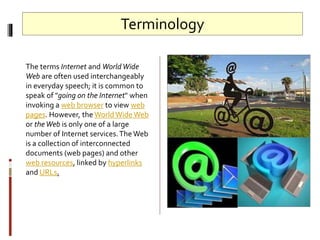
The terms Internet and WorldWide
Web are often used interchangeably
in everyday speech; it is common to
speak of "going on the Internet" when
invoking a web browser to view web
pages. However, the WorldWideWeb
or theWeb is only one of a large
number of Internet services.The Web
is a collection of interconnected
documents (web pages) and other
web resources, linked by hyperlinks
and URLs.
Communications Infrastructure Of The Internet
Routing And Service
Tiers
Structure
Access
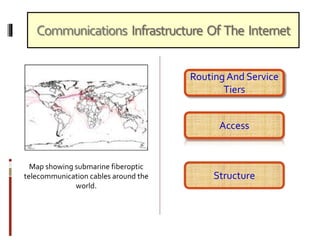
Map showing submarine fiberoptic
telecommunication cables around the
world.
Routing And ServiceTiers
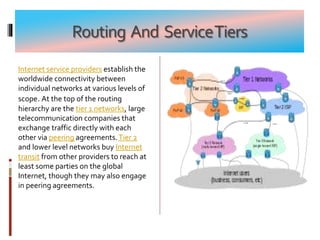
Internet service providers establish the
worldwide connectivity between
individual networks at various levels of
scope. At the top of the routing
hierarchy are the tier 1 networks, large
telecommunication companies that
exchange traffic directly with each
other via peering agreements.Tier 2
and lower level networks buy Internet
transit from other providers to reach at
least some parties on the global
Internet, though they may also engage
in peering agreements.
Access
Common methods of Internet
access by users include dial-up with
a computer modem via telephone
circuits, broadband over coaxial
cable, fibre optics or copper wires,
Wi-Fi, satellite and cellular
telephone technology (3G, 4G).The
Internet may often be accessed
from computers in libraries and
Internet cafes. Internet access
points exist in many public places
such as airport halls and coffee
shops.
Structure
Many computer scientists describe the
Internet as a "prime example of a large-
scale, highly engineered, yet highly
complex system".[The structure was
found to be highly robust to random
failures,]yet, very vulnerable to
intentional attacks.
The Internet structure and its usage
characteristics have been studied
extensively and the possibility of
developing alternative structures has
been investigated
Worldwide Internet Users
2005 2010 2014
World Population
6.5
Billion
6.9
Billion
7.2
Billion
Not Using The Internet 84% 70% 60%
Using The Internet 16% 30% 40%
Users In Developing
World
8% 21% 32%
Users In Developed
World
51% 67% 78%
History Of World Wide Web
Research into packet switching started in
the early 1960s,[15] and packet switched
networks such as the NPL network,[16]
ARPANET, CYCLADES, Merit Network,
Tymnet, andTelenet, were developed in
the late 1960s and 1970s using a variety
of protocols.[20] The ARPANET project
led to the development of protocols for
internetworking, by which multiple
separate networks could be joined into a
single network of networks.
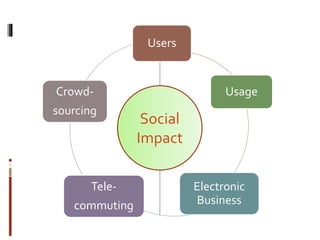
Users
Usage
Electronic
Business
Tele-
commuting
Crowd-
sourcing
Social
Impact
Users And Usage
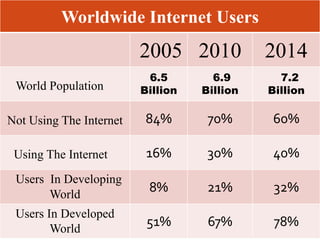
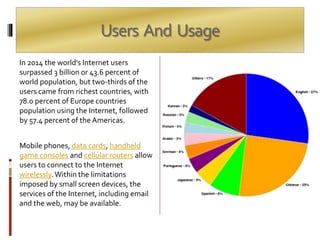
In 2014 the world's Internet users
surpassed 3 billion or 43.6 percent of
world population, but two-thirds of the
users came from richest countries, with
78.0 percent of Europe countries
population using the Internet, followed
by 57.4 percent of the Americas.
Mobile phones, data cards, handheld
game consoles and cellular routers allow
users to connect to the Internet
wirelessly.Within the limitations
imposed by small screen devices, the
services of the Internet, including email
and the web, may be available.
Electronic Business
Electronic business (e-business)
encompasses business processes
spanning the entire value chain:
purchasing, supply chain management,
marketing, sales, customer service, and
business relationship. E-commerce seeks
to add revenue streams using the
Internet to build and enhance
relationships with clients and partners.
A report by Oxford Economics adds
those two together to estimate the total
size of the digital economy at $20.4
trillion, equivalent to roughly 13.8% of
global sales
Telecommuting And Crowdsourcing
Telecommuting is the performance
within a traditional worker and employer
relationship when it is facilitated by tools
such as virtual private
networks,videoconferencing, and voice
over IP (VOIP) so that work may be
performed from any location.
The Internet provides a particularly good
venue for crowd sourcing, because
individuals tend to be more open in web-
based projects where they are not being
physically judged or scrutinized and thus
can feel more comfortable sharing.
Survillence
The vast majority of computer
surveillance involves the monitoring of
data and traffic on the Internet.[115] In the
United States for example, under the
Communications Assistance For Law
Enforcement Act, all phone calls and
broadband Internet traffic (emails, web
traffic, instant messaging, etc.) are
required to be available for unimpeded
real-time monitoring by Federal law
enforcement agencies.
Censorship
Some governments restrict access to
content on the Internet within their
territories, especially to political and
religious content, with domain name
and keyword filters.
In Norway, Denmark, Finland, and
Sweden, major Internet service
providers have voluntarily agreed to
restrict access to sites listed by
authorities.
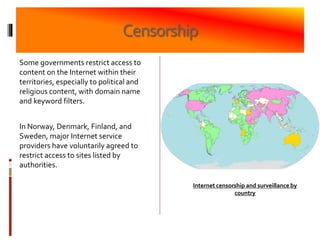
Internet censorship and surveillance by
country
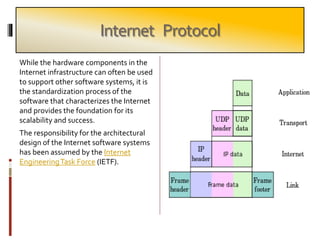
Internet Protocol
While the hardware components in the
Internet infrastructure can often be used
to support other software systems, it is
the standardization process of the
software that characterizes the Internet
and provides the foundation for its
scalability and success.
The responsibility for the architectural
design of the Internet software systems
has been assumed by the Internet
EngineeringTask Force (IETF).
Governing The Internet
The Internet is a global network
comprising many voluntarily
interconnected autonomous networks. It
operates without a central governing
body.
The technical underpinning and
standardization of the core protocols
(IPv4 and IPv6) is an activity of the IETF,
a non-profit organization that anyone
may associate with by contributing
technical expertise.
Internet

Internet

  • 2.
  • 4.
    Terminology The terms Internetand WorldWide Web are often used interchangeably in everyday speech; it is common to speak of "going on the Internet" when invoking a web browser to view web pages. However, the WorldWideWeb or theWeb is only one of a large number of Internet services.The Web is a collection of interconnected documents (web pages) and other web resources, linked by hyperlinks and URLs.
  • 6.
    Communications Infrastructure OfThe Internet Routing And Service Tiers Structure Access Map showing submarine fiberoptic telecommunication cables around the world.
  • 7.
    Routing And ServiceTiers Internetservice providers establish the worldwide connectivity between individual networks at various levels of scope. At the top of the routing hierarchy are the tier 1 networks, large telecommunication companies that exchange traffic directly with each other via peering agreements.Tier 2 and lower level networks buy Internet transit from other providers to reach at least some parties on the global Internet, though they may also engage in peering agreements.
  • 8.
    Access Common methods ofInternet access by users include dial-up with a computer modem via telephone circuits, broadband over coaxial cable, fibre optics or copper wires, Wi-Fi, satellite and cellular telephone technology (3G, 4G).The Internet may often be accessed from computers in libraries and Internet cafes. Internet access points exist in many public places such as airport halls and coffee shops.
  • 9.
    Structure Many computer scientistsdescribe the Internet as a "prime example of a large- scale, highly engineered, yet highly complex system".[The structure was found to be highly robust to random failures,]yet, very vulnerable to intentional attacks. The Internet structure and its usage characteristics have been studied extensively and the possibility of developing alternative structures has been investigated
  • 11.
    Worldwide Internet Users 20052010 2014 World Population 6.5 Billion 6.9 Billion 7.2 Billion Not Using The Internet 84% 70% 60% Using The Internet 16% 30% 40% Users In Developing World 8% 21% 32% Users In Developed World 51% 67% 78%
  • 12.
    History Of WorldWide Web Research into packet switching started in the early 1960s,[15] and packet switched networks such as the NPL network,[16] ARPANET, CYCLADES, Merit Network, Tymnet, andTelenet, were developed in the late 1960s and 1970s using a variety of protocols.[20] The ARPANET project led to the development of protocols for internetworking, by which multiple separate networks could be joined into a single network of networks.
  • 16.
  • 17.
    Users And Usage In2014 the world's Internet users surpassed 3 billion or 43.6 percent of world population, but two-thirds of the users came from richest countries, with 78.0 percent of Europe countries population using the Internet, followed by 57.4 percent of the Americas. Mobile phones, data cards, handheld game consoles and cellular routers allow users to connect to the Internet wirelessly.Within the limitations imposed by small screen devices, the services of the Internet, including email and the web, may be available.
  • 18.
    Electronic Business Electronic business(e-business) encompasses business processes spanning the entire value chain: purchasing, supply chain management, marketing, sales, customer service, and business relationship. E-commerce seeks to add revenue streams using the Internet to build and enhance relationships with clients and partners. A report by Oxford Economics adds those two together to estimate the total size of the digital economy at $20.4 trillion, equivalent to roughly 13.8% of global sales
  • 19.
    Telecommuting And Crowdsourcing Telecommutingis the performance within a traditional worker and employer relationship when it is facilitated by tools such as virtual private networks,videoconferencing, and voice over IP (VOIP) so that work may be performed from any location. The Internet provides a particularly good venue for crowd sourcing, because individuals tend to be more open in web- based projects where they are not being physically judged or scrutinized and thus can feel more comfortable sharing.
  • 21.
    Survillence The vast majorityof computer surveillance involves the monitoring of data and traffic on the Internet.[115] In the United States for example, under the Communications Assistance For Law Enforcement Act, all phone calls and broadband Internet traffic (emails, web traffic, instant messaging, etc.) are required to be available for unimpeded real-time monitoring by Federal law enforcement agencies.
  • 22.
    Censorship Some governments restrictaccess to content on the Internet within their territories, especially to political and religious content, with domain name and keyword filters. In Norway, Denmark, Finland, and Sweden, major Internet service providers have voluntarily agreed to restrict access to sites listed by authorities. Internet censorship and surveillance by country
  • 24.
    Internet Protocol While thehardware components in the Internet infrastructure can often be used to support other software systems, it is the standardization process of the software that characterizes the Internet and provides the foundation for its scalability and success. The responsibility for the architectural design of the Internet software systems has been assumed by the Internet EngineeringTask Force (IETF).
  • 26.
    Governing The Internet TheInternet is a global network comprising many voluntarily interconnected autonomous networks. It operates without a central governing body. The technical underpinning and standardization of the core protocols (IPv4 and IPv6) is an activity of the IETF, a non-profit organization that anyone may associate with by contributing technical expertise.