


BY : Nitesh Bhele (SIESCOMS)
   Paid,nonpersonal,public communication about caus
    es, goods and services, ideas, organizations,
    people, and places, through means such as direct
    mail, telephone, print, radio, television,
    and internet.

   An integral part of marketing, advertisements
    are public notices designed to inform and
    motivate. Their objective is to change the
    thinking pattern (or buying behavior) of
    the recipient, so that he or she is persuaded to
    take the action desired by the advertiser.
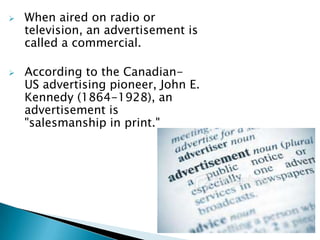
   When aired on radio or
    television, an advertisement is
    called a commercial.

   According to the Canadian-
    US advertising pioneer, John E.
    Kennedy (1864-1928), an
    advertisement is
    "salesmanship in print."
   For the economy as a whole, about 2 percent
    of total firm revenue is spent on advertising.

   Firms that sell highly differentiated consumer
    goods, such as over-the-counter drugs,
    perfumes, soft drinks, razor blades, breakfast
    cereals, and dog food, typically spend
    between 10 and 20 percent of revenue for
    advertising.
   Firms that sell industrial products, such as drill
    presses     and    communications        satellites,
    typically spend very little on advertising.

   Firms that sell homogeneous products, such as
    wheat, peanuts, or crude oil, spend nothing at
    all.

   This spending takes many forms, including
    commercials on television and radio, space in
    newspapers and magazines, direct mail, the
    yellow pages, billboards, and ads on websites.
   Although advertisement is considered to be
    the most important medium of spreading
    awareness of desired product among the
    target customer there is some debate in the
    case of advertisement among the economist.

   This can be evaluated by discussing both
    sides i.e critics as well as defense of
    advertisement.
   Critics of advertising argue that firms
    advertise to manipulate people’s tastes. Much
    advertising is psychological rather than
    informational.

   Critics also argue that advertising impedes
    competition. Advertising often tries to
    convince consumers that products are more
    different than they truly are.
   By increasing the perception of product
    differentiation and fostering brand loyalty,
    advertising makes buyers less concerned with
    price differences among similar goods.

   With a less elastic demand curve, each firm
    charges a larger markup over marginal cost.
   Defenders of advertising argue that firms use
    advertising to provide information to
    customers.
   Advertising conveys the prices of the goods
    offered for sale, the existence of new
    products, and the locations of retail outlets.
    This information allows customers to make
    better choices about what to buy and, thus,
    enhances the ability of markets to allocate
    resources efficiently.
   Advertising allows new firms to enter more
    easily because it gives entrants a means to
    attract customers from existing firms.

   Over time, policymakers have come to accept
    the view that advertising can make markets
    more competitive. One important example is
    the regulation of advertising for certain
    professions, such as lawyers, doctors, and
    pharmacists.
Advertisement economics

Advertisement economics

  • 1.
    BY : NiteshBhele (SIESCOMS)
  • 2.
    Paid,nonpersonal,public communication about caus es, goods and services, ideas, organizations, people, and places, through means such as direct mail, telephone, print, radio, television, and internet.  An integral part of marketing, advertisements are public notices designed to inform and motivate. Their objective is to change the thinking pattern (or buying behavior) of the recipient, so that he or she is persuaded to take the action desired by the advertiser.
  • 3.
    When aired on radio or television, an advertisement is called a commercial.  According to the Canadian- US advertising pioneer, John E. Kennedy (1864-1928), an advertisement is "salesmanship in print."
  • 4.
    For the economy as a whole, about 2 percent of total firm revenue is spent on advertising.  Firms that sell highly differentiated consumer goods, such as over-the-counter drugs, perfumes, soft drinks, razor blades, breakfast cereals, and dog food, typically spend between 10 and 20 percent of revenue for advertising.
  • 5.
    Firms that sell industrial products, such as drill presses and communications satellites, typically spend very little on advertising.  Firms that sell homogeneous products, such as wheat, peanuts, or crude oil, spend nothing at all.  This spending takes many forms, including commercials on television and radio, space in newspapers and magazines, direct mail, the yellow pages, billboards, and ads on websites.
  • 6.
    Although advertisement is considered to be the most important medium of spreading awareness of desired product among the target customer there is some debate in the case of advertisement among the economist.  This can be evaluated by discussing both sides i.e critics as well as defense of advertisement.
  • 7.
    Critics of advertising argue that firms advertise to manipulate people’s tastes. Much advertising is psychological rather than informational.  Critics also argue that advertising impedes competition. Advertising often tries to convince consumers that products are more different than they truly are.
  • 8.
    By increasing the perception of product differentiation and fostering brand loyalty, advertising makes buyers less concerned with price differences among similar goods.  With a less elastic demand curve, each firm charges a larger markup over marginal cost.
  • 9.
    Defenders of advertising argue that firms use advertising to provide information to customers.  Advertising conveys the prices of the goods offered for sale, the existence of new products, and the locations of retail outlets. This information allows customers to make better choices about what to buy and, thus, enhances the ability of markets to allocate resources efficiently.
  • 10.
    Advertising allows new firms to enter more easily because it gives entrants a means to attract customers from existing firms.  Over time, policymakers have come to accept the view that advertising can make markets more competitive. One important example is the regulation of advertising for certain professions, such as lawyers, doctors, and pharmacists.