
6/30/2020 Audit of Internal
Financial Control
over Financial
Reporting (IFCR)
A complete guide
CA TAUFIR ALAM
TRUEADVISERS
Contents
BRIEF BACKGROUNDOF THE ENVIRONMENT
Internal Financial Control
Internal Financial Control over Financial Reporting-IFCR
IFC to IFCR for Auditors
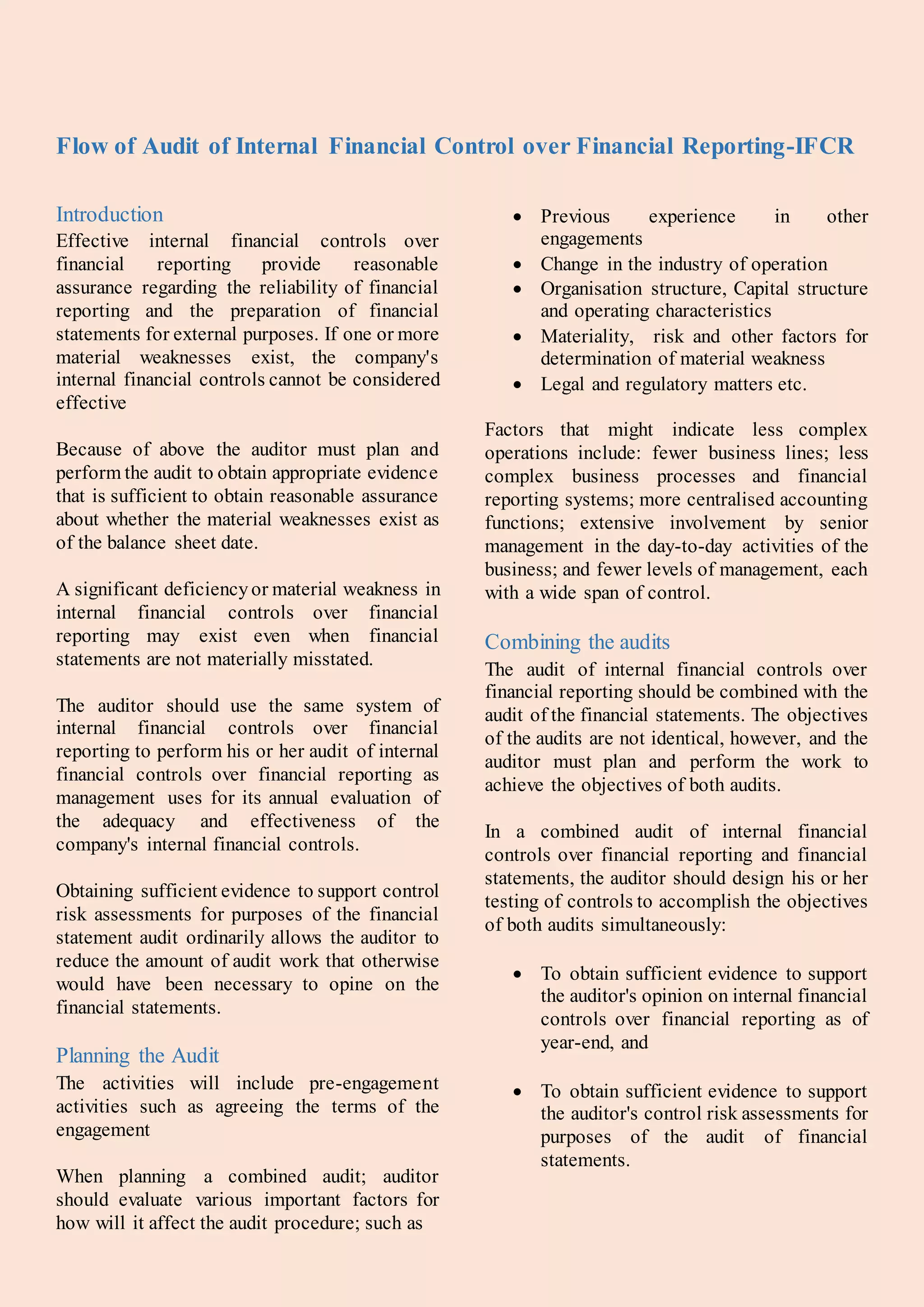
Flow of Audit of Internal Financial Control over Financial Reporting-IFCR
Introduction
Planning the Audit
Combining the audits
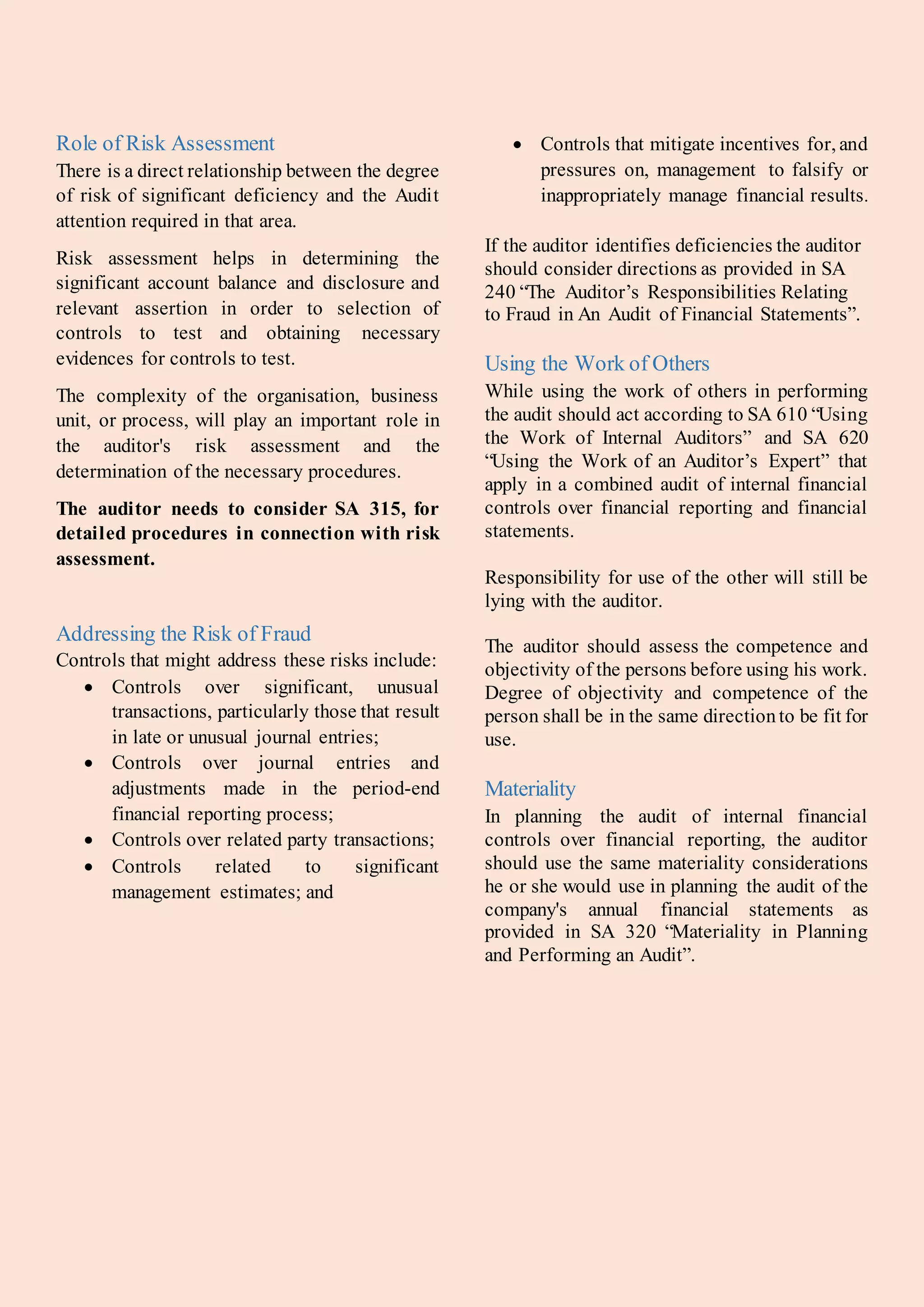
Role of Risk Assessment
Addressing the Risk of Fraud
Using the Work of Others
Materiality
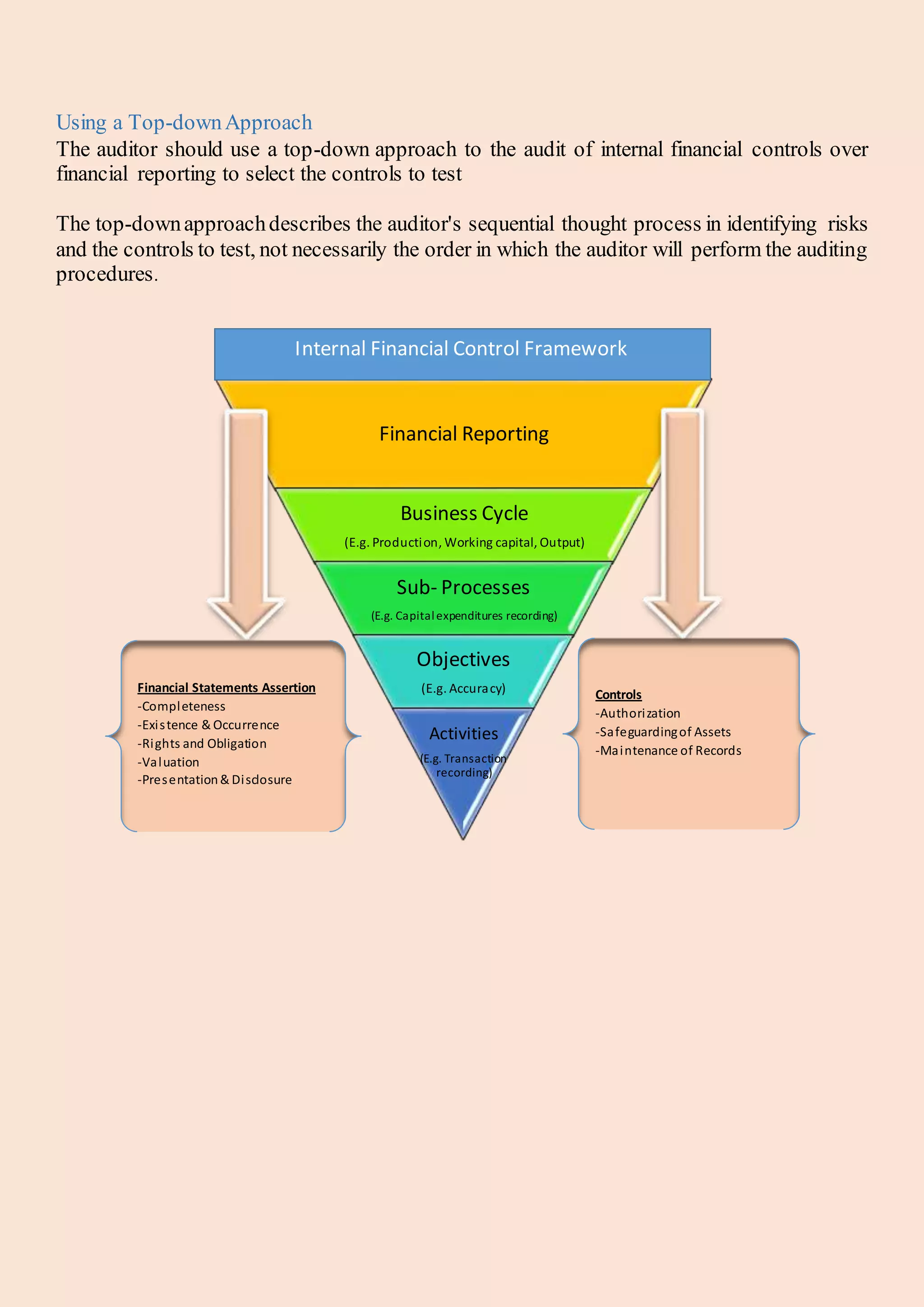
Using a Top-down Approach
Typical Flow ofAudit of Internal Financial Controls over Financial Reporting
AuditFlowDiagram
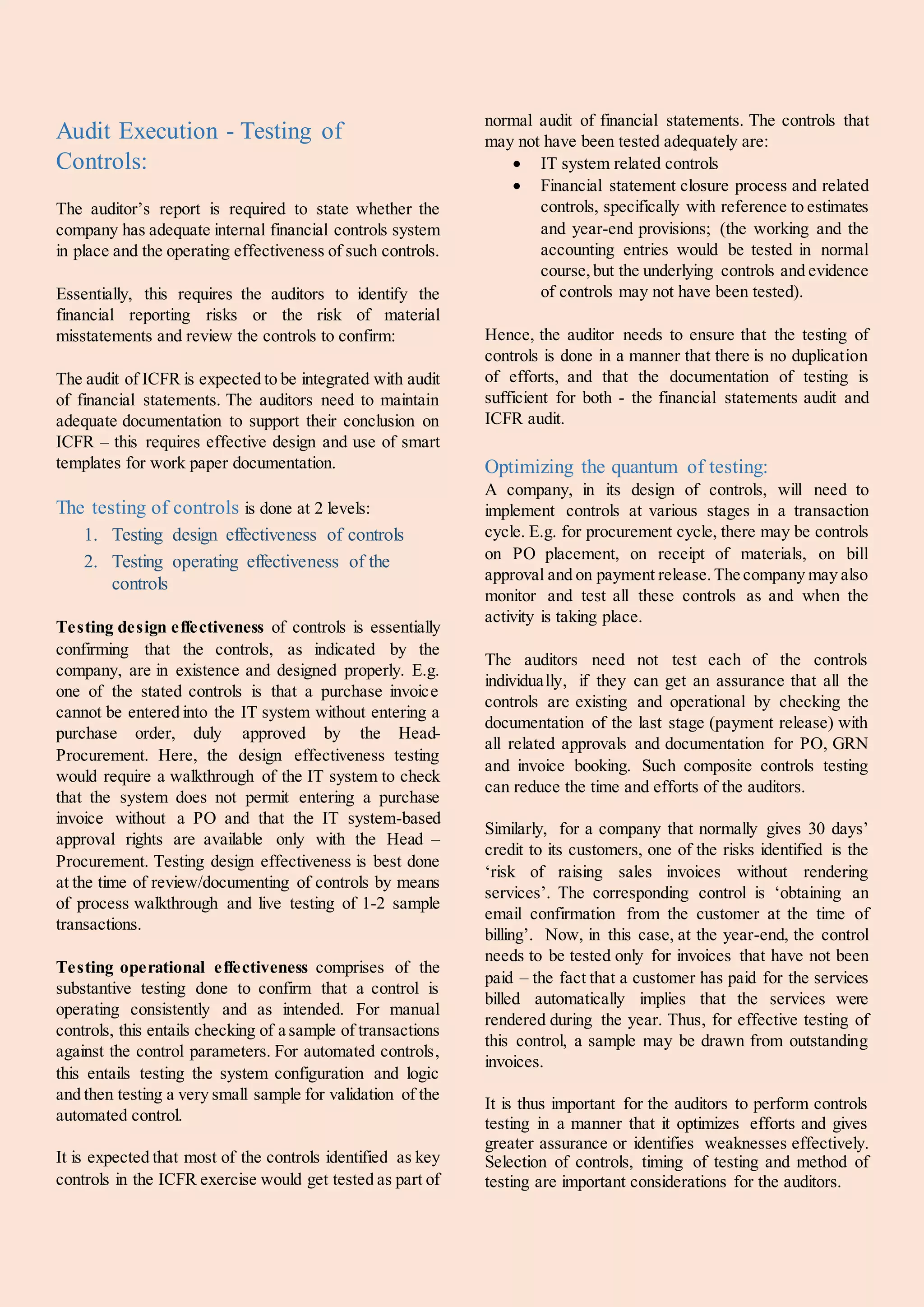
Audit Execution - Testing of Controls:
The testing of controls
1. Testing design effectiveness of controls
2. Testing operating effectiveness of the controls
Optimizing the quantum of testing:
Risk Control Matrix
1. Control Environments
2. Entity’s Risk Assessment Process
3. Control Activities Information System and Communication
4. Monitoring of Controls
Making it easy-Ready to use drafts and formats for Risk and Control Matrix (RCM)
Entity level Control Matrix:- Areas of controls Testing ANNEXURE-I
IT General Control Matrix:- Areasof controls Testing ANNEXURE-II
Specimen-FS Closure Policy & Sample Check List;
Activity wise preplanning & closure-Annexure-III
Preparation of FS-Annexure-IV
Disclosures& NTA-Annexure-V
Illustrative List of Risks of Material Misstatement - Control Objectives - Control Activities
Appendix-IVtothe SA-315
Table of contentsfor the Appendix
Illustrative Work-paperTemplate for Testing ROMM and Performing Walkthroughs
BRIEF BACKGROUND OF THE ENVIRONMENT
Internal Financial Control Internal Financial Control over
Financial Reporting-IFCR
Clause (e) of Sub-section 5 of Section 134 explains the
meaning of the term, “internal financial controls” as the
policies and procedures adopted by the company for
ensuring;
ICAI Guidance note says; (Definition taken from
AS-5 issued by PCAOB),IFCR includes those
polices & procedures that pertains to:
the orderlyandefficient conduct of its
business,
adherence to management policies,
the safeguarding of assets,
the prevention and detectionof fraud
and error,
the accuracyand completeness of the
accounting records, and
the timelypreparationof reliable financial
information.
Maintenanceofrecord
Transaction arerecorded
Prevention andtimely
detection ofunauthorised
acquisition, useand
dispositionofCompanies
assets
•In reasonably detailed
•Accurately
•Fairly reflects txn &
disposition of
companies assets
•With necessarydetails
to permit preparation
of FS+IGAAP
•Receipts & Payments
are dulyauthorised
•that could have
material effect onthe
financial statements
IFC
Fraud
prevention
Operational
controls IFCoFR
Applicability of IFCR
Reporting by Auditors
Applicable to all Co. except
Exemptedby
notification
issuedbyMCA
# Small Co/OPC-Clause-2 of the notification
# T/O < Rs.50 Cr or Borrowing<Rs.25 Cr as
per LAFS
# Defaultin filingannual return for last3
years u/s-137 or u/s-92-Clause 2A of
the notification
A process
designed to
provide
reasonable
assurance
regarding the
reliability of
financial
Reporting and
the preparation
of financial
statements for;
External
Purposes
+IGAAP
IFC to IFCR for Auditors
Section 143(3)(i) of the
Companies Act, 2013 (“the
2013 Act” or “the
Act”) requires the auditors’
report to state whether the
company has adequate
internal financial controls
system in place and the
operating effectiveness of
such controls.
Globally, auditor’s
reporting on internal
controls is together with the
reporting on the financial
Statements and such
internal controls reported
upon relate to only internal
controls over financial
Reporting. For example, in
USA, Section 404 of the
Sarbanes Oxley Act of 2002,
prescribes that the
registered public
accounting firm (auditor) of
the specified class of issuers
(companies) shall, in
addition to the attestation of
the financial statements,
also attest the internal
controls over financial
reporting.
Further, Rule 8(5)(viii) of
the Companies (Accounts)
Rules, 2014 requires the
Board of Directors’ report
of all the companies to state
the details in respect of
adequacy of internal
financial controls with
reference to the “financial
statements” only
Considering the above the
auditor need to report on
Internal Financial control
over financial report only
Flow of Audit of Internal Financial Control over Financial Reporting-IFCR
Introduction
Effective internal financial controls over
financial reporting provide reasonable
assurance regarding the reliability of financial
reporting and the preparation of financial
statements for external purposes. If one or more
material weaknesses exist, the company's
internal financial controls cannot be considered
effective
Because of above the auditor must plan and
perform the audit to obtain appropriate evidence
that is sufficient to obtain reasonable assurance
about whether the material weaknesses exist as
of the balance sheet date.
A significant deficiencyor material weakness in
internal financial controls over financial
reporting may exist even when financial
statements are not materially misstated.
The auditor should use the same system of
internal financial controls over financial
reporting to perform his or her audit of internal
financial controls over financial reporting as
management uses for its annual evaluation of
the adequacy and effectiveness of the
company's internal financial controls.
Obtaining sufficient evidence to support control
risk assessments for purposes of the financial
statement audit ordinarily allows the auditor to
reduce the amount of audit work that otherwise
would have been necessary to opine on the
financial statements.
Planning the Audit
The activities will include pre-engagement
activities such as agreeing the terms of the
engagement
When planning a combined audit; auditor
should evaluate various important factors for
how will it affect the audit procedure; such as
 Previous experience in other
engagements
 Change in the industry of operation
 Organisation structure, Capital structure
and operating characteristics
 Materiality, risk and other factors for
determination of material weakness
 Legal and regulatory matters etc.
Factors that might indicate less complex
operations include: fewer business lines; less
complex business processes and financial
reporting systems; more centralised accounting
functions; extensive involvement by senior
management in the day-to-day activities of the
business; and fewer levels of management, each
with a wide span of control.
Combining the audits
The audit of internal financial controls over
financial reporting should be combined with the
audit of the financial statements. The objectives
of the audits are not identical, however, and the
auditor must plan and perform the work to
achieve the objectives of both audits.
In a combined audit of internal financial
controls over financial reporting and financial
statements, the auditor should design his or her
testing of controls to accomplish the objectives
of both audits simultaneously:
 To obtain sufficient evidence to support
the auditor's opinion on internal financial
controls over financial reporting as of
year-end, and
 To obtain sufficient evidence to support
the auditor's control risk assessments for
purposes of the audit of financial
statements.
Role of Risk Assessment
There is a direct relationship between the degree
of risk of significant deficiency and the Audit
attention required in that area.
Risk assessment helps in determining the
significant account balance and disclosure and
relevant assertion in order to selection of
controls to test and obtaining necessary
evidences for controls to test.
The complexity of the organisation, business
unit, or process, will play an important role in
the auditor's risk assessment and the
determination of the necessary procedures.
The auditor needs to consider SA 315, for
detailed procedures in connection with risk
assessment.
Addressing the Risk of Fraud
Controls that might address these risks include:
 Controls over significant, unusual
transactions, particularly those that result
in late or unusual journal entries;
 Controls over journal entries and
adjustments made in the period-end
financial reporting process;
 Controls over related party transactions;
 Controls related to significant
management estimates; and
 Controls that mitigate incentives for, and
pressures on, management to falsify or
inappropriately manage financial results.
If the auditor identifies deficiencies the auditor
should consider directions as provided in SA
240 “The Auditor’s Responsibilities Relating
to Fraud in An Audit of Financial Statements”.
Using the Work of Others
While using the work of others in performing
the audit should act according to SA 610 “Using
the Work of Internal Auditors” and SA 620
“Using the Work of an Auditor’s Expert” that
apply in a combined audit of internal financial
controls over financial reporting and financial
statements.
Responsibility for use of the other will still be
lying with the auditor.
The auditor should assess the competence and
objectivity of the persons before using his work.
Degree of objectivity and competence of the
person shall be in the same directionto be fit for
use.
Materiality
In planning the audit of internal financial
controls over financial reporting, the auditor
should use the same materiality considerations
he or she would use in planning the audit of the
company's annual financial statements as
provided in SA 320 “Materiality in Planning
and Performing an Audit”.
Using a Top-downApproach
The auditor should use a top-down approach to the audit of internal financial controls over
financial reporting to select the controls to test
The top-downapproachdescribes the auditor's sequential thought process in identifying risks
and the controls to test, not necessarily the order in which the auditor will perform the auditing
procedures.
Financial Reporting
Business Cycle
(E.g. Production, Working capital, Output)
Sub- Processes
(E.g. Capitalexpenditures recording)
Objectives
(E.g. Accuracy)
Activities
(E.g. Transaction
recording)
Financial Statements Assertion
-Completeness
-Existence & Occurrence
-Rights and Obligation
-Valuation
-Presentation& Disclosure
Controls
-Authorization
-Safeguardingof Assets
-Maintenance of Records
Internal Financial Control Framework
Typical Flow of Audit of Internal Financial Controls over Financial
Reporting
Audit Flow Diagram
A.
P L A N N I N G
• START
• 1. Identify signifcant
account balance and
disclosure items
• 2. Identify and
understand
significant flow of
transaction
• 3. Identify risk of
material
misstatements
• 4. Identify controls
which address risk
of material
misstatements
• 5. Identify
applications,
associated IT
environment, ITGC
B.
D E S I G N &
IMPLIMENTATION
• 6. Assess the design
of controls
• 7. Assess the
Implementation of
controls
• Appropriate design
& Implementation
of controls?
• 8. YES- Plan
operative
effectiveness
testing
• 9. NO- Assess
audit impact and
plan other suitable
procedures
C.
O P E R A T I NG
EFFECTIVENESS
• 10. Plan nature,
timing and extent
of testing
operative
effectiveness
• 11. Perform
operative
effectiveness
testing
• 12. Assess findings
and conclude on
operative
effectiveness
• 13. Form opinion
on IFC
D.
R E P O R T IN G
• 14. Assess impact
on audit opinion
• 15. Form audit
opinion on
financial
statements
• END
A. B. C. D.
OrderoftheprocessofAuditforeachphasesi.e.,A,B,CandDabove
Audit Execution - Testing of
Controls:
The auditor’s report is required to state whether the
company has adequate internal financial controls system
in place and the operating effectiveness of such controls.
Essentially, this requires the auditors to identify the
financial reporting risks or the risk of material
misstatements and review the controls to confirm:
The audit of ICFR is expected to be integrated with audit
of financial statements. The auditors need to maintain
adequate documentation to support their conclusion on
ICFR – this requires effective design and use of smart
templates for work paper documentation.
The testing of controls is done at 2 levels:
1. Testing design effectiveness of controls
2. Testing operating effectiveness of the
controls
Testing design effectiveness of controls is essentially
confirming that the controls, as indicated by the
company, are in existence and designed properly. E.g.
one of the stated controls is that a purchase invoice
cannot be entered into the IT system without entering a
purchase order, duly approved by the Head-
Procurement. Here, the design effectiveness testing
would require a walkthrough of the IT system to check
that the system does not permit entering a purchase
invoice without a PO and that the IT system-based
approval rights are available only with the Head –
Procurement. Testing design effectiveness is best done
at the time of review/documenting of controls by means
of process walkthrough and live testing of 1-2 sample
transactions.
Testing operational effectiveness comprises of the
substantive testing done to confirm that a control is
operating consistently and as intended. For manual
controls, this entails checking of a sample of transactions
against the control parameters. For automated controls,
this entails testing the system configuration and logic
and then testing a very small sample for validation of the
automated control.
It is expected that most of the controls identified as key
controls in the ICFR exercise would get tested as part of
normal audit of financial statements. The controls that
may not have been tested adequately are:
 IT system related controls
 Financial statement closure process and related
controls, specifically with reference to estimates
and year-end provisions; (the working and the
accounting entries would be tested in normal
course,but the underlying controls and evidence
of controls may not have been tested).
Hence, the auditor needs to ensure that the testing of
controls is done in a manner that there is no duplication
of efforts, and that the documentation of testing is
sufficient for both - the financial statements audit and
ICFR audit.
Optimizing the quantum of testing:
A company, in its design of controls, will need to
implement controls at various stages in a transaction
cycle. E.g. for procurement cycle, there may be controls
on PO placement, on receipt of materials, on bill
approval and on payment release.The company may also
monitor and test all these controls as and when the
activity is taking place.
The auditors need not test each of the controls
individually, if they can get an assurance that all the
controls are existing and operational by checking the
documentation of the last stage (payment release) with
all related approvals and documentation for PO, GRN
and invoice booking. Such composite controls testing
can reduce the time and efforts of the auditors.
Similarly, for a company that normally gives 30 days’
credit to its customers, one of the risks identified is the
‘risk of raising sales invoices without rendering
services’. The corresponding control is ‘obtaining an
email confirmation from the customer at the time of
billing’. Now, in this case, at the year-end, the control
needs to be tested only for invoices that have not been
paid – the fact that a customer has paid for the services
billed automatically implies that the services were
rendered during the year. Thus, for effective testing of
this control, a sample may be drawn from outstanding
invoices.
It is thus important for the auditors to perform controls
testing in a manner that it optimizes efforts and gives
greater assurance or identifies weaknesses effectively.
Selection of controls, timing of testing and method of
testing are important considerations for the auditors.
Risk Control Matrix
The risk control matrix (RCM) is a matrix for the risks existing in the process and the controls that mitigate the risks.
The RCM populates the risk and the control sub process wise. The RCM,as we understand it are being given separately
to the management.
The risks are identified based on the “as is process” which is mapped in the process flow. The risks are populated based
on “What can go wrong in the process”. Since our examination focuses on internal financial control over financial
reporting (IFC-FR), the risks which are in the nature of regulatory and/or financial, and can potentially affect financial
reporting, have been identified and evaluated.
According to the risks identified, the controls required for mitigating the same were informed by the respective process
owners. In case there was no suitable control for the risk identified or the controls seemed to us to be inadequate, the
same was considered as design deficiency.
The RCM outlines the control mechanism based on the description of the control. The control frequency is one of the
items based on which the controls are tested. According to the walkthrough carried out, the control is either effective or
ineffective based on the availability / unavailability of evidence in the sample tested by our team.
A Risk Control Matrix (RCM) refers to a tool used for documentation of risks and controls in a structured manner, on a
standard template. An RCM prepared for ICFR documentation generally provides the following details:
1. Process and sub-process name
2. Risk description
3. Characteristics of risk in terms of fraud risk, risk level, etc.
4. Control description
5. Nature of control – preventive/ detective, manual/ automated, frequency of control, etc.
6. Evidence of control
7. Result of design testing
8. Result of testing operational effectiveness.
The Risk matrix is prepared based on the benchmark set under SA-315 for Components of Internal Controls
1. Control Environments
2. Entity’s Risk Assessment Process
3. Control Activities Information System and Communication
4. Monitoring of Controls
Making it easy-Ready to use drafts and formats for Risk and Control Matrix
(RCM)
Entity level Control Matrix:- Areas of controls Testing ANNEXURE-I
IT General Control Matrix:- Areas of controls Testing ANNEXURE-II
Specimen-FS Closure Policy & Sample Check List;
Activity wise preplanning & closure-Annexure-III
Preparation of FS-Annexure-IV
Disclosures & NTA-Annexure-V
Click to open
Illustrative List of Risks of Material Misstatement - Control Objectives -
Control Activities
Appendix-IV to the SA-315
Appendix IV -
RoMM Control Objectives and Control Activities.doc
This appendix has been developed to provide guidance and examples to assist in identifying risks of material
misstatement at the assertion level and relevant controls that may address the applicable risks of material misstatement.
For each class of transactions and account balance, risks of material misstatement and relevant controls are divided into
two categories: “Core Risks and Controls,” which may be applicable for normal risks of material misstatement on most
entities, and “Other Possible Risks and Controls,” which may or may not be applicable
This appendix will assist in the identification of relevant controls that may address the applicable risks of material
misstatement. This includes specific application or general IT controls.
This appendix also illustrates the risk of material misstatement and the control related to the risk that is likely to be
reflected in the Other Affected Accounts
Table of contents for the Appendix
Cash/Bank Balances Error! Bookmark not defined.
Prepaid Expenses Error! Bookmark not defined.
Trade receivables Error! Bookmark not defined.
Inventory Error! Bookmark not defined.
Goodwill and Intangible Assets Error! Bookmark not
defined.
Trade payables Error! Bookmark not defined.
Provision for expenses Error! Bookmark not defined.
Loans/Borrowings Error! Bookmark not defined.
Employee Benefits Error! Bookmark not defined.
Income Taxes Error! Bookmark not defined.
Deferred Taxes Error! Bookmark not defined.
Provision for Income taxes/ Advance Income taxes
Error! Bookmark not defined.
Provision for Income taxes/ Advance Income taxes
Error! Bookmark not defined.
Share Capital and Reserves and Surplus Error!
Bookmark not defined.
Revenue from Operations Error! Bookmark not
defined.
Cost of Sales Error! Bookmark not defined.
Depreciation/Amortisation and Other Expenses Error!
Bookmark not defined.
Finance Cost Error! Bookmark not defined.
Illustrative Work-paper Template for Testing ROMM and Performing
Walkthroughs
This template has been developed to provide illustrative examples to assist the auditors in addressing the Risks of
Material Misstatement (ROMM) for material classes of transactions and account balances. The pre-populated risks of
material misstatement (i.e., "what could go wrong") and relevant control activities included within this template are
derived from Appendix IV "Illustrative Risks of Material Misstatement, Related Control Objectives and Control
Activities" of the Guidance Note on Audit of Internal Financial Controls Over Financial Reporting. The substantive
procedures responsive to the risks identified are also illustrative.
Click to Open
Illustrative
Work-paper Template for Testing ROMM and Performing Walkthroughs.xlsx
2
Click to Open

Audit of Internal Financial Control over Financial Reporting (IFCR) A complete guide

  • 1.
    6/30/2020 Audit ofInternal Financial Control over Financial Reporting (IFCR) A complete guide CA TAUFIR ALAM TRUEADVISERS
  • 2.
    Contents BRIEF BACKGROUNDOF THEENVIRONMENT Internal Financial Control Internal Financial Control over Financial Reporting-IFCR IFC to IFCR for Auditors Flow of Audit of Internal Financial Control over Financial Reporting-IFCR Introduction Planning the Audit Combining the audits Role of Risk Assessment Addressing the Risk of Fraud Using the Work of Others Materiality Using a Top-down Approach Typical Flow ofAudit of Internal Financial Controls over Financial Reporting AuditFlowDiagram Audit Execution - Testing of Controls: The testing of controls 1. Testing design effectiveness of controls 2. Testing operating effectiveness of the controls Optimizing the quantum of testing: Risk Control Matrix 1. Control Environments 2. Entity’s Risk Assessment Process 3. Control Activities Information System and Communication 4. Monitoring of Controls Making it easy-Ready to use drafts and formats for Risk and Control Matrix (RCM) Entity level Control Matrix:- Areas of controls Testing ANNEXURE-I IT General Control Matrix:- Areasof controls Testing ANNEXURE-II Specimen-FS Closure Policy & Sample Check List; Activity wise preplanning & closure-Annexure-III Preparation of FS-Annexure-IV Disclosures& NTA-Annexure-V Illustrative List of Risks of Material Misstatement - Control Objectives - Control Activities Appendix-IVtothe SA-315 Table of contentsfor the Appendix Illustrative Work-paperTemplate for Testing ROMM and Performing Walkthroughs
  • 3.
    BRIEF BACKGROUND OFTHE ENVIRONMENT Internal Financial Control Internal Financial Control over Financial Reporting-IFCR Clause (e) of Sub-section 5 of Section 134 explains the meaning of the term, “internal financial controls” as the policies and procedures adopted by the company for ensuring; ICAI Guidance note says; (Definition taken from AS-5 issued by PCAOB),IFCR includes those polices & procedures that pertains to: the orderlyandefficient conduct of its business, adherence to management policies, the safeguarding of assets, the prevention and detectionof fraud and error, the accuracyand completeness of the accounting records, and the timelypreparationof reliable financial information. Maintenanceofrecord Transaction arerecorded Prevention andtimely detection ofunauthorised acquisition, useand dispositionofCompanies assets •In reasonably detailed •Accurately •Fairly reflects txn & disposition of companies assets •With necessarydetails to permit preparation of FS+IGAAP •Receipts & Payments are dulyauthorised •that could have material effect onthe financial statements IFC Fraud prevention Operational controls IFCoFR Applicability of IFCR Reporting by Auditors Applicable to all Co. except Exemptedby notification issuedbyMCA # Small Co/OPC-Clause-2 of the notification # T/O < Rs.50 Cr or Borrowing<Rs.25 Cr as per LAFS # Defaultin filingannual return for last3 years u/s-137 or u/s-92-Clause 2A of the notification A process designed to provide reasonable assurance regarding the reliability of financial Reporting and the preparation of financial statements for; External Purposes +IGAAP
  • 4.
    IFC to IFCRfor Auditors Section 143(3)(i) of the Companies Act, 2013 (“the 2013 Act” or “the Act”) requires the auditors’ report to state whether the company has adequate internal financial controls system in place and the operating effectiveness of such controls. Globally, auditor’s reporting on internal controls is together with the reporting on the financial Statements and such internal controls reported upon relate to only internal controls over financial Reporting. For example, in USA, Section 404 of the Sarbanes Oxley Act of 2002, prescribes that the registered public accounting firm (auditor) of the specified class of issuers (companies) shall, in addition to the attestation of the financial statements, also attest the internal controls over financial reporting. Further, Rule 8(5)(viii) of the Companies (Accounts) Rules, 2014 requires the Board of Directors’ report of all the companies to state the details in respect of adequacy of internal financial controls with reference to the “financial statements” only Considering the above the auditor need to report on Internal Financial control over financial report only
  • 5.
    Flow of Auditof Internal Financial Control over Financial Reporting-IFCR Introduction Effective internal financial controls over financial reporting provide reasonable assurance regarding the reliability of financial reporting and the preparation of financial statements for external purposes. If one or more material weaknesses exist, the company's internal financial controls cannot be considered effective Because of above the auditor must plan and perform the audit to obtain appropriate evidence that is sufficient to obtain reasonable assurance about whether the material weaknesses exist as of the balance sheet date. A significant deficiencyor material weakness in internal financial controls over financial reporting may exist even when financial statements are not materially misstated. The auditor should use the same system of internal financial controls over financial reporting to perform his or her audit of internal financial controls over financial reporting as management uses for its annual evaluation of the adequacy and effectiveness of the company's internal financial controls. Obtaining sufficient evidence to support control risk assessments for purposes of the financial statement audit ordinarily allows the auditor to reduce the amount of audit work that otherwise would have been necessary to opine on the financial statements. Planning the Audit The activities will include pre-engagement activities such as agreeing the terms of the engagement When planning a combined audit; auditor should evaluate various important factors for how will it affect the audit procedure; such as  Previous experience in other engagements  Change in the industry of operation  Organisation structure, Capital structure and operating characteristics  Materiality, risk and other factors for determination of material weakness  Legal and regulatory matters etc. Factors that might indicate less complex operations include: fewer business lines; less complex business processes and financial reporting systems; more centralised accounting functions; extensive involvement by senior management in the day-to-day activities of the business; and fewer levels of management, each with a wide span of control. Combining the audits The audit of internal financial controls over financial reporting should be combined with the audit of the financial statements. The objectives of the audits are not identical, however, and the auditor must plan and perform the work to achieve the objectives of both audits. In a combined audit of internal financial controls over financial reporting and financial statements, the auditor should design his or her testing of controls to accomplish the objectives of both audits simultaneously:  To obtain sufficient evidence to support the auditor's opinion on internal financial controls over financial reporting as of year-end, and  To obtain sufficient evidence to support the auditor's control risk assessments for purposes of the audit of financial statements.
  • 6.
    Role of RiskAssessment There is a direct relationship between the degree of risk of significant deficiency and the Audit attention required in that area. Risk assessment helps in determining the significant account balance and disclosure and relevant assertion in order to selection of controls to test and obtaining necessary evidences for controls to test. The complexity of the organisation, business unit, or process, will play an important role in the auditor's risk assessment and the determination of the necessary procedures. The auditor needs to consider SA 315, for detailed procedures in connection with risk assessment. Addressing the Risk of Fraud Controls that might address these risks include:  Controls over significant, unusual transactions, particularly those that result in late or unusual journal entries;  Controls over journal entries and adjustments made in the period-end financial reporting process;  Controls over related party transactions;  Controls related to significant management estimates; and  Controls that mitigate incentives for, and pressures on, management to falsify or inappropriately manage financial results. If the auditor identifies deficiencies the auditor should consider directions as provided in SA 240 “The Auditor’s Responsibilities Relating to Fraud in An Audit of Financial Statements”. Using the Work of Others While using the work of others in performing the audit should act according to SA 610 “Using the Work of Internal Auditors” and SA 620 “Using the Work of an Auditor’s Expert” that apply in a combined audit of internal financial controls over financial reporting and financial statements. Responsibility for use of the other will still be lying with the auditor. The auditor should assess the competence and objectivity of the persons before using his work. Degree of objectivity and competence of the person shall be in the same directionto be fit for use. Materiality In planning the audit of internal financial controls over financial reporting, the auditor should use the same materiality considerations he or she would use in planning the audit of the company's annual financial statements as provided in SA 320 “Materiality in Planning and Performing an Audit”.
  • 7.
    Using a Top-downApproach Theauditor should use a top-down approach to the audit of internal financial controls over financial reporting to select the controls to test The top-downapproachdescribes the auditor's sequential thought process in identifying risks and the controls to test, not necessarily the order in which the auditor will perform the auditing procedures. Financial Reporting Business Cycle (E.g. Production, Working capital, Output) Sub- Processes (E.g. Capitalexpenditures recording) Objectives (E.g. Accuracy) Activities (E.g. Transaction recording) Financial Statements Assertion -Completeness -Existence & Occurrence -Rights and Obligation -Valuation -Presentation& Disclosure Controls -Authorization -Safeguardingof Assets -Maintenance of Records Internal Financial Control Framework
  • 8.
    Typical Flow ofAudit of Internal Financial Controls over Financial Reporting Audit Flow Diagram A. P L A N N I N G • START • 1. Identify signifcant account balance and disclosure items • 2. Identify and understand significant flow of transaction • 3. Identify risk of material misstatements • 4. Identify controls which address risk of material misstatements • 5. Identify applications, associated IT environment, ITGC B. D E S I G N & IMPLIMENTATION • 6. Assess the design of controls • 7. Assess the Implementation of controls • Appropriate design & Implementation of controls? • 8. YES- Plan operative effectiveness testing • 9. NO- Assess audit impact and plan other suitable procedures C. O P E R A T I NG EFFECTIVENESS • 10. Plan nature, timing and extent of testing operative effectiveness • 11. Perform operative effectiveness testing • 12. Assess findings and conclude on operative effectiveness • 13. Form opinion on IFC D. R E P O R T IN G • 14. Assess impact on audit opinion • 15. Form audit opinion on financial statements • END A. B. C. D. OrderoftheprocessofAuditforeachphasesi.e.,A,B,CandDabove
  • 9.
    Audit Execution -Testing of Controls: The auditor’s report is required to state whether the company has adequate internal financial controls system in place and the operating effectiveness of such controls. Essentially, this requires the auditors to identify the financial reporting risks or the risk of material misstatements and review the controls to confirm: The audit of ICFR is expected to be integrated with audit of financial statements. The auditors need to maintain adequate documentation to support their conclusion on ICFR – this requires effective design and use of smart templates for work paper documentation. The testing of controls is done at 2 levels: 1. Testing design effectiveness of controls 2. Testing operating effectiveness of the controls Testing design effectiveness of controls is essentially confirming that the controls, as indicated by the company, are in existence and designed properly. E.g. one of the stated controls is that a purchase invoice cannot be entered into the IT system without entering a purchase order, duly approved by the Head- Procurement. Here, the design effectiveness testing would require a walkthrough of the IT system to check that the system does not permit entering a purchase invoice without a PO and that the IT system-based approval rights are available only with the Head – Procurement. Testing design effectiveness is best done at the time of review/documenting of controls by means of process walkthrough and live testing of 1-2 sample transactions. Testing operational effectiveness comprises of the substantive testing done to confirm that a control is operating consistently and as intended. For manual controls, this entails checking of a sample of transactions against the control parameters. For automated controls, this entails testing the system configuration and logic and then testing a very small sample for validation of the automated control. It is expected that most of the controls identified as key controls in the ICFR exercise would get tested as part of normal audit of financial statements. The controls that may not have been tested adequately are:  IT system related controls  Financial statement closure process and related controls, specifically with reference to estimates and year-end provisions; (the working and the accounting entries would be tested in normal course,but the underlying controls and evidence of controls may not have been tested). Hence, the auditor needs to ensure that the testing of controls is done in a manner that there is no duplication of efforts, and that the documentation of testing is sufficient for both - the financial statements audit and ICFR audit. Optimizing the quantum of testing: A company, in its design of controls, will need to implement controls at various stages in a transaction cycle. E.g. for procurement cycle, there may be controls on PO placement, on receipt of materials, on bill approval and on payment release.The company may also monitor and test all these controls as and when the activity is taking place. The auditors need not test each of the controls individually, if they can get an assurance that all the controls are existing and operational by checking the documentation of the last stage (payment release) with all related approvals and documentation for PO, GRN and invoice booking. Such composite controls testing can reduce the time and efforts of the auditors. Similarly, for a company that normally gives 30 days’ credit to its customers, one of the risks identified is the ‘risk of raising sales invoices without rendering services’. The corresponding control is ‘obtaining an email confirmation from the customer at the time of billing’. Now, in this case, at the year-end, the control needs to be tested only for invoices that have not been paid – the fact that a customer has paid for the services billed automatically implies that the services were rendered during the year. Thus, for effective testing of this control, a sample may be drawn from outstanding invoices. It is thus important for the auditors to perform controls testing in a manner that it optimizes efforts and gives greater assurance or identifies weaknesses effectively. Selection of controls, timing of testing and method of testing are important considerations for the auditors.
  • 10.
    Risk Control Matrix Therisk control matrix (RCM) is a matrix for the risks existing in the process and the controls that mitigate the risks. The RCM populates the risk and the control sub process wise. The RCM,as we understand it are being given separately to the management. The risks are identified based on the “as is process” which is mapped in the process flow. The risks are populated based on “What can go wrong in the process”. Since our examination focuses on internal financial control over financial reporting (IFC-FR), the risks which are in the nature of regulatory and/or financial, and can potentially affect financial reporting, have been identified and evaluated. According to the risks identified, the controls required for mitigating the same were informed by the respective process owners. In case there was no suitable control for the risk identified or the controls seemed to us to be inadequate, the same was considered as design deficiency. The RCM outlines the control mechanism based on the description of the control. The control frequency is one of the items based on which the controls are tested. According to the walkthrough carried out, the control is either effective or ineffective based on the availability / unavailability of evidence in the sample tested by our team. A Risk Control Matrix (RCM) refers to a tool used for documentation of risks and controls in a structured manner, on a standard template. An RCM prepared for ICFR documentation generally provides the following details: 1. Process and sub-process name 2. Risk description 3. Characteristics of risk in terms of fraud risk, risk level, etc. 4. Control description 5. Nature of control – preventive/ detective, manual/ automated, frequency of control, etc. 6. Evidence of control 7. Result of design testing 8. Result of testing operational effectiveness. The Risk matrix is prepared based on the benchmark set under SA-315 for Components of Internal Controls 1. Control Environments 2. Entity’s Risk Assessment Process 3. Control Activities Information System and Communication 4. Monitoring of Controls Making it easy-Ready to use drafts and formats for Risk and Control Matrix (RCM) Entity level Control Matrix:- Areas of controls Testing ANNEXURE-I IT General Control Matrix:- Areas of controls Testing ANNEXURE-II Specimen-FS Closure Policy & Sample Check List; Activity wise preplanning & closure-Annexure-III Preparation of FS-Annexure-IV Disclosures & NTA-Annexure-V Click to open
  • 11.
    Illustrative List ofRisks of Material Misstatement - Control Objectives - Control Activities Appendix-IV to the SA-315 Appendix IV - RoMM Control Objectives and Control Activities.doc This appendix has been developed to provide guidance and examples to assist in identifying risks of material misstatement at the assertion level and relevant controls that may address the applicable risks of material misstatement. For each class of transactions and account balance, risks of material misstatement and relevant controls are divided into two categories: “Core Risks and Controls,” which may be applicable for normal risks of material misstatement on most entities, and “Other Possible Risks and Controls,” which may or may not be applicable This appendix will assist in the identification of relevant controls that may address the applicable risks of material misstatement. This includes specific application or general IT controls. This appendix also illustrates the risk of material misstatement and the control related to the risk that is likely to be reflected in the Other Affected Accounts Table of contents for the Appendix Cash/Bank Balances Error! Bookmark not defined. Prepaid Expenses Error! Bookmark not defined. Trade receivables Error! Bookmark not defined. Inventory Error! Bookmark not defined. Goodwill and Intangible Assets Error! Bookmark not defined. Trade payables Error! Bookmark not defined. Provision for expenses Error! Bookmark not defined. Loans/Borrowings Error! Bookmark not defined. Employee Benefits Error! Bookmark not defined. Income Taxes Error! Bookmark not defined. Deferred Taxes Error! Bookmark not defined. Provision for Income taxes/ Advance Income taxes Error! Bookmark not defined. Provision for Income taxes/ Advance Income taxes Error! Bookmark not defined. Share Capital and Reserves and Surplus Error! Bookmark not defined. Revenue from Operations Error! Bookmark not defined. Cost of Sales Error! Bookmark not defined. Depreciation/Amortisation and Other Expenses Error! Bookmark not defined. Finance Cost Error! Bookmark not defined. Illustrative Work-paper Template for Testing ROMM and Performing Walkthroughs This template has been developed to provide illustrative examples to assist the auditors in addressing the Risks of Material Misstatement (ROMM) for material classes of transactions and account balances. The pre-populated risks of material misstatement (i.e., "what could go wrong") and relevant control activities included within this template are derived from Appendix IV "Illustrative Risks of Material Misstatement, Related Control Objectives and Control Activities" of the Guidance Note on Audit of Internal Financial Controls Over Financial Reporting. The substantive procedures responsive to the risks identified are also illustrative. Click to Open
  • 12.
    Illustrative Work-paper Template forTesting ROMM and Performing Walkthroughs.xlsx 2 Click to Open