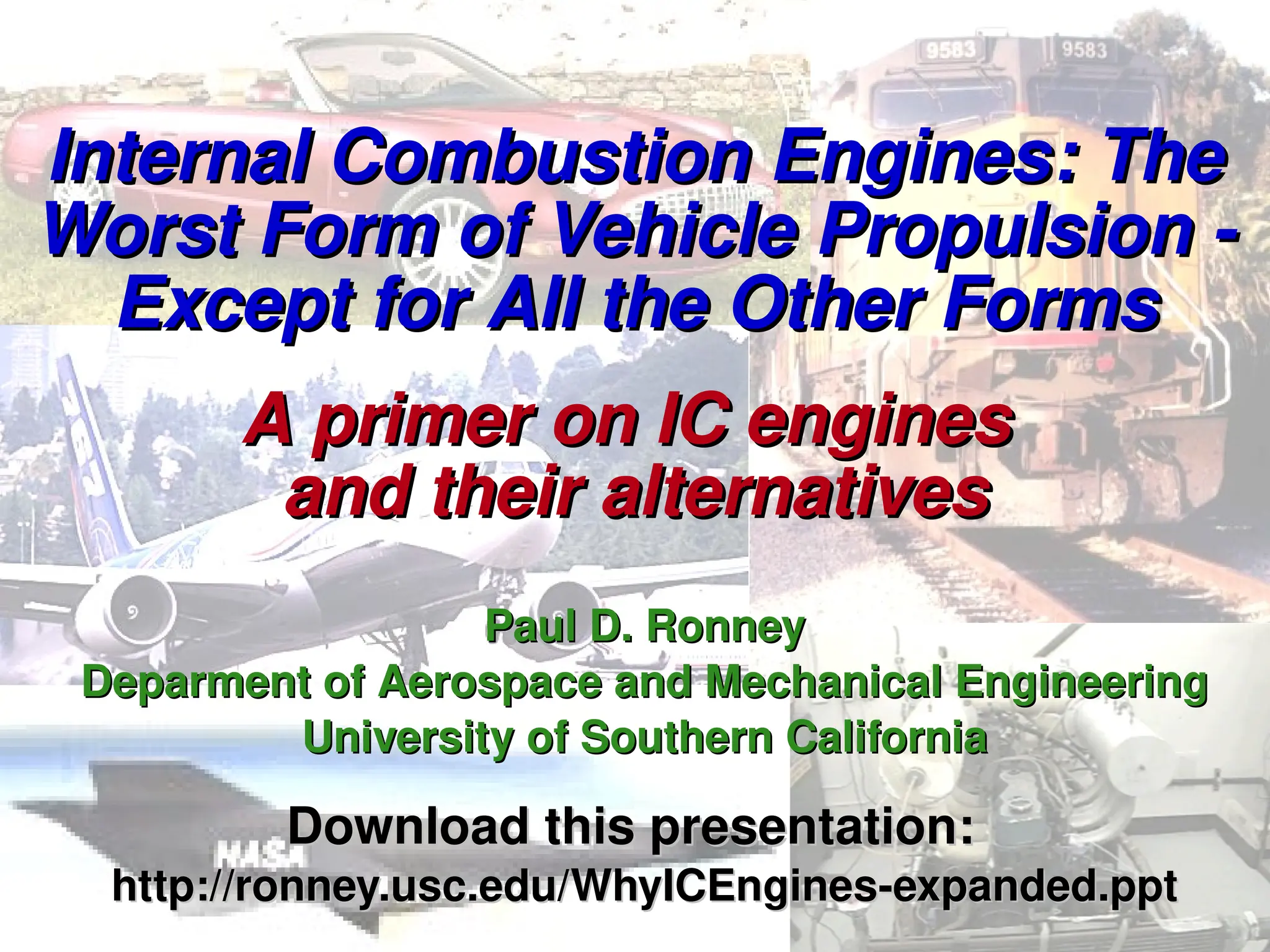
Internal Combustion Engines: The
Worst Form of Vehicle Propulsion -
Except for All the Other Forms
A primer on IC engines
and their alternatives
Paul D. Ronney
Paul D. Ronney
Deparment of Aerospace and Mechanical Engineering
University of Southern California
Download this presentation:
http://ronney.usc.edu/WhyICEngines-expanded.ppt
2
2
Outline
Outline
 Automotive engines
Automotive engines
 Definition of Internal Combustion Engines (ICEs)
Definition of Internal Combustion Engines (ICEs)
 Types of ICEs
Types of ICEs
 History and evolution of ICEs
History and evolution of ICEs
 Things you need to know before…
Things you need to know before…
 Gas turbines
Gas turbines
 What are the alternatives to ICEs?
What are the alternatives to ICEs?
 The nitty gritty
The nitty gritty
 How they work
How they work
 Why they’re designed that way
Why they’re designed that way
 Gasoline vs. diesel
Gasoline vs. diesel
 Practical perspective
Practical perspective
 Summary
Summary
Part 1:
Part 1:
Automotive engines:
Automotive engines:
how and why
how and why
4
4
Introduction
Introduction
 Hydrocarbon-fueled ICEs are the power plant of choice for vehicles
Hydrocarbon-fueled ICEs are the power plant of choice for vehicles
in the power range from 5 Watts to 100,000,000 Watts, and have
been for 100 years
been for 100 years
 There is an unlimited amount of inaccurate, misleading and/or
There is an unlimited amount of inaccurate, misleading and/or
dogmatic information about ICEs
 This seminar’s messages
This seminar’s messages
 Why ICEs so ubiquitous
Why ICEs so ubiquitous
 Why it will be so difficult to replace them with another technology
Why it will be so difficult to replace them with another technology
 What you will have to do if you want to replace them
What you will have to do if you want to replace them
5
5
Classification of ICEs
 Definition of an ICE: a
Definition of an ICE: a heat engine
heat engine in which the heat source is
in which the heat source is
a
a combustible mixture
combustible mixture that
that also serves as the working fluid
also serves as the working fluid
 The working fluid in turn is used either to
The working fluid in turn is used either to
 Produce shaft work by pushing on a piston or turbine blade
Produce shaft work by pushing on a piston or turbine blade
that in turn drives a rotating shaft or
 Creates a high-momentum fluid that is used directly for
Creates a high-momentum fluid that is used directly for
propulsive force
propulsive force
6
6
What is / is not an ICE?
IS
IS
 Gasoline-fueled
Gasoline-fueled
reciprocating piston
engine
engine
 Diesel-fueled
Diesel-fueled
reciprocating piston
engine
engine
 Gas turbine
Gas turbine
 Rocket
Rocket
IS NOT
IS NOT
 Steam power plant
Steam power plant
 Solar power plant
Solar power plant
 Nuclear power plant
Nuclear power plant
7
7
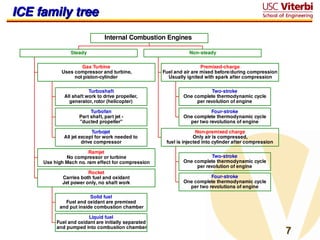
ICE family tree
ICE family tree
Turboshaft
All shaft work to drive propeller,
generator, rotor (helicopter)
Turbofan
Part shaft, part jet -
"ducted propeller"
Turbojet
All jet except for work needed to
drive compressor
Gas Turbine
Uses compressor and turbine,
not piston-cylinder
Ramjet
No compressor or turbine
Use high Mach no. ram effect for compression
Solid fuel
Fuel and oxidant are premixed
and put inside combustion chamber
Liquid fuel
Fuel and oxidant are initially separated
and pumped into combustion chamber
Rocket
Carries both fuel and oxidant
Jet power only, no shaft work
Steady
Two-stroke
One complete thermodynamic cycle
per revolution of engine
Four-stroke
One complete thermodynamic cycle
per two revolutions of engine
Premixed-charge
Fuel and air are mixed before/during compression
Usually ignited with spark after compression
Two-stroke
One complete thermodynamic cycle
per revolution of engine
Four-stroke
One complete thermodynamic cycle
per two revolutions of engine
Non-premixed charge
Only air is compressed,
fuel is injected into cylinder after compression
Non-steady
Internal Combustion Engines
8
8
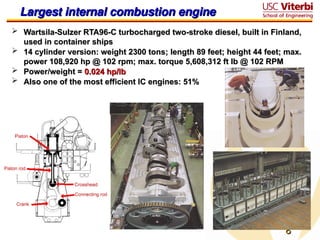
Largest internal combustion engine
 Wartsila-Sulzer RTA96-C turbocharged two-stroke diesel, built in Finland,
Wartsila-Sulzer RTA96-C turbocharged two-stroke diesel, built in Finland,
used in container ships
 14 cylinder version: weight 2300 tons
14 cylinder version: weight 2300 tons;
; length 89 feet; height 44 feet; max.
length 89 feet; height 44 feet; max.
power 108,920 hp @ 102 rpm; max. torque 5,608,312 ft lb @ 102 RPM
 Power/weight =
Power/weight = 0.024 hp/lb
0.024 hp/lb
 Also one of the most efficient IC engines: 51%
Also one of the most efficient IC engines: 51%
9
9
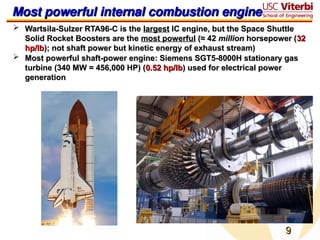
Most powerful internal combustion engine
 Wartsila-Sulzer RTA96-C is the
Wartsila-Sulzer RTA96-C is the largest
largest IC engine, but the Space Shuttle
IC engine, but the Space Shuttle
Solid Rocket Boosters are the
Solid Rocket Boosters are the most powerful
most powerful (≈ 42
(≈ 42 million
million horsepower (
horsepower (32
32
hp/lb
hp/lb); not shaft power but kinetic energy of exhaust stream)
); not shaft power but kinetic energy of exhaust stream)
 Most powerful shaft-power engine: Siemens SGT5-8000H stationary gas
Most powerful shaft-power engine: Siemens SGT5-8000H stationary gas
turbine (340 MW = 456,000 HP) (
turbine (340 MW = 456,000 HP) (0.52 hp/lb
0.52 hp/lb) used for electrical power
) used for electrical power
generation
generation
10
10
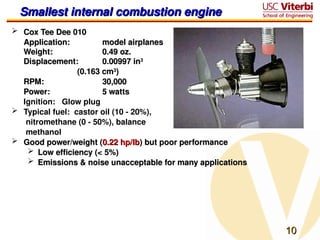
Smallest internal combustion engine
 Cox Tee Dee 010
Cox Tee Dee 010
Application:
Application: model airplanes
model airplanes
Weight:
Weight: 0.49 oz.
0.49 oz.
Displacement:
Displacement: 0.00997 in
0.00997 in3
3
(0.163 cm
(0.163 cm3
3
)
)
RPM:
RPM: 30,000
30,000
Power:
Power: 5 watts
5 watts
Ignition: Glow plug
 Typical fuel: castor oil (10 - 20%),
nitromethane (0 - 50%), balance
methanol
 Good power/weight (
Good power/weight (0.22 hp/lb
0.22 hp/lb) but poor performance
) but poor performance
 Low efficiency (< 5%)
Low efficiency (< 5%)
 Emissions & noise unacceptable for many applications
Emissions & noise unacceptable for many applications
11
11
History of automotive engines
 1859 - Oil discovered at Drake’s Well, Titusville,
1859 - Oil discovered at Drake’s Well, Titusville,
Pennsylvania (20 barrels per day)
Pennsylvania (20 barrels per day) - 40 year supply
- 40 year supply
 1876 - Premixed-charge 4-stroke engine - Otto
1876 - Premixed-charge 4-stroke engine - Otto
 1st practical ICE
1st practical ICE
 Power: 2 hp; Weight: 1250 pounds
Power: 2 hp; Weight: 1250 pounds
 Comp. ratio = 4 (knock limited), 14% efficiency
Comp. ratio = 4 (knock limited), 14% efficiency
(theory 38%)
(theory 38%)
 Today CR = 9 (still knock limited), 30% efficiency
Today CR = 9 (still knock limited), 30% efficiency
(theory 55%)
(theory 55%)
 1897 - Nonpremixed-charge engine - Diesel - higher
1897 - Nonpremixed-charge engine - Diesel - higher
efficiency due to
efficiency due to
 Higher compression ratio (no knock problem)
Higher compression ratio (no knock problem)
 No throttling loss - use fuel/air ratio to control power
No throttling loss - use fuel/air ratio to control power
 1901 - Spindletop Dome, east Texas - Lucas #1
1901 - Spindletop Dome, east Texas - Lucas #1
gusher produces 100,000 barrels per day - ensures
that “2nd Industrial Revolution” will be fueled by
oil, not coal or wood
oil, not coal or wood - 40 year supply
- 40 year supply
12
12
History of automotive engines
 1921 - Tetraethyl lead anti-knock additive discovered at
1921 - Tetraethyl lead anti-knock additive discovered at
General Motors
General Motors
 Enabled higher compression ratio (thus more power, better
Enabled higher compression ratio (thus more power, better
efficiency) in Otto-type engines
 1952 - A. J. Haagen-Smit, Caltech
1952 - A. J. Haagen-Smit, Caltech
NO + UHC + O
NO + UHC + O2
2 + sunlight
+ sunlight 
 NO
NO2
2 + O
+ O3
3
(from exhaust)
(from exhaust) (brown) (irritating)
(brown) (irritating)
(UHC = unburned hydrocarbons)
 1960s - Emissions regulations
1960s - Emissions regulations
 Detroit won’t believe it
Detroit won’t believe it
 Initial stop-gap measures - lean mixture, EGR, retard spark
Initial stop-gap measures - lean mixture, EGR, retard spark
 Poor performance & fuel economy
Poor performance & fuel economy
 1973 & 1979 - The energy crises
1973 & 1979 - The energy crises
 Detroit takes a bath
Detroit takes a bath
13
13
History of automotive engines
 1975 - Catalytic converters, unleaded fuel
1975 - Catalytic converters, unleaded fuel
 Detroit forced to buy technology
Detroit forced to buy technology
 More “aromatics” (e.g., benzene) in gasoline - high octane but
More “aromatics” (e.g., benzene) in gasoline - high octane but
carcinogenic, soot-producing
 1980s - Microcomputer control of engines
1980s - Microcomputer control of engines
 Tailor operation for best emissions, efficiency, ...
Tailor operation for best emissions, efficiency, ...
 1990s - Reformulated gasoline
1990s - Reformulated gasoline
 Reduced need for aromatics, cleaner(?)
Reduced need for aromatics, cleaner(?)
 ... but higher cost, lower miles per gallon
... but higher cost, lower miles per gallon
 Then we found that MTBE pollutes groundwater!!!
Then we found that MTBE pollutes groundwater!!!
 Alternative “oxygenated” fuel additive - ethanol - very attractive
Alternative “oxygenated” fuel additive - ethanol - very attractive
to powerful senators from farm states
14
14
History of automotive engines
 2000’s - hybrid vehicles
2000’s - hybrid vehicles
 Use small gasoline engine operating at maximum power
Use small gasoline engine operating at maximum power
(most efficient way to operate) or turned off if not needed
 Use generator/batteries/motors to make/store/use surplus
Use generator/batteries/motors to make/store/use surplus
power from gasoline engine
 More efficient, but much more equipment on board - not clear
More efficient, but much more equipment on board - not clear
if fuel savings justify extra cost
 Plug-in hybrid: half-way between conventional hybrid and
Plug-in hybrid: half-way between conventional hybrid and
electric vehicle
electric vehicle
 Recent study in a major consumer magazine: only 1 of 7
Recent study in a major consumer magazine: only 1 of 7
hybrids tested show a cost benefit over a 5 year ownership
period if tax incentives removed
» Dolly Parton: “You wouldn’t believe how much it costs to look
Dolly Parton: “You wouldn’t believe how much it costs to look
this cheap”
this cheap”
» Paul Ronney: “You wouldn’t believe how much energy some
Paul Ronney: “You wouldn’t believe how much energy some
people spend to save a little fuel”
15
15
Things you need to understand before ...
…
…you invent the zero-emission, 100 mpg 1000 hp engine,
you invent the zero-emission, 100 mpg 1000 hp engine,
revolutionize the automotive industry and shop for your
retirement home on the French Riviera
 Room for improvement - factor of less than 2 in efficiency
Room for improvement - factor of less than 2 in efficiency
 Ideal Otto cycle engine with compression ratio = 9: 55%
Ideal Otto cycle engine with compression ratio = 9: 55%
 Real engine: 25 - 30%
Real engine: 25 - 30%
 Differences because of
Differences because of
»Throttling losses
Throttling losses
»Heat losses
Heat losses
»Friction losses
Friction losses
»Slow burning
Slow burning
»Incomplete combustion is a very minor effect
Incomplete combustion is a very minor effect
 Majority of power is used to overcome air resistance
Majority of power is used to overcome air resistance -
-
smaller, more aerodynamic vehicles beneficial
16
16
Things you need to understand before ...
 Room for improvement - infinite in pollutants
Room for improvement - infinite in pollutants
 Pollutants are a
Pollutants are a non-equilibrium
non-equilibrium effect
effect
»Burn: Fuel + O
Burn: Fuel + O2
2 + N
+ N2
2 
 H
H2
2O + CO
O + CO2
2 + N
+ N2
2 + CO + UHC + NO
+ CO + UHC + NO
OK OK(?) OK Bad Bad Bad
»Expand: CO + UHC + NO “frozen” at high levels
Expand: CO + UHC + NO “frozen” at high levels
»With slow expansion, no heat loss:
With slow expansion, no heat loss:
CO + UHC + NO
CO + UHC + NO 
 H
H2
2O + CO
O + CO2
2 + N
+ N2
2
...but how to slow the expansion and eliminate heat loss?
 Worst problems: cold start, transients, old or out-of-
Worst problems: cold start, transients, old or out-of-
tune vehicles - 90% of pollution generated by 10% of
vehicles
vehicles
17
17
Things you need to understand before ...
 Room for improvement - very little in power
Room for improvement - very little in power
 IC engines are air processors
IC engines are air processors
»Fuel takes up little space
Fuel takes up little space
»Air flow = power
Air flow = power
»Limitation on air flow due to
Limitation on air flow due to
• “
“Choked” flow past intake valves
Choked” flow past intake valves
• Friction loss, mechanical strength - limits RPM
Friction loss, mechanical strength - limits RPM
• Slow burn
Slow burn
»How to increase air flow?
How to increase air flow?
• Larger engines
Larger engines
• Faster-rotating engines
Faster-rotating engines
• Turbocharge / supercharge
Turbocharge / supercharge
• Avoid stop/start cycle of reciprocating piston engines - how?
Avoid stop/start cycle of reciprocating piston engines - how?
18
18
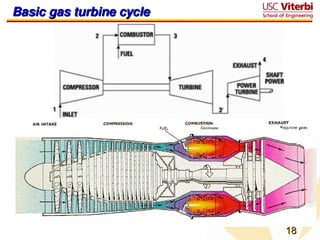
Basic gas turbine cycle
19
19
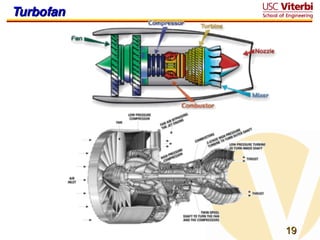
Turbofan
Turbofan
20
20
Why gas turbines?
Why gas turbines?
 GE CT7-8 turboshaft (used in
GE CT7-8 turboshaft (used in
helicopters)
helicopters)
 http://www.geae.com/engines/
http://www.geae.com/engines/
commercial/ct7/ct7-8.html
 Compressor/turbine stages: 6/4
Compressor/turbine stages: 6/4
 Diameter 26”, Length 48.8” = 426 liters
Diameter 26”, Length 48.8” = 426 liters
=
= 5.9 hp/liter
5.9 hp/liter
 Dry Weight 537 lb, max. power 2,520 hp
Dry Weight 537 lb, max. power 2,520 hp
(
(power/wt = 4.7 hp/lb
power/wt = 4.7 hp/lb)
)
 Pressure ratio at max. power: 21 (ratio
Pressure ratio at max. power: 21 (ratio
per stage = 21
per stage = 211/6
1/6
= 1.66)
= 1.66)
 Specific fuel consumption at max.
Specific fuel consumption at max.
power: 0.450 (units not given; if lb/hp-hr
then corresponds to 29.3% efficiency)
 Cummins QSK60-2850 4-stroke
Cummins QSK60-2850 4-stroke 60.0 liter
60.0 liter
(3,672 in
(3,672 in3
3
)
) V-16 2-stage turbocharged
V-16 2-stage turbocharged
diesel (used in mining trucks)
 http://www.everytime.cummins.com/
http://www.everytime.cummins.com/
assets/pdf/4087056.pdf
 2.93 m long x 1.58 m wide x 2.31 m high =
2.93 m long x 1.58 m wide x 2.31 m high =
10,700 liters =
10,700 liters = 0.27 hp/liter
0.27 hp/liter
 Dry weight 21,207 lb, 2850 hp at 1900
Dry weight 21,207 lb, 2850 hp at 1900
RPM (
RPM (power/wt = 0.134 hp/lb = 35x lower
power/wt = 0.134 hp/lb = 35x lower
than gas turbine
than gas turbine)
)
 Volume compression ratio ??? (not
Volume compression ratio ??? (not
given)
given)
21
21
 Ballard HY-80 “Fuel cell engine”
Ballard HY-80 “Fuel cell engine”
 http://www.ballard.com/resources/
http://www.ballard.com/resources/
transportation/XCS-HY-80_Trans.pdf (no
longer valid link!)
longer valid link!)
 Volume 220 liters = 0.41 hp/liter
Volume 220 liters = 0.41 hp/liter
 91 hp, 485 lb. (
91 hp, 485 lb. (power/wt = 0.19 hp/lb
power/wt = 0.19 hp/lb)
)
 48% efficiency (fuel to electricity)
48% efficiency (fuel to electricity)
 Uses hydrogen only - NOT hydrocarbons
Uses hydrogen only - NOT hydrocarbons
 Does NOT include electric drive system
Does NOT include electric drive system (≈
(≈
0.40 hp/lb) at ≈ 90% electrical to mechanical
efficiency
efficiency
(http://www.gm.com/company/gmability/adv
_tech/images/fact_sheets/hywire.html) (no
longer valid)
longer valid)
 Fuel cell + motor overall 0.13 hp/lb at 43%
Fuel cell + motor overall 0.13 hp/lb at 43%
efficiency, not including H
efficiency, not including H2
2 storage
storage
Why gas turbines?
Why gas turbines?
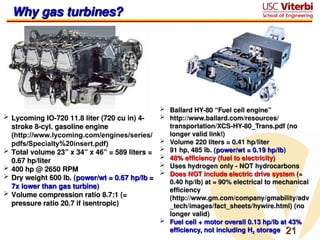
 Lycoming IO-720 11.8 liter (720 cu in) 4-
Lycoming IO-720 11.8 liter (720 cu in) 4-
stroke 8-cyl. gasoline engine
(
(http://www.lycoming.com/engines/series/
pdfs/Specialty%20insert.pdf)
)
 Total volume 23” x 34” x 46” = 589 liters =
Total volume 23” x 34” x 46” = 589 liters =
0.67 hp/liter
0.67 hp/liter
 400 hp @ 2650 RPM
400 hp @ 2650 RPM
 Dry weight 600 lb. (
Dry weight 600 lb. (power/wt = 0.67 hp/lb =
power/wt = 0.67 hp/lb =
7x lower than gas turbine
7x lower than gas turbine)
)
 Volume compression ratio 8.7:1 (=
Volume compression ratio 8.7:1 (=
pressure ratio 20.7 if isentropic)
22
22
Why gas turbines?
Why gas turbines?
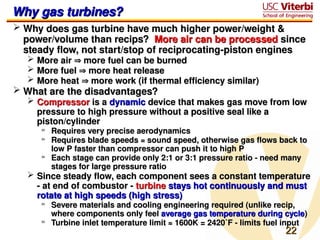
 Why does gas turbine have much higher power/weight &
Why does gas turbine have much higher power/weight &
power/volume than recips?
power/volume than recips? More air can be processed
More air can be processed since
since
steady flow, not start/stop of reciprocating-piston engines
 More air
More air 
 more fuel can be burned
more fuel can be burned
 More fuel
More fuel 
 more heat release
more heat release
 More heat
More heat 
 more work (if thermal efficiency similar)
more work (if thermal efficiency similar)
 What are the disadvantages?
What are the disadvantages?
 Compressor
Compressor is a
is a dynamic
dynamic device that makes gas move from low
device that makes gas move from low
pressure to high pressure without a positive seal like a
piston/cylinder
piston/cylinder
» Requires very precise aerodynamics
Requires very precise aerodynamics
» Requires blade speeds ≈ sound speed, otherwise gas flows back to
Requires blade speeds ≈ sound speed, otherwise gas flows back to
low P faster than compressor can push it to high P
» Each stage can provide only 2:1 or 3:1 pressure ratio - need many
Each stage can provide only 2:1 or 3:1 pressure ratio - need many
stages for large pressure ratio
 Since steady flow, each component sees a constant temperature
Since steady flow, each component sees a constant temperature
- at end of combustor -
- at end of combustor - turbine
turbine stays hot continuously and must
stays hot continuously and must
rotate at high speeds (high stress)
» Severe materials and cooling engineering required (unlike recip,
Severe materials and cooling engineering required (unlike recip,
where components only feel
where components only feel average gas temperature during cycle
average gas temperature during cycle)
)
» Turbine inlet temperature limit ≈ 1600K = 2420˚F - limits fuel input
Turbine inlet temperature limit ≈ 1600K = 2420˚F - limits fuel input
23
23
Why gas turbines?
Why gas turbines?
 As a result, turbines require more maintenance & are more
As a result, turbines require more maintenance & are more
expensive for same power (so never used in automotive
applications… but is used in modern military tanks, because of
power/volume, NOT power/weight)
 Simple intro to gas turbines:
Simple intro to gas turbines:
http://geae.com/education/engines101/
24
24
Alternative #1 - external combustion
 Examples: steam engine, Stirling cycle engine
Examples: steam engine, Stirling cycle engine
 Use any fuel as the heat source
Use any fuel as the heat source
 Use any working fluid (high
Use any working fluid (high 
, e.g. helium, provides better efficiency)
, e.g. helium, provides better efficiency)
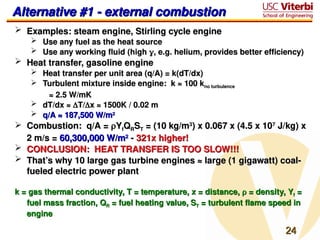
 Heat transfer, gasoline engine
Heat transfer, gasoline engine
 Heat transfer per unit area (q/A) = k(dT/dx)
Heat transfer per unit area (q/A) = k(dT/dx)
 Turbulent mixture inside engine: k ≈ 100 k
Turbulent mixture inside engine: k ≈ 100 kno turbulence
no turbulence
≈
≈ 2.5 W/mK
2.5 W/mK
 dT/dx ≈
dT/dx ≈ 
T/
T/
x ≈ 1500K / 0.02 m
x ≈ 1500K / 0.02 m
 q/A ≈ 187,500 W/m
q/A ≈ 187,500 W/m2
2
 Combustion: q/A =
Combustion: q/A = 
Y
Yf
fQ
QR
RS
ST
T = (10 kg/m
= (10 kg/m3
3
) x 0.067 x (4.5 x 10
) x 0.067 x (4.5 x 107
7
J/kg) x
J/kg) x
2 m/s =
2 m/s = 60,300,000 W/m
60,300,000 W/m2
2
-
- 321x higher!
321x higher!
 CONCLUSION: HEAT TRANSFER IS TOO SLOW!!!
CONCLUSION: HEAT TRANSFER IS TOO SLOW!!!
 That’s why 10 large gas turbine engines ≈ large (1 gigawatt) coal-
That’s why 10 large gas turbine engines ≈ large (1 gigawatt) coal-
fueled electric power plant
k = gas thermal conductivity, T = temperature, x = distance,
k = gas thermal conductivity, T = temperature, x = distance, 
 = density, Y
= density, Yf
f =
=
fuel mass fraction, Q
fuel mass fraction, QR
R = fuel heating value, S
= fuel heating value, ST
T = turbulent flame speed in
= turbulent flame speed in
engine
engine
25
25
Alternative #2 - Electric Vehicles (EVs)
 Why not generate electricity in a large central power plant
Why not generate electricity in a large central power plant
and distribute to charge batteries to power electric motors?
 EV NiMH battery - 26.4 kW-hours, 1147 pounds =
EV NiMH battery - 26.4 kW-hours, 1147 pounds = 1.83 x 10
1.83 x 10⁵
5
J/kg
J/kg (http://www.gmev.com/power/power.htm)
(http://www.gmev.com/power/power.htm)
 Gasoline (and other hydrocarbons):
Gasoline (and other hydrocarbons): 4.3 x 10
4.3 x 10⁷
7
J/kg
J/kg
 Even at 30% efficiency (gasoline) vs. 90% (batteries),
Even at 30% efficiency (gasoline) vs. 90% (batteries),
gasoline has
gasoline has 78 times higher energy/weight than batteries!
78 times higher energy/weight than batteries!
 1 gallon of gasoline ≈ 481 pounds of batteries for same
1 gallon of gasoline ≈ 481 pounds of batteries for same
energy delivered to the wheels
 Other issues with electric vehicles
Other issues with electric vehicles
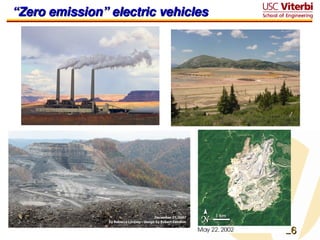
 "Zero emissions” ??? - EVs
"Zero emissions” ??? - EVs export
export pollution
pollution
 Replacement cost of batteries
Replacement cost of batteries
 Environmental cost of battery materials
Environmental cost of battery materials
 Possible advantage: EVs make smaller, lighter, more
Possible advantage: EVs make smaller, lighter, more
streamlined cars acceptable to consumers
26
26
“
“Zero emission” electric vehicles
Zero emission” electric vehicles
27
27
 Ballard HY-80 “Fuel cell engine”
Ballard HY-80 “Fuel cell engine”
(
(power/wt = 0.19 hp/lb
power/wt = 0.19 hp/lb)
)
 48% efficient (fuel to electricity)
48% efficient (fuel to electricity)
 MUST use hydrogen (from where?)
MUST use hydrogen (from where?)
 Requires large amounts of platinum
Requires large amounts of platinum
catalyst - extremely expensive
 Does NOT include electric drive system
Does NOT include electric drive system
(≈ 0.40 hp/lb thus fuel cell + motor
at ≈ 90% electrical to mechanical efficiency)
 Overall system:
Overall system: 0.13 hp/lb at 43% efficiency (hydrogen)
0.13 hp/lb at 43% efficiency (hydrogen)
 Conventional engine: ≈ 0.5 hp/lb at 30% efficiency (gasoline)
Conventional engine: ≈ 0.5 hp/lb at 30% efficiency (gasoline)
 Conclusion: fuel cell engines are only marginally more efficient,
Conclusion: fuel cell engines are only marginally more efficient,
much heavier for the same power, and require hydrogen which is
very difficult and potentially dangerous to store on a vehicle
 Prediction: even if we had an unlimited free source of hydrogen
Prediction: even if we had an unlimited free source of hydrogen
and a perfect way of storing it on a vehicle,
and a perfect way of storing it on a vehicle, we would still burn it,
we would still burn it,
not use it in a fuel cell
Alternative #3 - Hydrogen fuel cell
28
28
Hydrogen storage
Hydrogen storage
 Hydrogen is a great fuel
Hydrogen is a great fuel
 High energy density (1.2 x 10
High energy density (1.2 x 10⁸
8
J/kg, ≈ 3x hydrocarbons)
 Much faster reaction rates than hydrocarbons (≈ 10 - 100x at same T)
Much faster reaction rates than hydrocarbons (≈ 10 - 100x at same T)
 Excellent electrochemical properties in fuel cells
Excellent electrochemical properties in fuel cells
 But how to store it???
But how to store it???
 Cryogenic (very cold, -424˚F) liquid, low density (14x lower than water)
Cryogenic (very cold, -424˚F) liquid, low density (14x lower than water)
 Compressed gas: weight of tank ≈ 15x greater than weight of fuel
Compressed gas: weight of tank ≈ 15x greater than weight of fuel
 Borohydride solutions
Borohydride solutions
» NaBH
NaBH4
4 + 2H
+ 2H2
2O
O 
 NaBO
NaBO2
2 (Borax) + 3H
(Borax) + 3H2
2
» (mass solution)/(mass fuel) ≈ 9.25
(mass solution)/(mass fuel) ≈ 9.25
 Palladium - Pd/H = 164 by weight
Palladium - Pd/H = 164 by weight
 Carbon nanotubes - many claims, few facts…
Carbon nanotubes - many claims, few facts…
 Long-chain hydrocarbon (CH
Long-chain hydrocarbon (CH2
2)
)x
x: (Mass C)/(mass H) = 6, plus C atoms
: (Mass C)/(mass H) = 6, plus C atoms
add 94.1 kcal of energy release to 57.8 for H
add 94.1 kcal of energy release to 57.8 for H2
2!
!
 MORAL:
MORAL: By far
By far the best way to store hydrogen is to attach it to carbon
the best way to store hydrogen is to attach it to carbon
atoms and make hydrocarbons, even if you’re not going to use the
carbon as fuel!
carbon as fuel!
29
29
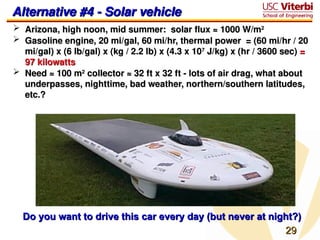
Alternative #4 - Solar vehicle
 Arizona, high noon, mid summer: solar flux ≈ 1000 W/m
Arizona, high noon, mid summer: solar flux ≈ 1000 W/m2
2
 Gasoline engine, 20 mi/gal, 60 mi/hr, thermal power = (60 mi/hr / 20
Gasoline engine, 20 mi/gal, 60 mi/hr, thermal power = (60 mi/hr / 20
mi/gal) x (6 lb/gal) x (kg / 2.2 lb) x (4.3 x 10
mi/gal) x (6 lb/gal) x (kg / 2.2 lb) x (4.3 x 10⁷
7
J/kg) x (hr / 3600 sec)
J/kg) x (hr / 3600 sec) =
=
97 kilowatts
97 kilowatts
 Need ≈ 100 m
Need ≈ 100 m2
2
collector ≈ 32 ft x 32 ft - lots of air drag, what about
underpasses, nighttime, bad weather, northern/southern latitudes,
etc.?
etc.?
Do you want to drive this car every day (but never at night?)
30
30
Alternative #5 - nuclear
 Who are we kidding ???
Who are we kidding ???
 Higher energy density though
Higher energy density though
 U
U235
235 fission:
fission: 8.2 x 10
8.2 x 10¹³
13
J/kg ≈ 2 million x hydrocarbons!
 Radioactive decay much less, but still much higher than
Radioactive decay much less, but still much higher than
hydrocarbon fuel
hydrocarbon fuel
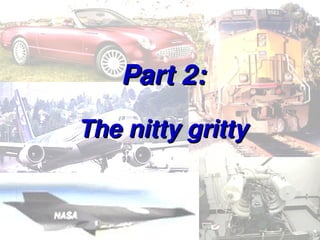
Part 2:
Part 2:
The nitty gritty
The nitty gritty
32
32
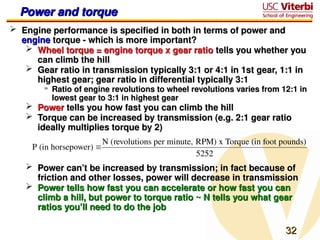
Power and torque
Power and torque
 Engine performance is specified in both in terms of power and
Engine performance is specified in both in terms of power and
engine
engine torque - which is more important?
torque - which is more important?
 Wheel torque = engine torque x gear ratio
Wheel torque = engine torque x gear ratio tells you whether you
tells you whether you
can climb the hill
can climb the hill
 Gear ratio in transmission typically 3:1 or 4:1 in 1st gear, 1:1 in
Gear ratio in transmission typically 3:1 or 4:1 in 1st gear, 1:1 in
highest gear; gear ratio in differential typically 3:1
» Ratio of engine revolutions to wheel revolutions varies from 12:1 in
Ratio of engine revolutions to wheel revolutions varies from 12:1 in
lowest gear to 3:1 in highest gear
 Power
Power tells you how fast you can climb the hill
tells you how fast you can climb the hill
 Torque can be increased by transmission (e.g. 2:1 gear ratio
Torque can be increased by transmission (e.g. 2:1 gear ratio
ideally multiplies torque by 2)
 Power can’t be increased by transmission; in fact because of
Power can’t be increased by transmission; in fact because of
friction and other losses, power will decrease in transmission
 Power tells how fast you can accelerate or how fast you can
Power tells how fast you can accelerate or how fast you can
climb a hill, but power to torque ratio ~ N tells you what gear
ratios you’ll need to do the job

P (in horsepower) 
N (revolutions per minute, RPM) x Torque (in foot pounds)
5252
33
33
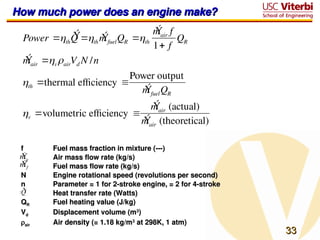
How much power does an engine make?
Power th
Ý
Q th
Ý
mfuelQR th
Ý
mair f
1 f
QR
Ý
mair vairVd N /n
th thermal efficiency 
Power output
Ý
mfuelQR
v volumetric efficiency 
Ý
mair (actual)
Ý
mair (theoretical)
f
f Fuel mass fraction in mixture (---)
Fuel mass fraction in mixture (---)
Air mass flow rate (kg/s)
Fuel mass flow rate (kg/s)
N
N Engine rotational speed (revolutions per second)
Engine rotational speed (revolutions per second)
n
n Parameter = 1 for 2-stroke engine, = 2 for 4-stroke
Parameter = 1 for 2-stroke engine, = 2 for 4-stroke
Heat transfer rate (Watts)
Q
QR
R Fuel heating value (J/kg)
Fuel heating value (J/kg)
V
Vd
d Displacement volume (m
Displacement volume (m3
3
)
)

air
air Air density (= 1.18 kg/m
Air density (= 1.18 kg/m3
3
at 298K, 1 atm)
at 298K, 1 atm)
Ý
ma
Ý
mf
34
34
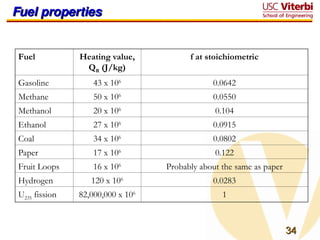
Fuel properties
Fuel properties
Fuel Heating value,
QR (J/kg)
f at stoichiometric
Gasoline 43 x 106
0.0642
Methane 50 x 106
0.0550
Methanol 20 x 106
0.104
Ethanol 27 x 106
0.0915
Coal 34 x 106
0.0802
Paper 17 x 106
0.122
Fruit Loops 16 x 106
Probably about the same as paper
Hydrogen 120 x 106
0.0283
U235 fission 82,000,000 x 106
1
35
35
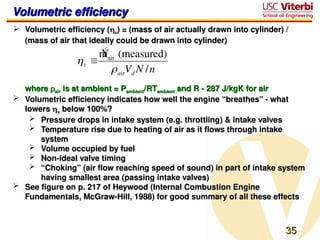
Volumetric efficiency
 Volumetric efficiency (
Volumetric efficiency (
v
v) = (mass of air actually drawn into cylinder) /
) = (mass of air actually drawn into cylinder) /
(mass of air that ideally could be drawn into cylinder)
where
where 
air
air is at ambient = P
is at ambient = Pambient
ambient/RT
/RTambient
ambient and R - 287 J/kgK for air
and R - 287 J/kgK for air
 Volumetric efficiency indicates how well the engine “breathes” - what
Volumetric efficiency indicates how well the engine “breathes” - what
lowers
lowers 
v
v below 100%?
below 100%?
 Pressure drops in intake system (e.g. throttling) & intake valves
Pressure drops in intake system (e.g. throttling) & intake valves
 Temperature rise due to heating of air as it flows through intake
Temperature rise due to heating of air as it flows through intake
system
system
 Volume occupied by fuel
Volume occupied by fuel
 Non-ideal valve timing
Non-ideal valve timing
 “
“Choking” (air flow reaching speed of sound) in part of intake system
Choking” (air flow reaching speed of sound) in part of intake system
having smallest area (passing intake valves)
 See figure on p. 217 of Heywood (Internal Combustion Engine
See figure on p. 217 of Heywood (Internal Combustion Engine
Fundamentals, McGraw-Hill, 1988) for good summary of all these effects

v 
Ý
mair (measured)
airVd N /n
36
36
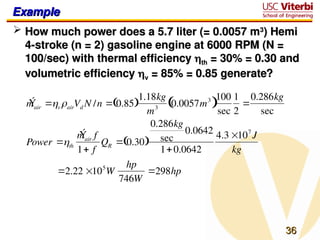
Example
Example
 How much power does a 5.7 liter (= 0.0057 m
How much power does a 5.7 liter (= 0.0057 m3
3
) Hemi
) Hemi
4-stroke (n = 2) gasoline engine at 6000 RPM (N =
100/sec) with thermal efficiency
100/sec) with thermal efficiency 
th
th = 30% = 0.30 and
= 30% = 0.30 and
volumetric efficiency
volumetric efficiency 
v
v = 85% = 0.85 generate?
= 85% = 0.85 generate?
Ý
mair vairVd N /n  0.85
 
1.18kg
m3 0.0057m3
 
100
sec
1
2

0.286kg
sec
Power th
Ý
mair f
1 f
QR  0.30
 
0.286kg
sec
0.0642
10.0642
4.3 107
J
kg
2.22 105
W
hp
746W
298hp
37
37
http://static.howstuffworks.com/flash/engine.swf
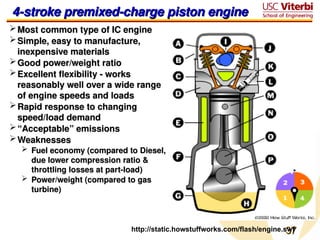
4-stroke premixed-charge piston engine
Most common type of IC engine
Most common type of IC engine
Simple, easy to manufacture,
Simple, easy to manufacture,
inexpensive materials
Good power/weight ratio
Good power/weight ratio
Excellent flexibility - works
Excellent flexibility - works
reasonably well over a wide range
of engine speeds and loads
Rapid response to changing
Rapid response to changing
speed/load demand
speed/load demand
“
“Acceptable” emissions
Acceptable” emissions
Weaknesses
Weaknesses
 Fuel economy (compared to Diesel,
Fuel economy (compared to Diesel,
due lower compression ratio &
throttling losses at part-load)
 Power/weight (compared to gas
Power/weight (compared to gas
turbine)
turbine)
38
38
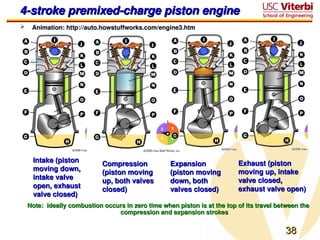
4-stroke premixed-charge piston engine
 Animation: http://auto.howstuffworks.com/engine3.htm
Animation: http://auto.howstuffworks.com/engine3.htm
Note: ideally combustion occurs in zero time when piston is at the top of its travel between the
compression and expansion strokes
Intake (piston
Intake (piston
moving down,
moving down,
intake valve
intake valve
open, exhaust
open, exhaust
valve closed)
valve closed)
Compression
Compression
(piston moving
(piston moving
up, both valves
up, both valves
closed)
closed)
Expansion
Expansion
(piston moving
(piston moving
down, both
down, both
valves closed)
valves closed)
Exhaust (piston
Exhaust (piston
moving up, intake
moving up, intake
valve closed,
valve closed,
exhaust valve open)
exhaust valve open)
39
39
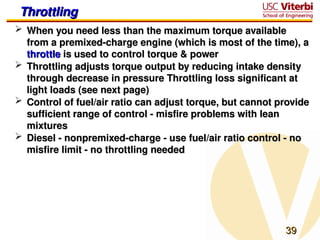
Throttling
Throttling
 When you need less than the maximum torque available
When you need less than the maximum torque available
from a premixed-charge engine (which is most of the time), a
throttle
throttle is used to control torque & power
is used to control torque & power
 Throttling adjusts torque output by reducing intake density
Throttling adjusts torque output by reducing intake density
through decrease in pressure Throttling loss significant at
light loads (see next page)
 Control of fuel/air ratio can adjust torque, but cannot provide
Control of fuel/air ratio can adjust torque, but cannot provide
sufficient range of control - misfire problems with lean
mixtures
mixtures
 Diesel - nonpremixed-charge - use fuel/air ratio control - no
Diesel - nonpremixed-charge - use fuel/air ratio control - no
misfire limit - no throttling needed
40
40
Throttling
Throttling
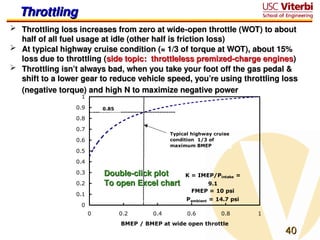
 Throttling loss increases from zero at wide-open throttle (WOT) to about
Throttling loss increases from zero at wide-open throttle (WOT) to about
half of all fuel usage at idle (other half is friction loss)
 At typical highway cruise condition (≈ 1/3 of torque at WOT), about 15%
At typical highway cruise condition (≈ 1/3 of torque at WOT), about 15%
loss due to throttling (
loss due to throttling (side topic: throttleless premixed-charge engines
side topic: throttleless premixed-charge engines)
)
 Throttling isn’t always bad, when you take your foot off the gas pedal &
Throttling isn’t always bad, when you take your foot off the gas pedal &
shift to a lower gear to reduce vehicle speed, you’re using throttling loss
(negative torque) and high N to maximize negative power
K = IMEP/Pintake =
9.1
FMEP = 10 psi
Pambient = 14.7 psi
0
0.1
0.2
0.3
0.4
0.5
0.6
0.7
0.8
0.9
1
0 0.2 0.4 0.6 0.8 1
BMEP / BMEP at wide open throttle
Efficiency
(with
throttle)
/
Efficiency
(without
throttle)
Typical highway cruise
condition ­1/3 of
maximum BMEP
­0.85
Double-click plot
Double-click plot
To open Excel chart
To open Excel chart
41
41
Throttling
Throttling
 Another way to reduce throttling losses: close off some
Another way to reduce throttling losses: close off some
cylinders when low power demand
 Cadillac had a 4-6-8 engine in the 1981 but it was a mechanical
Cadillac had a 4-6-8 engine in the 1981 but it was a mechanical
disaster
disaster
 GM uses a 4-8 “Active fuel management” (previously called
GM uses a 4-8 “Active fuel management” (previously called
“Displacement On Demand”) engine
http://www.gm.com:80/experience/technology/news/2006/2007_powertrain_
051806.jsp
051806.jsp
 Mercedes has had 4-8 “Cylinder deactivation” engines for
Mercedes has had 4-8 “Cylinder deactivation” engines for
European markets since 1998:
http://www.answers.com/topic/active%20cylinder%20control
 Many auto magazines suggest this will cut fuel usage in half,
Many auto magazines suggest this will cut fuel usage in half,
as though engines use fuel based only on displacement, not
RPM (N) or intake manifold pressure - more realistic articles
report 8 - 10% improvement in efficiency
42
42
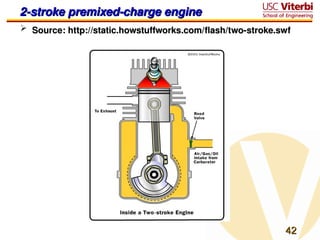
2-stroke premixed-charge engine
 Source: http://static.howstuffworks.com/flash/two-stroke.swf
Source: http://static.howstuffworks.com/flash/two-stroke.swf
43
43
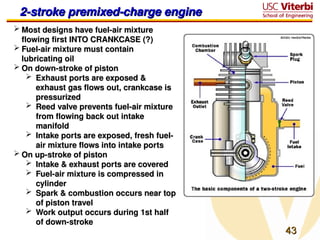
2-stroke premixed-charge engine
 Most designs have fuel-air mixture
Most designs have fuel-air mixture
flowing first INTO CRANKCASE (?)
 Fuel-air mixture must contain
Fuel-air mixture must contain
lubricating oil
lubricating oil
 On down-stroke of piston
On down-stroke of piston
 Exhaust ports are exposed &
Exhaust ports are exposed &
exhaust gas flows out, crankcase is
pressurized
pressurized
 Reed valve prevents fuel-air mixture
Reed valve prevents fuel-air mixture
from flowing back out intake
manifold
manifold
 Intake ports are exposed, fresh fuel-
Intake ports are exposed, fresh fuel-
air mixture flows into intake ports
 On up-stroke of piston
On up-stroke of piston
 Intake & exhaust ports are covered
Intake & exhaust ports are covered
 Fuel-air mixture is compressed in
Fuel-air mixture is compressed in
cylinder
cylinder
 Spark & combustion occurs near top
Spark & combustion occurs near top
of piston travel
of piston travel
 Work output occurs during 1st half
Work output occurs during 1st half
of down-stroke
of down-stroke
44
44
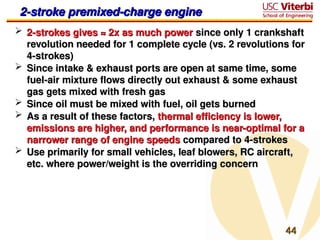
2-stroke premixed-charge engine
 2-strokes gives ≈ 2x as much power
2-strokes gives ≈ 2x as much power since only 1 crankshaft
since only 1 crankshaft
revolution needed for 1 complete cycle (vs. 2 revolutions for
4-strokes)
4-strokes)
 Since intake & exhaust ports are open at same time, some
Since intake & exhaust ports are open at same time, some
fuel-air mixture flows directly out exhaust & some exhaust
gas gets mixed with fresh gas
 Since oil must be mixed with fuel, oil gets burned
Since oil must be mixed with fuel, oil gets burned
 As a result of these factors,
As a result of these factors, thermal efficiency is lower,
thermal efficiency is lower,
emissions are higher, and performance is near-optimal for a
narrower range of engine speeds
narrower range of engine speeds compared to 4-strokes
compared to 4-strokes
 Use primarily for small vehicles, leaf blowers, RC aircraft,
Use primarily for small vehicles, leaf blowers, RC aircraft,
etc. where power/weight is the overriding concern
45
45
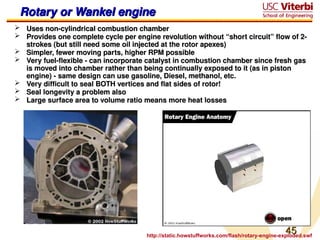
Rotary or Wankel engine
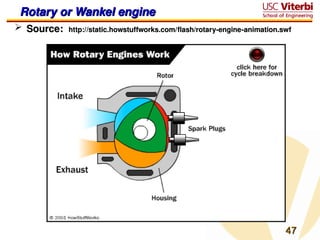
 Uses non-cylindrical combustion chamber
Uses non-cylindrical combustion chamber
 Provides one complete cycle per engine revolution without “short circuit” flow of 2-
Provides one complete cycle per engine revolution without “short circuit” flow of 2-
strokes (but still need some oil injected at the rotor apexes)
 Simpler, fewer moving parts, higher RPM possible
Simpler, fewer moving parts, higher RPM possible
 Very fuel-flexible - can incorporate catalyst in combustion chamber since fresh gas
Very fuel-flexible - can incorporate catalyst in combustion chamber since fresh gas
is moved into chamber rather than being continually exposed to it (as in piston
engine) - same design can use gasoline, Diesel, methanol, etc.
 Very difficult to seal BOTH vertices and flat sides of rotor!
Very difficult to seal BOTH vertices and flat sides of rotor!
 Seal longevity a problem also
Seal longevity a problem also
 Large surface area to volume ratio means more heat losses
Large surface area to volume ratio means more heat losses
http://static.howstuffworks.com/flash/rotary-engine-exploded.swf
47
47
Rotary or Wankel engine
 Source:
Source: http://static.howstuffworks.com/flash/rotary-engine-animation.swf
http://static.howstuffworks.com/flash/rotary-engine-animation.swf
48
48
4-stroke Diesel engine
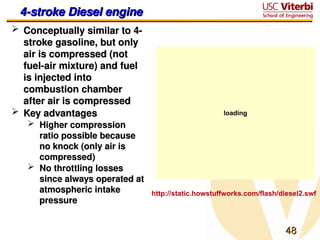
 Conceptually similar to 4-
Conceptually similar to 4-
stroke gasoline, but only
air is compressed (not
fuel-air mixture) and fuel
is injected into
is injected into
combustion chamber
combustion chamber
after air is compressed
 Key advantages
Key advantages
 Higher compression
Higher compression
ratio possible because
no knock (only air is
compressed)
compressed)
 No throttling losses
No throttling losses
since always operated at
atmospheric intake
atmospheric intake
pressure
pressure
http://static.howstuffworks.com/flash/diesel2.swf
49
49
Premixed vs. non-premixed charge engines
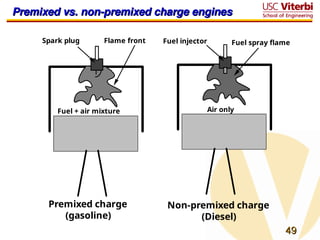
Flame front Fuel spray flame
Premixed charge
(gasoline)
Non-premixed charge
(Diesel)
Spark plug Fuel injector
Fuel + air mixture Air only
52
52
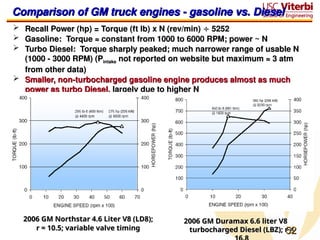
2006 GM Northstar 4.6 Liter V8 (LD8);
r = 10.5; variable valve timing
Comparison of GM truck engines - gasoline vs. Diesel
 Recall Power (hp) = Torque (ft lb) x N (rev/min)
Recall Power (hp) = Torque (ft lb) x N (rev/min) 
 5252
5252
 Gasoline: Torque ≈ constant from 1000 to 6000 RPM; power ~ N
Gasoline: Torque ≈ constant from 1000 to 6000 RPM; power ~ N
 Turbo Diesel: Torque sharply peaked; much narrower range of usable N
Turbo Diesel: Torque sharply peaked; much narrower range of usable N
(1000 - 3000 RPM) (P
(1000 - 3000 RPM) (Pintake
intake not reported on website but maximum ≈ 3 atm
not reported on website but maximum ≈ 3 atm
from other data)
from other data)
 Smaller, non-turbocharged gasoline engine produces almost as much
Smaller, non-turbocharged gasoline engine produces almost as much
power as turbo Diesel,
power as turbo Diesel, largely due to higher N
largely due to higher N
2006 GM Duramax 6.6 liter V8
turbocharged Diesel (LBZ); r =
53
53
Ronney’s catechism (1/4)
 Why do we throttle in a premixed charge engine despite the throttling
Why do we throttle in a premixed charge engine despite the throttling
losses it causes?
losses it causes?
 Because we have to reduce power & torque when we don’t want the
Because we have to reduce power & torque when we don’t want the
full output of the engine (which is most of the time in LA traffic, or
even on the open road)
 Why don’t we have to throttle in a nonpremixed charge engine?
Why don’t we have to throttle in a nonpremixed charge engine?
 Because we use control of the fuel to air ratio (i.e. to reduce power &
Because we use control of the fuel to air ratio (i.e. to reduce power &
torque, we reduce the fuel for the (fixed) air mass)
 Why don’t we do that for the premixed charge engine and avoid throttling
Why don’t we do that for the premixed charge engine and avoid throttling
losses?
losses?
 Because if we try to burn lean in the premixed-charge engine, when
Because if we try to burn lean in the premixed-charge engine, when
the equivalence ratio (
the equivalence ratio (
) is reduced below about 0.7, the mixture
) is reduced below about 0.7, the mixture
misfires and may stop altogether
 Why isn’t that a problem for the nonpremixed charge engine?
Why isn’t that a problem for the nonpremixed charge engine?
 Nonpremixed-charge engines are not subject to flammability limits like
Nonpremixed-charge engines are not subject to flammability limits like
premixed-charge engines since there is a continuously range of fuel-
to-air ratios varying from zero in the pure air to infinite in the pure fuel,
thus someplace there is a stoichiometric (
thus someplace there is a stoichiometric (
 = 1) mixture that can burn.
= 1) mixture that can burn.
Such variation in
Such variation in 
 does not occur in premixed-charge engines since,
does not occur in premixed-charge engines since,
by definition,
by definition, 
 is the same everywhere.
is the same everywhere.
54
54
Ronney’s catechism (2/4)
 So why would anyone want to use a premixed-charge engine?
So why would anyone want to use a premixed-charge engine?
 Because the nonpremixed-charge engine burns its fuel slower, since
Because the nonpremixed-charge engine burns its fuel slower, since
fuel and air must mix before they can burn. This is already taken care of
in the premixed-charge engine. This means lower engine RPM and thus
less power from an engine of a given displacement
 Wait - you said that the premixed-charge engine is slower burning.
Wait - you said that the premixed-charge engine is slower burning.
 Only if the mixture is too lean. If it’s near-stoichiometric, then it’s faster
Only if the mixture is too lean. If it’s near-stoichiometric, then it’s faster
because, again, mixing was already done before ignition (ideally, at
least). Recall that as
least). Recall that as 
 drops, T
drops, Tad
ad drops proportionately, and burning
drops proportionately, and burning
velocity (S
velocity (SL
L) drops exponentially as T
) drops exponentially as Tad
ad drops
drops
 Couldn’t I operate my non-premixed charge engine at overall stoichiometric
Couldn’t I operate my non-premixed charge engine at overall stoichiometric
conditions to increase burning rate?
 No. In nonpremixed-charge engines it still takes time to mix the pure
No. In nonpremixed-charge engines it still takes time to mix the pure
fuel and pure air, so (as discussed previously) burning rates, flame
lengths, etc. of nonpremixed flames are usually limited by mixing rates,
not reaction rates. Worse still, with initially unmixed reactants at overall
stoichiometric conditions, the last molecule of fuel will never find the
last molecule of air in the time available for burning in the engine - one
will be in the upper left corner of the cylinder, the other in the lower
right corner. That means unburned or partially burned fuel would be
emitted. That’s why diesel engines smoke at heavy load, when the
mixture gets too close to overall stoichiometric.
55
55
Ronney’s catechism (3/4)
 So what wrong with operating at a maximum fuel to air ratio a little lean
So what wrong with operating at a maximum fuel to air ratio a little lean
of stoichiometric?
of stoichiometric?
 That reduces maximum power, since you’re not burning every
That reduces maximum power, since you’re not burning every
molecule of O
molecule of O2
2 in the cylinder. Remember - O
in the cylinder. Remember - O2
2 molecules take up a
molecules take up a
lot more space in the cylinder that fuel molecules do (since each O
lot more space in the cylinder that fuel molecules do (since each O2
2
is attached to 3.77 N
is attached to 3.77 N2
2 molecules), so it behooves you to burn every
molecules), so it behooves you to burn every
last O
last O2
2 molecule if you want maximum power. So because of the
molecule if you want maximum power. So because of the
mixing time as well as the need to run overall lean, Diesels have
less power for a given displacement / weight / size / etc.
 So is the only advantage of the Diesel the better efficiency at part-load
So is the only advantage of the Diesel the better efficiency at part-load
due to absence of throttling loss?
 No, you also can go to higher compression ratios, which increases
No, you also can go to higher compression ratios, which increases
efficiency at any load. This helps alleviate the problem that slower
burning in Diesels means lower inherent efficiency (more burning at
increasing cylinder volume)
 Why can the compression ratio be higher in the Diesel engine?
Why can the compression ratio be higher in the Diesel engine?
 Because you don’t have nearly as severe problems with knock.
Because you don’t have nearly as severe problems with knock.
That’s because you compress only air, then inject fuel when you
want it to burn. In the premixed-charge case, the mixture being
compressed can explode (since it’s fuel + air) if you compress it too
much
much
56
56
Ronney’s catechism (4/4)
 Why is knock so bad?
Why is knock so bad?
 It causes intense pressure waves that rattle the piston and leads to
It causes intense pressure waves that rattle the piston and leads to
severe engine damage
 So, why have things evolved such that small engines are usually premixed-
So, why have things evolved such that small engines are usually premixed-
charge, whereas large engines are nonpremixed-charge?
 In small engines (lawn mowers, autos, etc.) you’re usually most
In small engines (lawn mowers, autos, etc.) you’re usually most
concerned with getting the highest power/weight and power/volume
ratios, rather than best efficiency (fuel economy). In larger engines
(trucks, locomotives, tugboats, etc.) you don’t care as much about size
and weight but efficiency is more critical
 But unsteady-flow aircraft engines, even large ones, are premixed-charge,
But unsteady-flow aircraft engines, even large ones, are premixed-charge,
because weight is always critical in aircraft
 You got me on that one. But of course most large aircraft engines are
You got me on that one. But of course most large aircraft engines are
steady-flow gas turbines, which kill unsteady-flow engines in terms of
power/weight and power/volume.
57
57
Practical alternatives… discussion points
 Conservation!
Conservation!
 Combined cycles: use hot exhaust from ICE to heat water for
Combined cycles: use hot exhaust from ICE to heat water for
conventional steam cycle - can achieve > 60% efficiency but not
practical for vehicles - too much added volume & weight
 Natural gas
Natural gas
 4x cheaper than electricity, 2x cheaper than gasoline or diesel for
4x cheaper than electricity, 2x cheaper than gasoline or diesel for
same energy
same energy
 Somewhat cleaner than gasoline or diesel, but no environmental
Somewhat cleaner than gasoline or diesel, but no environmental
silver bullet
silver bullet
 Low energy storage density - 4x lower than gasoline or diesel
Low energy storage density - 4x lower than gasoline or diesel
58
58
Practical alternatives… discussion points
 Fischer-Tropsch fuels - liquid hydrocarbons from coal or natural gas
Fischer-Tropsch fuels - liquid hydrocarbons from coal or natural gas
 Competitive with $75/barrel oil
Competitive with $75/barrel oil
 Cleaner than gasoline or diesel
Cleaner than gasoline or diesel
 …
… but using coal increases greenhouse gases!
but using coal increases greenhouse gases!
Coal : oil : natural gas = 2 : 1.5 : 1
 But really, there is no way to decide what the next step is until it is
But really, there is no way to decide what the next step is until it is
decided whether there will be a tax on CO
decided whether there will be a tax on CO2
2 emissions
emissions
 Personal opinion: most important problems are (in order of priority)
Personal opinion: most important problems are (in order of priority)
 Global warming
Global warming
 Energy independence
Energy independence
 Environment
Environment
59
59
Summary of advantages of ICEs
 Moral - hard to beat liquid-fueled internal combustion
Moral - hard to beat liquid-fueled internal combustion
engines for
engines for
 Power/weight & power/volume of engine
Power/weight & power/volume of engine
 Energy/weight (
Energy/weight (4.3 x 10
4.3 x 10⁷
7
J/kg
J/kg assuming only fuel, not air,
assuming only fuel, not air,
is carried) & energy/volume of liquid hydrocarbon fuel
 Distribution & handling convenience of liquids
Distribution & handling convenience of liquids
 Relative safety of hydrocarbons compared to hydrogen or
Relative safety of hydrocarbons compared to hydrogen or
nuclear energy
nuclear energy
 Conclusion #1: IC engines are the worst form of vehicle
Conclusion #1: IC engines are the worst form of vehicle
propulsion, except for all the other forms
 Conclusion #2: Oil costs way too much, but it’s still
Conclusion #2: Oil costs way too much, but it’s still
very cheap
very cheap
60
60
Sidebar: Throttleless Premixed-Charge Engine (TPCE)
 E. J. Durbin & P. D. Ronney, U.S. Patent No. 5,184,592
E. J. Durbin & P. D. Ronney, U.S. Patent No. 5,184,592
http://ronney.usc.edu/Research/TPCE/TPCE_patent.pdf
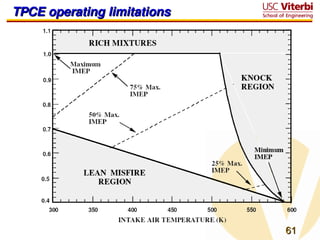
 Use intake temperature increment via exhaust heat transfer to reduce air
Use intake temperature increment via exhaust heat transfer to reduce air
density, thus IMEP/torque/power
 Keep P
Keep Pintake
intake (= P
(= P2
2 in our notation) at ambient
in our notation) at ambient (no throttling loss)
(no throttling loss)
 Increasing T
Increasing Tintake
intake = (T
= (T2
2 in our notation) leads to leaner lean misfire limit
in our notation) leads to leaner lean misfire limit
(lower f) - use air/fuel ratio AND T
(lower f) - use air/fuel ratio AND Tintake
intake to control power/torque
to control power/torque
 Lean limit corresponds ≈ to constant T
Lean limit corresponds ≈ to constant Tad
ad (= T
(= T4
4 in our notation)
in our notation)
 T
T4
4 = T
= T3
3 + fQ
+ fQR
R/C
/Cv
v = T
= T2
2r
r
-1
-1
+ fQ
+ fQR
R/C
/Cv
v 
 can get lean-limit T
can get lean-limit T4
4 through various
through various
combinations of T
combinations of T2
2 & f
& f
 Higher T
Higher T2
2 & lower f
& lower f 
 lower IMEP
lower IMEP
 Higher T
Higher Tintake
intake increases knock tendency, but
increases knock tendency, but
 Lean mixtures much less susceptible to knock
Lean mixtures much less susceptible to knock
 Alternative fuels (natural gas, methanol, ethanol) better
Alternative fuels (natural gas, methanol, ethanol) better
 Retrofit to existing engines possible by changing only intake, exhaust, &
Retrofit to existing engines possible by changing only intake, exhaust, &
control systems
control systems

IMEPg 
Pintake
RTintake
th,i,gv fQR intaketh,i,gv fQR
61
61
TPCE operating limitations
62
62
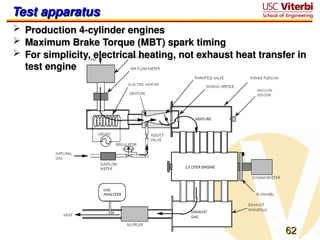
Test apparatus
Test apparatus
 Production 4-cylinder engines
Production 4-cylinder engines
 Maximum Brake Torque (MBT) spark timing
Maximum Brake Torque (MBT) spark timing
 For simplicity, electrical heating, not exhaust heat transfer in
For simplicity, electrical heating, not exhaust heat transfer in
test engine
test engine
63
63
Results
Results
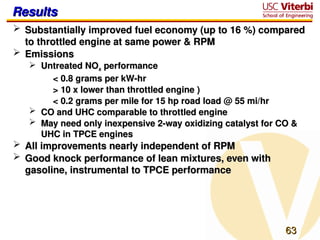
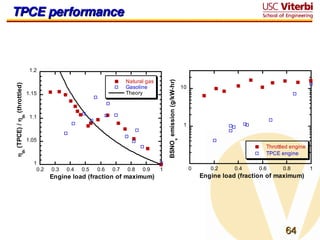
 Substantially improved fuel economy (up to 16 %) compared
Substantially improved fuel economy (up to 16 %) compared
to throttled engine at same power & RPM
 Emissions
Emissions
 Untreated NO
Untreated NOx
x performance
performance
< 0.8 grams per kW-hr
> 10 x lower than throttled engine )
< 0.2 grams per mile for 15 hp road load @ 55 mi/hr
 CO and UHC comparable to throttled engine
CO and UHC comparable to throttled engine
 May need only inexpensive 2-way oxidizing catalyst for CO &
May need only inexpensive 2-way oxidizing catalyst for CO &
UHC in TPCE engines
UHC in TPCE engines
 All improvements nearly independent of RPM
All improvements nearly independent of RPM
 Good knock performance of lean mixtures, even with
Good knock performance of lean mixtures, even with
gasoline, instrumental to TPCE performance
64
64
TPCE performance
TPCE performance
1
10
0 0.2 0.4 0.6 0.8 1
Throttled engine
TPCE engine
Engine load (fraction of maximum)
BSNO
x
emission
(g/kW-hr)
1
1.05
1.1
1.15
1.2
0.2 0.3 0.4 0.5 0.6 0.7 0.8 0.9 1
Natural gas
Gasoline
Theory
Engine load (fraction of maximum)

th
(TPCE)
/

th
(throttled)
65
65
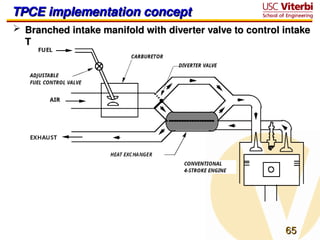
TPCE implementation concept
 Branched intake manifold with diverter valve to control intake
Branched intake manifold with diverter valve to control intake
T
T

internal combustion engines lecture notes ppt

  • 1.
    Internal Combustion Engines:The Internal Combustion Engines: The Worst Form of Vehicle Propulsion - Worst Form of Vehicle Propulsion - Except for All the Other Forms Except for All the Other Forms A primer on IC engines A primer on IC engines and their alternatives and their alternatives Paul D. Ronney Paul D. Ronney Deparment of Aerospace and Mechanical Engineering Deparment of Aerospace and Mechanical Engineering University of Southern California University of Southern California Download this presentation: Download this presentation: http://ronney.usc.edu/WhyICEngines-expanded.ppt http://ronney.usc.edu/WhyICEngines-expanded.ppt
  • 2.
    2 2 Outline Outline  Automotive engines Automotiveengines  Definition of Internal Combustion Engines (ICEs) Definition of Internal Combustion Engines (ICEs)  Types of ICEs Types of ICEs  History and evolution of ICEs History and evolution of ICEs  Things you need to know before… Things you need to know before…  Gas turbines Gas turbines  What are the alternatives to ICEs? What are the alternatives to ICEs?  The nitty gritty The nitty gritty  How they work How they work  Why they’re designed that way Why they’re designed that way  Gasoline vs. diesel Gasoline vs. diesel  Practical perspective Practical perspective  Summary Summary
  • 3.
    Part 1: Part 1: Automotiveengines: Automotive engines: how and why how and why
  • 4.
    4 4 Introduction Introduction  Hydrocarbon-fueled ICEsare the power plant of choice for vehicles Hydrocarbon-fueled ICEs are the power plant of choice for vehicles in the power range from 5 Watts to 100,000,000 Watts, and have in the power range from 5 Watts to 100,000,000 Watts, and have been for 100 years been for 100 years  There is an unlimited amount of inaccurate, misleading and/or There is an unlimited amount of inaccurate, misleading and/or dogmatic information about ICEs dogmatic information about ICEs  This seminar’s messages This seminar’s messages  Why ICEs so ubiquitous Why ICEs so ubiquitous  Why it will be so difficult to replace them with another technology Why it will be so difficult to replace them with another technology  What you will have to do if you want to replace them What you will have to do if you want to replace them
  • 5.
    5 5 Classification of ICEs Classificationof ICEs  Definition of an ICE: a Definition of an ICE: a heat engine heat engine in which the heat source is in which the heat source is a a combustible mixture combustible mixture that that also serves as the working fluid also serves as the working fluid  The working fluid in turn is used either to The working fluid in turn is used either to  Produce shaft work by pushing on a piston or turbine blade Produce shaft work by pushing on a piston or turbine blade that in turn drives a rotating shaft or that in turn drives a rotating shaft or  Creates a high-momentum fluid that is used directly for Creates a high-momentum fluid that is used directly for propulsive force propulsive force
  • 6.
    6 6 What is /is not an ICE? What is / is not an ICE? IS IS  Gasoline-fueled Gasoline-fueled reciprocating piston reciprocating piston engine engine  Diesel-fueled Diesel-fueled reciprocating piston reciprocating piston engine engine  Gas turbine Gas turbine  Rocket Rocket IS NOT IS NOT  Steam power plant Steam power plant  Solar power plant Solar power plant  Nuclear power plant Nuclear power plant
  • 7.
    7 7 ICE family tree ICEfamily tree Turboshaft All shaft work to drive propeller, generator, rotor (helicopter) Turbofan Part shaft, part jet - "ducted propeller" Turbojet All jet except for work needed to drive compressor Gas Turbine Uses compressor and turbine, not piston-cylinder Ramjet No compressor or turbine Use high Mach no. ram effect for compression Solid fuel Fuel and oxidant are premixed and put inside combustion chamber Liquid fuel Fuel and oxidant are initially separated and pumped into combustion chamber Rocket Carries both fuel and oxidant Jet power only, no shaft work Steady Two-stroke One complete thermodynamic cycle per revolution of engine Four-stroke One complete thermodynamic cycle per two revolutions of engine Premixed-charge Fuel and air are mixed before/during compression Usually ignited with spark after compression Two-stroke One complete thermodynamic cycle per revolution of engine Four-stroke One complete thermodynamic cycle per two revolutions of engine Non-premixed charge Only air is compressed, fuel is injected into cylinder after compression Non-steady Internal Combustion Engines
  • 8.
    8 8 Largest internal combustionengine Largest internal combustion engine  Wartsila-Sulzer RTA96-C turbocharged two-stroke diesel, built in Finland, Wartsila-Sulzer RTA96-C turbocharged two-stroke diesel, built in Finland, used in container ships used in container ships  14 cylinder version: weight 2300 tons 14 cylinder version: weight 2300 tons; ; length 89 feet; height 44 feet; max. length 89 feet; height 44 feet; max. power 108,920 hp @ 102 rpm; max. torque 5,608,312 ft lb @ 102 RPM power 108,920 hp @ 102 rpm; max. torque 5,608,312 ft lb @ 102 RPM  Power/weight = Power/weight = 0.024 hp/lb 0.024 hp/lb  Also one of the most efficient IC engines: 51% Also one of the most efficient IC engines: 51%
  • 9.
    9 9 Most powerful internalcombustion engine Most powerful internal combustion engine  Wartsila-Sulzer RTA96-C is the Wartsila-Sulzer RTA96-C is the largest largest IC engine, but the Space Shuttle IC engine, but the Space Shuttle Solid Rocket Boosters are the Solid Rocket Boosters are the most powerful most powerful (≈ 42 (≈ 42 million million horsepower ( horsepower (32 32 hp/lb hp/lb); not shaft power but kinetic energy of exhaust stream) ); not shaft power but kinetic energy of exhaust stream)  Most powerful shaft-power engine: Siemens SGT5-8000H stationary gas Most powerful shaft-power engine: Siemens SGT5-8000H stationary gas turbine (340 MW = 456,000 HP) ( turbine (340 MW = 456,000 HP) (0.52 hp/lb 0.52 hp/lb) used for electrical power ) used for electrical power generation generation
  • 10.
    10 10 Smallest internal combustionengine Smallest internal combustion engine  Cox Tee Dee 010 Cox Tee Dee 010 Application: Application: model airplanes model airplanes Weight: Weight: 0.49 oz. 0.49 oz. Displacement: Displacement: 0.00997 in 0.00997 in3 3 (0.163 cm (0.163 cm3 3 ) ) RPM: RPM: 30,000 30,000 Power: Power: 5 watts 5 watts Ignition: Glow plug  Typical fuel: castor oil (10 - 20%), nitromethane (0 - 50%), balance methanol  Good power/weight ( Good power/weight (0.22 hp/lb 0.22 hp/lb) but poor performance ) but poor performance  Low efficiency (< 5%) Low efficiency (< 5%)  Emissions & noise unacceptable for many applications Emissions & noise unacceptable for many applications
  • 11.
    11 11 History of automotiveengines History of automotive engines  1859 - Oil discovered at Drake’s Well, Titusville, 1859 - Oil discovered at Drake’s Well, Titusville, Pennsylvania (20 barrels per day) Pennsylvania (20 barrels per day) - 40 year supply - 40 year supply  1876 - Premixed-charge 4-stroke engine - Otto 1876 - Premixed-charge 4-stroke engine - Otto  1st practical ICE 1st practical ICE  Power: 2 hp; Weight: 1250 pounds Power: 2 hp; Weight: 1250 pounds  Comp. ratio = 4 (knock limited), 14% efficiency Comp. ratio = 4 (knock limited), 14% efficiency (theory 38%) (theory 38%)  Today CR = 9 (still knock limited), 30% efficiency Today CR = 9 (still knock limited), 30% efficiency (theory 55%) (theory 55%)  1897 - Nonpremixed-charge engine - Diesel - higher 1897 - Nonpremixed-charge engine - Diesel - higher efficiency due to efficiency due to  Higher compression ratio (no knock problem) Higher compression ratio (no knock problem)  No throttling loss - use fuel/air ratio to control power No throttling loss - use fuel/air ratio to control power  1901 - Spindletop Dome, east Texas - Lucas #1 1901 - Spindletop Dome, east Texas - Lucas #1 gusher produces 100,000 barrels per day - ensures gusher produces 100,000 barrels per day - ensures that “2nd Industrial Revolution” will be fueled by that “2nd Industrial Revolution” will be fueled by oil, not coal or wood oil, not coal or wood - 40 year supply - 40 year supply
  • 12.
    12 12 History of automotiveengines History of automotive engines  1921 - Tetraethyl lead anti-knock additive discovered at 1921 - Tetraethyl lead anti-knock additive discovered at General Motors General Motors  Enabled higher compression ratio (thus more power, better Enabled higher compression ratio (thus more power, better efficiency) in Otto-type engines efficiency) in Otto-type engines  1952 - A. J. Haagen-Smit, Caltech 1952 - A. J. Haagen-Smit, Caltech NO + UHC + O NO + UHC + O2 2 + sunlight + sunlight   NO NO2 2 + O + O3 3 (from exhaust) (from exhaust) (brown) (irritating) (brown) (irritating) (UHC = unburned hydrocarbons) (UHC = unburned hydrocarbons)  1960s - Emissions regulations 1960s - Emissions regulations  Detroit won’t believe it Detroit won’t believe it  Initial stop-gap measures - lean mixture, EGR, retard spark Initial stop-gap measures - lean mixture, EGR, retard spark  Poor performance & fuel economy Poor performance & fuel economy  1973 & 1979 - The energy crises 1973 & 1979 - The energy crises  Detroit takes a bath Detroit takes a bath
  • 13.
    13 13 History of automotiveengines History of automotive engines  1975 - Catalytic converters, unleaded fuel 1975 - Catalytic converters, unleaded fuel  Detroit forced to buy technology Detroit forced to buy technology  More “aromatics” (e.g., benzene) in gasoline - high octane but More “aromatics” (e.g., benzene) in gasoline - high octane but carcinogenic, soot-producing carcinogenic, soot-producing  1980s - Microcomputer control of engines 1980s - Microcomputer control of engines  Tailor operation for best emissions, efficiency, ... Tailor operation for best emissions, efficiency, ...  1990s - Reformulated gasoline 1990s - Reformulated gasoline  Reduced need for aromatics, cleaner(?) Reduced need for aromatics, cleaner(?)  ... but higher cost, lower miles per gallon ... but higher cost, lower miles per gallon  Then we found that MTBE pollutes groundwater!!! Then we found that MTBE pollutes groundwater!!!  Alternative “oxygenated” fuel additive - ethanol - very attractive Alternative “oxygenated” fuel additive - ethanol - very attractive to powerful senators from farm states to powerful senators from farm states
  • 14.
    14 14 History of automotiveengines History of automotive engines  2000’s - hybrid vehicles 2000’s - hybrid vehicles  Use small gasoline engine operating at maximum power Use small gasoline engine operating at maximum power (most efficient way to operate) or turned off if not needed (most efficient way to operate) or turned off if not needed  Use generator/batteries/motors to make/store/use surplus Use generator/batteries/motors to make/store/use surplus power from gasoline engine power from gasoline engine  More efficient, but much more equipment on board - not clear More efficient, but much more equipment on board - not clear if fuel savings justify extra cost if fuel savings justify extra cost  Plug-in hybrid: half-way between conventional hybrid and Plug-in hybrid: half-way between conventional hybrid and electric vehicle electric vehicle  Recent study in a major consumer magazine: only 1 of 7 Recent study in a major consumer magazine: only 1 of 7 hybrids tested show a cost benefit over a 5 year ownership hybrids tested show a cost benefit over a 5 year ownership period if tax incentives removed period if tax incentives removed » Dolly Parton: “You wouldn’t believe how much it costs to look Dolly Parton: “You wouldn’t believe how much it costs to look this cheap” this cheap” » Paul Ronney: “You wouldn’t believe how much energy some Paul Ronney: “You wouldn’t believe how much energy some people spend to save a little fuel” people spend to save a little fuel”
  • 15.
    15 15 Things you needto understand before ... Things you need to understand before ... … …you invent the zero-emission, 100 mpg 1000 hp engine, you invent the zero-emission, 100 mpg 1000 hp engine, revolutionize the automotive industry and shop for your revolutionize the automotive industry and shop for your retirement home on the French Riviera retirement home on the French Riviera  Room for improvement - factor of less than 2 in efficiency Room for improvement - factor of less than 2 in efficiency  Ideal Otto cycle engine with compression ratio = 9: 55% Ideal Otto cycle engine with compression ratio = 9: 55%  Real engine: 25 - 30% Real engine: 25 - 30%  Differences because of Differences because of »Throttling losses Throttling losses »Heat losses Heat losses »Friction losses Friction losses »Slow burning Slow burning »Incomplete combustion is a very minor effect Incomplete combustion is a very minor effect  Majority of power is used to overcome air resistance Majority of power is used to overcome air resistance - - smaller, more aerodynamic vehicles beneficial smaller, more aerodynamic vehicles beneficial
  • 16.
    16 16 Things you needto understand before ... Things you need to understand before ...  Room for improvement - infinite in pollutants Room for improvement - infinite in pollutants  Pollutants are a Pollutants are a non-equilibrium non-equilibrium effect effect »Burn: Fuel + O Burn: Fuel + O2 2 + N + N2 2   H H2 2O + CO O + CO2 2 + N + N2 2 + CO + UHC + NO + CO + UHC + NO OK OK(?) OK Bad Bad Bad OK OK(?) OK Bad Bad Bad »Expand: CO + UHC + NO “frozen” at high levels Expand: CO + UHC + NO “frozen” at high levels »With slow expansion, no heat loss: With slow expansion, no heat loss: CO + UHC + NO CO + UHC + NO   H H2 2O + CO O + CO2 2 + N + N2 2 ...but how to slow the expansion and eliminate heat loss? ...but how to slow the expansion and eliminate heat loss?  Worst problems: cold start, transients, old or out-of- Worst problems: cold start, transients, old or out-of- tune vehicles - 90% of pollution generated by 10% of tune vehicles - 90% of pollution generated by 10% of vehicles vehicles
  • 17.
    17 17 Things you needto understand before ... Things you need to understand before ...  Room for improvement - very little in power Room for improvement - very little in power  IC engines are air processors IC engines are air processors »Fuel takes up little space Fuel takes up little space »Air flow = power Air flow = power »Limitation on air flow due to Limitation on air flow due to • “ “Choked” flow past intake valves Choked” flow past intake valves • Friction loss, mechanical strength - limits RPM Friction loss, mechanical strength - limits RPM • Slow burn Slow burn »How to increase air flow? How to increase air flow? • Larger engines Larger engines • Faster-rotating engines Faster-rotating engines • Turbocharge / supercharge Turbocharge / supercharge • Avoid stop/start cycle of reciprocating piston engines - how? Avoid stop/start cycle of reciprocating piston engines - how?
  • 18.
    18 18 Basic gas turbinecycle Basic gas turbine cycle
  • 19.
  • 20.
    20 20 Why gas turbines? Whygas turbines?  GE CT7-8 turboshaft (used in GE CT7-8 turboshaft (used in helicopters) helicopters)  http://www.geae.com/engines/ http://www.geae.com/engines/ commercial/ct7/ct7-8.html commercial/ct7/ct7-8.html  Compressor/turbine stages: 6/4 Compressor/turbine stages: 6/4  Diameter 26”, Length 48.8” = 426 liters Diameter 26”, Length 48.8” = 426 liters = = 5.9 hp/liter 5.9 hp/liter  Dry Weight 537 lb, max. power 2,520 hp Dry Weight 537 lb, max. power 2,520 hp ( (power/wt = 4.7 hp/lb power/wt = 4.7 hp/lb) )  Pressure ratio at max. power: 21 (ratio Pressure ratio at max. power: 21 (ratio per stage = 21 per stage = 211/6 1/6 = 1.66) = 1.66)  Specific fuel consumption at max. Specific fuel consumption at max. power: 0.450 (units not given; if lb/hp-hr power: 0.450 (units not given; if lb/hp-hr then corresponds to 29.3% efficiency) then corresponds to 29.3% efficiency)  Cummins QSK60-2850 4-stroke Cummins QSK60-2850 4-stroke 60.0 liter 60.0 liter (3,672 in (3,672 in3 3 ) ) V-16 2-stage turbocharged V-16 2-stage turbocharged diesel (used in mining trucks) diesel (used in mining trucks)  http://www.everytime.cummins.com/ http://www.everytime.cummins.com/ assets/pdf/4087056.pdf assets/pdf/4087056.pdf  2.93 m long x 1.58 m wide x 2.31 m high = 2.93 m long x 1.58 m wide x 2.31 m high = 10,700 liters = 10,700 liters = 0.27 hp/liter 0.27 hp/liter  Dry weight 21,207 lb, 2850 hp at 1900 Dry weight 21,207 lb, 2850 hp at 1900 RPM ( RPM (power/wt = 0.134 hp/lb = 35x lower power/wt = 0.134 hp/lb = 35x lower than gas turbine than gas turbine) )  Volume compression ratio ??? (not Volume compression ratio ??? (not given) given)
  • 21.
    21 21  Ballard HY-80“Fuel cell engine” Ballard HY-80 “Fuel cell engine”  http://www.ballard.com/resources/ http://www.ballard.com/resources/ transportation/XCS-HY-80_Trans.pdf (no transportation/XCS-HY-80_Trans.pdf (no longer valid link!) longer valid link!)  Volume 220 liters = 0.41 hp/liter Volume 220 liters = 0.41 hp/liter  91 hp, 485 lb. ( 91 hp, 485 lb. (power/wt = 0.19 hp/lb power/wt = 0.19 hp/lb) )  48% efficiency (fuel to electricity) 48% efficiency (fuel to electricity)  Uses hydrogen only - NOT hydrocarbons Uses hydrogen only - NOT hydrocarbons  Does NOT include electric drive system Does NOT include electric drive system (≈ (≈ 0.40 hp/lb) at ≈ 90% electrical to mechanical 0.40 hp/lb) at ≈ 90% electrical to mechanical efficiency efficiency (http://www.gm.com/company/gmability/adv (http://www.gm.com/company/gmability/adv _tech/images/fact_sheets/hywire.html) (no _tech/images/fact_sheets/hywire.html) (no longer valid) longer valid)  Fuel cell + motor overall 0.13 hp/lb at 43% Fuel cell + motor overall 0.13 hp/lb at 43% efficiency, not including H efficiency, not including H2 2 storage storage Why gas turbines? Why gas turbines?  Lycoming IO-720 11.8 liter (720 cu in) 4- Lycoming IO-720 11.8 liter (720 cu in) 4- stroke 8-cyl. gasoline engine stroke 8-cyl. gasoline engine ( (http://www.lycoming.com/engines/series/ pdfs/Specialty%20insert.pdf) )  Total volume 23” x 34” x 46” = 589 liters = Total volume 23” x 34” x 46” = 589 liters = 0.67 hp/liter 0.67 hp/liter  400 hp @ 2650 RPM 400 hp @ 2650 RPM  Dry weight 600 lb. ( Dry weight 600 lb. (power/wt = 0.67 hp/lb = power/wt = 0.67 hp/lb = 7x lower than gas turbine 7x lower than gas turbine) )  Volume compression ratio 8.7:1 (= Volume compression ratio 8.7:1 (= pressure ratio 20.7 if isentropic) pressure ratio 20.7 if isentropic)
  • 22.
    22 22 Why gas turbines? Whygas turbines?  Why does gas turbine have much higher power/weight & Why does gas turbine have much higher power/weight & power/volume than recips? power/volume than recips? More air can be processed More air can be processed since since steady flow, not start/stop of reciprocating-piston engines steady flow, not start/stop of reciprocating-piston engines  More air More air   more fuel can be burned more fuel can be burned  More fuel More fuel   more heat release more heat release  More heat More heat   more work (if thermal efficiency similar) more work (if thermal efficiency similar)  What are the disadvantages? What are the disadvantages?  Compressor Compressor is a is a dynamic dynamic device that makes gas move from low device that makes gas move from low pressure to high pressure without a positive seal like a pressure to high pressure without a positive seal like a piston/cylinder piston/cylinder » Requires very precise aerodynamics Requires very precise aerodynamics » Requires blade speeds ≈ sound speed, otherwise gas flows back to Requires blade speeds ≈ sound speed, otherwise gas flows back to low P faster than compressor can push it to high P low P faster than compressor can push it to high P » Each stage can provide only 2:1 or 3:1 pressure ratio - need many Each stage can provide only 2:1 or 3:1 pressure ratio - need many stages for large pressure ratio stages for large pressure ratio  Since steady flow, each component sees a constant temperature Since steady flow, each component sees a constant temperature - at end of combustor - - at end of combustor - turbine turbine stays hot continuously and must stays hot continuously and must rotate at high speeds (high stress) rotate at high speeds (high stress) » Severe materials and cooling engineering required (unlike recip, Severe materials and cooling engineering required (unlike recip, where components only feel where components only feel average gas temperature during cycle average gas temperature during cycle) ) » Turbine inlet temperature limit ≈ 1600K = 2420˚F - limits fuel input Turbine inlet temperature limit ≈ 1600K = 2420˚F - limits fuel input
  • 23.
    23 23 Why gas turbines? Whygas turbines?  As a result, turbines require more maintenance & are more As a result, turbines require more maintenance & are more expensive for same power (so never used in automotive expensive for same power (so never used in automotive applications… but is used in modern military tanks, because of applications… but is used in modern military tanks, because of power/volume, NOT power/weight) power/volume, NOT power/weight)  Simple intro to gas turbines: Simple intro to gas turbines: http://geae.com/education/engines101/ http://geae.com/education/engines101/
  • 24.
    24 24 Alternative #1 -external combustion Alternative #1 - external combustion  Examples: steam engine, Stirling cycle engine Examples: steam engine, Stirling cycle engine  Use any fuel as the heat source Use any fuel as the heat source  Use any working fluid (high Use any working fluid (high  , e.g. helium, provides better efficiency) , e.g. helium, provides better efficiency)  Heat transfer, gasoline engine Heat transfer, gasoline engine  Heat transfer per unit area (q/A) = k(dT/dx) Heat transfer per unit area (q/A) = k(dT/dx)  Turbulent mixture inside engine: k ≈ 100 k Turbulent mixture inside engine: k ≈ 100 kno turbulence no turbulence ≈ ≈ 2.5 W/mK 2.5 W/mK  dT/dx ≈ dT/dx ≈  T/ T/ x ≈ 1500K / 0.02 m x ≈ 1500K / 0.02 m  q/A ≈ 187,500 W/m q/A ≈ 187,500 W/m2 2  Combustion: q/A = Combustion: q/A =  Y Yf fQ QR RS ST T = (10 kg/m = (10 kg/m3 3 ) x 0.067 x (4.5 x 10 ) x 0.067 x (4.5 x 107 7 J/kg) x J/kg) x 2 m/s = 2 m/s = 60,300,000 W/m 60,300,000 W/m2 2 - - 321x higher! 321x higher!  CONCLUSION: HEAT TRANSFER IS TOO SLOW!!! CONCLUSION: HEAT TRANSFER IS TOO SLOW!!!  That’s why 10 large gas turbine engines ≈ large (1 gigawatt) coal- That’s why 10 large gas turbine engines ≈ large (1 gigawatt) coal- fueled electric power plant fueled electric power plant k = gas thermal conductivity, T = temperature, x = distance, k = gas thermal conductivity, T = temperature, x = distance,   = density, Y = density, Yf f = = fuel mass fraction, Q fuel mass fraction, QR R = fuel heating value, S = fuel heating value, ST T = turbulent flame speed in = turbulent flame speed in engine engine
  • 25.
    25 25 Alternative #2 -Electric Vehicles (EVs) Alternative #2 - Electric Vehicles (EVs)  Why not generate electricity in a large central power plant Why not generate electricity in a large central power plant and distribute to charge batteries to power electric motors? and distribute to charge batteries to power electric motors?  EV NiMH battery - 26.4 kW-hours, 1147 pounds = EV NiMH battery - 26.4 kW-hours, 1147 pounds = 1.83 x 10 1.83 x 10⁵ 5 J/kg J/kg (http://www.gmev.com/power/power.htm) (http://www.gmev.com/power/power.htm)  Gasoline (and other hydrocarbons): Gasoline (and other hydrocarbons): 4.3 x 10 4.3 x 10⁷ 7 J/kg J/kg  Even at 30% efficiency (gasoline) vs. 90% (batteries), Even at 30% efficiency (gasoline) vs. 90% (batteries), gasoline has gasoline has 78 times higher energy/weight than batteries! 78 times higher energy/weight than batteries!  1 gallon of gasoline ≈ 481 pounds of batteries for same 1 gallon of gasoline ≈ 481 pounds of batteries for same energy delivered to the wheels energy delivered to the wheels  Other issues with electric vehicles Other issues with electric vehicles  "Zero emissions” ??? - EVs "Zero emissions” ??? - EVs export export pollution pollution  Replacement cost of batteries Replacement cost of batteries  Environmental cost of battery materials Environmental cost of battery materials  Possible advantage: EVs make smaller, lighter, more Possible advantage: EVs make smaller, lighter, more streamlined cars acceptable to consumers streamlined cars acceptable to consumers
  • 26.
    26 26 “ “Zero emission” electricvehicles Zero emission” electric vehicles
  • 27.
    27 27  Ballard HY-80“Fuel cell engine” Ballard HY-80 “Fuel cell engine” ( (power/wt = 0.19 hp/lb power/wt = 0.19 hp/lb) )  48% efficient (fuel to electricity) 48% efficient (fuel to electricity)  MUST use hydrogen (from where?) MUST use hydrogen (from where?)  Requires large amounts of platinum Requires large amounts of platinum catalyst - extremely expensive catalyst - extremely expensive  Does NOT include electric drive system Does NOT include electric drive system (≈ 0.40 hp/lb thus fuel cell + motor (≈ 0.40 hp/lb thus fuel cell + motor at ≈ 90% electrical to mechanical efficiency) at ≈ 90% electrical to mechanical efficiency)  Overall system: Overall system: 0.13 hp/lb at 43% efficiency (hydrogen) 0.13 hp/lb at 43% efficiency (hydrogen)  Conventional engine: ≈ 0.5 hp/lb at 30% efficiency (gasoline) Conventional engine: ≈ 0.5 hp/lb at 30% efficiency (gasoline)  Conclusion: fuel cell engines are only marginally more efficient, Conclusion: fuel cell engines are only marginally more efficient, much heavier for the same power, and require hydrogen which is much heavier for the same power, and require hydrogen which is very difficult and potentially dangerous to store on a vehicle very difficult and potentially dangerous to store on a vehicle  Prediction: even if we had an unlimited free source of hydrogen Prediction: even if we had an unlimited free source of hydrogen and a perfect way of storing it on a vehicle, and a perfect way of storing it on a vehicle, we would still burn it, we would still burn it, not use it in a fuel cell not use it in a fuel cell Alternative #3 - Hydrogen fuel cell Alternative #3 - Hydrogen fuel cell
  • 28.
    28 28 Hydrogen storage Hydrogen storage Hydrogen is a great fuel Hydrogen is a great fuel  High energy density (1.2 x 10 High energy density (1.2 x 10⁸ 8 J/kg, ≈ 3x hydrocarbons) J/kg, ≈ 3x hydrocarbons)  Much faster reaction rates than hydrocarbons (≈ 10 - 100x at same T) Much faster reaction rates than hydrocarbons (≈ 10 - 100x at same T)  Excellent electrochemical properties in fuel cells Excellent electrochemical properties in fuel cells  But how to store it??? But how to store it???  Cryogenic (very cold, -424˚F) liquid, low density (14x lower than water) Cryogenic (very cold, -424˚F) liquid, low density (14x lower than water)  Compressed gas: weight of tank ≈ 15x greater than weight of fuel Compressed gas: weight of tank ≈ 15x greater than weight of fuel  Borohydride solutions Borohydride solutions » NaBH NaBH4 4 + 2H + 2H2 2O O   NaBO NaBO2 2 (Borax) + 3H (Borax) + 3H2 2 » (mass solution)/(mass fuel) ≈ 9.25 (mass solution)/(mass fuel) ≈ 9.25  Palladium - Pd/H = 164 by weight Palladium - Pd/H = 164 by weight  Carbon nanotubes - many claims, few facts… Carbon nanotubes - many claims, few facts…  Long-chain hydrocarbon (CH Long-chain hydrocarbon (CH2 2) )x x: (Mass C)/(mass H) = 6, plus C atoms : (Mass C)/(mass H) = 6, plus C atoms add 94.1 kcal of energy release to 57.8 for H add 94.1 kcal of energy release to 57.8 for H2 2! !  MORAL: MORAL: By far By far the best way to store hydrogen is to attach it to carbon the best way to store hydrogen is to attach it to carbon atoms and make hydrocarbons, even if you’re not going to use the atoms and make hydrocarbons, even if you’re not going to use the carbon as fuel! carbon as fuel!
  • 29.
    29 29 Alternative #4 -Solar vehicle Alternative #4 - Solar vehicle  Arizona, high noon, mid summer: solar flux ≈ 1000 W/m Arizona, high noon, mid summer: solar flux ≈ 1000 W/m2 2  Gasoline engine, 20 mi/gal, 60 mi/hr, thermal power = (60 mi/hr / 20 Gasoline engine, 20 mi/gal, 60 mi/hr, thermal power = (60 mi/hr / 20 mi/gal) x (6 lb/gal) x (kg / 2.2 lb) x (4.3 x 10 mi/gal) x (6 lb/gal) x (kg / 2.2 lb) x (4.3 x 10⁷ 7 J/kg) x (hr / 3600 sec) J/kg) x (hr / 3600 sec) = = 97 kilowatts 97 kilowatts  Need ≈ 100 m Need ≈ 100 m2 2 collector ≈ 32 ft x 32 ft - lots of air drag, what about collector ≈ 32 ft x 32 ft - lots of air drag, what about underpasses, nighttime, bad weather, northern/southern latitudes, underpasses, nighttime, bad weather, northern/southern latitudes, etc.? etc.? Do you want to drive this car every day (but never at night?) Do you want to drive this car every day (but never at night?)
  • 30.
    30 30 Alternative #5 -nuclear Alternative #5 - nuclear  Who are we kidding ??? Who are we kidding ???  Higher energy density though Higher energy density though  U U235 235 fission: fission: 8.2 x 10 8.2 x 10¹³ 13 J/kg ≈ 2 million x hydrocarbons! J/kg ≈ 2 million x hydrocarbons!  Radioactive decay much less, but still much higher than Radioactive decay much less, but still much higher than hydrocarbon fuel hydrocarbon fuel
  • 31.
    Part 2: Part 2: Thenitty gritty The nitty gritty
  • 32.
    32 32 Power and torque Powerand torque  Engine performance is specified in both in terms of power and Engine performance is specified in both in terms of power and engine engine torque - which is more important? torque - which is more important?  Wheel torque = engine torque x gear ratio Wheel torque = engine torque x gear ratio tells you whether you tells you whether you can climb the hill can climb the hill  Gear ratio in transmission typically 3:1 or 4:1 in 1st gear, 1:1 in Gear ratio in transmission typically 3:1 or 4:1 in 1st gear, 1:1 in highest gear; gear ratio in differential typically 3:1 highest gear; gear ratio in differential typically 3:1 » Ratio of engine revolutions to wheel revolutions varies from 12:1 in Ratio of engine revolutions to wheel revolutions varies from 12:1 in lowest gear to 3:1 in highest gear lowest gear to 3:1 in highest gear  Power Power tells you how fast you can climb the hill tells you how fast you can climb the hill  Torque can be increased by transmission (e.g. 2:1 gear ratio Torque can be increased by transmission (e.g. 2:1 gear ratio ideally multiplies torque by 2) ideally multiplies torque by 2)  Power can’t be increased by transmission; in fact because of Power can’t be increased by transmission; in fact because of friction and other losses, power will decrease in transmission friction and other losses, power will decrease in transmission  Power tells how fast you can accelerate or how fast you can Power tells how fast you can accelerate or how fast you can climb a hill, but power to torque ratio ~ N tells you what gear climb a hill, but power to torque ratio ~ N tells you what gear ratios you’ll need to do the job ratios you’ll need to do the job  P (in horsepower)  N (revolutions per minute, RPM) x Torque (in foot pounds) 5252
  • 33.
    33 33 How much powerdoes an engine make? How much power does an engine make? Power th Ý Q th Ý mfuelQR th Ý mair f 1 f QR Ý mair vairVd N /n th thermal efficiency  Power output Ý mfuelQR v volumetric efficiency  Ý mair (actual) Ý mair (theoretical) f f Fuel mass fraction in mixture (---) Fuel mass fraction in mixture (---) Air mass flow rate (kg/s) Air mass flow rate (kg/s) Fuel mass flow rate (kg/s) Fuel mass flow rate (kg/s) N N Engine rotational speed (revolutions per second) Engine rotational speed (revolutions per second) n n Parameter = 1 for 2-stroke engine, = 2 for 4-stroke Parameter = 1 for 2-stroke engine, = 2 for 4-stroke Heat transfer rate (Watts) Heat transfer rate (Watts) Q QR R Fuel heating value (J/kg) Fuel heating value (J/kg) V Vd d Displacement volume (m Displacement volume (m3 3 ) )  air air Air density (= 1.18 kg/m Air density (= 1.18 kg/m3 3 at 298K, 1 atm) at 298K, 1 atm) Ý ma Ý mf
  • 34.
    34 34 Fuel properties Fuel properties FuelHeating value, QR (J/kg) f at stoichiometric Gasoline 43 x 106 0.0642 Methane 50 x 106 0.0550 Methanol 20 x 106 0.104 Ethanol 27 x 106 0.0915 Coal 34 x 106 0.0802 Paper 17 x 106 0.122 Fruit Loops 16 x 106 Probably about the same as paper Hydrogen 120 x 106 0.0283 U235 fission 82,000,000 x 106 1
  • 35.
    35 35 Volumetric efficiency Volumetric efficiency Volumetric efficiency ( Volumetric efficiency ( v v) = (mass of air actually drawn into cylinder) / ) = (mass of air actually drawn into cylinder) / (mass of air that ideally could be drawn into cylinder) (mass of air that ideally could be drawn into cylinder) where where  air air is at ambient = P is at ambient = Pambient ambient/RT /RTambient ambient and R - 287 J/kgK for air and R - 287 J/kgK for air  Volumetric efficiency indicates how well the engine “breathes” - what Volumetric efficiency indicates how well the engine “breathes” - what lowers lowers  v v below 100%? below 100%?  Pressure drops in intake system (e.g. throttling) & intake valves Pressure drops in intake system (e.g. throttling) & intake valves  Temperature rise due to heating of air as it flows through intake Temperature rise due to heating of air as it flows through intake system system  Volume occupied by fuel Volume occupied by fuel  Non-ideal valve timing Non-ideal valve timing  “ “Choking” (air flow reaching speed of sound) in part of intake system Choking” (air flow reaching speed of sound) in part of intake system having smallest area (passing intake valves) having smallest area (passing intake valves)  See figure on p. 217 of Heywood (Internal Combustion Engine See figure on p. 217 of Heywood (Internal Combustion Engine Fundamentals, McGraw-Hill, 1988) for good summary of all these effects Fundamentals, McGraw-Hill, 1988) for good summary of all these effects  v  Ý mair (measured) airVd N /n
  • 36.
    36 36 Example Example  How muchpower does a 5.7 liter (= 0.0057 m How much power does a 5.7 liter (= 0.0057 m3 3 ) Hemi ) Hemi 4-stroke (n = 2) gasoline engine at 6000 RPM (N = 4-stroke (n = 2) gasoline engine at 6000 RPM (N = 100/sec) with thermal efficiency 100/sec) with thermal efficiency  th th = 30% = 0.30 and = 30% = 0.30 and volumetric efficiency volumetric efficiency  v v = 85% = 0.85 generate? = 85% = 0.85 generate? Ý mair vairVd N /n  0.85   1.18kg m3 0.0057m3   100 sec 1 2  0.286kg sec Power th Ý mair f 1 f QR  0.30   0.286kg sec 0.0642 10.0642 4.3 107 J kg 2.22 105 W hp 746W 298hp
  • 37.
    37 37 http://static.howstuffworks.com/flash/engine.swf 4-stroke premixed-charge pistonengine 4-stroke premixed-charge piston engine Most common type of IC engine Most common type of IC engine Simple, easy to manufacture, Simple, easy to manufacture, inexpensive materials inexpensive materials Good power/weight ratio Good power/weight ratio Excellent flexibility - works Excellent flexibility - works reasonably well over a wide range reasonably well over a wide range of engine speeds and loads of engine speeds and loads Rapid response to changing Rapid response to changing speed/load demand speed/load demand “ “Acceptable” emissions Acceptable” emissions Weaknesses Weaknesses  Fuel economy (compared to Diesel, Fuel economy (compared to Diesel, due lower compression ratio & due lower compression ratio & throttling losses at part-load) throttling losses at part-load)  Power/weight (compared to gas Power/weight (compared to gas turbine) turbine)
  • 38.
    38 38 4-stroke premixed-charge pistonengine 4-stroke premixed-charge piston engine  Animation: http://auto.howstuffworks.com/engine3.htm Animation: http://auto.howstuffworks.com/engine3.htm Note: ideally combustion occurs in zero time when piston is at the top of its travel between the Note: ideally combustion occurs in zero time when piston is at the top of its travel between the compression and expansion strokes compression and expansion strokes Intake (piston Intake (piston moving down, moving down, intake valve intake valve open, exhaust open, exhaust valve closed) valve closed) Compression Compression (piston moving (piston moving up, both valves up, both valves closed) closed) Expansion Expansion (piston moving (piston moving down, both down, both valves closed) valves closed) Exhaust (piston Exhaust (piston moving up, intake moving up, intake valve closed, valve closed, exhaust valve open) exhaust valve open)
  • 39.
    39 39 Throttling Throttling  When youneed less than the maximum torque available When you need less than the maximum torque available from a premixed-charge engine (which is most of the time), a from a premixed-charge engine (which is most of the time), a throttle throttle is used to control torque & power is used to control torque & power  Throttling adjusts torque output by reducing intake density Throttling adjusts torque output by reducing intake density through decrease in pressure Throttling loss significant at through decrease in pressure Throttling loss significant at light loads (see next page) light loads (see next page)  Control of fuel/air ratio can adjust torque, but cannot provide Control of fuel/air ratio can adjust torque, but cannot provide sufficient range of control - misfire problems with lean sufficient range of control - misfire problems with lean mixtures mixtures  Diesel - nonpremixed-charge - use fuel/air ratio control - no Diesel - nonpremixed-charge - use fuel/air ratio control - no misfire limit - no throttling needed misfire limit - no throttling needed
  • 40.
    40 40 Throttling Throttling  Throttling lossincreases from zero at wide-open throttle (WOT) to about Throttling loss increases from zero at wide-open throttle (WOT) to about half of all fuel usage at idle (other half is friction loss) half of all fuel usage at idle (other half is friction loss)  At typical highway cruise condition (≈ 1/3 of torque at WOT), about 15% At typical highway cruise condition (≈ 1/3 of torque at WOT), about 15% loss due to throttling ( loss due to throttling (side topic: throttleless premixed-charge engines side topic: throttleless premixed-charge engines) )  Throttling isn’t always bad, when you take your foot off the gas pedal & Throttling isn’t always bad, when you take your foot off the gas pedal & shift to a lower gear to reduce vehicle speed, you’re using throttling loss shift to a lower gear to reduce vehicle speed, you’re using throttling loss (negative torque) and high N to maximize negative power (negative torque) and high N to maximize negative power K = IMEP/Pintake = 9.1 FMEP = 10 psi Pambient = 14.7 psi 0 0.1 0.2 0.3 0.4 0.5 0.6 0.7 0.8 0.9 1 0 0.2 0.4 0.6 0.8 1 BMEP / BMEP at wide open throttle Efficiency (with throttle) / Efficiency (without throttle) Typical highway cruise condition ­1/3 of maximum BMEP ­0.85 Double-click plot Double-click plot To open Excel chart To open Excel chart
  • 41.
    41 41 Throttling Throttling  Another wayto reduce throttling losses: close off some Another way to reduce throttling losses: close off some cylinders when low power demand cylinders when low power demand  Cadillac had a 4-6-8 engine in the 1981 but it was a mechanical Cadillac had a 4-6-8 engine in the 1981 but it was a mechanical disaster disaster  GM uses a 4-8 “Active fuel management” (previously called GM uses a 4-8 “Active fuel management” (previously called “Displacement On Demand”) engine “Displacement On Demand”) engine http://www.gm.com:80/experience/technology/news/2006/2007_powertrain_ http://www.gm.com:80/experience/technology/news/2006/2007_powertrain_ 051806.jsp 051806.jsp  Mercedes has had 4-8 “Cylinder deactivation” engines for Mercedes has had 4-8 “Cylinder deactivation” engines for European markets since 1998: European markets since 1998: http://www.answers.com/topic/active%20cylinder%20control http://www.answers.com/topic/active%20cylinder%20control  Many auto magazines suggest this will cut fuel usage in half, Many auto magazines suggest this will cut fuel usage in half, as though engines use fuel based only on displacement, not as though engines use fuel based only on displacement, not RPM (N) or intake manifold pressure - more realistic articles RPM (N) or intake manifold pressure - more realistic articles report 8 - 10% improvement in efficiency report 8 - 10% improvement in efficiency
  • 42.
    42 42 2-stroke premixed-charge engine 2-strokepremixed-charge engine  Source: http://static.howstuffworks.com/flash/two-stroke.swf Source: http://static.howstuffworks.com/flash/two-stroke.swf
  • 43.
    43 43 2-stroke premixed-charge engine 2-strokepremixed-charge engine  Most designs have fuel-air mixture Most designs have fuel-air mixture flowing first INTO CRANKCASE (?) flowing first INTO CRANKCASE (?)  Fuel-air mixture must contain Fuel-air mixture must contain lubricating oil lubricating oil  On down-stroke of piston On down-stroke of piston  Exhaust ports are exposed & Exhaust ports are exposed & exhaust gas flows out, crankcase is exhaust gas flows out, crankcase is pressurized pressurized  Reed valve prevents fuel-air mixture Reed valve prevents fuel-air mixture from flowing back out intake from flowing back out intake manifold manifold  Intake ports are exposed, fresh fuel- Intake ports are exposed, fresh fuel- air mixture flows into intake ports air mixture flows into intake ports  On up-stroke of piston On up-stroke of piston  Intake & exhaust ports are covered Intake & exhaust ports are covered  Fuel-air mixture is compressed in Fuel-air mixture is compressed in cylinder cylinder  Spark & combustion occurs near top Spark & combustion occurs near top of piston travel of piston travel  Work output occurs during 1st half Work output occurs during 1st half of down-stroke of down-stroke
  • 44.
    44 44 2-stroke premixed-charge engine 2-strokepremixed-charge engine  2-strokes gives ≈ 2x as much power 2-strokes gives ≈ 2x as much power since only 1 crankshaft since only 1 crankshaft revolution needed for 1 complete cycle (vs. 2 revolutions for revolution needed for 1 complete cycle (vs. 2 revolutions for 4-strokes) 4-strokes)  Since intake & exhaust ports are open at same time, some Since intake & exhaust ports are open at same time, some fuel-air mixture flows directly out exhaust & some exhaust fuel-air mixture flows directly out exhaust & some exhaust gas gets mixed with fresh gas gas gets mixed with fresh gas  Since oil must be mixed with fuel, oil gets burned Since oil must be mixed with fuel, oil gets burned  As a result of these factors, As a result of these factors, thermal efficiency is lower, thermal efficiency is lower, emissions are higher, and performance is near-optimal for a emissions are higher, and performance is near-optimal for a narrower range of engine speeds narrower range of engine speeds compared to 4-strokes compared to 4-strokes  Use primarily for small vehicles, leaf blowers, RC aircraft, Use primarily for small vehicles, leaf blowers, RC aircraft, etc. where power/weight is the overriding concern etc. where power/weight is the overriding concern
  • 45.
    45 45 Rotary or Wankelengine Rotary or Wankel engine  Uses non-cylindrical combustion chamber Uses non-cylindrical combustion chamber  Provides one complete cycle per engine revolution without “short circuit” flow of 2- Provides one complete cycle per engine revolution without “short circuit” flow of 2- strokes (but still need some oil injected at the rotor apexes) strokes (but still need some oil injected at the rotor apexes)  Simpler, fewer moving parts, higher RPM possible Simpler, fewer moving parts, higher RPM possible  Very fuel-flexible - can incorporate catalyst in combustion chamber since fresh gas Very fuel-flexible - can incorporate catalyst in combustion chamber since fresh gas is moved into chamber rather than being continually exposed to it (as in piston is moved into chamber rather than being continually exposed to it (as in piston engine) - same design can use gasoline, Diesel, methanol, etc. engine) - same design can use gasoline, Diesel, methanol, etc.  Very difficult to seal BOTH vertices and flat sides of rotor! Very difficult to seal BOTH vertices and flat sides of rotor!  Seal longevity a problem also Seal longevity a problem also  Large surface area to volume ratio means more heat losses Large surface area to volume ratio means more heat losses http://static.howstuffworks.com/flash/rotary-engine-exploded.swf
  • 46.
    47 47 Rotary or Wankelengine Rotary or Wankel engine  Source: Source: http://static.howstuffworks.com/flash/rotary-engine-animation.swf http://static.howstuffworks.com/flash/rotary-engine-animation.swf
  • 47.
    48 48 4-stroke Diesel engine 4-strokeDiesel engine  Conceptually similar to 4- Conceptually similar to 4- stroke gasoline, but only stroke gasoline, but only air is compressed (not air is compressed (not fuel-air mixture) and fuel fuel-air mixture) and fuel is injected into is injected into combustion chamber combustion chamber after air is compressed after air is compressed  Key advantages Key advantages  Higher compression Higher compression ratio possible because ratio possible because no knock (only air is no knock (only air is compressed) compressed)  No throttling losses No throttling losses since always operated at since always operated at atmospheric intake atmospheric intake pressure pressure http://static.howstuffworks.com/flash/diesel2.swf
  • 48.
    49 49 Premixed vs. non-premixedcharge engines Premixed vs. non-premixed charge engines Flame front Fuel spray flame Premixed charge (gasoline) Non-premixed charge (Diesel) Spark plug Fuel injector Fuel + air mixture Air only
  • 49.
    52 52 2006 GM Northstar4.6 Liter V8 (LD8); 2006 GM Northstar 4.6 Liter V8 (LD8); r = 10.5; variable valve timing r = 10.5; variable valve timing Comparison of GM truck engines - gasoline vs. Diesel Comparison of GM truck engines - gasoline vs. Diesel  Recall Power (hp) = Torque (ft lb) x N (rev/min) Recall Power (hp) = Torque (ft lb) x N (rev/min)   5252 5252  Gasoline: Torque ≈ constant from 1000 to 6000 RPM; power ~ N Gasoline: Torque ≈ constant from 1000 to 6000 RPM; power ~ N  Turbo Diesel: Torque sharply peaked; much narrower range of usable N Turbo Diesel: Torque sharply peaked; much narrower range of usable N (1000 - 3000 RPM) (P (1000 - 3000 RPM) (Pintake intake not reported on website but maximum ≈ 3 atm not reported on website but maximum ≈ 3 atm from other data) from other data)  Smaller, non-turbocharged gasoline engine produces almost as much Smaller, non-turbocharged gasoline engine produces almost as much power as turbo Diesel, power as turbo Diesel, largely due to higher N largely due to higher N 2006 GM Duramax 6.6 liter V8 2006 GM Duramax 6.6 liter V8 turbocharged Diesel (LBZ); r = turbocharged Diesel (LBZ); r =
  • 50.
    53 53 Ronney’s catechism (1/4) Ronney’scatechism (1/4)  Why do we throttle in a premixed charge engine despite the throttling Why do we throttle in a premixed charge engine despite the throttling losses it causes? losses it causes?  Because we have to reduce power & torque when we don’t want the Because we have to reduce power & torque when we don’t want the full output of the engine (which is most of the time in LA traffic, or full output of the engine (which is most of the time in LA traffic, or even on the open road) even on the open road)  Why don’t we have to throttle in a nonpremixed charge engine? Why don’t we have to throttle in a nonpremixed charge engine?  Because we use control of the fuel to air ratio (i.e. to reduce power & Because we use control of the fuel to air ratio (i.e. to reduce power & torque, we reduce the fuel for the (fixed) air mass) torque, we reduce the fuel for the (fixed) air mass)  Why don’t we do that for the premixed charge engine and avoid throttling Why don’t we do that for the premixed charge engine and avoid throttling losses? losses?  Because if we try to burn lean in the premixed-charge engine, when Because if we try to burn lean in the premixed-charge engine, when the equivalence ratio ( the equivalence ratio ( ) is reduced below about 0.7, the mixture ) is reduced below about 0.7, the mixture misfires and may stop altogether misfires and may stop altogether  Why isn’t that a problem for the nonpremixed charge engine? Why isn’t that a problem for the nonpremixed charge engine?  Nonpremixed-charge engines are not subject to flammability limits like Nonpremixed-charge engines are not subject to flammability limits like premixed-charge engines since there is a continuously range of fuel- premixed-charge engines since there is a continuously range of fuel- to-air ratios varying from zero in the pure air to infinite in the pure fuel, to-air ratios varying from zero in the pure air to infinite in the pure fuel, thus someplace there is a stoichiometric ( thus someplace there is a stoichiometric (  = 1) mixture that can burn. = 1) mixture that can burn. Such variation in Such variation in   does not occur in premixed-charge engines since, does not occur in premixed-charge engines since, by definition, by definition,   is the same everywhere. is the same everywhere.
  • 51.
    54 54 Ronney’s catechism (2/4) Ronney’scatechism (2/4)  So why would anyone want to use a premixed-charge engine? So why would anyone want to use a premixed-charge engine?  Because the nonpremixed-charge engine burns its fuel slower, since Because the nonpremixed-charge engine burns its fuel slower, since fuel and air must mix before they can burn. This is already taken care of fuel and air must mix before they can burn. This is already taken care of in the premixed-charge engine. This means lower engine RPM and thus in the premixed-charge engine. This means lower engine RPM and thus less power from an engine of a given displacement less power from an engine of a given displacement  Wait - you said that the premixed-charge engine is slower burning. Wait - you said that the premixed-charge engine is slower burning.  Only if the mixture is too lean. If it’s near-stoichiometric, then it’s faster Only if the mixture is too lean. If it’s near-stoichiometric, then it’s faster because, again, mixing was already done before ignition (ideally, at because, again, mixing was already done before ignition (ideally, at least). Recall that as least). Recall that as   drops, T drops, Tad ad drops proportionately, and burning drops proportionately, and burning velocity (S velocity (SL L) drops exponentially as T ) drops exponentially as Tad ad drops drops  Couldn’t I operate my non-premixed charge engine at overall stoichiometric Couldn’t I operate my non-premixed charge engine at overall stoichiometric conditions to increase burning rate? conditions to increase burning rate?  No. In nonpremixed-charge engines it still takes time to mix the pure No. In nonpremixed-charge engines it still takes time to mix the pure fuel and pure air, so (as discussed previously) burning rates, flame fuel and pure air, so (as discussed previously) burning rates, flame lengths, etc. of nonpremixed flames are usually limited by mixing rates, lengths, etc. of nonpremixed flames are usually limited by mixing rates, not reaction rates. Worse still, with initially unmixed reactants at overall not reaction rates. Worse still, with initially unmixed reactants at overall stoichiometric conditions, the last molecule of fuel will never find the stoichiometric conditions, the last molecule of fuel will never find the last molecule of air in the time available for burning in the engine - one last molecule of air in the time available for burning in the engine - one will be in the upper left corner of the cylinder, the other in the lower will be in the upper left corner of the cylinder, the other in the lower right corner. That means unburned or partially burned fuel would be right corner. That means unburned or partially burned fuel would be emitted. That’s why diesel engines smoke at heavy load, when the emitted. That’s why diesel engines smoke at heavy load, when the mixture gets too close to overall stoichiometric. mixture gets too close to overall stoichiometric.
  • 52.
    55 55 Ronney’s catechism (3/4) Ronney’scatechism (3/4)  So what wrong with operating at a maximum fuel to air ratio a little lean So what wrong with operating at a maximum fuel to air ratio a little lean of stoichiometric? of stoichiometric?  That reduces maximum power, since you’re not burning every That reduces maximum power, since you’re not burning every molecule of O molecule of O2 2 in the cylinder. Remember - O in the cylinder. Remember - O2 2 molecules take up a molecules take up a lot more space in the cylinder that fuel molecules do (since each O lot more space in the cylinder that fuel molecules do (since each O2 2 is attached to 3.77 N is attached to 3.77 N2 2 molecules), so it behooves you to burn every molecules), so it behooves you to burn every last O last O2 2 molecule if you want maximum power. So because of the molecule if you want maximum power. So because of the mixing time as well as the need to run overall lean, Diesels have mixing time as well as the need to run overall lean, Diesels have less power for a given displacement / weight / size / etc. less power for a given displacement / weight / size / etc.  So is the only advantage of the Diesel the better efficiency at part-load So is the only advantage of the Diesel the better efficiency at part-load due to absence of throttling loss? due to absence of throttling loss?  No, you also can go to higher compression ratios, which increases No, you also can go to higher compression ratios, which increases efficiency at any load. This helps alleviate the problem that slower efficiency at any load. This helps alleviate the problem that slower burning in Diesels means lower inherent efficiency (more burning at burning in Diesels means lower inherent efficiency (more burning at increasing cylinder volume) increasing cylinder volume)  Why can the compression ratio be higher in the Diesel engine? Why can the compression ratio be higher in the Diesel engine?  Because you don’t have nearly as severe problems with knock. Because you don’t have nearly as severe problems with knock. That’s because you compress only air, then inject fuel when you That’s because you compress only air, then inject fuel when you want it to burn. In the premixed-charge case, the mixture being want it to burn. In the premixed-charge case, the mixture being compressed can explode (since it’s fuel + air) if you compress it too compressed can explode (since it’s fuel + air) if you compress it too much much
  • 53.
    56 56 Ronney’s catechism (4/4) Ronney’scatechism (4/4)  Why is knock so bad? Why is knock so bad?  It causes intense pressure waves that rattle the piston and leads to It causes intense pressure waves that rattle the piston and leads to severe engine damage severe engine damage  So, why have things evolved such that small engines are usually premixed- So, why have things evolved such that small engines are usually premixed- charge, whereas large engines are nonpremixed-charge? charge, whereas large engines are nonpremixed-charge?  In small engines (lawn mowers, autos, etc.) you’re usually most In small engines (lawn mowers, autos, etc.) you’re usually most concerned with getting the highest power/weight and power/volume concerned with getting the highest power/weight and power/volume ratios, rather than best efficiency (fuel economy). In larger engines ratios, rather than best efficiency (fuel economy). In larger engines (trucks, locomotives, tugboats, etc.) you don’t care as much about size (trucks, locomotives, tugboats, etc.) you don’t care as much about size and weight but efficiency is more critical and weight but efficiency is more critical  But unsteady-flow aircraft engines, even large ones, are premixed-charge, But unsteady-flow aircraft engines, even large ones, are premixed-charge, because weight is always critical in aircraft because weight is always critical in aircraft  You got me on that one. But of course most large aircraft engines are You got me on that one. But of course most large aircraft engines are steady-flow gas turbines, which kill unsteady-flow engines in terms of steady-flow gas turbines, which kill unsteady-flow engines in terms of power/weight and power/volume. power/weight and power/volume.
  • 54.
    57 57 Practical alternatives… discussionpoints Practical alternatives… discussion points  Conservation! Conservation!  Combined cycles: use hot exhaust from ICE to heat water for Combined cycles: use hot exhaust from ICE to heat water for conventional steam cycle - can achieve > 60% efficiency but not conventional steam cycle - can achieve > 60% efficiency but not practical for vehicles - too much added volume & weight practical for vehicles - too much added volume & weight  Natural gas Natural gas  4x cheaper than electricity, 2x cheaper than gasoline or diesel for 4x cheaper than electricity, 2x cheaper than gasoline or diesel for same energy same energy  Somewhat cleaner than gasoline or diesel, but no environmental Somewhat cleaner than gasoline or diesel, but no environmental silver bullet silver bullet  Low energy storage density - 4x lower than gasoline or diesel Low energy storage density - 4x lower than gasoline or diesel
  • 55.
    58 58 Practical alternatives… discussionpoints Practical alternatives… discussion points  Fischer-Tropsch fuels - liquid hydrocarbons from coal or natural gas Fischer-Tropsch fuels - liquid hydrocarbons from coal or natural gas  Competitive with $75/barrel oil Competitive with $75/barrel oil  Cleaner than gasoline or diesel Cleaner than gasoline or diesel  … … but using coal increases greenhouse gases! but using coal increases greenhouse gases! Coal : oil : natural gas = 2 : 1.5 : 1 Coal : oil : natural gas = 2 : 1.5 : 1  But really, there is no way to decide what the next step is until it is But really, there is no way to decide what the next step is until it is decided whether there will be a tax on CO decided whether there will be a tax on CO2 2 emissions emissions  Personal opinion: most important problems are (in order of priority) Personal opinion: most important problems are (in order of priority)  Global warming Global warming  Energy independence Energy independence  Environment Environment
  • 56.
    59 59 Summary of advantagesof ICEs Summary of advantages of ICEs  Moral - hard to beat liquid-fueled internal combustion Moral - hard to beat liquid-fueled internal combustion engines for engines for  Power/weight & power/volume of engine Power/weight & power/volume of engine  Energy/weight ( Energy/weight (4.3 x 10 4.3 x 10⁷ 7 J/kg J/kg assuming only fuel, not air, assuming only fuel, not air, is carried) & energy/volume of liquid hydrocarbon fuel is carried) & energy/volume of liquid hydrocarbon fuel  Distribution & handling convenience of liquids Distribution & handling convenience of liquids  Relative safety of hydrocarbons compared to hydrogen or Relative safety of hydrocarbons compared to hydrogen or nuclear energy nuclear energy  Conclusion #1: IC engines are the worst form of vehicle Conclusion #1: IC engines are the worst form of vehicle propulsion, except for all the other forms propulsion, except for all the other forms  Conclusion #2: Oil costs way too much, but it’s still Conclusion #2: Oil costs way too much, but it’s still very cheap very cheap
  • 57.
    60 60 Sidebar: Throttleless Premixed-ChargeEngine (TPCE) Sidebar: Throttleless Premixed-Charge Engine (TPCE)  E. J. Durbin & P. D. Ronney, U.S. Patent No. 5,184,592 E. J. Durbin & P. D. Ronney, U.S. Patent No. 5,184,592 http://ronney.usc.edu/Research/TPCE/TPCE_patent.pdf http://ronney.usc.edu/Research/TPCE/TPCE_patent.pdf  Use intake temperature increment via exhaust heat transfer to reduce air Use intake temperature increment via exhaust heat transfer to reduce air density, thus IMEP/torque/power density, thus IMEP/torque/power  Keep P Keep Pintake intake (= P (= P2 2 in our notation) at ambient in our notation) at ambient (no throttling loss) (no throttling loss)  Increasing T Increasing Tintake intake = (T = (T2 2 in our notation) leads to leaner lean misfire limit in our notation) leads to leaner lean misfire limit (lower f) - use air/fuel ratio AND T (lower f) - use air/fuel ratio AND Tintake intake to control power/torque to control power/torque  Lean limit corresponds ≈ to constant T Lean limit corresponds ≈ to constant Tad ad (= T (= T4 4 in our notation) in our notation)  T T4 4 = T = T3 3 + fQ + fQR R/C /Cv v = T = T2 2r r -1 -1 + fQ + fQR R/C /Cv v   can get lean-limit T can get lean-limit T4 4 through various through various combinations of T combinations of T2 2 & f & f  Higher T Higher T2 2 & lower f & lower f   lower IMEP lower IMEP  Higher T Higher Tintake intake increases knock tendency, but increases knock tendency, but  Lean mixtures much less susceptible to knock Lean mixtures much less susceptible to knock  Alternative fuels (natural gas, methanol, ethanol) better Alternative fuels (natural gas, methanol, ethanol) better  Retrofit to existing engines possible by changing only intake, exhaust, & Retrofit to existing engines possible by changing only intake, exhaust, & control systems control systems  IMEPg  Pintake RTintake th,i,gv fQR intaketh,i,gv fQR
  • 58.
  • 59.
    62 62 Test apparatus Test apparatus Production 4-cylinder engines Production 4-cylinder engines  Maximum Brake Torque (MBT) spark timing Maximum Brake Torque (MBT) spark timing  For simplicity, electrical heating, not exhaust heat transfer in For simplicity, electrical heating, not exhaust heat transfer in test engine test engine
  • 60.
    63 63 Results Results  Substantially improvedfuel economy (up to 16 %) compared Substantially improved fuel economy (up to 16 %) compared to throttled engine at same power & RPM to throttled engine at same power & RPM  Emissions Emissions  Untreated NO Untreated NOx x performance performance < 0.8 grams per kW-hr < 0.8 grams per kW-hr > 10 x lower than throttled engine ) > 10 x lower than throttled engine ) < 0.2 grams per mile for 15 hp road load @ 55 mi/hr < 0.2 grams per mile for 15 hp road load @ 55 mi/hr  CO and UHC comparable to throttled engine CO and UHC comparable to throttled engine  May need only inexpensive 2-way oxidizing catalyst for CO & May need only inexpensive 2-way oxidizing catalyst for CO & UHC in TPCE engines UHC in TPCE engines  All improvements nearly independent of RPM All improvements nearly independent of RPM  Good knock performance of lean mixtures, even with Good knock performance of lean mixtures, even with gasoline, instrumental to TPCE performance gasoline, instrumental to TPCE performance
  • 61.
    64 64 TPCE performance TPCE performance 1 10 00.2 0.4 0.6 0.8 1 Throttled engine TPCE engine Engine load (fraction of maximum) BSNO x emission (g/kW-hr) 1 1.05 1.1 1.15 1.2 0.2 0.3 0.4 0.5 0.6 0.7 0.8 0.9 1 Natural gas Gasoline Theory Engine load (fraction of maximum)  th (TPCE) /  th (throttled)
  • 62.
    65 65 TPCE implementation concept TPCEimplementation concept  Branched intake manifold with diverter valve to control intake Branched intake manifold with diverter valve to control intake T T