1
ME329: Internal Combustion Engines
(ICE)
Dr. H. M. Rajabu
hmrajabu@gmail.com
Address: Block-O – Room 010
MIE Dept
SEMESTER-II
Tuesdays: 07:00 – 09:00 (A108)
16:00 – 17:00 (A106)
COURSE OUTLINE
Part 1: Introduction to ICEs
• Classification of internal combustion engines
• Air standard cycles, actual engine cycles, p-v diagram
• Spark Ignition (SI) and Compression Ignition (CI) engines
• Two and four -stroke engines
• Indicated and Brake parameters
• Fuels for ICEs
• Spark timing (SI) and fuel injection timing (CI)
• Engine Losses
• Power regulation
• Volumetric efficiency and air capacity of engines
• Engine mechanical and auxiliary friction
• Indicated, brake and friction mean effective pressure
2
COURSE OUTLINE
Part 2: Engine performance
• Basic performance parameters
• Engines Performance Behavior (maps)
Part 3: Engine systems
• Fuel and air intake systems
• Cooling system
• Lubricating system
• Electrical system
• Electronic Control Unit (ECU)
• Emission control systems
3
4
Introduction to ICE
What is an engine?
…is a machine designed to convert one form of energy
into mechanical kinetic energy…
Examples of engines:
Petrol engine, Diesel engine, electric motor, wind turbines,
hydro turbines, steam engine, steam turbine, stirling
engine
What is a heat engine?
is an engine that convert thermal energy into mechanical
kinetic energy
5
Introduction to ICE
What is an Internal Combustion Engine
• Is a heat engine in which the heat source is a combustible
mixture of fuel and air that also serves as the working fluid
• The working fluid is used either to:
-Produce shaft work by pushing on a piston or turbine
blade that in turn drives a rotating shaft or
-Creates a high-momentum fluid that is used directly as
propulsive force
6
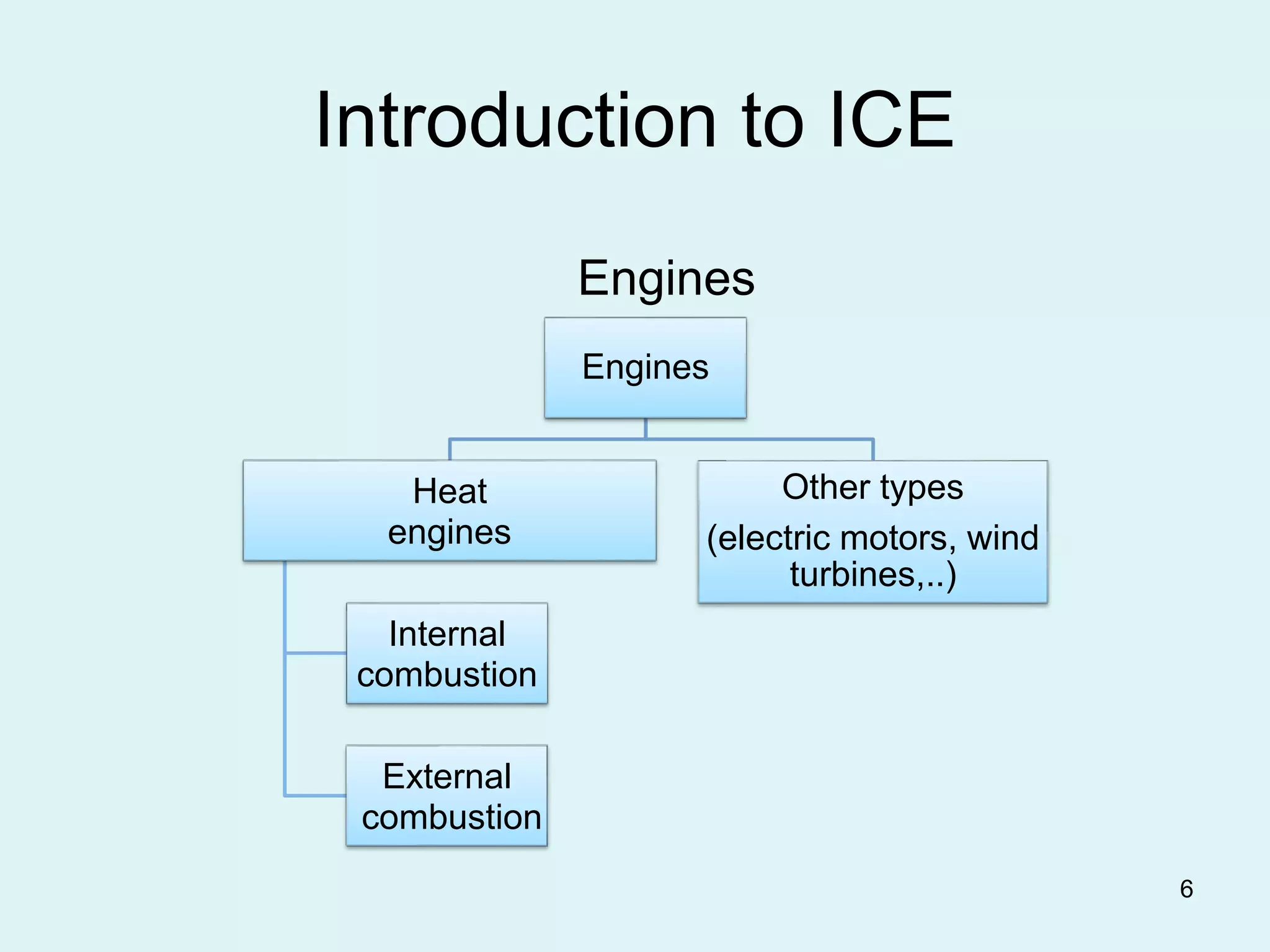
Introduction to ICE
Engines
Engines
Heat
engines
Internal
combustion
External
combustion
Other types
(electric motors, wind
turbines,..)
7
Introduction to ICE
Why are ICEs so popular and not easily
replaceable?
• They use hydrocarbon fuels (HC fuels have very high energy
density)
• Use fuels with high energy density and can be economically
used in many applications (cars, pumps, etc
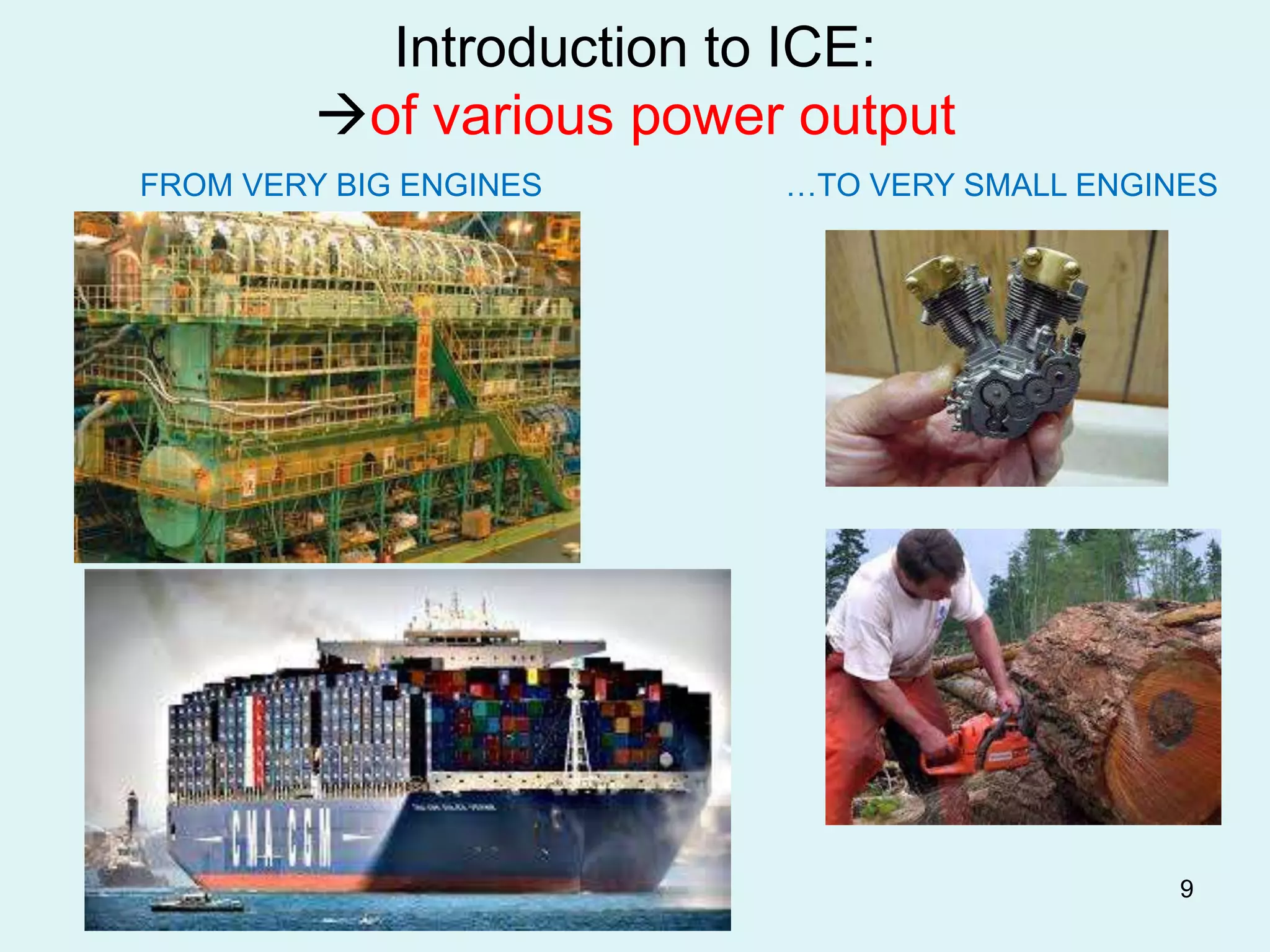
• Can be made of various power output (5W – 100 MW)
• Proven technology (the technology has been around for more
than 150 years)
• There is so much demand for motive power in many tasks
8
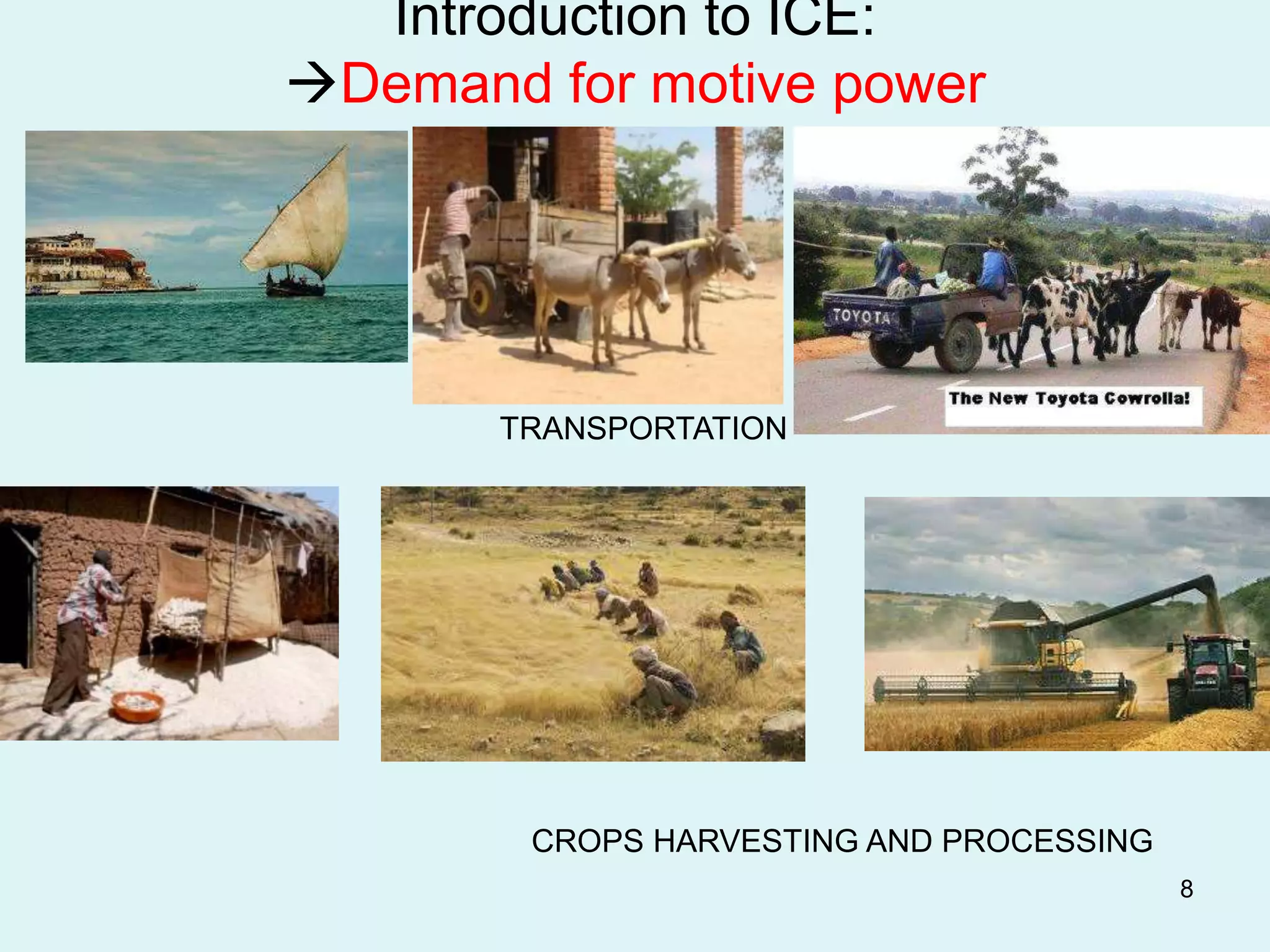
Introduction to ICE:
Demand for motive power
TRANSPORTATION
CROPS HARVESTING AND PROCESSING
9
Introduction to ICE:
of various power output
FROM VERY BIG ENGINES …TO VERY SMALL ENGINES
10
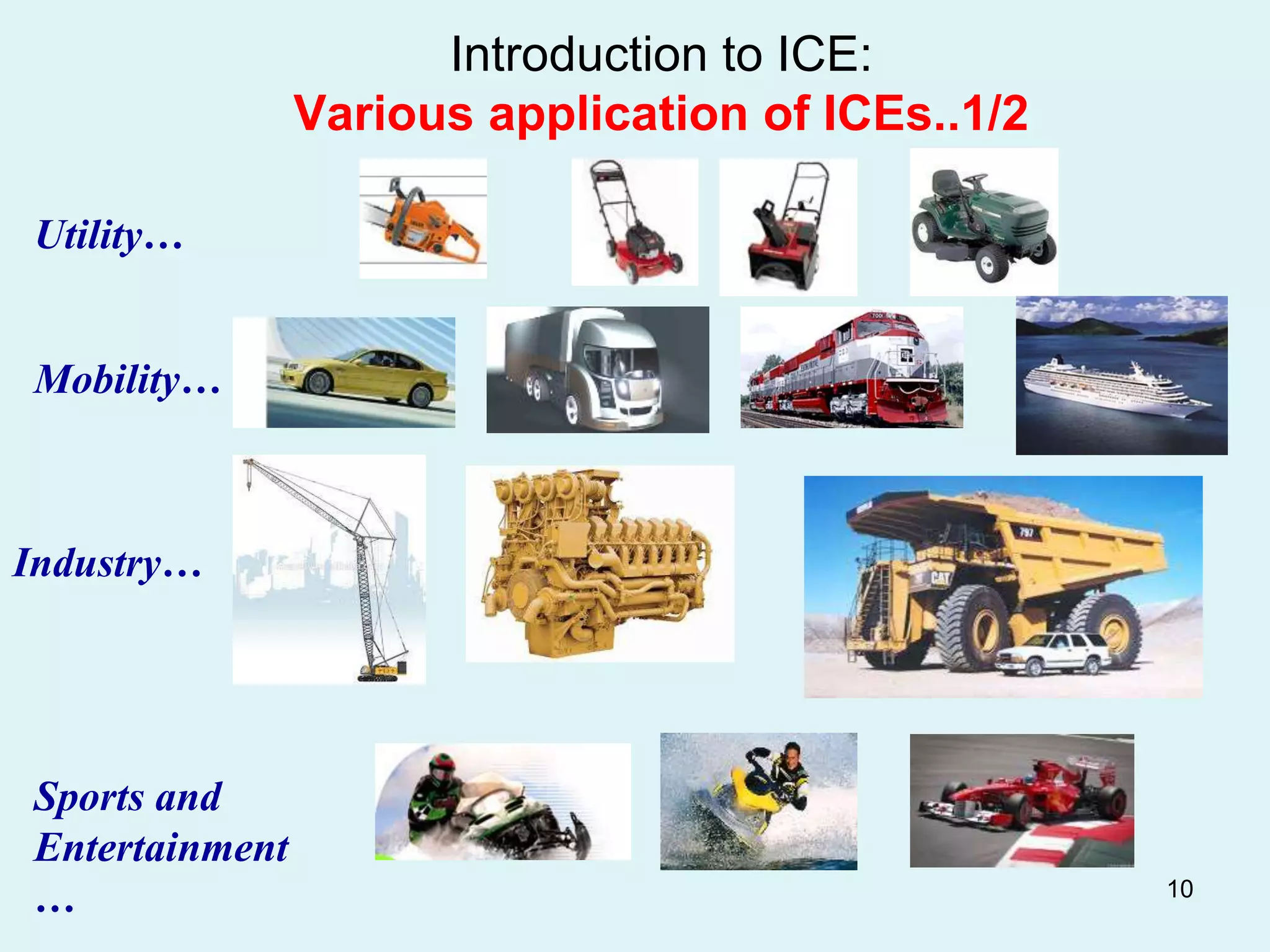
Introduction to ICE:
Various application of ICEs..1/2
Utility…
Sports and
Entertainment
…
Mobility…
Industry…
11
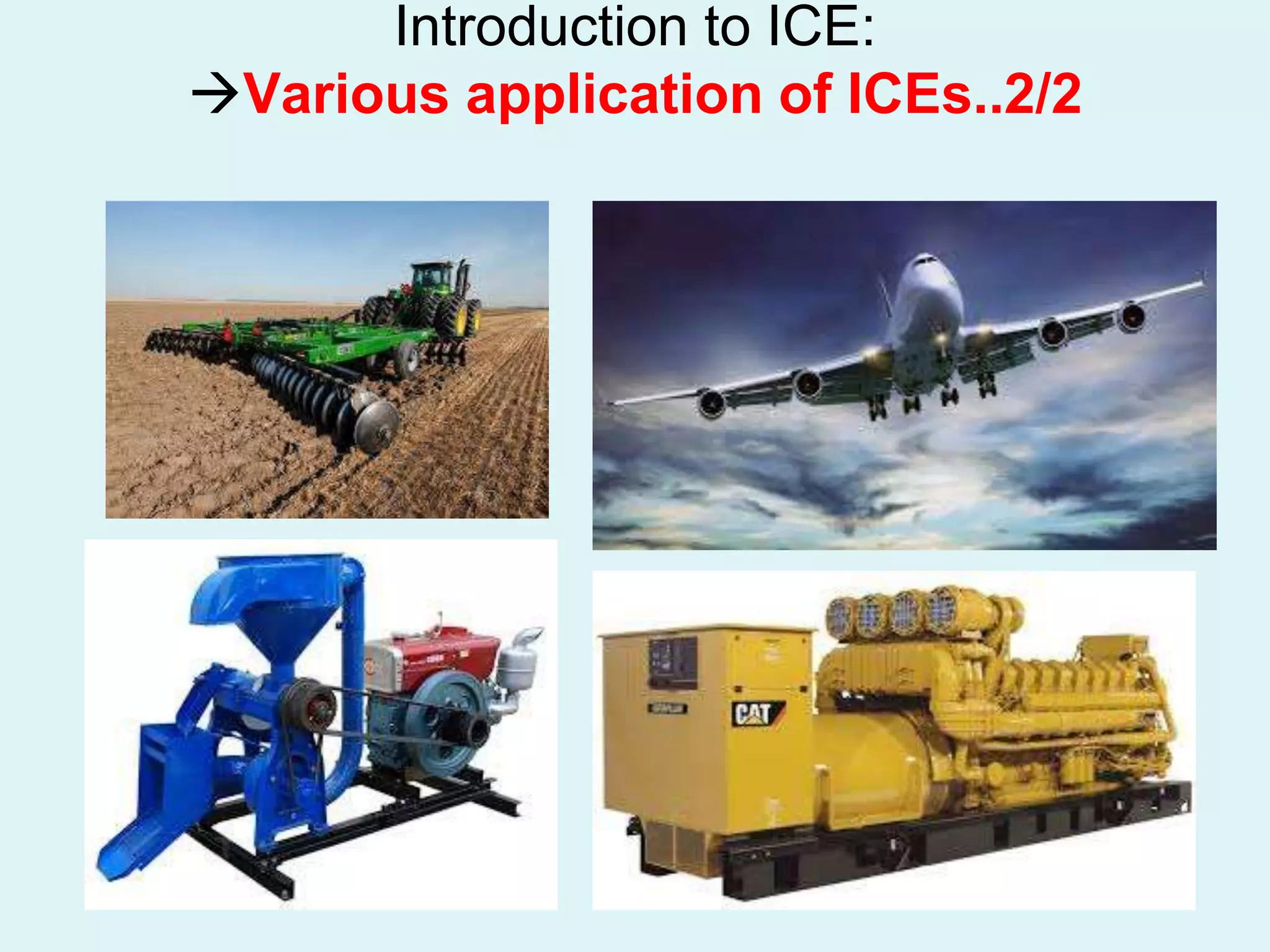
Introduction to ICE:
Various application of ICEs..2/2
12
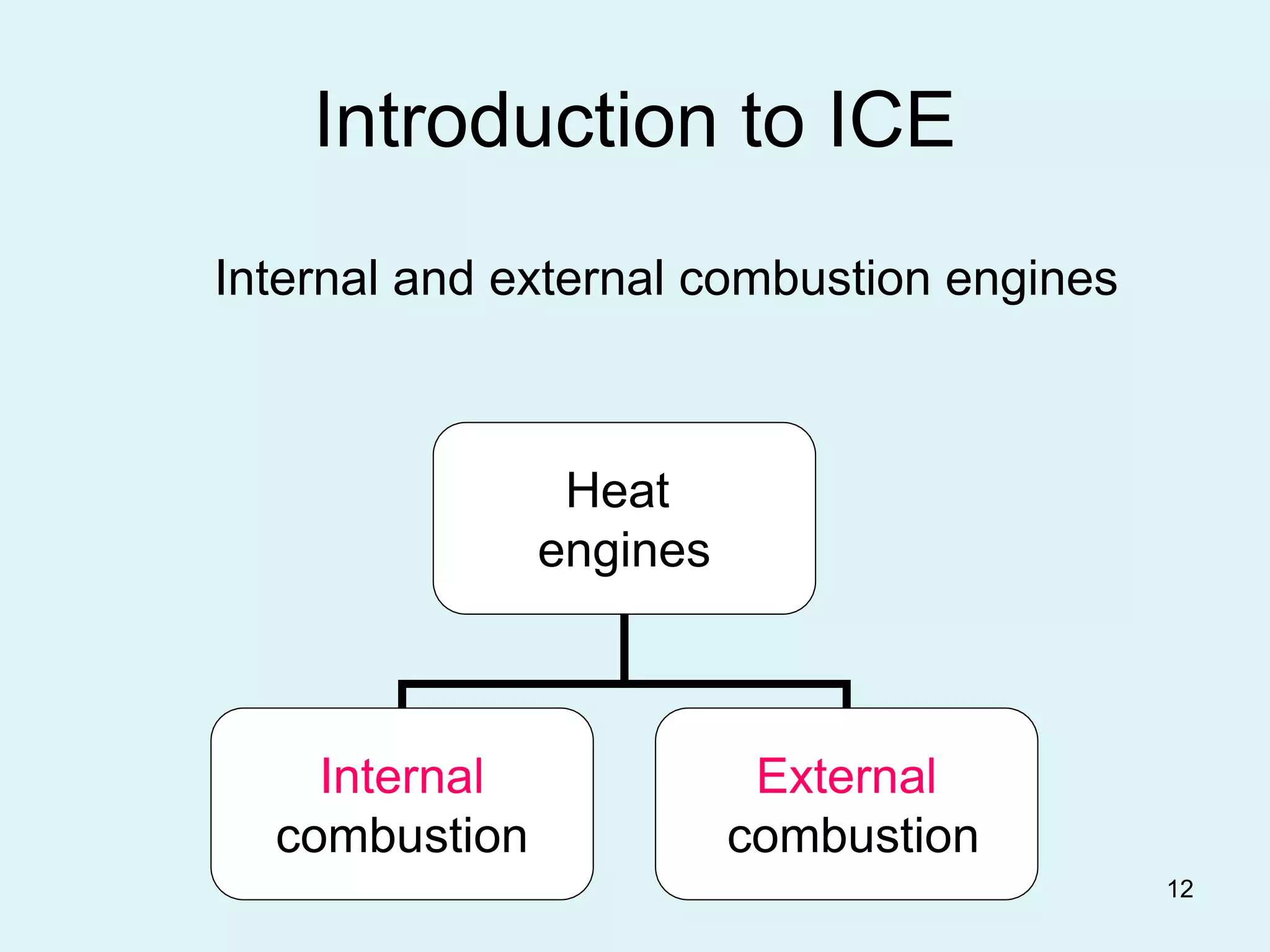
Introduction to ICE
Internal and external combustion engines
Heat
engines
Internal
combustion
External
combustion
13
Introduction to ICE
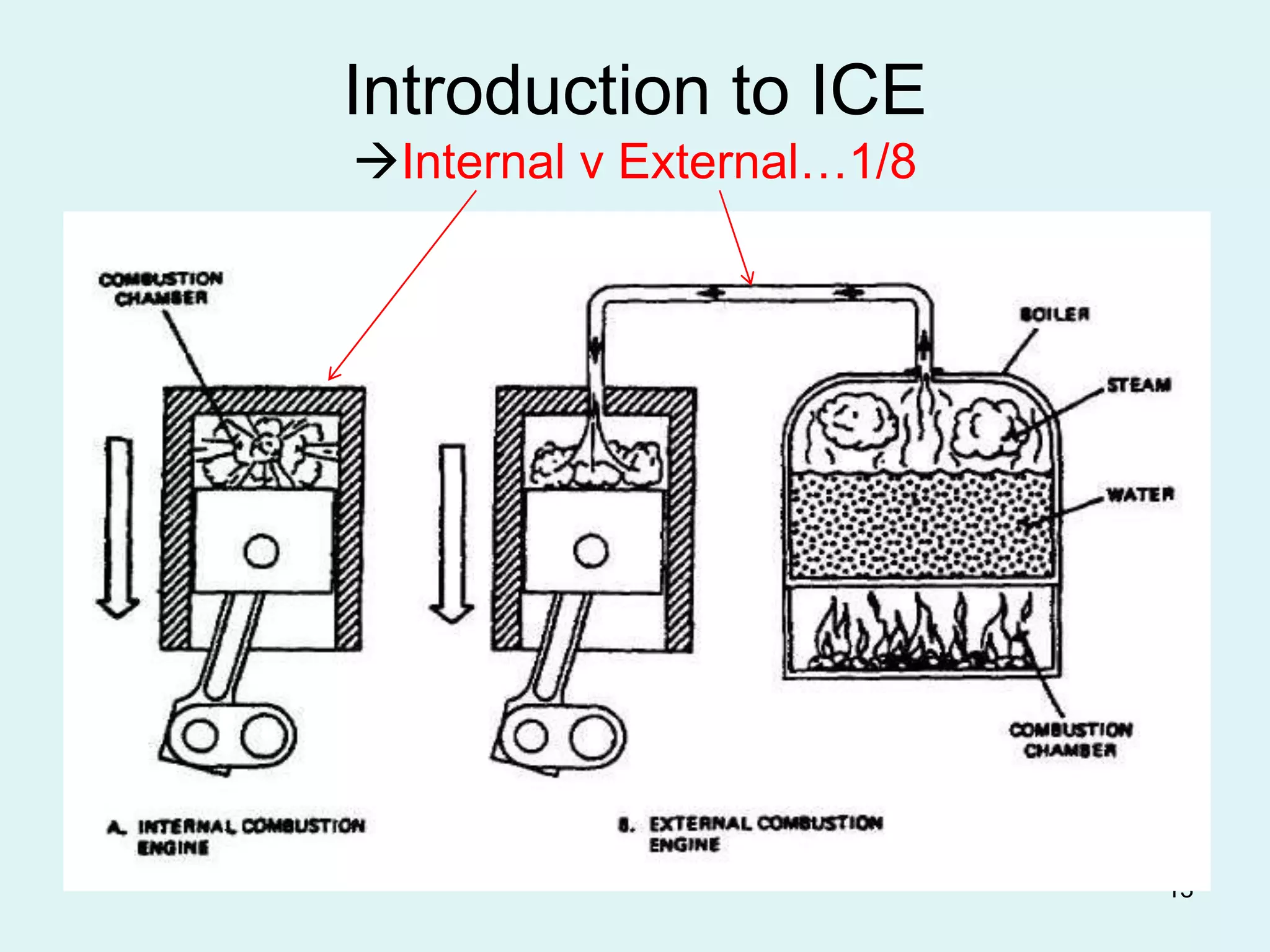
Internal v External…1/8
14
Introduction to ICE
Internal v External…2/8
• Internal Combustion Engines (ICE) are basically
any device which directly uses the hot gases from
combustion of fuel as a working fluid to increase
its temperature and pressure and to create force
and motion.
• Examples of fuels used include: Petrol/Gasoline,
Diesel, Kerosene, Natural gas, Alcohol, Aviation
Gas, biodiesel, vegetable oils…
15
Introduction to ICE
Internal v External…3/8
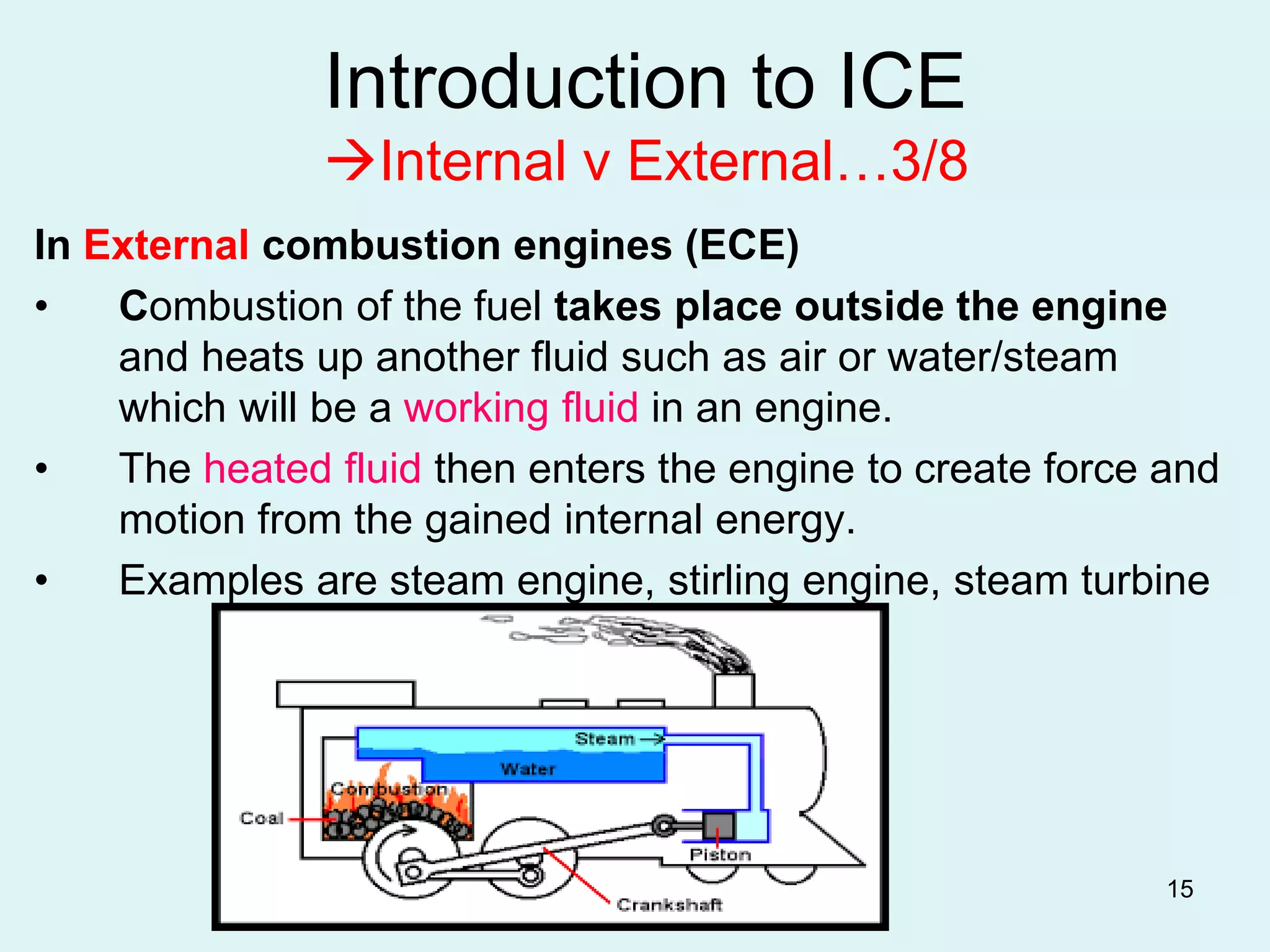
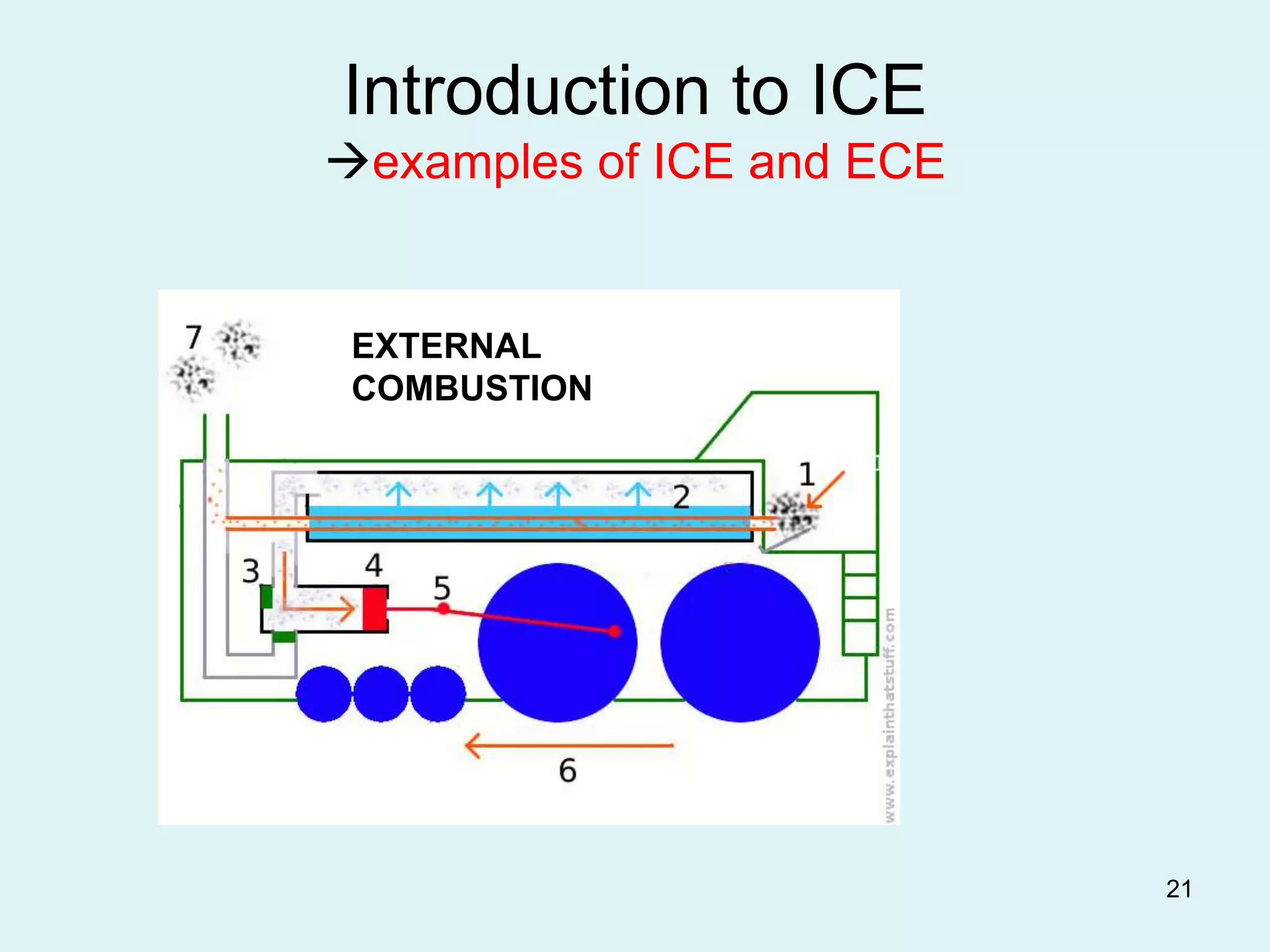
In External combustion engines (ECE)
• Combustion of the fuel takes place outside the engine
and heats up another fluid such as air or water/steam
which will be a working fluid in an engine.
• The heated fluid then enters the engine to create force and
motion from the gained internal energy.
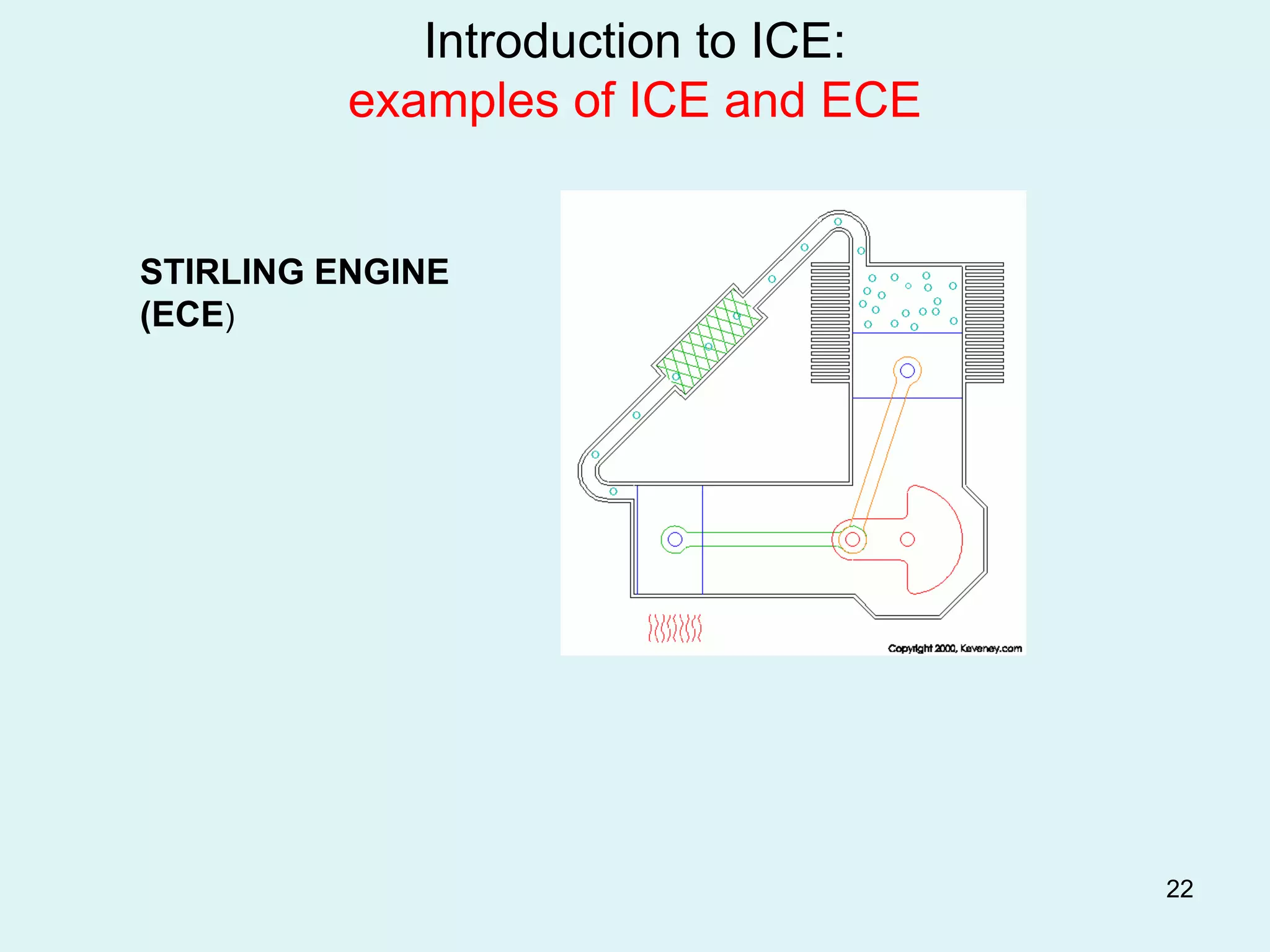
• Examples are steam engine, stirling engine, steam turbine
16
Introduction to ICE
Internal v External…4/8
In External Combustion Engines
• Working fluid coming out of the engine can be
re-used
Eg: steam engine, steam turbines, stirling engine
• Consists of additional equipment to heat the
working fluid
Eg: boiler to raise steam
....2015Clipsintro
17
Introduction to ICE
Internal v External…5/8
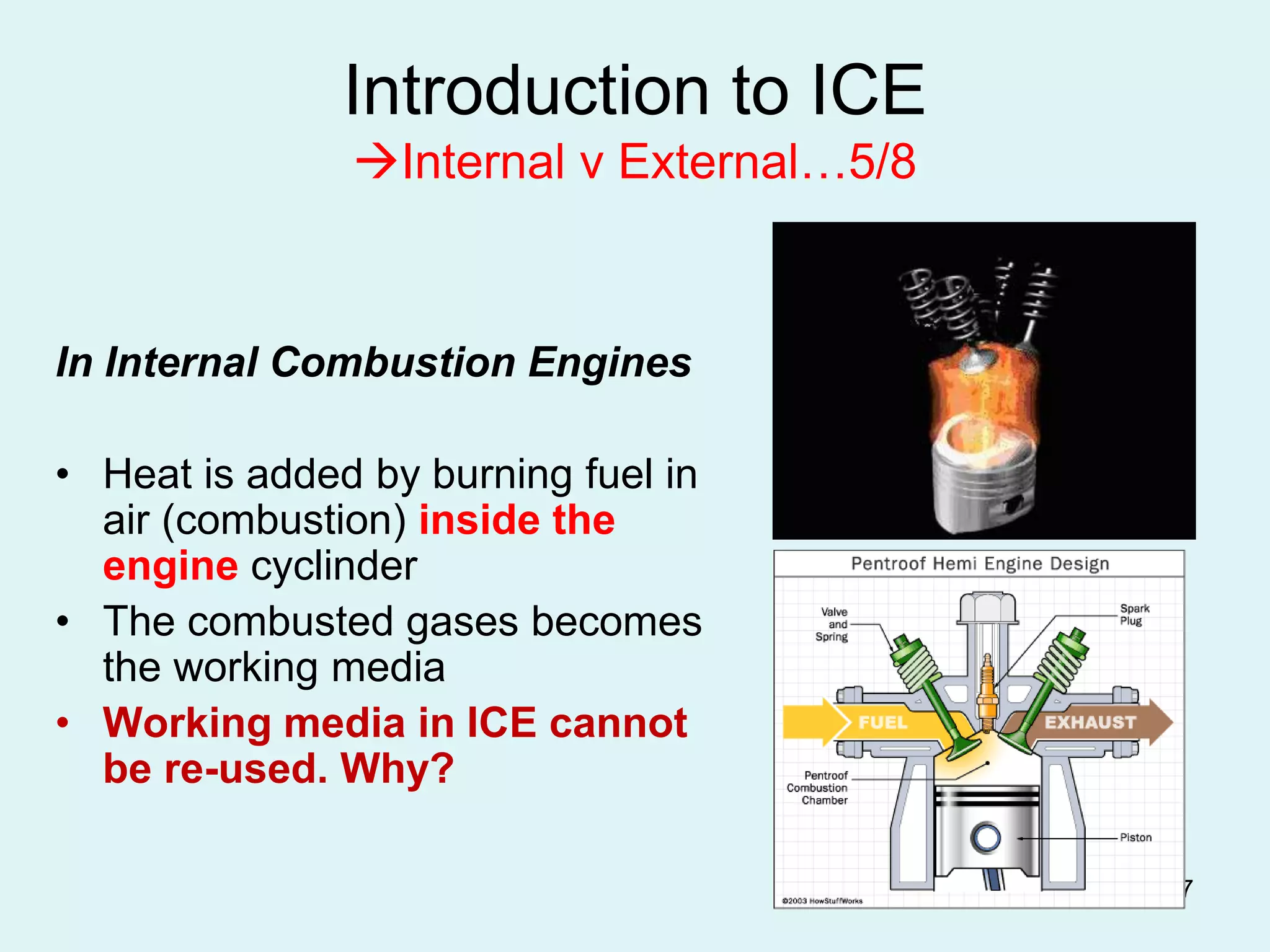
In Internal Combustion Engines
• Heat is added by burning fuel in
air (combustion) inside the
engine cyclinder
• The combusted gases becomes
the working media
• Working media in ICE cannot
be re-used. Why?
18
Introduction to ICE
Internal v External…6/8
Advantages of ECE over ICE are:
• Many type of fuels can be used,
ie, flammable (eg. diesel, petrol,
natural gas) and inflammable (eg.
coal, biomass, cow dung,…).
Solar heating also works. Note:
ICE use only flammable fuels.
• The working media can be re-
used in ECE.
19
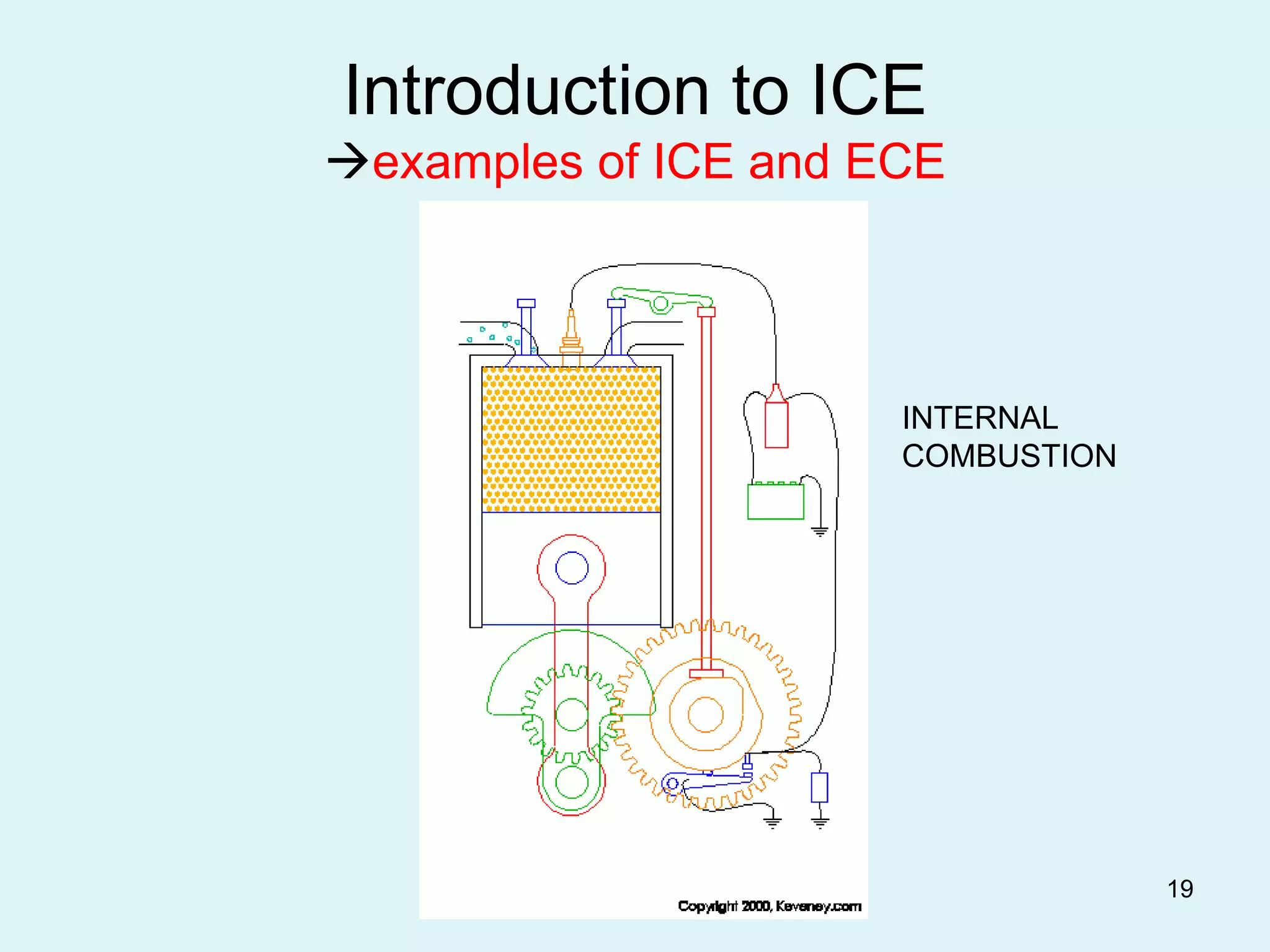
Introduction to ICE
examples of ICE and ECE
INTERNAL
COMBUSTION
20
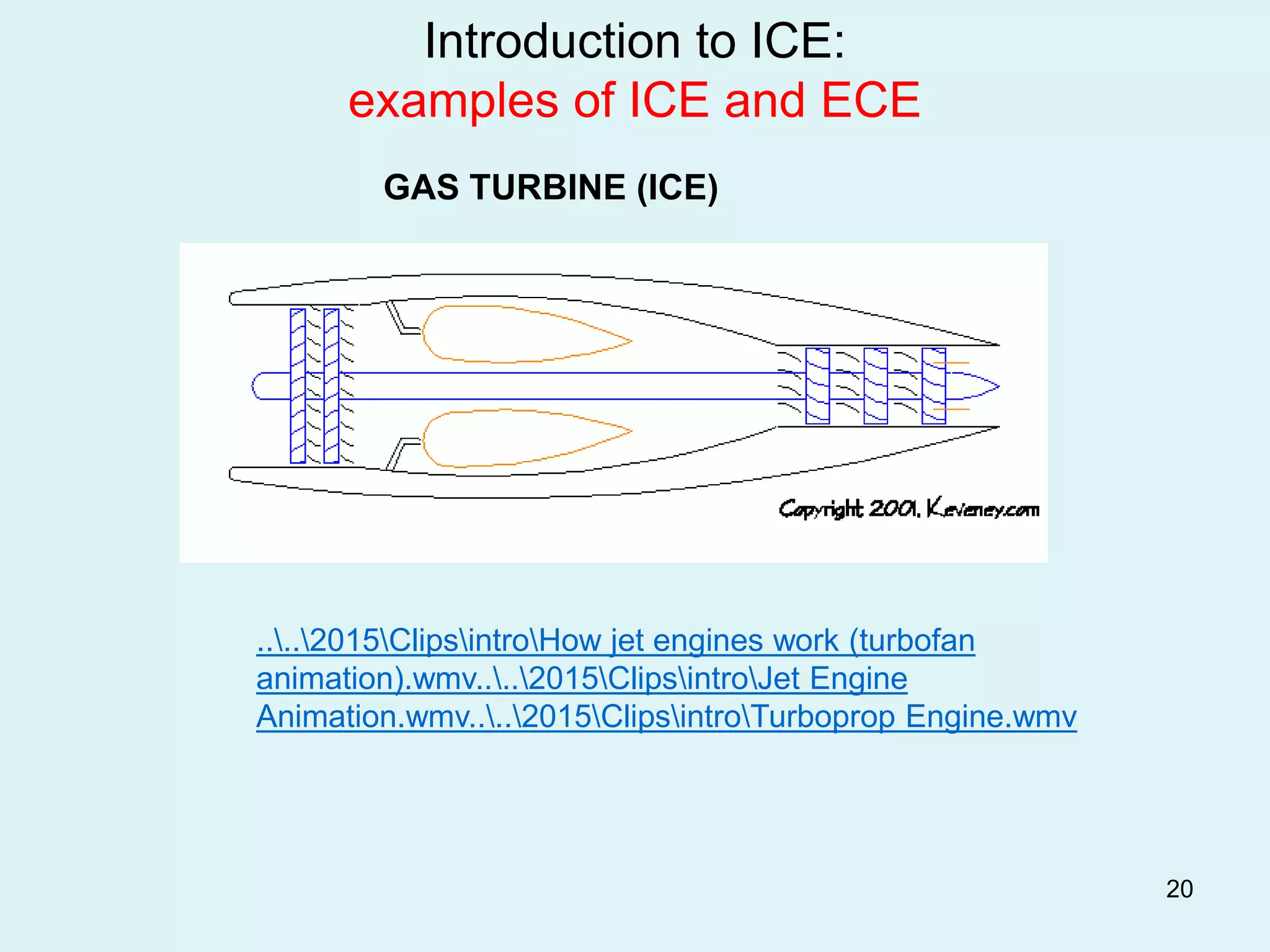
Introduction to ICE:
examples of ICE and ECE
GAS TURBINE (ICE)
....2015ClipsintroHow jet engines work (turbofan
animation).wmv....2015ClipsintroJet Engine
Animation.wmv....2015ClipsintroTurboprop Engine.wmv
21
Introduction to ICE
examples of ICE and ECE
EXTERNAL
COMBUSTION
22
Introduction to ICE:
examples of ICE and ECE
STIRLING ENGINE
(ECE)
23
What is a fuel?
• Fuels are any materials that store energy in the form of
chemical energy that can be released through a reaction
as heat energy
• Most common reaction is combustion of fuel with oxygen
• Combustion is a highly exothermic chemical reaction
• Common fuels which release heat energy via
combustion reaction are biomass (wood, charcoal),
fossil fuels (coal, petrol, diesel, natural gas)
• Nuclear fuels (uranium, plutonium) release heat by
fission or fusion reactions, which in principle is not
combustion.
• Nuclear fuels are used in external combustion engines,
mostly in power plants (Rankine cyle)
24
What is a fuel?
• Why are all internal combustion engines
powered by liquid and gaseous fuels?
– high energy density
– Easy mixing with air (fast combustion)
• Why not use solid fuels in ICE? Eg. Fuelwood,
charcoal, coal, which also have high energy
density?
-not easy to form a homogeneous mixture with air (very
slow combustion)
-abrasion of solids with cylinder walls
25
Other Fuels
• Other types of fuels that can be used in heat
engines:
– Wood (ECE)
– Coal (ECE)
-Biodiesel (ICE and ECE))
-Vegetable oils (ICE and ECE))
-Alcohols (ICE and ECE)
– Natural gas (ICE and ECE)
• any fuel that is used in ICE can be used in ECE,
but not vice versa
26
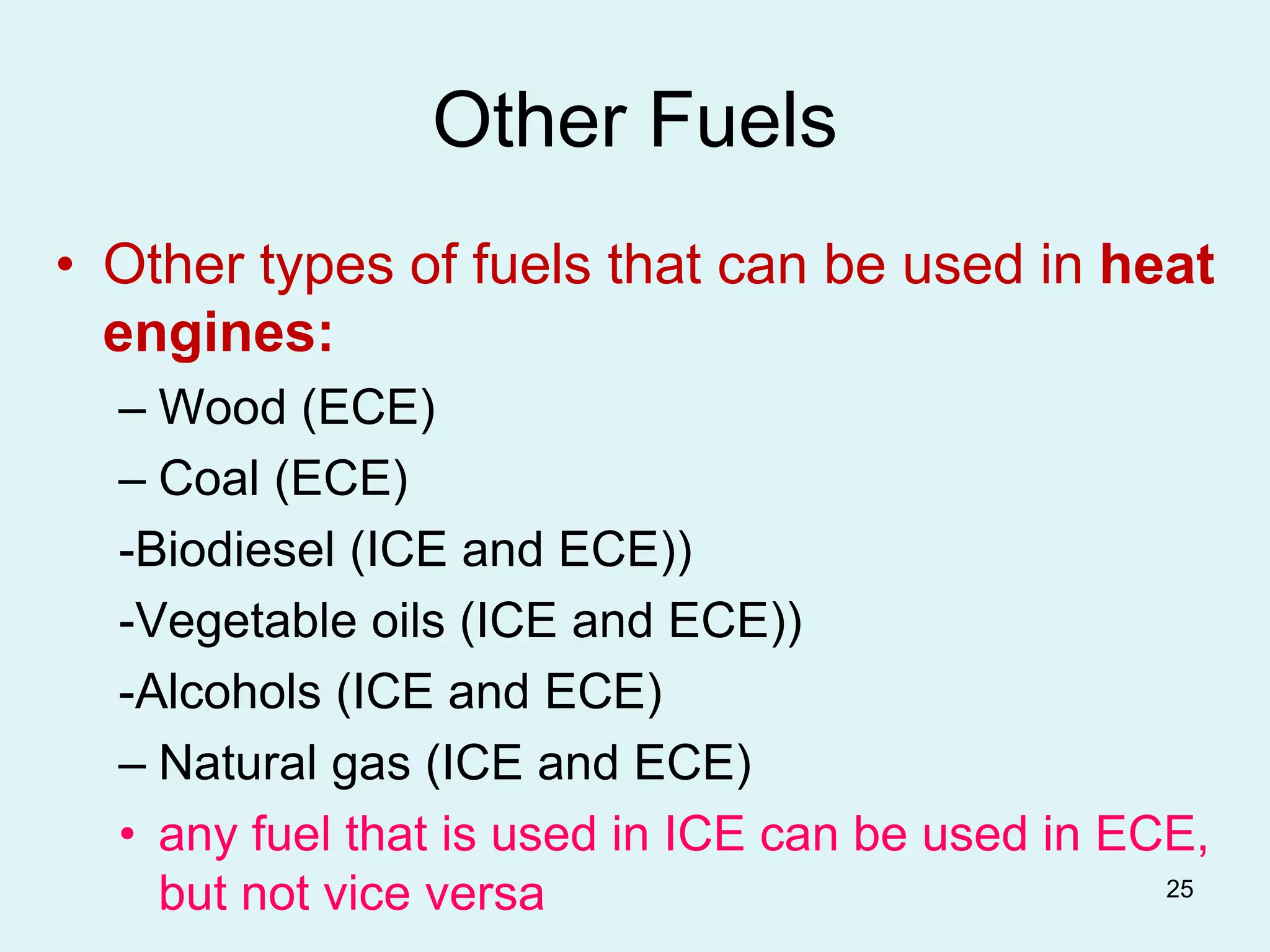
History of Engines..1/3
• Otto Cycle, basis for petrol engine: Dr. N.A. Otto
27
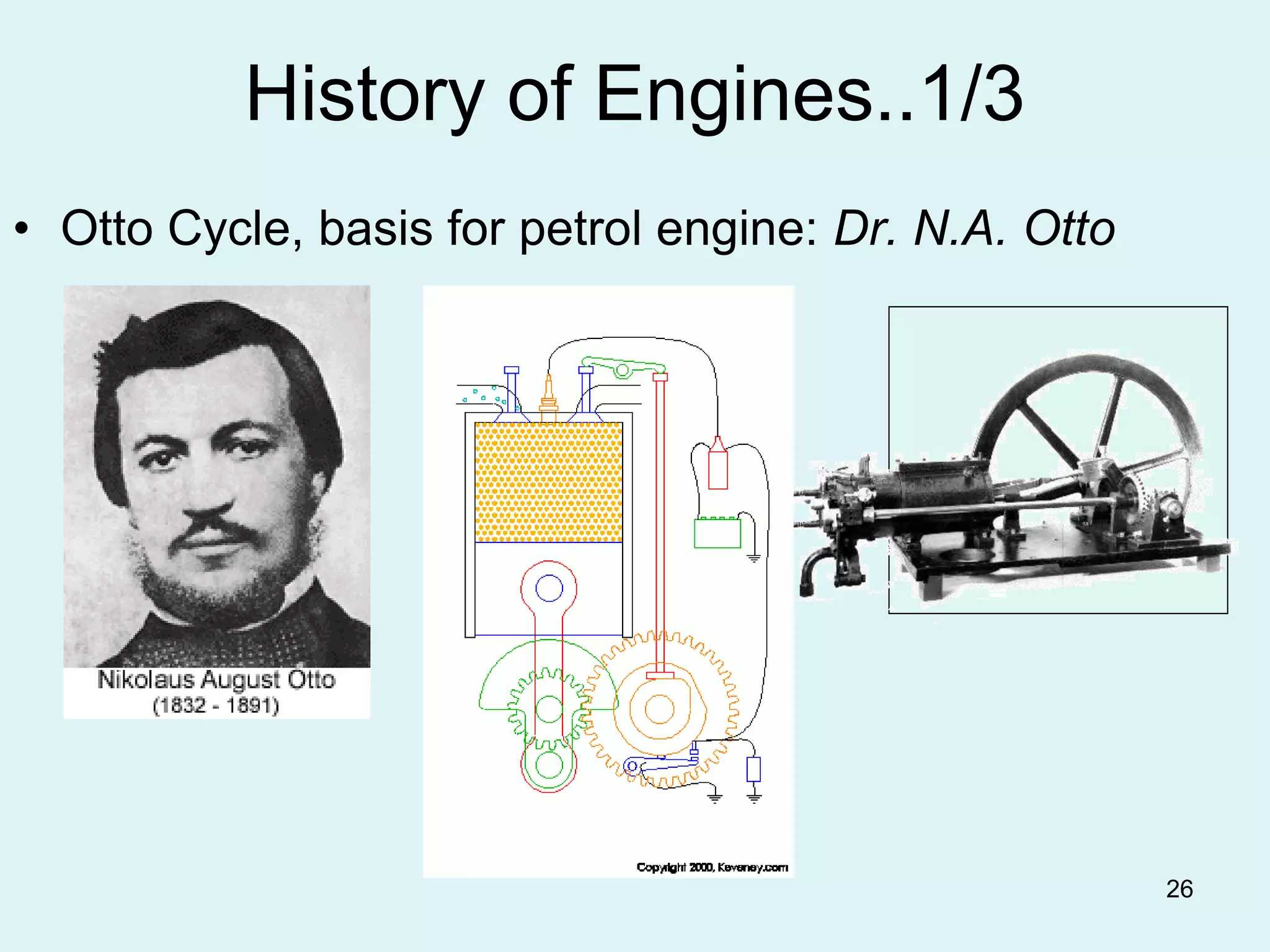
• Diesel Engine; Dr. Rudolph Diesel
History of Engines..2/3
Dr. R. Diesel
28
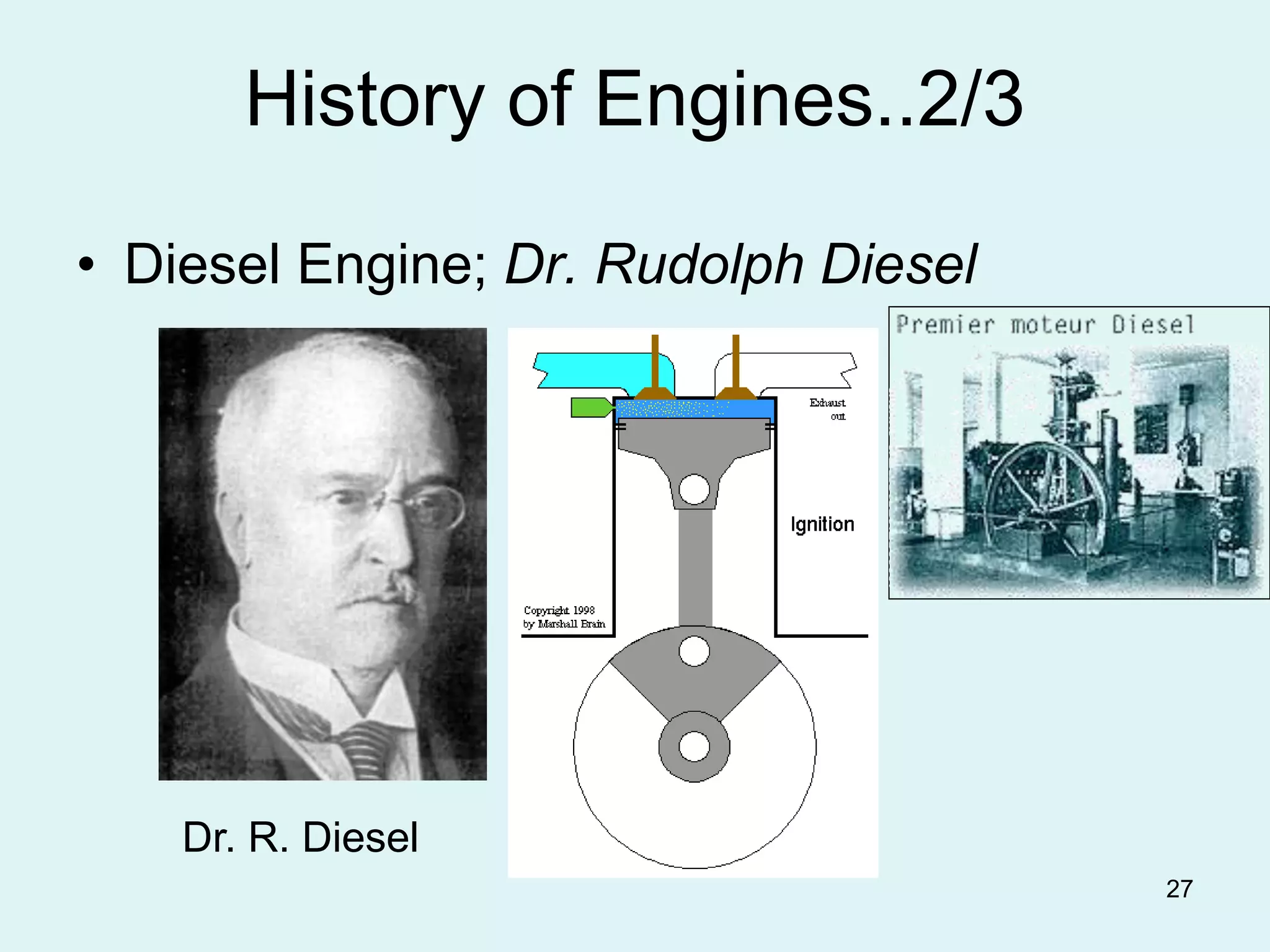
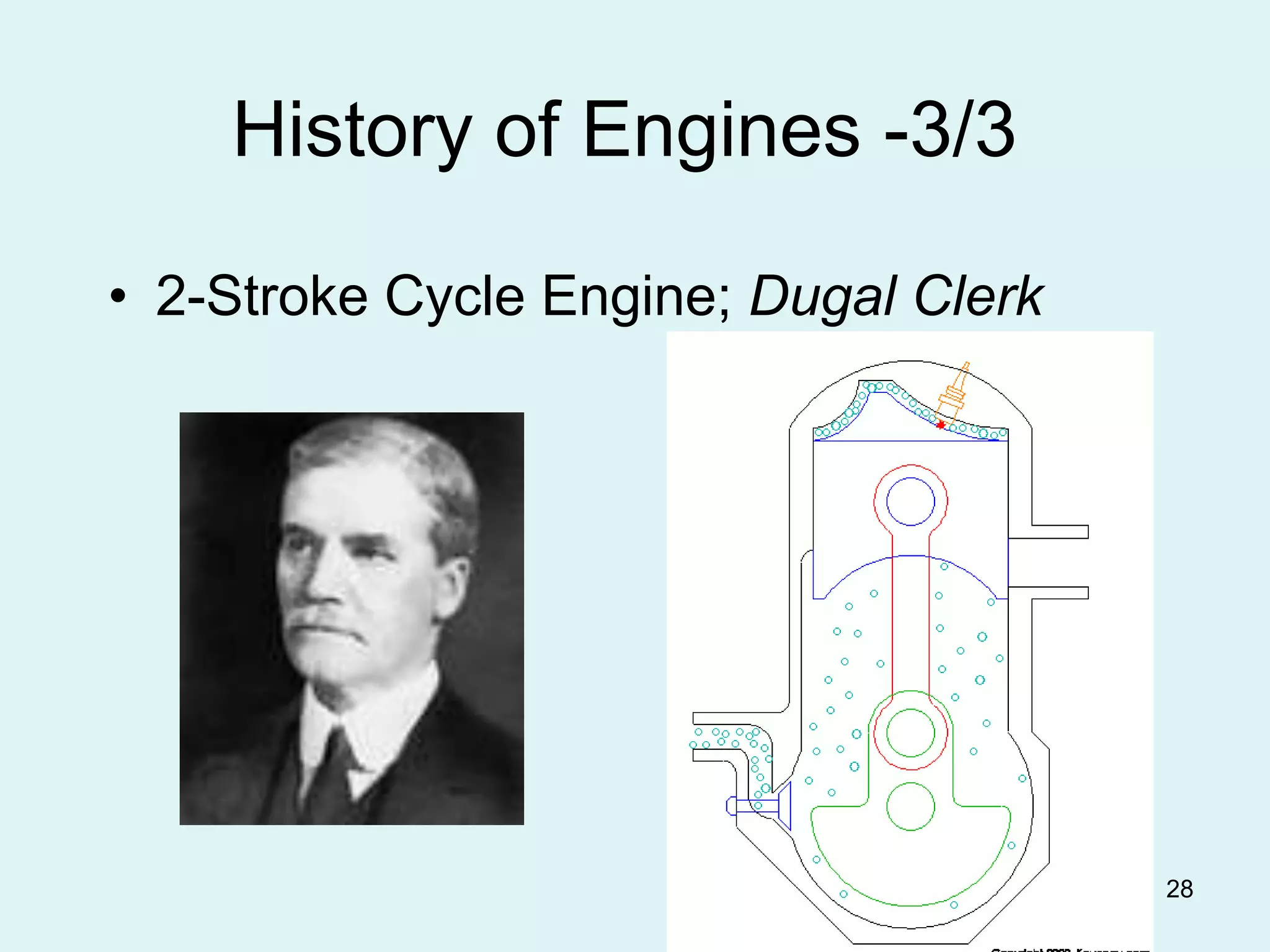
• 2-Stroke Cycle Engine; Dugal Clerk
History of Engines -3/3
29
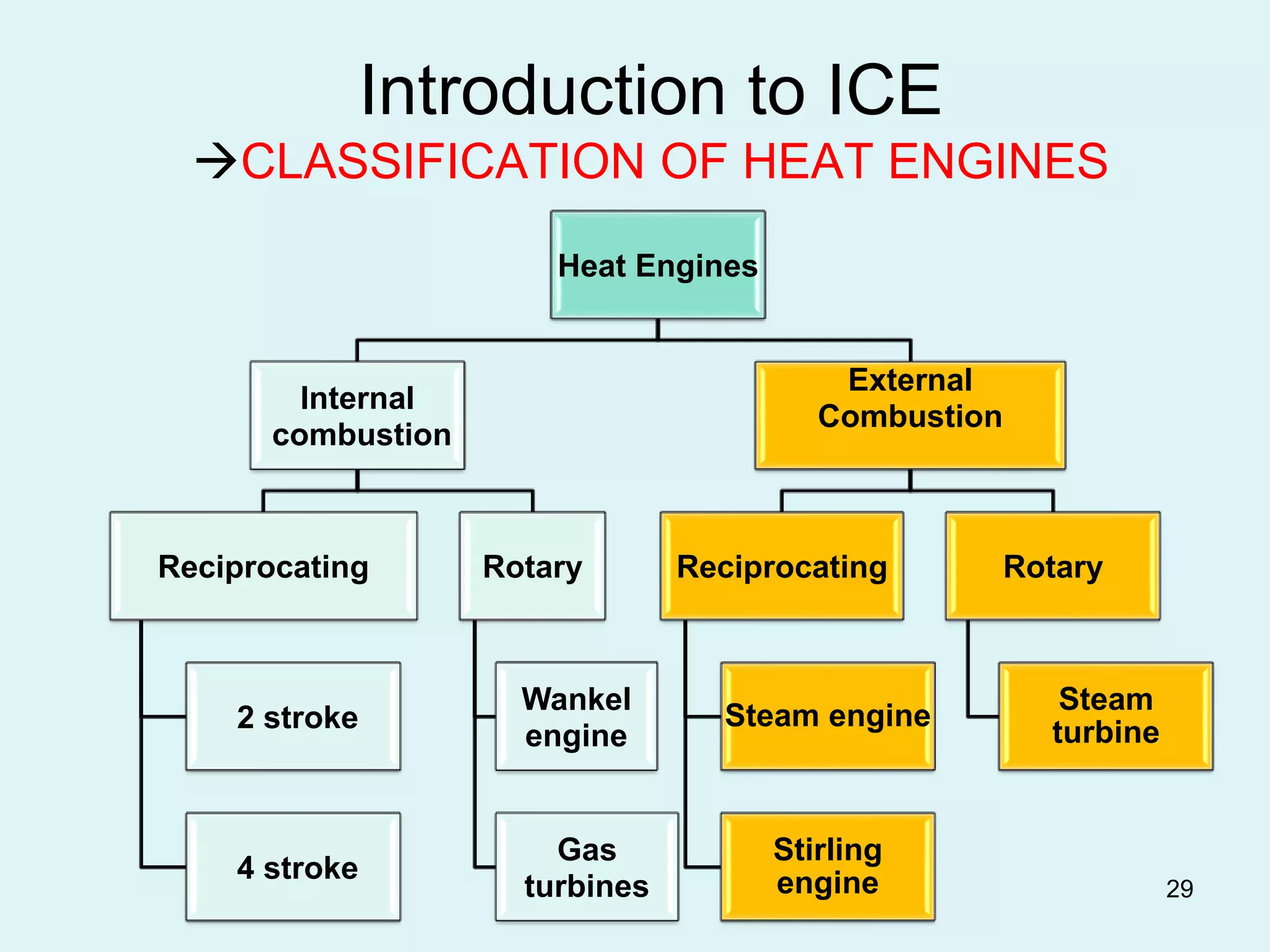
Introduction to ICE
CLASSIFICATION OF HEAT ENGINES
Heat Engines
Internal
combustion
Reciprocating
2 stroke
4 stroke
Rotary
Wankel
engine
Gas
turbines
External
Combustion
Reciprocating
Steam engine
Stirling
engine
Rotary
Steam
turbine
30
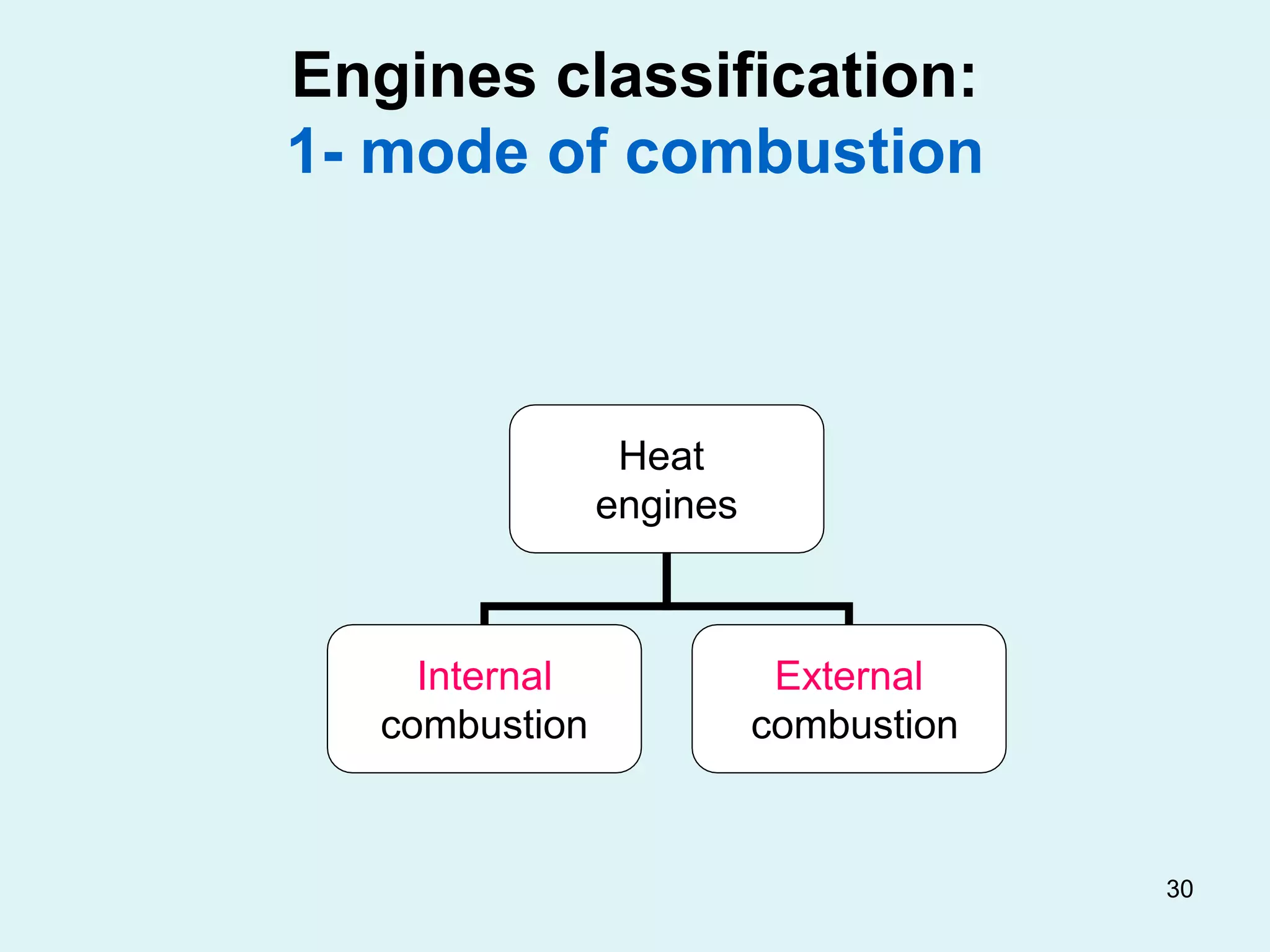
Engines classification:
1- mode of combustion
Heat
engines
Internal
combustion
External
combustion
31
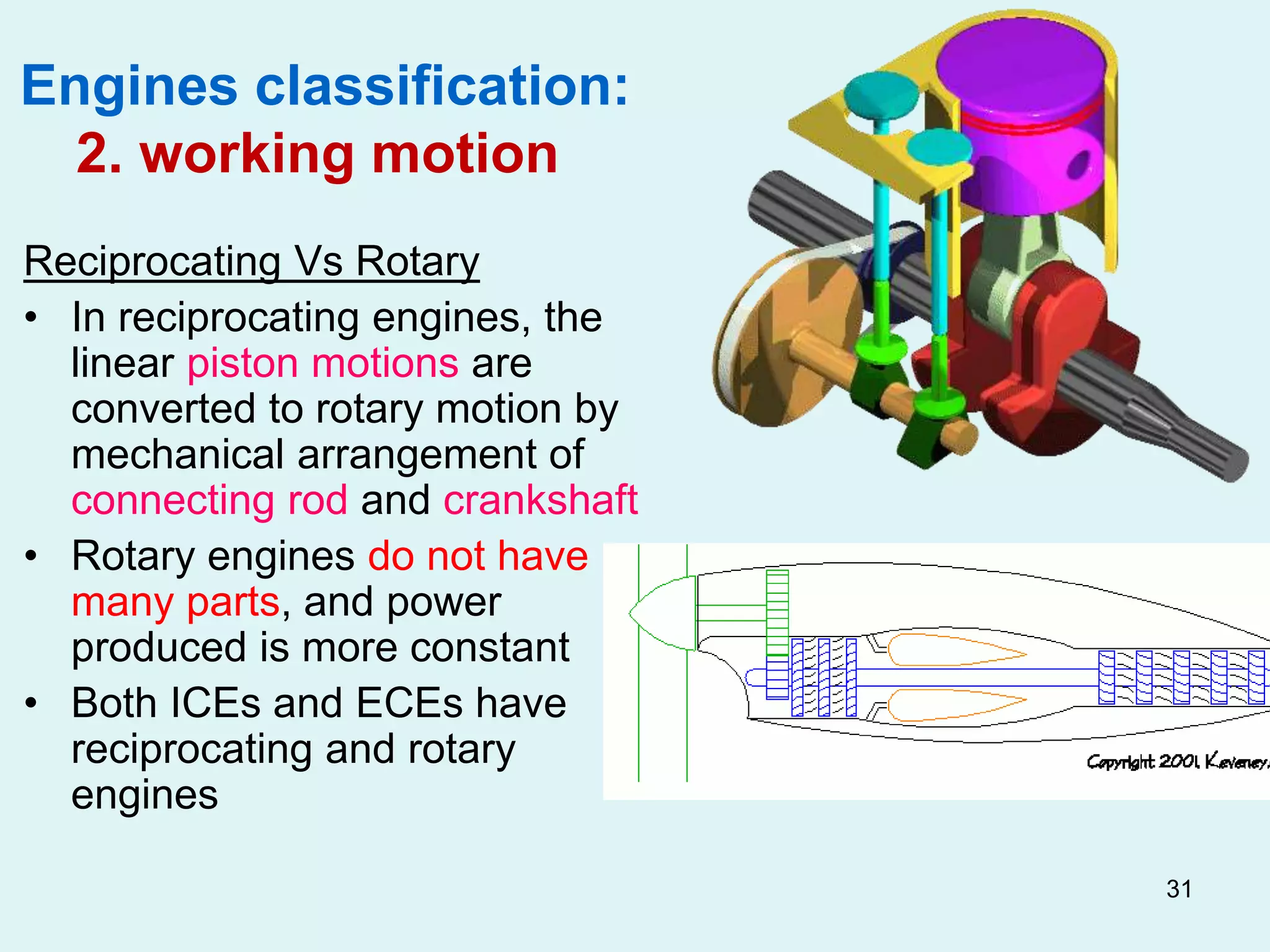
Engines classification:
2. working motion
Reciprocating Vs Rotary
• In reciprocating engines, the
linear piston motions are
converted to rotary motion by
mechanical arrangement of
connecting rod and crankshaft
• Rotary engines do not have
many parts, and power
produced is more constant
• Both ICEs and ECEs have
reciprocating and rotary
engines
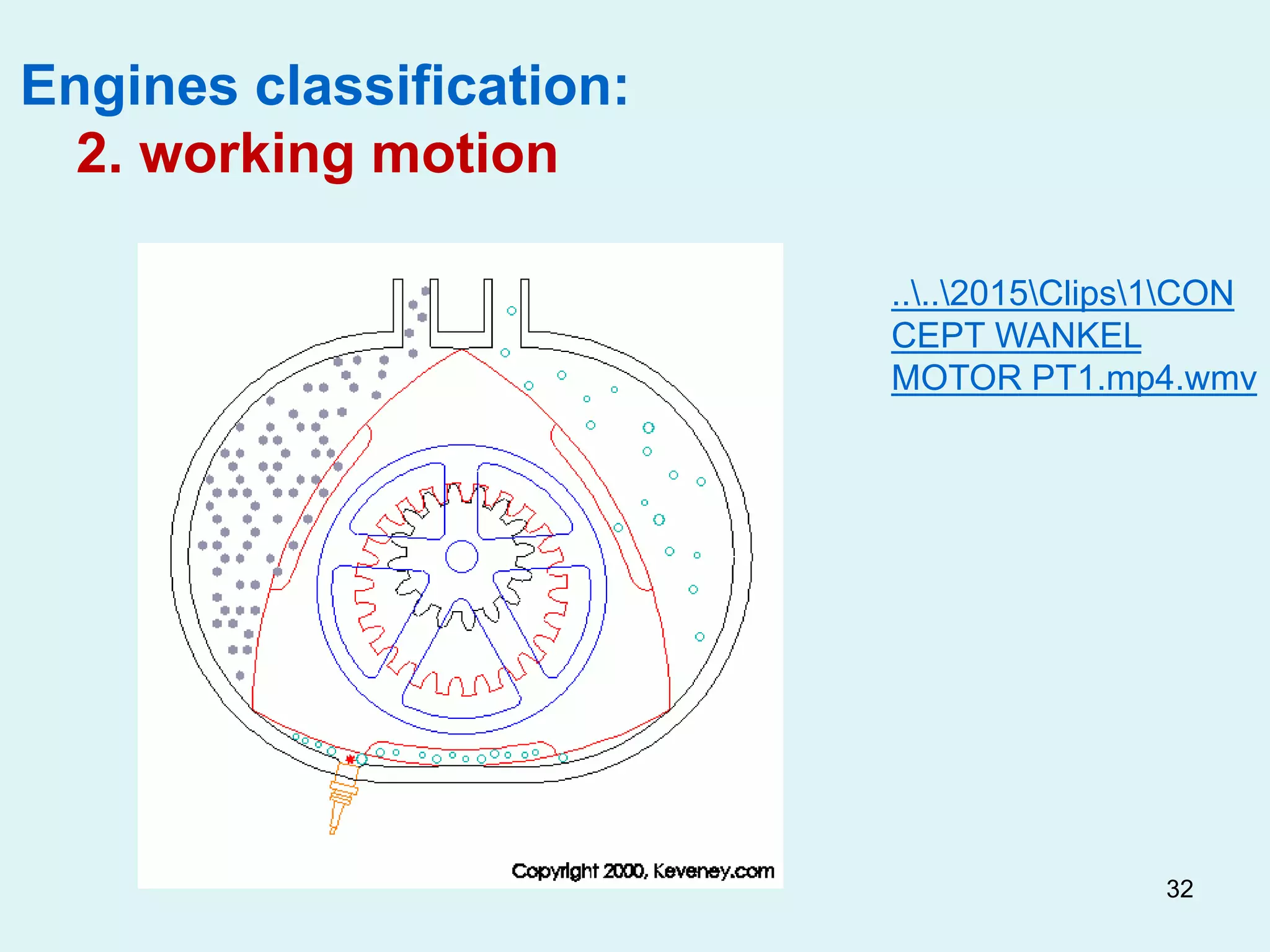
32
....2015Clips1CON
CEPT WANKEL
MOTOR PT1.mp4.wmv
Engines classification:
2. working motion
33
Engines classification:
3. strokes per cycle
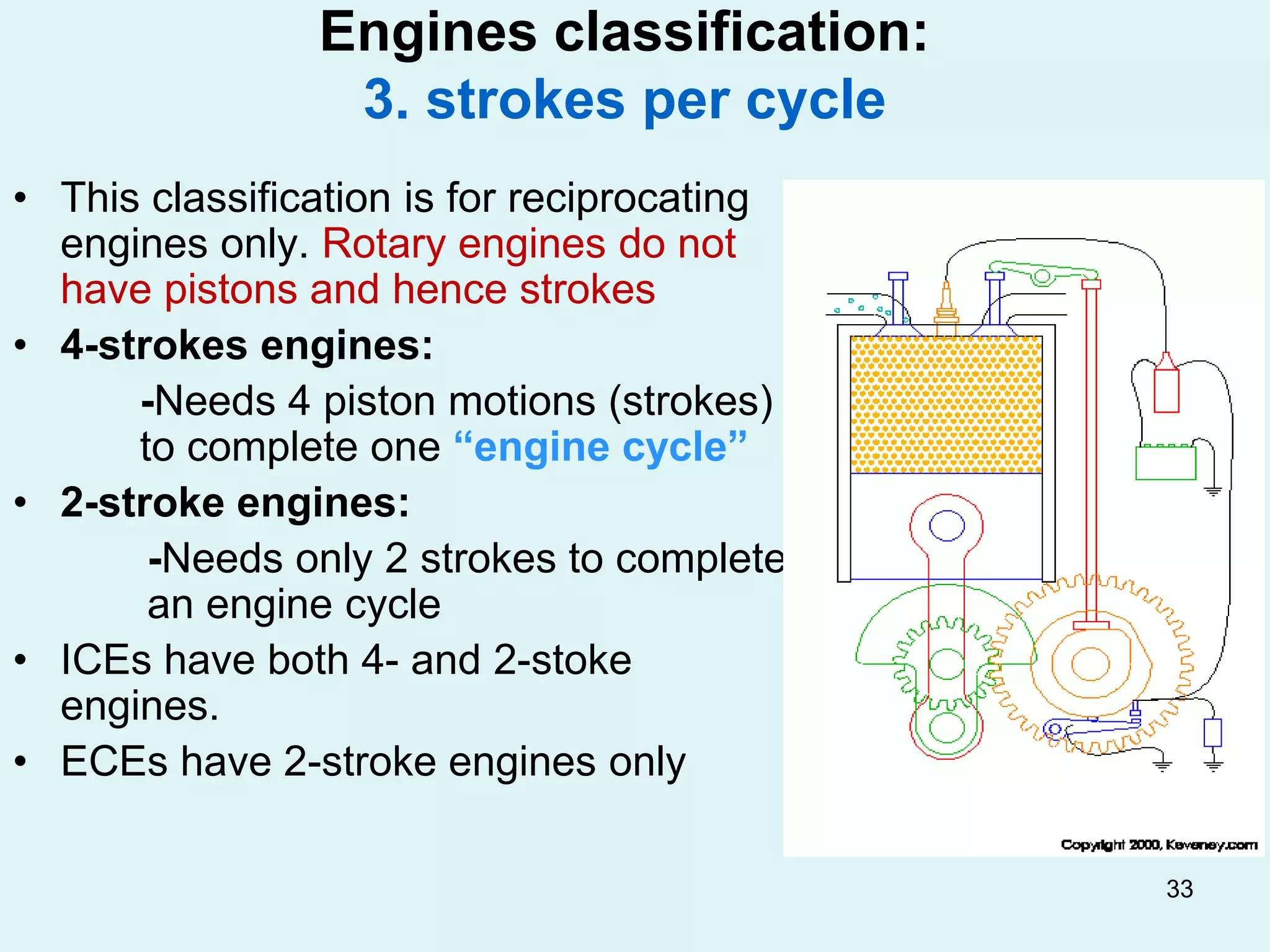
• This classification is for reciprocating
engines only. Rotary engines do not
have pistons and hence strokes
• 4-strokes engines:
-Needs 4 piston motions (strokes)
to complete one “engine cycle”
• 2-stroke engines:
-Needs only 2 strokes to complete
an engine cycle
• ICEs have both 4- and 2-stoke
engines.
• ECEs have 2-stroke engines only
34
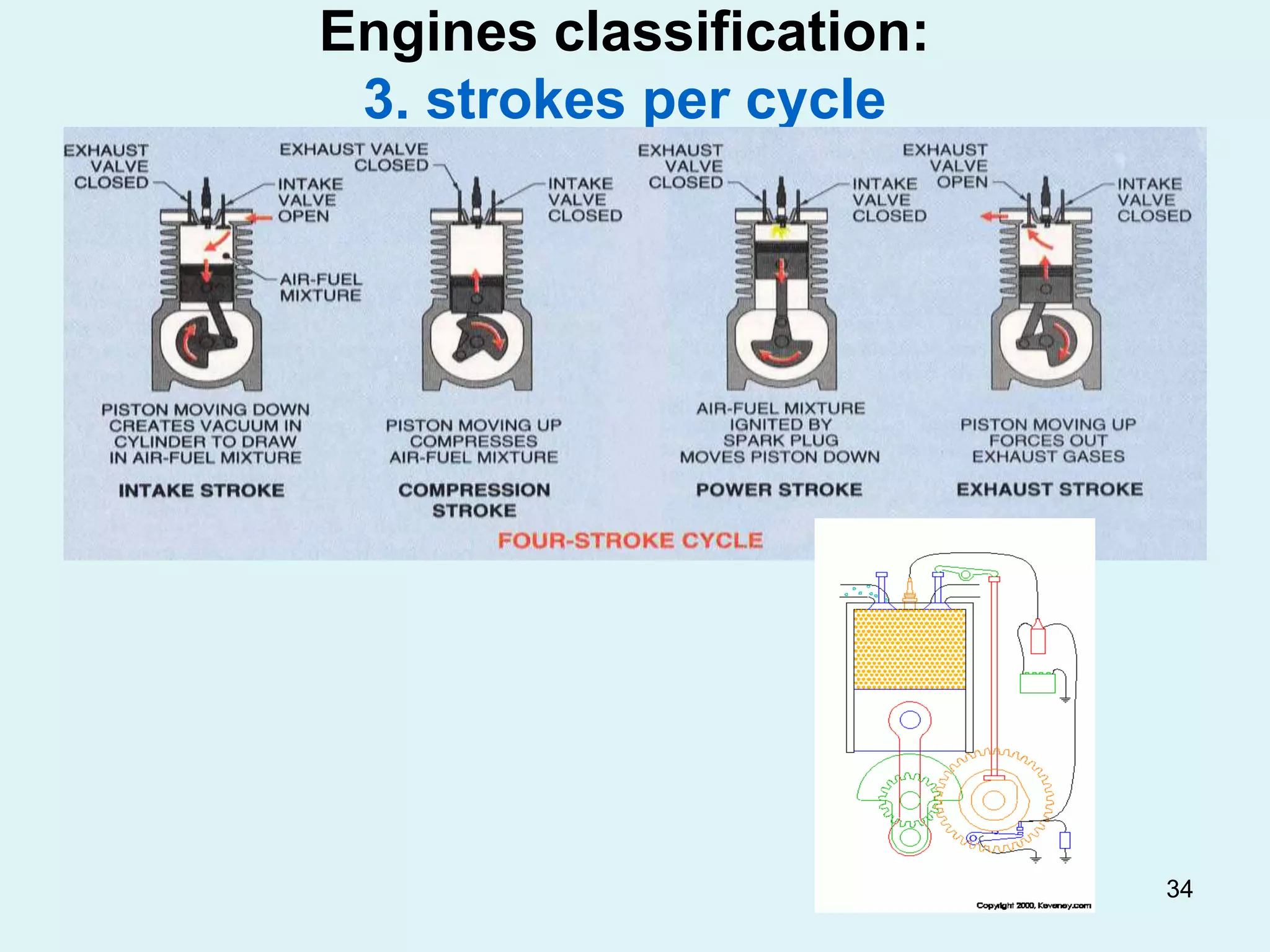
Engines classification:
3. strokes per cycle
35
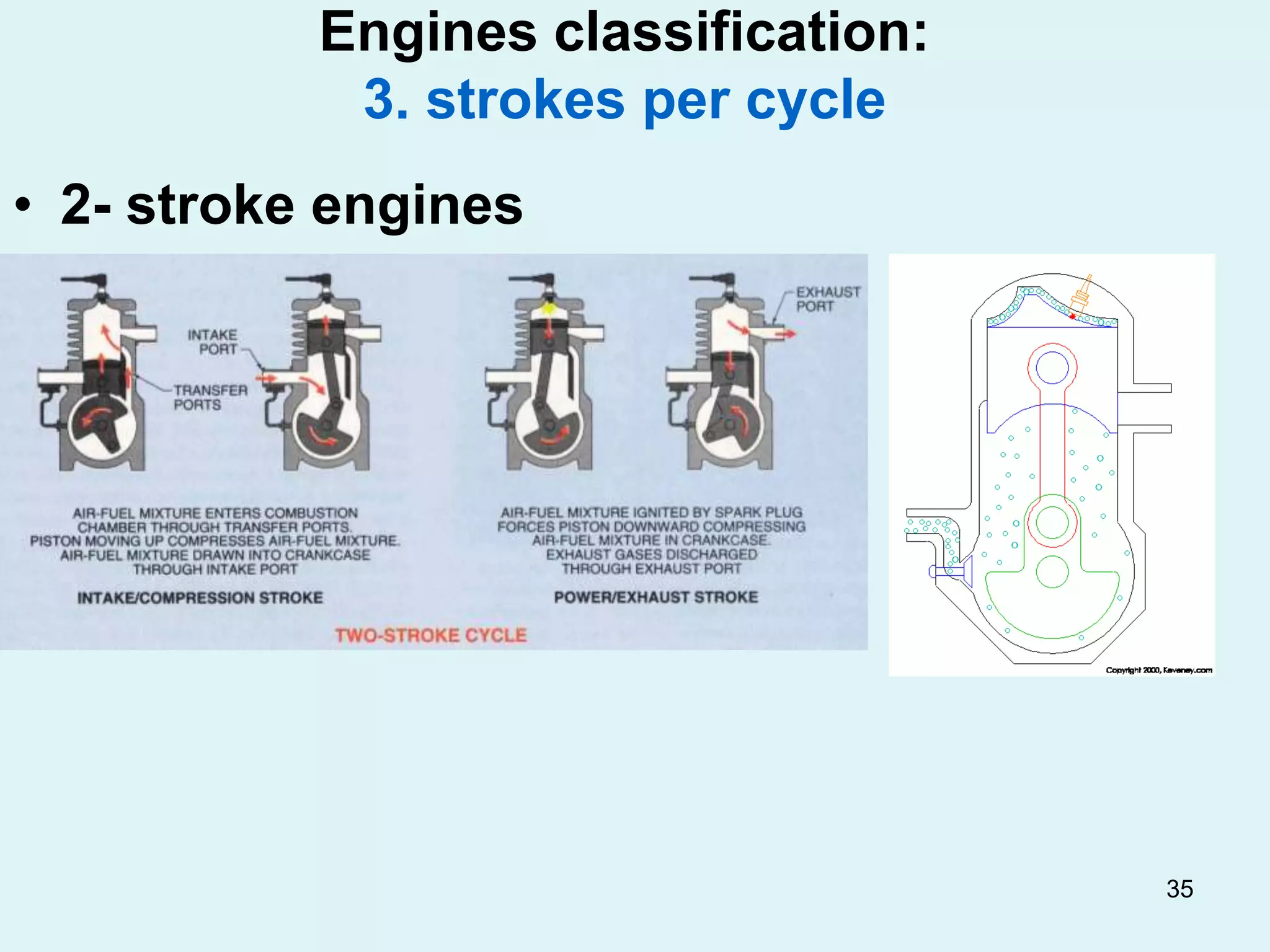
Engines classification:
3. strokes per cycle
• 2- stroke engines
36
Engines classification:
4. Number of cylinders
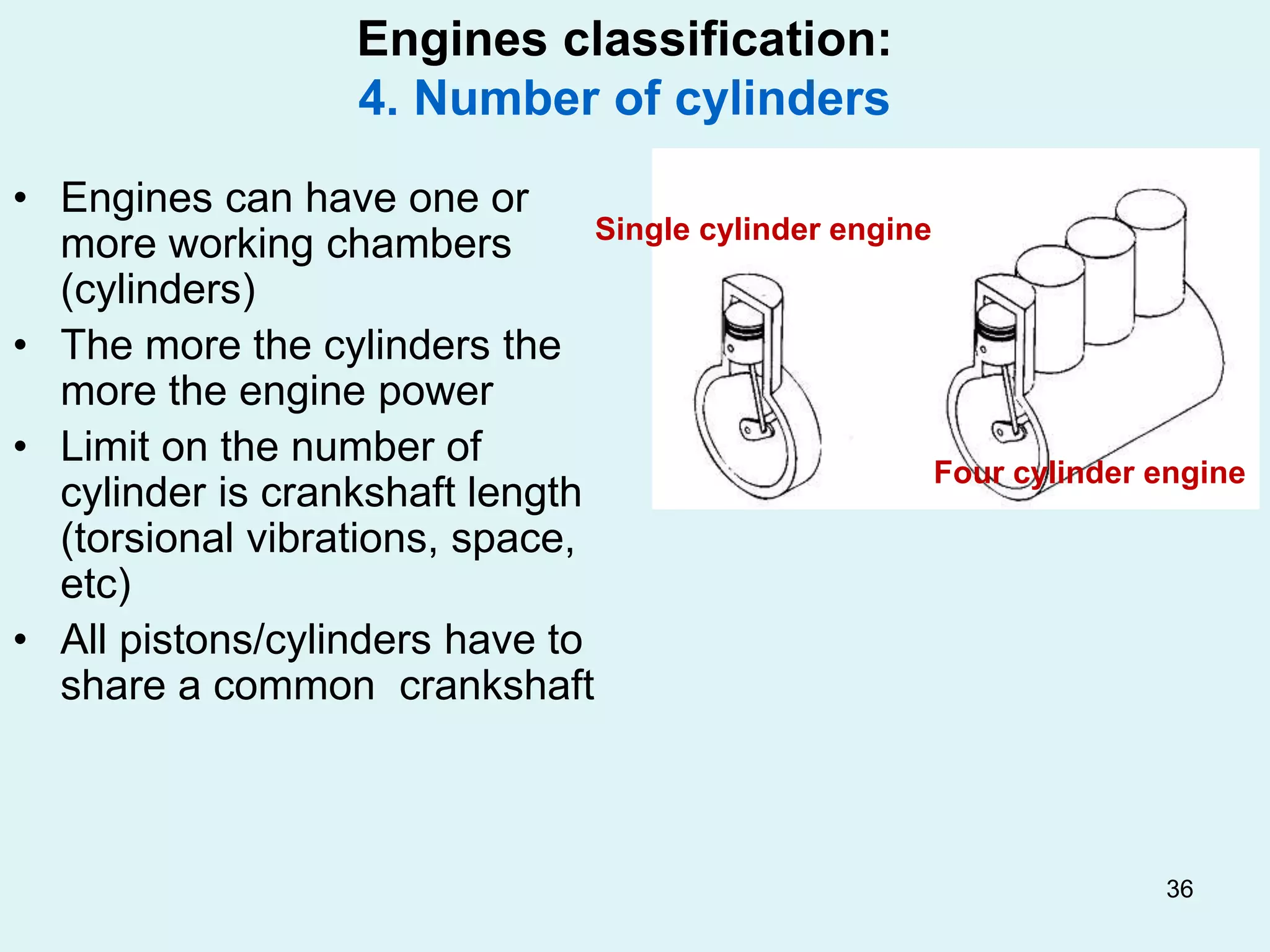
• Engines can have one or
more working chambers
(cylinders)
• The more the cylinders the
more the engine power
• Limit on the number of
cylinder is crankshaft length
(torsional vibrations, space,
etc)
• All pistons/cylinders have to
share a common crankshaft
Single cylinder engine
Four cylinder engine
37
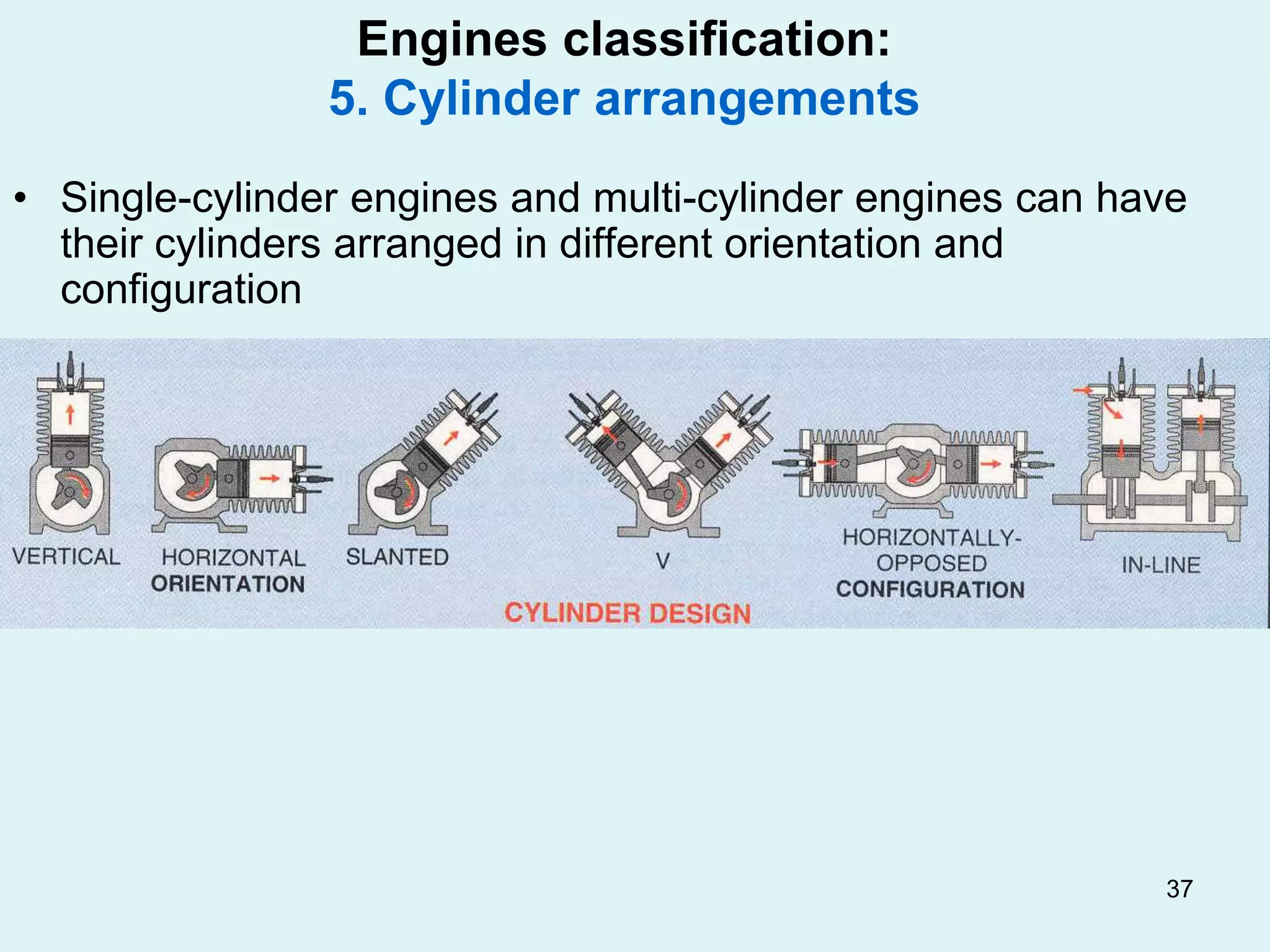
Engines classification:
5. Cylinder arrangements
• Single-cylinder engines and multi-cylinder engines can have
their cylinders arranged in different orientation and
configuration
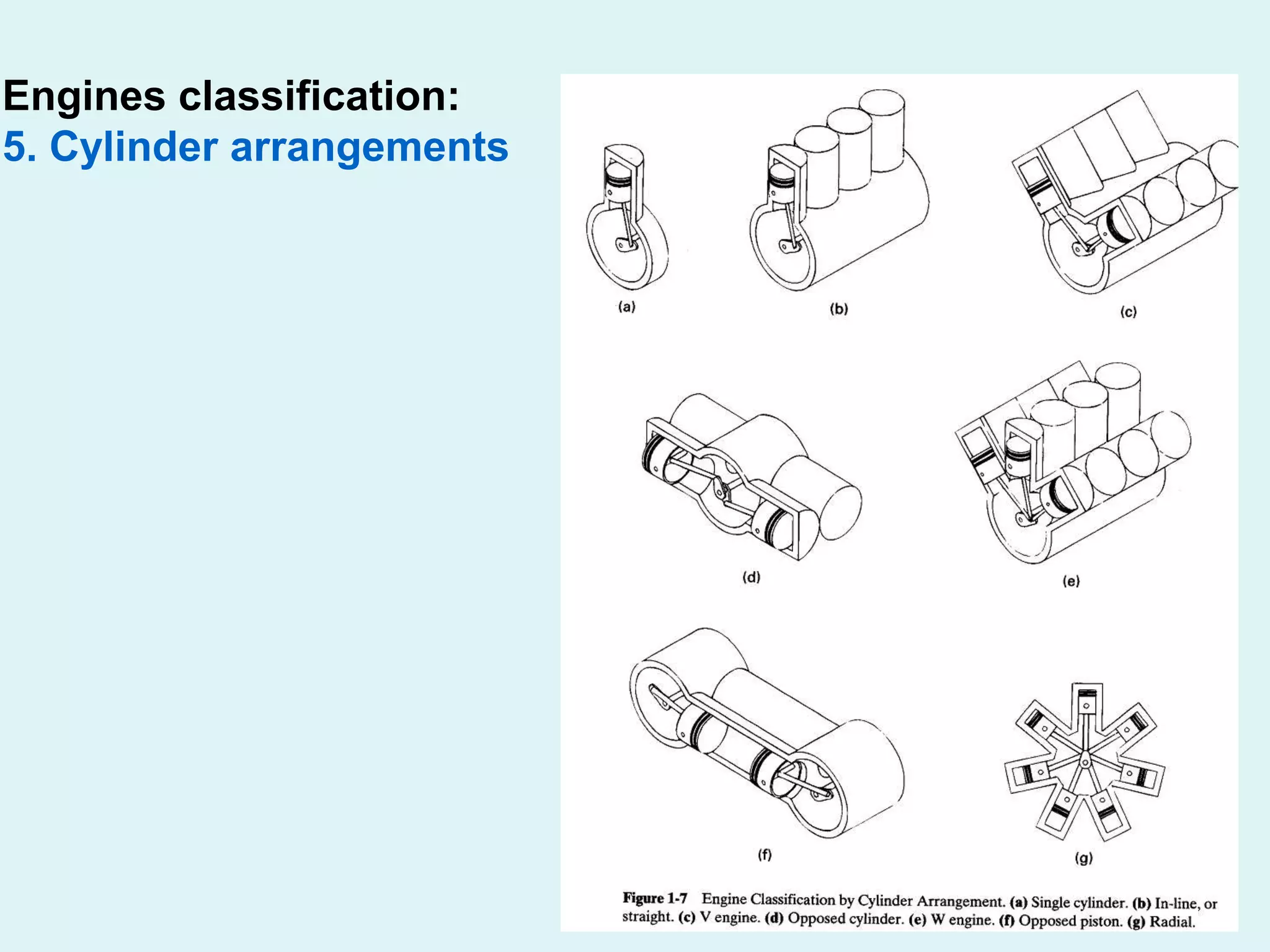
38
Engines classification:
5. Cylinder arrangements
39
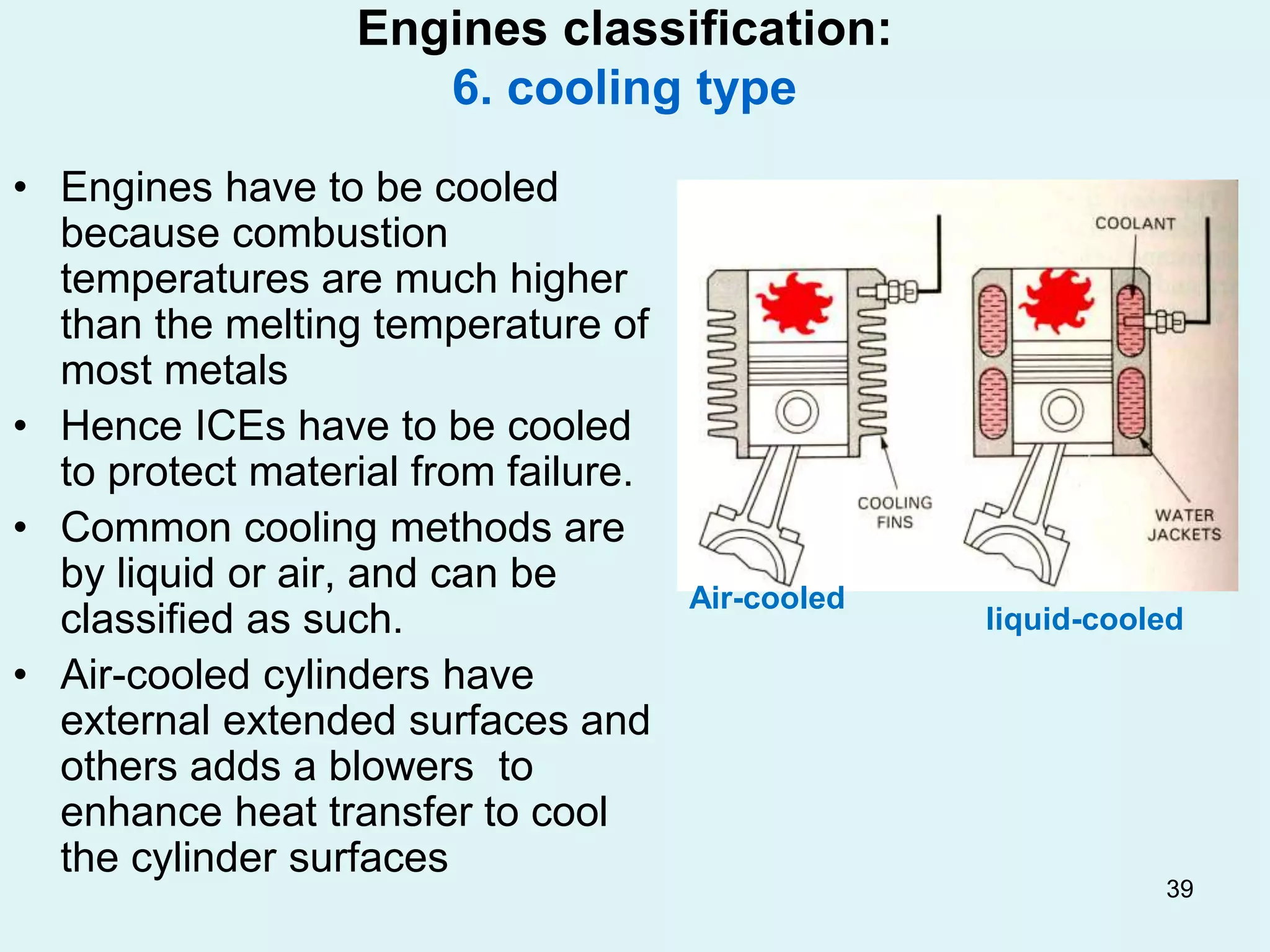
Engines classification:
6. cooling type
• Engines have to be cooled
because combustion
temperatures are much higher
than the melting temperature of
most metals
• Hence ICEs have to be cooled
to protect material from failure.
• Common cooling methods are
by liquid or air, and can be
classified as such.
• Air-cooled cylinders have
external extended surfaces and
others adds a blowers to
enhance heat transfer to cool
the cylinder surfaces
Air-cooled
liquid-cooled
40
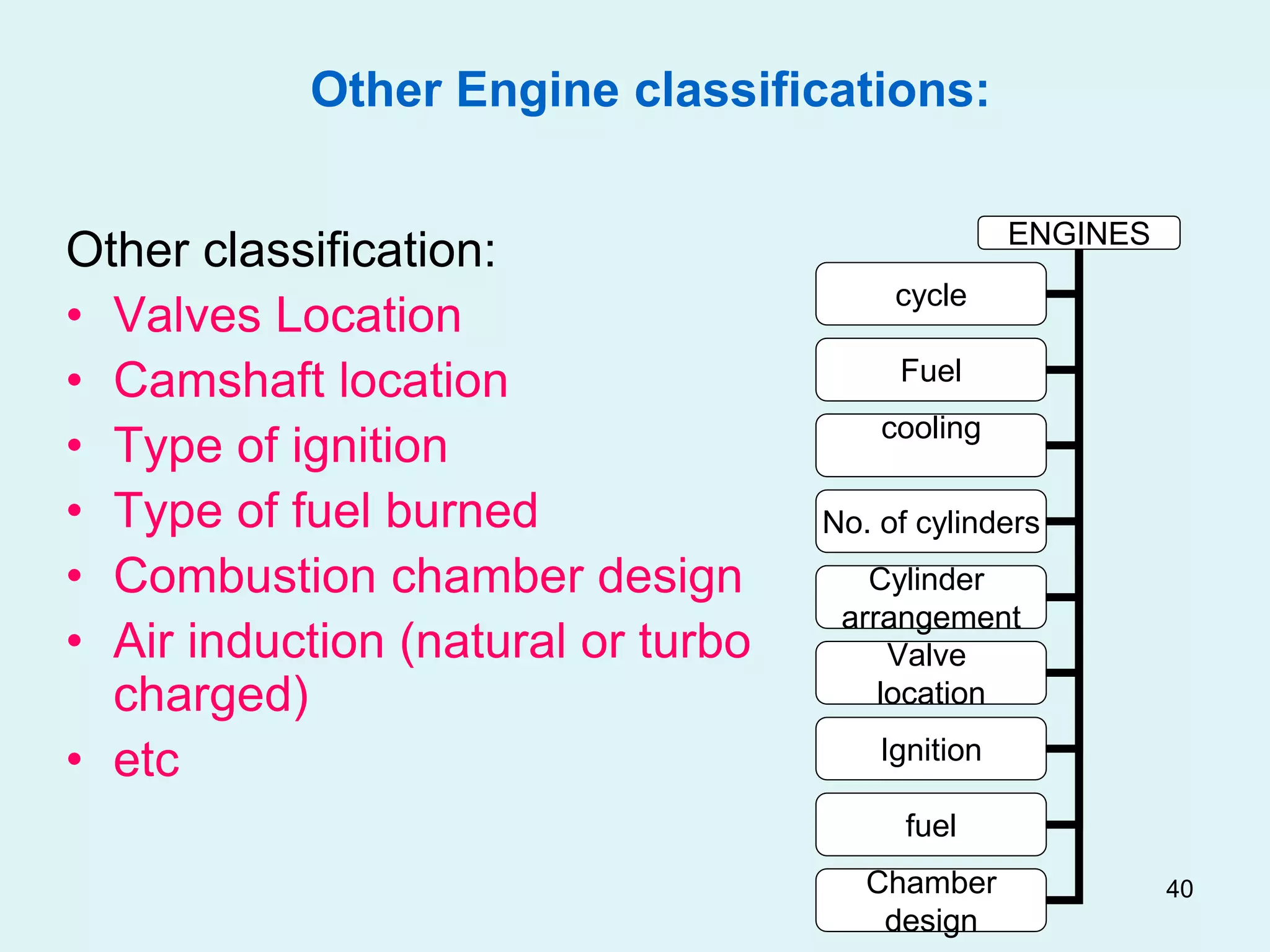
Other Engine classifications:
ENGINES
cooling
cycle
Fuel
No. of cylinders
Cylinder
arrangement
Valve
location
Ignition
fuel
Chamber
design
Other classification:
• Valves Location
• Camshaft location
• Type of ignition
• Type of fuel burned
• Combustion chamber design
• Air induction (natural or turbo
charged)
• etc
41
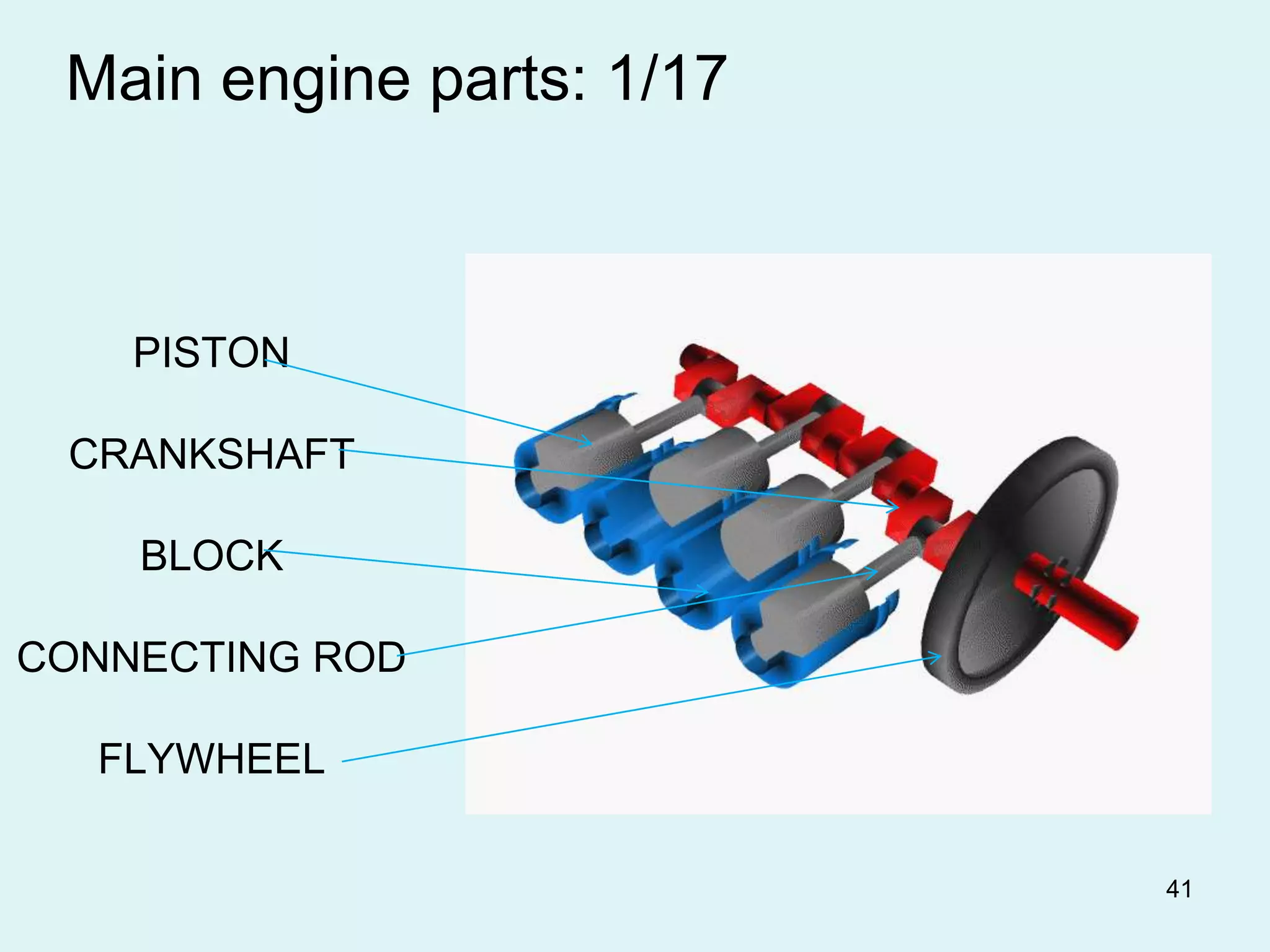
PISTON
CRANKSHAFT
BLOCK
CONNECTING ROD
FLYWHEEL
Main engine parts: 1/17
42
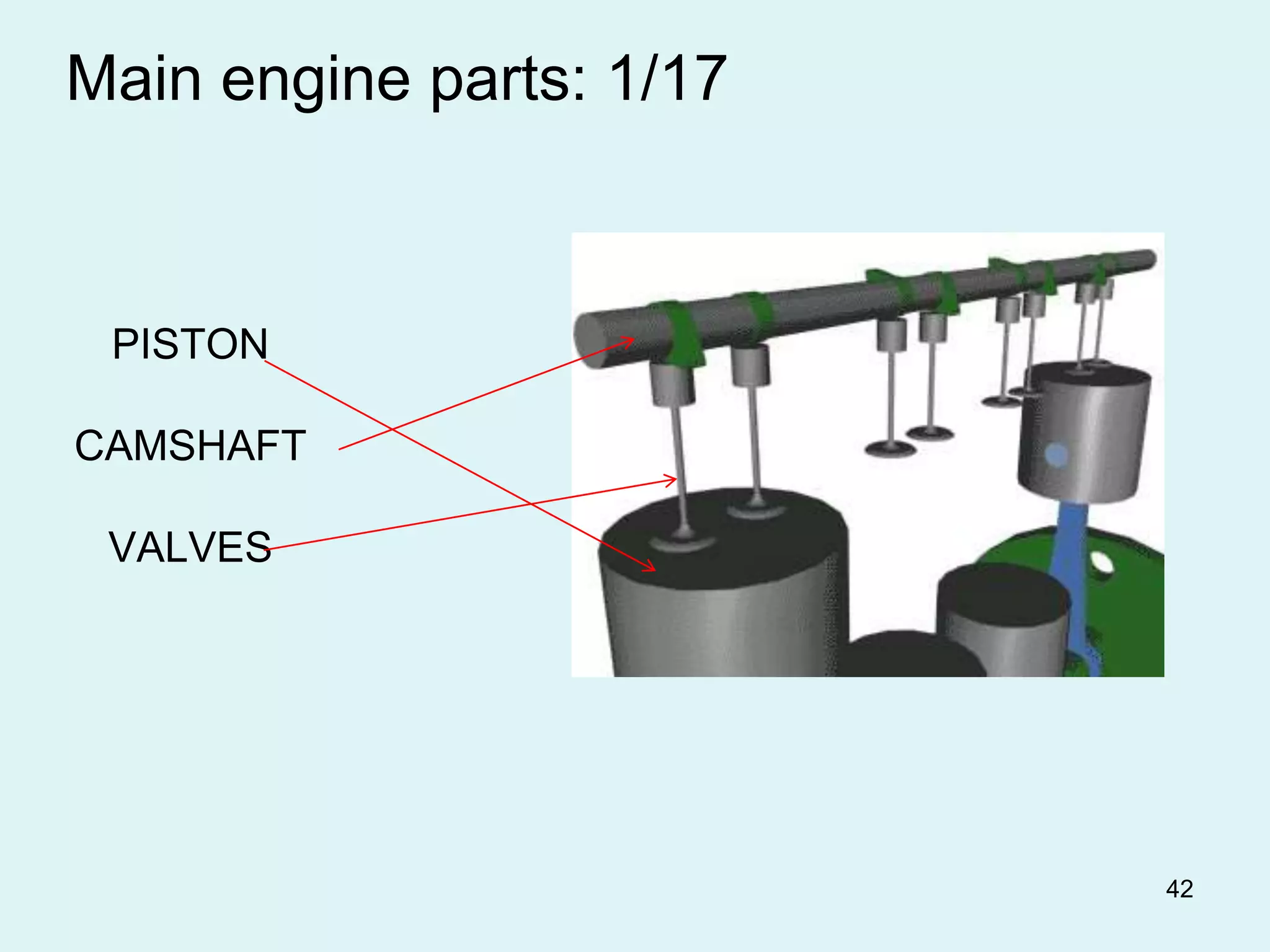
PISTON
CAMSHAFT
VALVES
Main engine parts: 1/17
43
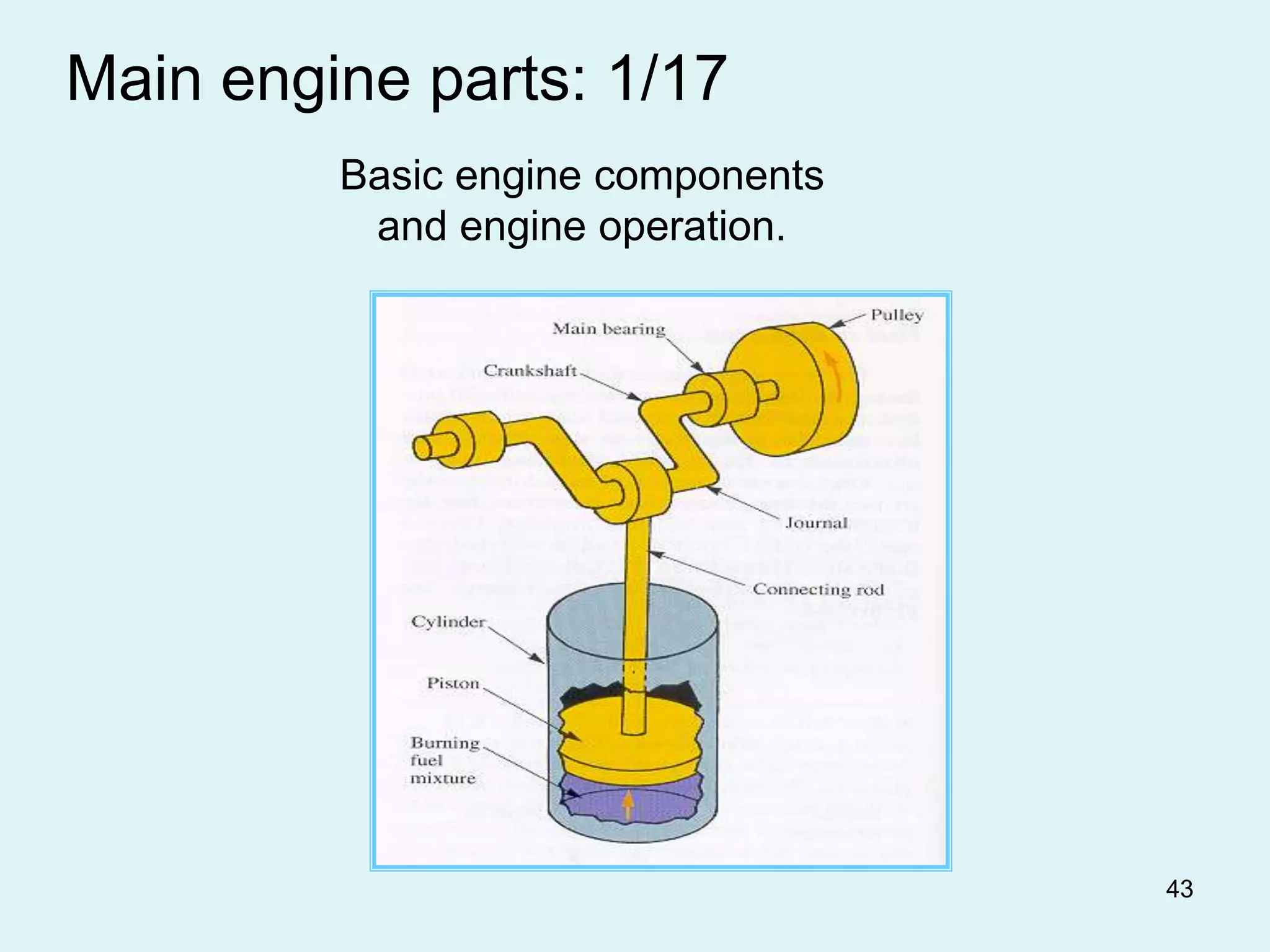
Basic engine components
and engine operation.
Main engine parts: 1/17
44
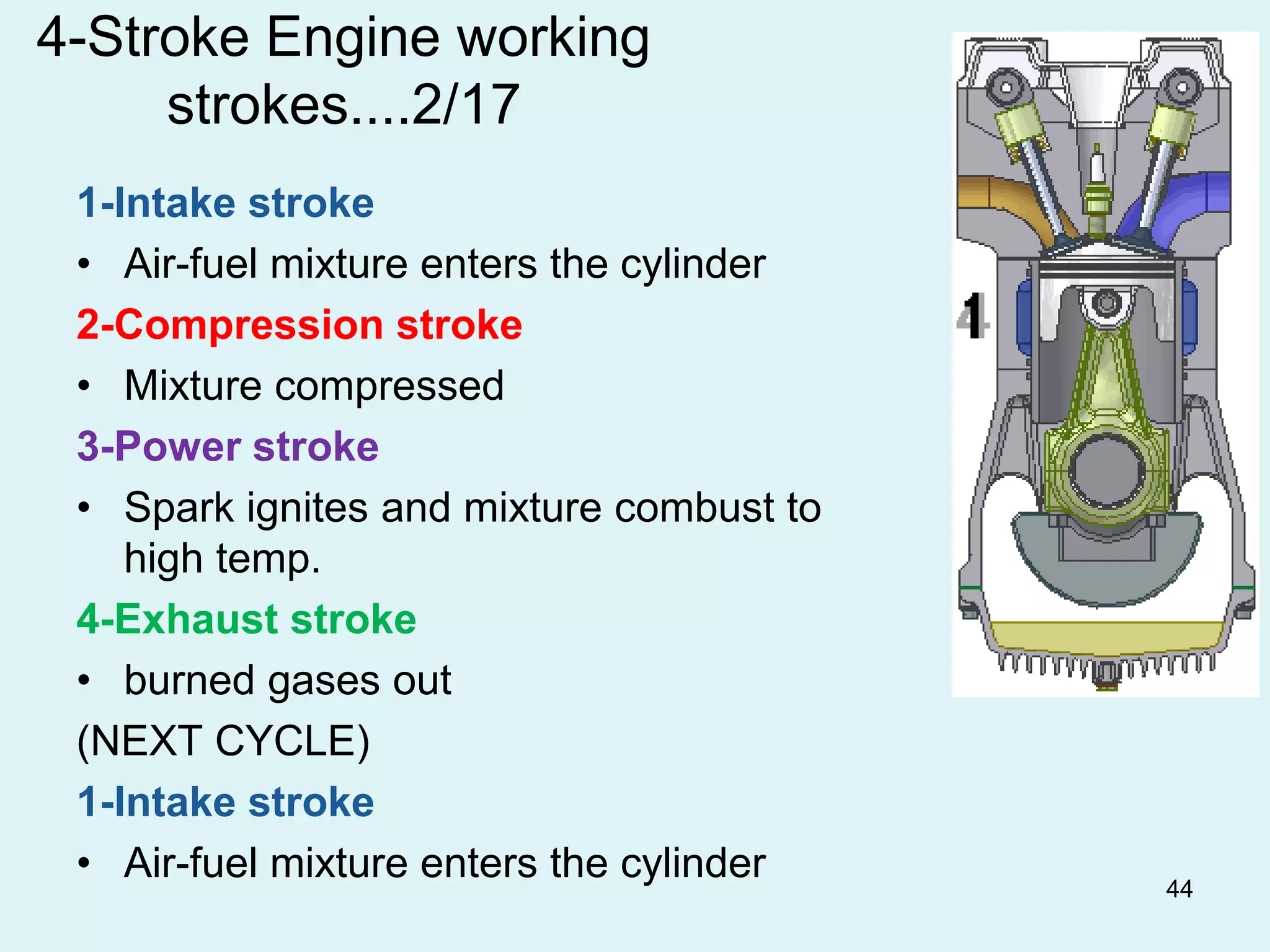
4-Stroke Engine working
strokes....2/17
1-Intake stroke
• Air-fuel mixture enters the cylinder
2-Compression stroke
• Mixture compressed
3-Power stroke
• Spark ignites and mixture combust to
high temp.
4-Exhaust stroke
• burned gases out
(NEXT CYCLE)
1-Intake stroke
• Air-fuel mixture enters the cylinder
45
4-Stroke Engine working
strokes....2/17
VALVES OPERATION
-Camshaft operate the valves
-Cam is driven by crankshaft
-Valves are synchronized with piston
position
46
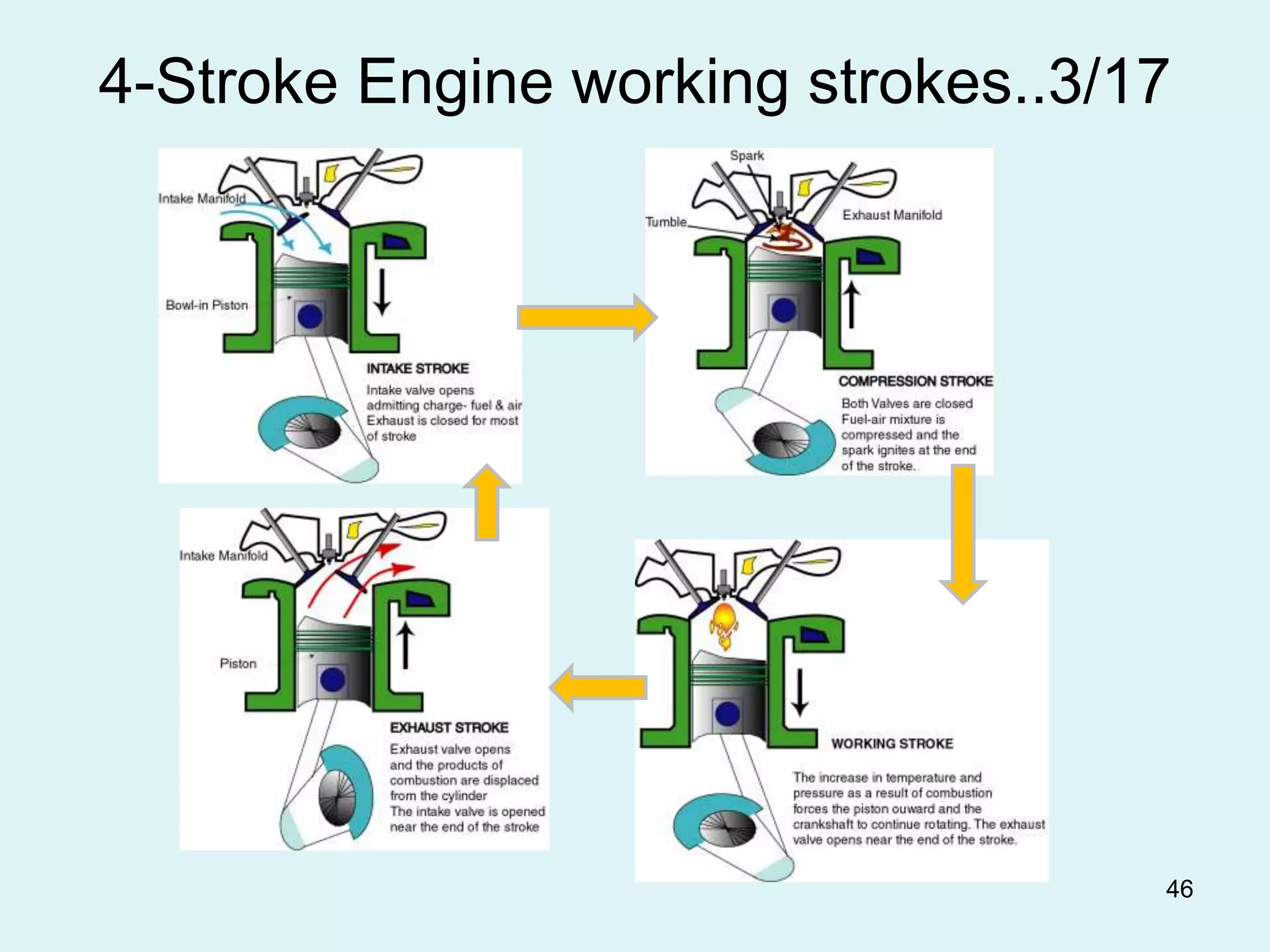
4-Stroke Engine working strokes..3/17
47
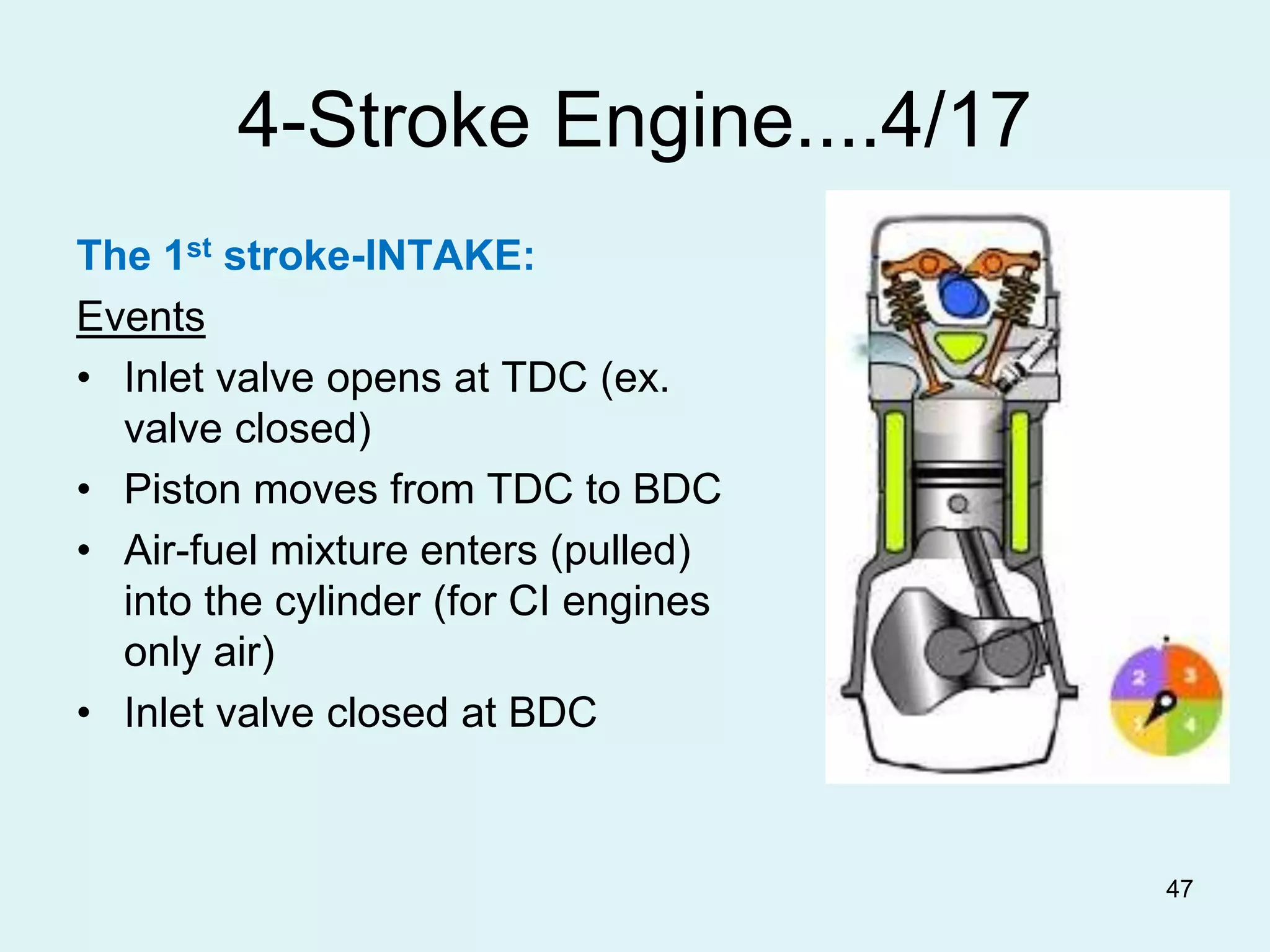
4-Stroke Engine....4/17
The 1st stroke-INTAKE:
Events
• Inlet valve opens at TDC (ex.
valve closed)
• Piston moves from TDC to BDC
• Air-fuel mixture enters (pulled)
into the cylinder (for CI engines
only air)
• Inlet valve closed at BDC
48
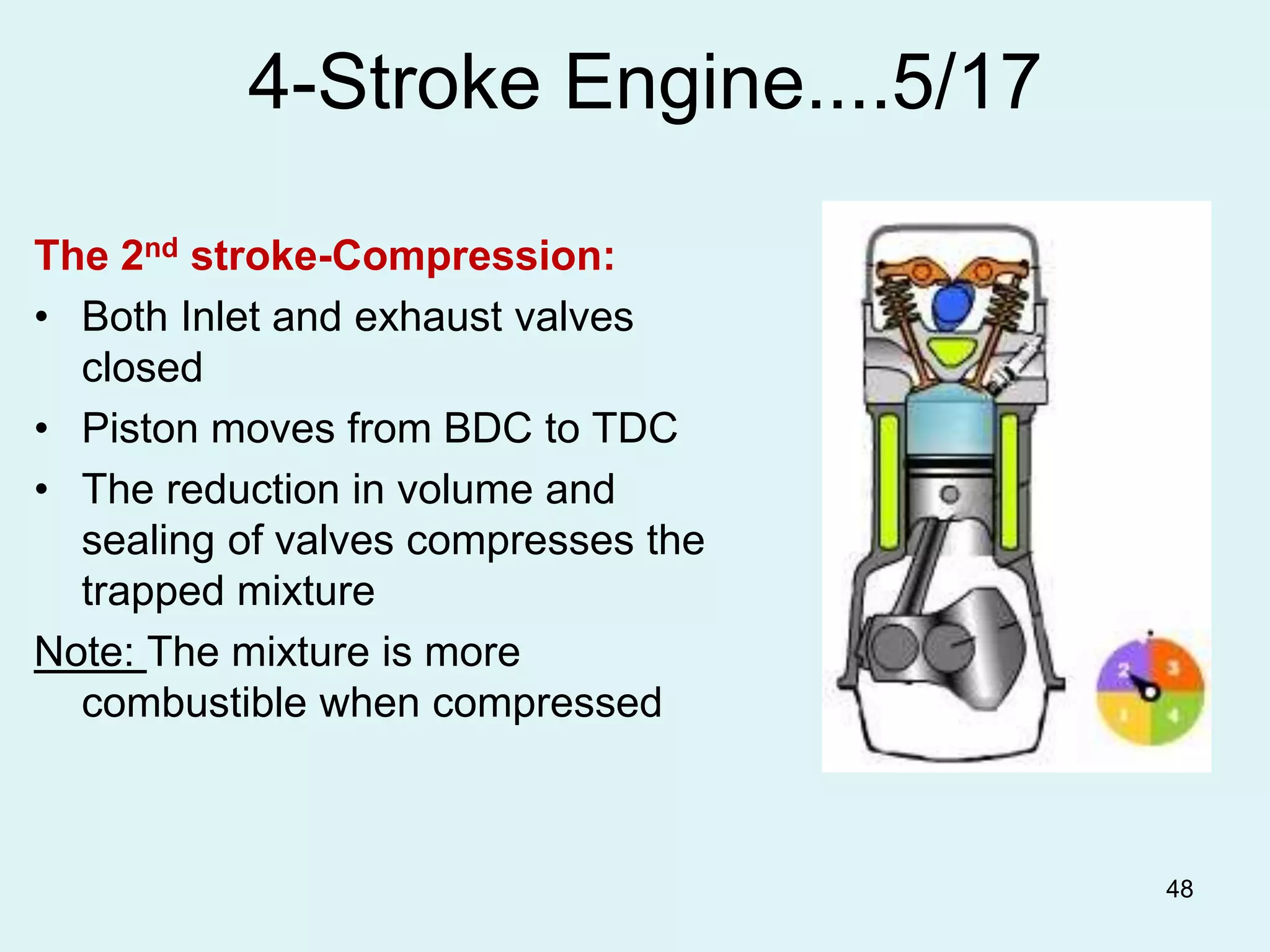
4-Stroke Engine....5/17
The 2nd stroke-Compression:
• Both Inlet and exhaust valves
closed
• Piston moves from BDC to TDC
• The reduction in volume and
sealing of valves compresses the
trapped mixture
Note: The mixture is more
combustible when compressed
49
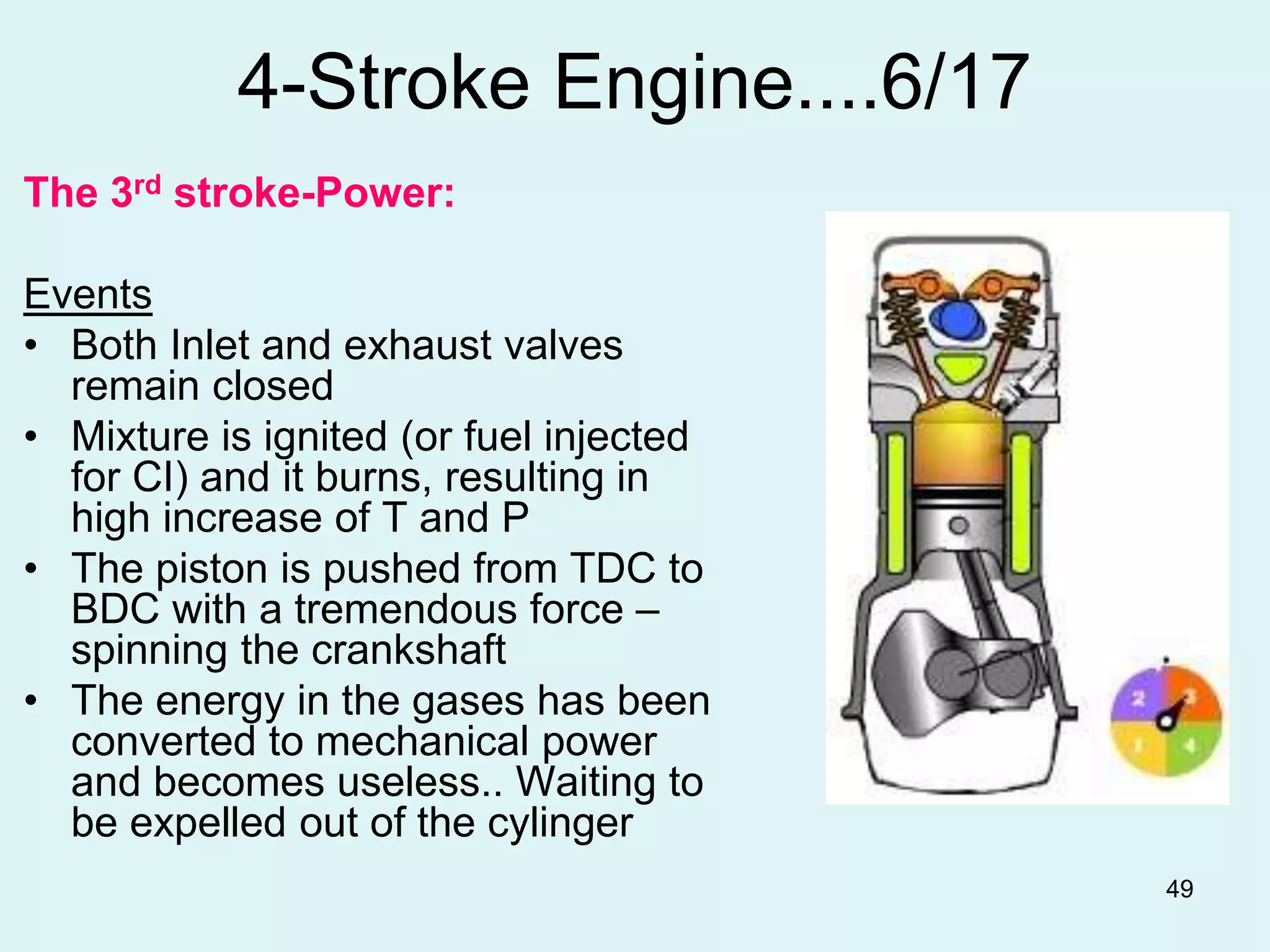
4-Stroke Engine....6/17
The 3rd stroke-Power:
Events
• Both Inlet and exhaust valves
remain closed
• Mixture is ignited (or fuel injected
for CI) and it burns, resulting in
high increase of T and P
• The piston is pushed from TDC to
BDC with a tremendous force –
spinning the crankshaft
• The energy in the gases has been
converted to mechanical power
and becomes useless.. Waiting to
be expelled out of the cylinger
50
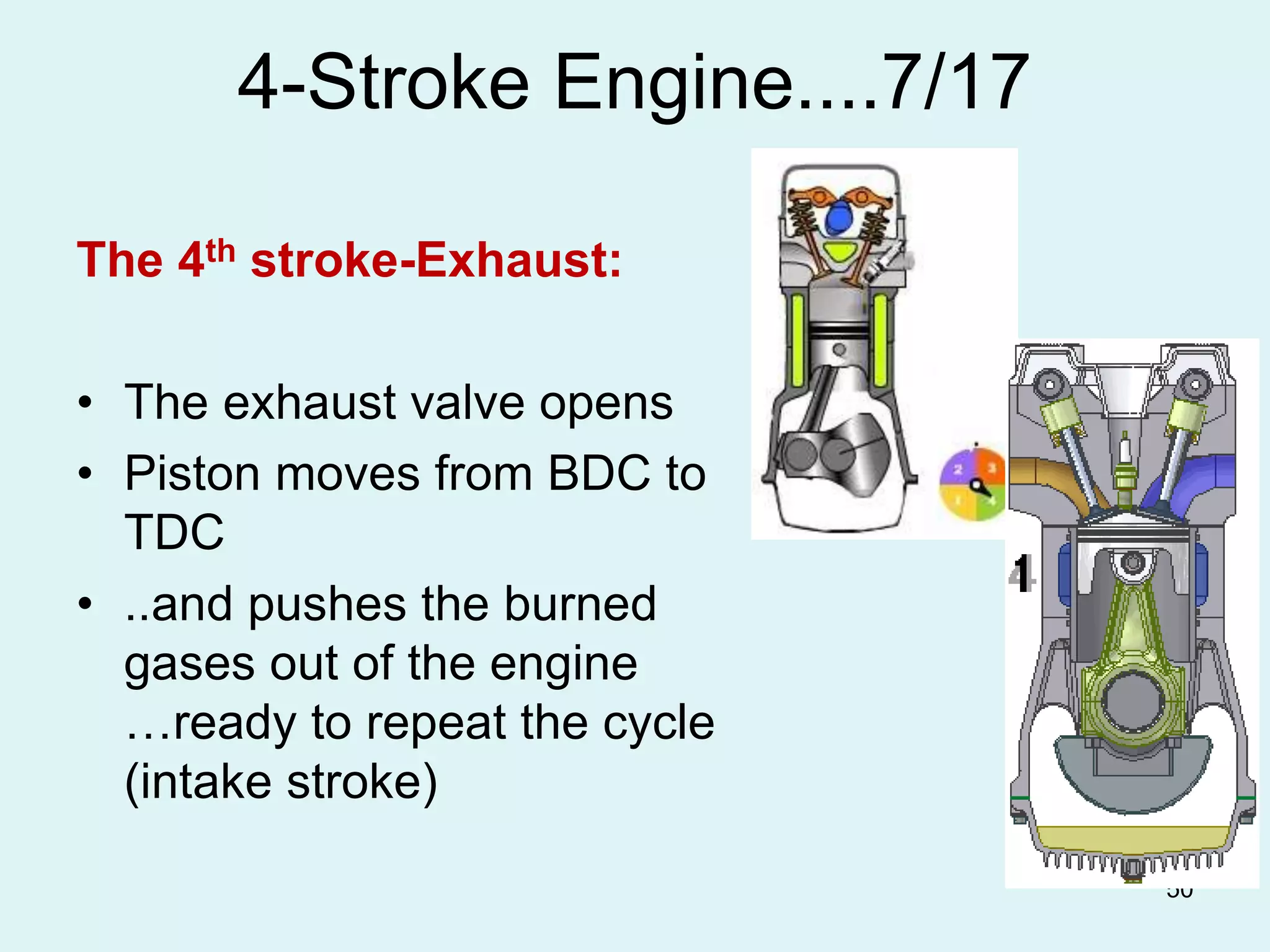
4-Stroke Engine....7/17
The 4th stroke-Exhaust:
• The exhaust valve opens
• Piston moves from BDC to
TDC
• ..and pushes the burned
gases out of the engine
…ready to repeat the cycle
(intake stroke)
51
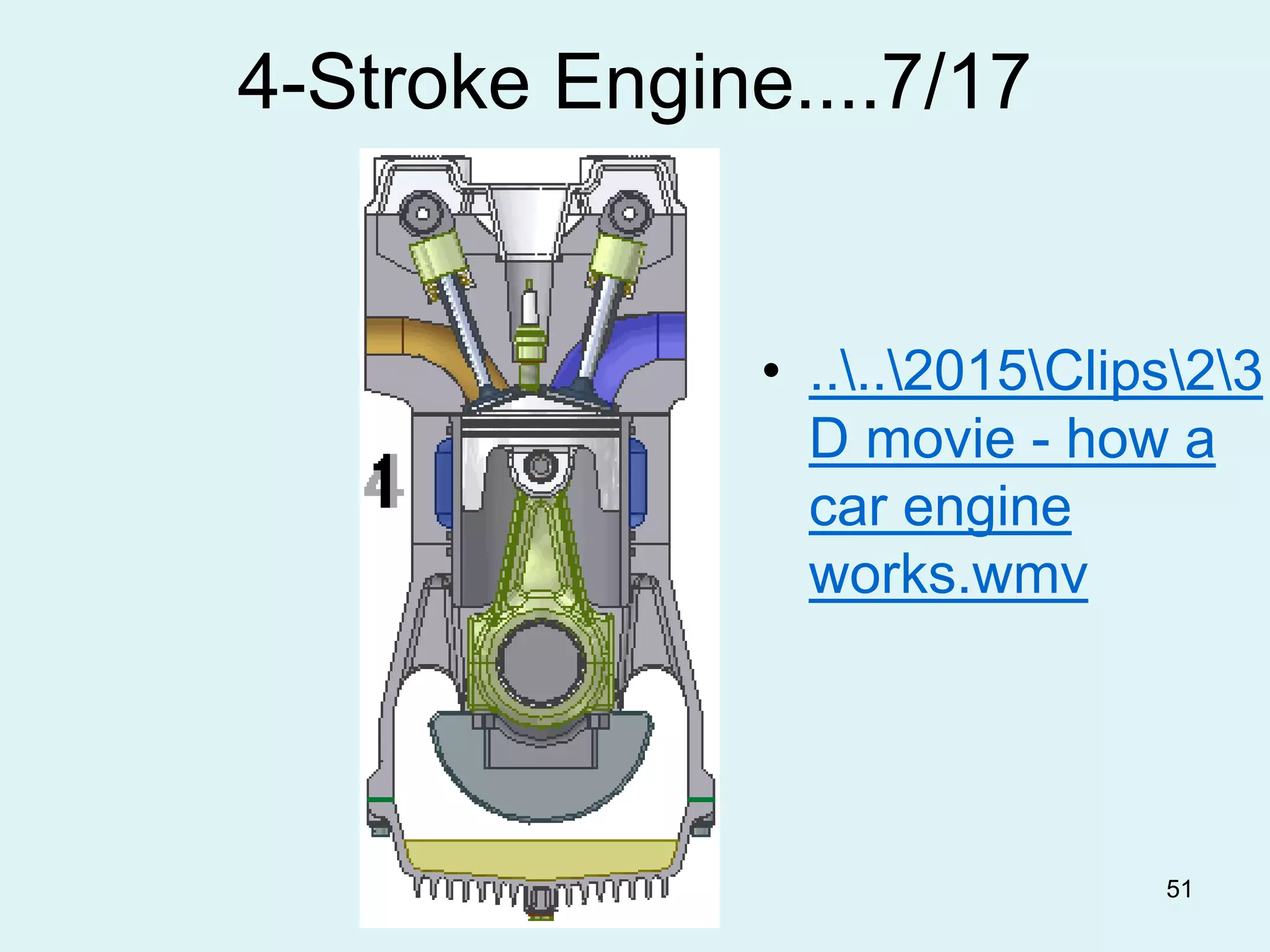
4-Stroke Engine....7/17
• ....2015Clips23
D movie - how a
car engine
works.wmv
52
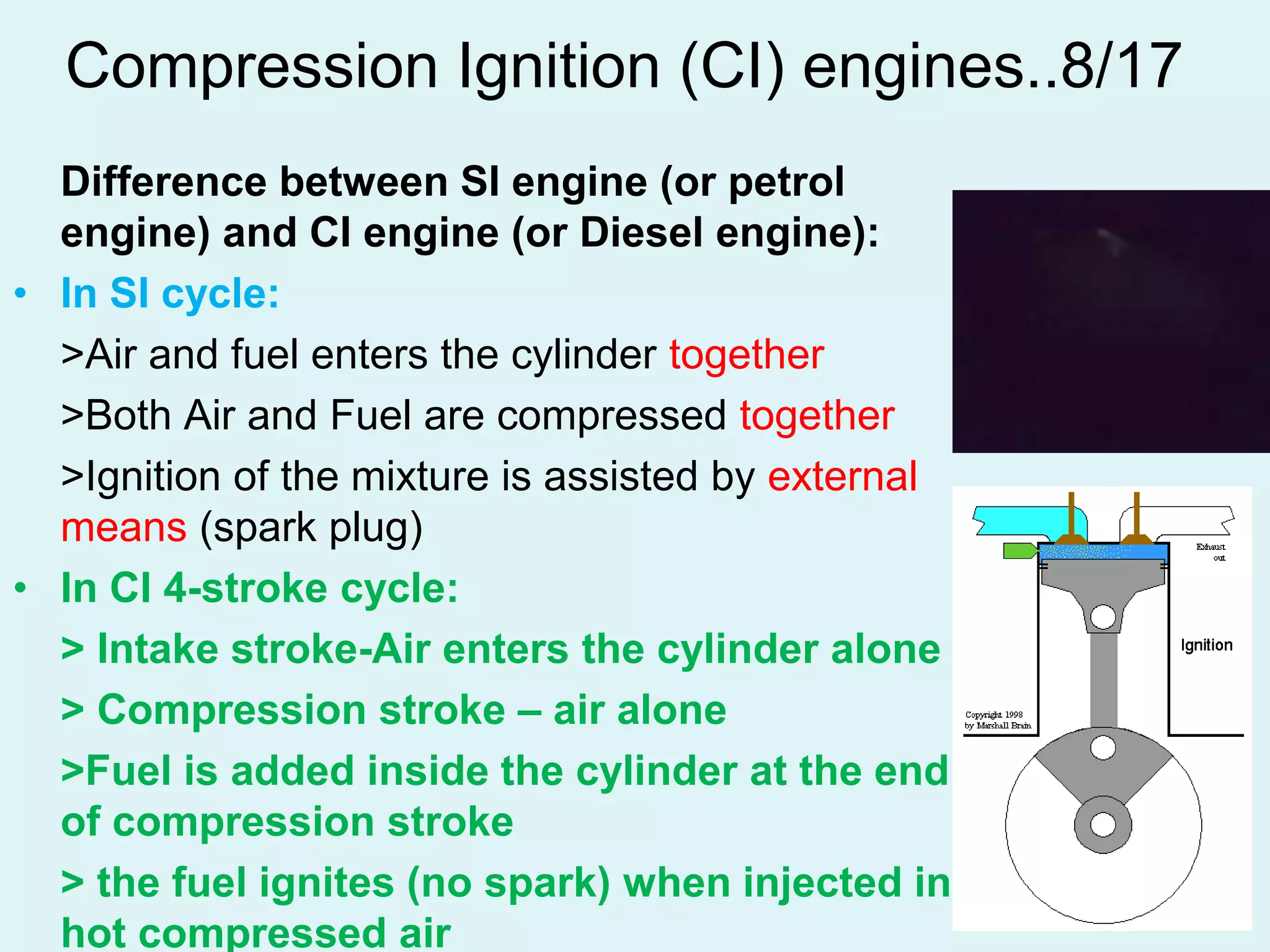
Compression Ignition (CI) engines..8/17
Difference between SI engine (or petrol
engine) and CI engine (or Diesel engine):
• In SI cycle:
>Air and fuel enters the cylinder together
>Both Air and Fuel are compressed together
>Ignition of the mixture is assisted by external
means (spark plug)
• In CI 4-stroke cycle:
> Intake stroke-Air enters the cylinder alone
> Compression stroke – air alone
>Fuel is added inside the cylinder at the end
of compression stroke
> the fuel ignites (no spark) when injected in
hot compressed air
53
Main engine
parts....9/17
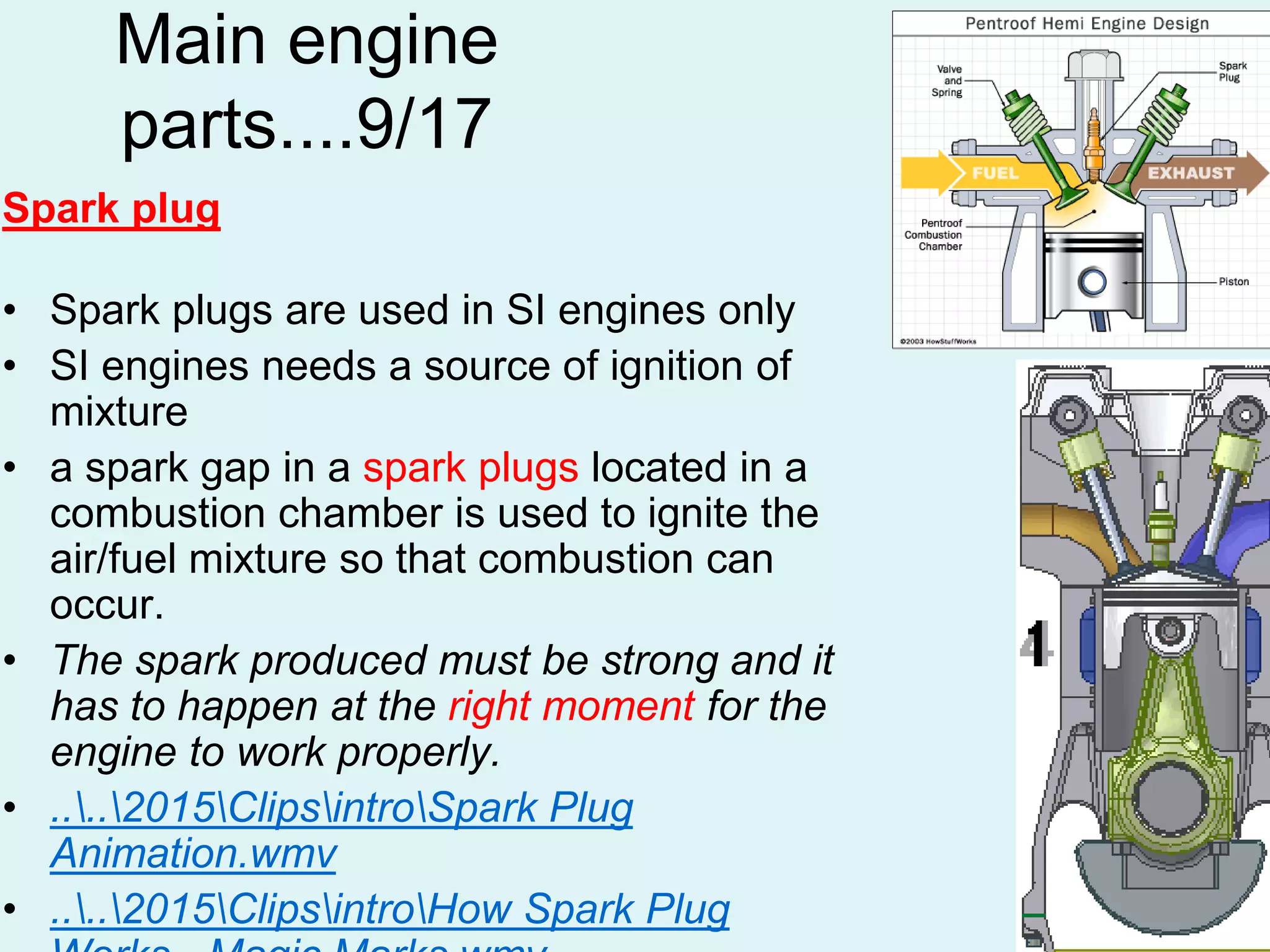
Spark plug
• Spark plugs are used in SI engines only
• SI engines needs a source of ignition of
mixture
• a spark gap in a spark plugs located in a
combustion chamber is used to ignite the
air/fuel mixture so that combustion can
occur.
• The spark produced must be strong and it
has to happen at the right moment for the
engine to work properly.
• ....2015ClipsintroSpark Plug
Animation.wmv
• ....2015ClipsintroHow Spark Plug
54
Main engine
parts..10/17
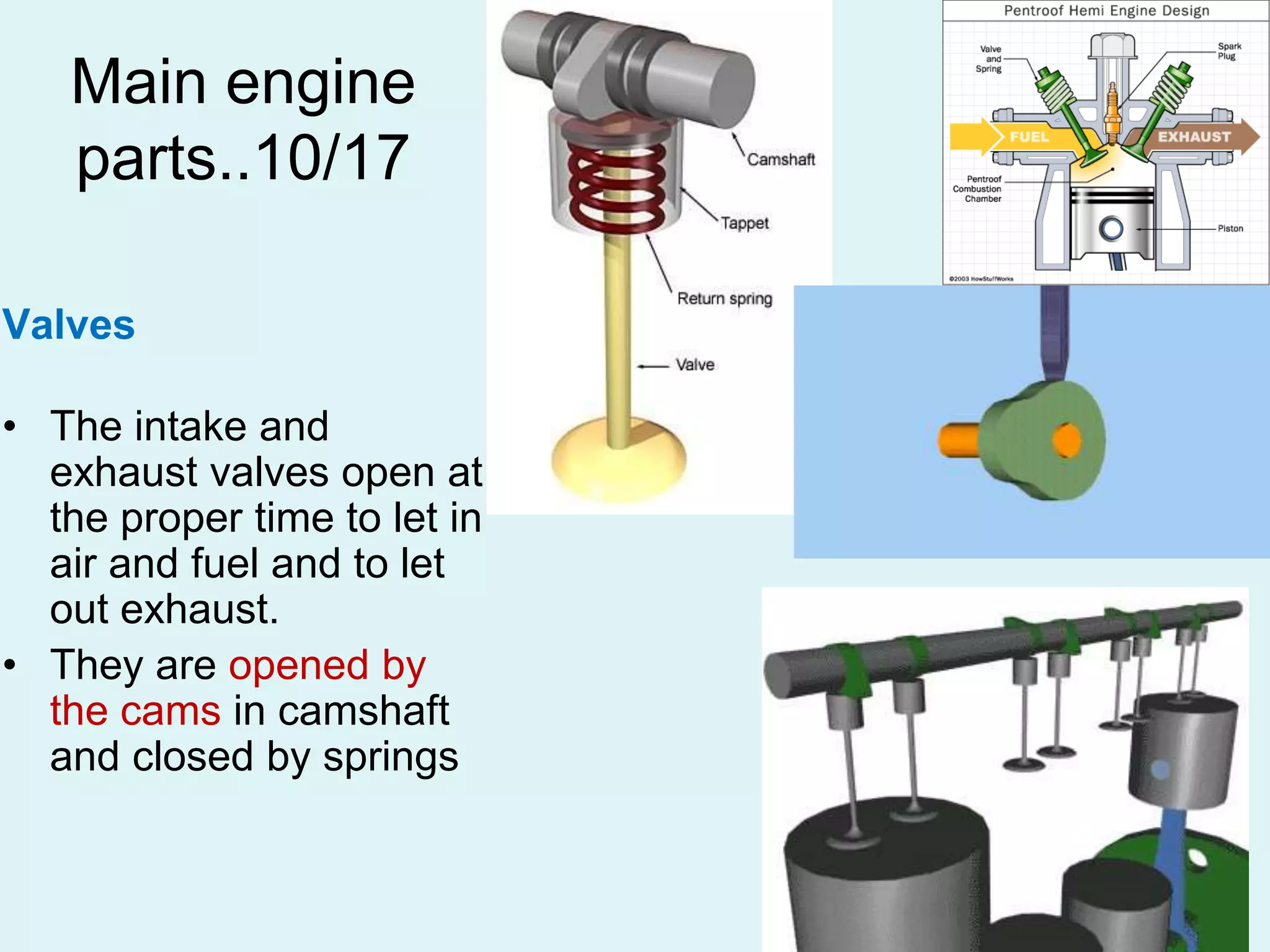
Valves
• The intake and
exhaust valves open at
the proper time to let in
air and fuel and to let
out exhaust.
• They are opened by
the cams in camshaft
and closed by springs
55
Main engine parts
..11/17
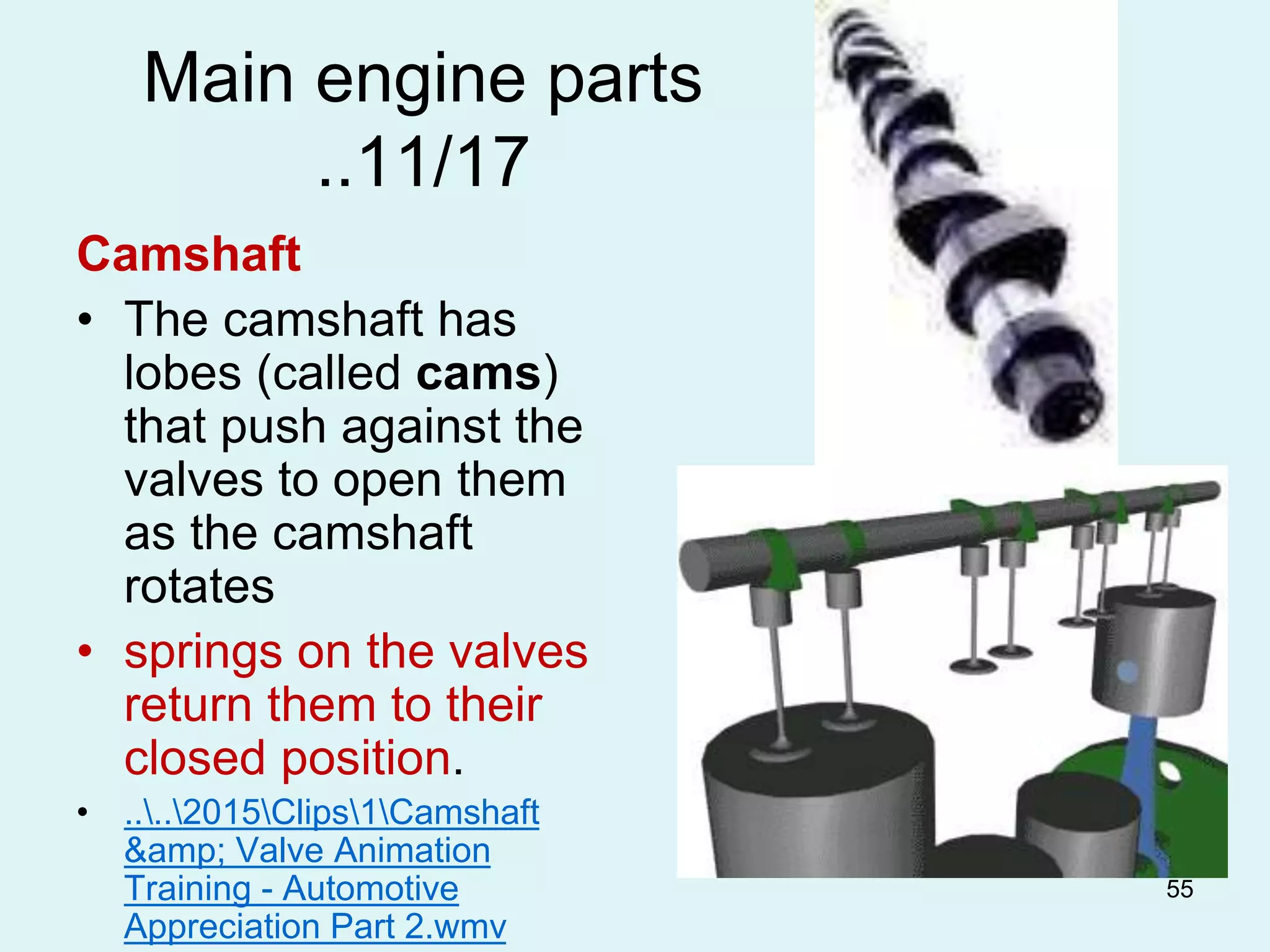
Camshaft
• The camshaft has
lobes (called cams)
that push against the
valves to open them
as the camshaft
rotates
• springs on the valves
return them to their
closed position.
• ....2015Clips1Camshaft
& Valve Animation
Training - Automotive
Appreciation Part 2.wmv
56
Main engine
parts..12/17
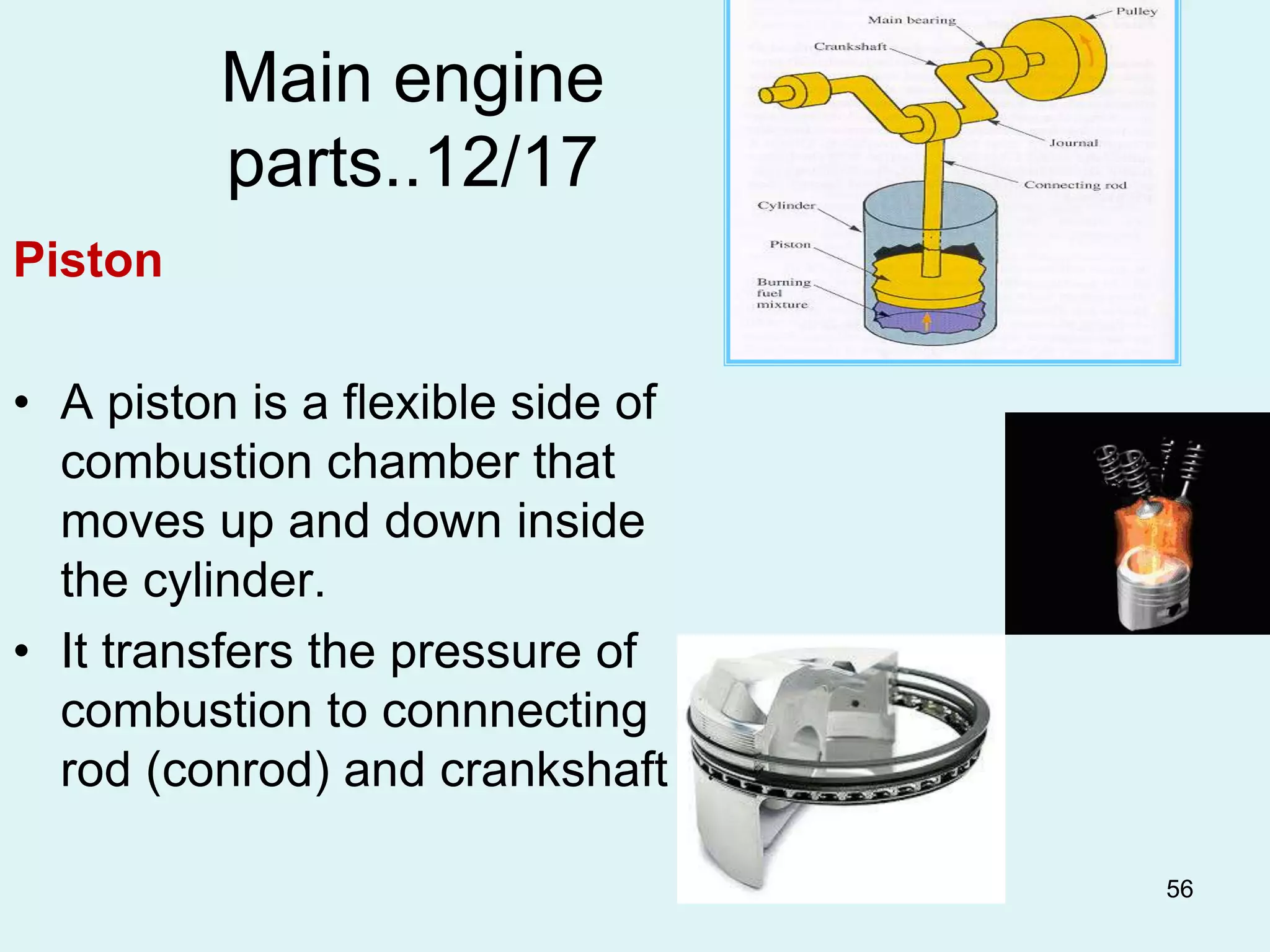
Piston
• A piston is a flexible side of
combustion chamber that
moves up and down inside
the cylinder.
• It transfers the pressure of
combustion to connnecting
rod (conrod) and crankshaft
57
Main engine parts..13/17
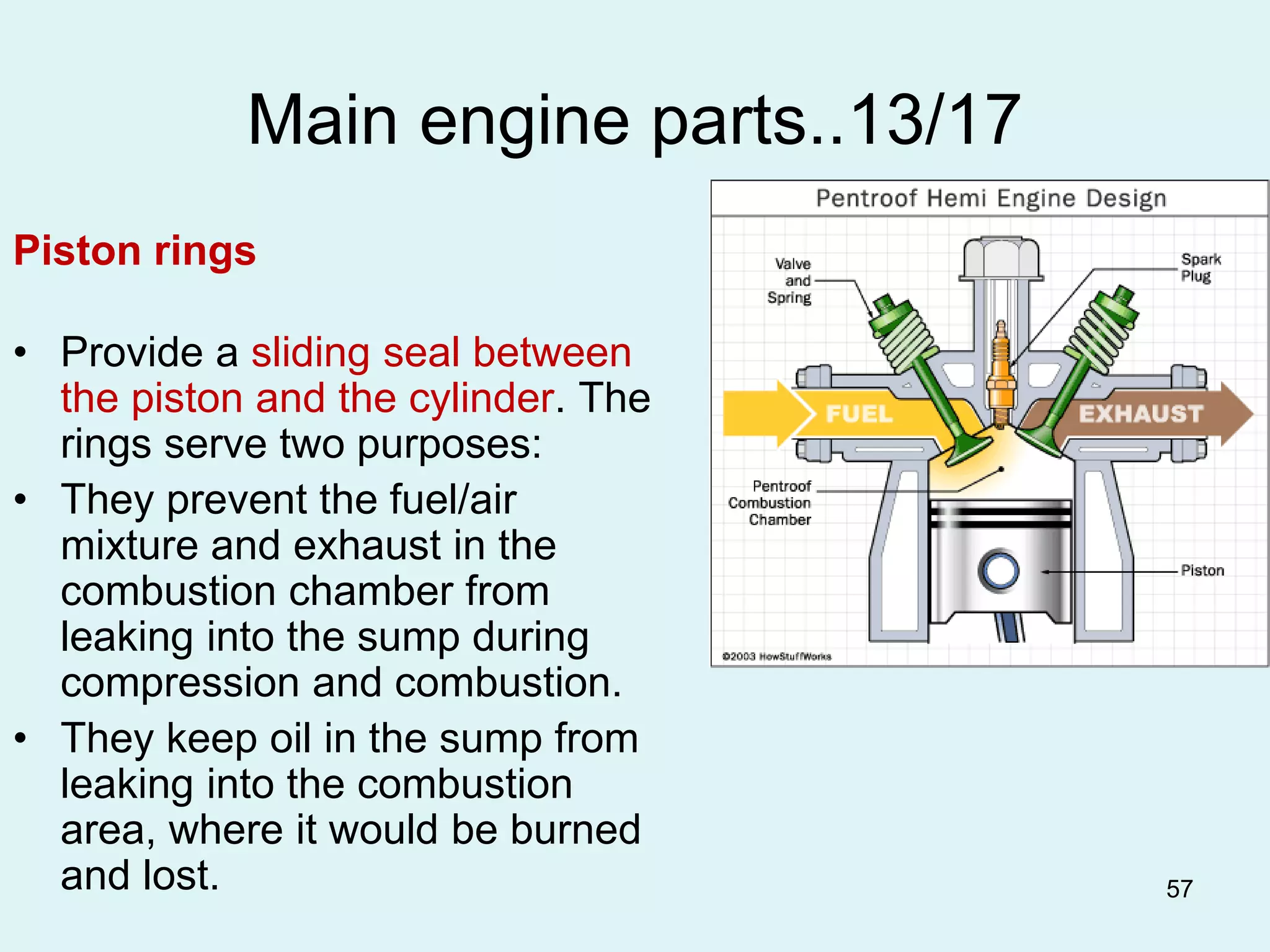
Piston rings
• Provide a sliding seal between
the piston and the cylinder. The
rings serve two purposes:
• They prevent the fuel/air
mixture and exhaust in the
combustion chamber from
leaking into the sump during
compression and combustion.
• They keep oil in the sump from
leaking into the combustion
area, where it would be burned
and lost.
58
Main engine parts..14/17
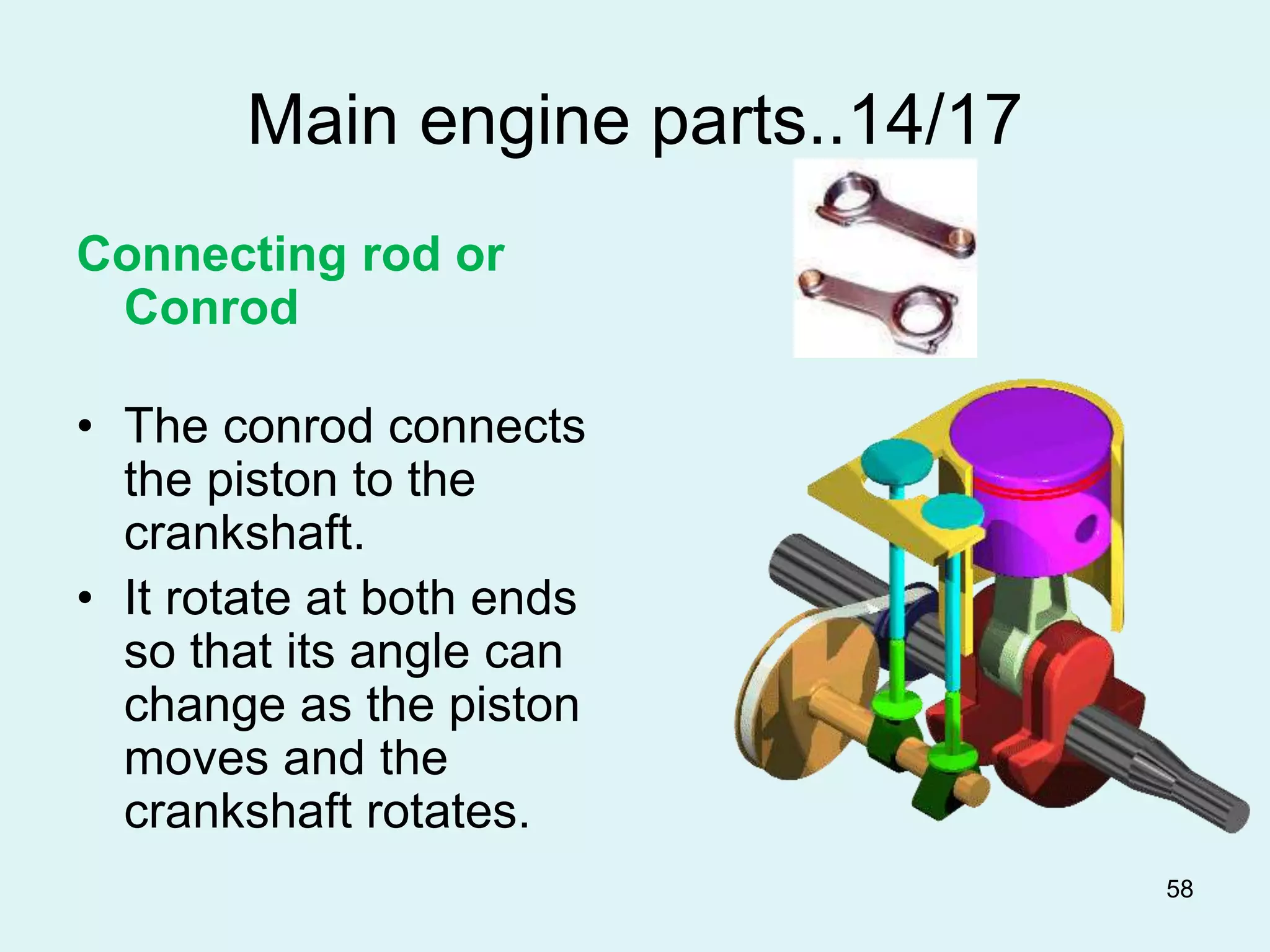
Connecting rod or
Conrod
• The conrod connects
the piston to the
crankshaft.
• It rotate at both ends
so that its angle can
change as the piston
moves and the
crankshaft rotates.
59
Main engine
parts..15/17
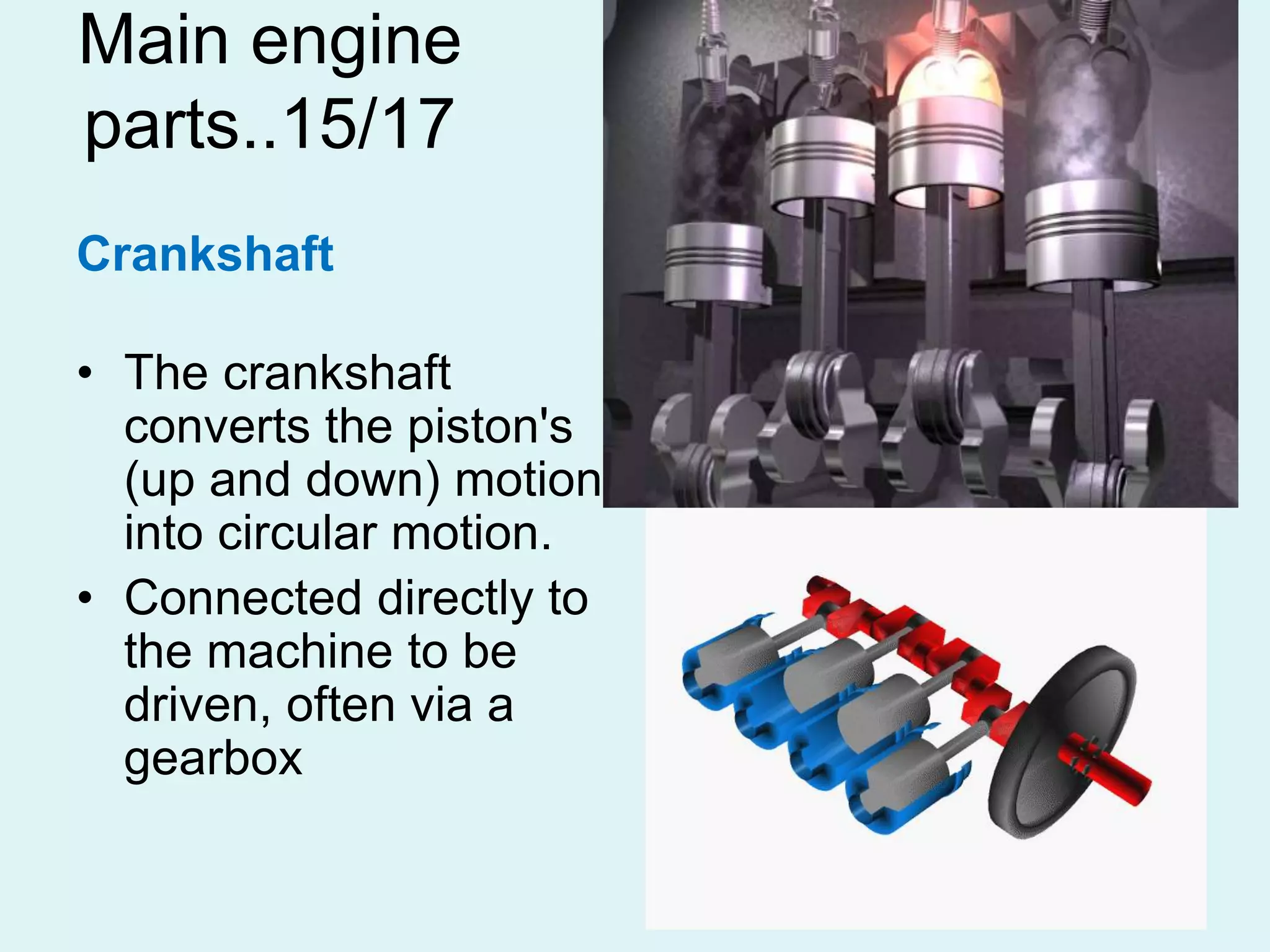
Crankshaft
• The crankshaft
converts the piston's
(up and down) motion
into circular motion.
• Connected directly to
the machine to be
driven, often via a
gearbox
60
Main engine parts..16/17
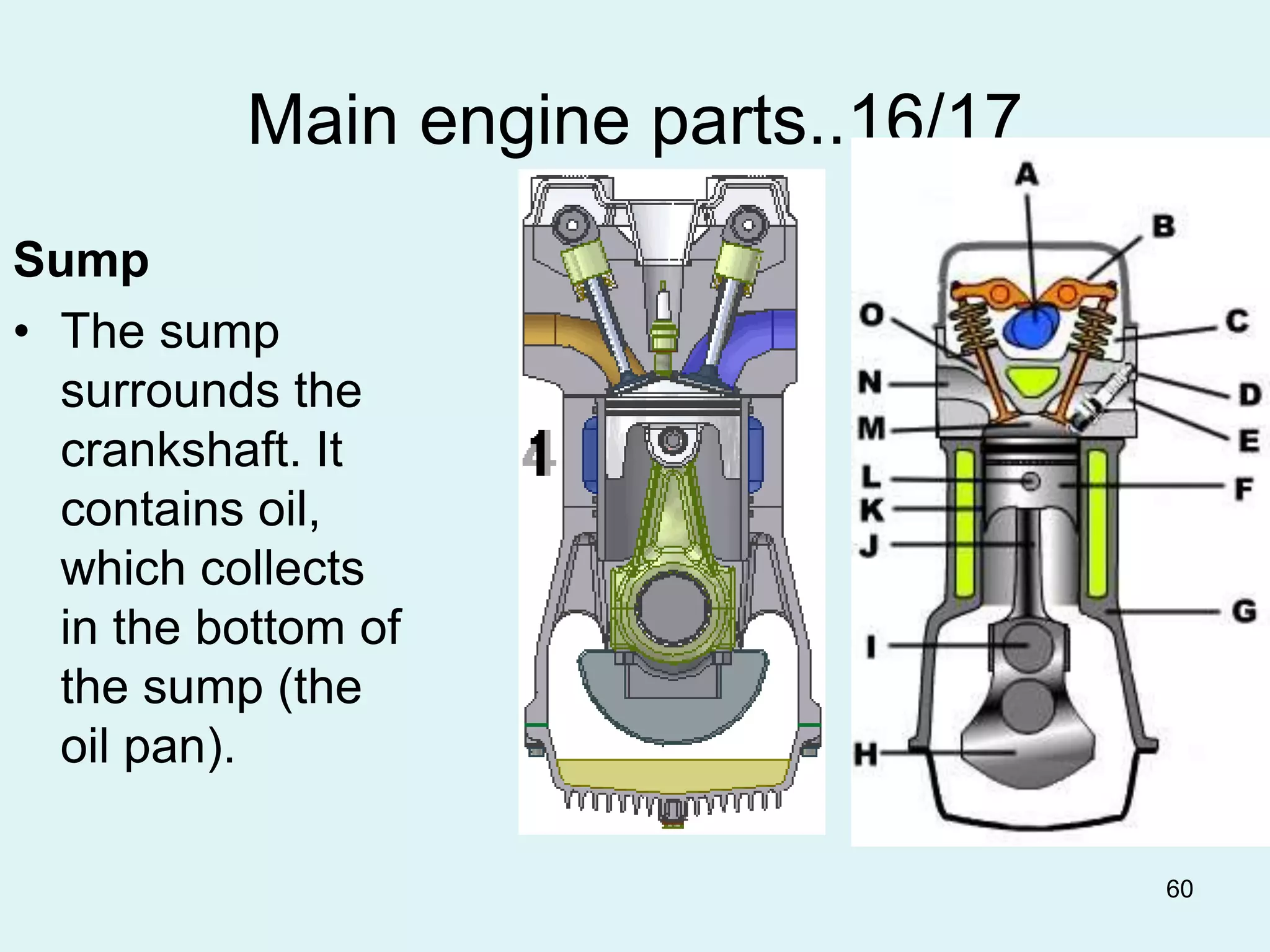
Sump
• The sump
surrounds the
crankshaft. It
contains oil,
which collects
in the bottom of
the sump (the
oil pan).
61
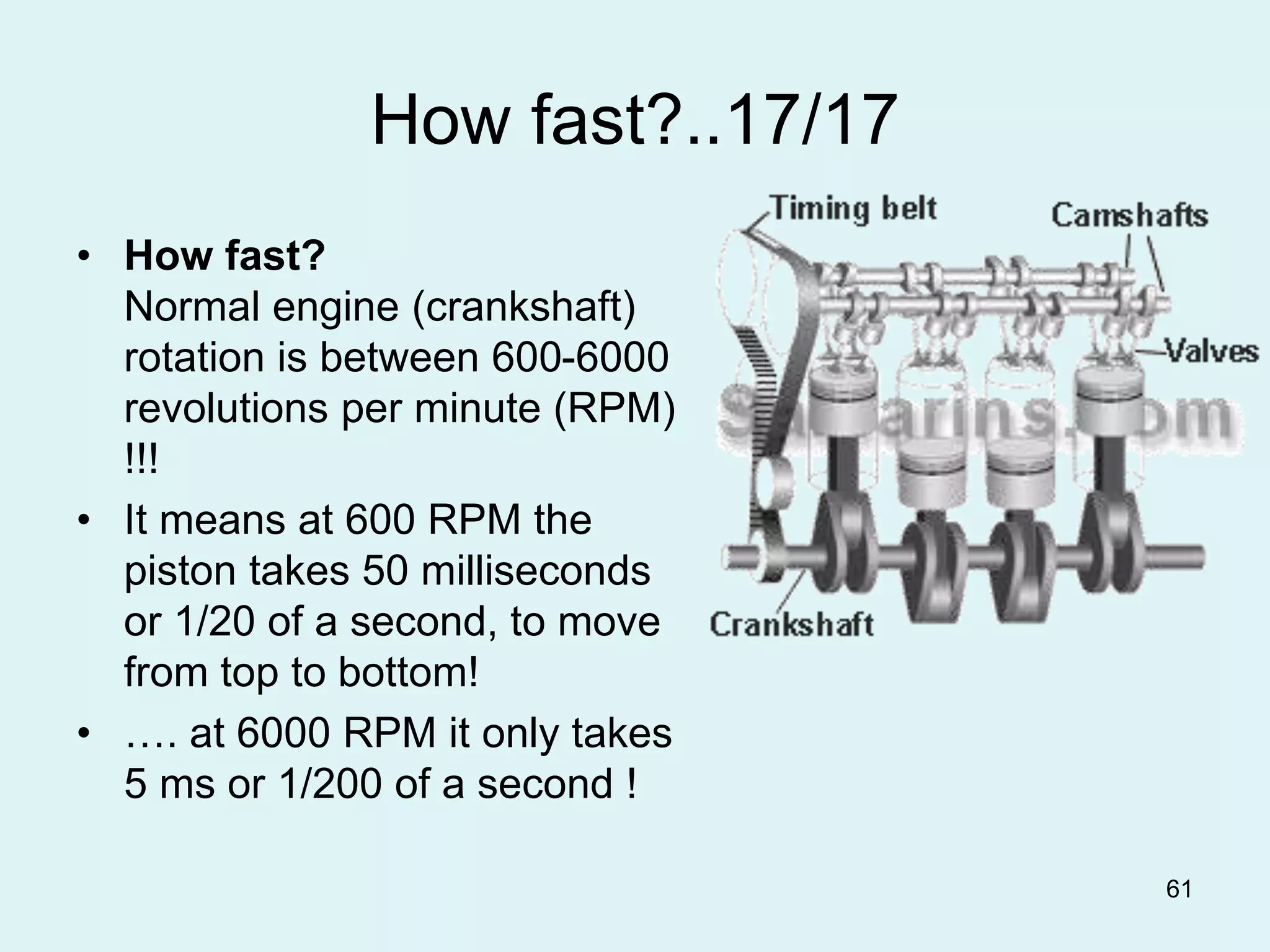
How fast?..17/17
• How fast?
Normal engine (crankshaft)
rotation is between 600-6000
revolutions per minute (RPM)
!!!
• It means at 600 RPM the
piston takes 50 milliseconds
or 1/20 of a second, to move
from top to bottom!
• …. at 6000 RPM it only takes
5 ms or 1/200 of a second !

1-Introduction to ICEs_01.ppt

  • 1.
    1 ME329: Internal CombustionEngines (ICE) Dr. H. M. Rajabu hmrajabu@gmail.com Address: Block-O – Room 010 MIE Dept SEMESTER-II Tuesdays: 07:00 – 09:00 (A108) 16:00 – 17:00 (A106)
  • 2.
    COURSE OUTLINE Part 1:Introduction to ICEs • Classification of internal combustion engines • Air standard cycles, actual engine cycles, p-v diagram • Spark Ignition (SI) and Compression Ignition (CI) engines • Two and four -stroke engines • Indicated and Brake parameters • Fuels for ICEs • Spark timing (SI) and fuel injection timing (CI) • Engine Losses • Power regulation • Volumetric efficiency and air capacity of engines • Engine mechanical and auxiliary friction • Indicated, brake and friction mean effective pressure 2
  • 3.
    COURSE OUTLINE Part 2:Engine performance • Basic performance parameters • Engines Performance Behavior (maps) Part 3: Engine systems • Fuel and air intake systems • Cooling system • Lubricating system • Electrical system • Electronic Control Unit (ECU) • Emission control systems 3
  • 4.
    4 Introduction to ICE Whatis an engine? …is a machine designed to convert one form of energy into mechanical kinetic energy… Examples of engines: Petrol engine, Diesel engine, electric motor, wind turbines, hydro turbines, steam engine, steam turbine, stirling engine What is a heat engine? is an engine that convert thermal energy into mechanical kinetic energy
  • 5.
    5 Introduction to ICE Whatis an Internal Combustion Engine • Is a heat engine in which the heat source is a combustible mixture of fuel and air that also serves as the working fluid • The working fluid is used either to: -Produce shaft work by pushing on a piston or turbine blade that in turn drives a rotating shaft or -Creates a high-momentum fluid that is used directly as propulsive force
  • 6.
  • 7.
    7 Introduction to ICE Whyare ICEs so popular and not easily replaceable? • They use hydrocarbon fuels (HC fuels have very high energy density) • Use fuels with high energy density and can be economically used in many applications (cars, pumps, etc • Can be made of various power output (5W – 100 MW) • Proven technology (the technology has been around for more than 150 years) • There is so much demand for motive power in many tasks
  • 8.
    8 Introduction to ICE: Demandfor motive power TRANSPORTATION CROPS HARVESTING AND PROCESSING
  • 9.
    9 Introduction to ICE: ofvarious power output FROM VERY BIG ENGINES …TO VERY SMALL ENGINES
  • 10.
    10 Introduction to ICE: Variousapplication of ICEs..1/2 Utility… Sports and Entertainment … Mobility… Industry…
  • 11.
    11 Introduction to ICE: Variousapplication of ICEs..2/2
  • 12.
    12 Introduction to ICE Internaland external combustion engines Heat engines Internal combustion External combustion
  • 13.
  • 14.
    14 Introduction to ICE Internalv External…2/8 • Internal Combustion Engines (ICE) are basically any device which directly uses the hot gases from combustion of fuel as a working fluid to increase its temperature and pressure and to create force and motion. • Examples of fuels used include: Petrol/Gasoline, Diesel, Kerosene, Natural gas, Alcohol, Aviation Gas, biodiesel, vegetable oils…
  • 15.
    15 Introduction to ICE Internalv External…3/8 In External combustion engines (ECE) • Combustion of the fuel takes place outside the engine and heats up another fluid such as air or water/steam which will be a working fluid in an engine. • The heated fluid then enters the engine to create force and motion from the gained internal energy. • Examples are steam engine, stirling engine, steam turbine
  • 16.
    16 Introduction to ICE Internalv External…4/8 In External Combustion Engines • Working fluid coming out of the engine can be re-used Eg: steam engine, steam turbines, stirling engine • Consists of additional equipment to heat the working fluid Eg: boiler to raise steam ....2015Clipsintro
  • 17.
    17 Introduction to ICE Internalv External…5/8 In Internal Combustion Engines • Heat is added by burning fuel in air (combustion) inside the engine cyclinder • The combusted gases becomes the working media • Working media in ICE cannot be re-used. Why?
  • 18.
    18 Introduction to ICE Internalv External…6/8 Advantages of ECE over ICE are: • Many type of fuels can be used, ie, flammable (eg. diesel, petrol, natural gas) and inflammable (eg. coal, biomass, cow dung,…). Solar heating also works. Note: ICE use only flammable fuels. • The working media can be re- used in ECE.
  • 19.
    19 Introduction to ICE examplesof ICE and ECE INTERNAL COMBUSTION
  • 20.
    20 Introduction to ICE: examplesof ICE and ECE GAS TURBINE (ICE) ....2015ClipsintroHow jet engines work (turbofan animation).wmv....2015ClipsintroJet Engine Animation.wmv....2015ClipsintroTurboprop Engine.wmv
  • 21.
    21 Introduction to ICE examplesof ICE and ECE EXTERNAL COMBUSTION
  • 22.
    22 Introduction to ICE: examplesof ICE and ECE STIRLING ENGINE (ECE)
  • 23.
    23 What is afuel? • Fuels are any materials that store energy in the form of chemical energy that can be released through a reaction as heat energy • Most common reaction is combustion of fuel with oxygen • Combustion is a highly exothermic chemical reaction • Common fuels which release heat energy via combustion reaction are biomass (wood, charcoal), fossil fuels (coal, petrol, diesel, natural gas) • Nuclear fuels (uranium, plutonium) release heat by fission or fusion reactions, which in principle is not combustion. • Nuclear fuels are used in external combustion engines, mostly in power plants (Rankine cyle)
  • 24.
    24 What is afuel? • Why are all internal combustion engines powered by liquid and gaseous fuels? – high energy density – Easy mixing with air (fast combustion) • Why not use solid fuels in ICE? Eg. Fuelwood, charcoal, coal, which also have high energy density? -not easy to form a homogeneous mixture with air (very slow combustion) -abrasion of solids with cylinder walls
  • 25.
    25 Other Fuels • Othertypes of fuels that can be used in heat engines: – Wood (ECE) – Coal (ECE) -Biodiesel (ICE and ECE)) -Vegetable oils (ICE and ECE)) -Alcohols (ICE and ECE) – Natural gas (ICE and ECE) • any fuel that is used in ICE can be used in ECE, but not vice versa
  • 26.
    26 History of Engines..1/3 •Otto Cycle, basis for petrol engine: Dr. N.A. Otto
  • 27.
    27 • Diesel Engine;Dr. Rudolph Diesel History of Engines..2/3 Dr. R. Diesel
  • 28.
    28 • 2-Stroke CycleEngine; Dugal Clerk History of Engines -3/3
  • 29.
    29 Introduction to ICE CLASSIFICATIONOF HEAT ENGINES Heat Engines Internal combustion Reciprocating 2 stroke 4 stroke Rotary Wankel engine Gas turbines External Combustion Reciprocating Steam engine Stirling engine Rotary Steam turbine
  • 30.
    30 Engines classification: 1- modeof combustion Heat engines Internal combustion External combustion
  • 31.
    31 Engines classification: 2. workingmotion Reciprocating Vs Rotary • In reciprocating engines, the linear piston motions are converted to rotary motion by mechanical arrangement of connecting rod and crankshaft • Rotary engines do not have many parts, and power produced is more constant • Both ICEs and ECEs have reciprocating and rotary engines
  • 32.
  • 33.
    33 Engines classification: 3. strokesper cycle • This classification is for reciprocating engines only. Rotary engines do not have pistons and hence strokes • 4-strokes engines: -Needs 4 piston motions (strokes) to complete one “engine cycle” • 2-stroke engines: -Needs only 2 strokes to complete an engine cycle • ICEs have both 4- and 2-stoke engines. • ECEs have 2-stroke engines only
  • 34.
  • 35.
    35 Engines classification: 3. strokesper cycle • 2- stroke engines
  • 36.
    36 Engines classification: 4. Numberof cylinders • Engines can have one or more working chambers (cylinders) • The more the cylinders the more the engine power • Limit on the number of cylinder is crankshaft length (torsional vibrations, space, etc) • All pistons/cylinders have to share a common crankshaft Single cylinder engine Four cylinder engine
  • 37.
    37 Engines classification: 5. Cylinderarrangements • Single-cylinder engines and multi-cylinder engines can have their cylinders arranged in different orientation and configuration
  • 38.
  • 39.
    39 Engines classification: 6. coolingtype • Engines have to be cooled because combustion temperatures are much higher than the melting temperature of most metals • Hence ICEs have to be cooled to protect material from failure. • Common cooling methods are by liquid or air, and can be classified as such. • Air-cooled cylinders have external extended surfaces and others adds a blowers to enhance heat transfer to cool the cylinder surfaces Air-cooled liquid-cooled
  • 40.
    40 Other Engine classifications: ENGINES cooling cycle Fuel No.of cylinders Cylinder arrangement Valve location Ignition fuel Chamber design Other classification: • Valves Location • Camshaft location • Type of ignition • Type of fuel burned • Combustion chamber design • Air induction (natural or turbo charged) • etc
  • 41.
  • 42.
  • 43.
    43 Basic engine components andengine operation. Main engine parts: 1/17
  • 44.
    44 4-Stroke Engine working strokes....2/17 1-Intakestroke • Air-fuel mixture enters the cylinder 2-Compression stroke • Mixture compressed 3-Power stroke • Spark ignites and mixture combust to high temp. 4-Exhaust stroke • burned gases out (NEXT CYCLE) 1-Intake stroke • Air-fuel mixture enters the cylinder
  • 45.
    45 4-Stroke Engine working strokes....2/17 VALVESOPERATION -Camshaft operate the valves -Cam is driven by crankshaft -Valves are synchronized with piston position
  • 46.
  • 47.
    47 4-Stroke Engine....4/17 The 1ststroke-INTAKE: Events • Inlet valve opens at TDC (ex. valve closed) • Piston moves from TDC to BDC • Air-fuel mixture enters (pulled) into the cylinder (for CI engines only air) • Inlet valve closed at BDC
  • 48.
    48 4-Stroke Engine....5/17 The 2ndstroke-Compression: • Both Inlet and exhaust valves closed • Piston moves from BDC to TDC • The reduction in volume and sealing of valves compresses the trapped mixture Note: The mixture is more combustible when compressed
  • 49.
    49 4-Stroke Engine....6/17 The 3rdstroke-Power: Events • Both Inlet and exhaust valves remain closed • Mixture is ignited (or fuel injected for CI) and it burns, resulting in high increase of T and P • The piston is pushed from TDC to BDC with a tremendous force – spinning the crankshaft • The energy in the gases has been converted to mechanical power and becomes useless.. Waiting to be expelled out of the cylinger
  • 50.
    50 4-Stroke Engine....7/17 The 4thstroke-Exhaust: • The exhaust valve opens • Piston moves from BDC to TDC • ..and pushes the burned gases out of the engine …ready to repeat the cycle (intake stroke)
  • 51.
    51 4-Stroke Engine....7/17 • ....2015Clips23 Dmovie - how a car engine works.wmv
  • 52.
    52 Compression Ignition (CI)engines..8/17 Difference between SI engine (or petrol engine) and CI engine (or Diesel engine): • In SI cycle: >Air and fuel enters the cylinder together >Both Air and Fuel are compressed together >Ignition of the mixture is assisted by external means (spark plug) • In CI 4-stroke cycle: > Intake stroke-Air enters the cylinder alone > Compression stroke – air alone >Fuel is added inside the cylinder at the end of compression stroke > the fuel ignites (no spark) when injected in hot compressed air
  • 53.
    53 Main engine parts....9/17 Spark plug •Spark plugs are used in SI engines only • SI engines needs a source of ignition of mixture • a spark gap in a spark plugs located in a combustion chamber is used to ignite the air/fuel mixture so that combustion can occur. • The spark produced must be strong and it has to happen at the right moment for the engine to work properly. • ....2015ClipsintroSpark Plug Animation.wmv • ....2015ClipsintroHow Spark Plug
  • 54.
    54 Main engine parts..10/17 Valves • Theintake and exhaust valves open at the proper time to let in air and fuel and to let out exhaust. • They are opened by the cams in camshaft and closed by springs
  • 55.
    55 Main engine parts ..11/17 Camshaft •The camshaft has lobes (called cams) that push against the valves to open them as the camshaft rotates • springs on the valves return them to their closed position. • ....2015Clips1Camshaft & Valve Animation Training - Automotive Appreciation Part 2.wmv
  • 56.
    56 Main engine parts..12/17 Piston • Apiston is a flexible side of combustion chamber that moves up and down inside the cylinder. • It transfers the pressure of combustion to connnecting rod (conrod) and crankshaft
  • 57.
    57 Main engine parts..13/17 Pistonrings • Provide a sliding seal between the piston and the cylinder. The rings serve two purposes: • They prevent the fuel/air mixture and exhaust in the combustion chamber from leaking into the sump during compression and combustion. • They keep oil in the sump from leaking into the combustion area, where it would be burned and lost.
  • 58.
    58 Main engine parts..14/17 Connectingrod or Conrod • The conrod connects the piston to the crankshaft. • It rotate at both ends so that its angle can change as the piston moves and the crankshaft rotates.
  • 59.
    59 Main engine parts..15/17 Crankshaft • Thecrankshaft converts the piston's (up and down) motion into circular motion. • Connected directly to the machine to be driven, often via a gearbox
  • 60.
    60 Main engine parts..16/17 Sump •The sump surrounds the crankshaft. It contains oil, which collects in the bottom of the sump (the oil pan).
  • 61.
    61 How fast?..17/17 • Howfast? Normal engine (crankshaft) rotation is between 600-6000 revolutions per minute (RPM) !!! • It means at 600 RPM the piston takes 50 milliseconds or 1/20 of a second, to move from top to bottom! • …. at 6000 RPM it only takes 5 ms or 1/200 of a second !