INTERNATIONAL WATER-
    RESOURCES ISSUES
 Some Concepts and Case
                Studies
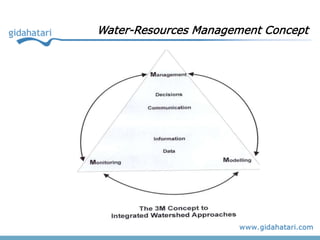
Water-Resources Management Concept
Examples of Global Water Issues

• Human health (water
 supply/sanitation)
• Food and agriculture
• Mining and industry
• Other water uses – recreation &
  fishing
• Political conflicts
• Lack of regulatory enforcement
• Discussion, opinions, and questions
A “check list” – to keep in mind during
                          this presentation:

• Water availability (supply) – quantity &
  quality
• Water-resources sustainability (climate
  change)
• Water law, administration, and
  enforcement
• Studies and decisions with limited data
  – Characterization assessments
  – Model applications
    (calibration/verification/simulation)
• IWRM – the current “silver bullet”
Topics of Interest
•   Definition of “basin”
•   Transboundary basins
•   Basin organizations
•   Water development
•   Trade-offs – impacts
•   Structural issues
•   Institutional issues
•   IWRM approaches
•   built into governmental
•   agencies (Africa, EU)
Global Population and Water-Use Trends
                            Source: Gleick (1998)
Uso del Agua - Algunos datos
• Per cápita alcanzó su punto máximo la extracción de agua
  en los EE.UU. en 1975 (2.300 m3/p/yr), pasando de 500
  en 1900 y m3/p/yr actualmente m3/p/yr 2000. Las
  demandas globales están aumentando 4.3 por ciento /
  año.

• El mayor uso de agua en el mundo se da en la agricultura
  de regadío, este uso es en gran medida ineficaz. De baja
  energía aplicación de precisión (LEPA) puede aumentar la
  eficiencia de rociadores 60 a 70 hasta tanto como 95 por
  ciento. El riego por goteo es cada vez más utilizados.

• El precio del agua juega un papel clave en el uso del agua.


*Fuente: Gleick (1998), The World’s Water.
Drinking Water & Basic Sanitation -- Some
                                                   Facts

• First Roman aqueducts – 312 B.C. Eventually, nine water
  systems conveyed through an extensive system of lead pipes.
  Per-capita water supply matched much of the modern
  industrialized world. Well-built sewers drained the city. [Lead
   became the “downfall” of this empire]

• 1990 estimates include 1.2 billion population without safe
  drinking water and 1.7 billion without sanitation.

• 2012 estimates conclude that unsafe water and poor
  sanitation will kill more children than malaria, AIDS, and
  accidents combined.      Most deaths come from diarrheal
  disease, and 90% of the victims are children under the age of
  five.


*Sources: WHO (1996); Gleick (1998), The World’s Water; Water & Wastes Digest (2012)
International Water-Resources
                                 Examples
• Nepal
• Republic of Yemen
• Chile (2nd, regional GW development/basin
    study)
• Argentina
• Mexico (various regional studies; WQ network
    design)
•   Mali – groundwater contamination/airport
•   Panama – rural and municipal water supplies
•   Pakistan – salinity control & reclamation
•   NW PR China          – master water-resources
    planning
•   The Philippines – City of Manila water supply
Case Study 1 – Koshi River Basin, Nepal
Himalayan Mountains, Nepal
Water-Resources Issues and Concerns,
                                     Nepal

• Koshi – A transnational river basin
• Climate change
    – Changes in seasonal streamflow variations
    – Water-management implications
•   Deforestation
•   Land-use changes
•   Erosion and sedimentation
•   Water supply and sanitation (sewage
    treatment)
Water-Resources Management
              Components and Tools -- Nepal

• Data
  – Precipitation (rainfall, snow) – areal and
    temporal patterns
  – Streamflow monitoring – sites, data gaps, etc.
  – Land use
  – Geology and soils
  – Socio-economic -- population, agriculture, etc.
• Physical-process hydrologic model(s)
• Hypothetical scenarios – climate, land use,
  etc.
Components of a Hydrologic Model (J2000)
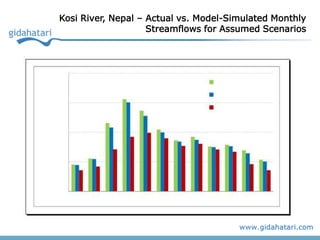
Kosi River, Nepal – Actual vs. Model-Simulated Monthly
                    Streamflows for Assumed Scenarios
Case Study 2 -- Republic of Yemen – A
                 Water-Shortage Land
Islamic Water Law and Environmental
                          Protection
What are the water issues in
                                  Yemen?
•   Water scarcity (with focus on groundwater)
•   High population-growth rates
•   Policy and institutions
•   Water contamination (pollution)
•   Lack of sustainable goals
    (planning/management)
• Water awareness and education
• Ineffectiveness of financial-donor projects
    – The World Bank
    – Various U.N. agencies (primarily UNDP)
    – Other national governments (e.g., The
      Netherlands)
Physiographic Zones in Yemen
Sana’a, the Capital of Yemen

•   1962 population, 62,000
•   1998 population, 1.2 M
•   Approx. 15% sewered
•   Water supply
    – Some wells; WQ issues
    – Water trucks to cisterns
• Migration to suburbs
• Old city/zuk in center
    – UNESCO cultural site
    – Wadi served as road
Yemen Photos – Water/Waste
“Management” in Sana’a, the Capital
Yemen Photos – Al Mukallah Region
Yemen Photos – Rural Water Supply &
                          Irrigation
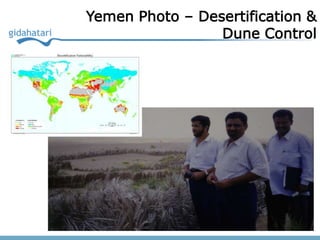
Yemen Photo – Desertification &
                 Dune Control
Case Study 3 – Mendoza Province, Argentina
                                          FAO Consultancy (2001-2002)


• What are the hydrologic/institutional
  issues?
   – Increased water use – agriculture,
     municipal, industrial
   – Groundwater contamination – salinity,
     other WQ issues
   – Water administration – surface water
     vs. groundwater
• What are the engineering “solutions”?
   – Build a large dam
   – Line irrigation canals
   – Regulate well-construction
     specifications
• Other – water pricing; water-use
  regulation
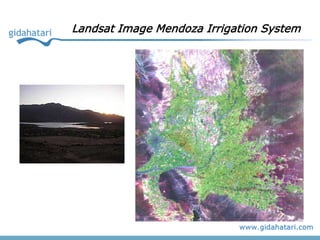
Landsat Image Mendoza Irrigation System
Poor Well Construction & Aquifer
                 Contamination
PROSPECTIVA DE LA
                                   PROBLEMÁTICA DE LA
                                   CUENCA NORTE DE MENDOZA

                                   El cambio estructural
                                   que introduce la construcción
                                   del dique de Potrerillos,
                                   producirá una serie de impactos
                                   en el sitema hídrico
                                   e hidrogeológico.


Instituto Nacional del Agua
Centro de Economía, Legislación y Administración del Agua
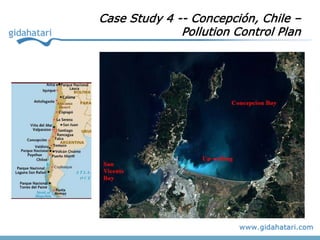
Case Study 4 -- Concepción, Chile –
              Pollution Control Plan
Point-Source Pollution Sources and Public
                                                                              Perception

                   10 km                                            QUIRIQUINA
        5 km                                                        ISLAND
 1 km                                                                                                                               TOME


             TUMBES
             PENINSULA


               N

                                                                          CONCEPCION BAY

                                               W
                                               I

                     W                                         I                                                        LIRQUEN
SAN VICENTE                                          RO
                                                       CU
                                                         AN
BAY                                                        T

                                                                                                             W
                                                                                               R
                                                                                            IVE
                                                                                          NR


                                   O                 TALCAHUANO
                                 AT
                                                                                                             PENCO
                                                                                         LIE


                               IP
                            CH
                                                                                       DA


                        A
                     HU
                                 I
                                                                                     AN


                                       S
                                     AL
                                   IC
                                 EM
           LENGA               CH

                                       I

                                                                        CONCEPCION
         HUALPEN              W*                                                                                 ANDALIEN RIVER


                                       BIO
                                             BIO
                                                   RIVE
                                                       R


                                                                                                                                  Laguna
                                                                                                                                  Pineda

                                                                                                   Nonguen
                                                               Laguna                              Creek
                        SAN
                        PEDRO                                  Chica
                                                    Laguna
                                                    Grande
Issues and Study Approaches, Concepción and
                            San Vicente Bays, Chile


• Fish kills (oxygen-depleted waters)
• Pollution controls of fish-processing plants
• Identification of other sources of pollution
   –   Steel and metallurgy
   –   Textile
   –   Chemicals and cement
   –   Refinery and hydrocarbon (oil/LPG) off-loading
   –   Domestic (municipal) sewage
• Bay water-quality/hydraulic study (DHI MIKE 3
  model)
• Pollution Control Plan (PCP) for CONAMA
• Technical transfer and training
• Stakeholder identification and involvement
• Local technical collaboration and public meetings
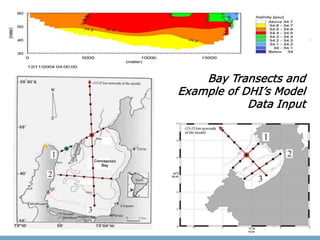
Bay Transects and
Example of DHI’s Model
            Data Input
Lessons Learned and Reality Check

• Mendoza, Argentina
   – Engineering structural components have inherent
     environmental and socio-economic trade-offs
   – Water administration and pricing – key attributes
• Concepción, Chile
   – Initial perceptions on causes may need to be
     modified
   – Important data-model links & non-technical
     factors
   – Role of regulatory controls – consistent with real
     world
Thanks for your interest in
                 this topic
For more information, visit our web:


CONSULTING         RESEARCH          CAPACITATION CAPACITATION            CAREER

Environmental      Waste dump                            Groundwater
                                     Applied hydrology                   Challenge
     flow           seepage                               modeling
                 Bioremediation of       Applied            Mining
Climate change                                                          Opportunities
                      tailings         hydrogeology      hydrogeology
 Groundwater                           GIS in water       Acid rock
                  Mine drainage                                          Our team
  modeling                             management          drainage
                                        Distributed       Design of
 Hydropower                                                             Mission and
                 Soil cover design     hydrological       monitoring
   plants                                                                  vision
                                         modeling         networks
  Monitoring
                                                                          Contact
   systems


 Gidahatari

Internacional water-resources-issues

  • 1.
    INTERNATIONAL WATER- RESOURCES ISSUES Some Concepts and Case Studies
  • 2.
  • 3.
    Examples of GlobalWater Issues • Human health (water supply/sanitation) • Food and agriculture • Mining and industry • Other water uses – recreation & fishing • Political conflicts • Lack of regulatory enforcement • Discussion, opinions, and questions
  • 4.
    A “check list”– to keep in mind during this presentation: • Water availability (supply) – quantity & quality • Water-resources sustainability (climate change) • Water law, administration, and enforcement • Studies and decisions with limited data – Characterization assessments – Model applications (calibration/verification/simulation) • IWRM – the current “silver bullet”
  • 5.
    Topics of Interest • Definition of “basin” • Transboundary basins • Basin organizations • Water development • Trade-offs – impacts • Structural issues • Institutional issues • IWRM approaches • built into governmental • agencies (Africa, EU)
  • 6.
    Global Population andWater-Use Trends Source: Gleick (1998)
  • 7.
    Uso del Agua- Algunos datos • Per cápita alcanzó su punto máximo la extracción de agua en los EE.UU. en 1975 (2.300 m3/p/yr), pasando de 500 en 1900 y m3/p/yr actualmente m3/p/yr 2000. Las demandas globales están aumentando 4.3 por ciento / año. • El mayor uso de agua en el mundo se da en la agricultura de regadío, este uso es en gran medida ineficaz. De baja energía aplicación de precisión (LEPA) puede aumentar la eficiencia de rociadores 60 a 70 hasta tanto como 95 por ciento. El riego por goteo es cada vez más utilizados. • El precio del agua juega un papel clave en el uso del agua. *Fuente: Gleick (1998), The World’s Water.
  • 8.
    Drinking Water &Basic Sanitation -- Some Facts • First Roman aqueducts – 312 B.C. Eventually, nine water systems conveyed through an extensive system of lead pipes. Per-capita water supply matched much of the modern industrialized world. Well-built sewers drained the city. [Lead became the “downfall” of this empire] • 1990 estimates include 1.2 billion population without safe drinking water and 1.7 billion without sanitation. • 2012 estimates conclude that unsafe water and poor sanitation will kill more children than malaria, AIDS, and accidents combined. Most deaths come from diarrheal disease, and 90% of the victims are children under the age of five. *Sources: WHO (1996); Gleick (1998), The World’s Water; Water & Wastes Digest (2012)
  • 9.
    International Water-Resources Examples • Nepal • Republic of Yemen • Chile (2nd, regional GW development/basin study) • Argentina • Mexico (various regional studies; WQ network design) • Mali – groundwater contamination/airport • Panama – rural and municipal water supplies • Pakistan – salinity control & reclamation • NW PR China – master water-resources planning • The Philippines – City of Manila water supply
  • 10.
    Case Study 1– Koshi River Basin, Nepal
  • 11.
  • 12.
    Water-Resources Issues andConcerns, Nepal • Koshi – A transnational river basin • Climate change – Changes in seasonal streamflow variations – Water-management implications • Deforestation • Land-use changes • Erosion and sedimentation • Water supply and sanitation (sewage treatment)
  • 13.
    Water-Resources Management Components and Tools -- Nepal • Data – Precipitation (rainfall, snow) – areal and temporal patterns – Streamflow monitoring – sites, data gaps, etc. – Land use – Geology and soils – Socio-economic -- population, agriculture, etc. • Physical-process hydrologic model(s) • Hypothetical scenarios – climate, land use, etc.
  • 14.
    Components of aHydrologic Model (J2000)
  • 15.
    Kosi River, Nepal– Actual vs. Model-Simulated Monthly Streamflows for Assumed Scenarios
  • 16.
    Case Study 2-- Republic of Yemen – A Water-Shortage Land
  • 17.
    Islamic Water Lawand Environmental Protection
  • 18.
    What are thewater issues in Yemen? • Water scarcity (with focus on groundwater) • High population-growth rates • Policy and institutions • Water contamination (pollution) • Lack of sustainable goals (planning/management) • Water awareness and education • Ineffectiveness of financial-donor projects – The World Bank – Various U.N. agencies (primarily UNDP) – Other national governments (e.g., The Netherlands)
  • 19.
  • 20.
    Sana’a, the Capitalof Yemen • 1962 population, 62,000 • 1998 population, 1.2 M • Approx. 15% sewered • Water supply – Some wells; WQ issues – Water trucks to cisterns • Migration to suburbs • Old city/zuk in center – UNESCO cultural site – Wadi served as road
  • 21.
    Yemen Photos –Water/Waste “Management” in Sana’a, the Capital
  • 22.
    Yemen Photos –Al Mukallah Region
  • 23.
    Yemen Photos –Rural Water Supply & Irrigation
  • 24.
    Yemen Photo –Desertification & Dune Control
  • 26.
    Case Study 3– Mendoza Province, Argentina FAO Consultancy (2001-2002) • What are the hydrologic/institutional issues? – Increased water use – agriculture, municipal, industrial – Groundwater contamination – salinity, other WQ issues – Water administration – surface water vs. groundwater • What are the engineering “solutions”? – Build a large dam – Line irrigation canals – Regulate well-construction specifications • Other – water pricing; water-use regulation
  • 27.
    Landsat Image MendozaIrrigation System
  • 28.
    Poor Well Construction& Aquifer Contamination
  • 29.
    PROSPECTIVA DE LA PROBLEMÁTICA DE LA CUENCA NORTE DE MENDOZA El cambio estructural que introduce la construcción del dique de Potrerillos, producirá una serie de impactos en el sitema hídrico e hidrogeológico. Instituto Nacional del Agua Centro de Economía, Legislación y Administración del Agua
  • 30.
    Case Study 4-- Concepción, Chile – Pollution Control Plan
  • 31.
    Point-Source Pollution Sourcesand Public Perception 10 km QUIRIQUINA 5 km ISLAND 1 km TOME TUMBES PENINSULA N CONCEPCION BAY W I W I LIRQUEN SAN VICENTE RO CU AN BAY T W R IVE NR O TALCAHUANO AT PENCO LIE IP CH DA A HU I AN S AL IC EM LENGA CH I CONCEPCION HUALPEN W* ANDALIEN RIVER BIO BIO RIVE R Laguna Pineda Nonguen Laguna Creek SAN PEDRO Chica Laguna Grande
  • 32.
    Issues and StudyApproaches, Concepción and San Vicente Bays, Chile • Fish kills (oxygen-depleted waters) • Pollution controls of fish-processing plants • Identification of other sources of pollution – Steel and metallurgy – Textile – Chemicals and cement – Refinery and hydrocarbon (oil/LPG) off-loading – Domestic (municipal) sewage • Bay water-quality/hydraulic study (DHI MIKE 3 model) • Pollution Control Plan (PCP) for CONAMA • Technical transfer and training • Stakeholder identification and involvement • Local technical collaboration and public meetings
  • 33.
    Bay Transects and Exampleof DHI’s Model Data Input
  • 34.
    Lessons Learned andReality Check • Mendoza, Argentina – Engineering structural components have inherent environmental and socio-economic trade-offs – Water administration and pricing – key attributes • Concepción, Chile – Initial perceptions on causes may need to be modified – Important data-model links & non-technical factors – Role of regulatory controls – consistent with real world
  • 35.
    Thanks for yourinterest in this topic
  • 36.
    For more information,visit our web: CONSULTING RESEARCH CAPACITATION CAPACITATION CAREER Environmental Waste dump Groundwater Applied hydrology Challenge flow seepage modeling Bioremediation of Applied Mining Climate change Opportunities tailings hydrogeology hydrogeology Groundwater GIS in water Acid rock Mine drainage Our team modeling management drainage Distributed Design of Hydropower Mission and Soil cover design hydrological monitoring plants vision modeling networks Monitoring Contact systems Gidahatari