INTERMOLECULAR
FORCES
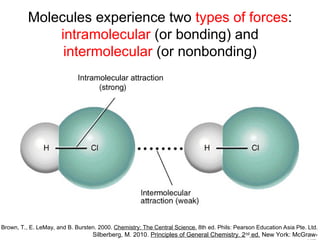
Molecules experience two types of forces:
intramolecular (or bonding) and
intermolecular (or nonbonding)
Intramolecular attraction
Brown, T., E. LeMay, and B. Bursten. 2000. Chemistry: The Central Science. 8th ed. Phils: Pearson Education Asia Pte. Ltd.
Silberberg, M. 2010. Principles of General Chemistry. 2nd
ed. New York: McGraw-
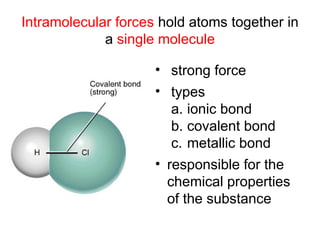
Intramolecular forces hold atoms together in
a single molecule
• strong force
• types
a. ionic bond
b. covalent bond
c. metallic bond
• responsible for the
chemical properties
of the substance
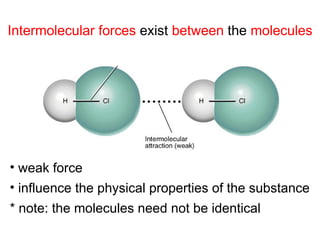
Intermolecular forces exist between the molecules
• weak force
• influence the physical properties of the substance
* note: the molecules need not be identical
Intermolecular Forces of
Attraction
(IMFA)
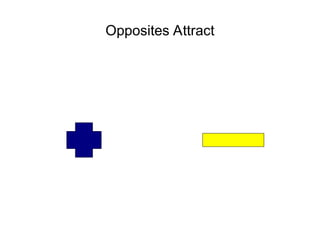
Opposites Attract
Opposites Attract
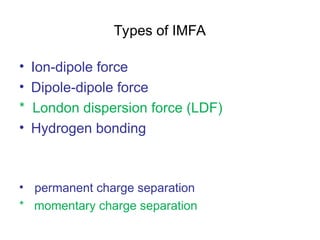
Types of IMFA
• Ion-dipole force
• Dipole-dipole force
* London dispersion force (LDF)
• Hydrogen bonding
• permanent charge separation
* momentary charge separation
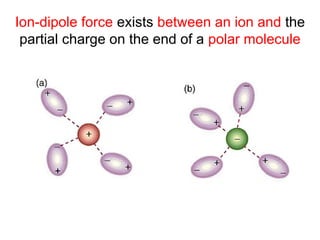
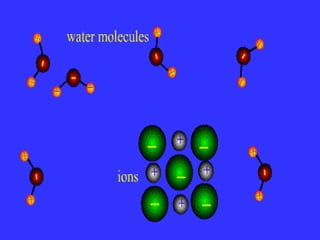
Ion-dipole force exists between an ion and the
partial charge on the end of a polar molecule
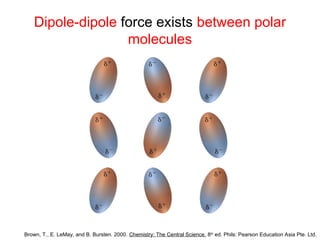
Dipole-dipole force exists between polar
molecules
Brown, T., E. LeMay, and B. Bursten. 2000. Chemistry: The Central Science. 8th
ed. Phils: Pearson Education Asia Pte. Ltd.
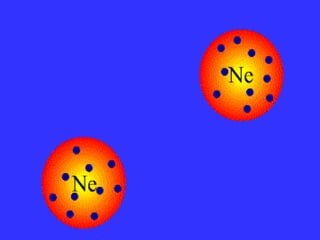
London dispersion force (LDF) exists between all
molecules, including nonpolar molecules
• electrons constantly move
• at a certain instance, more electrons can be
concentrated in one side of a molecule over
another
• this gives temporary polarity to the molecule
Brown, T., E. LeMay, and B. Bursten. 2000. Chemistry: The Central Science. 8th
ed. Phils: Pearson Education Asia Pte. Ltd.
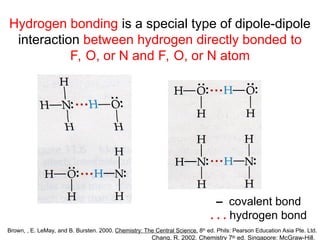
Hydrogen bonding is a special type of dipole-dipole
interaction between hydrogen directly bonded to
F, O, or N and F, O, or N atom
Brown, , E. LeMay, and B. Bursten. 2000. Chemistry: The Central Science. 8th
ed. Phils: Pearson Education Asia Pte. Ltd.
Chang, R. 2002. Chemistry 7th
ed. Singapore: McGraw-Hill.
– covalent bond
. . . hydrogen bond
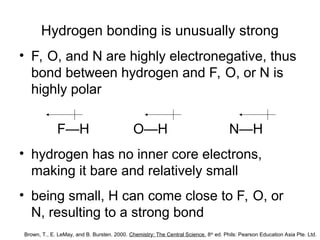
Hydrogen bonding is unusually strong
• F, O, and N are highly electronegative, thus
bond between hydrogen and F, O, or N is
highly polar
F—H O—H N—H
• hydrogen has no inner core electrons,
making it bare and relatively small
• being small, H can come close to F, O, or
N, resulting to a strong bond
Brown, T., E. LeMay, and B. Bursten. 2000. Chemistry: The Central Science. 8th
ed. Phils: Pearson Education Asia Pte. Ltd.
Brown, T., E. LeMay, and B. Bursten. 2000. Chemistry: The Central Science. 8th
ed. Phils: Pearson Education Asia Pte. Ltd.
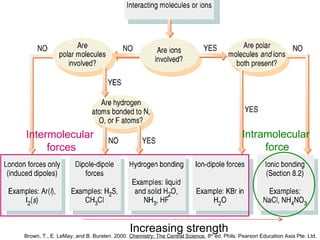
Intermolecular
forces
Intramolecular
force
Increasing strength
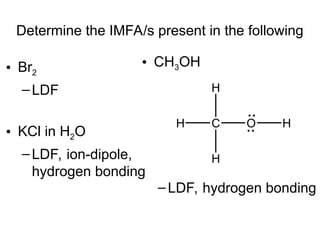
Determine the IMFA/s present in the following
• Br2
–LDF
• KCl in H2O
–LDF, ion-dipole,
hydrogen bonding
• CH3OH
–LDF, hydrogen bonding
C O
H
H
H
H
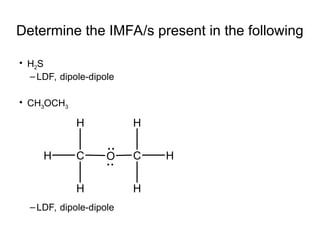
Determine the IMFA/s present in the following
• H2S
–LDF, dipole-dipole
• CH3OCH3
–LDF, dipole-dipole
O C
C
H
H
H
H
H
H
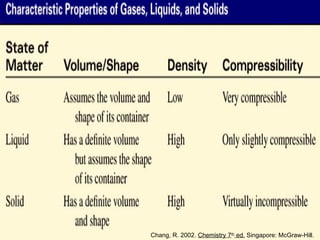
IMFA and the states of matter
Chang, R. 2002. Chemistry 7th
ed. Singapore: McGraw-Hill.
Gas molecules have weak IMFAs
• interaction between the molecules is
minimal, and so gas molecules fill a
container
• distances between gas molecules
are so great, and so gases are
highly compressible and have low
densities
Chang, R. 2002. Chemistry 7th
ed. Singapore: McGraw-Hill.
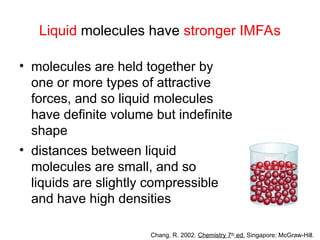
Liquid molecules have stronger IMFAs
• molecules are held together by
one or more types of attractive
forces, and so liquid molecules
have definite volume but indefinite
shape
• distances between liquid
molecules are small, and so
liquids are slightly compressible
and have high densities
Chang, R. 2002. Chemistry 7th
ed. Singapore: McGraw-Hill.
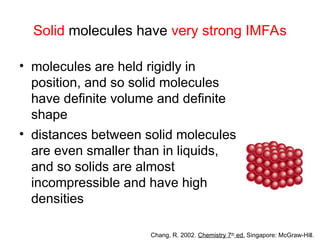
Solid molecules have very strong IMFAs
• molecules are held rigidly in
position, and so solid molecules
have definite volume and definite
shape
• distances between solid molecules
are even smaller than in liquids,
and so solids are almost
incompressible and have high
densities
Chang, R. 2002. Chemistry 7th
ed. Singapore: McGraw-Hill.
Chang, R. 2002. Chemistry 7th
ed. Singapore: McGraw-Hill.
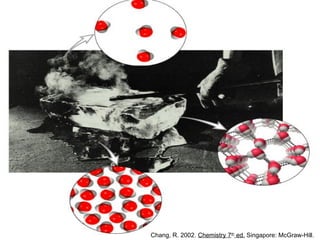
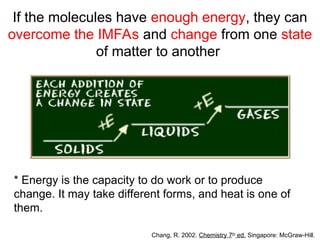
If the molecules have enough energy, they can
overcome the IMFAs and change from one state
of matter to another
* Energy is the capacity to do work or to produce
change. It may take different forms, and heat is one of
them.
Chang, R. 2002. Chemistry 7th
ed. Singapore: McGraw-Hill.
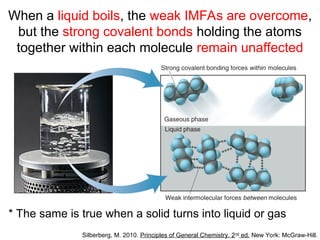
When a liquid boils, the weak IMFAs are overcome,
but the strong covalent bonds holding the atoms
together within each molecule remain unaffected
* The same is true when a solid turns into liquid or gas
Silberberg, M. 2010. Principles of General Chemistry. 2nd
ed. New York: McGraw-Hill.
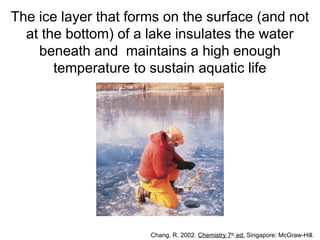
The ice layer that forms on the surface (and not
at the bottom) of a lake insulates the water
beneath and maintains a high enough
temperature to sustain aquatic life
Chang, R. 2002. Chemistry 7th
ed. Singapore: McGraw-Hill.
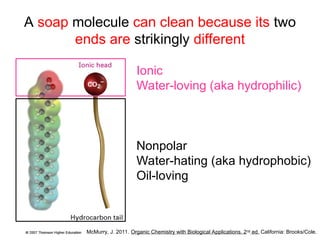
A soap molecule can clean because its two
ends are strikingly different
McMurry, J. 2011. Organic Chemistry with Biological Applications. 2nd
ed. California: Brooks/Cole.
Ionic
Water-loving (aka hydrophilic)
Nonpolar
Water-hating (aka hydrophobic)
Oil-loving
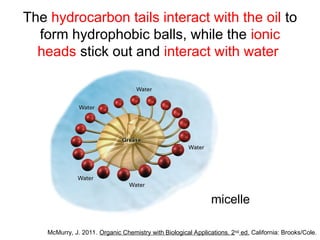
The hydrocarbon tails interact with the oil to
form hydrophobic balls, while the ionic
heads stick out and interact with water
McMurry, J. 2011. Organic Chemistry with Biological Applications. 2nd
ed. California: Brooks/Cole.
micelle
Compared to tissue, blotting paper is better
at removing oil from the face
http://badkittyexoticwear.com/shop/facecareoilblottingpaper-p-1617.html
http://pics.drugstore.com/prodimg/68807/300.jpg
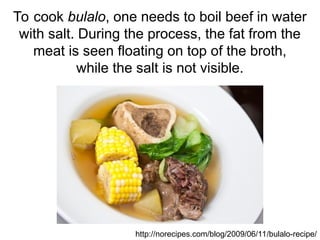
To cook bulalo, one needs to boil beef in water
with salt. During the process, the fat from the
meat is seen floating on top of the broth,
while the salt is not visible.
http://norecipes.com/blog/2009/06/11/bulalo-recipe/

Intermolecular forces and intramolecular forces

  • 1.
  • 2.
    Molecules experience twotypes of forces: intramolecular (or bonding) and intermolecular (or nonbonding) Intramolecular attraction Brown, T., E. LeMay, and B. Bursten. 2000. Chemistry: The Central Science. 8th ed. Phils: Pearson Education Asia Pte. Ltd. Silberberg, M. 2010. Principles of General Chemistry. 2nd ed. New York: McGraw-
  • 3.
    Intramolecular forces holdatoms together in a single molecule • strong force • types a. ionic bond b. covalent bond c. metallic bond • responsible for the chemical properties of the substance
  • 4.
    Intermolecular forces existbetween the molecules • weak force • influence the physical properties of the substance * note: the molecules need not be identical
  • 5.
  • 6.
  • 7.
  • 8.
    Types of IMFA •Ion-dipole force • Dipole-dipole force * London dispersion force (LDF) • Hydrogen bonding • permanent charge separation * momentary charge separation
  • 9.
    Ion-dipole force existsbetween an ion and the partial charge on the end of a polar molecule
  • 11.
    Dipole-dipole force existsbetween polar molecules Brown, T., E. LeMay, and B. Bursten. 2000. Chemistry: The Central Science. 8th ed. Phils: Pearson Education Asia Pte. Ltd.
  • 12.
    London dispersion force(LDF) exists between all molecules, including nonpolar molecules • electrons constantly move • at a certain instance, more electrons can be concentrated in one side of a molecule over another • this gives temporary polarity to the molecule Brown, T., E. LeMay, and B. Bursten. 2000. Chemistry: The Central Science. 8th ed. Phils: Pearson Education Asia Pte. Ltd.
  • 14.
    Hydrogen bonding isa special type of dipole-dipole interaction between hydrogen directly bonded to F, O, or N and F, O, or N atom Brown, , E. LeMay, and B. Bursten. 2000. Chemistry: The Central Science. 8th ed. Phils: Pearson Education Asia Pte. Ltd. Chang, R. 2002. Chemistry 7th ed. Singapore: McGraw-Hill. – covalent bond . . . hydrogen bond
  • 15.
    Hydrogen bonding isunusually strong • F, O, and N are highly electronegative, thus bond between hydrogen and F, O, or N is highly polar F—H O—H N—H • hydrogen has no inner core electrons, making it bare and relatively small • being small, H can come close to F, O, or N, resulting to a strong bond Brown, T., E. LeMay, and B. Bursten. 2000. Chemistry: The Central Science. 8th ed. Phils: Pearson Education Asia Pte. Ltd.
  • 16.
    Brown, T., E.LeMay, and B. Bursten. 2000. Chemistry: The Central Science. 8th ed. Phils: Pearson Education Asia Pte. Ltd. Intermolecular forces Intramolecular force Increasing strength
  • 17.
    Determine the IMFA/spresent in the following • Br2 –LDF • KCl in H2O –LDF, ion-dipole, hydrogen bonding • CH3OH –LDF, hydrogen bonding C O H H H H
  • 18.
    Determine the IMFA/spresent in the following • H2S –LDF, dipole-dipole • CH3OCH3 –LDF, dipole-dipole O C C H H H H H H
  • 19.
    IMFA and thestates of matter
  • 20.
    Chang, R. 2002.Chemistry 7th ed. Singapore: McGraw-Hill.
  • 21.
    Gas molecules haveweak IMFAs • interaction between the molecules is minimal, and so gas molecules fill a container • distances between gas molecules are so great, and so gases are highly compressible and have low densities Chang, R. 2002. Chemistry 7th ed. Singapore: McGraw-Hill.
  • 22.
    Liquid molecules havestronger IMFAs • molecules are held together by one or more types of attractive forces, and so liquid molecules have definite volume but indefinite shape • distances between liquid molecules are small, and so liquids are slightly compressible and have high densities Chang, R. 2002. Chemistry 7th ed. Singapore: McGraw-Hill.
  • 23.
    Solid molecules havevery strong IMFAs • molecules are held rigidly in position, and so solid molecules have definite volume and definite shape • distances between solid molecules are even smaller than in liquids, and so solids are almost incompressible and have high densities Chang, R. 2002. Chemistry 7th ed. Singapore: McGraw-Hill.
  • 24.
    Chang, R. 2002.Chemistry 7th ed. Singapore: McGraw-Hill.
  • 25.
    If the moleculeshave enough energy, they can overcome the IMFAs and change from one state of matter to another * Energy is the capacity to do work or to produce change. It may take different forms, and heat is one of them. Chang, R. 2002. Chemistry 7th ed. Singapore: McGraw-Hill.
  • 26.
    When a liquidboils, the weak IMFAs are overcome, but the strong covalent bonds holding the atoms together within each molecule remain unaffected * The same is true when a solid turns into liquid or gas Silberberg, M. 2010. Principles of General Chemistry. 2nd ed. New York: McGraw-Hill.
  • 28.
    The ice layerthat forms on the surface (and not at the bottom) of a lake insulates the water beneath and maintains a high enough temperature to sustain aquatic life Chang, R. 2002. Chemistry 7th ed. Singapore: McGraw-Hill.
  • 29.
    A soap moleculecan clean because its two ends are strikingly different McMurry, J. 2011. Organic Chemistry with Biological Applications. 2nd ed. California: Brooks/Cole. Ionic Water-loving (aka hydrophilic) Nonpolar Water-hating (aka hydrophobic) Oil-loving
  • 30.
    The hydrocarbon tailsinteract with the oil to form hydrophobic balls, while the ionic heads stick out and interact with water McMurry, J. 2011. Organic Chemistry with Biological Applications. 2nd ed. California: Brooks/Cole. micelle
  • 31.
    Compared to tissue,blotting paper is better at removing oil from the face http://badkittyexoticwear.com/shop/facecareoilblottingpaper-p-1617.html http://pics.drugstore.com/prodimg/68807/300.jpg
  • 32.
    To cook bulalo,one needs to boil beef in water with salt. During the process, the fat from the meat is seen floating on top of the broth, while the salt is not visible. http://norecipes.com/blog/2009/06/11/bulalo-recipe/

Editor's Notes

  • #2 Silberberg, M. 2010. Principles of General Chemistry. 2nd ed. New York: McGraw-Hill. p. 368 “Both bonding (intramolecular) forces and intermolecular forces arise from the electrostatic attractions between opposite charges.”
  • #3 Silberberg, M. 2010. Principles of General Chemistry. 2nd ed. New York: McGraw-Hill. p. 368 “Bonding forces are due to the attraction between cations and anions (ionic bonding), nuclei and electron pairs (covalent bonding), or metal cations and delocalized valence electrons (metallic bonding).”
  • #4 Silberberg, M. 2010. Principles of General Chemistry. 2nd ed. New York: McGraw-Hill. pp. 368 “Intermolecular forces, on the other hand, are due to the attraction between molecules as a result of partial charges, or to the attraction between ions and molecules.”
  • #9 “Polar molecules are dipoles; they have a positive end and a negative end.” “Positive ions are attracted to the negative end of a dipole, whereas negative ions are attracted to the positive end.”
  • #11 “Polar molecules attract each other when the positive end of one molecule is near the negative end of another. Dipole-dipole forces are effective only when polar molecules are very close together, and they are generally weaker than ion-dipole forces.”
  • #12 “The motion of electrons in an atom or molecule can create an instantaneous dipole moment. Let’s consider helium atoms as an example.” “In a collection of helium atoms the average distribution of the electrons about each nucleus is spherically symmetrical. The atoms are nonpolar and possess no permanent dipole moment. The instantaneous distribution of the electrons, however, can be different from the average distribution. For example, if we could freeze the motion of the electrons in a helium atom at any given instant, both electrons could be on one side of the nucleus. At just that instance, then, the atom would have an instantaneous dipole moment
  • #14 Brown, , E. LeMay, and B. Bursten. 2000. Chemistry: The Central Science. Phils: Pearson Education Asia Pte. Ltd. p. 400 “Examples of hydrogen bonding. The solid lines represent covalent bonds; the red dotted lines represent hydrogen bonds.” Chang, R. 2002. Chemistry 7th ed. Singapore: McGraw-Hill. p. 422 “Note that the O, N, and F atoms all possess at least one lone pair that can interact with the hydrogen atom in hydrogen bonding.”
  • #20 Chang, R. 2002. Chemistry 7th ed. Singapore: McGraw-Hill. p. 424 “The intermolecular forces discussed so far are all attractive in nature. Keep in mind, though, that molecules also exert repulsive forces on one another. Thus when two molecules approach each other, the repulsion between their electrons and between their nuclei comes into play. The magnitude of the repulsive force rises very steeply as the distance separating the molecules in a condensed phase decreases. This is why liquids and solids are so hard to compress. In these phases, the molecules are already in close contact with one another, and so they greatly resist being compressed further.”
  • #21 Chang, R. 2002. Chemistry 7th ed. Singapore: McGraw-Hill. p. 418 “In gases, the distances between molecules are so great (compared with their diameters) that at ordinary temperatures and pressures (say, 25°C and 1 atm), there is no appreciable interaction between the molecules. Because there is a great deal of empty space in a gas –that is, space that is not occupied by molecules—gases can be readily compressed. The lack of strong forces between molecules also allows a gas to expand to fill the volume of its container. Furthermore, the large amount of empty space explains why gases have very low densities under normal conditions”
  • #22 Chang, R. 2002. Chemistry 7th ed. Singapore: McGraw-Hill. p. 418 “The principal difference between the condensed states (liquids and solids) and the gaseous state is the distance between molecules. In a liquid, the molecules are so close together that there is very little empty space. The liquids are much more difficult to compress than gases, and they are also much denser under normal conditions. Molecules in a liquid are held together by one or more types of attractive forces. A liquid also has a definite volume, since molecules in a liquid do not break away from the attractive forces. The molecules can, however, move past one another freely, and so a liquid can flow, can be poured, and assumes the shape of its container.”
  • #23 Chang, R. 2002. Chemistry 7th ed. Singapore: McGraw-Hill. p. 418 “In a solid, molecules are held rigidly in position with virtually no freedom of motion. Many solids are characterized by long-range order; that is, the molecules are arranged in regular configurations in three dimensions. There is even less empty space in a solid than in a liquid. Thus solids are almost incompressible and possess definite shape and volume. With very few exceptions (water being the most important), the density of the solid form is higher than that of the liquid form for a given substance.”
  • #24 Question: How come the same type of molecule change from one form of matter to another?
  • #26 Silberberg, M. 2010. Principles of General Chemistry. 2nd ed. New York: McGraw-Hill. p. 291 “Most [covalent substances] are gases (such as methane and ammonia), liquids (such as benzene and water), or low-melting solids (such as sulfur and paraffin wax). If covalent bonds are so strong, why do covalent substances melt and boil at such low temperatures?” “To answer this question, we must distinguish between two different sets of forces: (1) the strong covalent bonding forces holding the atoms together within the molecule, and (2) the weak intermolecular forces holding the separate molecules near each other in the macroscopic sample. It is these weak forces between the molecules, not the strong covalent bonds within each molecule, that are responsible for the physical properties of covalent substances.”
  • #29 McMurry, J. 2011. Organic Chemistry with Biological Applications. 2nd ed. California: Brooks/Cole. “Soaps act as cleansers because the two ends of a soap molecule are so different. The carboxylate end of the long-chain molecule is ionic and therefore hydrophilic, or attracted to water. The long hydrocarbon portion of the molecule, however, is nonpolar and hydrophobic, avoiding water and therefore more soluble in oils. The net effect of these two opposing tendencies is that soaps are attracted to both oils and water and are therefore useful as cleansers.”
  • #30 McMurry, J. 2011. Organic Chemistry with Biological Applications. 2nd ed. California: Brooks/Cole. “When soaps are dispersed in water, the long hydrocarbon tails cluster together on the inside of tangled, hydrophobic balls, while the ionic heads on the surface of the clusters stick out into the water layer. These spherical clusters [are] called micelles. Grease and oil droplets are solubilized in water when they are coated by the nonpolar tails of soap molecules in the center of the micelles. Once solubilized, the grease and dirt can be rinsed away.”
  • #31 Oil is nonpolar, so is blotting paper. There is LDF between the two Paper, made up of cellulose, is capable of H-bond. Oil is not.
  • #32 Bulalo – Filipino beef marrow stew