Introduction to Interior Design
What is interior design?
Interior Design
To create a functional and
beautiful living environment.
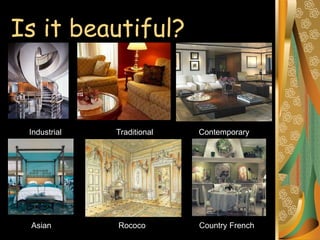
Is it beautiful?
Industrial Traditional Contemporary
Country French
Rococo
Asian
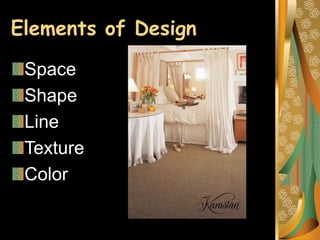
Elements of Design
Space
Shape
Line
Texture
Color
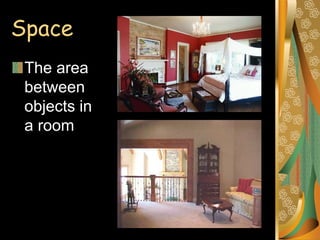
Space
The area
between
objects in
a room
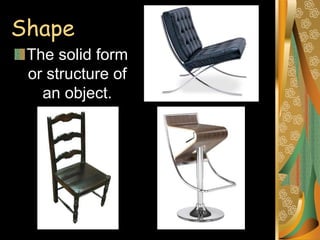
Shape
The solid form
or structure of
an object.
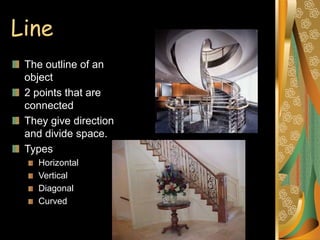
Line
The outline of an
object
2 points that are
connected
They give direction
and divide space.
Types
Horizontal
Vertical
Diagonal
Curved
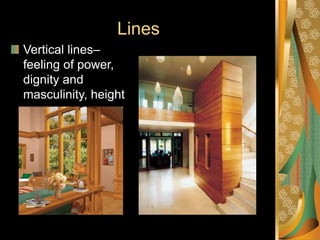
Lines
Vertical lines–
feeling of power,
dignity and
masculinity, height
Lines
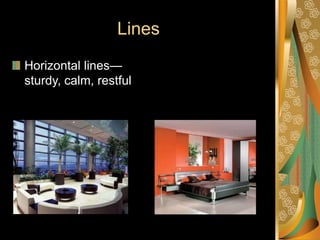
Horizontal lines—
sturdy, calm, restful
Lines
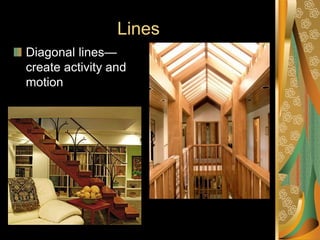
Diagonal lines—
create activity and
motion
Lines
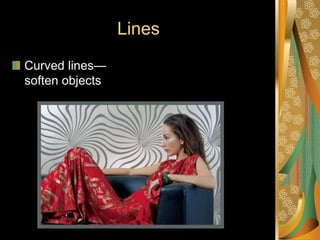
Curved lines—
soften objects
Texture
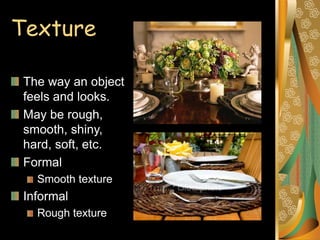
The way an object
feels and looks.
May be rough,
smooth, shiny,
hard, soft, etc.
Formal
Smooth texture
Informal
Rough texture
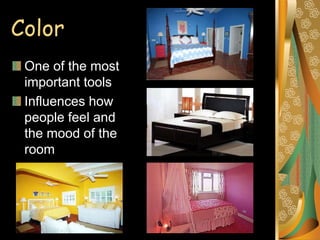
Color
One of the most
important tools
Influences how
people feel and
the mood of the
room
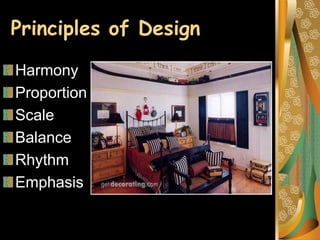
Principles of Design
Harmony
Proportion
Scale
Balance
Rhythm
Emphasis
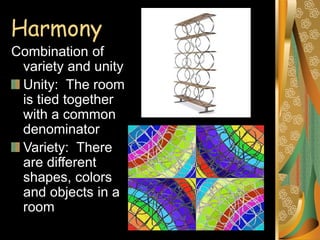
Harmony
Combination of
variety and unity
Unity: The room
is tied together
with a common
denominator
Variety: There
are different
shapes, colors
and objects in a
room
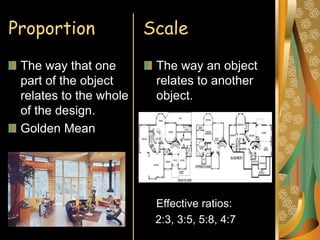
Proportion Scale
The way that one
part of the object
relates to the whole
of the design.
Golden Mean
The way an object
relates to another
object.
Effective ratios:
2:3, 3:5, 5:8, 4:7
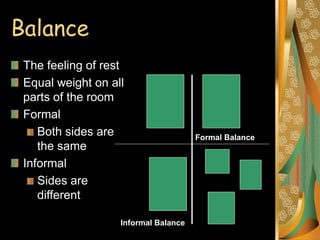
Balance
The feeling of rest
Equal weight on all
parts of the room
Formal
Both sides are
the same
Informal
Sides are
different
Informal Balance
Formal Balance
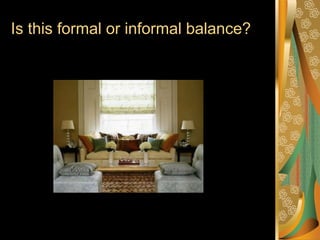
Is this formal or informal balance?
Rhythm
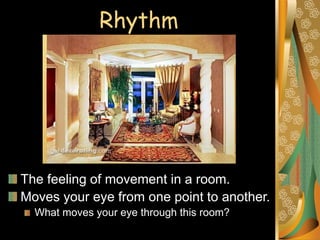
The feeling of movement in a room.
Moves your eye from one point to another.
What moves your eye through this room?
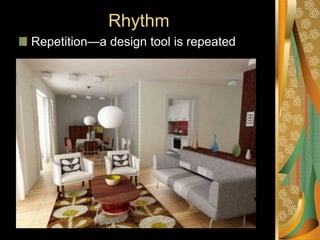
Rhythm
Repetition—a design tool is repeated
Rhythm
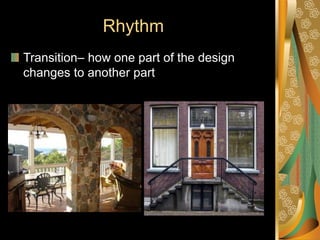
Transition– how one part of the design
changes to another part
Rhythm
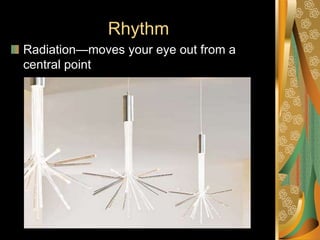
Radiation—moves your eye out from a
central point
Rhythm
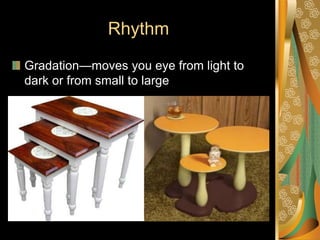
Gradation—moves you eye from light to
dark or from small to large
Emphasis
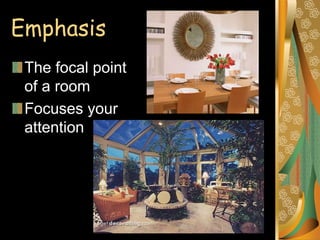
The focal point
of a room
Focuses your
attention

GenGS_InteriorDesignPictures.ppt