






Interior Design
Handbook of
Professional Practice
McGraw-Hill
Cindy Coleman,
Editor-in-Chief
www.sharexxx.net - free books & magazines
Practice
Professional
Handbook of
This page intentionally left blank.
CINDY COLEMAN, EDITOR-IN-CHIEF
McGraw-Hill
New York Chicago San Francisco Lisbon London
Madrid Mexico City Milan New Delhi San Juan
Seoul Singapore Sydney Toronto
Handbook of
Professional
Practice
Copyright © 2002 by the McGraw-Hill Companies, Inc. All rights reserved. Manufactured in the United States of America. Except as permitted under the United
States Copyright Act of 1976, no part of this publication may be reproduced or distributed in any form or by any means, or stored in a database or retrieval system,
without the prior written permission of the publisher.
0-07-141603-X
The material in this eBook also appears in the print version of this title: 0-07-136163-4.
All trademarks are trademarks of their respective owners. Rather than put a trademark symbol after every occurrence of a trademarked name, we use names
in an editorial fashion only, and to the benefit of the trademark owner, with no intention of infringement of the trademark. Where such designations appear in
this book, they have been printed with initial caps.
McGraw-Hill eBooks are available at special quantity discounts to use as premiums and sales promotions, or for use in corporate training programs. For more
information, please contact George Hoare, Special Sales, at george_hoare@mcgraw-hill.com or (212) 904-4069.
TERMS OF USE
This is a copyrighted work and The McGraw-Hill Companies, Inc. (“McGraw-Hill”) and its licensors reserve all rights in and to the work. Use of this work
is subject to these terms. Except as permitted under the Copyright Act of 1976 and the right to store and retrieve one copy of the work, you may not decom-
pile, disassemble, reverse engineer, reproduce, modify, create derivative works based upon, transmit, distribute, disseminate, sell, publish or sublicense the
work or any part of it without McGraw-Hill’s prior consent. You may use the work for your own noncommercial and personal use; any other use of the work
is strictly prohibited. Your right to use the work may be terminated if you fail to comply with these terms.
THE WORK IS PROVIDED “AS IS”. McGRAW-HILL AND ITS LICENSORS MAKE NO GUARANTEES OR WARRANTIES AS TO THE ACCURA-
CY, ADEQUACY OR COMPLETENESS OF OR RESULTS TO BE OBTAINED FROM USING THE WORK, INCLUDING ANY INFORMATION THAT
CAN BE ACCESSED THROUGH THE WORK VIA HYPERLINK OR OTHERWISE, AND EXPRESSLY DISCLAIM ANY WARRANTY, EXPRESS OR
IMPLIED, INCLUDING BUT NOT LIMITED TO IMPLIED WARRANTIES OF MERCHANTABILITY OR FITNESS FOR A PARTICULAR PURPOSE.
McGraw-Hill and its licensors do not warrant or guarantee that the functions contained in the work will meet your requirements or that its operation will be
uninterrupted or error free. Neither McGraw-Hill nor its licensors shall be liable to you or anyone else for any inaccuracy, error or omission, regardless of
cause, in the work or for any damages resulting therefrom. McGraw-Hill has no responsibility for the content of any information accessed through the work.
Under no circumstances shall McGraw-Hill and/or its licensors be liable for any indirect, incidental, special, punitive, consequential or similar damages that
result from the use of or inability to use the work, even if any of them has been advised of the possibility of such damages. This limitation of liability shall
apply to any claim or cause whatsoever whether such claim or cause arises in contract, tort or otherwise.
DOI: 10.1036/007141603X
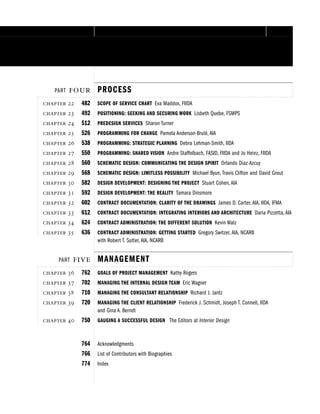
“The future belongs to those who believe
in the beauty of their dreams.”
–ELEANOR ROOSEVELT

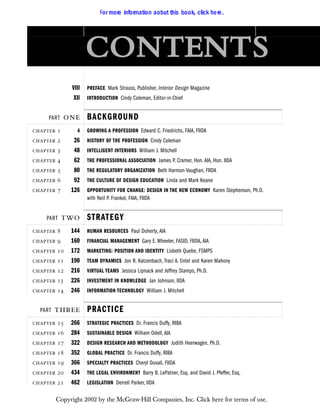
VIII PREFACE Mark Strauss, Publisher, Interior Design Magazine
XII INTRODUCTION Cindy Coleman, Editor-in-Chief
PART  BACKGROUND
  4 GROWING A PROFESSION Edward C. Friedrichs, FAIA, FIIDA
  26 HISTORY OF THE PROFESSION Cindy Coleman
  48 INTELLIGENT INTERIORS William J. Mitchell
  62 THE PROFESSIONAL ASSOCIATION James P. Cramer, Hon. AIA, Hon. IIDA
  80 THE REGULATORY ORGANIZATION Beth Harmon-Vaughan, FIIDA
  92 THE CULTURE OF DESIGN EDUCATION Linda and Mark Keane
  126 OPPORTUNITY FOR CHANGE: DESIGN IN THE NEW ECONOMY Karen Stephenson, Ph.D.
with Neil P. Frankel, FAIA, FIIDA
PART  STRATEGY
  144 HUMAN RESOURCES Paul Doherty, AIA
  160 FINANCIAL MANAGEMENT Gary E. Wheeler, FASID, FIIDA, AIA
  172 MARKETING: POSITION AND IDENTITY Lisbeth Quebe, FSMPS
  190 TEAM DYNAMICS Jon R. Katzenbach, Traci A. Entel and Karen Mahony
  216 VIRTUAL TEAMS Jessica Lipnack and Jeffrey Stamps, Ph.D.
  226 INVESTMENT IN KNOWLEDGE Jan Johnson, IIDA
  246 INFORMATION TECHNOLOGY William J. Mitchell
PART  PRACTICE
  266 STRATEGIC PRACTICES Dr. Francis Duffy, RIBA
  284 SUSTAINABLE DESIGN William Odell, AIA
  322 DESIGN RESEARCH AND METHODOLOGY Judith Heerwagen, Ph.D.
  352 GLOBAL PRACTICE Dr. Francis Duffy, RIBA
  366 SPECIALTY PRACTICES Cheryl Duvall, FIIDA
  434 THE LEGAL ENVIRONMENT Barry B. LePatner, Esq. and David J. Pfeffer, Esq.
  462 LEGISLATION Derrell Parker, IIDA
F
For more information aobut this book, click here.
Copyright 2002 by the McGraw-Hill Companies, Inc. Click here for terms of use.
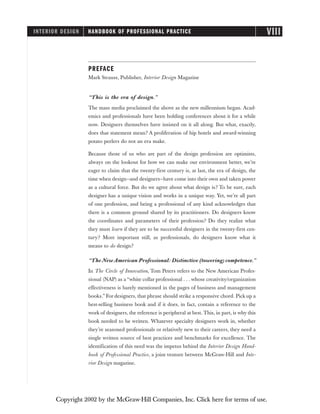
PART  PROCESS
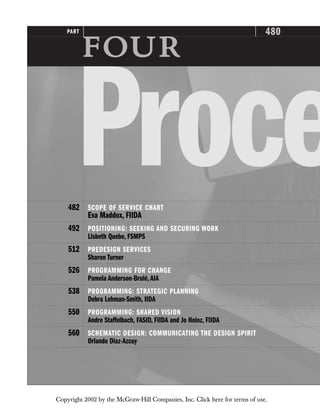
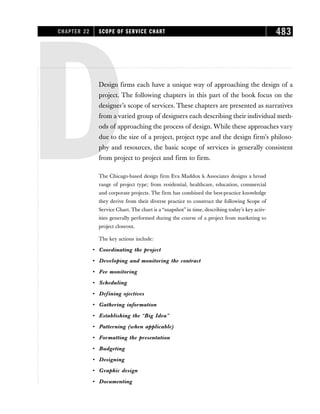
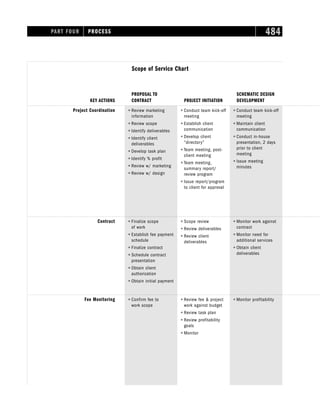
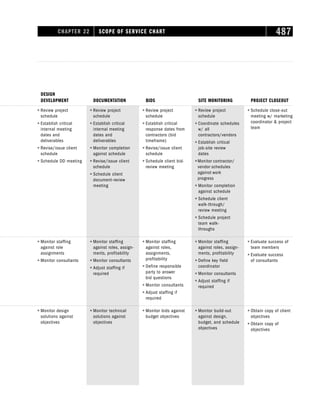
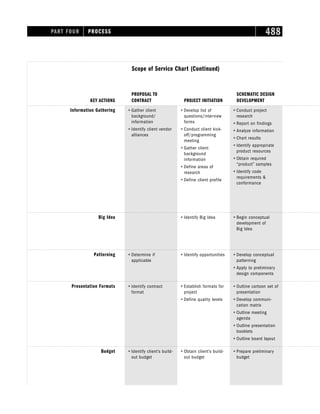
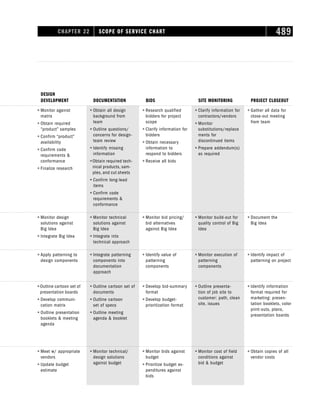
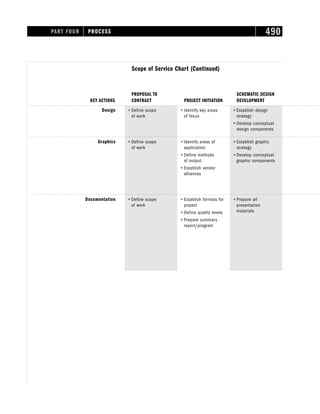
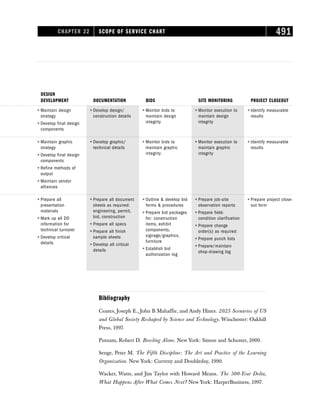
  482 SCOPE OF SERVICE CHART Eva Maddox, FIIDA
  492 POSITIONING: SEEKING AND SECURING WORK Lisbeth Quebe, FSMPS
  512 PREDESIGN SERVICES Sharon Turner
  526 PROGRAMMING FOR CHANGE Pamela Anderson-Brulé, AIA
  538 PROGRAMMING: STRATEGIC PLANNING Debra Lehman-Smith, IIDA
  550 PROGRAMMING: SHARED VISION Andre Staffelbach, FASID, FIIDA and Jo Heinz, FIIDA
  560 SCHEMATIC DESIGN: COMMUNICATING THE DESIGN SPIRIT Orlando Diaz-Azcuy
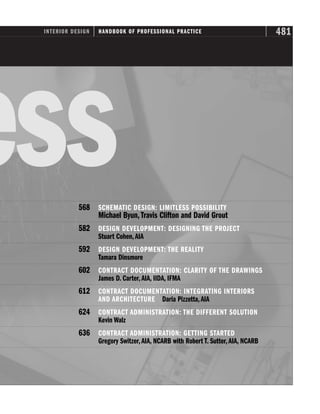
  568 SCHEMATIC DESIGN: LIMITLESS POSSIBILITY Michael Byun, Travis Clifton and David Grout
  582 DESIGN DEVELOPMENT: DESIGNING THE PROJECT Stuart Cohen, AIA
  592 DESIGN DEVELOPMENT: THE REALITY Tamara Dinsmore
  602 CONTRACT DOCUMENTATION: CLARITY OF THE DRAWINGS James D. Carter, AIA, IIDA, IFMA
  612 CONTRACT DOCUMENTATION: INTEGRATING INTERIORS AND ARCHITECTURE Daria Pizzetta, AIA
  624 CONTRACT ADMINISTRATION: THE DIFFERENT SOLUTION Kevin Walz
  636 CONTRACT ADMINISTRATION: GETTING STARTED Gregory Switzer, AIA, NCARB
with Robert T. Sutter, AIA, NCARB
PART  MANAGEMENT
  762 GOALS OF PROJECT MANAGEMENT Kathy Rogers
  702 MANAGING THE INTERNAL DESIGN TEAM Eric Wagner
  710 MANAGING THE CONSULTANT RELATIONSHIP Richard J. Jantz
  720 MANAGING THE CLIENT RELATIONSHIP Frederick J. Schmidt, Joseph T. Connell, IIDA
and Gina A. Berndt
  750 GAUGING A SUCCESSFUL DESIGN The Editors at Interior Design
764 Acknowledgments
766 List of Contributors with Biographies
774 Index
PREFACE
Mark Strauss, Publisher, Interior Design Magazine
“This is the era of design.”
The mass media proclaimed the above as the new millennium began. Acad-
emics and professionals have been holding conferences about it for a while
now. Designers themselves have insisted on it all along. But what, exactly,
does that statement mean? A proliferation of hip hotels and award-winning
potato peelers do not an era make.
Because those of us who are part of the design profession are optimists,
always on the lookout for how we can make our environment better, we’re
eager to claim that the twenty-first century is, at last, the era of design, the
time when design—and designers—have come into their own and taken power
as a cultural force. But do we agree about what design is? To be sure, each
designer has a unique vision and works in a unique way. Yet, we’re all part
of one profession, and being a professional of any kind acknowledges that
there is a common ground shared by its practitioners. Do designers know
the coordinates and parameters of their profession? Do they realize what
they must learn if they are to be successful designers in the twenty-first cen-
tury? More important still, as professionals, do designers know what it
means to do design?
“The New American Professional: Distinctive (towering) competence.”
In The Circle of Innovation, Tom Peters refers to the New American Profes-
sional (NAP) as a “white collar professional . . . whose creativity/organization
effectiveness is barely mentioned in the pages of business and management
books.” For designers, that phrase should strike a responsive chord. Pick up a
best-selling business book and if it does, in fact, contain a reference to the
work of designers, the reference is peripheral at best. This, in part, is why this
book needed to be written. Whatever specialty designers work in, whether
they’re seasoned professionals or relatively new to their careers, they need a
single written source of best practices and benchmarks for excellence. The
identification of this need was the impetus behind the Interior Design Hand-
book of Professional Practice, a joint venture between McGraw-Hill and Inte-
rior Design magazine.
INTERIOR DESIGN HANDBOOK OF PROFESSIONAL PRACTICE VIII
Copyright 2002 by the McGraw-Hill Companies, Inc. Click here for terms of use.
Traditionally, the question at the forefront of designers’ minds has been
“What do clients want?” The Interior Design Handbook of Professional Prac-
tice asks—and answers—another question altogether: “What do designers
need?” This is a book not only for the present, but also for the future. It is
prospective. It assumes that, yes, this is the era of design. And it becomes a
tool for designers to be better prepared to sustain the profession of design
and carry it forward.
“Work is not where you are. It’s what you do.”
These words, from the manager of the real estate program at a global consult-
ing and technology firm, sum up how business leaders perceive the workplace
as the twenty-first century begins. They apply to the designer’s workplace as
well. Although the client may be in Copenhagen and the designer in Maine,
communication happens, design is implemented, work gets done. Once-nar-
row professional boundaries have stretched to span the circumference of the
globe. In design,as in all slices of life,the globe—and,at the same time,the indi-
vidual—is the place to be. It’s where things are and where they’ll stay for the
foreseeable future.
Globalization is only one of the challenges grappling the design profession.
It is wise to expect and prepare for challenges from all directions, including
the economy, the physical and social environment, and academia. Today,
design transcends aesthetics. Through access alone, designers are in a posi-
tion to provide leadership in the realization of the New World.
Our daily life reflects an unsettled time. Groups of people, as well as organ-
izations and nations, seek new leaders, with new definitions of leadership.
Designers must step up and take their places in the front ranks. Individuals
and organizations everywhere are in transition, adapting to an economy that
looks much different than it did even a decade ago. In the old economy,
products were, for the most part, tangible. Now, expectations shift continu-
ally. The new economy values new information and new perspectives, an
intangible product, that seem and feel very different to us, that require us to
experience new levels of perception, that put demands on our sensibilities.
Now, and apparently forever, individuals and businesses want higher quality
and better, faster performance from their environments, from service pro-
viders, from their tools and toys, from anyone, anyplace, or anything that
affects the individual. On this competitive stage, high quality is still the goal
but speed is gaining on it for first place.
PREFACE IX
“All depends on the quality of the conversations.”
In the 1990s, the design profession became capital- rather than labor-inten-
sive. A design project required plenty of tasks, to be sure, but many of them
could be relegated to machines rather than delegated to people. To ration-
alize the expense of bringing new technology into their organizations, design
firms expanded the scope of their services. Because technology abhors sta-
sis, new business opportunities continued to appear. However, as services
expanded, capital expenditures expanded as well. The pressure on design
firms intensified.
Design firms that are successful and that will remain so have an inherent
understanding of the way people actually live and work. These firms are
committed to intellectual as well as socioeconomic diversity and inclusion.
They collaborate with, or sometimes employ, psychologists, sociologists,
anthropologists, management experts, and financial analysts in order to bet-
ter serve their client’s aims. This change is profound and represents a new
view of the profession, one that is multidisciplinary and user-centered. Above
all, this view acknowledges that design, and designers, have a social responsi-
bility. This improved value system for the design industry insists that
design projects create a problem-specific solution and at the same time bal-
ance all of the client’s goals—financial, organizational, functional, cultural,
and environmental.
Successful firms are also taking a nonlinear approach to the process of
design. Effective design is measured by the final product, to be sure, but also
by the degree to which the process of design encourages everyone it affects
to collaborate and to share and integrate ideas. In an organization, this
brings together people at all levels, with all types of responsibilities. In a fam-
ily, it means all generations, with all types of needs. This new inclusiveness
understands the rigors of the design process and the complications of daily
life. It anticipates new demands and continual change inside and outside the
organization, the family or the group.
“You do not merely want to be considered just the best of the best.
You want to be considered the only ones who do what you do.”
Evolution is swift. Designers must not simply change but maneuver to a posi-
tion ahead of the field. To stay there, to keep moving toward the ever-shifting
finish line, they need support, information, and new knowledge. The Interior
INTERIOR DESIGN HANDBOOK OF PROFESSIONAL PRACTICE X
Design Handbook of Professional Practice describes the changes currently
occurring in the design profession and industry. It suggests new, unique ways
of thinking and working. Ideally, this book will become a catalyst for all
designers who seekexcellence in interiordesign practice. It will be an essential
tool for those who have made a commitment to sustained excellence and con-
tinually move the profession forward.
Interior Design magazine is proud to bring together the best writers and
thinkers in the field today whose mission, under editor-in-chief Cindy Cole-
man, was to define design for the new millennium in terms that will help pro-
fessionals, academics, and students of interior design realize their
commitment to professional excellence. The Handbook is designed, itself, to
be used flexibly and repeatedly by professionals in search of new definitions,
new strategies, and new benchmarks by which to measure success.
PREFACE XI
INTRODUCTION
Cindy Coleman, Editor-in-Chief
THIS BOOK HAS THE ANSWER. WHAT IS THE QUESTION?
Designers know how to give advice. They are also skilled at asking ques-
tions. According to our training and the tradition of our profession, our ques-
tions focus on our clients: Who is the client? What does the client want?
Toward the end of the twentieth century, as information technology insinu-
ated itself into the office, the home, and the space and time between the two,
interior designers began to appreciate the importance of framing the ques-
tion another way: What does the client need? No one argues that interior
designers are skilled at asking the right questions and producing effective
answers. But that’s only half of the story, and it’s the end of the story. The
first half of the story, the point where it should begin, is with interior design-
ers themselves. What do interior designers need? That is the question this
book was designed to answer.
WHAT DO DESIGNERS NEED? KNOWLEDGE.
The next iterations of that question move the discussion in three principal
directions. What kinds of knowledge do interior designers need to do their
work? What knowledge does the interior design profession require to remain
viable now and not merely relevant in the future, but a powerful force for
social change? Ultimately, how can design practitioners and educators cre-
ate a body of knowledge that is unique to interior design? How can this body
of knowledge put us on a level playing field with other professions, sustain
our profession over the long term, and give designers opportunities to influ-
ence new thinking in our industry, the academy, and society?
WHAT IS THE PROOF THAT IGNORANCE IS BLISS?
The impetus for this book comes from designers themselves. Many have
come to realize, through powerful anecdotal and first- or second-hand expe-
rience, that the interior design profession as we have traditionally known it
is at a crossroads. Crossroads, in fact, may be too mild a term for our situa-
tion. Some go so far as to compare the interior design profession to the pop-
ulation of spotted owls—beautiful and useful contributors who have come
perilously close to extinction. Cultural and economic circumstances have
helped bring us to this point, to be sure. But do we know how, and to what
extent, we ourselves are responsible for our situation?
INTERIOR DESIGN HANDBOOK OF PROFESSIONAL PRACTICE XII
Copyright 2002 by the McGraw-Hill Companies, Inc. Click here for terms of use.
It is time, now, to stop and step back, take the long view of the present and
make intelligent decisions about our future. What future is there for interior
designers? What is the future of our profession? If we want to create our own
future, on our own terms, we must be willing to take the steps necessary to
make sure that we do, in fact, have a future.
How often, in the context of a design assignment, have we felt it our respon-
sibility to say to the client, “If you don’t take the time and resources to do it
right, when will you take the time and resources to do it over?” But now we’re
not asking the question of a client. We’re asking the question of our profes-
sion and ourselves.
WHY THIS QUESTION AND THIS ANSWER, AND WHY NOW?
This book was developed as if it were a design assignment. First, we defined
our mission: To give interior designers the knowledge and tools they need
to shape and sustain our profession and the environment where human
beings live and work.
Having chosen to accept this ambitious assignment, we gathered a team of
six advisors: Frank Duffy, Neil Frankel, Ed Friedrichs, Linda Keane, Eva
Maddox, and Mayer Rus. The insights of this group give the book a per-
spective that is as broad as it is deep, encompassing design theory and edu-
cation, global professional practice and the experiences of design firms large
and small. The group’s members are professionals whose work includes sem-
inal accomplishments in the recent history of design. Who better than they
to show us our way to the future? These respected experts led us to others—
the authors whose contributions make up this book.
WHERE DO WE BEGIN?
Just as we all periodically take an inventory of our work, living spaces, and
lives, this book begins with a look at designers themselves. We assess who
we are as a group and where we are in the history of our profession, which
is roughly 100 years old. We also compare interior designers with other pro-
fessionals. Do designers have an education that matches their ambition? Do
they have the legal and regulatory support they require to do their work?
Do the quality of their work and the ethical standards of their profession give
them that coveted intangible that can drive a career—respect?
During the last decade of the twentieth century, social and economic changes
were swift, profound, and permanent. Many designers succumbed to the
tyranny of speed, only to discover that, in their haste, they had spent time and
XIII
INTRODUCTION
resources and progressed nowhere. Others battled to protect the designer’s
turf, only to find that management consultants and other business profes-
sionals had co-opted design principles for themselves, combined them with
twenty-first-century management strategies, and are using them to win the
war. In the second part of this book, best-practice examples show designers
how to be more strategic in their methods, using information technology,
financial management, marketing and human resources skills, and team
dynamics to power the practice of interior design.
WHERE IS THE HEART OF IT?
The heart of this book is interior design itself. In PartThree, the authors show
strategy in action, presenting works that have become benchmarks of interior
design for the ways in which they address design strategy and research,
sustainability, and global and specialty practices. This part also describes the
legal environment and legislation that affect interior designers in the United
States. Following the dictum that power isn’t something that’s conferred, it’s
something that’s taken, American designers who choose to become involved
in legislative affairs will grant themselves the power to affect the profession of
interior design for decades to come.
Part Four focuses on the designer’s scope of services. Narratives from a var-
ied group of designers describe their individual methods of approaching the
process of design. These descriptions address prelease services, position-
ing and programming, schematic design, design development, and contract
documentation and administration. Part Five focuses on the management
process and delineates the criteria for a successful design project, showing
designers effective ways to manage relationships with the in-house design
team, consultants, and clients.
WHAT IS AT RISK?
During the French Revolution executions were popular public affairs, and all
of Paris was agog over the mind-numbing, heart-stopping efficiency of a new
and improved model of the guillotine, a beheading device that consisted of
two 14-foot posts from which an 88-pound diagonal metal blade, when its
support mechanism was released by the executioner, dropped at the rate of
21 feet per second.
From the aristocrats’ point of view, one of the heroes of the Revolution was
the Scarlet Pimpernel, who formed a secret society dedicated to rescuing
their class from the guillotine.
INTERIOR DESIGN HANDBOOK OF PROFESSIONAL PRACTICE XIV
One of the Pimpernel’s henchmen, a doctor, was led to the guillotine never-
theless. He valiantly placed his head in the notch above the basket and waited
for the blade to fall. The executioner lifted the lever of the support mechanism
but the blade stayed in place. “It is a sign!” the public shouted. “The doctor
has done no harm. He is meant to be free!” The doctor raised his head, was
whisked onto a waiting horse by the Pimpernel and sped to safety.
Another Pimpernel henchman, a lawyer, was next in line for the blade. He
lowered his head. The executioner raised the mechanism. Again the same
thing happened. Nothing. “There is nothing to negotiate,” cried the popu-
lace. “The malfunctioning blade has cast doubt on his guilt!” The lawyer,
too, was whisked to safety.
Next in line was Marie Antoinette, Queen of France, wife of King Louis XVI
and a well-known designer in the land. One of her famous works was a farm-
house in the gardens of Versailles, where she liked to dress up as a milkmaid
and pretend that she was a simple peasant. Marie ascended to the guillotine
and put her head in position for its destiny. Again the executioner raised the
lever and again nothing happened. Marie, willing to atone for an offhand
remark about cake and, because she was a designer, in possession of a natu-
rally contributive temperament, turned her head upward toward the blade
and said to the executioner, “Perhaps if you’d toggle the mechanism ever-so-
slightly to the left . . .” At which point the blade achieved its mission even
more efficiently than its usual 70th of a second, and Marie’s head fell into
the waiting basket and the designer was no more.
THE MORAL OF THE STORY?
It’s in the designer’s nature to solve problems. But now, it’s time for interior
designers to solve problems and design solutions for their own profession.
Our profession must become a group of people who speak with one voice on
matters of regulation, legislation, ethics, and excellence. We must coalesce as
an assembly of well-educated minds that, focused on a research question or
a matter of social policy, can create, hold, and perpetuate new knowledge
that will contribute to the universal intellectual enterprise. Because it’s time
for us to use every tool we can get our hands on, it’s time for this book.
What do designers need? Knowledge. If that’s a simple answer, it’s as sim-
ple as a good design. There’s more to it than we, or anyone, can anticipate.
But, it is not more than we can—and should—handle.
XV
INTRODUCTION
This page intentionally left blank.
Handbook of
Professional
Practice
2
PART

Backg
4 GROWING A PROFESSION
Edward C. Friedrichs, FAIA, FIIDA
26 HISTORY OF THE PROFESSION
Cindy Coleman
48 INTELLIGENT INTERIORS
William J. Mitchell
62 THE PROFESSIONAL ASSOCIATION
James P. Cramer, Hon.AIA, Hon. IIDA
80 THE REGULATORY ORGANIZATION
Beth Harmon-Vaughan, FIIDA
92 THE CULTURE OF DESIGN EDUCATION
Linda and Mark Keane
126 OPPORTUNITY FOR CHANGE: DESIGN IN THE NEW ECONOMY
Karen Stephenson, Ph.D. with Neil P. Frankel, FAIA, FIIDA
Copyright 2002 by the McGraw-Hill Companies, Inc. Click here for terms of use.
ground
3
INTERIOR DESIGN HANDBOOK OF PROFESSIONAL PRACTICE
4
CHAPTER

Growing a
Profession
EDWARD C. FRIEDRICHS, FAIA, FIIDA
Copyright 2002 by the McGraw-Hill Companies, Inc. Click here for terms of use.
SSome historians of interior design believe that the profession really
started in 1965,when Cornell University-educated architectArt Gensler
opened a small firm in San Francisco that focused on corporate office
design. An entrepreneur by nature, Gensler saw that the demand for
interior design services among corporate clients (and those catering to
them, such as the owners of office buildings)vastly outstripped the sup-
ply of firms prepared to provide these services competently. Although
others, such as Skidmore, Owings & Merrill’s Davis Allen, did specialize
in corporate office interiors, Gensler went beyond them in organizing
his small architecture and design firm around this market.
In doing so, he helped to separate interior design from architecture and
interior decoration—and to establish its identity among the design pro-
fessions. As this new handbook on interior design practice demonstrates,
the process that Art Gensler helped set in motion succeeded in creating a
new profession. Even now, however, interior designers are struggling to
gain official sanction for its title and practice and to define their bound-
aries. This struggle often pits them against architects and residential inte-
rior decorators, both of whom claim—with some legitimacy—to practice
interior design.
To put the situation in perspective, consider that it took centuries for the
architecture profession to define itself, secure its boundaries, and finally
obtain public sanction for its title and practice. Even today, the American
Institute of Architects and its state and local offshoots battle with building
designers, contractors, engineers, interior designers, and others over the
question of “who is entitled to design what” in the built environment.
One reason for the struggle is that interior design is a hybrid profession
whose roots trace back to architecture, the fine and decorative arts, graphic
design, and even home economics. Especially at a larger scale, designing
building interiors is a collaborative process, too. Interior designers are
CHAPTER 1 GROWING A PROFESSION 5
routinely part of teams that include architects, engineers, and other profes-
sionals and specialists. In this context, these “border wars” are meaningless:
the interior designer’s specific contributions are what matter.
INTERIOR DESIGN AS A PROFESSION
Until recently
Until recently, interior design has been a self-certifying profession, similar to
urban and regional planning (with its professional appellation, “certified
planner”). In many states, individuals are still free to call themselves interior
designers, regardless of their qualifications, and to offer interior design ser-
vices. Only a business license is required.
This is beginning to change. Regional chapters of both the American Soci-
ety of Interior Designers (ASID) and the International Interior Design Asso-
ciation (IIDA) are pushing hard to secure for interior designers the same
protections—of title and practice—that architects now enjoy in the United
States. Architects are licensed on a state-by-state-basis, and their activities are
overseen by registration boards that administer licensing examinations, issue
licenses, and discipline their licensees for malpractice and other practice-act
infractions. To advocate change in the interest of the profession and their
clients, design professionals should understand the nature of the arguments
currently being made for and against such professional protections, and the
factors that justify guarding interior design as a profession.
Arguments and Counter-arguments
Historically, both professions and trades have sought to limit entry to their
ranks and to guard their traditional privileges by eliminating potential com-
petitors. When possible, they have used the law to support this gatekeeping.
California Governor Jerry Brown, in the late 1970s, proposed to “sunset” the
practice and title acts of a wide range of trades and professions, including
architecture and landscape architecture. The trades and professions resisted,
arguing that public health, safety, and welfare would suffer if registration
PART ONE BACKGROUND 6
ended. That was their only possible argument: in America, anything else
would be restraint of trade.
In seeking to license the title and practice of interior design, the ASID and
IIDA are also making a public health, safety, and welfare argument. Opposing
them, understandably, are architects and interior decorators, their main com-
petitors among design professionals, who question whether such public
health and safety considerations apply. Some architects question the need for
state sanction of interior design practice, given its focus on non-load-bearing
structures. Some interior decorators and residential interior designers argue
that the requirements put forward by the proponents of interior designer
licensing go beyond what is actually needed to protect public health, safety,
and welfare. That would make those requirements exclusionary and therefore
in restraint of trade.
The arguments for and against licensure have a political component as well.
A dispute in the early 1980s in California pitted licensed architects against
registered building designers—a category created as a compromise to pre-
serve the traditional rights of draftsmen, carpenters, and others to design
houses and small buildings. Similarly, the AIA and its civil, professional, and
structural engineering counterparts regularly bicker over what their respec-
tive practice acts allow them to design or engineer. Similar compromises can
be expected for interior design in relation to architecture, interior decoration,
and residential interior design.
The legal and political possibilities available to both sides in arguments for
professional protections will continue to cloud rather than resolve the issue
of what constitutes a profession, so let us consider other factors that justify
interior design as a profession.
Professionalism
Traditionally, professionals have pointed to credentials as evidence of their
professionalism. This is what separates them from lay people, para-
professionals,and“mere technicians.”However,David Maister—a well-known
consultant to professional service firms—argues that while these things may
point to competence, true professionalism depends on attitude. A profes-
sional, in Maister’s view, is a “technician who cares”—and that entails caring
about the client.
CHAPTER 1 GROWING A PROFESSION 7
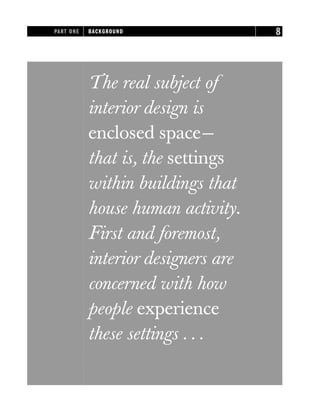
The real subject of
interior design is
enclosed space—
that is, the settings
within buildings that
house human activity.
First and foremost,
interior designers are
concerned with how
people experience
these settings . . .
PART ONE BACKGROUND 8
In trying to define professionalism, Maister lists the following distinguishing
traits:
• Taking pride in your work (and being committed to its quality)
• Taking responsibility and showing initiative
• Being eager to learn
• Listening to and anticipating the needs of others
• Being a team player
• Being trustworthy, honest, loyal
• Welcoming constructive criticism2
His point is that professionalism is not just education, training, a certificate
or license, and other credentials. In saying that these things are not the sine
qua non of professionalism, Maister is really arguing for a client-responsive
professionalism—as opposed to one that uses its credentials and presumed
expertise as an excuse for ignoring or even bullying the client.
Arrogance is an issue in the design professions. Too many designers regard
their clients as patrons, not partners. Design commissions become opportu-
nities to further personal ambition rather than meet the client’s goals and
needs. The implication is that design is self-expression, that the creative
process is largely if not exclusively the province of the designer alone.
Although there is inevitably an aspect of self-expression in the design
process, its creative power is enhanced, not diminished, by collaboration.
In collaboration, we become partners in a larger enterprise, and that gives
our work its energy and spark. In arguing for “professionals who care,”
Maister is drawing attention to the collaborative nature of their relation-
ships with their clients. It is a partnership to which both parties contri-
bute their expertise. Formally, professionals act as the agents of their clients.
As professionals, they have other obligations that affect this relationship—
obligations that are intended, among other things, to protect clients from
themselves. However, designers who assume they “know better” than their
clients miss the opportunity to get into their clients’ heads and understand
their world. They need that knowledge to connect their work to their clients’
CHAPTER 1 GROWING A PROFESSION 9
larger goals and strategies, the real starting points of innovation in the design
process.
What Makes Interior Design a Profession?
Interior design is a profession in part because of designers’ special skills and
education, but also because of designers’ special relationships with their
clients. According to Webster’s New Collegiate Dictionary, a profession is “a
calling requiring specialized knowledge and often long and intensive aca-
demic preparation.”4
An art is a “skill acquired by experience, study, or obser-
vation, an occupation requiring knowledge and skill, and the conscious use
of skill and creative imagination especially in the production of aesthetic
objects.”5
A craft is “an occupation or trade requiring manual dexterity or
artistic skill.”6
These definitions stress a difference in training, suggesting
that only professions require university study. That difference does not pre-
cisely hold anymore, since both arts and crafts are taught at the university
level. Recalling David Maister’s definition of a professional as a “technician
who cares,” we might ask, “Who benefits from the care that interior design-
ers exercise in the course of their practice?” Clearly, the beneficiaries are
those who use the settings that they design.
In defining the professional practice of interior design, the Foundation for
Interior Design Education and Research (FIDER) provides the following
outline of its scope:
• Analyzing client needs, goals, and life safety requirements
• Integrating findings with a knowledge of interior design
• Formulating preliminary design concepts that are aesthetic, appro-
priate, and functional, and in accordance with codes and standards
• Developing and presenting final design recommendations through
appropriate presentation media
• Preparing working drawings and specifications for non-load-
bearing interior construction, reflected ceiling plans, lighting, in-
terior detailing, materials, finishes, space planning, furnishings,
fixtures, and equipment in compliance with universal accessibility
guidelines and all applicable codes
PART ONE BACKGROUND 10
• Collaborating with professional services of other licensed practi-
tioners in the technical areas of mechanical, electrical, and load-
bearing design as required for regulatory approval
• Preparing and administering bids and contract documents as the
client’s agent
• Reviewing and evaluating design solutions during implementation
and upon completion7
While it is accurate as far as it goes, this definition misses the heart of the
matter. The real subject of interior design is enclosed space—that is, the set-
tings within buildings that house human activity. First and foremost, interior
designers are concerned with how people experience these settings and how
their design supports their different activities. These concerns form the core
of the interior design profession’s specialized knowledge.
EDUCATING INTERIOR DESIGNERS
Like architecture
Like architecture, interior design is taught through a combination of studio
work and coursework—the former a remnant of the old apprenticeship sys-
tem that once characterized both architecture and the arts and crafts. In
addition to studio training in design and visualization, professional interior
design programs typically provide a foundation in:
• Human factors
• Materials and systems
• Codes and regulations
• Contracts and business practices
Unlike architecture, most interior design programs do not address the engi-
neering side of building construction—e.g., coursework in the static and
CHAPTER 1 GROWING A PROFESSION 11
dynamic analysis of structure. Interior design also differs from architecture
(and interior decoration) in its concern for every aspect of the interior envi-
ronments that people use every day.
The human experience in these settings is a broad topic that includes history
and culture, psychology and physiology, organization theory, and benchmark
data drawn from practice—together with lighting, color theory, acoustics, and
ergonomics. These subjects need to be part of the professional interior
designer’s education and training.
How do interior designers gain an understanding of client and user needs?
“By asking them” is a reasonable answer for smaller projects, but larger ones
make use of social science research methods such as participant observa-
tion, network analysis, and surveys. Exposure to these methods through
coursework in anthropology and sociology is helpful, especially as strategic
consulting emerges as a specialty within the profession. (Strategic consult-
ing seeks to align a client’s real estate and facilities strategies with its busi-
ness plan. Typically, it helps the client define its real estate and facilities
program and establish the quantitative and qualitative measures of its per-
formance.) Business clients expect their design teams to understand the
strategic context of their projects. Coursework in business and economics
can begin that process; immersion in the industry, by reading its journals
and participating in its organizations, is the next step. Once designers reach
a certain level of responsibility, management becomes part of their job
description. Coursework in business and management can make this tran-
sition easier.
A Knowledge of Sustainable Design Principles
“Building ecology,” as the Europeans call it, needs to be part of interior
designers’ knowledge. They should know how to design to conserve nonre-
newable resources, minimize waste, reduce CO2 and SO2 levels, and support
human health and performance.8,9
PART ONE BACKGROUND 12
CHAPTER 1 GROWING A PROFESSION 13
INTERIOR DESIGNERS AND SUSTAINABLE DESIGN
In tackling the problem of indoor air pol-
lution in the 1980s, the interior design
profession led the way in raising public
awareness of the value of sustainable de-
sign. As advocates for the user, interior
designers have a special responsibility to
understand sustainable design principles
and evaluate their appropriateness for
their projects. Sustainability also offers
many opportunities to deliver added value
for clients. As case studies by the Rocky
Mountain Institute9
have shown, the re-
sulting gains in building and human per-
formance provide a reasonable (and even
rapid) payback on the client’s investment,
especiallywhen these measures are used in
combination. Here are some examples.
• Lockheed Building 157, Sunnyvale,
California. Lockheed spent $2.0 million to
add sustainable design features to this
600,000-ft2
office building that reduced its
energy consumption and provided a
higher-quality work environment. Control
of ambient noise was also achieved. Lower
energy costs alone would have repaid
Lockheed’s investment in four years. Be-
cause the improved quality of the work-
place reduced absenteeism by 15 percent,
the investment was actually repaid in less
than a year.
• West Bend Mutual Insurance Head-
quarters, West Bend, Wisconsin. West
Bend used a number of sustainable design
features, including energy-efficient lighting
and HVAC systems,roof,wall,and window
insulation, and thermal storage. Utility re-
bates kept its cost within a “conventional”
budget. The building is 40 percent more
efficient than the one it replaced. It provides
an “energy-responsive workplace” that
gives users direct control of thermal com-
fort at their workstations. A study showed
that the building achieved a 16 percent pro-
ductivity gain over the old one. A produc-
tivity gain of 5 percent (worth $650,000 in
1992 dollars) is attributable to the energy-
responsive workplace feature alone.
• NMB Headquarters, Amsterdam, The
Netherlands. This 538,000-ft2
project ex-
emplifies what Europeans call “integral
planning”: designing the building and its
systems holistically to reduce operating
costs and increase quality and perform-
ance. About $700,000 in extra costs were
incurred to optimize the building and its
systems, but this provided $2.6 million a
year in energy savings—and a payback of
only three months. Employee absenteeism
is down by 15 percent, too.
Gensler’s experience reinforces the Rocky
Mountain Institute’s findings. On office
campus projects, they found that providing
under-floor air supply and ambient lighting
can reduce the cost of workplace “churn”
(the need to shift workstations to accom-
modate changes in occupancy) from as
much as $5.00/ft2
to less than $1.00/ft2
. For
an office campus in Northern California,
these same features allowed them to re-
design the entire workplace to accommo-
date a different set of users just six weeks
before its opening—with no delays. By
avoiding the cost of delay, the client essen-
tially paid for the 10 percent higher cost of
these features before the campus had even
opened.
THE CULTURAL IMPACT OF INTERIOR DESIGN
Settings,the designed spaces
Settings, the designed spaces within buildings, are “where the action is.”
When human or organizational change occurs, settings are where it takes
place first. As my colleague Antony Harbour points out, the U.S. workplace
has been dramatically transformed over the last 40 years, but U.S. commercial
office buildings still have the same floor plans. The settings have changed
much more than their containers. Although settings are more ephemeral than
buildings, they have equal if not greater cultural impact.
Interior Designers and the Workplace Revolution
Because of the economic pressures of recession and globalization and tech-
nological developments such as bandwidth (the proliferation of electronic
networks to convey voice and data communications on a global basis), the
workplace has undergone profound change in the last decade. While tech-
nology is given credit for the productivity gains that have swept the U.S.
economy in this period, interior designers who specialize in the workplace
have had a major role in helping U.S. companies integrate new technologies
and work processes. Alone among design professionals, they understood that
these settings are the “connective tissue” that could make this happen.
Interior design professionals understand that design fuels organizational
change, regardless of the scale of its application. Think about where we work
today. Behind the modern city, whether London, Tokyo, or New York, are
nineteenth-century assumptions about work—that it occurs at specific times
and in specific places, for example. Now people work “anywhere, anytime,”
and there are compelling reasons, such as the problems of commuting, to dis-
tribute work geographically.
Not only the locus of work has changed in our culture; the mode of work has
changed as well. In the last century the workforce moved from Frederick
Taylor’s “scientific management” to ways of working that are increasingly
open-ended, democratic, and individual/team-tailored. Along the way, the
workplace changed, too. Taylorism was about efficiency (and uniformity).
What followed shifted the focus to effectiveness (and diversity). What’s the
difference? As Peter Drucker explains,“Efficiency is doing things right; effec-
tiveness is doing the right thing.”
PART ONE BACKGROUND 14
The Modern movement, aping Taylor, took “Form follows function” as its
credo. Today, though, we might amend this to “Form follows strategy.” If
design firms are now involved in strategic consulting, it is because interior
designers paved the way. Their ability to give form to strategy gave them an
advantage over competing consultants, because they knew how to make
strategy actionable.
Yet this focus on strategy does not entirely explain the impact that interior
designers have had on the workplace. More than any other profession
involved in the design of these settings, they have been able to use their
knowledge of workplace culture to design work settings that genuinely sup-
port the people who use them. Interior designers make it their business to
know how people actually inhabit and experience the built environment.
Their work—certainly the best of it—consistently reflects this understanding.
The licensing controversy notwithstanding, interior designers today are val-
ued members of building design teams precisely because they bring this
knowledge to the table.
Some of the most valuable research on the workplace in recent years has been
done by interior designers who specialize in work settings for corporate,
financial, and professional service clients. Gensler’s Margo Grant and Chris
Murray, for example, have done pioneering work documenting the changing
strategic goals of these companies and how they play out in spatial terms.
Their benchmarking studies give Gensler and its clients a wealth of com-
parative data about facilities trends across the developed world’s economy.
Needless to say, this is a competitive advantage in the global marketplace.
As Peter Drucker points out, it used to be that the skills needed in business
changed very slowly:
My ancestors were printers in Amsterdam from 1510 or so until 1750
and during that entire time they didn’t have to learn anything new.
All of the basic innovations in printing had been done . . . by the
early 16th
century. Socrates was a stone mason. If he came back to
life and went to work in a stone yard, it would take him about six
hours to catch on. Neither the tools nor the products have changed.10
Today, however, we are in the midst of a period of remarkable technological
innovation,equivalent in its impact to the clusterof spectacularbreakthroughs
that occurred in the last quarter of the nineteenth century. Technological
CHAPTER 1 GROWING A PROFESSION 15
innovation is one reason that professions evolve. Social change, the evolu-
tion of “everyday life” and its values, is another. “Faster, cheaper, better!”
is the catch phrase of the new economy. Every shaper of the built environ-
ment faces these related changes, as clients demand a new responsiveness.
Design professionals should rethink linear and segmented processes, reflect-
ing nineteenth-century practices, and begin to envision how everyone en-
gaged in designing and constructing the built environment should approach
their practice to achieve the speed, responsiveness, and innovation that
clients require.
IMPLICATIONS OF BANDWIDTH: NEW TOOLS,
PROCESSES, AND PRACTICES
The bandwidth revolution
The bandwidth revolution has given interior designers an entirely new set
of tools—not just for design, but also for collaboration. As is true for most
innovations, their early applications were focused on existing practices.
Today, though, a new generation of designers is at work who grew up with
these tools. As they move into the mainstream of practice, they will start to
use them to reshape practice.
Bandwidth is transforming the production process: how furniture, furnish-
ings, and equipment get from designer to manufacturer to end-user. It makes
it possible both to speed the production process, by tying it more directly to
purchasing, and to consolidate orders to secure larger production runs and
better prices. And it creates a world market for these products that should
increase their variety.
Bandwidth will also make it steadily easier for virtual teams to work collab-
oratively, to “construct” a virtual setting in three dimensions. This collabo-
ration takes place not just between people, but between computers, too, so
that in time fabrication will follow design without the need for detailed work-
ing drawings. As the process becomes more seamless (and more common),
it will extend to other aspects of construction. At some point, “design/build”
may really be a single process. Currently, we are only halfway there. A lot of
the infrastructure is in place, but the interface is still maddeningly primitive.
PART ONE BACKGROUND 16
At the same time, we are trying to use the infrastructure to support tradi-
tional practice models. It may take a “push” from the outside, such as another
oil shock that makes the price of airline tickets less affordable, to force
designers to change their ways and embrace virtual collaboration whole-
heartedly.
Thanks to bandwidth, manufacturing has gone from Henry Ford’s assembly
line, with its uniform products, to Dell’s (and now Ford’s) “mass customiza-
tion.” Service industries have changed similarly. Across the economy, cus-
tomers want the cost advantages of mass-market mass production, along
with the quality and performance of custom design.
DESIGNING IN FOUR DIMENSIONS
At the same time as
At the same time as clients demand an increased level of responsiveness,
knowledge workers demand “consonance” in the workplace. They approach
potential employers looking for a “fit” with their values and lifestyles. In a
buoyant economy, they can afford to be selective—and intolerant of “disso-
nance.” The built environment gives form to consonance and provides its
framework. To keep pace with social and technological changes, design pro-
fessionals must learn to see that framework as one that changes with time—
and therefore design in four dimensions.
The current rate of technological change suggests that designers will face
considerable pressure to practice with time in mind. Both the container and
the contained—“structure and stuff,” as Stewart Brand put it in How Build-
ings Learn—change over time, but at different rates of speed.11
The trends of
mass customization and congruence suggest that settings will change fre-
quently, which puts pressure on the rest to facilitate the change. This brings
us back to sustainability, which also demands of “stuff” that its residual value
be salvaged through recycling and reuse.
Designing in four dimensions means rethinking our conceptions of build-
ings. “There isn’t such a thing as a building,” Frank Duffy asserts. Buildings
are just “layers of longevity of built components”—they exist in time. What
CHAPTER 1 GROWING A PROFESSION 17
matters for their designers is their “use through time.” Duffy finds the whole
notion of timelessness to be “sterile” because it ignores time as the building’s
fourth dimension—they exist in time, so they have to evolve to meet its
changing demands.12
Also working from a “time-layered” perspective, Brand proposes a holistic
approach to time-sensitive design.13
He identifies six components of build-
ings: site, structure, skin, services, and space plan. While interior designers
are focused on the last two, they have good reason to want to influence the
rest: they all affect the building’s use through time. To exercise this influence
effectively, of course, interior designers have to understand the characteristics
of these components, and the possibilities of the other elements of the built
environment. Interior designers do not have to be engineers, orviceversa, but
both need to know enough about the others’ business so they can approach
the building in a holistic or time-layered way. As Brand says:
Thinking about buildings in this time-laden way is very practical.
As a designer you avoid such classic mistakes as solving a five-
minute problem with a fifty-year solution. It legitimizes the exis-
tence of different design skills, all with their different agendas
defined by this time scale.14
To be responsive to the user in the building design process, interior design-
ers need to have this broader knowledge of the building and its components.
In the end, their ability to sway others in the design and delivery process will
rest primarily on issues of use over time—issues that are primarily functional
and strategic, and that constantly require new skills.
LOOKING AHEAD
Interior designers
Interior designers face resistance in their quest to be recognized as a separate
profession. In 1999, the American Institute of Architects (AIA) put together
a task force to review the question of licensing interior designers. As Archi-
tectural Record’s Robert Ivy reported:
They found that interior designers seek to distinguish themselves
from less-qualified decorators, protect the right to practice, estab-
PART ONE BACKGROUND 18
lish gender equity in a field dominated by men, and earn the
respect of their fellow professionals.15
“The designers’viewpoint is consistent,”Ivyadded,citing his magazine’sApril
1998 roundtable discussion with interior designers. “Despite their gains in the
industry, they feel slighted or disparaged by architects.”Yet, he says,“there are
unavoidable differences between architects and interior designers”:
Architectural education is more rigorously focused on life safety, as
well as structure, building science, and codes. By contrast, the AIA
task force reported that in the 125 interior design programs cur-
rently available, education can vary from two to four years, and
current testing for certification focused more on aesthetics than
safety. The differences do not stop with pedagogy. Architects tend to
engage the entire design problem, considering not only the contents
of the interior, but the interior’s relation to the exterior envelope, its
construction and building systems, and the natural and human-
made surroundings. A healthy building—light-filled, safe, and pro-
moting human habitation—should be architects’ professional norm.
When we are operating at a high level of accomplishment, our work
is holistic, integrating complex technical systems and social require-
ments into structures that engage the landscape, sustain their
inhabitants inside and out, and enrich the community.16
Should interior designers be licensed? Here is Ivy’s answer:
Our own professional status reflects a public trust we have earned
at high cost, and it should not be diluted. . . . Practice legislation
may not be the panacea that interior designers seek, if it is achieved
without commensurate, fundamental changes in [their] education
and experience.17
However, interior designers can make a strong case that they should be ac-
corded the distinctions and protections that are part of other design profes-
sions such as architecture. No less than architects, interior designers are
engaged in “the entire design problem.” As advocates of the user, and as
designers who are “fourth-dimension sensitive,” they are often the first ones in
the building design process to point out how one or another of the building’s
components makes it harder for its settings to evolve easily to meet new needs.
As designers’ interest in indoor air quality demonstrates, they are concerned
with quality of life, too—with user performance, not just building performance.
CHAPTER 1 GROWING A PROFESSION 19
PART ONE BACKGROUND 20
ARCHITECTURE’S STRUGGLE TO BECOME A PROFESSION1
Interior designers who anguish about the
time it is taking to secure state sanction
for their profession’s title and practice
should bear in mind that it took architects
a lot longer. Arguments over who is and is
not qualified to design buildings punctu-
ate the history of the profession.
In the Middle Ages in Europe, the master
masons were the building architects.
During the Renaissance in Italy, artist-
architects supplanted them. They were
considered to be qualified as architects
owing to their training in design. Archi-
tects such as Brunelleschi and Michelan-
gelo took a strong interest in engineering
and technology, too, as they strove to real-
ize their ambitious building projects. With
Vitruvius, they believed that architecture
was a liberal art that combined theory and
practice. Master masons, who apprenticed
in the building trades, were disparaged be-
cause their training was purely practical.
Yet the Italian Renaissance also saw the
emergence of the professional in Europe’s
first true architect, Antonio Sangallo the
Younger. Apprenticed to the artist-archi-
tect Bramante, Sangallo helped implement
many of Bramante’s later buildings. In
time, he established a studio that is recog-
nizably the prototype for today’s architec-
ture and design firms. The architectural
historian James Ackerman has described
him as“one of the few architects of his time
who neverwanted to be anything else.”
Four diverging traditions emerge from the
Renaissance: artist-architects, trained in
design; humanist-architects, trained in
theory; architect-architects, focused on
buildings and striving for a balance be-
tween theory and practice; and builder-
architects, focused on construction but
still interested in designing buildings.
Artist-architects looked for patrons; archi-
tect-architects looked for clients. In the
seventeenth and eighteenth centuries, we
see this distinction played out between
“gentleman” architects and the emerging
profession. Thomas Jefferson counted
architecture among his gentlemanly pur-
suits, a trait he shared with others of his
class. Lord Burlington, who did much to
establish the architectural profession in
England, was widely criticized by his peers
for his “unwonted” interest in the prag-
matics of building construction. When the
Institute of British Architects was estab-
lished in 1834, noblemen could become
honorary members for a fee. (Signifi-
cantly, all connection with the building
trades was forbidden.)
In the eighteenth and nineteenth cen-
turies, English architects also faced com-
petition from surveyors. In his Dictionary
of 1755, Dr. Johnson gave essentially the
same definition for the words “surveyor”
and “architect.” In England, at least, the
two professions remained closely aligned
through much of the nineteenth century—
with both designing buildings. Engineers
designed buildings, too. In 1854, one of
them even won the Institute of British Ar-
chitects’ Gold Medal.
CHAPTER 1 GROWING A PROFESSION 21
PROFESSIONAL ETHICS
Like other professionals, interior designers
must contend with ethical issues. Indeed,
the issues can be quite similar to those of
allied and other learned professions. Like
architects, lawyers, and doctors, interior
designers can also do bodily harm and cre-
ate financial damage if they practice in-
competently or unethically. They can also
put people at risk by failing to be effective
advocates of their interests. Here are some
examples of these issues as they arise in in-
terior design practice.
• Life safety. Designers sometimes bemoan
codes and regulations, but these rules exist
to establish a minimum standard of health
and safety. Failure to meet code can delay
a project, which damages the owner, and
can also cause bodily harm.
• Confidentiality. Interior designers often
have access to confidential business infor-
mation—a planned acquisition, for exam-
ple,ora newbusiness plan orstrategy.This
knowledge is shared with interior design-
ers only because it has a direct bearing on
their work, and it is shared with them in
confidence. Ethically, and often by con-
tract, that confidence must be respected.
• Conflict of interest. Interior designers
are their clients’ agents, so they have an ob-
ligation to avoid or disclose to them any
potential conflicts of interest. (Disclosure
means that you are prepared to end the
conflict if the client so requests.) The ap-
pearance of conflict can be as problematic
as the reality. Just as voters worry when
politicians become too cozywith special in-
terests, clients start to wonder when inte-
rior designers accept gifts or junkets from
contractors and vendors. The occasional
lunch, party, box of candy, orbottle of wine
is no problem, but all-expenses-paid vaca-
tion trips and other costly“perks” cross the
line. They create the appearance if not the
reality that design decisions—specifying a
product, for example—are being made to
repay favors rather than to serve the inter-
ests of the client.
• User advocacy. Interior designers have
a responsibility to users. If, in their judg-
ment, a project’s requirements, though
legal, compromise user comfort and per-
formance unacceptably, they have an obli-
gation to try to change them, or to resign
from the project if the client is unwilling to
make changes. Design professionals have a
broader obligation to educate their clients
on the value of design features that im-
prove user quality of life and performance.
• Competency. Professional competence
reflects ongoing mastery of the skills and
knowledge demanded by professional
practice. Professional certification or li-
censing formally requires a level of mas-
tery that necessarily lags behind what
design professionals actually need. For ex-
ample, FIDER’s requirements do not yet
specify that interior designers know the
principles of sustainable design. That lag
does not excuse professional interior de-
signers from mastering these principles, or
any new skills that may be necessary to
maintain their professional competence.
Interior design came into its own in the 1990s as settings came to be seen as
strategic resources. The catch phrase “Place matters!”—so emblematic of the
second half of the decade—turned out to be literally true. When people have
real choice about when and where they spend their time, the quality of these
settings—their ability to support people in their desired activities—becomes
crucial, often the deciding point. A “place” can be part of the landscape or
cityscape, a building or building complex, or an enclosed indoor or outdoor
setting. The word implies a richness and wholeness that mocks the design
professions’ efforts to carve it into parts.
The built environment today has immense range and diversity. Much devel-
opment embraces multiple uses. The time dimension of buildings is chang-
ing, too, with more components expected (or needed) to be ephemeral rather
than “permanent.”Already, many projects today feature hybrid teams that are
organized around each project’s particular blend of uses and timeframes.
These interdisciplinary teams are the future. They expose each profession to
the others and give all of them a shared perspective about “place” that tran-
scends each one’s necessarily narrower view.
This shared viewpoint may eventually give rise to entirely new professions,
which we may no longer be willing to categorize as “architecture” or “inte-
rior design.” In time, too, the division between design and construction may
prove to be an artificial boundary, no longer justified by practice. Professions
are conservative forces in society, constantly resisting pressures to change,
yet constantly placed in situations where the need to change is obvious and
imperative. New professions arise in part because old ones fail to adapt.
Compared to architecture, interior design is still in its infancy—a profession
that is just now marshalling its forces to secure the recognition to which it
feels entitled. All this is taking place against the background of our entre-
preneurial and bandwidth-driven era. How important is it, in this context,
to secure the profession’s boundaries or win state sanction for its practice? If
it helps strengthen the education and training of interior designers, and
encourages them to meet their responsibilities as professionals, then it is
probably well worthwhile.
Especially today, it is hard to predict the future of the interior design profes-
sion. One clear way to prepare for it, however, is to make the education of
PART ONE BACKGROUND 22
interior design professionals much more rigorous. This argues for a more
comprehensive curriculum, as I have outlined previously, and for a four-year
professional degree program at the undergraduate level.
It also argues for learning, as Peter Senge calls it—not just maintaining skills,
but actively learning from practice. Senge’s point, made admirably in his
book, The Fifth Discipline,18
is that work itself is a learning experience of the
first order. Our interactions with clients, colleagues, and other collaborators
provide constant glimpses into an unfolding future. If we are attentive, we
can understand some of what the future demands—and take steps to meet it
appropriately. People who care about their careers, and who take their
responsibilities as professionals seriously, need to make learning a constant
priority.
Notes
1
This brief account is drawn from Spiro Kostof (ed.), The Architect, Oxford University Press, New
York, 1977, pp. 98–194.
2
Maister, David H., True Professionalism, The Free Press, New York, 1997, pp. 15–16.
3
Maister, True Professionalism, p. 16.
4
Webster’s New Collegiate Dictionary, G. & C. Merriam Co., 1977, p. 919.
5
Webster’s, p. 63.
6
Webster’s, p. 265.
7
Foundation for Interior Design Education and Research (FIDER), “Definition of Interior
Design” (from FIDER’s website: http://www.fider.org/definition.htm).
8
A good introduction to this topic is Diana Lopez Barnett and William D. Browning: A Primer
on Sustainable Building, Rocky Mountain Institute, Snowmass, CO, 1995.
9
Romm, Joseph J., and William D. Browning, Greening the Building and the Bottom Line, Rocky
Mountain Institute, Snowmass, CO, 1994.
10
Daly, James, “Sage Advice” (interview of Peter Drucker), Business 2.0, August 8, 2000.
11
Brand, Stewart, How Buildings Learn, Viking, New York, 1994, p. 13.
CHAPTER 1 GROWING A PROFESSION 23
12
Quoted in Brand, How Buildings Learn, pp. 12–13. The quotations are from Francis Duffy, “Mea-
suring Building Performance,” Facilities, May 1990, p. 17.
13
John Habraken took a similar position, initially in relation to housing, in the 1960s. See, for
example, his Variations: The Systematic Design of Supports, MIT Press, Cambridge, MA, 1976, and
The Structure of the Ordinary: Form and Control in the Built Environment, MIT Press, Cambridge, MA,
1998.
14
Brand, How Buildings Learn, p. 17.
15
Ivy (FAIA), Robert, “The Keys to the Kingdom,” Architectural Record, September 2000, p. 17.
16
Ivy, “The Keys to the Kingdom,” p. 17.
17
Ivy, “The Keys to the Kingdom,” p. 17.
18
Senge, Peter, The Fifth Discipline, Currency/Doubleday, New York, 1994.
19
Kostof, The Architect, p. 138.
Bibliography
Brand, Stewart. How Buildings Learn: What Happens After They’re Built.
New York: Penguin USA, 1995.
Browning, William D., and Joseph J. Romm. Greening the Building and the
Bottom Line: Increasing Productivity Through Energy-Efficient Design. Snow-
mass: Rocky Mountain Institute, 1994.
Cuff, Dana. Architecture: The Story of Practice. Cambridge, MA: MIT Press,
1992.
Gutman, Robert. Architectural Practice: A Critical View. New York: Prince-
ton Architectural Press, 1988.
Habraken, N. J., and Jonathan Teicher (Editor). The Structure of the Ordinary:
Form and Control in the Built Environment. Cambridge,MA: MITPress,1998.
Habraken, N. John. Variations: The Systematic Design of Supports. Cam-
bridge, MA: MIT Press, 1976.
Kostof, Spiro (Editor). The Architect: Chapters in the History of the Profes-
sion. Berkeley: University of California Press, 2000.
PART ONE BACKGROUND 24
Lopez Barnett, Dianna, and William D. Browning. A Primer on Sustainable
Building. Snowmass, CO: Rocky Mountain Institute, 1995.
Maister, David H. True Professionalism: The Courage to Care About Your Peo-
ple, Your Clients, and Your Career. New York: Free Press, 1997.
Senge, Peter, M. The Fifth Discipline: The Art and Practice of the Learning
Organization. New York: Currency/Doubleday, 1994.
Webster, Merriam (Editor). Merriam Webster’s Collegiate Dictionary. Spring-
field: G. & C. Webster Co., 1977.
CHAPTER 1 GROWING A PROFESSION 25
26
CHAPTER

History
ofthe
Profession
CINDY COLEMAN
Copyright 2002 by the McGraw-Hill Companies, Inc. Click here for terms of use.
IInterior designers can trace their profession to many who preceded
them, from the cave painters at Lascaux to the creators of the frescoed
interiors at Pompeii, to the holistic architecture, interiors, and furnish-
ings of Robert Adam and Thomas Jefferson in the eighteenth century,
and to Frank Lloyd Wright in the twentieth.
In the mid-nineteenth century, during the Industrial Revolution, the farm
economy, though still robust, was gradually supplanted by a new industrial
economy centered in or near the great, developing American cities of New
York, Boston, and Chicago. The transition from farm to industry allowed
Americans to see their houses as more than shelter and a place to sleep when
work outdoors was done. Industrial workers’ days were not necessarily
shorter than those of farmers. However, for industrial workers and city
dwellers in particular, home became a refuge that provided physical comfort
and even aesthetic pleasure in contrast to the noisy, gritty, and physically
exhausting atmosphere of the factory.
As women had more time to spend on the comforts of home, the large
department stores of England and America developed and included sections
devoted to drapery and upholstery. Specialty retailers included Liberty of
London for fabrics and Tiffany and Affiliated Artists in New York, which
produced lamps, vases, and other finely crafted decorative items.
At the end of the nineteenth century in England and America, the Arts and
Crafts movement developed as a direct response to the Industrial Revolu-
tion. Its members, including William Morris, Charles Voysey, and Gustav
Stickley, celebrated handcraft and deplored the social conditions, as well as
the machine-made designs, the Industrial Revolution had created. The Arts
and Crafts movement initiated small workshops devoted to woodworking,
pottery, and weaving, and brought together artists and architects to study the
interiors as well as the exteriors of buildings. Design integrity within the con-
temporary cultural and social context was the concern not only of the Arts
and Crafts movement, but of other groups including the WienerWerkstratte
and the Bauhaus, which developed and flourished in the twentieth century.
CHAPTER 2 HISTORY OF THE PROFESSION 27
Sensitivity to the role of design in society is as relevant at the beginning of
the twenty-first century as it was at the dawn of the twentieth. Some, in fact,
have referred to the year 2000 as the beginning of “the design century.”
Today, design is relevant as never before, particularly to the world of work.
Following World War II, business theories and practices began to evolve and
proceeded at a manageable pace; with the widespread use of computers in
the 1980s, that evolution picked up speed and continues to do so today,
when the only organizational constant is change. AfterWorld War II, the res-
idential and corporate branches of the interior design profession began to
move on separate tracks. Both have traveled rapidly, but in different direc-
tions. The interior designer’s role as a professional consultant to business
and organizations is the focus of this chapter. It is important to emphasize,
however, that design is a global language that transcends home and work-
place, geography and culture. To be a designer is to understand what all men
and women have in common—their humanity.
INTERIOR DESIGN EMERGES AS A PROFESSION:
1900 TO 1930
Theformalstudy
The formal study of interior design began in the United States at the end of
the nineteenth century. Programs and curricula typically developed in art
schools; at the great land-grant colleges of the Midwest, which were open to
women and also boasted strong programs in home economics; and within
academic programs in architecture, primarily at East Coast universities.
When interior design actually became recognized as a profession is a subject
for debate. Some scholars believe that interior design was not acknowledged
as an independent profession inAmerica until 1897,when EdithWharton and
Ogden Codman, Jr., published The Decoration of Houses. The authors are
considered the first to define the profession as it is viewed today, by clarifying
the difference between interior decoration, which deals with surface treat-
ments, and interior design, which encompasses the design of interior spaces.
Elsie de Wolfe, a contemporary of Mrs. Wharton’s and a disciple of her
approach, is considered to be one of America’s first professional interior
designers. Her expertise, however, was on the side of interior decoration,
PART ONE BACKGROUND 28
which she used with great skill in the creation of interiors for the industrial-
ist Henry Clay Frick and other wealthy New York families. She also accepted
commissions from the prominent Beaux Arts architect Stanford White. Early
twentieth-century women who are also considered among the first design
professionals are Nancy McClelland, who brought design services to the
general public through the decorating department she established at Wana-
maker’s department store in Manhattan; and Eleanor McMillen, whose
McMillen, Inc. is considered to be America’s first interior decorating firm.
By the turn of the twentieth century, the Industrial Revolution had reached
full maturity. Daily life in the developed world had become increasingly
mechanized, and Thomas Edison’s electric light bulb was adding time to the
work day and changing the nature of work. At the same time, the seeds of
the Information Age—a century in the future—were being planted with Bell’s
telephone in 1876 and Edison’s subsequent inventions of the telephone trans-
mitter, the stock ticker, the phonograph, and the movie camera. During the
early part of the twentieth century, there was little if any distinction between
residential and nonresidential interior design; it was not until after World
War II that North Americans became open to the idea of hiring design
professionals for both their houses and offices. As the century began, the
archetype of the workplace was the assembly line that Henry Ford created
to produce the Model T.
An early business theorist, Frederick W. Taylor, extended the assembly line
from the product to the worker. Considered to be industry’s first efficiency
expert, Taylor conducted time-study experiments that he developed into the
concept he called scientific management. In Taylor’s view, human workers
could—and should—function as mechanically as machines. If workers were
discouraged from thinking creatively and independently and completely
removed from decision making, and if work was broken down into its sim-
plest units, with all members of a single group of workers dedicated to iden-
tical tasks, efficiency would result. Taylor’s methods, developed for the
factory, eventually found their way into offices, along with typewriters, cal-
culators, and switchboards and the women and recently arrived European
immigrants who were hired to operate them.
Ford’s assembly line, and Taylor’s translation of it to human activity, next
found its way to business and the chart of organization. The hierarchical
organization, with its mechanical, organizational, and psychological elements
CHAPTER 2 HISTORY OF THE PROFESSION 29
now delineated, was born and grew. Once a suitable interior was designed to
contain it, it flourished.
In the corporate hierarchy, order ruled. To stay in control, however, the rul-
ing order needed to keep an eye on the workers. Workplaces were designed
for management, who typically constricted a large group of workers in a sin-
gle, vast space. From the giant panopticon that was the top of the hierarchy,
managers looked down over rows of workers at their typewriters or sewing
machines or tables where they assembled the typewriters, sewing machines,
Victrolas, and other machines that had become part of twentieth-century life.
At the turn of the twentieth century, the hierarchy was the metaphor for soci-
ety in all its forms; the elevator, invented in 1857, suggested that, in a demo-
cratic American society, workers could aspire to access any level they chose.
This was the era of the great retailers such as Marshall Field, whose establish-
ments were organized into departments, just like the Ford Motor Company.
This was the era that saw the construction of the Eiffel Tower as a brand mark
for Paris, along with the great railway hotels, large city apartment buildings,
the modern hospital, and the first skyscraper office buildings.
In business, Taylor’s scientific management prevailed, but he had his critics,
who were concerned about issues that interior designers still find themselves
dealing with a hundred years later. They included Mary Parker Follett of the
Harvard Business School, whose humanist, behaviorist approach to the man-
agement of organizations represented the opposite side of Taylor’s machine-
tooled coin. In the 1910s she championed such far-sighted approaches to
work, and the workplace, as “the law of situation” and cross-functional teams.
She also insisted that individual workers, rather than being merely static units
of work with a prescribed place on a linear assembly line, as Taylor would
have it, contributed to the strength of the organization as a whole. She
believed that, within the organizational structure, men and women should
be free to experiment until they found ways of working that were effective for
the tasks at hand and for themselves as individuals.
In the 1920s, Harvard was also the academic home of Elton Mayo and his
colleague Fritz Roethlisberger, who are the acknowledged creators of the
human relations movement and whose work also has contemporary impli-
cations. They conducted their famous Hawthorne experiments over a period
of more than 30 years—from the 1920s to the 1950s—at the Western Electric
Hawthorne Works in Cicero, Illinois. Their studies, which anticipated the
PART ONE BACKGROUND 30
current interest and advancements in ergonomics, focused on the physio-
logical aspects of work, particularly the impact of various levels of illumina-
tion on workers’ efficiency and the causes of fatigue. They also studied the
psychological aspects of work and looked closely at employees’ motivation,
satisfaction, and personal well-being, particularly as these abstract states took
form in workers’ relationships with their supervisors.
The Harvard theorists, along with Chester Barnard at AT&T and other
humanists, created a groundswell against scientific management. It was now
clear that not all work fit the model of Ford’s assembly line. And simply
because the assembly line itself depended on human beings but was, in fact,
profoundly dehumanizing, it was time to step back and rethink the nature of
work—and the workplace. The time had come for a paradigm shift in the way
organizations were structured and in the way the physical spaces of organi-
zations were designed. But then came World War II, and the hierarchy not
only prevailed, it joined the military.
THE BAUHAUS ARRIVES IN AMERICA: 1940 TO 1950
TheendofWorldWarII
The end of World War II brought a period of prosperity to the United States
that lasted almost 20 years. America had definitively won the war. By put-
ting its own interests aside and contributing its physical and material
resources to the war effort, corporate America was in large part responsible
for the country’s victory. Although American business quickly recovered
from the war, the military mindset prevailed during the remainder of the
1940s. At the Ford Motor Company, decision making was based on num-
bers; numbers and rigid control also defined management. This approach
led eventually to systems analysis, a rational, mathematically rigorous
method of decision making that was considered to be especially effective in
situations of uncertainty.
The war effort had been American through and through, but now that peace
had come, corporations wanted to reclaim their unique identities. They
wanted new headquarters that would function like the great cathedrals of
Europe—buildings that would announce the importance of these corpora-
tions to society, reflect their mission, embody their technological expertise,
CHAPTER 2 HISTORY OF THE PROFESSION 31
The time had come for
a paradigm shift in the
way organizations were
structured and in the
way the physical spaces
of organizations were
designed. But then
came World War II,
and the hierarchy not
only prevailed, it joined
the military.
PART ONE BACKGROUND 32
advertise their vision and confidence, and share their uniquely American
exuberance. Corporate America looked to the architectural and design com-
munities for their new image. It would be architects and designers associated
with the Bauhaus in Germany who would make that image reality.
Founded by Walter Gropius at the end of World War I, the Bauhaus, or
“building house,” was conceived not only as a school but as an artistic utopia
that brought together artists, craftspeople, and workers. Its emphasis was on
theory as well as application. Its goal, as Gropius stated in his 1919 prospec-
tus, was “to unify all disciplines of practical arts as inseparable components
of a new architecture.” The Bauhaus, which could trace its roots to the Arts
and Crafts movement in England and the Wiener Werkstatte in Austria,
sought to humanize technology. Its curriculum taught the spectrum of arts
and crafts, including planning and building; weaving; photography; the
visual arts, including woodcarving, metalsmithing, and ceramics; and adver-
tising and graphic design.
The members of the Bauhaus included the painters Paul Klee and Wassily
Kandinsky; the architect Mies van der Rohe; the designers Josef Albers,
Herbert Bayer, Marcel Breuer, and Laszlo Moholy-Nagy; and many others.
During little more than a decade, from 1919 to 1933, they produced works
that have become icons of modernism. Bauhaus supporters included Albert
Einstein, Arnold Schoenberg, and Marc Chagall.
After a post-World War I economic boom, the German economy deteriorated
precipitously. One of the goals of the Bauhaus was to create an orderly
worldview from the economic, social, and political chaos that prevailed in
Germany between the two world wars. The Bauhaus was committed to giv-
ing its students “integrated personalities,” to educating them in contempo-
rary culture as well as artistic theory and technique. Bauhaus designs
combined technological expertise with the school’s philosophy of egalitari-
anism and dynamism.
The Bauhaus, however, existed in a climate of ascendant fascism. First
located in Weimar, the school moved from there to Dessau and finally, in
1932, to Berlin, where it stayed for less than a year. The Bauhaus closed vol-
untarily in 1933, unwilling to accede to the conditions of Hitler’s German
Reich, now firmly in power. Many of the Bauhaus masters fled to America.
In 1937Walter Gropius took a position at Harvard, where he was later joined
by Marcel Breuer. Mies van der Rohe settled in Chicago in 1938 and became
CHAPTER 2 HISTORY OF THE PROFESSION 33
the head of architecture at the Illinois Institute of Technology. Other
“Bauhauslers” soon joined him, forming the “new” Bauhaus that ultimately
led the United States into the forefront of modern design.
BeforeWorld War II, the professionals who planned and designed office envi-
ronments—known today as contract interior designers—were not identified
with a discrete area of professional expertise. A doctor, lawyer, or corporation
that wanted assistance arranging an office interior space was referred to a fur-
niture dealer,who provided desks, chairs, and credenzas and sources for light-
ing, floor and wallcoverings, and office equipment. The selection of office
furniture was primarily the domain of manufacturers’ representatives, who
were also responsible for delivery, installation, and customer service. There
were exceptions to the rule, however, most notably Frank Lloyd Wright. In
his 1937 project for the Johnson Wax Company in Racine, Wisconsin, he
designed not only the building but the interiors and furnishings as well.
Beginning in the 1930s, and especially with the prosperity that followed
World War II, North Americans became open to hiring professionals to
design their residences, especiallywith the growing celebrity and social cachet
of decorators including John Fowler, Terence Herbert Robsjohn-Gibbings,
and Billy Baldwin. By definition, these residential interior decorators dealt
with surface treatments, and their services were generally understood and
valued. Films and popular magazines brought the idea of fine residential inte-
riors to a broad audience. Eventually, women’s magazines and particularly
shelter magazines showed their audiences that,with the help of a professional,
it was possible to turn the idea of a finely decorated residence into reality.
Corporate clients, however, saw no need to call in a professional to design an
office interior. In the business world, this service simply was not understood
or, if it was, it was considered to be the same as serious residential interior
decoration—expensive and elitist.
In 1932, in connection with an exhibit at NewYork’s Museum of Modern Art,
Philip Johnson and John Russell Hitchcock published The International Style:
Architecture since 1922, which clearly defined Mies van der Rohe’s New
Building as a distinctive style. The International style had an immediate
influence on corporate buildings, and later influenced residential architecture
and interiors as well. Buildings in the International style have steel skele-
tons and eschew decoration. Their glass skins make them interactive,with the
glass mediating between the interior and exterior, between the buildings’
users and the world outside.
PART ONE BACKGROUND 34
These sleek new corporate buildings required interiors that were compatible
with their exterior architecture. Recognizing the need for an innovative
approach to the office environment, Florence and Hans Knoll established
Knoll Associates in 1946 to design and manufacture furniture in the Bauhaus
style. Florence Knoll, an architect who had trained under Eliel Saarinen and
Mies van der Rohe, established the Knoll Planning Unit, a design studio that
provided Knoll’s furniture clients with interior architectural and planning
services. The unit, which became a laboratory for interior spaces, experi-
mented with the design, scale, and configuration of task-related furniture.
One of Knoll’s hallmarks was to insist on standardization of all of an office’s
design elements, with everything from furniture to stationery part of a coher-
ent, seamless system. Although some corporate clients and their employees
chafed at the Knoll approach and considered it too constricting, its rigor
helped American businesses establish their identities firmly in the American
mind. The Knoll approach was a precursor to the contemporary concept of
branding.
DESIGNERS LEARN TO STUDY HOW ORGANIZATIONS
BEHAVE: 1950 TO 1960
Intheearly1950s
In the early 1950s, the New York office of Skidmore, Owings & Merrill
(SOM) became one of the first major architecture and engineering firms to
offer interior design as a professional service. SOM eventually became estab-
lished as the world’s leader in contract interiors, providing design services
for such major corporations as Pepsi Cola, Chase Manhattan Bank, and
Union Carbide. Under the direction of architect Davis Allen, SOM estab-
lished its signature modern style.
By this time, Mies van der Rohe was established in America at the Illinois
Institute of Technology (IIT) in Chicago. One of his colleagues at IIT was
Herbert A. Simon, professor and head of the Department of Political and
Social Sciences and a future Nobel laureate in economics. Simon’s academic
interest was the nature of organizations, which he viewed as not abstract and
one-dimensional but concrete and complex, reflecting the individuals who
comprised them. Simon maintained that, to understand how organizations
CHAPTER 2 HISTORY OF THE PROFESSION 35
make choices, it was first necessary to understand how people in organiza-
tions make decisions.
In the 1950s, academia began again to study human-centered work. At the
Harvard Business School, the work of Malcolm P. McNair led to the devel-
opment of organizational behavior as a new area of study. Conceived as a
backlash against prewar concepts of human relations and the rigid systems
analysis of the postwaryears, organizational behavior was descriptive instead
of prescriptive: it studied how organizations and workers actually behave,
instead of recommending how they ought to behave.
Late in the decade, following the model of the Knoll Planning Unit, the larger
furniture manufacturers established entities devoted to practical research.
The Steelcase Corporate Development Center in Grand Rapids, Michigan,
became a proving ground for the company’s own designs. In 1958, another
furniture manufacturer, Herman Miller, Inc., formed a research division to
study the workplace. Herman Miller retained artist-designer Robert Probst to
direct the division and to convert his findings into design ideas. The result
was Herman Miller’s “Action Office,” a system of free-standing panels, coun-
tertops, and file pedestals that were flexible and easy to configure, whatever
the constraints or freedom of the interior space. This new“systems furniture”
complemented Simon’s theories and also echoed those of the prewar human-
ists who rejected the assembly line in favor of worker autonomy and flexibil-
ity. The modular elements of the Action Office could adapt to workers’
changing needs and perform independently of a building’s architecture.
Also in the late 1940s and 1950s, the husband-and-wife team of Charles and
Ray Eames introduced their “recognition of need” philosophy of design,
which insisted that interiors should be constructed primarily for the people
who inhabited them and using the furniture and tools they needed to do
their work effectively and efficiently. The Eameses believed that furniture
should be appropriate, informal, egalitarian, ethical, and socially conscious.
They used their talents to create furniture that was aesthetically pleasing;
and by first studying human beings at work, they created furniture that actu-
ally improved the work process.
All of the Eameses’ work, from furniture to films, produced a deep, substan-
tive reflection of America’s technical ingenuity and particularly its postwar
optimism. Their modular shelving and storage units, produced by Herman
Miller, were the first products to combine the efficiency of mass production
PART ONE BACKGROUND 36
with integrity in design and materials. Previously, if corporate managers
wanted custom furniture, the only sources were dealers who specialized in
high-end furniture, or the architects of their buildings. The Eameses greatly
influenced the product design industry, from furniture to lighting to general
office equipment.
The Eameses’ work was the genesis of the furniture and product design
industry as it is known at the beginning of the twenty-first century. Their
example, and their success, encouraged many designers and furniture man-
ufacturers to establish productive, long-standing working relationships.
Architects Mies van der Rohe and Eero Saarinen and designers Isamu
Noguchi and Harry Bertoia produced chairs, tables, and lamps for Knoll
International. In addition to producing work by Charles and Ray Eames,
Herman Miller, Inc. produced designs by Isamu Noguchi and Alexander
Girard, as well as the Comprehensive Storage System created by its design
director, George Nelson.
CORPORATE INTERIOR DESIGN FINDS ITS IDENTITY:
1960 TO 1970
The1960sinAmerica
The 1960s in America saw widespread questioning and experimentation at
all levels of society, from the personal to the institutional. Student protesters
storming a university president’s office and putting their feet up on his desk
became one of the decade’s many indelible visual metaphors. In a time that
saw a U.S. President and other political leaders assassinated, civil rights
marches proceeding peacefully alongside cities on fire, and the Vietnam war
back-to-back with TV commercials for toothpaste, the hierarchy was on
shaky ground. Once the dust settled, it was clear that values had shifted and
the time had come for the rigid hierarchy to relax and make room for indi-
vidual talent and entrepreneurship.
The 1960s introduced the contract interior design profession as we know it
today. While in the 1950s architecture firms had begun to offer interior design
services, the 1960s saw these interiors studios mature and develop into large,
independent design firms that offered comprehensive interiordesign services.
CHAPTER 2 HISTORY OF THE PROFESSION 37
One outstanding example is Gensler, Inc. In 1965, Arthur Gensler began his
eponymous company in San Francisco, with $200 and two colleagues. The
company initially provided space-planning services to business clients. Since
then, Gensler’s focus has expanded from space planning and office interior
design to comprehensive architectural services; the company has grown
from one office to 23 around the world, with more than 2,000 employees.
Today, Gensler is acknowledged by its peers as the most respected and best-
managed interior architecture firm in the United States.
THE INTERIOR DESIGNER JOINS THE MANAGEMENT
TEAM: 1970 TO 1980
Thevolatileculturalclimate
The volatile cultural climate of the 1960s and early 1970s may or may not
have contributed directly to the ascendancy of the open office. Nevertheless,
it was in the 1970s that major American corporations, including General
Electric, began looking to Peter Drucker for management consulting expert-
ise. Drucker, who coined the term “management by objectives,” was one of
the first to see the information economy developing and with it a new type
of employee—the “knowledge worker.” Drucker also insisted that decentral-
ization should be the model of a company’s corporate structure, and many
companies took Drucker at his word and extended decentralization to real
estate.
Until the 1970s, office buildings and particularly corporate headquarters were
located primarily in major cities. The obvious advantages were access to busi-
ness services and transportation. But high rental costs, combined with the
competitive advantage of new and rapidly changing technology, escalated the
cost of new construction and maintaining existing structures. It became
expensive if not prohibitive for a large company to relocate to another down-
town building that offered up-to-date infrastructure, the required technology,
and other amenities. Soon, companies began to move their headquarters from
the city to the suburbs, with its abundant land and low-cost spaces. The work-
force followed, continuing the boom in suburban and exurban housing devel-
opments and shopping malls that began afterWorld War II.
PART ONE BACKGROUND 38
These trends, in turn, led to the speculative office building. In response to
the exodus of businesses from the city, real estate developers created an
entirely new type of office complex. Suburban buildings were no longer cre-
ated in the image of their corporate tenants, like the Seagram Building or the
CBS headquarters in New York City. Instead, developers created anony-
mous groups of buildings on cheap and vast expanses of land, much of it
unused farmland. The model of a low-profile, meticulously maintained cor-
porate campus replaced the intense, vertical office tower. In keeping with its
emphasis on cost control, the speculative office building was basically a shell
that required the most efficient, most cost-effective use of space. This require-
ment demanded an entirely new type of professional: the space planner.
In the space-planning process, the first step is programming. The space plan-
ner interviews the client and, through questionnaires and face-to-face meet-
ings with workers and their supervisors, determines the amount of space
required for various functions. Projected growth or shrinkage are factored
in, and the collected data help the planner determine the amount of space
needed for each function or employee. The end result establishes the square
footage the client requires. Armed with this information, the real estate bro-
ker can shop the various spaces or buildings on the market, looking for the
most favorable lease option. If the client is considering more than one build-
ing, the design firm rejoins the team to organize the program information
into a space plan showing locations of partitions, doors, and furnishings.
This allows the client to visualize how the organization will fit into space in
one or more buildings.
Many large interior design firms were formed during this time, with several
created for the sole purpose of offering space-planning services. Between
1974 and 1984, the number of jobs in the United States, many of them occu-
pied for the first time by women, increased by approximately 24 percent.
Commercial interior designers became increasingly competitive, positioning
real estate brokers as intermediaries between their firms and their clients.
For the industry, this situation was a double-edged sword. Interior design pro-
fessionals entered the decision-making process earlier than ever before, which
gave them an opportunity to expand their role and increase their influence.
Many interior design firms became expert at analyzing building options and
expanded their services to include a full range of pre-lease services. This
CHAPTER 2 HISTORY OF THE PROFESSION 39
ultimately positioned designers as consultants who offered valuable advice
that would have a strategic and economic impact on their clients’ businesses.
The downside, however, was that, as real estate brokers became more in-
volved and aggressive at the planning phase of office design, clients expected
to pay lower professional fees for basic design services.
In addition, interior design firms that provided only space-planning services
contributed to the confusion about what a professional interior designer actu-
ally does. Traditionally, a new tenant’s landlord had paid for space planning.
The fee for this service was extremely low, averaging five cents per square
foot. Full-service interior design fees, meanwhile, averaged three dollars a
square foot. Many clients did not understand the differences between space
planning and comprehensive interior design services, which include much
more than programming alone. A contract interior designer has expertise in
conceptual design, design development, contract documentation and admin-
istration, and furniture specification. In addition, qualified interior designers
have the technical knowledge to integrate architecture and construction and
the ability to create interiors that are not only efficient, cost-effective, com-
fortable, and aesthetically pleasing, but that make workers more productive.
On a parallel track during the 1970s, as large interior design firms grew to
accommodate the increasingly specialized needs of their corporate clients,
residential interiors were created by practitioners associated with small or
frequently solo design firms that offered a much more abstract product—
good taste. Beginning in the late 1950s, Mies van der Rohe created landmark
apartment buildings in Chicago whose interiors were in spirit if not in fact
made for Bauhaus furniture. In the 1970s, European and especially Italian
furniture design, notably from the Memphis group, contributed to the cre-
ation of innovative residences. For the most part, however, especially in
America, homes that were professionally decorated recalled scaled-down ver-
sions of traditional British or Continental interiors. Following their training,
as well as public perception, residential specialists were recognized experts at
furniture, finishings, and overall visual presentation. They were not consid-
ered—nor did they consider themselves to be—strategists or planners. The
public perception of “interior design” had solidified early in the twentieth
century. In the intervening century, particularly in corporate America dur-
ing the decades following World War II, the definition changed but the per-
ception did not.
PART ONE BACKGROUND 40
Thewidespread misunderstanding about theirexpertise put interiordesigners
on the defensive. Since clients who were knowledgeable about design were the
exception rather than the rule, designers were forced to explain and justify the
value of design. The situation was exacerbated for designers in the late 1970s
with the beginning of the country’s first post-World War II recession.
The 1970s were a wake-up call for corporate America. Not only was the econ-
omy shaky, but “Japan, Inc.” offered formidable competition. The corporate
hierarchy was by now on the endangered list. W. Edwards Deming, an inde-
pendent business consultant, had been an advisor to the Japanese afterWorld
War II. His concept of the learning organization, which he developed in the
1950s, had helped Japan achieve its own postwar business recovery. Deming
believed that insights into the system and useful ideas for changing it should
find their way upward from the bottom of the organization, not be handed
down from above. He encouraged companies to foster their employees’
intrinsic motivation and insisted that no one is better equipped to resolve
systemic problems than the people who work with the system daily and who
know it best. A true visionary, Deming foresaw the transformation of the
American economy from goods to services and steered companies toward
an emphasis on quality and customer satisfaction. He is popularly known for
his concepts of “total quality management (TQM)” and “quality circles.”
Globalization signaled the beginning of the end for the bureaucratic mindset,
particularly when it came to corporate design. The days of rigid design stan-
dardization were clearly over. As they acknowledged global influence and
competition, corporations knew that developing new business approaches
was part of the deal.
THE COMPUTER JOINS THE WORKFORCE: 1980 TO 1990
Bytheearly1980s
By the early 1980s, global competition had forced America to completely
rethink the way it did business; in addition, advances in computer technol-
ogy had reached critical mass. The resulting profound change for organiza-
tions, the workplace, and individual workers created a host of euphemisms
for the word lay-off—reengineer, downsize, and rightsize among them. Just as
CHAPTER 2 HISTORY OF THE PROFESSION 41
the early 1980s brought profound change to the structure of business, it also
changed the way corporate leaders thought about their companies’ real estate
holdings, offices, and equipment. The 1980s brought radical change to the
profession of interior design as well.
In the 1980s, companies continued the workplace economies that they had
introduced during the heyday of reengineering. Because workers spent a
greater amount of time at the office, they became attached to their comput-
ers and their workspaces. For the first time, interior designers needed to
understand the concept of social dislocation as it applied to the workplace.
Ergonomic and health issues came up as well. Workers complained that
computers produced eye strain. The repetitive keystroking used during
word and information processing created something entirely new—carpal
tunnel syndrome. Long hours sitting in one place produced back problems
and made choosing a well-designed office chair not only a matter of aes-
thetics but a health and insurance issue as well. Interior designers began to
take a holistic approach to their work and explore new areas of knowledge,
such as management and the social sciences, that their education may not
have included.
The furniture systems that had been designed in the 1960s and 1970s,
though an ideal solution for their time, were not able to address the techno-
logically and physiologically based problems of the new workplace. Now,
interior designers were called upon to do no less than integrate furniture,
technology, ergonomics, building systems, and the environment. Design pro-
fessionals not only had to expand their skills and knowledge, they needed to
change their work style. Specifically, they had to learn to work quickly and
collaboratively with their clients and to see office design from the perspec-
tive of every position on the organizational chart.
For a time, the speculative office building and its emphasis on first-time costs
had relegated interior designers and furniture manufacturers to the periph-
ery of the business decision-making loop. The new client–designer collabo-
ration brought designers and manufacturers together for the first time in
decades. Designers had gained a deep, fundamental understanding of work-
place issues. Manufacturers realized that they could intensify the partnership
if they listened to what designers had to say and learned from it. In addition,
they could also add the critical component of research to their knowledge
PART ONE BACKGROUND 42
base. Manufacturers began behavioral and observational research to study
different solutions to workplace problems; that research continues to the
present.
The economy was moving rapidly, too, with the high-risk economic climate
creating great fortunes almost overnight. Talented residential designers
including Peter Marino, Sister Parish, and Mark Hampton saw their once-
small firms burgeon during the 1980s. Their clients became more significant
as well. In addition to increasingly high-end residential work in New York
and cities around the world, many received commissions to restore landmark
residences and public buildings in the United States and abroad; others cre-
ated and licensed their own lines of furniture or home accessories. At the
same time, shelter magazines hit their stride. Computerized printing tech-
niques made color reproduction beautiful but relatively inexpensive, and
magazines such as Architectural Digest had influence to match their circula-
tion. On the residential side of the street, interior design was becoming big
business and remains so as the twenty-first century begins.
Global competition, coupled with a recession in the late 1980s through the
early 1990s, lured many American interior design firms—corporate and resi-
dential alike—into the global market. These firms, particularly those special-
izing in corporate interiors, were lauded for their understanding of the
building process. Some corporate design professionals, however, were criti-
cized for bringing large but efficient buildings to countries where they were
culturally problematic. Many European workers, for example, consider direct
sunlight and fresh air to be standard office equipment and found it hard to
adjust to permanently closed windows, closed-off interior cubicles, and air
conditioning.
Nevertheless, a new breed of interior design professional had emerged. The
weak economy of the early 1990s required many design firms that had been
successful in the previous two decades to redefine their own businesses. In
addition, the design profession became capital-intensive rather than labor-
intensive. To rationalize the expense of capital expenditures for new tech-
nology, design firms began expanding the scope of services they provided.
Many followed corporate America’s lead and downsized, reengineered, or
even closed their doors. Those left standing were stronger and better quali-
fied to work in partnership with their clients.
CHAPTER 2 HISTORY OF THE PROFESSION 43
THE NEW LIBERAL ART OF TECHNOLOGICAL CULTURE:
1990 TO 2000
Today,interiordesigners
Today, interior designers find themselves working quite differently than in
the past. Richard Buchanan, head of the department of design at Carnegie
Mellon University, goes so far as to suggest that since 1995 the design indus-
try has experienced a revolution. He maintains, in fact, that, like the culture
itself, design has evolved to become the “new liberal art of technological
culture.”
Traditionally, the liberal arts have comprised the humanities, the social and
natural sciences, and mathematics. The liberal arts are distinguished by a set
of disciplines such as grammar, logic, and rhetoric that have the ability to
create bridges to areas of specialization such as the basic sciences and med-
icine, which have their own, sometimes arcane, vocabularies.
To design spaces well, interior designers, like anthropologists, must continu-
ously cross back and forth among many different corporate cultures and ter-
rains of knowledge. In this sense, design is a liberal art that connects discrete
areas of knowledge to all other elements of the culture. This is increasingly
evident in design firms that have moved into strategic planning and other
highly specialized areas of the design process. These firms are successful
because before they even begin to conceive a design, they study workers in
the workplace. The designers in these firms are organizational behaviorists
whose solutions reflect the way people actually do their work.
CONCLUSION
Sincetheearlytwentieth
Since the early twentieth century, American designers have been concerned
primarily with visual symbols and artifacts. The current information revo-
lution, however, has shifted the designer’s focus away from the exclusively
visual and toward the interaction of people with each other and the spaces
they jointly occupy. A new definition of symbol and artifact acquires mean-
PART ONE BACKGROUND 44
ing only in the relationships people create with the things and the spaces
around them.
The relevance of Frederick Taylor’s theories ended with the last century. As
the third millennium begins, the machine and the linear assembly line no
longer work as metaphors for the organization. The accurate metaphor now—
fragile, robust, and continually changing all at once—is the human brain itself.
Today, successful design firms are embracing the brain-as-metaphor and
taking a holistic and nonlinear approach to the process of providing design
services. Today, effective design demands collaboration, along with the inte-
gration of ideas from participants at all levels of an organization. Only the
people involved in it are fully able to interpret the rigors of the work process;
they are, in fact, part of the design team and play a crucial role in interpret-
ing how best to address the changing requirements of their own workplace.
Recently there has been increased emphasis on an improved value system
for the design industry—a system that encourages designers to create prob-
lem-specific solutions for each design project. At the same time, interior
designers are in a position to help their clients maintain a balance between
their business and operational goals, particularly as they relate to an organi-
zation’s financial, functional, and cultural climate.
Individuals and organizations around the globe are in transition from the
traditional economy, based solely on tangible products and assets and the
physical constraints of space and time, to a new, knowledge-based economy
whose foundation is intellectual capital, including human beings and tech-
nologies that are willing and able to work anywhere, “24/7/365,” to create a
unique body of knowledge for themselves or their organization. This shift is
occurring rapidly, and competitive pressure threatens to replace quality with
speed. It is imperative, however, that the people who inhabit organizational
environments take the time to perform better. Likewise, organizations must
build time into the production cycle of knowledge-based products. Only
high-quality information will reach the widest possible global audience and,
ultimately, have the broadest influence.
Interior designers’ professional competence today, and in the future, depends
on their full participation in the information revolution. Designers must con-
sider learning a lifelong enterprise and transform what they know into a deep
CHAPTER 2 HISTORY OF THE PROFESSION 45
understanding of the role of the designer—the professional who makes it pos-
sible for human beings to accomplish their goals individually and as partic-
ipants in whatever organization or situation they are part of. The journey will
no doubt be difficult, but, in undertaking it, designers will continue to
enhance their role and their importance to society.
Bibliography
Abercrombie, Stanley. George Nelson: The Design of Modern Design. Cam-
bridge, MA: MIT Press, 1995.
Brown, John Seely, and Paul Duguid. The Social Life of Information. Boston:
Harvard Business School Press, 2000.
Cerver, Francisco Asensio. Interior Design Atlas. Cologne: Konemann Ver-
lag, 2000.
Danz, Ernst. Architecture of Skidmore, Owings & Merrill, 1950–1962. New
York: Frederick A. Praeger, 1963.
Duffy, Francis. The New Office. London: Conran Octopus, 1997.
Fiedler, Jeannine, and Peter Feierabend. Bauhaus. Cologne: Konemann Ver-
lag, 1999.
Fiell, Charlotte, and Peter Fiell. Design of the 20th Century. Cologne:
Benedikt Taschen Verlag, 1999.
Gabor, Andrea. The Capitalist Philosophers: The Geniuses of Modern Busi-
ness: Their Lives, Times, and Ideas. New York: Times Business, 2000.
International Interior Design Association Foundation and E-Lab LLC. A
Study of Interior Design: Analysis of the Needs of Practice and Implications for
Education. Chicago: IIDA Foundation, 1999.
Larrabee, Eric, and Massimo Vignelli. Knoll Design. New York: Harry N.
Abrams, 1990.
Margolin, Victor, and Richard Buchanan. The Idea of Design: A Design
Issues Reader. Cambridge, MA: MIT Press, 1996.
PART ONE BACKGROUND 46
Massey, Anne. Interior Design of the 20th Century. London: Thames and
Hudson, 1990.
Neuhart, John, Marilyn Neuhart, and Ray Eames. Eames Design: The Work
of the Office of Charles and Ray Eames. New York: Harry N. Abrams, 1989.
O’Mara, Martha A. Strategy and Place: Managing Corporate Real Estate and
Facilities for Competitive Advantage. New York: The Free Press, 1999.
Pye, David. The Nature of Design. New York: Reinhold, 1964.
Stern, Robert A. M., Thomas Mellins, and David Fishman. New York 1960:
Architecture and Urbanism between the Second World War and the Bicenten-
nial. New York: Monacelli Press, 1995.
Wharton, Edith, and Ogden Codman, Jr. The Decoration of Houses. New
York: W. W. Norton, 1978.
Zelinsky, Marilyn. New Workplaces for New Workstyles. New York: McGraw-
Hill, 1998.
CHAPTER 2 HISTORY OF THE PROFESSION 47
48
CHAPTER

Intelligent
Interiors
WILLIAM J. MITCHELL
Copyright 2002 by the McGraw-Hill Companies, Inc. Click here for terms of use.
TThe focus of interior design has shifted, over the centuries, as succes-
sive waves of technological innovation have taken effect. In the pre-
industrial era buildings consisted essentially of supporting skeletons
and enclosing skins; interior design was mostly a matter of structure
and spatial organization. With the Industrial Revolution, buildings
acquired sophisticated mechanical and electrical systems—in effect, arti-
ficial physiologies; interior designers were increasingly concerned with
selecting and procuring specialized equipment and with configuring
machine-powered systems to support specific activities. The early mod-
ernist architect Le Corbusier summarized this new condition, and the
attitude he took to it, by describing a house polemically as a “machine
for living in.”1
Now, in the twenty-first century, inexpensive microelec-
tronics, software, and increasingly pervasive digital networks are usher-
ing in the age of intelligent interiors.
Twenty-first-century buildings are acquiring artificial nervous systems. Elec-
tronics and software are becoming important elements of interior design solu-
tions. And designers can now think of rooms as “robots for interacting with.”
PREINDUSTRIAL INTERIORS: STRUCTURE AND SPACE
Toputtheemerging
To put the emerging capabilities of intelligent interiors in perspective, let us
begin by considering a typical preindustrial building—the elementary habi-
tation of an agricultural worker shown, in its now ruined and abandoned
state, in Figure 3-1. It consists of a single rectangular space with doors at
either end and windows on opposite sides. Its basic function was, simply,
shelter. The stone walls and the corrugated iron roof provided protection
CHAPTER 3 INTELLIGENT INTERIORS 49
from the wind and the rain, and relief from the heat of the sun. The walls
mitigated extremes of heat and cold by supplying insulation, and through
their thermal mass, they would heat up in the warmth of the day, then rera-
diate thermal energy to the interior in the cool evenings. When these pas-
sive strategies did not suffice, a fireplace produced additional heat. And,
when it got really cold, there were blankets to huddle under.
The door and window openings provided connection to the exterior, together
with mechanisms for controlling the character of that connection. They
could be opened and closed manually to vary the flow of air. And, through fil-
tering mechanisms such as screens, shutters, blinds, and drapes (probably
minimal in this particular case), they provided straightforward ways to
manipulate qualities of interior light,view, privacy, and protection from bugs
and dust.
The interiorwas not subdivided, like a modern home, into specialized rooms.
Instead, the space was adapted for different purposes at different times,
through use of very simple, mostly portable furniture and equipment. There
was a bed for sleeping, table and chairs for eating and reading, and a water
basin for washing. The fireplace served as an elementary cooking device, and
the great outdoors as a privy.
There were no pipes and wires embedded in the walls and beneath the floor,
no mechanical or electrical devices, and no demands for the services of
plumbers, electricians, or appliance service people. Water was supplied from
a rainwater tank fed by runoff from the roof. Firewood was cut from the sur-
rounding scrub and hand-carried to the hearth. There may have been a
kerosene lantern filled from a drum outside the door. And perhaps there was
an evaporative cooler hanging in the branches of a nearby tree.
PART ONE BACKGROUND 50
FIGURE 3-1
The Skeleton and Skin of
a Simple Building.
MACHINE-AGE INTERIORS: DOMINANCE OF MECHANICAL
AND ELECTRICAL SYSTEMS
Nowcontrastthissimple
Now contrast this simple, base-case building with a typical twentieth-century
suburban home. The most obvious difference is that the more modern inte-
rior is subdivided into numerous specialized rooms for particular purposes—
typically several bedrooms for different family members, living room, dining
room, kitchen, bathrooms, laundry, and garage. The designer’s most funda-
mental task is to configure these rooms in response to a program—that is, to
get their sizes, proportions, interrelationships, and orientations right.
Each of these rooms requires specialized furniture and machinery to support
the associated functions. So a second crucial design task is to select, specify,
and procure the necessary items. There is bedroom, living room, and dining
room furniture, and there are kitchen, bathroom, laundry, and entertain-
ment fixtures and appliances. Natural light from the windows is augmented
by a variety of different electric light fixtures—with the specifications of
these varying according to location and purpose. And there are heating and
mechanical ventilation fixtures to provide active means of climate control.
To keep all these specialized devices running, the house is elaborately net-
worked with supply and removal systems. There are hot and cold water sup-
plies and sewer connections to the kitchen, bathroom, and laundry; the
plumbing plan is an important part of the design. There may be gas supply,
as well. There are air supply and return ducts to all the rooms; this requires
another sheet of construction drawings, and introduces another trade. And
there is electrical wiring everywhere—yet another drawing and trade.
All these systems require control devices, so the designer is required to
select, specify, and conveniently locate these. They consist mostly of faucets
and valves for the plumbing, and switches and dimmers for the electrical sys-
tem. Perhaps there are some rudimentary automatic controls—thermostats
for the air conditioning and timers for the lights.
Finally, the internal networks of the house are connected to large-scale util-
ity networks. There are metered connections to water, gas, and electrical
supply networks. Municipal sewer and garbage disposal systems remove
CHAPTER 3 INTELLIGENT INTERIORS 51
waste. The garage would be no use without connection to a street system.
Unlike the primitive dwelling considered earlier—which was essentially auto-
nomous in its operation—the modern house is so dependent on its utility
connections that it quickly becomes uninhabitable if these are disrupted.
Other modern building types—offices, manufacturing facilities, warehouses,
retail facilities, schools, hospitals, laboratories, and so on—can be analyzed in
similar ways. All consist of differentiated and specialized interior spaces, with
furniture and equipment adapted specifically to the particular functions
of those spaces. These spaces are tied together by internal mechanical and
electrical networks, and these networks are linked to large-scale utilities.
Throughout the nineteenth and twentieth centuries, as the mechanical and
electrical systems of buildings became increasingly elaborate and sophisti-
cated, they demanded growing shares of design attention (Figure 3-2). They
also accounted for increasing proportions of construction documents, and
they began to dominate construction and operating costs.
DIGITALLY NETWORKED INTERIORS
Sincethelate1960s
Since the late 1960s, digital networks have emerged as an increasingly impor-
tant new type of interior system. Their development began with the imple-
mentation of elementary computer networks in major business, research, and
educational facilities. The adoption of Ethernet and token ring standards,
together with the growing popularity of personal computers and engineering
workstations, led to the proliferation of local-area networks (LANs) in work-
places during the 1980s and the 1990s. As the twenty-first century dawned,
digital network connections were becoming commonplace in almost all types
of interiors, and as ubiquitous as electrical outlets.
In their physical characteristics and space requirements, these networks are
highly varied. Optical fiber may be used for the highest-speed links; this is
bulky, cannot be bent around sharp corners, and—though fairly easily accom-
modated in special chases and trays in new construction—can bevery difficult
to retrofit gracefully into existing interiors. Coaxial and twisted-pair copper
PART ONE BACKGROUND 52
wiring serves for lower-speed links; this is less demanding in its requirements
than fiber, but the sheer number of cables may add up to a significant space
demand. Wireless networks reduce the need to run cables everywhere, but
they have other limitations: they still require transceivers at closely spaced
intervals, they are generally slower than the wired alternatives, and they are
subject to interference problems.
Networking also creates a significant demand for space—particularly accessi-
ble closets—to accommodate switching equipment. These closets are now an
increasingly important element of interior space programs.
The growing need to provide network connection anywhere, and to power
digital electronic devices, creates some particular interior design challenges.
In some cases it suffices to provide power supply and network access around
the perimeter of spaces, and perhaps on columns. Where a higher density of
access points is required it may be necessary to introduce floor or ceiling
grids. Cabling can also be run through demountable partition and furniture
systems, but this increases their complexity and cost, and makes them harder
to take apart and reconfigure.
CHAPTER 3 INTELLIGENT INTERIORS 53
FIGURE 3-2
Mechanical and
electrical networks
have become increas-
ingly elaborate and
sophisticated in
modern buildings.
Throughout the
nineteenth and
twentieth centuries, as
the mechanical and
electrical systems of
buildings became
increasingly elaborate
and sophisticated, they
demanded growing
shares of design
attention.
PART ONE BACKGROUND 54
INTELLIGENT INTERIORS
Theactivitythatconverts
The activity that converts a merely networked building into an intelligent
building is the integration of electronic sensors, robotic effectors, and con-
trol intelligence into the network so that the building can respond more effec-
tively to changing interior requirements and external conditions. This is
becoming increasingly feasible as the cost of microelectronics drops, as elec-
tronic intelligence is embedded in a widening array of devices, and as these
devices are networked.
Electronic sensors correspond to the eyes, ears, and other sensory organs of
living organisms. Computer-connected microphones and digital cameras
(particularly in the form of increasingly ubiquitous Webcams) are the most
obvious. Pressure sensors not only make keyboards possible, they can also
be embedded in flooring and furniture to track locations of furniture and
inhabitants. Position sensors range from the mechanical and optical sensors
of the PC mouse to ultrasonic and electromagnetic sensors that precisely
track coordinates of objects in three-dimensional space, to Global Position-
ing System (GPS)-based sensors that track automobiles, boats, and airplanes.
Motion sensors tell whether there is activity within a space. Electronic and
optical tags and badges, together with special readers, allow objects to be
identified. Climatic sensors can keep track of temperature, humidity, and
air movement. Specialized chemical sensors exist in vast variety. And med-
ical sensors—implants, bedside devices, and noninvasive sensors in the sur-
rounding environment—can monitor your bodily condition.
Robotic effectors are machines that have been networked and brought under
computer control; they correspond to the hands, feet, and other organisms
that living organisms employ to accomplish their goals. Computer-controlled
displays, printers, and audio output devices have, of course, become very
familiar. Less obviously, any household device may now be thought of as
a potential robotic effector. Lighting, heating and ventilating, water and
sewage, cleaning, and security and safety systems of buildings may also be
integrated with networks. So may actuators that operate doors, windows, and
blinds or other privacy and sun-control devices. And there are innumerable
specialized devices such as computer-aided design and manufacturing
(CAD/CAM) production machines and surgical robots.
CHAPTER 3 INTELLIGENT INTERIORS 55
Control software relates the input from electronic sensors to the output from
robotic effectors. In its simplest and most familiar form it specifies a fixed
sequence of operations—the cycle of a dishwasher or microwave oven, for
example. More advanced control software applies decision rules in order to
determine appropriate responses to current conditions. Thus an air-condi-
tioning system may respond to temperature variations by varying its cooling
output, a houseplant irrigation system may respond to soil moisture content
by increasing or decreasing water supply, a clothes washer may respond to
the particular fabric and cleaning problem by adjusting its chemical mix and
cycle, and so on.
The most sophisticated control software has the capacity to observe and
learn. For example, an advanced climate-control system might observe pat-
terns of variation in external climatic conditions and internal user behav-
ior, develop predictive models based on these observations, and thus
anticipate needs. Instead of merely reacting to a drop in temperature, as a
simple thermostat-controlled system would, it might anticipate the drop and
prepare for it efficiently by adjusting heat production. Even more ambi-
tiously, advanced control software might coordinate the actions of multiple
devices and systems; on a snowy winter morning it might wake up a house-
hold by turning up the heat at the usual time, making wake-up calls at
appropriate moments, switching on the lights, setting appliances to work to
prepare breakfast, piping in personalized versions of the day’s news, and
starting the car.
Control software need not be fixed for the life of a device. Software-
controlled devices may be reprogrammed as necessary—thus providing far
greater flexibility than was possible with the hard-wired devices common in
the past. And, where a device is networked, reprogramming may be accom-
plished by downloading the new software from the Internet.
These new capabilities fundamentally change the way in which buildings
respond to the requirements of theirinhabitants. Preindustrial buildings, as we
have seen, relied mostly on passive strategies for responding to environmental
variation and meeting user needs. Buildings of the industrial era made much
more use of active, electrical and mechanical devices to perform these tasks,
but depended on manual and simple automatic control systems. The intelli-
gent interiors of the twenty-first century will increasingly integrate diverse
PART ONE BACKGROUND 56
CONNECTION TO GLOBAL NETWORKS
Justasabuilding’s
Just as a building’s internal plumbing is connected to the external water-sup-
ply network, and its electrical wiring to the electrical grid, so its internal net-
work (the nervous system of its smart interior) is normally connected to an
external information utility—the Internet.
The Internet had its origins in the 1960s, with the invention of packet-
switching for digital telecommunications and implementation of the Arpanet
—a network that initially connected a few large computers at universities and
research centers. Later, development of the TCP/IP protocol allowed packet-
switching networks to be readily interconnected, the proliferation of personal
computers and engineering workstations increased the demand for inter-
connection, and the Internet emerged. Growth accelerated with the super-
imposition of the World Wide Web, the development of graphic browsers
to facilitate surfing the Web, and the dot.com investment boom of the late
CHAPTER 3 INTELLIGENT INTERIORS 57
FIGURE 3-3
Buildings of the 21st
century are acquiring
electronic nervous
systems. (House_n
project, MIT, 2001.
(Courtesy of
Kent Larson)
electronic sensors, robotic effectors, embedded intelligence, networking, and
control software to create distributed systems that respond in far more sophis-
ticated and efficient fashion (Figure 3-3).
1990s. By the dawn of the new century, the Internet was functioning as a
true global utility—though still very uneven in its geographic and socioeco-
nomic penetration.
Physically, the Internet consists of servers (computers that store and pump
out digital information), clients (intelligent devices that consume informa-
tion), telecommunication links, and switches that route packets of digital
information from their sources to their intended destinations. The long-
distance and building-to-building links that hold it together are extraordi-
narily heterogeneous; they may be formed from any mixture of high-speed
fiber backbones, repurposed telephone or cable television copper wiring, ter-
restrial wireless links, geosynchronous satellite links, and low-earth-orbit
satellite links. From an interior designer’s perspective, the most critical link
is that linking a building’s internal network to a point-of-presence (POP) on
a high-speed backbone; this will largely determine the speed and reliability
of the building’s linkage to the external digital world, and hence the func-
tions that can effectively be supported. Telephone dial-up access is slow and
discontinuous but the only thing available in many contexts, cable modem
access makes use of the cable television system to provide faster, continuous
access, DSL does the same with telephone wiring, and dedicated lines or
satellite links provide very high-quality service at commensurate cost.
In general, it is useful to think of our burgeoning digital environment as
a large collection of nested networks linked to each other, at well-defined
points, by electronic “bridges.” At the lowest level are the very fast, minia-
turized circuits of digital electronic devices. These are connected to the
somewhat slower networks that integrate the smart elements of our immedi-
ate surroundings—perhaps bodynets linking implanted, wearable, and hand-
held devices, plus the internal networks of automobiles, and the local-area
networks of buildings. These, in turn, are linked into utilities at neighbor-
hood, city, and regional scale. And finally, the high-speed backbone of the
Internet ties everything together at a global scale. To the extent that there are
significant differences in speed and reliability between small-scale and large-
scale networks, there are clear advantages to storing software and data
locally, near to where they will be used. To the extent that these differences
are disappearing, though, so are the advantages of this local availability. We
are entering an era in which local software and data resources will be far less
important factors in the functionality of smart spaces than ready access to
the distributed resources of the global network.
PART ONE BACKGROUND 58
INTELLIGENT SUPPLY AND CONSUMPTION
Astheutilitiesthatsupply
As the utilities that supply a building become smarter in their operation, and
as a building’s systems and appliances become more intelligent consumers of
resources, the relationship of supply and demand becomes more sophisti-
cated. For example, an advanced electrical supply system mightvary its prices
dynamically according to current demand, and provide for buildings to “run
the meter backwards” by pumping electricity from solar collectors or fuel cells
back into the grid. In this context, a smart dishwasher might wait until prices
were low before switching itself on, or even choose a moment when it could
run on locally produced power rather than power supplied by the grid.
Devices that consume information can be programmed to “shop” the Inter-
net automatically for content they require at advantageous prices. Thus Nap-
ster, the controversial Internet music distribution system, looks for specified
recordings and downloads them from wherever they are most conveniently
available. Similar software can be employed to find and download video. If
sites charge for downloads, then this sort of software can be set to look for
the least expensive sources.
The same principle can be extended to refrigerators, pantries, and household
appliances such as clothes washers. In the future, many of these devices will
monitor their own contents electronically and automatically order new sup-
plies, as needed, over the Internet.
THE NEW FUNCTIONS OF INTELLIGENT INTERIORS
Ingeneral,theeffect
In general, the effect of embedded digital intelligence, together with Internet
connection, will be to make interior spaces more flexible and versatile. In the
home, for example, electronic delivery of digital audio and video files can
turn any room equipped with suitable displays and digital audio playback
devices into a versatile entertainment site—extending a trend that began with
radio, the gramophone, and television. The same applies to hotel rooms,
dormitory rooms, automobile seats, and airplane seats. Instead of a shelf
CHAPTER 3 INTELLIGENT INTERIORS 59
filled with audio CDs and video DVDs, what is now needed is a fast con-
nection to Napster or some equivalent.
The effect on workplaces will be even more dramatic. Traditionally, work-
places have been located in close proximity to necessary raw materials,
machinery, files, and so on, and work has been carried out during well-
defined working hours. Today, though, information work—which is an
increasingly dominant occupation in advanced economies—can be conducted
almost anywhere there is a network connection. Files can be accessed
remotely, software tools can be downloaded as necessary, and much (though
not all) interaction with customers and co-workers can be accomplished
through electronic mail, chat systems, specialized transaction software, tele-
phone, and videoconferencing. This does not mean that everyone will
become a full-time telecommuter, but it does provide much greater flexi-
bility in work times and places. In a world of network connections and intelli-
gent interiors there is no clear distinction between work and non-work places;
almost any place—an office cubicle, a library desk, a home study, a cafe, an air-
port lounge, an airline seat—may serve as a workplace when necessary.
Similarly, almost any intelligent interior can function as a study, library, or
classroom. Distance-learning technology can deliver educational resources
wherever and whenever they are needed. In some contexts this means that
online resources substitute for older modes of face-to-face instruction—
particularly where the goal is to serve large numbers of students at low cost.
In other contexts online resources complement and enhance face-to-face
instruction, as when students bring their wireless laptops to a seminar and
surf the Web to find material that is relevant to the ongoing discussion, or
when the images discussed in an architectural history class are available
online for later review.
More surprisingly, perhaps, intelligent interiors have the potential to deliver
medical services in radical new ways. Once, before medical treatment
depended on highly specialized resources, doctors made house calls. In the
industrial era the prevailing pattern was to transport patients to specialized
clinics, surgeries, hospitals, and nursing homes, where specialized knowledge
and equipment were concentrated. Intelligent interiors now open up the pos-
sibility of continuous, unobtrusive, remote medical monitoring, of remote
medical examination, and of controlled delivery of medication through smart
implants, intelligent pill dispensers and medicine cabinets, and the like. These
PART ONE BACKGROUND 60
sorts of capabilities are likely to be increasingly important as aging baby-
boomers create unprecedented demand for medical services.
CONCLUSIONS
Today’sbuildings
Today’s buildings serve their purposes through complex combinations of the
passive capabilities of structure and skin, the dynamic capabilities of mechan-
ical and electrical systems and appliances, and the sensing, processing, and
control capabilities of computational devices and networks. The addition of
electronic intelligence generally enhances the versatility of interiors, allows
them to adapt more effectively to changes in occupant requirements and exte-
rior conditions, and makes them into more efficient consumers of resources.
As the necessary technologies continue to develop, and as designers learn
to make effective use of them, intelligent systems will become an increas-
ingly crucial concern of interior design, a more and more dominant cost ele-
ment in construction and fit-out, and a fundamental determinant of client and
user satisfaction.
Note
1
Le Corbusier, Charles E. J., Towards a New Architecture [trans. Frederick Etchells], The Architec-
tural Press, London, 1927.
Bibliography
Banham, Reyner. The Architecture of the Well-Tempered Environment.
Chicago: University of Chicago Press, 1969.
Mitchell, William J. City of Bits: Space, Place, and the Infobahn, Cambridge
MA: MIT Press, 1995.
Mitchell, William J. E-topia: Urban Life, Jim—But Not as We Know It. Cam-
bridge MA: MIT Press, 1999.
CHAPTER 3 INTELLIGENT INTERIORS 61
62
CHAPTER

The
Professional
Association
JAMES P. CRAMER, Hon. AIA, Hon. IIDA
Copyright 2002 by the McGraw-Hill Companies, Inc. Click here for terms of use.
TThroughout the history of interior design, sole designers, design studios
and firms have been pioneers in leading and nurturing the larger uni-
verse of designers toward new levels of achievement and recognition.
Much of this activity has also taken place in professional nonprofit asso-
ciations, which are dedicated to improving professional practice. But
why join? Design professionals work hard at a wide range of tasks, all of
them necessary for successful results and successful business and pro-
fessional development. Elsewhere in this handbook, interior design
professionals are urged to embrace life-long learning and to develop
new skills to keep pace with market trends and technological develop-
ments. These development activities and the critical tasks that make up
a day’s work week after week make time a precious commodity for the
serious designer. In a professional life with such demands, it may seem
that joining an association is simply too much to ask.
In some cases, that may be so; for a particular designer, a particular profes-
sional association may not add enough value to make membership worth-
while in the face of competing demands for the designer’s limited time. Yet
associations are critical to the advancement of the interior design profession
and its affiliates.
Throughout the history of design, leaders of these associations have evalu-
ated, surveyed, and assessed (sometimes intuitively) the interior design pro-
fession outside their own studios (not just in terms of their own self-interest),
and have established teams and organizations that work together to address
issues of common concern. These societies, leagues, and associations have
been formed, both informally and formally, to provide extra leverage for the
priorities and causes of the design community. Design associations provide
enhanced information sharing, legislative initiatives, continuing professional
education, and fellowship of like-minded, although diverse, professionals
around the world. Today, the interior design associations are continuing to
build toward the future of the profession by reinventing themselves, proving
CHAPTER 4 THE PROFESSIONAL ASSOCIATION 63
their legitimacy, and driving toward new value propositions. Individual
designers owe it to themselves to understand the history and value of the
professional associations and the factors they should consider when decid-
ing which association is the right one for them.
COLLABORATION IN DESIGN—FROM BUILDING
STRUCTURES TO BUILDING A PROFESSION
Professionalassociations
Professional associations may seem like a modern phenomenon, and a spe-
cialized one at that. For centuries, however, design professionals have prac-
ticed in close connection with other trades and other design professionals.
Historically,“association” in design appears in different modes, involving dif-
ferent degrees of hierarchy and control. “Association” has also been a tool
for different purposes, from the creation of buildings to the enhancement of
social prestige to the betterment of design as a profession. But across these
modes, design practices have three things in common: socialization, cross-
disciplinary connections, and professional collaboration.
It is not commonly understood that prior to today’s professional interior
design associations, there existed near-invisible enclaves of designers within
the arts and architecture community who gathered socially and for the pur-
pose of idea sharing. Most of this history is impenetrably difficult to access.
However, we are able to pull together threads of early activity at the Archi-
tects Club founded in 1791 and the London Architectural Society founded
in 1806. These societies included interior design in their discussion programs
and often emphasized the importance of interior elements and decoration.
The London Architectural Society was a learned society whose members
were obliged to read an essay and exhibit an unpublished design each year
or pay a forfeit. Some of the records of these early European initiatives are
currently housed at The Royal Institute of British Architects (RIBA) in Lon-
don. After visiting the RIBA Library, one comes away with an awe-inspiring
sense of the talent, sensitivity, and power of interior design during the last
three centuries in Europe.
PART ONE BACKGROUND 64
ASSOCIATED TALENTS FOR INTEGRATED DESIGN
Throughouttheprecedingcenturies
Throughout the preceding centuries, interior designers were increasingly
motivated to come together to discover key issues and understandings of the
practices and policies of the day and also to put into place initiatives to
enhance and protect their practices and to advocate for good design.
By the middle of the eighteenth century, property owners in Asia, Europe,
and America could avail themselves of loosely integrated building and
design services, including architecture, interior design, and decoration. At
that time, it was quite common for the architects, or master builders as they
were also called, not only to decide on the structure of the buildings but also
to choose the interior finishes. For instance, in the mid-1700s, one of the
exceptionally talented design leaders of the time, Robert Adam, was com-
missioned to design residences, churches, institutions, and general-use proj-
ects, including, in many cases, the furniture for his buildings, which was
frequently made by Chippendale. Robert Adam ordered the silk damask for
the walls, he designed the furniture, and he designed the floors, whether
stone, wood, or fabric. Adam was an interior designer. He was also an archi-
tect who was designing, creating furniture and furnishings, and decorating
spaces that defined the tastes of the era.
This loose association of services continued throughout the eighteenth and
nineteenth centuries. In America, the architect Thomas Jefferson designed
both buildings and furnishings. While working as the U.S. Ambassador to
France, he was fascinated with interior elements that could be placed in such
a manner as to substantially enhance a room’s spatial quality. In England
in the 1820s,William Porden rebuilt Eaton Hall for Earl Grosvenor, designing
the exterior and interior architecture as well as the furniture. Daniel Marot
worked in Holland, England, and France, and almost always took responsibil-
ity for the architecture, interior design, and decorative detailing and place-
ment. During this period, design professions were loosely defined by their
specific functions, but they also commonly embraced all rolls,which provided
integrated services and a unified vision for their private and public clients.
Another significant early association model in the history of design evolved
from independent project collaboration initiatives into collaboration on the
CHAPTER 4 THE PROFESSIONAL ASSOCIATION 65
mission and purpose of design. One of the most influential architects of the
nineteenth century, A. W. N. Pugin, stood apart from the other major archi-
tects and designers of that time in that, while he typically created every detail
for a building, he did it without any staff—no draftsmen, designers, or clerks.
Even so, a talented alliance of devoted colleagues who appreciated his prin-
ciples and understood his aims carried out his work in design, metalwork,
stained glass, tiles, and ceramics. The noted interior designer John Gregory
Crace provided Pugin with interior design expertise from his own office
of designers (an early example of what we often refer today as outsourcing).
Pugin’s extended organization functioned as a de facto professional associa-
tion that included social and policy initiatives and, through their writing,
advocated theoretical viewpoints on ornament, urban design, and social
improvement. Pugin’s “society” supported its “members” in a meaningful
and practical manner in their everyday work and ultimately became much
more—an informal social network of like-minded people and an influential
information-sharing consortium. This network of designers and craftspeople
became a tiny virtual association, one of the thousands of predecessors to
today’s interior design associations.
ASSOCIATIONS AND THE FUTURE OF DESIGN
Fromhistoricaldcuments
From historical documents we learn of many informal alliances that began
to emerge to create organic and organizational energy flows to understand
and promote the increasing value of interior design and space-planning ser-
vices. Some embraced a primary interest in promoting the future of interior
design as a distinct profession.
This drive to promote interior design was enhanced when its leading pro-
ponents connected design with social issues in a variety of ways. While Edith
Wharton was bringing attention to this new and distinct profession in the
United States, as a result of her famous writings on interior decoration, in
Paris, Elsie de Wolfe was making her own contributions as an outspoken
advocate of interior design’s relevancy. Both Wharton and de Wolfe began
to knit together and bring to attention the many diverse design talents. These
PART ONE BACKGROUND 66
designers were a high-profile social force, and the newspapers took notice.
Wharton and de Wolfe were not only interested in serving a newly rich
clientele and upper-class nobility but also were responding, in a creative and
meaningful manner, to the extraordinary social and cultural changes of the
time. Designers were increasingly called upon to enhance the quality of
the human condition in hospitals, schools, hotels, and in the marketplace.
ASSOCIATIONS IN THE TWENTIETH CENTURY:
FRAGMENTATION AND INNOVATION
AfterWhartonanddeWolfe
After Wharton and de Wolfe championed the essential social role of this
emerging practice, designers began to professionalize as well as specialize,
and within the last 70 years, professional associations have become institu-
tions in the design industry. It is now possible to identify the changing roles
that these professional institutions have played in dividing responsibilities
among design and building professionals and to perceive how professional
associations have shaped practices—both for specific groups of design pro-
fessionals and at the margins of an association’s “territory.”
Trends in the nineteenth and twentieth centuries reshaped the design, build-
ing, and construction industry. There was a movement toward specializa-
tion, which divided responsibility for the different areas of practice and led
to fragmentation and implementation of a linear, step-by-step approach.
Thus, the American Society of Civil Engineers and Architects served only
civil engineers, not architects, and the American Institute of Architects (AIA)
was formed as a standalone not-for-profit organization in the mid-1850s for
the benefit of architects. The AIA and the Associated General Contractors
then advanced the idea that separate construction documents and contracts
be drawn up between the owner, the contractor, the architect, the engineer,
and the interior designer. The long-followed master builder approach, which
integrated functions and techniques and utilized design-build as the service
delivery method, moved out of favor, largely because of an agreed-upon
division of power between contractors—the builders and tradesmen—and the
professionals.
CHAPTER 4 THE PROFESSIONAL ASSOCIATION 67
It is now possible to
identify the changing
roles that these
professional institutions
have played in
dividing responsibilities
among design and
building professionals
and to perceive
how professional
associations have
shaped practices . . .
PART ONE BACKGROUND 68
One of the associations’ new roles was to make sense of the newfound niche
opportunities and higher degrees of challenges as a result of this fragmenta-
tion. The American Institute of Architects provided direction by codifying
this division between the building and design professions, which they incor-
porated into their Code of Ethics, by warning of an inherent conflict of inter-
est that existed between these different roles.
Just as separate professional specialties formed new alliances and enclaves
of leaders, a few design professions still sought innovation and took ini-
tiatives toward the integration of talents and services. One needs to look
no further than the cooperative, multitalented design studios at Cran-
brook, or the integrated processes at Frank Lloyd Wright’s Taliesen Studio,
or the total design philosophy and implementation of the work of Charles
and Ray Eames. Consider the Bauhaus movement, or the practice of John
Portman in Atlanta, who further led the movement toward the integration
of services in the later part of the twentieth century by arranging for financ-
ing, taking lead responsibility as developer, designing the buildings and
furnishings, and arranging for facility management to provide ongoing
stewardship for the building. Today, Portman’s chairs, tables, and artworks
are commonly found in his own office building and hotel projects. He was
also one of the architects responsible for reintroducing into the main-
stream the integrated design-build method and challenging the American
Institute of Architects to rewrite their Code of Ethics to allow architects to
once again take on single-source responsibility and answer directly to the
owner for design as well as construction services. Portman’s own col-
leagues exemplify how special-interest groups and professional interest areas
within an association can challenge and prevail in changing the policies of
associations.
Except for those few instances, however, fragmentation in design and con-
struction was common during the first 80 years of the twentieth century.
Therefore, while the twentieth century promoted professionalism to new
levels, it also was a period characterized by less-than-efficient design and
construction. There was more written about risk assessment and defining
authority than about efficient practices, and more about power and position
than about collaboration.
The trend toward professional and association specialization next gave rise
to new associations such as the Institute of Business Designers, the Interna-
CHAPTER 4 THE PROFESSIONAL ASSOCIATION 69
tional Society of Interior Designers, the Construction Specifications Insti-
tute, the Design-Build Institute of America, and the Urban Land Institute.
MAJOR ASSOCIATIONS AND THEIR GOALS
Todaythereare
Today there are interior design associations in almost every country through-
out the world. In the United States, the three primary associations are the
International Interior Design Association (IIDA), the American Society of
Interior Designers (ASID), and the American Institute of Architects’ Interi-
ors Professional Interest Area (PIA).
The International Interior Design Association provides a wide variety of
services and benefits to over 12,000 members. Its mission is to promote
excellence in interior design and to advance the profession through knowl-
edge. The IIDA was formed by three smaller associations: the Institute of
Business Designers, the International Society of Interior Design, and the Fed-
eral Designers Council. It advocates for design excellence, organizes the
interior design community worldwide, maintains educational standards,
responds to trends in business and design, and provides information about
interior design and related issues. The IIDA has nine international regions
with more than 30 chapters and 64 U.S. City centers. It is based in Chicago’s
Merchandise Mart. Its Internet site is www.iida.org.
The American Society of Interior Designers was formed in 1975 with the
consolidation of the American Institute of Designers (AID) and the National
Society of Interior Designers (NSID). The ASID serves over 30,000 mem-
bers, including approximately 7,000 students and 3,500 product represen-
tatives. The ASID provides services in government affairs, conferences,
publications, online services, and continuing education. Members include
both residential and commercial designers. The ASID focuses primarily on
U.S. issues, although it has some international members. The ASID’s head-
quarters are in Washington, D.C., just down the street from the east front of
the U.S. Capitol. Further information is available at www.asid.org.
The American Institute of Architects has an active interior architecture com-
mittee called the Interiors PIA. The AIA was founded in 1857 in New York
PART ONE BACKGROUND 70
City and is the largest design association in the world outside of Asia. The
AIA provides education, government advocacy, community redevelopment,
and public outreach activities with and for its 63,000 members. With 305
local and state chapters, the institute closely monitors legislative and regula-
tory actions at all levels of government. It provides professional development
opportunities, industry standard contract documents, information services,
and a comprehensive awards program. The AIA houses one of the largest
professional practice libraries in the world. It has chapters in Europe and
Hong Kong but focuses primarily on U.S. issues. The Interiors PIA includes
both interior designers and architects. For more information, see the Inter-
net site at www.e-architect.com.
INTERDISCIPLINARY AND INTERASSOCIATION
AFFILIATIONS
Often,designersalsoaffiliate
Often, designers also affiliate with other organizations, including the Urban
Land Institute (ULI), the International Facility Management Association
(IFMA), the American Design Drafting Association, the National Kitchen
and Bath Association (NKBA), the National Trust for Historic Preservation
(NTHP), the Institute of Store Planners (ISP), the Business and Industry
Furniture Manufacturers Association, the Design Management Institute, and
the Industrial Designers Society of America (IDSA), among others.
There is also an organization called the International Federation of Interior
Architects/Designers (IFI). The goals of IFI,which serves interior design asso-
ciations globally, are to promote the interior architecture and design profes-
sions, to represent its practitioners, to act as a clearinghouse for professional
and cultural information, to encourage international cooperation, and to
assist and serve the industry. The IFI engages in a number of activities to fur-
ther these ends, such as maintaining a public relations program, lobbying
for policies benefiting the practice, organizing conferences, and supporting
minimum standards of education and a Code of Ethics and Practice. Its
membership is composed not of individuals but rather of organizations. It
is located in Johannesburg, South Africa. More information is available at
www.ifi.co.za.
CHAPTER 4 THE PROFESSIONAL ASSOCIATION 71
Today, the leaders of
these associations are
integral parts of the
push toward growth
and relevancy.The
associations are actively
seeking theirleaders for
the future.They know
that the growth of the
design associations is
directly proportionate to
the collective strength ...
PART ONE BACKGROUND 72
LEADERSHIP OF ASSOCIATIONS: A KEY TO
STRATEGIC CHANGE
Whatliesahead
What lies ahead for the design associations? Each association is actively
interested in the future health and vitality of the interior design profession.
Today, the leaders of these associations are integral parts of the push toward
growth and relevancy. The associations are actively seeking their leaders for
the future. They know that the growth of the design associations is directly
proportionate to the collective strength, willingness, and ability of the vol-
unteer leaders who set the wheels of change in motion. Leadership is essen-
tial for future success. However, the climate for associations to thrive is much
different today than it was even five years ago.
Looking backward and looking around today, it is possible to document the
fact that the leaders of the interior design profession have been in the past
and will continue to be involved in the association initiatives to advance the
design professions. Consider these association leaders of recent history:
Florence Knoll, Sir Norman Foster, Frank Duffy, Margo Grant, Neil Frankel,
Henry Dreyfuss, Gary Wheeler, Arthur Gensler, Charles Gandy, Cheryl
Duvall, and countless others at local, state, regional, national, and interna-
tional levels.
Globally, taken country by country, and stated in countless but largely repet-
itive ways, the interior design associations have five common purposes that
are most often cited:
1. To improve the reputation and status of the interior design profession.
2. To serve as a learned society and collect a distinct body of knowledge.
3. To represent the interior design profession to the populations of their coun-
tries to whom individuals and the governments can refer for opinion on
design matters.
4. To work for the cultivation and improvement of interior design and to take
responsibility, on behalf of the public, for the highest standards of both
design and public protection.
5. To recognize design excellence and celebrate professional achievement.
CHAPTER 4 THE PROFESSIONAL ASSOCIATION 73
ACHIEVING EXCELLENCE IN GOVERNANCE
Howdoprofessionalassociations
How do professional associations in the design field implement these goals?
Each association has a chief elected officer and a chief executive officer. The
former is most often referred to as the president and the latter as the execu-
tive vice president. The boards of the associations range in size from about
a dozen to nearly fifty. An executive committee of officers helps to estab-
lish the governance policies and priorities of each association. The executive
vice president usually supervises a staff of specialists in areas ranging from
communications to government affairs. The staff size varies considerably
depending on the association. In addition to the board of directors, each of
the associations has committees, councils, task forces, and/or professional
interest areas in such categories as:
1. Residential Interior Design
2. Large Firm Roundtables
3. Hotel and Hospitality Interiors
4. Corporate Interiors
5. Health Care Design
6. Store Planning and Merchandising Design
7. Higher Education and Institutional Interiors
8. Religious and Ecclesiastical Interiors
9. Codes and Standards
10. Forms and Documents
11. Education
12. Industrial and Furniture Design
Many of the design associations have city, provincial, and state chapters.
Some of these organizations are full of energy and are driving the regional
progress of the interior design profession. In New York City, for instance, the
initiatives of the IIDA have brought attention to the role that interior design
professionals play in the success of the tourist, hospitality, and retail econ-
PART ONE BACKGROUND 74
omy. The IIDA Leadership Forum is often sold out weeks in advance, due
primarily to the in-depth and relevant subjects that shape the quality of
urban life in New York City.
The ASID, AIA, IIDA, and others have monthly chapter meetings in each
of the major cities in the United States. Often, these meetings focus on pro-
fessional issues that qualify for continuing education units. Each of the
professional organizations both offers and requires of their members con-
tinuing education at set levels annually. The associations’ web sites describe
qualifications for membership and for maintaining membership, and pro-
vide information on each chapter, with phone numbers and key coordina-
tor information.
CHOOSING TO BE INVOLVED
Insomecountries
In some countries, only one association is available for a professional to join.
Often, however, there are choices. Designers often ask themselves if mem-
bership is worth it, and whether they should get involved. According to
Greenway Consulting’s research in Design Intelligence, eight factors are most
often cited as reasons why designers choose not to get involved in a design
association:
1. Bureaucracy and red tape
2. Lack of vision
3. Not open to innovation and creativity
4. Poor meetings and flat programs
5. Lack of volunteer appreciation
6. Too much politics with a lack of open spirit
7. Poor management
8. A “pay your dues” mentality
Associations admit that they go through patterns, degrees, and cycles of suc-
cess in serving their membership. Today, there are also generational issues
CHAPTER 4 THE PROFESSIONAL ASSOCIATION 75
for associations to consider. Sophisticated technology, too, has made for a
different membership environment.
Interior designers are seeking greater responsiveness from the associations
and their leaders. They are more carefully considering the return on invest-
ment that they get for theirvolunteer involvement, attendance at conferences,
and purchase of forms, documents, and resources.
Each association has a governing body usually called a board of directors.
These boards meet at state, regional, national, and international levels. They
set policies, define the association’s vision, determine the measurements of
success, and make decisions regarding fiduciary obligations. Most of all,
however, the boards of these interior design associations are the champi-
ons of their organizations and of the future of the design professions. Board
members serve terms ranging from two to five years. During their term,
board members debate key issues of the day and deal with questions such
as “Should this body be inclusive or exclusive?” “What should our priorities
be this year?” “How can we be better managed, better led, and more relevant
to our constituencies”? In recent years, the boards of the design associations
have been hotbeds of political action and have brought forward broad
changes affecting the future of the design professions.
Each association has its own culture and style. And while some of the asso-
ciations continue to lead in certain areas, others choose to lead in other
areas. It is useful to examine characteristics of these associations to ascertain
where they “fit” with your own expectations. Keep in mind the following:
1. Are the meetings well attended?
2. Are there frequent communications?
3. Are there regular professional development programs offered for members
at all levels?
4. Is the board of directors prepared for their duties? Are they leaders?
5. Do the leaders participate in the meetings?
6. Does the organization encourage a plurality of ideas in their discussions or
are issues railroaded through the meetings of members?
7. Are the meetings of the association controlled by a few outspoken members?
8. Are issues resolved or do they carry over from meeting to meeting?
PART ONE BACKGROUND 76
9. Do the leaders take action?
10. Are issues brought to closure?
11. Are the meetings good social experiences—is there camaraderie and mean-
ingful social purpose?
TRUSTING YOUR ASSOCIATION?
Whiletwenty-first-centuryorganizations
While twenty-first-century organizations are formed because of common
purposes and goals, not all associations function effectively despite their lofty
ambitions. The most critical factor that makes some of these organizations
more effective is “trust.” Much has been written about trust. It is recom-
mended that a trust assessment be conducted before investing time and
money in an association. This is prudent behavior. Look for shared purpose,
shared culture, and for confidence in the leadership. Here are some ques-
tions to ask of associations before you become involved:
1. How involved are volunteers in the organization? What is the turnover rate?
What percentages are involved locally and nationally?
2. How much of my membership dollar goes into administrative overhead?
Exactly how is my dollar divided? What are the priorities of the budget for
these changing times?
3. Who are the leaders and what are their qualifications? Are these the leaders
that peers respect the most?
4. What barriers are associated with involvement in the leadership activities?
5. Does the association board have a strategic plan? Is it available to see?
How does the board measure success? How does it communicate that to the
membership?
6. What mechanisms does the association have to understand the member-
ship’s changing needs? Does it have a way to get timely and meaningful feed-
back on the services it offers?
CHAPTER 4 THE PROFESSIONAL ASSOCIATION 77
7. How does the association explain the value of membership in terms of return
on investment?
8. Could I have sample copies of the last three newsletters so that I can deter-
mine whether the association’s emphasis is relevant to my own professional
work situation?
9. How do I qualify for professional status? What credentials does the associa-
tion offer? How do I maintain my qualifications?
Once design professionals choose to join a professional association, they are
likely to continue to retain their membership. About 25 percent of first-year
members will choose to drop out, but thereafter membership retention is
normally around 92 percent. Still, each design professional retains the choice
of whether to continue to be a member of the association. To ensure that the
association is accountable to their needs, members should assess the quality
of communications from the leadership to members, from the association
to the public, and between the staff and the members. Such communica-
tion plans, often in place within the association, are crucial because, without
them, associations flop around without strategic continuity from year to year.
Without continuity, the association creates needless inefficiency, waste, and
inconsistent service. Members quickly see the difference.
THE VALUE PROPOSITION
Membersofprofessional
Members of professional associations have a responsibility to assess the
value of their associations on an ongoing basis. Continuing assessment not
only keeps the organization relevant and accountable to the association but
contributes as well to the legacy of the profession.
In general, the interior design associations have played a positive role in the
advancement of the profession of interior design and those affiliated with the
profession. Still, there are fragmented constituencies, and much progress
needs to be made before today’s associations reach their potential. There is
a trend toward collaboration with other design associations, and this trend
should produce a sharper edge—and more relevant services for the future.
PART ONE BACKGROUND 78
Each of the associations in its own style has opened up to candid conversa-
tions with both insiders and outsiders about its futurevision and viability. The
associations understand that it is vital to get outside the charmed circle, which
is often to some degree blinded by self-interest. (It is hard for an association to
save itself from the inside alone.) Therefore, new and youthful membership,
young associate and outside board members, and ongoing perspectives from
surveys help to keep the associations fresh, strong, and relevant.
Interior design organizations of the future will develop strengths in both
their knowledge capital and their social capital. One without the other will
produce an imbalance and a missed opportunity. Each day the associations
are moving one way or the other. They are more relevant—or less. They are
faster—or slower. They are soulful—or shallow. They are collaborative—or
they may seek short-term wins regardless of what is right for the longer term.
In sum, they are smart—or they are not. It is the collective wisdom, therefore,
of the design associations that provides the fuel for future relevancy, strate-
gic development, and service growth benefiting the profession.
Bibliography
Berger, Lance A., Martin J. Sikora, and Dorothy R. Berger. The Change Man-
agement Handbook: A Road Map to Corporate Transformation. New York:
McGraw-Hill Professional Publishing, 1994.
Cramer, James P. Design Plus Enterprise: Seeking a New Reality in Architec-
ture. Washington, DC: AIA Press, 1994.
Cramer, James P. Almanac of Architecture & Design. Norcross: The Green-
way Group, 2001.
Hesselbein, Francis, Marshall Goldsmith, Richard Beckhard, and Richard F.
Schubert. The Community of the Future. Drucker Foundation Future Series.
New York: Jossey-Bass, 1998.
Mau, Bruce. Life Style. London: Phaidon, 2000.
CHAPTER 4 THE PROFESSIONAL ASSOCIATION 79
80
CHAPTER

The
Regulatory
Organization
BETH HARMON-VAUGHAN, FIIDA
Copyright 2002 by the McGraw-Hill Companies, Inc. Click here for terms of use.
M
Modern professions have emerged as occupations that offer a unique
value to the society in which they exist. By these definitions, interior
design has developed into a true modern profession over the past 30
years. It has experienced growing demand for sophisticated services,
which enhance clients’ quality of life as well as their bottom line.
Through this growth, interior design has defined itself as a true profes-
sion, sharing characteristics of most other professions with a unique
body of knowledge and theoretical foundation, standards for formal
education, testing of candidates for basic knowledge and skills as entrée
into the profession, ethical standards, and legal recognition. Professions
begin to define themselves through an institutional infrastructure,
which develops and monitors standards of practice for the profession.
For interior design, two key aspects of the professional infrastructure are
the Foundation for Interior Design Education Research (FIDER) and the
National Council for Interior Design Qualifications (NCIDQ). FIDER is
a specialized accreditor whose mission is to establish standards for post-
secondary education and then evaluate and accredit programs based on
those standards. NCIDQ develops and administers an examination for qual-
ified, entry-level designers seeking professional status. The examination tests
minimum competence in the theory, knowledge, and skills necessary to enter
the professional practice of interior design and to protect the public health,
safety, and welfare. The examination is required for professional status in the
North American interior design associations as well as license in those Amer-
ican states or Canadian provinces where interior design licensing is available.
Both FIDER and NCIDQ subscribe to the definition of interior design which
has been endorsed by the International Interior Design Association, the
American Society of Interior Designers, Interior Designers of Canada, and
the Interior Design Educators Council. FIDER and NCIDQ consider this
definition as they address their missions of accreditation and testing. The def-
inition states that the professional interior designer is qualified by education,
experience, and examination to enhance the function and quality of interior
CHAPTER 5 THE REGULATORY ORGANIZATION 81
spaces for the purpose of improving the quality of life, increasing productiv-
ity, and protecting the health, safety, and welfare of the public. The profes-
sional interior designer:
• Analyzes clients’ needs, goals, and life safety requirements
• Integrates findings with knowledge of interior design
• Formulates preliminary design concepts that are aesthetic, appro-
priate, functional, and in accordance with codes and standards
• Develops and presents final design recommendations through ap-
propriate presentation media
• Prepares working drawings and specifications for non-load-
bearing interior construction, reflected ceiling plans, lighting, in-
terior detailing, materials, finishes, space planning, furnishings,
fixtures, and equipment in compliance with universal accessibility
guidelines and all applicable codes
• Collaborates with professional services of other licensed practi-
tioners in the technical areas of mechanical, electrical, and load-
bearing design as required for regulatory approval
• Prepares and administers bids and contract documents as the
client’s agent
• Reviews and evaluates design solutions during implementation and
upon completion
FIDER
FIDERisaspecialized
FIDER is a specialized accrediting agency, accrediting interior design pro-
grams at colleges and universities in North America. Its mission is to “lead the
interior design profession to excellence by setting standards and accrediting
academic programs.” FIDER has established standards for postsecondary
interiordesign education, evaluates college and university interiordesign pro-
grams based on the standards, and publishes a list of accredited programs.
PART ONE BACKGROUND 82
Recognized internationally by design professionals, FIDER is acknowledged
as an information source for excellence in interior design education. As a spe-
cialized accreditor, FIDER is a member of the Association of Specialized and
Professional Accreditors (ASPA) and recognized as a reliable authority on
interior design education by the Council for Higher Education Accreditation
(CHEA). CHEA is an association whose mission is to review processes used
by accrediting agencies, assuring good practices in accreditation.
Accreditation is a process unique to the United States and Canada, which
replaces government regulation of education as found in most other coun-
tries. It is a process of self-evaluation and peer review that promotes achieve-
ment of high academic standards, making education more responsive to
student and societal needs. Standards developed by interior design practi-
tioners and educators with concern for continued growth and development
of the profession are central to effective accreditation. Graduates of FIDER-
accredited programs receive an education that is recognized by the interior
design profession as meeting requirements for entry into the profession. In
the future this factor may affect the right to practice in states with licensing
or registration acts.
Though graduation from a FIDER-accredited program is not required to
practice interior design, students can be confident that these programs vol-
untarily placed themselves before the scrutiny of the profession. Accredited
programs have invested time, energy, and money to ensure that their gradu-
ates receive an education that meets the standards of the profession, which
will serve them immediately after graduation and into the future.
History
FIDER was established in 1970 as a specialized accreditor of postsecondary
education programs in interior design. The founding organizations were the
Interior Design Educators Council (IDEC), the American Institute of Inte-
rior Designers (AID), and the National Society of Interior Designers (NSID).
The AID and NSID merged in 1975 to form the American Society of Inte-
rior Designers (ASID). The intent of the founders was to promote excellence
by developing standards for interior design education, acknowledging the
increasing demands of an emerging profession.
CHAPTER 5 THE REGULATORY ORGANIZATION 83
Graduates of FIDER-
accredited programs
receive an education
recognized by the
interiordesign profession
as meeting requirements
forentry into the
profession. In the future
this factormay affect
the right to practice in
states with licensing or
registration acts.
PART ONE BACKGROUND 84
In 1997 the professional societies’ leaders joined the FIDER trustees in devel-
oping plans to address the future of interior design accreditation. FIDER’s
governance structure was identified as a significant strategic concern.
With the support of the founding organizations, FIDER was restructured in
1999 from a trust into a nonprofit corporation. The new structure was
designed to maintain productive connections with all “communities of inter-
est,” to assure continued collaboration between interior design educators
and practitioners. Today, FIDER maintains strategic relationships with those
organizations.
The FIDER board of directors, the governing body of the foundation, is
responsible for ensuring that the organization fulfills its mission. The board
sets standards, determines the process through which accreditation occurs,
maintains relationships with the design community, and secures funds and
other resources. The board of directors is responsible for maintaining the
legal, fiscal, and ethical integrity of FIDER. Financial support for FIDER
comes from fees paid by institutions for accreditation, annual fees paid by
programs to maintain their accreditation, and contributions from the pro-
fession, industry, and interior design press. There are nine directors on the
FIDER board, each serving a maximum of two three-year terms. A director
represents each of the five constituent groups. Those five directors appoint
four other directors, who represent all other stakeholders in the profession.
The executive director is an ex-officio member of the board.
The mission of FIDER is further achieved through the work of additional
commissions and committees. The Accreditation Commission and Board
of Visitors are hands-on volunteers, trained in the standards and evalua-
tion process, who are responsible for implementing the process of program
accreditation. The FIDER Research Council validates the accreditation
process through studies and encourages research in interior design. The
Standards Council monitors the standards through periodic surveys. Stan-
dards are revised when significant or cumulative developments in the inte-
rior design profession occur, which must be addressed through education.
Because postsecondary interior design programs exist in different types of
institutions, in 1999 FIDER adopted a single set of standards for professional
degree programs. These standards were developed through research with
practitioners and educators to determine appropriate levels of preparation
CHAPTER 5 THE REGULATORY ORGANIZATION 85
necessary to enter the practice of interior design. The standards are struc-
tured around a series of educational outcomes rather than a prescribed
length of time or number of credit hours. The panel of visitors assigned to
conduct the on-site program review is responsible for evaluating evidence of
these outcomes against the standards. The single set of standards focuses on
theory, method, technical foundation and skills necessary to practice interior
design, as well as 30 credit-hours of general education.
Beginning January 2000, new programs and programs applying for re-
accreditation will be evaluated using the new FIDER2000 Standards. By 2002
all FIDER-accredited programs must comply with the standards, including
those programs currently accredited as preprofessional, two-year programs.
The Accreditation Process
Accreditation is initiated when a program applies to FIDER and meets the
minimum standards for application. Once the application is accepted, the
program prepares and submits a standardized self-study. When the self-
study is received, FIDER assigns an evaluation team comprised of a three-
person panel of qualified educators and practitioners, and schedules the site
visit. Program evaluation occurs through a site visit conducted by the eval-
uation team. Site visits are usually three days in length. During this time the
panel of visitors evaluates samples of student work and meets with faculty,
students, administrators, and advisory board. Specific program outcomes are
reviewed against FIDER standards. At the conclusion of the visit, the team
prepares a written evaluation. The team report, with comments and recom-
mendations, is sent to the FIDER Evaluation Committee and is then for-
warded to the Accreditation Commission for a final accreditation decision.
The commission may grant a maximum six-year accreditation, or it may
deny accreditation, depending on the program’s level of compliance with the
standards. The time frame for the initial accrediting process can be 12 to 18
months. Once the term of accreditation has expired, the program must be
reevaluated using the same process to make certain it continues to meet stan-
dards and remains current with the changing demands of the profession.
Volunteer interior design practitioners and educators supported by a pro-
fessional staff conduct the FIDER accreditation process.
PART ONE BACKGROUND 86
NCIDQ
Theprimarymission
The primary mission of the National Council for Interior Design Qualifica-
tion is to develop and administer an examination which tests minimum com-
petency to enter the professional practice of interior design. Through the
examination process, it serves to identify to the public those interior design-
ers who have met the minimum standards for professional practice by pass-
ing the NCIDQ examination. The council endeavors to maintain the most
advanced examining procedures, and continually updates the examination
to reflect expanding professional knowledge and skills. It seeks the accept-
ance of the NCIDQ examination as a universal standard by which to mea-
sure the competency of interior designers to practice as professionals.
NCIDQ is the only examination acknowledged by the International Interior
Design Association, American Society of Interior Designers, Interior Design-
ers of Canada, and the Interior Design Educators Council. In addition to
responsibilities for examination, NCIDQ is charged with defining, research-
ing, and updating bodies of knowledge, conducting field surveys, analyzing
candidate performance, evaluating subject areas and item validity, devel-
oping and pretesting questions and problems, improving scoring, imple-
menting grading and jurying procedures, reviewing education and practice
requirements, and identifying public health, safety, and welfare issues.
To sit for the examination, the candidate must apply to NCIDQ and meet
education and experience requirements. Once the application is accepted,
the candidate is eligible to sit for the next scheduled examination session.
The exam is structured as a two-day test. The first day is multiple-choice
tests, which examine knowledge of codes, standards, and technical aspects of
interior design. The second-day tests are practicum problems in which
knowledge is tested through application. The exam is offered twice annually
at proctored test sites throughout North America. Completed exams are sent
to jury sites and scored by trained review teams. The candidate may retake
those sections that were not completed successfully.
History
Established in the late 1960s to issue credentials to qualified professional
interior design practitioners, the council has been in effect since 1972. It was
CHAPTER 5 THE REGULATORY ORGANIZATION 87
formalized as a not-for-profit organization when it was incorporated in 1974.
NCIDQ’s founders were the American Institute of Interior Designers (AID)
and the National Society of Interior Designers (NSID), the two national
organizations that were then preparing to merge into what became the Amer-
ican Society of Interior Designers (ASID). All national design organizations
whose membership was made up in total or in part of interior designers were
asked to join.
The NCIDQ was founded as a separate council to certify, through a quali-
fying examination, those interior design practitioners competent to practice.
It also studies and presents plans, programs, and guidelines for the statutory
licensing of interior design practitioners. The incorporation charter of the
council provides membership forAmerican state or Canadian provincial reg-
ulatory agencies. It does not offer membership to individuals. Representa-
tives from state/provincial regulatory agencies and professional societies are
appointed to serve as delegates on the NCIDQ council of delegates for two-
year terms. The NCIDQ board of directors with professional staff manages
the activities and affairs of the council, which has the right and authority to
manage its affairs, property, funds, and policies.
Successful completion of the NCIDQ examination is a prerequisite for pro-
fessional registration in those American states and Canadian provinces that
have enacted licensing or certification statutes to protect the health, safety,
and welfare of the public. The NCIDQ examination must also be passed by
every interior designer applying for professional membership in NCIDQ’s
constituent member organizations: the American Society of Interior Design-
ers (ASID), Interior Designers of Canada (IDC), and the International Inte-
rior Design Association (IIDA). The NCIDQ is a member of the International
Federation of InteriorArchitects/Interior Designers (IFI), an organization rep-
resenting many of the interior design associations around the world.
Certification and Licensure
Certification is generally defined as a voluntary form of recognition of an
individual, granted by a nongovernmental organization or agency. However,
minimum competency in any profession is usually a baseline standard
accepted by state and provincial governments for purposes of legal recogni-
tion. In addition to the development and administration of the professional
competency examination, NCIDQ also administers a certification program
PART ONE BACKGROUND 88
for interior designers. Certification is available to those practitioners who
meet minimum competency standards for the practice of interior design.
This certification includes minimum requirements for education and expe-
rience as well as completion of the NCIDQ examination. NCIDQ certifica-
tion is included among the license eligibility criteria in all American states
and Canadian provinces with enacted statutes.
Certification by the NCIDQ gives the interior designer a credential that
acknowledges his or her preparation to practice interior design profession-
ally, through education, experience and examination. NCIDQ certification
serves as qualification for professional membership within interior design
organizations and for nonaffiliates represents a voluntary individual accom-
plishment. Certified designers receive a certificate that identifies them as
qualified practitioners, ensures recognition of expertise, and assists develop-
ment and self-improvement through the individual’s understanding of a
body of knowledge to practice interior design competently.
Record Maintenance
As part of the NCIDQ’s ongoing effort to provide administrative support to
facilitate legal recognition for interior design practitioners, the council’s
board of directors approved a record management requirement effective in
1990. Individuals pay an annual fee for record maintenance that enables
NCIDQ to:
1. Maintain an accurate mailing list of certificate holders for ongoing notifica-
tions pertaining to the NCIDQ’s certification program
2. Update state and provincial regulatory agencies with current certification
data for residents within a given jurisdiction
3. Confirm NCIDQ certification status for initial licensing purposes in states
and provinces
4. Act as a clearinghouse for purposes of licensing reciprocity
IDEP Program
The career path of a professional interior designer involves formal education,
entry-level work experience, and passing the qualifying examination. Entry-
level work experience is required of candidates for the NCIDQ examination,
CHAPTER 5 THE REGULATORY ORGANIZATION 89
as well as by the major interior design organizations for professional mem-
bership. American state and Canadian provincial licensing boards require
proof of quality interior design experience for licensure and/or registration.
NCIDQ developed the Interior Design Experience Program (IDEP) as a
monitored, postgraduate internship program to assure that candidates are
prepared and qualified for examination. The program is administered by the
NCIDQ for graduates of interior design education programs.
The general purpose of IDEP is to reinforce interior design graduates’ edu-
cation as they enter professional practice and prepare for the NCIDQ exam-
ination. The program promotes the acquisition of professional discipline,
skills, and knowledge. It also provides structure, direction, resources, and
support to the training experience. These contribute to the development of
competent interior designers and enhance interior design entry-level work
experiences. The IDEP program has been developed using the Definition of
an Interior Designer and the Common Body of Knowledge established by
the NCIDQ and FIDER.
The IDEP has been developed to assist entry-level interior designers in
obtaining a broad range of quality professional experience and to establish
performance guidelines for the work experience of new interior designers.
The program serves as the transition between formal education and profes-
sional practice, recognizing the unique differences between programs of edu-
cation and diversity of practice. Most important, the IDEP facilitates the
development of competent interior designers who can provide professional
interior design services and work as team members involved in the design of
the built environment. The NCIDQ also produces a number of publications
to support the mission of the organization, including study guides, practice
exams, jury check sheets, and studies such as Analysis of the Interior Design
Profession.
In order to ensure the continued acceptance of NCIDQ certification in exist-
ing and proposed licensing statutes, the NCIDQ examination continues to
evaluate minimum competencies for the profession. However, as minimum
competencies in any profession may change or evolve with the development
of the profession and with the demands of the public, the examination and
other certification standards are continually reviewed and modified accord-
ingly. The NCIDQ encourages current certificate holders to keep current
with the profession through periodic reexamination. At the present time, this
PART ONE BACKGROUND 90
is a voluntary action, and existing certificates are not jeopardized if a certifi-
cate holder elects to take a subsequent examination. The NCIDQ will issue
renewal acknowledgments to those individuals, already certified, who are
successfully reexamined in 1990 or thereafter. NCIDQ certification provides
interior designers with peer recognition, allows reciprocity to practice in
licensed jurisdictions, and promotes public acceptance through awareness of
a profession with certified practitioners.
Contact Information
NCIDQ FIDER
1200 18th Street, NW, Suite 100 60 Monroe Center NW, Suite 300
Washington, DC 20036-250 Grand Rapids, MI 49503-2920
Telephone: 202–721–02 Telephone: 616–458–0400
Fax: 202–721–022 Fax: 616-458-0460
E-mail: ncidq@ncidq.org E-mail: fider@fider.org
Website: www.nicdq.org Website: www.fider.org
Sources for this section were provided by the FIDER and NCIDQ websites.
Association of Specialized and Professional Accreditors at aspa-use.org
Council for Higher Education Accreditation website at chea@chea.org
Foundation for Interior Design Education Research website at fider@fider.org
National Council for Interior Design Education Qualifications website at
ncidq@ncidq.org
CHAPTER 5 THE REGULATORY ORGANIZATION 91
92
CHAPTER

The
Cultureof
Design
Education
LINDA KEANE
MARK KEANE
Copyright 2002 by the McGraw-Hill Companies, Inc. Click here for terms of use.
AAt present, interior design education may seem to be bifurcated: design-
ers learn from established methods of design education in school, then
learn from their actual practice. One aspect of education emphasizes
theory, another practice, technique, and specialization. On a daily basis,
it may be difficult to understand how education merges with practice
and practice with education.To contemporary design professionals, that
bifurcation may be seamless, and theirwork may change the way design-
ers, and their clients,view interiors and habitation. The practice of inte-
rior design involves cultural production of spaces for habitation. Our
very definition of habitation, the place where we spend most of our time,
is being challenged by the pervasiveness of computers, expanded with
global connectivity, and heightened in value by the sense that design
is increasingly sophisticated, diversified, and sustainability oriented.
Design education, as well, is redefining itself as a liberal arts-grounded,
ideological, knowledge-based, innovative education. If design profes-
sionals share the trend in design education toward problem seeking
(rather than problem solving) and a more fully theorized approach to
habitation, they can better assess how their own practices will best mesh
with an increasingly complex world, and can better rethink and refresh
their approach to the work of design to meet that world’s challenges. In
looking at the education of the interior designer, it is essential to develop
an approach to design education that embraces the changing under-
standing of both interiority and the practice, theory, and life-long learn-
ing of design.
CHAPTER 6 THE CULTURE OF DESIGN EDUCATION 93
Productions at the
limit of literature,
at the limit of
music, at the limit
of any discipline,
often inform us
about the state of
that discipline, its
paradoxes and
its contradictions.
Questioning limits
is a means of
determining the
nature of the
discipline.
Bernard Tschumi,
Manhattan Transcripts
INTERIORITY: DESIGN AND THE ARCHITECTURE OF SPACE
Interiority,orthequality
Interiority, or the quality of interior space, is a concept of boundedness and
openness, both physically and culturally. Physically, interiority is the product
of boundaries; culturally, it implies the presence of the other, or the exterior,
to create the conditions that render it inside. The presence of the exte-
rior demands a relationship between that which is outside and that which is
inside. On the one hand, design professionals workwith interiority as a space
created and conditioned by the exterior—by a building’s walls, its shape, or its
skin. In Complexity and Contradiction, Robert Venturi writes that “designing
from the outside in, as well as the inside out, creates necessary tensions,which
help make architecture. Since the inside is different from the outside, the
wall—the point of change—becomes an architectural event.”1
On the other
hand, designers work with interiority as a space that itself can condition a
building’s shape. For interiors, the wall is not only an event; it is the beginning
of a double-sided boundary. Martin Heideggerwrites,“A boundary is not that
at which something stops, but as the Greeks recognized, the boundary is that
from which something begins its presencing.”2
For many designers, the inside
has been considered integral with the outside. Frank Lloyd Wright consid-
ered them to be integrated. “In Organic Architecture, then, it is quite impos-
sible to consider the building as one thing, its furnishings another and its
setting and environment still another. The Spirit in which these buildings are
conceived sees all these together at work as one thing.”3
Just as an exterior can
have an impact upon interiority, interiority can impact exteriority or exist
independently. The emergence of interior architecture as a distinct field
results in part from the twentieth-century phenomenon of build-outs and
renovations, where the design of a building’s skin and core is separated from
the design of its habitable space. Linda Pollari and Richard Somol write that
interior architecture tends to question the limits of space and relates “the
vocabulary of the interior—‘wallpaper,’ ‘carpets,’ excessive ‘material palettes’
to inform diverse projects and practices.”4
The relationship between the exterior and the interior, open to such diverse
interpretation as design “from the inside out” or design from the “outside in”
is changing the breadth of interior design education and the practice of inte-
riors. Olivier Leblois, architect, furniture designer, and professor at L’Ecole
PART ONE BACKGROUND 94
In architecture,
concepts can either
precede or follow
projects or build-
ings. In other
words, a theoret-
ical concept may
be either applied
to a project or
derived from it.
Bernard Tschumi,
Manhattan Transcripts
Speciale d’Architecture and Camondo in Paris, writes that the main point is
that there is no “interior” architecture and no “exterior” architecture; (inte-
rior) architecture is a spirit and way of feeling, seeing, living; the question is
not the difference between the exterior and the interior, but what resides in all
the places that are in between. He cites Foucault, who said that one’s identity
is not in status, fact, and knowledge, but in prospect, traject, and perspect.5
Others define interior architecture as the “holistic creation, development, and
completion of space for human use or humanistically conceived space follow-
ing Vitruvius’s dicta—firmness, commodity, and delight.”6
Interior architec-
ture is no longer limited in practice by medium or location (the interior), but
is now characterized by a more multidisciplinary agenda. John Kurtich and
Garret Eakin, in Interior Architecture, set forth a threefold definition of the
practice of interior architecture: first, integrated finished interiors completed
with a building; second, completion of space in an existing enclosure; and
third, the preservation, renovation, or adaptive re-use of buildings with an
interior focus.7
This expanded description identifies emerging areas of
expertise with requisite professionals. In practice, the arena between the
inside and the outside is being shared by capable transdisciplinary architects
and interior architects as its very boundaries become permeated.
Culturally, the “limits” of the interior are transforming in definition and in
practice as well. The field of interior design is being redefined by the devel-
opment of cyberspace, with a whole new type of space to be considered. As
William J. Mitchell points out, “You can enter and exit virtual places like
rooms.” Through the computer, endless communities of virtual rooms can
be entered, experienced, and moved through without the restraints of grav-
ity. On-line, individuals and groups use virtual space and spatial metaphors
such as “chat rooms” to inform and entertain themselves, even though they
are removed from each other in proximity. Cyberspace takes shape depend-
ing upon how we use it: “Depending on the interactions that interest you—
it’s the pick-up bar, the seminar room, the mardi-gras, the shopping mall, the
library, or the office.” We can now access and interact on the trading floor,
experience and contribute to the growth and decline of companies on screen,
explore the virtual Guggenheim and visit cities long ago lost to the accumu-
lation of civilization.8
Both the physical and the virtual bounds of interiority are expanding and
opening, as is the understanding of what constitutes design and who is
a designer.
CHAPTER 6 THE CULTURE OF DESIGN EDUCATION 95
DESIGN AS A BASIS FOR LEARNING
Educationoftheinteriordesigner
Education of the interior designer begins with the premise that, to design
space where people live their lives, the designer must learn and reconceptu-
alize the habitable—what people in a time and place accept as space they can
live in—with ease, comfort, pleasure, and well-being. In dealing with the hab-
itable, designers attempt to sustain the art of living. To meet these goals,
designers must learn how to learn about the habitable, how to continually
redesign their education, and how to expand their expertise.
Learning the habitable is a process of gathering and processing all sorts of
information about the ways in which people live, interact with each other and
with the environment, and change the way they live. It depends not only on
something that professors can quantify, scholars can recount historically,
researchers can document, scientists can evaluate, and decorators can stylize;
to learn the habitable, designers must constantly redefine livability. Inside is
where we choose to spend most of our lives. Just as designers must see that the
concept of interiority looks outward as well as inward, they must understand
that learning the habitable is not simply an inward-looking endeavor. It takes
living and studying how we live, where we live, what we want with living, and
how our existence defines the world. As part of investigating and inventing
the culture of habitability, the designer must exercise awareness, understand-
ing, and acceptance of diversity. If designers are to learn about the habitable
in a meaningful way, and thereby reconceive ideas of privacy, shared, and
public place, they must understand changing lifestyles, mobility, aging popu-
lations, shifts in family constituency, personal, local, and global environmen-
tal strategies.
One of the essential requirements of educational endeavors is a commitment
to teaching how to learn, and in the design field this commitment suggests
that in the undergraduateyears design students should be exposed to a broad
educational experience inclusive of many design and design-related disci-
plines. Many design programs begin with a “year of discovery,” an approach
to awareness that establishes a deeper relationship with the environment, peo-
ple, things, and space. In this initial year, design students explore the thinking
integral to allied disciplines—architecture, landscape architecture, industrial
design, product design, graphic design, and environmental design. Unfortu-
nately, during the latter half of the twentieth century, segregation into “allied
PART ONE BACKGROUND 96
Design is a means
of sustaining the
arts of everyday
living in a
technological
world.
Bill Stumpf, ACD
Newsletter
fields” after that first year became the norm. Generations of architectural and
interior design educators supported this artificial separation by omitting
exposure to, understanding of, and collaboration with the other disciplines.
By separating academic disciplines that share similar goals of improving
human habitation, design educators have failed to fulfill their responsibility
as educators. This separation of the disciplines has specialized and vocation-
alized activities that are by theirvery nature complex, comprehensive, and col-
laborative. The “year of discovery” in design education needs to continue
throughout the educational experience, mixing disciplines and offering “real-
world” exchanges and collaborations.
Undergraduate education needs to have a broad base if design students are to
be fully prepared to specialize later in a particular field of knowledge and eval-
uate how best to design graduate education to meet their goals. The education
of the interior designer is an education in sustaining the art of living. Cur-
rently, design institutions are facing the challenge of redefining just what con-
stitutes an education in design. As the knowledge base increases and the
field of practice expands, design institutions must critically evaluate both
the breadth of undergraduate introduction to the field and the expectations
of skill development and design experience needed. At the graduate level,
design institutions offer theoretical and technological specializations as well
as professional and creative coursework. Degrees in Consumer Research,
Environment Branding, Edutainment, and the Creative Workplace are
appearing and promoting new specialization in culturally developing areas.
As the range of interiority is redefined, and its expanded practice recognized,
the need for selective learning becomes a necessity as well as an issue. A
design student’s path may continue beyond the undergraduate introduction
to include diverse foci at the graduate and postgraduate levels. Design stu-
dents must choose carefully not only what to learn, but also from whom to
learn it. As much as the reputation and pedagogical affiliation (decoration,
design, or architecture) of an institution matter, so do the individuals who are
teaching and who envision the future direction of the teaching of interiors.
When design students and design institutions accept that there is value in
learning from a range of teachers and practitioners, they begin to understand
how to learn about a broad-based discipline.
At its best, design education constantly redesigns itself. Through critique and
reevaluation of its methods and by imagining the designer of the future,
design education is moving from a proscriptive approach to an inscriptive
CHAPTER 6 THE CULTURE OF DESIGN EDUCATION 97
practice. The proscriptive approach to design starts with the functional needs
of others. Proscriptive solutions are problem-solving solutions. Inscriptive
design methods are problem seeking, and pose questions and probabilities as
both process and product. Galen Cranz writes in her book, The Chair, “As
our ideas change, so do our chairs.” Designers should necessarily refer to old
ideas, history, and advocacywhen they rethink the concept of comfort in ways
that will allow them to overturn the artistic approach and allow them to
reconceptualize the how, why, and where. The first proscriptive error is to
accept an object’s form and function as already established. Ms. Cranz calls
for a new theoretical model acknowledging the reality that different parts of
the body and the mind work together in complex ways. In keeping with an
inscriptive approach, she suggests that body-conscious design should inte-
grate critical principles of ergonomics, psycho-social entities of people, and
the psychological experience of movement in space.9
Working similarly
within the inscriptive method, Katherine and Michael McCoy, past Directors
of Design at Cranbrook and currently at the Illinois Institute of Technology’s
Institute of Design, teach and practice an interpretive approach to design as
cultural production; in interpretive design, design professionals accept that
meaning is partially a negotiation between the viewer/user and objects. They
are aware that meaning is embedded in objects symbolically and linguisti-
cally, but also phenomenologically, ergonomically, and experientially. In New
Thinking in Design, Michael McCoy describes how he takes interpretive
design into practice in product design, furniture, and interiors. McCoy points
out that he uses a lot of the same attitudes and methodologies in interiors
projects as he uses on electronic projects. “In the case of an interior, one
addresses how public space symbolizes or talks about the cultural condition
that supported its making—or just how public space indicates its possibilities
for use—the way of seeing and the methodology are the same.”10
DESIGN AS KNOWLEDGE
Designeducators
Design educators have struggled with the relationship between instruction
and reflection, production and invention, vocation and critical practice.
Design education, inherently linked to practice and industry, is about learn-
ing “trust” in a process of discovery, the endpoint of which is not initially
known or even predictable. From Vitruvius’ The Ten Books on Architecture,11
PART ONE BACKGROUND 98
the oldest extant writing on architecture, we learn that architects need to be
equipped with knowledge of many branches of study and varied kinds of
learning, and that this knowledge is the child of practice and theory. For the
designer of space, both practice and theory are necessary and interrelated
components of a complete education.
In interior design education, “practice” is twofold. At the level of instruction,
it involves developing technique and skills in a liberal arts setting that fos-
ters thinking and understanding. The designer learns to understand all of
the practical aspects of people’s intimate connections to the habitable,
through material things and behavioral research. Traditionally, interior dec-
oration has dealt with the application of color, texture, and materials, and
the knowledgeable and selective collection of furnishings and objects signi-
fying ownership and occupation of space. We collect things. We surround
ourselves with objects of necessity, of delight, of use and of memory. Peter
Gomes, professor at Harvard University, writes, “I cannot remember a time
when I was not interested in things and their arrangement.”12
We embed our
homes and work places with things that contribute to the ease and pleasure
of our existence and define who we are and sometimes even how we are.
When designers question the limits of the inside and accept our natural
impulse to fill our spaces with collections, they need to reconceptualize the
very idea of habitation. For designers, the study of space is the study over
time of human use and experience. With occupation of space comes habita-
tion. With habitation comes complex interaction, associations, activities, and
experience. We develop relationships with each other, with the world out-
side, all through the “designed” world of the artificial.
In an important way, however, in the design studio, practice becomes theo-
retical. To practice effectively, the design professional must question the
parameters of habitation and of design practice, not only through factual
research and expertise, but through challenging the philosophy of how we
might work to reveal how we might live. The relationship between prac-
tice and theory in design is similar to the relationship between science and
philosophy, experiment and understanding. In The Story of Philosophy, Will
and Ariel Durant write of the difference between science and philosophy:
“Science is analytical description, philosophy is synthetic interpretation.
Science wishes to resolve the whole into parts, the organism into organs, the
obscure into the known. It does not inquire into the values and ideal possi-
bilities of things, nor their total and final significance. The philosopher is
CHAPTER 6 THE CULTURE OF DESIGN EDUCATION 99
Theory, if not
received at the
door of an empir-
ical discipline,
comes in like a
ghost and upsets
the furniture.
Erwin Panofsky
not content to describe the fact; he wishes to ascertain its relation to experi-
ence in general , and thereby get to its meaning and worth.”13
Knowledge
comes of science, but wisdom comes with experience. In “The Science of
Uncertainty: The Potential Contribution of Design to Knowledge,” Clive Dil-
not asks, What replaces scientific experiment and prediction? He states that
the quick answer to the first part is that propositions replace experiment. The
quick answer to the second part is that explanation replaces prediction.
Propositions are to design what experiment is to science. What design offers
is the capacity to create propositions about things (“this could be that”): if
experiment deals with the rule (“if this, then that”), design deals with the pos-
sibility (“could this be?”).14
In this sense of “what could be,” practice and theory are essentially inter-
twined in the development of a knowledge base for the interior designer. As
interior design defines itself as a discipline with its own educational standards
and curricula, its own professional organizations, publications, and legal
recognition, it needs to have as part of its base of knowledge its own philoso-
phy, its own theory. As Stanley Abercrombie wrote in the 1970s, interior
design “turns towards architectural writings where philosophical thinking
about interiors has long been subsumed.”15
Today’s convergence of theory
and history as critical studies is essential to the cultural content of design
thinking and making, and needs to be integrated within interior design stu-
dios. If interior design as a sustainable practice is to concern itself with the
understanding of current conditions to propose new forms of practice, it must
develop its own critical history, theory, and philosophy based on the nature
and quality of human habitation.
Design professionals are beginning to understand the importance of a broad
base of knowledge in the community as a whole. At a recent International
Interior Design Association Research Summit, the importance of research to
a humanistic practice of interior design was discussed. Schools contribute
scientific data, gathering information on everything from “what makes a cre-
ative environment to the effects of lighting on worker performance.” Susan
S. Szenasy, editor of Metropolis magazine on art, architecture, and design,
reports in “The View from La Jolla,” on the many active areas of research in
the field of interiors. Industry invests in market research, in manufacturing
processes, and in how people use products, translating this information into
cutting-edge development. Interior design offices keep records of projects,
collating client needs, project types, material performance; this knowledge
PART ONE BACKGROUND 100
base develops the firm’s profile and forms a competitive edge. The interior
design community, its schools, offices, and related industries generate a rich
body of knowledge about human beings and the environment. This com-
munity must begin to share this knowledge and connect the activity in aca-
demia with the research of firms and manufacturers. This sharing must also
address and reach out to the public to begin to build value in design.16
LIFELONG LEARNING: A K–80 APPROACH TO LEARNING
Themorecomplex
The more complex the world becomes, and the more knowledge there is to
master, the more a designer’s broad-based education and knowledge will
increase in value. If design professionals are to analyze and reconfigure the
culture of living in the light of diverse lifestyles, new conceptions of work,
entertainment, recreation, and communication, they must be aware of and
keep abreast of changing perceptions, cultural shifts, use of sustainable mate-
rials, and the impact and potential of new technologies. In the light of such
a complex task, developing the designer is a life-long educational process, a
process that must be emphasized and supported more fully than it is now by
the educational system.
If the field of architecture has expanded with respect to what its practitioners
need to learn—some 22 years plus for architects, according to Harvard’s
Joseph Hudnut’s list made in the 1940s—so too has the field of interiors
expanded. Originally, design involved the practice of the decorator equipped
with knowledge of history, styles, textiles, furnishings, and sources, and
on the other hand the integrative architect (who included details of light-
ing, furnishings, form, structure, and environmental issues seamlessly).
Now, the field has enlarged to include differentiated practices in the pub-
lic realm—design of the workplace, commercial spaces, industrial applica-
tions, furniture, entertainment environments, and immersive virtual worlds.
The expanding field of interiors puts more demands on academia and on
the need for establishing a strong commitment to continuing education.
Internationally, interior design practice complements the practice of archi-
tecture in the preservation of interiors, renovation of spaces, or completion
CHAPTER 6 THE CULTURE OF DESIGN EDUCATION 101
You and I are
molded by the
land, the trees,
the sky and all
that surrounds
us, the streets, the
houses. . . . Our
hearts are shaped
by the plaster
walls that cover
us and we reflect
plaster wall
ideals. . . . When
I make a vase, a
cup, or a saucer,
they will be my
expression and
they will tell you
who I am and
what I am.
Bernard Maybeck
The more complex
the world becomes,
and the more
knowledge there is to
master, the more a
designer’s broad-
based education and
knowledge will
increase in value.
PART ONE BACKGROUND 102
of new construction. In the United States, most interior programs begin with
interior decoration; an exception is the program at The School of the Art
Institute started by Ms. Marya Lilien, a Polish architect and the first woman
apprentice to Frank Lloyd Wright. She taught “design from the inside out”
prior to World War II. The interiors program at the Rhode Island School of
Design was redirected in the late 1940s by Ernst Lichtbau, who desired a
more rigorous approach to design. He also emphasized an architectural sen-
sibility heavily influenced by his Austrian education under Otto Wagner and
other Viennese designers of the Secession. Following World War II, more
schools began offering programs in interior design. The Interior Design Edu-
cators Council states that there were 70 four-year degree programs in interi-
ors at mid-century. In 1971, the Foundation for Interior Design Education
and Research (FIDER) was formed by the Interior Design Educational Com-
mittee (IDEC) and other professional societies. FIDER proposed to establish
and administer a voluntary plan for accreditation of interior design educa-
tion programs. A formal exam, the National Council for Interior Design
Qualifications, was created in 1974 by the design societies, including Indus-
trial Design. In 1990, the Coordinators Network of the IDEC surveyed 75
of 213 baccalaureate-degree interior design programs in the United States
and Canada. At that time, only a few architecture programs co-listed empha-
sis or degrees in Interiors. In the year 2000, FIDER listed 130 accredited pro-
grams in Interiors, and the Peterson Guide to Architecture Schools of North
America showed almost one-third of the 130 accredited architecture pro-
grams offering degrees in Interior Design or Architecture.17
Unfortunately, design is not considered valuable and essential to education.
The vocabulary and understanding of design thinking is not presented in the
early educational system. Young designers thereby miss an invaluable intro-
duction to this necessary interface with living and learning. Meredith Davis,
board member of the American Center for Design, completed a two-year
study with the National Endowment for the Arts to see how design was being
used in K–12 classrooms. The study, “Design as a Catalyst for Learning,”
published in 1997, selected 169 teachers from 900 nominees purported to be
using design in their classrooms. Of the 169 teachers who were selected on
the basis of course outlines and project descriptions, fewer than 5 percent
were art teachers. Most of their references were to the “elements and princi-
ples of design” (color, line, shape, etc.) rather than to the kind of complex
CHAPTER 6 THE CULTURE OF DESIGN EDUCATION 103
problem solving associated with the design professions. Almost none made
the link to the cognitive and conceptual issues embedded in the design
process.18
The building blocks of questioning, creative thinking, insightful
research, and problem seeking are not introduced as an essential part of ele-
mentary or secondary education. Elementary and secondary teachers are not
considering either that there are relationships between how we live and what
conditions we live in, or that these relationships are critical for how future
generations might perceive, impact, and change our living.
In response to this educational problem, design professionals have begun the
task of connecting both architecture and interior design to education in
grades K–12. Although architectural organizations such as the American
Institute of Architects have several programs nationally, and local chapters in
Chicago and Philadelphia have done the same, the essential task must be
served jointly from both disciplines. Since the early 1990s, interior design edu-
cators have indicated that involvement with the K–12 population is critical to
the future of the field. Stephanie Clemons, ASID, IDEC, writes that interior
design is a natural field to infuse into elementary education. She offers a com-
prehensive model with which to introduce interior design through career
awareness, career exploration, and work-based experiences in progressive
stages throughout elementary and secondary education. To raise teachers’
awareness and understanding of the very nature of design, design profession-
als must intensively involve and reeducate art and design educators.
Design professionals and educators must send the message that interior
design education, like other design education, is but an introduction to life-
long learning. Two-year certificate programs offer the briefest of introduction
to vocabulary and skills, more vocationally specific than culturally connected
as “reflective designing”; four-year undergraduate programs combine liberal
arts with design studio development, more effectively balancing why with
how; emerging three-year master’s programs graduate an older, more broadly
educated student into the field. Most four-year interior design programs have
the studio class at the core of the curriculum. In traditional models, liberal
arts, social studies, and art, architecture, and design history and theory
courses complement the work in the studio, as does instruction in color, mate-
rials, technology, and professional practice. In emerging interior architecture
models, critical studies are embedded in the design studio experience as the
basis for cultural production. At the end of the twentieth century the Interna-
PART ONE BACKGROUND 104
CHAPTER 6 THE CULTURE OF DESIGN EDUCATION 105
© Stephanie Clemons 2000.
• Design awareness
• Exploration exercises
• Individual career development
plan (ICDP)
• Industry tours
• Internships
• School-based enterprises
• Career clusters (11–12)
• Business/education compacts
• Mentorships
Apprenticeships
Vocational Schools
Technical School, Community
College, etc.
Higher Education (bachelors)
• Future Workplace
• World of Work
Lifelong Learning
• Community service learning
• Mock business/industry
projects
• Job simulation labs
Career
awareness
Career
counseling
Career
exploration
Work-based
experiences
Elementary
Junior high
High school
K–2
3–4
5–6
7–8
9–12
FIGURE 6-1
Model for Interior Design
Involvement in K-12.
(Reprinted with
permission from
Interiors & Sources)
tional Interior Design Association (IIDA) hosted a Large Firm Roundtable on
Interior Design Education. The Foundation for Interior Design Education
and Research (FIDER) concurrently began conducting surveys for revisions
of its Standards. The National Council for Interior Design Qualification
(NCIDQ) and other professional bodies, including the Boyer Report for
Architecture Education and the National Council for Architectural Registra-
tion Board (NCARB) Survey for Professional Aptitude, began self-studies
reviewing the education of designers. Many of these surveys acknowledge
the understanding that life-long learning is integral to design education. The
effort to distinguish between that which needs to be introduced in an aca-
demic setting, understood and applied in school, acquired during internship,
and testable and applicable during practice, is being questioned, along with
definition of the limits of practice.
One way to send this message is to enhance and support continuing educa-
tion. Continuing education offers opportunities for practitioners to infuse
work with new thinking, changing technology, and new methodologies. The
IIDA is implementing an initiative to look at the continuing education needs
of the profession. Neil Frankel, past president of the IIDA, writes that cur-
rently continuing education offerings are random, nonsequential, and incon-
sistent in quality. Available material needs to be cataloged and enriched with
both current expertise in the profession and emerging theoretical content.
“The ultimate goal is to create a cogent, systematic educational road map
that will lead design professionals to literacy and effectiveness at every point
on the learning curve, providing momentum for a lifetime of learning.”19
In
addressing a practice that is changing and redefining its range, continuing
education becomes essential.
The consciousness-raising efforts outlined so far must not remain static, and
must incorporate an understanding that interior design is challenged by
new thinking about interiority. Although programs exist which continue to
respect the skill of the decorator, emphasizing the world of the artificial, there
are other forces at work on both the conception of interiority and design
of space. Claudia Dona writes that “Many old distinctions, in short, will
have to be abandoned and supplanted by new ways of thinking if we are to
respond to the different design needs of the new human reality now emerg-
ing.”20
She accepts that this is the attitude of society, which for historical rea-
sons has introduced the necessity of continuously redesigning itself. Karim
Rasid, the Cairo-born Canadian industrial designer, says that “Today we are
dealing with a society based on experience, so objects need to blur experi-
ence with form.”21
Mark Taylor, professor of religion at Williams College,
says that “we are undergoing a reconfiguration of the very spatiality of expe-
rience.”22
As definition of interiority influences our living on the inside, inte-
rior design practice and educational needs of the interior designer expand.
From the interiors of homes, to the office, to commercial and institutional
PART ONE BACKGROUND 106
space, to riverfronts and streets of the cities, to the World Wide Web, the
inside and outside of cultural existence and production are being physi-
cally and virtually connected. Divisions between architecture and interiors,
objects, space, and our habitation with and in them are sharing meaning and
contributing to understanding.
INTERIOR DESIGN EDUCATION TODAY
Asdesignersstudy
As designers study not only interior decoration but also interiority, different
pedagogical models have developed. When the International Interior Design
Association (IIDA), the International Interior Design Association Founda-
tion (IIDAF), and E-Lab (now Sapient) collaborated on a study of education,
practice, and the industry, they found two distinct models in education:
“simulation” and “safe-haven.” Schools that offer “simulation” replicate the
office environment and its proceedings. The “safe-haven” model pursues
interior design through ideation and invention. Simulation and safe-haven
models differ in context of projects, interpretation (evaluation) of the design
process, and the nature of collaboration between students and faculty, and
they expose students to very different educational experiences.23
These mod-
els are presented within three disciplinary orientations to design education:
interior decoration, interior design, and interior architecture.
According to the IIDA/E-Lab Report, “The main goal of a simulation school
is to cultivate an environment where students learn sets of skills that can
transfer directly to the workplace.”24
Real clients, real programs, real time
and budget constraints form the proscriptive approach to interior design
education. Boundaries are explicit, and a linear design process is empha-
sized. The shortcoming of the “simulation” model is that it involves more
instruction in the practice of interiors and less ideation and invention in
the culture of habitation; collaborative experiences are not modeled, and a
theoretical basis for student work is often lacking. The majority of interior
programs offer the simulation model and have practitioners as instructors.
Graduates become entry-level designers and technicians.
CHAPTER 6 THE CULTURE OF DESIGN EDUCATION 107
Interior design is a
broad-spectrum
discipline that thrives
in the vitality of
energy, intellectual
engagement, mutual
respect, conflict, and
collaboration that
flow from contact with
other environmental
specializations.
PART ONE BACKGROUND 108
The“safe haven”model cultivates a creative,idea-based environment. Inscrip-
tive practice or the rethinking and situation-seeking approach is emphasized.
More full-time design educators teach in this model, which fosters creativity
and individual voice. Students are challenged and expected to achieve senior
designer and high-level critical positions in emerging practices. The industry
standard of auto-cad is often omitted or supplemented with exposure to digi-
tal modeling, animation, and interactive information architecture. “Safe-
haven” model schools are marked by graduating students who lack definitive
competency and marketable skills. The IIDA/E-Lab Report concludes that a
combined approach offering both “safe haven” and “simulation” experiences
best prepares the student for high-level entry into the profession.25
The range of instruction, inquiry, implementation, and invention is ongoing
in the continual definition of interior design education. Programs are located
in various settings—Schools of Architecture,Art and Design, Human Ecology,
or Human Economics. In the “design education” mode of instruction exist
programs which emphasize Interior Decoration. These curriculums stress his-
torical styles, history and placement of furniture, color, textiles, window treat-
ments, lighting, materials, and selection of complementary objects. Students
graduating from decorative programs tend to work in private practice, resi-
dential interiors, commercial product, store-home consulting, furniture and
material showrooms, antiques, object appraisal, and commissioned art posi-
tions. Schools emphasizing inquiry are based in material, environmental, and
cultural design research programs. Implementation as a “design education”
model exposes students to principles of residential interior decoration and
space planning but also promotes specialized training in commercial space
planning, contract design, project management, facilities management, and
potential specializations in lighting, acoustics, museum curatorial work, or
exhibition design. The professionalism of this type of program stresses func-
tional design planning principles equally with aesthetics and performance
standards of materials and furnishings. “Invention as Design Education” pro-
motes the emergence of interior architecture, a field practiced and recognized
in Europe. This model develops critical thinking and strategic interpretive
research skills along different trajectories than either architectural education
or design education. Human scale and use are the basis for research and
design as culturally connected practice. Studios balance creative exploration
of ideas with practical skill development and competency. Study trips, intern-
ships, and digital immersion in delineation, modeling, and communication
CHAPTER 6 THE CULTURE OF DESIGN EDUCATION 109
broaden the experience of this educational model. Interior design education
ranges in approach from instructional to vocational to educational.
An IDEC study offers a basic interiors curriculum with recommendations for
course content in Creative Work, Technical Work, Communication Skills,
Professional Procedures, and Academic Studies—Liberal Arts. These recom-
mendations were adapted as the basis forFIDER’s standards.The E-Lab/IIDA
Report speaks to the present move of both firms and practice toward archi-
tecture. In the most positive sense of this direction, theory and research
methodology are becoming embedded in the aesthetic and functional ex-
pectations of interior designers, resulting in a valued design-as-knowledge
form of practice. This move toward architecture currently offers a range of
approaches. The E-Lab/IIDA Report concludes that there are currently three
types of programs—one in which architecture subsumes interiordesign, one in
which there is an institutional and ideological link with architecture, and,
lastly, the program in which the differences between the two are emphasized
and in which no true linkage exists. These studies currently accept and
encourage diversity and differing emphases within interior design education
under the flexible framework of 60–80 percent creative and professional work
and 20–40 percent liberal studies. From instruction to invention models, the
import of liberal arts in the design education curriculum increases.
Interior design is a broad-spectrum discipline that thrives in the vitality of
energy, intellectual engagement, mutual respect, conflict, and collaboration
that flow from contact with other environmental specializations. Interior
design education needs to strengthen its programs and raise the overall qual-
ity of the diverse offerings while emphasizing its expertise in human-scale
research and interaction. While celebrating interior decoration, design, and
architecture, it needs to balance real-world skills with basic creative educa-
tion of the designer. Practitioners bring current ideas from the office and
industry into the studio, but more full-time academic teachers are needed to
contribute to a theoretical and philosophical basis for interior design.
Design education is flexible, vital, and poised to redefine itself in a positive
way. Cecil Stewart, past president of the AIA and an educator for over 25
years, says that America is leading the world in design education. He reports
that design education is more fluid to change and more connected to the
emerging practice and reality of industry. Scott Ageloff of the NewYork Insti-
PART ONE BACKGROUND 110
tute of Interior Design stresses education over vocation. In a school that still
respects the importance of the residential market, a broad-based education
emphasizing life-long learning—speaking, writing, and thinking—serves a pro-
fession that evolves and changes. Sally Levine of the Boston Architectural
Center supports a diverse number of entries into the field of interior design.
As the profession works toward achieving title and practice acts, she hopes
that it will not limit access to the field. Brian Kernaghah of the Rhode Island
School of Design writes that, clearly, interior design education is undergoing
a period of redefinition. The Royal College of Art in London acknowledges
in its catalogue the rapidly changing role of design and emphasizes a multi-
disciplinary experience encouraging confident, fluid attitudes and ability to
work creatively with other fields. “Quality and courage are pitched equally
against issues of probability and possibility.” Creative resourcefulness on
the part of the designer is identified with inscriptive practice. Architecture
studios share space with landscape, interiors, graphic design, object and fur-
niture design, real-world affiliates. Michael Vanderbyl, dean of the School of
Design at the California College of Arts and Crafts, expects that students
make connections—between culture and design, between themselves and
the world.26
INTERIOR DESIGN PRACTICE
TheIIDA/E-LabReport
The IIDA/E-Lab Report concludes that “the identity of interior design was
not clearly defined,” internally or by the public. This is understandable in
light of the differing interior design education models—interior decoration,
interior design, and interior architecture. The report concludes, “Clients’
perception of the skills and scope of interior designers differs drastically
from the vision interior design has for itself. Most clients still believe that
interior design is about surface decoration.”27
The report defines four types
of interior design practice. The cooperative model features architecture
firms that have both design and technical teams who work collaboratively
on larger corporate projects. The separated model consists of firms that
deal in the tenant improvement realm; architects oversee project manage-
CHAPTER 6 THE CULTURE OF DESIGN EDUCATION 111
ment, while interior designers contribute color, materials, and treatments.
The third model is the interior design firm, which features the “designer as
decorator.” This work is mostly residential. The fourth firm type is archi-
tectural. In this model, architects work as “master builders” and integrate
both external and internal space conception, detailing, and completion. In
the cooperative and separated models, junior designers from both archi-
tecture and interior design programs serve almost identical roles; there is
an accepted collaboration and respect for knowledge and area of expertise.
In the decorative and architectural models, the report suggests that inte-
rior designers and architects fulfill distinct but limiting roles. Respecting
decoration and design as necessary but distinct areas of practice, both
the profession and the academicians must clarify interior design’s contri-
butions. As Pollari and Somol put it, “If one axis of interior architecture
agenda is to emphasize section over plan (unlike space planning), another
is to orchestrate relations between bodies, space, and events in a dispersed
field, rather than promote the selection and placement of objects (. . . as
in decoration).”28
The profession needs to address this confusion and serve as an educational
advocate to the public. To replace client confusion with understanding, the
profession must first accept its expanding range of expertise and related edu-
cational models. By focusing on “human scale” and human issues in cultural
production of environments, the practice of interior design will continue to
serve the public creatively as well as responsibly, with a wide range of expert-
ise. From the physical to the virtual, the practice of creating space has a range
of expected expertise and application based on human scale and interaction.
Strategically, interior design philosophy and principles need to enter more
fully into public education, beginning with career awareness in K–12 classes.
Public participation by students, teachers, and practitioners in urban projects
and diverse community-based projects will begin the process of establishing
a working relationship among the schools, the industry, and the populations
that they serve.
PART ONE BACKGROUND 112
CHAPTER 6 THE CULTURE OF DESIGN EDUCATION 113
HOW THE STUDENT HAS EVOLVED
Asprogramsininteriordesign
As programs in interior design have evolved, students in interior design have
evolved as well. Traditionally, students were trained in color, textiles, mate-
rials, furnishing, historic styles, selection, and placement. In most projects,
these students resurfaced and reimagined spaces based on individual client
FIGURE 6-2
Client Needs Model.
(Courtesy of the
IIDA Foundation)
Schools
A
e
s
t
h
e
t
ic
s
Structure
F
u
n
c
t
i
o
n
K
n
o
w
l
e
d
g
e
Research
Firms
Advocacy Budget/Time
Design Understanding
Clients
Cross-disciplinary
collaboration
Understanding
space for the
client and the
end-user
Linking innovators
in firms with
innovators in schools
Fostering a community of practice
FFE is still important
More direct links to the client
will help interior designers
establish ownership of the
“Understanding” component in
this Client Needs Model.
needs and room-by-room definition. As the speculative office place emerged,
students began more and more to reconceptualize the workplace as their pre-
dominant space-planning exercise. They evaluated material performance
and workstations as kits of interchangeable parts. This exercise developed
into corporate contract design. Design students learned about product infor-
mation from manufacturers, and they studied the history of furniture and
styles. As the lighting industry matured and our habitation evolved into a
“24/7” existence, the study of general lighting expanded in complexity and
specificity to include task lighting, accent lighting, and mood-enhancing light-
ing. Lighting specialists emerged. As the science of acoustics became more
sophisticated, acoustical specialists emerged. As the realm of interior design
grew from residential to include commercial and institutional, students
found that a subjective response to the individual client became complicated,
and that they needed to respond objectively to a more general, anonymous
public. Collection of objects for social status began to give way to reimagin-
ing broader cultural meanings. “Theming” of interior space (and architec-
ture) became more emotive and experiential. Students found it possible
to take a cross-disciplinary approach to branding environments when the
rise of marketing eclipsed personal taste in corporate culture. Students are
increasingly computer literate, and this literacy is affecting definitions of and
behaviors in both physical and virtual space. Many students are “nontradi-
tional”—the average age of entry is often older than 25, and for many, the
interior design degree is a second degree. Most students continue to be
career oriented, desirous of employment in a design field and committed to
making a contribution to the quality of life.
While the student comes to his or her educational experience often older,
computer literate, and desirous of design, it does not seem that the student
comes more sophisticated nor mature in the realm of design. Students still
need awareness raising, instruction in research methodology, and studio
experience to transform information into innovation. Students initially seem
to need hands-on instruction before gaining the independent resourcefulness
necessary to the designer. Even with life experience, students need intro-
duction to the vocabulary of design in order to express their ideas and to col-
laborate with others. While students need to be opened to new ways of
thinking, they also seem to continue to need confidence to address the com-
plexities of most situations.
PART ONE BACKGROUND 114
WHAT STUDENTS EXPECT FROM EDUCATION
Designprograms
Design programs are on point to be state of the art conceptually and tech-
nologically. Students want to be up to date with the information they are
learning. They also want to be challenged to be innovative. Most of them
expect technological training as well as creative work. One students says, “I
want to have practical skills when I graduate, but more than that, I want my
school to value experimentation, new methods of working and new design
ideas.”29
Students seek a demanding arena in which to question, learn, pro-
duce work, and discuss ideas.
Many students are looking for a broad exposure to allied design disciplines—
industrial design, graphic design, furniture design, fashion design, and
architecture, as well as an education in interiors. “As the benefits of a well-
designed environment become increasingly apparent, a need for a strong
practical and abstract training will surface. I think there will be a move away
from strongly ‘segmented’ professions and many design-related fields will
start to overlap. The designerwill become increasingly accountable for his/her
design decisions—and thus form a new emphasis on social and environmen-
tal factors.”30
Student evaluations commonly review the promptness, professionalism, and
depth of knowledge presented by instructors. Students also speak to the
inspirational and motivational nature of the teaching. They find encourage-
ment, constructive criticism, and confidence testing to be pedagogical chal-
lenges. They also expect that the critique and feedback process will deliver
a truthful measure of strengths and weaknesses in the maturation of the
designer. Students require that teachers be both educators and practitioners.
They thrive on conversations in and out of the classroom. For students,
teachers also serve as mentors, and provide portfolio review, recommenda-
tions, advise on placement, and in some cases, career counseling.
Students also want to have a clear understanding of the position of the pro-
gram. They expect an interior design program focusing on residential design
to provide grounding in the necessary areas to render them knowledgeable to
begin practice. Students in interior design programs expect cooperative expe-
rience during their school years to balance the practical with the creative.
CHAPTER 6 THE CULTURE OF DESIGN EDUCATION 115
Design programs are
on point to be state
of the art conceptually
and technologically.
Students want to
be up to date with the
information they are
learning. They also
want to be challenged
to be innovative.
PART ONE BACKGROUND 116
Students in interior architecture programs expect a broadening relationship
with architectural education while they maintain intimate relationships with
user-centered design, lighting, details, furnishings, and materials.
WHAT STUDENTS EXPECT FROM THE PROFESSION
Studentshavehighexpectations
Students have high expectations from the profession. For those who truly
appreciate the opportunity to work with people, to reimagine new uses and
new concepts for habitation, design is a lifestyle. It includes life-long learn-
ing from the academies, from the offices, from industry, and from society.
Students champion the understanding that good design is integral to our
future and undertake jobs in which they can make a difference. “As a pro-
fessional, I expect to work in a field which is increasingly open to experi-
mentation and which invites the designer to take part in creating real
environments, not just shells. I expect color and delight to become more
important to interior design. I expect good design to be seen as an impor-
tant factor in a happy life.”31
Some students continue their education to spe-
cialize in their respective fields, interior decoration or interior design. Some
continue to focus on furniture, industrial design, lighting, and architecture,
taking training in the office. Many continue their education in related fields,
combining their educational experience into an innovative marketable net-
work of design abilities. Some choose not to become expert in any one area,
but to broaden their understandings so as to work in an expanded arena.
WHAT PARENTS EXPECT
Balancingtheintensity
Balancing the intensity of the actual educational experience—the demands of
creative thinking and invention, which stress many students—with the reality
of the demands placed on the graduate, design education still carries the rep-
utation of salaried art for parents of degree-seeking students. High school art
and design teachers report that parents first and foremost want students to
CHAPTER 6 THE CULTURE OF DESIGN EDUCATION 117
get quality job placement from a college education. With expectations of job
placement comes job security, and with job security comes reflection on sat-
isfaction and the lifestyle the job will afford. Interior design education must
allow students to develop skill and competency that can lead directly to mar-
ketability. Parents must be convinced that interior design is not a luxury, but
a valued service. Even without an introduction to design in the K–12 years,
students’ parents expect that design programs will lead to jobs. Interior design
programs which require “co-op” experience, some as much as six months,
assure parents of their child’s future employability. Other programs offer the
option of working for credit and experience before entering the work world
after graduation. Working and gaining practical experience during school
tremendously matures studio skills, assists students in discerning their direc-
tion after graduation, and advances their schoolwork so that they can build a
better portfolio. Travel programs, an integral component of most architecture
programs, are important for interior architecture students as well; as the mar-
ket expands into the global workplace, parents and students need to under-
stand diversity as integral to the“multiverse”view of the world. More interior
design programs are developing study trips to other countries or allying with
architecture travel programs; exposure to different cultures broadens design-
ers’ understanding and sensibilities about global diversity. Experience with
diverse ethnic and cultural communities broadens students’ experience with
differing rituals, traditions, and points of view. Universal design principles
are informed by regional design issues. Parents are often unaware of the full
range of possibilities afforded by a degree in interiors. Career options need to
be strongly communicated in academic promotional literature, and strong
connections need to be established with alumni.
WHAT THE PROFESSION EXPECTS
TheIIDA/E-Labstudy
The IIDA/E-Lab study found that the public had distinct needs but only a
“limited perspective” of how an interior designer could answer to the fur-
nishing, finishes, and equipment (FFE) needs of a project, and no real per-
spective on how the design professional could address the overall scope of a
project. The public believes that business aspects of projects—scheduling,
PART ONE BACKGROUND 118
time, budget, and trades coordination—belong to architects or construction
managers. The public’s shallow perception of the skills, abilities, and arena
of expertise of the interior designer is not consonant with new definitions of
interiority. Design professionals must help the public understand design
through education and events, not only through the work of individuals and
firms. Collaboration among educational institutions, the profession, and the
industry is needed. The business service provided by interiors professionals
is of value. If aesthetic improvements alone are deemed a subjective luxury,
designers need to implement more critical activities in the business aspects
of their practice. Collaborative design methods such as the inscriptive prac-
tices, user programming, interactive design, community involvement, and
ethnographic research are all methods which embed shared and reconceived
knowledge into reconceptualization of activities and answered physicality.
The study reports that when interior designers address client needs directly,
they will address the problem of limiting perceptions. It follows that interior
design needs to be a sustainable practice, one that provides services that are
understood as integrally embedded and necessary to the quality of life. A
sustainable practice implies a “green practice,” but also a deeper relevance
and involvement with user needs and human-scale involvement in the built
environment. The practice of interior design can answer to these needs.
The public has the perception that firms are emerging that combine pro-
gramming, design, and user-centered research in the global marketplace.
These firms build valued service by continually conducting multiclient
research, which results in leading-edge thinking that directly serves design. It
also keeps clients informed and challenged. Such firms practice in a broad
range of traditional disciplines: graphic design, furniture, interiors, smart
building design, and urban design. Such a firm is DEGW International,
located in eight different countries. DEGW emphasizes user research parallel
with design practice. Frank Duffy, chairman of DEGW, says, “We try to
understand why people want things and what they want and what the trends
are.” Investigations lead to ideation and ideation leads to invention. “Our
strength, our reputation, our ideas come from these research projects.”32
DEGW hosts in-house training sessions to connect research ideas with prac-
tice, as well as regular multiclient roundtables. This type of firm is sought as
a programming interface between clients and other project collaborators by
contributing user-centered research as a strength. Such practices seek design-
ers whose experience is cross-disciplinary and who are equipped to bring
CHAPTER 6 THE CULTURE OF DESIGN EDUCATION 119
individual talents and skills to a collaborative team. Interior design education
needs to capitalize on its intimate relationship with clients and their needs to
define user-centered research as one of the strengths of the discipline.
Doblin Group, a firm that practices “strategic design planning,” assists clients
in understanding change and utilizes such understandings to transform
industries through directed use and application of design knowledge. They
believe that designers have “the vision and the values needed to invent holis-
tic, integrated concepts for the future, fixing many parts of everyday life.”
The firm gives designers the tools needed to be coequal to financiers, mar-
keters, organizational design experts, researchers, engineers, and manufac-
turing experts. Utilizing innovative user-centered research, the firm surveys
human activity and use with commonplace technologies. Disposable cam-
eras, videotapes, and digital tape recordings are analyzed in depth before
design concepts are initiated. “The truth is, no designer or engineer, in my
judgment, can reinvent something unless and until it’s broken down to the
point where their common sense, logic, intuition, spirit, and brilliance can
wrap around it adequately.”33
WHAT ARE THE FUTURE IMPLICATIONS FOR
DESIGN EDUCATION?
Inacritiqueofdesign
In a critique of design education, John Chris Jones, professor of design at the
British Open University, writes that the available design skills are still inad-
equate to the scale of difficulties that the new technologies are bringing to
them. Interior design education will be impacted by a blurring between the
traditional allied disciplines of architecture, industrial design, and furniture
design. In transitioning from proscriptive to inscriptive approaches, it will
graduate designers less and less as technicians than as creative leaders criti-
cally and competently able to reconceptualize how we create, renovate, and
habitate space. It will accept and design for change. At the same time there
must be continued respect for the skills and abilities of all contributors.
According to Duffy, “not everyone has all the skills—no one of us has all the
PART ONE BACKGROUND 120
abilities.”34
It is important in understanding change to acknowledge that no
one discipline will have all the answers.
A recent survey of interior design educators, practitioners, and firms by
FIDER published in Interiors & Sources (March 1999) identified the need to
develop the traits and values of good interior design practice: attributes such
as creative and analytical thinking, ability to focus on user needs, ethical prac-
tice, global understanding, and appreciation of diversity were sited; embrace
technological use as a design, communication, and presentation tool; increase
awareness of protection of the client and consumer through understanding
and application of codes and regulations. These goals speak to the desire to
acknowledge the cultural contribution of the interior designer. This is in
keeping with the IIDA/E-Lab Report, which calls for the development of a
distinct identity for interior design—an identity that as a practice provides
a “human-centered” sensibility to the design of the built environment. This
human interaction and emphasis should be the catalyst that unites the vari-
ous schools, the public, and the industry. From the point of human interac-
tion comes this more expanded definition of interior architecture.
For interior design education, the problem with design suggests that design-
ers and design educators need to redesign the problems they face; they need
to accept breakdowns in disciplinary barriers, and collaborate. Interior
design education will expand its arena of knowledge and expertise to include
the branding of environments based on human need and activity, sustain-
able practices, user-centered research, interactive information architecture,
smart spaces, immersive environments, and design knowledge as value
design. Eva Maddox and Associates works with clients holistically recon-
ceptualizing attitude and appearance, redefining image, marketing, and inte-
riors based on the company’s history and projected future. The work of
Diller and Scofidio employs video surveillance as interaction between users
of space both interior and exterior. The Virtual Guggenheim and the New
York Stock Exchange “interiors” by Lise Ann Couture and Hani Rashid of
Asymptote bring information about stock movement graphically alive and
engage the viewer in an interactive on-line tour of galleries and works of art.
“Smart spaces” proposed by Richard Rogers and others offer sensible inter-
actions with space serving our comfort, security, and use through sensors
and embedded technology. Knowledge of user behavior and interaction with
CHAPTER 6 THE CULTURE OF DESIGN EDUCATION 121
objects and space concepts of habitation are changing as we connect publicly
from the privacy of our homes. Interior design education will provide an
experience and exposure that prepares students for a future that is constantly
changing and evolving. It is in knowing this that design education of inte-
rior design education becomes key. Design is always rethinking itself, reflect-
ing on its parameters, questioning existing constraints with its contribution.
Design must overcome outdated disciplinary divisions and demonstrate to
students and the public the interdisciplinary complexity of the changing
charge and organization of its practice. As practices evolve—architectural
firms designing interiors, interior firms branding environments, and gradu-
ates from both emerging as cross-disciplinary practitioners—it is essential
that the relationship between disciplines in academic programs overlap,
the relationship between schools and industry open, and the relationship
between practice and education become significantly more collaborative.
The development of interior design education as a value-based service will
require that schools look for opportunities to expose students to varied expe-
riences beyond the traditional role of furnishings, finishes, and equipment.
Opening studios to communities, offering services to individuals and insti-
tutions who cannot afford design consultation, will change the misnomer
that interior design is mere luxury. Collaborative projects with the public will
contribute creative design thinking to the renovation, adaptation, or creation
of spaces. Design Response, Inc., based in Campbell, California, offers the
services of pro-bono interior designers to local community agencies. Col-
laborative teams of designers, architects, artists, craftpersons, and interns
contribute design services to the local community. The organization, led by
volunteer designer Helen Carreker, completed over 100 projects in the 1990s.
Carreker says, “It is very gratifying to see these newly emerging designers
finish their training, assume career positions in the field and continue to use
their talents to give back to the community.”35
Design Build opportunities
such as the University of Auburn’s Rural Studio, led by MacArthur Foun-
dation Awardee Samuel Mockbee, and the Jersey Devils’ community proj-
ects, led by Steve Badanes, at the University of Washington, allow hands-on
construction experience, introducing students to the logic, problems and
physical realities of joining disparate materials in the creation of objects in
the public sphere in collaborative community practice.
Interior design education will continue to emphasize consumer and user
needs and to develop new methods of research that will structure ways of
PART ONE BACKGROUND 122
studying and understanding activities in people’s everyday lives, with a focus
on learning what people actually do. Designers will amass information in
reusable, easily organizable formats for collaborative networking and cre-
ative thinking. Interior design education will benefit by research and appli-
cation of new materials, similar to George Beylerian’s “Material Connexion,”
a digital research library, service, and data bank on green materials via the
web. Interior design education will combine the science of research with the
wisdom of human experience to contribute to the quality of life.
Interior design education must offer students an integrated approach and
an integrative course of study. Design educators can expand design’s area of
experience, open its traditional boundaries, and allow for comprehensive
study and practice if they approach design education more as a liberal
arts education with integration of the history of ideas and study of life. This
education offers designers the potential to network all of their thinking,
research, and creative envisioning to influence our habitation. Interior design
education is less about training the designer as technician, and more about
developing the designer into a leader in imagining innovations and imple-
menting them.
Notes
1
Venturi, Robert, Complexity and Contradiction, Museum of Modern Art Papers on Architecture,
New York, 1966, p. 86.
2
Heidegger, Martin, Poetry, Language, Thought (trans. Albert Hofstatder), Harper & Row, New
York, 1975.
3
Wright, Frank Lloyd, Edgar Kaufmann, and Ben Raeburn, Frank Lloyd Wright: Writings and Build-
ings, Meridian Books, New York, 1960, p. 102.
4
Pollari, Linda and Richard Somol, “Complex Interiority,” LA Architect, May–June, 2000, p. 14.
5
Leblois, Olivier, private communication.
6
Leblois, Olivier, private communication.
7
Kurtich, John, and Garret Eakin, Interior Architecture, Van Nostrand Reinhold, New York,
1993, p. 3.
8
Mitchell, William J., “Who Put the Space in Cyberspace?” in Peter Anders (ed.), Envisioning
Cyberspace. McGraw-Hill, New York, 1999, p. xi.
CHAPTER 6 THE CULTURE OF DESIGN EDUCATION 123
9
Cranz, Galen, The Chair, Rethinking Culture, Body, and Design,W. W. Norton, NewYork, 1998, p. 15.
10
McCoy, Michael,“Interpretive Design,” in C. Thomas Mitchell (ed.), New Thinking in Design,Van
Nostrand Reinhold, New York, 1996.
11
Vitruvius, Ten Books on Architecture, Dover, New York, 1960, p. 5.
12
Gomes, Peter, “An Unruly Passion for Things,” NEST, A Quarterly of Interiors, Summer 2000.
13
Durant, Will and Ariel Durant, The Story of Philosophy, Simon & Schuster, New York, 1953, p. 2.
14
Dilnot, Clive, “The Science of Uncertainty: The Potential Contribution of Design to Knowl-
edge,” presented at “Doctoral Education in Design,” Ohio State University, Oct 8–11, 1998.
15
Abercrombie, Stanley, A Philosophy of Interior Design, Harper & Row, New York, 1990, p. x.
16
Szenasy, Susan, “The View from La Jolla,” Metropolis, January 2000, p. 14.
17
Peterson Guide to Architecture Schools, ACSA, Washington, DC, 1998, p. 2.
18
Davis, Meredith, “Design as a Catalyst for Learning,” Association for Supervision and Cur-
riculum Development, Alexandria, VA, 1997 (via e-mail, August 31, 2000).
19
“IIDA Notes,” Interiors & Sources, June 1999, p. 124.
20
Dona, Claudia, “Invisible Design,” in John Thackera (ed.), Design after Modernism, Thames and
Hudson, New York, 1988, p. 152.
21
DaimlerChrysler Awards 2000, DaimlerChrysler Corporation, 2000, p. 14.
22
The Chronicle of Higher Education, August 4, 2000, p. A16.
23
IDA/E-Lab Report, p. 48, http://www.ameritech.net/users/iidafdn/Education_Analysis.pdf
24
“IIDA Notes,” Interiors & Sources, June 1999, p. 124.
25
IDA/E-Lab Report, pp. 27–28.
26
“CCAC School Catalogue,” California College of Arts and Crafts, 2000.
27
IDA/E-Lab Report, p. 13.
28
Pollari and Somol, “Complex Interiority,” p. 15.
29
Dow, Russell, student at the School of the Art Institute of Chicago, interview, July 10, 2000.
30
Pike, Lynda, student at the University of Pretoria, South Africa, interview, August 2000.
PART ONE BACKGROUND 124
31
Bisagna, Elisabeth, student at the School of the Art Institute of Chicago, interview, June 2000.
32
Duffy, Frank, “The Choreography of Change,” in C. Thomas Mitchell (ed.), New Thinking in
Design, Van Nostrand Reinhold, New York, 1996, p. 28.
33
Duffy, Frank, “The Choreography of Change,” p. 18.
34
Duffy, Frank, “The Choreography of Change,” p. 18.
35
Carreker, Helen, Interiors & Sources, June/August 2000.
CHAPTER 6 THE CULTURE OF DESIGN EDUCATION 125
126
CHAPTER

Opportunity
forChange:
Designin the
New Economy
KAREN STEPHENSON, Ph.D.
with NEIL P. FRANKEL, FAIA, FIIDA
Copyright 2002 by the McGraw-Hill Companies, Inc. Click here for terms of use.
TThroughout history, every time a person walked into a newly built envi-
ronment, he or she walked into a space museum; a museum of inner
space, not outer space. Groundbreaking ceremonies and ribbon cutting
rituals in praise of new constructions are a testimony to the importance
of place, that is, how we live and work in space. This chapter provides a
view into the client or sponsor’s expanding expectation of the designer’s
contribution and the profound potential this evolution has to increase
the value of design and of the design profession.
A TRANSITION FROM AN OLD TO NEW ECONOMY
Fifteenyearsago
Fifteen years ago the intellectual, Michel Foucault, predicted a shift in how
people perceive and value place. His philosophical body of work traces this
transformation of attitudes from the concept of simple location in seven-
teenth-century physics, to a fixed location of a disciplined individual in the
eighteenth century, and finally to the regulated workplace of the nineteenth
century. As any good archaeologist does, Foucault went into the field and
pieced together a “site analysis” that included an architectural examination
of prisons, factories, asylums, hospitals, and schools.
Each of the institutions Foucault investigated possessed a built reality
whereby people were placed in a line of cells or cubicles, side by side, like a
suburb. The result was that each individual became fixed in his place, con-
stantly located. We can observe this phenomenon today by simply walking
into any corporation or university. Then as now, hidden away from view
behind the walled, partitioned offices of what was labeled “universal plan-
ning” are the docile Stepford drones disciplined to serve.
Sadly, the recent stakeholders responsible for shaping the built environment
have progressed no further than their predecessors have. Unwittingly, we
have caged and enraged ourselves with artifacts from this industrial era.
Hierarchical planning in the workplace, those Dilbertian cubicles in which we
make our nests, results from reducing space to its barest economical essentials
CHAPTER 7 OPPORTUNITY FOR CHANGE: DESIGN IN THE NEW ECONOMY 127
just as the factory floor eliminated extraneous human movement to ensure
robotic efficiency, accuracy, and the IQ equivalent of a machine. The errors
of this old economy are obvious with hindsight: we know now that what
we really needed was another head—more knowledge—and not necessarily
another pair of hands. And we found out that the deprivation of space can
and does sink a human to an existence that is nasty and bureaucratic.
Is it any wonder that the vast savannas of the new economy give us a sense
of newfound freedom? Instead of becoming a vanishing point in a ware-
house of cubicles, today’s knowledge workers become targets of human cap-
ital. Pundits have theorized that the vast distance between people would be
compensated by the simultaneity of an Internet response, where intimacy
would be achieved through immediacy; that theory has been undermined
by research that indicates that even those who sit side-by-side in physical
proximity continue to communicate through e-mail. Virtual has become the
preferred mode. Have we substantively moved away from geography to
recapture a sense of the communal, albeit electronic, flow—something we
lost somewhere along the way in the fight for the right to be alone in the
corner office?
We suggest that the new economy has not replaced our primordial need to
be between. Rather, the Information Superhighway has cut a swath through
our parochial perceptions and permitted a new view from afar. It has punc-
tuated the evolutionary path we have traveled and let us see how we fit in
space and time. Indeed we have met a felt need over the Internet precisely
because of the way we live in gated corporate suburbs. But as bland as those
corporate suburbs are, we are not likely to abandon physical proximity nor
our old institutions because they still meet that primordial need for physical
intimacy—that fluid sense of community that comes and goes with belong-
ing and that is inexorably linked to the raw territorialism of our hominid
forebears. Virtuality has simply added another dimension to the space-time
continuum. It has cast a spotlight on the sterile corporate office where a
bureaucrat trumps brain and brawn any day of the week.
If this is so, then the workplace becomes very important. In truth, the work-
place is the icon of the new millennium. It’s the pivotal place for uniting a
divided industry around the common cause of design. Never was design
more critical in integrating components of the built environment—built envi-
ronments sprinkled with spaces called “kitchens,” “front porches,” “court-
yards,” and “plazas”—points of intersection between public and private,
PART ONE BACKGROUND 128
“The present
epoch will perhaps
be above all the
epoch of space. We
are in the epoch of
simultaneity: We
are in the epoch
of juxtaposition,
the epoch of the
near and far, of
the side-by-side, of
the dispersed. We
are at a moment,
I believe, when
our experience of
the world is less
that of a long
life developing
through time than
that of a network
that connects
points and inter-
sections with its
own skin.”
Michael Foucault, “Of
Other Spaces”1
opacity and transparency, real and virtual, open and closed, and corporation
and family. It has become a new economy hearth, a place of congregation
where ideas flow informally among colleagues and are realized in enterprise.
It is not that territorial divisions are destined to disappear entirely, but only
that they will be reconstituted. Old economy institutions never die without
leaving traces of themselves. They persist, not only by sheer force of survival,
but because they still answer unmet needs. The material neighborhood will
always constitute a bond between men. But it is the redefinition or redis-
tricting of the material neighborhood that catalyzes a unification of an indus-
try now divided by prior conceptions of professional specialization, e.g.,
territorial divisions, if you will, that are no longer relevant.
Figure 7-1 summarizes some of the more apparent features of each para-
digm, comparing recognizable characteristics and hallmarks of the old and
new economies.
WHO OWNS THE WORKPLACE?
Owners,thosedefinedasclient
Owners, those defined as client or sponsor, real estate developers, financial
institutions, architects, interior designers, organizational development ana-
lysts, as well as contractors and vendors have all staked a claim. Like pro-
fessional segregationists, they possessed their own tradition of territorialism
to own the intellectual property of their domain. And the resulting built envi-
ronments, like a reflecting pool, mirrored the composition of that knowledge
legacy. They created environments and buildings that were works of art,
when perhaps what was needed was more listening about what constituted
the “art” of work—the serendipitous interactions—that could give meaning
and aesthetic from 9 o’clock to 5 o’clock.
The inertial drag of an industry steeped in its own functional silos ultimately
led to more litigation, acrimony, and regulation. Any industry will cannibal-
ize itself if it cannot invent. But threaded through the industry is the com-
mon language of design.
The role of the designer in the work of the built environment continues to
evolve in a track parallel to our society. When the author Sigfried Giedion
CHAPTER 7 OPPORTUNITY FOR CHANGE: DESIGN IN THE NEW ECONOMY 129
PART ONE BACKGROUND 130
FIGURE 7-1
Comparative Table of
Old and New Economy
Paradigms.
Old Economy NewEconomy
Theory of limited good Theory of unlimited good
Propinquity Synchronicity
Local knowledge Ubiquity of access
Command and control Influence and trust
Technology backbone Appliance peer-to-peer
Centralization Network
Fixed hard cost Variable soft cost
Opacity Transparency
Tangible assets Intangible assets
Rigid Flexible
Dedicated use, single task Multi-use, Multi-task
Long life Half-life
Bricks and mortar Clicks and mortar
Old
New
referred to architecture as the “epoch of our time,” he posited a parallel rela-
tionship between design and the socioeconomic climate for client services.
The extraordinary developments in the world of technology, the evolving
changes in the sociology of place, and the increased expectations for the role
of the built environment in supporting human activity provided the platform
for an expanded role of the designer.
The evolution of the designer’s role is critical to understanding the opportu-
nity for increasing the value of design. This evolution, prompted by our
increased access to information, an amended list of client priorities, and cross-
functional expectations of our physical settings, such as the home office, retail
as destination, and hospitality as entertainment, has set a new agenda for the
goals, responsibilities, core competencies, work relationships, and public per-
ceptions of the designer.
The designer’s role has also been influenced by social changes affecting peo-
ple’s perceptions and attitudes toward time. In the old economy, quality was
the measurement for which companies competed. In the new economy, qual-
ity has become the norm, and speed has replaced quality as the basis of com-
petitive advantage. This change affects the way design work is implemented,
which is more interactive and no longer follows the traditional linear pattern
of design process.
In the past, the client or sponsor was responsible for providing the design
team with direction and information regarding the project. While user groups
were often interviewed about their requirements, the sponsor typically acted
as a filter through which all information flowed. Today, the user is the partic-
ipant, and each user has a distinct and direct relationship with the designer.
This change significantly affects the core competencies of the design pro-
fessional, who is no longer insulated by the client or sponsor and is required
to interpret the user’s intent. The designer’s new competencies rely on a
broader literacy about all subjects concerning the user. In the old economy,
the designer’s training was geared to issues important to the sponsor: image,
function and efficiency. Today, how work gets done becomes the basis for
design decisions and recommendations. The design professional’s train-
ing must become more multidisciplinary as the designer travels deeper into
the organization.
Figure 7-2 graphically compares the relationship of various stakeholders in
the project process. In the old economy the project is approached in a linear,
CHAPTER 7 OPPORTUNITY FOR CHANGE: DESIGN IN THE NEW ECONOMY 131
PART ONE BACKGROUND 132
FIGURE 7-2 The Old Economy Relationship Matrix
Competencies Goals Responsibilities Public Perception Work Relationship
Designer Visualize Function Concept Implementation Client/owner
Technical Image Drawing Contractor
Problem solve Budget Overview
Technical Consultants Specialized Competitiveness Support Expertise Designer
Futurize
Enabler
Client Sponsor Image Direct Ownership Designer
Facilitate Function Disburse funds User
Budget authority Manage Finance
Vision Real Estate
Contractor Manage Budget implemetation Conformance Realization Architect
Constructor Time/schedule direction, finance Owner
Quality of products drawing, intent, time Vendor
Performance
Vendor Produce Quality Support Support Contractor
Budget conformance
User Value Internal Information Supplier of Compliant Client
Receive Information
Finance Enable Containment Review Invisible Client
Control
CHAPTER 7 OPPORTUNITY FOR CHANGE: DESIGN IN THE NEW ECONOMY 133
FIGURE 7-3 The New Economy Relationship Matrix
Competencies Goals Responsibilities Public Perception Work Relationship
Designer Visualize Function Concept Implementation Client/owner
Technical Image Drawing development Implementors Contractor
Problem solve Budget development Technical consultant Align goals with
Establish goals Interpretation physical
of strategic goals requirements
Translation of Program potential
management objectives
Value added
Technical Consultants Technology forecast Application alternative Vendor Visionary Align technical with
Program/Application State-of-the-art Financial Facilitator physical settings
development equipment and application Framework plan for
future applications
Client Sponsor Image Direction Ownership Architect
Compose team Function Disbursment of funds Impliment public User
Establish goals Budget authority Management policy Finance
Facilitate Strategic vision Vision Legislative influence Strategic forecast
Management objectives Technology consultant Market anticipation
Alliance
Contractor Manager Budget implemetation Conformance Realization Architect
“Constructor” Time/schedule direction, finance Project Owner
Value engineering Quality of products drawing, intent, time responsibilities Vendor
Platform for future Performance Benchmark performance/ Financial
applications Continuous relationship specifications User
with client Alternative building
strategies
design/build
Vendor Produce Quality of products Support Support Contractor
On-going services Budget conformance design/build Knowledge User
Just in time Relationship building Time reduction
applications with client, user State-of-the-art
contractor recommendation/
application
User Value Internal information Technical consultant Compliant Client
Receive Tactical applications Leadership w/client Definition of needs
Mangement of vision Space ulilization
Distribution of funds Effectiveness
Establishing goals
Finance Enable Containment Review Invisible Client
Creative alternatives Identitfy pay-back Control Monitor Contractor
periods Monitor investment Vendor
Investment
hierarchical series of relationships. The new economy (see Figure 7-3) shifts
this process, making it more interactive and aligning the designer to the proj-
ect and the end user of the project.
THE INDUSTRY SHIFT
Historically
Historically, the workplace has been at the center of controversy for the last
two centuries. At the turn of 1900, Futurism swept the United States and
Europe like a force of nature. It permeated work, culture, and art: the immo-
bile strength of steel girders bested only by the flexing of the human minds
that gave them grandeur. With the dawn of a new economy, we have a dif-
ferent image. Instead of steel girders writ large, they are writ small, housing
a virtual reality that travels at the speed of light as though on the wings of
Mercury—all to beat a path to the door of this new millennium.
But this door opened onto a world that was an odd reversal of fortune.
Instead of last century’s visible and physical “place” that housed and held us
in gated office structures hidden to others, today we are invisibly connected
via the Internet in ways that make us transparent and our actions traceable.
We are becoming digitized, abbreviated, and hurled through glass walls and
fiber optics to be connected. In the old economy, the visible made us invisi-
ble; in the new economy, the invisible makes us visible.
Is there really something happening in the new economy that has implica-
tions for the design industry or is this just so much pointing and clicking?
In one of those ironic twists, old economy firms have unwittingly colluded
to produce the new economy. For example, in hierarchical management, the
lines of command and control are neatly drawn only to be stumbled over as
people reach across their discreet bodies of knowledge in search of solutions.
This leaves legacy firms squeezed in the middle, providing value at new-
economy rates but at an old-economy pace. The agility, speed, and resource-
fulness required to meet new-economy needs put old-line firms at risk. Many
firms don’t know how to undergo the substantive change required for suc-
cess in the new environment.
PART ONE BACKGROUND 134
The new economy brought forth the alignment of management goals with
the performance of the physical facilities. People work for ideas, not money.
Even “options” are an idea about money! So when ideas became currency
in the new economy, the greatest corporate investment became its people
and management leadership shifted its focus from efficiency to effective-
ness. Management no longer gauged its corporate health on the bottom line
only but looked to strategies of assessment such as “triple bottom line” or
the “balanced scorecard” (emphasis on balanced). Strategies that developed
an equation of organizational health encompassing financial, customer,
internal business process, and learning and growth issues became inter-
twined with design recommendation. No client or owner at the close of the
twentieth century failed to identify primary concerns regarding issues such
as recruitment, retention, absenteeism, health benefit costs, or employee
morale. The designer now meets with a client team much more complex
in its composition than that limited to the chairman or CEO. Today’s client
team is now composed of and represented by diverse areas of specialty,
such as human resources, financial, marketing, and risk management. Each
area brings a unique perspective to the project. Each defines the project
goals from its own perspective. Each has its own expectations of defining
project success.
The distinction between old and new economy is less about chronology,
twentieth century versus twenty-first century, but more about aspiration: the
project goal. In the old economy the designer’s focus was centered on real
estate issues: image, efficiency, and first time cost. In the new economy the
designer concentrates on management issues: performance, effectiveness,
attraction and retention. By definition, design in the new economy achieves
enhanced results for the project, thereby making design a more valuable
enterprise.
It is appropriate at this point to compare the old-economy condition to a cur-
rent new-economy platform and outline the relationship roles of the stake-
holders involved with interior space. This view is formed on two axes, that
of the list of participants forming the project ‘team’ and the relationships sur-
rounding the project. Figure 7-4 delineates additional characteristics to be
applied to the designer’s attributes in support of the project.
CHAPTER 7 OPPORTUNITY FOR CHANGE: DESIGN IN THE NEW ECONOMY 135
PART ONE BACKGROUND 136
Contractor
Vendor
Project
Technical
Consultant
Designer User
Real Estate
Finance
Client/
Sponsor
Contractor Vendor
Project
Real Estate
Designer Client/
Sponsor
Technical
Consultant User
Finance
Stakeholder Relationship in the Old Economy
Stakeholder Relationship in the New Economy
FIGURE 7-4
THE GAP BETWEEN PRACTICE AND PROCEDURE
Withaccelerationofworkpace
With acceleration of work pace, the workplace needs to have processes in
place to ensure task completion and knowledge capture. No sooner is one
procedure established than people naturally improvise another as new
requests arise. The continual updating or renegotiation of procedural knowl-
edge requires rapid-fire reconciliation. But in old-economy firms, legacy lives
long. Consequently, established ways of doing things in the back office often
remain untouched, in fact, become fossilized, as the more externally oriented
parts of the firm begin to adopt new procedures. Then, one day, the align-
ment or reconciliation of back-office procedures with front-office practice
seems insurmountable and people resort to personal favor for pushing favor,
all at a glacial pace. With no immediate solution in sight, the work envi-
ronment becomes a living museum and the management its custodian. As a
consequence, reconciliation of front- and back-office procedures is usually
ignored or forgotten in the haste to make profits. Eventually, people don’t
even recognize the back office, as they become worlds apart. Then one day
people can’t find the back office anymore because it’s buried under a moun-
tain of outdated procedures. It’s an arduous task equal to the most skilled
archaeologist to interpret history from the stratigraphy of lost processes.
Even if one could reconcile procedural records, there is probably nothing
written down on paper that even closely resembles what people actually do
in the firm today. And therein lies the problem. This misalignment between
practice and procedures produces gaps in perception and ultimately expec-
tations around what it is people really do. With no real understanding of
how work gets done and how knowledge is transferred, facility managers are
coping with artifacts from the past, buried bones, not buried treasures.
And that’s the good news. It gets worse. These procedural gaps grow to
Grand Canyon proportions and are then appropriated by clever individuals
intent on making a business out of arbitraging the gaps (the kings and
queens of brokering between things). The early stages of appropriating pro-
cedures aren’t all bad because in the inefficiencies there are the kernels of
new ideas. While these people are cleverly finessing the outdated procedures,
the gap between practice and procedure widens within the stratigraphy and,
as more and more people get involved over time, this type of tacit knowledge
becomes linked, forming a vein of innovation that circumvents the rules—all
in the name of progress. This know-how should be shared with those who
CHAPTER 7 OPPORTUNITY FOR CHANGE: DESIGN IN THE NEW ECONOMY 137
In truth, the workplace
is the icon of the new
millennium. It’s the
pivotal place for uniting
a divided industry
around the common
cause of design. Never
was design more
critical in integrating
components of the built
environment . . .
PART ONE BACKGROUND 138
design environments around work. But the challenge is to find them and
mine the vein for its riches before it ossifies. Ossification is the unintended
consequence when we leave “well enough alone.” Ossification consists of
feeding and sheltering these work-arounds, and before long the work-
arounds become the real work of the firm. People start to focus their efforts
inwardly rather than outwardly on the customer. These work-arounds can
become so intricate that eventually its inventors have to create a set of pro-
cedures just to manage the catacombs of information paths. All too often,
untrained facilities managers must navigate these.
Only experts can steer near great barrier reefs and only experts should treat
bureaucracies. Bureaucracies are just like coral reefs. Built on dead or dying
procedures, a monstrous structure is created from layer after layer of dead
cells of inefficiency until it changes the cultural ecosystem around it. These
bureaucracies are an ossified testimony to years of continual misappropria-
tion and misalignment. Over time, these bureaucracies become like barrier
reefs—beautiful but dangerous—dangerous because they are hard to change
and yet they shape our future. Ironically, solutions are inside a bureaucracy,
albeit invisible, intangible, and tacit, residing in the last place someone like
Henry Ford may have thought to look—inside people. That’s because old-
economy firms traditionally define and value capital assets, like elevators as
tangible and measurable and workplaces as nothing more than closely
packed Dilbertian cubicles carved out of a facilities budget as a hard fixed
cost. New-economy firms recognize that their most important asset is not the
elevator; rather it’s what goes up and down in it and perhaps doesn’t even
need to be in the elevator at all. If firms can’t value their people as assets,
then they will never understand how a built environment will retain them.
HUMAN CAPITAL
Amultitudeofforces
A multitude of forces have changed this old economy. Industrial-strength
economies are geared to capital assets and human costs (bricks and mortar);
the new economy is wound around human assets and capital costs (clicks
and mortar). However, the greatest capital assets in the world don’t mean a
thing if you cannot retain the best people. New business models are based
CHAPTER 7 OPPORTUNITY FOR CHANGE: DESIGN IN THE NEW ECONOMY 139
on a networkvalue chain that is nonlinear and values the timely and targeted
application of intellectual resources when and where they are most needed.
Just as the challenge in the new economy is not information but access to
that information, so it is for companies that must attract, retain, and marshal
intellectual capital, i.e., human resources to provide rapid, customized solu-
tions or services. Mobility is less pressing in a “fast company” than direc-
tionality: e.g., the ability to run to, not away from, problems. The knowledge
analyst must be behaviorally and technologically enabled to orchestrate
input, analyze data, craft a diagnosis, provide prognosis, and solve problems
for a client. At any given moment, an individual’s intellectual capital is poised
to solve and is not unlike a firm’s financial capital, stock that goes up and
goes down depending on real and perceived value. This is why designers
must solve the riddle of the intangible in real space and time. They must
understand the nature of work to know how to adapt flexibly between pub-
lic and private, opacity and transparency.
CONCLUSION
Thecomponents
The components of the design industry (client or sponsor, contractor, ven-
dor, finance, user, real estate, technical consultant, designer, and architect) all
have a piece of a limited pie in the legacy of their industry. In the old econ-
omy, the time to completed outcome was such that each component could
execute its own process in its own domain of knowledge. Each part viewed
itself as distinct, with a mission that was critical to the positive outcome of
the project and was the master of its own universe. With the new economy,
changes in technology, demand for shortened time frames, and increased
breadth of scope within each component, the industry shifted and began to
morph and merge. If the component players continue to protect their
domain, border skirmishes will inevitably occur throughout the intellectual
domain of the industry.
The industry components must yield and build an integrated process of
knowledge hand-shakes rather than default to the emergent processes they
now have—vestigial remains of the old economy. Human activity and its seg-
regation into residential and corporate, urban and rural, public and private
PART ONE BACKGROUND 140
patterns has converged in mixed-use precincts where people redefine their
environments as individuals, groups, communities, neighborhoods, and
countries. This redefinition begins and ends with the convergence of work
and lifestyles. But a “24/7” orientation does not mean seamless and sense-
less addiction to work; rather it is a balance and integration of work and life.
Continuous activity implies “24/7” sustainability in terms of services. Local
services and serendipitous meetings are not bygone memories, but are sim-
ply “relocated” to new unprecedented venues that support the nomadic
lifestyle. The result is that the raw territorialism of our hominid forebears,
punctuated by these disruptive technologies, is evolving and will adapt to
new domains and dominions. Who better to meet this new millennium chal-
lenge than the design community?
Note
1
Foucault, Michael. “Of Other Spaces,” Diacritcs, vol. 16 (1), 1986, p. 22.
Bibliography
Casey, Edward S. The Fate of Place: A Philosophical History. Berkeley: Univer-
sity of California Press, 1998.
Giedion, Sigfried. Space, Time and Architecture: The Growth of a New Tradition.
Cambridge, MA: Harvard University Press, 1967.
CHAPTER 7 OPPORTUNITY FOR CHANGE: DESIGN IN THE NEW ECONOMY 141
142
PART

Strate
144 HUMAN RESOURCES
Paul Doherty,AIA
160 FINANCIAL MANAGEMENT
Gary E.Wheeler, FASID, FIIDA,AIA
172 MARKETING: POSITION AND IDENTITY
Lisbeth Quebe, FSMPS
190 TEAM DYNAMICS
Jon R. Katzenbach,Traci A. Entel and Karen Mahony
216 VIRTUAL TEAMS
Jessica Lipnack and Jeffrey Stamps, Ph.D.
226 INVESTMENT IN KNOWLEDGE
Jan Johnson, IIDA
246 INFORMATION TECHNOLOGY
William J. Mitchell
Copyright 2002 by the McGraw-Hill Companies, Inc. Click here for terms of use.
egy
143
INTERIOR DESIGN HANDBOOK OF PROFESSIONAL PRACTICE
144
CHAPTER

Human
Resources
PAUL DOHERTY, AIA
Copyright 2002 by the McGraw-Hill Companies, Inc. Click here for terms of use.
DDesign firms realize that a highly skilled and motivated workforce is
pivotal to success: there is nothing more important to a design firm’s
health than its human capital. Human capital is managed, measured,
and administered through policies and strategies known collectively as
human resources (HR). HR sets the tone for how a firm treats, manages,
and nurtures its employees and is a major differentiating factor in the
marketplace today. When it works correctly, a firm’s HR strategy will
help recruit and retain valuable employees. Traditionally, only large
design firms addressed HR issues with formal processes and benefits.
In today’s net economy, however, the importance of HR, or the human side
of a firm’s business, can no longer be taken for granted and remain stagnant.
Firms of all sizes must address HR as a formal, strategic piece of their over-
all business strategy if they are to survive “The War for Talent”—a war in
which design firms engage in intense competition for talent, and increased
client needs are creating a fast-changing environment that does not increase
fees. How a design firm navigates through this balance will determine its
long-term health. It may seem that the advances that HR software has made
in the past few years can help a firm win the war for talent, but these solu-
tions are still falling woefully short.
Technology alone, of course, cannot take the place of a well-thought-out,
comprehensive HR strategy that accounts for the “people needs” of design
firm employees. For the design firm, effective HR involves striking the right
balance over how much responsibility a firm needs to assume with respect
to people needs and how much time and money a firm must devote in order
to meet these needs. In essence, HR creates the right balance between the
strategic needs of the firm and the basic people needs of its employees.
The job market today is scarce in terms of the skills and knowledge that a
growing, technology-driven firm requires,which makes the job market highly
competitive. Your firm’s ability to attract good employees and talent is
decided not just by higher wages, but also by the “human” side of your firm,
such as its general atmosphere, innovative environment, or creative time
CHAPTER 8 HUMAN RESOURCES 145
schedules that adapt to the changes in workforce needs. The demographics
of today’s employee market have changed forever as the diversity of society
is seen in growing percentages of designers. Included in this are the growing
legions of working mothers and/or single mothers and fathers. This has
increased the need for day-care facilities or services that firms can help subsi-
dize or pay for as a benefit to talented employees. A new responsibility that is
beginning to emerge is the care of elderly parents by firm employees, which
has created a new benefit for employees called elder care. As the demograph-
ics change, so must the benefits a firm offers.
Six key HR issues have significant effects on a design firm’s personnel and
are becoming the main differentiators in the marketplace today.
1. Increasing rules and regulations. Understanding and setting up poli-
cies regarding government-mandated regulations and programs is an impor-
tant piece of HR and the firm’s business. Policies on workplace hazards such
as discrimination, sexual harassment, or illegal use of the Internet are no
longer considered merely “nice to have”; they are a necessity because of the
growing enforcement of laws that carry harsh penalties if the firm does not
follow them.
2. Mobile/temporary workforce. Because the market cannot provide enough
talent, firms are hard pressed to operate in traditional ways, and new ideas of
how a firm operates are developing. Alternative, virtual work environments
that are created through remote locations and telecommuting are being
added to a firm’s arsenal of flexibility, which may also offer flex-time sched-
ules. Another increasing area of employment is the temporary or contingent
employee. These talented individuals move from project to project and from
firm to firm, where they enjoy flexibility, variety, and learning opportunities
that make this type of free agent a valuable commodity in the marketplace.
3. Workforce diversity. It is no longer a competitive advantage just to adapt
to cultural diversity in the design firm; the firm must learn how to capital-
ize on it. Since the firm is consciously or subconsciously competing on a
global scale, having a diverse workforce could be the key to growth that a
firm has never had the opportunity to explore before.
4. Change management. A proper HR strategy provides vision for how the
firm will move strategically through change, and also provides a plan of
action that can be implemented. In today’s fast-moving, highly connected
PART TWO STRATEGY 146
work environment, highly touted HR initiatives must be easily implemented.
There is nothing worse than a HR change that is announced with great fan-
fare, only to have nonaction doom the initiative to failure.
5. Work life. The design firm of today must be acutely “life friendly,” mean-
ing that in order to attract top talent, the design firm’s scheduling and gen-
eral operating policies must take into reasonable account the personal needs
of employees outside the work environment.
6. Technology. By streamlining the administrative aspects of HR, technology
has been a positive development for many tasks, such as resumé screening,
posting of jobs, and e-mail communications between personnel. However,
many issues that are design specific, such as employee portfolio manage-
ment, project measurements, and flexible scheduling, are lacking in today’s
software offerings. The Internet is bringing affordable HR options to our
industry as application service providers (ASP) are offering corporate-class
solutions as a pay-as-you-go subscription model for our industry’s smaller-
sized firms. This means that the traditional large expense of implementing
corporate-class technology by one entity can be shared by many subscribers,
lowering the cost.
For the design firm, then, these six challenges can be met with a HR policy
that carefully and comprehensively accounts for getting, keeping, and bene-
fiting from good employees: recruiting, hiring, development, retention, com-
pensation, and communication.
RECRUITING AND HIRING
Profitableandhealthy
Profitable and healthy design firm HR practices begin with smart hiring.
When design firms recruit, interview, hire, and train people who should not
have been hired anyway, they lose time and money and waste effort. No
design professionals want to spend the bulk of their time each day putting
out fires. Unfortunately, because of bad hiring, many managers and design-
ers spend their time as firefighters rather than as strategic thinkers, planners,
and designers. Design firms can avoid hiring the wrong people, but only if
CHAPTER 8 HUMAN RESOURCES 147
the firm follows a strict process that involves identifying needs, allowing flex-
ibility, and requiring technological competence.
Before starting the hiring process, the design firm should ask itself what kind
of position it is asking the market to fulfill. This seems simple, but most
design firms stick by the traditional methods of hiring by posting a job
description that places a person into a supervised routine based on a set of
job specs. Because the design office has changed so much over the past few
years, this traditional approach misses three main issues of the “new econ-
omy” design office.
1. A job description no longer means “one particular set of tasks.” Job descrip-
tions that lock people into performing tasks can inhibit speed and agility,
both of which are critical in today’s workplace. Employees are expected not
only to do the job to which they are assigned, but also to “contribute.” To
contribute, design firm employees must maintain core competencies while
learning something new based on high-quality standards, keeping clients
happy, and keeping costs under control.
2. What designers considered to be a routine job a few years ago now has to
be flexible in its tasks without the support of direct supervision. Some
employees do not work well in this type of environment and must be sup-
ported in other ways.
3. Although until recently design firms have classed technological skills as “nice
to have,” now they find them to be imperative. Design firms of all sizes
consider basic technology skills to be critical to the decision-making pro-
cess. Firms can no longer afford to have employees who cannot communi-
cate digitally.
Your firm should ask itself these key questions before making a move to
recruit talent:
• What are the most pressing competitive priorities facing your firm
right now?
• Will hiring a person help your firm stay competitive?
• What are the key trends in the industry, and do your firm’s over-
all business goals match these trends?
PART TWO STRATEGY 148
MENTORING
Thebestway
The best way for a design firm to foster professional growth and ensure that
its employees learn how the firm operates is to assign a mentor, sometimes
called a sponsor. These are employees who act as a new hire’s “big brother”
or “big sister,” sometimes for a period of time, but more likely until a certain
professional threshold is reached. The role of a mentor can vary from just
being available to answer questions and give support when necessary to hav-
ing periodic meetings that provide goals and feedback to the employee. Men-
tors are different from supervisors in that they do not oversee the employee’s
day-to-day work performance.
The key to a successful mentoring program is to make an educated selection
of mentors and prepare the mentors for their role. Here are four criteria that
the design firm should use to ensure successful mentoring.
1. Choose good role models. Choose employees who possess a good attitude
that you would like others to emulate. Mentors do not necessarily need to
be your most senior managers, but they should be naturally empathetic and
genuinely enjoy helping others.
2. Get recommendations. Ask project managers and others in your firm who
they think would make a good mentor.
3. Find common ground. Finding similarities between the employee and the
mentor, such as having attended the same design school or having similar
design tastes, is key for good rapport.
4. Provide training. Provide expectations to mentors about what is required
of them, the role they will be playing, and what they can expect in return
(time commitment, extra time off, etc.).
If the mentor and employee are not getting along, it is best to introduce the
employee to another mentor quickly. A postmentor interview with both the
affected employee and the mentor should take place so that the source of the
friction can be isolated and worked out.
CHAPTER 8 HUMAN RESOURCES 149
Over the past
decade, talent has
become more important
than capital, strategy,
or R&D. Think
about the sources of
competitive advantage
that companies
have. Capital is
accessible today for
good ideas and
good projects.
PART TWO STRATEGY 150
RETAINING THE “BEST AND BRIGHTEST”
Themostfrustratingaspect
The most frustrating aspect of the design business today is recruiting tal-
ented individuals, nurturing their growth, and then watching that talent walk
out the door. How can the design firm retain its best and brightest talent?
If the firm is people focused, it will do very well in today’s high-speed, com-
petitive environment because itwill keep its best and brightest. If the firm pays
no attention to its employees’ needs, it will lose its talent base and may not sur-
vive. HR should be focused on creating a people-centric firm that is flexible in
its compensation and willing to listen to its employees for its wants and needs.
To be people-centric, the design firm should measure its ability to offer:
• Pay and benefit packages
• Opportunities
• Job security
• Pride in work and firm
• Openness and fairness
• Camaraderie and friendliness
In order to attract the best talent, the design firm should provide a message
of who they are and what they expect from an employee. The best people
respond to four kinds of messages:
1. Go with a winner. This message is for people who want a high-perform-
ing firm, one where they will have lots of advancement opportunities.
2. Big risk, big reward. People who respond to this message want an envi-
ronment where they will be challenged either to do exceptionally well or to
leave—a firm where there is considerable risk but good compensation, and
where they can advance their career rapidly.
3. Save the world. This message attracts people who want a firm with an
inspiring mission and an exciting challenge.
4. Lifestyles. People who respond best to this message are seeking a firm that
offers more flexibility and better lifestyle benefits, such as a good location.
CHAPTER 8 HUMAN RESOURCES 151
COMPENSATION
Thecompensationsystem
The compensation system adopted by a design firm is one of the main
engines driving its business. Compensation is a very expensive engine to
maintain and can be the firm’s number one expense. Payroll and other com-
pensation issues, such as insurance and other benefits, however, form a
major part of how the firm is perceived in the market and how it operates as
a business. When a design firm decides how much to pay its employees and
establishes pay scales, awards bonuses, and offers other incentives, it can pro-
foundly affect the quality of its designs, its work, and its ability to attract and
retain good employees.
It is good practice for a design firm to set a basic wage policy that is based
on a strategic system that has a constant eye toward the needs and goals of
the firm. Many of the established salary practices of the past, such as auto-
matic pay increases for the amount of time you are at the firm, have given
way to new systems such as project-oriented, performance-based pay. An
effective compensation system should ensure the following results.
• The firm’s compensation policies are in line with state and federal
laws involving minimum wages and job classifications.
• The firm’s compensation policies are competitive enough to keep
pace with the changing climate of today’s labor market, particu-
larly in recruiting and retaining top design talent, who are in very
strong demand.
• The firm’s pay scale for the various positions (project manager, lead
designer, associate, principal, etc.) reflects the relative importance
of the position and the skills that performing those positions require.
• The firm’s payroll costs are in line with the overall financial health
of the company.
• The firm’s basic philosophy is clearly understood and strongly sup-
ported by all employees.
No matter whether their HR practices are traditional or cutting edge, all
design firms must meet basic legal requirements applicable to compensation
PART TWO STRATEGY 152
and benefits. Before the firm sets its salary policies and wage structures, it
should be sure to consult with an attorney and get advice on state and fed-
eral wage laws and other mandates. Some basic items to remember about
state and federal wage laws is that they require that employers pay wages on
time and at regular intervals, and there are regulations regarding what can
be deducted from an employee’s paycheck. Most states permit employers to
deduct only withholding taxes, Social Security, unemployment taxes, and
state disability payments. All other deductions, such as medical insurance
premiums, life insurance premiums, 401(k) contributions, or other employee-
paid benefits, require the advance written consent of the employee.
The design firm’s compensation policy should take into account the firm’s
mission and strategic goals. For instance, if the firm’s strategic goal is to
become the dominant firm in the industry within the next three to five
years, it will have to offer attractive wage and benefit packages to attract
the right people to fuel its growth. It may also need to pay highly talented
people more than their market value today so that it can benefit from their
contributions three to five years from now. If the firm’s goal is to improve
productivity, effectiveness, and efficiency, it will want to tie compensation
to performance and productivity metrics that can be measured in a peri-
odic manner.
A design firm’s compensation system should preserve the firm’s financial
health. A good rule of thumb for establishing the firm’s compensation sys-
tem is to determine the firm’s cost/revenue ratio. The key feature of this
ratio is what profit margin the firm realizes on its services. Although profit
margins in some industries are high enough, upwards of 50 percent in some
cases, to absorb higher payroll costs, in the design industry, profit margins
tend to run in the 12–15 percent range. Consequently, payroll in most
design firms runs around 30 percent of total revenues, including benefits
and taxes.
Many design firms spend considerable time and effort designing a pay system,
then leave it to the paycheck alone to communicate employee value and
firm philosophy. To succeed, the firm must not only create a fair system, but
also ongoing communication about the firm’s financial condition to man-
agers and between principals. This will help to effectively explain, administer,
and support firm pay policies to all employees. If there are any changes to
CHAPTER 8 HUMAN RESOURCES 153
your firm’s pay system, immediate and open communication can help allevi-
ate unfounded rumors, increase trust, and create a healthy work environment.
BENEFITS
Formanypotential
For many potential design employees, the benefits package is as important
as the wages. Benefits are any form of compensation that is not part of an
employee’s basic pay or is not tied directly to either the requirements of a
job or performance in a position. Design firms should realize that benefits
today are no longer one type of package that everyone in the firm receives.
Although all benefits packages contain some benefits in common, today’s
benefits are highly customizable to meet employees’ noncompensation needs.
With the rising costs of health insurance and the increasing trend toward
investing in retirement plans beyond Social Security, benefit packages can
make or break a prospective employee deal. HR benefits have become a
time-consuming business element, not only because the design firm must
choose which benefits to offer, but also because it must administer the
details, reconcile employee desires, and meet the realities of the firm’s finan-
cial position.
Exactly which benefits the firm offers and how much of the firm’s payroll
goes to pay for these benefits depends on the financial health of the firm and
whether the benefits meet the firm’s strategic business plan goals. As man-
dated by law, a benefits package consists of three basic elements: Social Secu-
rity/Medicare, workers’ compensation, and unemployment insurance. After
these basics, employee benefits are voluntary. Popular offerings include
health insurance, dental insurance, life insurance, time off, leaves of absence,
sick days, 401(k) investment plans, profit sharing, stock options, tuition reim-
bursement, child-care assistance, elder-care assistance, and an increasing ben-
efit of an in-house concierge, who can take care of things such as laundry/dry
cleaning, car care, post office chores, etc.
The best way to keep design firm employees happy is to listen to their needs
and adapt the firm’s offered benefits to meet these needs. The firm should
PART TWO STRATEGY 154
conduct an orientation as to what benefits are offered and the processes
involved. The orientation will allow the firm to educate new and existing
employees. In addition, it will offer the firm insight into what works, what
doesn’t, and what changes may need to be made.
EMPLOYEE MANUALS
Anemployeemanual
An employee manual keeps the design firm’s basic policies and procedures
well documented and accessible to all employees. The firm should be care-
ful to separate “firm policies” from “job-specific procedures.” If the firm
makes the distinction in its employee manual between policies that apply to
everyone in the company (general hours, payroll, vacation, etc.) and proce-
dures that relate specifically to how people get their work done (CAD layer-
ing guidelines, etc.), it will create less confusion in the firm as a whole. The
firm can also create this distinction if it creates procedure manuals for job-
specific tasks.
Employee manuals should be simple, clear, and concise. It is important that
the policies described are understood and accepted by all affected employ-
ees, for two reasons. First, if the employee manual communicates basic issues
of being an employee at the firm without overly formal, bureaucratic word-
ing or phrasing, it will go a long way toward building trust within your firm.
Second, the employee manual is a legal document and can be used for the
firm and against the firm in legal cases. The firm should make sure that an
attorney reviews the manual before the firm publishes it. In addition, all
employees who receive the hardcopy version should be required to sign a
document acknowledging the receipt of the manual and that they understand
the contents. This document should be kept in the employee’s files. Even
though the manual should be maintained in hardcopy form for this legal pur-
pose of acknowledgment, the firm should also produce it in soft copy. The
employee manual should be made available through the firm’s intranet, or
at the very least it should be easily accessible via the firm’s computer net-
work. This availability practice allows all employees to have easy access to
firm policies at a moment’s notice.
CHAPTER 8 HUMAN RESOURCES 155
Employee manuals should include the following:
• A Welcome statement from firm leader(s)
• An Equal Employment Opportunity (EEO) policy statement (includ-
ing sexual and other forms of harassment)
• The firm history and overview
• The Firm Mission Statement and values
• Basic firm rules: work hours, business ethics, smoking, drinking,
drugs, dress code, sick days, holidays, etc.
• Performance appraisal procedures
• Disciplinary procedures
• Health, safety, and security rules and procedures (fire exit maps, etc.)
• Benefit, pension (401k) and/or deferred-income programs
• Parking and transportation information
BEST PRACTICES
“Bestpractices”are
“Best practices” are guidelines for how a firm can improve its human capital.
The following elements are considered HR best practices in leading design
firms today.
• Aggressive recruiting. The traditional laid-back approach to recruit-
ing in the design field is giving way to aggressive tactics that are
becoming the norm today. Online recruiting via e-mail and through
the firm’s Web site are two major, and inexpensive, new ways to get
the word out about the firm and to target market-talented individu-
als quickly and effectively. The Hillier Group (http://www.hillier.
com) uses its Website to engage a potential employee through an
entertaining yet informative site. The design of the site sets the tone
for the culture of the firm.
PART TWO STRATEGY 156
• Maintaining a creative, healthy firm culture. The work style and envi-
ronment of the design firm has a bigger influence on its bottom line
than firm members may think. Stagnant, nonflexible firms will
bleed talent, but energetic, forward-looking leadership will provide
vision and fuel the growth of successful firms. In essence, although
success for the design firm starts at the top, it is enabled by proper
HR policies that help nurture the firm’s vision. Gensler (http:www.
gensler.com) has been recognized by many in the design community
as a leader in providing a nurturing, creative culture that is meas-
ured in its business success.
• Communicate regulatory changes. To maintain a stable work envi-
ronment, the design firm must communicate changes to regulatory
HR procedures and policies between the firm and employees in a
timely way. Many successful design firms share the best practice
of open communications and education as to what changes mean
to employees.
• Strategic staffing. One important best practice element is hiring the
right people at the right time. The design firm should take the time
and effort to make sure that each staffing decision made will meet
the goals and operational needs of the firm.
• Temporary staffing. Temporary, sometimes called contingent, staff-
ing has become a staple of best practice at leading firms. When it
brings in talented individuals from time to time on a per-project
basis, the firm gets the value of a fresh viewpoint outside the firm’s
knowledge base, and the project team members get the introduction
of innovative ideas and new ways of working. When managed
properly, contingent workers can be a wonderful element of a suc-
cessful design firm.
• High-performance work models. The hierarchal studio model of the
1900s has given way to two basic models that are delivering high-
performance measurements for leading firms:
ⴗ Autonomy: The firm gives the people who do the work more
power to determine how it gets done.
ⴗ Teaming: The firm gives a group of employees an assignment,
provides resources, and authorizes them to do what’s necessary
to best get the work accomplished.
CHAPTER 8 HUMAN RESOURCES 157
• Work/life. Best practice makes work/life issues a priority of the firm.
Human compassion and understanding far outweigh rigid HR pol-
icy in certain cases. In some successful firms, selected HR policies
are viewed as guidelines with room for interpretation. Flextime,
child care, elder care, and telecommuting can produce measurable
improvements in employee morale, satisfaction, and productivity,
while decreasing turnover and absenteeism.
FUTURE TRENDS
Thedesignindustry
The design industry is struggling to find and hold onto talent. At times,
designers, managers, and production personnel seem to be involved in a
perpetual revolving door, and nowhere is this more evident than in the infor-
mation technology (IT) and design areas of the businesses. How can the
design industry justify paying a computer network administrator a fraction
of the salary than that person can get in any other industry? Are designers
surprised anymore when a talented designer leaves the profession, because
she has been offered high wages to work for a computer gaming company or
Hollywood? Designers are losing their most valuable people, the people that
keep firms operating, due to ignorance, low value perception, and cheapness.
Other industries are picking up on the fact that designers pay their people
poorly and are raiding firms of all sizes for their personnel.
In the July 1998 issue of Fast Company magazine, Charles Fishman inter-
viewed Ed Michaels, a director of McKinsey & Co. in Atlanta, on the recent
McKinsey study titled, “The War forTalent.”This was a year-long study that
involved 77 companies and almost 6000 managers and executives. The study
reported that the most important business resource for the next 20 years is
talent: smart, sophisticated businesspeople who are technologically literate,
globally astute, and operationally agile. The results of this study are omi-
nous, as the search for the best and the brightest will become a constant,
costly battle with no finish line.
Historically, design firms have had people lining up at their doors. Now they
must compete aggressively for talent. The first step is to find talent. Non-
traditional approaches to recruiting are emerging because firms need to con-
vince IT and design talent that they will find challenging and lucrative
PART TWO STRATEGY 158
positions in the design industry. Designers are using incentives unheard of
just a few years ago to lure talent—for instance, signing bonuses, expense
accounts, travel to conferences, and flextime.
In order to keep the talent already available to designers, design firms must
acknowledge that they operate now in a changing landscape. In a way,
designers are involved in a silent battlefield in the war for talent. That battle-
field involves people who have been at the same firm for 3 to 10 years, peo-
ple between the ages of 25 and 35. Most firms are losing more people in
these ranks than they realize. And those people are often some of their best
employees. When asked what they were looking for in deciding where to
work, people answered, a great job in a great company, one that is well man-
aged, has terrific values, has a great culture. They also want “headroom”—
a job where they can make decisions on their own, without having to go
through a bureaucracy.
The stakes are high, and in certain cases talent retention will be the deter-
mining factor in success and even business survival. After all is said and done,
the design firm’s business depends not just on strategies, but on people.
Bibliography
Buckingham,Marcus,and Donald Clifton. Now, DiscoverYour Strengths. New
York: The Free Press, 2001.
Fishman, Charles. “The War for Talent.” Fast Company, Issue # 16, p. 104,
http://www.fastcompany.com/online/16/mckinsey.html
CHAPTER 8 HUMAN RESOURCES 159
160
CHAPTER

Financial
Management
GARY E. WHEELER, FASID, FIIDA, AIA
Copyright 2002 by the McGraw-Hill Companies, Inc. Click here for terms of use.
TThe design professions have struggled between the art and business of
design for decades. As artists we naturally focus on the aesthetic and
design sides of our talent. However, as business people we have the rep-
utation for ignoring the financial management of our firms and that
of our clients. In order to do quality work we must have a foundation of
good business practices as well as an understanding of what this can
offer us.
By definition, financial management is the measure of our success in how
well linked all the components of our business are (i.e., what we do, what
it costs to do it, and how profitable these actions are). According to Web-
ster’s New World Pocket Dictionary, the definition of financial is “1. money
resources, income, etc. 2. the science of managing money,” and the defini-
tion of management is “1. a managing or being managed; control, direction,
etc. 2. the persons managing a business, institution, etc.” Regardless of
whether one works for a large design or architectural organization or in a
one-person firm, the same basic practices and principles apply.
First,a business plan—whatwe are trying to accomplish within a given practice
—must be tied to our financial resources and goals. Strategic planning teaches
us to review the world around us, to assess our impact on our business envi-
ronment,and to plan to accomplish ourgoals and objectives.Therefore,finan-
cial management is not just the reporting of results, but rather is integral to
practice management and success.
Financial management is necessary for two very simple reasons: first, because
we want to do our very best work; and second, because we need to support
our practice financially. Responsible financial management will provide and
maintain the opportunity to do consistently more challenging work, and it
will keep us in business!
CHAPTER 9 FINANCIAL MANAGEMENT 161
FUNDAMENTAL PRINCIPLES OF FINANCIAL MANAGEMENT
Tohaveaclearunderstanding
Income or “Payment for Services”
To have a clear understanding of the fundamentals of financial management,
we need to define the following terms.
• Gross income: total compensation for all services and products.
• Sale: award of a commission upon which income can be earned.
• Net income: total compensation less
ⴗ Vendors’ costs—products and services
ⴗ Consultants
ⴗ Out-of-pocket nonreimbursed expenses
• Earned income: net income recognized as a result of delivering a
portion or all of the product or service.
• Profit: earned income less all cost of service and expenses.
The fundamentals for management and profitability are the same for con-
tract or residential design practices. Both need to be based on the value of
services and the time it takes to deliver and manage these services. Remem-
ber, all you have to “sell” is your talent and time.
Practice Expenses or “Cost of Services”
One of the biggest issues in many design firms is the disconnect between
income and expenses. Since time is money, many design firms give away the
only asset they have—their time. This is an area in which many residential
designers underestimate their value. If you are compensated solely through
the sale of product (i.e., furniture, accessories, materials), the time you invest
in research, selection, acquisition, installation, and handholding is easily
lost. If you do not track this time, you will most likely give away more than
you receive.
In a contract practice, the tracking of time to deliver a project is easier since
it is accomplished mechanically. Getting staff to fill out their time cards
accurately and timely is the key to earning revenue, issuing invoices, and
speeding payment for services.
PART TWO STRATEGY 162
Once you understand the various areas of expenses, setting up a tracking
system is relatively easy. Your accountant will be able to assist you in estab-
lishing these systems. The cost of services can be generally grouped into
three categories.
1. Cost of labor—generally variable
• Direct salaries or hourly wages
• Customary and statutory benefits such as Social Security,vacation, health
benefits, etc.
2. Cost of operations—generally fixed
• Rent
• Phone
• Technology
• Lights
• Heating
• Taxes
3. Cost of sales and marketing—generally variable and nonbillable
• Staff support
• Brochures
• Advertising
Financial management is therefore the balance between income and expenses.
Fixed versus Variable Expenses
The following two areas of expense are the foundation for financial plan-
ning. Certain items are nondiscretionary, such as rent, phone, lights, heating,
and taxes. You must pay these items to stay in business. Others are discre-
tionary, such as advertising and photography. While advertising may help
you position your firm within your target market, it is not required for you
to operate your firm.
• Fixed expenses are long term, slower to change, and less controllable on a
day-to-day basis. They include such items as a lease for office space or equip-
ment. Generally, these fixed expenses require a commitment of five to ten
CHAPTER 9 FINANCIAL MANAGEMENT 163
years. Taxes on your lease, while generally stable, can change depending on
the economic climate of the city and state in which you practice.
• Variable expenses are short term and more controllable. They are gener-
ally the focus of most financial management approaches and tools, due to
this element of control. Items such as advertising, reproduction, photogra-
phy, and salaries are all items that can be manipulated on a short-term basis.
Financial Management and Control
There are two basic ways of tracking income and expenses, accrual account-
ing and cash accounting.
1. Accrual accounting—net business value. This process accounts for all
assets and liabilities.
• Assets
ⴗ Fixed assets—furniture, computers, etc.
ⴗ Nonfixed assets—accounts receivable, value of uncompleted contracts
• Liabilities
ⴗ Fixed liabilities—long-term commitments, e.g., bank loans, leases, etc.
ⴗ Nonfixed liabilities—consultant/vendor cost, accounts payable
The accrual value is the net amount remaining after you have collected
everything due you and paid everything you owe.
2. Cash accounting—operating worth
• Business value excluding fixed assets and liabilities
The cash accounting process shows you the value of your company at any
given snapshot in time. If you have done the work but not been paid, there
is no value on the books. Therefore, your bank will look very closely at how
you manage your billings.
It is possible to have a positive accrual value and a negative cash value. For
example, the cost of office furniture is accrued by spreading its cost by
depreciating its value over time, but you have to have all the cash up front
to buy it.
PART TWO STRATEGY 164
FINANCIAL MANAGEMENT STRUCTURE
Thefinancialmanagement
The financial management structure of your company will depend on your
business philosophy, type and size of practice, and legal description.
Residential
The residential interior design practice is generally composed of single prac-
titioners or firms of 12 or fewer employees. If you are in a primarily residen-
tial practice, there are several ways you can receive compensation for your
services. The traditional way has been through the sale of furniture and acces-
sories. Usually these items are purchased from a wholesale source and
marked up 40 to 50 percent for sale to clients. Depending on the items and
their rarity, some items can even be doubled ot tripled in price. However, in
the past few years many manufacturers have opened their showrooms to the
public or established retail outlets. This was a business decision necessary for
them to survive. It has also led the residential design community to rethink
their compensation structure. Today we find many firms charging an hourly
fee and either arranging the acquisition of product through a third-party sup-
plier (dealer) or selling the product to their clients at a reduced markup. In
addition, the retail market has been greatly expanded by savvy marketing and
excellent products from such companies as Crate & Barrel and IKEA stores.
Although consumers can now buy well-designed products without a designer
assisting them, they still need the designer’s talents to coordinate their home
environment into more than pieces of furniture from a sales floor.
The practice of selling furniture and accessories as the key compensation
method is under attack by many sources. The design community continues to
be featured in everything from The New York Times and The Wall Street
Journal to local newspapers about the duping of the public. These articles
almost always focus on the exorbitant prices charged to clients,without regard
to budget or our clients’ best interests. In addition, as legal recognition of the
interior design profession continues to spread, government agencies are taking
a strong stand against this method of compensation. The issues of protecting
the health, safety, and welfare of the public are in conflict with the segment of
the profession that is compensated primarily through the sale of products.
It appears that there is a trend toward an hourly or value-based compensa-
tion structure similar to the contract practice. This is an easier way of being
CHAPTER 9 FINANCIAL MANAGEMENT 165
Financial management
is necessary for two
very simple reasons:
first, because we
want to do our very
best work; and second,
because we need to
support our practice
financially.
PART TWO STRATEGY 166
compensated for services, but it will require a major shift in residential prac-
tice throughout North America. Most of Europe already practices this way.
The interior designer or architect designs the space and specifies the furni-
ture; the client then buys these items directly from the manufacturer.
Contract
The other major segment of the design industry is the contract design prac-
tice. These practices tend to be larger than the residential practices and are
composed of firms that have 20 to 200 employees. Often these firms are divi-
sions within architectural firms or are stand-alone interiors practices that
often partner with architectural firms. Much like the residential practice, the
stand-alone contract design firm usually has one to three leaders—or princi-
pals—within the practice who are the standard bearers for the design direc-
tion of the firm. These practices can focus on corporate, institutional, health
care, retail, hospitality, and education, just to name a few areas. What is com-
mon among all of these practice groups is the way most of them receive com-
pensation through an hourly-based structure.
Generally these practices charge an hourly fee based on a commodity com-
pensation structure of cost per square foot. During the last decade or so
contact design services have come under great pressure by the real estate com-
munity, resulting in tighter profit margins. At the same time, clients are not
only expecting more service but also better quality of services at a faster turn-
around time. Increased client expectations, coupled with higher salaries and
expanded benefits, have resulted in a reevaluation of the compensation phi-
losophy of the contract practice. As we shift from a “project-based” practice to
a “relationship”-based practice, the value of the service is becoming more
important than the time it takes to produce it. This strategy is borrowed from
the financial consulting firms, which discovered some time ago that the
impact one has on a business is more valuable/important than the time it took
you to evaluate that business. More and more design firms are “consulting”
with their clients long before there is a project. Assisting clients in the evalua-
tion of existing real estate and strategy development to support the client’s
expansion goals are just two examples of consulting services.
Most contract projects are broken down into several phases, starting with
programming and ending with construction administration and client move-
in. Executing each of these phases requires certain talents and expertise to
CHAPTER 9 FINANCIAL MANAGEMENT 167
execute. Through tracking time and productivity, firms are able to estab-
lish benchmarks for developing fees on new projects. By learning from past
projects, one can more accurately develop a marketing and fee strategy for
new projects.
Many design firms have at least one key leader who is a doer/seller. In other
words, the key marketing person is also the one leading the project delivery
effort. In a small practice the process of selling and doing can be easier to
control. One gets a project, does the project, and then searches for another
project. While this process can lead to times of being very busy and others
that are slow, the small practice generally can anticipate these shifts in the
workload. However, the larger the practice, the more these ups and downs
cause problems with cash flow and staff. Today many offices are diversify-
ing into two or more areas to make sure that when one practice area is slow,
another is busy. Diversification can even out the ups and downs of the busi-
ness. Depth of expertise and leadership focus is key to this diversification.
Other practices have full-time dedicated marketing staff who focus solely on
developing project leads and client relationships. Others use a combination
of business development staff and administrative support staff, working with
senior marketing staff (usually principals) who are experts in their given pro-
gram area, such as interior design. This format usually exists in a large firm
where staff resources are sufficient to support such an organizational strat-
egy. A great deal of contract design is based on responding to Requests for
Proposals (RFPs), which often requires extensive resources of time and doc-
umentation to prepare properly. The proposal can often be the first and only
opportunity one has to get in front of prospective clients. Without focused
and appropriate proposals, your one chance to make an impact can be lost
before you are even in the game.
Your marketing approach should be developed based on your target market
and the maturity of your service offerings. Generally, marketing costs range
between 8 and 10 percent of your overall budget. If you are entering a new
market area where you have little or no reputation or experience, marketing
cost can be considerably higher. Your approach to entering a new market can
vary depending on your reputation and knowledge. By using research, writ-
ing papers, speaking at public forums where potential clients or partners may
be in attendance, and publishing your findings, you can build a strong pro-
fessional reputation which will enable you to broaden your product offerings.
PART TWO STRATEGY 168
Whether you are compensated by a markup on product, an hourly rate, or
one based on a cost per square foot, the bottom line is that your talent and
the time you take to develop your ideas are the key to your success. For sound
financial planning it is necessary to track accurately the time you spend to
service your clients. Without this data you cannot manage the resources nec-
essary to run your business successfully.
FINANCIAL MANAGEMENT TOOLS
Ifyoudonotknow
If you do not know where you want to go, how can you possibly get there?
We all struggle with this issue. In today’s fast-changing business environ-
ment, not only are we under pressure to change, but also our clients are con-
stantly reevaluating their lives, both professional and personal. To help us
try to get a handle on where we are going, there are some tools such as strate-
gic planning we can use to guide us.
Strategic planning is the lead effort in business organization planning and
growth. It sets the stage for change, provides a framework for everyday deci-
sion making, and guides an organization into the future. It helps an organi-
zation decide which fork in the road to take. The strategic planning process
was used by many of the nation’s top corporations in the past, but it has
gained new status through the use of scenario building. Strategic planning
enables us to look at multiple options for the future and therefore be pre-
pared to react proactively to the world around us.
In its most basic form, strategic planning is a process that involves analysis
of the world around us—not just the design world—through investigating the
current trends. What is happening now—and what will happen later?
• Economically
• Technologically
• Politically
• Culturally—socially and demographically
• Environmentally
CHAPTER 9 FINANCIAL MANAGEMENT 169
Alice:
Would you tell me
please, which way
to go from here?
Cheshire Cat:
That depends a
good deal on where
you want to go.
Alice:
I don’t much care
where.
Cheshire Cat:
Then it doesn’t
matter which way
to go.
Lewis Carroll, Through
the Looking-Glass, 1872
By taking this global view we can focus on how these areas may affect the
design profession. An example is the government and private-sector ini-
tiatives undertaken by the U.S. Green Buildings Council (USGBC). The
USGBCs initiatives have a direct impact on the products and services we can
provide our clients.
Strategic planning is “the process by which the guiding members of
an organization envision its future and develop the necessary
procedures and operations to achieve that future . . . the plan
that helps an organization create its future” (L. Goodstein, T. Nolan,
J. W. Pfeiffer).
Once the environmental scan is complete, we can focus on “where are we?”
Through an internal evaluation process known as a SWOT (Strengths,Weak-
nesses, Opportunities, andThreats) analysis,we can evaluate the impact of our
clients’ changing needs. First we focus on the strengths and weaknesses of our
firms. What differentiates us from our competitors? In which fundamental
areas are we strong or weak? This requires the leadership to be open and hon-
est in their internal evaluation of current staff, financial standing, design abili-
ties, personality issues, etc. This first analysis focuses on what is generally
under our control.
Next we look at opportunities and threats for the future. These items are
often not under our control. Issues such as legislation, the global economy,
and political change are not under our personal control. However, we must
be prepared to react to both the positive and negative aspects of changes in
these areas. Quite often an opportunity can also be a threat, and vice versa.
If there is an opportunity we do not address, it may come back to haunt us.
When the external and internal analysis is complete,you can develop a strat-
egy for “where do you want to go?” By establishing goals (broad description
of a nonmeasurable or time-sensitive aim) and objectives (measurable out-
come derived from a goal), we can set the course for our business and finan-
cial planning. Strategic plans are generally a rolling three-to-five-year look at
where we want to go, with detailed plans for the current year outlining what
needs to be done to achieve the plan.
• Develop alternatives—scenario planning. Creatively develop and ex-
plore alternatives that move the organization toward achieving its
vision and mission. This is the fun part—it’s essentially brainstorming.
PART TWO STRATEGY 170
When you come to
a fork in the road,
take it.
Yogi Berra
• Decide on the goals and objectives. Goals and objectives are intended
accomplishments, designed to resolve a critical issue and/or improve
the execution of key operations or responsibilities.
• Decide on the strategies. A strategy is a statement of how an objective
will be achieved through the allocation of human and financial
resources. It frequently specifies a time frame for accomplishment.
• Decide on the performance indicators. A performance indicator is an
observable measure or attribute, which reflects how well an organ-
ization is implementing or accomplishing its strategies in support
of an objective. How well have we succeeded?
Upon completion of your strategic plan, the year’s business plan can be devel-
oped. Resources, both human and financial, are assigned based on the prior-
ities established in the strategic plan. Therefore, the combination of strategic
planning and the development of the business plan become the road map for
meeting your company’s long-term goals. The fundamental principles of
financial management all come into play during this process. The foundation
for a successful practice has now been established. Implement the plan. Make
it happen!
Financial management requires sound business planning. By knowing where
you want to go, understanding the business climate that affects your area of
expertise, and developing sound management tools, one is able to properly
plan and manage the business of design.
Bibliography
Goodstein, Leonard D., Timothy M. Nolan, and William J. Pfeiffer. Applied
Strategic Planning: A Comprehensive Guide. New York: McGraw-Hill, 1993.
Lipnack, Jessica, and Jeffrey Stamps. Virtual Teams People Working Across
Boundaries with Technology (Second Edition). New York: John Wiley & Sons,
Inc., 2000.
Schwartz, Peter. The Art of the Long View. New York: Doubleday, 1991.
CHAPTER 9 FINANCIAL MANAGEMENT 171
172
CHAPTER

Marketing:
Positionand
Identity
LISBETH QUEBE, FSMPS
Copyright 2002 by the McGraw-Hill Companies, Inc. Click here for terms of use.
IIn the beginning, interior designers, architects, and engineers would
never have used the words “marketing” or “sales.” The words had an
unsavory connotation, calling up images of used-car salesmen in check-
ered coats or encyclopedia peddlers in scuffed shoes rather than
urbane design professionals. In fact, until the 1970s, the canon of ethics
of the American Institute of Architects (AIA) expressly forbade bla-
tant promotion, and the organizations that preceded the International
Interior Design Association, the Institute of Business Designers (IBD)
and the American Society of Interior Designers (ASID), were of simi-
lar mindsets. So how was work secured? Through connections and
visibility—sometimes known as the “old boy network.” Talent and a
striking portfolio were imperatives, but a design professional’s practice
expanded based on whom he or she knew. A professional’s merits were
extolled by friends and colleagues, and for a fortunate few, through
news stories and magazine articles written by others. As a professional,
your eyes were kept suitably downcast.
Today it’s a different story. Of course, the old boy network still plays an
important part. Designers must still be both visible and connected. In a pro-
fession where commissions are granted based on trust, recommendations and
references are forever the gold standard. Yet, over the past three decades,
design professionals have accepted professional services marketing as an
important part of their business. There is a thriving association, the Society of
Marketing Professional Services (SMPS), that comprises individuals whose
prime responsibility is marketing and sales. It was founded in 1973 and now
has over 5,000 members, including principals and marketers from interior
design firms, architectural firms, and other allied professions. Today, there
are myriad methods for promoting designers and their firms to potential
clients. Designers can choose from elective methods, such as advertis-
ing, exhibiting, sponsorship, publishing, speaking, and web page promotion.
And they must respond to strict requirements from potential clients for
formal qualification packages, proposals, presentations, and project tours.
CHAPTER 10 MARKETING: POSITION AND IDENTITY 173
Fortunately, advances in technology have allowed design professionals to
make quantum leaps in both the quality and speed of delivery of marketing
submissions and materials.
Even though design professionals are aware of these techniques, there is
often hesitancy or even real reluctance to move aggressively into a proactive
marketing program. Such a program takes work and resources. Marketing,
business development, and public relations do cost money, in the form of
time and actual dollars. Lots of heated debates occur about marketing
expenses, and what “industry average” is or ought to be. In truth, there is no
pat answer. But if marketing is thought of as an investment, the picture will
become clearer. Just as individuals pick the amount of money they want to
invest, and just as they pick the stocks or bonds they wish to use to reach
their financial goals, design professionals must determine how to invest in
building their practices. They must decide what they want to do and how
much they want to spend. If they are smart, they will keep track of what they
invest, and what they get in return, in the form of new fees. Periodically, they
should compare the two. In a new effort, one dollar may be spent to make
five. But in two to four years (depending on the sector being entered), tan-
gible results should be seen. Marketing efforts should yield a return on
investment that allows a practice to flourish.
WHAT IS MARKETING?
Sowhatisthisthing
So what is this thing called marketing? “Marketing” is used as an all-encom-
passing word, but it can be really broken up into three components. Market-
ing generally refers to all of the activities that prepare us to approach a
prospective client sector. Business Development refers to the activities in which
we interact directly with these prospects, which leads to sales, those activities
that actually close the deal. Communications, of which public relations is a
major part, refer to those activities that garnervisibility in the clients’ worlds.
Business development and sales activities are activities that we will examine in
Part Four. Briefly, business development begins with identification of a poten-
tial client, qualification of the lead (is itviable, and is it right forthe firm?), and
continues through a period of “courtship” until the time comes for a sales
PART TWO STRATEGY 174
pitch. Networking—keeping in touch with friends in the industry—is another
important activity that falls within business development.
In this chapter, we will examine the aspects of marketing related to develop-
ing and maintaining a company identity and making plans. These compo-
nents of marketing include determination of company position, preparation
of a strategic plan (which generally looks forward some three to five years), a
marketing plan (which is prepared annually), and a marketing budget (which
supports the marketing plan). Market research is also included, which may be
associated with exploring a new type of client, a new location, a new service,
or the firm’s current image. Finally, to market effectively, designers need
to develop and maintain certain systems. These may include lead-tracking
systems, project/personnel databases, visual resources (photographs, slides,
and/or digital imagery), and brochures.
This chapter will also address marketing communications. The part of com-
munications called branding affects both how the work is done and how the
work (and the firm) is perceived. The part of communications that is more
outwardly focused is called public relations. The goal of public relations is
to garner visibility in a positive way and, to the largest extent possible, con-
trol the content. Such control is not particularly easy when an editor or critic
writes about us or one of our projects. But we can create our own advertise-
ments, news releases, articles, exhibits, and speeches, and with some effort,
get our story out in the way we want it to be heard.
SELF-DEFINITION
Thefirststepinmarketing
Identify the Firm’s Practice Models
The first step in marketing is to have a clear sense of the company’s identity.
The design firm should evaluate just what type of company it is—what kind
of work it values, the degree of specialization, the practice model, and what
differentiates it from other design firms. Only when the firm has identified
its position within the industry can it develop a brand identity for the firm.
Design firms are like snowflakes: no two are exactly alike. Yet it is possible to
place firms in broad categories. In 1987, Weld Coxe, founder of The Coxe
Group (consultants to the design industry), and David Maister, a Harvard
CHAPTER 10 MARKETING: POSITION AND IDENTITY 175
professor, did just that. They postulated that most firms were driven by one
of three values: ideas, service, or product. All were perfectly proper, and none
was superior to the others. They also recommended operational and market-
ing approaches suited to these different values. The design profession has
evolved significantly since then, but there is still much validity in their thesis.
In Coxe and Maister’s model, a firm driven by ideas tends to do projects that
are unique. This type of firm is hired to create a specific solution to a spe-
cific problem. There will be no other like it—one Hayden Planetarium, one
Guggenheim Bilbao. Idea-driven firms get much of their work through the
notoriety they gain through publication. A service-driven firm generally
works on complicated projects for clients who need a lot of attention. These
firms often work for large corporations, hospitals, universities, or government
entities. Service firms sell most effectively through the person(s) who will do
the work, often supported by business development representatives. A prod-
uct-driven firm knows how to do a particular type of project extremely well.
It has the systems and processes in place to pump out a perfect Wal-Mart
or Bank One every couple of days. To sell this process, it relies on a sales
staff that can bring in signed contracts. Every firm may not be described per-
fectly by any of these models, and most firms are hybrids of a sort. But it
is still worthwhile to examine the firm’s staff, projects, and style of service
when fashioning a marketing approach, and thus Coxe and Maister’s model
remains a useful tool.
Identify the Firm’s Degree of Specialization/Globalization
Besides a firm’s values, there are other important areas of practice to examine.
One of the most important is specialization. Although designers like to think
of themselves as Renaissance men or women, that goal is hard to achieve in
today’s world. Things have gotten a bit more complicated; there’s a lot to
know about just one subject, let alone five or six. Clients are less apt to hire a
generalist, with just two or three of a project type on his resumé, than they are
a specialist,who can show a long historywith a type of facility or client. There
is a rationale for this. When designers are retained, clients put their trust in
them. Clients want designers to understand their industry—its protocol, its
processes, its language, its technology, and its competitive environment.
They want to be assured that the designers know what they are doing. After
all, their jobs, or businesses, are on the line.
PART TWO STRATEGY 176
It is wise and quite necessary to have a specialty, but it is a little scary—and
perhaps foolish—to have all your eggs in one basket. Keeping a firm healthy
and protected is always a balancing act, driven by the design professional’s
vision of its size and breadth of practice. What if a specialty area experiences
a recession or even disappears? So does the practice, if it has only one spe-
cialty. The safest position is to have a limited number of specialties, and to
have no more than 50 percent of the practice in any one area. That way, if
the hospitality sector experiences a downturn, a firm still has corporate or
health-care clients to feed the business.
Even though the world is getting more complex, it seems to be getting smaller.
Today, a U.S.-based firm is as likely to be doing work in Barcelona or Beijing
as it is in Baltimore. The normal course of practice is to develop a specialty
that is first local, then regional, then national, and finally international. As the
portfolio deepens and recognition as an expert is gained, the breadth of prac-
tice will expand. A firm may then export its knowledge in ever-broadening
circles. Technological advances are making it easier for more and more firms
to work on a global basis.
Differentiating the Firm from the Competition
Being a good—even a great—designer is not enough. A firm’s potential client
base needs to know it exists. More important, it needs to know why this par-
ticular firm is better than its competition. As clients evaluate design firms,
they generally go from a long list of candidates to a short list. And whether
designers like it or not, it is generally a fact that any of the finalists has the
ability to do the job. So why should clients pick any one firm from among
the competition? The successful firm will be the one that can articulate why
it is better—what sets it apart. That is the differentiation message.
A design firm must develop a message that differentiates it from the com-
petition for a marketing communications campaign or for a specific client
pursuit. Without such a message, the campaign or presentation will lack
direction and punch. A message may center on a distinctive process, a cer-
tain area of expertise, or an especially talented individual. To be most effec-
tive, it must be something no one else can claim. Because process is easiest
to duplicate, messages built on process are harder to sell. Many firms talk
about “the charette process,” or their “unique” programming methodology
CHAPTER 10 MARKETING: POSITION AND IDENTITY 177
(in truth, rarely unique). A message about expertise is effective, given the
facts to back it up, but others can make similar claims. After all, there are ten
firms in a Top Ten ranking. A message about the firm or its people ensures
uniqueness. No two people have worked on the exact same projects, in the
exact same role, or have the same degree of recognition.
A message may have several levels, but it must have one clear theme. That
theme must resonate throughout the presentation, starting it and summing it
up. That theme must carry consistently throughout an advertising campaign
—a series of ads building on one strong idea. That theme must repeat through-
out a comprehensive marketing communications campaign, so exhibits,
advertisements, talks, and even nametags deliver a consistent image and idea.
Before Marketing: Developing a Brand and a Strategic Plan
The theme a firm chooses to carry in all its marketing messages is a key
component of the concept known as branding. In recent years, the idea of
branding has intrigued the design industry. Long associated with product
marketing, branding is now moving into the service realm, led by the major
consulting firms and real estate organizations. So just what is the concept of
branding, and can it work for a design firm?
Simply stated, a product or a service is transformed into a brand when there
is an emotional connection with the customer. A brand creates a strong prod-
uct/service personality, one that transcends the product or service itself.
Swatch isn’t about keeping time; it’s about fashion. McDonald’s isn’t about
hamburgers; it’s about family experience. Nike isn’t about gym shoes; it’s
about lifestyle. Brands can be applied to companies, products, and even peo-
ple (such as Michael Graves or Martha Stewart). A brand is a promise. A
brand implies both authenticity and differentiation. A brand is about trust;
it makes a continuous promise of future satisfaction.
Positioning is an important first step to the branding aspect of marketing,
because developing a brand requires a clearly articulated vision of the com-
pany or service, and an absolute commitment to long-term execution. A
brand does not happen overnight, simply because someone develops a clever
advertising slogan or eye-catching logo. The product or service itself creates
the brand, and design professionals are more likely to understand the impli-
cations of their brand by talking to their customers than by debating the sub-
PART TWO STRATEGY 178
ject internally. To develop a brand, designers must understand what their
clients expect and deliver on it, continually and consistently. They must keep
the promise implied by the brand.
Maintaining a brand takes continuous attention and constant improvement.
Companies that manage their brands successfully change their corporate
culture to support the brand, infusing enthusiasm for the brand in every
employee. They make their product different, not just their advertising. Public
relations and advertising are used to support their product or their actions.
The most important aspect of branding is third-party endorsement. How
people feel about a brand is more important than what they actually know
about it. Branding exemplifies loyalty at the gut level. It is a concept well
worth implementing, with clarity and perseverance.
MAKING PLANS
Awisedesignprofessional
Strategic Planning
A wise design professional will recognize that having a well-defined company
identity is not enough. Designers must make careful, thoughtful short-term
and long-term plans for their companies. In business school lingo, they must
make “strategic plans” and “business plans.” Just the words “strategic plan-
ning” can strike fear into the most stalwart of hearts. It implies exhaustive
market research, a maze of calculations, hours spent in dimly lit conference
rooms arguing with colleagues over wordy mission statements that end up
so generic as to be meaningless. In truth, strategic planning can be a simple
process that brings designers back to the fundamentals of their practices.
A strategic plan is a broad vision. It looks out over the next three, five, or ten
years. Given the rate of change in the design industry, three to five years is
the more sensible option. A strategic plan is a positioning exercise, estab-
lishing the long-range goals of the firm. It addresses the desired culture of
the organization; its position in the industry; its project delivery processes;
issues related to people; and perhaps financial performance objectives. It is
largely the product of the leaders of the firm, with input from selected sen-
ior staff. It can be one page or ten. Ideally, the strategic plan is part of a plan-
CHAPTER 10 MARKETING: POSITION AND IDENTITY 179
ning continuum, preceding and lending direction to the annual business and
marketing plans.
Marketing Planning and Budgeting
A marketing plan is a written document that outlines specific performance
goals related to marketing for a specific period of time, and which establishes
a plan to meet those goals. You can write a marketing plan for the firm as a
whole, for a specialty sector within the firm, for a service, or for a specific
location. A marketing plan is a valuable communications tool, as it puts in
writing the expectations and the rules for the marketing effort. It serves as a
common road map, by assigning responsibilities in an understandable way.
It makes people accountable, and enables designers to measure their mar-
keting performance.
Marketing plans are doomed to fail unless the people who are responsible
for their implementation are involved in creating them, and that means prin-
cipals as well as marketing and business development staff. When designers
participate in the planning, they feel a sense of ownership. It is important to
include the firm’s principal officers (who have access to financial data) in
market planning so the marketing plan will make business sense. The plan
must generate enough revenue from new sales to make good business sense,
and the marketing budget must be affordable. A marketing plan should be
written annually, and tied to the firm’s fiscal year.
PART TWO STRATEGY 180
BASIC COMPONENTS OF A GOOD MARKETING PLAN:
1. Audit: “Where do you stand? What are
you good at?”
2. Outlook: “What’s out there? Where can
you be effective?”
3. Goals/objectives: “What do you want
to achieve?”
4. Strategies: “How are you going to do
that?”
5. Tools/resources: “What do you need to
do that?”
6. Budget: “What will it cost? Can you
afford it?”
7. Implementation: “Who’s actually doing
what, and when?”
The Audit
In the audit, you assess your current situation. You can’t figure out where
you’re going if you don’t know where you stand. First, take a look at the sec-
tors you serve. To protect yourself from a downturn in any one market, give
some consideration to maintaining at least two (and preferably three) strong
“core” sectors. Each core sector should generate at least 20 percent of your
sales, but it should be no larger than 50 percent. If one market gets too big,
you don’t work to make it smaller, but you do invest more in some of the oth-
ers to get back in balance. Examine your services. Evaluate the effectiveness
of the ones you are currently providing, and determine if there are others
you should add. Look to see where your projects are located, geographically.
Look at the profitability of your sectors. Try to identify project types on
which you consistently perform well. Examine your technical strengths and
weaknesses. Strengths can include such things as innovative planning, spe-
cialty knowledge, award-winning design, and a strong record of repeat com-
missions. Examples of weaknesses include an inability to meet budgets or
schedules, lousy references, overextended staff, and no depth of experience.
Look at your competition, to ascertain what they are doing and how it could
affect you.
In this phase, you can also analyze your marketing effectiveness. First, exam-
ine your sales in terms of fees. Look at what you sold this year and in previ-
ous years. Compare this to your goals. Look at your “hit rate.” Note how
many times your proposals got you to the interview, and how many times
your interviews got you the job. This tells you where you have to improve.
Look at what you spent on marketing. Compare it to what you sold, to see if
you received good value.
The Outlook
In developing the outlook, try to determine what markets offer the best op-
portunities. This can be a project type, a geography, or a service. When you
think you know where the opportunities lie, try to determine the best oppor-
tunities for you. Just because an area is strong does not mean you should be
in it. You may not be capable of—or interested in—serving it.
To define the outlook properly, it may be necessary to do a little market
research. Market research involves determining what kind of work you want
CHAPTER 10 MARKETING: POSITION AND IDENTITY 181
to do (a task made easier after the self-definition exercises mentioned earlier)
and finding where to get it. What do you focus on? It may be a new client
type (such as Fortune 500 companies); a new project type (such as law
offices); a new service type (such as facility management); or a new geogra-
phy (such as the Southeast). What do you consider? You consider forces and
trends that drive the market. You evaluate the size of the market, and its
maturity. You investigate funding. There can be great need and no money.
You look at the competition. You examine the cost to enter the market.
There are several ways to conduct market research. There are “direct” meth-
ods, which can be as simple as a literature search or a questionnaire. There
are “indirect” methods, which can be via telephone or person to person. You
don’t have to talk to 300 people either. If you get consistent answers from a
half-dozen knowledgeable people, you probably have the answers you need.
Setting Goals
The third component, goal setting, forms the basis of the marketing plan.
Goals must be specific, realistic, measurable, and limited. “Do good design”
is not specific—who decides what is “good” anyway? Goals must be realis-
tic, meaning they must be attainable within reason. There is no faster way
to get discouraged than by setting goals so grandiose that they cannot pos-
sibly be achieved. Your goals must be measurable—not “Make a profit,” but
“Make a 15 percent profit.” Goals must be limited. Prioritize. Don’t try to
do everything at once. It’s a short twelve months. Last, goals must be col-
lective. Acceptance by the people responsible for implementation is abso-
lutely critical.
Goals may touch on many things. You may target the amount of net fee to
be generated. You may describe the types of clients you would prefer to
secure. You may delineate types of projects you would like to add to your
portfolio. You may define geographic areas for penetration. You may allude
to your desired reputation or level of recognition. You may enumerate a
desired size in staffing or position in a ranking.
The strategic section of a marketing plan details the means by which you
reach your goals and objectives. In developing your strategies, you should
take advantage of your strengths, offsetyourweaknesses, and respond to mar-
keting opportunities. Strategies define action. They may address any number
PART TWO STRATEGY 182
of things: your activities with past or current clients; contact campaigns;
networking activities; participation in client organizations; involvement in
community activities; and public relations activities, including advertising,
announcements, articles, award submissions, direct-mail campaigns, special
events, exhibits, news releases, speeches, and seminars.
Determining Tools/Resources
In the tools/resources portion of the marketing plan, you determine the
resources and tools necessary to carry out your strategies. Your resources are
your people. Look at your strategies and try to determine if the proper peo-
ple are in place (at the principal, technical, and marketing levels) both to get
the job and do the job. Your tools are your collateral materials. Look at the
things you need to implement the strategies—such as project photography,
brochures, direct-mail pieces, a web page overhaul, or even a database.
The Marketing Budget
The marketing budget prices your strategies. It tells you if you can afford the
time and money allocation required to meet your firm’s marketing goals. It
ultimately tells you if your goals are realistic. The first time you prepare a
budget, it seems a daunting task. Over time, as you get to know the market-
ing habits of your particular cast of characters, and the costs to accomplish
certain tasks, it gets easier. First, you choose your approach. There are three
basic methodologies for creating a marketing budget: the projection method,
the percentage method, and the goal-based method.
The projection method, also referred to as the comparison method, relies on
using prior year costs for development of the upcoming year’s budget. You
must determine what has been spent year-to-date on marketing labor and
expenses and project the final year-end costs. The challenge is to decide if
that line item will stay the same, increase, or decrease in the upcoming year.
Add the line items, and you have your budget.
The percentage method, also called the top-down method, simply allocates
a set percentage of the firm’s total operating revenues to marketing. That per-
centage will generally range between 5 and 15 percent, although some firms
report costs as low as 3 percent and as high as 18 percent. The accepted aver-
CHAPTER 10 MARKETING: POSITION AND IDENTITY 183
age, in the year 2000, is probably between 7 and 9 percent, but then, what
firm is average?
The most accurate method, goal-based budgeting, is a “bottom-up” method
that assigns costs to each item in your marketing plan. Although more time
consuming to set up initially, it is by far the most accurate and manageable
budgeting methodology. With a detailed marketing plan, you will be able
to estimate the funding required to complete any identified task. Once you
have priced what you want to accomplish, you can test this number against
available dollars. If you cannot afford the marketing program identified in
your plan, you can cut specific items intelligently. Thus, planning continues
throughout the budgeting process.
Implementing the Marketing Plan
The final step of the marketing plan is implementation. Smart firms complete
an “action plan,” which can be a simple matrix or calendar that covers three
things. It defines specific tasks (“ What is to be done?”). It assigns responsi-
bility (“Who is to do it?”). It sets a time frame (“When will it be done?”).
MEASURING RESULTS
Toomanyfirms
Too many firms go to all the trouble of creating a marketing plan, file it
neatly away, and go about business as usual. Smart firms monitor the plan
or, as so eloquently put by Society for Marketing Professional Services
(SMPS) past president Thomas Stokes Page, “determine the degree of plan
disintegration.” A good marketing planning process requires a systematic
method of evaluation. Did you do what you said you would do? Did you get
the results you wanted?
There are a number of methods for monitoring and evaluating the entire mar-
keting effort. Keep a sales report that tells you the amount of fees you sell each
month. Track your marketing costs and compare them to your budget. Use
your sales report to identify the new commissions brought in and compare
those fees to what you spent on marketing in the same time period. These
PART TWO STRATEGY 184
exercises allowyou to evaluate your return on investment. Create a “hit rate”
report that tracks your success from proposal to interview, and from inter-
view to commission. Use your firm’s financial statements to determine what
percentage of your net revenues is being expended on marketing
So is all this planning and measurement really necessary? There are certainly
many firms with no organized marketing plans or tracking systems. You can
survive in a wholly reactive stance (for a while, anyway). But consider this. A
marketing plan provides direction. It instills accountability. It builds team-
work. There is simply no more effective means of getting everyone moving in
the same direction, and it allows measurement of progress from year to year.
MARKETING COMMUNICATIONS
Onceyouhavedeveloped
Once you have developed a clear sense of your firm’s identity, crafted a
strategic plan, and written a marketing plan, it is crucial to work on howyour
company’s image is conveyed to the world beyond your office doors. You
must work to manage the representation of your firm through use of the
media and effective public relations, activities that are often grouped under
the umbrella of marketing communications.
Your Audience
As a design professional, you have a number of audiences—your professional
peers, associated members of the design industry, your community. No audi-
ence is more important than your current and prospective client base. In Part
Four we will discuss client interaction from a business development stand-
point. However, there are “softer” ways of influencing existing and potential
clients, and that is through various media.
Your next most important audience is your network, and here too, media can
be influential. Clients look to your network—which should include brokers,
architects, engineers, contractors, program managers, and specialty consult-
ants—for information about you. What your network sees, reads, hears, and
conveys about you is critical in the marketplace.
CHAPTER 10 MARKETING: POSITION AND IDENTITY 185
The community at large is also your audience. You have an opportunity to be
known by people who are not part of the design and construction industry, or
who may not even be potential clients. But if “six degrees of separation” has
anyvalidity, many people can affectyour business, through introductions, rec-
ommendations, or recognition.
Internally Produced Material
Historically, design firms use printed brochures as a means of communicat-
ing their experience and expertise. Volumes can be printed on this subject,
but suffice to say that the best brochures express the firm’s work by showing
how it addresses specific client needs. The preprinted portfolio of images
that was used predominantly in the past is being supplanted by just-in-time
electronic project pages, combining the requisite photographs with text that
can be customized for any given situation. These types of pages can be recon-
figured and recombined, creating a brochure system that is flexible and
responsive to customer issues. A base brochure system like this can be sup-
plemented with smaller custom pieces that apply to a specific market sector,
project type, or service offering.
With the advent of the Internet, electronic media have made rapid gains in
acceptance and importance. A web page offers the opportunity for unlimited
worldwide access to your people, portfolio, and “pitch.” A web page is a
dynamic tool, but it takes a skilled writer, a superb designer, and a technol-
ogy guru to help get the message across. And unlike a brochure, it is never
done. It must be changed, updated, and periodically reinvented in order to
draw people back for multiple visits.
Exhibits are another great way to be seen. Some sectors, albeit not all, offer
great opportunities to promote your projects and your people. Both “un-
manned” exhibits and exhibit booths are accepted tools for marketing profes-
sional services. Opportunities to exhibit include gatherings of European real
estate entities; annual conventions of the American Society of Hospital Engi-
neers; various meetings of the Urban Land Institute; and the annual conven-
tion of the International Council of Shopping Centers.
Advertising is gaining more acceptance in the design industry. To be most
effective, an ad campaign must be coordinated and repetitive. For the major-
ity of firms, this is just not financially feasible. A full-page four-color ad may
PART TWO STRATEGY 186
cost between $4,000 and $15,000 in our world (and that does not include the
national business magazines, where a page may run upwards of $30,000), so
a few a year is a major investment, especially for a return that is difficult
to measure. Still, some firms are making the foray into building their brand
through advertising.
Externally Produced Material—Getting the Press to Cover You
You work hard to secure new projects. You should work almost as hard at get-
ting them written about. As design professionals, we struggle mightily to get
the eye of our own industry publications. And while it is a definite coup to be
featured in Interior Design, Interiors, or Architectural Digest, it is just as useful
to be featured in your client’s trade press. An article in Modern Healthcare or
Facilities Design and Management can be very influential, and more likely to
be seen by those who can hire you. It is also beneficial to land in the local
newspaper, not to mention The New York Times. You must court editors and
writers as you court clients. Get copies of their publication calendars, and see
if they are contemplating any articles that might logically include one of your
projects or a sage quote. Let them know about work in progress. Think about
story lines that would garner interest. Send press releases about new projects,
at selection and at completion. Send press releases about promotions and
awards, too.
Print media—magazines, newspapers, or trade journals—are a potent means
of conveying information about you and your firm. The fact that someone
would write about you or your projects is a powerful endorsement, worth
many times what you can say about yourself. Enclosing reprints from recog-
nized trade publications (both design and client-focused) lends credibility
and caché to qualification packages and proposals. A monograph or book on
the firm, published by a third party, is an unparalleled marketing tool.
Be an Expert
If a client is to entrust you with his project, he must feel you are an expert.
It won’t do just to tell him; you have to provide evidence of it. A stellar list
of projects is the best way, but that is icing on the cake if your curriculum vita
includes a nice list of publications and speaking engagements. Authoring an
article, either on your own or with a colleague or client, gives instant credi-
CHAPTER 10 MARKETING: POSITION AND IDENTITY 187
bility. If you are taking the time to research and write an article, find the
opportunity to speak about it, too. Professional organizations (preferably
your clients’) are constantly seeking speakers for their conventions and meet-
ings. Get on their agenda. Why not present as an authority to 30 potential
clients rather than grovel for admittance to the office of a single one?
Teaching is another way to add to your credibility. If Harvard University
puts you on the roster, that says something. It is equally true of any credible
university or technical college. Teaching has a bonus. It not only helps in
marketing, it helps in recruiting the stars of tomorrow.
SUSTAINING CLIENT RELATIONSHIPS
Youcanhirethebest
You can hire the best marketer in the universe, create the most brilliant of ad
campaigns, deliver the most compelling of interviews, and not get work.
Why? Bad references. There are no marketing tricks that can overcome poor
performance. Your past and current clients, and their references, are your
most effective allies in bringing in new work. Your clients must be willing to
speak to others about your performance. They must be willing to tour your
prospective clients through their space. Your articles and speeches will be
doubly effective if delivered in collaboration with your client. All this takes
their time and energy, so they have to be enthused about helping you. You
have to have made them your trusted friend.
Marketing is not cheap. It can consume anywhere from 5 to 15 percent of
your revenue. The best way to reduce marketing costs is by keeping the
clients you have and securing more work from them, without an onerous
marketing process. If you don’t have to market and sell every project, your
marketing costs will naturally be less. That doesn’t mean you don’t “market”
your existing clients. You must nurture existing relationships with the same
level of energy and focus as you do new ones. Take the opportunity to social-
ize with your clients. Get to know them on a less formal basis. You are likely
to find the relationship rewarding on a personal as well as financial level.
The more you can learn about your clients’ world, the more you can help
them succeed in their business, the more valuable you will be. Expand your
PART TWO STRATEGY 188
vision to include theirs. You will not only design a better facility; you will
help them reach their goals. And in doing so, reach yours.
Bibliography
Coxe, Weld, Nina F. Hartung, Hugh Hochberg, Brian J. Lewis, David H.
Maister, Robert F. Mattox, and Peter A. Piven. Success Strategies for Design
Professionals. New York: R. R. Donnelly and Sons, 1987.
Coxe, Weld. Marketing Architectural and Engineering Services. New York:
Van Nostrand Rheinhold, 1983.
Quebe, Lisbeth. The Marketing Budget. SMPS Core Series of Marketing
Information Reports, 1992.
Society for Marketing Professional Services. Marketing Handbook for the
Design and Construction Professional. BNi Publications, 2000.
Spaulding, Margaret, and William D’Elia. Advanced Marketing Techniques
for Architectural and Engineering Firms. New York: McGraw-Hill, 1989.
CHAPTER 10 MARKETING: POSITION AND IDENTITY 189
190
CHAPTER

Team
Dynamics
JON R. KATZENBACH
TRACI A. ENTEL
KAREN MAHONY
Copyright 2002 by the McGraw-Hill Companies, Inc. Click here for terms of use.
BBoth the sole designer and the design team are legendary parts of the
professional landscape of design. However, there is a theory in design
that the best and most truly creative work can come only from one per-
son’s mind. It is this theory that often makes team performance more
difficult in design than in other professions. Yet, while the designer as
sole creator may be a strong factor working against the establishment
or prevalence of teams in design, incredibly difficult demands on
designers that have led them to rely on collaborative work and experi-
ence has shown that teams work. For example, architect William F.
Lamb faced many challenges and set difficult goals for his most famous
building, the Empire State Building. The architectural atmosphere of
the 1920s encouraged him to build the tallest and most famous build-
ing in the world. In addition, he needed to meet the new zoning restric-
tions of 1916 while still achieving architectural excellence. Facing these
tough external pressures, Lamb also set high expectations for his
design team—to complete the tallest building in the world within 18
months of the initial sketch. It is now well known that the design and
execution of the Empire State Building was so well married that the
supplies appeared like magic and stories rose higher each day. And so,
“with perfect teamwork, Empire State was built.”1
In design, as in most professions, there is work for the single ego and there
is work best suited to teams. In this chapter we explore the meaning of teams
within the design field. Designers express the need for teams and collabora-
tion, and often credit teamwork for the success of their projects, and yet the
design industry is famed most for individualists. Both Frank Lloyd Wright
and Howard Roark, the fictional architect in The Fountainhead, by Ayn
Rand, were constantly victims of their unwavering ego. Our theory encour-
ages designers to identify and distinguish between when the single ego
should control a design project and when a team model should be used: this
distinction is the key to success in using teams in design.
CHAPTER 11 TEAM DYNAMICS 191
With perfect
teamwork, Empire
State was built.
Rem Koolhaas,
Delirious New York
EVERYONE KNOWS ABOUT TEAMS—RIGHT?
Manymanagementbooks
Many management books have been written stressing the need for teams and
providing advice on team building. Much of the teams theory that is dis-
cussed in this chapter comes from The Wisdom of Teams, by Jon R. Katzen-
bach and Doug K. Smith.2
This book has since become a best-selling classic
in modern business literature, with close to 500,000 copies distributed glob-
ally across many countries in over 15 different languages. Katzenbach is
generally regarded as the leading expert on team performance in large organ-
izations, particularly with respect to leadership teams.* The Wisdom of
Teams, like other texts, champions the virtues and benefits of teams; how-
ever, it approaches the theory of teams by focusing on the lessons learned by
real teams and nonteams and applying these learnings to other groups strug-
gling with their performance. Research for The Wisdom of Teams expanded
to hundreds of people in dozens of professions and organizations. Many of
the real-life examples confirmed ingoing hypotheses, but many additional
insights were developed as well, and the subject of team performance was
much less well understood than initially suspected. This chapter discusses
what Katzenbach and Smith learned from a wide range of real-life situations
in many industries, and applies that to what we learned about team per-
formance in the design profession.
Many of Katzenbach and Smith’s basic team findings may be considered
as common sense by team practitioners; however, many groups striving to
implement team performance do not apply their existing knowledge and
miss the opportunity for a real team effort. The inability of teams to suc-
ceed without a shared purpose is common sense to most people, and yet
many teams are not clear as a team about what they want to accomplish and
why. People may have attended team-building training sessions and then
struggled to translate the teachings to their work environment. In contrast,
they may have been fortunate to be part of a situation where a demand-
ing performance challenge resulted in the group becoming a team, almost
without really thinking about it. One designer recalled a team experience
when a project fell into disarray due to a delayed carpet delivery. The car-
pet was a floor finishing for an office in a skyscraper. The delay from the
factory resulted in a delivery to the skyscraper after the crane was due to
PART TWO STRATEGY 192
leave and work permits would have expired. Together the affected parties
solved the problem, which at the outset had seemed insurmountable. Yet
they never thought consciously about “becoming a team”; their entire focus
was on finding the best way to solve the carpet problem. That turned out
to be a team.
Team performance opportunities occur at all levels and situations in organi-
zations, e.g., teams that recommend, teams that produce, and teams that
manage. Unfortunately, such opportunities are not always recognized, leav-
ing a great deal of team performance potential untapped. Each group will
encountervarious challenges, but similarities are more important than differ-
ences when striving for team performance. Our traditional workplace metrics
are usually not in line with promoting team performance. Job descriptions,
compensation, and career paths are focused mainly on individual perform-
ance, with teams considered only as an afterthought. As a result, real teams
need to establish very clear group goals,working approaches, and metrics that
can offset the natural tendency to focus only on individual performance and
accountability. For example, as long as Michael Jordan was concerned pri-
marily about his own individual scoring, the Chicago Bulls did not win a
championship. After Jordan elevated the importance of helping others to
score, the collective score reflected the accomplishments of one of the best
teams in National Basketball Association history. It is difficult for us to trust
our career aspirations to outcomes that depend on the performance of others,
whereas delegating or assigning accountability to one person rather than a
group is our preferred method of management.
UNDERSTANDING TEAMS
Manyofusmayhave
Many of us may have experienced teams, but some of these experiences may
have been rewarding whereas other experiences were a waste of time. The
potential impact of teams is widely underexploited despite the rapidly grow-
ing recognition of the need for teams. People simply do not apply what they
already know about teams in a disciplined manner. As a result, they miss out
on performance potential, become discouraged, and fail to seek out new
CHAPTER 11 TEAM DYNAMICS 193
team opportunities. One designer described being involved with a long-term
hospital design project and discovering that she was the only person in the
group who had read the project strategy brief which described the design
objectives and goals. The brief had been prepared at the start of the project
with a great deal of input from the client management group, but the vital
information had not been passed to new group members as they joined the
project. This was an impediment to potential creation of a team. The chal-
lenge to understanding and building teams is more demanding than simply
making team implementers understand the compelling arguments of why
teams make a difference or even producing a clearer distinction between a
team and a nonteam. Team performance requires mastery of a simple disci-
pline that differs from normal group and managerial behaviors.
Real teams, not just groups of people labeled teams, are a basic unit of per-
formance. In any situation that requires the real-time combination of multiple
skills, experiences, and judgments, a disciplined team will invariably achieve
better results than a collection of individuals operating in confined job roles
and responsibilities. Teams can be quickly assembled, deployed, refocused,
and disbanded and are more productive than groups with no clear perform-
ance objectives, as members are committed to deliver tangible, agreed upon
results. At the same time, teams are not the onlyway for a small group to func-
tion as a performance unit. The single-leader unit or working group is an
equally useful performance unit when “the leader really knows best,” and
most of the work is best accomplished by individuals rather than groups.
Performance Challenges Are Essential
Significant performance challenges energize teams. A team will face an uphill
struggle to develop without a performance challenge that is meaningful to
all involved. Companies with strong performance standards spawn more
“real teams” than companies that simply encourage “more teams and team-
work” through company-wide initiatives that often lead only to frustration.
Personal chemistry and a desire to become a team may lead to teamworkval-
ues; however, it is critical to understand that teamwork is not the same thing
as a team. Colleagues can exhibit teamwork by looking out for one another
and being considerate in the workplace, but this does not enable them to per-
form as a team. A common set of performance goals that the group recog-
nizes as important, and holds one another mutually accountable for, is what
PART TWO STRATEGY 194
leads to a real team effort. The differentiating factor is that collective per-
formance is the primary objective, not “becoming (or behaving as) a team.”
Promoting teams for the sake of teams will seldom lead to team perform-
ance. Real teams are much more likely to flourish if leaders aim their sights
on group performance results that balance the needs of customers or clients,
employees, and shareholders. Clarity of purpose and goals has tremendous
impact in our rapidly changing world. For example, one architect expressed
the importance of understanding early on the growth intentions in a specific
client situation. The client, a management consulting firm, required a new
office design. At the start of the design phase the client employed only 12
people but wanted the design to reflect a working space for 20—exploiting
the luxury of working space rather than the maximum capacity for the office.
However, an important part of creating the design was understanding that
the client had plans to grow quickly to 30-plus employees, and that therefore,
after a period of time, constant change to accommodate each additional
employee would be required. The architect and the client worked as a team
in making these accommodations.
Individualism Need Not Impede Teams
Throughout our development, we are instilled with a strong sense of indi-
vidual responsibility through our parents, teachers, and coaches. It is there-
fore not surprising that these values follow through in our working lives,
where all advancement and reward are based on individual evaluations. Left
unattended, self-preservation and individual accountability will hinder
potential teams, and this often happens in design. Frank Lloyd Wright was
an American individualist who did not use his ego for the advancement of
teams. The motto, “Truth against the world,” was carved into the wall of his
childhood home and became a symbol of his resistance to compromise.
When the Chicago school of architecture developed the steel frame to gen-
erate space previously unimaginable, Wright, as an accomplished architect,
refused to embrace the innovation, preferring to continue using his own
techniques. To Wright, architecture was not a collective effort; it was a highly
individual artistic form of expression, and he took much pride in the finished
product. Wright worked with only a few contractors, and most relationships
were difficult. Wright did not even collaborate well with clients. After invit-
ing Wright to spend the night in houses he designed, hosts would awake to
CHAPTER 11 TEAM DYNAMICS 195
Throughout our
development, we are
instilled with a strong
sense of individual
responsibility through
our parents, teachers,
and coaches. It is
therefore not surprising
that these values
follow through in our
working lives . . .
PART TWO STRATEGY 196
discover their living room furniture completely rearranged, or even dis-
carded, to match his own vision of the room.3
This individualistic nonteam behavior exhibited by Wright is mimicked in
fiction. In Ayn Rand’s The Fountainhead, Howard Roark is the prototypical
individualist designer. Roark refuses to see his personal vision compromised
in the slightest. In a characteristic example, Roark receives a commission to
ghost-design a public housing project, and agrees on the condition that the
buildings not be altered in any way from his designs. When it becomes clear
that the plans have been altered mid-project, Roark blows up the unfinished
building. Roark’s condition to undertake the work, and his later behavior, are
the antithesis of team design. The result of his project, one intended for the
good of the public, is lost in a battle against his ego and stubborn philosophy.
However, if recognized and addressed, particularly with reference to how to
meet a performance challenge, individual concerns and differences become
a source of strength. Real teams do present ways for each individual to con-
tribute and thereby gain distinction in three ways: (1) team members recog-
nize the contributions of one another in ways that are truly meaningful;
(2) teams take great pride in their joint accomplishments, and when those are
recognized, every member of the team feels rewarded; (3) enlightened organ-
izations take account of the team contributions of individuals when they are
evaluating and advancing individuals. Indeed, when tied to a common team
purpose and goals, our need to distinguish ourselves as individuals in design
can become an energy source for team performance.
Teams Facilitate Problem Solving
Through jointly developing clear goals and approaches, teams establish com-
munications that support real-time problem solving and initiative. The flexi-
bility and responsiveness of a team allow approaches to be realigned as
new information and challenges come to light. Teams also provide a unique
social dimension. Real teams do not emerge unless the people in them
work hard to overcome barriers blocking collective performance. By tackling
these obstacles together, people on teams build trust and confidence in each
other’s capabilities. This collective commitment causes teams not to feel as
threatened by change as an individual, and to enlarge their solution space. An
added bonus is the discovery that teams seem to have more fun! Team mem-
bers will often talk about the fun aspects of working together, and a highly
CHAPTER 11 TEAM DYNAMICS 197
developed sense of humor is often seen in top-performing teams as it helped
them to deal with the pressures and intensity of high performance.
A Few Words of Caution
Teams are not the solution to everyone’s needs. They will not solve every
problem, enhance every group’s results, nor address every performance chal-
lenge. When misapplied, team efforts can be excessively wasteful, if not dis-
ruptive. However, when teams work well, and are focused on legitimate team
tasks, they invariably outperform other groups and individuals. Appropri-
ately focused, they represent the best proven way to convert visions and val-
ues into consistent action, and to energize processes across organizational
boundaries, bringing multiple skills together to solve a difficult problem. The
good news is that there is a team discipline that, if rigorously followed, can
transform the typical resistance to teams, such as beliefs that teams waste
time in meetings, squander resources, and impede decisions, into team per-
formance. While some elements of this discipline must be learned, most cen-
ter on common-sense ideas. Unfortunately, like all disciplines, the price of
success is strict adherence and practice.
TEAM BASICS: A WORKING DEFINITION AND DISCIPLINE
Toapplywhatwelearned
To apply what we learned from our “Wisdom of Teams” research as a prac-
tical discipline in the design context, it is essential to define a team. At the
heart of this definition lies the fundamental premise that teams and per-
formance are inextricably linked. Through listening to people who are or
have been members of teams and potential teams, the following definition
has been developed to distinguish a team from a mere group of people with
a common assignment:
A team is a small number of people with complementary skills
who are committed to a common purpose, performance goals, and
approach for which they hold themselves mutually accountable.4
Teams do not happen by magic, but persistent application of the definition
(or discipline,which Katzenbach calls team basics) will enhance most people’s
PART TWO STRATEGY 198
team performance. Focusing on performance rather than personal chemistry
or togetherness will shape teams more than any other factor. The team cannot
apply the basics selectively; each one must be adhered to—you must “get an A
on all of the basics.”
Small Number
Rather than being a formulaic rule, the notion of “small number” is more of
a guide. While groups of 30 or 40 people can theoretically become a team,
the strong tendency is for such groups to break into subteams, due to the
problems associated with larger groups interacting constructively as a group.
Large groups may exhibit herding behaviors and as a result tend to settle on
less clear statements of purpose, which will ultimately be detrimental to the
team. Virtually all the teams encountered in the research ranged between
2 and 25 people, with the majority numbering less than 10. Several years
ago, a research group at du Pont concluded after extensive study that groups
with more than 12 members usually became increasingly dysfunctional as
size increased.5
Complementary Skills
Teams must possess or develop the right mix of skills necessary to do the job
at hand. These complementary skills fall into three categories: technical or
functional expertise, problem-solving and decision-making skills, and inter-
personal skills. A team cannot hope to succeed without a mix of skills and
talents that matches what the performance task requires. Of particular impor-
tance are the technical, functional, and problem-solving skills imposed by
the project’s purpose and goals. No team can achieve its purpose without the
requisite skills. It is rare for a team to include every single skill required at
the outset, but teams are powerful vehicles for driving personal learning and
development. As long as the skill potential exists, the dynamics of a team
cause that skill to develop. Indeed, teams naturally integrate performance
and learning and achieve the balance of short-term performance with longer-
term institution building which has been an ongoing challenge of the popu-
lar learning organization theory.
In design, the existence of complementary skills is often the strongest build-
ing block for a team. The process of design typically involves a group of peo-
ple, with varied skills and experience, playing critical roles at different phases
CHAPTER 11 TEAM DYNAMICS 199
of the work. Recognizing the importance of the roles of each party is the pri-
mary enabler for a real team opportunity. Hugh Ferriss, inspired as a child
to become an architect by a photograph of the Parthenon, recognized that
the Parthenon was built in a “fortunate” period when engineers and artists
worked together and the public valued and rewarded their cooperation.6
Committed to a Common Purpose and Performance Goals
Purpose and performance goals go hand in hand; teams do not exist with-
out both. Most teams shape their purposes in response to a demand or
opportunity put in their path. The best-performing teams invest a tremen-
dous amount of time and effort exploring, shaping, and agreeing on a pur-
pose that belongs to them both collectively and individually. Groups that fail
to become teams rarely develop a common purpose that they own and can
translate into specific actionable goals. The power of a purpose lies in the
fact that it is a joint creation that exists only as a result of the team’s collab-
orative efforts and therefore inspires pride and responsibility. The purpose
gives the team an identity and keeps conflict constructive by providing a
meaningful standard by which to resolve clashes between individual inter-
ests and team interests.
To establish a common purpose in a design project, it is important to choose
and mobilize the entire project team at project inception. During the first
phase of design work, involving all identified parties in setting strategic
objectives enables a project to be built on a common purpose to which the
entire group has contributed. However, bringing together experts includ-
ing the client, architect, engineer, designer, other specialists, and in some sit-
uations even financiers or lawmakers is often a challenge. Often constraints
such as financial goals set by senior project management or clients less
informed of the process of design prevent such early involvement of these
parties. Architect Renzo Piano understands the importance of early involve-
ment by the entire project team; he is known for working collaboratively
with designers of varying specialties. Piano has alleviated the problem of
early mobilization of a project team by creating roles for engineers and other
critical contributors within his studio, therefore ensuring involvement from
project inception. Piano’s spirit of collaboration is noted in talking about the
process of design, when he speaks of “we,” even chastising one writer for
attributing buildings specifically to him rather than to the firm.7
PART TWO STRATEGY 200
The surest first step for a team trying to shape a common purpose mean-
ingful to its members is to transform broad directives into specific and
measurable performance goals, e.g., coming in under the design budget,
responding to all customers within 24 hours. The successful design team
defines clear goals that will focus team discussions. When goals are ambigu-
ous, discussions on pursuing them are much more difficult to have. Clear
goals aid the formation of team work-products that will tend to differ from
both organization-wide missions and the sum of individual objectives. The
work-product definition will require roughly equivalent contributions from
most team members, must be acceptable to all parties, and add real value.
An important enabler of real team development and project success is work-
ing with the client to understand and set performance goals for the design
project team. While often in a design project a single mission or desired end-
state might be clear to different members of a project team, most likely the
members will have individual project performance goals. The client-side
project manager may be most concerned with keeping on budget and with
end-user satisfaction, while the lighting expert is most concerned with achiev-
ing the optimal balance of natural and artificial light. The lighting balance
goal must be compatible with the constraints of the realistic budget goal.
Both parties’ performance goals are important to the success of the project,
but in order to be truly committed to a common purpose, these goals must
be open and understood by all.
Committed to a Common Approach
Teams also need to develop a common approach to working together. The
approach must include an economic and administrative aspect as well as a
social aspect. To meet the economic and administrative aspect, every mem-
ber of a team must do an appropriate amount of “real work” together.
This “real work” reaches beyond reviewing, commenting, and deciding and
involves subsets of the team “rolling up their sleeves” and interacting closely
with each other to produce collective work-products. Team members must
agree on who will do particular jobs, how schedules will be set and adhered
to, what skills need to be developed, how continuing membership is to be
earned, and how the group will make and modify decisions. Agreeing on the
specifics of work and how it fits to integrate individual skills and advance
team performance lies at the heart of shaping a common approach. Effective
teams always have members who assume important social roles such as chal-
CHAPTER 11 TEAM DYNAMICS 201
lenging, interpreting, supporting, and summarizing. These roles help to pro-
mote the mutual trust and constructive conflict necessary to the team’s suc-
cess and tend to evolve over time.
Mutual Accountability
No group can everbecome a team until it can hold itself accountable as a team.
By committing to hold themselves accountable to the team’s goals, each indi-
vidual earns the right to express his or her own views about all aspects of the
team’s effort and to have these views receive a fair and constructive hearing.
Mutual accountability cannot be coerced any more than people can be forced
to trust one another; however, mutual accountability does tend to grow as
a counterpart to the development of team purpose, performance goals,
and approach. Accountability arises from and reinforces the time, energy, and
action invested in figuring out what the team is trying to accomplish and how
to get it done. When people do real work together toward a common objec-
tive, trust and commitment follow. Teams that outperform other similar teams
and exceed their own performance goals are rare—we call these teams high-
performing or extraordinary teams. Such teams are differentiated by a high
degree of personal commitment from all team members. This level of com-
mitment is almost impossible to generate on purpose without high risk,
because it is invariably a function of overcoming an “impossible obstacle.”
Design team members should be aware that others mayfeel accountable to dif-
ferent parties—the lighting specialist to the general contractor, the general con-
tractor to the architect, the architect to the client-side manager, the client-side
manager to the client sponsor. Only by understanding and recognizing these
sometimes conflicting accountabilities can mutual accountabilitybe achieved.
BECOMING A TEAM
Inmanyinstances
In many instances the choice to become a team is neither recognized nor con-
sciously made. Often a structured single-leader working group will make more
sense for the performance goal and situation at hand. A working group relies
on its formal leader for direction, and on the individual contributions of its
members—working largely on their own—for performance results. This is in
PART TWO STRATEGY 202
marked contrast to a team, which strives for magnified impact that is greater
than the sum of each individual’s role. The choice between a team and a
working group depends largely on whether the individual achievements
can deliver the group’s performance aspirations, or whether shifting (multi-
ple) leadership, collective work-products, complementary skills, and mutual
accountability are needed. By knowing the strengths and weaknesses of both
teams and working groups, we are in a better position to choose which model
to apply to a situation. Applying a rigorous discipline can enhance both real
team and working group success.
Working Groups
Working groups thrive in hierarchical structures where individual account-
ability counts the most. The best working groups tend to come together to
share information, perspectives, and best practices, to make decisions that
help each person carry out his or her job better, and to reinforce each other’s
individual performance standards. The focus of a working group is always
on single leadership control, individual performance goals, and individual
accountabilities. As with a team, the working group will obviously benefit
from a clear purpose and a common understanding of how performance will
be evaluated. But unlike teams, the single-leader unit (or working group) uses
its purpose only to delineate individual roles, tasks, and responsibilities. The
working group roles will typically match formal organizational positions.
Often, to get their work done, a senior team member will delegate to a jun-
ior colleague outside the group. Members may compete constructively with
one another as they pursue individual performance targets and may also pro-
vide support and counsel to a member having difficulties. However, mem-
bers do not take responsibility for results other than their own and will not
try to develop additional, incremental performance requiring the combined,
real work of two or more group members.
Although a team promises greater performance than a working group, there
is considerably more risk involved with teams. To begin with, achieving team
performance is just plain hard work. Moreover, a leap of faith is required to
overcome values of individualism and the reluctance to trust one’s fate to
others. “Faking” this leap of faith will lead to a failing team, which will divert
members from their individual goals and result in a group performance less
than the sum of individual performances. Working groups are less risky and
do not need to invest time shaping their purpose, objectives, and approach,
CHAPTER 11 TEAM DYNAMICS 203
An important
enabler of real team
development and
project success is
working with the client
to understand and
set performance
goals for the design
project team.
PART TWO STRATEGY 204
since a leader usually establishes them for the group. Like all interactions
involving a group of people, both teams and working groups will benefit from
obvious good management practices—meetings with agendas, good commu-
nication, and time-efficient processes. The working group is efficient in the
use of members’ time and its formation and success will benefit from apply-
ing the following discipline:
• Working-group members work mostly on individual tasks that
match their skills and experience.
• The work-products of the group are largely individual.
• The group leader drives a rigorous working approach.
• Each member has strong individual accountability to his or her task.
Most of the time, if performance aspirations can be met through individuals
doing their jobs well, then a working-group approach is more comfortable,
less risky, and less disruptive than trying to achieve the more elusive team
performance levels. If the situation does not demand increased performance,
then investing time to improve the effectiveness of the working group will be
more worthwhile than the group floundering as the members try to become
a team. As people are more familiar with the working group, this tends to be
the model that achieves performance results faster. The group does not have
to spend time figuring out how it will work together, and the leader can rap-
idly assign tasks to individuals with the appropriate skills.
While setting project objectives and establishing a working approach both
lend themselves to working as a team and enabling teams, designers find the
creative design stages more difficult for team efforts to succeed. After the proj-
ect objectives are set and the client’s needs are clear, what is needed is a
design. It is at this stage of the work that the “design ego” is most prevalent.
The lead designer will propose a design to the client and to the other design
specialists, but the lead designer functions as the work group leader. For this
stage of the work it is difficult to use a real team, because it is said that the
camel is a racehorse designed by a committee. However, this is not always the
case. Rockefeller Center, conceived in the 1920s, was the product of not one
designer but many, including architects, builders, engineers, and also real
estate specialists, financiers, and lawyers. Each contributed experience and
imagination to solve the complex design challenge. A photograph taken dur-
CHAPTER 11 TEAM DYNAMICS 205
ing the planning stages of Rockefeller Center can be interpreted as a real team
at work. Nine men involved in creating the specifications of the project crowd
around the plan and two miniature models of the three-block site. The photo
captures two men adjusting the model, while the others look on with enthusi-
asm, as if any of them could reach down and adjust the model themselves.
One global design firm recognizes the innate difficulty of forming a real team
during design development, but acknowledges there are opportunities for
“real team moments.” Internally the firm uses a process for discussion called
“discourse on design.” Here a project team explains unresolved design
issues to a group of peers. While this group of peers does not join the project
team permanently, during the session, problems are solved with complemen-
tary skills, mutual respect, shifting leadership, and the common purpose of
achieving the most appropriate design for the client. Often the “discourse
on design” is viewed as a turning point or guiding light for a project.
Potential Teams
On the path to becoming a real team may lie what is termed a potential team.
This is a group that has a significant need for incremental performance and
is trying hard to improve its performance impact. Typically, the potential
team is lacking clarity around purpose, goals, or work-products and disci-
pline in developing a common working approach. Mutual accountability
between members tends not to have been established.
Perhaps the greatest performance gain comes from successfully making the
step from a potential team to a real team. There is no best answer as to how
to make this transition; however, an underlying pattern is that real teams do
not emerge unless the individual members take risks involving conflict,
trust, and interdependence, and together complete hard work and learn to
shift the leadership role. The most formidable risk involves building the
trust and interdependence necessary to move from individual accountability
to mutual accountability—and from single to shifting (multiple) leadership
roles. This usually requires an adjustment of attitudes that must come prima-
rily through action, not words. Not every potential team becomes a real team.
Individual differences, threats of being personally disadvantaged, actions that
destroy instead of build mutual respect and interdependence, and uncon-
structive conflict are among some of the forces that can block team perform-
ance and produce a performance level less than that of a working group.
PART TWO STRATEGY 206
Everyone who worked hard to invest in the team will suffer lost time and dis-
appointment and will be more reluctant to try teams in the future.
Moving from Potential to Real Teams
There is no guaranteed way to build team performance; however, a variety
of common approaches can help potential teams take the necessary risks to
move toward becoming a real team.8
1. Establish urgency and direction. All team members need to believe the
team has urgent and worthwhile performance purposes, and they want to
know what the expectations are. Indeed, the more urgent and meaningful the
rationale, the more likely it is that a real team will emerge.
2. Select members based on skills and skill potential, not personali-
ties. Teams must have the complementary skills to do their job or the ability
to develop the necessary skills. With the exception of certain advanced func-
tional or technical skills, most people can develop the needed skills after join-
ing a team. All of us have the capacity for personal growth and need only be
challenged in a performance-focused way. The question instead may become
whether the team is willing to invest the time and effort to help potential team
members grow. Training tends to work best when it is supplied “just in time”
and is customized to meet the group’s specific performance needs.
3. Pay particular attention to first meetings and actions. In everyday
life, initial impressions mean a great deal, and this holds true for teams. When
a potential team first meets, everyone watches one another to confirm or dis-
pel preconceived assumptions and concerns. Close attention in particular is
CHAPTER 11 TEAM DYNAMICS 207
Working Group
Potential Team
Real Team
High-Performance
Team
Compromise Unit
Time Required/Team Effectiveness
Performance
Impact
FIGURE 11-1
The Team
Performance Curve.
paid to the team leader. How the leader handles this initial interaction is crit-
ical to the team’s success in moving forward, and a poor start may never be
recovered. Meetings away from the work site may promote less inhibited
interactions, which will help to get the team off to a good start. Interruptions
will be fewer and no party will have the advantage of “home turf.”The finan-
cial and time investment in an off-site meeting may help to convince more
skeptical members of the importance of the project.
4. Set some clear rules of behavior. The most critical early rules pertain
to attendance, not limiting discussion topics, confidentiality, fact-based ana-
lytical approach, end-product orientation, constructive confrontation, and
everyone doing real work. Working with these rules may seem a little odd
at the outset, but their conception and adherence to them test the group’s
credibility.
5. Set and seize upon a few immediate performance-oriented tasks
and goals. Most teams, as they reflect on their success, can trace their ad-
vancement to key performance-oriented events that molded them together.
Potential teams can set such events in motion by immediately establishing a
few challenging and yet achievable goals that can be reached early on. Some
early wins in the design project will give the team a boost and help to build
confidence as it tackles more challenging problems.
6. Challenge the group regularly with fresh facts and information.
New information causes the potential team to redefine and enrich its under-
standing of the performance challenge, thereby helping the team shape its
common purpose, set goals, and define a common approach. Potential teams
err when they assume that all the information needed exists in the collective
experience and knowledge of the group. It is hard to imagine a design project
without regularly changing facts—delivery times, availability, and regulations.
7. Spend lots of time together. This seems like common sense, but it is often
not the case. Time spent together must be both scheduled and unscheduled.
Creative insights as well as personal bonding require impromptu and casual
interactions. Fortunately for design teams, this time spent together need not
all be face to face and teams can take advantage of technological advances
in telecommunications to bring them together“virtually.” However, even the
most “technologically advanced” virtual teams require face-to-face (synchro-
nous) time together at critical points throughout the process. You cannot do
it entirely “virtually”!
PART TWO STRATEGY 208
8. Exploit the power of positive feedback, recognition, and reward.
Positive reinforcement works as well in a team context as elsewhere. When
someone risks bringing up a sensitive issue, perhaps challenging design indi-
vidualism, other team members can use positive reinforcement to signal
openness to similar challenges. This positive reinforcement will have more
bearing if the leader shows his or her receptiveness to open discussion.
With these approaches in mind, consider this real team example in Califor-
nia. A home furnishings company abandoned its plans to move into a San
Francisco office building, and a rising Internet company wanted to acquire
the space. The building developer, who had planned to house the home fur-
nishings company and had financing based on this plan, gave the prospec-
tive client a small window of opportunity—the Internet company could
occupy the building, but it had only one month to make changes to the cur-
rent plan. Clearly, the Internet company had very different design require-
ments from the intended user. As a result, there was much work to be done,
and the client hired a global design firm. That firm quickly mobilized a
highly qualified team consisting of architects, engineers, the building devel-
oper, property owner, other design specialists—plus the client. The assembled
team was briefed on the task and spent the next month working closely
together toward a solution that would meet this demanding performance
challenge. Each member of the team provided valuable input and solved
important parts of the problem. The project required mutual accountability
and shared work-products building on the complementary skills of each
team member. Hence, it is highly unlikely that the incremental performance
required could have been met through the working group model.
THE ROLE OF A LEADER
Whileleadersareessential
Real Team Leaders
While leaders are essential to both working groups and real teams, the
leader’s role clearly differs between the two models. In a real team the lead-
ership role will shift to different members of the team depending on the situ-
ation faced by the team at a particular time. The good news is that most
people can learn the skills required to be an effective team leader. Getting
people to work as a team depends more on the leader’s attitudes than the
CHAPTER 11 TEAM DYNAMICS 209
individual’s personality, reputation, or rank. The attitudes of real team lead-
ers reflect the following beliefs: (1) they do not have all the answers and
therefore will not insist on providing them; (2) they do not need to make all
the key decisions and do not attempt to do so; and (3) they cannot proceed
without the combined contributions of all the other team members and so
avoid actions that might limit members’ inputs or intimidate them in any
way. Ego is not a principal concern of real team leaders.
The viewpoint that “only the team can fail” begins with the leaders. Leaders
act to clarify purpose and goal, build commitment and self-confidence,
strengthen the team’s collective skills and approach, remove externally im-
posed obstacles, and create opportunities for others. Most important, the
leaders do real work themselves. At the same time, a critical balance must be
struck between doing and controlling everything themselves and letting
other people do work that matches their talents and skills. When observing
the best real teams in action it is often difficult to pick out the nominated
leader, as each member will be doing real work, making decisions, and tak-
ing on the leadership role throughout the various stages of the project.
One architect interviewed felt he had been part of a real team based on this
shifting leadership pattern. The team was designing a new headquarters for
a top U.S. automotive company. The team had no previous experience work-
ing together, and none of the members was on his “home turf.” This leveled
the playing field and avoided any preset hierarchy—a familiar hurdle to
achieving real team levels of performance. The team had a clear mission and
understood the implications of their designs on the working environment
from the beginning. With an optimistic set of attitudes and a difficult per-
formance challenge, the team spent “24-hours a day working and living all
together in the war office.” Within a few months, an interesting leadership
pattern had emerged and continued throughout the effort. A project leader
in week one was a follower in week three and then a leader again later on in
the project. Thus, by applying the disciplines of team basics and shifting
leadership roles, the project not only achieved its purpose and goals, but was
also a very moving experience for all involved. Friendships were generated
and nicknames were formed for team members.
Real team leader behaviors are not difficult to learn or practice. However, we
are ingrained with the thinking that authority or leadership is to command
and control subordinates and to make all the tough decisions ourselves.
While these attitudes may succeed in a working group, they will ruin a poten-
PART TWO STRATEGY 210
tial team. Team performance requires the team to be decisive, the team to be
in control, and the team to be a hero—not the leader or any single person. Tak-
ing risks, interdependence, constructive conflict, and trust will not occur if the
leader calls every shot and always has the final say. A real team leader has to
take risks by giving up some of the command and control. However, the
leader suddenly stepping back and giving up all control rarely works either.
He or she must relinquish decision space onlywhen and as much as the group
is ready to accept and use. The leader must show in everything he or she does,
or does not do, a belief in the team’s purpose and in the people who make up
the team. It is essential that the team leader strike the right balance between
providing guidance and giving up control, between making tough decisions
and letting others make them, and between doing difficult things alone and
letting others learn how to do them. In a very real sense, the best team lead-
ers are essentially “gap fillers”—stepping in only when and where needed.
Working-Group Leaders
In contrast,with working groups it is always obvious who is leading the group
because the leadership role will always be fulfilled by the same person. When
time is of the essence, and the leader really does “know best,” this model can
be fast and efficient. The leaderwill have been through a similar situation pre-
viously and therefore has the most experience in the group at handling the
particular challenge. Although the individual inputs of other group members
are important, the leader functions as the ultimate decision maker. Members
are accountable to the leader for their individual work-products, and it is
the leader who is responsible for overall group performance. The role of the
group leader is more of delegation, motivation, and integration rather than
actually being involved with other members doing real work. Conflicts,
issues, and differences of opinion are resolved by the leader, and the goals and
working approach of the group are established by the leader. As with teams,
the group will benefit from the leader exhibiting good management practices.
Working-group leaders simply follow a different discipline than team lead-
ers. That discipline contrasts with the discipline of teams as follows.
1. The size of the group can be much larger than for teams, because there is
much less need for the group to do real work together. There are few “col-
lective work-products,” since most of the work can be assigned to individu-
als to accomplish effectively and efficiently.
CHAPTER 11 TEAM DYNAMICS 211
2. The performance purpose of the group is usually established by the leader.
Often, in fact, it has been assigned to the leader by upper-level managers. It
is, however, a powerful performance purpose—and it is that purpose that dif-
ferentiates the single-leader “performance unit” from the less disciplined
“effective group.”
3. The specific objectives of the group are determined by the leader, since she
is held accountable for its performance by those above her. The majority of
these objectives, of course, break into individual assignments or goals for
each of the members. While the leader may interact with each member in
translating group objectives into individual assignments, the leader remains
the final determiner of what goals and time frames will be set and met.
4. The group’s working approach is designed by the leader. Again, while the
leader may interact with individual members in shaping the individual roles,
the leader has the experience and know-how to determine who should be
given what assignments.
5. The leader holds each member individually accountable for tasks assigned
and agreed upon. Individuals feel a much stronger responsibility to the leader
to deliver as promised, and do not worry much about what others are doing.
Thus the single-leader unit is fast, efficient, and effective—when tasks can be
easily assigned to individual members, and when the joint work-products of
the group are much less important than the individual work-products. Single-
leader units, however, do not rise above the level of “effective groups” to
become performance units without a strong, clear performance purpose and
a leader who enforces consequence management.
MAKING A CHOICE FOR TEAMS IN DESIGN
Thoseleadingdesigngroups
Those leading design groups must look to the particular performance chal-
lenge at hand to help them decide how best to lead, and which discipline to
apply (real team or single-leader working group). If the performance chal-
lenge can be met through maximizing each individual’s contribution, then
the leader can rely on the normal decision-making and delegation processes
PART TWO STRATEGY 212
found in a working group. However, if the challenge cannot be met by tra-
ditional good management practices, if collective work and end products are
more important than individual results, and if different people need to lead,
then a real team approach should be seriously—and consciously—considered.
The team approach is becoming more applicable to design today, due to tech-
nological and cultural changes. The technological changes that have affected
design require greater participation from multiple experts and therefore cre-
ate more opportunity for real teams. For example, buildings like the Empire
State were designed in part based on the availability of natural light and ven-
tilation. Advances in technology have eliminated this design constraint, but
have increased the need for cooperation from various technical specialists.
Artificial lighting, cooling and heating systems, and more recently, complex
phone and computer networks, are standard in workplaces today and require
technical experts to work closely together. Additionally, as thevariety of struc-
tural and decorative options available to clients increases with innovation, so
does the number of potential vendors involved in a project.
A major cultural change that has affected the opportunity for real teams in
design is the effort to create environmentally responsible designs. Whether
“green” movements are introduced by regulatory or ethical guidelines or by
the good intentions of curious and innovative designers and clients, the green
movement is a way to get the project team motivated around a single “collec-
tive” goal. Green architecture is concerned with delivering an improved qual-
ity of life to the end-user. One aspect of this movement is that the architecture
creates a sense of communication with nature, which is recognized as a stim-
ulant to a healthy work environment and possibly encouraging social interac-
tion. This is part of a project’s goal and increases the emotional intelligence
and joint commitment required by the team, which can be a strong driver of
the common purpose aspect of a real team.
Performance goals within green architecture are often quantifiable and now
public. With the introduction of the Leadership in Energy and Environmen-
tal Design (LEED) rating system, architects and designers are working
together to meet formal and public performance goals, recognizing them for
contributing to a “healthy and prosperous planet.”9
Additionally, not unlike
the technical advances discussed above, producing green designs requires
expertise and cooperation along lines perhaps not considered in the past.
For example, buildings such as the Jubilee Campus at the University of
Nottingham, England, and the Commerzbank Headquarters in Germany
CHAPTER 11 TEAM DYNAMICS 213
(featured in an exhibit organized by the Architectural League of New York)
function on leading engineering designs.10
Therefore they need to be far
more precisely engineered than conventional buildings, and as a result, engi-
neers are integral leaders from the earliest moments of the design process.
If considering a team approach to design, it is important to know that real
teams have a finite life. Operating as a team is often an intense experience,
which cannot be maintained for a long period of time. As the team progres-
sively meets its design challenges, the purpose of the team may become less
clear and strong. At this point it is acceptable team behavior to hand off the
task to another team or move into another phase of the project where
the working-group model is more appropriate. This next group or phase may
contain several members from the original design team, but their roles
may be modified, for example, to implement recommendations made by
the initial team. Taking a specific stage in the design process, the client is
often the leader in the postimplementation phase. In design today, however,
change is endemic—designs must be built for ongoing flexibility and mobil-
ity without compromising the design intent—and the ongoing involvement of
the designer is common. While the design teams may morph, the initial trust
and accountability between, and development of the designer–client rela-
tionship must be recognized as the critical component to all high perform-
ance in design.
CONCLUSION
Thistheoryofteams
This theory of teams presents two models for design groups to work effec-
tively together, real teams and single-leader working groups. Both models are
valid, and by making the conscious choice of which to adopt up front, design
groups may benefit and achieve greater success. The approach to take will
depend largely on the performance challenge faced by the group, the amount
of investment the group is willing to make in shaping its purpose and goals,
and the group’s ability to develop mutual respect among all members with
respect to what is required to ensure the success of the project. Traditionally,
design may have leaned toward the working-group approach, with a vision-
PART TWO STRATEGY 214
ary leader calling all the shots. However, the rapidly changing design envi-
ronment is presenting many opportunities where a real team can achieve
greater performance.
Acknowledgments
Special thanks to Ate Atema, Atema Scheuer Design, New York, NY; Roz
Cama, Cama Inc., New Haven, CT; Carol Jones, City Interiors, Vancouver,
BC; Gervais Tompkin, Gensler, San Francisco, CA.
Notes
1
Empire State: A History, Empire State, Inc., New York, 1931, as cited in Rem Koolhaas, Deliri-
ous New York, Monacelli Press, New York, 1994.
2
Katzenbach, John R., and Douglas K. Smith, The Wisdom of Teams, Harvard Business School
Press, Boston, 1993.
3
Zevi, Bruno, Frank Lloyd Wright, Burkhauser, Boston, 1999.
4
Katzenbach and Smith, The Wisdom of Teams, p. 45.
5
John R. Katzenbach, personal communication.
6
Koolhaas, Delirious New York.
7
Buchanan, Peter, Renzo Piano Building Workshop: Complete Works, Vol II & III, Phaidon Press,
London, 1993. Massimo Dini, Renzo Piano: Projects and Buildings, Electa/Rizzoli, New York,
1984.
8
Katzenbach and Smith, The Wisdom of Teams, pp. 119–127.
9
“LEED: A Look at the Rating System That’s Changing the Way America Builds, ” Environ-
mental Building News, June 2000.
10
Ten Shades of Green, The Architectural League of New York, New York, 2000.
CHAPTER 11 TEAM DYNAMICS 215
216
CHAPTER

Virtual
Teams
JESSICA LIPNACK
JEFFREY STAMPS, Ph.D.
Copyright 2002 by the McGraw-Hill Companies, Inc. Click here for terms of use.
UUsing today’s technology to work across company boundaries and in
partnership with vendors and customers is quickly becoming the pre-
ferred working method of many industries. The design industry, to
continue to do “smart work,” will also benefit from becoming more
aware of how much more productive and cost-effective it can be to
work in virtual teams rather than only face to face.
For companies as traditionally grounded as architecture and design firms, this
is, for many, a real eye-opener. “I can’t think of any project that we do on our
own,” says Gary Wheeler, past president of the American Society of Interior
Design (ASID), who leads the Chicago office of Perkins & Will, the architec-
tural, engineering, and interior design firm. “There is just too much to know
and there are too many specialties in the built environment.”Wheeler’s office
is just completing a project forADC, the Minneapolis-based broadband com-
pany. “We did all the program interviews over their intranet site allowing up
to 5,000 people the opportunity to give input. We got 30–40 percent response,
where normally we get 10–20 percent. We’re involving people from HR, IT,
facilities, and management on the core team. We validated our findings with
them then shared them with leadership. A great deal was done via the net.”
This chapter will tackle the major questions: What are virtual teams? Why
should design firms think seriously about using them? And finally, what have
others learned about the challenges facingvirtual teams that make a designer’s
success more likely?
VIRTUAL TEAMS: WHAT ARE THEY?
Avirtualteam
Avirtual team, like any working team, gathers expert people together to solve
a particular problem or create a particular product. Working in teams, face
to face, is a well-recognized organizational concept. But what if the virtual
team is able to do its work across geographic and internal barriers by using
electronic technology, thus enabling the team to work together in totally new
CHAPTER 12 VIRTUAL TEAMS 217
ways. People are now able to work interdependently across space, time, and
organization boundaries.
Our electronic technology together with strong trust are what links virtual
teams and makes them function well. This element of trust is so impor-
tant it deserves its own section later on in this chapter. But for now, let’s
look briefly at what we mean by this new electronic technology linking vir-
tual teams.
NEW TECHNOLOGIES
Digitalcommunication
Digital communication may be real-time or time-disconnected, and it is effec-
tively unlimited in terms of the number of people it can reach. Today’s almost
miraculous interactions are not only fast, but thanks to increased memory
capabilities, we are able to recall, reprocess, and link to other information in
ways we only imagined a few years ago.
Now we can interact with people in entirely new ways. We can have on-
line conversations, meetings, and conferences—in real (synchronous) or “dis-
connected” (asynchronous) time—using various interactive media. We are
now privileged to be able to choose our methods of communication. We
know that face-to-face meetings help build trust. Real-time media keep people
in synch. And asynchronous media create the ability to link over time and
across boundaries.
GENSLER REDEFINES PLACE
Themovetovirtualteaming
The move to virtual teaming is happening in all industries; with it comes a
rethinking of the meaning of physical space. The architecture, design, and
consulting firm, Gensler, responded to a client’s question: “Can we sustain
growth and performance as a purely virtual network?” The client, Paragon
PART TWO STRATEGY 218
Biomedical, runs clinical trials for major pharmaceutical companies, with 150
people working mainly from home offices. But Paragon was concerned with
creating more collaboration and connectivity than T1 lines, state-of-the-art
laptops, and DSL lines had to offer.
In a February, 2000 interview with us, Loree Goffigon, VP and director
of Gensler Consulting, said that Paragon wanted new real estate featuring
“corporate hearths”—ideal settings for face-to-face interactions. They wanted
new places where Paragon people could meet, train, and find workspace
on demand in key locations including Irvine, California, the company’s orig-
inal home.
“Philosophically, the creation of these places is about learning, access, and
building community,” says Goffigon. Her firm finds itself working with “a
greater number of providers, including technology consultants, ad agencies,
and graphic design firms. Our work is happening much more collaboratively
and across a broader spectrum of organizational areas because the questions
our clients are asking are more comprehensive and systemic.”
We use the word “sites” today to mean much more than physical space. Sites
are the on-line “corporate hearths”—places people visit digitally. Sites may
range from little on-line rooms to sprawling corporate campuses like Micro-
soft’s in Redmond, Washington, to vast cyber-facilities like America OnLine.
People create on-line places from the ground up. To do so, they use virtual
analogs of desktops, rooms, offices, factories, malls, and communities. These
and other familiar “place” metaphors serve as the building blocks for local
cyberspace. We anticipate that these metaphors will rapidly evolve from
cartoon-like storefronts and graphical menus to increasingly sophisticated
three-dimensional virtual realities that members will walk into and around.
As the early computer game-playing generations of kids grow up, they are
incorporating the representational features of game technology into virtual
team interfaces.
To operate effectively across boundaries, virtual teams become masters of
media in preparing and delivering results as well as in running their own
organizations.
We like to encourage people to imagine having “process rooms” on the web
where you can grow the intelligence of the team as people collaborate over
CHAPTER 12 VIRTUAL TEAMS 219
time. Process rooms are really backstage interactions that can occur in safe
places to share private information for the team. These on-line rooms can be
used for both real-time meetings as well as ongoing asynchronous storage,
recall, and reuse of shared information. The room grows from an empty
space at the start of a team’s life to become progressively more organized and
customized by the actions of the team itself as it molds the space to its par-
ticular needs. Teams typically spend time in places structured by length,
width, and depth. Virtual teams spend “time” or disconnected time in cyber-
spaces structured by people, purpose, and links.
DOES PROXIMITY DETERMINE COLLABORATION?
Whatcomestomind
What comes to mind first when you think of a team? A group of people
working side by side, in close proximity to one another—a basketball or soc-
cer team, perhaps? From a personal perspective, the important distances are
the very short ones. How close people prefer to be for interpersonal interac-
tions varies by culture—from inches to feet.
How far away do people have to be before they need to worry about com-
pensating for distance? Or, put another way: How close do you have to be
to get the advantage of being in the same place? That is, what is the “radius
of collaborative co-location?” In the world before the web, collaboration falls
apart at a fairly short distance.
MIT Professor Tom Allen tells us that, based on his research, people are
not likely to collaborate very often if they are more than 50 feet apart.1
The probability of communicating or collaborating more than once a week
drops off dramatically if people are more than the width of a basketball court
apart. To get the benefit of working in the same place, people need to be quite
close together.
Globally, the farther apart people are physically, the more time zones they
must cross to communicate. Thus, time becomes a problem when people
who are not in the same place need some of their activities to be in sync.
The window for routine same-time (synchronous) work shrinks as more
time zones are crossed, closing to effectively zero when people are on oppo-
PART TWO STRATEGY 220
CHAPTER 12 VIRTUAL TEAMS 221
site sides of the globe. But even people who work together in the same
place can have problems being in the same place at the same time, such as
those in sales or consulting who rarely occupy their offices at the same time.
Even apparently co-located teams often cross time boundaries and need to
think virtually.
WHY SHOULD DESIGN FIRMS USE VIRTUAL TEAMS?
AsGaryWheelermentioned
As Gary Wheeler mentioned earlier, the design industry is extraordinarily
collaborative. It can be no other way, given the degrees of sophistication and
complexity that surround it and influence it. Gathering needed experts into
“process rooms” on-line is not only time-efficient, but significantly reduces
travel and meeting time costs.
Although Shell Oil Company, a leader in virtual teaming efforts, is not a
design firm, their virtual team benefits may be applicable to any industry,
including the interior design fields:
• Reduce costs by cutting travel costs and time, creating new
“e-economies” of scale, and designing better, digitally enhanced
processes.
Intimate 0 –18"
Personal 18" – 4'
Social 4' – 12'
Public 12' – 25'
Proxemics—
North American culture
50' Rule of
Collaboration
Different
buildings
Multiple
cities
Several
floors
Co-Located Teams
Virtual Teams
Tom Allen—
MIT, 1977
And
countries
around the globe
FIGURE 12-1
• Shorten cycle time by moving from serial to parallel processes, estab-
lishing better communications, and generating more widespread
trust.
• Increase innovation by permitting more diverse participation, stim-
ulating product and process creativity, and encouraging new busi-
ness development synergies.
• Leverage learning by capturing knowledge in the natural course
of doing the work, gaining wider access to expertise, and sharing
best practices.
Design teams that work virtually will find they can do together what they
cannot do alone. And most amazing, their whole will be more than the sum
of their parts. And, as Hank McKinnell, president and COO of Pfizer, the
pharmaceutical company, says, “No matter how effective any one person is,
all of us are smarter than any of us.”2
Most of the virtual teams we have interviewed for the book we authored, Vir-
tual Teams (Wiley, New York, 2000) use telephone conference calls to pro-
vide real-time meetings; many also rely on videoconferencing. People at
Buckman Labs, for instance, found that a very active on-line conversation
through their intranets can be fast-paced enough to seem almost real-time.
Many find that asynchronous communications, like threaded conversations
resembling verbal exchanges, are effective ways to communicate. These “vir-
tual water coolers” offer entirely new options for shaping meaningful aggre-
gations in virtual teams while supporting their dispersion.
Time can be stretched. This is an obvious benefit to design teams. Virtual
teams began viewing time as representing the results of human choice and
design—why, when, and how we will meet; why, when and how we will divide
and do the work. Co-located teams can quickly share these ideas, correct mis-
understandings, and work through problems. Virtual teams need to be more
explicit in their planning. Clarifying goals, tracking tasks, and accounting for
results are all part of the elaborating process in a manner visible to all mem-
bers of the team. This really does work if—if—all members of the team have a
very clear shared purpose. And if they are based on trust, one of virtual teams’
greatest challenges.
PART TWO STRATEGY 222
VIRTUAL TEAM CHALLENGES
Somevirtualteams
Some virtual teams fail. One of the reasons is that there are obvious differ-
ences in working environments. If people do not make accommodation for
how different it really is when they and their colleagues no longer work face
to face, teams can fall apart.
Everything that can go wrong with in-the-same-space teams can also plague
virtual teams. Only worse, because it can go wrong faster and less gracefully.
Going virtual is for most people a wrenching experience, both in adapting to
new technologies and in adopting new behaviors and working relationships.
Egos, power plays, backstabbing, hurt feelings, low confidence, poor self-
esteem, leaderlessness, and lack of trust all harass virtual teams. When com-
munication breaks down, people must take measures to repair it. It is just
that much more difficult to communicate across distance and organizations
using tenuous electronic links.
TRUST: THE KEY TO VIRTUAL RELATIONSHIPS
Peopleworktogether
People work together because they trust one another. They make deals,
undertake projects, set goals, and lend one another resources. Teams with
trust converge more easily, organize their work more quickly, and manage
themselves better. Less trust makes it much more difficult to generate and
sustain successful virtual teams.
Without daily face-to-face cues, trust is at once both harder to attain and eas-
ier to lose. Mistrust slips in between the slender lines of long-distance com-
munication stripped of the nuances of in-person interaction. Business can
grind to a halt when trust breaks down.
Successful virtual teams pay special attention to building trust at each
stage of their development. Trust originates in small groups—families, friend-
ships, and myriad formal and information associations based on shared inter-
CHAPTER 12 VIRTUAL TEAMS 223
Design teams that
work virtually will find
they can do together
what they cannot
do alone . . . their whole
will be more than the
sum of their parts. And,
as Hank McKinnell
says, “. . . all of us
are smarter than
any of us.”
PART TWO STRATEGY 224
ests and common concerns. People fundamentally trust others—or not. Trust
enables people to establish purposes and construct links. The greater the trust,
the lower the cost of communication and relationship building. The more
extensive the network, the greater the opportunities arising from commonly
held goals.
There are challenges facing virtual teams, no doubt about it. But the bene-
fits far outweigh the potential bumps in the road. As we climb the learn-
ing curve of distributed work, great teams will become the design industry’s
norm, just as it is fast becoming the way other industries work together in
new ways.
Notes
1
Allen,Thomas J., Managing the Flow of Technology: Technology Transfer and the Dissemination of
Technological Information within the R&D Organization, MIT Press, Cambridge, MA, 1977, p. 47.
2
Dr. Henry McKinnell, interview, January 19, 2000.
Bibliography
Beckhard, Richard, and Reuben T. Harris. Organizational Transitions: Man-
aging Complex Change (Addison-Wesley Series on Organization Develop-
ment). Reading, PA: Addison-Wesley, 1987.
Berners-Lee, Tim, Mark Fischetti (contributor), and Michael L. Dertouzos.
Weaving the Web: The Original Design and Ultimate Destiny of the World
Wide Web. New York: HarperBusiness, 2000.
Lama, Dalai, Howard C. Cutler, and Dalai Lama Bstan-dzin-rgya-mtsho.
The Art of Happiness: A Handbook for Living. New York: Riverhead Books,
1998.
Miles, Raymond E., and Charles C. Snow. Fit, Failure, and the Hall of Fame:
How Companies Succeed or Fail. New York: Free Press, 1994.
Rheingold, Howard. The Virtual Community: Homesteading on the Electronic
Frontier (Revised Edition). Cambridge, MA: MIT Press, 2000.
CHAPTER 12 VIRTUAL TEAMS 225
226
CHAPTER

Investmentin
Knowledge:
Commitment
toLearning/
Applying/
Creating
JAN JOHNSON, IIDA
Copyright 2002 by the McGraw-Hill Companies, Inc. Click here for terms of use.
MMany designers share a common frustration: they feel undervalued by
their clients and marginalized by other professionals. This perception
(and probable reality) stems from designers’ failure to recognize the
importance of knowledge in design practice. This knowledge is two-
fold: (1) knowledge about the process and possibilities of design—not
simply the output, but the outcome—and (2) knowledge about the client
and the context of any design project. With this knowledge, designers
can demonstrate that their services are more than a commodity and
genuinely add value. They will also be better able to set, manage, and
meet the expectations of clients and peer professionals.
The acquisition of knowledge, in and of itself, is not the answer, but a
commitment to life-long learning may be. The “magic” is not in informa-
tion itself, but rather in knowing what to do with it. Learning is a way of
approaching problems and projects that improves both the process and
the outcome. Learning can prepare designers to better understand the con-
flicts clients face in providing a more effective place to work or a satisfy-
ing place to live within constraints related to the project. Through increased
awareness and knowledge of the client’s world, designers are better pre-
pared to identify their client’s motivations and needs and thereby develop
effective solutions.
THE PRACTICE
Designisaprocess
Design is a process of applying a body of knowledge and the ability to create
toward the realization of an outcome. Interior design, more specifically,
occurs in the arena of the interior environment. Examining each of these ele-
ments—“a process,” “a body of knowledge,” “the ability to create,” and “the
realization of an outcome”—in the context of interior environments places the
challenges and opportunities facing the profession into sharp focus.
CHAPTER 13 INVESTMENT IN KNOWLEDGE 227
The design education system and design firms succeed in properly prepar-
ing and mentoring future professionals when they fully address each of these
elements, beginning with “process.” This process of design—concept, design,
development, testing, and deployment—is generic enough to describe virtu-
ally every design activity, from software to soft drinks, and yet fluid enough
to change with every project and each client’s needs. The concept of “fluid-
ity” is critical. Without it, control of knowledge in design, as in any other
profession, can mean “telling” a designer who is not capable of interact-
ing fluidly with a client may take up a preset solution and go in search of a
problem to which to apply it. For interior designers, process is neither “ask-
ing” nor “telling”; rather, it is all the parts in between, and their integration.
Much like the players in a jazz ensemble, who can’t improvise well without
having mastered the basics and agreed to a structure of rhythm and chord
changes, the most innovative interior designers rely on the basic structure of
the design process. Just as jazz technique should provide the means and
process to resolve any musical question, design should provide the mindset,
the means, and the process to address any problem.
Design practitioners contribute to and strengthen the profession when they
expand the body of knowledge that defines interior design. These knowledge
areas can include such “soft” areas as human behavior or ethnography, or
“hard” sciences, such as financial analysis or the management of information
technology. The “softer” subjects provide insights into the needs of the users
of environments in all their complexities, while the “hard” topics provide
parameters and metrics to evaluate the merits of any given solution.
An understanding of creative abilities—how we acquire and enhance creativ-
ity—is also crucial to the design process. These abilities are vital not only to
design practices, but to the outcomes provided to clients. This is especially
true in the corporate and health-care arenas, where the environment can pos-
itively (or negatively) influence the performance and satisfaction of its occu-
pants, or the level of patient care. As designers expand their understanding
of the creative process and those environmental conditions that support cre-
ativity and effective problem solving, they can place this knowledge in the
service of their clients.
• output: n. 1 the product of a process, esp. of manufacture, or of mental or
artistic work. 2 the quantity or amount of this. 3 the printout, results, etc.,
supplied by a computer.1
PART TWO STRATEGY 228
• outcome: n. a result; a visible effect. Result, consequence, end, aftereffect,
upshot, development, outgrowth, aftermath, follow-up.1
The last key element of the design process is the realization of an outcome.
When the goal of designers is to realize particular outcomes for their clients,
they harness the possibilities of design and demonstrate its benefits. This is
particularly important today, given that designers are often engaged in turf
battles with factions of the architectural community. Designers struggle to
demonstrate the relevance and value of interior design to those that they
would serve, and to improve the educational preparation for those entering
the profession. A focus on outcome reminds clients and other design pro-
fessionals of the value and scope of interior designers’ services.
Outcome and output differ in important ways. When designers provide mere
output, their services are a commodity; when they achieve beneficial out-
comes, their services add value to the project—and become more valuable to
the clients. Outcome means translating vision into strategy and strategy into
delivery. To provide outcome, designers have to discover, interpret, and doc-
ument the links between the client’s intents and their materialization. The
pursuit of outcome fosters dynamism and organizational learning among
design professionals and their client participants.
THE NEW CONTEXT OF THE DESIGN PRACTICE
Itishardtoknow
It is hard to know whether life is getting more complex or we are just getting
better at seeing the complexities that were always there. Either way, much
has been written in the popular press about the way we each experience life’s
complexity. On a personal level, we lament high levels of stress and the
increased pace of life. Some celebrate the dismantling of the old loyalties
between employer and employee, while others feel betrayed. We decry the
erosion of the nuclear family even though statistics confirm that the “nor-
mal” two parents-with-children household actually has long been the excep-
tion rather than the rule. We struggle to balance work and our personal lives.
CHAPTER 13 INVESTMENT IN KNOWLEDGE 229
Design practitioners
contribute to and
strengthen the profession
when they expand the
body of knowledge that
defines interiordesign.
These knowledge
areas can include
such“soft”areas as
human behavior
orethnography ...
PART TWO STRATEGY 230
We debate the appropriate balance between personal responsibility and gov-
ernment intervention and support.
On the level of commerce, every enterprise, from health care to retail to cor-
porate America, is grappling with the e-phenomenon and the uneasy feeling
that the rules have changed in ways we do not yet understand. New busi-
nesses are springing up to combine commodity purchases across multiple
corporations and capitalize on massive buying power, while other companies
are replacing the intermediary with direct channels of access. In the field of
interior design, clients are seemingly at once both more knowledgeable and
less well equipped to address their own issues. And they expect designers
to deliver solutions that are more dynamic, contextual, and intelligent than
ever before.
Coping with these phenomena (let alone contending with them successfully)
requires that designers respond at three interrelated levels—personally, in
their business decisions, and with societal interests in mind. If the design pro-
fession employs the design process in the service of effective environments
(or experiences) at all three of these levels, it can truly be part of the solution
to the problems clients are beginning to sense they now face. Getting there
requires understanding the ideas described above—the process of the activ-
ity, creative ability, the application and integration of knowledge, and the
goal of an outcome. Understanding in all of these areas is strengthened and
nourished by learning.
THE VALUE OF LEARNING
PeterSenge’s
PeterSenge’s The Fifth Discipline is the classic business text foradvocating the
value and characteristics of learning organizations. This book is extremely
valuable for a number of reasons: it serves as a wonderful example of valuable
knowledge outside of the design profession; it clearly demonstrates the bene-
fit of an attitude or practice of life-long learning for the individual, the practi-
tioner or member of an enterprise, and the profession; and it provides a
practical road map for developing such a practice.
CHAPTER 13 INVESTMENT IN KNOWLEDGE 231
Senge lists five new “component technologies” or disciplines that “provide
vital dimensions in building organizations (or professionals or professions)
that can truly ‘learn,’ that can continually enhance their capacity to realize
their highest aspirations”:
• Systems thinking (a conceptual framework to make the full patterns
clearer, and help see how to change them effectively)
• Personal mastery (achieving a special level of proficiency—the disci-
pline of continually clarifying and deepening our personal vision, of
focusing our energies, of developing patience, and of seeing reality
objectively; or to use another writer’s phrase—“the marriage of sense
and science”)
• Mental models (deeply ingrained assumptions, generalizations, or
even pictures or images that influence how we understand the world
and how we take action)
• Building shared vision (the practice of unearthing shared “pictures of
the future” that foster genuine commitment and enrollment rather
than mere compliance)
• Team learning (developing extraordinary capacities for coordinated
action, producing extraordinary results and growing individual
members more rapidly than could have occurred otherwise)2
All of these skills, and systems thinking in particular—which combines ele-
ments of the other four—are not only critical to a designer’s development and
“personal mastery” of the profession, but are also at the heart of designers’
ability to understand, interpret, and develop solutions to clients’ dilemmas.
Taking each of these disciplines in turn, designers can begin to see their rel-
evance as individual practitioners, as members of firms, and as members of
the profession.
PART TWO STRATEGY 232
PERSONAL MASTERY
Sengedescribes
Senge describes personal mastery as “the discipline of personal growth and
learning.” He explains, “People with high levels of personal mastery are con-
tinually expanding their ability to create the results in life they truly seek.”
He adds that “‘Learning’ in this context does not mean acquiring more infor-
mation, but expanding the ability to produce the results we truly want in life.
It is lifelong generative learning—[and] suggests a special level of proficiency
in every aspect of life—personal and professional.”2
Bill O’Brien, president of Hanover Insurance, explains why this personally
motivated growth and learning is important in the professional context: it is
an important precondition for realizing full potential and becoming success-
ful. He says, “Whatever the reasons, we do not pursue emotional develop-
ment with the same intensity with which we pursue physical and intellectual
development. This is all the more unfortunate because full emotional devel-
opment offers the greatest degree of leverage in attaining our full potential.
We believe there is no fundamental tradeoff between the higher virtues in
life and economic success. We believe we can have both. In fact, we believe
that, over the long term, the more we practice the higher virtues of life, the
more economic success we will have.”3
Designers who seek personal mastery seize every opportunity to add to their
understanding of their profession, their clients’ circumstances, and the world
at large. They nurture passion—their own, their staff’s and their clients’. They
encourage their team to look beyond the obvious and the expected and to
develop a shared vision of what is possible.
Firms promote personal mastery when they nurture the development of
the person as a professional and encourage designers’ contributions to each
other and to their communities. Some have even offered sabbaticals to their
staff to pursue subjects that not only challenge them personally but also
add balance to their lives. At minimum, many firms encourage their staff to
attend the programs offered by professional associations, industry partners,
or outside educational providers; some even offer their own internally devel-
oped coursework. Others support personal mastery by encouraging their
staff to do what they do best. The most supportive employers try to spot the
CHAPTER 13 INVESTMENT IN KNOWLEDGE 233
particular core competency or personal passion of an employee and encour-
age the employee to take on roles and responsibilities that apply that expert-
ise or passion. Rather than pigeonholing their staff into narrow, prescribed
roles, they encourage staff to cross traditional role boundaries or pursue a
skill or area that expands their practice and breathes new life into their work.
Designers nurtured in this way evidence the difference in their lives, their
work, and their ability to address their clients’ challenges.
In some cases, particular management practices will emphasize that employ-
ees should gain personal mastery of skills beyond the process of design—
skills critical to being an active participant in business and society. One
management style, precipitated by the trend toward flattened organization
structures (and practiced by at least one major firm), drives a great deal of
responsibility to the lowest possible level. As a result, inexperienced staff
members are accountable for client interactions and project delivery. To
make this work, the recruiting process seeks to identify general communi-
cation skills, the ability to think in common-sense terms, and recognition of
when experienced assistance is required. And with this experience, staff
members are expected to hone these social and business skills.
MENTAL MODELS
Designreliesheavily
Design relies heavily on mental models—the images, pictures, assumptions,
or stories we carry around to describe or explain the way the world works.
The way designers treat volume, arrangement, materials, or lighting is highly
dependent on the response these things engender in the occupants of the
space. A designer will try to use mental models to create a particular reaction
or evoke a particular feeling.
Senge explains that mental models affect what we do because they affect
what we see. He points out that the challenges we face because we all oper-
ate from our own mental models “lie not in whether they are right or wrong—
by definition all models are simplifications. The problems with mental
models arise when the models are tacit—when they exist below the level of
awareness. When [we] remain unaware of our mental models, they remain
PART TWO STRATEGY 234
unexamined. Because they remain unexamined, they remain unchanged.”2
In other words, in order to think outside the box, you have to recognize what
box you are in. Senge describes the Detroit automakers as an example of
this phenomenon, saying, “As the world changed, a gap widened between
Detroit’s mental models and reality, leading to increasingly counterproduc-
tive actions.”2
He goes on to point out that “entire industries can develop
chronic misfits between mental models and reality. In some ways, close-knit
industries are especially vulnerable because all the member companies look to
each other for standards of best practice.”
How can the design profession prevent this counterproductive myopia? How
can designers improve their awareness of their own mental models and that
of their clients and become more open to change? Senge advocates two
“learning skills”: skills of reflection and skills of inquiry. He says, “Skills of
reflection concern slowing down our own thinking processes so that we can
become more aware of how we form our mental models and the ways they
influence our actions. Inquiry skills concern how we operate in face-to-face
interactions with others, especially in dealing with complex and [conflicting]
issues.” Senge refers to the work of David Schon of MIT in showing the
“importance of reflection on learning in professions including medicine,
architecture and management. While many professionals seem to stop learn-
ing as soon as they leave graduate school, those who become lifelong learners
practice what he calls ‘reflection in action.’” For Schon, this ability distin-
guishes the truly outstanding professionals: Phrases like “thinking on your
feet,”“keeping yourwits aboutyou,” and “learning by doing” suggest not only
that we can think about doing but that we can think about doing something
while doing it.4
So much of what designers do is match cues in the environment with the
meanings that designers or their clients attribute to those cues. For instance,
wood connotes richness and prestige; the generosity of space is directly correlated
to one’s status; and asking people what they want should make them more
accepting of the outcome even if they don’t get what they asked for. Continuing
education courses on the way people respond to color, or what distance from
our bodies we consider our personal space, for example, are great ways to
challenge assumptions and add to an understanding of the mental models
people share. Through such courses, designers will learn that some models
are universally applicable, while others depend on culture, geography, socie-
tal norms, religious beliefs, or other manifestations of our diversity.
CHAPTER 13 INVESTMENT IN KNOWLEDGE 235
By constantly practicing these skills of reflection and inquiry, designers
improve their practice and better understand and interpret the intentions and
goals of their clients.
SHARED VISION
Buildingasharedvision
Building a shared vision means providing a common focus and impetus for
the accumulation of new knowledge. Senge explains, “Shared vision is vital
for the learning organization because it provides the focus and energy for
learning. While adaptive learning is possible without vision, generative learn-
ing occurs only when people are striving to accomplish something that mat-
ters deeply to them. In fact, the whole idea of generative learning—‘expanding
your ability to create’—will seem abstract and meaningless until people
become excited about some vision of what they want to accomplish. . . . A
shared vision is a vision that many people are truly committed to, because it
reflects their own personal vision.”2
This notion of shared vision applies to projects, teams, firms, and professions.
For teams, shared vision creates alignment and motivates team members to
exceed expectations. (It also helps get people to just stick around—which is
important nowadays, when attraction and retention are hot issues.) An
employer, a team leader, or a client can create shared vision by making the
time to develop this mutually held possibility with integrity and convincing
his or her colleagues to buy in. Designers who approach their projects with
the goal of first establishing shared vision find that it engenders commitment
and creates alignment, facilitates decision making, and seems to bring out
everyone’s best thinking and creativity. Developing a shared vision also pro-
vides the opportunity for the client to expand upon ideas and ambitions for
the project and see the links between decisions and their outcomes.
So how is shared vision established? Some firms hold “vision” sessions with
their clients and invite as broad a cross section of representation as can be
persuaded to participate. They begin by bringing the client’s goals to the sur-
face—not only for the project, but for themselves or their organization. They
then get the group to imagine what needs to happen or what activities should
occur for those goals to be realized. Then they discuss what qualities or
PART TWO STRATEGY 236
CHAPTER 13 INVESTMENT IN KNOWLEDGE 237
attributes of the environment would support those activities. A part of this
session is also to have everyone either determine or articulate (in the case of
business) what their corporate culture or brand is about, and what con-
straints or parameters must be respected. This understanding provides
another level of context for the project.
Sessions like these also go a long way toward engaging the participants in
the process and getting them to support the outcome—they now understand
and agree with the context in which decisions or recommendations are made.
Also, they more thoroughly understand what contribution the design firm
made to ensuring a successful and relevant outcome.
Developing shared vision is particularly challenging in geographically dis-
persed businesses. One approach used by several of the “giants of the indus-
try” gathers the senior management together on a regular basis to exchange
successes and failures and otherwise reinforce the values and goals of the
organization. Here, shared values begin with establishing a concise vision
that permeates the entire organization and is then reinforced on a consistent
and continuous basis.
One large, U.S.-based architectural and interior design firm describes itself
this way:
As a means of bridging the diversity of interests in a profit-centered
and highly entrepreneurial organization such as ours, it is our
desire to build consensus and engender support for the way we
see ourselves in the market and recognize the values under which
we behave.
There are two components to the Vision:
ⴗ The core purpose—we have a core purpose that defines our stra-
tegic goal. It is the “near sighted” portion of our vision. It is
strategic in the sense that from time to time, our interpretation
of the market will require redefining the core purpose to prop-
erly respond to market opportunity.
ⴗ The core values—the “far sighted” portion of our vision is repre-
sented by those standards of conviction and behavior that are so
central to the beliefs of the company that they will not change
even though the market may urge a redefinition.
• Our Core Purpose: To be the “Corporate Occupancy Resource.”
Whatever the occupancy need of our corporate client, be pre-
pared to enable them to satisfy those needs. Help our clients
become more successful through improved performance of the
space they occupy yielding increased productivity of their human
resources.
• Our Core Values:
1. Always do what is right for the client. Recognize success from
our client’s perspective and do what is best to enable that success.
2. “Don’t mess with our people.” Recognize the dedication, com-
mitment and value of our staff. Defend their integrity and
achievements and stand behind them in their faults. Assure
our clients of service—not servitude.
3. Cling to integrity, responsibility and accountability. In what-
ever we do, always be prepared for the bright light of scrutiny.
Always perform with integrity, take responsibility and be
accountable.
Don’t be afraid of making a profit. Profits allow us to live a little
better, to continue to provide and perpetuate the value we create,
and build a platform for others to join us.
TEAM LEARNING
Teamlearningcombines
Team learning combines aspects of personal mastery and shared vision, but
further emphasizes the need to apply these elements on a larger scale. Accord-
ing to Senge, team learning is a discipline, one in which members align and
develop the team’s capacity to create the results its members truly desire.
Team learning builds on the discipline of developing a shared vision, but goes
beyond it. According to Senge, team learning “also builds on personal mas-
tery, for talented teams are made up of talented individuals. But shared vision
and talent are not enough.” He refers to a common problem among teams:
they may be made up of talented individuals, and they may share a vision for
a while, yet they fail to learn. He compares these failed teams to a great jazz
PART TWO STRATEGY 238
ensemble; it “has talent and a shared vision (even if they don’t discuss it), but
what really matters is that the musicians know how to play together.” Senge
goes on,“There has never been a greater need for mastering team learning in
organizations than there is today. Individual learning, at some level, is irrele-
vant for organizational learning. Individuals learn all the time and yet there is
no organizational learning. But if teams learn, they become a microcosm for
learning throughout the organization.”2
Senge then goes on to describe the three critical dimensions of team learning.
The first dimension is the need to think insightfully about complex issues.
According to Senge, “Here, the team must learn how to tap the potential for
many minds to be more intelligent than one mind.”The second dimension is
the need for innovative, coordinated action. As Senge puts it, “Outstanding
teams . . . develop . . . ‘operational trust,’ where each member remains con-
scious of other team members and can be counted on to act in ways that com-
plement each other’s actions.” The third dimension of team learning is the
role of team members on other teams. Senge provides the example of the
actions of senior teams, most of which are actually carried out through other
teams. To Senge, this “connectedness” of learning teams continually fosters
other learning teams by spreading the practices and skills of team learning
more broadly.2
To develop in all three dimensions of team learning, a team must master the
practices of dialogue and discussion, the two distinct ways that teams con-
verse. Senge explains that in dialogue, the participants freely and creatively
explore complex and subtle issues. This exploration involves “a deep ‘listen-
ing’ to one another and suspending of one’s own views.” By contrast, in dis-
cussion, the participants present and defend different views, and search for
the best view to support decisions that must be made at the time. No matter
what mode the participants adopt, Senge says, “the discipline of team learn-
ing, like any other discipline, requires practice.”2
Designers have always worked in teams—cross-functional groups with par-
ticular expertise (project management, design, technical coordination, or con-
sultation)—who come together to apply their skills and knowledge to achieve
their clients’ desired outcomes. This time-honored process also fosters learn-
ing among colleagues and junior members of the teams. This interaction and
on-the-job-learning is a major element of designers’ professional develop-
ment. When designers interact with and learn from each other, when they
CHAPTER 13 INVESTMENT IN KNOWLEDGE 239
mentor junior staff and encourage their curiosity and exploration, they do
the profession the biggest service they can offer.
One of the greatest challenges designers face right now is to foster this
process of mentoring and team learning in the face of the pressures of tight
fees and light-speed schedules. Practicing team learning, however, provides
part of the solution—effective teams are more efficient and deliver more rel-
evant, more comprehensive, more beneficial outcomes. Firms that have bro-
ken the cycle of lower fees and less time for investigation or mentoring have
found that they can charge higher fees and enjoy greater profitability because
they are working “smarter” and more effectively and at the same time deliv-
ering more value to their clients.
SYSTEMS THINKING
Insummarizing
In summarizing the five component technologies of team learning, Senge
notes that systems thinking integrates the other four, “fusing them into a
coherent body of theory and practice.” It keeps the other disciplines from
being “separate gimmicks” or “the latest . . . fad(s).” Systems thinking “needs
the disciplines of building shared vision, mental models, team learning, and
personal mastery to realize its potential. Building shared vision fosters a
commitment to the long term. Mental models focus on the openness needed
to unearth shortcomings in our present ways of seeing the world. Team
learning develops the skills of groups of people to look for the larger picture
that lies beyond individual perspectives. And personal mastery fosters the
personal motivation to continually learn how our actions affect our world.
Lastly, systems thinking makes understandable the subtlest aspect of the
learning organization—the new way individuals perceive themselves and
their world.”2
In other words, systems thinking allows us to see the connec-
tions between things—to understand the larger context in which people must
make choices. It lets us see what any given decision is related to and what it
will affect.
Understanding how economic conditions, culture, business intents, personal
preferences and beliefs, current and future technologies, and societal trends
PART TWO STRATEGY 240
may all play a part (and come together) in the development of an interior
environment may be the most important ability designers can have. By apply-
ing all these learning skills and, in particular, systems thinking, designers can
identify and communicate “the value proposition”—the particular assembly
of decisions, approaches, and solutions that truly responds to the client’s
needs and adds value to their lives or organizations.
THE VALUE OF THE WHOLE PICTURE
Systemsthinkingimplies
Systems thinking implies integration—that we put together the whole picture.
“From an early age,” Senge cautions, “we are taught to break apart problems,
to fragment the world. This apparently makes complex tasks and subjects
more manageable, but we pay a hidden, enormous price. We can no longer
see the consequences of our actions; we lose our intrinsic sense of connec-
tion to a larger whole.” We lose the ability to address and balance all the ele-
ments of a given situation, and instead find ourselves optimizing one part
and in the process, suboptimizing the whole.2
In many cultures, the traditional role of the“architect as master builder” is still
in practice. It provides a single point of responsibility and accountability
wherein the designerhas a mission to design and provide a solution developed
with creativity but delivered to support the goals and objectives of the client.
Unfortunately, pressures on fees and the threats of litigation have fostered an
attitude in U.S. practices of risk avoidance. This does not excuse the design
profession from the requirement to take a holistic approach to solutions—one
that embraces the interests of all constitutive parties and beneficiaries.
Taking on the role of “integrator” presents a wonderful opportunity to cre-
ate value. When done well, one creates results that are greater than the sum
of the parts. This role does not presently exist in any formal way in the
design industry—but no one else is as well positioned to provide it as the inte-
rior design profession. Even our metaphoric jazz band has a leader. The goal
of the design profession should be to assume that leader’s role.
If designers do not take on that leadership role, they give away an incredi-
bly valuable opportunity to play the most important role there is—to be the
CHAPTER 13 INVESTMENT IN KNOWLEDGE 241
If designers do not take
on that leadership role,
they give away an
incredibly valuable
opportunity to play the
most important role
there is—to be the one
who “owns” the vision,
who identifies those
skills and expertise
needed and nurtures
the relationships . . .
PART TWO STRATEGY 242
one who “owns” the vision, who identifies those skills and expertise needed
and nurtures the relationships between the elements (so as to acknowledge
and leverage the linkages between these elements), the one who monitors the
process and the outcome for its adherence to the vision. It is in this leader-
ship role that a designer’s knowledge and understanding of the myriad of
interrelated topics that must be integrated is most needed. It is in this role
that an ability to create a shared vision and an effective team will ensure a
valuable outcome. And the responsible assumption of this role is the one
thing that most clients want and cannot provide themselves.
THE IMPORTANCE OF DEPTH
Learninghasalsobeen
Learning has also been described as having three levels: understanding, appli-
cation, and integration/creation. Understanding usually involves familiariza-
tion with a given subject. Application requires the ability to apply information
in appropriate (and often predictable, repeatable) ways—in short, to do some-
thing with it. The third level, integration/creation, requires one to apply infor-
mation in new, previously undiscovered ways; to use information and an
understanding of its predictable application to bring into being something
that did not exist before. Knowledge acquired and applied through each
of these three levels of learning is needed to create and to innovate; every
question posed should be seen as an opportunity to provide more than what
was requested.
THE IMPORTANCE OF BREADTH
ToadoptSenge’snotion
To adopt Senge’s notion of systems thinking is to focus on both the elements
that would make up a whole system (of something) and the relationships
between these elements. For example, designers who apply systems think-
ing to the development of an effective corporate work environment need to
understand and apply knowledge about space, technology tools, the organi-
CHAPTER 13 INVESTMENT IN KNOWLEDGE 243
zation’s culture and practices, all of which help define the environment.
Designers must understand and apply knowledge about people: how they
react and respond to spatial cues; how they use tools in their activities; what
behaviors are deemed acceptable or not. Designers also need to understand
and apply knowledge about the organization: their goals and strategies for
achieving those goals; how work gets done and the nature of teams; the
financial impacts of our recommendations in the context of that corpora-
tion’s structure and economic situation. And the industry itself, its relative
maturity and health, must also be understood systemically. Lastly, designers
must consider the capabilities of those who would change and manage any
program that is developed.
Systems thinking requires understanding the relationship between all these
elements and how a decision in one area will affect another. If the designer
encourages customization in individual work environments, will it create
an unmanageable inventory of space and furniture components? If the
designer discourages personal choice and control in the physical environ-
ment, will management’s initiatives to empower (and even retain) their work-
force be undermined?
IMPLICATIONS FOR THE INTERIOR DESIGN PROFESSION
Ifweacceptthepremise
If we accept the premise that designers use their skills and knowledge as
designers to produce “outcomes” for their clients, then we can conclude that
designers are in the service business. The designer’s job is not to produce
drawings, or oversee construction sites (although these are often necessary
parts of the process); nor is it to get published, or enjoy the envy of col-
leagues. Designers’ “shared vision” should be to bring about the result that
serves the client best.
The trick for designers is to manage the client relationship and experience—
to bring to bear their personal mastery, compare and clarify their own
and their client’s mental models, create a shared vision of what this project
might or should accomplish, form and nourish an integrated team to achieve
the vision.
PART TWO STRATEGY 244
The challenge is to embrace these principles and develop these disciplines.
The result will be better, more satisfied individuals, designers and profes-
sionals. Professions and professionals are defined in part by the unique body
of knowledge which informs them, which they apply, and to which they add.
Interior design is no different. And, like other professions, interior design can
only be improved by both expanding the boundaries of knowledge and com-
mitting to its life-long acquisition. Doctors are better healers when they inte-
grate humanity with science, mind with body. Lawyers bring not only other
legal precedent but also subject expertise to bear to argue a point of law suc-
cessfully. Interior designers serve their clients best (and therefore increase
their perceived value) when they master the theoretical and practical body of
knowledge that defines interior design, and effectively integrate information,
facts, and intelligence about the related topics that form the context of a
given assignment.
Design professionals must expand their ambitions and commit to acquiring
knowledge and understanding throughout their careers—so that they can inte-
grate and apply what they learn to the act of designing, with the goal of
improving the other three components of design: to hone their personal skills
and become more facile in the entire process of design; to inspire and nurture
the creative act; to increase their ability not only to satisfy the expectations of
their clients, but to exceed them—and do so repeatedly and profitably.
Notes
1
The Oxford Dictionary and Thesaurus, American Edition, Oxford University Press, New York,
1996.
2
Senge, Peter M., The Fifth Discipline, Currency Doubleday, New York, 1990, pp. 3, 6–10, 12,
176, 191–192, 206, 236–237.
3
O’Brien, Bill, Advanced Maturity, Hanover Insurance, Worcester, MA.
4
Schon, Donald, The Reflective Prectitioner: How Professionals Think in Action, Basic Books, New York,
1983.
CHAPTER 13 INVESTMENT IN KNOWLEDGE 245
246
CHAPTER

Information
Technology
inInterior
Design
WILLIAM J. MITCHELL
Copyright 2002 by the McGraw-Hill Companies, Inc. Click here for terms of use.
TTraditionally, interior designers have employed two-dimensional draw-
ings and three-dimensional scale models to represent design proposals.
These representations continually evolve, and they serve multiple pur-
poses (Figure 14-1). At early stages in the design process they support
the rapid exploration of design ideas; designers think with their pencils
in their hands, or by manipulating rough models. As ideas develop,
visual and tactile representations are increasingly used to focus dis-
cussion among designers, clients, consultants, contractors, and other
members of the design and construction team. They also serve to for-
malize the division of responsibilities among members of the team, and
to coordinate and integrate the work of different team members.
At later stages, representations become more precise and formal. They are
used less as exploratory tools and more as careful records of decisions that
have already been made. They become the basis for area calculations and
material quantity measurements, for cost analyses, and for various analyses
of technical performance—structural, lighting, thermal, acoustic, and so on,
as necessary. At the construction stage they serve as contract documents, and
as the basis for necessary approvals by government agencies. Finally, at the
postconstruction stage, as-built representations may become the foundation
for ongoing facility management operations.
Since the late 1960s a third form of representation—the digital model—has
become increasingly popular in architectural and interior design. The inter-
face to the digital model is provided by computer-aided design (CAD) soft-
ware—just as the interface to a digital text file is provided by word-processing
software, and the interface to a digital image file by image-processing and
digital paint software. Contrary to much popular belief, CAD systems do not
replace traditional drawings and scale models; the paperless design process
turns out to be as mythical as the paperless office. Instead, the three forms
of representation complement one another in a way that allows design and
construction processes to become far more efficient, and that allows previ-
ously inaccessible design possibilities to be explored.
CHAPTER 14 INFORMATION TECHNOLOGY 247
PART TWO STRATEGY 248
TRANSLATING AMONG REPRESENTATIONS
Eachofthethreebasicforms
Each of the three basic forms of representation has its particular technical
advantages and disadvantages and associated costs. Each is well suited to
particular stages and purposes within a design and construction process, and
less well suited to use in other contexts. A typical design process, therefore,
involves translation back and forth among two-dimensional drawings, three-
dimensional scale models, and digital models. Sometimes these translation
FIGURE 14-1
Different representations
used at different stages,
and for different
purposes, in Fumihiko
Maki’s development of
the design for a new
Media Laboratory
building at MIT.
a. Early sketch.
b. Physical model.
c. Developed technical drawing.
d. CAD perspective of an interior space.
a
c d
b
steps are mechanical, but sometimes they are used as opportunities to make
decisions and add information.
For example, two-dimensional drawings—particularly plans and sections—are
cogent abstractions that represent fundamental properties of a design in a
particularly powerful and useful way. However, they are not the most vivid
and accessible way to describe qualities of three-dimensional space and light.
And, when they are in paper format, they are difficult and expensive to mod-
ify and to keep consistent as modifications are made. (If you change the plan,
you have to be sure to make the corresponding changes to the elevations and
sections, and maybe plans on other floors.)
Three-dimensional models are typically more time-consuming and expen-
sive to produce, but they provide a better way to understand the complexi-
ties of space and light. They are an excellent means of focusing a discussion,
and (within limits) they support rapid exploration of options simply by mov-
ing pieces around.
Digital models are extremely versatile and flexible, they support automatic
measurement, analysis, and simulation through application of software, and
they can be transmitted rapidly and inexpensively through computer net-
works. However, they are not directly visible; they must be translated into
other formats—displays, printouts, or physical models—before they can be
inspected and discussed.
Translation paths among these three types of representations, and between
representations and the three-dimensional reality of a constructed building,
are shown in Figure 14-2. Some have long been familiar to designers; it is
standard, for example, to translate sketches into working models during the
exploration of design ideas, and equally common to move from models to
drawings. The process of construction translates working drawings into full-
scale physical reality, while the inverse process of measured drawing (often
a crucial early step in interior renovation projects) produces drawings that
correspond to the built reality. Historically, though less so today, it has also
been common to construct directly from three-dimensional scale models,
and to produce miniature model versions of existing buildings.
Some newer translation processes have also become familiar with the grow-
ing popularity of CAD. Printing and plotting processes translate digital mod-
els into two-dimensional drawings on paper, while digitizers and scanners
CHAPTER 14 INFORMATION TECHNOLOGY 249
PART TWO STRATEGY 250
FIGURE 14-2
Different types of
representations of a
building and translation
paths among them.
allow designers to go in the opposite direction. Since the development of rel-
atively inexpensive, high-quality, large-format color printers, production of
prints from digital files has become the standard means of preparing archi-
tectural and interior design presentation materials.
On-screen displays are also, of course, visual renditions of information con-
tained in a stored digital model and provide a way to edit that model; unlike
printing, plotting, and scanning, which are batch processes, they establish
a highly interactive relationship between digital and graphic representa-
tions. As CAD technology has developed, and as more computer power has
CHAPTER 14 INFORMATION TECHNOLOGY 251
become available to support sophisticated interfaces, graphical interaction
with CAD systems has gradually become smoother and more fluid.
The translation paths between digital and physical models are a newer devel-
opment, and as yet, much less familiar to most designers. Various types of
three-dimensional digitizers and scanners can now be used to convert the geo-
metric information represented by a physical model into digital form (Figure
14-3). And rapid-prototyping machines—in essence, the three-dimensional
equivalents of laser printers–can be used to “build back” physical models
from digital ones (Figure 14-4). Many rapid-prototyping technologies are
currently in use: laser-cutters quickly and accurately produce cardboard,
wood, or plastic cutouts that can later be assembled by hand; deposition
printers deposit small particles of plastic or ceramic in layers; stereolithog-
raphy machines employ computer-controlled laser beams to selectively solid-
ify polymer solution; multi-axis milling machines carve three-dimensional
forms out of solid blocks; and yet other types of devices produce layered
models by utilizing lasers to cut and fuse sheets of resin-impregnated paper.
The more advanced three-dimensional digitizing, scanning, and rapid-proto-
typing devices are still scarce and expensive, but their availability will grow
and their costs will drop over time.
In principle, it is possible to make these translations as highly interactive as
those between a digital model and screen display in a typical CAD system.
The necessary technology is still mostly at the research stage, but it will even-
tually become commonplace in design studios. One approach is represented
FIGURE 14-3
3-D Laser Scanner.
PART TWO STRATEGY 252
by the Luminous Table, developed at MIT’s Media Laboratory by John
Underkoffler and Hiroshi Ishii (Figure 14-5). Users of the Luminous Table
directly manipulate physical model elements such as wooden blocks. Video
cameras and computer-vision software are used to construct, in real time, a
corresponding three-dimensional digital model. Computations are instanta-
neously performed on the digital model, then the results are video-projected
back onto the physical model. Dimensions, areas, and volumes can be cal-
culated and displayed, accurate shadows can be cast, airflows and pedestrian
flows can be simulated, and so on.
An alternative approach is to employ some combination of immersive, stereo-
scopic displays and tactile feedback devices. In the future, we can anticipate
“smart clay” and other means of accomplishing the close, interactive coupling
of physical and digital models. Figure 14-6 illustrates potential future inter-
relationships of graphical interaction with two-dimensional displays, tactile
interaction with smart clay and the like, and the digital model.
FIGURE 14-5
Luminous Table
developed by John
Underkoffler and Hiroshi
Ishii, in use in the
design studios at MIT.
FIGURE 14-4
Physical Model produced
by a 3-D printer.
CHAPTER 14 INFORMATION TECHNOLOGY 253
FIGURE 14-6
Relationship of a 3-D
digital model of a
building to different
types of interfaces:
traditional, 2-D
on-screen interface,
3-D tactile interface,
and the constructed
building itself as a real-
world interface. Heavy
lines show actual
connections and lighter
lines show implicit
connections.
EMERGENCE OF CAD/CAM CONSTRUCTION
MostearlyCADsystems
Most early CAD systems were intended for use as drafting systems. Their
primary purpose was to speed the process of creating traditional construc-
tion documents, to reduce the cost, and to reduce errors. They represented
designs as sets of two-dimensional drawings—floor plans, elevations, sec-
tions, details, and perspectives—often organized in “layers” that explicitly
recalled the drawing layers that had been drafted on translucent sheets of
paper or Mylar. To facilitate construction of drawings, they provided layout
grids, snap operations, geometric construction operations (such as insertion
of an arc through three points), and copy-and-repeat operations. These early
systems proved particularly effective in large-scale commercial, industrial,
and institutional interior projects that involved extensive repetition of bays,
columns, standard floor plates, and standard items of furniture and equip-
ment. In projects with less repetition, their benefits were less substantial.
An obvious extension of CAD drafting technology is to provide facilities for
associating nongeometric properties with graphic elements. This soon became
a standard software feature of more advanced CAD systems. Thus, for exam-
ple, a designer might associate vendor’s name, product serial number, and var-
ious items of technical data with the graphic symbol fora chair.The data could
then be retrieved interactively by pointing at a display, and it could be used to
compile sorted and tabulated reports, such as furniture and equipment sched-
ules. These features greatly enhanced the usefulness of CAD software at the
construction documentation and postoccupancy facility management phases
of architectural and interiors projects.
A less obvious, and technically more difficult, move of CAD software design-
ers was to begin building CAD systems around three-dimensional digital
models rather than sets of two-dimensional, digitally encoded drawings.
To succeed, this strategy depended on the availability of far more powerful
computers, the emergence of software technologies such as three-dimen-
sional surface and solid modeling, and the development of more complex
and sophisticated graphic interfaces. Gradually the technological pieces fell
into place, and three-dimensional CAD modelers had become commonplace
in architectural and interiors practice by the 1990s.
One advantage of a three-dimensional model is that it can be used, in con-
junction with rapid-prototyping devices, to produce three-dimensional physi-
PART TWO STRATEGY 254
cal models as well as two-dimensional prints and plots. An even more impor-
tant advantage is that it can be used to drive computer-aided design/computer-
aided manufacturing (CAD/CAM) machinery and on-site positioning
machinery. This establishes a new type of linkage between the digital model
and the constructed building, as was shown in Figure 14-2. CAD/CAM tech-
nology translates the digital model directly into full-scale physical reality, thus
eliminating rather than automating the production of traditional construction
documents. Conversely, new three-dimensional imaging and electronic sur-
veying technologies facilitate construction of three-dimensional CAD models
of existing buildings.
CAD/CAM technology first developed in the manufacturing industry—par-
ticularly in the automobile, ship-building, and aerospace areas—and has only
more recently moved into architectural and interior design and construc-
tion. The variety of CAD/CAM machinery now available is immense. There
are digitally controlled machines for cutting and bending steelwork, for cut-
ting sheet materials such as glass, plywood, and sheet metal into complex
shapes, for milling wood and stone, and many more. They will play an in-
creasingly important role in fabrication of components for architectural and
interior construction.
MULTIMEDIA DESIGN AND CONSTRUCTION PROCESSES
Today,anarchitectural
Today, an architectural or interior design and construction process is likely
to involve most or all of the types of representations shown in Figure 14-3,
togetherwith most or all of the translation paths among them. Designing and
building have become truly multimedia activities.
The process that has been pioneered by Frank Gehry and his partners and
collaborators, and that has enabled the efficient design and construction of
such innovative projects as the Bilbao Guggenheim Museum (Figure 14-7)
and the Conde-Nast cafeteria interior (Figure 14-8), strikingly illustrates this.
The exploration of design ideas begins with the production of quick sketches
and three-dimensional physical models. As the design converges, physical
models are digitized to create corresponding digital models—particularly of
CHAPTER 14 INFORMATION TECHNOLOGY 255
PART TWO STRATEGY 256
FIGURE 14-8
Frank Gehry, curved
glass interior of the
Conde-Nast cafeteria,
New York.
the complex curved surfaces that have come to characterize Gehry’s work.
Design development is then based on the three-dimensional models, and
takes place largely in a CAD environment. Physical models are repeatedly
“built back” from the digital models, through rapid-prototyping, to provide a
check that the visual and spatial qualities are developing appropriately and to
provide compelling presentation materials. Eventually, the developed CAD
model serves as the basis for a CAD/CAM fabrication and erection process.
This type of multimedia process opens up design territory that had hitherto
been imaginable, but inaccessible as a practical matter. The complex curved
FIGURE 14-7
Frank Gehry’s Bilbao
Guggenheim Museum.
CHAPTER 14 INFORMATION TECHNOLOGY 257
forms of the Conde-Nast interior would have been extremely difficult to rep-
resent using conventional drafting and physical modeling techniques, for
example. Even more important, it would have been impossible to build on
an acceptable budget and schedule. But CAD/CAM techniques allowed the
efficient production of the complex, nonrepeating curved glass shapes. This
and similar projects illustrate that designers are now finding ways to break
free from machine-age assumptions about mass production, repetition of
parts, and economies of scale, and are beginning to explore the exciting new
potentials of digitally enabled mass customization.
MEASUREMENT, ANALYSIS, AND SIMULATION
Inadditiontosupporting
In addition to supporting rapid-prototyping and CAD/CAM, three-dimen-
sional digital models facilitate the use of measurement, analysis, and simu-
lation software. This software extracts the input data needed from the CAD
model, processes them, then displays the required results for consideration
by designers, consultants, and clients.
Visual simulation software is the most familiar tool of this type in interior
design. In essence, this software computes the spatial and spectral distribu-
tion across the surfaces of an interior that is illuminated in a specified way,
then displays the result as a shaded perspective image. The amount of com-
putation required to produce an accurate result is immense, but that is rarely
much of a problem today. When properly set up and calibrated, advanced
rendering algorithms (in particular, radiosity and raytracing) can now pro-
duce scientifically accurate, photorealistic results (Figure 14-9).
The most advanced acoustic simulation software is equally impressive. In
one of its forms, this software accepts a three-dimensional CAD model of
an interior (such as a concert hall) as input, and asks the user which seat
she would like to occupy. It also requires input of a musical performance
recorded in an acoustically“dead” chamber—that is,with no sound reflections
and reverberations. It then calculates the auditorium’s acoustic effects, and
replays the performance exactly as it would sound at the specified seat.
Interior airflow is another area in which computer simulation has made
impressive advances. Techniques of computational fluid dynamics now allow
PART TWO STRATEGY 258
precise simulation and visualization of both natural and artificial airflows
within spaces, and hence more effective design for human comfort and safety.
These techniques are particularly effective for tasks such as the design of
complex atrium spaces, where airflows may be complex and difficult to pre-
dict by conventional means, where comfort conditions are difficult to control,
and where safety issues such as smoke propagation are of crucial importance.
The possibilities for computer measurement, analysis, and simulation of
designs are almost endless. As the necessary research is done, and as software
vendors make increasingly comprehensive and sophisticated software toolkits
available to interior designers, the capacity to produce accurate and com-
pelling predictions of an interior’s performance in all its important dimen-
sions will become an increasingly important competitive factor. Clients and
regulating authorities will know that this is possible, and they will demand it.
As three-dimensional digital models increasingly support visual simulation,
other forms of analysis and simulation, rapid-prototyping, and CAD/CAM,
the benefits resulting from construction and use of these models will increase.
At the same time, better interfaces, more powerful computational facilities,
and more sophisticated software will drive down the costs of constructing,
editing, and maintaining these models. As a result, they will increasingly dis-
place two-dimensional “drafting system” digital models in everyday practice.
FIGURE 14-9
Visual simulations of
unbuilt architectural
projects, produced by
Takehiko Nagakura and
his students at MIT.
b
a
a. Le Corbusier’s Palace of the Soviets
b. Terragni’s Danteum
Where plans, sections, and elevations are needed, these two-dimensional rep-
resentations will automatically be produced as specialized graphic reports
from the three-dimensional model.
INTEGRATION OF CAD, INFORMATION MANAGEMENT, AND
ELECTRONIC COMMERCE
AsCADdatabecome
As CAD data become increasingly crucial in design and construction, effi-
cient management of CAD project and library databases is becoming a crit-
ical practice task. Approaches to this task have evolved a great deal over
the years.
In the early days of CAD in architecture and interiors, the idea was to main-
tain a definitive, centralized project database on a mainframe or a mini-
computer. Members of the design and construction team accessed that
database whenever they needed information about the current state of the
project, and they entered the results of their work back into that database.
The idea was simple and elegant, but its comprehensive and effective imple-
mentation proved very difficult—particularly on the relatively puny comput-
ers of the time.
With the personal computer and engineering workstation revolution of the
1980s, CAD users began to work with locally resident software rather than
by logging into a central machine, and they tended to manage their own files
on their own PCs. This was effective for small projects, but it created a man-
agement nightmare on large-scale, long-running projects involving many
designers and consultants. It was difficult to keep versions straight, to keep
multiple representations of a project consistent, to ensure that everyone had
the most current information, and so on. Strong standards and conventions
and strict management controls were needed to prevent chaos.
Now, in the network era, with increasing use of local-area networks within
organizations and the Internet for long-distance linkage, members of a design
team can be electronically interconnected. Design databases can be main-
tained on servers, and can be managed—with appropriate access controls—
with the aid of sophisticated software. Some design and construction man-
agement organizations have implemented such systems on their own, and
CHAPTER 14 INFORMATION TECHNOLOGY 259
dot.com startups have emerged to offer comprehensive, on-line management
and distribution of design and construction data. Whether traditional design
and construction organizations end up controlling this business, or whether
the task of on-line design and construction data management is taken over
by the new, specialist players with large amounts of venture capital behind
them, it seems clear that the future belongs to electronically interconnected,
geographically distributed design and construction teams. Increasingly, de-
signers, consultants, clients, fabricators, general contractors, construction
managers, and regulatory authorities will be tightly interlinked through the
Internet and the web. Rapid digital transfer of CAD and other data, and use
of specialized software for managing, safeguarding, and distribution informa-
tion, will become the norm.
One of the most dramatic consequences of this development will be the
growing integration of CAD and electronic commerce capabilities. Instead
of selecting materials and products by flipping through printed catalogs and
consulting sales staff, designers will increasingly resort to on-line catalogs.
Choices will be recorded by linking CAD databases to product catalog data.
Prices will be quoted, and negotiation and bidding processes will efficiently
be carried out in on-line environments, making use of electronic procure-
ment technologies that are already employed extensively in other fields.
Increasingly, CAD systems will look like specialized browsers that provide
access, as needed, to information and resources residing on servers scattered
throughout the web.
VIRTUAL STUDIOS AND CONFERENCE ROOMS
Thecombination
The combination of CAD capabilities with extensive web resources and on-
line data management tools can be regarded as a virtual design studio—an
electronic facility for supporting the work of a design team that is wholly or
partially geographically distributed. Use of such a capability has many poten-
tial advantages: it facilitates the export of design services, it allows the aggre-
gation of the best expertise for a project on a global scale, it keeps traveling
participants in close touch, it provides the possibility of tapping into inex-
pensive labor markets for routine aspects of the process, and it can even sup-
PART TWO STRATEGY 260
CHAPTER 14 INFORMATION TECHNOLOGY 261
Synchronous
Local
Remote
Asynchronous
Face-to-face
conference
Pin-up
Jury
Drawing archive
Videoconference
Real-time
application
sharing
Web page
Electronic mail
FIGURE 14-10
Modes of Design
Interaction.
port 24-hour operation by taking advantage of time differences between
widely separated locations such as Los Angeles, London, and Hong Kong.
It also, of course, removes many geographic constraints on competition
among design firms.
Within such an environment, digital telecommunication adds the possibil-
ity of remote interaction to that of local, face-to-face interaction. Similarly,
digital storage adds the possibility of asynchronous communication to that of
synchronous. (In asynchronous communication the parties make use of
recorded messages of some kind to remove the necessity of being available
at the same time.) The combinations of these possibilities are illustrated in
Figure 14-10.
The various options do not substitute directly for one another, since they
have different strengths, weaknesses, and associated costs. Local synchro-
nous interaction—for example, by meeting around a table in a conference
room—is most intense, effective, and satisfying for many purposes, but it is
also the most expensive and difficult to arrange. Remote synchronous inter-
action, through on-line chat, teleconferencing, orvideoconferencing, removes
the element of travel time and cost but limits the possibilities for effective
communication. Local asynchronous interaction, for example by inspecting a
large collection of drawings stored in a flat file, can provide enormous band-
width for information transmission but lacks human directness. Remote
asynchronous interaction, through e-mail,voice-mail, and the web, is the most
inexpensive and convenient but the least direct. Thus a major task of office
and project management, today, is to choose and provide the most effective
and economical combination of these capabilities.
As the effective bandwidth of everyday digital telecommunication grows, the
balance among these capabilities will shift. Remote, synchronous communi-
cation will become better and cheaper. In particular, Webcasting and video-
conferencing will become increasingly commonplace, and it will migrate from
specialized conferencing facilities to individual laptop and desktop devices.
“Virtual conference rooms,” which combine good, inexpensive videoconfer-
encing with concurrent, remote access to CAD files, etc., will become an
increasingly crucial part of everyday design practice and teaching.
CONCLUSION
Ingeneral,theclosely
In general, the closely interrelated fields of architecture, landscape architec-
ture, urban design, and interior design were fairly slow to move from paper-
based to computer-based techniques for recording, editing, managing, and
distributing information. This was largely a consequence of the fragmented,
labor-intensive character of the industry, which made it difficult to invest in
new technology on the necessary scale.
The personal computer revolution of the 1980s dramatically changed the
conditions of practice, however. CAD and visual simulation systems became
everyday practice tools. Design firms quickly found that they could not
compete without them, and students began to realize that fluency with CAD
was now an essential career skill.
Now, the Internet revolution has irreversibly and dramatically altered the
conditions of design practice once again. In the twenty-first century, interior
design firms will find themselves increasingly reliant upon three-dimensional
digital modeling, rapid-prototyping, CAD/CAM construction, advanced
analysis and simulation techniques, on-line management of design data, elec-
tronic commerce techniques for product selection and procurement, and 24-
hour, globally distributed work processes.
PART TWO STRATEGY 262
Bibliography
Mitchell, William J., and Malcolm McCullough. Digital Design Media (Sec-
ond Edition). New York: Van Nostrand Reinhold, 1995.
Mitchell, William J. Roll Over Euclid: How Frank Gehry Designs and Builds.
Frank Gehry, Architect. Editor, J. Fiona Ragheb, Published by the Solomon
R. Guggenheim Museum, distributed by Harry N. Abrams, Inc., 2001.
Mitchell, William J. Vitruvius Redux, Formal Engineering Design Synthesis.
Editors, E. K. Antonsson and J. Cagan. Cambridge, UK: Cambridge Uni-
versity Press (2001, in press).
Pinto Duarte, José, João Bento, and William J. Mitchell. The Lisbon Char-
rette: Remote Collaborative Design. Lisbon, Portugal: IST Press, 1999.
CHAPTER 14 INFORMATION TECHNOLOGY 263
264
PART

Pract
266 STRATEGIC PRACTICES
Dr. Francis Duffy, RIBA
284 SUSTAINABLE DESIGN
William Odell,AIA
322 DESIGN RESEARCH AND METHODOLOGY
Judith Heerwagen, Ph.D.
352 GLOBAL PRACTICE
Dr. Francis Duffy, RIBA
366 SPECIALTY PRACTICES
Cheryl Duvall, FIIDA
434 THE LEGAL ENVIRONMENT
Barry B. LePatner, Esq. and David J. Pfeffer, Esq.
462 LEGISLATION
Derrell Parker, IIDA
Copyright 2002 by the McGraw-Hill Companies, Inc. Click here for terms of use.
ice
265
INTERIOR DESIGN HANDBOOK OF PROFESSIONAL PRACTICE
266
CHAPTER

Strategic
Practices
Dr. FRANCIS DUFFY, RIBA
Copyright 2002 by the McGraw-Hill Companies, Inc. Click here for terms of use.
SSometimes an outsider can see things that are invisible to those who
live and work closer to home.
The conventional office buildings and interiors to which North Ameri-
cans are so accustomed, in both their high- and low-rise manifestations,
are not the only kinds of office environments that are conceivable. Nor
are they immutable. They are the direct consequence of the culture, the
work practices, and the economy of a very particular nation in a remark-
able period of its history. Many features of the conventional office that
everyone seems to take for granted—for example, the cubicles satirized
by Scott Adams via his hapless cartoon characters, Dilbert and his col-
leagues—are by no means inevitable. Nor are they entirely an accident.
History and ideology made them. They are very much the product of
the century that has been called “the American Century.” The domi-
nance, the persistence, and the global diffusion of the American model
of the office is the direct consequence of the triumphant international
success of the American economy in the last hundred years.
We have entered a new century and have begun to experience what it is like
to work in a very different kind of economy. Many observers believe that this
new economy, because it is based on the exchange of knowledge rather than
trading in goods, is tending to become more open ended, participative, and
interactive. The old economy was characterized by bureaucracy, i.e., by the
hierarchies of impersonal control needed to extract greater and greater effi-
ciency within the closed systems appropriate to manufacturing. The deper-
sonalized culture of command and control and of divide and rule—so strongly
advocated by FrederickTaylor and so energetically exploited by Henry Ford—
permeates the physical fabric of the conventional North American, twentieth-
century office.
Culture becomes implicit in physical artifacts and, once we have become
accustomed to it, we find it easy to underestimate its strength. However, the
CHAPTER 15 STRATEGIC PRACTICES 267
cultural significance of the office environment becomes very clear when
the late twentieth-century North American office is compared with its con-
temporary Northern European equivalent. The physical consequences of
the prevailing social democratic culture on the offices of Northern Europe—
particularly Germany, Scandinavia, and the Netherlands—are strikingly dif-
ferent. Individual office rooms, all exactly the same size, are provided for
everyone without regard to hierarchy. Everyone enjoys direct access to day-
light. Everyone expects to be able to open his or her own window and con-
trol his or her own environment. The design of office buildings and office
furniture reflects a huge respect for the rights, the individual comfort, and
the well-being of every office worker. Ergonomics is elevated to a very high
level of respect and influence. Adjustability for each and every individual is
taken for granted. Statutory negotiations in Workers Councils about the
quality of working life have resulted in low, narrow, highly cellular, naturally
ventilated office buildings equipped with many individually operable win-
dows, personally adjustable furniture, and superb staff amenities. Of course,
the typical environment of the conventional corporate North American
office is very different.
Speaking globally, however, it is the highly corporate and conventional
North American model of the office, rather than its much less widely dif-
fused social democratic, Northern European counterpart, which has become
dominant. Cities all around the world do not consider themselves proper
cities unless they build high office buildings in the manner of Chicago or
Dallas or Atlanta. Business parks, worldwide, are based on North American
prototypes. Big, deep, simple, American-style office floor plates are what
most global corporations still want, wherever they happen to be. Construc-
tion practices invented in Chicago are everywhere. American furniture man-
ufacturers have become world leaders in a globalizing industry—hence the
ubiquity of American space planning techniques, space standards, and floor
layouts. In fact, so deeply rooted has the conventional, late-twentieth-century
North American office become in the practice not only of architects and
interior designers but of the entire property and construction industries,
including that relatively new but highly conservative profession, facilities
management, that change has become almost unthinkable.
This observation would be a matter of academic interest were it not for an
acute sense of a growing contradiction between what the conventional office
PART THREE PRACTICE 268
has so long represented in terms of business values and the very different
kind of work culture of the emerging economy of e-commerce. This is not
simply to argue that the conventional North American model of the office
is inferior or that the Northern European model is superior. Both have
been created, entirely legitimately, in different economic and cultural envi-
ronments. The point is that neither is absolute, neither is permanent, neither
is the perfect solution. It no longer makes sense to choose between them.
Both are likely to become obsolescent for exactly the same basic reasons—irre-
sistible technological, social, and cultural change.
This chapter is about the architectural and design implications of these
changes. Our first premise is that all office buildings everywhere must reflect
and also support—and certainly not contradict—the spirit of their age and of
their place. Our second premise is that, because of the impact of information
technology on society, work cultures, in different ways in different places, are
all about to change to a degree not experienced since the end of the nine-
teenth century. New ways of working, unprecedented networks, and com-
pletely novel work cultures are beginning to be realized. Change can be
expected everywhere. The purpose of this chapter is to explore the likely
manifestations of technological, social, and cultural change and to make some
practical predictions about the consequences of such changes on the office
environments that will be necessary to support the emerging knowledge-
based economy.
THE DRIVERS OF CHANGE
Informationtechnology
Information technology makes innovation in workplace design entirely
possible. Economic drivers make change in workplace design absolutely
necessary. These drivers operate at three very different levels—the business
imperative to increase efficiency in space use, the business potential to use
space to enhance organizational effectiveness, and the business advantage
inherent in using space as a powerful medium of communication that can
stimulate and accelerate organizational change. To take advantage of all
three drivers in the design of offices demands a very different design process
CHAPTER 15 STRATEGIC PRACTICES 269
from that to which we have become accustomed in North America—and
everywhere else.
Conventional NorthAmerican offices have always been used to increase busi-
ness efficiency. There has been constant pressure from occupiers—especially
in recent years from newly professionalized and frequently outsourced facili-
ties managers—to drive down occupancy costs by reducing the amount of
space allocated to each office worker. Workplace standards have been ruth-
lessly rationalized and simplified. Space planners are always attempting to
tackle the intractable problems of paper handling. However, until very
recently, there has been much less interest in the potentially much more
rewarding but much more difficult challenge of managing the use of space
through time more efficiently. Today both home working and workplace shar-
ing are becoming much more attractive because of the technically exciting
and mobility-encouraging potential of wireless telephony.
However, the bitter experience of some unsuccessful experiments to intensify
space use is teaching occupiers that cost cutting is not enough. Too urgent an
emphasis on saving money, by driving space use harder and harder, has
always been the curse of conventional office planning and paradoxically runs
counter to innovation because it can stir up so much end-user reaction.
Far more cogent as an agent of change is the use of innovative design to add
value to businesses by stimulating more effective ways of working. Effec-
tiveness goes well beyond cost-cutting efficiency. The economic driver for
effectiveness is not just to save money but to add value to businesses by using
space to create the potential for open-ended improvement in the quality
of work done. Architectural devices, such as internal streets and carefully
designed and located social spaces, can be powerful ways of enhancing
serendipity and maximizing the potential for interaction among the diverse
departments of large organizations. Nonhierarchical, interconnecting, trans-
parent, open plan spaces can be used to encourage communication among
disciplines, levels, and departments in businesses that must bring together
creative knowledge workers from many disciplines. Bright colors, stimulat-
ing environments, rich amenities, and diverse settings can be used to attract
and retain staff in the highly competitive commercial environment created
by very low levels of unemployment. Imaginatively designed, the working
environment can provide an infrastructure that stimulates creative people to
even greater efforts.
PART THREE PRACTICE 270
The third economic driver for change in office design is the use of physical
environment to express corporate intentions and business strategy in ways
that are more powerful and more sustainable than any other medium of com-
munication. Many businesses are learning to use design to express and
promulgate the social values that underpin the empowerment of staff, the
encouragement of creativity and innovation, and the generation and sharing
of knowledge. Office space can be designed in ways that cry out loud that
interaction is more attractive than isolation, that openness and transparency
are preferable to separation and opacity, openness to enclosure, networks to
hierarchy, that negotiation is more effective than command and control.
THE NEW IMPORTANCE OF TIME
Perhapsthemost
Perhaps the most far-reaching consequence of change is that powerful, ubi-
quitous, reliable information technology is leading to the development of
new processes and new ways of working. These in turn have made it obvi-
ous that new conventions in the use of time are even more inevitable than
new conventions in the design of office space.
Things that have been taken for granted for a hundred years—such as the
eight-hour working day and the five-day working week, such as the need for a
vast infrastructure of roads and railways designed to get hundreds of thou-
sands of commuters to their desks every day at the stroke of nine—are hang-
overs from our industrial past. Why was synchrony so important? Where did
the idea of mass commuting come from? Both came from the time when the
only way to get work done was to assemble workers all together in one place,
at their lathes, or their spinning jennies, or their typewriters, so that when the
bell rang, and the power surged, everybody would begin to work all at once,
under close supervision, in complete unison. Needless to say, the technologi-
cal necessity for such feats of synchrony no longer exists. In the age of the
Internet, most of us are free to work not just whenever but wherever we like.
This is not to say that a civilized society does not need conventions in the
use of time and space to keep things in place, to keep us all sane. The sim-
ple reality is that the temporal and spatial conventions that we have inher-
CHAPTER 15 STRATEGIC PRACTICES 271
ited from the industrial societies of the nineteenth century no longer have
the functional logic underpinning them that once made them impossible
to ignore. That we are in urgent need of new conventions becomes abun-
dantly clear when the printouts of time utilization surveys—a technique of
recording observations of when people are in the office and of what they are
doing—are examined. It is not true, as is often observed, that the office seems
half-empty even at the busiest times of day. Observations of hundreds of
cases show that the truth is that office workplaces are rarely occupied for
more than one-third of the time that they are available, even during the core
8-hour working day. Even today, with our still relatively undeveloped use of
information technology, office workers are much more mobile both within
and outside the office than is assumed in conventional space standards and
design practice.
It seems obvious that the trend toward even greater mobility will continue.
Home working will be an experience that most of us will share to some
extent. Daily schedules will become more ragged and more complex. Office
buildings will become more sociable and more permeable, less impersonal
and hermetic. Patterns of commuting will become more diffuse. The func-
tion of the city, and of the office within the city, will be to attract and sup-
port mobile, demanding, and highly interactive people rather than simply to
accommodate a static, docile, silent workforce at the lowest price.
CHANGES IN DESIGN
Againstthisbackground
Against this background the conventional North American working envi-
ronment, however efficient it may be—and even that is highly questionable
given observed patterns of how space is actually used over time—is failing to
stimulate a changing, increasingly knowledge-based workforce to greater pro-
ductivity because it is broadcasting the wrong messages.
A recent book by Jeremy Myerson and Philip Ross, The Creative Office, pro-
vides an interesting measure of the impact of some of the changes that are
taking place in office design as a result of the three drivers outlined above.
The book, typical of a burgeoning genre of semi-design, semi-business pub-
PART THREE PRACTICE 272
lications, illustrates 43 international case studies of innovative office design.
The lively running commentary reflects general user satisfaction. The case
studies are grouped thematically—new offices that exemplify teamwork,
innovative environments that facilitate the exchange of ideas, novel work-
places that have been designed to encourage community, and, finally, fresh
interiors where information technology has been used to facilitate mobility
both within and outside the office.
This is just the kind of data that conventional developers and real estate
brokers still seem to find very easy to dismiss. In the conservative property
industry, change is resisted. This may be because many of the cases are
examples of the new economy—particularly media and information technol-
ogy. Another possible reason is that by no means all the cases are North
American—only 13, in fact; while 13 are from Continental Europe (including
one from Turkey); another 13 are British, and four are from Asia/Pacific.
However, neither international experience nor creative enterprise should be
treated lightly at this point in the development of a new global economy
based increasingly on creativity and knowledge. Most of the cases are new
economy businesses but, interestingly, the old economy is heavily repre-
sented too. Myerson and Ross’s case studies include such mainstream heavy
hitters as Boeing, Owens Corning, and McDonalds, as well as six major
banks and insurance companies, not to mention IBM, Nokia, and Andersen
Consulting (with two case studies). All this provides a useful insight into
how new business trends are affecting some relatively advanced users of
office space.
This book raises one question rather sharply for those who provide, design,
or deliver corporate real estate. The 43 case studies are all examples of
users who have succeeded, by extraordinary effort, for one business purpose
or another, in achieving something radically new and different from office
design. Whether reinventing or simply inventing themselves, what choices
have they made regarding their office buildings and design of spaces?
Eighteen of the businesses (42 percent) have gone to the trouble of building
new, purpose-designed offices for themselves. In all of these, in North Amer-
ica as well as in Northern Europe, care has been taken to invent novel, highly
unconventional—not necessarily the most efficient—architectural forms to
create places where ideas can be more easily exchanged or a sense of com-
CHAPTER 15 STRATEGIC PRACTICES 273
Things that have been
taken for granted for
a hundred years . . .
such as the need for a
vast infrastructure of
roads and railways
designed to get . . .
commuters to their
desks every day at the
stroke of nine—are
hangovers from our
industrial past.
PART THREE PRACTICE 274
munity generated. Seventeen of the cases (40 percent) are examples of adap-
tive reuse of structures originally designed for entirely different purposes,
such as warehouses, industrial sheds, and old houses. These buildings have
obviously been chosen because they have what might be called “character”—
big volumes, striking roofs, interesting detailing which creative tenants have
enjoyed converting to bring them into business use. Strong architectural fea-
tures, so often lacking in developers’ conventional high-rise rent slabs or low-
rise tilt-ups, seem to be attractive because they make good team spaces or
can be used to enhance staff mobility.
Only five of the cases (11 percent) are fit-outs in what are clearly older but
more or less conventional rented office buildings. The least number of cases
(three, a mere 7 percent of the sample) are fit-outs in the newer kinds of spec-
ulative offices that the property market finds it convenient to supply today.
There is a message here for the property industry. This exercise could indi-
cate that supply-side inertia, not lack of user demand, is responsible for the
industry’s failure to anticipate what seems to be a radically different pattern
of demand. Developers, real estate brokers, architects and designers, as well
as building systems and building product manufacturers, and last but not
least furniture manufacturers, have an urgent incentive to reexamine what
may be in danger of becoming an obsolescent range of products.
Three additional British case studies, drawn directly from recent experi-
ence, illustrate in a little more detail what changing user demands means
for the design of the office. The circumstances of the three projects are quite
different. The new head office of a retail pharmaceutical firm, Boots the
Chemists—the British equivalent of Walgreens—is the largest. The client’s
objective project was to create a unified corporate center. About 2,800 peo-
ple from five different sites have been brought together in an entirely new
office building linked by a major internal street to a totally refurbished Skid-
more, Owings & Merrill building dating from the 1960s. The Grosvenor
Estate example is much smaller. Grosvenor is a major London-based devel-
oper and landowner with its origins in the eighteenth century. In this case a
mere 200 people moved to a new office in the West End of London. Their
journey, in another sense, was somewhat longer: from offices which would
not have been out of place in the nineteenth century to the twenty-first cen-
tury, from a picturesque warren of more or less disconnected, eighteenth-
century houses into a single, brand-new office building. Egg, an entirely new
CHAPTER 15 STRATEGIC PRACTICES 275
Internet bank set up by the British insurance company, the Prudential—no
relation to the U.S. firm of the same name—did not even need to move. Its
converted high-volume industrial shed in Derby accommodates the 1,000-
member staff of an entirely new call center for an e-commerce bank that,
typically, did not even exist three years earlier.
Only one of the three examples, Grosvenor’s own speculative building, is
remotely like a conventional North American office building. Of course, UK
developer standards are higher—for example, the building is equipped with
a full access floor of the kind that has been standard in the UK for 20 years
but, for some reason, is still rare in the United States. Good as the building
is, it was extensively modified during construction for Grosvenor’s own use.
All three new offices have been specifically designed to increase business
efficiency by driving down occupancy costs. Workplace standards, in each
case, have been simplified. The waste inherent in paper storage has been
attacked. Cableless phone systems make it possible to intensify space use. In
two of the cases (not in the call center, where the operational needs are dif-
ferent), the information technology infrastructure that makes it possible to
share workplaces, although not yet fully exploited, is already in place.
More important is the way in which the three businesses have used design
to add value by stimulating more effective ways of doing business. Improve-
ments in effectiveness have been achieved in various ways. In the Boots the
Chemists project, a long continuous, multilevel street runs from end to end
of the complex, linking a chain of immediately adjacent social and service
spaces. These have been designed specifically to enhance serendipity and to
maximize the potential for interaction among thousands of people in the
diverse parts of what is by any standard a very large organization. Gros-
venor’s nonhierarchical, open plan, so very different from the offices the
company inhabited before, is an architectural way of encouraging com-
munication across disciplines and between levels. In a completely different
business culture, the cheerful colors and the stimulating environment of Egg
is an obvious architectural means of attracting and retaining staff in a par-
ticularly competitive business. All three examples clearly demonstrate the
trend toward an increasing proportion of the space budget being taken up
by shared, collective activities—project rooms, meeting spaces, rooms for
training and meetings, touch-down spaces, social areas, etc.—spaces that are
increasingly necessary as settings for complex interactive knowledge work.
PART THREE PRACTICE 276
The obverse should also be noted: the relative, and indeed frequently abso-
lute, decline of the area devoted to individual workplaces. As mobile work-
ing and home working increase, these trends will certainly accelerate.
The messages that design can communicate about business strategy are crit-
ically important in all three cases. These three businesses are doing far more
than simply accommodating themselves—they are using building projects to
accelerate programs of business and cultural change. In Boots the Chemists,
every design detail, every step in the design process was used to drive home
vitally important messages to every member of staff at every level about the
importance of better communications, better team working, better thinking.
Grosvenor’s design iconography is a carefully judged program to express to
staff and visitors the importance, for a highly progressive, international prop-
erty company, of maintaining continuity with its values and its history. The
company is deliberately using its new space to communicate a sophisticated
message to the world about its corporate intentions. Egg is using its space
not just to attract and retain key staff but to demonstrate to staff and cus-
tomers what e-commerce is all about.
Common to all three projects, and to the increasing number of similarly
innovative office projects round the world, is something quite new: the pur-
poseful and considered use of innovative design to stimulate change. This is
a long way from corporate real estate’s habitual view of office design as the
cheapest way of accommodating as many people as possible in the smallest
possible workstations. The big difference is that design is now being used
with strategic intent.
CHANGES IN THE DESIGN PROCESS
Thechiefreason
The chief reason, however, for drawing attention to these three projects is not
just that they exemplify how office design is being used to improve business
performance,but also to illustrate how the process of office design is changing.
What is essential to understand is that, although the physical design of the
new office is critically important, innovation in physical design is literally
CHAPTER 15 STRATEGIC PRACTICES 277
unthinkable if the process by which physical design is procured and deliv-
ered is not reinvented. The process by which successfully innovative offices,
such as the three British examples described above—Boots the Chemists,
Grosvenor, and Egg—have been designed, is different from conventional
design thinking in at least four fundamental ways.
First, these three businesses, and indeed all organizations that want to use
design to accelerate cultural change, have learned that they must keep their
hands on the tiller. Outsourcing of project management, at least in a strate-
gic sense, is impossible. Design leadership and managerial ownership of
innovative office projects, from inception to completion—and thereafter—
have become vitally necessary. A clear vision about the purpose of proposed
design changes must be articulated and sustained, preferably from the very
top of the organization, right through such projects.
Second, these three businesses, and indeed all innovating organizations, have
come to understand that data are essential to measure the performance of
what is designed against what was intended. Hunches and rules of thumb,
old or new, are no longer good enough. Without data, old habits die hard.
Third, the three case study businesses, and again all organizations that know
what they are doing with design, have realized that innovative design means
that more and more people not only want to but have the right to be involved
in the design process. Ordinary people are becoming directly involved
in choosing the working environment that seems right for them—not sur-
prisingly, because they know that they are the business and they are totally
in accord with the discretion they are used to exercising over the domestic
and social environment of the rest of their lives. Design is becoming more
open and democratic—architects and designers can no longer hope to avoid
a genuine creative dialogue with powerful and articulate end users. That will
always mean listening, patience, empathy, and, occasionally, confrontation.
Fourth, in a changing and increasingly complex business environment, these
three businesses, and indeed any organization that is attempting the same
ambitious degree of change, have had to recognize that a systemic approach
to design is necessary. In the old economy, when everything was supposedly
in its place and when everyone was told exactly what he or she had to do,
it was quite possible for the designer of the office environment to work
without reference to parallel initiatives in restructuring the organization or
PART THREE PRACTICE 278
installing new information technology. The physical office environment can
no longer be designed without reference to the parallel redesign of the two
other main dimensions of working life—the design of the social system of the
office and the design of the ways in which information technology is used
in the office. This means, of course, a total restructuring of the conventional
design process.
In effect, these are the four essential conditions for success in designing for
new ways of working. Many architects and designers dislike the fourth and
last proposition because they fear loss of artistic autonomy. Abandoning the
romantic idea of the architect as a totally independent agent does not, how-
ever, necessarily mean loss of design influence. In office design the opposite
is far more likely to be the case. In an integrating culture, the more architects
and designers are involved in the politics of their clients’ democratic
processes of decision making and the more they are involved in integrated
decisions involving the design of their clients’ social and technological sys-
tems, the more influence they will win.
THE IMPACT OF E-COMMERCE
Thethreecasestudies
The three case studies outlined above and the 43 examples of creative design
in Myerson and Ross’s book are only the beginning of the story. As the wider
implications of e-commerce on the property and construction industries
become clearer, architects and designers will have even less reason to attempt
to isolate themselves from process. The process sketched above means that
architects and designers must continually ask themselves what their design is
actually for. Architects and designers must involve themselves in their clients’
business strategies, face up to organizational and technological issues, learn
to avoid intermediaries, and work directly and extensively with end users.
The conventional office is the product of a late-nineteenth-century and early-
twentieth-century social and technical system, a system that was as mechan-
ical and closed as its makers could devise it to be, a system that divided
in order to rule. The office environments that are the consequences of the
CHAPTER 15 STRATEGIC PRACTICES 279
The new office . . .
has to proclaim an
entirely opposite set of
values—networks,
knowledge, interaction,
enjoyment, transparency,
fluidity, life. The
big design question is
what iconography
is appropriate to
express such values.
PART THREE PRACTICE 280
values of this older economy have become no more and no less than a
metaphor for hierarchy, control, separation, meanness, opacity, dullness, sta-
sis, death. The new office, to be relevant in the new economy, has to pro-
claim an entirely opposite set of values—networks, knowledge, interaction,
enjoyment, transparency, fluidity, life. The big design question is what
iconography is appropriate to express such values. To answer this question
architects and designers will have to come to terms with yet another level of
process—understanding what delivering the new work culture really means
in the widest social and economic context.
Disintermediation and the Democratization of Design
The Internet makes possible disintermediation, i.e., stripping away layers
of middlemen to give everyone, including all office workers, direct access,
for example, to the design process. Disintermediation means the inevitable
democratization of the design, procurement, and delivery of every aspect of
the office environment. From this perspective, five major disconnects are
opening up between what e-commerce offers and how things are done in the
conventional way.
The first gap is between the openness, choice, and responsiveness offered by
the Internet and conventional real estate procedures based on hierarchy and
control. The second gap is between the highly branded, easy-to-access, fun-to-
use style of the web and the tired, slow, old economy deliverywe know so well
in property, construction—and design. The third is between the locational
freedom offered by ubiquitous technology and the rigid demarcation of work
and life that we have inherited from the mores of the late-nineteenth century.
The fourth disconnect is between design that stimulates and attracts people
by offering multiple choices and the sterile stereotypes of the conventional
office. The fifth is the difference between using change management tech-
niques to accelerate organizational and cultural change and confining such
techniques to far less ambitious damage limitation.
Frequently the argument is made that increasing dependence on electronic
communications will destroy the need for face-to-face interaction and make
places—and hence the physical design of the workplace—redundant. Nothing
is less likely. In the world of virtuality, e-commerce will make real materials,
real experiences, real places more rather than less significant. To compete
CHAPTER 15 STRATEGIC PRACTICES 281
with the virtual world, the office has to become more attractive. The more
we do not have to go to work, the more design quality will matter.
We have frequently used the somewhat unlikely metaphor of the club to
attempt to describe the quality of a social and physical environment that
allows people freedom in time and space in an environment that is all the
more affordable and all the more attractive because it is based on commonly
agreed conventions of the use of space and time. Three things make a club
work. The first is an imaginative understanding of how people are prepared,
under certain conditions, to share space over time. The second is a statisti-
cal understanding of the probable consequences of the aggregated conse-
quences of so much individual discretion and choice. The third is the willing
acceptance of conventions of the use and time to support an agreed, common
good. Old-fashioned gentlemen’s clubs, despite their sexism and elitism, had
all these features. Two thousand people literally clubbed together to time-
share a palace that provided a richness, a range of settings, an array of
options that none of them could afford individually.
The metaphor of the club helps to articulate three paradoxes that encapsulate
both the potential and the challenges of inventing the new office. First, the
more mobile people are, the more enjoyment of the qualities of place will mat-
ter to them. Second, the more we are prepared to share and manipulate the
resources of space and time, the more physical design choices we shall have to
enjoy. Third, as we argued earlier, the more the architects and designers are
prepared to involve themselves with those who design the nonphysical sys-
tems that complete the world of work—process and people—the more freedom
they will have to invent innovative and interesting physical design solutions.
Designing for the Knowledge Economy
Architects and designers will have to fight both to get things right and to do
the right thing—Peter Drucker’s famous distinction between efficiency and
effectiveness. The conventional North American office with its strong roots in
the old economy of FrederickTaylor and Henry Ford is a powerful reminder
of how design, of a very different sort, was very often used, in a less fortunate
age, to exploit and manipulate people. The persistence of outmoded—not to
say, contaminated—design conventions, at least by contemporary standards,
particularly in North America, tells us how strong the Taylorist value system
PART THREE PRACTICE 282
remains in our culture—otherwise its growing incongruity would long ago
have become intolerable. But the persistence of outmoded managerial ideol-
ogies embedded in the physical fabric of the conventional office is largely
explained by a conservative delivery system, obsessed partly by efficiency but
even more by its own short-term interests. The big danger, at this crucial
moment in the development of the knowledge economy, is that office build-
ings and office interiors that speak far more eloquently about the past than
about the future will drag us all, despite our highest aspirations, downward
and backward.
The landscape of e-commerce is certain to be very different from that of the
conventional office. Change management has become an essential part of the
design process. Conventional ways of designing are no longer good enough—
because they are as divisive, fragmentary, and unchanging as the physical
environments they produced.
Bibliography
Clements-Croome, Derek, Editor. Creating the Productive Workplace. Lon-
don: E&FN Spon, 2000.
DEGW. Design for Change—The Architecture of DEGW. Basle: Birkhauser,
1998.
Duffy, Francis. The New Office. London: Conran Octopus, 1997.
Mitchell, William J. e-topia. Cambridge: MIT Press, 1998.
Mitchell, William J. City of Bits: Space, Place and the Infobahn. Cambridge,
MA: MIT Press, 1995.
Santa, Raymond, and Roger Cunliffe. Tomorrow’s Office. London: E&FN
Spon, 1996.
Turner, Gavin, and Jeremy Myerson. New Workplace, New Office. London:
Gower, 1998.
CHAPTER 15 STRATEGIC PRACTICES 283
284
CHAPTER

Sustainable
Design
WILLIAM ODELL, AIA
Copyright 2002 by the McGraw-Hill Companies, Inc. Click here for terms of use.
‘‘
G
“Green” design, “environmental” design, and “sustainable” design all
refer to the same topic often discussed today within the design commu-
nity: how can we think of design as environmentally responsible design?
Designers may wonder what the issue is; after all, many aspects of environ-
mentally responsible design are already common practice. Improved indoor
air quality is becoming an important goal for most professionals, and many
methods for achieving it are being incorporated into the general practice.
Products that emit substantially fewervolatile organic compounds and mate-
rials that have substantial recycled content are common. Our buildings are
far more efficient than they were just 20 years ago. Many of these elements
have found their way into the regulatory framework that shapes the design
and construction industry. Some of this change has come about because soci-
ety has mandated it through legislation. Other aspects have come about sim-
ply because designers and owners have discovered better and more effective
ways to design buildings.
Yet for many and perhaps most of the designers who think about sustainable
design, these topics are considered design options at best. Environmentally
responsible design, or sustainable design, as we will call it in this chapter, is
not standard practice now because most of the profession remains to a large
extent uninformed about the issues involved or the options before them. And
if that attitude persists, the design profession will be unable to cope with
clients’ needs. The design profession has a real stake in becoming educated
about sustainable design. In a few short years, sustainable design will be stan-
dard practice. Society simply has no other option. We live in a world with
growing concerns about the quality of the environment that surrounds and
supports us, that supports human life. Environmental threats are real and
appear to be growing. The issue is not whether the earth will continue to be
able to support life, but whether the earth will continue to be able to support
human life. The earth has proven over many millions of years to be quite
capable of supporting a myriad of life forms, which have adapted to many
changes in the condition of the globe, from the ice age to the impact of aster-
oids. The question is whether the earth can support the impact of people on
CHAPTER 16 SUSTAINABLE DESIGN 285
its air, water, and soil. While there remain many controversies about the rel-
ative cause and effect of human interactions on the environment and even
more controversy about the timing of specific effects, there is a growing con-
sensus within the overall scientific community as to the overall trends. Those
trends indicate that the health of the environment is deteriorating, at an
accelerating pace, because of the impact of humans.
It is, in many ways, a revolutionary time in design. Significant environmen-
tal concerns mean that the very definition of good design is being redefined.
Sustainable design, green design, and environmental design will be common
practice in the future. Soon, the central practical issue for designers will
change from one of education to one of ethics. In the near future, a design
will be considered good only if it is healthy for its users and for the earth’s
environment. Building designers are primarily responsible for the decisions
that affect our built environment. They have a unique opportunity. For every
material, system, or product decision that they make, there is a significant
range of choices. Some are toxic to users and the earth. Others are far less
so and in some cases approach sustainability and even a degree of healing.
The choices are for design professionals to make. If they choose conscien-
tiously and wisely, they have the opportunity not only to improve individual
buildings, but also to help build a healthier environment for all. If, collec-
tively, design professionals can improve the environmental performance
of the built environment, they can have a tremendous impact in reducing
the overall environmental problem on earth. That impact is not only signif-
icant but also within the profession’s reach, within the bounds of existing
market forces.
Even though growing numbers of clients are asking about sustainable design
issues, it will remain the responsibility of designers to bring their full knowl-
edge of environmental issues to each project. In what follows, we will develop
the range of issues facing design professionals, and indicate the knowledge
they must master, using buildings as a central example.
PART THREE PRACTICE 286
ENVIRONMENTAL CONCERNS
Themodernenvironmental
The modern environmental movement generally originated in the 1960s.
There was growing concern about the use of pesticides and the quality of
air and water. Lake Erie was dying, as were many of the acid rain-plagued
forests of the Northeast. Waste was a growing problem and recycling was vir-
tually unknown. The first of a series of what became known as “Superfund”
sites, where extensive pollution was identified, became important local and
national issues. Efforts to deal with these issues received widespread public
support. The Nixon administration addressed environmental concerns with
the first broad environmental legislation and the creation of the Environ-
mental Protection Agency. The concerns were heightened in the 1970s by the
energy crisis and later by the concern over the discovery of a hole in the ozone
layer. During the 1980s, many people began to realize that it was necessary
not only to clean up environmental problems but also to find innovative ways
to avoid the pollution problem in the first place. Today, we are increasingly
finding that not only are there many ways to avoid pollution but also that in
doing so we can produce buildings that are more attractive, productive, and
economical to build and operate than “typical” buildings.
In the last three decades we have made a great deal of progress in dealing with
many environmental issues. The air is substantially cleaner in most of our
major urban areas. The water quality in many rivers and streams is also much
higher. Most of our industrial processes are cleaner than they were just a
decade ago. Our buildings are far more energy efficient than they were in the
1960s. The industrial nations of the world worked together to eliminate
the use of chlorofluorocarbons (CFCs), one of the gases most damaging
to the ozone layer, and are working on other issues. Lake Erie has come back.
THE SITUATION TODAY
Theproblemsthatweface
The problems that we face today are of a substantially different kind than
those we faced 30 years ago. Many of the problems of that time were highly
visible—dirty lakes and streams, smog, and dying forests. That public visibil-
ity had a great deal to do with the widespread public support for dealing with
CHAPTER 16 SUSTAINABLE DESIGN 287
the problems. Many of today’s problems are much less visible. The problems
are less obvious but no less critical. While progress has been made in low-
ering the release of CFCs into the atmosphere in the industrial world, CFCs
continue to be produced in the emerging nations of the world, with pro-
duction accelerating. Other damaging gases continue to be released by all
nations. Toxic emissions, while lowered, continue to be released into the air
and water by industrial and other processes. Recycling has become an indus-
try in many areas but is still in its infancy. In general, while we have done
much to reduce the rate of environmental degradation in many areas, the
general trend is that of degradation of the environment.
SEEING BUILDINGS AS DESIGN PROBLEMS: COSTS AND
BENEFITS FOR USERS AND THE ENVIRONMENT
Sustainabilityis
Sustainability is generally defined as an ability to meet today’s needs with-
out compromising the ability of future generations to meet their own needs.
As simple as this definition may be, its application to the work of designers
can be challenging. There are many unanswered questions, little under-
standing of most issues, and, frequently, less than ideal choices. This is par-
ticularly true in the building industry. On the other hand, there are many
ways to improve the environmental performance of our building designs
today within common construction budgets, time constraints and program-
matic needs. The challenge is to focus on the problems and issues involved
and begin to address them systematically in the design and delivery of facil-
ities. One can start by understanding the specific impact of buildings.
The Impact of Buildings
The impact of buildings is a significant part of the overall problem of envi-
ronmental degradation. Buildings use a significant portion of the earth’s
resources and produce an even larger proportion of the pollution released
into the air, water, and soil. According to the World Resources Institute,1
buildings use 17 percent of fresh water flows and 25 percent of harvested
PART THREE PRACTICE 288
wood. Buildings are responsible for 50 percent of the production of CFCs.
They use 40 percent of energy flows, generate 33 percent of CO2 emissions,
and produce 40 percent of the landfill material from construction and dem-
olition waste. The Environmental Protection Agency estimates that one-third
of all buildings suffer from “sick building” syndrome.
We have these problems with the design of most buildings in part because
decisions made by one party are paid for by others. Moreover, building own-
ers simply never see the full costs of many of these decisions. Pollution cre-
ated in the manufacturing of a given building material, for example, is a cost
paid for not by the building owner but, generally, by the public at large, when
the toxins eventually have to be cleaned up. The true cost of a building
includes not only the cost of the “bricks and mortar” that go into its con-
struction but also the cost of the people who use it. The construction costs
of buildings are small compared to the costs to the people who occupy them.
This is true of all building types. In the typical $100/ft2
office building, for
example, the costs of its occupants may range from $200 to $500 per square
foot annually, depending on the occupant. Clearly, it makes more economic
sense to make sure that design decisions promote the health and productiv-
ity of the people using the building.
Benefits
Sustainable design is clearly important to help solve our increasingly urgent
environmental concerns. It also can improve overall building performance
and makes sense economically. Ironically, the extremely poor performance of
a typical building today, in terms of energy efficiency, air quality, and other
measures of environmental performance, often is paralleled by the building’s
equally poor performance as a productive place to be and work.
Buildings that make better use of energy and other resources save money.
Lower operation costs lead directly to a higher building values, by raising the
net operating revenue. There is increasing evidence beyond common sense
telling us that healthy buildings are more productive. There is also evidence
that healthy buildings lease or sell faster than ones that are less so.
CHAPTER 16 SUSTAINABLE DESIGN 289
PART THREE PRACTICE 290
PRACTICAL PROBLEMS IN SUSTAINABLE DESIGN
Thechallengefordesigners
The challenge for designers is to understand the overall impact of their indi-
vidual design decisions on human health and the health of the world around
us. This issue must become as important and intuitively understood as cost
and schedule decisions are today. As daunting as this sounds, the good news
is that today there is a growing list of better choices and resources to help us
make those choices. The key is to understand the central goals of sustain-
able design, the obstacles facing designers, and the life “history” and life cycle
of a given material or product.
Environmental Goals
After they take account of the true costs of a building and the benefits of sus-
tainable design, how can designers define the overall environmental goals
that the society as a whole and the design industry should seek? The fol-
lowing are key goals for the interior design profession.
FIGURE 16-1
High performance glass
products are now quite
common. Their thermal
performance is far
superior to the glass of
just a few years ago and
is improving every day.
This triple-glazed system
at the Federal Reserve
Bank of Minneapolis
helps to keep valuable
heat inside the building
during winter months.
• To promote the efficient use of resources, including materials, water,
and energy
• To understand the life cycle of all the materials we use in order to
understand the overall environmental impact of our decisions
• To create healthy indoor environments for building users
• To protect ecosystems in the selection of the materials that go into
a project
• To move toward eliminating waste in the production, transport,
installation, and use of materials
• To help users move toward eliminating waste by making recy-
cling easy
• To move away from the use of fossil fuels and toward the use of sus-
tainable energy resources
• To find ways to let building users know why the building has been
designed the way it has, to help raise the general awareness of the
issues and opportunities
Obstacles
There is no shortage of obstacles to achieving the goals of sustainable design
applied to buildings. For one thing, there are many unanswered questions.
While there is generally widespread agreement within the scientific commu-
nity that the environment has been degraded, there is disagreement as to par-
ticular causes, effects, and timing in many areas. Many manufacturers literally
cannot tell us exactly what goes into a given product. In many areas, it may
seem at first that the design industry has limited choices available for envi-
ronmentally responsible products. While the design industry is, generally,
more and more aware that environmental issues are part of the professional
equation, it is also to a great extent ignorant of the specific issues involved and
how they should be addressed. Moreover, there is vocal resistance in many
areas of society and within the profession concerning environmental issues.
Some designers mistakenly fear that considering environmental issues will
challenge their “artistic expression.” Others think of the topic as a confusing
addition to an already crowded design agenda. Unlike the largely nonparti-
CHAPTER 16 SUSTAINABLE DESIGN 291
san approach to these issues earlier, the issue has become “political” for some.
Finally, for many, there is a perception that “green” either costs more, is
impractical, looks “odd,” or inhibits freedom of expression.
The Present Situation
Despite these many real and perceived obstacles, there is reason to be hope-
ful. There is a growing list of resources and examples from which to learn.
While the industry has a long way to go before all building will truly be sus-
tainable, there have been many successes. Many material manufacturers are
researching and redesigning their products. With a little research, you will
find that for nearly every building product there are many environmentally
superior options to choose from. More owners, suppliers, and contractors
are becoming sensitive to the issue and trying to improve their own per-
formance. Enough “green” buildings have been built for us to know that they
need not cost more and may frequently cost less. Finally, some of the best
designs and designers of recent years have embraced these issues in innova-
tive and imaginative ways, giving young design professionals worthy exam-
ples to learn from.
Many of the issues that were considered environmental options just a few
years ago—clean air, clear water, limited energy conservation—are today
required, have widespread support, and are standard practice. Many of the
environmental issues that we face today will be addressed by “standard prac-
tice” for the interior design industry in a very short time. Part of this change
will happen because society has no other choice—it will be required. There
is only a limited amount of water available in central and west Texas, for
example, and controls become tighter everyyear. Part of this will come about
because of public consensus that will demand healthy buildings. The nearly
total ban on smoking within buildings, for example, has been followed by
other expectations of the basic health requirements of building on the part
of the general public. Part of the initiative will come from clients who see the
benefits or want to reduce risk. The large number of “sick” buildings of
the late 1980s received wide attention by major building owners.
A large part of the change, however, will come about simply because it makes
more sense in all of these aspects—the health of the occupants, economy, and
flexibility for all concerned. Why would we continue to produce buildings
that are unhealthy and inefficient when we know they do not have to be?
PART THREE PRACTICE 292
CHAPTER 16 SUSTAINABLE DESIGN 293
Building Codes
The building codes that govern the design and construction of buildings are
a product of the late nineteenth century. They came about because of many
problems that came with the Industrial Revolution. When society began to
deal with the fires, building collapses, and other problems associated with
industrialization, there was a long period of trial and error as problems were
discovered and solutions tried. The trial-and-error method of defining issues
of fire safety and structural integrity continued for nearly a hundred years.
We live and practice today with the greatly expanded and refined product
of those early efforts. These various standards are widely understood and
accepted, and are clearly part of “common practice.” Sustainable design/envi-
ronmental issues are, more or less, where building and life safety codes were
in the early part of the nineteenth century. We are just beginning to under-
stand the basic issues and just beginning to explore the solutions.
FIGURE 16-2
Many options for ceiling
tiles are now available
with high post-consumer
recycled content, for
either cellulose com-
position or mineral
composition tiles.
Material and Waste: The Life-Cycle Issue
The “life history” of most building materials is one of waste. Ninety-four
percent of the material that contributes to productivity of the average prod-
uct in the United States has already become a waste by-product by the time
the product gets to the end user. This includes building products. If pack-
aging is accounted for, the percentage is higher. Waste in this regard is
defined as materials released into the air, water, or soil that are not usable by
any other life form on earth. Nature, for the most part, knows no waste. Each
organism’s “waste” is “food” for another life form. Man is the only life form
that systematically produces waste in the true sense, i.e., material that is no
longer useful by any other organism on earth. The toxins, heavy metals, and
other materials that we regularly produce as by-products of our complex
manufacturing processes are truly waste. Once released into the biosphere,
these materials accumulate and can enter the food chain. These materials can
bio-accummulate in organisms. There is growing evidence of a cumulative
impact on the lives of many organisms. Amphibians, for example, are par-
ticularly susceptible to these impacts. Lower in the food chain, with shorter
gestation periods and skins that absorb materials directly, they tend to be
more immediately affected by toxins within their environment. A Missouri
botanical research organization, for example, has predicted that the world
population of frogs will be reduced by 50 percent within 10 years.2
There are
increasing concerns within the scientific community that the accumulation
of toxins is having a detrimental effect on life at many levels.
The solution to this problem is not to find better ways to deal with pollution
once it is made. The solution is rather to redesign the things that we make to
eliminate the toxins in the first place. What is not acceptable in the end is
“down-cycling.” Down-cycling is the recycling of materials—plastics for exam-
ple—into a lesser product. Recovering mixed plastics to use in lumber is a
short-term solution, for example. While this extends the life of the mate-
rials involved—the plastics—it only delays the eventual disposal of the material
in a landfill with the toxins involved. Such recycling is a short-term solution
at best.
The objective is to recycle into products in such a way that material is never
lost to the overall system—it simply evolves into another form. The model for
this is nature itself. In doing so, there are two ways we can emulate nature.
The first way is to make products that include only compounds that are
PART THREE PRACTICE 294
biodegradable, i.e., they are part of nature. The second way is to design prod-
ucts so that they can eventually be recycled. Recycling in this case means
producing materials that can be recycled into another product. Many carpets
are now designed and manufactured so that they can be eventually remanu-
factured into more carpet. Furniture manufacturers, equipment suppliers,
and others are also beginning to redesign their products in a similar fashion.
THE LIFE CYCLE OF A CHAIR
For most of the history of the design profession, the knowledge of materials
and products has been limited largely to short-term knowledge that extends
from the showroom through installation. This knowledge represents only a
small part of the history of these materials and products. For example, con-
sider a simple desk chair. The chair may consist of several dozen materials,
including the metals, paints, fabrics, plastics, foams, glues, and lubricants
that go into the final product. Each of these components in turn is made of
a set of materials that have gone into producing that component. The paint
will be the end product of the interactions of dozens of different chemicals
and processes. Each of those chemicals has a history going back to the orig-
inal raw material sources. The aluminum fittings have previously traveled
over many continents as the raw material was processed. The steel has a
similar story.
For most products today, the history of production is one of pollutants at
every step released in one way or the other into the air, water, and soil. Those
emissions represent a large percentage of the overall waste that results from
the production of the chair. Each step also uses energy in various forms with
its resulting pollution. Each material that goes into the final chair has a sim-
ilar history. Each material or subcomponent is delivered to the manufac-
turer’s assembly plant. Those materials will generally have been transported
from some distance. They will generally have come from plants that use great
quantities of energy and other resources. The plants, primarily those located
outside the United States, will frequently be unsafe and unhealthy for the
workers. The waste generated will be great. The chair is finally delivered to
the building site from a distant factory by transportation that is itself ineffi-
cient. It will be delivered to the job site with packaging material that will have
been used once and will end up in a landfill.
While the chair is in use, there is a good chance that it will give off gases that
are evaporating from the glues, foams, and other material that went into its
CHAPTER 16 SUSTAINABLE DESIGN 295
PART THREE PRACTICE 296
creation. Those gases, once released in a confined space, will have an imme-
diately negative effect on people who are chemically sensitive, as well as
unknown longer-term effects on everyone else. If the chair breaks in use,
there is a better than even chance that its useful life will end at that point.
No matter how long it lasts, it will eventually end up as waste buried in a
landfill, because there are no other options for disposing of it. When it goes
to the landfill, no one will know exactly what went into the product or what
chemicals are being released into the soil, water, and air.
Even a modest building design will have hundreds of products that go into
the final project. Each of those products has a similar story. In selecting fin-
ish materials, furniture, lighting products, systems, or equipment for a proj-
ect, it is important to understand as much as possible about the complete life
cycle of each item. Many of the concerns about this simple chair are not eas-
FIGURE 16-3
Life Cycle Diagram of
Typical Commercial
Chair.
CHAPTER 16 SUSTAINABLE DESIGN 297
ily answered—even, surprisingly, by manufacturers who are deeply commit-
ted to improving the environmental performance of their products and their
manufacturing operations. Many questions, however, are answerable.
There are many greatly improved products. While we have a long way to go
in truly understanding the environmental implications of many of the mate-
rials and products that we use, more and more information is becoming
available concerning the life cycle of projects and their overall impact on the
health of users and on the health of the environment. At the same time, while
there are many unsatisfactory products and materials, there are also an
increasing number of manufacturers producing environmentally superior
products. The key to deciding between competing products is to understand
the life cycle of each.
LIFE-CYCLE ISSUES CHECKLIST
• Raw materials. Design professionals should consider the raw materi-
als that go into the product. Where do the raw materials come from?
Is the material safe and nontoxic? Can it be produced or harvested
without polluting the surrounding area? How much energy is used
to produce the material? How many other material resources are
depleted in producing the material? Does its production help the
surrounding community? Is the raw material a renewable resource,
or does it come from a recycled material? Is the raw material a sal-
vaged material (wood flooring), or is it a recycled product (ground-
up rubber)? Is it an agricultural or industrial by-product?
FIGURE 16-4
Compressed fiber
panels for interior wall
construction are made
of an agricultural waste
product—straw that is
normally burned. It also
replaces gypsum wall
board, eliminating the
pollution stream wall
board fabrication
produces.
• Transportation. Designers should evaluate the amount of transpor-
tation involved at all points, from raw material production through
final product delivery. Each mile of transportation requires more
energy consumption and produces greater levels of pollution. Are
there locally produced products that will serve the need just as well?
• Production. It is important that the design professional understand
the various production steps that take the raw materials through to
a finished product. How much pollution is released into the air,
water, and soil in these processes? How much waste is produced in
these processes? How much energy is used? How much water and
other resources were required in the processes? What other resources
are depleted in the production process? Is the process safe and
healthy for the workers?
• Packaging. Designers should not forget that packaging alone can
represent a large percentage of the total waste stream for a given
product and looms large in the total waste stream of society. While
construction waste recycling is important, avoiding packaging
waste in the first place is the most efficient strategy. Is the packag-
ing necessary? How little is necessary? Is the packaging material
reusable? If not, can it be recycled in other ways? Many innovations
are made possible by using local materials and working with man-
ufacturers. As an example, consider that 50 percent of all hardwood
is used for pallets; 95 percent of these pallets are used only one time.3
• Installation. As designers know, many products, which are other-
wise environmentally benign, can fall into disfavor simply because
of the installation procedures required by the manufacturers. Is the
installation safe for workers? Does it introduce volatile organic
compounds (VOCs) into the building? Will the warranty be voided
if a more environmentally friendly mastic or finish is used? Are the
mastics, finishes, or other required installation materials safe and
environmentally friendly?
• Use. The design firm should ask whether the material will serve
for a long time with a minimum of upkeep. Is it safe for users? Are
the maintenance procedures safe? Is it free of VOCs and other toxic
compounds?
PART THREE PRACTICE 298
CHAPTER 16 SUSTAINABLE DESIGN 299
FIGURE 16-5
Paint is the most common
finish material. Until recent
years, most paints off-
gassed high quantities of
VOCs during and after
installation. The paint
industry, however, has made
great strides in improving
the environmental perfor-
mance of the product. As
with all other materials, it
is still extremely important
to read the label carefully.
While the chair is in
use, there is a good
chance that it will give
off gases that are
evaporating from the
glues, foams, and other
material that went
into its creation. Those
gases . . . will have an
immediately negative
effect on people who are
chemically sensitive . . .
PART THREE PRACTICE 300
CHAPTER 16 SUSTAINABLE DESIGN 301
• Maintenance. Design professionals should not overlook maintenance
issues. What is required to maintain the product? Are the mainte-
nance materials safe for the maintenance workers and for the users?
Are these materials free of toxic materials? What was the life cycle
of the maintenance materials?
• Recovery. It is also important that designers understand what
happens at the end of the useful life of a given building material or
product. Each building component will have a different useful life.
Carpeting, for example, will generally need to be replaced far more
often than ceiling tile. Ceiling tiles will be replaced more often than
restroom counter tops or other major fixed elements. At the moment,
the overwhelming majority of building products end up in a land-
fill when they are no longer useful. Can the product be reused? Is
the material recyclable into a material resource for another prod-
uct? Can the product be easily removed? If it is not reusable or recy-
clable, is the product biodegradable?
FIGURE 16-6
Linoleum is an old
product now being
rediscovered in part
because of its sub-
stantial environmental
benefits throughout
its life cycle, from raw
material sources
through maintenance
and recycling.
PART THREE PRACTICE 302
Standardized Labeling
Eventually, designers will be able to answer questions such as these by refer-
ring to some form of standard labeling for materials used in the products
they choose. Such labels will likely be required by law, much as they are now
required for food. A number of such systems are now in use in Europe. In
this country, however, standard labeling is in its infancy. Material data sheets
are only partly useful. Small amounts of materials are not required to be
reported, nor are compounds used in the production process itself. In the
meantime, designers will have to ask these questions themselves. Research-
ing the life history of each material and product in a project generally is not
possible within the normal pressures of schedule and fees. Fortunately, there
are growing lists of resources that can help designers understand these issues
and assist them in making timely decisions.
HEAVY METALS
VOLATILE ORGANIC COMPOUNDS (VOCS) (AND THEIR COMPOUNDS)
 Formaldehyde  Isophorone  Lead
 Vinyl chloride  Methylene chloride  Mercury
 4-phenylcyclohexene (4-PC)  Ethylbenzene  Cadmium
 Styrene  Naphthalene  Chromium
 Benzene  Phthalate esters  Antimony
 Methyl ethyl ketone  Acrolein  Nickel
 Methyl isobutyl ketone  Acrylonitrile
 Toluene  1,2-dichlorobenzene
 Xylenes  Acetone
 1,1,1-trichloroethane  Carbon tetrachloride
 Trichloroethylene  Tetrachloroethane
FIGURE 16-7
Common Substances to
Avoid when Selecting
Materials.
INDOOR ENVIRONMENTAL QUALITY AND
THE DESIGN PROCESS
Designersneedtoconsider
Designers need to consider numerous factors when they set out to create an
indoor environment. Important factors include the quality of the air, light-
ing, acoustics, thermal comfort, and visual and actual access to the outside.
In designing a new or renovated facility, design professionals should under-
stand not only the individual environmental impacts of each material deci-
CHAPTER 16 SUSTAINABLE DESIGN 303
sion but also the total impact of these decisions in creating environments that
support the building’s users.
The design of systems to increase natural light is a good example of how
designers can satisfy the user’s interior environmental needs and exterior
environmental needs at the same time. In the United States, cheap energy
afterWorld War II allowed the creation of large hermetically sealed buildings
which cut most occupants off from the outside world. Windows no longer
opened, and fewer and fewer people ever saw outside. Fresh airwas limited in
the name of “energy conservation.” Increasingly, these kinds of buildings
have been questioned from a humanistic as well as an environmental and
health viewpoint. In Europe, for example, basic access to daylight is com-
monly required in many building codes. Many require all building occupants
to be within a maximum distance (25 ft) from an outside window. Operable
windows are common and also frequently required. In addition to being
more pleasant places in which to work, these buildings typically use substan-
FIGURE 16-8
In this laboratory,
daylight is the main
source of light for most
of the day.
tially less energy than does the average U.S. building. Daylighting of interior
spaces not only creates more attractive places to work but also can help reduce
energy consumption in a building. If a building uses daylight, it will need less
energy for installed lighting. In addition, because lights are a significant heat
source in most buildings, using less artificial lighting will also reduce the cool-
ing load in the building. If strategies such as this are designed in from the
beginning, they can help reduce the first cost as well as the operational cost of
the building, and lower its overall environmental impact.
The Environmentally Self-Conscious Design Process
It is not realistic to think that it will generally be possible to design build-
ings that perform significantly better environmentally within the traditional
design process. The traditional process is generally linear in nature, with
each discipline adding its part to the project, and it allows designers little
opportunity or incentive to rethink basic issues and work toward more inte-
grated design solutions. In addition, designers have many unanswered ques-
tions; they are overwhelmed with the many new products coming onto the
market every week, all of which prompt new questions; and in many cases,
they do not understand the basic science. The issues, problems, and solu-
tions are far from intuitive. To produce high-performance buildings requires
a different approach to design—a self-conscious approach. The sustainable
design process outlined below is by its very nature rigorous and deliberate
in producing a more efficient design. It provides many more opportunities
for synergies for first cost and operational savings within a more collabora-
tive team.
THE TEAM
It is always important that designers select the right team for a project. The
design professional should select a team with prior experience with environ-
mental issues even though for a time it will be hard to find such experience.
What is perhaps most important is that the design team members share a com-
mon understanding that it is important to improve the environmental per-
formance of the design, and are willing to work together for better solutions.
The team will include the owner’s representative. Every effort should also
be made to include those who will ultimately be responsible for operating
and maintaining the final facility for the owner. A knowledgeable building
PART THREE PRACTICE 304
manager can greatly help the overall performance of a building. This per-
formance includes energy conservation, building maintenance, and other
operational issues. It is important that the manager and his or her team have
a clear understanding of the overall and specific goals and objectives for the
project design as well as detailed knowledge of how particular systems are
designed to be operated.
For larger projects, many different organizations may be involved, e.g., the
base building architect, mechanical engineers, the construction firm or man-
ager, and telecommunications consultants. For these projects, it will be help-
ful to identify one person in each firm to be the “green” shepherd, to make
sure environmental information and issues within each firm are passed on
to and addressed by the team.
To move toward sustainable buildings, it may be helpful for the design team
to include additional team members depending on the size of the project and
its resources. In larger projects, energy modeling, indoor air quality (IAQ)
and maintenance advisors are frequently part of the team. If at all possible,
the construction professional responsible for the project should be included
from the beginning. If it is a straight bid project, consider having infor-
mation sessions for interested contractors prior to the official pre-bid meet-
ing, to explain the project and the overall environmental issues and goals
that shaped the design. If appropriate, consider including selected building
material suppliers and subcontractors as part of the team. If some product
suppliers already have preexisting agreements with the client—for furniture
systems, for example—they also should be included from the beginning. The
more inclusive the team can be made, the better. The entire team should be
part of the initial education sessions.
EDUCATION AND SETTING GOALS
Once the team is in place, it will be extremely helpful to start the project with
an education and goal-setting session. While this process is increasingly com-
mon in projects, environmental issues deserve their own focus. The issues are
new to many people, and it is helpful to start with a common understanding
of the issues and see what others are doing to create better-performing build-
ings. The design team should consider holding an environmental charrette or
work session for the entire team to learn together and to begin to outline the
environmental goals for the project. Such a session is one of the best ways to
get people involved.
CHAPTER 16 SUSTAINABLE DESIGN 305
PART THREE PRACTICE 306
The next step is to define environmental goals for the project. The design
team should define these as specifically as possible for each area of the proj-
ect. For example, energy consumption, water use, and waste are easily quan-
tified. The Leadership in Energy and Environmental Design (LEED) Green
Building Rating System (discussed below) can be very helpful in this regard
in organizing the various issues and helping the team to set specific stan-
dards and goals. Part of the initial session’s goal should be devoted to devel-
oping a methodogy for making decisions and balancing resources.
Some teams have developed large-scale versions of LEED “scorecards,” have
them laminated for ease of using erasable markers, and use these as one tool
for keeping up to date on various issues and the overall progress during
the project.
The importance of setting goals cannot be overstressed. Unlike building
budgets and schedules, environmental issues are not intuitively understood
by most people. It is important that the design team set environmental goals
and issues early and then revisit them at each project meeting.
GATHERING RESOURCES AND INFORMATION
Once the design team has set initial goals, its next task will be to gather infor-
mation about program needs and to explore all options for solving the basic
needs with minimal resources. The team should identify specific needs for
ventilation, humidification, and filtration, all of which will have an impact on
indoor environmental quality and cost—and, if possible, identify local sources
FIGURE 16-9
As with other aspects of
the design, sharing
information with the
entire team early in the
process will make it
much easier to meet
environmental goals.
CHAPTER 16 SUSTAINABLE DESIGN 307
of materials. The team should look for opportunities for partnerships with
suppliers, local utility companies, and others. It should identify possible
sources for salvaged building materials that might be used in a project. If
demolition is required, the team should consider what materials might be
saved for reuse in the new project. It should also identify sources for building
construction waste recycling and locate sources of information to help in the
selection of materials. For example, wood paneling and structural members
can frequently be reused. Carpet tiles can be renewed. Ceiling tiles can fre-
quently be reused in back-of-the-house areas.
FIGURE 16-10
Selecting environ-
mentally benign
materials does not
inhibit design quality
and, in most cases, does
not impact the budget.
Once the team is in
place, it will be
extremely helpful to
start the project with
an education and
goal-setting session.
While this process is
increasingly common in
projects, environmental
issues deserve their
own focus.
PART THREE PRACTICE 308
DESIGN REFINEMENT AND OPTIMIZATION
Optimization is simply the ongoing review of each design decision or mate-
rial selection to ensure that it is indeed the best possible selection for the task
and goals at hand. For instance, the design team can use an energy model to
evaluate energy consumption by load component (lighting, ventilation, plug
loads, etc.). The DOE-2 energy modeling system is the best. This modeling
system was funded by the U.S. Department of Energy and administered by
the Ernest Orlando Lawrence Berkeley National Laboratory. It can work sys-
tematically to reduce each load. The most significant benefits will come from
the synergy that can be found between systems. Maximizing daylight and
minimizing electric lighting, for example, will also reduce the overall cooling
load of an office building. If daylight can be used for significant portions of
the lighting needs, the overall mechanical system can be smaller.
While they work with the mechanical engineers and lighting designers to
minimize energy consumptions designers should also keep in mind the other
things that produce high-quality spaces. They should account, for example,
for whether there are views to the exterior. Similarly, they should isolate pol-
lution-generating equipment including copiers, fax machines, and printers,
to make it easier to exhaust the pollutants involved. And they should make
sure there is easy access for maintenance.
As the project progresses, the designers should ask the following questions.
Is the design flexible for long-term use? If demolition is to take place prior
to construction, are these materials being recycled? Can any of these mate-
rials be reused in the new construction? Are there local salvaged materials
that can be used? What are the best materials that can be afforded to meet
the needs of the project while protecting the environment and health of the
building’s users? How little is it possible to get by with in terms of resources
while still meeting the needs of the client?
CHAPTER 16 SUSTAINABLE DESIGN 309
FIGURE 16-11
In this demolition of
an old hospital, the
rigid insulation was
salvaged and used in
the new facility.
Every aspect of the design should be reevaluated systematically to achieve
a better design. Materials should be dimensioned to minimize waste using
standard material sizes wherever possible. Minimize on-site finishing of mate-
rials to make it easier to keep the building free of off-gassing from these oper-
ations. It is generally easier to control these finishing processes in a factory
setting. Be clear about environmental requirements expected in the specifica-
tion, including VOCs, recycled content, and avoidance of materials that have
been banned by regulatory agencies. Design for flexibility and adaptability
wherever possible, to allow the building to serve for a longer time without
additional work. Provide for recycling at each work area and at the loading
dock. Experience has shown that recycling is more likely to happen when it
has been made convenient to do so.
PART THREE PRACTICE 310
FIGURE 16-12
Sometimes simply using
fewer materials is a way
to control environmental
impact. In this case, a
simple sealed concrete
floor eliminates the
need for more toxic
finishing processes.
SPECIFICATIONS AND CONSTRUCTION DOCUMENTS
Specifications and construction documents require special attention. The
industry typically relies on “standard” specifications. However, many of
the materials or requirements for environmentally superior buildings may be
new. New specifications will have to be crafted that carefully outline the
expected environmental performance requirements. Develop a construction
waste specification based on research of the local community. If demolition
is to occur prior to construction, clearly define what is expected to be done
with the materials to be removed. Clearly define those materials that will be
salvaged for later reuse.
CHAPTER 16 SUSTAINABLE DESIGN 311
The pre-bid conference should clearly outline the environmental goals and
any unique features or requirements. The design team should encourage all
contributors to the project to seek new ways to minimize construction waste
and to be open to suggestions, beyond the ones already incorporated into
the project, for using salvaged materials.
BIDDING AND CONSTRUCTION
If the construction team was not involved in the project from the beginning,
the design team should pay special attention to identifying the overall envi-
ronmental goals for new members of the team. The team might consider an
environmental education session similar to those at the beginning of the
design phase. It should pay particular attention to construction waste materi-
als, and any special construction sequencing required. If a construction man-
ager has been involved from the beginning, this educational effort should be
directed to the subcontractors’ bidding on the project.
Once contracts have been let and construction is about to begin, the design
team should prepare a team overview of the project and its environmental
goals. Most of these issues, materials, and systems will be new to most of
those who will construct the project. If the design team makes clear the issues
involved and the goals for the project, the construction team has the best
chance of meeting the objectives of the project. As with the design team, it
is frequently helpful to identify one person within each subcontractor’s crew
to be the environmental shepherd to ensure a smooth flow of information
and to provide a daily reminder of the specifics of the mission. Many con-
tractors have found it useful to cover a week’s outstanding environmental
FIGURE 16-13
Cargill Dow LLC has
developed a fiber made
from polylactic acid, a
corn byproduct. Inter-
face Inc. has designed
carpet tiles, shown here,
and fabrics made of this
breakthrough material.
PART THREE PRACTICE 312
issues at the weekly site superintendent meetings, much as they do for job
site safety. This practice puts environmental issues squarely into the main-
stream of job site activity and helps ensure that nothing is missed.
POST-OCCUPANCY
Once the project is complete, it is important that the design team stay in con-
tact with the building’s users and operators to ensure that the building is
functioning correctly. Designers should consider creating an operations
manual to explain to initial and later operators why particular material and
system decisions were made, how they are to operate, and how they are to
be maintained. Many materials and maintenance procedures may be new to
people. If problems arise, they can be corrected or at least serve as a basis
for better decisions in the future.
Ten Simple Things
An environmentally responsible building need not look different from one
that is not. To help extend the knowledge of the issues, find innovative ways
FIGURE 16-14 and 16-15
In most areas of the
country, minimizing con-
struction waste is simply
a matter of making it
convenient for the sub-
contractors to separate
materials, such as wood,
metal, drywall, etc.
to explain to users why the design decisions were made as they were. Sim-
ple displays can be very effective in raising the overall level of awareness of
environmental solutions. The self-conscious sustainable design process takes
account of ten factors:
1. Reduce energy use. Work with the overall building designer to maximize
the use of daylight, reduce the use of electric lighting and reduce overall
energy consumption. Consider the use of operable windows.
2. Use environmentally friendly building materials. Select building mate-
rials based on their entire life cycle, to minimize waste and pollution at all
stages while also protecting the health of the building users.
3. Plan for user recycling. Make it easy for the building’s users to recycle by
providing appropriate space and casework to sort and store recyclable mate-
rials both at the point of use—e.g., the coffee station—and at the receiving area
of the building.
4. Construction waste. Provide for construction waste minimization in the
specifications for each material as well as a recycling requirement in the gen-
eral conditions of the specification.
5. Promote indoor air quality. Insure that the materials selected promote
health with a minimum of off-gassing, that the building is wellventilated before
occupancy and during use, and that microbial contamination is avoided.
Ensure that the design limits opportunities for mold buildup in ductwork and
elsewhere in the building.
6. Program carefully. Ensure that the overall program is necessary and min-
imized to reduce the overall use of resources.
7. Long-term flexibility. Design for flexibility in every way possible for the
long-term use of the initial and subsequent users.
8. Maintenance. Ensure that the building is easy to clean and maintain.
9. Learn systematically. Work toward raising the overall environmental per-
formance of not just a single project but all projects. Do this by learning from
each to systematically improve your standard specifications, details, and
other aspects of design. Use the LEED rating system (to follow) on all of
your projects.
CHAPTER 16 SUSTAINABLE DESIGN 313
10. Share and demonstrate sustainability. If we are to improve the envi-
ronment for all, the knowledge of how to do so cannot be proprietary infor-
mation. Share the knowledge gained with your colleagues and competitors
as well as your clients.
11. Long-term value. In all ways, think of the design in terms of creating an
environment of long-term value.
Rating Systems
Over the last several decades, a number of different rating systems have
been developed to evaluate the environmental performance of many things,
including building materials. Several systems have been developed that
specifically rate the overall environmental performance of buildings. The
most widely known and complete systems include the BREEM system, devel-
oped in Great Britain in the 1980s and the BEPAC system, created in Canada
in the early 1990s. Both of these systems attempt to model every material, sys-
tem, and operational decision that goes into a building to arrive at a total
impact of the building on the health of the earth. Both are computer models
of great thoroughness and complexity. In the mid-1990s, both were consid-
ered by the new U.S. Green Building Council (USGBC) for a building rating
system for the United States. However, the complexity of both systems limits
theirwidespread use. The council decided to create a new building rating sys-
tem intended specifically to be used as a design tool. That system, the LEED
Green Building Rating System (see Table 16-1), under development for five
years, was officially released in the spring of 2000.
LEED GREEN BUILDING RATING SYSTEM
The USGBC was formed in 1993. It is a consortium of building owners;
material suppliers, contractors; architects, engineers; governmental agencies;
and others involved in the design, construction, ownership, and operations of
buildings. It is a mainstream organization dedicated to significantly improv-
ing the environmental performance of the built environment. The council is
a consensus-driven organization.
The LEED Green Building Rating System was initially developed for com-
mercial buildings. Other sections are now under development, including
PART THREE PRACTICE 314
CHAPTER 16 SUSTAINABLE DESIGN 315
TABLE 16-1 LEED Green Building Rating System,
Developed by the U.S. Green Building Council
SUSTAINABLE SITES
Prereq 1 Erosion  Sedimentation Control
Credit 1 Site Selection
Credit 2 Urban
Credit 3 Brownfield Redevelopment
Credit 4 Alternative Transportation
Credit 5 Reduced Site Disturbance
Credit 6 Stormwater Management
Credit 7 Landscape  Exterior Design to
Reduce Heat Islands
Credit 8 Light Pollution Reduction
SAFEGUARDING WATER
Credit 1 Water Efficient Landscaping
Credit 2 Innovative Wastewater
Technologies
Credit 3 Water Use Reduction
ENERGY AND ATMOSPHERE PROTECTION
Prereq 1 Fundamental Building Systems
Commissioning
Prereq 2 Minimum Energy Performance
Prereq 3 CFC Reduction in HVACR
Equipment
Credit 1 Optimize Energy Performance
Credit 2 Renewable Energy
Credit 3 Best Practice Commissioning
Credit 4 Ozone Depletion
Credit 5 Measurement and Verification
Credit 6 Green Power
CONSERVING MATERIALS AND RESOURCES
Prereq 1 Storage  Collection of Recyclables
Credit 1 Building Reuse
Credit 2 Construction Waste Management
Credit 3 Resource Reuse
Credit 4 Recycled Content
Credit 5 Local/Regional Materials
Credit 6 Rapidly Renewable Materials
Credit 7 Certified Wood
ENHANCING INDOOR
ENVIRONMENTAL QUALITY
Prereq 1 Minimum Indoor Air Quality (IAQ)
Performance
Prereq 2 Environmental Tobacco Smoke
(ETS) Control
Credit 1 Carbon Dioxide (CO2) Monitoring
Credit 2 Increase Ventilation Effectiveness
Credit 3 Construction IAQ Management
Plan
Credit 4 Low-Emitting Materials
Credit 5 Indoor Chemical  Pollutant
Source Control
Credit 6 Controllability of Systems
Credit 7 Thermal Comfort
Credit 8 Daylight  Views
PART THREE PRACTICE 316
LEED Residential and LEED Interior Construction, which will more specif-
ically address the needs of these industry sectors. Other sections will follow.
In the meantime, the LEED Commercial Buildings system will serve well as
a tool to help design teams make decisions.
The LEED Building Rating System is based on a series of prerequisites and
criteria for various areas of the design. For criteria met, points are awarded
reflecting the overall environmental impact of the various components of the
building. Various levels of certification are awarded by the USGBC for point
levels achieved. A fairly straightforward and user-friendly system to use, it
has been designed specifically to help a team organize its decision-making
process toward the goal of minimizing the overall environmental impact of
a given building design. While LEED is probably not quite as accurate as
the BEPAC and BREEM systems, it is likely to have a far greater impact on
the environmental performance of buildings simply because it will be widely
used. Moreover, it is a tool intended to be used in the design phase, helping
to shape decisions, rather than just rating them after the fact.
FIGURE 16-16
In the Nidus Center for
Scientific Enterprise, not
only are the materials
environmentally superior,
but they are also on
display for users and
visitors. The Nidus
Center was one of ten
buildings to be awarded
a LEED Rating during the
USGBC’s pilot program.
The rating system is generally performance-based rather than proscrip-
tive. It encourages innovation and exploration of new ideas and solutions
rather than relying on code minimums. A copy of the complete LEED Rat-
ing System as well as information about other resources can be found at
http://www.usgbc.org.
Product Resources
Designers have available a growing list of resources for material information,
systems and technologies and other aspects affecting the interior design of
buildings. Some of the best of these include the following:
Environmental Building News:
http://ebn@www.buildinggreen.com.
• Environmental Building News is a very well researched and well written
monthly newsletter concerning all aspects of building design. In addition,
this organization produces a materials resource database and other educa-
tional materials. These include E Build and Green Spec. For the best use of
this resource, subscribe to their services.
United States Green Building Council (USGBC):
http://www.usgbc.org.
• The USGBC is a consensus-driven membership organization formed to
promote environmentally responsible building. The organization is respon-
sible for creating the LEED rating system. They have a growing list of edu-
cational resources as well as the LEED Green Building Rating System.
Designers should seriously consider joining the USGBC.
Green Building Resource Center: http://www.geonetwork.org.
• This is a web-based service with a wide variety of resources and links to
other resources.
Environmental Protection Agency: http://www.epa.gov.
• This website offers a great deal of information on indoor air quality,
emissions, and other topics. Links are provided to many other additional
resources.
AIA Environmental Resource Guide
• A materials resource guide.
CHAPTER 16 SUSTAINABLE DESIGN 317
Environmental Design and Construction
• A bimonthly journal reviewing the latest in sustainable design and con-
struction.
Sustainable Buildings Technical Manual: Green Building
Design, Construction and Operations
• Published by the Public Technology and the USGBC.
Two excellent texts on sustainability in general are:
• The Ecology of Commerce: A Declaration of Sustainability, by Paul Hawken,
New York, Harperbusiness, 1994.
• Natural Capitalism: Creating the Next Industrial Revolution, by Paul Hawken,
Amory B. Lovins, and L. Hunter Lovins, New York, Little Brown and Com-
pany, 1999.
SUMMARY
Wefaceseriousthreats
We face serious threats to the environment and human health. Buildings
are a significant part of that problem. They pose a particular challenge to the
design industry. However, they also offer the design community an oppor-
tunity to improve the performance of our habitable environments, and at the
same to have a significant overall impact on the world’s environmental prob-
lem. The biggest single challenge, however, is for the design community to
make sustainable design not only an option, but a requirement.
Notes
1
World Resources Institute.
2
Peter Raven, personal communication.
3
Mendler, Sandra, and William Odell, The HOK Guidebook to Sustainable Design.
PART THREE PRACTICE 318
Sustainable Design Resources in Print
A select list of resources we have found to be especially helpful . . .
GENERAL
Anderson, Ray. Mid-Course Correction: Toward a Sustainable Enterprise:
The Interface Model. White River Junction, VT: Chelsea Green Publishing
Company, 1999.
Hawken, Paul, Amory B. Lovins, and L. Hunter Lovins. Natural Capitalism:
Creating the Next Industrial Revolution. Boston: Little, Brown and Com-
pany, 1999.
Lopez Barnett, Dianna, with William D. Browning. A Primer on Sustainable
Building. Snowmass, CO: Rocky Mountain Institute, Green Development
Services, 1995.
Public Technology and U.S. Green Building Council. Sustainable Building
Technical Manual: Green Building Design, Construction, and Operations.
Washington, DC: Public Technology, Inc., 1996.
ENERGY
Humm, Othmar, and Peter Toggweiler. Photovoltaics in Architecture: The
Integration of Photovoltaic Cells in Building Envelop. Basel: Birkhäuser Ver-
lag, 1993.
Illumination Engineering Society of North America. Illumination Engineer-
ing Society of North America (IESNA) Lighting Handbook. 8th ed. New
York: IESNA, 1993.
Passive SolarIndustry Council, National Renewable Energy Laboratory, Law-
rence Berkeley National Laboratory, Berkeley Solar Group. Designing Low
Energy Buildings. Washington, DC: Passive Solar Industry Council, 1997.
Watson, Donald, Editor. The Energy Design Handbook. Washington, DC:
AIA Press, 1993.
MATERIAL RESOURCES
American Institute of Architects. Environmental Resource Guide. New York:
John Wiley  Sons, 1997.
CHAPTER 16 SUSTAINABLE DESIGN 319
Good Wood Alliance. Good Wood Directory. Burlington, VT: Good Wood
Alliance, 1996.
E Build. GreenSpec. The Environmental Building New Product Directory and
Guideline Specifications. Brattleboro, VT: E Build, Inc., 1999.
Kalin and Associates, Inc. Greenspec. Newton Centre, MA: Kalin and Asso-
ciates, Inc., 1996.
Leclair, Kim, and David Rousseau. Environmental by Design: A Source-
book of Environmentally Aware Material Choices. Vancouver, BC: Hartley 
Marks, 1992.
Mumma, Tracey, ed. Guide to Resource-Efficient Building Elements. 6th ed.
Missoula, MT: Center for Resourceful Building Technology, 1997.
Small, Sally, Editor. Sustainable Design and Construction Database. Denver,
CO: National Park Service, 1995.
Tree Talk, Inc. Woods of the World. Burlington, VT: Tree Talk, 1996.
Triangle J Council of Governments, Design Harmony Architects, and Aba-
cot Architecture. WasteSpec: Model Specifications for Construction Waste
Reduction, Reuse and Recycling. Research Triangle Park, NC: Triangle J
Council of Governments, 1995.
INDOOR ENVIRONMENT
Sheet Metal and Air Conditioning Contractors’ National Association
(SMACNA). Indoor Air Quality Guidelines for Occupied Buildings under Con-
struction. Chantilly, VA: SMACNA, 1995.
U.S. Environmental Protection Agency, Office of Air and Radiation. Build-
ing Air Quality: A Guide for Building Owners and Facility Managers. Wash-
ington, DC: EPA, 1991.
ECONOMICS
Dell’Isola,Alphonse J., and Kirk J. Stephen. Life Cycle Costing for Design Pro-
fessionals. New York: McGraw-Hill, 1981.
CASE STUDIES
Rocky Mountain Institute. Green Development: Integrating Ecology and Real
Estate. New York: John Wiley  Sons, Inc., 1997.
PART THREE PRACTICE 320
Vale, Brenda, and Robert Vale. Green Architecture: Design for an Energy-Con-
scious Future. Boston: Little, Brown and Company, 1991.
PERIODICALS
Environmental Building News. Brattleboro, VT: E Build, Inc.
Environmental Design and Construction: The Magazine for Successful Build-
ing—Economically and Environmentally. Troy, MI: New Business Publishing
Company.
Indoor Air Bulletin. Santa Cruz, CA: Hal Levin/Indoor Air Information Ser-
vice, Inc.
Interiors and Sources. North Palm Beach, FL: L.C. Clark Publishing Com-
pany.
The Green Business Letter: The Hands-On Journal for Environmentally Con-
scious Companies. Washington, DC: Tilden Press, Inc.
CHAPTER 16 SUSTAINABLE DESIGN 321
322
CHAPTER

Design
Researchand
Methodology
JUDITH HEERWAGEN, Ph.D.
Copyright 2002 by the McGraw-Hill Companies, Inc. Click here for terms of use.
TThe practice of interior design is like the practice of medicine in two
important ways: first, design begins with problem identification and
diagnosis; and second,it develops a solution (in medicine,a“treatment”)
derived from an understanding of the specific context and needs. How-
ever, interior design departs from medicine in one crucial way: it rarely
conducts research to find out whether its “treatments” work. That is,
does the design solve the identified problem? (In medical terms, is the
diagnosis accurate?) Does the design result in improved comfort, per-
formance, and pleasure of the occupants? Does it support the client’s
business strategy and needs? Present indicators of design “success”—
costs per square foot or square feet per person—do not address these
kinds of questions.
A skeptic might argue that interior design has functioned for a long time
without a research base. Why is it important now? Several emerging trends
are shifting the landscape for interior design, thereby increasing the impor-
tance of developing a strong research component at both the educational and
professional levels.
• First, more clients are developing a “show me” attitude. They are
increasingly demanding justification for design decisions. When a
designer claims that a new interior will increase productivity,
clients are asking for evidence. When a designer claims that his or
her firm’s solutions are successful, clients are beginning to ask how
they measure success. The firms who have the best answers to these
questions are more likely to get the job.
• A second reason for developing a stronger research component in
interior design is the emergence of performance-based contract-
ing. While performance-based contracting has not yet become a big
issue in interior design, it is increasingly being used in architec-
ture, especially in energy-efficient design. Under this contracting
system, the architect is not paid the full fee when construction is
complete. Rather, a component of the fee is paid after the building
CHAPTER 17 DESIGN RESEARCH AND METHODOLOGY 323
has been operating for a predetermined time period. If the build-
ing performs as expected, the architect is paid the remainder of the
fee plus a bonus. As we learn more about the relationship between
health and interior environmental quality (especially materials
selection and HVAC design), clients are going to be looking for
designers who have a strong knowledge base in green design and
who have some background in research methodologies for testing
design outcomes.
• A third compelling argument for research is the growing interest in
“learning organizations.” A learning organization cannot exist
without a strong research foundation. Learning is built upon delib-
erate and systematic inquiry: gathering information, assessing it,
relating it to what is already known, testing predictions, and ulti-
mately changing perspectives and practice on the basis of evidence.
• A fourth reason is to demonstrate a link between design and the goals
and strategic interests of organizations. As facilities become more
closely linked to business issues, there will be increasing demand
for designers to show that a design is successful, not only from a com-
fort and aesthetic dimension, but also from a strategic perspective.
Every design is a hypothesis. However, unlike hypotheses in scientific
research, design hypotheses are rarely made explicit in projects. Instead, they
remain nebulous constructs in the designer’s mind. This chapter builds on
the assumption that design hypotheses should be made more explicit and
amenable to systematic evaluation.
DESIGN EVALUATION AND THEORY DEVELOPMENT
Researchininteriordesign
Research in interior design can take one of two routes. The first is design
evaluation and the second is theory development. Design evaluation
research is oriented toward real settings, especially assessing what works and
what does not in a particular design. Theory development, on the other
hand, focuses on understanding basic relationships and concepts. Whereas
PART THREE PRACTICE 324
design evaluation is more likely to be done by design firms, theory develop-
ment is more likely to be pursued in academic settings or research institutes.
This chapter focuses on research tools and techniques that are most useful
for design professionals.
Research is relevant to the whole design process and can contribute to
design in many ways, including the following:
Programming
• Research can be used to identify problems, needs, and issues that are not
immediately evident. Research processes in this context include surveys,
structured interviews, behavioral observation, and ethnographic analyses.
Although many firms engage in these data-gathering techniques, they are
often not applied consistently across times, settings, and populations.
Design concept development
• Reviews of scholarly research can be used to generate new ideas and
approaches to interior design problems. However, the design researcher
needs to know where to look, what questions to ask, and how to interpret
data from other fields in light of a particular design context. For instance, an
extensive body of research on teams and teamwork exists in both psychol-
ogy and organizational behavior, yet designers seldom use this literature to
help them understand teamwork. Given the immense interest in creativity
and innovation, research on these topics could also prove useful in develop-
ing new ideas and relationships for the physical setting.
Design evaluation
• Numerous techniques for post-occupancy evaluations have been developed
in the past couple of decades, ranging from very sophisticated methodolo-
gies to simulations that provide feedback throughout the design process and
implementation. Many of these techniques are already used in design, yet
others are overlooked because they are presumed to be too difficult or costly
to apply.
A couple of examples may help to illustrate the way research can contribute
more fully to design. One highly relevant and timely issue concerns the
link between communications processes and organizational innovation. It is
often assumed that increased communication leads to innovation. However,
scholarly research on innovation shows that increased communication is a
CHAPTER 17 DESIGN RESEARCH AND METHODOLOGY 325
Research in interior
design can take one of
two routes.The first is
design evaluation ...
oriented toward real
settings, especially
assessing what works
and what does not ...
Theory development ...
focuses on understanding
basic relationships
and concepts.
PART THREE PRACTICE 326
necessary, but not sufficient, condition for innovation. Other factors also
matter, such as the nature of the work and how the organizational culture
and policies affect workers’ willingness and motivation to share information
and work collaboratively.1
A recent study of a high-tech firm in Silicon Valley shows that many of the
informal team spaces located in easily accessible locations throughout the
building were seldom used. The designers had assumed that the technical
staff worked in teams and that they needed to get together frequently and
spontaneously. However, a post-occupancy evaluation showed that many of
the engineers worked primarily alone, not in teams. Furthermore, when the
engineers wanted to meet as a group, many found that the informal meeting
spaces did not have the kinds of tools, equipment, and furniture they needed.
The openness also made it easier for noise to spill into the private work areas
bordering the group spaces. Similar results were found in numerous studies
described by Sims et al.2
This does not mean that informal team spaces
should be abandoned. Rather, it means that their design should be linked
more carefully to the nature of the work and the organizational context. In
both the Silicon Valley study and in studies described by Sims et al. some
groups found the informal spaces to be very useful and supportive of their
needs. When this kind of variability exists (and this is almost always true in
design evaluation), it is very important to understand what is producing the
variability. For instance, were the teams or their projects different in some
fundamental way? Did the spaces have different features and attributes that
made some more useful than others?
Without a deeper understanding of these kinds of issues, design can go
astray not only in small ways, but also in major ways. Brown and Duguid
call this “design that bites back.”3
The example they cite is the decision by
the advertising firm Chiat/Day to implement nonterritorial workspaces in its
New York and Los Angeles offices several years ago. According to a case
study presented by Sims et al., the objectives of the Chiat/Day workspace
redesign were to reduce status distinctions, increase collaboration, build col-
lective intelligence, improve quality of work, produce better/quicker prod-
ucts, raise the technology competence of employees, and give employees the
freedom to work wherever they wanted. Employees were encouraged to store
all information on their computers. If they had hard files they needed to be
returned to hall lockers each night and checked out again the following
CHAPTER 17 DESIGN RESEARCH AND METHODOLOGY 327
morning. People moved files in portable holders and red wagons to the space
where they wanted to work that day. There were team rooms, private spaces,
club houses and coffee nooks.
What were the results of this experiment? On the positive side, Sims et al. iden-
tified increases in communication, better coordination within groups, a sense
of team spirit, and increased access to employees at all levels in the organiza-
tion. However, serious problems identified by Brown and Duguid led to the
demise of the experiment and a return to a more traditional office design.4
The problems identified by Brown and Duguid included the following.
• Employees did not want to move around as much as the organiza-
tion wanted them to. In the New York office, “peer policing” pre-
vented people from “nesting”—e.g., using the same place every day.
• Because the spaces varied in their desirability, many employees
arrived at work very early to stake out the best locations and thereby
prevent others from using these desirable spaces.
• Employees, as well as managers, had difficulty locating one another,
because everyone was always in a different place. Thus people spent
a lot of time roaming around searching for colleagues.
How could the Chiat/Day problems have been avoided? There are a num-
ber of points in the design process when research interventions could have
been useful. First, the project would have benefited from a review of alter-
native workspaces in other organizations, to identify what worked and
what didn’t. Second, a more thorough understanding of work processes at
Chiat/Day might have led the proponents of the nonterritorial office to ques-
tion some of their basic assumptions. Third, when such a radical departure
from current practice is suggested, it is always a good idea to do pilot tests
using segments of the organization for experimental intervention before
moving forward with the full design program. This enables designers and
the organization leadership to identify behaviors and tasks that are most
resistant to or amenable to change.
PART THREE PRACTICE 328
INTEGRATING RESEARCH INTO THE PRACTICE OF
INTERIOR DESIGN
Ifresearchbecame
If research became an integral part of the practice of interior design, the ben-
efits would be far reaching, including:
• Increased ability to diagnose client context and needs
• Improved design solutions
• Development of an internal knowledge base as a foundation for
design decision making
• Ability to provide clients with valid data from previous projects
• Development of metrics that measure the cultural, organizational,
and human values of interior design—not just costs per square foot
or square feet per person, or other commonly used data
In today’s demanding marketplace, each of these benefits could increase the
competitive value of firms that make research an integral part of their prac-
tice. Many designers shy away from research out of fear that it is too diffi-
cult, too time consuming, and too expensive. Yet it may be more expensive
in the long run to ignore research and the potential benefits it affords to
those who embrace its potential. This chapter provides an overview of basic
research concepts and methodologies relevant to interior design.
BASIC HUMAN–ENVIRONMENT RELATIONSHIPS
Humansensorysystems
Human sensory systems evolved to aid adaptive information processing.
Our sensory systems perceive colors, patterns, textures, views, sounds, aro-
mas, light, and artifacts as information that enable us to determine whether
a place is habitable and therefore likely to support our functional, social, and
psychological needs.
CHAPTER 17 DESIGN RESEARCH AND METHODOLOGY 329
The world that is presented to our senses would be overwhelming if it were
not filtered through numerous psychological mechanisms that determine
what’s out there, what it means, and how we should respond, given our cur-
rent situation. For instance, if you are alone in the office, the sound of a door
opening and footsteps approaching you may mean something quite different
if you are alone late at night than if it is early in the morning. In the morn-
ing you expect others to arrive, whereas at night you do not. The same infor-
mation and environmental conditions can trigger very different responses.
Because human response to the environment is so variable and influenced
by so many factors, many people believe that valid and reliable relationships
are impossible to identify. However, good design research and well thought-
out hypotheses can go a long way toward overcoming these difficulties.
Human behavior in a given setting depends on the specific features and
attributes of the design, the overall purpose of the space, the functions to be
performed, and the capabilities and characteristics of the persons who will
occupy the space. The implications for design are substantial and include the
following points.
• Environments, except in extreme cases, do not yield “main effects”—
that is, they will not affect everyone in the same way.
• To design in a truly effective way, much more emphasis should
be placed on understanding the variability in human perceptions,
sensitivities, goals, work tasks, and work styles.
• Greater emphasis should also be given to developing ways to
increase choice, flexibility, and variability so that people can select
what works best for them under different circumstances.
The goal of design research is to test these relationships and to build a more
credible basis for design decisions. This by no means denies the importance
of intuition and new concepts in design. Intuition and imaginative leaps will
always be present in good design—just as they are in good science. However,
research will help to separate intuition that works from that which falls short
of reaching design goals and objectives.
PART THREE PRACTICE 330
OVERVIEW OF RESEARCH PROCESS AND METHODS
Thefollowingsections
The following sections focus on a variety of research methods and tech-
niques that can be used in design evaluation, with examples of specific appli-
cations and research studies. The section starts with general measurement
issues, then discusses the most frequently used methodologies, and explore
other techniques that are not as widely used, but that could prove to be very
useful for designers.
Getting Started
Every design, as noted earlier, is a hypothesis and a practical experiment. By
its very nature, design aims to solve problems by intervening in the envi-
ronment in particular ways. However, both the design hypotheses and the
design interventions need to be articulated. These are the foundation for
research.
The following questions should be addressed before setting up a research
project. Many designers may find it difficult to verbalize design in this way,
because much of the design process is intuitive and nonconscious, relying on
images, metaphors, and tacit knowledge rather than explicit knowledge and
logical thinking. However, these steps are essential to research.
State the design hypotheses (these are derived from the goals and
objectives of the design project).
• If you do X (go to a totally open space, reduce the size of offices), what will
happen? What behavior change do you expect to see?
• On what basis do you make this claim? What is the logic behind it?
Identify relevant features and attributes of the environment.
• What do you need to manipulate to have this result (e.g., reduced partition
heights, smallerfootprint furnishings, morevisual and aural access to others)?
• Why do you think this will happen?
Expected outcomes.
• What behaviors or other outcomes would tell you that your hypothesis has
been supported?
• Why did you select these indicators?
CHAPTER 17 DESIGN RESEARCH AND METHODOLOGY 331
An example may help. As noted earlier, organizations are very concerned
with innovation, idea generation, and internal communications. In response
to this, many designers are suggesting spaces to enhance informal interac-
tions. Placed in the terms stated above, the hypothesis might look like this:
Design hypothesis.
• Informal meeting areas scattered throughout the workspace will lead to more
interactions among workers, which, in turn, will generate more conversations
and ideas of value to work. The underlying logic and basis for this hypothesis
comes from numerous sources, many of which are intuitive rather than based
on previous research. Reasons given for the value of informal areas include:
people are more likely to join in a conversation if it is nearby, workers like
to take a break from their work and need a different kind of place, informal
spaces aid teamwork and spontaneous brainstorming and problem solving.
Relevant features and attributes of the environment.
• Informal meeting spaces in many organizations include the following features
and their intended purpose: comfortable seating to encourage lingering, loca-
tion in open areas adjacent to private workspaces to encourage casual team-
ing, white boards for discussions, good visual access into the spaces so others
can see and hear what is going on and can spontaneously join in.
Expected outcomes.
• This component of design is usually not well articulated. However, to assess
the impact of a design, the expected outcomes need to be clearly stated
because these serve as measures of success. For instance, potential indicators
of successful outcomes of informal team spaces might be increased use of
the spaces, increases in the perceived value of the space by users, more fre-
quent interactions among workers, greater generation and flow of ideas,
increased knowledge of what is going on in the office, and an increased sense
of belonging.
Setting performance goals.
• The design team and the organization need to decide together what degree
of improvement they are working toward. Does even the slightest increase in
the expected outcomes matter? Or should you aim for a 10 percent improve-
ment, a 25 percent improvement? Setting performance guidelines will help
in the evaluation of the research data. Scientific research uses statistical sig-
nificance as proof of success. However, this may not be as useful to an organ-
PART THREE PRACTICE 332
ization. The degree and direction of change over time may be more relevant
to organizational performance. Very few performance metrics yield statistical
analyses to judge whether organizational changes are “working.” Instead,
managers look at the overall profile of outcomes and make a decision about
new policies or procedures based on this.
Once these steps have been accomplished, it is much easier to identify the
specific measures and methods to use in gathering data to test the design
hypothesis.
Measurement Issues
Key measurement issues are criteria for selecting metrics, the use of control
groups, the timing of the measurement process, and deciding how data will
be used. Each of these topics is discussed below. The specific measures cho-
sen should meet the following criteria:
• Relevancy: addresses the mission, goals, and objectives of the business unit
and can be used in strategic planning.
• Reliability: produces consistent results when applied again.
• Validity: a good indicator of the outcome of interest (it measures what it
purports to measure).
• Efficiency: using the minimal set of measures needed to do the job; enables
conclusions to be drawn from the entire data set.
• Discriminating: small changes will be noticed and are meaningful (many
workplace effects are likelyto be subtle and mayshowsmall changes overtime).
• Balanced: the metrics will include both quantitative and qualitative meas-
ures; direct and indirect measures. Quantitative data can be translated into
numbers and used for statistical analyses. Qualitative data, on the other hand,
often include interviews and results from focus groups that are more difficult
to translate into numeric scales. Nonetheless, such data provide a rich under-
standing of the context and processes that make it easier to interpret quanti-
tative results. Further, qualitative approaches are often used as a means to
develop items for surveys and structured interviews or other data gathering
mechanisms. The second aspect of a balanced family of measures is direct
CHAPTER 17 DESIGN RESEARCH AND METHODOLOGY 333
PART THREE PRACTICE 334
versus indirect measures of performance. Direct measures include outputs
such as sales volume. Indirect measures are often correlated with performance
or are the building blocks of performance rather than actual performance out-
put. Examples are frequency of use, occupant satisfaction, or absenteeism.
CONTROL GROUPS
Because so many other factors can influence the outcomes you are studying,
it is difficult to know whether performance changes are due to the workplace
itself or to other factors that may change simultaneously. This is especially
true when the design is part of an organizational change effort, which is often
the case. Confounding factors may be internal to the organization (changes
in policies or markets), or they may be external to the organization but
nonetheless can affect business performance (such as economic conditions).
The best way to avoid problems of interpreting the success of a design is to
use control groups along with pre- and post-studies. An appropriate control
group would be a business unit in the same building that does a similar kind
of work, but is not going through a workplace change. The control group
should be as similar to the design change group as possible.
The control group is studied at the same time as the group experiencing the
design changes, with both groups studied during the “pre” and “post” design
phases. Although the control group does not experience the design change,
they get the same surveys or other measures at the same time. If the design
has an impact independent of organizational issues, then the “pre” and “post”
responses for those in the design change condition should show greater dif-
ferences across time than those of the control group. Figure 17-1 illustrates
this issue.
Experimental Group
Percent
Change
Control Group
Time 1 Time 2
FIGURE 17-1
Degree of Change in
Communications after
Redesign.
TIMING OF MEASUREMENT
The measurements should be applied before the change and after. The “post”
measures should be done six to nine months after project completion, to
enable workers to adapt to the new setting. The delaywill help to diminish the
“settling-in” phase, when problems may be most obvious and the workplace
needs to be fine-tuned. It will also reduce the impact of a “halo” effect associ-
ated with being in a new or renovated space. After three months the sense of
newness usually wears off.
PLANNING AHEAD: HOW WILL MEASURES BE USED?
From a strategic perspective, measurement is a tool to stimulate improve-
ment. Thus, a critical part of the research process is to consider from the out-
set how the results will be used:
• Who will receive the results and in what format?
• How will the results feed into future workplace projects?
• Will there be a central database on design research? If so, who will
maintain and update it?
• How will information be captured and shared in the most use-
ful way?
• How will the outcomes be integrated into a coherent whole?
Specific Methods and Techniques
SOME KEY TERMS
Several terms used in research present a great deal of confusion. These are
subjective versus objective measures, and qualitative versus quantitative
measures.
Subjective assessment techniques, such as questionnaires, interviews, and
focus groups, are used widely in the design profession during the program-
ming phase and after occupancy to assess occupant response to the new envi-
ronment. These are called “subjective” rather than “objective” techniques
because they assess feelings, thoughts, perceptions, and attitudes that exist in
the mind of the person. Objective techniques, in contrast, study things that
CHAPTER 17 DESIGN RESEARCH AND METHODOLOGY 335
exist independently of the mind—that is, the features and characteristics of
objects. For example, a person’s feelings about the amount of privacy expe-
rienced in a particular place is a subjective measure. The physical measure-
ment of enclosure (e.g., height of partitions, presence of a door) and
acoustics, all of which affect the perception of privacy, are objective measures.
Subjective assessments use techniques such as rating scales, while objective
assessments use physical measures that are translated into numbers (square
feet, decibels, etc).
The differences between qualitative and quantitative methods are similar.
Qualitative methods are used to assess subjective qualities of experience.
Qualitative techniques include interviews and participant observation. The
output of qualitative research is usually a verbal analysis such as identifica-
tion of themes, concepts, and issues. Quantitative techniques, on the other
hand, assign numbers to something being measured. Thus, survey data are
quantitative because they use rating scales or categories that provide numer-
ical outputs (e.g, average scores, numbers of people in different categories).
Quantitative data also include measures of noise volumes, room area, width
of corridors, work surface area, lighting levels. Thus, quantitative data can
include both subjective and objective measures. Qualitative data, on the
other hand, are subjective because the purpose is to identify aspects of expe-
rience and perceptions that are inherently subjective. An example may help.
Open-ended interviews about people’s perceptions of environmental quality
are likely to elicit a wide range of concepts, perceptions, and experiences.
Research using this technique would analyze the interviews and discuss key
concepts and ideas. Future research might take some of these concepts and
develop them into a survey instrument that could be used to quantify the
perceptions—e.g., how many people share perceptions, what kinds of envi-
ronmental conditions elicit particular perceptions, etc. If the scale is tested
with large numbers of people and is shown to be a reliable and valid meas-
ure, it becomes a tool for quantifying environmental perceptions. The field
of psychometrics has developed out of the belief that subjective impressions
and feelings can be quantified.
SURVEYS
Surveys are used primarily in post-occupancy evaluation to assess occupants’
overall satisfaction with the new space. Some key issues to consider in devel-
oping surveys are the following:
PART THREE PRACTICE 336
• Identify what you want to find out and why.
• Develop questions only after you have outlined the information
you need.
• Make sure to include questions that are of most value and that are
related to your design hypothesis. (Many surveys totally forget this
component and instead use a boilerplate survey for all projects.)
• Eliminate any questions for which data can be easily obtained in
other ways (through surveys or administrative records).
• Word the questions in such a way that they do not suggest a right
or wrong answer.
• Keep the survey to ten minutes or less.
• Allow for open-ended comments.
• Pilot-test all surveys and revise the questions based on feedback
from these initial tests.
• Use the pilot test to check timing as well as understanding of
questions.
• Keep survey results confidential, to assure that people will respond
with their true feelings.
Many design evaluation surveys ask respondents to rate both their overall
satisfaction with specific environmental features as well as its degree of
importance to them.
INTERVIEWS
Interviews are used when more in-depth information is desired than is pos-
sible to obtain with surveys, especially at the beginning of a project when lit-
tle is known about the organization, its culture, or its ways of working.
Interviews are more flexible than surveys and allow for follow-up questions.
Individual interviews also enable employees to express their concerns and
fears more freely—in contrast to focus-group discussions.
Interviews are often used to identify work processes and tasks, amount of
time spent on different kinds of tasks, frequency of working in different loca-
tions, use of technology, organizational culture, and so forth. Programming
CHAPTER 17 DESIGN RESEARCH AND METHODOLOGY 337
The authors
hypothesized that
people in windowless
offices would use
more photos and
posters of nature objects
or scenes as a way to
compensate for the
loss of contact with
the outdoors.
PART THREE PRACTICE 338
surveys provide an overall snapshot of organizational life from the employee
perspective.
The key drawback in conducting interviews is the length of time they take,
both in doing the interview and in distilling the key insights and issues rel-
evant to design decisions. This is especially difficult when there are oppos-
ing points of view that could lead to very different design outcomes.
Some suggestions for conducting interviews are
• Do not ask questions that can be answered with a yes or a no, unless
you intend to follow up with a probe (e.g., could you please explain
why you feel that way?).
• Pilot-test the interview questions to test the length of the interview
session and to make sure people understand what you are asking.
• When you set up times for interviews, tell the person how long the
interview will last, what kinds of questions you will be asking, and
what you intend to do with the information.
• Unless there is a specific reason not to do so, keep all interviews con-
fidential so people will feel free to express their opinions and fears.
Interviews are frequently used at the beginning of a project to gather infor-
mation on work patterns. Questions typically focus on what people do,
where they work most frequently, what kinds of technologies they use regu-
larly, the importance of privacy and concentration to their work, and how
frequently they work alone or with others. This information is generally used
to develop individual and group workspaces.
FOCUS GROUPS
Focus groups consist of people who have some aspect of their life in common
(researchers refer to focus-group members as “familiar strangers”). In an
organization, focus groups frequently consist of those in similar job categories
(same-level managers, clerical staff, administrators, scientists, and techni-
cal staff), those from the same administrative unit, or those who share simi-
lar environments.
Focus groups are especially useful in understanding different perspectives
and for identifying the reasons behind people’s opinions and perceptions.
CHAPTER 17 DESIGN RESEARCH AND METHODOLOGY 339
They can be used throughout the design phase and as a post-occupancy
evaluation technique. At the beginning of a project, focus groups are useful
for identifying work patterns and existing problems, gaining a better under-
standing of the reasons problems exist, and identifying potential solutions.
Focus groups can also be used later in the project to test worker responses to
potential designs and to identify potential difficulties that may have been
overlooked by the design team. As a post-occupancy technique, focus groups
can be used to supplement surveys.
A key drawback of focus groups is that they do not provide information on
how many people hold particular perspectives. For instance, if a problem is
identified, the focus group will not be able to say how many people experi-
ence the problem or how serious it is overall.
Some key issues to consider in conducting focus groups are:
• Limit the number of questions so that everyone will have a chance
to talk.
• Aim to have about eight to twelve participants; larger groups make
it difficult for all to be heard, and smaller groups limit the range
of discussion.
• Involve all who will be affected by the design.
• In order to facilitate the free flow of ideas and concerns in orga-
nizational settings, hold separate focus groups for people at differ-
ent job levels.
• Explain how information from the discussion will be used.
The specific questions used to elicit discussion will depend on the purpose
of the focus group. For instance, questions for groups formed to provide
information during programming might include:
• How do you work now with other members of your group or other
groups in the organization?
• What types of work go smoothly, and when are there problems?
• What factors, either in the organization or the environment, facil-
itate or inhibit your ability to do your work?
• What could be done better, and why?
PART THREE PRACTICE 340
PHYSICAL TRACES
Physical trace analysis looks for evidence of how people use a space. It
includes assessment of accumulation of material (litter, dust, footprints),
selective wearing down of materials associated with use (carpet wear, path-
ways through a lawn), and the artifacts that people use to personalize an envi-
ronment. This technique is not often used in evaluating designs, but it could
be a valuable addition to subjective measures.
For instance, personal artifacts provide clues about people’s personality,
interests, and lifestyles. Differential dust accumulation on books in a library
suggests that some books are more popular and well used than others. How-
ever, physical traces research is often difficult to interpret because othervari-
ables that are not studied may be affecting the outcome. For instance, if dust
accumulates more readily on books located on the top shelf, this may be due
to differences in the difficulty of reaching the higher space for cleaning pur-
poses, rather than to differential use of the books. This type of research is
most useful when it is carried out in conjunction with other techniques.
Heerwagen and Orians used a physical trace approach in a study of how
workers decorated their offices in windowed and windowless spaces.5
The
authors hypothesized that people in windowless offices would use more pho-
tos and posters of nature objects or scenes as a way to compensate for the
loss of contact with the outdoors. They performed a content analysis of all
non-work-related items displayed on office and cubicle walls for clerical and
administrative staff at a large university. They found that workers in win-
dowless spaces, as hypothesized, used significantly more décor with nature
themes and surrogate views than similar workers in offices with windows. A
majority of the images were positioned in the major field of view, suggesting
that they are actually looked at, not just used as decoration. The research
provides insights into the value of personalization and the inclusion of nat-
ural décor in the workplace.
ARCHIVAL DATA
Archival data are stored in records, either electronically or in hard-copy files.
The current interests in productivity, absenteeism, and turnover rates make
this kind of data highly valuable to researchers. The data are often used to
assess the impact of a design, using a pre–post design analysis. In the
pre–post design, data from a selected time period prior to the design change
are compared with data from a similar time period after the change is imple-
CHAPTER 17 DESIGN RESEARCH AND METHODOLOGY 341
They found that
workers in windowless
spaces, as hypothesized,
used significantly more
décor with nature
themes and surrogate
views than similar
workers in offices
with windows.
PART THREE PRACTICE 342
mented. Archival data can also be used to assess the impact of two different
design treatments. In this circumstance, time-related effects that could influ-
ence outcomes are controlled. For instance, if absenteeism is assessed for dif-
ferent times of the year in a pre–post study, the differences in illness could
be due to seasonal incidence of flu or colds and not to design features. For
this reason, most studies using archival turnover or absenteeism data usually
assess data for a full year pre and post.
Ulrich used hospital archival data to assess the impact of window views on
patients’ recovery from surgery.6
All patients were in the same wing of the
hospital, but half of them had views of a small cluster of trees (the “tree”
group) and the other half had a view of a brown brick wall (the “wall” group).
Ulrich hypothesized that views of nature would have a positive impact on
patients’ well-being in the hospital. The hypothesis was based on previous
research showing that exposure to natural environments, especially trees and
water, is associated with positive feelings, heightened interest in the external
environment, and reduced stress. The study relied totally on archival data
stored in patient records. Data analysis showed that patients who had the
natural view stayed significantly fewer days in the hospital, took more mild
analgesics, and had more positive recovery processes than the matched
group of patients whose view consisted of the building façade.
Archival techniques have also been used by researchers to assess the rela-
tionship between productivity and design. In one frequently cited study of
personal controls in individual workstations, Walter Kroner and his col-
leagues studied clerical workers in an insurance company.7
The company
automatically recorded the number of forms processed by each worker on a
daily basis. The researchers used these data to assess the impact of personal
ambient controls on work performance, using a pre–post study design with
workers tested in both the old and new workstations. Unfortunately, the
switch to the high-control workstations occurred at the same time as a move
to a new office building that differed in fundamental ways from the space in
which the baseline data were gathered. The new building was located in a nat-
ural prairie setting with trees and a small pond; the old building was in a sub-
urban setting. The new building also had more windows and more open
space. As a consequence, most workers in the new building had a view to the
outdoors, compared with only a small percentage in the old building. These
differences between the buildings made it more difficult for the researchers to
CHAPTER 17 DESIGN RESEARCH AND METHODOLOGY 343
determine the extent to which the increases in work performance were due to
the general features of the building or to the specific workstations.
These complications are frequent in office design. New designs often are
accompanied by new organizational policies and staffing changes.This makes
it much more difficult to assess the impact of the design independent of the
other factors. The next section deals more closely with these issues and dis-
cusses several methods for increasing the validity of design research.
Some key issues to consider in using archival data are
• Data should be assessed to assure that recording is performed in a
consistent manner over the time period of interest. If recording poli-
cies have changed during the time period of the study, the data are
no longer comparable.
• In order to assure confidentiality of records, names should be deleted
and a subject number assigned in place of an individual’s name.
• Understand what the data do and do not represent. For instance,
some firms do not distinguish between absenteeism due to personal
illness and time taken off to care for sick family members. Thus, if
the intent is to look at the impact of the design on illness, it can-
not be validly assessed through such absenteeism records. Illness
would need to be assessed in a different way.
BEHAVIORAL OBSERVATION
Behavioral observation is used to identify what kinds of activities occur
where, how often, by whom, and for what purpose. The observer uses a lay-
out of the space or a recording sheet that lists the spaces. Behaviors are iden-
tified through pilot testing and are coded for ease in transmitting to paper.
Although the technique can be time consuming, it is useful when little is
known about how a facility is used or when specific behavioral changes are
sought. Although it is possible to ask workers what spaces they use and
how frequently, these data tend to be unreliable because memory for spa-
tial experiences is not accurate, especially if the behavior is habitual. Also,
much behavior is unconscious, and people are not always aware of how
they are reacting to a space—especially when their focus may be on a task or
on other people. The steps involved in doing a behavioral analysis include
the following:
PART THREE PRACTICE 344
1. Conduct preliminary observations to develop behavioral categories.
This step involves spending time in the existing environment, observing the
general flow of activities and behaviors. The outcome of this initial stage is
referred to as an “ethogram”—an overview of the general activities and behav-
ioral modes in a specific setting.
2. Conduct pretests to assure consistency among observers. Behaviors
of interest to the research project should be identified and discussed with the
researchers who will be doing observations in a pretest situation. Each per-
son should record data independently. After the test period is completed, the
group reconvenes to assess the degree of agreement among the data collec-
tors. This process is continued until sufficiently high agreement is obtained
to assure that individual observers are rating behaviors in the same way.
Agreement of 80 percent or higher is desirable.
3. Gather data in existing space. The data should be gathered at a variety
of times and days of the week over the course of two to three weeks. Periods
of intense activity as well as low activity levels should both be included, in
order to capture the overall use patterns of a space.
4. Gather data in new space. The same process and time schedule should
be used in the new space to enhance the validity of comparisons. Additional
behaviors and categories may be added if the observational period shows
that different activities occur in the new space.
5. Analyze and compare the two spaces. This phase produces the final
data output for the behavioral analyses. Primary focus is on changes in fre-
quencies of behaviors, with special attention given to the kinds of activities
the new space is designed to promote.
Data Analysis
For design evaluation purposes, data analysis should be kept simple and easy
to understand. This section is broken down by data analysis appropriate for
specific kinds of methodologies.
SURVEY DATA
Frequency data and mean scores can be used to assess survey data and to
compare the old and new spaces. A couple of examples follow. Figure 17-2
CHAPTER 17 DESIGN RESEARCH AND METHODOLOGY 345
PART THREE PRACTICE 346
shows data from a study of a new green building in Holland, Michigan, the
Herman Miller Green House.8
The study from which the graph is taken was
a pre–post analysis of occupant comfort, satisfaction, and well-being in the
old and new buildings. The graph shows the percentage of occupants who
experienced positive changes in well-being measures between the old, stan-
dard building and the new green building.
Mean scores are frequently used to develop “profiles,” as in Figure 17-3.
Sense of belonging
0 10 20 30 40
Percent Improvement in the New Building
50 60 70 80
Relationships with coworkers
Job satisfaction
Ability to control conditions
Work performance
Privacy
Overall work split
Feelings about the environment
Healthiness of building
FIGURE 17-2
Office Workers’ Com-
parison of Buildings on
Well-Being Measured.
Pre measures
Post measures
1 2 3 4 5 6 7
Very poor Very good
Lighting
Temperature
Acoustics
Privacy
Aesthetics
FIGURE 17-3
Pre- and Post-Mean
Score Profiles for
Ambient Conditions.
CHAPTER 17 DESIGN RESEARCH AND METHODOLOGY 347
BEHAVIORAL MAP DATA
Analysis of behavioral data is frequently displayed on floor plans that show
the spatial distribution and frequency of behaviors in different locations.
PHYSICAL TRACES
The study described above by Heerwagen and Orians used content analysis
to describe the features of items used to decorate walls in windowed and win-
dowless offices.9
The content categories were summarized in a simple 2 × 2
format as shown in Figure 17-4.
Windowless Offices
Surrogate
Views
Non-views
Windowed Offices
96 32
99 50
195 82
FIGURE 17-4
FOCUS-GROUP AND INTERVIEW DATA
Data from focus groups and interviews must be analyzed qualitatively rather
than quantitatively. This means that extensive notes or transcripts need to
be made during the sessions. These are read numerous times to identify key
themes and issues, especially differences and commonalities among groups.
For example, a series of focus groups conducted by the author for a large
financial firm assessed how well a new office design was meeting the proj-
ect goals. Separate focus groups were held for each of the office units, with
managers meeting separately to encourage free and open discussion by
their staffs. The groups were asked to rate their perceptions of the degree of
progress toward four design goals (all of which were oriented around collab-
oration, information sharing, and sense of community). After the ratings,
each of the goals was discussed and participants were asked for specific exam-
ples to explain their rating. The group was also asked to identify environ-
mental and organizational factors that enhanced or inhibited progress toward
goals. The data analysis compared perceived inhibitors and enhancers across
units as well as differences in perceptions between managers and staff. For
instance, one of the goals was to increase cross-unit collaboration,yetvery few
examples of increased collaboration were mentioned. In fact, most staff felt
that there was no inherent reason for them to work across units. In this case,
an organizational solution was needed to develop cross-unit projects that
would provide a need for collaboration. The environment alone cannot pro-
duce collaborative behaviors.
Data Interpretation
When data analysis is complete, the project reconsiders the design hypothe-
ses and asks: Do the data show support for the hypotheses? Very few scien-
tific research studies show complete support for all hypotheses and
predictions. Thus, we would not expect to find perfect alignment in design
research. Where misalignments occur, it is important to try to understand
why this happened. Data analysis could show one of several patterns:
• The hypothesized results occur.
• There is no change pre and post.
• The outcomes are affected, but in the opposite way.
• Mixed results—some support the hypothesis, others do not.
This stage is one of the more difficult research processes, particularly when
some results are positive and others are negative. We want to focus on the
positive and ignore the results that don’t turn out the way we expect. How-
ever, it is often more valuable to understand why things went wrong. First,
you don’t want to repeat the mistakes. A second value in understanding neg-
ative results is that you often learn more because it forces a rethinking of
basic assumptions and a search for further links between the environment
and the behavioral outcomes.
For instance, the study on team spaces for the Silicon Valley firm, discussed
previously, found that many informal spaces located in hallways were not
used. The reasoning behind the design was very logical: because people use
corridors frequently and because these are often the location for brief greet-
PART THREE PRACTICE 348
ings and conversations, people who meet by chance should have the oppor-
tunity to sit down and talk further, and others passing by or in adjacent
offices should be able to join in. Hence, the design included comfortable
chairs, visual openness, and white boards for spontaneous work. The spaces,
however, were seldom used, and many of those who did use them found the
spaces unsatisfactory. A post-occupancy survey revealed these reasons for the
low usage and dissatisfaction: the vast majority of work done by the software
engineers in this building was individual effort rather than team work, thus
they had little reason to meet spontaneously and frequently in groups in the
informal spaces. Meetings were held in conference rooms with appropriate
technology. Many also complained about the openness because it created
noise that was bothersome to people in nearby offices and because it lacked
privacy for group discussions, particularly those requiring security. A third
reason for the low ratings was the lack of functionality. Chairs were difficult
to move and could not be usefully arranged to allow all to have good views
of one another and of the white boards. Thus, the spaces were difficult to use
for meetings. And they were seldom used for casual relaxation because the
intense work pace of the firm left little room for casual social interactions.
The research in this case provided important insights that are now being
used to redesign group workspaces that are more appropriate to the nature
of work in the company.
A couple more examples of negative results show different lessons learned. In
the focus groups discussed earlier that were conducted with the financial
organization, one of the stated design goals (e.g., hypotheses) was that collab-
oration between units of the organization would increase if more interaction
spaces were provided. The design included a central commons, numerous
small and medium-sized conference rooms, and open workspaces with tables
and white boards. Members of the focus groups pointed out that while col-
laboration within units had greatly increased, collaboration between units
had not. The reason was simple: there was no reason for the units to work
together. They did not share clients, tasks, work products, or anything else
that would naturally bring them together. The head of the center had made
cross-unit collaboration an important goal, but no one had thought about
how to accomplish this organizationally.
Another example comes from the Herman Miller Green House study men-
tioned earlier. In addition to assessing the occupant responses in an exten-
sive pre–post survey, the study also assessed organizational-level success
CHAPTER 17 DESIGN RESEARCH AND METHODOLOGY 349
measures using the Total Quality Metrics (TQM) data gathered by Herman
Miller for its manufacturing plant. The study had hypothesized that the
new green design would improve overall productivity and success because
of the enhanced interior environmental quality. Unfortunately, the data
analysis showed only modest improvements of less than 2 percent across all
TQM measures. However, when data were analyzed relative to the baseline,
it was obvious that there was actually little room for improvement. The
organization was already operating at such a high level of effectiveness (98.7
percent on-time delivery) that big improvements were not possible. This
suggests that other measures of organizational success should have been
used instead.
INTEGRATING RESEARCH FINDINGS INTO
THE ORGANIZATION
Thepointofdoingresearch
The point of doing research is to improve design by learning more about the
effects of the designed environment: what works, what doesn’t, and why in
a particular context?
The frenetic pace of design work today doesn’t often leave time for this kind
of reflection, but efforts should be made. When research is done, it often is
relayed only to the client and not to the rest of the firm. Internal lectures,
seminars, and discussion groups can be used effectively to internalize the les-
sons learned so that future designs can build upon the successes and avoid
the failures of past design projects. Many design firms have recently imple-
mented internal learning components, primarily for continuing education
purposes but also for generating an internal design knowledge base. These
structures should be exploited and expanded to include Internet-based,
enterprise-wide databases and examples. In addition to serving as an inter-
nal learning mechanism, such tools would also be useful in marketing and
proposal development. Showing data along with photos of spaces in use
(rather than the typical design photo devoid of people) would show a knowl-
edge and concern out of the ordinary and would give added value to the
firm’s talk about fulfilling the goals and needs of clients.
PART THREE PRACTICE 350
Notes
1
Allen, T. J., Managing the Flow of Technology: Technology Transfer and the Dissemination of
Technical Information within the RD Organization, MIT Press, Cambridge, MA, 1977; and
T. Amabile, “A Model of Creativity and Innovation in Organizations,” in B. M. Staw and L.
L. Cummings (Eds.), Research in Organizational Behavior, Vol. 10, JAI Press, Greenwich, CT,
1988.
2
Sims, W. R., M. Joroff, and F. Becker. Teamspace Strategies: Creating and Managing Environ-
ments to Support High Performance Teamwork, IDRC Foundation, Atlanta, 1998.
3
Brown, J. S., and P. Duguid, The Social Life of Information, Harvard Business School Press,
Cambridge, MA, 1999.
4
Brown and Duguid, The Social Life of Information.
5
Heerwagen, J., and G. Orians, “Adaptations to Windowlessness: a Study of the Use of Visual
Décor in Windowed and Windowless Offices,” Environment and Behavior, vol. 18, no. 5, pp.
623–630, 1986.
6
Ulrich, R., “View through a Window May Influence Recovery from Surgery,” Science, vol. 224,
pp. 420–421, 1984.
7
Kroner, W., J. A. Stark-Martin, and T. Willemain, Using Advanced Office Technology to Increase
Productivity, Rensselaer Polytechnic Institute: Center for Architectural Research, Troy, NY,
1992.
8
Heerwagen, J., “Do Green Buildings Enhance the Well-being of Workers?” Environmental
Design + Construction Magazine, July/August 2000, pp. 24–29.
9
Heerwagen and Orians, “Adaptations to Windowlessness.”
Suggested Further Reading
Aranoff, S., and A. Kaplan. Total Workplace Performance: Rethinking the
Office Environment. Ottawa: WDL Publications, 1995.
Becker, F., M. Joroff, and K. L. Quinn. Toolkit: Reinventing the Workplace.
Atlanta: IDRC Foundation, 1995.
Horgen, T. H., M. L. Joroff, W. L. Porter, and D. A. Schon. Excellence by
Design: Transforming Workplace and Work Practice. New York: John Wiley 
Sons, 1999.
Sundstrom, E. Work Places. New York: Cambridge University Press, 1985.
CHAPTER 17 DESIGN RESEARCH AND METHODOLOGY 351
352
CHAPTER

Global
Practice
Dr. FRANCIS DUFFY, RIBA
Copyright 2002 by the McGraw-Hill Companies, Inc. Click here for terms of use.
DDesign quickly follows money and money always follows power.
Baroque architecture was the international language of the Counter-
Reformation and is found everywhere from Poland to Brazil. Lutyens
and Baker, and their lesser followers, rolled out the iconography of the
British Empire throughout India and Africa and Palestine. In the great
post–World War II period of American economic imperialism, Skid-
more, Owings  Merrill performed a similar service worldwide for cor-
porate giants. Arguably, in the 1980s, following the deregulation and
globalization of the banking industry, London only just managed to
survive as one of the three great international financial services cen-
ters, by rapidly importing great chunks of U.S. know-how in office
design. Each of these episodes marked a change in the international
scope and the ambition of the design professions.
However, architectural and design projects are inevitably site specific. Most
are tiny. This is why the vast majority of design and architectural practices
operate on a highly local basis. Robert Gutman, one of the very few sociol-
ogists who have taken a serious interest in the architectural profession,
tells us in his book, Architectural Practice: A Critical View (Princeton Archi-
tectural Press, New York, 1988), how few large practices there are, and how
very many small ones. In the late 1970s—there is no reason to believe that
the overall shape of the figures is substantially different today—there were
25,000 architectural offices in the United States, of which half were one-
person offices doing minor jobs. One-half of the remaining 12,500 had fewer
than five employees, including technicians and support staff. Only 10 per-
cent of these practices employed more than 20 employees. Two percent of
the total 250 firms had more than 50 employees, and these firms collected
30 percent of all fees for architectural services. More up-to-date information
from World Architecture’s October 2000 survey of the world’s largest interior
design practices reveals a huge range from the largest practice to the small-
est, even in the already highly selected group of the top 100 firms. The
biggest Top-100 interior design practice, Gensler, employs 980 interior design
CHAPTER 18 GLOBAL PRACTICE 353
staff and has a fee income of over $150 million. At the bottom of the list are
17 firms that employ no more than 10 interior designers and whose annual
income is mostly less than $5 million. U.S. firms take the top seven rankings
worldwide. There are 55 U.S. firms in the top-100 list and 25 UK firms. No
other country can boast more than 3.
Unlike accountants and management consultants—the top firms in these pro-
fessions are household names, notorious for their ubiquity—and unlike even
advertising agencies and product designers, the vast majority of interior
designers and architects really do still seem to prefer to work locally. Perhaps
they find it difficult to transcend the tight boundaries of national contractual
and regulatory frameworks, of local building practices and materials, in
order to deliver architectural and design services intercontinentally to clients,
many of whom in this era of mergers and acquisitions, are rapidly globaliz-
ing. It takes a very particular kind of design practice to succeed internation-
ally and an even more particular kind of practice to combine international
reach with substantial, in-depth, local capability.
This chapter addresses the changes that must be made in the delivery of archi-
tectural and interior design if the emerging demands of international clients
are to be met. The experience described in this chapter is entirely of office
design, but the same conclusions apply, mutatis mutandis—with the suitable
or necessary changes—to other great areas of potential growth for interna-
tional design, such as retail and sports facilities.
HOW INTERNATIONAL CORPORATE REAL ESTATE
HAS DEVELOPED
Inthe1950s
In the 1950s, office architecture was already being used by certain globaliz-
ing businesses to establish their brands internationally. Interior design was
being used, even more frequently, for the same purpose. International organ-
izations also frequently used design standards for internal reasons—e.g., to
reinforce corporate values in order to buttress corporate discipline. These
were the two commercial motives that, from the 1950s right through the
1970s, shaped the classic design programs of such exemplary commissioners
of international design services as IBM and Olivetti. Corporate real estate
centers imposed the highest design standards on acquiescent, international
PART THREE PRACTICE 354
branch offices, standards that were vetted by designers of the caliber of Eliot
Noyes and Ettore Sottsas, and maintained by elite teams of highly skilled, in-
house project managers.
Such enlightened design programs, of course, were always exceptional in
office design. Cost control and variety reduction, following a logistical, quasi-
military model,were much more frequent determinants of the quality of inter-
national corporate real estate. The chief instrument by which these more
humdrum objectives of international corporate control were achieved was by
imposing so-called corporate standards, volumes of rules, specifications and
procedures, written, as it were, randomly in diverse locals and rolled out, it
has to be said, without much discrimination or local sensitivity, everywhere
from China to Peru. Since the beginning of the 1980s, corporate standards
have tended to become ever more functional and cost driven. The growing
bias toward distancing corporate real estate from strategic business consider-
ations has been encouraged over the last two decades by the increasing pro-
fessionalization of facilities management and, even more recently, by the ever
more popular corporate habit of outsourcing all noncore service functions,
including real estate and facilities management. This is the entirely logical,
and probably inevitable, consequence of stripping property assets off com-
pany balance sheets in order to concentrate capital on what were thought to
be essential business objectives.
The Linkage Between Design and Corporate Strategy
Design is likely to become more rather than less important to international
business. Today, at the beginning of the knowledge-based economy, real
estate, buildings and interiors, can be used more powerfully than ever before
as instruments of technological and cultural change. Office design is becom-
ing, at least in a growing number of leading businesses, intimately related
to corporate strategy. The paradox is that, as the working environment
becomes potentially more and more useful and central to business at the
highest level, the operational day-to-day practice of corporate management
of real estate has become ever more detached from strategic intent. In many
organizations the use of design for strategic business purposes has effectively
been ruled out by formulaic cost-cutting procedures. For example, outsourc-
ing corporate real estate, however attractive for short-term financial and
administrative reasons, more or less completely divorces it from direct man-
agerial control—and sometimes blots it totally out of managerial awareness,
CHAPTER 18 GLOBAL PRACTICE 355
let alone sensitivity or concern. If this is true, as it seems to be in Silicon Val-
ley, where no one has time any more to think creatively about real estate, it
is even more likely to be the case in the far-flung, complex, and expensive-
to-manage networks of international offices.
Meanwhile, the attitudes of ordinary international corporate real estate exec-
utives are changing. Centralized control, on the military model, is certainly on
its way out—probably because it is an inherently labor-intensive and expensive
way of doing things, whatever triumphs of penny-pinching have been
achieved along the way. Under current circumstances everyone on the inter-
national circuit in corporate real estate seems to be overstretched, even more
starved of time and resources than their colleagues in the United States.
Where once hundreds of project managers serviced a large corporation’s
properties spread across, let’s say, the whole of Europe, today the same work-
load is handled by half a dozen overworked people, always buttonholed,
constantly on the move. In these circumstances, and especially given spectac-
ularly rapid growth in certain sectors, attempts to control corporate real
estate centrally are liable to be easily ambushed by local practices in broker-
ing, design, and construction.
A related but even more important crisis is the increasing tension between cor-
porate real estate and user interests. Real estate management structures, under
the severe pressures described above to cut costs and to outsource wherever
possible, are finding it extremely difficult to cope with increasingly empowered
users. The French are no easier to deal with than the Germans, and why
should the Japanese be any easier than their colleagues in Hong Kong? Eco-
nomic, demographic, and technological changes are all converging to create
a new kind of office workforce, with an entirely different profile, whose ex-
pectations of the working environment are increasing and whose potential to
create trouble, if not always to effect change, is very much on the increase.
It is interesting to compare European international real estate practice with
North American procedures: European businesses operating in the United
States have been generally reluctant to import their own standards and pro-
cedures and are far more likely to adopt local customs than their U.S. coun-
terparts operating in Europe. This may be partly because of a longer tradition
of corporate real estate practice on that side of the Atlantic. It also has to be
said that it has been noticed that North American office users are prepared to
accept environmental conditions that are much poorer than those to which
ordinary office workers have become accustomed in the last two or three
PART THREE PRACTICE 356
decades in Scandinavia, Germany, and the Netherlands (but not, incidentally,
for different reasons, in the UK, France, and Italy). American readers may not
be aware of how homogenous American corporate culture appears from the
European perspective. Despite the federal system and a vast geography, 200
years of a common culture and 100 years of Taylorism have made all U.S.
offices—not to mention much of the rest of the paraphernalia of American
life—look very much the same wherever they happen to be. Americans, per-
haps without realizing it, tend to assume that uniform office design standards
ought to prevail everywhere in the world, just as they do at home. If they don’t
find consistency, they impose it. Europeans, from long experience of big cul-
tural and linguistic differences, are much more tolerant of diversity.
CHALLENGES FOR INTERNATIONAL CORPORATE
REAL ESTATE
Twofundamentalproblems
Two fundamental problems facing corporate real estate in the international
context remain intractable. These are, first, how to deal with potentially bal-
looning user demand for better-quality working environments that are strate-
gically related to business purpose, and, second, how to reinvent corporate
real estate delivery so that it can keep up with the accelerating rate of change.
The same fundamental economic and technological pressures are working
everywhere, although at different rates and on different time scales, depending
on relative national wealth and faster and slower rates of technological devel-
opment. What makes a controlled international design response difficult is
that these economic and technological pressures are overlaid by three further
levels of complexity—international differences in wage levels and occupancy
costs, differences in culture, and differences in the organization of professional
services. Architects and designers who wish to work internationally must be
prepared to respond to wildly different wage and cost structures, to very dif-
ferent national—and indeed regional—cultures, and to different, and sometimes
illogical and contradictory, regulatory systems and modes of practice.
There are five different ways in which international corporate real estate can
currently respond to these challenges. The first is to ignore the problem, sim-
ply adopting local working practices, more or less in the European way
CHAPTER 18 GLOBAL PRACTICE 357
Americans, perhaps
without realizing it,
tend to assume that
uniform office design
standards ought to
prevail everywhere in
the world, just as they
do at home. If they
don’t find consistency,
they impose it.
PART THREE PRACTICE 358
mentioned above.The second is to throw large project management resources
at the problem in an attempt to impose an external order, in the old-fashioned
American corporate way. The third is to outsource, which means, in prac-
tice, running faster and faster, attempting to deal with problems as they arise.
The fourth is to explore ways of providing seamless international delivery
packages through unions of developers, realtors, designers, furniture manu-
facturers, and construction companies. The fifth is to go even further in the
direction of outsourcing, relying on specialist providers like Regus and HQ
that treat office space as if it were a hotel accommodation in which services
are paid for by the minute instead of the real estate way of paying for square
feet by the year.
None of these possible responses is likely to be good enough for emerging,
knowledge-based businesses, especially given the pressures that are already
building up today at the crucial interface between real estate providers,
whose power is weakening, and end users,whose power is tending to increase.
Designers and architects are accustomed to working at the interface between
the supply-side industries—property, construction, and furniture—and the
demand side, that is, the people who have to put up with office space every
day of their lives. Too often people responsible in house for corporate real
estate, and indeed facilities managers as well, are being forced to resist, even
to deny, user pressure as if they are now merely a powerless extension of the
supply chain. In this situation the designers in the middle, mediating between
the suppliers and the customers, have the opportunity to become much more
inventive—provided they are prepared to understand, and to become involved
with intricate, sometimes passionate, and always risky organizational politics.
Within international corporate real estate departments the pressure toward
central control, standardization, and variety reduction are stronger than ever
before, largely because of diminishing resources. However, the administra-
tive imperative to control and to simplify is being resisted by even stronger
user pressures toward cultural and operational diversity. Everyone who has
worked internationally for corporate clients will be very well aware of the
classic and ongoing conflict between corporate headquarters and national
and regional offices. “I’m from HQ and here to help,” is an ancient joke. This
ancient managerial turf war is currently being exacerbated by the major
structural changes, already mentioned above, in the profile of employee
expectations. As all organizations move, in some sectors and in some coun-
tries, perhaps more rapidly than others, to shedding low-level clerical staff,
CHAPTER 18 GLOBAL PRACTICE 359
increasing dependence on attracting and retaining more and more empow-
ered office workers becomes an increasingly strong imperative. People who
are free to make their own choices in the disposition of their space and time
also expect to be much more closely involved in the design process. Such
people will want at least as much discretion at their workplaces as they enjoy
at home and in every other department of their increasingly complex
lifestyles. Even more important, ambitious senior managers in advanced and
rapidly changing businesses are showing increasing impatience with con-
ventional real estate procedures and standards. They don’t like the standard
of service that is on offer today. They want to get their own hands on the
tiller. They want to shape office space themselves to accelerate and sustain
organizational and cultural change.
GENUINE DIVERSITY AND PSEUDO-DIVERSITY
Officeusers
Office users, however intelligent, do not always know the right questions.
Nor do office suppliers know all the answers.
One of the difficulties that designers face when designing offices for global
businesses is to distinguish between how much diversity is desirable and how
much is necessary. Sometimes genuine reasons for regional and operational
differences exist. Sometimes pseudo-justifications are invented to buttress
convenient cultural differences or to disguise functional similarities. National
predilections are often cited as self-evidently sufficient reasons for justifying
particular ways of using office space, such as the French preference for
enclosed, hierarchical, cellular office rooms, or the German enthusiasm for
the super-democratic combi-office, both contrasted with the passive Ameri-
can tolerance of the cubicle and of the deep, more or less windowless open
plan. What might work in Dallas or Palo Alto cannot possibly, given such
nationalistic formulas, ever work in Dusseldorf or Paris. Such allegedly fun-
damental differences in space use are, more often than not, simply ploys in the
corporate turf wars mentioned above—especially when it is claimed that the
same simple preferences should apply indiscriminately across entire coun-
tries. In office design, all-encompassing generalizations should always be
regarded with suspicion. In fact, in the design of corporate offices, it is always
PART THREE PRACTICE 360
differences within nations, sectors, and organizations that are more interest-
ing than similarities.
Sectoral differences, e.g., between the way the electronics industry and the
legal profession use space, are usually much more powerful predictors for
design solutions than supposedly monolithic national cultures. Sectoral dif-
ferences tend to be grounded in process—which is more accessible to observa-
tion and to testing than folkloric opinion.Thevarying culture of organizations
themselves is often strong enough to override national stereotypes. More-
over, on closer examination, different subcultures often coexist totally legiti-
matelywithin the same organization. Such intraorganizational differences are
likely to multiply as increasingly diverse cultural and technological structures
develop parallel with the knowledge economy.
International Differences in Use of Space
Generalizations about national patterns of space use can be as misleading
to designers working internationally as corporate real estate’s longstanding
centralizing tendency to ignore or iron out inconvenient cultural and geo-
graphical differences. There are indeed many genuine factors that should be
used with total justice to differentiate North American office design culture
from Northern European, from Pacific Rim, or from Latin American. Oddly
enough, business-driven, international corporate real estate people have long
often ignored two financial differences to which one would have expected
them to be very sensitive: staff income and real estate costs. Conventional
international corporate space standards are not usually designed to be sen-
sitive to variations in staff salaries and office rents from city to city. It seems
very perverse that the same amount of space should be allocated per person
in Houston, London, Tokyo, Santiago, and Cape Town, when the differen-
tial between earnings in these cities is a factor of five, and between costs of
office space is even more.
Air-brushing out meteorological, cultural, and technological differences is
equally common. In environmental matters, air conditioning is certainly not
required everywhere in the world. In social and cultural affairs, attitudes
toward time, gender, and health vary widely. In relation to work processes,
there is still a two- or even three-year gap between the take-up of informa-
tion technology in Europe compared to the United States, and an even wider
gap between Europe and other parts of the world.
CHAPTER 18 GLOBAL PRACTICE 361
It will be hard, however, for corporate real estate to ignore a relatively new
factor that is introducing a new dimension of diversity into international
office design. This is the changing patterns in the use of space over time—
daily, weekly, yearly—that are the consequence of ubiquitous networks of
robust information technology that allow people, in effect, to invent their
own timetables, wherever they happen to be. One practical consequence
will be space use intensification in the office, as businesses realize how
mobile people are becoming both inside and outside the office. Another prac-
tical consequence will be the renaissance of city life, as the importance of
unscheduled social and intellectual contact is realized in an increasingly vir-
tual world. Exactly what the new conventions in the use of time and space
should be, we don’t yet know. But we do know that they won’t be as simple
as the five-day week and the eight-hour day.
Three plausible, if somewhat cynical, conclusions may be drawn from all
these observations. The first is that for corporate real estate purposes, what
has mattered most is making the lives of those who deliver and manage cor-
porate real estate internationally as easy as possible. The second is that, from
a national point of view, what has mattered most in relation to international
corporate real estate norms has been protectionism, i.e., manipulating the
market to protect local suppliers. The third is that neither of these consider-
ations should be allowed to have anything to do with designing the kinds of
office accommodation that twenty-first-century businesses really do need
today as they struggle to develop their international competencies in a period
of very rapid change of every kind.
CULTURAL FLUENCY AND ORGANIZATIONAL PLURALITY
Recognizingthatsome
Recognizing that some similarities and differences in international real estate
are legitimate while others are mere fabrications (smoke screens invented for
selfish national or corporate reasons) is an essential step forward for design-
ers who genuinely want to understand how they should best service such a
complex market. There is absolutely no doubt that many design opportunities
do exist internationally and that design imagination of the highest order will
be necessary to satisfy what will certainly be a rapid increase in demand for
innovative design by expanding global organizations and business networks.
PART THREE PRACTICE 362
Cultural Fluency and Design Sophistication
What North American designers particularly need to realize is that they
have become accustomed to what has become a dangerously self-sufficient,
inward- and backward-looking, conservative office design culture. The con-
venience of suppliers has been allowed to bear far more weight in office
design than the needs of the users. The almost universal success of the
homogeneous North American office model in the twentieth century has
now turned into a serious problem for internationalizing design practices.
Conventional off-the-shelf design solutions, weighed down with Taylorist
iconography, are certain to be increasingly challenged in the twenty-first cen-
tury. The challenge is likely to be felt with particular acuteness by practices
hoping to operate overseas where the supply chain is under most strain and
where the need for design invention to achieve strenuous corporate objec-
tives is greatest. In existing international design practices, diverse forms of
practice and alternative ways of doing things already provide a relativistic
stimulus: differences can be legitimate; innovation is possible. New ways of
working are likely to lead to further disintermediation of the supply chain
and to yet more democratization of the design process. Neither the cookie-
cutter approach of old-fashioned corporate design delivery nor the national-
istic shortcuts of prefabricated design solutions will continue to be tolerated.
Users will demand more design imagination and more specialized design
services. Hence the need in international practice for greater design sophis-
tication and for far more cultural fluency.
Feedback is an essential component of success for both designers and user
clients. Feedback implies infinite possibility for change and improvement.
More measures of how well buildings perform in relation to business strat-
egy will become critically important. And, important as measures of how well
buildings have been delivered and maintained undoubtedly are, measures of
how buildings can be used are even more important.
Standardization Versus Diversity
Given the choice in office design between standardization and diversity,
there is no doubt that we now live in a more complex commercial world
where greater diversity has now become very much more preferable—and is
perhaps even the key to business survival. Standardization of components,
layouts, and design elements is only a very primitive way of simplifying
CHAPTER 18 GLOBAL PRACTICE 363
delivery, which, of course, is only a small part of the users’ problem. Knowl-
edge-based clients, equipped with the most powerful information technol-
ogy, no longer want to be limited by routine ways of doing things, however
efficient. To be more effective they need to reinvent themselves continually.
The people who work for them are already highly mobile. They are more and
more willing to choose when and where to work.
The choice for design firms is not simply between working abroad and stay-
ing at home in the comfort zone of the familiar, American market for office
design. The choice is more and more between two sharply contrasted mod-
els of design practice, which have big international—and North American—
implications. The first is what might be called the imperialist model—even
though it has long been familiar even within the democratic United States:
a few very large firms rolling out low-cost, standard solutions, offering min-
imum content and expecting even less feedback, with zero responsiveness
to local conditions. The second is the developmental model: many smaller
but more intellectually acute, more mobile practices offering open-ended,
thoughtful, imaginative responses both to particular and to changing condi-
tions; capable of learning from different physical and commercial environ-
ments; enjoying maximum invention through maximum feedback. The first
model was the only way in which the earlier part of the twentieth century,
with all its intellectual and logistical limitations, could attempt to solve its
clients’ global office design problems. The second model was made possible
by new technology and is obviously better suited to the far more challeng-
ing, but much better networked, conditions of the new century.
CONCLUSIONS
Internationaldesign
International design practice is demanding. However, this is the moment to
try it out, because it is the new frontier where innovation is most likely to
occur. The users need us. The old corporate real estate structures have
become overstretched and dysfunctional. In the globalizing world of com-
merce, there is everything for designers and architects to play for. It is a
world where small practices, well networked, can operate more nimbly than
the dinosaur imperialist design practices of the past. New alliances with sup-
PART THREE PRACTICE 364
pliers—developers, real estate brokers, contractors, furniture manufacturers,
information technology suppliers—will be possible because none of the old
logistical procedures is working properly any more. But what will keep these
new alliances straight, unlike the old ones, is the ethical pressure of design-
ers constantly having to fight for and articulate emerging client and end-user
interests. It is this innovating attitude that will give designers and architects
the power to change the world.
This is the most challenging field of design practice and the one in which
the new rules for user-based design will be invented—rules which eventually
may even find their way home.
Bibliography
Duffy, Francis. Architectural Knowledge. London: EFN: Spon, 1998.
Duffy, Francis. The New Office. London: Conran Octopus, 1997.
Duffy, Francis. “Forty Years of Office Design.” Architect’s Journal, 2 Novem-
ber 2000.
Gutman, Robert. The Architectural Profession: A Critical View. New York:
Princeton Architectural Press, 1988.
King, Anthony, Editor. Buildings and Society. Routledge, 1981.
Moore, K. Diaz, Editor. Culture—Meaning—Architecture: Critical Reflections
on the Work of Amos Rapoport. Ashgate: Aldershot and Burlington, 2000.
van Meel, Juriaan. The European Office: Office Design and National Context.
010 Rotterdam: Publications, 2000.
Royal Institute of British Architects (RIBA). Strategic Study of the Profession.
London: RIBA, 1991–1995.
Yeang, Ken. The Green Skyscraper. Munich: Prestel, 1999.
CHAPTER 18 GLOBAL PRACTICE 365
366
CHAPTER

Specialty
Practices
CHERYL DUVALL, FIIDA
Copyright 2002 by the McGraw-Hill Companies, Inc. Click here for terms of use.
AAs a profession matures and evolves, it is inevitable that certain prac-
tice areas begin to emerge as specialties, requiring specific expertise to
address their individual complexities. Interior design is no exception.
Just as one may seek the services of a “family doctor” in the medical pro-
fession, but later need to visit a dermatologist for a specific need, so
might a corporate client encounter similar circumstances in requiring
interior design services.
Generally, the core services provided by interior designers follow the six basic
phases of design: programming, schematic design, design development, con-
tract documents, bidding and negotiation, and contract administration. Yet
these core services may not meet all of a corporate client’s needs. As a result,
design professionals have developed specialty practices to add supplemental
services to their professional repertoires. These ancillary services are related
directly to the core services but address the client’s needs with more depth
and breadth than a general practitioner would. This attention to detail gener-
ally requires more time from the designer and thus generates more fees. Even
though the cost to the client rises, if the designer executes these ancillary ser-
vices well, the client enjoys a valuable return on his investment.
Some design professionals may seek a career path focused on one or more
specialty services because these services make the best use of a particular set
of skills they have already identified. Some may feel most comfortable work-
ing in the six basic phases of design, as generalists. Some may simply fall
into a specialty as a matter of chance. And for many designers, an initial
choice or chance may seem to have set a course that would be difficult to
alter. Yet whatever their initial professional choices, all designers should be
aware of the directions in which specialty practices take the profession of
design. Without this awareness, a designer can fall behind in a competitive
market for the best projects, lose a chance to strengthen a client relationship,
make a misjudgment about building a design team, or miss an opportunity
to develop professionally in the most productive and personally satisfying
way possible.
CHAPTER 19 SPECIALTY PRACTICES 367
Specialty practices related to the interior design profession are numerous,
and new practice areas are developing each year. Designers have traveled
widely divergent career paths as they seek, or perhaps stumble upon, their
optimum professional role in one or more specialty practice areas. To that
end, each category below will highlight real-life examples of interior design
professionals who have enjoyed professional growth and experiences in pro-
viding specialty practices, outside the core services of interior design, to iden-
tify not only what sort of work specialty practices entail, but also the types
of personal characteristics that make specialty practitioners successful. For
the purposes of this chapter, three broad categories of specialty practices will
be addressed: facility management, workplace consulting, and short-term
design. Within each of these broad headings, the most prevalent specialty
areas will be addressed. Additionally, because the interior design profes-
sionals providing these services often work on-site with the client, or may
be hired on a contractual basis, a focus on outsourcing will be included in
this chapter.
FACILITY MANAGEMENT
Facilitymanagement
Facility management, as defined by the International Facility Management
Association (IFMA), is “the practice of coordinating the physical workplace
with the people and work of the organization. It integrates the principles of
business administration, architecture and the behavioral and engineering sci-
ences.” Because many clients of interior designers are facility managers, it is
only natural that designers have developed specialty practices in interior
design in response to the needs of the facility management profession. As inte-
rior designers observe, study, and listen to their clients who are facility man-
agers, they have identified particular needs that require special attention and
focus. For some designers, such as those who provide computer-aided facility
management (CAFM), specific training is required. Often, the facility man-
ager does not have the time, resources (whether staff, equipment, or funding),
expertise, or desire to provide the necessary services in-house. Thus, several
specialty practice areas related to facility management have emerged that log-
ically may be provided by interior designers. The four most prevalent areas
are churn work, relocation services, CAFM, and owner’s representation.
PART THREE PRACTICE 368
Churn Work
“Churn” in the workplace is simply defined as the movement of workers.
Churn is inevitable, and is regarded as a necessary characteristic of a grow-
ing and dynamic business. Typically, churn occurs as a department increases
or decreases its staff as a natural course of business. For example, a facility
manager may receive a call from a department requesting additional work-
stations or offices to accommodate five additional staff members. Some-
times such a request is easily accommodated—for example, if the neighboring
department happens to have five vacant workplaces. More often than not,
however, even such a small request can result in a domino effect, requiring
that the facility manager not only move people but also reconfigure systems
furniture (workstations), demolish full-height partitions, and construct new
ones. This “churn work” becomes a subset of interior design, requiring space-
planning skills as well as furniture inventory, specification, and construction
documentation services.
A facility manager often has in-house staff that is responsible for answering
the churn requests in the company. However, he or she may also contract
these services on the outside, usually with an “on-call” arrangement, by which
an interiors firm may have an agreement to provide churn work as needed,
based on an hourly rate or otherwise negotiated fee. Churn requests can be
so common in a corporation that it can easily keep one or more persons busy
on a full-time basis.
Corporate decisions cause churn to occur. Corporations are constantly
adding people, rightsizing, downsizing, reorganizing, merging, acquiring, sell-
ing off divisions, creating new divisions, or changing for the sake of change.
Elizabeth Seidel, an in-house interior designer and facilities services special-
ist with the Black  Decker Corporation, defines churn as “the constant
movement of people.” She cites many reasons why churn occurs, including
the obvious, such as hiring people or moving a department. Yet any change
at all to an employee’s status often involves churn, such as a promotion,
which may involve moving to another location in the company or to a pri-
vate office, or an internal job transfer.
Naoto Oka, a design manager with the World Bank, is involved with churn
on a daily basis. He says, “Churn work is like washing clothes in a washer.
The size of the container remains the same but what is inside changes loca-
tions. If you use the right detergent, it gets cleaner. If you don’t, things just
CHAPTER 19 SPECIALTY PRACTICES 369
get more entangled.” He identifies the churn work process as a simple and
logical progression:
• Identify the client’s needs.
• Establish a game plan.
• Sell the plan to the clients.
• Prepare drawings.
• Implement the plan.
Elizabeth Seidel has also observed that churn work involves the same activ-
ities as an overall new design project. In her opinion, “You can apply the
same general design principles to churn work. You need to resolve how your
client is going to function. Will the design be functional as well as aestheti-
cally pleasing? Is the cabling and telecommunications supportive? The
whole scope of work that a designer would address in an overall large design
project is also addressed in churn work, just often on a smaller scale.” She
describes the following typical activities:
• Meet with clients to gather and assess needs.
• Interact with clients on ongoing basis (hand-hold through the
process).
• Create the move team that will disconnect and reconnect.
• Be sensitive to both end-user requests and corporate mission.
• Assist in political negotiations.
• Be conscious of cost as though money is your own.
• Be concerned for life safety and building code issues.
• Coordinate and work cooperatively with a team of people.
• Interact with vendors (furniture installers, electricians, data tech-
nicians, etc.).
Seidel lists six personal traits that are important for any interior designer to
possess when involved with churn work as a specialty practice area of inte-
PART THREE PRACTICE 370
rior design: the designer must be flexible, passionate, politically savvy, coura-
geous (ability to do the hard things), desirous to please, and supportive of
corporate policy. She notes that she has performed churn design services in
virtually every job position she has held in her 14 years of professional expe-
rience. Those positions have included work as a staff interior designer at
furniture dealerships, private interiors firms, and in-house facilities depart-
ments. In each case, the steps were basically the same and required a mas-
tery of personal communication and management skills.
Interior designers play a vital role in assisting companies to understand
churn, plan for it, and strategize the means and methods of managing churn
for future opportunities. Seidel has worked in companies where churn was as
high as 63 percent annually, where she moved 750 people of a total workforce
of 1,200 in oneyear. The typical percentage of employees moved is somewhat
lower. The International Facility Management Association (IFMA) typically
reports on the average rate of churn in their Benchmark Reports, which in
1997 published an average rate of churn of 44 percent among their respon-
dents. Wise companies will track their rate of churn in order to determine its
overall cost to their organization and consider ways to reduce those costs as
appropriate with corporate objectives.
Churn will always exist. In its simplest form, it is a box move, where peo-
ple and their boxed possessions move while furniture, fixtures, and equip-
ment remain. But many companies have not invested the money or effort to
achieve these simple box moves, or believe that “box move churn” does not
agree with corporate goals. To reduce the cost of churn through “box moves,”
designers must be flexible in planning, adhere to corporate standards, and
adopt universal approaches to individual needs. Some companies embrace
this approach. For others, the higher cost of churn is acceptable in light of
other corporate objectives. Whatever the corporate policy, churn will always
be present, and interior designers who focus on churn as a specialty will
always find a demand for their services.
Relocation Services
Design professionals provide relocation services as a specialty practice for
those clients who require assistance in managing the physical move of the
relocation process. These services may include any or all of the following re-
location components: security coordination, coordination of telephone and
CHAPTER 19 SPECIALTY PRACTICES 371
data equipment relocation, furniture management, employee assistance (pre-
move consultation, training, and post-move orientation to new space) and
the screening, hiring, and overseeing of vendors who actually implement the
physical move.
By retaining a relocation specialist, a facility manager is assured that all
aspects of the move process are adequately addressed and that the physical
move will occur in a safe, efficient, and cost-effective manner. This is espe-
cially important in situations where the facilities staff is not able to devote
the appropriate time and effort to overseeing all the aspects of a move. A
relocation specialist will be concerned with all the major components of the
client’s relocation impacting both scheduling and costs of each move project.
These components include:
1. Lease termination
2. Key business periods
3. Security issues
4. Communication requirements
5. Specialty equipment
6. Food service needs
7. Records storage
8. New and/or reused furniture
9. Construction schedule
10. Building logistics
Although many companies are able to provide these services in-house, it has
become increasingly common for a facility manager to subcontract this ser-
vice. Denise Wesen, manager of plan design and project management for the
St. Paul Companies, explains: “We want to keep our internal workforce sta-
ble. Since work comes in cycles, we want our staff to be consistently busy.
Outsourced consultants fill in for us during the busy periods, enabling us to
reserve the lulls exclusively for our internal staff.” She believes that reloca-
tion services is one of the services under her umbrella that she can outsource
effectively, to the right service provider.
PART THREE PRACTICE 372
CHAPTER 19 SPECIALTY PRACTICES 373
RELOCATION CONSULTING CHECKLIST
The following is a comprehensive list of services available for (CLIENT) to comprise a customized Relocation Services package.
PROJECT START DATE PROPOSED MOVE DATE PROPOSED COMPLETION DATE
PRE-MOVE COORDINATION
 Project Initiation Meeting
 Prepare  Maintain Master Project Schedule
 Project Meetings
 Programming
 Client Meetings
 Meeting Minutes
 Space Planning  Develop  Review
 Progress Reports
 Tagging Existing Furniture
 Tagging Equipment
 Site Visits
 Mover Walk Through
 Prepare Move List
 Color Coded Move Plans
 Temporary Signage
 Room Number Floor Plan
 Arrangement for Box Delivery
 Coordinate with Tel/Data
 Coordinate with General Contractor
 Interim Moves
 Other:
FURNITURE COORDINATION
 Inventory Existing Furniture
 Determine Furniture for Re-Use
 Verify New Furniture Counts
 Furniture Selection
 Furniture Specification
 Track New Furniture Orders
 Schedule Installation
 Schedule Elevators  Loading Docks
 Punchlist New Furniture
 Arrange for Existing Furniture Touch Up
 Arrange for the Liquidation of Existing Furniture
 Other:
VENDOR COORDINATION
 Prepare RFP's for Vendors
 Copy Machines
 Plants
 Artwork
 Vending Machines
 Coffee  Supplies
 Paper Supplies
 Cleaning
 Movers
 Signage
 Stationary/Change of Address
 Other Equipment:
 Other:
EMPLOYEE PREPARATION
 Write and Distribute Move Guidelines
 Pre-Move Meetings with Entire Staff
 Pre-Move Meetings with Client Representatives
 Move “Event” Planning
 Other:
MOVE COORDINATION
 Supervise Moves from To Locations
 Supervise Moves from From Locations
 Verify Receipt of All Items
 Interim Moves, Existing Site
 Other:
POST-OCCUPANCY EVALUATION
 Coordinate the Removal of All Boxes
 Punchlist Move
 Post Occupancy Adjustments
 Furniture  Ergonomic Evaluation
 Wrap Up Meeting by Phase
 Wrap Up Meeting Upon Final Completion
 Project Closeout
 Other:
OTHER
 Phased Move(s)
 Professional Staff Services On-Site
FIGURE 19-1
Interior designers are well suited to provide this service. Interior designers
have been trained to pay attention to details, and to care about all aspects
of the interior, especially the satisfaction of the occupants upon move-in.
Yolanda Mazzoni is an interior designer who often has the project assign-
ment role of relocation specialist. She says, “My role as a relocation special-
ist allows me to use my expertise with design, furniture, construction, and
management and apply it to a role that provides clients with a well-rounded
individual that is able to lead, plan, and manage minute detail. The strategic
aspect of the planning involved in large complex scenarios is challenging. It
is very similar in nature to master planning. The results are black and white.
It can be either successful or it fails. When the proper planning is in place, it
is always successful and rewarding.” Tom Bay, an interior designer who is
working as a project manager at the Pentagon, agrees that interior designers
are well suited for this specialty practice area. According to Bay, “Usually
architectural firms are hands off as far as relocation services are concerned.
Even interior design firms were not interested in performing these services
after the early 1990s recession. The younger designers are not familiar with
the tasks that are required, nor do they understand the furniture aspects that
comprise much of the relocation services. This can be viewed as a good
thing. Interior designers and architects have refocused on their original goals
and calling. This refocus has left a void. And voids result in opportunities for
others. For those interior designers who are “old geezers,” relocation services
represent something we always did. For me, I fell into relocation consultation
by accident. Water seeks a void in a downhill struggle. It’s a natural flow.
There will always be a need for these services, and my background offers the
experience that many younger designers just don’t have or want to have.”
The relocation specialist works with key members of the client’s staff and
assumes primary responsibility for the relocation process. He or she offers
guidance to the client regarding the preparation of the facilities and the com-
munication to the employees affected by the move. The specialist works
closely with the client in developing requests for proposal (RFPs) to forward
to potential vendors and identifies any outside consultants and/or vendors
that may be needed. (See Figure 19-2.) A relocation specialist may perform
any or all of the following tasks:
• Establish a realistic budget and schedule.
• Assign responsibilities.
PART THREE PRACTICE 374
• Coordinate vendors and contractors.
• Qualify and select move vendors.
• Provide furniture management.
• Coordinate specialty areas.
• Prepare employees.
• Provide on-site coordination.
• Perform post-move evaluation (see Figure 19-3.)
Yolanda Mazzoni’s services are designed to take companies through a step-
by-step process of decision making during the entire relocation process. She
describes the process as a team process: “The process begins with the for-
mation of internal and external project teams who set goals and objectives
for the move; continues with monthly target dates for meeting set goals
and objectives, and ends with a post-move-in evaluation. Generally, the most
complex relocation tasks are those involved in the phased relocation and
reuse of existing furniture and equipment for the new facility. There is seri-
ous work involved in organizing the relocation process that could be over-
whelming to an inexperienced team. Creative use of tools and carefully
defined procedures minimizes employee downtime, equipment downtime,
lost production, and interruptions to customer service.”
The typical candidate profile of a relocation specialist reflects a very organ-
ized and detail-oriented individual. He/she must be able to interact with all
types and levels of individuals from the temporary “move vendor” employ-
ees to the client’s CEO. The most effective individual is one who is very
familiar with furniture systems, electrical/data coordination, and general
construction practices. Marci Porritt, an interior designer, was introduced to
relocation consulting as an outsourced provider, planning and supervising a
series of small moves for an insurance company. She then provided out-
sourced relocation management at the World Bank, with two other interior
designers, moving 4,300 bank employees over an 18-month period: “We
handled all of the pre-move activity and vendor coordination. From Thurs-
day through Sunday we would supervise the actual move activity, and on
Monday morning we would handle the post-move adjustments.” Naoto Oka,
a design manager at the World Bank, simply defines such relocation services
CHAPTER 19 SPECIALTY PRACTICES 375
PART THREE PRACTICE 376
(Mr., Ms.)
(Title)
(Company)
(Street)
(City, State, Zip)
RE: Request for Proposal
Moving Services
(Project)
Dear (Name)
(Corporation) will be moving into new facilities in (address). The site will consist of buildings; a (#) square foot
office building. The employees and equipment will be coming from (#) facilities located in (City) (refer to Exhibit
A).
At this time, we are planning a (#) phase move between (dates/dates). Please note that moves will be conducted
during regular working hours, overtime hours, weekends and holidays.
Please furnish me with your proposal in accordance with the enclosed Moving Specifications and Proposal Data
Sheet. Any proposal, which does not follow this format, will be rejected. In addition, we ask that you complete the
enclosed Vendor Qualification Sheet for those vendors whose information is currently not on file with the
(Corporation) Purchasing Department.
We are arraigning pre-bid meeting to familiarize you with all the facilities and their contents. It will be held on
(date). Please plan on meeting at (time) at (location).
Sealed bids are due on (date/time). Please send an original and three (3) copies to:
(Company)
(Street)
(City, State, Zip)
(Individual)
(Corporation) reserves the right for final vendor selection. Any and all proposals may be rejected at the discretion
of (Corporation) may terminate the contract for Moving Services at any time.
If you have any questions regarding this Request for Proposal, please contact me at ( # )
Very truly yours,
(Individual)
(Company)
FIGURE 19-2
Standard Request for Proposal (RFP)
for Professional Moving Services.
CHAPTER 19 SPECIALTY PRACTICES 377
I. PROPOSAL DATA SHEET
RATES:
A. PRICING UNION NON-UNION
STRAIGHT TIME/HOUR
 Helper: $ /Hr. $ /Hr.
 Driver  Truck $ /Hr. $ /Hr.
 Supervisor: $ /Hr. $ /Hr.
 Foreman: $ /Hr. $ /Hr.
S
S
S
SA
A
A
AT
T
T
TU
U
U
UR
R
R
RD
D
D
DA
A
A
AY
Y
Y
Y
 Helper: $ /Hr. $ /Hr.
 Driver  Truck $ /Hr. $ /Hr.
 Supervisor $ /Hr. $ /Hr.
 Foreman: $ /Hr. $ /Hr.
S
S
S
SU
U
U
UN
N
N
ND
D
D
DA
A
A
AY
Y
Y
Y
 Helper: $ /Hr. $ /Hr.
 Driver  Truck $ /Hr. $ /Hr.
 Supervisor $ /Hr. $ /Hr.
 Foreman: $ /Hr. $ /Hr.
H
H
H
HO
O
O
OL
L
L
LII
I
ID
D
D
DA
A
A
AY
Y
Y
YS
S
S
S
 Helper: $ /Hr. $ /Hr.
 Driver  Truck $ /Hr. $ /Hr.
 Supervisor $ /Hr. $ /Hr.
 Foreman: $ /Hr. $ /Hr.
B. Please price the individual moves per exhibit ( # )
II. FEE’S QUESTIONNAIRE
 Are your rates portal to portal?  Yes  No
 Or, do you charge mileage?  Yes  No
 If yes, what is your charge/mile? $ /mile
 What is considered overtime? Before a.m. After p.m.
 What is your minimum billing charges? $
 Tote Size (s) $ /ea.
 What would you charge to distribute the totes? $ /hr.
 Labels $ /roll
PART THREE PRACTICE 378
III. EQUIPMENT QUESTIONNAIRE
List the type of trucks you have available.
Do you own the trucks or are they leased?  Own  Lease
Do your men have radios and beepers?  Yes  No
Please furnish the types and quantities of equipment you have available to move computer hardware.
How many dollies do you own?
Are the wheels made of rubber?
IV. The moving company will be responsible for protecting the facility during the move (i.e., masonite laid on all
pathways from elevator or port of entry to office area, chipboards, corner protectors, etc.)
Please describe the method you use to protect the building and floor from damage.
V. Please state the name if the rigging company you will be using, if applicable.
VI. Terms of Payment:
VII. (Corporation) insurance requirements are specified in Exhibit (#). Please acknowledge your concurrence with
these limits.
VIII. Do you agree with (Corporation) Specifications for moving services listed on the previous page?
 Yes  No
FIGURE 19-2 (Continued)
CHAPTER 19 SPECIALTY PRACTICES 379
POST-MOVE REQUEST
Please complete this form and return it to your Department’s facilities contact after moving into your new work space
NAME DATE
LOCATION EXTENSION
URGENT! DESCRIPTION OF PROBLEM
 Telephone – not functioning
 Voice Mail – not functioning
 Terminal/Computer– not functioning
 Electrical – no power
 Missing Items (please check Lost  Found)
 Network Connection
 Security Badge – not working
 Other (please describe)
NOT URGENT DESCRIPTION OF PROBLEM
 Telephone – training, cords, setup
 Furniture – repairs, adjustments, missing pieces
 Keys – missing or broken
 Other (please describe)
REPORT OF DAMAGE DURING MOVE DESCRIPTION OF PROBLEM
 Damaged furniture workstation, office,
 Damaged equipment – computer, printer
 Damaged walls, floors, etc.
 Other (please describe)
Please note that all requests will be prioritized and responded to in order received.
FOR FACILITIES/TELECOMM USE ONLY
DATE  TIME RECEIVED BY
DATE  TIME REFERRED BY
REFERRED TO: NAME RESOLVED: NAME
 Facilities  Property Mngmt  Yes/Date
 Security  Tel/Data  No/Reason
 Other
FIGURE 19-3
A Post-Move Evaluation Form benchmarks
client’s assessment of the move process.
as “you move things which belong to somebody else to a new location using
your common sense.”
Tom Bay states that the personal characteristics he finds most important in a
good relocation specialist include: good listening skills, good problem-solving
skills, proactive initiative, ability to think on feet, excellent follow-through,
and ability to anticipate unknown challenges. Denise Wesen agrees and adds
that it is extremely important to have “a very thick skin. The relocation spe-
cialist needs to recognize when he or she has done a good job even if the end
user is exhibiting stress. Let it be water off a duck’s back. This is especially
important if a group has been through a reorganization and people are nerv-
ous.” Marci Porritt adds that “a positive attitude and lots of energy” are two
personal traits that seem vital to the success of a relocation effort.
As with most projects, the key to success is good communication among all
parties. Because the move team is comprised of varied individuals with
diverse backgrounds, it is especially important that the relocation specialist
identify and involve key individuals in all aspects of the planning as early as
possible. The remainder of the team may grow or shrink depending on the
phase of the relocation and the current tasks to be accomplished, but a core
group of key individuals should be consistent throughout the project. The
relocation specialist defines the communication and approval processes, and
identifies on the schedule and task lists the party responsible and their
progress. Wesen notes that the end-user contacts are always involved as a
member of the team, yet “it is important for the professional to be in control.
We recognize their concerns, and work cooperatively, but we must uphold
the fact that we are the professionals in this particular field. It is our primary
responsibility to foster good communication that will set realistic expecta-
tions.” The expertise of each vendor is considered an integral part of the
process and a valuable addition to the team. Mazzoni reflects that “the com-
mon mistake that many relocation specialists make is when they believe that
their way is the best and only way to accomplish the task. There is always a
better way to complete a task. Listen, assess, and lead.”
Computer-Aided Facility Management
Computer-aided facility management (CAFM) provides organizations a full
range of comprehensive facilities-related information that is linked to com-
puter-aided drawings (CAD). The database and linked drawings can easily
PART THREE PRACTICE 380
provide significant facilities-related tools such as up-to-date as-built plans,
rent chargeback information in square feet, and accurate inventories of
furniture, fixtures, and equipment (FFE) items. CAFM systems provide
facility managers with easy access to information that assists them in deter-
mining and tracking the most cost-effective use of the company’s real estate
and facilities assets. With this information, they are able to plan for future
space needs, demonstrate how business units grow and change, understand
the impact of new technologies on space use, streamline costs and processes
related to managing churn, and provide hard data to substantiate facili-
ties strategies. Often, other internal departments become involved or con-
tribute to the need for this centralized information, such as real estate, human
resources, information systems, records management, and telecommunica-
tions. The CAFM specialist may be called upon to help in the programming
phase of the full-service, six-phase design project, or to track the evolving
needs of an entire organization—to the benefit of the company’s overall health
as it grows.
Interior designers utilize CAFM capabilities to provide accurate and valuable
data to assist their clients in important decision making that is related to the
planning and design of their facilities. Adriana Stanescu, an architect from
Rumania, has been immersed in CAFM for manyyears. She describes CAFM
as “a software platform, a visual information manager that ties maps, floor
plans, organization charts, pictures, and diagrams to numeric and textual
information. So, CAFM is the tool that enables corporations to manage a
large group of assets quickly yet effectively.” (See Figure 19-4.) Laurie Gath-
wright, an interior designer real estate analyst with the Corporate Real Estate
Department of T. Rowe Price Associates, describes CAFM as encompassing
“a broad range of services, from simply managing space information and
drawings within a software package to creation of a ‘visual resource manager’
in which assets from multiple departments are tracked. I define CAFM as the
utilization of electronic tools to aid in the management and planning of real
estate and its related resources. The related resources may be any asset that
exists within or around a real estate facility, and the associated lease informa-
tion. CAFM can also be described as an information warehouse in which
data that is utilized by many different departments can be stored.”
A facility manager may retain these CAFM services as a specialty practice
provided by the interiors firm, or he may assign internal staff to provide
these services. Before designers can exercise fully the benefits of CAFM,
CHAPTER 19 SPECIALTY PRACTICES 381
PART THREE PRACTICE 382
Departments
Floor Plan
Reports
Regions
Other Reports
CHAPTER 19 SPECIALTY PRACTICES 383
they need special training and continuing education. Stanescu, who provides
outsourced CAFM consulting to the United Nations, believes that “consult-
ants working in this particular field need first to become fully knowledgeable
of the capabilities of the system that they are going to employ. There is no
way to interact with clients without mastering the system first. Also there is
a need for flexibility and silent acceptance of redundancy on the part of the
consultant. That is because the clients rarely have in mind a clear picture of
the final product when retaining a consultant.”
Each client has its own set of unique needs. However, there are some com-
mon activities that relate to interior design and the use of CAFM as a
Stacking Diagram
FIGURE 19-4
CAFM, a “software
platform,” enables
corporations to
manage their
facilities.
specialty practice. For example, an interior designer could work with the facil-
ity manager to establish priorities and determine appropriate tracking and
reporting protocols. The designer would then customize a CAFM data-
base to incorporate the company’s facilities terminology, reporting protocols,
and data management processes. Using CAFM software, such as Aperture,
Archibus, or FM/Space, the interior designer would input and maintain proj-
ect data for facility management purposes, regularly updating and reporting
information as required. Stanescu adds, “The area of services enabled by the
use of CAFM encompasses a large array of management issues, such as facil-
ities management (space planning, space allocation, personnel, equipment/
furniture, maintenance); property management (leases, vacancy, occupancy
issues); and technology management (network documentation, connectiv-
ity issues). The structure of CAFM as thus conceived gives consultants the
possibility to employ this tool, when a client expresses the need of optimiz-
ing the management of a large group of assets. It is my opinion that the key
in being successful with CAFM in the future lies with the consultant’s abil-
ity to find and define those large group of assets for corporate clients and
then introduce the clients to the system and its capabilities.”
There are many reasons why companies may want to use CAFM and retain
a design consultant to minimally help set it up and perhaps ultimately pro-
vide comprehensive services. Stanescu offers the following reasons.
• All organizations face the major problems of managing space, peo-
ple, and assets.
• Facility management (FM) is critical to the success of any fast-
growing, highly competitive organization. The top management
team views the facility department as a key player in achieving the
business mission.
• FM encompasses a wide variety of application areas—from space
planning and asset tracking to reallocation of resources and com-
pliance reporting.
• FM must keep the information up to date and provide it quickly
to the management in a form that they can understand.
• Existing FM processes may not be working as well as they should,
requiring examination and reengineering of the FM processes.
PART THREE PRACTICE 384
• CAFM is a visual information system that can dramatically im-
prove the facility management organization to better serve the busi-
ness mission.
• CAFM gives the ability to provide clear, accurate, and timely
information to the rest of the organization.
• CAFM views the space needs as a raw material that must be deliv-
ered just in time to match the changing needs of the business.
• CAFM offers information that will help make the decision easier
and more accurate.
It should be noted, however, that designers and their clients can benefit when
CAFM is used in the more typical full-service, six-phase project, especially in
the initial programming phase. The interior design professional would docu-
ment program requirements that have been obtained, through interviewing
or questionnaire, into an alphanumeric database as part of the CAFM soft-
ware package. As the design progresses, the professional adds graphic infor-
mation to the database. Laurie Gathwright’s introduction to CAFM as an
interior designer was through a similar process: “I first became involved with
CAFM while working on a master plan for an insurance company’s corporate
campus. I began to manage the software that was used as a programming tool
for the project. I became involved in programming for the project, because the
data stored in FMS [a specific CAFM product] was so closely linked to the
program and master plan. I found that I enjoyed extracting data from FMS
and utilizing it to revise the master plan.”
Ultimately, a designer can use CAFM to track an entire organization, depart-
ment by department, maintaining records that provide a basis for budget
preparations, rent chargebacks, proactive facility management, and strate-
gic facility planning. Gathwright describes the rationale behind T. Rowe
Price’s (TRPA) decision to invest in CAFM: “The driving force behind the
CAFM implementation at TRPA was the company’s growing real estate
portfolio. Ten years ago, the company employed 800 people in two loca-
tions. At the time of implementation, the company was nearing 3,000 em-
ployees in 11 facilities, with plans for three additional sites to open within 18
months. The company now manages close to 1.5 million square feet in 20
CHAPTER 19 SPECIALTY PRACTICES 385
facilities, with over 4,000 employees using Aperture [a specific CAFM prod-
uct]. The resources associated with TRPA’s real estate portfolio include per-
sonnel, equipment, furniture, and lease information. Multiple departments
were accessing data relating to these resources on a constant basis. The
CAFM system allowed TRPA to store this information in a single location.
The CAFM system is now the most reliable source of information relating
to these resources.”
Gathwright describes typical responsibilities and activities that an interior
designer using CAFM may perform:
• Interface and coordinate with administrators of systems that relate
to the CAFM system. In many companies, personnel information is
recorded and tracked in PeopleSoft by the human resources depart-
ment. It is necessary to coordinate with the PeopleSoft adminis-
trator to ensure that the personnel data within the CAFM system
are correct and can be updated in a timely manner.
• Provide training and general support to all system users.
• Coordinate data input. There can be an infinite number of data
sources for CAFM systems; it is necessary to ensure that informa-
tion contributing to the CAFM system is “good” data and is being
updated on a regular basis.
• Conduct ongoing needs analysis necessary to improve the system.
• Perform related responsibilities, such as maintaining lease charge-
back reports and providing strategic planning and programming.
The desired personal traits and capabilities of interior designers performing
CAFM consultation or services include: a thorough understanding of facili-
ties management, some exposure to strategic planning and programming, the
ability and desire to be detail-oriented, and a combination of technical expert-
ise and the ubiquitous “people” skills. Gathwright feels that the latter “is a
strength that I have not seen in many of the consultants that I have worked
with through the CAFM implementation process. It is very important, not
only to be able to understand and operate the system, but to be able to com-
municate technical issues to people with limited technical knowledge.”
PART THREE PRACTICE 386
Over time, CAFM provides a historical database that is a valuable tool for
assessing cost benefits, determining the viability of alternative approaches,
and evaluating facilities options. Stanescu summarizes its benefits:
• CAFM responds quickly and accurately to all FM requests that
come along.
• It improves the organization’s productivity by using standard tem-
plates, symbols, data, and reports.
• Its easy-to-understand graphics enable management to make deci-
sions easily.
• It makes strategic planning more effective because of the compre-
hensive understanding of facility assets and how they are used.
• It ensures the consistency and accuracy of asset inventories, per-
sonnel location, and space information.
• It involves less disruption, fewer mistakes, and reduced cost.
CAFM allows management to develop knowledge related to facilities issues
more easily, quickly, and reliably through access to accurate, dynamic, real-
time graphic and statistical information. Overall, CAFM provides a com-
pany with both detailed and overview information that is readily available
and provides the basis forwell-informed decision making over the life span of
a facility or group of facilities. Interior designers who provide these services
are important participants in the overall health and growth of a company.
Owner’s Representation
Owner’s representation is the specialty practice of acting as the client’s advo-
cate in communicating to all parties involved in a project. As the client’s
advocate, the designer makes decisions and addresses problems in a manner
that truly represents the best interest of the client as well as the project. The
owner’s representative provides a single point of contact for multiple disci-
plines, and ensures strict adherence to budget and schedule. The owner’s
representative also assures that all parties are providing quality work and are
complying with corporate standards.
CHAPTER 19 SPECIALTY PRACTICES 387
Yet whatever their
initial professional
choices, all designers
should be aware of the
directions in which
specialty practices take
the profession of design.
Without this
awareness, a designer
can fall behind in a
competitive market for
the best projects . . .
PART THREE PRACTICE 388
It is commonplace that a company, upon embarking on an interiors project,
requires someone to represent them and their interests to all constituents
involved in the project. When the client retains an interior designer to per-
form in the role of owner’s representative, the client is able to concentrate on
his core responsibilities with the knowledge that facilities-related issues will
be competently addressed by his advocate. In some cases, interior designers
are more experienced than a client’s own representative, especially if the
client’s representative is an office manager or firm partner rather than a facil-
ities professional.
Marilyn Farrow, FIIDA, is an interior designer who has performed the role
of owner’s representative for several large corporations. She defines this
service as “adopting the relationship of ‘agency,’ that is, putting the best inter-
ests of the owner first. When a designer assumes the role of owner’s repre-
sentative, she performs as though a member of the owner’s organization,
fully accountable and responsible for the business initiative in your care.” A
few common activities in this role include: soliciting vendors’ and consult-
ants’ proposals, negotiating fees, negotiating conflicts with departmental end
users to uphold corporate standards, analyzing data to achieve cost savings
in furniture and construction, recommending new standards to reduce cost
of churn, assisting in lease negotiations to achieve project savings, and doc-
umenting project activity.
In the early 1990s, Farrow was an independent consultant and project coordi-
nator for Kraft General Foods, overseeing one-third of their consolidations of
sales offices in cities throughout the country. She recognized that in her work
for the client, “The goal was to minimize real estate expense and foster com-
munication, collaboration, and cooperation. Consolidation was proposed to
bring the various divisions’ sales persons into dialogue and cooperation, in
order to leverage their activities to build sales and minimize expenses. To do
this, co-location of the sales forces was proposed, offering parity of quality of
environment. Activities included a process of six meetings which included
human resources, information technology, management, and me as the
owner’s representative, to gain concurrence and buy in, select real estate, and
realign sales offices to occupy “flex-tech” type of real estate (high-tech ware-
house). Kraft benefited financially from using a contracted owner’s represen-
tative by leveraging the expertise and resources only so long as they were
required (18 months).”
CHAPTER 19 SPECIALTY PRACTICES 389
Farrow cites key personal traits and characteristics important to this spe-
cialty. The designer must:
• Find it easy to meet people, talk to them, listen, and care about
their issues.
• Be able to manage (say “no,” prioritize, move initiatives toward the
desired goal).
• Remain focused on the company’s business objectives and not be
side-tracked by another agenda.
• Be comfortable with corporate hierarchy/politics.
Farrow adds, “If you care more about the client’s issues than your own, or
can put aside the ‘purity of design,’ this can be an extremely exciting and fun
thing to do! You’re playing the big boys’ game in their court, and the stakes
are high. The ‘forgiveness quotient’ is lean. It can be exhilarating! One key
to my personal success was the short-term nature of the project, and the vis-
ible results that occurred which were directly responsive to personal efforts.
However, do know that Corporate America can be a lot more ‘black and
white’ than the average design firm, which may or may not be comfortable.
For me, this was a very nifty opportunity! I’m extremely grateful for the fun
I had, and the credibility it added to my resume. It can open doors you never
imagined. Few designers have this arrow in their quiver.”
WORKPLACE CONSULTING
Ofthoseinteriordesigners
Of those interior designers engaged in the practice of nonresidential design,
more than 75 percent are involved in designing the workplace. It is therefore
no surprise that a specialty practice area of workplace consulting has
emerged as one of the leading specialties in the profession.
Workplace consulting is provided as a specialty practice by interior designers
who help clients gather and evaluate workplace-related information in order
to make informed decisions that will enhance and improve the work environ-
ment. The workplace consultant investigates and recommends ways compa-
nies can make theirworkplaces align betterwith business goals, become more
PART THREE PRACTICE 390
productive, and address issues that affect employee recruitment and reten-
tion. The workplace consultant offers clients a broad view of available work-
place options and best practices. Workplace consulting includes a number of
different approaches to facilities issues, and may range from developing high-
level strategic planning to creating a corporate newsletter for employees
about to undergo significant change in their work environment.
Interior designers are naturally skilled, through education and experience, to
lead many of the efforts required in providing workplace consulting services.
Other chapters in this book address a few of these consulting areas, such as
strategic planning and sustainable design. Four other common workplace
consulting specialties are innovative officing, benchmarking, change man-
agement, and post-occupancy evaluations.
Innovative Officing
Innovative officing is a term that describes the design of office environments
that optimally support the people, corporate culture, and work processes
housed within. Innovative officing includes many traditional workplace com-
ponents, as well as the introduction of various “alternative officing” concepts,
such as hotelling, activity-based worksettings, telecommuting, and shared
work spaces.
The interior design professional is a viable consultant to lead companies as
they explore how innovative officing can support corporate objectives. Many
companies recognize that their office environments have not kept pace with
the change of their business, whether it is a change of vision, leadership,
culture, or simply growth. Smart organizations realize that in order to be effec-
tive, their work environments must align with their business goals and objec-
tives. This realization often leads to the exploration of ways they should
change the work environment in order to support these new changes and
evolving work processes.
The interior designer who provides these consulting services is especially
attuned to his or her client, and works with the client to evaluate and consider
options that are appropriate to its business culture and the needs of the staff.
Often, the designer will need to introduce new officing concepts, a process
which requires an in-depth study regarding how the staff use space, both
presently and with an eye to the future. Often, the first step is for the design
professional to train and educate the staff at all levels concerning the many
CHAPTER 19 SPECIALTY PRACTICES 391
workplace options available, as well as the benefits and the potential modifi-
cations of the workspace, technology, and work styles that may result from
changes in the work environment. These solutions include a great variety of
workplace scenarios such as open work areas, teaming environments, shared
work areas, teleworkers, satellite offices, and activity-based worksettings. The
designer may recommend a number of different solutions, including a more
“traditional” approach based on the goals and requirements of each individ-
ual client.
The designer’s goal is to create a successful work environment that allows
the client to use its space resources more effectively and efficiently, while
meeting corporate business objectives. Designers can begin to identify the
appropriate officing environment for a given client with the following steps:
• Assess the particular needs of each group.
• Document how the current workplace is actually used, using a
variety of methodologies (e.g., bedchecks or in-out studies).
• Analyze future trends and effects of changes in the uses of technology.
• Consider tools for success in implementation.
• Identify measurements for success.
• Make recommendations for human resources and organizational
development responses to the change.
• Assess cost factors inherent in a successful transition.
Rob Davis, an interior designer and workplace consultant with Griswold,
Heckel  Associates Inc. (GHK), describes the typical activities that a work-
place consultant performs. “Most of the activities of workplace consulting
are atypical. The services need to be tailored to the client organization and
its circumstances. But in general, the typical activities include: surveys of
a variety of sorts, interviews, review of results of previous studies, projec-
tions (financial, business, human resources), understanding the business at
hand (including linkages between the business and office needs), analysis,
and recommendations.”
Rob’s co-worker, Robert Heizler, is an architect as well as a NCIDQ certified
designer, and has developed an expertise in innovative officing. He defines
PART THREE PRACTICE 392
innovative officing as “responding to the minutia in how people work as well
as answering what the client has requested. In performing innovative office
consulting, we take the extra time and effort to truly dive in and discover
how people work. It takes significant time and effort to get into this. It is not
‘designing by rote.’ It is the right response that all too often gets rubber-
stamped into a design solution. It is not the mundane cookie-cutter approach.
Innovative office consulting is customized to each individual client’s needs.”
Robert Wright, national director of design and construction for Ernst 
Young (EY), was one of the leading pioneers developing EY’s Workplace
for the Future. Wright distinguishes workplace consultation as the “strategic
master planning for real estate needs for the office. Innovative officing con-
siders all aspects of the interior workspace: where we should work, where we
operate,where people are,where clients are,where business is accomplished.”
Wright describes three typical activities or responsibilities that a workplace
consultant would lead. “First, they would understand our culture so that they
could provide solutions appropriate to our business. Second, they would
develop solutions to meet the functional needs of the office. Third, they
would introduce, educate, and sell alternative workplace settings.”
Heizler emphatically agrees that the role of the workplace consultant is to
educate and to be educated. This education takes many forms and is mani-
fested in various ways during the progress of the innovative officing explo-
ration. He makes it clear that: “It is vitally important to keep up with current
business trends and ideologies. A workplace consultant must know and com-
municate what is going on in the workplace and in the interior design pro-
fession. He or she must be an avid publications reader, consuming Fast
Company, Wired, and Business Week to keep fingers on the pulse of the real
world with its real-world issues.”
Other traits that Heizler finds important include “the passion to make every
opportunity be an innovative officing consideration. It is simply the practice
of good design. Don’t box yourself in. People who excel in innovative offic-
ing think outside of the box. Additionally, the consultant should be focused
and skilled at articulating to the client the potential benefits so that the client
can think out of the box also. A workplace consultant cannot work inde-
pendently. He or she must be able and excited about interacting.”
Wright describes desirable personal traits he looks for in his workplace con-
sultants: professional, understanding, knowledgeable, good communicator
CHAPTER 19 SPECIALTY PRACTICES 393
(verbally as well as written), sympathetic versus empathetic, high integrity,
perseverance.
Wright has used innovative officing consultants to provide a good starting
point with new concepts. These concepts get modified as they go along. He
expects the interior design firms that he retains to implement the concepts
to “Make it their own. They need to take ownership. I expect them to mod-
ify the concepts to meet the needs.” (See Figure 19-5.)
Benchmarking
According to former Xerox CEO David Kearns, the definition of bench-
marking is “the continuous process of measuring products, services, and
practices against the toughest competitors or those companies recognized as
industry leaders.” In the facilities world, this can be interpreted as the prac-
tice of comparing one’s own data and practices against other organizations
in order to understand and evaluate facilities and the workplace. By bench-
marking we learn by borrowing from the best and adapting their approaches
to fit our needs. Benchmarking provides an opportunity to share successes
and leverage knowledge and experience between organizations. The interior
design professional is well positioned to lead this benchmarking consulta-
tion. Often, the design professional is already working in the facility and is
aware of many factors which may need to be benchmarked, or could be used
in the data-gathering process. Sometimes, the facility department may just
need to be “jump started” in the process, and use the services of a bench-
marking consultant to lead this first-time effort.
Facility managers as well as corporate executives often seek consultation
regarding the performance of their facilities. They list four major rationales
for such consultation:
1. The business desires to continually improve the performance of its operation.
2. It needs to analyze the comparative costs of maintaining a facility.
3. It has identified a goal of improving the profitability of the company through
direct impact on the bottom line.
4. It needs to present a business case to emphasize the importance of the facil-
ity manager’s role.
PART THREE PRACTICE 394
CHAPTER 19 SPECIALTY PRACTICES 395
WORKPLACE DESCRIPTION
Ernst  Young LLP
McLean, Virginia
THE CHALLENGE
Recruiting, employee retention and quality of life can have a great affect on an organization’s
productivity and success. In today’s job market, employers scramble for new hires and will do just
about anything to keep a good employee. Many organizations are challenged to provide an
environment conducive to the employees’ productivity and quality of life.
In response to the challenge, Ernst  Young’s National Real Estate Group (EYNRE) developed national
standards and established a quality benchmark for all locations that address four specific areas;
 Quality of Life
 Workplace Standards
 Workplace Amenities
 Cost Effectiveness / Timeliness
QUALITY OF LIFE
In an effort to provide both a better quality of life for their employees as well as better service to
their clients, Ernst  Young acquired 130,000 rsf of space at Westpark Business Park in McLean,
Virginia. The relocation meant a shorter commute for employees to and from work. It also meant less
time on the road as most of the firm’s high tech and health care clients were headquartered in the
area. Creating the new workplace, Ernst  Young implemented the new Workplace of the Future
standards to provide consistency and quality that was comparable to recent successful projects
recently implemented in California and Texas.
FIGURE 19-5
The design and client team set the goals of
the workplace at the onset of the project.
PART THREE PRACTICE 396
WORKPLACE STANDARDS
Through the new real estate standards, EYNRE ensured that, regardless of business unit, practice
area or location, the workplace maintains a high level of quality and remain consistent with other EY
locations. In a profession where the people are as fluid as the projects, the consistency within the
workplace can provide a level of familiarity where none might exist.
Each floor of the building is designed with a standard layout so that regardless of seat assignment,
employees know where to find team rooms, admin support, copy, coffee and mail areas. This
consistency can help both the level of productivity as well as an employee’s well being.
WORKPLACE AMENITIES
As a result of hoteling, or workspace sharing, about 40% of the McLean staff do not have a
permanent workspace. As a result, a visit to the office does not always require a worksurface as
much as it does a familiar face and capable hands. Many of the team members come into the office
for either team or client meetings, or to obtain support from the professional service personnel in the
central file room, reprographics, word processing or graphics support. The centralized amenities allow
for “one stop shopping” to make the most of one’s time.
Whether an employee is interviewing new hires in the interview rooms, utilizing the 75 person
conference center, or relaxing or working in the lunchroom/café with clients and other EY employees,
EY provides a relaxed, yet high quality workplace to support the needs of its professionals.
As a result of buying agreements and standards development, EYNRE has established a cost effective
approach to workplace design that is also responsive to the timely requirements for space.
Acquisition of new real estate is a serious investment for EY. Timing is critical in getting quality
product in a quality space in timely manner. EYNRE's buying agreements and chosen product lines
allow for the real estate to be acquired just in time, saving the firm significant monies.
FIGURE 19-5 (Continued)
Stephen C. Roth is an architect who has been involved in facility planning
for over 15 years. He explains the role of benchmarking: “As Director of Real
Estate, Planning  Construction for a public utility, I am responsible for the
development of service agreements with our customers and business plans
for approval by our management. Cost and service quality measures are an
integral part of both activities. Benchmarking helps determine our level of
competitiveness and (hopefully) our degree of improvement with respect to
the providing of services and, therefore, the performance of our jobs, both
of which contribute heavily towards a confidence in our ability to provide
the best possible service at the lowest possible cost.”
In general, facilities benchmarking efforts fall into four broad categories:
resource utilization, space management, space assignment, and real estate.
Each facilities organization needs to determine what it wants to measure and
why, starting small and expanding each year if necessary. Some typical facil-
ity factors include density, churn rates, cost per square foot, private office-
to-workstation ratios, cost per move, vacancy rates, and resource utilization.
Such factors are measured against companies in a client’s own industry or
against companies of similar structure in different industries. Benchmarking
provides the opportunity to evaluate current facilities and set a baseline for
analyzing future performance.
James E. Loesch, CFM, is a founding member of the benchmarking and
research committees of the International Facility Management Association
(IFMA). He points out that benchmarking can fail without clear goals and a
complete understanding of its possible consequences for the organization.
Every three years, the IFMA publishes Benchmark Surveys to help its mem-
bers understand and apply the benefits of benchmarking. But Loesch advises
that “data for its own sake is wasted effort. You must have a clear under-
standing of what you want to get out of it. You must have a clear understand-
ing of what your company values and needs, such as its processes, costs, how
it does business, and internal customer expectations. You also must know
what are in the numbers, both within your company and among other com-
panies against whom you may be benchmarking. Numbers can lie. You must
compare apples to apples.” Loesch also cautions that all the participants need
to think through the implications of benchmarking. Some results could affect
change—i.e., the decision to downsize some positions. Some decisions are
political, some are union driven, some are culture driven. He advises,“Know
CHAPTER 19 SPECIALTY PRACTICES 397
Benchmarking helps
determine our level of
competitiveness and
(hopefully) our degree
of improvement
with respect to the
providing of services
and, therefore, the
performance of
our jobs . . .
PART THREE PRACTICE 398
your organization, its leadership, its sensitivities and yourself. Benchmarking
is not for the weak of heart.”
Benchmarking is based on the continuous practice of measuring a number
of key indicators of efficiency and effectiveness. The evaluation includes a
study of the client’s needs, the collection of specific data, and then the analy-
sis of that data in comparison to others in similar industries. Some activi-
ties include:
• Reviewing current facilities data and client information
• Touring key facilities, documenting observations, and identifying
areas of focus
• Reviewing benchmark data in general and specific to the client
industry
• Identifying other sources of information on facility management in
like industries or among similar-sized companies
• Comparing and contrasting the data, analyzing and testing rea-
sons for differences
• Developing and creating buy-in for a suitable baseline for evalu-
ation and comparison with future performance
Roth describes the process that his organization uses: “For us, benchmark-
ing a service is a three-step process with the critical intent for the end result
being a credible end product. This means that the benchmarked information
must be easily understood and useful, which, in turn, means that the bench-
marked information must clearly tie back to each group’s budget and per-
formance responsibilities.”
Many organizations measure the use of their facilities by square footage
analyses and comparisons. One of Roth’s key activities is “the understand-
ing of the square footage each [internal] customer directly occupies, as well
as indirectly uses/benefits from. Given the complex nature of this exercise,
the use of a computer-aided facilities information management system
(CAFIMS) is required. We track everything in rentable square feet for ex-
ternal comparison purposes and use Aperture as our CAFIMS. The data is
CHAPTER 19 SPECIALTY PRACTICES 399
exported into an Excel spreadsheet and combined with our cost of service
data taken from our company’s accounting system to determine both the
costs of our services for each of our customers, as well as the per square foot
information we use for performance measures and benchmarks.”
The interior designer, as benchmarking consultant, gathers and documents
the data, and works with the client to set a baseline, develop an action plan,
and determine the schedule for monitoring progress against the baseline.
This effort can provide answers to key questions, including:
• How well the space compares with others
• Suggestions for changes that would improve the bottom line or
improve performance, and justify the expenses of the changes
• How well positioned the facilities are to accommodate future devel-
opments in technology, workstyles, and evolving needs
Roth reports on how his company as a public utility uses its benchmarking
results. “We trend and benchmark a series of costs, by service. We then iden-
tify where our cost improvement efforts are needed and tie those efforts back
to our business plan for the coming year. Our customers, our management,
and each of our functional groups are then presented with information that
clearly identifies the cost of our services, how we compare to others, and
where we intend to focus our cost improvement initiatives.”
James Loesch is chief facilities engineer for an applied physics laboratory.
His organization uses its facilities benchmarking effort to determine “a sense
of where his organization is in general. Where is our biggest deviation in a
negative area? Are we in the pack? If yes, then I may look for areas in which
to improve. If we really stand out as odd in one area, then it may be worth
some time and effort to drill down.” (See Figure 19-6.) What Loesch finds
especially helpful is to identify several benchmark partners to compare
“apples to apples,” compare raw data, and share. He advises that it often
takes a personal relationship with other organizations to accomplish such an
intimate activity, especially if salary data are involved.
Rob Davis is an interior designer who is experienced in facilities bench-
marking. He appreciates the opportunity to measure how design actually
shapes users’ reactions and productivity. He says, “I came to be interested in
PART THREE PRACTICE 400
the qualitative aspects of interior design after years of practice. My associa-
tion with a variety of Fortune 500 companies, and understanding a bit about
the internal considerations, politics, and funding issues, intrigued me. In
fact, I was always interested in knowing about client businesses. Over time
I became interested in being able to help quantify the relationship, if any,
between design considerations and potential effects on productivity, satis-
faction, well-being, etc. Dieter Rams and Stephen Bayley both make the case
for ‘design’ being more than shape or appearance, as does the German
philosopher Max Bense in his writings on semiotics.”
Davis has worked with a variety of customers, assisting them in obtaining
data that could be benchmarked and analyzed to improve performance of
the company’s facilities and assets. (See Figures 19-7 and 19-8.) He describes
the successful benchmarking consultant as a dedicated investigator. He finds
that “the most important trait for doing this type of work is curiosity about
how things work, followed by an interest in problem solving, followed by the
ability to grasp a situation and to devise a means of investigating it in a fairly
rigorous and exhaustive manner. This must be combined with the ability to
CHAPTER 19 SPECIALTY PRACTICES 401
345
279
404
321
505
287
223
330
369
261
240
364
446
257
276
311
263
203
274
165
189
391
0
100
200
300
400
500
600
IFMA #1 #2 #3 #4 #5 #6 #7 #8
Gross
Square
Feet
Rentable
Square
Feet
Usable
Square
Feet
Client
FIGURE 19-6A
Client Benchmarking
Study.
Square footage
comparisons with
same class and best
in class companies.
FIGURE 19-6B
Client Conference
Room Survey
Comparative Analysis.
Ratio of conference
room usable square
footage to workplace
usable square footage.
PART THREE PRACTICE 402
BENCHMARK
DATA
Owned
Sq.
Ft.
Leased
Sq.
Ft.
#
of
FTE
Gross
Sq.
Ft.
GSF
per
FTE
Rentable
Sq.
Ft.
RSF
per
FTE
Usable
Sq.
Ft.
USF
per
FTE
Sq.
Ft.
Vacant
Vacancy
Rate
Building
Efficiency
Rate
OM
Cost
OC
per
FTE
Fixed
Asset
Cost
FA.
per
FTE
Occupancy
Cost
per
FTE
Lease
Costs
Project
Costs
Annual
Facility
Cost
BUILDING
A
Floor
Number
1
•
Department
#1
•
Department
#2
•
Department
#3
•
Department
#4
•
Department
#5
Floor
Number
2
•
Department
#1
•
Department
#2
•
Department
#3
Floor
Number
3
•
Department
#1
•
Department
#2
•
Department
#3
•
Department
#4
•
Department
#5
BUILDING
B
Floor
Number
1
•
Department
#1
•
Department
#2
•
Department
#3
•
Department
#4
•
Department
#5
CHAPTER 19 SPECIALTY PRACTICES 403
WORKSTATION
STANDARDS
#
of
Moves
Annually
#
of
FTEs
Moved
Sq.
Ft.
Moved
Churn
Rate
Floor
Churn
Rate
Total
Cost
of
Moves
Cost
per
Move
Total
Cost
of
Box
Moves
Cost
per
Move
Total
Cost
of
Furniture
Moves
Cost
per
Move
Total
Cost
of
Construction
Cost
per
Move
A
B
C
D
E
F
G
H
I
Total
BUILDING
A
Floor
Number
1
•
Department
#1
•
Department
#2
•
Department
#3
•
Department
#4
•
Department
#5
Floor
Number
2
•
Department
#1
•
Department
#2
•
Department
#3
Floor
Number
3
•
Department
#1
•
Department
#2
•
Department
#3
•
Department
#4
•
Department
#5
BUILDING
B
Floor
Number
1
•
Department
#1
•
Department
#2
•
Department
#3
•
Department
#4
•
Department
#5
EXHIBIT
19-7
GHK
has
developed
this
sample
form
of
information
to
be
collected
to
provide
benchmark
data.
PART THREE PRACTICE 404
understand linkages between seemingly unrelated aspects of the situation.
This work is partly deductive and partly intuitive, with neither being good
on its own.”
Davis believes that interior design professionals who want to pursue this con-
sulting practice must be resourceful, not only for their own work, but also in
extracting the information from the client they are serving. To lead a bench-
Project Summary Data
Date:
Job Number:
Department Name:
Department Number:
Contact Person:
Phone:
Current Location
Building:
Floor:
Gross sq. ft.: Rentable sq. ft.: Useable sq. ft.:
New Location
Building:
Floor:
Gross sq. ft.: Rentable sq. ft.: Useable sq. ft.:
Staff
Previous # of staff: New # of staff:
Previous # of offices/workstations:
A: B: C: D: E: F: G: H: I:
New # of
offices/workstations:
A: B: C: D: E: F: G: H: I:
Gross sq. ft.: Rentable sq. ft.:
Costs
Box Move: # of staff moved: per sq.ft.:
Furniture Move: # of staff moved: per sq.ft.:
Construction: # of staff moved: per sq.ft.:
Design/Management: # of staff moved: per sq.ft.:
Schedule
PLANNED
planning time: constr. time: move date:
ACTUAL
planning time: constr. time: move date:
FIGURE 19-8
GHK developed this
sample form of
information to be
collected at the close
of a project to update
benchmarking data.
marking effort, the designer needs to have the following personal traits and
characteristics. The designer must:
• Have a broad perspective of narrow specialty service (it’s not enough
to be a number cruncher)
• Possess excellent planning and organizational skills
• Be able to analyze data in meaningful way
• Have excellent communications skills (listen actively and explain
clearly)
• Be able to forge relationships, internally and externally
• Be detail oriented
• Be naturally inquisitive
• Be politically savvy
• Know about the organization to be benchmarked
To build the knowledge base they need to benchmark, designers can turn to
many excellent external sources, such as web research, conferences, and pub-
lications. Davis adds,“Information is widely available to anyone who chooses
to look for it. For instance, the definitive statement on occupancy cost comes
from The Association of Management Accountants. How do I know that?
Well, I needed to know it and took it from there. I made some inquiries, in
person and on the web, and ordered their publications. The thing to remem-
ber is that there is a professional association for every known activity. Beyond
that, there are good books on every subject, but I resist the temptation to read
the business ‘best sellers,’ which dish up the buzzwords du jour in such a gen-
eral manner as not to be really useful.”
In addition, designers can easily find information necessary to project plans
and make benchmarking evaluations. Davis says, “Fortunately, many com-
plex statistical and forecasting methods have been incorporated into everyday
computer programs like Excel, Definitive Scenario, and others. Knowledge of
basic business principles is essential. Terms like present value, net present
value, rolling averages, and standard deviation should not only be part of the
problem solver’s lexicon but a part of his or herworking knowledge. We’ve all
CHAPTER 19 SPECIALTY PRACTICES 405
seen those Texas Instruments pocket calculators that our MBA friends carry.
Well, it wouldn’t hurt to know what one of those devices does.”
Roth identifies the key to successful benchmarking as a mixture of focus and
precision. He says, “Whether cost or service quality, the person or organiza-
tion providing benchmarking services must ultimately tailor the information
to its intended audience(s) so that the information is useful and of value.
That not only means having the ability to develop an action plan from the
information, but also a plan that is aligned with corporate/customer goals
and objectives. Without such an outcome, both the corporation and the cus-
tomer will not have confidence in your ability to deliver the facilities and
related services they need at the cost and quality levels they desire.”
Change Management
Change is the only constant in today’s business world. Whether it is change
in one’s customer base, technological advances, or the economy, organiza-
tions that do not embrace change will not survive. As corporate mission state-
ments and cultures change, changes in the work environment must occur as
well in order to support the business goals and objectives of the changed
organization. Interior designers are often called upon to develop a method-
ology for helping clients manage transitions related to change in the work
environment. These changes are often needed to reinforce the major organi-
zational changes, such as changes in leadership, purpose, and structure.
Appropriate internal resources within the client organization are needed to
work hand in hand with the change management consultant to manage the
transition successfully. Change management consultation services are indi-
vidualized to the specific needs of each client and employee user group. The
most successful change management efforts foster ownership of the upcom-
ing change among employees by involving them in the process, which also
provides valuable input to the interior design process.
Melodee Wagen, a change management consultant, defines change manage-
ment as “listening, responding appropriately, and communicating. It is the
process of helping people manage through the human reactions to effectively
and productively function under new circumstances. Change management
is the process of informing, pulling, pushing, listening, and helping people
through both the change and then the transition to the new reality. Change
management is patience.”
PART THREE PRACTICE 406
Diane Schroeder, an interiordesignerwho has led many corporations through
the change process, emphasizes that change requires a clear plan and a moti-
vation for staff to follow the plan. She says,“In order for change to occur and
perpetuate, there must be an intended result and an envisioned path through
the transition. People cannot successfully shift from one set of behavioral
protocols to another without a step-by-step transition plan. A new environ-
ment cannot force change any more than introducing new relationships or
new tools, putting them in a room together and walking away, expecting them
to ‘figure it out.’ Human behavior typically relaxes into routine and familiar
surroundings.When an outside element imposes change, it is natural to resist.
The key to successful change is to invite the ‘people’ to become engaged
in the change; to create the value of the change to them personally, and to
become involved in the physical surroundings that reinforce the ultimate
desire. In order to transition to a new way of thinking and behaving, we must
borrow elements from the present, put those elements into a new context,
and create models to demonstrate the desirable future.”
This work involves a change management consultant, often an interior
designer trained in change management processes, who typically consults
separately with four groups: a steering committee made up of management
decision makers, a facilitation team that oversees communication, a focus
group composed of representatives of the organization at large, and an imple-
mentation team. The change management consultant provides material and
guidance to the four groups, and manages the process from the initial discus-
sions through design input and transition management. He or she develops
tools to help employees understand and adapt to the changes in their work-
place and often works with their corporate communications department to
prepare appropriate internal communications materials.
Melodee Wagen has identified three critical activities in leading the change
management process. The first critical activity for designers who practice
change management is to help senior management understand why they
should include change management thinking and behavior from the very
beginning of every major undertaking. She says, “It is important to approach
the change from the point of view of the individual whose life will be affected
by what is happening, or rather effectively happening to them. All employees
need information, as specific and detailed as possible, but they also need the
understanding that change is disruptive, frightening, sometimes personally
CHAPTER 19 SPECIALTY PRACTICES 407
affecting people’s lives, and that business isn’t ‘as usual.’The human response
of stress, resistance, and ‘mourning the old’ does not differ if the change is
viewed as positive or negative.”
The second critical activity is to assure that the company either fulfills its
promises or addresses these promises. Wagen says, “They cannot leave peo-
ple wondering. Humans will make up their own version of events, specula-
tion will run rampant, and productivity will suffer. It is important that the
company understand that although change is a time that offers opportunity
for creativity, it is distracting, and is not a good time to increase performance
goals unless it is done very carefully.”
The third critical activity is to communicate. Wagen says that in bench-
marking, the design professional must “communicate, communicate, and
communicate again. Repeat the story; remind everyone again and again why
we are doing this, why it is important, and what the goals are for the change.
Communicate in different media, such as town hall meetings, letters, on the
web, through e-mail, and through special project newsletters.”
The training that is needed by an interior designer interested in expanding
his or her role to include change management is a widelyvaried path. Wagen
found it helpful to pursue postgraduate work, which resulted in a Certificate
in Management Studies. Her professional background includes 14 years of
work in administration and strategic planning and analysis at Harvard Uni-
versity. She has also served as an on-site service provider at a major high-
technology provider, doing strategic planning, master planning, alternative
officing studies and implementation, and occupancy planning.
On the other hand, Diane Schroeder has evolved through three decades of
interior architecture, always with a focus on communication and human
behavior. With her Bachelor of Fine Arts degree from the University of
Nebraska, during the first years of her career, Schroeder was assigned to
work with teams that developed facilities in Middle Eastern cultures includ-
ing Jordan and Saudi Arabia. Vast differences in cultures, behaviors, and
protocols awakened the realization that the dramas of life and the environ-
ments in which they take place are connected and interactive. Asking ques-
tions and inviting response in pursuit of a vision toward the way people feel
and interact with their environment is the continuity of evolution through
generations, business strategies, economic impact, technological influences,
and variations in priorities.
PART THREE PRACTICE 408
Traits and characteristics that are helpful to an interior designer considering
this specialty service include: patience, forward-thinking ability, understand-
ing of human and organizational dynamics, ability to persuade as well as col-
laborate, ability to anticipate and put oneself in another’s shoes. Wagen’s best
advice is to be able to “Tell the truth. Tell why something is happening. If it
must be addressed but is still confidential—say so. Be very careful to say what
you really believe. Don’t promise what you might not be able to deliver.” Per-
haps the most important trait of a change management consultant is the
capacity to see the common elements that can make up a path that staff can
actually follow. Schroeder advises that “common denominators will cause
bonding and balance. Simplicity evolves out of the interacting complexities.
Instead of independent, isolated work environments, many companies are
looking for the collective mentality of collaborative teaming to leverage the
total knowledge of the workforce.”The effect that this change can have on an
organization is powerful. Interior designers who are skilled in change man-
agement processes provide vital consulting services.
A CASE STUDY: BLUE CROSS AND
BLUE SHIELD ASSOCIATION
TheBlueCross
The Blue Cross and Blue Shield Association (BCBSA), located in Illinois, is a
good example of a company that is sincerely interested in supporting and
managing change. Diane Schroeder worked with them to implement real
change within their work environment to reflect changed organizational
philosophies. The BCBSA adopted “change philosophies” to encourage inter-
active work and team work. The compelling philosophy,“Collectively, we can
gain nearly 100 percent knowledge,” drove the stated goals:
1. Cultural transformation and the pursuit of excellence, focused on the cus-
tomer, can be achieved through value added teamwork and shared vision.
2. A teamwork environment is really critical to achieve invention.
3. Teamwork, collaboration, and personal performance go hand in hand in cre-
ating a strategic framework.
CHAPTER 19 SPECIALTY PRACTICES 409
4. Workplaces designed in parallel with cultural and work process shifts allow
people to worksmarterforbetterproductivity.Theworkplace fosters creativity.
5. Function and flexibility are imperative. Workplace factors such as ergonom-
ics, noise level, lighting, HVAC must support worker.
The Blue Cross and Blue Shield Association, upon recommendation by
the interior design professionals, retained a professional production com-
pany that specializes in corporate communications. Schroeder describes the
process: “The production company was to produce a video tape that would
run on a continuous basis during the work week throughout the duration of
the construction period of the new headquarters facility. The video appeared
in an auxiliary area of the existing facility as an abbreviated explanation of
the corporate goals, values, relationships, and processes delivered by corpo-
rate management. The message was directly aligned with how the workplace
would be a tool to break down the barriers and allow ‘team collaboration’
and ‘collective knowledge. ’ The six-person workplace mock-up adjacent to
the video monitor was featured and described by the facilities leader and
design team. It was available for all BCBSA employees to visit, try on, and
visualize their new work environment. The vision, the plan, the reality was
set for change success.”
It is important to note that departmental representatives were chosen to par-
ticipate in a liaison group, and this group was charged with facilitating inter-
active communication to reinforce the transition toward the new BCBSA
culture. One way that group “buy-in” was fostered was achieved through vot-
ing by the staff regarding their preference of individual workplaces or open
spaces enabling teamwork. As often happens, “the natural human response
to resist change” became the overriding opinion, and they elected to continue
with a configuration that was similar to their existing environment. The
BCBSA traditional work environment was 60 percent enclosed workplaces
and 40 percent open workplaces with stand-up privacy. The proposed new
environment included a move to 10 percent enclosed workplaces and 90 per-
cent open workplaces. The envisioned spontaneous teaming environment
emerged as those involving teaming in scheduled meeting places, returning
to individual workplaces with stand-up privacy. However, 10 percent of the
open workplaces were housed in a configuration of continual, spontaneous
collaboration. A radical transition from a culture of low interaction and high
autonomy to a culture of high interaction and impromptu teaming would
PART THREE PRACTICE 410
have required continuous training and modeling of new processes and
behavior protocols. As it was, behavior protocols and processes were evolv-
ing and not fully identified. Therefore, the results of the voting for “buy-in”
became a transition stage toward the ultimate vision.
A CASE STUDY: A FINANCIAL COMPANY
Inadifferentexample
In a different example with a slightly different result, a financial company
embarked upon a change management process with one of their divisions,
Business Credit (BC). They felt it was critical to the success of the space plan-
ning and design process that a consistent understanding among all partici-
pants was needed. All needed to understand the principles to be employed,
and possess a clear sense of their relative priority. BC’s senior managers
spent considerable time discussing the alternatives, and developing a list of
space-planning design principles, ranked in order of importance.
BC was to be a prototype for future planning and cultural change. It needed
to implement organizational changes to achieve its goal to become the pre-
eminent U.S. asset-based lender. To meet its strategic intent, BC needed to
centralize its key operations on one floor (of nine) within the headquarters
of the parent financial company. The primary purpose of the BC work envi-
ronment was to develop a physical space that enabled employees to attain
the corporate vision, mission, and goals. The approach considered the rela-
tionship of space to strategy, business process, technology, culture, and the
activities of work.
Its parent company traditionally experienced an environment with a high
degree of individual work and low amounts of collaboration. This was clearly
reflected in the typical space standards adopted long ago. However, senior
management’s view of the new BC was high interaction and high autonomy.
They also envisioned high-performance teams with higher levels of interac-
tion, collaboration, and autonomy. (See Figure 19-9.)
The initial facility vision (a collaboration between Steelcase EnvisioningTM
and the interior design consultant) was that this group’s work processes and
relationships would be best supported with task-based work settings. Forty-
CHAPTER 19 SPECIALTY PRACTICES 411
PART THREE PRACTICE 412
FIGURE 19-9
Each quadrant
describes a working
“neighborhood” that
varies between high and
low autonomy and high
and low interaction.
seven BC employees would be in 16 different work settings, comprised of
seven dedicated individual settings and nine shared settings, ranging from
technology based, to collaborative, to presentation. Additionally, each em-
ployee would be assigned a dedicated individual setting.
However, Schroeder paints the reality picture, once the participants really
faced what changes were being considered. She explains, “While the criteria
was in place and the vision toward an open, collaborative environment was
clearly defined, the employee liaisons were promised by senior management
that they would be involved in the formation of the physical environment.
The liaisons presented a case to senior management, insisting that if they
were to buy into the success of the newly formed BC, they needed to work
the way they knew how to work—which was to be in an assigned multitasking
enclosed workplace. Team collaboration would be scheduled occasions, rein-
forcing a common direction with the vast majority of work accruing in the
assigned workplace, private to confidential negotiations, allowing meeting
space for one or two additional associates. Individual competition, instead of
measuring team successes, was clearly a part of the incentive compensation,
reinforcing an autonomous culture. Ultimately, a high percentage of private
offices was implemented and a culture similar to the traditionally known cul-
ture was perpetuated.”
Change management is a challenging consulting practice, and one that
requires continual education and training. Interior designers who rise to meet
this challenge will enjoy high-level discussions and powerful interactions
with the top leadership of Fortune 1000 companies. Schroeder is one of these
designers. Her work has led her to the conclusion that “there is a gap as wide
as the Grand Canyon between a philosophy of ‘management’ versus ‘leader-
ship.’ Leadership by example is the most powerful transition methodology.
When led to their own intelligence, people will be more inspired, enthusias-
tic, and creative. They will rise to the occasion of leadership, even at young,
inexperienced levels.” MelodeeWagen also has gleaned a gem from her many
consultations in change management. She notes that “one of the things that
usually surprises senior management is how much everyone in the company
already knows. If something is going on, word gets out. It is up to the leader-
ship to craft the story, and to provide the facts and rationale, proactively.
Waiting until all the information is available simply means thatyou’ll be fight-
ing fires of rumors, speculation, and fear. The best habit is to develop a pol-
icy and attitude of listening, responding, and then communicating often.”
CHAPTER 19 SPECIALTY PRACTICES 413
PART THREE PRACTICE 414
Post-Occupancy Evaluations
It has become increasingly necessary for the interior design profession to
demonstrate its ability to positively affect the bottom line of corporations and
businesses. Much has been theorized and written about the positive effects of
good design on worker productivity, effectiveness, employee recruitment and
retention, and employee health. However, it has only been in the last decade
or so that post-occupancy evaluations (POE) have become an additional serv-
ice provided by designers, whether paid for by the client organization or con-
sidered by the design firm itself as a research and development endeavor.
Part of the difficulty in pursuing workplace evaluations in a pre-move and
post-move analysis is the need for objectivity in what is often a subjective
field. The academic world speaks of the need for control groups and scientific
measuring devices, but these practices are rarely performed in the measure-
ment of interior design effectiveness and do not reach the designer “in
the trenches.” Therefore, interested members of the interior design industry
have created powerful POE questionnaires and methodologies to analyze
the impact of their design solutions, without the use of laboratory-perfect
research practices. These methods of research and analysis may be conducted
without great expense, often using a standard format of ranking to gather
data based on the client’s perception of a number of criteria, including func-
tionality, effectiveness, adaptability, aesthetics, privacy, environmental condi-
tions, and safety.
Kathryn Klass, a facility management consultant who specializes in POE,
describes the need for workplace evaluations. “Often described as pre- or
post-occupancy evaluations, workplace evaluations are the systematic study
of facilities from the perspective of the occupants. They help real estate
groups understand and respond to the issues in their facilities, develop Best
Practices, and build positive relationships with employees.”
Interior design professionals who specialize in POE have their own individual
approaches to conducting workplace evaluations. While specific methods
vary, there are some similarities. Most POE specialists agree that both pre-
and post-occupancy evaluations are important. The designer should conduct
the first evaluation prior to the client’s move or renovation, in order to gain an
understanding of the users’ current built environment. If the designer will
gather data with a questionnaire, the same questionnaire should be used for
the post evaluation(s). The post evaluations should take place approximately
two to three months following the move, and facilitate feedback concern-
ing the users’ initial interaction with their new work space or environments.
Ideally, the designer would schedule a third evaluation, occurring 12 to 18
months following occupancy, to potentially identify a previous “halo effect.”
This third evaluation would offer more in-depth feedback concerning use of
common areas, adjacencies of work groups/persons, ability of design to adapt
to changes, and the overall functional effectiveness of the design.
Othersimilarities in approach include: defining the areas the studyis intended
to address; developing a comprehensive yet easy to answer questionnaire;
selecting a standard format of ranking methodology (i.e., a scale of 1–6, with
clearly defined response levels); identifying, with the client’s participation, a
statistically significant pool of potential respondents; communicating the rea-
son forthe studywith support from top management; and communicating the
results of the study in an appropriate manner to senior management as well as
to the participants.
Klass shares her experience with POE. In her practice,“pre-occupancy evalu-
ations are performed prior to a major change in the real estate direction or as
a result of significant change in the business model. The current situation is
analyzed and understood in terms of its positives and negatives, and possibil-
ities for change and improvement are identified. These evaluations establish
baselines, identify priorities and specific needs of business units, and highlight
issues that require addressing. It is important that such an evaluation occur
prior to the planning process so that the information isn’t influenced by
employee feelings about potential changes.” She adds that “Post-occupancy
evaluations generally occur four to twelve months after a major renovation or
move. Post-occupancy evaluations should not be confused with post-move
surveys,which are done immediatelyaftera relocation project,and are specific
to the move process. A post-occupancy evaluation provides a measure to
determine the effectiveness of space utilization and how it addresses user
requirements. (Such items can range widely, i.e., personal workstation surface
area, chair comfort, and file storage to building image questions, air quality,
and building signage effectiveness.) It provides guidance for future planning,
determines the success factors of the renovations, identifies adjustments that
are desired or required, and allows a real estate group to incorporate improve-
ments into future projects (or phases of the same project).” (See Figure 19-10.)
CHAPTER 19 SPECIALTY PRACTICES 415
PART THREE PRACTICE 416
POST-OCCUPANCY EVALUATION
Please rate each of the following features of your individual and departmental space according to the rating
system below.
Not
to me
0
Unsatisfied
1
Unsatisfied
2
Satisfied
3
M
Satisfied
4
Satisfied
5
Individual Space Departmental Space
(Cubicle/Office) (Common Work Areas)
______ Overall amount of space allocated ______
______ Space layout meets functional work requirements ______
______ Amount of storage ______
______ Ease of circulation ______
______ Amount of work surface ______
______ Adequate space for equipment/shared equipment ______
______ Flexibility for change/growth/reconfiguration ______
______ Adequate teaming areas ______
______ Adequate conferencing/huddle areas ______
______ Space appropriate for private meetings ______
______ Overall noise level ______
______ Departmental and team proximities/adjacencies ______
______ Overall comfort (in workstation/conference areas) ______
______ Overall rating of the new environment ______
Please use this space and the back of this page for additional comments:
Personnel Information: The questions below have been designed to help us put your responses to these
questions in perspective.
How long have you been with the company? ______ Year(s)
What is your title/function within your department? ____________________
What percentage of your typical work time is spent?
______ In your individual work space
______ In conference or huddle rooms
______ In other departments
______ Outside the facility
Thank you for taking the time to assist us in evaluating your office space. This information will be used to
improve our office environments.
System
Rating
Applicable
Very oderately Highly
FIGURE 19-10
A Post-Occupancy Revaluation provides a measure to
determine the effectiveness of the space and user satisfaction.
The steps performed by a POE specialist include:
1. Planning and preparation
2. Data collection
3. Data analysis
4. Data reporting and documentation
5. Development of an action plan based on the POE results
There are many reasons for a designer to conduct a POE. Perhaps the best
reason for implementing a POE program is that it allows the designer and
the client to learn from the past in order to improve on future projects. This
is especially beneficial when a client is involved in a long-term, multiphased
project, where the results of the initial POE can be utilized to fine-tune and
improve future phases before they come on-line. Klass agrees: “Workplace
evaluations can enable enhanced communications between a real estate
group and the facility users. If the evaluation responses are treated with
respect, improved communication and trust will result, even if the specific
problems can’t be solved. From the perspective of the facilities or real estate
group, such an evaluation shows a commitment toward the opinions and
concerns of the staff. It increases the profile of the facilities group with the
users of the space, and shows their commitment to funding continuous
improvement activities. In addition, involving the end-users in the process
will increase their understanding of any changes that result.”
Many interior designers and their facility management clients are passionate
about the need for metrics and the ability to measure the success of an inte-
riors project, especially in the office environment.
The personal traits and characteristics that are found in successful POE spe-
cialists include excellent listening and communication skills, abilityto sell new
ideas, open-minded analytical thinking abilities, excellent follow-through,
and passion for the cause. Interior design and facilities professionals who pos-
sess these traits are well suited to provide POE consultation services.
CHAPTER 19 SPECIALTY PRACTICES 417
CASE STUDY: AN INSURANCE COMPANY
Klassknowsfirsthand
Klass knows first hand of the benefit that POE can have when performed
during a long-term, multi-phased project. Her client, an insurance company,
had been faced with tremendous change in the last few years and was work-
ing to provide world-class services in the insurance industry. To them, this
meant excelling in an environment of increasing competition and global
reach. Against this background, their Facilities and Space Planning Depart-
ment (FSPD) began the strategic process of evaluating officing standards in
their facilities. It was decided to adopt an open office standard for approxi-
mately 95 percent of the office space. In an effort to measure the success of
this type of transition, the FSPD began a workplace evaluation to determine
how the existing space was being used, evaluate its effectiveness, and help
in developing the new standards. Once the shift to open offices was under-
way, the FSPD completed the second half of this assessment, which was a
post-occupancy evaluation to determine if the changes were effective, well
received, and met the original objectives. The results informed the next
stages of the construction project and provided direction on a much-needed
change management program. (See Figure 19-11.)
SHORT-TERM DESIGN
Duringthesecondhalf
During the second half of the twentieth century, interior design emerged
and flourished as a viable profession that delivered needed services to office
environments evolving after the Industrial Revolution and the first appear-
ances of the mechanical office. The once-radical office landscapes introduced
by the Quickborner Team in the 1960s gave birth to the open plan environ-
ment that the comic strip character Dilbert has immortalized today. During
these several decades of discovery, trials, and maturation, interior designers
developed a well-defined process, with a logical progression of phases that
comprised planning, design, and implementation. Although sizes of projects
varied, as did their complexities and characteristics, most interiors proj-
ects were implemented in about a year’s time, give or take a couple of months,
PART THREE PRACTICE 418
with major headquarters’ campuses requiring a longer time frame. It was
not uncommon in the 1980s to describe a 100,000-ft2
interiors project
with a schedule of ten months from programming to occupancy as a “fast-
track project.”
However, the escalating advances of technology coupled with the booming
economy of the late 1990s have profoundly redefined the term “fast track.”
New entrepreneurial companies are springing up in unprecedented num-
bers, many with financing from venture capitalists who are anxious for quick
gains and focused progress. These companies and their supporters don’t
have time to wait. They want everything right now, and this mandate holds
true for their interior office environments as well. An emerging specialty
CHAPTER 19 SPECIALTY PRACTICES 419
Moderately
Satisfied
26%
Moderately
Unsatisfied
12%
Highly
Satisfied
24%
Not Applicable
5% Highly Unsatisfied
7%
Satisfied
26%
Moderately
Satisfied
32%
Moderately
Unsatisfied
17%
Highly Satisfied
10%
Not Applicable
5%
Highly
Unsatisfied
5%
Satisfied
31%
FIGURE 19-11
Results of Facilities
and Space Planning
Department Assessment
Study (Kathryn Klass).
Space layout meets
functional work
requirements.
practice involves planning and implementing start-up or “incubator” space,
for the emerging technology and biotechnology industries.
Incubator Spaces
As defined by Webster, to incubate is “to maintain at a favorable temperature
and in other conditions promoting development.” Thus, a new type of office
and lab space called the “incubator” has been introduced in the business
community to attract, develop, and promote start-up companies that meet
certain profiles for success. These businesses typically receive subsidized or
drastically reduced rents for well-equipped office and lab spaces provided by
local governments in the hopes that the start-up will meet tremendous suc-
cess and remain in the region to grow, hire, contribute to the tax base and
become a local leader. Interior designers who want to be introduced to both
the incubated companies as well as their supporters have found this “short-
term design” opportunity to be an emerging specialty practice.
Griswold, Heckel  Kelly Associates Inc. (GHK) has designed a technology
incubator in Howard County, Maryland, called “The Center for Business and
Technology Development.” This 20,000-ft2
facility hosts about 20 office
suites, ranging in size from 120 to 1,000 ft2
, in addition to shared common
areas. The Howard County Economic Development Authority (HCEDA)
was the champion that secured State of Maryland funding as well as financial
backing and support from Howard County government and local private-
sector businesses to launch this incubator. Two of the marketing pioneers for
HCEDA are Michael Haines and Carol Morrison. Morrison defines incuba-
tors as providing “space for a start-up which offers all support services, both
physical and educational.” Their center furnishes the office suite, and then
offers conference, training, and board rooms at no additional charge. Other
common spaces and equipment are provided, such as lobby and receptionist,
administrative services, copying facilities, facsimile machines, shredders,
postage meters and scales, and binding equipment. “Because we provide
these common facilities, our start-up companies do not require large suites
with underused square footage, which would be more common if they were
to locate their new business elsewhere,” shares Morrison.
The key to successfully designing an incubator is flexibility. Haines describes
their incubator as “a large space divided into a number of different work
spaces. Companies can expand or contract in this environment. The sharing
PART THREE PRACTICE 420
of common areas is another example of the importance of flexibility. This
incubator is a work in progress.”
When asked what start-up companies look for when locating with an incu-
bator, Haines and Morrison list the three top ingredients:
• Flexibility of the space
• Networking through the incubator’s contacts
• Exposure to the media and public relations opportunities
Once they are in and established, their next priority is money: they are look-
ing for investors and partners.
Both Haines and Morrison have been surprised at the instant success of their
high-tech incubator. It is a magnet attracting volunteers, media,visiting coun-
tries, legislators, investors, job candidates, and the public. In the first four
months of operation, 750 visitors toured the incubator, including 34 from
Japan. The suites are 100 percent occupied, and are looking hopefully to
Phase II, which will increase their overall square footage by 50 percent.
Haines and Morrison have visited more than seven incubators in the Mid-
Atlantic region and feel that their center’s focus on technology and their
overall approach is unique in the region. By recognizing that wet laborato-
ries (a type of laboratory facility for wet processes, requiring water and
drains) for biotechnology companies can be a limiting factor, the focus of this
incubator on technology versus biotechnology has enabled them to remain
more flexible in the design of their facility. They also have observed that
“there is a trade off between fixed drywall partitions and demountable walls.
The demountable partitions may sound attractive, yet they are cost prohibi-
tive and the lack of acoustical privacy is a big issue with start-up companies.
Our tenants want privacy.”
Current discussions between Haines and Morrison “are focused on the grad-
uation process. Other incubators haven’t solved what happens when the start-
up is launched away from the facility. Strategic planning is needed to assure
that there are appropriate options or facilities for these start-ups to go to when
they graduate.” Again, for the interior planning consultant, the opportunities
are numerous for these companies in need of short-term design solutions with
long-term continuous benefits.
CHAPTER 19 SPECIALTY PRACTICES 421
Emerging E-business Companies
Emerging e-businesses are reshaping the landscape of traditional business
and investment practices, by challenging “conventional wisdom” and are
rewriting the scripts of interior design. “Speed to market” has been expanded
to include speed to hire, speed to partner, speed to advertise, and speed to secure
venture capital funding. Nowhere does the mantra mention speed to establish
an aesthetically pleasing and functional office space. Implied in the“new world”
belief structure is the understanding that the proper office environment will
support their objectives. In reality, however, interior design tends not to
appear on the immediate radar screen. There are bigger priorities with which
to be concerned, yet although space is a minor issue in the eyes of the execu-
tives, it is still an issue.
So what is the role of the interior design professional when meeting and
working with these “new world” entrepreneurs? It is one that promotes com-
prehensive flexibility, not only in the design of the space but in the trial of
concepts, meeting times, on-the-fly programming and data-gathering activi-
ties, and gut-feel recommendations. Perhaps more than ever before, interior
design professionals are being consulted to simply make recommendations
based on our vast experiences, because there is no time to discuss or history
to review that will shed light on the future of this start-up company. It is a
new frontier, with few rules and exponential potential for growth.
Keith Hammonds, a Fast Company senior editor, described a typical scene in
his August 2000 article, “Character Test.” He says, “Since January 1999,
[Troy] Tyler [35] and his two partners, Andrew Playford, 33, and David S.
Kidder, 27, have been forging a company from the ground up. SmartRay now
has 25 employees; two rounds of angel financing; four beanbag chairs; and
a bare-bones, exposed-duct, one-room office overlooking 23rd Street in New
York’s Chelsea neighborhood. The corporate dining room is a bistro around
the corner. When the three principals want to meet in private, they crush
into their building’s elevator. Up and down they go, plotting the future.”
Later in the article we learn more about the early priorities of these dot.com
entrepreneurs. When the three partners began to shop for money in the early
months of theirventure, Hammonds writes,“Almost immediately they found
the going rough. ‘We had a demo and a business plan,’ Playford recalls. ‘But
that’s all we had, really. We didn’t have a company. We didn’t have an infra-
PART THREE PRACTICE 422
structure. We didn’t have space or chairs or employees.’” Once again, the
interior design community is made of aware of their position in the food
chain of the dot.com client. In fact, designers can achieve greater under-
standing of the needs of dot.com companies if they compare “old world” and
“new world” realities in the dot.com business community.
Some of the“old world”executives are being chosen to lead these“newworld”
companies. Rick Inatome, CEO of an Internet education company, ZapMe
Corporation, felt like a stranger in a foreign land when he left the glamorous
trappings of a Fortune 500 business at the age of 46. D. M. Osborne, a senior
writer at Inc., interviewed Inatome for the March 2000 cover story, “Getting
It.” He described Inatome’s first days: “Instead of working in an executive
suite with a private washroom, Inatome spent his first weeks at ZapMe, based
in San Ramon, California, perched on a box in a six-by-six foot cubicle. One
day a boisterous young Web designer thrust out his hand and casually
inquired of the CEO,‘So, what do you do here?’”
The implications of these scenarios are significant to the interior designer.
With the old rules becoming outdated, and new ones being introduced, dis-
missed, and reintroduced with a different twist, it is imperative that design
professionals stay current. It is no longer enough to attend the design indus-
try conferences, but it is increasingly important to attend the many confer-
ences that are targeted to the new economy companies. Similarly, it is
commonplace for one to find Fast Company, Wired, and Red Herring publi-
cations on the desks of interior designers working for dot.com clients.
Diane Schroeder, Design Director at GHK, has worked with several emerg-
ing e-business companies, leading the design of their spaces to reflect their
culture and new identity. She summarizes the differences: “These companies
Old World
Currency is cash.
Market value is based on doing the
right thing.
Stock prices increase with the
announcement of a new partnership.
There are established rules of
hierarchy.
New World
Currency is stock options.
Market value is based on doing
the instantaneous thing.
Stock prices increase with the
announcement of a big sale.
There are few rules and flatter
organizations.
CHAPTER 19 SPECIALTY PRACTICES 423
represent an emerging culture of high technology, young candidates in high
demand, and high risk with high incentive . . . Business strategies include
workplaces that attract and retain the best and the brightest candidates.
Leadership toward success is the focus, not an attempt to change the indi-
viduals or teams. Traditional office space is not a consideration. E-commerce
envisioning hypothesizes workplace tools, including social settings, sleeping
and showering areas, lighting drama, and the idea that work is social. We
are, however, acquiescing to the educational environment with the transition
into the creative business environment. The question arises: What happens
after dot.com?”
OUTSOURCING RELATIONSHIPS
Duringtherecessionyears
During the recession years of the early 1990s, many corporations took a hard
look at their financial statements and decided to focus only on their core
businesses. These decisions usually triggered the outsourcing of all ancil-
lary functions, including facility management and interior design. For some
corporations, a skeleton staff remained to direct and oversee the work of
outsourced service providers. For other companies, entire divisions were out-
sourced, requiring the outsourced service providers to answer directly to a
vice president of administration or sometimes the chief financial officer. In
the IFMA’s Research Report #16, Facility Management Practices, published
in 1996, the data suggested “a shift toward doing more with fewer internal
FM staff and/or perhaps a greater use of outsourcing.” This recent shift has
created a greater demand for outsourced facility management and interior
design service providers and their specialty practices, in both the traditional
temporary consultant mode and an on-site mode.
The main reason to outsource is typically financially based. Lynda Grasser-
Ross, with significant experience and training in real estate and operations-
oriented development leasing, has observed that“the main driverto outsource
is the corporate decision to disengage from non-core services, with a clear
expectation of cost savings.” Now with the Fireman’s Fund in Novato, Cali-
fornia, Grasser-Ross continues to outsource facility planning and design
services, citing other drivers that include the need for consistency and best
PART THREE PRACTICE 424
practices. She profoundly believes that best practices are realized when work-
ing with outsourced providers who keep abreast of emerging trends in the
marketplace, and offer their industry expertise from working with a variety of
companies addressing a diverse platform of issues. She feels that best practices
is a compelling reason in itself in support of outsourcing.
Baxter Healthcare has long believed in the benefits of outsourcing. It and its
sister company, Allegiance Healthcare, created outsourced relationships in
order to focus on their core business and let others do what they do best.
They wanted to be a low-cost provider with the best value. These outsourced
relationships range from clerical services and travel support to real estate
management and facility planning.
While much of the recent outsourcing trend did not alter the traditional
design services offered by interior design firms (delivering conventional ren-
ovation or new construction projects), it did increase the need for specific
ancillary services, such as churn work, relocation management, and CAFM
services. These services had traditionally been provided by internal staff and
now needed to be outsourced. However, the significant shift which affected
interior design firms was the desire and expectation by the corporation to
outsource their facility planning and design services to a service provider
who would actually “sit on-site” with them, the customer. This resulted in a
dedicated staff, who resembled in every way corporate employees, complete
with security badges, access to computer systems, assigned parking spaces,
and regular hours. Naoto Oka, design manager with the Facilities Manage-
ment Division of the World Bank, describes it simply as “you provide serv-
ices to clients on-site, but your paycheck comes from your company.” Some
interiors firms reject this idea, and do not participate in providing on-site
services. Other firms embrace it as an opportunity to get close to their cus-
tomer and become in many ways their strategic partner.
On-Site Provider
Providing on-site facility planning and design as an outsourced service can
be a tremendous win–win opportunity for both the client and the service
provider. Howard Baskin, an architect with GHK, lived on-site with Bank of
America for six years as an outsourced provider in a consultative role. Previ-
ously he was an in-house facilities staff member for American Hospital, and
CHAPTER 19 SPECIALTY PRACTICES 425
knows firsthand what occurs on either side of the fence. He believes that the
most important aspect of being an outsourced on-site provider is “the ability
to become part of the culture of the company, of your customer. To move from
‘vendor status’ to full-fledged team member is very rewarding as well as chal-
lenging. Sometimes, I needed to keep corporate secrets from the GHK organ-
ization. I needed the ability to be a chameleon at times.” Baskin delights in the
opportunity to “go beyond the traditional architect’s role to become a full-
fledged business partner with the customer.”
Of Baskin’s 27 years of professional experience, half were spent in the cor-
porate environment, and half in a consultative role (including his six years
on-site with Bank of America). He first joined the corporate ranks because
he recognized there was a void in the architectural profession. He did not
feel that architects and interior designers knew how to relate to corporate
clients. By working for “Corporate America,” he began to understand the
client, and enjoyed planning and designing, from start to finish. When he
was “rightsized” out in 1990, he had a unique perspective and skill set that
others in his profession lacked. That void became his opportunity to move
into a consulting role.
Similar experiences have been shared by co-worker Kristen Drewke, an inte-
rior designer and project manager, who has spent more than ten years on-
site with Baxter Healthcare in Deerfield, Illinois. Drewke defines an on-site
provider as one who “lives with the client in their house. You are a guest. You
learn and live their business and culture. You learn their politics. You feel
and are sensitive to their business ups and downs. You feel and are sensi-
tive to their emotional ups and downs. You become business associates and
friends. You walk a fine line between your business and theirs. You must
always try to balance the two. You require your management’s understand-
ing and support of the effort. You should be empowered to make decisions.
You must be flexible in thought and process.” She believes that on-site
providers have an advantage if they have experienced both sides of the
industry, with a facilities background as well as a design firm background.
Drewke finds that the work is highly stimulating, and covers a broad area of
expertise. She says, “You name it, we’ve done it. Soup to nuts. I have found
that if there are boundaries or guidelines, they move. We have done every-
thing from providing graphics for Earth Day and golf outings, to high-level
strategic meetings with upper management. Being on-site has both its ups and
PART THREE PRACTICE 426
downs. But the opportunities are there, if you seek them out and develop-
ment them.”
Mitchell Cohen, president of GHK, pioneered an approach in providing on-
site facility planning and design services. When Baxter Healthcare mandated
the outsourcing of all non-core businesses in 1990, Cohen led the on-site team
which included Drewke. They ultimately retained members of the Baxter
facilities staff who were being “rightsized out.”Their responsibilities included
master planning, strategic facilities planning, standards development, feasibil-
ity studies, and churn/move management. Drewke’s on-site team continues
these and other services, 10 years later.
Cohen emphasizes the need for outsourced on-site providers to be respon-
sive and flexible. He says, “Every service provider has faced a situation in
which, temporarily at least, the workload for a client exceeds the capabilities
of the dedicated on-site staff. Whether the spike occurs because deadlines are
moved up, more work is required or existing staff become unavailable, the
response must be the same: to provide staff in a timely fashion at service lev-
els that meet or exceed the client’s expectations.”
Both Baskin and Drewke cite the following personal traits and characteris-
tics of successful on-site providers: ability to multitask, to focus, and to think
on your feet; willingness to address problems as business issues not design/
architectural issues; political astuteness; ability to be passionate and take
ownership of customer’s issues; charm; honesty and a strong sense of ethics;
self-esteem and confidence to gain the respect of customers and peers; and
courage to push back and challenge.
Sally Jensen, also an interior designer with GHK, is a member of a multi-
supplier on-site team, with Johnson Controls, at Sun Microsystems on the
West Coast. She describes the philosophy of her on-site team: “We need to
be the kind of individuals who can and will do whatever is required to get
the job done, and done well. We must be willing to not only meet the cus-
tomer’s expectations, but to exceed them. It really is important to be friendly
and easy, while still maintaining control of the workload. We should be lik-
able to most personality types, and be inquisitive and energized enough to
enjoy the diversity of the environment which changes daily. We are in the
customer’s space, and must respect that fact. We are there for them, not for
our own egos.”
CHAPTER 19 SPECIALTY PRACTICES 427
PART THREE PRACTICE 428
Jay Erbe was vice president of administrative services for a major insurance
company. He maintained a small staff of facilities personnel but supple-
mented their needs with an outsourced service provider, GHK. Initially,
GHK provided an on-site team of three, which grew to a maximum of twelve
to correspond to the size of the demand and workload. In addition, staff
from GHK’s regional offices provided move management and churn man-
agement services. Erbe shares “four key considerations when selecting an
outsourced provider. (1) Chemistry. First and foremost. The in-house man-
ager must not feel threatened by the outsourced provider. We look for com-
plementary and overlapping skills. This becomes a necessary and healthy
interdependence. Chemistry builds. (2) Humility. The most important qual-
ity of an outsourced consultant is to be humble. He should not be out to
wave a flag ‘this is what I bring to the table.’ (3) Creativity and Options. The
outsourced consultant should bring leading-edge ideologies and alternatives
to the table, whether a chair selection, an innovative design detail, or a cre-
ative approach to phasing. (4) Sales and Marketing. The consultant must be
able to sell his ideas to the internal staff and in-house management. Hav-
ing great ideas is one thing, but selling them and inspiring confidence is a
whole other ballgame that must be achieved. Sales and marketing is an art
and a science.”
Baskin agrees with these four points, and offers two immediate benefits that
are realized once an on-site team is in place. First, he believes that the learn-
ing curve is reduced as much as half if an outsourced provider sits on-site
with the customer. (See Figure 19-12.) Second, Baskin firmly believes that
most clients who retain the services of an off-site outsourced provider (one
that does not sit on-site) truly do not understand what an interior design and
Construction Admin
Follow-on Project
Initial Project
0 0.05 0.1 0.15 0.2 0.25 0.3
Documents
Design
Planning
Programming
FIGURE 19-12
The learning curve is
reduced with on-site
consultants.
CHAPTER 19 SPECIALTY PRACTICES 429
facility planning consultant does. He says, “They don’t see the intensity and
amount of labor. If the client’s project managers could see this, it would
greatly increase the amount of professional respect. We seldom experience
serious issues when the client literally works alongside the outsourced team.”
Lessons learned by Cohen during the past decade with Baxter, as well as from
other on-site relationships, are shared with GHK’s on-site teams. Cohen is a
big proponent of metrics, or the measurement of performance. Annual exam-
inations and reporting typify the “best practices” measurements that have
been performed by GHK and other service providers at Baxter. This regular
evaluation has enabled Baxter and its outsourced providers to benchmark
their own performance as well as compare their results to others in same class
or best of class companies. (See Figure 19-13.)
One publication that highlights the successes and challenges of the out-
sourced relationship is The Outsource Report, sponsored by Facilities Design
 Management and Brown Raysman Millstein Felder  Steiner LLP. Editor
Kenneth M. Block, Esq., summarizes in the June 2000 e-Letter issue, “The
key to a successful alliance is relationship management. . . . In order for a
true alliance to prosper, there must be an understanding of the mutual risks
and rewards. Objectives must be discussed and understood and become part
of the base of the alliance. Additionally, various types of a risk/reward shar-
ing can be agreed upon, such as cost savings and financial gain. The estab-
lishment of joint performance goals and measures using benchmarking
FIGURE 19-13
Examples of Metrics
Reported Annually.
1992
100%
80%
60%
40%
20%
0%
1993 1994
Design firm’s rating: employee satisfaction after design services
Occupancy/employee costs after design service
1995 1996
1990 1991 1992 1993 1994 1995 1996
$10,500
$6,500
$9,500
$8,500
$7,500
techniques is also helpful to measure the performance of both the provider
and customer. Measurement of the performance of both parties is the ulti-
mate key to a successful true alliance.”
For the interior designer and facility planner, an on-site outsourced service
delivery is often a means by which to find career satisfaction and ultimate
customer satisfaction.
Temporary Workers and Contractors
Also a significant contender in the outsourced provider pool is the designer
who is a temporary worker or independent contractor. These workers seek
and enjoy the freedom and variety in contracting their services for a specific
assignment, for a specific duration of time. They can work for virtually any
organization that wishes to retain their services, whether it be through an
agency, interior design firm, or directly with a facility management organi-
zation or company.
The distinguishing characteristic of an independent contractor revolves
around how he or she is paid. The independent contractor designer assumes
all responsibility for the payment of taxes, insurances, healthcare coverage,
and other benefits. (See Figure 19-14.) This can be beneficial if the designer
wishes to deduct home office expenses, or has other sources of benefits, i.e.,
a spouse with benefits provided by his or her employer. However, the
designer who chooses this mode of work must consider some risk factors,
such as errors and omissions, liability, interpretations of IRS regulations, and
lack of long-term contracts or commitments.
Marilyn Farrow, FIIDA, has been an independent contractor on several occa-
sions. She describes a few typical activities.
• Activities can and may be same as any other professional practice.
The contractual arrangement under which you provide services
and are paid is the only difference.
• Care must be taken to be properly indemnified by employers against
malpractice, errors and omissions, and liability claims, when elect-
ing this form of business relationship.
• Must be responsible in filing quarterly “estimated tax” forms, pay-
ing all state and federal obligations.
PART THREE PRACTICE 430
Farrow also cites a few key considerations particular to this specialty.
• The relationship of “contractor” should be transparent to the customer.
• Identifying an alternative source of health insurance is a contri-
buting factor in evaluating the financial viability of this kind of
business relationship.
• The independent contractor is able to secure retention of “intellectual
property” by the individual, a benefit not present when working for
a salary.
CHAPTER 19 SPECIALTY PRACTICES 431
A COMPARATIVE ANALYSIS OF
REPRESENTATIVE EXPENDITURES
BASED ON SALARY @ $75,000
CONTRACT
EMPLOYER’S EMPLOYEE
PAYMENT OBLIGATION
 SOCIAL SECURITY Company @ 6.2% 4,687.50 9,300.00
Individual @ 12.4%
on net earnings (8,705 on net)
 MEDICARE Company @ 1.45% 1,087.50 2,175.00
Individual @ 2.9%
on net earnings (2,036 on net)
 STATE UNEMPLOYMENT Company @ .7% 525.00
No Individual Obligation 0
 FEDERAL UNEMPLOYMENT Company @ .8% 600.00
0
 GROUP/LIFE INSURANCE Company @ $315/mo 3,780.00
No Individual Obligation 0
 DISABILITY INSURANCE Company @ $28.75/mo 345.00
No Individual Obligation 0
11,025.00 11,475.00
(10,741 on net)
ESTIMATED ANNUAL EXPENSES: ANNUAL COSTS
Phone service, 2 lines 1,000.00
Equipment, supplies 1,000.00
Conferences, books, education 1,000.00
Software 300.00
Professional licenses, registrations, memberships 1,000.00
Travel expenses not reimbursed 500.00
=
=
=
= N
N
N
Ne
e
e
et
t
t
t e
e
e
ea
a
a
ar
r
r
rn
n
n
nii
i
in
n
n
ng
g
g
gs
s
s
s o
o
o
of
f
f
f $
$
$
$7
7
7
70
0
0
0,
,
,
,2
2
2
20
0
0
00
0
0
0 4,800.00
FIGURE 19-14
Comparative Analysis
of expenditures for an
independent contractor.
Farrow concludes that “the measurements of success must rely on other
than ‘time clock’ perspectives. Contributions must reside in value-add, not
time applied.”
CONCLUSION
Designprofessionals
Design professionals began to develop specialty practices when clients began
to need supplemental services, beyond those provided in the six basic phases
of conventional design services. Designers who offer these ancillary services
address the customer’s needs with more depth and breadth than would a
general practitioner. Because specialists trained and experienced in these
specialty areas are prepared to attend to critical details, the client enjoys a
valuable return on his investment.
Interior designers have followed widely divergent career paths in the pursuit
of expertise in specialty practice areas. Whether these professionals sought
out or stumbled upon their optimum professional role pays tribute to the
value of the more unconventional practice of interior design in these spe-
cialty practice areas.
Bibliography
Becker, Franklin. The Total Workplace: Facilities Management and the Elas-
tic Organization. New York: Van Nostrand Reinhold, 1990.
Becker, Franklin, and Fritz Steele. Workplace by Design: Mapping the High-
Performance Workscape. San Francisco: Jossey-Bass Management, 1995.
Cotts, David G. The Facility Management Handbook. NewYork: AMACOM,
1998.
Duffy, Francis. The New Office: With 20 International Case Studies. Lon-
don: Conrad Octopus, 1997.
Facilities Design  Management in partnership with various sponsors, The
Outsource Report. New York: Bill Communications.
PART THREE PRACTICE 432
Friday, Stormy, and David G. Cotts. Quality Facility Management: A Mar-
keting and Customer Service Approach. New York: John Wiley  Sons, 1994.
Rondeau, Edmond P., Robert Kevin Brown, and Paul D. Lapides. Facility
Management. New York: John Wiley  Sons, 1995.
Sims, William, Michael Joroff, and Franklin Becker. Managing the Rein-
vented Workplace. Norcross, GA: International Development Research Foun-
dation, 1996.
Zelinsky, Marilyn. New Workplaces for New Workstyles. New York: McGraw-
Hill, 1998.
CHAPTER 19 SPECIALTY PRACTICES 433
434
CHAPTER

TheLegal
Environment
BARRY B. LEPATNER, Esq.
DAVID J. PFEFFER, Esq.
Copyright 2002 by the McGraw-Hill Companies, Inc. Click here for terms of use.
OOver the past 20 years, design professionals have increasingly encoun-
tered challenges from new and varied areas of legal complexity and
exposure. In recent years, the design world has been forced to address
liability for claims ranging from sick-building-related illness to Ameri-
cans with Disabilities Act (ADA)violations, to the more common equiv-
ocal billings and delay claims brought by owners and contractors. In
addition, interior designers and other design professionals in many
states have been exposed to increased civil and even criminal liabilityfor
practicing in jurisdictions without a license as well as charges for unau-
thorized practice as a professional. While most designers do not set out
to break the law, uncertainty about legal issues may be their undoing.
It is troubling enough for designers to consider the personal and professional
losses they might incur if they must defend a legal claim. But legal exposure
presents a concrete financial risk, too, even when a designer is covered by
insurance. At the same time that legal claims against designers have increased
in frequency and complexity, the costs of defending designers against these
claims have skyrocketed. The cost of defending a claim too often exceeds the
potential liability of the claim itself. Even when the designer has liability
insurance to cover a claim, the diminishing coverage, exhausted by the costs
of one’s defense, may not leave enough insurance left over to pay the claim. In
the face of a diminishing liability policy—which is what most design profes-
sionals have—a designer can be personally liable for a large portion of the
costs of a claim even if the settlement or judgment amount is originally within
policy limits.
Even though the risk and costs of liability may seem overwhelming, designers
can protect themselves if they are aware of the types of liability they face and
what they can do to avoid becoming involved in legal action. This chapter
focuses on those areas of the law that pose increased liability to practicing
interior designers and other design professionals. Included in this discussion
are practical steps for interior designers to take in order to avoid liability. As
a related matter, this chapter also sets out a discussion addressing certain
CHAPTER 20 THE LEGAL ENVIRONMENT 435
business and legal complexities facing the design world. Though this is not
intended to be a summary of every area of liability faced by an interior
designer, it is the intention of the authors to sensitize practitioners to the need
to take appropriate steps, from a business and contractual standpoint, that
can limit or eliminate such liability. Because it is not practical to discuss the
law and practices of every jurisdiction, design professionals are advised to
obtain the assistance of experienced legal counsel.
LICENSING
Duringtherecession
During the recession of the early 1990s, many architects began to complain
that interior designers were usurping the licensed field of architecture, i.e.,
practicing a profession for which they were not authorized by strict profes-
sional training. In order to avoid legal exposure because of licensing issues,
interior designers must not only become familiar with the licensing laws and
rules in the state where a project is located, but must also be able to distin-
guish the difference between the services they can legally perform and those
services they cannot perform.
Licensing issues can have serious consequences for designers, financially as
well as personally. In recent years, the number of complaints filed against
designers for practicing without a license has increased dramatically. Interior
designers could be prosecuted in criminal court under penal statutes for
unauthorized practice, and in addition they now face the possibility that a
client will add monetary damages to their claim about the unlicensed practice
of interior design, architecture, and engineering. Even if they are not sued,
designers are likely to find that a court will refuse to enforce a designer’s
claim for the payment of fees, if the court finds that the designer performed
professional services without the required license.
Perhaps the most important step designers can take is to understand what
services they can legally perform in a particular state. The distinction between
permissible and impermissible services is not always as clear as it seems.
Licensing laws concerning interior designers commonly stress the difference
between interior design and the practice of architecture and engineering.
PART THREE PRACTICE 436
These laws place responsibility for the building systems, i.e., mechanical, elec-
trical, plumbing, life safety, with the architect and engineer who are licensed
by state law to seal and stamp drawings for this portion of a project. In New
York, for example, the law emphasizes the difference between interior con-
struction “not materially affecting the building systems” and design services
that affect building systems. The clear intent is that the latter shall fall within
the practice of architecture and engineering. Elements such as cabinets, light-
ing, and shelving usually fall within the ambit of the interior designer’s per-
missible scope of work. Where an interior design firm’s services included
designs for floor elevations, changes in walls and openings, and supervision
of the general contractor, a New York court found that the interior designer
engaged in the unlicensed practice of architecture and noted that “there is a
thin—but plain—line between ‘interior design’ and ‘architecture’ services.”1
The court held that“the preparation of plans and supervision of construction
work are the usual functions of an architect.”
In comparison, Florida focuses on the difference between structural elements
and nonstructural interior elements of a building. The Florida Board of
Architecture  Interior Design defines “Interior Design” as:
Designs, consultations, studies, drawings, specifications, and the
administration of design construction contracts relating to non-
structural interior elements of a building or structure. . . . Interior
design specifically excludes the design of or responsibility for archi-
tectural and engineering work except for specification of fixtures
and their location within interior spaces.2
The Florida board defines “Architecture” as:
The rendering or offering to render services in connection with the
design and construction of a structure or group of structures which
have as their principal purpose human habitation or use, and the
utilization of space within and surrounding such structures.3
When interior design documents are prepared by a registered interior
designer in Florida, the Florida board requires the interior designer to include
a statement on the plans that “the document is not an architectural or engi-
neering study, drawing, specification, or design and is not to be used for con-
struction of any load bearing framing orwalls of structures, or issuance of any
building permit, except as otherwise provided by law.”4
CHAPTER 20 THE LEGAL ENVIRONMENT 437
Designers who practice beyond the scope of a license often incur serious civil
and criminal consequences. Not only do these designers lose the opportunity
to make a valid defense to an owner’s malpractice claim, but in states such as
California, Illinois, and New York, those who practice without a license com-
mit a crime that subjects them to penalties such as imprisonment, fines, and
the revocation of their properly obtained license. Likewise, a designer who
unlawfully uses another’s title or stamps a drawing could also be subject to
penalties. Most states, and the rules promulgated by theAmerican Institute of
Architects (AIA), require a design professional to report any instance of
licensing law violations to the appropriate regulatory bodies.
Interior designers must be careful not to mistakenly represent themselves to
the public as being able to practice beyond the scope of their license. Most
states not only prohibit the unauthorized practice of the professions but also
proscribe a nonlicensed individual from holding himself or herself out as a
licensed person. In California,NewYork,and otherstates,an interiordesigner
or interior decorating firm cannot include the term “architect” or similarword
in its name or on its advertising material, including business cards or other
material which may indicate to the public that the firm is qualified to practice
architecture orengineering. Care must also be taken to avoid using terms such
as “architectural,”“construction supervision,” and similar expressions.
To avoid liability for unlawful practice, designers should inform their clients
of the services their firm will be performing and explicitly exclude all archi-
tectural or engineering services. When drafting an interior design agree-
ment, careful attention must be paid to ensure that the interior designer’s
services do not go beyond the allowable definition of interior design. This
information should be included in the written agreement with the client so
there will be no misunderstanding concerning the services to be performed.
PREPARING PROPOSALS
Forinteriordesigners
For interior designers, preparing and submitting proposals is a traditional
approach to securing new business. The skillful preparation of a Request for
Proposal (RFP) can position a firm on a project’s short list or, in the best of
circumstances, reflect qualifications that distinguish one firm over those with-
out similar qualifications or terms of service. The fundamentals of the pro-
PART THREE PRACTICE 438
posal process are simple enough: identify prospective clients and projects;
clarify the prospect’s need to determine your marketing approach; transmit
the written proposal; and, hopefully, learn that one’s proposal has received
the client’s approval. Seems easy enough. Or is it? Unfortunately for design-
ers, under certain circumstances the proposal can bind the designer contrac-
tually to terms that may be unreasonable. In order to avoid being bound by
unreasonable contract terms, interior designers should understand the legal
ramifications of preparing a proposal for a project.
What happens if a proposal is answered by a simple client reply stating across
the bottom page: “Accepted, please commence services immediately as set
forth above.” Is there an enforceable contract? Are you responsible for com-
mencing your services immediately? Can you be sued if you do not perform
the precise services outlined in your proposal? The legal answers to these
questions are frequently “yes.” Although RFPs often do not create an offer
that the prospective client can turn into a binding contract merely by writing
“Accepted” on its face, a proposal can sometimes be interpreted by courts as
an invitation or“offer” to enter into a binding contract for the described serv-
ices. Generally, whether at an auction in a gallery or on an Internet site, when
a potential buyer makes a bid and the seller subsequently accepts it, a contract
exists because the parties have mutually assented to be bound. It does not
matter that the parties may not have worked out every one of the contract
terms or that the agreement is not in writing. And the mere fact that the par-
ties intend to reduce their agreement to a writing in the future does not make
their “agreement” nonbinding. For this reason, designers should see the
process of responding to a potential client’s RFP as serious business.
Protecting the Designer from Lawsuit
Design professionals can avoid being unwittingly bound to contract terms if
they follow some steps designed to make their proposals precise and to make
their intent clear. Under the law of contracts, parties are free, with certain lim-
itations, to decide under what circumstances their assents will become bind-
ing. It is also fundamental that contract formation is governed by the intent of
the parties. In evaluating the parties’ intent, courts look to their expressed
words and actions. Two legal rules are well established on this point: (1) if par-
ties manifest an intent not to be bound unless they have executed a formal
agreement, then they will not be bound until such time; and (2) the mere fact
CHAPTER 20 THE LEGAL ENVIRONMENT 439
Generally, whetherat
an auction in a gallery
oron an Internet site,
when a potential buyer
makes a bid and the
sellersubsequently
accepts it, a contract
exists because the
parties have mutually
assented to be bound ...
PART THREE PRACTICE 440
that the parties intend to memorialize the agreement in a formal document
does not prevent the informal agreement from taking effect prior to that
event. Consequently, in order to avoid becoming bound by a reply containing
unreasonable contract terms, the astute interior designer should follow these
four rules for submitting proposals:
1. Review the terms and conditions contained in an RFP carefully.
2. Thoroughly think through fee and schedule terms with an emphasis on
staffing availability. Unexpected fees and schedule delays are the main cause
of owner dissatisfaction.
3. Qualify proposals to conform to or address special concerns as to how and
when your firm will perform its work. Exceptions should be made based on
ambiguous and incomplete information contained in the RFP. If your pro-
posal is accepted, these qualifications and exceptions may make the differ-
ence between a profitable and unprofitable project.
4. Attach a copy of your firm’s standard agreement for services. If your pro-
posal is accepted,you will ensure a full negotiation on all contract terms after
your firm has been selected.
LIABILITY AND CONTRACTUAL PROTECTIONS
Asteammembers
As team members, interior designers are subject to real and imagined claims
from a number of directions; many of them will stem from actions under-
taken (or omitted) by another team member. This liability is of two types.
The first type of claim, contractual liability claims, arise when designers fail
to perform any promise which formed a part of their contract. Contractual
liability is usually measured in terms of assumed or due care in the per-
formance of a designer’s contractual obligations. The second type of claim
involves malpractice or professional negligence, in which clients allege that
designers committed professional misconduct, provided services that fall
below an acceptable local standard of care, or engaged in other improper con-
duct relating to their services. Like contract claims, professional negligence
claims are usually measured in terms of whether the interior designer’s per-
CHAPTER 20 THE LEGAL ENVIRONMENT 441
formance fell short of applicable professional standards usually exercised by
a member of the profession in the locale where the services were performed.
The law does not expect or require absolute perfection from an interior
designer. Unless the parties have contractually agreed to a higher standard,
the law tests the efficiency of the interior designer by the rule of ordinary and
reasonable skill usually exercised by one of that profession. To prove mal-
practice, the claimant must almost always present evidence of the standard
of care by which the designer’s competence may be judged and show that the
designer did something, or failed to do something, that violated accepted pro-
fessional standards.
Design professionals commonly face exposure to liability related to the
design, scheduling, construction cost estimating, supervision and inspection,
certification of payments due a contractor, and resolution of disputes. We
focus below on several of these areas and address specific steps that an inte-
rior designer can take to minimize risk of exposure in these areas.
LIABILITY FOR SCHEDULING
Ifadesignerfails
If a designer fails to achieve established project deadlines, the owner can sus-
tain substantial damages. A design professional may be liable to the owner
if the project is not completed on time as a result of his or her acts or omis-
sions. Because of the increasing number of claims for damages due to delay,
designers should include in their contracts specific provisions to minimize
liability for this type of claim.
Although a sophisticated owner will want the designer to assist in preparing
a project schedule and be responsible for meeting all agreed-upon schedule
deadlines, the designer’s contract should expressly exclude liability for delays
caused by other project team members. Such contractual language could
read as follows:
The Designer, in collaboration with the Owner [and the Architect
of Record], shall establish a mutually acceptable schedule for the
PART THREE PRACTICE 442
design development and contract documents phases. The schedule
shall include commencement and completion dates for such phases in
accordance with the Owner’s established date for issuance of draw-
ings for bidding. Should there be any deviation from this schedule
due to the Owner’s programming changes or other causes outside
the Designer’s control, the completion dates for such phase shall be
modified accordingly. As appropriate, the Designer shall assist the
Owner [and theArchitect of Record] in coordinating the schedules for
installation of the work, but shall not be responsible for any malfea-
sance, neglect, or failure of any contractor or supplier to meet their
schedules for completion or to perform their respective duties and
responsibilities.
Should the project be delayed through no fault of the designer, the designer
should be entitled to an adjustment in the project schedule and compensated
for the extra time spent and services rendered on the project past the agreed-
upon completion date. The following provision will ensure that the designer
is entitled to the schedule adjustment and is properly compensated for the
extended time and services rendered on a project as a result of an owner- or
contractor-caused delay:
Notwithstanding any other provision contained in this Agreement,
if the services covered by this Agreement have not been completed
within _____________ (______ ) months of the date hereof, through
no fault of the Designer, the Designer shall be compensated for all
services rendered after _____________ (______ ) months on an
hourly basis in accordance with the Designer’s Hourly Rate Sched-
ule which is then in effect. The Designer shall be entitled to an
adjustment to the project schedule for the number of days the com-
pletion of services was delayed.
Finally, designers should take the following general precautions to avoid
exposure for scheduling claims: (1) be insistent that all project schedule mile-
stone dates and turn-around times are realistic; (2) ensure that reasonable-
ness standards for time extensions are built into your agreements and that a
force majeure, i.e., Act of God, clause is included; and (3) immediately inform
your client in writing of all delays caused by contractors, consultants, or
other parties.
CHAPTER 20 THE LEGAL ENVIRONMENT 443
As team members,
interior designers are
subject to real
and imagined claims
from a number of
directions; many . . .
from actions undertaken
(or omitted) by another
team member.
PART THREE PRACTICE 444
LIABILITY FOR COST ESTIMATES
Often,clientsclaim
Often, clients claim that designers failed to prepare a design within the
owner’s budget. If a design professional miscalculates the anticipated costs
of a project, he may face liability to the owner. In determining whether the
designer is liable for cost-estimating claims, courts will seek to assess whether
the designer lived up to the reasonable standard of professional skill. If the
court finds that the designer did not live up to the reasonable standard, it
may hold the designer responsible for damages to the client, and in addition
it may deny the designer compensation for services rendered. However, the
court will not usually infer liability simply because the cost discrepancy is
greater than usual.
Design professionals should think carefully about employing a common pro-
tection against such claims: incorporating a clause in one’s agreement which
limits liability for cost estimates. Such a limitation of liability shifts the
responsibility for estimating costs away from the designer. The AIA has
sought to insulate architects from providing cost estimates for projects by
placing responsibility for cost estimating with the owner. This position, how-
ever, will often backfire, and cause an owner, especially a sophisticated one,
to lose faith in the designer. Historically, design professionals gained stature
in the eyes of their clients by delivering designs that matched project budg-
ets established by the client. By retreating from this standard, designers have
painted themselves into a corner. They provide design services with only
limited construction involvement and thereby lose control over the contrac-
tor and the project costs. In such circumstances, designers are often unable
to protect the client from overcharges by contractors. In the end the client
loses confidence in the entire process.
The other approach to cost estimates is to work more closely with the owner
and other members of the team involved in the project. By agreeing to work
closely with the owner, a cost estimation consultant, or with a construction
manager, designers can play a more significant role in a project without
increasing liability. Those concerned about risk can minimize exposure with
a specific contract provision that recognizes the designer’s responsibility to
make design changes to meet the project budget, at no cost through the design
development phase. Once the owner approves the design development docu-
CHAPTER 20 THE LEGAL ENVIRONMENT 445
ments as consistent with the project budget—based on confirmation from an
outside cost consultant—there can be little or no liability to the designer if sub-
sequent bids come in higher.
Design professionals should incorporate provisions into their agreements
which reflect their commitment to work with the owner to adopt realistic
project costs, while including protective language to minimize their own
exposure. Designers should explain to clients that as the result of fluctuat-
ing labor costs and the variable prices of materials and equipment, they can-
not be reasonably expected to take on the risk of guaranteeing project cost
estimates, within certain parameters. Such a provision can take the follow-
ing form:
Any evaluations by the Designer of the Owner’s project budget or
statements of probable construction cost, represent the Designer’s
best judgment as a design professional familiar with the construc-
tion industry. It is recognized, however, that neither the Designer
nor the Owner has control over the cost of labor, materials or equip-
ment, over the Contractor’s methods of determining bid prices, or
over competitive bidding, market or negotiating conditions. Accord-
ingly, the Designer cannot and does not warrant or represent that
bids or negotiated prices will not vary from the project budget pro-
posed, established, or approved by the Owner, if any, or from any
statement of probable construction cost or other cost estimate or eval-
uation prepared by the Designer.
In order to avoid exposure for excessive cost claims, the designer should
explain the cost-estimating process to the client. Before finalizing a contract
for the project, designers can explain how project costs are developed and
how many variable cost factors affect price predictions. During design and
construction, designers should inform clients about how project scope or
other significant changes may affect previous cost estimates; in addition,
increases in fees may eventuate from design changes at late stages of design
development. Designers should be particularly cautious when an owner em-
phasizes that project costs must be guaranteed. This is a red-flag for design
exposure in what may be an unfair and even frivolous legal action.
PART THREE PRACTICE 446
OWNERSHIP OF DOCUMENTS
Whoowns,andhastheright
Who owns, and has the right to future use of, the written design documents
created by a design professional? Do clients who pay for the production of
drawings and specifications own the documents? Are design professionals
merely selling their ideas to clients, whereby they retain exclusive use to and
ownership of their documents? If another designer subsequently completes
the project, can the original designer be liable for errors or omissions con-
tained in the design documents?
Absent an agreement assigning their rights, designers generally have owner-
ship rights to the plans and specifications they create. However, contract
terms, such as those contained in standardized AIA or ASID agreements,
customarily grant the owner a license or permission to copy the designer’s
documents and use them for particular purposes. Additionally, when a con-
tract does not contain any terms about whether the client can reuse drawings
and documents, the client generally has a right to use the documents pre-
pared by the design professional.
Agreements with Clients
Design professionals can protect themselves from exposure should the
owner reuse design documents, and from the possibility that the owner might
unlawfully use or copy them, if their agreements contain language that states
that the design professional is the author and owner of the design work and
retains possession to and ownership in the work. Such a provision can be
worded as follows:
The drawings, specifications, and other documents (including but
not limited to all documents related to interior construction, custom
furniture, lighting, fabrics, and carpet [add additional items here])
prepared by the Designer for this Project are instruments of service
and shall remain the property of the Designer whether the Project
for which they are made is executed or not. As the author of these
documents, the Designer shall retain all statutory and other reserved
rights, including but not limited to copyright and patent rights. The
Owner shall advise its agents, employees, contractors, vendors, and
CHAPTER 20 THE LEGAL ENVIRONMENT 447
manufacturers who are provided copies of these documents of the
Designer’s proprietary interest in such documents.
In order to reflect the owner’s limited need to be able to use the designer’s
documents for information and reference purposes after the project is com-
pleted, the following language should be added:
The Owner shall be permitted to retain copies, including repro-
ducible copies, of drawings and specifications for information and
reference in connection with the Owner’s use and occupancy of the
project provided the Designer is not in default under this Agree-
ment, except as provided herein or by agreement in writing and
with appropriate compensation to the Designer. The drawings and
specifications shall not be used by the Owner or others on other
projects, for additions to this project, or for completion of this proj-
ect by others.
Design professionals should negotiate for additional fees with any owner
who seeks to utilize the design documents for any future project. If such
negotiation is not possible, the design professional needs protection for
claims arising out of such future use. An owner should agree to indemnify,
i.e., restore any loss to, the design professional for any future loss associated
with the owner’s subsequent use of the drawings and specifications. The fol-
lowing provision will operate to reduce exposure in the event of the owner’s
subsequent use of the designer’s documents:
In the event the Designer is not retained for subsequent adapta-
tion(s) and the use of the design prepared by him/her for this proj-
ect, the Owner shall defend, indemnify, and hold the Designer
harmless from and against all claims, demands, liabilities, causes
of actions, lawsuits, damages, judgments, costs, and expenses, in-
cluding reasonable attorneys’ fees, the Designer may sustain or
incur, in connection with, arising out of, as a consequence of, or by
reason of the use of the Designer’s design on such subsequent adap-
tation(s) and new project(s).
By including such provisions in agreements with clients, designers will pro-
tect their property interests in the tangible manifestations of their work at the
same time that they also recognize the owner’s need to have some control
over the documents concerning the project.
PART THREE PRACTICE 448
Copyright Laws
U.S. and many international copyright laws protect original works of author-
ship fixed in any unique and tangible medium of expression. The copyright
laws apply to the expression of an idea, but not to the idea itself. In other
words, ideas may not be copyrighted, but their“tangible expression” may be.
Under Section 102 of the CopyrightAct, 17 U.S.C., as amended on December
1, 1990, an original design of a building, embodied in any tangible medium of
expression, including a building, design plans, or drawings, is subject to copy-
right protection as an “architectural work.”
Designers should be aware that Section 102 of the U.S. Copyright Act is lim-
ited to certain structures. The use of the term “building” excludes many types
of three-dimensional works worthy of copyright protection, such as bridges,
walkways, recreational vehicles, mobile homes, boats, and gardens. However,
the term “building” includes not only structures inhabited by humans, but
also those merely used by humans, such as churches, pergolas, gazebos, and
garden pavilions. These are limited examples of many other forms which may
be copyright-protected.
COPYRIGHT VS. PATENT PROTECTIONS
It should also be noted that a copyright is distinct from a patent. There are
three basic differences between the two: first, the subject matter differs
because patents are directed at physical, scientific, and technological items,
whereas copyrights encompass artistic and intellectual works. In general,
copyrightable works are nonfunctional; examples include writing, painting,
or a piece of sculpture. Second, patents offer considerably more protection. A
patent is a 17-year monopoly granted to the inventor by the federal govern-
ment in exchange for a complete and thorough description of his or her inven-
tion. A copyright is a right granted to the author of literary or artistic
productions, whereby he is invested with the sole and exclusive privilege of
ownership of a work, including the right to license publishing and distribu-
tion rights. Protection under the U.S. Copyright Act is secure for 50 years,
after which it may be renewed. Third, unlike the patent process, it is a rela-
tively simple matter to obtain copyright registration. An application is sub-
mitted, together with a filing fee and one original copy of the unpublished
work to be copyrighted.
Copyright grants four rights exclusively to the author or owner of the archi-
tectural work: the right to transform or adapt the work into another form;
CHAPTER 20 THE LEGAL ENVIRONMENT 449
the right to make copies; the right to distribute copies; and the exclusive
right to display the work publicly. Anyone who violates any of these rights
provided to the author or owner of the copyright is committing an illegal act,
i.e., an infringement of the copyright.
All authors and owners are advised to have their designs and technical draw-
ings registered with the Copyright Office in Washington, D.C. While regis-
tration with the Copyright Office is not essential for the creation of a
copyright, the copyright holder is certainly not without incentives to register.
First and foremost, a completed registration is an indispensable prerequisite
to filing an action for infringement. Once the material has been registered,
it is immaterial whether the infringement that leads to the lawsuit occurred
before or after the effective date of registration. Additionally, the copyright
holder can use a certificate that shows that the work was copyrighted before
or within five years after its first publication to provide prima facie evidence
of the validity both of the copyright and the facts stated in the certificate.
A court may not award statutory damages or attorneys’ fees for any in-
fringement of an unpublished work occurring before registration or for any
infringement of a published work not registered within three months of pub-
lication. Other notable benefits of registration include preservation of the
copyright, at least in certain circumstances, even when the work as published
bears no notice of copyright whatsoever, and protection of the actual owner’s
interest when the notice erroneously names another as the proprietor of
the copyright.
Because of existing copyright laws, even if developer-owners own the draw-
ings, they do not have a free hand to clone a design or one of its elements
unless they receive an assignment of the design copyright or unless design is
created by an employee. If the developers do not own drawings and do not
have a legitimate interest in the work by way of an assignment, they may be
required to defend against an infringement action brought by the original
creator. Especially if developers intend to use a design at a different loca-
tion, they might consider acquiring the copyright, which is assignable, along
with the drawings, and an agreement allowing them unfettered use of the
design plans.
PART THREE PRACTICE 450
HEALTH AND SAFETY ISSUES
Healthstudies
Health studies over the past 25 years have found that increasing numbers
of people contract severe respiratory and skin diseases as well as fatigue and
headaches resulting from unacceptable levels of gases, bacteria, fungi, molds,
and other harmful chemicals in the air circulating throughout enclosed build-
ings. These symptoms, referred to in the aggregate as “sick-building-related”
symptoms, are on the rise. Across the country, physicians report that sick-
building-related illnesses increased by as much as 40 percent in the 1990s
alone. With the increase in awareness of indoor pollution comes the rise in
litigation against owners and design professionals for building-related illness
and sick-building syndrome. Both new construction as well as renovation
projects are prone to these claims. Substantial lawsuits have been filed by
sick tenants, occupants, and visitors against owners and designers. Even
when the plaintiffs do not name the design team as defendants in such law-
suits, they are often brought into the litigation by owners who seek to be
indemnified by design professionals for the sick-building-related claims.
Illnesses caused by harmful chemicals that are found in buildings fall into
one of two categories. The first illness is known as building-related illness,
which occurs when readily identifiable fungi or other airborne matter causes
actual disease. The second is sick-building syndrome, which occurs when
people report symptoms that cannot be traced to one particular cause.
Building-related illness and sick-building syndrome can be caused by a num-
ber of different factors, including poor air distribution; inadequate air
intakes; sealed windows; contaminated HVAC systems; faulty air filters that
fail to filter out noxious impurities; recycled air containing second-hand
smoke; construction dust and paint fumes; accumulation of standing water
in HVAC condensate trays; and dangerous construction materials such as
textile trimmings, dyes and sealants in furniture, and other materials con-
taining heavy metals.
Additionally, the presence of asbestos in commercial and residential buildings
has taken on ominous proportions for the real estate industry. The presence
of asbestos in buildings has resulted in federal, state, and local legislation
to limit the exposure to and handling of asbestos. On the federal level, the
CHAPTER 20 THE LEGAL ENVIRONMENT 451
Copyright grants four
rights exclusively to the
authororownerof the
architectural work:
the right to transform
oradapt the work
into anotherform; the
right to make copies;
the right to distribute
copies; and the exclusive
right to display the
work publicly.
PART THREE PRACTICE 452
Environmental Protection Agency (EPA) and the Occupational Safety and
Health Administration (OSHA) have promulgated exposure limits to
asbestos measured over time periods. There are also special requirements for
renovation, removal, and demolition, including negative pressure enclosures,
supervisory personnel, worker decontamination areas, clean rooms, and
equipment rooms. State and local legislatures and agencies have also enacted
legislation concerning asbestos. For example, the NewYork State Department
of Law, which oversees cooperative and condominium offerings, has enacted
regulations requiring sponsors to inspect for asbestos and disclose its pres-
ence, if any, in the cooperative offering plan. In addition, the New York State
legislature amended the statute of limitations for toxic tort lawsuits. Victims
in New York may commence an action within three years from the date the
injury was discovered, as opposed to when the victim was actually exposed to
the toxic material. Other states have enacted similar rules.
An interior design firm can avoid or minimize its liability by incorporating
certain exculpatory provisions in its agreements. First, the designer–owner
agreement should place all responsibility for air quality with the owner. Since
many owners will not accept the additional costs relating to improving air
quality without evidence of a real need, in projects where air quality may
pose a particular problem, the designer–owner agreement should also pro-
vide that the owner retain, at its expense, an air quality consultant.
Second, the agreement should specifically exclude the designer from respon-
sibility for all work related to toxic and hazardous material. The design firm
should advise the owner before commencing services on the project that it
does not have the expertise to deal with toxic materials and a consultant
should be hired for this purpose. The essence of this wording might read
as follows:
The Project may uncover hazardous or toxic materials or pollutants
including, but not limited to asbestos, asbestos-related materials and
PCBs. Notwithstanding any provisions in this Agreement to the con-
trary, the Interior Designer and its consultants are not responsible
for the performance of any services in connection with or related to
such materials and the Owner hereby agrees to retain an expert
or experts to arrange for the prompt identifications of and/or re-
moval or treatment of such materials identified during the course of
CHAPTER 20 THE LEGAL ENVIRONMENT 453
the Project and to indemnify and hold harmless the Interior De-
signer and its principals, employees, agents, and consultants from
any claims, damages, losses, demands, lawsuits, causes of action,
injuries, or expenses, including reasonable counsel fees, incurred by
the Interior Designer arising out of, as a consequence of, or in any
way related to the existence of such material on the Project.
Finally, on certain projects where existing air quality issues may pose height-
ened concerns, designers should request that the owner indemnify them and
hold them harmless from liability related to the existence of toxic materials.
This is especially important where there are known toxic airborne particles
such as asbestos and lead-based paint present on the site.
Realizing that the integrity of a building’s health is important, certain prac-
tical considerations should be addressed to limit liability for building-related
illness and sick-building syndrome. Designers should pay close attention to
the specification of materials to be used in the building. Although designers
will not usually be responsible for conducting their own testing of materials
used on their projects, designers should not specify materials for which the
side effects may be unknown. They should also hesitate to use newly devel-
oped materials before an established testing program has ensured that there
are no health-related effects. When an owner demands a substitution of
materials and the designer believes it could potentially cause pollution prob-
lems, the designer should require the owner to indemnify it against any
claims arising out of such substitution.
AMERICANS WITH DISABILITIES ACT—HOW THE ADA
AFFECTS INTERIOR DESIGN PROFESSIONALS
Thepassage
Overview of the ADA
The passage of the Americans with Disabilities Act (ADA) has and will con-
tinue to have a significant effect on the design community. The act sets
forth requirements with respect to new construction and obligates property
owners to modify existing structures to accommodate the disabled. Interior
designers performing services on commercial projects will find that their
clients will expect assistance in interpreting the provisions of the act which
PART THREE PRACTICE 454
relate to accessability of places of public accommodation and commer-
cial facilities.
The ADA is the most comprehensive civil rights legislation enacted since
Title VII of the Civil Rights Act of 1964. It was designed to protect disabled
individuals from discrimination in employment (Title I), public services
(Title II), public accommodations (Title III), and telecommunication relay
services (Title IV).
Title III of the ADA took effect on January 26, 1992. Despite its many bene-
fits, Title III places serious financial burdens on developers, owners, land-
lords, and tenants of real property. Many of the requirements under Title
III remain unclear, and confusion still exists as to how to comply with these
requirements. What is clear, however, is that compliance with the ADA
requirements is mandatory and persons with disabilities cannot be charged
for the costs incurred in complying with the ADA. It should be noted that
construction standards in local jurisdictions are often more rigorous than
those in Title III and, therefore, take precedence over ADA requirements.
However, where Title III requirements go beyond those contained in the
local law, Title III must be complied with.
Title III divides buildings and facilities into two categories: public accom-
modations and commercial facilities. The Title III requirements apply only
to public accommodations. Public accommodations generally fall within one
of the following twelve categories:
1. Places of lodging
2. Establishments serving food or drink
3. Places of exhibition or entertainment
4. Places of public gathering
5. Sales or rental establishments
6. Service establishments
7. Stations used for specified public transportation
8. Places of public display or collection
9. Places of recreation
CHAPTER 20 THE LEGAL ENVIRONMENT 455
10. Places of education
11. Social service establishments
12. Places of exercise or recreation
Commercial facilities are usually defined as nonresidential facilities used by
private entities with commercial operations, such as office buildings, ware-
houses, and factories.
The following discussion is intended to provide the reader with a general
overview of the major ADA requirements and suggestions for avoiding com-
mon pitfalls associated with ADA compliance. This section is not intended
to provide a comprehensive review of all ADA requirements. The act should
be examined whenever a question of compliance arises.
Architectural Barriers
Architectural barriers are physical objects that obstruct a disabled individ-
ual’s access to, or use of, a facility. An example would be a narrow doorway
as the only entrance to a room. To the extent that it is readily achievable, the
law requires the removal of all architectural barriers in existing facilities. If
it is determined that barrier removal is not readily achievable, there is still a
requirement for the public accommodation to make its services, facilities, or
privileges available to the disabled in a way that is readily achievable.
The term “readily achievable” means “easily accomplishable and able to be
carried out without much difficulty or expense.” Because there are no pre-
determined formulas, the issue of whether a removal is readily achiev-
able is to be determined on a case-by-case basis. However, the following
five factors are to be considered in determining whether a change is read-
ily achievable:
1. The nature and cost of the required action
2. The overall financial resources available at the site, the number of employ-
ees at the site, safety requirements, and the impact of the proposed action on
the operation of the site
3. The geographic separation and the administrative or fiscal relationship
between the site and parent entity
PART THREE PRACTICE 456
4. If applicable, the overall financial resources of the parent entity including the
number of employees and the number, type, and location of its facilities
5. If applicable, the type of business of the parent entity
Some examples of types of alternatives are providing a “talking directory”
in building lobbies, valet parking for the disabled, providing home delivery,
and relocating activities to accessible locations. A person with a disability
cannot be charged for the costs of providing alternative approaches.
Title III recommends that barrier removal take place in the following order
of priority:
I. The highest priority affords physical access from parking lots, public trans-
portation, and sidewalks. This includes installing ramps, accessible parking
spaces, and widening doors.
II. Access to areas where goods and services are available to the public. This
includes the installation of ramps, providing Braille signage, and adjusting
display racks and cases.
III. Access to rest rooms, which includes the installation of full-length mirrors
and wide toilets.
IV. Assume other measures necessary in order to remove other barriers.
Removal of a barrier will be mandated by the courts in all cases where dis-
crimination has been proven. However, if the Justice Department has rea-
sonable cause to believe that a practice or pattern of discrimination exists, it
can file a civil suit which can result in ordering barrier removal together with
a fine. The best way to avoid such lawsuits is by making good-faith efforts
to comply with the ADA before problems arise. Additionally, it is advisable
to keep a list of existing barriers that are not removed, together with the spe-
cific reasons for not removing them, and to seek the advice of local organi-
zations as to the needs of the disabled persons they represent.
The development of a plan to remove barriers to the disabled could be suf-
ficient to prove such a good-faith effort. In fact, the Justice Department rec-
ommends this course in addition to consulting with local organizations
representing the disabled. While the “good-faith standard” requires positive
CHAPTER 20 THE LEGAL ENVIRONMENT 457
compliance efforts, no business is exempt from compliance because of a fail-
ure to understand or receive technical assistance in implementing removal
of barriers.
New Construction/Alterations
Since January 26, 1993, the law provides that all new commercial facilities and
places of public accommodation must be fully accessible to the disabled. If a
building permit for a commercial building is approved after January 26, 1992,
and receives its first certification of occupancy after January 26, 1993, it must
be fully usable by individuals with disabilities. If the permit was approved
prior to January 26, 1992, the building is not subject to Title III rules pertain-
ing to new construction even if first occupancy occurs after January 26, 1993.
However, the building must still meet the barrier-removal requirements dis-
cussed above.
When there are alterations to a commercial facility or place of public accom-
modation, the altered areas of the facility must be fully accessible to the
disabled. Alterations are defined as remodeling, renovation, or reconstruction
that affect the use of the building. Alterations do not include usual mainte-
nance such as painting, reroofing, asbestos removal, and most changes to the
electrical and mechanical systems except for switches and controls. If the
structural conditions of an existing building or facility make it impossible to
fulfill the Title III accessibility requirements, those accessibility requirements
shall be deemed “technically infeasible.”
With respect to an alteration of a building or a facility,“technically infeasible”
means that it has little likelihood of being accomplished because existing
structural conditions would require removing or altering a load-bearing
member which is an essential part of the structural frame; or because other
existing physical or site constraints prohibit modification or addition of ele-
ments, spaces, or features which are in full and strict compliance with the min-
imum requirements for new construction and which are necessary to provide
accessibility. Where required alterations are technically infeasible, the owner
will not have to comply with the alteration requirements of the ADA. It
should be noted, however, that if compliance is technically infeasible, the
alteration shall provide accessibility to the maximum extent feasible. Any ele-
ments or features of the building or facility that are being altered and can be
made accessible shall be made accessible within the scope of the alteration.
PART THREE PRACTICE 458
Penalties for Noncompliance with the ADA
Design professionals face considerable risk under the ADA. As a civil rights
law, the ADA specifies that either a private individual or the U.S. Attorney’s
office can bring a suit against a public accommodation that violates the ADA.
It is not necessary to allege discrimination “after the fact.” A lawsuit can be
filed if the petitioner has reasonable grounds to believe that discrimination
is “about to occur” in either a new construction project or an alteration.
One particular case against an architectural firm deserves mentioning. In
United States v. Ellerbe Becket, Inc.,5
the United States filed an action against
Ellerbe Becket, Inc., an architectural firm, for violations of the ADA. The
complaint alleged that Ellerbe had engaged in a pattern or practice of design-
ing new sports arenas across the United States that failed to comply with
the ADA and its implementing regulation regarding lines of sight for dis-
abled patrons.
Ellerbe maintained that the ADA was not clear and was open to interpreta-
tion as to precisely what was required. Although the government settled with
Ellerbe in 1998 for an agreement by Ellerbe to design new stadiums so spec-
tators in wheelchairs still have a full view when other fans stand up, the case
presents an example of how easy it is for a designer to incur liability forADA
violations. In order to avoid liability where ADA provisions are unclear and
open to interpretation, designers should inform their clients in writing of the
ADA issues and require the owner to make the final determination con-
cerning how far they should go in ensuring ADA compliance.
CONCLUSION
Thereismore
There is more to the art of negotiating contracts than limiting liabilityordecid-
ing how to protect your intellectual property. It is widely recognized that even
today’s seemingly simple construction projects are far more complex than
those built even ten years ago. Owners and designers alike are facing increas-
ing choices in the means and methods of design and construction. It has
therefore become more important than ever to integrate business and legal
CHAPTER 20 THE LEGAL ENVIRONMENT 459
protections into each agreement with the client as well as to coordinate the
interiordesign agreementwith those of the othermembers of the project team.
This change has occurred because owners now recognize that each project is
unique, in that to properly ascribe to each of the team members the appro-
priate responsibilities and liabilities, it is necessary to accurately define all
of thevariables—the special features needed to match the scope with the project
delivery system, and the combination of consultants to be integrated and coor-
dinated to the phased completion dates for separate stages of many projects.
At the outset of each project, the design team must meet with the client and
survey what is most critical to them, what factors they most need to see to call
the project successful. Even for small and simple projects, the complete inves-
tigation calls upon the designer to workwith the owner and other project team
members to address goal-oriented questions before the design process can
effectively begin. If designers identify clients’ design and business goals, they
can ensure that their agreements with owners contain the requisite legal pro-
tections as well as provisions that will coordinate workwith other members of
the project team. If they adopt a more businesslike approach to the drafting
and negotiation of agreements, designers will limit their exposure to liability,
be in a better position to meet and exceed their clients’ goals, and see more of
their projects successfully completed.
Notes
1
Marshall-Schule Associates, Inc. v. Goldman, 137 Misc.2d 1024, 523 N.Y.S.2d 16 (Civ. NY 1987).
2
Florida Administrative Code, Chapter 481, Part I, § 481.203(8).
3
Florida Administrative Code, Chapter 481, Part I, § 481.203(6).
4
Florida Administrative Code, Chapter 481, Part I, § 481.2131.
5
United States v. Ellerbe Bechet, Inc., 976 F. Suppl. 1262 (Dist. Minn. 1997).
Bibliography
Board of Architecture  Interior Design, Laws and Rules, Division of Pro-
fessions, Chapter 481, Part I, Florida Statutes.
PART THREE PRACTICE 460
Cushman, Robert F., and Stephen D. Butler. Construction Change Order
Claims. New York: John Wiley  Sons, Inc., 1994.
LePatner, Barry B., and Sidney M. Johnson. Structural  Foundation Fail-
ures, A Case Book for Architects, Engineers, and Lawyers. New York:
McGraw-Hill, 1997.
New York State Education Law, McKinney’s, 2001
Turner, Scott C. Insurance Coverage of Construction Disputes. West Group,
1999.
Walker, Stephen G., Richard A. Holderness, and Stephen D. Butler. State by
State Guide to Architect, Engineer, and Contractor Licensing. Aspen Law 
Business, 1999.
CHAPTER 20 THE LEGAL ENVIRONMENT 461
462
CHAPTER

Legislation
DERRELL PARKER, IIDA
Copyright 2002 by the McGraw-Hill Companies, Inc. Click here for terms of use.
TThe history of legislation regulating interior design in America began
with the attempt to pass the first interior design regulation legislation
in California in 1951. This attempt was not successful in creating new
ground-breaking legislation; as a matter of fact, it failed in its attempt.
It was successful in bringing to the profession a perceived idea that the
profession was changing and becoming more complex. It also fore-
warned practitioners of the need for legislation that would not only
protect the health and safety of the public utilizing interior design ser-
vices, but would also protect the practice of interior design.
Since that time, the face of interior design has changed dramatically, and
through this evolution the responsibilities of design professionals have
become more complex. Today interior designers are responsible for a variety
of life safety issues that have, in the past, been in the purview of other design
professionals, such as architects and engineers. In many states and jurisdic-
tions today, the designer is responsible for planning ingress and egress from
interior spaces, many of them in large, complex high-rise projects. In many
cases, the interior designer serves as the project programmer, planner, and
lead design professional. Because of this evolution of responsibilities, one of
the most important factors facing interior design practitioners today is their
right to practice the profession for which they are educated, experienced, and
examined to practice.
Designers may wonder why they should know the history of legislation in
their field. They may believe that professional self-regulation is sufficient to
ensure that the design profession fulfills its responsibilities. Like other pro-
fessions that affect public welfare, there is a strong case for legal regulation
of interior design. The professional interior design community, bolstered by
advances in education and experience, has taken custodial responsibility for
interior design in today’s society. It has developed and promoted a scientific
core of knowledge, formal education requirements, including a college-level
accreditation system, and a professional examination to focus specifically on
interior design. With this professionalization comes regulation: not only title
CHAPTER 21 LEGISLATION 463
acts (allowing designers to call themselves interior designers) but also prac-
tice acts (establishing standards for professional conduct), and through eth-
ical codes as well.
Conceived in the late 1960s and incorporated in 1974, the National Council
for Interior Design Qualification (NCIDQ) was established. The council,
through its examination, seeks to create a universal standard by which to
measure the competency of interiordesigners to practice as professionals.The
birth of this examination came as a result of the growing complexity of the
interior design profession, and serves to identify to the public those interior
designers who have met the minimum standards forprofessional practice.The
NCIDQ has become the hallmark examination for interior design legislation.
In all states with interior design legislation, the NCIDQ is a requirement.
In 1982, Alabama became the first state to enact legislation for the regul-
ation of interior design. This enactment became the catalyst for other states to
pursue legislative actions. Interior design professional organizations began
to establish state-to-state coalitions for the sole purpose of gaining interior
design legislation. Today there are 19 states with interior design regula-
tion: Alabama, Arkansas, California, Connecticut, Florida, Georgia, Illinois,
Louisiana, Maine, Maryland, Minnesota, Missouri, Nevada, New Mexico,
New York, Tennessee, Texas, Virginia, and Wisconsin, and also the District
of Columbia and Puerto Rico. While regulation in some of the states is only
for title, in others it regulates both title and practice.
In 1989, the National Legislative Coalition of Interior Design (NLCID) was
formed. This coalition was established to aid those state coalitions by becom-
ing a clearinghouse for information about local and national legislative activ-
ities. In 1989, the AIA/Interior Design Accord was signed. This accord was an
agreement entered into by several design organizations, namely, the Ameri-
can Institute of Architects (AIA), the American Society of Interior Designers
(ASID), the Institute of Business Designers (IBD), and the International Soci-
ety of Interior Designers (ISID). The purpose of the accord was to establish
guidelines for states seeking interior design legislation. The general intent of
this accord was that the AIA would not oppose attempts by interior designers
to gain legislation at state levels so long as those attempts were only for title
acts; it did not include any regulations which pertained to definition of scope
of practice, sealing of construction documentation, or performance of any
design that affected health or life safety.
PART THREE PRACTICE 464
While the accord was looked on by some to be an instrument to aid interior
designers in obtaining title act legislation for their states, many people on both
sides of the accord perceived the document to be nothing more than a way for
the AIA to control how, and if, interior designers would gain legislation. The
accord was abandoned by the interior design participants in the spring of
2000. The accord was abandoned primarily because of a lack of participation
by both interior designers and architects. What had been written as a living,
evolving document had been allowed to wither and was no longerviable.
Today there are 19 states, as well as the territory of Puerto Rico and the Dis-
trict of Columbia, with varying forms of interior design legislation. There are
now active coalitions in all 50 states, of which some are seeking to enact
legislation acknowledging interior design as a profession, while others are
actively pursuing modifications of existing legislation.
PRACTICE ACTS VERSUS TITLE ACTS
Insomestates
In some states, interior designers may not be able to practice until they meet
the requirements of a title act, which establishes the qualifications they must
meet before they can practice. Once they qualify to practice, they may be sub-
ject to legal requirements that limit the scope and set the standard of pro-
fessional conduct for their practice. The differences between the two types
of legislation deserve some elaboration.
Practice acts define a particular scope of practice as well as regulate the actual
performance of such practice by any individual registered to perform those
services. Persons wishing to engage in the practice must demonstrate their
ability to meet certain standards as set forth by practice legislation. These acts
usually require levels of education, experience, and examination. Practice
acts are usually reserved for those professions dealing with health, safety, and
welfare issues, such as architecture, engineering, and medicine. Professions
are regulated by the state. This regulation is usually done by a state board
made up of a group of peers appointed by the state’s governor.
In states where interior design is legislated, government regulators have con-
cluded that interior designers, especially those working in the commercial or
contract arena, do, in fact, have a great deal of influence over the health,
CHAPTER 21 LEGISLATION 465
safety, and welfare of the public. Therefore, lawmakers have insisted, in some
cases, on practice legislation for their interior design laws. All practice acts
require that the professional register with a state regulatory board. In most
cases where practice legislation is enacted, professionals are also usually
restricted from using a particular title until they have met specific qualifica-
tions outlined in the law.
Title acts are less restrictive than practice acts, because practice acts are based
on the performance and ability of the registrant. Title acts define what pro-
fessionals may call themselves. The most important reason for title acts is to
enable the public to more readily identify those individuals who are quali-
fied by law to use a certain title. This qualification ensures that the person
has met the minimum standards required to provide competent services.
These standards may or may not be set by education, experience, and exam-
ination. In states with title legislation, it is unlawful to use a title without first
having met the qualifications as outlined in the state’s laws. Title acts do not
necessarily regulate who may partake or act in said profession; rather, they
limit what practitioners may call themselves and how professional services
are offered to the public. Any person who has not met the requirements for
title registration set by the state may not represent or identify himself by title.
Title acts require registration with the appropriate state regulatory board.
ADVOCACY
Theinteriordesignprofession
The interior design profession is represented by a number of professional
organizations. This discussion will be limited to those that are the most
actively involved in the legislative arena: the American Society of Interior
Design (ASID)and the International InteriorDesignAssociation (IIDA).These
organizations have played major roles in state-to-state coalitions seeking legis-
lation for interior design. Both organizations have government and regulatory
affairs departments that dispense information to their members. Legislative
activities in state-to-state and national legislation may affect the associations’
membership and the way they practice and pursue legislative agendas.
It is the mission of professional organizations, not only in interior design but
also in architecture, engineering, etc., to assure that their members retain the
PART THREE PRACTICE 466
right to practice and receive their fair share of the marketplace. Even so, both
the ASID and the IIDA support legislative regulation of the interior design
profession, not solely because of market share, but more importantly, to pro-
tect health and safety. Both the ASID and the IIDA have assisted state coali-
tions in establishing the interior designer’s effect on such major concerns.
Along with the professional organizations, other collateral organizations con-
tribute to the efforts of interior designers to shape legislation to regulate the
profession. These organizations do not operate in such a direct manner, but
certainly their efforts are of no less importance. One such organization is the
Foundation for Interior Design Education and Research (FIDER). The
FIDER accredits undergraduate programs in interior design, for the sole pur-
pose of ensuring the highest quality of interior design education. A FIDER-
accredited degree is not a requirement for registration in all states regulating
the practice of interior design; however, it is recognized as the definitive
accreditation in many states with regulatory legislation.
Another collateral organization that is not involved in the actual legislative
process is the National Council for Interior Design Qualification (NCIDQ).
The NCIDQ is involved in the examination process. Its membership is com-
prised of the state and provincial agencies which regulate interiordesign. In all
of the states and jurisdictions with legislation, interior designers must suc-
cessfully pass the NCIDQ examination if they are to be registered as interior
designers by the state. The NCIDQ is also responsible for, and maintains, the
Model Language available for states to use when they draft new legislation.
MODEL LANGUAGE FOR LEGISLATION REGULATING
THE INTERIOR DESIGN PROFESSION
ModelLanguage
Model Language for Interior Designers is, as the title indicates, a model that
states may or may not choose to follow when they decide to draft legislation
regulating the interior design profession. The Model Language is a living
document, meaning that it is constantly changing and evolving along with
the profession itself. The Model Language is domiciled at the headquarters
of the NCIDQ in Washington, D.C., and pertains only to the registration of
interior designers. The Model Language is helpful in the effort to create a
CHAPTER 21 LEGISLATION 467
more uniform profession nationwide, and can be used as a guideline to
develop more standard and consistent laws from state to state. This stan-
dardization would allow for reciprocity between states that recognize interior
design as a profession, and would make it easier for design professionals to
receive certification as interior designers in more than one state.
The Model Language, like that of other professions, outlines a definition of
the profession of interior design and describes services that may be offered
by the registrant. In addition, it outlines the education interior designers
must achieve, the examination they must pass, and the experience they must
accumulate before they can perform the tasks specified in the legislative
definition of services. Model Language for Interior Designers requires that
interior designers use a seal and obtain sealing powers to certify techni-
cal documentation. Without those powers, interior designers would not be
able to submit their documents to building authorities or other governmen-
tal agencies for issuance of building permits. The Model Language also
addresses the structure and duties of a state regulatory board. In the case of
Model Language for Interior Designers, where health, life, and safety con-
cerns are paramount, the regulatory board must address registrants who may
cause harm to the public through neglect or error. Therefore, the Model Lan-
guage contains provisions giving the state regulatory board enforcement and
disciplinary powers. As in most laws, the Model Language offers an exemp-
tion clause. Exemptions are usually offered to members of other professions
who, by virtue of their education, examination, and experience, are also
deemed qualified to practice in the interior design profession.
COALITIONS
Therearenow
There are now interior design coalitions in nearly all states, working to enact
legislation or revise existing legislation. These coalitions are supported by
both the ASID and IIDA through their government and regulatory affairs
departments. Each coalition focuses on its state and works to establish grass-
roots connections in that state. Who better than residents of a state should
talk to legislators about why their home state needs legislation? State coali-
tions were originally formed so that legislation could be approached on a
local level to give state lawmakers and local constituencies a face and a name.
PART THREE PRACTICE 468
Coalitions have been very successful in attaining their legislative goals.
They have helped to establish legislation regulating interior design in the 19
states named earlier, Washington, D.C., and Puerto Rico. Coalitions afford
all designers the opportunity to partake in the legislative process. Among
their membership they include members of interior design professional
organizations, nonaffiliated interior designers, architects, and other design
professionals who believe that there is a need to regulate interior design.
They also believe that interior designers have a definite impact on the health
and life safety of their state’s citizenry.
EDUCATION
Atthistime
At this time, states that regulate the interior design profession require vary-
ing amounts of education for design professionals. One state has no educa-
tional requirement, while others require four- or five-year degrees. Most
states, however, require at least a two-year degree. Since 1998, the NCIDQ
has required that interior designers have at least a two-year degree to be eli-
gible to sit for the examination. While some states recognize other examina-
tions, the NCIDQ examination is the only one that has been adopted by all
states and jurisdictions that have interior design legislation.
In 1968, the Interior Design Educators Council (IDEC) was founded with
the primary purpose of advancing the needs of educators of interior design
professionals. In 1973, FIDER was established. FIDER’s primary purpose is
to review and evaluate accreditation programs of interior design. FIDER
accredits only undergraduate programs of interior design education. The
accreditation is based on FIDER’S 12 Standards of Excellence for the Inte-
rior Design profession, as follows.
Standard 1.
• Curriculum Structure (The curriculum is structured to facilitate and advance
student learning.)
Standard 2.
• Design Fundamentals (Students have a foundation in the fundamentals
of art and design, theories of design and human behavior, and discipline-
related history.)
CHAPTER 21 LEGISLATION 469
Standard 3.
• Interior Design (Students understand and apply the knowledge, skills, pro-
cesses, and theories of interior design.)
Standard 4.
• Communication (Students communicate effectively.)
Standard 5.
• Building Systems and Interior Materials (Students design within the context
of building systems. Students use appropriate materials and products.)
Standard 6.
• Regulations (Students apply the laws, codes, regulations, standards, and prac-
tices that protect the health, safety, and welfare of the public.)
Standard 7.
• Business and Professional Practice (Students have a foundation in business
and professional practice.)
Standard 8.
• Professional Values (The program leads students to develop the atti-
tudes, traits, and values of professional responsibility, accountability, and
effectiveness.)
Standard 9.
• Faculty (Faculty members and other instructional personnel are qualified
and adequate in number to implement program objectives.)
Standard 10.
• Facilities (Program facilities and resources provide an environment to stim-
ulate thought, motivate students, and promote the exchange of ideas.)
Standard 11.
• Administration (The administration of the program is clearlydefined,provides
appropriate program leadership, and supports the program. The program
demonstrates accountability to the public through its published documents.)
Standard 12.
• Assessment (Systematic and comprehensive assessment methods contribute
to the program’s ongoing development and improvement.)
PART THREE PRACTICE 470
EXPERIENCE
Formanyyears
For many years, in interior design as in many other professions, practical
experience has been an important item for a professional’s résumé. And
indeed most designers considered the value of experience only when they
were trying to secure employment. Today, now that more states regulate
design, design professionals are learning that the length and nature of their
experience matters for obtaining certification to practice.
In many areas, interior designers are realizing the value not only of the
length of their employment-related experience in the design field, but also
of the diversity in the type and quality of that experience. Because of the
rapid changes in the field, it is of great importance that today’s interior
designer acquire broad-based experience in the profession. This experi-
ence becomes crucial when interior designers are required to meet demands
for technical accuracy in documentation, in planning and programming,
and in health and life safety issues. Just as the profession is evolving and
responsibilities are becoming more complex, the value of diverse experience
is increasing.
NCIDQ and IDEP
Along with the need for diverse experience, design professionals also need a
monitored process to document that experience accurately. Until 1999, inte-
rior design had no program that monitored interior design experience. Now,
however, the NCIDQ is tracking experience for those persons who wish to
take the NCIDQ examination, through the Interior Design Experience Pro-
gram (IDEP). The IDEP is a monitored experience program which ensures
that a design professional is exposed to and gains the appropriate experience
in all areas of interior design, including those which will be a part of the
examination. Up to the present time, the NCIDQ has measured experience
for those candidates who wish to sit for the exam based on the candidate’s
merit and letters of recommendation. When the new IDEP experience pro-
gram goes into effect, all experience will be tracked and verified by the
NCIDQ. This is especially important in states that rely heavily on experience
as well as education and examination as evaluative criteria for certification
and where this verification element becomes a very important component of
a candidate’s application for state registration.
CHAPTER 21 LEGISLATION 471
EXAMINATION
In1974,theNCIDQ
In 1974, the NCIDQ was founded with the goal of protecting the public by
identifying interior design practitioners competent to practice by adminis-
tering a minimum competency examination for interior designers. It is the
major credentialing agency for the interior design profession in the United
States and Canada. The NCIDQ offers a comprehensive examination that
states use for licensure and professional certification of interior designers.
The NCIDQ requires that candidates who sit for their examination meet an
education requirement of at least two years in a formal interior design pro-
gram of study and that they have at least four years of full-time work expe-
rience in the field of interior design practice. The NCIDQ examination
measures minimum competency in the practice of interior design. It is the
only interior design examination developed and administered in the United
States and Canada by an agency that is independent of other interior design
organizations. Since this examination is used by regulatory boards as a cri-
teria for registration, and since regulation is based on protection of health,
safety, and welfare, it is vital that this examination not be influenced by
organizations within the profession, whose primary agendas focus on prac-
tice and market share for members, not safety and welfare issues for the pub-
lic. Without outside voices, the examination might become biased. The
NCIDQ continually changes and updates its examination and its procedure
for administering the examination.
REGULATORY BOARDS
AnothergoaloftheNCIDQ
Another goal of the NCIDQ has been to establish a council of regulatory
boards of interior design. This council is known as the Council of Delegates
and, today, there are 16 regulatory boards represented on the council. When-
ever state legislatures pass legislation that regulates a profession, there must
be a state regulatory board to oversee the profession. In some states where
interior design regulations are in effect, there are independent regulatory
boards to oversee interior designers; in other states, the regulatory board
PART THREE PRACTICE 472
may be comprised of many design disciplines, such as architects, engineers,
and interior designers. Regardless of the structure, the duties and responsi-
bilities of regulatory boards are much the same.
According to state statute, boards register, license, or certify interior design-
ers, and they maintain rosters of those persons who are registered, licensed,
or certified for the purpose of identifying them. Regulatory boards have the
power to discipline those registrants, licensees, or certified professionals who
do not protect the health and safety of the public or who fail to adhere to the
performance standards required of their profession. Regulatory boards may
set and adopt Rules of Conduct for practitioners. Most regulatory boards are
composed of practitioners of the represented profession or professions and
one or more public members. The regulatory board is the venue through
which the public can register complaints that a registrant, licensee, or certi-
fied professional has harmed someone’s health and safety. The members of
a state regulatory board are responsible for upholding the statutes governing
the profession for which the board is formed.
REGULATION IN LIGHT OF THE WAY DESIGN
PROFESSIONALS PRACTICE
In1904,ElsiedeWolfe
In 1904, Elsie de Wolfe began a career in what we now refer to as interior
design in America. Nearly a century later, it is doubtful Ms. de Wolfe would
recognize the profession that she created. It was not until after World War
II that the face of the building landscape began to change dramatically in
the United States. The changes occurred with the onset of curtain-wall con-
struction, suspended ceilings, and central building systems, which allowed
for environmental control, and changes in construction methods. The
changes to construction methods led to larger contiguous areas of interior
real estate and the introduction of open office planning concepts. These
events, along with the formation of large-scale corporations brought on by
the postwar boom, all laid the groundwork for the interior design field and
its responsibilities.
Today, interior designers are hired to complete tasks as varied as program-
ming new or reused facilities and planning spatial layouts for large and small
CHAPTER 21 LEGISLATION 473
interior spaces. Interior designers develop programs for clients based on the
varied needs of the end user. Design professionals provide project manage-
ment and execute technical documents for construction, such as drawings
and specifications. The interior designers of today must be able to perform
multiple tasks in which they exercise a high level of independent judg-
ment and know local, state, and national codes. They must be able to nego-
tiate contracts, schedule projects, budget projects, and coordinate work in
progress. No matter what the project, they must be capable of identifying
problems, analyzing requirements, and making realistic assessments, all
within the confines of code, budget, and time constraints. Interior designers
may work as independent consultants or as a part of a design team with other
design professionals.
Health and Safety in the Design Context
Whatever the role of the interior designer today, it is paramount to the pro-
fession that the health and safety of the public be protected at all times. Inte-
rior designers protect the health and safety of the public by being aware of
the consequences of each of their choices and by maintaining a direct knowl-
edge of local, state, and national codes. For instance, when interior design-
ers plan an exit route from an interior core space to a building exit system
and design it in compliance with code, they are protecting the health and
safety of the public who occupy or use the space. When interior designers
demonstrate their ability to know where and how to place grab bars in hand-
icap toilet rooms, or design an accessible counter where reach and approach
are correct, they are protecting the health and safety of the public who use
those facilities. These are not design elements that the designer can guess
about or leave to chance. Before designers can approach them properly, they
must possess a base of knowledge that they can access and apply.
In the last Analysis for the Interior Design Profession (1998) conducted for the
NCIDQ, commercial designers expressed their opinion that some of the
most important health and safety issues facing interior designers in the com-
mercial field today were field survey skills, specification writing skills, knowl-
edge of building codes, the Americans with Disabilities Act, and flammability
and testing standards. When asked how interior designers create a safe and
effective design solution, they responded that design professionals needed to
have a knowledge base in the following areas.
PART THREE PRACTICE 474
CHAPTER 21 LEGISLATION 475
SELF-REGULATION: ETHICS
Theprofession
The profession of interior design is like any other. No matter how much leg-
islation regulates the field, a profession must still police its own practition-
ers. Most interior design professional associations have codes of ethics. Most
regulatory boards have adopted these or their own codes of ethics for their
registrants. While these codes of ethics are different for each group or organ-
ization, they are usually written to protect the welfare of the public the pro-
fession serves. Codes of ethics may deal with disclosure to a client; for
instance, a code of ethics may require that the interior designer disclose a
financial interest in a company that may be bidding on the client’s project.
Codes of ethics may cover truth in advertising. For example, a code of ethics
may provide that interior designers are subject to sanctions when they tell a
client that they are capable of working on projects that require special knowl-
edge, even though they have never done work in that particular area.
Codes of ethics adopted by the design profession play a key role in ensuring
the honesty or integrity of the marketplace. In addition, regulatory boards
use them as an additional method of protecting the public from unscrupu-
lous practitioners, those who live up to the letter of the law as set out in the
NCIDQ LIST OF KEY KN0WLEDGE AREAS
FOR INTERIOR DESIGNERS
• Verbal communication and basic
language skills
• Working drawings
• Space-planning principles
• Human factors (ergonomics)
• Professional ethics
• Barrier-free design
• Building codes
• Project management
• Interior construction
• Contract specifications
To date, interior design
has not been adequately
acknowledged as a
profession that requires
a distinct set of core
competencies that
extend well beyond
simple decoration; nor
has the broad social
and economic impact of
the profession been
recognized.
PART THREE PRACTICE 476
statutory regulatory scheme, but who may otherwise, through dishonest
activities, put the welfare of the public in jeopardy. And while ethics are
important to any profession, they cannot be legislated. Although regulatory
boards may adopt a profession’s ethics code, or establish a code of its own,
it is the responsibility of the profession to establish and maintain its own
standards of ethical conduct.
TEAM ASSEMBLY
Interiordesigners
Interior designers work with a variety of different professionals, from archi-
tects and engineers to contractors and art consultants. In the built environ-
ment, interior designers most likely deal with the largest amount of differing
consultants. For instance, on a large architectural project, an architect’s team
may consist of the architect, structural, civil, electrical and mechanical engi-
neers, interior designer, and landscape architect. Similarly, depending on the
size and complexity of the project, an interior designer’s team may be com-
prised of the interior designer and lighting, acoustical, furniture, art, interior
plantscaping, window covering, and furniture consultants. Regardless of the
numbers or types of professionals on a project team, the interior designer
must possess the ability to communicate with each one on a knowledgeable
level and guide the project to conclusion. With the complexity of interior
design today, no designer can effectively be a one-person show. Design pro-
fessionals must rely on the expertise of other professionals, yet all of them
must function as integral parts of the team.
Due to the onset of interior design legislation, it has become even more crit-
ical that interior designers are aware of how best to assemble a project team.
Interior designers are now called upon more and more not only to partici-
pate in the design team but also to convene, control, and lead the team. In
states with interior design legislation that allows for collaboration with other
design professionals, the interior designer may serve as lead professional or
professional of record. In some instances, the interior designer may be the
lead, with the architect as consultant.
CHAPTER 21 LEGISLATION 477
UNDERSTANDING THE DESIGNER’S INFLUENCE
IN A REGULATED FIELD
Today’sinteriordesigner
Today’s interior designer is a blend of technician, artist, sociologist, and psy-
chologist. Interior designers must master the ability to bring facets of all of
these elements to their work. They must have detailed technical knowledge
of construction and codes, as well as a thorough understanding of health and
safety issues, as they pertain to the built environment. In addition, the inte-
rior designer must be capable of recognizing cultural changes and how they
relate to the welfare of society.
To date, interior design has not been adequately acknowledged as a profes-
sion that requires a distinct set of core competencies that extend well beyond
simple decoration; nor has the broad social and economic impact of the pro-
fession been recognized. Yet the increase in product testing, codes, ergonom-
ics issues, environmental issues, civil rights legislation, and other government
mandates testify to the increased level of knowledge and implementation skill
required of the interior design professional. The prominence of these issues in
laws, regulations, and among the public underscores the need for legal regu-
lation of the interior design profession.
Driven by cultural and societal changes, economic developments, and tech-
nological advances, the practice of interior design has become more cogni-
zant of, and responsible for, public health, safety, and welfare. Even the most
fundamental design service, such as space planning, which requires attention
to corridor and aisle width, in addition to reach dimensions, is critically con-
cerned with the health and safety of the public
Consumer Demands and the Need for Designer Education
Today, we are living longer, and enjoying better health, than at any other time
in history. Along with this longer life comes the need for more specialized inte-
rior environments. The graying Baby Boomers of today are more demand-
ing and expectant of interior environments that not only provide for their
health-care services but also fulfill their cultural and social needs. To provide
a viable professional service to these clients, today’s interior designer must spe-
cialize, diversify, and develop more breadth in both education and experience.
PART THREE PRACTICE 478
Now that workers use the computer more and more, they perform more and
more work tasks in office environments. Those office interiors create very
specialized environments. The interior designer must be aware of the nature
of these environments, and have a familiarworking knowledge of such things
as illumination, acoustics, ergonomics, and indoor air quality, along with the
ability to properly plan space, interpret codes, and plan for barrier-free design.
Design professionals can address these tasks only by developing knowl-
edge bases through education, examination, and experience. And they must
address these tasks, for their application is paramount to the protection of
the health and safety of the public, and to the successful completion of all
design projects.
Bibliography
Foundation for Interior Design Education and Research (FIDER). Standards
of Excellence in the Interior Design Profession. January 2000.
Ketter, Kerwin. White Paper.—The Case for Interior Design as a Separate Core
Profession. Spring 1997.
National Council of Interior Design Qualification (NICDQ). Analysis of the
Interior Design Profession. 1998.
National Council of Interior Design Qualification (NICDQ). Report of the
Job Analysis of Interior Design. 1988.
Piotrowski, Christine M. Professional Practice for Interior Design, 2nd Edi-
tion. New York: Van Nostrand Reinhold, 1994.
CHAPTER 21 LEGISLATION 479
480
482 SCOPE OF SERVICE CHART
Eva Maddox, FIIDA
492 POSITIONING: SEEKING AND SECURING WORK
Lisbeth Quebe, FSMPS
512 PREDESIGN SERVICES
Sharon Turner
526 PROGRAMMING FOR CHANGE
Pamela Anderson-Brulé,AIA
538 PROGRAMMING: STRATEGIC PLANNING
Debra Lehman-Smith, IIDA
550 PROGRAMMING: SHARED VISION
Andre Staffelbach, FASID, FIIDA and Jo Heinz, FIIDA
560 SCHEMATIC DESIGN: COMMUNICATING THE DESIGN SPIRIT
Orlando Diaz-Azcuy
PART

Proce
Copyright 2002 by the McGraw-Hill Companies, Inc. Click here for terms of use.
568 SCHEMATIC DESIGN: LIMITLESS POSSIBILITY
Michael Byun,Travis Clifton and David Grout
582 DESIGN DEVELOPMENT: DESIGNING THE PROJECT
Stuart Cohen,AIA
592 DESIGN DEVELOPMENT: THE REALITY
Tamara Dinsmore
602 CONTRACT DOCUMENTATION: CLARITY OF THE DRAWINGS
James D. Carter,AIA, IIDA, IFMA
612 CONTRACT DOCUMENTATION: INTEGRATING INTERIORS
AND ARCHITECTURE Daria Pizzetta,AIA
624 CONTRACT ADMINISTRATION: THE DIFFERENT SOLUTION
Kevin Walz
636 CONTRACT ADMINISTRATION: GETTING STARTED
Gregory Switzer,AIA, NCARB with Robert T. Sutter,AIA, NCARB
ess
INTERIOR DESIGN HANDBOOK OF PROFESSIONAL PRACTICE 481
482
CHAPTER

Scopeof
Service
Chart
EVA MADDOX, FIIDA
Copyright 2002 by the McGraw-Hill Companies, Inc. Click here for terms of use.
DDesign firms each have a unique way of approaching the design of a
project. The following chapters in this part of the book focus on the
designer’s scope of services. These chapters are presented as narratives
from a varied group of designers each describing their individual meth-
ods of approaching the process of design. While these approaches vary
due to the size of a project, project type and the design firm’s philoso-
phy and resources, the basic scope of services is generally consistent
from project to project and firm to firm.
The Chicago-based design firm Eva Maddox  Associates designs a broad
range of project type; from residential, healthcare, education, commercial
and corporate projects. The firm has combined the best-practice knowledge
they derive from their diverse practice to construct the following Scope of
Service Chart. The chart is a “snapshot” in time, describing today’s key activ-
ities generally performed during the course of a project from marketing to
project closeout.
The key actions include:
• Coordinating the project
• Developing and monitoring the contract
• Fee monitoring
• Scheduling
• Defining ojectives
• Gathering information
• Establishing the “Big Idea”
• Patterning (when applicable)
• Formatting the presentation
• Budgeting
• Designing
• Graphic design
• Documenting
CHAPTER 22 SCOPE OF SERVICE CHART 483
PART FOUR PROCESS 484
PROPOSAL TO
CONTRACT PROJECT INITIATION
SCHEMATIC DESIGN
DEVELOPMENT
KEY ACTIONS
Project Coordination ⴗ Review marketing
information
ⴗ Review scope
ⴗ Identify deliverables
ⴗ Identify client
deliverables
ⴗ Develop task plan
ⴗ Identify % profit
ⴗ Review w/ marketing
ⴗ Review w/ design
ⴗ Conduct team kick-off
meeting
ⴗ Establish client
communication
ⴗ Develop client
“directory”
ⴗ Team meeting, post-
client meeting
ⴗ Team meeting,
summary report/
review program
ⴗ Issue report/program
to client for approval
ⴗ Conduct team kick-off
meeting
ⴗ Maintain client
communication
ⴗ Conduct in-house
presentation, 2 days
prior to client
meeting
ⴗ Issue meeting
minutes
Project Coordination
ⴗ Finalize scope
of work
ⴗ Establish fee payment
schedule
ⴗ Finalize contract
ⴗ Schedule contract
presentation
ⴗ Obtain client
authorization
ⴗ Obtain initial payment
ⴗ Scope review
ⴗ Review deliverables
ⴗ Review client
deliverables
ⴗ Monitor work against
contract
ⴗ Monitor need for
additional services
ⴗ Obtain client
deliverables
Contract
Fee Monitoring
Scope of Service Chart
ⴗ Confirm fee to
work scope
ⴗ Review fee  project
work against budget
ⴗ Review task plan
ⴗ Review profitability
goals
ⴗ Monitor
ⴗ Monitor profitability
CHAPTER 22 SCOPE OF SERVICE CHART 485
DESIGN
DEVELOPMENT DOCUMENTATION BIDS SITE MONITORING PROJECT CLOSEOUT
ⴗ Conduct team kick-off
meeting
ⴗ Maintain client
communication
ⴗ Conduct in-house
presentation, 2 days
prior to client
meeting
ⴗ Issue meeting
minutes
ⴗ Conduct team turn-
over meeting
ⴗ Maintain client
communication
ⴗ Conduct in-house
document-review
meeting(s)
ⴗ Conduct client-review
meeting
ⴗ Obtain client approval
ⴗ Issue meeting
minutes
ⴗ Prepare list of
qualified bidders;
review w/ client 
obtain approval
ⴗ Stamp appropriate
documents
ⴗ Issue documents
for bid
ⴗ Receive 
review bids
ⴗ Prepare bid summary
 recommendations
ⴗ Review bids w/ client
ⴗ Obtain bid
authorization
ⴗ Conduct kick-off
job-site meeting
w/ all contractors/
vendors
ⴗ Attend job-site review
meeting
ⴗ Issue field reports,
field conditions,
change orders, punch
lists to appropriate
parties
ⴗ Conduct client
walk-throughs
ⴗ Conduct team walk-
through for “lessons
learned” evaluation
ⴗ Conduct project
close-out meeting
ⴗ Distribute close-out
reports to: marketing
coordinator, senior
vice president,
project manager,
finance manager
ⴗ Close out all
project files
ⴗ Distribute materials
to marketing as
required
ⴗ Monitor work against
contract
ⴗ Monitor need for
additional services
ⴗ Obtain client
deliverables
ⴗ Monitor work against
contract
ⴗ Monitor need for
additional services
ⴗ Obtain client
deliverables
ⴗ Issue authorized bids
to successful bidders
ⴗ Monitor work against
contract
ⴗ Monitor need for
additional services
ⴗ Obtain any client
deliverables
ⴗ Monitor work against
contract
ⴗ Monitor need for
additional services
ⴗ Obtain any client
deliverables
ⴗ Obtain copy of
final contract
ⴗ Obtain copy of all
additional services
ⴗ Monitor profitability ⴗ Monitor profitability ⴗ Monitor profitability ⴗ Monitor profitability ⴗ Obtain copy of
final project
progress reports
PART FOUR PROCESS 486
ⴗ Establish project
schedule
ⴗ Review project
schedule
ⴗ Establish critical
internal meeting
dates and
deliverables
ⴗ Revise/issue client
schedule
ⴗ Schedule client kick-
off meeting and/or
programming
ⴗ Review project
schedule
ⴗ Establish critical
internal meeting
dates and
deliverables
ⴗ Revise/issue client
schedule
ⴗ Schedule SDD
presentation meeting
PROPOSAL TO
CONTRACT PROJECT INITIATION
SCHEMATIC DESIGN
DEVELOPMENT
ⴗ Identify internal
objectives
ⴗ Establish project
objectives
ⴗ Define/establish
project objectives
ⴗ Monitor
ⴗ Monitor SDD
solutions against
objectives
KEY ACTIONS
Schedule
Objectives
Schedule ⴗ Identify team
ⴗ Identify consultants
ⴗ Assign team
ⴗ Assign project
responsibilities
ⴗ Establish client
contact
ⴗ Monitor
ⴗ Monitor staffing
against role
assignments
ⴗ Monitor consultants
Scope of Service Chart (Continued)
CHAPTER 22 SCOPE OF SERVICE CHART 487
ⴗ Review project
schedule
ⴗ Establish critical
internal meeting
dates and
deliverables
ⴗ Revise/issue client
schedule
ⴗ Schedule DD meeting
ⴗ Review project
schedule
ⴗ Establish critical
internal meeting
dates and
deliverables
ⴗ Monitor completion
against schedule
ⴗ Revise/issue client
schedule
ⴗ Schedule client
document-review
meeting
ⴗ Review project
schedule
ⴗ Establish critical
response dates from
contractors (bid
timeframe)
ⴗ Revise/issue client
schedule
ⴗ Schedule client bid-
review meeting
ⴗ Review project
schedule
ⴗ Coordinate schedules
w/ all
contractors/vendors
ⴗ Establish critical
job-site review
dates
ⴗ Monitor contractor/
vendor schedules
against work
progress
ⴗ Monitor completion
against schedule
ⴗ Schedule client
walk-through/
review meeting
ⴗ Schedule project
team walk-
throughs
ⴗ Schedule close-out
meeting w/ marketing
coordinator  project
team
ⴗ Monitor staffing
against role
assignments
ⴗ Monitor consultants
ⴗ Monitor staffing
against roles, assign-
ments, profitability
ⴗ Monitor consultants
ⴗ Adjust staffing if
required
ⴗ Monitor staffing
against roles,
assignments,
profitability
ⴗ Define responsible
party to answer
bid questions
ⴗ Monitor consultants
ⴗ Adjust staffing if
required
ⴗ Monitor staffing
against roles, assign-
ments, profitability
ⴗ Define key field
coordinator
ⴗ Monitor consultants
ⴗ Adjust staffing if
required
ⴗ Evaluate success of
team members
ⴗ Evaluate success
of consultants
DESIGN
DEVELOPMENT DOCUMENTATION BIDS SITE MONITORING PROJECT CLOSEOUT
ⴗ Monitor design
solutions against
objectives
ⴗ Monitor technical
solutions against
objectives
ⴗ Monitor bids against
budget objectives
ⴗ Monitor build-out
against design,
budget, and schedule
objectives
ⴗ Obtain copy of client
objectives
ⴗ Obtain copy of
objectives
PART FOUR PROCESS 488
ⴗ Identify Big Idea ⴗ Begin conceptual
development of
Big Idea
Big Idea
PROPOSAL TO
CONTRACT PROJECT INITIATION
SCHEMATIC DESIGN
DEVELOPMENT
ⴗ Determine if
applicable
ⴗ Identify opportunities ⴗ Develop conceptual
patterning
ⴗ Apply to preliminary
design components
Patterning
ⴗ Identify contract
format
ⴗ Establish formats for
project
ⴗ Define quality levels
ⴗ Outline cartoon set of
presentation
ⴗ Develop communi-
cation matrix
ⴗ Outline meeting
agenda
ⴗ Outline presentation
booklets
ⴗ Outline board layout
Presentation Formats
ⴗ Identify client’s build-
out budget
ⴗ Obtain client’s build-
out budget
ⴗ Prepare preliminary
budget
Budget
ⴗ Gather client
background/
information
ⴗ Identify client vendor
alliances
ⴗ Develop list of
questions/interview
forms
ⴗ Conduct client kick-
off/programming
meeting
ⴗ Gather client
background
information
ⴗ Define areas of
research
ⴗ Define client profile
ⴗ Conduct project
research
ⴗ Report on findings
ⴗ Analyze information
ⴗ Chart results
ⴗ Identify appropriate
product resources
ⴗ Obtain required
“product” samples
ⴗ Identify code
requirements 
conformance
Information Gathering
KEY ACTIONS
Scope of Service Chart (Continued)
CHAPTER 22 SCOPE OF SERVICE CHART 489
ⴗ Monitor design
solutions against
Big Idea
ⴗ Integrate Big Idea
ⴗ Monitor technical
solutions against
Big Idea
ⴗ Integrate into
technical approach
ⴗ Monitor bid pricing/
bid alternatives
against Big Idea
ⴗ Monitor build-out for
quality control of Big
Idea
ⴗ Document the
Big Idea
DESIGN
DEVELOPMENT DOCUMENTATION BIDS SITE MONITORING PROJECT CLOSEOUT
ⴗ Apply patterning to
design components
ⴗ Integrate patterning
components into
documentation
approach
ⴗ Identify value of
patterning
components
ⴗ Monitor execution of
patterning
components
ⴗ Identify impact of
patterning on project
ⴗ Outline cartoon set of
presentation boards
ⴗ Develop communi-
cation matrix
ⴗ Outline presentation
booklets  meeting
agenda
ⴗ Outline cartoon set of
documents
ⴗ Outline cartoon
set of specs
ⴗ Outline meeting
agenda  booklet
ⴗ Develop bid-summary
format
ⴗ Develop budget-
prioritization format
ⴗ Outline presenta-
tion of job site to
customer: path, clean
site, issues
ⴗ Identify information
format required for
marketing: presen-
tation booklets, color
print-outs, plans,
presentation boards
ⴗ Meet w/ appropriate
vendors
ⴗ Update budget
estimate
ⴗ Monitor technical/
design solutions
against budget
ⴗ Monitor bids against
budget
ⴗ Prioritize budget ex-
penditures against
bids
ⴗ Monitor cost of field
conditions against
bid  budget
ⴗ Obtain copies of all
vendor costs
ⴗ Monitor against
matrix
ⴗ Obtain required
“product” samples
ⴗ Confirm “product”
availability
ⴗ Confirm code
requirements 
conformance
ⴗ Finalize research
ⴗ Obtain all design
background from
team
ⴗ Outline questions/
concerns for design-
team review
ⴗ Identify missing
information
ⴗ Obtain required tech-
nical products, sam-
ples, and cut sheets
ⴗ Confirm long-lead
items
ⴗ Confirm code
requirements 
conformance
ⴗ Research qualified
bidders for project
scope
ⴗ Clarify information for
bidders
ⴗ Obtain necessary
information to
respond to bidders
ⴗ Receive all bids
ⴗ Clarify information for
contractors/vendors
ⴗ Monitor
substitutions/replace
ments for
discontinued items
ⴗ Prepare addendum(s)
as required
ⴗ Gather all data for
close-out meeting
from team
PART FOUR PROCESS 490
ⴗ Define scope
of work
ⴗ Establish formats for
project
ⴗ Define quality levels
ⴗ Prepare summary
report/program
ⴗ Prepare all
presentation
materials
Documentation
ⴗ Define scope
of work
ⴗ Identify key areas
of focus
ⴗ Establish design
strategy
ⴗ Develop conceptual
design components
Design
ⴗ Define scope
of work
ⴗ Identify areas of
application
ⴗ Define methods
of output
ⴗ Establish vendor
alliances
ⴗ Establish graphic
strategy
ⴗ Develop conceptual
graphic components
Graphics
PROPOSAL TO
CONTRACT PROJECT INITIATION
SCHEMATIC DESIGN
DEVELOPMENT
KEY ACTIONS
Scope of Service Chart (Continued)
CHAPTER 22 SCOPE OF SERVICE CHART 491
ⴗ Prepare all
presentation
materials
ⴗ Mark up all DD
information for
technical turnover
ⴗ Develop critical
details
ⴗ Prepare all document
sheets as required:
engineering, permit,
bid, construction
ⴗ Prepare all specs
ⴗ Prepare all finish
sample sheets
ⴗ Develop all critical
details
ⴗ Outline  develop bid
forms  procedures
ⴗ Prepare bid packages
for: construction
items, exhibit
components,
signage/graphics,
furniture
ⴗ Establish bid
authorization log
ⴗ Prepare job-site
observation reports
ⴗ Prepare field-
condition clarification
ⴗ Prepare change
order(s) as required
ⴗ Prepare punch lists
ⴗ Prepare/maintain
shop-drawing log
ⴗ Prepare project close-
out form
ⴗ Maintain design
strategy
ⴗ Develop final design
components
ⴗ Develop design/
construction details
ⴗ Monitor bids to
maintain design
integrity
ⴗ Monitor execution to
maintain design
integrity
ⴗ Identify measurable
results
ⴗ Maintain graphic
strategy
ⴗ Develop final design
components
ⴗ Refine methods of
output
ⴗ Maintain vendor
alliances
ⴗ Develop graphic/
technical details
ⴗ Monitor bids to
maintain graphic
integrity
ⴗ Monitor execution to
maintain graphic
integrity
ⴗ Identify measurable
results
DESIGN
DEVELOPMENT DOCUMENTATION BIDS SITE MONITORING PROJECT CLOSEOUT
Bibliography
Coates, Joseph E., John B Mahaffie, and Andy Hines. 2025 Scenarios of US
and Global Society Reshaped by Science and Technology. Winchester: Oakhill
Press, 1997.
Putnam, Robert D. Bowling Alone. New York: Simon and Schuster, 2000.
Senge, Peter M. The Fifth Discipline: The Art and Practice of the Learning
Organization. New York: Curreny and Doubleday, 1990.
Wacker, Watts, and Jim Taylor with Howard Means. The 500-Year Delta,
What Happens After What Comes Next? New York: HarperBusiness, 1997.
492
CHAPTER

Positioning:
Seekingand
Securing
Work
LISBETH QUEBE, FSMPS
Copyright 2002 by the McGraw-Hill Companies, Inc. Click here for terms of use.
NNo design professional would disagree with the advice of the wise soul
who pointed out that the most important part of any project is getting
the job: Without the job, there isn’t much to fuss about. When design-
ers set out to get the job, the work of business development can seem
to involve a lot of fuss: identifying a market with growth potential;
identifying a prospect within that market; getting on that prospect’s
long list; submitting qualifications; presenting your team in a formal
interview; touring projects; proposing a scope of services and fees;
negotiating the terms of the contract; and exploring whyyou did or did
not get the commission. That’s an exhaustive amount of work before
the design firm even starts the project, and it may seem to a busy
designer to be a huge investment of resources for an uncertain return.
But designers who think of business development solely in terms of the
single project miss real opportunities. Getting one job done well is a
key to starting a good and ideally lasting association.
The design professional’s goal should be not simply getting the project,
but establishing a long-term relationship. This relationship is created not
through marketing the project, but through marketing the client. Maybe only
one project will result—some clients build only one house, one school, or one
office—but the reference is forever. If the project is an award winner but the
client is disgruntled with the process, you have only half-succeeded.
Marketing and business development activities are exercises in building
trust. It is only when designers earn the trust of the client that they receive
the project. Designers can earn the client’s trust by demonstrating that they
have current, relevant experience, talent, strong processes, and the ability to
listen to and interpret the client’s goals. And to prove that they have these
assets, designers must understand and use the business development process.
This chapter describes the process of developing clients, selling your services,
and preparing proposals. At the core of all of these activities is a focus on a
rewarding and enduring relationship with the client.
CHAPTER 23 POSITIONING: SEEKING AND SECURING WORK 493
BUSINESS DEVELOPMENT
Theprimaryfocus
The primary theme of this chapter is business development, which is an
“external” activity in that the design professional interacts with potential
clients. Yet designers should start the business development process with
some internal activity—market research. Before a member of the firm picks
up the phone, gets in the car, or boards the airplane to get in front of a poten-
tial customer, it behooves the firm to do its homework.
MARKET RESEARCH
Marketresearch
Market research involves determining what kind of work a design firm wants
to do and finding where to get it. Design professionals might undertake mar-
ket research for any number of reasons. They may want to explore a new
client sector, such as health care or public work. They may want to explore
a new project type within an existing sector, such as alternative officing
within the corporate sector. They may want to explore a new office location.
They may want to see if adding a new service would be attractive to clients
and prospects. No matter what the motivation to do market research, design-
ers should take four steps to do the research well. First, determine what the
firm wants to know. Second, determine the ideal source of the information.
Third, determine the method by which the firm will gather the information;
and last, decide who will do it.
To determine what they want to know about a market, design professionals
should write out their questions. These questions can deal with any number
of issues: trends in the market; current projects; anticipated projects; desired
services; performance criteria; competition; and even favorite periodicals
(the firm’s future PR focus). Next, the firm should develop a list of people
who can provide this information. This list can contain three to 300 people,
depending on the purpose of the research. Three savvy observations from
well-placed observers can be just as valuable as the thoughts of the 5 to 20
percent who may respond to a larger survey.
PART FOUR PROCESS 494
Once the issues are identified and potential respondents identified, the firm
must decide upon a methodology. It can do a literature search (a smart prepara-
tory move, even if the firm plans to employ other methods). Literature, how-
ever, tends to look backward and is therefore in danger of being dated. In
comparison, the Internet is a marvelous research tool. It gives design profes-
sionals access to corporations, hospitals, public entities, and associations—
instantly. Using this current information,theycan then prepare a questionnaire
and mail it out with a prepaid return envelope. The questionnaire should be
simple. If essays are required, people are likely to throw the questions away; if
onlyyes/no answers are required, people are likely to respond. The design firm
may also use the telephone, either by enlisting an employee or by hiring a mar-
ket research firm.The in-house route usesvaluable resources but puts the most
knowledgeable person on the phone with the prospect. It affords the chance to
start building a relationship, but it may stifle the prospect’s candor. The con-
sultant route provides anonymity, but designers need to be assured that a pro-
fessional and knowledgeable person will conduct the interview.
When have the interviews produced enough information? When they have
given the firm the input of enough decision makers to indicate a fact or
a trend. Only when design professionals have identified a trend can they
talk knowledgeably about the situation in the market and use their precious
resources in the smartest fashion.
FINDING THE PROSPECT
Togetwork
To get work, designers must know that an opportunity exists, and the more
they know about the opportunity (including the client and the potential proj-
ect), the better their chances of being short-listed and of winning the project.
Any useful information about a potential client or project can serve as a lead.
Lead finding begins by talking to the right people. Two valid ways to obtain
good leads are networking and cold calling.
Networking
To most savvy marketers, the most important element in their lead-finding
efforts is an effective network. A network can provide information about
CHAPTER 23 POSITIONING: SEEKING AND SECURING WORK 495
markets, potential projects, competition, and just about anything else design
professionals want to know. A well-constructed and actively used network
can significantly improve a firm’s efforts to get additional projects.
Networking usually comes to mind as a means of obtaining leads, but it can
be used for much more. Networking allows design professionals to
• Trade reliable information on new projects.
• Generate project teams or partnerships.
• Implement market research.
• Get information about competitors.
• Confirm or discount rumors.
• Uncover hidden relationships, or real decision makers.
• Alert others to changes within your firm.
• Obtain postinterview feedback.
• Save a lot of time (and a lot of money) because the firm won’t be
chasing jobs that are not real or for which the firm is not qualified.
Every design professional already has a network. The “law of 250” says that
everyone interacts with at least 250 people on a relatively constant basis. Part
of this network is friends, family, and fellow employees. Part is a professional
network of brokers, consultants, contractors, and professional peers. In this
professional context, associations and societies can be very useful, and the
most useful are those made up of potential clients, such as the International
Facility Management Association (IFMA), the International Association of
Corporate Real Estate Executives (NACORE), the National Association of
Industrial and Office Properties (NAIOP), the Urban Land Institute (ULI),
and the American Society of Hospital Engineers (ASHE). Other helpful asso-
ciations are professional societies such as the American Society of Interior
Design (ASID), the International Interior Design Association (IIDA), and the
American Institute of Architects (AIA). Designers can also network produc-
tively with civic and government groups such as boards of major institutions
and chambers of commerce, as well as suppliers of products.
PART FOUR PROCESS 496
CHAPTER 23 POSITIONING: SEEKING AND SECURING WORK 497
The design
professional’s goal
should be not simply
getting the project,
but establishing a
long-term relationship.
This relationship is
created not through
marketing the project,
but through marketing
the client.
In order to make the most of networks, designers should follow a set of sim-
ple rules. To network well, design professionals must be good listeners, aware
not only of the words being spoken but of the atmosphere in which the words
are uttered. They must seek to build trust; networking is focused as much
on helping others as on helping yourself. Designers who constantly take
information, but who do not return anything helpful, will find that their
networks will cease to exist. And networking is work, work that requires
persistence. But compared to “cold” calling, networking is also the quickest
source of warm or hot leads. And it pays off. One well-known architect kept
meticulous lists of contacts in every city. To him, his greatest asset was not
pictures of his work, but the names in his network.
Cold Calling
The design industry develops many of its leads over the telephone. When the
contact involves someone the designer does not know, the contact is referred
to as a “cold” call. Design professionals make cold calls to do research on a
given market and to uncover leads. The goal of a cold call is not to make
a sale, but to make a friend. No one buys professional services based on a
brief telephone call. The specific goals of cold calling are to establish a rela-
tionship and a dialogue, to get enough information to make it possible to
decide whether or not to pursue the project, and to set up an appointment.
The first step in cold calling is to target. Decide on the type of client to
be reached and the geography to be covered. Next, before the call is made,
use association guides and the Internet to conduct a minimum amount of
advanced research on the prospect. Identify the best person to speakwith, and
don’t hesitate to go right to the top. Develop a list of questions to be asked.
Finally, make the call.
The goal of cold calling is to make the person want to help. Callers should
identify themselves by name, company, and a short tag line that identifies
what they do. They then have approximately 20 seconds to establish rapport.
They should express the need for help in a friendly, courteous manner, and
set the stage for asking questions. Rather than simply reading off their list
of questions, they should branch off and have a natural conversation, and
return to the list to make sure everything has been covered. The conclusion
of a cold call may be a simple agreement just to keep in touch, or it may seem
reasonable to ask for an appointment, where face-to-face selling can begin.
PART FOUR PROCESS 498
Cold calling is not finished when the call is complete. It may be a good idea
to send something: a note of thanks, a brochure, or a reprint. The goal of the
cold call is to make the prospect open a file on the caller’s firm. The designer
who calls must also make a record of the call. If a contact record form is filled
out (manually or electronically), it will help the designer remember the call
when it is time to make a follow-up call, allow the firm to track the caller’s
activity, and make others in the firm aware of the calling activity so that the
firm’s efforts are coordinated. Design professionals should set aside a regular
time for cold calling. Firms should set objectives—five calls a day, five calls a
week, or five calls a month—and urge staff to keep at it; their comfort level will
grow with experience.
QUALIFYING THE PROSPECT
Throughnetworking
Through networking or cold calling efforts, a design professional has uncov-
ered a lead. It’s a highly desirable commission: the design of a new museum
wing. But this designer has spent a career designing patient rooms in hospi-
tals. Should this designer pursue the lead anyway? An important part of the
business development process in design firms is making go/no-go decisions.
Not every client is right for every designer or every firm. The design profes-
sional who has spotted the lead on the museum project could spend a lot of
money to get to the interview, working connections and writing convincing
qualifications, but 99.9 percent of the time, the designer will be bested by a
competitor with a half-dozen museum projects to his credit. If by some mir-
acle the designer is selected (perhaps the designer’s Uncle William is the
curator), the hospital design firm will probably lose a bundle of money learn-
ing on the job, and irritate the museum client in the process.
Design professionals should understand that it is smart to walk away from a
project opportunity when
• The designer or the firm does not have the right kind of experience.
• The firm cannot put the right staff on the project.
• The client is notoriously difficult.
• The designer knows that no profit can be made.
CHAPTER 23 POSITIONING: SEEKING AND SECURING WORK 499
• The designer is sure that the job will go to a favored firm.
• The prospective client won’t permit contact before the interview,
and the designer knows nothing about them.
• The designer enters the hunt much too late.
However, there are instances when it is a good marketing decision to go after
a project that the firm is likely to lose. When a design professional has tar-
geted a desirable client, and wants to make a good impression, the firm may
decide to go after a project even though its chances are slim. That is, design
professionals may make a conscious decision to gain visibility and credibil-
ity through a well-crafted proposal and interview process. This exercise is
very different from chasing something the design professional has no busi-
ness chasing at all.
COURTSHIP/RELATIONSHIP BUILDING
Whendesignprofessionals
When design professionals market clients as opposed to projects, it may take
some time before an appropriate project presents itself. Rather than bemoan-
ing this situation, designers should consider it an advantage. The “market
clients” approach gives design professionals plenty of time to learn the cul-
ture of the organization and establish a relationship. It is much easier to do
this now than in the frantic week before the interview.
When it finally comes time for the prospect to make up a list of firms, a
design firm that markets clients will be one of the names that comes to mind
first if it
• Works diligently at the relationship.
• Telephones on a periodic basis.
• Better yet, visits.
• Sends interesting articles that pertain to the client or project type,
or even to personal interests.
PART FOUR PROCESS 500
QUALIFICATION PACKAGES
Asaresultofalong
As a result of a long courtship, a referral from a broker, or a stellar reputa-
tion, a design professional is asked to submit qualifications for a particular
project. The client issues a Request for Information (RFI), Request for Qual-
ifications (RFQ), or Request for Proposal (RFP). The industry uses these
terms interchangeably, although the latter (RFP) is more likely to request a
scope of services and fee, addressed later in this section.
In an RFQ, the potential client poses specific questions that the design pro-
fessional answers in a qualification statement, a written exhibit of experi-
ence. Always customized, the qualification statement is a sales tool that can
put a firm ahead of the competition. The main objectives of a qualification
statement are to communicate how well design professionals understand the
client’s concerns and to show how they will address those concerns. The
client determines the elements of qualification statements and proposals.
Design professionals should follow the order in which the questions are
asked, and answer the questions directly and as briefly as possible. They
should adhere to the client’s format because clients often compare submis-
sions side by side. If clients cannot find designers’ responses easily, those
designers will be eliminated.
Even though every RFQ is different, designers are likely to be asked for cer-
tain components. One extremely important component of the qualification
statement is the cover letter that accompanies the qualification package. The
letter may be the only thing a client reads, and it certainly can serve as a
refresher after he has waded through a dozen or so weighty submissions. The
designer should make the letter a concise summary of key selling points, and
make it engaging.
In the first part of the submission, the design professional will introduce your
firm. This introduction should be brief, one page at the most. It should be
relevant to the project, and emphasize the project type for which the RFQ
was issued. Next, the submission should present the project team—the indi-
viduals who will work on the project. The designer may want to precede this
section with an organization chart or a written preface that clearly states
names and project roles, and follow with the individual résumés of the team.
Résumés should be kept to one or two pages. The designer should use proj-
CHAPTER 23 POSITIONING: SEEKING AND SECURING WORK 501
ect roles, not corporate titles, and tailor the individual’s project experience so
that it is related to the proposed project.
The design professional will definitely be asked to present relevant experi-
ence. The submission should include only the most relevant examples, and
it should explain why each example demonstrates the design professional’s
capability to do the client’s job. The client may ask how the designer will
approach the project. This question affords designers the opportunity to
tell how they will address (and solve) the client’s concerns. They may wish
to briefly restate the problem, so it is clear that they understand the issues
involved. They may want to state a planning or design philosophy, relat-
ing it directly to the particular situation. The client may even require that
designers develop a preliminary work plan that identifies specific tasks,
responsibilities, and timeframes. They may also ask designers to provide
references. Designers will find it well worth the time to call every reference
they list, tell them to expect the call, educate them about the potential proj-
ect, and cue them about important points of emphasis. These calls to ref-
erences also give design professionals an opportunity to touch base with
their references.
What should the design professional do with all that marketing material in
the submittal? Use a “Supplemental Information” section for preprinted proj-
ect pages, reprints, project lists, and award lists. The client may choose to
look at it or not, but he will not have to wade through volumes to get to the
information he really seeks.
A good submission produces results. The client
• Knows that the designer understands his concerns.
• Knows that the designer has the team, the experience and the
approach that can address those concerns.
• Looks forward to meeting the designer in person.
PART FOUR PROCESS 502
SELLING YOUR SERVICES
Presentationsdepend
Presentations depend less on technical expertise or experience and more
on personalities and planning. Presentations can be in many different for-
mats, from simple meetings to multimedia events. Regardless of format, there
are two major objectives. The first objective is to deliver a clear message.
Design professionals do that by developing a theme based on their firm’s
strengths, making the theme seem beneficial to the audience, and focusing on
what the client wants and needs to know. The second objective is to establish
team chemistry. A team’s selection is based on trust. The design profes-
sional should strive to make the clients think they would be comfortable
working with the design professional, and that the firm is eager to solve
their problems.
Understanding Your Audience
Design professionals must develop a presentation that resonates with the
audience, and to do that, they must understand that audience. Of course,
designers have a tremendous advantage if a client has hired them previously,
or if they have been courting the client for a period prior to the selection
process. In such a case, the designers seeking the project will have a sense of
the personalities, preferences, and dynamics of the selection committee. In
other cases, designers need to know everything there is to know about the
project. But it is not enough to know about the proposed project. It is also
necessary to understand the concerns of each member of the committee, and
these concerns may differ from individual to individual. Ideally, designers
should understand every angle, and play to each concern. They should also
consider the style of the client, so that they may mirror that style to a certain
extent. A bunch of suits pitching to some dot.com executives in jeans does
not telegraph chemistry. On the other hand, the presentation will not work
if the professionals giving it come across as blatantly phony. Presenters will
be most comfortable (and persuasive) just being themselves.
Preparing for the Presentation
To get ready for a presentation, it is good practice to invite all who can con-
tribute—even if they may not actually attend the presentation—to a strategy
CHAPTER 23 POSITIONING: SEEKING AND SECURING WORK 503
Presentations depend
less on technical
expertise or experience
and more on
personalities and
planning. Presentations
can be in many
different formats, from
simple meetings to
multimedia events.
PART FOUR PROCESS 504
session. The session should start with a data dump—everything everyone
knows about this client and this project. Next, the session should devote time
to determining the overall message of the presentation. The team should
worry about delivery style and visuals only after it has decided on the mes-
sage. The advertising firm of Hill and Knowlton used to call this message
the SOCO—the single overriding communications objective. What is the one
thing that the presentation team wants the client to remember about the
designer and the firm? Everything the presenters say must support this over-
all message. The team must figure out what the client does not need to be
told. Remember, no one can retain more than three or four key ideas. Some
presentations (lectures, for instance) are informational, and happen in a log-
ical and sequential order. Sales presentations are motivational, intended to
persuade the audience. The order of topics and time allocated to each are
determined by the issues of the audience.
In determining the media and tools, the presenters must consider the mes-
sage, the audience, the room, and the cost (versus the resulting commission).
Experts say that visual aids can raise the effectiveness of a speech some 40
percent. Visual aids must support your message; they will never take its place.
Presenters may choose to use presentation boards, slides or photographs,
electronic media such as PowerPoint, videos (on their own or embedded in
a PowerPoint show), or models. Less is more, so presenters should not feel
compelled to use visuals all the time. These aids should be used only when
they add value to the message or to the designer’s and the firm’s image.
The presenters should consider the quality of their visuals. They should be
sure that theirvisuals remain uncluttered. If they use only bulleted topics and
simple graphics, they allow the audience to concentrate on them and their
topic. If they use graphics and color, they can draw the audience’s eyes to
their most important points. Bigger is definitely better. If the audience can’t
see it, the point will be lost.
For all presenters, rehearsals are mandatory. Preparing for presentations
involves three key elements: coaching, team building, and motivation. Re-
hearsals are to benefit the entire team, so individuals should allow enough
time for the entire group to rehearse and receive coaching. The first go-
around is strategic, as each presenter determines what he or she will say and
receives the concurrence of the group. In the next round, the presenters
should determine time frames for their portion of the presention, and do one
CHAPTER 23 POSITIONING: SEEKING AND SECURING WORK 505
or more timed rehearsals, offering comments at the end. These comments
should be in the form of constructive, not destructive, criticism. And the pre-
senters should not forget to rehearse questions and answers. If presenters
have the answers to the toughest questions worked out, they will enter the
presentation with more confidence.
Delivering the Presentation
Style alone never sells a job. However, presenters’ physical skills do have a
profound effect on their message. Presenters communicate a great deal about
themselves and their abilities with verbal skills and physical skills (including
body language), and your interactions with tools and visuals communicates
a great deal about you and your abilities.
Presenters can benefit from close attention to verbalization. Speakers must
be seen as experts; they should avoid words like “I think,” “perhaps,” or
“maybe.” If they sound insecure or unsure, why should clients believe them?
They should also be conversational, and should avoid talking like an inte-
rior designer or architect, in technical terms and flowery descriptions. They
should also be candid, to demonstrate that they are aware of the client’s con-
cerns and conflicts. Actual delivery is important as well. Presenters should
speak slowly—much more slowly than their normal rate of speech. They
should talk loudly enough so the people in the back of the room can hear
them. (Speakers always sound louder to themselves than they do to their
audience.) If they increase volume their inflection and energy will increase
too. Voice, pacing, tone, and volume should generally match the words pre-
senters are speaking. Presenters should not rely on notes; notes serve only
to diminish the design professional’s aura of expertise.
Body language can provide additional—potentially negative—information.
Speakers should not fold their arms—that is considered a hostile and aggres-
sive move. Similarly, they should not put their hands in their pockets—that
telegraphs nervousness and distracts the audience, especially if the speakers
have change in their pockets. Clasping the hands is another way of saying
“What shall I do now?” and presenters should avoid that gesture and other
types of fidgeting.
Presenters can also use their bodies to create an immediate, positive impres-
sion. They should move quickly and with enthusiasm as they approach the
PART FOUR PROCESS 506
stage/lectern/front of the room. Their gestures should be about the same as
their gestures when they are having a normal conversation with friends.
If their gestures feel fake, they will look fake. Presenters should alternate
between body movement and no movement at all, and underscore their
words with their facial expressions. For the best effect on the audience, body
positioning is important. Presenters should always face the audience; they
should never turn their back or talk to the projection screen. Normally, pre-
senters (and their shoulders) should be at a 45° angle to the room. This posi-
tioning establishes a nonthreatening stance and opens the presenter’s body
to the screen when it is necessary to gesture or move.
To get the message across, presenters need to make visual connections with
the audience. They should establish eye contact with one person for the dura-
tion of a sentence, or while they explain a concept. Presenters should not feel
that they have to look at every audience member at any given moment; if they
try to maintain too much eye contact around the room, their eyes will be all
over the place, and they will look frantic. They should simply look at one per-
son at a time. This “connected” approach will allow speakers to really see
someone, and to get some visual feedback. When presenters are not speak-
ing, they should pay attention to the speaker, in order to focus the attention of
the audience.
Presenters can work not only with their physical cues but also with their dress
to make clients feel comfortable. They should dress appropriately, consider-
ing the client. Presenters will benefit if they find out what the majority of the
audience is likely to wear, and dress just a bit nicer. By all means, presenters
should wear comfortable clothes. If speakers are pulling at their drawers or
wincing because their shoes are too tight, they will be distracted (as will their
audience). Designers should not hesitate to use “color psychology” to their
advantage. Dark colors project authority, power, and control. Bright colors
get attention.
To make these physical considerations work in the context of the whole pres-
entation, the presenters should set the room up in advance. They can mark
the light switches they intend to use. They should know the location of elec-
trical outlets. If possible, presenters can arrange the seating in a semicircle
to focus and contain the energy of the audience. Throughout the presenta-
tion, the presenters should keep the lights on. Bright lights increase the
energy in the room and make the audience and the speakers more alert.
CHAPTER 23 POSITIONING: SEEKING AND SECURING WORK 507
If the speakers plan to use a computer during the presentation, they should
master it in advance. The intense pressure of an interview is an incredibly
poor time to try out any new technology. Speakers should make sure that
they do not waste time serving the technology; the technology they use must
serve them and their audience. Above all, presenters should remember that
they themselves are the most powerful visuals.
Speakers send the strongest message when their words, body language, and
tools all support each other. Ultimately it is up to the presenters to make
clients feel comfortable with their team’s material and style. As presenters,
their main task is to engage their audience’s attention and keep it focused on
their message. The audience will forgive a stumble or two, but it will not for-
give a boring performance.
After the presentation, presenters should always get a debriefing, win or lose.
They will benefit if they learn why they succeeded or what were their mis-
takes. Presenters should think of debriefing as research. They will get the
most out of the process if they use open-ended (but not leading) questions.
Presenters should develop a format for sharing what they have learned with
the team, and debrief humanely.
PROPOSAL PREPARATION
Usually,designprofessionals
Usually, design professionals will be asked to make a proposal in conjunc-
tion with their presentation, or shortly thereafter. The primary purpose of the
proposal is to delineate the designer’s services and present the proposed fee
for these services. A proposal may become the basis of a formal agreement
(contract), or it may serve as the agreement itself. Firms sometimes specify
that fees that are over a certain amount require a formal agreement rather
than a proposal form of agreement.
Designers should keep in mind that the proposal is distinct from the process
leading up to it. The qualifications and presentation were persuasive, pro-
motional exercises, while the proposal is a legal document. While designers
are still in a selling mode, they should be fully prepared to actually do every-
thing they say they will do. There are three basic parts of a proposal: the
PART FOUR PROCESS 508
scope of the project, the scope of services, and professional fees. A proposal
may also contain sections relating to schedule, team, and work plan. It is a
smart move to initiate this document, rather than to respond to an owner’s
contract, so that the designer can establish the framework for negotiation.
Identifying Scope of Services
The scope of services is the defining element of the proposal, and should be
written with great care. It should be preceded by text that clearly describes
the scope of the project, so there is a common understanding between owner
and designer. The scope of services is usually divided into basic services,
which are covered under the designer’s base fee, and additional services,
which the client may add as options. If designers are working with an
owner’s agreement as a base document, they should make sure that the client
has not shifted services that they normally consider “additional” into basic
services. Sometimes it is advisable to list items that are not covered in the
usual scope of services, to reduce the possibility of future misunderstand-
ings, but for the most part, the proposal should be a positive document.
Identifying Compensation
Professional fees are the second key part of the proposal, and perhaps the
most agonizing part of its preparation. Designers can make use of definite
strategies for presenting their fee. If the owner is considering several firms,
the designerwill want to present the fee so that the owner can make an apples-
to-apples comparison. This comparison is usually easiest when designers
keep the basic services simple and in conformance with industry standards. If
designers include in their basic services certain services that most other firms
do not, their fee is likely to be higher. Fees can be presented on a square-foot
or other unit basis, on an hourly basis, as a single lump sum, or as a percent-
age of the construction cost (although this is more common in architectural
proposals). The proposal should clarify the terms of payment, by time period
or phase. It should protect the design firm against unreasonable withhold-
ing of fees, and give the firm recourse when payment is delayed. Later, in
an attachment or in the formal agreement, designers can cover more negative
provisions, such as limiting the time to contest invoices, the amount of inter-
est charged on late payments, and adjustments to the fee if the project is
delayed or put on hold.
CHAPTER 23 POSITIONING: SEEKING AND SECURING WORK 509
NEGOTIATING THE TERMS
Oncetheclienthasselected
Once the client has selected the designer, client and design firm are in a
mutual love-fest. Neither wants to destroy that harmony with a nasty nego-
tiation process. However, the negotiation of satisfactory terms is crucial to
the success of the project and, ultimately, to the financial health of the design
firm. Ideally, if the designer’s (or the client’s) proposal is fairly reasonable
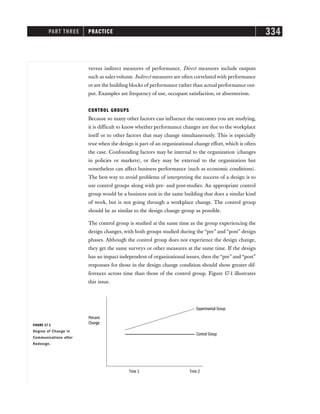
and the fee acceptable, there will be no confrontation. But if there are issues
to be addressed, designers have an opportunity to use the negotiation as a
forum to communicate the project process. An experienced client already
knows that the project process is not a straight path, but the inexperienced
client needs to be educated about potential risks in the process. Most own-
ers expect designers to approach negotiations with the same level of pro-
fessionalism and analysis that they will exhibit on their project. Like the
presentation, the negotiation is another demonstration of how the design
professional will work. The designer’s goal in negotiations is mutual under-
standing and an equitable agreement. To get there, designers should priori-
tize issues and get help when they need it, from their attorney or their
insurance carrier.
FORMALIZING THE AGREEMENT
Oncesignedanddated
Once signed and dated, the proposal may serve as the agreement, often aug-
mented with additional terms. It may serve as the basis for a formal agree-
ment, customized by the firm, by the client, or as offered by a professional
organization. The American Institute of Architects’ B-141 form can be used
for interiors as well as architecture, and AIA B-171 is written specifically for
interiors projects. Whatever the form, it formalizes the project terms and the
relationship. It should be a celebratory occasion, launching a new collabo-
ration or continuing an existing one. Design professionals are advised to
take the time to acknowledge it with their clients, as a key step in building a
solid platform for the creative process.
PART FOUR PROCESS 510
Bibliography
Coxe, Weld. Marketing Architectural and Engineering Services. New York:
Van Nostrand Rheinhold Company, 1983.
Coxe, Weld, Nina F. Hartung, Hugh Hochberg, Brian J. Lewis, David H.
Maister, Robert F. Mattox, and Peter A. Piven. Success Strategies for Design
Professionals. New York: R. R. Donnelly and Sons, 1987
Quebe, Lisbeth. The Marketing Budget. SMPS Core Series of Marketing
Information Reports, 1992.
Society for Marketing Professional Services. Marketing Handbook for the
Design and Construction Professional. BNi Publications, Inc., 2000.
Spaulding, Margaret, and William D’Elia. Advanced Marketing Techniques
for Architectural and Engineering Firms. New York: McGraw-Hill, 1989.
CHAPTER 23 POSITIONING: SEEKING AND SECURING WORK 511
512
CHAPTER

Predesign
Services
SHARON TURNER
Copyright 2002 by the McGraw-Hill Companies, Inc. Click here for terms of use.
TThe value of predesign services should not be underestimated—this is
where a project begins its life, and a good start sets the standard for the
quality of service and delivery for the project as a whole. Put simply,
whatever the extent of the commission, this is where the goals of the
project are clearly identified and understood by the project team.
Predesign involves primarily establishing the necessary information to
design and administer the project and determines how the design firm will
relate professionally to the client and the wider project team. The opportu-
nity for developing trust and strong collaborative working relationships in
this phase will go a long way toward achieving a successful outcome for the
overall commission.
PREDESIGN PROJECT METHODOLOGIES
Broadlyspeaking
Broadly speaking, interior design firms are involved in predesign services in
three ways. The first is the project initiation phase of a standard interior
design commission, when the space to be designed has already been identi-
fied and the scope of work has been predetermined by the client. The sec-
ond is when the design firm is part of a wider project team charged with
identifying space requirements and assisting in the selection of the most suit-
able space or building, or evaluating the extent of work required in an exist-
ing building or property portfolio. This is also known as prelease service.
The third is when a client organization is undergoing some form of major
change, e.g., corporate relocation, merger, acquisition, or a radical rethink-
ing of workplace needs and so employs a design firm in a consulting role for
the change process.
Typically, these three types of commission take one of three approaches: a
conventional project initiation approach, a pre-release team approach, or a
consulting approach.
CHAPTER 24 PREDESIGN SERVICES 513
The Conventional Approach—Project Initiation
In this scenario the project is typically in an existing space already under the
control of the client, or the space has been negotiated for prior to the appoint-
ment of the interior design firm. Predesign services in this scenario usually
involve no more than initial meetings with the client team to establish the
project reporting and administration structure and to set the work plan and
schedule for the future phases. This is typically undertaken by either the
principal-in-charge of the project or the project manager of the design firm.
In addition, from the client side, attendance should include the client or
client representative, a client information technology representative or con-
sultant, and from the consultant side the mechanical, electrical, or plumbing
(MEP) engineer where applicable.
From the interior designers perspective, a typical project initiation meeting
should cover the following topics:
• Project and team organization structure
• Reporting and approval procedures
• Budget and cost-control procedures
• Identification of project or building constraints
• Client corporate guidelines, space standards, and business plan
documentation
• Headcount, organization structure, adjacency requirements
• Summary of existing client programming data
• Identification of programming methodologies and components
• Distribution of “as built” drawings, computer disks
• Identification of field survey requirements
• Development of the work plan and schedule
• Review of fee invoicing and payment procedures
A word of caution, however: when the interior designer has come late to the
table there have been many instances of clients underestimating their space
requirements, particularly as headcount growth is so difficult for many organ-
PART FOUR PROCESS 514
izations to predict. I remember a case in point where a client and his broker
had been searching and negotiating for a 75,000-ft2
space requirement for four
months. Three buildings had been short-listed prior to the appointment of the
interior design firm, which subsequently discovered that the real space
requirement was 110,000 ft2
. A sobering thought economically and potentially
disastrous in a tight property market.
These initial meetings are then followed by the detailed programming phase
and the project proceeds in a traditional phased way. Fees for the project ini-
tiation phase usually form part of the overall interior design fee for the proj-
ect, which is most commonly stated as dollars per square foot.
The Prelease Team Approach
The recession of the early 1990s resulted in clients taking a very cautious
approach to acquiring real estate and looking for bettervalue for money in the
buildings they occupied. As a result, both end-user clients and the brokerage
community are now retaining the services of interior design firms earlier in
the project process than in the past. This type of predesign service is more
common to larger commissions involving corporate relocations and consoli-
dations. However, recently the dot.coms and new media firms are also using
interior designers in prelease building evaluation and negotiations, as they
are having to move quickly in a tight real estate market. A standard prelease
team consists of the client representative, the real estate advisor or broker,
legal representation, the architect/designer, and engineers (as necessary).
Many large occupiers are finding that the large blocks of space they require
are not readily available for lease in most locations, and given the tight
restrictions being placed on obtaining finances by lending institutions, more
developers are replacing speculative office developments with design-to-suit
projects or pre-let projects. Developers are seeking large corporate users to
come into their projects as the major tenant and quite often to take an equity
position in the project. Several developers since the recession have become
development managers for large corporate clients who own land and want
to develop buildings to suit their requirements. This is a return to the strong
commercial markets in many of our city centers during the 1960s and 1970s,
which were responsible for the formation of city business districts in the
United States. This has also been the case in Europe more recently, e.g., La
Defense in Paris, Frankfurt, and Canary Wharf in London, to name a few.
CHAPTER 24 PREDESIGN SERVICES 515
In this scenario the interior designer, as a part of the wider professional
team, establishes the clients’ “big picture” space requirements in the form of
a strategic program and develops the ideal building footprint arrangement.
With the assistance of professional engineers, the interior design “pro forma”
for a new location/building and the infrastructure needed to support the
environment is established. Once signed off by the clients’ senior manage-
ment, the “pro forma” is used to begin the property search.
In the case of a build-to-suit requirement, the information will be used to
solicit responses for developer’s proposals.
This very often results in suggested modifications to the base building design
offer, to better suit the client’s needs and assists the team in making its final
recommendations.
A typical site/developer appraisal checklist would include:
• Location, access, and transportation links
• Size, massing, and core provision
• Planning authority consent status
• Ownership scenarios (freehold site purchase/developer leaseback)
• Construction challenges
• Costs (property, relocation, business, and construction)
• Building footprint and loss factor efficiency checks
• Stacking diagrams and test fits
• Rating how well the building meets the ideal space strategy
The truevalue to the client of this type of collaborative predesign service is the
development of a clear space strategy and the criteria for a space search, analy-
sis of short-listed sites or buildings, and professional advice in supporting
negotiations and decision making. The value to the interior design firm is that
this type of commission, when executed properly, often leads to a full-service
interior design commission following the leasing or building acquisition.
Because the time span of this sort of commission can often be a year from the
start of the process to making a final decision on a building, this predesign
PART FOUR PROCESS 516
service is offered as a stand-alone commission based on either a fixed or not-
to-exceed fee.
The Consulting Role
The third type of predesign service involves understanding how design and
environment can affect the alignment of business goals, corporate culture,
and real estate needs. It rarely takes the form of a traditional design project
in a predetermined location. These projects are more likely to be predesign
feasibility studies involving the recommendation of future space strategies,
relocation scenarios, or exploration of alternatives with a view to imple-
menting major space use changes in a client organization.
Existing real estate portfolio consolidations consist of reviewing and ana-
lyzing existing conditions, space efficiency, and effectiveness. The analysis
would attempt to answer the questions of what is working, what isn’t, and
why not?
The review of existing conditions, especially environmental conditions,
requires measuring existing performance against preset guidelines or “best
practice” criteria. Obtaining these data requires the services of engineers;
almost always MEP and fire protection (FP) and sometimes structural. The
data are presented in report format, with recommendations for upgrades,
costing information, and implementation logistics.
This type of due-diligence study is best reported in the form of a spread-
sheet, so that comparisons between building and/or locations can be easily
understood. The report would also contain “big picture” stacking scenarios
and test fits of typical building floors to establish efficiency and loss factors.
For an example of a building evaluation checklist, see Figure 24-1.
Predesign feasibility studies are projects that exist outside a “live” interior
design project and involve the design firm providing knowledge-based
advice to set new goals/guidelines for workplace design and occupancy tar-
gets. These projects are nearly always driven by the need to occupy less
space, use existing space more efficiently, or provide a better-quality envi-
ronment for staff and customers.
These projects are invariably for large-scale corporate clients. Virtually all
large relocation projects involve a predesign feasibility study prior to the real
estate decisions being made or the appointment of the interior designer to
CHAPTER 24 PREDESIGN SERVICES 517
PART FOUR PROCESS 518
QUALITATIVE SCORING MATRIX
After reviewing the shortlisted properties, each criteria has been scored on a scale of 1–3
(3-Meets the Requirement, 1-Does Not Meet Requirement).
SHORTLISTED PROPERTIES BUILDING NO. 1 BUILDING NO. 2
Element Weighting Criteria 0.00% Score 0.00% Score
1 LOCATION 20% Within designated area of search
Road Access
Access to Public Transport
Access to Airport
Proximity to Customers
Proximity to Competitors
Proximity to Major Highways
Proximity to Local Amenities
Average Score
Average Score × Weighting (%)
2 BUILDING 10% Image
Surrounding Areas
Self Contained Building
Signage/Prominence
Expansion Option
Average Score
Average Score × Weighting (%)
3 BUILDING AMENITIES/ 5% Reception Space
SERVICES
24 Hour Access
Building Security
Age of Plant
Uninterrupted Power Supply (UPS)
Average Score
Average Score × Weighting (%)
4 AVAILABLE SPACE 15% Configuration
Flexibility
Independent Access
Floor Plate Size
Efficiency Factor
Existing Condition
Average Score
Average Score × Weighting (%)
FIGURE 24-1
Building Evaluation Checklist.
CHAPTER 24 PREDESIGN SERVICES 519
SHORTLISTED PROPERTIES BUILDING NO. 1 BUILDING NO. 2
Element Weighting Criteria 0.00% Score 0.00% Score
5 SPECIFICATION 15% Air Conditioning
Suspended Ceilings
Raised Floors
Core Configuration
Elevators
Average Score
Average Score × Weighting (%)
6 PARKING 5% Designated Parking
Free Parking Closeby
Average Score
Average Score × Weighting (%)
7 LEASE TERMS 5% Length of Lease Commitment
Break Clause
Expansion Option
Average Score
Average Score × Weighting (%)
8 TIMING 10% Optional date for relocation
Deadline date for relocation
Average Score
Average Score × Weighting (%)
9 LANDLORD 15% Significant contribution to fit out
CONTRIBUTION
Average Score
Average Score × Weighting (%)
AVERAGE RATING
TOTAL RATING/100% 100%
design a given space. These studies are usually carried out with the client’s
facilities management team, the interior design consulting team, and fre-
quently with the input of business or management consultants who report
on improving business processes and operational criteria. Many large cor-
porate clients are amending their design services criteria to exclude those
design firms that cannot offer this type of consulting service.
The fees for these projects are usually on a fixed-fee or not-to-exceed basis.
WHO IS INVOLVED WITH THE PROCESS?
Allthreetypes
All three types of predesign services are influenced by the tangible project
parameters of schedule and budget, with key issues such as “We will pay
double rent if we are not relocated by _______________. “There can be no
down-time for our operation.” These can be understood and planned for by
the project team.
Less tangible, yet critical to success, is the definition and understanding of
what the true goals and objectives of the project are, and—importantly—what
the measures of success are for the project in the eyes of the board and/or
the employees. The design professional needs to understand how the client
views the situation—the history, the boardroom politics, the perception of
themselves in their marketplace, and the degree of potential change to be
planned for from the outset.
The predesign phase reports and recommendations must come to clear and
impartial conclusions to be credible with the direct client and senior man-
agement, and to be responsive to the needs of the business. The method-
ology for gathering this information, the analysis, and presentation of
recommendations is extremely important to establish early on the points of
consensus on what the project is about. Quite a tall order for an outsider to
come in to a client organization and accomplish. But it is exactly the reason
why the design professional can see, without bias, the issues surrounding the
client’s existing situation and/or proposed project. Because we are not from
“in-house,” our opinions are often more readily accepted as being impartial
and therefore more credible.
PART FOUR PROCESS 520
ESTABLISHING A PROJECT STRATEGY
DEVELOPMENT TEAM
Inthesecondandthirdtypes
In the second and third types of predesign services the interior designer
forms part of a wider strategy development team. Ideally this should consist
of the client’s corporate real estate team, facilities management, information
technology, human resources, and the interior designer, with input from
engineers, a real estate professional, and other consultants on an as-needed
basis. The strategy development process involves the following:
• Hold strategic planning sessions with the business heads.
• Determine the business objectives and change/flexibility targets.
• Ask “Where are the opportunities for change in the corporate culture
or process?”
• Keep space programming macro; detail is not required at this stage—
think big picture.
• Question the real need for physical proximity between people/
departments/business units.
• Establish the information technology and services infrastructure
requirements at the earliest opportunity.
• Establish the level of amenities to be provided.
• Establish existing conditions if appropriate.
• Establish the real drivers behind the project.
Even if the client has chosen to outsource the management of the project to
a client representative or project management consultant, it is critical that a
strategy development team be set up in this manner. Building credibility with
the direct client and senior management is key to a successful project.
The finalized strategic program or real estate strategy report is signed off by
the client and the information forms the yardstick to highlight the challenges
of the project and sets out the criteria to measure the suitability of various
occupancy scenarios and locations that may be considered.
CHAPTER 24 PREDESIGN SERVICES 521
This collaboration ...
very often leads
to an advantageous
negotiating position
forthe client if the
building is spatially
inefficient, loss factors
are exceptionally
high, orspecifications
fall below those
“reasonably”expected.
PART FOUR PROCESS 522
THE ROLE OF THE REAL ESTATE PROFESSIONAL
Armedwiththeclient’s
Armed with the client’s building criteria or space strategy report, the real
estate professional, who is representing the client, finds and screens prospec-
tive locations/buildings that meet the client’s criteria. He or she will liaise
with the strategy development team to provide the interior designer with
base building information, floor plans, and services provision information.
However, being primarily financially driven, he or she brings to the team the
market knowledge and negotiating skills to obtain for the client the best lease
terms, landlord contributions and incentives, building management, and
services provision. We, as the design professionals, are expert witnesses to
what is on offer in terms of existing conditions, upgrade requirements, and
compliance of the building with the client’s pro forma. This collaboration
between interior designer and real estate professional very often leads to an
advantageous negotiating position for the client if the building is spatially
inefficient, loss factors are exceptionally high, or specifications fall below
those “reasonably” expected.
WORKING WITH OTHER CONSULTANTS
Formostpredesign
For most predesign phases or projects, the primary consultants in addition
to the interior design firm are the MEP and FP engineers and the structural
engineer, who, depending on the requirements of the project, needs to con-
firm structural loading and provide supplemental design. As a result, the
structural engineers play a smaller role than the mechanical engineers.
It is this group of three consultants who provide the primary professional
licensed service to the client. They take the legal responsibility for their por-
tions of a project and are held accountable by the state that granted them a
license to practice. Quite often, code consultants help expedite the filing of
the documents with statutory authorities having jurisdiction over the project
while providing expert advice on the design’s compliance with city, state, and
federal codes.
CHAPTER 24 PREDESIGN SERVICES 523
Whether the client contracts directly with these consultants or they are con-
tracted through the interior design firm on behalf of the client, these con-
sultants should follow the directions of the interior design firm regarding
meeting deadlines and coordinating their work.
When specialized interior projects, such as trading floors, present them-
selves, it is prudent to have the MEP and FP consultants contract directly
with the client. As a user group, traders have a heavy reliance on the mechan-
ical systems’ design to support the trading floor environment and operations,
provide redundancy backup in case of failure, and to build in operational
security within the space. Because of these sensitivities, the project is better
served if the client has direct control of these services. This is also true in
the case of retaining information technology (IT) consultants for all types of
clients, not just for heavy IT users such as traders.
If the predesign commission includes a search for new buildings or locations,
the engineer provides a scope of services similar to the interior designer’s. In
most cases this can be summarized as a due-diligence study to investigate
whether enough capacity exists in the base building systems to meet the
client’s systems needs. If the services provision falls short, the engineers need
to quantify that shortfall. At a later stage this can support the client’s lease
negotiations with the building owner.
In a tight property market the client’s real estate consultant needs a quick
turnaround on confirming the viability of potential locations from both the
designer and engineers. The interior design firm needs to respond quickly
in providing empirical information that leads to an informed decision about
why the prospective location is or is not viable. The key to this process is
making an informed decision. To make this process credible, the bases by
which one judges a candidate location must be consistently applied by using
an “ideal” benchmark. These benchmarks are determined by designer and
engineer in the project initiation phase at the outset of the commission.
In projects where the client is considering an equity stake in a building, the
number of consultants needs to be expanded to include waterproofing, verti-
cal transportation, structural, curtain wall, and other specialty consultants to
ensure that the building complies to the specifications and drawings prepared
by the owner’s consultants. For projects of this nature it is common for a
construction manager to be retained by the client to consult on the owner’s
contractors means, methods, logistics, and costs. If the client’s design team
PART FOUR PROCESS 524
requires building modifications, they need to be properly priced as additions
and deductions by the owner for charge-back to the client.
Where any type of property search is involved, the client should have a pro-
fessional real estate advisor involved as well as legal counsel. With today’s
reliance on IT, the client’s communications and IT advisors (in-house, out-
side, or both) should be involved in the project from the beginning. How
those are managed vary from being completely in-house to completely out-
sourced, depending on the client’s organization and the size of the project.
As you can see, these teams can become quite large. How they are organ-
ized, the reporting structure, and approval processes differ greatly among dif-
ferent clients. The Internet and project management software enables us all
to communicate more efficiently and deliver information that is readily
accessible to all parties.
Regardless of which of the three typical predesign services one may be per-
forming, the common thread through them all is to gather enough informa-
tion at an early stage to truly understand the challenges of the project. This,
in turn, will result in a more informed design process and better design solu-
tions in later phases.
Bibliography
Duffy, Francis. The New Office. London: Conran Octopus Limited, 1997.
Hammer, Michael, and James Champy. Re-engineering the Corporation. New
York: HarperCollins Publishers, 1993.
Myerson, Jeremy, and Philip Ross. The Creative Office. Corte Madre, CA:
Ginko Press Inc., 1999.
Riewoldt, Otto. Intelligent Spaces. London: Calmann  King Ltd., 1997.
CHAPTER 24 PREDESIGN SERVICES 525
526
CHAPTER

Programming
forChange
PAMELA ANDERSON-BRULÉ, AIA
Copyright 2002 by the McGraw-Hill Companies, Inc. Click here for terms of use.
AAt the commencement of any project, when the designer begins the
process of discovery into a client’s needs, wants, and desires, one thing
is surely present no matter what the project or client type, and that is
change. Whether it is a residential client in search of a home, a corpo-
ration in search of a headquarters, a government agency in search of a
public facility, a new project or a remodel, there will be change.
Change is a powerful occurrence that has notable effects on humans whose
lives are wrapped around its events. Change brings with it every spectrum
of emotion, from excitement and expectation to fear and apprehension. It is
in the presence of the unknown that these emotions can often be magnified
and affect the quality of communication and understanding that needs to be
present to design a project successfully.
In order to begin to discover the effects of change on the client and therefore
on the client’s future needs, one must consider the effects of change on the
client’s entire system. If you are designing for a family, the effects of change
will be different for the husband than for the wife or the children. In corpo-
rate work, what works well for the finance department might cause conflict
with the human resources department. Therefore, we must look at our clients
as a whole system and we must also understand their parts, their structures,
and their strategic objectives, if we are to assist our clients in making suc-
cessful decisions about their future.
Programming in a broad sense is the process, methodology, and tool used
in the discovery and/or creation of the unknown and the known. Depending
on the complexity of the problem, the magnitude of change, and the emo-
tional and factual understanding of the client for its own future desired state,
it can be simple and straightforward, or extremely elaborate, with a multi-
tude of interrelated or interconnected parts.
“Traditional” programming records a description of space needs and docu-
ments the elements within a project that are necessary to meet the client’s
requirements. The process used to establish this document is typically an
interview, or perhaps a questionnaire, between the client and the designer
recording the client’s responses. The client is then asked to review the infor-
CHAPTER 25 PROGRAMMING FOR CHANGE 527
mation and confirm the content of the program, which then becomes the
guide and checklist for the designer.
This traditional method assumes that clients are capable of understanding
their own circumstances, analyzing their effects, replanning and reorganizing
for their future, and then clearly communicating this to the designer in terms
of building needs. It also assumes that the clients’ representatives have a
thorough understanding of their entire system and the complexity of their
own cultural, technical, financial, and organizational needs. In most cases,
certainly, clients do not even completely understand their own current state
and are often responding to their existing physical space or cultural arche-
types in a way that may no longer be valid.
How, then, do you begin to build common understanding of the “change”
that will occur, and how do you assist your clients through the process of dis-
covering the unknowns?
PROCESS AND METHODOLOGY
Youmustbegin
Process Design and Development
You must begin with a planned process, which is designed around the end
results that you and your client seek. Similar to the way you would design a
project, you must start with a conceptual idea of the process, you must
explore areas for analysis, and you must determine what level of effort and
cost the client is willing to invest in development. Once these concepts are
outlined and agreed upon, a game plan, with agendas, must be created,
which will guide you through the process. It must be facilitated in a way that
allows for open exploration, honest feedback, and well thought out direction.
The process must address the emotional, cultural, and operational and/or
functional needs of the client. It must include the analysis of existing condi-
tions as well as the projection of the client’s future needs, which will support
the client’s strategic objectives.
It is important to understand that the discussions need to be highly interac-
tive, participatory, and open to questioning by all. In Excellence by Design:
Transforming Workplace and Work Practice, by Turid Horgen, Michael Joroff,
PART FOUR PROCESS 528
William Porter, and Donald Schön in association with the Space and Orga-
nization Research Group (SPORG) of the Massachusetts Institute of Tech-
nology’s School of Architecture (John Wiley  Sons, New York, 1998), there
is a discussion of “process architecture.” The book describes the necessary
steps to providing process leadership to accomplish the goals of transform-
ing a workplace. “Process architecture requires openness to creative tension
between the user and practitioners. This approach is much more demanding
than traditional programming. . . . Process architecture demands a tolerance
or zeal for open-endedness and persistent uncertainty. For the process archi-
tect, the design is never entirely complete . . . However, one characteristic of
the design process is that one rips apart what has been, looks at it with dif-
ferent eyes, and puts it together in a way it has not been put together before.”
A variety of facilitation methods can be used in an interactive manner for
information gathering. They include one-on-one interviews, focus groups
(structured discussions,with preselected participants, internal and external to
the organization), open forums, workshops (internally focused working ses-
sions), and benchmarking (guided tours, of similar or relative projects, with
focused discussions). It can also be appropriate to use questionnaires, sur-
veys, etc., to gather information that can provide valuable data to the project,
where an inclusive process does not affect the outcome of the information.
The concept of facilitating a process, rather than just doing one, is funda-
mental to reaching a superior level of service to clients. It is as important
that the building be ready for an organization as it is that an organization be
ready for the building. Facilitating clients through this interactive process can
often be the catalyst for change to begin and to continue even after they
occupy their space.
As an example, for the San José Martin Luther King Jr. Library, a large joint
use facility was envisioned, where city and state university libraries would be
integrated into a single facility. The vision was to create seamless service, a
united culture, and a project unique in the nation, between two distinctly
different organizations. A facilitated process allowed for the discovery and
acknowledgement of complexity and initiated the necessary steps to cultural
and operational development, years before the completion of the facility. In
this way the architecture of the organization was developed in unison with
the architecture of the facility, and alignment was reached between the orga-
nizational objectives and the vision.
CHAPTER 25 PROGRAMMING FOR CHANGE 529
Systems Analysis
To begin to truly understand your clients’ needs, you must understand their
current state or system. In order to accomplish this, you must go through a
discovery process, which will allow you to gain enough insight about them
to record their current state. This is typically done through an interactive
process, involving enough of the individuals within the organization who
have accurate data and information.
One example of this might be the programming of a public health clinic. If
you were to interview the administrative staff and ask them to map out their
current work process,you would probably get a completely different outcome
than if you asked the same task of the nurses, and you would get yet another
if you asked the doctors. The reason is that each of the participants sees the
system from a different perspective and in fact does not understand exactly
what actually happens. Through this example, we can see why it is so impor-
tant to use “cross-functional” teams of individuals when you are working
with organizational complexity.
It is also important to talk to each of the department or groups individually,
so that you can understand their individual perspectives and needs, in iso-
lation from the whole; otherwise, you may easily miss an important issue.
Even in the case of residential design, if you discuss the client’s needs with
only the couple, you may never discover an unspoken but truly important
need of one of the individuals.
Also, through the interactive process of defining the existing conditions, one
needs to record what works and what does not workwithin the system. Often,
in a designer’s excitement to create a new space, things that worked quite
well, and are truly important to the client, can be lost and are not missed until
the project is complete. By asking questions about what works and why, the
designer can gain a deeper level of insight into a variety of conditions in
the client’s organization. This will make the designer more astute when the
program is finally complete and as the design is being developed.
Work/Life Flow Analysis
Work flow analysis or life flow analysis (for residential projects) is one tool
which helps record the day-to-day reality of an organization or group. Every
aspect of the organization or group must be discussed as you walk through
PART FOUR PROCESS 530
a typical day, week, month, and year. It is important to capture physical, cul-
tural, emotional, financial, technological, and organizational needs that are
attributed to the way one leads one’s life and work.
If any one of these aspects is forgotten, the user and the designer will not be
fully aware of how change might affect them and will be unable to plan a
design that will support them fully. As our lives become more complicated,
as change becomes a constant, and as time becomes more demanding, the
way we work, live, share knowledge, and survive will become more depend-
ent on the quality of the spaces in which we live. The ability of the design
space to nurture our personal and professional needs will better serve our
personal responsiblities both within organizations and society as a whole.
External Factors and Drivers
Once this information is captured, the discussions should expand to exter-
nal factors that will drive the system. Something as mundane as how the
garbage is stored and collected, how supplies are delivered, how the children
enter the house on a rainy day, can often lead to process discoveries that have
real and serious design implications.
Logistical Issues
Another level of analysis that should be performed is the review of logistic
issues that will affect the project and the client in the process of completing
design and construction. Does the project need to be phased? Will your
client occupy the space during a remodel? How will move coordination be
handled? What contingencies need to be included in the schedule? All these
may seem to be construction-related questions, but in fact they may lead to
the discovery of elements that will need to be considered in the program,
design, and certainly in the project planning from the very beginning of
the project.
Conclusion for Systems Analysis
The concept of doing a full investigation into all of the matters that might
affect your client in the process of change leads to the discovery of the
unknowns and allows for you to work collaboratively with your client to
CHAPTER 25 PROGRAMMING FOR CHANGE 531
In the current state
of the world of
acquisitions, mergers,
blended families,
joint-use projects, etc.,
there is a real need for
the development and
understanding of
a client’s culture if a
designer is going to
have an appropriate
level of insight . . .
PART FOUR PROCESS 532
design the next steps. It should be noted that one should never be married
to the end result while proceeding through this process. The real solution to
the need for change may in fact not be in a built project, but in organizational
change. It is not until we have gone through these interactions with our
clients that we can build a new system for them that will support them in the
future in every aspect of organizational success. Inevitably, the journey that
you will go on with your client through this discovery process will be in and
of itself more valuable, to them and to you, than simply the end result. As
important as it is to plan out the process, it is equally important to continu-
ally monitor your progress and to be completely open to redesigning the
process when the need arises.
CULTURAL DEVELOPMENT
Inthecurrentstate
In the current state of the world of acquisitions, mergers, blended families,
joint-use projects, etc., there is a real need for the development and under-
standing of a client’s culture if a designer is going to have an appropriate
level of insight to design the project. Even when working for existing com-
panies, organizations, agencies, and individuals, there is often a “cultural
void” in their own understanding of themselves. If there is not alignment on
this level, the project is at constant risk of inherent conflicts that can develop
from the individual whims of participants.
It is important to make sure that there is the right level of participation in a
project by key decision makers. A core team of key representatives and
stakeholders who will validate the proposed plan and provide direction and
leadership throughout the process should be selected at the very beginning
of the project. If an organizational vision exists, it must be reviewed and val-
idated, and if it does not, it must be built. The core values of the client must
be articulated and aligned with the stated vision. This provides the frame-
work for decision making and should be constantly present as programming
decisions are reached. The success of the programming effort can then be
measured by the degree to which the program supports the organization’s
core values, vision, and objectives.
CHAPTER 25 PROGRAMMING FOR CHANGE 533
Ideally, development of the client’s new system will include the“right people,”
at a deep organizational level, at the right times. However, not everyone in
an organization will have been involved, and communication is necessary to
ensure that nonparticipants will accept and support the proposed changes
in their environment. A plan can be developed that will address the needs
of the whole organization as it moves toward implementation, and might
include ongoing communication, an input and feedback loop, and individual
and team training where needed to prepare for future operations.
THE SPACE PROGRAM
Thespaceprogramdocument
The space program document can reflect both the programming process and
its outcome. Elements of a comprehensive space program for a complex
organization might include all of the following components, whereas a resi-
dential space program might contain only a few of them in a reduced format.
1. Introduction. Description of how information is organized within the doc-
ument, a glossary or definition of terms, general assumptions, etc.
2. Organizational vision, core values, and strategic objectives. Vision
statement, core values, and objectives which provided the framework for
the decisions that led to the space program and should guide the designer
throughout the project. For a residential project this might be a written
“dream” of their future home by the clients.
3. Process and methodology. A summary of the process and its participants.
Future users of the document will gain an understanding of how and why
decisions were made.
4. Operational plan. Documentation of future operational and functional
scenario(s), developed through systems analysis, which form the basis for the
space requirements. An operational plan could also include an implementa-
tion strategy (the necessary steps to achieve the future scenario), and address
resource allocation (budgeted time and expense for staff, consultants, and
any other necessary resources to implement the operational plan).
PART FOUR PROCESS 534
5. Critica-issues list. A description of any issues or elements that are critical
to the success of the project, or that must be addressed or resolved in design.
6. Space program.
a. Space allocation standards: Where appropriate, standards for space allo-
cation can be developed based on functional requirements, hierarchy,
etc. Especially in large facilities, standardization of the size and technical
requirements of conference rooms, workspaces, etc., facilitates the creation
of modular spaces that support future reconfiguration or alternative use.
b. Qualitative spatial requirements: A narrative that describes the vision for
the quality of the space, which can include “how the space should look
or feel.”
c. Building standard assumptions:
i. Technical standards: Includes structural, mechanical, electrical, tech-
nology, lighting, plumbing, security, communications, audiovisual,
and acoustical requirements.
ii. Departmental grossing factors: A factor applied to the net square
footage of each department that accommodates interdepartmental cir-
culation, etc., and creates the total departmental gross square footage.
iii. Building grossing factors: A factor applied to the sum of the depart-
mental gross square footage that accommodates building systems,
building circulation (department to department and vertical, where
applicable), wall thickness, etc.
d. Quantitative spatial requirements:
i. Quantity, square footage allocation, and function for each type of
space: For each type of space, the total quantity, net square footage,
functional and use comments, and staff projections.
ii. Space data sheets for each type of space:
1. Technical and building systems requirements that reflect condi-
tions atypical to building standards
2. Projected furniture, fixtures, and equipment
e. Space layout diagrams: Typical conceptual space diagrams, e.g., confer-
ence rooms, training rooms, workspaces, standard office layout, etc.
f. Functional adjacencies: Describes the primary, secondary, and tertiary
adjacency requirements of individual spaces in relation to other spaces.
CHAPTER 25 PROGRAMMING FOR CHANGE 535
g. Functional stacking diagrams: Describes the adjacency requirements of
individual departments or subdepartments in relation to other depart-
ments, both horizontally and vertically (multiple floors).
h. Site development criteria: Site requirements developed through the sys-
tems analysis, such as accessibility, parking and transportation, and ameni-
ties such as proximity to other services, etc.
7. Appendix.
a. Meeting memoranda
b. Participant listing
TOOLS
Thelevelofinformation
The level of information collection that has been outlined can be over-
whelming. Yet, if any of the details are forgotten, the outcome can be a missed
detail, an inaccurate assumption, a design with flaws, and an unsatisfactory
end result. If we accept “that the quality of the project is equal to the quality
of the process,” and that information management is the key to meeting the
functional as well as quality goals of the project, then we must find a way to
collect, record, change, track, measure, and learn from information.
The current means available to accomplish this effectively are through a rela-
tional database. Development of a relational database, which is designed to
support the process and includes the specific types of information required,
acts as both a repository and checklist for information. When a database is
used, it can be designed and programmed to capture specific information, as
well as allow change tracking and program reconciliation to development of
the design. The most important aspect of inputting information in a data-
base is to ensure that its integrity is maintained over the life of the project.
Program reconciliation is accomplished by comparing design documentation
at periodic intervals (i.e., 50 percent design development, 100 percent con-
struction documents, etc.) to the initial space program. Tracking the initia-
tion and approval of changes to the space program, as reflected in the actual
design, are necessary to ensure that the original goals are eventually met at
completion of the project, or are revised to accommodate the change.
PART FOUR PROCESS 536
CONCLUSION
Programmingisreally
Programming is really the art of knowledge management, which is constantly
changing and expanding along with our ability to manage information. We
need to creatively collect, record, and manage this information if we are to
accomplish the act and art of design. Innovative design must be fundamen-
tally functional and in alignment with the vision, goals, and objectives of our
clients and their organizations. In essence, it must not only align to their
strategic needs, but also to their cultural and even emotional needs. We can
never reach this objective if we are not willing to expand our thinking, invest
in our tools, and train ourselves in the art of facilitating the design process.
We must be willing to involve ourselves at an emotional level if we are going
to achieve meeting the emotional needs of our clients through design.
Bibliography
Fox, Matthew. The Reinvention of Work. San Francisco: Harper, 1995.
Churn in the Workplace. Zeeland: Herman Miller, 2001.
Collaborative Settings Fostering Teamwork in the Workplace. Zeeland: Her-
man Miller, 2001.
Horgen,Turid, Michael Joroff,William Porter, and Donald Schön. Excellence
by Design—Transforming Workplace and Work Practice. NewYork: John Wiley
 Sons, 1998.
Kelley, Tom, Jonathan Littman (Contributor), and Tom Peters. The Art of
Innovation: Lessons in Creativity from Ideo, America’s Leading Design Firm.
New York: Doubleday, 2001.
Propst, Robert. The Office: A Facility Based on Change. Seacaucus: Birch
Lane Press, 1986.
Reinventing the Corporation: Office Environments: The North American Per-
spective. Zeeland: Herman Miller, 2001.
Supporting Collaborative Work. Zeeland: Herman Miller, 2001.
CHAPTER 25 PROGRAMMING FOR CHANGE 537
538
CHAPTER

Programming:
Strategic
Planning
DEBRA LEHMAN-SMITH, IIDA
Copyright 2002 by the McGraw-Hill Companies, Inc. Click here for terms of use.
TThe client is the driving force behind every project. And, as everyone
already knows, every client has a distinctive set of corporate qualities
and project-specific criteria.Thus,it is of utmost importance that the first
step in the design process be to gain a thorough understanding of who
the client is and what they are all about. This information-gathering
phase has traditionally been known simply as the programming phase
of a project. Today, this phase needs to include not only program-
ming, but also client insight, workplace analysis, and test fits. Thus, the
phase is actually best titled “Strategic Planning.” The thoroughness of
strategic planning can mean the difference between the success and fail-
ure of the project.
The following sections describe the strategic planning components and the
significance of each, while periodically using AmSouth Bancorporation as a
case study. AmSouth Bancorporation is a financial institution located in the
southern United States. A few years ago, AmSouth decided to relocate their
offices from eight office buildings scattered throughout Birmingham, Ala-
bama, to one corporate headquarters. AmSouth had many of the typical
client goals and project issues and thus will serve as a good example as we
begin to understand the strategic planning phase.
CLIENT INSIGHT
Uniqueness.Thisiswhat
Uniqueness. This is what makes each of us individuals. It is essential to rec-
ognize this in our clients, as the best interior design comes from an in-depth
analysis and understanding of what makes a particular company and its
workforce unique. Understanding the company’s culture and business goals
and the workforce’s lifestyles provides direction for the architectural design.
CHAPTER 26 PROGRAMMING: STRATEGIC PLANNING 539
This is your chance to really get to know your client’s company, personality,
and working style. Since you will be working with this client for a number
of months oryears, it will help to establish positive relationships early. While
working on the AmSouth project, we quickly learned that the client’s repre-
sentatives were true Southerners. And, due to the fact that there was no local
metropolis offering a variety of cultural experiences near the project site, our
project team members began to acclimate themselves by allowing our hosts
to introduce us to a variety of Southern customs, including meals with fried
green tomatoes and grits. After spending a few months on the project, some
members of the team even began unconsciously to develop their own South-
ern drawls, thus further relating to the client. Through these bonding expe-
riences, we were able to gain a solid understanding of the personalities of
both workforce members and the corporate culture.
This insight into the client is best gained through a combination of your own
research about the company and its business industry combined with invalu-
able information learned during client insight meetings. These meetings
should review the client’s organization, corporate goals, and objectives for the
future. Some of the basic topics that should be discussed include the following:
Corporate business goals and objectives.
• The goals and objectives offer a look into the background of the company.
Often, this discussion is associated with a history lesson of who the company
is, where it began, and how it got to where it is today.
Corporate mission statement.
• The mission statement will give you insight into the culture and environment
of the company. This will aid in determining how best to approach the client
while discussing the project.
Project goals.
• The goals of the new office will vary from client to client. It will be impor-
tant to understand the specific goals and ensure that they are incorporated
into the workplace analysis. Some common goals include increased flexibil-
ity, cost effectiveness, sustainable design, employee attraction and retention,
and incorporation of better high-technology and data systems.
Management strategies.
• The strategies that a company uses to manage its workforce and company are
important to note. These will be the strategies that will be used once the new
PART FOUR PROCESS 540
office is designed, so they must be accommodated within the new design. If
the company is a law firm with a one-to-one attorney-to-legal assistant ratio,
it may be important to locate that legal assistant directly adjacent to the attor-
ney he or she is working with. However, if a pool of legal assistants works with
a number of attorneys, it may be more efficient to designate an area of an
office floor to locate all legal assistants together, so that they may better col-
laborate and save valuable office space at the same time.
Through discussions of these topics, valuable information can be learned
that will form a strong foundation of knowledge for the project. For exam-
ple, if the client states that one corporate goal is to become more efficient
and also increase the size of the corporation, it will be necessary to design a
flexible office that can accommodate future growth by potentially modifying
workstation sizes and/or adding workstations. Thus, this office would not be
designed with a large number of enclosed offices. On the contrary, the office
design concept should begin with a design structured around standardized,
movable office systems, which should be further analyzed during the work-
place analysis.
PROGRAMMING
Aftergaininganunderstanding
After gaining an understanding of a client’s organization, learning how an
organization works, communicates, develops, and processes information is
crucial in determining the most effective interior plan and design. Groups
within the company work, behave, and interact differently, based on their
responsibilities and individual needs.
A tour of the client’s existing facilities to gain a basic understanding of the
overall operations should occur early in the programming phase. Following
the tour of the facilities, the next step is to conduct a series of interviews.
The process for interviewing representatives for all the divisions of a corpo-
ration may take up to several months, but the wealth of data gathered makes
it worth the effort and is essential to the project. For the interviews, the client
should select the staff members they believe will be most insightful and
CHAPTER 26 PROGRAMMING: STRATEGIC PLANNING 541
knowledgeable about the company’s programming topics. Thus, it is often
helpful to give the client a list of potential interviewing questions or topics
a few weeks prior to the scheduled interviews to aid in their determina-
tion of the interviewees. The following list of topics should be discussed in
these meetings:
• Current and future staff projections
• Current and future departmental responsibilities, work processes,
and functional requirements
• Critical department adjacency requirements
• Individual personnel functional and adjacency requirements
• Specific and unique space needs requirements
• Support space requirements (workrooms, computer rooms, meeting
spaces, etc.)
• Office and workstation space standards
• Technology issues specific to department functions
• Base building requirements (structural, HVAC, plumbing, ceiling
height, etc.)
From this information and the information gained through the client insight
investigation discussed earlier, a program can be created to define the basic
physical requirements of the workplace. Now, the amenities and infrastruc-
ture of that workplace must be determined.
WORKPLACE ANALYSIS
Oncetheprogram
Once the program is complete, the interior project team assesses the further
workplace requirements for the project. Beyond the basic square-footage cal-
culations and numbers of workstations, chairs, files, and other office equip-
ment, workplace analysis topics must be incorporated to create a complete
project understanding. These topics, listed below, may have been conceptu-
PART FOUR PROCESS 542
ally introduced during the initial client insight process as vague concepts and
now become the evaluation criteria for the workplace analysis.
Flexibility.
• Determine how often a company shifts departments and/or changes teams,
and how simple this process needs to be. This can lead to discussions regard-
ing movable or fixed partitions and the cost impacts of flexibility.
Uniform office/workstation size.
• The amount of open versus closed office space and the sizes of offices and
workstations that are required to support various office functions must be
determined. A standard office/workstation size or a limited number of sizes
to delineate hierarchy in an office is an important factor in any project. These
workstations can be composed of various components, which can become a
“kit of parts” to aid in their flexibility, while keeping costs down and pro-
viding a module for spatial layouts. At AmSouth Bancorporation, six modu-
lar workstation configurations were created to be utilized by all company
employees. Since the completion of this project, the flexibility of these work-
stations has allowed for an incredible cost savings to AmSouth as they peri-
odically reconfigure their departments.
Technology.
• One of the most expensive investments for a corporation and one of the
largest components of the construction budget is technology. It is essential
that the amount of flexibility, redundancy requirements, needs for multisite
operations, reliability of the system, employee accessibility (home or office),
and the type of distribution (wireless or broadband) be taken into consid-
eration in evaluating the business strategy for integrating technology into
the facility.
Security.
• Visibility of security, how it is best integrated into the building management
systems and architecture, is part of the corporation philosophy regarding
security. The increased risk of violence in the workplace from employees or
the outside has changed how security is viewed.
Acoustics.
• There are fundamental conflicts between productivity and open office
designs which provide flexibility. Studies now define high-intensity and low-
intensity noise. These help affect decisions about building systems and prod-
ucts that can make open office space more productive.
CHAPTER 26 PROGRAMMING: STRATEGIC PLANNING 543
Uniqueness. This is
what makes each of us
individuals. It is
essential to recognize
this in our clients, as
the best interior
design comes from an
in-depth analysis and
understanding of what
makes a particular
company and its
workforce unique.
PART FOUR PROCESS 544
Shared conference facilities.
• The interior designer needs to fully understand how conference rooms are
used, what sizes are most functional, and who the users are. Once that is dis-
cerned, decisions can be made about whether there should be centralized or
decentralized conference rooms or a combination, what services need to be
adjacent, and if they are used by the public or not. The amount of real estate
required for departmentalized conferencing is greater than for a central con-
ference facility, but if departmentalized conference rooms are not of concern
to the corporate culture, the additional cost may be acceptable.
Support spaces.
• These are the spaces that are critical to the operation of the facility and can
consist of mailrooms, records storage, stockrooms, and catering kitchens.
Again, the amount of real estate dedicated to their use has a cost impact, but
their functionality is equally important. The company needs to assess where
these spaces should be located and consider alternative solutions such as off-
site storage or less costly basement or windowless space.
Communication areas.
•
Interior Handbook for interior designers.pdf

Interior Handbook for interior designers.pdf

  • 1.
    Interior Design Handbook of ProfessionalPractice McGraw-Hill Cindy Coleman, Editor-in-Chief www.sharexxx.net - free books & magazines
  • 2.
  • 3.
  • 4.
    CINDY COLEMAN, EDITOR-IN-CHIEF McGraw-Hill NewYork Chicago San Francisco Lisbon London Madrid Mexico City Milan New Delhi San Juan Seoul Singapore Sydney Toronto Handbook of Professional Practice
  • 5.
    Copyright © 2002by the McGraw-Hill Companies, Inc. All rights reserved. Manufactured in the United States of America. Except as permitted under the United States Copyright Act of 1976, no part of this publication may be reproduced or distributed in any form or by any means, or stored in a database or retrieval system, without the prior written permission of the publisher. 0-07-141603-X The material in this eBook also appears in the print version of this title: 0-07-136163-4. All trademarks are trademarks of their respective owners. Rather than put a trademark symbol after every occurrence of a trademarked name, we use names in an editorial fashion only, and to the benefit of the trademark owner, with no intention of infringement of the trademark. Where such designations appear in this book, they have been printed with initial caps. McGraw-Hill eBooks are available at special quantity discounts to use as premiums and sales promotions, or for use in corporate training programs. For more information, please contact George Hoare, Special Sales, at george_hoare@mcgraw-hill.com or (212) 904-4069. TERMS OF USE This is a copyrighted work and The McGraw-Hill Companies, Inc. (“McGraw-Hill”) and its licensors reserve all rights in and to the work. Use of this work is subject to these terms. Except as permitted under the Copyright Act of 1976 and the right to store and retrieve one copy of the work, you may not decom- pile, disassemble, reverse engineer, reproduce, modify, create derivative works based upon, transmit, distribute, disseminate, sell, publish or sublicense the work or any part of it without McGraw-Hill’s prior consent. You may use the work for your own noncommercial and personal use; any other use of the work is strictly prohibited. Your right to use the work may be terminated if you fail to comply with these terms. THE WORK IS PROVIDED “AS IS”. McGRAW-HILL AND ITS LICENSORS MAKE NO GUARANTEES OR WARRANTIES AS TO THE ACCURA- CY, ADEQUACY OR COMPLETENESS OF OR RESULTS TO BE OBTAINED FROM USING THE WORK, INCLUDING ANY INFORMATION THAT CAN BE ACCESSED THROUGH THE WORK VIA HYPERLINK OR OTHERWISE, AND EXPRESSLY DISCLAIM ANY WARRANTY, EXPRESS OR IMPLIED, INCLUDING BUT NOT LIMITED TO IMPLIED WARRANTIES OF MERCHANTABILITY OR FITNESS FOR A PARTICULAR PURPOSE. McGraw-Hill and its licensors do not warrant or guarantee that the functions contained in the work will meet your requirements or that its operation will be uninterrupted or error free. Neither McGraw-Hill nor its licensors shall be liable to you or anyone else for any inaccuracy, error or omission, regardless of cause, in the work or for any damages resulting therefrom. McGraw-Hill has no responsibility for the content of any information accessed through the work. Under no circumstances shall McGraw-Hill and/or its licensors be liable for any indirect, incidental, special, punitive, consequential or similar damages that result from the use of or inability to use the work, even if any of them has been advised of the possibility of such damages. This limitation of liability shall apply to any claim or cause whatsoever whether such claim or cause arises in contract, tort or otherwise. DOI: 10.1036/007141603X
  • 6.
    “The future belongsto those who believe in the beauty of their dreams.” –ELEANOR ROOSEVELT
  • 7.
     VIII PREFACE MarkStrauss, Publisher, Interior Design Magazine XII INTRODUCTION Cindy Coleman, Editor-in-Chief PART  BACKGROUND   4 GROWING A PROFESSION Edward C. Friedrichs, FAIA, FIIDA   26 HISTORY OF THE PROFESSION Cindy Coleman   48 INTELLIGENT INTERIORS William J. Mitchell   62 THE PROFESSIONAL ASSOCIATION James P. Cramer, Hon. AIA, Hon. IIDA   80 THE REGULATORY ORGANIZATION Beth Harmon-Vaughan, FIIDA   92 THE CULTURE OF DESIGN EDUCATION Linda and Mark Keane   126 OPPORTUNITY FOR CHANGE: DESIGN IN THE NEW ECONOMY Karen Stephenson, Ph.D. with Neil P. Frankel, FAIA, FIIDA PART  STRATEGY   144 HUMAN RESOURCES Paul Doherty, AIA   160 FINANCIAL MANAGEMENT Gary E. Wheeler, FASID, FIIDA, AIA   172 MARKETING: POSITION AND IDENTITY Lisbeth Quebe, FSMPS   190 TEAM DYNAMICS Jon R. Katzenbach, Traci A. Entel and Karen Mahony   216 VIRTUAL TEAMS Jessica Lipnack and Jeffrey Stamps, Ph.D.   226 INVESTMENT IN KNOWLEDGE Jan Johnson, IIDA   246 INFORMATION TECHNOLOGY William J. Mitchell PART  PRACTICE   266 STRATEGIC PRACTICES Dr. Francis Duffy, RIBA   284 SUSTAINABLE DESIGN William Odell, AIA   322 DESIGN RESEARCH AND METHODOLOGY Judith Heerwagen, Ph.D.   352 GLOBAL PRACTICE Dr. Francis Duffy, RIBA   366 SPECIALTY PRACTICES Cheryl Duvall, FIIDA   434 THE LEGAL ENVIRONMENT Barry B. LePatner, Esq. and David J. Pfeffer, Esq.   462 LEGISLATION Derrell Parker, IIDA F For more information aobut this book, click here. Copyright 2002 by the McGraw-Hill Companies, Inc. Click here for terms of use.
  • 8.
    PART  PROCESS  482 SCOPE OF SERVICE CHART Eva Maddox, FIIDA   492 POSITIONING: SEEKING AND SECURING WORK Lisbeth Quebe, FSMPS   512 PREDESIGN SERVICES Sharon Turner   526 PROGRAMMING FOR CHANGE Pamela Anderson-Brulé, AIA   538 PROGRAMMING: STRATEGIC PLANNING Debra Lehman-Smith, IIDA   550 PROGRAMMING: SHARED VISION Andre Staffelbach, FASID, FIIDA and Jo Heinz, FIIDA   560 SCHEMATIC DESIGN: COMMUNICATING THE DESIGN SPIRIT Orlando Diaz-Azcuy   568 SCHEMATIC DESIGN: LIMITLESS POSSIBILITY Michael Byun, Travis Clifton and David Grout   582 DESIGN DEVELOPMENT: DESIGNING THE PROJECT Stuart Cohen, AIA   592 DESIGN DEVELOPMENT: THE REALITY Tamara Dinsmore   602 CONTRACT DOCUMENTATION: CLARITY OF THE DRAWINGS James D. Carter, AIA, IIDA, IFMA   612 CONTRACT DOCUMENTATION: INTEGRATING INTERIORS AND ARCHITECTURE Daria Pizzetta, AIA   624 CONTRACT ADMINISTRATION: THE DIFFERENT SOLUTION Kevin Walz   636 CONTRACT ADMINISTRATION: GETTING STARTED Gregory Switzer, AIA, NCARB with Robert T. Sutter, AIA, NCARB PART  MANAGEMENT   762 GOALS OF PROJECT MANAGEMENT Kathy Rogers   702 MANAGING THE INTERNAL DESIGN TEAM Eric Wagner   710 MANAGING THE CONSULTANT RELATIONSHIP Richard J. Jantz   720 MANAGING THE CLIENT RELATIONSHIP Frederick J. Schmidt, Joseph T. Connell, IIDA and Gina A. Berndt   750 GAUGING A SUCCESSFUL DESIGN The Editors at Interior Design 764 Acknowledgments 766 List of Contributors with Biographies 774 Index
  • 9.
    PREFACE Mark Strauss, Publisher,Interior Design Magazine “This is the era of design.” The mass media proclaimed the above as the new millennium began. Acad- emics and professionals have been holding conferences about it for a while now. Designers themselves have insisted on it all along. But what, exactly, does that statement mean? A proliferation of hip hotels and award-winning potato peelers do not an era make. Because those of us who are part of the design profession are optimists, always on the lookout for how we can make our environment better, we’re eager to claim that the twenty-first century is, at last, the era of design, the time when design—and designers—have come into their own and taken power as a cultural force. But do we agree about what design is? To be sure, each designer has a unique vision and works in a unique way. Yet, we’re all part of one profession, and being a professional of any kind acknowledges that there is a common ground shared by its practitioners. Do designers know the coordinates and parameters of their profession? Do they realize what they must learn if they are to be successful designers in the twenty-first cen- tury? More important still, as professionals, do designers know what it means to do design? “The New American Professional: Distinctive (towering) competence.” In The Circle of Innovation, Tom Peters refers to the New American Profes- sional (NAP) as a “white collar professional . . . whose creativity/organization effectiveness is barely mentioned in the pages of business and management books.” For designers, that phrase should strike a responsive chord. Pick up a best-selling business book and if it does, in fact, contain a reference to the work of designers, the reference is peripheral at best. This, in part, is why this book needed to be written. Whatever specialty designers work in, whether they’re seasoned professionals or relatively new to their careers, they need a single written source of best practices and benchmarks for excellence. The identification of this need was the impetus behind the Interior Design Hand- book of Professional Practice, a joint venture between McGraw-Hill and Inte- rior Design magazine. INTERIOR DESIGN HANDBOOK OF PROFESSIONAL PRACTICE VIII Copyright 2002 by the McGraw-Hill Companies, Inc. Click here for terms of use.
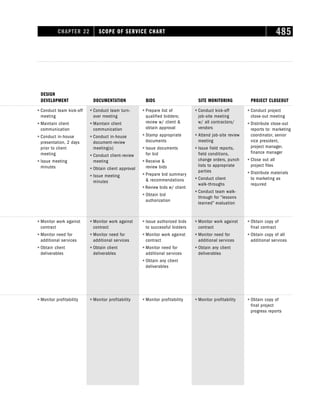
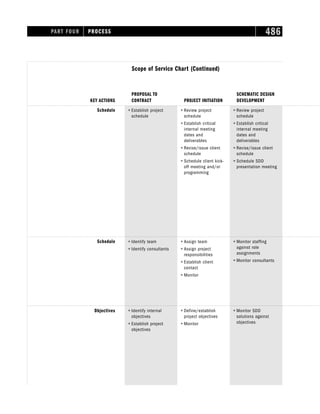
  • 10.
    Traditionally, the questionat the forefront of designers’ minds has been “What do clients want?” The Interior Design Handbook of Professional Prac- tice asks—and answers—another question altogether: “What do designers need?” This is a book not only for the present, but also for the future. It is prospective. It assumes that, yes, this is the era of design. And it becomes a tool for designers to be better prepared to sustain the profession of design and carry it forward. “Work is not where you are. It’s what you do.” These words, from the manager of the real estate program at a global consult- ing and technology firm, sum up how business leaders perceive the workplace as the twenty-first century begins. They apply to the designer’s workplace as well. Although the client may be in Copenhagen and the designer in Maine, communication happens, design is implemented, work gets done. Once-nar- row professional boundaries have stretched to span the circumference of the globe. In design,as in all slices of life,the globe—and,at the same time,the indi- vidual—is the place to be. It’s where things are and where they’ll stay for the foreseeable future. Globalization is only one of the challenges grappling the design profession. It is wise to expect and prepare for challenges from all directions, including the economy, the physical and social environment, and academia. Today, design transcends aesthetics. Through access alone, designers are in a posi- tion to provide leadership in the realization of the New World. Our daily life reflects an unsettled time. Groups of people, as well as organ- izations and nations, seek new leaders, with new definitions of leadership. Designers must step up and take their places in the front ranks. Individuals and organizations everywhere are in transition, adapting to an economy that looks much different than it did even a decade ago. In the old economy, products were, for the most part, tangible. Now, expectations shift continu- ally. The new economy values new information and new perspectives, an intangible product, that seem and feel very different to us, that require us to experience new levels of perception, that put demands on our sensibilities. Now, and apparently forever, individuals and businesses want higher quality and better, faster performance from their environments, from service pro- viders, from their tools and toys, from anyone, anyplace, or anything that affects the individual. On this competitive stage, high quality is still the goal but speed is gaining on it for first place. PREFACE IX
  • 11.
    “All depends onthe quality of the conversations.” In the 1990s, the design profession became capital- rather than labor-inten- sive. A design project required plenty of tasks, to be sure, but many of them could be relegated to machines rather than delegated to people. To ration- alize the expense of bringing new technology into their organizations, design firms expanded the scope of their services. Because technology abhors sta- sis, new business opportunities continued to appear. However, as services expanded, capital expenditures expanded as well. The pressure on design firms intensified. Design firms that are successful and that will remain so have an inherent understanding of the way people actually live and work. These firms are committed to intellectual as well as socioeconomic diversity and inclusion. They collaborate with, or sometimes employ, psychologists, sociologists, anthropologists, management experts, and financial analysts in order to bet- ter serve their client’s aims. This change is profound and represents a new view of the profession, one that is multidisciplinary and user-centered. Above all, this view acknowledges that design, and designers, have a social responsi- bility. This improved value system for the design industry insists that design projects create a problem-specific solution and at the same time bal- ance all of the client’s goals—financial, organizational, functional, cultural, and environmental. Successful firms are also taking a nonlinear approach to the process of design. Effective design is measured by the final product, to be sure, but also by the degree to which the process of design encourages everyone it affects to collaborate and to share and integrate ideas. In an organization, this brings together people at all levels, with all types of responsibilities. In a fam- ily, it means all generations, with all types of needs. This new inclusiveness understands the rigors of the design process and the complications of daily life. It anticipates new demands and continual change inside and outside the organization, the family or the group. “You do not merely want to be considered just the best of the best. You want to be considered the only ones who do what you do.” Evolution is swift. Designers must not simply change but maneuver to a posi- tion ahead of the field. To stay there, to keep moving toward the ever-shifting finish line, they need support, information, and new knowledge. The Interior INTERIOR DESIGN HANDBOOK OF PROFESSIONAL PRACTICE X
  • 12.
    Design Handbook ofProfessional Practice describes the changes currently occurring in the design profession and industry. It suggests new, unique ways of thinking and working. Ideally, this book will become a catalyst for all designers who seekexcellence in interiordesign practice. It will be an essential tool for those who have made a commitment to sustained excellence and con- tinually move the profession forward. Interior Design magazine is proud to bring together the best writers and thinkers in the field today whose mission, under editor-in-chief Cindy Cole- man, was to define design for the new millennium in terms that will help pro- fessionals, academics, and students of interior design realize their commitment to professional excellence. The Handbook is designed, itself, to be used flexibly and repeatedly by professionals in search of new definitions, new strategies, and new benchmarks by which to measure success. PREFACE XI
  • 13.
    INTRODUCTION Cindy Coleman, Editor-in-Chief THISBOOK HAS THE ANSWER. WHAT IS THE QUESTION? Designers know how to give advice. They are also skilled at asking ques- tions. According to our training and the tradition of our profession, our ques- tions focus on our clients: Who is the client? What does the client want? Toward the end of the twentieth century, as information technology insinu- ated itself into the office, the home, and the space and time between the two, interior designers began to appreciate the importance of framing the ques- tion another way: What does the client need? No one argues that interior designers are skilled at asking the right questions and producing effective answers. But that’s only half of the story, and it’s the end of the story. The first half of the story, the point where it should begin, is with interior design- ers themselves. What do interior designers need? That is the question this book was designed to answer. WHAT DO DESIGNERS NEED? KNOWLEDGE. The next iterations of that question move the discussion in three principal directions. What kinds of knowledge do interior designers need to do their work? What knowledge does the interior design profession require to remain viable now and not merely relevant in the future, but a powerful force for social change? Ultimately, how can design practitioners and educators cre- ate a body of knowledge that is unique to interior design? How can this body of knowledge put us on a level playing field with other professions, sustain our profession over the long term, and give designers opportunities to influ- ence new thinking in our industry, the academy, and society? WHAT IS THE PROOF THAT IGNORANCE IS BLISS? The impetus for this book comes from designers themselves. Many have come to realize, through powerful anecdotal and first- or second-hand expe- rience, that the interior design profession as we have traditionally known it is at a crossroads. Crossroads, in fact, may be too mild a term for our situa- tion. Some go so far as to compare the interior design profession to the pop- ulation of spotted owls—beautiful and useful contributors who have come perilously close to extinction. Cultural and economic circumstances have helped bring us to this point, to be sure. But do we know how, and to what extent, we ourselves are responsible for our situation? INTERIOR DESIGN HANDBOOK OF PROFESSIONAL PRACTICE XII Copyright 2002 by the McGraw-Hill Companies, Inc. Click here for terms of use.
  • 14.
    It is time,now, to stop and step back, take the long view of the present and make intelligent decisions about our future. What future is there for interior designers? What is the future of our profession? If we want to create our own future, on our own terms, we must be willing to take the steps necessary to make sure that we do, in fact, have a future. How often, in the context of a design assignment, have we felt it our respon- sibility to say to the client, “If you don’t take the time and resources to do it right, when will you take the time and resources to do it over?” But now we’re not asking the question of a client. We’re asking the question of our profes- sion and ourselves. WHY THIS QUESTION AND THIS ANSWER, AND WHY NOW? This book was developed as if it were a design assignment. First, we defined our mission: To give interior designers the knowledge and tools they need to shape and sustain our profession and the environment where human beings live and work. Having chosen to accept this ambitious assignment, we gathered a team of six advisors: Frank Duffy, Neil Frankel, Ed Friedrichs, Linda Keane, Eva Maddox, and Mayer Rus. The insights of this group give the book a per- spective that is as broad as it is deep, encompassing design theory and edu- cation, global professional practice and the experiences of design firms large and small. The group’s members are professionals whose work includes sem- inal accomplishments in the recent history of design. Who better than they to show us our way to the future? These respected experts led us to others— the authors whose contributions make up this book. WHERE DO WE BEGIN? Just as we all periodically take an inventory of our work, living spaces, and lives, this book begins with a look at designers themselves. We assess who we are as a group and where we are in the history of our profession, which is roughly 100 years old. We also compare interior designers with other pro- fessionals. Do designers have an education that matches their ambition? Do they have the legal and regulatory support they require to do their work? Do the quality of their work and the ethical standards of their profession give them that coveted intangible that can drive a career—respect? During the last decade of the twentieth century, social and economic changes were swift, profound, and permanent. Many designers succumbed to the tyranny of speed, only to discover that, in their haste, they had spent time and XIII INTRODUCTION
  • 15.
    resources and progressednowhere. Others battled to protect the designer’s turf, only to find that management consultants and other business profes- sionals had co-opted design principles for themselves, combined them with twenty-first-century management strategies, and are using them to win the war. In the second part of this book, best-practice examples show designers how to be more strategic in their methods, using information technology, financial management, marketing and human resources skills, and team dynamics to power the practice of interior design. WHERE IS THE HEART OF IT? The heart of this book is interior design itself. In PartThree, the authors show strategy in action, presenting works that have become benchmarks of interior design for the ways in which they address design strategy and research, sustainability, and global and specialty practices. This part also describes the legal environment and legislation that affect interior designers in the United States. Following the dictum that power isn’t something that’s conferred, it’s something that’s taken, American designers who choose to become involved in legislative affairs will grant themselves the power to affect the profession of interior design for decades to come. Part Four focuses on the designer’s scope of services. Narratives from a var- ied group of designers describe their individual methods of approaching the process of design. These descriptions address prelease services, position- ing and programming, schematic design, design development, and contract documentation and administration. Part Five focuses on the management process and delineates the criteria for a successful design project, showing designers effective ways to manage relationships with the in-house design team, consultants, and clients. WHAT IS AT RISK? During the French Revolution executions were popular public affairs, and all of Paris was agog over the mind-numbing, heart-stopping efficiency of a new and improved model of the guillotine, a beheading device that consisted of two 14-foot posts from which an 88-pound diagonal metal blade, when its support mechanism was released by the executioner, dropped at the rate of 21 feet per second. From the aristocrats’ point of view, one of the heroes of the Revolution was the Scarlet Pimpernel, who formed a secret society dedicated to rescuing their class from the guillotine. INTERIOR DESIGN HANDBOOK OF PROFESSIONAL PRACTICE XIV
  • 16.
    One of thePimpernel’s henchmen, a doctor, was led to the guillotine never- theless. He valiantly placed his head in the notch above the basket and waited for the blade to fall. The executioner lifted the lever of the support mechanism but the blade stayed in place. “It is a sign!” the public shouted. “The doctor has done no harm. He is meant to be free!” The doctor raised his head, was whisked onto a waiting horse by the Pimpernel and sped to safety. Another Pimpernel henchman, a lawyer, was next in line for the blade. He lowered his head. The executioner raised the mechanism. Again the same thing happened. Nothing. “There is nothing to negotiate,” cried the popu- lace. “The malfunctioning blade has cast doubt on his guilt!” The lawyer, too, was whisked to safety. Next in line was Marie Antoinette, Queen of France, wife of King Louis XVI and a well-known designer in the land. One of her famous works was a farm- house in the gardens of Versailles, where she liked to dress up as a milkmaid and pretend that she was a simple peasant. Marie ascended to the guillotine and put her head in position for its destiny. Again the executioner raised the lever and again nothing happened. Marie, willing to atone for an offhand remark about cake and, because she was a designer, in possession of a natu- rally contributive temperament, turned her head upward toward the blade and said to the executioner, “Perhaps if you’d toggle the mechanism ever-so- slightly to the left . . .” At which point the blade achieved its mission even more efficiently than its usual 70th of a second, and Marie’s head fell into the waiting basket and the designer was no more. THE MORAL OF THE STORY? It’s in the designer’s nature to solve problems. But now, it’s time for interior designers to solve problems and design solutions for their own profession. Our profession must become a group of people who speak with one voice on matters of regulation, legislation, ethics, and excellence. We must coalesce as an assembly of well-educated minds that, focused on a research question or a matter of social policy, can create, hold, and perpetuate new knowledge that will contribute to the universal intellectual enterprise. Because it’s time for us to use every tool we can get our hands on, it’s time for this book. What do designers need? Knowledge. If that’s a simple answer, it’s as sim- ple as a good design. There’s more to it than we, or anyone, can anticipate. But, it is not more than we can—and should—handle. XV INTRODUCTION
  • 17.
  • 18.
  • 19.
    2 PART  Backg 4 GROWING APROFESSION Edward C. Friedrichs, FAIA, FIIDA 26 HISTORY OF THE PROFESSION Cindy Coleman 48 INTELLIGENT INTERIORS William J. Mitchell 62 THE PROFESSIONAL ASSOCIATION James P. Cramer, Hon.AIA, Hon. IIDA 80 THE REGULATORY ORGANIZATION Beth Harmon-Vaughan, FIIDA 92 THE CULTURE OF DESIGN EDUCATION Linda and Mark Keane 126 OPPORTUNITY FOR CHANGE: DESIGN IN THE NEW ECONOMY Karen Stephenson, Ph.D. with Neil P. Frankel, FAIA, FIIDA Copyright 2002 by the McGraw-Hill Companies, Inc. Click here for terms of use.
  • 20.
    ground 3 INTERIOR DESIGN HANDBOOKOF PROFESSIONAL PRACTICE
  • 21.
    4 CHAPTER  Growing a Profession EDWARD C.FRIEDRICHS, FAIA, FIIDA Copyright 2002 by the McGraw-Hill Companies, Inc. Click here for terms of use.
  • 22.
    SSome historians ofinterior design believe that the profession really started in 1965,when Cornell University-educated architectArt Gensler opened a small firm in San Francisco that focused on corporate office design. An entrepreneur by nature, Gensler saw that the demand for interior design services among corporate clients (and those catering to them, such as the owners of office buildings)vastly outstripped the sup- ply of firms prepared to provide these services competently. Although others, such as Skidmore, Owings & Merrill’s Davis Allen, did specialize in corporate office interiors, Gensler went beyond them in organizing his small architecture and design firm around this market. In doing so, he helped to separate interior design from architecture and interior decoration—and to establish its identity among the design pro- fessions. As this new handbook on interior design practice demonstrates, the process that Art Gensler helped set in motion succeeded in creating a new profession. Even now, however, interior designers are struggling to gain official sanction for its title and practice and to define their bound- aries. This struggle often pits them against architects and residential inte- rior decorators, both of whom claim—with some legitimacy—to practice interior design. To put the situation in perspective, consider that it took centuries for the architecture profession to define itself, secure its boundaries, and finally obtain public sanction for its title and practice. Even today, the American Institute of Architects and its state and local offshoots battle with building designers, contractors, engineers, interior designers, and others over the question of “who is entitled to design what” in the built environment. One reason for the struggle is that interior design is a hybrid profession whose roots trace back to architecture, the fine and decorative arts, graphic design, and even home economics. Especially at a larger scale, designing building interiors is a collaborative process, too. Interior designers are CHAPTER 1 GROWING A PROFESSION 5
  • 23.
    routinely part ofteams that include architects, engineers, and other profes- sionals and specialists. In this context, these “border wars” are meaningless: the interior designer’s specific contributions are what matter. INTERIOR DESIGN AS A PROFESSION Until recently Until recently, interior design has been a self-certifying profession, similar to urban and regional planning (with its professional appellation, “certified planner”). In many states, individuals are still free to call themselves interior designers, regardless of their qualifications, and to offer interior design ser- vices. Only a business license is required. This is beginning to change. Regional chapters of both the American Soci- ety of Interior Designers (ASID) and the International Interior Design Asso- ciation (IIDA) are pushing hard to secure for interior designers the same protections—of title and practice—that architects now enjoy in the United States. Architects are licensed on a state-by-state-basis, and their activities are overseen by registration boards that administer licensing examinations, issue licenses, and discipline their licensees for malpractice and other practice-act infractions. To advocate change in the interest of the profession and their clients, design professionals should understand the nature of the arguments currently being made for and against such professional protections, and the factors that justify guarding interior design as a profession. Arguments and Counter-arguments Historically, both professions and trades have sought to limit entry to their ranks and to guard their traditional privileges by eliminating potential com- petitors. When possible, they have used the law to support this gatekeeping. California Governor Jerry Brown, in the late 1970s, proposed to “sunset” the practice and title acts of a wide range of trades and professions, including architecture and landscape architecture. The trades and professions resisted, arguing that public health, safety, and welfare would suffer if registration PART ONE BACKGROUND 6
  • 24.
    ended. That wastheir only possible argument: in America, anything else would be restraint of trade. In seeking to license the title and practice of interior design, the ASID and IIDA are also making a public health, safety, and welfare argument. Opposing them, understandably, are architects and interior decorators, their main com- petitors among design professionals, who question whether such public health and safety considerations apply. Some architects question the need for state sanction of interior design practice, given its focus on non-load-bearing structures. Some interior decorators and residential interior designers argue that the requirements put forward by the proponents of interior designer licensing go beyond what is actually needed to protect public health, safety, and welfare. That would make those requirements exclusionary and therefore in restraint of trade. The arguments for and against licensure have a political component as well. A dispute in the early 1980s in California pitted licensed architects against registered building designers—a category created as a compromise to pre- serve the traditional rights of draftsmen, carpenters, and others to design houses and small buildings. Similarly, the AIA and its civil, professional, and structural engineering counterparts regularly bicker over what their respec- tive practice acts allow them to design or engineer. Similar compromises can be expected for interior design in relation to architecture, interior decoration, and residential interior design. The legal and political possibilities available to both sides in arguments for professional protections will continue to cloud rather than resolve the issue of what constitutes a profession, so let us consider other factors that justify interior design as a profession. Professionalism Traditionally, professionals have pointed to credentials as evidence of their professionalism. This is what separates them from lay people, para- professionals,and“mere technicians.”However,David Maister—a well-known consultant to professional service firms—argues that while these things may point to competence, true professionalism depends on attitude. A profes- sional, in Maister’s view, is a “technician who cares”—and that entails caring about the client. CHAPTER 1 GROWING A PROFESSION 7
  • 25.
    The real subjectof interior design is enclosed space— that is, the settings within buildings that house human activity. First and foremost, interior designers are concerned with how people experience these settings . . . PART ONE BACKGROUND 8
  • 26.
    In trying todefine professionalism, Maister lists the following distinguishing traits: • Taking pride in your work (and being committed to its quality) • Taking responsibility and showing initiative • Being eager to learn • Listening to and anticipating the needs of others • Being a team player • Being trustworthy, honest, loyal • Welcoming constructive criticism2 His point is that professionalism is not just education, training, a certificate or license, and other credentials. In saying that these things are not the sine qua non of professionalism, Maister is really arguing for a client-responsive professionalism—as opposed to one that uses its credentials and presumed expertise as an excuse for ignoring or even bullying the client. Arrogance is an issue in the design professions. Too many designers regard their clients as patrons, not partners. Design commissions become opportu- nities to further personal ambition rather than meet the client’s goals and needs. The implication is that design is self-expression, that the creative process is largely if not exclusively the province of the designer alone. Although there is inevitably an aspect of self-expression in the design process, its creative power is enhanced, not diminished, by collaboration. In collaboration, we become partners in a larger enterprise, and that gives our work its energy and spark. In arguing for “professionals who care,” Maister is drawing attention to the collaborative nature of their relation- ships with their clients. It is a partnership to which both parties contri- bute their expertise. Formally, professionals act as the agents of their clients. As professionals, they have other obligations that affect this relationship— obligations that are intended, among other things, to protect clients from themselves. However, designers who assume they “know better” than their clients miss the opportunity to get into their clients’ heads and understand their world. They need that knowledge to connect their work to their clients’ CHAPTER 1 GROWING A PROFESSION 9
  • 27.
    larger goals andstrategies, the real starting points of innovation in the design process. What Makes Interior Design a Profession? Interior design is a profession in part because of designers’ special skills and education, but also because of designers’ special relationships with their clients. According to Webster’s New Collegiate Dictionary, a profession is “a calling requiring specialized knowledge and often long and intensive aca- demic preparation.”4 An art is a “skill acquired by experience, study, or obser- vation, an occupation requiring knowledge and skill, and the conscious use of skill and creative imagination especially in the production of aesthetic objects.”5 A craft is “an occupation or trade requiring manual dexterity or artistic skill.”6 These definitions stress a difference in training, suggesting that only professions require university study. That difference does not pre- cisely hold anymore, since both arts and crafts are taught at the university level. Recalling David Maister’s definition of a professional as a “technician who cares,” we might ask, “Who benefits from the care that interior design- ers exercise in the course of their practice?” Clearly, the beneficiaries are those who use the settings that they design. In defining the professional practice of interior design, the Foundation for Interior Design Education and Research (FIDER) provides the following outline of its scope: • Analyzing client needs, goals, and life safety requirements • Integrating findings with a knowledge of interior design • Formulating preliminary design concepts that are aesthetic, appro- priate, and functional, and in accordance with codes and standards • Developing and presenting final design recommendations through appropriate presentation media • Preparing working drawings and specifications for non-load- bearing interior construction, reflected ceiling plans, lighting, in- terior detailing, materials, finishes, space planning, furnishings, fixtures, and equipment in compliance with universal accessibility guidelines and all applicable codes PART ONE BACKGROUND 10
  • 28.
    • Collaborating withprofessional services of other licensed practi- tioners in the technical areas of mechanical, electrical, and load- bearing design as required for regulatory approval • Preparing and administering bids and contract documents as the client’s agent • Reviewing and evaluating design solutions during implementation and upon completion7 While it is accurate as far as it goes, this definition misses the heart of the matter. The real subject of interior design is enclosed space—that is, the set- tings within buildings that house human activity. First and foremost, interior designers are concerned with how people experience these settings and how their design supports their different activities. These concerns form the core of the interior design profession’s specialized knowledge. EDUCATING INTERIOR DESIGNERS Like architecture Like architecture, interior design is taught through a combination of studio work and coursework—the former a remnant of the old apprenticeship sys- tem that once characterized both architecture and the arts and crafts. In addition to studio training in design and visualization, professional interior design programs typically provide a foundation in: • Human factors • Materials and systems • Codes and regulations • Contracts and business practices Unlike architecture, most interior design programs do not address the engi- neering side of building construction—e.g., coursework in the static and CHAPTER 1 GROWING A PROFESSION 11
  • 29.
    dynamic analysis ofstructure. Interior design also differs from architecture (and interior decoration) in its concern for every aspect of the interior envi- ronments that people use every day. The human experience in these settings is a broad topic that includes history and culture, psychology and physiology, organization theory, and benchmark data drawn from practice—together with lighting, color theory, acoustics, and ergonomics. These subjects need to be part of the professional interior designer’s education and training. How do interior designers gain an understanding of client and user needs? “By asking them” is a reasonable answer for smaller projects, but larger ones make use of social science research methods such as participant observa- tion, network analysis, and surveys. Exposure to these methods through coursework in anthropology and sociology is helpful, especially as strategic consulting emerges as a specialty within the profession. (Strategic consult- ing seeks to align a client’s real estate and facilities strategies with its busi- ness plan. Typically, it helps the client define its real estate and facilities program and establish the quantitative and qualitative measures of its per- formance.) Business clients expect their design teams to understand the strategic context of their projects. Coursework in business and economics can begin that process; immersion in the industry, by reading its journals and participating in its organizations, is the next step. Once designers reach a certain level of responsibility, management becomes part of their job description. Coursework in business and management can make this tran- sition easier. A Knowledge of Sustainable Design Principles “Building ecology,” as the Europeans call it, needs to be part of interior designers’ knowledge. They should know how to design to conserve nonre- newable resources, minimize waste, reduce CO2 and SO2 levels, and support human health and performance.8,9 PART ONE BACKGROUND 12
  • 30.
    CHAPTER 1 GROWINGA PROFESSION 13 INTERIOR DESIGNERS AND SUSTAINABLE DESIGN In tackling the problem of indoor air pol- lution in the 1980s, the interior design profession led the way in raising public awareness of the value of sustainable de- sign. As advocates for the user, interior designers have a special responsibility to understand sustainable design principles and evaluate their appropriateness for their projects. Sustainability also offers many opportunities to deliver added value for clients. As case studies by the Rocky Mountain Institute9 have shown, the re- sulting gains in building and human per- formance provide a reasonable (and even rapid) payback on the client’s investment, especiallywhen these measures are used in combination. Here are some examples. • Lockheed Building 157, Sunnyvale, California. Lockheed spent $2.0 million to add sustainable design features to this 600,000-ft2 office building that reduced its energy consumption and provided a higher-quality work environment. Control of ambient noise was also achieved. Lower energy costs alone would have repaid Lockheed’s investment in four years. Be- cause the improved quality of the work- place reduced absenteeism by 15 percent, the investment was actually repaid in less than a year. • West Bend Mutual Insurance Head- quarters, West Bend, Wisconsin. West Bend used a number of sustainable design features, including energy-efficient lighting and HVAC systems,roof,wall,and window insulation, and thermal storage. Utility re- bates kept its cost within a “conventional” budget. The building is 40 percent more efficient than the one it replaced. It provides an “energy-responsive workplace” that gives users direct control of thermal com- fort at their workstations. A study showed that the building achieved a 16 percent pro- ductivity gain over the old one. A produc- tivity gain of 5 percent (worth $650,000 in 1992 dollars) is attributable to the energy- responsive workplace feature alone. • NMB Headquarters, Amsterdam, The Netherlands. This 538,000-ft2 project ex- emplifies what Europeans call “integral planning”: designing the building and its systems holistically to reduce operating costs and increase quality and perform- ance. About $700,000 in extra costs were incurred to optimize the building and its systems, but this provided $2.6 million a year in energy savings—and a payback of only three months. Employee absenteeism is down by 15 percent, too. Gensler’s experience reinforces the Rocky Mountain Institute’s findings. On office campus projects, they found that providing under-floor air supply and ambient lighting can reduce the cost of workplace “churn” (the need to shift workstations to accom- modate changes in occupancy) from as much as $5.00/ft2 to less than $1.00/ft2 . For an office campus in Northern California, these same features allowed them to re- design the entire workplace to accommo- date a different set of users just six weeks before its opening—with no delays. By avoiding the cost of delay, the client essen- tially paid for the 10 percent higher cost of these features before the campus had even opened.
  • 31.
    THE CULTURAL IMPACTOF INTERIOR DESIGN Settings,the designed spaces Settings, the designed spaces within buildings, are “where the action is.” When human or organizational change occurs, settings are where it takes place first. As my colleague Antony Harbour points out, the U.S. workplace has been dramatically transformed over the last 40 years, but U.S. commercial office buildings still have the same floor plans. The settings have changed much more than their containers. Although settings are more ephemeral than buildings, they have equal if not greater cultural impact. Interior Designers and the Workplace Revolution Because of the economic pressures of recession and globalization and tech- nological developments such as bandwidth (the proliferation of electronic networks to convey voice and data communications on a global basis), the workplace has undergone profound change in the last decade. While tech- nology is given credit for the productivity gains that have swept the U.S. economy in this period, interior designers who specialize in the workplace have had a major role in helping U.S. companies integrate new technologies and work processes. Alone among design professionals, they understood that these settings are the “connective tissue” that could make this happen. Interior design professionals understand that design fuels organizational change, regardless of the scale of its application. Think about where we work today. Behind the modern city, whether London, Tokyo, or New York, are nineteenth-century assumptions about work—that it occurs at specific times and in specific places, for example. Now people work “anywhere, anytime,” and there are compelling reasons, such as the problems of commuting, to dis- tribute work geographically. Not only the locus of work has changed in our culture; the mode of work has changed as well. In the last century the workforce moved from Frederick Taylor’s “scientific management” to ways of working that are increasingly open-ended, democratic, and individual/team-tailored. Along the way, the workplace changed, too. Taylorism was about efficiency (and uniformity). What followed shifted the focus to effectiveness (and diversity). What’s the difference? As Peter Drucker explains,“Efficiency is doing things right; effec- tiveness is doing the right thing.” PART ONE BACKGROUND 14
  • 32.
    The Modern movement,aping Taylor, took “Form follows function” as its credo. Today, though, we might amend this to “Form follows strategy.” If design firms are now involved in strategic consulting, it is because interior designers paved the way. Their ability to give form to strategy gave them an advantage over competing consultants, because they knew how to make strategy actionable. Yet this focus on strategy does not entirely explain the impact that interior designers have had on the workplace. More than any other profession involved in the design of these settings, they have been able to use their knowledge of workplace culture to design work settings that genuinely sup- port the people who use them. Interior designers make it their business to know how people actually inhabit and experience the built environment. Their work—certainly the best of it—consistently reflects this understanding. The licensing controversy notwithstanding, interior designers today are val- ued members of building design teams precisely because they bring this knowledge to the table. Some of the most valuable research on the workplace in recent years has been done by interior designers who specialize in work settings for corporate, financial, and professional service clients. Gensler’s Margo Grant and Chris Murray, for example, have done pioneering work documenting the changing strategic goals of these companies and how they play out in spatial terms. Their benchmarking studies give Gensler and its clients a wealth of com- parative data about facilities trends across the developed world’s economy. Needless to say, this is a competitive advantage in the global marketplace. As Peter Drucker points out, it used to be that the skills needed in business changed very slowly: My ancestors were printers in Amsterdam from 1510 or so until 1750 and during that entire time they didn’t have to learn anything new. All of the basic innovations in printing had been done . . . by the early 16th century. Socrates was a stone mason. If he came back to life and went to work in a stone yard, it would take him about six hours to catch on. Neither the tools nor the products have changed.10 Today, however, we are in the midst of a period of remarkable technological innovation,equivalent in its impact to the clusterof spectacularbreakthroughs that occurred in the last quarter of the nineteenth century. Technological CHAPTER 1 GROWING A PROFESSION 15
  • 33.
    innovation is onereason that professions evolve. Social change, the evolu- tion of “everyday life” and its values, is another. “Faster, cheaper, better!” is the catch phrase of the new economy. Every shaper of the built environ- ment faces these related changes, as clients demand a new responsiveness. Design professionals should rethink linear and segmented processes, reflect- ing nineteenth-century practices, and begin to envision how everyone en- gaged in designing and constructing the built environment should approach their practice to achieve the speed, responsiveness, and innovation that clients require. IMPLICATIONS OF BANDWIDTH: NEW TOOLS, PROCESSES, AND PRACTICES The bandwidth revolution The bandwidth revolution has given interior designers an entirely new set of tools—not just for design, but also for collaboration. As is true for most innovations, their early applications were focused on existing practices. Today, though, a new generation of designers is at work who grew up with these tools. As they move into the mainstream of practice, they will start to use them to reshape practice. Bandwidth is transforming the production process: how furniture, furnish- ings, and equipment get from designer to manufacturer to end-user. It makes it possible both to speed the production process, by tying it more directly to purchasing, and to consolidate orders to secure larger production runs and better prices. And it creates a world market for these products that should increase their variety. Bandwidth will also make it steadily easier for virtual teams to work collab- oratively, to “construct” a virtual setting in three dimensions. This collabo- ration takes place not just between people, but between computers, too, so that in time fabrication will follow design without the need for detailed work- ing drawings. As the process becomes more seamless (and more common), it will extend to other aspects of construction. At some point, “design/build” may really be a single process. Currently, we are only halfway there. A lot of the infrastructure is in place, but the interface is still maddeningly primitive. PART ONE BACKGROUND 16
  • 34.
    At the sametime, we are trying to use the infrastructure to support tradi- tional practice models. It may take a “push” from the outside, such as another oil shock that makes the price of airline tickets less affordable, to force designers to change their ways and embrace virtual collaboration whole- heartedly. Thanks to bandwidth, manufacturing has gone from Henry Ford’s assembly line, with its uniform products, to Dell’s (and now Ford’s) “mass customiza- tion.” Service industries have changed similarly. Across the economy, cus- tomers want the cost advantages of mass-market mass production, along with the quality and performance of custom design. DESIGNING IN FOUR DIMENSIONS At the same time as At the same time as clients demand an increased level of responsiveness, knowledge workers demand “consonance” in the workplace. They approach potential employers looking for a “fit” with their values and lifestyles. In a buoyant economy, they can afford to be selective—and intolerant of “disso- nance.” The built environment gives form to consonance and provides its framework. To keep pace with social and technological changes, design pro- fessionals must learn to see that framework as one that changes with time— and therefore design in four dimensions. The current rate of technological change suggests that designers will face considerable pressure to practice with time in mind. Both the container and the contained—“structure and stuff,” as Stewart Brand put it in How Build- ings Learn—change over time, but at different rates of speed.11 The trends of mass customization and congruence suggest that settings will change fre- quently, which puts pressure on the rest to facilitate the change. This brings us back to sustainability, which also demands of “stuff” that its residual value be salvaged through recycling and reuse. Designing in four dimensions means rethinking our conceptions of build- ings. “There isn’t such a thing as a building,” Frank Duffy asserts. Buildings are just “layers of longevity of built components”—they exist in time. What CHAPTER 1 GROWING A PROFESSION 17
  • 35.
    matters for theirdesigners is their “use through time.” Duffy finds the whole notion of timelessness to be “sterile” because it ignores time as the building’s fourth dimension—they exist in time, so they have to evolve to meet its changing demands.12 Also working from a “time-layered” perspective, Brand proposes a holistic approach to time-sensitive design.13 He identifies six components of build- ings: site, structure, skin, services, and space plan. While interior designers are focused on the last two, they have good reason to want to influence the rest: they all affect the building’s use through time. To exercise this influence effectively, of course, interior designers have to understand the characteristics of these components, and the possibilities of the other elements of the built environment. Interior designers do not have to be engineers, orviceversa, but both need to know enough about the others’ business so they can approach the building in a holistic or time-layered way. As Brand says: Thinking about buildings in this time-laden way is very practical. As a designer you avoid such classic mistakes as solving a five- minute problem with a fifty-year solution. It legitimizes the exis- tence of different design skills, all with their different agendas defined by this time scale.14 To be responsive to the user in the building design process, interior design- ers need to have this broader knowledge of the building and its components. In the end, their ability to sway others in the design and delivery process will rest primarily on issues of use over time—issues that are primarily functional and strategic, and that constantly require new skills. LOOKING AHEAD Interior designers Interior designers face resistance in their quest to be recognized as a separate profession. In 1999, the American Institute of Architects (AIA) put together a task force to review the question of licensing interior designers. As Archi- tectural Record’s Robert Ivy reported: They found that interior designers seek to distinguish themselves from less-qualified decorators, protect the right to practice, estab- PART ONE BACKGROUND 18
  • 36.
    lish gender equityin a field dominated by men, and earn the respect of their fellow professionals.15 “The designers’viewpoint is consistent,”Ivyadded,citing his magazine’sApril 1998 roundtable discussion with interior designers. “Despite their gains in the industry, they feel slighted or disparaged by architects.”Yet, he says,“there are unavoidable differences between architects and interior designers”: Architectural education is more rigorously focused on life safety, as well as structure, building science, and codes. By contrast, the AIA task force reported that in the 125 interior design programs cur- rently available, education can vary from two to four years, and current testing for certification focused more on aesthetics than safety. The differences do not stop with pedagogy. Architects tend to engage the entire design problem, considering not only the contents of the interior, but the interior’s relation to the exterior envelope, its construction and building systems, and the natural and human- made surroundings. A healthy building—light-filled, safe, and pro- moting human habitation—should be architects’ professional norm. When we are operating at a high level of accomplishment, our work is holistic, integrating complex technical systems and social require- ments into structures that engage the landscape, sustain their inhabitants inside and out, and enrich the community.16 Should interior designers be licensed? Here is Ivy’s answer: Our own professional status reflects a public trust we have earned at high cost, and it should not be diluted. . . . Practice legislation may not be the panacea that interior designers seek, if it is achieved without commensurate, fundamental changes in [their] education and experience.17 However, interior designers can make a strong case that they should be ac- corded the distinctions and protections that are part of other design profes- sions such as architecture. No less than architects, interior designers are engaged in “the entire design problem.” As advocates of the user, and as designers who are “fourth-dimension sensitive,” they are often the first ones in the building design process to point out how one or another of the building’s components makes it harder for its settings to evolve easily to meet new needs. As designers’ interest in indoor air quality demonstrates, they are concerned with quality of life, too—with user performance, not just building performance. CHAPTER 1 GROWING A PROFESSION 19
  • 37.
    PART ONE BACKGROUND20 ARCHITECTURE’S STRUGGLE TO BECOME A PROFESSION1 Interior designers who anguish about the time it is taking to secure state sanction for their profession’s title and practice should bear in mind that it took architects a lot longer. Arguments over who is and is not qualified to design buildings punctu- ate the history of the profession. In the Middle Ages in Europe, the master masons were the building architects. During the Renaissance in Italy, artist- architects supplanted them. They were considered to be qualified as architects owing to their training in design. Archi- tects such as Brunelleschi and Michelan- gelo took a strong interest in engineering and technology, too, as they strove to real- ize their ambitious building projects. With Vitruvius, they believed that architecture was a liberal art that combined theory and practice. Master masons, who apprenticed in the building trades, were disparaged be- cause their training was purely practical. Yet the Italian Renaissance also saw the emergence of the professional in Europe’s first true architect, Antonio Sangallo the Younger. Apprenticed to the artist-archi- tect Bramante, Sangallo helped implement many of Bramante’s later buildings. In time, he established a studio that is recog- nizably the prototype for today’s architec- ture and design firms. The architectural historian James Ackerman has described him as“one of the few architects of his time who neverwanted to be anything else.” Four diverging traditions emerge from the Renaissance: artist-architects, trained in design; humanist-architects, trained in theory; architect-architects, focused on buildings and striving for a balance be- tween theory and practice; and builder- architects, focused on construction but still interested in designing buildings. Artist-architects looked for patrons; archi- tect-architects looked for clients. In the seventeenth and eighteenth centuries, we see this distinction played out between “gentleman” architects and the emerging profession. Thomas Jefferson counted architecture among his gentlemanly pur- suits, a trait he shared with others of his class. Lord Burlington, who did much to establish the architectural profession in England, was widely criticized by his peers for his “unwonted” interest in the prag- matics of building construction. When the Institute of British Architects was estab- lished in 1834, noblemen could become honorary members for a fee. (Signifi- cantly, all connection with the building trades was forbidden.) In the eighteenth and nineteenth cen- turies, English architects also faced com- petition from surveyors. In his Dictionary of 1755, Dr. Johnson gave essentially the same definition for the words “surveyor” and “architect.” In England, at least, the two professions remained closely aligned through much of the nineteenth century— with both designing buildings. Engineers designed buildings, too. In 1854, one of them even won the Institute of British Ar- chitects’ Gold Medal.
  • 38.
    CHAPTER 1 GROWINGA PROFESSION 21 PROFESSIONAL ETHICS Like other professionals, interior designers must contend with ethical issues. Indeed, the issues can be quite similar to those of allied and other learned professions. Like architects, lawyers, and doctors, interior designers can also do bodily harm and cre- ate financial damage if they practice in- competently or unethically. They can also put people at risk by failing to be effective advocates of their interests. Here are some examples of these issues as they arise in in- terior design practice. • Life safety. Designers sometimes bemoan codes and regulations, but these rules exist to establish a minimum standard of health and safety. Failure to meet code can delay a project, which damages the owner, and can also cause bodily harm. • Confidentiality. Interior designers often have access to confidential business infor- mation—a planned acquisition, for exam- ple,ora newbusiness plan orstrategy.This knowledge is shared with interior design- ers only because it has a direct bearing on their work, and it is shared with them in confidence. Ethically, and often by con- tract, that confidence must be respected. • Conflict of interest. Interior designers are their clients’ agents, so they have an ob- ligation to avoid or disclose to them any potential conflicts of interest. (Disclosure means that you are prepared to end the conflict if the client so requests.) The ap- pearance of conflict can be as problematic as the reality. Just as voters worry when politicians become too cozywith special in- terests, clients start to wonder when inte- rior designers accept gifts or junkets from contractors and vendors. The occasional lunch, party, box of candy, orbottle of wine is no problem, but all-expenses-paid vaca- tion trips and other costly“perks” cross the line. They create the appearance if not the reality that design decisions—specifying a product, for example—are being made to repay favors rather than to serve the inter- ests of the client. • User advocacy. Interior designers have a responsibility to users. If, in their judg- ment, a project’s requirements, though legal, compromise user comfort and per- formance unacceptably, they have an obli- gation to try to change them, or to resign from the project if the client is unwilling to make changes. Design professionals have a broader obligation to educate their clients on the value of design features that im- prove user quality of life and performance. • Competency. Professional competence reflects ongoing mastery of the skills and knowledge demanded by professional practice. Professional certification or li- censing formally requires a level of mas- tery that necessarily lags behind what design professionals actually need. For ex- ample, FIDER’s requirements do not yet specify that interior designers know the principles of sustainable design. That lag does not excuse professional interior de- signers from mastering these principles, or any new skills that may be necessary to maintain their professional competence.
  • 39.
    Interior design cameinto its own in the 1990s as settings came to be seen as strategic resources. The catch phrase “Place matters!”—so emblematic of the second half of the decade—turned out to be literally true. When people have real choice about when and where they spend their time, the quality of these settings—their ability to support people in their desired activities—becomes crucial, often the deciding point. A “place” can be part of the landscape or cityscape, a building or building complex, or an enclosed indoor or outdoor setting. The word implies a richness and wholeness that mocks the design professions’ efforts to carve it into parts. The built environment today has immense range and diversity. Much devel- opment embraces multiple uses. The time dimension of buildings is chang- ing, too, with more components expected (or needed) to be ephemeral rather than “permanent.”Already, many projects today feature hybrid teams that are organized around each project’s particular blend of uses and timeframes. These interdisciplinary teams are the future. They expose each profession to the others and give all of them a shared perspective about “place” that tran- scends each one’s necessarily narrower view. This shared viewpoint may eventually give rise to entirely new professions, which we may no longer be willing to categorize as “architecture” or “inte- rior design.” In time, too, the division between design and construction may prove to be an artificial boundary, no longer justified by practice. Professions are conservative forces in society, constantly resisting pressures to change, yet constantly placed in situations where the need to change is obvious and imperative. New professions arise in part because old ones fail to adapt. Compared to architecture, interior design is still in its infancy—a profession that is just now marshalling its forces to secure the recognition to which it feels entitled. All this is taking place against the background of our entre- preneurial and bandwidth-driven era. How important is it, in this context, to secure the profession’s boundaries or win state sanction for its practice? If it helps strengthen the education and training of interior designers, and encourages them to meet their responsibilities as professionals, then it is probably well worthwhile. Especially today, it is hard to predict the future of the interior design profes- sion. One clear way to prepare for it, however, is to make the education of PART ONE BACKGROUND 22
  • 40.
    interior design professionalsmuch more rigorous. This argues for a more comprehensive curriculum, as I have outlined previously, and for a four-year professional degree program at the undergraduate level. It also argues for learning, as Peter Senge calls it—not just maintaining skills, but actively learning from practice. Senge’s point, made admirably in his book, The Fifth Discipline,18 is that work itself is a learning experience of the first order. Our interactions with clients, colleagues, and other collaborators provide constant glimpses into an unfolding future. If we are attentive, we can understand some of what the future demands—and take steps to meet it appropriately. People who care about their careers, and who take their responsibilities as professionals seriously, need to make learning a constant priority. Notes 1 This brief account is drawn from Spiro Kostof (ed.), The Architect, Oxford University Press, New York, 1977, pp. 98–194. 2 Maister, David H., True Professionalism, The Free Press, New York, 1997, pp. 15–16. 3 Maister, True Professionalism, p. 16. 4 Webster’s New Collegiate Dictionary, G. & C. Merriam Co., 1977, p. 919. 5 Webster’s, p. 63. 6 Webster’s, p. 265. 7 Foundation for Interior Design Education and Research (FIDER), “Definition of Interior Design” (from FIDER’s website: http://www.fider.org/definition.htm). 8 A good introduction to this topic is Diana Lopez Barnett and William D. Browning: A Primer on Sustainable Building, Rocky Mountain Institute, Snowmass, CO, 1995. 9 Romm, Joseph J., and William D. Browning, Greening the Building and the Bottom Line, Rocky Mountain Institute, Snowmass, CO, 1994. 10 Daly, James, “Sage Advice” (interview of Peter Drucker), Business 2.0, August 8, 2000. 11 Brand, Stewart, How Buildings Learn, Viking, New York, 1994, p. 13. CHAPTER 1 GROWING A PROFESSION 23
  • 41.
    12 Quoted in Brand,How Buildings Learn, pp. 12–13. The quotations are from Francis Duffy, “Mea- suring Building Performance,” Facilities, May 1990, p. 17. 13 John Habraken took a similar position, initially in relation to housing, in the 1960s. See, for example, his Variations: The Systematic Design of Supports, MIT Press, Cambridge, MA, 1976, and The Structure of the Ordinary: Form and Control in the Built Environment, MIT Press, Cambridge, MA, 1998. 14 Brand, How Buildings Learn, p. 17. 15 Ivy (FAIA), Robert, “The Keys to the Kingdom,” Architectural Record, September 2000, p. 17. 16 Ivy, “The Keys to the Kingdom,” p. 17. 17 Ivy, “The Keys to the Kingdom,” p. 17. 18 Senge, Peter, The Fifth Discipline, Currency/Doubleday, New York, 1994. 19 Kostof, The Architect, p. 138. Bibliography Brand, Stewart. How Buildings Learn: What Happens After They’re Built. New York: Penguin USA, 1995. Browning, William D., and Joseph J. Romm. Greening the Building and the Bottom Line: Increasing Productivity Through Energy-Efficient Design. Snow- mass: Rocky Mountain Institute, 1994. Cuff, Dana. Architecture: The Story of Practice. Cambridge, MA: MIT Press, 1992. Gutman, Robert. Architectural Practice: A Critical View. New York: Prince- ton Architectural Press, 1988. Habraken, N. J., and Jonathan Teicher (Editor). The Structure of the Ordinary: Form and Control in the Built Environment. Cambridge,MA: MITPress,1998. Habraken, N. John. Variations: The Systematic Design of Supports. Cam- bridge, MA: MIT Press, 1976. Kostof, Spiro (Editor). The Architect: Chapters in the History of the Profes- sion. Berkeley: University of California Press, 2000. PART ONE BACKGROUND 24
  • 42.
    Lopez Barnett, Dianna,and William D. Browning. A Primer on Sustainable Building. Snowmass, CO: Rocky Mountain Institute, 1995. Maister, David H. True Professionalism: The Courage to Care About Your Peo- ple, Your Clients, and Your Career. New York: Free Press, 1997. Senge, Peter, M. The Fifth Discipline: The Art and Practice of the Learning Organization. New York: Currency/Doubleday, 1994. Webster, Merriam (Editor). Merriam Webster’s Collegiate Dictionary. Spring- field: G. & C. Webster Co., 1977. CHAPTER 1 GROWING A PROFESSION 25
  • 43.
    26 CHAPTER  History ofthe Profession CINDY COLEMAN Copyright 2002by the McGraw-Hill Companies, Inc. Click here for terms of use.
  • 44.
    IInterior designers cantrace their profession to many who preceded them, from the cave painters at Lascaux to the creators of the frescoed interiors at Pompeii, to the holistic architecture, interiors, and furnish- ings of Robert Adam and Thomas Jefferson in the eighteenth century, and to Frank Lloyd Wright in the twentieth. In the mid-nineteenth century, during the Industrial Revolution, the farm economy, though still robust, was gradually supplanted by a new industrial economy centered in or near the great, developing American cities of New York, Boston, and Chicago. The transition from farm to industry allowed Americans to see their houses as more than shelter and a place to sleep when work outdoors was done. Industrial workers’ days were not necessarily shorter than those of farmers. However, for industrial workers and city dwellers in particular, home became a refuge that provided physical comfort and even aesthetic pleasure in contrast to the noisy, gritty, and physically exhausting atmosphere of the factory. As women had more time to spend on the comforts of home, the large department stores of England and America developed and included sections devoted to drapery and upholstery. Specialty retailers included Liberty of London for fabrics and Tiffany and Affiliated Artists in New York, which produced lamps, vases, and other finely crafted decorative items. At the end of the nineteenth century in England and America, the Arts and Crafts movement developed as a direct response to the Industrial Revolu- tion. Its members, including William Morris, Charles Voysey, and Gustav Stickley, celebrated handcraft and deplored the social conditions, as well as the machine-made designs, the Industrial Revolution had created. The Arts and Crafts movement initiated small workshops devoted to woodworking, pottery, and weaving, and brought together artists and architects to study the interiors as well as the exteriors of buildings. Design integrity within the con- temporary cultural and social context was the concern not only of the Arts and Crafts movement, but of other groups including the WienerWerkstratte and the Bauhaus, which developed and flourished in the twentieth century. CHAPTER 2 HISTORY OF THE PROFESSION 27
  • 45.
    Sensitivity to therole of design in society is as relevant at the beginning of the twenty-first century as it was at the dawn of the twentieth. Some, in fact, have referred to the year 2000 as the beginning of “the design century.” Today, design is relevant as never before, particularly to the world of work. Following World War II, business theories and practices began to evolve and proceeded at a manageable pace; with the widespread use of computers in the 1980s, that evolution picked up speed and continues to do so today, when the only organizational constant is change. AfterWorld War II, the res- idential and corporate branches of the interior design profession began to move on separate tracks. Both have traveled rapidly, but in different direc- tions. The interior designer’s role as a professional consultant to business and organizations is the focus of this chapter. It is important to emphasize, however, that design is a global language that transcends home and work- place, geography and culture. To be a designer is to understand what all men and women have in common—their humanity. INTERIOR DESIGN EMERGES AS A PROFESSION: 1900 TO 1930 Theformalstudy The formal study of interior design began in the United States at the end of the nineteenth century. Programs and curricula typically developed in art schools; at the great land-grant colleges of the Midwest, which were open to women and also boasted strong programs in home economics; and within academic programs in architecture, primarily at East Coast universities. When interior design actually became recognized as a profession is a subject for debate. Some scholars believe that interior design was not acknowledged as an independent profession inAmerica until 1897,when EdithWharton and Ogden Codman, Jr., published The Decoration of Houses. The authors are considered the first to define the profession as it is viewed today, by clarifying the difference between interior decoration, which deals with surface treat- ments, and interior design, which encompasses the design of interior spaces. Elsie de Wolfe, a contemporary of Mrs. Wharton’s and a disciple of her approach, is considered to be one of America’s first professional interior designers. Her expertise, however, was on the side of interior decoration, PART ONE BACKGROUND 28
  • 46.
    which she usedwith great skill in the creation of interiors for the industrial- ist Henry Clay Frick and other wealthy New York families. She also accepted commissions from the prominent Beaux Arts architect Stanford White. Early twentieth-century women who are also considered among the first design professionals are Nancy McClelland, who brought design services to the general public through the decorating department she established at Wana- maker’s department store in Manhattan; and Eleanor McMillen, whose McMillen, Inc. is considered to be America’s first interior decorating firm. By the turn of the twentieth century, the Industrial Revolution had reached full maturity. Daily life in the developed world had become increasingly mechanized, and Thomas Edison’s electric light bulb was adding time to the work day and changing the nature of work. At the same time, the seeds of the Information Age—a century in the future—were being planted with Bell’s telephone in 1876 and Edison’s subsequent inventions of the telephone trans- mitter, the stock ticker, the phonograph, and the movie camera. During the early part of the twentieth century, there was little if any distinction between residential and nonresidential interior design; it was not until after World War II that North Americans became open to the idea of hiring design professionals for both their houses and offices. As the century began, the archetype of the workplace was the assembly line that Henry Ford created to produce the Model T. An early business theorist, Frederick W. Taylor, extended the assembly line from the product to the worker. Considered to be industry’s first efficiency expert, Taylor conducted time-study experiments that he developed into the concept he called scientific management. In Taylor’s view, human workers could—and should—function as mechanically as machines. If workers were discouraged from thinking creatively and independently and completely removed from decision making, and if work was broken down into its sim- plest units, with all members of a single group of workers dedicated to iden- tical tasks, efficiency would result. Taylor’s methods, developed for the factory, eventually found their way into offices, along with typewriters, cal- culators, and switchboards and the women and recently arrived European immigrants who were hired to operate them. Ford’s assembly line, and Taylor’s translation of it to human activity, next found its way to business and the chart of organization. The hierarchical organization, with its mechanical, organizational, and psychological elements CHAPTER 2 HISTORY OF THE PROFESSION 29
  • 47.
    now delineated, wasborn and grew. Once a suitable interior was designed to contain it, it flourished. In the corporate hierarchy, order ruled. To stay in control, however, the rul- ing order needed to keep an eye on the workers. Workplaces were designed for management, who typically constricted a large group of workers in a sin- gle, vast space. From the giant panopticon that was the top of the hierarchy, managers looked down over rows of workers at their typewriters or sewing machines or tables where they assembled the typewriters, sewing machines, Victrolas, and other machines that had become part of twentieth-century life. At the turn of the twentieth century, the hierarchy was the metaphor for soci- ety in all its forms; the elevator, invented in 1857, suggested that, in a demo- cratic American society, workers could aspire to access any level they chose. This was the era of the great retailers such as Marshall Field, whose establish- ments were organized into departments, just like the Ford Motor Company. This was the era that saw the construction of the Eiffel Tower as a brand mark for Paris, along with the great railway hotels, large city apartment buildings, the modern hospital, and the first skyscraper office buildings. In business, Taylor’s scientific management prevailed, but he had his critics, who were concerned about issues that interior designers still find themselves dealing with a hundred years later. They included Mary Parker Follett of the Harvard Business School, whose humanist, behaviorist approach to the man- agement of organizations represented the opposite side of Taylor’s machine- tooled coin. In the 1910s she championed such far-sighted approaches to work, and the workplace, as “the law of situation” and cross-functional teams. She also insisted that individual workers, rather than being merely static units of work with a prescribed place on a linear assembly line, as Taylor would have it, contributed to the strength of the organization as a whole. She believed that, within the organizational structure, men and women should be free to experiment until they found ways of working that were effective for the tasks at hand and for themselves as individuals. In the 1920s, Harvard was also the academic home of Elton Mayo and his colleague Fritz Roethlisberger, who are the acknowledged creators of the human relations movement and whose work also has contemporary impli- cations. They conducted their famous Hawthorne experiments over a period of more than 30 years—from the 1920s to the 1950s—at the Western Electric Hawthorne Works in Cicero, Illinois. Their studies, which anticipated the PART ONE BACKGROUND 30
  • 48.
    current interest andadvancements in ergonomics, focused on the physio- logical aspects of work, particularly the impact of various levels of illumina- tion on workers’ efficiency and the causes of fatigue. They also studied the psychological aspects of work and looked closely at employees’ motivation, satisfaction, and personal well-being, particularly as these abstract states took form in workers’ relationships with their supervisors. The Harvard theorists, along with Chester Barnard at AT&T and other humanists, created a groundswell against scientific management. It was now clear that not all work fit the model of Ford’s assembly line. And simply because the assembly line itself depended on human beings but was, in fact, profoundly dehumanizing, it was time to step back and rethink the nature of work—and the workplace. The time had come for a paradigm shift in the way organizations were structured and in the way the physical spaces of organi- zations were designed. But then came World War II, and the hierarchy not only prevailed, it joined the military. THE BAUHAUS ARRIVES IN AMERICA: 1940 TO 1950 TheendofWorldWarII The end of World War II brought a period of prosperity to the United States that lasted almost 20 years. America had definitively won the war. By put- ting its own interests aside and contributing its physical and material resources to the war effort, corporate America was in large part responsible for the country’s victory. Although American business quickly recovered from the war, the military mindset prevailed during the remainder of the 1940s. At the Ford Motor Company, decision making was based on num- bers; numbers and rigid control also defined management. This approach led eventually to systems analysis, a rational, mathematically rigorous method of decision making that was considered to be especially effective in situations of uncertainty. The war effort had been American through and through, but now that peace had come, corporations wanted to reclaim their unique identities. They wanted new headquarters that would function like the great cathedrals of Europe—buildings that would announce the importance of these corpora- tions to society, reflect their mission, embody their technological expertise, CHAPTER 2 HISTORY OF THE PROFESSION 31
  • 49.
    The time hadcome for a paradigm shift in the way organizations were structured and in the way the physical spaces of organizations were designed. But then came World War II, and the hierarchy not only prevailed, it joined the military. PART ONE BACKGROUND 32
  • 50.
    advertise their visionand confidence, and share their uniquely American exuberance. Corporate America looked to the architectural and design com- munities for their new image. It would be architects and designers associated with the Bauhaus in Germany who would make that image reality. Founded by Walter Gropius at the end of World War I, the Bauhaus, or “building house,” was conceived not only as a school but as an artistic utopia that brought together artists, craftspeople, and workers. Its emphasis was on theory as well as application. Its goal, as Gropius stated in his 1919 prospec- tus, was “to unify all disciplines of practical arts as inseparable components of a new architecture.” The Bauhaus, which could trace its roots to the Arts and Crafts movement in England and the Wiener Werkstatte in Austria, sought to humanize technology. Its curriculum taught the spectrum of arts and crafts, including planning and building; weaving; photography; the visual arts, including woodcarving, metalsmithing, and ceramics; and adver- tising and graphic design. The members of the Bauhaus included the painters Paul Klee and Wassily Kandinsky; the architect Mies van der Rohe; the designers Josef Albers, Herbert Bayer, Marcel Breuer, and Laszlo Moholy-Nagy; and many others. During little more than a decade, from 1919 to 1933, they produced works that have become icons of modernism. Bauhaus supporters included Albert Einstein, Arnold Schoenberg, and Marc Chagall. After a post-World War I economic boom, the German economy deteriorated precipitously. One of the goals of the Bauhaus was to create an orderly worldview from the economic, social, and political chaos that prevailed in Germany between the two world wars. The Bauhaus was committed to giv- ing its students “integrated personalities,” to educating them in contempo- rary culture as well as artistic theory and technique. Bauhaus designs combined technological expertise with the school’s philosophy of egalitari- anism and dynamism. The Bauhaus, however, existed in a climate of ascendant fascism. First located in Weimar, the school moved from there to Dessau and finally, in 1932, to Berlin, where it stayed for less than a year. The Bauhaus closed vol- untarily in 1933, unwilling to accede to the conditions of Hitler’s German Reich, now firmly in power. Many of the Bauhaus masters fled to America. In 1937Walter Gropius took a position at Harvard, where he was later joined by Marcel Breuer. Mies van der Rohe settled in Chicago in 1938 and became CHAPTER 2 HISTORY OF THE PROFESSION 33
  • 51.
    the head ofarchitecture at the Illinois Institute of Technology. Other “Bauhauslers” soon joined him, forming the “new” Bauhaus that ultimately led the United States into the forefront of modern design. BeforeWorld War II, the professionals who planned and designed office envi- ronments—known today as contract interior designers—were not identified with a discrete area of professional expertise. A doctor, lawyer, or corporation that wanted assistance arranging an office interior space was referred to a fur- niture dealer,who provided desks, chairs, and credenzas and sources for light- ing, floor and wallcoverings, and office equipment. The selection of office furniture was primarily the domain of manufacturers’ representatives, who were also responsible for delivery, installation, and customer service. There were exceptions to the rule, however, most notably Frank Lloyd Wright. In his 1937 project for the Johnson Wax Company in Racine, Wisconsin, he designed not only the building but the interiors and furnishings as well. Beginning in the 1930s, and especially with the prosperity that followed World War II, North Americans became open to hiring professionals to design their residences, especiallywith the growing celebrity and social cachet of decorators including John Fowler, Terence Herbert Robsjohn-Gibbings, and Billy Baldwin. By definition, these residential interior decorators dealt with surface treatments, and their services were generally understood and valued. Films and popular magazines brought the idea of fine residential inte- riors to a broad audience. Eventually, women’s magazines and particularly shelter magazines showed their audiences that,with the help of a professional, it was possible to turn the idea of a finely decorated residence into reality. Corporate clients, however, saw no need to call in a professional to design an office interior. In the business world, this service simply was not understood or, if it was, it was considered to be the same as serious residential interior decoration—expensive and elitist. In 1932, in connection with an exhibit at NewYork’s Museum of Modern Art, Philip Johnson and John Russell Hitchcock published The International Style: Architecture since 1922, which clearly defined Mies van der Rohe’s New Building as a distinctive style. The International style had an immediate influence on corporate buildings, and later influenced residential architecture and interiors as well. Buildings in the International style have steel skele- tons and eschew decoration. Their glass skins make them interactive,with the glass mediating between the interior and exterior, between the buildings’ users and the world outside. PART ONE BACKGROUND 34
  • 52.
    These sleek newcorporate buildings required interiors that were compatible with their exterior architecture. Recognizing the need for an innovative approach to the office environment, Florence and Hans Knoll established Knoll Associates in 1946 to design and manufacture furniture in the Bauhaus style. Florence Knoll, an architect who had trained under Eliel Saarinen and Mies van der Rohe, established the Knoll Planning Unit, a design studio that provided Knoll’s furniture clients with interior architectural and planning services. The unit, which became a laboratory for interior spaces, experi- mented with the design, scale, and configuration of task-related furniture. One of Knoll’s hallmarks was to insist on standardization of all of an office’s design elements, with everything from furniture to stationery part of a coher- ent, seamless system. Although some corporate clients and their employees chafed at the Knoll approach and considered it too constricting, its rigor helped American businesses establish their identities firmly in the American mind. The Knoll approach was a precursor to the contemporary concept of branding. DESIGNERS LEARN TO STUDY HOW ORGANIZATIONS BEHAVE: 1950 TO 1960 Intheearly1950s In the early 1950s, the New York office of Skidmore, Owings & Merrill (SOM) became one of the first major architecture and engineering firms to offer interior design as a professional service. SOM eventually became estab- lished as the world’s leader in contract interiors, providing design services for such major corporations as Pepsi Cola, Chase Manhattan Bank, and Union Carbide. Under the direction of architect Davis Allen, SOM estab- lished its signature modern style. By this time, Mies van der Rohe was established in America at the Illinois Institute of Technology (IIT) in Chicago. One of his colleagues at IIT was Herbert A. Simon, professor and head of the Department of Political and Social Sciences and a future Nobel laureate in economics. Simon’s academic interest was the nature of organizations, which he viewed as not abstract and one-dimensional but concrete and complex, reflecting the individuals who comprised them. Simon maintained that, to understand how organizations CHAPTER 2 HISTORY OF THE PROFESSION 35
  • 53.
    make choices, itwas first necessary to understand how people in organiza- tions make decisions. In the 1950s, academia began again to study human-centered work. At the Harvard Business School, the work of Malcolm P. McNair led to the devel- opment of organizational behavior as a new area of study. Conceived as a backlash against prewar concepts of human relations and the rigid systems analysis of the postwaryears, organizational behavior was descriptive instead of prescriptive: it studied how organizations and workers actually behave, instead of recommending how they ought to behave. Late in the decade, following the model of the Knoll Planning Unit, the larger furniture manufacturers established entities devoted to practical research. The Steelcase Corporate Development Center in Grand Rapids, Michigan, became a proving ground for the company’s own designs. In 1958, another furniture manufacturer, Herman Miller, Inc., formed a research division to study the workplace. Herman Miller retained artist-designer Robert Probst to direct the division and to convert his findings into design ideas. The result was Herman Miller’s “Action Office,” a system of free-standing panels, coun- tertops, and file pedestals that were flexible and easy to configure, whatever the constraints or freedom of the interior space. This new“systems furniture” complemented Simon’s theories and also echoed those of the prewar human- ists who rejected the assembly line in favor of worker autonomy and flexibil- ity. The modular elements of the Action Office could adapt to workers’ changing needs and perform independently of a building’s architecture. Also in the late 1940s and 1950s, the husband-and-wife team of Charles and Ray Eames introduced their “recognition of need” philosophy of design, which insisted that interiors should be constructed primarily for the people who inhabited them and using the furniture and tools they needed to do their work effectively and efficiently. The Eameses believed that furniture should be appropriate, informal, egalitarian, ethical, and socially conscious. They used their talents to create furniture that was aesthetically pleasing; and by first studying human beings at work, they created furniture that actu- ally improved the work process. All of the Eameses’ work, from furniture to films, produced a deep, substan- tive reflection of America’s technical ingenuity and particularly its postwar optimism. Their modular shelving and storage units, produced by Herman Miller, were the first products to combine the efficiency of mass production PART ONE BACKGROUND 36
  • 54.
    with integrity indesign and materials. Previously, if corporate managers wanted custom furniture, the only sources were dealers who specialized in high-end furniture, or the architects of their buildings. The Eameses greatly influenced the product design industry, from furniture to lighting to general office equipment. The Eameses’ work was the genesis of the furniture and product design industry as it is known at the beginning of the twenty-first century. Their example, and their success, encouraged many designers and furniture man- ufacturers to establish productive, long-standing working relationships. Architects Mies van der Rohe and Eero Saarinen and designers Isamu Noguchi and Harry Bertoia produced chairs, tables, and lamps for Knoll International. In addition to producing work by Charles and Ray Eames, Herman Miller, Inc. produced designs by Isamu Noguchi and Alexander Girard, as well as the Comprehensive Storage System created by its design director, George Nelson. CORPORATE INTERIOR DESIGN FINDS ITS IDENTITY: 1960 TO 1970 The1960sinAmerica The 1960s in America saw widespread questioning and experimentation at all levels of society, from the personal to the institutional. Student protesters storming a university president’s office and putting their feet up on his desk became one of the decade’s many indelible visual metaphors. In a time that saw a U.S. President and other political leaders assassinated, civil rights marches proceeding peacefully alongside cities on fire, and the Vietnam war back-to-back with TV commercials for toothpaste, the hierarchy was on shaky ground. Once the dust settled, it was clear that values had shifted and the time had come for the rigid hierarchy to relax and make room for indi- vidual talent and entrepreneurship. The 1960s introduced the contract interior design profession as we know it today. While in the 1950s architecture firms had begun to offer interior design services, the 1960s saw these interiors studios mature and develop into large, independent design firms that offered comprehensive interiordesign services. CHAPTER 2 HISTORY OF THE PROFESSION 37
  • 55.
    One outstanding exampleis Gensler, Inc. In 1965, Arthur Gensler began his eponymous company in San Francisco, with $200 and two colleagues. The company initially provided space-planning services to business clients. Since then, Gensler’s focus has expanded from space planning and office interior design to comprehensive architectural services; the company has grown from one office to 23 around the world, with more than 2,000 employees. Today, Gensler is acknowledged by its peers as the most respected and best- managed interior architecture firm in the United States. THE INTERIOR DESIGNER JOINS THE MANAGEMENT TEAM: 1970 TO 1980 Thevolatileculturalclimate The volatile cultural climate of the 1960s and early 1970s may or may not have contributed directly to the ascendancy of the open office. Nevertheless, it was in the 1970s that major American corporations, including General Electric, began looking to Peter Drucker for management consulting expert- ise. Drucker, who coined the term “management by objectives,” was one of the first to see the information economy developing and with it a new type of employee—the “knowledge worker.” Drucker also insisted that decentral- ization should be the model of a company’s corporate structure, and many companies took Drucker at his word and extended decentralization to real estate. Until the 1970s, office buildings and particularly corporate headquarters were located primarily in major cities. The obvious advantages were access to busi- ness services and transportation. But high rental costs, combined with the competitive advantage of new and rapidly changing technology, escalated the cost of new construction and maintaining existing structures. It became expensive if not prohibitive for a large company to relocate to another down- town building that offered up-to-date infrastructure, the required technology, and other amenities. Soon, companies began to move their headquarters from the city to the suburbs, with its abundant land and low-cost spaces. The work- force followed, continuing the boom in suburban and exurban housing devel- opments and shopping malls that began afterWorld War II. PART ONE BACKGROUND 38
  • 56.
    These trends, inturn, led to the speculative office building. In response to the exodus of businesses from the city, real estate developers created an entirely new type of office complex. Suburban buildings were no longer cre- ated in the image of their corporate tenants, like the Seagram Building or the CBS headquarters in New York City. Instead, developers created anony- mous groups of buildings on cheap and vast expanses of land, much of it unused farmland. The model of a low-profile, meticulously maintained cor- porate campus replaced the intense, vertical office tower. In keeping with its emphasis on cost control, the speculative office building was basically a shell that required the most efficient, most cost-effective use of space. This require- ment demanded an entirely new type of professional: the space planner. In the space-planning process, the first step is programming. The space plan- ner interviews the client and, through questionnaires and face-to-face meet- ings with workers and their supervisors, determines the amount of space required for various functions. Projected growth or shrinkage are factored in, and the collected data help the planner determine the amount of space needed for each function or employee. The end result establishes the square footage the client requires. Armed with this information, the real estate bro- ker can shop the various spaces or buildings on the market, looking for the most favorable lease option. If the client is considering more than one build- ing, the design firm rejoins the team to organize the program information into a space plan showing locations of partitions, doors, and furnishings. This allows the client to visualize how the organization will fit into space in one or more buildings. Many large interior design firms were formed during this time, with several created for the sole purpose of offering space-planning services. Between 1974 and 1984, the number of jobs in the United States, many of them occu- pied for the first time by women, increased by approximately 24 percent. Commercial interior designers became increasingly competitive, positioning real estate brokers as intermediaries between their firms and their clients. For the industry, this situation was a double-edged sword. Interior design pro- fessionals entered the decision-making process earlier than ever before, which gave them an opportunity to expand their role and increase their influence. Many interior design firms became expert at analyzing building options and expanded their services to include a full range of pre-lease services. This CHAPTER 2 HISTORY OF THE PROFESSION 39
  • 57.
    ultimately positioned designersas consultants who offered valuable advice that would have a strategic and economic impact on their clients’ businesses. The downside, however, was that, as real estate brokers became more in- volved and aggressive at the planning phase of office design, clients expected to pay lower professional fees for basic design services. In addition, interior design firms that provided only space-planning services contributed to the confusion about what a professional interior designer actu- ally does. Traditionally, a new tenant’s landlord had paid for space planning. The fee for this service was extremely low, averaging five cents per square foot. Full-service interior design fees, meanwhile, averaged three dollars a square foot. Many clients did not understand the differences between space planning and comprehensive interior design services, which include much more than programming alone. A contract interior designer has expertise in conceptual design, design development, contract documentation and admin- istration, and furniture specification. In addition, qualified interior designers have the technical knowledge to integrate architecture and construction and the ability to create interiors that are not only efficient, cost-effective, com- fortable, and aesthetically pleasing, but that make workers more productive. On a parallel track during the 1970s, as large interior design firms grew to accommodate the increasingly specialized needs of their corporate clients, residential interiors were created by practitioners associated with small or frequently solo design firms that offered a much more abstract product— good taste. Beginning in the late 1950s, Mies van der Rohe created landmark apartment buildings in Chicago whose interiors were in spirit if not in fact made for Bauhaus furniture. In the 1970s, European and especially Italian furniture design, notably from the Memphis group, contributed to the cre- ation of innovative residences. For the most part, however, especially in America, homes that were professionally decorated recalled scaled-down ver- sions of traditional British or Continental interiors. Following their training, as well as public perception, residential specialists were recognized experts at furniture, finishings, and overall visual presentation. They were not consid- ered—nor did they consider themselves to be—strategists or planners. The public perception of “interior design” had solidified early in the twentieth century. In the intervening century, particularly in corporate America dur- ing the decades following World War II, the definition changed but the per- ception did not. PART ONE BACKGROUND 40
  • 58.
    Thewidespread misunderstanding abouttheirexpertise put interiordesigners on the defensive. Since clients who were knowledgeable about design were the exception rather than the rule, designers were forced to explain and justify the value of design. The situation was exacerbated for designers in the late 1970s with the beginning of the country’s first post-World War II recession. The 1970s were a wake-up call for corporate America. Not only was the econ- omy shaky, but “Japan, Inc.” offered formidable competition. The corporate hierarchy was by now on the endangered list. W. Edwards Deming, an inde- pendent business consultant, had been an advisor to the Japanese afterWorld War II. His concept of the learning organization, which he developed in the 1950s, had helped Japan achieve its own postwar business recovery. Deming believed that insights into the system and useful ideas for changing it should find their way upward from the bottom of the organization, not be handed down from above. He encouraged companies to foster their employees’ intrinsic motivation and insisted that no one is better equipped to resolve systemic problems than the people who work with the system daily and who know it best. A true visionary, Deming foresaw the transformation of the American economy from goods to services and steered companies toward an emphasis on quality and customer satisfaction. He is popularly known for his concepts of “total quality management (TQM)” and “quality circles.” Globalization signaled the beginning of the end for the bureaucratic mindset, particularly when it came to corporate design. The days of rigid design stan- dardization were clearly over. As they acknowledged global influence and competition, corporations knew that developing new business approaches was part of the deal. THE COMPUTER JOINS THE WORKFORCE: 1980 TO 1990 Bytheearly1980s By the early 1980s, global competition had forced America to completely rethink the way it did business; in addition, advances in computer technol- ogy had reached critical mass. The resulting profound change for organiza- tions, the workplace, and individual workers created a host of euphemisms for the word lay-off—reengineer, downsize, and rightsize among them. Just as CHAPTER 2 HISTORY OF THE PROFESSION 41
  • 59.
    the early 1980sbrought profound change to the structure of business, it also changed the way corporate leaders thought about their companies’ real estate holdings, offices, and equipment. The 1980s brought radical change to the profession of interior design as well. In the 1980s, companies continued the workplace economies that they had introduced during the heyday of reengineering. Because workers spent a greater amount of time at the office, they became attached to their comput- ers and their workspaces. For the first time, interior designers needed to understand the concept of social dislocation as it applied to the workplace. Ergonomic and health issues came up as well. Workers complained that computers produced eye strain. The repetitive keystroking used during word and information processing created something entirely new—carpal tunnel syndrome. Long hours sitting in one place produced back problems and made choosing a well-designed office chair not only a matter of aes- thetics but a health and insurance issue as well. Interior designers began to take a holistic approach to their work and explore new areas of knowledge, such as management and the social sciences, that their education may not have included. The furniture systems that had been designed in the 1960s and 1970s, though an ideal solution for their time, were not able to address the techno- logically and physiologically based problems of the new workplace. Now, interior designers were called upon to do no less than integrate furniture, technology, ergonomics, building systems, and the environment. Design pro- fessionals not only had to expand their skills and knowledge, they needed to change their work style. Specifically, they had to learn to work quickly and collaboratively with their clients and to see office design from the perspec- tive of every position on the organizational chart. For a time, the speculative office building and its emphasis on first-time costs had relegated interior designers and furniture manufacturers to the periph- ery of the business decision-making loop. The new client–designer collabo- ration brought designers and manufacturers together for the first time in decades. Designers had gained a deep, fundamental understanding of work- place issues. Manufacturers realized that they could intensify the partnership if they listened to what designers had to say and learned from it. In addition, they could also add the critical component of research to their knowledge PART ONE BACKGROUND 42
  • 60.
    base. Manufacturers beganbehavioral and observational research to study different solutions to workplace problems; that research continues to the present. The economy was moving rapidly, too, with the high-risk economic climate creating great fortunes almost overnight. Talented residential designers including Peter Marino, Sister Parish, and Mark Hampton saw their once- small firms burgeon during the 1980s. Their clients became more significant as well. In addition to increasingly high-end residential work in New York and cities around the world, many received commissions to restore landmark residences and public buildings in the United States and abroad; others cre- ated and licensed their own lines of furniture or home accessories. At the same time, shelter magazines hit their stride. Computerized printing tech- niques made color reproduction beautiful but relatively inexpensive, and magazines such as Architectural Digest had influence to match their circula- tion. On the residential side of the street, interior design was becoming big business and remains so as the twenty-first century begins. Global competition, coupled with a recession in the late 1980s through the early 1990s, lured many American interior design firms—corporate and resi- dential alike—into the global market. These firms, particularly those special- izing in corporate interiors, were lauded for their understanding of the building process. Some corporate design professionals, however, were criti- cized for bringing large but efficient buildings to countries where they were culturally problematic. Many European workers, for example, consider direct sunlight and fresh air to be standard office equipment and found it hard to adjust to permanently closed windows, closed-off interior cubicles, and air conditioning. Nevertheless, a new breed of interior design professional had emerged. The weak economy of the early 1990s required many design firms that had been successful in the previous two decades to redefine their own businesses. In addition, the design profession became capital-intensive rather than labor- intensive. To rationalize the expense of capital expenditures for new tech- nology, design firms began expanding the scope of services they provided. Many followed corporate America’s lead and downsized, reengineered, or even closed their doors. Those left standing were stronger and better quali- fied to work in partnership with their clients. CHAPTER 2 HISTORY OF THE PROFESSION 43
  • 61.
    THE NEW LIBERALART OF TECHNOLOGICAL CULTURE: 1990 TO 2000 Today,interiordesigners Today, interior designers find themselves working quite differently than in the past. Richard Buchanan, head of the department of design at Carnegie Mellon University, goes so far as to suggest that since 1995 the design indus- try has experienced a revolution. He maintains, in fact, that, like the culture itself, design has evolved to become the “new liberal art of technological culture.” Traditionally, the liberal arts have comprised the humanities, the social and natural sciences, and mathematics. The liberal arts are distinguished by a set of disciplines such as grammar, logic, and rhetoric that have the ability to create bridges to areas of specialization such as the basic sciences and med- icine, which have their own, sometimes arcane, vocabularies. To design spaces well, interior designers, like anthropologists, must continu- ously cross back and forth among many different corporate cultures and ter- rains of knowledge. In this sense, design is a liberal art that connects discrete areas of knowledge to all other elements of the culture. This is increasingly evident in design firms that have moved into strategic planning and other highly specialized areas of the design process. These firms are successful because before they even begin to conceive a design, they study workers in the workplace. The designers in these firms are organizational behaviorists whose solutions reflect the way people actually do their work. CONCLUSION Sincetheearlytwentieth Since the early twentieth century, American designers have been concerned primarily with visual symbols and artifacts. The current information revo- lution, however, has shifted the designer’s focus away from the exclusively visual and toward the interaction of people with each other and the spaces they jointly occupy. A new definition of symbol and artifact acquires mean- PART ONE BACKGROUND 44
  • 62.
    ing only inthe relationships people create with the things and the spaces around them. The relevance of Frederick Taylor’s theories ended with the last century. As the third millennium begins, the machine and the linear assembly line no longer work as metaphors for the organization. The accurate metaphor now— fragile, robust, and continually changing all at once—is the human brain itself. Today, successful design firms are embracing the brain-as-metaphor and taking a holistic and nonlinear approach to the process of providing design services. Today, effective design demands collaboration, along with the inte- gration of ideas from participants at all levels of an organization. Only the people involved in it are fully able to interpret the rigors of the work process; they are, in fact, part of the design team and play a crucial role in interpret- ing how best to address the changing requirements of their own workplace. Recently there has been increased emphasis on an improved value system for the design industry—a system that encourages designers to create prob- lem-specific solutions for each design project. At the same time, interior designers are in a position to help their clients maintain a balance between their business and operational goals, particularly as they relate to an organi- zation’s financial, functional, and cultural climate. Individuals and organizations around the globe are in transition from the traditional economy, based solely on tangible products and assets and the physical constraints of space and time, to a new, knowledge-based economy whose foundation is intellectual capital, including human beings and tech- nologies that are willing and able to work anywhere, “24/7/365,” to create a unique body of knowledge for themselves or their organization. This shift is occurring rapidly, and competitive pressure threatens to replace quality with speed. It is imperative, however, that the people who inhabit organizational environments take the time to perform better. Likewise, organizations must build time into the production cycle of knowledge-based products. Only high-quality information will reach the widest possible global audience and, ultimately, have the broadest influence. Interior designers’ professional competence today, and in the future, depends on their full participation in the information revolution. Designers must con- sider learning a lifelong enterprise and transform what they know into a deep CHAPTER 2 HISTORY OF THE PROFESSION 45
  • 63.
    understanding of therole of the designer—the professional who makes it pos- sible for human beings to accomplish their goals individually and as partic- ipants in whatever organization or situation they are part of. The journey will no doubt be difficult, but, in undertaking it, designers will continue to enhance their role and their importance to society. Bibliography Abercrombie, Stanley. George Nelson: The Design of Modern Design. Cam- bridge, MA: MIT Press, 1995. Brown, John Seely, and Paul Duguid. The Social Life of Information. Boston: Harvard Business School Press, 2000. Cerver, Francisco Asensio. Interior Design Atlas. Cologne: Konemann Ver- lag, 2000. Danz, Ernst. Architecture of Skidmore, Owings & Merrill, 1950–1962. New York: Frederick A. Praeger, 1963. Duffy, Francis. The New Office. London: Conran Octopus, 1997. Fiedler, Jeannine, and Peter Feierabend. Bauhaus. Cologne: Konemann Ver- lag, 1999. Fiell, Charlotte, and Peter Fiell. Design of the 20th Century. Cologne: Benedikt Taschen Verlag, 1999. Gabor, Andrea. The Capitalist Philosophers: The Geniuses of Modern Busi- ness: Their Lives, Times, and Ideas. New York: Times Business, 2000. International Interior Design Association Foundation and E-Lab LLC. A Study of Interior Design: Analysis of the Needs of Practice and Implications for Education. Chicago: IIDA Foundation, 1999. Larrabee, Eric, and Massimo Vignelli. Knoll Design. New York: Harry N. Abrams, 1990. Margolin, Victor, and Richard Buchanan. The Idea of Design: A Design Issues Reader. Cambridge, MA: MIT Press, 1996. PART ONE BACKGROUND 46
  • 64.
    Massey, Anne. InteriorDesign of the 20th Century. London: Thames and Hudson, 1990. Neuhart, John, Marilyn Neuhart, and Ray Eames. Eames Design: The Work of the Office of Charles and Ray Eames. New York: Harry N. Abrams, 1989. O’Mara, Martha A. Strategy and Place: Managing Corporate Real Estate and Facilities for Competitive Advantage. New York: The Free Press, 1999. Pye, David. The Nature of Design. New York: Reinhold, 1964. Stern, Robert A. M., Thomas Mellins, and David Fishman. New York 1960: Architecture and Urbanism between the Second World War and the Bicenten- nial. New York: Monacelli Press, 1995. Wharton, Edith, and Ogden Codman, Jr. The Decoration of Houses. New York: W. W. Norton, 1978. Zelinsky, Marilyn. New Workplaces for New Workstyles. New York: McGraw- Hill, 1998. CHAPTER 2 HISTORY OF THE PROFESSION 47
  • 65.
    48 CHAPTER  Intelligent Interiors WILLIAM J. MITCHELL Copyright2002 by the McGraw-Hill Companies, Inc. Click here for terms of use.
  • 66.
    TThe focus ofinterior design has shifted, over the centuries, as succes- sive waves of technological innovation have taken effect. In the pre- industrial era buildings consisted essentially of supporting skeletons and enclosing skins; interior design was mostly a matter of structure and spatial organization. With the Industrial Revolution, buildings acquired sophisticated mechanical and electrical systems—in effect, arti- ficial physiologies; interior designers were increasingly concerned with selecting and procuring specialized equipment and with configuring machine-powered systems to support specific activities. The early mod- ernist architect Le Corbusier summarized this new condition, and the attitude he took to it, by describing a house polemically as a “machine for living in.”1 Now, in the twenty-first century, inexpensive microelec- tronics, software, and increasingly pervasive digital networks are usher- ing in the age of intelligent interiors. Twenty-first-century buildings are acquiring artificial nervous systems. Elec- tronics and software are becoming important elements of interior design solu- tions. And designers can now think of rooms as “robots for interacting with.” PREINDUSTRIAL INTERIORS: STRUCTURE AND SPACE Toputtheemerging To put the emerging capabilities of intelligent interiors in perspective, let us begin by considering a typical preindustrial building—the elementary habi- tation of an agricultural worker shown, in its now ruined and abandoned state, in Figure 3-1. It consists of a single rectangular space with doors at either end and windows on opposite sides. Its basic function was, simply, shelter. The stone walls and the corrugated iron roof provided protection CHAPTER 3 INTELLIGENT INTERIORS 49
  • 67.
    from the windand the rain, and relief from the heat of the sun. The walls mitigated extremes of heat and cold by supplying insulation, and through their thermal mass, they would heat up in the warmth of the day, then rera- diate thermal energy to the interior in the cool evenings. When these pas- sive strategies did not suffice, a fireplace produced additional heat. And, when it got really cold, there were blankets to huddle under. The door and window openings provided connection to the exterior, together with mechanisms for controlling the character of that connection. They could be opened and closed manually to vary the flow of air. And, through fil- tering mechanisms such as screens, shutters, blinds, and drapes (probably minimal in this particular case), they provided straightforward ways to manipulate qualities of interior light,view, privacy, and protection from bugs and dust. The interiorwas not subdivided, like a modern home, into specialized rooms. Instead, the space was adapted for different purposes at different times, through use of very simple, mostly portable furniture and equipment. There was a bed for sleeping, table and chairs for eating and reading, and a water basin for washing. The fireplace served as an elementary cooking device, and the great outdoors as a privy. There were no pipes and wires embedded in the walls and beneath the floor, no mechanical or electrical devices, and no demands for the services of plumbers, electricians, or appliance service people. Water was supplied from a rainwater tank fed by runoff from the roof. Firewood was cut from the sur- rounding scrub and hand-carried to the hearth. There may have been a kerosene lantern filled from a drum outside the door. And perhaps there was an evaporative cooler hanging in the branches of a nearby tree. PART ONE BACKGROUND 50 FIGURE 3-1 The Skeleton and Skin of a Simple Building.
  • 68.
    MACHINE-AGE INTERIORS: DOMINANCEOF MECHANICAL AND ELECTRICAL SYSTEMS Nowcontrastthissimple Now contrast this simple, base-case building with a typical twentieth-century suburban home. The most obvious difference is that the more modern inte- rior is subdivided into numerous specialized rooms for particular purposes— typically several bedrooms for different family members, living room, dining room, kitchen, bathrooms, laundry, and garage. The designer’s most funda- mental task is to configure these rooms in response to a program—that is, to get their sizes, proportions, interrelationships, and orientations right. Each of these rooms requires specialized furniture and machinery to support the associated functions. So a second crucial design task is to select, specify, and procure the necessary items. There is bedroom, living room, and dining room furniture, and there are kitchen, bathroom, laundry, and entertain- ment fixtures and appliances. Natural light from the windows is augmented by a variety of different electric light fixtures—with the specifications of these varying according to location and purpose. And there are heating and mechanical ventilation fixtures to provide active means of climate control. To keep all these specialized devices running, the house is elaborately net- worked with supply and removal systems. There are hot and cold water sup- plies and sewer connections to the kitchen, bathroom, and laundry; the plumbing plan is an important part of the design. There may be gas supply, as well. There are air supply and return ducts to all the rooms; this requires another sheet of construction drawings, and introduces another trade. And there is electrical wiring everywhere—yet another drawing and trade. All these systems require control devices, so the designer is required to select, specify, and conveniently locate these. They consist mostly of faucets and valves for the plumbing, and switches and dimmers for the electrical sys- tem. Perhaps there are some rudimentary automatic controls—thermostats for the air conditioning and timers for the lights. Finally, the internal networks of the house are connected to large-scale util- ity networks. There are metered connections to water, gas, and electrical supply networks. Municipal sewer and garbage disposal systems remove CHAPTER 3 INTELLIGENT INTERIORS 51
  • 69.
    waste. The garagewould be no use without connection to a street system. Unlike the primitive dwelling considered earlier—which was essentially auto- nomous in its operation—the modern house is so dependent on its utility connections that it quickly becomes uninhabitable if these are disrupted. Other modern building types—offices, manufacturing facilities, warehouses, retail facilities, schools, hospitals, laboratories, and so on—can be analyzed in similar ways. All consist of differentiated and specialized interior spaces, with furniture and equipment adapted specifically to the particular functions of those spaces. These spaces are tied together by internal mechanical and electrical networks, and these networks are linked to large-scale utilities. Throughout the nineteenth and twentieth centuries, as the mechanical and electrical systems of buildings became increasingly elaborate and sophisti- cated, they demanded growing shares of design attention (Figure 3-2). They also accounted for increasing proportions of construction documents, and they began to dominate construction and operating costs. DIGITALLY NETWORKED INTERIORS Sincethelate1960s Since the late 1960s, digital networks have emerged as an increasingly impor- tant new type of interior system. Their development began with the imple- mentation of elementary computer networks in major business, research, and educational facilities. The adoption of Ethernet and token ring standards, together with the growing popularity of personal computers and engineering workstations, led to the proliferation of local-area networks (LANs) in work- places during the 1980s and the 1990s. As the twenty-first century dawned, digital network connections were becoming commonplace in almost all types of interiors, and as ubiquitous as electrical outlets. In their physical characteristics and space requirements, these networks are highly varied. Optical fiber may be used for the highest-speed links; this is bulky, cannot be bent around sharp corners, and—though fairly easily accom- modated in special chases and trays in new construction—can bevery difficult to retrofit gracefully into existing interiors. Coaxial and twisted-pair copper PART ONE BACKGROUND 52
  • 70.
    wiring serves forlower-speed links; this is less demanding in its requirements than fiber, but the sheer number of cables may add up to a significant space demand. Wireless networks reduce the need to run cables everywhere, but they have other limitations: they still require transceivers at closely spaced intervals, they are generally slower than the wired alternatives, and they are subject to interference problems. Networking also creates a significant demand for space—particularly accessi- ble closets—to accommodate switching equipment. These closets are now an increasingly important element of interior space programs. The growing need to provide network connection anywhere, and to power digital electronic devices, creates some particular interior design challenges. In some cases it suffices to provide power supply and network access around the perimeter of spaces, and perhaps on columns. Where a higher density of access points is required it may be necessary to introduce floor or ceiling grids. Cabling can also be run through demountable partition and furniture systems, but this increases their complexity and cost, and makes them harder to take apart and reconfigure. CHAPTER 3 INTELLIGENT INTERIORS 53 FIGURE 3-2 Mechanical and electrical networks have become increas- ingly elaborate and sophisticated in modern buildings.
  • 71.
    Throughout the nineteenth and twentiethcenturies, as the mechanical and electrical systems of buildings became increasingly elaborate and sophisticated, they demanded growing shares of design attention. PART ONE BACKGROUND 54
  • 72.
    INTELLIGENT INTERIORS Theactivitythatconverts The activitythat converts a merely networked building into an intelligent building is the integration of electronic sensors, robotic effectors, and con- trol intelligence into the network so that the building can respond more effec- tively to changing interior requirements and external conditions. This is becoming increasingly feasible as the cost of microelectronics drops, as elec- tronic intelligence is embedded in a widening array of devices, and as these devices are networked. Electronic sensors correspond to the eyes, ears, and other sensory organs of living organisms. Computer-connected microphones and digital cameras (particularly in the form of increasingly ubiquitous Webcams) are the most obvious. Pressure sensors not only make keyboards possible, they can also be embedded in flooring and furniture to track locations of furniture and inhabitants. Position sensors range from the mechanical and optical sensors of the PC mouse to ultrasonic and electromagnetic sensors that precisely track coordinates of objects in three-dimensional space, to Global Position- ing System (GPS)-based sensors that track automobiles, boats, and airplanes. Motion sensors tell whether there is activity within a space. Electronic and optical tags and badges, together with special readers, allow objects to be identified. Climatic sensors can keep track of temperature, humidity, and air movement. Specialized chemical sensors exist in vast variety. And med- ical sensors—implants, bedside devices, and noninvasive sensors in the sur- rounding environment—can monitor your bodily condition. Robotic effectors are machines that have been networked and brought under computer control; they correspond to the hands, feet, and other organisms that living organisms employ to accomplish their goals. Computer-controlled displays, printers, and audio output devices have, of course, become very familiar. Less obviously, any household device may now be thought of as a potential robotic effector. Lighting, heating and ventilating, water and sewage, cleaning, and security and safety systems of buildings may also be integrated with networks. So may actuators that operate doors, windows, and blinds or other privacy and sun-control devices. And there are innumerable specialized devices such as computer-aided design and manufacturing (CAD/CAM) production machines and surgical robots. CHAPTER 3 INTELLIGENT INTERIORS 55
  • 73.
    Control software relatesthe input from electronic sensors to the output from robotic effectors. In its simplest and most familiar form it specifies a fixed sequence of operations—the cycle of a dishwasher or microwave oven, for example. More advanced control software applies decision rules in order to determine appropriate responses to current conditions. Thus an air-condi- tioning system may respond to temperature variations by varying its cooling output, a houseplant irrigation system may respond to soil moisture content by increasing or decreasing water supply, a clothes washer may respond to the particular fabric and cleaning problem by adjusting its chemical mix and cycle, and so on. The most sophisticated control software has the capacity to observe and learn. For example, an advanced climate-control system might observe pat- terns of variation in external climatic conditions and internal user behav- ior, develop predictive models based on these observations, and thus anticipate needs. Instead of merely reacting to a drop in temperature, as a simple thermostat-controlled system would, it might anticipate the drop and prepare for it efficiently by adjusting heat production. Even more ambi- tiously, advanced control software might coordinate the actions of multiple devices and systems; on a snowy winter morning it might wake up a house- hold by turning up the heat at the usual time, making wake-up calls at appropriate moments, switching on the lights, setting appliances to work to prepare breakfast, piping in personalized versions of the day’s news, and starting the car. Control software need not be fixed for the life of a device. Software- controlled devices may be reprogrammed as necessary—thus providing far greater flexibility than was possible with the hard-wired devices common in the past. And, where a device is networked, reprogramming may be accom- plished by downloading the new software from the Internet. These new capabilities fundamentally change the way in which buildings respond to the requirements of theirinhabitants. Preindustrial buildings, as we have seen, relied mostly on passive strategies for responding to environmental variation and meeting user needs. Buildings of the industrial era made much more use of active, electrical and mechanical devices to perform these tasks, but depended on manual and simple automatic control systems. The intelli- gent interiors of the twenty-first century will increasingly integrate diverse PART ONE BACKGROUND 56
  • 74.
    CONNECTION TO GLOBALNETWORKS Justasabuilding’s Just as a building’s internal plumbing is connected to the external water-sup- ply network, and its electrical wiring to the electrical grid, so its internal net- work (the nervous system of its smart interior) is normally connected to an external information utility—the Internet. The Internet had its origins in the 1960s, with the invention of packet- switching for digital telecommunications and implementation of the Arpanet —a network that initially connected a few large computers at universities and research centers. Later, development of the TCP/IP protocol allowed packet- switching networks to be readily interconnected, the proliferation of personal computers and engineering workstations increased the demand for inter- connection, and the Internet emerged. Growth accelerated with the super- imposition of the World Wide Web, the development of graphic browsers to facilitate surfing the Web, and the dot.com investment boom of the late CHAPTER 3 INTELLIGENT INTERIORS 57 FIGURE 3-3 Buildings of the 21st century are acquiring electronic nervous systems. (House_n project, MIT, 2001. (Courtesy of Kent Larson) electronic sensors, robotic effectors, embedded intelligence, networking, and control software to create distributed systems that respond in far more sophis- ticated and efficient fashion (Figure 3-3).
  • 75.
    1990s. By thedawn of the new century, the Internet was functioning as a true global utility—though still very uneven in its geographic and socioeco- nomic penetration. Physically, the Internet consists of servers (computers that store and pump out digital information), clients (intelligent devices that consume informa- tion), telecommunication links, and switches that route packets of digital information from their sources to their intended destinations. The long- distance and building-to-building links that hold it together are extraordi- narily heterogeneous; they may be formed from any mixture of high-speed fiber backbones, repurposed telephone or cable television copper wiring, ter- restrial wireless links, geosynchronous satellite links, and low-earth-orbit satellite links. From an interior designer’s perspective, the most critical link is that linking a building’s internal network to a point-of-presence (POP) on a high-speed backbone; this will largely determine the speed and reliability of the building’s linkage to the external digital world, and hence the func- tions that can effectively be supported. Telephone dial-up access is slow and discontinuous but the only thing available in many contexts, cable modem access makes use of the cable television system to provide faster, continuous access, DSL does the same with telephone wiring, and dedicated lines or satellite links provide very high-quality service at commensurate cost. In general, it is useful to think of our burgeoning digital environment as a large collection of nested networks linked to each other, at well-defined points, by electronic “bridges.” At the lowest level are the very fast, minia- turized circuits of digital electronic devices. These are connected to the somewhat slower networks that integrate the smart elements of our immedi- ate surroundings—perhaps bodynets linking implanted, wearable, and hand- held devices, plus the internal networks of automobiles, and the local-area networks of buildings. These, in turn, are linked into utilities at neighbor- hood, city, and regional scale. And finally, the high-speed backbone of the Internet ties everything together at a global scale. To the extent that there are significant differences in speed and reliability between small-scale and large- scale networks, there are clear advantages to storing software and data locally, near to where they will be used. To the extent that these differences are disappearing, though, so are the advantages of this local availability. We are entering an era in which local software and data resources will be far less important factors in the functionality of smart spaces than ready access to the distributed resources of the global network. PART ONE BACKGROUND 58
  • 76.
    INTELLIGENT SUPPLY ANDCONSUMPTION Astheutilitiesthatsupply As the utilities that supply a building become smarter in their operation, and as a building’s systems and appliances become more intelligent consumers of resources, the relationship of supply and demand becomes more sophisti- cated. For example, an advanced electrical supply system mightvary its prices dynamically according to current demand, and provide for buildings to “run the meter backwards” by pumping electricity from solar collectors or fuel cells back into the grid. In this context, a smart dishwasher might wait until prices were low before switching itself on, or even choose a moment when it could run on locally produced power rather than power supplied by the grid. Devices that consume information can be programmed to “shop” the Inter- net automatically for content they require at advantageous prices. Thus Nap- ster, the controversial Internet music distribution system, looks for specified recordings and downloads them from wherever they are most conveniently available. Similar software can be employed to find and download video. If sites charge for downloads, then this sort of software can be set to look for the least expensive sources. The same principle can be extended to refrigerators, pantries, and household appliances such as clothes washers. In the future, many of these devices will monitor their own contents electronically and automatically order new sup- plies, as needed, over the Internet. THE NEW FUNCTIONS OF INTELLIGENT INTERIORS Ingeneral,theeffect In general, the effect of embedded digital intelligence, together with Internet connection, will be to make interior spaces more flexible and versatile. In the home, for example, electronic delivery of digital audio and video files can turn any room equipped with suitable displays and digital audio playback devices into a versatile entertainment site—extending a trend that began with radio, the gramophone, and television. The same applies to hotel rooms, dormitory rooms, automobile seats, and airplane seats. Instead of a shelf CHAPTER 3 INTELLIGENT INTERIORS 59
  • 77.
    filled with audioCDs and video DVDs, what is now needed is a fast con- nection to Napster or some equivalent. The effect on workplaces will be even more dramatic. Traditionally, work- places have been located in close proximity to necessary raw materials, machinery, files, and so on, and work has been carried out during well- defined working hours. Today, though, information work—which is an increasingly dominant occupation in advanced economies—can be conducted almost anywhere there is a network connection. Files can be accessed remotely, software tools can be downloaded as necessary, and much (though not all) interaction with customers and co-workers can be accomplished through electronic mail, chat systems, specialized transaction software, tele- phone, and videoconferencing. This does not mean that everyone will become a full-time telecommuter, but it does provide much greater flexi- bility in work times and places. In a world of network connections and intelli- gent interiors there is no clear distinction between work and non-work places; almost any place—an office cubicle, a library desk, a home study, a cafe, an air- port lounge, an airline seat—may serve as a workplace when necessary. Similarly, almost any intelligent interior can function as a study, library, or classroom. Distance-learning technology can deliver educational resources wherever and whenever they are needed. In some contexts this means that online resources substitute for older modes of face-to-face instruction— particularly where the goal is to serve large numbers of students at low cost. In other contexts online resources complement and enhance face-to-face instruction, as when students bring their wireless laptops to a seminar and surf the Web to find material that is relevant to the ongoing discussion, or when the images discussed in an architectural history class are available online for later review. More surprisingly, perhaps, intelligent interiors have the potential to deliver medical services in radical new ways. Once, before medical treatment depended on highly specialized resources, doctors made house calls. In the industrial era the prevailing pattern was to transport patients to specialized clinics, surgeries, hospitals, and nursing homes, where specialized knowledge and equipment were concentrated. Intelligent interiors now open up the pos- sibility of continuous, unobtrusive, remote medical monitoring, of remote medical examination, and of controlled delivery of medication through smart implants, intelligent pill dispensers and medicine cabinets, and the like. These PART ONE BACKGROUND 60
  • 78.
    sorts of capabilitiesare likely to be increasingly important as aging baby- boomers create unprecedented demand for medical services. CONCLUSIONS Today’sbuildings Today’s buildings serve their purposes through complex combinations of the passive capabilities of structure and skin, the dynamic capabilities of mechan- ical and electrical systems and appliances, and the sensing, processing, and control capabilities of computational devices and networks. The addition of electronic intelligence generally enhances the versatility of interiors, allows them to adapt more effectively to changes in occupant requirements and exte- rior conditions, and makes them into more efficient consumers of resources. As the necessary technologies continue to develop, and as designers learn to make effective use of them, intelligent systems will become an increas- ingly crucial concern of interior design, a more and more dominant cost ele- ment in construction and fit-out, and a fundamental determinant of client and user satisfaction. Note 1 Le Corbusier, Charles E. J., Towards a New Architecture [trans. Frederick Etchells], The Architec- tural Press, London, 1927. Bibliography Banham, Reyner. The Architecture of the Well-Tempered Environment. Chicago: University of Chicago Press, 1969. Mitchell, William J. City of Bits: Space, Place, and the Infobahn, Cambridge MA: MIT Press, 1995. Mitchell, William J. E-topia: Urban Life, Jim—But Not as We Know It. Cam- bridge MA: MIT Press, 1999. CHAPTER 3 INTELLIGENT INTERIORS 61
  • 79.
    62 CHAPTER  The Professional Association JAMES P. CRAMER,Hon. AIA, Hon. IIDA Copyright 2002 by the McGraw-Hill Companies, Inc. Click here for terms of use.
  • 80.
    TThroughout the historyof interior design, sole designers, design studios and firms have been pioneers in leading and nurturing the larger uni- verse of designers toward new levels of achievement and recognition. Much of this activity has also taken place in professional nonprofit asso- ciations, which are dedicated to improving professional practice. But why join? Design professionals work hard at a wide range of tasks, all of them necessary for successful results and successful business and pro- fessional development. Elsewhere in this handbook, interior design professionals are urged to embrace life-long learning and to develop new skills to keep pace with market trends and technological develop- ments. These development activities and the critical tasks that make up a day’s work week after week make time a precious commodity for the serious designer. In a professional life with such demands, it may seem that joining an association is simply too much to ask. In some cases, that may be so; for a particular designer, a particular profes- sional association may not add enough value to make membership worth- while in the face of competing demands for the designer’s limited time. Yet associations are critical to the advancement of the interior design profession and its affiliates. Throughout the history of design, leaders of these associations have evalu- ated, surveyed, and assessed (sometimes intuitively) the interior design pro- fession outside their own studios (not just in terms of their own self-interest), and have established teams and organizations that work together to address issues of common concern. These societies, leagues, and associations have been formed, both informally and formally, to provide extra leverage for the priorities and causes of the design community. Design associations provide enhanced information sharing, legislative initiatives, continuing professional education, and fellowship of like-minded, although diverse, professionals around the world. Today, the interior design associations are continuing to build toward the future of the profession by reinventing themselves, proving CHAPTER 4 THE PROFESSIONAL ASSOCIATION 63
  • 81.
    their legitimacy, anddriving toward new value propositions. Individual designers owe it to themselves to understand the history and value of the professional associations and the factors they should consider when decid- ing which association is the right one for them. COLLABORATION IN DESIGN—FROM BUILDING STRUCTURES TO BUILDING A PROFESSION Professionalassociations Professional associations may seem like a modern phenomenon, and a spe- cialized one at that. For centuries, however, design professionals have prac- ticed in close connection with other trades and other design professionals. Historically,“association” in design appears in different modes, involving dif- ferent degrees of hierarchy and control. “Association” has also been a tool for different purposes, from the creation of buildings to the enhancement of social prestige to the betterment of design as a profession. But across these modes, design practices have three things in common: socialization, cross- disciplinary connections, and professional collaboration. It is not commonly understood that prior to today’s professional interior design associations, there existed near-invisible enclaves of designers within the arts and architecture community who gathered socially and for the pur- pose of idea sharing. Most of this history is impenetrably difficult to access. However, we are able to pull together threads of early activity at the Archi- tects Club founded in 1791 and the London Architectural Society founded in 1806. These societies included interior design in their discussion programs and often emphasized the importance of interior elements and decoration. The London Architectural Society was a learned society whose members were obliged to read an essay and exhibit an unpublished design each year or pay a forfeit. Some of the records of these early European initiatives are currently housed at The Royal Institute of British Architects (RIBA) in Lon- don. After visiting the RIBA Library, one comes away with an awe-inspiring sense of the talent, sensitivity, and power of interior design during the last three centuries in Europe. PART ONE BACKGROUND 64
  • 82.
    ASSOCIATED TALENTS FORINTEGRATED DESIGN Throughouttheprecedingcenturies Throughout the preceding centuries, interior designers were increasingly motivated to come together to discover key issues and understandings of the practices and policies of the day and also to put into place initiatives to enhance and protect their practices and to advocate for good design. By the middle of the eighteenth century, property owners in Asia, Europe, and America could avail themselves of loosely integrated building and design services, including architecture, interior design, and decoration. At that time, it was quite common for the architects, or master builders as they were also called, not only to decide on the structure of the buildings but also to choose the interior finishes. For instance, in the mid-1700s, one of the exceptionally talented design leaders of the time, Robert Adam, was com- missioned to design residences, churches, institutions, and general-use proj- ects, including, in many cases, the furniture for his buildings, which was frequently made by Chippendale. Robert Adam ordered the silk damask for the walls, he designed the furniture, and he designed the floors, whether stone, wood, or fabric. Adam was an interior designer. He was also an archi- tect who was designing, creating furniture and furnishings, and decorating spaces that defined the tastes of the era. This loose association of services continued throughout the eighteenth and nineteenth centuries. In America, the architect Thomas Jefferson designed both buildings and furnishings. While working as the U.S. Ambassador to France, he was fascinated with interior elements that could be placed in such a manner as to substantially enhance a room’s spatial quality. In England in the 1820s,William Porden rebuilt Eaton Hall for Earl Grosvenor, designing the exterior and interior architecture as well as the furniture. Daniel Marot worked in Holland, England, and France, and almost always took responsibil- ity for the architecture, interior design, and decorative detailing and place- ment. During this period, design professions were loosely defined by their specific functions, but they also commonly embraced all rolls,which provided integrated services and a unified vision for their private and public clients. Another significant early association model in the history of design evolved from independent project collaboration initiatives into collaboration on the CHAPTER 4 THE PROFESSIONAL ASSOCIATION 65
  • 83.
    mission and purposeof design. One of the most influential architects of the nineteenth century, A. W. N. Pugin, stood apart from the other major archi- tects and designers of that time in that, while he typically created every detail for a building, he did it without any staff—no draftsmen, designers, or clerks. Even so, a talented alliance of devoted colleagues who appreciated his prin- ciples and understood his aims carried out his work in design, metalwork, stained glass, tiles, and ceramics. The noted interior designer John Gregory Crace provided Pugin with interior design expertise from his own office of designers (an early example of what we often refer today as outsourcing). Pugin’s extended organization functioned as a de facto professional associa- tion that included social and policy initiatives and, through their writing, advocated theoretical viewpoints on ornament, urban design, and social improvement. Pugin’s “society” supported its “members” in a meaningful and practical manner in their everyday work and ultimately became much more—an informal social network of like-minded people and an influential information-sharing consortium. This network of designers and craftspeople became a tiny virtual association, one of the thousands of predecessors to today’s interior design associations. ASSOCIATIONS AND THE FUTURE OF DESIGN Fromhistoricaldcuments From historical documents we learn of many informal alliances that began to emerge to create organic and organizational energy flows to understand and promote the increasing value of interior design and space-planning ser- vices. Some embraced a primary interest in promoting the future of interior design as a distinct profession. This drive to promote interior design was enhanced when its leading pro- ponents connected design with social issues in a variety of ways. While Edith Wharton was bringing attention to this new and distinct profession in the United States, as a result of her famous writings on interior decoration, in Paris, Elsie de Wolfe was making her own contributions as an outspoken advocate of interior design’s relevancy. Both Wharton and de Wolfe began to knit together and bring to attention the many diverse design talents. These PART ONE BACKGROUND 66
  • 84.
    designers were ahigh-profile social force, and the newspapers took notice. Wharton and de Wolfe were not only interested in serving a newly rich clientele and upper-class nobility but also were responding, in a creative and meaningful manner, to the extraordinary social and cultural changes of the time. Designers were increasingly called upon to enhance the quality of the human condition in hospitals, schools, hotels, and in the marketplace. ASSOCIATIONS IN THE TWENTIETH CENTURY: FRAGMENTATION AND INNOVATION AfterWhartonanddeWolfe After Wharton and de Wolfe championed the essential social role of this emerging practice, designers began to professionalize as well as specialize, and within the last 70 years, professional associations have become institu- tions in the design industry. It is now possible to identify the changing roles that these professional institutions have played in dividing responsibilities among design and building professionals and to perceive how professional associations have shaped practices—both for specific groups of design pro- fessionals and at the margins of an association’s “territory.” Trends in the nineteenth and twentieth centuries reshaped the design, build- ing, and construction industry. There was a movement toward specializa- tion, which divided responsibility for the different areas of practice and led to fragmentation and implementation of a linear, step-by-step approach. Thus, the American Society of Civil Engineers and Architects served only civil engineers, not architects, and the American Institute of Architects (AIA) was formed as a standalone not-for-profit organization in the mid-1850s for the benefit of architects. The AIA and the Associated General Contractors then advanced the idea that separate construction documents and contracts be drawn up between the owner, the contractor, the architect, the engineer, and the interior designer. The long-followed master builder approach, which integrated functions and techniques and utilized design-build as the service delivery method, moved out of favor, largely because of an agreed-upon division of power between contractors—the builders and tradesmen—and the professionals. CHAPTER 4 THE PROFESSIONAL ASSOCIATION 67
  • 85.
    It is nowpossible to identify the changing roles that these professional institutions have played in dividing responsibilities among design and building professionals and to perceive how professional associations have shaped practices . . . PART ONE BACKGROUND 68
  • 86.
    One of theassociations’ new roles was to make sense of the newfound niche opportunities and higher degrees of challenges as a result of this fragmenta- tion. The American Institute of Architects provided direction by codifying this division between the building and design professions, which they incor- porated into their Code of Ethics, by warning of an inherent conflict of inter- est that existed between these different roles. Just as separate professional specialties formed new alliances and enclaves of leaders, a few design professions still sought innovation and took ini- tiatives toward the integration of talents and services. One needs to look no further than the cooperative, multitalented design studios at Cran- brook, or the integrated processes at Frank Lloyd Wright’s Taliesen Studio, or the total design philosophy and implementation of the work of Charles and Ray Eames. Consider the Bauhaus movement, or the practice of John Portman in Atlanta, who further led the movement toward the integration of services in the later part of the twentieth century by arranging for financ- ing, taking lead responsibility as developer, designing the buildings and furnishings, and arranging for facility management to provide ongoing stewardship for the building. Today, Portman’s chairs, tables, and artworks are commonly found in his own office building and hotel projects. He was also one of the architects responsible for reintroducing into the main- stream the integrated design-build method and challenging the American Institute of Architects to rewrite their Code of Ethics to allow architects to once again take on single-source responsibility and answer directly to the owner for design as well as construction services. Portman’s own col- leagues exemplify how special-interest groups and professional interest areas within an association can challenge and prevail in changing the policies of associations. Except for those few instances, however, fragmentation in design and con- struction was common during the first 80 years of the twentieth century. Therefore, while the twentieth century promoted professionalism to new levels, it also was a period characterized by less-than-efficient design and construction. There was more written about risk assessment and defining authority than about efficient practices, and more about power and position than about collaboration. The trend toward professional and association specialization next gave rise to new associations such as the Institute of Business Designers, the Interna- CHAPTER 4 THE PROFESSIONAL ASSOCIATION 69
  • 87.
    tional Society ofInterior Designers, the Construction Specifications Insti- tute, the Design-Build Institute of America, and the Urban Land Institute. MAJOR ASSOCIATIONS AND THEIR GOALS Todaythereare Today there are interior design associations in almost every country through- out the world. In the United States, the three primary associations are the International Interior Design Association (IIDA), the American Society of Interior Designers (ASID), and the American Institute of Architects’ Interi- ors Professional Interest Area (PIA). The International Interior Design Association provides a wide variety of services and benefits to over 12,000 members. Its mission is to promote excellence in interior design and to advance the profession through knowl- edge. The IIDA was formed by three smaller associations: the Institute of Business Designers, the International Society of Interior Design, and the Fed- eral Designers Council. It advocates for design excellence, organizes the interior design community worldwide, maintains educational standards, responds to trends in business and design, and provides information about interior design and related issues. The IIDA has nine international regions with more than 30 chapters and 64 U.S. City centers. It is based in Chicago’s Merchandise Mart. Its Internet site is www.iida.org. The American Society of Interior Designers was formed in 1975 with the consolidation of the American Institute of Designers (AID) and the National Society of Interior Designers (NSID). The ASID serves over 30,000 mem- bers, including approximately 7,000 students and 3,500 product represen- tatives. The ASID provides services in government affairs, conferences, publications, online services, and continuing education. Members include both residential and commercial designers. The ASID focuses primarily on U.S. issues, although it has some international members. The ASID’s head- quarters are in Washington, D.C., just down the street from the east front of the U.S. Capitol. Further information is available at www.asid.org. The American Institute of Architects has an active interior architecture com- mittee called the Interiors PIA. The AIA was founded in 1857 in New York PART ONE BACKGROUND 70
  • 88.
    City and isthe largest design association in the world outside of Asia. The AIA provides education, government advocacy, community redevelopment, and public outreach activities with and for its 63,000 members. With 305 local and state chapters, the institute closely monitors legislative and regula- tory actions at all levels of government. It provides professional development opportunities, industry standard contract documents, information services, and a comprehensive awards program. The AIA houses one of the largest professional practice libraries in the world. It has chapters in Europe and Hong Kong but focuses primarily on U.S. issues. The Interiors PIA includes both interior designers and architects. For more information, see the Inter- net site at www.e-architect.com. INTERDISCIPLINARY AND INTERASSOCIATION AFFILIATIONS Often,designersalsoaffiliate Often, designers also affiliate with other organizations, including the Urban Land Institute (ULI), the International Facility Management Association (IFMA), the American Design Drafting Association, the National Kitchen and Bath Association (NKBA), the National Trust for Historic Preservation (NTHP), the Institute of Store Planners (ISP), the Business and Industry Furniture Manufacturers Association, the Design Management Institute, and the Industrial Designers Society of America (IDSA), among others. There is also an organization called the International Federation of Interior Architects/Designers (IFI). The goals of IFI,which serves interior design asso- ciations globally, are to promote the interior architecture and design profes- sions, to represent its practitioners, to act as a clearinghouse for professional and cultural information, to encourage international cooperation, and to assist and serve the industry. The IFI engages in a number of activities to fur- ther these ends, such as maintaining a public relations program, lobbying for policies benefiting the practice, organizing conferences, and supporting minimum standards of education and a Code of Ethics and Practice. Its membership is composed not of individuals but rather of organizations. It is located in Johannesburg, South Africa. More information is available at www.ifi.co.za. CHAPTER 4 THE PROFESSIONAL ASSOCIATION 71
  • 89.
    Today, the leadersof these associations are integral parts of the push toward growth and relevancy.The associations are actively seeking theirleaders for the future.They know that the growth of the design associations is directly proportionate to the collective strength ... PART ONE BACKGROUND 72
  • 90.
    LEADERSHIP OF ASSOCIATIONS:A KEY TO STRATEGIC CHANGE Whatliesahead What lies ahead for the design associations? Each association is actively interested in the future health and vitality of the interior design profession. Today, the leaders of these associations are integral parts of the push toward growth and relevancy. The associations are actively seeking their leaders for the future. They know that the growth of the design associations is directly proportionate to the collective strength, willingness, and ability of the vol- unteer leaders who set the wheels of change in motion. Leadership is essen- tial for future success. However, the climate for associations to thrive is much different today than it was even five years ago. Looking backward and looking around today, it is possible to document the fact that the leaders of the interior design profession have been in the past and will continue to be involved in the association initiatives to advance the design professions. Consider these association leaders of recent history: Florence Knoll, Sir Norman Foster, Frank Duffy, Margo Grant, Neil Frankel, Henry Dreyfuss, Gary Wheeler, Arthur Gensler, Charles Gandy, Cheryl Duvall, and countless others at local, state, regional, national, and interna- tional levels. Globally, taken country by country, and stated in countless but largely repet- itive ways, the interior design associations have five common purposes that are most often cited: 1. To improve the reputation and status of the interior design profession. 2. To serve as a learned society and collect a distinct body of knowledge. 3. To represent the interior design profession to the populations of their coun- tries to whom individuals and the governments can refer for opinion on design matters. 4. To work for the cultivation and improvement of interior design and to take responsibility, on behalf of the public, for the highest standards of both design and public protection. 5. To recognize design excellence and celebrate professional achievement. CHAPTER 4 THE PROFESSIONAL ASSOCIATION 73
  • 91.
    ACHIEVING EXCELLENCE INGOVERNANCE Howdoprofessionalassociations How do professional associations in the design field implement these goals? Each association has a chief elected officer and a chief executive officer. The former is most often referred to as the president and the latter as the execu- tive vice president. The boards of the associations range in size from about a dozen to nearly fifty. An executive committee of officers helps to estab- lish the governance policies and priorities of each association. The executive vice president usually supervises a staff of specialists in areas ranging from communications to government affairs. The staff size varies considerably depending on the association. In addition to the board of directors, each of the associations has committees, councils, task forces, and/or professional interest areas in such categories as: 1. Residential Interior Design 2. Large Firm Roundtables 3. Hotel and Hospitality Interiors 4. Corporate Interiors 5. Health Care Design 6. Store Planning and Merchandising Design 7. Higher Education and Institutional Interiors 8. Religious and Ecclesiastical Interiors 9. Codes and Standards 10. Forms and Documents 11. Education 12. Industrial and Furniture Design Many of the design associations have city, provincial, and state chapters. Some of these organizations are full of energy and are driving the regional progress of the interior design profession. In New York City, for instance, the initiatives of the IIDA have brought attention to the role that interior design professionals play in the success of the tourist, hospitality, and retail econ- PART ONE BACKGROUND 74
  • 92.
    omy. The IIDALeadership Forum is often sold out weeks in advance, due primarily to the in-depth and relevant subjects that shape the quality of urban life in New York City. The ASID, AIA, IIDA, and others have monthly chapter meetings in each of the major cities in the United States. Often, these meetings focus on pro- fessional issues that qualify for continuing education units. Each of the professional organizations both offers and requires of their members con- tinuing education at set levels annually. The associations’ web sites describe qualifications for membership and for maintaining membership, and pro- vide information on each chapter, with phone numbers and key coordina- tor information. CHOOSING TO BE INVOLVED Insomecountries In some countries, only one association is available for a professional to join. Often, however, there are choices. Designers often ask themselves if mem- bership is worth it, and whether they should get involved. According to Greenway Consulting’s research in Design Intelligence, eight factors are most often cited as reasons why designers choose not to get involved in a design association: 1. Bureaucracy and red tape 2. Lack of vision 3. Not open to innovation and creativity 4. Poor meetings and flat programs 5. Lack of volunteer appreciation 6. Too much politics with a lack of open spirit 7. Poor management 8. A “pay your dues” mentality Associations admit that they go through patterns, degrees, and cycles of suc- cess in serving their membership. Today, there are also generational issues CHAPTER 4 THE PROFESSIONAL ASSOCIATION 75
  • 93.
    for associations toconsider. Sophisticated technology, too, has made for a different membership environment. Interior designers are seeking greater responsiveness from the associations and their leaders. They are more carefully considering the return on invest- ment that they get for theirvolunteer involvement, attendance at conferences, and purchase of forms, documents, and resources. Each association has a governing body usually called a board of directors. These boards meet at state, regional, national, and international levels. They set policies, define the association’s vision, determine the measurements of success, and make decisions regarding fiduciary obligations. Most of all, however, the boards of these interior design associations are the champi- ons of their organizations and of the future of the design professions. Board members serve terms ranging from two to five years. During their term, board members debate key issues of the day and deal with questions such as “Should this body be inclusive or exclusive?” “What should our priorities be this year?” “How can we be better managed, better led, and more relevant to our constituencies”? In recent years, the boards of the design associations have been hotbeds of political action and have brought forward broad changes affecting the future of the design professions. Each association has its own culture and style. And while some of the asso- ciations continue to lead in certain areas, others choose to lead in other areas. It is useful to examine characteristics of these associations to ascertain where they “fit” with your own expectations. Keep in mind the following: 1. Are the meetings well attended? 2. Are there frequent communications? 3. Are there regular professional development programs offered for members at all levels? 4. Is the board of directors prepared for their duties? Are they leaders? 5. Do the leaders participate in the meetings? 6. Does the organization encourage a plurality of ideas in their discussions or are issues railroaded through the meetings of members? 7. Are the meetings of the association controlled by a few outspoken members? 8. Are issues resolved or do they carry over from meeting to meeting? PART ONE BACKGROUND 76
  • 94.
    9. Do theleaders take action? 10. Are issues brought to closure? 11. Are the meetings good social experiences—is there camaraderie and mean- ingful social purpose? TRUSTING YOUR ASSOCIATION? Whiletwenty-first-centuryorganizations While twenty-first-century organizations are formed because of common purposes and goals, not all associations function effectively despite their lofty ambitions. The most critical factor that makes some of these organizations more effective is “trust.” Much has been written about trust. It is recom- mended that a trust assessment be conducted before investing time and money in an association. This is prudent behavior. Look for shared purpose, shared culture, and for confidence in the leadership. Here are some ques- tions to ask of associations before you become involved: 1. How involved are volunteers in the organization? What is the turnover rate? What percentages are involved locally and nationally? 2. How much of my membership dollar goes into administrative overhead? Exactly how is my dollar divided? What are the priorities of the budget for these changing times? 3. Who are the leaders and what are their qualifications? Are these the leaders that peers respect the most? 4. What barriers are associated with involvement in the leadership activities? 5. Does the association board have a strategic plan? Is it available to see? How does the board measure success? How does it communicate that to the membership? 6. What mechanisms does the association have to understand the member- ship’s changing needs? Does it have a way to get timely and meaningful feed- back on the services it offers? CHAPTER 4 THE PROFESSIONAL ASSOCIATION 77
  • 95.
    7. How doesthe association explain the value of membership in terms of return on investment? 8. Could I have sample copies of the last three newsletters so that I can deter- mine whether the association’s emphasis is relevant to my own professional work situation? 9. How do I qualify for professional status? What credentials does the associa- tion offer? How do I maintain my qualifications? Once design professionals choose to join a professional association, they are likely to continue to retain their membership. About 25 percent of first-year members will choose to drop out, but thereafter membership retention is normally around 92 percent. Still, each design professional retains the choice of whether to continue to be a member of the association. To ensure that the association is accountable to their needs, members should assess the quality of communications from the leadership to members, from the association to the public, and between the staff and the members. Such communica- tion plans, often in place within the association, are crucial because, without them, associations flop around without strategic continuity from year to year. Without continuity, the association creates needless inefficiency, waste, and inconsistent service. Members quickly see the difference. THE VALUE PROPOSITION Membersofprofessional Members of professional associations have a responsibility to assess the value of their associations on an ongoing basis. Continuing assessment not only keeps the organization relevant and accountable to the association but contributes as well to the legacy of the profession. In general, the interior design associations have played a positive role in the advancement of the profession of interior design and those affiliated with the profession. Still, there are fragmented constituencies, and much progress needs to be made before today’s associations reach their potential. There is a trend toward collaboration with other design associations, and this trend should produce a sharper edge—and more relevant services for the future. PART ONE BACKGROUND 78
  • 96.
    Each of theassociations in its own style has opened up to candid conversa- tions with both insiders and outsiders about its futurevision and viability. The associations understand that it is vital to get outside the charmed circle, which is often to some degree blinded by self-interest. (It is hard for an association to save itself from the inside alone.) Therefore, new and youthful membership, young associate and outside board members, and ongoing perspectives from surveys help to keep the associations fresh, strong, and relevant. Interior design organizations of the future will develop strengths in both their knowledge capital and their social capital. One without the other will produce an imbalance and a missed opportunity. Each day the associations are moving one way or the other. They are more relevant—or less. They are faster—or slower. They are soulful—or shallow. They are collaborative—or they may seek short-term wins regardless of what is right for the longer term. In sum, they are smart—or they are not. It is the collective wisdom, therefore, of the design associations that provides the fuel for future relevancy, strate- gic development, and service growth benefiting the profession. Bibliography Berger, Lance A., Martin J. Sikora, and Dorothy R. Berger. The Change Man- agement Handbook: A Road Map to Corporate Transformation. New York: McGraw-Hill Professional Publishing, 1994. Cramer, James P. Design Plus Enterprise: Seeking a New Reality in Architec- ture. Washington, DC: AIA Press, 1994. Cramer, James P. Almanac of Architecture & Design. Norcross: The Green- way Group, 2001. Hesselbein, Francis, Marshall Goldsmith, Richard Beckhard, and Richard F. Schubert. The Community of the Future. Drucker Foundation Future Series. New York: Jossey-Bass, 1998. Mau, Bruce. Life Style. London: Phaidon, 2000. CHAPTER 4 THE PROFESSIONAL ASSOCIATION 79
  • 97.
    80 CHAPTER  The Regulatory Organization BETH HARMON-VAUGHAN, FIIDA Copyright2002 by the McGraw-Hill Companies, Inc. Click here for terms of use.
  • 98.
    M Modern professions haveemerged as occupations that offer a unique value to the society in which they exist. By these definitions, interior design has developed into a true modern profession over the past 30 years. It has experienced growing demand for sophisticated services, which enhance clients’ quality of life as well as their bottom line. Through this growth, interior design has defined itself as a true profes- sion, sharing characteristics of most other professions with a unique body of knowledge and theoretical foundation, standards for formal education, testing of candidates for basic knowledge and skills as entrée into the profession, ethical standards, and legal recognition. Professions begin to define themselves through an institutional infrastructure, which develops and monitors standards of practice for the profession. For interior design, two key aspects of the professional infrastructure are the Foundation for Interior Design Education Research (FIDER) and the National Council for Interior Design Qualifications (NCIDQ). FIDER is a specialized accreditor whose mission is to establish standards for post- secondary education and then evaluate and accredit programs based on those standards. NCIDQ develops and administers an examination for qual- ified, entry-level designers seeking professional status. The examination tests minimum competence in the theory, knowledge, and skills necessary to enter the professional practice of interior design and to protect the public health, safety, and welfare. The examination is required for professional status in the North American interior design associations as well as license in those Amer- ican states or Canadian provinces where interior design licensing is available. Both FIDER and NCIDQ subscribe to the definition of interior design which has been endorsed by the International Interior Design Association, the American Society of Interior Designers, Interior Designers of Canada, and the Interior Design Educators Council. FIDER and NCIDQ consider this definition as they address their missions of accreditation and testing. The def- inition states that the professional interior designer is qualified by education, experience, and examination to enhance the function and quality of interior CHAPTER 5 THE REGULATORY ORGANIZATION 81
  • 99.
    spaces for thepurpose of improving the quality of life, increasing productiv- ity, and protecting the health, safety, and welfare of the public. The profes- sional interior designer: • Analyzes clients’ needs, goals, and life safety requirements • Integrates findings with knowledge of interior design • Formulates preliminary design concepts that are aesthetic, appro- priate, functional, and in accordance with codes and standards • Develops and presents final design recommendations through ap- propriate presentation media • Prepares working drawings and specifications for non-load- bearing interior construction, reflected ceiling plans, lighting, in- terior detailing, materials, finishes, space planning, furnishings, fixtures, and equipment in compliance with universal accessibility guidelines and all applicable codes • Collaborates with professional services of other licensed practi- tioners in the technical areas of mechanical, electrical, and load- bearing design as required for regulatory approval • Prepares and administers bids and contract documents as the client’s agent • Reviews and evaluates design solutions during implementation and upon completion FIDER FIDERisaspecialized FIDER is a specialized accrediting agency, accrediting interior design pro- grams at colleges and universities in North America. Its mission is to “lead the interior design profession to excellence by setting standards and accrediting academic programs.” FIDER has established standards for postsecondary interiordesign education, evaluates college and university interiordesign pro- grams based on the standards, and publishes a list of accredited programs. PART ONE BACKGROUND 82
  • 100.
    Recognized internationally bydesign professionals, FIDER is acknowledged as an information source for excellence in interior design education. As a spe- cialized accreditor, FIDER is a member of the Association of Specialized and Professional Accreditors (ASPA) and recognized as a reliable authority on interior design education by the Council for Higher Education Accreditation (CHEA). CHEA is an association whose mission is to review processes used by accrediting agencies, assuring good practices in accreditation. Accreditation is a process unique to the United States and Canada, which replaces government regulation of education as found in most other coun- tries. It is a process of self-evaluation and peer review that promotes achieve- ment of high academic standards, making education more responsive to student and societal needs. Standards developed by interior design practi- tioners and educators with concern for continued growth and development of the profession are central to effective accreditation. Graduates of FIDER- accredited programs receive an education that is recognized by the interior design profession as meeting requirements for entry into the profession. In the future this factor may affect the right to practice in states with licensing or registration acts. Though graduation from a FIDER-accredited program is not required to practice interior design, students can be confident that these programs vol- untarily placed themselves before the scrutiny of the profession. Accredited programs have invested time, energy, and money to ensure that their gradu- ates receive an education that meets the standards of the profession, which will serve them immediately after graduation and into the future. History FIDER was established in 1970 as a specialized accreditor of postsecondary education programs in interior design. The founding organizations were the Interior Design Educators Council (IDEC), the American Institute of Inte- rior Designers (AID), and the National Society of Interior Designers (NSID). The AID and NSID merged in 1975 to form the American Society of Inte- rior Designers (ASID). The intent of the founders was to promote excellence by developing standards for interior design education, acknowledging the increasing demands of an emerging profession. CHAPTER 5 THE REGULATORY ORGANIZATION 83
  • 101.
    Graduates of FIDER- accreditedprograms receive an education recognized by the interiordesign profession as meeting requirements forentry into the profession. In the future this factormay affect the right to practice in states with licensing or registration acts. PART ONE BACKGROUND 84
  • 102.
    In 1997 theprofessional societies’ leaders joined the FIDER trustees in devel- oping plans to address the future of interior design accreditation. FIDER’s governance structure was identified as a significant strategic concern. With the support of the founding organizations, FIDER was restructured in 1999 from a trust into a nonprofit corporation. The new structure was designed to maintain productive connections with all “communities of inter- est,” to assure continued collaboration between interior design educators and practitioners. Today, FIDER maintains strategic relationships with those organizations. The FIDER board of directors, the governing body of the foundation, is responsible for ensuring that the organization fulfills its mission. The board sets standards, determines the process through which accreditation occurs, maintains relationships with the design community, and secures funds and other resources. The board of directors is responsible for maintaining the legal, fiscal, and ethical integrity of FIDER. Financial support for FIDER comes from fees paid by institutions for accreditation, annual fees paid by programs to maintain their accreditation, and contributions from the pro- fession, industry, and interior design press. There are nine directors on the FIDER board, each serving a maximum of two three-year terms. A director represents each of the five constituent groups. Those five directors appoint four other directors, who represent all other stakeholders in the profession. The executive director is an ex-officio member of the board. The mission of FIDER is further achieved through the work of additional commissions and committees. The Accreditation Commission and Board of Visitors are hands-on volunteers, trained in the standards and evalua- tion process, who are responsible for implementing the process of program accreditation. The FIDER Research Council validates the accreditation process through studies and encourages research in interior design. The Standards Council monitors the standards through periodic surveys. Stan- dards are revised when significant or cumulative developments in the inte- rior design profession occur, which must be addressed through education. Because postsecondary interior design programs exist in different types of institutions, in 1999 FIDER adopted a single set of standards for professional degree programs. These standards were developed through research with practitioners and educators to determine appropriate levels of preparation CHAPTER 5 THE REGULATORY ORGANIZATION 85
  • 103.
    necessary to enterthe practice of interior design. The standards are struc- tured around a series of educational outcomes rather than a prescribed length of time or number of credit hours. The panel of visitors assigned to conduct the on-site program review is responsible for evaluating evidence of these outcomes against the standards. The single set of standards focuses on theory, method, technical foundation and skills necessary to practice interior design, as well as 30 credit-hours of general education. Beginning January 2000, new programs and programs applying for re- accreditation will be evaluated using the new FIDER2000 Standards. By 2002 all FIDER-accredited programs must comply with the standards, including those programs currently accredited as preprofessional, two-year programs. The Accreditation Process Accreditation is initiated when a program applies to FIDER and meets the minimum standards for application. Once the application is accepted, the program prepares and submits a standardized self-study. When the self- study is received, FIDER assigns an evaluation team comprised of a three- person panel of qualified educators and practitioners, and schedules the site visit. Program evaluation occurs through a site visit conducted by the eval- uation team. Site visits are usually three days in length. During this time the panel of visitors evaluates samples of student work and meets with faculty, students, administrators, and advisory board. Specific program outcomes are reviewed against FIDER standards. At the conclusion of the visit, the team prepares a written evaluation. The team report, with comments and recom- mendations, is sent to the FIDER Evaluation Committee and is then for- warded to the Accreditation Commission for a final accreditation decision. The commission may grant a maximum six-year accreditation, or it may deny accreditation, depending on the program’s level of compliance with the standards. The time frame for the initial accrediting process can be 12 to 18 months. Once the term of accreditation has expired, the program must be reevaluated using the same process to make certain it continues to meet stan- dards and remains current with the changing demands of the profession. Volunteer interior design practitioners and educators supported by a pro- fessional staff conduct the FIDER accreditation process. PART ONE BACKGROUND 86
  • 104.
    NCIDQ Theprimarymission The primary missionof the National Council for Interior Design Qualifica- tion is to develop and administer an examination which tests minimum com- petency to enter the professional practice of interior design. Through the examination process, it serves to identify to the public those interior design- ers who have met the minimum standards for professional practice by pass- ing the NCIDQ examination. The council endeavors to maintain the most advanced examining procedures, and continually updates the examination to reflect expanding professional knowledge and skills. It seeks the accept- ance of the NCIDQ examination as a universal standard by which to mea- sure the competency of interior designers to practice as professionals. NCIDQ is the only examination acknowledged by the International Interior Design Association, American Society of Interior Designers, Interior Design- ers of Canada, and the Interior Design Educators Council. In addition to responsibilities for examination, NCIDQ is charged with defining, research- ing, and updating bodies of knowledge, conducting field surveys, analyzing candidate performance, evaluating subject areas and item validity, devel- oping and pretesting questions and problems, improving scoring, imple- menting grading and jurying procedures, reviewing education and practice requirements, and identifying public health, safety, and welfare issues. To sit for the examination, the candidate must apply to NCIDQ and meet education and experience requirements. Once the application is accepted, the candidate is eligible to sit for the next scheduled examination session. The exam is structured as a two-day test. The first day is multiple-choice tests, which examine knowledge of codes, standards, and technical aspects of interior design. The second-day tests are practicum problems in which knowledge is tested through application. The exam is offered twice annually at proctored test sites throughout North America. Completed exams are sent to jury sites and scored by trained review teams. The candidate may retake those sections that were not completed successfully. History Established in the late 1960s to issue credentials to qualified professional interior design practitioners, the council has been in effect since 1972. It was CHAPTER 5 THE REGULATORY ORGANIZATION 87
  • 105.
    formalized as anot-for-profit organization when it was incorporated in 1974. NCIDQ’s founders were the American Institute of Interior Designers (AID) and the National Society of Interior Designers (NSID), the two national organizations that were then preparing to merge into what became the Amer- ican Society of Interior Designers (ASID). All national design organizations whose membership was made up in total or in part of interior designers were asked to join. The NCIDQ was founded as a separate council to certify, through a quali- fying examination, those interior design practitioners competent to practice. It also studies and presents plans, programs, and guidelines for the statutory licensing of interior design practitioners. The incorporation charter of the council provides membership forAmerican state or Canadian provincial reg- ulatory agencies. It does not offer membership to individuals. Representa- tives from state/provincial regulatory agencies and professional societies are appointed to serve as delegates on the NCIDQ council of delegates for two- year terms. The NCIDQ board of directors with professional staff manages the activities and affairs of the council, which has the right and authority to manage its affairs, property, funds, and policies. Successful completion of the NCIDQ examination is a prerequisite for pro- fessional registration in those American states and Canadian provinces that have enacted licensing or certification statutes to protect the health, safety, and welfare of the public. The NCIDQ examination must also be passed by every interior designer applying for professional membership in NCIDQ’s constituent member organizations: the American Society of Interior Design- ers (ASID), Interior Designers of Canada (IDC), and the International Inte- rior Design Association (IIDA). The NCIDQ is a member of the International Federation of InteriorArchitects/Interior Designers (IFI), an organization rep- resenting many of the interior design associations around the world. Certification and Licensure Certification is generally defined as a voluntary form of recognition of an individual, granted by a nongovernmental organization or agency. However, minimum competency in any profession is usually a baseline standard accepted by state and provincial governments for purposes of legal recogni- tion. In addition to the development and administration of the professional competency examination, NCIDQ also administers a certification program PART ONE BACKGROUND 88
  • 106.
    for interior designers.Certification is available to those practitioners who meet minimum competency standards for the practice of interior design. This certification includes minimum requirements for education and expe- rience as well as completion of the NCIDQ examination. NCIDQ certifica- tion is included among the license eligibility criteria in all American states and Canadian provinces with enacted statutes. Certification by the NCIDQ gives the interior designer a credential that acknowledges his or her preparation to practice interior design profession- ally, through education, experience and examination. NCIDQ certification serves as qualification for professional membership within interior design organizations and for nonaffiliates represents a voluntary individual accom- plishment. Certified designers receive a certificate that identifies them as qualified practitioners, ensures recognition of expertise, and assists develop- ment and self-improvement through the individual’s understanding of a body of knowledge to practice interior design competently. Record Maintenance As part of the NCIDQ’s ongoing effort to provide administrative support to facilitate legal recognition for interior design practitioners, the council’s board of directors approved a record management requirement effective in 1990. Individuals pay an annual fee for record maintenance that enables NCIDQ to: 1. Maintain an accurate mailing list of certificate holders for ongoing notifica- tions pertaining to the NCIDQ’s certification program 2. Update state and provincial regulatory agencies with current certification data for residents within a given jurisdiction 3. Confirm NCIDQ certification status for initial licensing purposes in states and provinces 4. Act as a clearinghouse for purposes of licensing reciprocity IDEP Program The career path of a professional interior designer involves formal education, entry-level work experience, and passing the qualifying examination. Entry- level work experience is required of candidates for the NCIDQ examination, CHAPTER 5 THE REGULATORY ORGANIZATION 89
  • 107.
    as well asby the major interior design organizations for professional mem- bership. American state and Canadian provincial licensing boards require proof of quality interior design experience for licensure and/or registration. NCIDQ developed the Interior Design Experience Program (IDEP) as a monitored, postgraduate internship program to assure that candidates are prepared and qualified for examination. The program is administered by the NCIDQ for graduates of interior design education programs. The general purpose of IDEP is to reinforce interior design graduates’ edu- cation as they enter professional practice and prepare for the NCIDQ exam- ination. The program promotes the acquisition of professional discipline, skills, and knowledge. It also provides structure, direction, resources, and support to the training experience. These contribute to the development of competent interior designers and enhance interior design entry-level work experiences. The IDEP program has been developed using the Definition of an Interior Designer and the Common Body of Knowledge established by the NCIDQ and FIDER. The IDEP has been developed to assist entry-level interior designers in obtaining a broad range of quality professional experience and to establish performance guidelines for the work experience of new interior designers. The program serves as the transition between formal education and profes- sional practice, recognizing the unique differences between programs of edu- cation and diversity of practice. Most important, the IDEP facilitates the development of competent interior designers who can provide professional interior design services and work as team members involved in the design of the built environment. The NCIDQ also produces a number of publications to support the mission of the organization, including study guides, practice exams, jury check sheets, and studies such as Analysis of the Interior Design Profession. In order to ensure the continued acceptance of NCIDQ certification in exist- ing and proposed licensing statutes, the NCIDQ examination continues to evaluate minimum competencies for the profession. However, as minimum competencies in any profession may change or evolve with the development of the profession and with the demands of the public, the examination and other certification standards are continually reviewed and modified accord- ingly. The NCIDQ encourages current certificate holders to keep current with the profession through periodic reexamination. At the present time, this PART ONE BACKGROUND 90
  • 108.
    is a voluntaryaction, and existing certificates are not jeopardized if a certifi- cate holder elects to take a subsequent examination. The NCIDQ will issue renewal acknowledgments to those individuals, already certified, who are successfully reexamined in 1990 or thereafter. NCIDQ certification provides interior designers with peer recognition, allows reciprocity to practice in licensed jurisdictions, and promotes public acceptance through awareness of a profession with certified practitioners. Contact Information NCIDQ FIDER 1200 18th Street, NW, Suite 100 60 Monroe Center NW, Suite 300 Washington, DC 20036-250 Grand Rapids, MI 49503-2920 Telephone: 202–721–02 Telephone: 616–458–0400 Fax: 202–721–022 Fax: 616-458-0460 E-mail: ncidq@ncidq.org E-mail: fider@fider.org Website: www.nicdq.org Website: www.fider.org Sources for this section were provided by the FIDER and NCIDQ websites. Association of Specialized and Professional Accreditors at aspa-use.org Council for Higher Education Accreditation website at chea@chea.org Foundation for Interior Design Education Research website at fider@fider.org National Council for Interior Design Education Qualifications website at ncidq@ncidq.org CHAPTER 5 THE REGULATORY ORGANIZATION 91
  • 109.
    92 CHAPTER  The Cultureof Design Education LINDA KEANE MARK KEANE Copyright2002 by the McGraw-Hill Companies, Inc. Click here for terms of use.
  • 110.
    AAt present, interiordesign education may seem to be bifurcated: design- ers learn from established methods of design education in school, then learn from their actual practice. One aspect of education emphasizes theory, another practice, technique, and specialization. On a daily basis, it may be difficult to understand how education merges with practice and practice with education.To contemporary design professionals, that bifurcation may be seamless, and theirwork may change the way design- ers, and their clients,view interiors and habitation. The practice of inte- rior design involves cultural production of spaces for habitation. Our very definition of habitation, the place where we spend most of our time, is being challenged by the pervasiveness of computers, expanded with global connectivity, and heightened in value by the sense that design is increasingly sophisticated, diversified, and sustainability oriented. Design education, as well, is redefining itself as a liberal arts-grounded, ideological, knowledge-based, innovative education. If design profes- sionals share the trend in design education toward problem seeking (rather than problem solving) and a more fully theorized approach to habitation, they can better assess how their own practices will best mesh with an increasingly complex world, and can better rethink and refresh their approach to the work of design to meet that world’s challenges. In looking at the education of the interior designer, it is essential to develop an approach to design education that embraces the changing under- standing of both interiority and the practice, theory, and life-long learn- ing of design. CHAPTER 6 THE CULTURE OF DESIGN EDUCATION 93 Productions at the limit of literature, at the limit of music, at the limit of any discipline, often inform us about the state of that discipline, its paradoxes and its contradictions. Questioning limits is a means of determining the nature of the discipline. Bernard Tschumi, Manhattan Transcripts
  • 111.
    INTERIORITY: DESIGN ANDTHE ARCHITECTURE OF SPACE Interiority,orthequality Interiority, or the quality of interior space, is a concept of boundedness and openness, both physically and culturally. Physically, interiority is the product of boundaries; culturally, it implies the presence of the other, or the exterior, to create the conditions that render it inside. The presence of the exte- rior demands a relationship between that which is outside and that which is inside. On the one hand, design professionals workwith interiority as a space created and conditioned by the exterior—by a building’s walls, its shape, or its skin. In Complexity and Contradiction, Robert Venturi writes that “designing from the outside in, as well as the inside out, creates necessary tensions,which help make architecture. Since the inside is different from the outside, the wall—the point of change—becomes an architectural event.”1 On the other hand, designers work with interiority as a space that itself can condition a building’s shape. For interiors, the wall is not only an event; it is the beginning of a double-sided boundary. Martin Heideggerwrites,“A boundary is not that at which something stops, but as the Greeks recognized, the boundary is that from which something begins its presencing.”2 For many designers, the inside has been considered integral with the outside. Frank Lloyd Wright consid- ered them to be integrated. “In Organic Architecture, then, it is quite impos- sible to consider the building as one thing, its furnishings another and its setting and environment still another. The Spirit in which these buildings are conceived sees all these together at work as one thing.”3 Just as an exterior can have an impact upon interiority, interiority can impact exteriority or exist independently. The emergence of interior architecture as a distinct field results in part from the twentieth-century phenomenon of build-outs and renovations, where the design of a building’s skin and core is separated from the design of its habitable space. Linda Pollari and Richard Somol write that interior architecture tends to question the limits of space and relates “the vocabulary of the interior—‘wallpaper,’ ‘carpets,’ excessive ‘material palettes’ to inform diverse projects and practices.”4 The relationship between the exterior and the interior, open to such diverse interpretation as design “from the inside out” or design from the “outside in” is changing the breadth of interior design education and the practice of inte- riors. Olivier Leblois, architect, furniture designer, and professor at L’Ecole PART ONE BACKGROUND 94 In architecture, concepts can either precede or follow projects or build- ings. In other words, a theoret- ical concept may be either applied to a project or derived from it. Bernard Tschumi, Manhattan Transcripts
  • 112.
    Speciale d’Architecture andCamondo in Paris, writes that the main point is that there is no “interior” architecture and no “exterior” architecture; (inte- rior) architecture is a spirit and way of feeling, seeing, living; the question is not the difference between the exterior and the interior, but what resides in all the places that are in between. He cites Foucault, who said that one’s identity is not in status, fact, and knowledge, but in prospect, traject, and perspect.5 Others define interior architecture as the “holistic creation, development, and completion of space for human use or humanistically conceived space follow- ing Vitruvius’s dicta—firmness, commodity, and delight.”6 Interior architec- ture is no longer limited in practice by medium or location (the interior), but is now characterized by a more multidisciplinary agenda. John Kurtich and Garret Eakin, in Interior Architecture, set forth a threefold definition of the practice of interior architecture: first, integrated finished interiors completed with a building; second, completion of space in an existing enclosure; and third, the preservation, renovation, or adaptive re-use of buildings with an interior focus.7 This expanded description identifies emerging areas of expertise with requisite professionals. In practice, the arena between the inside and the outside is being shared by capable transdisciplinary architects and interior architects as its very boundaries become permeated. Culturally, the “limits” of the interior are transforming in definition and in practice as well. The field of interior design is being redefined by the devel- opment of cyberspace, with a whole new type of space to be considered. As William J. Mitchell points out, “You can enter and exit virtual places like rooms.” Through the computer, endless communities of virtual rooms can be entered, experienced, and moved through without the restraints of grav- ity. On-line, individuals and groups use virtual space and spatial metaphors such as “chat rooms” to inform and entertain themselves, even though they are removed from each other in proximity. Cyberspace takes shape depend- ing upon how we use it: “Depending on the interactions that interest you— it’s the pick-up bar, the seminar room, the mardi-gras, the shopping mall, the library, or the office.” We can now access and interact on the trading floor, experience and contribute to the growth and decline of companies on screen, explore the virtual Guggenheim and visit cities long ago lost to the accumu- lation of civilization.8 Both the physical and the virtual bounds of interiority are expanding and opening, as is the understanding of what constitutes design and who is a designer. CHAPTER 6 THE CULTURE OF DESIGN EDUCATION 95
  • 113.
    DESIGN AS ABASIS FOR LEARNING Educationoftheinteriordesigner Education of the interior designer begins with the premise that, to design space where people live their lives, the designer must learn and reconceptu- alize the habitable—what people in a time and place accept as space they can live in—with ease, comfort, pleasure, and well-being. In dealing with the hab- itable, designers attempt to sustain the art of living. To meet these goals, designers must learn how to learn about the habitable, how to continually redesign their education, and how to expand their expertise. Learning the habitable is a process of gathering and processing all sorts of information about the ways in which people live, interact with each other and with the environment, and change the way they live. It depends not only on something that professors can quantify, scholars can recount historically, researchers can document, scientists can evaluate, and decorators can stylize; to learn the habitable, designers must constantly redefine livability. Inside is where we choose to spend most of our lives. Just as designers must see that the concept of interiority looks outward as well as inward, they must understand that learning the habitable is not simply an inward-looking endeavor. It takes living and studying how we live, where we live, what we want with living, and how our existence defines the world. As part of investigating and inventing the culture of habitability, the designer must exercise awareness, understand- ing, and acceptance of diversity. If designers are to learn about the habitable in a meaningful way, and thereby reconceive ideas of privacy, shared, and public place, they must understand changing lifestyles, mobility, aging popu- lations, shifts in family constituency, personal, local, and global environmen- tal strategies. One of the essential requirements of educational endeavors is a commitment to teaching how to learn, and in the design field this commitment suggests that in the undergraduateyears design students should be exposed to a broad educational experience inclusive of many design and design-related disci- plines. Many design programs begin with a “year of discovery,” an approach to awareness that establishes a deeper relationship with the environment, peo- ple, things, and space. In this initial year, design students explore the thinking integral to allied disciplines—architecture, landscape architecture, industrial design, product design, graphic design, and environmental design. Unfortu- nately, during the latter half of the twentieth century, segregation into “allied PART ONE BACKGROUND 96 Design is a means of sustaining the arts of everyday living in a technological world. Bill Stumpf, ACD Newsletter
  • 114.
    fields” after thatfirst year became the norm. Generations of architectural and interior design educators supported this artificial separation by omitting exposure to, understanding of, and collaboration with the other disciplines. By separating academic disciplines that share similar goals of improving human habitation, design educators have failed to fulfill their responsibility as educators. This separation of the disciplines has specialized and vocation- alized activities that are by theirvery nature complex, comprehensive, and col- laborative. The “year of discovery” in design education needs to continue throughout the educational experience, mixing disciplines and offering “real- world” exchanges and collaborations. Undergraduate education needs to have a broad base if design students are to be fully prepared to specialize later in a particular field of knowledge and eval- uate how best to design graduate education to meet their goals. The education of the interior designer is an education in sustaining the art of living. Cur- rently, design institutions are facing the challenge of redefining just what con- stitutes an education in design. As the knowledge base increases and the field of practice expands, design institutions must critically evaluate both the breadth of undergraduate introduction to the field and the expectations of skill development and design experience needed. At the graduate level, design institutions offer theoretical and technological specializations as well as professional and creative coursework. Degrees in Consumer Research, Environment Branding, Edutainment, and the Creative Workplace are appearing and promoting new specialization in culturally developing areas. As the range of interiority is redefined, and its expanded practice recognized, the need for selective learning becomes a necessity as well as an issue. A design student’s path may continue beyond the undergraduate introduction to include diverse foci at the graduate and postgraduate levels. Design stu- dents must choose carefully not only what to learn, but also from whom to learn it. As much as the reputation and pedagogical affiliation (decoration, design, or architecture) of an institution matter, so do the individuals who are teaching and who envision the future direction of the teaching of interiors. When design students and design institutions accept that there is value in learning from a range of teachers and practitioners, they begin to understand how to learn about a broad-based discipline. At its best, design education constantly redesigns itself. Through critique and reevaluation of its methods and by imagining the designer of the future, design education is moving from a proscriptive approach to an inscriptive CHAPTER 6 THE CULTURE OF DESIGN EDUCATION 97
  • 115.
    practice. The proscriptiveapproach to design starts with the functional needs of others. Proscriptive solutions are problem-solving solutions. Inscriptive design methods are problem seeking, and pose questions and probabilities as both process and product. Galen Cranz writes in her book, The Chair, “As our ideas change, so do our chairs.” Designers should necessarily refer to old ideas, history, and advocacywhen they rethink the concept of comfort in ways that will allow them to overturn the artistic approach and allow them to reconceptualize the how, why, and where. The first proscriptive error is to accept an object’s form and function as already established. Ms. Cranz calls for a new theoretical model acknowledging the reality that different parts of the body and the mind work together in complex ways. In keeping with an inscriptive approach, she suggests that body-conscious design should inte- grate critical principles of ergonomics, psycho-social entities of people, and the psychological experience of movement in space.9 Working similarly within the inscriptive method, Katherine and Michael McCoy, past Directors of Design at Cranbrook and currently at the Illinois Institute of Technology’s Institute of Design, teach and practice an interpretive approach to design as cultural production; in interpretive design, design professionals accept that meaning is partially a negotiation between the viewer/user and objects. They are aware that meaning is embedded in objects symbolically and linguisti- cally, but also phenomenologically, ergonomically, and experientially. In New Thinking in Design, Michael McCoy describes how he takes interpretive design into practice in product design, furniture, and interiors. McCoy points out that he uses a lot of the same attitudes and methodologies in interiors projects as he uses on electronic projects. “In the case of an interior, one addresses how public space symbolizes or talks about the cultural condition that supported its making—or just how public space indicates its possibilities for use—the way of seeing and the methodology are the same.”10 DESIGN AS KNOWLEDGE Designeducators Design educators have struggled with the relationship between instruction and reflection, production and invention, vocation and critical practice. Design education, inherently linked to practice and industry, is about learn- ing “trust” in a process of discovery, the endpoint of which is not initially known or even predictable. From Vitruvius’ The Ten Books on Architecture,11 PART ONE BACKGROUND 98
  • 116.
    the oldest extantwriting on architecture, we learn that architects need to be equipped with knowledge of many branches of study and varied kinds of learning, and that this knowledge is the child of practice and theory. For the designer of space, both practice and theory are necessary and interrelated components of a complete education. In interior design education, “practice” is twofold. At the level of instruction, it involves developing technique and skills in a liberal arts setting that fos- ters thinking and understanding. The designer learns to understand all of the practical aspects of people’s intimate connections to the habitable, through material things and behavioral research. Traditionally, interior dec- oration has dealt with the application of color, texture, and materials, and the knowledgeable and selective collection of furnishings and objects signi- fying ownership and occupation of space. We collect things. We surround ourselves with objects of necessity, of delight, of use and of memory. Peter Gomes, professor at Harvard University, writes, “I cannot remember a time when I was not interested in things and their arrangement.”12 We embed our homes and work places with things that contribute to the ease and pleasure of our existence and define who we are and sometimes even how we are. When designers question the limits of the inside and accept our natural impulse to fill our spaces with collections, they need to reconceptualize the very idea of habitation. For designers, the study of space is the study over time of human use and experience. With occupation of space comes habita- tion. With habitation comes complex interaction, associations, activities, and experience. We develop relationships with each other, with the world out- side, all through the “designed” world of the artificial. In an important way, however, in the design studio, practice becomes theo- retical. To practice effectively, the design professional must question the parameters of habitation and of design practice, not only through factual research and expertise, but through challenging the philosophy of how we might work to reveal how we might live. The relationship between prac- tice and theory in design is similar to the relationship between science and philosophy, experiment and understanding. In The Story of Philosophy, Will and Ariel Durant write of the difference between science and philosophy: “Science is analytical description, philosophy is synthetic interpretation. Science wishes to resolve the whole into parts, the organism into organs, the obscure into the known. It does not inquire into the values and ideal possi- bilities of things, nor their total and final significance. The philosopher is CHAPTER 6 THE CULTURE OF DESIGN EDUCATION 99 Theory, if not received at the door of an empir- ical discipline, comes in like a ghost and upsets the furniture. Erwin Panofsky
  • 117.
    not content todescribe the fact; he wishes to ascertain its relation to experi- ence in general , and thereby get to its meaning and worth.”13 Knowledge comes of science, but wisdom comes with experience. In “The Science of Uncertainty: The Potential Contribution of Design to Knowledge,” Clive Dil- not asks, What replaces scientific experiment and prediction? He states that the quick answer to the first part is that propositions replace experiment. The quick answer to the second part is that explanation replaces prediction. Propositions are to design what experiment is to science. What design offers is the capacity to create propositions about things (“this could be that”): if experiment deals with the rule (“if this, then that”), design deals with the pos- sibility (“could this be?”).14 In this sense of “what could be,” practice and theory are essentially inter- twined in the development of a knowledge base for the interior designer. As interior design defines itself as a discipline with its own educational standards and curricula, its own professional organizations, publications, and legal recognition, it needs to have as part of its base of knowledge its own philoso- phy, its own theory. As Stanley Abercrombie wrote in the 1970s, interior design “turns towards architectural writings where philosophical thinking about interiors has long been subsumed.”15 Today’s convergence of theory and history as critical studies is essential to the cultural content of design thinking and making, and needs to be integrated within interior design stu- dios. If interior design as a sustainable practice is to concern itself with the understanding of current conditions to propose new forms of practice, it must develop its own critical history, theory, and philosophy based on the nature and quality of human habitation. Design professionals are beginning to understand the importance of a broad base of knowledge in the community as a whole. At a recent International Interior Design Association Research Summit, the importance of research to a humanistic practice of interior design was discussed. Schools contribute scientific data, gathering information on everything from “what makes a cre- ative environment to the effects of lighting on worker performance.” Susan S. Szenasy, editor of Metropolis magazine on art, architecture, and design, reports in “The View from La Jolla,” on the many active areas of research in the field of interiors. Industry invests in market research, in manufacturing processes, and in how people use products, translating this information into cutting-edge development. Interior design offices keep records of projects, collating client needs, project types, material performance; this knowledge PART ONE BACKGROUND 100
  • 118.
    base develops thefirm’s profile and forms a competitive edge. The interior design community, its schools, offices, and related industries generate a rich body of knowledge about human beings and the environment. This com- munity must begin to share this knowledge and connect the activity in aca- demia with the research of firms and manufacturers. This sharing must also address and reach out to the public to begin to build value in design.16 LIFELONG LEARNING: A K–80 APPROACH TO LEARNING Themorecomplex The more complex the world becomes, and the more knowledge there is to master, the more a designer’s broad-based education and knowledge will increase in value. If design professionals are to analyze and reconfigure the culture of living in the light of diverse lifestyles, new conceptions of work, entertainment, recreation, and communication, they must be aware of and keep abreast of changing perceptions, cultural shifts, use of sustainable mate- rials, and the impact and potential of new technologies. In the light of such a complex task, developing the designer is a life-long educational process, a process that must be emphasized and supported more fully than it is now by the educational system. If the field of architecture has expanded with respect to what its practitioners need to learn—some 22 years plus for architects, according to Harvard’s Joseph Hudnut’s list made in the 1940s—so too has the field of interiors expanded. Originally, design involved the practice of the decorator equipped with knowledge of history, styles, textiles, furnishings, and sources, and on the other hand the integrative architect (who included details of light- ing, furnishings, form, structure, and environmental issues seamlessly). Now, the field has enlarged to include differentiated practices in the pub- lic realm—design of the workplace, commercial spaces, industrial applica- tions, furniture, entertainment environments, and immersive virtual worlds. The expanding field of interiors puts more demands on academia and on the need for establishing a strong commitment to continuing education. Internationally, interior design practice complements the practice of archi- tecture in the preservation of interiors, renovation of spaces, or completion CHAPTER 6 THE CULTURE OF DESIGN EDUCATION 101 You and I are molded by the land, the trees, the sky and all that surrounds us, the streets, the houses. . . . Our hearts are shaped by the plaster walls that cover us and we reflect plaster wall ideals. . . . When I make a vase, a cup, or a saucer, they will be my expression and they will tell you who I am and what I am. Bernard Maybeck
  • 119.
    The more complex theworld becomes, and the more knowledge there is to master, the more a designer’s broad- based education and knowledge will increase in value. PART ONE BACKGROUND 102
  • 120.
    of new construction.In the United States, most interior programs begin with interior decoration; an exception is the program at The School of the Art Institute started by Ms. Marya Lilien, a Polish architect and the first woman apprentice to Frank Lloyd Wright. She taught “design from the inside out” prior to World War II. The interiors program at the Rhode Island School of Design was redirected in the late 1940s by Ernst Lichtbau, who desired a more rigorous approach to design. He also emphasized an architectural sen- sibility heavily influenced by his Austrian education under Otto Wagner and other Viennese designers of the Secession. Following World War II, more schools began offering programs in interior design. The Interior Design Edu- cators Council states that there were 70 four-year degree programs in interi- ors at mid-century. In 1971, the Foundation for Interior Design Education and Research (FIDER) was formed by the Interior Design Educational Com- mittee (IDEC) and other professional societies. FIDER proposed to establish and administer a voluntary plan for accreditation of interior design educa- tion programs. A formal exam, the National Council for Interior Design Qualifications, was created in 1974 by the design societies, including Indus- trial Design. In 1990, the Coordinators Network of the IDEC surveyed 75 of 213 baccalaureate-degree interior design programs in the United States and Canada. At that time, only a few architecture programs co-listed empha- sis or degrees in Interiors. In the year 2000, FIDER listed 130 accredited pro- grams in Interiors, and the Peterson Guide to Architecture Schools of North America showed almost one-third of the 130 accredited architecture pro- grams offering degrees in Interior Design or Architecture.17 Unfortunately, design is not considered valuable and essential to education. The vocabulary and understanding of design thinking is not presented in the early educational system. Young designers thereby miss an invaluable intro- duction to this necessary interface with living and learning. Meredith Davis, board member of the American Center for Design, completed a two-year study with the National Endowment for the Arts to see how design was being used in K–12 classrooms. The study, “Design as a Catalyst for Learning,” published in 1997, selected 169 teachers from 900 nominees purported to be using design in their classrooms. Of the 169 teachers who were selected on the basis of course outlines and project descriptions, fewer than 5 percent were art teachers. Most of their references were to the “elements and princi- ples of design” (color, line, shape, etc.) rather than to the kind of complex CHAPTER 6 THE CULTURE OF DESIGN EDUCATION 103
  • 121.
    problem solving associatedwith the design professions. Almost none made the link to the cognitive and conceptual issues embedded in the design process.18 The building blocks of questioning, creative thinking, insightful research, and problem seeking are not introduced as an essential part of ele- mentary or secondary education. Elementary and secondary teachers are not considering either that there are relationships between how we live and what conditions we live in, or that these relationships are critical for how future generations might perceive, impact, and change our living. In response to this educational problem, design professionals have begun the task of connecting both architecture and interior design to education in grades K–12. Although architectural organizations such as the American Institute of Architects have several programs nationally, and local chapters in Chicago and Philadelphia have done the same, the essential task must be served jointly from both disciplines. Since the early 1990s, interior design edu- cators have indicated that involvement with the K–12 population is critical to the future of the field. Stephanie Clemons, ASID, IDEC, writes that interior design is a natural field to infuse into elementary education. She offers a com- prehensive model with which to introduce interior design through career awareness, career exploration, and work-based experiences in progressive stages throughout elementary and secondary education. To raise teachers’ awareness and understanding of the very nature of design, design profession- als must intensively involve and reeducate art and design educators. Design professionals and educators must send the message that interior design education, like other design education, is but an introduction to life- long learning. Two-year certificate programs offer the briefest of introduction to vocabulary and skills, more vocationally specific than culturally connected as “reflective designing”; four-year undergraduate programs combine liberal arts with design studio development, more effectively balancing why with how; emerging three-year master’s programs graduate an older, more broadly educated student into the field. Most four-year interior design programs have the studio class at the core of the curriculum. In traditional models, liberal arts, social studies, and art, architecture, and design history and theory courses complement the work in the studio, as does instruction in color, mate- rials, technology, and professional practice. In emerging interior architecture models, critical studies are embedded in the design studio experience as the basis for cultural production. At the end of the twentieth century the Interna- PART ONE BACKGROUND 104
  • 122.
    CHAPTER 6 THECULTURE OF DESIGN EDUCATION 105 © Stephanie Clemons 2000. • Design awareness • Exploration exercises • Individual career development plan (ICDP) • Industry tours • Internships • School-based enterprises • Career clusters (11–12) • Business/education compacts • Mentorships Apprenticeships Vocational Schools Technical School, Community College, etc. Higher Education (bachelors) • Future Workplace • World of Work Lifelong Learning • Community service learning • Mock business/industry projects • Job simulation labs Career awareness Career counseling Career exploration Work-based experiences Elementary Junior high High school K–2 3–4 5–6 7–8 9–12 FIGURE 6-1 Model for Interior Design Involvement in K-12. (Reprinted with permission from Interiors & Sources) tional Interior Design Association (IIDA) hosted a Large Firm Roundtable on Interior Design Education. The Foundation for Interior Design Education and Research (FIDER) concurrently began conducting surveys for revisions of its Standards. The National Council for Interior Design Qualification (NCIDQ) and other professional bodies, including the Boyer Report for Architecture Education and the National Council for Architectural Registra- tion Board (NCARB) Survey for Professional Aptitude, began self-studies
  • 123.
    reviewing the educationof designers. Many of these surveys acknowledge the understanding that life-long learning is integral to design education. The effort to distinguish between that which needs to be introduced in an aca- demic setting, understood and applied in school, acquired during internship, and testable and applicable during practice, is being questioned, along with definition of the limits of practice. One way to send this message is to enhance and support continuing educa- tion. Continuing education offers opportunities for practitioners to infuse work with new thinking, changing technology, and new methodologies. The IIDA is implementing an initiative to look at the continuing education needs of the profession. Neil Frankel, past president of the IIDA, writes that cur- rently continuing education offerings are random, nonsequential, and incon- sistent in quality. Available material needs to be cataloged and enriched with both current expertise in the profession and emerging theoretical content. “The ultimate goal is to create a cogent, systematic educational road map that will lead design professionals to literacy and effectiveness at every point on the learning curve, providing momentum for a lifetime of learning.”19 In addressing a practice that is changing and redefining its range, continuing education becomes essential. The consciousness-raising efforts outlined so far must not remain static, and must incorporate an understanding that interior design is challenged by new thinking about interiority. Although programs exist which continue to respect the skill of the decorator, emphasizing the world of the artificial, there are other forces at work on both the conception of interiority and design of space. Claudia Dona writes that “Many old distinctions, in short, will have to be abandoned and supplanted by new ways of thinking if we are to respond to the different design needs of the new human reality now emerg- ing.”20 She accepts that this is the attitude of society, which for historical rea- sons has introduced the necessity of continuously redesigning itself. Karim Rasid, the Cairo-born Canadian industrial designer, says that “Today we are dealing with a society based on experience, so objects need to blur experi- ence with form.”21 Mark Taylor, professor of religion at Williams College, says that “we are undergoing a reconfiguration of the very spatiality of expe- rience.”22 As definition of interiority influences our living on the inside, inte- rior design practice and educational needs of the interior designer expand. From the interiors of homes, to the office, to commercial and institutional PART ONE BACKGROUND 106
  • 124.
    space, to riverfrontsand streets of the cities, to the World Wide Web, the inside and outside of cultural existence and production are being physi- cally and virtually connected. Divisions between architecture and interiors, objects, space, and our habitation with and in them are sharing meaning and contributing to understanding. INTERIOR DESIGN EDUCATION TODAY Asdesignersstudy As designers study not only interior decoration but also interiority, different pedagogical models have developed. When the International Interior Design Association (IIDA), the International Interior Design Association Founda- tion (IIDAF), and E-Lab (now Sapient) collaborated on a study of education, practice, and the industry, they found two distinct models in education: “simulation” and “safe-haven.” Schools that offer “simulation” replicate the office environment and its proceedings. The “safe-haven” model pursues interior design through ideation and invention. Simulation and safe-haven models differ in context of projects, interpretation (evaluation) of the design process, and the nature of collaboration between students and faculty, and they expose students to very different educational experiences.23 These mod- els are presented within three disciplinary orientations to design education: interior decoration, interior design, and interior architecture. According to the IIDA/E-Lab Report, “The main goal of a simulation school is to cultivate an environment where students learn sets of skills that can transfer directly to the workplace.”24 Real clients, real programs, real time and budget constraints form the proscriptive approach to interior design education. Boundaries are explicit, and a linear design process is empha- sized. The shortcoming of the “simulation” model is that it involves more instruction in the practice of interiors and less ideation and invention in the culture of habitation; collaborative experiences are not modeled, and a theoretical basis for student work is often lacking. The majority of interior programs offer the simulation model and have practitioners as instructors. Graduates become entry-level designers and technicians. CHAPTER 6 THE CULTURE OF DESIGN EDUCATION 107
  • 125.
    Interior design isa broad-spectrum discipline that thrives in the vitality of energy, intellectual engagement, mutual respect, conflict, and collaboration that flow from contact with other environmental specializations. PART ONE BACKGROUND 108
  • 126.
    The“safe haven”model cultivatesa creative,idea-based environment. Inscrip- tive practice or the rethinking and situation-seeking approach is emphasized. More full-time design educators teach in this model, which fosters creativity and individual voice. Students are challenged and expected to achieve senior designer and high-level critical positions in emerging practices. The industry standard of auto-cad is often omitted or supplemented with exposure to digi- tal modeling, animation, and interactive information architecture. “Safe- haven” model schools are marked by graduating students who lack definitive competency and marketable skills. The IIDA/E-Lab Report concludes that a combined approach offering both “safe haven” and “simulation” experiences best prepares the student for high-level entry into the profession.25 The range of instruction, inquiry, implementation, and invention is ongoing in the continual definition of interior design education. Programs are located in various settings—Schools of Architecture,Art and Design, Human Ecology, or Human Economics. In the “design education” mode of instruction exist programs which emphasize Interior Decoration. These curriculums stress his- torical styles, history and placement of furniture, color, textiles, window treat- ments, lighting, materials, and selection of complementary objects. Students graduating from decorative programs tend to work in private practice, resi- dential interiors, commercial product, store-home consulting, furniture and material showrooms, antiques, object appraisal, and commissioned art posi- tions. Schools emphasizing inquiry are based in material, environmental, and cultural design research programs. Implementation as a “design education” model exposes students to principles of residential interior decoration and space planning but also promotes specialized training in commercial space planning, contract design, project management, facilities management, and potential specializations in lighting, acoustics, museum curatorial work, or exhibition design. The professionalism of this type of program stresses func- tional design planning principles equally with aesthetics and performance standards of materials and furnishings. “Invention as Design Education” pro- motes the emergence of interior architecture, a field practiced and recognized in Europe. This model develops critical thinking and strategic interpretive research skills along different trajectories than either architectural education or design education. Human scale and use are the basis for research and design as culturally connected practice. Studios balance creative exploration of ideas with practical skill development and competency. Study trips, intern- ships, and digital immersion in delineation, modeling, and communication CHAPTER 6 THE CULTURE OF DESIGN EDUCATION 109
  • 127.
    broaden the experienceof this educational model. Interior design education ranges in approach from instructional to vocational to educational. An IDEC study offers a basic interiors curriculum with recommendations for course content in Creative Work, Technical Work, Communication Skills, Professional Procedures, and Academic Studies—Liberal Arts. These recom- mendations were adapted as the basis forFIDER’s standards.The E-Lab/IIDA Report speaks to the present move of both firms and practice toward archi- tecture. In the most positive sense of this direction, theory and research methodology are becoming embedded in the aesthetic and functional ex- pectations of interior designers, resulting in a valued design-as-knowledge form of practice. This move toward architecture currently offers a range of approaches. The E-Lab/IIDA Report concludes that there are currently three types of programs—one in which architecture subsumes interiordesign, one in which there is an institutional and ideological link with architecture, and, lastly, the program in which the differences between the two are emphasized and in which no true linkage exists. These studies currently accept and encourage diversity and differing emphases within interior design education under the flexible framework of 60–80 percent creative and professional work and 20–40 percent liberal studies. From instruction to invention models, the import of liberal arts in the design education curriculum increases. Interior design is a broad-spectrum discipline that thrives in the vitality of energy, intellectual engagement, mutual respect, conflict, and collaboration that flow from contact with other environmental specializations. Interior design education needs to strengthen its programs and raise the overall qual- ity of the diverse offerings while emphasizing its expertise in human-scale research and interaction. While celebrating interior decoration, design, and architecture, it needs to balance real-world skills with basic creative educa- tion of the designer. Practitioners bring current ideas from the office and industry into the studio, but more full-time academic teachers are needed to contribute to a theoretical and philosophical basis for interior design. Design education is flexible, vital, and poised to redefine itself in a positive way. Cecil Stewart, past president of the AIA and an educator for over 25 years, says that America is leading the world in design education. He reports that design education is more fluid to change and more connected to the emerging practice and reality of industry. Scott Ageloff of the NewYork Insti- PART ONE BACKGROUND 110
  • 128.
    tute of InteriorDesign stresses education over vocation. In a school that still respects the importance of the residential market, a broad-based education emphasizing life-long learning—speaking, writing, and thinking—serves a pro- fession that evolves and changes. Sally Levine of the Boston Architectural Center supports a diverse number of entries into the field of interior design. As the profession works toward achieving title and practice acts, she hopes that it will not limit access to the field. Brian Kernaghah of the Rhode Island School of Design writes that, clearly, interior design education is undergoing a period of redefinition. The Royal College of Art in London acknowledges in its catalogue the rapidly changing role of design and emphasizes a multi- disciplinary experience encouraging confident, fluid attitudes and ability to work creatively with other fields. “Quality and courage are pitched equally against issues of probability and possibility.” Creative resourcefulness on the part of the designer is identified with inscriptive practice. Architecture studios share space with landscape, interiors, graphic design, object and fur- niture design, real-world affiliates. Michael Vanderbyl, dean of the School of Design at the California College of Arts and Crafts, expects that students make connections—between culture and design, between themselves and the world.26 INTERIOR DESIGN PRACTICE TheIIDA/E-LabReport The IIDA/E-Lab Report concludes that “the identity of interior design was not clearly defined,” internally or by the public. This is understandable in light of the differing interior design education models—interior decoration, interior design, and interior architecture. The report concludes, “Clients’ perception of the skills and scope of interior designers differs drastically from the vision interior design has for itself. Most clients still believe that interior design is about surface decoration.”27 The report defines four types of interior design practice. The cooperative model features architecture firms that have both design and technical teams who work collaboratively on larger corporate projects. The separated model consists of firms that deal in the tenant improvement realm; architects oversee project manage- CHAPTER 6 THE CULTURE OF DESIGN EDUCATION 111
  • 129.
    ment, while interiordesigners contribute color, materials, and treatments. The third model is the interior design firm, which features the “designer as decorator.” This work is mostly residential. The fourth firm type is archi- tectural. In this model, architects work as “master builders” and integrate both external and internal space conception, detailing, and completion. In the cooperative and separated models, junior designers from both archi- tecture and interior design programs serve almost identical roles; there is an accepted collaboration and respect for knowledge and area of expertise. In the decorative and architectural models, the report suggests that inte- rior designers and architects fulfill distinct but limiting roles. Respecting decoration and design as necessary but distinct areas of practice, both the profession and the academicians must clarify interior design’s contri- butions. As Pollari and Somol put it, “If one axis of interior architecture agenda is to emphasize section over plan (unlike space planning), another is to orchestrate relations between bodies, space, and events in a dispersed field, rather than promote the selection and placement of objects (. . . as in decoration).”28 The profession needs to address this confusion and serve as an educational advocate to the public. To replace client confusion with understanding, the profession must first accept its expanding range of expertise and related edu- cational models. By focusing on “human scale” and human issues in cultural production of environments, the practice of interior design will continue to serve the public creatively as well as responsibly, with a wide range of expert- ise. From the physical to the virtual, the practice of creating space has a range of expected expertise and application based on human scale and interaction. Strategically, interior design philosophy and principles need to enter more fully into public education, beginning with career awareness in K–12 classes. Public participation by students, teachers, and practitioners in urban projects and diverse community-based projects will begin the process of establishing a working relationship among the schools, the industry, and the populations that they serve. PART ONE BACKGROUND 112
  • 130.
    CHAPTER 6 THECULTURE OF DESIGN EDUCATION 113 HOW THE STUDENT HAS EVOLVED Asprogramsininteriordesign As programs in interior design have evolved, students in interior design have evolved as well. Traditionally, students were trained in color, textiles, mate- rials, furnishing, historic styles, selection, and placement. In most projects, these students resurfaced and reimagined spaces based on individual client FIGURE 6-2 Client Needs Model. (Courtesy of the IIDA Foundation) Schools A e s t h e t ic s Structure F u n c t i o n K n o w l e d g e Research Firms Advocacy Budget/Time Design Understanding Clients Cross-disciplinary collaboration Understanding space for the client and the end-user Linking innovators in firms with innovators in schools Fostering a community of practice FFE is still important More direct links to the client will help interior designers establish ownership of the “Understanding” component in this Client Needs Model.
  • 131.
    needs and room-by-roomdefinition. As the speculative office place emerged, students began more and more to reconceptualize the workplace as their pre- dominant space-planning exercise. They evaluated material performance and workstations as kits of interchangeable parts. This exercise developed into corporate contract design. Design students learned about product infor- mation from manufacturers, and they studied the history of furniture and styles. As the lighting industry matured and our habitation evolved into a “24/7” existence, the study of general lighting expanded in complexity and specificity to include task lighting, accent lighting, and mood-enhancing light- ing. Lighting specialists emerged. As the science of acoustics became more sophisticated, acoustical specialists emerged. As the realm of interior design grew from residential to include commercial and institutional, students found that a subjective response to the individual client became complicated, and that they needed to respond objectively to a more general, anonymous public. Collection of objects for social status began to give way to reimagin- ing broader cultural meanings. “Theming” of interior space (and architec- ture) became more emotive and experiential. Students found it possible to take a cross-disciplinary approach to branding environments when the rise of marketing eclipsed personal taste in corporate culture. Students are increasingly computer literate, and this literacy is affecting definitions of and behaviors in both physical and virtual space. Many students are “nontradi- tional”—the average age of entry is often older than 25, and for many, the interior design degree is a second degree. Most students continue to be career oriented, desirous of employment in a design field and committed to making a contribution to the quality of life. While the student comes to his or her educational experience often older, computer literate, and desirous of design, it does not seem that the student comes more sophisticated nor mature in the realm of design. Students still need awareness raising, instruction in research methodology, and studio experience to transform information into innovation. Students initially seem to need hands-on instruction before gaining the independent resourcefulness necessary to the designer. Even with life experience, students need intro- duction to the vocabulary of design in order to express their ideas and to col- laborate with others. While students need to be opened to new ways of thinking, they also seem to continue to need confidence to address the com- plexities of most situations. PART ONE BACKGROUND 114
  • 132.
    WHAT STUDENTS EXPECTFROM EDUCATION Designprograms Design programs are on point to be state of the art conceptually and tech- nologically. Students want to be up to date with the information they are learning. They also want to be challenged to be innovative. Most of them expect technological training as well as creative work. One students says, “I want to have practical skills when I graduate, but more than that, I want my school to value experimentation, new methods of working and new design ideas.”29 Students seek a demanding arena in which to question, learn, pro- duce work, and discuss ideas. Many students are looking for a broad exposure to allied design disciplines— industrial design, graphic design, furniture design, fashion design, and architecture, as well as an education in interiors. “As the benefits of a well- designed environment become increasingly apparent, a need for a strong practical and abstract training will surface. I think there will be a move away from strongly ‘segmented’ professions and many design-related fields will start to overlap. The designerwill become increasingly accountable for his/her design decisions—and thus form a new emphasis on social and environmen- tal factors.”30 Student evaluations commonly review the promptness, professionalism, and depth of knowledge presented by instructors. Students also speak to the inspirational and motivational nature of the teaching. They find encourage- ment, constructive criticism, and confidence testing to be pedagogical chal- lenges. They also expect that the critique and feedback process will deliver a truthful measure of strengths and weaknesses in the maturation of the designer. Students require that teachers be both educators and practitioners. They thrive on conversations in and out of the classroom. For students, teachers also serve as mentors, and provide portfolio review, recommenda- tions, advise on placement, and in some cases, career counseling. Students also want to have a clear understanding of the position of the pro- gram. They expect an interior design program focusing on residential design to provide grounding in the necessary areas to render them knowledgeable to begin practice. Students in interior design programs expect cooperative expe- rience during their school years to balance the practical with the creative. CHAPTER 6 THE CULTURE OF DESIGN EDUCATION 115
  • 133.
    Design programs are onpoint to be state of the art conceptually and technologically. Students want to be up to date with the information they are learning. They also want to be challenged to be innovative. PART ONE BACKGROUND 116
  • 134.
    Students in interiorarchitecture programs expect a broadening relationship with architectural education while they maintain intimate relationships with user-centered design, lighting, details, furnishings, and materials. WHAT STUDENTS EXPECT FROM THE PROFESSION Studentshavehighexpectations Students have high expectations from the profession. For those who truly appreciate the opportunity to work with people, to reimagine new uses and new concepts for habitation, design is a lifestyle. It includes life-long learn- ing from the academies, from the offices, from industry, and from society. Students champion the understanding that good design is integral to our future and undertake jobs in which they can make a difference. “As a pro- fessional, I expect to work in a field which is increasingly open to experi- mentation and which invites the designer to take part in creating real environments, not just shells. I expect color and delight to become more important to interior design. I expect good design to be seen as an impor- tant factor in a happy life.”31 Some students continue their education to spe- cialize in their respective fields, interior decoration or interior design. Some continue to focus on furniture, industrial design, lighting, and architecture, taking training in the office. Many continue their education in related fields, combining their educational experience into an innovative marketable net- work of design abilities. Some choose not to become expert in any one area, but to broaden their understandings so as to work in an expanded arena. WHAT PARENTS EXPECT Balancingtheintensity Balancing the intensity of the actual educational experience—the demands of creative thinking and invention, which stress many students—with the reality of the demands placed on the graduate, design education still carries the rep- utation of salaried art for parents of degree-seeking students. High school art and design teachers report that parents first and foremost want students to CHAPTER 6 THE CULTURE OF DESIGN EDUCATION 117
  • 135.
    get quality jobplacement from a college education. With expectations of job placement comes job security, and with job security comes reflection on sat- isfaction and the lifestyle the job will afford. Interior design education must allow students to develop skill and competency that can lead directly to mar- ketability. Parents must be convinced that interior design is not a luxury, but a valued service. Even without an introduction to design in the K–12 years, students’ parents expect that design programs will lead to jobs. Interior design programs which require “co-op” experience, some as much as six months, assure parents of their child’s future employability. Other programs offer the option of working for credit and experience before entering the work world after graduation. Working and gaining practical experience during school tremendously matures studio skills, assists students in discerning their direc- tion after graduation, and advances their schoolwork so that they can build a better portfolio. Travel programs, an integral component of most architecture programs, are important for interior architecture students as well; as the mar- ket expands into the global workplace, parents and students need to under- stand diversity as integral to the“multiverse”view of the world. More interior design programs are developing study trips to other countries or allying with architecture travel programs; exposure to different cultures broadens design- ers’ understanding and sensibilities about global diversity. Experience with diverse ethnic and cultural communities broadens students’ experience with differing rituals, traditions, and points of view. Universal design principles are informed by regional design issues. Parents are often unaware of the full range of possibilities afforded by a degree in interiors. Career options need to be strongly communicated in academic promotional literature, and strong connections need to be established with alumni. WHAT THE PROFESSION EXPECTS TheIIDA/E-Labstudy The IIDA/E-Lab study found that the public had distinct needs but only a “limited perspective” of how an interior designer could answer to the fur- nishing, finishes, and equipment (FFE) needs of a project, and no real per- spective on how the design professional could address the overall scope of a project. The public believes that business aspects of projects—scheduling, PART ONE BACKGROUND 118
  • 136.
    time, budget, andtrades coordination—belong to architects or construction managers. The public’s shallow perception of the skills, abilities, and arena of expertise of the interior designer is not consonant with new definitions of interiority. Design professionals must help the public understand design through education and events, not only through the work of individuals and firms. Collaboration among educational institutions, the profession, and the industry is needed. The business service provided by interiors professionals is of value. If aesthetic improvements alone are deemed a subjective luxury, designers need to implement more critical activities in the business aspects of their practice. Collaborative design methods such as the inscriptive prac- tices, user programming, interactive design, community involvement, and ethnographic research are all methods which embed shared and reconceived knowledge into reconceptualization of activities and answered physicality. The study reports that when interior designers address client needs directly, they will address the problem of limiting perceptions. It follows that interior design needs to be a sustainable practice, one that provides services that are understood as integrally embedded and necessary to the quality of life. A sustainable practice implies a “green practice,” but also a deeper relevance and involvement with user needs and human-scale involvement in the built environment. The practice of interior design can answer to these needs. The public has the perception that firms are emerging that combine pro- gramming, design, and user-centered research in the global marketplace. These firms build valued service by continually conducting multiclient research, which results in leading-edge thinking that directly serves design. It also keeps clients informed and challenged. Such firms practice in a broad range of traditional disciplines: graphic design, furniture, interiors, smart building design, and urban design. Such a firm is DEGW International, located in eight different countries. DEGW emphasizes user research parallel with design practice. Frank Duffy, chairman of DEGW, says, “We try to understand why people want things and what they want and what the trends are.” Investigations lead to ideation and ideation leads to invention. “Our strength, our reputation, our ideas come from these research projects.”32 DEGW hosts in-house training sessions to connect research ideas with prac- tice, as well as regular multiclient roundtables. This type of firm is sought as a programming interface between clients and other project collaborators by contributing user-centered research as a strength. Such practices seek design- ers whose experience is cross-disciplinary and who are equipped to bring CHAPTER 6 THE CULTURE OF DESIGN EDUCATION 119
  • 137.
    individual talents andskills to a collaborative team. Interior design education needs to capitalize on its intimate relationship with clients and their needs to define user-centered research as one of the strengths of the discipline. Doblin Group, a firm that practices “strategic design planning,” assists clients in understanding change and utilizes such understandings to transform industries through directed use and application of design knowledge. They believe that designers have “the vision and the values needed to invent holis- tic, integrated concepts for the future, fixing many parts of everyday life.” The firm gives designers the tools needed to be coequal to financiers, mar- keters, organizational design experts, researchers, engineers, and manufac- turing experts. Utilizing innovative user-centered research, the firm surveys human activity and use with commonplace technologies. Disposable cam- eras, videotapes, and digital tape recordings are analyzed in depth before design concepts are initiated. “The truth is, no designer or engineer, in my judgment, can reinvent something unless and until it’s broken down to the point where their common sense, logic, intuition, spirit, and brilliance can wrap around it adequately.”33 WHAT ARE THE FUTURE IMPLICATIONS FOR DESIGN EDUCATION? Inacritiqueofdesign In a critique of design education, John Chris Jones, professor of design at the British Open University, writes that the available design skills are still inad- equate to the scale of difficulties that the new technologies are bringing to them. Interior design education will be impacted by a blurring between the traditional allied disciplines of architecture, industrial design, and furniture design. In transitioning from proscriptive to inscriptive approaches, it will graduate designers less and less as technicians than as creative leaders criti- cally and competently able to reconceptualize how we create, renovate, and habitate space. It will accept and design for change. At the same time there must be continued respect for the skills and abilities of all contributors. According to Duffy, “not everyone has all the skills—no one of us has all the PART ONE BACKGROUND 120
  • 138.
    abilities.”34 It is importantin understanding change to acknowledge that no one discipline will have all the answers. A recent survey of interior design educators, practitioners, and firms by FIDER published in Interiors & Sources (March 1999) identified the need to develop the traits and values of good interior design practice: attributes such as creative and analytical thinking, ability to focus on user needs, ethical prac- tice, global understanding, and appreciation of diversity were sited; embrace technological use as a design, communication, and presentation tool; increase awareness of protection of the client and consumer through understanding and application of codes and regulations. These goals speak to the desire to acknowledge the cultural contribution of the interior designer. This is in keeping with the IIDA/E-Lab Report, which calls for the development of a distinct identity for interior design—an identity that as a practice provides a “human-centered” sensibility to the design of the built environment. This human interaction and emphasis should be the catalyst that unites the vari- ous schools, the public, and the industry. From the point of human interac- tion comes this more expanded definition of interior architecture. For interior design education, the problem with design suggests that design- ers and design educators need to redesign the problems they face; they need to accept breakdowns in disciplinary barriers, and collaborate. Interior design education will expand its arena of knowledge and expertise to include the branding of environments based on human need and activity, sustain- able practices, user-centered research, interactive information architecture, smart spaces, immersive environments, and design knowledge as value design. Eva Maddox and Associates works with clients holistically recon- ceptualizing attitude and appearance, redefining image, marketing, and inte- riors based on the company’s history and projected future. The work of Diller and Scofidio employs video surveillance as interaction between users of space both interior and exterior. The Virtual Guggenheim and the New York Stock Exchange “interiors” by Lise Ann Couture and Hani Rashid of Asymptote bring information about stock movement graphically alive and engage the viewer in an interactive on-line tour of galleries and works of art. “Smart spaces” proposed by Richard Rogers and others offer sensible inter- actions with space serving our comfort, security, and use through sensors and embedded technology. Knowledge of user behavior and interaction with CHAPTER 6 THE CULTURE OF DESIGN EDUCATION 121
  • 139.
    objects and spaceconcepts of habitation are changing as we connect publicly from the privacy of our homes. Interior design education will provide an experience and exposure that prepares students for a future that is constantly changing and evolving. It is in knowing this that design education of inte- rior design education becomes key. Design is always rethinking itself, reflect- ing on its parameters, questioning existing constraints with its contribution. Design must overcome outdated disciplinary divisions and demonstrate to students and the public the interdisciplinary complexity of the changing charge and organization of its practice. As practices evolve—architectural firms designing interiors, interior firms branding environments, and gradu- ates from both emerging as cross-disciplinary practitioners—it is essential that the relationship between disciplines in academic programs overlap, the relationship between schools and industry open, and the relationship between practice and education become significantly more collaborative. The development of interior design education as a value-based service will require that schools look for opportunities to expose students to varied expe- riences beyond the traditional role of furnishings, finishes, and equipment. Opening studios to communities, offering services to individuals and insti- tutions who cannot afford design consultation, will change the misnomer that interior design is mere luxury. Collaborative projects with the public will contribute creative design thinking to the renovation, adaptation, or creation of spaces. Design Response, Inc., based in Campbell, California, offers the services of pro-bono interior designers to local community agencies. Col- laborative teams of designers, architects, artists, craftpersons, and interns contribute design services to the local community. The organization, led by volunteer designer Helen Carreker, completed over 100 projects in the 1990s. Carreker says, “It is very gratifying to see these newly emerging designers finish their training, assume career positions in the field and continue to use their talents to give back to the community.”35 Design Build opportunities such as the University of Auburn’s Rural Studio, led by MacArthur Foun- dation Awardee Samuel Mockbee, and the Jersey Devils’ community proj- ects, led by Steve Badanes, at the University of Washington, allow hands-on construction experience, introducing students to the logic, problems and physical realities of joining disparate materials in the creation of objects in the public sphere in collaborative community practice. Interior design education will continue to emphasize consumer and user needs and to develop new methods of research that will structure ways of PART ONE BACKGROUND 122
  • 140.
    studying and understandingactivities in people’s everyday lives, with a focus on learning what people actually do. Designers will amass information in reusable, easily organizable formats for collaborative networking and cre- ative thinking. Interior design education will benefit by research and appli- cation of new materials, similar to George Beylerian’s “Material Connexion,” a digital research library, service, and data bank on green materials via the web. Interior design education will combine the science of research with the wisdom of human experience to contribute to the quality of life. Interior design education must offer students an integrated approach and an integrative course of study. Design educators can expand design’s area of experience, open its traditional boundaries, and allow for comprehensive study and practice if they approach design education more as a liberal arts education with integration of the history of ideas and study of life. This education offers designers the potential to network all of their thinking, research, and creative envisioning to influence our habitation. Interior design education is less about training the designer as technician, and more about developing the designer into a leader in imagining innovations and imple- menting them. Notes 1 Venturi, Robert, Complexity and Contradiction, Museum of Modern Art Papers on Architecture, New York, 1966, p. 86. 2 Heidegger, Martin, Poetry, Language, Thought (trans. Albert Hofstatder), Harper & Row, New York, 1975. 3 Wright, Frank Lloyd, Edgar Kaufmann, and Ben Raeburn, Frank Lloyd Wright: Writings and Build- ings, Meridian Books, New York, 1960, p. 102. 4 Pollari, Linda and Richard Somol, “Complex Interiority,” LA Architect, May–June, 2000, p. 14. 5 Leblois, Olivier, private communication. 6 Leblois, Olivier, private communication. 7 Kurtich, John, and Garret Eakin, Interior Architecture, Van Nostrand Reinhold, New York, 1993, p. 3. 8 Mitchell, William J., “Who Put the Space in Cyberspace?” in Peter Anders (ed.), Envisioning Cyberspace. McGraw-Hill, New York, 1999, p. xi. CHAPTER 6 THE CULTURE OF DESIGN EDUCATION 123
  • 141.
    9 Cranz, Galen, TheChair, Rethinking Culture, Body, and Design,W. W. Norton, NewYork, 1998, p. 15. 10 McCoy, Michael,“Interpretive Design,” in C. Thomas Mitchell (ed.), New Thinking in Design,Van Nostrand Reinhold, New York, 1996. 11 Vitruvius, Ten Books on Architecture, Dover, New York, 1960, p. 5. 12 Gomes, Peter, “An Unruly Passion for Things,” NEST, A Quarterly of Interiors, Summer 2000. 13 Durant, Will and Ariel Durant, The Story of Philosophy, Simon & Schuster, New York, 1953, p. 2. 14 Dilnot, Clive, “The Science of Uncertainty: The Potential Contribution of Design to Knowl- edge,” presented at “Doctoral Education in Design,” Ohio State University, Oct 8–11, 1998. 15 Abercrombie, Stanley, A Philosophy of Interior Design, Harper & Row, New York, 1990, p. x. 16 Szenasy, Susan, “The View from La Jolla,” Metropolis, January 2000, p. 14. 17 Peterson Guide to Architecture Schools, ACSA, Washington, DC, 1998, p. 2. 18 Davis, Meredith, “Design as a Catalyst for Learning,” Association for Supervision and Cur- riculum Development, Alexandria, VA, 1997 (via e-mail, August 31, 2000). 19 “IIDA Notes,” Interiors & Sources, June 1999, p. 124. 20 Dona, Claudia, “Invisible Design,” in John Thackera (ed.), Design after Modernism, Thames and Hudson, New York, 1988, p. 152. 21 DaimlerChrysler Awards 2000, DaimlerChrysler Corporation, 2000, p. 14. 22 The Chronicle of Higher Education, August 4, 2000, p. A16. 23 IDA/E-Lab Report, p. 48, http://www.ameritech.net/users/iidafdn/Education_Analysis.pdf 24 “IIDA Notes,” Interiors & Sources, June 1999, p. 124. 25 IDA/E-Lab Report, pp. 27–28. 26 “CCAC School Catalogue,” California College of Arts and Crafts, 2000. 27 IDA/E-Lab Report, p. 13. 28 Pollari and Somol, “Complex Interiority,” p. 15. 29 Dow, Russell, student at the School of the Art Institute of Chicago, interview, July 10, 2000. 30 Pike, Lynda, student at the University of Pretoria, South Africa, interview, August 2000. PART ONE BACKGROUND 124
  • 142.
    31 Bisagna, Elisabeth, studentat the School of the Art Institute of Chicago, interview, June 2000. 32 Duffy, Frank, “The Choreography of Change,” in C. Thomas Mitchell (ed.), New Thinking in Design, Van Nostrand Reinhold, New York, 1996, p. 28. 33 Duffy, Frank, “The Choreography of Change,” p. 18. 34 Duffy, Frank, “The Choreography of Change,” p. 18. 35 Carreker, Helen, Interiors & Sources, June/August 2000. CHAPTER 6 THE CULTURE OF DESIGN EDUCATION 125
  • 143.
    126 CHAPTER  Opportunity forChange: Designin the New Economy KARENSTEPHENSON, Ph.D. with NEIL P. FRANKEL, FAIA, FIIDA Copyright 2002 by the McGraw-Hill Companies, Inc. Click here for terms of use.
  • 144.
    TThroughout history, everytime a person walked into a newly built envi- ronment, he or she walked into a space museum; a museum of inner space, not outer space. Groundbreaking ceremonies and ribbon cutting rituals in praise of new constructions are a testimony to the importance of place, that is, how we live and work in space. This chapter provides a view into the client or sponsor’s expanding expectation of the designer’s contribution and the profound potential this evolution has to increase the value of design and of the design profession. A TRANSITION FROM AN OLD TO NEW ECONOMY Fifteenyearsago Fifteen years ago the intellectual, Michel Foucault, predicted a shift in how people perceive and value place. His philosophical body of work traces this transformation of attitudes from the concept of simple location in seven- teenth-century physics, to a fixed location of a disciplined individual in the eighteenth century, and finally to the regulated workplace of the nineteenth century. As any good archaeologist does, Foucault went into the field and pieced together a “site analysis” that included an architectural examination of prisons, factories, asylums, hospitals, and schools. Each of the institutions Foucault investigated possessed a built reality whereby people were placed in a line of cells or cubicles, side by side, like a suburb. The result was that each individual became fixed in his place, con- stantly located. We can observe this phenomenon today by simply walking into any corporation or university. Then as now, hidden away from view behind the walled, partitioned offices of what was labeled “universal plan- ning” are the docile Stepford drones disciplined to serve. Sadly, the recent stakeholders responsible for shaping the built environment have progressed no further than their predecessors have. Unwittingly, we have caged and enraged ourselves with artifacts from this industrial era. Hierarchical planning in the workplace, those Dilbertian cubicles in which we make our nests, results from reducing space to its barest economical essentials CHAPTER 7 OPPORTUNITY FOR CHANGE: DESIGN IN THE NEW ECONOMY 127
  • 145.
    just as thefactory floor eliminated extraneous human movement to ensure robotic efficiency, accuracy, and the IQ equivalent of a machine. The errors of this old economy are obvious with hindsight: we know now that what we really needed was another head—more knowledge—and not necessarily another pair of hands. And we found out that the deprivation of space can and does sink a human to an existence that is nasty and bureaucratic. Is it any wonder that the vast savannas of the new economy give us a sense of newfound freedom? Instead of becoming a vanishing point in a ware- house of cubicles, today’s knowledge workers become targets of human cap- ital. Pundits have theorized that the vast distance between people would be compensated by the simultaneity of an Internet response, where intimacy would be achieved through immediacy; that theory has been undermined by research that indicates that even those who sit side-by-side in physical proximity continue to communicate through e-mail. Virtual has become the preferred mode. Have we substantively moved away from geography to recapture a sense of the communal, albeit electronic, flow—something we lost somewhere along the way in the fight for the right to be alone in the corner office? We suggest that the new economy has not replaced our primordial need to be between. Rather, the Information Superhighway has cut a swath through our parochial perceptions and permitted a new view from afar. It has punc- tuated the evolutionary path we have traveled and let us see how we fit in space and time. Indeed we have met a felt need over the Internet precisely because of the way we live in gated corporate suburbs. But as bland as those corporate suburbs are, we are not likely to abandon physical proximity nor our old institutions because they still meet that primordial need for physical intimacy—that fluid sense of community that comes and goes with belong- ing and that is inexorably linked to the raw territorialism of our hominid forebears. Virtuality has simply added another dimension to the space-time continuum. It has cast a spotlight on the sterile corporate office where a bureaucrat trumps brain and brawn any day of the week. If this is so, then the workplace becomes very important. In truth, the work- place is the icon of the new millennium. It’s the pivotal place for uniting a divided industry around the common cause of design. Never was design more critical in integrating components of the built environment—built envi- ronments sprinkled with spaces called “kitchens,” “front porches,” “court- yards,” and “plazas”—points of intersection between public and private, PART ONE BACKGROUND 128 “The present epoch will perhaps be above all the epoch of space. We are in the epoch of simultaneity: We are in the epoch of juxtaposition, the epoch of the near and far, of the side-by-side, of the dispersed. We are at a moment, I believe, when our experience of the world is less that of a long life developing through time than that of a network that connects points and inter- sections with its own skin.” Michael Foucault, “Of Other Spaces”1
  • 146.
    opacity and transparency,real and virtual, open and closed, and corporation and family. It has become a new economy hearth, a place of congregation where ideas flow informally among colleagues and are realized in enterprise. It is not that territorial divisions are destined to disappear entirely, but only that they will be reconstituted. Old economy institutions never die without leaving traces of themselves. They persist, not only by sheer force of survival, but because they still answer unmet needs. The material neighborhood will always constitute a bond between men. But it is the redefinition or redis- tricting of the material neighborhood that catalyzes a unification of an indus- try now divided by prior conceptions of professional specialization, e.g., territorial divisions, if you will, that are no longer relevant. Figure 7-1 summarizes some of the more apparent features of each para- digm, comparing recognizable characteristics and hallmarks of the old and new economies. WHO OWNS THE WORKPLACE? Owners,thosedefinedasclient Owners, those defined as client or sponsor, real estate developers, financial institutions, architects, interior designers, organizational development ana- lysts, as well as contractors and vendors have all staked a claim. Like pro- fessional segregationists, they possessed their own tradition of territorialism to own the intellectual property of their domain. And the resulting built envi- ronments, like a reflecting pool, mirrored the composition of that knowledge legacy. They created environments and buildings that were works of art, when perhaps what was needed was more listening about what constituted the “art” of work—the serendipitous interactions—that could give meaning and aesthetic from 9 o’clock to 5 o’clock. The inertial drag of an industry steeped in its own functional silos ultimately led to more litigation, acrimony, and regulation. Any industry will cannibal- ize itself if it cannot invent. But threaded through the industry is the com- mon language of design. The role of the designer in the work of the built environment continues to evolve in a track parallel to our society. When the author Sigfried Giedion CHAPTER 7 OPPORTUNITY FOR CHANGE: DESIGN IN THE NEW ECONOMY 129
  • 147.
    PART ONE BACKGROUND130 FIGURE 7-1 Comparative Table of Old and New Economy Paradigms. Old Economy NewEconomy Theory of limited good Theory of unlimited good Propinquity Synchronicity Local knowledge Ubiquity of access Command and control Influence and trust Technology backbone Appliance peer-to-peer Centralization Network Fixed hard cost Variable soft cost Opacity Transparency Tangible assets Intangible assets Rigid Flexible Dedicated use, single task Multi-use, Multi-task Long life Half-life Bricks and mortar Clicks and mortar Old New
  • 148.
    referred to architectureas the “epoch of our time,” he posited a parallel rela- tionship between design and the socioeconomic climate for client services. The extraordinary developments in the world of technology, the evolving changes in the sociology of place, and the increased expectations for the role of the built environment in supporting human activity provided the platform for an expanded role of the designer. The evolution of the designer’s role is critical to understanding the opportu- nity for increasing the value of design. This evolution, prompted by our increased access to information, an amended list of client priorities, and cross- functional expectations of our physical settings, such as the home office, retail as destination, and hospitality as entertainment, has set a new agenda for the goals, responsibilities, core competencies, work relationships, and public per- ceptions of the designer. The designer’s role has also been influenced by social changes affecting peo- ple’s perceptions and attitudes toward time. In the old economy, quality was the measurement for which companies competed. In the new economy, qual- ity has become the norm, and speed has replaced quality as the basis of com- petitive advantage. This change affects the way design work is implemented, which is more interactive and no longer follows the traditional linear pattern of design process. In the past, the client or sponsor was responsible for providing the design team with direction and information regarding the project. While user groups were often interviewed about their requirements, the sponsor typically acted as a filter through which all information flowed. Today, the user is the partic- ipant, and each user has a distinct and direct relationship with the designer. This change significantly affects the core competencies of the design pro- fessional, who is no longer insulated by the client or sponsor and is required to interpret the user’s intent. The designer’s new competencies rely on a broader literacy about all subjects concerning the user. In the old economy, the designer’s training was geared to issues important to the sponsor: image, function and efficiency. Today, how work gets done becomes the basis for design decisions and recommendations. The design professional’s train- ing must become more multidisciplinary as the designer travels deeper into the organization. Figure 7-2 graphically compares the relationship of various stakeholders in the project process. In the old economy the project is approached in a linear, CHAPTER 7 OPPORTUNITY FOR CHANGE: DESIGN IN THE NEW ECONOMY 131
  • 149.
    PART ONE BACKGROUND132 FIGURE 7-2 The Old Economy Relationship Matrix Competencies Goals Responsibilities Public Perception Work Relationship Designer Visualize Function Concept Implementation Client/owner Technical Image Drawing Contractor Problem solve Budget Overview Technical Consultants Specialized Competitiveness Support Expertise Designer Futurize Enabler Client Sponsor Image Direct Ownership Designer Facilitate Function Disburse funds User Budget authority Manage Finance Vision Real Estate Contractor Manage Budget implemetation Conformance Realization Architect Constructor Time/schedule direction, finance Owner Quality of products drawing, intent, time Vendor Performance Vendor Produce Quality Support Support Contractor Budget conformance User Value Internal Information Supplier of Compliant Client Receive Information Finance Enable Containment Review Invisible Client Control
  • 150.
    CHAPTER 7 OPPORTUNITYFOR CHANGE: DESIGN IN THE NEW ECONOMY 133 FIGURE 7-3 The New Economy Relationship Matrix Competencies Goals Responsibilities Public Perception Work Relationship Designer Visualize Function Concept Implementation Client/owner Technical Image Drawing development Implementors Contractor Problem solve Budget development Technical consultant Align goals with Establish goals Interpretation physical of strategic goals requirements Translation of Program potential management objectives Value added Technical Consultants Technology forecast Application alternative Vendor Visionary Align technical with Program/Application State-of-the-art Financial Facilitator physical settings development equipment and application Framework plan for future applications Client Sponsor Image Direction Ownership Architect Compose team Function Disbursment of funds Impliment public User Establish goals Budget authority Management policy Finance Facilitate Strategic vision Vision Legislative influence Strategic forecast Management objectives Technology consultant Market anticipation Alliance Contractor Manager Budget implemetation Conformance Realization Architect “Constructor” Time/schedule direction, finance Project Owner Value engineering Quality of products drawing, intent, time responsibilities Vendor Platform for future Performance Benchmark performance/ Financial applications Continuous relationship specifications User with client Alternative building strategies design/build Vendor Produce Quality of products Support Support Contractor On-going services Budget conformance design/build Knowledge User Just in time Relationship building Time reduction applications with client, user State-of-the-art contractor recommendation/ application User Value Internal information Technical consultant Compliant Client Receive Tactical applications Leadership w/client Definition of needs Mangement of vision Space ulilization Distribution of funds Effectiveness Establishing goals Finance Enable Containment Review Invisible Client Creative alternatives Identitfy pay-back Control Monitor Contractor periods Monitor investment Vendor Investment
  • 151.
    hierarchical series ofrelationships. The new economy (see Figure 7-3) shifts this process, making it more interactive and aligning the designer to the proj- ect and the end user of the project. THE INDUSTRY SHIFT Historically Historically, the workplace has been at the center of controversy for the last two centuries. At the turn of 1900, Futurism swept the United States and Europe like a force of nature. It permeated work, culture, and art: the immo- bile strength of steel girders bested only by the flexing of the human minds that gave them grandeur. With the dawn of a new economy, we have a dif- ferent image. Instead of steel girders writ large, they are writ small, housing a virtual reality that travels at the speed of light as though on the wings of Mercury—all to beat a path to the door of this new millennium. But this door opened onto a world that was an odd reversal of fortune. Instead of last century’s visible and physical “place” that housed and held us in gated office structures hidden to others, today we are invisibly connected via the Internet in ways that make us transparent and our actions traceable. We are becoming digitized, abbreviated, and hurled through glass walls and fiber optics to be connected. In the old economy, the visible made us invisi- ble; in the new economy, the invisible makes us visible. Is there really something happening in the new economy that has implica- tions for the design industry or is this just so much pointing and clicking? In one of those ironic twists, old economy firms have unwittingly colluded to produce the new economy. For example, in hierarchical management, the lines of command and control are neatly drawn only to be stumbled over as people reach across their discreet bodies of knowledge in search of solutions. This leaves legacy firms squeezed in the middle, providing value at new- economy rates but at an old-economy pace. The agility, speed, and resource- fulness required to meet new-economy needs put old-line firms at risk. Many firms don’t know how to undergo the substantive change required for suc- cess in the new environment. PART ONE BACKGROUND 134
  • 152.
    The new economybrought forth the alignment of management goals with the performance of the physical facilities. People work for ideas, not money. Even “options” are an idea about money! So when ideas became currency in the new economy, the greatest corporate investment became its people and management leadership shifted its focus from efficiency to effective- ness. Management no longer gauged its corporate health on the bottom line only but looked to strategies of assessment such as “triple bottom line” or the “balanced scorecard” (emphasis on balanced). Strategies that developed an equation of organizational health encompassing financial, customer, internal business process, and learning and growth issues became inter- twined with design recommendation. No client or owner at the close of the twentieth century failed to identify primary concerns regarding issues such as recruitment, retention, absenteeism, health benefit costs, or employee morale. The designer now meets with a client team much more complex in its composition than that limited to the chairman or CEO. Today’s client team is now composed of and represented by diverse areas of specialty, such as human resources, financial, marketing, and risk management. Each area brings a unique perspective to the project. Each defines the project goals from its own perspective. Each has its own expectations of defining project success. The distinction between old and new economy is less about chronology, twentieth century versus twenty-first century, but more about aspiration: the project goal. In the old economy the designer’s focus was centered on real estate issues: image, efficiency, and first time cost. In the new economy the designer concentrates on management issues: performance, effectiveness, attraction and retention. By definition, design in the new economy achieves enhanced results for the project, thereby making design a more valuable enterprise. It is appropriate at this point to compare the old-economy condition to a cur- rent new-economy platform and outline the relationship roles of the stake- holders involved with interior space. This view is formed on two axes, that of the list of participants forming the project ‘team’ and the relationships sur- rounding the project. Figure 7-4 delineates additional characteristics to be applied to the designer’s attributes in support of the project. CHAPTER 7 OPPORTUNITY FOR CHANGE: DESIGN IN THE NEW ECONOMY 135
  • 153.
    PART ONE BACKGROUND136 Contractor Vendor Project Technical Consultant Designer User Real Estate Finance Client/ Sponsor Contractor Vendor Project Real Estate Designer Client/ Sponsor Technical Consultant User Finance Stakeholder Relationship in the Old Economy Stakeholder Relationship in the New Economy FIGURE 7-4
  • 154.
    THE GAP BETWEENPRACTICE AND PROCEDURE Withaccelerationofworkpace With acceleration of work pace, the workplace needs to have processes in place to ensure task completion and knowledge capture. No sooner is one procedure established than people naturally improvise another as new requests arise. The continual updating or renegotiation of procedural knowl- edge requires rapid-fire reconciliation. But in old-economy firms, legacy lives long. Consequently, established ways of doing things in the back office often remain untouched, in fact, become fossilized, as the more externally oriented parts of the firm begin to adopt new procedures. Then, one day, the align- ment or reconciliation of back-office procedures with front-office practice seems insurmountable and people resort to personal favor for pushing favor, all at a glacial pace. With no immediate solution in sight, the work envi- ronment becomes a living museum and the management its custodian. As a consequence, reconciliation of front- and back-office procedures is usually ignored or forgotten in the haste to make profits. Eventually, people don’t even recognize the back office, as they become worlds apart. Then one day people can’t find the back office anymore because it’s buried under a moun- tain of outdated procedures. It’s an arduous task equal to the most skilled archaeologist to interpret history from the stratigraphy of lost processes. Even if one could reconcile procedural records, there is probably nothing written down on paper that even closely resembles what people actually do in the firm today. And therein lies the problem. This misalignment between practice and procedures produces gaps in perception and ultimately expec- tations around what it is people really do. With no real understanding of how work gets done and how knowledge is transferred, facility managers are coping with artifacts from the past, buried bones, not buried treasures. And that’s the good news. It gets worse. These procedural gaps grow to Grand Canyon proportions and are then appropriated by clever individuals intent on making a business out of arbitraging the gaps (the kings and queens of brokering between things). The early stages of appropriating pro- cedures aren’t all bad because in the inefficiencies there are the kernels of new ideas. While these people are cleverly finessing the outdated procedures, the gap between practice and procedure widens within the stratigraphy and, as more and more people get involved over time, this type of tacit knowledge becomes linked, forming a vein of innovation that circumvents the rules—all in the name of progress. This know-how should be shared with those who CHAPTER 7 OPPORTUNITY FOR CHANGE: DESIGN IN THE NEW ECONOMY 137
  • 155.
    In truth, theworkplace is the icon of the new millennium. It’s the pivotal place for uniting a divided industry around the common cause of design. Never was design more critical in integrating components of the built environment . . . PART ONE BACKGROUND 138
  • 156.
    design environments aroundwork. But the challenge is to find them and mine the vein for its riches before it ossifies. Ossification is the unintended consequence when we leave “well enough alone.” Ossification consists of feeding and sheltering these work-arounds, and before long the work- arounds become the real work of the firm. People start to focus their efforts inwardly rather than outwardly on the customer. These work-arounds can become so intricate that eventually its inventors have to create a set of pro- cedures just to manage the catacombs of information paths. All too often, untrained facilities managers must navigate these. Only experts can steer near great barrier reefs and only experts should treat bureaucracies. Bureaucracies are just like coral reefs. Built on dead or dying procedures, a monstrous structure is created from layer after layer of dead cells of inefficiency until it changes the cultural ecosystem around it. These bureaucracies are an ossified testimony to years of continual misappropria- tion and misalignment. Over time, these bureaucracies become like barrier reefs—beautiful but dangerous—dangerous because they are hard to change and yet they shape our future. Ironically, solutions are inside a bureaucracy, albeit invisible, intangible, and tacit, residing in the last place someone like Henry Ford may have thought to look—inside people. That’s because old- economy firms traditionally define and value capital assets, like elevators as tangible and measurable and workplaces as nothing more than closely packed Dilbertian cubicles carved out of a facilities budget as a hard fixed cost. New-economy firms recognize that their most important asset is not the elevator; rather it’s what goes up and down in it and perhaps doesn’t even need to be in the elevator at all. If firms can’t value their people as assets, then they will never understand how a built environment will retain them. HUMAN CAPITAL Amultitudeofforces A multitude of forces have changed this old economy. Industrial-strength economies are geared to capital assets and human costs (bricks and mortar); the new economy is wound around human assets and capital costs (clicks and mortar). However, the greatest capital assets in the world don’t mean a thing if you cannot retain the best people. New business models are based CHAPTER 7 OPPORTUNITY FOR CHANGE: DESIGN IN THE NEW ECONOMY 139
  • 157.
    on a networkvaluechain that is nonlinear and values the timely and targeted application of intellectual resources when and where they are most needed. Just as the challenge in the new economy is not information but access to that information, so it is for companies that must attract, retain, and marshal intellectual capital, i.e., human resources to provide rapid, customized solu- tions or services. Mobility is less pressing in a “fast company” than direc- tionality: e.g., the ability to run to, not away from, problems. The knowledge analyst must be behaviorally and technologically enabled to orchestrate input, analyze data, craft a diagnosis, provide prognosis, and solve problems for a client. At any given moment, an individual’s intellectual capital is poised to solve and is not unlike a firm’s financial capital, stock that goes up and goes down depending on real and perceived value. This is why designers must solve the riddle of the intangible in real space and time. They must understand the nature of work to know how to adapt flexibly between pub- lic and private, opacity and transparency. CONCLUSION Thecomponents The components of the design industry (client or sponsor, contractor, ven- dor, finance, user, real estate, technical consultant, designer, and architect) all have a piece of a limited pie in the legacy of their industry. In the old econ- omy, the time to completed outcome was such that each component could execute its own process in its own domain of knowledge. Each part viewed itself as distinct, with a mission that was critical to the positive outcome of the project and was the master of its own universe. With the new economy, changes in technology, demand for shortened time frames, and increased breadth of scope within each component, the industry shifted and began to morph and merge. If the component players continue to protect their domain, border skirmishes will inevitably occur throughout the intellectual domain of the industry. The industry components must yield and build an integrated process of knowledge hand-shakes rather than default to the emergent processes they now have—vestigial remains of the old economy. Human activity and its seg- regation into residential and corporate, urban and rural, public and private PART ONE BACKGROUND 140
  • 158.
    patterns has convergedin mixed-use precincts where people redefine their environments as individuals, groups, communities, neighborhoods, and countries. This redefinition begins and ends with the convergence of work and lifestyles. But a “24/7” orientation does not mean seamless and sense- less addiction to work; rather it is a balance and integration of work and life. Continuous activity implies “24/7” sustainability in terms of services. Local services and serendipitous meetings are not bygone memories, but are sim- ply “relocated” to new unprecedented venues that support the nomadic lifestyle. The result is that the raw territorialism of our hominid forebears, punctuated by these disruptive technologies, is evolving and will adapt to new domains and dominions. Who better to meet this new millennium chal- lenge than the design community? Note 1 Foucault, Michael. “Of Other Spaces,” Diacritcs, vol. 16 (1), 1986, p. 22. Bibliography Casey, Edward S. The Fate of Place: A Philosophical History. Berkeley: Univer- sity of California Press, 1998. Giedion, Sigfried. Space, Time and Architecture: The Growth of a New Tradition. Cambridge, MA: Harvard University Press, 1967. CHAPTER 7 OPPORTUNITY FOR CHANGE: DESIGN IN THE NEW ECONOMY 141
  • 159.
    142 PART  Strate 144 HUMAN RESOURCES PaulDoherty,AIA 160 FINANCIAL MANAGEMENT Gary E.Wheeler, FASID, FIIDA,AIA 172 MARKETING: POSITION AND IDENTITY Lisbeth Quebe, FSMPS 190 TEAM DYNAMICS Jon R. Katzenbach,Traci A. Entel and Karen Mahony 216 VIRTUAL TEAMS Jessica Lipnack and Jeffrey Stamps, Ph.D. 226 INVESTMENT IN KNOWLEDGE Jan Johnson, IIDA 246 INFORMATION TECHNOLOGY William J. Mitchell Copyright 2002 by the McGraw-Hill Companies, Inc. Click here for terms of use.
  • 160.
    egy 143 INTERIOR DESIGN HANDBOOKOF PROFESSIONAL PRACTICE
  • 161.
    144 CHAPTER  Human Resources PAUL DOHERTY, AIA Copyright2002 by the McGraw-Hill Companies, Inc. Click here for terms of use.
  • 162.
    DDesign firms realizethat a highly skilled and motivated workforce is pivotal to success: there is nothing more important to a design firm’s health than its human capital. Human capital is managed, measured, and administered through policies and strategies known collectively as human resources (HR). HR sets the tone for how a firm treats, manages, and nurtures its employees and is a major differentiating factor in the marketplace today. When it works correctly, a firm’s HR strategy will help recruit and retain valuable employees. Traditionally, only large design firms addressed HR issues with formal processes and benefits. In today’s net economy, however, the importance of HR, or the human side of a firm’s business, can no longer be taken for granted and remain stagnant. Firms of all sizes must address HR as a formal, strategic piece of their over- all business strategy if they are to survive “The War for Talent”—a war in which design firms engage in intense competition for talent, and increased client needs are creating a fast-changing environment that does not increase fees. How a design firm navigates through this balance will determine its long-term health. It may seem that the advances that HR software has made in the past few years can help a firm win the war for talent, but these solu- tions are still falling woefully short. Technology alone, of course, cannot take the place of a well-thought-out, comprehensive HR strategy that accounts for the “people needs” of design firm employees. For the design firm, effective HR involves striking the right balance over how much responsibility a firm needs to assume with respect to people needs and how much time and money a firm must devote in order to meet these needs. In essence, HR creates the right balance between the strategic needs of the firm and the basic people needs of its employees. The job market today is scarce in terms of the skills and knowledge that a growing, technology-driven firm requires,which makes the job market highly competitive. Your firm’s ability to attract good employees and talent is decided not just by higher wages, but also by the “human” side of your firm, such as its general atmosphere, innovative environment, or creative time CHAPTER 8 HUMAN RESOURCES 145
  • 163.
    schedules that adaptto the changes in workforce needs. The demographics of today’s employee market have changed forever as the diversity of society is seen in growing percentages of designers. Included in this are the growing legions of working mothers and/or single mothers and fathers. This has increased the need for day-care facilities or services that firms can help subsi- dize or pay for as a benefit to talented employees. A new responsibility that is beginning to emerge is the care of elderly parents by firm employees, which has created a new benefit for employees called elder care. As the demograph- ics change, so must the benefits a firm offers. Six key HR issues have significant effects on a design firm’s personnel and are becoming the main differentiators in the marketplace today. 1. Increasing rules and regulations. Understanding and setting up poli- cies regarding government-mandated regulations and programs is an impor- tant piece of HR and the firm’s business. Policies on workplace hazards such as discrimination, sexual harassment, or illegal use of the Internet are no longer considered merely “nice to have”; they are a necessity because of the growing enforcement of laws that carry harsh penalties if the firm does not follow them. 2. Mobile/temporary workforce. Because the market cannot provide enough talent, firms are hard pressed to operate in traditional ways, and new ideas of how a firm operates are developing. Alternative, virtual work environments that are created through remote locations and telecommuting are being added to a firm’s arsenal of flexibility, which may also offer flex-time sched- ules. Another increasing area of employment is the temporary or contingent employee. These talented individuals move from project to project and from firm to firm, where they enjoy flexibility, variety, and learning opportunities that make this type of free agent a valuable commodity in the marketplace. 3. Workforce diversity. It is no longer a competitive advantage just to adapt to cultural diversity in the design firm; the firm must learn how to capital- ize on it. Since the firm is consciously or subconsciously competing on a global scale, having a diverse workforce could be the key to growth that a firm has never had the opportunity to explore before. 4. Change management. A proper HR strategy provides vision for how the firm will move strategically through change, and also provides a plan of action that can be implemented. In today’s fast-moving, highly connected PART TWO STRATEGY 146
  • 164.
    work environment, highlytouted HR initiatives must be easily implemented. There is nothing worse than a HR change that is announced with great fan- fare, only to have nonaction doom the initiative to failure. 5. Work life. The design firm of today must be acutely “life friendly,” mean- ing that in order to attract top talent, the design firm’s scheduling and gen- eral operating policies must take into reasonable account the personal needs of employees outside the work environment. 6. Technology. By streamlining the administrative aspects of HR, technology has been a positive development for many tasks, such as resumé screening, posting of jobs, and e-mail communications between personnel. However, many issues that are design specific, such as employee portfolio manage- ment, project measurements, and flexible scheduling, are lacking in today’s software offerings. The Internet is bringing affordable HR options to our industry as application service providers (ASP) are offering corporate-class solutions as a pay-as-you-go subscription model for our industry’s smaller- sized firms. This means that the traditional large expense of implementing corporate-class technology by one entity can be shared by many subscribers, lowering the cost. For the design firm, then, these six challenges can be met with a HR policy that carefully and comprehensively accounts for getting, keeping, and bene- fiting from good employees: recruiting, hiring, development, retention, com- pensation, and communication. RECRUITING AND HIRING Profitableandhealthy Profitable and healthy design firm HR practices begin with smart hiring. When design firms recruit, interview, hire, and train people who should not have been hired anyway, they lose time and money and waste effort. No design professionals want to spend the bulk of their time each day putting out fires. Unfortunately, because of bad hiring, many managers and design- ers spend their time as firefighters rather than as strategic thinkers, planners, and designers. Design firms can avoid hiring the wrong people, but only if CHAPTER 8 HUMAN RESOURCES 147
  • 165.
    the firm followsa strict process that involves identifying needs, allowing flex- ibility, and requiring technological competence. Before starting the hiring process, the design firm should ask itself what kind of position it is asking the market to fulfill. This seems simple, but most design firms stick by the traditional methods of hiring by posting a job description that places a person into a supervised routine based on a set of job specs. Because the design office has changed so much over the past few years, this traditional approach misses three main issues of the “new econ- omy” design office. 1. A job description no longer means “one particular set of tasks.” Job descrip- tions that lock people into performing tasks can inhibit speed and agility, both of which are critical in today’s workplace. Employees are expected not only to do the job to which they are assigned, but also to “contribute.” To contribute, design firm employees must maintain core competencies while learning something new based on high-quality standards, keeping clients happy, and keeping costs under control. 2. What designers considered to be a routine job a few years ago now has to be flexible in its tasks without the support of direct supervision. Some employees do not work well in this type of environment and must be sup- ported in other ways. 3. Although until recently design firms have classed technological skills as “nice to have,” now they find them to be imperative. Design firms of all sizes consider basic technology skills to be critical to the decision-making pro- cess. Firms can no longer afford to have employees who cannot communi- cate digitally. Your firm should ask itself these key questions before making a move to recruit talent: • What are the most pressing competitive priorities facing your firm right now? • Will hiring a person help your firm stay competitive? • What are the key trends in the industry, and do your firm’s over- all business goals match these trends? PART TWO STRATEGY 148
  • 166.
    MENTORING Thebestway The best wayfor a design firm to foster professional growth and ensure that its employees learn how the firm operates is to assign a mentor, sometimes called a sponsor. These are employees who act as a new hire’s “big brother” or “big sister,” sometimes for a period of time, but more likely until a certain professional threshold is reached. The role of a mentor can vary from just being available to answer questions and give support when necessary to hav- ing periodic meetings that provide goals and feedback to the employee. Men- tors are different from supervisors in that they do not oversee the employee’s day-to-day work performance. The key to a successful mentoring program is to make an educated selection of mentors and prepare the mentors for their role. Here are four criteria that the design firm should use to ensure successful mentoring. 1. Choose good role models. Choose employees who possess a good attitude that you would like others to emulate. Mentors do not necessarily need to be your most senior managers, but they should be naturally empathetic and genuinely enjoy helping others. 2. Get recommendations. Ask project managers and others in your firm who they think would make a good mentor. 3. Find common ground. Finding similarities between the employee and the mentor, such as having attended the same design school or having similar design tastes, is key for good rapport. 4. Provide training. Provide expectations to mentors about what is required of them, the role they will be playing, and what they can expect in return (time commitment, extra time off, etc.). If the mentor and employee are not getting along, it is best to introduce the employee to another mentor quickly. A postmentor interview with both the affected employee and the mentor should take place so that the source of the friction can be isolated and worked out. CHAPTER 8 HUMAN RESOURCES 149
  • 167.
    Over the past decade,talent has become more important than capital, strategy, or R&D. Think about the sources of competitive advantage that companies have. Capital is accessible today for good ideas and good projects. PART TWO STRATEGY 150
  • 168.
    RETAINING THE “BESTAND BRIGHTEST” Themostfrustratingaspect The most frustrating aspect of the design business today is recruiting tal- ented individuals, nurturing their growth, and then watching that talent walk out the door. How can the design firm retain its best and brightest talent? If the firm is people focused, it will do very well in today’s high-speed, com- petitive environment because itwill keep its best and brightest. If the firm pays no attention to its employees’ needs, it will lose its talent base and may not sur- vive. HR should be focused on creating a people-centric firm that is flexible in its compensation and willing to listen to its employees for its wants and needs. To be people-centric, the design firm should measure its ability to offer: • Pay and benefit packages • Opportunities • Job security • Pride in work and firm • Openness and fairness • Camaraderie and friendliness In order to attract the best talent, the design firm should provide a message of who they are and what they expect from an employee. The best people respond to four kinds of messages: 1. Go with a winner. This message is for people who want a high-perform- ing firm, one where they will have lots of advancement opportunities. 2. Big risk, big reward. People who respond to this message want an envi- ronment where they will be challenged either to do exceptionally well or to leave—a firm where there is considerable risk but good compensation, and where they can advance their career rapidly. 3. Save the world. This message attracts people who want a firm with an inspiring mission and an exciting challenge. 4. Lifestyles. People who respond best to this message are seeking a firm that offers more flexibility and better lifestyle benefits, such as a good location. CHAPTER 8 HUMAN RESOURCES 151
  • 169.
    COMPENSATION Thecompensationsystem The compensation systemadopted by a design firm is one of the main engines driving its business. Compensation is a very expensive engine to maintain and can be the firm’s number one expense. Payroll and other com- pensation issues, such as insurance and other benefits, however, form a major part of how the firm is perceived in the market and how it operates as a business. When a design firm decides how much to pay its employees and establishes pay scales, awards bonuses, and offers other incentives, it can pro- foundly affect the quality of its designs, its work, and its ability to attract and retain good employees. It is good practice for a design firm to set a basic wage policy that is based on a strategic system that has a constant eye toward the needs and goals of the firm. Many of the established salary practices of the past, such as auto- matic pay increases for the amount of time you are at the firm, have given way to new systems such as project-oriented, performance-based pay. An effective compensation system should ensure the following results. • The firm’s compensation policies are in line with state and federal laws involving minimum wages and job classifications. • The firm’s compensation policies are competitive enough to keep pace with the changing climate of today’s labor market, particu- larly in recruiting and retaining top design talent, who are in very strong demand. • The firm’s pay scale for the various positions (project manager, lead designer, associate, principal, etc.) reflects the relative importance of the position and the skills that performing those positions require. • The firm’s payroll costs are in line with the overall financial health of the company. • The firm’s basic philosophy is clearly understood and strongly sup- ported by all employees. No matter whether their HR practices are traditional or cutting edge, all design firms must meet basic legal requirements applicable to compensation PART TWO STRATEGY 152
  • 170.
    and benefits. Beforethe firm sets its salary policies and wage structures, it should be sure to consult with an attorney and get advice on state and fed- eral wage laws and other mandates. Some basic items to remember about state and federal wage laws is that they require that employers pay wages on time and at regular intervals, and there are regulations regarding what can be deducted from an employee’s paycheck. Most states permit employers to deduct only withholding taxes, Social Security, unemployment taxes, and state disability payments. All other deductions, such as medical insurance premiums, life insurance premiums, 401(k) contributions, or other employee- paid benefits, require the advance written consent of the employee. The design firm’s compensation policy should take into account the firm’s mission and strategic goals. For instance, if the firm’s strategic goal is to become the dominant firm in the industry within the next three to five years, it will have to offer attractive wage and benefit packages to attract the right people to fuel its growth. It may also need to pay highly talented people more than their market value today so that it can benefit from their contributions three to five years from now. If the firm’s goal is to improve productivity, effectiveness, and efficiency, it will want to tie compensation to performance and productivity metrics that can be measured in a peri- odic manner. A design firm’s compensation system should preserve the firm’s financial health. A good rule of thumb for establishing the firm’s compensation sys- tem is to determine the firm’s cost/revenue ratio. The key feature of this ratio is what profit margin the firm realizes on its services. Although profit margins in some industries are high enough, upwards of 50 percent in some cases, to absorb higher payroll costs, in the design industry, profit margins tend to run in the 12–15 percent range. Consequently, payroll in most design firms runs around 30 percent of total revenues, including benefits and taxes. Many design firms spend considerable time and effort designing a pay system, then leave it to the paycheck alone to communicate employee value and firm philosophy. To succeed, the firm must not only create a fair system, but also ongoing communication about the firm’s financial condition to man- agers and between principals. This will help to effectively explain, administer, and support firm pay policies to all employees. If there are any changes to CHAPTER 8 HUMAN RESOURCES 153
  • 171.
    your firm’s paysystem, immediate and open communication can help allevi- ate unfounded rumors, increase trust, and create a healthy work environment. BENEFITS Formanypotential For many potential design employees, the benefits package is as important as the wages. Benefits are any form of compensation that is not part of an employee’s basic pay or is not tied directly to either the requirements of a job or performance in a position. Design firms should realize that benefits today are no longer one type of package that everyone in the firm receives. Although all benefits packages contain some benefits in common, today’s benefits are highly customizable to meet employees’ noncompensation needs. With the rising costs of health insurance and the increasing trend toward investing in retirement plans beyond Social Security, benefit packages can make or break a prospective employee deal. HR benefits have become a time-consuming business element, not only because the design firm must choose which benefits to offer, but also because it must administer the details, reconcile employee desires, and meet the realities of the firm’s finan- cial position. Exactly which benefits the firm offers and how much of the firm’s payroll goes to pay for these benefits depends on the financial health of the firm and whether the benefits meet the firm’s strategic business plan goals. As man- dated by law, a benefits package consists of three basic elements: Social Secu- rity/Medicare, workers’ compensation, and unemployment insurance. After these basics, employee benefits are voluntary. Popular offerings include health insurance, dental insurance, life insurance, time off, leaves of absence, sick days, 401(k) investment plans, profit sharing, stock options, tuition reim- bursement, child-care assistance, elder-care assistance, and an increasing ben- efit of an in-house concierge, who can take care of things such as laundry/dry cleaning, car care, post office chores, etc. The best way to keep design firm employees happy is to listen to their needs and adapt the firm’s offered benefits to meet these needs. The firm should PART TWO STRATEGY 154
  • 172.
    conduct an orientationas to what benefits are offered and the processes involved. The orientation will allow the firm to educate new and existing employees. In addition, it will offer the firm insight into what works, what doesn’t, and what changes may need to be made. EMPLOYEE MANUALS Anemployeemanual An employee manual keeps the design firm’s basic policies and procedures well documented and accessible to all employees. The firm should be care- ful to separate “firm policies” from “job-specific procedures.” If the firm makes the distinction in its employee manual between policies that apply to everyone in the company (general hours, payroll, vacation, etc.) and proce- dures that relate specifically to how people get their work done (CAD layer- ing guidelines, etc.), it will create less confusion in the firm as a whole. The firm can also create this distinction if it creates procedure manuals for job- specific tasks. Employee manuals should be simple, clear, and concise. It is important that the policies described are understood and accepted by all affected employ- ees, for two reasons. First, if the employee manual communicates basic issues of being an employee at the firm without overly formal, bureaucratic word- ing or phrasing, it will go a long way toward building trust within your firm. Second, the employee manual is a legal document and can be used for the firm and against the firm in legal cases. The firm should make sure that an attorney reviews the manual before the firm publishes it. In addition, all employees who receive the hardcopy version should be required to sign a document acknowledging the receipt of the manual and that they understand the contents. This document should be kept in the employee’s files. Even though the manual should be maintained in hardcopy form for this legal pur- pose of acknowledgment, the firm should also produce it in soft copy. The employee manual should be made available through the firm’s intranet, or at the very least it should be easily accessible via the firm’s computer net- work. This availability practice allows all employees to have easy access to firm policies at a moment’s notice. CHAPTER 8 HUMAN RESOURCES 155
  • 173.
    Employee manuals shouldinclude the following: • A Welcome statement from firm leader(s) • An Equal Employment Opportunity (EEO) policy statement (includ- ing sexual and other forms of harassment) • The firm history and overview • The Firm Mission Statement and values • Basic firm rules: work hours, business ethics, smoking, drinking, drugs, dress code, sick days, holidays, etc. • Performance appraisal procedures • Disciplinary procedures • Health, safety, and security rules and procedures (fire exit maps, etc.) • Benefit, pension (401k) and/or deferred-income programs • Parking and transportation information BEST PRACTICES “Bestpractices”are “Best practices” are guidelines for how a firm can improve its human capital. The following elements are considered HR best practices in leading design firms today. • Aggressive recruiting. The traditional laid-back approach to recruit- ing in the design field is giving way to aggressive tactics that are becoming the norm today. Online recruiting via e-mail and through the firm’s Web site are two major, and inexpensive, new ways to get the word out about the firm and to target market-talented individu- als quickly and effectively. The Hillier Group (http://www.hillier. com) uses its Website to engage a potential employee through an entertaining yet informative site. The design of the site sets the tone for the culture of the firm. PART TWO STRATEGY 156
  • 174.
    • Maintaining acreative, healthy firm culture. The work style and envi- ronment of the design firm has a bigger influence on its bottom line than firm members may think. Stagnant, nonflexible firms will bleed talent, but energetic, forward-looking leadership will provide vision and fuel the growth of successful firms. In essence, although success for the design firm starts at the top, it is enabled by proper HR policies that help nurture the firm’s vision. Gensler (http:www. gensler.com) has been recognized by many in the design community as a leader in providing a nurturing, creative culture that is meas- ured in its business success. • Communicate regulatory changes. To maintain a stable work envi- ronment, the design firm must communicate changes to regulatory HR procedures and policies between the firm and employees in a timely way. Many successful design firms share the best practice of open communications and education as to what changes mean to employees. • Strategic staffing. One important best practice element is hiring the right people at the right time. The design firm should take the time and effort to make sure that each staffing decision made will meet the goals and operational needs of the firm. • Temporary staffing. Temporary, sometimes called contingent, staff- ing has become a staple of best practice at leading firms. When it brings in talented individuals from time to time on a per-project basis, the firm gets the value of a fresh viewpoint outside the firm’s knowledge base, and the project team members get the introduction of innovative ideas and new ways of working. When managed properly, contingent workers can be a wonderful element of a suc- cessful design firm. • High-performance work models. The hierarchal studio model of the 1900s has given way to two basic models that are delivering high- performance measurements for leading firms: ⴗ Autonomy: The firm gives the people who do the work more power to determine how it gets done. ⴗ Teaming: The firm gives a group of employees an assignment, provides resources, and authorizes them to do what’s necessary to best get the work accomplished. CHAPTER 8 HUMAN RESOURCES 157
  • 175.
    • Work/life. Bestpractice makes work/life issues a priority of the firm. Human compassion and understanding far outweigh rigid HR pol- icy in certain cases. In some successful firms, selected HR policies are viewed as guidelines with room for interpretation. Flextime, child care, elder care, and telecommuting can produce measurable improvements in employee morale, satisfaction, and productivity, while decreasing turnover and absenteeism. FUTURE TRENDS Thedesignindustry The design industry is struggling to find and hold onto talent. At times, designers, managers, and production personnel seem to be involved in a perpetual revolving door, and nowhere is this more evident than in the infor- mation technology (IT) and design areas of the businesses. How can the design industry justify paying a computer network administrator a fraction of the salary than that person can get in any other industry? Are designers surprised anymore when a talented designer leaves the profession, because she has been offered high wages to work for a computer gaming company or Hollywood? Designers are losing their most valuable people, the people that keep firms operating, due to ignorance, low value perception, and cheapness. Other industries are picking up on the fact that designers pay their people poorly and are raiding firms of all sizes for their personnel. In the July 1998 issue of Fast Company magazine, Charles Fishman inter- viewed Ed Michaels, a director of McKinsey & Co. in Atlanta, on the recent McKinsey study titled, “The War forTalent.”This was a year-long study that involved 77 companies and almost 6000 managers and executives. The study reported that the most important business resource for the next 20 years is talent: smart, sophisticated businesspeople who are technologically literate, globally astute, and operationally agile. The results of this study are omi- nous, as the search for the best and the brightest will become a constant, costly battle with no finish line. Historically, design firms have had people lining up at their doors. Now they must compete aggressively for talent. The first step is to find talent. Non- traditional approaches to recruiting are emerging because firms need to con- vince IT and design talent that they will find challenging and lucrative PART TWO STRATEGY 158
  • 176.
    positions in thedesign industry. Designers are using incentives unheard of just a few years ago to lure talent—for instance, signing bonuses, expense accounts, travel to conferences, and flextime. In order to keep the talent already available to designers, design firms must acknowledge that they operate now in a changing landscape. In a way, designers are involved in a silent battlefield in the war for talent. That battle- field involves people who have been at the same firm for 3 to 10 years, peo- ple between the ages of 25 and 35. Most firms are losing more people in these ranks than they realize. And those people are often some of their best employees. When asked what they were looking for in deciding where to work, people answered, a great job in a great company, one that is well man- aged, has terrific values, has a great culture. They also want “headroom”— a job where they can make decisions on their own, without having to go through a bureaucracy. The stakes are high, and in certain cases talent retention will be the deter- mining factor in success and even business survival. After all is said and done, the design firm’s business depends not just on strategies, but on people. Bibliography Buckingham,Marcus,and Donald Clifton. Now, DiscoverYour Strengths. New York: The Free Press, 2001. Fishman, Charles. “The War for Talent.” Fast Company, Issue # 16, p. 104, http://www.fastcompany.com/online/16/mckinsey.html CHAPTER 8 HUMAN RESOURCES 159
  • 177.
    160 CHAPTER  Financial Management GARY E. WHEELER,FASID, FIIDA, AIA Copyright 2002 by the McGraw-Hill Companies, Inc. Click here for terms of use.
  • 178.
    TThe design professionshave struggled between the art and business of design for decades. As artists we naturally focus on the aesthetic and design sides of our talent. However, as business people we have the rep- utation for ignoring the financial management of our firms and that of our clients. In order to do quality work we must have a foundation of good business practices as well as an understanding of what this can offer us. By definition, financial management is the measure of our success in how well linked all the components of our business are (i.e., what we do, what it costs to do it, and how profitable these actions are). According to Web- ster’s New World Pocket Dictionary, the definition of financial is “1. money resources, income, etc. 2. the science of managing money,” and the defini- tion of management is “1. a managing or being managed; control, direction, etc. 2. the persons managing a business, institution, etc.” Regardless of whether one works for a large design or architectural organization or in a one-person firm, the same basic practices and principles apply. First,a business plan—whatwe are trying to accomplish within a given practice —must be tied to our financial resources and goals. Strategic planning teaches us to review the world around us, to assess our impact on our business envi- ronment,and to plan to accomplish ourgoals and objectives.Therefore,finan- cial management is not just the reporting of results, but rather is integral to practice management and success. Financial management is necessary for two very simple reasons: first, because we want to do our very best work; and second, because we need to support our practice financially. Responsible financial management will provide and maintain the opportunity to do consistently more challenging work, and it will keep us in business! CHAPTER 9 FINANCIAL MANAGEMENT 161
  • 179.
    FUNDAMENTAL PRINCIPLES OFFINANCIAL MANAGEMENT Tohaveaclearunderstanding Income or “Payment for Services” To have a clear understanding of the fundamentals of financial management, we need to define the following terms. • Gross income: total compensation for all services and products. • Sale: award of a commission upon which income can be earned. • Net income: total compensation less ⴗ Vendors’ costs—products and services ⴗ Consultants ⴗ Out-of-pocket nonreimbursed expenses • Earned income: net income recognized as a result of delivering a portion or all of the product or service. • Profit: earned income less all cost of service and expenses. The fundamentals for management and profitability are the same for con- tract or residential design practices. Both need to be based on the value of services and the time it takes to deliver and manage these services. Remem- ber, all you have to “sell” is your talent and time. Practice Expenses or “Cost of Services” One of the biggest issues in many design firms is the disconnect between income and expenses. Since time is money, many design firms give away the only asset they have—their time. This is an area in which many residential designers underestimate their value. If you are compensated solely through the sale of product (i.e., furniture, accessories, materials), the time you invest in research, selection, acquisition, installation, and handholding is easily lost. If you do not track this time, you will most likely give away more than you receive. In a contract practice, the tracking of time to deliver a project is easier since it is accomplished mechanically. Getting staff to fill out their time cards accurately and timely is the key to earning revenue, issuing invoices, and speeding payment for services. PART TWO STRATEGY 162
  • 180.
    Once you understandthe various areas of expenses, setting up a tracking system is relatively easy. Your accountant will be able to assist you in estab- lishing these systems. The cost of services can be generally grouped into three categories. 1. Cost of labor—generally variable • Direct salaries or hourly wages • Customary and statutory benefits such as Social Security,vacation, health benefits, etc. 2. Cost of operations—generally fixed • Rent • Phone • Technology • Lights • Heating • Taxes 3. Cost of sales and marketing—generally variable and nonbillable • Staff support • Brochures • Advertising Financial management is therefore the balance between income and expenses. Fixed versus Variable Expenses The following two areas of expense are the foundation for financial plan- ning. Certain items are nondiscretionary, such as rent, phone, lights, heating, and taxes. You must pay these items to stay in business. Others are discre- tionary, such as advertising and photography. While advertising may help you position your firm within your target market, it is not required for you to operate your firm. • Fixed expenses are long term, slower to change, and less controllable on a day-to-day basis. They include such items as a lease for office space or equip- ment. Generally, these fixed expenses require a commitment of five to ten CHAPTER 9 FINANCIAL MANAGEMENT 163
  • 181.
    years. Taxes onyour lease, while generally stable, can change depending on the economic climate of the city and state in which you practice. • Variable expenses are short term and more controllable. They are gener- ally the focus of most financial management approaches and tools, due to this element of control. Items such as advertising, reproduction, photogra- phy, and salaries are all items that can be manipulated on a short-term basis. Financial Management and Control There are two basic ways of tracking income and expenses, accrual account- ing and cash accounting. 1. Accrual accounting—net business value. This process accounts for all assets and liabilities. • Assets ⴗ Fixed assets—furniture, computers, etc. ⴗ Nonfixed assets—accounts receivable, value of uncompleted contracts • Liabilities ⴗ Fixed liabilities—long-term commitments, e.g., bank loans, leases, etc. ⴗ Nonfixed liabilities—consultant/vendor cost, accounts payable The accrual value is the net amount remaining after you have collected everything due you and paid everything you owe. 2. Cash accounting—operating worth • Business value excluding fixed assets and liabilities The cash accounting process shows you the value of your company at any given snapshot in time. If you have done the work but not been paid, there is no value on the books. Therefore, your bank will look very closely at how you manage your billings. It is possible to have a positive accrual value and a negative cash value. For example, the cost of office furniture is accrued by spreading its cost by depreciating its value over time, but you have to have all the cash up front to buy it. PART TWO STRATEGY 164
  • 182.
    FINANCIAL MANAGEMENT STRUCTURE Thefinancialmanagement Thefinancial management structure of your company will depend on your business philosophy, type and size of practice, and legal description. Residential The residential interior design practice is generally composed of single prac- titioners or firms of 12 or fewer employees. If you are in a primarily residen- tial practice, there are several ways you can receive compensation for your services. The traditional way has been through the sale of furniture and acces- sories. Usually these items are purchased from a wholesale source and marked up 40 to 50 percent for sale to clients. Depending on the items and their rarity, some items can even be doubled ot tripled in price. However, in the past few years many manufacturers have opened their showrooms to the public or established retail outlets. This was a business decision necessary for them to survive. It has also led the residential design community to rethink their compensation structure. Today we find many firms charging an hourly fee and either arranging the acquisition of product through a third-party sup- plier (dealer) or selling the product to their clients at a reduced markup. In addition, the retail market has been greatly expanded by savvy marketing and excellent products from such companies as Crate & Barrel and IKEA stores. Although consumers can now buy well-designed products without a designer assisting them, they still need the designer’s talents to coordinate their home environment into more than pieces of furniture from a sales floor. The practice of selling furniture and accessories as the key compensation method is under attack by many sources. The design community continues to be featured in everything from The New York Times and The Wall Street Journal to local newspapers about the duping of the public. These articles almost always focus on the exorbitant prices charged to clients,without regard to budget or our clients’ best interests. In addition, as legal recognition of the interior design profession continues to spread, government agencies are taking a strong stand against this method of compensation. The issues of protecting the health, safety, and welfare of the public are in conflict with the segment of the profession that is compensated primarily through the sale of products. It appears that there is a trend toward an hourly or value-based compensa- tion structure similar to the contract practice. This is an easier way of being CHAPTER 9 FINANCIAL MANAGEMENT 165
  • 183.
    Financial management is necessaryfor two very simple reasons: first, because we want to do our very best work; and second, because we need to support our practice financially. PART TWO STRATEGY 166
  • 184.
    compensated for services,but it will require a major shift in residential prac- tice throughout North America. Most of Europe already practices this way. The interior designer or architect designs the space and specifies the furni- ture; the client then buys these items directly from the manufacturer. Contract The other major segment of the design industry is the contract design prac- tice. These practices tend to be larger than the residential practices and are composed of firms that have 20 to 200 employees. Often these firms are divi- sions within architectural firms or are stand-alone interiors practices that often partner with architectural firms. Much like the residential practice, the stand-alone contract design firm usually has one to three leaders—or princi- pals—within the practice who are the standard bearers for the design direc- tion of the firm. These practices can focus on corporate, institutional, health care, retail, hospitality, and education, just to name a few areas. What is com- mon among all of these practice groups is the way most of them receive com- pensation through an hourly-based structure. Generally these practices charge an hourly fee based on a commodity com- pensation structure of cost per square foot. During the last decade or so contact design services have come under great pressure by the real estate com- munity, resulting in tighter profit margins. At the same time, clients are not only expecting more service but also better quality of services at a faster turn- around time. Increased client expectations, coupled with higher salaries and expanded benefits, have resulted in a reevaluation of the compensation phi- losophy of the contract practice. As we shift from a “project-based” practice to a “relationship”-based practice, the value of the service is becoming more important than the time it takes to produce it. This strategy is borrowed from the financial consulting firms, which discovered some time ago that the impact one has on a business is more valuable/important than the time it took you to evaluate that business. More and more design firms are “consulting” with their clients long before there is a project. Assisting clients in the evalua- tion of existing real estate and strategy development to support the client’s expansion goals are just two examples of consulting services. Most contract projects are broken down into several phases, starting with programming and ending with construction administration and client move- in. Executing each of these phases requires certain talents and expertise to CHAPTER 9 FINANCIAL MANAGEMENT 167
  • 185.
    execute. Through trackingtime and productivity, firms are able to estab- lish benchmarks for developing fees on new projects. By learning from past projects, one can more accurately develop a marketing and fee strategy for new projects. Many design firms have at least one key leader who is a doer/seller. In other words, the key marketing person is also the one leading the project delivery effort. In a small practice the process of selling and doing can be easier to control. One gets a project, does the project, and then searches for another project. While this process can lead to times of being very busy and others that are slow, the small practice generally can anticipate these shifts in the workload. However, the larger the practice, the more these ups and downs cause problems with cash flow and staff. Today many offices are diversify- ing into two or more areas to make sure that when one practice area is slow, another is busy. Diversification can even out the ups and downs of the busi- ness. Depth of expertise and leadership focus is key to this diversification. Other practices have full-time dedicated marketing staff who focus solely on developing project leads and client relationships. Others use a combination of business development staff and administrative support staff, working with senior marketing staff (usually principals) who are experts in their given pro- gram area, such as interior design. This format usually exists in a large firm where staff resources are sufficient to support such an organizational strat- egy. A great deal of contract design is based on responding to Requests for Proposals (RFPs), which often requires extensive resources of time and doc- umentation to prepare properly. The proposal can often be the first and only opportunity one has to get in front of prospective clients. Without focused and appropriate proposals, your one chance to make an impact can be lost before you are even in the game. Your marketing approach should be developed based on your target market and the maturity of your service offerings. Generally, marketing costs range between 8 and 10 percent of your overall budget. If you are entering a new market area where you have little or no reputation or experience, marketing cost can be considerably higher. Your approach to entering a new market can vary depending on your reputation and knowledge. By using research, writ- ing papers, speaking at public forums where potential clients or partners may be in attendance, and publishing your findings, you can build a strong pro- fessional reputation which will enable you to broaden your product offerings. PART TWO STRATEGY 168
  • 186.
    Whether you arecompensated by a markup on product, an hourly rate, or one based on a cost per square foot, the bottom line is that your talent and the time you take to develop your ideas are the key to your success. For sound financial planning it is necessary to track accurately the time you spend to service your clients. Without this data you cannot manage the resources nec- essary to run your business successfully. FINANCIAL MANAGEMENT TOOLS Ifyoudonotknow If you do not know where you want to go, how can you possibly get there? We all struggle with this issue. In today’s fast-changing business environ- ment, not only are we under pressure to change, but also our clients are con- stantly reevaluating their lives, both professional and personal. To help us try to get a handle on where we are going, there are some tools such as strate- gic planning we can use to guide us. Strategic planning is the lead effort in business organization planning and growth. It sets the stage for change, provides a framework for everyday deci- sion making, and guides an organization into the future. It helps an organi- zation decide which fork in the road to take. The strategic planning process was used by many of the nation’s top corporations in the past, but it has gained new status through the use of scenario building. Strategic planning enables us to look at multiple options for the future and therefore be pre- pared to react proactively to the world around us. In its most basic form, strategic planning is a process that involves analysis of the world around us—not just the design world—through investigating the current trends. What is happening now—and what will happen later? • Economically • Technologically • Politically • Culturally—socially and demographically • Environmentally CHAPTER 9 FINANCIAL MANAGEMENT 169 Alice: Would you tell me please, which way to go from here? Cheshire Cat: That depends a good deal on where you want to go. Alice: I don’t much care where. Cheshire Cat: Then it doesn’t matter which way to go. Lewis Carroll, Through the Looking-Glass, 1872
  • 187.
    By taking thisglobal view we can focus on how these areas may affect the design profession. An example is the government and private-sector ini- tiatives undertaken by the U.S. Green Buildings Council (USGBC). The USGBCs initiatives have a direct impact on the products and services we can provide our clients. Strategic planning is “the process by which the guiding members of an organization envision its future and develop the necessary procedures and operations to achieve that future . . . the plan that helps an organization create its future” (L. Goodstein, T. Nolan, J. W. Pfeiffer). Once the environmental scan is complete, we can focus on “where are we?” Through an internal evaluation process known as a SWOT (Strengths,Weak- nesses, Opportunities, andThreats) analysis,we can evaluate the impact of our clients’ changing needs. First we focus on the strengths and weaknesses of our firms. What differentiates us from our competitors? In which fundamental areas are we strong or weak? This requires the leadership to be open and hon- est in their internal evaluation of current staff, financial standing, design abili- ties, personality issues, etc. This first analysis focuses on what is generally under our control. Next we look at opportunities and threats for the future. These items are often not under our control. Issues such as legislation, the global economy, and political change are not under our personal control. However, we must be prepared to react to both the positive and negative aspects of changes in these areas. Quite often an opportunity can also be a threat, and vice versa. If there is an opportunity we do not address, it may come back to haunt us. When the external and internal analysis is complete,you can develop a strat- egy for “where do you want to go?” By establishing goals (broad description of a nonmeasurable or time-sensitive aim) and objectives (measurable out- come derived from a goal), we can set the course for our business and finan- cial planning. Strategic plans are generally a rolling three-to-five-year look at where we want to go, with detailed plans for the current year outlining what needs to be done to achieve the plan. • Develop alternatives—scenario planning. Creatively develop and ex- plore alternatives that move the organization toward achieving its vision and mission. This is the fun part—it’s essentially brainstorming. PART TWO STRATEGY 170 When you come to a fork in the road, take it. Yogi Berra
  • 188.
    • Decide onthe goals and objectives. Goals and objectives are intended accomplishments, designed to resolve a critical issue and/or improve the execution of key operations or responsibilities. • Decide on the strategies. A strategy is a statement of how an objective will be achieved through the allocation of human and financial resources. It frequently specifies a time frame for accomplishment. • Decide on the performance indicators. A performance indicator is an observable measure or attribute, which reflects how well an organ- ization is implementing or accomplishing its strategies in support of an objective. How well have we succeeded? Upon completion of your strategic plan, the year’s business plan can be devel- oped. Resources, both human and financial, are assigned based on the prior- ities established in the strategic plan. Therefore, the combination of strategic planning and the development of the business plan become the road map for meeting your company’s long-term goals. The fundamental principles of financial management all come into play during this process. The foundation for a successful practice has now been established. Implement the plan. Make it happen! Financial management requires sound business planning. By knowing where you want to go, understanding the business climate that affects your area of expertise, and developing sound management tools, one is able to properly plan and manage the business of design. Bibliography Goodstein, Leonard D., Timothy M. Nolan, and William J. Pfeiffer. Applied Strategic Planning: A Comprehensive Guide. New York: McGraw-Hill, 1993. Lipnack, Jessica, and Jeffrey Stamps. Virtual Teams People Working Across Boundaries with Technology (Second Edition). New York: John Wiley & Sons, Inc., 2000. Schwartz, Peter. The Art of the Long View. New York: Doubleday, 1991. CHAPTER 9 FINANCIAL MANAGEMENT 171
  • 189.
    172 CHAPTER  Marketing: Positionand Identity LISBETH QUEBE, FSMPS Copyright2002 by the McGraw-Hill Companies, Inc. Click here for terms of use.
  • 190.
    IIn the beginning,interior designers, architects, and engineers would never have used the words “marketing” or “sales.” The words had an unsavory connotation, calling up images of used-car salesmen in check- ered coats or encyclopedia peddlers in scuffed shoes rather than urbane design professionals. In fact, until the 1970s, the canon of ethics of the American Institute of Architects (AIA) expressly forbade bla- tant promotion, and the organizations that preceded the International Interior Design Association, the Institute of Business Designers (IBD) and the American Society of Interior Designers (ASID), were of simi- lar mindsets. So how was work secured? Through connections and visibility—sometimes known as the “old boy network.” Talent and a striking portfolio were imperatives, but a design professional’s practice expanded based on whom he or she knew. A professional’s merits were extolled by friends and colleagues, and for a fortunate few, through news stories and magazine articles written by others. As a professional, your eyes were kept suitably downcast. Today it’s a different story. Of course, the old boy network still plays an important part. Designers must still be both visible and connected. In a pro- fession where commissions are granted based on trust, recommendations and references are forever the gold standard. Yet, over the past three decades, design professionals have accepted professional services marketing as an important part of their business. There is a thriving association, the Society of Marketing Professional Services (SMPS), that comprises individuals whose prime responsibility is marketing and sales. It was founded in 1973 and now has over 5,000 members, including principals and marketers from interior design firms, architectural firms, and other allied professions. Today, there are myriad methods for promoting designers and their firms to potential clients. Designers can choose from elective methods, such as advertis- ing, exhibiting, sponsorship, publishing, speaking, and web page promotion. And they must respond to strict requirements from potential clients for formal qualification packages, proposals, presentations, and project tours. CHAPTER 10 MARKETING: POSITION AND IDENTITY 173
  • 191.
    Fortunately, advances intechnology have allowed design professionals to make quantum leaps in both the quality and speed of delivery of marketing submissions and materials. Even though design professionals are aware of these techniques, there is often hesitancy or even real reluctance to move aggressively into a proactive marketing program. Such a program takes work and resources. Marketing, business development, and public relations do cost money, in the form of time and actual dollars. Lots of heated debates occur about marketing expenses, and what “industry average” is or ought to be. In truth, there is no pat answer. But if marketing is thought of as an investment, the picture will become clearer. Just as individuals pick the amount of money they want to invest, and just as they pick the stocks or bonds they wish to use to reach their financial goals, design professionals must determine how to invest in building their practices. They must decide what they want to do and how much they want to spend. If they are smart, they will keep track of what they invest, and what they get in return, in the form of new fees. Periodically, they should compare the two. In a new effort, one dollar may be spent to make five. But in two to four years (depending on the sector being entered), tan- gible results should be seen. Marketing efforts should yield a return on investment that allows a practice to flourish. WHAT IS MARKETING? Sowhatisthisthing So what is this thing called marketing? “Marketing” is used as an all-encom- passing word, but it can be really broken up into three components. Market- ing generally refers to all of the activities that prepare us to approach a prospective client sector. Business Development refers to the activities in which we interact directly with these prospects, which leads to sales, those activities that actually close the deal. Communications, of which public relations is a major part, refer to those activities that garnervisibility in the clients’ worlds. Business development and sales activities are activities that we will examine in Part Four. Briefly, business development begins with identification of a poten- tial client, qualification of the lead (is itviable, and is it right forthe firm?), and continues through a period of “courtship” until the time comes for a sales PART TWO STRATEGY 174
  • 192.
    pitch. Networking—keeping intouch with friends in the industry—is another important activity that falls within business development. In this chapter, we will examine the aspects of marketing related to develop- ing and maintaining a company identity and making plans. These compo- nents of marketing include determination of company position, preparation of a strategic plan (which generally looks forward some three to five years), a marketing plan (which is prepared annually), and a marketing budget (which supports the marketing plan). Market research is also included, which may be associated with exploring a new type of client, a new location, a new service, or the firm’s current image. Finally, to market effectively, designers need to develop and maintain certain systems. These may include lead-tracking systems, project/personnel databases, visual resources (photographs, slides, and/or digital imagery), and brochures. This chapter will also address marketing communications. The part of com- munications called branding affects both how the work is done and how the work (and the firm) is perceived. The part of communications that is more outwardly focused is called public relations. The goal of public relations is to garner visibility in a positive way and, to the largest extent possible, con- trol the content. Such control is not particularly easy when an editor or critic writes about us or one of our projects. But we can create our own advertise- ments, news releases, articles, exhibits, and speeches, and with some effort, get our story out in the way we want it to be heard. SELF-DEFINITION Thefirststepinmarketing Identify the Firm’s Practice Models The first step in marketing is to have a clear sense of the company’s identity. The design firm should evaluate just what type of company it is—what kind of work it values, the degree of specialization, the practice model, and what differentiates it from other design firms. Only when the firm has identified its position within the industry can it develop a brand identity for the firm. Design firms are like snowflakes: no two are exactly alike. Yet it is possible to place firms in broad categories. In 1987, Weld Coxe, founder of The Coxe Group (consultants to the design industry), and David Maister, a Harvard CHAPTER 10 MARKETING: POSITION AND IDENTITY 175
  • 193.
    professor, did justthat. They postulated that most firms were driven by one of three values: ideas, service, or product. All were perfectly proper, and none was superior to the others. They also recommended operational and market- ing approaches suited to these different values. The design profession has evolved significantly since then, but there is still much validity in their thesis. In Coxe and Maister’s model, a firm driven by ideas tends to do projects that are unique. This type of firm is hired to create a specific solution to a spe- cific problem. There will be no other like it—one Hayden Planetarium, one Guggenheim Bilbao. Idea-driven firms get much of their work through the notoriety they gain through publication. A service-driven firm generally works on complicated projects for clients who need a lot of attention. These firms often work for large corporations, hospitals, universities, or government entities. Service firms sell most effectively through the person(s) who will do the work, often supported by business development representatives. A prod- uct-driven firm knows how to do a particular type of project extremely well. It has the systems and processes in place to pump out a perfect Wal-Mart or Bank One every couple of days. To sell this process, it relies on a sales staff that can bring in signed contracts. Every firm may not be described per- fectly by any of these models, and most firms are hybrids of a sort. But it is still worthwhile to examine the firm’s staff, projects, and style of service when fashioning a marketing approach, and thus Coxe and Maister’s model remains a useful tool. Identify the Firm’s Degree of Specialization/Globalization Besides a firm’s values, there are other important areas of practice to examine. One of the most important is specialization. Although designers like to think of themselves as Renaissance men or women, that goal is hard to achieve in today’s world. Things have gotten a bit more complicated; there’s a lot to know about just one subject, let alone five or six. Clients are less apt to hire a generalist, with just two or three of a project type on his resumé, than they are a specialist,who can show a long historywith a type of facility or client. There is a rationale for this. When designers are retained, clients put their trust in them. Clients want designers to understand their industry—its protocol, its processes, its language, its technology, and its competitive environment. They want to be assured that the designers know what they are doing. After all, their jobs, or businesses, are on the line. PART TWO STRATEGY 176
  • 194.
    It is wiseand quite necessary to have a specialty, but it is a little scary—and perhaps foolish—to have all your eggs in one basket. Keeping a firm healthy and protected is always a balancing act, driven by the design professional’s vision of its size and breadth of practice. What if a specialty area experiences a recession or even disappears? So does the practice, if it has only one spe- cialty. The safest position is to have a limited number of specialties, and to have no more than 50 percent of the practice in any one area. That way, if the hospitality sector experiences a downturn, a firm still has corporate or health-care clients to feed the business. Even though the world is getting more complex, it seems to be getting smaller. Today, a U.S.-based firm is as likely to be doing work in Barcelona or Beijing as it is in Baltimore. The normal course of practice is to develop a specialty that is first local, then regional, then national, and finally international. As the portfolio deepens and recognition as an expert is gained, the breadth of prac- tice will expand. A firm may then export its knowledge in ever-broadening circles. Technological advances are making it easier for more and more firms to work on a global basis. Differentiating the Firm from the Competition Being a good—even a great—designer is not enough. A firm’s potential client base needs to know it exists. More important, it needs to know why this par- ticular firm is better than its competition. As clients evaluate design firms, they generally go from a long list of candidates to a short list. And whether designers like it or not, it is generally a fact that any of the finalists has the ability to do the job. So why should clients pick any one firm from among the competition? The successful firm will be the one that can articulate why it is better—what sets it apart. That is the differentiation message. A design firm must develop a message that differentiates it from the com- petition for a marketing communications campaign or for a specific client pursuit. Without such a message, the campaign or presentation will lack direction and punch. A message may center on a distinctive process, a cer- tain area of expertise, or an especially talented individual. To be most effec- tive, it must be something no one else can claim. Because process is easiest to duplicate, messages built on process are harder to sell. Many firms talk about “the charette process,” or their “unique” programming methodology CHAPTER 10 MARKETING: POSITION AND IDENTITY 177
  • 195.
    (in truth, rarelyunique). A message about expertise is effective, given the facts to back it up, but others can make similar claims. After all, there are ten firms in a Top Ten ranking. A message about the firm or its people ensures uniqueness. No two people have worked on the exact same projects, in the exact same role, or have the same degree of recognition. A message may have several levels, but it must have one clear theme. That theme must resonate throughout the presentation, starting it and summing it up. That theme must carry consistently throughout an advertising campaign —a series of ads building on one strong idea. That theme must repeat through- out a comprehensive marketing communications campaign, so exhibits, advertisements, talks, and even nametags deliver a consistent image and idea. Before Marketing: Developing a Brand and a Strategic Plan The theme a firm chooses to carry in all its marketing messages is a key component of the concept known as branding. In recent years, the idea of branding has intrigued the design industry. Long associated with product marketing, branding is now moving into the service realm, led by the major consulting firms and real estate organizations. So just what is the concept of branding, and can it work for a design firm? Simply stated, a product or a service is transformed into a brand when there is an emotional connection with the customer. A brand creates a strong prod- uct/service personality, one that transcends the product or service itself. Swatch isn’t about keeping time; it’s about fashion. McDonald’s isn’t about hamburgers; it’s about family experience. Nike isn’t about gym shoes; it’s about lifestyle. Brands can be applied to companies, products, and even peo- ple (such as Michael Graves or Martha Stewart). A brand is a promise. A brand implies both authenticity and differentiation. A brand is about trust; it makes a continuous promise of future satisfaction. Positioning is an important first step to the branding aspect of marketing, because developing a brand requires a clearly articulated vision of the com- pany or service, and an absolute commitment to long-term execution. A brand does not happen overnight, simply because someone develops a clever advertising slogan or eye-catching logo. The product or service itself creates the brand, and design professionals are more likely to understand the impli- cations of their brand by talking to their customers than by debating the sub- PART TWO STRATEGY 178
  • 196.
    ject internally. Todevelop a brand, designers must understand what their clients expect and deliver on it, continually and consistently. They must keep the promise implied by the brand. Maintaining a brand takes continuous attention and constant improvement. Companies that manage their brands successfully change their corporate culture to support the brand, infusing enthusiasm for the brand in every employee. They make their product different, not just their advertising. Public relations and advertising are used to support their product or their actions. The most important aspect of branding is third-party endorsement. How people feel about a brand is more important than what they actually know about it. Branding exemplifies loyalty at the gut level. It is a concept well worth implementing, with clarity and perseverance. MAKING PLANS Awisedesignprofessional Strategic Planning A wise design professional will recognize that having a well-defined company identity is not enough. Designers must make careful, thoughtful short-term and long-term plans for their companies. In business school lingo, they must make “strategic plans” and “business plans.” Just the words “strategic plan- ning” can strike fear into the most stalwart of hearts. It implies exhaustive market research, a maze of calculations, hours spent in dimly lit conference rooms arguing with colleagues over wordy mission statements that end up so generic as to be meaningless. In truth, strategic planning can be a simple process that brings designers back to the fundamentals of their practices. A strategic plan is a broad vision. It looks out over the next three, five, or ten years. Given the rate of change in the design industry, three to five years is the more sensible option. A strategic plan is a positioning exercise, estab- lishing the long-range goals of the firm. It addresses the desired culture of the organization; its position in the industry; its project delivery processes; issues related to people; and perhaps financial performance objectives. It is largely the product of the leaders of the firm, with input from selected sen- ior staff. It can be one page or ten. Ideally, the strategic plan is part of a plan- CHAPTER 10 MARKETING: POSITION AND IDENTITY 179
  • 197.
    ning continuum, precedingand lending direction to the annual business and marketing plans. Marketing Planning and Budgeting A marketing plan is a written document that outlines specific performance goals related to marketing for a specific period of time, and which establishes a plan to meet those goals. You can write a marketing plan for the firm as a whole, for a specialty sector within the firm, for a service, or for a specific location. A marketing plan is a valuable communications tool, as it puts in writing the expectations and the rules for the marketing effort. It serves as a common road map, by assigning responsibilities in an understandable way. It makes people accountable, and enables designers to measure their mar- keting performance. Marketing plans are doomed to fail unless the people who are responsible for their implementation are involved in creating them, and that means prin- cipals as well as marketing and business development staff. When designers participate in the planning, they feel a sense of ownership. It is important to include the firm’s principal officers (who have access to financial data) in market planning so the marketing plan will make business sense. The plan must generate enough revenue from new sales to make good business sense, and the marketing budget must be affordable. A marketing plan should be written annually, and tied to the firm’s fiscal year. PART TWO STRATEGY 180 BASIC COMPONENTS OF A GOOD MARKETING PLAN: 1. Audit: “Where do you stand? What are you good at?” 2. Outlook: “What’s out there? Where can you be effective?” 3. Goals/objectives: “What do you want to achieve?” 4. Strategies: “How are you going to do that?” 5. Tools/resources: “What do you need to do that?” 6. Budget: “What will it cost? Can you afford it?” 7. Implementation: “Who’s actually doing what, and when?”
  • 198.
    The Audit In theaudit, you assess your current situation. You can’t figure out where you’re going if you don’t know where you stand. First, take a look at the sec- tors you serve. To protect yourself from a downturn in any one market, give some consideration to maintaining at least two (and preferably three) strong “core” sectors. Each core sector should generate at least 20 percent of your sales, but it should be no larger than 50 percent. If one market gets too big, you don’t work to make it smaller, but you do invest more in some of the oth- ers to get back in balance. Examine your services. Evaluate the effectiveness of the ones you are currently providing, and determine if there are others you should add. Look to see where your projects are located, geographically. Look at the profitability of your sectors. Try to identify project types on which you consistently perform well. Examine your technical strengths and weaknesses. Strengths can include such things as innovative planning, spe- cialty knowledge, award-winning design, and a strong record of repeat com- missions. Examples of weaknesses include an inability to meet budgets or schedules, lousy references, overextended staff, and no depth of experience. Look at your competition, to ascertain what they are doing and how it could affect you. In this phase, you can also analyze your marketing effectiveness. First, exam- ine your sales in terms of fees. Look at what you sold this year and in previ- ous years. Compare this to your goals. Look at your “hit rate.” Note how many times your proposals got you to the interview, and how many times your interviews got you the job. This tells you where you have to improve. Look at what you spent on marketing. Compare it to what you sold, to see if you received good value. The Outlook In developing the outlook, try to determine what markets offer the best op- portunities. This can be a project type, a geography, or a service. When you think you know where the opportunities lie, try to determine the best oppor- tunities for you. Just because an area is strong does not mean you should be in it. You may not be capable of—or interested in—serving it. To define the outlook properly, it may be necessary to do a little market research. Market research involves determining what kind of work you want CHAPTER 10 MARKETING: POSITION AND IDENTITY 181
  • 199.
    to do (atask made easier after the self-definition exercises mentioned earlier) and finding where to get it. What do you focus on? It may be a new client type (such as Fortune 500 companies); a new project type (such as law offices); a new service type (such as facility management); or a new geogra- phy (such as the Southeast). What do you consider? You consider forces and trends that drive the market. You evaluate the size of the market, and its maturity. You investigate funding. There can be great need and no money. You look at the competition. You examine the cost to enter the market. There are several ways to conduct market research. There are “direct” meth- ods, which can be as simple as a literature search or a questionnaire. There are “indirect” methods, which can be via telephone or person to person. You don’t have to talk to 300 people either. If you get consistent answers from a half-dozen knowledgeable people, you probably have the answers you need. Setting Goals The third component, goal setting, forms the basis of the marketing plan. Goals must be specific, realistic, measurable, and limited. “Do good design” is not specific—who decides what is “good” anyway? Goals must be realis- tic, meaning they must be attainable within reason. There is no faster way to get discouraged than by setting goals so grandiose that they cannot pos- sibly be achieved. Your goals must be measurable—not “Make a profit,” but “Make a 15 percent profit.” Goals must be limited. Prioritize. Don’t try to do everything at once. It’s a short twelve months. Last, goals must be col- lective. Acceptance by the people responsible for implementation is abso- lutely critical. Goals may touch on many things. You may target the amount of net fee to be generated. You may describe the types of clients you would prefer to secure. You may delineate types of projects you would like to add to your portfolio. You may define geographic areas for penetration. You may allude to your desired reputation or level of recognition. You may enumerate a desired size in staffing or position in a ranking. The strategic section of a marketing plan details the means by which you reach your goals and objectives. In developing your strategies, you should take advantage of your strengths, offsetyourweaknesses, and respond to mar- keting opportunities. Strategies define action. They may address any number PART TWO STRATEGY 182
  • 200.
    of things: youractivities with past or current clients; contact campaigns; networking activities; participation in client organizations; involvement in community activities; and public relations activities, including advertising, announcements, articles, award submissions, direct-mail campaigns, special events, exhibits, news releases, speeches, and seminars. Determining Tools/Resources In the tools/resources portion of the marketing plan, you determine the resources and tools necessary to carry out your strategies. Your resources are your people. Look at your strategies and try to determine if the proper peo- ple are in place (at the principal, technical, and marketing levels) both to get the job and do the job. Your tools are your collateral materials. Look at the things you need to implement the strategies—such as project photography, brochures, direct-mail pieces, a web page overhaul, or even a database. The Marketing Budget The marketing budget prices your strategies. It tells you if you can afford the time and money allocation required to meet your firm’s marketing goals. It ultimately tells you if your goals are realistic. The first time you prepare a budget, it seems a daunting task. Over time, as you get to know the market- ing habits of your particular cast of characters, and the costs to accomplish certain tasks, it gets easier. First, you choose your approach. There are three basic methodologies for creating a marketing budget: the projection method, the percentage method, and the goal-based method. The projection method, also referred to as the comparison method, relies on using prior year costs for development of the upcoming year’s budget. You must determine what has been spent year-to-date on marketing labor and expenses and project the final year-end costs. The challenge is to decide if that line item will stay the same, increase, or decrease in the upcoming year. Add the line items, and you have your budget. The percentage method, also called the top-down method, simply allocates a set percentage of the firm’s total operating revenues to marketing. That per- centage will generally range between 5 and 15 percent, although some firms report costs as low as 3 percent and as high as 18 percent. The accepted aver- CHAPTER 10 MARKETING: POSITION AND IDENTITY 183
  • 201.
    age, in theyear 2000, is probably between 7 and 9 percent, but then, what firm is average? The most accurate method, goal-based budgeting, is a “bottom-up” method that assigns costs to each item in your marketing plan. Although more time consuming to set up initially, it is by far the most accurate and manageable budgeting methodology. With a detailed marketing plan, you will be able to estimate the funding required to complete any identified task. Once you have priced what you want to accomplish, you can test this number against available dollars. If you cannot afford the marketing program identified in your plan, you can cut specific items intelligently. Thus, planning continues throughout the budgeting process. Implementing the Marketing Plan The final step of the marketing plan is implementation. Smart firms complete an “action plan,” which can be a simple matrix or calendar that covers three things. It defines specific tasks (“ What is to be done?”). It assigns responsi- bility (“Who is to do it?”). It sets a time frame (“When will it be done?”). MEASURING RESULTS Toomanyfirms Too many firms go to all the trouble of creating a marketing plan, file it neatly away, and go about business as usual. Smart firms monitor the plan or, as so eloquently put by Society for Marketing Professional Services (SMPS) past president Thomas Stokes Page, “determine the degree of plan disintegration.” A good marketing planning process requires a systematic method of evaluation. Did you do what you said you would do? Did you get the results you wanted? There are a number of methods for monitoring and evaluating the entire mar- keting effort. Keep a sales report that tells you the amount of fees you sell each month. Track your marketing costs and compare them to your budget. Use your sales report to identify the new commissions brought in and compare those fees to what you spent on marketing in the same time period. These PART TWO STRATEGY 184
  • 202.
    exercises allowyou toevaluate your return on investment. Create a “hit rate” report that tracks your success from proposal to interview, and from inter- view to commission. Use your firm’s financial statements to determine what percentage of your net revenues is being expended on marketing So is all this planning and measurement really necessary? There are certainly many firms with no organized marketing plans or tracking systems. You can survive in a wholly reactive stance (for a while, anyway). But consider this. A marketing plan provides direction. It instills accountability. It builds team- work. There is simply no more effective means of getting everyone moving in the same direction, and it allows measurement of progress from year to year. MARKETING COMMUNICATIONS Onceyouhavedeveloped Once you have developed a clear sense of your firm’s identity, crafted a strategic plan, and written a marketing plan, it is crucial to work on howyour company’s image is conveyed to the world beyond your office doors. You must work to manage the representation of your firm through use of the media and effective public relations, activities that are often grouped under the umbrella of marketing communications. Your Audience As a design professional, you have a number of audiences—your professional peers, associated members of the design industry, your community. No audi- ence is more important than your current and prospective client base. In Part Four we will discuss client interaction from a business development stand- point. However, there are “softer” ways of influencing existing and potential clients, and that is through various media. Your next most important audience is your network, and here too, media can be influential. Clients look to your network—which should include brokers, architects, engineers, contractors, program managers, and specialty consult- ants—for information about you. What your network sees, reads, hears, and conveys about you is critical in the marketplace. CHAPTER 10 MARKETING: POSITION AND IDENTITY 185
  • 203.
    The community atlarge is also your audience. You have an opportunity to be known by people who are not part of the design and construction industry, or who may not even be potential clients. But if “six degrees of separation” has anyvalidity, many people can affectyour business, through introductions, rec- ommendations, or recognition. Internally Produced Material Historically, design firms use printed brochures as a means of communicat- ing their experience and expertise. Volumes can be printed on this subject, but suffice to say that the best brochures express the firm’s work by showing how it addresses specific client needs. The preprinted portfolio of images that was used predominantly in the past is being supplanted by just-in-time electronic project pages, combining the requisite photographs with text that can be customized for any given situation. These types of pages can be recon- figured and recombined, creating a brochure system that is flexible and responsive to customer issues. A base brochure system like this can be sup- plemented with smaller custom pieces that apply to a specific market sector, project type, or service offering. With the advent of the Internet, electronic media have made rapid gains in acceptance and importance. A web page offers the opportunity for unlimited worldwide access to your people, portfolio, and “pitch.” A web page is a dynamic tool, but it takes a skilled writer, a superb designer, and a technol- ogy guru to help get the message across. And unlike a brochure, it is never done. It must be changed, updated, and periodically reinvented in order to draw people back for multiple visits. Exhibits are another great way to be seen. Some sectors, albeit not all, offer great opportunities to promote your projects and your people. Both “un- manned” exhibits and exhibit booths are accepted tools for marketing profes- sional services. Opportunities to exhibit include gatherings of European real estate entities; annual conventions of the American Society of Hospital Engi- neers; various meetings of the Urban Land Institute; and the annual conven- tion of the International Council of Shopping Centers. Advertising is gaining more acceptance in the design industry. To be most effective, an ad campaign must be coordinated and repetitive. For the major- ity of firms, this is just not financially feasible. A full-page four-color ad may PART TWO STRATEGY 186
  • 204.
    cost between $4,000and $15,000 in our world (and that does not include the national business magazines, where a page may run upwards of $30,000), so a few a year is a major investment, especially for a return that is difficult to measure. Still, some firms are making the foray into building their brand through advertising. Externally Produced Material—Getting the Press to Cover You You work hard to secure new projects. You should work almost as hard at get- ting them written about. As design professionals, we struggle mightily to get the eye of our own industry publications. And while it is a definite coup to be featured in Interior Design, Interiors, or Architectural Digest, it is just as useful to be featured in your client’s trade press. An article in Modern Healthcare or Facilities Design and Management can be very influential, and more likely to be seen by those who can hire you. It is also beneficial to land in the local newspaper, not to mention The New York Times. You must court editors and writers as you court clients. Get copies of their publication calendars, and see if they are contemplating any articles that might logically include one of your projects or a sage quote. Let them know about work in progress. Think about story lines that would garner interest. Send press releases about new projects, at selection and at completion. Send press releases about promotions and awards, too. Print media—magazines, newspapers, or trade journals—are a potent means of conveying information about you and your firm. The fact that someone would write about you or your projects is a powerful endorsement, worth many times what you can say about yourself. Enclosing reprints from recog- nized trade publications (both design and client-focused) lends credibility and caché to qualification packages and proposals. A monograph or book on the firm, published by a third party, is an unparalleled marketing tool. Be an Expert If a client is to entrust you with his project, he must feel you are an expert. It won’t do just to tell him; you have to provide evidence of it. A stellar list of projects is the best way, but that is icing on the cake if your curriculum vita includes a nice list of publications and speaking engagements. Authoring an article, either on your own or with a colleague or client, gives instant credi- CHAPTER 10 MARKETING: POSITION AND IDENTITY 187
  • 205.
    bility. If youare taking the time to research and write an article, find the opportunity to speak about it, too. Professional organizations (preferably your clients’) are constantly seeking speakers for their conventions and meet- ings. Get on their agenda. Why not present as an authority to 30 potential clients rather than grovel for admittance to the office of a single one? Teaching is another way to add to your credibility. If Harvard University puts you on the roster, that says something. It is equally true of any credible university or technical college. Teaching has a bonus. It not only helps in marketing, it helps in recruiting the stars of tomorrow. SUSTAINING CLIENT RELATIONSHIPS Youcanhirethebest You can hire the best marketer in the universe, create the most brilliant of ad campaigns, deliver the most compelling of interviews, and not get work. Why? Bad references. There are no marketing tricks that can overcome poor performance. Your past and current clients, and their references, are your most effective allies in bringing in new work. Your clients must be willing to speak to others about your performance. They must be willing to tour your prospective clients through their space. Your articles and speeches will be doubly effective if delivered in collaboration with your client. All this takes their time and energy, so they have to be enthused about helping you. You have to have made them your trusted friend. Marketing is not cheap. It can consume anywhere from 5 to 15 percent of your revenue. The best way to reduce marketing costs is by keeping the clients you have and securing more work from them, without an onerous marketing process. If you don’t have to market and sell every project, your marketing costs will naturally be less. That doesn’t mean you don’t “market” your existing clients. You must nurture existing relationships with the same level of energy and focus as you do new ones. Take the opportunity to social- ize with your clients. Get to know them on a less formal basis. You are likely to find the relationship rewarding on a personal as well as financial level. The more you can learn about your clients’ world, the more you can help them succeed in their business, the more valuable you will be. Expand your PART TWO STRATEGY 188
  • 206.
    vision to includetheirs. You will not only design a better facility; you will help them reach their goals. And in doing so, reach yours. Bibliography Coxe, Weld, Nina F. Hartung, Hugh Hochberg, Brian J. Lewis, David H. Maister, Robert F. Mattox, and Peter A. Piven. Success Strategies for Design Professionals. New York: R. R. Donnelly and Sons, 1987. Coxe, Weld. Marketing Architectural and Engineering Services. New York: Van Nostrand Rheinhold, 1983. Quebe, Lisbeth. The Marketing Budget. SMPS Core Series of Marketing Information Reports, 1992. Society for Marketing Professional Services. Marketing Handbook for the Design and Construction Professional. BNi Publications, 2000. Spaulding, Margaret, and William D’Elia. Advanced Marketing Techniques for Architectural and Engineering Firms. New York: McGraw-Hill, 1989. CHAPTER 10 MARKETING: POSITION AND IDENTITY 189
  • 207.
    190 CHAPTER  Team Dynamics JON R. KATZENBACH TRACIA. ENTEL KAREN MAHONY Copyright 2002 by the McGraw-Hill Companies, Inc. Click here for terms of use.
  • 208.
    BBoth the soledesigner and the design team are legendary parts of the professional landscape of design. However, there is a theory in design that the best and most truly creative work can come only from one per- son’s mind. It is this theory that often makes team performance more difficult in design than in other professions. Yet, while the designer as sole creator may be a strong factor working against the establishment or prevalence of teams in design, incredibly difficult demands on designers that have led them to rely on collaborative work and experi- ence has shown that teams work. For example, architect William F. Lamb faced many challenges and set difficult goals for his most famous building, the Empire State Building. The architectural atmosphere of the 1920s encouraged him to build the tallest and most famous build- ing in the world. In addition, he needed to meet the new zoning restric- tions of 1916 while still achieving architectural excellence. Facing these tough external pressures, Lamb also set high expectations for his design team—to complete the tallest building in the world within 18 months of the initial sketch. It is now well known that the design and execution of the Empire State Building was so well married that the supplies appeared like magic and stories rose higher each day. And so, “with perfect teamwork, Empire State was built.”1 In design, as in most professions, there is work for the single ego and there is work best suited to teams. In this chapter we explore the meaning of teams within the design field. Designers express the need for teams and collabora- tion, and often credit teamwork for the success of their projects, and yet the design industry is famed most for individualists. Both Frank Lloyd Wright and Howard Roark, the fictional architect in The Fountainhead, by Ayn Rand, were constantly victims of their unwavering ego. Our theory encour- ages designers to identify and distinguish between when the single ego should control a design project and when a team model should be used: this distinction is the key to success in using teams in design. CHAPTER 11 TEAM DYNAMICS 191 With perfect teamwork, Empire State was built. Rem Koolhaas, Delirious New York
  • 209.
    EVERYONE KNOWS ABOUTTEAMS—RIGHT? Manymanagementbooks Many management books have been written stressing the need for teams and providing advice on team building. Much of the teams theory that is dis- cussed in this chapter comes from The Wisdom of Teams, by Jon R. Katzen- bach and Doug K. Smith.2 This book has since become a best-selling classic in modern business literature, with close to 500,000 copies distributed glob- ally across many countries in over 15 different languages. Katzenbach is generally regarded as the leading expert on team performance in large organ- izations, particularly with respect to leadership teams.* The Wisdom of Teams, like other texts, champions the virtues and benefits of teams; how- ever, it approaches the theory of teams by focusing on the lessons learned by real teams and nonteams and applying these learnings to other groups strug- gling with their performance. Research for The Wisdom of Teams expanded to hundreds of people in dozens of professions and organizations. Many of the real-life examples confirmed ingoing hypotheses, but many additional insights were developed as well, and the subject of team performance was much less well understood than initially suspected. This chapter discusses what Katzenbach and Smith learned from a wide range of real-life situations in many industries, and applies that to what we learned about team per- formance in the design profession. Many of Katzenbach and Smith’s basic team findings may be considered as common sense by team practitioners; however, many groups striving to implement team performance do not apply their existing knowledge and miss the opportunity for a real team effort. The inability of teams to suc- ceed without a shared purpose is common sense to most people, and yet many teams are not clear as a team about what they want to accomplish and why. People may have attended team-building training sessions and then struggled to translate the teachings to their work environment. In contrast, they may have been fortunate to be part of a situation where a demand- ing performance challenge resulted in the group becoming a team, almost without really thinking about it. One designer recalled a team experience when a project fell into disarray due to a delayed carpet delivery. The car- pet was a floor finishing for an office in a skyscraper. The delay from the factory resulted in a delivery to the skyscraper after the crane was due to PART TWO STRATEGY 192
  • 210.
    leave and workpermits would have expired. Together the affected parties solved the problem, which at the outset had seemed insurmountable. Yet they never thought consciously about “becoming a team”; their entire focus was on finding the best way to solve the carpet problem. That turned out to be a team. Team performance opportunities occur at all levels and situations in organi- zations, e.g., teams that recommend, teams that produce, and teams that manage. Unfortunately, such opportunities are not always recognized, leav- ing a great deal of team performance potential untapped. Each group will encountervarious challenges, but similarities are more important than differ- ences when striving for team performance. Our traditional workplace metrics are usually not in line with promoting team performance. Job descriptions, compensation, and career paths are focused mainly on individual perform- ance, with teams considered only as an afterthought. As a result, real teams need to establish very clear group goals,working approaches, and metrics that can offset the natural tendency to focus only on individual performance and accountability. For example, as long as Michael Jordan was concerned pri- marily about his own individual scoring, the Chicago Bulls did not win a championship. After Jordan elevated the importance of helping others to score, the collective score reflected the accomplishments of one of the best teams in National Basketball Association history. It is difficult for us to trust our career aspirations to outcomes that depend on the performance of others, whereas delegating or assigning accountability to one person rather than a group is our preferred method of management. UNDERSTANDING TEAMS Manyofusmayhave Many of us may have experienced teams, but some of these experiences may have been rewarding whereas other experiences were a waste of time. The potential impact of teams is widely underexploited despite the rapidly grow- ing recognition of the need for teams. People simply do not apply what they already know about teams in a disciplined manner. As a result, they miss out on performance potential, become discouraged, and fail to seek out new CHAPTER 11 TEAM DYNAMICS 193
  • 211.
    team opportunities. Onedesigner described being involved with a long-term hospital design project and discovering that she was the only person in the group who had read the project strategy brief which described the design objectives and goals. The brief had been prepared at the start of the project with a great deal of input from the client management group, but the vital information had not been passed to new group members as they joined the project. This was an impediment to potential creation of a team. The chal- lenge to understanding and building teams is more demanding than simply making team implementers understand the compelling arguments of why teams make a difference or even producing a clearer distinction between a team and a nonteam. Team performance requires mastery of a simple disci- pline that differs from normal group and managerial behaviors. Real teams, not just groups of people labeled teams, are a basic unit of per- formance. In any situation that requires the real-time combination of multiple skills, experiences, and judgments, a disciplined team will invariably achieve better results than a collection of individuals operating in confined job roles and responsibilities. Teams can be quickly assembled, deployed, refocused, and disbanded and are more productive than groups with no clear perform- ance objectives, as members are committed to deliver tangible, agreed upon results. At the same time, teams are not the onlyway for a small group to func- tion as a performance unit. The single-leader unit or working group is an equally useful performance unit when “the leader really knows best,” and most of the work is best accomplished by individuals rather than groups. Performance Challenges Are Essential Significant performance challenges energize teams. A team will face an uphill struggle to develop without a performance challenge that is meaningful to all involved. Companies with strong performance standards spawn more “real teams” than companies that simply encourage “more teams and team- work” through company-wide initiatives that often lead only to frustration. Personal chemistry and a desire to become a team may lead to teamworkval- ues; however, it is critical to understand that teamwork is not the same thing as a team. Colleagues can exhibit teamwork by looking out for one another and being considerate in the workplace, but this does not enable them to per- form as a team. A common set of performance goals that the group recog- nizes as important, and holds one another mutually accountable for, is what PART TWO STRATEGY 194
  • 212.
    leads to areal team effort. The differentiating factor is that collective per- formance is the primary objective, not “becoming (or behaving as) a team.” Promoting teams for the sake of teams will seldom lead to team perform- ance. Real teams are much more likely to flourish if leaders aim their sights on group performance results that balance the needs of customers or clients, employees, and shareholders. Clarity of purpose and goals has tremendous impact in our rapidly changing world. For example, one architect expressed the importance of understanding early on the growth intentions in a specific client situation. The client, a management consulting firm, required a new office design. At the start of the design phase the client employed only 12 people but wanted the design to reflect a working space for 20—exploiting the luxury of working space rather than the maximum capacity for the office. However, an important part of creating the design was understanding that the client had plans to grow quickly to 30-plus employees, and that therefore, after a period of time, constant change to accommodate each additional employee would be required. The architect and the client worked as a team in making these accommodations. Individualism Need Not Impede Teams Throughout our development, we are instilled with a strong sense of indi- vidual responsibility through our parents, teachers, and coaches. It is there- fore not surprising that these values follow through in our working lives, where all advancement and reward are based on individual evaluations. Left unattended, self-preservation and individual accountability will hinder potential teams, and this often happens in design. Frank Lloyd Wright was an American individualist who did not use his ego for the advancement of teams. The motto, “Truth against the world,” was carved into the wall of his childhood home and became a symbol of his resistance to compromise. When the Chicago school of architecture developed the steel frame to gen- erate space previously unimaginable, Wright, as an accomplished architect, refused to embrace the innovation, preferring to continue using his own techniques. To Wright, architecture was not a collective effort; it was a highly individual artistic form of expression, and he took much pride in the finished product. Wright worked with only a few contractors, and most relationships were difficult. Wright did not even collaborate well with clients. After invit- ing Wright to spend the night in houses he designed, hosts would awake to CHAPTER 11 TEAM DYNAMICS 195
  • 213.
    Throughout our development, weare instilled with a strong sense of individual responsibility through our parents, teachers, and coaches. It is therefore not surprising that these values follow through in our working lives . . . PART TWO STRATEGY 196
  • 214.
    discover their livingroom furniture completely rearranged, or even dis- carded, to match his own vision of the room.3 This individualistic nonteam behavior exhibited by Wright is mimicked in fiction. In Ayn Rand’s The Fountainhead, Howard Roark is the prototypical individualist designer. Roark refuses to see his personal vision compromised in the slightest. In a characteristic example, Roark receives a commission to ghost-design a public housing project, and agrees on the condition that the buildings not be altered in any way from his designs. When it becomes clear that the plans have been altered mid-project, Roark blows up the unfinished building. Roark’s condition to undertake the work, and his later behavior, are the antithesis of team design. The result of his project, one intended for the good of the public, is lost in a battle against his ego and stubborn philosophy. However, if recognized and addressed, particularly with reference to how to meet a performance challenge, individual concerns and differences become a source of strength. Real teams do present ways for each individual to con- tribute and thereby gain distinction in three ways: (1) team members recog- nize the contributions of one another in ways that are truly meaningful; (2) teams take great pride in their joint accomplishments, and when those are recognized, every member of the team feels rewarded; (3) enlightened organ- izations take account of the team contributions of individuals when they are evaluating and advancing individuals. Indeed, when tied to a common team purpose and goals, our need to distinguish ourselves as individuals in design can become an energy source for team performance. Teams Facilitate Problem Solving Through jointly developing clear goals and approaches, teams establish com- munications that support real-time problem solving and initiative. The flexi- bility and responsiveness of a team allow approaches to be realigned as new information and challenges come to light. Teams also provide a unique social dimension. Real teams do not emerge unless the people in them work hard to overcome barriers blocking collective performance. By tackling these obstacles together, people on teams build trust and confidence in each other’s capabilities. This collective commitment causes teams not to feel as threatened by change as an individual, and to enlarge their solution space. An added bonus is the discovery that teams seem to have more fun! Team mem- bers will often talk about the fun aspects of working together, and a highly CHAPTER 11 TEAM DYNAMICS 197
  • 215.
    developed sense ofhumor is often seen in top-performing teams as it helped them to deal with the pressures and intensity of high performance. A Few Words of Caution Teams are not the solution to everyone’s needs. They will not solve every problem, enhance every group’s results, nor address every performance chal- lenge. When misapplied, team efforts can be excessively wasteful, if not dis- ruptive. However, when teams work well, and are focused on legitimate team tasks, they invariably outperform other groups and individuals. Appropri- ately focused, they represent the best proven way to convert visions and val- ues into consistent action, and to energize processes across organizational boundaries, bringing multiple skills together to solve a difficult problem. The good news is that there is a team discipline that, if rigorously followed, can transform the typical resistance to teams, such as beliefs that teams waste time in meetings, squander resources, and impede decisions, into team per- formance. While some elements of this discipline must be learned, most cen- ter on common-sense ideas. Unfortunately, like all disciplines, the price of success is strict adherence and practice. TEAM BASICS: A WORKING DEFINITION AND DISCIPLINE Toapplywhatwelearned To apply what we learned from our “Wisdom of Teams” research as a prac- tical discipline in the design context, it is essential to define a team. At the heart of this definition lies the fundamental premise that teams and per- formance are inextricably linked. Through listening to people who are or have been members of teams and potential teams, the following definition has been developed to distinguish a team from a mere group of people with a common assignment: A team is a small number of people with complementary skills who are committed to a common purpose, performance goals, and approach for which they hold themselves mutually accountable.4 Teams do not happen by magic, but persistent application of the definition (or discipline,which Katzenbach calls team basics) will enhance most people’s PART TWO STRATEGY 198
  • 216.
    team performance. Focusingon performance rather than personal chemistry or togetherness will shape teams more than any other factor. The team cannot apply the basics selectively; each one must be adhered to—you must “get an A on all of the basics.” Small Number Rather than being a formulaic rule, the notion of “small number” is more of a guide. While groups of 30 or 40 people can theoretically become a team, the strong tendency is for such groups to break into subteams, due to the problems associated with larger groups interacting constructively as a group. Large groups may exhibit herding behaviors and as a result tend to settle on less clear statements of purpose, which will ultimately be detrimental to the team. Virtually all the teams encountered in the research ranged between 2 and 25 people, with the majority numbering less than 10. Several years ago, a research group at du Pont concluded after extensive study that groups with more than 12 members usually became increasingly dysfunctional as size increased.5 Complementary Skills Teams must possess or develop the right mix of skills necessary to do the job at hand. These complementary skills fall into three categories: technical or functional expertise, problem-solving and decision-making skills, and inter- personal skills. A team cannot hope to succeed without a mix of skills and talents that matches what the performance task requires. Of particular impor- tance are the technical, functional, and problem-solving skills imposed by the project’s purpose and goals. No team can achieve its purpose without the requisite skills. It is rare for a team to include every single skill required at the outset, but teams are powerful vehicles for driving personal learning and development. As long as the skill potential exists, the dynamics of a team cause that skill to develop. Indeed, teams naturally integrate performance and learning and achieve the balance of short-term performance with longer- term institution building which has been an ongoing challenge of the popu- lar learning organization theory. In design, the existence of complementary skills is often the strongest build- ing block for a team. The process of design typically involves a group of peo- ple, with varied skills and experience, playing critical roles at different phases CHAPTER 11 TEAM DYNAMICS 199
  • 217.
    of the work.Recognizing the importance of the roles of each party is the pri- mary enabler for a real team opportunity. Hugh Ferriss, inspired as a child to become an architect by a photograph of the Parthenon, recognized that the Parthenon was built in a “fortunate” period when engineers and artists worked together and the public valued and rewarded their cooperation.6 Committed to a Common Purpose and Performance Goals Purpose and performance goals go hand in hand; teams do not exist with- out both. Most teams shape their purposes in response to a demand or opportunity put in their path. The best-performing teams invest a tremen- dous amount of time and effort exploring, shaping, and agreeing on a pur- pose that belongs to them both collectively and individually. Groups that fail to become teams rarely develop a common purpose that they own and can translate into specific actionable goals. The power of a purpose lies in the fact that it is a joint creation that exists only as a result of the team’s collab- orative efforts and therefore inspires pride and responsibility. The purpose gives the team an identity and keeps conflict constructive by providing a meaningful standard by which to resolve clashes between individual inter- ests and team interests. To establish a common purpose in a design project, it is important to choose and mobilize the entire project team at project inception. During the first phase of design work, involving all identified parties in setting strategic objectives enables a project to be built on a common purpose to which the entire group has contributed. However, bringing together experts includ- ing the client, architect, engineer, designer, other specialists, and in some sit- uations even financiers or lawmakers is often a challenge. Often constraints such as financial goals set by senior project management or clients less informed of the process of design prevent such early involvement of these parties. Architect Renzo Piano understands the importance of early involve- ment by the entire project team; he is known for working collaboratively with designers of varying specialties. Piano has alleviated the problem of early mobilization of a project team by creating roles for engineers and other critical contributors within his studio, therefore ensuring involvement from project inception. Piano’s spirit of collaboration is noted in talking about the process of design, when he speaks of “we,” even chastising one writer for attributing buildings specifically to him rather than to the firm.7 PART TWO STRATEGY 200
  • 218.
    The surest firststep for a team trying to shape a common purpose mean- ingful to its members is to transform broad directives into specific and measurable performance goals, e.g., coming in under the design budget, responding to all customers within 24 hours. The successful design team defines clear goals that will focus team discussions. When goals are ambigu- ous, discussions on pursuing them are much more difficult to have. Clear goals aid the formation of team work-products that will tend to differ from both organization-wide missions and the sum of individual objectives. The work-product definition will require roughly equivalent contributions from most team members, must be acceptable to all parties, and add real value. An important enabler of real team development and project success is work- ing with the client to understand and set performance goals for the design project team. While often in a design project a single mission or desired end- state might be clear to different members of a project team, most likely the members will have individual project performance goals. The client-side project manager may be most concerned with keeping on budget and with end-user satisfaction, while the lighting expert is most concerned with achiev- ing the optimal balance of natural and artificial light. The lighting balance goal must be compatible with the constraints of the realistic budget goal. Both parties’ performance goals are important to the success of the project, but in order to be truly committed to a common purpose, these goals must be open and understood by all. Committed to a Common Approach Teams also need to develop a common approach to working together. The approach must include an economic and administrative aspect as well as a social aspect. To meet the economic and administrative aspect, every mem- ber of a team must do an appropriate amount of “real work” together. This “real work” reaches beyond reviewing, commenting, and deciding and involves subsets of the team “rolling up their sleeves” and interacting closely with each other to produce collective work-products. Team members must agree on who will do particular jobs, how schedules will be set and adhered to, what skills need to be developed, how continuing membership is to be earned, and how the group will make and modify decisions. Agreeing on the specifics of work and how it fits to integrate individual skills and advance team performance lies at the heart of shaping a common approach. Effective teams always have members who assume important social roles such as chal- CHAPTER 11 TEAM DYNAMICS 201
  • 219.
    lenging, interpreting, supporting,and summarizing. These roles help to pro- mote the mutual trust and constructive conflict necessary to the team’s suc- cess and tend to evolve over time. Mutual Accountability No group can everbecome a team until it can hold itself accountable as a team. By committing to hold themselves accountable to the team’s goals, each indi- vidual earns the right to express his or her own views about all aspects of the team’s effort and to have these views receive a fair and constructive hearing. Mutual accountability cannot be coerced any more than people can be forced to trust one another; however, mutual accountability does tend to grow as a counterpart to the development of team purpose, performance goals, and approach. Accountability arises from and reinforces the time, energy, and action invested in figuring out what the team is trying to accomplish and how to get it done. When people do real work together toward a common objec- tive, trust and commitment follow. Teams that outperform other similar teams and exceed their own performance goals are rare—we call these teams high- performing or extraordinary teams. Such teams are differentiated by a high degree of personal commitment from all team members. This level of com- mitment is almost impossible to generate on purpose without high risk, because it is invariably a function of overcoming an “impossible obstacle.” Design team members should be aware that others mayfeel accountable to dif- ferent parties—the lighting specialist to the general contractor, the general con- tractor to the architect, the architect to the client-side manager, the client-side manager to the client sponsor. Only by understanding and recognizing these sometimes conflicting accountabilities can mutual accountabilitybe achieved. BECOMING A TEAM Inmanyinstances In many instances the choice to become a team is neither recognized nor con- sciously made. Often a structured single-leader working group will make more sense for the performance goal and situation at hand. A working group relies on its formal leader for direction, and on the individual contributions of its members—working largely on their own—for performance results. This is in PART TWO STRATEGY 202
  • 220.
    marked contrast toa team, which strives for magnified impact that is greater than the sum of each individual’s role. The choice between a team and a working group depends largely on whether the individual achievements can deliver the group’s performance aspirations, or whether shifting (multi- ple) leadership, collective work-products, complementary skills, and mutual accountability are needed. By knowing the strengths and weaknesses of both teams and working groups, we are in a better position to choose which model to apply to a situation. Applying a rigorous discipline can enhance both real team and working group success. Working Groups Working groups thrive in hierarchical structures where individual account- ability counts the most. The best working groups tend to come together to share information, perspectives, and best practices, to make decisions that help each person carry out his or her job better, and to reinforce each other’s individual performance standards. The focus of a working group is always on single leadership control, individual performance goals, and individual accountabilities. As with a team, the working group will obviously benefit from a clear purpose and a common understanding of how performance will be evaluated. But unlike teams, the single-leader unit (or working group) uses its purpose only to delineate individual roles, tasks, and responsibilities. The working group roles will typically match formal organizational positions. Often, to get their work done, a senior team member will delegate to a jun- ior colleague outside the group. Members may compete constructively with one another as they pursue individual performance targets and may also pro- vide support and counsel to a member having difficulties. However, mem- bers do not take responsibility for results other than their own and will not try to develop additional, incremental performance requiring the combined, real work of two or more group members. Although a team promises greater performance than a working group, there is considerably more risk involved with teams. To begin with, achieving team performance is just plain hard work. Moreover, a leap of faith is required to overcome values of individualism and the reluctance to trust one’s fate to others. “Faking” this leap of faith will lead to a failing team, which will divert members from their individual goals and result in a group performance less than the sum of individual performances. Working groups are less risky and do not need to invest time shaping their purpose, objectives, and approach, CHAPTER 11 TEAM DYNAMICS 203
  • 221.
    An important enabler ofreal team development and project success is working with the client to understand and set performance goals for the design project team. PART TWO STRATEGY 204
  • 222.
    since a leaderusually establishes them for the group. Like all interactions involving a group of people, both teams and working groups will benefit from obvious good management practices—meetings with agendas, good commu- nication, and time-efficient processes. The working group is efficient in the use of members’ time and its formation and success will benefit from apply- ing the following discipline: • Working-group members work mostly on individual tasks that match their skills and experience. • The work-products of the group are largely individual. • The group leader drives a rigorous working approach. • Each member has strong individual accountability to his or her task. Most of the time, if performance aspirations can be met through individuals doing their jobs well, then a working-group approach is more comfortable, less risky, and less disruptive than trying to achieve the more elusive team performance levels. If the situation does not demand increased performance, then investing time to improve the effectiveness of the working group will be more worthwhile than the group floundering as the members try to become a team. As people are more familiar with the working group, this tends to be the model that achieves performance results faster. The group does not have to spend time figuring out how it will work together, and the leader can rap- idly assign tasks to individuals with the appropriate skills. While setting project objectives and establishing a working approach both lend themselves to working as a team and enabling teams, designers find the creative design stages more difficult for team efforts to succeed. After the proj- ect objectives are set and the client’s needs are clear, what is needed is a design. It is at this stage of the work that the “design ego” is most prevalent. The lead designer will propose a design to the client and to the other design specialists, but the lead designer functions as the work group leader. For this stage of the work it is difficult to use a real team, because it is said that the camel is a racehorse designed by a committee. However, this is not always the case. Rockefeller Center, conceived in the 1920s, was the product of not one designer but many, including architects, builders, engineers, and also real estate specialists, financiers, and lawyers. Each contributed experience and imagination to solve the complex design challenge. A photograph taken dur- CHAPTER 11 TEAM DYNAMICS 205
  • 223.
    ing the planningstages of Rockefeller Center can be interpreted as a real team at work. Nine men involved in creating the specifications of the project crowd around the plan and two miniature models of the three-block site. The photo captures two men adjusting the model, while the others look on with enthusi- asm, as if any of them could reach down and adjust the model themselves. One global design firm recognizes the innate difficulty of forming a real team during design development, but acknowledges there are opportunities for “real team moments.” Internally the firm uses a process for discussion called “discourse on design.” Here a project team explains unresolved design issues to a group of peers. While this group of peers does not join the project team permanently, during the session, problems are solved with complemen- tary skills, mutual respect, shifting leadership, and the common purpose of achieving the most appropriate design for the client. Often the “discourse on design” is viewed as a turning point or guiding light for a project. Potential Teams On the path to becoming a real team may lie what is termed a potential team. This is a group that has a significant need for incremental performance and is trying hard to improve its performance impact. Typically, the potential team is lacking clarity around purpose, goals, or work-products and disci- pline in developing a common working approach. Mutual accountability between members tends not to have been established. Perhaps the greatest performance gain comes from successfully making the step from a potential team to a real team. There is no best answer as to how to make this transition; however, an underlying pattern is that real teams do not emerge unless the individual members take risks involving conflict, trust, and interdependence, and together complete hard work and learn to shift the leadership role. The most formidable risk involves building the trust and interdependence necessary to move from individual accountability to mutual accountability—and from single to shifting (multiple) leadership roles. This usually requires an adjustment of attitudes that must come prima- rily through action, not words. Not every potential team becomes a real team. Individual differences, threats of being personally disadvantaged, actions that destroy instead of build mutual respect and interdependence, and uncon- structive conflict are among some of the forces that can block team perform- ance and produce a performance level less than that of a working group. PART TWO STRATEGY 206
  • 224.
    Everyone who workedhard to invest in the team will suffer lost time and dis- appointment and will be more reluctant to try teams in the future. Moving from Potential to Real Teams There is no guaranteed way to build team performance; however, a variety of common approaches can help potential teams take the necessary risks to move toward becoming a real team.8 1. Establish urgency and direction. All team members need to believe the team has urgent and worthwhile performance purposes, and they want to know what the expectations are. Indeed, the more urgent and meaningful the rationale, the more likely it is that a real team will emerge. 2. Select members based on skills and skill potential, not personali- ties. Teams must have the complementary skills to do their job or the ability to develop the necessary skills. With the exception of certain advanced func- tional or technical skills, most people can develop the needed skills after join- ing a team. All of us have the capacity for personal growth and need only be challenged in a performance-focused way. The question instead may become whether the team is willing to invest the time and effort to help potential team members grow. Training tends to work best when it is supplied “just in time” and is customized to meet the group’s specific performance needs. 3. Pay particular attention to first meetings and actions. In everyday life, initial impressions mean a great deal, and this holds true for teams. When a potential team first meets, everyone watches one another to confirm or dis- pel preconceived assumptions and concerns. Close attention in particular is CHAPTER 11 TEAM DYNAMICS 207 Working Group Potential Team Real Team High-Performance Team Compromise Unit Time Required/Team Effectiveness Performance Impact FIGURE 11-1 The Team Performance Curve.
  • 225.
    paid to theteam leader. How the leader handles this initial interaction is crit- ical to the team’s success in moving forward, and a poor start may never be recovered. Meetings away from the work site may promote less inhibited interactions, which will help to get the team off to a good start. Interruptions will be fewer and no party will have the advantage of “home turf.”The finan- cial and time investment in an off-site meeting may help to convince more skeptical members of the importance of the project. 4. Set some clear rules of behavior. The most critical early rules pertain to attendance, not limiting discussion topics, confidentiality, fact-based ana- lytical approach, end-product orientation, constructive confrontation, and everyone doing real work. Working with these rules may seem a little odd at the outset, but their conception and adherence to them test the group’s credibility. 5. Set and seize upon a few immediate performance-oriented tasks and goals. Most teams, as they reflect on their success, can trace their ad- vancement to key performance-oriented events that molded them together. Potential teams can set such events in motion by immediately establishing a few challenging and yet achievable goals that can be reached early on. Some early wins in the design project will give the team a boost and help to build confidence as it tackles more challenging problems. 6. Challenge the group regularly with fresh facts and information. New information causes the potential team to redefine and enrich its under- standing of the performance challenge, thereby helping the team shape its common purpose, set goals, and define a common approach. Potential teams err when they assume that all the information needed exists in the collective experience and knowledge of the group. It is hard to imagine a design project without regularly changing facts—delivery times, availability, and regulations. 7. Spend lots of time together. This seems like common sense, but it is often not the case. Time spent together must be both scheduled and unscheduled. Creative insights as well as personal bonding require impromptu and casual interactions. Fortunately for design teams, this time spent together need not all be face to face and teams can take advantage of technological advances in telecommunications to bring them together“virtually.” However, even the most “technologically advanced” virtual teams require face-to-face (synchro- nous) time together at critical points throughout the process. You cannot do it entirely “virtually”! PART TWO STRATEGY 208
  • 226.
    8. Exploit thepower of positive feedback, recognition, and reward. Positive reinforcement works as well in a team context as elsewhere. When someone risks bringing up a sensitive issue, perhaps challenging design indi- vidualism, other team members can use positive reinforcement to signal openness to similar challenges. This positive reinforcement will have more bearing if the leader shows his or her receptiveness to open discussion. With these approaches in mind, consider this real team example in Califor- nia. A home furnishings company abandoned its plans to move into a San Francisco office building, and a rising Internet company wanted to acquire the space. The building developer, who had planned to house the home fur- nishings company and had financing based on this plan, gave the prospec- tive client a small window of opportunity—the Internet company could occupy the building, but it had only one month to make changes to the cur- rent plan. Clearly, the Internet company had very different design require- ments from the intended user. As a result, there was much work to be done, and the client hired a global design firm. That firm quickly mobilized a highly qualified team consisting of architects, engineers, the building devel- oper, property owner, other design specialists—plus the client. The assembled team was briefed on the task and spent the next month working closely together toward a solution that would meet this demanding performance challenge. Each member of the team provided valuable input and solved important parts of the problem. The project required mutual accountability and shared work-products building on the complementary skills of each team member. Hence, it is highly unlikely that the incremental performance required could have been met through the working group model. THE ROLE OF A LEADER Whileleadersareessential Real Team Leaders While leaders are essential to both working groups and real teams, the leader’s role clearly differs between the two models. In a real team the lead- ership role will shift to different members of the team depending on the situ- ation faced by the team at a particular time. The good news is that most people can learn the skills required to be an effective team leader. Getting people to work as a team depends more on the leader’s attitudes than the CHAPTER 11 TEAM DYNAMICS 209
  • 227.
    individual’s personality, reputation,or rank. The attitudes of real team lead- ers reflect the following beliefs: (1) they do not have all the answers and therefore will not insist on providing them; (2) they do not need to make all the key decisions and do not attempt to do so; and (3) they cannot proceed without the combined contributions of all the other team members and so avoid actions that might limit members’ inputs or intimidate them in any way. Ego is not a principal concern of real team leaders. The viewpoint that “only the team can fail” begins with the leaders. Leaders act to clarify purpose and goal, build commitment and self-confidence, strengthen the team’s collective skills and approach, remove externally im- posed obstacles, and create opportunities for others. Most important, the leaders do real work themselves. At the same time, a critical balance must be struck between doing and controlling everything themselves and letting other people do work that matches their talents and skills. When observing the best real teams in action it is often difficult to pick out the nominated leader, as each member will be doing real work, making decisions, and tak- ing on the leadership role throughout the various stages of the project. One architect interviewed felt he had been part of a real team based on this shifting leadership pattern. The team was designing a new headquarters for a top U.S. automotive company. The team had no previous experience work- ing together, and none of the members was on his “home turf.” This leveled the playing field and avoided any preset hierarchy—a familiar hurdle to achieving real team levels of performance. The team had a clear mission and understood the implications of their designs on the working environment from the beginning. With an optimistic set of attitudes and a difficult per- formance challenge, the team spent “24-hours a day working and living all together in the war office.” Within a few months, an interesting leadership pattern had emerged and continued throughout the effort. A project leader in week one was a follower in week three and then a leader again later on in the project. Thus, by applying the disciplines of team basics and shifting leadership roles, the project not only achieved its purpose and goals, but was also a very moving experience for all involved. Friendships were generated and nicknames were formed for team members. Real team leader behaviors are not difficult to learn or practice. However, we are ingrained with the thinking that authority or leadership is to command and control subordinates and to make all the tough decisions ourselves. While these attitudes may succeed in a working group, they will ruin a poten- PART TWO STRATEGY 210
  • 228.
    tial team. Teamperformance requires the team to be decisive, the team to be in control, and the team to be a hero—not the leader or any single person. Tak- ing risks, interdependence, constructive conflict, and trust will not occur if the leader calls every shot and always has the final say. A real team leader has to take risks by giving up some of the command and control. However, the leader suddenly stepping back and giving up all control rarely works either. He or she must relinquish decision space onlywhen and as much as the group is ready to accept and use. The leader must show in everything he or she does, or does not do, a belief in the team’s purpose and in the people who make up the team. It is essential that the team leader strike the right balance between providing guidance and giving up control, between making tough decisions and letting others make them, and between doing difficult things alone and letting others learn how to do them. In a very real sense, the best team lead- ers are essentially “gap fillers”—stepping in only when and where needed. Working-Group Leaders In contrast,with working groups it is always obvious who is leading the group because the leadership role will always be fulfilled by the same person. When time is of the essence, and the leader really does “know best,” this model can be fast and efficient. The leaderwill have been through a similar situation pre- viously and therefore has the most experience in the group at handling the particular challenge. Although the individual inputs of other group members are important, the leader functions as the ultimate decision maker. Members are accountable to the leader for their individual work-products, and it is the leader who is responsible for overall group performance. The role of the group leader is more of delegation, motivation, and integration rather than actually being involved with other members doing real work. Conflicts, issues, and differences of opinion are resolved by the leader, and the goals and working approach of the group are established by the leader. As with teams, the group will benefit from the leader exhibiting good management practices. Working-group leaders simply follow a different discipline than team lead- ers. That discipline contrasts with the discipline of teams as follows. 1. The size of the group can be much larger than for teams, because there is much less need for the group to do real work together. There are few “col- lective work-products,” since most of the work can be assigned to individu- als to accomplish effectively and efficiently. CHAPTER 11 TEAM DYNAMICS 211
  • 229.
    2. The performancepurpose of the group is usually established by the leader. Often, in fact, it has been assigned to the leader by upper-level managers. It is, however, a powerful performance purpose—and it is that purpose that dif- ferentiates the single-leader “performance unit” from the less disciplined “effective group.” 3. The specific objectives of the group are determined by the leader, since she is held accountable for its performance by those above her. The majority of these objectives, of course, break into individual assignments or goals for each of the members. While the leader may interact with each member in translating group objectives into individual assignments, the leader remains the final determiner of what goals and time frames will be set and met. 4. The group’s working approach is designed by the leader. Again, while the leader may interact with individual members in shaping the individual roles, the leader has the experience and know-how to determine who should be given what assignments. 5. The leader holds each member individually accountable for tasks assigned and agreed upon. Individuals feel a much stronger responsibility to the leader to deliver as promised, and do not worry much about what others are doing. Thus the single-leader unit is fast, efficient, and effective—when tasks can be easily assigned to individual members, and when the joint work-products of the group are much less important than the individual work-products. Single- leader units, however, do not rise above the level of “effective groups” to become performance units without a strong, clear performance purpose and a leader who enforces consequence management. MAKING A CHOICE FOR TEAMS IN DESIGN Thoseleadingdesigngroups Those leading design groups must look to the particular performance chal- lenge at hand to help them decide how best to lead, and which discipline to apply (real team or single-leader working group). If the performance chal- lenge can be met through maximizing each individual’s contribution, then the leader can rely on the normal decision-making and delegation processes PART TWO STRATEGY 212
  • 230.
    found in aworking group. However, if the challenge cannot be met by tra- ditional good management practices, if collective work and end products are more important than individual results, and if different people need to lead, then a real team approach should be seriously—and consciously—considered. The team approach is becoming more applicable to design today, due to tech- nological and cultural changes. The technological changes that have affected design require greater participation from multiple experts and therefore cre- ate more opportunity for real teams. For example, buildings like the Empire State were designed in part based on the availability of natural light and ven- tilation. Advances in technology have eliminated this design constraint, but have increased the need for cooperation from various technical specialists. Artificial lighting, cooling and heating systems, and more recently, complex phone and computer networks, are standard in workplaces today and require technical experts to work closely together. Additionally, as thevariety of struc- tural and decorative options available to clients increases with innovation, so does the number of potential vendors involved in a project. A major cultural change that has affected the opportunity for real teams in design is the effort to create environmentally responsible designs. Whether “green” movements are introduced by regulatory or ethical guidelines or by the good intentions of curious and innovative designers and clients, the green movement is a way to get the project team motivated around a single “collec- tive” goal. Green architecture is concerned with delivering an improved qual- ity of life to the end-user. One aspect of this movement is that the architecture creates a sense of communication with nature, which is recognized as a stim- ulant to a healthy work environment and possibly encouraging social interac- tion. This is part of a project’s goal and increases the emotional intelligence and joint commitment required by the team, which can be a strong driver of the common purpose aspect of a real team. Performance goals within green architecture are often quantifiable and now public. With the introduction of the Leadership in Energy and Environmen- tal Design (LEED) rating system, architects and designers are working together to meet formal and public performance goals, recognizing them for contributing to a “healthy and prosperous planet.”9 Additionally, not unlike the technical advances discussed above, producing green designs requires expertise and cooperation along lines perhaps not considered in the past. For example, buildings such as the Jubilee Campus at the University of Nottingham, England, and the Commerzbank Headquarters in Germany CHAPTER 11 TEAM DYNAMICS 213
  • 231.
    (featured in anexhibit organized by the Architectural League of New York) function on leading engineering designs.10 Therefore they need to be far more precisely engineered than conventional buildings, and as a result, engi- neers are integral leaders from the earliest moments of the design process. If considering a team approach to design, it is important to know that real teams have a finite life. Operating as a team is often an intense experience, which cannot be maintained for a long period of time. As the team progres- sively meets its design challenges, the purpose of the team may become less clear and strong. At this point it is acceptable team behavior to hand off the task to another team or move into another phase of the project where the working-group model is more appropriate. This next group or phase may contain several members from the original design team, but their roles may be modified, for example, to implement recommendations made by the initial team. Taking a specific stage in the design process, the client is often the leader in the postimplementation phase. In design today, however, change is endemic—designs must be built for ongoing flexibility and mobil- ity without compromising the design intent—and the ongoing involvement of the designer is common. While the design teams may morph, the initial trust and accountability between, and development of the designer–client rela- tionship must be recognized as the critical component to all high perform- ance in design. CONCLUSION Thistheoryofteams This theory of teams presents two models for design groups to work effec- tively together, real teams and single-leader working groups. Both models are valid, and by making the conscious choice of which to adopt up front, design groups may benefit and achieve greater success. The approach to take will depend largely on the performance challenge faced by the group, the amount of investment the group is willing to make in shaping its purpose and goals, and the group’s ability to develop mutual respect among all members with respect to what is required to ensure the success of the project. Traditionally, design may have leaned toward the working-group approach, with a vision- PART TWO STRATEGY 214
  • 232.
    ary leader callingall the shots. However, the rapidly changing design envi- ronment is presenting many opportunities where a real team can achieve greater performance. Acknowledgments Special thanks to Ate Atema, Atema Scheuer Design, New York, NY; Roz Cama, Cama Inc., New Haven, CT; Carol Jones, City Interiors, Vancouver, BC; Gervais Tompkin, Gensler, San Francisco, CA. Notes 1 Empire State: A History, Empire State, Inc., New York, 1931, as cited in Rem Koolhaas, Deliri- ous New York, Monacelli Press, New York, 1994. 2 Katzenbach, John R., and Douglas K. Smith, The Wisdom of Teams, Harvard Business School Press, Boston, 1993. 3 Zevi, Bruno, Frank Lloyd Wright, Burkhauser, Boston, 1999. 4 Katzenbach and Smith, The Wisdom of Teams, p. 45. 5 John R. Katzenbach, personal communication. 6 Koolhaas, Delirious New York. 7 Buchanan, Peter, Renzo Piano Building Workshop: Complete Works, Vol II & III, Phaidon Press, London, 1993. Massimo Dini, Renzo Piano: Projects and Buildings, Electa/Rizzoli, New York, 1984. 8 Katzenbach and Smith, The Wisdom of Teams, pp. 119–127. 9 “LEED: A Look at the Rating System That’s Changing the Way America Builds, ” Environ- mental Building News, June 2000. 10 Ten Shades of Green, The Architectural League of New York, New York, 2000. CHAPTER 11 TEAM DYNAMICS 215
  • 233.
    216 CHAPTER  Virtual Teams JESSICA LIPNACK JEFFREY STAMPS,Ph.D. Copyright 2002 by the McGraw-Hill Companies, Inc. Click here for terms of use.
  • 234.
    UUsing today’s technologyto work across company boundaries and in partnership with vendors and customers is quickly becoming the pre- ferred working method of many industries. The design industry, to continue to do “smart work,” will also benefit from becoming more aware of how much more productive and cost-effective it can be to work in virtual teams rather than only face to face. For companies as traditionally grounded as architecture and design firms, this is, for many, a real eye-opener. “I can’t think of any project that we do on our own,” says Gary Wheeler, past president of the American Society of Interior Design (ASID), who leads the Chicago office of Perkins & Will, the architec- tural, engineering, and interior design firm. “There is just too much to know and there are too many specialties in the built environment.”Wheeler’s office is just completing a project forADC, the Minneapolis-based broadband com- pany. “We did all the program interviews over their intranet site allowing up to 5,000 people the opportunity to give input. We got 30–40 percent response, where normally we get 10–20 percent. We’re involving people from HR, IT, facilities, and management on the core team. We validated our findings with them then shared them with leadership. A great deal was done via the net.” This chapter will tackle the major questions: What are virtual teams? Why should design firms think seriously about using them? And finally, what have others learned about the challenges facingvirtual teams that make a designer’s success more likely? VIRTUAL TEAMS: WHAT ARE THEY? Avirtualteam Avirtual team, like any working team, gathers expert people together to solve a particular problem or create a particular product. Working in teams, face to face, is a well-recognized organizational concept. But what if the virtual team is able to do its work across geographic and internal barriers by using electronic technology, thus enabling the team to work together in totally new CHAPTER 12 VIRTUAL TEAMS 217
  • 235.
    ways. People arenow able to work interdependently across space, time, and organization boundaries. Our electronic technology together with strong trust are what links virtual teams and makes them function well. This element of trust is so impor- tant it deserves its own section later on in this chapter. But for now, let’s look briefly at what we mean by this new electronic technology linking vir- tual teams. NEW TECHNOLOGIES Digitalcommunication Digital communication may be real-time or time-disconnected, and it is effec- tively unlimited in terms of the number of people it can reach. Today’s almost miraculous interactions are not only fast, but thanks to increased memory capabilities, we are able to recall, reprocess, and link to other information in ways we only imagined a few years ago. Now we can interact with people in entirely new ways. We can have on- line conversations, meetings, and conferences—in real (synchronous) or “dis- connected” (asynchronous) time—using various interactive media. We are now privileged to be able to choose our methods of communication. We know that face-to-face meetings help build trust. Real-time media keep people in synch. And asynchronous media create the ability to link over time and across boundaries. GENSLER REDEFINES PLACE Themovetovirtualteaming The move to virtual teaming is happening in all industries; with it comes a rethinking of the meaning of physical space. The architecture, design, and consulting firm, Gensler, responded to a client’s question: “Can we sustain growth and performance as a purely virtual network?” The client, Paragon PART TWO STRATEGY 218
  • 236.
    Biomedical, runs clinicaltrials for major pharmaceutical companies, with 150 people working mainly from home offices. But Paragon was concerned with creating more collaboration and connectivity than T1 lines, state-of-the-art laptops, and DSL lines had to offer. In a February, 2000 interview with us, Loree Goffigon, VP and director of Gensler Consulting, said that Paragon wanted new real estate featuring “corporate hearths”—ideal settings for face-to-face interactions. They wanted new places where Paragon people could meet, train, and find workspace on demand in key locations including Irvine, California, the company’s orig- inal home. “Philosophically, the creation of these places is about learning, access, and building community,” says Goffigon. Her firm finds itself working with “a greater number of providers, including technology consultants, ad agencies, and graphic design firms. Our work is happening much more collaboratively and across a broader spectrum of organizational areas because the questions our clients are asking are more comprehensive and systemic.” We use the word “sites” today to mean much more than physical space. Sites are the on-line “corporate hearths”—places people visit digitally. Sites may range from little on-line rooms to sprawling corporate campuses like Micro- soft’s in Redmond, Washington, to vast cyber-facilities like America OnLine. People create on-line places from the ground up. To do so, they use virtual analogs of desktops, rooms, offices, factories, malls, and communities. These and other familiar “place” metaphors serve as the building blocks for local cyberspace. We anticipate that these metaphors will rapidly evolve from cartoon-like storefronts and graphical menus to increasingly sophisticated three-dimensional virtual realities that members will walk into and around. As the early computer game-playing generations of kids grow up, they are incorporating the representational features of game technology into virtual team interfaces. To operate effectively across boundaries, virtual teams become masters of media in preparing and delivering results as well as in running their own organizations. We like to encourage people to imagine having “process rooms” on the web where you can grow the intelligence of the team as people collaborate over CHAPTER 12 VIRTUAL TEAMS 219
  • 237.
    time. Process roomsare really backstage interactions that can occur in safe places to share private information for the team. These on-line rooms can be used for both real-time meetings as well as ongoing asynchronous storage, recall, and reuse of shared information. The room grows from an empty space at the start of a team’s life to become progressively more organized and customized by the actions of the team itself as it molds the space to its par- ticular needs. Teams typically spend time in places structured by length, width, and depth. Virtual teams spend “time” or disconnected time in cyber- spaces structured by people, purpose, and links. DOES PROXIMITY DETERMINE COLLABORATION? Whatcomestomind What comes to mind first when you think of a team? A group of people working side by side, in close proximity to one another—a basketball or soc- cer team, perhaps? From a personal perspective, the important distances are the very short ones. How close people prefer to be for interpersonal interac- tions varies by culture—from inches to feet. How far away do people have to be before they need to worry about com- pensating for distance? Or, put another way: How close do you have to be to get the advantage of being in the same place? That is, what is the “radius of collaborative co-location?” In the world before the web, collaboration falls apart at a fairly short distance. MIT Professor Tom Allen tells us that, based on his research, people are not likely to collaborate very often if they are more than 50 feet apart.1 The probability of communicating or collaborating more than once a week drops off dramatically if people are more than the width of a basketball court apart. To get the benefit of working in the same place, people need to be quite close together. Globally, the farther apart people are physically, the more time zones they must cross to communicate. Thus, time becomes a problem when people who are not in the same place need some of their activities to be in sync. The window for routine same-time (synchronous) work shrinks as more time zones are crossed, closing to effectively zero when people are on oppo- PART TWO STRATEGY 220
  • 238.
    CHAPTER 12 VIRTUALTEAMS 221 site sides of the globe. But even people who work together in the same place can have problems being in the same place at the same time, such as those in sales or consulting who rarely occupy their offices at the same time. Even apparently co-located teams often cross time boundaries and need to think virtually. WHY SHOULD DESIGN FIRMS USE VIRTUAL TEAMS? AsGaryWheelermentioned As Gary Wheeler mentioned earlier, the design industry is extraordinarily collaborative. It can be no other way, given the degrees of sophistication and complexity that surround it and influence it. Gathering needed experts into “process rooms” on-line is not only time-efficient, but significantly reduces travel and meeting time costs. Although Shell Oil Company, a leader in virtual teaming efforts, is not a design firm, their virtual team benefits may be applicable to any industry, including the interior design fields: • Reduce costs by cutting travel costs and time, creating new “e-economies” of scale, and designing better, digitally enhanced processes. Intimate 0 –18" Personal 18" – 4' Social 4' – 12' Public 12' – 25' Proxemics— North American culture 50' Rule of Collaboration Different buildings Multiple cities Several floors Co-Located Teams Virtual Teams Tom Allen— MIT, 1977 And countries around the globe FIGURE 12-1
  • 239.
    • Shorten cycletime by moving from serial to parallel processes, estab- lishing better communications, and generating more widespread trust. • Increase innovation by permitting more diverse participation, stim- ulating product and process creativity, and encouraging new busi- ness development synergies. • Leverage learning by capturing knowledge in the natural course of doing the work, gaining wider access to expertise, and sharing best practices. Design teams that work virtually will find they can do together what they cannot do alone. And most amazing, their whole will be more than the sum of their parts. And, as Hank McKinnell, president and COO of Pfizer, the pharmaceutical company, says, “No matter how effective any one person is, all of us are smarter than any of us.”2 Most of the virtual teams we have interviewed for the book we authored, Vir- tual Teams (Wiley, New York, 2000) use telephone conference calls to pro- vide real-time meetings; many also rely on videoconferencing. People at Buckman Labs, for instance, found that a very active on-line conversation through their intranets can be fast-paced enough to seem almost real-time. Many find that asynchronous communications, like threaded conversations resembling verbal exchanges, are effective ways to communicate. These “vir- tual water coolers” offer entirely new options for shaping meaningful aggre- gations in virtual teams while supporting their dispersion. Time can be stretched. This is an obvious benefit to design teams. Virtual teams began viewing time as representing the results of human choice and design—why, when, and how we will meet; why, when and how we will divide and do the work. Co-located teams can quickly share these ideas, correct mis- understandings, and work through problems. Virtual teams need to be more explicit in their planning. Clarifying goals, tracking tasks, and accounting for results are all part of the elaborating process in a manner visible to all mem- bers of the team. This really does work if—if—all members of the team have a very clear shared purpose. And if they are based on trust, one of virtual teams’ greatest challenges. PART TWO STRATEGY 222
  • 240.
    VIRTUAL TEAM CHALLENGES Somevirtualteams Somevirtual teams fail. One of the reasons is that there are obvious differ- ences in working environments. If people do not make accommodation for how different it really is when they and their colleagues no longer work face to face, teams can fall apart. Everything that can go wrong with in-the-same-space teams can also plague virtual teams. Only worse, because it can go wrong faster and less gracefully. Going virtual is for most people a wrenching experience, both in adapting to new technologies and in adopting new behaviors and working relationships. Egos, power plays, backstabbing, hurt feelings, low confidence, poor self- esteem, leaderlessness, and lack of trust all harass virtual teams. When com- munication breaks down, people must take measures to repair it. It is just that much more difficult to communicate across distance and organizations using tenuous electronic links. TRUST: THE KEY TO VIRTUAL RELATIONSHIPS Peopleworktogether People work together because they trust one another. They make deals, undertake projects, set goals, and lend one another resources. Teams with trust converge more easily, organize their work more quickly, and manage themselves better. Less trust makes it much more difficult to generate and sustain successful virtual teams. Without daily face-to-face cues, trust is at once both harder to attain and eas- ier to lose. Mistrust slips in between the slender lines of long-distance com- munication stripped of the nuances of in-person interaction. Business can grind to a halt when trust breaks down. Successful virtual teams pay special attention to building trust at each stage of their development. Trust originates in small groups—families, friend- ships, and myriad formal and information associations based on shared inter- CHAPTER 12 VIRTUAL TEAMS 223
  • 241.
    Design teams that workvirtually will find they can do together what they cannot do alone . . . their whole will be more than the sum of their parts. And, as Hank McKinnell says, “. . . all of us are smarter than any of us.” PART TWO STRATEGY 224
  • 242.
    ests and commonconcerns. People fundamentally trust others—or not. Trust enables people to establish purposes and construct links. The greater the trust, the lower the cost of communication and relationship building. The more extensive the network, the greater the opportunities arising from commonly held goals. There are challenges facing virtual teams, no doubt about it. But the bene- fits far outweigh the potential bumps in the road. As we climb the learn- ing curve of distributed work, great teams will become the design industry’s norm, just as it is fast becoming the way other industries work together in new ways. Notes 1 Allen,Thomas J., Managing the Flow of Technology: Technology Transfer and the Dissemination of Technological Information within the R&D Organization, MIT Press, Cambridge, MA, 1977, p. 47. 2 Dr. Henry McKinnell, interview, January 19, 2000. Bibliography Beckhard, Richard, and Reuben T. Harris. Organizational Transitions: Man- aging Complex Change (Addison-Wesley Series on Organization Develop- ment). Reading, PA: Addison-Wesley, 1987. Berners-Lee, Tim, Mark Fischetti (contributor), and Michael L. Dertouzos. Weaving the Web: The Original Design and Ultimate Destiny of the World Wide Web. New York: HarperBusiness, 2000. Lama, Dalai, Howard C. Cutler, and Dalai Lama Bstan-dzin-rgya-mtsho. The Art of Happiness: A Handbook for Living. New York: Riverhead Books, 1998. Miles, Raymond E., and Charles C. Snow. Fit, Failure, and the Hall of Fame: How Companies Succeed or Fail. New York: Free Press, 1994. Rheingold, Howard. The Virtual Community: Homesteading on the Electronic Frontier (Revised Edition). Cambridge, MA: MIT Press, 2000. CHAPTER 12 VIRTUAL TEAMS 225
  • 243.
  • 244.
    MMany designers sharea common frustration: they feel undervalued by their clients and marginalized by other professionals. This perception (and probable reality) stems from designers’ failure to recognize the importance of knowledge in design practice. This knowledge is two- fold: (1) knowledge about the process and possibilities of design—not simply the output, but the outcome—and (2) knowledge about the client and the context of any design project. With this knowledge, designers can demonstrate that their services are more than a commodity and genuinely add value. They will also be better able to set, manage, and meet the expectations of clients and peer professionals. The acquisition of knowledge, in and of itself, is not the answer, but a commitment to life-long learning may be. The “magic” is not in informa- tion itself, but rather in knowing what to do with it. Learning is a way of approaching problems and projects that improves both the process and the outcome. Learning can prepare designers to better understand the con- flicts clients face in providing a more effective place to work or a satisfy- ing place to live within constraints related to the project. Through increased awareness and knowledge of the client’s world, designers are better pre- pared to identify their client’s motivations and needs and thereby develop effective solutions. THE PRACTICE Designisaprocess Design is a process of applying a body of knowledge and the ability to create toward the realization of an outcome. Interior design, more specifically, occurs in the arena of the interior environment. Examining each of these ele- ments—“a process,” “a body of knowledge,” “the ability to create,” and “the realization of an outcome”—in the context of interior environments places the challenges and opportunities facing the profession into sharp focus. CHAPTER 13 INVESTMENT IN KNOWLEDGE 227
  • 245.
    The design educationsystem and design firms succeed in properly prepar- ing and mentoring future professionals when they fully address each of these elements, beginning with “process.” This process of design—concept, design, development, testing, and deployment—is generic enough to describe virtu- ally every design activity, from software to soft drinks, and yet fluid enough to change with every project and each client’s needs. The concept of “fluid- ity” is critical. Without it, control of knowledge in design, as in any other profession, can mean “telling” a designer who is not capable of interact- ing fluidly with a client may take up a preset solution and go in search of a problem to which to apply it. For interior designers, process is neither “ask- ing” nor “telling”; rather, it is all the parts in between, and their integration. Much like the players in a jazz ensemble, who can’t improvise well without having mastered the basics and agreed to a structure of rhythm and chord changes, the most innovative interior designers rely on the basic structure of the design process. Just as jazz technique should provide the means and process to resolve any musical question, design should provide the mindset, the means, and the process to address any problem. Design practitioners contribute to and strengthen the profession when they expand the body of knowledge that defines interior design. These knowledge areas can include such “soft” areas as human behavior or ethnography, or “hard” sciences, such as financial analysis or the management of information technology. The “softer” subjects provide insights into the needs of the users of environments in all their complexities, while the “hard” topics provide parameters and metrics to evaluate the merits of any given solution. An understanding of creative abilities—how we acquire and enhance creativ- ity—is also crucial to the design process. These abilities are vital not only to design practices, but to the outcomes provided to clients. This is especially true in the corporate and health-care arenas, where the environment can pos- itively (or negatively) influence the performance and satisfaction of its occu- pants, or the level of patient care. As designers expand their understanding of the creative process and those environmental conditions that support cre- ativity and effective problem solving, they can place this knowledge in the service of their clients. • output: n. 1 the product of a process, esp. of manufacture, or of mental or artistic work. 2 the quantity or amount of this. 3 the printout, results, etc., supplied by a computer.1 PART TWO STRATEGY 228
  • 246.
    • outcome: n.a result; a visible effect. Result, consequence, end, aftereffect, upshot, development, outgrowth, aftermath, follow-up.1 The last key element of the design process is the realization of an outcome. When the goal of designers is to realize particular outcomes for their clients, they harness the possibilities of design and demonstrate its benefits. This is particularly important today, given that designers are often engaged in turf battles with factions of the architectural community. Designers struggle to demonstrate the relevance and value of interior design to those that they would serve, and to improve the educational preparation for those entering the profession. A focus on outcome reminds clients and other design pro- fessionals of the value and scope of interior designers’ services. Outcome and output differ in important ways. When designers provide mere output, their services are a commodity; when they achieve beneficial out- comes, their services add value to the project—and become more valuable to the clients. Outcome means translating vision into strategy and strategy into delivery. To provide outcome, designers have to discover, interpret, and doc- ument the links between the client’s intents and their materialization. The pursuit of outcome fosters dynamism and organizational learning among design professionals and their client participants. THE NEW CONTEXT OF THE DESIGN PRACTICE Itishardtoknow It is hard to know whether life is getting more complex or we are just getting better at seeing the complexities that were always there. Either way, much has been written in the popular press about the way we each experience life’s complexity. On a personal level, we lament high levels of stress and the increased pace of life. Some celebrate the dismantling of the old loyalties between employer and employee, while others feel betrayed. We decry the erosion of the nuclear family even though statistics confirm that the “nor- mal” two parents-with-children household actually has long been the excep- tion rather than the rule. We struggle to balance work and our personal lives. CHAPTER 13 INVESTMENT IN KNOWLEDGE 229
  • 247.
    Design practitioners contribute toand strengthen the profession when they expand the body of knowledge that defines interiordesign. These knowledge areas can include such“soft”areas as human behavior orethnography ... PART TWO STRATEGY 230
  • 248.
    We debate theappropriate balance between personal responsibility and gov- ernment intervention and support. On the level of commerce, every enterprise, from health care to retail to cor- porate America, is grappling with the e-phenomenon and the uneasy feeling that the rules have changed in ways we do not yet understand. New busi- nesses are springing up to combine commodity purchases across multiple corporations and capitalize on massive buying power, while other companies are replacing the intermediary with direct channels of access. In the field of interior design, clients are seemingly at once both more knowledgeable and less well equipped to address their own issues. And they expect designers to deliver solutions that are more dynamic, contextual, and intelligent than ever before. Coping with these phenomena (let alone contending with them successfully) requires that designers respond at three interrelated levels—personally, in their business decisions, and with societal interests in mind. If the design pro- fession employs the design process in the service of effective environments (or experiences) at all three of these levels, it can truly be part of the solution to the problems clients are beginning to sense they now face. Getting there requires understanding the ideas described above—the process of the activ- ity, creative ability, the application and integration of knowledge, and the goal of an outcome. Understanding in all of these areas is strengthened and nourished by learning. THE VALUE OF LEARNING PeterSenge’s PeterSenge’s The Fifth Discipline is the classic business text foradvocating the value and characteristics of learning organizations. This book is extremely valuable for a number of reasons: it serves as a wonderful example of valuable knowledge outside of the design profession; it clearly demonstrates the bene- fit of an attitude or practice of life-long learning for the individual, the practi- tioner or member of an enterprise, and the profession; and it provides a practical road map for developing such a practice. CHAPTER 13 INVESTMENT IN KNOWLEDGE 231
  • 249.
    Senge lists fivenew “component technologies” or disciplines that “provide vital dimensions in building organizations (or professionals or professions) that can truly ‘learn,’ that can continually enhance their capacity to realize their highest aspirations”: • Systems thinking (a conceptual framework to make the full patterns clearer, and help see how to change them effectively) • Personal mastery (achieving a special level of proficiency—the disci- pline of continually clarifying and deepening our personal vision, of focusing our energies, of developing patience, and of seeing reality objectively; or to use another writer’s phrase—“the marriage of sense and science”) • Mental models (deeply ingrained assumptions, generalizations, or even pictures or images that influence how we understand the world and how we take action) • Building shared vision (the practice of unearthing shared “pictures of the future” that foster genuine commitment and enrollment rather than mere compliance) • Team learning (developing extraordinary capacities for coordinated action, producing extraordinary results and growing individual members more rapidly than could have occurred otherwise)2 All of these skills, and systems thinking in particular—which combines ele- ments of the other four—are not only critical to a designer’s development and “personal mastery” of the profession, but are also at the heart of designers’ ability to understand, interpret, and develop solutions to clients’ dilemmas. Taking each of these disciplines in turn, designers can begin to see their rel- evance as individual practitioners, as members of firms, and as members of the profession. PART TWO STRATEGY 232
  • 250.
    PERSONAL MASTERY Sengedescribes Senge describespersonal mastery as “the discipline of personal growth and learning.” He explains, “People with high levels of personal mastery are con- tinually expanding their ability to create the results in life they truly seek.” He adds that “‘Learning’ in this context does not mean acquiring more infor- mation, but expanding the ability to produce the results we truly want in life. It is lifelong generative learning—[and] suggests a special level of proficiency in every aspect of life—personal and professional.”2 Bill O’Brien, president of Hanover Insurance, explains why this personally motivated growth and learning is important in the professional context: it is an important precondition for realizing full potential and becoming success- ful. He says, “Whatever the reasons, we do not pursue emotional develop- ment with the same intensity with which we pursue physical and intellectual development. This is all the more unfortunate because full emotional devel- opment offers the greatest degree of leverage in attaining our full potential. We believe there is no fundamental tradeoff between the higher virtues in life and economic success. We believe we can have both. In fact, we believe that, over the long term, the more we practice the higher virtues of life, the more economic success we will have.”3 Designers who seek personal mastery seize every opportunity to add to their understanding of their profession, their clients’ circumstances, and the world at large. They nurture passion—their own, their staff’s and their clients’. They encourage their team to look beyond the obvious and the expected and to develop a shared vision of what is possible. Firms promote personal mastery when they nurture the development of the person as a professional and encourage designers’ contributions to each other and to their communities. Some have even offered sabbaticals to their staff to pursue subjects that not only challenge them personally but also add balance to their lives. At minimum, many firms encourage their staff to attend the programs offered by professional associations, industry partners, or outside educational providers; some even offer their own internally devel- oped coursework. Others support personal mastery by encouraging their staff to do what they do best. The most supportive employers try to spot the CHAPTER 13 INVESTMENT IN KNOWLEDGE 233
  • 251.
    particular core competencyor personal passion of an employee and encour- age the employee to take on roles and responsibilities that apply that expert- ise or passion. Rather than pigeonholing their staff into narrow, prescribed roles, they encourage staff to cross traditional role boundaries or pursue a skill or area that expands their practice and breathes new life into their work. Designers nurtured in this way evidence the difference in their lives, their work, and their ability to address their clients’ challenges. In some cases, particular management practices will emphasize that employ- ees should gain personal mastery of skills beyond the process of design— skills critical to being an active participant in business and society. One management style, precipitated by the trend toward flattened organization structures (and practiced by at least one major firm), drives a great deal of responsibility to the lowest possible level. As a result, inexperienced staff members are accountable for client interactions and project delivery. To make this work, the recruiting process seeks to identify general communi- cation skills, the ability to think in common-sense terms, and recognition of when experienced assistance is required. And with this experience, staff members are expected to hone these social and business skills. MENTAL MODELS Designreliesheavily Design relies heavily on mental models—the images, pictures, assumptions, or stories we carry around to describe or explain the way the world works. The way designers treat volume, arrangement, materials, or lighting is highly dependent on the response these things engender in the occupants of the space. A designer will try to use mental models to create a particular reaction or evoke a particular feeling. Senge explains that mental models affect what we do because they affect what we see. He points out that the challenges we face because we all oper- ate from our own mental models “lie not in whether they are right or wrong— by definition all models are simplifications. The problems with mental models arise when the models are tacit—when they exist below the level of awareness. When [we] remain unaware of our mental models, they remain PART TWO STRATEGY 234
  • 252.
    unexamined. Because theyremain unexamined, they remain unchanged.”2 In other words, in order to think outside the box, you have to recognize what box you are in. Senge describes the Detroit automakers as an example of this phenomenon, saying, “As the world changed, a gap widened between Detroit’s mental models and reality, leading to increasingly counterproduc- tive actions.”2 He goes on to point out that “entire industries can develop chronic misfits between mental models and reality. In some ways, close-knit industries are especially vulnerable because all the member companies look to each other for standards of best practice.” How can the design profession prevent this counterproductive myopia? How can designers improve their awareness of their own mental models and that of their clients and become more open to change? Senge advocates two “learning skills”: skills of reflection and skills of inquiry. He says, “Skills of reflection concern slowing down our own thinking processes so that we can become more aware of how we form our mental models and the ways they influence our actions. Inquiry skills concern how we operate in face-to-face interactions with others, especially in dealing with complex and [conflicting] issues.” Senge refers to the work of David Schon of MIT in showing the “importance of reflection on learning in professions including medicine, architecture and management. While many professionals seem to stop learn- ing as soon as they leave graduate school, those who become lifelong learners practice what he calls ‘reflection in action.’” For Schon, this ability distin- guishes the truly outstanding professionals: Phrases like “thinking on your feet,”“keeping yourwits aboutyou,” and “learning by doing” suggest not only that we can think about doing but that we can think about doing something while doing it.4 So much of what designers do is match cues in the environment with the meanings that designers or their clients attribute to those cues. For instance, wood connotes richness and prestige; the generosity of space is directly correlated to one’s status; and asking people what they want should make them more accepting of the outcome even if they don’t get what they asked for. Continuing education courses on the way people respond to color, or what distance from our bodies we consider our personal space, for example, are great ways to challenge assumptions and add to an understanding of the mental models people share. Through such courses, designers will learn that some models are universally applicable, while others depend on culture, geography, socie- tal norms, religious beliefs, or other manifestations of our diversity. CHAPTER 13 INVESTMENT IN KNOWLEDGE 235
  • 253.
    By constantly practicingthese skills of reflection and inquiry, designers improve their practice and better understand and interpret the intentions and goals of their clients. SHARED VISION Buildingasharedvision Building a shared vision means providing a common focus and impetus for the accumulation of new knowledge. Senge explains, “Shared vision is vital for the learning organization because it provides the focus and energy for learning. While adaptive learning is possible without vision, generative learn- ing occurs only when people are striving to accomplish something that mat- ters deeply to them. In fact, the whole idea of generative learning—‘expanding your ability to create’—will seem abstract and meaningless until people become excited about some vision of what they want to accomplish. . . . A shared vision is a vision that many people are truly committed to, because it reflects their own personal vision.”2 This notion of shared vision applies to projects, teams, firms, and professions. For teams, shared vision creates alignment and motivates team members to exceed expectations. (It also helps get people to just stick around—which is important nowadays, when attraction and retention are hot issues.) An employer, a team leader, or a client can create shared vision by making the time to develop this mutually held possibility with integrity and convincing his or her colleagues to buy in. Designers who approach their projects with the goal of first establishing shared vision find that it engenders commitment and creates alignment, facilitates decision making, and seems to bring out everyone’s best thinking and creativity. Developing a shared vision also pro- vides the opportunity for the client to expand upon ideas and ambitions for the project and see the links between decisions and their outcomes. So how is shared vision established? Some firms hold “vision” sessions with their clients and invite as broad a cross section of representation as can be persuaded to participate. They begin by bringing the client’s goals to the sur- face—not only for the project, but for themselves or their organization. They then get the group to imagine what needs to happen or what activities should occur for those goals to be realized. Then they discuss what qualities or PART TWO STRATEGY 236
  • 254.
    CHAPTER 13 INVESTMENTIN KNOWLEDGE 237 attributes of the environment would support those activities. A part of this session is also to have everyone either determine or articulate (in the case of business) what their corporate culture or brand is about, and what con- straints or parameters must be respected. This understanding provides another level of context for the project. Sessions like these also go a long way toward engaging the participants in the process and getting them to support the outcome—they now understand and agree with the context in which decisions or recommendations are made. Also, they more thoroughly understand what contribution the design firm made to ensuring a successful and relevant outcome. Developing shared vision is particularly challenging in geographically dis- persed businesses. One approach used by several of the “giants of the indus- try” gathers the senior management together on a regular basis to exchange successes and failures and otherwise reinforce the values and goals of the organization. Here, shared values begin with establishing a concise vision that permeates the entire organization and is then reinforced on a consistent and continuous basis. One large, U.S.-based architectural and interior design firm describes itself this way: As a means of bridging the diversity of interests in a profit-centered and highly entrepreneurial organization such as ours, it is our desire to build consensus and engender support for the way we see ourselves in the market and recognize the values under which we behave. There are two components to the Vision: ⴗ The core purpose—we have a core purpose that defines our stra- tegic goal. It is the “near sighted” portion of our vision. It is strategic in the sense that from time to time, our interpretation of the market will require redefining the core purpose to prop- erly respond to market opportunity. ⴗ The core values—the “far sighted” portion of our vision is repre- sented by those standards of conviction and behavior that are so central to the beliefs of the company that they will not change even though the market may urge a redefinition.
  • 255.
    • Our CorePurpose: To be the “Corporate Occupancy Resource.” Whatever the occupancy need of our corporate client, be pre- pared to enable them to satisfy those needs. Help our clients become more successful through improved performance of the space they occupy yielding increased productivity of their human resources. • Our Core Values: 1. Always do what is right for the client. Recognize success from our client’s perspective and do what is best to enable that success. 2. “Don’t mess with our people.” Recognize the dedication, com- mitment and value of our staff. Defend their integrity and achievements and stand behind them in their faults. Assure our clients of service—not servitude. 3. Cling to integrity, responsibility and accountability. In what- ever we do, always be prepared for the bright light of scrutiny. Always perform with integrity, take responsibility and be accountable. Don’t be afraid of making a profit. Profits allow us to live a little better, to continue to provide and perpetuate the value we create, and build a platform for others to join us. TEAM LEARNING Teamlearningcombines Team learning combines aspects of personal mastery and shared vision, but further emphasizes the need to apply these elements on a larger scale. Accord- ing to Senge, team learning is a discipline, one in which members align and develop the team’s capacity to create the results its members truly desire. Team learning builds on the discipline of developing a shared vision, but goes beyond it. According to Senge, team learning “also builds on personal mas- tery, for talented teams are made up of talented individuals. But shared vision and talent are not enough.” He refers to a common problem among teams: they may be made up of talented individuals, and they may share a vision for a while, yet they fail to learn. He compares these failed teams to a great jazz PART TWO STRATEGY 238
  • 256.
    ensemble; it “hastalent and a shared vision (even if they don’t discuss it), but what really matters is that the musicians know how to play together.” Senge goes on,“There has never been a greater need for mastering team learning in organizations than there is today. Individual learning, at some level, is irrele- vant for organizational learning. Individuals learn all the time and yet there is no organizational learning. But if teams learn, they become a microcosm for learning throughout the organization.”2 Senge then goes on to describe the three critical dimensions of team learning. The first dimension is the need to think insightfully about complex issues. According to Senge, “Here, the team must learn how to tap the potential for many minds to be more intelligent than one mind.”The second dimension is the need for innovative, coordinated action. As Senge puts it, “Outstanding teams . . . develop . . . ‘operational trust,’ where each member remains con- scious of other team members and can be counted on to act in ways that com- plement each other’s actions.” The third dimension of team learning is the role of team members on other teams. Senge provides the example of the actions of senior teams, most of which are actually carried out through other teams. To Senge, this “connectedness” of learning teams continually fosters other learning teams by spreading the practices and skills of team learning more broadly.2 To develop in all three dimensions of team learning, a team must master the practices of dialogue and discussion, the two distinct ways that teams con- verse. Senge explains that in dialogue, the participants freely and creatively explore complex and subtle issues. This exploration involves “a deep ‘listen- ing’ to one another and suspending of one’s own views.” By contrast, in dis- cussion, the participants present and defend different views, and search for the best view to support decisions that must be made at the time. No matter what mode the participants adopt, Senge says, “the discipline of team learn- ing, like any other discipline, requires practice.”2 Designers have always worked in teams—cross-functional groups with par- ticular expertise (project management, design, technical coordination, or con- sultation)—who come together to apply their skills and knowledge to achieve their clients’ desired outcomes. This time-honored process also fosters learn- ing among colleagues and junior members of the teams. This interaction and on-the-job-learning is a major element of designers’ professional develop- ment. When designers interact with and learn from each other, when they CHAPTER 13 INVESTMENT IN KNOWLEDGE 239
  • 257.
    mentor junior staffand encourage their curiosity and exploration, they do the profession the biggest service they can offer. One of the greatest challenges designers face right now is to foster this process of mentoring and team learning in the face of the pressures of tight fees and light-speed schedules. Practicing team learning, however, provides part of the solution—effective teams are more efficient and deliver more rel- evant, more comprehensive, more beneficial outcomes. Firms that have bro- ken the cycle of lower fees and less time for investigation or mentoring have found that they can charge higher fees and enjoy greater profitability because they are working “smarter” and more effectively and at the same time deliv- ering more value to their clients. SYSTEMS THINKING Insummarizing In summarizing the five component technologies of team learning, Senge notes that systems thinking integrates the other four, “fusing them into a coherent body of theory and practice.” It keeps the other disciplines from being “separate gimmicks” or “the latest . . . fad(s).” Systems thinking “needs the disciplines of building shared vision, mental models, team learning, and personal mastery to realize its potential. Building shared vision fosters a commitment to the long term. Mental models focus on the openness needed to unearth shortcomings in our present ways of seeing the world. Team learning develops the skills of groups of people to look for the larger picture that lies beyond individual perspectives. And personal mastery fosters the personal motivation to continually learn how our actions affect our world. Lastly, systems thinking makes understandable the subtlest aspect of the learning organization—the new way individuals perceive themselves and their world.”2 In other words, systems thinking allows us to see the connec- tions between things—to understand the larger context in which people must make choices. It lets us see what any given decision is related to and what it will affect. Understanding how economic conditions, culture, business intents, personal preferences and beliefs, current and future technologies, and societal trends PART TWO STRATEGY 240
  • 258.
    may all playa part (and come together) in the development of an interior environment may be the most important ability designers can have. By apply- ing all these learning skills and, in particular, systems thinking, designers can identify and communicate “the value proposition”—the particular assembly of decisions, approaches, and solutions that truly responds to the client’s needs and adds value to their lives or organizations. THE VALUE OF THE WHOLE PICTURE Systemsthinkingimplies Systems thinking implies integration—that we put together the whole picture. “From an early age,” Senge cautions, “we are taught to break apart problems, to fragment the world. This apparently makes complex tasks and subjects more manageable, but we pay a hidden, enormous price. We can no longer see the consequences of our actions; we lose our intrinsic sense of connec- tion to a larger whole.” We lose the ability to address and balance all the ele- ments of a given situation, and instead find ourselves optimizing one part and in the process, suboptimizing the whole.2 In many cultures, the traditional role of the“architect as master builder” is still in practice. It provides a single point of responsibility and accountability wherein the designerhas a mission to design and provide a solution developed with creativity but delivered to support the goals and objectives of the client. Unfortunately, pressures on fees and the threats of litigation have fostered an attitude in U.S. practices of risk avoidance. This does not excuse the design profession from the requirement to take a holistic approach to solutions—one that embraces the interests of all constitutive parties and beneficiaries. Taking on the role of “integrator” presents a wonderful opportunity to cre- ate value. When done well, one creates results that are greater than the sum of the parts. This role does not presently exist in any formal way in the design industry—but no one else is as well positioned to provide it as the inte- rior design profession. Even our metaphoric jazz band has a leader. The goal of the design profession should be to assume that leader’s role. If designers do not take on that leadership role, they give away an incredi- bly valuable opportunity to play the most important role there is—to be the CHAPTER 13 INVESTMENT IN KNOWLEDGE 241
  • 259.
    If designers donot take on that leadership role, they give away an incredibly valuable opportunity to play the most important role there is—to be the one who “owns” the vision, who identifies those skills and expertise needed and nurtures the relationships . . . PART TWO STRATEGY 242
  • 260.
    one who “owns”the vision, who identifies those skills and expertise needed and nurtures the relationships between the elements (so as to acknowledge and leverage the linkages between these elements), the one who monitors the process and the outcome for its adherence to the vision. It is in this leader- ship role that a designer’s knowledge and understanding of the myriad of interrelated topics that must be integrated is most needed. It is in this role that an ability to create a shared vision and an effective team will ensure a valuable outcome. And the responsible assumption of this role is the one thing that most clients want and cannot provide themselves. THE IMPORTANCE OF DEPTH Learninghasalsobeen Learning has also been described as having three levels: understanding, appli- cation, and integration/creation. Understanding usually involves familiariza- tion with a given subject. Application requires the ability to apply information in appropriate (and often predictable, repeatable) ways—in short, to do some- thing with it. The third level, integration/creation, requires one to apply infor- mation in new, previously undiscovered ways; to use information and an understanding of its predictable application to bring into being something that did not exist before. Knowledge acquired and applied through each of these three levels of learning is needed to create and to innovate; every question posed should be seen as an opportunity to provide more than what was requested. THE IMPORTANCE OF BREADTH ToadoptSenge’snotion To adopt Senge’s notion of systems thinking is to focus on both the elements that would make up a whole system (of something) and the relationships between these elements. For example, designers who apply systems think- ing to the development of an effective corporate work environment need to understand and apply knowledge about space, technology tools, the organi- CHAPTER 13 INVESTMENT IN KNOWLEDGE 243
  • 261.
    zation’s culture andpractices, all of which help define the environment. Designers must understand and apply knowledge about people: how they react and respond to spatial cues; how they use tools in their activities; what behaviors are deemed acceptable or not. Designers also need to understand and apply knowledge about the organization: their goals and strategies for achieving those goals; how work gets done and the nature of teams; the financial impacts of our recommendations in the context of that corpora- tion’s structure and economic situation. And the industry itself, its relative maturity and health, must also be understood systemically. Lastly, designers must consider the capabilities of those who would change and manage any program that is developed. Systems thinking requires understanding the relationship between all these elements and how a decision in one area will affect another. If the designer encourages customization in individual work environments, will it create an unmanageable inventory of space and furniture components? If the designer discourages personal choice and control in the physical environ- ment, will management’s initiatives to empower (and even retain) their work- force be undermined? IMPLICATIONS FOR THE INTERIOR DESIGN PROFESSION Ifweacceptthepremise If we accept the premise that designers use their skills and knowledge as designers to produce “outcomes” for their clients, then we can conclude that designers are in the service business. The designer’s job is not to produce drawings, or oversee construction sites (although these are often necessary parts of the process); nor is it to get published, or enjoy the envy of col- leagues. Designers’ “shared vision” should be to bring about the result that serves the client best. The trick for designers is to manage the client relationship and experience— to bring to bear their personal mastery, compare and clarify their own and their client’s mental models, create a shared vision of what this project might or should accomplish, form and nourish an integrated team to achieve the vision. PART TWO STRATEGY 244
  • 262.
    The challenge isto embrace these principles and develop these disciplines. The result will be better, more satisfied individuals, designers and profes- sionals. Professions and professionals are defined in part by the unique body of knowledge which informs them, which they apply, and to which they add. Interior design is no different. And, like other professions, interior design can only be improved by both expanding the boundaries of knowledge and com- mitting to its life-long acquisition. Doctors are better healers when they inte- grate humanity with science, mind with body. Lawyers bring not only other legal precedent but also subject expertise to bear to argue a point of law suc- cessfully. Interior designers serve their clients best (and therefore increase their perceived value) when they master the theoretical and practical body of knowledge that defines interior design, and effectively integrate information, facts, and intelligence about the related topics that form the context of a given assignment. Design professionals must expand their ambitions and commit to acquiring knowledge and understanding throughout their careers—so that they can inte- grate and apply what they learn to the act of designing, with the goal of improving the other three components of design: to hone their personal skills and become more facile in the entire process of design; to inspire and nurture the creative act; to increase their ability not only to satisfy the expectations of their clients, but to exceed them—and do so repeatedly and profitably. Notes 1 The Oxford Dictionary and Thesaurus, American Edition, Oxford University Press, New York, 1996. 2 Senge, Peter M., The Fifth Discipline, Currency Doubleday, New York, 1990, pp. 3, 6–10, 12, 176, 191–192, 206, 236–237. 3 O’Brien, Bill, Advanced Maturity, Hanover Insurance, Worcester, MA. 4 Schon, Donald, The Reflective Prectitioner: How Professionals Think in Action, Basic Books, New York, 1983. CHAPTER 13 INVESTMENT IN KNOWLEDGE 245
  • 263.
    246 CHAPTER  Information Technology inInterior Design WILLIAM J. MITCHELL Copyright2002 by the McGraw-Hill Companies, Inc. Click here for terms of use.
  • 264.
    TTraditionally, interior designershave employed two-dimensional draw- ings and three-dimensional scale models to represent design proposals. These representations continually evolve, and they serve multiple pur- poses (Figure 14-1). At early stages in the design process they support the rapid exploration of design ideas; designers think with their pencils in their hands, or by manipulating rough models. As ideas develop, visual and tactile representations are increasingly used to focus dis- cussion among designers, clients, consultants, contractors, and other members of the design and construction team. They also serve to for- malize the division of responsibilities among members of the team, and to coordinate and integrate the work of different team members. At later stages, representations become more precise and formal. They are used less as exploratory tools and more as careful records of decisions that have already been made. They become the basis for area calculations and material quantity measurements, for cost analyses, and for various analyses of technical performance—structural, lighting, thermal, acoustic, and so on, as necessary. At the construction stage they serve as contract documents, and as the basis for necessary approvals by government agencies. Finally, at the postconstruction stage, as-built representations may become the foundation for ongoing facility management operations. Since the late 1960s a third form of representation—the digital model—has become increasingly popular in architectural and interior design. The inter- face to the digital model is provided by computer-aided design (CAD) soft- ware—just as the interface to a digital text file is provided by word-processing software, and the interface to a digital image file by image-processing and digital paint software. Contrary to much popular belief, CAD systems do not replace traditional drawings and scale models; the paperless design process turns out to be as mythical as the paperless office. Instead, the three forms of representation complement one another in a way that allows design and construction processes to become far more efficient, and that allows previ- ously inaccessible design possibilities to be explored. CHAPTER 14 INFORMATION TECHNOLOGY 247
  • 265.
    PART TWO STRATEGY248 TRANSLATING AMONG REPRESENTATIONS Eachofthethreebasicforms Each of the three basic forms of representation has its particular technical advantages and disadvantages and associated costs. Each is well suited to particular stages and purposes within a design and construction process, and less well suited to use in other contexts. A typical design process, therefore, involves translation back and forth among two-dimensional drawings, three- dimensional scale models, and digital models. Sometimes these translation FIGURE 14-1 Different representations used at different stages, and for different purposes, in Fumihiko Maki’s development of the design for a new Media Laboratory building at MIT. a. Early sketch. b. Physical model. c. Developed technical drawing. d. CAD perspective of an interior space. a c d b
  • 266.
    steps are mechanical,but sometimes they are used as opportunities to make decisions and add information. For example, two-dimensional drawings—particularly plans and sections—are cogent abstractions that represent fundamental properties of a design in a particularly powerful and useful way. However, they are not the most vivid and accessible way to describe qualities of three-dimensional space and light. And, when they are in paper format, they are difficult and expensive to mod- ify and to keep consistent as modifications are made. (If you change the plan, you have to be sure to make the corresponding changes to the elevations and sections, and maybe plans on other floors.) Three-dimensional models are typically more time-consuming and expen- sive to produce, but they provide a better way to understand the complexi- ties of space and light. They are an excellent means of focusing a discussion, and (within limits) they support rapid exploration of options simply by mov- ing pieces around. Digital models are extremely versatile and flexible, they support automatic measurement, analysis, and simulation through application of software, and they can be transmitted rapidly and inexpensively through computer net- works. However, they are not directly visible; they must be translated into other formats—displays, printouts, or physical models—before they can be inspected and discussed. Translation paths among these three types of representations, and between representations and the three-dimensional reality of a constructed building, are shown in Figure 14-2. Some have long been familiar to designers; it is standard, for example, to translate sketches into working models during the exploration of design ideas, and equally common to move from models to drawings. The process of construction translates working drawings into full- scale physical reality, while the inverse process of measured drawing (often a crucial early step in interior renovation projects) produces drawings that correspond to the built reality. Historically, though less so today, it has also been common to construct directly from three-dimensional scale models, and to produce miniature model versions of existing buildings. Some newer translation processes have also become familiar with the grow- ing popularity of CAD. Printing and plotting processes translate digital mod- els into two-dimensional drawings on paper, while digitizers and scanners CHAPTER 14 INFORMATION TECHNOLOGY 249
  • 267.
    PART TWO STRATEGY250 FIGURE 14-2 Different types of representations of a building and translation paths among them. allow designers to go in the opposite direction. Since the development of rel- atively inexpensive, high-quality, large-format color printers, production of prints from digital files has become the standard means of preparing archi- tectural and interior design presentation materials. On-screen displays are also, of course, visual renditions of information con- tained in a stored digital model and provide a way to edit that model; unlike printing, plotting, and scanning, which are batch processes, they establish a highly interactive relationship between digital and graphic representa- tions. As CAD technology has developed, and as more computer power has
  • 268.
    CHAPTER 14 INFORMATIONTECHNOLOGY 251 become available to support sophisticated interfaces, graphical interaction with CAD systems has gradually become smoother and more fluid. The translation paths between digital and physical models are a newer devel- opment, and as yet, much less familiar to most designers. Various types of three-dimensional digitizers and scanners can now be used to convert the geo- metric information represented by a physical model into digital form (Figure 14-3). And rapid-prototyping machines—in essence, the three-dimensional equivalents of laser printers–can be used to “build back” physical models from digital ones (Figure 14-4). Many rapid-prototyping technologies are currently in use: laser-cutters quickly and accurately produce cardboard, wood, or plastic cutouts that can later be assembled by hand; deposition printers deposit small particles of plastic or ceramic in layers; stereolithog- raphy machines employ computer-controlled laser beams to selectively solid- ify polymer solution; multi-axis milling machines carve three-dimensional forms out of solid blocks; and yet other types of devices produce layered models by utilizing lasers to cut and fuse sheets of resin-impregnated paper. The more advanced three-dimensional digitizing, scanning, and rapid-proto- typing devices are still scarce and expensive, but their availability will grow and their costs will drop over time. In principle, it is possible to make these translations as highly interactive as those between a digital model and screen display in a typical CAD system. The necessary technology is still mostly at the research stage, but it will even- tually become commonplace in design studios. One approach is represented FIGURE 14-3 3-D Laser Scanner.
  • 269.
    PART TWO STRATEGY252 by the Luminous Table, developed at MIT’s Media Laboratory by John Underkoffler and Hiroshi Ishii (Figure 14-5). Users of the Luminous Table directly manipulate physical model elements such as wooden blocks. Video cameras and computer-vision software are used to construct, in real time, a corresponding three-dimensional digital model. Computations are instanta- neously performed on the digital model, then the results are video-projected back onto the physical model. Dimensions, areas, and volumes can be cal- culated and displayed, accurate shadows can be cast, airflows and pedestrian flows can be simulated, and so on. An alternative approach is to employ some combination of immersive, stereo- scopic displays and tactile feedback devices. In the future, we can anticipate “smart clay” and other means of accomplishing the close, interactive coupling of physical and digital models. Figure 14-6 illustrates potential future inter- relationships of graphical interaction with two-dimensional displays, tactile interaction with smart clay and the like, and the digital model. FIGURE 14-5 Luminous Table developed by John Underkoffler and Hiroshi Ishii, in use in the design studios at MIT. FIGURE 14-4 Physical Model produced by a 3-D printer.
  • 270.
    CHAPTER 14 INFORMATIONTECHNOLOGY 253 FIGURE 14-6 Relationship of a 3-D digital model of a building to different types of interfaces: traditional, 2-D on-screen interface, 3-D tactile interface, and the constructed building itself as a real- world interface. Heavy lines show actual connections and lighter lines show implicit connections.
  • 271.
    EMERGENCE OF CAD/CAMCONSTRUCTION MostearlyCADsystems Most early CAD systems were intended for use as drafting systems. Their primary purpose was to speed the process of creating traditional construc- tion documents, to reduce the cost, and to reduce errors. They represented designs as sets of two-dimensional drawings—floor plans, elevations, sec- tions, details, and perspectives—often organized in “layers” that explicitly recalled the drawing layers that had been drafted on translucent sheets of paper or Mylar. To facilitate construction of drawings, they provided layout grids, snap operations, geometric construction operations (such as insertion of an arc through three points), and copy-and-repeat operations. These early systems proved particularly effective in large-scale commercial, industrial, and institutional interior projects that involved extensive repetition of bays, columns, standard floor plates, and standard items of furniture and equip- ment. In projects with less repetition, their benefits were less substantial. An obvious extension of CAD drafting technology is to provide facilities for associating nongeometric properties with graphic elements. This soon became a standard software feature of more advanced CAD systems. Thus, for exam- ple, a designer might associate vendor’s name, product serial number, and var- ious items of technical data with the graphic symbol fora chair.The data could then be retrieved interactively by pointing at a display, and it could be used to compile sorted and tabulated reports, such as furniture and equipment sched- ules. These features greatly enhanced the usefulness of CAD software at the construction documentation and postoccupancy facility management phases of architectural and interiors projects. A less obvious, and technically more difficult, move of CAD software design- ers was to begin building CAD systems around three-dimensional digital models rather than sets of two-dimensional, digitally encoded drawings. To succeed, this strategy depended on the availability of far more powerful computers, the emergence of software technologies such as three-dimen- sional surface and solid modeling, and the development of more complex and sophisticated graphic interfaces. Gradually the technological pieces fell into place, and three-dimensional CAD modelers had become commonplace in architectural and interiors practice by the 1990s. One advantage of a three-dimensional model is that it can be used, in con- junction with rapid-prototyping devices, to produce three-dimensional physi- PART TWO STRATEGY 254
  • 272.
    cal models aswell as two-dimensional prints and plots. An even more impor- tant advantage is that it can be used to drive computer-aided design/computer- aided manufacturing (CAD/CAM) machinery and on-site positioning machinery. This establishes a new type of linkage between the digital model and the constructed building, as was shown in Figure 14-2. CAD/CAM tech- nology translates the digital model directly into full-scale physical reality, thus eliminating rather than automating the production of traditional construction documents. Conversely, new three-dimensional imaging and electronic sur- veying technologies facilitate construction of three-dimensional CAD models of existing buildings. CAD/CAM technology first developed in the manufacturing industry—par- ticularly in the automobile, ship-building, and aerospace areas—and has only more recently moved into architectural and interior design and construc- tion. The variety of CAD/CAM machinery now available is immense. There are digitally controlled machines for cutting and bending steelwork, for cut- ting sheet materials such as glass, plywood, and sheet metal into complex shapes, for milling wood and stone, and many more. They will play an in- creasingly important role in fabrication of components for architectural and interior construction. MULTIMEDIA DESIGN AND CONSTRUCTION PROCESSES Today,anarchitectural Today, an architectural or interior design and construction process is likely to involve most or all of the types of representations shown in Figure 14-3, togetherwith most or all of the translation paths among them. Designing and building have become truly multimedia activities. The process that has been pioneered by Frank Gehry and his partners and collaborators, and that has enabled the efficient design and construction of such innovative projects as the Bilbao Guggenheim Museum (Figure 14-7) and the Conde-Nast cafeteria interior (Figure 14-8), strikingly illustrates this. The exploration of design ideas begins with the production of quick sketches and three-dimensional physical models. As the design converges, physical models are digitized to create corresponding digital models—particularly of CHAPTER 14 INFORMATION TECHNOLOGY 255
  • 273.
    PART TWO STRATEGY256 FIGURE 14-8 Frank Gehry, curved glass interior of the Conde-Nast cafeteria, New York. the complex curved surfaces that have come to characterize Gehry’s work. Design development is then based on the three-dimensional models, and takes place largely in a CAD environment. Physical models are repeatedly “built back” from the digital models, through rapid-prototyping, to provide a check that the visual and spatial qualities are developing appropriately and to provide compelling presentation materials. Eventually, the developed CAD model serves as the basis for a CAD/CAM fabrication and erection process. This type of multimedia process opens up design territory that had hitherto been imaginable, but inaccessible as a practical matter. The complex curved FIGURE 14-7 Frank Gehry’s Bilbao Guggenheim Museum.
  • 274.
    CHAPTER 14 INFORMATIONTECHNOLOGY 257 forms of the Conde-Nast interior would have been extremely difficult to rep- resent using conventional drafting and physical modeling techniques, for example. Even more important, it would have been impossible to build on an acceptable budget and schedule. But CAD/CAM techniques allowed the efficient production of the complex, nonrepeating curved glass shapes. This and similar projects illustrate that designers are now finding ways to break free from machine-age assumptions about mass production, repetition of parts, and economies of scale, and are beginning to explore the exciting new potentials of digitally enabled mass customization. MEASUREMENT, ANALYSIS, AND SIMULATION Inadditiontosupporting In addition to supporting rapid-prototyping and CAD/CAM, three-dimen- sional digital models facilitate the use of measurement, analysis, and simu- lation software. This software extracts the input data needed from the CAD model, processes them, then displays the required results for consideration by designers, consultants, and clients. Visual simulation software is the most familiar tool of this type in interior design. In essence, this software computes the spatial and spectral distribu- tion across the surfaces of an interior that is illuminated in a specified way, then displays the result as a shaded perspective image. The amount of com- putation required to produce an accurate result is immense, but that is rarely much of a problem today. When properly set up and calibrated, advanced rendering algorithms (in particular, radiosity and raytracing) can now pro- duce scientifically accurate, photorealistic results (Figure 14-9). The most advanced acoustic simulation software is equally impressive. In one of its forms, this software accepts a three-dimensional CAD model of an interior (such as a concert hall) as input, and asks the user which seat she would like to occupy. It also requires input of a musical performance recorded in an acoustically“dead” chamber—that is,with no sound reflections and reverberations. It then calculates the auditorium’s acoustic effects, and replays the performance exactly as it would sound at the specified seat. Interior airflow is another area in which computer simulation has made impressive advances. Techniques of computational fluid dynamics now allow
  • 275.
    PART TWO STRATEGY258 precise simulation and visualization of both natural and artificial airflows within spaces, and hence more effective design for human comfort and safety. These techniques are particularly effective for tasks such as the design of complex atrium spaces, where airflows may be complex and difficult to pre- dict by conventional means, where comfort conditions are difficult to control, and where safety issues such as smoke propagation are of crucial importance. The possibilities for computer measurement, analysis, and simulation of designs are almost endless. As the necessary research is done, and as software vendors make increasingly comprehensive and sophisticated software toolkits available to interior designers, the capacity to produce accurate and com- pelling predictions of an interior’s performance in all its important dimen- sions will become an increasingly important competitive factor. Clients and regulating authorities will know that this is possible, and they will demand it. As three-dimensional digital models increasingly support visual simulation, other forms of analysis and simulation, rapid-prototyping, and CAD/CAM, the benefits resulting from construction and use of these models will increase. At the same time, better interfaces, more powerful computational facilities, and more sophisticated software will drive down the costs of constructing, editing, and maintaining these models. As a result, they will increasingly dis- place two-dimensional “drafting system” digital models in everyday practice. FIGURE 14-9 Visual simulations of unbuilt architectural projects, produced by Takehiko Nagakura and his students at MIT. b a a. Le Corbusier’s Palace of the Soviets b. Terragni’s Danteum
  • 276.
    Where plans, sections,and elevations are needed, these two-dimensional rep- resentations will automatically be produced as specialized graphic reports from the three-dimensional model. INTEGRATION OF CAD, INFORMATION MANAGEMENT, AND ELECTRONIC COMMERCE AsCADdatabecome As CAD data become increasingly crucial in design and construction, effi- cient management of CAD project and library databases is becoming a crit- ical practice task. Approaches to this task have evolved a great deal over the years. In the early days of CAD in architecture and interiors, the idea was to main- tain a definitive, centralized project database on a mainframe or a mini- computer. Members of the design and construction team accessed that database whenever they needed information about the current state of the project, and they entered the results of their work back into that database. The idea was simple and elegant, but its comprehensive and effective imple- mentation proved very difficult—particularly on the relatively puny comput- ers of the time. With the personal computer and engineering workstation revolution of the 1980s, CAD users began to work with locally resident software rather than by logging into a central machine, and they tended to manage their own files on their own PCs. This was effective for small projects, but it created a man- agement nightmare on large-scale, long-running projects involving many designers and consultants. It was difficult to keep versions straight, to keep multiple representations of a project consistent, to ensure that everyone had the most current information, and so on. Strong standards and conventions and strict management controls were needed to prevent chaos. Now, in the network era, with increasing use of local-area networks within organizations and the Internet for long-distance linkage, members of a design team can be electronically interconnected. Design databases can be main- tained on servers, and can be managed—with appropriate access controls— with the aid of sophisticated software. Some design and construction man- agement organizations have implemented such systems on their own, and CHAPTER 14 INFORMATION TECHNOLOGY 259
  • 277.
    dot.com startups haveemerged to offer comprehensive, on-line management and distribution of design and construction data. Whether traditional design and construction organizations end up controlling this business, or whether the task of on-line design and construction data management is taken over by the new, specialist players with large amounts of venture capital behind them, it seems clear that the future belongs to electronically interconnected, geographically distributed design and construction teams. Increasingly, de- signers, consultants, clients, fabricators, general contractors, construction managers, and regulatory authorities will be tightly interlinked through the Internet and the web. Rapid digital transfer of CAD and other data, and use of specialized software for managing, safeguarding, and distribution informa- tion, will become the norm. One of the most dramatic consequences of this development will be the growing integration of CAD and electronic commerce capabilities. Instead of selecting materials and products by flipping through printed catalogs and consulting sales staff, designers will increasingly resort to on-line catalogs. Choices will be recorded by linking CAD databases to product catalog data. Prices will be quoted, and negotiation and bidding processes will efficiently be carried out in on-line environments, making use of electronic procure- ment technologies that are already employed extensively in other fields. Increasingly, CAD systems will look like specialized browsers that provide access, as needed, to information and resources residing on servers scattered throughout the web. VIRTUAL STUDIOS AND CONFERENCE ROOMS Thecombination The combination of CAD capabilities with extensive web resources and on- line data management tools can be regarded as a virtual design studio—an electronic facility for supporting the work of a design team that is wholly or partially geographically distributed. Use of such a capability has many poten- tial advantages: it facilitates the export of design services, it allows the aggre- gation of the best expertise for a project on a global scale, it keeps traveling participants in close touch, it provides the possibility of tapping into inex- pensive labor markets for routine aspects of the process, and it can even sup- PART TWO STRATEGY 260
  • 278.
    CHAPTER 14 INFORMATIONTECHNOLOGY 261 Synchronous Local Remote Asynchronous Face-to-face conference Pin-up Jury Drawing archive Videoconference Real-time application sharing Web page Electronic mail FIGURE 14-10 Modes of Design Interaction. port 24-hour operation by taking advantage of time differences between widely separated locations such as Los Angeles, London, and Hong Kong. It also, of course, removes many geographic constraints on competition among design firms. Within such an environment, digital telecommunication adds the possibil- ity of remote interaction to that of local, face-to-face interaction. Similarly, digital storage adds the possibility of asynchronous communication to that of synchronous. (In asynchronous communication the parties make use of recorded messages of some kind to remove the necessity of being available at the same time.) The combinations of these possibilities are illustrated in Figure 14-10. The various options do not substitute directly for one another, since they have different strengths, weaknesses, and associated costs. Local synchro- nous interaction—for example, by meeting around a table in a conference room—is most intense, effective, and satisfying for many purposes, but it is also the most expensive and difficult to arrange. Remote synchronous inter- action, through on-line chat, teleconferencing, orvideoconferencing, removes the element of travel time and cost but limits the possibilities for effective communication. Local asynchronous interaction, for example by inspecting a large collection of drawings stored in a flat file, can provide enormous band- width for information transmission but lacks human directness. Remote
  • 279.
    asynchronous interaction, throughe-mail,voice-mail, and the web, is the most inexpensive and convenient but the least direct. Thus a major task of office and project management, today, is to choose and provide the most effective and economical combination of these capabilities. As the effective bandwidth of everyday digital telecommunication grows, the balance among these capabilities will shift. Remote, synchronous communi- cation will become better and cheaper. In particular, Webcasting and video- conferencing will become increasingly commonplace, and it will migrate from specialized conferencing facilities to individual laptop and desktop devices. “Virtual conference rooms,” which combine good, inexpensive videoconfer- encing with concurrent, remote access to CAD files, etc., will become an increasingly crucial part of everyday design practice and teaching. CONCLUSION Ingeneral,theclosely In general, the closely interrelated fields of architecture, landscape architec- ture, urban design, and interior design were fairly slow to move from paper- based to computer-based techniques for recording, editing, managing, and distributing information. This was largely a consequence of the fragmented, labor-intensive character of the industry, which made it difficult to invest in new technology on the necessary scale. The personal computer revolution of the 1980s dramatically changed the conditions of practice, however. CAD and visual simulation systems became everyday practice tools. Design firms quickly found that they could not compete without them, and students began to realize that fluency with CAD was now an essential career skill. Now, the Internet revolution has irreversibly and dramatically altered the conditions of design practice once again. In the twenty-first century, interior design firms will find themselves increasingly reliant upon three-dimensional digital modeling, rapid-prototyping, CAD/CAM construction, advanced analysis and simulation techniques, on-line management of design data, elec- tronic commerce techniques for product selection and procurement, and 24- hour, globally distributed work processes. PART TWO STRATEGY 262
  • 280.
    Bibliography Mitchell, William J.,and Malcolm McCullough. Digital Design Media (Sec- ond Edition). New York: Van Nostrand Reinhold, 1995. Mitchell, William J. Roll Over Euclid: How Frank Gehry Designs and Builds. Frank Gehry, Architect. Editor, J. Fiona Ragheb, Published by the Solomon R. Guggenheim Museum, distributed by Harry N. Abrams, Inc., 2001. Mitchell, William J. Vitruvius Redux, Formal Engineering Design Synthesis. Editors, E. K. Antonsson and J. Cagan. Cambridge, UK: Cambridge Uni- versity Press (2001, in press). Pinto Duarte, José, João Bento, and William J. Mitchell. The Lisbon Char- rette: Remote Collaborative Design. Lisbon, Portugal: IST Press, 1999. CHAPTER 14 INFORMATION TECHNOLOGY 263
  • 281.
    264 PART  Pract 266 STRATEGIC PRACTICES Dr.Francis Duffy, RIBA 284 SUSTAINABLE DESIGN William Odell,AIA 322 DESIGN RESEARCH AND METHODOLOGY Judith Heerwagen, Ph.D. 352 GLOBAL PRACTICE Dr. Francis Duffy, RIBA 366 SPECIALTY PRACTICES Cheryl Duvall, FIIDA 434 THE LEGAL ENVIRONMENT Barry B. LePatner, Esq. and David J. Pfeffer, Esq. 462 LEGISLATION Derrell Parker, IIDA Copyright 2002 by the McGraw-Hill Companies, Inc. Click here for terms of use.
  • 282.
    ice 265 INTERIOR DESIGN HANDBOOKOF PROFESSIONAL PRACTICE
  • 283.
    266 CHAPTER  Strategic Practices Dr. FRANCIS DUFFY,RIBA Copyright 2002 by the McGraw-Hill Companies, Inc. Click here for terms of use.
  • 284.
    SSometimes an outsidercan see things that are invisible to those who live and work closer to home. The conventional office buildings and interiors to which North Ameri- cans are so accustomed, in both their high- and low-rise manifestations, are not the only kinds of office environments that are conceivable. Nor are they immutable. They are the direct consequence of the culture, the work practices, and the economy of a very particular nation in a remark- able period of its history. Many features of the conventional office that everyone seems to take for granted—for example, the cubicles satirized by Scott Adams via his hapless cartoon characters, Dilbert and his col- leagues—are by no means inevitable. Nor are they entirely an accident. History and ideology made them. They are very much the product of the century that has been called “the American Century.” The domi- nance, the persistence, and the global diffusion of the American model of the office is the direct consequence of the triumphant international success of the American economy in the last hundred years. We have entered a new century and have begun to experience what it is like to work in a very different kind of economy. Many observers believe that this new economy, because it is based on the exchange of knowledge rather than trading in goods, is tending to become more open ended, participative, and interactive. The old economy was characterized by bureaucracy, i.e., by the hierarchies of impersonal control needed to extract greater and greater effi- ciency within the closed systems appropriate to manufacturing. The deper- sonalized culture of command and control and of divide and rule—so strongly advocated by FrederickTaylor and so energetically exploited by Henry Ford— permeates the physical fabric of the conventional North American, twentieth- century office. Culture becomes implicit in physical artifacts and, once we have become accustomed to it, we find it easy to underestimate its strength. However, the CHAPTER 15 STRATEGIC PRACTICES 267
  • 285.
    cultural significance ofthe office environment becomes very clear when the late twentieth-century North American office is compared with its con- temporary Northern European equivalent. The physical consequences of the prevailing social democratic culture on the offices of Northern Europe— particularly Germany, Scandinavia, and the Netherlands—are strikingly dif- ferent. Individual office rooms, all exactly the same size, are provided for everyone without regard to hierarchy. Everyone enjoys direct access to day- light. Everyone expects to be able to open his or her own window and con- trol his or her own environment. The design of office buildings and office furniture reflects a huge respect for the rights, the individual comfort, and the well-being of every office worker. Ergonomics is elevated to a very high level of respect and influence. Adjustability for each and every individual is taken for granted. Statutory negotiations in Workers Councils about the quality of working life have resulted in low, narrow, highly cellular, naturally ventilated office buildings equipped with many individually operable win- dows, personally adjustable furniture, and superb staff amenities. Of course, the typical environment of the conventional corporate North American office is very different. Speaking globally, however, it is the highly corporate and conventional North American model of the office, rather than its much less widely dif- fused social democratic, Northern European counterpart, which has become dominant. Cities all around the world do not consider themselves proper cities unless they build high office buildings in the manner of Chicago or Dallas or Atlanta. Business parks, worldwide, are based on North American prototypes. Big, deep, simple, American-style office floor plates are what most global corporations still want, wherever they happen to be. Construc- tion practices invented in Chicago are everywhere. American furniture man- ufacturers have become world leaders in a globalizing industry—hence the ubiquity of American space planning techniques, space standards, and floor layouts. In fact, so deeply rooted has the conventional, late-twentieth-century North American office become in the practice not only of architects and interior designers but of the entire property and construction industries, including that relatively new but highly conservative profession, facilities management, that change has become almost unthinkable. This observation would be a matter of academic interest were it not for an acute sense of a growing contradiction between what the conventional office PART THREE PRACTICE 268
  • 286.
    has so longrepresented in terms of business values and the very different kind of work culture of the emerging economy of e-commerce. This is not simply to argue that the conventional North American model of the office is inferior or that the Northern European model is superior. Both have been created, entirely legitimately, in different economic and cultural envi- ronments. The point is that neither is absolute, neither is permanent, neither is the perfect solution. It no longer makes sense to choose between them. Both are likely to become obsolescent for exactly the same basic reasons—irre- sistible technological, social, and cultural change. This chapter is about the architectural and design implications of these changes. Our first premise is that all office buildings everywhere must reflect and also support—and certainly not contradict—the spirit of their age and of their place. Our second premise is that, because of the impact of information technology on society, work cultures, in different ways in different places, are all about to change to a degree not experienced since the end of the nine- teenth century. New ways of working, unprecedented networks, and com- pletely novel work cultures are beginning to be realized. Change can be expected everywhere. The purpose of this chapter is to explore the likely manifestations of technological, social, and cultural change and to make some practical predictions about the consequences of such changes on the office environments that will be necessary to support the emerging knowledge- based economy. THE DRIVERS OF CHANGE Informationtechnology Information technology makes innovation in workplace design entirely possible. Economic drivers make change in workplace design absolutely necessary. These drivers operate at three very different levels—the business imperative to increase efficiency in space use, the business potential to use space to enhance organizational effectiveness, and the business advantage inherent in using space as a powerful medium of communication that can stimulate and accelerate organizational change. To take advantage of all three drivers in the design of offices demands a very different design process CHAPTER 15 STRATEGIC PRACTICES 269
  • 287.
    from that towhich we have become accustomed in North America—and everywhere else. Conventional NorthAmerican offices have always been used to increase busi- ness efficiency. There has been constant pressure from occupiers—especially in recent years from newly professionalized and frequently outsourced facili- ties managers—to drive down occupancy costs by reducing the amount of space allocated to each office worker. Workplace standards have been ruth- lessly rationalized and simplified. Space planners are always attempting to tackle the intractable problems of paper handling. However, until very recently, there has been much less interest in the potentially much more rewarding but much more difficult challenge of managing the use of space through time more efficiently. Today both home working and workplace shar- ing are becoming much more attractive because of the technically exciting and mobility-encouraging potential of wireless telephony. However, the bitter experience of some unsuccessful experiments to intensify space use is teaching occupiers that cost cutting is not enough. Too urgent an emphasis on saving money, by driving space use harder and harder, has always been the curse of conventional office planning and paradoxically runs counter to innovation because it can stir up so much end-user reaction. Far more cogent as an agent of change is the use of innovative design to add value to businesses by stimulating more effective ways of working. Effec- tiveness goes well beyond cost-cutting efficiency. The economic driver for effectiveness is not just to save money but to add value to businesses by using space to create the potential for open-ended improvement in the quality of work done. Architectural devices, such as internal streets and carefully designed and located social spaces, can be powerful ways of enhancing serendipity and maximizing the potential for interaction among the diverse departments of large organizations. Nonhierarchical, interconnecting, trans- parent, open plan spaces can be used to encourage communication among disciplines, levels, and departments in businesses that must bring together creative knowledge workers from many disciplines. Bright colors, stimulat- ing environments, rich amenities, and diverse settings can be used to attract and retain staff in the highly competitive commercial environment created by very low levels of unemployment. Imaginatively designed, the working environment can provide an infrastructure that stimulates creative people to even greater efforts. PART THREE PRACTICE 270
  • 288.
    The third economicdriver for change in office design is the use of physical environment to express corporate intentions and business strategy in ways that are more powerful and more sustainable than any other medium of com- munication. Many businesses are learning to use design to express and promulgate the social values that underpin the empowerment of staff, the encouragement of creativity and innovation, and the generation and sharing of knowledge. Office space can be designed in ways that cry out loud that interaction is more attractive than isolation, that openness and transparency are preferable to separation and opacity, openness to enclosure, networks to hierarchy, that negotiation is more effective than command and control. THE NEW IMPORTANCE OF TIME Perhapsthemost Perhaps the most far-reaching consequence of change is that powerful, ubi- quitous, reliable information technology is leading to the development of new processes and new ways of working. These in turn have made it obvi- ous that new conventions in the use of time are even more inevitable than new conventions in the design of office space. Things that have been taken for granted for a hundred years—such as the eight-hour working day and the five-day working week, such as the need for a vast infrastructure of roads and railways designed to get hundreds of thou- sands of commuters to their desks every day at the stroke of nine—are hang- overs from our industrial past. Why was synchrony so important? Where did the idea of mass commuting come from? Both came from the time when the only way to get work done was to assemble workers all together in one place, at their lathes, or their spinning jennies, or their typewriters, so that when the bell rang, and the power surged, everybody would begin to work all at once, under close supervision, in complete unison. Needless to say, the technologi- cal necessity for such feats of synchrony no longer exists. In the age of the Internet, most of us are free to work not just whenever but wherever we like. This is not to say that a civilized society does not need conventions in the use of time and space to keep things in place, to keep us all sane. The sim- ple reality is that the temporal and spatial conventions that we have inher- CHAPTER 15 STRATEGIC PRACTICES 271
  • 289.
    ited from theindustrial societies of the nineteenth century no longer have the functional logic underpinning them that once made them impossible to ignore. That we are in urgent need of new conventions becomes abun- dantly clear when the printouts of time utilization surveys—a technique of recording observations of when people are in the office and of what they are doing—are examined. It is not true, as is often observed, that the office seems half-empty even at the busiest times of day. Observations of hundreds of cases show that the truth is that office workplaces are rarely occupied for more than one-third of the time that they are available, even during the core 8-hour working day. Even today, with our still relatively undeveloped use of information technology, office workers are much more mobile both within and outside the office than is assumed in conventional space standards and design practice. It seems obvious that the trend toward even greater mobility will continue. Home working will be an experience that most of us will share to some extent. Daily schedules will become more ragged and more complex. Office buildings will become more sociable and more permeable, less impersonal and hermetic. Patterns of commuting will become more diffuse. The func- tion of the city, and of the office within the city, will be to attract and sup- port mobile, demanding, and highly interactive people rather than simply to accommodate a static, docile, silent workforce at the lowest price. CHANGES IN DESIGN Againstthisbackground Against this background the conventional North American working envi- ronment, however efficient it may be—and even that is highly questionable given observed patterns of how space is actually used over time—is failing to stimulate a changing, increasingly knowledge-based workforce to greater pro- ductivity because it is broadcasting the wrong messages. A recent book by Jeremy Myerson and Philip Ross, The Creative Office, pro- vides an interesting measure of the impact of some of the changes that are taking place in office design as a result of the three drivers outlined above. The book, typical of a burgeoning genre of semi-design, semi-business pub- PART THREE PRACTICE 272
  • 290.
    lications, illustrates 43international case studies of innovative office design. The lively running commentary reflects general user satisfaction. The case studies are grouped thematically—new offices that exemplify teamwork, innovative environments that facilitate the exchange of ideas, novel work- places that have been designed to encourage community, and, finally, fresh interiors where information technology has been used to facilitate mobility both within and outside the office. This is just the kind of data that conventional developers and real estate brokers still seem to find very easy to dismiss. In the conservative property industry, change is resisted. This may be because many of the cases are examples of the new economy—particularly media and information technol- ogy. Another possible reason is that by no means all the cases are North American—only 13, in fact; while 13 are from Continental Europe (including one from Turkey); another 13 are British, and four are from Asia/Pacific. However, neither international experience nor creative enterprise should be treated lightly at this point in the development of a new global economy based increasingly on creativity and knowledge. Most of the cases are new economy businesses but, interestingly, the old economy is heavily repre- sented too. Myerson and Ross’s case studies include such mainstream heavy hitters as Boeing, Owens Corning, and McDonalds, as well as six major banks and insurance companies, not to mention IBM, Nokia, and Andersen Consulting (with two case studies). All this provides a useful insight into how new business trends are affecting some relatively advanced users of office space. This book raises one question rather sharply for those who provide, design, or deliver corporate real estate. The 43 case studies are all examples of users who have succeeded, by extraordinary effort, for one business purpose or another, in achieving something radically new and different from office design. Whether reinventing or simply inventing themselves, what choices have they made regarding their office buildings and design of spaces? Eighteen of the businesses (42 percent) have gone to the trouble of building new, purpose-designed offices for themselves. In all of these, in North Amer- ica as well as in Northern Europe, care has been taken to invent novel, highly unconventional—not necessarily the most efficient—architectural forms to create places where ideas can be more easily exchanged or a sense of com- CHAPTER 15 STRATEGIC PRACTICES 273
  • 291.
    Things that havebeen taken for granted for a hundred years . . . such as the need for a vast infrastructure of roads and railways designed to get . . . commuters to their desks every day at the stroke of nine—are hangovers from our industrial past. PART THREE PRACTICE 274
  • 292.
    munity generated. Seventeenof the cases (40 percent) are examples of adap- tive reuse of structures originally designed for entirely different purposes, such as warehouses, industrial sheds, and old houses. These buildings have obviously been chosen because they have what might be called “character”— big volumes, striking roofs, interesting detailing which creative tenants have enjoyed converting to bring them into business use. Strong architectural fea- tures, so often lacking in developers’ conventional high-rise rent slabs or low- rise tilt-ups, seem to be attractive because they make good team spaces or can be used to enhance staff mobility. Only five of the cases (11 percent) are fit-outs in what are clearly older but more or less conventional rented office buildings. The least number of cases (three, a mere 7 percent of the sample) are fit-outs in the newer kinds of spec- ulative offices that the property market finds it convenient to supply today. There is a message here for the property industry. This exercise could indi- cate that supply-side inertia, not lack of user demand, is responsible for the industry’s failure to anticipate what seems to be a radically different pattern of demand. Developers, real estate brokers, architects and designers, as well as building systems and building product manufacturers, and last but not least furniture manufacturers, have an urgent incentive to reexamine what may be in danger of becoming an obsolescent range of products. Three additional British case studies, drawn directly from recent experi- ence, illustrate in a little more detail what changing user demands means for the design of the office. The circumstances of the three projects are quite different. The new head office of a retail pharmaceutical firm, Boots the Chemists—the British equivalent of Walgreens—is the largest. The client’s objective project was to create a unified corporate center. About 2,800 peo- ple from five different sites have been brought together in an entirely new office building linked by a major internal street to a totally refurbished Skid- more, Owings & Merrill building dating from the 1960s. The Grosvenor Estate example is much smaller. Grosvenor is a major London-based devel- oper and landowner with its origins in the eighteenth century. In this case a mere 200 people moved to a new office in the West End of London. Their journey, in another sense, was somewhat longer: from offices which would not have been out of place in the nineteenth century to the twenty-first cen- tury, from a picturesque warren of more or less disconnected, eighteenth- century houses into a single, brand-new office building. Egg, an entirely new CHAPTER 15 STRATEGIC PRACTICES 275
  • 293.
    Internet bank setup by the British insurance company, the Prudential—no relation to the U.S. firm of the same name—did not even need to move. Its converted high-volume industrial shed in Derby accommodates the 1,000- member staff of an entirely new call center for an e-commerce bank that, typically, did not even exist three years earlier. Only one of the three examples, Grosvenor’s own speculative building, is remotely like a conventional North American office building. Of course, UK developer standards are higher—for example, the building is equipped with a full access floor of the kind that has been standard in the UK for 20 years but, for some reason, is still rare in the United States. Good as the building is, it was extensively modified during construction for Grosvenor’s own use. All three new offices have been specifically designed to increase business efficiency by driving down occupancy costs. Workplace standards, in each case, have been simplified. The waste inherent in paper storage has been attacked. Cableless phone systems make it possible to intensify space use. In two of the cases (not in the call center, where the operational needs are dif- ferent), the information technology infrastructure that makes it possible to share workplaces, although not yet fully exploited, is already in place. More important is the way in which the three businesses have used design to add value by stimulating more effective ways of doing business. Improve- ments in effectiveness have been achieved in various ways. In the Boots the Chemists project, a long continuous, multilevel street runs from end to end of the complex, linking a chain of immediately adjacent social and service spaces. These have been designed specifically to enhance serendipity and to maximize the potential for interaction among thousands of people in the diverse parts of what is by any standard a very large organization. Gros- venor’s nonhierarchical, open plan, so very different from the offices the company inhabited before, is an architectural way of encouraging com- munication across disciplines and between levels. In a completely different business culture, the cheerful colors and the stimulating environment of Egg is an obvious architectural means of attracting and retaining staff in a par- ticularly competitive business. All three examples clearly demonstrate the trend toward an increasing proportion of the space budget being taken up by shared, collective activities—project rooms, meeting spaces, rooms for training and meetings, touch-down spaces, social areas, etc.—spaces that are increasingly necessary as settings for complex interactive knowledge work. PART THREE PRACTICE 276
  • 294.
    The obverse shouldalso be noted: the relative, and indeed frequently abso- lute, decline of the area devoted to individual workplaces. As mobile work- ing and home working increase, these trends will certainly accelerate. The messages that design can communicate about business strategy are crit- ically important in all three cases. These three businesses are doing far more than simply accommodating themselves—they are using building projects to accelerate programs of business and cultural change. In Boots the Chemists, every design detail, every step in the design process was used to drive home vitally important messages to every member of staff at every level about the importance of better communications, better team working, better thinking. Grosvenor’s design iconography is a carefully judged program to express to staff and visitors the importance, for a highly progressive, international prop- erty company, of maintaining continuity with its values and its history. The company is deliberately using its new space to communicate a sophisticated message to the world about its corporate intentions. Egg is using its space not just to attract and retain key staff but to demonstrate to staff and cus- tomers what e-commerce is all about. Common to all three projects, and to the increasing number of similarly innovative office projects round the world, is something quite new: the pur- poseful and considered use of innovative design to stimulate change. This is a long way from corporate real estate’s habitual view of office design as the cheapest way of accommodating as many people as possible in the smallest possible workstations. The big difference is that design is now being used with strategic intent. CHANGES IN THE DESIGN PROCESS Thechiefreason The chief reason, however, for drawing attention to these three projects is not just that they exemplify how office design is being used to improve business performance,but also to illustrate how the process of office design is changing. What is essential to understand is that, although the physical design of the new office is critically important, innovation in physical design is literally CHAPTER 15 STRATEGIC PRACTICES 277
  • 295.
    unthinkable if theprocess by which physical design is procured and deliv- ered is not reinvented. The process by which successfully innovative offices, such as the three British examples described above—Boots the Chemists, Grosvenor, and Egg—have been designed, is different from conventional design thinking in at least four fundamental ways. First, these three businesses, and indeed all organizations that want to use design to accelerate cultural change, have learned that they must keep their hands on the tiller. Outsourcing of project management, at least in a strate- gic sense, is impossible. Design leadership and managerial ownership of innovative office projects, from inception to completion—and thereafter— have become vitally necessary. A clear vision about the purpose of proposed design changes must be articulated and sustained, preferably from the very top of the organization, right through such projects. Second, these three businesses, and indeed all innovating organizations, have come to understand that data are essential to measure the performance of what is designed against what was intended. Hunches and rules of thumb, old or new, are no longer good enough. Without data, old habits die hard. Third, the three case study businesses, and again all organizations that know what they are doing with design, have realized that innovative design means that more and more people not only want to but have the right to be involved in the design process. Ordinary people are becoming directly involved in choosing the working environment that seems right for them—not sur- prisingly, because they know that they are the business and they are totally in accord with the discretion they are used to exercising over the domestic and social environment of the rest of their lives. Design is becoming more open and democratic—architects and designers can no longer hope to avoid a genuine creative dialogue with powerful and articulate end users. That will always mean listening, patience, empathy, and, occasionally, confrontation. Fourth, in a changing and increasingly complex business environment, these three businesses, and indeed any organization that is attempting the same ambitious degree of change, have had to recognize that a systemic approach to design is necessary. In the old economy, when everything was supposedly in its place and when everyone was told exactly what he or she had to do, it was quite possible for the designer of the office environment to work without reference to parallel initiatives in restructuring the organization or PART THREE PRACTICE 278
  • 296.
    installing new informationtechnology. The physical office environment can no longer be designed without reference to the parallel redesign of the two other main dimensions of working life—the design of the social system of the office and the design of the ways in which information technology is used in the office. This means, of course, a total restructuring of the conventional design process. In effect, these are the four essential conditions for success in designing for new ways of working. Many architects and designers dislike the fourth and last proposition because they fear loss of artistic autonomy. Abandoning the romantic idea of the architect as a totally independent agent does not, how- ever, necessarily mean loss of design influence. In office design the opposite is far more likely to be the case. In an integrating culture, the more architects and designers are involved in the politics of their clients’ democratic processes of decision making and the more they are involved in integrated decisions involving the design of their clients’ social and technological sys- tems, the more influence they will win. THE IMPACT OF E-COMMERCE Thethreecasestudies The three case studies outlined above and the 43 examples of creative design in Myerson and Ross’s book are only the beginning of the story. As the wider implications of e-commerce on the property and construction industries become clearer, architects and designers will have even less reason to attempt to isolate themselves from process. The process sketched above means that architects and designers must continually ask themselves what their design is actually for. Architects and designers must involve themselves in their clients’ business strategies, face up to organizational and technological issues, learn to avoid intermediaries, and work directly and extensively with end users. The conventional office is the product of a late-nineteenth-century and early- twentieth-century social and technical system, a system that was as mechan- ical and closed as its makers could devise it to be, a system that divided in order to rule. The office environments that are the consequences of the CHAPTER 15 STRATEGIC PRACTICES 279
  • 297.
    The new office. . . has to proclaim an entirely opposite set of values—networks, knowledge, interaction, enjoyment, transparency, fluidity, life. The big design question is what iconography is appropriate to express such values. PART THREE PRACTICE 280
  • 298.
    values of thisolder economy have become no more and no less than a metaphor for hierarchy, control, separation, meanness, opacity, dullness, sta- sis, death. The new office, to be relevant in the new economy, has to pro- claim an entirely opposite set of values—networks, knowledge, interaction, enjoyment, transparency, fluidity, life. The big design question is what iconography is appropriate to express such values. To answer this question architects and designers will have to come to terms with yet another level of process—understanding what delivering the new work culture really means in the widest social and economic context. Disintermediation and the Democratization of Design The Internet makes possible disintermediation, i.e., stripping away layers of middlemen to give everyone, including all office workers, direct access, for example, to the design process. Disintermediation means the inevitable democratization of the design, procurement, and delivery of every aspect of the office environment. From this perspective, five major disconnects are opening up between what e-commerce offers and how things are done in the conventional way. The first gap is between the openness, choice, and responsiveness offered by the Internet and conventional real estate procedures based on hierarchy and control. The second gap is between the highly branded, easy-to-access, fun-to- use style of the web and the tired, slow, old economy deliverywe know so well in property, construction—and design. The third is between the locational freedom offered by ubiquitous technology and the rigid demarcation of work and life that we have inherited from the mores of the late-nineteenth century. The fourth disconnect is between design that stimulates and attracts people by offering multiple choices and the sterile stereotypes of the conventional office. The fifth is the difference between using change management tech- niques to accelerate organizational and cultural change and confining such techniques to far less ambitious damage limitation. Frequently the argument is made that increasing dependence on electronic communications will destroy the need for face-to-face interaction and make places—and hence the physical design of the workplace—redundant. Nothing is less likely. In the world of virtuality, e-commerce will make real materials, real experiences, real places more rather than less significant. To compete CHAPTER 15 STRATEGIC PRACTICES 281
  • 299.
    with the virtualworld, the office has to become more attractive. The more we do not have to go to work, the more design quality will matter. We have frequently used the somewhat unlikely metaphor of the club to attempt to describe the quality of a social and physical environment that allows people freedom in time and space in an environment that is all the more affordable and all the more attractive because it is based on commonly agreed conventions of the use of space and time. Three things make a club work. The first is an imaginative understanding of how people are prepared, under certain conditions, to share space over time. The second is a statisti- cal understanding of the probable consequences of the aggregated conse- quences of so much individual discretion and choice. The third is the willing acceptance of conventions of the use and time to support an agreed, common good. Old-fashioned gentlemen’s clubs, despite their sexism and elitism, had all these features. Two thousand people literally clubbed together to time- share a palace that provided a richness, a range of settings, an array of options that none of them could afford individually. The metaphor of the club helps to articulate three paradoxes that encapsulate both the potential and the challenges of inventing the new office. First, the more mobile people are, the more enjoyment of the qualities of place will mat- ter to them. Second, the more we are prepared to share and manipulate the resources of space and time, the more physical design choices we shall have to enjoy. Third, as we argued earlier, the more the architects and designers are prepared to involve themselves with those who design the nonphysical sys- tems that complete the world of work—process and people—the more freedom they will have to invent innovative and interesting physical design solutions. Designing for the Knowledge Economy Architects and designers will have to fight both to get things right and to do the right thing—Peter Drucker’s famous distinction between efficiency and effectiveness. The conventional North American office with its strong roots in the old economy of FrederickTaylor and Henry Ford is a powerful reminder of how design, of a very different sort, was very often used, in a less fortunate age, to exploit and manipulate people. The persistence of outmoded—not to say, contaminated—design conventions, at least by contemporary standards, particularly in North America, tells us how strong the Taylorist value system PART THREE PRACTICE 282
  • 300.
    remains in ourculture—otherwise its growing incongruity would long ago have become intolerable. But the persistence of outmoded managerial ideol- ogies embedded in the physical fabric of the conventional office is largely explained by a conservative delivery system, obsessed partly by efficiency but even more by its own short-term interests. The big danger, at this crucial moment in the development of the knowledge economy, is that office build- ings and office interiors that speak far more eloquently about the past than about the future will drag us all, despite our highest aspirations, downward and backward. The landscape of e-commerce is certain to be very different from that of the conventional office. Change management has become an essential part of the design process. Conventional ways of designing are no longer good enough— because they are as divisive, fragmentary, and unchanging as the physical environments they produced. Bibliography Clements-Croome, Derek, Editor. Creating the Productive Workplace. Lon- don: E&FN Spon, 2000. DEGW. Design for Change—The Architecture of DEGW. Basle: Birkhauser, 1998. Duffy, Francis. The New Office. London: Conran Octopus, 1997. Mitchell, William J. e-topia. Cambridge: MIT Press, 1998. Mitchell, William J. City of Bits: Space, Place and the Infobahn. Cambridge, MA: MIT Press, 1995. Santa, Raymond, and Roger Cunliffe. Tomorrow’s Office. London: E&FN Spon, 1996. Turner, Gavin, and Jeremy Myerson. New Workplace, New Office. London: Gower, 1998. CHAPTER 15 STRATEGIC PRACTICES 283
  • 301.
    284 CHAPTER  Sustainable Design WILLIAM ODELL, AIA Copyright2002 by the McGraw-Hill Companies, Inc. Click here for terms of use.
  • 302.
    ‘‘ G “Green” design, “environmental”design, and “sustainable” design all refer to the same topic often discussed today within the design commu- nity: how can we think of design as environmentally responsible design? Designers may wonder what the issue is; after all, many aspects of environ- mentally responsible design are already common practice. Improved indoor air quality is becoming an important goal for most professionals, and many methods for achieving it are being incorporated into the general practice. Products that emit substantially fewervolatile organic compounds and mate- rials that have substantial recycled content are common. Our buildings are far more efficient than they were just 20 years ago. Many of these elements have found their way into the regulatory framework that shapes the design and construction industry. Some of this change has come about because soci- ety has mandated it through legislation. Other aspects have come about sim- ply because designers and owners have discovered better and more effective ways to design buildings. Yet for many and perhaps most of the designers who think about sustainable design, these topics are considered design options at best. Environmentally responsible design, or sustainable design, as we will call it in this chapter, is not standard practice now because most of the profession remains to a large extent uninformed about the issues involved or the options before them. And if that attitude persists, the design profession will be unable to cope with clients’ needs. The design profession has a real stake in becoming educated about sustainable design. In a few short years, sustainable design will be stan- dard practice. Society simply has no other option. We live in a world with growing concerns about the quality of the environment that surrounds and supports us, that supports human life. Environmental threats are real and appear to be growing. The issue is not whether the earth will continue to be able to support life, but whether the earth will continue to be able to support human life. The earth has proven over many millions of years to be quite capable of supporting a myriad of life forms, which have adapted to many changes in the condition of the globe, from the ice age to the impact of aster- oids. The question is whether the earth can support the impact of people on CHAPTER 16 SUSTAINABLE DESIGN 285
  • 303.
    its air, water,and soil. While there remain many controversies about the rel- ative cause and effect of human interactions on the environment and even more controversy about the timing of specific effects, there is a growing con- sensus within the overall scientific community as to the overall trends. Those trends indicate that the health of the environment is deteriorating, at an accelerating pace, because of the impact of humans. It is, in many ways, a revolutionary time in design. Significant environmen- tal concerns mean that the very definition of good design is being redefined. Sustainable design, green design, and environmental design will be common practice in the future. Soon, the central practical issue for designers will change from one of education to one of ethics. In the near future, a design will be considered good only if it is healthy for its users and for the earth’s environment. Building designers are primarily responsible for the decisions that affect our built environment. They have a unique opportunity. For every material, system, or product decision that they make, there is a significant range of choices. Some are toxic to users and the earth. Others are far less so and in some cases approach sustainability and even a degree of healing. The choices are for design professionals to make. If they choose conscien- tiously and wisely, they have the opportunity not only to improve individual buildings, but also to help build a healthier environment for all. If, collec- tively, design professionals can improve the environmental performance of the built environment, they can have a tremendous impact in reducing the overall environmental problem on earth. That impact is not only signif- icant but also within the profession’s reach, within the bounds of existing market forces. Even though growing numbers of clients are asking about sustainable design issues, it will remain the responsibility of designers to bring their full knowl- edge of environmental issues to each project. In what follows, we will develop the range of issues facing design professionals, and indicate the knowledge they must master, using buildings as a central example. PART THREE PRACTICE 286
  • 304.
    ENVIRONMENTAL CONCERNS Themodernenvironmental The modernenvironmental movement generally originated in the 1960s. There was growing concern about the use of pesticides and the quality of air and water. Lake Erie was dying, as were many of the acid rain-plagued forests of the Northeast. Waste was a growing problem and recycling was vir- tually unknown. The first of a series of what became known as “Superfund” sites, where extensive pollution was identified, became important local and national issues. Efforts to deal with these issues received widespread public support. The Nixon administration addressed environmental concerns with the first broad environmental legislation and the creation of the Environ- mental Protection Agency. The concerns were heightened in the 1970s by the energy crisis and later by the concern over the discovery of a hole in the ozone layer. During the 1980s, many people began to realize that it was necessary not only to clean up environmental problems but also to find innovative ways to avoid the pollution problem in the first place. Today, we are increasingly finding that not only are there many ways to avoid pollution but also that in doing so we can produce buildings that are more attractive, productive, and economical to build and operate than “typical” buildings. In the last three decades we have made a great deal of progress in dealing with many environmental issues. The air is substantially cleaner in most of our major urban areas. The water quality in many rivers and streams is also much higher. Most of our industrial processes are cleaner than they were just a decade ago. Our buildings are far more energy efficient than they were in the 1960s. The industrial nations of the world worked together to eliminate the use of chlorofluorocarbons (CFCs), one of the gases most damaging to the ozone layer, and are working on other issues. Lake Erie has come back. THE SITUATION TODAY Theproblemsthatweface The problems that we face today are of a substantially different kind than those we faced 30 years ago. Many of the problems of that time were highly visible—dirty lakes and streams, smog, and dying forests. That public visibil- ity had a great deal to do with the widespread public support for dealing with CHAPTER 16 SUSTAINABLE DESIGN 287
  • 305.
    the problems. Manyof today’s problems are much less visible. The problems are less obvious but no less critical. While progress has been made in low- ering the release of CFCs into the atmosphere in the industrial world, CFCs continue to be produced in the emerging nations of the world, with pro- duction accelerating. Other damaging gases continue to be released by all nations. Toxic emissions, while lowered, continue to be released into the air and water by industrial and other processes. Recycling has become an indus- try in many areas but is still in its infancy. In general, while we have done much to reduce the rate of environmental degradation in many areas, the general trend is that of degradation of the environment. SEEING BUILDINGS AS DESIGN PROBLEMS: COSTS AND BENEFITS FOR USERS AND THE ENVIRONMENT Sustainabilityis Sustainability is generally defined as an ability to meet today’s needs with- out compromising the ability of future generations to meet their own needs. As simple as this definition may be, its application to the work of designers can be challenging. There are many unanswered questions, little under- standing of most issues, and, frequently, less than ideal choices. This is par- ticularly true in the building industry. On the other hand, there are many ways to improve the environmental performance of our building designs today within common construction budgets, time constraints and program- matic needs. The challenge is to focus on the problems and issues involved and begin to address them systematically in the design and delivery of facil- ities. One can start by understanding the specific impact of buildings. The Impact of Buildings The impact of buildings is a significant part of the overall problem of envi- ronmental degradation. Buildings use a significant portion of the earth’s resources and produce an even larger proportion of the pollution released into the air, water, and soil. According to the World Resources Institute,1 buildings use 17 percent of fresh water flows and 25 percent of harvested PART THREE PRACTICE 288
  • 306.
    wood. Buildings areresponsible for 50 percent of the production of CFCs. They use 40 percent of energy flows, generate 33 percent of CO2 emissions, and produce 40 percent of the landfill material from construction and dem- olition waste. The Environmental Protection Agency estimates that one-third of all buildings suffer from “sick building” syndrome. We have these problems with the design of most buildings in part because decisions made by one party are paid for by others. Moreover, building own- ers simply never see the full costs of many of these decisions. Pollution cre- ated in the manufacturing of a given building material, for example, is a cost paid for not by the building owner but, generally, by the public at large, when the toxins eventually have to be cleaned up. The true cost of a building includes not only the cost of the “bricks and mortar” that go into its con- struction but also the cost of the people who use it. The construction costs of buildings are small compared to the costs to the people who occupy them. This is true of all building types. In the typical $100/ft2 office building, for example, the costs of its occupants may range from $200 to $500 per square foot annually, depending on the occupant. Clearly, it makes more economic sense to make sure that design decisions promote the health and productiv- ity of the people using the building. Benefits Sustainable design is clearly important to help solve our increasingly urgent environmental concerns. It also can improve overall building performance and makes sense economically. Ironically, the extremely poor performance of a typical building today, in terms of energy efficiency, air quality, and other measures of environmental performance, often is paralleled by the building’s equally poor performance as a productive place to be and work. Buildings that make better use of energy and other resources save money. Lower operation costs lead directly to a higher building values, by raising the net operating revenue. There is increasing evidence beyond common sense telling us that healthy buildings are more productive. There is also evidence that healthy buildings lease or sell faster than ones that are less so. CHAPTER 16 SUSTAINABLE DESIGN 289
  • 307.
    PART THREE PRACTICE290 PRACTICAL PROBLEMS IN SUSTAINABLE DESIGN Thechallengefordesigners The challenge for designers is to understand the overall impact of their indi- vidual design decisions on human health and the health of the world around us. This issue must become as important and intuitively understood as cost and schedule decisions are today. As daunting as this sounds, the good news is that today there is a growing list of better choices and resources to help us make those choices. The key is to understand the central goals of sustain- able design, the obstacles facing designers, and the life “history” and life cycle of a given material or product. Environmental Goals After they take account of the true costs of a building and the benefits of sus- tainable design, how can designers define the overall environmental goals that the society as a whole and the design industry should seek? The fol- lowing are key goals for the interior design profession. FIGURE 16-1 High performance glass products are now quite common. Their thermal performance is far superior to the glass of just a few years ago and is improving every day. This triple-glazed system at the Federal Reserve Bank of Minneapolis helps to keep valuable heat inside the building during winter months.
  • 308.
    • To promotethe efficient use of resources, including materials, water, and energy • To understand the life cycle of all the materials we use in order to understand the overall environmental impact of our decisions • To create healthy indoor environments for building users • To protect ecosystems in the selection of the materials that go into a project • To move toward eliminating waste in the production, transport, installation, and use of materials • To help users move toward eliminating waste by making recy- cling easy • To move away from the use of fossil fuels and toward the use of sus- tainable energy resources • To find ways to let building users know why the building has been designed the way it has, to help raise the general awareness of the issues and opportunities Obstacles There is no shortage of obstacles to achieving the goals of sustainable design applied to buildings. For one thing, there are many unanswered questions. While there is generally widespread agreement within the scientific commu- nity that the environment has been degraded, there is disagreement as to par- ticular causes, effects, and timing in many areas. Many manufacturers literally cannot tell us exactly what goes into a given product. In many areas, it may seem at first that the design industry has limited choices available for envi- ronmentally responsible products. While the design industry is, generally, more and more aware that environmental issues are part of the professional equation, it is also to a great extent ignorant of the specific issues involved and how they should be addressed. Moreover, there is vocal resistance in many areas of society and within the profession concerning environmental issues. Some designers mistakenly fear that considering environmental issues will challenge their “artistic expression.” Others think of the topic as a confusing addition to an already crowded design agenda. Unlike the largely nonparti- CHAPTER 16 SUSTAINABLE DESIGN 291
  • 309.
    san approach tothese issues earlier, the issue has become “political” for some. Finally, for many, there is a perception that “green” either costs more, is impractical, looks “odd,” or inhibits freedom of expression. The Present Situation Despite these many real and perceived obstacles, there is reason to be hope- ful. There is a growing list of resources and examples from which to learn. While the industry has a long way to go before all building will truly be sus- tainable, there have been many successes. Many material manufacturers are researching and redesigning their products. With a little research, you will find that for nearly every building product there are many environmentally superior options to choose from. More owners, suppliers, and contractors are becoming sensitive to the issue and trying to improve their own per- formance. Enough “green” buildings have been built for us to know that they need not cost more and may frequently cost less. Finally, some of the best designs and designers of recent years have embraced these issues in innova- tive and imaginative ways, giving young design professionals worthy exam- ples to learn from. Many of the issues that were considered environmental options just a few years ago—clean air, clear water, limited energy conservation—are today required, have widespread support, and are standard practice. Many of the environmental issues that we face today will be addressed by “standard prac- tice” for the interior design industry in a very short time. Part of this change will happen because society has no other choice—it will be required. There is only a limited amount of water available in central and west Texas, for example, and controls become tighter everyyear. Part of this will come about because of public consensus that will demand healthy buildings. The nearly total ban on smoking within buildings, for example, has been followed by other expectations of the basic health requirements of building on the part of the general public. Part of the initiative will come from clients who see the benefits or want to reduce risk. The large number of “sick” buildings of the late 1980s received wide attention by major building owners. A large part of the change, however, will come about simply because it makes more sense in all of these aspects—the health of the occupants, economy, and flexibility for all concerned. Why would we continue to produce buildings that are unhealthy and inefficient when we know they do not have to be? PART THREE PRACTICE 292
  • 310.
    CHAPTER 16 SUSTAINABLEDESIGN 293 Building Codes The building codes that govern the design and construction of buildings are a product of the late nineteenth century. They came about because of many problems that came with the Industrial Revolution. When society began to deal with the fires, building collapses, and other problems associated with industrialization, there was a long period of trial and error as problems were discovered and solutions tried. The trial-and-error method of defining issues of fire safety and structural integrity continued for nearly a hundred years. We live and practice today with the greatly expanded and refined product of those early efforts. These various standards are widely understood and accepted, and are clearly part of “common practice.” Sustainable design/envi- ronmental issues are, more or less, where building and life safety codes were in the early part of the nineteenth century. We are just beginning to under- stand the basic issues and just beginning to explore the solutions. FIGURE 16-2 Many options for ceiling tiles are now available with high post-consumer recycled content, for either cellulose com- position or mineral composition tiles.
  • 311.
    Material and Waste:The Life-Cycle Issue The “life history” of most building materials is one of waste. Ninety-four percent of the material that contributes to productivity of the average prod- uct in the United States has already become a waste by-product by the time the product gets to the end user. This includes building products. If pack- aging is accounted for, the percentage is higher. Waste in this regard is defined as materials released into the air, water, or soil that are not usable by any other life form on earth. Nature, for the most part, knows no waste. Each organism’s “waste” is “food” for another life form. Man is the only life form that systematically produces waste in the true sense, i.e., material that is no longer useful by any other organism on earth. The toxins, heavy metals, and other materials that we regularly produce as by-products of our complex manufacturing processes are truly waste. Once released into the biosphere, these materials accumulate and can enter the food chain. These materials can bio-accummulate in organisms. There is growing evidence of a cumulative impact on the lives of many organisms. Amphibians, for example, are par- ticularly susceptible to these impacts. Lower in the food chain, with shorter gestation periods and skins that absorb materials directly, they tend to be more immediately affected by toxins within their environment. A Missouri botanical research organization, for example, has predicted that the world population of frogs will be reduced by 50 percent within 10 years.2 There are increasing concerns within the scientific community that the accumulation of toxins is having a detrimental effect on life at many levels. The solution to this problem is not to find better ways to deal with pollution once it is made. The solution is rather to redesign the things that we make to eliminate the toxins in the first place. What is not acceptable in the end is “down-cycling.” Down-cycling is the recycling of materials—plastics for exam- ple—into a lesser product. Recovering mixed plastics to use in lumber is a short-term solution, for example. While this extends the life of the mate- rials involved—the plastics—it only delays the eventual disposal of the material in a landfill with the toxins involved. Such recycling is a short-term solution at best. The objective is to recycle into products in such a way that material is never lost to the overall system—it simply evolves into another form. The model for this is nature itself. In doing so, there are two ways we can emulate nature. The first way is to make products that include only compounds that are PART THREE PRACTICE 294
  • 312.
    biodegradable, i.e., theyare part of nature. The second way is to design prod- ucts so that they can eventually be recycled. Recycling in this case means producing materials that can be recycled into another product. Many carpets are now designed and manufactured so that they can be eventually remanu- factured into more carpet. Furniture manufacturers, equipment suppliers, and others are also beginning to redesign their products in a similar fashion. THE LIFE CYCLE OF A CHAIR For most of the history of the design profession, the knowledge of materials and products has been limited largely to short-term knowledge that extends from the showroom through installation. This knowledge represents only a small part of the history of these materials and products. For example, con- sider a simple desk chair. The chair may consist of several dozen materials, including the metals, paints, fabrics, plastics, foams, glues, and lubricants that go into the final product. Each of these components in turn is made of a set of materials that have gone into producing that component. The paint will be the end product of the interactions of dozens of different chemicals and processes. Each of those chemicals has a history going back to the orig- inal raw material sources. The aluminum fittings have previously traveled over many continents as the raw material was processed. The steel has a similar story. For most products today, the history of production is one of pollutants at every step released in one way or the other into the air, water, and soil. Those emissions represent a large percentage of the overall waste that results from the production of the chair. Each step also uses energy in various forms with its resulting pollution. Each material that goes into the final chair has a sim- ilar history. Each material or subcomponent is delivered to the manufac- turer’s assembly plant. Those materials will generally have been transported from some distance. They will generally have come from plants that use great quantities of energy and other resources. The plants, primarily those located outside the United States, will frequently be unsafe and unhealthy for the workers. The waste generated will be great. The chair is finally delivered to the building site from a distant factory by transportation that is itself ineffi- cient. It will be delivered to the job site with packaging material that will have been used once and will end up in a landfill. While the chair is in use, there is a good chance that it will give off gases that are evaporating from the glues, foams, and other material that went into its CHAPTER 16 SUSTAINABLE DESIGN 295
  • 313.
    PART THREE PRACTICE296 creation. Those gases, once released in a confined space, will have an imme- diately negative effect on people who are chemically sensitive, as well as unknown longer-term effects on everyone else. If the chair breaks in use, there is a better than even chance that its useful life will end at that point. No matter how long it lasts, it will eventually end up as waste buried in a landfill, because there are no other options for disposing of it. When it goes to the landfill, no one will know exactly what went into the product or what chemicals are being released into the soil, water, and air. Even a modest building design will have hundreds of products that go into the final project. Each of those products has a similar story. In selecting fin- ish materials, furniture, lighting products, systems, or equipment for a proj- ect, it is important to understand as much as possible about the complete life cycle of each item. Many of the concerns about this simple chair are not eas- FIGURE 16-3 Life Cycle Diagram of Typical Commercial Chair.
  • 314.
    CHAPTER 16 SUSTAINABLEDESIGN 297 ily answered—even, surprisingly, by manufacturers who are deeply commit- ted to improving the environmental performance of their products and their manufacturing operations. Many questions, however, are answerable. There are many greatly improved products. While we have a long way to go in truly understanding the environmental implications of many of the mate- rials and products that we use, more and more information is becoming available concerning the life cycle of projects and their overall impact on the health of users and on the health of the environment. At the same time, while there are many unsatisfactory products and materials, there are also an increasing number of manufacturers producing environmentally superior products. The key to deciding between competing products is to understand the life cycle of each. LIFE-CYCLE ISSUES CHECKLIST • Raw materials. Design professionals should consider the raw materi- als that go into the product. Where do the raw materials come from? Is the material safe and nontoxic? Can it be produced or harvested without polluting the surrounding area? How much energy is used to produce the material? How many other material resources are depleted in producing the material? Does its production help the surrounding community? Is the raw material a renewable resource, or does it come from a recycled material? Is the raw material a sal- vaged material (wood flooring), or is it a recycled product (ground- up rubber)? Is it an agricultural or industrial by-product? FIGURE 16-4 Compressed fiber panels for interior wall construction are made of an agricultural waste product—straw that is normally burned. It also replaces gypsum wall board, eliminating the pollution stream wall board fabrication produces.
  • 315.
    • Transportation. Designersshould evaluate the amount of transpor- tation involved at all points, from raw material production through final product delivery. Each mile of transportation requires more energy consumption and produces greater levels of pollution. Are there locally produced products that will serve the need just as well? • Production. It is important that the design professional understand the various production steps that take the raw materials through to a finished product. How much pollution is released into the air, water, and soil in these processes? How much waste is produced in these processes? How much energy is used? How much water and other resources were required in the processes? What other resources are depleted in the production process? Is the process safe and healthy for the workers? • Packaging. Designers should not forget that packaging alone can represent a large percentage of the total waste stream for a given product and looms large in the total waste stream of society. While construction waste recycling is important, avoiding packaging waste in the first place is the most efficient strategy. Is the packag- ing necessary? How little is necessary? Is the packaging material reusable? If not, can it be recycled in other ways? Many innovations are made possible by using local materials and working with man- ufacturers. As an example, consider that 50 percent of all hardwood is used for pallets; 95 percent of these pallets are used only one time.3 • Installation. As designers know, many products, which are other- wise environmentally benign, can fall into disfavor simply because of the installation procedures required by the manufacturers. Is the installation safe for workers? Does it introduce volatile organic compounds (VOCs) into the building? Will the warranty be voided if a more environmentally friendly mastic or finish is used? Are the mastics, finishes, or other required installation materials safe and environmentally friendly? • Use. The design firm should ask whether the material will serve for a long time with a minimum of upkeep. Is it safe for users? Are the maintenance procedures safe? Is it free of VOCs and other toxic compounds? PART THREE PRACTICE 298
  • 316.
    CHAPTER 16 SUSTAINABLEDESIGN 299 FIGURE 16-5 Paint is the most common finish material. Until recent years, most paints off- gassed high quantities of VOCs during and after installation. The paint industry, however, has made great strides in improving the environmental perfor- mance of the product. As with all other materials, it is still extremely important to read the label carefully.
  • 317.
    While the chairis in use, there is a good chance that it will give off gases that are evaporating from the glues, foams, and other material that went into its creation. Those gases . . . will have an immediately negative effect on people who are chemically sensitive . . . PART THREE PRACTICE 300
  • 318.
    CHAPTER 16 SUSTAINABLEDESIGN 301 • Maintenance. Design professionals should not overlook maintenance issues. What is required to maintain the product? Are the mainte- nance materials safe for the maintenance workers and for the users? Are these materials free of toxic materials? What was the life cycle of the maintenance materials? • Recovery. It is also important that designers understand what happens at the end of the useful life of a given building material or product. Each building component will have a different useful life. Carpeting, for example, will generally need to be replaced far more often than ceiling tile. Ceiling tiles will be replaced more often than restroom counter tops or other major fixed elements. At the moment, the overwhelming majority of building products end up in a land- fill when they are no longer useful. Can the product be reused? Is the material recyclable into a material resource for another prod- uct? Can the product be easily removed? If it is not reusable or recy- clable, is the product biodegradable? FIGURE 16-6 Linoleum is an old product now being rediscovered in part because of its sub- stantial environmental benefits throughout its life cycle, from raw material sources through maintenance and recycling.
  • 319.
    PART THREE PRACTICE302 Standardized Labeling Eventually, designers will be able to answer questions such as these by refer- ring to some form of standard labeling for materials used in the products they choose. Such labels will likely be required by law, much as they are now required for food. A number of such systems are now in use in Europe. In this country, however, standard labeling is in its infancy. Material data sheets are only partly useful. Small amounts of materials are not required to be reported, nor are compounds used in the production process itself. In the meantime, designers will have to ask these questions themselves. Research- ing the life history of each material and product in a project generally is not possible within the normal pressures of schedule and fees. Fortunately, there are growing lists of resources that can help designers understand these issues and assist them in making timely decisions. HEAVY METALS VOLATILE ORGANIC COMPOUNDS (VOCS) (AND THEIR COMPOUNDS) Formaldehyde Isophorone Lead Vinyl chloride Methylene chloride Mercury 4-phenylcyclohexene (4-PC) Ethylbenzene Cadmium Styrene Naphthalene Chromium Benzene Phthalate esters Antimony Methyl ethyl ketone Acrolein Nickel Methyl isobutyl ketone Acrylonitrile Toluene 1,2-dichlorobenzene Xylenes Acetone 1,1,1-trichloroethane Carbon tetrachloride Trichloroethylene Tetrachloroethane FIGURE 16-7 Common Substances to Avoid when Selecting Materials. INDOOR ENVIRONMENTAL QUALITY AND THE DESIGN PROCESS Designersneedtoconsider Designers need to consider numerous factors when they set out to create an indoor environment. Important factors include the quality of the air, light- ing, acoustics, thermal comfort, and visual and actual access to the outside. In designing a new or renovated facility, design professionals should under- stand not only the individual environmental impacts of each material deci-
  • 320.
    CHAPTER 16 SUSTAINABLEDESIGN 303 sion but also the total impact of these decisions in creating environments that support the building’s users. The design of systems to increase natural light is a good example of how designers can satisfy the user’s interior environmental needs and exterior environmental needs at the same time. In the United States, cheap energy afterWorld War II allowed the creation of large hermetically sealed buildings which cut most occupants off from the outside world. Windows no longer opened, and fewer and fewer people ever saw outside. Fresh airwas limited in the name of “energy conservation.” Increasingly, these kinds of buildings have been questioned from a humanistic as well as an environmental and health viewpoint. In Europe, for example, basic access to daylight is com- monly required in many building codes. Many require all building occupants to be within a maximum distance (25 ft) from an outside window. Operable windows are common and also frequently required. In addition to being more pleasant places in which to work, these buildings typically use substan- FIGURE 16-8 In this laboratory, daylight is the main source of light for most of the day.
  • 321.
    tially less energythan does the average U.S. building. Daylighting of interior spaces not only creates more attractive places to work but also can help reduce energy consumption in a building. If a building uses daylight, it will need less energy for installed lighting. In addition, because lights are a significant heat source in most buildings, using less artificial lighting will also reduce the cool- ing load in the building. If strategies such as this are designed in from the beginning, they can help reduce the first cost as well as the operational cost of the building, and lower its overall environmental impact. The Environmentally Self-Conscious Design Process It is not realistic to think that it will generally be possible to design build- ings that perform significantly better environmentally within the traditional design process. The traditional process is generally linear in nature, with each discipline adding its part to the project, and it allows designers little opportunity or incentive to rethink basic issues and work toward more inte- grated design solutions. In addition, designers have many unanswered ques- tions; they are overwhelmed with the many new products coming onto the market every week, all of which prompt new questions; and in many cases, they do not understand the basic science. The issues, problems, and solu- tions are far from intuitive. To produce high-performance buildings requires a different approach to design—a self-conscious approach. The sustainable design process outlined below is by its very nature rigorous and deliberate in producing a more efficient design. It provides many more opportunities for synergies for first cost and operational savings within a more collabora- tive team. THE TEAM It is always important that designers select the right team for a project. The design professional should select a team with prior experience with environ- mental issues even though for a time it will be hard to find such experience. What is perhaps most important is that the design team members share a com- mon understanding that it is important to improve the environmental per- formance of the design, and are willing to work together for better solutions. The team will include the owner’s representative. Every effort should also be made to include those who will ultimately be responsible for operating and maintaining the final facility for the owner. A knowledgeable building PART THREE PRACTICE 304
  • 322.
    manager can greatlyhelp the overall performance of a building. This per- formance includes energy conservation, building maintenance, and other operational issues. It is important that the manager and his or her team have a clear understanding of the overall and specific goals and objectives for the project design as well as detailed knowledge of how particular systems are designed to be operated. For larger projects, many different organizations may be involved, e.g., the base building architect, mechanical engineers, the construction firm or man- ager, and telecommunications consultants. For these projects, it will be help- ful to identify one person in each firm to be the “green” shepherd, to make sure environmental information and issues within each firm are passed on to and addressed by the team. To move toward sustainable buildings, it may be helpful for the design team to include additional team members depending on the size of the project and its resources. In larger projects, energy modeling, indoor air quality (IAQ) and maintenance advisors are frequently part of the team. If at all possible, the construction professional responsible for the project should be included from the beginning. If it is a straight bid project, consider having infor- mation sessions for interested contractors prior to the official pre-bid meet- ing, to explain the project and the overall environmental issues and goals that shaped the design. If appropriate, consider including selected building material suppliers and subcontractors as part of the team. If some product suppliers already have preexisting agreements with the client—for furniture systems, for example—they also should be included from the beginning. The more inclusive the team can be made, the better. The entire team should be part of the initial education sessions. EDUCATION AND SETTING GOALS Once the team is in place, it will be extremely helpful to start the project with an education and goal-setting session. While this process is increasingly com- mon in projects, environmental issues deserve their own focus. The issues are new to many people, and it is helpful to start with a common understanding of the issues and see what others are doing to create better-performing build- ings. The design team should consider holding an environmental charrette or work session for the entire team to learn together and to begin to outline the environmental goals for the project. Such a session is one of the best ways to get people involved. CHAPTER 16 SUSTAINABLE DESIGN 305
  • 323.
    PART THREE PRACTICE306 The next step is to define environmental goals for the project. The design team should define these as specifically as possible for each area of the proj- ect. For example, energy consumption, water use, and waste are easily quan- tified. The Leadership in Energy and Environmental Design (LEED) Green Building Rating System (discussed below) can be very helpful in this regard in organizing the various issues and helping the team to set specific stan- dards and goals. Part of the initial session’s goal should be devoted to devel- oping a methodogy for making decisions and balancing resources. Some teams have developed large-scale versions of LEED “scorecards,” have them laminated for ease of using erasable markers, and use these as one tool for keeping up to date on various issues and the overall progress during the project. The importance of setting goals cannot be overstressed. Unlike building budgets and schedules, environmental issues are not intuitively understood by most people. It is important that the design team set environmental goals and issues early and then revisit them at each project meeting. GATHERING RESOURCES AND INFORMATION Once the design team has set initial goals, its next task will be to gather infor- mation about program needs and to explore all options for solving the basic needs with minimal resources. The team should identify specific needs for ventilation, humidification, and filtration, all of which will have an impact on indoor environmental quality and cost—and, if possible, identify local sources FIGURE 16-9 As with other aspects of the design, sharing information with the entire team early in the process will make it much easier to meet environmental goals.
  • 324.
    CHAPTER 16 SUSTAINABLEDESIGN 307 of materials. The team should look for opportunities for partnerships with suppliers, local utility companies, and others. It should identify possible sources for salvaged building materials that might be used in a project. If demolition is required, the team should consider what materials might be saved for reuse in the new project. It should also identify sources for building construction waste recycling and locate sources of information to help in the selection of materials. For example, wood paneling and structural members can frequently be reused. Carpet tiles can be renewed. Ceiling tiles can fre- quently be reused in back-of-the-house areas. FIGURE 16-10 Selecting environ- mentally benign materials does not inhibit design quality and, in most cases, does not impact the budget.
  • 325.
    Once the teamis in place, it will be extremely helpful to start the project with an education and goal-setting session. While this process is increasingly common in projects, environmental issues deserve their own focus. PART THREE PRACTICE 308
  • 326.
    DESIGN REFINEMENT ANDOPTIMIZATION Optimization is simply the ongoing review of each design decision or mate- rial selection to ensure that it is indeed the best possible selection for the task and goals at hand. For instance, the design team can use an energy model to evaluate energy consumption by load component (lighting, ventilation, plug loads, etc.). The DOE-2 energy modeling system is the best. This modeling system was funded by the U.S. Department of Energy and administered by the Ernest Orlando Lawrence Berkeley National Laboratory. It can work sys- tematically to reduce each load. The most significant benefits will come from the synergy that can be found between systems. Maximizing daylight and minimizing electric lighting, for example, will also reduce the overall cooling load of an office building. If daylight can be used for significant portions of the lighting needs, the overall mechanical system can be smaller. While they work with the mechanical engineers and lighting designers to minimize energy consumptions designers should also keep in mind the other things that produce high-quality spaces. They should account, for example, for whether there are views to the exterior. Similarly, they should isolate pol- lution-generating equipment including copiers, fax machines, and printers, to make it easier to exhaust the pollutants involved. And they should make sure there is easy access for maintenance. As the project progresses, the designers should ask the following questions. Is the design flexible for long-term use? If demolition is to take place prior to construction, are these materials being recycled? Can any of these mate- rials be reused in the new construction? Are there local salvaged materials that can be used? What are the best materials that can be afforded to meet the needs of the project while protecting the environment and health of the building’s users? How little is it possible to get by with in terms of resources while still meeting the needs of the client? CHAPTER 16 SUSTAINABLE DESIGN 309 FIGURE 16-11 In this demolition of an old hospital, the rigid insulation was salvaged and used in the new facility.
  • 327.
    Every aspect ofthe design should be reevaluated systematically to achieve a better design. Materials should be dimensioned to minimize waste using standard material sizes wherever possible. Minimize on-site finishing of mate- rials to make it easier to keep the building free of off-gassing from these oper- ations. It is generally easier to control these finishing processes in a factory setting. Be clear about environmental requirements expected in the specifica- tion, including VOCs, recycled content, and avoidance of materials that have been banned by regulatory agencies. Design for flexibility and adaptability wherever possible, to allow the building to serve for a longer time without additional work. Provide for recycling at each work area and at the loading dock. Experience has shown that recycling is more likely to happen when it has been made convenient to do so. PART THREE PRACTICE 310 FIGURE 16-12 Sometimes simply using fewer materials is a way to control environmental impact. In this case, a simple sealed concrete floor eliminates the need for more toxic finishing processes. SPECIFICATIONS AND CONSTRUCTION DOCUMENTS Specifications and construction documents require special attention. The industry typically relies on “standard” specifications. However, many of the materials or requirements for environmentally superior buildings may be new. New specifications will have to be crafted that carefully outline the expected environmental performance requirements. Develop a construction waste specification based on research of the local community. If demolition is to occur prior to construction, clearly define what is expected to be done with the materials to be removed. Clearly define those materials that will be salvaged for later reuse.
  • 328.
    CHAPTER 16 SUSTAINABLEDESIGN 311 The pre-bid conference should clearly outline the environmental goals and any unique features or requirements. The design team should encourage all contributors to the project to seek new ways to minimize construction waste and to be open to suggestions, beyond the ones already incorporated into the project, for using salvaged materials. BIDDING AND CONSTRUCTION If the construction team was not involved in the project from the beginning, the design team should pay special attention to identifying the overall envi- ronmental goals for new members of the team. The team might consider an environmental education session similar to those at the beginning of the design phase. It should pay particular attention to construction waste materi- als, and any special construction sequencing required. If a construction man- ager has been involved from the beginning, this educational effort should be directed to the subcontractors’ bidding on the project. Once contracts have been let and construction is about to begin, the design team should prepare a team overview of the project and its environmental goals. Most of these issues, materials, and systems will be new to most of those who will construct the project. If the design team makes clear the issues involved and the goals for the project, the construction team has the best chance of meeting the objectives of the project. As with the design team, it is frequently helpful to identify one person within each subcontractor’s crew to be the environmental shepherd to ensure a smooth flow of information and to provide a daily reminder of the specifics of the mission. Many con- tractors have found it useful to cover a week’s outstanding environmental FIGURE 16-13 Cargill Dow LLC has developed a fiber made from polylactic acid, a corn byproduct. Inter- face Inc. has designed carpet tiles, shown here, and fabrics made of this breakthrough material.
  • 329.
    PART THREE PRACTICE312 issues at the weekly site superintendent meetings, much as they do for job site safety. This practice puts environmental issues squarely into the main- stream of job site activity and helps ensure that nothing is missed. POST-OCCUPANCY Once the project is complete, it is important that the design team stay in con- tact with the building’s users and operators to ensure that the building is functioning correctly. Designers should consider creating an operations manual to explain to initial and later operators why particular material and system decisions were made, how they are to operate, and how they are to be maintained. Many materials and maintenance procedures may be new to people. If problems arise, they can be corrected or at least serve as a basis for better decisions in the future. Ten Simple Things An environmentally responsible building need not look different from one that is not. To help extend the knowledge of the issues, find innovative ways FIGURE 16-14 and 16-15 In most areas of the country, minimizing con- struction waste is simply a matter of making it convenient for the sub- contractors to separate materials, such as wood, metal, drywall, etc.
  • 330.
    to explain tousers why the design decisions were made as they were. Sim- ple displays can be very effective in raising the overall level of awareness of environmental solutions. The self-conscious sustainable design process takes account of ten factors: 1. Reduce energy use. Work with the overall building designer to maximize the use of daylight, reduce the use of electric lighting and reduce overall energy consumption. Consider the use of operable windows. 2. Use environmentally friendly building materials. Select building mate- rials based on their entire life cycle, to minimize waste and pollution at all stages while also protecting the health of the building users. 3. Plan for user recycling. Make it easy for the building’s users to recycle by providing appropriate space and casework to sort and store recyclable mate- rials both at the point of use—e.g., the coffee station—and at the receiving area of the building. 4. Construction waste. Provide for construction waste minimization in the specifications for each material as well as a recycling requirement in the gen- eral conditions of the specification. 5. Promote indoor air quality. Insure that the materials selected promote health with a minimum of off-gassing, that the building is wellventilated before occupancy and during use, and that microbial contamination is avoided. Ensure that the design limits opportunities for mold buildup in ductwork and elsewhere in the building. 6. Program carefully. Ensure that the overall program is necessary and min- imized to reduce the overall use of resources. 7. Long-term flexibility. Design for flexibility in every way possible for the long-term use of the initial and subsequent users. 8. Maintenance. Ensure that the building is easy to clean and maintain. 9. Learn systematically. Work toward raising the overall environmental per- formance of not just a single project but all projects. Do this by learning from each to systematically improve your standard specifications, details, and other aspects of design. Use the LEED rating system (to follow) on all of your projects. CHAPTER 16 SUSTAINABLE DESIGN 313
  • 331.
    10. Share anddemonstrate sustainability. If we are to improve the envi- ronment for all, the knowledge of how to do so cannot be proprietary infor- mation. Share the knowledge gained with your colleagues and competitors as well as your clients. 11. Long-term value. In all ways, think of the design in terms of creating an environment of long-term value. Rating Systems Over the last several decades, a number of different rating systems have been developed to evaluate the environmental performance of many things, including building materials. Several systems have been developed that specifically rate the overall environmental performance of buildings. The most widely known and complete systems include the BREEM system, devel- oped in Great Britain in the 1980s and the BEPAC system, created in Canada in the early 1990s. Both of these systems attempt to model every material, sys- tem, and operational decision that goes into a building to arrive at a total impact of the building on the health of the earth. Both are computer models of great thoroughness and complexity. In the mid-1990s, both were consid- ered by the new U.S. Green Building Council (USGBC) for a building rating system for the United States. However, the complexity of both systems limits theirwidespread use. The council decided to create a new building rating sys- tem intended specifically to be used as a design tool. That system, the LEED Green Building Rating System (see Table 16-1), under development for five years, was officially released in the spring of 2000. LEED GREEN BUILDING RATING SYSTEM The USGBC was formed in 1993. It is a consortium of building owners; material suppliers, contractors; architects, engineers; governmental agencies; and others involved in the design, construction, ownership, and operations of buildings. It is a mainstream organization dedicated to significantly improv- ing the environmental performance of the built environment. The council is a consensus-driven organization. The LEED Green Building Rating System was initially developed for com- mercial buildings. Other sections are now under development, including PART THREE PRACTICE 314
  • 332.
    CHAPTER 16 SUSTAINABLEDESIGN 315 TABLE 16-1 LEED Green Building Rating System, Developed by the U.S. Green Building Council SUSTAINABLE SITES Prereq 1 Erosion Sedimentation Control Credit 1 Site Selection Credit 2 Urban Credit 3 Brownfield Redevelopment Credit 4 Alternative Transportation Credit 5 Reduced Site Disturbance Credit 6 Stormwater Management Credit 7 Landscape Exterior Design to Reduce Heat Islands Credit 8 Light Pollution Reduction SAFEGUARDING WATER Credit 1 Water Efficient Landscaping Credit 2 Innovative Wastewater Technologies Credit 3 Water Use Reduction ENERGY AND ATMOSPHERE PROTECTION Prereq 1 Fundamental Building Systems Commissioning Prereq 2 Minimum Energy Performance Prereq 3 CFC Reduction in HVACR Equipment Credit 1 Optimize Energy Performance Credit 2 Renewable Energy Credit 3 Best Practice Commissioning Credit 4 Ozone Depletion Credit 5 Measurement and Verification Credit 6 Green Power CONSERVING MATERIALS AND RESOURCES Prereq 1 Storage Collection of Recyclables Credit 1 Building Reuse Credit 2 Construction Waste Management Credit 3 Resource Reuse Credit 4 Recycled Content Credit 5 Local/Regional Materials Credit 6 Rapidly Renewable Materials Credit 7 Certified Wood ENHANCING INDOOR ENVIRONMENTAL QUALITY Prereq 1 Minimum Indoor Air Quality (IAQ) Performance Prereq 2 Environmental Tobacco Smoke (ETS) Control Credit 1 Carbon Dioxide (CO2) Monitoring Credit 2 Increase Ventilation Effectiveness Credit 3 Construction IAQ Management Plan Credit 4 Low-Emitting Materials Credit 5 Indoor Chemical Pollutant Source Control Credit 6 Controllability of Systems Credit 7 Thermal Comfort Credit 8 Daylight Views
  • 333.
    PART THREE PRACTICE316 LEED Residential and LEED Interior Construction, which will more specif- ically address the needs of these industry sectors. Other sections will follow. In the meantime, the LEED Commercial Buildings system will serve well as a tool to help design teams make decisions. The LEED Building Rating System is based on a series of prerequisites and criteria for various areas of the design. For criteria met, points are awarded reflecting the overall environmental impact of the various components of the building. Various levels of certification are awarded by the USGBC for point levels achieved. A fairly straightforward and user-friendly system to use, it has been designed specifically to help a team organize its decision-making process toward the goal of minimizing the overall environmental impact of a given building design. While LEED is probably not quite as accurate as the BEPAC and BREEM systems, it is likely to have a far greater impact on the environmental performance of buildings simply because it will be widely used. Moreover, it is a tool intended to be used in the design phase, helping to shape decisions, rather than just rating them after the fact. FIGURE 16-16 In the Nidus Center for Scientific Enterprise, not only are the materials environmentally superior, but they are also on display for users and visitors. The Nidus Center was one of ten buildings to be awarded a LEED Rating during the USGBC’s pilot program.
  • 334.
    The rating systemis generally performance-based rather than proscrip- tive. It encourages innovation and exploration of new ideas and solutions rather than relying on code minimums. A copy of the complete LEED Rat- ing System as well as information about other resources can be found at http://www.usgbc.org. Product Resources Designers have available a growing list of resources for material information, systems and technologies and other aspects affecting the interior design of buildings. Some of the best of these include the following: Environmental Building News: http://ebn@www.buildinggreen.com. • Environmental Building News is a very well researched and well written monthly newsletter concerning all aspects of building design. In addition, this organization produces a materials resource database and other educa- tional materials. These include E Build and Green Spec. For the best use of this resource, subscribe to their services. United States Green Building Council (USGBC): http://www.usgbc.org. • The USGBC is a consensus-driven membership organization formed to promote environmentally responsible building. The organization is respon- sible for creating the LEED rating system. They have a growing list of edu- cational resources as well as the LEED Green Building Rating System. Designers should seriously consider joining the USGBC. Green Building Resource Center: http://www.geonetwork.org. • This is a web-based service with a wide variety of resources and links to other resources. Environmental Protection Agency: http://www.epa.gov. • This website offers a great deal of information on indoor air quality, emissions, and other topics. Links are provided to many other additional resources. AIA Environmental Resource Guide • A materials resource guide. CHAPTER 16 SUSTAINABLE DESIGN 317
  • 335.
    Environmental Design andConstruction • A bimonthly journal reviewing the latest in sustainable design and con- struction. Sustainable Buildings Technical Manual: Green Building Design, Construction and Operations • Published by the Public Technology and the USGBC. Two excellent texts on sustainability in general are: • The Ecology of Commerce: A Declaration of Sustainability, by Paul Hawken, New York, Harperbusiness, 1994. • Natural Capitalism: Creating the Next Industrial Revolution, by Paul Hawken, Amory B. Lovins, and L. Hunter Lovins, New York, Little Brown and Com- pany, 1999. SUMMARY Wefaceseriousthreats We face serious threats to the environment and human health. Buildings are a significant part of that problem. They pose a particular challenge to the design industry. However, they also offer the design community an oppor- tunity to improve the performance of our habitable environments, and at the same to have a significant overall impact on the world’s environmental prob- lem. The biggest single challenge, however, is for the design community to make sustainable design not only an option, but a requirement. Notes 1 World Resources Institute. 2 Peter Raven, personal communication. 3 Mendler, Sandra, and William Odell, The HOK Guidebook to Sustainable Design. PART THREE PRACTICE 318
  • 336.
    Sustainable Design Resourcesin Print A select list of resources we have found to be especially helpful . . . GENERAL Anderson, Ray. Mid-Course Correction: Toward a Sustainable Enterprise: The Interface Model. White River Junction, VT: Chelsea Green Publishing Company, 1999. Hawken, Paul, Amory B. Lovins, and L. Hunter Lovins. Natural Capitalism: Creating the Next Industrial Revolution. Boston: Little, Brown and Com- pany, 1999. Lopez Barnett, Dianna, with William D. Browning. A Primer on Sustainable Building. Snowmass, CO: Rocky Mountain Institute, Green Development Services, 1995. Public Technology and U.S. Green Building Council. Sustainable Building Technical Manual: Green Building Design, Construction, and Operations. Washington, DC: Public Technology, Inc., 1996. ENERGY Humm, Othmar, and Peter Toggweiler. Photovoltaics in Architecture: The Integration of Photovoltaic Cells in Building Envelop. Basel: Birkhäuser Ver- lag, 1993. Illumination Engineering Society of North America. Illumination Engineer- ing Society of North America (IESNA) Lighting Handbook. 8th ed. New York: IESNA, 1993. Passive SolarIndustry Council, National Renewable Energy Laboratory, Law- rence Berkeley National Laboratory, Berkeley Solar Group. Designing Low Energy Buildings. Washington, DC: Passive Solar Industry Council, 1997. Watson, Donald, Editor. The Energy Design Handbook. Washington, DC: AIA Press, 1993. MATERIAL RESOURCES American Institute of Architects. Environmental Resource Guide. New York: John Wiley Sons, 1997. CHAPTER 16 SUSTAINABLE DESIGN 319
  • 337.
    Good Wood Alliance.Good Wood Directory. Burlington, VT: Good Wood Alliance, 1996. E Build. GreenSpec. The Environmental Building New Product Directory and Guideline Specifications. Brattleboro, VT: E Build, Inc., 1999. Kalin and Associates, Inc. Greenspec. Newton Centre, MA: Kalin and Asso- ciates, Inc., 1996. Leclair, Kim, and David Rousseau. Environmental by Design: A Source- book of Environmentally Aware Material Choices. Vancouver, BC: Hartley Marks, 1992. Mumma, Tracey, ed. Guide to Resource-Efficient Building Elements. 6th ed. Missoula, MT: Center for Resourceful Building Technology, 1997. Small, Sally, Editor. Sustainable Design and Construction Database. Denver, CO: National Park Service, 1995. Tree Talk, Inc. Woods of the World. Burlington, VT: Tree Talk, 1996. Triangle J Council of Governments, Design Harmony Architects, and Aba- cot Architecture. WasteSpec: Model Specifications for Construction Waste Reduction, Reuse and Recycling. Research Triangle Park, NC: Triangle J Council of Governments, 1995. INDOOR ENVIRONMENT Sheet Metal and Air Conditioning Contractors’ National Association (SMACNA). Indoor Air Quality Guidelines for Occupied Buildings under Con- struction. Chantilly, VA: SMACNA, 1995. U.S. Environmental Protection Agency, Office of Air and Radiation. Build- ing Air Quality: A Guide for Building Owners and Facility Managers. Wash- ington, DC: EPA, 1991. ECONOMICS Dell’Isola,Alphonse J., and Kirk J. Stephen. Life Cycle Costing for Design Pro- fessionals. New York: McGraw-Hill, 1981. CASE STUDIES Rocky Mountain Institute. Green Development: Integrating Ecology and Real Estate. New York: John Wiley Sons, Inc., 1997. PART THREE PRACTICE 320
  • 338.
    Vale, Brenda, andRobert Vale. Green Architecture: Design for an Energy-Con- scious Future. Boston: Little, Brown and Company, 1991. PERIODICALS Environmental Building News. Brattleboro, VT: E Build, Inc. Environmental Design and Construction: The Magazine for Successful Build- ing—Economically and Environmentally. Troy, MI: New Business Publishing Company. Indoor Air Bulletin. Santa Cruz, CA: Hal Levin/Indoor Air Information Ser- vice, Inc. Interiors and Sources. North Palm Beach, FL: L.C. Clark Publishing Com- pany. The Green Business Letter: The Hands-On Journal for Environmentally Con- scious Companies. Washington, DC: Tilden Press, Inc. CHAPTER 16 SUSTAINABLE DESIGN 321
  • 339.
    322 CHAPTER  Design Researchand Methodology JUDITH HEERWAGEN, Ph.D. Copyright2002 by the McGraw-Hill Companies, Inc. Click here for terms of use.
  • 340.
    TThe practice ofinterior design is like the practice of medicine in two important ways: first, design begins with problem identification and diagnosis; and second,it develops a solution (in medicine,a“treatment”) derived from an understanding of the specific context and needs. How- ever, interior design departs from medicine in one crucial way: it rarely conducts research to find out whether its “treatments” work. That is, does the design solve the identified problem? (In medical terms, is the diagnosis accurate?) Does the design result in improved comfort, per- formance, and pleasure of the occupants? Does it support the client’s business strategy and needs? Present indicators of design “success”— costs per square foot or square feet per person—do not address these kinds of questions. A skeptic might argue that interior design has functioned for a long time without a research base. Why is it important now? Several emerging trends are shifting the landscape for interior design, thereby increasing the impor- tance of developing a strong research component at both the educational and professional levels. • First, more clients are developing a “show me” attitude. They are increasingly demanding justification for design decisions. When a designer claims that a new interior will increase productivity, clients are asking for evidence. When a designer claims that his or her firm’s solutions are successful, clients are beginning to ask how they measure success. The firms who have the best answers to these questions are more likely to get the job. • A second reason for developing a stronger research component in interior design is the emergence of performance-based contract- ing. While performance-based contracting has not yet become a big issue in interior design, it is increasingly being used in architec- ture, especially in energy-efficient design. Under this contracting system, the architect is not paid the full fee when construction is complete. Rather, a component of the fee is paid after the building CHAPTER 17 DESIGN RESEARCH AND METHODOLOGY 323
  • 341.
    has been operatingfor a predetermined time period. If the build- ing performs as expected, the architect is paid the remainder of the fee plus a bonus. As we learn more about the relationship between health and interior environmental quality (especially materials selection and HVAC design), clients are going to be looking for designers who have a strong knowledge base in green design and who have some background in research methodologies for testing design outcomes. • A third compelling argument for research is the growing interest in “learning organizations.” A learning organization cannot exist without a strong research foundation. Learning is built upon delib- erate and systematic inquiry: gathering information, assessing it, relating it to what is already known, testing predictions, and ulti- mately changing perspectives and practice on the basis of evidence. • A fourth reason is to demonstrate a link between design and the goals and strategic interests of organizations. As facilities become more closely linked to business issues, there will be increasing demand for designers to show that a design is successful, not only from a com- fort and aesthetic dimension, but also from a strategic perspective. Every design is a hypothesis. However, unlike hypotheses in scientific research, design hypotheses are rarely made explicit in projects. Instead, they remain nebulous constructs in the designer’s mind. This chapter builds on the assumption that design hypotheses should be made more explicit and amenable to systematic evaluation. DESIGN EVALUATION AND THEORY DEVELOPMENT Researchininteriordesign Research in interior design can take one of two routes. The first is design evaluation and the second is theory development. Design evaluation research is oriented toward real settings, especially assessing what works and what does not in a particular design. Theory development, on the other hand, focuses on understanding basic relationships and concepts. Whereas PART THREE PRACTICE 324
  • 342.
    design evaluation ismore likely to be done by design firms, theory develop- ment is more likely to be pursued in academic settings or research institutes. This chapter focuses on research tools and techniques that are most useful for design professionals. Research is relevant to the whole design process and can contribute to design in many ways, including the following: Programming • Research can be used to identify problems, needs, and issues that are not immediately evident. Research processes in this context include surveys, structured interviews, behavioral observation, and ethnographic analyses. Although many firms engage in these data-gathering techniques, they are often not applied consistently across times, settings, and populations. Design concept development • Reviews of scholarly research can be used to generate new ideas and approaches to interior design problems. However, the design researcher needs to know where to look, what questions to ask, and how to interpret data from other fields in light of a particular design context. For instance, an extensive body of research on teams and teamwork exists in both psychol- ogy and organizational behavior, yet designers seldom use this literature to help them understand teamwork. Given the immense interest in creativity and innovation, research on these topics could also prove useful in develop- ing new ideas and relationships for the physical setting. Design evaluation • Numerous techniques for post-occupancy evaluations have been developed in the past couple of decades, ranging from very sophisticated methodolo- gies to simulations that provide feedback throughout the design process and implementation. Many of these techniques are already used in design, yet others are overlooked because they are presumed to be too difficult or costly to apply. A couple of examples may help to illustrate the way research can contribute more fully to design. One highly relevant and timely issue concerns the link between communications processes and organizational innovation. It is often assumed that increased communication leads to innovation. However, scholarly research on innovation shows that increased communication is a CHAPTER 17 DESIGN RESEARCH AND METHODOLOGY 325
  • 343.
    Research in interior designcan take one of two routes.The first is design evaluation ... oriented toward real settings, especially assessing what works and what does not ... Theory development ... focuses on understanding basic relationships and concepts. PART THREE PRACTICE 326
  • 344.
    necessary, but notsufficient, condition for innovation. Other factors also matter, such as the nature of the work and how the organizational culture and policies affect workers’ willingness and motivation to share information and work collaboratively.1 A recent study of a high-tech firm in Silicon Valley shows that many of the informal team spaces located in easily accessible locations throughout the building were seldom used. The designers had assumed that the technical staff worked in teams and that they needed to get together frequently and spontaneously. However, a post-occupancy evaluation showed that many of the engineers worked primarily alone, not in teams. Furthermore, when the engineers wanted to meet as a group, many found that the informal meeting spaces did not have the kinds of tools, equipment, and furniture they needed. The openness also made it easier for noise to spill into the private work areas bordering the group spaces. Similar results were found in numerous studies described by Sims et al.2 This does not mean that informal team spaces should be abandoned. Rather, it means that their design should be linked more carefully to the nature of the work and the organizational context. In both the Silicon Valley study and in studies described by Sims et al. some groups found the informal spaces to be very useful and supportive of their needs. When this kind of variability exists (and this is almost always true in design evaluation), it is very important to understand what is producing the variability. For instance, were the teams or their projects different in some fundamental way? Did the spaces have different features and attributes that made some more useful than others? Without a deeper understanding of these kinds of issues, design can go astray not only in small ways, but also in major ways. Brown and Duguid call this “design that bites back.”3 The example they cite is the decision by the advertising firm Chiat/Day to implement nonterritorial workspaces in its New York and Los Angeles offices several years ago. According to a case study presented by Sims et al., the objectives of the Chiat/Day workspace redesign were to reduce status distinctions, increase collaboration, build col- lective intelligence, improve quality of work, produce better/quicker prod- ucts, raise the technology competence of employees, and give employees the freedom to work wherever they wanted. Employees were encouraged to store all information on their computers. If they had hard files they needed to be returned to hall lockers each night and checked out again the following CHAPTER 17 DESIGN RESEARCH AND METHODOLOGY 327
  • 345.
    morning. People movedfiles in portable holders and red wagons to the space where they wanted to work that day. There were team rooms, private spaces, club houses and coffee nooks. What were the results of this experiment? On the positive side, Sims et al. iden- tified increases in communication, better coordination within groups, a sense of team spirit, and increased access to employees at all levels in the organiza- tion. However, serious problems identified by Brown and Duguid led to the demise of the experiment and a return to a more traditional office design.4 The problems identified by Brown and Duguid included the following. • Employees did not want to move around as much as the organiza- tion wanted them to. In the New York office, “peer policing” pre- vented people from “nesting”—e.g., using the same place every day. • Because the spaces varied in their desirability, many employees arrived at work very early to stake out the best locations and thereby prevent others from using these desirable spaces. • Employees, as well as managers, had difficulty locating one another, because everyone was always in a different place. Thus people spent a lot of time roaming around searching for colleagues. How could the Chiat/Day problems have been avoided? There are a num- ber of points in the design process when research interventions could have been useful. First, the project would have benefited from a review of alter- native workspaces in other organizations, to identify what worked and what didn’t. Second, a more thorough understanding of work processes at Chiat/Day might have led the proponents of the nonterritorial office to ques- tion some of their basic assumptions. Third, when such a radical departure from current practice is suggested, it is always a good idea to do pilot tests using segments of the organization for experimental intervention before moving forward with the full design program. This enables designers and the organization leadership to identify behaviors and tasks that are most resistant to or amenable to change. PART THREE PRACTICE 328
  • 346.
    INTEGRATING RESEARCH INTOTHE PRACTICE OF INTERIOR DESIGN Ifresearchbecame If research became an integral part of the practice of interior design, the ben- efits would be far reaching, including: • Increased ability to diagnose client context and needs • Improved design solutions • Development of an internal knowledge base as a foundation for design decision making • Ability to provide clients with valid data from previous projects • Development of metrics that measure the cultural, organizational, and human values of interior design—not just costs per square foot or square feet per person, or other commonly used data In today’s demanding marketplace, each of these benefits could increase the competitive value of firms that make research an integral part of their prac- tice. Many designers shy away from research out of fear that it is too diffi- cult, too time consuming, and too expensive. Yet it may be more expensive in the long run to ignore research and the potential benefits it affords to those who embrace its potential. This chapter provides an overview of basic research concepts and methodologies relevant to interior design. BASIC HUMAN–ENVIRONMENT RELATIONSHIPS Humansensorysystems Human sensory systems evolved to aid adaptive information processing. Our sensory systems perceive colors, patterns, textures, views, sounds, aro- mas, light, and artifacts as information that enable us to determine whether a place is habitable and therefore likely to support our functional, social, and psychological needs. CHAPTER 17 DESIGN RESEARCH AND METHODOLOGY 329
  • 347.
    The world thatis presented to our senses would be overwhelming if it were not filtered through numerous psychological mechanisms that determine what’s out there, what it means, and how we should respond, given our cur- rent situation. For instance, if you are alone in the office, the sound of a door opening and footsteps approaching you may mean something quite different if you are alone late at night than if it is early in the morning. In the morn- ing you expect others to arrive, whereas at night you do not. The same infor- mation and environmental conditions can trigger very different responses. Because human response to the environment is so variable and influenced by so many factors, many people believe that valid and reliable relationships are impossible to identify. However, good design research and well thought- out hypotheses can go a long way toward overcoming these difficulties. Human behavior in a given setting depends on the specific features and attributes of the design, the overall purpose of the space, the functions to be performed, and the capabilities and characteristics of the persons who will occupy the space. The implications for design are substantial and include the following points. • Environments, except in extreme cases, do not yield “main effects”— that is, they will not affect everyone in the same way. • To design in a truly effective way, much more emphasis should be placed on understanding the variability in human perceptions, sensitivities, goals, work tasks, and work styles. • Greater emphasis should also be given to developing ways to increase choice, flexibility, and variability so that people can select what works best for them under different circumstances. The goal of design research is to test these relationships and to build a more credible basis for design decisions. This by no means denies the importance of intuition and new concepts in design. Intuition and imaginative leaps will always be present in good design—just as they are in good science. However, research will help to separate intuition that works from that which falls short of reaching design goals and objectives. PART THREE PRACTICE 330
  • 348.
    OVERVIEW OF RESEARCHPROCESS AND METHODS Thefollowingsections The following sections focus on a variety of research methods and tech- niques that can be used in design evaluation, with examples of specific appli- cations and research studies. The section starts with general measurement issues, then discusses the most frequently used methodologies, and explore other techniques that are not as widely used, but that could prove to be very useful for designers. Getting Started Every design, as noted earlier, is a hypothesis and a practical experiment. By its very nature, design aims to solve problems by intervening in the envi- ronment in particular ways. However, both the design hypotheses and the design interventions need to be articulated. These are the foundation for research. The following questions should be addressed before setting up a research project. Many designers may find it difficult to verbalize design in this way, because much of the design process is intuitive and nonconscious, relying on images, metaphors, and tacit knowledge rather than explicit knowledge and logical thinking. However, these steps are essential to research. State the design hypotheses (these are derived from the goals and objectives of the design project). • If you do X (go to a totally open space, reduce the size of offices), what will happen? What behavior change do you expect to see? • On what basis do you make this claim? What is the logic behind it? Identify relevant features and attributes of the environment. • What do you need to manipulate to have this result (e.g., reduced partition heights, smallerfootprint furnishings, morevisual and aural access to others)? • Why do you think this will happen? Expected outcomes. • What behaviors or other outcomes would tell you that your hypothesis has been supported? • Why did you select these indicators? CHAPTER 17 DESIGN RESEARCH AND METHODOLOGY 331
  • 349.
    An example mayhelp. As noted earlier, organizations are very concerned with innovation, idea generation, and internal communications. In response to this, many designers are suggesting spaces to enhance informal interac- tions. Placed in the terms stated above, the hypothesis might look like this: Design hypothesis. • Informal meeting areas scattered throughout the workspace will lead to more interactions among workers, which, in turn, will generate more conversations and ideas of value to work. The underlying logic and basis for this hypothesis comes from numerous sources, many of which are intuitive rather than based on previous research. Reasons given for the value of informal areas include: people are more likely to join in a conversation if it is nearby, workers like to take a break from their work and need a different kind of place, informal spaces aid teamwork and spontaneous brainstorming and problem solving. Relevant features and attributes of the environment. • Informal meeting spaces in many organizations include the following features and their intended purpose: comfortable seating to encourage lingering, loca- tion in open areas adjacent to private workspaces to encourage casual team- ing, white boards for discussions, good visual access into the spaces so others can see and hear what is going on and can spontaneously join in. Expected outcomes. • This component of design is usually not well articulated. However, to assess the impact of a design, the expected outcomes need to be clearly stated because these serve as measures of success. For instance, potential indicators of successful outcomes of informal team spaces might be increased use of the spaces, increases in the perceived value of the space by users, more fre- quent interactions among workers, greater generation and flow of ideas, increased knowledge of what is going on in the office, and an increased sense of belonging. Setting performance goals. • The design team and the organization need to decide together what degree of improvement they are working toward. Does even the slightest increase in the expected outcomes matter? Or should you aim for a 10 percent improve- ment, a 25 percent improvement? Setting performance guidelines will help in the evaluation of the research data. Scientific research uses statistical sig- nificance as proof of success. However, this may not be as useful to an organ- PART THREE PRACTICE 332
  • 350.
    ization. The degreeand direction of change over time may be more relevant to organizational performance. Very few performance metrics yield statistical analyses to judge whether organizational changes are “working.” Instead, managers look at the overall profile of outcomes and make a decision about new policies or procedures based on this. Once these steps have been accomplished, it is much easier to identify the specific measures and methods to use in gathering data to test the design hypothesis. Measurement Issues Key measurement issues are criteria for selecting metrics, the use of control groups, the timing of the measurement process, and deciding how data will be used. Each of these topics is discussed below. The specific measures cho- sen should meet the following criteria: • Relevancy: addresses the mission, goals, and objectives of the business unit and can be used in strategic planning. • Reliability: produces consistent results when applied again. • Validity: a good indicator of the outcome of interest (it measures what it purports to measure). • Efficiency: using the minimal set of measures needed to do the job; enables conclusions to be drawn from the entire data set. • Discriminating: small changes will be noticed and are meaningful (many workplace effects are likelyto be subtle and mayshowsmall changes overtime). • Balanced: the metrics will include both quantitative and qualitative meas- ures; direct and indirect measures. Quantitative data can be translated into numbers and used for statistical analyses. Qualitative data, on the other hand, often include interviews and results from focus groups that are more difficult to translate into numeric scales. Nonetheless, such data provide a rich under- standing of the context and processes that make it easier to interpret quanti- tative results. Further, qualitative approaches are often used as a means to develop items for surveys and structured interviews or other data gathering mechanisms. The second aspect of a balanced family of measures is direct CHAPTER 17 DESIGN RESEARCH AND METHODOLOGY 333
  • 351.
    PART THREE PRACTICE334 versus indirect measures of performance. Direct measures include outputs such as sales volume. Indirect measures are often correlated with performance or are the building blocks of performance rather than actual performance out- put. Examples are frequency of use, occupant satisfaction, or absenteeism. CONTROL GROUPS Because so many other factors can influence the outcomes you are studying, it is difficult to know whether performance changes are due to the workplace itself or to other factors that may change simultaneously. This is especially true when the design is part of an organizational change effort, which is often the case. Confounding factors may be internal to the organization (changes in policies or markets), or they may be external to the organization but nonetheless can affect business performance (such as economic conditions). The best way to avoid problems of interpreting the success of a design is to use control groups along with pre- and post-studies. An appropriate control group would be a business unit in the same building that does a similar kind of work, but is not going through a workplace change. The control group should be as similar to the design change group as possible. The control group is studied at the same time as the group experiencing the design changes, with both groups studied during the “pre” and “post” design phases. Although the control group does not experience the design change, they get the same surveys or other measures at the same time. If the design has an impact independent of organizational issues, then the “pre” and “post” responses for those in the design change condition should show greater dif- ferences across time than those of the control group. Figure 17-1 illustrates this issue. Experimental Group Percent Change Control Group Time 1 Time 2 FIGURE 17-1 Degree of Change in Communications after Redesign.
  • 352.
    TIMING OF MEASUREMENT Themeasurements should be applied before the change and after. The “post” measures should be done six to nine months after project completion, to enable workers to adapt to the new setting. The delaywill help to diminish the “settling-in” phase, when problems may be most obvious and the workplace needs to be fine-tuned. It will also reduce the impact of a “halo” effect associ- ated with being in a new or renovated space. After three months the sense of newness usually wears off. PLANNING AHEAD: HOW WILL MEASURES BE USED? From a strategic perspective, measurement is a tool to stimulate improve- ment. Thus, a critical part of the research process is to consider from the out- set how the results will be used: • Who will receive the results and in what format? • How will the results feed into future workplace projects? • Will there be a central database on design research? If so, who will maintain and update it? • How will information be captured and shared in the most use- ful way? • How will the outcomes be integrated into a coherent whole? Specific Methods and Techniques SOME KEY TERMS Several terms used in research present a great deal of confusion. These are subjective versus objective measures, and qualitative versus quantitative measures. Subjective assessment techniques, such as questionnaires, interviews, and focus groups, are used widely in the design profession during the program- ming phase and after occupancy to assess occupant response to the new envi- ronment. These are called “subjective” rather than “objective” techniques because they assess feelings, thoughts, perceptions, and attitudes that exist in the mind of the person. Objective techniques, in contrast, study things that CHAPTER 17 DESIGN RESEARCH AND METHODOLOGY 335
  • 353.
    exist independently ofthe mind—that is, the features and characteristics of objects. For example, a person’s feelings about the amount of privacy expe- rienced in a particular place is a subjective measure. The physical measure- ment of enclosure (e.g., height of partitions, presence of a door) and acoustics, all of which affect the perception of privacy, are objective measures. Subjective assessments use techniques such as rating scales, while objective assessments use physical measures that are translated into numbers (square feet, decibels, etc). The differences between qualitative and quantitative methods are similar. Qualitative methods are used to assess subjective qualities of experience. Qualitative techniques include interviews and participant observation. The output of qualitative research is usually a verbal analysis such as identifica- tion of themes, concepts, and issues. Quantitative techniques, on the other hand, assign numbers to something being measured. Thus, survey data are quantitative because they use rating scales or categories that provide numer- ical outputs (e.g, average scores, numbers of people in different categories). Quantitative data also include measures of noise volumes, room area, width of corridors, work surface area, lighting levels. Thus, quantitative data can include both subjective and objective measures. Qualitative data, on the other hand, are subjective because the purpose is to identify aspects of expe- rience and perceptions that are inherently subjective. An example may help. Open-ended interviews about people’s perceptions of environmental quality are likely to elicit a wide range of concepts, perceptions, and experiences. Research using this technique would analyze the interviews and discuss key concepts and ideas. Future research might take some of these concepts and develop them into a survey instrument that could be used to quantify the perceptions—e.g., how many people share perceptions, what kinds of envi- ronmental conditions elicit particular perceptions, etc. If the scale is tested with large numbers of people and is shown to be a reliable and valid meas- ure, it becomes a tool for quantifying environmental perceptions. The field of psychometrics has developed out of the belief that subjective impressions and feelings can be quantified. SURVEYS Surveys are used primarily in post-occupancy evaluation to assess occupants’ overall satisfaction with the new space. Some key issues to consider in devel- oping surveys are the following: PART THREE PRACTICE 336
  • 354.
    • Identify whatyou want to find out and why. • Develop questions only after you have outlined the information you need. • Make sure to include questions that are of most value and that are related to your design hypothesis. (Many surveys totally forget this component and instead use a boilerplate survey for all projects.) • Eliminate any questions for which data can be easily obtained in other ways (through surveys or administrative records). • Word the questions in such a way that they do not suggest a right or wrong answer. • Keep the survey to ten minutes or less. • Allow for open-ended comments. • Pilot-test all surveys and revise the questions based on feedback from these initial tests. • Use the pilot test to check timing as well as understanding of questions. • Keep survey results confidential, to assure that people will respond with their true feelings. Many design evaluation surveys ask respondents to rate both their overall satisfaction with specific environmental features as well as its degree of importance to them. INTERVIEWS Interviews are used when more in-depth information is desired than is pos- sible to obtain with surveys, especially at the beginning of a project when lit- tle is known about the organization, its culture, or its ways of working. Interviews are more flexible than surveys and allow for follow-up questions. Individual interviews also enable employees to express their concerns and fears more freely—in contrast to focus-group discussions. Interviews are often used to identify work processes and tasks, amount of time spent on different kinds of tasks, frequency of working in different loca- tions, use of technology, organizational culture, and so forth. Programming CHAPTER 17 DESIGN RESEARCH AND METHODOLOGY 337
  • 355.
    The authors hypothesized that peoplein windowless offices would use more photos and posters of nature objects or scenes as a way to compensate for the loss of contact with the outdoors. PART THREE PRACTICE 338
  • 356.
    surveys provide anoverall snapshot of organizational life from the employee perspective. The key drawback in conducting interviews is the length of time they take, both in doing the interview and in distilling the key insights and issues rel- evant to design decisions. This is especially difficult when there are oppos- ing points of view that could lead to very different design outcomes. Some suggestions for conducting interviews are • Do not ask questions that can be answered with a yes or a no, unless you intend to follow up with a probe (e.g., could you please explain why you feel that way?). • Pilot-test the interview questions to test the length of the interview session and to make sure people understand what you are asking. • When you set up times for interviews, tell the person how long the interview will last, what kinds of questions you will be asking, and what you intend to do with the information. • Unless there is a specific reason not to do so, keep all interviews con- fidential so people will feel free to express their opinions and fears. Interviews are frequently used at the beginning of a project to gather infor- mation on work patterns. Questions typically focus on what people do, where they work most frequently, what kinds of technologies they use regu- larly, the importance of privacy and concentration to their work, and how frequently they work alone or with others. This information is generally used to develop individual and group workspaces. FOCUS GROUPS Focus groups consist of people who have some aspect of their life in common (researchers refer to focus-group members as “familiar strangers”). In an organization, focus groups frequently consist of those in similar job categories (same-level managers, clerical staff, administrators, scientists, and techni- cal staff), those from the same administrative unit, or those who share simi- lar environments. Focus groups are especially useful in understanding different perspectives and for identifying the reasons behind people’s opinions and perceptions. CHAPTER 17 DESIGN RESEARCH AND METHODOLOGY 339
  • 357.
    They can beused throughout the design phase and as a post-occupancy evaluation technique. At the beginning of a project, focus groups are useful for identifying work patterns and existing problems, gaining a better under- standing of the reasons problems exist, and identifying potential solutions. Focus groups can also be used later in the project to test worker responses to potential designs and to identify potential difficulties that may have been overlooked by the design team. As a post-occupancy technique, focus groups can be used to supplement surveys. A key drawback of focus groups is that they do not provide information on how many people hold particular perspectives. For instance, if a problem is identified, the focus group will not be able to say how many people experi- ence the problem or how serious it is overall. Some key issues to consider in conducting focus groups are: • Limit the number of questions so that everyone will have a chance to talk. • Aim to have about eight to twelve participants; larger groups make it difficult for all to be heard, and smaller groups limit the range of discussion. • Involve all who will be affected by the design. • In order to facilitate the free flow of ideas and concerns in orga- nizational settings, hold separate focus groups for people at differ- ent job levels. • Explain how information from the discussion will be used. The specific questions used to elicit discussion will depend on the purpose of the focus group. For instance, questions for groups formed to provide information during programming might include: • How do you work now with other members of your group or other groups in the organization? • What types of work go smoothly, and when are there problems? • What factors, either in the organization or the environment, facil- itate or inhibit your ability to do your work? • What could be done better, and why? PART THREE PRACTICE 340
  • 358.
    PHYSICAL TRACES Physical traceanalysis looks for evidence of how people use a space. It includes assessment of accumulation of material (litter, dust, footprints), selective wearing down of materials associated with use (carpet wear, path- ways through a lawn), and the artifacts that people use to personalize an envi- ronment. This technique is not often used in evaluating designs, but it could be a valuable addition to subjective measures. For instance, personal artifacts provide clues about people’s personality, interests, and lifestyles. Differential dust accumulation on books in a library suggests that some books are more popular and well used than others. How- ever, physical traces research is often difficult to interpret because othervari- ables that are not studied may be affecting the outcome. For instance, if dust accumulates more readily on books located on the top shelf, this may be due to differences in the difficulty of reaching the higher space for cleaning pur- poses, rather than to differential use of the books. This type of research is most useful when it is carried out in conjunction with other techniques. Heerwagen and Orians used a physical trace approach in a study of how workers decorated their offices in windowed and windowless spaces.5 The authors hypothesized that people in windowless offices would use more pho- tos and posters of nature objects or scenes as a way to compensate for the loss of contact with the outdoors. They performed a content analysis of all non-work-related items displayed on office and cubicle walls for clerical and administrative staff at a large university. They found that workers in win- dowless spaces, as hypothesized, used significantly more décor with nature themes and surrogate views than similar workers in offices with windows. A majority of the images were positioned in the major field of view, suggesting that they are actually looked at, not just used as decoration. The research provides insights into the value of personalization and the inclusion of nat- ural décor in the workplace. ARCHIVAL DATA Archival data are stored in records, either electronically or in hard-copy files. The current interests in productivity, absenteeism, and turnover rates make this kind of data highly valuable to researchers. The data are often used to assess the impact of a design, using a pre–post design analysis. In the pre–post design, data from a selected time period prior to the design change are compared with data from a similar time period after the change is imple- CHAPTER 17 DESIGN RESEARCH AND METHODOLOGY 341
  • 359.
    They found that workersin windowless spaces, as hypothesized, used significantly more décor with nature themes and surrogate views than similar workers in offices with windows. PART THREE PRACTICE 342
  • 360.
    mented. Archival datacan also be used to assess the impact of two different design treatments. In this circumstance, time-related effects that could influ- ence outcomes are controlled. For instance, if absenteeism is assessed for dif- ferent times of the year in a pre–post study, the differences in illness could be due to seasonal incidence of flu or colds and not to design features. For this reason, most studies using archival turnover or absenteeism data usually assess data for a full year pre and post. Ulrich used hospital archival data to assess the impact of window views on patients’ recovery from surgery.6 All patients were in the same wing of the hospital, but half of them had views of a small cluster of trees (the “tree” group) and the other half had a view of a brown brick wall (the “wall” group). Ulrich hypothesized that views of nature would have a positive impact on patients’ well-being in the hospital. The hypothesis was based on previous research showing that exposure to natural environments, especially trees and water, is associated with positive feelings, heightened interest in the external environment, and reduced stress. The study relied totally on archival data stored in patient records. Data analysis showed that patients who had the natural view stayed significantly fewer days in the hospital, took more mild analgesics, and had more positive recovery processes than the matched group of patients whose view consisted of the building façade. Archival techniques have also been used by researchers to assess the rela- tionship between productivity and design. In one frequently cited study of personal controls in individual workstations, Walter Kroner and his col- leagues studied clerical workers in an insurance company.7 The company automatically recorded the number of forms processed by each worker on a daily basis. The researchers used these data to assess the impact of personal ambient controls on work performance, using a pre–post study design with workers tested in both the old and new workstations. Unfortunately, the switch to the high-control workstations occurred at the same time as a move to a new office building that differed in fundamental ways from the space in which the baseline data were gathered. The new building was located in a nat- ural prairie setting with trees and a small pond; the old building was in a sub- urban setting. The new building also had more windows and more open space. As a consequence, most workers in the new building had a view to the outdoors, compared with only a small percentage in the old building. These differences between the buildings made it more difficult for the researchers to CHAPTER 17 DESIGN RESEARCH AND METHODOLOGY 343
  • 361.
    determine the extentto which the increases in work performance were due to the general features of the building or to the specific workstations. These complications are frequent in office design. New designs often are accompanied by new organizational policies and staffing changes.This makes it much more difficult to assess the impact of the design independent of the other factors. The next section deals more closely with these issues and dis- cusses several methods for increasing the validity of design research. Some key issues to consider in using archival data are • Data should be assessed to assure that recording is performed in a consistent manner over the time period of interest. If recording poli- cies have changed during the time period of the study, the data are no longer comparable. • In order to assure confidentiality of records, names should be deleted and a subject number assigned in place of an individual’s name. • Understand what the data do and do not represent. For instance, some firms do not distinguish between absenteeism due to personal illness and time taken off to care for sick family members. Thus, if the intent is to look at the impact of the design on illness, it can- not be validly assessed through such absenteeism records. Illness would need to be assessed in a different way. BEHAVIORAL OBSERVATION Behavioral observation is used to identify what kinds of activities occur where, how often, by whom, and for what purpose. The observer uses a lay- out of the space or a recording sheet that lists the spaces. Behaviors are iden- tified through pilot testing and are coded for ease in transmitting to paper. Although the technique can be time consuming, it is useful when little is known about how a facility is used or when specific behavioral changes are sought. Although it is possible to ask workers what spaces they use and how frequently, these data tend to be unreliable because memory for spa- tial experiences is not accurate, especially if the behavior is habitual. Also, much behavior is unconscious, and people are not always aware of how they are reacting to a space—especially when their focus may be on a task or on other people. The steps involved in doing a behavioral analysis include the following: PART THREE PRACTICE 344
  • 362.
    1. Conduct preliminaryobservations to develop behavioral categories. This step involves spending time in the existing environment, observing the general flow of activities and behaviors. The outcome of this initial stage is referred to as an “ethogram”—an overview of the general activities and behav- ioral modes in a specific setting. 2. Conduct pretests to assure consistency among observers. Behaviors of interest to the research project should be identified and discussed with the researchers who will be doing observations in a pretest situation. Each per- son should record data independently. After the test period is completed, the group reconvenes to assess the degree of agreement among the data collec- tors. This process is continued until sufficiently high agreement is obtained to assure that individual observers are rating behaviors in the same way. Agreement of 80 percent or higher is desirable. 3. Gather data in existing space. The data should be gathered at a variety of times and days of the week over the course of two to three weeks. Periods of intense activity as well as low activity levels should both be included, in order to capture the overall use patterns of a space. 4. Gather data in new space. The same process and time schedule should be used in the new space to enhance the validity of comparisons. Additional behaviors and categories may be added if the observational period shows that different activities occur in the new space. 5. Analyze and compare the two spaces. This phase produces the final data output for the behavioral analyses. Primary focus is on changes in fre- quencies of behaviors, with special attention given to the kinds of activities the new space is designed to promote. Data Analysis For design evaluation purposes, data analysis should be kept simple and easy to understand. This section is broken down by data analysis appropriate for specific kinds of methodologies. SURVEY DATA Frequency data and mean scores can be used to assess survey data and to compare the old and new spaces. A couple of examples follow. Figure 17-2 CHAPTER 17 DESIGN RESEARCH AND METHODOLOGY 345
  • 363.
    PART THREE PRACTICE346 shows data from a study of a new green building in Holland, Michigan, the Herman Miller Green House.8 The study from which the graph is taken was a pre–post analysis of occupant comfort, satisfaction, and well-being in the old and new buildings. The graph shows the percentage of occupants who experienced positive changes in well-being measures between the old, stan- dard building and the new green building. Mean scores are frequently used to develop “profiles,” as in Figure 17-3. Sense of belonging 0 10 20 30 40 Percent Improvement in the New Building 50 60 70 80 Relationships with coworkers Job satisfaction Ability to control conditions Work performance Privacy Overall work split Feelings about the environment Healthiness of building FIGURE 17-2 Office Workers’ Com- parison of Buildings on Well-Being Measured. Pre measures Post measures 1 2 3 4 5 6 7 Very poor Very good Lighting Temperature Acoustics Privacy Aesthetics FIGURE 17-3 Pre- and Post-Mean Score Profiles for Ambient Conditions.
  • 364.
    CHAPTER 17 DESIGNRESEARCH AND METHODOLOGY 347 BEHAVIORAL MAP DATA Analysis of behavioral data is frequently displayed on floor plans that show the spatial distribution and frequency of behaviors in different locations. PHYSICAL TRACES The study described above by Heerwagen and Orians used content analysis to describe the features of items used to decorate walls in windowed and win- dowless offices.9 The content categories were summarized in a simple 2 × 2 format as shown in Figure 17-4. Windowless Offices Surrogate Views Non-views Windowed Offices 96 32 99 50 195 82 FIGURE 17-4 FOCUS-GROUP AND INTERVIEW DATA Data from focus groups and interviews must be analyzed qualitatively rather than quantitatively. This means that extensive notes or transcripts need to be made during the sessions. These are read numerous times to identify key themes and issues, especially differences and commonalities among groups. For example, a series of focus groups conducted by the author for a large financial firm assessed how well a new office design was meeting the proj- ect goals. Separate focus groups were held for each of the office units, with managers meeting separately to encourage free and open discussion by their staffs. The groups were asked to rate their perceptions of the degree of progress toward four design goals (all of which were oriented around collab- oration, information sharing, and sense of community). After the ratings, each of the goals was discussed and participants were asked for specific exam- ples to explain their rating. The group was also asked to identify environ-
  • 365.
    mental and organizationalfactors that enhanced or inhibited progress toward goals. The data analysis compared perceived inhibitors and enhancers across units as well as differences in perceptions between managers and staff. For instance, one of the goals was to increase cross-unit collaboration,yetvery few examples of increased collaboration were mentioned. In fact, most staff felt that there was no inherent reason for them to work across units. In this case, an organizational solution was needed to develop cross-unit projects that would provide a need for collaboration. The environment alone cannot pro- duce collaborative behaviors. Data Interpretation When data analysis is complete, the project reconsiders the design hypothe- ses and asks: Do the data show support for the hypotheses? Very few scien- tific research studies show complete support for all hypotheses and predictions. Thus, we would not expect to find perfect alignment in design research. Where misalignments occur, it is important to try to understand why this happened. Data analysis could show one of several patterns: • The hypothesized results occur. • There is no change pre and post. • The outcomes are affected, but in the opposite way. • Mixed results—some support the hypothesis, others do not. This stage is one of the more difficult research processes, particularly when some results are positive and others are negative. We want to focus on the positive and ignore the results that don’t turn out the way we expect. How- ever, it is often more valuable to understand why things went wrong. First, you don’t want to repeat the mistakes. A second value in understanding neg- ative results is that you often learn more because it forces a rethinking of basic assumptions and a search for further links between the environment and the behavioral outcomes. For instance, the study on team spaces for the Silicon Valley firm, discussed previously, found that many informal spaces located in hallways were not used. The reasoning behind the design was very logical: because people use corridors frequently and because these are often the location for brief greet- PART THREE PRACTICE 348
  • 366.
    ings and conversations,people who meet by chance should have the oppor- tunity to sit down and talk further, and others passing by or in adjacent offices should be able to join in. Hence, the design included comfortable chairs, visual openness, and white boards for spontaneous work. The spaces, however, were seldom used, and many of those who did use them found the spaces unsatisfactory. A post-occupancy survey revealed these reasons for the low usage and dissatisfaction: the vast majority of work done by the software engineers in this building was individual effort rather than team work, thus they had little reason to meet spontaneously and frequently in groups in the informal spaces. Meetings were held in conference rooms with appropriate technology. Many also complained about the openness because it created noise that was bothersome to people in nearby offices and because it lacked privacy for group discussions, particularly those requiring security. A third reason for the low ratings was the lack of functionality. Chairs were difficult to move and could not be usefully arranged to allow all to have good views of one another and of the white boards. Thus, the spaces were difficult to use for meetings. And they were seldom used for casual relaxation because the intense work pace of the firm left little room for casual social interactions. The research in this case provided important insights that are now being used to redesign group workspaces that are more appropriate to the nature of work in the company. A couple more examples of negative results show different lessons learned. In the focus groups discussed earlier that were conducted with the financial organization, one of the stated design goals (e.g., hypotheses) was that collab- oration between units of the organization would increase if more interaction spaces were provided. The design included a central commons, numerous small and medium-sized conference rooms, and open workspaces with tables and white boards. Members of the focus groups pointed out that while col- laboration within units had greatly increased, collaboration between units had not. The reason was simple: there was no reason for the units to work together. They did not share clients, tasks, work products, or anything else that would naturally bring them together. The head of the center had made cross-unit collaboration an important goal, but no one had thought about how to accomplish this organizationally. Another example comes from the Herman Miller Green House study men- tioned earlier. In addition to assessing the occupant responses in an exten- sive pre–post survey, the study also assessed organizational-level success CHAPTER 17 DESIGN RESEARCH AND METHODOLOGY 349
  • 367.
    measures using theTotal Quality Metrics (TQM) data gathered by Herman Miller for its manufacturing plant. The study had hypothesized that the new green design would improve overall productivity and success because of the enhanced interior environmental quality. Unfortunately, the data analysis showed only modest improvements of less than 2 percent across all TQM measures. However, when data were analyzed relative to the baseline, it was obvious that there was actually little room for improvement. The organization was already operating at such a high level of effectiveness (98.7 percent on-time delivery) that big improvements were not possible. This suggests that other measures of organizational success should have been used instead. INTEGRATING RESEARCH FINDINGS INTO THE ORGANIZATION Thepointofdoingresearch The point of doing research is to improve design by learning more about the effects of the designed environment: what works, what doesn’t, and why in a particular context? The frenetic pace of design work today doesn’t often leave time for this kind of reflection, but efforts should be made. When research is done, it often is relayed only to the client and not to the rest of the firm. Internal lectures, seminars, and discussion groups can be used effectively to internalize the les- sons learned so that future designs can build upon the successes and avoid the failures of past design projects. Many design firms have recently imple- mented internal learning components, primarily for continuing education purposes but also for generating an internal design knowledge base. These structures should be exploited and expanded to include Internet-based, enterprise-wide databases and examples. In addition to serving as an inter- nal learning mechanism, such tools would also be useful in marketing and proposal development. Showing data along with photos of spaces in use (rather than the typical design photo devoid of people) would show a knowl- edge and concern out of the ordinary and would give added value to the firm’s talk about fulfilling the goals and needs of clients. PART THREE PRACTICE 350
  • 368.
    Notes 1 Allen, T. J.,Managing the Flow of Technology: Technology Transfer and the Dissemination of Technical Information within the RD Organization, MIT Press, Cambridge, MA, 1977; and T. Amabile, “A Model of Creativity and Innovation in Organizations,” in B. M. Staw and L. L. Cummings (Eds.), Research in Organizational Behavior, Vol. 10, JAI Press, Greenwich, CT, 1988. 2 Sims, W. R., M. Joroff, and F. Becker. Teamspace Strategies: Creating and Managing Environ- ments to Support High Performance Teamwork, IDRC Foundation, Atlanta, 1998. 3 Brown, J. S., and P. Duguid, The Social Life of Information, Harvard Business School Press, Cambridge, MA, 1999. 4 Brown and Duguid, The Social Life of Information. 5 Heerwagen, J., and G. Orians, “Adaptations to Windowlessness: a Study of the Use of Visual Décor in Windowed and Windowless Offices,” Environment and Behavior, vol. 18, no. 5, pp. 623–630, 1986. 6 Ulrich, R., “View through a Window May Influence Recovery from Surgery,” Science, vol. 224, pp. 420–421, 1984. 7 Kroner, W., J. A. Stark-Martin, and T. Willemain, Using Advanced Office Technology to Increase Productivity, Rensselaer Polytechnic Institute: Center for Architectural Research, Troy, NY, 1992. 8 Heerwagen, J., “Do Green Buildings Enhance the Well-being of Workers?” Environmental Design + Construction Magazine, July/August 2000, pp. 24–29. 9 Heerwagen and Orians, “Adaptations to Windowlessness.” Suggested Further Reading Aranoff, S., and A. Kaplan. Total Workplace Performance: Rethinking the Office Environment. Ottawa: WDL Publications, 1995. Becker, F., M. Joroff, and K. L. Quinn. Toolkit: Reinventing the Workplace. Atlanta: IDRC Foundation, 1995. Horgen, T. H., M. L. Joroff, W. L. Porter, and D. A. Schon. Excellence by Design: Transforming Workplace and Work Practice. New York: John Wiley Sons, 1999. Sundstrom, E. Work Places. New York: Cambridge University Press, 1985. CHAPTER 17 DESIGN RESEARCH AND METHODOLOGY 351
  • 369.
    352 CHAPTER  Global Practice Dr. FRANCIS DUFFY,RIBA Copyright 2002 by the McGraw-Hill Companies, Inc. Click here for terms of use.
  • 370.
    DDesign quickly followsmoney and money always follows power. Baroque architecture was the international language of the Counter- Reformation and is found everywhere from Poland to Brazil. Lutyens and Baker, and their lesser followers, rolled out the iconography of the British Empire throughout India and Africa and Palestine. In the great post–World War II period of American economic imperialism, Skid- more, Owings Merrill performed a similar service worldwide for cor- porate giants. Arguably, in the 1980s, following the deregulation and globalization of the banking industry, London only just managed to survive as one of the three great international financial services cen- ters, by rapidly importing great chunks of U.S. know-how in office design. Each of these episodes marked a change in the international scope and the ambition of the design professions. However, architectural and design projects are inevitably site specific. Most are tiny. This is why the vast majority of design and architectural practices operate on a highly local basis. Robert Gutman, one of the very few sociol- ogists who have taken a serious interest in the architectural profession, tells us in his book, Architectural Practice: A Critical View (Princeton Archi- tectural Press, New York, 1988), how few large practices there are, and how very many small ones. In the late 1970s—there is no reason to believe that the overall shape of the figures is substantially different today—there were 25,000 architectural offices in the United States, of which half were one- person offices doing minor jobs. One-half of the remaining 12,500 had fewer than five employees, including technicians and support staff. Only 10 per- cent of these practices employed more than 20 employees. Two percent of the total 250 firms had more than 50 employees, and these firms collected 30 percent of all fees for architectural services. More up-to-date information from World Architecture’s October 2000 survey of the world’s largest interior design practices reveals a huge range from the largest practice to the small- est, even in the already highly selected group of the top 100 firms. The biggest Top-100 interior design practice, Gensler, employs 980 interior design CHAPTER 18 GLOBAL PRACTICE 353
  • 371.
    staff and hasa fee income of over $150 million. At the bottom of the list are 17 firms that employ no more than 10 interior designers and whose annual income is mostly less than $5 million. U.S. firms take the top seven rankings worldwide. There are 55 U.S. firms in the top-100 list and 25 UK firms. No other country can boast more than 3. Unlike accountants and management consultants—the top firms in these pro- fessions are household names, notorious for their ubiquity—and unlike even advertising agencies and product designers, the vast majority of interior designers and architects really do still seem to prefer to work locally. Perhaps they find it difficult to transcend the tight boundaries of national contractual and regulatory frameworks, of local building practices and materials, in order to deliver architectural and design services intercontinentally to clients, many of whom in this era of mergers and acquisitions, are rapidly globaliz- ing. It takes a very particular kind of design practice to succeed internation- ally and an even more particular kind of practice to combine international reach with substantial, in-depth, local capability. This chapter addresses the changes that must be made in the delivery of archi- tectural and interior design if the emerging demands of international clients are to be met. The experience described in this chapter is entirely of office design, but the same conclusions apply, mutatis mutandis—with the suitable or necessary changes—to other great areas of potential growth for interna- tional design, such as retail and sports facilities. HOW INTERNATIONAL CORPORATE REAL ESTATE HAS DEVELOPED Inthe1950s In the 1950s, office architecture was already being used by certain globaliz- ing businesses to establish their brands internationally. Interior design was being used, even more frequently, for the same purpose. International organ- izations also frequently used design standards for internal reasons—e.g., to reinforce corporate values in order to buttress corporate discipline. These were the two commercial motives that, from the 1950s right through the 1970s, shaped the classic design programs of such exemplary commissioners of international design services as IBM and Olivetti. Corporate real estate centers imposed the highest design standards on acquiescent, international PART THREE PRACTICE 354
  • 372.
    branch offices, standardsthat were vetted by designers of the caliber of Eliot Noyes and Ettore Sottsas, and maintained by elite teams of highly skilled, in- house project managers. Such enlightened design programs, of course, were always exceptional in office design. Cost control and variety reduction, following a logistical, quasi- military model,were much more frequent determinants of the quality of inter- national corporate real estate. The chief instrument by which these more humdrum objectives of international corporate control were achieved was by imposing so-called corporate standards, volumes of rules, specifications and procedures, written, as it were, randomly in diverse locals and rolled out, it has to be said, without much discrimination or local sensitivity, everywhere from China to Peru. Since the beginning of the 1980s, corporate standards have tended to become ever more functional and cost driven. The growing bias toward distancing corporate real estate from strategic business consider- ations has been encouraged over the last two decades by the increasing pro- fessionalization of facilities management and, even more recently, by the ever more popular corporate habit of outsourcing all noncore service functions, including real estate and facilities management. This is the entirely logical, and probably inevitable, consequence of stripping property assets off com- pany balance sheets in order to concentrate capital on what were thought to be essential business objectives. The Linkage Between Design and Corporate Strategy Design is likely to become more rather than less important to international business. Today, at the beginning of the knowledge-based economy, real estate, buildings and interiors, can be used more powerfully than ever before as instruments of technological and cultural change. Office design is becom- ing, at least in a growing number of leading businesses, intimately related to corporate strategy. The paradox is that, as the working environment becomes potentially more and more useful and central to business at the highest level, the operational day-to-day practice of corporate management of real estate has become ever more detached from strategic intent. In many organizations the use of design for strategic business purposes has effectively been ruled out by formulaic cost-cutting procedures. For example, outsourc- ing corporate real estate, however attractive for short-term financial and administrative reasons, more or less completely divorces it from direct man- agerial control—and sometimes blots it totally out of managerial awareness, CHAPTER 18 GLOBAL PRACTICE 355
  • 373.
    let alone sensitivityor concern. If this is true, as it seems to be in Silicon Val- ley, where no one has time any more to think creatively about real estate, it is even more likely to be the case in the far-flung, complex, and expensive- to-manage networks of international offices. Meanwhile, the attitudes of ordinary international corporate real estate exec- utives are changing. Centralized control, on the military model, is certainly on its way out—probably because it is an inherently labor-intensive and expensive way of doing things, whatever triumphs of penny-pinching have been achieved along the way. Under current circumstances everyone on the inter- national circuit in corporate real estate seems to be overstretched, even more starved of time and resources than their colleagues in the United States. Where once hundreds of project managers serviced a large corporation’s properties spread across, let’s say, the whole of Europe, today the same work- load is handled by half a dozen overworked people, always buttonholed, constantly on the move. In these circumstances, and especially given spectac- ularly rapid growth in certain sectors, attempts to control corporate real estate centrally are liable to be easily ambushed by local practices in broker- ing, design, and construction. A related but even more important crisis is the increasing tension between cor- porate real estate and user interests. Real estate management structures, under the severe pressures described above to cut costs and to outsource wherever possible, are finding it extremely difficult to cope with increasingly empowered users. The French are no easier to deal with than the Germans, and why should the Japanese be any easier than their colleagues in Hong Kong? Eco- nomic, demographic, and technological changes are all converging to create a new kind of office workforce, with an entirely different profile, whose ex- pectations of the working environment are increasing and whose potential to create trouble, if not always to effect change, is very much on the increase. It is interesting to compare European international real estate practice with North American procedures: European businesses operating in the United States have been generally reluctant to import their own standards and pro- cedures and are far more likely to adopt local customs than their U.S. coun- terparts operating in Europe. This may be partly because of a longer tradition of corporate real estate practice on that side of the Atlantic. It also has to be said that it has been noticed that North American office users are prepared to accept environmental conditions that are much poorer than those to which ordinary office workers have become accustomed in the last two or three PART THREE PRACTICE 356
  • 374.
    decades in Scandinavia,Germany, and the Netherlands (but not, incidentally, for different reasons, in the UK, France, and Italy). American readers may not be aware of how homogenous American corporate culture appears from the European perspective. Despite the federal system and a vast geography, 200 years of a common culture and 100 years of Taylorism have made all U.S. offices—not to mention much of the rest of the paraphernalia of American life—look very much the same wherever they happen to be. Americans, per- haps without realizing it, tend to assume that uniform office design standards ought to prevail everywhere in the world, just as they do at home. If they don’t find consistency, they impose it. Europeans, from long experience of big cul- tural and linguistic differences, are much more tolerant of diversity. CHALLENGES FOR INTERNATIONAL CORPORATE REAL ESTATE Twofundamentalproblems Two fundamental problems facing corporate real estate in the international context remain intractable. These are, first, how to deal with potentially bal- looning user demand for better-quality working environments that are strate- gically related to business purpose, and, second, how to reinvent corporate real estate delivery so that it can keep up with the accelerating rate of change. The same fundamental economic and technological pressures are working everywhere, although at different rates and on different time scales, depending on relative national wealth and faster and slower rates of technological devel- opment. What makes a controlled international design response difficult is that these economic and technological pressures are overlaid by three further levels of complexity—international differences in wage levels and occupancy costs, differences in culture, and differences in the organization of professional services. Architects and designers who wish to work internationally must be prepared to respond to wildly different wage and cost structures, to very dif- ferent national—and indeed regional—cultures, and to different, and sometimes illogical and contradictory, regulatory systems and modes of practice. There are five different ways in which international corporate real estate can currently respond to these challenges. The first is to ignore the problem, sim- ply adopting local working practices, more or less in the European way CHAPTER 18 GLOBAL PRACTICE 357
  • 375.
    Americans, perhaps without realizingit, tend to assume that uniform office design standards ought to prevail everywhere in the world, just as they do at home. If they don’t find consistency, they impose it. PART THREE PRACTICE 358
  • 376.
    mentioned above.The secondis to throw large project management resources at the problem in an attempt to impose an external order, in the old-fashioned American corporate way. The third is to outsource, which means, in prac- tice, running faster and faster, attempting to deal with problems as they arise. The fourth is to explore ways of providing seamless international delivery packages through unions of developers, realtors, designers, furniture manu- facturers, and construction companies. The fifth is to go even further in the direction of outsourcing, relying on specialist providers like Regus and HQ that treat office space as if it were a hotel accommodation in which services are paid for by the minute instead of the real estate way of paying for square feet by the year. None of these possible responses is likely to be good enough for emerging, knowledge-based businesses, especially given the pressures that are already building up today at the crucial interface between real estate providers, whose power is weakening, and end users,whose power is tending to increase. Designers and architects are accustomed to working at the interface between the supply-side industries—property, construction, and furniture—and the demand side, that is, the people who have to put up with office space every day of their lives. Too often people responsible in house for corporate real estate, and indeed facilities managers as well, are being forced to resist, even to deny, user pressure as if they are now merely a powerless extension of the supply chain. In this situation the designers in the middle, mediating between the suppliers and the customers, have the opportunity to become much more inventive—provided they are prepared to understand, and to become involved with intricate, sometimes passionate, and always risky organizational politics. Within international corporate real estate departments the pressure toward central control, standardization, and variety reduction are stronger than ever before, largely because of diminishing resources. However, the administra- tive imperative to control and to simplify is being resisted by even stronger user pressures toward cultural and operational diversity. Everyone who has worked internationally for corporate clients will be very well aware of the classic and ongoing conflict between corporate headquarters and national and regional offices. “I’m from HQ and here to help,” is an ancient joke. This ancient managerial turf war is currently being exacerbated by the major structural changes, already mentioned above, in the profile of employee expectations. As all organizations move, in some sectors and in some coun- tries, perhaps more rapidly than others, to shedding low-level clerical staff, CHAPTER 18 GLOBAL PRACTICE 359
  • 377.
    increasing dependence onattracting and retaining more and more empow- ered office workers becomes an increasingly strong imperative. People who are free to make their own choices in the disposition of their space and time also expect to be much more closely involved in the design process. Such people will want at least as much discretion at their workplaces as they enjoy at home and in every other department of their increasingly complex lifestyles. Even more important, ambitious senior managers in advanced and rapidly changing businesses are showing increasing impatience with con- ventional real estate procedures and standards. They don’t like the standard of service that is on offer today. They want to get their own hands on the tiller. They want to shape office space themselves to accelerate and sustain organizational and cultural change. GENUINE DIVERSITY AND PSEUDO-DIVERSITY Officeusers Office users, however intelligent, do not always know the right questions. Nor do office suppliers know all the answers. One of the difficulties that designers face when designing offices for global businesses is to distinguish between how much diversity is desirable and how much is necessary. Sometimes genuine reasons for regional and operational differences exist. Sometimes pseudo-justifications are invented to buttress convenient cultural differences or to disguise functional similarities. National predilections are often cited as self-evidently sufficient reasons for justifying particular ways of using office space, such as the French preference for enclosed, hierarchical, cellular office rooms, or the German enthusiasm for the super-democratic combi-office, both contrasted with the passive Ameri- can tolerance of the cubicle and of the deep, more or less windowless open plan. What might work in Dallas or Palo Alto cannot possibly, given such nationalistic formulas, ever work in Dusseldorf or Paris. Such allegedly fun- damental differences in space use are, more often than not, simply ploys in the corporate turf wars mentioned above—especially when it is claimed that the same simple preferences should apply indiscriminately across entire coun- tries. In office design, all-encompassing generalizations should always be regarded with suspicion. In fact, in the design of corporate offices, it is always PART THREE PRACTICE 360
  • 378.
    differences within nations,sectors, and organizations that are more interest- ing than similarities. Sectoral differences, e.g., between the way the electronics industry and the legal profession use space, are usually much more powerful predictors for design solutions than supposedly monolithic national cultures. Sectoral dif- ferences tend to be grounded in process—which is more accessible to observa- tion and to testing than folkloric opinion.Thevarying culture of organizations themselves is often strong enough to override national stereotypes. More- over, on closer examination, different subcultures often coexist totally legiti- matelywithin the same organization. Such intraorganizational differences are likely to multiply as increasingly diverse cultural and technological structures develop parallel with the knowledge economy. International Differences in Use of Space Generalizations about national patterns of space use can be as misleading to designers working internationally as corporate real estate’s longstanding centralizing tendency to ignore or iron out inconvenient cultural and geo- graphical differences. There are indeed many genuine factors that should be used with total justice to differentiate North American office design culture from Northern European, from Pacific Rim, or from Latin American. Oddly enough, business-driven, international corporate real estate people have long often ignored two financial differences to which one would have expected them to be very sensitive: staff income and real estate costs. Conventional international corporate space standards are not usually designed to be sen- sitive to variations in staff salaries and office rents from city to city. It seems very perverse that the same amount of space should be allocated per person in Houston, London, Tokyo, Santiago, and Cape Town, when the differen- tial between earnings in these cities is a factor of five, and between costs of office space is even more. Air-brushing out meteorological, cultural, and technological differences is equally common. In environmental matters, air conditioning is certainly not required everywhere in the world. In social and cultural affairs, attitudes toward time, gender, and health vary widely. In relation to work processes, there is still a two- or even three-year gap between the take-up of informa- tion technology in Europe compared to the United States, and an even wider gap between Europe and other parts of the world. CHAPTER 18 GLOBAL PRACTICE 361
  • 379.
    It will behard, however, for corporate real estate to ignore a relatively new factor that is introducing a new dimension of diversity into international office design. This is the changing patterns in the use of space over time— daily, weekly, yearly—that are the consequence of ubiquitous networks of robust information technology that allow people, in effect, to invent their own timetables, wherever they happen to be. One practical consequence will be space use intensification in the office, as businesses realize how mobile people are becoming both inside and outside the office. Another prac- tical consequence will be the renaissance of city life, as the importance of unscheduled social and intellectual contact is realized in an increasingly vir- tual world. Exactly what the new conventions in the use of time and space should be, we don’t yet know. But we do know that they won’t be as simple as the five-day week and the eight-hour day. Three plausible, if somewhat cynical, conclusions may be drawn from all these observations. The first is that for corporate real estate purposes, what has mattered most is making the lives of those who deliver and manage cor- porate real estate internationally as easy as possible. The second is that, from a national point of view, what has mattered most in relation to international corporate real estate norms has been protectionism, i.e., manipulating the market to protect local suppliers. The third is that neither of these consider- ations should be allowed to have anything to do with designing the kinds of office accommodation that twenty-first-century businesses really do need today as they struggle to develop their international competencies in a period of very rapid change of every kind. CULTURAL FLUENCY AND ORGANIZATIONAL PLURALITY Recognizingthatsome Recognizing that some similarities and differences in international real estate are legitimate while others are mere fabrications (smoke screens invented for selfish national or corporate reasons) is an essential step forward for design- ers who genuinely want to understand how they should best service such a complex market. There is absolutely no doubt that many design opportunities do exist internationally and that design imagination of the highest order will be necessary to satisfy what will certainly be a rapid increase in demand for innovative design by expanding global organizations and business networks. PART THREE PRACTICE 362
  • 380.
    Cultural Fluency andDesign Sophistication What North American designers particularly need to realize is that they have become accustomed to what has become a dangerously self-sufficient, inward- and backward-looking, conservative office design culture. The con- venience of suppliers has been allowed to bear far more weight in office design than the needs of the users. The almost universal success of the homogeneous North American office model in the twentieth century has now turned into a serious problem for internationalizing design practices. Conventional off-the-shelf design solutions, weighed down with Taylorist iconography, are certain to be increasingly challenged in the twenty-first cen- tury. The challenge is likely to be felt with particular acuteness by practices hoping to operate overseas where the supply chain is under most strain and where the need for design invention to achieve strenuous corporate objec- tives is greatest. In existing international design practices, diverse forms of practice and alternative ways of doing things already provide a relativistic stimulus: differences can be legitimate; innovation is possible. New ways of working are likely to lead to further disintermediation of the supply chain and to yet more democratization of the design process. Neither the cookie- cutter approach of old-fashioned corporate design delivery nor the national- istic shortcuts of prefabricated design solutions will continue to be tolerated. Users will demand more design imagination and more specialized design services. Hence the need in international practice for greater design sophis- tication and for far more cultural fluency. Feedback is an essential component of success for both designers and user clients. Feedback implies infinite possibility for change and improvement. More measures of how well buildings perform in relation to business strat- egy will become critically important. And, important as measures of how well buildings have been delivered and maintained undoubtedly are, measures of how buildings can be used are even more important. Standardization Versus Diversity Given the choice in office design between standardization and diversity, there is no doubt that we now live in a more complex commercial world where greater diversity has now become very much more preferable—and is perhaps even the key to business survival. Standardization of components, layouts, and design elements is only a very primitive way of simplifying CHAPTER 18 GLOBAL PRACTICE 363
  • 381.
    delivery, which, ofcourse, is only a small part of the users’ problem. Knowl- edge-based clients, equipped with the most powerful information technol- ogy, no longer want to be limited by routine ways of doing things, however efficient. To be more effective they need to reinvent themselves continually. The people who work for them are already highly mobile. They are more and more willing to choose when and where to work. The choice for design firms is not simply between working abroad and stay- ing at home in the comfort zone of the familiar, American market for office design. The choice is more and more between two sharply contrasted mod- els of design practice, which have big international—and North American— implications. The first is what might be called the imperialist model—even though it has long been familiar even within the democratic United States: a few very large firms rolling out low-cost, standard solutions, offering min- imum content and expecting even less feedback, with zero responsiveness to local conditions. The second is the developmental model: many smaller but more intellectually acute, more mobile practices offering open-ended, thoughtful, imaginative responses both to particular and to changing condi- tions; capable of learning from different physical and commercial environ- ments; enjoying maximum invention through maximum feedback. The first model was the only way in which the earlier part of the twentieth century, with all its intellectual and logistical limitations, could attempt to solve its clients’ global office design problems. The second model was made possible by new technology and is obviously better suited to the far more challeng- ing, but much better networked, conditions of the new century. CONCLUSIONS Internationaldesign International design practice is demanding. However, this is the moment to try it out, because it is the new frontier where innovation is most likely to occur. The users need us. The old corporate real estate structures have become overstretched and dysfunctional. In the globalizing world of com- merce, there is everything for designers and architects to play for. It is a world where small practices, well networked, can operate more nimbly than the dinosaur imperialist design practices of the past. New alliances with sup- PART THREE PRACTICE 364
  • 382.
    pliers—developers, real estatebrokers, contractors, furniture manufacturers, information technology suppliers—will be possible because none of the old logistical procedures is working properly any more. But what will keep these new alliances straight, unlike the old ones, is the ethical pressure of design- ers constantly having to fight for and articulate emerging client and end-user interests. It is this innovating attitude that will give designers and architects the power to change the world. This is the most challenging field of design practice and the one in which the new rules for user-based design will be invented—rules which eventually may even find their way home. Bibliography Duffy, Francis. Architectural Knowledge. London: EFN: Spon, 1998. Duffy, Francis. The New Office. London: Conran Octopus, 1997. Duffy, Francis. “Forty Years of Office Design.” Architect’s Journal, 2 Novem- ber 2000. Gutman, Robert. The Architectural Profession: A Critical View. New York: Princeton Architectural Press, 1988. King, Anthony, Editor. Buildings and Society. Routledge, 1981. Moore, K. Diaz, Editor. Culture—Meaning—Architecture: Critical Reflections on the Work of Amos Rapoport. Ashgate: Aldershot and Burlington, 2000. van Meel, Juriaan. The European Office: Office Design and National Context. 010 Rotterdam: Publications, 2000. Royal Institute of British Architects (RIBA). Strategic Study of the Profession. London: RIBA, 1991–1995. Yeang, Ken. The Green Skyscraper. Munich: Prestel, 1999. CHAPTER 18 GLOBAL PRACTICE 365
  • 383.
    366 CHAPTER  Specialty Practices CHERYL DUVALL, FIIDA Copyright2002 by the McGraw-Hill Companies, Inc. Click here for terms of use.
  • 384.
    AAs a professionmatures and evolves, it is inevitable that certain prac- tice areas begin to emerge as specialties, requiring specific expertise to address their individual complexities. Interior design is no exception. Just as one may seek the services of a “family doctor” in the medical pro- fession, but later need to visit a dermatologist for a specific need, so might a corporate client encounter similar circumstances in requiring interior design services. Generally, the core services provided by interior designers follow the six basic phases of design: programming, schematic design, design development, con- tract documents, bidding and negotiation, and contract administration. Yet these core services may not meet all of a corporate client’s needs. As a result, design professionals have developed specialty practices to add supplemental services to their professional repertoires. These ancillary services are related directly to the core services but address the client’s needs with more depth and breadth than a general practitioner would. This attention to detail gener- ally requires more time from the designer and thus generates more fees. Even though the cost to the client rises, if the designer executes these ancillary ser- vices well, the client enjoys a valuable return on his investment. Some design professionals may seek a career path focused on one or more specialty services because these services make the best use of a particular set of skills they have already identified. Some may feel most comfortable work- ing in the six basic phases of design, as generalists. Some may simply fall into a specialty as a matter of chance. And for many designers, an initial choice or chance may seem to have set a course that would be difficult to alter. Yet whatever their initial professional choices, all designers should be aware of the directions in which specialty practices take the profession of design. Without this awareness, a designer can fall behind in a competitive market for the best projects, lose a chance to strengthen a client relationship, make a misjudgment about building a design team, or miss an opportunity to develop professionally in the most productive and personally satisfying way possible. CHAPTER 19 SPECIALTY PRACTICES 367
  • 385.
    Specialty practices relatedto the interior design profession are numerous, and new practice areas are developing each year. Designers have traveled widely divergent career paths as they seek, or perhaps stumble upon, their optimum professional role in one or more specialty practice areas. To that end, each category below will highlight real-life examples of interior design professionals who have enjoyed professional growth and experiences in pro- viding specialty practices, outside the core services of interior design, to iden- tify not only what sort of work specialty practices entail, but also the types of personal characteristics that make specialty practitioners successful. For the purposes of this chapter, three broad categories of specialty practices will be addressed: facility management, workplace consulting, and short-term design. Within each of these broad headings, the most prevalent specialty areas will be addressed. Additionally, because the interior design profes- sionals providing these services often work on-site with the client, or may be hired on a contractual basis, a focus on outsourcing will be included in this chapter. FACILITY MANAGEMENT Facilitymanagement Facility management, as defined by the International Facility Management Association (IFMA), is “the practice of coordinating the physical workplace with the people and work of the organization. It integrates the principles of business administration, architecture and the behavioral and engineering sci- ences.” Because many clients of interior designers are facility managers, it is only natural that designers have developed specialty practices in interior design in response to the needs of the facility management profession. As inte- rior designers observe, study, and listen to their clients who are facility man- agers, they have identified particular needs that require special attention and focus. For some designers, such as those who provide computer-aided facility management (CAFM), specific training is required. Often, the facility man- ager does not have the time, resources (whether staff, equipment, or funding), expertise, or desire to provide the necessary services in-house. Thus, several specialty practice areas related to facility management have emerged that log- ically may be provided by interior designers. The four most prevalent areas are churn work, relocation services, CAFM, and owner’s representation. PART THREE PRACTICE 368
  • 386.
    Churn Work “Churn” inthe workplace is simply defined as the movement of workers. Churn is inevitable, and is regarded as a necessary characteristic of a grow- ing and dynamic business. Typically, churn occurs as a department increases or decreases its staff as a natural course of business. For example, a facility manager may receive a call from a department requesting additional work- stations or offices to accommodate five additional staff members. Some- times such a request is easily accommodated—for example, if the neighboring department happens to have five vacant workplaces. More often than not, however, even such a small request can result in a domino effect, requiring that the facility manager not only move people but also reconfigure systems furniture (workstations), demolish full-height partitions, and construct new ones. This “churn work” becomes a subset of interior design, requiring space- planning skills as well as furniture inventory, specification, and construction documentation services. A facility manager often has in-house staff that is responsible for answering the churn requests in the company. However, he or she may also contract these services on the outside, usually with an “on-call” arrangement, by which an interiors firm may have an agreement to provide churn work as needed, based on an hourly rate or otherwise negotiated fee. Churn requests can be so common in a corporation that it can easily keep one or more persons busy on a full-time basis. Corporate decisions cause churn to occur. Corporations are constantly adding people, rightsizing, downsizing, reorganizing, merging, acquiring, sell- ing off divisions, creating new divisions, or changing for the sake of change. Elizabeth Seidel, an in-house interior designer and facilities services special- ist with the Black Decker Corporation, defines churn as “the constant movement of people.” She cites many reasons why churn occurs, including the obvious, such as hiring people or moving a department. Yet any change at all to an employee’s status often involves churn, such as a promotion, which may involve moving to another location in the company or to a pri- vate office, or an internal job transfer. Naoto Oka, a design manager with the World Bank, is involved with churn on a daily basis. He says, “Churn work is like washing clothes in a washer. The size of the container remains the same but what is inside changes loca- tions. If you use the right detergent, it gets cleaner. If you don’t, things just CHAPTER 19 SPECIALTY PRACTICES 369
  • 387.
    get more entangled.”He identifies the churn work process as a simple and logical progression: • Identify the client’s needs. • Establish a game plan. • Sell the plan to the clients. • Prepare drawings. • Implement the plan. Elizabeth Seidel has also observed that churn work involves the same activ- ities as an overall new design project. In her opinion, “You can apply the same general design principles to churn work. You need to resolve how your client is going to function. Will the design be functional as well as aestheti- cally pleasing? Is the cabling and telecommunications supportive? The whole scope of work that a designer would address in an overall large design project is also addressed in churn work, just often on a smaller scale.” She describes the following typical activities: • Meet with clients to gather and assess needs. • Interact with clients on ongoing basis (hand-hold through the process). • Create the move team that will disconnect and reconnect. • Be sensitive to both end-user requests and corporate mission. • Assist in political negotiations. • Be conscious of cost as though money is your own. • Be concerned for life safety and building code issues. • Coordinate and work cooperatively with a team of people. • Interact with vendors (furniture installers, electricians, data tech- nicians, etc.). Seidel lists six personal traits that are important for any interior designer to possess when involved with churn work as a specialty practice area of inte- PART THREE PRACTICE 370
  • 388.
    rior design: thedesigner must be flexible, passionate, politically savvy, coura- geous (ability to do the hard things), desirous to please, and supportive of corporate policy. She notes that she has performed churn design services in virtually every job position she has held in her 14 years of professional expe- rience. Those positions have included work as a staff interior designer at furniture dealerships, private interiors firms, and in-house facilities depart- ments. In each case, the steps were basically the same and required a mas- tery of personal communication and management skills. Interior designers play a vital role in assisting companies to understand churn, plan for it, and strategize the means and methods of managing churn for future opportunities. Seidel has worked in companies where churn was as high as 63 percent annually, where she moved 750 people of a total workforce of 1,200 in oneyear. The typical percentage of employees moved is somewhat lower. The International Facility Management Association (IFMA) typically reports on the average rate of churn in their Benchmark Reports, which in 1997 published an average rate of churn of 44 percent among their respon- dents. Wise companies will track their rate of churn in order to determine its overall cost to their organization and consider ways to reduce those costs as appropriate with corporate objectives. Churn will always exist. In its simplest form, it is a box move, where peo- ple and their boxed possessions move while furniture, fixtures, and equip- ment remain. But many companies have not invested the money or effort to achieve these simple box moves, or believe that “box move churn” does not agree with corporate goals. To reduce the cost of churn through “box moves,” designers must be flexible in planning, adhere to corporate standards, and adopt universal approaches to individual needs. Some companies embrace this approach. For others, the higher cost of churn is acceptable in light of other corporate objectives. Whatever the corporate policy, churn will always be present, and interior designers who focus on churn as a specialty will always find a demand for their services. Relocation Services Design professionals provide relocation services as a specialty practice for those clients who require assistance in managing the physical move of the relocation process. These services may include any or all of the following re- location components: security coordination, coordination of telephone and CHAPTER 19 SPECIALTY PRACTICES 371
  • 389.
    data equipment relocation,furniture management, employee assistance (pre- move consultation, training, and post-move orientation to new space) and the screening, hiring, and overseeing of vendors who actually implement the physical move. By retaining a relocation specialist, a facility manager is assured that all aspects of the move process are adequately addressed and that the physical move will occur in a safe, efficient, and cost-effective manner. This is espe- cially important in situations where the facilities staff is not able to devote the appropriate time and effort to overseeing all the aspects of a move. A relocation specialist will be concerned with all the major components of the client’s relocation impacting both scheduling and costs of each move project. These components include: 1. Lease termination 2. Key business periods 3. Security issues 4. Communication requirements 5. Specialty equipment 6. Food service needs 7. Records storage 8. New and/or reused furniture 9. Construction schedule 10. Building logistics Although many companies are able to provide these services in-house, it has become increasingly common for a facility manager to subcontract this ser- vice. Denise Wesen, manager of plan design and project management for the St. Paul Companies, explains: “We want to keep our internal workforce sta- ble. Since work comes in cycles, we want our staff to be consistently busy. Outsourced consultants fill in for us during the busy periods, enabling us to reserve the lulls exclusively for our internal staff.” She believes that reloca- tion services is one of the services under her umbrella that she can outsource effectively, to the right service provider. PART THREE PRACTICE 372
  • 390.
    CHAPTER 19 SPECIALTYPRACTICES 373 RELOCATION CONSULTING CHECKLIST The following is a comprehensive list of services available for (CLIENT) to comprise a customized Relocation Services package. PROJECT START DATE PROPOSED MOVE DATE PROPOSED COMPLETION DATE PRE-MOVE COORDINATION Project Initiation Meeting Prepare Maintain Master Project Schedule Project Meetings Programming Client Meetings Meeting Minutes Space Planning Develop Review Progress Reports Tagging Existing Furniture Tagging Equipment Site Visits Mover Walk Through Prepare Move List Color Coded Move Plans Temporary Signage Room Number Floor Plan Arrangement for Box Delivery Coordinate with Tel/Data Coordinate with General Contractor Interim Moves Other: FURNITURE COORDINATION Inventory Existing Furniture Determine Furniture for Re-Use Verify New Furniture Counts Furniture Selection Furniture Specification Track New Furniture Orders Schedule Installation Schedule Elevators Loading Docks Punchlist New Furniture Arrange for Existing Furniture Touch Up Arrange for the Liquidation of Existing Furniture Other: VENDOR COORDINATION Prepare RFP's for Vendors Copy Machines Plants Artwork Vending Machines Coffee Supplies Paper Supplies Cleaning Movers Signage Stationary/Change of Address Other Equipment: Other: EMPLOYEE PREPARATION Write and Distribute Move Guidelines Pre-Move Meetings with Entire Staff Pre-Move Meetings with Client Representatives Move “Event” Planning Other: MOVE COORDINATION Supervise Moves from To Locations Supervise Moves from From Locations Verify Receipt of All Items Interim Moves, Existing Site Other: POST-OCCUPANCY EVALUATION Coordinate the Removal of All Boxes Punchlist Move Post Occupancy Adjustments Furniture Ergonomic Evaluation Wrap Up Meeting by Phase Wrap Up Meeting Upon Final Completion Project Closeout Other: OTHER Phased Move(s) Professional Staff Services On-Site FIGURE 19-1
  • 391.
    Interior designers arewell suited to provide this service. Interior designers have been trained to pay attention to details, and to care about all aspects of the interior, especially the satisfaction of the occupants upon move-in. Yolanda Mazzoni is an interior designer who often has the project assign- ment role of relocation specialist. She says, “My role as a relocation special- ist allows me to use my expertise with design, furniture, construction, and management and apply it to a role that provides clients with a well-rounded individual that is able to lead, plan, and manage minute detail. The strategic aspect of the planning involved in large complex scenarios is challenging. It is very similar in nature to master planning. The results are black and white. It can be either successful or it fails. When the proper planning is in place, it is always successful and rewarding.” Tom Bay, an interior designer who is working as a project manager at the Pentagon, agrees that interior designers are well suited for this specialty practice area. According to Bay, “Usually architectural firms are hands off as far as relocation services are concerned. Even interior design firms were not interested in performing these services after the early 1990s recession. The younger designers are not familiar with the tasks that are required, nor do they understand the furniture aspects that comprise much of the relocation services. This can be viewed as a good thing. Interior designers and architects have refocused on their original goals and calling. This refocus has left a void. And voids result in opportunities for others. For those interior designers who are “old geezers,” relocation services represent something we always did. For me, I fell into relocation consultation by accident. Water seeks a void in a downhill struggle. It’s a natural flow. There will always be a need for these services, and my background offers the experience that many younger designers just don’t have or want to have.” The relocation specialist works with key members of the client’s staff and assumes primary responsibility for the relocation process. He or she offers guidance to the client regarding the preparation of the facilities and the com- munication to the employees affected by the move. The specialist works closely with the client in developing requests for proposal (RFPs) to forward to potential vendors and identifies any outside consultants and/or vendors that may be needed. (See Figure 19-2.) A relocation specialist may perform any or all of the following tasks: • Establish a realistic budget and schedule. • Assign responsibilities. PART THREE PRACTICE 374
  • 392.
    • Coordinate vendorsand contractors. • Qualify and select move vendors. • Provide furniture management. • Coordinate specialty areas. • Prepare employees. • Provide on-site coordination. • Perform post-move evaluation (see Figure 19-3.) Yolanda Mazzoni’s services are designed to take companies through a step- by-step process of decision making during the entire relocation process. She describes the process as a team process: “The process begins with the for- mation of internal and external project teams who set goals and objectives for the move; continues with monthly target dates for meeting set goals and objectives, and ends with a post-move-in evaluation. Generally, the most complex relocation tasks are those involved in the phased relocation and reuse of existing furniture and equipment for the new facility. There is seri- ous work involved in organizing the relocation process that could be over- whelming to an inexperienced team. Creative use of tools and carefully defined procedures minimizes employee downtime, equipment downtime, lost production, and interruptions to customer service.” The typical candidate profile of a relocation specialist reflects a very organ- ized and detail-oriented individual. He/she must be able to interact with all types and levels of individuals from the temporary “move vendor” employ- ees to the client’s CEO. The most effective individual is one who is very familiar with furniture systems, electrical/data coordination, and general construction practices. Marci Porritt, an interior designer, was introduced to relocation consulting as an outsourced provider, planning and supervising a series of small moves for an insurance company. She then provided out- sourced relocation management at the World Bank, with two other interior designers, moving 4,300 bank employees over an 18-month period: “We handled all of the pre-move activity and vendor coordination. From Thurs- day through Sunday we would supervise the actual move activity, and on Monday morning we would handle the post-move adjustments.” Naoto Oka, a design manager at the World Bank, simply defines such relocation services CHAPTER 19 SPECIALTY PRACTICES 375
  • 393.
    PART THREE PRACTICE376 (Mr., Ms.) (Title) (Company) (Street) (City, State, Zip) RE: Request for Proposal Moving Services (Project) Dear (Name) (Corporation) will be moving into new facilities in (address). The site will consist of buildings; a (#) square foot office building. The employees and equipment will be coming from (#) facilities located in (City) (refer to Exhibit A). At this time, we are planning a (#) phase move between (dates/dates). Please note that moves will be conducted during regular working hours, overtime hours, weekends and holidays. Please furnish me with your proposal in accordance with the enclosed Moving Specifications and Proposal Data Sheet. Any proposal, which does not follow this format, will be rejected. In addition, we ask that you complete the enclosed Vendor Qualification Sheet for those vendors whose information is currently not on file with the (Corporation) Purchasing Department. We are arraigning pre-bid meeting to familiarize you with all the facilities and their contents. It will be held on (date). Please plan on meeting at (time) at (location). Sealed bids are due on (date/time). Please send an original and three (3) copies to: (Company) (Street) (City, State, Zip) (Individual) (Corporation) reserves the right for final vendor selection. Any and all proposals may be rejected at the discretion of (Corporation) may terminate the contract for Moving Services at any time. If you have any questions regarding this Request for Proposal, please contact me at ( # ) Very truly yours, (Individual) (Company) FIGURE 19-2 Standard Request for Proposal (RFP) for Professional Moving Services.
  • 394.
    CHAPTER 19 SPECIALTYPRACTICES 377 I. PROPOSAL DATA SHEET RATES: A. PRICING UNION NON-UNION STRAIGHT TIME/HOUR Helper: $ /Hr. $ /Hr. Driver Truck $ /Hr. $ /Hr. Supervisor: $ /Hr. $ /Hr. Foreman: $ /Hr. $ /Hr. S S S SA A A AT T T TU U U UR R R RD D D DA A A AY Y Y Y Helper: $ /Hr. $ /Hr. Driver Truck $ /Hr. $ /Hr. Supervisor $ /Hr. $ /Hr. Foreman: $ /Hr. $ /Hr. S S S SU U U UN N N ND D D DA A A AY Y Y Y Helper: $ /Hr. $ /Hr. Driver Truck $ /Hr. $ /Hr. Supervisor $ /Hr. $ /Hr. Foreman: $ /Hr. $ /Hr. H H H HO O O OL L L LII I ID D D DA A A AY Y Y YS S S S Helper: $ /Hr. $ /Hr. Driver Truck $ /Hr. $ /Hr. Supervisor $ /Hr. $ /Hr. Foreman: $ /Hr. $ /Hr. B. Please price the individual moves per exhibit ( # ) II. FEE’S QUESTIONNAIRE Are your rates portal to portal? Yes No Or, do you charge mileage? Yes No If yes, what is your charge/mile? $ /mile What is considered overtime? Before a.m. After p.m. What is your minimum billing charges? $ Tote Size (s) $ /ea. What would you charge to distribute the totes? $ /hr. Labels $ /roll
  • 395.
    PART THREE PRACTICE378 III. EQUIPMENT QUESTIONNAIRE List the type of trucks you have available. Do you own the trucks or are they leased? Own Lease Do your men have radios and beepers? Yes No Please furnish the types and quantities of equipment you have available to move computer hardware. How many dollies do you own? Are the wheels made of rubber? IV. The moving company will be responsible for protecting the facility during the move (i.e., masonite laid on all pathways from elevator or port of entry to office area, chipboards, corner protectors, etc.) Please describe the method you use to protect the building and floor from damage. V. Please state the name if the rigging company you will be using, if applicable. VI. Terms of Payment: VII. (Corporation) insurance requirements are specified in Exhibit (#). Please acknowledge your concurrence with these limits. VIII. Do you agree with (Corporation) Specifications for moving services listed on the previous page? Yes No FIGURE 19-2 (Continued)
  • 396.
    CHAPTER 19 SPECIALTYPRACTICES 379 POST-MOVE REQUEST Please complete this form and return it to your Department’s facilities contact after moving into your new work space NAME DATE LOCATION EXTENSION URGENT! DESCRIPTION OF PROBLEM Telephone – not functioning Voice Mail – not functioning Terminal/Computer– not functioning Electrical – no power Missing Items (please check Lost Found) Network Connection Security Badge – not working Other (please describe) NOT URGENT DESCRIPTION OF PROBLEM Telephone – training, cords, setup Furniture – repairs, adjustments, missing pieces Keys – missing or broken Other (please describe) REPORT OF DAMAGE DURING MOVE DESCRIPTION OF PROBLEM Damaged furniture workstation, office, Damaged equipment – computer, printer Damaged walls, floors, etc. Other (please describe) Please note that all requests will be prioritized and responded to in order received. FOR FACILITIES/TELECOMM USE ONLY DATE TIME RECEIVED BY DATE TIME REFERRED BY REFERRED TO: NAME RESOLVED: NAME Facilities Property Mngmt Yes/Date Security Tel/Data No/Reason Other FIGURE 19-3 A Post-Move Evaluation Form benchmarks client’s assessment of the move process.
  • 397.
    as “you movethings which belong to somebody else to a new location using your common sense.” Tom Bay states that the personal characteristics he finds most important in a good relocation specialist include: good listening skills, good problem-solving skills, proactive initiative, ability to think on feet, excellent follow-through, and ability to anticipate unknown challenges. Denise Wesen agrees and adds that it is extremely important to have “a very thick skin. The relocation spe- cialist needs to recognize when he or she has done a good job even if the end user is exhibiting stress. Let it be water off a duck’s back. This is especially important if a group has been through a reorganization and people are nerv- ous.” Marci Porritt adds that “a positive attitude and lots of energy” are two personal traits that seem vital to the success of a relocation effort. As with most projects, the key to success is good communication among all parties. Because the move team is comprised of varied individuals with diverse backgrounds, it is especially important that the relocation specialist identify and involve key individuals in all aspects of the planning as early as possible. The remainder of the team may grow or shrink depending on the phase of the relocation and the current tasks to be accomplished, but a core group of key individuals should be consistent throughout the project. The relocation specialist defines the communication and approval processes, and identifies on the schedule and task lists the party responsible and their progress. Wesen notes that the end-user contacts are always involved as a member of the team, yet “it is important for the professional to be in control. We recognize their concerns, and work cooperatively, but we must uphold the fact that we are the professionals in this particular field. It is our primary responsibility to foster good communication that will set realistic expecta- tions.” The expertise of each vendor is considered an integral part of the process and a valuable addition to the team. Mazzoni reflects that “the com- mon mistake that many relocation specialists make is when they believe that their way is the best and only way to accomplish the task. There is always a better way to complete a task. Listen, assess, and lead.” Computer-Aided Facility Management Computer-aided facility management (CAFM) provides organizations a full range of comprehensive facilities-related information that is linked to com- puter-aided drawings (CAD). The database and linked drawings can easily PART THREE PRACTICE 380
  • 398.
    provide significant facilities-relatedtools such as up-to-date as-built plans, rent chargeback information in square feet, and accurate inventories of furniture, fixtures, and equipment (FFE) items. CAFM systems provide facility managers with easy access to information that assists them in deter- mining and tracking the most cost-effective use of the company’s real estate and facilities assets. With this information, they are able to plan for future space needs, demonstrate how business units grow and change, understand the impact of new technologies on space use, streamline costs and processes related to managing churn, and provide hard data to substantiate facili- ties strategies. Often, other internal departments become involved or con- tribute to the need for this centralized information, such as real estate, human resources, information systems, records management, and telecommunica- tions. The CAFM specialist may be called upon to help in the programming phase of the full-service, six-phase design project, or to track the evolving needs of an entire organization—to the benefit of the company’s overall health as it grows. Interior designers utilize CAFM capabilities to provide accurate and valuable data to assist their clients in important decision making that is related to the planning and design of their facilities. Adriana Stanescu, an architect from Rumania, has been immersed in CAFM for manyyears. She describes CAFM as “a software platform, a visual information manager that ties maps, floor plans, organization charts, pictures, and diagrams to numeric and textual information. So, CAFM is the tool that enables corporations to manage a large group of assets quickly yet effectively.” (See Figure 19-4.) Laurie Gath- wright, an interior designer real estate analyst with the Corporate Real Estate Department of T. Rowe Price Associates, describes CAFM as encompassing “a broad range of services, from simply managing space information and drawings within a software package to creation of a ‘visual resource manager’ in which assets from multiple departments are tracked. I define CAFM as the utilization of electronic tools to aid in the management and planning of real estate and its related resources. The related resources may be any asset that exists within or around a real estate facility, and the associated lease informa- tion. CAFM can also be described as an information warehouse in which data that is utilized by many different departments can be stored.” A facility manager may retain these CAFM services as a specialty practice provided by the interiors firm, or he may assign internal staff to provide these services. Before designers can exercise fully the benefits of CAFM, CHAPTER 19 SPECIALTY PRACTICES 381
  • 399.
    PART THREE PRACTICE382 Departments Floor Plan Reports Regions Other Reports
  • 400.
    CHAPTER 19 SPECIALTYPRACTICES 383 they need special training and continuing education. Stanescu, who provides outsourced CAFM consulting to the United Nations, believes that “consult- ants working in this particular field need first to become fully knowledgeable of the capabilities of the system that they are going to employ. There is no way to interact with clients without mastering the system first. Also there is a need for flexibility and silent acceptance of redundancy on the part of the consultant. That is because the clients rarely have in mind a clear picture of the final product when retaining a consultant.” Each client has its own set of unique needs. However, there are some com- mon activities that relate to interior design and the use of CAFM as a Stacking Diagram FIGURE 19-4 CAFM, a “software platform,” enables corporations to manage their facilities.
  • 401.
    specialty practice. Forexample, an interior designer could work with the facil- ity manager to establish priorities and determine appropriate tracking and reporting protocols. The designer would then customize a CAFM data- base to incorporate the company’s facilities terminology, reporting protocols, and data management processes. Using CAFM software, such as Aperture, Archibus, or FM/Space, the interior designer would input and maintain proj- ect data for facility management purposes, regularly updating and reporting information as required. Stanescu adds, “The area of services enabled by the use of CAFM encompasses a large array of management issues, such as facil- ities management (space planning, space allocation, personnel, equipment/ furniture, maintenance); property management (leases, vacancy, occupancy issues); and technology management (network documentation, connectiv- ity issues). The structure of CAFM as thus conceived gives consultants the possibility to employ this tool, when a client expresses the need of optimiz- ing the management of a large group of assets. It is my opinion that the key in being successful with CAFM in the future lies with the consultant’s abil- ity to find and define those large group of assets for corporate clients and then introduce the clients to the system and its capabilities.” There are many reasons why companies may want to use CAFM and retain a design consultant to minimally help set it up and perhaps ultimately pro- vide comprehensive services. Stanescu offers the following reasons. • All organizations face the major problems of managing space, peo- ple, and assets. • Facility management (FM) is critical to the success of any fast- growing, highly competitive organization. The top management team views the facility department as a key player in achieving the business mission. • FM encompasses a wide variety of application areas—from space planning and asset tracking to reallocation of resources and com- pliance reporting. • FM must keep the information up to date and provide it quickly to the management in a form that they can understand. • Existing FM processes may not be working as well as they should, requiring examination and reengineering of the FM processes. PART THREE PRACTICE 384
  • 402.
    • CAFM isa visual information system that can dramatically im- prove the facility management organization to better serve the busi- ness mission. • CAFM gives the ability to provide clear, accurate, and timely information to the rest of the organization. • CAFM views the space needs as a raw material that must be deliv- ered just in time to match the changing needs of the business. • CAFM offers information that will help make the decision easier and more accurate. It should be noted, however, that designers and their clients can benefit when CAFM is used in the more typical full-service, six-phase project, especially in the initial programming phase. The interior design professional would docu- ment program requirements that have been obtained, through interviewing or questionnaire, into an alphanumeric database as part of the CAFM soft- ware package. As the design progresses, the professional adds graphic infor- mation to the database. Laurie Gathwright’s introduction to CAFM as an interior designer was through a similar process: “I first became involved with CAFM while working on a master plan for an insurance company’s corporate campus. I began to manage the software that was used as a programming tool for the project. I became involved in programming for the project, because the data stored in FMS [a specific CAFM product] was so closely linked to the program and master plan. I found that I enjoyed extracting data from FMS and utilizing it to revise the master plan.” Ultimately, a designer can use CAFM to track an entire organization, depart- ment by department, maintaining records that provide a basis for budget preparations, rent chargebacks, proactive facility management, and strate- gic facility planning. Gathwright describes the rationale behind T. Rowe Price’s (TRPA) decision to invest in CAFM: “The driving force behind the CAFM implementation at TRPA was the company’s growing real estate portfolio. Ten years ago, the company employed 800 people in two loca- tions. At the time of implementation, the company was nearing 3,000 em- ployees in 11 facilities, with plans for three additional sites to open within 18 months. The company now manages close to 1.5 million square feet in 20 CHAPTER 19 SPECIALTY PRACTICES 385
  • 403.
    facilities, with over4,000 employees using Aperture [a specific CAFM prod- uct]. The resources associated with TRPA’s real estate portfolio include per- sonnel, equipment, furniture, and lease information. Multiple departments were accessing data relating to these resources on a constant basis. The CAFM system allowed TRPA to store this information in a single location. The CAFM system is now the most reliable source of information relating to these resources.” Gathwright describes typical responsibilities and activities that an interior designer using CAFM may perform: • Interface and coordinate with administrators of systems that relate to the CAFM system. In many companies, personnel information is recorded and tracked in PeopleSoft by the human resources depart- ment. It is necessary to coordinate with the PeopleSoft adminis- trator to ensure that the personnel data within the CAFM system are correct and can be updated in a timely manner. • Provide training and general support to all system users. • Coordinate data input. There can be an infinite number of data sources for CAFM systems; it is necessary to ensure that informa- tion contributing to the CAFM system is “good” data and is being updated on a regular basis. • Conduct ongoing needs analysis necessary to improve the system. • Perform related responsibilities, such as maintaining lease charge- back reports and providing strategic planning and programming. The desired personal traits and capabilities of interior designers performing CAFM consultation or services include: a thorough understanding of facili- ties management, some exposure to strategic planning and programming, the ability and desire to be detail-oriented, and a combination of technical expert- ise and the ubiquitous “people” skills. Gathwright feels that the latter “is a strength that I have not seen in many of the consultants that I have worked with through the CAFM implementation process. It is very important, not only to be able to understand and operate the system, but to be able to com- municate technical issues to people with limited technical knowledge.” PART THREE PRACTICE 386
  • 404.
    Over time, CAFMprovides a historical database that is a valuable tool for assessing cost benefits, determining the viability of alternative approaches, and evaluating facilities options. Stanescu summarizes its benefits: • CAFM responds quickly and accurately to all FM requests that come along. • It improves the organization’s productivity by using standard tem- plates, symbols, data, and reports. • Its easy-to-understand graphics enable management to make deci- sions easily. • It makes strategic planning more effective because of the compre- hensive understanding of facility assets and how they are used. • It ensures the consistency and accuracy of asset inventories, per- sonnel location, and space information. • It involves less disruption, fewer mistakes, and reduced cost. CAFM allows management to develop knowledge related to facilities issues more easily, quickly, and reliably through access to accurate, dynamic, real- time graphic and statistical information. Overall, CAFM provides a com- pany with both detailed and overview information that is readily available and provides the basis forwell-informed decision making over the life span of a facility or group of facilities. Interior designers who provide these services are important participants in the overall health and growth of a company. Owner’s Representation Owner’s representation is the specialty practice of acting as the client’s advo- cate in communicating to all parties involved in a project. As the client’s advocate, the designer makes decisions and addresses problems in a manner that truly represents the best interest of the client as well as the project. The owner’s representative provides a single point of contact for multiple disci- plines, and ensures strict adherence to budget and schedule. The owner’s representative also assures that all parties are providing quality work and are complying with corporate standards. CHAPTER 19 SPECIALTY PRACTICES 387
  • 405.
    Yet whatever their initialprofessional choices, all designers should be aware of the directions in which specialty practices take the profession of design. Without this awareness, a designer can fall behind in a competitive market for the best projects . . . PART THREE PRACTICE 388
  • 406.
    It is commonplacethat a company, upon embarking on an interiors project, requires someone to represent them and their interests to all constituents involved in the project. When the client retains an interior designer to per- form in the role of owner’s representative, the client is able to concentrate on his core responsibilities with the knowledge that facilities-related issues will be competently addressed by his advocate. In some cases, interior designers are more experienced than a client’s own representative, especially if the client’s representative is an office manager or firm partner rather than a facil- ities professional. Marilyn Farrow, FIIDA, is an interior designer who has performed the role of owner’s representative for several large corporations. She defines this service as “adopting the relationship of ‘agency,’ that is, putting the best inter- ests of the owner first. When a designer assumes the role of owner’s repre- sentative, she performs as though a member of the owner’s organization, fully accountable and responsible for the business initiative in your care.” A few common activities in this role include: soliciting vendors’ and consult- ants’ proposals, negotiating fees, negotiating conflicts with departmental end users to uphold corporate standards, analyzing data to achieve cost savings in furniture and construction, recommending new standards to reduce cost of churn, assisting in lease negotiations to achieve project savings, and doc- umenting project activity. In the early 1990s, Farrow was an independent consultant and project coordi- nator for Kraft General Foods, overseeing one-third of their consolidations of sales offices in cities throughout the country. She recognized that in her work for the client, “The goal was to minimize real estate expense and foster com- munication, collaboration, and cooperation. Consolidation was proposed to bring the various divisions’ sales persons into dialogue and cooperation, in order to leverage their activities to build sales and minimize expenses. To do this, co-location of the sales forces was proposed, offering parity of quality of environment. Activities included a process of six meetings which included human resources, information technology, management, and me as the owner’s representative, to gain concurrence and buy in, select real estate, and realign sales offices to occupy “flex-tech” type of real estate (high-tech ware- house). Kraft benefited financially from using a contracted owner’s represen- tative by leveraging the expertise and resources only so long as they were required (18 months).” CHAPTER 19 SPECIALTY PRACTICES 389
  • 407.
    Farrow cites keypersonal traits and characteristics important to this spe- cialty. The designer must: • Find it easy to meet people, talk to them, listen, and care about their issues. • Be able to manage (say “no,” prioritize, move initiatives toward the desired goal). • Remain focused on the company’s business objectives and not be side-tracked by another agenda. • Be comfortable with corporate hierarchy/politics. Farrow adds, “If you care more about the client’s issues than your own, or can put aside the ‘purity of design,’ this can be an extremely exciting and fun thing to do! You’re playing the big boys’ game in their court, and the stakes are high. The ‘forgiveness quotient’ is lean. It can be exhilarating! One key to my personal success was the short-term nature of the project, and the vis- ible results that occurred which were directly responsive to personal efforts. However, do know that Corporate America can be a lot more ‘black and white’ than the average design firm, which may or may not be comfortable. For me, this was a very nifty opportunity! I’m extremely grateful for the fun I had, and the credibility it added to my resume. It can open doors you never imagined. Few designers have this arrow in their quiver.” WORKPLACE CONSULTING Ofthoseinteriordesigners Of those interior designers engaged in the practice of nonresidential design, more than 75 percent are involved in designing the workplace. It is therefore no surprise that a specialty practice area of workplace consulting has emerged as one of the leading specialties in the profession. Workplace consulting is provided as a specialty practice by interior designers who help clients gather and evaluate workplace-related information in order to make informed decisions that will enhance and improve the work environ- ment. The workplace consultant investigates and recommends ways compa- nies can make theirworkplaces align betterwith business goals, become more PART THREE PRACTICE 390
  • 408.
    productive, and addressissues that affect employee recruitment and reten- tion. The workplace consultant offers clients a broad view of available work- place options and best practices. Workplace consulting includes a number of different approaches to facilities issues, and may range from developing high- level strategic planning to creating a corporate newsletter for employees about to undergo significant change in their work environment. Interior designers are naturally skilled, through education and experience, to lead many of the efforts required in providing workplace consulting services. Other chapters in this book address a few of these consulting areas, such as strategic planning and sustainable design. Four other common workplace consulting specialties are innovative officing, benchmarking, change man- agement, and post-occupancy evaluations. Innovative Officing Innovative officing is a term that describes the design of office environments that optimally support the people, corporate culture, and work processes housed within. Innovative officing includes many traditional workplace com- ponents, as well as the introduction of various “alternative officing” concepts, such as hotelling, activity-based worksettings, telecommuting, and shared work spaces. The interior design professional is a viable consultant to lead companies as they explore how innovative officing can support corporate objectives. Many companies recognize that their office environments have not kept pace with the change of their business, whether it is a change of vision, leadership, culture, or simply growth. Smart organizations realize that in order to be effec- tive, their work environments must align with their business goals and objec- tives. This realization often leads to the exploration of ways they should change the work environment in order to support these new changes and evolving work processes. The interior designer who provides these consulting services is especially attuned to his or her client, and works with the client to evaluate and consider options that are appropriate to its business culture and the needs of the staff. Often, the designer will need to introduce new officing concepts, a process which requires an in-depth study regarding how the staff use space, both presently and with an eye to the future. Often, the first step is for the design professional to train and educate the staff at all levels concerning the many CHAPTER 19 SPECIALTY PRACTICES 391
  • 409.
    workplace options available,as well as the benefits and the potential modifi- cations of the workspace, technology, and work styles that may result from changes in the work environment. These solutions include a great variety of workplace scenarios such as open work areas, teaming environments, shared work areas, teleworkers, satellite offices, and activity-based worksettings. The designer may recommend a number of different solutions, including a more “traditional” approach based on the goals and requirements of each individ- ual client. The designer’s goal is to create a successful work environment that allows the client to use its space resources more effectively and efficiently, while meeting corporate business objectives. Designers can begin to identify the appropriate officing environment for a given client with the following steps: • Assess the particular needs of each group. • Document how the current workplace is actually used, using a variety of methodologies (e.g., bedchecks or in-out studies). • Analyze future trends and effects of changes in the uses of technology. • Consider tools for success in implementation. • Identify measurements for success. • Make recommendations for human resources and organizational development responses to the change. • Assess cost factors inherent in a successful transition. Rob Davis, an interior designer and workplace consultant with Griswold, Heckel Associates Inc. (GHK), describes the typical activities that a work- place consultant performs. “Most of the activities of workplace consulting are atypical. The services need to be tailored to the client organization and its circumstances. But in general, the typical activities include: surveys of a variety of sorts, interviews, review of results of previous studies, projec- tions (financial, business, human resources), understanding the business at hand (including linkages between the business and office needs), analysis, and recommendations.” Rob’s co-worker, Robert Heizler, is an architect as well as a NCIDQ certified designer, and has developed an expertise in innovative officing. He defines PART THREE PRACTICE 392
  • 410.
    innovative officing as“responding to the minutia in how people work as well as answering what the client has requested. In performing innovative office consulting, we take the extra time and effort to truly dive in and discover how people work. It takes significant time and effort to get into this. It is not ‘designing by rote.’ It is the right response that all too often gets rubber- stamped into a design solution. It is not the mundane cookie-cutter approach. Innovative office consulting is customized to each individual client’s needs.” Robert Wright, national director of design and construction for Ernst Young (EY), was one of the leading pioneers developing EY’s Workplace for the Future. Wright distinguishes workplace consultation as the “strategic master planning for real estate needs for the office. Innovative officing con- siders all aspects of the interior workspace: where we should work, where we operate,where people are,where clients are,where business is accomplished.” Wright describes three typical activities or responsibilities that a workplace consultant would lead. “First, they would understand our culture so that they could provide solutions appropriate to our business. Second, they would develop solutions to meet the functional needs of the office. Third, they would introduce, educate, and sell alternative workplace settings.” Heizler emphatically agrees that the role of the workplace consultant is to educate and to be educated. This education takes many forms and is mani- fested in various ways during the progress of the innovative officing explo- ration. He makes it clear that: “It is vitally important to keep up with current business trends and ideologies. A workplace consultant must know and com- municate what is going on in the workplace and in the interior design pro- fession. He or she must be an avid publications reader, consuming Fast Company, Wired, and Business Week to keep fingers on the pulse of the real world with its real-world issues.” Other traits that Heizler finds important include “the passion to make every opportunity be an innovative officing consideration. It is simply the practice of good design. Don’t box yourself in. People who excel in innovative offic- ing think outside of the box. Additionally, the consultant should be focused and skilled at articulating to the client the potential benefits so that the client can think out of the box also. A workplace consultant cannot work inde- pendently. He or she must be able and excited about interacting.” Wright describes desirable personal traits he looks for in his workplace con- sultants: professional, understanding, knowledgeable, good communicator CHAPTER 19 SPECIALTY PRACTICES 393
  • 411.
    (verbally as wellas written), sympathetic versus empathetic, high integrity, perseverance. Wright has used innovative officing consultants to provide a good starting point with new concepts. These concepts get modified as they go along. He expects the interior design firms that he retains to implement the concepts to “Make it their own. They need to take ownership. I expect them to mod- ify the concepts to meet the needs.” (See Figure 19-5.) Benchmarking According to former Xerox CEO David Kearns, the definition of bench- marking is “the continuous process of measuring products, services, and practices against the toughest competitors or those companies recognized as industry leaders.” In the facilities world, this can be interpreted as the prac- tice of comparing one’s own data and practices against other organizations in order to understand and evaluate facilities and the workplace. By bench- marking we learn by borrowing from the best and adapting their approaches to fit our needs. Benchmarking provides an opportunity to share successes and leverage knowledge and experience between organizations. The interior design professional is well positioned to lead this benchmarking consulta- tion. Often, the design professional is already working in the facility and is aware of many factors which may need to be benchmarked, or could be used in the data-gathering process. Sometimes, the facility department may just need to be “jump started” in the process, and use the services of a bench- marking consultant to lead this first-time effort. Facility managers as well as corporate executives often seek consultation regarding the performance of their facilities. They list four major rationales for such consultation: 1. The business desires to continually improve the performance of its operation. 2. It needs to analyze the comparative costs of maintaining a facility. 3. It has identified a goal of improving the profitability of the company through direct impact on the bottom line. 4. It needs to present a business case to emphasize the importance of the facil- ity manager’s role. PART THREE PRACTICE 394
  • 412.
    CHAPTER 19 SPECIALTYPRACTICES 395 WORKPLACE DESCRIPTION Ernst Young LLP McLean, Virginia THE CHALLENGE Recruiting, employee retention and quality of life can have a great affect on an organization’s productivity and success. In today’s job market, employers scramble for new hires and will do just about anything to keep a good employee. Many organizations are challenged to provide an environment conducive to the employees’ productivity and quality of life. In response to the challenge, Ernst Young’s National Real Estate Group (EYNRE) developed national standards and established a quality benchmark for all locations that address four specific areas; Quality of Life Workplace Standards Workplace Amenities Cost Effectiveness / Timeliness QUALITY OF LIFE In an effort to provide both a better quality of life for their employees as well as better service to their clients, Ernst Young acquired 130,000 rsf of space at Westpark Business Park in McLean, Virginia. The relocation meant a shorter commute for employees to and from work. It also meant less time on the road as most of the firm’s high tech and health care clients were headquartered in the area. Creating the new workplace, Ernst Young implemented the new Workplace of the Future standards to provide consistency and quality that was comparable to recent successful projects recently implemented in California and Texas. FIGURE 19-5 The design and client team set the goals of the workplace at the onset of the project.
  • 413.
    PART THREE PRACTICE396 WORKPLACE STANDARDS Through the new real estate standards, EYNRE ensured that, regardless of business unit, practice area or location, the workplace maintains a high level of quality and remain consistent with other EY locations. In a profession where the people are as fluid as the projects, the consistency within the workplace can provide a level of familiarity where none might exist. Each floor of the building is designed with a standard layout so that regardless of seat assignment, employees know where to find team rooms, admin support, copy, coffee and mail areas. This consistency can help both the level of productivity as well as an employee’s well being. WORKPLACE AMENITIES As a result of hoteling, or workspace sharing, about 40% of the McLean staff do not have a permanent workspace. As a result, a visit to the office does not always require a worksurface as much as it does a familiar face and capable hands. Many of the team members come into the office for either team or client meetings, or to obtain support from the professional service personnel in the central file room, reprographics, word processing or graphics support. The centralized amenities allow for “one stop shopping” to make the most of one’s time. Whether an employee is interviewing new hires in the interview rooms, utilizing the 75 person conference center, or relaxing or working in the lunchroom/café with clients and other EY employees, EY provides a relaxed, yet high quality workplace to support the needs of its professionals. As a result of buying agreements and standards development, EYNRE has established a cost effective approach to workplace design that is also responsive to the timely requirements for space. Acquisition of new real estate is a serious investment for EY. Timing is critical in getting quality product in a quality space in timely manner. EYNRE's buying agreements and chosen product lines allow for the real estate to be acquired just in time, saving the firm significant monies. FIGURE 19-5 (Continued)
  • 414.
    Stephen C. Rothis an architect who has been involved in facility planning for over 15 years. He explains the role of benchmarking: “As Director of Real Estate, Planning Construction for a public utility, I am responsible for the development of service agreements with our customers and business plans for approval by our management. Cost and service quality measures are an integral part of both activities. Benchmarking helps determine our level of competitiveness and (hopefully) our degree of improvement with respect to the providing of services and, therefore, the performance of our jobs, both of which contribute heavily towards a confidence in our ability to provide the best possible service at the lowest possible cost.” In general, facilities benchmarking efforts fall into four broad categories: resource utilization, space management, space assignment, and real estate. Each facilities organization needs to determine what it wants to measure and why, starting small and expanding each year if necessary. Some typical facil- ity factors include density, churn rates, cost per square foot, private office- to-workstation ratios, cost per move, vacancy rates, and resource utilization. Such factors are measured against companies in a client’s own industry or against companies of similar structure in different industries. Benchmarking provides the opportunity to evaluate current facilities and set a baseline for analyzing future performance. James E. Loesch, CFM, is a founding member of the benchmarking and research committees of the International Facility Management Association (IFMA). He points out that benchmarking can fail without clear goals and a complete understanding of its possible consequences for the organization. Every three years, the IFMA publishes Benchmark Surveys to help its mem- bers understand and apply the benefits of benchmarking. But Loesch advises that “data for its own sake is wasted effort. You must have a clear under- standing of what you want to get out of it. You must have a clear understand- ing of what your company values and needs, such as its processes, costs, how it does business, and internal customer expectations. You also must know what are in the numbers, both within your company and among other com- panies against whom you may be benchmarking. Numbers can lie. You must compare apples to apples.” Loesch also cautions that all the participants need to think through the implications of benchmarking. Some results could affect change—i.e., the decision to downsize some positions. Some decisions are political, some are union driven, some are culture driven. He advises,“Know CHAPTER 19 SPECIALTY PRACTICES 397
  • 415.
    Benchmarking helps determine ourlevel of competitiveness and (hopefully) our degree of improvement with respect to the providing of services and, therefore, the performance of our jobs . . . PART THREE PRACTICE 398
  • 416.
    your organization, itsleadership, its sensitivities and yourself. Benchmarking is not for the weak of heart.” Benchmarking is based on the continuous practice of measuring a number of key indicators of efficiency and effectiveness. The evaluation includes a study of the client’s needs, the collection of specific data, and then the analy- sis of that data in comparison to others in similar industries. Some activi- ties include: • Reviewing current facilities data and client information • Touring key facilities, documenting observations, and identifying areas of focus • Reviewing benchmark data in general and specific to the client industry • Identifying other sources of information on facility management in like industries or among similar-sized companies • Comparing and contrasting the data, analyzing and testing rea- sons for differences • Developing and creating buy-in for a suitable baseline for evalu- ation and comparison with future performance Roth describes the process that his organization uses: “For us, benchmark- ing a service is a three-step process with the critical intent for the end result being a credible end product. This means that the benchmarked information must be easily understood and useful, which, in turn, means that the bench- marked information must clearly tie back to each group’s budget and per- formance responsibilities.” Many organizations measure the use of their facilities by square footage analyses and comparisons. One of Roth’s key activities is “the understand- ing of the square footage each [internal] customer directly occupies, as well as indirectly uses/benefits from. Given the complex nature of this exercise, the use of a computer-aided facilities information management system (CAFIMS) is required. We track everything in rentable square feet for ex- ternal comparison purposes and use Aperture as our CAFIMS. The data is CHAPTER 19 SPECIALTY PRACTICES 399
  • 417.
    exported into anExcel spreadsheet and combined with our cost of service data taken from our company’s accounting system to determine both the costs of our services for each of our customers, as well as the per square foot information we use for performance measures and benchmarks.” The interior designer, as benchmarking consultant, gathers and documents the data, and works with the client to set a baseline, develop an action plan, and determine the schedule for monitoring progress against the baseline. This effort can provide answers to key questions, including: • How well the space compares with others • Suggestions for changes that would improve the bottom line or improve performance, and justify the expenses of the changes • How well positioned the facilities are to accommodate future devel- opments in technology, workstyles, and evolving needs Roth reports on how his company as a public utility uses its benchmarking results. “We trend and benchmark a series of costs, by service. We then iden- tify where our cost improvement efforts are needed and tie those efforts back to our business plan for the coming year. Our customers, our management, and each of our functional groups are then presented with information that clearly identifies the cost of our services, how we compare to others, and where we intend to focus our cost improvement initiatives.” James Loesch is chief facilities engineer for an applied physics laboratory. His organization uses its facilities benchmarking effort to determine “a sense of where his organization is in general. Where is our biggest deviation in a negative area? Are we in the pack? If yes, then I may look for areas in which to improve. If we really stand out as odd in one area, then it may be worth some time and effort to drill down.” (See Figure 19-6.) What Loesch finds especially helpful is to identify several benchmark partners to compare “apples to apples,” compare raw data, and share. He advises that it often takes a personal relationship with other organizations to accomplish such an intimate activity, especially if salary data are involved. Rob Davis is an interior designer who is experienced in facilities bench- marking. He appreciates the opportunity to measure how design actually shapes users’ reactions and productivity. He says, “I came to be interested in PART THREE PRACTICE 400
  • 418.
    the qualitative aspectsof interior design after years of practice. My associa- tion with a variety of Fortune 500 companies, and understanding a bit about the internal considerations, politics, and funding issues, intrigued me. In fact, I was always interested in knowing about client businesses. Over time I became interested in being able to help quantify the relationship, if any, between design considerations and potential effects on productivity, satis- faction, well-being, etc. Dieter Rams and Stephen Bayley both make the case for ‘design’ being more than shape or appearance, as does the German philosopher Max Bense in his writings on semiotics.” Davis has worked with a variety of customers, assisting them in obtaining data that could be benchmarked and analyzed to improve performance of the company’s facilities and assets. (See Figures 19-7 and 19-8.) He describes the successful benchmarking consultant as a dedicated investigator. He finds that “the most important trait for doing this type of work is curiosity about how things work, followed by an interest in problem solving, followed by the ability to grasp a situation and to devise a means of investigating it in a fairly rigorous and exhaustive manner. This must be combined with the ability to CHAPTER 19 SPECIALTY PRACTICES 401 345 279 404 321 505 287 223 330 369 261 240 364 446 257 276 311 263 203 274 165 189 391 0 100 200 300 400 500 600 IFMA #1 #2 #3 #4 #5 #6 #7 #8 Gross Square Feet Rentable Square Feet Usable Square Feet Client FIGURE 19-6A Client Benchmarking Study. Square footage comparisons with same class and best in class companies. FIGURE 19-6B Client Conference Room Survey Comparative Analysis. Ratio of conference room usable square footage to workplace usable square footage.
  • 419.
    PART THREE PRACTICE402 BENCHMARK DATA Owned Sq. Ft. Leased Sq. Ft. # of FTE Gross Sq. Ft. GSF per FTE Rentable Sq. Ft. RSF per FTE Usable Sq. Ft. USF per FTE Sq. Ft. Vacant Vacancy Rate Building Efficiency Rate OM Cost OC per FTE Fixed Asset Cost FA. per FTE Occupancy Cost per FTE Lease Costs Project Costs Annual Facility Cost BUILDING A Floor Number 1 • Department #1 • Department #2 • Department #3 • Department #4 • Department #5 Floor Number 2 • Department #1 • Department #2 • Department #3 Floor Number 3 • Department #1 • Department #2 • Department #3 • Department #4 • Department #5 BUILDING B Floor Number 1 • Department #1 • Department #2 • Department #3 • Department #4 • Department #5
  • 420.
    CHAPTER 19 SPECIALTYPRACTICES 403 WORKSTATION STANDARDS # of Moves Annually # of FTEs Moved Sq. Ft. Moved Churn Rate Floor Churn Rate Total Cost of Moves Cost per Move Total Cost of Box Moves Cost per Move Total Cost of Furniture Moves Cost per Move Total Cost of Construction Cost per Move A B C D E F G H I Total BUILDING A Floor Number 1 • Department #1 • Department #2 • Department #3 • Department #4 • Department #5 Floor Number 2 • Department #1 • Department #2 • Department #3 Floor Number 3 • Department #1 • Department #2 • Department #3 • Department #4 • Department #5 BUILDING B Floor Number 1 • Department #1 • Department #2 • Department #3 • Department #4 • Department #5 EXHIBIT 19-7 GHK has developed this sample form of information to be collected to provide benchmark data.
  • 421.
    PART THREE PRACTICE404 understand linkages between seemingly unrelated aspects of the situation. This work is partly deductive and partly intuitive, with neither being good on its own.” Davis believes that interior design professionals who want to pursue this con- sulting practice must be resourceful, not only for their own work, but also in extracting the information from the client they are serving. To lead a bench- Project Summary Data Date: Job Number: Department Name: Department Number: Contact Person: Phone: Current Location Building: Floor: Gross sq. ft.: Rentable sq. ft.: Useable sq. ft.: New Location Building: Floor: Gross sq. ft.: Rentable sq. ft.: Useable sq. ft.: Staff Previous # of staff: New # of staff: Previous # of offices/workstations: A: B: C: D: E: F: G: H: I: New # of offices/workstations: A: B: C: D: E: F: G: H: I: Gross sq. ft.: Rentable sq. ft.: Costs Box Move: # of staff moved: per sq.ft.: Furniture Move: # of staff moved: per sq.ft.: Construction: # of staff moved: per sq.ft.: Design/Management: # of staff moved: per sq.ft.: Schedule PLANNED planning time: constr. time: move date: ACTUAL planning time: constr. time: move date: FIGURE 19-8 GHK developed this sample form of information to be collected at the close of a project to update benchmarking data.
  • 422.
    marking effort, thedesigner needs to have the following personal traits and characteristics. The designer must: • Have a broad perspective of narrow specialty service (it’s not enough to be a number cruncher) • Possess excellent planning and organizational skills • Be able to analyze data in meaningful way • Have excellent communications skills (listen actively and explain clearly) • Be able to forge relationships, internally and externally • Be detail oriented • Be naturally inquisitive • Be politically savvy • Know about the organization to be benchmarked To build the knowledge base they need to benchmark, designers can turn to many excellent external sources, such as web research, conferences, and pub- lications. Davis adds,“Information is widely available to anyone who chooses to look for it. For instance, the definitive statement on occupancy cost comes from The Association of Management Accountants. How do I know that? Well, I needed to know it and took it from there. I made some inquiries, in person and on the web, and ordered their publications. The thing to remem- ber is that there is a professional association for every known activity. Beyond that, there are good books on every subject, but I resist the temptation to read the business ‘best sellers,’ which dish up the buzzwords du jour in such a gen- eral manner as not to be really useful.” In addition, designers can easily find information necessary to project plans and make benchmarking evaluations. Davis says, “Fortunately, many com- plex statistical and forecasting methods have been incorporated into everyday computer programs like Excel, Definitive Scenario, and others. Knowledge of basic business principles is essential. Terms like present value, net present value, rolling averages, and standard deviation should not only be part of the problem solver’s lexicon but a part of his or herworking knowledge. We’ve all CHAPTER 19 SPECIALTY PRACTICES 405
  • 423.
    seen those TexasInstruments pocket calculators that our MBA friends carry. Well, it wouldn’t hurt to know what one of those devices does.” Roth identifies the key to successful benchmarking as a mixture of focus and precision. He says, “Whether cost or service quality, the person or organiza- tion providing benchmarking services must ultimately tailor the information to its intended audience(s) so that the information is useful and of value. That not only means having the ability to develop an action plan from the information, but also a plan that is aligned with corporate/customer goals and objectives. Without such an outcome, both the corporation and the cus- tomer will not have confidence in your ability to deliver the facilities and related services they need at the cost and quality levels they desire.” Change Management Change is the only constant in today’s business world. Whether it is change in one’s customer base, technological advances, or the economy, organiza- tions that do not embrace change will not survive. As corporate mission state- ments and cultures change, changes in the work environment must occur as well in order to support the business goals and objectives of the changed organization. Interior designers are often called upon to develop a method- ology for helping clients manage transitions related to change in the work environment. These changes are often needed to reinforce the major organi- zational changes, such as changes in leadership, purpose, and structure. Appropriate internal resources within the client organization are needed to work hand in hand with the change management consultant to manage the transition successfully. Change management consultation services are indi- vidualized to the specific needs of each client and employee user group. The most successful change management efforts foster ownership of the upcom- ing change among employees by involving them in the process, which also provides valuable input to the interior design process. Melodee Wagen, a change management consultant, defines change manage- ment as “listening, responding appropriately, and communicating. It is the process of helping people manage through the human reactions to effectively and productively function under new circumstances. Change management is the process of informing, pulling, pushing, listening, and helping people through both the change and then the transition to the new reality. Change management is patience.” PART THREE PRACTICE 406
  • 424.
    Diane Schroeder, aninteriordesignerwho has led many corporations through the change process, emphasizes that change requires a clear plan and a moti- vation for staff to follow the plan. She says,“In order for change to occur and perpetuate, there must be an intended result and an envisioned path through the transition. People cannot successfully shift from one set of behavioral protocols to another without a step-by-step transition plan. A new environ- ment cannot force change any more than introducing new relationships or new tools, putting them in a room together and walking away, expecting them to ‘figure it out.’ Human behavior typically relaxes into routine and familiar surroundings.When an outside element imposes change, it is natural to resist. The key to successful change is to invite the ‘people’ to become engaged in the change; to create the value of the change to them personally, and to become involved in the physical surroundings that reinforce the ultimate desire. In order to transition to a new way of thinking and behaving, we must borrow elements from the present, put those elements into a new context, and create models to demonstrate the desirable future.” This work involves a change management consultant, often an interior designer trained in change management processes, who typically consults separately with four groups: a steering committee made up of management decision makers, a facilitation team that oversees communication, a focus group composed of representatives of the organization at large, and an imple- mentation team. The change management consultant provides material and guidance to the four groups, and manages the process from the initial discus- sions through design input and transition management. He or she develops tools to help employees understand and adapt to the changes in their work- place and often works with their corporate communications department to prepare appropriate internal communications materials. Melodee Wagen has identified three critical activities in leading the change management process. The first critical activity for designers who practice change management is to help senior management understand why they should include change management thinking and behavior from the very beginning of every major undertaking. She says, “It is important to approach the change from the point of view of the individual whose life will be affected by what is happening, or rather effectively happening to them. All employees need information, as specific and detailed as possible, but they also need the understanding that change is disruptive, frightening, sometimes personally CHAPTER 19 SPECIALTY PRACTICES 407
  • 425.
    affecting people’s lives,and that business isn’t ‘as usual.’The human response of stress, resistance, and ‘mourning the old’ does not differ if the change is viewed as positive or negative.” The second critical activity is to assure that the company either fulfills its promises or addresses these promises. Wagen says, “They cannot leave peo- ple wondering. Humans will make up their own version of events, specula- tion will run rampant, and productivity will suffer. It is important that the company understand that although change is a time that offers opportunity for creativity, it is distracting, and is not a good time to increase performance goals unless it is done very carefully.” The third critical activity is to communicate. Wagen says that in bench- marking, the design professional must “communicate, communicate, and communicate again. Repeat the story; remind everyone again and again why we are doing this, why it is important, and what the goals are for the change. Communicate in different media, such as town hall meetings, letters, on the web, through e-mail, and through special project newsletters.” The training that is needed by an interior designer interested in expanding his or her role to include change management is a widelyvaried path. Wagen found it helpful to pursue postgraduate work, which resulted in a Certificate in Management Studies. Her professional background includes 14 years of work in administration and strategic planning and analysis at Harvard Uni- versity. She has also served as an on-site service provider at a major high- technology provider, doing strategic planning, master planning, alternative officing studies and implementation, and occupancy planning. On the other hand, Diane Schroeder has evolved through three decades of interior architecture, always with a focus on communication and human behavior. With her Bachelor of Fine Arts degree from the University of Nebraska, during the first years of her career, Schroeder was assigned to work with teams that developed facilities in Middle Eastern cultures includ- ing Jordan and Saudi Arabia. Vast differences in cultures, behaviors, and protocols awakened the realization that the dramas of life and the environ- ments in which they take place are connected and interactive. Asking ques- tions and inviting response in pursuit of a vision toward the way people feel and interact with their environment is the continuity of evolution through generations, business strategies, economic impact, technological influences, and variations in priorities. PART THREE PRACTICE 408
  • 426.
    Traits and characteristicsthat are helpful to an interior designer considering this specialty service include: patience, forward-thinking ability, understand- ing of human and organizational dynamics, ability to persuade as well as col- laborate, ability to anticipate and put oneself in another’s shoes. Wagen’s best advice is to be able to “Tell the truth. Tell why something is happening. If it must be addressed but is still confidential—say so. Be very careful to say what you really believe. Don’t promise what you might not be able to deliver.” Per- haps the most important trait of a change management consultant is the capacity to see the common elements that can make up a path that staff can actually follow. Schroeder advises that “common denominators will cause bonding and balance. Simplicity evolves out of the interacting complexities. Instead of independent, isolated work environments, many companies are looking for the collective mentality of collaborative teaming to leverage the total knowledge of the workforce.”The effect that this change can have on an organization is powerful. Interior designers who are skilled in change man- agement processes provide vital consulting services. A CASE STUDY: BLUE CROSS AND BLUE SHIELD ASSOCIATION TheBlueCross The Blue Cross and Blue Shield Association (BCBSA), located in Illinois, is a good example of a company that is sincerely interested in supporting and managing change. Diane Schroeder worked with them to implement real change within their work environment to reflect changed organizational philosophies. The BCBSA adopted “change philosophies” to encourage inter- active work and team work. The compelling philosophy,“Collectively, we can gain nearly 100 percent knowledge,” drove the stated goals: 1. Cultural transformation and the pursuit of excellence, focused on the cus- tomer, can be achieved through value added teamwork and shared vision. 2. A teamwork environment is really critical to achieve invention. 3. Teamwork, collaboration, and personal performance go hand in hand in cre- ating a strategic framework. CHAPTER 19 SPECIALTY PRACTICES 409
  • 427.
    4. Workplaces designedin parallel with cultural and work process shifts allow people to worksmarterforbetterproductivity.Theworkplace fosters creativity. 5. Function and flexibility are imperative. Workplace factors such as ergonom- ics, noise level, lighting, HVAC must support worker. The Blue Cross and Blue Shield Association, upon recommendation by the interior design professionals, retained a professional production com- pany that specializes in corporate communications. Schroeder describes the process: “The production company was to produce a video tape that would run on a continuous basis during the work week throughout the duration of the construction period of the new headquarters facility. The video appeared in an auxiliary area of the existing facility as an abbreviated explanation of the corporate goals, values, relationships, and processes delivered by corpo- rate management. The message was directly aligned with how the workplace would be a tool to break down the barriers and allow ‘team collaboration’ and ‘collective knowledge. ’ The six-person workplace mock-up adjacent to the video monitor was featured and described by the facilities leader and design team. It was available for all BCBSA employees to visit, try on, and visualize their new work environment. The vision, the plan, the reality was set for change success.” It is important to note that departmental representatives were chosen to par- ticipate in a liaison group, and this group was charged with facilitating inter- active communication to reinforce the transition toward the new BCBSA culture. One way that group “buy-in” was fostered was achieved through vot- ing by the staff regarding their preference of individual workplaces or open spaces enabling teamwork. As often happens, “the natural human response to resist change” became the overriding opinion, and they elected to continue with a configuration that was similar to their existing environment. The BCBSA traditional work environment was 60 percent enclosed workplaces and 40 percent open workplaces with stand-up privacy. The proposed new environment included a move to 10 percent enclosed workplaces and 90 per- cent open workplaces. The envisioned spontaneous teaming environment emerged as those involving teaming in scheduled meeting places, returning to individual workplaces with stand-up privacy. However, 10 percent of the open workplaces were housed in a configuration of continual, spontaneous collaboration. A radical transition from a culture of low interaction and high autonomy to a culture of high interaction and impromptu teaming would PART THREE PRACTICE 410
  • 428.
    have required continuoustraining and modeling of new processes and behavior protocols. As it was, behavior protocols and processes were evolv- ing and not fully identified. Therefore, the results of the voting for “buy-in” became a transition stage toward the ultimate vision. A CASE STUDY: A FINANCIAL COMPANY Inadifferentexample In a different example with a slightly different result, a financial company embarked upon a change management process with one of their divisions, Business Credit (BC). They felt it was critical to the success of the space plan- ning and design process that a consistent understanding among all partici- pants was needed. All needed to understand the principles to be employed, and possess a clear sense of their relative priority. BC’s senior managers spent considerable time discussing the alternatives, and developing a list of space-planning design principles, ranked in order of importance. BC was to be a prototype for future planning and cultural change. It needed to implement organizational changes to achieve its goal to become the pre- eminent U.S. asset-based lender. To meet its strategic intent, BC needed to centralize its key operations on one floor (of nine) within the headquarters of the parent financial company. The primary purpose of the BC work envi- ronment was to develop a physical space that enabled employees to attain the corporate vision, mission, and goals. The approach considered the rela- tionship of space to strategy, business process, technology, culture, and the activities of work. Its parent company traditionally experienced an environment with a high degree of individual work and low amounts of collaboration. This was clearly reflected in the typical space standards adopted long ago. However, senior management’s view of the new BC was high interaction and high autonomy. They also envisioned high-performance teams with higher levels of interac- tion, collaboration, and autonomy. (See Figure 19-9.) The initial facility vision (a collaboration between Steelcase EnvisioningTM and the interior design consultant) was that this group’s work processes and relationships would be best supported with task-based work settings. Forty- CHAPTER 19 SPECIALTY PRACTICES 411
  • 429.
    PART THREE PRACTICE412 FIGURE 19-9 Each quadrant describes a working “neighborhood” that varies between high and low autonomy and high and low interaction.
  • 430.
    seven BC employeeswould be in 16 different work settings, comprised of seven dedicated individual settings and nine shared settings, ranging from technology based, to collaborative, to presentation. Additionally, each em- ployee would be assigned a dedicated individual setting. However, Schroeder paints the reality picture, once the participants really faced what changes were being considered. She explains, “While the criteria was in place and the vision toward an open, collaborative environment was clearly defined, the employee liaisons were promised by senior management that they would be involved in the formation of the physical environment. The liaisons presented a case to senior management, insisting that if they were to buy into the success of the newly formed BC, they needed to work the way they knew how to work—which was to be in an assigned multitasking enclosed workplace. Team collaboration would be scheduled occasions, rein- forcing a common direction with the vast majority of work accruing in the assigned workplace, private to confidential negotiations, allowing meeting space for one or two additional associates. Individual competition, instead of measuring team successes, was clearly a part of the incentive compensation, reinforcing an autonomous culture. Ultimately, a high percentage of private offices was implemented and a culture similar to the traditionally known cul- ture was perpetuated.” Change management is a challenging consulting practice, and one that requires continual education and training. Interior designers who rise to meet this challenge will enjoy high-level discussions and powerful interactions with the top leadership of Fortune 1000 companies. Schroeder is one of these designers. Her work has led her to the conclusion that “there is a gap as wide as the Grand Canyon between a philosophy of ‘management’ versus ‘leader- ship.’ Leadership by example is the most powerful transition methodology. When led to their own intelligence, people will be more inspired, enthusias- tic, and creative. They will rise to the occasion of leadership, even at young, inexperienced levels.” MelodeeWagen also has gleaned a gem from her many consultations in change management. She notes that “one of the things that usually surprises senior management is how much everyone in the company already knows. If something is going on, word gets out. It is up to the leader- ship to craft the story, and to provide the facts and rationale, proactively. Waiting until all the information is available simply means thatyou’ll be fight- ing fires of rumors, speculation, and fear. The best habit is to develop a pol- icy and attitude of listening, responding, and then communicating often.” CHAPTER 19 SPECIALTY PRACTICES 413
  • 431.
    PART THREE PRACTICE414 Post-Occupancy Evaluations It has become increasingly necessary for the interior design profession to demonstrate its ability to positively affect the bottom line of corporations and businesses. Much has been theorized and written about the positive effects of good design on worker productivity, effectiveness, employee recruitment and retention, and employee health. However, it has only been in the last decade or so that post-occupancy evaluations (POE) have become an additional serv- ice provided by designers, whether paid for by the client organization or con- sidered by the design firm itself as a research and development endeavor. Part of the difficulty in pursuing workplace evaluations in a pre-move and post-move analysis is the need for objectivity in what is often a subjective field. The academic world speaks of the need for control groups and scientific measuring devices, but these practices are rarely performed in the measure- ment of interior design effectiveness and do not reach the designer “in the trenches.” Therefore, interested members of the interior design industry have created powerful POE questionnaires and methodologies to analyze the impact of their design solutions, without the use of laboratory-perfect research practices. These methods of research and analysis may be conducted without great expense, often using a standard format of ranking to gather data based on the client’s perception of a number of criteria, including func- tionality, effectiveness, adaptability, aesthetics, privacy, environmental condi- tions, and safety. Kathryn Klass, a facility management consultant who specializes in POE, describes the need for workplace evaluations. “Often described as pre- or post-occupancy evaluations, workplace evaluations are the systematic study of facilities from the perspective of the occupants. They help real estate groups understand and respond to the issues in their facilities, develop Best Practices, and build positive relationships with employees.” Interior design professionals who specialize in POE have their own individual approaches to conducting workplace evaluations. While specific methods vary, there are some similarities. Most POE specialists agree that both pre- and post-occupancy evaluations are important. The designer should conduct the first evaluation prior to the client’s move or renovation, in order to gain an understanding of the users’ current built environment. If the designer will gather data with a questionnaire, the same questionnaire should be used for
  • 432.
    the post evaluation(s).The post evaluations should take place approximately two to three months following the move, and facilitate feedback concern- ing the users’ initial interaction with their new work space or environments. Ideally, the designer would schedule a third evaluation, occurring 12 to 18 months following occupancy, to potentially identify a previous “halo effect.” This third evaluation would offer more in-depth feedback concerning use of common areas, adjacencies of work groups/persons, ability of design to adapt to changes, and the overall functional effectiveness of the design. Othersimilarities in approach include: defining the areas the studyis intended to address; developing a comprehensive yet easy to answer questionnaire; selecting a standard format of ranking methodology (i.e., a scale of 1–6, with clearly defined response levels); identifying, with the client’s participation, a statistically significant pool of potential respondents; communicating the rea- son forthe studywith support from top management; and communicating the results of the study in an appropriate manner to senior management as well as to the participants. Klass shares her experience with POE. In her practice,“pre-occupancy evalu- ations are performed prior to a major change in the real estate direction or as a result of significant change in the business model. The current situation is analyzed and understood in terms of its positives and negatives, and possibil- ities for change and improvement are identified. These evaluations establish baselines, identify priorities and specific needs of business units, and highlight issues that require addressing. It is important that such an evaluation occur prior to the planning process so that the information isn’t influenced by employee feelings about potential changes.” She adds that “Post-occupancy evaluations generally occur four to twelve months after a major renovation or move. Post-occupancy evaluations should not be confused with post-move surveys,which are done immediatelyaftera relocation project,and are specific to the move process. A post-occupancy evaluation provides a measure to determine the effectiveness of space utilization and how it addresses user requirements. (Such items can range widely, i.e., personal workstation surface area, chair comfort, and file storage to building image questions, air quality, and building signage effectiveness.) It provides guidance for future planning, determines the success factors of the renovations, identifies adjustments that are desired or required, and allows a real estate group to incorporate improve- ments into future projects (or phases of the same project).” (See Figure 19-10.) CHAPTER 19 SPECIALTY PRACTICES 415
  • 433.
    PART THREE PRACTICE416 POST-OCCUPANCY EVALUATION Please rate each of the following features of your individual and departmental space according to the rating system below. Not to me 0 Unsatisfied 1 Unsatisfied 2 Satisfied 3 M Satisfied 4 Satisfied 5 Individual Space Departmental Space (Cubicle/Office) (Common Work Areas) ______ Overall amount of space allocated ______ ______ Space layout meets functional work requirements ______ ______ Amount of storage ______ ______ Ease of circulation ______ ______ Amount of work surface ______ ______ Adequate space for equipment/shared equipment ______ ______ Flexibility for change/growth/reconfiguration ______ ______ Adequate teaming areas ______ ______ Adequate conferencing/huddle areas ______ ______ Space appropriate for private meetings ______ ______ Overall noise level ______ ______ Departmental and team proximities/adjacencies ______ ______ Overall comfort (in workstation/conference areas) ______ ______ Overall rating of the new environment ______ Please use this space and the back of this page for additional comments: Personnel Information: The questions below have been designed to help us put your responses to these questions in perspective. How long have you been with the company? ______ Year(s) What is your title/function within your department? ____________________ What percentage of your typical work time is spent? ______ In your individual work space ______ In conference or huddle rooms ______ In other departments ______ Outside the facility Thank you for taking the time to assist us in evaluating your office space. This information will be used to improve our office environments. System Rating Applicable Very oderately Highly FIGURE 19-10 A Post-Occupancy Revaluation provides a measure to determine the effectiveness of the space and user satisfaction.
  • 434.
    The steps performedby a POE specialist include: 1. Planning and preparation 2. Data collection 3. Data analysis 4. Data reporting and documentation 5. Development of an action plan based on the POE results There are many reasons for a designer to conduct a POE. Perhaps the best reason for implementing a POE program is that it allows the designer and the client to learn from the past in order to improve on future projects. This is especially beneficial when a client is involved in a long-term, multiphased project, where the results of the initial POE can be utilized to fine-tune and improve future phases before they come on-line. Klass agrees: “Workplace evaluations can enable enhanced communications between a real estate group and the facility users. If the evaluation responses are treated with respect, improved communication and trust will result, even if the specific problems can’t be solved. From the perspective of the facilities or real estate group, such an evaluation shows a commitment toward the opinions and concerns of the staff. It increases the profile of the facilities group with the users of the space, and shows their commitment to funding continuous improvement activities. In addition, involving the end-users in the process will increase their understanding of any changes that result.” Many interior designers and their facility management clients are passionate about the need for metrics and the ability to measure the success of an inte- riors project, especially in the office environment. The personal traits and characteristics that are found in successful POE spe- cialists include excellent listening and communication skills, abilityto sell new ideas, open-minded analytical thinking abilities, excellent follow-through, and passion for the cause. Interior design and facilities professionals who pos- sess these traits are well suited to provide POE consultation services. CHAPTER 19 SPECIALTY PRACTICES 417
  • 435.
    CASE STUDY: ANINSURANCE COMPANY Klassknowsfirsthand Klass knows first hand of the benefit that POE can have when performed during a long-term, multi-phased project. Her client, an insurance company, had been faced with tremendous change in the last few years and was work- ing to provide world-class services in the insurance industry. To them, this meant excelling in an environment of increasing competition and global reach. Against this background, their Facilities and Space Planning Depart- ment (FSPD) began the strategic process of evaluating officing standards in their facilities. It was decided to adopt an open office standard for approxi- mately 95 percent of the office space. In an effort to measure the success of this type of transition, the FSPD began a workplace evaluation to determine how the existing space was being used, evaluate its effectiveness, and help in developing the new standards. Once the shift to open offices was under- way, the FSPD completed the second half of this assessment, which was a post-occupancy evaluation to determine if the changes were effective, well received, and met the original objectives. The results informed the next stages of the construction project and provided direction on a much-needed change management program. (See Figure 19-11.) SHORT-TERM DESIGN Duringthesecondhalf During the second half of the twentieth century, interior design emerged and flourished as a viable profession that delivered needed services to office environments evolving after the Industrial Revolution and the first appear- ances of the mechanical office. The once-radical office landscapes introduced by the Quickborner Team in the 1960s gave birth to the open plan environ- ment that the comic strip character Dilbert has immortalized today. During these several decades of discovery, trials, and maturation, interior designers developed a well-defined process, with a logical progression of phases that comprised planning, design, and implementation. Although sizes of projects varied, as did their complexities and characteristics, most interiors proj- ects were implemented in about a year’s time, give or take a couple of months, PART THREE PRACTICE 418
  • 436.
    with major headquarters’campuses requiring a longer time frame. It was not uncommon in the 1980s to describe a 100,000-ft2 interiors project with a schedule of ten months from programming to occupancy as a “fast- track project.” However, the escalating advances of technology coupled with the booming economy of the late 1990s have profoundly redefined the term “fast track.” New entrepreneurial companies are springing up in unprecedented num- bers, many with financing from venture capitalists who are anxious for quick gains and focused progress. These companies and their supporters don’t have time to wait. They want everything right now, and this mandate holds true for their interior office environments as well. An emerging specialty CHAPTER 19 SPECIALTY PRACTICES 419 Moderately Satisfied 26% Moderately Unsatisfied 12% Highly Satisfied 24% Not Applicable 5% Highly Unsatisfied 7% Satisfied 26% Moderately Satisfied 32% Moderately Unsatisfied 17% Highly Satisfied 10% Not Applicable 5% Highly Unsatisfied 5% Satisfied 31% FIGURE 19-11 Results of Facilities and Space Planning Department Assessment Study (Kathryn Klass). Space layout meets functional work requirements.
  • 437.
    practice involves planningand implementing start-up or “incubator” space, for the emerging technology and biotechnology industries. Incubator Spaces As defined by Webster, to incubate is “to maintain at a favorable temperature and in other conditions promoting development.” Thus, a new type of office and lab space called the “incubator” has been introduced in the business community to attract, develop, and promote start-up companies that meet certain profiles for success. These businesses typically receive subsidized or drastically reduced rents for well-equipped office and lab spaces provided by local governments in the hopes that the start-up will meet tremendous suc- cess and remain in the region to grow, hire, contribute to the tax base and become a local leader. Interior designers who want to be introduced to both the incubated companies as well as their supporters have found this “short- term design” opportunity to be an emerging specialty practice. Griswold, Heckel Kelly Associates Inc. (GHK) has designed a technology incubator in Howard County, Maryland, called “The Center for Business and Technology Development.” This 20,000-ft2 facility hosts about 20 office suites, ranging in size from 120 to 1,000 ft2 , in addition to shared common areas. The Howard County Economic Development Authority (HCEDA) was the champion that secured State of Maryland funding as well as financial backing and support from Howard County government and local private- sector businesses to launch this incubator. Two of the marketing pioneers for HCEDA are Michael Haines and Carol Morrison. Morrison defines incuba- tors as providing “space for a start-up which offers all support services, both physical and educational.” Their center furnishes the office suite, and then offers conference, training, and board rooms at no additional charge. Other common spaces and equipment are provided, such as lobby and receptionist, administrative services, copying facilities, facsimile machines, shredders, postage meters and scales, and binding equipment. “Because we provide these common facilities, our start-up companies do not require large suites with underused square footage, which would be more common if they were to locate their new business elsewhere,” shares Morrison. The key to successfully designing an incubator is flexibility. Haines describes their incubator as “a large space divided into a number of different work spaces. Companies can expand or contract in this environment. The sharing PART THREE PRACTICE 420
  • 438.
    of common areasis another example of the importance of flexibility. This incubator is a work in progress.” When asked what start-up companies look for when locating with an incu- bator, Haines and Morrison list the three top ingredients: • Flexibility of the space • Networking through the incubator’s contacts • Exposure to the media and public relations opportunities Once they are in and established, their next priority is money: they are look- ing for investors and partners. Both Haines and Morrison have been surprised at the instant success of their high-tech incubator. It is a magnet attracting volunteers, media,visiting coun- tries, legislators, investors, job candidates, and the public. In the first four months of operation, 750 visitors toured the incubator, including 34 from Japan. The suites are 100 percent occupied, and are looking hopefully to Phase II, which will increase their overall square footage by 50 percent. Haines and Morrison have visited more than seven incubators in the Mid- Atlantic region and feel that their center’s focus on technology and their overall approach is unique in the region. By recognizing that wet laborato- ries (a type of laboratory facility for wet processes, requiring water and drains) for biotechnology companies can be a limiting factor, the focus of this incubator on technology versus biotechnology has enabled them to remain more flexible in the design of their facility. They also have observed that “there is a trade off between fixed drywall partitions and demountable walls. The demountable partitions may sound attractive, yet they are cost prohibi- tive and the lack of acoustical privacy is a big issue with start-up companies. Our tenants want privacy.” Current discussions between Haines and Morrison “are focused on the grad- uation process. Other incubators haven’t solved what happens when the start- up is launched away from the facility. Strategic planning is needed to assure that there are appropriate options or facilities for these start-ups to go to when they graduate.” Again, for the interior planning consultant, the opportunities are numerous for these companies in need of short-term design solutions with long-term continuous benefits. CHAPTER 19 SPECIALTY PRACTICES 421
  • 439.
    Emerging E-business Companies Emerginge-businesses are reshaping the landscape of traditional business and investment practices, by challenging “conventional wisdom” and are rewriting the scripts of interior design. “Speed to market” has been expanded to include speed to hire, speed to partner, speed to advertise, and speed to secure venture capital funding. Nowhere does the mantra mention speed to establish an aesthetically pleasing and functional office space. Implied in the“new world” belief structure is the understanding that the proper office environment will support their objectives. In reality, however, interior design tends not to appear on the immediate radar screen. There are bigger priorities with which to be concerned, yet although space is a minor issue in the eyes of the execu- tives, it is still an issue. So what is the role of the interior design professional when meeting and working with these “new world” entrepreneurs? It is one that promotes com- prehensive flexibility, not only in the design of the space but in the trial of concepts, meeting times, on-the-fly programming and data-gathering activi- ties, and gut-feel recommendations. Perhaps more than ever before, interior design professionals are being consulted to simply make recommendations based on our vast experiences, because there is no time to discuss or history to review that will shed light on the future of this start-up company. It is a new frontier, with few rules and exponential potential for growth. Keith Hammonds, a Fast Company senior editor, described a typical scene in his August 2000 article, “Character Test.” He says, “Since January 1999, [Troy] Tyler [35] and his two partners, Andrew Playford, 33, and David S. Kidder, 27, have been forging a company from the ground up. SmartRay now has 25 employees; two rounds of angel financing; four beanbag chairs; and a bare-bones, exposed-duct, one-room office overlooking 23rd Street in New York’s Chelsea neighborhood. The corporate dining room is a bistro around the corner. When the three principals want to meet in private, they crush into their building’s elevator. Up and down they go, plotting the future.” Later in the article we learn more about the early priorities of these dot.com entrepreneurs. When the three partners began to shop for money in the early months of theirventure, Hammonds writes,“Almost immediately they found the going rough. ‘We had a demo and a business plan,’ Playford recalls. ‘But that’s all we had, really. We didn’t have a company. We didn’t have an infra- PART THREE PRACTICE 422
  • 440.
    structure. We didn’thave space or chairs or employees.’” Once again, the interior design community is made of aware of their position in the food chain of the dot.com client. In fact, designers can achieve greater under- standing of the needs of dot.com companies if they compare “old world” and “new world” realities in the dot.com business community. Some of the“old world”executives are being chosen to lead these“newworld” companies. Rick Inatome, CEO of an Internet education company, ZapMe Corporation, felt like a stranger in a foreign land when he left the glamorous trappings of a Fortune 500 business at the age of 46. D. M. Osborne, a senior writer at Inc., interviewed Inatome for the March 2000 cover story, “Getting It.” He described Inatome’s first days: “Instead of working in an executive suite with a private washroom, Inatome spent his first weeks at ZapMe, based in San Ramon, California, perched on a box in a six-by-six foot cubicle. One day a boisterous young Web designer thrust out his hand and casually inquired of the CEO,‘So, what do you do here?’” The implications of these scenarios are significant to the interior designer. With the old rules becoming outdated, and new ones being introduced, dis- missed, and reintroduced with a different twist, it is imperative that design professionals stay current. It is no longer enough to attend the design indus- try conferences, but it is increasingly important to attend the many confer- ences that are targeted to the new economy companies. Similarly, it is commonplace for one to find Fast Company, Wired, and Red Herring publi- cations on the desks of interior designers working for dot.com clients. Diane Schroeder, Design Director at GHK, has worked with several emerg- ing e-business companies, leading the design of their spaces to reflect their culture and new identity. She summarizes the differences: “These companies Old World Currency is cash. Market value is based on doing the right thing. Stock prices increase with the announcement of a new partnership. There are established rules of hierarchy. New World Currency is stock options. Market value is based on doing the instantaneous thing. Stock prices increase with the announcement of a big sale. There are few rules and flatter organizations. CHAPTER 19 SPECIALTY PRACTICES 423
  • 441.
    represent an emergingculture of high technology, young candidates in high demand, and high risk with high incentive . . . Business strategies include workplaces that attract and retain the best and the brightest candidates. Leadership toward success is the focus, not an attempt to change the indi- viduals or teams. Traditional office space is not a consideration. E-commerce envisioning hypothesizes workplace tools, including social settings, sleeping and showering areas, lighting drama, and the idea that work is social. We are, however, acquiescing to the educational environment with the transition into the creative business environment. The question arises: What happens after dot.com?” OUTSOURCING RELATIONSHIPS Duringtherecessionyears During the recession years of the early 1990s, many corporations took a hard look at their financial statements and decided to focus only on their core businesses. These decisions usually triggered the outsourcing of all ancil- lary functions, including facility management and interior design. For some corporations, a skeleton staff remained to direct and oversee the work of outsourced service providers. For other companies, entire divisions were out- sourced, requiring the outsourced service providers to answer directly to a vice president of administration or sometimes the chief financial officer. In the IFMA’s Research Report #16, Facility Management Practices, published in 1996, the data suggested “a shift toward doing more with fewer internal FM staff and/or perhaps a greater use of outsourcing.” This recent shift has created a greater demand for outsourced facility management and interior design service providers and their specialty practices, in both the traditional temporary consultant mode and an on-site mode. The main reason to outsource is typically financially based. Lynda Grasser- Ross, with significant experience and training in real estate and operations- oriented development leasing, has observed that“the main driverto outsource is the corporate decision to disengage from non-core services, with a clear expectation of cost savings.” Now with the Fireman’s Fund in Novato, Cali- fornia, Grasser-Ross continues to outsource facility planning and design services, citing other drivers that include the need for consistency and best PART THREE PRACTICE 424
  • 442.
    practices. She profoundlybelieves that best practices are realized when work- ing with outsourced providers who keep abreast of emerging trends in the marketplace, and offer their industry expertise from working with a variety of companies addressing a diverse platform of issues. She feels that best practices is a compelling reason in itself in support of outsourcing. Baxter Healthcare has long believed in the benefits of outsourcing. It and its sister company, Allegiance Healthcare, created outsourced relationships in order to focus on their core business and let others do what they do best. They wanted to be a low-cost provider with the best value. These outsourced relationships range from clerical services and travel support to real estate management and facility planning. While much of the recent outsourcing trend did not alter the traditional design services offered by interior design firms (delivering conventional ren- ovation or new construction projects), it did increase the need for specific ancillary services, such as churn work, relocation management, and CAFM services. These services had traditionally been provided by internal staff and now needed to be outsourced. However, the significant shift which affected interior design firms was the desire and expectation by the corporation to outsource their facility planning and design services to a service provider who would actually “sit on-site” with them, the customer. This resulted in a dedicated staff, who resembled in every way corporate employees, complete with security badges, access to computer systems, assigned parking spaces, and regular hours. Naoto Oka, design manager with the Facilities Manage- ment Division of the World Bank, describes it simply as “you provide serv- ices to clients on-site, but your paycheck comes from your company.” Some interiors firms reject this idea, and do not participate in providing on-site services. Other firms embrace it as an opportunity to get close to their cus- tomer and become in many ways their strategic partner. On-Site Provider Providing on-site facility planning and design as an outsourced service can be a tremendous win–win opportunity for both the client and the service provider. Howard Baskin, an architect with GHK, lived on-site with Bank of America for six years as an outsourced provider in a consultative role. Previ- ously he was an in-house facilities staff member for American Hospital, and CHAPTER 19 SPECIALTY PRACTICES 425
  • 443.
    knows firsthand whatoccurs on either side of the fence. He believes that the most important aspect of being an outsourced on-site provider is “the ability to become part of the culture of the company, of your customer. To move from ‘vendor status’ to full-fledged team member is very rewarding as well as chal- lenging. Sometimes, I needed to keep corporate secrets from the GHK organ- ization. I needed the ability to be a chameleon at times.” Baskin delights in the opportunity to “go beyond the traditional architect’s role to become a full- fledged business partner with the customer.” Of Baskin’s 27 years of professional experience, half were spent in the cor- porate environment, and half in a consultative role (including his six years on-site with Bank of America). He first joined the corporate ranks because he recognized there was a void in the architectural profession. He did not feel that architects and interior designers knew how to relate to corporate clients. By working for “Corporate America,” he began to understand the client, and enjoyed planning and designing, from start to finish. When he was “rightsized” out in 1990, he had a unique perspective and skill set that others in his profession lacked. That void became his opportunity to move into a consulting role. Similar experiences have been shared by co-worker Kristen Drewke, an inte- rior designer and project manager, who has spent more than ten years on- site with Baxter Healthcare in Deerfield, Illinois. Drewke defines an on-site provider as one who “lives with the client in their house. You are a guest. You learn and live their business and culture. You learn their politics. You feel and are sensitive to their business ups and downs. You feel and are sensi- tive to their emotional ups and downs. You become business associates and friends. You walk a fine line between your business and theirs. You must always try to balance the two. You require your management’s understand- ing and support of the effort. You should be empowered to make decisions. You must be flexible in thought and process.” She believes that on-site providers have an advantage if they have experienced both sides of the industry, with a facilities background as well as a design firm background. Drewke finds that the work is highly stimulating, and covers a broad area of expertise. She says, “You name it, we’ve done it. Soup to nuts. I have found that if there are boundaries or guidelines, they move. We have done every- thing from providing graphics for Earth Day and golf outings, to high-level strategic meetings with upper management. Being on-site has both its ups and PART THREE PRACTICE 426
  • 444.
    downs. But theopportunities are there, if you seek them out and develop- ment them.” Mitchell Cohen, president of GHK, pioneered an approach in providing on- site facility planning and design services. When Baxter Healthcare mandated the outsourcing of all non-core businesses in 1990, Cohen led the on-site team which included Drewke. They ultimately retained members of the Baxter facilities staff who were being “rightsized out.”Their responsibilities included master planning, strategic facilities planning, standards development, feasibil- ity studies, and churn/move management. Drewke’s on-site team continues these and other services, 10 years later. Cohen emphasizes the need for outsourced on-site providers to be respon- sive and flexible. He says, “Every service provider has faced a situation in which, temporarily at least, the workload for a client exceeds the capabilities of the dedicated on-site staff. Whether the spike occurs because deadlines are moved up, more work is required or existing staff become unavailable, the response must be the same: to provide staff in a timely fashion at service lev- els that meet or exceed the client’s expectations.” Both Baskin and Drewke cite the following personal traits and characteris- tics of successful on-site providers: ability to multitask, to focus, and to think on your feet; willingness to address problems as business issues not design/ architectural issues; political astuteness; ability to be passionate and take ownership of customer’s issues; charm; honesty and a strong sense of ethics; self-esteem and confidence to gain the respect of customers and peers; and courage to push back and challenge. Sally Jensen, also an interior designer with GHK, is a member of a multi- supplier on-site team, with Johnson Controls, at Sun Microsystems on the West Coast. She describes the philosophy of her on-site team: “We need to be the kind of individuals who can and will do whatever is required to get the job done, and done well. We must be willing to not only meet the cus- tomer’s expectations, but to exceed them. It really is important to be friendly and easy, while still maintaining control of the workload. We should be lik- able to most personality types, and be inquisitive and energized enough to enjoy the diversity of the environment which changes daily. We are in the customer’s space, and must respect that fact. We are there for them, not for our own egos.” CHAPTER 19 SPECIALTY PRACTICES 427
  • 445.
    PART THREE PRACTICE428 Jay Erbe was vice president of administrative services for a major insurance company. He maintained a small staff of facilities personnel but supple- mented their needs with an outsourced service provider, GHK. Initially, GHK provided an on-site team of three, which grew to a maximum of twelve to correspond to the size of the demand and workload. In addition, staff from GHK’s regional offices provided move management and churn man- agement services. Erbe shares “four key considerations when selecting an outsourced provider. (1) Chemistry. First and foremost. The in-house man- ager must not feel threatened by the outsourced provider. We look for com- plementary and overlapping skills. This becomes a necessary and healthy interdependence. Chemistry builds. (2) Humility. The most important qual- ity of an outsourced consultant is to be humble. He should not be out to wave a flag ‘this is what I bring to the table.’ (3) Creativity and Options. The outsourced consultant should bring leading-edge ideologies and alternatives to the table, whether a chair selection, an innovative design detail, or a cre- ative approach to phasing. (4) Sales and Marketing. The consultant must be able to sell his ideas to the internal staff and in-house management. Hav- ing great ideas is one thing, but selling them and inspiring confidence is a whole other ballgame that must be achieved. Sales and marketing is an art and a science.” Baskin agrees with these four points, and offers two immediate benefits that are realized once an on-site team is in place. First, he believes that the learn- ing curve is reduced as much as half if an outsourced provider sits on-site with the customer. (See Figure 19-12.) Second, Baskin firmly believes that most clients who retain the services of an off-site outsourced provider (one that does not sit on-site) truly do not understand what an interior design and Construction Admin Follow-on Project Initial Project 0 0.05 0.1 0.15 0.2 0.25 0.3 Documents Design Planning Programming FIGURE 19-12 The learning curve is reduced with on-site consultants.
  • 446.
    CHAPTER 19 SPECIALTYPRACTICES 429 facility planning consultant does. He says, “They don’t see the intensity and amount of labor. If the client’s project managers could see this, it would greatly increase the amount of professional respect. We seldom experience serious issues when the client literally works alongside the outsourced team.” Lessons learned by Cohen during the past decade with Baxter, as well as from other on-site relationships, are shared with GHK’s on-site teams. Cohen is a big proponent of metrics, or the measurement of performance. Annual exam- inations and reporting typify the “best practices” measurements that have been performed by GHK and other service providers at Baxter. This regular evaluation has enabled Baxter and its outsourced providers to benchmark their own performance as well as compare their results to others in same class or best of class companies. (See Figure 19-13.) One publication that highlights the successes and challenges of the out- sourced relationship is The Outsource Report, sponsored by Facilities Design Management and Brown Raysman Millstein Felder Steiner LLP. Editor Kenneth M. Block, Esq., summarizes in the June 2000 e-Letter issue, “The key to a successful alliance is relationship management. . . . In order for a true alliance to prosper, there must be an understanding of the mutual risks and rewards. Objectives must be discussed and understood and become part of the base of the alliance. Additionally, various types of a risk/reward shar- ing can be agreed upon, such as cost savings and financial gain. The estab- lishment of joint performance goals and measures using benchmarking FIGURE 19-13 Examples of Metrics Reported Annually. 1992 100% 80% 60% 40% 20% 0% 1993 1994 Design firm’s rating: employee satisfaction after design services Occupancy/employee costs after design service 1995 1996 1990 1991 1992 1993 1994 1995 1996 $10,500 $6,500 $9,500 $8,500 $7,500
  • 447.
    techniques is alsohelpful to measure the performance of both the provider and customer. Measurement of the performance of both parties is the ulti- mate key to a successful true alliance.” For the interior designer and facility planner, an on-site outsourced service delivery is often a means by which to find career satisfaction and ultimate customer satisfaction. Temporary Workers and Contractors Also a significant contender in the outsourced provider pool is the designer who is a temporary worker or independent contractor. These workers seek and enjoy the freedom and variety in contracting their services for a specific assignment, for a specific duration of time. They can work for virtually any organization that wishes to retain their services, whether it be through an agency, interior design firm, or directly with a facility management organi- zation or company. The distinguishing characteristic of an independent contractor revolves around how he or she is paid. The independent contractor designer assumes all responsibility for the payment of taxes, insurances, healthcare coverage, and other benefits. (See Figure 19-14.) This can be beneficial if the designer wishes to deduct home office expenses, or has other sources of benefits, i.e., a spouse with benefits provided by his or her employer. However, the designer who chooses this mode of work must consider some risk factors, such as errors and omissions, liability, interpretations of IRS regulations, and lack of long-term contracts or commitments. Marilyn Farrow, FIIDA, has been an independent contractor on several occa- sions. She describes a few typical activities. • Activities can and may be same as any other professional practice. The contractual arrangement under which you provide services and are paid is the only difference. • Care must be taken to be properly indemnified by employers against malpractice, errors and omissions, and liability claims, when elect- ing this form of business relationship. • Must be responsible in filing quarterly “estimated tax” forms, pay- ing all state and federal obligations. PART THREE PRACTICE 430
  • 448.
    Farrow also citesa few key considerations particular to this specialty. • The relationship of “contractor” should be transparent to the customer. • Identifying an alternative source of health insurance is a contri- buting factor in evaluating the financial viability of this kind of business relationship. • The independent contractor is able to secure retention of “intellectual property” by the individual, a benefit not present when working for a salary. CHAPTER 19 SPECIALTY PRACTICES 431 A COMPARATIVE ANALYSIS OF REPRESENTATIVE EXPENDITURES BASED ON SALARY @ $75,000 CONTRACT EMPLOYER’S EMPLOYEE PAYMENT OBLIGATION SOCIAL SECURITY Company @ 6.2% 4,687.50 9,300.00 Individual @ 12.4% on net earnings (8,705 on net) MEDICARE Company @ 1.45% 1,087.50 2,175.00 Individual @ 2.9% on net earnings (2,036 on net) STATE UNEMPLOYMENT Company @ .7% 525.00 No Individual Obligation 0 FEDERAL UNEMPLOYMENT Company @ .8% 600.00 0 GROUP/LIFE INSURANCE Company @ $315/mo 3,780.00 No Individual Obligation 0 DISABILITY INSURANCE Company @ $28.75/mo 345.00 No Individual Obligation 0 11,025.00 11,475.00 (10,741 on net) ESTIMATED ANNUAL EXPENSES: ANNUAL COSTS Phone service, 2 lines 1,000.00 Equipment, supplies 1,000.00 Conferences, books, education 1,000.00 Software 300.00 Professional licenses, registrations, memberships 1,000.00 Travel expenses not reimbursed 500.00 = = = = N N N Ne e e et t t t e e e ea a a ar r r rn n n nii i in n n ng g g gs s s s o o o of f f f $ $ $ $7 7 7 70 0 0 0, , , ,2 2 2 20 0 0 00 0 0 0 4,800.00 FIGURE 19-14 Comparative Analysis of expenditures for an independent contractor.
  • 449.
    Farrow concludes that“the measurements of success must rely on other than ‘time clock’ perspectives. Contributions must reside in value-add, not time applied.” CONCLUSION Designprofessionals Design professionals began to develop specialty practices when clients began to need supplemental services, beyond those provided in the six basic phases of conventional design services. Designers who offer these ancillary services address the customer’s needs with more depth and breadth than would a general practitioner. Because specialists trained and experienced in these specialty areas are prepared to attend to critical details, the client enjoys a valuable return on his investment. Interior designers have followed widely divergent career paths in the pursuit of expertise in specialty practice areas. Whether these professionals sought out or stumbled upon their optimum professional role pays tribute to the value of the more unconventional practice of interior design in these spe- cialty practice areas. Bibliography Becker, Franklin. The Total Workplace: Facilities Management and the Elas- tic Organization. New York: Van Nostrand Reinhold, 1990. Becker, Franklin, and Fritz Steele. Workplace by Design: Mapping the High- Performance Workscape. San Francisco: Jossey-Bass Management, 1995. Cotts, David G. The Facility Management Handbook. NewYork: AMACOM, 1998. Duffy, Francis. The New Office: With 20 International Case Studies. Lon- don: Conrad Octopus, 1997. Facilities Design Management in partnership with various sponsors, The Outsource Report. New York: Bill Communications. PART THREE PRACTICE 432
  • 450.
    Friday, Stormy, andDavid G. Cotts. Quality Facility Management: A Mar- keting and Customer Service Approach. New York: John Wiley Sons, 1994. Rondeau, Edmond P., Robert Kevin Brown, and Paul D. Lapides. Facility Management. New York: John Wiley Sons, 1995. Sims, William, Michael Joroff, and Franklin Becker. Managing the Rein- vented Workplace. Norcross, GA: International Development Research Foun- dation, 1996. Zelinsky, Marilyn. New Workplaces for New Workstyles. New York: McGraw- Hill, 1998. CHAPTER 19 SPECIALTY PRACTICES 433
  • 451.
    434 CHAPTER  TheLegal Environment BARRY B. LEPATNER,Esq. DAVID J. PFEFFER, Esq. Copyright 2002 by the McGraw-Hill Companies, Inc. Click here for terms of use.
  • 452.
    OOver the past20 years, design professionals have increasingly encoun- tered challenges from new and varied areas of legal complexity and exposure. In recent years, the design world has been forced to address liability for claims ranging from sick-building-related illness to Ameri- cans with Disabilities Act (ADA)violations, to the more common equiv- ocal billings and delay claims brought by owners and contractors. In addition, interior designers and other design professionals in many states have been exposed to increased civil and even criminal liabilityfor practicing in jurisdictions without a license as well as charges for unau- thorized practice as a professional. While most designers do not set out to break the law, uncertainty about legal issues may be their undoing. It is troubling enough for designers to consider the personal and professional losses they might incur if they must defend a legal claim. But legal exposure presents a concrete financial risk, too, even when a designer is covered by insurance. At the same time that legal claims against designers have increased in frequency and complexity, the costs of defending designers against these claims have skyrocketed. The cost of defending a claim too often exceeds the potential liability of the claim itself. Even when the designer has liability insurance to cover a claim, the diminishing coverage, exhausted by the costs of one’s defense, may not leave enough insurance left over to pay the claim. In the face of a diminishing liability policy—which is what most design profes- sionals have—a designer can be personally liable for a large portion of the costs of a claim even if the settlement or judgment amount is originally within policy limits. Even though the risk and costs of liability may seem overwhelming, designers can protect themselves if they are aware of the types of liability they face and what they can do to avoid becoming involved in legal action. This chapter focuses on those areas of the law that pose increased liability to practicing interior designers and other design professionals. Included in this discussion are practical steps for interior designers to take in order to avoid liability. As a related matter, this chapter also sets out a discussion addressing certain CHAPTER 20 THE LEGAL ENVIRONMENT 435
  • 453.
    business and legalcomplexities facing the design world. Though this is not intended to be a summary of every area of liability faced by an interior designer, it is the intention of the authors to sensitize practitioners to the need to take appropriate steps, from a business and contractual standpoint, that can limit or eliminate such liability. Because it is not practical to discuss the law and practices of every jurisdiction, design professionals are advised to obtain the assistance of experienced legal counsel. LICENSING Duringtherecession During the recession of the early 1990s, many architects began to complain that interior designers were usurping the licensed field of architecture, i.e., practicing a profession for which they were not authorized by strict profes- sional training. In order to avoid legal exposure because of licensing issues, interior designers must not only become familiar with the licensing laws and rules in the state where a project is located, but must also be able to distin- guish the difference between the services they can legally perform and those services they cannot perform. Licensing issues can have serious consequences for designers, financially as well as personally. In recent years, the number of complaints filed against designers for practicing without a license has increased dramatically. Interior designers could be prosecuted in criminal court under penal statutes for unauthorized practice, and in addition they now face the possibility that a client will add monetary damages to their claim about the unlicensed practice of interior design, architecture, and engineering. Even if they are not sued, designers are likely to find that a court will refuse to enforce a designer’s claim for the payment of fees, if the court finds that the designer performed professional services without the required license. Perhaps the most important step designers can take is to understand what services they can legally perform in a particular state. The distinction between permissible and impermissible services is not always as clear as it seems. Licensing laws concerning interior designers commonly stress the difference between interior design and the practice of architecture and engineering. PART THREE PRACTICE 436
  • 454.
    These laws placeresponsibility for the building systems, i.e., mechanical, elec- trical, plumbing, life safety, with the architect and engineer who are licensed by state law to seal and stamp drawings for this portion of a project. In New York, for example, the law emphasizes the difference between interior con- struction “not materially affecting the building systems” and design services that affect building systems. The clear intent is that the latter shall fall within the practice of architecture and engineering. Elements such as cabinets, light- ing, and shelving usually fall within the ambit of the interior designer’s per- missible scope of work. Where an interior design firm’s services included designs for floor elevations, changes in walls and openings, and supervision of the general contractor, a New York court found that the interior designer engaged in the unlicensed practice of architecture and noted that “there is a thin—but plain—line between ‘interior design’ and ‘architecture’ services.”1 The court held that“the preparation of plans and supervision of construction work are the usual functions of an architect.” In comparison, Florida focuses on the difference between structural elements and nonstructural interior elements of a building. The Florida Board of Architecture Interior Design defines “Interior Design” as: Designs, consultations, studies, drawings, specifications, and the administration of design construction contracts relating to non- structural interior elements of a building or structure. . . . Interior design specifically excludes the design of or responsibility for archi- tectural and engineering work except for specification of fixtures and their location within interior spaces.2 The Florida board defines “Architecture” as: The rendering or offering to render services in connection with the design and construction of a structure or group of structures which have as their principal purpose human habitation or use, and the utilization of space within and surrounding such structures.3 When interior design documents are prepared by a registered interior designer in Florida, the Florida board requires the interior designer to include a statement on the plans that “the document is not an architectural or engi- neering study, drawing, specification, or design and is not to be used for con- struction of any load bearing framing orwalls of structures, or issuance of any building permit, except as otherwise provided by law.”4 CHAPTER 20 THE LEGAL ENVIRONMENT 437
  • 455.
    Designers who practicebeyond the scope of a license often incur serious civil and criminal consequences. Not only do these designers lose the opportunity to make a valid defense to an owner’s malpractice claim, but in states such as California, Illinois, and New York, those who practice without a license com- mit a crime that subjects them to penalties such as imprisonment, fines, and the revocation of their properly obtained license. Likewise, a designer who unlawfully uses another’s title or stamps a drawing could also be subject to penalties. Most states, and the rules promulgated by theAmerican Institute of Architects (AIA), require a design professional to report any instance of licensing law violations to the appropriate regulatory bodies. Interior designers must be careful not to mistakenly represent themselves to the public as being able to practice beyond the scope of their license. Most states not only prohibit the unauthorized practice of the professions but also proscribe a nonlicensed individual from holding himself or herself out as a licensed person. In California,NewYork,and otherstates,an interiordesigner or interior decorating firm cannot include the term “architect” or similarword in its name or on its advertising material, including business cards or other material which may indicate to the public that the firm is qualified to practice architecture orengineering. Care must also be taken to avoid using terms such as “architectural,”“construction supervision,” and similar expressions. To avoid liability for unlawful practice, designers should inform their clients of the services their firm will be performing and explicitly exclude all archi- tectural or engineering services. When drafting an interior design agree- ment, careful attention must be paid to ensure that the interior designer’s services do not go beyond the allowable definition of interior design. This information should be included in the written agreement with the client so there will be no misunderstanding concerning the services to be performed. PREPARING PROPOSALS Forinteriordesigners For interior designers, preparing and submitting proposals is a traditional approach to securing new business. The skillful preparation of a Request for Proposal (RFP) can position a firm on a project’s short list or, in the best of circumstances, reflect qualifications that distinguish one firm over those with- out similar qualifications or terms of service. The fundamentals of the pro- PART THREE PRACTICE 438
  • 456.
    posal process aresimple enough: identify prospective clients and projects; clarify the prospect’s need to determine your marketing approach; transmit the written proposal; and, hopefully, learn that one’s proposal has received the client’s approval. Seems easy enough. Or is it? Unfortunately for design- ers, under certain circumstances the proposal can bind the designer contrac- tually to terms that may be unreasonable. In order to avoid being bound by unreasonable contract terms, interior designers should understand the legal ramifications of preparing a proposal for a project. What happens if a proposal is answered by a simple client reply stating across the bottom page: “Accepted, please commence services immediately as set forth above.” Is there an enforceable contract? Are you responsible for com- mencing your services immediately? Can you be sued if you do not perform the precise services outlined in your proposal? The legal answers to these questions are frequently “yes.” Although RFPs often do not create an offer that the prospective client can turn into a binding contract merely by writing “Accepted” on its face, a proposal can sometimes be interpreted by courts as an invitation or“offer” to enter into a binding contract for the described serv- ices. Generally, whether at an auction in a gallery or on an Internet site, when a potential buyer makes a bid and the seller subsequently accepts it, a contract exists because the parties have mutually assented to be bound. It does not matter that the parties may not have worked out every one of the contract terms or that the agreement is not in writing. And the mere fact that the par- ties intend to reduce their agreement to a writing in the future does not make their “agreement” nonbinding. For this reason, designers should see the process of responding to a potential client’s RFP as serious business. Protecting the Designer from Lawsuit Design professionals can avoid being unwittingly bound to contract terms if they follow some steps designed to make their proposals precise and to make their intent clear. Under the law of contracts, parties are free, with certain lim- itations, to decide under what circumstances their assents will become bind- ing. It is also fundamental that contract formation is governed by the intent of the parties. In evaluating the parties’ intent, courts look to their expressed words and actions. Two legal rules are well established on this point: (1) if par- ties manifest an intent not to be bound unless they have executed a formal agreement, then they will not be bound until such time; and (2) the mere fact CHAPTER 20 THE LEGAL ENVIRONMENT 439
  • 457.
    Generally, whetherat an auctionin a gallery oron an Internet site, when a potential buyer makes a bid and the sellersubsequently accepts it, a contract exists because the parties have mutually assented to be bound ... PART THREE PRACTICE 440
  • 458.
    that the partiesintend to memorialize the agreement in a formal document does not prevent the informal agreement from taking effect prior to that event. Consequently, in order to avoid becoming bound by a reply containing unreasonable contract terms, the astute interior designer should follow these four rules for submitting proposals: 1. Review the terms and conditions contained in an RFP carefully. 2. Thoroughly think through fee and schedule terms with an emphasis on staffing availability. Unexpected fees and schedule delays are the main cause of owner dissatisfaction. 3. Qualify proposals to conform to or address special concerns as to how and when your firm will perform its work. Exceptions should be made based on ambiguous and incomplete information contained in the RFP. If your pro- posal is accepted, these qualifications and exceptions may make the differ- ence between a profitable and unprofitable project. 4. Attach a copy of your firm’s standard agreement for services. If your pro- posal is accepted,you will ensure a full negotiation on all contract terms after your firm has been selected. LIABILITY AND CONTRACTUAL PROTECTIONS Asteammembers As team members, interior designers are subject to real and imagined claims from a number of directions; many of them will stem from actions under- taken (or omitted) by another team member. This liability is of two types. The first type of claim, contractual liability claims, arise when designers fail to perform any promise which formed a part of their contract. Contractual liability is usually measured in terms of assumed or due care in the per- formance of a designer’s contractual obligations. The second type of claim involves malpractice or professional negligence, in which clients allege that designers committed professional misconduct, provided services that fall below an acceptable local standard of care, or engaged in other improper con- duct relating to their services. Like contract claims, professional negligence claims are usually measured in terms of whether the interior designer’s per- CHAPTER 20 THE LEGAL ENVIRONMENT 441
  • 459.
    formance fell shortof applicable professional standards usually exercised by a member of the profession in the locale where the services were performed. The law does not expect or require absolute perfection from an interior designer. Unless the parties have contractually agreed to a higher standard, the law tests the efficiency of the interior designer by the rule of ordinary and reasonable skill usually exercised by one of that profession. To prove mal- practice, the claimant must almost always present evidence of the standard of care by which the designer’s competence may be judged and show that the designer did something, or failed to do something, that violated accepted pro- fessional standards. Design professionals commonly face exposure to liability related to the design, scheduling, construction cost estimating, supervision and inspection, certification of payments due a contractor, and resolution of disputes. We focus below on several of these areas and address specific steps that an inte- rior designer can take to minimize risk of exposure in these areas. LIABILITY FOR SCHEDULING Ifadesignerfails If a designer fails to achieve established project deadlines, the owner can sus- tain substantial damages. A design professional may be liable to the owner if the project is not completed on time as a result of his or her acts or omis- sions. Because of the increasing number of claims for damages due to delay, designers should include in their contracts specific provisions to minimize liability for this type of claim. Although a sophisticated owner will want the designer to assist in preparing a project schedule and be responsible for meeting all agreed-upon schedule deadlines, the designer’s contract should expressly exclude liability for delays caused by other project team members. Such contractual language could read as follows: The Designer, in collaboration with the Owner [and the Architect of Record], shall establish a mutually acceptable schedule for the PART THREE PRACTICE 442
  • 460.
    design development andcontract documents phases. The schedule shall include commencement and completion dates for such phases in accordance with the Owner’s established date for issuance of draw- ings for bidding. Should there be any deviation from this schedule due to the Owner’s programming changes or other causes outside the Designer’s control, the completion dates for such phase shall be modified accordingly. As appropriate, the Designer shall assist the Owner [and theArchitect of Record] in coordinating the schedules for installation of the work, but shall not be responsible for any malfea- sance, neglect, or failure of any contractor or supplier to meet their schedules for completion or to perform their respective duties and responsibilities. Should the project be delayed through no fault of the designer, the designer should be entitled to an adjustment in the project schedule and compensated for the extra time spent and services rendered on the project past the agreed- upon completion date. The following provision will ensure that the designer is entitled to the schedule adjustment and is properly compensated for the extended time and services rendered on a project as a result of an owner- or contractor-caused delay: Notwithstanding any other provision contained in this Agreement, if the services covered by this Agreement have not been completed within _____________ (______ ) months of the date hereof, through no fault of the Designer, the Designer shall be compensated for all services rendered after _____________ (______ ) months on an hourly basis in accordance with the Designer’s Hourly Rate Sched- ule which is then in effect. The Designer shall be entitled to an adjustment to the project schedule for the number of days the com- pletion of services was delayed. Finally, designers should take the following general precautions to avoid exposure for scheduling claims: (1) be insistent that all project schedule mile- stone dates and turn-around times are realistic; (2) ensure that reasonable- ness standards for time extensions are built into your agreements and that a force majeure, i.e., Act of God, clause is included; and (3) immediately inform your client in writing of all delays caused by contractors, consultants, or other parties. CHAPTER 20 THE LEGAL ENVIRONMENT 443
  • 461.
    As team members, interiordesigners are subject to real and imagined claims from a number of directions; many . . . from actions undertaken (or omitted) by another team member. PART THREE PRACTICE 444
  • 462.
    LIABILITY FOR COSTESTIMATES Often,clientsclaim Often, clients claim that designers failed to prepare a design within the owner’s budget. If a design professional miscalculates the anticipated costs of a project, he may face liability to the owner. In determining whether the designer is liable for cost-estimating claims, courts will seek to assess whether the designer lived up to the reasonable standard of professional skill. If the court finds that the designer did not live up to the reasonable standard, it may hold the designer responsible for damages to the client, and in addition it may deny the designer compensation for services rendered. However, the court will not usually infer liability simply because the cost discrepancy is greater than usual. Design professionals should think carefully about employing a common pro- tection against such claims: incorporating a clause in one’s agreement which limits liability for cost estimates. Such a limitation of liability shifts the responsibility for estimating costs away from the designer. The AIA has sought to insulate architects from providing cost estimates for projects by placing responsibility for cost estimating with the owner. This position, how- ever, will often backfire, and cause an owner, especially a sophisticated one, to lose faith in the designer. Historically, design professionals gained stature in the eyes of their clients by delivering designs that matched project budg- ets established by the client. By retreating from this standard, designers have painted themselves into a corner. They provide design services with only limited construction involvement and thereby lose control over the contrac- tor and the project costs. In such circumstances, designers are often unable to protect the client from overcharges by contractors. In the end the client loses confidence in the entire process. The other approach to cost estimates is to work more closely with the owner and other members of the team involved in the project. By agreeing to work closely with the owner, a cost estimation consultant, or with a construction manager, designers can play a more significant role in a project without increasing liability. Those concerned about risk can minimize exposure with a specific contract provision that recognizes the designer’s responsibility to make design changes to meet the project budget, at no cost through the design development phase. Once the owner approves the design development docu- CHAPTER 20 THE LEGAL ENVIRONMENT 445
  • 463.
    ments as consistentwith the project budget—based on confirmation from an outside cost consultant—there can be little or no liability to the designer if sub- sequent bids come in higher. Design professionals should incorporate provisions into their agreements which reflect their commitment to work with the owner to adopt realistic project costs, while including protective language to minimize their own exposure. Designers should explain to clients that as the result of fluctuat- ing labor costs and the variable prices of materials and equipment, they can- not be reasonably expected to take on the risk of guaranteeing project cost estimates, within certain parameters. Such a provision can take the follow- ing form: Any evaluations by the Designer of the Owner’s project budget or statements of probable construction cost, represent the Designer’s best judgment as a design professional familiar with the construc- tion industry. It is recognized, however, that neither the Designer nor the Owner has control over the cost of labor, materials or equip- ment, over the Contractor’s methods of determining bid prices, or over competitive bidding, market or negotiating conditions. Accord- ingly, the Designer cannot and does not warrant or represent that bids or negotiated prices will not vary from the project budget pro- posed, established, or approved by the Owner, if any, or from any statement of probable construction cost or other cost estimate or eval- uation prepared by the Designer. In order to avoid exposure for excessive cost claims, the designer should explain the cost-estimating process to the client. Before finalizing a contract for the project, designers can explain how project costs are developed and how many variable cost factors affect price predictions. During design and construction, designers should inform clients about how project scope or other significant changes may affect previous cost estimates; in addition, increases in fees may eventuate from design changes at late stages of design development. Designers should be particularly cautious when an owner em- phasizes that project costs must be guaranteed. This is a red-flag for design exposure in what may be an unfair and even frivolous legal action. PART THREE PRACTICE 446
  • 464.
    OWNERSHIP OF DOCUMENTS Whoowns,andhastheright Whoowns, and has the right to future use of, the written design documents created by a design professional? Do clients who pay for the production of drawings and specifications own the documents? Are design professionals merely selling their ideas to clients, whereby they retain exclusive use to and ownership of their documents? If another designer subsequently completes the project, can the original designer be liable for errors or omissions con- tained in the design documents? Absent an agreement assigning their rights, designers generally have owner- ship rights to the plans and specifications they create. However, contract terms, such as those contained in standardized AIA or ASID agreements, customarily grant the owner a license or permission to copy the designer’s documents and use them for particular purposes. Additionally, when a con- tract does not contain any terms about whether the client can reuse drawings and documents, the client generally has a right to use the documents pre- pared by the design professional. Agreements with Clients Design professionals can protect themselves from exposure should the owner reuse design documents, and from the possibility that the owner might unlawfully use or copy them, if their agreements contain language that states that the design professional is the author and owner of the design work and retains possession to and ownership in the work. Such a provision can be worded as follows: The drawings, specifications, and other documents (including but not limited to all documents related to interior construction, custom furniture, lighting, fabrics, and carpet [add additional items here]) prepared by the Designer for this Project are instruments of service and shall remain the property of the Designer whether the Project for which they are made is executed or not. As the author of these documents, the Designer shall retain all statutory and other reserved rights, including but not limited to copyright and patent rights. The Owner shall advise its agents, employees, contractors, vendors, and CHAPTER 20 THE LEGAL ENVIRONMENT 447
  • 465.
    manufacturers who areprovided copies of these documents of the Designer’s proprietary interest in such documents. In order to reflect the owner’s limited need to be able to use the designer’s documents for information and reference purposes after the project is com- pleted, the following language should be added: The Owner shall be permitted to retain copies, including repro- ducible copies, of drawings and specifications for information and reference in connection with the Owner’s use and occupancy of the project provided the Designer is not in default under this Agree- ment, except as provided herein or by agreement in writing and with appropriate compensation to the Designer. The drawings and specifications shall not be used by the Owner or others on other projects, for additions to this project, or for completion of this proj- ect by others. Design professionals should negotiate for additional fees with any owner who seeks to utilize the design documents for any future project. If such negotiation is not possible, the design professional needs protection for claims arising out of such future use. An owner should agree to indemnify, i.e., restore any loss to, the design professional for any future loss associated with the owner’s subsequent use of the drawings and specifications. The fol- lowing provision will operate to reduce exposure in the event of the owner’s subsequent use of the designer’s documents: In the event the Designer is not retained for subsequent adapta- tion(s) and the use of the design prepared by him/her for this proj- ect, the Owner shall defend, indemnify, and hold the Designer harmless from and against all claims, demands, liabilities, causes of actions, lawsuits, damages, judgments, costs, and expenses, in- cluding reasonable attorneys’ fees, the Designer may sustain or incur, in connection with, arising out of, as a consequence of, or by reason of the use of the Designer’s design on such subsequent adap- tation(s) and new project(s). By including such provisions in agreements with clients, designers will pro- tect their property interests in the tangible manifestations of their work at the same time that they also recognize the owner’s need to have some control over the documents concerning the project. PART THREE PRACTICE 448
  • 466.
    Copyright Laws U.S. andmany international copyright laws protect original works of author- ship fixed in any unique and tangible medium of expression. The copyright laws apply to the expression of an idea, but not to the idea itself. In other words, ideas may not be copyrighted, but their“tangible expression” may be. Under Section 102 of the CopyrightAct, 17 U.S.C., as amended on December 1, 1990, an original design of a building, embodied in any tangible medium of expression, including a building, design plans, or drawings, is subject to copy- right protection as an “architectural work.” Designers should be aware that Section 102 of the U.S. Copyright Act is lim- ited to certain structures. The use of the term “building” excludes many types of three-dimensional works worthy of copyright protection, such as bridges, walkways, recreational vehicles, mobile homes, boats, and gardens. However, the term “building” includes not only structures inhabited by humans, but also those merely used by humans, such as churches, pergolas, gazebos, and garden pavilions. These are limited examples of many other forms which may be copyright-protected. COPYRIGHT VS. PATENT PROTECTIONS It should also be noted that a copyright is distinct from a patent. There are three basic differences between the two: first, the subject matter differs because patents are directed at physical, scientific, and technological items, whereas copyrights encompass artistic and intellectual works. In general, copyrightable works are nonfunctional; examples include writing, painting, or a piece of sculpture. Second, patents offer considerably more protection. A patent is a 17-year monopoly granted to the inventor by the federal govern- ment in exchange for a complete and thorough description of his or her inven- tion. A copyright is a right granted to the author of literary or artistic productions, whereby he is invested with the sole and exclusive privilege of ownership of a work, including the right to license publishing and distribu- tion rights. Protection under the U.S. Copyright Act is secure for 50 years, after which it may be renewed. Third, unlike the patent process, it is a rela- tively simple matter to obtain copyright registration. An application is sub- mitted, together with a filing fee and one original copy of the unpublished work to be copyrighted. Copyright grants four rights exclusively to the author or owner of the archi- tectural work: the right to transform or adapt the work into another form; CHAPTER 20 THE LEGAL ENVIRONMENT 449
  • 467.
    the right tomake copies; the right to distribute copies; and the exclusive right to display the work publicly. Anyone who violates any of these rights provided to the author or owner of the copyright is committing an illegal act, i.e., an infringement of the copyright. All authors and owners are advised to have their designs and technical draw- ings registered with the Copyright Office in Washington, D.C. While regis- tration with the Copyright Office is not essential for the creation of a copyright, the copyright holder is certainly not without incentives to register. First and foremost, a completed registration is an indispensable prerequisite to filing an action for infringement. Once the material has been registered, it is immaterial whether the infringement that leads to the lawsuit occurred before or after the effective date of registration. Additionally, the copyright holder can use a certificate that shows that the work was copyrighted before or within five years after its first publication to provide prima facie evidence of the validity both of the copyright and the facts stated in the certificate. A court may not award statutory damages or attorneys’ fees for any in- fringement of an unpublished work occurring before registration or for any infringement of a published work not registered within three months of pub- lication. Other notable benefits of registration include preservation of the copyright, at least in certain circumstances, even when the work as published bears no notice of copyright whatsoever, and protection of the actual owner’s interest when the notice erroneously names another as the proprietor of the copyright. Because of existing copyright laws, even if developer-owners own the draw- ings, they do not have a free hand to clone a design or one of its elements unless they receive an assignment of the design copyright or unless design is created by an employee. If the developers do not own drawings and do not have a legitimate interest in the work by way of an assignment, they may be required to defend against an infringement action brought by the original creator. Especially if developers intend to use a design at a different loca- tion, they might consider acquiring the copyright, which is assignable, along with the drawings, and an agreement allowing them unfettered use of the design plans. PART THREE PRACTICE 450
  • 468.
    HEALTH AND SAFETYISSUES Healthstudies Health studies over the past 25 years have found that increasing numbers of people contract severe respiratory and skin diseases as well as fatigue and headaches resulting from unacceptable levels of gases, bacteria, fungi, molds, and other harmful chemicals in the air circulating throughout enclosed build- ings. These symptoms, referred to in the aggregate as “sick-building-related” symptoms, are on the rise. Across the country, physicians report that sick- building-related illnesses increased by as much as 40 percent in the 1990s alone. With the increase in awareness of indoor pollution comes the rise in litigation against owners and design professionals for building-related illness and sick-building syndrome. Both new construction as well as renovation projects are prone to these claims. Substantial lawsuits have been filed by sick tenants, occupants, and visitors against owners and designers. Even when the plaintiffs do not name the design team as defendants in such law- suits, they are often brought into the litigation by owners who seek to be indemnified by design professionals for the sick-building-related claims. Illnesses caused by harmful chemicals that are found in buildings fall into one of two categories. The first illness is known as building-related illness, which occurs when readily identifiable fungi or other airborne matter causes actual disease. The second is sick-building syndrome, which occurs when people report symptoms that cannot be traced to one particular cause. Building-related illness and sick-building syndrome can be caused by a num- ber of different factors, including poor air distribution; inadequate air intakes; sealed windows; contaminated HVAC systems; faulty air filters that fail to filter out noxious impurities; recycled air containing second-hand smoke; construction dust and paint fumes; accumulation of standing water in HVAC condensate trays; and dangerous construction materials such as textile trimmings, dyes and sealants in furniture, and other materials con- taining heavy metals. Additionally, the presence of asbestos in commercial and residential buildings has taken on ominous proportions for the real estate industry. The presence of asbestos in buildings has resulted in federal, state, and local legislation to limit the exposure to and handling of asbestos. On the federal level, the CHAPTER 20 THE LEGAL ENVIRONMENT 451
  • 469.
    Copyright grants four rightsexclusively to the authororownerof the architectural work: the right to transform oradapt the work into anotherform; the right to make copies; the right to distribute copies; and the exclusive right to display the work publicly. PART THREE PRACTICE 452
  • 470.
    Environmental Protection Agency(EPA) and the Occupational Safety and Health Administration (OSHA) have promulgated exposure limits to asbestos measured over time periods. There are also special requirements for renovation, removal, and demolition, including negative pressure enclosures, supervisory personnel, worker decontamination areas, clean rooms, and equipment rooms. State and local legislatures and agencies have also enacted legislation concerning asbestos. For example, the NewYork State Department of Law, which oversees cooperative and condominium offerings, has enacted regulations requiring sponsors to inspect for asbestos and disclose its pres- ence, if any, in the cooperative offering plan. In addition, the New York State legislature amended the statute of limitations for toxic tort lawsuits. Victims in New York may commence an action within three years from the date the injury was discovered, as opposed to when the victim was actually exposed to the toxic material. Other states have enacted similar rules. An interior design firm can avoid or minimize its liability by incorporating certain exculpatory provisions in its agreements. First, the designer–owner agreement should place all responsibility for air quality with the owner. Since many owners will not accept the additional costs relating to improving air quality without evidence of a real need, in projects where air quality may pose a particular problem, the designer–owner agreement should also pro- vide that the owner retain, at its expense, an air quality consultant. Second, the agreement should specifically exclude the designer from respon- sibility for all work related to toxic and hazardous material. The design firm should advise the owner before commencing services on the project that it does not have the expertise to deal with toxic materials and a consultant should be hired for this purpose. The essence of this wording might read as follows: The Project may uncover hazardous or toxic materials or pollutants including, but not limited to asbestos, asbestos-related materials and PCBs. Notwithstanding any provisions in this Agreement to the con- trary, the Interior Designer and its consultants are not responsible for the performance of any services in connection with or related to such materials and the Owner hereby agrees to retain an expert or experts to arrange for the prompt identifications of and/or re- moval or treatment of such materials identified during the course of CHAPTER 20 THE LEGAL ENVIRONMENT 453
  • 471.
    the Project andto indemnify and hold harmless the Interior De- signer and its principals, employees, agents, and consultants from any claims, damages, losses, demands, lawsuits, causes of action, injuries, or expenses, including reasonable counsel fees, incurred by the Interior Designer arising out of, as a consequence of, or in any way related to the existence of such material on the Project. Finally, on certain projects where existing air quality issues may pose height- ened concerns, designers should request that the owner indemnify them and hold them harmless from liability related to the existence of toxic materials. This is especially important where there are known toxic airborne particles such as asbestos and lead-based paint present on the site. Realizing that the integrity of a building’s health is important, certain prac- tical considerations should be addressed to limit liability for building-related illness and sick-building syndrome. Designers should pay close attention to the specification of materials to be used in the building. Although designers will not usually be responsible for conducting their own testing of materials used on their projects, designers should not specify materials for which the side effects may be unknown. They should also hesitate to use newly devel- oped materials before an established testing program has ensured that there are no health-related effects. When an owner demands a substitution of materials and the designer believes it could potentially cause pollution prob- lems, the designer should require the owner to indemnify it against any claims arising out of such substitution. AMERICANS WITH DISABILITIES ACT—HOW THE ADA AFFECTS INTERIOR DESIGN PROFESSIONALS Thepassage Overview of the ADA The passage of the Americans with Disabilities Act (ADA) has and will con- tinue to have a significant effect on the design community. The act sets forth requirements with respect to new construction and obligates property owners to modify existing structures to accommodate the disabled. Interior designers performing services on commercial projects will find that their clients will expect assistance in interpreting the provisions of the act which PART THREE PRACTICE 454
  • 472.
    relate to accessabilityof places of public accommodation and commer- cial facilities. The ADA is the most comprehensive civil rights legislation enacted since Title VII of the Civil Rights Act of 1964. It was designed to protect disabled individuals from discrimination in employment (Title I), public services (Title II), public accommodations (Title III), and telecommunication relay services (Title IV). Title III of the ADA took effect on January 26, 1992. Despite its many bene- fits, Title III places serious financial burdens on developers, owners, land- lords, and tenants of real property. Many of the requirements under Title III remain unclear, and confusion still exists as to how to comply with these requirements. What is clear, however, is that compliance with the ADA requirements is mandatory and persons with disabilities cannot be charged for the costs incurred in complying with the ADA. It should be noted that construction standards in local jurisdictions are often more rigorous than those in Title III and, therefore, take precedence over ADA requirements. However, where Title III requirements go beyond those contained in the local law, Title III must be complied with. Title III divides buildings and facilities into two categories: public accom- modations and commercial facilities. The Title III requirements apply only to public accommodations. Public accommodations generally fall within one of the following twelve categories: 1. Places of lodging 2. Establishments serving food or drink 3. Places of exhibition or entertainment 4. Places of public gathering 5. Sales or rental establishments 6. Service establishments 7. Stations used for specified public transportation 8. Places of public display or collection 9. Places of recreation CHAPTER 20 THE LEGAL ENVIRONMENT 455
  • 473.
    10. Places ofeducation 11. Social service establishments 12. Places of exercise or recreation Commercial facilities are usually defined as nonresidential facilities used by private entities with commercial operations, such as office buildings, ware- houses, and factories. The following discussion is intended to provide the reader with a general overview of the major ADA requirements and suggestions for avoiding com- mon pitfalls associated with ADA compliance. This section is not intended to provide a comprehensive review of all ADA requirements. The act should be examined whenever a question of compliance arises. Architectural Barriers Architectural barriers are physical objects that obstruct a disabled individ- ual’s access to, or use of, a facility. An example would be a narrow doorway as the only entrance to a room. To the extent that it is readily achievable, the law requires the removal of all architectural barriers in existing facilities. If it is determined that barrier removal is not readily achievable, there is still a requirement for the public accommodation to make its services, facilities, or privileges available to the disabled in a way that is readily achievable. The term “readily achievable” means “easily accomplishable and able to be carried out without much difficulty or expense.” Because there are no pre- determined formulas, the issue of whether a removal is readily achiev- able is to be determined on a case-by-case basis. However, the following five factors are to be considered in determining whether a change is read- ily achievable: 1. The nature and cost of the required action 2. The overall financial resources available at the site, the number of employ- ees at the site, safety requirements, and the impact of the proposed action on the operation of the site 3. The geographic separation and the administrative or fiscal relationship between the site and parent entity PART THREE PRACTICE 456
  • 474.
    4. If applicable,the overall financial resources of the parent entity including the number of employees and the number, type, and location of its facilities 5. If applicable, the type of business of the parent entity Some examples of types of alternatives are providing a “talking directory” in building lobbies, valet parking for the disabled, providing home delivery, and relocating activities to accessible locations. A person with a disability cannot be charged for the costs of providing alternative approaches. Title III recommends that barrier removal take place in the following order of priority: I. The highest priority affords physical access from parking lots, public trans- portation, and sidewalks. This includes installing ramps, accessible parking spaces, and widening doors. II. Access to areas where goods and services are available to the public. This includes the installation of ramps, providing Braille signage, and adjusting display racks and cases. III. Access to rest rooms, which includes the installation of full-length mirrors and wide toilets. IV. Assume other measures necessary in order to remove other barriers. Removal of a barrier will be mandated by the courts in all cases where dis- crimination has been proven. However, if the Justice Department has rea- sonable cause to believe that a practice or pattern of discrimination exists, it can file a civil suit which can result in ordering barrier removal together with a fine. The best way to avoid such lawsuits is by making good-faith efforts to comply with the ADA before problems arise. Additionally, it is advisable to keep a list of existing barriers that are not removed, together with the spe- cific reasons for not removing them, and to seek the advice of local organi- zations as to the needs of the disabled persons they represent. The development of a plan to remove barriers to the disabled could be suf- ficient to prove such a good-faith effort. In fact, the Justice Department rec- ommends this course in addition to consulting with local organizations representing the disabled. While the “good-faith standard” requires positive CHAPTER 20 THE LEGAL ENVIRONMENT 457
  • 475.
    compliance efforts, nobusiness is exempt from compliance because of a fail- ure to understand or receive technical assistance in implementing removal of barriers. New Construction/Alterations Since January 26, 1993, the law provides that all new commercial facilities and places of public accommodation must be fully accessible to the disabled. If a building permit for a commercial building is approved after January 26, 1992, and receives its first certification of occupancy after January 26, 1993, it must be fully usable by individuals with disabilities. If the permit was approved prior to January 26, 1992, the building is not subject to Title III rules pertain- ing to new construction even if first occupancy occurs after January 26, 1993. However, the building must still meet the barrier-removal requirements dis- cussed above. When there are alterations to a commercial facility or place of public accom- modation, the altered areas of the facility must be fully accessible to the disabled. Alterations are defined as remodeling, renovation, or reconstruction that affect the use of the building. Alterations do not include usual mainte- nance such as painting, reroofing, asbestos removal, and most changes to the electrical and mechanical systems except for switches and controls. If the structural conditions of an existing building or facility make it impossible to fulfill the Title III accessibility requirements, those accessibility requirements shall be deemed “technically infeasible.” With respect to an alteration of a building or a facility,“technically infeasible” means that it has little likelihood of being accomplished because existing structural conditions would require removing or altering a load-bearing member which is an essential part of the structural frame; or because other existing physical or site constraints prohibit modification or addition of ele- ments, spaces, or features which are in full and strict compliance with the min- imum requirements for new construction and which are necessary to provide accessibility. Where required alterations are technically infeasible, the owner will not have to comply with the alteration requirements of the ADA. It should be noted, however, that if compliance is technically infeasible, the alteration shall provide accessibility to the maximum extent feasible. Any ele- ments or features of the building or facility that are being altered and can be made accessible shall be made accessible within the scope of the alteration. PART THREE PRACTICE 458
  • 476.
    Penalties for Noncompliancewith the ADA Design professionals face considerable risk under the ADA. As a civil rights law, the ADA specifies that either a private individual or the U.S. Attorney’s office can bring a suit against a public accommodation that violates the ADA. It is not necessary to allege discrimination “after the fact.” A lawsuit can be filed if the petitioner has reasonable grounds to believe that discrimination is “about to occur” in either a new construction project or an alteration. One particular case against an architectural firm deserves mentioning. In United States v. Ellerbe Becket, Inc.,5 the United States filed an action against Ellerbe Becket, Inc., an architectural firm, for violations of the ADA. The complaint alleged that Ellerbe had engaged in a pattern or practice of design- ing new sports arenas across the United States that failed to comply with the ADA and its implementing regulation regarding lines of sight for dis- abled patrons. Ellerbe maintained that the ADA was not clear and was open to interpreta- tion as to precisely what was required. Although the government settled with Ellerbe in 1998 for an agreement by Ellerbe to design new stadiums so spec- tators in wheelchairs still have a full view when other fans stand up, the case presents an example of how easy it is for a designer to incur liability forADA violations. In order to avoid liability where ADA provisions are unclear and open to interpretation, designers should inform their clients in writing of the ADA issues and require the owner to make the final determination con- cerning how far they should go in ensuring ADA compliance. CONCLUSION Thereismore There is more to the art of negotiating contracts than limiting liabilityordecid- ing how to protect your intellectual property. It is widely recognized that even today’s seemingly simple construction projects are far more complex than those built even ten years ago. Owners and designers alike are facing increas- ing choices in the means and methods of design and construction. It has therefore become more important than ever to integrate business and legal CHAPTER 20 THE LEGAL ENVIRONMENT 459
  • 477.
    protections into eachagreement with the client as well as to coordinate the interiordesign agreementwith those of the othermembers of the project team. This change has occurred because owners now recognize that each project is unique, in that to properly ascribe to each of the team members the appro- priate responsibilities and liabilities, it is necessary to accurately define all of thevariables—the special features needed to match the scope with the project delivery system, and the combination of consultants to be integrated and coor- dinated to the phased completion dates for separate stages of many projects. At the outset of each project, the design team must meet with the client and survey what is most critical to them, what factors they most need to see to call the project successful. Even for small and simple projects, the complete inves- tigation calls upon the designer to workwith the owner and other project team members to address goal-oriented questions before the design process can effectively begin. If designers identify clients’ design and business goals, they can ensure that their agreements with owners contain the requisite legal pro- tections as well as provisions that will coordinate workwith other members of the project team. If they adopt a more businesslike approach to the drafting and negotiation of agreements, designers will limit their exposure to liability, be in a better position to meet and exceed their clients’ goals, and see more of their projects successfully completed. Notes 1 Marshall-Schule Associates, Inc. v. Goldman, 137 Misc.2d 1024, 523 N.Y.S.2d 16 (Civ. NY 1987). 2 Florida Administrative Code, Chapter 481, Part I, § 481.203(8). 3 Florida Administrative Code, Chapter 481, Part I, § 481.203(6). 4 Florida Administrative Code, Chapter 481, Part I, § 481.2131. 5 United States v. Ellerbe Bechet, Inc., 976 F. Suppl. 1262 (Dist. Minn. 1997). Bibliography Board of Architecture Interior Design, Laws and Rules, Division of Pro- fessions, Chapter 481, Part I, Florida Statutes. PART THREE PRACTICE 460
  • 478.
    Cushman, Robert F.,and Stephen D. Butler. Construction Change Order Claims. New York: John Wiley Sons, Inc., 1994. LePatner, Barry B., and Sidney M. Johnson. Structural Foundation Fail- ures, A Case Book for Architects, Engineers, and Lawyers. New York: McGraw-Hill, 1997. New York State Education Law, McKinney’s, 2001 Turner, Scott C. Insurance Coverage of Construction Disputes. West Group, 1999. Walker, Stephen G., Richard A. Holderness, and Stephen D. Butler. State by State Guide to Architect, Engineer, and Contractor Licensing. Aspen Law Business, 1999. CHAPTER 20 THE LEGAL ENVIRONMENT 461
  • 479.
    462 CHAPTER  Legislation DERRELL PARKER, IIDA Copyright2002 by the McGraw-Hill Companies, Inc. Click here for terms of use.
  • 480.
    TThe history oflegislation regulating interior design in America began with the attempt to pass the first interior design regulation legislation in California in 1951. This attempt was not successful in creating new ground-breaking legislation; as a matter of fact, it failed in its attempt. It was successful in bringing to the profession a perceived idea that the profession was changing and becoming more complex. It also fore- warned practitioners of the need for legislation that would not only protect the health and safety of the public utilizing interior design ser- vices, but would also protect the practice of interior design. Since that time, the face of interior design has changed dramatically, and through this evolution the responsibilities of design professionals have become more complex. Today interior designers are responsible for a variety of life safety issues that have, in the past, been in the purview of other design professionals, such as architects and engineers. In many states and jurisdic- tions today, the designer is responsible for planning ingress and egress from interior spaces, many of them in large, complex high-rise projects. In many cases, the interior designer serves as the project programmer, planner, and lead design professional. Because of this evolution of responsibilities, one of the most important factors facing interior design practitioners today is their right to practice the profession for which they are educated, experienced, and examined to practice. Designers may wonder why they should know the history of legislation in their field. They may believe that professional self-regulation is sufficient to ensure that the design profession fulfills its responsibilities. Like other pro- fessions that affect public welfare, there is a strong case for legal regulation of interior design. The professional interior design community, bolstered by advances in education and experience, has taken custodial responsibility for interior design in today’s society. It has developed and promoted a scientific core of knowledge, formal education requirements, including a college-level accreditation system, and a professional examination to focus specifically on interior design. With this professionalization comes regulation: not only title CHAPTER 21 LEGISLATION 463
  • 481.
    acts (allowing designersto call themselves interior designers) but also prac- tice acts (establishing standards for professional conduct), and through eth- ical codes as well. Conceived in the late 1960s and incorporated in 1974, the National Council for Interior Design Qualification (NCIDQ) was established. The council, through its examination, seeks to create a universal standard by which to measure the competency of interiordesigners to practice as professionals.The birth of this examination came as a result of the growing complexity of the interior design profession, and serves to identify to the public those interior designers who have met the minimum standards forprofessional practice.The NCIDQ has become the hallmark examination for interior design legislation. In all states with interior design legislation, the NCIDQ is a requirement. In 1982, Alabama became the first state to enact legislation for the regul- ation of interior design. This enactment became the catalyst for other states to pursue legislative actions. Interior design professional organizations began to establish state-to-state coalitions for the sole purpose of gaining interior design legislation. Today there are 19 states with interior design regula- tion: Alabama, Arkansas, California, Connecticut, Florida, Georgia, Illinois, Louisiana, Maine, Maryland, Minnesota, Missouri, Nevada, New Mexico, New York, Tennessee, Texas, Virginia, and Wisconsin, and also the District of Columbia and Puerto Rico. While regulation in some of the states is only for title, in others it regulates both title and practice. In 1989, the National Legislative Coalition of Interior Design (NLCID) was formed. This coalition was established to aid those state coalitions by becom- ing a clearinghouse for information about local and national legislative activ- ities. In 1989, the AIA/Interior Design Accord was signed. This accord was an agreement entered into by several design organizations, namely, the Ameri- can Institute of Architects (AIA), the American Society of Interior Designers (ASID), the Institute of Business Designers (IBD), and the International Soci- ety of Interior Designers (ISID). The purpose of the accord was to establish guidelines for states seeking interior design legislation. The general intent of this accord was that the AIA would not oppose attempts by interior designers to gain legislation at state levels so long as those attempts were only for title acts; it did not include any regulations which pertained to definition of scope of practice, sealing of construction documentation, or performance of any design that affected health or life safety. PART THREE PRACTICE 464
  • 482.
    While the accordwas looked on by some to be an instrument to aid interior designers in obtaining title act legislation for their states, many people on both sides of the accord perceived the document to be nothing more than a way for the AIA to control how, and if, interior designers would gain legislation. The accord was abandoned by the interior design participants in the spring of 2000. The accord was abandoned primarily because of a lack of participation by both interior designers and architects. What had been written as a living, evolving document had been allowed to wither and was no longerviable. Today there are 19 states, as well as the territory of Puerto Rico and the Dis- trict of Columbia, with varying forms of interior design legislation. There are now active coalitions in all 50 states, of which some are seeking to enact legislation acknowledging interior design as a profession, while others are actively pursuing modifications of existing legislation. PRACTICE ACTS VERSUS TITLE ACTS Insomestates In some states, interior designers may not be able to practice until they meet the requirements of a title act, which establishes the qualifications they must meet before they can practice. Once they qualify to practice, they may be sub- ject to legal requirements that limit the scope and set the standard of pro- fessional conduct for their practice. The differences between the two types of legislation deserve some elaboration. Practice acts define a particular scope of practice as well as regulate the actual performance of such practice by any individual registered to perform those services. Persons wishing to engage in the practice must demonstrate their ability to meet certain standards as set forth by practice legislation. These acts usually require levels of education, experience, and examination. Practice acts are usually reserved for those professions dealing with health, safety, and welfare issues, such as architecture, engineering, and medicine. Professions are regulated by the state. This regulation is usually done by a state board made up of a group of peers appointed by the state’s governor. In states where interior design is legislated, government regulators have con- cluded that interior designers, especially those working in the commercial or contract arena, do, in fact, have a great deal of influence over the health, CHAPTER 21 LEGISLATION 465
  • 483.
    safety, and welfareof the public. Therefore, lawmakers have insisted, in some cases, on practice legislation for their interior design laws. All practice acts require that the professional register with a state regulatory board. In most cases where practice legislation is enacted, professionals are also usually restricted from using a particular title until they have met specific qualifica- tions outlined in the law. Title acts are less restrictive than practice acts, because practice acts are based on the performance and ability of the registrant. Title acts define what pro- fessionals may call themselves. The most important reason for title acts is to enable the public to more readily identify those individuals who are quali- fied by law to use a certain title. This qualification ensures that the person has met the minimum standards required to provide competent services. These standards may or may not be set by education, experience, and exam- ination. In states with title legislation, it is unlawful to use a title without first having met the qualifications as outlined in the state’s laws. Title acts do not necessarily regulate who may partake or act in said profession; rather, they limit what practitioners may call themselves and how professional services are offered to the public. Any person who has not met the requirements for title registration set by the state may not represent or identify himself by title. Title acts require registration with the appropriate state regulatory board. ADVOCACY Theinteriordesignprofession The interior design profession is represented by a number of professional organizations. This discussion will be limited to those that are the most actively involved in the legislative arena: the American Society of Interior Design (ASID)and the International InteriorDesignAssociation (IIDA).These organizations have played major roles in state-to-state coalitions seeking legis- lation for interior design. Both organizations have government and regulatory affairs departments that dispense information to their members. Legislative activities in state-to-state and national legislation may affect the associations’ membership and the way they practice and pursue legislative agendas. It is the mission of professional organizations, not only in interior design but also in architecture, engineering, etc., to assure that their members retain the PART THREE PRACTICE 466
  • 484.
    right to practiceand receive their fair share of the marketplace. Even so, both the ASID and the IIDA support legislative regulation of the interior design profession, not solely because of market share, but more importantly, to pro- tect health and safety. Both the ASID and the IIDA have assisted state coali- tions in establishing the interior designer’s effect on such major concerns. Along with the professional organizations, other collateral organizations con- tribute to the efforts of interior designers to shape legislation to regulate the profession. These organizations do not operate in such a direct manner, but certainly their efforts are of no less importance. One such organization is the Foundation for Interior Design Education and Research (FIDER). The FIDER accredits undergraduate programs in interior design, for the sole pur- pose of ensuring the highest quality of interior design education. A FIDER- accredited degree is not a requirement for registration in all states regulating the practice of interior design; however, it is recognized as the definitive accreditation in many states with regulatory legislation. Another collateral organization that is not involved in the actual legislative process is the National Council for Interior Design Qualification (NCIDQ). The NCIDQ is involved in the examination process. Its membership is com- prised of the state and provincial agencies which regulate interiordesign. In all of the states and jurisdictions with legislation, interior designers must suc- cessfully pass the NCIDQ examination if they are to be registered as interior designers by the state. The NCIDQ is also responsible for, and maintains, the Model Language available for states to use when they draft new legislation. MODEL LANGUAGE FOR LEGISLATION REGULATING THE INTERIOR DESIGN PROFESSION ModelLanguage Model Language for Interior Designers is, as the title indicates, a model that states may or may not choose to follow when they decide to draft legislation regulating the interior design profession. The Model Language is a living document, meaning that it is constantly changing and evolving along with the profession itself. The Model Language is domiciled at the headquarters of the NCIDQ in Washington, D.C., and pertains only to the registration of interior designers. The Model Language is helpful in the effort to create a CHAPTER 21 LEGISLATION 467
  • 485.
    more uniform professionnationwide, and can be used as a guideline to develop more standard and consistent laws from state to state. This stan- dardization would allow for reciprocity between states that recognize interior design as a profession, and would make it easier for design professionals to receive certification as interior designers in more than one state. The Model Language, like that of other professions, outlines a definition of the profession of interior design and describes services that may be offered by the registrant. In addition, it outlines the education interior designers must achieve, the examination they must pass, and the experience they must accumulate before they can perform the tasks specified in the legislative definition of services. Model Language for Interior Designers requires that interior designers use a seal and obtain sealing powers to certify techni- cal documentation. Without those powers, interior designers would not be able to submit their documents to building authorities or other governmen- tal agencies for issuance of building permits. The Model Language also addresses the structure and duties of a state regulatory board. In the case of Model Language for Interior Designers, where health, life, and safety con- cerns are paramount, the regulatory board must address registrants who may cause harm to the public through neglect or error. Therefore, the Model Lan- guage contains provisions giving the state regulatory board enforcement and disciplinary powers. As in most laws, the Model Language offers an exemp- tion clause. Exemptions are usually offered to members of other professions who, by virtue of their education, examination, and experience, are also deemed qualified to practice in the interior design profession. COALITIONS Therearenow There are now interior design coalitions in nearly all states, working to enact legislation or revise existing legislation. These coalitions are supported by both the ASID and IIDA through their government and regulatory affairs departments. Each coalition focuses on its state and works to establish grass- roots connections in that state. Who better than residents of a state should talk to legislators about why their home state needs legislation? State coali- tions were originally formed so that legislation could be approached on a local level to give state lawmakers and local constituencies a face and a name. PART THREE PRACTICE 468
  • 486.
    Coalitions have beenvery successful in attaining their legislative goals. They have helped to establish legislation regulating interior design in the 19 states named earlier, Washington, D.C., and Puerto Rico. Coalitions afford all designers the opportunity to partake in the legislative process. Among their membership they include members of interior design professional organizations, nonaffiliated interior designers, architects, and other design professionals who believe that there is a need to regulate interior design. They also believe that interior designers have a definite impact on the health and life safety of their state’s citizenry. EDUCATION Atthistime At this time, states that regulate the interior design profession require vary- ing amounts of education for design professionals. One state has no educa- tional requirement, while others require four- or five-year degrees. Most states, however, require at least a two-year degree. Since 1998, the NCIDQ has required that interior designers have at least a two-year degree to be eli- gible to sit for the examination. While some states recognize other examina- tions, the NCIDQ examination is the only one that has been adopted by all states and jurisdictions that have interior design legislation. In 1968, the Interior Design Educators Council (IDEC) was founded with the primary purpose of advancing the needs of educators of interior design professionals. In 1973, FIDER was established. FIDER’s primary purpose is to review and evaluate accreditation programs of interior design. FIDER accredits only undergraduate programs of interior design education. The accreditation is based on FIDER’S 12 Standards of Excellence for the Inte- rior Design profession, as follows. Standard 1. • Curriculum Structure (The curriculum is structured to facilitate and advance student learning.) Standard 2. • Design Fundamentals (Students have a foundation in the fundamentals of art and design, theories of design and human behavior, and discipline- related history.) CHAPTER 21 LEGISLATION 469
  • 487.
    Standard 3. • InteriorDesign (Students understand and apply the knowledge, skills, pro- cesses, and theories of interior design.) Standard 4. • Communication (Students communicate effectively.) Standard 5. • Building Systems and Interior Materials (Students design within the context of building systems. Students use appropriate materials and products.) Standard 6. • Regulations (Students apply the laws, codes, regulations, standards, and prac- tices that protect the health, safety, and welfare of the public.) Standard 7. • Business and Professional Practice (Students have a foundation in business and professional practice.) Standard 8. • Professional Values (The program leads students to develop the atti- tudes, traits, and values of professional responsibility, accountability, and effectiveness.) Standard 9. • Faculty (Faculty members and other instructional personnel are qualified and adequate in number to implement program objectives.) Standard 10. • Facilities (Program facilities and resources provide an environment to stim- ulate thought, motivate students, and promote the exchange of ideas.) Standard 11. • Administration (The administration of the program is clearlydefined,provides appropriate program leadership, and supports the program. The program demonstrates accountability to the public through its published documents.) Standard 12. • Assessment (Systematic and comprehensive assessment methods contribute to the program’s ongoing development and improvement.) PART THREE PRACTICE 470
  • 488.
    EXPERIENCE Formanyyears For many years,in interior design as in many other professions, practical experience has been an important item for a professional’s résumé. And indeed most designers considered the value of experience only when they were trying to secure employment. Today, now that more states regulate design, design professionals are learning that the length and nature of their experience matters for obtaining certification to practice. In many areas, interior designers are realizing the value not only of the length of their employment-related experience in the design field, but also of the diversity in the type and quality of that experience. Because of the rapid changes in the field, it is of great importance that today’s interior designer acquire broad-based experience in the profession. This experi- ence becomes crucial when interior designers are required to meet demands for technical accuracy in documentation, in planning and programming, and in health and life safety issues. Just as the profession is evolving and responsibilities are becoming more complex, the value of diverse experience is increasing. NCIDQ and IDEP Along with the need for diverse experience, design professionals also need a monitored process to document that experience accurately. Until 1999, inte- rior design had no program that monitored interior design experience. Now, however, the NCIDQ is tracking experience for those persons who wish to take the NCIDQ examination, through the Interior Design Experience Pro- gram (IDEP). The IDEP is a monitored experience program which ensures that a design professional is exposed to and gains the appropriate experience in all areas of interior design, including those which will be a part of the examination. Up to the present time, the NCIDQ has measured experience for those candidates who wish to sit for the exam based on the candidate’s merit and letters of recommendation. When the new IDEP experience pro- gram goes into effect, all experience will be tracked and verified by the NCIDQ. This is especially important in states that rely heavily on experience as well as education and examination as evaluative criteria for certification and where this verification element becomes a very important component of a candidate’s application for state registration. CHAPTER 21 LEGISLATION 471
  • 489.
    EXAMINATION In1974,theNCIDQ In 1974, theNCIDQ was founded with the goal of protecting the public by identifying interior design practitioners competent to practice by adminis- tering a minimum competency examination for interior designers. It is the major credentialing agency for the interior design profession in the United States and Canada. The NCIDQ offers a comprehensive examination that states use for licensure and professional certification of interior designers. The NCIDQ requires that candidates who sit for their examination meet an education requirement of at least two years in a formal interior design pro- gram of study and that they have at least four years of full-time work expe- rience in the field of interior design practice. The NCIDQ examination measures minimum competency in the practice of interior design. It is the only interior design examination developed and administered in the United States and Canada by an agency that is independent of other interior design organizations. Since this examination is used by regulatory boards as a cri- teria for registration, and since regulation is based on protection of health, safety, and welfare, it is vital that this examination not be influenced by organizations within the profession, whose primary agendas focus on prac- tice and market share for members, not safety and welfare issues for the pub- lic. Without outside voices, the examination might become biased. The NCIDQ continually changes and updates its examination and its procedure for administering the examination. REGULATORY BOARDS AnothergoaloftheNCIDQ Another goal of the NCIDQ has been to establish a council of regulatory boards of interior design. This council is known as the Council of Delegates and, today, there are 16 regulatory boards represented on the council. When- ever state legislatures pass legislation that regulates a profession, there must be a state regulatory board to oversee the profession. In some states where interior design regulations are in effect, there are independent regulatory boards to oversee interior designers; in other states, the regulatory board PART THREE PRACTICE 472
  • 490.
    may be comprisedof many design disciplines, such as architects, engineers, and interior designers. Regardless of the structure, the duties and responsi- bilities of regulatory boards are much the same. According to state statute, boards register, license, or certify interior design- ers, and they maintain rosters of those persons who are registered, licensed, or certified for the purpose of identifying them. Regulatory boards have the power to discipline those registrants, licensees, or certified professionals who do not protect the health and safety of the public or who fail to adhere to the performance standards required of their profession. Regulatory boards may set and adopt Rules of Conduct for practitioners. Most regulatory boards are composed of practitioners of the represented profession or professions and one or more public members. The regulatory board is the venue through which the public can register complaints that a registrant, licensee, or certi- fied professional has harmed someone’s health and safety. The members of a state regulatory board are responsible for upholding the statutes governing the profession for which the board is formed. REGULATION IN LIGHT OF THE WAY DESIGN PROFESSIONALS PRACTICE In1904,ElsiedeWolfe In 1904, Elsie de Wolfe began a career in what we now refer to as interior design in America. Nearly a century later, it is doubtful Ms. de Wolfe would recognize the profession that she created. It was not until after World War II that the face of the building landscape began to change dramatically in the United States. The changes occurred with the onset of curtain-wall con- struction, suspended ceilings, and central building systems, which allowed for environmental control, and changes in construction methods. The changes to construction methods led to larger contiguous areas of interior real estate and the introduction of open office planning concepts. These events, along with the formation of large-scale corporations brought on by the postwar boom, all laid the groundwork for the interior design field and its responsibilities. Today, interior designers are hired to complete tasks as varied as program- ming new or reused facilities and planning spatial layouts for large and small CHAPTER 21 LEGISLATION 473
  • 491.
    interior spaces. Interiordesigners develop programs for clients based on the varied needs of the end user. Design professionals provide project manage- ment and execute technical documents for construction, such as drawings and specifications. The interior designers of today must be able to perform multiple tasks in which they exercise a high level of independent judg- ment and know local, state, and national codes. They must be able to nego- tiate contracts, schedule projects, budget projects, and coordinate work in progress. No matter what the project, they must be capable of identifying problems, analyzing requirements, and making realistic assessments, all within the confines of code, budget, and time constraints. Interior designers may work as independent consultants or as a part of a design team with other design professionals. Health and Safety in the Design Context Whatever the role of the interior designer today, it is paramount to the pro- fession that the health and safety of the public be protected at all times. Inte- rior designers protect the health and safety of the public by being aware of the consequences of each of their choices and by maintaining a direct knowl- edge of local, state, and national codes. For instance, when interior design- ers plan an exit route from an interior core space to a building exit system and design it in compliance with code, they are protecting the health and safety of the public who occupy or use the space. When interior designers demonstrate their ability to know where and how to place grab bars in hand- icap toilet rooms, or design an accessible counter where reach and approach are correct, they are protecting the health and safety of the public who use those facilities. These are not design elements that the designer can guess about or leave to chance. Before designers can approach them properly, they must possess a base of knowledge that they can access and apply. In the last Analysis for the Interior Design Profession (1998) conducted for the NCIDQ, commercial designers expressed their opinion that some of the most important health and safety issues facing interior designers in the com- mercial field today were field survey skills, specification writing skills, knowl- edge of building codes, the Americans with Disabilities Act, and flammability and testing standards. When asked how interior designers create a safe and effective design solution, they responded that design professionals needed to have a knowledge base in the following areas. PART THREE PRACTICE 474
  • 492.
    CHAPTER 21 LEGISLATION475 SELF-REGULATION: ETHICS Theprofession The profession of interior design is like any other. No matter how much leg- islation regulates the field, a profession must still police its own practition- ers. Most interior design professional associations have codes of ethics. Most regulatory boards have adopted these or their own codes of ethics for their registrants. While these codes of ethics are different for each group or organ- ization, they are usually written to protect the welfare of the public the pro- fession serves. Codes of ethics may deal with disclosure to a client; for instance, a code of ethics may require that the interior designer disclose a financial interest in a company that may be bidding on the client’s project. Codes of ethics may cover truth in advertising. For example, a code of ethics may provide that interior designers are subject to sanctions when they tell a client that they are capable of working on projects that require special knowl- edge, even though they have never done work in that particular area. Codes of ethics adopted by the design profession play a key role in ensuring the honesty or integrity of the marketplace. In addition, regulatory boards use them as an additional method of protecting the public from unscrupu- lous practitioners, those who live up to the letter of the law as set out in the NCIDQ LIST OF KEY KN0WLEDGE AREAS FOR INTERIOR DESIGNERS • Verbal communication and basic language skills • Working drawings • Space-planning principles • Human factors (ergonomics) • Professional ethics • Barrier-free design • Building codes • Project management • Interior construction • Contract specifications
  • 493.
    To date, interiordesign has not been adequately acknowledged as a profession that requires a distinct set of core competencies that extend well beyond simple decoration; nor has the broad social and economic impact of the profession been recognized. PART THREE PRACTICE 476
  • 494.
    statutory regulatory scheme,but who may otherwise, through dishonest activities, put the welfare of the public in jeopardy. And while ethics are important to any profession, they cannot be legislated. Although regulatory boards may adopt a profession’s ethics code, or establish a code of its own, it is the responsibility of the profession to establish and maintain its own standards of ethical conduct. TEAM ASSEMBLY Interiordesigners Interior designers work with a variety of different professionals, from archi- tects and engineers to contractors and art consultants. In the built environ- ment, interior designers most likely deal with the largest amount of differing consultants. For instance, on a large architectural project, an architect’s team may consist of the architect, structural, civil, electrical and mechanical engi- neers, interior designer, and landscape architect. Similarly, depending on the size and complexity of the project, an interior designer’s team may be com- prised of the interior designer and lighting, acoustical, furniture, art, interior plantscaping, window covering, and furniture consultants. Regardless of the numbers or types of professionals on a project team, the interior designer must possess the ability to communicate with each one on a knowledgeable level and guide the project to conclusion. With the complexity of interior design today, no designer can effectively be a one-person show. Design pro- fessionals must rely on the expertise of other professionals, yet all of them must function as integral parts of the team. Due to the onset of interior design legislation, it has become even more crit- ical that interior designers are aware of how best to assemble a project team. Interior designers are now called upon more and more not only to partici- pate in the design team but also to convene, control, and lead the team. In states with interior design legislation that allows for collaboration with other design professionals, the interior designer may serve as lead professional or professional of record. In some instances, the interior designer may be the lead, with the architect as consultant. CHAPTER 21 LEGISLATION 477
  • 495.
    UNDERSTANDING THE DESIGNER’SINFLUENCE IN A REGULATED FIELD Today’sinteriordesigner Today’s interior designer is a blend of technician, artist, sociologist, and psy- chologist. Interior designers must master the ability to bring facets of all of these elements to their work. They must have detailed technical knowledge of construction and codes, as well as a thorough understanding of health and safety issues, as they pertain to the built environment. In addition, the inte- rior designer must be capable of recognizing cultural changes and how they relate to the welfare of society. To date, interior design has not been adequately acknowledged as a profes- sion that requires a distinct set of core competencies that extend well beyond simple decoration; nor has the broad social and economic impact of the pro- fession been recognized. Yet the increase in product testing, codes, ergonom- ics issues, environmental issues, civil rights legislation, and other government mandates testify to the increased level of knowledge and implementation skill required of the interior design professional. The prominence of these issues in laws, regulations, and among the public underscores the need for legal regu- lation of the interior design profession. Driven by cultural and societal changes, economic developments, and tech- nological advances, the practice of interior design has become more cogni- zant of, and responsible for, public health, safety, and welfare. Even the most fundamental design service, such as space planning, which requires attention to corridor and aisle width, in addition to reach dimensions, is critically con- cerned with the health and safety of the public Consumer Demands and the Need for Designer Education Today, we are living longer, and enjoying better health, than at any other time in history. Along with this longer life comes the need for more specialized inte- rior environments. The graying Baby Boomers of today are more demand- ing and expectant of interior environments that not only provide for their health-care services but also fulfill their cultural and social needs. To provide a viable professional service to these clients, today’s interior designer must spe- cialize, diversify, and develop more breadth in both education and experience. PART THREE PRACTICE 478
  • 496.
    Now that workersuse the computer more and more, they perform more and more work tasks in office environments. Those office interiors create very specialized environments. The interior designer must be aware of the nature of these environments, and have a familiarworking knowledge of such things as illumination, acoustics, ergonomics, and indoor air quality, along with the ability to properly plan space, interpret codes, and plan for barrier-free design. Design professionals can address these tasks only by developing knowl- edge bases through education, examination, and experience. And they must address these tasks, for their application is paramount to the protection of the health and safety of the public, and to the successful completion of all design projects. Bibliography Foundation for Interior Design Education and Research (FIDER). Standards of Excellence in the Interior Design Profession. January 2000. Ketter, Kerwin. White Paper.—The Case for Interior Design as a Separate Core Profession. Spring 1997. National Council of Interior Design Qualification (NICDQ). Analysis of the Interior Design Profession. 1998. National Council of Interior Design Qualification (NICDQ). Report of the Job Analysis of Interior Design. 1988. Piotrowski, Christine M. Professional Practice for Interior Design, 2nd Edi- tion. New York: Van Nostrand Reinhold, 1994. CHAPTER 21 LEGISLATION 479
  • 497.
    480 482 SCOPE OFSERVICE CHART Eva Maddox, FIIDA 492 POSITIONING: SEEKING AND SECURING WORK Lisbeth Quebe, FSMPS 512 PREDESIGN SERVICES Sharon Turner 526 PROGRAMMING FOR CHANGE Pamela Anderson-Brulé,AIA 538 PROGRAMMING: STRATEGIC PLANNING Debra Lehman-Smith, IIDA 550 PROGRAMMING: SHARED VISION Andre Staffelbach, FASID, FIIDA and Jo Heinz, FIIDA 560 SCHEMATIC DESIGN: COMMUNICATING THE DESIGN SPIRIT Orlando Diaz-Azcuy PART  Proce Copyright 2002 by the McGraw-Hill Companies, Inc. Click here for terms of use.
  • 498.
    568 SCHEMATIC DESIGN:LIMITLESS POSSIBILITY Michael Byun,Travis Clifton and David Grout 582 DESIGN DEVELOPMENT: DESIGNING THE PROJECT Stuart Cohen,AIA 592 DESIGN DEVELOPMENT: THE REALITY Tamara Dinsmore 602 CONTRACT DOCUMENTATION: CLARITY OF THE DRAWINGS James D. Carter,AIA, IIDA, IFMA 612 CONTRACT DOCUMENTATION: INTEGRATING INTERIORS AND ARCHITECTURE Daria Pizzetta,AIA 624 CONTRACT ADMINISTRATION: THE DIFFERENT SOLUTION Kevin Walz 636 CONTRACT ADMINISTRATION: GETTING STARTED Gregory Switzer,AIA, NCARB with Robert T. Sutter,AIA, NCARB ess INTERIOR DESIGN HANDBOOK OF PROFESSIONAL PRACTICE 481
  • 499.
    482 CHAPTER  Scopeof Service Chart EVA MADDOX, FIIDA Copyright2002 by the McGraw-Hill Companies, Inc. Click here for terms of use.
  • 500.
    DDesign firms eachhave a unique way of approaching the design of a project. The following chapters in this part of the book focus on the designer’s scope of services. These chapters are presented as narratives from a varied group of designers each describing their individual meth- ods of approaching the process of design. While these approaches vary due to the size of a project, project type and the design firm’s philoso- phy and resources, the basic scope of services is generally consistent from project to project and firm to firm. The Chicago-based design firm Eva Maddox Associates designs a broad range of project type; from residential, healthcare, education, commercial and corporate projects. The firm has combined the best-practice knowledge they derive from their diverse practice to construct the following Scope of Service Chart. The chart is a “snapshot” in time, describing today’s key activ- ities generally performed during the course of a project from marketing to project closeout. The key actions include: • Coordinating the project • Developing and monitoring the contract • Fee monitoring • Scheduling • Defining ojectives • Gathering information • Establishing the “Big Idea” • Patterning (when applicable) • Formatting the presentation • Budgeting • Designing • Graphic design • Documenting CHAPTER 22 SCOPE OF SERVICE CHART 483
  • 501.
    PART FOUR PROCESS484 PROPOSAL TO CONTRACT PROJECT INITIATION SCHEMATIC DESIGN DEVELOPMENT KEY ACTIONS Project Coordination ⴗ Review marketing information ⴗ Review scope ⴗ Identify deliverables ⴗ Identify client deliverables ⴗ Develop task plan ⴗ Identify % profit ⴗ Review w/ marketing ⴗ Review w/ design ⴗ Conduct team kick-off meeting ⴗ Establish client communication ⴗ Develop client “directory” ⴗ Team meeting, post- client meeting ⴗ Team meeting, summary report/ review program ⴗ Issue report/program to client for approval ⴗ Conduct team kick-off meeting ⴗ Maintain client communication ⴗ Conduct in-house presentation, 2 days prior to client meeting ⴗ Issue meeting minutes Project Coordination ⴗ Finalize scope of work ⴗ Establish fee payment schedule ⴗ Finalize contract ⴗ Schedule contract presentation ⴗ Obtain client authorization ⴗ Obtain initial payment ⴗ Scope review ⴗ Review deliverables ⴗ Review client deliverables ⴗ Monitor work against contract ⴗ Monitor need for additional services ⴗ Obtain client deliverables Contract Fee Monitoring Scope of Service Chart ⴗ Confirm fee to work scope ⴗ Review fee project work against budget ⴗ Review task plan ⴗ Review profitability goals ⴗ Monitor ⴗ Monitor profitability
  • 502.
    CHAPTER 22 SCOPEOF SERVICE CHART 485 DESIGN DEVELOPMENT DOCUMENTATION BIDS SITE MONITORING PROJECT CLOSEOUT ⴗ Conduct team kick-off meeting ⴗ Maintain client communication ⴗ Conduct in-house presentation, 2 days prior to client meeting ⴗ Issue meeting minutes ⴗ Conduct team turn- over meeting ⴗ Maintain client communication ⴗ Conduct in-house document-review meeting(s) ⴗ Conduct client-review meeting ⴗ Obtain client approval ⴗ Issue meeting minutes ⴗ Prepare list of qualified bidders; review w/ client obtain approval ⴗ Stamp appropriate documents ⴗ Issue documents for bid ⴗ Receive review bids ⴗ Prepare bid summary recommendations ⴗ Review bids w/ client ⴗ Obtain bid authorization ⴗ Conduct kick-off job-site meeting w/ all contractors/ vendors ⴗ Attend job-site review meeting ⴗ Issue field reports, field conditions, change orders, punch lists to appropriate parties ⴗ Conduct client walk-throughs ⴗ Conduct team walk- through for “lessons learned” evaluation ⴗ Conduct project close-out meeting ⴗ Distribute close-out reports to: marketing coordinator, senior vice president, project manager, finance manager ⴗ Close out all project files ⴗ Distribute materials to marketing as required ⴗ Monitor work against contract ⴗ Monitor need for additional services ⴗ Obtain client deliverables ⴗ Monitor work against contract ⴗ Monitor need for additional services ⴗ Obtain client deliverables ⴗ Issue authorized bids to successful bidders ⴗ Monitor work against contract ⴗ Monitor need for additional services ⴗ Obtain any client deliverables ⴗ Monitor work against contract ⴗ Monitor need for additional services ⴗ Obtain any client deliverables ⴗ Obtain copy of final contract ⴗ Obtain copy of all additional services ⴗ Monitor profitability ⴗ Monitor profitability ⴗ Monitor profitability ⴗ Monitor profitability ⴗ Obtain copy of final project progress reports
  • 503.
    PART FOUR PROCESS486 ⴗ Establish project schedule ⴗ Review project schedule ⴗ Establish critical internal meeting dates and deliverables ⴗ Revise/issue client schedule ⴗ Schedule client kick- off meeting and/or programming ⴗ Review project schedule ⴗ Establish critical internal meeting dates and deliverables ⴗ Revise/issue client schedule ⴗ Schedule SDD presentation meeting PROPOSAL TO CONTRACT PROJECT INITIATION SCHEMATIC DESIGN DEVELOPMENT ⴗ Identify internal objectives ⴗ Establish project objectives ⴗ Define/establish project objectives ⴗ Monitor ⴗ Monitor SDD solutions against objectives KEY ACTIONS Schedule Objectives Schedule ⴗ Identify team ⴗ Identify consultants ⴗ Assign team ⴗ Assign project responsibilities ⴗ Establish client contact ⴗ Monitor ⴗ Monitor staffing against role assignments ⴗ Monitor consultants Scope of Service Chart (Continued)
  • 504.
    CHAPTER 22 SCOPEOF SERVICE CHART 487 ⴗ Review project schedule ⴗ Establish critical internal meeting dates and deliverables ⴗ Revise/issue client schedule ⴗ Schedule DD meeting ⴗ Review project schedule ⴗ Establish critical internal meeting dates and deliverables ⴗ Monitor completion against schedule ⴗ Revise/issue client schedule ⴗ Schedule client document-review meeting ⴗ Review project schedule ⴗ Establish critical response dates from contractors (bid timeframe) ⴗ Revise/issue client schedule ⴗ Schedule client bid- review meeting ⴗ Review project schedule ⴗ Coordinate schedules w/ all contractors/vendors ⴗ Establish critical job-site review dates ⴗ Monitor contractor/ vendor schedules against work progress ⴗ Monitor completion against schedule ⴗ Schedule client walk-through/ review meeting ⴗ Schedule project team walk- throughs ⴗ Schedule close-out meeting w/ marketing coordinator project team ⴗ Monitor staffing against role assignments ⴗ Monitor consultants ⴗ Monitor staffing against roles, assign- ments, profitability ⴗ Monitor consultants ⴗ Adjust staffing if required ⴗ Monitor staffing against roles, assignments, profitability ⴗ Define responsible party to answer bid questions ⴗ Monitor consultants ⴗ Adjust staffing if required ⴗ Monitor staffing against roles, assign- ments, profitability ⴗ Define key field coordinator ⴗ Monitor consultants ⴗ Adjust staffing if required ⴗ Evaluate success of team members ⴗ Evaluate success of consultants DESIGN DEVELOPMENT DOCUMENTATION BIDS SITE MONITORING PROJECT CLOSEOUT ⴗ Monitor design solutions against objectives ⴗ Monitor technical solutions against objectives ⴗ Monitor bids against budget objectives ⴗ Monitor build-out against design, budget, and schedule objectives ⴗ Obtain copy of client objectives ⴗ Obtain copy of objectives
  • 505.
    PART FOUR PROCESS488 ⴗ Identify Big Idea ⴗ Begin conceptual development of Big Idea Big Idea PROPOSAL TO CONTRACT PROJECT INITIATION SCHEMATIC DESIGN DEVELOPMENT ⴗ Determine if applicable ⴗ Identify opportunities ⴗ Develop conceptual patterning ⴗ Apply to preliminary design components Patterning ⴗ Identify contract format ⴗ Establish formats for project ⴗ Define quality levels ⴗ Outline cartoon set of presentation ⴗ Develop communi- cation matrix ⴗ Outline meeting agenda ⴗ Outline presentation booklets ⴗ Outline board layout Presentation Formats ⴗ Identify client’s build- out budget ⴗ Obtain client’s build- out budget ⴗ Prepare preliminary budget Budget ⴗ Gather client background/ information ⴗ Identify client vendor alliances ⴗ Develop list of questions/interview forms ⴗ Conduct client kick- off/programming meeting ⴗ Gather client background information ⴗ Define areas of research ⴗ Define client profile ⴗ Conduct project research ⴗ Report on findings ⴗ Analyze information ⴗ Chart results ⴗ Identify appropriate product resources ⴗ Obtain required “product” samples ⴗ Identify code requirements conformance Information Gathering KEY ACTIONS Scope of Service Chart (Continued)
  • 506.
    CHAPTER 22 SCOPEOF SERVICE CHART 489 ⴗ Monitor design solutions against Big Idea ⴗ Integrate Big Idea ⴗ Monitor technical solutions against Big Idea ⴗ Integrate into technical approach ⴗ Monitor bid pricing/ bid alternatives against Big Idea ⴗ Monitor build-out for quality control of Big Idea ⴗ Document the Big Idea DESIGN DEVELOPMENT DOCUMENTATION BIDS SITE MONITORING PROJECT CLOSEOUT ⴗ Apply patterning to design components ⴗ Integrate patterning components into documentation approach ⴗ Identify value of patterning components ⴗ Monitor execution of patterning components ⴗ Identify impact of patterning on project ⴗ Outline cartoon set of presentation boards ⴗ Develop communi- cation matrix ⴗ Outline presentation booklets meeting agenda ⴗ Outline cartoon set of documents ⴗ Outline cartoon set of specs ⴗ Outline meeting agenda booklet ⴗ Develop bid-summary format ⴗ Develop budget- prioritization format ⴗ Outline presenta- tion of job site to customer: path, clean site, issues ⴗ Identify information format required for marketing: presen- tation booklets, color print-outs, plans, presentation boards ⴗ Meet w/ appropriate vendors ⴗ Update budget estimate ⴗ Monitor technical/ design solutions against budget ⴗ Monitor bids against budget ⴗ Prioritize budget ex- penditures against bids ⴗ Monitor cost of field conditions against bid budget ⴗ Obtain copies of all vendor costs ⴗ Monitor against matrix ⴗ Obtain required “product” samples ⴗ Confirm “product” availability ⴗ Confirm code requirements conformance ⴗ Finalize research ⴗ Obtain all design background from team ⴗ Outline questions/ concerns for design- team review ⴗ Identify missing information ⴗ Obtain required tech- nical products, sam- ples, and cut sheets ⴗ Confirm long-lead items ⴗ Confirm code requirements conformance ⴗ Research qualified bidders for project scope ⴗ Clarify information for bidders ⴗ Obtain necessary information to respond to bidders ⴗ Receive all bids ⴗ Clarify information for contractors/vendors ⴗ Monitor substitutions/replace ments for discontinued items ⴗ Prepare addendum(s) as required ⴗ Gather all data for close-out meeting from team
  • 507.
    PART FOUR PROCESS490 ⴗ Define scope of work ⴗ Establish formats for project ⴗ Define quality levels ⴗ Prepare summary report/program ⴗ Prepare all presentation materials Documentation ⴗ Define scope of work ⴗ Identify key areas of focus ⴗ Establish design strategy ⴗ Develop conceptual design components Design ⴗ Define scope of work ⴗ Identify areas of application ⴗ Define methods of output ⴗ Establish vendor alliances ⴗ Establish graphic strategy ⴗ Develop conceptual graphic components Graphics PROPOSAL TO CONTRACT PROJECT INITIATION SCHEMATIC DESIGN DEVELOPMENT KEY ACTIONS Scope of Service Chart (Continued)
  • 508.
    CHAPTER 22 SCOPEOF SERVICE CHART 491 ⴗ Prepare all presentation materials ⴗ Mark up all DD information for technical turnover ⴗ Develop critical details ⴗ Prepare all document sheets as required: engineering, permit, bid, construction ⴗ Prepare all specs ⴗ Prepare all finish sample sheets ⴗ Develop all critical details ⴗ Outline develop bid forms procedures ⴗ Prepare bid packages for: construction items, exhibit components, signage/graphics, furniture ⴗ Establish bid authorization log ⴗ Prepare job-site observation reports ⴗ Prepare field- condition clarification ⴗ Prepare change order(s) as required ⴗ Prepare punch lists ⴗ Prepare/maintain shop-drawing log ⴗ Prepare project close- out form ⴗ Maintain design strategy ⴗ Develop final design components ⴗ Develop design/ construction details ⴗ Monitor bids to maintain design integrity ⴗ Monitor execution to maintain design integrity ⴗ Identify measurable results ⴗ Maintain graphic strategy ⴗ Develop final design components ⴗ Refine methods of output ⴗ Maintain vendor alliances ⴗ Develop graphic/ technical details ⴗ Monitor bids to maintain graphic integrity ⴗ Monitor execution to maintain graphic integrity ⴗ Identify measurable results DESIGN DEVELOPMENT DOCUMENTATION BIDS SITE MONITORING PROJECT CLOSEOUT Bibliography Coates, Joseph E., John B Mahaffie, and Andy Hines. 2025 Scenarios of US and Global Society Reshaped by Science and Technology. Winchester: Oakhill Press, 1997. Putnam, Robert D. Bowling Alone. New York: Simon and Schuster, 2000. Senge, Peter M. The Fifth Discipline: The Art and Practice of the Learning Organization. New York: Curreny and Doubleday, 1990. Wacker, Watts, and Jim Taylor with Howard Means. The 500-Year Delta, What Happens After What Comes Next? New York: HarperBusiness, 1997.
  • 509.
    492 CHAPTER  Positioning: Seekingand Securing Work LISBETH QUEBE, FSMPS Copyright2002 by the McGraw-Hill Companies, Inc. Click here for terms of use.
  • 510.
    NNo design professionalwould disagree with the advice of the wise soul who pointed out that the most important part of any project is getting the job: Without the job, there isn’t much to fuss about. When design- ers set out to get the job, the work of business development can seem to involve a lot of fuss: identifying a market with growth potential; identifying a prospect within that market; getting on that prospect’s long list; submitting qualifications; presenting your team in a formal interview; touring projects; proposing a scope of services and fees; negotiating the terms of the contract; and exploring whyyou did or did not get the commission. That’s an exhaustive amount of work before the design firm even starts the project, and it may seem to a busy designer to be a huge investment of resources for an uncertain return. But designers who think of business development solely in terms of the single project miss real opportunities. Getting one job done well is a key to starting a good and ideally lasting association. The design professional’s goal should be not simply getting the project, but establishing a long-term relationship. This relationship is created not through marketing the project, but through marketing the client. Maybe only one project will result—some clients build only one house, one school, or one office—but the reference is forever. If the project is an award winner but the client is disgruntled with the process, you have only half-succeeded. Marketing and business development activities are exercises in building trust. It is only when designers earn the trust of the client that they receive the project. Designers can earn the client’s trust by demonstrating that they have current, relevant experience, talent, strong processes, and the ability to listen to and interpret the client’s goals. And to prove that they have these assets, designers must understand and use the business development process. This chapter describes the process of developing clients, selling your services, and preparing proposals. At the core of all of these activities is a focus on a rewarding and enduring relationship with the client. CHAPTER 23 POSITIONING: SEEKING AND SECURING WORK 493
  • 511.
    BUSINESS DEVELOPMENT Theprimaryfocus The primarytheme of this chapter is business development, which is an “external” activity in that the design professional interacts with potential clients. Yet designers should start the business development process with some internal activity—market research. Before a member of the firm picks up the phone, gets in the car, or boards the airplane to get in front of a poten- tial customer, it behooves the firm to do its homework. MARKET RESEARCH Marketresearch Market research involves determining what kind of work a design firm wants to do and finding where to get it. Design professionals might undertake mar- ket research for any number of reasons. They may want to explore a new client sector, such as health care or public work. They may want to explore a new project type within an existing sector, such as alternative officing within the corporate sector. They may want to explore a new office location. They may want to see if adding a new service would be attractive to clients and prospects. No matter what the motivation to do market research, design- ers should take four steps to do the research well. First, determine what the firm wants to know. Second, determine the ideal source of the information. Third, determine the method by which the firm will gather the information; and last, decide who will do it. To determine what they want to know about a market, design professionals should write out their questions. These questions can deal with any number of issues: trends in the market; current projects; anticipated projects; desired services; performance criteria; competition; and even favorite periodicals (the firm’s future PR focus). Next, the firm should develop a list of people who can provide this information. This list can contain three to 300 people, depending on the purpose of the research. Three savvy observations from well-placed observers can be just as valuable as the thoughts of the 5 to 20 percent who may respond to a larger survey. PART FOUR PROCESS 494
  • 512.
    Once the issuesare identified and potential respondents identified, the firm must decide upon a methodology. It can do a literature search (a smart prepara- tory move, even if the firm plans to employ other methods). Literature, how- ever, tends to look backward and is therefore in danger of being dated. In comparison, the Internet is a marvelous research tool. It gives design profes- sionals access to corporations, hospitals, public entities, and associations— instantly. Using this current information,theycan then prepare a questionnaire and mail it out with a prepaid return envelope. The questionnaire should be simple. If essays are required, people are likely to throw the questions away; if onlyyes/no answers are required, people are likely to respond. The design firm may also use the telephone, either by enlisting an employee or by hiring a mar- ket research firm.The in-house route usesvaluable resources but puts the most knowledgeable person on the phone with the prospect. It affords the chance to start building a relationship, but it may stifle the prospect’s candor. The con- sultant route provides anonymity, but designers need to be assured that a pro- fessional and knowledgeable person will conduct the interview. When have the interviews produced enough information? When they have given the firm the input of enough decision makers to indicate a fact or a trend. Only when design professionals have identified a trend can they talk knowledgeably about the situation in the market and use their precious resources in the smartest fashion. FINDING THE PROSPECT Togetwork To get work, designers must know that an opportunity exists, and the more they know about the opportunity (including the client and the potential proj- ect), the better their chances of being short-listed and of winning the project. Any useful information about a potential client or project can serve as a lead. Lead finding begins by talking to the right people. Two valid ways to obtain good leads are networking and cold calling. Networking To most savvy marketers, the most important element in their lead-finding efforts is an effective network. A network can provide information about CHAPTER 23 POSITIONING: SEEKING AND SECURING WORK 495
  • 513.
    markets, potential projects,competition, and just about anything else design professionals want to know. A well-constructed and actively used network can significantly improve a firm’s efforts to get additional projects. Networking usually comes to mind as a means of obtaining leads, but it can be used for much more. Networking allows design professionals to • Trade reliable information on new projects. • Generate project teams or partnerships. • Implement market research. • Get information about competitors. • Confirm or discount rumors. • Uncover hidden relationships, or real decision makers. • Alert others to changes within your firm. • Obtain postinterview feedback. • Save a lot of time (and a lot of money) because the firm won’t be chasing jobs that are not real or for which the firm is not qualified. Every design professional already has a network. The “law of 250” says that everyone interacts with at least 250 people on a relatively constant basis. Part of this network is friends, family, and fellow employees. Part is a professional network of brokers, consultants, contractors, and professional peers. In this professional context, associations and societies can be very useful, and the most useful are those made up of potential clients, such as the International Facility Management Association (IFMA), the International Association of Corporate Real Estate Executives (NACORE), the National Association of Industrial and Office Properties (NAIOP), the Urban Land Institute (ULI), and the American Society of Hospital Engineers (ASHE). Other helpful asso- ciations are professional societies such as the American Society of Interior Design (ASID), the International Interior Design Association (IIDA), and the American Institute of Architects (AIA). Designers can also network produc- tively with civic and government groups such as boards of major institutions and chambers of commerce, as well as suppliers of products. PART FOUR PROCESS 496
  • 514.
    CHAPTER 23 POSITIONING:SEEKING AND SECURING WORK 497 The design professional’s goal should be not simply getting the project, but establishing a long-term relationship. This relationship is created not through marketing the project, but through marketing the client.
  • 515.
    In order tomake the most of networks, designers should follow a set of sim- ple rules. To network well, design professionals must be good listeners, aware not only of the words being spoken but of the atmosphere in which the words are uttered. They must seek to build trust; networking is focused as much on helping others as on helping yourself. Designers who constantly take information, but who do not return anything helpful, will find that their networks will cease to exist. And networking is work, work that requires persistence. But compared to “cold” calling, networking is also the quickest source of warm or hot leads. And it pays off. One well-known architect kept meticulous lists of contacts in every city. To him, his greatest asset was not pictures of his work, but the names in his network. Cold Calling The design industry develops many of its leads over the telephone. When the contact involves someone the designer does not know, the contact is referred to as a “cold” call. Design professionals make cold calls to do research on a given market and to uncover leads. The goal of a cold call is not to make a sale, but to make a friend. No one buys professional services based on a brief telephone call. The specific goals of cold calling are to establish a rela- tionship and a dialogue, to get enough information to make it possible to decide whether or not to pursue the project, and to set up an appointment. The first step in cold calling is to target. Decide on the type of client to be reached and the geography to be covered. Next, before the call is made, use association guides and the Internet to conduct a minimum amount of advanced research on the prospect. Identify the best person to speakwith, and don’t hesitate to go right to the top. Develop a list of questions to be asked. Finally, make the call. The goal of cold calling is to make the person want to help. Callers should identify themselves by name, company, and a short tag line that identifies what they do. They then have approximately 20 seconds to establish rapport. They should express the need for help in a friendly, courteous manner, and set the stage for asking questions. Rather than simply reading off their list of questions, they should branch off and have a natural conversation, and return to the list to make sure everything has been covered. The conclusion of a cold call may be a simple agreement just to keep in touch, or it may seem reasonable to ask for an appointment, where face-to-face selling can begin. PART FOUR PROCESS 498
  • 516.
    Cold calling isnot finished when the call is complete. It may be a good idea to send something: a note of thanks, a brochure, or a reprint. The goal of the cold call is to make the prospect open a file on the caller’s firm. The designer who calls must also make a record of the call. If a contact record form is filled out (manually or electronically), it will help the designer remember the call when it is time to make a follow-up call, allow the firm to track the caller’s activity, and make others in the firm aware of the calling activity so that the firm’s efforts are coordinated. Design professionals should set aside a regular time for cold calling. Firms should set objectives—five calls a day, five calls a week, or five calls a month—and urge staff to keep at it; their comfort level will grow with experience. QUALIFYING THE PROSPECT Throughnetworking Through networking or cold calling efforts, a design professional has uncov- ered a lead. It’s a highly desirable commission: the design of a new museum wing. But this designer has spent a career designing patient rooms in hospi- tals. Should this designer pursue the lead anyway? An important part of the business development process in design firms is making go/no-go decisions. Not every client is right for every designer or every firm. The design profes- sional who has spotted the lead on the museum project could spend a lot of money to get to the interview, working connections and writing convincing qualifications, but 99.9 percent of the time, the designer will be bested by a competitor with a half-dozen museum projects to his credit. If by some mir- acle the designer is selected (perhaps the designer’s Uncle William is the curator), the hospital design firm will probably lose a bundle of money learn- ing on the job, and irritate the museum client in the process. Design professionals should understand that it is smart to walk away from a project opportunity when • The designer or the firm does not have the right kind of experience. • The firm cannot put the right staff on the project. • The client is notoriously difficult. • The designer knows that no profit can be made. CHAPTER 23 POSITIONING: SEEKING AND SECURING WORK 499
  • 517.
    • The designeris sure that the job will go to a favored firm. • The prospective client won’t permit contact before the interview, and the designer knows nothing about them. • The designer enters the hunt much too late. However, there are instances when it is a good marketing decision to go after a project that the firm is likely to lose. When a design professional has tar- geted a desirable client, and wants to make a good impression, the firm may decide to go after a project even though its chances are slim. That is, design professionals may make a conscious decision to gain visibility and credibil- ity through a well-crafted proposal and interview process. This exercise is very different from chasing something the design professional has no busi- ness chasing at all. COURTSHIP/RELATIONSHIP BUILDING Whendesignprofessionals When design professionals market clients as opposed to projects, it may take some time before an appropriate project presents itself. Rather than bemoan- ing this situation, designers should consider it an advantage. The “market clients” approach gives design professionals plenty of time to learn the cul- ture of the organization and establish a relationship. It is much easier to do this now than in the frantic week before the interview. When it finally comes time for the prospect to make up a list of firms, a design firm that markets clients will be one of the names that comes to mind first if it • Works diligently at the relationship. • Telephones on a periodic basis. • Better yet, visits. • Sends interesting articles that pertain to the client or project type, or even to personal interests. PART FOUR PROCESS 500
  • 518.
    QUALIFICATION PACKAGES Asaresultofalong As aresult of a long courtship, a referral from a broker, or a stellar reputa- tion, a design professional is asked to submit qualifications for a particular project. The client issues a Request for Information (RFI), Request for Qual- ifications (RFQ), or Request for Proposal (RFP). The industry uses these terms interchangeably, although the latter (RFP) is more likely to request a scope of services and fee, addressed later in this section. In an RFQ, the potential client poses specific questions that the design pro- fessional answers in a qualification statement, a written exhibit of experi- ence. Always customized, the qualification statement is a sales tool that can put a firm ahead of the competition. The main objectives of a qualification statement are to communicate how well design professionals understand the client’s concerns and to show how they will address those concerns. The client determines the elements of qualification statements and proposals. Design professionals should follow the order in which the questions are asked, and answer the questions directly and as briefly as possible. They should adhere to the client’s format because clients often compare submis- sions side by side. If clients cannot find designers’ responses easily, those designers will be eliminated. Even though every RFQ is different, designers are likely to be asked for cer- tain components. One extremely important component of the qualification statement is the cover letter that accompanies the qualification package. The letter may be the only thing a client reads, and it certainly can serve as a refresher after he has waded through a dozen or so weighty submissions. The designer should make the letter a concise summary of key selling points, and make it engaging. In the first part of the submission, the design professional will introduce your firm. This introduction should be brief, one page at the most. It should be relevant to the project, and emphasize the project type for which the RFQ was issued. Next, the submission should present the project team—the indi- viduals who will work on the project. The designer may want to precede this section with an organization chart or a written preface that clearly states names and project roles, and follow with the individual résumés of the team. Résumés should be kept to one or two pages. The designer should use proj- CHAPTER 23 POSITIONING: SEEKING AND SECURING WORK 501
  • 519.
    ect roles, notcorporate titles, and tailor the individual’s project experience so that it is related to the proposed project. The design professional will definitely be asked to present relevant experi- ence. The submission should include only the most relevant examples, and it should explain why each example demonstrates the design professional’s capability to do the client’s job. The client may ask how the designer will approach the project. This question affords designers the opportunity to tell how they will address (and solve) the client’s concerns. They may wish to briefly restate the problem, so it is clear that they understand the issues involved. They may want to state a planning or design philosophy, relat- ing it directly to the particular situation. The client may even require that designers develop a preliminary work plan that identifies specific tasks, responsibilities, and timeframes. They may also ask designers to provide references. Designers will find it well worth the time to call every reference they list, tell them to expect the call, educate them about the potential proj- ect, and cue them about important points of emphasis. These calls to ref- erences also give design professionals an opportunity to touch base with their references. What should the design professional do with all that marketing material in the submittal? Use a “Supplemental Information” section for preprinted proj- ect pages, reprints, project lists, and award lists. The client may choose to look at it or not, but he will not have to wade through volumes to get to the information he really seeks. A good submission produces results. The client • Knows that the designer understands his concerns. • Knows that the designer has the team, the experience and the approach that can address those concerns. • Looks forward to meeting the designer in person. PART FOUR PROCESS 502
  • 520.
    SELLING YOUR SERVICES Presentationsdepend Presentationsdepend less on technical expertise or experience and more on personalities and planning. Presentations can be in many different for- mats, from simple meetings to multimedia events. Regardless of format, there are two major objectives. The first objective is to deliver a clear message. Design professionals do that by developing a theme based on their firm’s strengths, making the theme seem beneficial to the audience, and focusing on what the client wants and needs to know. The second objective is to establish team chemistry. A team’s selection is based on trust. The design profes- sional should strive to make the clients think they would be comfortable working with the design professional, and that the firm is eager to solve their problems. Understanding Your Audience Design professionals must develop a presentation that resonates with the audience, and to do that, they must understand that audience. Of course, designers have a tremendous advantage if a client has hired them previously, or if they have been courting the client for a period prior to the selection process. In such a case, the designers seeking the project will have a sense of the personalities, preferences, and dynamics of the selection committee. In other cases, designers need to know everything there is to know about the project. But it is not enough to know about the proposed project. It is also necessary to understand the concerns of each member of the committee, and these concerns may differ from individual to individual. Ideally, designers should understand every angle, and play to each concern. They should also consider the style of the client, so that they may mirror that style to a certain extent. A bunch of suits pitching to some dot.com executives in jeans does not telegraph chemistry. On the other hand, the presentation will not work if the professionals giving it come across as blatantly phony. Presenters will be most comfortable (and persuasive) just being themselves. Preparing for the Presentation To get ready for a presentation, it is good practice to invite all who can con- tribute—even if they may not actually attend the presentation—to a strategy CHAPTER 23 POSITIONING: SEEKING AND SECURING WORK 503
  • 521.
    Presentations depend less ontechnical expertise or experience and more on personalities and planning. Presentations can be in many different formats, from simple meetings to multimedia events. PART FOUR PROCESS 504
  • 522.
    session. The sessionshould start with a data dump—everything everyone knows about this client and this project. Next, the session should devote time to determining the overall message of the presentation. The team should worry about delivery style and visuals only after it has decided on the mes- sage. The advertising firm of Hill and Knowlton used to call this message the SOCO—the single overriding communications objective. What is the one thing that the presentation team wants the client to remember about the designer and the firm? Everything the presenters say must support this over- all message. The team must figure out what the client does not need to be told. Remember, no one can retain more than three or four key ideas. Some presentations (lectures, for instance) are informational, and happen in a log- ical and sequential order. Sales presentations are motivational, intended to persuade the audience. The order of topics and time allocated to each are determined by the issues of the audience. In determining the media and tools, the presenters must consider the mes- sage, the audience, the room, and the cost (versus the resulting commission). Experts say that visual aids can raise the effectiveness of a speech some 40 percent. Visual aids must support your message; they will never take its place. Presenters may choose to use presentation boards, slides or photographs, electronic media such as PowerPoint, videos (on their own or embedded in a PowerPoint show), or models. Less is more, so presenters should not feel compelled to use visuals all the time. These aids should be used only when they add value to the message or to the designer’s and the firm’s image. The presenters should consider the quality of their visuals. They should be sure that theirvisuals remain uncluttered. If they use only bulleted topics and simple graphics, they allow the audience to concentrate on them and their topic. If they use graphics and color, they can draw the audience’s eyes to their most important points. Bigger is definitely better. If the audience can’t see it, the point will be lost. For all presenters, rehearsals are mandatory. Preparing for presentations involves three key elements: coaching, team building, and motivation. Re- hearsals are to benefit the entire team, so individuals should allow enough time for the entire group to rehearse and receive coaching. The first go- around is strategic, as each presenter determines what he or she will say and receives the concurrence of the group. In the next round, the presenters should determine time frames for their portion of the presention, and do one CHAPTER 23 POSITIONING: SEEKING AND SECURING WORK 505
  • 523.
    or more timedrehearsals, offering comments at the end. These comments should be in the form of constructive, not destructive, criticism. And the pre- senters should not forget to rehearse questions and answers. If presenters have the answers to the toughest questions worked out, they will enter the presentation with more confidence. Delivering the Presentation Style alone never sells a job. However, presenters’ physical skills do have a profound effect on their message. Presenters communicate a great deal about themselves and their abilities with verbal skills and physical skills (including body language), and your interactions with tools and visuals communicates a great deal about you and your abilities. Presenters can benefit from close attention to verbalization. Speakers must be seen as experts; they should avoid words like “I think,” “perhaps,” or “maybe.” If they sound insecure or unsure, why should clients believe them? They should also be conversational, and should avoid talking like an inte- rior designer or architect, in technical terms and flowery descriptions. They should also be candid, to demonstrate that they are aware of the client’s con- cerns and conflicts. Actual delivery is important as well. Presenters should speak slowly—much more slowly than their normal rate of speech. They should talk loudly enough so the people in the back of the room can hear them. (Speakers always sound louder to themselves than they do to their audience.) If they increase volume their inflection and energy will increase too. Voice, pacing, tone, and volume should generally match the words pre- senters are speaking. Presenters should not rely on notes; notes serve only to diminish the design professional’s aura of expertise. Body language can provide additional—potentially negative—information. Speakers should not fold their arms—that is considered a hostile and aggres- sive move. Similarly, they should not put their hands in their pockets—that telegraphs nervousness and distracts the audience, especially if the speakers have change in their pockets. Clasping the hands is another way of saying “What shall I do now?” and presenters should avoid that gesture and other types of fidgeting. Presenters can also use their bodies to create an immediate, positive impres- sion. They should move quickly and with enthusiasm as they approach the PART FOUR PROCESS 506
  • 524.
    stage/lectern/front of theroom. Their gestures should be about the same as their gestures when they are having a normal conversation with friends. If their gestures feel fake, they will look fake. Presenters should alternate between body movement and no movement at all, and underscore their words with their facial expressions. For the best effect on the audience, body positioning is important. Presenters should always face the audience; they should never turn their back or talk to the projection screen. Normally, pre- senters (and their shoulders) should be at a 45° angle to the room. This posi- tioning establishes a nonthreatening stance and opens the presenter’s body to the screen when it is necessary to gesture or move. To get the message across, presenters need to make visual connections with the audience. They should establish eye contact with one person for the dura- tion of a sentence, or while they explain a concept. Presenters should not feel that they have to look at every audience member at any given moment; if they try to maintain too much eye contact around the room, their eyes will be all over the place, and they will look frantic. They should simply look at one per- son at a time. This “connected” approach will allow speakers to really see someone, and to get some visual feedback. When presenters are not speak- ing, they should pay attention to the speaker, in order to focus the attention of the audience. Presenters can work not only with their physical cues but also with their dress to make clients feel comfortable. They should dress appropriately, consider- ing the client. Presenters will benefit if they find out what the majority of the audience is likely to wear, and dress just a bit nicer. By all means, presenters should wear comfortable clothes. If speakers are pulling at their drawers or wincing because their shoes are too tight, they will be distracted (as will their audience). Designers should not hesitate to use “color psychology” to their advantage. Dark colors project authority, power, and control. Bright colors get attention. To make these physical considerations work in the context of the whole pres- entation, the presenters should set the room up in advance. They can mark the light switches they intend to use. They should know the location of elec- trical outlets. If possible, presenters can arrange the seating in a semicircle to focus and contain the energy of the audience. Throughout the presenta- tion, the presenters should keep the lights on. Bright lights increase the energy in the room and make the audience and the speakers more alert. CHAPTER 23 POSITIONING: SEEKING AND SECURING WORK 507
  • 525.
    If the speakersplan to use a computer during the presentation, they should master it in advance. The intense pressure of an interview is an incredibly poor time to try out any new technology. Speakers should make sure that they do not waste time serving the technology; the technology they use must serve them and their audience. Above all, presenters should remember that they themselves are the most powerful visuals. Speakers send the strongest message when their words, body language, and tools all support each other. Ultimately it is up to the presenters to make clients feel comfortable with their team’s material and style. As presenters, their main task is to engage their audience’s attention and keep it focused on their message. The audience will forgive a stumble or two, but it will not for- give a boring performance. After the presentation, presenters should always get a debriefing, win or lose. They will benefit if they learn why they succeeded or what were their mis- takes. Presenters should think of debriefing as research. They will get the most out of the process if they use open-ended (but not leading) questions. Presenters should develop a format for sharing what they have learned with the team, and debrief humanely. PROPOSAL PREPARATION Usually,designprofessionals Usually, design professionals will be asked to make a proposal in conjunc- tion with their presentation, or shortly thereafter. The primary purpose of the proposal is to delineate the designer’s services and present the proposed fee for these services. A proposal may become the basis of a formal agreement (contract), or it may serve as the agreement itself. Firms sometimes specify that fees that are over a certain amount require a formal agreement rather than a proposal form of agreement. Designers should keep in mind that the proposal is distinct from the process leading up to it. The qualifications and presentation were persuasive, pro- motional exercises, while the proposal is a legal document. While designers are still in a selling mode, they should be fully prepared to actually do every- thing they say they will do. There are three basic parts of a proposal: the PART FOUR PROCESS 508
  • 526.
    scope of theproject, the scope of services, and professional fees. A proposal may also contain sections relating to schedule, team, and work plan. It is a smart move to initiate this document, rather than to respond to an owner’s contract, so that the designer can establish the framework for negotiation. Identifying Scope of Services The scope of services is the defining element of the proposal, and should be written with great care. It should be preceded by text that clearly describes the scope of the project, so there is a common understanding between owner and designer. The scope of services is usually divided into basic services, which are covered under the designer’s base fee, and additional services, which the client may add as options. If designers are working with an owner’s agreement as a base document, they should make sure that the client has not shifted services that they normally consider “additional” into basic services. Sometimes it is advisable to list items that are not covered in the usual scope of services, to reduce the possibility of future misunderstand- ings, but for the most part, the proposal should be a positive document. Identifying Compensation Professional fees are the second key part of the proposal, and perhaps the most agonizing part of its preparation. Designers can make use of definite strategies for presenting their fee. If the owner is considering several firms, the designerwill want to present the fee so that the owner can make an apples- to-apples comparison. This comparison is usually easiest when designers keep the basic services simple and in conformance with industry standards. If designers include in their basic services certain services that most other firms do not, their fee is likely to be higher. Fees can be presented on a square-foot or other unit basis, on an hourly basis, as a single lump sum, or as a percent- age of the construction cost (although this is more common in architectural proposals). The proposal should clarify the terms of payment, by time period or phase. It should protect the design firm against unreasonable withhold- ing of fees, and give the firm recourse when payment is delayed. Later, in an attachment or in the formal agreement, designers can cover more negative provisions, such as limiting the time to contest invoices, the amount of inter- est charged on late payments, and adjustments to the fee if the project is delayed or put on hold. CHAPTER 23 POSITIONING: SEEKING AND SECURING WORK 509
  • 527.
    NEGOTIATING THE TERMS Oncetheclienthasselected Oncethe client has selected the designer, client and design firm are in a mutual love-fest. Neither wants to destroy that harmony with a nasty nego- tiation process. However, the negotiation of satisfactory terms is crucial to the success of the project and, ultimately, to the financial health of the design firm. Ideally, if the designer’s (or the client’s) proposal is fairly reasonable and the fee acceptable, there will be no confrontation. But if there are issues to be addressed, designers have an opportunity to use the negotiation as a forum to communicate the project process. An experienced client already knows that the project process is not a straight path, but the inexperienced client needs to be educated about potential risks in the process. Most own- ers expect designers to approach negotiations with the same level of pro- fessionalism and analysis that they will exhibit on their project. Like the presentation, the negotiation is another demonstration of how the design professional will work. The designer’s goal in negotiations is mutual under- standing and an equitable agreement. To get there, designers should priori- tize issues and get help when they need it, from their attorney or their insurance carrier. FORMALIZING THE AGREEMENT Oncesignedanddated Once signed and dated, the proposal may serve as the agreement, often aug- mented with additional terms. It may serve as the basis for a formal agree- ment, customized by the firm, by the client, or as offered by a professional organization. The American Institute of Architects’ B-141 form can be used for interiors as well as architecture, and AIA B-171 is written specifically for interiors projects. Whatever the form, it formalizes the project terms and the relationship. It should be a celebratory occasion, launching a new collabo- ration or continuing an existing one. Design professionals are advised to take the time to acknowledge it with their clients, as a key step in building a solid platform for the creative process. PART FOUR PROCESS 510
  • 528.
    Bibliography Coxe, Weld. MarketingArchitectural and Engineering Services. New York: Van Nostrand Rheinhold Company, 1983. Coxe, Weld, Nina F. Hartung, Hugh Hochberg, Brian J. Lewis, David H. Maister, Robert F. Mattox, and Peter A. Piven. Success Strategies for Design Professionals. New York: R. R. Donnelly and Sons, 1987 Quebe, Lisbeth. The Marketing Budget. SMPS Core Series of Marketing Information Reports, 1992. Society for Marketing Professional Services. Marketing Handbook for the Design and Construction Professional. BNi Publications, Inc., 2000. Spaulding, Margaret, and William D’Elia. Advanced Marketing Techniques for Architectural and Engineering Firms. New York: McGraw-Hill, 1989. CHAPTER 23 POSITIONING: SEEKING AND SECURING WORK 511
  • 529.
    512 CHAPTER  Predesign Services SHARON TURNER Copyright 2002by the McGraw-Hill Companies, Inc. Click here for terms of use.
  • 530.
    TThe value ofpredesign services should not be underestimated—this is where a project begins its life, and a good start sets the standard for the quality of service and delivery for the project as a whole. Put simply, whatever the extent of the commission, this is where the goals of the project are clearly identified and understood by the project team. Predesign involves primarily establishing the necessary information to design and administer the project and determines how the design firm will relate professionally to the client and the wider project team. The opportu- nity for developing trust and strong collaborative working relationships in this phase will go a long way toward achieving a successful outcome for the overall commission. PREDESIGN PROJECT METHODOLOGIES Broadlyspeaking Broadly speaking, interior design firms are involved in predesign services in three ways. The first is the project initiation phase of a standard interior design commission, when the space to be designed has already been identi- fied and the scope of work has been predetermined by the client. The sec- ond is when the design firm is part of a wider project team charged with identifying space requirements and assisting in the selection of the most suit- able space or building, or evaluating the extent of work required in an exist- ing building or property portfolio. This is also known as prelease service. The third is when a client organization is undergoing some form of major change, e.g., corporate relocation, merger, acquisition, or a radical rethink- ing of workplace needs and so employs a design firm in a consulting role for the change process. Typically, these three types of commission take one of three approaches: a conventional project initiation approach, a pre-release team approach, or a consulting approach. CHAPTER 24 PREDESIGN SERVICES 513
  • 531.
    The Conventional Approach—ProjectInitiation In this scenario the project is typically in an existing space already under the control of the client, or the space has been negotiated for prior to the appoint- ment of the interior design firm. Predesign services in this scenario usually involve no more than initial meetings with the client team to establish the project reporting and administration structure and to set the work plan and schedule for the future phases. This is typically undertaken by either the principal-in-charge of the project or the project manager of the design firm. In addition, from the client side, attendance should include the client or client representative, a client information technology representative or con- sultant, and from the consultant side the mechanical, electrical, or plumbing (MEP) engineer where applicable. From the interior designers perspective, a typical project initiation meeting should cover the following topics: • Project and team organization structure • Reporting and approval procedures • Budget and cost-control procedures • Identification of project or building constraints • Client corporate guidelines, space standards, and business plan documentation • Headcount, organization structure, adjacency requirements • Summary of existing client programming data • Identification of programming methodologies and components • Distribution of “as built” drawings, computer disks • Identification of field survey requirements • Development of the work plan and schedule • Review of fee invoicing and payment procedures A word of caution, however: when the interior designer has come late to the table there have been many instances of clients underestimating their space requirements, particularly as headcount growth is so difficult for many organ- PART FOUR PROCESS 514
  • 532.
    izations to predict.I remember a case in point where a client and his broker had been searching and negotiating for a 75,000-ft2 space requirement for four months. Three buildings had been short-listed prior to the appointment of the interior design firm, which subsequently discovered that the real space requirement was 110,000 ft2 . A sobering thought economically and potentially disastrous in a tight property market. These initial meetings are then followed by the detailed programming phase and the project proceeds in a traditional phased way. Fees for the project ini- tiation phase usually form part of the overall interior design fee for the proj- ect, which is most commonly stated as dollars per square foot. The Prelease Team Approach The recession of the early 1990s resulted in clients taking a very cautious approach to acquiring real estate and looking for bettervalue for money in the buildings they occupied. As a result, both end-user clients and the brokerage community are now retaining the services of interior design firms earlier in the project process than in the past. This type of predesign service is more common to larger commissions involving corporate relocations and consoli- dations. However, recently the dot.coms and new media firms are also using interior designers in prelease building evaluation and negotiations, as they are having to move quickly in a tight real estate market. A standard prelease team consists of the client representative, the real estate advisor or broker, legal representation, the architect/designer, and engineers (as necessary). Many large occupiers are finding that the large blocks of space they require are not readily available for lease in most locations, and given the tight restrictions being placed on obtaining finances by lending institutions, more developers are replacing speculative office developments with design-to-suit projects or pre-let projects. Developers are seeking large corporate users to come into their projects as the major tenant and quite often to take an equity position in the project. Several developers since the recession have become development managers for large corporate clients who own land and want to develop buildings to suit their requirements. This is a return to the strong commercial markets in many of our city centers during the 1960s and 1970s, which were responsible for the formation of city business districts in the United States. This has also been the case in Europe more recently, e.g., La Defense in Paris, Frankfurt, and Canary Wharf in London, to name a few. CHAPTER 24 PREDESIGN SERVICES 515
  • 533.
    In this scenariothe interior designer, as a part of the wider professional team, establishes the clients’ “big picture” space requirements in the form of a strategic program and develops the ideal building footprint arrangement. With the assistance of professional engineers, the interior design “pro forma” for a new location/building and the infrastructure needed to support the environment is established. Once signed off by the clients’ senior manage- ment, the “pro forma” is used to begin the property search. In the case of a build-to-suit requirement, the information will be used to solicit responses for developer’s proposals. This very often results in suggested modifications to the base building design offer, to better suit the client’s needs and assists the team in making its final recommendations. A typical site/developer appraisal checklist would include: • Location, access, and transportation links • Size, massing, and core provision • Planning authority consent status • Ownership scenarios (freehold site purchase/developer leaseback) • Construction challenges • Costs (property, relocation, business, and construction) • Building footprint and loss factor efficiency checks • Stacking diagrams and test fits • Rating how well the building meets the ideal space strategy The truevalue to the client of this type of collaborative predesign service is the development of a clear space strategy and the criteria for a space search, analy- sis of short-listed sites or buildings, and professional advice in supporting negotiations and decision making. The value to the interior design firm is that this type of commission, when executed properly, often leads to a full-service interior design commission following the leasing or building acquisition. Because the time span of this sort of commission can often be a year from the start of the process to making a final decision on a building, this predesign PART FOUR PROCESS 516
  • 534.
    service is offeredas a stand-alone commission based on either a fixed or not- to-exceed fee. The Consulting Role The third type of predesign service involves understanding how design and environment can affect the alignment of business goals, corporate culture, and real estate needs. It rarely takes the form of a traditional design project in a predetermined location. These projects are more likely to be predesign feasibility studies involving the recommendation of future space strategies, relocation scenarios, or exploration of alternatives with a view to imple- menting major space use changes in a client organization. Existing real estate portfolio consolidations consist of reviewing and ana- lyzing existing conditions, space efficiency, and effectiveness. The analysis would attempt to answer the questions of what is working, what isn’t, and why not? The review of existing conditions, especially environmental conditions, requires measuring existing performance against preset guidelines or “best practice” criteria. Obtaining these data requires the services of engineers; almost always MEP and fire protection (FP) and sometimes structural. The data are presented in report format, with recommendations for upgrades, costing information, and implementation logistics. This type of due-diligence study is best reported in the form of a spread- sheet, so that comparisons between building and/or locations can be easily understood. The report would also contain “big picture” stacking scenarios and test fits of typical building floors to establish efficiency and loss factors. For an example of a building evaluation checklist, see Figure 24-1. Predesign feasibility studies are projects that exist outside a “live” interior design project and involve the design firm providing knowledge-based advice to set new goals/guidelines for workplace design and occupancy tar- gets. These projects are nearly always driven by the need to occupy less space, use existing space more efficiently, or provide a better-quality envi- ronment for staff and customers. These projects are invariably for large-scale corporate clients. Virtually all large relocation projects involve a predesign feasibility study prior to the real estate decisions being made or the appointment of the interior designer to CHAPTER 24 PREDESIGN SERVICES 517
  • 535.
    PART FOUR PROCESS518 QUALITATIVE SCORING MATRIX After reviewing the shortlisted properties, each criteria has been scored on a scale of 1–3 (3-Meets the Requirement, 1-Does Not Meet Requirement). SHORTLISTED PROPERTIES BUILDING NO. 1 BUILDING NO. 2 Element Weighting Criteria 0.00% Score 0.00% Score 1 LOCATION 20% Within designated area of search Road Access Access to Public Transport Access to Airport Proximity to Customers Proximity to Competitors Proximity to Major Highways Proximity to Local Amenities Average Score Average Score × Weighting (%) 2 BUILDING 10% Image Surrounding Areas Self Contained Building Signage/Prominence Expansion Option Average Score Average Score × Weighting (%) 3 BUILDING AMENITIES/ 5% Reception Space SERVICES 24 Hour Access Building Security Age of Plant Uninterrupted Power Supply (UPS) Average Score Average Score × Weighting (%) 4 AVAILABLE SPACE 15% Configuration Flexibility Independent Access Floor Plate Size Efficiency Factor Existing Condition Average Score Average Score × Weighting (%) FIGURE 24-1 Building Evaluation Checklist.
  • 536.
    CHAPTER 24 PREDESIGNSERVICES 519 SHORTLISTED PROPERTIES BUILDING NO. 1 BUILDING NO. 2 Element Weighting Criteria 0.00% Score 0.00% Score 5 SPECIFICATION 15% Air Conditioning Suspended Ceilings Raised Floors Core Configuration Elevators Average Score Average Score × Weighting (%) 6 PARKING 5% Designated Parking Free Parking Closeby Average Score Average Score × Weighting (%) 7 LEASE TERMS 5% Length of Lease Commitment Break Clause Expansion Option Average Score Average Score × Weighting (%) 8 TIMING 10% Optional date for relocation Deadline date for relocation Average Score Average Score × Weighting (%) 9 LANDLORD 15% Significant contribution to fit out CONTRIBUTION Average Score Average Score × Weighting (%) AVERAGE RATING TOTAL RATING/100% 100%
  • 537.
    design a givenspace. These studies are usually carried out with the client’s facilities management team, the interior design consulting team, and fre- quently with the input of business or management consultants who report on improving business processes and operational criteria. Many large cor- porate clients are amending their design services criteria to exclude those design firms that cannot offer this type of consulting service. The fees for these projects are usually on a fixed-fee or not-to-exceed basis. WHO IS INVOLVED WITH THE PROCESS? Allthreetypes All three types of predesign services are influenced by the tangible project parameters of schedule and budget, with key issues such as “We will pay double rent if we are not relocated by _______________. “There can be no down-time for our operation.” These can be understood and planned for by the project team. Less tangible, yet critical to success, is the definition and understanding of what the true goals and objectives of the project are, and—importantly—what the measures of success are for the project in the eyes of the board and/or the employees. The design professional needs to understand how the client views the situation—the history, the boardroom politics, the perception of themselves in their marketplace, and the degree of potential change to be planned for from the outset. The predesign phase reports and recommendations must come to clear and impartial conclusions to be credible with the direct client and senior man- agement, and to be responsive to the needs of the business. The method- ology for gathering this information, the analysis, and presentation of recommendations is extremely important to establish early on the points of consensus on what the project is about. Quite a tall order for an outsider to come in to a client organization and accomplish. But it is exactly the reason why the design professional can see, without bias, the issues surrounding the client’s existing situation and/or proposed project. Because we are not from “in-house,” our opinions are often more readily accepted as being impartial and therefore more credible. PART FOUR PROCESS 520
  • 538.
    ESTABLISHING A PROJECTSTRATEGY DEVELOPMENT TEAM Inthesecondandthirdtypes In the second and third types of predesign services the interior designer forms part of a wider strategy development team. Ideally this should consist of the client’s corporate real estate team, facilities management, information technology, human resources, and the interior designer, with input from engineers, a real estate professional, and other consultants on an as-needed basis. The strategy development process involves the following: • Hold strategic planning sessions with the business heads. • Determine the business objectives and change/flexibility targets. • Ask “Where are the opportunities for change in the corporate culture or process?” • Keep space programming macro; detail is not required at this stage— think big picture. • Question the real need for physical proximity between people/ departments/business units. • Establish the information technology and services infrastructure requirements at the earliest opportunity. • Establish the level of amenities to be provided. • Establish existing conditions if appropriate. • Establish the real drivers behind the project. Even if the client has chosen to outsource the management of the project to a client representative or project management consultant, it is critical that a strategy development team be set up in this manner. Building credibility with the direct client and senior management is key to a successful project. The finalized strategic program or real estate strategy report is signed off by the client and the information forms the yardstick to highlight the challenges of the project and sets out the criteria to measure the suitability of various occupancy scenarios and locations that may be considered. CHAPTER 24 PREDESIGN SERVICES 521
  • 539.
    This collaboration ... veryoften leads to an advantageous negotiating position forthe client if the building is spatially inefficient, loss factors are exceptionally high, orspecifications fall below those “reasonably”expected. PART FOUR PROCESS 522
  • 540.
    THE ROLE OFTHE REAL ESTATE PROFESSIONAL Armedwiththeclient’s Armed with the client’s building criteria or space strategy report, the real estate professional, who is representing the client, finds and screens prospec- tive locations/buildings that meet the client’s criteria. He or she will liaise with the strategy development team to provide the interior designer with base building information, floor plans, and services provision information. However, being primarily financially driven, he or she brings to the team the market knowledge and negotiating skills to obtain for the client the best lease terms, landlord contributions and incentives, building management, and services provision. We, as the design professionals, are expert witnesses to what is on offer in terms of existing conditions, upgrade requirements, and compliance of the building with the client’s pro forma. This collaboration between interior designer and real estate professional very often leads to an advantageous negotiating position for the client if the building is spatially inefficient, loss factors are exceptionally high, or specifications fall below those “reasonably” expected. WORKING WITH OTHER CONSULTANTS Formostpredesign For most predesign phases or projects, the primary consultants in addition to the interior design firm are the MEP and FP engineers and the structural engineer, who, depending on the requirements of the project, needs to con- firm structural loading and provide supplemental design. As a result, the structural engineers play a smaller role than the mechanical engineers. It is this group of three consultants who provide the primary professional licensed service to the client. They take the legal responsibility for their por- tions of a project and are held accountable by the state that granted them a license to practice. Quite often, code consultants help expedite the filing of the documents with statutory authorities having jurisdiction over the project while providing expert advice on the design’s compliance with city, state, and federal codes. CHAPTER 24 PREDESIGN SERVICES 523
  • 541.
    Whether the clientcontracts directly with these consultants or they are con- tracted through the interior design firm on behalf of the client, these con- sultants should follow the directions of the interior design firm regarding meeting deadlines and coordinating their work. When specialized interior projects, such as trading floors, present them- selves, it is prudent to have the MEP and FP consultants contract directly with the client. As a user group, traders have a heavy reliance on the mechan- ical systems’ design to support the trading floor environment and operations, provide redundancy backup in case of failure, and to build in operational security within the space. Because of these sensitivities, the project is better served if the client has direct control of these services. This is also true in the case of retaining information technology (IT) consultants for all types of clients, not just for heavy IT users such as traders. If the predesign commission includes a search for new buildings or locations, the engineer provides a scope of services similar to the interior designer’s. In most cases this can be summarized as a due-diligence study to investigate whether enough capacity exists in the base building systems to meet the client’s systems needs. If the services provision falls short, the engineers need to quantify that shortfall. At a later stage this can support the client’s lease negotiations with the building owner. In a tight property market the client’s real estate consultant needs a quick turnaround on confirming the viability of potential locations from both the designer and engineers. The interior design firm needs to respond quickly in providing empirical information that leads to an informed decision about why the prospective location is or is not viable. The key to this process is making an informed decision. To make this process credible, the bases by which one judges a candidate location must be consistently applied by using an “ideal” benchmark. These benchmarks are determined by designer and engineer in the project initiation phase at the outset of the commission. In projects where the client is considering an equity stake in a building, the number of consultants needs to be expanded to include waterproofing, verti- cal transportation, structural, curtain wall, and other specialty consultants to ensure that the building complies to the specifications and drawings prepared by the owner’s consultants. For projects of this nature it is common for a construction manager to be retained by the client to consult on the owner’s contractors means, methods, logistics, and costs. If the client’s design team PART FOUR PROCESS 524
  • 542.
    requires building modifications,they need to be properly priced as additions and deductions by the owner for charge-back to the client. Where any type of property search is involved, the client should have a pro- fessional real estate advisor involved as well as legal counsel. With today’s reliance on IT, the client’s communications and IT advisors (in-house, out- side, or both) should be involved in the project from the beginning. How those are managed vary from being completely in-house to completely out- sourced, depending on the client’s organization and the size of the project. As you can see, these teams can become quite large. How they are organ- ized, the reporting structure, and approval processes differ greatly among dif- ferent clients. The Internet and project management software enables us all to communicate more efficiently and deliver information that is readily accessible to all parties. Regardless of which of the three typical predesign services one may be per- forming, the common thread through them all is to gather enough informa- tion at an early stage to truly understand the challenges of the project. This, in turn, will result in a more informed design process and better design solu- tions in later phases. Bibliography Duffy, Francis. The New Office. London: Conran Octopus Limited, 1997. Hammer, Michael, and James Champy. Re-engineering the Corporation. New York: HarperCollins Publishers, 1993. Myerson, Jeremy, and Philip Ross. The Creative Office. Corte Madre, CA: Ginko Press Inc., 1999. Riewoldt, Otto. Intelligent Spaces. London: Calmann King Ltd., 1997. CHAPTER 24 PREDESIGN SERVICES 525
  • 543.
    526 CHAPTER  Programming forChange PAMELA ANDERSON-BRULÉ, AIA Copyright2002 by the McGraw-Hill Companies, Inc. Click here for terms of use.
  • 544.
    AAt the commencementof any project, when the designer begins the process of discovery into a client’s needs, wants, and desires, one thing is surely present no matter what the project or client type, and that is change. Whether it is a residential client in search of a home, a corpo- ration in search of a headquarters, a government agency in search of a public facility, a new project or a remodel, there will be change. Change is a powerful occurrence that has notable effects on humans whose lives are wrapped around its events. Change brings with it every spectrum of emotion, from excitement and expectation to fear and apprehension. It is in the presence of the unknown that these emotions can often be magnified and affect the quality of communication and understanding that needs to be present to design a project successfully. In order to begin to discover the effects of change on the client and therefore on the client’s future needs, one must consider the effects of change on the client’s entire system. If you are designing for a family, the effects of change will be different for the husband than for the wife or the children. In corpo- rate work, what works well for the finance department might cause conflict with the human resources department. Therefore, we must look at our clients as a whole system and we must also understand their parts, their structures, and their strategic objectives, if we are to assist our clients in making suc- cessful decisions about their future. Programming in a broad sense is the process, methodology, and tool used in the discovery and/or creation of the unknown and the known. Depending on the complexity of the problem, the magnitude of change, and the emo- tional and factual understanding of the client for its own future desired state, it can be simple and straightforward, or extremely elaborate, with a multi- tude of interrelated or interconnected parts. “Traditional” programming records a description of space needs and docu- ments the elements within a project that are necessary to meet the client’s requirements. The process used to establish this document is typically an interview, or perhaps a questionnaire, between the client and the designer recording the client’s responses. The client is then asked to review the infor- CHAPTER 25 PROGRAMMING FOR CHANGE 527
  • 545.
    mation and confirmthe content of the program, which then becomes the guide and checklist for the designer. This traditional method assumes that clients are capable of understanding their own circumstances, analyzing their effects, replanning and reorganizing for their future, and then clearly communicating this to the designer in terms of building needs. It also assumes that the clients’ representatives have a thorough understanding of their entire system and the complexity of their own cultural, technical, financial, and organizational needs. In most cases, certainly, clients do not even completely understand their own current state and are often responding to their existing physical space or cultural arche- types in a way that may no longer be valid. How, then, do you begin to build common understanding of the “change” that will occur, and how do you assist your clients through the process of dis- covering the unknowns? PROCESS AND METHODOLOGY Youmustbegin Process Design and Development You must begin with a planned process, which is designed around the end results that you and your client seek. Similar to the way you would design a project, you must start with a conceptual idea of the process, you must explore areas for analysis, and you must determine what level of effort and cost the client is willing to invest in development. Once these concepts are outlined and agreed upon, a game plan, with agendas, must be created, which will guide you through the process. It must be facilitated in a way that allows for open exploration, honest feedback, and well thought out direction. The process must address the emotional, cultural, and operational and/or functional needs of the client. It must include the analysis of existing condi- tions as well as the projection of the client’s future needs, which will support the client’s strategic objectives. It is important to understand that the discussions need to be highly interac- tive, participatory, and open to questioning by all. In Excellence by Design: Transforming Workplace and Work Practice, by Turid Horgen, Michael Joroff, PART FOUR PROCESS 528
  • 546.
    William Porter, andDonald Schön in association with the Space and Orga- nization Research Group (SPORG) of the Massachusetts Institute of Tech- nology’s School of Architecture (John Wiley Sons, New York, 1998), there is a discussion of “process architecture.” The book describes the necessary steps to providing process leadership to accomplish the goals of transform- ing a workplace. “Process architecture requires openness to creative tension between the user and practitioners. This approach is much more demanding than traditional programming. . . . Process architecture demands a tolerance or zeal for open-endedness and persistent uncertainty. For the process archi- tect, the design is never entirely complete . . . However, one characteristic of the design process is that one rips apart what has been, looks at it with dif- ferent eyes, and puts it together in a way it has not been put together before.” A variety of facilitation methods can be used in an interactive manner for information gathering. They include one-on-one interviews, focus groups (structured discussions,with preselected participants, internal and external to the organization), open forums, workshops (internally focused working ses- sions), and benchmarking (guided tours, of similar or relative projects, with focused discussions). It can also be appropriate to use questionnaires, sur- veys, etc., to gather information that can provide valuable data to the project, where an inclusive process does not affect the outcome of the information. The concept of facilitating a process, rather than just doing one, is funda- mental to reaching a superior level of service to clients. It is as important that the building be ready for an organization as it is that an organization be ready for the building. Facilitating clients through this interactive process can often be the catalyst for change to begin and to continue even after they occupy their space. As an example, for the San José Martin Luther King Jr. Library, a large joint use facility was envisioned, where city and state university libraries would be integrated into a single facility. The vision was to create seamless service, a united culture, and a project unique in the nation, between two distinctly different organizations. A facilitated process allowed for the discovery and acknowledgement of complexity and initiated the necessary steps to cultural and operational development, years before the completion of the facility. In this way the architecture of the organization was developed in unison with the architecture of the facility, and alignment was reached between the orga- nizational objectives and the vision. CHAPTER 25 PROGRAMMING FOR CHANGE 529
  • 547.
    Systems Analysis To beginto truly understand your clients’ needs, you must understand their current state or system. In order to accomplish this, you must go through a discovery process, which will allow you to gain enough insight about them to record their current state. This is typically done through an interactive process, involving enough of the individuals within the organization who have accurate data and information. One example of this might be the programming of a public health clinic. If you were to interview the administrative staff and ask them to map out their current work process,you would probably get a completely different outcome than if you asked the same task of the nurses, and you would get yet another if you asked the doctors. The reason is that each of the participants sees the system from a different perspective and in fact does not understand exactly what actually happens. Through this example, we can see why it is so impor- tant to use “cross-functional” teams of individuals when you are working with organizational complexity. It is also important to talk to each of the department or groups individually, so that you can understand their individual perspectives and needs, in iso- lation from the whole; otherwise, you may easily miss an important issue. Even in the case of residential design, if you discuss the client’s needs with only the couple, you may never discover an unspoken but truly important need of one of the individuals. Also, through the interactive process of defining the existing conditions, one needs to record what works and what does not workwithin the system. Often, in a designer’s excitement to create a new space, things that worked quite well, and are truly important to the client, can be lost and are not missed until the project is complete. By asking questions about what works and why, the designer can gain a deeper level of insight into a variety of conditions in the client’s organization. This will make the designer more astute when the program is finally complete and as the design is being developed. Work/Life Flow Analysis Work flow analysis or life flow analysis (for residential projects) is one tool which helps record the day-to-day reality of an organization or group. Every aspect of the organization or group must be discussed as you walk through PART FOUR PROCESS 530
  • 548.
    a typical day,week, month, and year. It is important to capture physical, cul- tural, emotional, financial, technological, and organizational needs that are attributed to the way one leads one’s life and work. If any one of these aspects is forgotten, the user and the designer will not be fully aware of how change might affect them and will be unable to plan a design that will support them fully. As our lives become more complicated, as change becomes a constant, and as time becomes more demanding, the way we work, live, share knowledge, and survive will become more depend- ent on the quality of the spaces in which we live. The ability of the design space to nurture our personal and professional needs will better serve our personal responsiblities both within organizations and society as a whole. External Factors and Drivers Once this information is captured, the discussions should expand to exter- nal factors that will drive the system. Something as mundane as how the garbage is stored and collected, how supplies are delivered, how the children enter the house on a rainy day, can often lead to process discoveries that have real and serious design implications. Logistical Issues Another level of analysis that should be performed is the review of logistic issues that will affect the project and the client in the process of completing design and construction. Does the project need to be phased? Will your client occupy the space during a remodel? How will move coordination be handled? What contingencies need to be included in the schedule? All these may seem to be construction-related questions, but in fact they may lead to the discovery of elements that will need to be considered in the program, design, and certainly in the project planning from the very beginning of the project. Conclusion for Systems Analysis The concept of doing a full investigation into all of the matters that might affect your client in the process of change leads to the discovery of the unknowns and allows for you to work collaboratively with your client to CHAPTER 25 PROGRAMMING FOR CHANGE 531
  • 549.
    In the currentstate of the world of acquisitions, mergers, blended families, joint-use projects, etc., there is a real need for the development and understanding of a client’s culture if a designer is going to have an appropriate level of insight . . . PART FOUR PROCESS 532
  • 550.
    design the nextsteps. It should be noted that one should never be married to the end result while proceeding through this process. The real solution to the need for change may in fact not be in a built project, but in organizational change. It is not until we have gone through these interactions with our clients that we can build a new system for them that will support them in the future in every aspect of organizational success. Inevitably, the journey that you will go on with your client through this discovery process will be in and of itself more valuable, to them and to you, than simply the end result. As important as it is to plan out the process, it is equally important to continu- ally monitor your progress and to be completely open to redesigning the process when the need arises. CULTURAL DEVELOPMENT Inthecurrentstate In the current state of the world of acquisitions, mergers, blended families, joint-use projects, etc., there is a real need for the development and under- standing of a client’s culture if a designer is going to have an appropriate level of insight to design the project. Even when working for existing com- panies, organizations, agencies, and individuals, there is often a “cultural void” in their own understanding of themselves. If there is not alignment on this level, the project is at constant risk of inherent conflicts that can develop from the individual whims of participants. It is important to make sure that there is the right level of participation in a project by key decision makers. A core team of key representatives and stakeholders who will validate the proposed plan and provide direction and leadership throughout the process should be selected at the very beginning of the project. If an organizational vision exists, it must be reviewed and val- idated, and if it does not, it must be built. The core values of the client must be articulated and aligned with the stated vision. This provides the frame- work for decision making and should be constantly present as programming decisions are reached. The success of the programming effort can then be measured by the degree to which the program supports the organization’s core values, vision, and objectives. CHAPTER 25 PROGRAMMING FOR CHANGE 533
  • 551.
    Ideally, development ofthe client’s new system will include the“right people,” at a deep organizational level, at the right times. However, not everyone in an organization will have been involved, and communication is necessary to ensure that nonparticipants will accept and support the proposed changes in their environment. A plan can be developed that will address the needs of the whole organization as it moves toward implementation, and might include ongoing communication, an input and feedback loop, and individual and team training where needed to prepare for future operations. THE SPACE PROGRAM Thespaceprogramdocument The space program document can reflect both the programming process and its outcome. Elements of a comprehensive space program for a complex organization might include all of the following components, whereas a resi- dential space program might contain only a few of them in a reduced format. 1. Introduction. Description of how information is organized within the doc- ument, a glossary or definition of terms, general assumptions, etc. 2. Organizational vision, core values, and strategic objectives. Vision statement, core values, and objectives which provided the framework for the decisions that led to the space program and should guide the designer throughout the project. For a residential project this might be a written “dream” of their future home by the clients. 3. Process and methodology. A summary of the process and its participants. Future users of the document will gain an understanding of how and why decisions were made. 4. Operational plan. Documentation of future operational and functional scenario(s), developed through systems analysis, which form the basis for the space requirements. An operational plan could also include an implementa- tion strategy (the necessary steps to achieve the future scenario), and address resource allocation (budgeted time and expense for staff, consultants, and any other necessary resources to implement the operational plan). PART FOUR PROCESS 534
  • 552.
    5. Critica-issues list.A description of any issues or elements that are critical to the success of the project, or that must be addressed or resolved in design. 6. Space program. a. Space allocation standards: Where appropriate, standards for space allo- cation can be developed based on functional requirements, hierarchy, etc. Especially in large facilities, standardization of the size and technical requirements of conference rooms, workspaces, etc., facilitates the creation of modular spaces that support future reconfiguration or alternative use. b. Qualitative spatial requirements: A narrative that describes the vision for the quality of the space, which can include “how the space should look or feel.” c. Building standard assumptions: i. Technical standards: Includes structural, mechanical, electrical, tech- nology, lighting, plumbing, security, communications, audiovisual, and acoustical requirements. ii. Departmental grossing factors: A factor applied to the net square footage of each department that accommodates interdepartmental cir- culation, etc., and creates the total departmental gross square footage. iii. Building grossing factors: A factor applied to the sum of the depart- mental gross square footage that accommodates building systems, building circulation (department to department and vertical, where applicable), wall thickness, etc. d. Quantitative spatial requirements: i. Quantity, square footage allocation, and function for each type of space: For each type of space, the total quantity, net square footage, functional and use comments, and staff projections. ii. Space data sheets for each type of space: 1. Technical and building systems requirements that reflect condi- tions atypical to building standards 2. Projected furniture, fixtures, and equipment e. Space layout diagrams: Typical conceptual space diagrams, e.g., confer- ence rooms, training rooms, workspaces, standard office layout, etc. f. Functional adjacencies: Describes the primary, secondary, and tertiary adjacency requirements of individual spaces in relation to other spaces. CHAPTER 25 PROGRAMMING FOR CHANGE 535
  • 553.
    g. Functional stackingdiagrams: Describes the adjacency requirements of individual departments or subdepartments in relation to other depart- ments, both horizontally and vertically (multiple floors). h. Site development criteria: Site requirements developed through the sys- tems analysis, such as accessibility, parking and transportation, and ameni- ties such as proximity to other services, etc. 7. Appendix. a. Meeting memoranda b. Participant listing TOOLS Thelevelofinformation The level of information collection that has been outlined can be over- whelming. Yet, if any of the details are forgotten, the outcome can be a missed detail, an inaccurate assumption, a design with flaws, and an unsatisfactory end result. If we accept “that the quality of the project is equal to the quality of the process,” and that information management is the key to meeting the functional as well as quality goals of the project, then we must find a way to collect, record, change, track, measure, and learn from information. The current means available to accomplish this effectively are through a rela- tional database. Development of a relational database, which is designed to support the process and includes the specific types of information required, acts as both a repository and checklist for information. When a database is used, it can be designed and programmed to capture specific information, as well as allow change tracking and program reconciliation to development of the design. The most important aspect of inputting information in a data- base is to ensure that its integrity is maintained over the life of the project. Program reconciliation is accomplished by comparing design documentation at periodic intervals (i.e., 50 percent design development, 100 percent con- struction documents, etc.) to the initial space program. Tracking the initia- tion and approval of changes to the space program, as reflected in the actual design, are necessary to ensure that the original goals are eventually met at completion of the project, or are revised to accommodate the change. PART FOUR PROCESS 536
  • 554.
    CONCLUSION Programmingisreally Programming is reallythe art of knowledge management, which is constantly changing and expanding along with our ability to manage information. We need to creatively collect, record, and manage this information if we are to accomplish the act and art of design. Innovative design must be fundamen- tally functional and in alignment with the vision, goals, and objectives of our clients and their organizations. In essence, it must not only align to their strategic needs, but also to their cultural and even emotional needs. We can never reach this objective if we are not willing to expand our thinking, invest in our tools, and train ourselves in the art of facilitating the design process. We must be willing to involve ourselves at an emotional level if we are going to achieve meeting the emotional needs of our clients through design. Bibliography Fox, Matthew. The Reinvention of Work. San Francisco: Harper, 1995. Churn in the Workplace. Zeeland: Herman Miller, 2001. Collaborative Settings Fostering Teamwork in the Workplace. Zeeland: Her- man Miller, 2001. Horgen,Turid, Michael Joroff,William Porter, and Donald Schön. Excellence by Design—Transforming Workplace and Work Practice. NewYork: John Wiley Sons, 1998. Kelley, Tom, Jonathan Littman (Contributor), and Tom Peters. The Art of Innovation: Lessons in Creativity from Ideo, America’s Leading Design Firm. New York: Doubleday, 2001. Propst, Robert. The Office: A Facility Based on Change. Seacaucus: Birch Lane Press, 1986. Reinventing the Corporation: Office Environments: The North American Per- spective. Zeeland: Herman Miller, 2001. Supporting Collaborative Work. Zeeland: Herman Miller, 2001. CHAPTER 25 PROGRAMMING FOR CHANGE 537
  • 555.
    538 CHAPTER  Programming: Strategic Planning DEBRA LEHMAN-SMITH, IIDA Copyright2002 by the McGraw-Hill Companies, Inc. Click here for terms of use.
  • 556.
    TThe client isthe driving force behind every project. And, as everyone already knows, every client has a distinctive set of corporate qualities and project-specific criteria.Thus,it is of utmost importance that the first step in the design process be to gain a thorough understanding of who the client is and what they are all about. This information-gathering phase has traditionally been known simply as the programming phase of a project. Today, this phase needs to include not only program- ming, but also client insight, workplace analysis, and test fits. Thus, the phase is actually best titled “Strategic Planning.” The thoroughness of strategic planning can mean the difference between the success and fail- ure of the project. The following sections describe the strategic planning components and the significance of each, while periodically using AmSouth Bancorporation as a case study. AmSouth Bancorporation is a financial institution located in the southern United States. A few years ago, AmSouth decided to relocate their offices from eight office buildings scattered throughout Birmingham, Ala- bama, to one corporate headquarters. AmSouth had many of the typical client goals and project issues and thus will serve as a good example as we begin to understand the strategic planning phase. CLIENT INSIGHT Uniqueness.Thisiswhat Uniqueness. This is what makes each of us individuals. It is essential to rec- ognize this in our clients, as the best interior design comes from an in-depth analysis and understanding of what makes a particular company and its workforce unique. Understanding the company’s culture and business goals and the workforce’s lifestyles provides direction for the architectural design. CHAPTER 26 PROGRAMMING: STRATEGIC PLANNING 539
  • 557.
    This is yourchance to really get to know your client’s company, personality, and working style. Since you will be working with this client for a number of months oryears, it will help to establish positive relationships early. While working on the AmSouth project, we quickly learned that the client’s repre- sentatives were true Southerners. And, due to the fact that there was no local metropolis offering a variety of cultural experiences near the project site, our project team members began to acclimate themselves by allowing our hosts to introduce us to a variety of Southern customs, including meals with fried green tomatoes and grits. After spending a few months on the project, some members of the team even began unconsciously to develop their own South- ern drawls, thus further relating to the client. Through these bonding expe- riences, we were able to gain a solid understanding of the personalities of both workforce members and the corporate culture. This insight into the client is best gained through a combination of your own research about the company and its business industry combined with invalu- able information learned during client insight meetings. These meetings should review the client’s organization, corporate goals, and objectives for the future. Some of the basic topics that should be discussed include the following: Corporate business goals and objectives. • The goals and objectives offer a look into the background of the company. Often, this discussion is associated with a history lesson of who the company is, where it began, and how it got to where it is today. Corporate mission statement. • The mission statement will give you insight into the culture and environment of the company. This will aid in determining how best to approach the client while discussing the project. Project goals. • The goals of the new office will vary from client to client. It will be impor- tant to understand the specific goals and ensure that they are incorporated into the workplace analysis. Some common goals include increased flexibil- ity, cost effectiveness, sustainable design, employee attraction and retention, and incorporation of better high-technology and data systems. Management strategies. • The strategies that a company uses to manage its workforce and company are important to note. These will be the strategies that will be used once the new PART FOUR PROCESS 540
  • 558.
    office is designed,so they must be accommodated within the new design. If the company is a law firm with a one-to-one attorney-to-legal assistant ratio, it may be important to locate that legal assistant directly adjacent to the attor- ney he or she is working with. However, if a pool of legal assistants works with a number of attorneys, it may be more efficient to designate an area of an office floor to locate all legal assistants together, so that they may better col- laborate and save valuable office space at the same time. Through discussions of these topics, valuable information can be learned that will form a strong foundation of knowledge for the project. For exam- ple, if the client states that one corporate goal is to become more efficient and also increase the size of the corporation, it will be necessary to design a flexible office that can accommodate future growth by potentially modifying workstation sizes and/or adding workstations. Thus, this office would not be designed with a large number of enclosed offices. On the contrary, the office design concept should begin with a design structured around standardized, movable office systems, which should be further analyzed during the work- place analysis. PROGRAMMING Aftergaininganunderstanding After gaining an understanding of a client’s organization, learning how an organization works, communicates, develops, and processes information is crucial in determining the most effective interior plan and design. Groups within the company work, behave, and interact differently, based on their responsibilities and individual needs. A tour of the client’s existing facilities to gain a basic understanding of the overall operations should occur early in the programming phase. Following the tour of the facilities, the next step is to conduct a series of interviews. The process for interviewing representatives for all the divisions of a corpo- ration may take up to several months, but the wealth of data gathered makes it worth the effort and is essential to the project. For the interviews, the client should select the staff members they believe will be most insightful and CHAPTER 26 PROGRAMMING: STRATEGIC PLANNING 541
  • 559.
    knowledgeable about thecompany’s programming topics. Thus, it is often helpful to give the client a list of potential interviewing questions or topics a few weeks prior to the scheduled interviews to aid in their determina- tion of the interviewees. The following list of topics should be discussed in these meetings: • Current and future staff projections • Current and future departmental responsibilities, work processes, and functional requirements • Critical department adjacency requirements • Individual personnel functional and adjacency requirements • Specific and unique space needs requirements • Support space requirements (workrooms, computer rooms, meeting spaces, etc.) • Office and workstation space standards • Technology issues specific to department functions • Base building requirements (structural, HVAC, plumbing, ceiling height, etc.) From this information and the information gained through the client insight investigation discussed earlier, a program can be created to define the basic physical requirements of the workplace. Now, the amenities and infrastruc- ture of that workplace must be determined. WORKPLACE ANALYSIS Oncetheprogram Once the program is complete, the interior project team assesses the further workplace requirements for the project. Beyond the basic square-footage cal- culations and numbers of workstations, chairs, files, and other office equip- ment, workplace analysis topics must be incorporated to create a complete project understanding. These topics, listed below, may have been conceptu- PART FOUR PROCESS 542
  • 560.
    ally introduced duringthe initial client insight process as vague concepts and now become the evaluation criteria for the workplace analysis. Flexibility. • Determine how often a company shifts departments and/or changes teams, and how simple this process needs to be. This can lead to discussions regard- ing movable or fixed partitions and the cost impacts of flexibility. Uniform office/workstation size. • The amount of open versus closed office space and the sizes of offices and workstations that are required to support various office functions must be determined. A standard office/workstation size or a limited number of sizes to delineate hierarchy in an office is an important factor in any project. These workstations can be composed of various components, which can become a “kit of parts” to aid in their flexibility, while keeping costs down and pro- viding a module for spatial layouts. At AmSouth Bancorporation, six modu- lar workstation configurations were created to be utilized by all company employees. Since the completion of this project, the flexibility of these work- stations has allowed for an incredible cost savings to AmSouth as they peri- odically reconfigure their departments. Technology. • One of the most expensive investments for a corporation and one of the largest components of the construction budget is technology. It is essential that the amount of flexibility, redundancy requirements, needs for multisite operations, reliability of the system, employee accessibility (home or office), and the type of distribution (wireless or broadband) be taken into consid- eration in evaluating the business strategy for integrating technology into the facility. Security. • Visibility of security, how it is best integrated into the building management systems and architecture, is part of the corporation philosophy regarding security. The increased risk of violence in the workplace from employees or the outside has changed how security is viewed. Acoustics. • There are fundamental conflicts between productivity and open office designs which provide flexibility. Studies now define high-intensity and low- intensity noise. These help affect decisions about building systems and prod- ucts that can make open office space more productive. CHAPTER 26 PROGRAMMING: STRATEGIC PLANNING 543
  • 561.
    Uniqueness. This is whatmakes each of us individuals. It is essential to recognize this in our clients, as the best interior design comes from an in-depth analysis and understanding of what makes a particular company and its workforce unique. PART FOUR PROCESS 544
  • 562.
    Shared conference facilities. •The interior designer needs to fully understand how conference rooms are used, what sizes are most functional, and who the users are. Once that is dis- cerned, decisions can be made about whether there should be centralized or decentralized conference rooms or a combination, what services need to be adjacent, and if they are used by the public or not. The amount of real estate required for departmentalized conferencing is greater than for a central con- ference facility, but if departmentalized conference rooms are not of concern to the corporate culture, the additional cost may be acceptable. Support spaces. • These are the spaces that are critical to the operation of the facility and can consist of mailrooms, records storage, stockrooms, and catering kitchens. Again, the amount of real estate dedicated to their use has a cost impact, but their functionality is equally important. The company needs to assess where these spaces should be located and consider alternative solutions such as off- site storage or less costly basement or windowless space. Communication areas. •