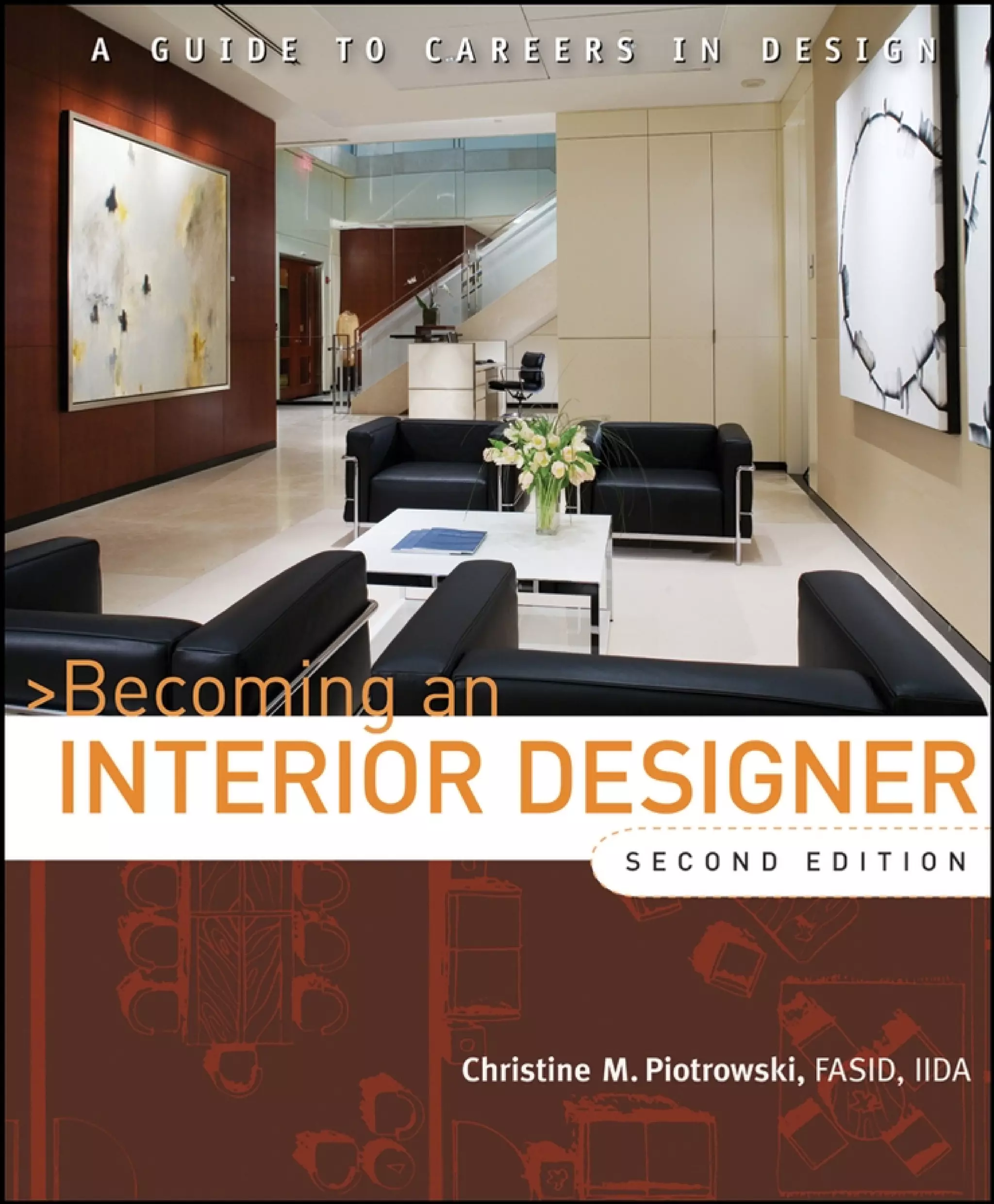
› Becoming an
INTERIOR
DESIGNER
› Becoming an
INTERIOR
DESIGNER
A Guide to Careers in Design
Second Edition
CH R I STI NE M. PIOTROWSKI, FA SID, IIDA
John Wiley & Sons, Inc.
This book is printed on acid-free paper.
Copyright © 2009 by Christine M. Piotrowski. All
rights reserved.
Published by John Wiley & Sons, Inc., Hoboken,
New Jersey.
Published simultaneously in Canada.
No part of this publication may be reproduced, stored
in a retrieval system, or transmitted in any form or by
any means, electronic, mechanical, photocopying,
recording, scanning, or otherwise, except as
permitted under Section 107 or 108 of the 1976
United States Copyright Act, without either the prior
written permission of the Publisher, or authorization
through payment of the appropriate per-copy fee to
the Copyright Clearance Center, 222 Rosewood Drive,
Danvers, MA 01923, (978) 750–8400, fax (978) 646–
8600, or on the web at www.copyright.com. Requests
to the Publisher for permission should be addressed
to the Permissions Department, John Wiley & Sons,
Inc., 111 River Street, Hoboken, NJ 07030, (201) 748–
6011, fax (201) 748–6008, or online at www.wiley.
com/go/permissions.
Limit of Liability/Disclaimer of Warranty: While
the publisher and the author have used their
best efforts in preparing this book, they make no
representations or warranties with respect to the
accuracy or completeness of the contents of this
book and specifically disclaim any implied warranties
of merchantability or fitness for a particular purpose.
No warranty may be created or extended by sales
representatives or written sales materials. The
advice and strategies contained herein may not
be suitable for your situation. You should consult
with a professional where appropriate. Neither the
publisher nor the author shall be liable for any loss
of profit or any other commercial damages, including
but not limited to special, incidental, consequential,
or other damages.
For general information about our other products
and services, please contact our Customer Care
Department within the United States at (800) 762–
2974, outside the United States at (317) 572–3993 or
fax (317) 572–4002.
Wiley also publishes its books in a variety of
electronic formats. Some content that appears in
print may not be available in electronic books. For
more information about Wiley products, visit our Web
site at www.wiley.com.
Library of Congress Cataloging-in-Publication Data
Piotrowski, Christine M., 1947-
Becoming an interior designer: a guide to careers in
design / Christine Piotrowski.—2nd ed.
p. cm.
Includes bibliographical references and index.
ISBN 978-0-470-11423-0 (pbk.)
1. Interior decoration—Vocational guidance. I. Title.
NK2116.P56 2009
747.092—dc22
2008018564
Printed in the United States of America.
10 9 8 7 6 5 4 3 2 1
DISCLAIMER
This publication is designed to provide accurate and
authoritative information in regard to the subject
matter covered. It is sold with the understanding
that the publisher and the author are not engaged in
rendering professional services. If professional advice
or other expert assistance is required, the services of a
competent professional should be sought.
All photographs, documents, and forms are
proprietary to the organization, design firm, designer,
or author. None of the figures in this text may be
reproduced without the expressed written permission
of the appropriate copyright holder.
To Martha and Casmier, looking down from above.
With love,
Christine
A truly committed decision is
the force that changes your life.
A N O N Y M O U S
PREFACE IX
ACKNOWLEDGMENTS XII
1 An Introduction to the Interior
Design Profession 1
What Do Interior Designers Do? 2
What Do Interior Designers Do? 3
Is Interior Design for You? 11
History 17
Sustainable Design 21
What Do You Feel Is the Impact of
Sustainable Design on the Profession? 27
Professional Associations 32
Interior Design Registration
and Licensing 36
How Important Is Certification by Examination
and Licensing of Interior Designers Today? 38
Why Did You Become
an Interior Designer? 42
2 Educational Preparation 55
High School Preparation 59
Choosing an Educational Program 62
How Did You Choose Which School to Attend
to Obtain Your Education in Interior Design? 63
Four-Year Educational Preparation 72
The Importance of Internships 77
Two-Year Associate Degree 78
Postgraduate Education
in Interior Design 80
NCIDQ Examination 82
Continuing Education 84
How Important Is Interior Design
Education in Today’s Industry? 92
3 Where the Jobs Are 99
Career Decisions 103
Independent Design Firms 107
What Motivated You to
Start Your Own Design Firm? 110
Architectural Offices 112
Furniture Retailers 116
Office Furnishings Dealers 119
Interior Design on a Global Stage 121
Facility Planning and Design 124
Sole Practitioner Work Environments 124
Job-Seeking Tools 130
Can You Describe the Optimum
Portfolio for a Job Applicant? 134
What Do You Look for in Hiring
a New Designer? 139
What Do You Enjoy Most About Working
in the Firm You Are in Right Now? 143
CONTENTS
02_114230-ftoc.indd vii
02_114230-ftoc.indd vii 11/14/08 11:20:35 AM
11/14/08 11:20:35 AM
B E C O M I N G A N I N T E R I O R D E S I G N E R
viii
4 Design Specialties 149
Residential Design 150
Aging in Place 153
Commercial 156
Sustainable Design 158
What Do You Feel Is the Impact
of Sustainable Design or Design
for Seniors on the Profession? 160
Corporate and Professional Offices 166
Hospitality 174
Entertainment and Recreation 180
Retail Facilities 183
Healthcare 186
Senior Living 192
Institutional 195
Restoration and Adaptive Use 201
Related Career Options 202
What Advice Would You Give Someone
Who Wants to Be an Interior Designer? 212
5 The Design Process 223
Project Development 224
Programming 230
Schematic Design 232
Design Development 235
Contract Documents 239
Contract Administration 241
Project Management 244
Working Relationships 246
What Is the Single Most Important Skill an
Interior Designer Needs to Be Successful? 247
6 Interior Design as a Business 253
Business Formations 255
What Motivated You to Start
Your Design Firm? 257
Marketing Methods 260
Contracts 264
Interior Design Revenue 270
Legal Issues 272
How Important Is Certification
by Examination and Licensing
of Interior Designers Today? 275
What Is the Greatest Business
Challenge for Interior Design Firms? 278
7 The Future 285
What Do You See as the Future
for the Interior Design Profession? 285
INTERIOR DESIGN RESOURCES 297
CIDA-ACCREDITED INTERIOR DESIGN
PROGRAMS IN THE UNITED STATES
AND CANADA 299
INTERIOR DESIGN REFERENCES 310
INTERIOR DESIGNERS 312
INDEX 317
02_114230-ftoc.indd viii
02_114230-ftoc.indd viii 11/14/08 11:20:35 AM
11/14/08 11:20:35 AM
PREFACE
The profession of interior design has received a lot of media attention over the years. Network
television has portrayed interior designers as characters in major shows and featured them as experts
on cable’s various home decorating programs. Movies have even included interior designers or
decorators as part of the cast. You have no doubt looked at one or more of the magazines related to
interior design on the newsstands. The media attention, of course, doesn’t necessarily help someone
learn all that is involved in pursuing this profession.
This book is about the profession of interior design and the professional interior designer. If
you are a student in high school or a postsecondary student who is considering interior design as a
career, this book helps you understand what the profession entails. Maybe you have lost interest in
your current career and are looking for a way to express your creative side. This book can assist you in
understanding how interior design may help you achieve that goal. It will not, however, explain how to
establish a practice or actually teach you how to do interior design.
The interior design profession has two broad segments of specialization. Residential interior
design, primarily the design of private residences, is the area most familiar to the public. Commercial
interior design is the other large segment of the profession. This specialty involves the interior
design of businesses such as offices, hotels, stores, restaurants—even airports, sports stadiums,
and prisons. Within each of these broad areas, designers might focus on one or more subareas—
condominiums and retail stores, for example.
The profession has changed significantly over the last 45 years or so. Here are just some of the
ways in which it is different: building and safety codes are emphasized; sustainable design in both
residential and commercial interior design has gained importance; the growing complexity of projects
and the design process means interior designers must be better educated and trained; licensing and
legal responsibilities focus added attention on project management and contract administration;
and the aging population has brought an increased awareness of the design of spaces for seniors.
B E C O M I N G A N I N T E R I O R D E S I G N E R
x
These challenges and others have brought about critical changes in the profession through greater
educational preparation, increased technical skills, broader knowledge requirements, and the
measurement of professional competency via testing. Thus, today’s professional interior designer
works in a profession raised to a higher level than that of the stereotypical decorator. Interior design
in the 21st century is much more than selecting colors and arranging furniture.
Helping you understand this exciting creative profession and career is the purpose of this second
edition. This award-winning book has been revised and updated to include new information on
sustainable design, aging in place, and interior design on the global stage, as well as other topics
and comments from dozens of additional practitioners at many levels in their career. Numerous new
designer profiles with examples of their project work have been added throughout the book.
Additional highlights to the second edition begin in Chapter 1, which provides an overview of the
profession of interior design with a brief look at its history and such considerations as licensing, and
other general topics. A new section discusses the role of interior designers and poses the question
“What do interior designers do?” to dozens of practitioners. Chapter 2 describes the educational
requirements of interior designers. A section has been added concerning high school preparation
to help younger potential practitioners understand what can be done at that level. Chapter 3 looks
at the various environments in which interior designers work. For example, some designers work
by themselves from home offices, while others work as team members in large design firms—and
everything in between. Note that all the information on job seeking such as résumés and portfolios
has been moved to this chapter. Chapter 4 offers insights into the opportunities for various
specializations in the field through interviews with practitioners currently working in them. This
chapter also includes additional information and comments from designers about the importance
of sustainable design and design for seniors. Chapter 5 describes the activities that occur between
the inception of a project and its completion. It also discusses working relationships with allied
professionals and the project management process. Chapter 6 presents an overview of the business
side of the profession. This chapter briefly discusses how interior designers find clients through
marketing activities, the importance of contracts in defining proposed services, and how interior
designers earn revenue. Chapter 7 is a compilation of comments from practitioners on what they feel
is the future of the interior design profession.
Indeed, I think you will find what practitioners have to say interesting and exciting. Included are
quotes and commentaries by nearly 100 professionals who are practicing interior design or have been
involved in this exciting profession in other ways. Interior designers in many specialties and career
stages have provided insights to help you discover what this profession is like. Their responses to
questions and points of view comprise a special feature found within and at the end of each chapter.
This feature is unique among career books and will help you understand what interior design is like
from people doing professional work every day.
Preface xi
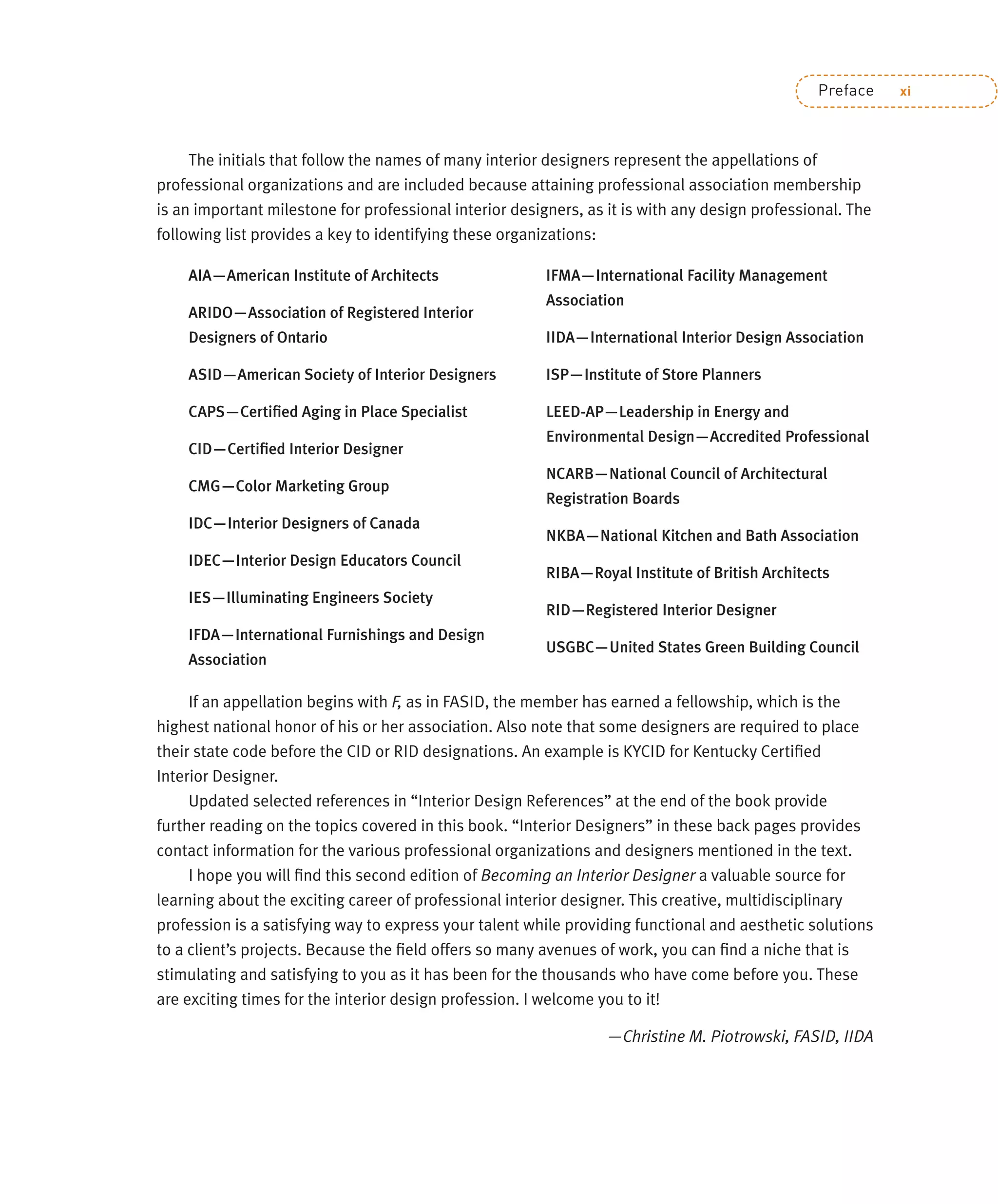
The initials that follow the names of many interior designers represent the appellations of
professional organizations and are included because attaining professional association membership
is an important milestone for professional interior designers, as it is with any design professional. The
following list provides a key to identifying these organizations:
AIA—American Institute of Architects
ARIDO—Association of Registered Interior
Designers of Ontario
ASID—American Society of Interior Designers
CAPS—Certified Aging in Place Specialist
CID—Certified Interior Designer
CMG—Color Marketing Group
IDC—Interior Designers of Canada
IDEC—Interior Design Educators Council
IES—Illuminating Engineers Society
IFDA—International Furnishings and Design
Association
IFMA—International Facility Management
Association
IIDA—International Interior Design Association
ISP—Institute of Store Planners
LEED-AP—Leadership in Energy and
Environmental Design—Accredited Professional
NCARB—National Council of Architectural
Registration Boards
NKBA—National Kitchen and Bath Association
RIBA—Royal Institute of British Architects
RID—Registered Interior Designer
USGBC—United States Green Building Council
If an appellation begins with F, as in FASID, the member has earned a fellowship, which is the
highest national honor of his or her association. Also note that some designers are required to place
their state code before the CID or RID designations. An example is KYCID for Kentucky Certified
Interior Designer.
Updated selected references in “Interior Design References” at the end of the book provide
further reading on the topics covered in this book. “Interior Designers” in these back pages provides
contact information for the various professional organizations and designers mentioned in the text.
I hope you will find this second edition of Becoming an Interior Designer a valuable source for
learning about the exciting career of professional interior designer. This creative, multidisciplinary
profession is a satisfying way to express your talent while providing functional and aesthetic solutions
to a client’s projects. Because the field offers so many avenues of work, you can find a niche that is
stimulating and satisfying to you as it has been for the thousands who have come before you. These
are exciting times for the interior design profession. I welcome you to it!
—Christine M. Piotrowski, FASID, IIDA
ACKNOWLEDGMENTS
I would like to thank the many interior designers, educators, and other design professionals who
have contributed material to this book. Many of them I have known for many years. They graciously
shared their insights, experiences, and passions about the profession as well as their project photos
and drawings for this book. All these professionals are listed at the back of the book under “Interior
Designers.”
I also want to thank several people at John Wiley & Sons for their assistance and guidance. Of
course, special thanks go to my editor, John Czarnecki, for patiently seeing this book to completion.
I want to acknowledge Raheli Millman and Sadie Abuhoff for their assistance on the second edition
and Lauren Olesky for her assistance on the first. Lastly, I want to thank my long-time friend Amanda
Miller for encouraging me to do this book in the first place.
An Introduction
to the Interior
Design Profession
We spend over 90 percent of our day in interior spaces. Despite this, most people take interiors for
granted, barely noticing the furniture, colors, textures, and other elements—let alone the form of
the space—of which they are made. Sometimes, of course, the design of the interior does catch our
attention. Maybe it’s the pulsing excitement of a casino, the rich paneling of an expensive restaurant,
or the soothing background of a religious facility.
As you are reading this book, you obviously have an interest in interiors and interior design. It
might be because you have always enjoyed rearranging the furniture in your home. Maybe you like
to draw imaginative floor plans for houses. It could be that a relative or friend is a contractor and you
have been involved in the actual construction of a building in some way. Perhaps you saw a program
on television and it inspired you to learn more about the profession.
The interior design profession is a lot more than what you see portrayed on various television
programs. The profession of interior design has been defined by educators and professionals. This
widely accepted definition is provided to help you understand what the profession is all about:
Interior design is a multi-faceted profession in which creative and technical solutions are applied
within a structure to achieve a built interior environment. These solutions are functional, enhance
the quality of life and culture of the occupants, and are aesthetically attractive. Designs are created
in response to and coordinated with the building shell, and acknowledge the physical location and
social context of the project. Designs must adhere to code and regulatory requirements and encourage
the principles of environmental sustainability. The interior design process follows a systematic and
coordinated methodology, including research, analysis and integration of knowledge into the creative
process, whereby the needs and resources of the client are satisfied to produce an interior space that
fulfills the project goals.1
1
B E C O M I N G A N I N T E R I O R D E S I G N E R
2
Professional interior designers are not interior decorators and interior decorators are not
professional interior designers, although the public generally does not see any difference. “Interior
design is not the same as decoration. Decoration is the furnishing or adorning a space with
fashionable or beautiful things. Decoration, although a valuable and important element of an interior,
is not solely concerned with human interaction or human behavior. Interior design is all about human
behavior and human interaction.”2
Although a professional interior designer might provide interior decoration services, an interior
decorator does not have the education and experience to perform the many other services of a
professional interior designer. A decorator is primarily concerned with the aesthetic embellishment
of the interior and rarely has the expertise, for example, to produce the necessary drawings for the
construction of nonload-bearing walls and certain mechanical systems that are routinely produced by
a professional interior designer.
What Do Interior Designers Do?
Interior design professionals provide the owners of homes and many kinds of businesses with
functionally successful and aesthetically attractive interior spaces. An interior designer might
specialize in working with private residences or with commercial interiors such as hotels, hospitals,
retail stores, offices, and dozens of other private and public facilities. In many ways, the interior
design profession benefits society by focusing on how space—and interior environment—should look
and function.
The professional interior designer uses his or her educational preparation and training to
consider how the design affects the health, safety, and welfare of occupants. Many projects today
include careful consideration of sustainable design in the selection of furniture and materials used
in the interior. Planning the arrangement of partition walls, selection of furniture, and specifying
aesthetic embellishments for the space are all tasks the designer uses to bring the interior to life. A
set of functional and aesthetic requirements expressed by the client becomes reality.
In planning a residence or any type of commercial interior, the professional interior designer
engages in many tasks using a wide variety of skills and knowledge gained through education and
practice. The professional interior designer must consider building and life safety codes, address
environmental issues, and understand the basic construction and mechanical systems of buildings.
He or she must effectively communicate design concepts through precisely scaled drawings and other
documents used in the industry. Another critical responsibility concerns how to manage all the tasks
that must be accomplished to complete a project as large as a 1,000-room casino hotel or as small as
someone’s home. The interior designer must also have the business skills to complete projects within
budget for the client while making a profit for the design firm. And, of course, the interior designer
selects colors, materials, and products so that what is supposed to actually occur in the spaces can.
This book helps you see clearly what the profession is about and what the real work of interior
An Introduction to the Interior Design Profession 3
designers is like in the 21st century. It includes comments from professional interior designers in many
specialties, sizes of companies, and areas of the country. These responses are presented to help you
get an idea of what working professionals think about the profession. I posed the question “What
do interior designers do?” to many of the designers whose work or other comments are in this book.
“Problem solving” is a common response, but many other tasks and responsibilities are also mentioned.
What Do Interior Designers Do?
› Residential interior designers support their
clients in realizing their dreams and creating a
home for their family and friends. We research,
design, document, and specify the interior
architectural finishes, millwork, plumbing, lighting,
cabinetry, and interior design details and work
closely with the project team (client, architect,
and contractor) to implement them. Second, we
bring together the complete vision for the project
through the design, research, and implementation
of the interior furnishings—from all the furniture
to the artwork and accessories.
Annette Stelmack, Allied Member ASID
› Create environments that support the human
condition in whatever activities it chooses,
including living, sleeping, working, playing, eating,
shopping, healing, or praying. These environments
must be safe, accessible, sustainable, and, in many
cases, beautiful. But, most importantly they must
be functional for the person(s) inhabiting them.
Lisa Whited, IIDA, ASID, Maine Certified Designer
› Interior designers create interior environments
that are functional, aesthetically pleasing, and
enhance the quality of life and culture of the users
of the space. In doing so, they have an obligation to
protect the health, safety, and welfare of the public.
Jan Bast, FASID, IIDA, IDEC
› We influence life patterns by creating healthy
and safe environments.
Patricia McLaughlin, ASID, RID
› Interior designers solve problems. Our clients
come to us with questions, wants, and needs and
through design development we answer those
questions and provide solutions for those wants
and needs—all while protecting the health, welfare,
and safety of the public through our knowledge of
local and national building codes.
Kristin King, ASID
› Interior designers plan and design interior
spaces. Interior designers understand how people
move through, live and work in, and experience
interior space. We consider the specific experiences
and functions the space or project must support
from the point of view of the user. Our unique
understanding of psychological and human factors
as well as formal design principles, materials, codes
and regulations, and the means and methods of
construction inform our diagnosis of user needs
and the development of design concepts.
Beth Harmon-Vaughn, FIIDA, Associate, AIA, LEED-AP
› They use their creative skills and expertise to
create spaces that improve people’s environments
and make life better. More pragmatically, interior
designers gather and analyze information, produce
drawings, manage consultant teams, and oversee
construction projects.
David Hanson, IDC, RID, IIDA
B E C O M I N G A N I N T E R I O R D E S I G N E R
4
› Good question. Interior design is sometimes
described as problem solving, but our work is
really focused on helping our clients prepare for a
future they can imagine but not fully predict. We
develop an image that transforms their vision to
reality. The vision is from the client’s thoughts and
business goals.
We take our client’s ideas, expressed in business
terms, and give them form, make them reality. That
reality is something they could have never imagined
themselves and when it is right and becomes
their vision, we have succeeded with the magic of
design. To do so, designers have to understand their
aspirations, not merely their needs.
Rita Carson Guest, FASID
› Interior designers are problem solvers who must
be able to develop a design that fits the client’s
criteria and budgets. They must be able to take that
design concept and make it reality by preparing
the necessary drawings, renderings, details,
construction documents, specifications, budgets
along with the most important part, which is
creativity and visualization. They also must be very
strong in communication and, most important, in
being listeners.
Lisa Slayman, ASID, IIDA
› Depending upon the project, interior designers
investigate existing conditions; research work
habits and management philosophies; incorporate
work and life culture of space users or clients;
explore potential solutions that meet functional
and aesthetic goals; conform to code and legal
constraints; prepare graphic and written materials
that communicate the solutions to a wide variety of
people—clients, lenders, committees, other design
professionals, code officials, and the building
industry; and continue building their knowledge.
Katherine Ankerson, IDEC, NCARB Certified
› An interior designer serves many roles. A
designer is a mentor to clients and others in
the profession. We serve as project managers
coordinating many trades and making sure that
not only we are doing our job correctly, but that
Private residence:
kitchen remodel. Sally
Howard D’Angelo, ASID,
S. H. Designs, Windham,
New Hampshire.
PHOTOGRAPH: BILL FISH
An Introduction to the Interior Design Profession 5
others are as well. We inspire interiors as well as
lives with our work. Sometimes we do the dirty
work that no one else wants to do, but in the end
the smile on a client’s face and the satisfaction that
comes from a completed project makes all the
project’s challenges worth the time and effort.
Shannon Ferguson, IIDA
› We are professionals that offer our clients
creative solutions in order for the spaces in which
they live, work, play, and heal to function better
and be more aesthetically pleasing.
Robert Wright, FASID
› We do everything for a space: we think
through how the space functions based on who
is occupying that particular space, how they are
going to live there, work there, and function, and
design around those parameters. We coordinate
colors, furnishings, fabrics, and everything that
goes into the environment.
Laurie Smith, ASID
› Interior designers design and create interior
spaces, whether residential, commercial, or
hospitality. The role of the interior designer is to
understand the client’s vision and goals for the
project and interpret them in the design.
Trisha Wilson, ASID
› Good designers provide problem resolution
through good design.
Patricia Rowen, ASID, CAPS
› Every decision an interior designer makes,
in one way or another, involves life safety and
quality of life. Some of those decisions include
specifying furniture, fabric, and carpeting that
comply with fire codes, complying with other
applicable building codes, designing ergonomic
work spaces, planning spaces that provide proper
means of egress, and providing solutions for the
handicapped and other persons with special needs.
Universal design and green design are buzz words
right now but they have always been and will
continue to always be a part of every project. In
addition to all of this, we manage projects, with
budget, time, and safety in mind.
Donna Vining, FASID, IIDA, RID, CAPS
› If they are good at what they do, they create
environments that unfold really meaningful
experiences for their guests.
Bruce Brigham, FASID, ISP, IES
› Interior designers take a client’s programmatic
needs for a space and combine them with creativity
and technical expertise to arrive at a customized
space unique to their client.
Maryanne Hewitt, IIDA
› Interior design is a service industry. A designer
must enjoy working with and helping people.
Some of the aspects of commercial interior design
include research, psychology, art, color, graphics,
design, ergonomics, efficiency, and workflow.
Mary Knopf, ASID, IIDA, LEED-AP
› They are problem solvers. They need to be
able to translate someone else’s idea into a new
reality. They need to be able to pick up all the
puzzle pieces and reconstruct them into another
solution—different from what the box said.
Linda Isley, IIDA, CID
› In three words: plan, coordinate, and execute.
An interior designer is responsible for distilling
the client’s thoughts, desires, and budget to create
a design plan for the project. The designer then
coordinates all the elements within the plan and
finally is the moving force for the plan’s execution.
Greta Guelich, ASID
B E C O M I N G A N I N T E R I O R D E S I G N E R
6
› Interior designers shape the human experience
by creating the spaces in which we interact and
live.
Darcie Miller, NKBA, CMG, ASID Industry Partner
› The easy answer is we create environments
that are not only lovely to look at, but are also
functional. But actually we are also therapists,
accountants, researchers, organizers, shoppers, and
sometimes even movers to realize our concept.
The interior designer often becomes a family’s
most trusted friend as major moves, new additions
to the family, new hobbies, or any other family
change that affects the interior are discussed with
the designer—and often we are the first to know.
Susan Norman, IIDA
› Interior designers in the corporate world
understand corporate culture, how people work,
and what corporations need to attract and retain
personnel. Interior designers study the workplace
and create environmental solutions that are
productive and fitting for the users.
Colleen McCafferty, IFMA, USGBC, LEED-CI
› In the course of my 25-plus-year career, I
have worked on a variety of projects from small
to very large residential projects, hospitals, and
healthcare facilities—which are like little cities—
numerous corporate offices, a funeral home, a
fire/police station, and a yacht. The scope of work
has always been varied within each project. Some
include all aspects, from initial client contact and
proposals, through schematics and budgeting;
design development with space planning, furniture
arrangement, selection, specifying, and scheduling;
finish selection and scheduling; lighting, artwork,
and accessory selection and placement; bid
documentation and processing; installation; and
working with all types of industry professionals,
trades, and vendors. I have experienced the retail
setting, design studio, architectural firm, and
consulting as an independent designer. I have
attended multiple trade shows and markets,
traveled the world, and met many people in the
process. The body of knowledge reflected in the
Council for Interior Design Accreditation (CIDA)
Standards is very real in its expectations of what
interior designers do.
Carol Morrow, Ph.D., ASID, IIDA, IDEC
› They solve problems (whether they are spatial,
organizational, programmatic, or aesthetic)
that affect people’s health, safety, and welfare.
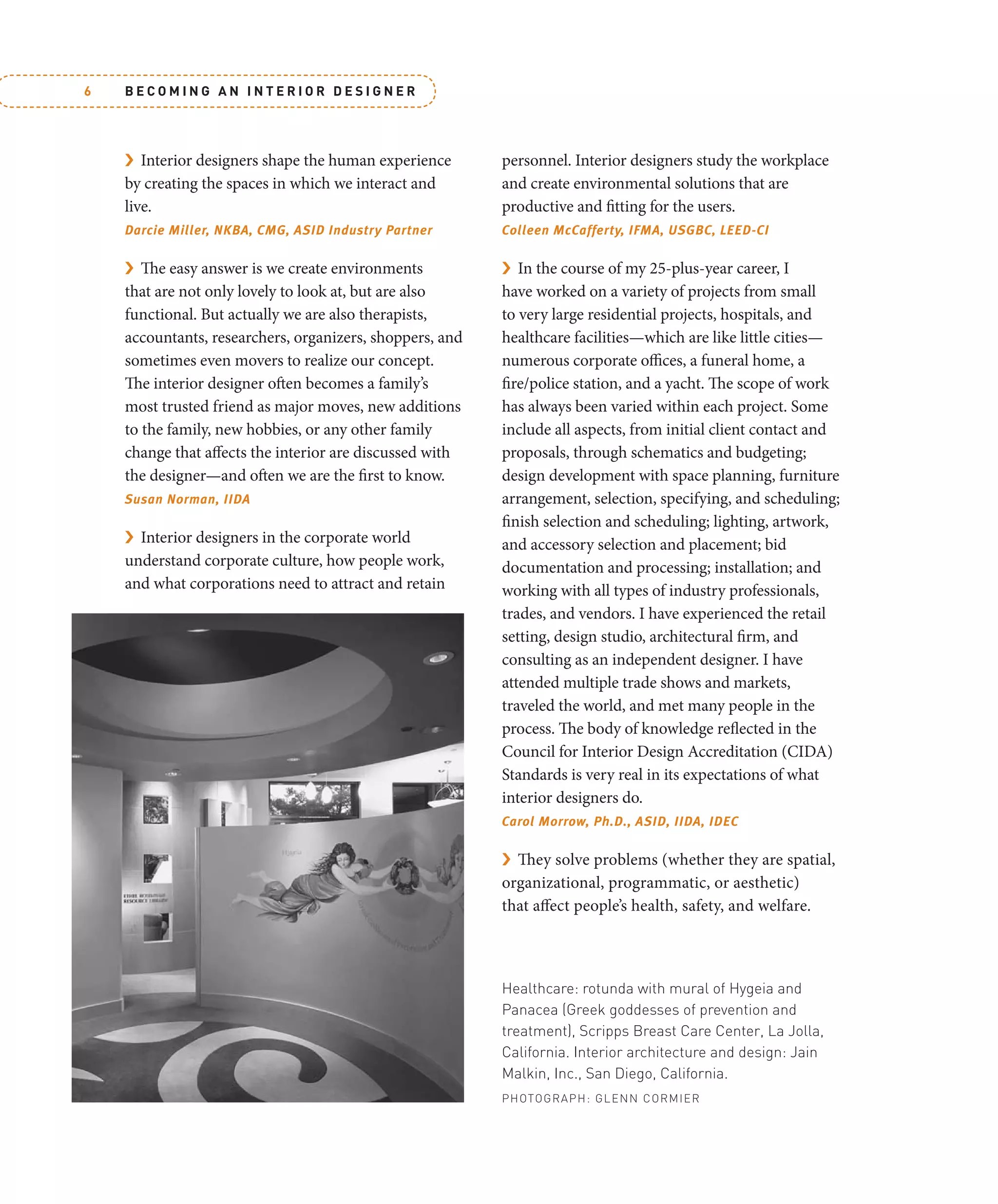
Healthcare: rotunda with mural of Hygeia and
Panacea (Greek goddesses of prevention and
treatment), Scripps Breast Care Center, La Jolla,
California. Interior architecture and design: Jain
Malkin, Inc., San Diego, California.
PHOTOGRAPH: GLENN CORMIER
An Introduction to the Interior Design Profession 7
Some are great technicians; some are great
designers; some are great teachers; and a rare
few are two or all of these. Some work in large
offices; some are sole practitioners. Many work
in the residential realm while a large number
work in the commercial setting (that includes
healthcare, hospitality, retail, or corporate
work). Nevertheless all collaborate with other
design professionals—including engineers and
architects, building service/construction experts,
and vendors/suppliers of all types.
David Stone, IIDA, LEED-AP
› A good interior designer will listen to the client’s
needs and try to fulfill them to the best of his or
her ability—keeping in mind, of course, function
and good design.
Debra Himes, ASID, IIDA
› Interior designers help the client improve their
space, taking into account the client’s needs and
culture. The nature of projects vary so much that
it is difficult to say.
Jane Coit, Associate Member IIDA
› Interior designers incorporate a broad range
of skills to plan space that is both functional and
aesthetically pleasing. Interior designers must
juggle the needs of the client within the constraints
of issues such as temporary or leased space, tight
budgets, and differing aesthetic tastes. Interior
designers provide a specialized knowledge base
that includes understanding design elements and
principles, space planning, life safety issues, codes,
and contract documents.
Laura Busse, IIDA, KYCID
› Interior designers create meaningful,
aesthetically pleasing environments to enhance the
intended human activity within the environment.
Suzan Globus, FASID, LEED-AP
› The answer quite honestly depends upon whom
and when you ask the question. There are many
interior designers who focus upon schematic
design and design development phases of work,
yet there are many interior designers that place
their primary attention upon marketing, branding,
or the management of design. Many interior
designers work collaboratively with a range of
professionals and utilize a range of skills on a daily
basis, from computer modeling and rendering
skills to sketching or rendering perspective
drawings by hand.
Many interior designers select fixtures,
furniture, and equipment for their current projects
and in the course of doing so, compose and
complete material boards. Material boards are
used to visualize the range of colors, materials,
and furnishings for a project. On the other end
of the spectrum, interior designers are immersed
in creating interior architecture—often working
in collaborative professional environments
integrating programmatic, structural, material,
and lighting aspects into built form. This is the
current professional model in Europe. Regardless
of where one finds or sees oneself in the spectrum,
most interior designers address design from the
perspective of the human body—its size, scale,
societal and cultural norms, experiential aspects,
and so on.
James Postell, Associate Professor,
University of Cincinnati
› Through research, development, and
implementation, interior designers improve the
quality of life, increase productivity, and protect
the health, safety, and welfare of the public.
Keith Miller, ASID
› As Nancy Blossom’s research shows, some are
tastemakers, some are place makers, others are
trendsetters. With all respect to Robert Ivy, when
B E C O M I N G A N I N T E R I O R D E S I G N E R
8
we are at the top of our game, we design holistic
spaces that address the spiritual, functional, and life
safety needs of our clients. We don’t just deal with
the finishes and contents of the spaces between the
exterior walls. Interior designers need to have an
understanding of the context within which they
work and understand how their decisions affect
structure, site, and infrastructure. All of us deal
with the health, safety, and welfare of the public
in some way or another through the decisions we
make in service to our clients. Even the selection
of a simple item like a piece of furniture can have
psychological and physiological, as well as code
implications. The piece may not project the image
that the client wants, it may not support the body
properly, and its materials may produce toxic gases
in a fire. This, in addition to the larger implications
of the interior planning, should give an indication
of how far reaching a designer’s decisions can be.
Robert J. Krikac, IDEC
› Work with clients to create an environment that
reinforces and supports their business.
Nila Leiserowitz, FASID, Associate AIA
› Create functional, secure living, and working
environments that support health, safety, and
welfare issues while also raising the quality and
enjoyment of life.
Michael Thomas, FASID, CAPS
› The interior designer is the bridge between the
physical environment and the human in space.
Our distinction in the building practice is the wish
and capability to help people become more human.
And our success is the ability to make these
positive connections.
Linda Sorrento, ASID, IIDA, LEED-AP
› The interior designer must have a holistic view
of any project undertaken. This view comes into
play when you see the integration of all the facets
and requirements of the project.
An interior designer must have practical and
technical expertise, as well as an understanding
of the aesthetics, of all elements that make up
the interior environment. The designer must
understand how people use and respond to these
elements. It is not a matter of understanding the
individual elements in an interior, but the elements
as they interact with each other.
We live, work, and play in a three-dimensional
world—spending on average about 80 percent of
our time each day indoors.
Interior design deals with the human-built
environment. . . . It touches all that we do in both
our personal and professional lives. What we see
and touch—the environment that surrounds us and
how that makes us feel—is most often noticed, and
is a direct result of interior design or a lack thereof.
Interior design affects people’s lives to a greater
degree than any other profession. It affects how we
live and move and feel in the built environment—
the very quality of our lives.
Linda Elliott Smith, FASID
› They are problem solvers foremost. They assess
and identify the design problem and they develop
the design solution through critical thinking.
Robin Wagner, ASID, IDEC
› Interior designers perform a wide range of tasks,
so every day is different. From the obvious, like
space planning and color selections, to the not
so obvious, like personal counseling to late-night
photo shoots, there is always something new to do
as an interior designer.
Lindsay Sholdar, ASID
An Introduction to the Interior Design Profession 9
› First, what I don’t do: I don’t design anything
alone. I illustrate planning concepts with well-
developed graphic representations and discuss how
these concepts may improve the performance in an
office.
Lisa Henry, ASID
› Interior designers design interior environments
that affect the human experience, to establish a
clear understanding of place. That is, they create
an identity or image for a commercial or private
building, to elicit a personal response such as
to relax, entertain, have fun, buy product, heal,
learn, teach, impress, and so on, or to support a
particular task, that is, to create an efficient and
ergonomically correct work environment.
Rosalyn Cama, FASID
› In my world, they act as psychiatrists and
problem solvers. People need help figuring out how
to make their lifestyles fit their residences—and the
same goes for their commercial spaces. A designer
needs to listen to their clients, their needs, and
how they and their families or coworkers use the
given spaces. Designs need to provide comfort and
functionality—and it is a designer’s job to integrate
both. Additionally, I feel that my job is to truly
make my clients’ lives easier. Most people don’t
want to think about the process of creating the
design whether on paper or in true action. I have
found that many clients also do not want any part
of the construction/deconstruction process either.
Therefore, a designer can also take on the role of
“go-between” or project manager (to use a more
commonly understood phrase).
Marilizabeth Polizzi, Allied Member ASID
› There are a broad range of skills involved in
interior design. A designer or firm may specialize
in a small segment or cover all the tasks involved.
We typically clarify a program defining the
constraints and goals for the project, offer and
refine creative solutions for the interior space and
associated details, make selections for finishes
and furnishings, document our findings, create
budgets, contract labor, make purchases, and
manage the implementation of the project.
Sally Howard D’Angelo, ASID, AIA Affiliate
› For my practice, I spend a great deal of time
as a client advocate. I help clients sort through
the choices that appear overwhelming, to reach
a solution that is practical, interesting, and
aesthetically pleasing. I want to find solutions to
the problems at hand, whether the problems are
large or small. If the problems or things that annoy
the user have not been dealt with, the project
is not a success. Masking something that is not
functioning well by making it pretty is not effective
design. Another definition of what designers (at
least for myself) do is about 5 percent actual design
work and 95 percent project administration and
oversight.
Sharmin Pool-Bak, ASID, CAPS, LEED-AP
› The NCIDQ (National Council for Interior
Design Qualification) definition is the best
example to me of what interior designers do.
However, I believe one of the best definitions is in
an article by Jill Pable at Florida State University
(and her colleague) that discusses the difference
between “filled and fulfilling spaces.” I believe that
interior designers do not fill, but design and create
“fulfilling spaces” based on client needs and desires
within a given budget and timeline.
Stephanie Clemons, Ph.D., ASID, FIDEC
› Analyze client needs, educate clients, use
acquired knowledge to provide solutions that
support clients’ needs, productivity, strategic plan,
and corporate brand.
Terri Maurer, FASID
B E C O M I N G A N I N T E R I O R D E S I G N E R
10
› Interior designers are problem solvers. They
provide solutions by addressing such issues
as spatial planning, acoustics, and lighting. In
addition to creating a functional space, a designer
strives to provide an aesthetically pleasing
environment for their client.
Teresa Ridlon, Allied Member ASID
› If they are doing what I feel they should be
doing, they work as part of a team with the clients
to design spaces that will help the clients lead
healthier, happier, safer lives. This goal should
be the same whether designing residential or
nonresidential spaces. That is the short definition.
Drue Lawlor, FASID
› We help create the environments where people
live, work, and play.
Melinda Sechrist, FASID
› Interior design projects are the design and
renovation of interior space within buildings. The
interior designer’s role is to lead the design process
for interior design projects. Interior designers listen
to their clients during the programming phase.
They bring new research to the design solutions.
They create design solutions that meet their
clients’ needs and exceed their expectations. They
document projects for building permit application.
They observe construction. Interior designers
collaborate with other disciplines throughout
the entire project (architects, engineers, lighting
designers, vendors, and contractors).
Rachelle Schoessler Lynn, CID, ASID,
LEED-AP, Allied Member AIA
› Interior designers protect the health, safety, and
welfare of the public while creating environments
that are appropriate and enjoyable to the occupants
of a space.
Alexis B. Bounds, Allied Member ASID
› Interior designers create a functioning
environment that is aesthetically inspiring. This
environment is specific to the client’s goals and
adheres to all applicable life, health, and safety
codes. Green and universal design should be
strongly considered.
Carolyn Ann Ames, Allied Member ASID
› When it comes right down to it, we’re advocates
for the end users of a space. We put ourselves in
the homeowner’s, student’s, patient’s, customer’s,
visitor’s, or worker’s place and create spaces that
are safe, comfortable, beautiful, functional, and
inviting. Unlike what’s shown on TV design shows,
design is much more than aesthetics—it’s about
making better interiors for all of us to inhabit.
Charrisse Johnston, ASID, LEED-AP, CID
› Problem solve. We create attractive but
functional environments.
Chris Socci, Allied Member ASID
› An interior designer is a professional that has
the ability through experience and education to
create interior environments that serve their end
users with functionality and preserve the health,
safety, and welfare of the public. Professional
interior designers are able to visually enhance
spaces. But more importantly, they are able to
identify spatial challenges and overcome those
obstacles with creative solutions that are developed
through researching and observing the physical
environments.
Shannon Mitchener, LEED-AP, Allied Member ASID,
Associate IIDA
An Introduction to the Interior Design Profession 11
Is Interior Design for You?
Many people think that someone who wants to be an interior designer must be very creative or an
artist. It certainly takes creativity to develop plans and design concepts to resolve a client’s needs
for a professionally designed home environment or commercial space. Few interior designers begin
their quest to be part of this profession with innate artistic abilities. These creative or artistic skills
are developed through course work and experience, as are the technical skills needed for the
development of plans and drawings.
There are many ways to work in the profession as you will see in this book. Not all positions in
interior design require a high level of skill in what might be considered artistic endeavors. You may
find a place in the profession that uses other skills such as technical mastery of drafting, project
organization and management, or the selling skills. The fact that there are many ways in which to
work in this profession is an interesting truth for anyone who:
Enjoys solving problems.
Has a concern for details.
Observes interiors and tries to figure out how to change them.
Can comfortably work with a team.
Has creative and artistic abilities and interests.
If you are interested in interior spaces, find yourself wondering about their design, or can think
of ways to make them better, that is a strong first step that shows interest in the profession. Reading
books about interior design is, of course, another strong indicator of interest. If you are in high
school, you can talk to your guidance counselor or a teacher who teaches interior design, drafting,
or art classes. You might also want to talk to an interior designer. Contact the local offices of the
professional associations and perhaps they can give you the names of designers who teach interior
design at a community college or university. Asking questions of those working in the field is a great
way to find out if you are really suited for the profession. This book will give you an overview of the
profession. You can also visit Web sites to help you learn more about the profession and career
opportunities in interior design, such as www.careersininteriordesign.com, a joint effort sponsored
by professional associations, educators, and testing organizations. The American Society of Interior
Designers (www.asid.org), International Interior Design Association (www.iida.org), and Interior
Designers of Canada (www.interiordesigncanada.org) are the largest of the professional associations
in the United States and Canada and can be contacted for information that can help you decide if
becoming a professional interior designer is for you.
B E C O M I N G A N I N T E R I O R D E S I G N E R
12
High-End Residential, Construction Remodeling
DONNA VINING, FA SID, IIDA, RID, C APS
PR E SIDENT, VINING DE SIGN A SSOCIATE S, INC.
HOUSTON, TEX A S
What has been your greatest challenge as an interior
designer?
› Interpreting clients’ wishes and giving them
what they want and need.
How important is interior design education in today’s
industry?
› It is monumental. If we are to be a profession,
we must have a consistent, quality educational
program, ever changing and evolving as today’s
advances move faster and faster.
What led you to enter your design specialty?
› My mother was a huge influence. She was my
very own Sister Parish, always decorating our
home. When I was a teenager, she opened her
own antique shop in a small house on the same
property as our home.
What are your primary responsibilities and duties?
› Everything. When you are the owner, you
have all the financial and managerial type of
responsibilities and duties as well as being the lead
interior designer. In residential, clients want you,
and even though my staff teams on all projects, I
am heavily involved in most of them.
What is the most satisfying part of your job?
› Hearing the clients say they love our work.
TOP LEFT Private residence: master suite. Donna
Vining, FASID, Vining Design Associates, Inc.,
Houston, Texas.
PHOTOGRAPH: ROB MUIR
LEFT Private residence: living room. Donna Vining,
FASID, Vining Design Associates, Inc., Houston, Texas.
PHOTOGRAPH: ROB MUIR
An Introduction to the Interior Design Profession 13
What is the least satisfying part
of your job?
› Depending on others for my end
product—so many people are involved,
and it is hard to make things happen
just like I want them.
What is the most important quality
or skill of a designer in your specialty?
› Listening skills and teaching clients
what is best for them and their lifestyle.
What advice would you give someone
who wants to be an interior designer?
› Take business and psychology classes
and realize that the actual design
portion is a small part of the business.
Who or what experience has been a major
influence on your career?
› My mother was a huge influence. And once I
was in the field, the ability to make things beautiful
but always functional and durable.
Design of Active Living and Aging-in-Place Communities
SHANNON FERGUSON, IIDA
P R O J E C T MA N A G E R
ID COLL ABORATIVE
GREENSBORO, NORTH C AROLINA
What led you to enter your design specialty?
› Fate, I suppose. . . . After graduation I received
an internship with a North Carolina design firm.
When I started with them, they worked primarily
with local clients in the healthcare and medical
fields. After my internship, I stayed on with ID
Collaborative and, as the years have progressed,
we have become more well-known in the senior
living and active living communities. After
procuring several large projects over the last few
years I have had the privilege of progressing my
skills in active-living communities and aging-in-
place communities across the eastern and southern
regions of the United States.
What is the most important quality or skill of a
designer in your specialty?
› In my opinion the most important quality of
an effective designer is being able to listen to your
client’s expectations and desires and turn them
into reality.
Private residence: dining room. Donna Vining,
FASID, Vining Design Associates, Inc.,
Houston, Texas.
PHOTOGRAPH: ROB MUIR
B E C O M I N G A N I N T E R I O R D E S I G N E R
14
How is your specialty different from other
specialties?
› My specialty is different from others because
not only do I deal with people’s work environment,
but also their living environments. To me a
living environment is such a personal space
that it can either bring happiness or contribute
to sadness and depression. So often you see
retirement communities and nursing homes that
are depressing and run-down. If you had to live
in this every day, I would venture to say that you
might be subject to despondency and, in turn, a
shortened life span. Therefore, dealing with living
environments, especially in the aging population,
gives me a responsibility to bring renewed life into
the environments that I design.
What are your primary responsibilities and duties in
your position?
› I serve as a project manager and see projects
through from start to finish. Initially, I work with
clients to determine their scope of services needed
as well as work with them on forming a budget
for the project. I work with ID Collaborative’s
principal on design contracts for projects. Once
contracts are approved, I work with the client
from schematic design planning into design
development through to construction documents
and contract administration. Throughout this
process, I present interior finish schemes,
furnishings, and so on for client approval. We are
then able to determine the overall concept for
the space, its use, and its character. I work with
architects, contractors, and other consultants
on all aspects of the project including floor plan
layouts, reflected ceiling plans, millwork details,
architectural details, building codes, and the like.
Once construction is complete and furnishings are
installed, a final punch list is completed with the
client and the project is followed through to the
very end to be sure the client is satisfied and all
work is complete.
What is the most satisfying part of your job?
› The most satisfying part of my job is
working with the client and assisting them in
conceptualizing their thoughts and imaginations
and turning them into reality.
What is the least satisfying part of your job?
› My least favorite part is the feeling that I have
not delivered or captured the true form of the
client’s concept.
Who or what experience has been a major influence
in your career?
› My firm as a whole has been a major influence
on my career. We have a fantastic group of
people who all have different specialties that are
remarkable and inspiring to me as a designer.
What has been your greatest challenge as an interior
designer?
› Education of clients and the community. Many
people have a misconception as to what it actually
is that interior designers do. After watching all of
the shows on Bravo and HGTV, they think that
interior designers are flamboyant individuals who
swoop into a job, do a quick makeover, and are out
of the picture as fast as they came in. These shows
do not provide the public with any background
information on credentials, requirements for interior
design certification, or education, and certainly do
not provide the public with an actual picture of what
true interior designers do on a daily basis.
An Introduction to the Interior Design Profession 15
› Getting a job in interior design today requires an appropriate education and mastering skills from
drafting and drawing to effective communication. It involves learning technical areas of construction,
mechanical systems, and codes as well as showing that you have the interest and enthusiasm to work in
the profession. Getting in also means knowing what kind of job you want and whether you want to work in
a residential or commercial specialty. You also need to consider if you would work best in a small studio, a
large multidisciplinary firm, or an intermediate-size practice.
When it comes time to research job possibilities, be sure to do your homework on the companies in which
you are interested. If you know something about the company before the interview, you will make a far
better impression at the interview. Investigate the style and type of interior design work that the firm
does by researching trade magazines and local print media. Look for the firm’s Web site and carefully
examine as much of it as you can. Talk to professors who know something about the company. Your college
placement office might be able to help as well.
You can also find out about possible jobs and about a specific company by researching:
Q Department of Commerce articles and reports
Q Local magazines and newspapers
Q Dun & Bradstreet Reference Book
Q Registrar of Contractors
Q Board of Technical Registration
Q Yellow Pages directory
Q Professional association chapters
Q Family and friends
You may need two or more versions of your résumé, each specific to a type of design work you are
interested in obtaining. For example, you should organize your résumé differently when you apply
for a position with a firm primarily engaged in residential design work versus one that specializes in
hospitality interior design. The résumé also should be somewhat different if you are applying to a large
multidisciplinary firm versus a small firm. The same goes for your portfolio. Showing a commercial firm
a portfolio of residential projects could be a waste of time all around. Chapter 3 discusses résumés and
portfolios in more detail.
Looking for a job in interior design—whether your first one as you finish school or when you move from one
firm to another—is a job in itself. It is important that you go about it in a sensible and organized fashion.
The more prepared you are, the more homework you do before you even start your search, the greater your
chances of gaining that ideal position. Additional information on the topics related to finding a job can be
found in Chapter 3.
GETTING IN
B E C O M I N G A N I N T E R I O R D E S I G N E R
16
Corporate Headquarters, Offices, and Retail Spaces
FR EDERICK ME SSNER, IIDA
PR I NCIPAL, PHOENIX DE SIGN ONE, IN C.
TE M PE, ARIZONA
What has been your greatest challenge as an interior
designer?
› There is a fine balance between the activity of
design and the need to handle all the business
activities that go into the normal day. They are
both necessities and constantly in competition for
the ten hours per day we seem to feel are required.
What led you to enter your design specialty?
› From a young age, I was always interested in how
things go together and in drawing. As I learned
more about the tools of our trade, I became more
interested in how I could manipulate space to affect
people. My interest is in commercial design because
I believe it has the potential to have great impact.
What are your primary responsibilities and duties?
› Design mentor, financial control, strategic
planning for the design firm, human resources,
design and project management, marketing, and
father confessor.
What is the most satisfying part of your job?
› Teaching the many aspects of design as well
as practicing the same is the reward that is most
enjoyed.
What is the least satisfying part of your job?
› The challenge of dissatisfied clients due to any
number of reasons is a part of the job that can be,
at times, very difficult.
What is the most important quality or skill of a
designer in your specialty?
› The ability to listen and interpret wants and
needs with the best possible solution is the mark
of a good commercial designer. In the design
of office space, it takes knowledge of competing
TOP LEFT Corporate headquarters: entry.
Fred Messner, IIDA, Phoenix Design One, Inc.,
Tempe, Arizona.
PHOTOGRAPH: CHRISTIAAN BLOK
LEFT Corporate headquarters: reception area.
Fred Messner, IIDA, Phoenix Design One, Inc.,
Tempe, Arizona.
PHOTOGRAPH: CHRISTIAAN BLOK
An Introduction to the Interior Design Profession 17
space and construction methods
and understanding of the client’s
sophistication, budget, and taste as well
as timelines. The best solution most
often is a compromise that blends the
most positive aspects of all.
How important is interior design
education in today’s industry?
› It all starts here. This is the
opportunity to start building a base that
will last a lifetime. Interests and habits
that start in school will carry designers
into the profession.
Who or what experience has been a
major influence on your career?
› My involvement with IBD
(Institute of Business Designers) and then IIDA
(International Interior Design Association)
was a link to my colleagues and the profession.
It allowed me to gain insight into everyday
occurrences with a different perspective. I have
also built valuable friendships.
Corporate headquarters: boardroom. Fred Messner,
IIDA, Phoenix Design One, Inc., Tempe, Arizona.
PHOTOGRAPH: CHRISTIAAN BLOK
History
As a profession, interior design has a comparatively short history. Architects, artisans, and
craftspeople completed interiors before interior decorators began offering their services. Architects
created the design of a building’s structure and often the interiors. They would engage craftspeople to
create and produce the furnishings needed to complete the interior. Other artisans lent their expertise
with decorative embellishments and the production of handmade pieces for the interior. Of course, all
this was accomplished for the world of the wealthy and mighty—not the average person.
Many historians have credited Elsie de Wolfe (1865–1950) as the first person to successfully engage
in interior decoration as a career separate from architecture. At about the turn of the 20th century, de
Wolfe established a career by offering “interior decoration” services to her society friends in New York
City. “She was an actress and a society figure before she began to remodel her own home, transforming
typically Victorian rooms with stylish simplicity by using white paint, cheerful colors, and flowery printed
chintzes.”3
Her friends recognized her alternative decor, which was a great contrast to the dark, deep
colors and woods of Victorian interiors. She is also believed to be among the first decorators to charge
for her services rather than be paid only a commission on the goods she sold to clients.4
B E C O M I N G A N I N T E R I O R D E S I G N E R
18
The door opened for this profession at the turn of the 20th century for several reasons. One was
the development of new technologies during the 19th-century Industrial Revolution that helped make
possible machine-made furnishings and other products. These mass-produced items were cheaper
and more available to the average consumer. As demand for these goods grew, department stores—a
new concept in the 19th century—began displaying the new products in their stores, attracting the
average consumer. This exposure to new products helped generate interest in the decoration of
residences by trained decorators.
The success of the early decorators encouraged many women to seek this avenue of professional
and career enrichment. It was, after all, one of the few respectable ways for women to work in the
early part of the 20th century. Educational programs were developed to train the early decorators in
period styles and to provide the educational background needed to plan interiors. One of the first
schools to offer effective training in interior decoration was the New York School of Applied and Fine
Arts, now known as Parsons, the New School for Design.
As the profession continued to grow in the major cities, “decorators clubs” were formed in
order for the decorators to meet, share ideas, and learn more about their profession. The first
national decorators association was formed in 1931 and was called the American Institute of Interior
Decorators (AIID)—later to be called the American Institute of Interior Designers (AID). In 1975, the
two largest groups of professionals at the time—AID and the National Society of Interior Designers
(NSID)—merged to form the American Society of Interior Designers (ASID).
By the 1940s, due to changes in the profession and the built environment industry in general,
many individuals working in the field began to call themselves interior designers instead of
interior decorators and to refer to their profession as interior design rather than decorating. The
distinction reflected in these new terms was first applied to those few interior designers working with
business clients. In addition, many kinds of new business clients appeared, slowly providing other
opportunities for the gradual growth of the commercial interior design profession. Dorothy Draper
(1889–1969) is well known for her design of commercial interiors such as hotel lobbies, clubs, and
stores. Her influence grew in the 1940s, and she is often identified by historians as one of the first
interior designers to specialize in commercial interiors rather than residences.
Of course, numerous influential interior decorators and designers contributed to the
development of the profession as we know it today. The names Eleanor McMillen, Ruby Ross Wood,
Mrs. Henry Parish II, Billy Baldwin, Florence Schust Knoll, and T. H. Robsjohn-Gibbings are familiar to
many practitioners in the field. Architects Frank Lloyd Wright, Mies van der Rohe, and Richard Meier,
along with designers David Hicks, Mark Hampton, Michael Graves, and Warren Platner, are just a few
of the fine professionals whose talent immeasurably contributed to the growth of the interior design
profession in the 20th century. If you would like to learn about the history of the profession in greater
detail, you may wish to read one of the books listed in the references.
An Introduction to the Interior Design Profession 19
Commercial: Healthcare
LINDA ISLEY, IIDA, CID
DE SIGN DIRECTOR, YOUNG + CO., INC.
SAN DIEGO, C ALIFORNIA
What led you to enter your design specialty?
› At the time, the banking industry was closing
down and I was hired into a firm that specialized
in healthcare. My analytical tendencies work well
in this field. My strengths are in the technical
aspects of design and construction. In healthcare
my strengths are utilized.
What is the most important quality or skill of a
designer in your specialty?
› Being able to listen to the needs of all the “end
users” (staff, owners, and patients), and being able
to turn those desires into an environment that
promotes health and healing.
How is your specialty different from other
specialties?
› There are many things about the patients you
serve that are not documented in the design
manuals. You need to be able to interpret the
sensitive constraints of fragile health into a
solution that is both safe and comfortable.
What are your primary responsibilities and duties in
your position?
› I project manage the design and documentation
of most of the projects in the office. I review
all details that are developed in the office for
constructability and understanding.
Healthcare: Balboa Naval Medical Center, Pediatric
Intensive Care Unit. Linda Isley, IIDA, Young + Co., Inc.,
San Diego, California. Architect: Ravatt Albrecht.
PHOTOGRAPH: CAMPOS PHOTOGRAPHY
B E C O M I N G A N I N T E R I O R D E S I G N E R
20
What is the most satisfying part of your job?
› The most satisfying is seeing an idea get built.
What is the least satisfying part of your job?
› The least satisfying is being described as a
“decorator” and not being understood for what
knowledge you bring to the design team. Especially
when we are relegated to being only the “finish
applicators.”
TOP LEFT Healthcare: Scripps Mercy
Medical Group—Mission Valley—
waiting room. Linda Isley, IIDA, Young
+ Co., Inc., San Diego, California.
Architect: Rodriguez Park Architects.
PHOTOGRAPH: CAMPOS PHOTOGRAPHY
LEFT Healthcare: Scripps Mercy
Medical Group—Mission Valley—nurses
station. Linda Isley, IIDA, Young + Co.,
Inc., San Diego, California. Architect:
Rodriguez Park Architects.
PHOTOGRAPH: CAMPOS PHOTOGRAPHY
Who or what experience has been a major influence
in your career?
› I have always gravitated to an office that has
utilized my abilities to develop elevations and
design details. The more experience, the better I
became. I spent my first five years out of school
in an architect’s office doing documentation and
presentation work.
What has been your greatest challenge as an interior
designer?
› Overcoming stereotypes.
An Introduction to the Interior Design Profession 21
Sustainable Design
Watching the news you have no doubt become aware of how our environment is under siege from
depletion of resources and climate changes that change the earth and our lives. Did you know that
40 percent of what goes to landfills is construction waste? According to the U.S. Green Building
Council (USGBC), buildings consume between 30 and 40 percent of all energy used.5
The depletion of
resources also affects the built environment and the work of many in interior design and architecture.
Sustainable design of both residential and commercial interiors will continue to play a very important
role in the interior design profession in the 21st century.
The designs, construction methods, materials, and products specified for buildings and interiors
all have an impact on the environment as well as the users of buildings. Resources are depleted and
landfills become clogged with materials that may never disintegrate. The indoor environment can
be harmful to people with allergies. Finding ways to design interior environments and buildings in
general is increasingly focusing on sustainable design.
But what is sustainable design? “Sustainable design seeks to meet the needs of the present
without compromising the ability of future generations to meet their needs.”6
Concepts in sustainable
design in architecture and interior design have emerged since the 1970s though, of course, concern
for the environment goes back many more years. Sustainable design is sometimes thought of as green
design. Sustainable and green design seeks to create not only designs that utilize materials wisely, but
also manufacturing and construction processes that result in as little harm to the environment and the
user as possible while meeting the needs of the building’s owners and users.
Materials and products specified for interiors also affect the interior environment in another
way. Indoor air quality can be harmful to many users of residences and commercial spaces due to the
materials that are specified. Toxic fumes referred to as volatile organic compounds (VOCs) are emitted
from carpeting, paints, wall coverings, and furniture products. These VOCs result from glues used to
manufacture furniture, adhesives used to attach carpets to floors and wall coverings to walls, and paint.
These fumes are irritants and cause allergic reactions in some individuals.
Sustainable design concepts affect the home as well. For example, homes are built much tighter
today, meaning that contractors attempt to keep air leaking in or out of a house to a minimum. This is
done to increase the energy efficiency of the house. Unfortunately, the materials used to finish the interior
can create VOCs—as can the furniture and furnishing products specified for the residential interior.
The U.S. Green Building Council is a nonprofit organization that has brought architects, contractors,
product manufacturers, interior designers, and others in the built environment industry together to
find ways to increase knowledge and practice in sustainable design. Their educational programs help
all these different entities understand how to design buildings that are healthier for the occupants and
save resources. A program developed by the USGBC is the LEED Certification program. LEED stands
for Leadership in Energy and Environmental Design. It is a way that building owners and designers
can voluntarily create buildings that are healthy and environmentally responsible. “LEED Certification
validates a building owner’s efforts to create a green building.”7
B E C O M I N G A N I N T E R I O R D E S I G N E R
22
There are several books listed in the “Interior Design References” (page 310) that examine
sustainable design in interior design. You can also find more information from the USGBC (www.
usgbc.org).
Residential: Sustainable Design
ANNET TE K. STELMACK, A SID ALLIED MEMBER
E COI ST, CONSULTANT, SPE AKER,
AND OW NER, INSP IRIT
LOUI SVILLE, COLORADO
What led you to enter your design specialty?
› My upbringing as a first-generation American
inspired my natural approach to interior design.
My family recycled and reused everything. My love
for nature and all living creatures was nurtured
throughout my childhood and then I too passed
this value on to my husband and son. My son
enjoys teasing me that I was recycling for the
entire office before Denver had the facilities. I
would load my car up weekly with the recyclables
and deposit them at our local recycling center
in Boulder, Colorado. This started more than
20 years ago as my son Bryan is now 25; he was
always my assistant on these trips. From the onset,
I was continually drawn to organic design forms,
finishes, and objects that ultimately led to my area
of expertise in the arena of sustainable residential
design. I have a deep compassionate caring for our
environment and for the future generations of all
living species. I am continually inspired by both
Mother Earth and her and our children.
What is the most important quality or skill of a
designer in your specialty?
› Being knowledgeable and literate is vital
within all specialties of interior design, including
sustainable residential interior design. Initially,
I drew from the commercial design sector as
they were leading the way in sustainable design.
Today, there is an overflowing abundance of
information available at our fingertips for all
sectors of the market. For environmental resources,
I consistently refer to the Internet and books,
along with participating in organizations such
Sustainable residence: living room, Lake Pines.
Annette Stelmack, Allied Member ASID, Inspirit-
llc, Louisville, Colorado; formerly with Associates
III. Architect: Doug Graybeal, Graybeal Architects
(formerly with CCY Architects).
PHOTOGRAPH: DAVID O. MARLOW
An Introduction to the Interior Design Profession 23
as U.S. Green Building Council, ASID, and AIA-
COTE. The Internet, books, and networking with
like-minded individuals across all sectors of the
building industry provide a depth of knowledge
and experience that is fundamental in honing
and developing our expertise. In tandem with
knowledge must be our listening skills. Intuitively
listening beyond the words of our clients and
team members brings a synergy in our work that
transcends the details and, as though by magic,
reveals our client’s vision. I have found that this
brings together exceptional results—from great
team chemistry to proactive problem solving to
exceeding the client’s expectations.
How is your specialty different from other
specialties?
› Ultimately sustainable, green, eco-friendly
design will no longer be a separate set of skills,
knowledge, language, or practice. Sustainable
design principles and practices are now being
incorporated into interior design schools across
the country. The Council for Interior Design
Accreditation has set forth standards pertaining to
sustainability. Accredited programs must provide
education that includes the environmental ethics
and the role of sustainability in the practice of
interior design.
What are your primary responsibilities and duties in
your position?
› I was the design director of Associates III
Interior Design for over 25 years and an integral
member from 1979 to 2006. Associates III is
recognized on numerous fronts for their beautiful
interiors and earth-friendly design philosophy. I
was instrumental in mentoring and coleading this
model firm, pioneering the field of sustainable
residential interior design with our company
vision: We are environmental stewards with a
passion to create nurturing, healthy, and sustaining
environments.
As the design director and a senior project
designer with Associates III, I was responsible
for managing the design team and overseeing
projects, budgets, and deadlines. In addition, I
was responsible for business development and
departmental management tasks. I also managed
Sustainable residence: kitchen,
Lake Pines. Annette Stelmack,
Allied Member ASID, Inspirit-llc,
Louisville, Colorado; formerly with
Associates III. Architect: Doug
Graybeal, Graybeal Architects
(formerly with CCY Architects).
PHOTOGRAPH: DAVID O. MARLOW
B E C O M I N G A N I N T E R I O R D E S I G N E R
24
projects, leading my teams to the successful
completion of the most challenging and largest
scale projects taken on by the company. As the
environmental leader at Associates III, I formalized
and managed the environmental and sustainable
efforts on behalf of the firm.
I am also the coauthor of Sustainable
Residential Interiors (John Wiley & Sons, 2006)
with my Associates III friends Kari Foster and
Debbie Hindman. Our book clearly and succinctly
lays out strategies and tools to meet not only
homeowners’ needs, but those of the planet.
Over the last two years I have been
transitioning out of practicing interior design
into my next venture, Inspirit: To Instill Courage
& Life. This firm allows me to fuse my passion
for environmental stewardship and creativity
in order to inspire future generations. I actively
teach and mentor sustainability to peers, parents,
and students of all ages. My expertise, synergy,
and passion for natural and ecological design and
responsible living are reflected in all my work. As
environmental advocacy and literacy is paramount
to me, I’m thrilled to share my expansive
knowledge in the arena of environmental
sustainability by sharing my passion with all.
I lecture on sustainability and eco-design
at building industry events such as ”Interiors,”
the American Society of Interior Designers’
annual conference, and other venues. I have been
interviewed for American Architectural Review, a
PBS series spotlighting green design education.
And I serve on several committees, including the
national ASID Sustainable Design Council and the
U. S. Green Building Council—Colorado Chapter.
I am equally moved by others and seek to live
by Mahatma Gandhi’s inspirational words: “You
must be the change you wish to see in the world.”
What is the most satisfying part of your job?
› The most satisfying part of my job is connecting
with people and nurturing relationships. I also
love proactively solving problems in addition to
mentoring team members’ growth and success.
What is the least satisfying part of your job?
› As I am now transitioning out of design into
my role as an eco-consult, eco-outreach, and
eco-education, the part that I won’t miss is the
lack of perspective that some clients have on the
completion of their projects and meeting their
unrealistic deadlines. There are other issues more
important to the world than whether or not a sofa
is going to be delivered at a certain time.
Who or what experience has been a major influence
in your career?
› In addition to my upbringing, as I already
mentioned, attending the EnvironDesign2
conference in 1998 was a pivotal and focused
event that fully acknowledged my values and
ethics. The experience was emotional and intense.
I was moved deeply by William McDonough,
Paul Hawken, Sim Van der Ryn, and many others
over the course of the weekend conference, and
it changed my life for the good. My newfound
conviction for environmentally responsible, green
building became a motivating force in the firm. I
was fortunate to find synergistic alignment with
the owner of the Associates III, Kari Foster, who
fully supported the next steps of transforming the
company. As the environmental leader of the firm,
I engaged everyone to identify obvious action steps
toward being more environmentally responsible
and we used the small successes to build our
sustainable practice into an everyday part of our
interior design business.
An Introduction to the Interior Design Profession 25
What has been your greatest challenge
as an interior designer?
› Being patient while the mainstream market—
clients, team members, manufacturers, contractors,
architects, vendors—begins to recognize the
invaluable aspects of integrating sustainable
design principles, philosophies, and practices into
everything we do. Every decision we make affects
the next; it’s a chain reaction of good or negative
results that directly affects the one and only planet
that we live on.
Commercial: Sustainable Design
RACHELLE SCHOE SSLER LYNN, CID, A SID, IFMA,
USGB C, LEED-AP, ALLIED MEMBER AIA
PARTNER, STUDIO 2030
MINNE APOLIS, MINNE SOTA
What led you to enter your design specialty?
› I am a commercial interior designer. I integrate
sustainable design thinking into all of my projects.
Interior designers have a profound impact on how
the indoor environment affects human health.
What is the most important quality or skill of a
designer in your specialty?
› The ability to collaborate
and discover the best
sustainable design solution.
The ability to brainstorm
openly with others in order
to explore the possibilities
for creating a world generous
in resources for the next
generations.
How is your specialty different from other
specialties?
› Sustainable design thinking is integrated into
every design specialty. It is not an additional
service. It is integrated thinking from the
conception of a project.
What are your primary responsibilities and duties in
your position?
› I am the cofounder of Studio 2030. My business
partner David Loehr and I are responsible for
all aspects of managing our business. We love to
collaborate with our design talent on projects.
Restaurant: Red Stag Supper
Club, dining room. A LEED-
qualified interior. Rachelle
Schoessler Lynn, ASID, CID,
LEED-AP, Studio 2030, Inc.,
Minneapolis, Minnesota.
PHOTOGRAPH: ERIC MELZER
PHOTOGRAPHY
B E C O M I N G A N I N T E R I O R D E S I G N E R
26
What is the most satisfying part of your job?
› The most satisfying aspect of my job is when
the client has that “aha” moment. When the client
has experienced the project vision in person upon
construction completion and when the employees
and client respond well to the new environment.
What do you enjoy most about working in the firm you
are in right now?
› I love working with passionate, talented, smart
designers who produce great work for our clients.
What advice would you give to someone who wants to
be an interior designer?
› Design comes from the soul. This profession is
about giving, and the reward is the joy our clients
experience.
What is the single most important skill an interior
designer needs to be successful?
› Passion for great design.
10’
N
3m
0
TOP LEFT Restaurant: Red Stag
Supper Club, floor plan. Rachelle
Schoessler Lynn, ASID, CID, LEED-
AP, Studio 2030, Inc., Minneapolis,
Minnesota.
LEFT Restaurant: Red Stag Supper
Club, bar. A LEED-qualified
interior. Rachelle Schoessler Lynn,
ASID, CID, LEED-AP, Studio 2030,
Inc., Minneapolis, Minnesota.
PHOTOGRAPH: ERIC MELZER
PHOTOGRAPHY
An Introduction to the Interior Design Profession 27
What Do You Feel Is the Impact of
Sustainable Design on the Profession?
› Sustainable design must be environmentally as
well as socially and economically thoughtful in order
to be truly sustainable. It is the foundation of design
for the future.
Beth Harmon-Vaughn, FIIDA, Assoc. AIA, LEED-AP
› As an industry, I think that sustainable design is
in its early years at this point. I have several clients
who have inquired about sustainable products, but
very few that actually follow through with them. Part
of the reason for this seems to be cost factors and
another part is education and time. Currently, these
are products and concepts that you have to pursue
as an architect or designer. However, in the years to
come, I imagine that this concept will become so
common that it will be hard not to specify products
with recycled content or labeled as “green.”
Shannon Ferguson, IIDA
› Sustainability is a whole new world. We are used
to tearing down and just creating new. For the good
of the world, we need to start looking at alternate
ways to reuse materials, walls, and furniture, looking
for ways to keep materials from the landfill and still
give great solutions to the client. This is a time where
creativity is really going to challenge our solutions.
Colleen McCafferty, IFMA, USGBC, LEED-CI
› Huge! I have been serving as adjunct faculty at
several New England schools since 2001. I tell my
students that it is a given that they must design for
safety (fire and building codes), accessibility (ADA
and universal design), and sustainability. We all
have an ethical obligation to do everything we can
in the design professions to protect the earth for our
children and grandchildren. Sustainable design is not
a specialty—it is simply a requirement for all design.
Lisa Whited, IIDA, ASID, Maine
Certified Interior Designer
› We are just beginning to feel the impact of
sustainability. It is integrated to the design process.
Nila Lesierwotz, FASID, Associate AIA
› Green design is not a current fad. It is a
philosophical orientation and holds enormous
potential for the future of interior design.
James Postell, Associate Professor,
University of Cincinnati
› Sustainable design is becoming mainstream
and clients are beginning to take notice and ask
designers to design their spaces with sustainable
resources where possible without stressing their
budgets.
Interior designers are struggling to
find sustainable products at the same time
manufacturers are struggling to determine how
to transform their manufacturing operations and
products to become sustainable. There are no
standard means of measurement at this time so the
interior designer’s biggest challenge is to determine
which products are truly sustainable.
Rita Guest, FASID
› Sustainable design is something that we all
should be practicing in every aspect of our
profession and our personal lives. Using materials
and products and creating solutions that are
sustainable and healthy makes sense for your
clientele and the community at large. A sustainable
solution should encompass life cycle costs in both
real dollars and environmental impact. Designers
need to understand the reality of sustainable design
in order to remain viable in today’s marketplace.
Mary Knopf, ASID, IIDA, LEED-AP
B E C O M I N G A N I N T E R I O R D E S I G N E R
28
› We have an imperative to correct the spiral
of negative influence humans have exerted on
our planet, and to make responsible choices that
improve the environment, at the very least that do
it no further harm.
Katherine Ankerson, IDEC, NCARB Certified
› Sustainable design or rather sustainable lifestyle
is more than just a trend, it is a reality which
should dictate all aspects of all professions not just
interior design. We have a great responsibility to
overcome and will once the commitment is made.
We all just need to commit.
Darcie Miller, NKBA, ASID Industry Partner, CMG
› My hope for our profession is that sustainable
design will become the standard and not the
exception. As individuals we can make a small
difference, but as professionals we have the unique
opportunity to educate our clients and the public
on the impact of careless design decisions. We
can effect change toward sustainability on a much
larger scale than most. Our responsibility is to
protect the heath, safety, and welfare of not just the
public but of the environment as well.
Lindsay Sholdar, ASID
› Sustainable design is a way of life and is here
to stay. It affects every aspect of design and the
interior and exterior spaces we shape. I think
the philosophy and culture of sustainable design
has been implemented in our nation so quickly,
because (1) our children were taught about it in
elementary school and they taught their parents,
(2) it makes sense, and (3) we are already seeing
the impact of the opposite of sustainable design in
our atmosphere and environments. Sustainable
design aspects should completely permeate all
curriculum in interior design education. It should
be the only way to design future spaces.
Stephanie Clemons, Ph.D., FASID, FIDEC
› I have always lamented at the category of
sustainable design. I think that good design should
inherently be sustainable. But currently, it is
viewed as a category. Sustainable design is critical,
especially as we are stewards of so many materials
that go into a job. It is an opportunity for the
designer to have a teaching role with clients
and educate them on the benefits of sustainable
approaches to interior design. Not just the
environmental and health benefits, but the
Restaurant: entry. William Peace,
ASID, Peace Design, Atlanta,
Georgia.
PHOTOGRAPH: CHRIS A. LITTLE
An Introduction to the Interior Design Profession 29
economic benefits of green strategies. It puts a lot
of power in the designer’s hands to be able to show
a financial model of the return on investment.
These conversations we have about the financial
impact of many different interior design strategies
add tremendous value to our clients.
Lisa Henry, ASID
› Sustainable design is very important in the
industry at the present and is just becoming
important to the public as they are made aware of
the consequences of their lifestyle choices. In 20
years, the buzz may have faded some, but will grow
stronger during the immediate future.
Sally D’Angelo, ASID,
Affiliate Member AIA
› Sustainable design affects the health of the earth
and the health of my clients. It is my obligation as
a professional interior designer and a human being
to protect both.
Kristin King, ASID
› Within just a few more years, I believe all of our
interior design projects will include sustainable,
green solutions because we will be more aware
of the issues, better educated, and our clients will
expect it.
Robert Wright, FASID
› Sustainable design is really the responsibility of
all of us. We have the opportunity as designers to
specify products that will contribute to greener
buildings. But we also have the responsibility to
really check out the long-term effects of some of
the products that we are told are green only to find
out they fail sooner and end up in the landfill with
worse consequences than a traditional product.
Melinda Sechrist, FASID
› In the ’80s, it was life cycle design—looking
at the cost effects of our interior FFE (furniture,
fixtures, and equipment) decisions. Now we must
take a broader look at the effects of the choices
that we make as the negative impact of human
activities on the environment has become clear.
Especially in the U.S., where we still consume a
disproportionate amount of the world’s resources.
Sustainability is not a passing fad, but is becoming
a necessary mindset for how we go about our lives
and the decisions that we make about the built
environment. It is becoming more common for
students and professionals to be LEED-AP. Clients
are beginning to require more sustainability
aspects be designed in to their projects not just for
the PR, but because it makes good business from a
facilities management and financial point of view.
With the continuing rise of energy costs, LEED
approaches to buildings can have a fast payback
of increased first cost and continued operational
savings. Sustainable approaches to design can
also be used to recruit and retain the best of a
generation that lists the environment as a high
priority. The impact on design education is clear:
sustainability is here for a long time and we need
to be preparing our graduates in this area.
Robert J. Krikac, IDEC
› We as designers have the opportunity to change
the direction of global warming. The buildings and
the interiors that we design are major contributors
to landfill waste, air quality, water quality and
consumption, pollution, energy consumption due
to building operations, and energy consumption
due to manufacturing of materials required for
construction.
Rachelle Schoessler Lynn, CID, ASID,
LEED-AP, Allied Member AIA
The importance of sustainable design is addressed again in Chapter 4.
B E C O M I N G A N I N T E R I O R D E S I G N E R
30
› The consequences of unethical behavior by politicians, business leaders, sports figures, and many
others are widely discussed in the media. Ethical behavior by all members of our society is expected,
though not always forthcoming.
Ethical standards help those engaged in a specific profession understand what is considered right and
wrong in the performance of the work of the profession. In the case of interior design, ethical standards
are guidelines for the practitioner’s work relationships with clients, other interior design professionals,
employers, the profession in general, and the public.
Interior design professionals who affiliate with
a professional association are required to abide
by that organization’s written code of ethical
standards. When they do not, the association
may take action against them—and it does not
take ethics charges lightly. Designers who remain
independent are also expected to conduct their
business in an ethical manner, although they
cannot be charged with ethics violations. Many
unethical actions have legal consequences as well.
Behaving ethically is not hard. Keeping promises
made to those you work with and for, only taking
work for which you are experienced and capable
to accomplish, abiding by the laws within your
state regarding the business practice of interior
design, and respecting the client and others
are not difficult tasks. These are a sampling of
what constitutes ethical behavior. What is hard
is facing the consequences when one behaves in
an unethical manner, regardless of whether one
is affiliated with an interior design professional
association. You can read the various codes of
ethics adopted by interior design organizations
by referring to their Web sites (see “Interior
Design Resources” on page 297).
ETHICAL STANDARDS
Private residence: hall table and mirror. Greta
Guelich, ASID, Perceptions Interior Design Group
LLC, Scottsdale, Arizona.
PHOTOGRAPH: MARK BOISCLAIR
An Introduction to the Interior Design Profession 31
Education and Research
K ATHERINE S. ANKERSON, IDEC, NC ARB
CERTIFIED
UNIVERSIT Y OF NEBRA SK A-LINCOLN
LINCOLN, NEBRA SK A
What is your design practice or research specialty?
› Two areas of interest have driven my research.
First, improving teaching and learning in interior
design with a particular emphasis on using
technology and with strong educational strategies
to create interactive animations and simulations.
Second, improving the built environment for the
aging individual by investigating and creating
strategies for a supportive and livable home
environment.
What advice would you give to someone who wants
to be an interior designer?
› This is an exciting and challenging field, where
you have an opportunity to affect people’s lives
through the designed environment. Observe and
be curious about everything around you, keep a
sketchbook for observations and resulting ideas
and thoughts. Develop your interpersonal skills
alongside your design skills. Approach every task
with excellence in mind. Go beyond—take every
advantage to be a leader. Remember that you have
a unique set of skills and knowledge that allow you
to view problems much differently than most, and
do not hesitate to use this uniqueness to contribute
back to society in the betterment of the human
condition.
What has been your greatest challenge as an interior
designer/faculty member?
› The greatest challenge of being an interior design
educator is also one of the most exciting—to keep
current with the profession and issues facing it, and
to go beyond knowledge of the immediate to look
towards future implications of those issues and what
will be facing future interior design graduates.
What is the single most important skill an interior
designer needs to be successful?
› A passion for the power of design.
Why did you become an educator?
› Through all aspects of my life, I have been an
educator of sorts. In the office setting, I mentored
new professionals; in personal life, I engaged in
activities such as coaching that involve teaching
young people new skills and teamwork. Education is
a natural fit to combine the passion for design with
the leadership gifts that I possess. After teaching my
first class, I was hooked. The impact we as educators
have on the future of the interior design profession,
the blossoming of students realizing their potential,
the “aha” moments when you see in one’s eyes that
they “get it”—each of these continue to affect me in a
positive and reinforcing manner.
What are a few characteristics of a good student?
› A broad curiosity and the willingness to explore
and expand their knowledge. An excitement
about knowledge and the application of such.
Understanding they are in school to learn, that
they do not already have all the answers. Being
willing to engage in critical discourse about
design and other subjects.
B E C O M I N G A N I N T E R I O R D E S I G N E R
32
Professional Associations
A professional association helps to represent its membership to the general public. An association
also provides information and learning opportunities to enhance the membership’s practice of the
profession. Several associations serve members of the interior design profession in the United States
and Canada. Some, such as the American Society of Interior Designers (ASID), serve broad segments
of the profession. Others, such as the Institute of Store Planners (ISP), represent specialty designers.
The two largest associations in the United States are ASID, with over 40,000 members, and the
International Interior Design Association (IIDA), with over 12,000 members. In Canada, the Interior
Designers of Canada (IDC) is the national professional association. Seven Canadian provinces also
have provincial associations that support local interior designers.
When you become a member of a professional association, you join a network of colleagues with
similar interests. Many interior designers are sole practitioners, working by themselves from home
offices or small studios. Networking opportunities with members in the local area is a great assistance
to these small business owners and a reason many give for joining a professional association.
Chapter and national activities of associations give sole practitioners and designers in larger
firms opportunities to obtain and exchange information and gain from peer relationships. Becoming
involved in chapter and national committees gives members another opportunity to hone leadership
and management skills as well as to form extended networks that develop into valuable resources for
both personal and professional growth.
Members of associations are able to take advantage of the services offered by a headquarters
staff that analyzes and disseminates large amounts of information that the nonaffiliated designer may
not have access to, let alone time to read and absorb. Professional associations also serve as a filter
and source of information to help members address issues related to interior design practice, thus
helping them remain effective practitioners of interior design.
Association members obtain information via e-mail news flashes, association magazines or
newsletters, and mailings, as well as national and regional conferences. In the electronic age, the
national association’s Web site provides a great deal of important information to interior designers,
some of it available only to members. In addition, local chapters throughout the United States and
Canada hold member meetings on the local level and provide information via chapter meetings,
electronic communications, educational seminars, and newsletters.
Professional association membership conveys a meaningful credential that is important in
marketing to potential clients. The prestige this offers helps you compete against individuals who
have not obtained the education and other competency qualifications of association members.
Acceptance into an association, especially at the highest level of membership termed “professional,”
means you have met stringent criteria related to education, experience, and competency testing.
Becoming a member of an interior design professional association also means you are bound to abide
by stated ethical standards and conduct.
An Introduction to the Interior Design Profession 33
An important responsibility of the associations is to function on
behalf of members in relation to government regulation and to national
and even international issues. Professional associations have staff
departments that research governmental regulations that might affect
the professional practice of interior design and the health, safety, and
welfare of the public. This information is forwarded so individual state
or provincial chapters can inform local members about impending
legislation, regulation, and other issues that affect the profession.
Individual members also obtain much of this information via mailings and e-mail news flashes.
Which association is best for you? You alone can answer that question by becoming involved in one.
A student in an interior design program can become a student member of the national associations.
Upon graduation, the student can advance to the first level of practitioner membership. Although each
association provides similar services, the activities of the local chapters often differ; this commonly
influences the individual’s choice of organization. Attending a few local chapter meetings and getting to
know people in them will help you determine which association is right for you.
So you may have an understanding of the qualifications of membership in a professional
association, “Membership Qualifications” (see page 34) provides a brief overview of membership
qualification for ASID and IIDA. These associations were selected because they are the biggest, in
terms of membership, in the United States. Membership qualifications in other associations may
vary. “Other Professional Associations” (see page 35) gives short descriptions of some additional
professional interior design associations.
Retail: floor plan. The
Electronics Boutique,
Woodbridge Center,
Woodbridge, New Jersey.
Architect: John Mclean,
RA, AIA, John Mclean
Architect. White Plains,
New York.
B E C O M I N G A N I N T E R I O R D E S I G N E R
34
National Association
Interior Designers of Canada (IDC)
Provincial Associations
Registered Interior Designers of Alberta
Interior Designers Institute of British Columbia
Professional Interior Designers Institute of Manitoba
Association of Registered Interior Designers of
New Brunswick
Association of Interior Designers of Nova Scotia
Association of Registered Interior Designers of
Ontario
Interior Designers Association of Saskatchewan
American Society of Interior Designers (ASID)
Professional
Graduation from recognized program of study in
interior design.
Educational requirement must meet National
Council for Interior Design Qualification (NCIDQ)
requirements.
Minimum two years’ work experience in interior
design.
Completed NCIDQ examination.
Six hours (0.6) continuing education unit (CEU)
credits every two years.
Appellation usage (Member Name, ASID).
Allied
Graduation from recognized program of study in
interior design.
Minimum two years’ work experience in interior
design.
Six hours (0.6) continuing education unit (CEU)
credits every two years.
Appellation usage (Member Name, Allied Member
ASID).
Other membership categories exist for individuals
who are not interior design practitioners.
International Interior Design Association (IIDA)
Professional
Graduation from recognized program of study in
interior design.
Educational requirement must meet NCIDQ
requirements.
Minimum two years’ work experience in interior
design.
Completed NCIDQ examination.
Ten hours (1.0) continuing education unit (CEU)
credits every two years.
Appellation usage (Member Name, IIDA).
Associate
Graduation from recognized program of study in
interior design.
Minimum two years’ work experience in interior
design.
10 hours (1.0) CEU credits every two years.
Appellation usage (Member Name, Associate
Member IIDA).
Other membership categories exist for individuals
who are not interior design practitioners.
Note: NCIDQ requires a minimum of six years of
education and work experience in order to qualify
to take the examination. The minimum educational
requirement by NCIDQ is a two-year certificate in
interior design.
CANADIAN INTERIOR DESIGN
PROFESSIONAL ASSOCIATIONS
MEMBERSHIP QUALIFICATIONS
An Introduction to the Interior Design Profession 35
American Institute of Architects (AIA)
Represents the interests of professional architects.
Interior designers may be eligible for affiliate
membership in a local AIA chapter.
Building Office and Management Association
(BOMA)
Members are primarily owners or managers of office
buildings. Interior designers who work for firms
specializing in large corporate office facilities often
belong to BOMA.
Interior Designers of Canada (IDC)
The national association of Canadian interior
designers. It deals with issues of national and
international interest on behalf of the members of
the provincial associations (see “Canadian Interior
Design Professional Associations,” page 34).
International Facility Management
Association (IFMA)
Members are primarily those responsible for the
management and/or planning of corporate facilities.
IFMA members may work for a corporation such as a
large banking institution or a public utility such as
AT&T, or be independent facility planners/space
planners.
Institute of Store Planners (ISP)
Represents interior designers who specialize in
retail stores and department stores.
National Kitchen and Bath Association
(NKBA)
Represents interior designers who specialize in
kitchen and/or bath design or are retailers of products
for kitchens and baths such as cabinet makers.
U.S. Green Building Council (USGBC)
Represents individuals from across the built
environment industry working to promote buildings
that are environmentally healthy to live and work in.
An affiliated program with the USGBC is the LEED
(Leadership in Energy and Environmental Design)
accreditation program. A designer can choose
to be a LEED-Accredited Professional (LEED-AP)
by learning and demonstrating a comprehensive
understanding of green design and building
practices.
Certified Aging-in-Place Specialist (CAPS)
This certification is for individuals who achieve
additional experience, technical skills, business
knowledge, and customer service skills necessary
for working with mature adult clients and others in
the aging-in-place segment of the industry.
Note: Many other specialty associations may be
of benefit to interior designers, depending on their
specialty practice. Some are listed in “Interior
Design Resources” (see page 297); others may be
found in interior design trade magazines such as
Interior Design, Contract, and Interiors and Sources.
OTHER PROFESSIONAL ASSOCIATIONS
B E C O M I N G A N I N T E R I O R D E S I G N E R
36
Sustainable Design
LI NDA SORRENTO, A SID, IIDA, LEED-AP
DI R E CTOR, EDUC ATION & RE SE ARCH
PAR TNERSHIPS
U.S . GREEN BUILDING COUNCIL
W A S HINGTON, DC
What led you to enter your design specialty?
› My extended family is comprised of artists
and engineers extremely close to the natural
environment and volunteerism. I began as a fine
artist and discovered interior design as it was
emerging as a profession. I was fortunate that there
is a profession with all the assets to combine my
family heritage and purpose.
What is the most important quality or skill of a
designer in your specialty?
› The interior designer has a responsibility to
improve their skills through continuous learning.
How is your specialty different from other
specialties?
› Sustainable design is the basis for all specialties
to make decisions for the long term to ensure
health and good life for our children and their
children.
What are your primary responsibilities and duties in
your position?
› I initiate and maintain strategic relationships
with key industry organizations and partners
to advance the USGBC’s mission of sustainable
market transformation and its education and
research objectives.
What is the most satisfying part of your job? The
least?
› I work with an enormous diversity of players in
the sustainable built environment and, therefore,
open the door for the interior design profession
with all sorts of people. Albeit, the least satisfying
part of the job is my difficulty in balancing work
and life.
Who or what experience has been a major influence
in your career?
› Most importantly, Penny Bonda, FASID, who
inspired my professional transformation and shift
to sustainable design and all the volunteers that I’ve
worked with in this profession.
What has been your greatest challenge as an interior
designer?
› The greatest frustration is that the profession
continues to be undervalued.
Interior Design Registration and Licensing
In 2008, 24 states, Washington, D.C., and Puerto Rico—as well as the Canadian provinces—had
some type of interior design legislation. Another 10 states had legislation pending. Why are interior
designers around the country seeking legislation? Regardless of the type of space being designed,
the work of those involved in interior design affects the life safety and health of those that use interior
spaces. For example, many of the products that are used in an interior give off toxic fumes that can
be harmful to many people who have respiratory problems, and many give off toxic fumes when
burned. Interior specification of materials and products is done primarily by interior designers, not
An Introduction to the Interior Design Profession 37
the architects who design commercial buildings and homes. Having knowledge to select and specify
these products goes way beyond only considering the aesthetics of the products.
Beginning in 1982, states began passing legislation to license or register professionals working
in interior design. Of course, attempts to regulate interior design practice had been made before.
Alabama was the first state to successfully enact legislation affecting interior design. Although
legislation varies from jurisdiction to jurisdiction, legislation concerning the interior design profession
generally requires specific educational, work experience, and testing requirements in order for
individuals to work as, or call themselves, an interior designer. See “Interior Design Registration
Laws in the United States” (page 38) for a list of states that have legislation pertaining to interior
design work and the type of legislation that has been enacted. Canadian provinces with provincial
associations all have some form of legislation.
Legislation can take many forms. In some states, it restricts who may call himself or herself
an interior designer. In this case, the legislation is commonly referred to as title registration. The
legislation regulates what title is affected. In some states the regulated title is interior designer. In
most others it might be certified interior designer or registered interior designer. A title act does not
limit who may practice interior design, but rather limits the title one may use as a practitioner.
Where such legislation exists, an individual cannot advertise himself or herself as a registered
interior designer or certified interior designer unless he or she meets the education, experience, and
examination requirements defined by the jurisdiction. This type of legislation is currently the norm in
18 states and the Canadian provinces.
Some jurisdictions have passed legislation that limits who may practice interior design services
as described by a state board of technical registration. If designers do not pursue and meet the
requirements set by the state to practice the profession, then they are prohibited from performing the
professional services of an interior designer as defined by the state. This type of legislation is called a
practice act. Generally, interior designers working where a practice act has been established are called
registered interior designer or interior designer depending on the exact language of the law in the
jurisdiction. As of 2007, only Florida, Alabama, Louisiana, Nevada, Washington, D.C., and Puerto Rico
had enacted practice act legislation.
Within selected jurisdictions, licensing or other registration assures the consumer of interior
design services that the person hired for the project has the training, experience, and competence to
render professional interior design services. With licensure, problems occurring in the interior design
phase are the responsibility of the interior designer; the client has the opportunity to file a complaint
with the state board, which can discipline the designer. This protection does not exist where licensing
is not in effect. Interior designers use a combination of skills, knowledge, and experience to creatively
solve functional and aesthetic problems and meet the needs of the consumer. This is true whether
the consumer owns a home or a business facility. It can be argued that no other profession involves
as wide a range of technical, aesthetic, planning, and health, safety, and welfare issues as interior
design.
B E C O M I N G A N I N T E R I O R D E S I G N E R
38
Alabama Title and Practice
Arkansas Title
California Self-certification
Colorado Interior Design
Permitting Statute
Connecticut Title
Florida Title and Practice
Georgia Title
Illinois Title
Iowa Title
Kentucky Title
Louisiana Title and Practice
Maine Title
Maryland Title
Minnesota Title
Missouri Title
Nevada Title and Practice
New Jersey Title
New Mexico Title
New York Title
Oklahoma Title
Puerto Rico Title and Practice
Tennessee Title
Texas Title
Virginia Title
Washington, D.C. Title and Practice
Wisconsin Title
INTERIOR DESIGN REGISTRATION LAWS IN THE UNITED STATES
How Important Is Certification by Examination
and Licensing of Interior Designers Today?
› Passing a qualifying examination and becoming
registered or licensed will be the minimum
requirements for interior design in the very near
future. Nearly half the states in the U.S. and many
of the Canadian provinces already have some
legislation in place to regulate our profession.
Another 10 or so states are currently in the process
of getting this type of legislation passed. These two
things will become the minimum requirements
for those wishing to practice or call themselves
“interior designer” in the near future.
Terri Maurer, FASID
› As a former regulatory board member and
president of NCIDQ, I feel certification by
examination and the licensure through the states’
regulatory processes is critical to the protection of
the public health, safety, and welfare. This ensures
that the public can rely on those individuals with
certification and licensure as having obtained a
certain standard of education and professional
experience.
Linda Elliott Smith, FASID
An Introduction to the Interior Design Profession 39
› California licenses interior designers and I think
it’s very important for the profession.
Jain Malkin, CID
› Critical.
Nila Leiserowitz, FASID
› I would like to see interior designers certified
by examination and licensing of professional
qualification to represent the rigorous education
that we must have. We need to overcome the image
that interior designers are nothing more than
furniture salesman by the public.
Sandra Evans, ASID
› It becomes more important with each passing
year. I believe that in the next couple of decades
certification and licensing will become as
important and ubiquitous as the CPA (certified
public accountant) exam. And because of increased
liability related to interior design issues (ADA,
mold/air quality, ergonomics, etc.), the general
public will begin demanding qualified designers.
Jeffrey Rausch, IIDA
› Critical to continued advancement of the
profession through regulation of activities
undertaken under the heading of “interior design.”
Marilyn Farrow, FIIDA
› Very important. As interior designers we work
with lighting, building systems, finish materials,
and furnishings that affect the people living and
working in the spaces we design. We need to
show competence in designing and specifying
for interiors spaces beyond the pure aesthetics. It
is critical to be aware of the safety of a building’s
structural materials, the furnishings, and the
finishes in respect to one’s health and life safety.
Sally Thompson, ASID
› Monumental—the public needs to understand
our profession. Examination and licensure assures
the public that we are capable of protecting their
health, safety, and welfare.
Donna Vining, FASID, IIDA, RID, CAPS
› It is very important to set industry standards
that require at least minimum standards of general
knowledge. We owe it to ourselves and to our
clients.
Michelle King, IIDA
› Very important because of the liabilities that
exist in offering professional interior design
services. A client is paying for professional service
and expects the designer to be accountable for the
results.
Leonard Alvarado
› Immensely.
Rosalyn Cama, FASID
› I think certification is vital to the practice of
interior design. Until we have certification or legal
recognition in all states, we will not have credibility
as a professional practice.
Susan Coleman, FIIDA, FIDEC
Note: Additional comments are included in
Chapter 6.
B E C O M I N G A N I N T E R I O R D E S I G N E R
40
› The interior designer or client, to provide expertise in specific areas of an interiors project, may hire
professionals and consultants in allied fields.
Architecture: The profession of designing and supervising the construction of buildings of all types.
Construction: General contractors oversee the tradespersons that are needed to build the project.
Subcontractors are hired by the general contractor (or owner of the building) to build certain parts of the
project such as framing, plumbing, and the electrical components.
Engineering: The planning and design of various technical aspects of a building or its interior. Types of
engineers that might be involved in an interior project include mechanical, electrical, plumbing, heating
and ventilation, and structural engineers.
Facility planning: Synonymous with space planning. Facility planners often work for client corporations.
Graphic design: The design and development of a wide variety of graphic media for print, film,
advertising, books, and other areas of commercial art.
Interior architecture: Many consider this profession synonymous with interior design; however, state
boards of technical registration require that the term interior architect be used only by individuals who
have graduated from a school of architecture or been certified as an architect.
Kitchen and bath design: The specialty design of residential and commercial kitchens and/or baths.
Lighting design: The specialty design of artificial and natural lighting treatments to enhance the design
and function of an interior or exterior space.
Space planning: The planning of interior spaces, especially in commercial facilities. Generally, the space
planner has less responsibility for the decorative aspects of the interior than the interior designer.
ALLIED PROFESSIONS
An Introduction to the Interior Design Profession 41
A Career Change Challenge
CHARRISSE JOHNSTON, A SID, LEED-AP, CID
DE SIGNER (SPECIALT Y: W ORKPL ACE/
OFFICE DE SIGN)
GENSLER
SANTA MONIC A, C ALIFORNIA
How did you choose which school to attend to obtain
your education in interior design?
› I was impressed by UCLA Extension Interior
Design Program’s reputation and instructional
quality (the instructors are all practicing
professionals) and its flexible class schedule suited
my needs. I also liked that it’s a postbaccalaureate
program and that many of the students were also
career changers like myself. What sealed the deal
was meeting an inspiring woman who had gone
through the program while raising a family, passed
the NCIDQ, and become the program’s student
advisor.
What degrees do you possess?
› A professional certificate from the UCLA
Extension Architecture and Interior Design
Program; an M.B.A. from the Columbia Business
School with a dual concentration in management
and marketing; and a B.A. from Johns Hopkins
University in social and behavioral sciences with a
concentration in behavioral biology.
What was your greatest challenge as a student?
› Balancing school and family life, I attended
school in the evenings while raising two young
children. Also, gaining the self-confidence that,
even though I’d only used quantitative/analytical
skills in my past career (marketing research,
strategic planning), I could be as effective a
designer as my naturally artistic classmates.
Are you planning to take the NCIDQ exam if you have
not already? Why or why not?
› I sat for the NCIDQ as soon as I qualified to
take it. Passing this exam was important to me
personally because it validated years of hard work.
It’s also important to the profession as a whole
because it establishes standards for a still-nascent
and often misunderstood profession.
How important do you feel an internship is to a
student’s educational experience?
› Absolutely crucial, no matter what type of design
firm or how menial the responsibilities. I had an
internship at a boutique hospitality firm where
I was relegated to receptionist duty. But, during
those three months, I met a ton of sales reps, saw
all the presentation boards and proposals, and
learned firsthand how the business operated. All
of this experience proved valuable later.
How did you choose the firm that you are working for?
› Gensler is a legendary firm known for its
excellence in all regards. While still a student, I’d
met one of the managing principals at an industry
conference, and she encouraged me to call her
when I was ready to look for a job. I was totally
floored and figured that if Gensler would take me,
I wouldn’t bother looking anywhere else. And,
fortunately, that’s exactly what happened.
What has been your greatest challenge in your first
years of employment?
› Again, balancing work with family life. I enjoy
my job immensely, and I’ve been lucky to be
assigned to some wonderful projects, so it’s often
difficult for me to stop working and go home. I’m
also committed to ASID (I serve on the national
Student Advisory Council) and that takes a lot of
B E C O M I N G A N I N T E R I O R D E S I G N E R
42
time as well. But my kids are great, I work only a
mile from home, my office is very family-friendly,
and I have a super nanny, so it’s worked out very
well.
Of course, the other challenge is the low
starting salaries. I try not to think about what I’d be
making if I’d stayed on Wall Street.
Did you join the student chapter of ASID or IIDA at
your school? Why?
› My student advisor encouraged me to attend an
ASID student chapter meeting because she said
it would enrich my education beyond what I was
learning in the classroom. One thing led to another
and I eventually became a two-term student
chapter president.
Why Did You Become an Interior Designer?
› Interior design was a degree suggested by my
high school principal because I was both artistic
and academically strong in math and science.
My choices at the time were to become an art
teacher or an interior designer. Fortunately, my
principal was knowledgeable and wise enough
to advise my parents that I should pursue a
college degree and not be satisfied with a
short-term course.
Carol Morrow, Ph.D., ASID, IIDA, IDEC
› I liked the hardware store as a kid. While a
business major in college, I decided to add fashion
merchandising to make it more interesting and
had to take a basic design course as well as textiles.
I met a few interior students and figured if they
could do it, so could I. So I switched majors and
have been at it ever since.
Melinda Sechrist, FASID
› I care about people and interior design was the
most effective way I could personally contribute to
society.
Linda Sorrento, ASID, IIDA, LEED-AP
› I have always been interested in space and
interior environments and grew up drawing and
painting and naturally wanted to major in art in
college. My college required that I select a specialty,
so I selected interior design. I was still able to take
art classes while learning a profession where I
could find employment.
Rita Carson Guest, FASID
› I had always loved reading floor plans, even as
a child. I had worked for several developers—one
in the architectural department—and had always
been interested in space planning. And then the
social worker in me also liked the idea of working
with people to create living environments that
functioned well.
Jan Bast, FASID, IIDA
› I always had an interest in art, design, and
manipulating interior space. So, when I was
researching a post secondary education, it became
apparent that interior design would be a good
career choice.
David Hanson, RID, IDC, IIDA
An Introduction to the Interior Design Profession 43
› As a child, buildings, design, and construction
always fascinated me. I learned how to draft when
I was 14 years old. It was a natural progression to
become an interior designer.
Kristin King, ASID
› My passion began as a desire to create better
places for people to live and work. I believe that
all interior designers share this basic passion. That
passion has grown for me to include consideration
for how we affect the natural environment in the
process. I still focus on interiors, but the choices we
make in the process have a significant effect on the
larger environment that we all share.
Barbara Nugent, FASID
› It was my childhood dream to improve interior
environments. I described my desire to my
grandfather, and he said I was describing a career
in interior design.
Rosalyn Cama, FASID
› The creation of place has great impact on people.
Great place is both aesthetical and emotional.
Nila Leiserowitz, FASID, Associate AIA
› Believe it or not, I’d never heard of interior design
as a profession until I was working my husband’s
way through college at a local university. I worked in
the dean’s office, where the interior design program
was being developed, and the course curriculum
came across my desk. I was so impressed with the
interdisciplinary approach of the program through
art, architecture, interior design, graphic design,
and technology that I became interested in pursuing
that new major. I found it fascinating that many of
the courses focused on various forms of creative
problem solving.
Terri Maurer, FASID
› I have always been an artist and was a graphic
designer in my first career. However, I wanted to
translate my design skills from 2D to 3D. I was led
into interior design because I was very interested
in the perspective/renderings that had been done
for presentations. After taking some drafting
classes and courses in perspective, I was hooked
on creating the whole environment.
Robin J. Wagner, ASID, IDEC
› I was working in an architectural firm while
in school and saw the potential for rapid
advancement in commercial interior design. There
was a lack of technical knowledge in the field at
that time.
Fred Messner, IIDA
› I actually fell into it working for a large design
and furnishings firm after high school. I liked it
and explored many avenues of industry.
Michael Thomas, FASID, CAPS
› Interior design is an extension of my creative
nature and the fulfillment of my desire to be of
service to persons who endeavor to enrich their
lives through their physical environment.
Sandra Evans, ASID
› I became an interior designer because it was
the closest degree I could find to a fine arts degree
that my father would fund. At that time, I was
interested in all the art classes; but as I began to
take interior design labs, I enjoyed the challenge
of interpreting a program combined with the
complexity of transferring my ideas into a two- or
three-dimensional format.
Linda Santellanes, ASID
B E C O M I N G A N I N T E R I O R D E S I G N E R
44
› I’m a registered architect, not a professional
interior designer. I suppose you could say I’m a
professional interior architect who has a great deal
of experience designing interiors.
M. Arthur Gensler Jr., FAIA, FIIDA, RIBA
› I didn’t plan to become an interior designer.
I started out with a degree in psychology and,
later, through a circuitous route, discovered
this field. This was way before Art Gensler had
created the field of corporate office interiors.
Healthcare design in those days didn’t even exist.
In fact, interior design as we know it was taught
in only about three schools across the country. At
most universities, it was in the home economics
department, which was anything but commercial
or institutional interior design. It’s actually quite
an interesting story how I got into the field, but it
would take several paragraphs to even scratch the
surface. It was, however, quite fortuitous, as I found
I really enjoyed it and it brought together many of
my talents and abilities. I always had a good head
for business, was persuasive and also creative.
Those are important prerequisites for this field,
especially if one wants to be self-employed.
Jain Malkin, CID
› As a teenager I became interested in spaces,
particularly my own personal space, and how, with
some thought and manipulation of the elements
within the space, that environment could take on a
totally different feel.
Linda E. Smith, FASID
› I started out wanting to become an architect.
Lucky for me, the closest architectural school to
me was at the University of Manitoba, Canada
(100 km away from my hometown). The program
offers a master’s in architecture and is regarded
very highly. The undergraduate degrees offered are
environmental studies (three years) and interior
design (four years). I chose the interior design
program. I knew I would have a solid profession
to rely on if I did not continue studying for my
masters. (The environmental studies program
would provide an undergraduate with a very good
foundation to proceed into architecture, but it
would not provide a solid degree on its own.)
Once I graduated, I gave myself one year to
work in the industry before going back to school
for my masters. I have been practicing interior
design for 15 years and have no intention of
obtaining a master’s in architecture.
Jennifer van der Put, BID, IDC, ARIDO, IFMA
› At first it was because I wanted to fix up my
own house. Then others started asking for my
interior design advice and urged me to take it up
as a profession.
Greta Guelich, ASID
› Even during my education as an architect years
ago, the initiation and focus of my design process
was with the interior spaces and experiences
created for people within the spaces. That bent
continued on into practice in both architecture and
interior design. As a designer, the ability to shape
the settings that people live, work, and play within
is a huge responsibility and joy.
Katherine Ankerson, IDEC, NCARB Certified
› To provide functional, aesthetically pleasing
environments for people to live and work.
Sally Nordahl, IIDA
› I always knew that I’d be involved with some
type of design, but I had to take a number of art
and design classes in college to decide which area
was a good fit. I was steered into graphic design
by a guidance counselor in college who didn’t
understand our profession at all. But when I took
a job in college working with architectural models,
I realized that architecture and design were where
my true interests lay.
Suzanne Urban, IIDA, ASID
An Introduction to the Interior Design Profession 45
› I have always been intrigued by the built
environment and how space, volume, and
aesthetics affect our well-being and quality of life.
Robert Wright, FASID
› On looking back, I can’t say for sure that any
one thing swayed me. I always knew that I wanted
to be in an artistic profession, yet there was also
the mechanical side and the what-makes-it-work,
how-was-this-done aspect. I think interior design
found me. Once the decision was made, I have
never regretted nor doubted the choice.
Derrell Parker, IIDA
› I wanted to focus on the effect of environment
on personal success.
Neil Frankel, FIIDA, FAIA
› The plan has always fascinated me. As a very
young child, I drew house plans for fun. And I had
a high school art teacher who introduced rural kids
to the world of applied art. Everybody assumed a
college-bound rural kid would become a teacher
or home economist. I enrolled in the College of
Arts and Sciences as an art major. A couple of
prearchitecture courses pointed me in the direction
of architecture or interior design. Economics
and circumstances put me in the interior design
masters program at the University of Missouri,
Columbia. I have never been sorry. The intimate
relationship between an interior and the people
who live and work there is fascinating. I truly
believe that when an interior works, people live
better, work better, learn better, and heal better.
M. Joy Meeuwig, IIDA
› I considered interior design a perfect place
to blend my artistic abilities with a desire for a
professional career.
Juliana Catlin, FASID
› My mother told me I could never make money
being an artist. I still like to create, and this seemed
to be a good avenue for that.
Debra May Himes, ASID, IIDA
Sports arena: Ice Lounge, Jobing.com
Arena, Glendale, Arizona. Lisa
Slayman, ASID, IIDA, Slayman
Design Associates, Inc., Newport
Beach, California. Architect: HOK,
Kansas City.
PHOTOGRAPH: ENNIS PHOTOGRAPHY
B E C O M I N G A N I N T E R I O R D E S I G N E R
46
› I grew up with immigrant parents; my dad was
a builder and my mom was a seamstress. It was
only natural that I would end up in the building
industry, plus a little arm twisting from my
parents. From a very young age, I was exposed to
residential interiors through my mom’s work as
a seamstress who provided window treatments,
bedding, and pillows to clients. My mother worked
for a few interior designers, one who led me to a
fantastic, small interior design school in Colorado
that was accredited by FIDER (now CIDA). I loved
sitting with my dad reading blueprints and going
to the construction job sites whenever possible.
When I wasn’t in the sewing studio helping my
mom, I was on the job site with my dad or outside
gardening. To this day, I most enjoy problem
solving in the field and watching the construction
team bring it all together.
Annette Stelmack, Allied Member ASID
› I have always loved art and design. When trying
to decide how to best put my love of art to use I
felt that becoming an interior designer would be
the best way for me to share my love and talent
with my community. Not only does interior design
allow me to use my talents, but it also allows me
to create healthier and happier communities for
people who live there.
Shannon Ferguson, IIDA
› It was a career that would incorporate my
interest in science and math and a desire to create.
Interior designers at my university were required
to have chemistry, biochemistry, and anatomy as it
also satisfied prerequisites for textile science.
Linda Isley, IIDA
› I became an interior designer after getting a
bachelor’s degree in fine art and realizing that
I enjoy the hands-on and creative nature of the
interior design profession. I drew houses as a kid,
rearranged my furniture, and redecorated my
room many times. I realized later on what interior
designers do and thought that it was the fit for me.
Laurie Smith, ASID
› I had the opportunity to go back to college
when I was 38. After carefully thinking through
my talents and believing my work should be
something I loved, I selected a two-year interior
design program at the University of California.
My husband was serving in the U.S. Navy and we
had a three-year tour in Long Beach. I had just
enough time before moving again, to complete
the program. The state of California was in the
midst of interior design legislation at this time,
so I began studying for the NCIDQ as I did not
want to be known as one of the designers who was
“grandfathered” in due to this legislation.
Patricia Rowen, ASID, CAPS
› My interests and talents in high school included
fine arts, math, and music. In looking at career
options, architecture came to the forefront. In
college I experimented with architecture and
fashion design before finding the field of interior
design, which seemed like the ideal fit.
Mary Knopf, ASID
› As a kid I enjoyed creating floor plans of made-
up houses. I have always enjoyed that technical
side of design. I guess it came from my mother,
who was a seamstress and made bridal gowns
without patterns, and my father, who was a tool
and die maker. Interior design has always allowed
me to help solve the problems of making the
interior work for the business. Looking back, it
was especially gratifying to work in healthcare and
the early days of office systems and help affect the
functional working environment of hospitals and
office facilities.
Christine M. Piotrowski, FASID, IIDA
An Introduction to the Interior Design Profession 47
› I actually enjoyed art and business. I did not
think I could make it as an artist and thought
business was a bit boring. I grew up around
architecture all my life and I think subliminally it
just came to me
Jo Rabaut, ASID, IIDA
› I started out with a liberal arts degree from
Williams College. After school I worked for a
time as a carpenter and then became a contractor.
I taught myself to draw technical drawings by
studying and then copying the drawings that I
was given to build from. Then I started my own
design/build firm. Then one day I said to myself,
“I am tired of pounding nails and cutting wood. I
know how to do that now. The design part is what
I love.” So I got myself a temporary job drafting
at FORMA, the design division of Westin Hotels.
I turned that into a permanent position and
began to learn the technical rigors of fine interior
design. Then I studied for and passed the NCIDQ.
Working on the creation of a complete interior
environment from start to finish is what really
turned me on to interior design. Now that has
evolved into the development of complete, branded
environments and “experience” planning—the
obvious and necessary evolution of developing
great interior design, especially in the retail field in
which I work.
Bruce James Brigham, FASID, ISP, IES
› At the time, 1971, the field of interior design was
still “unformed.” I started in a five-year program
as a co-op at the University of Cincinnati, which
had Bob Stevens as the head of the department.
Bob was an architect, and had the vision to create
a department that still stands today as the number-
one-rated interior design program in the country.
I entered because I naively wanted design and
art courses. I got so much more, opening up an
entire world that I didn’t know existed, gaining
exposure to architecture and design, a world that
I had not been exposed to before. I also had the
pleasure of doing my early co-ops at Herman Miller
in Zeeland, Michigan, in the very early days of
Systems Furniture, with designers and innovators
on site. What a great experience that was, building
on what school was teaching me, and what the
industry was about to become. At the time of
graduation, interior designers were not generally
hired by architectural firms, but that soon changed,
and the marriage of the interior and exterior soon
became an accepted relationship.
Colleen McCafferty, IFMA, USGBC, LEED-CI
› I became an interior designer because it allowed
me to express my creativity on a large scale using
interactive mediums.
Darcie Miller, NKBA, ASID Industry Partner, CMG
› When I was a child, I would always be working
on home furnishings projects like refinishing
furniture, making accessories and selling them in
the local stationery store, and other art projects.
When I started college, I told my parents I wanted
to be an interior designer and they discouraged
me. They felt I needed to have a degree in business
because it would lead me to a more successful
place in the workforce. During my studies in junior
college, I took a couple of interior design classes
as electives and did extremely well. The teacher at
that time encouraged me to take it further so, at
that time, I changed my major. After I completed
all my design classes in that school, I transferred to
Cal State Long Beach because it had one of the best
interior design programs in the country.
Lisa Slayman, ASID, IIDA
› I enjoy the diversity. Interior design is not
dull. You meet fascinating people and work with
beautiful items to create an environment that
affects people’s lives every day.
Susan Norman, IIDA
B E C O M I N G A N I N T E R I O R D E S I G N E R
48
› I wanted to do something with my artistic
talents. I took an elective drawing class my
first year in college. I was not even thinking of
an interior design major. We did perspective
drawings, and I was immediately hooked on
the caring of interior space and plane through
drawing. I began the architecture program the next
semester.
Maryanne Hewitt, IIDA
› I was always interested in technical drawing
and watching my civil engineering father draft.
An art teacher in junior and senior high school
encouraged that drawing talent and helped me
look at architecture schools. In college a professor
helped me “see the light” and realize that interior
design was where my passion lay. The rest, as they
say, is history.
David Stone, IIDA, LEED-AP
› I have always had a passion for art, design, and
architecture. I wanted to do something creative,
but have a job that has many directions.
Jane Coit, Associate Member IIDA
› My interest in interior design is broad and
comprehensive in scope, but the basis for doing
interior design is to make a difference—to make a
better world through design.
An attraction of interior design is the brief
time span for design ideas to be realized. Most
interior projects are conceived and completed
within a year, whereas buildings and urban
development can take years to complete. Interiors
are relatively quick to complete and the satisfaction
that results from each project is rewarding.
The primary attraction of the profession is the
opportunity to compose and resolve space—down
to the details.
In my career as both an educator and
practitioner, my central aim has been to better
understand the potency and conceptual basis
of interior design. For the past 20 years, I
have taught interior design students and have
worked to develop my design practice. Teaching
and practicing are codependent, and in part I
became an interior designer because of my love
for teaching. I became a teacher for my love of
designing.
James Postell, Associate Professor,
University of Cincinnati
› When I was in junior high, my older sister
called from her college dorm to tell me there
was a career for me: interior design. Since I can
remember, I’ve been discovered sneaking around
parents’ friends’ houses fascinated at how people
use their space. I built dream homes out of
blocks for our toy figures, and drew floor plans
on notepaper, perplexed at how to put it to scale.
In high school I determined that architecture
was the more manly profession, and entered a
drafting course. Bored out of my mind drawing
screws and basic house elevations, I realized my
penchant for personal details when a classmate
broke my focus, noting the classic paneled door,
the window shutters, flower boxes, shrubbery,
brick detailing, etcetera. I enrolled in the Interior
Design Program at the University of Kentucky
and, for the first time in my entire educational
career, I felt like I was learning skills that would
lead me to my own calling.
I love art and beauty and all their natural and
created expressions, but I really love putting those
expressions to practical use in environments where
people live.
Keith Miller, ASID
An Introduction to the Interior Design Profession 49
› I became an interior designer to bridge together
my diverse interests and strengths. I enjoy
working with people, I am interested in how your
surroundings influence your work, I feel compelled
and drawn to the creative process, I enjoy numbers
and budgets. Finally, I am both a detail-oriented
person and a big-picture thinker. As a child I
always wanted to be an architect. But after learning
more about interior design while completing my
first degree in accounting, I felt certain that the
emphasis of human interaction within a space
versus just the form or function made interior
design the better choice.
Laura Busse, IIDA, KYCID
› I have always seen my career path as leading
toward designing creative solutions. I, as many
others, switched professions midlife from a
product design and production industry for the
mass market to that of interior design in order
to work more independently on unique projects
designed directly for the individual end user. I was
drawn to interior design as a more entrepreneur-
friendly field that has the advantage of affording
both small and large firms the ability to compete
successfully. An interior designer can also balance
the time spent on business activities with cycles of
intense creativity.
Sally D’ Angelo, ASID, AIA Affiliate
› I couldn’t imagine not being an interior designer.
I think the idea of being able to improve someone’s
life by improving their surroundings is very
powerful.
Lindsay Sholdar, ASID
› I became a designer because it is a unique way
to connect the world of visual arts to the world of
business.
Lisa Henry, ASID
› I “fell” into the career in high school when I
took an interior design class. I love the creative
yet practical side of the profession. I enjoy the
technical aspects of the career (e.g., lighting and
computers) as well as the application of psychology
and understanding of human behavior. I appreciate
how the field must adapt to changing trends yet
clearly support the trends that are here to stay (e.g.,
universal and sustainable design). I love the design
process and helping others develop meaningful
spaces. It is, and always will be for me, a very
fulfilling career.
Stephanie Clemons, Ph.D., FASID, FIDEC
› As a young girl, I remember how much I loved
to rearrange my bedroom furniture. My mother
would take me to the fabric store to select patterns
and fabrics for new clothes. I credit her for my
ability to visualize. As a teenager I loved the high-
style world of fashion design. Dissatisfied with the
clothing choices available, I learned to sew and
made most of my wardrobe during high school,
which provided an excellent education in the
knowledge of fabrics. That education continued
when I learned to fabricate window treatments,
bedding, etcetera for my own residence. I was in
my mid-30s when I went back to school to pursue
a lifelong love of design.
Teresa Ridlon, Allied Member ASID
› Ever since I could hold a pencil I have been
drawing floor plans—others “doodled” and I drew
plans. Architecture and interiors have always
fascinated me, and so it was really inevitable that
I would go into interior design. The interest was
encouraged by my parents, as we were forever
touring homes that were being built as I grew up,
and our own home was remodeled several times and
redesigned, with the help of an architect and interior
designer, both of whom were more than happy to
answer my questions and share advice as I grew up.
Drue Lawlor, FASID
B E C O M I N G A N I N T E R I O R D E S I G N E R
50
› I found a paper I wrote in about fifth grade
listing that as my goal. I remember drawing floor
plans of homes at that age—with designs that I still
wish could be realized today.
Sharmin Pool-Bak, ASID, CAPS, LEED-AP
› I will give you the long version. This is the story
I share with eighth-graders who are interested in
interior design:
I grew up the daughter of an architect and
engineer. My father designed our house and had
it built in 1966. My parents always gave me great
freedom in decorating my room—from painting
in whatever color I wanted to allowing me to hang
whatever I wanted on the walls. When I was in the
seventh grade, I really wanted a loft. The ceilings in
our contemporary house were very high. My father
said if I drew a plan of what I wanted, he would
build it. So I had this wonderful loft space in my
room with my mattress up high. It was very cool
for a 12-year-old.
I was in high school and not sure what I
should study in college. I loved arts and crafts
projects, but didn’t take art in high school.
However, I did take mechanical drafting, and in
Private residence: living room.
Robin Wagner, ASID, IDEC, Wagner-
Somerset Designs, Clifton, Virginia.
PHOTOGRAPH: ROBIN WAGNER
the summer I worked a little bit in my father’s
office drafting elevations and floor plans. When
I was in high school, I had a science teacher who
said I should study forest engineering because it
was a field with few women in it and I would make
a lot of money. Sounded good to a 17-year-old—
tromping around in the woods with a bunch of
guys. I entered the University of Maine at Orono
and promptly flunked out after one semester.
While I was in Orono, however, I decorated my
dorm room and won an honorable mention prize
for my room. That prize got me to thinking that
maybe I could make a living doing what I’d always
enjoyed so much, so I entered Bauder College in
Atlanta, Georgia, and received an AA in interior
design in 1983. I graduated top of my class—
proving that once I knew what I wanted to do I
could excel at it.
I worked for an office furniture dealer (Herman
Miller) for three years. Then, in 1986, when I asked
for a raise (I was making $12,000) and was turned
down, I decided to start my own company. At
the age of 23, I started Lisa Whited Planning and
Design, Inc. I kept the company until 2001.
An Introduction to the Interior Design Profession 51
In 1988, realizing I really needed to add
to my design education, I entered the Boston
Architectural Center, studying architecture. I
studied for three years, commuting from Portland,
Maine, to Boston (two hours each way) two
nights per week. I did not get my degree—but the
additional education was invaluable. I also took
classes over the years at the Maine College of Art
(color theory, etcetera). In 2000, still wanting to add
to my education, I entered Antioch New England
Graduate School and gained an MS in Organization
and Management, graduating in fall 2002.
Lisa Whited, IIDA, ASID, IDEC
› I love buildings, the exterior blending with
the interior, and bringing them together in a
harmonious manner to create a special place to
live, entertain your friends and family, work, and,
especially, relax.
Kristen Anderson, ASID, CID, RID
› At the time I started interior design school
in 1981, I was a 30-year-old wife and mother
working in a furniture business that my husband
and I owned. I was good at helping the customers
and thought it would be logical to finish my
college degree in interior design rather than in
journalism (which is what I was majoring in in the
1960s when I dropped out to get married, as many
women did in those days).
As it happened, the FIDER-accredited program
at the University of Missouri was powerful. I soon
came to understand the true impact designers can
have on environments and, therefore, on people
(and I’m a people person). I loved every aspect of
my education, but I especially loved the people
part—the design and behavior classes; the books
Designing Places for People, A Pattern Language,
Humanscape, Environments for People and Human
Dimension for Interior Space—even the ergonomics
part interested me. (Weird, huh?)
Now my life has taken many turns away
from the plans I had when I was 30. But I love my
work—I love being a professional designer.
Linda Kress, ASID
› It was an evolution from birth. I was always
drawing, painting, coloring, and making things
with my hands. I had a lot of exposure to all types
of design, but it was the college program that
helped me focus on interior design.
Susan Coleman, FIIDA, FIDEC
› By growing up in Japan, I realized that life
experiences shape who we are. Everything about
my living environment—region, culture, interior
dwellings, and so on—influenced the development
of my character and how I feel about myself and
living. In high school, I specifically realized that
I wanted to influence others because I knew well
how our environment can affect our motivation
and zest for life. I decided to do this through
interior design, where I could develop interior
environments that enhance motivation and
positive experiences for others.
Susan B. Higbee
› I have always been interested in art and
architecture and decided to focus on the interior
environment when I became familiar with this
field in college.
Janice Carleen Linster, ASID, IIDA, CID
› After reaching a previous career goal as a
journalist early in life, I decided the only thing
left to do was to write a book and quickly realized
I didn’t know much about anything other than
journalism. I thought I should pursue another
interest for the subject of the book and went back
to college to study interior design. College led to
practicing.
Suzan Globus, FASID, LEED-AP
B E C O M I N G A N I N T E R I O R D E S I G N E R
52
› As a child, I was influenced by my mother and
grandmother. Growing up in Miami, I spent a lot
of time watching them renovate homes and boats.
It was then I realized I could mentally visualize
a space in three dimensions. Interior design just
seemed to be the natural direction for me.
Sally Thompson, ASID
› From a young age, I was always interested
in design. I enjoyed art classes and visiting art
museums with my parents. I would spend hours
with large sheets of paper, drawing entire cities
with buildings, houses, and roads. My cities were
perfect places to race my matchbox cars. I enjoyed
creating my own little world with Lincoln Logs
and Legos. My Barbies always had the best-laid-
out townhouse on the block. When asked what
I wanted to be when I grew up, I would always
answer, “an architect.” I don’t think I really knew
what that meant, only that it had something to do
with creating the built environment.
I took all the design and drafting classes I
could in high school. I was fortunate to have
the opportunity to participate in the Georgia
Governor’s Honors program in Design. My type of
artistic talent—more technically oriented—seemed
to be the perfect match for architectural design. I
entered college determined to get into the School
of Architecture and study interior design.
Kristi Barker, CID
› I want a career that utilizes both my technical
capabilities and creative talents. Interior design is
about balancing what is physical and tangible with
aesthetic ideals. To me, form and function should
be a happy marriage. I also enjoy having new
challenges on a regular basis. Each new project
offers a chance to approach things differently, to
solve a new problem.
Kimberly M. Studzinski, ASID
› In 1997, I graduated from Carnegie Mellon
University with a Bachelor of Architecture degree. I
decided I wanted to work in a more detail-oriented
field, so I took a position at a firm that practiced
architecture but had interior design as its specialty.
Derek Schmidt
› In high school, I was fascinated by the way a
building’s energy was embedded in its structure. I
considered studying architecture, but at that time
women were not encouraged to be architects,
and I entered a liberal arts program instead. After
graduation, I took a series of aptitude tests, and
architecture looked like the best career choice, so I
enrolled at the Boston Architectural Center. After two
and a half years of going to school nights and working
days at anything I could get related to architecture,
I burned out on school but continued to work. A
recession and a move to Denver took me into retail
management and human services work. In 1988 I
moved back to Boston and got a job with an architect.
A vocational counselor advised that, because I loved
color and texture and was most interested in how
people experienced and used interior spaces, I might
study interior design. So back I went to the BAC’s
interior design program.
Corky Binggeli, ASID
› My dad was a contractor and as a kid I worked with
him on some of his projects. I thought of becoming
an architect but lacked the discipline to study,
especially math, while I was in college. I was much
more interested in following sports and finding a
husband than getting an education. I ended up with an
education and married later in my career.
Mary Fisher Knott, CID, RSPI, Allied Member ASID
› I had wanted to be involved in the built environment
since I was four or five. Of all the things going on, the
workers and their tasks fascinated me the most. Being
raised in a rural community, I did not encounter much
emphasis on the design professions, but I took as many
An Introduction to the Interior Design Profession 53
courses as I could that would prepare me for a career
in architecture. I say architecture because I had no
idea that interior design was a profession unto itself.
In college I was exposed to the profession of interior
design as a career option. When the possibility of
a career path in interior design became clear, my
academic life became much more exciting, engaging
me in a much more passionate manner. After many
years working in small architecture firms and then
in the interiors group of a large AE (architectural-
engineering) firm, I obtained a master’s degree and
pursued a career in design education. Choosing
the education path has allowed me to continue to
be a part of the design profession and to give back
something to this profession that has provided me
such a satisfying career.
Robert J. Krikac, IDEC
› My dad and brother are both in the construction
business, so I grew up around a construction
environment. On top of that, drawing has always
been a talent that comes naturally to me. Design is
the best mesh of things that I am comfortable with,
enjoy, and can earn a living with. I was actually
a pre-vet major for two years before design. I
switched after realizing it was not stimulating or
creative enough for me, so I made the commitment
to take on the additional four years of design
school. It was certainly worth it.
Alexis B. Bounds, Allied Member ASID
› I became an interior designer because of my love
of the art field. What blossomed from that was a
deep appreciation for the way an interior affects its
habitants.
Carolyn Ann Ames, Allied Member ASID
› Interior design captures all of my interests—art,
business, and science—in one profession. Every
day I get to exercise a whole range of skills, so I’m
never bored.
Charisse Johnston, ASID, LEED-AP, CID
› Because I enjoy working with others and
creating beautiful solutions.
Chris Socci, Allied Member ASID
› I became an interior designer because I have
always been intrigued by architecture and the
indoor environments. I always knew I wanted
to work in a profession that would allow me to
explore both creativity and logic. Once I got in to
design school, I soon appreciated and understood
the fact that interior designers affect the health,
safety, and welfare of the public and users of a
space; therefore being able to positively influence
an end user through design made this profession
even more appealing to me.
Shannon Mitchener, LEED-AP, Allied
Member ASID, Associate IIDA
NOTES
1. National Council for Interior Design Qualification. 2008. “NCIDQ Definition of Interior Design.” NCIDQ.org, http://www.ncidq.
org/who/definition.htm.
2. Charlotte S. Jensen. 2001. “Design Versus Decoration.” Interiors and Sources, September, 91.
3. John Pile. 2000. A History of Interior Design (New York: John Wiley & Sons), 255.
4. Nina Campbell and Caroline Seebohm. 1992. Elsie de Wolfe: A Decorative Life (New York: Clarkson N. Potter), 70.
5. U.S. Green Building Council. 2003. Building Momentum: National Trends and Prospects for High Performance Green Buildings.
(Washington, DC: U.S. Green Building Council) 3.
6. World Commission on Environment and Development. 1987. The Brundtland Report: Our Common Future. Oxford: Oxford
University Press.
7. Christine M. Piotrowski and Elizabeth A. Rogers. 2007. Designing Commerical Interiors 2nd ed.(Hoboken, NJ: John Wiley & Sons), 17.
Reading 01

Reading 01

  • 3.
  • 5.
    › Becoming an INTERIOR DESIGNER AGuide to Careers in Design Second Edition CH R I STI NE M. PIOTROWSKI, FA SID, IIDA John Wiley & Sons, Inc.
  • 6.
    This book isprinted on acid-free paper. Copyright © 2009 by Christine M. Piotrowski. All rights reserved. Published by John Wiley & Sons, Inc., Hoboken, New Jersey. Published simultaneously in Canada. No part of this publication may be reproduced, stored in a retrieval system, or transmitted in any form or by any means, electronic, mechanical, photocopying, recording, scanning, or otherwise, except as permitted under Section 107 or 108 of the 1976 United States Copyright Act, without either the prior written permission of the Publisher, or authorization through payment of the appropriate per-copy fee to the Copyright Clearance Center, 222 Rosewood Drive, Danvers, MA 01923, (978) 750–8400, fax (978) 646– 8600, or on the web at www.copyright.com. Requests to the Publisher for permission should be addressed to the Permissions Department, John Wiley & Sons, Inc., 111 River Street, Hoboken, NJ 07030, (201) 748– 6011, fax (201) 748–6008, or online at www.wiley. com/go/permissions. Limit of Liability/Disclaimer of Warranty: While the publisher and the author have used their best efforts in preparing this book, they make no representations or warranties with respect to the accuracy or completeness of the contents of this book and specifically disclaim any implied warranties of merchantability or fitness for a particular purpose. No warranty may be created or extended by sales representatives or written sales materials. The advice and strategies contained herein may not be suitable for your situation. You should consult with a professional where appropriate. Neither the publisher nor the author shall be liable for any loss of profit or any other commercial damages, including but not limited to special, incidental, consequential, or other damages. For general information about our other products and services, please contact our Customer Care Department within the United States at (800) 762– 2974, outside the United States at (317) 572–3993 or fax (317) 572–4002. Wiley also publishes its books in a variety of electronic formats. Some content that appears in print may not be available in electronic books. For more information about Wiley products, visit our Web site at www.wiley.com. Library of Congress Cataloging-in-Publication Data Piotrowski, Christine M., 1947- Becoming an interior designer: a guide to careers in design / Christine Piotrowski.—2nd ed. p. cm. Includes bibliographical references and index. ISBN 978-0-470-11423-0 (pbk.) 1. Interior decoration—Vocational guidance. I. Title. NK2116.P56 2009 747.092—dc22 2008018564 Printed in the United States of America. 10 9 8 7 6 5 4 3 2 1 DISCLAIMER This publication is designed to provide accurate and authoritative information in regard to the subject matter covered. It is sold with the understanding that the publisher and the author are not engaged in rendering professional services. If professional advice or other expert assistance is required, the services of a competent professional should be sought. All photographs, documents, and forms are proprietary to the organization, design firm, designer, or author. None of the figures in this text may be reproduced without the expressed written permission of the appropriate copyright holder.
  • 7.
    To Martha andCasmier, looking down from above. With love, Christine
  • 8.
    A truly committeddecision is the force that changes your life. A N O N Y M O U S
  • 9.
    PREFACE IX ACKNOWLEDGMENTS XII 1An Introduction to the Interior Design Profession 1 What Do Interior Designers Do? 2 What Do Interior Designers Do? 3 Is Interior Design for You? 11 History 17 Sustainable Design 21 What Do You Feel Is the Impact of Sustainable Design on the Profession? 27 Professional Associations 32 Interior Design Registration and Licensing 36 How Important Is Certification by Examination and Licensing of Interior Designers Today? 38 Why Did You Become an Interior Designer? 42 2 Educational Preparation 55 High School Preparation 59 Choosing an Educational Program 62 How Did You Choose Which School to Attend to Obtain Your Education in Interior Design? 63 Four-Year Educational Preparation 72 The Importance of Internships 77 Two-Year Associate Degree 78 Postgraduate Education in Interior Design 80 NCIDQ Examination 82 Continuing Education 84 How Important Is Interior Design Education in Today’s Industry? 92 3 Where the Jobs Are 99 Career Decisions 103 Independent Design Firms 107 What Motivated You to Start Your Own Design Firm? 110 Architectural Offices 112 Furniture Retailers 116 Office Furnishings Dealers 119 Interior Design on a Global Stage 121 Facility Planning and Design 124 Sole Practitioner Work Environments 124 Job-Seeking Tools 130 Can You Describe the Optimum Portfolio for a Job Applicant? 134 What Do You Look for in Hiring a New Designer? 139 What Do You Enjoy Most About Working in the Firm You Are in Right Now? 143 CONTENTS 02_114230-ftoc.indd vii 02_114230-ftoc.indd vii 11/14/08 11:20:35 AM 11/14/08 11:20:35 AM
  • 10.
    B E CO M I N G A N I N T E R I O R D E S I G N E R viii 4 Design Specialties 149 Residential Design 150 Aging in Place 153 Commercial 156 Sustainable Design 158 What Do You Feel Is the Impact of Sustainable Design or Design for Seniors on the Profession? 160 Corporate and Professional Offices 166 Hospitality 174 Entertainment and Recreation 180 Retail Facilities 183 Healthcare 186 Senior Living 192 Institutional 195 Restoration and Adaptive Use 201 Related Career Options 202 What Advice Would You Give Someone Who Wants to Be an Interior Designer? 212 5 The Design Process 223 Project Development 224 Programming 230 Schematic Design 232 Design Development 235 Contract Documents 239 Contract Administration 241 Project Management 244 Working Relationships 246 What Is the Single Most Important Skill an Interior Designer Needs to Be Successful? 247 6 Interior Design as a Business 253 Business Formations 255 What Motivated You to Start Your Design Firm? 257 Marketing Methods 260 Contracts 264 Interior Design Revenue 270 Legal Issues 272 How Important Is Certification by Examination and Licensing of Interior Designers Today? 275 What Is the Greatest Business Challenge for Interior Design Firms? 278 7 The Future 285 What Do You See as the Future for the Interior Design Profession? 285 INTERIOR DESIGN RESOURCES 297 CIDA-ACCREDITED INTERIOR DESIGN PROGRAMS IN THE UNITED STATES AND CANADA 299 INTERIOR DESIGN REFERENCES 310 INTERIOR DESIGNERS 312 INDEX 317 02_114230-ftoc.indd viii 02_114230-ftoc.indd viii 11/14/08 11:20:35 AM 11/14/08 11:20:35 AM
  • 11.
    PREFACE The profession ofinterior design has received a lot of media attention over the years. Network television has portrayed interior designers as characters in major shows and featured them as experts on cable’s various home decorating programs. Movies have even included interior designers or decorators as part of the cast. You have no doubt looked at one or more of the magazines related to interior design on the newsstands. The media attention, of course, doesn’t necessarily help someone learn all that is involved in pursuing this profession. This book is about the profession of interior design and the professional interior designer. If you are a student in high school or a postsecondary student who is considering interior design as a career, this book helps you understand what the profession entails. Maybe you have lost interest in your current career and are looking for a way to express your creative side. This book can assist you in understanding how interior design may help you achieve that goal. It will not, however, explain how to establish a practice or actually teach you how to do interior design. The interior design profession has two broad segments of specialization. Residential interior design, primarily the design of private residences, is the area most familiar to the public. Commercial interior design is the other large segment of the profession. This specialty involves the interior design of businesses such as offices, hotels, stores, restaurants—even airports, sports stadiums, and prisons. Within each of these broad areas, designers might focus on one or more subareas— condominiums and retail stores, for example. The profession has changed significantly over the last 45 years or so. Here are just some of the ways in which it is different: building and safety codes are emphasized; sustainable design in both residential and commercial interior design has gained importance; the growing complexity of projects and the design process means interior designers must be better educated and trained; licensing and legal responsibilities focus added attention on project management and contract administration; and the aging population has brought an increased awareness of the design of spaces for seniors.
  • 12.
    B E CO M I N G A N I N T E R I O R D E S I G N E R x These challenges and others have brought about critical changes in the profession through greater educational preparation, increased technical skills, broader knowledge requirements, and the measurement of professional competency via testing. Thus, today’s professional interior designer works in a profession raised to a higher level than that of the stereotypical decorator. Interior design in the 21st century is much more than selecting colors and arranging furniture. Helping you understand this exciting creative profession and career is the purpose of this second edition. This award-winning book has been revised and updated to include new information on sustainable design, aging in place, and interior design on the global stage, as well as other topics and comments from dozens of additional practitioners at many levels in their career. Numerous new designer profiles with examples of their project work have been added throughout the book. Additional highlights to the second edition begin in Chapter 1, which provides an overview of the profession of interior design with a brief look at its history and such considerations as licensing, and other general topics. A new section discusses the role of interior designers and poses the question “What do interior designers do?” to dozens of practitioners. Chapter 2 describes the educational requirements of interior designers. A section has been added concerning high school preparation to help younger potential practitioners understand what can be done at that level. Chapter 3 looks at the various environments in which interior designers work. For example, some designers work by themselves from home offices, while others work as team members in large design firms—and everything in between. Note that all the information on job seeking such as résumés and portfolios has been moved to this chapter. Chapter 4 offers insights into the opportunities for various specializations in the field through interviews with practitioners currently working in them. This chapter also includes additional information and comments from designers about the importance of sustainable design and design for seniors. Chapter 5 describes the activities that occur between the inception of a project and its completion. It also discusses working relationships with allied professionals and the project management process. Chapter 6 presents an overview of the business side of the profession. This chapter briefly discusses how interior designers find clients through marketing activities, the importance of contracts in defining proposed services, and how interior designers earn revenue. Chapter 7 is a compilation of comments from practitioners on what they feel is the future of the interior design profession. Indeed, I think you will find what practitioners have to say interesting and exciting. Included are quotes and commentaries by nearly 100 professionals who are practicing interior design or have been involved in this exciting profession in other ways. Interior designers in many specialties and career stages have provided insights to help you discover what this profession is like. Their responses to questions and points of view comprise a special feature found within and at the end of each chapter. This feature is unique among career books and will help you understand what interior design is like from people doing professional work every day.
  • 13.
    Preface xi The initialsthat follow the names of many interior designers represent the appellations of professional organizations and are included because attaining professional association membership is an important milestone for professional interior designers, as it is with any design professional. The following list provides a key to identifying these organizations: AIA—American Institute of Architects ARIDO—Association of Registered Interior Designers of Ontario ASID—American Society of Interior Designers CAPS—Certified Aging in Place Specialist CID—Certified Interior Designer CMG—Color Marketing Group IDC—Interior Designers of Canada IDEC—Interior Design Educators Council IES—Illuminating Engineers Society IFDA—International Furnishings and Design Association IFMA—International Facility Management Association IIDA—International Interior Design Association ISP—Institute of Store Planners LEED-AP—Leadership in Energy and Environmental Design—Accredited Professional NCARB—National Council of Architectural Registration Boards NKBA—National Kitchen and Bath Association RIBA—Royal Institute of British Architects RID—Registered Interior Designer USGBC—United States Green Building Council If an appellation begins with F, as in FASID, the member has earned a fellowship, which is the highest national honor of his or her association. Also note that some designers are required to place their state code before the CID or RID designations. An example is KYCID for Kentucky Certified Interior Designer. Updated selected references in “Interior Design References” at the end of the book provide further reading on the topics covered in this book. “Interior Designers” in these back pages provides contact information for the various professional organizations and designers mentioned in the text. I hope you will find this second edition of Becoming an Interior Designer a valuable source for learning about the exciting career of professional interior designer. This creative, multidisciplinary profession is a satisfying way to express your talent while providing functional and aesthetic solutions to a client’s projects. Because the field offers so many avenues of work, you can find a niche that is stimulating and satisfying to you as it has been for the thousands who have come before you. These are exciting times for the interior design profession. I welcome you to it! —Christine M. Piotrowski, FASID, IIDA
  • 14.
    ACKNOWLEDGMENTS I would liketo thank the many interior designers, educators, and other design professionals who have contributed material to this book. Many of them I have known for many years. They graciously shared their insights, experiences, and passions about the profession as well as their project photos and drawings for this book. All these professionals are listed at the back of the book under “Interior Designers.” I also want to thank several people at John Wiley & Sons for their assistance and guidance. Of course, special thanks go to my editor, John Czarnecki, for patiently seeing this book to completion. I want to acknowledge Raheli Millman and Sadie Abuhoff for their assistance on the second edition and Lauren Olesky for her assistance on the first. Lastly, I want to thank my long-time friend Amanda Miller for encouraging me to do this book in the first place.
  • 15.
    An Introduction to theInterior Design Profession We spend over 90 percent of our day in interior spaces. Despite this, most people take interiors for granted, barely noticing the furniture, colors, textures, and other elements—let alone the form of the space—of which they are made. Sometimes, of course, the design of the interior does catch our attention. Maybe it’s the pulsing excitement of a casino, the rich paneling of an expensive restaurant, or the soothing background of a religious facility. As you are reading this book, you obviously have an interest in interiors and interior design. It might be because you have always enjoyed rearranging the furniture in your home. Maybe you like to draw imaginative floor plans for houses. It could be that a relative or friend is a contractor and you have been involved in the actual construction of a building in some way. Perhaps you saw a program on television and it inspired you to learn more about the profession. The interior design profession is a lot more than what you see portrayed on various television programs. The profession of interior design has been defined by educators and professionals. This widely accepted definition is provided to help you understand what the profession is all about: Interior design is a multi-faceted profession in which creative and technical solutions are applied within a structure to achieve a built interior environment. These solutions are functional, enhance the quality of life and culture of the occupants, and are aesthetically attractive. Designs are created in response to and coordinated with the building shell, and acknowledge the physical location and social context of the project. Designs must adhere to code and regulatory requirements and encourage the principles of environmental sustainability. The interior design process follows a systematic and coordinated methodology, including research, analysis and integration of knowledge into the creative process, whereby the needs and resources of the client are satisfied to produce an interior space that fulfills the project goals.1 1
  • 16.
    B E CO M I N G A N I N T E R I O R D E S I G N E R 2 Professional interior designers are not interior decorators and interior decorators are not professional interior designers, although the public generally does not see any difference. “Interior design is not the same as decoration. Decoration is the furnishing or adorning a space with fashionable or beautiful things. Decoration, although a valuable and important element of an interior, is not solely concerned with human interaction or human behavior. Interior design is all about human behavior and human interaction.”2 Although a professional interior designer might provide interior decoration services, an interior decorator does not have the education and experience to perform the many other services of a professional interior designer. A decorator is primarily concerned with the aesthetic embellishment of the interior and rarely has the expertise, for example, to produce the necessary drawings for the construction of nonload-bearing walls and certain mechanical systems that are routinely produced by a professional interior designer. What Do Interior Designers Do? Interior design professionals provide the owners of homes and many kinds of businesses with functionally successful and aesthetically attractive interior spaces. An interior designer might specialize in working with private residences or with commercial interiors such as hotels, hospitals, retail stores, offices, and dozens of other private and public facilities. In many ways, the interior design profession benefits society by focusing on how space—and interior environment—should look and function. The professional interior designer uses his or her educational preparation and training to consider how the design affects the health, safety, and welfare of occupants. Many projects today include careful consideration of sustainable design in the selection of furniture and materials used in the interior. Planning the arrangement of partition walls, selection of furniture, and specifying aesthetic embellishments for the space are all tasks the designer uses to bring the interior to life. A set of functional and aesthetic requirements expressed by the client becomes reality. In planning a residence or any type of commercial interior, the professional interior designer engages in many tasks using a wide variety of skills and knowledge gained through education and practice. The professional interior designer must consider building and life safety codes, address environmental issues, and understand the basic construction and mechanical systems of buildings. He or she must effectively communicate design concepts through precisely scaled drawings and other documents used in the industry. Another critical responsibility concerns how to manage all the tasks that must be accomplished to complete a project as large as a 1,000-room casino hotel or as small as someone’s home. The interior designer must also have the business skills to complete projects within budget for the client while making a profit for the design firm. And, of course, the interior designer selects colors, materials, and products so that what is supposed to actually occur in the spaces can. This book helps you see clearly what the profession is about and what the real work of interior
  • 17.
    An Introduction tothe Interior Design Profession 3 designers is like in the 21st century. It includes comments from professional interior designers in many specialties, sizes of companies, and areas of the country. These responses are presented to help you get an idea of what working professionals think about the profession. I posed the question “What do interior designers do?” to many of the designers whose work or other comments are in this book. “Problem solving” is a common response, but many other tasks and responsibilities are also mentioned. What Do Interior Designers Do? › Residential interior designers support their clients in realizing their dreams and creating a home for their family and friends. We research, design, document, and specify the interior architectural finishes, millwork, plumbing, lighting, cabinetry, and interior design details and work closely with the project team (client, architect, and contractor) to implement them. Second, we bring together the complete vision for the project through the design, research, and implementation of the interior furnishings—from all the furniture to the artwork and accessories. Annette Stelmack, Allied Member ASID › Create environments that support the human condition in whatever activities it chooses, including living, sleeping, working, playing, eating, shopping, healing, or praying. These environments must be safe, accessible, sustainable, and, in many cases, beautiful. But, most importantly they must be functional for the person(s) inhabiting them. Lisa Whited, IIDA, ASID, Maine Certified Designer › Interior designers create interior environments that are functional, aesthetically pleasing, and enhance the quality of life and culture of the users of the space. In doing so, they have an obligation to protect the health, safety, and welfare of the public. Jan Bast, FASID, IIDA, IDEC › We influence life patterns by creating healthy and safe environments. Patricia McLaughlin, ASID, RID › Interior designers solve problems. Our clients come to us with questions, wants, and needs and through design development we answer those questions and provide solutions for those wants and needs—all while protecting the health, welfare, and safety of the public through our knowledge of local and national building codes. Kristin King, ASID › Interior designers plan and design interior spaces. Interior designers understand how people move through, live and work in, and experience interior space. We consider the specific experiences and functions the space or project must support from the point of view of the user. Our unique understanding of psychological and human factors as well as formal design principles, materials, codes and regulations, and the means and methods of construction inform our diagnosis of user needs and the development of design concepts. Beth Harmon-Vaughn, FIIDA, Associate, AIA, LEED-AP › They use their creative skills and expertise to create spaces that improve people’s environments and make life better. More pragmatically, interior designers gather and analyze information, produce drawings, manage consultant teams, and oversee construction projects. David Hanson, IDC, RID, IIDA
  • 18.
    B E CO M I N G A N I N T E R I O R D E S I G N E R 4 › Good question. Interior design is sometimes described as problem solving, but our work is really focused on helping our clients prepare for a future they can imagine but not fully predict. We develop an image that transforms their vision to reality. The vision is from the client’s thoughts and business goals. We take our client’s ideas, expressed in business terms, and give them form, make them reality. That reality is something they could have never imagined themselves and when it is right and becomes their vision, we have succeeded with the magic of design. To do so, designers have to understand their aspirations, not merely their needs. Rita Carson Guest, FASID › Interior designers are problem solvers who must be able to develop a design that fits the client’s criteria and budgets. They must be able to take that design concept and make it reality by preparing the necessary drawings, renderings, details, construction documents, specifications, budgets along with the most important part, which is creativity and visualization. They also must be very strong in communication and, most important, in being listeners. Lisa Slayman, ASID, IIDA › Depending upon the project, interior designers investigate existing conditions; research work habits and management philosophies; incorporate work and life culture of space users or clients; explore potential solutions that meet functional and aesthetic goals; conform to code and legal constraints; prepare graphic and written materials that communicate the solutions to a wide variety of people—clients, lenders, committees, other design professionals, code officials, and the building industry; and continue building their knowledge. Katherine Ankerson, IDEC, NCARB Certified › An interior designer serves many roles. A designer is a mentor to clients and others in the profession. We serve as project managers coordinating many trades and making sure that not only we are doing our job correctly, but that Private residence: kitchen remodel. Sally Howard D’Angelo, ASID, S. H. Designs, Windham, New Hampshire. PHOTOGRAPH: BILL FISH
  • 19.
    An Introduction tothe Interior Design Profession 5 others are as well. We inspire interiors as well as lives with our work. Sometimes we do the dirty work that no one else wants to do, but in the end the smile on a client’s face and the satisfaction that comes from a completed project makes all the project’s challenges worth the time and effort. Shannon Ferguson, IIDA › We are professionals that offer our clients creative solutions in order for the spaces in which they live, work, play, and heal to function better and be more aesthetically pleasing. Robert Wright, FASID › We do everything for a space: we think through how the space functions based on who is occupying that particular space, how they are going to live there, work there, and function, and design around those parameters. We coordinate colors, furnishings, fabrics, and everything that goes into the environment. Laurie Smith, ASID › Interior designers design and create interior spaces, whether residential, commercial, or hospitality. The role of the interior designer is to understand the client’s vision and goals for the project and interpret them in the design. Trisha Wilson, ASID › Good designers provide problem resolution through good design. Patricia Rowen, ASID, CAPS › Every decision an interior designer makes, in one way or another, involves life safety and quality of life. Some of those decisions include specifying furniture, fabric, and carpeting that comply with fire codes, complying with other applicable building codes, designing ergonomic work spaces, planning spaces that provide proper means of egress, and providing solutions for the handicapped and other persons with special needs. Universal design and green design are buzz words right now but they have always been and will continue to always be a part of every project. In addition to all of this, we manage projects, with budget, time, and safety in mind. Donna Vining, FASID, IIDA, RID, CAPS › If they are good at what they do, they create environments that unfold really meaningful experiences for their guests. Bruce Brigham, FASID, ISP, IES › Interior designers take a client’s programmatic needs for a space and combine them with creativity and technical expertise to arrive at a customized space unique to their client. Maryanne Hewitt, IIDA › Interior design is a service industry. A designer must enjoy working with and helping people. Some of the aspects of commercial interior design include research, psychology, art, color, graphics, design, ergonomics, efficiency, and workflow. Mary Knopf, ASID, IIDA, LEED-AP › They are problem solvers. They need to be able to translate someone else’s idea into a new reality. They need to be able to pick up all the puzzle pieces and reconstruct them into another solution—different from what the box said. Linda Isley, IIDA, CID › In three words: plan, coordinate, and execute. An interior designer is responsible for distilling the client’s thoughts, desires, and budget to create a design plan for the project. The designer then coordinates all the elements within the plan and finally is the moving force for the plan’s execution. Greta Guelich, ASID
  • 20.
    B E CO M I N G A N I N T E R I O R D E S I G N E R 6 › Interior designers shape the human experience by creating the spaces in which we interact and live. Darcie Miller, NKBA, CMG, ASID Industry Partner › The easy answer is we create environments that are not only lovely to look at, but are also functional. But actually we are also therapists, accountants, researchers, organizers, shoppers, and sometimes even movers to realize our concept. The interior designer often becomes a family’s most trusted friend as major moves, new additions to the family, new hobbies, or any other family change that affects the interior are discussed with the designer—and often we are the first to know. Susan Norman, IIDA › Interior designers in the corporate world understand corporate culture, how people work, and what corporations need to attract and retain personnel. Interior designers study the workplace and create environmental solutions that are productive and fitting for the users. Colleen McCafferty, IFMA, USGBC, LEED-CI › In the course of my 25-plus-year career, I have worked on a variety of projects from small to very large residential projects, hospitals, and healthcare facilities—which are like little cities— numerous corporate offices, a funeral home, a fire/police station, and a yacht. The scope of work has always been varied within each project. Some include all aspects, from initial client contact and proposals, through schematics and budgeting; design development with space planning, furniture arrangement, selection, specifying, and scheduling; finish selection and scheduling; lighting, artwork, and accessory selection and placement; bid documentation and processing; installation; and working with all types of industry professionals, trades, and vendors. I have experienced the retail setting, design studio, architectural firm, and consulting as an independent designer. I have attended multiple trade shows and markets, traveled the world, and met many people in the process. The body of knowledge reflected in the Council for Interior Design Accreditation (CIDA) Standards is very real in its expectations of what interior designers do. Carol Morrow, Ph.D., ASID, IIDA, IDEC › They solve problems (whether they are spatial, organizational, programmatic, or aesthetic) that affect people’s health, safety, and welfare. Healthcare: rotunda with mural of Hygeia and Panacea (Greek goddesses of prevention and treatment), Scripps Breast Care Center, La Jolla, California. Interior architecture and design: Jain Malkin, Inc., San Diego, California. PHOTOGRAPH: GLENN CORMIER
  • 21.
    An Introduction tothe Interior Design Profession 7 Some are great technicians; some are great designers; some are great teachers; and a rare few are two or all of these. Some work in large offices; some are sole practitioners. Many work in the residential realm while a large number work in the commercial setting (that includes healthcare, hospitality, retail, or corporate work). Nevertheless all collaborate with other design professionals—including engineers and architects, building service/construction experts, and vendors/suppliers of all types. David Stone, IIDA, LEED-AP › A good interior designer will listen to the client’s needs and try to fulfill them to the best of his or her ability—keeping in mind, of course, function and good design. Debra Himes, ASID, IIDA › Interior designers help the client improve their space, taking into account the client’s needs and culture. The nature of projects vary so much that it is difficult to say. Jane Coit, Associate Member IIDA › Interior designers incorporate a broad range of skills to plan space that is both functional and aesthetically pleasing. Interior designers must juggle the needs of the client within the constraints of issues such as temporary or leased space, tight budgets, and differing aesthetic tastes. Interior designers provide a specialized knowledge base that includes understanding design elements and principles, space planning, life safety issues, codes, and contract documents. Laura Busse, IIDA, KYCID › Interior designers create meaningful, aesthetically pleasing environments to enhance the intended human activity within the environment. Suzan Globus, FASID, LEED-AP › The answer quite honestly depends upon whom and when you ask the question. There are many interior designers who focus upon schematic design and design development phases of work, yet there are many interior designers that place their primary attention upon marketing, branding, or the management of design. Many interior designers work collaboratively with a range of professionals and utilize a range of skills on a daily basis, from computer modeling and rendering skills to sketching or rendering perspective drawings by hand. Many interior designers select fixtures, furniture, and equipment for their current projects and in the course of doing so, compose and complete material boards. Material boards are used to visualize the range of colors, materials, and furnishings for a project. On the other end of the spectrum, interior designers are immersed in creating interior architecture—often working in collaborative professional environments integrating programmatic, structural, material, and lighting aspects into built form. This is the current professional model in Europe. Regardless of where one finds or sees oneself in the spectrum, most interior designers address design from the perspective of the human body—its size, scale, societal and cultural norms, experiential aspects, and so on. James Postell, Associate Professor, University of Cincinnati › Through research, development, and implementation, interior designers improve the quality of life, increase productivity, and protect the health, safety, and welfare of the public. Keith Miller, ASID › As Nancy Blossom’s research shows, some are tastemakers, some are place makers, others are trendsetters. With all respect to Robert Ivy, when
  • 22.
    B E CO M I N G A N I N T E R I O R D E S I G N E R 8 we are at the top of our game, we design holistic spaces that address the spiritual, functional, and life safety needs of our clients. We don’t just deal with the finishes and contents of the spaces between the exterior walls. Interior designers need to have an understanding of the context within which they work and understand how their decisions affect structure, site, and infrastructure. All of us deal with the health, safety, and welfare of the public in some way or another through the decisions we make in service to our clients. Even the selection of a simple item like a piece of furniture can have psychological and physiological, as well as code implications. The piece may not project the image that the client wants, it may not support the body properly, and its materials may produce toxic gases in a fire. This, in addition to the larger implications of the interior planning, should give an indication of how far reaching a designer’s decisions can be. Robert J. Krikac, IDEC › Work with clients to create an environment that reinforces and supports their business. Nila Leiserowitz, FASID, Associate AIA › Create functional, secure living, and working environments that support health, safety, and welfare issues while also raising the quality and enjoyment of life. Michael Thomas, FASID, CAPS › The interior designer is the bridge between the physical environment and the human in space. Our distinction in the building practice is the wish and capability to help people become more human. And our success is the ability to make these positive connections. Linda Sorrento, ASID, IIDA, LEED-AP › The interior designer must have a holistic view of any project undertaken. This view comes into play when you see the integration of all the facets and requirements of the project. An interior designer must have practical and technical expertise, as well as an understanding of the aesthetics, of all elements that make up the interior environment. The designer must understand how people use and respond to these elements. It is not a matter of understanding the individual elements in an interior, but the elements as they interact with each other. We live, work, and play in a three-dimensional world—spending on average about 80 percent of our time each day indoors. Interior design deals with the human-built environment. . . . It touches all that we do in both our personal and professional lives. What we see and touch—the environment that surrounds us and how that makes us feel—is most often noticed, and is a direct result of interior design or a lack thereof. Interior design affects people’s lives to a greater degree than any other profession. It affects how we live and move and feel in the built environment— the very quality of our lives. Linda Elliott Smith, FASID › They are problem solvers foremost. They assess and identify the design problem and they develop the design solution through critical thinking. Robin Wagner, ASID, IDEC › Interior designers perform a wide range of tasks, so every day is different. From the obvious, like space planning and color selections, to the not so obvious, like personal counseling to late-night photo shoots, there is always something new to do as an interior designer. Lindsay Sholdar, ASID
  • 23.
    An Introduction tothe Interior Design Profession 9 › First, what I don’t do: I don’t design anything alone. I illustrate planning concepts with well- developed graphic representations and discuss how these concepts may improve the performance in an office. Lisa Henry, ASID › Interior designers design interior environments that affect the human experience, to establish a clear understanding of place. That is, they create an identity or image for a commercial or private building, to elicit a personal response such as to relax, entertain, have fun, buy product, heal, learn, teach, impress, and so on, or to support a particular task, that is, to create an efficient and ergonomically correct work environment. Rosalyn Cama, FASID › In my world, they act as psychiatrists and problem solvers. People need help figuring out how to make their lifestyles fit their residences—and the same goes for their commercial spaces. A designer needs to listen to their clients, their needs, and how they and their families or coworkers use the given spaces. Designs need to provide comfort and functionality—and it is a designer’s job to integrate both. Additionally, I feel that my job is to truly make my clients’ lives easier. Most people don’t want to think about the process of creating the design whether on paper or in true action. I have found that many clients also do not want any part of the construction/deconstruction process either. Therefore, a designer can also take on the role of “go-between” or project manager (to use a more commonly understood phrase). Marilizabeth Polizzi, Allied Member ASID › There are a broad range of skills involved in interior design. A designer or firm may specialize in a small segment or cover all the tasks involved. We typically clarify a program defining the constraints and goals for the project, offer and refine creative solutions for the interior space and associated details, make selections for finishes and furnishings, document our findings, create budgets, contract labor, make purchases, and manage the implementation of the project. Sally Howard D’Angelo, ASID, AIA Affiliate › For my practice, I spend a great deal of time as a client advocate. I help clients sort through the choices that appear overwhelming, to reach a solution that is practical, interesting, and aesthetically pleasing. I want to find solutions to the problems at hand, whether the problems are large or small. If the problems or things that annoy the user have not been dealt with, the project is not a success. Masking something that is not functioning well by making it pretty is not effective design. Another definition of what designers (at least for myself) do is about 5 percent actual design work and 95 percent project administration and oversight. Sharmin Pool-Bak, ASID, CAPS, LEED-AP › The NCIDQ (National Council for Interior Design Qualification) definition is the best example to me of what interior designers do. However, I believe one of the best definitions is in an article by Jill Pable at Florida State University (and her colleague) that discusses the difference between “filled and fulfilling spaces.” I believe that interior designers do not fill, but design and create “fulfilling spaces” based on client needs and desires within a given budget and timeline. Stephanie Clemons, Ph.D., ASID, FIDEC › Analyze client needs, educate clients, use acquired knowledge to provide solutions that support clients’ needs, productivity, strategic plan, and corporate brand. Terri Maurer, FASID
  • 24.
    B E CO M I N G A N I N T E R I O R D E S I G N E R 10 › Interior designers are problem solvers. They provide solutions by addressing such issues as spatial planning, acoustics, and lighting. In addition to creating a functional space, a designer strives to provide an aesthetically pleasing environment for their client. Teresa Ridlon, Allied Member ASID › If they are doing what I feel they should be doing, they work as part of a team with the clients to design spaces that will help the clients lead healthier, happier, safer lives. This goal should be the same whether designing residential or nonresidential spaces. That is the short definition. Drue Lawlor, FASID › We help create the environments where people live, work, and play. Melinda Sechrist, FASID › Interior design projects are the design and renovation of interior space within buildings. The interior designer’s role is to lead the design process for interior design projects. Interior designers listen to their clients during the programming phase. They bring new research to the design solutions. They create design solutions that meet their clients’ needs and exceed their expectations. They document projects for building permit application. They observe construction. Interior designers collaborate with other disciplines throughout the entire project (architects, engineers, lighting designers, vendors, and contractors). Rachelle Schoessler Lynn, CID, ASID, LEED-AP, Allied Member AIA › Interior designers protect the health, safety, and welfare of the public while creating environments that are appropriate and enjoyable to the occupants of a space. Alexis B. Bounds, Allied Member ASID › Interior designers create a functioning environment that is aesthetically inspiring. This environment is specific to the client’s goals and adheres to all applicable life, health, and safety codes. Green and universal design should be strongly considered. Carolyn Ann Ames, Allied Member ASID › When it comes right down to it, we’re advocates for the end users of a space. We put ourselves in the homeowner’s, student’s, patient’s, customer’s, visitor’s, or worker’s place and create spaces that are safe, comfortable, beautiful, functional, and inviting. Unlike what’s shown on TV design shows, design is much more than aesthetics—it’s about making better interiors for all of us to inhabit. Charrisse Johnston, ASID, LEED-AP, CID › Problem solve. We create attractive but functional environments. Chris Socci, Allied Member ASID › An interior designer is a professional that has the ability through experience and education to create interior environments that serve their end users with functionality and preserve the health, safety, and welfare of the public. Professional interior designers are able to visually enhance spaces. But more importantly, they are able to identify spatial challenges and overcome those obstacles with creative solutions that are developed through researching and observing the physical environments. Shannon Mitchener, LEED-AP, Allied Member ASID, Associate IIDA
  • 25.
    An Introduction tothe Interior Design Profession 11 Is Interior Design for You? Many people think that someone who wants to be an interior designer must be very creative or an artist. It certainly takes creativity to develop plans and design concepts to resolve a client’s needs for a professionally designed home environment or commercial space. Few interior designers begin their quest to be part of this profession with innate artistic abilities. These creative or artistic skills are developed through course work and experience, as are the technical skills needed for the development of plans and drawings. There are many ways to work in the profession as you will see in this book. Not all positions in interior design require a high level of skill in what might be considered artistic endeavors. You may find a place in the profession that uses other skills such as technical mastery of drafting, project organization and management, or the selling skills. The fact that there are many ways in which to work in this profession is an interesting truth for anyone who: Enjoys solving problems. Has a concern for details. Observes interiors and tries to figure out how to change them. Can comfortably work with a team. Has creative and artistic abilities and interests. If you are interested in interior spaces, find yourself wondering about their design, or can think of ways to make them better, that is a strong first step that shows interest in the profession. Reading books about interior design is, of course, another strong indicator of interest. If you are in high school, you can talk to your guidance counselor or a teacher who teaches interior design, drafting, or art classes. You might also want to talk to an interior designer. Contact the local offices of the professional associations and perhaps they can give you the names of designers who teach interior design at a community college or university. Asking questions of those working in the field is a great way to find out if you are really suited for the profession. This book will give you an overview of the profession. You can also visit Web sites to help you learn more about the profession and career opportunities in interior design, such as www.careersininteriordesign.com, a joint effort sponsored by professional associations, educators, and testing organizations. The American Society of Interior Designers (www.asid.org), International Interior Design Association (www.iida.org), and Interior Designers of Canada (www.interiordesigncanada.org) are the largest of the professional associations in the United States and Canada and can be contacted for information that can help you decide if becoming a professional interior designer is for you.
  • 26.
    B E CO M I N G A N I N T E R I O R D E S I G N E R 12 High-End Residential, Construction Remodeling DONNA VINING, FA SID, IIDA, RID, C APS PR E SIDENT, VINING DE SIGN A SSOCIATE S, INC. HOUSTON, TEX A S What has been your greatest challenge as an interior designer? › Interpreting clients’ wishes and giving them what they want and need. How important is interior design education in today’s industry? › It is monumental. If we are to be a profession, we must have a consistent, quality educational program, ever changing and evolving as today’s advances move faster and faster. What led you to enter your design specialty? › My mother was a huge influence. She was my very own Sister Parish, always decorating our home. When I was a teenager, she opened her own antique shop in a small house on the same property as our home. What are your primary responsibilities and duties? › Everything. When you are the owner, you have all the financial and managerial type of responsibilities and duties as well as being the lead interior designer. In residential, clients want you, and even though my staff teams on all projects, I am heavily involved in most of them. What is the most satisfying part of your job? › Hearing the clients say they love our work. TOP LEFT Private residence: master suite. Donna Vining, FASID, Vining Design Associates, Inc., Houston, Texas. PHOTOGRAPH: ROB MUIR LEFT Private residence: living room. Donna Vining, FASID, Vining Design Associates, Inc., Houston, Texas. PHOTOGRAPH: ROB MUIR
  • 27.
    An Introduction tothe Interior Design Profession 13 What is the least satisfying part of your job? › Depending on others for my end product—so many people are involved, and it is hard to make things happen just like I want them. What is the most important quality or skill of a designer in your specialty? › Listening skills and teaching clients what is best for them and their lifestyle. What advice would you give someone who wants to be an interior designer? › Take business and psychology classes and realize that the actual design portion is a small part of the business. Who or what experience has been a major influence on your career? › My mother was a huge influence. And once I was in the field, the ability to make things beautiful but always functional and durable. Design of Active Living and Aging-in-Place Communities SHANNON FERGUSON, IIDA P R O J E C T MA N A G E R ID COLL ABORATIVE GREENSBORO, NORTH C AROLINA What led you to enter your design specialty? › Fate, I suppose. . . . After graduation I received an internship with a North Carolina design firm. When I started with them, they worked primarily with local clients in the healthcare and medical fields. After my internship, I stayed on with ID Collaborative and, as the years have progressed, we have become more well-known in the senior living and active living communities. After procuring several large projects over the last few years I have had the privilege of progressing my skills in active-living communities and aging-in- place communities across the eastern and southern regions of the United States. What is the most important quality or skill of a designer in your specialty? › In my opinion the most important quality of an effective designer is being able to listen to your client’s expectations and desires and turn them into reality. Private residence: dining room. Donna Vining, FASID, Vining Design Associates, Inc., Houston, Texas. PHOTOGRAPH: ROB MUIR
  • 28.
    B E CO M I N G A N I N T E R I O R D E S I G N E R 14 How is your specialty different from other specialties? › My specialty is different from others because not only do I deal with people’s work environment, but also their living environments. To me a living environment is such a personal space that it can either bring happiness or contribute to sadness and depression. So often you see retirement communities and nursing homes that are depressing and run-down. If you had to live in this every day, I would venture to say that you might be subject to despondency and, in turn, a shortened life span. Therefore, dealing with living environments, especially in the aging population, gives me a responsibility to bring renewed life into the environments that I design. What are your primary responsibilities and duties in your position? › I serve as a project manager and see projects through from start to finish. Initially, I work with clients to determine their scope of services needed as well as work with them on forming a budget for the project. I work with ID Collaborative’s principal on design contracts for projects. Once contracts are approved, I work with the client from schematic design planning into design development through to construction documents and contract administration. Throughout this process, I present interior finish schemes, furnishings, and so on for client approval. We are then able to determine the overall concept for the space, its use, and its character. I work with architects, contractors, and other consultants on all aspects of the project including floor plan layouts, reflected ceiling plans, millwork details, architectural details, building codes, and the like. Once construction is complete and furnishings are installed, a final punch list is completed with the client and the project is followed through to the very end to be sure the client is satisfied and all work is complete. What is the most satisfying part of your job? › The most satisfying part of my job is working with the client and assisting them in conceptualizing their thoughts and imaginations and turning them into reality. What is the least satisfying part of your job? › My least favorite part is the feeling that I have not delivered or captured the true form of the client’s concept. Who or what experience has been a major influence in your career? › My firm as a whole has been a major influence on my career. We have a fantastic group of people who all have different specialties that are remarkable and inspiring to me as a designer. What has been your greatest challenge as an interior designer? › Education of clients and the community. Many people have a misconception as to what it actually is that interior designers do. After watching all of the shows on Bravo and HGTV, they think that interior designers are flamboyant individuals who swoop into a job, do a quick makeover, and are out of the picture as fast as they came in. These shows do not provide the public with any background information on credentials, requirements for interior design certification, or education, and certainly do not provide the public with an actual picture of what true interior designers do on a daily basis.
  • 29.
    An Introduction tothe Interior Design Profession 15 › Getting a job in interior design today requires an appropriate education and mastering skills from drafting and drawing to effective communication. It involves learning technical areas of construction, mechanical systems, and codes as well as showing that you have the interest and enthusiasm to work in the profession. Getting in also means knowing what kind of job you want and whether you want to work in a residential or commercial specialty. You also need to consider if you would work best in a small studio, a large multidisciplinary firm, or an intermediate-size practice. When it comes time to research job possibilities, be sure to do your homework on the companies in which you are interested. If you know something about the company before the interview, you will make a far better impression at the interview. Investigate the style and type of interior design work that the firm does by researching trade magazines and local print media. Look for the firm’s Web site and carefully examine as much of it as you can. Talk to professors who know something about the company. Your college placement office might be able to help as well. You can also find out about possible jobs and about a specific company by researching: Q Department of Commerce articles and reports Q Local magazines and newspapers Q Dun & Bradstreet Reference Book Q Registrar of Contractors Q Board of Technical Registration Q Yellow Pages directory Q Professional association chapters Q Family and friends You may need two or more versions of your résumé, each specific to a type of design work you are interested in obtaining. For example, you should organize your résumé differently when you apply for a position with a firm primarily engaged in residential design work versus one that specializes in hospitality interior design. The résumé also should be somewhat different if you are applying to a large multidisciplinary firm versus a small firm. The same goes for your portfolio. Showing a commercial firm a portfolio of residential projects could be a waste of time all around. Chapter 3 discusses résumés and portfolios in more detail. Looking for a job in interior design—whether your first one as you finish school or when you move from one firm to another—is a job in itself. It is important that you go about it in a sensible and organized fashion. The more prepared you are, the more homework you do before you even start your search, the greater your chances of gaining that ideal position. Additional information on the topics related to finding a job can be found in Chapter 3. GETTING IN
  • 30.
    B E CO M I N G A N I N T E R I O R D E S I G N E R 16 Corporate Headquarters, Offices, and Retail Spaces FR EDERICK ME SSNER, IIDA PR I NCIPAL, PHOENIX DE SIGN ONE, IN C. TE M PE, ARIZONA What has been your greatest challenge as an interior designer? › There is a fine balance between the activity of design and the need to handle all the business activities that go into the normal day. They are both necessities and constantly in competition for the ten hours per day we seem to feel are required. What led you to enter your design specialty? › From a young age, I was always interested in how things go together and in drawing. As I learned more about the tools of our trade, I became more interested in how I could manipulate space to affect people. My interest is in commercial design because I believe it has the potential to have great impact. What are your primary responsibilities and duties? › Design mentor, financial control, strategic planning for the design firm, human resources, design and project management, marketing, and father confessor. What is the most satisfying part of your job? › Teaching the many aspects of design as well as practicing the same is the reward that is most enjoyed. What is the least satisfying part of your job? › The challenge of dissatisfied clients due to any number of reasons is a part of the job that can be, at times, very difficult. What is the most important quality or skill of a designer in your specialty? › The ability to listen and interpret wants and needs with the best possible solution is the mark of a good commercial designer. In the design of office space, it takes knowledge of competing TOP LEFT Corporate headquarters: entry. Fred Messner, IIDA, Phoenix Design One, Inc., Tempe, Arizona. PHOTOGRAPH: CHRISTIAAN BLOK LEFT Corporate headquarters: reception area. Fred Messner, IIDA, Phoenix Design One, Inc., Tempe, Arizona. PHOTOGRAPH: CHRISTIAAN BLOK
  • 31.
    An Introduction tothe Interior Design Profession 17 space and construction methods and understanding of the client’s sophistication, budget, and taste as well as timelines. The best solution most often is a compromise that blends the most positive aspects of all. How important is interior design education in today’s industry? › It all starts here. This is the opportunity to start building a base that will last a lifetime. Interests and habits that start in school will carry designers into the profession. Who or what experience has been a major influence on your career? › My involvement with IBD (Institute of Business Designers) and then IIDA (International Interior Design Association) was a link to my colleagues and the profession. It allowed me to gain insight into everyday occurrences with a different perspective. I have also built valuable friendships. Corporate headquarters: boardroom. Fred Messner, IIDA, Phoenix Design One, Inc., Tempe, Arizona. PHOTOGRAPH: CHRISTIAAN BLOK History As a profession, interior design has a comparatively short history. Architects, artisans, and craftspeople completed interiors before interior decorators began offering their services. Architects created the design of a building’s structure and often the interiors. They would engage craftspeople to create and produce the furnishings needed to complete the interior. Other artisans lent their expertise with decorative embellishments and the production of handmade pieces for the interior. Of course, all this was accomplished for the world of the wealthy and mighty—not the average person. Many historians have credited Elsie de Wolfe (1865–1950) as the first person to successfully engage in interior decoration as a career separate from architecture. At about the turn of the 20th century, de Wolfe established a career by offering “interior decoration” services to her society friends in New York City. “She was an actress and a society figure before she began to remodel her own home, transforming typically Victorian rooms with stylish simplicity by using white paint, cheerful colors, and flowery printed chintzes.”3 Her friends recognized her alternative decor, which was a great contrast to the dark, deep colors and woods of Victorian interiors. She is also believed to be among the first decorators to charge for her services rather than be paid only a commission on the goods she sold to clients.4
  • 32.
    B E CO M I N G A N I N T E R I O R D E S I G N E R 18 The door opened for this profession at the turn of the 20th century for several reasons. One was the development of new technologies during the 19th-century Industrial Revolution that helped make possible machine-made furnishings and other products. These mass-produced items were cheaper and more available to the average consumer. As demand for these goods grew, department stores—a new concept in the 19th century—began displaying the new products in their stores, attracting the average consumer. This exposure to new products helped generate interest in the decoration of residences by trained decorators. The success of the early decorators encouraged many women to seek this avenue of professional and career enrichment. It was, after all, one of the few respectable ways for women to work in the early part of the 20th century. Educational programs were developed to train the early decorators in period styles and to provide the educational background needed to plan interiors. One of the first schools to offer effective training in interior decoration was the New York School of Applied and Fine Arts, now known as Parsons, the New School for Design. As the profession continued to grow in the major cities, “decorators clubs” were formed in order for the decorators to meet, share ideas, and learn more about their profession. The first national decorators association was formed in 1931 and was called the American Institute of Interior Decorators (AIID)—later to be called the American Institute of Interior Designers (AID). In 1975, the two largest groups of professionals at the time—AID and the National Society of Interior Designers (NSID)—merged to form the American Society of Interior Designers (ASID). By the 1940s, due to changes in the profession and the built environment industry in general, many individuals working in the field began to call themselves interior designers instead of interior decorators and to refer to their profession as interior design rather than decorating. The distinction reflected in these new terms was first applied to those few interior designers working with business clients. In addition, many kinds of new business clients appeared, slowly providing other opportunities for the gradual growth of the commercial interior design profession. Dorothy Draper (1889–1969) is well known for her design of commercial interiors such as hotel lobbies, clubs, and stores. Her influence grew in the 1940s, and she is often identified by historians as one of the first interior designers to specialize in commercial interiors rather than residences. Of course, numerous influential interior decorators and designers contributed to the development of the profession as we know it today. The names Eleanor McMillen, Ruby Ross Wood, Mrs. Henry Parish II, Billy Baldwin, Florence Schust Knoll, and T. H. Robsjohn-Gibbings are familiar to many practitioners in the field. Architects Frank Lloyd Wright, Mies van der Rohe, and Richard Meier, along with designers David Hicks, Mark Hampton, Michael Graves, and Warren Platner, are just a few of the fine professionals whose talent immeasurably contributed to the growth of the interior design profession in the 20th century. If you would like to learn about the history of the profession in greater detail, you may wish to read one of the books listed in the references.
  • 33.
    An Introduction tothe Interior Design Profession 19 Commercial: Healthcare LINDA ISLEY, IIDA, CID DE SIGN DIRECTOR, YOUNG + CO., INC. SAN DIEGO, C ALIFORNIA What led you to enter your design specialty? › At the time, the banking industry was closing down and I was hired into a firm that specialized in healthcare. My analytical tendencies work well in this field. My strengths are in the technical aspects of design and construction. In healthcare my strengths are utilized. What is the most important quality or skill of a designer in your specialty? › Being able to listen to the needs of all the “end users” (staff, owners, and patients), and being able to turn those desires into an environment that promotes health and healing. How is your specialty different from other specialties? › There are many things about the patients you serve that are not documented in the design manuals. You need to be able to interpret the sensitive constraints of fragile health into a solution that is both safe and comfortable. What are your primary responsibilities and duties in your position? › I project manage the design and documentation of most of the projects in the office. I review all details that are developed in the office for constructability and understanding. Healthcare: Balboa Naval Medical Center, Pediatric Intensive Care Unit. Linda Isley, IIDA, Young + Co., Inc., San Diego, California. Architect: Ravatt Albrecht. PHOTOGRAPH: CAMPOS PHOTOGRAPHY
  • 34.
    B E CO M I N G A N I N T E R I O R D E S I G N E R 20 What is the most satisfying part of your job? › The most satisfying is seeing an idea get built. What is the least satisfying part of your job? › The least satisfying is being described as a “decorator” and not being understood for what knowledge you bring to the design team. Especially when we are relegated to being only the “finish applicators.” TOP LEFT Healthcare: Scripps Mercy Medical Group—Mission Valley— waiting room. Linda Isley, IIDA, Young + Co., Inc., San Diego, California. Architect: Rodriguez Park Architects. PHOTOGRAPH: CAMPOS PHOTOGRAPHY LEFT Healthcare: Scripps Mercy Medical Group—Mission Valley—nurses station. Linda Isley, IIDA, Young + Co., Inc., San Diego, California. Architect: Rodriguez Park Architects. PHOTOGRAPH: CAMPOS PHOTOGRAPHY Who or what experience has been a major influence in your career? › I have always gravitated to an office that has utilized my abilities to develop elevations and design details. The more experience, the better I became. I spent my first five years out of school in an architect’s office doing documentation and presentation work. What has been your greatest challenge as an interior designer? › Overcoming stereotypes.
  • 35.
    An Introduction tothe Interior Design Profession 21 Sustainable Design Watching the news you have no doubt become aware of how our environment is under siege from depletion of resources and climate changes that change the earth and our lives. Did you know that 40 percent of what goes to landfills is construction waste? According to the U.S. Green Building Council (USGBC), buildings consume between 30 and 40 percent of all energy used.5 The depletion of resources also affects the built environment and the work of many in interior design and architecture. Sustainable design of both residential and commercial interiors will continue to play a very important role in the interior design profession in the 21st century. The designs, construction methods, materials, and products specified for buildings and interiors all have an impact on the environment as well as the users of buildings. Resources are depleted and landfills become clogged with materials that may never disintegrate. The indoor environment can be harmful to people with allergies. Finding ways to design interior environments and buildings in general is increasingly focusing on sustainable design. But what is sustainable design? “Sustainable design seeks to meet the needs of the present without compromising the ability of future generations to meet their needs.”6 Concepts in sustainable design in architecture and interior design have emerged since the 1970s though, of course, concern for the environment goes back many more years. Sustainable design is sometimes thought of as green design. Sustainable and green design seeks to create not only designs that utilize materials wisely, but also manufacturing and construction processes that result in as little harm to the environment and the user as possible while meeting the needs of the building’s owners and users. Materials and products specified for interiors also affect the interior environment in another way. Indoor air quality can be harmful to many users of residences and commercial spaces due to the materials that are specified. Toxic fumes referred to as volatile organic compounds (VOCs) are emitted from carpeting, paints, wall coverings, and furniture products. These VOCs result from glues used to manufacture furniture, adhesives used to attach carpets to floors and wall coverings to walls, and paint. These fumes are irritants and cause allergic reactions in some individuals. Sustainable design concepts affect the home as well. For example, homes are built much tighter today, meaning that contractors attempt to keep air leaking in or out of a house to a minimum. This is done to increase the energy efficiency of the house. Unfortunately, the materials used to finish the interior can create VOCs—as can the furniture and furnishing products specified for the residential interior. The U.S. Green Building Council is a nonprofit organization that has brought architects, contractors, product manufacturers, interior designers, and others in the built environment industry together to find ways to increase knowledge and practice in sustainable design. Their educational programs help all these different entities understand how to design buildings that are healthier for the occupants and save resources. A program developed by the USGBC is the LEED Certification program. LEED stands for Leadership in Energy and Environmental Design. It is a way that building owners and designers can voluntarily create buildings that are healthy and environmentally responsible. “LEED Certification validates a building owner’s efforts to create a green building.”7
  • 36.
    B E CO M I N G A N I N T E R I O R D E S I G N E R 22 There are several books listed in the “Interior Design References” (page 310) that examine sustainable design in interior design. You can also find more information from the USGBC (www. usgbc.org). Residential: Sustainable Design ANNET TE K. STELMACK, A SID ALLIED MEMBER E COI ST, CONSULTANT, SPE AKER, AND OW NER, INSP IRIT LOUI SVILLE, COLORADO What led you to enter your design specialty? › My upbringing as a first-generation American inspired my natural approach to interior design. My family recycled and reused everything. My love for nature and all living creatures was nurtured throughout my childhood and then I too passed this value on to my husband and son. My son enjoys teasing me that I was recycling for the entire office before Denver had the facilities. I would load my car up weekly with the recyclables and deposit them at our local recycling center in Boulder, Colorado. This started more than 20 years ago as my son Bryan is now 25; he was always my assistant on these trips. From the onset, I was continually drawn to organic design forms, finishes, and objects that ultimately led to my area of expertise in the arena of sustainable residential design. I have a deep compassionate caring for our environment and for the future generations of all living species. I am continually inspired by both Mother Earth and her and our children. What is the most important quality or skill of a designer in your specialty? › Being knowledgeable and literate is vital within all specialties of interior design, including sustainable residential interior design. Initially, I drew from the commercial design sector as they were leading the way in sustainable design. Today, there is an overflowing abundance of information available at our fingertips for all sectors of the market. For environmental resources, I consistently refer to the Internet and books, along with participating in organizations such Sustainable residence: living room, Lake Pines. Annette Stelmack, Allied Member ASID, Inspirit- llc, Louisville, Colorado; formerly with Associates III. Architect: Doug Graybeal, Graybeal Architects (formerly with CCY Architects). PHOTOGRAPH: DAVID O. MARLOW
  • 37.
    An Introduction tothe Interior Design Profession 23 as U.S. Green Building Council, ASID, and AIA- COTE. The Internet, books, and networking with like-minded individuals across all sectors of the building industry provide a depth of knowledge and experience that is fundamental in honing and developing our expertise. In tandem with knowledge must be our listening skills. Intuitively listening beyond the words of our clients and team members brings a synergy in our work that transcends the details and, as though by magic, reveals our client’s vision. I have found that this brings together exceptional results—from great team chemistry to proactive problem solving to exceeding the client’s expectations. How is your specialty different from other specialties? › Ultimately sustainable, green, eco-friendly design will no longer be a separate set of skills, knowledge, language, or practice. Sustainable design principles and practices are now being incorporated into interior design schools across the country. The Council for Interior Design Accreditation has set forth standards pertaining to sustainability. Accredited programs must provide education that includes the environmental ethics and the role of sustainability in the practice of interior design. What are your primary responsibilities and duties in your position? › I was the design director of Associates III Interior Design for over 25 years and an integral member from 1979 to 2006. Associates III is recognized on numerous fronts for their beautiful interiors and earth-friendly design philosophy. I was instrumental in mentoring and coleading this model firm, pioneering the field of sustainable residential interior design with our company vision: We are environmental stewards with a passion to create nurturing, healthy, and sustaining environments. As the design director and a senior project designer with Associates III, I was responsible for managing the design team and overseeing projects, budgets, and deadlines. In addition, I was responsible for business development and departmental management tasks. I also managed Sustainable residence: kitchen, Lake Pines. Annette Stelmack, Allied Member ASID, Inspirit-llc, Louisville, Colorado; formerly with Associates III. Architect: Doug Graybeal, Graybeal Architects (formerly with CCY Architects). PHOTOGRAPH: DAVID O. MARLOW
  • 38.
    B E CO M I N G A N I N T E R I O R D E S I G N E R 24 projects, leading my teams to the successful completion of the most challenging and largest scale projects taken on by the company. As the environmental leader at Associates III, I formalized and managed the environmental and sustainable efforts on behalf of the firm. I am also the coauthor of Sustainable Residential Interiors (John Wiley & Sons, 2006) with my Associates III friends Kari Foster and Debbie Hindman. Our book clearly and succinctly lays out strategies and tools to meet not only homeowners’ needs, but those of the planet. Over the last two years I have been transitioning out of practicing interior design into my next venture, Inspirit: To Instill Courage & Life. This firm allows me to fuse my passion for environmental stewardship and creativity in order to inspire future generations. I actively teach and mentor sustainability to peers, parents, and students of all ages. My expertise, synergy, and passion for natural and ecological design and responsible living are reflected in all my work. As environmental advocacy and literacy is paramount to me, I’m thrilled to share my expansive knowledge in the arena of environmental sustainability by sharing my passion with all. I lecture on sustainability and eco-design at building industry events such as ”Interiors,” the American Society of Interior Designers’ annual conference, and other venues. I have been interviewed for American Architectural Review, a PBS series spotlighting green design education. And I serve on several committees, including the national ASID Sustainable Design Council and the U. S. Green Building Council—Colorado Chapter. I am equally moved by others and seek to live by Mahatma Gandhi’s inspirational words: “You must be the change you wish to see in the world.” What is the most satisfying part of your job? › The most satisfying part of my job is connecting with people and nurturing relationships. I also love proactively solving problems in addition to mentoring team members’ growth and success. What is the least satisfying part of your job? › As I am now transitioning out of design into my role as an eco-consult, eco-outreach, and eco-education, the part that I won’t miss is the lack of perspective that some clients have on the completion of their projects and meeting their unrealistic deadlines. There are other issues more important to the world than whether or not a sofa is going to be delivered at a certain time. Who or what experience has been a major influence in your career? › In addition to my upbringing, as I already mentioned, attending the EnvironDesign2 conference in 1998 was a pivotal and focused event that fully acknowledged my values and ethics. The experience was emotional and intense. I was moved deeply by William McDonough, Paul Hawken, Sim Van der Ryn, and many others over the course of the weekend conference, and it changed my life for the good. My newfound conviction for environmentally responsible, green building became a motivating force in the firm. I was fortunate to find synergistic alignment with the owner of the Associates III, Kari Foster, who fully supported the next steps of transforming the company. As the environmental leader of the firm, I engaged everyone to identify obvious action steps toward being more environmentally responsible and we used the small successes to build our sustainable practice into an everyday part of our interior design business.
  • 39.
    An Introduction tothe Interior Design Profession 25 What has been your greatest challenge as an interior designer? › Being patient while the mainstream market— clients, team members, manufacturers, contractors, architects, vendors—begins to recognize the invaluable aspects of integrating sustainable design principles, philosophies, and practices into everything we do. Every decision we make affects the next; it’s a chain reaction of good or negative results that directly affects the one and only planet that we live on. Commercial: Sustainable Design RACHELLE SCHOE SSLER LYNN, CID, A SID, IFMA, USGB C, LEED-AP, ALLIED MEMBER AIA PARTNER, STUDIO 2030 MINNE APOLIS, MINNE SOTA What led you to enter your design specialty? › I am a commercial interior designer. I integrate sustainable design thinking into all of my projects. Interior designers have a profound impact on how the indoor environment affects human health. What is the most important quality or skill of a designer in your specialty? › The ability to collaborate and discover the best sustainable design solution. The ability to brainstorm openly with others in order to explore the possibilities for creating a world generous in resources for the next generations. How is your specialty different from other specialties? › Sustainable design thinking is integrated into every design specialty. It is not an additional service. It is integrated thinking from the conception of a project. What are your primary responsibilities and duties in your position? › I am the cofounder of Studio 2030. My business partner David Loehr and I are responsible for all aspects of managing our business. We love to collaborate with our design talent on projects. Restaurant: Red Stag Supper Club, dining room. A LEED- qualified interior. Rachelle Schoessler Lynn, ASID, CID, LEED-AP, Studio 2030, Inc., Minneapolis, Minnesota. PHOTOGRAPH: ERIC MELZER PHOTOGRAPHY
  • 40.
    B E CO M I N G A N I N T E R I O R D E S I G N E R 26 What is the most satisfying part of your job? › The most satisfying aspect of my job is when the client has that “aha” moment. When the client has experienced the project vision in person upon construction completion and when the employees and client respond well to the new environment. What do you enjoy most about working in the firm you are in right now? › I love working with passionate, talented, smart designers who produce great work for our clients. What advice would you give to someone who wants to be an interior designer? › Design comes from the soul. This profession is about giving, and the reward is the joy our clients experience. What is the single most important skill an interior designer needs to be successful? › Passion for great design. 10’ N 3m 0 TOP LEFT Restaurant: Red Stag Supper Club, floor plan. Rachelle Schoessler Lynn, ASID, CID, LEED- AP, Studio 2030, Inc., Minneapolis, Minnesota. LEFT Restaurant: Red Stag Supper Club, bar. A LEED-qualified interior. Rachelle Schoessler Lynn, ASID, CID, LEED-AP, Studio 2030, Inc., Minneapolis, Minnesota. PHOTOGRAPH: ERIC MELZER PHOTOGRAPHY
  • 41.
    An Introduction tothe Interior Design Profession 27 What Do You Feel Is the Impact of Sustainable Design on the Profession? › Sustainable design must be environmentally as well as socially and economically thoughtful in order to be truly sustainable. It is the foundation of design for the future. Beth Harmon-Vaughn, FIIDA, Assoc. AIA, LEED-AP › As an industry, I think that sustainable design is in its early years at this point. I have several clients who have inquired about sustainable products, but very few that actually follow through with them. Part of the reason for this seems to be cost factors and another part is education and time. Currently, these are products and concepts that you have to pursue as an architect or designer. However, in the years to come, I imagine that this concept will become so common that it will be hard not to specify products with recycled content or labeled as “green.” Shannon Ferguson, IIDA › Sustainability is a whole new world. We are used to tearing down and just creating new. For the good of the world, we need to start looking at alternate ways to reuse materials, walls, and furniture, looking for ways to keep materials from the landfill and still give great solutions to the client. This is a time where creativity is really going to challenge our solutions. Colleen McCafferty, IFMA, USGBC, LEED-CI › Huge! I have been serving as adjunct faculty at several New England schools since 2001. I tell my students that it is a given that they must design for safety (fire and building codes), accessibility (ADA and universal design), and sustainability. We all have an ethical obligation to do everything we can in the design professions to protect the earth for our children and grandchildren. Sustainable design is not a specialty—it is simply a requirement for all design. Lisa Whited, IIDA, ASID, Maine Certified Interior Designer › We are just beginning to feel the impact of sustainability. It is integrated to the design process. Nila Lesierwotz, FASID, Associate AIA › Green design is not a current fad. It is a philosophical orientation and holds enormous potential for the future of interior design. James Postell, Associate Professor, University of Cincinnati › Sustainable design is becoming mainstream and clients are beginning to take notice and ask designers to design their spaces with sustainable resources where possible without stressing their budgets. Interior designers are struggling to find sustainable products at the same time manufacturers are struggling to determine how to transform their manufacturing operations and products to become sustainable. There are no standard means of measurement at this time so the interior designer’s biggest challenge is to determine which products are truly sustainable. Rita Guest, FASID › Sustainable design is something that we all should be practicing in every aspect of our profession and our personal lives. Using materials and products and creating solutions that are sustainable and healthy makes sense for your clientele and the community at large. A sustainable solution should encompass life cycle costs in both real dollars and environmental impact. Designers need to understand the reality of sustainable design in order to remain viable in today’s marketplace. Mary Knopf, ASID, IIDA, LEED-AP
  • 42.
    B E CO M I N G A N I N T E R I O R D E S I G N E R 28 › We have an imperative to correct the spiral of negative influence humans have exerted on our planet, and to make responsible choices that improve the environment, at the very least that do it no further harm. Katherine Ankerson, IDEC, NCARB Certified › Sustainable design or rather sustainable lifestyle is more than just a trend, it is a reality which should dictate all aspects of all professions not just interior design. We have a great responsibility to overcome and will once the commitment is made. We all just need to commit. Darcie Miller, NKBA, ASID Industry Partner, CMG › My hope for our profession is that sustainable design will become the standard and not the exception. As individuals we can make a small difference, but as professionals we have the unique opportunity to educate our clients and the public on the impact of careless design decisions. We can effect change toward sustainability on a much larger scale than most. Our responsibility is to protect the heath, safety, and welfare of not just the public but of the environment as well. Lindsay Sholdar, ASID › Sustainable design is a way of life and is here to stay. It affects every aspect of design and the interior and exterior spaces we shape. I think the philosophy and culture of sustainable design has been implemented in our nation so quickly, because (1) our children were taught about it in elementary school and they taught their parents, (2) it makes sense, and (3) we are already seeing the impact of the opposite of sustainable design in our atmosphere and environments. Sustainable design aspects should completely permeate all curriculum in interior design education. It should be the only way to design future spaces. Stephanie Clemons, Ph.D., FASID, FIDEC › I have always lamented at the category of sustainable design. I think that good design should inherently be sustainable. But currently, it is viewed as a category. Sustainable design is critical, especially as we are stewards of so many materials that go into a job. It is an opportunity for the designer to have a teaching role with clients and educate them on the benefits of sustainable approaches to interior design. Not just the environmental and health benefits, but the Restaurant: entry. William Peace, ASID, Peace Design, Atlanta, Georgia. PHOTOGRAPH: CHRIS A. LITTLE
  • 43.
    An Introduction tothe Interior Design Profession 29 economic benefits of green strategies. It puts a lot of power in the designer’s hands to be able to show a financial model of the return on investment. These conversations we have about the financial impact of many different interior design strategies add tremendous value to our clients. Lisa Henry, ASID › Sustainable design is very important in the industry at the present and is just becoming important to the public as they are made aware of the consequences of their lifestyle choices. In 20 years, the buzz may have faded some, but will grow stronger during the immediate future. Sally D’Angelo, ASID, Affiliate Member AIA › Sustainable design affects the health of the earth and the health of my clients. It is my obligation as a professional interior designer and a human being to protect both. Kristin King, ASID › Within just a few more years, I believe all of our interior design projects will include sustainable, green solutions because we will be more aware of the issues, better educated, and our clients will expect it. Robert Wright, FASID › Sustainable design is really the responsibility of all of us. We have the opportunity as designers to specify products that will contribute to greener buildings. But we also have the responsibility to really check out the long-term effects of some of the products that we are told are green only to find out they fail sooner and end up in the landfill with worse consequences than a traditional product. Melinda Sechrist, FASID › In the ’80s, it was life cycle design—looking at the cost effects of our interior FFE (furniture, fixtures, and equipment) decisions. Now we must take a broader look at the effects of the choices that we make as the negative impact of human activities on the environment has become clear. Especially in the U.S., where we still consume a disproportionate amount of the world’s resources. Sustainability is not a passing fad, but is becoming a necessary mindset for how we go about our lives and the decisions that we make about the built environment. It is becoming more common for students and professionals to be LEED-AP. Clients are beginning to require more sustainability aspects be designed in to their projects not just for the PR, but because it makes good business from a facilities management and financial point of view. With the continuing rise of energy costs, LEED approaches to buildings can have a fast payback of increased first cost and continued operational savings. Sustainable approaches to design can also be used to recruit and retain the best of a generation that lists the environment as a high priority. The impact on design education is clear: sustainability is here for a long time and we need to be preparing our graduates in this area. Robert J. Krikac, IDEC › We as designers have the opportunity to change the direction of global warming. The buildings and the interiors that we design are major contributors to landfill waste, air quality, water quality and consumption, pollution, energy consumption due to building operations, and energy consumption due to manufacturing of materials required for construction. Rachelle Schoessler Lynn, CID, ASID, LEED-AP, Allied Member AIA The importance of sustainable design is addressed again in Chapter 4.
  • 44.
    B E CO M I N G A N I N T E R I O R D E S I G N E R 30 › The consequences of unethical behavior by politicians, business leaders, sports figures, and many others are widely discussed in the media. Ethical behavior by all members of our society is expected, though not always forthcoming. Ethical standards help those engaged in a specific profession understand what is considered right and wrong in the performance of the work of the profession. In the case of interior design, ethical standards are guidelines for the practitioner’s work relationships with clients, other interior design professionals, employers, the profession in general, and the public. Interior design professionals who affiliate with a professional association are required to abide by that organization’s written code of ethical standards. When they do not, the association may take action against them—and it does not take ethics charges lightly. Designers who remain independent are also expected to conduct their business in an ethical manner, although they cannot be charged with ethics violations. Many unethical actions have legal consequences as well. Behaving ethically is not hard. Keeping promises made to those you work with and for, only taking work for which you are experienced and capable to accomplish, abiding by the laws within your state regarding the business practice of interior design, and respecting the client and others are not difficult tasks. These are a sampling of what constitutes ethical behavior. What is hard is facing the consequences when one behaves in an unethical manner, regardless of whether one is affiliated with an interior design professional association. You can read the various codes of ethics adopted by interior design organizations by referring to their Web sites (see “Interior Design Resources” on page 297). ETHICAL STANDARDS Private residence: hall table and mirror. Greta Guelich, ASID, Perceptions Interior Design Group LLC, Scottsdale, Arizona. PHOTOGRAPH: MARK BOISCLAIR
  • 45.
    An Introduction tothe Interior Design Profession 31 Education and Research K ATHERINE S. ANKERSON, IDEC, NC ARB CERTIFIED UNIVERSIT Y OF NEBRA SK A-LINCOLN LINCOLN, NEBRA SK A What is your design practice or research specialty? › Two areas of interest have driven my research. First, improving teaching and learning in interior design with a particular emphasis on using technology and with strong educational strategies to create interactive animations and simulations. Second, improving the built environment for the aging individual by investigating and creating strategies for a supportive and livable home environment. What advice would you give to someone who wants to be an interior designer? › This is an exciting and challenging field, where you have an opportunity to affect people’s lives through the designed environment. Observe and be curious about everything around you, keep a sketchbook for observations and resulting ideas and thoughts. Develop your interpersonal skills alongside your design skills. Approach every task with excellence in mind. Go beyond—take every advantage to be a leader. Remember that you have a unique set of skills and knowledge that allow you to view problems much differently than most, and do not hesitate to use this uniqueness to contribute back to society in the betterment of the human condition. What has been your greatest challenge as an interior designer/faculty member? › The greatest challenge of being an interior design educator is also one of the most exciting—to keep current with the profession and issues facing it, and to go beyond knowledge of the immediate to look towards future implications of those issues and what will be facing future interior design graduates. What is the single most important skill an interior designer needs to be successful? › A passion for the power of design. Why did you become an educator? › Through all aspects of my life, I have been an educator of sorts. In the office setting, I mentored new professionals; in personal life, I engaged in activities such as coaching that involve teaching young people new skills and teamwork. Education is a natural fit to combine the passion for design with the leadership gifts that I possess. After teaching my first class, I was hooked. The impact we as educators have on the future of the interior design profession, the blossoming of students realizing their potential, the “aha” moments when you see in one’s eyes that they “get it”—each of these continue to affect me in a positive and reinforcing manner. What are a few characteristics of a good student? › A broad curiosity and the willingness to explore and expand their knowledge. An excitement about knowledge and the application of such. Understanding they are in school to learn, that they do not already have all the answers. Being willing to engage in critical discourse about design and other subjects.
  • 46.
    B E CO M I N G A N I N T E R I O R D E S I G N E R 32 Professional Associations A professional association helps to represent its membership to the general public. An association also provides information and learning opportunities to enhance the membership’s practice of the profession. Several associations serve members of the interior design profession in the United States and Canada. Some, such as the American Society of Interior Designers (ASID), serve broad segments of the profession. Others, such as the Institute of Store Planners (ISP), represent specialty designers. The two largest associations in the United States are ASID, with over 40,000 members, and the International Interior Design Association (IIDA), with over 12,000 members. In Canada, the Interior Designers of Canada (IDC) is the national professional association. Seven Canadian provinces also have provincial associations that support local interior designers. When you become a member of a professional association, you join a network of colleagues with similar interests. Many interior designers are sole practitioners, working by themselves from home offices or small studios. Networking opportunities with members in the local area is a great assistance to these small business owners and a reason many give for joining a professional association. Chapter and national activities of associations give sole practitioners and designers in larger firms opportunities to obtain and exchange information and gain from peer relationships. Becoming involved in chapter and national committees gives members another opportunity to hone leadership and management skills as well as to form extended networks that develop into valuable resources for both personal and professional growth. Members of associations are able to take advantage of the services offered by a headquarters staff that analyzes and disseminates large amounts of information that the nonaffiliated designer may not have access to, let alone time to read and absorb. Professional associations also serve as a filter and source of information to help members address issues related to interior design practice, thus helping them remain effective practitioners of interior design. Association members obtain information via e-mail news flashes, association magazines or newsletters, and mailings, as well as national and regional conferences. In the electronic age, the national association’s Web site provides a great deal of important information to interior designers, some of it available only to members. In addition, local chapters throughout the United States and Canada hold member meetings on the local level and provide information via chapter meetings, electronic communications, educational seminars, and newsletters. Professional association membership conveys a meaningful credential that is important in marketing to potential clients. The prestige this offers helps you compete against individuals who have not obtained the education and other competency qualifications of association members. Acceptance into an association, especially at the highest level of membership termed “professional,” means you have met stringent criteria related to education, experience, and competency testing. Becoming a member of an interior design professional association also means you are bound to abide by stated ethical standards and conduct.
  • 47.
    An Introduction tothe Interior Design Profession 33 An important responsibility of the associations is to function on behalf of members in relation to government regulation and to national and even international issues. Professional associations have staff departments that research governmental regulations that might affect the professional practice of interior design and the health, safety, and welfare of the public. This information is forwarded so individual state or provincial chapters can inform local members about impending legislation, regulation, and other issues that affect the profession. Individual members also obtain much of this information via mailings and e-mail news flashes. Which association is best for you? You alone can answer that question by becoming involved in one. A student in an interior design program can become a student member of the national associations. Upon graduation, the student can advance to the first level of practitioner membership. Although each association provides similar services, the activities of the local chapters often differ; this commonly influences the individual’s choice of organization. Attending a few local chapter meetings and getting to know people in them will help you determine which association is right for you. So you may have an understanding of the qualifications of membership in a professional association, “Membership Qualifications” (see page 34) provides a brief overview of membership qualification for ASID and IIDA. These associations were selected because they are the biggest, in terms of membership, in the United States. Membership qualifications in other associations may vary. “Other Professional Associations” (see page 35) gives short descriptions of some additional professional interior design associations. Retail: floor plan. The Electronics Boutique, Woodbridge Center, Woodbridge, New Jersey. Architect: John Mclean, RA, AIA, John Mclean Architect. White Plains, New York.
  • 48.
    B E CO M I N G A N I N T E R I O R D E S I G N E R 34 National Association Interior Designers of Canada (IDC) Provincial Associations Registered Interior Designers of Alberta Interior Designers Institute of British Columbia Professional Interior Designers Institute of Manitoba Association of Registered Interior Designers of New Brunswick Association of Interior Designers of Nova Scotia Association of Registered Interior Designers of Ontario Interior Designers Association of Saskatchewan American Society of Interior Designers (ASID) Professional Graduation from recognized program of study in interior design. Educational requirement must meet National Council for Interior Design Qualification (NCIDQ) requirements. Minimum two years’ work experience in interior design. Completed NCIDQ examination. Six hours (0.6) continuing education unit (CEU) credits every two years. Appellation usage (Member Name, ASID). Allied Graduation from recognized program of study in interior design. Minimum two years’ work experience in interior design. Six hours (0.6) continuing education unit (CEU) credits every two years. Appellation usage (Member Name, Allied Member ASID). Other membership categories exist for individuals who are not interior design practitioners. International Interior Design Association (IIDA) Professional Graduation from recognized program of study in interior design. Educational requirement must meet NCIDQ requirements. Minimum two years’ work experience in interior design. Completed NCIDQ examination. Ten hours (1.0) continuing education unit (CEU) credits every two years. Appellation usage (Member Name, IIDA). Associate Graduation from recognized program of study in interior design. Minimum two years’ work experience in interior design. 10 hours (1.0) CEU credits every two years. Appellation usage (Member Name, Associate Member IIDA). Other membership categories exist for individuals who are not interior design practitioners. Note: NCIDQ requires a minimum of six years of education and work experience in order to qualify to take the examination. The minimum educational requirement by NCIDQ is a two-year certificate in interior design. CANADIAN INTERIOR DESIGN PROFESSIONAL ASSOCIATIONS MEMBERSHIP QUALIFICATIONS
  • 49.
    An Introduction tothe Interior Design Profession 35 American Institute of Architects (AIA) Represents the interests of professional architects. Interior designers may be eligible for affiliate membership in a local AIA chapter. Building Office and Management Association (BOMA) Members are primarily owners or managers of office buildings. Interior designers who work for firms specializing in large corporate office facilities often belong to BOMA. Interior Designers of Canada (IDC) The national association of Canadian interior designers. It deals with issues of national and international interest on behalf of the members of the provincial associations (see “Canadian Interior Design Professional Associations,” page 34). International Facility Management Association (IFMA) Members are primarily those responsible for the management and/or planning of corporate facilities. IFMA members may work for a corporation such as a large banking institution or a public utility such as AT&T, or be independent facility planners/space planners. Institute of Store Planners (ISP) Represents interior designers who specialize in retail stores and department stores. National Kitchen and Bath Association (NKBA) Represents interior designers who specialize in kitchen and/or bath design or are retailers of products for kitchens and baths such as cabinet makers. U.S. Green Building Council (USGBC) Represents individuals from across the built environment industry working to promote buildings that are environmentally healthy to live and work in. An affiliated program with the USGBC is the LEED (Leadership in Energy and Environmental Design) accreditation program. A designer can choose to be a LEED-Accredited Professional (LEED-AP) by learning and demonstrating a comprehensive understanding of green design and building practices. Certified Aging-in-Place Specialist (CAPS) This certification is for individuals who achieve additional experience, technical skills, business knowledge, and customer service skills necessary for working with mature adult clients and others in the aging-in-place segment of the industry. Note: Many other specialty associations may be of benefit to interior designers, depending on their specialty practice. Some are listed in “Interior Design Resources” (see page 297); others may be found in interior design trade magazines such as Interior Design, Contract, and Interiors and Sources. OTHER PROFESSIONAL ASSOCIATIONS
  • 50.
    B E CO M I N G A N I N T E R I O R D E S I G N E R 36 Sustainable Design LI NDA SORRENTO, A SID, IIDA, LEED-AP DI R E CTOR, EDUC ATION & RE SE ARCH PAR TNERSHIPS U.S . GREEN BUILDING COUNCIL W A S HINGTON, DC What led you to enter your design specialty? › My extended family is comprised of artists and engineers extremely close to the natural environment and volunteerism. I began as a fine artist and discovered interior design as it was emerging as a profession. I was fortunate that there is a profession with all the assets to combine my family heritage and purpose. What is the most important quality or skill of a designer in your specialty? › The interior designer has a responsibility to improve their skills through continuous learning. How is your specialty different from other specialties? › Sustainable design is the basis for all specialties to make decisions for the long term to ensure health and good life for our children and their children. What are your primary responsibilities and duties in your position? › I initiate and maintain strategic relationships with key industry organizations and partners to advance the USGBC’s mission of sustainable market transformation and its education and research objectives. What is the most satisfying part of your job? The least? › I work with an enormous diversity of players in the sustainable built environment and, therefore, open the door for the interior design profession with all sorts of people. Albeit, the least satisfying part of the job is my difficulty in balancing work and life. Who or what experience has been a major influence in your career? › Most importantly, Penny Bonda, FASID, who inspired my professional transformation and shift to sustainable design and all the volunteers that I’ve worked with in this profession. What has been your greatest challenge as an interior designer? › The greatest frustration is that the profession continues to be undervalued. Interior Design Registration and Licensing In 2008, 24 states, Washington, D.C., and Puerto Rico—as well as the Canadian provinces—had some type of interior design legislation. Another 10 states had legislation pending. Why are interior designers around the country seeking legislation? Regardless of the type of space being designed, the work of those involved in interior design affects the life safety and health of those that use interior spaces. For example, many of the products that are used in an interior give off toxic fumes that can be harmful to many people who have respiratory problems, and many give off toxic fumes when burned. Interior specification of materials and products is done primarily by interior designers, not
  • 51.
    An Introduction tothe Interior Design Profession 37 the architects who design commercial buildings and homes. Having knowledge to select and specify these products goes way beyond only considering the aesthetics of the products. Beginning in 1982, states began passing legislation to license or register professionals working in interior design. Of course, attempts to regulate interior design practice had been made before. Alabama was the first state to successfully enact legislation affecting interior design. Although legislation varies from jurisdiction to jurisdiction, legislation concerning the interior design profession generally requires specific educational, work experience, and testing requirements in order for individuals to work as, or call themselves, an interior designer. See “Interior Design Registration Laws in the United States” (page 38) for a list of states that have legislation pertaining to interior design work and the type of legislation that has been enacted. Canadian provinces with provincial associations all have some form of legislation. Legislation can take many forms. In some states, it restricts who may call himself or herself an interior designer. In this case, the legislation is commonly referred to as title registration. The legislation regulates what title is affected. In some states the regulated title is interior designer. In most others it might be certified interior designer or registered interior designer. A title act does not limit who may practice interior design, but rather limits the title one may use as a practitioner. Where such legislation exists, an individual cannot advertise himself or herself as a registered interior designer or certified interior designer unless he or she meets the education, experience, and examination requirements defined by the jurisdiction. This type of legislation is currently the norm in 18 states and the Canadian provinces. Some jurisdictions have passed legislation that limits who may practice interior design services as described by a state board of technical registration. If designers do not pursue and meet the requirements set by the state to practice the profession, then they are prohibited from performing the professional services of an interior designer as defined by the state. This type of legislation is called a practice act. Generally, interior designers working where a practice act has been established are called registered interior designer or interior designer depending on the exact language of the law in the jurisdiction. As of 2007, only Florida, Alabama, Louisiana, Nevada, Washington, D.C., and Puerto Rico had enacted practice act legislation. Within selected jurisdictions, licensing or other registration assures the consumer of interior design services that the person hired for the project has the training, experience, and competence to render professional interior design services. With licensure, problems occurring in the interior design phase are the responsibility of the interior designer; the client has the opportunity to file a complaint with the state board, which can discipline the designer. This protection does not exist where licensing is not in effect. Interior designers use a combination of skills, knowledge, and experience to creatively solve functional and aesthetic problems and meet the needs of the consumer. This is true whether the consumer owns a home or a business facility. It can be argued that no other profession involves as wide a range of technical, aesthetic, planning, and health, safety, and welfare issues as interior design.
  • 52.
    B E CO M I N G A N I N T E R I O R D E S I G N E R 38 Alabama Title and Practice Arkansas Title California Self-certification Colorado Interior Design Permitting Statute Connecticut Title Florida Title and Practice Georgia Title Illinois Title Iowa Title Kentucky Title Louisiana Title and Practice Maine Title Maryland Title Minnesota Title Missouri Title Nevada Title and Practice New Jersey Title New Mexico Title New York Title Oklahoma Title Puerto Rico Title and Practice Tennessee Title Texas Title Virginia Title Washington, D.C. Title and Practice Wisconsin Title INTERIOR DESIGN REGISTRATION LAWS IN THE UNITED STATES How Important Is Certification by Examination and Licensing of Interior Designers Today? › Passing a qualifying examination and becoming registered or licensed will be the minimum requirements for interior design in the very near future. Nearly half the states in the U.S. and many of the Canadian provinces already have some legislation in place to regulate our profession. Another 10 or so states are currently in the process of getting this type of legislation passed. These two things will become the minimum requirements for those wishing to practice or call themselves “interior designer” in the near future. Terri Maurer, FASID › As a former regulatory board member and president of NCIDQ, I feel certification by examination and the licensure through the states’ regulatory processes is critical to the protection of the public health, safety, and welfare. This ensures that the public can rely on those individuals with certification and licensure as having obtained a certain standard of education and professional experience. Linda Elliott Smith, FASID
  • 53.
    An Introduction tothe Interior Design Profession 39 › California licenses interior designers and I think it’s very important for the profession. Jain Malkin, CID › Critical. Nila Leiserowitz, FASID › I would like to see interior designers certified by examination and licensing of professional qualification to represent the rigorous education that we must have. We need to overcome the image that interior designers are nothing more than furniture salesman by the public. Sandra Evans, ASID › It becomes more important with each passing year. I believe that in the next couple of decades certification and licensing will become as important and ubiquitous as the CPA (certified public accountant) exam. And because of increased liability related to interior design issues (ADA, mold/air quality, ergonomics, etc.), the general public will begin demanding qualified designers. Jeffrey Rausch, IIDA › Critical to continued advancement of the profession through regulation of activities undertaken under the heading of “interior design.” Marilyn Farrow, FIIDA › Very important. As interior designers we work with lighting, building systems, finish materials, and furnishings that affect the people living and working in the spaces we design. We need to show competence in designing and specifying for interiors spaces beyond the pure aesthetics. It is critical to be aware of the safety of a building’s structural materials, the furnishings, and the finishes in respect to one’s health and life safety. Sally Thompson, ASID › Monumental—the public needs to understand our profession. Examination and licensure assures the public that we are capable of protecting their health, safety, and welfare. Donna Vining, FASID, IIDA, RID, CAPS › It is very important to set industry standards that require at least minimum standards of general knowledge. We owe it to ourselves and to our clients. Michelle King, IIDA › Very important because of the liabilities that exist in offering professional interior design services. A client is paying for professional service and expects the designer to be accountable for the results. Leonard Alvarado › Immensely. Rosalyn Cama, FASID › I think certification is vital to the practice of interior design. Until we have certification or legal recognition in all states, we will not have credibility as a professional practice. Susan Coleman, FIIDA, FIDEC Note: Additional comments are included in Chapter 6.
  • 54.
    B E CO M I N G A N I N T E R I O R D E S I G N E R 40 › The interior designer or client, to provide expertise in specific areas of an interiors project, may hire professionals and consultants in allied fields. Architecture: The profession of designing and supervising the construction of buildings of all types. Construction: General contractors oversee the tradespersons that are needed to build the project. Subcontractors are hired by the general contractor (or owner of the building) to build certain parts of the project such as framing, plumbing, and the electrical components. Engineering: The planning and design of various technical aspects of a building or its interior. Types of engineers that might be involved in an interior project include mechanical, electrical, plumbing, heating and ventilation, and structural engineers. Facility planning: Synonymous with space planning. Facility planners often work for client corporations. Graphic design: The design and development of a wide variety of graphic media for print, film, advertising, books, and other areas of commercial art. Interior architecture: Many consider this profession synonymous with interior design; however, state boards of technical registration require that the term interior architect be used only by individuals who have graduated from a school of architecture or been certified as an architect. Kitchen and bath design: The specialty design of residential and commercial kitchens and/or baths. Lighting design: The specialty design of artificial and natural lighting treatments to enhance the design and function of an interior or exterior space. Space planning: The planning of interior spaces, especially in commercial facilities. Generally, the space planner has less responsibility for the decorative aspects of the interior than the interior designer. ALLIED PROFESSIONS
  • 55.
    An Introduction tothe Interior Design Profession 41 A Career Change Challenge CHARRISSE JOHNSTON, A SID, LEED-AP, CID DE SIGNER (SPECIALT Y: W ORKPL ACE/ OFFICE DE SIGN) GENSLER SANTA MONIC A, C ALIFORNIA How did you choose which school to attend to obtain your education in interior design? › I was impressed by UCLA Extension Interior Design Program’s reputation and instructional quality (the instructors are all practicing professionals) and its flexible class schedule suited my needs. I also liked that it’s a postbaccalaureate program and that many of the students were also career changers like myself. What sealed the deal was meeting an inspiring woman who had gone through the program while raising a family, passed the NCIDQ, and become the program’s student advisor. What degrees do you possess? › A professional certificate from the UCLA Extension Architecture and Interior Design Program; an M.B.A. from the Columbia Business School with a dual concentration in management and marketing; and a B.A. from Johns Hopkins University in social and behavioral sciences with a concentration in behavioral biology. What was your greatest challenge as a student? › Balancing school and family life, I attended school in the evenings while raising two young children. Also, gaining the self-confidence that, even though I’d only used quantitative/analytical skills in my past career (marketing research, strategic planning), I could be as effective a designer as my naturally artistic classmates. Are you planning to take the NCIDQ exam if you have not already? Why or why not? › I sat for the NCIDQ as soon as I qualified to take it. Passing this exam was important to me personally because it validated years of hard work. It’s also important to the profession as a whole because it establishes standards for a still-nascent and often misunderstood profession. How important do you feel an internship is to a student’s educational experience? › Absolutely crucial, no matter what type of design firm or how menial the responsibilities. I had an internship at a boutique hospitality firm where I was relegated to receptionist duty. But, during those three months, I met a ton of sales reps, saw all the presentation boards and proposals, and learned firsthand how the business operated. All of this experience proved valuable later. How did you choose the firm that you are working for? › Gensler is a legendary firm known for its excellence in all regards. While still a student, I’d met one of the managing principals at an industry conference, and she encouraged me to call her when I was ready to look for a job. I was totally floored and figured that if Gensler would take me, I wouldn’t bother looking anywhere else. And, fortunately, that’s exactly what happened. What has been your greatest challenge in your first years of employment? › Again, balancing work with family life. I enjoy my job immensely, and I’ve been lucky to be assigned to some wonderful projects, so it’s often difficult for me to stop working and go home. I’m also committed to ASID (I serve on the national Student Advisory Council) and that takes a lot of
  • 56.
    B E CO M I N G A N I N T E R I O R D E S I G N E R 42 time as well. But my kids are great, I work only a mile from home, my office is very family-friendly, and I have a super nanny, so it’s worked out very well. Of course, the other challenge is the low starting salaries. I try not to think about what I’d be making if I’d stayed on Wall Street. Did you join the student chapter of ASID or IIDA at your school? Why? › My student advisor encouraged me to attend an ASID student chapter meeting because she said it would enrich my education beyond what I was learning in the classroom. One thing led to another and I eventually became a two-term student chapter president. Why Did You Become an Interior Designer? › Interior design was a degree suggested by my high school principal because I was both artistic and academically strong in math and science. My choices at the time were to become an art teacher or an interior designer. Fortunately, my principal was knowledgeable and wise enough to advise my parents that I should pursue a college degree and not be satisfied with a short-term course. Carol Morrow, Ph.D., ASID, IIDA, IDEC › I liked the hardware store as a kid. While a business major in college, I decided to add fashion merchandising to make it more interesting and had to take a basic design course as well as textiles. I met a few interior students and figured if they could do it, so could I. So I switched majors and have been at it ever since. Melinda Sechrist, FASID › I care about people and interior design was the most effective way I could personally contribute to society. Linda Sorrento, ASID, IIDA, LEED-AP › I have always been interested in space and interior environments and grew up drawing and painting and naturally wanted to major in art in college. My college required that I select a specialty, so I selected interior design. I was still able to take art classes while learning a profession where I could find employment. Rita Carson Guest, FASID › I had always loved reading floor plans, even as a child. I had worked for several developers—one in the architectural department—and had always been interested in space planning. And then the social worker in me also liked the idea of working with people to create living environments that functioned well. Jan Bast, FASID, IIDA › I always had an interest in art, design, and manipulating interior space. So, when I was researching a post secondary education, it became apparent that interior design would be a good career choice. David Hanson, RID, IDC, IIDA
  • 57.
    An Introduction tothe Interior Design Profession 43 › As a child, buildings, design, and construction always fascinated me. I learned how to draft when I was 14 years old. It was a natural progression to become an interior designer. Kristin King, ASID › My passion began as a desire to create better places for people to live and work. I believe that all interior designers share this basic passion. That passion has grown for me to include consideration for how we affect the natural environment in the process. I still focus on interiors, but the choices we make in the process have a significant effect on the larger environment that we all share. Barbara Nugent, FASID › It was my childhood dream to improve interior environments. I described my desire to my grandfather, and he said I was describing a career in interior design. Rosalyn Cama, FASID › The creation of place has great impact on people. Great place is both aesthetical and emotional. Nila Leiserowitz, FASID, Associate AIA › Believe it or not, I’d never heard of interior design as a profession until I was working my husband’s way through college at a local university. I worked in the dean’s office, where the interior design program was being developed, and the course curriculum came across my desk. I was so impressed with the interdisciplinary approach of the program through art, architecture, interior design, graphic design, and technology that I became interested in pursuing that new major. I found it fascinating that many of the courses focused on various forms of creative problem solving. Terri Maurer, FASID › I have always been an artist and was a graphic designer in my first career. However, I wanted to translate my design skills from 2D to 3D. I was led into interior design because I was very interested in the perspective/renderings that had been done for presentations. After taking some drafting classes and courses in perspective, I was hooked on creating the whole environment. Robin J. Wagner, ASID, IDEC › I was working in an architectural firm while in school and saw the potential for rapid advancement in commercial interior design. There was a lack of technical knowledge in the field at that time. Fred Messner, IIDA › I actually fell into it working for a large design and furnishings firm after high school. I liked it and explored many avenues of industry. Michael Thomas, FASID, CAPS › Interior design is an extension of my creative nature and the fulfillment of my desire to be of service to persons who endeavor to enrich their lives through their physical environment. Sandra Evans, ASID › I became an interior designer because it was the closest degree I could find to a fine arts degree that my father would fund. At that time, I was interested in all the art classes; but as I began to take interior design labs, I enjoyed the challenge of interpreting a program combined with the complexity of transferring my ideas into a two- or three-dimensional format. Linda Santellanes, ASID
  • 58.
    B E CO M I N G A N I N T E R I O R D E S I G N E R 44 › I’m a registered architect, not a professional interior designer. I suppose you could say I’m a professional interior architect who has a great deal of experience designing interiors. M. Arthur Gensler Jr., FAIA, FIIDA, RIBA › I didn’t plan to become an interior designer. I started out with a degree in psychology and, later, through a circuitous route, discovered this field. This was way before Art Gensler had created the field of corporate office interiors. Healthcare design in those days didn’t even exist. In fact, interior design as we know it was taught in only about three schools across the country. At most universities, it was in the home economics department, which was anything but commercial or institutional interior design. It’s actually quite an interesting story how I got into the field, but it would take several paragraphs to even scratch the surface. It was, however, quite fortuitous, as I found I really enjoyed it and it brought together many of my talents and abilities. I always had a good head for business, was persuasive and also creative. Those are important prerequisites for this field, especially if one wants to be self-employed. Jain Malkin, CID › As a teenager I became interested in spaces, particularly my own personal space, and how, with some thought and manipulation of the elements within the space, that environment could take on a totally different feel. Linda E. Smith, FASID › I started out wanting to become an architect. Lucky for me, the closest architectural school to me was at the University of Manitoba, Canada (100 km away from my hometown). The program offers a master’s in architecture and is regarded very highly. The undergraduate degrees offered are environmental studies (three years) and interior design (four years). I chose the interior design program. I knew I would have a solid profession to rely on if I did not continue studying for my masters. (The environmental studies program would provide an undergraduate with a very good foundation to proceed into architecture, but it would not provide a solid degree on its own.) Once I graduated, I gave myself one year to work in the industry before going back to school for my masters. I have been practicing interior design for 15 years and have no intention of obtaining a master’s in architecture. Jennifer van der Put, BID, IDC, ARIDO, IFMA › At first it was because I wanted to fix up my own house. Then others started asking for my interior design advice and urged me to take it up as a profession. Greta Guelich, ASID › Even during my education as an architect years ago, the initiation and focus of my design process was with the interior spaces and experiences created for people within the spaces. That bent continued on into practice in both architecture and interior design. As a designer, the ability to shape the settings that people live, work, and play within is a huge responsibility and joy. Katherine Ankerson, IDEC, NCARB Certified › To provide functional, aesthetically pleasing environments for people to live and work. Sally Nordahl, IIDA › I always knew that I’d be involved with some type of design, but I had to take a number of art and design classes in college to decide which area was a good fit. I was steered into graphic design by a guidance counselor in college who didn’t understand our profession at all. But when I took a job in college working with architectural models, I realized that architecture and design were where my true interests lay. Suzanne Urban, IIDA, ASID
  • 59.
    An Introduction tothe Interior Design Profession 45 › I have always been intrigued by the built environment and how space, volume, and aesthetics affect our well-being and quality of life. Robert Wright, FASID › On looking back, I can’t say for sure that any one thing swayed me. I always knew that I wanted to be in an artistic profession, yet there was also the mechanical side and the what-makes-it-work, how-was-this-done aspect. I think interior design found me. Once the decision was made, I have never regretted nor doubted the choice. Derrell Parker, IIDA › I wanted to focus on the effect of environment on personal success. Neil Frankel, FIIDA, FAIA › The plan has always fascinated me. As a very young child, I drew house plans for fun. And I had a high school art teacher who introduced rural kids to the world of applied art. Everybody assumed a college-bound rural kid would become a teacher or home economist. I enrolled in the College of Arts and Sciences as an art major. A couple of prearchitecture courses pointed me in the direction of architecture or interior design. Economics and circumstances put me in the interior design masters program at the University of Missouri, Columbia. I have never been sorry. The intimate relationship between an interior and the people who live and work there is fascinating. I truly believe that when an interior works, people live better, work better, learn better, and heal better. M. Joy Meeuwig, IIDA › I considered interior design a perfect place to blend my artistic abilities with a desire for a professional career. Juliana Catlin, FASID › My mother told me I could never make money being an artist. I still like to create, and this seemed to be a good avenue for that. Debra May Himes, ASID, IIDA Sports arena: Ice Lounge, Jobing.com Arena, Glendale, Arizona. Lisa Slayman, ASID, IIDA, Slayman Design Associates, Inc., Newport Beach, California. Architect: HOK, Kansas City. PHOTOGRAPH: ENNIS PHOTOGRAPHY
  • 60.
    B E CO M I N G A N I N T E R I O R D E S I G N E R 46 › I grew up with immigrant parents; my dad was a builder and my mom was a seamstress. It was only natural that I would end up in the building industry, plus a little arm twisting from my parents. From a very young age, I was exposed to residential interiors through my mom’s work as a seamstress who provided window treatments, bedding, and pillows to clients. My mother worked for a few interior designers, one who led me to a fantastic, small interior design school in Colorado that was accredited by FIDER (now CIDA). I loved sitting with my dad reading blueprints and going to the construction job sites whenever possible. When I wasn’t in the sewing studio helping my mom, I was on the job site with my dad or outside gardening. To this day, I most enjoy problem solving in the field and watching the construction team bring it all together. Annette Stelmack, Allied Member ASID › I have always loved art and design. When trying to decide how to best put my love of art to use I felt that becoming an interior designer would be the best way for me to share my love and talent with my community. Not only does interior design allow me to use my talents, but it also allows me to create healthier and happier communities for people who live there. Shannon Ferguson, IIDA › It was a career that would incorporate my interest in science and math and a desire to create. Interior designers at my university were required to have chemistry, biochemistry, and anatomy as it also satisfied prerequisites for textile science. Linda Isley, IIDA › I became an interior designer after getting a bachelor’s degree in fine art and realizing that I enjoy the hands-on and creative nature of the interior design profession. I drew houses as a kid, rearranged my furniture, and redecorated my room many times. I realized later on what interior designers do and thought that it was the fit for me. Laurie Smith, ASID › I had the opportunity to go back to college when I was 38. After carefully thinking through my talents and believing my work should be something I loved, I selected a two-year interior design program at the University of California. My husband was serving in the U.S. Navy and we had a three-year tour in Long Beach. I had just enough time before moving again, to complete the program. The state of California was in the midst of interior design legislation at this time, so I began studying for the NCIDQ as I did not want to be known as one of the designers who was “grandfathered” in due to this legislation. Patricia Rowen, ASID, CAPS › My interests and talents in high school included fine arts, math, and music. In looking at career options, architecture came to the forefront. In college I experimented with architecture and fashion design before finding the field of interior design, which seemed like the ideal fit. Mary Knopf, ASID › As a kid I enjoyed creating floor plans of made- up houses. I have always enjoyed that technical side of design. I guess it came from my mother, who was a seamstress and made bridal gowns without patterns, and my father, who was a tool and die maker. Interior design has always allowed me to help solve the problems of making the interior work for the business. Looking back, it was especially gratifying to work in healthcare and the early days of office systems and help affect the functional working environment of hospitals and office facilities. Christine M. Piotrowski, FASID, IIDA
  • 61.
    An Introduction tothe Interior Design Profession 47 › I actually enjoyed art and business. I did not think I could make it as an artist and thought business was a bit boring. I grew up around architecture all my life and I think subliminally it just came to me Jo Rabaut, ASID, IIDA › I started out with a liberal arts degree from Williams College. After school I worked for a time as a carpenter and then became a contractor. I taught myself to draw technical drawings by studying and then copying the drawings that I was given to build from. Then I started my own design/build firm. Then one day I said to myself, “I am tired of pounding nails and cutting wood. I know how to do that now. The design part is what I love.” So I got myself a temporary job drafting at FORMA, the design division of Westin Hotels. I turned that into a permanent position and began to learn the technical rigors of fine interior design. Then I studied for and passed the NCIDQ. Working on the creation of a complete interior environment from start to finish is what really turned me on to interior design. Now that has evolved into the development of complete, branded environments and “experience” planning—the obvious and necessary evolution of developing great interior design, especially in the retail field in which I work. Bruce James Brigham, FASID, ISP, IES › At the time, 1971, the field of interior design was still “unformed.” I started in a five-year program as a co-op at the University of Cincinnati, which had Bob Stevens as the head of the department. Bob was an architect, and had the vision to create a department that still stands today as the number- one-rated interior design program in the country. I entered because I naively wanted design and art courses. I got so much more, opening up an entire world that I didn’t know existed, gaining exposure to architecture and design, a world that I had not been exposed to before. I also had the pleasure of doing my early co-ops at Herman Miller in Zeeland, Michigan, in the very early days of Systems Furniture, with designers and innovators on site. What a great experience that was, building on what school was teaching me, and what the industry was about to become. At the time of graduation, interior designers were not generally hired by architectural firms, but that soon changed, and the marriage of the interior and exterior soon became an accepted relationship. Colleen McCafferty, IFMA, USGBC, LEED-CI › I became an interior designer because it allowed me to express my creativity on a large scale using interactive mediums. Darcie Miller, NKBA, ASID Industry Partner, CMG › When I was a child, I would always be working on home furnishings projects like refinishing furniture, making accessories and selling them in the local stationery store, and other art projects. When I started college, I told my parents I wanted to be an interior designer and they discouraged me. They felt I needed to have a degree in business because it would lead me to a more successful place in the workforce. During my studies in junior college, I took a couple of interior design classes as electives and did extremely well. The teacher at that time encouraged me to take it further so, at that time, I changed my major. After I completed all my design classes in that school, I transferred to Cal State Long Beach because it had one of the best interior design programs in the country. Lisa Slayman, ASID, IIDA › I enjoy the diversity. Interior design is not dull. You meet fascinating people and work with beautiful items to create an environment that affects people’s lives every day. Susan Norman, IIDA
  • 62.
    B E CO M I N G A N I N T E R I O R D E S I G N E R 48 › I wanted to do something with my artistic talents. I took an elective drawing class my first year in college. I was not even thinking of an interior design major. We did perspective drawings, and I was immediately hooked on the caring of interior space and plane through drawing. I began the architecture program the next semester. Maryanne Hewitt, IIDA › I was always interested in technical drawing and watching my civil engineering father draft. An art teacher in junior and senior high school encouraged that drawing talent and helped me look at architecture schools. In college a professor helped me “see the light” and realize that interior design was where my passion lay. The rest, as they say, is history. David Stone, IIDA, LEED-AP › I have always had a passion for art, design, and architecture. I wanted to do something creative, but have a job that has many directions. Jane Coit, Associate Member IIDA › My interest in interior design is broad and comprehensive in scope, but the basis for doing interior design is to make a difference—to make a better world through design. An attraction of interior design is the brief time span for design ideas to be realized. Most interior projects are conceived and completed within a year, whereas buildings and urban development can take years to complete. Interiors are relatively quick to complete and the satisfaction that results from each project is rewarding. The primary attraction of the profession is the opportunity to compose and resolve space—down to the details. In my career as both an educator and practitioner, my central aim has been to better understand the potency and conceptual basis of interior design. For the past 20 years, I have taught interior design students and have worked to develop my design practice. Teaching and practicing are codependent, and in part I became an interior designer because of my love for teaching. I became a teacher for my love of designing. James Postell, Associate Professor, University of Cincinnati › When I was in junior high, my older sister called from her college dorm to tell me there was a career for me: interior design. Since I can remember, I’ve been discovered sneaking around parents’ friends’ houses fascinated at how people use their space. I built dream homes out of blocks for our toy figures, and drew floor plans on notepaper, perplexed at how to put it to scale. In high school I determined that architecture was the more manly profession, and entered a drafting course. Bored out of my mind drawing screws and basic house elevations, I realized my penchant for personal details when a classmate broke my focus, noting the classic paneled door, the window shutters, flower boxes, shrubbery, brick detailing, etcetera. I enrolled in the Interior Design Program at the University of Kentucky and, for the first time in my entire educational career, I felt like I was learning skills that would lead me to my own calling. I love art and beauty and all their natural and created expressions, but I really love putting those expressions to practical use in environments where people live. Keith Miller, ASID
  • 63.
    An Introduction tothe Interior Design Profession 49 › I became an interior designer to bridge together my diverse interests and strengths. I enjoy working with people, I am interested in how your surroundings influence your work, I feel compelled and drawn to the creative process, I enjoy numbers and budgets. Finally, I am both a detail-oriented person and a big-picture thinker. As a child I always wanted to be an architect. But after learning more about interior design while completing my first degree in accounting, I felt certain that the emphasis of human interaction within a space versus just the form or function made interior design the better choice. Laura Busse, IIDA, KYCID › I have always seen my career path as leading toward designing creative solutions. I, as many others, switched professions midlife from a product design and production industry for the mass market to that of interior design in order to work more independently on unique projects designed directly for the individual end user. I was drawn to interior design as a more entrepreneur- friendly field that has the advantage of affording both small and large firms the ability to compete successfully. An interior designer can also balance the time spent on business activities with cycles of intense creativity. Sally D’ Angelo, ASID, AIA Affiliate › I couldn’t imagine not being an interior designer. I think the idea of being able to improve someone’s life by improving their surroundings is very powerful. Lindsay Sholdar, ASID › I became a designer because it is a unique way to connect the world of visual arts to the world of business. Lisa Henry, ASID › I “fell” into the career in high school when I took an interior design class. I love the creative yet practical side of the profession. I enjoy the technical aspects of the career (e.g., lighting and computers) as well as the application of psychology and understanding of human behavior. I appreciate how the field must adapt to changing trends yet clearly support the trends that are here to stay (e.g., universal and sustainable design). I love the design process and helping others develop meaningful spaces. It is, and always will be for me, a very fulfilling career. Stephanie Clemons, Ph.D., FASID, FIDEC › As a young girl, I remember how much I loved to rearrange my bedroom furniture. My mother would take me to the fabric store to select patterns and fabrics for new clothes. I credit her for my ability to visualize. As a teenager I loved the high- style world of fashion design. Dissatisfied with the clothing choices available, I learned to sew and made most of my wardrobe during high school, which provided an excellent education in the knowledge of fabrics. That education continued when I learned to fabricate window treatments, bedding, etcetera for my own residence. I was in my mid-30s when I went back to school to pursue a lifelong love of design. Teresa Ridlon, Allied Member ASID › Ever since I could hold a pencil I have been drawing floor plans—others “doodled” and I drew plans. Architecture and interiors have always fascinated me, and so it was really inevitable that I would go into interior design. The interest was encouraged by my parents, as we were forever touring homes that were being built as I grew up, and our own home was remodeled several times and redesigned, with the help of an architect and interior designer, both of whom were more than happy to answer my questions and share advice as I grew up. Drue Lawlor, FASID
  • 64.
    B E CO M I N G A N I N T E R I O R D E S I G N E R 50 › I found a paper I wrote in about fifth grade listing that as my goal. I remember drawing floor plans of homes at that age—with designs that I still wish could be realized today. Sharmin Pool-Bak, ASID, CAPS, LEED-AP › I will give you the long version. This is the story I share with eighth-graders who are interested in interior design: I grew up the daughter of an architect and engineer. My father designed our house and had it built in 1966. My parents always gave me great freedom in decorating my room—from painting in whatever color I wanted to allowing me to hang whatever I wanted on the walls. When I was in the seventh grade, I really wanted a loft. The ceilings in our contemporary house were very high. My father said if I drew a plan of what I wanted, he would build it. So I had this wonderful loft space in my room with my mattress up high. It was very cool for a 12-year-old. I was in high school and not sure what I should study in college. I loved arts and crafts projects, but didn’t take art in high school. However, I did take mechanical drafting, and in Private residence: living room. Robin Wagner, ASID, IDEC, Wagner- Somerset Designs, Clifton, Virginia. PHOTOGRAPH: ROBIN WAGNER the summer I worked a little bit in my father’s office drafting elevations and floor plans. When I was in high school, I had a science teacher who said I should study forest engineering because it was a field with few women in it and I would make a lot of money. Sounded good to a 17-year-old— tromping around in the woods with a bunch of guys. I entered the University of Maine at Orono and promptly flunked out after one semester. While I was in Orono, however, I decorated my dorm room and won an honorable mention prize for my room. That prize got me to thinking that maybe I could make a living doing what I’d always enjoyed so much, so I entered Bauder College in Atlanta, Georgia, and received an AA in interior design in 1983. I graduated top of my class— proving that once I knew what I wanted to do I could excel at it. I worked for an office furniture dealer (Herman Miller) for three years. Then, in 1986, when I asked for a raise (I was making $12,000) and was turned down, I decided to start my own company. At the age of 23, I started Lisa Whited Planning and Design, Inc. I kept the company until 2001.
  • 65.
    An Introduction tothe Interior Design Profession 51 In 1988, realizing I really needed to add to my design education, I entered the Boston Architectural Center, studying architecture. I studied for three years, commuting from Portland, Maine, to Boston (two hours each way) two nights per week. I did not get my degree—but the additional education was invaluable. I also took classes over the years at the Maine College of Art (color theory, etcetera). In 2000, still wanting to add to my education, I entered Antioch New England Graduate School and gained an MS in Organization and Management, graduating in fall 2002. Lisa Whited, IIDA, ASID, IDEC › I love buildings, the exterior blending with the interior, and bringing them together in a harmonious manner to create a special place to live, entertain your friends and family, work, and, especially, relax. Kristen Anderson, ASID, CID, RID › At the time I started interior design school in 1981, I was a 30-year-old wife and mother working in a furniture business that my husband and I owned. I was good at helping the customers and thought it would be logical to finish my college degree in interior design rather than in journalism (which is what I was majoring in in the 1960s when I dropped out to get married, as many women did in those days). As it happened, the FIDER-accredited program at the University of Missouri was powerful. I soon came to understand the true impact designers can have on environments and, therefore, on people (and I’m a people person). I loved every aspect of my education, but I especially loved the people part—the design and behavior classes; the books Designing Places for People, A Pattern Language, Humanscape, Environments for People and Human Dimension for Interior Space—even the ergonomics part interested me. (Weird, huh?) Now my life has taken many turns away from the plans I had when I was 30. But I love my work—I love being a professional designer. Linda Kress, ASID › It was an evolution from birth. I was always drawing, painting, coloring, and making things with my hands. I had a lot of exposure to all types of design, but it was the college program that helped me focus on interior design. Susan Coleman, FIIDA, FIDEC › By growing up in Japan, I realized that life experiences shape who we are. Everything about my living environment—region, culture, interior dwellings, and so on—influenced the development of my character and how I feel about myself and living. In high school, I specifically realized that I wanted to influence others because I knew well how our environment can affect our motivation and zest for life. I decided to do this through interior design, where I could develop interior environments that enhance motivation and positive experiences for others. Susan B. Higbee › I have always been interested in art and architecture and decided to focus on the interior environment when I became familiar with this field in college. Janice Carleen Linster, ASID, IIDA, CID › After reaching a previous career goal as a journalist early in life, I decided the only thing left to do was to write a book and quickly realized I didn’t know much about anything other than journalism. I thought I should pursue another interest for the subject of the book and went back to college to study interior design. College led to practicing. Suzan Globus, FASID, LEED-AP
  • 66.
    B E CO M I N G A N I N T E R I O R D E S I G N E R 52 › As a child, I was influenced by my mother and grandmother. Growing up in Miami, I spent a lot of time watching them renovate homes and boats. It was then I realized I could mentally visualize a space in three dimensions. Interior design just seemed to be the natural direction for me. Sally Thompson, ASID › From a young age, I was always interested in design. I enjoyed art classes and visiting art museums with my parents. I would spend hours with large sheets of paper, drawing entire cities with buildings, houses, and roads. My cities were perfect places to race my matchbox cars. I enjoyed creating my own little world with Lincoln Logs and Legos. My Barbies always had the best-laid- out townhouse on the block. When asked what I wanted to be when I grew up, I would always answer, “an architect.” I don’t think I really knew what that meant, only that it had something to do with creating the built environment. I took all the design and drafting classes I could in high school. I was fortunate to have the opportunity to participate in the Georgia Governor’s Honors program in Design. My type of artistic talent—more technically oriented—seemed to be the perfect match for architectural design. I entered college determined to get into the School of Architecture and study interior design. Kristi Barker, CID › I want a career that utilizes both my technical capabilities and creative talents. Interior design is about balancing what is physical and tangible with aesthetic ideals. To me, form and function should be a happy marriage. I also enjoy having new challenges on a regular basis. Each new project offers a chance to approach things differently, to solve a new problem. Kimberly M. Studzinski, ASID › In 1997, I graduated from Carnegie Mellon University with a Bachelor of Architecture degree. I decided I wanted to work in a more detail-oriented field, so I took a position at a firm that practiced architecture but had interior design as its specialty. Derek Schmidt › In high school, I was fascinated by the way a building’s energy was embedded in its structure. I considered studying architecture, but at that time women were not encouraged to be architects, and I entered a liberal arts program instead. After graduation, I took a series of aptitude tests, and architecture looked like the best career choice, so I enrolled at the Boston Architectural Center. After two and a half years of going to school nights and working days at anything I could get related to architecture, I burned out on school but continued to work. A recession and a move to Denver took me into retail management and human services work. In 1988 I moved back to Boston and got a job with an architect. A vocational counselor advised that, because I loved color and texture and was most interested in how people experienced and used interior spaces, I might study interior design. So back I went to the BAC’s interior design program. Corky Binggeli, ASID › My dad was a contractor and as a kid I worked with him on some of his projects. I thought of becoming an architect but lacked the discipline to study, especially math, while I was in college. I was much more interested in following sports and finding a husband than getting an education. I ended up with an education and married later in my career. Mary Fisher Knott, CID, RSPI, Allied Member ASID › I had wanted to be involved in the built environment since I was four or five. Of all the things going on, the workers and their tasks fascinated me the most. Being raised in a rural community, I did not encounter much emphasis on the design professions, but I took as many
  • 67.
    An Introduction tothe Interior Design Profession 53 courses as I could that would prepare me for a career in architecture. I say architecture because I had no idea that interior design was a profession unto itself. In college I was exposed to the profession of interior design as a career option. When the possibility of a career path in interior design became clear, my academic life became much more exciting, engaging me in a much more passionate manner. After many years working in small architecture firms and then in the interiors group of a large AE (architectural- engineering) firm, I obtained a master’s degree and pursued a career in design education. Choosing the education path has allowed me to continue to be a part of the design profession and to give back something to this profession that has provided me such a satisfying career. Robert J. Krikac, IDEC › My dad and brother are both in the construction business, so I grew up around a construction environment. On top of that, drawing has always been a talent that comes naturally to me. Design is the best mesh of things that I am comfortable with, enjoy, and can earn a living with. I was actually a pre-vet major for two years before design. I switched after realizing it was not stimulating or creative enough for me, so I made the commitment to take on the additional four years of design school. It was certainly worth it. Alexis B. Bounds, Allied Member ASID › I became an interior designer because of my love of the art field. What blossomed from that was a deep appreciation for the way an interior affects its habitants. Carolyn Ann Ames, Allied Member ASID › Interior design captures all of my interests—art, business, and science—in one profession. Every day I get to exercise a whole range of skills, so I’m never bored. Charisse Johnston, ASID, LEED-AP, CID › Because I enjoy working with others and creating beautiful solutions. Chris Socci, Allied Member ASID › I became an interior designer because I have always been intrigued by architecture and the indoor environments. I always knew I wanted to work in a profession that would allow me to explore both creativity and logic. Once I got in to design school, I soon appreciated and understood the fact that interior designers affect the health, safety, and welfare of the public and users of a space; therefore being able to positively influence an end user through design made this profession even more appealing to me. Shannon Mitchener, LEED-AP, Allied Member ASID, Associate IIDA NOTES 1. National Council for Interior Design Qualification. 2008. “NCIDQ Definition of Interior Design.” NCIDQ.org, http://www.ncidq. org/who/definition.htm. 2. Charlotte S. Jensen. 2001. “Design Versus Decoration.” Interiors and Sources, September, 91. 3. John Pile. 2000. A History of Interior Design (New York: John Wiley & Sons), 255. 4. Nina Campbell and Caroline Seebohm. 1992. Elsie de Wolfe: A Decorative Life (New York: Clarkson N. Potter), 70. 5. U.S. Green Building Council. 2003. Building Momentum: National Trends and Prospects for High Performance Green Buildings. (Washington, DC: U.S. Green Building Council) 3. 6. World Commission on Environment and Development. 1987. The Brundtland Report: Our Common Future. Oxford: Oxford University Press. 7. Christine M. Piotrowski and Elizabeth A. Rogers. 2007. Designing Commerical Interiors 2nd ed.(Hoboken, NJ: John Wiley & Sons), 17.