SECTION 9
Words
by Adeena Mey
Images
by Adeena Mey
and Khiang H. Hei
NEW KHMER ARCHITECTURE
All cities are geological. You can’t take three steps
without encountering ghosts bearing all the pres-
tige of their legends. We move within a closed land-
scape whose landmarks constantly draw us toward
the past.1
THE CAMBODIAN RIVIERA
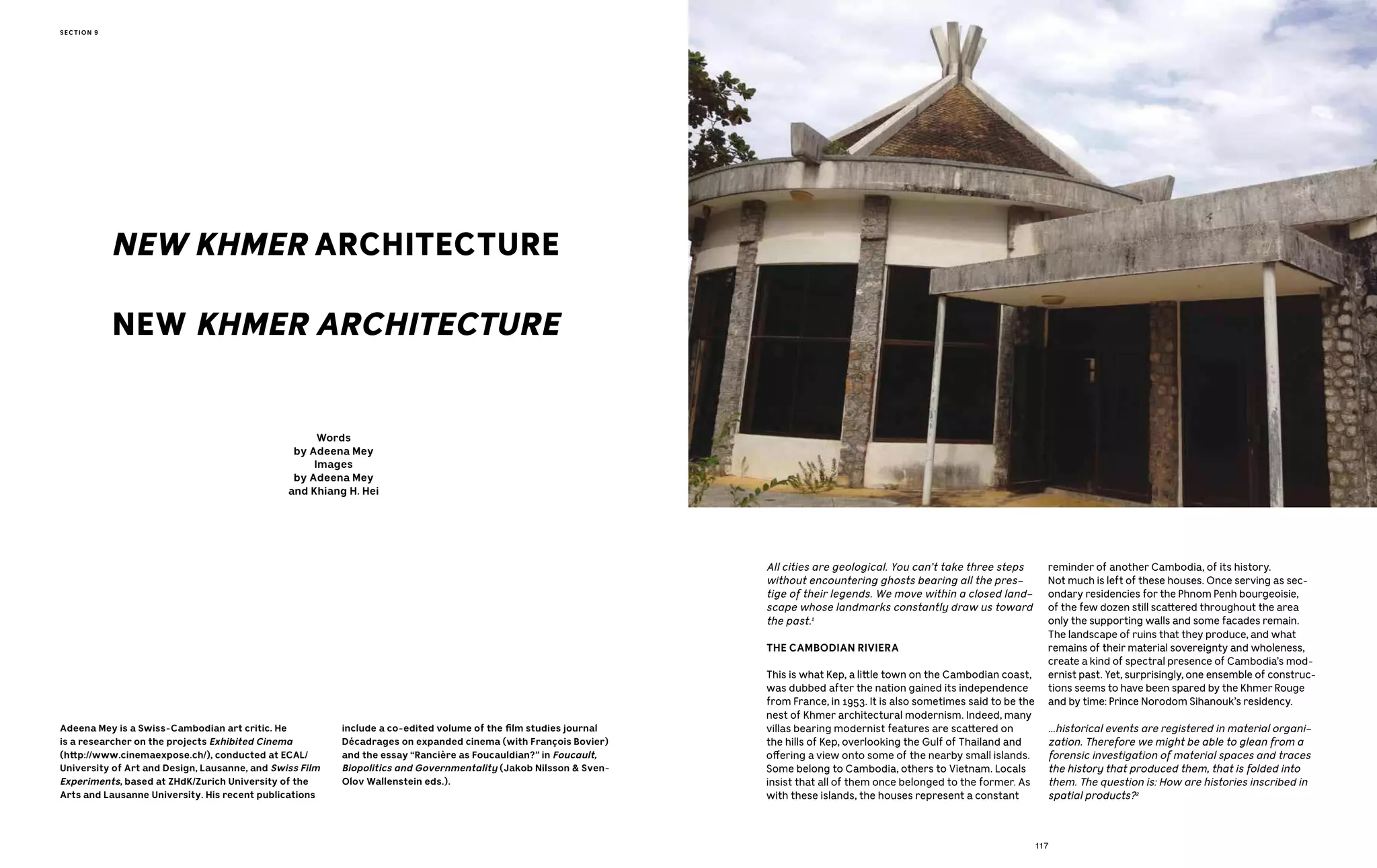
This is what Kep, a litle town on the Cambodian coast,
was dubbed after the nation gained its independence
from France, in 1953. It is also sometimes said to be the
nest of Khmer architectural modernism. Indeed, many
villas bearing modernist features are scatered on
the hills of Kep, overlooking the Gulf of Thailand and
ofering a view onto some of the nearby small islands.
Some belong to Cambodia, others to Vietnam. Locals
insist that all of them once belonged to the former. As
with these islands, the houses represent a constant
reminder of another Cambodia, of its history.
Not much is left of these houses. Once serving as sec-
ondary residencies for the Phnom Penh bourgeoisie,
of the few dozen still scatered throughout the area
only the supporting walls and some facades remain.
The landscape of ruins that they produce, and what
remains of their material sovereignty and wholeness,
create a kind of spectral presence of Cambodia’s mod-
ernist past. Yet, surprisingly, one ensemble of construc-
tions seems to have been spared by the Khmer Rouge
and by time: Prince Norodom Sihanouk’s residency.
…historical events are registered in material organi-
zation. Therefore we might be able to glean from a
forensic investigation of material spaces and traces
the history that produced them, that is folded into
them. The question is: How are histories inscribed in
spatial products?2
Adeena Mey is a Swiss-Cambodian art critic. He
is a researcher on the projects Exhibited Cinema
(htp://www.cinemaexpose.ch/), conducted at ECAL/
University of Art and Design, Lausanne, and Swiss Film
Experiments, based at ZHdK/Zurich University of the
Arts and Lausanne University. His recent publications
include a co-edited volume of the ilm studies journal
Décadrages on expanded cinema (with François Bovier)
and the essay “Rancière as Foucauldian?” in Foucault,
Biopolitics and Governmentality (Jakob Nilsson & Sven-
Olov Wallenstein eds.).
117
A NEW REPORTAGE
“POLITICAL PLASTIC” OF THE SANGKUM
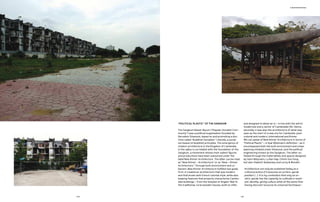
The Sangkum Reastr Niyum (“Popular Socialist Com-
munity”) was a political organization founded by
Norodom Sihanouk, based on and promoting a doc-
trine called “Buddhist Socialism.” Literally, a social-
ism based on Buddhist principles. The emergence of
modern architecture in the Kingdom of Cambodia
in the 1960s is correlated with the foundation of the
Sangkum, a movement whose most salient igures
and productions have been subsumed under the
label New Khmer Architecture. The later can be read
as “New Khmer – Architecture” or as “New – Khmer
Architecture.” Through built environment and ur-
banism, New Khmer Architecture fulilled two goals.
First, it created an architecture that was modern
and that broke with French colonial style, while also
keeping features that properly characterize Cambo-
dian buildings – from the temples of Angkor Wat to
the traditional, rural wooden houses, built on stilts
and designed to allow air in – in line with the will to
modernize every sector of Cambodian life. Hence,
secondly, it was also the architecture of what was
seen as the start of a new era for Cambodia: post-
colonial and modern, international and Khmer.
We can speak of New Khmer Architecture in terms of
“Political Plastic” – in Eyal Weizman’s deinition – as it
encompassed both the built environment and urban
planning initiated under Sihanouk, and the political
engineering known as the Sangkum. The later un-
folded through the materialities and spaces designed
by Vann Molyvann, Lu Ban Hap, Chhim Sun Fong,
but also Vladimir Bodiansky and Leroy & Mondet.
Architecture can only be sustained today as a
critical practice if it assumes an arrière-garde
position (…). It is my contention that only an ar-
rière-garde has the capacity to cultivate a resist-
ant, identity-giving culture while at the same time
having discreet recourse to universal technique.3
119
118
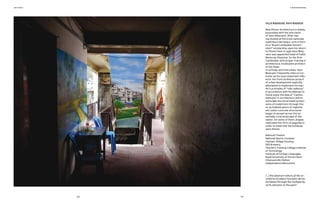
VILLE RADIEUSE, PAYS RADIEUX
New Khmer Architecture is widely
associated with the sole name
of Vann Molyvann. After hav-
ing studied at the Ecole nationale
supérieure des beaux-arts in Paris
on a “Royal Cambodian Govern-
ment” scholarship, upon his return
to Phnom Penh in 1956 Vann Moly-
vann was appointed head of Public
Works by Sihanouk. As the irst
Cambodian with proper training in
architecture, he became architect
of the State.
In writings and interviews, Vann
Molyvann frequently cites Le Cor-
busier as his most important inlu-
ence. His Front du Bassac project
of urban development explicitly
atempted to implement his mas-
ter’s principles of “ville radieuse.”
In accordance with his atempt to
found anew the idea of “Cambo-
dianness” in architecture and to
articulate the Universalist preten-
sions of modernism through this
re-actualized genre of regional-
ism, sober concrete structures
began to sprawl across the es-
sentially rural landscape of the
nation. On some of them, shapes
replicated the form of pagodas in
order to state that the buildings
were Khmer.
National Theatre
National Sports Complex
Olympic Village Housing
SKD Brewery
Teachers Training College Institute
of Technology
Institute of Foreign Languages
Royal University of Phnom Penh
Sihanoukville Station
Independence Monument
(…) the abstract nature of the ar-
chitectural object has been dema-
terialized through the multiplicity
of its allusions to the past.4
A NEW REPORTAGE
SECTION 9
121
120
S
E
CT
I
O
N
9
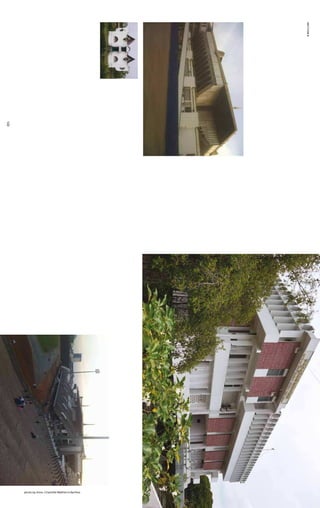
photo by Anne-Charlote Maltherre Barthes
122
A NEW REPORTAGE
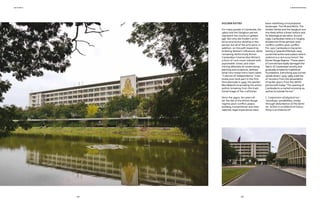
GOLDEN SIXTIES
For many people in Cambodia, the
1960s and the Sangkum period
represent the country’s golden
age. Not only did modern archi-
tectural practice develop in this
period, but all of the arts were, in
addition, on the path toward hy-
bridizing Western inluences, while
remaining distinctively Khmer.
Cambodian Cinema (Kon Khmer);
a form of rock music imbued with
psychedelic tones; and stam-
mering atempts at modernizing
painting and sculpture, deined
what two researchers have called
“Cultures of Independence.” Cam-
bodia even took part in the irst
Paris Biennale in 1959, the painter
Men Makoth incarnating the artist-
author, breaking from the tradi-
tional image of the craftsman.
Since the 1990s, ten years af-
ter the fall of the Khmer Rouge
regime, post-conlict, peace-
building, humanitarian and inter-
national-legal imperatives have
been redeining a traumatized
landscape. The UN and NGOs. The
Golden Sixties and the Sangkum are
inscribed within a linear history and
its teleological narrative. Accord-
ingly, Cambodian history is roughly
divided into three periods: ante-
conlict, conlict, post-conlict.
Pre-1970 Cambodia is character-
ized by a “peaceful lifestyle, easy
social interaction and a place where
violence is a rare occurrence”; the
Khmer Rouge Regime: “These years
of turmoil have badly damaged the
fabric of Cambodian society and
gradually eroded its traditional
foundations. Everything was turned
upside down”; 1979-1989, a period
of recovery from the devastation
of earlier years; from the UNTAC
period until today: “The opening of
Cambodia to a market economy as
well as to outside forces.”
(…) expansion of physical sur-
roundings, sensibilities, media,
through disturbance of the famil-
iar. Action is architecture! Every-
thing is architecture!5
SECTION 9
125
124
A NEW REPORTAGE
CAMBODIA, FROM THE FUTURE
In the emerging Cambodian cul-
tural scene, there is a 1960s retro
trend, not to mention a nostalgia for
this recent but almost extirpated
past. The productions of the New
Khmer Architects stand as physi-
cal witnesses to this “golden age.”
They atest to an “authentic” Khmer
identity, against the fast rise of Asian
turbo-capitalism and its glass tow-
ers. Remember, save, patrimonialize.
But beyond nostalgia or reaction,
and indiference, can what is left of
the New Khmer Architecture be re-
invested with any sense of futurity?
SECTION 9
notes
1. Gilles Ivain [Ivan Chtcheglov], Formulary for a New Urbanism, Situationist International, No. 1, October 1953.
2. Eyal Weizman, “Political Plastic (Interview)”, Collapse. Philosophical Research and Development, Vol. VI, 2010.
3. Kenneth Frampton, Towards A Critical Regionalism: Six Points for an Architecture of Resistance, in Hal Foster,The Anti-Aesthetic. Essays on Postmodern
Culture, 1983.
4. Peter Eisenman, Graves of Modernism, Eisenman Inside Out. Selected Writings 1963-1988, 2004.
5. Wolf Vostell and Dick Higgins, Fantastic Architecture, 1969.
127
126

New_Khmer_Architecture_New_Khmer_Archit.pdf

  • 1.
    SECTION 9 Words by AdeenaMey Images by Adeena Mey and Khiang H. Hei NEW KHMER ARCHITECTURE NEW KHMER ARCHITECTURE All cities are geological. You can’t take three steps without encountering ghosts bearing all the pres- tige of their legends. We move within a closed land- scape whose landmarks constantly draw us toward the past.1 THE CAMBODIAN RIVIERA This is what Kep, a litle town on the Cambodian coast, was dubbed after the nation gained its independence from France, in 1953. It is also sometimes said to be the nest of Khmer architectural modernism. Indeed, many villas bearing modernist features are scatered on the hills of Kep, overlooking the Gulf of Thailand and ofering a view onto some of the nearby small islands. Some belong to Cambodia, others to Vietnam. Locals insist that all of them once belonged to the former. As with these islands, the houses represent a constant reminder of another Cambodia, of its history. Not much is left of these houses. Once serving as sec- ondary residencies for the Phnom Penh bourgeoisie, of the few dozen still scatered throughout the area only the supporting walls and some facades remain. The landscape of ruins that they produce, and what remains of their material sovereignty and wholeness, create a kind of spectral presence of Cambodia’s mod- ernist past. Yet, surprisingly, one ensemble of construc- tions seems to have been spared by the Khmer Rouge and by time: Prince Norodom Sihanouk’s residency. …historical events are registered in material organi- zation. Therefore we might be able to glean from a forensic investigation of material spaces and traces the history that produced them, that is folded into them. The question is: How are histories inscribed in spatial products?2 Adeena Mey is a Swiss-Cambodian art critic. He is a researcher on the projects Exhibited Cinema (htp://www.cinemaexpose.ch/), conducted at ECAL/ University of Art and Design, Lausanne, and Swiss Film Experiments, based at ZHdK/Zurich University of the Arts and Lausanne University. His recent publications include a co-edited volume of the ilm studies journal Décadrages on expanded cinema (with François Bovier) and the essay “Rancière as Foucauldian?” in Foucault, Biopolitics and Governmentality (Jakob Nilsson & Sven- Olov Wallenstein eds.). 117
  • 2.
    A NEW REPORTAGE “POLITICALPLASTIC” OF THE SANGKUM The Sangkum Reastr Niyum (“Popular Socialist Com- munity”) was a political organization founded by Norodom Sihanouk, based on and promoting a doc- trine called “Buddhist Socialism.” Literally, a social- ism based on Buddhist principles. The emergence of modern architecture in the Kingdom of Cambodia in the 1960s is correlated with the foundation of the Sangkum, a movement whose most salient igures and productions have been subsumed under the label New Khmer Architecture. The later can be read as “New Khmer – Architecture” or as “New – Khmer Architecture.” Through built environment and ur- banism, New Khmer Architecture fulilled two goals. First, it created an architecture that was modern and that broke with French colonial style, while also keeping features that properly characterize Cambo- dian buildings – from the temples of Angkor Wat to the traditional, rural wooden houses, built on stilts and designed to allow air in – in line with the will to modernize every sector of Cambodian life. Hence, secondly, it was also the architecture of what was seen as the start of a new era for Cambodia: post- colonial and modern, international and Khmer. We can speak of New Khmer Architecture in terms of “Political Plastic” – in Eyal Weizman’s deinition – as it encompassed both the built environment and urban planning initiated under Sihanouk, and the political engineering known as the Sangkum. The later un- folded through the materialities and spaces designed by Vann Molyvann, Lu Ban Hap, Chhim Sun Fong, but also Vladimir Bodiansky and Leroy & Mondet. Architecture can only be sustained today as a critical practice if it assumes an arrière-garde position (…). It is my contention that only an ar- rière-garde has the capacity to cultivate a resist- ant, identity-giving culture while at the same time having discreet recourse to universal technique.3 119 118
  • 3.
    VILLE RADIEUSE, PAYSRADIEUX New Khmer Architecture is widely associated with the sole name of Vann Molyvann. After hav- ing studied at the Ecole nationale supérieure des beaux-arts in Paris on a “Royal Cambodian Govern- ment” scholarship, upon his return to Phnom Penh in 1956 Vann Moly- vann was appointed head of Public Works by Sihanouk. As the irst Cambodian with proper training in architecture, he became architect of the State. In writings and interviews, Vann Molyvann frequently cites Le Cor- busier as his most important inlu- ence. His Front du Bassac project of urban development explicitly atempted to implement his mas- ter’s principles of “ville radieuse.” In accordance with his atempt to found anew the idea of “Cambo- dianness” in architecture and to articulate the Universalist preten- sions of modernism through this re-actualized genre of regional- ism, sober concrete structures began to sprawl across the es- sentially rural landscape of the nation. On some of them, shapes replicated the form of pagodas in order to state that the buildings were Khmer. National Theatre National Sports Complex Olympic Village Housing SKD Brewery Teachers Training College Institute of Technology Institute of Foreign Languages Royal University of Phnom Penh Sihanoukville Station Independence Monument (…) the abstract nature of the ar- chitectural object has been dema- terialized through the multiplicity of its allusions to the past.4 A NEW REPORTAGE SECTION 9 121 120
  • 4.
  • 5.
    A NEW REPORTAGE GOLDENSIXTIES For many people in Cambodia, the 1960s and the Sangkum period represent the country’s golden age. Not only did modern archi- tectural practice develop in this period, but all of the arts were, in addition, on the path toward hy- bridizing Western inluences, while remaining distinctively Khmer. Cambodian Cinema (Kon Khmer); a form of rock music imbued with psychedelic tones; and stam- mering atempts at modernizing painting and sculpture, deined what two researchers have called “Cultures of Independence.” Cam- bodia even took part in the irst Paris Biennale in 1959, the painter Men Makoth incarnating the artist- author, breaking from the tradi- tional image of the craftsman. Since the 1990s, ten years af- ter the fall of the Khmer Rouge regime, post-conlict, peace- building, humanitarian and inter- national-legal imperatives have been redeining a traumatized landscape. The UN and NGOs. The Golden Sixties and the Sangkum are inscribed within a linear history and its teleological narrative. Accord- ingly, Cambodian history is roughly divided into three periods: ante- conlict, conlict, post-conlict. Pre-1970 Cambodia is character- ized by a “peaceful lifestyle, easy social interaction and a place where violence is a rare occurrence”; the Khmer Rouge Regime: “These years of turmoil have badly damaged the fabric of Cambodian society and gradually eroded its traditional foundations. Everything was turned upside down”; 1979-1989, a period of recovery from the devastation of earlier years; from the UNTAC period until today: “The opening of Cambodia to a market economy as well as to outside forces.” (…) expansion of physical sur- roundings, sensibilities, media, through disturbance of the famil- iar. Action is architecture! Every- thing is architecture!5 SECTION 9 125 124
  • 6.
    A NEW REPORTAGE CAMBODIA,FROM THE FUTURE In the emerging Cambodian cul- tural scene, there is a 1960s retro trend, not to mention a nostalgia for this recent but almost extirpated past. The productions of the New Khmer Architects stand as physi- cal witnesses to this “golden age.” They atest to an “authentic” Khmer identity, against the fast rise of Asian turbo-capitalism and its glass tow- ers. Remember, save, patrimonialize. But beyond nostalgia or reaction, and indiference, can what is left of the New Khmer Architecture be re- invested with any sense of futurity? SECTION 9 notes 1. Gilles Ivain [Ivan Chtcheglov], Formulary for a New Urbanism, Situationist International, No. 1, October 1953. 2. Eyal Weizman, “Political Plastic (Interview)”, Collapse. Philosophical Research and Development, Vol. VI, 2010. 3. Kenneth Frampton, Towards A Critical Regionalism: Six Points for an Architecture of Resistance, in Hal Foster,The Anti-Aesthetic. Essays on Postmodern Culture, 1983. 4. Peter Eisenman, Graves of Modernism, Eisenman Inside Out. Selected Writings 1963-1988, 2004. 5. Wolf Vostell and Dick Higgins, Fantastic Architecture, 1969. 127 126