Towards an organisational model of 'interface' university structure as a means of serving the lifelong learning needs   Pencho Mihnev Centre of Information Society Technologies Sofia University “St. Kl. Ohridski”, Bulgaria
Contents Introduction The Lifelong Learning The Lifelong Learning demands upon the delivery structures The nature of the higher education institutions CIST as a Lifelong Learning service provider Towards constructing a model of lifelong learning ‘interface’ university structures Conclusion s
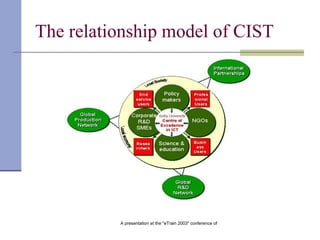
Introduction Sofia University “St. Kliment Ohridski” The first and the biggest Bulgarian HE Institution (HEI) 35,000 students >3,000 academic staff 17 faculties,  76 Bachelor’s and over  200 Master’s  degree programmes   Centre of Information Society Technologies (CIST) Created 1996, interdisciplinary purposes CIST work characteristics Activities – IST research, training, and services About 30 successful international projects 14 of them related to learning, education, and training Business-like structure, self sustainability
The relationship model of CIST
The Lifelong Learning The new demands of economy, society, and individuals The demands of the knowledge economy The demands of the contemporary society The personal demands Adopted definition “ All learning activity undertaken throughout life, with the aim of improving knowledge, skills and competencies within a personal, civic, social and/or employment-related perspective. ”   European Commission, 2000 Shortages of this definition? ( not addressed  here) Putting LLL in an  overall framework of incentives Is it important? Why? To whom?
The Lifelong Learning demands upon the delivery structures (1) Inspected sources European Commission 2001, 2002 Making a European Area of Lifelong Learning a Reality.  COM(2001) 678 final European Report on Quality Indicators of Lifelong Learning. Fifteen Quality Indicators , June 2002   World Bank reports, October 2002 Lifelong Learning in the Global Knowledge Economy: Challenges for Developing  Countries. Constructing Knowledge Societies: New Challenges for Tertiary Education .
The Lifelong Learning demands (2) Learner skills demand: “ technical” skills ( literacy, foreign language, mathematics, science, ICT skills, information processing, problem-solving, analytical skills )   interpersonal skills ( teamwork, leadership, communication skills )   methodological skills ( learning to learn, pursuing lifelong learning, coping with risk and change )
The Lifelong Learning demands (3) ‘ Essence of learning’ demand   definition and aims of learning   culture of learning   variety of delivery forms and contexts   Institution management demand   resourcing   customers’ needs awareness   matching opportunities to interest   dealing with change and innovation   entrepreneurship and risk management   partnership approach ( internal and external )
The Lifelong Learning demands (4) Accessibility demand   valuing all types of learning ( formal, non-formal, and informal )   facilitating access   social inclusion   Demand on consumer protection and fairness   quality assurance   assessment and certification ( non-traditional forms of learning )   awareness of available providers and learning pathways
The nature of higher education institutions   (HEI) Purposes ( Burton Clark, 1983 ) Processing and development of  advanced  knowledge Enrichment and dissemination of the world’s intellectual heritage   Education of the intellectual human potential of the nations and the world Our  focus - at the following HEI characteristics: Work organisation Beliefs ( norms and values )   Authority ( decision-making processes, and power distribution & exercising )   Processes of change ( innovation )
Work organisation in HE Separate scientific disciplines Linked in a form of a “ loosely coupled system ”   Bottom heavy, adaptive and sustainable The organisational fragmentation brings stability to HEI Vertical grouping of organisation levels in HE system “ superstructure ” level – the national HE system “ structure ” level - the institutional level as a whole “ understructure ” levels - faculty, department & individuals The professional work - at the understructure levels, they possess a great deal of decision-making power  The guiding logic - the logic of the scientific discipline
Beliefs and authority The Beliefs rooted in the scientific truth pursuing knowledge for its own sake discipline loyalty (rather than institutional loyalty) source of identity, authority, and power affect the decision-making processes The Authority reflects the structures of work organisation and beliefs   decision-making processes - bottom heavy, made collegially on the basis of professional (disciplinary) and expert judgment   … so is the decision-making power possessed and exercised
The innovation and change at understructure levels  Occurs mainly on disciplinary grounds follows the changes in the knowledge base, work patterns, and discoveries in the discipline “ changes can be found  anywhere , but cannot be found  everywhere ” Understructures are prone to resist other types of change : primarily responsive to the demands in their scientific fields (other professors) the large environmental forces as “ consumer demand ” and “ labor-force demand ” are largely resisted at that level
HEI - Summary and conclusions Research universities are inner-directed Service colleges are other way directed When students abundant - teaching and services placed on a  take-it-or-leave-it  base When students or resources in short supply, institutions are more responsive to the environmental needs   How a new university structure appears (structural changes)? International transfer as a major route of change   The change, translated into prestige and honour, brings support for its sustainability Summary  (Clark): “Desired changes attenuate and fail  unless  they become a steady part of the  structure of work , the  web of beliefs , and the  division of control ”
CIST as a lifelong learning service provider Delivery of specialised  training in   challenging  domains and topics   External  marketing ( the market  demands ) and  internal  marketing ( the university  supply )   Matching  the  supply   to  the external  demand   Development of CIST  capacity for design  and  delivery  of training in : Information Society Technologies   Lifelong Learning Skills   Development of CIST- own  delivery  infrastructure Work, based on  key business characteristics   Ongoing  human  and  organisation capacity development
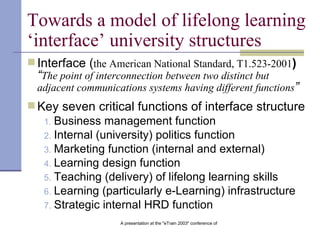
Towards a model of lifelong learning ‘interface’ university structures   Interface ( the American National Standard, T1.523-2001 ) “ The point of interconnection between two distinct but adjacent communications systems having different functions ”   Key seven critical functions of interface structure Business management function   Internal (university) politics function   Marketing function (internal and external)   Learning design function   Teaching (delivery) of lifelong learning skills   Learning (particularly e-Learning) infrastructure Strategic internal HRD function
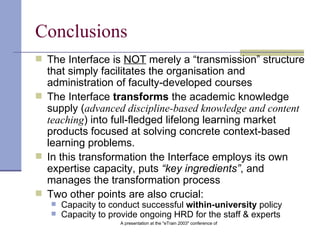
Conclusion s The Interface is  NOT  merely a “transmission” structure that simply facilitates the organisation and administration of faculty-developed courses The Interface  transforms  the academic knowledge supply ( advanced discipline-based knowledge and content teaching ) into full-fledged lifelong learning market products focused at solving concrete context-based learning problems. In this transformation the Interface employs its own expertise capacity, puts  “key ingredients” , and   manages the transformation process Two other points are also crucial: Capacity to conduct successful  within-university  policy Capacity to provide ongoing HRD for the staff & experts
Sources This presentation is a supplement to the article: “ Towards an organisational model of ‘interface’   university structure as a means of serving Lifelong   Learning needs ” by Pencho Mihnev and Roumen Nikolov It is part of the book “Lifelong Learning in the Digital Age” Tom J. van Weert, Mike Kendall (Eds.)  (2004).   Lifelong Learning in the Digital Age: Sustainable for all in a changing world , IFIP Technical Committee 3 (Education) Lifelong Learning Working Track in the IFIP conference  “ E-Training Practices for Professional Organisations ” , Pori, Finland, 7-11 July 2003. IFIP Conference Proceedings 266 Kluwer 2004, ISBN 1-4020-7842-0

Interface Structures For LLL

  • 1.
    Towards an organisationalmodel of 'interface' university structure as a means of serving the lifelong learning needs Pencho Mihnev Centre of Information Society Technologies Sofia University “St. Kl. Ohridski”, Bulgaria
  • 2.
    Contents Introduction TheLifelong Learning The Lifelong Learning demands upon the delivery structures The nature of the higher education institutions CIST as a Lifelong Learning service provider Towards constructing a model of lifelong learning ‘interface’ university structures Conclusion s
  • 3.
    Introduction Sofia University“St. Kliment Ohridski” The first and the biggest Bulgarian HE Institution (HEI) 35,000 students >3,000 academic staff 17 faculties, 76 Bachelor’s and over 200 Master’s degree programmes Centre of Information Society Technologies (CIST) Created 1996, interdisciplinary purposes CIST work characteristics Activities – IST research, training, and services About 30 successful international projects 14 of them related to learning, education, and training Business-like structure, self sustainability
  • 4.
  • 5.
    The Lifelong LearningThe new demands of economy, society, and individuals The demands of the knowledge economy The demands of the contemporary society The personal demands Adopted definition “ All learning activity undertaken throughout life, with the aim of improving knowledge, skills and competencies within a personal, civic, social and/or employment-related perspective. ” European Commission, 2000 Shortages of this definition? ( not addressed here) Putting LLL in an overall framework of incentives Is it important? Why? To whom?
  • 6.
    The Lifelong Learningdemands upon the delivery structures (1) Inspected sources European Commission 2001, 2002 Making a European Area of Lifelong Learning a Reality. COM(2001) 678 final European Report on Quality Indicators of Lifelong Learning. Fifteen Quality Indicators , June 2002 World Bank reports, October 2002 Lifelong Learning in the Global Knowledge Economy: Challenges for Developing Countries. Constructing Knowledge Societies: New Challenges for Tertiary Education .
  • 7.
    The Lifelong Learningdemands (2) Learner skills demand: “ technical” skills ( literacy, foreign language, mathematics, science, ICT skills, information processing, problem-solving, analytical skills ) interpersonal skills ( teamwork, leadership, communication skills ) methodological skills ( learning to learn, pursuing lifelong learning, coping with risk and change )
  • 8.
    The Lifelong Learningdemands (3) ‘ Essence of learning’ demand definition and aims of learning culture of learning variety of delivery forms and contexts Institution management demand resourcing customers’ needs awareness matching opportunities to interest dealing with change and innovation entrepreneurship and risk management partnership approach ( internal and external )
  • 9.
    The Lifelong Learningdemands (4) Accessibility demand valuing all types of learning ( formal, non-formal, and informal ) facilitating access social inclusion Demand on consumer protection and fairness quality assurance assessment and certification ( non-traditional forms of learning ) awareness of available providers and learning pathways
  • 10.
    The nature ofhigher education institutions (HEI) Purposes ( Burton Clark, 1983 ) Processing and development of advanced knowledge Enrichment and dissemination of the world’s intellectual heritage Education of the intellectual human potential of the nations and the world Our focus - at the following HEI characteristics: Work organisation Beliefs ( norms and values ) Authority ( decision-making processes, and power distribution & exercising ) Processes of change ( innovation )
  • 11.
    Work organisation inHE Separate scientific disciplines Linked in a form of a “ loosely coupled system ” Bottom heavy, adaptive and sustainable The organisational fragmentation brings stability to HEI Vertical grouping of organisation levels in HE system “ superstructure ” level – the national HE system “ structure ” level - the institutional level as a whole “ understructure ” levels - faculty, department & individuals The professional work - at the understructure levels, they possess a great deal of decision-making power The guiding logic - the logic of the scientific discipline
  • 12.
    Beliefs and authorityThe Beliefs rooted in the scientific truth pursuing knowledge for its own sake discipline loyalty (rather than institutional loyalty) source of identity, authority, and power affect the decision-making processes The Authority reflects the structures of work organisation and beliefs decision-making processes - bottom heavy, made collegially on the basis of professional (disciplinary) and expert judgment … so is the decision-making power possessed and exercised
  • 13.
    The innovation andchange at understructure levels Occurs mainly on disciplinary grounds follows the changes in the knowledge base, work patterns, and discoveries in the discipline “ changes can be found anywhere , but cannot be found everywhere ” Understructures are prone to resist other types of change : primarily responsive to the demands in their scientific fields (other professors) the large environmental forces as “ consumer demand ” and “ labor-force demand ” are largely resisted at that level
  • 14.
    HEI - Summaryand conclusions Research universities are inner-directed Service colleges are other way directed When students abundant - teaching and services placed on a take-it-or-leave-it base When students or resources in short supply, institutions are more responsive to the environmental needs How a new university structure appears (structural changes)? International transfer as a major route of change The change, translated into prestige and honour, brings support for its sustainability Summary (Clark): “Desired changes attenuate and fail unless they become a steady part of the structure of work , the web of beliefs , and the division of control ”
  • 15.
    CIST as alifelong learning service provider Delivery of specialised training in challenging domains and topics External marketing ( the market demands ) and internal marketing ( the university supply ) Matching the supply to the external demand Development of CIST capacity for design and delivery of training in : Information Society Technologies Lifelong Learning Skills Development of CIST- own delivery infrastructure Work, based on key business characteristics Ongoing human and organisation capacity development
  • 16.
    Towards a modelof lifelong learning ‘interface’ university structures Interface ( the American National Standard, T1.523-2001 ) “ The point of interconnection between two distinct but adjacent communications systems having different functions ” Key seven critical functions of interface structure Business management function Internal (university) politics function Marketing function (internal and external) Learning design function Teaching (delivery) of lifelong learning skills Learning (particularly e-Learning) infrastructure Strategic internal HRD function
  • 17.
    Conclusion s TheInterface is NOT merely a “transmission” structure that simply facilitates the organisation and administration of faculty-developed courses The Interface transforms the academic knowledge supply ( advanced discipline-based knowledge and content teaching ) into full-fledged lifelong learning market products focused at solving concrete context-based learning problems. In this transformation the Interface employs its own expertise capacity, puts “key ingredients” , and manages the transformation process Two other points are also crucial: Capacity to conduct successful within-university policy Capacity to provide ongoing HRD for the staff & experts
  • 18.
    Sources This presentationis a supplement to the article: “ Towards an organisational model of ‘interface’ university structure as a means of serving Lifelong Learning needs ” by Pencho Mihnev and Roumen Nikolov It is part of the book “Lifelong Learning in the Digital Age” Tom J. van Weert, Mike Kendall (Eds.) (2004). Lifelong Learning in the Digital Age: Sustainable for all in a changing world , IFIP Technical Committee 3 (Education) Lifelong Learning Working Track in the IFIP conference “ E-Training Practices for Professional Organisations ” , Pori, Finland, 7-11 July 2003. IFIP Conference Proceedings 266 Kluwer 2004, ISBN 1-4020-7842-0