Intercultural Communication A Practical Guide Tracy Novinger
Intercultural Communication A Practical Guide Tracy Novinger
Intercultural Communication A Practical Guide Tracy Novinger
Intercultural Communication A Practical Guide Tracy Novinger
Intercultural Communication A Practical Guide Tracy Novinger
1.
Intercultural Communication APractical Guide
Tracy Novinger download
https://ebookbell.com/product/intercultural-communication-a-
practical-guide-tracy-novinger-1869046
Explore and download more ebooks at ebookbell.com
2.
Here are somerecommended products that we believe you will be
interested in. You can click the link to download.
Intercultural Communication A Practical Guide Tracy Novinger
https://ebookbell.com/product/intercultural-communication-a-practical-
guide-tracy-novinger-51924408
Research Methods In Intercultural Communication A Practical Guide
First Edition Hua
https://ebookbell.com/product/research-methods-in-intercultural-
communication-a-practical-guide-first-edition-hua-5700062
Research Methods In Intercultural Communication A Practical Guide
2016th Edition Zhu Hua
https://ebookbell.com/product/research-methods-in-intercultural-
communication-a-practical-guide-2016th-edition-zhu-hua-59148032
Basic Concepts Of Intercultural Communication Paradigms Principles And
Practices 2nd Edition Milton J Bennett
https://ebookbell.com/product/basic-concepts-of-intercultural-
communication-paradigms-principles-and-practices-2nd-edition-milton-j-
bennett-36129312
3.
Teaching Intercultural RhetoricAnd Technical Communication Theories
Curriculum Pedagogies And Practice 1st Edition Barry Thatcher Kirk St
Amant Charles H Sides
https://ebookbell.com/product/teaching-intercultural-rhetoric-and-
technical-communication-theories-curriculum-pedagogies-and-
practice-1st-edition-barry-thatcher-kirk-st-amant-charles-h-
sides-51380692
Foreign Language Teachers And Intercultural Competence An
Investigation In 7 Countries Of Foreign Language Teachers Views And
Teaching Practices International Communication And Education Lies
Sercu
https://ebookbell.com/product/foreign-language-teachers-and-
intercultural-competence-an-investigation-in-7-countries-of-foreign-
language-teachers-views-and-teaching-practices-international-
communication-and-education-lies-sercu-1636086
Intercultural Communication A Discourse Approach 3rd Edition Ron
Scollon
https://ebookbell.com/product/intercultural-communication-a-discourse-
approach-3rd-edition-ron-scollon-45013672
Intercultural Communication A College English Course Book
https://ebookbell.com/product/intercultural-communication-a-college-
english-course-book-58380452
Intercultural Communication A Reader 13th Edition Larry A Samovar
https://ebookbell.com/product/intercultural-communication-a-
reader-13th-edition-larry-a-samovar-5131858
6.
I N TE R C U L T U R A L C O M M U N I C A T I O N
I N TE R C U LT U R A L
C O M M U N I C AT I O N
A Practical Guide
B Y T R A C Y N O V I N G E R
U N I V E R S I T Y O F T E X A S P R E S S , A U S T I N
T O TH E M E M O RY
O F T H E F R E E S P I R I T O F
P H Y L L I S A L I C E G R I F F I T H E L L S P E R M A N
A N D T O G L E N ,
M I Q U E R I D O Y M I A M I G O .
C O NT E N T S
P R E F A C E ix
A C K N O W L E D G M E N T S xi
P A R T O N E The Global Perspective
of Intercultural Communication 1
O N E Why Communicate across Cultures? 3
T W O What Constitutes a Culture? 12
T H R E E Obstacles of Perception 26
F O U R Obstacles in Verbal Processes 45
F I V E Obstacles in Nonverbal Processes 53
P A R T T W O Two Worlds:
The United States and Mexico 75
13.
S I X
SE V E N
E I G H T
P A R T T H R E E
N I N E
A P P E N D I X :
A U T H O R ’ S N O T E
G L O S S A R Y
N O T E S
B I B L I O G R A P H Y
I N D E X
A B O U T
T H E A U T H O R
The Mexico–United States
Cultural Environment 77
Some Mexico–United States
Cultural Issues 106
Day-to-Day Cultural Interaction 124
Conclusion 149
Transcending Culture 151
159
161
173
193
201
209
14.
Preface
In our worldof expanding technology and shrinking geography, people of
different cultures have increasing frequency of contact and need for effective
communication on a daily basis. Speaking a different language is an obvious
obstacle to intercultural communication, but a greater and more difficult
hurdle is to “speak” a different culture. Even though we may learn the words,
the grammar, and the recognizable pronunciation of a language, we may
still not know how to navigate around the greater obstacles to communica-
tion that are presented by cultural difference.
Communication specialists estimate that from two-thirds to three-fourths
of our communication takes place nonverbally through behavior. All be-
havior is communication, and since we cannot not behave, we cannot not
communicate. During all of the waking hours that we spend with other hu-
man beings we “speak” volumes through the behavior our culture has
drilled into us.
Each of us is conditioned by our culture from birth. We learn when to
speak up and when to keep quiet. We learn that some facial expressions
meet with approval and others provoke a reprimand. We are taught which
gestures are acceptable and which are not, and whether we can publicly un-
wrap a gift; we learn where to put our hands at a meal, whether or not we
can make noise with our mouths when we eat, which table utensils to use
or not use, and in what fashion we may use them. We learn how to address
people in a manner approved by our culture, what tone of voice to employ,
what posture is censored and what is praised, when and how to make eye
15.
x Intercultural Communication
contactand for how long, and countless other things that would be impos-
sible to remember consciously and use all at the same time when interacting
socially. This communicative behavior is learned so well that it becomes in-
ternalized at a subconscious level. We are primarily aware of deviations from
our prescribed cultural norms, and we tend to negatively evaluate any such
deviations.
Since we learn our cultural behavior in units, it is a useful artifice to com-
pare cultural differences in units. To learn to communicate across cultures
more quickly and more effectively, we can apply a framework of categories
of potential obstacles (cultural units) to our own and to a target culture.
Part I of this book addresses the need for successful communication
across cultures and defines what constitutes a culture. Next, an original tax-
onomy of potential intercultural communication obstacles is constructed
from the literature of communication, anthropology, psychology, sociology,
business, and current events, as well as from interviews with persons of
multicultural backgrounds. The categories are explained, and many are il-
lustrated with anecdotes.
Part II applies the framework of obstacles outlined in Part I to the dif-
ferences in cultural units of the United States and Mexico. This applica-
tion demonstrates how these cultural differences create misunderstanding
and ineffectual communication in commonly occurring business and social
situations.
Part III prescribes an effective approach to intercultural communication
between any two cultures, using the framework of potential obstacles to
efficiently obtain results. We can act consciously to transcend the rules with
which our own culture grips us.
16.
Acknowledgments
Although I amindebted to persons too numerous to mention for insight into
intercultural communication, I would like, nonetheless, to expressly thank
a number of people who encouraged, informed, and assisted me. Any
strengths of this work derive in great measure from their support. In ex-
pressing my appreciation, I do not imply that the following persons either
agree or disagree with specific details or with the contents of this book.
To Dr. Philip Gaunt, Director of the Elliott School of Communication at
Wichita State University, Kansas, un merci très particulier for sharing his
knowledge and for guidance. My thanks to Beatriz de la Garza, Ph.D., J.D.,
for her supportive friendship and interest, and to friends Nancy Hamilton
and Arciela Izquierdo Jordan, J.D., for their feedback. Guillermina Flores de
Padilla, Assistant Director of the Benjamin Franklin Library at the Instituto
Mexicano Norteamericano de Relaciones Culturales de Nuevo León in
Monterrey, graciously helped me when I showed up as an unannounced for-
eign visitor. I also thank Georgina Silva Ramírez de Domínguez for a warm
welcome in Monterrey, Mexico.
For their input, I would also like to acknowledge Jane “Juanita” Smith
Garcés, Maria Eugenia Dubois, Philip Russell of the Mexico Resource
Center, Isabel Gereda Taylor, J.D., Robin Wasson, Allan Adams, Allert
Brown-Gort, Evelyn Sierra Hammond, Ph.D., and Herb Brandt.
I have been blessed over the years with the enduring friendship of Marcia
Barros Parisi of São Paulo, Brazil; Elvira Paiva Andrade of Santos, Brazil;
Repeta Tetauru of Tahiti; and Geneviève Trouche, currently of Paris, formerly
17.
x i iIntercultural Communication
of Algeria and Tahiti. And special thanks to the Mexican people for the
warmth and great courtesy they have unfailingly extended to me on many
visits to Mexico.
I have a personal tie to the Latin Americas and especially appreciate the
opportunity to have focused on Mexico in an attempt to illumine the diffi-
culties of intercultural communication. On the Caribbean island of Aruba,
where three generations of my family lived, I, too, called my cousins’ grand-
father, Luís Guillermo López of Mexico, “Grandpa.” He was my god-
father—my padrino—and I have many cousins (primos hermanos) with
López and Cantú surnames.
The renowned Benson Latin American Collection at the University of
Texas at Austin was a valuable library resource. And to Theresa May, my
energetic editor at the University of Texas Press, gracias, obregado, merci.
18.
I N TE R C U L T U R A L C O M M U N I C A T I O N
O N EWhy Communicate
across Cultures?
The most universal quality is diversity.
—montaigne, 1580
Isolated cultures stagnate; cultures that
communicate with others evolve. —t. sowell,
race and culture 1994
I N T E R C U LT U R A L I N T E R FA C E
A well-dressed Mexican pulled up in a taxi to the Palacio de Justicia in
Lima, Peru. Armed guards were standing on the steps ascending to the
building. The passenger paid and thanked the driver and opened the door
of the cab, intent on the information he had come to get. As he leaned for-
ward and put one foot onto the pavement, a cold rifle muzzle jabbed him
in the temple and jerked his attention to matters at hand. The Peruvian
guard holding the rifle shot two harsh words at him. The Mexican red-
dened, emerged from the taxi, and drew himself erect. With a sweep of his
arm, he retorted three words: “¡Qué! ¿Nos conocemos?” (What! Do we
know each other?) With a half bow the guard lowered the rifle and courte-
ously gestured the man up the steps, speaking in deferential tones. What
happened here? What did the guard with the gun say that triggered this re-
action from the Mexican? And what in the Mexican visitor’s behavior and
23.
4 Intercultural Communication
thosethree Spanish words instantly changed the Peruvian guard’s attitude
and demeanor?
I N S P I T E O F O U R S E LV E S
We cannot not communicate. All behavior is communication, and we can-
not not behave.1
Even a person who does not want to “communicate”—who sits huddled
with arms folded and head down—communicates that he is trying to avoid
communication. By nature, communication is a system of behavior.2
And
because different cultures often demand very different behaviors, intercul-
tural communication is more complex than communication between per-
sons of the same culture.3
All communication takes place in the matrix of
culture, therefore difference in culture is the primary obstacle to intercul-
tural communication.
Communication specialists estimate that two-thirds to three-fourths of
all communication is nonverbal. The average varies from culture to culture,
but what this statistic essentially means is that a person communicates in
great part by nonverbal behavior, behavior being gestures, facial expressions,
tone of voice, dress, body language, the rituals (such as courtesies) one ob-
serves, etc. Our culture teaches us our behavior from birth, and most of our
behavior is unconscious. Therefore—in addition to the words that we in-
tentionally use—through our behavior we unconsciously communicate dur-
ing all of the waking hours that we spend with other human beings. We
“speak” volumes outside of our awareness and often in spite of our con-
scious choices.
Although our verbal language comes to us naturally, only the most eth-
nocentric can believe that their own is a “natural” language and that
other societies speak some distortion of it. Yet, when it comes to the non-
verbal language of behavior, most people believe that their own is a nat-
ural form of communication that foreign people have learned badly, not
evolved to, or lost.4
If we understand that we need to translate verbal lan-
guage, we should be able to understand that we also need to translate non-
verbal language.
T H E C U LT U R E G R I P
Most of us probably think of ourselves as persons who operate through our
own free will. Much of the time, however, this is not true.
24.
5
Why Communicate acrossCultures?
The Mexican visitor and the Peruvian guard participated in a communi-
cation exchange that was deeply embedded in the hierarchy and formality
inherent in Mediterranean-based cultures. With the interrogation, “¿Que
quieres?” (What do you want?), the guard had addressed the visitor with
the familiar verb form in Spanish. The familiar form of address in most
Spanish-speaking countries is used only with family members, close friends,
former classmates, or children. The reflexive reaction of the man arriving
was indignation, even though the circumstances were dangerous. His retort
“Do we know each other?” was a powerful cultural rebuke. The automatic
response of the guard was to amend his discourtesy and reply in the formal
style of address for the visitor to please go about his business. Fortunately
for the Mexican visitor, this incident turned out well. He would not have re-
sponded in such a manner if he had stopped to think about the logic of chal-
lenging a gun with indignation and three Spanish words—but the point is
that he did not think. Cultural conditioning controlled the behavior of both
men, including he who held the gun and the apparent power. Neither man
went through a conscious thought process.
Our behavior is taught to us from birth, and it is taught to us so that we
will conform to the culture in which we live. We learn when to speak up and
when to keep quiet. We learn that certain facial expressions meet with ap-
proval and others provoke a reprimand. We are taught which gestures are
acceptable and which are not, and whether we can publicly unwrap a gift;
we learn where to put our hands when at the table, whether or not we can
make noise with our mouths when we eat, which utensils to use or not use,
whether toothpicks are acceptable and, if so, in what fashion we may use
them. We learn how to address people in a manner approved by our culture,
what tone of voice to use, what posture is censored and what is praised,
when and how to make eye contact and for how long, and countless other
things that would be impossible to consciously remember and use all at the
same time when interacting socially.
This behavior is learned so well—so that we can pass social scrutiny by
the ever-alert antennae of our peers and be admitted to their group—that
the behavior becomes internalized below the level of our conscious thought.
We operate in great part on this elaborately written subconscious program,
leaving only a small percentage of our actions to be governed by conscious
choice and thought. We most often become aware of the subconscious be-
havior that we expect from ourselves and therefore from others when some-
one violates the pattern that we have come to expect. Such a violation raises
our internalized rules to a conscious level of awareness.
25.
6 Intercultural Communication
CO N S I D E R T H E C O N T E X T
From culture to culture the proportion of nonverbal behavioral communi-
cation varies relative to the verbal communication that is used. Communi-
cation styles that focus relatively more on words to communicate and less
on behavior—the context in which the words are used—are said to be
“low-context.” “High-context” cultures, in contrast, rely relatively more on
nonverbal context or behaviors than they rely on abstract, verbal symbols
of meaning. The difference in style is similar to that of time being conveyed
to the second by the precise, numeric display of a digital watch, as compared
to telling time by the halting movement of the hands of an analog grand-
father clock. This dissimilarity in communication styles between low- and
high-context cultures creates frequent, significant obstacles to intercultural
communication.
A high-context message is one in which more of the information is con-
tained in the physical context or internalized in the person receiving it, and
less in the coded, explicit, transmitted verbal part of the message. A low-
context communication is just the opposite. The focus is on vesting more of
the information in the explicit verbal code.5
Low-context communication can be compared to interfacing with a
computer. It is a system of explicit prompt and response exchanges. If the
computer does not read an inaccurate response’s programming, then it does
not compute. North Americans have a low-context communication style
and intend to transmit their messages primarily in words spoken, which are
amplified or overridden relatively less than in many other cultures by non-
verbal signals such as gestures, silence, eye contact,6
or ritual.
Thus a low-context person consciously focuses on words to communi-
cate, but a high-context person is acculturated from birth to send and re-
ceive a large proportion of messages through behavioral context, both con-
sciously and unconsciously. When this high-context person receives a verbal
message from a low-context person, misunderstanding is necessarily created
when the high-context person erroneously attributes meaning to nonverbal
context when such meaning is not intended. This same high-context person
will then, in turn, communicate much by context along with a verbal mes-
sage. The low-context person may not apprehend, much less understand,
much of the contextual nonverbal message that is being expressed. The low-
context person relies primarily on words themselves for meaning when, in
fact, the context probably contains the real message.
26.
7
Why Communicate acrossCultures?
The distinction between high- and low-context cultures does not mean
that context is meaningless in low-context cultures. It means that culture
dictates a large variation in degree of importance of the context to commu-
nicative meaning.7
R E A D I N G T H E S I G N S
In many societies with a high-context communication style, such as Japan
or Mexico, it is considered impolite to respond with “no” to a request. The
courteous response of “maybe” or “I will try” is clearly understood as “no”
to a person familiar with that culture and contextual ritual. A person from
a low-context culture will typically ignore the ritual (context) because he
is accustomed to focusing on the words. He takes the words spoken liter-
ally and treats them as being information specific. This low-context person
is then incensed or offended when he does not get what he expects. If he
protests, the high-context person cannot understand why the low-context
person wants to force a rude response, or why the low-context person is be-
ing rude by insisting.
When an Occidental moves to French Polynesia, she may be frustrated
at receiving what appears to be no response at all when asking a question of
a Polynesian. It may be days or months (or never), before she realizes that
the person addressed has just responded “yes” by an almost imperceptible
raising of the eyebrows. Though she would understand the nodding of the
head that by convention signals assent in many Western cultures, she relies
on words and does not even see the subtle, unfamiliar nonverbal reply.
Moreover, before she becomes familiar with Polynesian culture, she would
not know how to interpret the answer correctly if she did notice it. In
Greece, for example, the same eyebrow “flash”8
means no. Even so, some
nonverbal messages are obvious. Clearly a different message is sent and re-
ceived by the delivery of a bouquet of roses than by the delivery of a person’s
severed ear.
One cannot rely on the similarity of communication styles between two
Western cultures, nor even on the similarity of styles between two Spanish-
speaking countries. There are, for example, many differences between Co-
lombian and Venezuelan cultures. Colombia is very formal; hierarchy (class)
is paramount. In comparison, Venezuela is more informal. Venezuelans make
a point of being equal to persons in high or important positions. They more
commonly use the familiar tu form to address each other than do many
27.
8 Intercultural Communication
otherSpanish-speakers. This difference may have evolved because of Vene-
zuela’s oil production, which raised living standards and afforded more pub-
lic education, making the general public here less class conscious than that
in Colombia.9
North American writers, diplomats, soldiers, and tourists traveling in Eu-
rope after World War II found that many of the people they dealt with spoke
English. It was easy to assume that everybody attached the same meanings
to the same words in the same language and that Europeans and North Amer-
icans understood each other. But it quickly became apparent that, because
of differences in culture and in daily activities and practices, a common lan-
guage did not necessarily facilitate communication or comprehension.10
Today we come into contact with cultures that are foreign to us more
than ever before. Technology has expanded contact between cultures in the
postmodern world beyond traditional boundaries, thereby creating an ur-
gent need to focus on intercultural communication.11
We have become so
mobile that distances no longer matter,12
and we no longer have a national
economy. The United States’ economy now engages the economies of all
other developed nations at a global level.13
Alvin Toffler wrote that “the transnational corporation . . . may do re-
search in one country, manufacture components in another, assemble them
in a third, sell the manufactured goods in a fourth, deposit its surplus funds
in a fifth, and so on.”14
T H E O B S TA C L E C O U R S E
Our global village is turning out to be an unstable and often unfriendly
place, with ethnic nationalisms taking center stage.15
Competent, effective
intercultural communication has become critical for our well-being and sur-
vival. Individuals and organizations struggle to cope with problems in liv-
ing and working with people of other cultures16
on a daily basis. And in the
accelerating pace of face-to-face and technologically facilitated interaction,
it becomes ever more desirable to achieve intercultural communication com-
petency as quickly as possible.
In order to increase our much-needed intercultural communication com-
petency, it is helpful to know what kinds of obstacles commonly occur when
we attempt to arrive at acceptable shared meaning across any cultural
boundary. Recognizing potential obstacles will help avoid, overcome, or
steer around potential pitfalls. To proceed on this course, we need to define
some terms that will be used:
28.
9
Why Communicate acrossCultures?
Intercultural: A macrodefinition of “intercultural” is used, indicat-
ing one or several differences between communicators relating to
language, national origin, race, or ethnicity, rather than a micro-
definition that, for example, might indicate the difference in “cul-
ture” between the Women’s Bar Association and a local electri-
cians’ union in the United States, or between a group of engineers
and a group of musicians. This book addresses the obstacles in
communicating across cultures that are international, rather than
targeting diverse, intranational subcultures (sometimes called co-
cultures) that share the experience of living in the same polity,
such as the United States of America. More precisely, the term
“intercultural communication” shall mean an international
“transactional, symbolic process involving the attribution of
meaning between people from different cultures.”17
Cross-cultural: This term will be synonymous with intercultural.
Etic: Etic is a communication term that means viewed from an exter-
nal, intercultural perspective, that is, culture-general. The word
“etic” was coined by United States linguist Kenneth L. Pike by
extraction from the word phonetic, and the word’s pronunciation
rhymes with “phonetic.” Etic refers to cultural characteristics
that pertain to, or are raw data of, a language or other area of be-
havior, without considering the data as significant units function-
ing within a system. “The etic view is an alien view—the struc-
turing of an outsider.”18
The etic view can tell us that a certain
tribe pierces nose, ears, and lips to wear bone and shell adorn-
ments—a list of alien behavioral characteristics.
Emic: Emic is a communication term that means viewed from an in-
ternal, intracultural perspective, that is, culture-specific. The
word “emic” also was coined by Pike and was extracted from the
word phonemic. Its pronunciation rhymes with “anemic.” Emic
refers to cultural characteristics that pertain to or are a significant
unit that functions in contrast with other units in a language or
other system of behavior. “The emic view is monocultural, with
its units derived from the internal functional relations of only one
. . . culture at a time.”19
An emic view can show how the wearing
of certain bone and shell adornments by members of a given tribe
clearly labels members as to their rank, rights, wealth, and mar-
riage eligibility, and is used by the culture to order daily interac-
tion. The emic view explains alien behavioral characteristics.
29.
1 0 InterculturalCommunication
North American: This term will refer to an English-speaking citizen
of the United States of America (not a Canadian or Mexican)
who is an anglophone. Often this will be a North American of
northern European origin, but the term European American
seems more awkward and would exclude true anglophones of
other heritages. An anglophone of northern European origin is
sometimes called an “anglo,” but this term has a different conno-
tation than anglophone. One should note that Mexico is in North
America, and that residents of Mexico, Central America, and
South America all live in the “Americas,” and are therefore
Americans. When interacting with countries of the Americas,
rather than saying “I am an American,” a citizen of the United
States of America can more precisely refer to him- or herself in
Spanish as a North American. It is better still in Spanish to use
estadounidense, which is taken to mean a citizen of the United
States of America even though the full names of a number of
countries in the Americas begin with “United States.”
In our quest for increased understanding, using a list of the types of ob-
stacles that most commonly arise when attempting to communicate across
cultures will give us a practical, etic template to apply to a specific foreign
culture. Looking at the selected culture from the outside, we can go down
the list of the categories in which breakdowns commonly occur. We can
consider each category to see if it appears to be an area that impedes com-
munication between our own and the target culture.
However, we also need to emically examine the internal cultural system
of the “other” culture. Other societies frequently mandate verbal and non-
verbal behavior for daily situations of personal interaction that are quite
different from what is prescribed and considered appropriate in one’s own.
We will, of course, easily recognize prescribed verbal and nonverbal behav-
ior that differs from the norms of our own culture. We can then increase our
understanding of behavior that seems foreign or inappropriate by trying to
comprehend the function within a given culture of the behavioral units that
we question.
T H E S TA G N AT I O N O F I S O L AT I O N
Different cultures in the world have developed different skills according to
the time, place, and circumstance in which they unfold, because cultural fea-
30.
Why Communicate acrossCultures? 1 1
tures evolve to serve a social purpose. The result today is that different
people may confront in different ways, with varying degrees of effectiveness,
the same challenges and opportunities, because cultures differ in their rela-
tive effectiveness for particular purposes.20
Persons with diverse viewpoints
must communicate in order to set conditions under which all can flourish21
and to profit from the exchange of efficient ways of dealing with life circum-
stances. Sociologist Thomas Sowell points out that, historically, the Balkan-
ization of peoples into small and isolated groups has resulted in cultural re-
tardation.22
Further, human tolerance suffers as communication declines.23
It is imperative that cultures be able to communicate with each other for
practical reasons.
We will all benefit from intercultural communication, for over the mil-
lennia of human history, cross-cultural experiences have been associated with
a society’s achievement.24
Throughout history, cultures have beneficially
crossed in the world’s great trading centers. They also cross through migra-
tion. Today we can see this tendency toward achievement in “immigrant na-
tions” such as the United States, Australia, and Brazil. These nations exhibit
social and economic dynamism, optimism, and adaptability that are rare
among societies that are more closed. Immigrants bringing a foreign culture
affect the nation that receives them, even while the receiving nation in turn
reshapes the immigrants.25
In setting out to cross cultural boundaries, and before examining poten-
tial pitfalls, we need first to begin with a map of cultural territory.
31.
T W OWhat Constitutes a Culture?
Culture is communication and communication is
culture.1
The plane finally landed in Tokyo, after the long flight from the West Coast
of the United States. Annie Nimos had changed into fresh business clothes
before arrival, because she would be met by the owner of the firm with whom
she had corresponded for a year for her import business. She had placed sev-
eral orders by correspondence, and business had gone smoothly, but this
would be the first time she and the owner would meet. After finally getting
through customs, she saw a gentleman with a sign in his hand that said
“Mrs. Nimos” and made her way toward him. Tanaka-San, the owner of the
firm, as well as another man and woman who were employees, had come to
meet her. There were bows and herros, and the younger man stepped for-
ward to offer to carry her laptop computer. She started slightly when he
greeted her: “Hello. Welcome to Tokyo. How old are you?”
C O M M U N I C AT I N G W I T H T H E O T H E R
Some communication specialists propose that all communication is inter-
cultural,2
because there are microcultural differences between one family
and another, or even idio-cultural differences between two persons. But this
is not a useful stance in the attempt to communicate successfully across
32.
What Constitutes aCulture? 1 3
national cultures, as culture is commonly defined. The act of understand-
ing and being understood is more complex in a broad intercultural range
than in a narrow intracultural situation. The variables of mind, senses, and
medium are, in part or great measure, the products of the communicator’s
particular culture.3
Further, cultural differences present greater obstacles to
communication than do linguistic differences.4
Although Mrs. Nimos had had contact with diverse cultures in South
America and in Europe, this was her first trip to Japan. The personal ques-
tion as to her age caught her off guard, because in the West such a question
would be considered intrusive and offensive. After momentary hesitation
she told the young man her age. He nodded and seemed satisfied, maybe be-
cause she was older than he had expected. Later in the visit, reflecting on her
welcome at the airport, she was able to relate the question about her age to
the importance of hierarchy in Japan. Age is an important factor in situat-
ing a person in the Japanese cultural hierarchy. For her Japanese business
counterparts to feel comfortable that they knew the proper way to address
and to relate to her, they needed to know her age.
In a later conversation, at a dinner with several Chinese students work-
ing on doctoral degrees in the United States, Mrs. Nimos recounted her ex-
perience in Japan, seeking another Asian perspective. On hearing the story,
the men nodded instantly with understanding and said that age is important
for the same reason in China. However, they elaborated, when communi-
cating with family members generation becomes an important factor that
overrides age. Xu Lia explained that he has an uncle who is almost the same
age as he and a cousin who is twenty years older. Xu Lia must address the
young uncle with the respect accorded to the older generation in the family,
and he addresses the older cousin as a peer because the cousin is of the same
generation as Xu Lia.5
We can best understand intercultural communication as cultural variance
in the perception of social objects and events.6
The differences commonly
defined as cultural include language, nationality, ethnicity, values, and cus-
toms. And although communication between subcultures or microcultures
within a given polity is not our focus, understanding how barriers to com-
munication arise because of cultural differences certainly will increase one’s
communication skills with all people.
The elimination of geographic and social barriers by current communi-
cation technology constantly crosses cultural boundaries and confronts us
with the Other, one who is other than us, in some way alien and diverse.7
33.
1 4 InterculturalCommunication
Communicating with the Other may be the key to our survival,8
and the
identity and attributes of the Other are rooted in culture.9
Central, then, to
the issue of intercultural communication is the concept of what constitutes
a culture.
C O N C E P T O F C U LT U R E
There are many concepts of culture, ranging from the simple to the complex:
1. Culture is just “the way we do things around here.”10
Culture is
the set of norms by which things are run—or simply “are.”11
2. Culture is the logic by which we give order to the world.12
3. Culture refers to “knowledge, experience, meanings, beliefs,
values, attitudes, religions, concepts of self, the universe and self-
universe, relationships, hierarchies of status, role expectations,
spatial relations, and time concepts” accumulated by a large
group of people over generations through individual and group
effort. “Culture manifests itself both in patterns of language and
thought, and in forms of activity and behavior.”13
Culture filters
communication.
Anthropologist Edward T. Hall, in his catalyzing work The Silent Lan-
guage, states that culture is not one thing, but rather a complex series of in-
terrelated activities with origins deeply buried in our past. He treats culture
in its entirety as a form of communication. Culture is communication and
communication is culture.14
In a living, dynamic circle, culture governs com-
munication and communication creates, reinforces, and re-creates culture.
Even though humans may be the only animals to have culture, they are
not the first to be social. They did not, in their special wisdom, invent soci-
ety. Even the earliest complex animals were born into a social system to
which they had to adapt if they were to subsist. Society is an adaptive neces-
sity for human existence, and communication is the system of co-adaptation
that sustains society. However, we need to remember that even though com-
munication is necessary to sustain life, other peoples who do not communi-
cate precisely as we do, do not immediately die.15
Human communication contains two kinds of messages. The first is in-
termittent in occurrence and can be referred to as the new informational as-
pect. The other is the continuous, relational aspect of interpersonal com-
munication. The conveyance of new information is no more important than
34.
What Constitutes aCulture? 1 5
the relational aspect of communication, because the latter keeps the com-
munication system in operation and regulates the interaction process. Com-
munication in the broadest sense is the active aspect of cultural structure.16
The information content of communication often takes the form of a low-
context verbal message, and the relational aspect is more often communi-
cated nonverbally as a contextual metamessage.17
To understand how humans adapt to their society, we can conceptually
break down the social system of a culture into units of prescribed behavior
for given situations. Hall characterizes these units as situational frames in
society. A situational frame is the smallest viable unit of a culture that can
be “analyzed, taught, transmitted, and handed down” as a complete entity.
Examples of such units might be “greeting,” “gift-giving,” “introductions,”
“eye contact,” and “table manners.” As children, we start learning in units
the behavior for each situation that is considered appropriate for our cul-
ture. These situational units are culture’s building blocks, and they contain
social, temporal, proxemic, kinesic, linguistic, personality, and other com-
ponents. Since we can more easily learn a new culture by using manageable
analytic units,18
looking at common cultural “situations”—the units that
differ from culture to culture and constitute potential obstacles—can aid us
in achieving effective intercultural communication.
Difference in the situational units of a culture creates communication ob-
stacles in the process of verbal and nonverbal interaction between persons.
But since culture as a whole gives rise to obstacles of perception, it is also
imperative to broadly consider cultural information such as history, reli-
gion, form of government, preconceptions, and values.
Culture gives humans their identity. It is the total communication frame-
work for words, actions, body language, emblems (gestures), intonation, fa-
cial expressions, for the way one handles time, space, and materials, and for
the way one works, makes love, plays, and so on. All these things and more
are complete communication systems. Meanings can only be read correctly
if one is familiar with these units of behavior in their cultural context.19
Anything that can properly be called cultural is learned, not hereditary.20
But these learned ways of interacting gradually sink below the surface of the
mind and become hidden controls that are experienced as innate because
they are ubiquitous and habitual. Culture organizes the psyche, how people
look at things, behave, make decisions, order priorities, and even how they
think.21
We are, all of us, already cultural experts, but we are experts in our own
cultures and almost totally at a subconscious level. Our trained subcon-
35.
1 6 InterculturalCommunication
scious antennae can read insincerity when words and nonverbal communi-
cation are incongruent, and we can anticipate aggressive actions from subtle
cues. But this same finely tuned sub-subconscious interpretative ability will
misread cues that have a different meaning in another culture, and when this
happens we have a reaction based on misinformation, often without our be-
ing aware of the mechanics leading to our response.
Our own cultural maps are so familiar, like a home neighborhood, that
we do not need to make them explicit; it is only in foreign cultural territory
that we need an externalized map.22
When one can successfully describe an
informal pattern in a culture, then others in the same culture can immedi-
ately recognize it because they already have acquired this pattern. By ex-
plicitly putting cultural patterns or rules into words, these informal and sub-
conscious patterns can be more easily taught.23
In fact, the only important
process in the survival of cultures is transmission,24
i.e., communication.
Although culture is learned, Hall points out that it is very difficult for
culture X to teach culture Y to use nonverbal communication forms, be-
cause all groups tend to interpret their own nonverbal communication pat-
terns as universal.25
We constantly and silently communicate our real feel-
ings in the language of nonverbal behavior, which is elaborately patterned
by our culture.26
Consequently, to communicate across cultures, we need formal training
not only in the language but also in the history, government, and customs of
the target culture, with at least an introduction to its nonverbal language.27
Humans are linked to each other through hierarchies of rhythms of lan-
guage and body movement that are culture-specific. We cannot adequately
describe a culture solely from the inside without reference to the outside,
nor vice-versa,28
which dictates an etic-emic approach.
C U LT U R E I S N O R M AT I V E
As children, we learn through subliminal, but clearly discrete, signals the
directives, the prohibitions, the encouragements, and the warnings that
govern our consistent association with other members of our society. Our
systems of verbal and body-motion languages are flexible and malleable,
but they are adaptive and functional only because they are systematically
organized.29
Every society seems to have strict normative regulations of communica-
tion, a kind of communication traffic order.30
In fact, all human behavior is
36.
What Constitutes aCulture? 1 7
subject to normative social control, and each bit of behavior (Hall’s situa-
tional unit) becomes an element in a code. This normative structure is what
gives human behavior its communicative power.31
One communicates by
how one adheres to or deviates from the norm. The particular set of rules
that transforms a person into a human being derives from requirements
established in the ritual organization of social encounters.32
However, we
should bear in mind that at some time in history some culture has justified
or condemned every conceivable human action.
When a person is born into a society, a system already exists into which
the person must be assimilated if the society is to sustain itself. If the per-
son’s behavior does not become predictable to the degree expected, then he
or she must be accorded special treatment, which can range from deifica-
tion to incarceration. In some societies the person who does not assimi-
late will be allowed to die. Ultimately the goal is to make the person’s be-
havior predictable enough that society can go about the rest of its business.
In every society, in order to attain membership, a person must gain control
of the pattern of, and be incorporated into, the society’s communication
system.33
Human communities select their cultural institutions from a great range
of possibilities; the resulting configuration of choices from this matrix makes
up the pattern of a culture, and patterning is what gives culture its intelligi-
bility.34
These cultural patterns are unique, not universal, but human beings
have difficulty getting outside their own cultural skins in order to see this.
To communicate effectively across cultures, we need to increase our under-
standing of our own unconscious culture.35
D E V I AT I O N F R O M C U LT U R A L N O R M S
There is a public order. All of our interactions with others are governed by
a learned set of rules—our cultural pattern—most of which unconsciously
guide our behavior and consequently affect our communication. We draw
on our learned rules to understand others’ behavior.36
Interacting through
verbal and nonverbal language usage (what is said when, how it is phrased,
and how one coordinates language with nonverbal signs) is not simply a
matter of free choice; such usage is affected by subconscious and internal
constraints that lie out of our immediate awareness.37
We are sharply con-
scious of another’s deviation from these rules—and we interpret meaning
from such deviation. When engaging in intercultural communication, we
37.
1 8 InterculturalCommunication
often cannot understand the meaning of another’s comportment, and we
know that we do not understand. A yet greater peril to misunderstanding
occurs when we think we understand and do not. We misinterpret. We can
misinterpret such things as the dynamics of turn-taking, the use of space,
eye contact, and smiling, to name only a few possibilities from a potentially
infinite list.
An act can be proper or improper only according to the judgment of a spe-
cific social group, and one type of socially approved act, called a negatively
eventful act, is of central importance. If this type of act is not performed
there will be negative sanctions, but the act goes unperceived if performed
properly.38
The part of the human nervous system that deals with social be-
havior works according to the principle of negative feedback. Therefore, we
are consciously aware primarily of violations of our unconscious rules of
behavior; acts in compliance with the rules go unnoticed, as do the uncon-
scious rules themselves as long as persons comply with them. We most fre-
quently become aware of this hidden control system when interacting with
other cultures, because often such interactions do not follow our uncon-
scious rules.39
The great gift of intercultural interactions is the opportunity
to achieve awareness of our own cultural system, which has value beyond
simply having a good or bad experience with an “exotic” encounter.
Teresa, raised in South America, married a man with a French father
and a Russian mother, Antonina. The newlyweds lived with the husband’s
parents early in the marriage. Every morning the young woman would greet
her father- and mother-in-law and kiss them on the cheek, as she was ac-
customed to greeting her own family. On occasions when the mother-in-
law was irritated with Teresa, she complained that Teresa obviously didn’t
like her—that she “disgusted” and “repulsed” Teresa. Teresa was surprised
by the choice of words and could not identify the basis for Antonina’s
complaint.
Several years later Teresa realized that she was accustomed to giving a
Latin-style “kiss” good-morning—a kiss on the cheek—or more accurately,
a brushing of cheeks. But all of her life, in the various countries in which she
lived, Antonina kissed family and friends, both men and women, in Russian
fashion. This was a kiss full on the mouth, and most people with whom she
interacted accommodated her style. Antonina interpreted Teresa’s turning of
her head and the “cheek-kiss” as avoidance because of dislike and a critical
attitude. The only person Teresa kissed on the mouth was her husband. Be-
fore her realization, Teresa had not connected Antonina’s accusation of
“disgust” with her morning greeting and its style.
38.
What Constitutes aCulture? 1 9
C U LT U R E C L A S H E S
Millions of North Americans traveled to Europe after World War II, and a
large number of European writers, intellectuals, and students traveled to the
United States. Occasionally, the opportunity to live in and learn about a dif-
ferent society helped shatter the preconceived stereotypes that each had
about the other. But most of these transatlantic explorations and cultural
exchanges led not to mutual understanding but mutual suspicion, and not
to greater sophistication but greater provincialism. Most of the travelers were
champions of their own culture with an inability to appreciate any country
but their own or to accept another society on its own terms.40
Simple expo-
sure to another culture does not guarantee better intercultural communica-
tion. Such encounters may result only in culture clashes and the reinforce-
ment of negative stereotypes.
Antonina and Teresa’s greeting behavior lay below their conscious
thought. Antonina reacted strongly to the negatively eventful act of avoid-
ance of contact on the mouth because she interpreted it as judgmental. It
brought Teresa’s behavior to a conscious level, although Antonina seemed
able to verbalize only her reaction and not its cause. For Teresa the morn-
ing greeting was not a negative event, and the ritual stayed below a con-
scious level. It would have been helpful if Teresa had become consciously
aware of her own and Antonina’s cultural conditioning earlier in the rela-
tionship, because the offense perceived by Antonina added fuel to a long-
lasting fire of contention. This type of misunderstanding is typical of how
cultural differences cause difficulties in intercultural communication.
Australian Jill Ker Conway, in her autobiography True North, recounts
that she was irrationally irked by what she perceived as the inefficiency of
English life, the slowness with which things got done, and the relaxed con-
fidence of all concerned that they lived at the center of the greatest intellec-
tual community in the world. John, her North American husband, gave her
advice to help her objectively observe rather than react. He urged her “to
view the British as though they were an African tribe, complete with nose
rings and elaborate tattoos, delightful to observe, just as one would any
other strange culture.”41
She states that, like “every émigré, I was always
keeping score, somewhere in the back of my mind, weighing and assessing
what was good and bad about my new situation, testing the new society
against my native one.”42
Conway writes that there are climates of the mind. “Some expatriates
never arrive spiritually in the new land.” The light remains foreign, and the
39.
2 0 InterculturalCommunication
climate is perpetually measured by the standard of another geographic zone.
The senses of sight and smell continue to be governed by the person’s inner
sense, always searching for the familiar sensations of childhood, just as
some émigrés can never master the pronunciation of a new tongue no mat-
ter how fluently they speak it.43
We automatically treat what is most characteristic of our own culture
(that of our youth) as though it were innate. We are automatically ethno-
centric—we are thoroughly trained to be so—and we therefore think and
react to anyone whose behavior differs as if that person were impolite, irre-
sponsible, inferior, etc. We experience the behavior of another that deviates
from our own unconscious cultural norms as an uncontrollable and unpre-
dictable part of ourselves; a cultural type of identification grips us in its iron
fist,44
demanding conformity. And, as the misunderstanding between An-
tonina and Teresa over greeting style illustrates, a negative or positive reac-
tion can be primarily one-way.
All societies lament the differences they encounter in others. Europeans
have complained that the United States’ past has little relevance to the ex-
perience of societies elsewhere on earth. The French have long believed that
their culture is infinitely exportable and their history of worldwide sig-
nificance. While North Americans tout their democracy, the French pro-
claim their civilization. The global attitudes of both nations are similarly
grandiose.45
In dealing with other countries, many North Americans assume that all
foreigners secretly wish to emulate the United States and expect them to re-
model their institutions using the North American pattern. Richard Pells
writes that North Americans tend to evaluate other countries by how closely
they resemble the United States, including not only those nations’ social in-
stitutions but also their plumbing and their kitchens.46
Many nations characterize a cultural difference such as the killing of
one’s sister for adultery as an uncivilized deviation from cultural norms.
Differences as extreme as this example signal very fundamental differences
in cultural patterns. In non-Westernized Arab settings the sister is a sacred
link between families, and culture justifies such an act as preserving the cen-
tral family institution, without which the society would perish or be radi-
cally altered.47
Without accepting, condoning, or participating in practices
unacceptable to our own cultures, understanding a different practice none-
theless aids in intercultural communication. It is true, however, that signi-
ficant and fundamental cultural differences make communication difficult at
best and, on some points, impossible.
40.
What Constitutes aCulture? 2 1
D I V E R S I T Y A N D I D E N T I T Y
In some North American subcultures, it is the practice to avoid direct eye
contact with strangers in public when closer than twelve to fourteen feet.
Persons belonging to a group that is used to visual involvement inside that
distance will misread the avoidance of eye contact: miscuing of this type on
the unconscious behavioral level is touchy and complex and in some con-
texts is interpreted as deliberate racism.48
Many people from Asian and
Latin American cultures avoid eye contact as a sign of respect. This is also
true of many African Americans, particularly in the southern United States.
Many North American employers, teachers, and similar “authority” figures
interpret avoidance of eye contact as a sign of disrespect or deviousness.49
In fact, we can picture a North American adult scolding a child who looks
down: “You look at me when I speak to you!”—but in many parts of the
world one never challenges authority by looking it in the eye.
In United States’ urban centers, direct eye contact has taken new mean-
ing among the younger generation. It acts much like a challenge to a duel
and may provoke a physical altercation. The Code of Conduct signs at Uni-
versal Studio’s City Walk in Los Angeles warn against “annoying others
through noisy or boisterous activities or by unnecessary staring [author’s
emphasis].”50
An anglophone North American teacher may assume that most children
want to get ahead and may try to encourage students with contests. His-
panic New Mexican children may appear lazy because they seem not to
want to make the effort. This stereotype takes on new meaning when we
learn that to stand out from one’s peers in the Hispanic group is to place
oneself in great jeopardy and is to be avoided at all costs.51
The teacher is
steeped in the individualism of North American culture; the child has been
conditioned by collective Hispanic culture. Members of each group will be
motivated differently.
People as cultural beings are not masters of their fate—they are bound
by hidden rules as long as they remain ignorant of the hidden norms of their
culture.52
What is closest to ourselves is what we consciously know least
well.53
In Not Like Us, Richard Pells writes that North American expatriates liv-
ing in Europe found the experience to be an occasion for introspection, and
the opportunity not only to explore another culture but also to “rediscover”
one’s own. James Baldwin during his long residence in France concluded
that his cultural ties were neither to Europe nor to Africa, but that his iden-
41.
2 2 InterculturalCommunication
tity was inescapably North American. Other writers and intellectuals had
similar epiphanies and spoke of a cultural reawakening and of their greater
awareness of the strengths and deficiencies of their own North American
culture.54
To understand and accept the ways in which the minds of those in an-
other group work constitutes the essence of cultural understanding; a by-
product of such acceptance affords a rare glimpse of the strengths and weak-
nesses of our own system. Transcending or freeing ourselves from the grip
of unconscious culture cannot be accomplished without some such self-
awareness. The real job may be to understand our own culture, and to take
other cultures seriously forces us to pay attention to the details of our own.55
We may, in fact, need each other for self-definition. How can we know what
is distinctively British, French, or Mexican without describing what is pe-
culiarly German, Italian, or Dutch? How can we know what is distinctively
Latin American without defining what is North American?56
E T I C / E M I C A P P R O A C H E S
Since some universal skills for intercultural communication apply across all
cultures,57
we can effectively utilize an etic (culture general) approach. But
we also need to employ an emic approach to produce paradigms about a
specific culture,58
and therefore we need to investigate the culture with
which we plan to interact in order to pinpoint cultural differences. Increas-
ing difference-awareness through an emic approach ideally should engender
the concept that we are different from others and not always that others are
different from us. Sensitizing people to the idea that differences exist is a first
step in attaining intercultural communication proficiency.59
Intercultural
communication competence and culture-specific communication compe-
tence must be viewed as two separate concepts that operate simultaneously
to contribute to the successful outcome of a given intercultural encounter.60
In examining a culture from the inside to gain as much understanding as
possible, we should always be alert for any cultural differences that may po-
tentially present communication problems but that may not seem to fit any
external list of categories. It is important not to lose sight of the fact that cul-
ture is active, not static, and is continuously evolving and changing. And
even though this book specifically addresses intercultural communication,
the concepts presented will also be useful in everyday intracultural commu-
nication. Ideally, we will learn to suspend judgment about any unfamiliar or
42.
What Constitutes aCulture? 2 3
offensive communicative behavior, verbal or nonverbal, and ask ourselves
“How is this behavior useful, or how does it originate in culture?” or—per-
haps occasionally—“Is this individual really just an obnoxious representa-
tion of him- or herself?”
In our own cultures, we acquire a cultural template for communication
behavior that not only allows us automatically to handle routine encoun-
ters, but also consciously to adapt to new situations that arise. In address-
ing a foreign culture, using an etic, general approach combined with an
emic, culture-specific approach will give us insight into how to arrive at ac-
ceptable shared meaning both in anticipated and unforeseen circumstances.
I N T E R C U LT U R A L C O M M U N I C AT I O N O B S TA C L E S
The successful intercultural communication process best begins with good-
will on both sides. However, an individual’s negative reactions and evalua-
tions of a foreign culture may create intercultural communication barriers.
Negative evaluations cause dislike rather than like, and avoidance rather
than approach. They occur because the foreign culture deviates from the
norms to which we are acculturated. These barriers are bicultural and mono-
directional, reflecting unwillingness or inability to understand the norms
of a foreign culture. The barriers are not necessarily reciprocal. Further, a
single cultural difference may, in fact, be an absolute barrier if it violates one
of a communicator’s core values.61
The isolation of women in harems and
the practice of infanticide violate Western core values. Female sexual free-
dom violates core values of most Arab and Asian nations.
Culture is the matrix in which perception and verbal and nonverbal com-
munication processes develop.62
Factors in these three general communica-
tion groupings in turn affect culture as well as each other. The interrela-
tionships are complex but can be usefully diagrammed (see Table 1).
T A B L E 1 . Cultural Matrix
CULTURE
Behavior
PERCEPTION
VERBAL
PROCESSES
NONVERBAL
PROCESSES
43.
T A BL E 2 . Potential Obstacles to Intercultural Communication
Culture
Perception Behavior
CULTURE SPECIFIC COMPETENCY
Collectivism vs. Accent
Individualism Cadence
Face Connotation
Hierarchy Context
History and Idiom
Experience Polite Usage
Master Symbols Silence
Power Style
Preconceptions
Role LITERACY /
Class ORALITY
Gender
Rules
Social Organization
Family
Government
Thought Patterns
Values
Worldview
CULTURALLY
PERSONAL
Adaptability
Attitude
Ethnocentrism
Uncertainty
Verbal Processes Nonverbal Processes
Chronemics (Time Sense)
Monochronic
Polychronic
Context
Immediacy
Kinesics (Body Motion
Communication)
Emblems (Gestures)
Eye Contact
Facial Expressions
Haptics (Touch)
Posture
Smell
Proxemics (Space Sense)
Fixed-Feature Space
Semifixed-Feature Space
Informal Space
Physical Characteristics
Artifacts (Extensions of
Self)
Physical Appearance
Vocalics (Speech
Characteristics)
Vocal Characterizers
Vocal Qualifiers
Vocal Rate
Vocal Segregates
44.
What Constitutes aCulture? 2 5
As a navigation tool for foreign cultural territory, an original list of “ob-
stacles” has been gleaned from intercultural communication research and
literature. These obstacles have been sorted into the three general groupings
and tabulated in taxonomic form. For an overview of a dynamic culture-as-
communication whole, see Table 2 for this list of categories of common po-
tential obstacles to intercultural communication.63
Table 2 will serve as a map to guide us in our attempt to communicate
across cultural boundaries. The next three chapters will explicate the cate-
gories of potential obstacles to intercultural communication, so that we
have a better chance of anticipating and recognizing—and therefore of
avoiding or surmounting—these barriers.
45.
T H RE E Obstacles of Perception
Another culture can be different, without being
defective.1
Communication is like a kaleidoscope. Many units
of different sizes, shapes, and color make up the
whole picture. Any action, shift, or change adjusts
the pattern and the relationship of all of the units
to each other, thereby altering the picture.
Monsieur and Madame Bertrand had invited a few good friends to dinner
at their Paris home. It was a crisply cold winter night. After dining sumptu-
ously and finishing late, Monsieur Bertrand was helping Madame Dubois
into her coat. The hosts and several guests were standing in the foyer.
Madame Dubois raised an arm to get it into the sleeve of her coat and
knocked a painting off the wall onto the tile floor. She and the hostess bent
down to examine the painting. Unfortunately, the fall onto the tile had dam-
aged the frame. Madame Dubois fingered the damage. She said “It’s dam-
aged. I’m so sorry.” Straightening up, she adjusted her coat and commented,
“What an awkward place to hang a painting. I couldn’t avoid it.” After good-
byes and effusive compliments about the wonderful delicacies of the dinner
and the selection of wines, Madame Dubois and her husband departed.
Perception is the internal process by which we select, evaluate, and orga-
nize the stimuli of the outside world. From the time we are born, we learn
46.
Obstacles of Perception2 7
our perceptions and the resulting behaviors from our cultural experiences.2
Behaviors “natural” to different cultures do not necessarily conflict,3
but
when they do, the conflict frequently causes communication problems.
Madame Dubois’s apparent lack of concern for the painting that she
damaged would probably cause ill will on the part of North American hosts.
In North American culture, respect for a person’s material possessions sym-
bolizes respect for the person. More effusive apologies, and perhaps repa-
ration, would have been both offered and expected in such a situation. But
in France there is a different social network, and a possession does not
symbolize the relationship. The friendship should be more important than
a material possession, and the fact that Madame Dubois could rely on the
relationship being more important than the damage to the painting was in-
dicative of this cultural value and attitude, thereby reinforcing the friend-
ship rather than causing a rift. This particular cultural difference between
France and the United States is one that is especially difficult for both cul-
tures to understand.4
It is not that a material possession is more impor-
tant than a friendship in the United States, it is that demonstrating respect
for the possession of another symbolizes the importance one places on the
relationship.
When we attempt to communicate with another culture, it is of great
help to start out with an awareness of the principal types of cultural differ-
ences that can potentially impede communication—the arrival at acceptable
shared meaning. We can classify these disparities as differences in percep-
tion and as differences in the verbal and nonverbal processes of communi-
cation. Drawing on studies by sociologists, psychologists, anthropologists,
and communication specialists, on personal experiences of multicultural
people, and on other sources, we can construct a number of common and
significant categories of perception and process that cause difficulties when
persons of different cultures attempt to communicate.
We will first consider the common communication obstacles engendered
by culturally different perceptions, and next we will examine the obstacles
that arise from verbal and nonverbal processes of communication. We will
then see how this theoretical framework applies today to practical commu-
nication between two specific cultures: the United States and Mexico.
The categories of perception that commonly cause difficulties in inter-
cultural communication are shown in Table 3.
Some explanation of each of the categories of potential obstacles outlined
in Table 3 is necessary in order for us to understand how they apply to com-
munication across cultural borders.
47.
2 8 InterculturalCommunication
T A B L E 3 . Obstacles of Perception
Culturally Shaped Perceptions Personal Perceptions within a
Cultural Framework
Preconceptions Uncertainty
Collectivism vs. Individualism Attitude
Face Ethnocentrism
Hierarchy Adaptability
History and Experience
Master Symbols
Power
Role
Gender
Social Class
Rules
Social Organization
Family
Government
Thought Patterns
Values
Worldview
C U LT U R E S H A P E S P E R C E P T I O N
Preconceptions
Preconceptions so greatly affect intercultural communication that we will
begin our discussion of obstacles caused by differences in perception with
this category. Understanding that we all have preconceptions is a key to
understanding how culture shapes perception. Culture engenders precon-
ceptions in each and every one of us, in training us from birth in the be-
havior patterns to which we are expected to conform and which each of us
in turn expects from others. We then carry these subliminal expectations
or preconceptions into cross-cultural encounters, until we learn to suspend
at least some of them because they may not be relevant to successful com-
munication with a specific foreign culture. Prejudices and stereotypes are
preconceptions.
If stereotypes are hardy, it is not because they necessarily contain some
grain of truth. It is because they express the culture of the person who es-
pouses the stereotype. A French person who says that North American chil-
48.
Obstacles of Perception2 9
dren are rude refers to the French concept of child rearing, and the North
American who maintains that the French are rude because they don’t let you
get a word in edgewise refers to the implicit rules of turn-taking in North
American conversation.5
Negative judgment or evaluation of a foreign cul-
ture fosters dislike and avoidance.6
People who use stereotypes make reality fit their preconceptions. A story
that illustrates this is that of a patient who goes to a psychiatrist because he
believes he is dead. The psychiatrist asks the patient if dead men bleed, and
the patient answers that they do not. The psychiatrist then pricks the pa-
tient’s finger and draws blood. The patient responds, “Well, imagine that,
dead men do bleed.”7
People tend to see what they expect to see and, furthermore, to discount
that which conflicts with these preconceptions, stereotypes, or prejudices to-
ward persons.8
The different cultural identities of two persons attempting to
communicate will encourage each to perceive the other as having group at-
tributes, rather than as being a unique person.9
Preconceptions can be posi-
tive or negative, but a significant problem they present in intercultural com-
munication is that preconceptions often lie outside of awareness.10
Even though preconceptions are frequently misleading, there is nonethe-
less a wealth of evidence provided by anthropologists, sociologists, psychol-
ogists, and others that a culture does shape national character traits.11
That
the general public perceives “national” characteristics is summed up with
good humor by a sign posted in an Italian restaurant. “Heaven is where
the police are British, the chefs Italian, the mechanics German, the lovers
French, and it is all organized by the Swiss. Hell is where the police are Ger-
man, the chefs British, the mechanics French, the lovers Swiss, and it is all
organized by the Italians.”
There are reasons for these perceived identities:12
1. Members of a culture share common early experiences.
2. These experiences produce similar personality profiles.
3. Since the early experiences of individuals differ from culture to
culture, personality characteristics and values differ from culture
to culture.
4. This does not mean that all members of a culture behave the
same, because there is a wide range of individual differences. Even
so, most members of a given culture share many aspects of behav-
ior to varying degrees.
49.
3 0 InterculturalCommunication
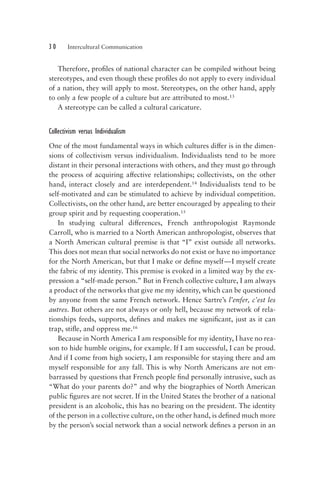
Therefore, profiles of national character can be compiled without being
stereotypes, and even though these profiles do not apply to every individual
of a nation, they will apply to most. Stereotypes, on the other hand, apply
to only a few people of a culture but are attributed to most.13
A stereotype can be called a cultural caricature.
Collectivism versus Individualism
One of the most fundamental ways in which cultures differ is in the dimen-
sions of collectivism versus individualism. Individualists tend to be more
distant in their personal interactions with others, and they must go through
the process of acquiring affective relationships; collectivists, on the other
hand, interact closely and are interdependent.14
Individualists tend to be
self-motivated and can be stimulated to achieve by individual competition.
Collectivists, on the other hand, are better encouraged by appealing to their
group spirit and by requesting cooperation.15
In studying cultural differences, French anthropologist Raymonde
Carroll, who is married to a North American anthropologist, observes that
a North American cultural premise is that “I” exist outside all networks.
This does not mean that social networks do not exist or have no importance
for the North American, but that I make or define myself—I myself create
the fabric of my identity. This premise is evoked in a limited way by the ex-
pression a “self-made person.” But in French collective culture, I am always
a product of the networks that give me my identity, which can be questioned
by anyone from the same French network. Hence Sartre’s l’enfer, c’est les
autres. But others are not always or only hell, because my network of rela-
tionships feeds, supports, defines and makes me significant, just as it can
trap, stifle, and oppress me.16
Because in North America I am responsible for my identity, I have no rea-
son to hide humble origins, for example. If I am successful, I can be proud.
And if I come from high society, I am responsible for staying there and am
myself responsible for any fall. This is why North Americans are not em-
barrassed by questions that French people find personally intrusive, such as
“What do your parents do?” and why the biographies of North American
public figures are not secret. If in the United States the brother of a national
president is an alcoholic, this has no bearing on the president. The identity
of the person in a collective culture, on the other hand, is defined much more
by the person’s social network than a social network defines a person in an
50.
Obstacles of Perception3 1
individualistic culture. To ask a French person whom you meet “What do
you do?” is “none of your business.”17
Thomas Morning Owl, a member of the Confederated Umatilla Tribes in
the state of Oregon, if asked “Shinnamwa?” (Who are you?) in the Sahaptin
language, would not respond by giving his name. He would instead describe
who his father is, his mother, and his tribe, and where they came from.
Morning Owl comments that in North American society people have indi-
vidual identities, but for the collective culture of Amerindians of the Co-
lumbia Plateau, a person is no one without reference to his or her lineage:
“who preceded you, is who you are.”18
Collective cultures place less value on relationships with out-groups
(strangers, casual acquaintances) than do individualistic cultures. There-
fore, persons of a collective culture, such as the Japanese, tend to focus most
of their appropriately positive behavior on persons in their in-group, in
order to maintain group cohesion, cooperation, and harmony.19
Persons in
out-groups are much less important. Individualistic cultures like the United
States do not differentiate as much between out-groups and in-groups and
therefore do not differentiate as much in their “friendly” behavior. This may
partially explain the perception by other cultures that North Americans are
overly or inappropriately familiar with strangers, or that their friendliness is
shallow or insincere.
Further, collective cultures are less tolerant of variation in culturally pre-
scribed behavior than are individualistic cultures.20
Face
Face is the value or standing a person has in the eyes of others. This stand-
ing can be a source of the person’s sense of personal pride or self-respect.
In many cultures maintaining face is of great importance, and one must take
great care in disagreeing, criticizing, or competing.21
Europeans are often
amazed by the North American media’s relentless exposure of U.S. prob-
lems and by the amount of self-criticism that takes place within the nation.22
Hierarchy
In a culture, differences can be accorded to the order of birth, order of arrival,
and order of status. Hall states that societies will order people, situation, or
station—but not all three simultaneously.23
As a consequence, depending
51.
3 2 InterculturalCommunication
on the culture, people requiring a service might be attended to according to
their age, in the order of their arrival, or in keeping with their perceived so-
cial rank.
Hierarchical organization of a culture affects people on a daily basis.
“Flat” hierarchical organization affords an open and mobile society, whereas
a steep hierarchy constricts social advancement.24
The acceptance of hierar-
chy in a society is, by definition, an acceptance of inequality.25
In 1998 a twenty-four-year-old French citizen was appointed director of
U.S. operations for a computer network-systems firm in San Francisco. Even
though he is a graduate of one of France’s most prestigious business schools,
he maintains he would never have this kind of responsibility working for a
French company. He explains that in the United States people will listen to
you because of what you can do, not because of your age or where you
learned to do it. But in France, age combined with knowledge are still not
enough. Even when you are fifty years old and experienced, the status con-
ferred by your school is the overriding factor in job opportunity. Your
school ultimately determines your professional station in life, good or bad.
Christian Saint-Étienne, a consultant and economics professor at the Uni-
versity of Paris–Dauphine, says that the rigid hierarchical system pushes
bright and ambitious young people to leave26
for environments where their
opinions will carry more weight.
Different factors determine a person’s rank in the hierarchy of different
cultures. When Annie Nimos arrived for the first time in Japan, she was
greeted with an opening query about her age. Her Japanese counterparts
sought hierarchical information they considered essential in order to know
the proper way to address and relate to her.
The difference in the hierarchical organization of cultures is a significant
factor in intercultural communication. All living things have a pecking or-
der.27
The concept of hierarchical distance, which can also be conceived of
as interpersonal power distance, affects the degree of formality that is used
in communication style. A decentralized and democratic society encourages
participatory communication,28
while a centralized, authoritarian society
discourages it. Japanese tradition, for example, is based on classification,
rank, order, and harmony, in contrast to North American tradition, which
is based on declassification, equality, exploration, and adventure (although
there is, of course, some overlap).29
Gender and minority statuses can affect
one’s position in the hierarchy of a culture.30
North American writers visiting Europe during the last half of the twen-
tieth century remarked on the contrasts between the two civilizations. Eu-
52.
Obstacles of Perception3 3
rope is aristocratic in its culture and politics, with the upper classes demand-
ing deference from those considered social inferiors.31
In Mexico, also a hi-
erarchical culture, people similarly prefer to maintain an authoritative dis-
tance and use very formal, although personal, courtesy. North Americans,
in contrast, strive for impeccable democracy and egalitarianism in relating
to others and as a result employ a far more informal style of communication.
Communication style in a steep hierarchical society serves to reinforce or
create hierarchical difference between persons. Individuals will use forms of
address that maintain social distance. In recognition of the hierarchy, they
will tend to display positive emotions or behavior to persons who have
higher status and negative emotions or behavior to persons who rank lower
in status.32
An individual’s communication style in a flatter hierarchical society de-
creases hierarchical differences. In a “flat” hierarchy, a speaker will use forms
of address that demote the rank of persons at higher echelons and promote
persons at lower ones, in an attempt to democratically minimize status dif-
ferences and create equality. In the flatter hierarchy, there will be a tendency
to display negative behavior toward higher-status persons to lower them to
one’s own status, and to display positive behavior toward lower-status per-
sons to elevate them, because all persons should be equal.33
Learned behav-
ior is the opposite of that for cultures with a steep hierarchy.
A number of communication specialists studying gender differences in
communication in the United States agree that women are more skilled than
men at nonverbal communication. One of a number of plausible explana-
tions is that women more often have passive or submissive roles and learn
to read nonverbal communication cues to appease those in positions of
power. If this is true, one can expect that in cultures with the steep hierar-
chical organization that equates to high interpersonal power distances, per-
sons will be highly skilled in interpreting nonverbal communication cues.34
European intellectuals observe that the authority of persons in govern-
ment and large corporations in the United States stems from the weight of
public opinion in a democratic environment, rather than from hierarchical
organization. North Americans in authority therefore strive to appear be-
nevolent and democratic. Many European writers agree that the United
States affords a fluid society where anyone can climb to the apex of the so-
cial pyramid, in contrast to the class divisions of Europe.35
The United States is organized with smaller distances in its social hierar-
chy than exist in the steeper social organization of many world cultures. The
apparent lack of respect that North Americans express toward persons in
53.
3 4 InterculturalCommunication
authority, and the familiarity with which they interact with persons of lower
status than themselves, can confuse or offend persons from cultures with
steep hierarchical organization. For the purposes of successful—and enjoy-
able—communication, it is useful for people from other cultures to under-
stand consciously that North Americans are conditioned by their culture to
communicate in a manner that will decrease the hierarchical distance be-
tween themselves and people situated both at higher and lower levels in the
social ranking system.
Hierarchy affects communication within a society. In a steep hierarchy,
information slows down as it moves up the levels of authority, ending up in
a bottleneck as it reaches the decision-maker who is overloaded with infor-
mation.36
On the way down, information moves quickly but is manipulated
as a resource that enhances status and authority. Steep hierarchies breed
concealment and misrepresentation of information.37
In a flatter hierarchy,
information flows more quickly and freely, with less distortion.
History and Experience
A person’s life experience and a culture’s history mold an individual’s per-
ceptions. In some cultures history is a part of the living present, and it col-
ors people’s perceptions of their lives on a daily basis. This would certainly
be true in Israel and Palestine today, in a way that is not the case in the
United States.
Some European writers claim that North Americans have no respect for
the past, but others declare them emancipated from the “shackles” of his-
tory. Still others say that North Americans rarely look back because they are
certain that the best lies in the future.38
Master Symbols
A culture may have strong political, religious, or other belief systems. As a
result, there often will emerge a highly abstract master symbol that is agreed
upon and respected by groups. If the social structure of a culture is tightly
organized around such master symbols, such as the greeting “Allah is great”
or the belief that “Christ is my savior,” it will be difficult, and sometimes
impossible, to share perceptions cross-culturally.39
Master symbols repre-
sent core cultural values, a violation of which may be an absolute barrier to
communication.
54.
Obstacles of Perception3 5
Power
When there is a significant discrepancy in power or status between groups,
intergroup posturing tendencies are particularly acute and can present ob-
stacles to intercultural communication.40
Cross-perceptions between the strong and successful and the weak and
the poor differ. The strong attribute success or failure to individual traits
and underestimate external factors. They tend to exaggerate their generos-
ity and criticize lack of gratitude by recipients. The weak and poor attribute
lack of success to the “system” rather than themselves. They see the success-
ful as demanding and selfish. The disadvantaged seek recognition and re-
spect, which the strong seldom give because they rarely understand the
need.41
One can see this phenomenon at work in interpersonal communica-
tion within cultures, as well as in communication between cultures.
Europeans tend to be ambivalent about the United States. On one hand
they respect U.S. wealth and military strength, and on the other they fear
U.S. motives and interference in domestic affairs. They have envied U.S. pre-
eminence, which has caused them to exaggerate the nation’s deficiencies.
The United States is seen occasionally as a savior but more often as a neces-
sary evil.42
After World War II, Europeans, like the ancient Greeks, believed
they could compensate for loss of political clout with their history of artis-
tic and literary supremacy, in the role of guardians of “High Culture.”43
Role
The role that society prescribes for persons can vary greatly by culture.44
Cultures that have a high-context communication style will read a great deal
of meaning into how a person adheres to, or deviates from, their culturally
imposed role, and a culture often imposes severe sanctions for any deviation
from a person’s prescribed role. Cultures commonly impose roles by gender
or social class.
G E N D E R . Cultures regard some behaviors as masculine or feminine, and
behavior associated with one sex is usually considered inappropriate for
the other.45
Society allocates patterning of gendered temperaments. Anglo-
Saxon social convention, for example, discourages men from bringing aes-
thetic or nurturing feelings to consciousness, just as it took away men’s tears
in the nineteenth century. Social systems even control what should be thought
l'ardore delle massee stimolo a chi ha bisogno d'essere spronato per
muoversi. Ma quando vorrebbero e potrebbero scendere all'azione
cui egli sembrava li avesse spinti, li contiene e li frena, perchè nè il
sentimento religioso dei più ne riceva ombra od offesa, nè le classi
più alte e più agiate abbiano ragione di temere pericoli per sè o per
le cose loro. Agli uomini del medio ceto composto, fra noi, di
avvocati, di letterati, di medici, di artisti, di commercianti, molti de'
quali son già disposti dalla loro educazione ad accogliere le dottrine
che da un pezzo la filosofia francese ha messe di moda, il Bonaparte
apre le braccia e fa credere d'esser venuto per scuotere il giogo che
li opprime e che per verità ad essi era parso molto leggiero: ne
solletica la vanità o l'ambizione: offrendo impieghi ed onori fa brillare
ai loro sguardi ideali di grandezza e di libertà. Ma per accoglier
costoro non respinge da sè il clero e la nobiltà: chè quello è
autorevole e questa non suscita odii ardenti, come in Francia, ed ha
molte aderenze: clero e nobiltà dal canto loro, per abitudine e per
educazione, sono concilianti e quasi senza resistenza si prestano,
parte per paura del peggio, parte per speranza del meglio, a
secondarlo.
Quanti nobili e quanti prelati, fatti cittadini, non accompagnarono poi
nelle fortunose vicende della sua vita il giovane côrso del quale
vedevano allora spuntare l'aurora! E come pronto ed acuto fu
l'occhio di lui a penetrare nel cuore e nella mente di quanti lo
avvicinavano e a discernere, fra la folla degli adulatori che gli faceva
calca intorno, gli uomini, fino allora ignoti a sè stessi, che per le
qualità dell'ingegno e dell'animo eran degni ch'ei facesse calcolo
sopra di loro; e come seppe senza esitare stendere ad essi la mano
per innalzarli e metterli al suo fianco! Alla folla il trastullo delle
pompe e delle forme, l'ebbrezza delle esagerazioni: questi pochi,
tratti nell'intimità e nella fiducia sua, educava e provava alla vita
pubblica, rendeva devoti e legava a sè, aprendo alle loro menti nuovi
orizzonti e facendo ad essi balenare lontane speranze per la lor
patria, forse allora sincere.
Intanto ben diversa e dolorosa era la realtà che il Bonaparte poteva
loro offrire. Questa Italia che egli sentiva essere sua personale
57.
conquista e perla quale vedeva disegnarsi e andava vagheggiando
ideali che pochi anni dopo l'egoismo suo, prevalendo, troncò, la
sapeva riserbata, nei reconditi disegni del Direttorio e dalle necessità
politiche della Francia, a pagare le spese della pace con l'Austria
dopo che avesse pagate alla Francia quelle della guerra. Ei doveva
perciò sfruttarla, dissanguarla, cavarne tutto il succo vitale per
provvedere ai bisogni dell'esercito, alimentare la sua impresa, e non
offrire all'Austria che un limone spremuto. E doveva in pari tempo
impedirle di acquistare tale saldezza di ordinamenti, così larga
unione delle sue parti e così libera autonomia di esistenza che
potessero poi esser d'ostacolo al mercato per cui la conquista era
fatta. Onde la instabilità degli effimeri stati democratici che all'ombra
delle sue vittorie o col conforto di molte promesse, lasciò sorgere
nella penisola.
Piccole repubbliche che si pavoneggiavano nei nomi gloriosi
dell'antichità classica, ma che funzionavano sopra una copia, ridotta
per comodo dei Francesi e per illusione degli Italiani, della
costituzione dell'anno V; che menavano vanto e discutevano con
calore e a grandi frasi dell'esercizio della libertà cui eran chiamati,
che evocavano ad ogni momento le ombre di Bruto, degli Scipioni e
magari di Camillo ed erano poi allo sbaraglio del primo caporale
Gallo che volesse essere insolente. Generali, commissari, agenti
ordinatori, requisitori straordinari ed ordinari, civili e militari venuti di
Francia, tutti comandavano, tutti insolentivano con prepotenza, tutti
credevano di avere il diritto di prendere per un orecchio e trattar da
padroni questi uomini liberi. E, come tutti comandavano, così tutti
intascavano. Parevano uccelli di rapina calati su di un campo di
battaglia: non erano mai sazii: tutto faceva per loro: oro, argento,
viveri, quadri, oggetti d'arte, persino i pegni del Monte di Pietà! Nel
nome del Direttorio la spogliazione si eseguiva in grande con la
garanzia di trattati e di compromessi e per mezzo di dotti e non dotti
ufficialmente investiti nella missione di far scelta — in lingua più
povera si direbbe rubare — del meglio che trovassero nelle gallerie,
nei musei e nelle casse pubbliche. Ma alla spogliazione ufficiale
s'aggiungeva la privata. Chiedendo a titolo di dono i più riguardosi,
58.
gli altri mettendogli artigli impudentemente — la parola è del
Bonaparte — su quel che loro piaceva, ciascuno cercava di non
tornare a mani vuote al di là delle Alpi. E non era giusto che gli
Italiani pagassero il beneficio della libertà che i Francesi — bontà
loro — avevano portato? i Romani nella Grecia non avevano fatto lo
stesso? Ma Mummio, erano gli Italiani che lo ricordavano: i Francesi
parlavano invece di Catone e continuavano a frugare nelle tasche dei
loro nuovi fratelli. — “Cappello in testa e mani nelle tasche!„ —
consigliava in quei giorni di democrazia invadente il Parini ad un
campagnolo che per timidità o per abito di cortesia non sapeva stare
dinanzi ai magistrati col capo scoperto. Il Parini, al quale il Monti
nella Mascheroniana pone in bocca:
il dolor della meschina
Di cotal nuova libertà vestita
Che libertà nomossi e fu rapina.
Serva la vide, ohimè, serva schernita.
Oh l'Italia pagò cara questa libertà! e s'avvide da ultimo di non
stringere che un pugno di mosche. Quando il Bonaparte lasciò la
penisola e a questa venne meno con esso anche il freno che fino
allora aveva contenuto la più sfacciata ruberia ed impedito il trionfo
della demagogia piazzaiuola, già della libertà erano stanchi anche
coloro che più sinceramente le erano mossi incontro. I più abili ed i
più onesti, dopo avere indarno tentato di reagire contro tanta rovina
delle loro speranze e dei loro ideali, dopo aver cercato inutilmente di
arrestare l'onda invadente nella vita pubblica degli elementi più
torbidi e più violenti che il cieco favor popolare e il non disinteressato
favore dei generali e commissari francesi sospingevano innanzi,
s'erano ritirati in disparte. Il contrastare degli avidi, il rubare dei
disonesti, le piccole prepotenze dei cittadini che avevano il governo
di nome e le grandi dei Francesi che lo esercitavano di fatto, la
confusione delle attribuzioni, gli odii, le calunnie, la intemperanza del
linguaggio avevano, in tre anni, gettato l'Italia nello stato della più
completa anarchia.
59.
*
Allora appunto, nel1799, cominciò la reazione antifrancese: ma,
come la rivoluzione, anch'essa venne fra noi dal di fuori.
Quasi ad un tempo fu trionfante alle due estremità della penisola.
Dalle Alpi calò in Lombardia il maresciallo Suwaroff, il terribile tartaro
che aveva massacrati gli ultimi eroi della libertà polacca, e guidava
Austriaci e Russi: piombò in Calabria dalla Sicilia il cardinale Fabrizio
Ruffo e lo seguiva un'orda disordinata di borbonici, di briganti, di
preti, di frati e di contadini che lungo il cammino diventò folla. Un
medesimo odio contro la rivoluzione guidava l'uno e l'altro, il fanatico
maresciallo scismatico, l'accorto principe della Chiesa romana: pronti
erano entrambi a qualunque eccesso pur di far trionfare Cristo ed il
diritto divino dei re.
Nuovo Attila, il Suwaroff, e come lui terribile nella bruttezza
ripugnante del volto e della piccola persona, si gittava furibondo in
mezzo alla mischia cogli occhi iniettati di sangue, e tenendosi ritto su
di un selvaggio cavallo della steppa, correva seminudo sotto una
bianca e lunga camicia tartara, donde pendevano decorazioni e
reliquie, fra le file de' suoi incitando alla strage, dandone l'esempio: i
suoi urli erano di belva inferocita, le pose e i gesti teatrali: quando
s'incontrava in una croce o in una immagine sacra scendeva da
cavallo, si gettava bocconi e colla testa beluina nella polvere baciava
il suolo.
Il Ruffo, maestoso nella eleganza signorile della porpora cardinalizia,
incedeva sereno in mezzo alle turbe furibonde e fanatiche de' suoi
nuovi crociati. Dalla sua bocca di miele uscivano parole che
suonavano pace e perdono cristiano, ma che sulle turbe le quali lo
ascoltavano col cuore invasato di sacro odio producevano l'effetto di
staffilate: gli sciagurati che s'eran fatti nemici della religione e del re
e che conveniva richiamare, per salvezza delle anime loro e per
tranquillità e sicurezza degli altri, alla fede di cristiani e di sudditi, ei
li additava con la punta della spada: con la croce benediceva le
60.
schiere che tornavanodalle stragi sanguinose: di tratto in tratto
fermava i suoi ad una chiesa ed intonava il Tedeum al Dio della
vittoria.
Una lunga traccia di incendi, di stupri, di saccheggi, di rapine, di
lascivie per cui il Suwaroff menava vanto e gli brillavano gli occhi di
gioia e il Ruffo mostrava di vergognarsi e dolersi, segnava il
passaggio in Lombardia e nel Regno delle milizie oltremontane e
nostrane della Santa Fede: e dietro la traccia, e per allargarla,
accorrevano, come iene attratte dall'odore della preda e del sangue,
sempre nuove turbe di insorgenti e più feroci, fiutando se vi eran
superstiti alle prime stragi, cercando se trovavano avanzi delle prime
rapine, insaziabili per timore che le vittime venissero loro a mancare.
Col successo il contagio si diffonde dalle estremità nel centro d'Italia.
Un selvaggio furore sembra invadere le tranquille e gentili
popolazioni della Toscana, dell'Umbria e delle Marche: cadono gli
alberi della libertà e sorgono per ogni dove le croci; cessano lo
squillar delle trombe e il rullar dei tamburi; fra un lento e continuo
suonar di campane, echeggiano da ogni parte grida selvaggie di
Morte ai Giacobini, Viva Maria! Moltitudini sterminate di contadini
armati di picche, di falci, di fucili si muovono quasi in processione
militare dai loro borghi, si organizzano in bande, improvvisano capi.
Centro dell'armata della fede è in Toscana, Arezzo: generalessa una
donna, Alessandra Mari da Montevarchi che, novella Giovanna
d'Arco, portando un'imagine della Vergine, precede a cavallo la turba
aretina e la conduce delirante d'odio e di fede, fra il canto delle
sante litanie, alla caccia dei Francesi, dei giacobini, degli ebrei, di
tutti i nemici della fede.
D'onde in ogni parte di questa Italia, che ieri pareva delirare
d'entusiasmo per i Francesi, d'amore per la libertà, sono sbucate
d'improvviso tante masse cristiane e così numerosi sanfedisti? Dove
si tenevano finora nascosti, e come tanto odio non visto covava? E
dove sono ora i molti che smaniosi di godere e di esercitare i diritti
del cittadino facevano ressa attorno ai pubblici uffici? i non mai sazi
di libertà? gli energumeni, i declamatori delle tribune, dei giornali,
61.
delle piazze cheparevan non trovar sufficienti parole per affermare e
ripetere il loro risoluto proposito di sacrificare la vita piuttosto che la
libertà acquistata?
Non si vedono più: si direbbe che una voragine li ha inghiottiti tutti.
È bastato che l'esercito francese vinto dagli Austro-Russi in campali
giornate, investito ed incalzato in ogni parte dalle bande degli
insorgenti, fosse costretto a sottrarre alle libere repubbliche italiane il
suo appoggio, perchè queste, come castello di carta al primo soffio,
crollassero. Per i loro ideali di libertà e di ordinato viver civile, per
l'esistenza di quello Stato che con fede di compiere cosa santa
avevano fondato pochi mesi prima, lottarono da eroi fino all'ultimo
gli uomini della Repubblica Partenopea, soli: ma non erano che un
pugno di forti e la reazione li soffocò col numero nel sangue.
Abbandonarono invece il campo, vergognosamente inerti, tutti gli
altri nelle altre parti d'Italia. I più compromessi fautori della libertà
seguirono l'esercito francese nella ritirata: quelli che credettero di
rimanere sul patrio suolo e che non poterono ottenere d'esser
dimenticati o anche di far accogliere i loro servigi dai nuovi vincitori,
furono o massacrati nel primo momento dal furor delle turbe o
carcerati o esiliati o tratti a morte più tardi, quando cominciò per
mezzo di persecuzioni e di processi la più misurata, ma non meno
feroce e sanguinaria, epurazione a freddo dei sospetti di civismo. Alle
stragi di Mario succedono le proscrizioni di Silla.
A spiegare tanta e così subitanea mutazione non basta dire che le
violenze e le ruberie dei Francesi, che l'anarchia dei governi da loro
istituiti avevano ingenerato odio a sazietà siffatta che gli Italiani
avrebbero accolto come liberatore anche il turco: conviene
ammettere, come io dicevo da principio, che al soffio delle idee
francesi la superficie soltanto della vita italiana si era mossa: che era
spuma e non onda quella che s'era sollevata. La natura italiana,
nonostante l'apparente consenso generale, non era stata toccata
profondamente nel suo organismo dalle novità francesi: un accesso
violento di febbre che la paura ed il contatto coi Francesi avevano
provocato, l'aveva turbata momentaneamente: passata la paura,
cessato il contatto, le tendenze naturali, sentendosi di nuovo libere
62.
di sè, avevanoripreso il sopravvento ed avevano per reazione
ecceduto nel volere dalla vita italiana espellere ciò che l'importazione
straniera vi aveva introdotto.
*
Altri stranieri avevano dominato nei secoli precedenti l'Italia; ma
nessuno, prima dei Francesi, aveva voluto d'un tratto e per forza
innestare la propria vita, le proprie idee, le proprie ispirazioni nella
vita italiana: ciò che delle costumanze e del pensiero spagnuolo era
rimasto fra noi, era stato assorbito per lento e spontaneo
infiltramento nel volgere di molti anni. Del resto, che la violenta
imposizione dei principii della rivoluzione francese non solo si sia
esercitata sopra un terreno che in nessun modo era disposto ad
accoglierla, ma che sia venuta ad interrompere bruscamente il
naturale svolgimento della vita italiana, quando appunto cominciava
a rinnovarsi da sè, lo mostra il fatto che neppure il vivere più
composto e ordinato di altri quindici anni della dominazione francese
restaurata fra noi nel primo anno del secolo, hanno potuto radicarli.
Certo per legge di adattamento essi poterono in quegli anni
guadagnar terreno e lasciarono traccia di sè in molti che si erano
trovati in condizione di vederne e di gustarne i benefici: ma la
grande massa del popolo italiano fu lieta che la reazione del 1815 —
più fortunata e più durevole di quella del 1799 — rimettesse le cose
come erano prima che i Francesi ponessero il piede in Italia, e
s'adagiò soddisfatta nel suo nuovo sonno, dal quale soltanto la lenta
e graduale preparazione di mezzo secolo potè destarla e metterla in
condizione di poter guardare con occhio sicuro il sole della libertà.
Un uomo avrebbe potuto anticipare l'aurora di questo sole:
Napoleone Bonaparte se egli, quando fu padrone di sè e non doveva
render conto ad alcuno, come prima al Direttorio, dell'opera sua,
avesse voluto essere italiano soltanto e si fosse proposto di riprender
le fila della tradizione italiana là dove l'orrore per la rivoluzione
francese, poi le armi di Francia le avevano spezzate. Ma quando calò
per la seconda volta nella penisola per metter fine alla reazione che
63.
da tredici mesivi imperversava, e d'un sol salto, colla battaglia di
Marengo, fu in sella e di nuovo ebbe in mano il freno di lei ch'era
“fatta indomita e selvaggia„ egli non era più il giovane generale
invaso dalla voglia d'afferrare per i capelli la gloria e la fortuna
dovunque le avesse trovate. Gloria e fortuna le aveva già raggiunte e
le teneva strette nel ferreo pugno. Era il primo console, il vero
signore della Francia: se in altri tempi egli aveva potuto accarezzare
la possibilità di congiungere la propria fortuna alle sorti d'Italia e di
far servire gli interessi e le aspirazioni di questa alle sue personali
mire d'ambizione e di dominio, ora che il 18 brumaio aveva
trasformato i suoi più alti sogni in una realtà e trascinata la Francia
ai suoi piedi, l'egoismo suo s'era immedesimato del tutto con questa.
Non vedeva più che la Francia nell'Europa, e solo sè nella Francia:
tutto nel mondo, l'Italia per la prima, la più cara delle sue conquiste,
doveva servire alla gloria, alla grandezza, agli interessi della Francia
perchè queste erano la gloria, la grandezza, l'interesse di lui.
L'uomo della rivoluzione era finito col secolo ch'era morto. Colui che
con Marengo aveva aperto il secolo nuovo, dalla rivoluzione,
attraverso la quale era salito, aveva cominciato a staccarsi: non ne
aveva più bisogno, anzi la temeva e voleva per ciò all'opera
distruggitrice e disgregatrice del popolo far succedere quella
ricostruttrice ed ordinatrice dell'uomo di Stato. Disgraziatamente
l'uomo di Stato non era meno rivoluzionario del popolo: le forme
della ricostruzione furono diverse perchè personali, ma il metodo finì
coll'essere lo stesso: la prepotenza, l'arbitrio, la violenza, il capriccio,
la collera, la passione.
Al popolo italiano s'annunciò uomo d'ordine nelle prime parole che
gli diresse dopo la vittoria: “Il popolo francese viene per la seconda
volta a spezzare le vostre catene. Quando il vostro territorio sarà
compiutamente sgombro dal nemico, la repubblica sarà riorganizzata
sulle basi immutabili della religione, dell'eguaglianza e del buon
ordine.„ Dell'antica formula rivoluzionaria restava la sola
eguaglianza: ciò che anche di questa restava, poteron scorgere
subito i Milanesi quando, dopo la vittoria di Marengo, videro il
Bonaparte andare in Duomo per assistere al Tedeum sotto il
64.
baldacchino che solevaessere preparato per i soli sovrani, circondato
da uno stato maggiore tutto oro e ricami, preceduto e seguito dalle
guardie consolari, con isfoggio di divise, di livree, di velluti, di
pennacchi e di ornamenti che ricordavano le pompe spagnolesche
del tempo antico. Cominciava il Bonaparte ad avvezzare gli occhi dei
liberi cittadini, prima di trasformarli in sudditi, alla teatralità dello
spettacolo della sua grandezza: non è lontano il tempo che tutto il
mondo sarà in livrea per far cornice e contrasto al suo grigio
cappotto.
L'Italia non ebbe per il momento che ordinamenti provvisori: altre
cure chiamavano altrove lui che da solo voleva sostenere il carico
della reazione dell'Europa intiera. Soltanto allorchè ebbe costretto
tutte le orgogliose monarchie dell'antica Europa a stringere la mano
vittoriosa con cui offriva loro la pace, pensò ad ordinare più
stabilmente la nostra penisola. Era tempo: la verace e saggia libertà
che si era attesa da lui non era venuta; le corruzioni, i disordini, le
prepotenze degli amministratori e delle amministrazioni provvisorie,
le spogliazioni, le requisizioni, le rapine, naturali conseguenze della
guerra, si erano rinnovate, come dal primo triennio della
dominazione francese ed avevano di nuovo resa odiosa la libertà.
V'era in Italia una popolazione che il Bonaparte prediligeva fra tutte:
quella che dalle Alpi per le pianure lombarda, emiliana e romagnola
si stende al di qua ed al di là del Po fino all'Esino. In mezzo ad essa,
nel 1796, aveva vissuto i suoi giorni migliori, quelli delle prime glorie,
che son sempre le più care, e gli pareva che là battesse il vero cuore
della nazione italiana: certo di là gli eran venuti gli uomini che
meglio fra noi lo avevano compreso e secondato e che ancora lo
circondavano. Per ciò, dopo Campoformio e contro le istruzioni del
Direttorio, le aveva permesso di formare col nome di repubblica
Cisalpina una forte unità di Stato, ed alla nuova repubblica aveva
dedicato cure e lasciato intravvedere alti destini e più larga unità.
Se il Bonaparte non volle mai dell'Italia tutta
le disciolte
65.
Membra legarle inun sol nodo e stretto,
lasciò però, che anche dopo il suo ritorno nella penisola questa unità
cisalpina risorgesse e rimanesse, della intiera nazione italiana, quasi
il simbolo, in attesa — ei lasciava creder di prometterle — che tempi
migliori le permettessero di esserne il nucleo. Ma intanto volle
esserne egli il padrone e la guida. Conclusa la pace generale, ne
chiamò a consulta i rappresentanti perchè studiassero un nuovo
ordinamento di repubblica rispondente ai bisogni della lor nazione ed
alla volontà sua; li chiamò a Lione, in terra straniera, davanti ai suoi
ministri francesi ed a sè stesso e della lor nuova repubblica volle che
lo eleggessero presidente.
Che importava? Ma con la nuova repubblica, che fu detta italiana,
usciva finalmente e per la prima volta dopo tanti secoli di storia
assumeva valore politico questo nome significativo di ideali e di
speranze che già erano nell'intimo pensiero o almeno nel sentimento
di molti; ma della nuova repubblica il Bonaparte affidava le redini,
come a vice presidente, al Melzi, l'italiano per integrità di carattere,
per altezza d'ingegno, per nobiltà di propositi più rispettato, l'uomo
che dell'avvenire d'Italia ebbe forse la più chiara visione e la più
sicura coscienza. Le circostanze e la volontà del Bonaparte non
permisero che quel nome d'italiana assumesse più largo e più vero
significato: chè delle altre parti d'Italia già pervenute in mano di lui o
che vi pervennero poi, preferì o formare dipartimenti francesi o
mantenerle isolate o aggrupparle artificiosamente fra loro, anzichè
allargare i confini della repubblica italiana. Ma le speranze che nel
Melzi erano state concepite, cominciarono a divenir realtà: egli purgò
la repubblica dalla corruzione, restaurò il senso morale e la giustizia,
ed iniziò con mano tranquilla, con larghezza di vedute e con audacia
temperata dal senso pratico ch'egli aveva della vita, un'opera lenta di
ricostruzione sociale e politica, la quale poteva assicurare allo Stato
lunga vita e sicura. Parve un'êra nuova di prosperità e di benessere
che s'aprisse: pur troppo non fu lunga nè libera di difficoltà e di
ostacoli. I maggiori di questi venivano di Francia. Il Bonaparte aveva
detto alla Consulta di Lione: “Voi avete bisogno di leggi generali e di
66.
costumi generali. Nonavete eserciti, bensì avete gli elementi per
crearli.„ E la repubblica italiana ebbe per opera del Melzi savie leggi
generali, e pose le basi di quell'esercito che doveva essere la miglior
scuola della nazione italiana e che restò la visione gloriosa e più di
frequente evocata dai forti italiani, quando tornò per loro il tempo
dell'inerzia.
Anche quello che il Bonaparte aveva chiamato il costume, cioè il
carattere ed il sentimento nazionale, si era proposto e si studiò il
Melzi di formare: aveva accettato di essere l'uomo del Bonaparte
rispetto alla nazione italiana e voleva essere — ei diceva — anche
l'uomo della nazione rispetto al Bonaparte; ma perchè potesse
raggiungere così nobile intento conveniva che cessasse
l'asservimento alla Francia. Il contatto coi Francesi era troppo
continuo, perchè non fosse cagione di spiacevoli contrasti: la
dipendenza dalla Francia troppo diretta e troppo presente perchè gli
interessi di questa non avessero a prevalere su quelli che avrebbe
imposto la nazionalità della serva e più bisognosa sorella. E invece
che diminuire l'asservimento diventava ogni giorno più duro, e più
ferrea e più imperiosa si faceva sentire la volontà di Napoleone.
Prima erano consigli e raccomandazioni al Melzi: diventarono poi
ordini e ingiunzioni fatte — nonostante l'affetto e la grande stima
che il Bonaparte nutriva per il patrizio milanese — con quel tono
secco di militaresca villania che al Talleyrand faceva dire col suo fine
sorriso: — “Peccato che un uomo di tanto ingegno sia tanto male
educato!„ Il Melzi era costretto quasi sempre a piegare il capo: non
vi si rassegnava però che riluttante e dopo di avere con coraggio,
che era già di pochi e che presto non sarebbe stato di nessuno,
tentato di persuadere e di resistere.
Di mano in mano che il Bonaparte si avvicinava alla corona
imperiale, tanto più invadente, accentratrice si faceva la personalità
sua: ogni azione altrui dalla sua restava soffocata e distrutta: una
volontà sola, una sola vita vi doveva essere in Europa, la sua.
Il Bonaparte fu chiamato il primo dei controrivoluzionari: e per vero
egli aveva creduto di fermar l'opera della rivoluzione rimettendo la
67.
società sopra lebasi donde la rivoluzione l'aveva spostata: l'ordine e
la religione. L'operosa ricostruzione interna del consolato, la pace
generale con l'Europa, il Concordato col papa parevano nel 1801
voler mantenere la promessa. Ora il Cesarismo lo aveva ricondotto di
nuovo là dove la rivoluzione con la violenza era giunta. Non la
Francia soltanto, ma l'Europa intera turbata; principi e popoli in
istato di continua instabilità ed in pericolo di sovvertimento ad un sol
cenno di lui; il Pontefice, come ai tempi della rivoluzione, strappato
alla sua sede e trascinato in Francia e le coscienze religiose turbate.
Seguirlo in questa fase ultima della sua vita politica non tocca a me
nell'ordine di queste letture; è giunto il momento in cui la
individualità del Bonaparte ha talmente assorbito la vita di tutta
l'Europa da formare con essa una sola ed indivisibile cosa.
Napoleone è già il Giove terreno che fulmina, che riceve gli incensi,
che si sente al difuori e al disopra del genere umano.
E torrenti di luce il sol diffuse
Napoleone Dio, Napoleone!
Rispondeva la terra, e il ciel si chiuse.
Miseri mortali costretti a vivere fuor delle loro condizioni normali, ad
obbedire senza discutere, ad ammirare sempre; sempre in attesa di
qualche colpo di scena che d'un tratto muti le loro sorti; sempre nel
timore che un segno di penna annulli la loro esistenza, che li privi
delle sostanze, che strappi i lor figli alla casa paterna e li balzi qua e
là per tutta l'Europa. Mai la ragion di Stato aveva annientato tanto
l'individuo! Nulla aveva più valore nella vita dell'uomo privato, nè in
quella dei popoli. Che importa alla storia sapere quali principi
Napoleone abbia posto sui troni o quali ne abbia balzati? restano
ombre prive di corpo, nomi vani, quando attraverso ad essi non si
vada a cercare il sole che li illumina e li vivifica. Che importa sapere
come Napoleone abbia riunito all'impero francese l'uno dopo l'altro il
Piemonte, poi Genova con la Liguria, poi Parma, Piacenza, Lucca, poi
la Toscana, dopo averne fatto un effimero regno d'Etruria, e da
ultimo Roma? Quali destini serbava all'eterna città quando,
68.
attingendo ancora unavolta alla forza della sua tradizione gloriosa,
faceva di essa la seconda metropoli dell'impero, poi del figlio
lungamente desiderato, un re di Roma? Ne voleva far centro della
nuova nazione italiana? Chi può seguirlo attraverso il fantasmagorico
mutare e rimutare della sua volontà, e cogliere in mezzo il barattare
continuo di troni e provincie, quale sia l'ultima mira dell'azione sua?
Il bel nome italico rimaneva al regno, in cui la repubblica italiana
s'era trasformata: ma il Melzi non v'era più a governarla. Al suo
posto Napoleone aveva posto un giovanetto francese, il figliastro suo
Eugenio: e francesi, come Eugenio, tratti dalla famiglia di Giove
furono pure Giuseppe e Gioacchino Murat che successivamente
Napoleone fe' passare sul trono abbandonato da Ferdinando di
Borbone. Continua nel regno italico, s'inizia nel regno di Napoli il
rinnovamento legislativo, economico e militare del paese; e possono,
ne' primi momenti del fasto teatrale delle nuove Corti e della gloria
militare cui sono chiamate a partecipare, restare abbagliate le
popolazioni italiane. Ma la realtà finisce coll'imporsi: al fasto
principesco, alla gloria militare erano sacrificati gli interessi del
popolo; per la grandezza dell'impero di Francia prosciugate le risorse
pubbliche, seminate di lutti le case dei cittadini. Resistere alla
volontà di chi disponeva della loro sorte non osavano i principi, era
impotente il popolo: ond'è che gli Italiani ricaddero di nuovo in
quello stato di inerzia passiva che già altra volta era succeduto alla
momentanea effervescenza che l'amore per la libertà pareva avesse
destato fra noi: di nuovo nel segreto del cuore covarono gli Italiani
l'odio contro gli stranieri oppressori. Ma l'odio questa volta era più
intenso perchè più lunga era stata l'educazione politica, più sicuri
erano divenuti i criteri per distinguere il bene dal male, l'apparenza
dalla realtà: ed il contrasto stesso che nella repubblica e nel regno
italico gli Italiani avevano avuto sotto gli occhi, dei benefici che da
savi ordinamenti liberi avrebbero potuto ritrarre coi mali che per
l'assoggettamento a Francia nel fatto ne ritraevano, acuiva l'odio ed
il dolore.
Il Franchetti in una delle sue migliori monografie su questi tempi ha
dimostrato che l'odio sorto fra noi dalle sofferenze, dalle prepotenze,
69.
dalle delusioni subitedurante la dominazione francese fu il fuoco
sacro che ha acceso il sentimento patrio italiano, prima dell'89 vivo
soltanto nella comunanza del linguaggio, della coltura e delle
tradizioni storiche. Un medesimo odio e una comune miseria hanno
fatto cercare la medesima salvezza; così la coscienza unitaria della
nazione italiana fu formata. Dal male nasce più spesso che in altro
nido il bene: e basterebbe ciò perchè a questa età tumultuosa noi
dovessimo rivolgere grati lo sguardo, quando anche non le
dovessimo d'averci richiamato alla milizia e dato l'esempio dei primi
larghi ordinamenti legislativi che rimasero poi fermi nella nostra
tradizione.
La coscienza nazionale italiana portava però ancora con sè il segno
del peccato d'origine: era nata dall'odio e non poteva per anco aver
altro carattere che distruttivo; non sentiva allora altra necessità
all'infuori che quella di togliersi di dosso chi la soffocava, e per il
momento non vedeva e non cercava come le sarebbe stato poi
concesso nel fatto di costruire l'unità della patria.
Per ciò il popolo italiano assistè plaudendo al crollo della fortuna
napoleonica, dove non diè mano esso stesso a quella rovina: per ciò
respinse con repugnanza le offerte di indipendenza che la voce
francese del vanitoso Gioacchino Murat gli vantò da Rimini e respinse
anche quelle di Eugenio di Beauharnais, che pur era degno di miglior
sorte. Ma poichè l'odio solo l'avea mosso e non avea pronta e chiara
davanti agli occhi la vera soluzione del suo avvenire, dopo esser
corso dietro alle speranze — e fu errore scontato collo Spielberg —
di una restaurazione liberale ed autonoma sotto gli auspici
dell'Austria, finì col cadere nella servitù e passare da una ad un'altra
dominazione straniera, la quale gli tolse anche quelle speranze di
libertà e quelle illusioni di gloria che la dominazione francese gli
concedeva.
Eppure, se fra tanto tumulto di passioni l'Italia avesse prestato
attento orecchio, avrebbe inteso una voce che dalle pagine ora
dimenticate di un tenue opuscolo, dirigendo un Appello ad
Alessandro imperatore autocrate di tutte le Russie sul destino
70.
d'Italia, additava conmano sicura donde la salvezza futura sarebbe
venuta. “Offrasi — diceva la voce dell'anonimo solitario — offrasi a
questa nazione l'indipendenza, l'unione e la scelta di un governo....
Gli occhi d'ogni italiano, nel di cui petto arde il sacro amor di patria e
a cui l'onore nazionale è caro, rivolti sono da gran tempo sopra
quello che tutto appella a far nostro capo e sovrano. Restaci ancora
un principe legittimo e degno di esserlo, la di cui famiglia tutto ha
nelle vene il più puro sangue italiano. Un principe nato fra noi, fra
noi allevato, che noi tutti conosciamo e che conosce noi tutti. Egli ha
i nostri costumi e le inclinazioni nostre, le nostre abitudini. L'illustre
casa di Savoia è italiana e gli avi suoi sono dell'Italia la gloria e
l'orgoglio. Che i monarchi alleati, che Vostra Maestà la richiamino al
proprio antico dominio non solo, ma che a regnare s'inviti su tutti gli
Italiani che desideran divenirne sudditi. Si presenti il Re di Sardegna
agli Italiani tutti come il centro della loro unione e gli Italiani tutti
accetteranno con viva gioia e trasporto il magnanimo dono e
benediranno la mano donatrice: correre tosto scorgerebbonsi da
ogni lato dell'afflitta Italia giovani ardenti a salutare l'augusto, il
nazional sovrano e ad offrirgli le braccia ed il sangue loro.„
La voce del solitario italico che con occhio così limpido vedeva la
futura missione rendentrice di Carlo Alberto e di Vittorio Emanuele II
e preannunziava i plebisciti dell'Italia nuova, cadde allora nel silenzio.
Altro odio doveva nascere da altre e più dure ed umilianti sofferenze;
dolorosi sacrifici di sangue e di ideali dovevano essere imposti dalle
esperienze fallite cercando per vie diverse la patria, prima che la
coscienza nazionale italiana fosse compiuta e che non più soltanto
dalle elucubrazioni politiche dei pensatori ma dalla educazione
generale del popolo si invocasse e si imponesse la redenzione del
nostro paese.
71.
Nota del Trascrittore
Ortografiae punteggiatura originali sono state
mantenute, correggendo senza annotazione minimi errori
tipografici.
Copertina creata dal trascrittore e posta nel pubblico
dominio.
72.
*** END OFTHE PROJECT GUTENBERG EBOOK I FRANCESI IN
ITALIA (1796-1815) ***
Updated editions will replace the previous one—the old editions
will be renamed.
Creating the works from print editions not protected by U.S.
copyright law means that no one owns a United States
copyright in these works, so the Foundation (and you!) can copy
and distribute it in the United States without permission and
without paying copyright royalties. Special rules, set forth in the
General Terms of Use part of this license, apply to copying and
distributing Project Gutenberg™ electronic works to protect the
PROJECT GUTENBERG™ concept and trademark. Project
Gutenberg is a registered trademark, and may not be used if
you charge for an eBook, except by following the terms of the
trademark license, including paying royalties for use of the
Project Gutenberg trademark. If you do not charge anything for
copies of this eBook, complying with the trademark license is
very easy. You may use this eBook for nearly any purpose such
as creation of derivative works, reports, performances and
research. Project Gutenberg eBooks may be modified and
printed and given away—you may do practically ANYTHING in
the United States with eBooks not protected by U.S. copyright
law. Redistribution is subject to the trademark license, especially
commercial redistribution.
START: FULL LICENSE
PLEASE READ THISBEFORE YOU DISTRIBUTE OR USE THIS WORK
To protect the Project Gutenberg™ mission of promoting the
free distribution of electronic works, by using or distributing this
work (or any other work associated in any way with the phrase
“Project Gutenberg”), you agree to comply with all the terms of
the Full Project Gutenberg™ License available with this file or
online at www.gutenberg.org/license.
Section 1. General Terms of Use and
Redistributing Project Gutenberg™
electronic works
1.A. By reading or using any part of this Project Gutenberg™
electronic work, you indicate that you have read, understand,
agree to and accept all the terms of this license and intellectual
property (trademark/copyright) agreement. If you do not agree
to abide by all the terms of this agreement, you must cease
using and return or destroy all copies of Project Gutenberg™
electronic works in your possession. If you paid a fee for
obtaining a copy of or access to a Project Gutenberg™
electronic work and you do not agree to be bound by the terms
of this agreement, you may obtain a refund from the person or
entity to whom you paid the fee as set forth in paragraph 1.E.8.
1.B. “Project Gutenberg” is a registered trademark. It may only
be used on or associated in any way with an electronic work by
people who agree to be bound by the terms of this agreement.
There are a few things that you can do with most Project
Gutenberg™ electronic works even without complying with the
full terms of this agreement. See paragraph 1.C below. There
are a lot of things you can do with Project Gutenberg™
electronic works if you follow the terms of this agreement and
help preserve free future access to Project Gutenberg™
electronic works. See paragraph 1.E below.
75.
1.C. The ProjectGutenberg Literary Archive Foundation (“the
Foundation” or PGLAF), owns a compilation copyright in the
collection of Project Gutenberg™ electronic works. Nearly all the
individual works in the collection are in the public domain in the
United States. If an individual work is unprotected by copyright
law in the United States and you are located in the United
States, we do not claim a right to prevent you from copying,
distributing, performing, displaying or creating derivative works
based on the work as long as all references to Project
Gutenberg are removed. Of course, we hope that you will
support the Project Gutenberg™ mission of promoting free
access to electronic works by freely sharing Project Gutenberg™
works in compliance with the terms of this agreement for
keeping the Project Gutenberg™ name associated with the
work. You can easily comply with the terms of this agreement
by keeping this work in the same format with its attached full
Project Gutenberg™ License when you share it without charge
with others.
1.D. The copyright laws of the place where you are located also
govern what you can do with this work. Copyright laws in most
countries are in a constant state of change. If you are outside
the United States, check the laws of your country in addition to
the terms of this agreement before downloading, copying,
displaying, performing, distributing or creating derivative works
based on this work or any other Project Gutenberg™ work. The
Foundation makes no representations concerning the copyright
status of any work in any country other than the United States.
1.E. Unless you have removed all references to Project
Gutenberg:
1.E.1. The following sentence, with active links to, or other
immediate access to, the full Project Gutenberg™ License must
appear prominently whenever any copy of a Project
Gutenberg™ work (any work on which the phrase “Project
76.
Gutenberg” appears, orwith which the phrase “Project
Gutenberg” is associated) is accessed, displayed, performed,
viewed, copied or distributed:
This eBook is for the use of anyone anywhere in the United
States and most other parts of the world at no cost and
with almost no restrictions whatsoever. You may copy it,
give it away or re-use it under the terms of the Project
Gutenberg License included with this eBook or online at
www.gutenberg.org. If you are not located in the United
States, you will have to check the laws of the country
where you are located before using this eBook.
1.E.2. If an individual Project Gutenberg™ electronic work is
derived from texts not protected by U.S. copyright law (does not
contain a notice indicating that it is posted with permission of
the copyright holder), the work can be copied and distributed to
anyone in the United States without paying any fees or charges.
If you are redistributing or providing access to a work with the
phrase “Project Gutenberg” associated with or appearing on the
work, you must comply either with the requirements of
paragraphs 1.E.1 through 1.E.7 or obtain permission for the use
of the work and the Project Gutenberg™ trademark as set forth
in paragraphs 1.E.8 or 1.E.9.
1.E.3. If an individual Project Gutenberg™ electronic work is
posted with the permission of the copyright holder, your use and
distribution must comply with both paragraphs 1.E.1 through
1.E.7 and any additional terms imposed by the copyright holder.
Additional terms will be linked to the Project Gutenberg™
License for all works posted with the permission of the copyright
holder found at the beginning of this work.
1.E.4. Do not unlink or detach or remove the full Project
Gutenberg™ License terms from this work, or any files
77.
containing a partof this work or any other work associated with
Project Gutenberg™.
1.E.5. Do not copy, display, perform, distribute or redistribute
this electronic work, or any part of this electronic work, without
prominently displaying the sentence set forth in paragraph 1.E.1
with active links or immediate access to the full terms of the
Project Gutenberg™ License.
1.E.6. You may convert to and distribute this work in any binary,
compressed, marked up, nonproprietary or proprietary form,
including any word processing or hypertext form. However, if
you provide access to or distribute copies of a Project
Gutenberg™ work in a format other than “Plain Vanilla ASCII” or
other format used in the official version posted on the official
Project Gutenberg™ website (www.gutenberg.org), you must,
at no additional cost, fee or expense to the user, provide a copy,
a means of exporting a copy, or a means of obtaining a copy
upon request, of the work in its original “Plain Vanilla ASCII” or
other form. Any alternate format must include the full Project
Gutenberg™ License as specified in paragraph 1.E.1.
1.E.7. Do not charge a fee for access to, viewing, displaying,
performing, copying or distributing any Project Gutenberg™
works unless you comply with paragraph 1.E.8 or 1.E.9.
1.E.8. You may charge a reasonable fee for copies of or
providing access to or distributing Project Gutenberg™
electronic works provided that:
• You pay a royalty fee of 20% of the gross profits you derive
from the use of Project Gutenberg™ works calculated using the
method you already use to calculate your applicable taxes. The
fee is owed to the owner of the Project Gutenberg™ trademark,
but he has agreed to donate royalties under this paragraph to
the Project Gutenberg Literary Archive Foundation. Royalty
78.
payments must bepaid within 60 days following each date on
which you prepare (or are legally required to prepare) your
periodic tax returns. Royalty payments should be clearly marked
as such and sent to the Project Gutenberg Literary Archive
Foundation at the address specified in Section 4, “Information
about donations to the Project Gutenberg Literary Archive
Foundation.”
• You provide a full refund of any money paid by a user who
notifies you in writing (or by e-mail) within 30 days of receipt
that s/he does not agree to the terms of the full Project
Gutenberg™ License. You must require such a user to return or
destroy all copies of the works possessed in a physical medium
and discontinue all use of and all access to other copies of
Project Gutenberg™ works.
• You provide, in accordance with paragraph 1.F.3, a full refund of
any money paid for a work or a replacement copy, if a defect in
the electronic work is discovered and reported to you within 90
days of receipt of the work.
• You comply with all other terms of this agreement for free
distribution of Project Gutenberg™ works.
1.E.9. If you wish to charge a fee or distribute a Project
Gutenberg™ electronic work or group of works on different
terms than are set forth in this agreement, you must obtain
permission in writing from the Project Gutenberg Literary
Archive Foundation, the manager of the Project Gutenberg™
trademark. Contact the Foundation as set forth in Section 3
below.
1.F.
1.F.1. Project Gutenberg volunteers and employees expend
considerable effort to identify, do copyright research on,
transcribe and proofread works not protected by U.S. copyright
79.
law in creatingthe Project Gutenberg™ collection. Despite these
efforts, Project Gutenberg™ electronic works, and the medium
on which they may be stored, may contain “Defects,” such as,
but not limited to, incomplete, inaccurate or corrupt data,
transcription errors, a copyright or other intellectual property
infringement, a defective or damaged disk or other medium, a
computer virus, or computer codes that damage or cannot be
read by your equipment.
1.F.2. LIMITED WARRANTY, DISCLAIMER OF DAMAGES - Except
for the “Right of Replacement or Refund” described in
paragraph 1.F.3, the Project Gutenberg Literary Archive
Foundation, the owner of the Project Gutenberg™ trademark,
and any other party distributing a Project Gutenberg™ electronic
work under this agreement, disclaim all liability to you for
damages, costs and expenses, including legal fees. YOU AGREE
THAT YOU HAVE NO REMEDIES FOR NEGLIGENCE, STRICT
LIABILITY, BREACH OF WARRANTY OR BREACH OF CONTRACT
EXCEPT THOSE PROVIDED IN PARAGRAPH 1.F.3. YOU AGREE
THAT THE FOUNDATION, THE TRADEMARK OWNER, AND ANY
DISTRIBUTOR UNDER THIS AGREEMENT WILL NOT BE LIABLE
TO YOU FOR ACTUAL, DIRECT, INDIRECT, CONSEQUENTIAL,
PUNITIVE OR INCIDENTAL DAMAGES EVEN IF YOU GIVE
NOTICE OF THE POSSIBILITY OF SUCH DAMAGE.
1.F.3. LIMITED RIGHT OF REPLACEMENT OR REFUND - If you
discover a defect in this electronic work within 90 days of
receiving it, you can receive a refund of the money (if any) you
paid for it by sending a written explanation to the person you
received the work from. If you received the work on a physical
medium, you must return the medium with your written
explanation. The person or entity that provided you with the
defective work may elect to provide a replacement copy in lieu
of a refund. If you received the work electronically, the person
or entity providing it to you may choose to give you a second
opportunity to receive the work electronically in lieu of a refund.
80.
If the secondcopy is also defective, you may demand a refund
in writing without further opportunities to fix the problem.
1.F.4. Except for the limited right of replacement or refund set
forth in paragraph 1.F.3, this work is provided to you ‘AS-IS’,
WITH NO OTHER WARRANTIES OF ANY KIND, EXPRESS OR
IMPLIED, INCLUDING BUT NOT LIMITED TO WARRANTIES OF
MERCHANTABILITY OR FITNESS FOR ANY PURPOSE.
1.F.5. Some states do not allow disclaimers of certain implied
warranties or the exclusion or limitation of certain types of
damages. If any disclaimer or limitation set forth in this
agreement violates the law of the state applicable to this
agreement, the agreement shall be interpreted to make the
maximum disclaimer or limitation permitted by the applicable
state law. The invalidity or unenforceability of any provision of
this agreement shall not void the remaining provisions.
1.F.6. INDEMNITY - You agree to indemnify and hold the
Foundation, the trademark owner, any agent or employee of the
Foundation, anyone providing copies of Project Gutenberg™
electronic works in accordance with this agreement, and any
volunteers associated with the production, promotion and
distribution of Project Gutenberg™ electronic works, harmless
from all liability, costs and expenses, including legal fees, that
arise directly or indirectly from any of the following which you
do or cause to occur: (a) distribution of this or any Project
Gutenberg™ work, (b) alteration, modification, or additions or
deletions to any Project Gutenberg™ work, and (c) any Defect
you cause.
Section 2. Information about the Mission
of Project Gutenberg™
81.
Welcome to ourwebsite – the perfect destination for book lovers and
knowledge seekers. We believe that every book holds a new world,
offering opportunities for learning, discovery, and personal growth.
That’s why we are dedicated to bringing you a diverse collection of
books, ranging from classic literature and specialized publications to
self-development guides and children's books.
More than just a book-buying platform, we strive to be a bridge
connecting you with timeless cultural and intellectual values. With an
elegant, user-friendly interface and a smart search system, you can
quickly find the books that best suit your interests. Additionally,
our special promotions and home delivery services help you save time
and fully enjoy the joy of reading.
Join us on a journey of knowledge exploration, passion nurturing, and
personal growth every day!
ebookbell.com





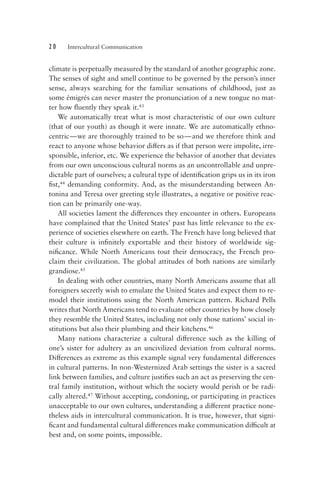
![What Constitutes a Culture? 2 1
D I V E R S I T Y A N D I D E N T I T Y
In some North American subcultures, it is the practice to avoid direct eye
contact with strangers in public when closer than twelve to fourteen feet.
Persons belonging to a group that is used to visual involvement inside that
distance will misread the avoidance of eye contact: miscuing of this type on
the unconscious behavioral level is touchy and complex and in some con-
texts is interpreted as deliberate racism.48
Many people from Asian and
Latin American cultures avoid eye contact as a sign of respect. This is also
true of many African Americans, particularly in the southern United States.
Many North American employers, teachers, and similar “authority” figures
interpret avoidance of eye contact as a sign of disrespect or deviousness.49
In fact, we can picture a North American adult scolding a child who looks
down: “You look at me when I speak to you!”—but in many parts of the
world one never challenges authority by looking it in the eye.
In United States’ urban centers, direct eye contact has taken new mean-
ing among the younger generation. It acts much like a challenge to a duel
and may provoke a physical altercation. The Code of Conduct signs at Uni-
versal Studio’s City Walk in Los Angeles warn against “annoying others
through noisy or boisterous activities or by unnecessary staring [author’s
emphasis].”50
An anglophone North American teacher may assume that most children
want to get ahead and may try to encourage students with contests. His-
panic New Mexican children may appear lazy because they seem not to
want to make the effort. This stereotype takes on new meaning when we
learn that to stand out from one’s peers in the Hispanic group is to place
oneself in great jeopardy and is to be avoided at all costs.51
The teacher is
steeped in the individualism of North American culture; the child has been
conditioned by collective Hispanic culture. Members of each group will be
motivated differently.
People as cultural beings are not masters of their fate—they are bound
by hidden rules as long as they remain ignorant of the hidden norms of their
culture.52
What is closest to ourselves is what we consciously know least
well.53
In Not Like Us, Richard Pells writes that North American expatriates liv-
ing in Europe found the experience to be an occasion for introspection, and
the opportunity not only to explore another culture but also to “rediscover”
one’s own. James Baldwin during his long residence in France concluded
that his cultural ties were neither to Europe nor to Africa, but that his iden-](https://image.slidesharecdn.com/934523-250620111610-960dcde8/85/Intercultural-Communication-A-Practical-Guide-Tracy-Novinger-40-320.jpg)