


A Rehab Revolution
Introducing Interactive Metronome evaluation and training for athletes, students who wish to improve their timing, accuracy and academics. Appointments available with Dr. Doreo and staff (805)777-7184
History of Interactive Metronome Originally developed to assist musicians with studio recording Used later to help developmentally delayed students with music training Formal clinical research began in 1994
Early Studies: Motor Skills Study Special Education students  Improved fine and gross motor and visual motor skills Results presented to the American Educational Research Association
Stanley I. Greenspan, MD Chairman, IM Scientific Advisory Board Clinical Professor Psychiatry, George Washington Medical School Contributor to over 100 articles and 27 books, including Building Healthy Minds, and The Child with Special Needs Child Development Expert Featured in The Washington Post, Newsweek, Time Magazine,  ABC’s Nightline, NBC, and CBS
Science Overview Motor Planning and Sequencing are core functions of the brain. “ Motor Planning and Sequencing is a critical component of the deficit in a variety of developmental and learning disorders.” - Stanley I. Greenspan, M.D.
Large-Scale Correlation Study Timing and Child Development Study Published Conducted in Illinois by High/Scope Foundation 585 students, 6-10 years old The First Link
AJOT Published Clinical Study 3 groups of ADHD boys separated by:  Control / Placebo / IM-trained Statistically significant improvement in: Attention Motor Control and Coordination Language Processing Reading Control of Aggression and Impulsivity
AJOT Published Clinical Study Interaction Effect = 0.005
Academic Fluency Study Over 700 middle and high school students  Pre and Post subtest on nationally standardized Woodcock-Johnson III test  Results showed significant increases in grade equivalent (GE) performances in IM Group
Academic Fluency Study 2.21 GE Gain in Reading Fluency   1.66 GE Gain in Math Fluency   2.21 GE gain, n=718, Woodcock Johnson, 3 rd  Ed. 1.66 GE gain, n=703, Woodcock Johnson, 3 rd  Ed.
Results from Early Clinical Trials MEDIAL BRAINSTEM Neuro-Motor Pipeline BASAL GANGLIA Integrates Thought and Movement  CINGULATE GYRUS Allows Shifting of Attention Cognitive Flexibility Results from a Pilot fMRI (Brain Scan) study show IM Directly Activates Multiple Parts of the “Neuronetwork”
Key Diagnoses CVA and Brain Injury Amputees Parkinson’s General Rehabilitation ADHD Cognitive / Developmental Disorders Academic / Sports Performance
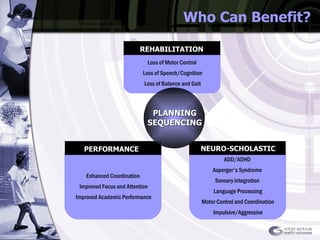
Who Can Benefit? Loss of Motor Control Loss of Speech/Cognition Loss of Balance and Gait ADD/ADHD Asperger's Syndrome  Sensory Integration  Language Processing Motor Control and Coordination Impulsive/Aggressive Enhanced Coordination Improved Focus and Attention Improved Academic Performance PERFORMANCE NEURO-SCHOLASTIC REHABILITATION PLANNING SEQUENCING
What are the Benefits? ATTENTION / FOCUS 1 MOTOR CONTROL / COORDINATION 3 BALANCE & GAIT 4 LANGUAGE PROCESSING 5 CONTROL OF AGGRESSION / IMPULSIVITY 6 MENTAL / COGNITIVE PROCESSING 2
Performance on IM directly correlates with performance in: Attention and Concentration Mental Processing Motor Planning and Sequencing Language Processing Behavior (Aggression and Impulsivity) Executive Functioning
Performance on IM directly correlates with performance in: Balance and Gait Endurance Strength Fine/Gross Motor Skills Coordination
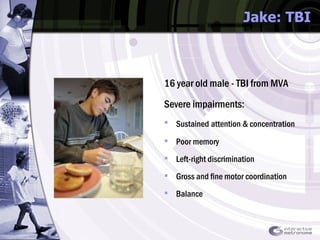
Jake: TBI 16 year old male - TBI from MVA Severe impairments: Sustained   attention & concentration Poor memory Left-right discrimination  Gross and fine motor coordination Balance
Jake: TBI After 6 weeks of IM Training: Able to attend to paper/pencil tasks for up to 50mins in preparation for school Only needed minimal cues for L-R discrimination Reported that he could hold conversations for longer periods of time and now able to “day dream”
Alexandria: Sensory Integration Disorder 9 year old female – Sensory Integration Disorder Impairments: Poor fine motor coordination Balance Multiple Tantrums Each Day D Average in Math
Alexandria: Sensory Integration Disorder After 5 weeks of IM Training: Able to ride her bicycle without training wheels for the 1 st  time Her attention increased dramatically Earned and A and B on her next two math tests Drastic decrease in frequency and duration of emotional outbursts
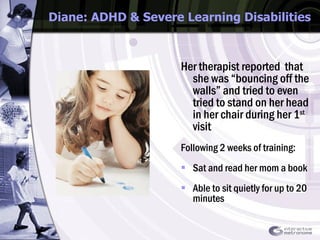
Diane: ADHD & Severe Learning Disabilities Her therapist reported  that she was “bouncing off the walls” and tried to even tried to stand on her head in her chair during her 1 st  visit Following 2 weeks of training: Sat and read her mom a book  Able to sit quietly for up to 20 minutes
Diane: ADHD & Severe Learning Disabilities Enrolled in the IM program at age 8 Deficits addressed: Poor Attention & Concentration  Great difficulty processing multiple instructions
Benefits of IM Non-invasive Non-pharmaceutical (not exclusive of Rx) Complements existing therapy Short-term Measurable outcomes Functional cross-over Clinical differentiator
Demonstration
Assessment 1 second = 1,000 milliseconds 0  -  15 ms  Perfect 16 -  40 ms  Above Average 41 - 100 ms  Average 200 100 40 15 0 15 40 100 200
Questions and Answers
Other Case Studies Stroke TBI Amputee
Lizette: Stroke Initial Therapy: Met all IP and OP functional goals Discharged to home Returned with cognitive shifting deficits  IM training initiated Patient returned to work with  improvement in concentration, speech, balance, and motor coordination.
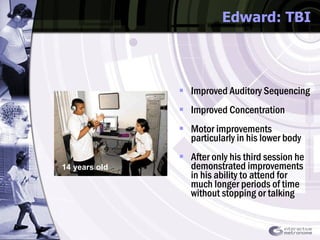
Edward: TBI Improved Auditory Sequencing  Improved Concentration  Motor improvements particularly in his lower body  After only his third session he demonstrated improvements in his ability to attend for much longer periods of time without stopping or talking 14 years old
Veronica: Stroke 37 year old female - CVA Deficits addressed: Poor attention & concentration  Unable to attend to tasks for more than 10-15 minutes without getting externally distracted Decreased stamina and endurance Unable to stand for more than 15-20 minutes
Case Study 2: Stroke Following 8 weeks of IM training: Able to complete simulated work activity for at least 60 minutes without becoming distracted  Able to stand and complete household activities for at least 45 minutes
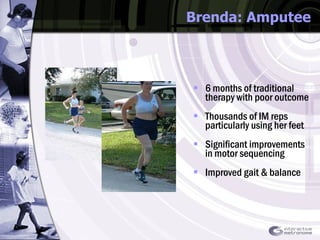
Brenda: Amputee 6 months of traditional therapy with poor outcome Thousands of IM reps particularly using her feet Significant improvements in motor sequencing  Improved gait & balance
Brenda: Amputee Disney Marathon FINISH LINE! January 2004
Interactive Metronome evaluation and training available by appointment with Dr. Doreo and her staff  (805)777-7184 Thousand Oaks, CA www.drdoreo.com

Interactive Metronome: Training to Win

  • 1.
  • 2.
    Introducing Interactive Metronomeevaluation and training for athletes, students who wish to improve their timing, accuracy and academics. Appointments available with Dr. Doreo and staff (805)777-7184
  • 3.
    History of InteractiveMetronome Originally developed to assist musicians with studio recording Used later to help developmentally delayed students with music training Formal clinical research began in 1994
  • 4.
    Early Studies: MotorSkills Study Special Education students Improved fine and gross motor and visual motor skills Results presented to the American Educational Research Association
  • 5.
    Stanley I. Greenspan,MD Chairman, IM Scientific Advisory Board Clinical Professor Psychiatry, George Washington Medical School Contributor to over 100 articles and 27 books, including Building Healthy Minds, and The Child with Special Needs Child Development Expert Featured in The Washington Post, Newsweek, Time Magazine, ABC’s Nightline, NBC, and CBS
  • 6.
    Science Overview MotorPlanning and Sequencing are core functions of the brain. “ Motor Planning and Sequencing is a critical component of the deficit in a variety of developmental and learning disorders.” - Stanley I. Greenspan, M.D.
  • 7.
    Large-Scale Correlation StudyTiming and Child Development Study Published Conducted in Illinois by High/Scope Foundation 585 students, 6-10 years old The First Link
  • 8.
    AJOT Published ClinicalStudy 3 groups of ADHD boys separated by: Control / Placebo / IM-trained Statistically significant improvement in: Attention Motor Control and Coordination Language Processing Reading Control of Aggression and Impulsivity
  • 9.
    AJOT Published ClinicalStudy Interaction Effect = 0.005
  • 10.
    Academic Fluency StudyOver 700 middle and high school students Pre and Post subtest on nationally standardized Woodcock-Johnson III test Results showed significant increases in grade equivalent (GE) performances in IM Group
  • 11.
    Academic Fluency Study2.21 GE Gain in Reading Fluency 1.66 GE Gain in Math Fluency 2.21 GE gain, n=718, Woodcock Johnson, 3 rd Ed. 1.66 GE gain, n=703, Woodcock Johnson, 3 rd Ed.
  • 12.
    Results from EarlyClinical Trials MEDIAL BRAINSTEM Neuro-Motor Pipeline BASAL GANGLIA Integrates Thought and Movement CINGULATE GYRUS Allows Shifting of Attention Cognitive Flexibility Results from a Pilot fMRI (Brain Scan) study show IM Directly Activates Multiple Parts of the “Neuronetwork”
  • 13.
    Key Diagnoses CVAand Brain Injury Amputees Parkinson’s General Rehabilitation ADHD Cognitive / Developmental Disorders Academic / Sports Performance
  • 14.
    Who Can Benefit?Loss of Motor Control Loss of Speech/Cognition Loss of Balance and Gait ADD/ADHD Asperger's Syndrome Sensory Integration Language Processing Motor Control and Coordination Impulsive/Aggressive Enhanced Coordination Improved Focus and Attention Improved Academic Performance PERFORMANCE NEURO-SCHOLASTIC REHABILITATION PLANNING SEQUENCING
  • 15.
    What are theBenefits? ATTENTION / FOCUS 1 MOTOR CONTROL / COORDINATION 3 BALANCE & GAIT 4 LANGUAGE PROCESSING 5 CONTROL OF AGGRESSION / IMPULSIVITY 6 MENTAL / COGNITIVE PROCESSING 2
  • 16.
    Performance on IMdirectly correlates with performance in: Attention and Concentration Mental Processing Motor Planning and Sequencing Language Processing Behavior (Aggression and Impulsivity) Executive Functioning
  • 17.
    Performance on IMdirectly correlates with performance in: Balance and Gait Endurance Strength Fine/Gross Motor Skills Coordination
  • 18.
    Jake: TBI 16year old male - TBI from MVA Severe impairments: Sustained attention & concentration Poor memory Left-right discrimination Gross and fine motor coordination Balance
  • 19.
    Jake: TBI After6 weeks of IM Training: Able to attend to paper/pencil tasks for up to 50mins in preparation for school Only needed minimal cues for L-R discrimination Reported that he could hold conversations for longer periods of time and now able to “day dream”
  • 20.
    Alexandria: Sensory IntegrationDisorder 9 year old female – Sensory Integration Disorder Impairments: Poor fine motor coordination Balance Multiple Tantrums Each Day D Average in Math
  • 21.
    Alexandria: Sensory IntegrationDisorder After 5 weeks of IM Training: Able to ride her bicycle without training wheels for the 1 st time Her attention increased dramatically Earned and A and B on her next two math tests Drastic decrease in frequency and duration of emotional outbursts
  • 22.
    Diane: ADHD &Severe Learning Disabilities Her therapist reported that she was “bouncing off the walls” and tried to even tried to stand on her head in her chair during her 1 st visit Following 2 weeks of training: Sat and read her mom a book Able to sit quietly for up to 20 minutes
  • 23.
    Diane: ADHD &Severe Learning Disabilities Enrolled in the IM program at age 8 Deficits addressed: Poor Attention & Concentration Great difficulty processing multiple instructions
  • 24.
    Benefits of IMNon-invasive Non-pharmaceutical (not exclusive of Rx) Complements existing therapy Short-term Measurable outcomes Functional cross-over Clinical differentiator
  • 25.
  • 26.
    Assessment 1 second= 1,000 milliseconds 0 - 15 ms Perfect 16 - 40 ms Above Average 41 - 100 ms Average 200 100 40 15 0 15 40 100 200
  • 27.
  • 28.
    Other Case StudiesStroke TBI Amputee
  • 29.
    Lizette: Stroke InitialTherapy: Met all IP and OP functional goals Discharged to home Returned with cognitive shifting deficits IM training initiated Patient returned to work with improvement in concentration, speech, balance, and motor coordination.
  • 30.
    Edward: TBI ImprovedAuditory Sequencing Improved Concentration Motor improvements particularly in his lower body After only his third session he demonstrated improvements in his ability to attend for much longer periods of time without stopping or talking 14 years old
  • 31.
    Veronica: Stroke 37year old female - CVA Deficits addressed: Poor attention & concentration Unable to attend to tasks for more than 10-15 minutes without getting externally distracted Decreased stamina and endurance Unable to stand for more than 15-20 minutes
  • 32.
    Case Study 2:Stroke Following 8 weeks of IM training: Able to complete simulated work activity for at least 60 minutes without becoming distracted Able to stand and complete household activities for at least 45 minutes
  • 33.
    Brenda: Amputee 6months of traditional therapy with poor outcome Thousands of IM reps particularly using her feet Significant improvements in motor sequencing Improved gait & balance
  • 34.
    Brenda: Amputee DisneyMarathon FINISH LINE! January 2004
  • 35.
    Interactive Metronome evaluationand training available by appointment with Dr. Doreo and her staff (805)777-7184 Thousand Oaks, CA www.drdoreo.com