An Educational Application of Online
Games for Learning Difficulties
Maria Margoudi, Zacharoula Smyrnaiou
University of Athens (UOA)
Educational Technology Lab (ETL)
ICSNE 2015: International Conference in Special Needs in Education 30/7/2015
Overview
 Introduction
 Theoretical Framework
 The Evaluation Tools
 The Methodology
 The Phases of the Study
 Results
ICSNE 2015: International Conference in Special Needs in
Education
2 30/7/2015
Introduction
ICSNE 2015: International Conference in Special Needs in
Education
3 30/7/2015
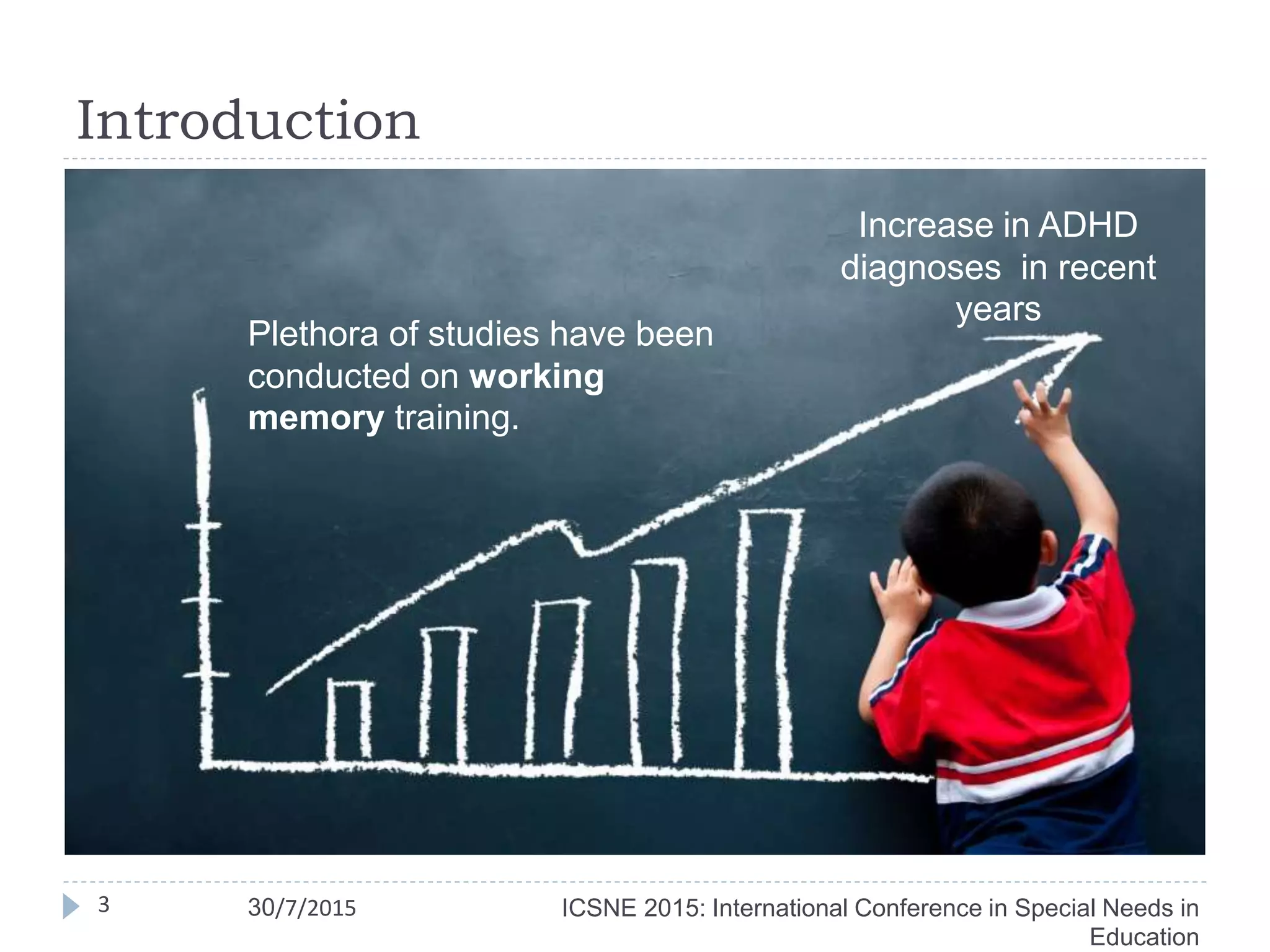
Increase in ADHD
diagnoses in recent
years
Plethora of studies have been
conducted on working
memory training.
Introduction
 Aim of the study:
The investigation of the use of already existent,
free-access to all, online games for the training
of working memory.
 The research questions:
1. Investigate the impact of training working
memory on two core symptoms of ADHD:
attention deficit and impulsivity.
1. Investigate the impact of training working memory
on the general cognitive abilities of the individual.
ICSNE 2015: International Conference in Special Needs in
Education
4 30/7/2015
Theoretical Framework - ADHD
 Attention Deficit Hyperactivity Disorder (ADHD) is a
neurodevelopmental disorder attributed to the spectrum of learning
difficulties.
 It is associated with the maturation of the nervous system and it
appears with a constant course and specific cognitive dysfunctions.
 ADHD is a usual behavioral disorder during childhood, but it may
persist during adulthood.
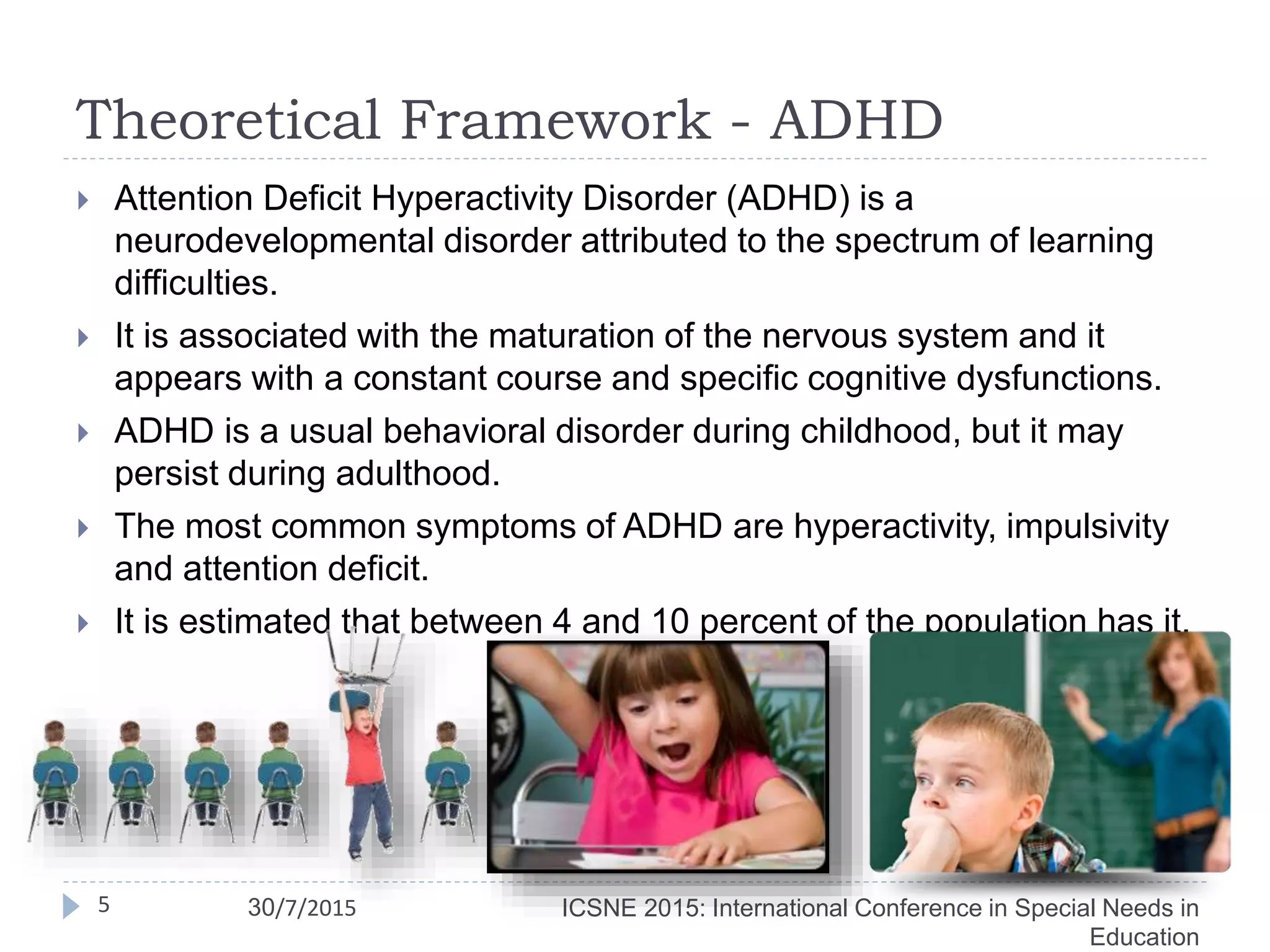
 The most common symptoms of ADHD are hyperactivity, impulsivity
and attention deficit.
 It is estimated that between 4 and 10 percent of the population has it.
ICSNE 2015: International Conference in Special Needs in
Education
5 30/7/2015
Theoretical Framework –
Cerebral Function and ADHD
 The neurodevelopmental disorders linked to ADHD occur early in life
and are mainly associated with disorders in the development of
the nervous system.
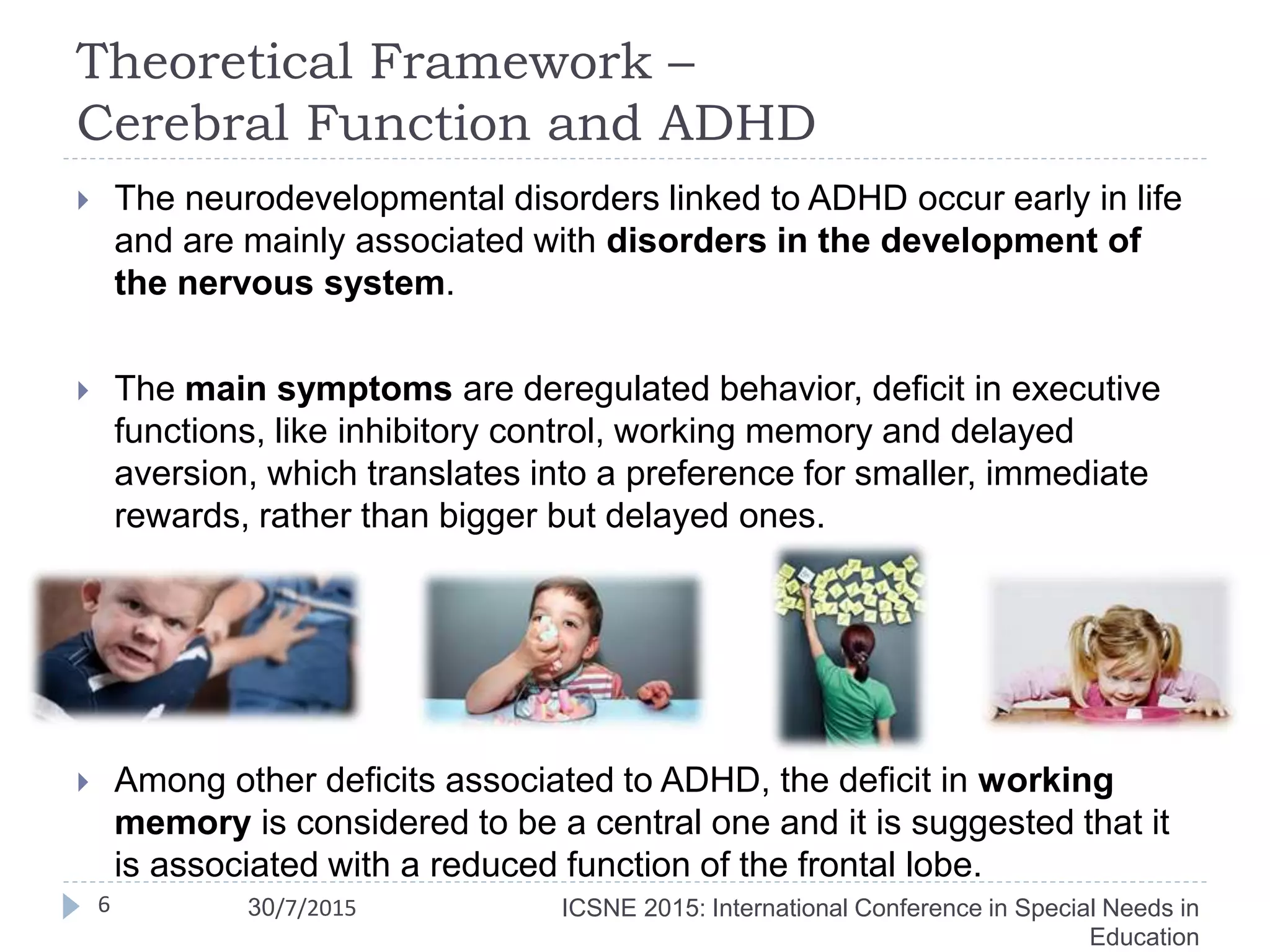
 The main symptoms are deregulated behavior, deficit in executive
functions, like inhibitory control, working memory and delayed
aversion, which translates into a preference for smaller, immediate
rewards, rather than bigger but delayed ones.
 Among other deficits associated to ADHD, the deficit in working
memory is considered to be a central one and it is suggested that it
is associated with a reduced function of the frontal lobe.
ICSNE 2015: International Conference in Special Needs in
Education
6 30/7/2015
Theoretical Framework –
Working Memory and ADHD
 Working memory is defined as the individual’s ability to hold
information in his mind, while in the same time being able to handle
them.
Even though the capacity of working memory is limited and
information can be retained just for a few seconds, working memory
is linked to the ability of vocabulary learning, reading and
understanding a language, taking notes, writing, reasoning and
complex learning.
 Studies based on neuroimaging show that training has a significant
impact on neuronal activity and particularly in areas of the brain
associated with working memory.
 There are indications that video games may contribute to the
reduction of the symptoms of ADHD.
ICSNE 2015: International Conference in Special Needs in
Education
7 30/7/2015
The Methodology –
Purpose and Objectives
8
 Purpose:
A case study to investigate the feasibility of training working
memory and its impact on the core symptoms of ADHD.
 Hypothesis:
Whether the training of working memory through the use
of free online digital tools is possible and if it has a positive
impact on ADHD symptoms and if it contributes to the
improvement of an individual’s cognitive abilities.
 Research questions:
1. What is the effect of working memory’s training, through the use of
free online games, to the core symptoms of ADHD: attention and
impulsivity deficit?
2. What is the effect of working memory’s training, through the use of
free online games, to the general cognitive abilities of an
individual?
ICSNE 2015: International Conference in Special Needs in
Education
30/7/2015
The Methodology –
Method and Evaluation Tools
9
 Qualitative research approach.
 Individual case study.
 3 digital tools were designed and implemented, in order to
act as assessment tools before and after the main
intervention.
 For the realization of these tools the E-Slate platform was
utilized.
 These tools have based their structure and content to
already existing tools either available online, or for
commercial use.
ICSNE 2015: International Conference in Special Needs in
Education
30/7/2015
The Methodology –
Method and Evaluation Tools
10
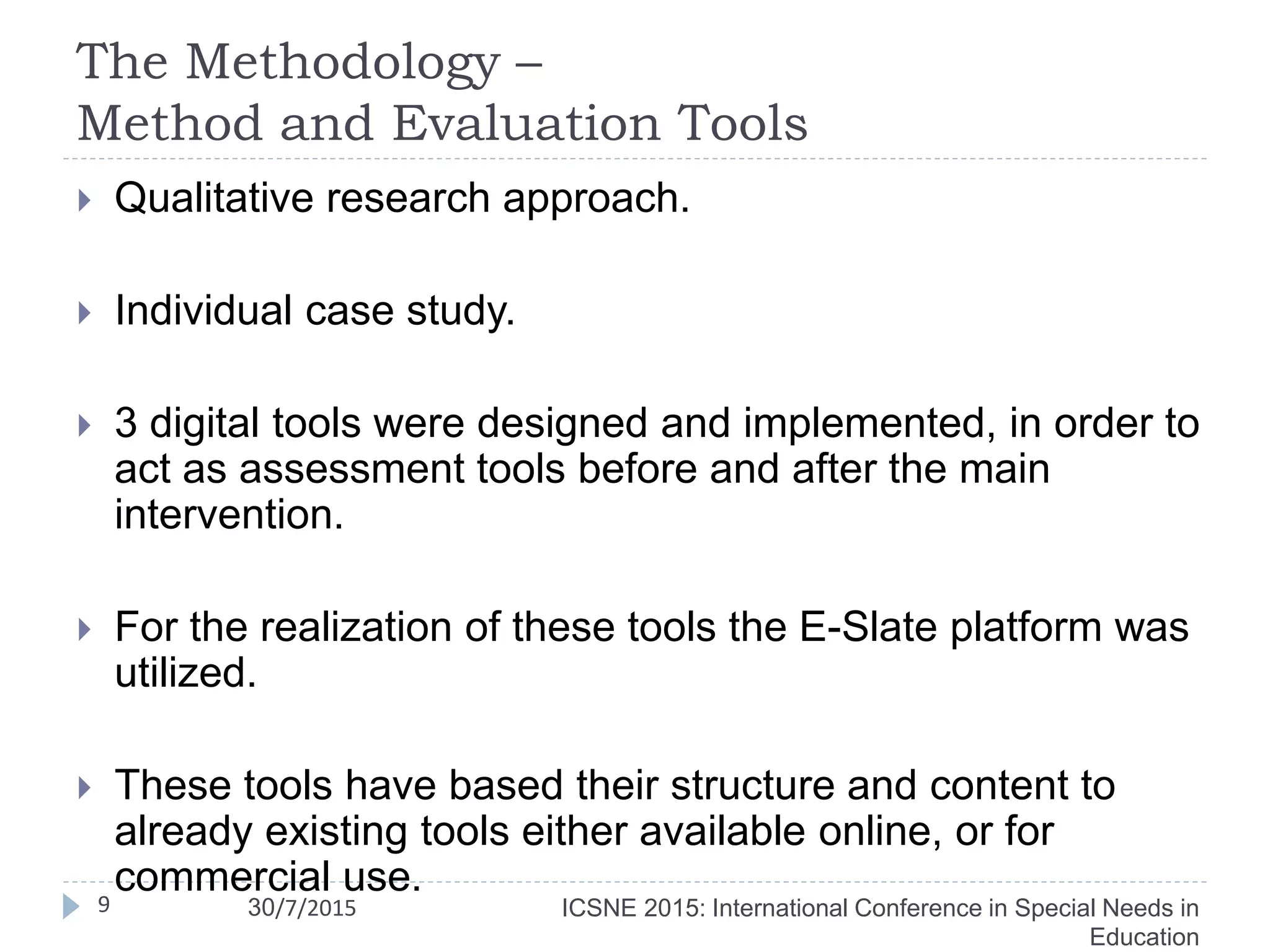
 Raven’s Progressive Matrices
 A standardized intelligence test.
 It consists of visual, geometrical
analogy problems, presented in a
matrix of geometrical shapes.
Each time an entry in this matrix
is missing and the correct answer
can be selected from a set of
responses.
ICSNE 2015: International Conference in Special Needs in
Education
30/7/2015
The Methodology –
Method and Evaluation Tools
11
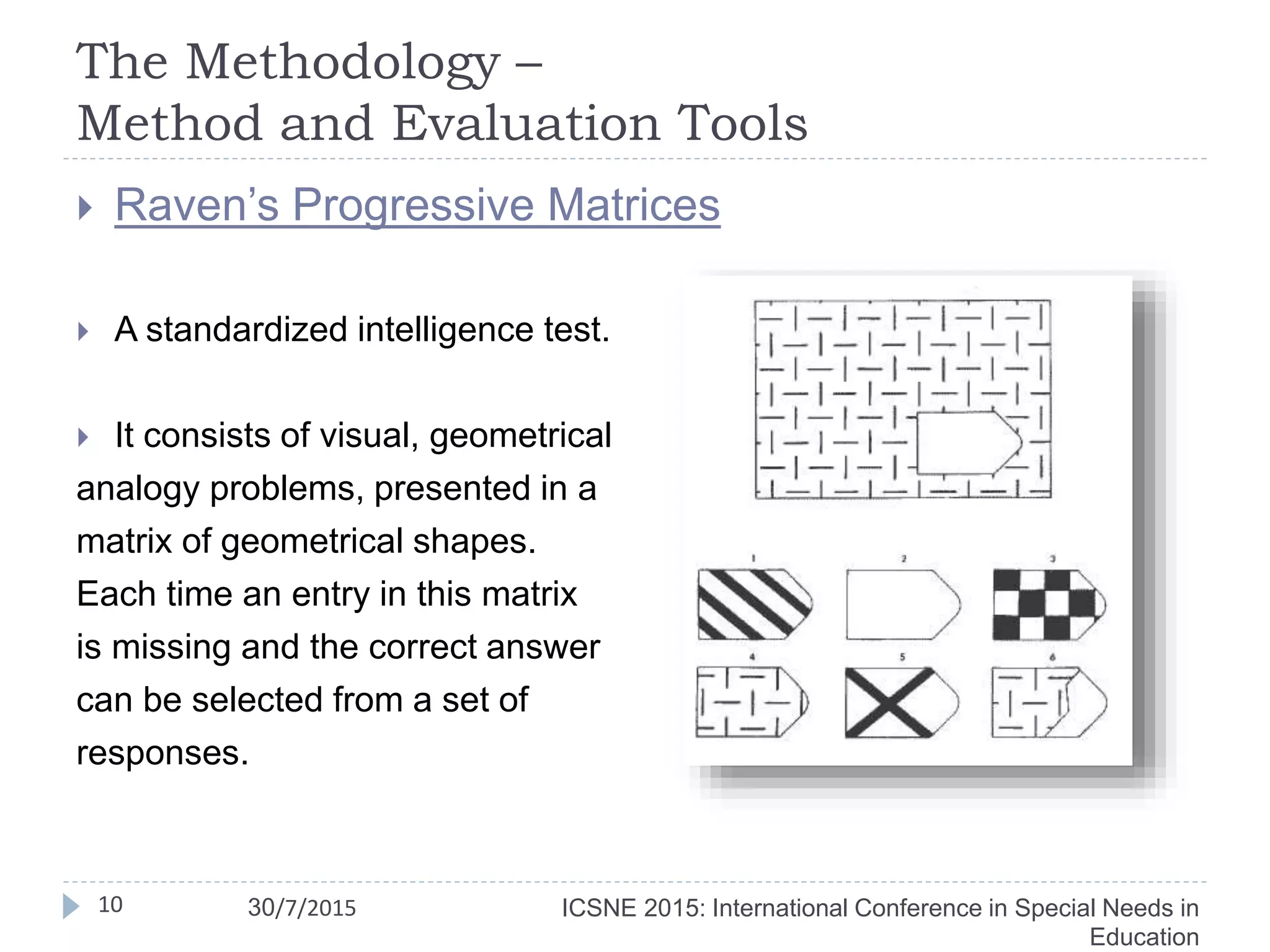
 Stroop’s Color Interference Task
 A test used for estimating the impulsivity levels of the user.
 A series of words are provided, each of which named a different color.
 Nevertheless, the name of the color and the actual color of the word
do not always match.
 The user is asked to read aloud the actual color of the word
ICSNE 2015: International Conference in Special Needs in
Education
30/7/2015
The Methodology –
Method and Evaluation Tools
12
 Sustained Attention test
 A Continuous Performance test (CPT)
 It is used by ADHD researchers in an attempt to
measure the attention levels of the user.
ICSNE 2015: International Conference in Special Needs in
Education
30/7/2015
The Methodology –
Time, Space and the Sample
13
 Time:
June 2014.
 Participant:
A 13 years old, female student participated. The student was officially
diagnosed in 2011 with ADHD.
 Duration: a week (7 days).
 Main intervention 5 days, for 15 minutes per day. The rest 2
days, 1 before and 1 after the main intervention, the pre and post-
tests took place accordingly and lasted for 1 hour per day.
ICSNE 2015: International Conference in Special Needs in
Education
30/7/2015
The Phases of the Study
 Pre-Intervention (Day 1)
The participant completed the three provided tests (Raven’s test,
Stroop’s test and Sustained Attention test).
 Main Intervention (Days 2-6)
The participant was requested to visit on a daily basis, for the
following five days, certain websites, each of which provided a
different online game for memory training.
 Post Intervention (Day 7)
The participant was asked to complete, once more, the three
tests (Raven’s test, Stroop’s test and Sustained Attention test).
14 ICSNE 2015: International Conference in Special Needs in
Education
30/7/2015
The Phases of the Study – The Games
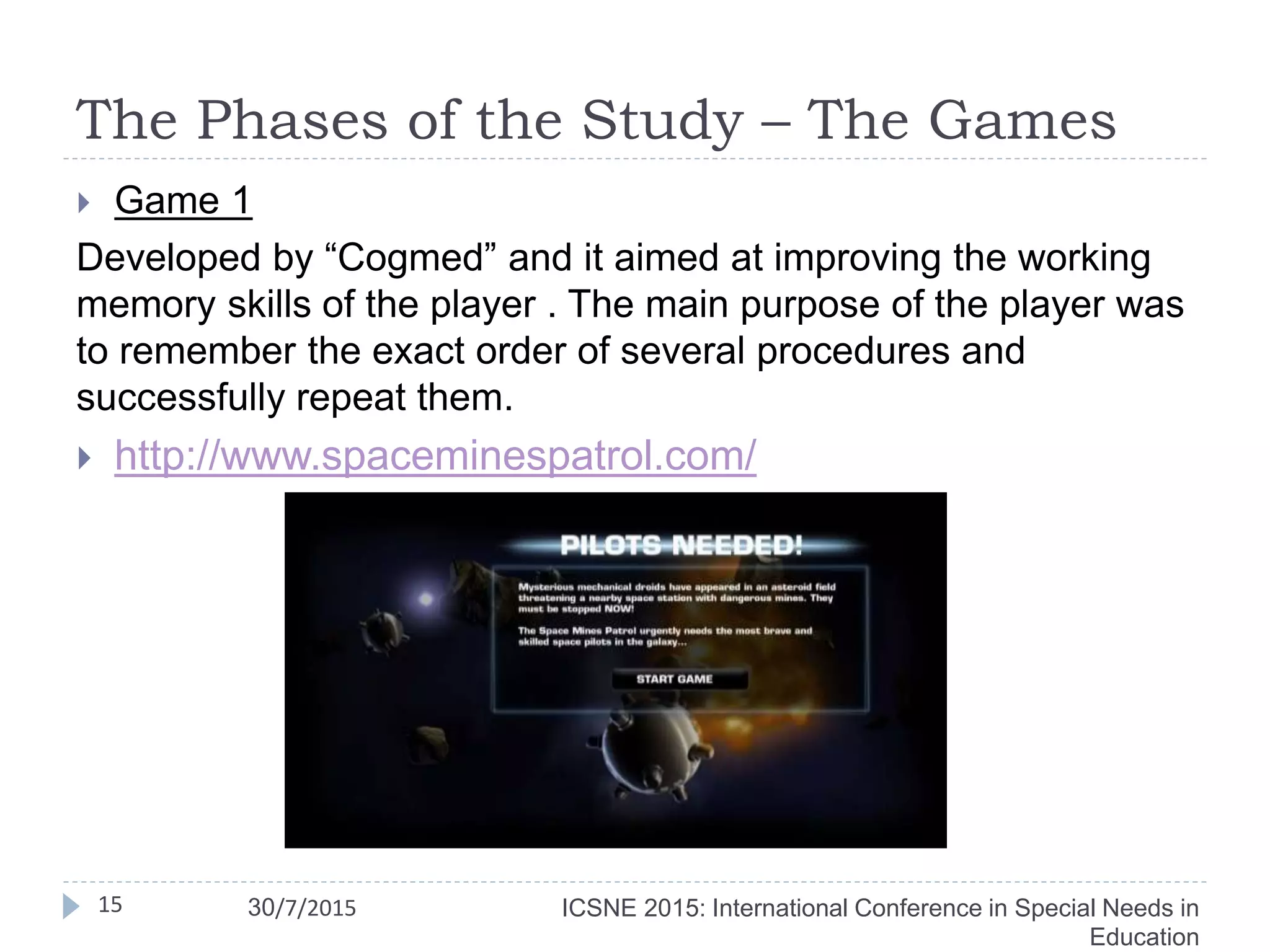
 Game 1
Developed by “Cogmed” and it aimed at improving the working
memory skills of the player . The main purpose of the player was
to remember the exact order of several procedures and
successfully repeat them.
 http://www.spaceminespatrol.com/
15 ICSNE 2015: International Conference in Special Needs in
Education
30/7/2015
The Phases of the Study – The Games
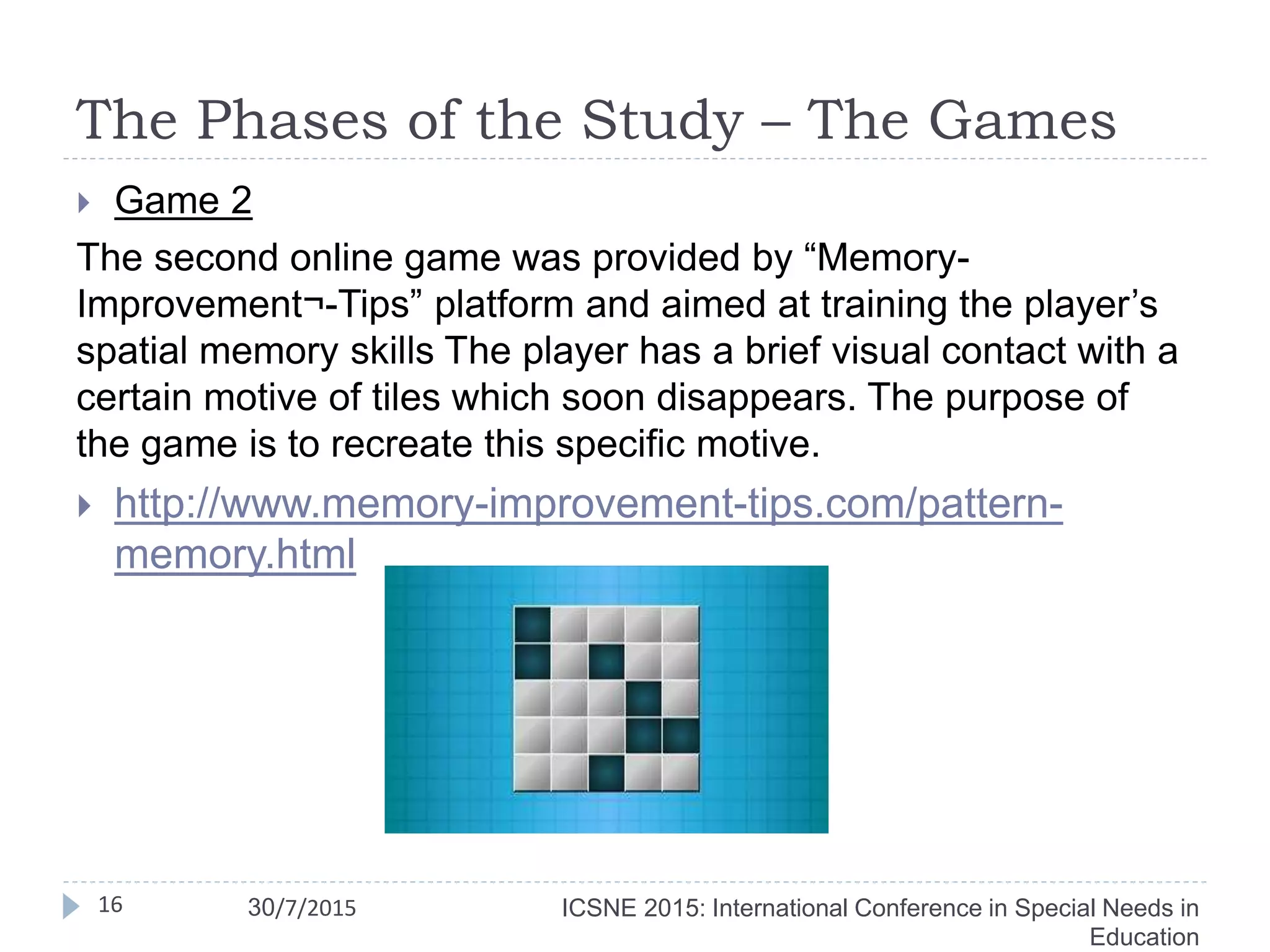
 Game 2
The second online game was provided by “Memory-
Improvement¬-Tips” platform and aimed at training the player’s
spatial memory skills The player has a brief visual contact with a
certain motive of tiles which soon disappears. The purpose of
the game is to recreate this specific motive.
 http://www.memory-improvement-tips.com/pattern-
memory.html
16 ICSNE 2015: International Conference in Special Needs in
Education
30/7/2015
The Phases of the Study – The Games
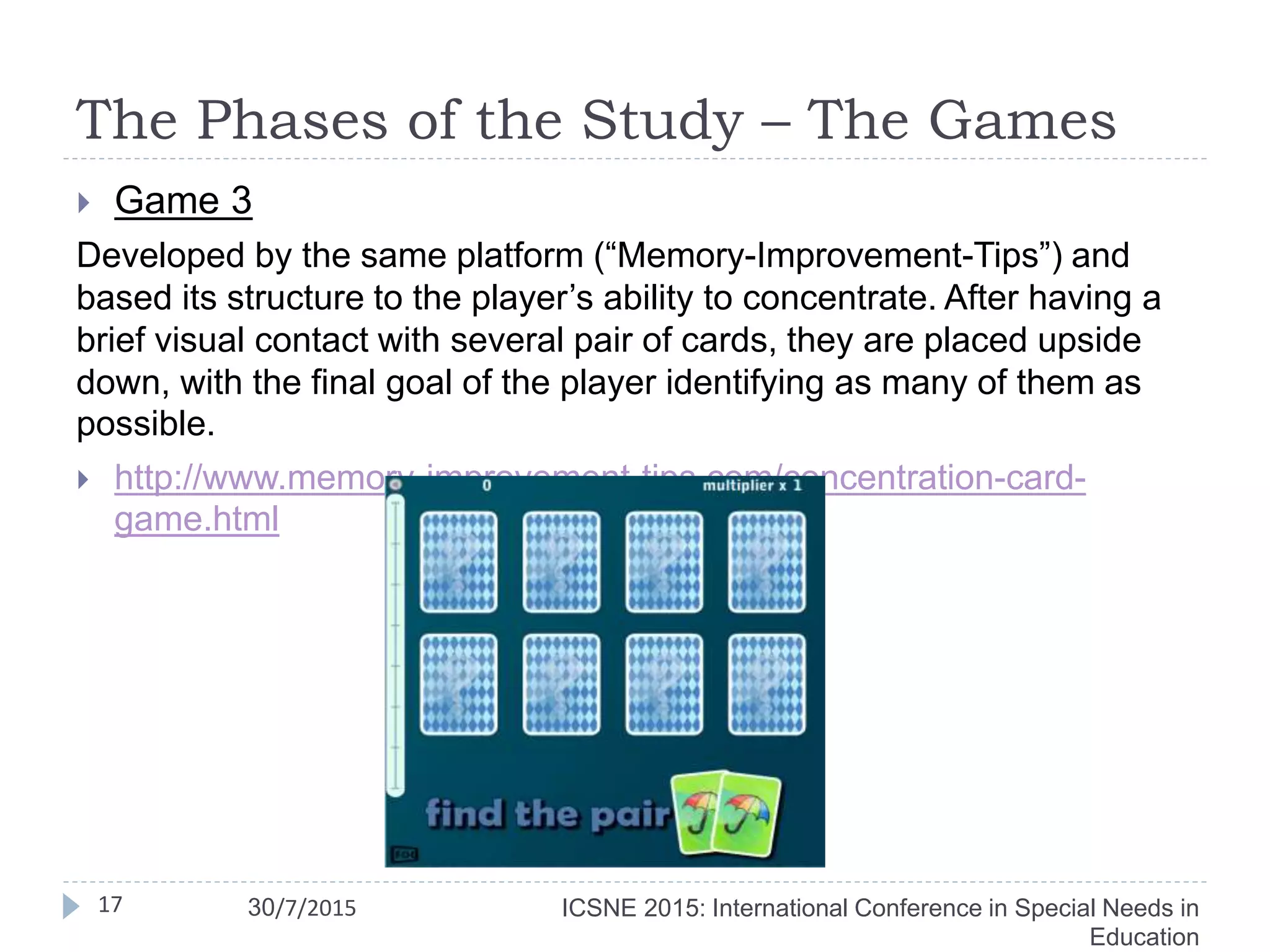
 Game 3
Developed by the same platform (“Memory-Improvement-Tips”) and
based its structure to the player’s ability to concentrate. After having a
brief visual contact with several pair of cards, they are placed upside
down, with the final goal of the player identifying as many of them as
possible.
 http://www.memory-improvement-tips.com/concentration-card-
game.html
17 ICSNE 2015: International Conference in Special Needs in
Education
30/7/2015
The Results –
Attention Deficit and Impulsivity
 The concentration of the participant was greatly improved.
 There is a parallel increase of the participant’s interest towards
the process in which he has to engage to and a decrease of
the difficulties he faces towards the completion of the activity.
 After the main intervention the occasions when the attention of
the participant was distracted were mainly due to
environmental factors and not to the intrinsic characteristics of
the participant.
 The occurrence of inappropriate behaviors, such as beginning
an off-topic discussion, or the manifestation of distress, as a
form of impulsivity, also seem to have considerably reduced
after the main intervention.
 However, behaviors indicating haste, such as hasty responses
to the tests have sharply risen after the main intervention,
while behaviors that indicated that the participant was ignoring
the instructions given were almost non-existent in the post-test
phase.18 ICSNE 2015: International Conference in Special Needs in
Education
30/7/2015
The Results –
General Cognitive Abilities
 No significant variation between the percentages of
correct and incorrect questions was observed after the
main intervention.
 The data of the current study do not indicate either a
positive or a negative change.
19 ICSNE 2015: International Conference in Special Needs in
Education
30/7/2015
Restrictions and Future Work
 Need for further research in order to validate the results of the
current study due to the limited number of participants and the short
duration of the case study.
 We cannot generalize the results of the study to the general
population.
 In order to establish the validity and the reliability of the study, the
implementation of a similar study on a larger scale and for a longer
period of time is suggested.
 We should also point out that the current study doesn’t examine one
of the core characteristics of ADHD, which is hyperactivity. This is
due to the lack, at the time, of appropriate tools that would allow the
measurement of hyperactivity levels during the different phases of
the study.
 Finally, it should be noted that exploited screen recording tool
presented a malfunction during a certain point of the study and
caused a temporal discrepancy between the sound and the video
presented.
20 ICSNE 2015: International Conference in Special Needs in
Education
30/7/2015
Thank you
21 ICSNE 2015: International Conference in Special Needs in
Education
30/7/2015

An Educational Application of Online Games for Learning Difficulties

  • 1.
    An Educational Applicationof Online Games for Learning Difficulties Maria Margoudi, Zacharoula Smyrnaiou University of Athens (UOA) Educational Technology Lab (ETL) ICSNE 2015: International Conference in Special Needs in Education 30/7/2015
  • 2.
    Overview  Introduction  TheoreticalFramework  The Evaluation Tools  The Methodology  The Phases of the Study  Results ICSNE 2015: International Conference in Special Needs in Education 2 30/7/2015
  • 3.
    Introduction ICSNE 2015: InternationalConference in Special Needs in Education 3 30/7/2015 Increase in ADHD diagnoses in recent years Plethora of studies have been conducted on working memory training.
  • 4.
    Introduction  Aim ofthe study: The investigation of the use of already existent, free-access to all, online games for the training of working memory.  The research questions: 1. Investigate the impact of training working memory on two core symptoms of ADHD: attention deficit and impulsivity. 1. Investigate the impact of training working memory on the general cognitive abilities of the individual. ICSNE 2015: International Conference in Special Needs in Education 4 30/7/2015
  • 5.
    Theoretical Framework -ADHD  Attention Deficit Hyperactivity Disorder (ADHD) is a neurodevelopmental disorder attributed to the spectrum of learning difficulties.  It is associated with the maturation of the nervous system and it appears with a constant course and specific cognitive dysfunctions.  ADHD is a usual behavioral disorder during childhood, but it may persist during adulthood.  The most common symptoms of ADHD are hyperactivity, impulsivity and attention deficit.  It is estimated that between 4 and 10 percent of the population has it. ICSNE 2015: International Conference in Special Needs in Education 5 30/7/2015
  • 6.
    Theoretical Framework – CerebralFunction and ADHD  The neurodevelopmental disorders linked to ADHD occur early in life and are mainly associated with disorders in the development of the nervous system.  The main symptoms are deregulated behavior, deficit in executive functions, like inhibitory control, working memory and delayed aversion, which translates into a preference for smaller, immediate rewards, rather than bigger but delayed ones.  Among other deficits associated to ADHD, the deficit in working memory is considered to be a central one and it is suggested that it is associated with a reduced function of the frontal lobe. ICSNE 2015: International Conference in Special Needs in Education 6 30/7/2015
  • 7.
    Theoretical Framework – WorkingMemory and ADHD  Working memory is defined as the individual’s ability to hold information in his mind, while in the same time being able to handle them. Even though the capacity of working memory is limited and information can be retained just for a few seconds, working memory is linked to the ability of vocabulary learning, reading and understanding a language, taking notes, writing, reasoning and complex learning.  Studies based on neuroimaging show that training has a significant impact on neuronal activity and particularly in areas of the brain associated with working memory.  There are indications that video games may contribute to the reduction of the symptoms of ADHD. ICSNE 2015: International Conference in Special Needs in Education 7 30/7/2015
  • 8.
    The Methodology – Purposeand Objectives 8  Purpose: A case study to investigate the feasibility of training working memory and its impact on the core symptoms of ADHD.  Hypothesis: Whether the training of working memory through the use of free online digital tools is possible and if it has a positive impact on ADHD symptoms and if it contributes to the improvement of an individual’s cognitive abilities.  Research questions: 1. What is the effect of working memory’s training, through the use of free online games, to the core symptoms of ADHD: attention and impulsivity deficit? 2. What is the effect of working memory’s training, through the use of free online games, to the general cognitive abilities of an individual? ICSNE 2015: International Conference in Special Needs in Education 30/7/2015
  • 9.
    The Methodology – Methodand Evaluation Tools 9  Qualitative research approach.  Individual case study.  3 digital tools were designed and implemented, in order to act as assessment tools before and after the main intervention.  For the realization of these tools the E-Slate platform was utilized.  These tools have based their structure and content to already existing tools either available online, or for commercial use. ICSNE 2015: International Conference in Special Needs in Education 30/7/2015
  • 10.
    The Methodology – Methodand Evaluation Tools 10  Raven’s Progressive Matrices  A standardized intelligence test.  It consists of visual, geometrical analogy problems, presented in a matrix of geometrical shapes. Each time an entry in this matrix is missing and the correct answer can be selected from a set of responses. ICSNE 2015: International Conference in Special Needs in Education 30/7/2015
  • 11.
    The Methodology – Methodand Evaluation Tools 11  Stroop’s Color Interference Task  A test used for estimating the impulsivity levels of the user.  A series of words are provided, each of which named a different color.  Nevertheless, the name of the color and the actual color of the word do not always match.  The user is asked to read aloud the actual color of the word ICSNE 2015: International Conference in Special Needs in Education 30/7/2015
  • 12.
    The Methodology – Methodand Evaluation Tools 12  Sustained Attention test  A Continuous Performance test (CPT)  It is used by ADHD researchers in an attempt to measure the attention levels of the user. ICSNE 2015: International Conference in Special Needs in Education 30/7/2015
  • 13.
    The Methodology – Time,Space and the Sample 13  Time: June 2014.  Participant: A 13 years old, female student participated. The student was officially diagnosed in 2011 with ADHD.  Duration: a week (7 days).  Main intervention 5 days, for 15 minutes per day. The rest 2 days, 1 before and 1 after the main intervention, the pre and post- tests took place accordingly and lasted for 1 hour per day. ICSNE 2015: International Conference in Special Needs in Education 30/7/2015
  • 14.
    The Phases ofthe Study  Pre-Intervention (Day 1) The participant completed the three provided tests (Raven’s test, Stroop’s test and Sustained Attention test).  Main Intervention (Days 2-6) The participant was requested to visit on a daily basis, for the following five days, certain websites, each of which provided a different online game for memory training.  Post Intervention (Day 7) The participant was asked to complete, once more, the three tests (Raven’s test, Stroop’s test and Sustained Attention test). 14 ICSNE 2015: International Conference in Special Needs in Education 30/7/2015
  • 15.
    The Phases ofthe Study – The Games  Game 1 Developed by “Cogmed” and it aimed at improving the working memory skills of the player . The main purpose of the player was to remember the exact order of several procedures and successfully repeat them.  http://www.spaceminespatrol.com/ 15 ICSNE 2015: International Conference in Special Needs in Education 30/7/2015
  • 16.
    The Phases ofthe Study – The Games  Game 2 The second online game was provided by “Memory- Improvement¬-Tips” platform and aimed at training the player’s spatial memory skills The player has a brief visual contact with a certain motive of tiles which soon disappears. The purpose of the game is to recreate this specific motive.  http://www.memory-improvement-tips.com/pattern- memory.html 16 ICSNE 2015: International Conference in Special Needs in Education 30/7/2015
  • 17.
    The Phases ofthe Study – The Games  Game 3 Developed by the same platform (“Memory-Improvement-Tips”) and based its structure to the player’s ability to concentrate. After having a brief visual contact with several pair of cards, they are placed upside down, with the final goal of the player identifying as many of them as possible.  http://www.memory-improvement-tips.com/concentration-card- game.html 17 ICSNE 2015: International Conference in Special Needs in Education 30/7/2015
  • 18.
    The Results – AttentionDeficit and Impulsivity  The concentration of the participant was greatly improved.  There is a parallel increase of the participant’s interest towards the process in which he has to engage to and a decrease of the difficulties he faces towards the completion of the activity.  After the main intervention the occasions when the attention of the participant was distracted were mainly due to environmental factors and not to the intrinsic characteristics of the participant.  The occurrence of inappropriate behaviors, such as beginning an off-topic discussion, or the manifestation of distress, as a form of impulsivity, also seem to have considerably reduced after the main intervention.  However, behaviors indicating haste, such as hasty responses to the tests have sharply risen after the main intervention, while behaviors that indicated that the participant was ignoring the instructions given were almost non-existent in the post-test phase.18 ICSNE 2015: International Conference in Special Needs in Education 30/7/2015
  • 19.
    The Results – GeneralCognitive Abilities  No significant variation between the percentages of correct and incorrect questions was observed after the main intervention.  The data of the current study do not indicate either a positive or a negative change. 19 ICSNE 2015: International Conference in Special Needs in Education 30/7/2015
  • 20.
    Restrictions and FutureWork  Need for further research in order to validate the results of the current study due to the limited number of participants and the short duration of the case study.  We cannot generalize the results of the study to the general population.  In order to establish the validity and the reliability of the study, the implementation of a similar study on a larger scale and for a longer period of time is suggested.  We should also point out that the current study doesn’t examine one of the core characteristics of ADHD, which is hyperactivity. This is due to the lack, at the time, of appropriate tools that would allow the measurement of hyperactivity levels during the different phases of the study.  Finally, it should be noted that exploited screen recording tool presented a malfunction during a certain point of the study and caused a temporal discrepancy between the sound and the video presented. 20 ICSNE 2015: International Conference in Special Needs in Education 30/7/2015
  • 21.
    Thank you 21 ICSNE2015: International Conference in Special Needs in Education 30/7/2015