S.
Politics
Z.
Politics
S. Art
Z. Art

Lake
s
River
s

Writing

Technolo
gy

Religio
n
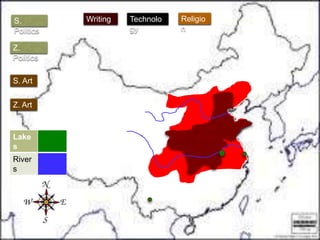
Shang Dynasty
Originally a tribe living in the lower regions of the
Yellow River during the Xia Dynasty (21st - 17th
century BC), Shang was established by King
Tang in 1675 BC after overthrowing the
tyrannical rule of Jie, (Xia's last emperor). This
dynasty lasted over 600 years and was led by 30
different emperors. As the capital of the Shang
was always based in Yin (the now Xiaotun
Village, in Anyang City of Henan Province), it is
also known as 'Yin Shang'.
Ma
p
Eastern Zhou
In 771 BC, with the death of King You, the last
king of the Western Zhou Dynasty, the Eastern
Zhou Dynasty began. Xuan Jiu, the son of King
You, established the dynasty in 770 BC, and
moved the capital to Luoyi (present-day
Luoyang, Henan Province). Over 25 emperors
have reigned over the Eastern Zhou Dynasty.

Map
Shang Politics
The dynasty flourished through the reign of the
ninth emperor. During the rule of the tenth
emperor however, conditions began to
deteriorate and there were multiple attempts by
the emperor's own family to overthrow him and
take command of the kingdom. Social problems
began to emerge and the emperor's power
gradually declined.

Ma
p
Zhou Politics
During the Spring and Autumn Period, there were
over 140 states, and royal authority gradually lost
its ruling position. Some powerful states
developed quickly and began to annex weaker
ones. Once the powerful ones won, they would
force the defeated to acknowledge their rule.
Five overlords declared their hegemony in
succession in this period: they were Huangong of
the Qi State, Xianggong of the Song
State, Wengong of Jin, Mugong of the Qin and
Zhuangwang of Chu.
Ma
p
Shang Art
In the field of music, there was also great
progress. The improvements in the bronze
casting techniques allowed for delicate musical
instruments to be made. In Yin Xu (Yin Yuins) in
Xiao Tun Village of Anyang City, archeologists
discovered musical instruments of the Shang
Dynasty including: Xun (Ocarina made of baked
clay), drums, and copper cymbals.

Ma
p
Zhou Art
The Zhou emperors paid much attention to
etiquette. In sacrificial ceremonies, funerals,
wedding ceremonies and other important events,
there were strict regulations for the people to
abide by. In order to change the extravagant
customs which prevailed in the late period of the
Shang, no one was allowed to be drunk. So that
is why some drinking goblets commonly seen
during the Shang Dynasty disappeared in the
Western Zhou.
Ma
p
Religion
The ancient Chinese are said to have three
doctrines: Confucianism, Buddhism, and
Taoism, with Christianity and Islam arriving only
in the 7th century A.D. Laozi, according to
tradition, was the 6th century B.C. Chinese
philosopher who wrote the Tao Te Ching of
Taoism. Confucius (551-479) taught morality. His
philosophy became important during the Han
Dynasty (206 B.C.-A.D.220). Herbert A Giles
(1845-1935), a British Sinologist who modified
the Roman version of Chinese characters.
Ma
p
Technology
Few Westerners are aware that, for thousands of
years, China was far
more developed than the West. In this article we
will examine the Confucian
culture, that created the basis for the Chinese to
make a series of remarkable
inventions, and how these inventions allowed
China to achieve a
much higher living standard, than existed
anywhere else at the time
Ma
p
Writing
The basic principles behind Chinese writing have
remained unchanged for thousands of years.
Each character consists of a number of strokes
or lines set inside an imaginary square.
Thousands of bones from the Shang
dynasty have been unearthed with writing on
them. Many of the characters on these bones still
exist (in a slightly altered state) today.

Ma
p
Yellow River
Is the second-longest river in Asia after Yangtze
and the sixth.longest in the world at the
estimated lenght of 5,464 km (3,395 mi).
Originating in the Bayan Har Mountains in
Qinghai province of western China.

Ma
p
Yangtze River
The Yangtze River or Chang Jiang is the
longest river in Asia and the third-longest in
the world. It flows for 6,418 kilometers (3,988
mi) from the glaciers ont the Qinghai-Tibet
Plateau in Qinghai eastward across
southwest, central and eastern China before
emptying into the East China sea at
Shanghai.

Ma
p
Dian Chi

Ma
p
Chou Hu

Ma
p
Tai Hu

Ma
p

Interactive map china made in china

  • 1.
  • 2.
    Shang Dynasty Originally atribe living in the lower regions of the Yellow River during the Xia Dynasty (21st - 17th century BC), Shang was established by King Tang in 1675 BC after overthrowing the tyrannical rule of Jie, (Xia's last emperor). This dynasty lasted over 600 years and was led by 30 different emperors. As the capital of the Shang was always based in Yin (the now Xiaotun Village, in Anyang City of Henan Province), it is also known as 'Yin Shang'. Ma p
  • 3.
    Eastern Zhou In 771BC, with the death of King You, the last king of the Western Zhou Dynasty, the Eastern Zhou Dynasty began. Xuan Jiu, the son of King You, established the dynasty in 770 BC, and moved the capital to Luoyi (present-day Luoyang, Henan Province). Over 25 emperors have reigned over the Eastern Zhou Dynasty. Map
  • 4.
    Shang Politics The dynastyflourished through the reign of the ninth emperor. During the rule of the tenth emperor however, conditions began to deteriorate and there were multiple attempts by the emperor's own family to overthrow him and take command of the kingdom. Social problems began to emerge and the emperor's power gradually declined. Ma p
  • 5.
    Zhou Politics During theSpring and Autumn Period, there were over 140 states, and royal authority gradually lost its ruling position. Some powerful states developed quickly and began to annex weaker ones. Once the powerful ones won, they would force the defeated to acknowledge their rule. Five overlords declared their hegemony in succession in this period: they were Huangong of the Qi State, Xianggong of the Song State, Wengong of Jin, Mugong of the Qin and Zhuangwang of Chu. Ma p
  • 6.
    Shang Art In thefield of music, there was also great progress. The improvements in the bronze casting techniques allowed for delicate musical instruments to be made. In Yin Xu (Yin Yuins) in Xiao Tun Village of Anyang City, archeologists discovered musical instruments of the Shang Dynasty including: Xun (Ocarina made of baked clay), drums, and copper cymbals. Ma p
  • 7.
    Zhou Art The Zhouemperors paid much attention to etiquette. In sacrificial ceremonies, funerals, wedding ceremonies and other important events, there were strict regulations for the people to abide by. In order to change the extravagant customs which prevailed in the late period of the Shang, no one was allowed to be drunk. So that is why some drinking goblets commonly seen during the Shang Dynasty disappeared in the Western Zhou. Ma p
  • 8.
    Religion The ancient Chineseare said to have three doctrines: Confucianism, Buddhism, and Taoism, with Christianity and Islam arriving only in the 7th century A.D. Laozi, according to tradition, was the 6th century B.C. Chinese philosopher who wrote the Tao Te Ching of Taoism. Confucius (551-479) taught morality. His philosophy became important during the Han Dynasty (206 B.C.-A.D.220). Herbert A Giles (1845-1935), a British Sinologist who modified the Roman version of Chinese characters. Ma p
  • 9.
    Technology Few Westerners areaware that, for thousands of years, China was far more developed than the West. In this article we will examine the Confucian culture, that created the basis for the Chinese to make a series of remarkable inventions, and how these inventions allowed China to achieve a much higher living standard, than existed anywhere else at the time Ma p
  • 10.
    Writing The basic principlesbehind Chinese writing have remained unchanged for thousands of years. Each character consists of a number of strokes or lines set inside an imaginary square. Thousands of bones from the Shang dynasty have been unearthed with writing on them. Many of the characters on these bones still exist (in a slightly altered state) today. Ma p
  • 11.
    Yellow River Is thesecond-longest river in Asia after Yangtze and the sixth.longest in the world at the estimated lenght of 5,464 km (3,395 mi). Originating in the Bayan Har Mountains in Qinghai province of western China. Ma p
  • 12.
    Yangtze River The YangtzeRiver or Chang Jiang is the longest river in Asia and the third-longest in the world. It flows for 6,418 kilometers (3,988 mi) from the glaciers ont the Qinghai-Tibet Plateau in Qinghai eastward across southwest, central and eastern China before emptying into the East China sea at Shanghai. Ma p
  • 13.
  • 14.
  • 15.