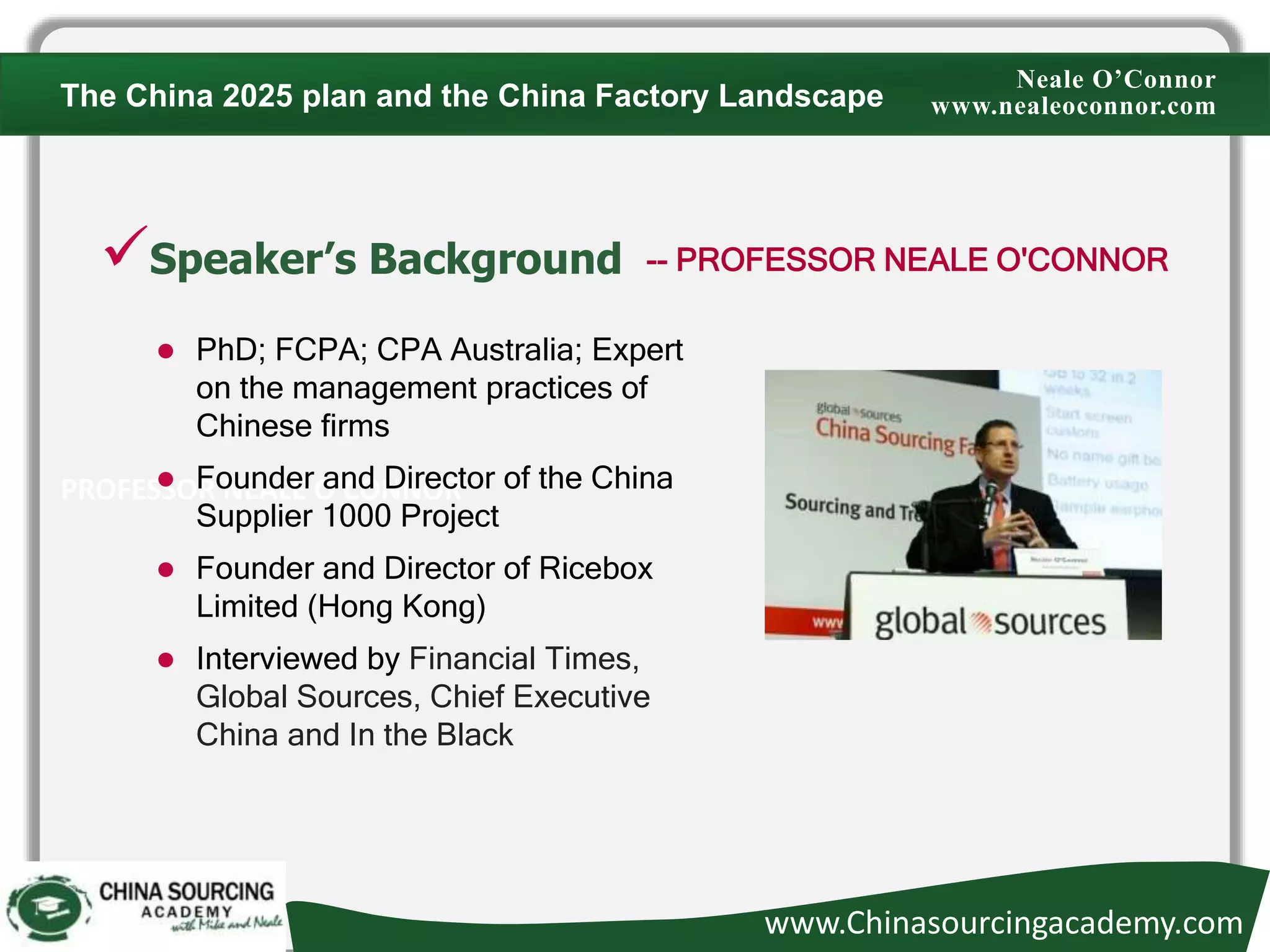



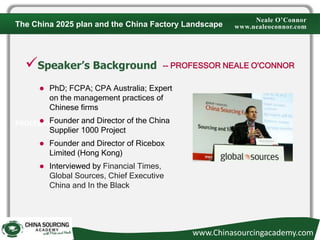
PROFESSOR NEALE O'CONNOR
Speaker’s Background
 PhD; FCPA; CPA Australia; Expert
on the management practices of
Chinese firms
 Founder and Director of the China
Supplier 1000 Project
 Founder and Director of Ricebox
Limited (Hong Kong)
 Interviewed by Financial Times,
Global Sources, Chief Executive
China and In the Black
-- PROFESSOR NEALE O'CONNOR
Neale O’Connor
www.nealeoconnor.comThe China 2025 plan and the China Factory Landscape
www.Chinasourcingacademy.com
Full 75 Slide Deck & 8 Videos – Go to CSA
Neale O’Connor
www.nealeoconnor.com
CONTENT
1. Made in China 2025
2. Challenges – Mind of the
Supplier
3. Challenges – Factory
Management
4. Top Eight Mega Trends
for Suppliers and Buyers
The China 2025 plan and the China Factory Landscape
www.Chinasourcingacademy.com
Made in China 2025
1. Summary
www.Chinasourcingacademy.com
Made in China 2025-Main Contents
• "One" - a target: China will develop to a manufacturing
power.
• "Two" - integrating information technology and
industry to achieve the goal.
• "Three" - achieving the goal through a "three step"
strategy, and each step will require about ten years.
– In the 1st step, by 2025 China will be ranked among the
manufacturing powers;
– In the 2nd step, by 2035 China's manufacturing sector will reach a
generally moderate level among the manufacturing powers;
– The 3rd step will mean transforming China into a leading
manufacturing power by 2049, which will be the 100th anniversary
of the founding of the People's Republic of China.
• "Four" - four principles:
– market-oriented and government guided;
– based on the present and having a long term perspective;
– comprehensively pressing forward and making breakthroughs in
key areas;
– independent development and win-win cooperation
www.Chinasourcingacademy.com
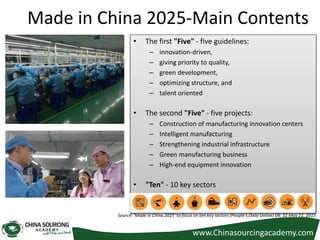
• The first "Five" - five guidelines:
– innovation-driven,
– giving priority to quality,
– green development,
– optimizing structure, and
– talent oriented
• The second "Five" - five projects:
– Construction of manufacturing innovation centers
– Intelligent manufacturing
– Strengthening industrial infrastructure
– Green manufacturing business
– High-end equipment innovation
• "Ten" - 10 key sectors
Source: 'Made in China 2025' to focus on ten key sectors (People's Daily Online) 08: 32 May 22, 2015
Made in China 2025-Main Contents
www.Chinasourcingacademy.com
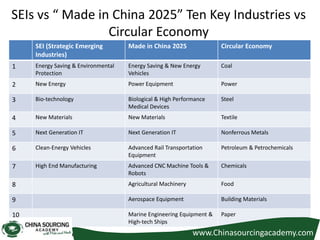
SEIs vs “ Made in China 2025” Ten Key Industries vs
Circular Economy
SEI (Strategic Emerging
Industries)
Made in China 2025 Circular Economy
1 Energy Saving & Environmental
Protection
Energy Saving & New Energy
Vehicles
Coal
2 New Energy Power Equipment Power
3 Bio-technology Biological & High Performance
Medical Devices
Steel
4 New Materials New Materials Textile
5 Next Generation IT Next Generation IT Nonferrous Metals
6 Clean-Energy Vehicles Advanced Rail Transportation
Equipment
Petroleum & Petrochemicals
7 High End Manufacturing Advanced CNC Machine Tools &
Robots
Chemicals
8 Agricultural Machinery Food
9 Aerospace Equipment Building Materials
10 Marine Engineering Equipment &
High-tech Ships
Paper
Source: State Council www.Chinasourcingacademy.com
Made in China 2025-Mission
• Gives manufacturing a makeover
• From “world’s factory” to “planet’s leading
manufacturing power” by 2025
• Elevate the perception of Chinese goods from “made
in China” to “innovated in China”
• Raising domestic content of core components and
materials to 40% by 2020 and 70% by 2025
• Set a target of SEI-related industries to account for
8% of the economy by 2015 and 15% by 2020
• Establish a 40 billion yuan (US$6.45 billion)
innovation fund to sponsor new business, supporting
the creation of manufacturing innovation centers 15
by 2020 and 40 by 2025
www.Chinasourcingacademy.com
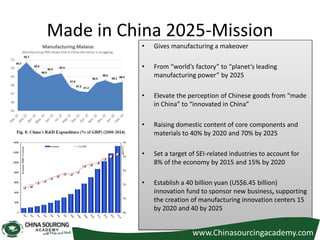
49.7
50.7
49.6
48.9
49.2
49.4
47.8
47.3 47.2
48.3
48.6
48.2 48.4
45
46
47
48
49
50
51
Manufacturing Malaise
Manufacturing PMI shows that in China the sector is struggling.
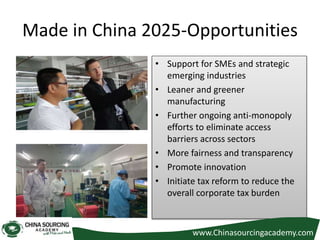
Made in China 2025-Opportunities
• Support for SMEs and strategic
emerging industries
• Leaner and greener
manufacturing
• Further ongoing anti-monopoly
efforts to eliminate access
barriers across sectors
• More fairness and transparency
• Promote innovation
• Initiate tax reform to reduce the
overall corporate tax burden
www.Chinasourcingacademy.com
Expanded Details of the China 2025 Plan
– Go to CSA
Key Challenges
2. Mind of the Supplier
www.Chinasourcingacademy.com
Evidence from
2014-2016 Trade Expo
Interviews
www.chinasupplier1000.com
www.Chinasourcingacademy.com
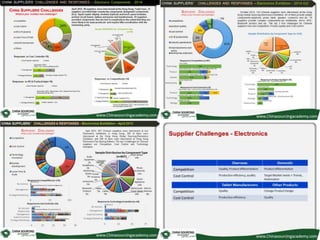
2015 - 2016 Infographics of 1300 Suppliers
- Go to CSA
Key Challenges
3. Factory Management
www.Chinasourcingacademy.com
Full Profiles of 10 Factories & Videos
– Go to CSA
Key Challenges
4. Eight Mega Trends for Buyers and
Suppliers
www.Chinasourcingacademy.com
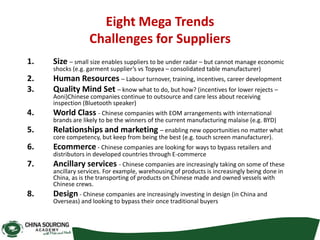
Eight Mega Trends
Challenges for Suppliers
1. Size – small size enables suppliers to be under radar – but cannot manage economic
shocks (e.g. garment supplier’s vs Topyea – consolidated table manufacturer)
2. Human Resources – Labour turnover, training, incentives, career development
3. Quality Mind Set – know what to do, but how? (incentives for lower rejects –
Aoni)Chinese companies continue to outsource and care less about receiving
inspection (Bluetooth speaker)
4. World Class - Chinese companies with EOM arrangements with international
brands are likely to be the winners of the current manufacturing malaise (e.g. BYD)
5. Relationships and marketing – enabling new opportunities no matter what
core competency, but keep from being the best (e.g. touch screen manufacturer).
6. Ecommerce - Chinese companies are looking for ways to bypass retailers and
distributors in developed countries through E-commerce
7. Ancillary services - Chinese companies are increasingly taking on some of these
ancillary services. For example, warehousing of products is increasingly being done in
China, as is the transporting of products on Chinese made and owned vessels with
Chinese crews.
8. Design - Chinese companies are increasingly investing in design (in China and
Overseas) and looking to bypass their once traditional buyers
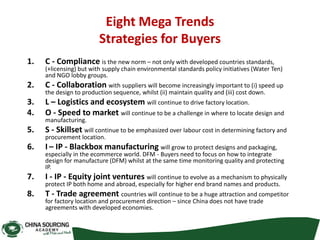
Eight Mega Trends
Strategies for Buyers
1. C - Compliance is the new norm – not only with developed countries standards,
(+licensing) but with supply chain environmental standards policy initiatives (Water Ten)
and NGO lobby groups.
2. C - Collaboration with suppliers will become increasingly important to (i) speed up
the design to production sequence, whilst (ii) maintain quality and (iii) cost down.
3. L – Logistics and ecosystem will continue to drive factory location.
4. O - Speed to market will continue to be a challenge in where to locate design and
manufacturing.
5. S - Skillset will continue to be emphasized over labour cost in determining factory and
procurement location.
6. I – IP - Blackbox manufacturing will grow to protect designs and packaging,
especially in the ecommerce world. DFM - Buyers need to focus on how to integrate
design for manufacture (DFM) whilst at the same time monitoring quality and protecting
IP.
7. I - IP - Equity joint ventures will continue to evolve as a mechanism to physically
protect IP both home and abroad, especially for higher end brand names and products.
8. T - Trade agreement countries will continue to be a huge attraction and competitor
for factory location and procurement direction – since China does not have trade
agreements with developed economies.
PROFESSOR NEALE O'CONNOR
Speaker’s Background
 PhD; FCPA; CPA Australia; Expert
on the management practices of
Chinese firms
 Founder and Director of the China
Supplier 1000 Project
 Founder and Director of Ricebox
Limited (Hong Kong)
 Interviewed by Financial Times,
Global Sources, Chief Executive
China and In the Black
-- PROFESSOR NEALE O'CONNOR
Neale O’Connor
www.nealeoconnor.comThe China 2025 plan and the China Factory Landscape
www.Chinasourcingacademy.com
Learn China Sourcing with CSA

Made in China 2025-CSA0306 Short Version

  • 1.
    PROFESSOR NEALE O'CONNOR Speaker’sBackground  PhD; FCPA; CPA Australia; Expert on the management practices of Chinese firms  Founder and Director of the China Supplier 1000 Project  Founder and Director of Ricebox Limited (Hong Kong)  Interviewed by Financial Times, Global Sources, Chief Executive China and In the Black -- PROFESSOR NEALE O'CONNOR Neale O’Connor www.nealeoconnor.comThe China 2025 plan and the China Factory Landscape www.Chinasourcingacademy.com
  • 2.
    Full 75 SlideDeck & 8 Videos – Go to CSA
  • 3.
    Neale O’Connor www.nealeoconnor.com CONTENT 1. Madein China 2025 2. Challenges – Mind of the Supplier 3. Challenges – Factory Management 4. Top Eight Mega Trends for Suppliers and Buyers The China 2025 plan and the China Factory Landscape www.Chinasourcingacademy.com
  • 4.
    Made in China2025 1. Summary www.Chinasourcingacademy.com
  • 5.
    Made in China2025-Main Contents • "One" - a target: China will develop to a manufacturing power. • "Two" - integrating information technology and industry to achieve the goal. • "Three" - achieving the goal through a "three step" strategy, and each step will require about ten years. – In the 1st step, by 2025 China will be ranked among the manufacturing powers; – In the 2nd step, by 2035 China's manufacturing sector will reach a generally moderate level among the manufacturing powers; – The 3rd step will mean transforming China into a leading manufacturing power by 2049, which will be the 100th anniversary of the founding of the People's Republic of China. • "Four" - four principles: – market-oriented and government guided; – based on the present and having a long term perspective; – comprehensively pressing forward and making breakthroughs in key areas; – independent development and win-win cooperation www.Chinasourcingacademy.com
  • 6.
    • The first"Five" - five guidelines: – innovation-driven, – giving priority to quality, – green development, – optimizing structure, and – talent oriented • The second "Five" - five projects: – Construction of manufacturing innovation centers – Intelligent manufacturing – Strengthening industrial infrastructure – Green manufacturing business – High-end equipment innovation • "Ten" - 10 key sectors Source: 'Made in China 2025' to focus on ten key sectors (People's Daily Online) 08: 32 May 22, 2015 Made in China 2025-Main Contents www.Chinasourcingacademy.com
  • 7.
    SEIs vs “Made in China 2025” Ten Key Industries vs Circular Economy SEI (Strategic Emerging Industries) Made in China 2025 Circular Economy 1 Energy Saving & Environmental Protection Energy Saving & New Energy Vehicles Coal 2 New Energy Power Equipment Power 3 Bio-technology Biological & High Performance Medical Devices Steel 4 New Materials New Materials Textile 5 Next Generation IT Next Generation IT Nonferrous Metals 6 Clean-Energy Vehicles Advanced Rail Transportation Equipment Petroleum & Petrochemicals 7 High End Manufacturing Advanced CNC Machine Tools & Robots Chemicals 8 Agricultural Machinery Food 9 Aerospace Equipment Building Materials 10 Marine Engineering Equipment & High-tech Ships Paper Source: State Council www.Chinasourcingacademy.com
  • 8.
    Made in China2025-Mission • Gives manufacturing a makeover • From “world’s factory” to “planet’s leading manufacturing power” by 2025 • Elevate the perception of Chinese goods from “made in China” to “innovated in China” • Raising domestic content of core components and materials to 40% by 2020 and 70% by 2025 • Set a target of SEI-related industries to account for 8% of the economy by 2015 and 15% by 2020 • Establish a 40 billion yuan (US$6.45 billion) innovation fund to sponsor new business, supporting the creation of manufacturing innovation centers 15 by 2020 and 40 by 2025 www.Chinasourcingacademy.com 49.7 50.7 49.6 48.9 49.2 49.4 47.8 47.3 47.2 48.3 48.6 48.2 48.4 45 46 47 48 49 50 51 Manufacturing Malaise Manufacturing PMI shows that in China the sector is struggling.
  • 9.
    Made in China2025-Opportunities • Support for SMEs and strategic emerging industries • Leaner and greener manufacturing • Further ongoing anti-monopoly efforts to eliminate access barriers across sectors • More fairness and transparency • Promote innovation • Initiate tax reform to reduce the overall corporate tax burden www.Chinasourcingacademy.com
  • 10.
    Expanded Details ofthe China 2025 Plan – Go to CSA
  • 11.
    Key Challenges 2. Mindof the Supplier www.Chinasourcingacademy.com
  • 12.
    Evidence from 2014-2016 TradeExpo Interviews www.chinasupplier1000.com www.Chinasourcingacademy.com
  • 14.
    2015 - 2016Infographics of 1300 Suppliers - Go to CSA
  • 15.
    Key Challenges 3. FactoryManagement www.Chinasourcingacademy.com
  • 16.
    Full Profiles of10 Factories & Videos – Go to CSA
  • 17.
    Key Challenges 4. EightMega Trends for Buyers and Suppliers www.Chinasourcingacademy.com
  • 18.
    Eight Mega Trends Challengesfor Suppliers 1. Size – small size enables suppliers to be under radar – but cannot manage economic shocks (e.g. garment supplier’s vs Topyea – consolidated table manufacturer) 2. Human Resources – Labour turnover, training, incentives, career development 3. Quality Mind Set – know what to do, but how? (incentives for lower rejects – Aoni)Chinese companies continue to outsource and care less about receiving inspection (Bluetooth speaker) 4. World Class - Chinese companies with EOM arrangements with international brands are likely to be the winners of the current manufacturing malaise (e.g. BYD) 5. Relationships and marketing – enabling new opportunities no matter what core competency, but keep from being the best (e.g. touch screen manufacturer). 6. Ecommerce - Chinese companies are looking for ways to bypass retailers and distributors in developed countries through E-commerce 7. Ancillary services - Chinese companies are increasingly taking on some of these ancillary services. For example, warehousing of products is increasingly being done in China, as is the transporting of products on Chinese made and owned vessels with Chinese crews. 8. Design - Chinese companies are increasingly investing in design (in China and Overseas) and looking to bypass their once traditional buyers
  • 19.
    Eight Mega Trends Strategiesfor Buyers 1. C - Compliance is the new norm – not only with developed countries standards, (+licensing) but with supply chain environmental standards policy initiatives (Water Ten) and NGO lobby groups. 2. C - Collaboration with suppliers will become increasingly important to (i) speed up the design to production sequence, whilst (ii) maintain quality and (iii) cost down. 3. L – Logistics and ecosystem will continue to drive factory location. 4. O - Speed to market will continue to be a challenge in where to locate design and manufacturing. 5. S - Skillset will continue to be emphasized over labour cost in determining factory and procurement location. 6. I – IP - Blackbox manufacturing will grow to protect designs and packaging, especially in the ecommerce world. DFM - Buyers need to focus on how to integrate design for manufacture (DFM) whilst at the same time monitoring quality and protecting IP. 7. I - IP - Equity joint ventures will continue to evolve as a mechanism to physically protect IP both home and abroad, especially for higher end brand names and products. 8. T - Trade agreement countries will continue to be a huge attraction and competitor for factory location and procurement direction – since China does not have trade agreements with developed economies.
  • 20.
    PROFESSOR NEALE O'CONNOR Speaker’sBackground  PhD; FCPA; CPA Australia; Expert on the management practices of Chinese firms  Founder and Director of the China Supplier 1000 Project  Founder and Director of Ricebox Limited (Hong Kong)  Interviewed by Financial Times, Global Sources, Chief Executive China and In the Black -- PROFESSOR NEALE O'CONNOR Neale O’Connor www.nealeoconnor.comThe China 2025 plan and the China Factory Landscape www.Chinasourcingacademy.com
  • 21.