
Opening Keynote Address Salim Ismail January 29, 2009
Objectives for today Intelligent Content is…  a definition Content on the web…  an evolution evolution of data/infrastructure on the internet Social Media Examples of intelligent applications Where else is content intelligent? (off-web) Back to the Web – what’s next? Q&A
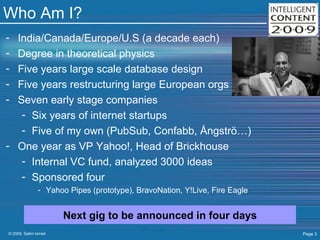
Who Am I? India/Canada/Europe/U.S (a decade each) Degree in theoretical physics Five years large scale database design Five years restructuring large European orgs Seven early stage companies Six years of internet startups Five of my own (PubSub, Confabb, Ångströ…) One year as VP Yahoo!, Head of Brickhouse Internal VC fund, analyzed 3000 ideas Sponsored four  Yahoo Pipes (prototype), BravoNation, Y!Live, Fire Eagle Next gig to be announced in four days
What is ‘Intelligent  Content ’ Content Data of some kind Wrapper Associated metadata The dream of the Semantic Web “ the  semantics  of information and services on the web is defined, making it possible for the web to understand and satisfy the requests of people and machines to use the  web content .  It derives from  World Wide Web Consortium  director Sir  Tim Berners-Lee 's vision of the Web as a universal medium for  data ,  information , and  knowledge  exchange.” All data, fully self-described for whatever purpose is required (slightly utopian… rather difficult)
What is ‘ Intelligent  Content’ Many types of intelligence:  Gardner:  logical ,  linguistic ,  spatial ,  musical ,  kinesthetic ,  naturalist ,  intrapersonal ,  interpersonal  and  social intelligence Sternberg: Practical / Contextual - deals with the mental activity involved in attaining fit to  context ”  Uses adaptation, shaping, and selection Experiental / Creative  Experience breaks down into novel/automated Componential / Analytical  Break down problems and intuit solutions
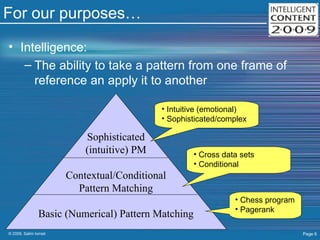
For our purposes… Intelligence:  The ability to take a pattern from one frame of reference an apply it to another Chess program Pagerank Cross data sets Conditional Intuitive (emotional) Sophisticated/complex Sophisticated (intuitive) PM Contextual/Conditional Pattern Matching Basic (Numerical) Pattern Matching
Two definitions of “Intelligent Content” Content can be considered intelligent when it expresses, in an open way, the full meaning underlying a communication such that the data, information and knowledge being expressed can be easily accessed and effectively leveraged by both people and the software applications that support them.  - Joe Gollner Structurally rich and semantically aware, and is therefore automatically discoverable, reusable, reconfigurable and adaptable  - Ann Rockley
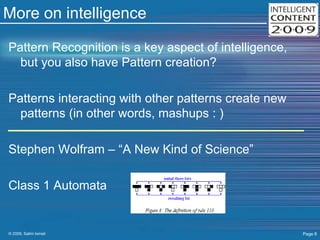
More on intelligence Pattern Recognition is a key aspect of intelligence, but you also have Pattern creation? Patterns interacting with other patterns create new patterns (in other words, mashups : ) Stephen Wolfram – “A New Kind of Science” Class 1 Automata
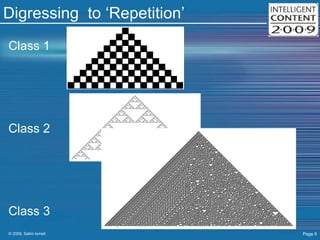
Digressing  to ‘Repetition’ Class 1 Class 2 Class 3
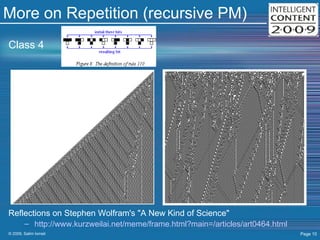
More on Repetition (recursive PM) Class 4 Reflections on Stephen Wolfram's "A New Kind of Science"  http :// www. kurzweilai.net/meme/frame.html?main =/articles/art0464.html
Intelligent Content – Summary Context is key Who, what, where, when… (why) Pattern management across frames of reference In documents, SGML > XML > DITA > ?? Eventually, pattern management (intelligence) will be embedded in the content (document) W- ar- goin- on ho-iday w-th som- f-iends n-x- we-k  Se- -ou wh-n w- ge- ba-k 25% of letters missing, yet meaning is conveyed
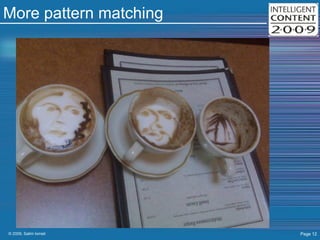
More pattern matching
Next topic… Intelligent Content is…  a definition Content on the web…  an evolution evolution of data/infrastructure on the internet Social Media Examples of intelligent applications Where else is content intelligent? (off-web) Back to the Web – what’s next? Q&A
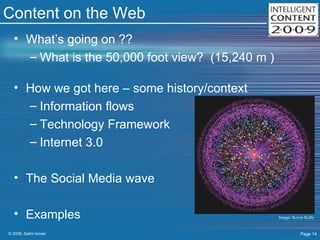
Content on the Web What’s going on ?? What is the 50,000 foot view?  (15,240 m )  How we got here – some history/context Information flows Technology Framework Internet 3.0 The Social Media wave Examples Image: Kevin Kelly
There’s lots going on today… ! Yahoo/Google/Microsoft/AOL/Facebook Blogs/feeds/RSS/ATOM//microblogging/lifestreaming Friendster/LinkedIn/Myspace/Bebo/Facebook Facebook Feed/FriendFeed/FriendFeedFilter/FeedaFriend Adsense/Panama/Beacon/adCenter Twitter/Twhirl/Tweetdeck/Twitterfone/Twitscan/TwitSnooze OpenID/IdentityCommons/IdentityGang/IdentityWoman Dataportability/Data Availability/OpenSocial… nottoosocialyet/FriendConnect/FacebookConnect/everybodybloodyconnect Icannotakeanymoreofthispleasestop
And a few companies…
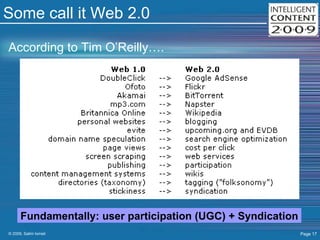
Some call it Web 2.0 According to Tim O’Reilly…. Fundamentally: user participation (UGC) + Syndication
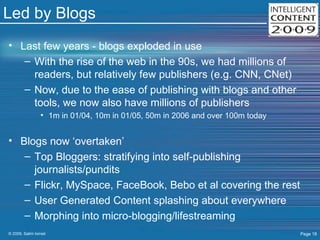
Led by Blogs Last few years - blogs exploded in use With the rise of the web in the 90s, we had millions of readers, but relatively few publishers (e.g. CNN, CNet) Now, due to the ease of publishing with blogs and other tools, we now also have millions of publishers 1m in 01/04, 10m in 01/05, 50m in 2006 and over 100m today Blogs now ‘overtaken’ Top Bloggers: stratifying into self-publishing journalists/pundits Flickr, MySpace, FaceBook, Bebo et al covering the rest User Generated Content splashing about everywhere Morphing into micro-blogging/lifestreaming
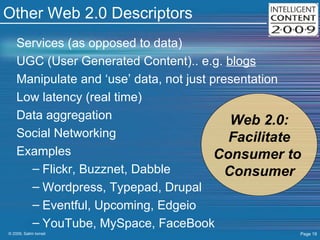
Other Web 2.0 Descriptors Services (as opposed to data) UGC (User Generated Content).. e.g.  blogs Manipulate and ‘use’ data, not just presentation Low latency (real time) Data aggregation Social Networking Examples Flickr, Buzznet, Dabble Wordpress, Typepad, Drupal Eventful, Upcoming, Edgeio YouTube, MySpace, FaceBook Web 2.0: Facilitate Consumer to  Consumer
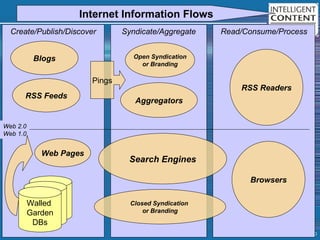
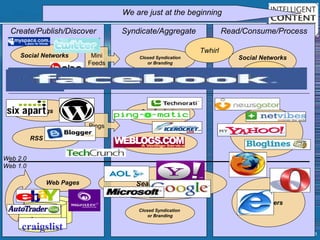
Aggregators Blogs RSS Readers RSS Feeds Closed Syndication  or Branding Browsers Web Pages Search Engines Internet Information Flows Open Syndication or Branding Pings Create/Publish/Discover Syndicate/Aggregate Read/Consume/Process Web 2.0 Web 1.0 Walled  Garden DBs
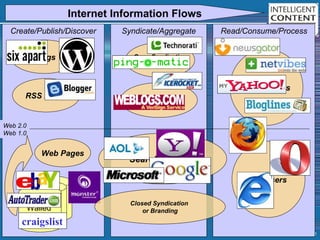
Blogs Aggregators RSS Feeds Browsers Web Pages Search Engines Internet Information Flows Pings Open Syndication or Branding craigslist Closed Syndication  or Branding Create/Publish/Discover Syndicate/Aggregate Read/Consume/Process Web 2.0 Web 1.0 Walled  Gardens
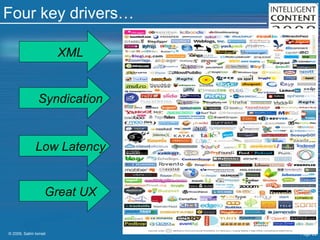
Four key drivers… Syndication XML Low Latency Great UX
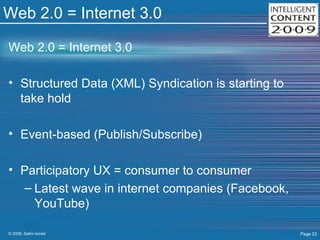
Web 2.0 = Internet 3.0 Web 2.0 = Internet 3.0 Structured Data (XML) Syndication is starting to take hold Event-based (Publish/Subscribe) Participatory UX = consumer to consumer Latest wave in internet companies (Facebook, YouTube)
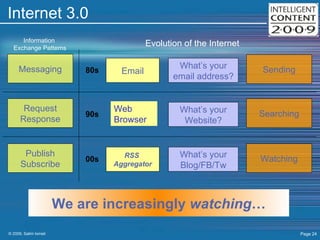
Internet 3.0  We are increasingly  watching … Messaging Request Response Publish Subscribe What’s your email address? Sending What’s your Website? Searching What’s your Blog/FB/Tw Watching Information  Exchange Patterns Evolution of the Internet 80s Email 90s Web  Browser 00s RSS  Aggregator
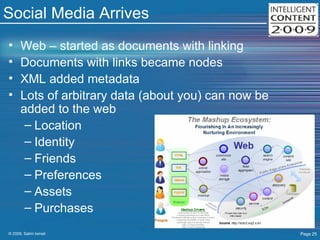
Social Media Arrives Web – started as documents with linking Documents with links became nodes XML added metadata Lots of arbitrary data (about you) can now be added to the web Location Identity Friends Preferences Assets Purchases
Why is Social Media big? We are biological creatures Driven by social constructs “Who you know” drives a lot of what we do Context drives 80% of information value Who speaks gives a lot of context
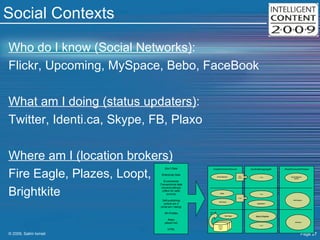
Social Contexts Who do I know (Social Networks) :  Flickr, Upcoming, MySpace, Bebo, FaceBook What am I doing (status updaters) :  Twitter, Identi.ca, Skype, FB, Plaxo Where am I (location brokers)   Fire Eagle, Plazes, Loopt, Brightkite Gov’t Data Enterprise Data E-commerce Transactional data (reviews/ratings) (offers for sale) (events) Self-publishing (where am I) (what am I doing) SN Profiles Blogs (about me) HTML Create/Publish/Discover Syndicate/Aggregate Read/Consume/Process Web 2.0 Web 1.0 Aggregators Blogs RSS Readers RSS Feeds Closed Syndication  or Branding Browsers Web Pages Search Engines Walled  Garden DBs Open Syndication or Branding Pings Social Networks Mini Feeds Closed Syndication or Branding Social Networks (email)
Create/Publish/Discover Syndicate/Aggregate Read/Consume/Process Web 2.0 Web 1.0 Aggregators Blogs RSS Readers RSS Feeds Closed Syndication  or Branding Browsers Web Pages Search Engines We are just at the beginning Open Syndication or Branding Pings Social Networks Mini Feeds Closed Syndication or Branding Social Networks (email) Twhirl EMAIL !!! Walled  Garden DBs craigslist
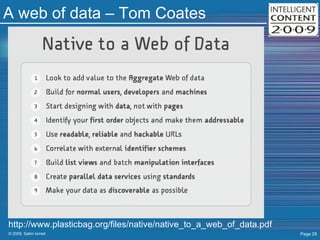
A web of data – Tom Coates http://www.plasticbag.org/files/native/native_to_a_web_of_data.pdf
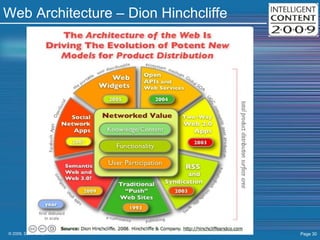
Web Architecture – Dion Hinchcliffe
Thoughts on  Social Media SM has become the starting point for consumers But, computers are binary, relationships aren’t 80/20 rule SNs will hold who’s connected to whom, but not more Leverage with other types of information
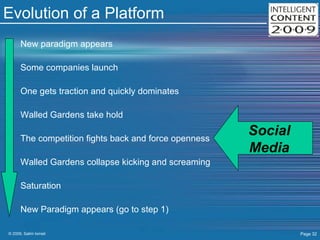
Evolution of a Platform New paradigm appears Some companies launch One gets traction and quickly dominates  Walled Gardens take hold The competition fights back and force openness Walled Gardens collapse kicking and screaming Saturation New Paradigm appears (go to step 1) Social Media
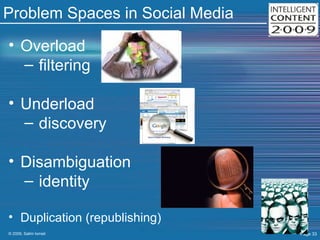
Problem Spaces in Social Media Overload filtering Underload discovery Disambiguation identity Duplication (republishing)
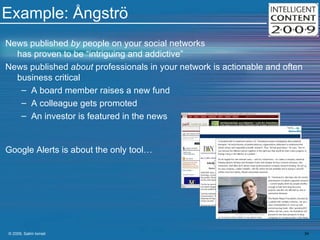
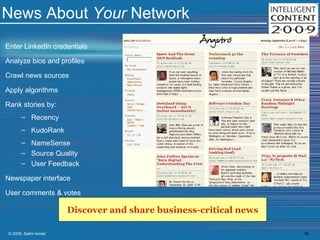
Example: Ångströ  News published  by  people on your social networks has proven to be “intriguing and addictive” News published  about  professionals in your network is actionable and often business critical A board member raises a new fund A colleague gets promoted An investor is featured in the news Google Alerts is about the only tool…
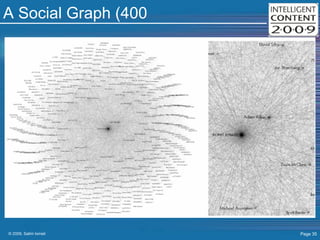
A Social Graph (400
News About  Your  Network Enter LinkedIn credentials Analyze bios and profiles Crawl news sources Apply algorithms Rank stories by: Recency KudoRank NameSense Source Quality User Feedback Newspaper interface User comments & votes Discover and share business-critical news
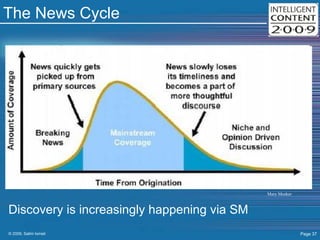
The News Cycle Discovery is increasingly happening via SM Mary Meeker
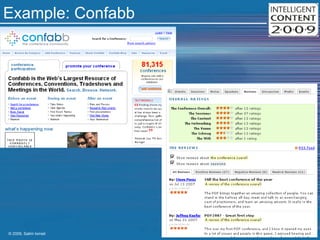
Example: Confabb
Live Traffic
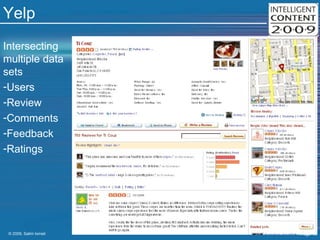
Yelp Intersecting multiple data sets Users Review Comments Feedback Ratings
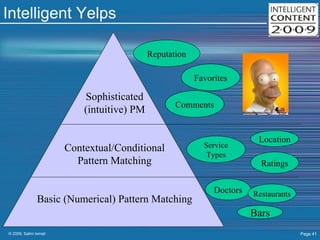
Intelligent Yelps Doctors Service Types Bars Location Mechanical Turk Restaurants Ratings Comments Reputation Favorites Sophisticated (intuitive) PM Contextual/Conditional Pattern Matching Basic (Numerical) Pattern Matching
Next topic… Intelligent Content is…  a definition Content on the web…  an evolution evolution of data/infrastructure on the internet Social Media Examples of intelligent applications Where else is content intelligent? (off-web) Back to the Web – what’s next? Q&A
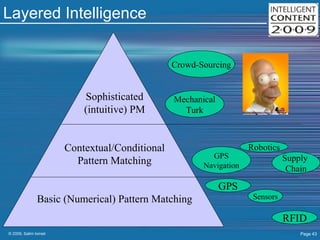
Layered Intelligence GPS GPS Navigation RFID Robotics Mechanical Turk Sensors Supply  Chain Mechanical Turk Crowd-Sourcing Sophisticated (intuitive) PM Contextual/Conditional Pattern Matching Basic (Numerical) Pattern Matching
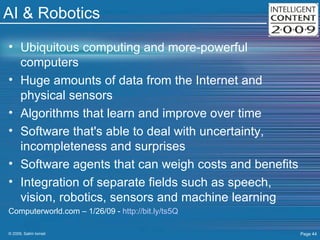
AI & Robotics Ubiquitous computing and more-powerful computers  Huge amounts of data from the Internet and physical sensors  Algorithms that learn and improve over time  Software that's able to deal with uncertainty, incompleteness and surprises  Software agents that can weigh costs and benefits  Integration of separate fields such as speech, vision, robotics, sensors and machine learning  Computerworld.com – 1/26/09 -  http://bit.ly/ts5Q
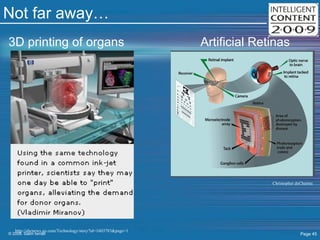
Not far away… 3D printing of organs Artificial Retinas Christopher deCharms http://abcnews.go.com/Technology/story?id=1603783&page=1
Next topic… Intelligent Content is…  a definition Content on the web…  an evolution evolution of data/infrastructure on the internet Social Media Examples Where else is content intelligent? (off-web) Back to the Web – what’s next? Q&A
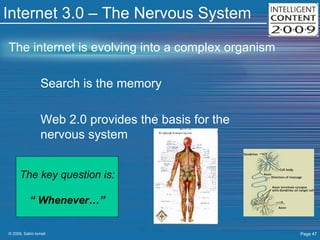
Internet 3.0 – The Nervous System The internet is evolving into a complex organism Search is the memory Web 2.0 provides the basis for the  nervous system The key question is: “  Whenever…”
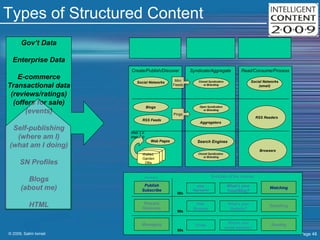
Types of Structured Content Gov’t Data Enterprise Data E-commerce Transactional data (reviews/ratings) (offers for sale) (events) Self-publishing (where am I) (what am I doing) SN Profiles Blogs (about me) HTML Create/Publish/Discover Syndicate/Aggregate Read/Consume/Process Web 2.0 Web 1.0 Aggregators Blogs RSS Readers RSS Feeds Closed Syndication  or Branding Browsers Web Pages Search Engines Walled  Garden DBs Open Syndication or Branding Pings Social Networks Mini Feeds Closed Syndication or Branding Social Networks (email) 80s Email 90s Web  Browser 00s RSS  Aggregator Messaging Request Response Publish Subscribe What’s your email address? Sending What’s your Website? Searching What’s your Feed/Blog? Watching Information  Exchange Patterns Evolution of the Internet
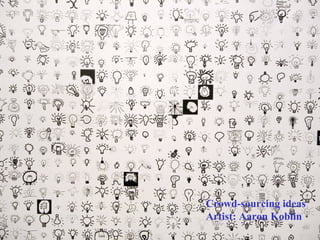
CONTENT ON THE WEB Crowd-sourcing ideas Artist: Aaron Koblin
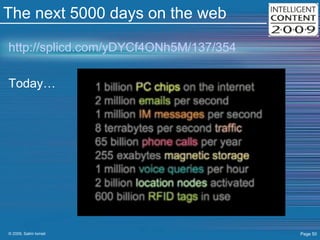
The next 5000 days on the web http://splicd.com/yDYCf4ONh5M/137/354 Today…
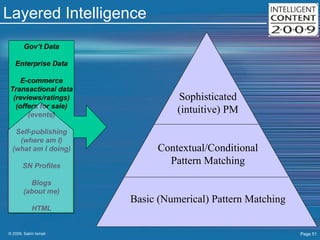
Layered Intelligence Gov’t Data Enterprise Data E-commerce Transactional data (reviews/ratings) (offers for sale) (events) Self-publishing (where am I) (what am I doing) SN Profiles Blogs (about me) HTML Sophisticated (intuitive) PM Contextual/Conditional Pattern Matching Basic (Numerical) Pattern Matching
Thanks…. http://salimismail.com ww.twitter.com/salimismail

Intelligentcontent2009

  • 1.
    Opening Keynote AddressSalim Ismail January 29, 2009
  • 2.
    Objectives for todayIntelligent Content is… a definition Content on the web… an evolution evolution of data/infrastructure on the internet Social Media Examples of intelligent applications Where else is content intelligent? (off-web) Back to the Web – what’s next? Q&A
  • 3.
    Who Am I?India/Canada/Europe/U.S (a decade each) Degree in theoretical physics Five years large scale database design Five years restructuring large European orgs Seven early stage companies Six years of internet startups Five of my own (PubSub, Confabb, Ångströ…) One year as VP Yahoo!, Head of Brickhouse Internal VC fund, analyzed 3000 ideas Sponsored four Yahoo Pipes (prototype), BravoNation, Y!Live, Fire Eagle Next gig to be announced in four days
  • 4.
    What is ‘Intelligent Content ’ Content Data of some kind Wrapper Associated metadata The dream of the Semantic Web “ the semantics of information and services on the web is defined, making it possible for the web to understand and satisfy the requests of people and machines to use the web content . It derives from World Wide Web Consortium director Sir Tim Berners-Lee 's vision of the Web as a universal medium for data , information , and knowledge exchange.” All data, fully self-described for whatever purpose is required (slightly utopian… rather difficult)
  • 5.
    What is ‘Intelligent Content’ Many types of intelligence: Gardner: logical , linguistic , spatial , musical , kinesthetic , naturalist , intrapersonal , interpersonal and social intelligence Sternberg: Practical / Contextual - deals with the mental activity involved in attaining fit to context ” Uses adaptation, shaping, and selection Experiental / Creative Experience breaks down into novel/automated Componential / Analytical Break down problems and intuit solutions
  • 6.
    For our purposes…Intelligence: The ability to take a pattern from one frame of reference an apply it to another Chess program Pagerank Cross data sets Conditional Intuitive (emotional) Sophisticated/complex Sophisticated (intuitive) PM Contextual/Conditional Pattern Matching Basic (Numerical) Pattern Matching
  • 7.
    Two definitions of“Intelligent Content” Content can be considered intelligent when it expresses, in an open way, the full meaning underlying a communication such that the data, information and knowledge being expressed can be easily accessed and effectively leveraged by both people and the software applications that support them. - Joe Gollner Structurally rich and semantically aware, and is therefore automatically discoverable, reusable, reconfigurable and adaptable - Ann Rockley
  • 8.
    More on intelligencePattern Recognition is a key aspect of intelligence, but you also have Pattern creation? Patterns interacting with other patterns create new patterns (in other words, mashups : ) Stephen Wolfram – “A New Kind of Science” Class 1 Automata
  • 9.
    Digressing to‘Repetition’ Class 1 Class 2 Class 3
  • 10.
    More on Repetition(recursive PM) Class 4 Reflections on Stephen Wolfram's "A New Kind of Science" http :// www. kurzweilai.net/meme/frame.html?main =/articles/art0464.html
  • 11.
    Intelligent Content –Summary Context is key Who, what, where, when… (why) Pattern management across frames of reference In documents, SGML > XML > DITA > ?? Eventually, pattern management (intelligence) will be embedded in the content (document) W- ar- goin- on ho-iday w-th som- f-iends n-x- we-k Se- -ou wh-n w- ge- ba-k 25% of letters missing, yet meaning is conveyed
  • 12.
  • 13.
    Next topic… IntelligentContent is… a definition Content on the web… an evolution evolution of data/infrastructure on the internet Social Media Examples of intelligent applications Where else is content intelligent? (off-web) Back to the Web – what’s next? Q&A
  • 14.
    Content on theWeb What’s going on ?? What is the 50,000 foot view? (15,240 m ) How we got here – some history/context Information flows Technology Framework Internet 3.0 The Social Media wave Examples Image: Kevin Kelly
  • 15.
    There’s lots goingon today… ! Yahoo/Google/Microsoft/AOL/Facebook Blogs/feeds/RSS/ATOM//microblogging/lifestreaming Friendster/LinkedIn/Myspace/Bebo/Facebook Facebook Feed/FriendFeed/FriendFeedFilter/FeedaFriend Adsense/Panama/Beacon/adCenter Twitter/Twhirl/Tweetdeck/Twitterfone/Twitscan/TwitSnooze OpenID/IdentityCommons/IdentityGang/IdentityWoman Dataportability/Data Availability/OpenSocial… nottoosocialyet/FriendConnect/FacebookConnect/everybodybloodyconnect Icannotakeanymoreofthispleasestop
  • 16.
    And a fewcompanies…
  • 17.
    Some call itWeb 2.0 According to Tim O’Reilly…. Fundamentally: user participation (UGC) + Syndication
  • 18.
    Led by BlogsLast few years - blogs exploded in use With the rise of the web in the 90s, we had millions of readers, but relatively few publishers (e.g. CNN, CNet) Now, due to the ease of publishing with blogs and other tools, we now also have millions of publishers 1m in 01/04, 10m in 01/05, 50m in 2006 and over 100m today Blogs now ‘overtaken’ Top Bloggers: stratifying into self-publishing journalists/pundits Flickr, MySpace, FaceBook, Bebo et al covering the rest User Generated Content splashing about everywhere Morphing into micro-blogging/lifestreaming
  • 19.
    Other Web 2.0Descriptors Services (as opposed to data) UGC (User Generated Content).. e.g. blogs Manipulate and ‘use’ data, not just presentation Low latency (real time) Data aggregation Social Networking Examples Flickr, Buzznet, Dabble Wordpress, Typepad, Drupal Eventful, Upcoming, Edgeio YouTube, MySpace, FaceBook Web 2.0: Facilitate Consumer to Consumer
  • 20.
    Aggregators Blogs RSSReaders RSS Feeds Closed Syndication or Branding Browsers Web Pages Search Engines Internet Information Flows Open Syndication or Branding Pings Create/Publish/Discover Syndicate/Aggregate Read/Consume/Process Web 2.0 Web 1.0 Walled Garden DBs
  • 21.
    Blogs Aggregators RSSFeeds Browsers Web Pages Search Engines Internet Information Flows Pings Open Syndication or Branding craigslist Closed Syndication or Branding Create/Publish/Discover Syndicate/Aggregate Read/Consume/Process Web 2.0 Web 1.0 Walled Gardens
  • 22.
    Four key drivers…Syndication XML Low Latency Great UX
  • 23.
    Web 2.0 =Internet 3.0 Web 2.0 = Internet 3.0 Structured Data (XML) Syndication is starting to take hold Event-based (Publish/Subscribe) Participatory UX = consumer to consumer Latest wave in internet companies (Facebook, YouTube)
  • 24.
    Internet 3.0 We are increasingly watching … Messaging Request Response Publish Subscribe What’s your email address? Sending What’s your Website? Searching What’s your Blog/FB/Tw Watching Information Exchange Patterns Evolution of the Internet 80s Email 90s Web Browser 00s RSS Aggregator
  • 25.
    Social Media ArrivesWeb – started as documents with linking Documents with links became nodes XML added metadata Lots of arbitrary data (about you) can now be added to the web Location Identity Friends Preferences Assets Purchases
  • 26.
    Why is SocialMedia big? We are biological creatures Driven by social constructs “Who you know” drives a lot of what we do Context drives 80% of information value Who speaks gives a lot of context
  • 27.
    Social Contexts Whodo I know (Social Networks) : Flickr, Upcoming, MySpace, Bebo, FaceBook What am I doing (status updaters) : Twitter, Identi.ca, Skype, FB, Plaxo Where am I (location brokers) Fire Eagle, Plazes, Loopt, Brightkite Gov’t Data Enterprise Data E-commerce Transactional data (reviews/ratings) (offers for sale) (events) Self-publishing (where am I) (what am I doing) SN Profiles Blogs (about me) HTML Create/Publish/Discover Syndicate/Aggregate Read/Consume/Process Web 2.0 Web 1.0 Aggregators Blogs RSS Readers RSS Feeds Closed Syndication or Branding Browsers Web Pages Search Engines Walled Garden DBs Open Syndication or Branding Pings Social Networks Mini Feeds Closed Syndication or Branding Social Networks (email)
  • 28.
    Create/Publish/Discover Syndicate/Aggregate Read/Consume/ProcessWeb 2.0 Web 1.0 Aggregators Blogs RSS Readers RSS Feeds Closed Syndication or Branding Browsers Web Pages Search Engines We are just at the beginning Open Syndication or Branding Pings Social Networks Mini Feeds Closed Syndication or Branding Social Networks (email) Twhirl EMAIL !!! Walled Garden DBs craigslist
  • 29.
    A web ofdata – Tom Coates http://www.plasticbag.org/files/native/native_to_a_web_of_data.pdf
  • 30.
    Web Architecture –Dion Hinchcliffe
  • 31.
    Thoughts on Social Media SM has become the starting point for consumers But, computers are binary, relationships aren’t 80/20 rule SNs will hold who’s connected to whom, but not more Leverage with other types of information
  • 32.
    Evolution of aPlatform New paradigm appears Some companies launch One gets traction and quickly dominates Walled Gardens take hold The competition fights back and force openness Walled Gardens collapse kicking and screaming Saturation New Paradigm appears (go to step 1) Social Media
  • 33.
    Problem Spaces inSocial Media Overload filtering Underload discovery Disambiguation identity Duplication (republishing)
  • 34.
    Example: Ångströ News published by people on your social networks has proven to be “intriguing and addictive” News published about professionals in your network is actionable and often business critical A board member raises a new fund A colleague gets promoted An investor is featured in the news Google Alerts is about the only tool…
  • 35.
  • 36.
    News About Your Network Enter LinkedIn credentials Analyze bios and profiles Crawl news sources Apply algorithms Rank stories by: Recency KudoRank NameSense Source Quality User Feedback Newspaper interface User comments & votes Discover and share business-critical news
  • 37.
    The News CycleDiscovery is increasingly happening via SM Mary Meeker
  • 38.
  • 39.
  • 40.
    Yelp Intersecting multipledata sets Users Review Comments Feedback Ratings
  • 41.
    Intelligent Yelps DoctorsService Types Bars Location Mechanical Turk Restaurants Ratings Comments Reputation Favorites Sophisticated (intuitive) PM Contextual/Conditional Pattern Matching Basic (Numerical) Pattern Matching
  • 42.
    Next topic… IntelligentContent is… a definition Content on the web… an evolution evolution of data/infrastructure on the internet Social Media Examples of intelligent applications Where else is content intelligent? (off-web) Back to the Web – what’s next? Q&A
  • 43.
    Layered Intelligence GPSGPS Navigation RFID Robotics Mechanical Turk Sensors Supply Chain Mechanical Turk Crowd-Sourcing Sophisticated (intuitive) PM Contextual/Conditional Pattern Matching Basic (Numerical) Pattern Matching
  • 44.
    AI & RoboticsUbiquitous computing and more-powerful computers Huge amounts of data from the Internet and physical sensors Algorithms that learn and improve over time Software that's able to deal with uncertainty, incompleteness and surprises Software agents that can weigh costs and benefits Integration of separate fields such as speech, vision, robotics, sensors and machine learning Computerworld.com – 1/26/09 - http://bit.ly/ts5Q
  • 45.
    Not far away…3D printing of organs Artificial Retinas Christopher deCharms http://abcnews.go.com/Technology/story?id=1603783&page=1
  • 46.
    Next topic… IntelligentContent is… a definition Content on the web… an evolution evolution of data/infrastructure on the internet Social Media Examples Where else is content intelligent? (off-web) Back to the Web – what’s next? Q&A
  • 47.
    Internet 3.0 –The Nervous System The internet is evolving into a complex organism Search is the memory Web 2.0 provides the basis for the nervous system The key question is: “ Whenever…”
  • 48.
    Types of StructuredContent Gov’t Data Enterprise Data E-commerce Transactional data (reviews/ratings) (offers for sale) (events) Self-publishing (where am I) (what am I doing) SN Profiles Blogs (about me) HTML Create/Publish/Discover Syndicate/Aggregate Read/Consume/Process Web 2.0 Web 1.0 Aggregators Blogs RSS Readers RSS Feeds Closed Syndication or Branding Browsers Web Pages Search Engines Walled Garden DBs Open Syndication or Branding Pings Social Networks Mini Feeds Closed Syndication or Branding Social Networks (email) 80s Email 90s Web Browser 00s RSS Aggregator Messaging Request Response Publish Subscribe What’s your email address? Sending What’s your Website? Searching What’s your Feed/Blog? Watching Information Exchange Patterns Evolution of the Internet
  • 49.
    CONTENT ON THEWEB Crowd-sourcing ideas Artist: Aaron Koblin
  • 50.
    The next 5000days on the web http://splicd.com/yDYCf4ONh5M/137/354 Today…
  • 51.
    Layered Intelligence Gov’tData Enterprise Data E-commerce Transactional data (reviews/ratings) (offers for sale) (events) Self-publishing (where am I) (what am I doing) SN Profiles Blogs (about me) HTML Sophisticated (intuitive) PM Contextual/Conditional Pattern Matching Basic (Numerical) Pattern Matching
  • 52.