Al-Qaida bomber was CIA informant, officials say | The Salt Lake Tribune   http://www.sltrib.com/csp/cms/sites/sltrib/pages/printerfriendly.csp?id=...


              Al-Qaida bomber was CIA
              informant, officials say
              Plot • Dramatic sting operation thwarted attack before it had any chance of succeeding.
              By ADAM GOLDMAN
              and EILEEN SULLIVAN
              The Associated Press
              Published: May 8, 2012 10:56AM
              Updated: May 8, 2012 06:07PM

              Washington • The CIA had al-Qaida fooled from the
              beginning.

              Last month, U.S. intelligence learned that al-Qaida’s Yemen
              branch hoped to launch a spectacular attack using a new,
              nearly undetectable bomb aboard an airliner bound for
              America, officials say.

              But the man the terrorists were counting on to carry out the
              attack was actually working for the CIA and Saudi
              intelligence, U.S. and Yemeni officials told The Associated
              Press on Tuesday.

              The dramatic sting operation thwarted the attack before it
              had a chance to succeed.

              It was the latest misfire for al-Qaida, which has repeatedly
              come close to detonating a bomb aboard an airliner. For the
              United State, it was a victory that delivered the bomb intact
              to U.S. intelligence.

              The officials spoke to the AP on condition of anonymity
              because of the sensitivity of the operation. The cooperation
              of the would-be bomber was first reported Tuesday evening
              by The Los Angeles Times.
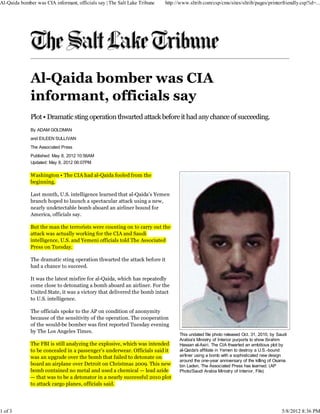
                                                                                 This undated file photo released Oct. 31, 2010, by Saudi
                                                                                 Arabia's Ministry of Interior purports to show Ibrahim
              The FBI is still analyzing the explosive, which was intended       Hassan al-Asiri. The CIA thwarted an ambitious plot by
              to be concealed in a passenger’s underwear. Officials said it      al-Qaida's affiliate in Yemen to destroy a U.S.-bound
              was an upgrade over the bomb that failed to detonate on            airliner using a bomb with a sophisticated new design
                                                                                 around the one-year anniversary of the killing of Osama
              board an airplane over Detroit on Christmas 2009. This new         bin Laden, The Associated Press has learned. (AP
              bomb contained no metal and used a chemical — lead azide           Photo/Saudi Arabia Ministry of Interior, File)
              — that was to be a detonator in a nearly successful 2010 plot
              to attack cargo planes, officials said.


1 of 3                                                                                                                                5/8/2012 8:36 PM
Al-Qaida bomber was CIA informant, officials say | The Salt Lake Tribune   http://www.sltrib.com/csp/cms/sites/sltrib/pages/printerfriendly.csp?id=...


              Security procedures at U.S. airports remained unchanged Tuesday, a reflection of both the U.S. confidence in
              its security systems and a recognition that the government can’t realistically expect travelers to endure much
              more. Increased costs and delays to airlines and shipping companies could have a global economic impact, too.

              “I would not expect any real changes for the traveling public,” said House Intelligence Committee Chairman
              Mike Rogers, R-Mich. “There is a concern that overseas security doesn’t match ours. That’s an ongoing
              challenge.”

              While airline checks in the United States mean passing through an onerous, sometimes embarrassing series of
              pat-downs and body scans, procedures overseas can be a mixed bag. The U.S. cannot force other countries to
              permanently adopt the expensive and intrusive measures that have become common in American airports over
              the past decade.

              The Transportation Security Administration sent advice to some international air carriers and airports about
              security measures that might stave off an attack from a hidden explosive. It’s the same advice the U.S. has
              issued before, but there was a thought that it might get new attention in light of the foiled plot.

              The U.S. has worked for years to try to improve security for U.S.-bound flights originating at international
              airports. And many countries agree that security needs to be better. But while plots such as the Christmas
              attack have spurred changes, some security gaps that have been closed in the U.S. remain open overseas.

              Officials believe that body scanners, for instance, probably would have detected this latest attempt by al-Qaida
              to bring down a jetliner. Such scanners allow screeners to see objects hidden beneath a passenger’s clothes.

              But while scanners are in place in airports nationwide, their use is scattershot overseas. Even in security-
              conscious Europe, the European Union has not required full-body imaging machines for all airports, though a
              number of major airports in Paris, London, Frankfurt and elsewhere use them.

              All passengers on U.S.-bound flights are checked against terrorist watch lists and law enforcement databases.

              In some countries, U.S. officials are stationed in airports to offer advice on security matters. In some cases,
              though, the U.S. is limited to hoping that other countries follow the security advice from the Transportation
              Security Administration.

              “Even if our technology is good enough to spot it, the technology is still in human hands and we are inherently
              fallible,” said Rep. Adam Schiff, D-Calif., a member of the House Intelligence Committee. “And overseas, we
              have varying degrees of security depending on where the flight originates.”

              Al-Qaida has repeatedly tried to take advantage of those overseas gaps. The Christmas 2009 bombing
              originated in Amsterdam, where the bomber did not receive a full-body scan. And in 2010, terrorists smuggled
              bombs onto cargo jets, which receive less scrutiny than passenger planes.

              In both those instances, the bombs were made by al-Qaida’s master bomb maker in Yemen, Ibrahim Hassan
              al-Asiri. Officials believe this latest bomb was the handiwork of al-Asiri or one of his students.

              In the meantime, Americans traveled Tuesday with little apparent concern.

              “We were nervous — for a minute,” said Nan Gartner, a retiree on her way to Italy from New York’s John F.
              Kennedy Airport. “But then we thought, we aren’t going anywhere near Yemen, so we’re OK.”

              —

              Officials: Chemical used before

              Washington • U.S. officials say al-Qaida’s sophisticated new underwear bomb contained a chemical that was
              also used in a failed 2010 effort to take down U.S.-bound cargo planes.

              The cargo plot failed, but only because the United States was tipped off to the bombs. The bombs made it past


2 of 3                                                                                                                             5/8/2012 8:36 PM
Al-Qaida bomber was CIA informant, officials say | The Salt Lake Tribune   http://www.sltrib.com/csp/cms/sites/sltrib/pages/printerfriendly.csp?id=...


              cargo handlers and airport screeners.

              In those bombs, the detonator was lead azide. Officials say the same chemical was used inside this latest bomb
              recovered by the CIA.

              That could explain why officials describe this new bomb as an upgrade over the Christmas 2009 underwear
              bomb. That bomb did not use lead azide as a detonator and it failed to ignite aboard a plane over Detroit.

              The officials spoke on condition of anonymity because they were not authorized to discuss the information
              publicly.


3 of 3                                                                                                                             5/8/2012 8:36 PM

CIA - FOILED PLANE PLOT (2)

  • 1.
    Al-Qaida bomber wasCIA informant, officials say | The Salt Lake Tribune http://www.sltrib.com/csp/cms/sites/sltrib/pages/printerfriendly.csp?id=... Al-Qaida bomber was CIA informant, officials say Plot • Dramatic sting operation thwarted attack before it had any chance of succeeding. By ADAM GOLDMAN and EILEEN SULLIVAN The Associated Press Published: May 8, 2012 10:56AM Updated: May 8, 2012 06:07PM Washington • The CIA had al-Qaida fooled from the beginning. Last month, U.S. intelligence learned that al-Qaida’s Yemen branch hoped to launch a spectacular attack using a new, nearly undetectable bomb aboard an airliner bound for America, officials say. But the man the terrorists were counting on to carry out the attack was actually working for the CIA and Saudi intelligence, U.S. and Yemeni officials told The Associated Press on Tuesday. The dramatic sting operation thwarted the attack before it had a chance to succeed. It was the latest misfire for al-Qaida, which has repeatedly come close to detonating a bomb aboard an airliner. For the United State, it was a victory that delivered the bomb intact to U.S. intelligence. The officials spoke to the AP on condition of anonymity because of the sensitivity of the operation. The cooperation of the would-be bomber was first reported Tuesday evening by The Los Angeles Times. This undated file photo released Oct. 31, 2010, by Saudi Arabia's Ministry of Interior purports to show Ibrahim The FBI is still analyzing the explosive, which was intended Hassan al-Asiri. The CIA thwarted an ambitious plot by to be concealed in a passenger’s underwear. Officials said it al-Qaida's affiliate in Yemen to destroy a U.S.-bound was an upgrade over the bomb that failed to detonate on airliner using a bomb with a sophisticated new design around the one-year anniversary of the killing of Osama board an airplane over Detroit on Christmas 2009. This new bin Laden, The Associated Press has learned. (AP bomb contained no metal and used a chemical — lead azide Photo/Saudi Arabia Ministry of Interior, File) — that was to be a detonator in a nearly successful 2010 plot to attack cargo planes, officials said. 1 of 3 5/8/2012 8:36 PM
  • 2.
    Al-Qaida bomber wasCIA informant, officials say | The Salt Lake Tribune http://www.sltrib.com/csp/cms/sites/sltrib/pages/printerfriendly.csp?id=... Security procedures at U.S. airports remained unchanged Tuesday, a reflection of both the U.S. confidence in its security systems and a recognition that the government can’t realistically expect travelers to endure much more. Increased costs and delays to airlines and shipping companies could have a global economic impact, too. “I would not expect any real changes for the traveling public,” said House Intelligence Committee Chairman Mike Rogers, R-Mich. “There is a concern that overseas security doesn’t match ours. That’s an ongoing challenge.” While airline checks in the United States mean passing through an onerous, sometimes embarrassing series of pat-downs and body scans, procedures overseas can be a mixed bag. The U.S. cannot force other countries to permanently adopt the expensive and intrusive measures that have become common in American airports over the past decade. The Transportation Security Administration sent advice to some international air carriers and airports about security measures that might stave off an attack from a hidden explosive. It’s the same advice the U.S. has issued before, but there was a thought that it might get new attention in light of the foiled plot. The U.S. has worked for years to try to improve security for U.S.-bound flights originating at international airports. And many countries agree that security needs to be better. But while plots such as the Christmas attack have spurred changes, some security gaps that have been closed in the U.S. remain open overseas. Officials believe that body scanners, for instance, probably would have detected this latest attempt by al-Qaida to bring down a jetliner. Such scanners allow screeners to see objects hidden beneath a passenger’s clothes. But while scanners are in place in airports nationwide, their use is scattershot overseas. Even in security- conscious Europe, the European Union has not required full-body imaging machines for all airports, though a number of major airports in Paris, London, Frankfurt and elsewhere use them. All passengers on U.S.-bound flights are checked against terrorist watch lists and law enforcement databases. In some countries, U.S. officials are stationed in airports to offer advice on security matters. In some cases, though, the U.S. is limited to hoping that other countries follow the security advice from the Transportation Security Administration. “Even if our technology is good enough to spot it, the technology is still in human hands and we are inherently fallible,” said Rep. Adam Schiff, D-Calif., a member of the House Intelligence Committee. “And overseas, we have varying degrees of security depending on where the flight originates.” Al-Qaida has repeatedly tried to take advantage of those overseas gaps. The Christmas 2009 bombing originated in Amsterdam, where the bomber did not receive a full-body scan. And in 2010, terrorists smuggled bombs onto cargo jets, which receive less scrutiny than passenger planes. In both those instances, the bombs were made by al-Qaida’s master bomb maker in Yemen, Ibrahim Hassan al-Asiri. Officials believe this latest bomb was the handiwork of al-Asiri or one of his students. In the meantime, Americans traveled Tuesday with little apparent concern. “We were nervous — for a minute,” said Nan Gartner, a retiree on her way to Italy from New York’s John F. Kennedy Airport. “But then we thought, we aren’t going anywhere near Yemen, so we’re OK.” — Officials: Chemical used before Washington • U.S. officials say al-Qaida’s sophisticated new underwear bomb contained a chemical that was also used in a failed 2010 effort to take down U.S.-bound cargo planes. The cargo plot failed, but only because the United States was tipped off to the bombs. The bombs made it past 2 of 3 5/8/2012 8:36 PM
  • 3.
    Al-Qaida bomber wasCIA informant, officials say | The Salt Lake Tribune http://www.sltrib.com/csp/cms/sites/sltrib/pages/printerfriendly.csp?id=... cargo handlers and airport screeners. In those bombs, the detonator was lead azide. Officials say the same chemical was used inside this latest bomb recovered by the CIA. That could explain why officials describe this new bomb as an upgrade over the Christmas 2009 underwear bomb. That bomb did not use lead azide as a detonator and it failed to ignite aboard a plane over Detroit. The officials spoke on condition of anonymity because they were not authorized to discuss the information publicly. 3 of 3 5/8/2012 8:36 PM