Patent litigation is the legal process that unfolds when someone 
who owns the patent for a particular invention enforces their right by 
suing another for manufacturing or selling the invention without 
permission
Many businesses believe that receiving a patent offers complete protection 
against infringement. However, when a patent is threatened, patent holders 
must take more drastic measures to protect their interests.
Patent litigation includes legal actions to 
protect patents against infringement, and may result in monetary 
damages or an injunction against the infringement.
As claims in a patent define boundaries of the invention claimed, a product 
or process patent will be infringing if it falls within the scope of  claim in 
the patent.
Types of Patent Infringement
Direct Infringement:
Making, using, selling, trying to sell, or importing 
something without obtaining a license from the patent holder is 
considered direct patent infringement. The offender must complete 
this act willfully and within the country.
But it has certain exceptions like scientific use, foreign 
vessels or aircraft, compulsory licenses.
Direct Infringement:
Literal infringement:
Exists if all elements of a claim are literally present in an alleged
product or process.
Determination of literal infringement is done by comparing
elements of a claim to those of a product or process one on one.
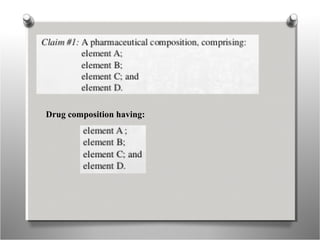
Drug composition having:
 To decide whether alleged infringer’s product or method
literally infringes a claim of the patent, you must compare that
product or method with the patent claim and determine whether
every requirement of the claim is included in that product or
method .
 If so, alleged infringer’s product or method literally infringes
that claim.
 If the patent claim uses the term “comprising,” that patent
claim is to be understood as an open claim. An open claim is
infringed as long as every requirement in the claim is present in
[alleged infringer]’s [product] [method]. The fact that [alleged
infringer]’s [product] [method] also includes other [parts]
[steps] will not avoid infringement, as long as it has every
requirement in the patent claim.
 If the patent claim uses the term “consisting of,” that patent
claim is to be understood as a closed claim. To infringe a closed
claim, [alleged infringer]’s [product] [method] must have every
requirement in the claim and no other [parts] [steps].
 If the patent claim uses the term “consisting essentially of,”
that patent claim is to be understood as a partially closed claim.
A partially closed claim is infringed as long as every requirement
in the claim is present in [alleged infringer]’s [product] [method].
The fact that [alleged infringer]’s [product] [method] also
includes other [parts] [steps] will not avoid infringement so
long as those [parts] [steps] do not materially affect the basic
and novel properties of the invention. If [accused infringer]’s
[product] [method] includes other [parts] [steps] that do change
those basic and novel properties, it does not infringe.
Equivalence infringement:
In short, the doctrine of equivalents states that if a party creates a
product that does the same thing in the same way as a patented
product, and produces the same result, the courts may find it to be
infringement. Even if the new product is more efficient than the
original patent, it is still an infringing offense.
Let's assume the patent owner has a patent for a desk lamp having seven
specific features, namely:
a desk lamp comprising:
1. a magnetic base;
2. a flexible goose neck mounted to the base;
3. a reflector mounted on the end of the goose neck;
4. an LED bulb mounted to the reflector;
5. a manual on and off turn switch for turning the LED bulb on or off;
6. a control circuit that turns on the LED bulb whenever any portion of
the lamp is touched, and
7. the control circuit keeping the LED bulb lit for 30 minutes before
automatically turning it off.
A first offending product which does have all the features listed would
be considered infringing. If the offending product has other features in addition to
features (1) through (7), such a dimmer switch, then it is still considered to
infringe the claim. Generally, claims are written with inclusive language so that
patent infringement is not avoided by the addition of non-listed features.
A second offending product - one which has all of the listed features
except for the LED bulb. Instead of an LED bulb, the offending product has an
incandescent bulb. But it would be considered to infringe the patent because while
the offending device does not have an LED bulb, it does have something which
works in substantially the same way to give substantially the same result. Both
LED bulbs and incandescent bulbs are "functional equivalents" because they
both work in substantially the same way to give substantially the same results.
They both turn electricity into light.
Indirect Infringement: Indirect infringement includes contributory
infringement and inducement to infringe a patent.
Contributory Infringement:
Contributive infringement occurs when a seller (third party)
provides a part/material assistance/component that, while not itself
infringing of any patent, has a particular use as part of some other
machine or composition that is covered by a patent.
For example: a patent claims a mobile phone having few
components interconnected like display, processor, speaker and other
parts and there is party A who is manufacturing the same mobile phone
as covered in patent, and a party B provides a particular part to be used
in manufacturing a mobile phone, then party B will be contributory
infringer to that patent.
Induced Infringement:
A person or company aids in patent infringement by
providing components or helping to make a patented product. It occurs
through offering instructions, preparing instructions, or licensing plans
or processes.
JUDICIAL PROCESS OF COURT:
1.Concerned parties, plaintiff and defendant are notified in advance
of judicial rights.
2.Before the trial begins the parties are required to exchange their
evidences. During trial the evidences are cross examined.
3.If the defendant is accused of infringing a patent then reversal of
burden of proof is implemented and he is responsible for providing
evidence for manufacturing process of such product.
4.Either plaintiff or defendant may appeal to appellate board
against decision of controller with in 3 months.
5.Plaintiff should bring suit to court with in 3 years from the date
of infringement.
How defendant protect themselves
from infringement?
Defenses in a patent infringement case can include:
Invalidating the patent
Claiming non-infringement
Statutory defense (Importing, Experiment, Government use)
Citing prior use, first sale or repair doctrines, inequitable
conduct, patent misuse, or limitation on rights
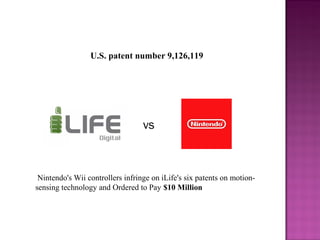
U.S. patent number 9,126,119
 Nintendo's Wii controllers infringe on iLife's six patents on motion-
sensing technology and Ordered to Pay $10 Million
vs
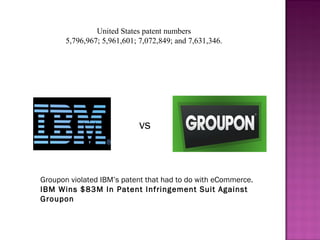
 United States patent numbers 
5,796,967; 5,961,601; 7,072,849; and 7,631,346.
vs
Groupon violated IBM’s patent that had to do with eCommerce.
IBM Wins $83M In Patent Infringement Suit Against
Groupon
THANK YOU

Patent infringement.

  • 2.
  • 3.
    Many businesses believe that receiving a patent offers complete protection  against infringement. However, when a patent is threatened, patent holders  must take more drastic measures to protect their interests. Patent litigation includes legal actions to  protect patents againstinfringement, and may result in monetary  damages or an injunction against the infringement. As claims in a patent define boundaries of the invention claimed, a product  or process patent will be infringing if it falls within the scope of  claim in  the patent.
  • 4.
    Types of PatentInfringement Direct Infringement: Making, using, selling, trying to sell, or importing  something without obtaining a license from the patent holder is  considered direct patent infringement. The offender must complete  this act willfully and within the country. But it has certain exceptions like scientific use, foreign  vessels or aircraft, compulsory licenses.
  • 5.
    Direct Infringement: Literal infringement: Existsif all elements of a claim are literally present in an alleged product or process. Determination of literal infringement is done by comparing elements of a claim to those of a product or process one on one.
  • 6.
  • 7.
     To decidewhether alleged infringer’s product or method literally infringes a claim of the patent, you must compare that product or method with the patent claim and determine whether every requirement of the claim is included in that product or method .  If so, alleged infringer’s product or method literally infringes that claim.  If the patent claim uses the term “comprising,” that patent claim is to be understood as an open claim. An open claim is infringed as long as every requirement in the claim is present in [alleged infringer]’s [product] [method]. The fact that [alleged infringer]’s [product] [method] also includes other [parts] [steps] will not avoid infringement, as long as it has every requirement in the patent claim.  If the patent claim uses the term “consisting of,” that patent claim is to be understood as a closed claim. To infringe a closed claim, [alleged infringer]’s [product] [method] must have every requirement in the claim and no other [parts] [steps].
  • 8.
     If thepatent claim uses the term “consisting essentially of,” that patent claim is to be understood as a partially closed claim. A partially closed claim is infringed as long as every requirement in the claim is present in [alleged infringer]’s [product] [method]. The fact that [alleged infringer]’s [product] [method] also includes other [parts] [steps] will not avoid infringement so long as those [parts] [steps] do not materially affect the basic and novel properties of the invention. If [accused infringer]’s [product] [method] includes other [parts] [steps] that do change those basic and novel properties, it does not infringe.
  • 9.
    Equivalence infringement: In short,the doctrine of equivalents states that if a party creates a product that does the same thing in the same way as a patented product, and produces the same result, the courts may find it to be infringement. Even if the new product is more efficient than the original patent, it is still an infringing offense.
  • 10.
    Let's assume thepatent owner has a patent for a desk lamp having seven specific features, namely: a desk lamp comprising: 1. a magnetic base; 2. a flexible goose neck mounted to the base; 3. a reflector mounted on the end of the goose neck; 4. an LED bulb mounted to the reflector; 5. a manual on and off turn switch for turning the LED bulb on or off; 6. a control circuit that turns on the LED bulb whenever any portion of the lamp is touched, and 7. the control circuit keeping the LED bulb lit for 30 minutes before automatically turning it off.
  • 11.
    A first offendingproduct which does have all the features listed would be considered infringing. If the offending product has other features in addition to features (1) through (7), such a dimmer switch, then it is still considered to infringe the claim. Generally, claims are written with inclusive language so that patent infringement is not avoided by the addition of non-listed features. A second offending product - one which has all of the listed features except for the LED bulb. Instead of an LED bulb, the offending product has an incandescent bulb. But it would be considered to infringe the patent because while the offending device does not have an LED bulb, it does have something which works in substantially the same way to give substantially the same result. Both LED bulbs and incandescent bulbs are "functional equivalents" because they both work in substantially the same way to give substantially the same results. They both turn electricity into light.
  • 12.
    Indirect Infringement: Indirectinfringement includes contributory infringement and inducement to infringe a patent. Contributory Infringement: Contributive infringement occurs when a seller (third party) provides a part/material assistance/component that, while not itself infringing of any patent, has a particular use as part of some other machine or composition that is covered by a patent. For example: a patent claims a mobile phone having few components interconnected like display, processor, speaker and other parts and there is party A who is manufacturing the same mobile phone as covered in patent, and a party B provides a particular part to be used in manufacturing a mobile phone, then party B will be contributory infringer to that patent. Induced Infringement: A person or company aids in patent infringement by providing components or helping to make a patented product. It occurs through offering instructions, preparing instructions, or licensing plans or processes.
  • 13.
    JUDICIAL PROCESS OFCOURT: 1.Concerned parties, plaintiff and defendant are notified in advance of judicial rights. 2.Before the trial begins the parties are required to exchange their evidences. During trial the evidences are cross examined. 3.If the defendant is accused of infringing a patent then reversal of burden of proof is implemented and he is responsible for providing evidence for manufacturing process of such product. 4.Either plaintiff or defendant may appeal to appellate board against decision of controller with in 3 months. 5.Plaintiff should bring suit to court with in 3 years from the date of infringement.
  • 14.
    How defendant protectthemselves from infringement?
  • 15.
    Defenses in apatent infringement case can include: Invalidating the patent Claiming non-infringement Statutory defense (Importing, Experiment, Government use) Citing prior use, first sale or repair doctrines, inequitable conduct, patent misuse, or limitation on rights
  • 16.
    U.S. patent number9,126,119  Nintendo's Wii controllers infringe on iLife's six patents on motion- sensing technology and Ordered to Pay $10 Million vs
  • 17.
     United States patent numbers  5,796,967; 5,961,601; 7,072,849; and 7,631,346. vs Groupon violated IBM’spatent that had to do with eCommerce. IBM Wins $83M In Patent Infringement Suit Against Groupon
  • 18.