ENROLMENT NO:14ee028
A.MOHAMED SAMEER
EEE
Ramco Institute of Tech
Contents….
1. Computer processor
2. Components of a processor.
3. History of processor.
4. Micro processor.
5. Concept of Generation.
6. Intel i3 i5 i7 processor
Introduction to Computer Processor
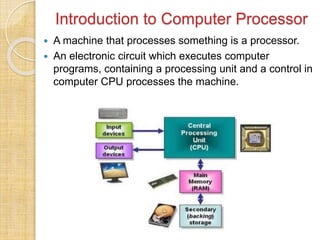
 A machine that processes something is a processor.
 An electronic circuit which executes computer
programs, containing a processing unit and a control in
computer CPU processes the machine.
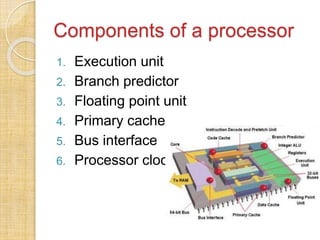
Components of a processor
1. Execution unit
2. Branch predictor
3. Floating point unit
4. Primary cache
5. Bus interface
6. Processor clock
Machine cycle for a
processor
Step 1: Fetching
Step 2: Decoding
Step 3: Executing
Step 4: Storing
History of processor
 1960 cpu by ibm
 CPU allowed computer to cross over from the industry to
home.
 Today, engineers are making them even smaller and more
powerful.
Microprocessor
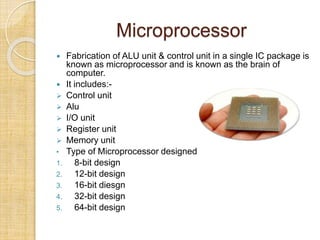
 Fabrication of ALU unit & control unit in a single IC package is
known as microprocessor and is known as the brain of
computer.
 It includes:-
 Control unit
 Alu
 I/O unit
 Register unit
 Memory unit
• Type of Microprocessor designed
1. 8-bit design
2. 12-bit design
3. 16-bit diesgn
4. 32-bit design
5. 64-bit design
4th Generation Intel Core
Processor
 4th Generation Intel Core processor, more
advanced, faster and new line of low-power
processor, have arrived in 2013, aims to set
a new standard for mobile computing
experience and innovative Ultrabook, and
tablets designs
Intel i3 processor.
 The Core i3 is a 3.2 GHz dual core chip,
and it's quite a big improvement over the
Core2Duo. It's a good 700 MHz faster,
much faster bus with significantly faster
RAM.
 The first Core i3 processors were launched
on January 7, 2010.
Intel i5 processor.
 I5 provides the opportunity to the
users to use the system with multi
tasking.
 A big feature of the I5 processors is
that they have ability to run two
multitasking processors together that
are generally called as dual
processors .
 It can increase the working
performance of the system efficiently.
Features of i5 processor.
 I5 processors have ability to work with
integrated memory and can enhance the
performance of the applications. The increase
the memory up to 1333 MHz
 as I5 processors have high speed performing
rate so they are able to perform at the
maximum CPU rate of 3.6 GHz
 Micro architecture for the I5 processors was
presented by the Nehalem and these
processors have a cache rate up to 8 MB.
Intel i7 processor.
 Intel developed different types
processors for the users for the faster
working as compared to the previous
versions.
 I7 processor that is comparatively faster
than the old ones. I7 processors were
designed to meet the challenges of the
intelligent and the faster working
performance of the computer system.
 They were designed in 2008 and were
announced in 2009 just after the I5
processors.
Feature of i7 processor.
 With the help of I7 processors users can
enjoy the high speed working with the
additional feature of the multitasking i.e.
using two different documents or the files at
the same time.
 Dual core technology is also a part of I7
processors that provide reliable and high data
rate working performance to the customers.
 I7 processors are so advanced to deals with
the integrated memory of e system and have
ability to increase the memory up to 1066
Mbits and provide
 The working speed of 25.6 GB/sec.
Comparision
ThAnK yOu

Intel

  • 1.
  • 2.
    Contents…. 1. Computer processor 2.Components of a processor. 3. History of processor. 4. Micro processor. 5. Concept of Generation. 6. Intel i3 i5 i7 processor
  • 3.
    Introduction to ComputerProcessor  A machine that processes something is a processor.  An electronic circuit which executes computer programs, containing a processing unit and a control in computer CPU processes the machine.
  • 5.
    Components of aprocessor 1. Execution unit 2. Branch predictor 3. Floating point unit 4. Primary cache 5. Bus interface 6. Processor clock
  • 6.
    Machine cycle fora processor Step 1: Fetching Step 2: Decoding Step 3: Executing Step 4: Storing
  • 7.
    History of processor 1960 cpu by ibm  CPU allowed computer to cross over from the industry to home.  Today, engineers are making them even smaller and more powerful.
  • 8.
    Microprocessor  Fabrication ofALU unit & control unit in a single IC package is known as microprocessor and is known as the brain of computer.  It includes:-  Control unit  Alu  I/O unit  Register unit  Memory unit • Type of Microprocessor designed 1. 8-bit design 2. 12-bit design 3. 16-bit diesgn 4. 32-bit design 5. 64-bit design
  • 9.
    4th Generation IntelCore Processor  4th Generation Intel Core processor, more advanced, faster and new line of low-power processor, have arrived in 2013, aims to set a new standard for mobile computing experience and innovative Ultrabook, and tablets designs
  • 10.
    Intel i3 processor. The Core i3 is a 3.2 GHz dual core chip, and it's quite a big improvement over the Core2Duo. It's a good 700 MHz faster, much faster bus with significantly faster RAM.  The first Core i3 processors were launched on January 7, 2010.
  • 11.
    Intel i5 processor. I5 provides the opportunity to the users to use the system with multi tasking.  A big feature of the I5 processors is that they have ability to run two multitasking processors together that are generally called as dual processors .  It can increase the working performance of the system efficiently.
  • 12.
    Features of i5processor.  I5 processors have ability to work with integrated memory and can enhance the performance of the applications. The increase the memory up to 1333 MHz  as I5 processors have high speed performing rate so they are able to perform at the maximum CPU rate of 3.6 GHz  Micro architecture for the I5 processors was presented by the Nehalem and these processors have a cache rate up to 8 MB.
  • 13.
    Intel i7 processor. Intel developed different types processors for the users for the faster working as compared to the previous versions.  I7 processor that is comparatively faster than the old ones. I7 processors were designed to meet the challenges of the intelligent and the faster working performance of the computer system.  They were designed in 2008 and were announced in 2009 just after the I5 processors.
  • 14.
    Feature of i7processor.  With the help of I7 processors users can enjoy the high speed working with the additional feature of the multitasking i.e. using two different documents or the files at the same time.  Dual core technology is also a part of I7 processors that provide reliable and high data rate working performance to the customers.  I7 processors are so advanced to deals with the integrated memory of e system and have ability to increase the memory up to 1066 Mbits and provide  The working speed of 25.6 GB/sec.
  • 15.
  • 16.