Integration of Virtual Labs into Science
e-learning.
DongFeng Liu, Priscila Valdiviezo, Guido Riofrío, Rodrigo Barba
November 19, 2015
VARE - 2015
Agenda
•Problems
•Abstract
•Introduction
•Methodology
•Assembly module
•Gauge module
•Simulation module
•Network module
•Implemetation and discussion
•Conclusion
Problems
• Theoretical subjects with experimental scenarios.
• Ignorance of pedagogical tools to support the learning
process.
Abstract
• This study focuses on the virtual assembly of instruments, the
realization of dynamic 3D gauges, and the setup of emulation-
based systems.
• Design and implement 3D Virtual Labs, which are considered as a low-
cost alternative to educators and students in science e-learning.
• This research involves designing deploying and complex application
that combines advanced visualization; interactive management through
complex virtual devices and intelligent components.
Introduction
• Virtual laboratories as a low-cost alternative solution comparing to
real labs.
They are gaining more and more attention in e-learning.
• In our former studies, we developed a virtual 3D game environment
for the intelligent tutoring of algebra and physics problems.
Therefore, we consider integrating a virtual laboratory into GISTS
(”3D Game Based Intelligent Science Tutoring System”).
• A virtual laboratory for e-learning should have the functionalities to
simulate the assembly and disassembly processes of instruments.
• In this research we present our findings on the construction of a
virtual laboratory called GISTS.
Methodology
• The development of interactive tools that allow the student to solve
problems through experimentation using objects, tools, and 3D
environments.
• Using a game and simulation engine appropriate for a wide variety
of simulation and entertainment applications. (www.delta3d.org)
• Assembly Sequence Planning
The assembly sequence determines the current parts that can be
operated on. In the assembly process, there may be more
than one current part. When a part is chosen, an interactive process
is carried out to determine whether it is the current part.
• Assembly Path Planning
The
assembly path is the motion trajectory of parts in virtual assembl
y environment, with the purpose of a faster and more
effective assembly.
In virtual 3D environment, the
assembly path means the series points or curve from starting in
PAM (Position Attitude Matrix) and end PAM.
Assembly Modeling
Gauge Modeling
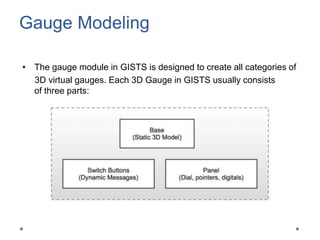
• The gauge module in GISTS is designed to create all categories of
3D virtual gauges. Each 3D Gauge in GISTS usually consists
of three parts:
Simulation module
• The difference with VA (virtual assembly) in the engineering field,
where the purpose is to train and improve the assembly skills. The
VA used in the e-learning is to help students in understanding the
basic structure and the architecture of an experimental instrument.
Finally, it will help students operate these instruments to simulate
the scientific process. The simulation module in GISTS is
responsible for simulating the setup created by a learner.
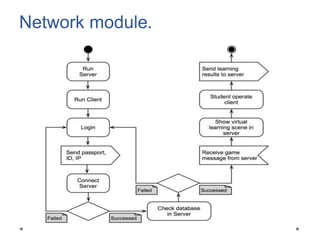
Network module.
Implementation and discussion
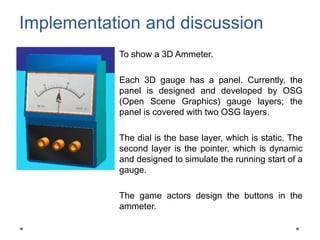
To show a 3D Ammeter.
Each 3D gauge has a panel. Currently, the
panel is designed and developed by OSG
(Open Scene Graphics) gauge layers; the
panel is covered with two OSG layers.
The dial is the base layer, which is static. The
second layer is the pointer, which is dynamic
and designed to simulate the running start of a
gauge.
The game actors design the buttons in the
ammeter.
Implementation and discussion
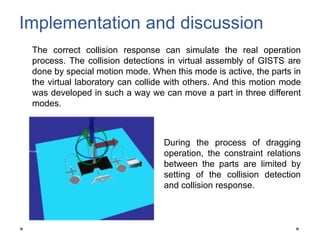
The correct collision response can simulate the real operation
process. The collision detections in virtual assembly of GISTS are
done by special motion mode. When this mode is active, the parts in
the virtual laboratory can collide with others. And this motion mode
was developed in such a way we can move a part in three different
modes.
During the process of dragging
operation, the constraint relations
between the parts are limited by
setting of the collision detection
and collision response.
Implementation and discussion
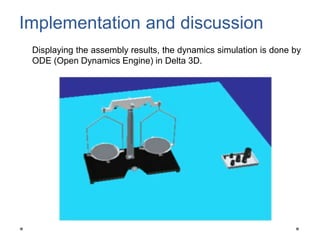
Displaying the assembly results, the dynamics simulation is done by
ODE (Open Dynamics Engine) in Delta 3D.
Conclusion
• This study is presented to improve the virtual laboratories in
order to construct high-level virtual laboratories for middle-school
from two points:
a) Integrating the industry using assembly technology into the
virtual laboratory experiments.
b) Introducing 3D gauges into the virtual laboratories.
• Its experimental assignments will not only help students to better
understand scientific processes and rules, but also teach them
how to apply the acquired knowledge to practice.
Conclusion
• The future work lies on three aspects:
a) Systematically implement various experimental learning
contents.
a) Improving the network module to develop a virtual campus
based on virtual laboratory systems.
a) Integration with a LMS (Learning Management System.)
Questions ?
Contact
Rodrigo Barba Guamán
lrbarba@utpl.edu.ec
@lrbarba

Integration of Virtual Labs into science  e-learning.

  • 1.
    Integration of VirtualLabs into Science e-learning. DongFeng Liu, Priscila Valdiviezo, Guido Riofrío, Rodrigo Barba November 19, 2015 VARE - 2015
  • 2.
  • 3.
    Problems • Theoretical subjectswith experimental scenarios. • Ignorance of pedagogical tools to support the learning process.
  • 4.
    Abstract • This studyfocuses on the virtual assembly of instruments, the realization of dynamic 3D gauges, and the setup of emulation- based systems. • Design and implement 3D Virtual Labs, which are considered as a low- cost alternative to educators and students in science e-learning. • This research involves designing deploying and complex application that combines advanced visualization; interactive management through complex virtual devices and intelligent components.
  • 5.
    Introduction • Virtual laboratoriesas a low-cost alternative solution comparing to real labs. They are gaining more and more attention in e-learning. • In our former studies, we developed a virtual 3D game environment for the intelligent tutoring of algebra and physics problems. Therefore, we consider integrating a virtual laboratory into GISTS (”3D Game Based Intelligent Science Tutoring System”). • A virtual laboratory for e-learning should have the functionalities to simulate the assembly and disassembly processes of instruments. • In this research we present our findings on the construction of a virtual laboratory called GISTS.
  • 6.
    Methodology • The developmentof interactive tools that allow the student to solve problems through experimentation using objects, tools, and 3D environments. • Using a game and simulation engine appropriate for a wide variety of simulation and entertainment applications. (www.delta3d.org)
  • 7.
    • Assembly SequencePlanning The assembly sequence determines the current parts that can be operated on. In the assembly process, there may be more than one current part. When a part is chosen, an interactive process is carried out to determine whether it is the current part. • Assembly Path Planning The assembly path is the motion trajectory of parts in virtual assembl y environment, with the purpose of a faster and more effective assembly. In virtual 3D environment, the assembly path means the series points or curve from starting in PAM (Position Attitude Matrix) and end PAM. Assembly Modeling
  • 8.
    Gauge Modeling • Thegauge module in GISTS is designed to create all categories of 3D virtual gauges. Each 3D Gauge in GISTS usually consists of three parts:
  • 9.
    Simulation module • Thedifference with VA (virtual assembly) in the engineering field, where the purpose is to train and improve the assembly skills. The VA used in the e-learning is to help students in understanding the basic structure and the architecture of an experimental instrument. Finally, it will help students operate these instruments to simulate the scientific process. The simulation module in GISTS is responsible for simulating the setup created by a learner.
  • 10.
  • 11.
    Implementation and discussion Toshow a 3D Ammeter. Each 3D gauge has a panel. Currently, the panel is designed and developed by OSG (Open Scene Graphics) gauge layers; the panel is covered with two OSG layers. The dial is the base layer, which is static. The second layer is the pointer, which is dynamic and designed to simulate the running start of a gauge. The game actors design the buttons in the ammeter.
  • 12.
    Implementation and discussion Thecorrect collision response can simulate the real operation process. The collision detections in virtual assembly of GISTS are done by special motion mode. When this mode is active, the parts in the virtual laboratory can collide with others. And this motion mode was developed in such a way we can move a part in three different modes. During the process of dragging operation, the constraint relations between the parts are limited by setting of the collision detection and collision response.
  • 13.
    Implementation and discussion Displayingthe assembly results, the dynamics simulation is done by ODE (Open Dynamics Engine) in Delta 3D.
  • 14.
    Conclusion • This studyis presented to improve the virtual laboratories in order to construct high-level virtual laboratories for middle-school from two points: a) Integrating the industry using assembly technology into the virtual laboratory experiments. b) Introducing 3D gauges into the virtual laboratories. • Its experimental assignments will not only help students to better understand scientific processes and rules, but also teach them how to apply the acquired knowledge to practice.
  • 15.
    Conclusion • The futurework lies on three aspects: a) Systematically implement various experimental learning contents. a) Improving the network module to develop a virtual campus based on virtual laboratory systems. a) Integration with a LMS (Learning Management System.)
  • 16.
  • 17.