Integration of mega projects into the existing road
network – the critical role of traffic modelling
Craig McGeoch
Principal Manager, Road Network Analysis
• Major projects and the ‘Wave’
• Integrating projects into the existing network
– the role of Roads and Maritime
– measuring integration / network performance
• The role of traffic modelling
– some key issues
• Case studies
– M4 Widening Road Network Performance Mitigation Plan (RNPMP)
– CBD and South East Light Rail (CSELR)
2
This presentation
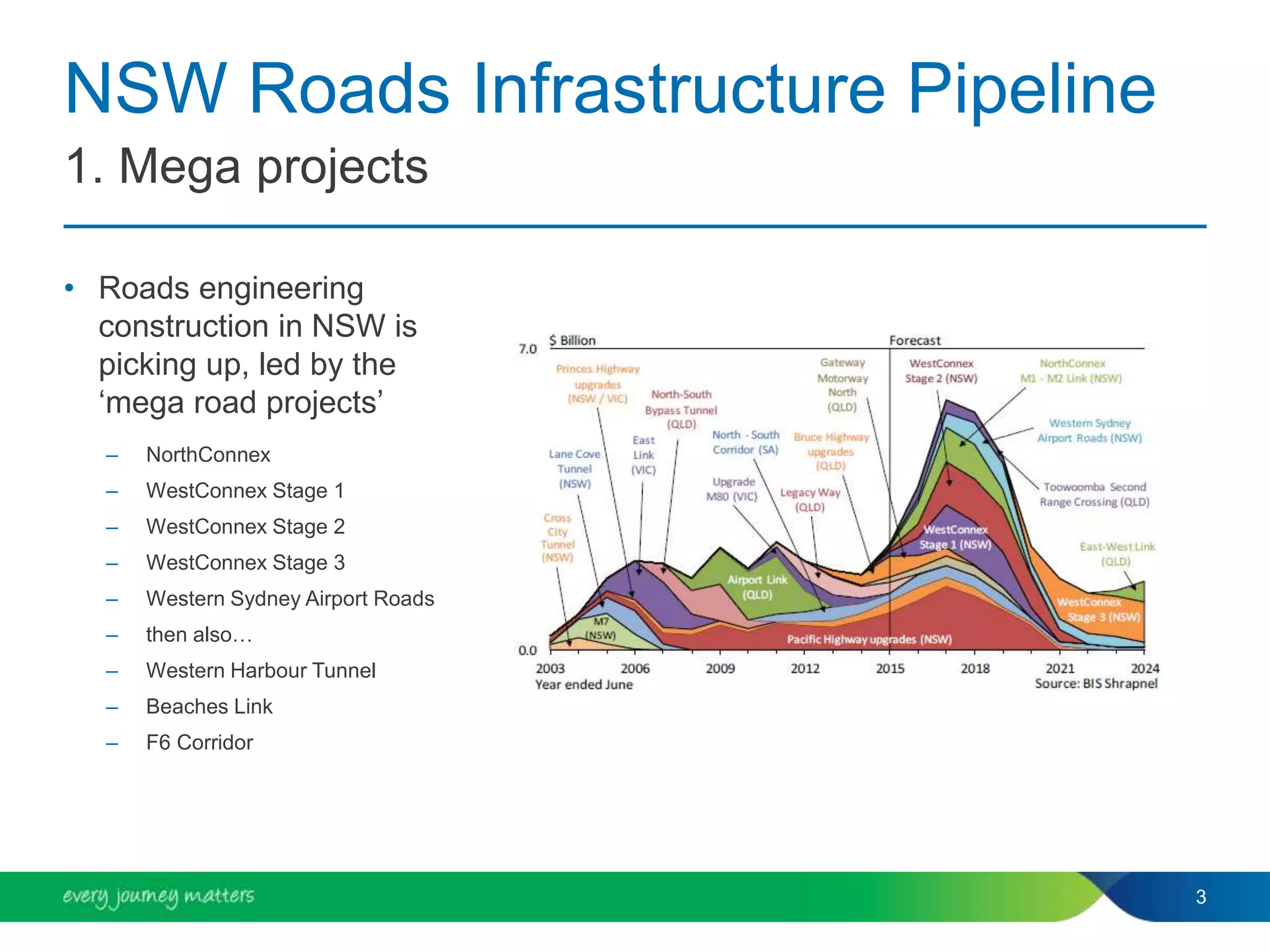
NSW Roads Infrastructure Pipeline
3
1. Mega projects
• Roads engineering
construction in NSW is
picking up, led by the
‘mega road projects’
– NorthConnex
– WestConnex Stage 1
– WestConnex Stage 2
– WestConnex Stage 3
– Western Sydney Airport Roads
– then also…
– Western Harbour Tunnel
– Beaches Link
– F6 Corridor
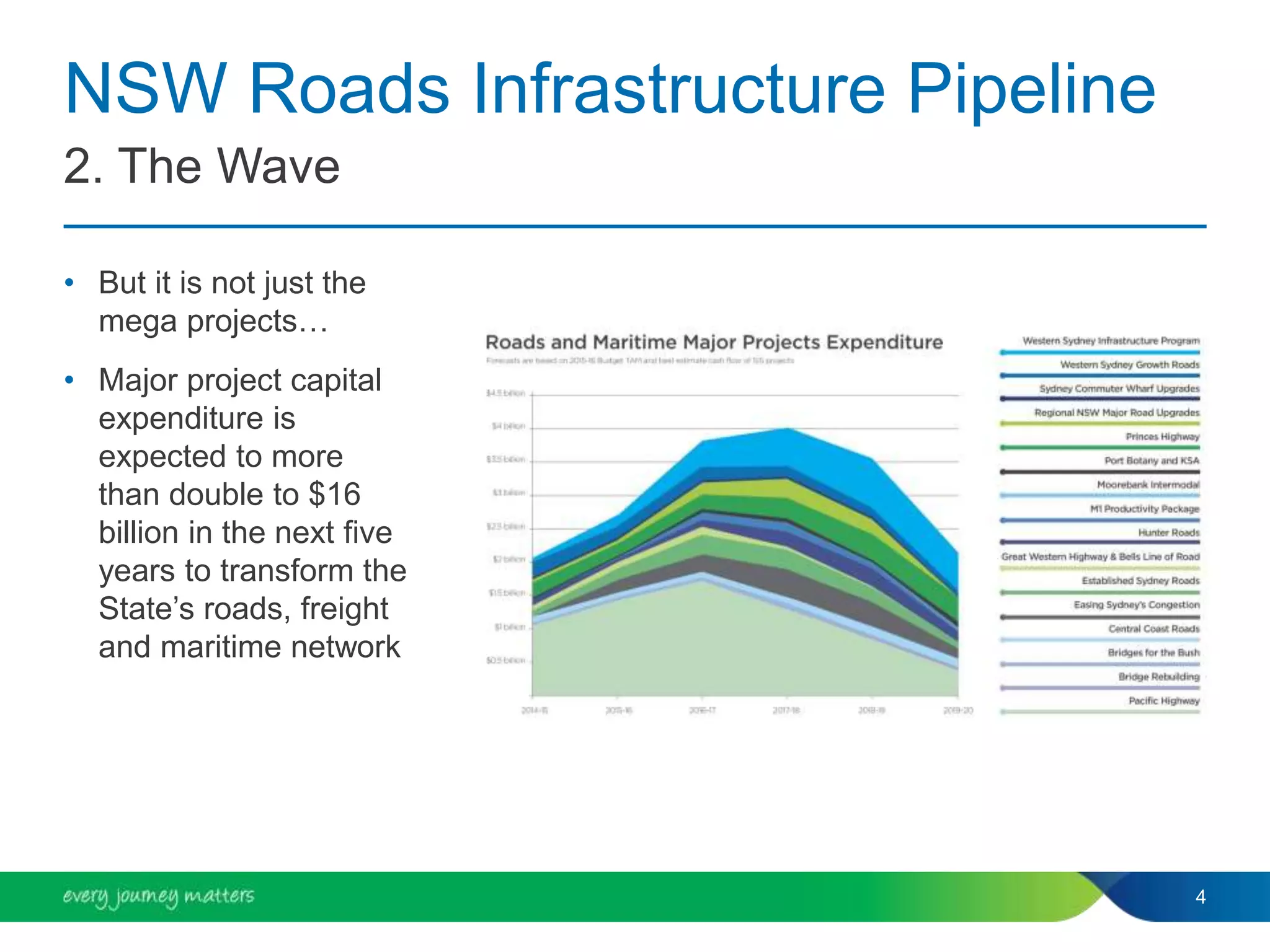
NSW Roads Infrastructure Pipeline
4
2. The Wave
• But it is not just the
mega projects…
• Major project capital
expenditure is
expected to more
than double to $16
billion in the next five
years to transform the
State’s roads, freight
and maritime network
Roads and Maritime Services
1. To build, manage and maintain the
state road and waterway network and
assets.
2. To maximise the customer benefits and
service potential of our networks.
3. To integrate our networks with
private motorways, local roads and
the broader transport system.
4. To use our networks to facilitate
economic and social development and
growth in NSW.
5
Roles
The Role of Traffic Modelling
• Traffic modelling is increasingly being used to justify and prioritise
investment in transport infrastructure:
– business cases
– capacity design / project scope
– environmental evaluations
– economic evaluations (road user benefits)
– financial evaluations
– construction impacts
– etc.
• Projects of all scales:
– pinch point programme
– mega projects e.g. WestConnex
• Guidance: Roads and Maritime Services
Traffic Modelling Guidelines
6
How is ‘Integration’ Measured
• Major projects may introduce new impacts:
– a light rail line through an existing intersection(s)
– a motorway connection to an existing arterial road
• What are the desired (‘target’) criteria for network performance
– Level of Service (and what Level of Service: C?, D?)
– already congested locations?
• What is the area of project influence?
- - - - - - - - -
• Traffic modelling is essential to assess forecast network performance
• Challenges – future year operational models in congested areas
7
Case Study – M4 Widening
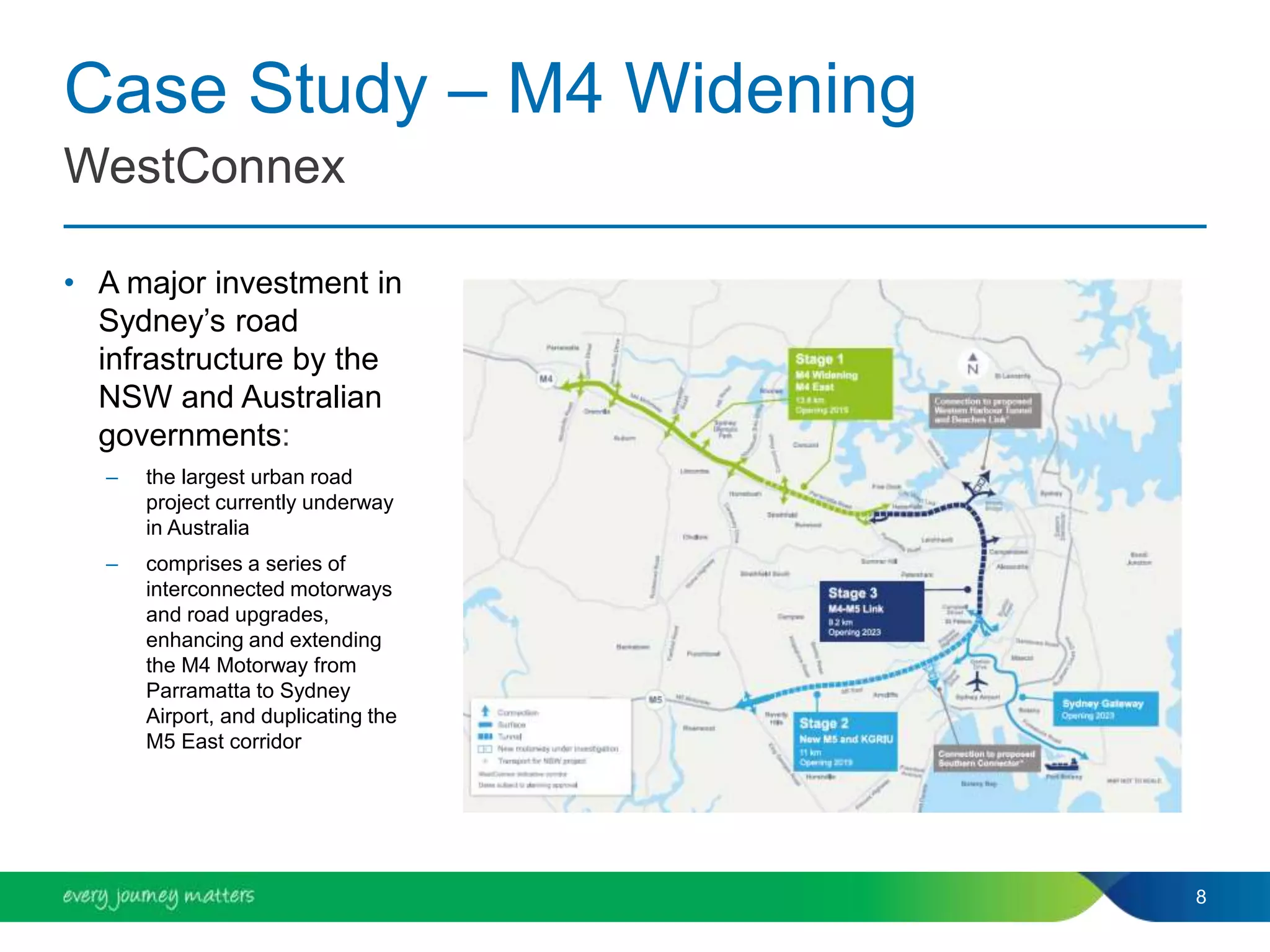
• A major investment in
Sydney’s road
infrastructure by the
NSW and Australian
governments:
– the largest urban road
project currently underway
in Australia
– comprises a series of
interconnected motorways
and road upgrades,
enhancing and extending
the M4 Motorway from
Parramatta to Sydney
Airport, and duplicating the
M5 East corridor
8
WestConnex
M4 Widening
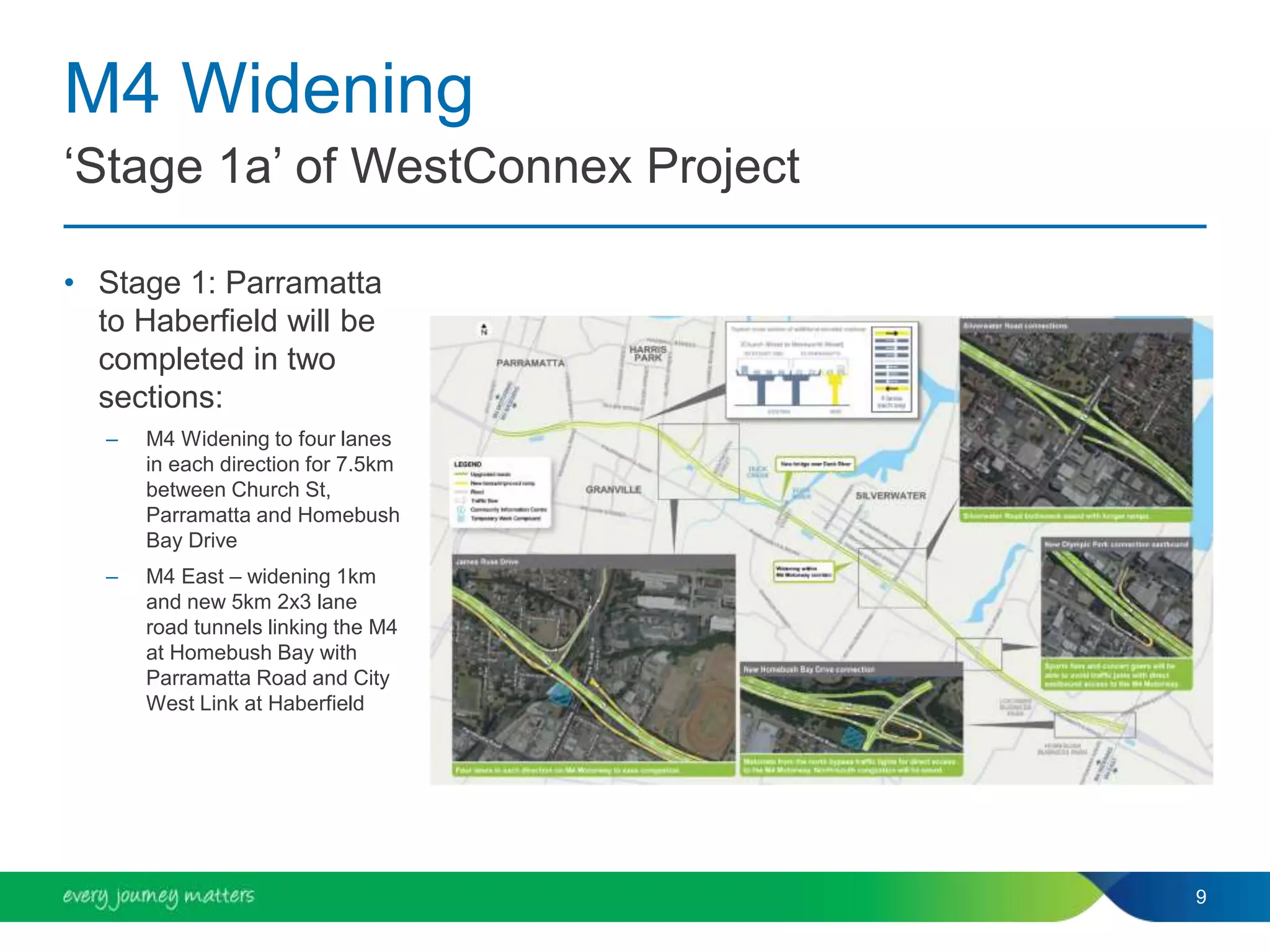
• Stage 1: Parramatta
to Haberfield will be
completed in two
sections:
– M4 Widening to four lanes
in each direction for 7.5km
between Church St,
Parramatta and Homebush
Bay Drive
– M4 East – widening 1km
and new 5km 2x3 lane
road tunnels linking the M4
at Homebush Bay with
Parramatta Road and City
West Link at Haberfield
9
‘Stage 1a’ of WestConnex Project
M4 Widening
• Director General’s requirements for EIS:
– Induced traffic!
• State significant infrastructure (SSI) Instrument of approval:
– Condition B15: Within 12 months of approval*, the Proponent shall develop a Road
Network Performance Mitigation Plan
• updated consideration of potential mitigation measures to manage any predicted traffic
performance deficiencies
• justify why the predicted ‘do minimum’ performance of any intersection of the adjoining road
network cannot be maintained (if necessary)
– The purpose of the plan is to manage the performance impacts of the SSI on the
adjoining road network by identifying or confirming mitigation improvements that
could be required in areas where traffic performance may be unsatisfactory at time
of completion of construction
* i.e. prior to opening of the project
10
Planning Requirements
M4 Widening
• Instrument of approval:
– Condition E6: At 12 months and 5 years after the commencement of operation the
Proponent shall prepare an Operational Traffic Performance Review
• assess traffic and road network performance and the mitigation measures identified in the
RNPMP
11
Ongoing Requirements
Developing the M4W RNPMP
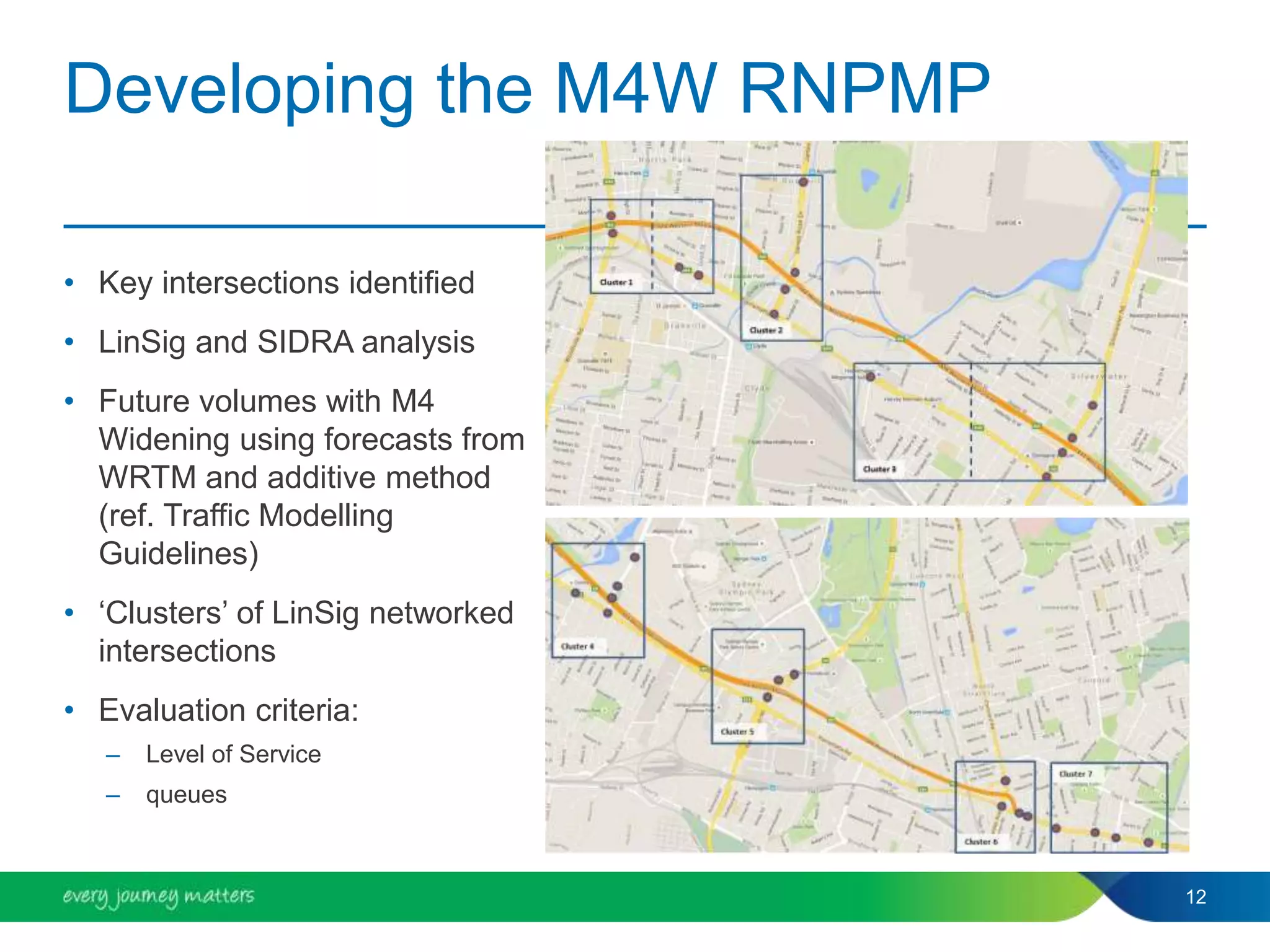
• Key intersections identified
• LinSig and SIDRA analysis
• Future volumes with M4
Widening using forecasts from
WRTM and additive method
(ref. Traffic Modelling
Guidelines)
• ‘Clusters’ of LinSig networked
intersections
• Evaluation criteria:
– Level of Service
– queues
12
M4W RNPMP – Outcomes
• Pre-opening mitigation measures developed with the aim of maximising the
operational efficiency of the existing road network when the M4 Widening is
open to traffic
• Post opening measures will be the subject of detailed assessments
underpinned by traffic volumes recorded once the M4 Widening is open to
traffic and operating under stable conditions
13
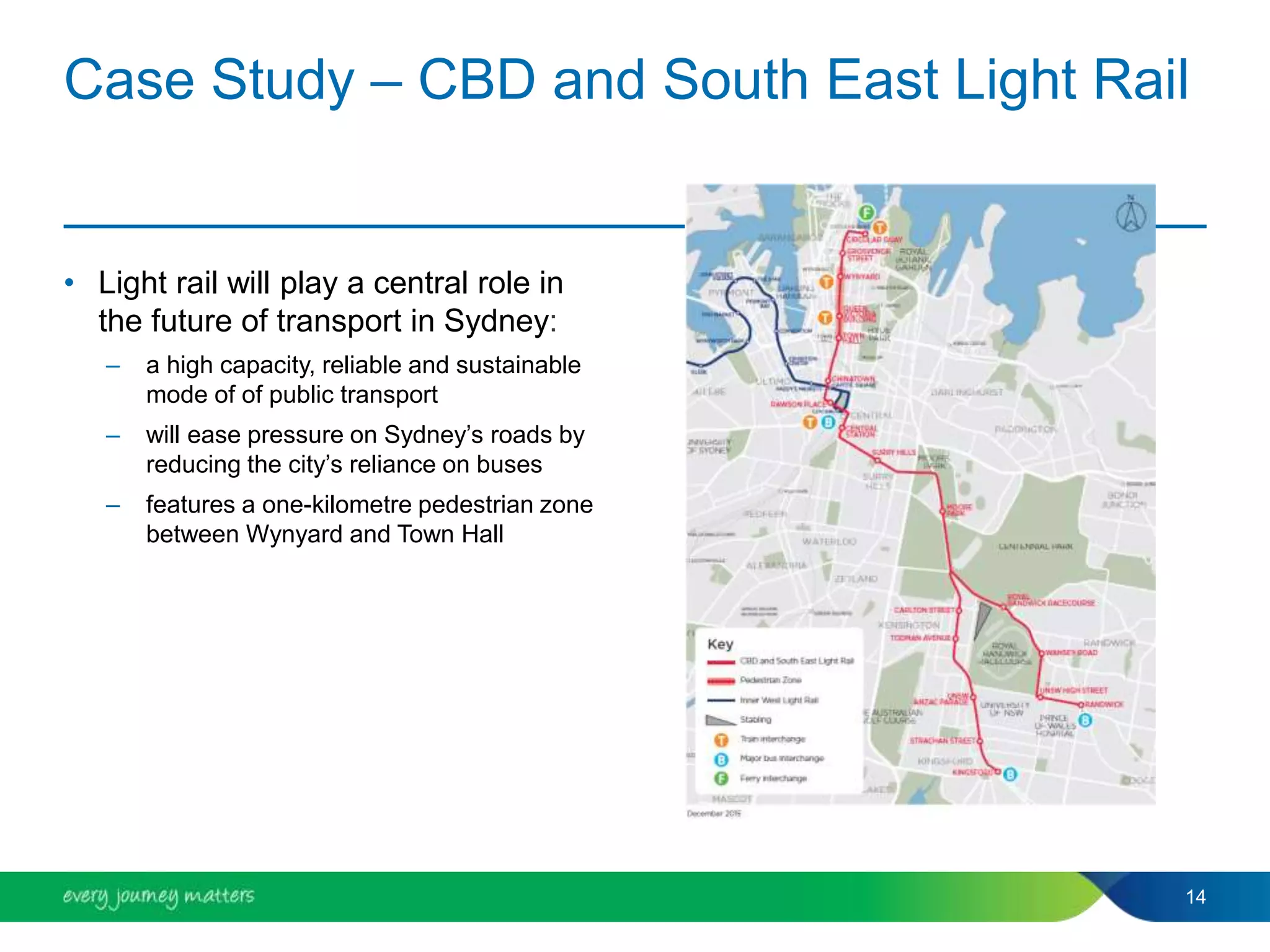
Case Study – CBD and South East Light Rail
• Light rail will play a central role in
the future of transport in Sydney:
– a high capacity, reliable and sustainable
mode of of public transport
– will ease pressure on Sydney’s roads by
reducing the city’s reliance on buses
– features a one-kilometre pedestrian zone
between Wynyard and Town Hall
14
CBD and South East Light Rail
• Instrument of approval:
– Condition C16: Within 12 months of the completion of construction, the Proponent
shall commission an Independent Environmental Audit of the SSI
• assess the operational performance of the SSI against the aims and objectives for the project
• assess the environmental performance of the SSI against the predictions made and
conclusions drawn in project planning documents
15
Planning Requirements
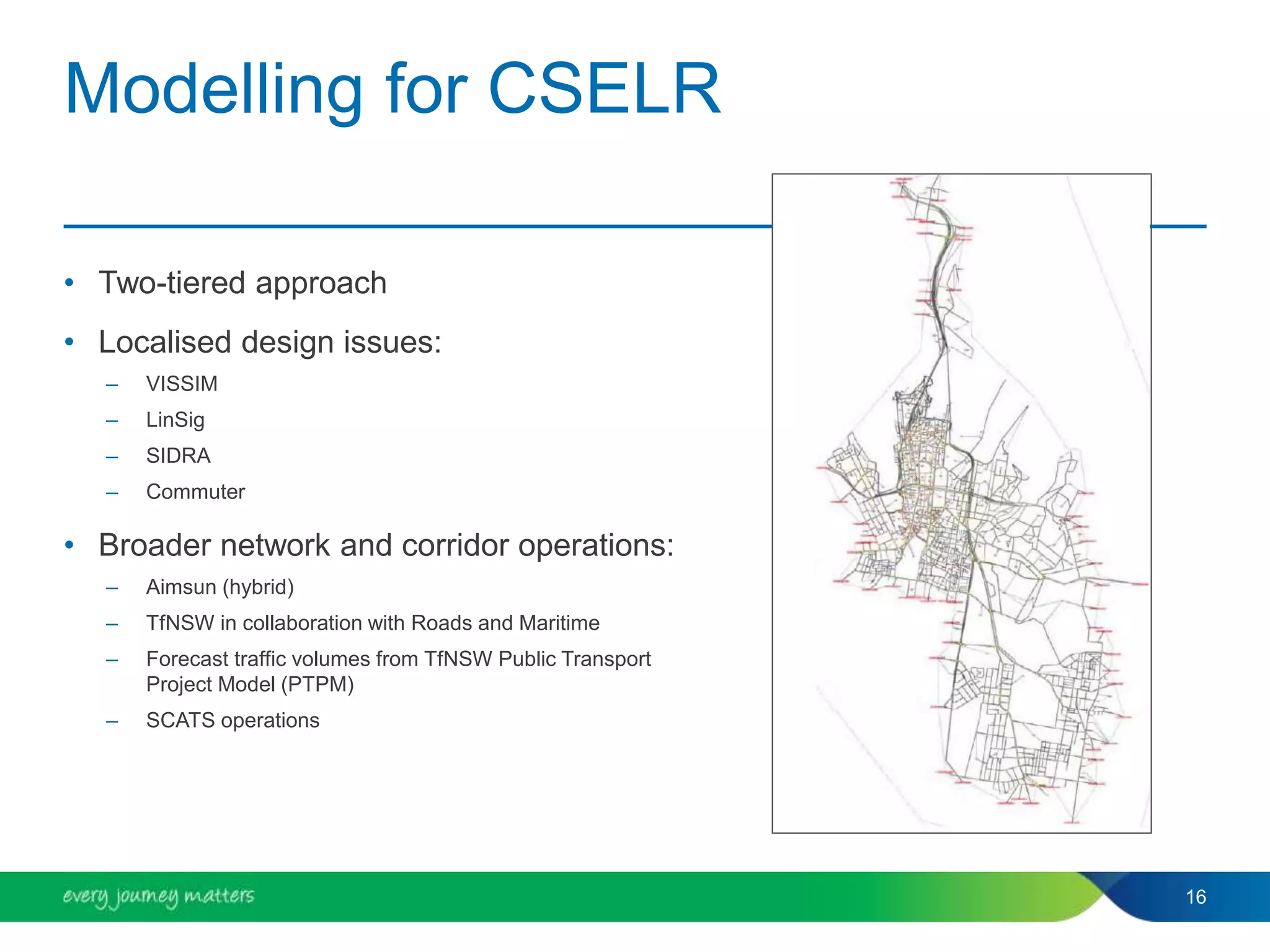
Modelling for CSELR
• Two-tiered approach
• Localised design issues:
– VISSIM
– LinSig
– SIDRA
– Commuter
• Broader network and corridor operations:
– Aimsun (hybrid)
– TfNSW in collaboration with Roads and Maritime
– Forecast traffic volumes from TfNSW Public Transport
Project Model (PTPM)
– SCATS operations
16
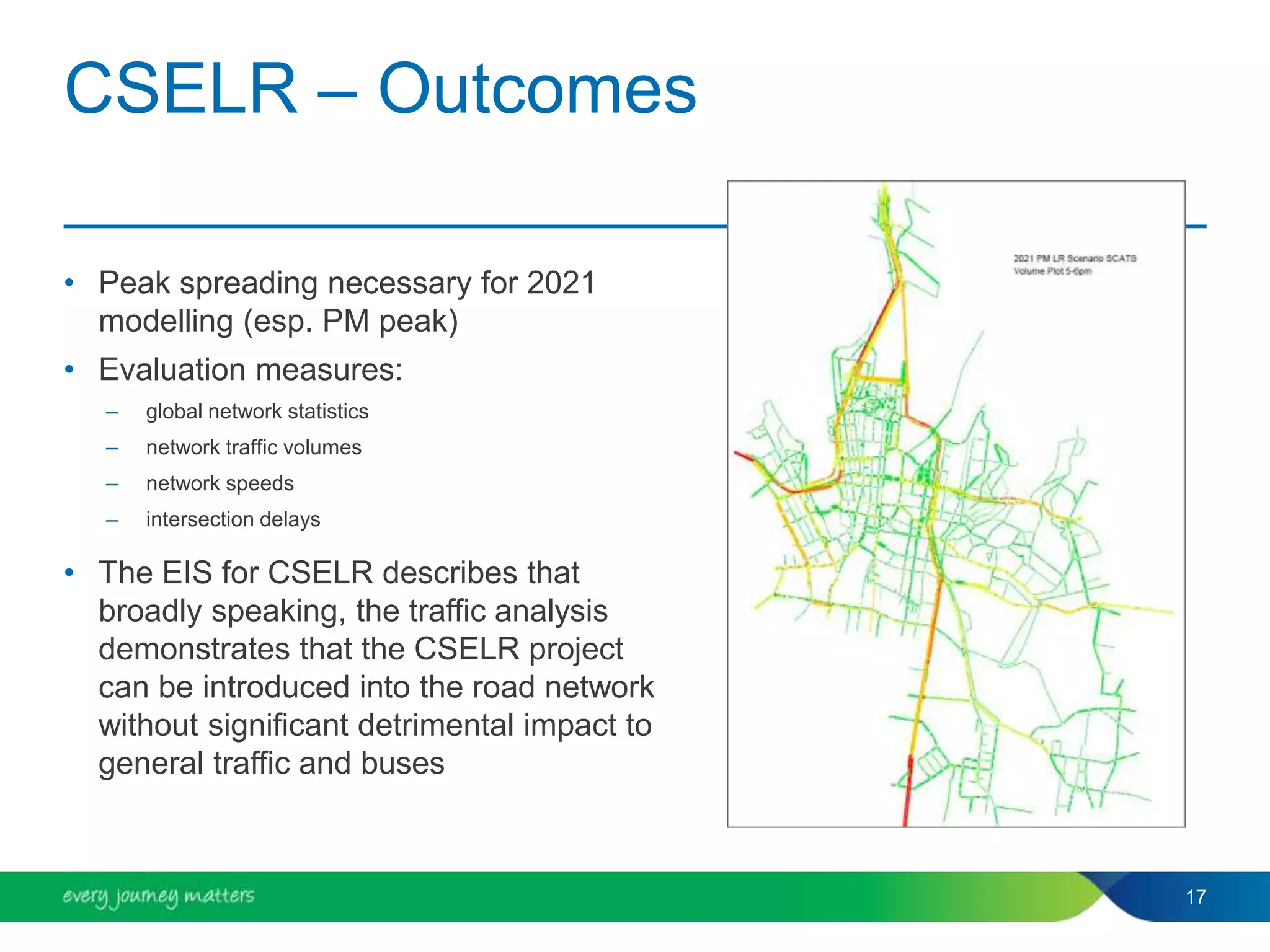
CSELR – Outcomes
• Peak spreading necessary for 2021
modelling (esp. PM peak)
• Evaluation measures:
– global network statistics
– network traffic volumes
– network speeds
– intersection delays
• The EIS for CSELR describes that
broadly speaking, the traffic analysis
demonstrates that the CSELR project
can be introduced into the road network
without significant detrimental impact to
general traffic and buses
17
Conclusion
• Roads and Maritime Services has an ambitious task ahead to deliver the
single largest series of infrastructure investments in the State’s history
• Planning for these mega projects must include assessment of how the projects
will integrate with the existing road network
• Traffic modelling is essential to this task
• The M4 Widening RNPMP and CSELR provide examples of the application of
traffic modelling to integrate major projects into the existing road network
18
Questions
19
Thank You

Integration of mega projects into the existing network – the critical role of traffic modelling

  • 1.
    Integration of megaprojects into the existing road network – the critical role of traffic modelling Craig McGeoch Principal Manager, Road Network Analysis
  • 2.
    • Major projectsand the ‘Wave’ • Integrating projects into the existing network – the role of Roads and Maritime – measuring integration / network performance • The role of traffic modelling – some key issues • Case studies – M4 Widening Road Network Performance Mitigation Plan (RNPMP) – CBD and South East Light Rail (CSELR) 2 This presentation
  • 3.
    NSW Roads InfrastructurePipeline 3 1. Mega projects • Roads engineering construction in NSW is picking up, led by the ‘mega road projects’ – NorthConnex – WestConnex Stage 1 – WestConnex Stage 2 – WestConnex Stage 3 – Western Sydney Airport Roads – then also… – Western Harbour Tunnel – Beaches Link – F6 Corridor
  • 4.
    NSW Roads InfrastructurePipeline 4 2. The Wave • But it is not just the mega projects… • Major project capital expenditure is expected to more than double to $16 billion in the next five years to transform the State’s roads, freight and maritime network
  • 5.
    Roads and MaritimeServices 1. To build, manage and maintain the state road and waterway network and assets. 2. To maximise the customer benefits and service potential of our networks. 3. To integrate our networks with private motorways, local roads and the broader transport system. 4. To use our networks to facilitate economic and social development and growth in NSW. 5 Roles
  • 6.
    The Role ofTraffic Modelling • Traffic modelling is increasingly being used to justify and prioritise investment in transport infrastructure: – business cases – capacity design / project scope – environmental evaluations – economic evaluations (road user benefits) – financial evaluations – construction impacts – etc. • Projects of all scales: – pinch point programme – mega projects e.g. WestConnex • Guidance: Roads and Maritime Services Traffic Modelling Guidelines 6
  • 7.
    How is ‘Integration’Measured • Major projects may introduce new impacts: – a light rail line through an existing intersection(s) – a motorway connection to an existing arterial road • What are the desired (‘target’) criteria for network performance – Level of Service (and what Level of Service: C?, D?) – already congested locations? • What is the area of project influence? - - - - - - - - - • Traffic modelling is essential to assess forecast network performance • Challenges – future year operational models in congested areas 7
  • 8.
    Case Study –M4 Widening • A major investment in Sydney’s road infrastructure by the NSW and Australian governments: – the largest urban road project currently underway in Australia – comprises a series of interconnected motorways and road upgrades, enhancing and extending the M4 Motorway from Parramatta to Sydney Airport, and duplicating the M5 East corridor 8 WestConnex
  • 9.
    M4 Widening • Stage1: Parramatta to Haberfield will be completed in two sections: – M4 Widening to four lanes in each direction for 7.5km between Church St, Parramatta and Homebush Bay Drive – M4 East – widening 1km and new 5km 2x3 lane road tunnels linking the M4 at Homebush Bay with Parramatta Road and City West Link at Haberfield 9 ‘Stage 1a’ of WestConnex Project
  • 10.
    M4 Widening • DirectorGeneral’s requirements for EIS: – Induced traffic! • State significant infrastructure (SSI) Instrument of approval: – Condition B15: Within 12 months of approval*, the Proponent shall develop a Road Network Performance Mitigation Plan • updated consideration of potential mitigation measures to manage any predicted traffic performance deficiencies • justify why the predicted ‘do minimum’ performance of any intersection of the adjoining road network cannot be maintained (if necessary) – The purpose of the plan is to manage the performance impacts of the SSI on the adjoining road network by identifying or confirming mitigation improvements that could be required in areas where traffic performance may be unsatisfactory at time of completion of construction * i.e. prior to opening of the project 10 Planning Requirements
  • 11.
    M4 Widening • Instrumentof approval: – Condition E6: At 12 months and 5 years after the commencement of operation the Proponent shall prepare an Operational Traffic Performance Review • assess traffic and road network performance and the mitigation measures identified in the RNPMP 11 Ongoing Requirements
  • 12.
    Developing the M4WRNPMP • Key intersections identified • LinSig and SIDRA analysis • Future volumes with M4 Widening using forecasts from WRTM and additive method (ref. Traffic Modelling Guidelines) • ‘Clusters’ of LinSig networked intersections • Evaluation criteria: – Level of Service – queues 12
  • 13.
    M4W RNPMP –Outcomes • Pre-opening mitigation measures developed with the aim of maximising the operational efficiency of the existing road network when the M4 Widening is open to traffic • Post opening measures will be the subject of detailed assessments underpinned by traffic volumes recorded once the M4 Widening is open to traffic and operating under stable conditions 13
  • 14.
    Case Study –CBD and South East Light Rail • Light rail will play a central role in the future of transport in Sydney: – a high capacity, reliable and sustainable mode of of public transport – will ease pressure on Sydney’s roads by reducing the city’s reliance on buses – features a one-kilometre pedestrian zone between Wynyard and Town Hall 14
  • 15.
    CBD and SouthEast Light Rail • Instrument of approval: – Condition C16: Within 12 months of the completion of construction, the Proponent shall commission an Independent Environmental Audit of the SSI • assess the operational performance of the SSI against the aims and objectives for the project • assess the environmental performance of the SSI against the predictions made and conclusions drawn in project planning documents 15 Planning Requirements
  • 16.
    Modelling for CSELR •Two-tiered approach • Localised design issues: – VISSIM – LinSig – SIDRA – Commuter • Broader network and corridor operations: – Aimsun (hybrid) – TfNSW in collaboration with Roads and Maritime – Forecast traffic volumes from TfNSW Public Transport Project Model (PTPM) – SCATS operations 16
  • 17.
    CSELR – Outcomes •Peak spreading necessary for 2021 modelling (esp. PM peak) • Evaluation measures: – global network statistics – network traffic volumes – network speeds – intersection delays • The EIS for CSELR describes that broadly speaking, the traffic analysis demonstrates that the CSELR project can be introduced into the road network without significant detrimental impact to general traffic and buses 17
  • 18.
    Conclusion • Roads andMaritime Services has an ambitious task ahead to deliver the single largest series of infrastructure investments in the State’s history • Planning for these mega projects must include assessment of how the projects will integrate with the existing road network • Traffic modelling is essential to this task • The M4 Widening RNPMP and CSELR provide examples of the application of traffic modelling to integrate major projects into the existing road network 18
  • 19.

Editor's Notes

  • #6 NSW Roads and Maritime Services (Roads and Maritime) has a key role in planning and delivering major road projects, including how they integrate with existing road networks, whether urban or rural. In many cases this means enhancing existing road networks with enabling works to provide additional capacity and/or connectivity as part of the major project, or identifying mitigating works to safeguard performance on the adjacent road network impacted by the project. Traffic modelling plays a critical role in informing this planning.
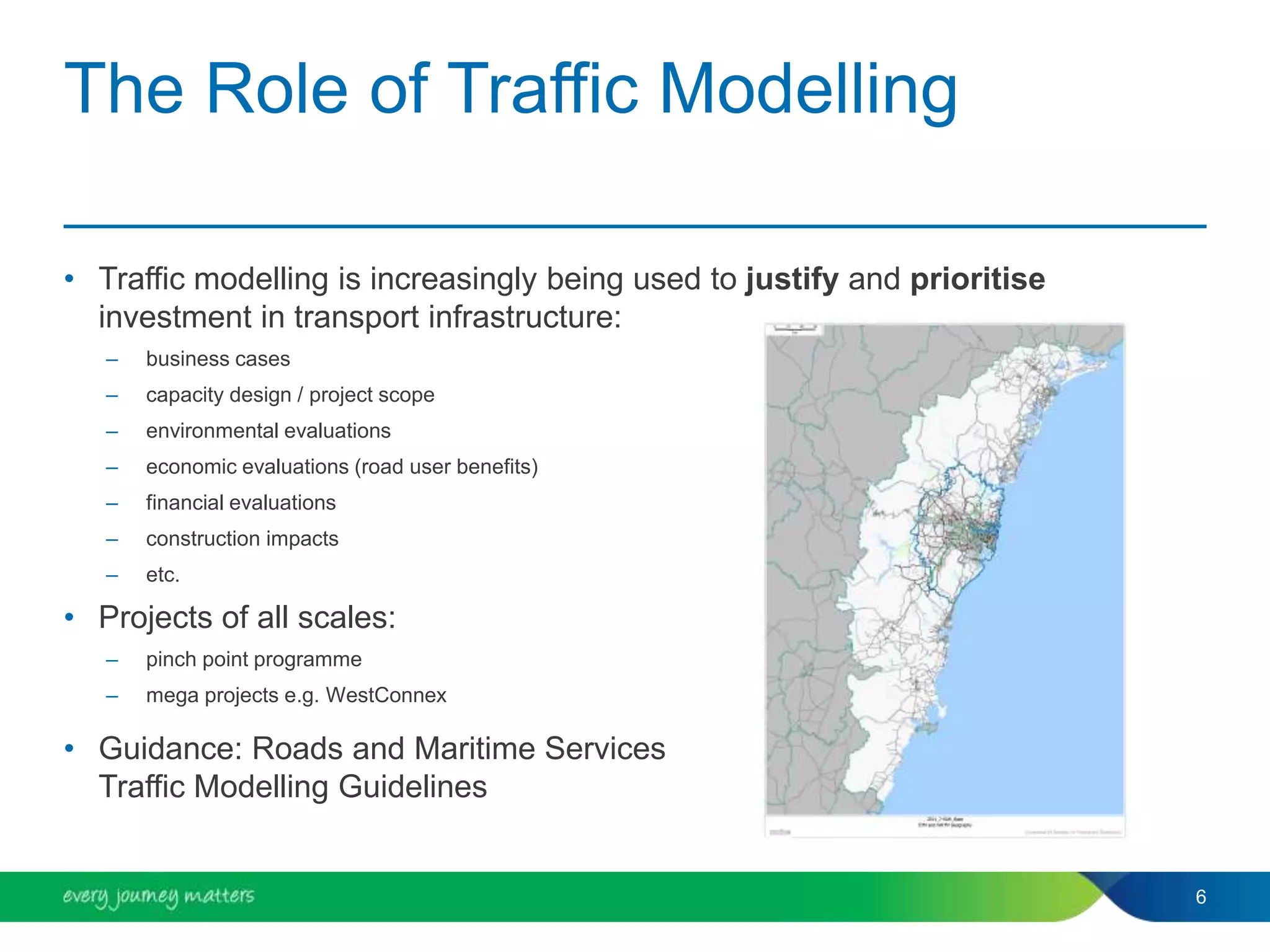
  • #7 Graphic illustrates the geographies of the Sydney Strategic Travel Model (STM) and the WestConnex Road Traffic Model (WRTM), two of the primary forecasting models used in NSW major project planning practice
  • #11 Note that the requirements for other Stages of WestConnex (M4E and New M5) are different…
  • #15 Each weekday morning, more than 1,600 buses enter the CBD, causing congestion and lengthy delays. CBD streets simply cannot cope with the extra buses needed to meet Sydney’s forecast growth. Light rail will remove up to 220 buses from the CBD in the morning peak, moving more people using less street space and removing a major source of congestion for other road users. A key feature is the one kilometre pedestrian zone between Wynyard and Town Hall (Source: TfNSW Sydney Light Rail Fact Sheet: Why Sydney needs light rail)
  • #16 A light rail system, by its nature as a road based public transport mode, needs to be designed into the road network and requires detailed consideration of all modes and associated management issues Providing a segregated route for the CSE light rail to maximise public transport carrying capacity will necessarily displace some road-based traffic The pedestrianised zone being delivered in conjunction with light rail yields substantial sustainability and amenity benefits, however the impacts of traffic displaced from the spine to other areas of the road network need to be acknowledged
  • #17 The design intent is for LRVs to be able to proceed through all intersections with minimal delay. However, the design of each intersection must have regard to all road users and the overall performance of the transport network including road traffic
  • #18 A number of key intersections have been identified where further design and optimisation work is underway to provide increased capacity