PLAGIARISM
             What It Is
                 &
           How to Avoid It


Presentation based on Clemson's Student-
      Athlete Enrichment Programs
What is PLAGIARISM

Definition: Misrepresenting anyone else’s
words, work, or ideas as your own.

●   This can happen intentionally or
    unintentionally.
●   Even unintentional plagiarism has to be
    reported.
HOW TO AVOID PLAGIARISM

 #1 - Give yourself lots of time to complete
 projects.
HOW TO AVOID PLAGIARISM

 #2 - Take careful notes. When you read a
 source, write brief summary notes in your own
 words. Do not copy word-for-word from a
 source. You may forget what words are yours
 and what words come from the source.
HOW TO AVOID PLAGIARISM

 #3 - Cite every idea or fact you learned from a
 source. Unless the fact or idea is so well-known
 that almost every person in the world will
 already know, you must cite the source.

 Example: "William Shakespeare was an English
 playwright." This is common knowledge. No
 need to cite.
What about Unintentional
            Plagiarism?
Ignorance is NOT an excuse

Examples
  ●   Failure to cite sources
  ●   Omitting quotation marks where needed
  ●   Incorrect paraphrase
INTERNAL CITATION

Definition: Internal citations go at the end of
sentences with material from your sources.
Internal citations tell readers that the material in
the preceding sentences was taken from
another source. Use internal citation when
paraphrasing, summarizing, and quoting.
INTERNAL CITATION
●   Cite immediately after direct quote or
    paraphrase.
●   Place summary citations at the end of the
    section.
●   Citations go inside the sentence.
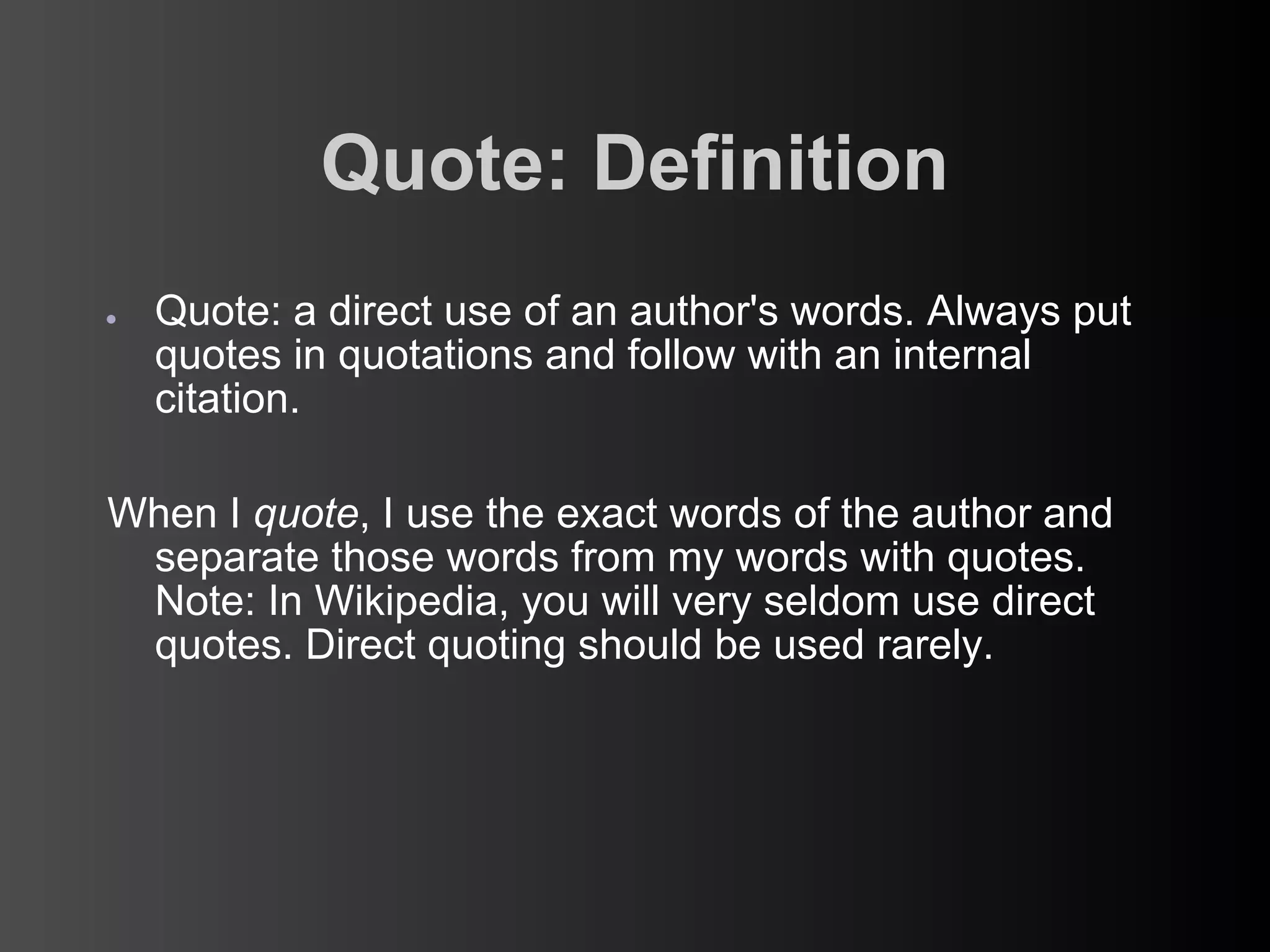
Quote: Definition
●   Quote: a direct use of an author's words. Always put
    quotes in quotations and follow with an internal
    citation.

When I quote, I use the exact words of the author and
 separate those words from my words with quotes.
 Note: In Wikipedia, you will very seldom use direct
 quotes. Direct quoting should be used rarely.
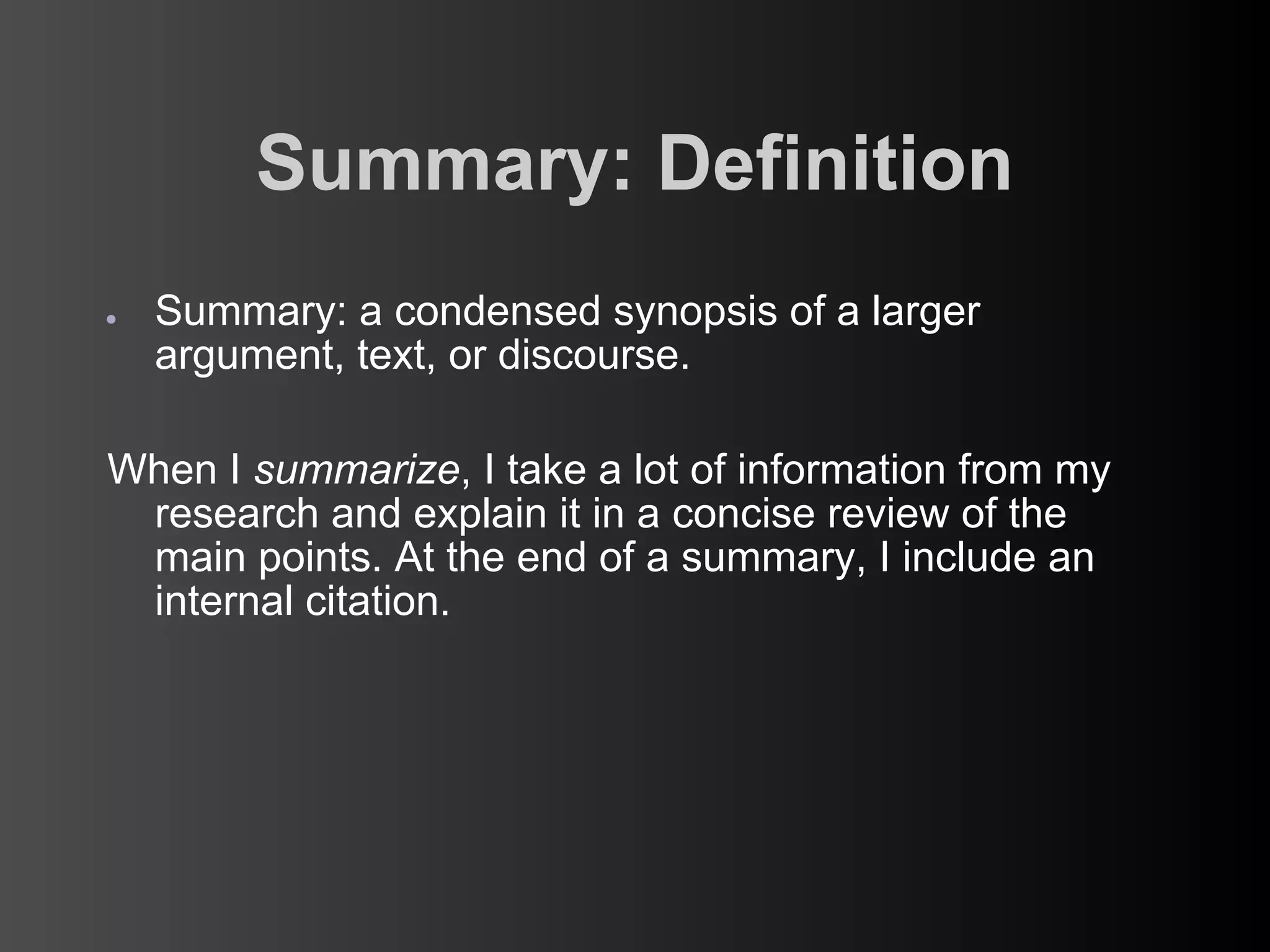
Summary: Definition
●   Summary: a condensed synopsis of a larger
    argument, text, or discourse.

When I summarize, I take a lot of information from my
 research and explain it in a concise review of the
 main points. At the end of a summary, I include an
 internal citation.
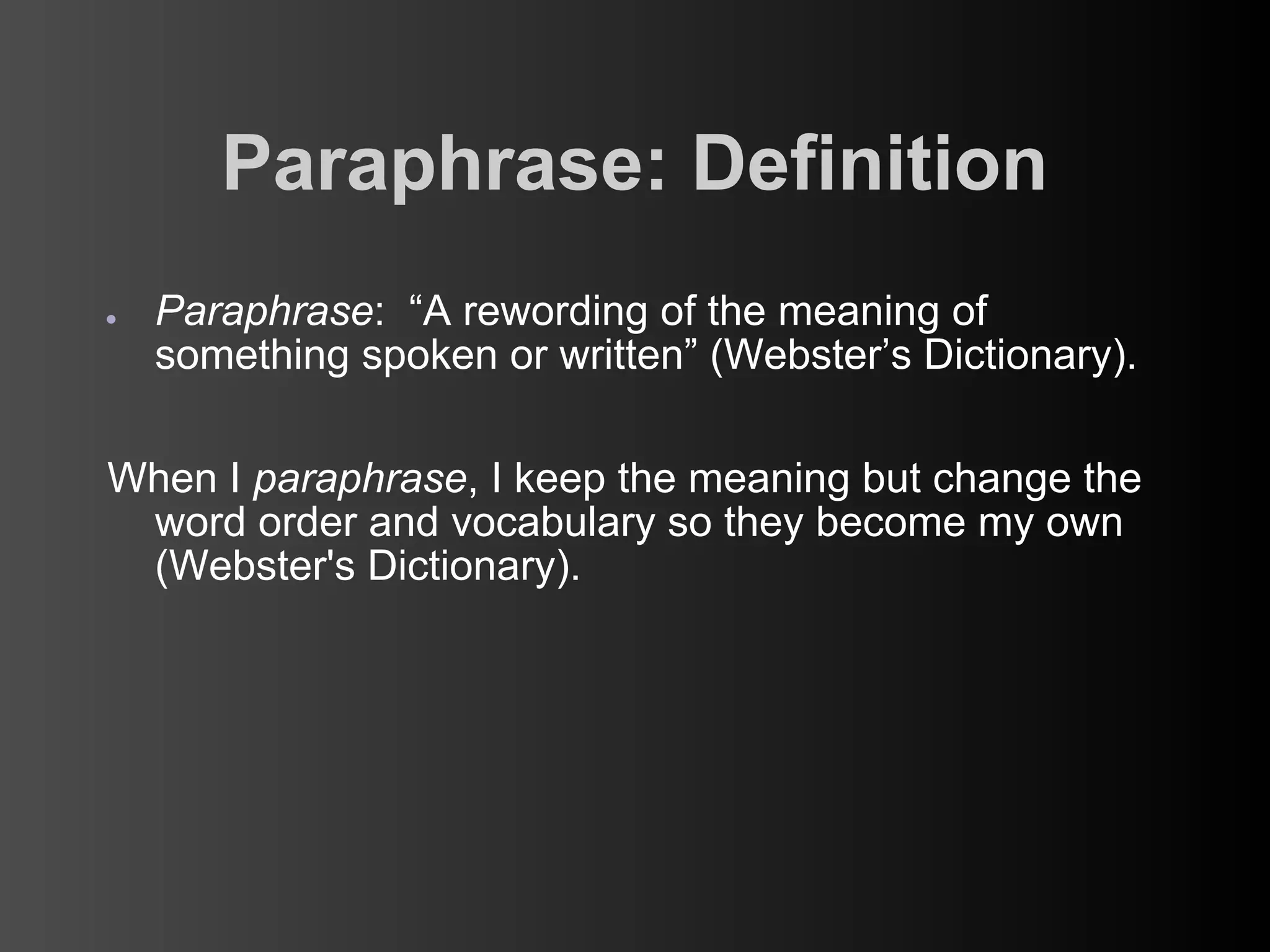
Paraphrase: Definition
●   Paraphrase: “A rewording of the meaning of
    something spoken or written” (Webster’s Dictionary).

When I paraphrase, I keep the meaning but change the
 word order and vocabulary so they become my own
 (Webster's Dictionary).
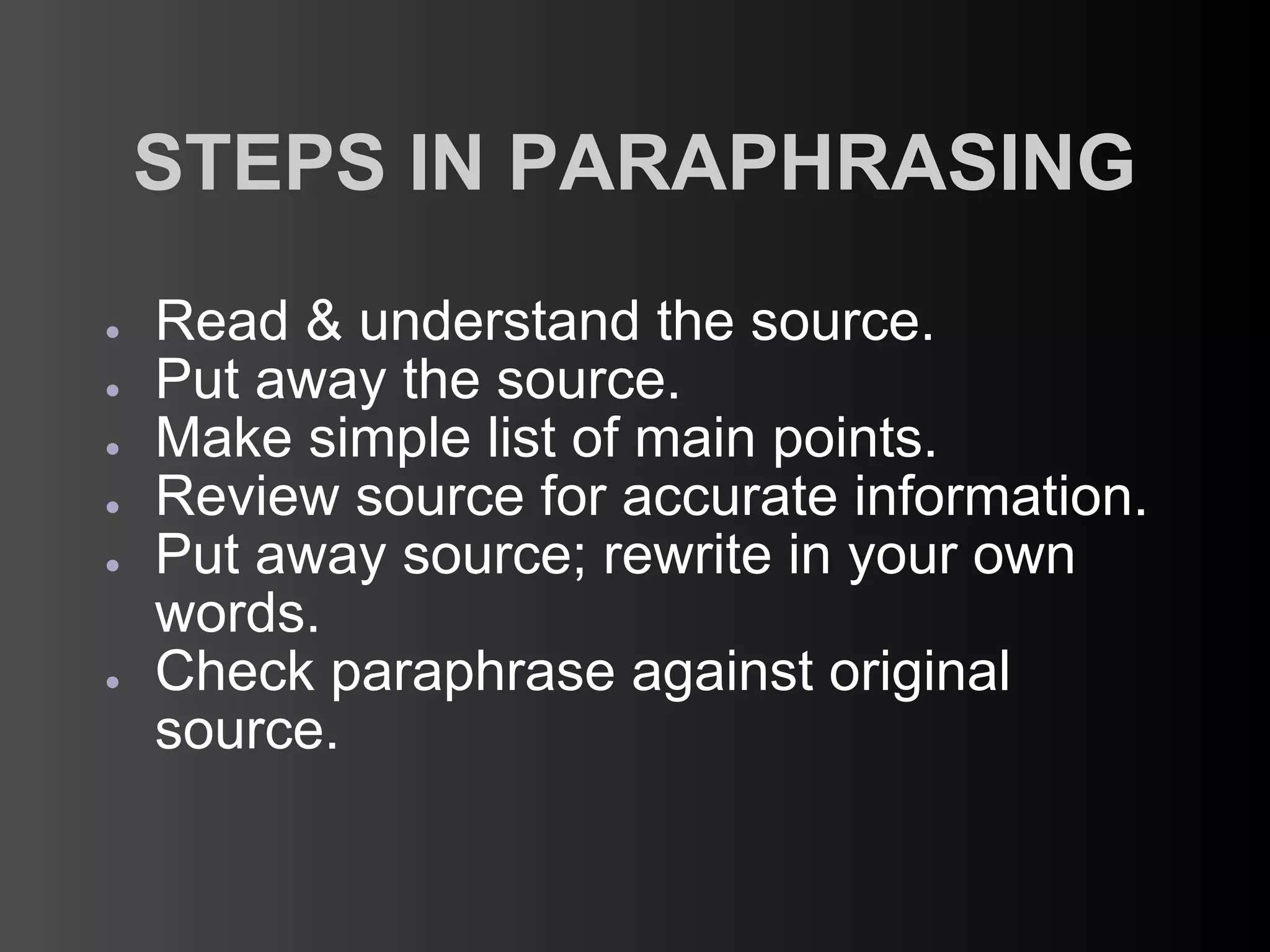
STEPS IN PARAPHRASING
●   Read & understand the source.
●   Put away the source.
●   Make simple list of main points.
●   Review source for accurate information.
●   Put away source; rewrite in your own
    words.
●   Check paraphrase against original
    source.
GOOD PARAPHRASE IS:
●   Accurate – same meaning as source.
●   Original – different language from
    source.
●   Grammatically correct.

●   If NO, try again.
TIPS FOR PARAPHRASING
●   Use different STRUCTURE.
●   Maintain MEANING.
●   Vary WORDS (except proper names,
    numbers, technical jargon).
●   Keep similar LENGTH.
●   Use your own STYLE, even if less
    perfect.
Paraphrase or Plagiarize?
EXAMPLES: Is this good
         paraphrase?
●   Original source:
     “If the existence of a signing ape was
    unsettling for linguists, it was also startling
    news for animal behaviorists” (Davis 26).
●   Version A:
     The existence of a signing ape unsettled
    linguists and startled animal behaviorists
    (Davis 26).
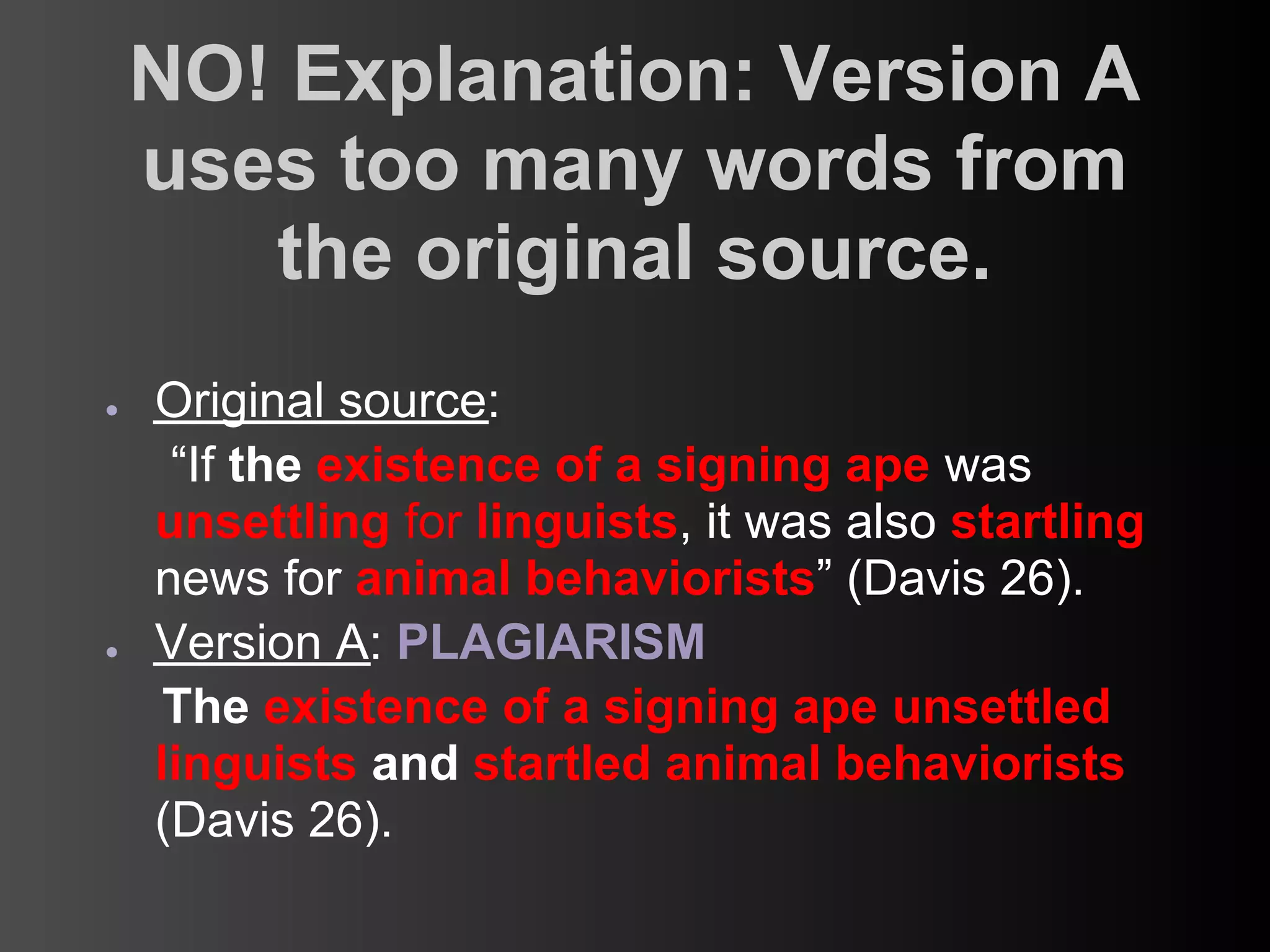
NO! Explanation: Version A
    uses too many words from
       the original source.
●   Original source:
     “If the existence of a signing ape was
    unsettling for linguists, it was also startling
    news for animal behaviorists” (Davis 26).
●   Version A: PLAGIARISM
     The existence of a signing ape unsettled
    linguists and startled animal behaviorists
    (Davis 26).
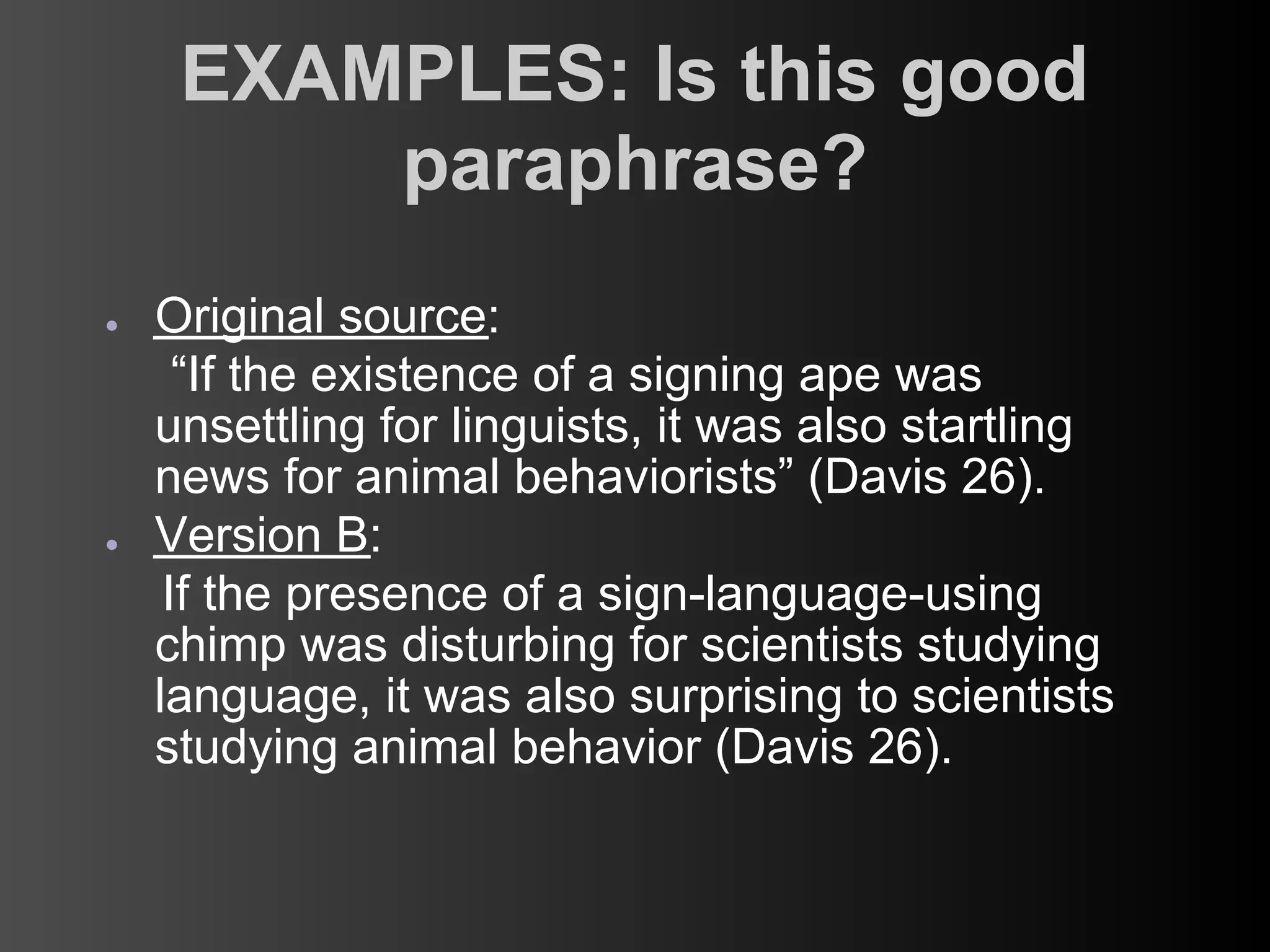
EXAMPLES: Is this good
         paraphrase?
●   Original source:
      “If the existence of a signing ape was
    unsettling for linguists, it was also startling
    news for animal behaviorists” (Davis 26).
●   Version B:
     If the presence of a sign-language-using
    chimp was disturbing for scientists studying
    language, it was also surprising to scientists
    studying animal behavior (Davis 26).
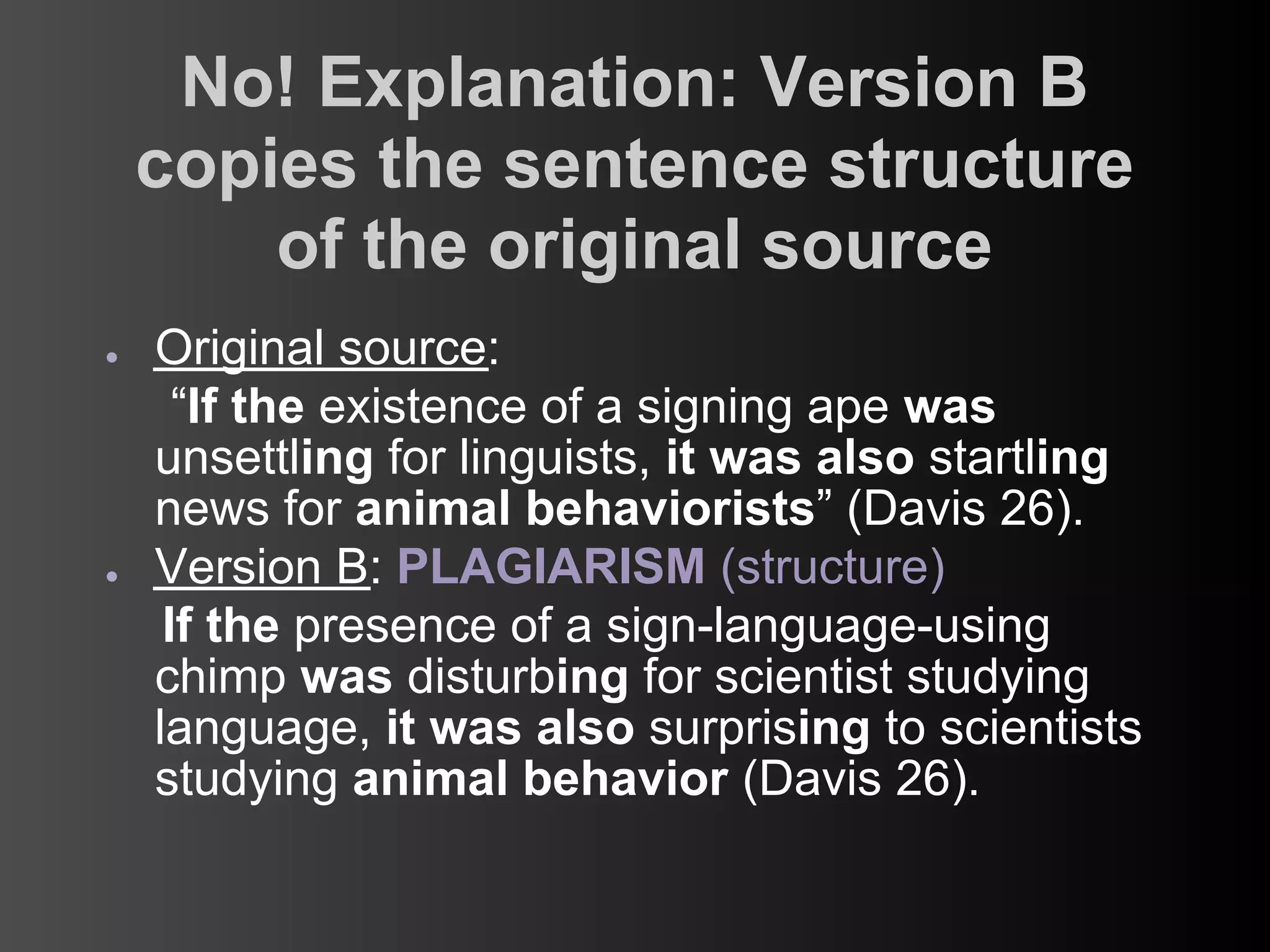
No! Explanation: Version B
    copies the sentence structure
        of the original source
●   Original source:
      “If the existence of a signing ape was
    unsettling for linguists, it was also startling
    news for animal behaviorists” (Davis 26).
●   Version B: PLAGIARISM (structure)
     If the presence of a sign-language-using
    chimp was disturbing for scientist studying
    language, it was also surprising to scientists
    studying animal behavior (Davis 26).
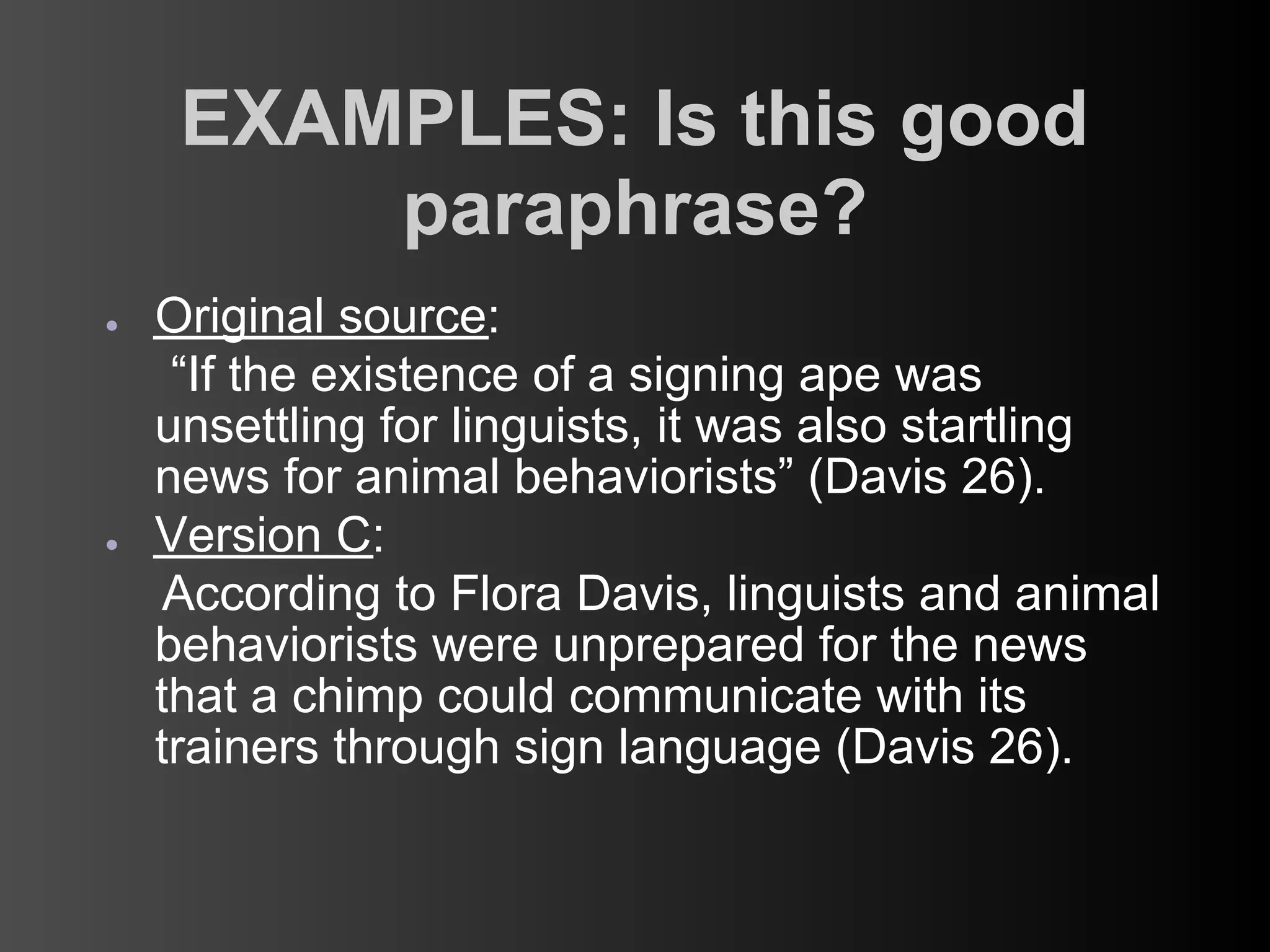
EXAMPLES: Is this good
         paraphrase?
●   Original source:
     “If the existence of a signing ape was
    unsettling for linguists, it was also startling
    news for animal behaviorists” (Davis 26).
●   Version C:
     According to Flora Davis, linguists and animal
    behaviorists were unprepared for the news
    that a chimp could communicate with its
    trainers through sign language (Davis 26).
Yes! Explanation: Version C
      conveys the same idea, but
    changes the words and sentence
               structure.
●   Original source:
     “If the existence of a signing ape was
    unsettling for linguists, it was also startling
    news for animal behaviorists” (Davis 26).
●   Version C: GOOD PARAPHASE!
     According to Flora Davis, linguists and animal
    behaviorists were unprepared for the news
    that a chimp could communicate with its
    trainers through sign language (Davis 26).
Check your work:
●   Make copies of all research sources.
●   Underline all sections of sources used
    in paper.
●   Underline all cited material in paper.
●   Compare the two, using guidelines for
    paraphrasing and avoiding plagiarism.

Integrating Sources

  • 1.
    PLAGIARISM What It Is & How to Avoid It Presentation based on Clemson's Student- Athlete Enrichment Programs
  • 2.
    What is PLAGIARISM Definition:Misrepresenting anyone else’s words, work, or ideas as your own. ● This can happen intentionally or unintentionally. ● Even unintentional plagiarism has to be reported.
  • 3.
    HOW TO AVOIDPLAGIARISM #1 - Give yourself lots of time to complete projects.
  • 4.
    HOW TO AVOIDPLAGIARISM #2 - Take careful notes. When you read a source, write brief summary notes in your own words. Do not copy word-for-word from a source. You may forget what words are yours and what words come from the source.
  • 5.
    HOW TO AVOIDPLAGIARISM #3 - Cite every idea or fact you learned from a source. Unless the fact or idea is so well-known that almost every person in the world will already know, you must cite the source. Example: "William Shakespeare was an English playwright." This is common knowledge. No need to cite.
  • 6.
    What about Unintentional Plagiarism? Ignorance is NOT an excuse Examples ● Failure to cite sources ● Omitting quotation marks where needed ● Incorrect paraphrase
  • 7.
    INTERNAL CITATION Definition: Internalcitations go at the end of sentences with material from your sources. Internal citations tell readers that the material in the preceding sentences was taken from another source. Use internal citation when paraphrasing, summarizing, and quoting.
  • 8.
    INTERNAL CITATION ● Cite immediately after direct quote or paraphrase. ● Place summary citations at the end of the section. ● Citations go inside the sentence.
  • 9.
    Quote: Definition ● Quote: a direct use of an author's words. Always put quotes in quotations and follow with an internal citation. When I quote, I use the exact words of the author and separate those words from my words with quotes. Note: In Wikipedia, you will very seldom use direct quotes. Direct quoting should be used rarely.
  • 10.
    Summary: Definition ● Summary: a condensed synopsis of a larger argument, text, or discourse. When I summarize, I take a lot of information from my research and explain it in a concise review of the main points. At the end of a summary, I include an internal citation.
  • 11.
    Paraphrase: Definition ● Paraphrase: “A rewording of the meaning of something spoken or written” (Webster’s Dictionary). When I paraphrase, I keep the meaning but change the word order and vocabulary so they become my own (Webster's Dictionary).
  • 12.
    STEPS IN PARAPHRASING ● Read & understand the source. ● Put away the source. ● Make simple list of main points. ● Review source for accurate information. ● Put away source; rewrite in your own words. ● Check paraphrase against original source.
  • 13.
    GOOD PARAPHRASE IS: ● Accurate – same meaning as source. ● Original – different language from source. ● Grammatically correct. ● If NO, try again.
  • 14.
    TIPS FOR PARAPHRASING ● Use different STRUCTURE. ● Maintain MEANING. ● Vary WORDS (except proper names, numbers, technical jargon). ● Keep similar LENGTH. ● Use your own STYLE, even if less perfect.
  • 15.
  • 16.
    EXAMPLES: Is thisgood paraphrase? ● Original source: “If the existence of a signing ape was unsettling for linguists, it was also startling news for animal behaviorists” (Davis 26). ● Version A: The existence of a signing ape unsettled linguists and startled animal behaviorists (Davis 26).
  • 17.
    NO! Explanation: VersionA uses too many words from the original source. ● Original source: “If the existence of a signing ape was unsettling for linguists, it was also startling news for animal behaviorists” (Davis 26). ● Version A: PLAGIARISM The existence of a signing ape unsettled linguists and startled animal behaviorists (Davis 26).
  • 18.
    EXAMPLES: Is thisgood paraphrase? ● Original source: “If the existence of a signing ape was unsettling for linguists, it was also startling news for animal behaviorists” (Davis 26). ● Version B: If the presence of a sign-language-using chimp was disturbing for scientists studying language, it was also surprising to scientists studying animal behavior (Davis 26).
  • 19.
    No! Explanation: VersionB copies the sentence structure of the original source ● Original source: “If the existence of a signing ape was unsettling for linguists, it was also startling news for animal behaviorists” (Davis 26). ● Version B: PLAGIARISM (structure) If the presence of a sign-language-using chimp was disturbing for scientist studying language, it was also surprising to scientists studying animal behavior (Davis 26).
  • 20.
    EXAMPLES: Is thisgood paraphrase? ● Original source: “If the existence of a signing ape was unsettling for linguists, it was also startling news for animal behaviorists” (Davis 26). ● Version C: According to Flora Davis, linguists and animal behaviorists were unprepared for the news that a chimp could communicate with its trainers through sign language (Davis 26).
  • 21.
    Yes! Explanation: VersionC conveys the same idea, but changes the words and sentence structure. ● Original source: “If the existence of a signing ape was unsettling for linguists, it was also startling news for animal behaviorists” (Davis 26). ● Version C: GOOD PARAPHASE! According to Flora Davis, linguists and animal behaviorists were unprepared for the news that a chimp could communicate with its trainers through sign language (Davis 26).
  • 22.
    Check your work: ● Make copies of all research sources. ● Underline all sections of sources used in paper. ● Underline all cited material in paper. ● Compare the two, using guidelines for paraphrasing and avoiding plagiarism.