Integrating Digital Humanities Projects into the Undergraduate CurriculumRebecca Frost Davis, Program Officer for the Humanities, National Institute for Technology and Liberal Education (NITLE)Kathryn Tomasek, Associate Professor of History, Wheaton College, MassachusettsTHATCamp Liberal Arts Colleges, June 4, 2011
GoalsConnect digital humanities teaching to pedagogical theoryReview why people at small liberal arts colleges want to do digital humanitiesConnect to tenets of liberal educationElaborate the pedagogical theory of project-based learning
Why Digital Humanities @ LAC?Undergraduate research Pedagogical practices, especially active and collaborative learning, project based and applied learning Learning about the changed digital environment or context and how to exercise liberal arts abilities (critical thinking, writing, etc.) in that context—in other words: preparing undergraduates to be citizens in a networked world Interdisciplinary work and other types of collaboration Revitalizing the humanities
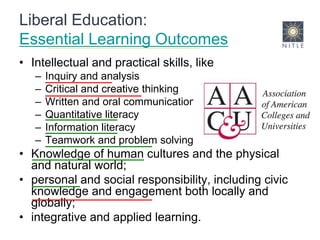
Liberal Education: Essential Learning OutcomesIntellectual and practical skills, like Inquiry and analysisCritical and creative thinkingWritten and oral communicationQuantitative literacyInformation literacyTeamwork and problem solvingKnowledge of human cultures and the physical and natural world; personal and social responsibility, including civic knowledge and engagement both locally and globally; integrative and applied learning.
High Impact Practices (Kuh)First-Year Seminars and ExperiencesCommon Intellectual ExperienceLearning CommunitiesWriting-Intensive CoursesCollaborative Assignments and ProjectsUndergraduate ResearchDiversity/Global LearningService Learning, Community-Based LearningInternshipsCapstone Courses and Projects
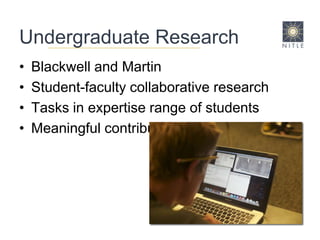
Undergraduate ResearchBlackwell and MartinStudent-faculty collaborative researchTasks in expertise range of studentsMeaningful contributions
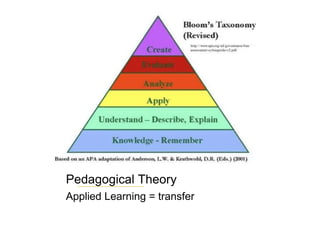
Pedagogical TheoryApplied Learning = transfer
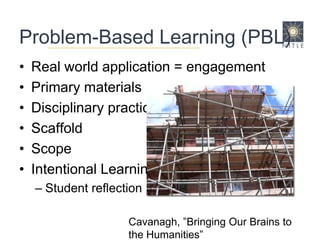
Problem-Based Learning (PBL)Real world application = engagementPrimary materialsDisciplinary practiceScaffoldScopeIntentional LearningStudent reflectionCavanagh, ”Bringing Our Brains to the Humanities”

Integrating Digital Humanities Projects into the Classroom

  • 1.
    Integrating Digital HumanitiesProjects into the Undergraduate CurriculumRebecca Frost Davis, Program Officer for the Humanities, National Institute for Technology and Liberal Education (NITLE)Kathryn Tomasek, Associate Professor of History, Wheaton College, MassachusettsTHATCamp Liberal Arts Colleges, June 4, 2011
  • 2.
    GoalsConnect digital humanitiesteaching to pedagogical theoryReview why people at small liberal arts colleges want to do digital humanitiesConnect to tenets of liberal educationElaborate the pedagogical theory of project-based learning
  • 3.
    Why Digital Humanities@ LAC?Undergraduate research Pedagogical practices, especially active and collaborative learning, project based and applied learning Learning about the changed digital environment or context and how to exercise liberal arts abilities (critical thinking, writing, etc.) in that context—in other words: preparing undergraduates to be citizens in a networked world Interdisciplinary work and other types of collaboration Revitalizing the humanities
  • 4.
    Liberal Education: EssentialLearning OutcomesIntellectual and practical skills, like Inquiry and analysisCritical and creative thinkingWritten and oral communicationQuantitative literacyInformation literacyTeamwork and problem solvingKnowledge of human cultures and the physical and natural world; personal and social responsibility, including civic knowledge and engagement both locally and globally; integrative and applied learning.
  • 5.
    High Impact Practices(Kuh)First-Year Seminars and ExperiencesCommon Intellectual ExperienceLearning CommunitiesWriting-Intensive CoursesCollaborative Assignments and ProjectsUndergraduate ResearchDiversity/Global LearningService Learning, Community-Based LearningInternshipsCapstone Courses and Projects
  • 6.
    Undergraduate ResearchBlackwell andMartinStudent-faculty collaborative researchTasks in expertise range of studentsMeaningful contributions
  • 7.
  • 8.
    Problem-Based Learning (PBL)Realworld application = engagementPrimary materialsDisciplinary practiceScaffoldScopeIntentional LearningStudent reflectionCavanagh, ”Bringing Our Brains to the Humanities”