
SERVICES 
MARKETING 
TRIANGLE: 
AN INTRODUCTION
WWhhaatt aarree sseerrvviicceess?? 
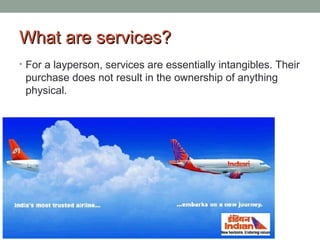
• For a layperson, services are essentially intangibles. Their 
purchase does not result in the ownership of anything 
physical.
WWhhaatt iiss SSeerrvviicceess MMaarrkkeettiinngg TTrriiaannggllee?? 
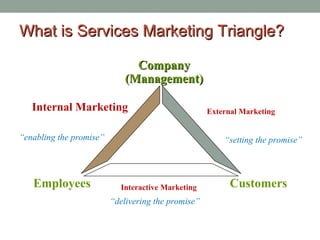
Internal Marketing 
Interactive Marketing 
External Marketing 
CCoommppaannyy 
((MMaannaaggeemmeenntt)) 
“enabling the promise” 
Employees Customers 
“delivering the promise” 
“setting the promise”
WWaayyss ttoo UUssee tthhee SSeerrvviicceess MMaarrkkeettiinngg 
TTrriiaannggllee 
Overall Strategic Assessment 
• How is the service 
organisation doing on all 
three sides of the 
triangle? 
• Where are the 
weaknesses? 
• What are the strengths? 
Specific Service Implementation 
What is being promoted 
and by whom? 
How will it be delivered 
and by whom? 
Are the supporting 
systems in place to 
deliver the promised 
service?
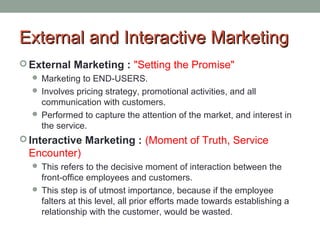
a External anndd IInntteerraaccttiivvee MMaarrkkeettiinngg 
External Marketing : "Setting the Promise" 
 Marketing to END-USERS. 
 Involves pricing strategy, promotional activities, and all 
communication with customers. 
 Performed to capture the attention of the market, and interest in 
the service. 
Interactive Marketing : (Moment of Truth, Service 
Encounter) 
 This refers to the decisive moment of interaction between the 
front-office employees and customers. 
 This step is of utmost importance, because if the employee 
falters at this level, all prior efforts made towards establishing a 
relationship with the customer, would be wasted.
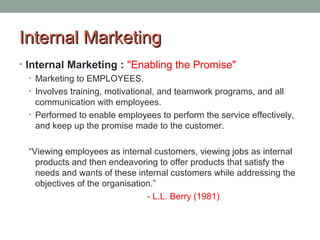
IInntteerrnnaall MMaarrkkeettiinngg 
• Internal Marketing : "Enabling the Promise" 
• Marketing to EMPLOYEES. 
• Involves training, motivational, and teamwork programs, and all 
communication with employees. 
• Performed to enable employees to perform the service effectively, 
and keep up the promise made to the customer. 
“Viewing employees as internal customers, viewing jobs as internal 
products and then endeavoring to offer products that satisfy the 
needs and wants of these internal customers while addressing the 
objectives of the organisation.” 
- L.L. Berry (1981)
Integrated Services Marketing Triangle

Integrated Services Marketing Triangle

  • 1.
  • 2.
    WWhhaatt aarree sseerrvviicceess?? • For a layperson, services are essentially intangibles. Their purchase does not result in the ownership of anything physical.
  • 3.
    WWhhaatt iiss SSeerrvviicceessMMaarrkkeettiinngg TTrriiaannggllee?? Internal Marketing Interactive Marketing External Marketing CCoommppaannyy ((MMaannaaggeemmeenntt)) “enabling the promise” Employees Customers “delivering the promise” “setting the promise”
  • 4.
    WWaayyss ttoo UUsseetthhee SSeerrvviicceess MMaarrkkeettiinngg TTrriiaannggllee Overall Strategic Assessment • How is the service organisation doing on all three sides of the triangle? • Where are the weaknesses? • What are the strengths? Specific Service Implementation What is being promoted and by whom? How will it be delivered and by whom? Are the supporting systems in place to deliver the promised service?
  • 5.
    a External annddIInntteerraaccttiivvee MMaarrkkeettiinngg External Marketing : "Setting the Promise"  Marketing to END-USERS.  Involves pricing strategy, promotional activities, and all communication with customers.  Performed to capture the attention of the market, and interest in the service. Interactive Marketing : (Moment of Truth, Service Encounter)  This refers to the decisive moment of interaction between the front-office employees and customers.  This step is of utmost importance, because if the employee falters at this level, all prior efforts made towards establishing a relationship with the customer, would be wasted.
  • 6.
    IInntteerrnnaall MMaarrkkeettiinngg •Internal Marketing : "Enabling the Promise" • Marketing to EMPLOYEES. • Involves training, motivational, and teamwork programs, and all communication with employees. • Performed to enable employees to perform the service effectively, and keep up the promise made to the customer. “Viewing employees as internal customers, viewing jobs as internal products and then endeavoring to offer products that satisfy the needs and wants of these internal customers while addressing the objectives of the organisation.” - L.L. Berry (1981)