Introduction to Information Technology
8.1. People in Information Systems: Creators
Introduction to Information Technology
INT-1010
Prof C
Luis R Castellanos
1
08
People in Information Systems
Introduction to Information Technology
8.1. People in Information Systems: Creators
2
[Getting to know about PGCC]
How many locations does
PGCC have? Where are they?
Introduction to Information Technology
8.1. People in Information Systems: Creators
3
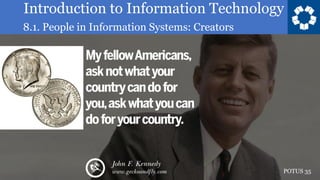
Franklin D Roosevelt
POTUS 35
Introduction to Information Technology
8.1. People in Information Systems: Creators
4
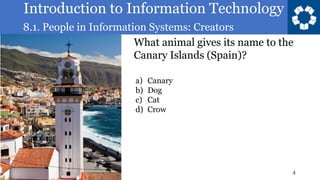
What animal gives its name to the
Canary Islands (Spain)?
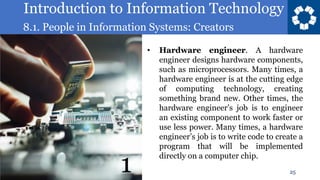
a) Canary
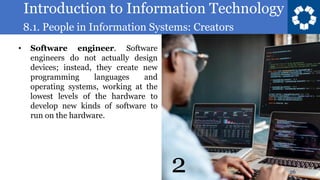
b) Dog
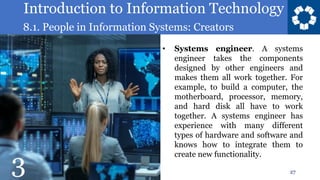
c) Cat
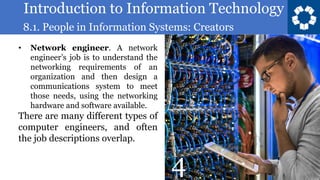
d) Crow
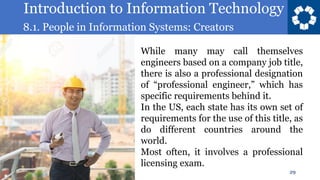
Introduction to Information Technology
8.1. People in Information Systems: Creators
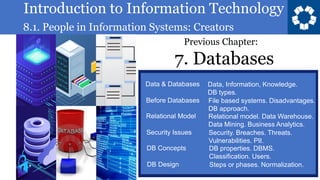
7. Databases
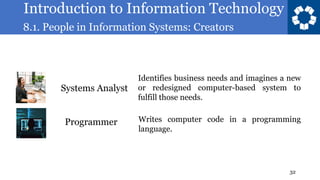
5
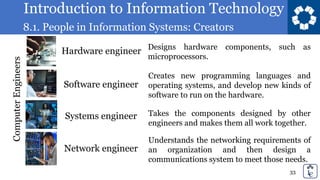
Previous Chapter:
Data & Databases Data, Information, Knowledge.
DB types.
Before Databases File based systems. Disadvantages.
DB approach.
Relational Model Relational model. Data Warehouse.
Data Mining. Business Analytics.
Security Issues Security. Breaches. Threats.
Vulnerabilities. PII.
DB Concepts DB properties. DBMS.
Classification. Users.
DB Design Steps or phases. Normalization.
Introduction to Information Technology
8.1. People in Information Systems: Creators
6
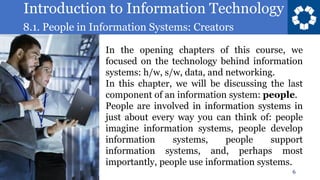
In the opening chapters of this course, we
focused on the technology behind information
systems: h/w, s/w, data, and networking.
In this chapter, we will be discussing the last
component of an information system: people.
People are involved in information systems in
just about every way you can think of: people
imagine information systems, people develop
information systems, people support
information systems, and, perhaps most
importantly, people use information systems.
Introduction to Information Technology
8.1. People in Information Systems: Creators
7
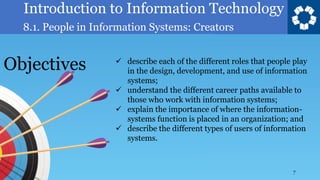
✓ describe each of the different roles that people play
in the design, development, and use of information
systems;
✓ understand the different career paths available to
those who work with information systems;
✓ explain the importance of where the information-
systems function is placed in an organization; and
✓ describe the different types of users of information
systems.
Objectives
Introduction to Information Technology
8.1. People in Information Systems: Creators
8
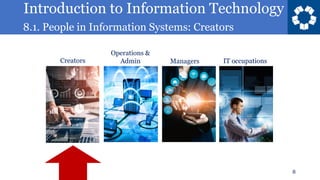
Operations &
Admin
Creators Managers IT occupations
Introduction to Information Technology
8.1. People in Information Systems: Creators
Introduction to Information Technology
INT-1010
Prof C
Luis R Castellanos
9
08.1
People in Information Systems:
Creators
Introduction to Information Technology
8.1. People in Information Systems: Creators
10
Creators
People in Information
Systems
Introduction to Information Technology
8.1. People in Information Systems: Creators
11
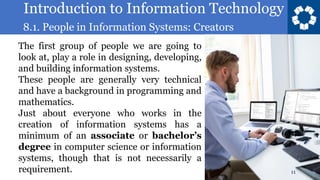
The first group of people we are going to
look at, play a role in designing, developing,
and building information systems.
These people are generally very technical
and have a background in programming and
mathematics.
Just about everyone who works in the
creation of information systems has a
minimum of an associate or bachelor’s
degree in computer science or information
systems, though that is not necessarily a
requirement.
Introduction to Information Technology
8.1. People in Information Systems: Creators
12
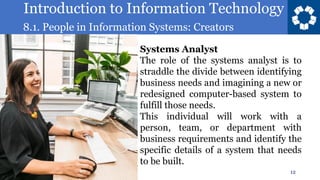
Systems Analyst
The role of the systems analyst is to
straddle the divide between identifying
business needs and imagining a new or
redesigned computer-based system to
fulfill those needs.
This individual will work with a
person, team, or department with
business requirements and identify the
specific details of a system that needs
to be built.
Introduction to Information Technology
8.1. People in Information Systems: Creators
13
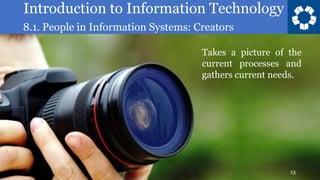
Takes a picture of the
current processes and
gathers current needs.
Introduction to Information Technology
8.1. People in Information Systems: Creators
14
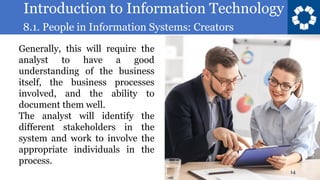
Generally, this will require the
analyst to have a good
understanding of the business
itself, the business processes
involved, and the ability to
document them well.
The analyst will identify the
different stakeholders in the
system and work to involve the
appropriate individuals in the
process.
Introduction to Information Technology
8.1. People in Information Systems: Creators
15
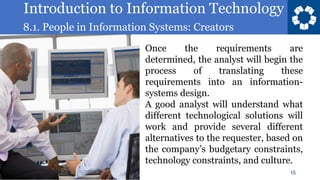
Once the requirements are
determined, the analyst will begin the
process of translating these
requirements into an information-
systems design.
A good analyst will understand what
different technological solutions will
work and provide several different
alternatives to the requester, based on
the company’s budgetary constraints,
technology constraints, and culture.
Introduction to Information Technology
8.1. People in Information Systems: Creators
16
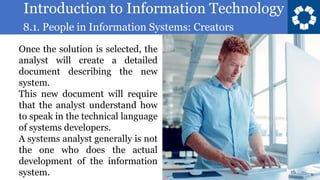
Once the solution is selected, the
analyst will create a detailed
document describing the new
system.
This new document will require
that the analyst understand how
to speak in the technical language
of systems developers.
A systems analyst generally is not
the one who does the actual
development of the information
system.
Introduction to Information Technology
8.1. People in Information Systems: Creators
17
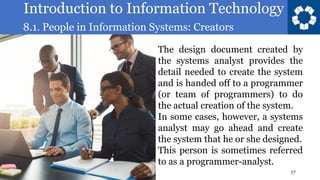
The design document created by
the systems analyst provides the
detail needed to create the system
and is handed off to a programmer
(or team of programmers) to do
the actual creation of the system.
In some cases, however, a systems
analyst may go ahead and create
the system that he or she designed.
This person is sometimes referred
to as a programmer-analyst.
Introduction to Information Technology
8.1. People in Information Systems: Creators
18
In other cases, the system may be
assembled from off-the-shelf
components by a person called a
systems integrator.
This is a specific type of systems
analyst that understands how to
get different software packages to
work with each other.
Introduction to Information Technology
8.1. People in Information Systems: Creators
19
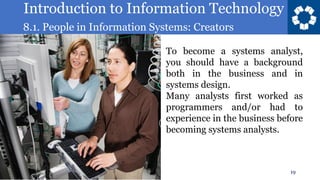
To become a systems analyst,
you should have a background
both in the business and in
systems design.
Many analysts first worked as
programmers and/or had to
experience in the business before
becoming systems analysts.
Introduction to Information Technology
8.1. People in Information Systems: Creators
20
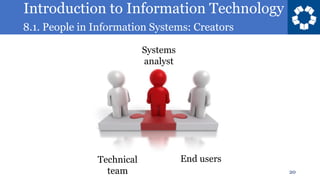
End users
Technical
team
Systems
analyst
Introduction to Information Technology
8.1. People in Information Systems: Creators
21
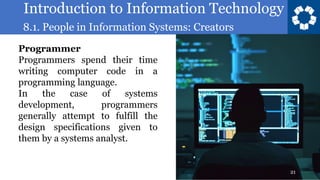
Programmer
Programmers spend their time
writing computer code in a
programming language.
In the case of systems
development, programmers
generally attempt to fulfill the
design specifications given to
them by a systems analyst.
Introduction to Information Technology
8.1. People in Information Systems: Creators
22
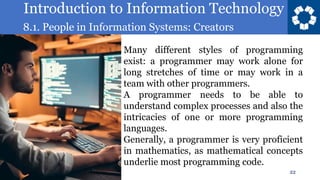
Many different styles of programming
exist: a programmer may work alone for
long stretches of time or may work in a
team with other programmers.
A programmer needs to be able to
understand complex processes and also the
intricacies of one or more programming
languages.
Generally, a programmer is very proficient
in mathematics, as mathematical concepts
underlie most programming code.
Introduction to Information Technology
8.1. People in Information Systems: Creators
23
Introduction to Information Technology
8.1. People in Information Systems: Creators
24
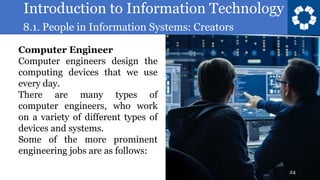
Computer Engineer
Computer engineers design the
computing devices that we use
every day.
There are many types of
computer engineers, who work
on a variety of different types of
devices and systems.
Some of the more prominent
engineering jobs are as follows:
Introduction to Information Technology
8.1. People in Information Systems: Creators
25
• Hardware engineer. A hardware
engineer designs hardware components,
such as microprocessors. Many times, a
hardware engineer is at the cutting edge
of computing technology, creating
something brand new. Other times, the
hardware engineer’s job is to engineer
an existing component to work faster or
use less power. Many times, a hardware
engineer’s job is to write code to create a
program that will be implemented
directly on a computer chip.
1
Introduction to Information Technology
8.1. People in Information Systems: Creators
26
• Software engineer. Software
engineers do not actually design
devices; instead, they create new
programming languages and
operating systems, working at the
lowest levels of the hardware to
develop new kinds of software to
run on the hardware.
2
Introduction to Information Technology
8.1. People in Information Systems: Creators
27
• Systems engineer. A systems
engineer takes the components
designed by other engineers and
makes them all work together. For
example, to build a computer, the
motherboard, processor, memory,
and hard disk all have to work
together. A systems engineer has
experience with many different
types of hardware and software and
knows how to integrate them to
create new functionality.
3
Introduction to Information Technology
8.1. People in Information Systems: Creators
28
• Network engineer. A network
engineer’s job is to understand the
networking requirements of an
organization and then design a
communications system to meet
those needs, using the networking
hardware and software available.
There are many different types of
computer engineers, and often
the job descriptions overlap.
4
Introduction to Information Technology
8.1. People in Information Systems: Creators
29
While many may call themselves
engineers based on a company job title,
there is also a professional designation
of “professional engineer,” which has
specific requirements behind it.
In the US, each state has its own set of
requirements for the use of this title, as
do different countries around the
world.
Most often, it involves a professional
licensing exam.
Introduction to Information Technology
8.1. People in Information Systems: Creators
30
Introduction to Information Technology
8.1. People in Information Systems: Creators
31
Introduction to Information Technology
8.1. People in Information Systems: Creators
32
Systems Analyst
Identifies business needs and imagines a new
or redesigned computer-based system to
fulfill those needs.
Programmer Writes computer code in a programming
language.
Introduction to Information Technology
8.1. People in Information Systems: Creators
33
Hardware engineer Designs hardware components, such as
microprocessors.
Software engineer
Creates new programming languages and
operating systems, and develop new kinds of
software to run on the hardware.
Systems engineer Takes the components designed by other
engineers and makes them all work together.
Network engineer
Understands the networking requirements of
an organization and then design a
communications system to meet those needs.
Computer
Engineers
Introduction to Information Technology
8.1. People in Information Systems: Creators
34
Introduction to Information Technology
8.1. People in Information Systems: Creators
Introduction to Information Technology
8.1. People in Information Systems: Creators
Textbook
36
https://eng.libretexts.org/Courses/Prince_
Georges_Community_College/INT_1010%
3A_Concepts_in_Computing
Purchase of a book is not
required.
Introduction to Information Technology
8.1. People in Information Systems: Creators
Professor C
37
castellr@pgcc.edu
eLearning Expert
BS & MS in Systems Engineering
BS & MS in Military Science and Arts
HC Dr in Education
IT Professor | Spanish Instructor
LCINT1010.wordpress.com
Presentation created in 01/2022.
Slides last updated on 11/2023
Introduction to Information Technology
8.1. People in Information Systems: Creators
Introduction to Information Technology
INT-1010
Prof C
Luis R Castellanos
38
08.1
People in Information Systems:
Creators

INT 1010 08-1.pdf

  • 1.
    Introduction to InformationTechnology 8.1. People in Information Systems: Creators Introduction to Information Technology INT-1010 Prof C Luis R Castellanos 1 08 People in Information Systems
  • 2.
    Introduction to InformationTechnology 8.1. People in Information Systems: Creators 2 [Getting to know about PGCC] How many locations does PGCC have? Where are they?
  • 3.
    Introduction to InformationTechnology 8.1. People in Information Systems: Creators 3 Franklin D Roosevelt POTUS 35
  • 4.
    Introduction to InformationTechnology 8.1. People in Information Systems: Creators 4 What animal gives its name to the Canary Islands (Spain)? a) Canary b) Dog c) Cat d) Crow
  • 5.
    Introduction to InformationTechnology 8.1. People in Information Systems: Creators 7. Databases 5 Previous Chapter: Data & Databases Data, Information, Knowledge. DB types. Before Databases File based systems. Disadvantages. DB approach. Relational Model Relational model. Data Warehouse. Data Mining. Business Analytics. Security Issues Security. Breaches. Threats. Vulnerabilities. PII. DB Concepts DB properties. DBMS. Classification. Users. DB Design Steps or phases. Normalization.
  • 6.
    Introduction to InformationTechnology 8.1. People in Information Systems: Creators 6 In the opening chapters of this course, we focused on the technology behind information systems: h/w, s/w, data, and networking. In this chapter, we will be discussing the last component of an information system: people. People are involved in information systems in just about every way you can think of: people imagine information systems, people develop information systems, people support information systems, and, perhaps most importantly, people use information systems.
  • 7.
    Introduction to InformationTechnology 8.1. People in Information Systems: Creators 7 ✓ describe each of the different roles that people play in the design, development, and use of information systems; ✓ understand the different career paths available to those who work with information systems; ✓ explain the importance of where the information- systems function is placed in an organization; and ✓ describe the different types of users of information systems. Objectives
  • 8.
    Introduction to InformationTechnology 8.1. People in Information Systems: Creators 8 Operations & Admin Creators Managers IT occupations
  • 9.
    Introduction to InformationTechnology 8.1. People in Information Systems: Creators Introduction to Information Technology INT-1010 Prof C Luis R Castellanos 9 08.1 People in Information Systems: Creators
  • 10.
    Introduction to InformationTechnology 8.1. People in Information Systems: Creators 10 Creators People in Information Systems
  • 11.
    Introduction to InformationTechnology 8.1. People in Information Systems: Creators 11 The first group of people we are going to look at, play a role in designing, developing, and building information systems. These people are generally very technical and have a background in programming and mathematics. Just about everyone who works in the creation of information systems has a minimum of an associate or bachelor’s degree in computer science or information systems, though that is not necessarily a requirement.
  • 12.
    Introduction to InformationTechnology 8.1. People in Information Systems: Creators 12 Systems Analyst The role of the systems analyst is to straddle the divide between identifying business needs and imagining a new or redesigned computer-based system to fulfill those needs. This individual will work with a person, team, or department with business requirements and identify the specific details of a system that needs to be built.
  • 13.
    Introduction to InformationTechnology 8.1. People in Information Systems: Creators 13 Takes a picture of the current processes and gathers current needs.
  • 14.
    Introduction to InformationTechnology 8.1. People in Information Systems: Creators 14 Generally, this will require the analyst to have a good understanding of the business itself, the business processes involved, and the ability to document them well. The analyst will identify the different stakeholders in the system and work to involve the appropriate individuals in the process.
  • 15.
    Introduction to InformationTechnology 8.1. People in Information Systems: Creators 15 Once the requirements are determined, the analyst will begin the process of translating these requirements into an information- systems design. A good analyst will understand what different technological solutions will work and provide several different alternatives to the requester, based on the company’s budgetary constraints, technology constraints, and culture.
  • 16.
    Introduction to InformationTechnology 8.1. People in Information Systems: Creators 16 Once the solution is selected, the analyst will create a detailed document describing the new system. This new document will require that the analyst understand how to speak in the technical language of systems developers. A systems analyst generally is not the one who does the actual development of the information system.
  • 17.
    Introduction to InformationTechnology 8.1. People in Information Systems: Creators 17 The design document created by the systems analyst provides the detail needed to create the system and is handed off to a programmer (or team of programmers) to do the actual creation of the system. In some cases, however, a systems analyst may go ahead and create the system that he or she designed. This person is sometimes referred to as a programmer-analyst.
  • 18.
    Introduction to InformationTechnology 8.1. People in Information Systems: Creators 18 In other cases, the system may be assembled from off-the-shelf components by a person called a systems integrator. This is a specific type of systems analyst that understands how to get different software packages to work with each other.
  • 19.
    Introduction to InformationTechnology 8.1. People in Information Systems: Creators 19 To become a systems analyst, you should have a background both in the business and in systems design. Many analysts first worked as programmers and/or had to experience in the business before becoming systems analysts.
  • 20.
    Introduction to InformationTechnology 8.1. People in Information Systems: Creators 20 End users Technical team Systems analyst
  • 21.
    Introduction to InformationTechnology 8.1. People in Information Systems: Creators 21 Programmer Programmers spend their time writing computer code in a programming language. In the case of systems development, programmers generally attempt to fulfill the design specifications given to them by a systems analyst.
  • 22.
    Introduction to InformationTechnology 8.1. People in Information Systems: Creators 22 Many different styles of programming exist: a programmer may work alone for long stretches of time or may work in a team with other programmers. A programmer needs to be able to understand complex processes and also the intricacies of one or more programming languages. Generally, a programmer is very proficient in mathematics, as mathematical concepts underlie most programming code.
  • 23.
    Introduction to InformationTechnology 8.1. People in Information Systems: Creators 23
  • 24.
    Introduction to InformationTechnology 8.1. People in Information Systems: Creators 24 Computer Engineer Computer engineers design the computing devices that we use every day. There are many types of computer engineers, who work on a variety of different types of devices and systems. Some of the more prominent engineering jobs are as follows:
  • 25.
    Introduction to InformationTechnology 8.1. People in Information Systems: Creators 25 • Hardware engineer. A hardware engineer designs hardware components, such as microprocessors. Many times, a hardware engineer is at the cutting edge of computing technology, creating something brand new. Other times, the hardware engineer’s job is to engineer an existing component to work faster or use less power. Many times, a hardware engineer’s job is to write code to create a program that will be implemented directly on a computer chip. 1
  • 26.
    Introduction to InformationTechnology 8.1. People in Information Systems: Creators 26 • Software engineer. Software engineers do not actually design devices; instead, they create new programming languages and operating systems, working at the lowest levels of the hardware to develop new kinds of software to run on the hardware. 2
  • 27.
    Introduction to InformationTechnology 8.1. People in Information Systems: Creators 27 • Systems engineer. A systems engineer takes the components designed by other engineers and makes them all work together. For example, to build a computer, the motherboard, processor, memory, and hard disk all have to work together. A systems engineer has experience with many different types of hardware and software and knows how to integrate them to create new functionality. 3
  • 28.
    Introduction to InformationTechnology 8.1. People in Information Systems: Creators 28 • Network engineer. A network engineer’s job is to understand the networking requirements of an organization and then design a communications system to meet those needs, using the networking hardware and software available. There are many different types of computer engineers, and often the job descriptions overlap. 4
  • 29.
    Introduction to InformationTechnology 8.1. People in Information Systems: Creators 29 While many may call themselves engineers based on a company job title, there is also a professional designation of “professional engineer,” which has specific requirements behind it. In the US, each state has its own set of requirements for the use of this title, as do different countries around the world. Most often, it involves a professional licensing exam.
  • 30.
    Introduction to InformationTechnology 8.1. People in Information Systems: Creators 30
  • 31.
    Introduction to InformationTechnology 8.1. People in Information Systems: Creators 31
  • 32.
    Introduction to InformationTechnology 8.1. People in Information Systems: Creators 32 Systems Analyst Identifies business needs and imagines a new or redesigned computer-based system to fulfill those needs. Programmer Writes computer code in a programming language.
  • 33.
    Introduction to InformationTechnology 8.1. People in Information Systems: Creators 33 Hardware engineer Designs hardware components, such as microprocessors. Software engineer Creates new programming languages and operating systems, and develop new kinds of software to run on the hardware. Systems engineer Takes the components designed by other engineers and makes them all work together. Network engineer Understands the networking requirements of an organization and then design a communications system to meet those needs. Computer Engineers
  • 34.
    Introduction to InformationTechnology 8.1. People in Information Systems: Creators 34
  • 35.
    Introduction to InformationTechnology 8.1. People in Information Systems: Creators
  • 36.
    Introduction to InformationTechnology 8.1. People in Information Systems: Creators Textbook 36 https://eng.libretexts.org/Courses/Prince_ Georges_Community_College/INT_1010% 3A_Concepts_in_Computing Purchase of a book is not required.
  • 37.
    Introduction to InformationTechnology 8.1. People in Information Systems: Creators Professor C 37 castellr@pgcc.edu eLearning Expert BS & MS in Systems Engineering BS & MS in Military Science and Arts HC Dr in Education IT Professor | Spanish Instructor LCINT1010.wordpress.com Presentation created in 01/2022. Slides last updated on 11/2023
  • 38.
    Introduction to InformationTechnology 8.1. People in Information Systems: Creators Introduction to Information Technology INT-1010 Prof C Luis R Castellanos 38 08.1 People in Information Systems: Creators