Health Insurance And Its Products
What is Health Insurance?
Health insurance, like other forms of insurance, is a form of
collectivism by means of which people collectively pool their risk, in
this case the risk of incurring medical expenses.
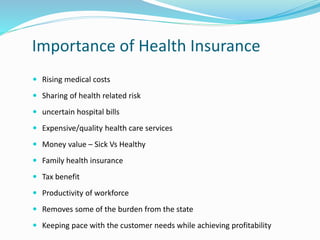
Importance of Health Insurance
 Rising medical costs
 Sharing of health related risk
 uncertain hospital bills
 Expensive/quality health care services
 Money value – Sick Vs Healthy
 Family health insurance
 Tax benefit
 Productivity of workforce
 Removes some of the burden from the state
 Keeping pace with the customer needs while achieving profitability
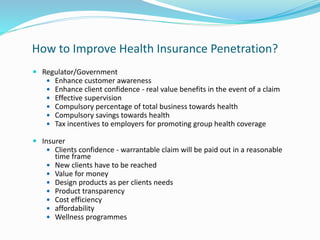
How to Improve Health Insurance Penetration?
 Regulator/Government
 Enhance customer awareness
 Enhance client confidence - real value benefits in the event of a claim
 Effective supervision
 Compulsory percentage of total business towards health
 Compulsory savings towards health
 Tax incentives to employers for promoting group health coverage
 Insurer
 Clients confidence - warrantable claim will be paid out in a reasonable
time frame
 New clients have to be reached
 Value for money
 Design products as per clients needs
 Product transparency
 Cost efficiency
 affordability
 Wellness programmes
Initiatives of IRDA
 Committee to formulate regulations
 Pure health insurance products
 Allowing the formation of an stand alone health insurance
company
 Standalone health insurance companies
 Renewability
 Senior citizens
Impediments in Health Insurance
 Lack of Data
 Moral Hazard/Adverse Selection
 Complex nature of the product
 Medical Inflation
 New treatments
 Unnecessary treatments
 Difficulty in pricing
 Government provision of health care
 Long term nature
 Changing life style
 Mis-selling/fraud
Types of Health Insurance Plans
 Individual health plan
 Family floater plan
 Senior Citizens’ plan
 Critical illness plan
 Daily hospital cash and
 Unit-linked health plan (ULHP).
Individual Health Plans
 Largely, an individual health insurance plan (IHIP), or ‘mediclaim’,
would cover expenses if you are hospitalised for at least 24 hours.
 These plans are indemnity policies, that is, they reimburse the
actual expenses incurred up to the amount of the cover that you
buy.
 Some of the expenses that are covered are room rent, doctor’s
fees, anaesthetist’s fees, cost of blood and oxygen, and operation
theatre charges.
Family Floater Plans
 This is a fairly new entrant in the health insurance firmament.
 It takes advantage of the fact that the possibility of all members of
a family falling ill at the same time or within the same year is low.
 Under a family floater (FF) health plan, the entire sum insured can
be availed by any or all members and is not restricted to one
individual only as is the case in an individual health plan.
 Let’s look at an example. Say, a family of four has individual covers
of Rs 1 lakh each. If the cost of treating one person crosses Rs 1
lakh, then the rest has to be borne by the family out of its own
money. If, however, the entire family is insured for Rs 4 lakh
through a floater policy, then any of the members will be covered
for that amount in any year. To the extent of the annual cover, any
number of members can avail the money.
Senior Citizens’ Plans
 Insurance is considered a form of long-term savings for senior
citizens. This money provides financial stability and also helps
them in times of need. Medical insurance enables senior citizens to
pay for health checkups, emergency medical costs and long-term
treatment. The income tax benefit on insurance premiums is up to
Rs. 15,000 under Section 80 D of the Income Tax Act, as on March
31, 2016. Medical insurance is provided through several private
insurance companies and four public sector general insurance
companies. These are:
 National Insurance Company
 Oriental Insurance Company
 New India Assurance
 United India Insurance Company
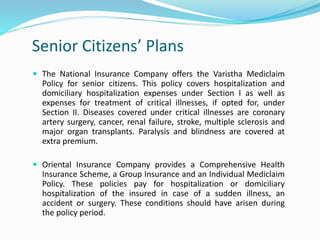
Senior Citizens’ Plans
 The National Insurance Company offers the Varistha Mediclaim
Policy for senior citizens. This policy covers hospitalization and
domiciliary hospitalization expenses under Section I as well as
expenses for treatment of critical illnesses, if opted for, under
Section II. Diseases covered under critical illnesses are coronary
artery surgery, cancer, renal failure, stroke, multiple sclerosis and
major organ transplants. Paralysis and blindness are covered at
extra premium.
 Oriental Insurance Company provides a Comprehensive Health
Insurance Scheme, a Group Insurance and an Individual Mediclaim
Policy. These policies pay for hospitalization or domiciliary
hospitalization of the insured in case of a sudden illness, an
accident or surgery. These conditions should have arisen during
the policy period.
Critical Illness Plans
 A Critical Illness plan means to insure against the risk of serious
illness. It will give the same security of knowing that a guaranteed
cash sum will be paid if the unexpected happens and one is
diagnosed with a critical illness.
 The purpose of a critical illness plan is to let you put aside a small
regular amount now, as an insurance against all this happening.
 Bajaj Allianz, in its efforts to provide a customer centric solution is
offering an insurance policy to cover to some of these critical
illnesses like Cancer Coronary Artery bypass surgery First Heart
attack Kidney Failure Multiple sclerosis Major organ transplant
Stroke Arota graft surgery Paralysis Primary Pulmonary Arterial
Hypertension.
Daily Hospital Cash
 Expense benefit is paid on per day basis after hospitalization (most
plans mandate at least 48 hours of hospitalization).
 The pre-decided daily benefit amount is paid in full, irrespective of
the actual expenses.
 For example, a person buys a DHC plan with a limit of Rs 2,000 per
day. He gets hospitalised for 7 days and the total bill is Rs 35,000.
He would be reimbursed Rs 14,000 (2,000x7). If the bill is Rs 8,000,
he would still be reimbursed Rs 14,000.
Unit-linked health plan (ULHP)
 All ULHPs offer one or more combination of the other benefits (for
which risk premium is deducted from fund value).
Also, charges such as premium allocation charge and policy
administration charge are deducted from the fund value.
 LIC has launched Health Plus plan, a unique long term health
insurance plan that combines health insurance covers for the
entire family (husband, wife and the children) – Hospital Cash
Benefit (HCB) and Major Surgical Benefit (MSB) along with a ULIP
component (investment in the form of Units) that is specifically
designed to meet domiciliary treatment (DTB) related expenses for
the insured members.
Health Insurance in India
The health insurance market in India is very limited covering about
10% of the total population. The existing schemes can be categorized
as:
 Voluntary health insurance schemes or private-for-profit schemes;
 Mandatory health insurance schemes or government run schemes
(namely ESIS, CGHS).
 Insurance offered by NGOs / community based health insurance,
and
 Employer-based schemes
Voluntary health insurance schemes
 In private insurance, buyers are willing to pay premium to an
insurance company that pools similar risks and insures them for
health related expenses.
 The main distinction is that the premiums are set at a level, which
are based on assessment of risk status of the consumer (or of the
group of employees) and the level of benefits provided, rather
than as a proportion of consumer’s income.
 In the public sector, the General Insurance Corporation (GIC) and
its four subsidiary companies (National Insurance Corporation,
New India Assurance Company, Oriental Insurance Company and
United Insurance Company) provide voluntary insurance schemes.
Voluntary health insurance schemes
 The most popular health insurance cover offered by GIC is
Mediclaim policy.
 Mediclaim policy: It was introduced in 1986. It reimburses the
hospitalization expenses owing to illness or injury suffered by the
insured, whether the hospitalization is domiciliary or otherwise.
 Some of the various other voluntary health insurance schemes
available in the market are :- Asha deep plan II , Jeevan Asha plan
II, Jan Arogya policy, Raja Rajeswari policy, Overseas Mediclaim
policy, Cancer Insurance policy, Bhavishya Arogya policy, Dreaded
disease policy, Health Guard, Critical illness policy, Group Health
insurance policy, Shakti Shield etc.
Mandatory health insurance schemes
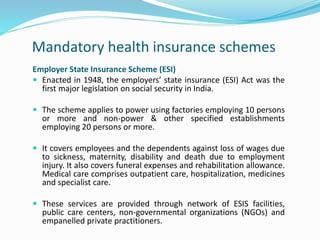
Employer State Insurance Scheme (ESI)
 Enacted in 1948, the employers’ state insurance (ESI) Act was the
first major legislation on social security in India.
 The scheme applies to power using factories employing 10 persons
or more and non-power & other specified establishments
employing 20 persons or more.
 It covers employees and the dependents against loss of wages due
to sickness, maternity, disability and death due to employment
injury. It also covers funeral expenses and rehabilitation allowance.
Medical care comprises outpatient care, hospitalization, medicines
and specialist care.
 These services are provided through network of ESIS facilities,
public care centers, non-governmental organizations (NGOs) and
empanelled private practitioners.
Mandatory health insurance schemes
Central Government Health Insurance Scheme (CGHS)
 Established in 1954, the CGHS covers employees and retirees of
the central government and certain autonomous and semi
autonomous and semi-government organizations.
 It also covers Members of Parliament, Governors, accredited
journalists and members of general public in some specified areas.
 Benefits under the scheme include medical care, home visits/care,
free medicines and diagnostic services.
 These services are provided through public facilities with some
specialized treatment (with reimbursement ceilings) being
permissible at private facilities.
 Most of the expenditure is met by the central government as only
12% is the share of contribution.
Mandatory health insurance schemes
Universal Health Insurance Scheme (UHIS)
 For providing financial risk protection to the poor, the government
announced UHIS in 2003.
 Under this scheme, for a premium of Rs. 165 per year per person,
Rs.248 for a family of five and Rs.330 for a family of seven , health
care for sum assured of Rs. 30000/- was provided.
 This scheme has been made eligible for below poverty line families
only.
 To make the scheme more saleable, the insurance companies
provided for a floater clause that made any member of family
eligible as against mediclaim policy which is for an individual
member.
Insurance offered by NGOs
 Insurance offered by NGOs/Community based schemes are typically
targeted at poorer population living in communities. Such schemes are
generally run by charitable trusts or non-governmental organizations
(NGOs).
 In these schemes the members prepay a set amount each year for
specified services. The premia are usually flat rate (not income related)
and therefore not progressive.
 The benefits offered are mainly in terms of preventive care, though
ambulatory and inpatient care is also covered.
 Such schemes tend to be financed through patient collection,
government grants and donations.
 Some of the popular Community Based Health Insurance schemes are:
- Self-Employed Women’s Association (SEWA), Tribuvandas Foundation
(TF), The Mullur Milk Co-operative, Sewagram, Action for Community
Organization, Rehabilitation and Development (ACCORD), Voluntary
Health Services (VHS) etc.
Employer based schemes
 Employers in both public and private sector offers employer based
insurance schemes through their own employer.
 These facilities are by way of lump sum payments, reimbursement
of employees’ health expenditure for out patient care and
hospitalization, fixed medical allowance or covering them under
the group health insurance schemes.
 The Railways, Defense and Security forces, Plantation sector and
Mining sector run their own health services for employees and
their families.
THANK YOU
BBA(B&I)
2nd SHIFT
To: MS. ASTHA DHUPAR MAM
SUBMITTED BY: RITIK TANEJA
SAHIB SINGH
PALAK ARORA
KUSH MENDIRATTA
RAJVEER ARORA

Insurance presentation

  • 1.
  • 2.
    What is HealthInsurance? Health insurance, like other forms of insurance, is a form of collectivism by means of which people collectively pool their risk, in this case the risk of incurring medical expenses.
  • 3.
    Importance of HealthInsurance  Rising medical costs  Sharing of health related risk  uncertain hospital bills  Expensive/quality health care services  Money value – Sick Vs Healthy  Family health insurance  Tax benefit  Productivity of workforce  Removes some of the burden from the state  Keeping pace with the customer needs while achieving profitability
  • 4.
    How to ImproveHealth Insurance Penetration?  Regulator/Government  Enhance customer awareness  Enhance client confidence - real value benefits in the event of a claim  Effective supervision  Compulsory percentage of total business towards health  Compulsory savings towards health  Tax incentives to employers for promoting group health coverage  Insurer  Clients confidence - warrantable claim will be paid out in a reasonable time frame  New clients have to be reached  Value for money  Design products as per clients needs  Product transparency  Cost efficiency  affordability  Wellness programmes
  • 5.
    Initiatives of IRDA Committee to formulate regulations  Pure health insurance products  Allowing the formation of an stand alone health insurance company  Standalone health insurance companies  Renewability  Senior citizens
  • 6.
    Impediments in HealthInsurance  Lack of Data  Moral Hazard/Adverse Selection  Complex nature of the product  Medical Inflation  New treatments  Unnecessary treatments  Difficulty in pricing  Government provision of health care  Long term nature  Changing life style  Mis-selling/fraud
  • 7.
    Types of HealthInsurance Plans  Individual health plan  Family floater plan  Senior Citizens’ plan  Critical illness plan  Daily hospital cash and  Unit-linked health plan (ULHP).
  • 8.
    Individual Health Plans Largely, an individual health insurance plan (IHIP), or ‘mediclaim’, would cover expenses if you are hospitalised for at least 24 hours.  These plans are indemnity policies, that is, they reimburse the actual expenses incurred up to the amount of the cover that you buy.  Some of the expenses that are covered are room rent, doctor’s fees, anaesthetist’s fees, cost of blood and oxygen, and operation theatre charges.
  • 9.
    Family Floater Plans This is a fairly new entrant in the health insurance firmament.  It takes advantage of the fact that the possibility of all members of a family falling ill at the same time or within the same year is low.  Under a family floater (FF) health plan, the entire sum insured can be availed by any or all members and is not restricted to one individual only as is the case in an individual health plan.  Let’s look at an example. Say, a family of four has individual covers of Rs 1 lakh each. If the cost of treating one person crosses Rs 1 lakh, then the rest has to be borne by the family out of its own money. If, however, the entire family is insured for Rs 4 lakh through a floater policy, then any of the members will be covered for that amount in any year. To the extent of the annual cover, any number of members can avail the money.
  • 10.
    Senior Citizens’ Plans Insurance is considered a form of long-term savings for senior citizens. This money provides financial stability and also helps them in times of need. Medical insurance enables senior citizens to pay for health checkups, emergency medical costs and long-term treatment. The income tax benefit on insurance premiums is up to Rs. 15,000 under Section 80 D of the Income Tax Act, as on March 31, 2016. Medical insurance is provided through several private insurance companies and four public sector general insurance companies. These are:  National Insurance Company  Oriental Insurance Company  New India Assurance  United India Insurance Company
  • 11.
    Senior Citizens’ Plans The National Insurance Company offers the Varistha Mediclaim Policy for senior citizens. This policy covers hospitalization and domiciliary hospitalization expenses under Section I as well as expenses for treatment of critical illnesses, if opted for, under Section II. Diseases covered under critical illnesses are coronary artery surgery, cancer, renal failure, stroke, multiple sclerosis and major organ transplants. Paralysis and blindness are covered at extra premium.  Oriental Insurance Company provides a Comprehensive Health Insurance Scheme, a Group Insurance and an Individual Mediclaim Policy. These policies pay for hospitalization or domiciliary hospitalization of the insured in case of a sudden illness, an accident or surgery. These conditions should have arisen during the policy period.
  • 12.
    Critical Illness Plans A Critical Illness plan means to insure against the risk of serious illness. It will give the same security of knowing that a guaranteed cash sum will be paid if the unexpected happens and one is diagnosed with a critical illness.  The purpose of a critical illness plan is to let you put aside a small regular amount now, as an insurance against all this happening.  Bajaj Allianz, in its efforts to provide a customer centric solution is offering an insurance policy to cover to some of these critical illnesses like Cancer Coronary Artery bypass surgery First Heart attack Kidney Failure Multiple sclerosis Major organ transplant Stroke Arota graft surgery Paralysis Primary Pulmonary Arterial Hypertension.
  • 13.
    Daily Hospital Cash Expense benefit is paid on per day basis after hospitalization (most plans mandate at least 48 hours of hospitalization).  The pre-decided daily benefit amount is paid in full, irrespective of the actual expenses.  For example, a person buys a DHC plan with a limit of Rs 2,000 per day. He gets hospitalised for 7 days and the total bill is Rs 35,000. He would be reimbursed Rs 14,000 (2,000x7). If the bill is Rs 8,000, he would still be reimbursed Rs 14,000.
  • 14.
    Unit-linked health plan(ULHP)  All ULHPs offer one or more combination of the other benefits (for which risk premium is deducted from fund value). Also, charges such as premium allocation charge and policy administration charge are deducted from the fund value.  LIC has launched Health Plus plan, a unique long term health insurance plan that combines health insurance covers for the entire family (husband, wife and the children) – Hospital Cash Benefit (HCB) and Major Surgical Benefit (MSB) along with a ULIP component (investment in the form of Units) that is specifically designed to meet domiciliary treatment (DTB) related expenses for the insured members.
  • 15.
    Health Insurance inIndia The health insurance market in India is very limited covering about 10% of the total population. The existing schemes can be categorized as:  Voluntary health insurance schemes or private-for-profit schemes;  Mandatory health insurance schemes or government run schemes (namely ESIS, CGHS).  Insurance offered by NGOs / community based health insurance, and  Employer-based schemes
  • 16.
    Voluntary health insuranceschemes  In private insurance, buyers are willing to pay premium to an insurance company that pools similar risks and insures them for health related expenses.  The main distinction is that the premiums are set at a level, which are based on assessment of risk status of the consumer (or of the group of employees) and the level of benefits provided, rather than as a proportion of consumer’s income.  In the public sector, the General Insurance Corporation (GIC) and its four subsidiary companies (National Insurance Corporation, New India Assurance Company, Oriental Insurance Company and United Insurance Company) provide voluntary insurance schemes.
  • 17.
    Voluntary health insuranceschemes  The most popular health insurance cover offered by GIC is Mediclaim policy.  Mediclaim policy: It was introduced in 1986. It reimburses the hospitalization expenses owing to illness or injury suffered by the insured, whether the hospitalization is domiciliary or otherwise.  Some of the various other voluntary health insurance schemes available in the market are :- Asha deep plan II , Jeevan Asha plan II, Jan Arogya policy, Raja Rajeswari policy, Overseas Mediclaim policy, Cancer Insurance policy, Bhavishya Arogya policy, Dreaded disease policy, Health Guard, Critical illness policy, Group Health insurance policy, Shakti Shield etc.
  • 18.
    Mandatory health insuranceschemes Employer State Insurance Scheme (ESI)  Enacted in 1948, the employers’ state insurance (ESI) Act was the first major legislation on social security in India.  The scheme applies to power using factories employing 10 persons or more and non-power & other specified establishments employing 20 persons or more.  It covers employees and the dependents against loss of wages due to sickness, maternity, disability and death due to employment injury. It also covers funeral expenses and rehabilitation allowance. Medical care comprises outpatient care, hospitalization, medicines and specialist care.  These services are provided through network of ESIS facilities, public care centers, non-governmental organizations (NGOs) and empanelled private practitioners.
  • 19.
    Mandatory health insuranceschemes Central Government Health Insurance Scheme (CGHS)  Established in 1954, the CGHS covers employees and retirees of the central government and certain autonomous and semi autonomous and semi-government organizations.  It also covers Members of Parliament, Governors, accredited journalists and members of general public in some specified areas.  Benefits under the scheme include medical care, home visits/care, free medicines and diagnostic services.  These services are provided through public facilities with some specialized treatment (with reimbursement ceilings) being permissible at private facilities.  Most of the expenditure is met by the central government as only 12% is the share of contribution.
  • 20.
    Mandatory health insuranceschemes Universal Health Insurance Scheme (UHIS)  For providing financial risk protection to the poor, the government announced UHIS in 2003.  Under this scheme, for a premium of Rs. 165 per year per person, Rs.248 for a family of five and Rs.330 for a family of seven , health care for sum assured of Rs. 30000/- was provided.  This scheme has been made eligible for below poverty line families only.  To make the scheme more saleable, the insurance companies provided for a floater clause that made any member of family eligible as against mediclaim policy which is for an individual member.
  • 21.
    Insurance offered byNGOs  Insurance offered by NGOs/Community based schemes are typically targeted at poorer population living in communities. Such schemes are generally run by charitable trusts or non-governmental organizations (NGOs).  In these schemes the members prepay a set amount each year for specified services. The premia are usually flat rate (not income related) and therefore not progressive.  The benefits offered are mainly in terms of preventive care, though ambulatory and inpatient care is also covered.  Such schemes tend to be financed through patient collection, government grants and donations.  Some of the popular Community Based Health Insurance schemes are: - Self-Employed Women’s Association (SEWA), Tribuvandas Foundation (TF), The Mullur Milk Co-operative, Sewagram, Action for Community Organization, Rehabilitation and Development (ACCORD), Voluntary Health Services (VHS) etc.
  • 22.
    Employer based schemes Employers in both public and private sector offers employer based insurance schemes through their own employer.  These facilities are by way of lump sum payments, reimbursement of employees’ health expenditure for out patient care and hospitalization, fixed medical allowance or covering them under the group health insurance schemes.  The Railways, Defense and Security forces, Plantation sector and Mining sector run their own health services for employees and their families.
  • 23.
    THANK YOU BBA(B&I) 2nd SHIFT To:MS. ASTHA DHUPAR MAM SUBMITTED BY: RITIK TANEJA SAHIB SINGH PALAK ARORA KUSH MENDIRATTA RAJVEER ARORA