Consumer Protection Act,1986
Prepared by
Mrs. Seema Mahajan
Asst. Prof. in Commerce
PTMLSD College for Women, Gurdaspur
THREE TIER CONSUMER GRIEVANCES
MACHINERY UNDER THE CONSUMER
PROTECTION ACT
District Forum:
District forum consists of a president and two other members. The
president can be a retired or working judge of District Court. They
are appointed by state government. The complaints for goods or
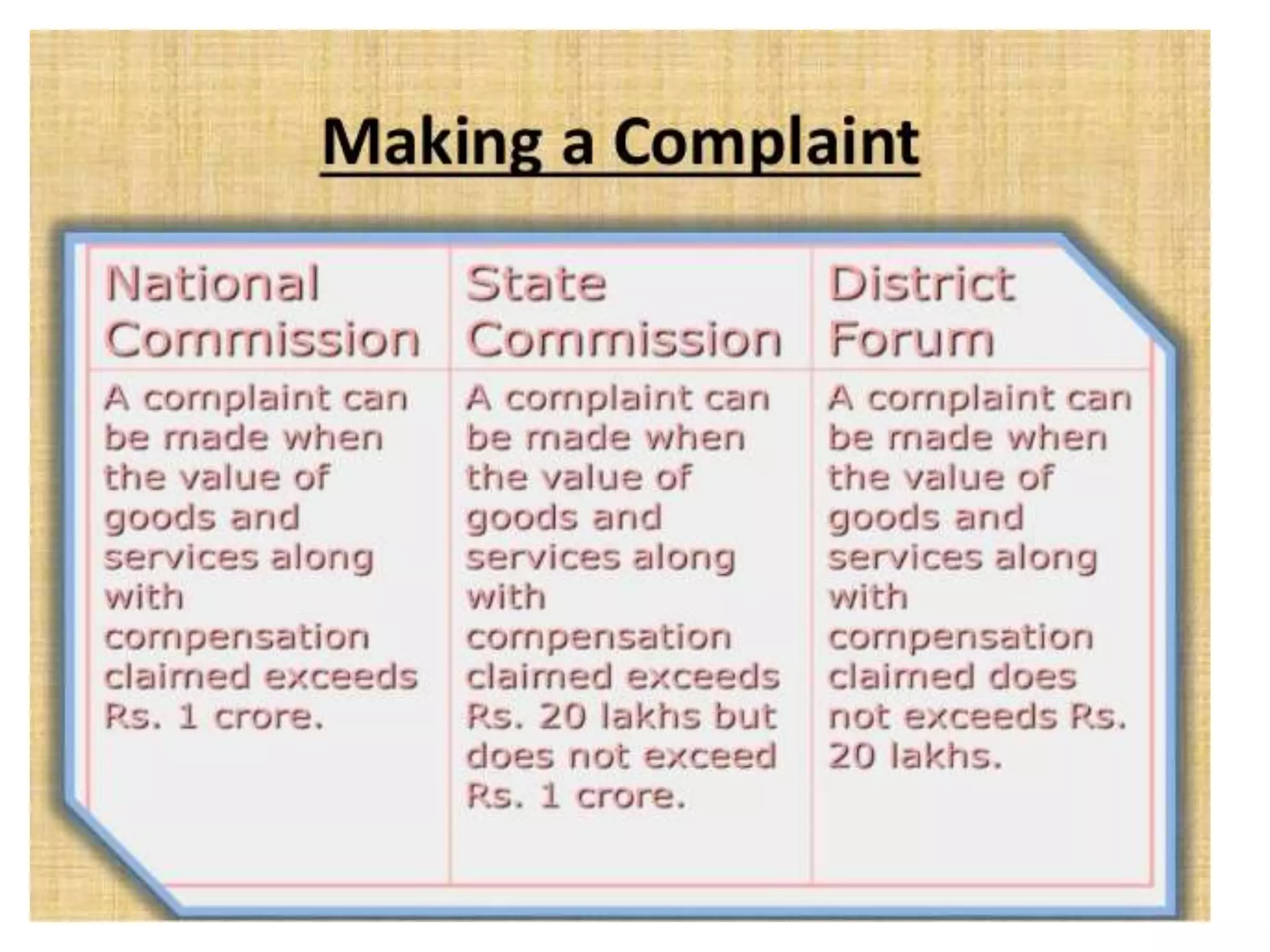
services worth Rs 20 lakhs or less can be filed in this agency. The
agency sends the goods for testing in laboratory if required and
gives decisions on the basis of facts and laboratory report. If the
aggrieved party is not satisfied by the jurisdiction of the district
forum then they can file an appeal against the judgment in State
Commission within 30 days by depositing Rs 25000 or 50% of the
penalty amount whichever is less.
State Commission
It consists of a president and two other members. The
president must be a retired or working judge of high
court. They all are appointed by state government. The
complaints for the goods worth more than Rs 20 lakhs
and less than Rs 1 crore can be filed in State
Commission on receiving complaint the State
commission contacts the party against whom the
complaint is filed and sends the goods for testing in
laboratory if required. In case the aggrieved party is
not satisfied with the judgment then they can file an
appeal in National Commission within 30 days by
depositing Rs 3500 or 50% of penalty amount
whichever is less
National Commission
The national commission consists of a president and
four members one of whom shall be a woman. They
are appointed by Central Government. The complaint
can be filed in National Commission if the value of
goods exceeds Rs 1 crore. On receiving the complaint
the National Commission informs the party against
whom complaint is filed and sends the goods for
testing if required and gives judgment?
If aggrieved party is not satisfied with the judgment
then they can file a complaint in Supreme Court within
30 days
CONSUMERS WILL BENEFIT UNDER THE
NEW CONSUMER PROTECTION ACT, 2019
The new Consumer Protection Act proposes a slew of
measures and tightens the existing rules to further
safeguard consumer rights. Consumers can cheer as
the Consumer Protection Act, 2019 has recently
replaced the three decade old Consumer Protection
Act, 1986. The new Act proposes a slew of measures
and tightens the existing rules to further safeguard
consumer rights. Introduction of a central regulator,
strict penalties for misleading advertisements and
guidelines for e-commerce and electronic service
providers are some of the key highlights.
Consumer courts
• Consumer redressal commissions, aka consumer courts, are present at the
district, state and national levels to address consumer complaints. The Act has
increased the pecuniary jurisdiction, which means ability of courts to take up
cases depending on the value of the case, of the consumer courts. “Since
access to district courts is better compared to state and national commissions,
the increase in limit to Rs 1 crore of district courts will be a convenience point,”
says M.R. Madhavan, Co-Founder and President, PRS Legislative Research.
• Another crucial change says that now the money spent on buying the product
till that time will determine the value of the case as opposed to the previous
parameter of total value of the purchased goods/service. “Say something is
bought on discount, it’s only fair that the amount the consumer has paid is the
determiner in place of the MRP,” says Madhavan.
• In another move, the Act allows consumers to file their complaint with the
court from anywhere. This comes as a big relief as earlier they were required to
file complaint in the area where the seller or service provider was located. This
is a fitting move considering the rise in e-commerce purchases, where the
seller could be located anywhere. In addition, the Act also enables the
consumer to seek a hearing through video conferencing, saving him both
money and time.
Product liability
The Act has proposed provisions for product liability
under which a manufacturer or a service provider has
to compensate a consumer if their good/service cause
injury or loss to the consumer due to manufacturing
defect or poor service. For instance, if a pressure
cooker explodes due to a manufacturing defect and
harms the consumer, the manufacturer is liable to
compensate the consumer for the injury. Earlier, the
consumer would only be compensated with the
cooker’s cost. The consumer could ask for
compensation, but through a civil court, which usually
takes years to resolve a case, and not consumer forum.
e-commerce platforms
The most significant impact of this provision will be on e-commerce platforms as it
also includes service providers under its ambit. “Product liability is now extended
to service providers and sellers along with manufacturers. This means e-commerce
sites cannot escape as aggregators anymore,” says Mukesh Jain, Founder, Mukesh
Jain & Associates.
E-commerce under the radar
E-commerce will now be governed by all the laws that apply to direct selling. The
guidelines propose that platforms like Amazon, Flipkart, Snapdeal etc will have to
disclose sellers’ details, such as their address, website, email, etc and other
conditions related to refund, exchange, terms of contract and warranty on their
website to increase transparency. The onus of ensuring that no counterfeit
products are sold on these platforms will also most likely lie with the companies. If
any such product is reported or recognised, the company could be penalised. This
move is fitting since cases of fake products sold through ecommerce platforms is
rampant. A survey by a social community platform LocalCircles conducted in
December last year showed that 38% respondents out of 6,923 were sold
counterfeit products from an ecommerce site in one year. These guidelines are
open for public comment until 15 September.
Separate regulator
The Act proposes establishment of a central regulator, Central
Consumer Protection Authority (CCPA), to address issues
related to consumer rights, unfair trade practices,
misleading advertisements and impose penalities for selling
faulty and fake products. Broadly, regulatory moves of CCPA
will be directed towards the manufacturers, sellers and
service providers and will not address customers’
grievances and disputes directly. Nevertheless, the overall
purpose of CCPA is to strengthen the existing consumer
rights.
https://economictimes.indiatimes.com/wealth/spend/here
s-how-consumers-will-benefitunder-the-new-consumer-
protection-act/articleshow/70711304.cms
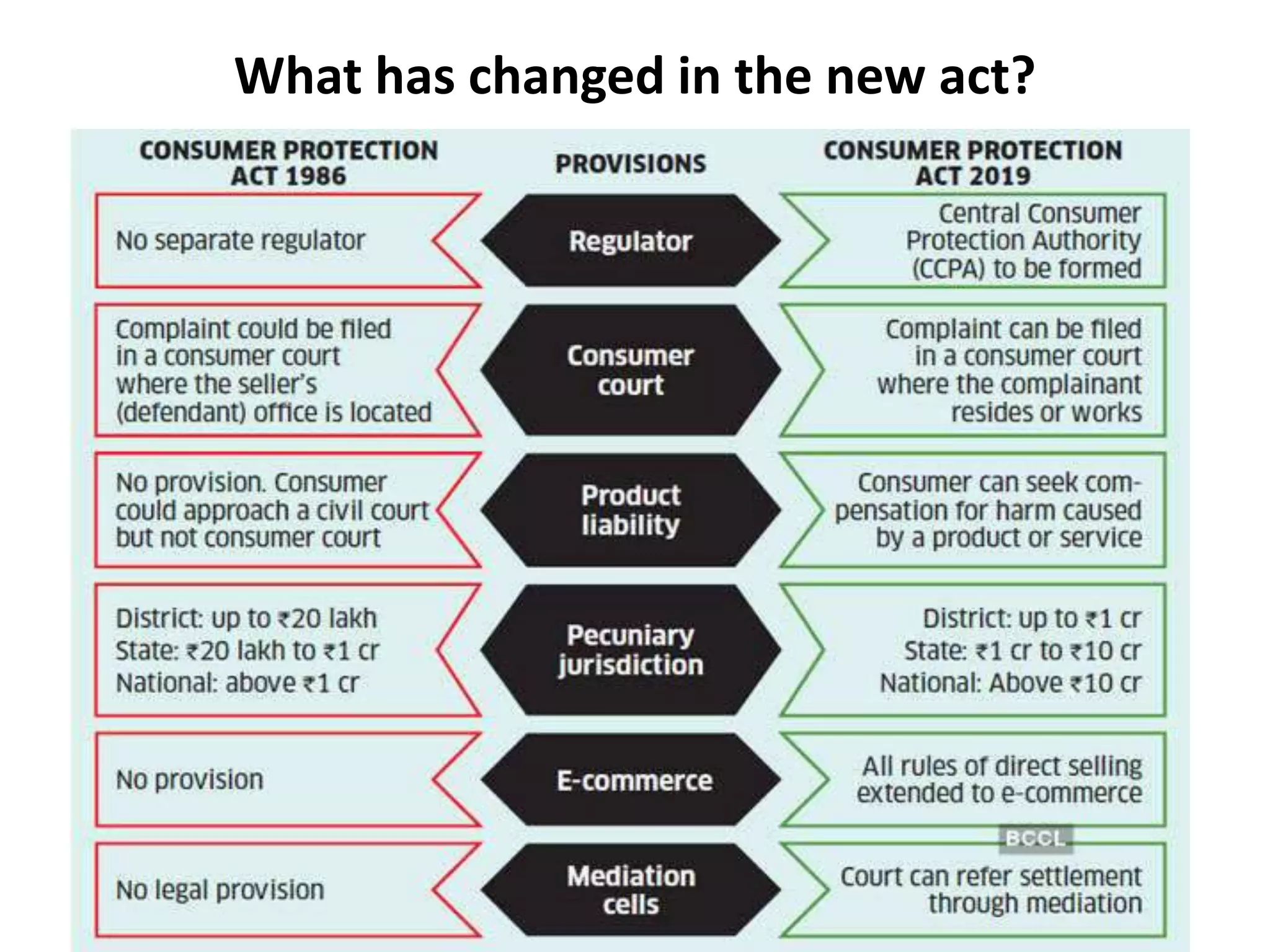
What has changed in the new act?
Consumer  dispute redressal mechanism

Consumer dispute redressal mechanism

  • 1.
    Consumer Protection Act,1986 Preparedby Mrs. Seema Mahajan Asst. Prof. in Commerce PTMLSD College for Women, Gurdaspur
  • 3.
    THREE TIER CONSUMERGRIEVANCES MACHINERY UNDER THE CONSUMER PROTECTION ACT District Forum: District forum consists of a president and two other members. The president can be a retired or working judge of District Court. They are appointed by state government. The complaints for goods or services worth Rs 20 lakhs or less can be filed in this agency. The agency sends the goods for testing in laboratory if required and gives decisions on the basis of facts and laboratory report. If the aggrieved party is not satisfied by the jurisdiction of the district forum then they can file an appeal against the judgment in State Commission within 30 days by depositing Rs 25000 or 50% of the penalty amount whichever is less.
  • 4.
    State Commission It consistsof a president and two other members. The president must be a retired or working judge of high court. They all are appointed by state government. The complaints for the goods worth more than Rs 20 lakhs and less than Rs 1 crore can be filed in State Commission on receiving complaint the State commission contacts the party against whom the complaint is filed and sends the goods for testing in laboratory if required. In case the aggrieved party is not satisfied with the judgment then they can file an appeal in National Commission within 30 days by depositing Rs 3500 or 50% of penalty amount whichever is less
  • 5.
    National Commission The nationalcommission consists of a president and four members one of whom shall be a woman. They are appointed by Central Government. The complaint can be filed in National Commission if the value of goods exceeds Rs 1 crore. On receiving the complaint the National Commission informs the party against whom complaint is filed and sends the goods for testing if required and gives judgment? If aggrieved party is not satisfied with the judgment then they can file a complaint in Supreme Court within 30 days
  • 9.
    CONSUMERS WILL BENEFITUNDER THE NEW CONSUMER PROTECTION ACT, 2019 The new Consumer Protection Act proposes a slew of measures and tightens the existing rules to further safeguard consumer rights. Consumers can cheer as the Consumer Protection Act, 2019 has recently replaced the three decade old Consumer Protection Act, 1986. The new Act proposes a slew of measures and tightens the existing rules to further safeguard consumer rights. Introduction of a central regulator, strict penalties for misleading advertisements and guidelines for e-commerce and electronic service providers are some of the key highlights.
  • 10.
    Consumer courts • Consumerredressal commissions, aka consumer courts, are present at the district, state and national levels to address consumer complaints. The Act has increased the pecuniary jurisdiction, which means ability of courts to take up cases depending on the value of the case, of the consumer courts. “Since access to district courts is better compared to state and national commissions, the increase in limit to Rs 1 crore of district courts will be a convenience point,” says M.R. Madhavan, Co-Founder and President, PRS Legislative Research. • Another crucial change says that now the money spent on buying the product till that time will determine the value of the case as opposed to the previous parameter of total value of the purchased goods/service. “Say something is bought on discount, it’s only fair that the amount the consumer has paid is the determiner in place of the MRP,” says Madhavan. • In another move, the Act allows consumers to file their complaint with the court from anywhere. This comes as a big relief as earlier they were required to file complaint in the area where the seller or service provider was located. This is a fitting move considering the rise in e-commerce purchases, where the seller could be located anywhere. In addition, the Act also enables the consumer to seek a hearing through video conferencing, saving him both money and time.
  • 11.
    Product liability The Acthas proposed provisions for product liability under which a manufacturer or a service provider has to compensate a consumer if their good/service cause injury or loss to the consumer due to manufacturing defect or poor service. For instance, if a pressure cooker explodes due to a manufacturing defect and harms the consumer, the manufacturer is liable to compensate the consumer for the injury. Earlier, the consumer would only be compensated with the cooker’s cost. The consumer could ask for compensation, but through a civil court, which usually takes years to resolve a case, and not consumer forum.
  • 12.
    e-commerce platforms The mostsignificant impact of this provision will be on e-commerce platforms as it also includes service providers under its ambit. “Product liability is now extended to service providers and sellers along with manufacturers. This means e-commerce sites cannot escape as aggregators anymore,” says Mukesh Jain, Founder, Mukesh Jain & Associates. E-commerce under the radar E-commerce will now be governed by all the laws that apply to direct selling. The guidelines propose that platforms like Amazon, Flipkart, Snapdeal etc will have to disclose sellers’ details, such as their address, website, email, etc and other conditions related to refund, exchange, terms of contract and warranty on their website to increase transparency. The onus of ensuring that no counterfeit products are sold on these platforms will also most likely lie with the companies. If any such product is reported or recognised, the company could be penalised. This move is fitting since cases of fake products sold through ecommerce platforms is rampant. A survey by a social community platform LocalCircles conducted in December last year showed that 38% respondents out of 6,923 were sold counterfeit products from an ecommerce site in one year. These guidelines are open for public comment until 15 September.
  • 13.
    Separate regulator The Actproposes establishment of a central regulator, Central Consumer Protection Authority (CCPA), to address issues related to consumer rights, unfair trade practices, misleading advertisements and impose penalities for selling faulty and fake products. Broadly, regulatory moves of CCPA will be directed towards the manufacturers, sellers and service providers and will not address customers’ grievances and disputes directly. Nevertheless, the overall purpose of CCPA is to strengthen the existing consumer rights. https://economictimes.indiatimes.com/wealth/spend/here s-how-consumers-will-benefitunder-the-new-consumer- protection-act/articleshow/70711304.cms
  • 14.
    What has changedin the new act?