Insurance
Insurance:
 Insurance is a way to manage
your risk. When you buy
insurance, you purchase
protection against unexpected
financial losses. The insurance
company pays you or someone
you choose if something bad
happens to you. If you have no
insurance and an accident
happens, you may be
responsible for all related costs.
Why Insurance
important?
 Buying insurance is important as it ensures
that you are financially secure to face any
type of problem in life, and this is why
insurance is a very important part of financial
planning. A general insurance company
offers insurance policies to secure health,
travel, motor vehicle, and home. The
convenient part of it is that you can purchase
all these insurance policies online nowadays.
Insured VS Insurer
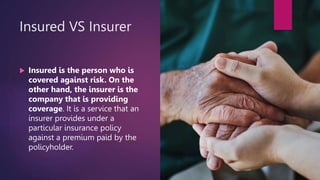
 Insured is the person who is
covered against risk. On the
other hand, the insurer is the
company that is providing
coverage. It is a service that an
insurer provides under a
particular insurance policy
against a premium paid by the
policyholder.
Risk
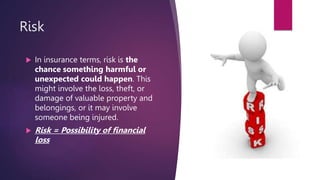
 In insurance terms, risk is the
chance something harmful or
unexpected could happen. This
might involve the loss, theft, or
damage of valuable property and
belongings, or it may involve
someone being injured.
 Risk = Possibility of financial
loss
How to
handle risk ?
There are Three ways to handle risk:
 Avoidance
 Retention
 Transfer (through Insurance and Contracts)
Avoidance
 Many times it is not possible to completely avoid risk but the
possibility should not be overlooked.
 For example, at the height of a thunderstorm, Vehicles for
travel until the weather begins to clear, thus avoiding the risk
of auto accidents during severe weather.
Retention
 At times, based on the likely frequency and severity of the
risks presented, retaining the risk or a portion of the risk may
be cost-effective even though other methods of handling the
risk are available.
 For example : Keep some money in hand to use it in case of
emergency.
Transfer
 The purchase of insurance is also referred to as a risk
transfer since the policy actually shifts the financial
risk of loss, contractually, from the insured entity to
the insurance company.
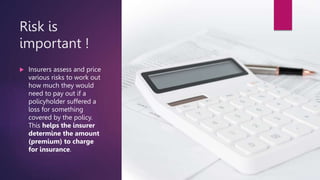
Risk is
important !
 Insurers assess and price
various risks to work out
how much they would
need to pay out if a
policyholder suffered a
loss for something
covered by the policy.
This helps the insurer
determine the amount
(premium) to charge
for insurance.
Types of risk :
 #1 – Pure Risk
 #2 – Speculative Risk
Pure Risk
Pure risk refers to the situation
where it is certain that the
outcome will lead to loss of the
person only or maximum it
could lead to the condition of
the break-even to the person,
but it can never cause profit to
the person.
An example of pure risk includes
the possibility of damage to the
house due to natural calamity.
Speculative Risk
Speculative risk refers to the
situation where the direction of
the outcome is not specific
Ex : It could lead to a condition
of loss, profit, or break-even.
These risks are generally not
insurable. An example of
speculative risk includes the
purchase of the shares of a
company by a person.
Types of loss:
 #1 – Direct loss
 #2 – Indirect loss
Direct Loss
In insurance, "direct loss coverage"
refers to damage immediately inflicted
by a disaster, accident or other event,
known in insurance language as "perils.”
Example : If a tornado strikes a town
and takes the roof off the building, a
direct loss would include damage to the
structure, as well as to equipment,
furniture, inventory or other items
inside. Fire and smoke damage would
count as a direct loss. So would theft, or
a car crashing through the front
window.
Indirect Loss
Indirect loss insurance, often
referred to in business insurance
policies as "consequential losses,"
are not inflicted by the peril itself
but describe losses suffered as a
result or consequence of the direct
loss.
Example : If a tornado destroys the
roof of a store, not only are there
rebuilding costs, but the business
cannot operate until the damage is
fixed. Income lost during the
rebuilding -- and after it, if
customers stick with the alternatives
they find in the meantime --
represents an indirect loss.
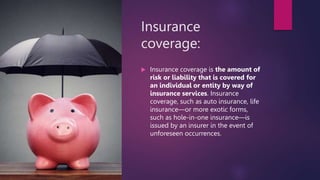
Insurance
coverage:
 Insurance coverage is the amount of
risk or liability that is covered for
an individual or entity by way of
insurance services. Insurance
coverage, such as auto insurance, life
insurance—or more exotic forms,
such as hole-in-one insurance—is
issued by an insurer in the event of
unforeseen occurrences.
Risk Factor
 Risk factor is nothing but the amount of premium
needs to be paid to the insurer (i.e. The eligibility to
get a policy)
 It determines that the huge risk will leads to huge
amount of premium to be paid to the insurer
 There are several risk factors. Based on the risk factor
the premium amount may vary and also the insurer
will decide whether they can provide insurance or not
to the insured
 In conclusion, The Risk factor implies that the
eligibility to get a policy and how much premium has
to be paid by the insured to the insurer.
Risk factors in
Different
types of
Insurance
There are several types of Insurance and some of them
are listed below:
1. Life Insurance - Factors such as Age, Height and
Weight, Medical records, Personal habits,
Occupation and Amount of coverage
2. Home Insurance – Factors such as Home Built year,
Construction and roof type, Number of floor and
family and Amount of coverage
3. Auto Insurance – Factors such as Vehicle make year
and model, Age and Gender of a driver and
Amount of coverage
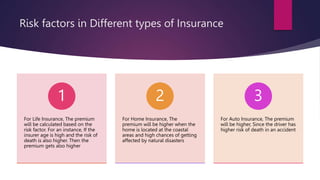
Risk factors in Different types of Insurance
For Life Insurance, The premium
will be calculated based on the
risk factor. For an instance, If the
insurer age is high and the risk of
death is also higher. Then the
premium gets also higher
1
For Home Insurance, The
premium will be higher when the
home is located at the coastal
areas and high chances of getting
affected by natural disasters
2
For Auto Insurance, The premium
will be higher, Since the driver has
higher risk of death in an accident
3
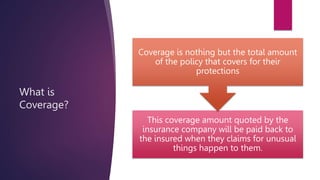
What is
Coverage?
This coverage amount quoted by the
insurance company will be paid back to
the insured when they claims for unusual
things happen to them.
Coverage is nothing but the total amount
of the policy that covers for their
protections
What is Peril?
 Generally, Peril refers to the cause of loss and it can
be covered with insurance.
 For Instance, Let's assume that the fire
damages/destroys the whole building. The fire
causes the loss in this scenario. Then the "Fire" is a
Peril.
 The Peril has been derived into two namely:
1. Named Perils
2. Open Perils
Named Perils – It is covered in a policy that states the
specific things that causes the loss should be listed
Open Perils – It accepts all types of risks (I.e. All risks)
What is Hazard?
 Hazard is defined as the probability of getting
chances to support loss
 There are three types of Hazards, They are:
1. Physical Hazard
2. Moral Hazard
3. Morale Hazard
Types of Hazards
 Physical Hazard:
Physical hazard implies that explicitly displayed outside Ex: Faulty wiring in a
house
 Moral Hazard:
Make or creating fake incidents and try to claim insurance
 Morale Hazard:
The loss that occurs due to carelessness
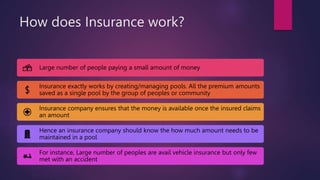
How does Insurance work?
Large number of people paying a small amount of money
Insurance exactly works by creating/managing pools. All the premium amounts
saved as a single pool by the group of peoples or community
Insurance company ensures that the money is available once the insured claims
an amount
Hence an insurance company should know the how much amount needs to be
maintained in a pool
For instance, Large number of peoples are avail vehicle insurance but only few
met with an accident
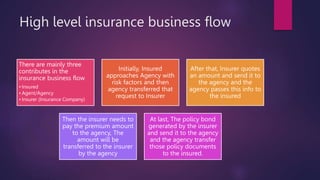
High level insurance business flow
There are mainly three
contributes in the
insurance business flow
• Insured
• Agent/Agency
• Insurer (Insurance Company)
Initially, Insured
approaches Agency with
risk factors and then
agency transferred that
request to Insurer
After that, Insurer quotes
an amount and send it to
the agency and the
agency passes this info to
the insured
Then the insurer needs to
pay the premium amount
to the agency, The
amount will be
transferred to the insurer
by the agency
At last, The policy bond
generated by the insurer
and send it to the agency
and the agency transfer
those policy documents
to the insured.
Conclusion
 Insurance is a large investment, and you will most likely purchase multiple
policies throughout your lifetime.
 It is essential that you know what each type of insurance covers and how it
works so you can make the best decision about what to buy.
 Do not base your decision on just what is cheapest but look at what it
provides.
This Photo by Unknown author is licensed under CC BY-NC.

Insurance - Basics.pptx

  • 1.
  • 2.
    Insurance:  Insurance isa way to manage your risk. When you buy insurance, you purchase protection against unexpected financial losses. The insurance company pays you or someone you choose if something bad happens to you. If you have no insurance and an accident happens, you may be responsible for all related costs.
  • 3.
    Why Insurance important?  Buyinginsurance is important as it ensures that you are financially secure to face any type of problem in life, and this is why insurance is a very important part of financial planning. A general insurance company offers insurance policies to secure health, travel, motor vehicle, and home. The convenient part of it is that you can purchase all these insurance policies online nowadays.
  • 4.
    Insured VS Insurer Insured is the person who is covered against risk. On the other hand, the insurer is the company that is providing coverage. It is a service that an insurer provides under a particular insurance policy against a premium paid by the policyholder.
  • 5.
    Risk  In insuranceterms, risk is the chance something harmful or unexpected could happen. This might involve the loss, theft, or damage of valuable property and belongings, or it may involve someone being injured.  Risk = Possibility of financial loss
  • 6.
    How to handle risk? There are Three ways to handle risk:  Avoidance  Retention  Transfer (through Insurance and Contracts)
  • 7.
    Avoidance  Many timesit is not possible to completely avoid risk but the possibility should not be overlooked.  For example, at the height of a thunderstorm, Vehicles for travel until the weather begins to clear, thus avoiding the risk of auto accidents during severe weather.
  • 8.
    Retention  At times,based on the likely frequency and severity of the risks presented, retaining the risk or a portion of the risk may be cost-effective even though other methods of handling the risk are available.  For example : Keep some money in hand to use it in case of emergency.
  • 9.
    Transfer  The purchaseof insurance is also referred to as a risk transfer since the policy actually shifts the financial risk of loss, contractually, from the insured entity to the insurance company.
  • 10.
    Risk is important ! Insurers assess and price various risks to work out how much they would need to pay out if a policyholder suffered a loss for something covered by the policy. This helps the insurer determine the amount (premium) to charge for insurance.
  • 11.
    Types of risk:  #1 – Pure Risk  #2 – Speculative Risk
  • 12.
    Pure Risk Pure riskrefers to the situation where it is certain that the outcome will lead to loss of the person only or maximum it could lead to the condition of the break-even to the person, but it can never cause profit to the person. An example of pure risk includes the possibility of damage to the house due to natural calamity.
  • 13.
    Speculative Risk Speculative riskrefers to the situation where the direction of the outcome is not specific Ex : It could lead to a condition of loss, profit, or break-even. These risks are generally not insurable. An example of speculative risk includes the purchase of the shares of a company by a person.
  • 14.
    Types of loss: #1 – Direct loss  #2 – Indirect loss
  • 15.
    Direct Loss In insurance,"direct loss coverage" refers to damage immediately inflicted by a disaster, accident or other event, known in insurance language as "perils.” Example : If a tornado strikes a town and takes the roof off the building, a direct loss would include damage to the structure, as well as to equipment, furniture, inventory or other items inside. Fire and smoke damage would count as a direct loss. So would theft, or a car crashing through the front window.
  • 16.
    Indirect Loss Indirect lossinsurance, often referred to in business insurance policies as "consequential losses," are not inflicted by the peril itself but describe losses suffered as a result or consequence of the direct loss. Example : If a tornado destroys the roof of a store, not only are there rebuilding costs, but the business cannot operate until the damage is fixed. Income lost during the rebuilding -- and after it, if customers stick with the alternatives they find in the meantime -- represents an indirect loss.
  • 17.
    Insurance coverage:  Insurance coverageis the amount of risk or liability that is covered for an individual or entity by way of insurance services. Insurance coverage, such as auto insurance, life insurance—or more exotic forms, such as hole-in-one insurance—is issued by an insurer in the event of unforeseen occurrences.
  • 18.
    Risk Factor  Riskfactor is nothing but the amount of premium needs to be paid to the insurer (i.e. The eligibility to get a policy)  It determines that the huge risk will leads to huge amount of premium to be paid to the insurer  There are several risk factors. Based on the risk factor the premium amount may vary and also the insurer will decide whether they can provide insurance or not to the insured  In conclusion, The Risk factor implies that the eligibility to get a policy and how much premium has to be paid by the insured to the insurer.
  • 19.
    Risk factors in Different typesof Insurance There are several types of Insurance and some of them are listed below: 1. Life Insurance - Factors such as Age, Height and Weight, Medical records, Personal habits, Occupation and Amount of coverage 2. Home Insurance – Factors such as Home Built year, Construction and roof type, Number of floor and family and Amount of coverage 3. Auto Insurance – Factors such as Vehicle make year and model, Age and Gender of a driver and Amount of coverage
  • 20.
    Risk factors inDifferent types of Insurance For Life Insurance, The premium will be calculated based on the risk factor. For an instance, If the insurer age is high and the risk of death is also higher. Then the premium gets also higher 1 For Home Insurance, The premium will be higher when the home is located at the coastal areas and high chances of getting affected by natural disasters 2 For Auto Insurance, The premium will be higher, Since the driver has higher risk of death in an accident 3
  • 21.
    What is Coverage? This coverageamount quoted by the insurance company will be paid back to the insured when they claims for unusual things happen to them. Coverage is nothing but the total amount of the policy that covers for their protections
  • 22.
    What is Peril? Generally, Peril refers to the cause of loss and it can be covered with insurance.  For Instance, Let's assume that the fire damages/destroys the whole building. The fire causes the loss in this scenario. Then the "Fire" is a Peril.  The Peril has been derived into two namely: 1. Named Perils 2. Open Perils Named Perils – It is covered in a policy that states the specific things that causes the loss should be listed Open Perils – It accepts all types of risks (I.e. All risks)
  • 23.
    What is Hazard? Hazard is defined as the probability of getting chances to support loss  There are three types of Hazards, They are: 1. Physical Hazard 2. Moral Hazard 3. Morale Hazard
  • 24.
    Types of Hazards Physical Hazard: Physical hazard implies that explicitly displayed outside Ex: Faulty wiring in a house  Moral Hazard: Make or creating fake incidents and try to claim insurance  Morale Hazard: The loss that occurs due to carelessness
  • 25.
    How does Insurancework? Large number of people paying a small amount of money Insurance exactly works by creating/managing pools. All the premium amounts saved as a single pool by the group of peoples or community Insurance company ensures that the money is available once the insured claims an amount Hence an insurance company should know the how much amount needs to be maintained in a pool For instance, Large number of peoples are avail vehicle insurance but only few met with an accident
  • 26.
    High level insurancebusiness flow There are mainly three contributes in the insurance business flow • Insured • Agent/Agency • Insurer (Insurance Company) Initially, Insured approaches Agency with risk factors and then agency transferred that request to Insurer After that, Insurer quotes an amount and send it to the agency and the agency passes this info to the insured Then the insurer needs to pay the premium amount to the agency, The amount will be transferred to the insurer by the agency At last, The policy bond generated by the insurer and send it to the agency and the agency transfer those policy documents to the insured.
  • 27.
    Conclusion  Insurance isa large investment, and you will most likely purchase multiple policies throughout your lifetime.  It is essential that you know what each type of insurance covers and how it works so you can make the best decision about what to buy.  Do not base your decision on just what is cheapest but look at what it provides.
  • 28.
    This Photo byUnknown author is licensed under CC BY-NC.