Module 1- Instrumentation Drawings & Symbols -1-
S
SY
YR
RI
IA
AN
N G
GA
AS
S C
CO
OM
MP
PA
AN
NY
Y (
(S
SG
GC
C)
)
Specific Programs "Instrumentation & Control"
M
MO
OD
DU
UL
LE
E 1
1:
:
I
IN
NS
ST
TR
RU
UM
ME
EN
NT
TA
AT
TI
IO
ON
N
D
DR
RA
AW
WI
IN
NG
GS
S &
& S
SY
YM
MB
BO
OL
LS
S
Module 1- Instrumentation Drawings & Symbols -2-
S
SY
YR
RI
IA
AN
N G
GA
AS
S C
CO
OM
MP
PA
AN
NY
Y (
(S
SG
GC
C)
)
Specific Programs "Instrumentation & Control"
I
IN
NS
ST
TR
RU
UM
ME
EN
NT
TA
AT
TI
IO
ON
N D
DR
RA
AW
WI
IN
NG
GS
S
&
& S
SY
YM
MB
BO
OL
LS
S
Objectives
At completion of this module, the trainee will have understanding of:
1. Instrumentation symbols and abbreviations,
2. Structure of instrument codes (Tag Numbers),
3. Process Block Diagram
4. Process Flow Diagram (PFD)
5. Piping and Instrumentation Drawing (P&ID)
6. Electrical Loop Drawing
7. DCS (I/O) Input & Output Loop Drawing
8. Pneumatic Loop drawing
9. Cause and Effect Diagram
10. Functional Logic Diagram
11. Instrument Installation Hook-Up Diagram (Pneumatic or Process)
Introduction
This manual has been written to provide the reader with an understanding of the
various codes and symbols used to illustrate instrumentation in facilities designed
for the production of oil, gas and associated hydrocarbon products.
Instrument codes and symbols are graphically represented in technical diagrams
such as Process Flow Schemes (PFD) and in Pipeline and Instrumentation Drawings
(P&ID).
Such drawings are of particular importance to operation and maintenance
technicians who are required to understand the process control systems associated
with an installation.
However, difficulties are often experienced primarily due to the existence of several
systems of instrument codes and symbols which have been developed over the years
by owners and contractors who carry out the engineering design, construction and
operation of processing installations.
Module 1- Instrumentation Drawings & Symbols -3-
S
SY
YR
RI
IA
AN
N G
GA
AS
S C
CO
OM
MP
PA
AN
NY
Y (
(S
SG
GC
C)
)
Specific Programs "Instrumentation & Control"
Purpose of Codes and Symbols
The primary purpose of using codes and symbols is to enable the various instrument
functions required in a process to be clearly and concisely represented on Process
Flow Diagrams (PFD) and on Pipeline and Instrumentation Drawings (P&ID).
The measuring instrument and control device function codes and symbols indicate
which process parameter is being measured, the relative locations of the measure-
ment and control devices and the permissible limits applicable to certain variable
process conditions.
In cases where supervisory computer systems are installed in a system, special
symbols are used to indicate the computer and the instruments, which are connected
to it.
For instance, letter codes and symbols permit the following instrument; functions to
be graphically represented.
Process Monitoring Instrument Codes
- Flow rate (F)
- Level (L)
- Pressure (P)
- Quality (Q)
- Speed (S)
- Temperature (T)
These codes are integrated with various symbols to distinguish between indicators,
recorders and in certain cases, their geographical locations.
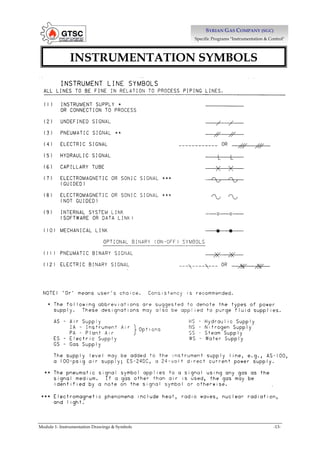
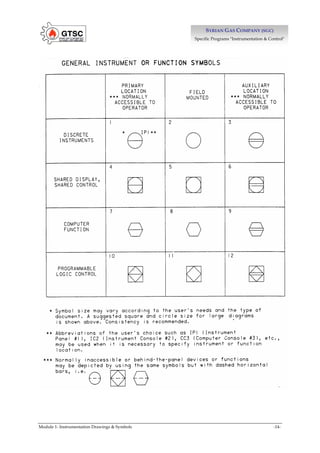
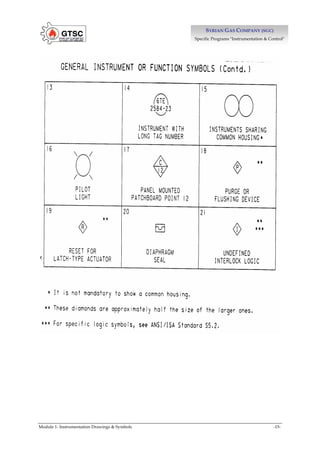
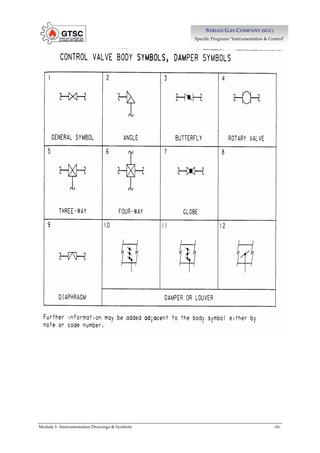
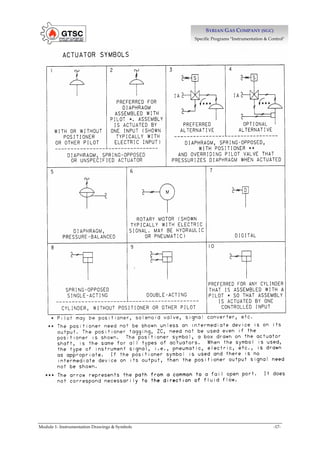
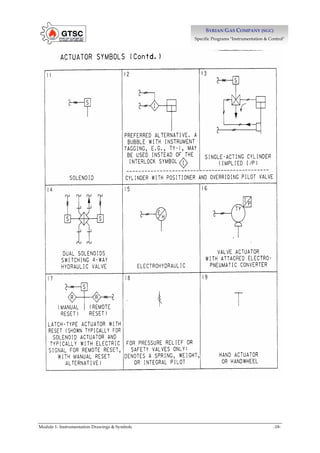
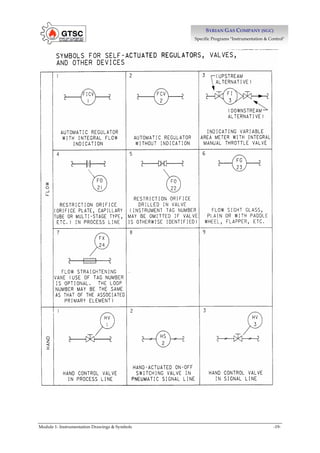
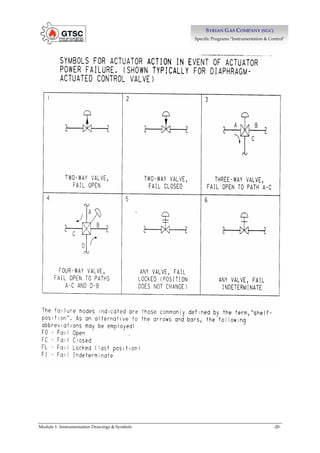
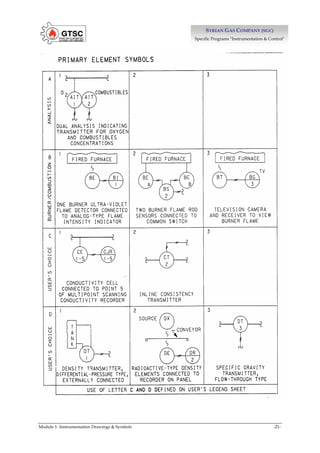
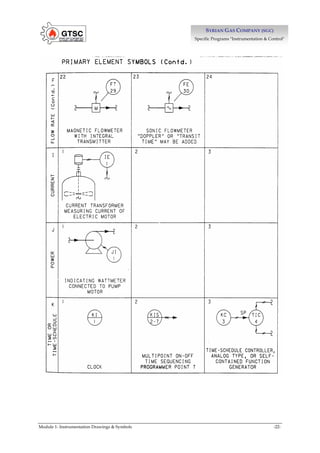
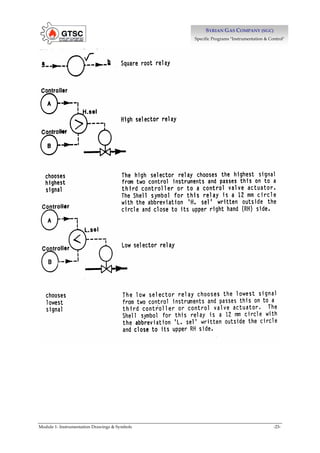
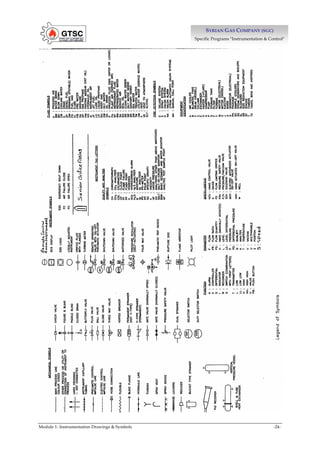
At the end of this section, there are several sheets contain wide range of the
applicable instrument symbols and abbreviations.
Emergency or Safety Instrument Codes
A list is given below, for the abnormal conditions, which must be measured by
function qualification instruments. State display or alarm signals from such
instruments are for the purpose of alerting the process operator, thus enabling
corrective action to be taken. In cases of emergency or to safeguard vital equipment,
the instruments automatically initiate trip or shutdown actions.
Module 1- Instrumentation Drawings & Symbols -4-
S
SY
YR
RI
IA
AN
N G
GA
AS
S C
CO
OM
MP
PA
AN
NY
Y (
(S
SG
GC
C)
)
Specific Programs "Instrumentation & Control"
- High level (H) initiates an alarm.
- Extreme high level (HH) trips the inlet valve shut.
- Low level (L) initiates an alarm.
- Extreme low level (LL) trips the outlet valve shut.
Low flow (L) initiates an alarm and may also open a minimum flow spill-back
or recycle valve to prevent the pump from overheating. Extreme low flow
(LL) trips the pump motor to prevent damage.
High-pressure (H) increases the overhead condenser coolant flow. Extreme
high pressure (HH) initiates an alarm and opens a vent valve to flare.
High temperature (H) initiates an alarm. Extreme high temperature (HH)
trips the fuel inlet valves to protect the furnace coil from overheating.
Structure of the Instrument Codes
In general, every conventional measuring or controlling instrument Installed in a
process unit is identified by three separate codes as follows.
¾ A location number code indicates the specific process unit in which the
instrument is installed.
¾ A function letter code indicates the property or process variable being measured
or controlled.
¾ A serial number code identifies the specific instrument and therefore prevents
confusion when there are several Instruments In a single process unit, each
having the same function letter code.
The combination of the three codes is known as the Instrument tag number, which
has the basic format -
xx a - yyy
TAG NUMBERS
“xx” is a two-digit number used to identify the process unit.
'a’ is a letter code containing two or more capital letters and is used to identify the
instrument function.
'yyy' is a three-digit number used to identify the particular instrument.
Module 1- Instrumentation Drawings & Symbols -5-
S
SY
YR
RI
IA
AN
N G
GA
AS
S C
CO
OM
MP
PA
AN
NY
Y (
(S
SG
GC
C)
)
Specific Programs "Instrumentation & Control"
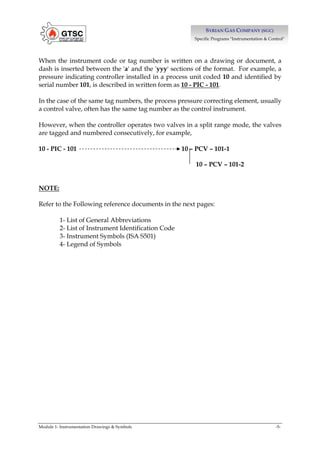
When the instrument code or tag number is written on a drawing or document, a
dash is inserted between the 'a' and the 'yyy' sections of the format. For example, a
pressure indicating controller installed in a process unit coded 10 and identified by
serial number 101, is described in written form as 10 - PIC - 101.
In the case of the same tag numbers, the process pressure correcting element, usually
a control valve, often has the same tag number as the control instrument.
However, when the controller operates two valves in a split range mode, the valves
are tagged and numbered consecutively, for example,
10 - PIC - 101 10 – PCV – 101-1
10 – PCV – 101-2
NOTE:
Refer to the Following reference documents in the next pages:
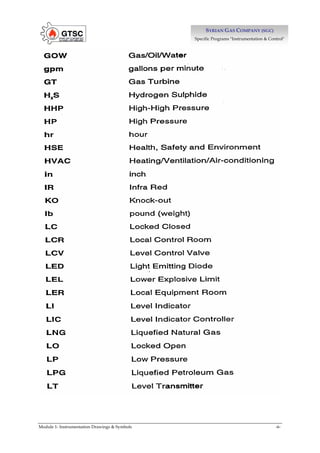
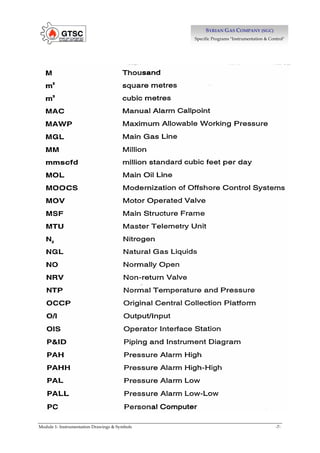
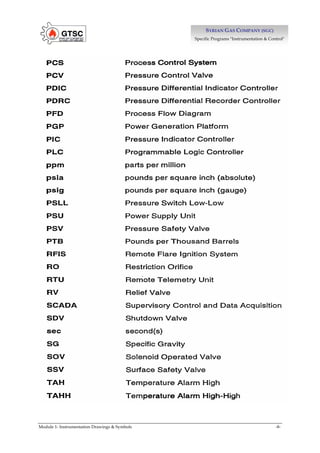
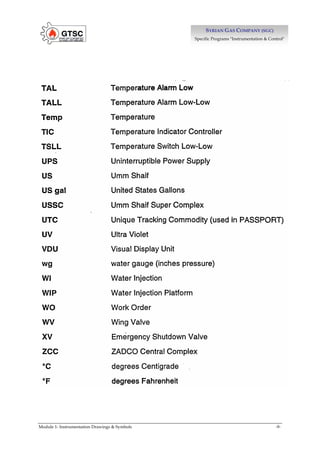
1- List of General Abbreviations
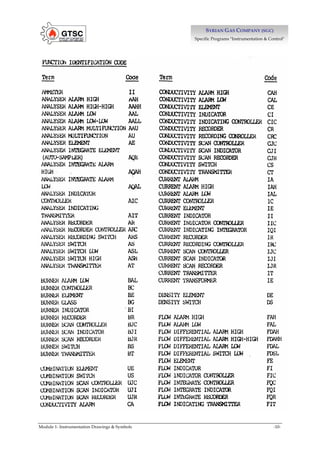
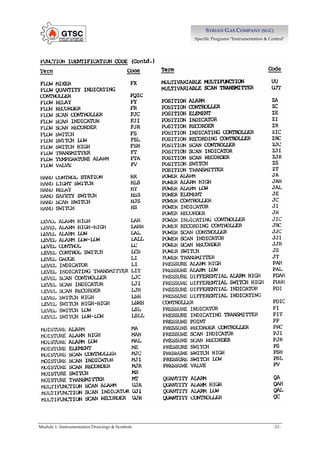
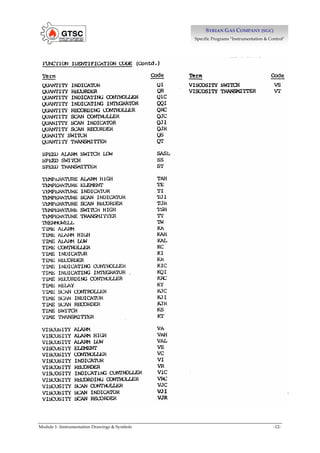
2- List of Instrument Identification Code
3- Instrument Symbols (ISA S501)
4- Legend of Symbols
Module 1- Instrumentation Drawings & Symbols -6-
S
SY
YR
RI
IA
AN
N G
GA
AS
S C
CO
OM
MP
PA
AN
NY
Y (
(S
SG
GC
C)
)
Specific Programs "Instrumentation & Control"
Module 1- Instrumentation Drawings & Symbols -7-
S
SY
YR
RI
IA
AN
N G
GA
AS
S C
CO
OM
MP
PA
AN
NY
Y (
(S
SG
GC
C)
)
Specific Programs "Instrumentation & Control"
Module 1- Instrumentation Drawings & Symbols -8-
S
SY
YR
RI
IA
AN
N G
GA
AS
S C
CO
OM
MP
PA
AN
NY
Y (
(S
SG
GC
C)
)
Specific Programs "Instrumentation & Control"
Module 1- Instrumentation Drawings & Symbols -9-
S
SY
YR
RI
IA
AN
N G
GA
AS
S C
CO
OM
MP
PA
AN
NY
Y (
(S
SG
GC
C)
)
Specific Programs "Instrumentation & Control"
Module 1- Instrumentation Drawings & Symbols -10-
S
SY
YR
RI
IA
AN
N G
GA
AS
S C
CO
OM
MP
PA
AN
NY
Y (
(S
SG
GC
C)
)
Specific Programs "Instrumentation & Control"
Module 1- Instrumentation Drawings & Symbols -11-
S
SY
YR
RI
IA
AN
N G
GA
AS
S C
CO
OM
MP
PA
AN
NY
Y (
(S
SG
GC
C)
)
Specific Programs "Instrumentation & Control"
Module 1- Instrumentation Drawings & Symbols -12-
S
SY
YR
RI
IA
AN
N G
GA
AS
S C
CO
OM
MP
PA
AN
NY
Y (
(S
SG
GC
C)
)
Specific Programs "Instrumentation & Control"
Module 1- Instrumentation Drawings & Symbols -13-
S
SY
YR
RI
IA
AN
N G
GA
AS
S C
CO
OM
MP
PA
AN
NY
Y (
(S
SG
GC
C)
)
Specific Programs "Instrumentation & Control"
INSTRUMENTATION SYMBOLS
Module 1- Instrumentation Drawings & Symbols -14-
S
SY
YR
RI
IA
AN
N G
GA
AS
S C
CO
OM
MP
PA
AN
NY
Y (
(S
SG
GC
C)
)
Specific Programs "Instrumentation & Control"
Module 1- Instrumentation Drawings & Symbols -15-
S
SY
YR
RI
IA
AN
N G
GA
AS
S C
CO
OM
MP
PA
AN
NY
Y (
(S
SG
GC
C)
)
Specific Programs "Instrumentation & Control"
Module 1- Instrumentation Drawings & Symbols -16-
S
SY
YR
RI
IA
AN
N G
GA
AS
S C
CO
OM
MP
PA
AN
NY
Y (
(S
SG
GC
C)
)
Specific Programs "Instrumentation & Control"
Module 1- Instrumentation Drawings & Symbols -17-
S
SY
YR
RI
IA
AN
N G
GA
AS
S C
CO
OM
MP
PA
AN
NY
Y (
(S
SG
GC
C)
)
Specific Programs "Instrumentation & Control"
Module 1- Instrumentation Drawings & Symbols -18-
S
SY
YR
RI
IA
AN
N G
GA
AS
S C
CO
OM
MP
PA
AN
NY
Y (
(S
SG
GC
C)
)
Specific Programs "Instrumentation & Control"
Module 1- Instrumentation Drawings & Symbols -19-
S
SY
YR
RI
IA
AN
N G
GA
AS
S C
CO
OM
MP
PA
AN
NY
Y (
(S
SG
GC
C)
)
Specific Programs "Instrumentation & Control"
Module 1- Instrumentation Drawings & Symbols -20-
S
SY
YR
RI
IA
AN
N G
GA
AS
S C
CO
OM
MP
PA
AN
NY
Y (
(S
SG
GC
C)
)
Specific Programs "Instrumentation & Control"
Module 1- Instrumentation Drawings & Symbols -21-
S
SY
YR
RI
IA
AN
N G
GA
AS
S C
CO
OM
MP
PA
AN
NY
Y (
(S
SG
GC
C)
)
Specific Programs "Instrumentation & Control"
Module 1- Instrumentation Drawings & Symbols -22-
S
SY
YR
RI
IA
AN
N G
GA
AS
S C
CO
OM
MP
PA
AN
NY
Y (
(S
SG
GC
C)
)
Specific Programs "Instrumentation & Control"
Module 1- Instrumentation Drawings & Symbols -23-
S
SY
YR
RI
IA
AN
N G
GA
AS
S C
CO
OM
MP
PA
AN
NY
Y (
(S
SG
GC
C)
)
Specific Programs "Instrumentation & Control"
Module 1- Instrumentation Drawings & Symbols -24-
S
SY
YR
RI
IA
AN
N G
GA
AS
S C
CO
OM
MP
PA
AN
NY
Y (
(S
SG
GC
C)
)
Specific Programs "Instrumentation & Control"
Module 2 A- Pressure Measurements -1-
S
SY
YR
RI
IA
AN
N G
GA
AS
S C
CO
OM
MP
PA
AN
NY
Y (
(S
SG
GC
C)
)
Specific Programs "Instrumentation & Control"
M
MO
OD
DU
UL
LE
E 2
2:
:
P
PR
RE
ES
SS
SU
UR
RE
E M
ME
EA
AS
SU
UR
RE
EM
ME
EN
NT
TS
S
Module 2 A- Pressure Measurements -2-
S
SY
YR
RI
IA
AN
N G
GA
AS
S C
CO
OM
MP
PA
AN
NY
Y (
(S
SG
GC
C)
)
Specific Programs "Instrumentation & Control"
P
PR
RE
ES
SS
SU
UR
RE
E M
ME
EA
AS
SU
UR
RE
EM
ME
EN
NT
T
Objectives
• At Completion of this module, the trainee will have understanding of:
• Pressure definition, types and units.
• Pressure sensing elements.
• Principles of pressure sensing elements; bourbon tubes, bellows, diaphragms,
vibrating wires, strain gauges and capacitance sensors.
• Protection devices for pressure measuring elements.
• Pressure measurement devices.
• Function of pressure measurement devices.
• Select a pressure device for a service.
• Identify the types of pressure gauge errors.
• Identify the parts and function of pneumatic and electronic pressure
transmitters.
• Describe the difference between electronic and smart transmitters.
• How to Convert 4-20 mA signal to 1-5 vdc signal and why.
• Calculate an output signal of a pressure transmitter at certain input.
• Definition of range and span of a transmitter.
• Field-wiring connection methods of the electronic pressure transmitter.
• Pressure switches types and function.
• Pressure regulators construction parts and function.
Related Safety Regulations for Module I-1: PRESSURE MEASUREMENT
Trainee have to be familiarized with the following SGC HSE regulations, while studying
this module:
Regulation No. 6: Permit to Work system.
Regulation No. 7: Isolation
7.18 (1-10) control systems procedures and isolations.
Regulation No. 22: Hot and Odd Bolting.
Regulation No. 23: General Engineering Safety.
Module 2 A- Pressure Measurements -3-
S
SY
YR
RI
IA
AN
N G
GA
AS
S C
CO
OM
MP
PA
AN
NY
Y (
(S
SG
GC
C)
)
Specific Programs "Instrumentation & Control"
Pressure Measurement
Oil and gas production operations require that system operating pressures be
regulated to specific pressures in order for the system(s) to work properly.
In addition, safety considerations dictate that system operating pressures be
monitored and controlled to ensure that the pressure limitations of equipment and
piping are not exceeded. In order to meet these objectives, the industry relies on a
variety of devices to generate an output signal which may be used to adjust or
change the observed pressure, The devices used by the oil and gas industry for
sensing operating pressures and generating the needed output signals are described
in this manual. The purpose of this document is to provide the reader with an
understanding of how the different types of device functions and how they should
by applied, in order to satisfy the requirements of system monitoring and control.
Pressure is defined as the force exerted per unit area of surface.
P = F/A
P = pressure
F = force
A = surface area exposed to the force
In processing plants the hydrocarbon gases and liquids handled in pipes and vessels
exert pressure on the surface area.
Types of Pressure
In order to understand various types of pressure the following will be considered:
Pressure Scale reference points, there are two reference points, the zero point of
pressure which is assumed to a perfect vacuum, another point is atmospheric
pressure which varies with altitude above sea level and with weather conditions.
Module 2 A- Pressure Measurements -4-
S
SY
YR
RI
IA
AN
N G
GA
AS
S C
CO
OM
MP
PA
AN
NY
Y (
(S
SG
GC
C)
)
Specific Programs "Instrumentation & Control"
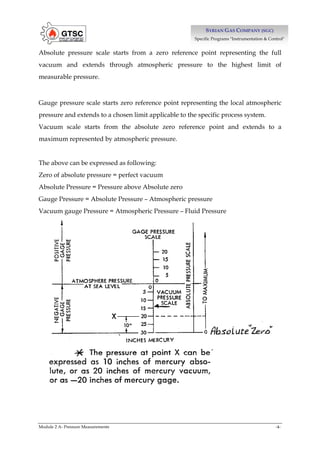
Absolute pressure scale starts from a zero reference point representing the full
vacuum and extends through atmospheric pressure to the highest limit of
measurable pressure.
Gauge pressure scale starts zero reference point representing the local atmospheric
pressure and extends to a chosen limit applicable to the specific process system.
Vacuum scale starts from the absolute zero reference point and extends to a
maximum represented by atmospheric pressure.
The above can be expressed as following:
Zero of absolute pressure = perfect vacuum
Absolute Pressure = Pressure above Absolute zero
Gauge Pressure = Absolute Pressure – Atmospheric pressure
Vacuum gauge Pressure = Atmospheric Pressure – Fluid Pressure
Module 2 A- Pressure Measurements -5-
S
SY
YR
RI
IA
AN
N G
GA
AS
S C
CO
OM
MP
PA
AN
NY
Y (
(S
SG
GC
C)
)
Specific Programs "Instrumentation & Control"
Pressure Units:
SGC uses a variety of pressure units but the two main systems are the Imperial(British
andAmerican) units and the S.I. (System International).
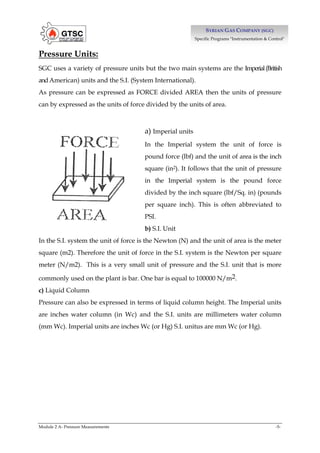
As pressure can be expressed as FORCE divided AREA then the units of pressure
can by expressed as the units of force divided by the units of area.
a) Imperial units
In the Imperial system the unit of force is
pound force (lbf) and the unit of area is the inch
square (in2). It follows that the unit of pressure
in the Imperial system is the pound force
divided by the inch square (lbf/Sq. in) (pounds
per square inch). This is often abbreviated to
PSI.
b) S.I. Unit
In the S.I. system the unit of force is the Newton (N) and the unit of area is the meter
square (m2). Therefore the unit of force in the S.I. system is the Newton per square
meter (N/m2). This is a very small unit of pressure and the S.I. unit that is more
commonly used on the plant is bar. One bar is equal to 100000 N/m2.
c) Liquid Column
Pressure can also be expressed in terms of liquid column height. The Imperial units
are inches water column (in Wc) and the S.I. units are millimeters water column
(mm Wc). Imperial units are inches Wc (or Hg) S.I. unitus are mm Wc (or Hg).
Module 2 A- Pressure Measurements -6-
S
SY
YR
RI
IA
AN
N G
GA
AS
S C
CO
OM
MP
PA
AN
NY
Y (
(S
SG
GC
C)
)
Specific Programs "Instrumentation & Control"
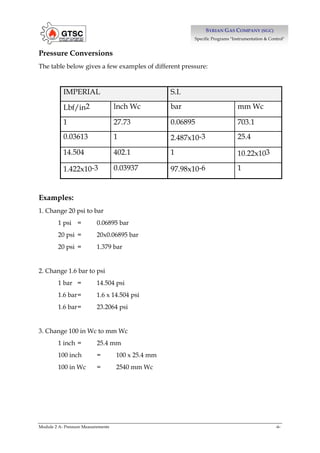
Pressure Conversions
The table below gives a few examples of different pressure:
IMPERIAL S.I.
Lbf/in2 lnch Wc bar mm Wc
1 27.73 0.06895 703.1
0.03613 1 2.487x10⁻³ 25.4
14.504 402.1 1 10.22x10³
1.422x10⁻³ 0.03937 97.98x10⁻⁶ 1
Examples:
1. Change 20 psi to bar
1 psi = 0.06895 bar
20 psi = 20x0.06895 bar
20 psi = 1.379 bar
2. Change 1.6 bar to psi
1 bar = 14.504 psi
1.6 bar= 1.6 x 14.504 psi
1.6 bar= 23.2064 psi
3. Change 100 in Wc to mm Wc
1 inch = 25.4 mm
100 inch = 100 x 25.4 mm
100 in Wc = 2540 mm Wc

INSTRUMENTATION_DRAWINGS__SYMBOLS_COURSE.pdf

  • 1.
    Module 1- InstrumentationDrawings & Symbols -1- S SY YR RI IA AN N G GA AS S C CO OM MP PA AN NY Y ( (S SG GC C) ) Specific Programs "Instrumentation & Control" M MO OD DU UL LE E 1 1: : I IN NS ST TR RU UM ME EN NT TA AT TI IO ON N D DR RA AW WI IN NG GS S & & S SY YM MB BO OL LS S
  • 2.
    Module 1- InstrumentationDrawings & Symbols -2- S SY YR RI IA AN N G GA AS S C CO OM MP PA AN NY Y ( (S SG GC C) ) Specific Programs "Instrumentation & Control" I IN NS ST TR RU UM ME EN NT TA AT TI IO ON N D DR RA AW WI IN NG GS S & & S SY YM MB BO OL LS S Objectives At completion of this module, the trainee will have understanding of: 1. Instrumentation symbols and abbreviations, 2. Structure of instrument codes (Tag Numbers), 3. Process Block Diagram 4. Process Flow Diagram (PFD) 5. Piping and Instrumentation Drawing (P&ID) 6. Electrical Loop Drawing 7. DCS (I/O) Input & Output Loop Drawing 8. Pneumatic Loop drawing 9. Cause and Effect Diagram 10. Functional Logic Diagram 11. Instrument Installation Hook-Up Diagram (Pneumatic or Process) Introduction This manual has been written to provide the reader with an understanding of the various codes and symbols used to illustrate instrumentation in facilities designed for the production of oil, gas and associated hydrocarbon products. Instrument codes and symbols are graphically represented in technical diagrams such as Process Flow Schemes (PFD) and in Pipeline and Instrumentation Drawings (P&ID). Such drawings are of particular importance to operation and maintenance technicians who are required to understand the process control systems associated with an installation. However, difficulties are often experienced primarily due to the existence of several systems of instrument codes and symbols which have been developed over the years by owners and contractors who carry out the engineering design, construction and operation of processing installations.
  • 3.
    Module 1- InstrumentationDrawings & Symbols -3- S SY YR RI IA AN N G GA AS S C CO OM MP PA AN NY Y ( (S SG GC C) ) Specific Programs "Instrumentation & Control" Purpose of Codes and Symbols The primary purpose of using codes and symbols is to enable the various instrument functions required in a process to be clearly and concisely represented on Process Flow Diagrams (PFD) and on Pipeline and Instrumentation Drawings (P&ID). The measuring instrument and control device function codes and symbols indicate which process parameter is being measured, the relative locations of the measure- ment and control devices and the permissible limits applicable to certain variable process conditions. In cases where supervisory computer systems are installed in a system, special symbols are used to indicate the computer and the instruments, which are connected to it. For instance, letter codes and symbols permit the following instrument; functions to be graphically represented. Process Monitoring Instrument Codes - Flow rate (F) - Level (L) - Pressure (P) - Quality (Q) - Speed (S) - Temperature (T) These codes are integrated with various symbols to distinguish between indicators, recorders and in certain cases, their geographical locations. At the end of this section, there are several sheets contain wide range of the applicable instrument symbols and abbreviations. Emergency or Safety Instrument Codes A list is given below, for the abnormal conditions, which must be measured by function qualification instruments. State display or alarm signals from such instruments are for the purpose of alerting the process operator, thus enabling corrective action to be taken. In cases of emergency or to safeguard vital equipment, the instruments automatically initiate trip or shutdown actions.
  • 4.
    Module 1- InstrumentationDrawings & Symbols -4- S SY YR RI IA AN N G GA AS S C CO OM MP PA AN NY Y ( (S SG GC C) ) Specific Programs "Instrumentation & Control" - High level (H) initiates an alarm. - Extreme high level (HH) trips the inlet valve shut. - Low level (L) initiates an alarm. - Extreme low level (LL) trips the outlet valve shut. Low flow (L) initiates an alarm and may also open a minimum flow spill-back or recycle valve to prevent the pump from overheating. Extreme low flow (LL) trips the pump motor to prevent damage. High-pressure (H) increases the overhead condenser coolant flow. Extreme high pressure (HH) initiates an alarm and opens a vent valve to flare. High temperature (H) initiates an alarm. Extreme high temperature (HH) trips the fuel inlet valves to protect the furnace coil from overheating. Structure of the Instrument Codes In general, every conventional measuring or controlling instrument Installed in a process unit is identified by three separate codes as follows. ¾ A location number code indicates the specific process unit in which the instrument is installed. ¾ A function letter code indicates the property or process variable being measured or controlled. ¾ A serial number code identifies the specific instrument and therefore prevents confusion when there are several Instruments In a single process unit, each having the same function letter code. The combination of the three codes is known as the Instrument tag number, which has the basic format - xx a - yyy TAG NUMBERS “xx” is a two-digit number used to identify the process unit. 'a’ is a letter code containing two or more capital letters and is used to identify the instrument function. 'yyy' is a three-digit number used to identify the particular instrument.
  • 5.
    Module 1- InstrumentationDrawings & Symbols -5- S SY YR RI IA AN N G GA AS S C CO OM MP PA AN NY Y ( (S SG GC C) ) Specific Programs "Instrumentation & Control" When the instrument code or tag number is written on a drawing or document, a dash is inserted between the 'a' and the 'yyy' sections of the format. For example, a pressure indicating controller installed in a process unit coded 10 and identified by serial number 101, is described in written form as 10 - PIC - 101. In the case of the same tag numbers, the process pressure correcting element, usually a control valve, often has the same tag number as the control instrument. However, when the controller operates two valves in a split range mode, the valves are tagged and numbered consecutively, for example, 10 - PIC - 101 10 – PCV – 101-1 10 – PCV – 101-2 NOTE: Refer to the Following reference documents in the next pages: 1- List of General Abbreviations 2- List of Instrument Identification Code 3- Instrument Symbols (ISA S501) 4- Legend of Symbols
  • 6.
    Module 1- InstrumentationDrawings & Symbols -6- S SY YR RI IA AN N G GA AS S C CO OM MP PA AN NY Y ( (S SG GC C) ) Specific Programs "Instrumentation & Control"
  • 7.
    Module 1- InstrumentationDrawings & Symbols -7- S SY YR RI IA AN N G GA AS S C CO OM MP PA AN NY Y ( (S SG GC C) ) Specific Programs "Instrumentation & Control"
  • 8.
    Module 1- InstrumentationDrawings & Symbols -8- S SY YR RI IA AN N G GA AS S C CO OM MP PA AN NY Y ( (S SG GC C) ) Specific Programs "Instrumentation & Control"
  • 9.
    Module 1- InstrumentationDrawings & Symbols -9- S SY YR RI IA AN N G GA AS S C CO OM MP PA AN NY Y ( (S SG GC C) ) Specific Programs "Instrumentation & Control"
  • 10.
    Module 1- InstrumentationDrawings & Symbols -10- S SY YR RI IA AN N G GA AS S C CO OM MP PA AN NY Y ( (S SG GC C) ) Specific Programs "Instrumentation & Control"
  • 11.
    Module 1- InstrumentationDrawings & Symbols -11- S SY YR RI IA AN N G GA AS S C CO OM MP PA AN NY Y ( (S SG GC C) ) Specific Programs "Instrumentation & Control"
  • 12.
    Module 1- InstrumentationDrawings & Symbols -12- S SY YR RI IA AN N G GA AS S C CO OM MP PA AN NY Y ( (S SG GC C) ) Specific Programs "Instrumentation & Control"
  • 13.
    Module 1- InstrumentationDrawings & Symbols -13- S SY YR RI IA AN N G GA AS S C CO OM MP PA AN NY Y ( (S SG GC C) ) Specific Programs "Instrumentation & Control" INSTRUMENTATION SYMBOLS
  • 14.
    Module 1- InstrumentationDrawings & Symbols -14- S SY YR RI IA AN N G GA AS S C CO OM MP PA AN NY Y ( (S SG GC C) ) Specific Programs "Instrumentation & Control"
  • 15.
    Module 1- InstrumentationDrawings & Symbols -15- S SY YR RI IA AN N G GA AS S C CO OM MP PA AN NY Y ( (S SG GC C) ) Specific Programs "Instrumentation & Control"
  • 16.
    Module 1- InstrumentationDrawings & Symbols -16- S SY YR RI IA AN N G GA AS S C CO OM MP PA AN NY Y ( (S SG GC C) ) Specific Programs "Instrumentation & Control"
  • 17.
    Module 1- InstrumentationDrawings & Symbols -17- S SY YR RI IA AN N G GA AS S C CO OM MP PA AN NY Y ( (S SG GC C) ) Specific Programs "Instrumentation & Control"
  • 18.
    Module 1- InstrumentationDrawings & Symbols -18- S SY YR RI IA AN N G GA AS S C CO OM MP PA AN NY Y ( (S SG GC C) ) Specific Programs "Instrumentation & Control"
  • 19.
    Module 1- InstrumentationDrawings & Symbols -19- S SY YR RI IA AN N G GA AS S C CO OM MP PA AN NY Y ( (S SG GC C) ) Specific Programs "Instrumentation & Control"
  • 20.
    Module 1- InstrumentationDrawings & Symbols -20- S SY YR RI IA AN N G GA AS S C CO OM MP PA AN NY Y ( (S SG GC C) ) Specific Programs "Instrumentation & Control"
  • 21.
    Module 1- InstrumentationDrawings & Symbols -21- S SY YR RI IA AN N G GA AS S C CO OM MP PA AN NY Y ( (S SG GC C) ) Specific Programs "Instrumentation & Control"
  • 22.
    Module 1- InstrumentationDrawings & Symbols -22- S SY YR RI IA AN N G GA AS S C CO OM MP PA AN NY Y ( (S SG GC C) ) Specific Programs "Instrumentation & Control"
  • 23.
    Module 1- InstrumentationDrawings & Symbols -23- S SY YR RI IA AN N G GA AS S C CO OM MP PA AN NY Y ( (S SG GC C) ) Specific Programs "Instrumentation & Control"
  • 24.
    Module 1- InstrumentationDrawings & Symbols -24- S SY YR RI IA AN N G GA AS S C CO OM MP PA AN NY Y ( (S SG GC C) ) Specific Programs "Instrumentation & Control"
  • 25.
    Module 2 A-Pressure Measurements -1- S SY YR RI IA AN N G GA AS S C CO OM MP PA AN NY Y ( (S SG GC C) ) Specific Programs "Instrumentation & Control" M MO OD DU UL LE E 2 2: : P PR RE ES SS SU UR RE E M ME EA AS SU UR RE EM ME EN NT TS S
  • 26.
    Module 2 A-Pressure Measurements -2- S SY YR RI IA AN N G GA AS S C CO OM MP PA AN NY Y ( (S SG GC C) ) Specific Programs "Instrumentation & Control" P PR RE ES SS SU UR RE E M ME EA AS SU UR RE EM ME EN NT T Objectives • At Completion of this module, the trainee will have understanding of: • Pressure definition, types and units. • Pressure sensing elements. • Principles of pressure sensing elements; bourbon tubes, bellows, diaphragms, vibrating wires, strain gauges and capacitance sensors. • Protection devices for pressure measuring elements. • Pressure measurement devices. • Function of pressure measurement devices. • Select a pressure device for a service. • Identify the types of pressure gauge errors. • Identify the parts and function of pneumatic and electronic pressure transmitters. • Describe the difference between electronic and smart transmitters. • How to Convert 4-20 mA signal to 1-5 vdc signal and why. • Calculate an output signal of a pressure transmitter at certain input. • Definition of range and span of a transmitter. • Field-wiring connection methods of the electronic pressure transmitter. • Pressure switches types and function. • Pressure regulators construction parts and function. Related Safety Regulations for Module I-1: PRESSURE MEASUREMENT Trainee have to be familiarized with the following SGC HSE regulations, while studying this module: Regulation No. 6: Permit to Work system. Regulation No. 7: Isolation 7.18 (1-10) control systems procedures and isolations. Regulation No. 22: Hot and Odd Bolting. Regulation No. 23: General Engineering Safety.
  • 27.
    Module 2 A-Pressure Measurements -3- S SY YR RI IA AN N G GA AS S C CO OM MP PA AN NY Y ( (S SG GC C) ) Specific Programs "Instrumentation & Control" Pressure Measurement Oil and gas production operations require that system operating pressures be regulated to specific pressures in order for the system(s) to work properly. In addition, safety considerations dictate that system operating pressures be monitored and controlled to ensure that the pressure limitations of equipment and piping are not exceeded. In order to meet these objectives, the industry relies on a variety of devices to generate an output signal which may be used to adjust or change the observed pressure, The devices used by the oil and gas industry for sensing operating pressures and generating the needed output signals are described in this manual. The purpose of this document is to provide the reader with an understanding of how the different types of device functions and how they should by applied, in order to satisfy the requirements of system monitoring and control. Pressure is defined as the force exerted per unit area of surface. P = F/A P = pressure F = force A = surface area exposed to the force In processing plants the hydrocarbon gases and liquids handled in pipes and vessels exert pressure on the surface area. Types of Pressure In order to understand various types of pressure the following will be considered: Pressure Scale reference points, there are two reference points, the zero point of pressure which is assumed to a perfect vacuum, another point is atmospheric pressure which varies with altitude above sea level and with weather conditions.
  • 28.
    Module 2 A-Pressure Measurements -4- S SY YR RI IA AN N G GA AS S C CO OM MP PA AN NY Y ( (S SG GC C) ) Specific Programs "Instrumentation & Control" Absolute pressure scale starts from a zero reference point representing the full vacuum and extends through atmospheric pressure to the highest limit of measurable pressure. Gauge pressure scale starts zero reference point representing the local atmospheric pressure and extends to a chosen limit applicable to the specific process system. Vacuum scale starts from the absolute zero reference point and extends to a maximum represented by atmospheric pressure. The above can be expressed as following: Zero of absolute pressure = perfect vacuum Absolute Pressure = Pressure above Absolute zero Gauge Pressure = Absolute Pressure – Atmospheric pressure Vacuum gauge Pressure = Atmospheric Pressure – Fluid Pressure
  • 29.
    Module 2 A-Pressure Measurements -5- S SY YR RI IA AN N G GA AS S C CO OM MP PA AN NY Y ( (S SG GC C) ) Specific Programs "Instrumentation & Control" Pressure Units: SGC uses a variety of pressure units but the two main systems are the Imperial(British andAmerican) units and the S.I. (System International). As pressure can be expressed as FORCE divided AREA then the units of pressure can by expressed as the units of force divided by the units of area. a) Imperial units In the Imperial system the unit of force is pound force (lbf) and the unit of area is the inch square (in2). It follows that the unit of pressure in the Imperial system is the pound force divided by the inch square (lbf/Sq. in) (pounds per square inch). This is often abbreviated to PSI. b) S.I. Unit In the S.I. system the unit of force is the Newton (N) and the unit of area is the meter square (m2). Therefore the unit of force in the S.I. system is the Newton per square meter (N/m2). This is a very small unit of pressure and the S.I. unit that is more commonly used on the plant is bar. One bar is equal to 100000 N/m2. c) Liquid Column Pressure can also be expressed in terms of liquid column height. The Imperial units are inches water column (in Wc) and the S.I. units are millimeters water column (mm Wc). Imperial units are inches Wc (or Hg) S.I. unitus are mm Wc (or Hg).
  • 30.
    Module 2 A-Pressure Measurements -6- S SY YR RI IA AN N G GA AS S C CO OM MP PA AN NY Y ( (S SG GC C) ) Specific Programs "Instrumentation & Control" Pressure Conversions The table below gives a few examples of different pressure: IMPERIAL S.I. Lbf/in2 lnch Wc bar mm Wc 1 27.73 0.06895 703.1 0.03613 1 2.487x10⁻³ 25.4 14.504 402.1 1 10.22x10³ 1.422x10⁻³ 0.03937 97.98x10⁻⁶ 1 Examples: 1. Change 20 psi to bar 1 psi = 0.06895 bar 20 psi = 20x0.06895 bar 20 psi = 1.379 bar 2. Change 1.6 bar to psi 1 bar = 14.504 psi 1.6 bar= 1.6 x 14.504 psi 1.6 bar= 23.2064 psi 3. Change 100 in Wc to mm Wc 1 inch = 25.4 mm 100 inch = 100 x 25.4 mm 100 in Wc = 2540 mm Wc