Teacher: School: Subject: Lesson: Date Observed:
NOTE: This STAR Observation Technique Guide is a supervisory tool which is useful to collect information from the actual teaching-learning activity in the
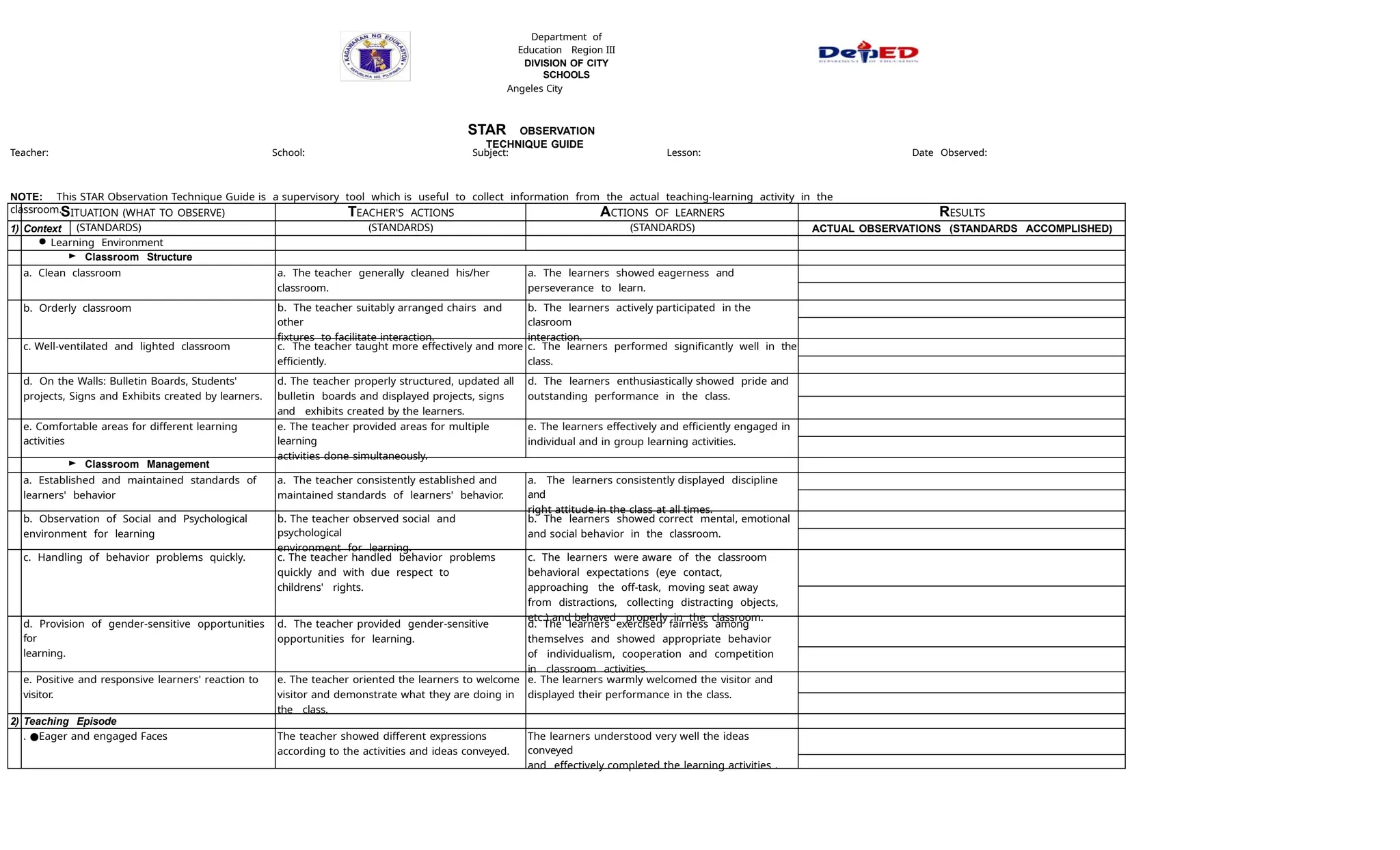
classroom.SITUATION (WHAT TO OBSERVE) TEACHER'S ACTIONS ACTIONS OF LEARNERS RESULTS
1) Context (STANDARDS) (STANDARDS) (STANDARDS) ACTUAL OBSERVATIONS (STANDARDS ACCOMPLISHED)
● Learning Environment
► Classroom Structure
a. Clean classroom a. The teacher generally cleaned his/her
classroom.
a. The learners showed eagerness and
perseverance to learn.
b. Orderly classroom b. The teacher suitably arranged chairs and
other
fixtures to facilitate interaction.
b. The learners actively participated in the
clasroom
interaction.
c. Well-ventilated and lighted classroom c. The teacher taught more effectively and more
efficiently.
c. The learners performed significantly well in the
class.
d. On the Walls: Bulletin Boards, Students'
projects, Signs and Exhibits created by learners.
d. The teacher properly structured, updated all
bulletin boards and displayed projects, signs
and exhibits created by the learners.
d. The learners enthusiastically showed pride and
outstanding performance in the class.
e. Comfortable areas for different learning
activities
e. The teacher provided areas for multiple
learning
activities done simultaneously.
e. The learners effectively and efficiently engaged in
individual and in group learning activities.
► Classroom Management
a. Established and maintained standards of
learners' behavior
a. The teacher consistently established and
maintained standards of learners' behavior.
a. The learners consistently displayed discipline
and
right attitude in the class at all times.
b. Observation of Social and Psychological
environment for learning
b. The teacher observed social and
psychological
environment for learning.
b. The learners showed correct mental, emotional
and social behavior in the classroom.
c. Handling of behavior problems quickly. c. The teacher handled behavior problems
quickly and with due respect to
childrens' rights.
c. The learners were aware of the classroom
behavioral expectations (eye contact,
approaching the off-task, moving seat away
from distractions, collecting distracting objects,
etc.) and behaved properly in the classroom.
d. Provision of gender-sensitive opportunities
for
learning.
d. The teacher provided gender-sensitive
opportunities for learning.
d. The learners exercised fairness among
themselves and showed appropriate behavior
of individualism, cooperation and competition
in classroom activities.
e. Positive and responsive learners' reaction to
visitor.
e. The teacher oriented the learners to welcome
visitor and demonstrate what they are doing in
the class.
e. The learners warmly welcomed the visitor and
displayed their performance in the class.
2) Teaching Episode
. Eager
● and engaged Faces The teacher showed different expressions
according to the activities and ideas conveyed.
The learners understood very well the ideas
conveyed
and effectively completed the learning activities .
Department of
Education Region III
DIVISION OF CITY
SCHOOLS
Angeles City
STAR OBSERVATION
TECHNIQUE GUIDE
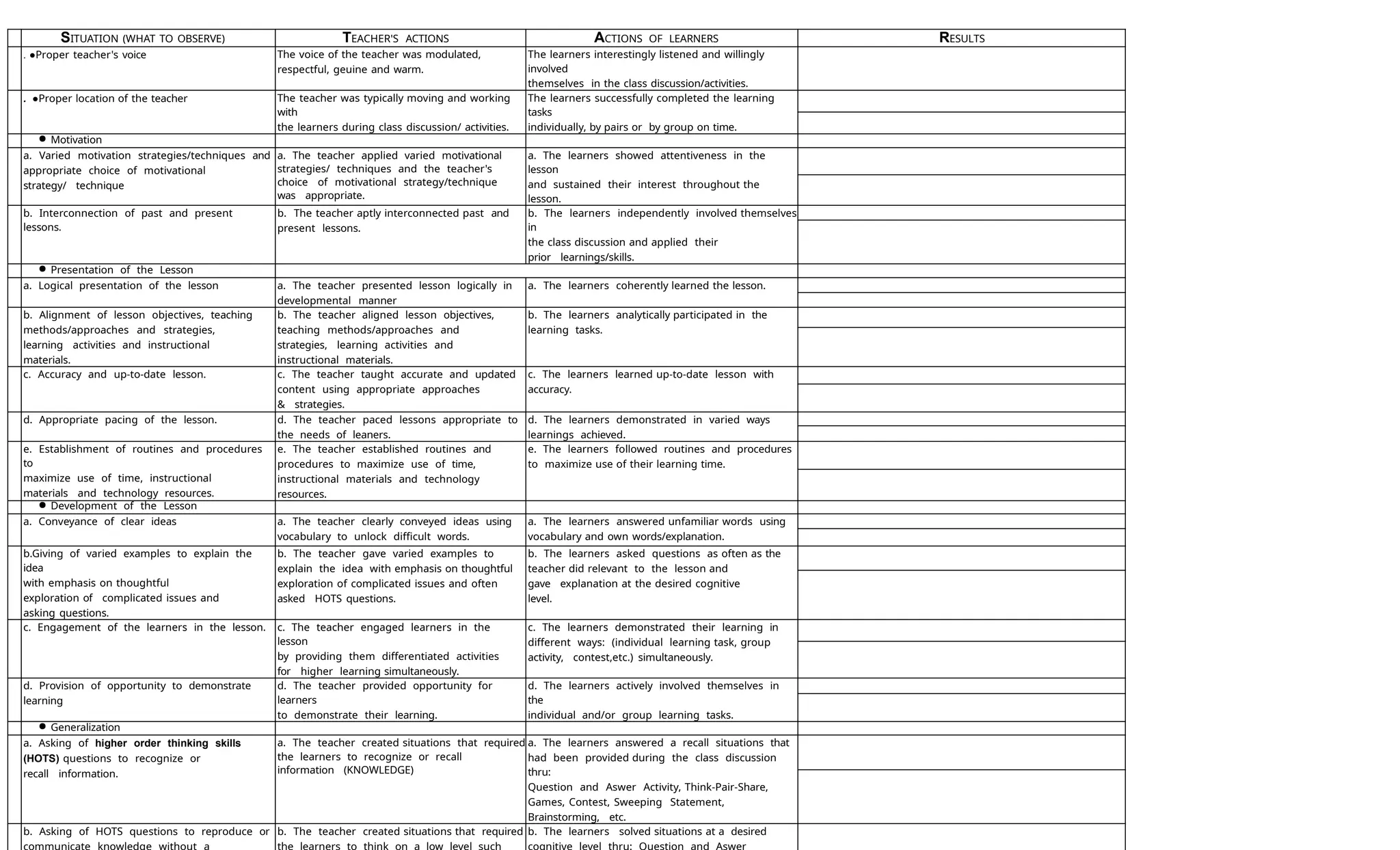
SITUATION (WHAT TO OBSERVE) TEACHER'S ACTIONS ACTIONS OF LEARNERS RESULTS
. ●Proper teacher's voice The voice of the teacher was modulated,
respectful, geuine and warm.
The learners interestingly listened and willingly
involved
themselves in the class discussion/activities.
. ●Proper location of the teacher The teacher was typically moving and working
with
the learners during class discussion/ activities.
The learners successfully completed the learning
tasks
individually, by pairs or by group on time.
● Motivation
a. Varied motivation strategies/techniques and
appropriate choice of motivational
strategy/ technique
a. The teacher applied varied motivational
strategies/ techniques and the teacher's
choice of motivational strategy/technique
was appropriate.
a. The learners showed attentiveness in the
lesson
and sustained their interest throughout the
lesson.
b. Interconnection of past and present
lessons.
b. The teacher aptly interconnected past and
present lessons.
b. The learners independently involved themselves
in
the class discussion and applied their
prior learnings/skills.
● Presentation of the Lesson
a. Logical presentation of the lesson a. The teacher presented lesson logically in
developmental manner
a. The learners coherently learned the lesson.
b. Alignment of lesson objectives, teaching
methods/approaches and strategies,
learning activities and instructional
materials.
b. The teacher aligned lesson objectives,
teaching methods/approaches and
strategies, learning activities and
instructional materials.
b. The learners analytically participated in the
learning tasks.
c. Accuracy and up-to-date lesson. c. The teacher taught accurate and updated
content using appropriate approaches
& strategies.
c. The learners learned up-to-date lesson with
accuracy.
d. Appropriate pacing of the lesson. d. The teacher paced lessons appropriate to
the needs of leaners.
d. The learners demonstrated in varied ways
learnings achieved.
e. Establishment of routines and procedures
to
maximize use of time, instructional
materials and technology resources.
e. The teacher established routines and
procedures to maximize use of time,
instructional materials and technology
resources.
e. The learners followed routines and procedures
to maximize use of their learning time.
● Development of the Lesson
a. Conveyance of clear ideas a. The teacher clearly conveyed ideas using
vocabulary to unlock difficult words.
a. The learners answered unfamiliar words using
vocabulary and own words/explanation.
b.Giving of varied examples to explain the
idea
with emphasis on thoughtful
exploration of complicated issues and
asking questions.
b. The teacher gave varied examples to
explain the idea with emphasis on thoughtful
exploration of complicated issues and often
asked HOTS questions.
b. The learners asked questions as often as the
teacher did relevant to the lesson and
gave explanation at the desired cognitive
level.
c. Engagement of the learners in the lesson. c. The teacher engaged learners in the
lesson
by providing them differentiated activities
for higher learning simultaneously.
c. The learners demonstrated their learning in
different ways: (individual learning task, group
activity, contest,etc.) simultaneously.
d. Provision of opportunity to demonstrate
learning
d. The teacher provided opportunity for
learners
to demonstrate their learning.
d. The learners actively involved themselves in
the
individual and/or group learning tasks.
● Generalization
a. Asking of higher order thinking skills
(HOTS) questions to recognize or
recall information.
a. The teacher created situations that required
the learners to recognize or recall
information (KNOWLEDGE)
a. The learners answered a recall situations that
had been provided during the class discussion
thru:
Question and Aswer Activity, Think-Pair-Share,
Games, Contest, Sweeping Statement,
Brainstorming, etc.
b. Asking of HOTS questions to reproduce or
communicate knowledge without a
b. The teacher created situations that required
the learners to think on a low level such
b. The learners solved situations at a desired
cognitive level thru: Question and Aswer
CONFORME: OBSERVER:
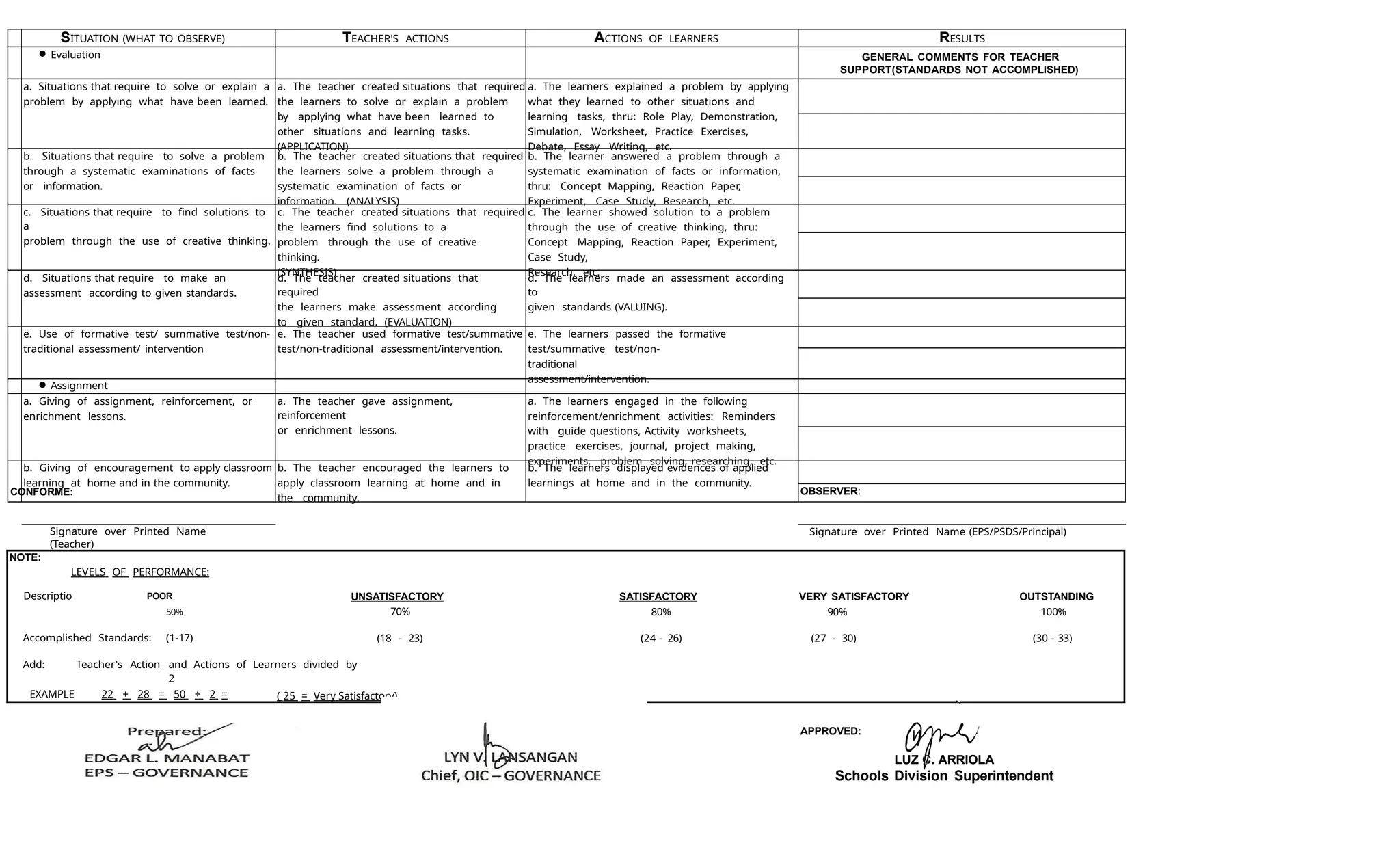
SITUATION (WHAT TO OBSERVE) TEACHER'S ACTIONS ACTIONS OF LEARNERS RESULTS
● Evaluation GENERAL COMMENTS FOR TEACHER
SUPPORT(STANDARDS NOT ACCOMPLISHED)
a. Situations that require to solve or explain a
problem by applying what have been learned.
a. The teacher created situations that required
the learners to solve or explain a problem
by applying what have been learned to
other situations and learning tasks.
(APPLICATION)
a. The learners explained a problem by applying
what they learned to other situations and
learning tasks, thru: Role Play, Demonstration,
Simulation, Worksheet, Practice Exercises,
Debate, Essay Writing, etc.
b. Situations that require to solve a problem
through a systematic examinations of facts
or information.
b. The teacher created situations that required
the learners solve a problem through a
systematic examination of facts or
information. (ANALYSIS)
b. The learner answered a problem through a
systematic examination of facts or information,
thru: Concept Mapping, Reaction Paper,
Experiment, Case Study, Research, etc.
c. Situations that require to find solutions to
a
problem through the use of creative thinking.
c. The teacher created situations that required
the learners find solutions to a
problem through the use of creative
thinking.
(SYNTHESIS)
c. The learner showed solution to a problem
through the use of creative thinking, thru:
Concept Mapping, Reaction Paper, Experiment,
Case Study,
Research, etc.
d. Situations that require to make an
assessment according to given standards.
d. The teacher created situations that
required
the learners make assessment according
to given standard. (EVALUATION)
d. The learners made an assessment according
to
given standards (VALUING).
e. Use of formative test/ summative test/non-
traditional assessment/ intervention
e. The teacher used formative test/summative
test/non-traditional assessment/intervention.
e. The learners passed the formative
test/summative test/non-
traditional
assessment/intervention.
● Assignment
a. Giving of assignment, reinforcement, or
enrichment lessons.
a. The teacher gave assignment,
reinforcement
or enrichment lessons.
a. The learners engaged in the following
reinforcement/enrichment activities: Reminders
with guide questions, Activity worksheets,
practice exercises, journal, project making,
experiments, problem solving, researching, etc.
b. Giving of encouragement to apply classroom
learning at home and in the community.
b. The teacher encouraged the learners to
apply classroom learning at home and in
the community.
b. The learners displayed evidences of applied
learnings at home and in the community.
Signature over Printed Name (EPS/PSDS/Principal)
NOTE:
LEVELS OF PERFORMANCE:
Descriptio POOR UNSATISFACTORY SATISFACTORY VERY SATISFACTORY OUTSTANDING
50% 70% 80% 90% 100%
Accomplished Standards: (1-17) (18 - 23) (24 - 26) (27 - 30) (30 - 33)
Add: Teacher's Action and Actions of Learners divided by
2
EXAMPLE 22 + 28 = 50 ÷ 2 = ( 25 = Very Satisfactory)
APPROVED:
LUZ C. ARRIOLA
Schools Division Superintendent
Signature over Printed Name
(Teacher)

STAR Observation Technique.pptxhwjmsndmsms

  • 1.
    Teacher: School: Subject:Lesson: Date Observed: NOTE: This STAR Observation Technique Guide is a supervisory tool which is useful to collect information from the actual teaching-learning activity in the classroom.SITUATION (WHAT TO OBSERVE) TEACHER'S ACTIONS ACTIONS OF LEARNERS RESULTS 1) Context (STANDARDS) (STANDARDS) (STANDARDS) ACTUAL OBSERVATIONS (STANDARDS ACCOMPLISHED) ● Learning Environment ► Classroom Structure a. Clean classroom a. The teacher generally cleaned his/her classroom. a. The learners showed eagerness and perseverance to learn. b. Orderly classroom b. The teacher suitably arranged chairs and other fixtures to facilitate interaction. b. The learners actively participated in the clasroom interaction. c. Well-ventilated and lighted classroom c. The teacher taught more effectively and more efficiently. c. The learners performed significantly well in the class. d. On the Walls: Bulletin Boards, Students' projects, Signs and Exhibits created by learners. d. The teacher properly structured, updated all bulletin boards and displayed projects, signs and exhibits created by the learners. d. The learners enthusiastically showed pride and outstanding performance in the class. e. Comfortable areas for different learning activities e. The teacher provided areas for multiple learning activities done simultaneously. e. The learners effectively and efficiently engaged in individual and in group learning activities. ► Classroom Management a. Established and maintained standards of learners' behavior a. The teacher consistently established and maintained standards of learners' behavior. a. The learners consistently displayed discipline and right attitude in the class at all times. b. Observation of Social and Psychological environment for learning b. The teacher observed social and psychological environment for learning. b. The learners showed correct mental, emotional and social behavior in the classroom. c. Handling of behavior problems quickly. c. The teacher handled behavior problems quickly and with due respect to childrens' rights. c. The learners were aware of the classroom behavioral expectations (eye contact, approaching the off-task, moving seat away from distractions, collecting distracting objects, etc.) and behaved properly in the classroom. d. Provision of gender-sensitive opportunities for learning. d. The teacher provided gender-sensitive opportunities for learning. d. The learners exercised fairness among themselves and showed appropriate behavior of individualism, cooperation and competition in classroom activities. e. Positive and responsive learners' reaction to visitor. e. The teacher oriented the learners to welcome visitor and demonstrate what they are doing in the class. e. The learners warmly welcomed the visitor and displayed their performance in the class. 2) Teaching Episode . Eager ● and engaged Faces The teacher showed different expressions according to the activities and ideas conveyed. The learners understood very well the ideas conveyed and effectively completed the learning activities . Department of Education Region III DIVISION OF CITY SCHOOLS Angeles City STAR OBSERVATION TECHNIQUE GUIDE
  • 2.
    SITUATION (WHAT TOOBSERVE) TEACHER'S ACTIONS ACTIONS OF LEARNERS RESULTS . ●Proper teacher's voice The voice of the teacher was modulated, respectful, geuine and warm. The learners interestingly listened and willingly involved themselves in the class discussion/activities. . ●Proper location of the teacher The teacher was typically moving and working with the learners during class discussion/ activities. The learners successfully completed the learning tasks individually, by pairs or by group on time. ● Motivation a. Varied motivation strategies/techniques and appropriate choice of motivational strategy/ technique a. The teacher applied varied motivational strategies/ techniques and the teacher's choice of motivational strategy/technique was appropriate. a. The learners showed attentiveness in the lesson and sustained their interest throughout the lesson. b. Interconnection of past and present lessons. b. The teacher aptly interconnected past and present lessons. b. The learners independently involved themselves in the class discussion and applied their prior learnings/skills. ● Presentation of the Lesson a. Logical presentation of the lesson a. The teacher presented lesson logically in developmental manner a. The learners coherently learned the lesson. b. Alignment of lesson objectives, teaching methods/approaches and strategies, learning activities and instructional materials. b. The teacher aligned lesson objectives, teaching methods/approaches and strategies, learning activities and instructional materials. b. The learners analytically participated in the learning tasks. c. Accuracy and up-to-date lesson. c. The teacher taught accurate and updated content using appropriate approaches & strategies. c. The learners learned up-to-date lesson with accuracy. d. Appropriate pacing of the lesson. d. The teacher paced lessons appropriate to the needs of leaners. d. The learners demonstrated in varied ways learnings achieved. e. Establishment of routines and procedures to maximize use of time, instructional materials and technology resources. e. The teacher established routines and procedures to maximize use of time, instructional materials and technology resources. e. The learners followed routines and procedures to maximize use of their learning time. ● Development of the Lesson a. Conveyance of clear ideas a. The teacher clearly conveyed ideas using vocabulary to unlock difficult words. a. The learners answered unfamiliar words using vocabulary and own words/explanation. b.Giving of varied examples to explain the idea with emphasis on thoughtful exploration of complicated issues and asking questions. b. The teacher gave varied examples to explain the idea with emphasis on thoughtful exploration of complicated issues and often asked HOTS questions. b. The learners asked questions as often as the teacher did relevant to the lesson and gave explanation at the desired cognitive level. c. Engagement of the learners in the lesson. c. The teacher engaged learners in the lesson by providing them differentiated activities for higher learning simultaneously. c. The learners demonstrated their learning in different ways: (individual learning task, group activity, contest,etc.) simultaneously. d. Provision of opportunity to demonstrate learning d. The teacher provided opportunity for learners to demonstrate their learning. d. The learners actively involved themselves in the individual and/or group learning tasks. ● Generalization a. Asking of higher order thinking skills (HOTS) questions to recognize or recall information. a. The teacher created situations that required the learners to recognize or recall information (KNOWLEDGE) a. The learners answered a recall situations that had been provided during the class discussion thru: Question and Aswer Activity, Think-Pair-Share, Games, Contest, Sweeping Statement, Brainstorming, etc. b. Asking of HOTS questions to reproduce or communicate knowledge without a b. The teacher created situations that required the learners to think on a low level such b. The learners solved situations at a desired cognitive level thru: Question and Aswer
  • 3.
    CONFORME: OBSERVER: SITUATION (WHATTO OBSERVE) TEACHER'S ACTIONS ACTIONS OF LEARNERS RESULTS ● Evaluation GENERAL COMMENTS FOR TEACHER SUPPORT(STANDARDS NOT ACCOMPLISHED) a. Situations that require to solve or explain a problem by applying what have been learned. a. The teacher created situations that required the learners to solve or explain a problem by applying what have been learned to other situations and learning tasks. (APPLICATION) a. The learners explained a problem by applying what they learned to other situations and learning tasks, thru: Role Play, Demonstration, Simulation, Worksheet, Practice Exercises, Debate, Essay Writing, etc. b. Situations that require to solve a problem through a systematic examinations of facts or information. b. The teacher created situations that required the learners solve a problem through a systematic examination of facts or information. (ANALYSIS) b. The learner answered a problem through a systematic examination of facts or information, thru: Concept Mapping, Reaction Paper, Experiment, Case Study, Research, etc. c. Situations that require to find solutions to a problem through the use of creative thinking. c. The teacher created situations that required the learners find solutions to a problem through the use of creative thinking. (SYNTHESIS) c. The learner showed solution to a problem through the use of creative thinking, thru: Concept Mapping, Reaction Paper, Experiment, Case Study, Research, etc. d. Situations that require to make an assessment according to given standards. d. The teacher created situations that required the learners make assessment according to given standard. (EVALUATION) d. The learners made an assessment according to given standards (VALUING). e. Use of formative test/ summative test/non- traditional assessment/ intervention e. The teacher used formative test/summative test/non-traditional assessment/intervention. e. The learners passed the formative test/summative test/non- traditional assessment/intervention. ● Assignment a. Giving of assignment, reinforcement, or enrichment lessons. a. The teacher gave assignment, reinforcement or enrichment lessons. a. The learners engaged in the following reinforcement/enrichment activities: Reminders with guide questions, Activity worksheets, practice exercises, journal, project making, experiments, problem solving, researching, etc. b. Giving of encouragement to apply classroom learning at home and in the community. b. The teacher encouraged the learners to apply classroom learning at home and in the community. b. The learners displayed evidences of applied learnings at home and in the community. Signature over Printed Name (EPS/PSDS/Principal) NOTE: LEVELS OF PERFORMANCE: Descriptio POOR UNSATISFACTORY SATISFACTORY VERY SATISFACTORY OUTSTANDING 50% 70% 80% 90% 100% Accomplished Standards: (1-17) (18 - 23) (24 - 26) (27 - 30) (30 - 33) Add: Teacher's Action and Actions of Learners divided by 2 EXAMPLE 22 + 28 = 50 ÷ 2 = ( 25 = Very Satisfactory) APPROVED: LUZ C. ARRIOLA Schools Division Superintendent Signature over Printed Name (Teacher)