What is an
instructional objective?
1
Format in
Writing Instructional Objectives
Components of
Instructional objectives Formation of
Instructional
Objectives in
Reference to
Bloom and
SOLO Taxonomy
Levels of Objectives
according to Ground Lund
2
3
4
5A
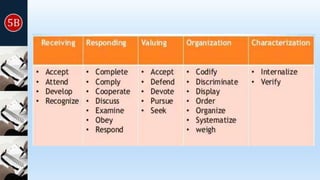
5B
6
Educational Domains and the
Levels of Learning by Bloom
Instructional Objectives and
Associated Verbs
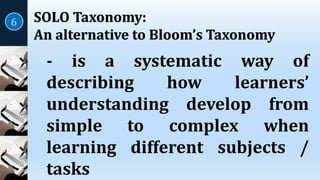
SOLO Taxonomy:
An alternative to Bloom’s Taxonomy
What is an instructional objective?
- Desired outcomes for learning
- Define the intents of an educational plan
- Help teachers to plan steps necessary to
achieve a plan
- Help students to know what is expected of
them at the end of a lesson
- Help teachers, administrators to assess the
products of the system
Components of Instructional Objectives
- According to Robert Mager,
instructional objectives must be:
- OBSERVABLE AND MEASURABLE
Components of Instructional Objectives
- PERFORMANCE
- What the learner will be able to do when he has mastered the
objectives.
- What behavior the teacher will accept as evidence that the
objectives have been achieved.
- Using verb that denote observable action.
Components of Instructional Objectives
- PRODUCT
- What will be evaluated.
- What students produce by their action.
Components of Instructional Objectives
- CONDITIONS
- Under what condition he/ she will do it.
- The condition under which the behavior will be observed.
Components of Instructional Objectives
- Performance Criteria
- To what standards he will be able to do it
- Standard of the performance level defined as acceptable
Format in Making Instructional
Objectives
1. Use precise words – that are not
open to many interpretations.
2. Link the components together to
write an effective/ efficient
instructional objectives.
Format in Making Instructional
Objectives
Format in Making Instructional
Objectives
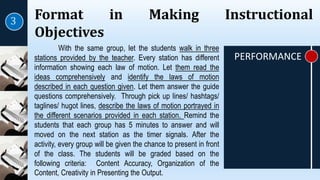
With the same group, let the students walk in three
stations provided by the teacher. Every station has different
information showing each law of motion. Let them read the
ideas comprehensively and identify the laws of motion
described in each question given. Let them answer the guide
questions comprehensively. Through pick up lines/ hashtags/
taglines/ hugot lines, describe the laws of motion portrayed in
the different scenarios provided in each station. Remind the
students that each group has 5 minutes to answer and will
moved on the next station as the timer signals. After the
activity, every group will be given the chance to present in front
of the class. The students will be graded based on the
following criteria: Content Accuracy, Organization of the
Content, Creativity in Presenting the Output.
PERFORMANCE
Format in Making Instructional
Objectives
PERFORMANCE
PRODUCT
With the same group, let the students walk in three
stations provided by the teacher. Every station has different
information showing each law of motion. Let them read the
ideas comprehensively and identify the laws of motion
described in each question given. Let them answer the guide
questions comprehensively. Through pick up lines/ hashtags/
taglines/ hugot lines, describe the laws of motion portrayed in
the different scenarios provided in each station. Remind the
students that each group has 5 minutes to answer and will
moved on the next station as the timer signals. After the
activity, every group will be given the chance to present in front
of the class. The students will be graded based on the
following criteria: Content Accuracy, Organization of the
Content, Creativity in Presenting the Output.
Format in Making Instructional
Objectives
PERFORMANCE
PRODUCT
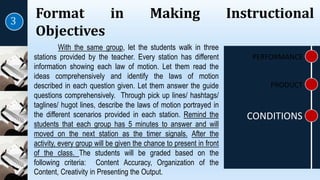
With the same group, let the students walk in three
stations provided by the teacher. Every station has different
information showing each law of motion. Let them read the
ideas comprehensively and identify the laws of motion
described in each question given. Let them answer the guide
questions comprehensively. Through pick up lines/ hashtags/
taglines/ hugot lines, describe the laws of motion portrayed in
the different scenarios provided in each station. Remind the
students that each group has 5 minutes to answer and will
moved on the next station as the timer signals. After the
activity, every group will be given the chance to present in front
of the class. The students will be graded based on the
following criteria: Content Accuracy, Organization of the
Content, Creativity in Presenting the Output.
CONDITIONS
Format in Making Instructional
Objectives
PERFORMANCE
PRODUCT
With the same group, let the students walk in three
stations provided by the teacher. Every station has different
information showing each law of motion. Let them read the
ideas comprehensively and identify the laws of motion
described in each question given. Let them answer the guide
questions comprehensively. Through pick up lines/ hashtags/
taglines/ hugot lines, describe the laws of motion portrayed in
the different scenarios provided in each station. Remind the
students that each group has 5 minutes to answer and will
moved on the next station as the timer signals. After the
activity, every group will be given the chance to present in front
of the class. The students will be graded based on the
following criteria: Content Accuracy, Organization of the
Content, Creativity in Presenting the Output.
CRITERION
CONDITIONS
LEVELS OF OBJECTIVES ACCORDING TO
GROUNDLUND
1.General Objectives
2. Specific Objectives
EDUCATIONAL DOMAINS AND THE
LEVELS OF LEARNING ACCORDING TO
BLOOM
Bloom’s Taxonomy of
Learning Objectives
Knowledge
Comprehension
Application
Analysis
Creation
Evaluation
Remember
Understand
Apply
Analyze
Create
Evaluate
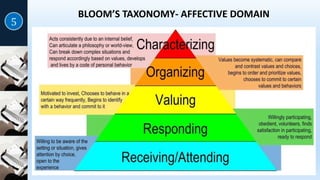
BLOOM’S TAXONOMY- AFFECTIVE DOMAIN
BLOOM’S TAXONOMY- PSYCHOMOTOR DOMAIN
SOLO Taxonomy:
An alternative to Bloom’s Taxonomy
- is a systematic way of
describing how learners’
understanding develop from
simple to complex when
learning different subjects /
tasks
SOLO Taxonomy:
An alternative to Bloom’s Taxonomy
- Stands for:
Structure of
Observed Learning
Outcomes
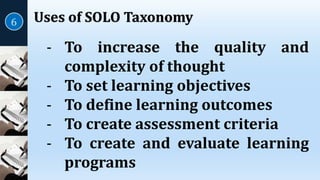
Uses of SOLO Taxonomy
- To increase the quality and
complexity of thought
- To set learning objectives
- To define learning outcomes
- To create assessment criteria
- To create and evaluate learning
programs
Five Hierarchical Levels of Understanding
based on SOLO Taxonomy
What is an
instructional objective?
1
Format in
Writing Instructional Objectives
Components of
Instructional objectives
Thank You
for Listening
Levels of Objectives
according to Ground Lund
2
3
4
5A
5B
6
Educational Domains and the
Levels of Learning by Bloom
Instructional Objectives and
Associated Verbs
SOLO Taxonomy:
An alternative to Bloom’s Taxonomy
Mary Anne A. Mercado
MAEd(Science Education)

instructional objectives.pptx

  • 1.
    What is an instructionalobjective? 1 Format in Writing Instructional Objectives Components of Instructional objectives Formation of Instructional Objectives in Reference to Bloom and SOLO Taxonomy Levels of Objectives according to Ground Lund 2 3 4 5A 5B 6 Educational Domains and the Levels of Learning by Bloom Instructional Objectives and Associated Verbs SOLO Taxonomy: An alternative to Bloom’s Taxonomy
  • 2.
    What is aninstructional objective? - Desired outcomes for learning - Define the intents of an educational plan - Help teachers to plan steps necessary to achieve a plan - Help students to know what is expected of them at the end of a lesson - Help teachers, administrators to assess the products of the system
  • 3.
    Components of InstructionalObjectives - According to Robert Mager, instructional objectives must be: - OBSERVABLE AND MEASURABLE
  • 4.
    Components of InstructionalObjectives - PERFORMANCE - What the learner will be able to do when he has mastered the objectives. - What behavior the teacher will accept as evidence that the objectives have been achieved. - Using verb that denote observable action.
  • 5.
    Components of InstructionalObjectives - PRODUCT - What will be evaluated. - What students produce by their action.
  • 6.
    Components of InstructionalObjectives - CONDITIONS - Under what condition he/ she will do it. - The condition under which the behavior will be observed.
  • 7.
    Components of InstructionalObjectives - Performance Criteria - To what standards he will be able to do it - Standard of the performance level defined as acceptable
  • 8.
    Format in MakingInstructional Objectives 1. Use precise words – that are not open to many interpretations. 2. Link the components together to write an effective/ efficient instructional objectives.
  • 9.
    Format in MakingInstructional Objectives
  • 10.
    Format in MakingInstructional Objectives With the same group, let the students walk in three stations provided by the teacher. Every station has different information showing each law of motion. Let them read the ideas comprehensively and identify the laws of motion described in each question given. Let them answer the guide questions comprehensively. Through pick up lines/ hashtags/ taglines/ hugot lines, describe the laws of motion portrayed in the different scenarios provided in each station. Remind the students that each group has 5 minutes to answer and will moved on the next station as the timer signals. After the activity, every group will be given the chance to present in front of the class. The students will be graded based on the following criteria: Content Accuracy, Organization of the Content, Creativity in Presenting the Output. PERFORMANCE
  • 11.
    Format in MakingInstructional Objectives PERFORMANCE PRODUCT With the same group, let the students walk in three stations provided by the teacher. Every station has different information showing each law of motion. Let them read the ideas comprehensively and identify the laws of motion described in each question given. Let them answer the guide questions comprehensively. Through pick up lines/ hashtags/ taglines/ hugot lines, describe the laws of motion portrayed in the different scenarios provided in each station. Remind the students that each group has 5 minutes to answer and will moved on the next station as the timer signals. After the activity, every group will be given the chance to present in front of the class. The students will be graded based on the following criteria: Content Accuracy, Organization of the Content, Creativity in Presenting the Output.
  • 12.
    Format in MakingInstructional Objectives PERFORMANCE PRODUCT With the same group, let the students walk in three stations provided by the teacher. Every station has different information showing each law of motion. Let them read the ideas comprehensively and identify the laws of motion described in each question given. Let them answer the guide questions comprehensively. Through pick up lines/ hashtags/ taglines/ hugot lines, describe the laws of motion portrayed in the different scenarios provided in each station. Remind the students that each group has 5 minutes to answer and will moved on the next station as the timer signals. After the activity, every group will be given the chance to present in front of the class. The students will be graded based on the following criteria: Content Accuracy, Organization of the Content, Creativity in Presenting the Output. CONDITIONS
  • 13.
    Format in MakingInstructional Objectives PERFORMANCE PRODUCT With the same group, let the students walk in three stations provided by the teacher. Every station has different information showing each law of motion. Let them read the ideas comprehensively and identify the laws of motion described in each question given. Let them answer the guide questions comprehensively. Through pick up lines/ hashtags/ taglines/ hugot lines, describe the laws of motion portrayed in the different scenarios provided in each station. Remind the students that each group has 5 minutes to answer and will moved on the next station as the timer signals. After the activity, every group will be given the chance to present in front of the class. The students will be graded based on the following criteria: Content Accuracy, Organization of the Content, Creativity in Presenting the Output. CRITERION CONDITIONS
  • 14.
    LEVELS OF OBJECTIVESACCORDING TO GROUNDLUND 1.General Objectives 2. Specific Objectives
  • 15.
    EDUCATIONAL DOMAINS ANDTHE LEVELS OF LEARNING ACCORDING TO BLOOM Bloom’s Taxonomy of Learning Objectives
  • 16.
  • 17.
  • 18.
  • 19.
  • 21.
  • 23.
    SOLO Taxonomy: An alternativeto Bloom’s Taxonomy - is a systematic way of describing how learners’ understanding develop from simple to complex when learning different subjects / tasks
  • 24.
    SOLO Taxonomy: An alternativeto Bloom’s Taxonomy - Stands for: Structure of Observed Learning Outcomes
  • 25.
    Uses of SOLOTaxonomy - To increase the quality and complexity of thought - To set learning objectives - To define learning outcomes - To create assessment criteria - To create and evaluate learning programs
  • 26.
    Five Hierarchical Levelsof Understanding based on SOLO Taxonomy
  • 28.
    What is an instructionalobjective? 1 Format in Writing Instructional Objectives Components of Instructional objectives Thank You for Listening Levels of Objectives according to Ground Lund 2 3 4 5A 5B 6 Educational Domains and the Levels of Learning by Bloom Instructional Objectives and Associated Verbs SOLO Taxonomy: An alternative to Bloom’s Taxonomy Mary Anne A. Mercado MAEd(Science Education)

Editor's Notes

  • #3 Is instructional objective different form a learning objective or learning outcome? “Learning Outcomes”- What the student achieves, as opposed to what the instructor plans to teach Similar to instructional objectives in that they relate to, or result from, the content that is taught. However, they are not expressed in the form of [discreet/reductionist] instructional objective; they do not specify condition or performance in the way that instructional objectives do. -- Written for specific lessons and exercises
  • #4 Objectives of learning need to be specific in terms of:
  • #5 1. THE OBJECTIVES MUST BE WRITTEN IN TERMS OF OBSERVABLE STUDENTS’ PERFORMANCE. It should specifies what exactly what student actions should be observed as a result of instruction. ** identify the …..
  • #6  This includes the information, tool or equipment and materials that will or will not be available for the students, any limitations or restrictions as time and space, and any other requirements applicable. 2. ** given the blank world map, students should be able to locate the five volcanoes. After reading chapter 2,
  • #7  This includes the information, tool or equipment and materials that will or will not be available for the students, any limitations or restrictions as time and space, and any other requirements applicable. 2. ** given the blank world map, students should be able to locate the five volcanoes. After reading chapter 2,
  • #8 3. ** within ten minutes, In 5 sentences,
  • #9 According to Robert Mager, objectives must be measurable and observable; therefore must follow the following format:
  • #15 **General Instructional Objectives must be followed by a sample specific behavioral outcomes. **Specific objectives may form the basis for testing and assessment. THERE ARE DIFFERENT TYPES OF BEHAVIORS CAN BE SPECIFIED IN WRITING INSTRUCTIONAL OBJECTIVES.
  • #16 Benjamin Bloom proposed the most helpful guide for behaviour classification. He created scheme that classify instructional ibjectives in a systematic way He divided the objectives into three domains: Cognitive Affective Psychomotor
  • #17 ** in 1956, Cognitive Domain are expressed in noun.. In yr 2001, . . .
  • #18 Verbs associated in each level of learning
  • #19 Verbs associated in each level of learning
  • #20 The affective domain (Krathwohl, Bloom, Masia, 1973) includes the manner in which we deal with things emotionally, such as feelings, values, appreciation, enthusiasms, motivations, and attitudes. Before there were 4 major categories from the simplest behavior to the most complex: Receiving, responding valuing, commitment.
  • #22 Objective in the psychomotor domain are divided into 3 levels of learning before: imitation, Manipulation, Precision. Then, later it became 5 levels. . .
  • #23 As of this time it is divided into the following levels of learning. . .
  • #25 - Was devised by Biggs and Coliis in 1982 as an Laternative to Bloom’s (Cognitive Domain) Taxonomy. Bloom’s categorizes learning from simply remembering to more complex cognitive structures such as analysing and evaluating.