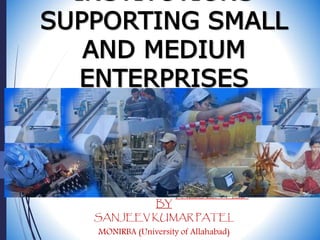
INSTITUTIONS 
SUPPORTING SMALL 
AND MEDIUM 
ENTERPRISES 
PRESENTED 
BY 
SANJEEV KUMAR PATEL 
MONIRBA (University of Allahabad)
STATE 
LEVEL 
• DIs 
• DICs 
• SFCs 
• SIDCs/SIICs 
• SSIDCs 
OTHERS 
• Industry Association 
• Non Governmental 
Organizations 
• R & D Laboratories 
CENTRAL 
LEVEL 
• SSI Board 
• KVIC 
• SIDO 
• NSIC 
• NSTEDB 
• NPC 
• NISIET 
• NIESBUD 
• EDI
SSI Board 
SSI Board 
Small Scale Industries Board was established in 1954 to facilitate the 
coordination and inter-institutional linkages for the development of SSI sector. 
 The Board is an apex advisory body constituted to render advice to the 
government on all issues pertaining to the SSI sector. 
 The Board is reconstituted every two years and is headed by the Minister In 
charge of Small Scale Industries in the Government of India. The Board 
comprises among others State Industry Ministers, some Members of 
Parliament, Secretaries of various Departments of Government of 
India, Financial institutions, public sector undertakings, industry associations 
and eminent experts in the field
 The Board operates broadly in the following areas: 
 Enterprise and skill development 
 Technology upgradation. 
 Access to Credit. 
 Marketing Assistance. 
 Legal Framework. 
 Development of industries in specific region like Northeast.
KHADI AND VILLAGE INDUSTRIES 
COMMISSION (KVIC) 
 Statutory body formed by the Government of India, under the Act of Parliament, 
'Khadi and Village Industries Commission Act of 1956. 
 Responsible for planning, promotion, organization and implementation of the program 
for the development of Khadi and Village industries in rural areas with the help of 
other rural development agencies engaged in rural development. 
 KVIC’s functions also comprise building up a reserve of raw materials and provide 
supply to producers. 
 Creation of common service facilities for processing of raw materials and provision of 
marketing of KVIC products.
Continued . . . 
 KVIC is entrusted with the task of providing financial assistance to 
institutions or persons engaged in the development and operation of Khadi 
and village industries. 
 The KVIC is also charged with the responsibility of encouraging and 
promoting research in the production techniques and equipment employed 
in the Khadi and Village Industries sector and providing facilities for the 
study of the problems relating to it 
 It takes steps to ensure genuineness of the products and sets standards of 
quality and ensure that the products of KVI do conform to the standards.
Small Industries Development 
Organization (SIDO) 
 Established in 1954 on recommendation of Ford Foundation. 
 The strength of SIDO lies in its countrywide spread of almost 100 
offices/service centres, which employ over 2500 staff, mostly technical 
 SIDO partners and networks with other national providers of support 
and financial services to SMEs such as the Small Industries 
Development Bank of India (SIDBI), the National Small Industries 
Corporation (NSIC), the Bureau of Indian Standards (BIS), the Reserve 
Bank of India (RBI) (India's Central Bank) and relevant agencies of the 
Governments of the 28 States of the country.
Continued . . . 
 SIDO provides services to small industry throughout the country by 
implementing a broad program of activities and services including the 
following: 
 Entrepreneurship Development 
 Tool Room Services 
 Testing Centres 
 Extension Services 
 R&D Services 
 Consultancy Services 
 Policy Development
 Established in 1955 by GOI with the main objectives to promote, aid 
and foster the growth of SSIs in the country. 
Name of the Centre Focus area 
Chennai Leather & Footwear 
Howrah General Engineering 
Hyderabad Electronics & Computer Application 
New Delhi Machine Tools & related activities 
Rajkot 
Energy Audit & Energy Conservation 
activities 
Rajpura (Pb) Domestic Electrical Appliances 
Aligarh (UP) Lock Cluster & Die and Tool making
 NSIC also helps in organizing supply of raw materials like coal, 
iron, steel and other materials and even machines needed by 
small scale private industries. 
 Main services provided by NSIC are: 
- Machinery and Equipment (Hire Purchase / Lease scheme) 
- Financial Assistance Scheme. 
- Assistance for Procurement of Raw Material. 
- Government Store Purchase Program. 
- Technology Transfer Centre (TTC).
 Established in 1982 by GOI, is an institutional mechanism to promote 
knowledge-driven and technology-intensive enterprises. 
 Aims to convert "job-seekers" into "job-generators" through Science 
& Technology (S&T) interventions. 
Major objectives are: 
 Promote and develop high-end entrepreneurship for S&T manpower 
as well as self-employment by utilizing S&T infrastructure and 
methods.
 Facilitate and conduct various informational services relating to 
promotion of entrepreneurship. 
 Network agencies of support system, academic institutions and R&D 
organizations to foster self-employment using S&T with special focus 
on backward areas. 
 Act as a policy advisory body with regard to entrepreneurship
National Institute for Small Industry 
Extension and Training (NISIET) 
 Set up in early 1950s, NISIET acts an important resource and 
information centre for small units and undertakes research and 
consultancy for small industry development. 
 An autonomous body of the Ministry of Small Scale Industries, the 
institute achieves its objectives through training, consultancy, research 
and education, to extension and information services. 
 In 1984, UNIDO has recognized NISIET as an institute of meritorious 
performance under its Centre of Excellence Scheme to extend aid.
 NIESBU is registered as a Society under Societies Registration Act, 1860 started 
functioning from 6th July, 1983. 
 It is a premier organisation of Ministry of Micro, Small and Medium 
Enterprises engaged in :- 
 Training 
 consultancy 
 research, etc. in order to promote entrepreneurship. 
 The Institute has trained more than 2.98 lakh trainees including 3,000 persons 
from more than 125 countries till 31st July, 2014.
Continued . . . 
 To evolve standardised materials and processes for selection, training, support 
and sustenance of entrepreneurs, potential and existing. 
 To help/support and affiliate institutions/organisations in carrying out 
training and other entrepreneurship development related activities. 
 To provide vital information and support to trainers, promoters and 
entrepreneurs. 
 To train trainers, promoters and consultants in various areas of 
entrepreneurship development 
 To share international experience and expertise in entrepreneurship 
development. 
 Cluster Intervention
State Level Institutions
DIs (Directorate of Industries) 
 Directorate of Industries (DIs) – At the State level, the Commissioner/ 
Director of Industries implements policies for the promotion and development 
of small-scale, cottage, medium and large scale industries. 
 The Central policies for the SSI sector serve as guidelines but each State evolves 
its own policy and package of incentives. 
 The Commissioner/ Director of Industries in all the States/UTs, oversee the 
activities of field offices, the District Industries Centers (DICs) at the district 
level .
DICs (District Industries Centers) 
 In order to extend promotion of small-scale and cottage 
industries in cities and state capitals to district headquarters, DIC 
program was initiated in May, 1978, as a centrally sponsored 
scheme. 
 DIC was established with the aim of generating greater 
employment opportunities especially in rural and backward 
areas in the country.
Continued . . . 
 At present DICs operate under respective Sate budgetary 
provisions. DICs extend services of the following nature – 
(i) economic investigation of local resources 
(ii) supply of machinery and equipment 
(iii) provision of raw materials 
(iv) arrangement of credit facilities 
(v) marketing 
(vi) quality inputs 
(vii) consultancy
SFCs ( State Financial Corporations) 
 It was set up under the Industrial Finance Corporation Act, 1948. 
 There are 18 SFCs in the country , of which 17 were established under SFCs act 
1951. 
Main objectives is to finance and promote small and medium enterprises in their 
respective states for achieving balanced regional growth. 
 Catalyze investment, generate employment and widen ownership base of industry. 
 Financial assistance is provided by way of term loans, direct subscription to 
equity/debentures, guarantees, discounting of bills of exchange and seed capital 
assistance. 
 SFCs operate a number of schemes to refinance of IDBI and SIDBI and also extend 
equity type assistance.
 SFCs have tailor-made schemes for artisans and special target groups 
such as SC/ST, women, ex-servicemen, physically challenged. 
 Also provide financial assistance for small road transport operators, 
hotels, tourism-related activities, hospitals. 
 Under Single Window Scheme of SIDBI, SFCs have also been extending 
working capital along with term loans to mitigate the difficulties faced 
by SSIs in obtaining working capital limits on time.
SIDC / SIIC and SSIDC 
State Industrial Development / Investment Corporation (SIDC/SIIC) – 
 Set up under the Companies Act, 1956, as wholly owned undertakings of the State 
governments, act as catalysts in respective states. 
 SIDC helps in developing land, providing developed plots, together with facilities 
like roads, power, water supply, drainage and other amenities. 
 They also extend assistance to small-scale sector by way of term loans, subscription 
to equity and promotional services. 
 11 out of 28 SIDCs in the country also function as SFCs and are termed as Twin-function 
of IDCs. 
 Established under Companies Act, 1956, as State government undertaking, caters to 
small, tiny and village industries in respective states.
State Small Industrial Development Corporations (SSIDC) 
 the functions SSIDC performs: - 
(i) Procure and distribution of scarce raw materials. 
(ii) Supply of machinery to SSI units on hire-purchase basis. 
(iii) Product marketing assistance. 
(iv) Construction of industrial estates, allied infrastructure facilities and their 
maintenance. 
(vi) Providing management assistance to production units.
Other State-level agencies Extending 
Facilities for SSI Promotion 
 State Infrastructure Development Corporations 
 State Cooperative Banks 
 Regional Rural Banks 
 State Export Corporations 
 Agro Industries Corporations 
 Handloom and Handicrafts Corporations
REFERENCES 
 dcmsme.gov.in 
 kvic.org.in 
 sido.go.tz 
 wikipedia.org 
 wipo.int 
 nsic.co.in 
 nstedb.com 
 udyogbandhu.com
Institutions supporting small and medium enterprises, sanjeev

Institutions supporting small and medium enterprises, sanjeev

  • 1.
    INSTITUTIONS SUPPORTING SMALL AND MEDIUM ENTERPRISES PRESENTED BY SANJEEV KUMAR PATEL MONIRBA (University of Allahabad)
  • 2.
    STATE LEVEL •DIs • DICs • SFCs • SIDCs/SIICs • SSIDCs OTHERS • Industry Association • Non Governmental Organizations • R & D Laboratories CENTRAL LEVEL • SSI Board • KVIC • SIDO • NSIC • NSTEDB • NPC • NISIET • NIESBUD • EDI
  • 3.
    SSI Board SSIBoard Small Scale Industries Board was established in 1954 to facilitate the coordination and inter-institutional linkages for the development of SSI sector.  The Board is an apex advisory body constituted to render advice to the government on all issues pertaining to the SSI sector.  The Board is reconstituted every two years and is headed by the Minister In charge of Small Scale Industries in the Government of India. The Board comprises among others State Industry Ministers, some Members of Parliament, Secretaries of various Departments of Government of India, Financial institutions, public sector undertakings, industry associations and eminent experts in the field
  • 4.
     The Boardoperates broadly in the following areas:  Enterprise and skill development  Technology upgradation.  Access to Credit.  Marketing Assistance.  Legal Framework.  Development of industries in specific region like Northeast.
  • 5.
    KHADI AND VILLAGEINDUSTRIES COMMISSION (KVIC)  Statutory body formed by the Government of India, under the Act of Parliament, 'Khadi and Village Industries Commission Act of 1956.  Responsible for planning, promotion, organization and implementation of the program for the development of Khadi and Village industries in rural areas with the help of other rural development agencies engaged in rural development.  KVIC’s functions also comprise building up a reserve of raw materials and provide supply to producers.  Creation of common service facilities for processing of raw materials and provision of marketing of KVIC products.
  • 6.
    Continued . ..  KVIC is entrusted with the task of providing financial assistance to institutions or persons engaged in the development and operation of Khadi and village industries.  The KVIC is also charged with the responsibility of encouraging and promoting research in the production techniques and equipment employed in the Khadi and Village Industries sector and providing facilities for the study of the problems relating to it  It takes steps to ensure genuineness of the products and sets standards of quality and ensure that the products of KVI do conform to the standards.
  • 7.
    Small Industries Development Organization (SIDO)  Established in 1954 on recommendation of Ford Foundation.  The strength of SIDO lies in its countrywide spread of almost 100 offices/service centres, which employ over 2500 staff, mostly technical  SIDO partners and networks with other national providers of support and financial services to SMEs such as the Small Industries Development Bank of India (SIDBI), the National Small Industries Corporation (NSIC), the Bureau of Indian Standards (BIS), the Reserve Bank of India (RBI) (India's Central Bank) and relevant agencies of the Governments of the 28 States of the country.
  • 8.
    Continued . ..  SIDO provides services to small industry throughout the country by implementing a broad program of activities and services including the following:  Entrepreneurship Development  Tool Room Services  Testing Centres  Extension Services  R&D Services  Consultancy Services  Policy Development
  • 9.
     Established in1955 by GOI with the main objectives to promote, aid and foster the growth of SSIs in the country. Name of the Centre Focus area Chennai Leather & Footwear Howrah General Engineering Hyderabad Electronics & Computer Application New Delhi Machine Tools & related activities Rajkot Energy Audit & Energy Conservation activities Rajpura (Pb) Domestic Electrical Appliances Aligarh (UP) Lock Cluster & Die and Tool making
  • 10.
     NSIC alsohelps in organizing supply of raw materials like coal, iron, steel and other materials and even machines needed by small scale private industries.  Main services provided by NSIC are: - Machinery and Equipment (Hire Purchase / Lease scheme) - Financial Assistance Scheme. - Assistance for Procurement of Raw Material. - Government Store Purchase Program. - Technology Transfer Centre (TTC).
  • 11.
     Established in1982 by GOI, is an institutional mechanism to promote knowledge-driven and technology-intensive enterprises.  Aims to convert "job-seekers" into "job-generators" through Science & Technology (S&T) interventions. Major objectives are:  Promote and develop high-end entrepreneurship for S&T manpower as well as self-employment by utilizing S&T infrastructure and methods.
  • 12.
     Facilitate andconduct various informational services relating to promotion of entrepreneurship.  Network agencies of support system, academic institutions and R&D organizations to foster self-employment using S&T with special focus on backward areas.  Act as a policy advisory body with regard to entrepreneurship
  • 13.
    National Institute forSmall Industry Extension and Training (NISIET)  Set up in early 1950s, NISIET acts an important resource and information centre for small units and undertakes research and consultancy for small industry development.  An autonomous body of the Ministry of Small Scale Industries, the institute achieves its objectives through training, consultancy, research and education, to extension and information services.  In 1984, UNIDO has recognized NISIET as an institute of meritorious performance under its Centre of Excellence Scheme to extend aid.
  • 14.
     NIESBU isregistered as a Society under Societies Registration Act, 1860 started functioning from 6th July, 1983.  It is a premier organisation of Ministry of Micro, Small and Medium Enterprises engaged in :-  Training  consultancy  research, etc. in order to promote entrepreneurship.  The Institute has trained more than 2.98 lakh trainees including 3,000 persons from more than 125 countries till 31st July, 2014.
  • 15.
    Continued . ..  To evolve standardised materials and processes for selection, training, support and sustenance of entrepreneurs, potential and existing.  To help/support and affiliate institutions/organisations in carrying out training and other entrepreneurship development related activities.  To provide vital information and support to trainers, promoters and entrepreneurs.  To train trainers, promoters and consultants in various areas of entrepreneurship development  To share international experience and expertise in entrepreneurship development.  Cluster Intervention
  • 16.
  • 17.
    DIs (Directorate ofIndustries)  Directorate of Industries (DIs) – At the State level, the Commissioner/ Director of Industries implements policies for the promotion and development of small-scale, cottage, medium and large scale industries.  The Central policies for the SSI sector serve as guidelines but each State evolves its own policy and package of incentives.  The Commissioner/ Director of Industries in all the States/UTs, oversee the activities of field offices, the District Industries Centers (DICs) at the district level .
  • 18.
    DICs (District IndustriesCenters)  In order to extend promotion of small-scale and cottage industries in cities and state capitals to district headquarters, DIC program was initiated in May, 1978, as a centrally sponsored scheme.  DIC was established with the aim of generating greater employment opportunities especially in rural and backward areas in the country.
  • 19.
    Continued . ..  At present DICs operate under respective Sate budgetary provisions. DICs extend services of the following nature – (i) economic investigation of local resources (ii) supply of machinery and equipment (iii) provision of raw materials (iv) arrangement of credit facilities (v) marketing (vi) quality inputs (vii) consultancy
  • 20.
    SFCs ( StateFinancial Corporations)  It was set up under the Industrial Finance Corporation Act, 1948.  There are 18 SFCs in the country , of which 17 were established under SFCs act 1951. Main objectives is to finance and promote small and medium enterprises in their respective states for achieving balanced regional growth.  Catalyze investment, generate employment and widen ownership base of industry.  Financial assistance is provided by way of term loans, direct subscription to equity/debentures, guarantees, discounting of bills of exchange and seed capital assistance.  SFCs operate a number of schemes to refinance of IDBI and SIDBI and also extend equity type assistance.
  • 21.
     SFCs havetailor-made schemes for artisans and special target groups such as SC/ST, women, ex-servicemen, physically challenged.  Also provide financial assistance for small road transport operators, hotels, tourism-related activities, hospitals.  Under Single Window Scheme of SIDBI, SFCs have also been extending working capital along with term loans to mitigate the difficulties faced by SSIs in obtaining working capital limits on time.
  • 22.
    SIDC / SIICand SSIDC State Industrial Development / Investment Corporation (SIDC/SIIC) –  Set up under the Companies Act, 1956, as wholly owned undertakings of the State governments, act as catalysts in respective states.  SIDC helps in developing land, providing developed plots, together with facilities like roads, power, water supply, drainage and other amenities.  They also extend assistance to small-scale sector by way of term loans, subscription to equity and promotional services.  11 out of 28 SIDCs in the country also function as SFCs and are termed as Twin-function of IDCs.  Established under Companies Act, 1956, as State government undertaking, caters to small, tiny and village industries in respective states.
  • 23.
    State Small IndustrialDevelopment Corporations (SSIDC)  the functions SSIDC performs: - (i) Procure and distribution of scarce raw materials. (ii) Supply of machinery to SSI units on hire-purchase basis. (iii) Product marketing assistance. (iv) Construction of industrial estates, allied infrastructure facilities and their maintenance. (vi) Providing management assistance to production units.
  • 24.
    Other State-level agenciesExtending Facilities for SSI Promotion  State Infrastructure Development Corporations  State Cooperative Banks  Regional Rural Banks  State Export Corporations  Agro Industries Corporations  Handloom and Handicrafts Corporations
  • 25.
    REFERENCES  dcmsme.gov.in  kvic.org.in  sido.go.tz  wikipedia.org  wipo.int  nsic.co.in  nstedb.com  udyogbandhu.com