




INSTITUTIONAL
SUPPORT TO
SMALL AND
MEDIUM
ENTERPRISES
Prepared By-:
Nikhil Mishra
Narendra Chandrakar
Harsh Srivastav
Agenda
 What is Support Institute.
 Which are they.
 Role of them.
Support Institute
 under the authority of the Minister
of Economy, Innovation and
Development, and has the
mission to facilitate and assist
SMEs in their innovation
strategies and international
growth,  increase productivity and
competitiveness, strengthen skills
and capacity of management and
access to financial markets,
alongside the promotion of
entrepreneurship.
Institutional support system is
necessary at three stages of
enterprise development:
 Inception or Promotion
 Day-to-day management
 Expansion and Diversification
Three dimensions of
institutional support systemare:
 Central Government
 State Government
 Non-government Support System
CENTRAL GOVERNMENT
INSTITUTES
 SMALL SCALE INDUSTRIES BOARD
(SSIB)
 NATIONAL BANK FOR AGRICULTURE
AND RURAL DEVELOPMENT (NABARD)
 SMALL INDUSTRIES DEVELOPMENT
ORGANISATION (SIDO)
 NATIONAL SMALL INDUSTRIES
CORPORATION (NSIC)
 SMALL INDUSTRIES DEVELOPMENT
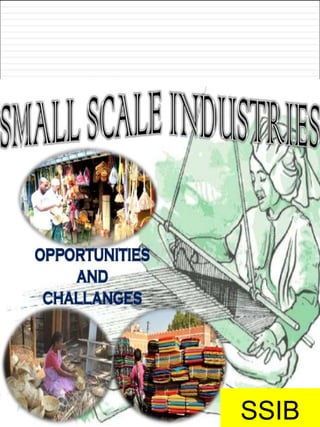
SSIB
SMALL SCALE
INDUSTRIES BOARD
The Small Scale Industries Board
in 1955 defined, "Small-scale
industry as a unit employing less
than 50 employees if using power
and less than 100 employees if
not using power and with a capital
asset not exceeding Rs. 5 lakhs".
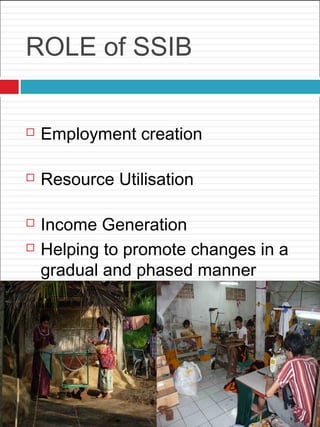
ROLE of SSIB
 Employment creation
 Resource Utilisation
 Income Generation
 Helping to promote changes in a
gradual and phased manner
It co nsists o f the
fo llo wing m e m be rs:
 Union Industry Minister
 State Industry Minister
 Selected members of Parliament
 Secretaries of department
concerned
 Financial Institutions
 Selected Public Enterprises
 Industry Associations
 Eminent experts in the field
NATIONAL BANKFOR
AGRICULTURE AND
RURAL DEVELOPMENT
(NABARD)
 National Bank for Agriculture and
Rural Development (NABARD)
was established on 12 July 1982
by an Act of the Parliament to
promote sustainable and
equitable agriculture and rural
prosperity through effective credit
support, related services,
institutional development and
other innovative initiatives.
ROLEOf NABARD:
In discharging its role as a facilitator for rural
prosperity NABARD is entrusted with
 Providing refinance to lending institutions in rural
areas
 Bringing about or promoting institutional
development and
 Evaluating, monitoring and inspecting the client
banks
Besides this pivotal
role, NABARDalso:
 Acts as a coordinator in the operations of rural credit
institutions
 Extends assistance to the government, the Reserve
Bank of India and other organizations in matters relating
to rural development
 Offers training and research facilities for banks,
cooperatives and organizations working in the field of
rural development
 Helps the state governments in reaching their targets of
providing assistance to eligible institutions in agriculture
and rural development
 Acts as regulator for cooperative banks and RRBs
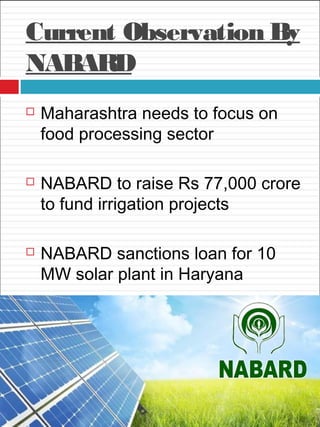
Current Observation By
NABARD
 Maharashtra needs to focus on
food processing sector
 NABARD to raise Rs 77,000 crore
to fund irrigation projects
 NABARD sanctions loan for 10
MW solar plant in Haryana 
SMALL INDUSTRIES
DEVELOPMENT
ORGANISATION (SIDO)
 The Small Industries Development Organization
(SIDO) is the national SME Development Agency of
India. It is a major constituent of the Ministry of Small
Scale Industries of the Government of India. Set up in
1954, SIDO provides services to small industry
throughout the country by implementing a broad
program of activities and services including the
following:
 Entrepreneurship Development
 Tool Room Services
 Testing Centres
 Extension Services
 R&D Services
 Consultancy Services
 Policy Development
Role Of SIDO
 To formulate policy for promotion of SSI
 Provide coordination of policies of state
government
 To collect and disseminate information
 To provide wide range of extension services
through allied institutions
 To promote facilities for technology up gradation
 To offer consultancy services
Services Rendered by SIDO:
 Entrepreneurship development
and Management training.
 Efforts for skill development.
 Preparation of feasibility reports
for different products.
 Provision of testing services.
 Availability of tool room facilities.
NATIONAL SMALL
INDUSTRIES
CORPORATION (NSIC)
The National Small Industries
Corporation (NSIC), an enterprise
under the union ministry of
industries was set up in 1955 in
New Delhi to promote aid and
facilitate the growth of small scale
industries in the country. NSIC
offers a package of assistance for
the benefit of small–scale
enterprises.
ROLE Of NSIC
 Provide machinery on hire-purchase scheme to small-
scale industries.
 Provide equipment leasing facility.
 Help in export marketing of the products of small-scale
industries.
 Participate in bulk purchase programme of the
Government.
 Develop prototype of machines and equipments to pass
on to small-scale industries for commercial production.
 Distribute basic raw material among small-scale
industries through raw material depots.
 Help in development and up-gradation of technology
and implementation of modernization programmes of
small-scale industries.
 Impart training in various industrial trades.
 Set up small-scale industries in other developing
countries on turn-key basis.
 Undertake the construction of industrial estates.
SMALL INDUSTRIES
DEVELOPMENT BANKOF
INDIA (SIDBI)
 Small Industries Development Bank of
India (SIDBI), set up on April 2, 1990
under small industries development bank
of India act, is the Principal Financial
Institution for the Promotion, Financing
and Development of the Micro, Small and
Medium Enterprise (MSME) sector and
for Co-ordination of the functions of the
institutions engaged in similar activities.
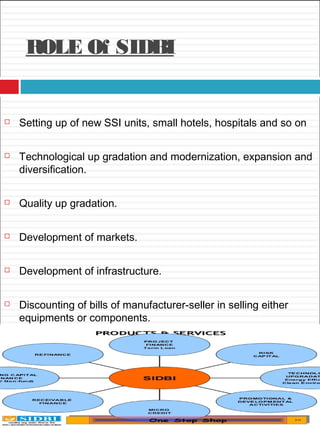
ROLE Of SIDBI
 Setting up of new SSI units, small hotels, hospitals and so on
 Technological up gradation and modernization, expansion and
diversification.
 Quality up gradation.
 Development of markets.
 Development of infrastructure.
 Discounting of bills of manufacturer-seller in selling either
equipments or components.
STATE GOVERNMENT
INSTITUTES
 STATE FINANCIAL CORPORATIONS
(SFC)
 STATE SMALL INDUSTRIES
DEVELOPMENT CORPORATION
(SSIDC)
 SMALL INDUSTRIES SERVICES
INSTITUTES(SISI)
STATE FINANCIAL
CORPORATIONS
(SFC)
 The State Finance Corporations
(SFCs) are the integral part of
institutional finance structure in
the country. SEC promotes small
and medium industries of the
states. Besides, SFCs are helpful
in ensuring balanced regional
development, higher investment,
more employment generation and
broad ownership of industries.
ROLE Of SFC
 The SFCs grant loans mainly for
acquisition of fixed assets like land,
building, plant and machinery.
 The SFCs provide financial assistance to
industrial units whose paid-up capital and
reserves do not exceed Rs. 3 crore (or
such higher limit up to Rs. 30 crore as
may be specified by the central
government).
 The SFCs underwrite new stocks,
shares, debentures etc., of industrial
concerns.
 The SFCs provide guarantee loans
raised in the capital market by scheduled
banks, industrial concerns, and state co-
STATE SMALL
INDUSTRIES
DEVELOPMENT
CORPORATION (SSIDC)
STATE SMALL
INDUSTRIES
DEVELOPMENT
CORPORATION (SSIDC)
 Small Industries Development
Corporations (SIDCO) are state-owned
companies or agencies in the states
of India which were established at
various times under the policy of
Government of India for the promotion of
small sale industries.
A few of the SIDCOs are:
 Kerala Small Industries Development
Corporation Limited
 Small Industries Development
Corporation of Jammu and Kashmir.
 Tamil Nadu Small Industries
Development Corporation
Limited (TANSIDCO).
ROLE Of SSIDC
 Procurement and distribution of
raw materials.
 Supply of machine on hire-
purchase basis.
 Construction of industrial estates.
 Providing assistance for
marketing of products of SSI.
SMALL INDUSTRIES
SERVICES INSTITUTES(SISI)
 Set-up one in each state to provide consultancy.
 Training to small and prospective entrepreneurs.
 28 SISI’s and 30 Branch SISI’s set up in state capitals
and other places all over the country.
 Assist the utilization of assets.
 40 percent share in total industrial output.
 35 percent share in exports.
ROLE Of SISI
 Assist existing and prospective entrepreneurs.
 Conduct EDPs all over the country.
 Testing of raw materials and products of SSIs.
 Financial assistance.
 Conduct economic and technical surveys.
 Market information.
CONCLUSION
The most important development
in the post-independence period
has been the growth of a number
of key institutions to promote,
assist and develop entrepreneurs
to initiate industrial growth in the
country. The country has laid a
strong foundation broad based its
infrastructure and provided much
needed support and assistance.
REFERENCES
 https://www.nabard.org
 https://www.sidco.org
 dcmsme.gov.in/archive/sidoboard.htm
 www.apsfc.com
 www.google.com
THANK YOU

Institutionalsupporttosmallandmediumenterprises 120627021515-phpapp01

  • 1.
    INSTITUTIONAL SUPPORT TO SMALL AND MEDIUM ENTERPRISES PreparedBy-: Nikhil Mishra Narendra Chandrakar Harsh Srivastav
  • 2.
    Agenda  What isSupport Institute.  Which are they.  Role of them.
  • 3.
    Support Institute  underthe authority of the Minister of Economy, Innovation and Development, and has the mission to facilitate and assist SMEs in their innovation strategies and international growth,  increase productivity and competitiveness, strengthen skills and capacity of management and access to financial markets, alongside the promotion of entrepreneurship.
  • 4.
    Institutional support systemis necessary at three stages of enterprise development:  Inception or Promotion  Day-to-day management  Expansion and Diversification
  • 5.
    Three dimensions of institutionalsupport systemare:  Central Government  State Government  Non-government Support System
  • 6.
    CENTRAL GOVERNMENT INSTITUTES  SMALLSCALE INDUSTRIES BOARD (SSIB)  NATIONAL BANK FOR AGRICULTURE AND RURAL DEVELOPMENT (NABARD)  SMALL INDUSTRIES DEVELOPMENT ORGANISATION (SIDO)  NATIONAL SMALL INDUSTRIES CORPORATION (NSIC)  SMALL INDUSTRIES DEVELOPMENT
  • 7.
  • 8.
    SMALL SCALE INDUSTRIES BOARD TheSmall Scale Industries Board in 1955 defined, "Small-scale industry as a unit employing less than 50 employees if using power and less than 100 employees if not using power and with a capital asset not exceeding Rs. 5 lakhs".
  • 9.
    ROLE of SSIB Employment creation  Resource Utilisation  Income Generation  Helping to promote changes in a gradual and phased manner
  • 10.
    It co nsistso f the fo llo wing m e m be rs:  Union Industry Minister  State Industry Minister  Selected members of Parliament  Secretaries of department concerned  Financial Institutions  Selected Public Enterprises  Industry Associations  Eminent experts in the field
  • 12.
    NATIONAL BANKFOR AGRICULTURE AND RURALDEVELOPMENT (NABARD)  National Bank for Agriculture and Rural Development (NABARD) was established on 12 July 1982 by an Act of the Parliament to promote sustainable and equitable agriculture and rural prosperity through effective credit support, related services, institutional development and other innovative initiatives.
  • 13.
    ROLEOf NABARD: In dischargingits role as a facilitator for rural prosperity NABARD is entrusted with  Providing refinance to lending institutions in rural areas  Bringing about or promoting institutional development and  Evaluating, monitoring and inspecting the client banks
  • 14.
    Besides this pivotal role,NABARDalso:  Acts as a coordinator in the operations of rural credit institutions  Extends assistance to the government, the Reserve Bank of India and other organizations in matters relating to rural development  Offers training and research facilities for banks, cooperatives and organizations working in the field of rural development  Helps the state governments in reaching their targets of providing assistance to eligible institutions in agriculture and rural development  Acts as regulator for cooperative banks and RRBs
  • 15.
    Current Observation By NABARD Maharashtra needs to focus on food processing sector  NABARD to raise Rs 77,000 crore to fund irrigation projects  NABARD sanctions loan for 10 MW solar plant in Haryana 
  • 17.
    SMALL INDUSTRIES DEVELOPMENT ORGANISATION (SIDO) The Small Industries Development Organization (SIDO) is the national SME Development Agency of India. It is a major constituent of the Ministry of Small Scale Industries of the Government of India. Set up in 1954, SIDO provides services to small industry throughout the country by implementing a broad program of activities and services including the following:  Entrepreneurship Development  Tool Room Services  Testing Centres  Extension Services  R&D Services  Consultancy Services  Policy Development
  • 18.
    Role Of SIDO To formulate policy for promotion of SSI  Provide coordination of policies of state government  To collect and disseminate information  To provide wide range of extension services through allied institutions  To promote facilities for technology up gradation  To offer consultancy services
  • 19.
    Services Rendered bySIDO:  Entrepreneurship development and Management training.  Efforts for skill development.  Preparation of feasibility reports for different products.  Provision of testing services.  Availability of tool room facilities.
  • 21.
    NATIONAL SMALL INDUSTRIES CORPORATION (NSIC) TheNational Small Industries Corporation (NSIC), an enterprise under the union ministry of industries was set up in 1955 in New Delhi to promote aid and facilitate the growth of small scale industries in the country. NSIC offers a package of assistance for the benefit of small–scale enterprises.
  • 22.
    ROLE Of NSIC Provide machinery on hire-purchase scheme to small- scale industries.  Provide equipment leasing facility.  Help in export marketing of the products of small-scale industries.  Participate in bulk purchase programme of the Government.  Develop prototype of machines and equipments to pass on to small-scale industries for commercial production.
  • 23.
     Distribute basicraw material among small-scale industries through raw material depots.  Help in development and up-gradation of technology and implementation of modernization programmes of small-scale industries.  Impart training in various industrial trades.  Set up small-scale industries in other developing countries on turn-key basis.  Undertake the construction of industrial estates.
  • 25.
    SMALL INDUSTRIES DEVELOPMENT BANKOF INDIA(SIDBI)  Small Industries Development Bank of India (SIDBI), set up on April 2, 1990 under small industries development bank of India act, is the Principal Financial Institution for the Promotion, Financing and Development of the Micro, Small and Medium Enterprise (MSME) sector and for Co-ordination of the functions of the institutions engaged in similar activities.
  • 26.
    ROLE Of SIDBI Setting up of new SSI units, small hotels, hospitals and so on  Technological up gradation and modernization, expansion and diversification.  Quality up gradation.  Development of markets.  Development of infrastructure.  Discounting of bills of manufacturer-seller in selling either equipments or components.
  • 27.
    STATE GOVERNMENT INSTITUTES  STATEFINANCIAL CORPORATIONS (SFC)  STATE SMALL INDUSTRIES DEVELOPMENT CORPORATION (SSIDC)  SMALL INDUSTRIES SERVICES INSTITUTES(SISI)
  • 29.
    STATE FINANCIAL CORPORATIONS (SFC)  TheState Finance Corporations (SFCs) are the integral part of institutional finance structure in the country. SEC promotes small and medium industries of the states. Besides, SFCs are helpful in ensuring balanced regional development, higher investment, more employment generation and broad ownership of industries.
  • 30.
    ROLE Of SFC The SFCs grant loans mainly for acquisition of fixed assets like land, building, plant and machinery.  The SFCs provide financial assistance to industrial units whose paid-up capital and reserves do not exceed Rs. 3 crore (or such higher limit up to Rs. 30 crore as may be specified by the central government).  The SFCs underwrite new stocks, shares, debentures etc., of industrial concerns.  The SFCs provide guarantee loans raised in the capital market by scheduled banks, industrial concerns, and state co-
  • 31.
  • 32.
    STATE SMALL INDUSTRIES DEVELOPMENT CORPORATION (SSIDC) Small Industries Development Corporations (SIDCO) are state-owned companies or agencies in the states of India which were established at various times under the policy of Government of India for the promotion of small sale industries. A few of the SIDCOs are:  Kerala Small Industries Development Corporation Limited  Small Industries Development Corporation of Jammu and Kashmir.  Tamil Nadu Small Industries Development Corporation Limited (TANSIDCO).
  • 33.
    ROLE Of SSIDC Procurement and distribution of raw materials.  Supply of machine on hire- purchase basis.  Construction of industrial estates.  Providing assistance for marketing of products of SSI.
  • 35.
    SMALL INDUSTRIES SERVICES INSTITUTES(SISI) Set-up one in each state to provide consultancy.  Training to small and prospective entrepreneurs.  28 SISI’s and 30 Branch SISI’s set up in state capitals and other places all over the country.  Assist the utilization of assets.  40 percent share in total industrial output.  35 percent share in exports.
  • 36.
    ROLE Of SISI Assist existing and prospective entrepreneurs.  Conduct EDPs all over the country.  Testing of raw materials and products of SSIs.  Financial assistance.  Conduct economic and technical surveys.  Market information.
  • 37.
    CONCLUSION The most importantdevelopment in the post-independence period has been the growth of a number of key institutions to promote, assist and develop entrepreneurs to initiate industrial growth in the country. The country has laid a strong foundation broad based its infrastructure and provided much needed support and assistance.
  • 38.
    REFERENCES  https://www.nabard.org  https://www.sidco.org dcmsme.gov.in/archive/sidoboard.htm  www.apsfc.com  www.google.com
  • 39.

Editor's Notes

  • #2 The term institutional support system generally refers to the economic environment of industry and business comprising of authorities and institutions whose decisions and operational framework affect the level of business. These institutions include govt owned agencies, statutory corporations autonomous and semi autonomous organizations.
  • #9 It is an apex body and has been entrusted to play advisory role in solving problems of SMEs.
  • #14 For providing credit for the promotion of agriculture small scale industries, cottage and village industries handicrafts and other rural industries. 1.To promote labor intensive industries in rural sector and open wide range of avenues for employment to the rural ppl. various schemes have been formulated by NABARD to provide exclusive support to activities undertaken by women like ASSISTANCE TO RURAL WOMEN IN NON FARM DEVELOPMENT, assistance for marketing of non farm products and so on.. 2.It is an integrated area based credit intensification pgm in collaboration with the govt. banks and other development agencies…so far it has been implemented in over 106 districts in the country.. 3.It is a promotional pgm setup to motivate and train educated unemployed rural youth to start their own enterprises.
  • #20 1.Basic purpose of this pgm is to identify entr capabilities n motivate n train d entrepreneurs so that they can easily set up their industrial units. Various orgns resp to provide trng r: smal indstries service institute….national institute for entrepreneurshp and small business developmnt……natl institute for smal industry extension and trng 2.Arng trng facilities for technicl skill develpmnt to technicians and workers located at different parts of d country. 3.SIDO prepares project profiles related wid different pdt grps.it contains detailed info on pdt manufacturing process, mkt potential,quality control and standards, investmnt requiremnts, availability of raw materials and machines. 4.Main function of these testing centers and field status r to Provide certification facilities for quality assurance.it increases marketability of products being produced by SMEs 5.Main functns of tool rooms are to design n manufacture dies, tools, fixtures……provide service facilities for manufacturng tools, heat tretmnt, testing n so on…..organise short term courses for entrepreneurs..
  • #22 With the objective of promoting and developing SSIs. 1.it has two schemes in this context: hire purchase scheme and lease scheme…..under hire purchase scheme it arranges indigenous and imported machinery on easy instalmnt….in lease scheme 100% financial facilities are available to small entrepreneurs which enable them to diversify and ensure tech upgradation… 2. Financial assistance provided for marketing, bills discounting, purchase of raw materials and export activities. 3. …supply of raw materials…..import of raw materials…..supply of scarce raw materials on priority basis…. 4. SSIs are interested to avail facilities for tech acquisition, adoption and upgradation. Technicl service centers are established by NSIC in different parts of the country to provide diverse technical support to SSS. 5. ….ensures adequate margin or return to small entrepreneurs….encourage stadardisation and quality control for products of SSI…….assist in development of brand ie making pdts more marketable…..ensure effective advertising and publicity of pdts of SSI. 6. These benefits include supply of tender form free of cost…..freedom from security deposit….exemption from payment of earnest money.
  • #27 It is the principal financial institution for the promotion, financing and development of industry in the small, tiny and cottage industries. 3.Acquiring of ISO 9000 series certification
  • #31 SFC function wid the objective of financing and promoting SMEs, achieving regional socio-economic growth and generating grtr employment opportunities. 1.And other assets 3.To encourage new and technically qualified women entrepreneurs in setting up industrial projects. 4.Expansion of industry by rural and urban artisans. 5.Under the scheme of IDBI.
  • #33 3.PROVIDING ALLIED INFRASTRUCTURTE facilities and their maintenance.