Institutional FrameworksExperience with CGIAR reformLloyd Le Page, CEO CGIAR ConsortiumOECD Conference on Agricultural Knowledge Systems
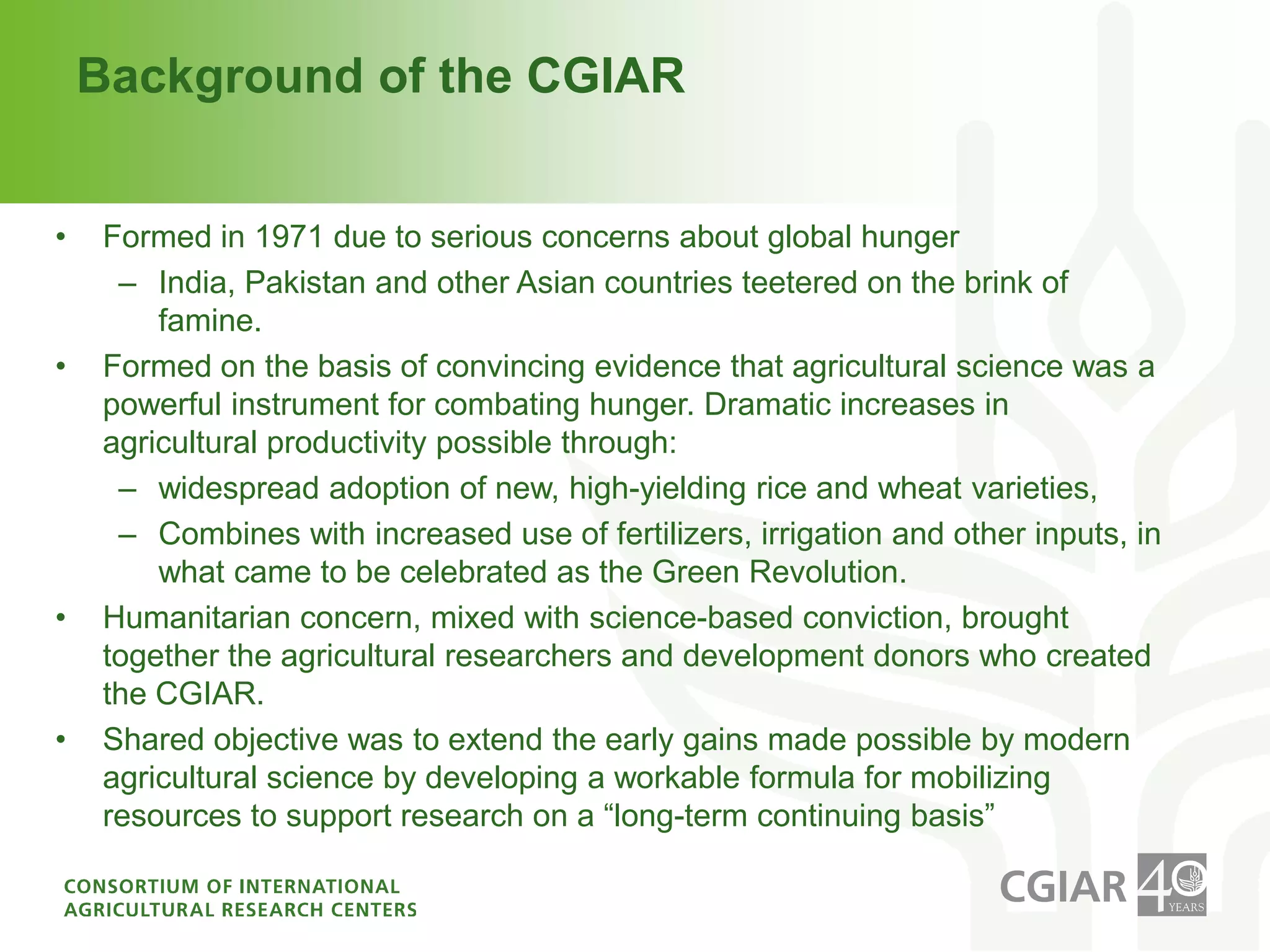
Background of the CGIARFormed in 1971 due to serious concerns about global hungerIndia, Pakistan and other Asian countries teetered on the brink of famine. Formed on the basis of convincing evidence that agricultural science was a powerful instrument for combating hunger. Dramatic increases in agricultural productivity possible through:widespread adoption of new, high-yielding rice and wheat varieties, Combines with increased use of fertilizers, irrigation and other inputs, in what came to be celebrated as the Green Revolution. Humanitarian concern, mixed with science-based conviction, brought together the agricultural researchers and development donors who created the CGIAR. Shared objective was to extend the early gains made possible by modern agricultural science by developing a workable formula for mobilizing resources to support research on a “long-term continuing basis”
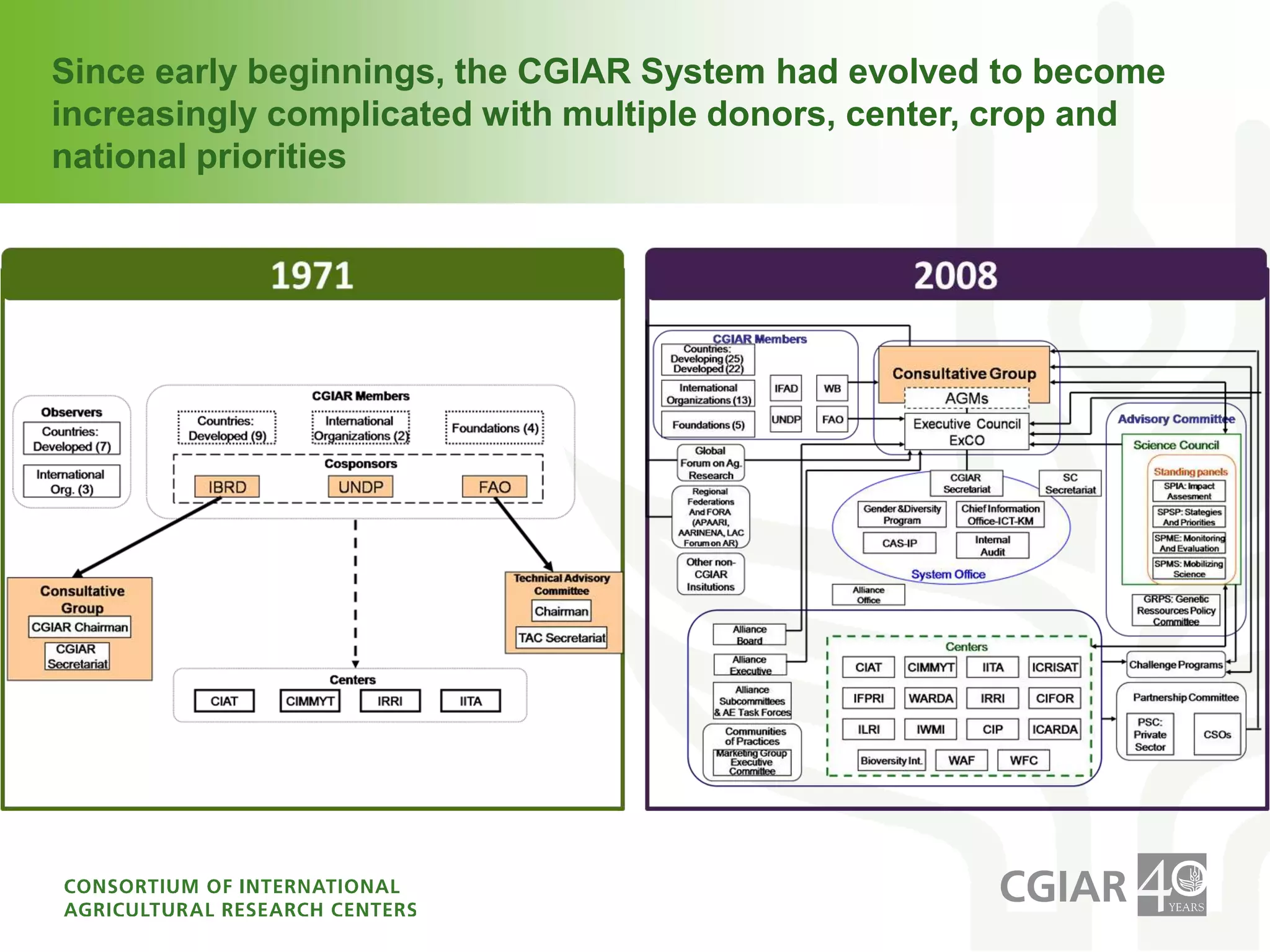
Since early beginnings, the CGIAR System had evolved to become increasingly complicated with multiple donors, center, crop and national priorities3
Why Reform ?
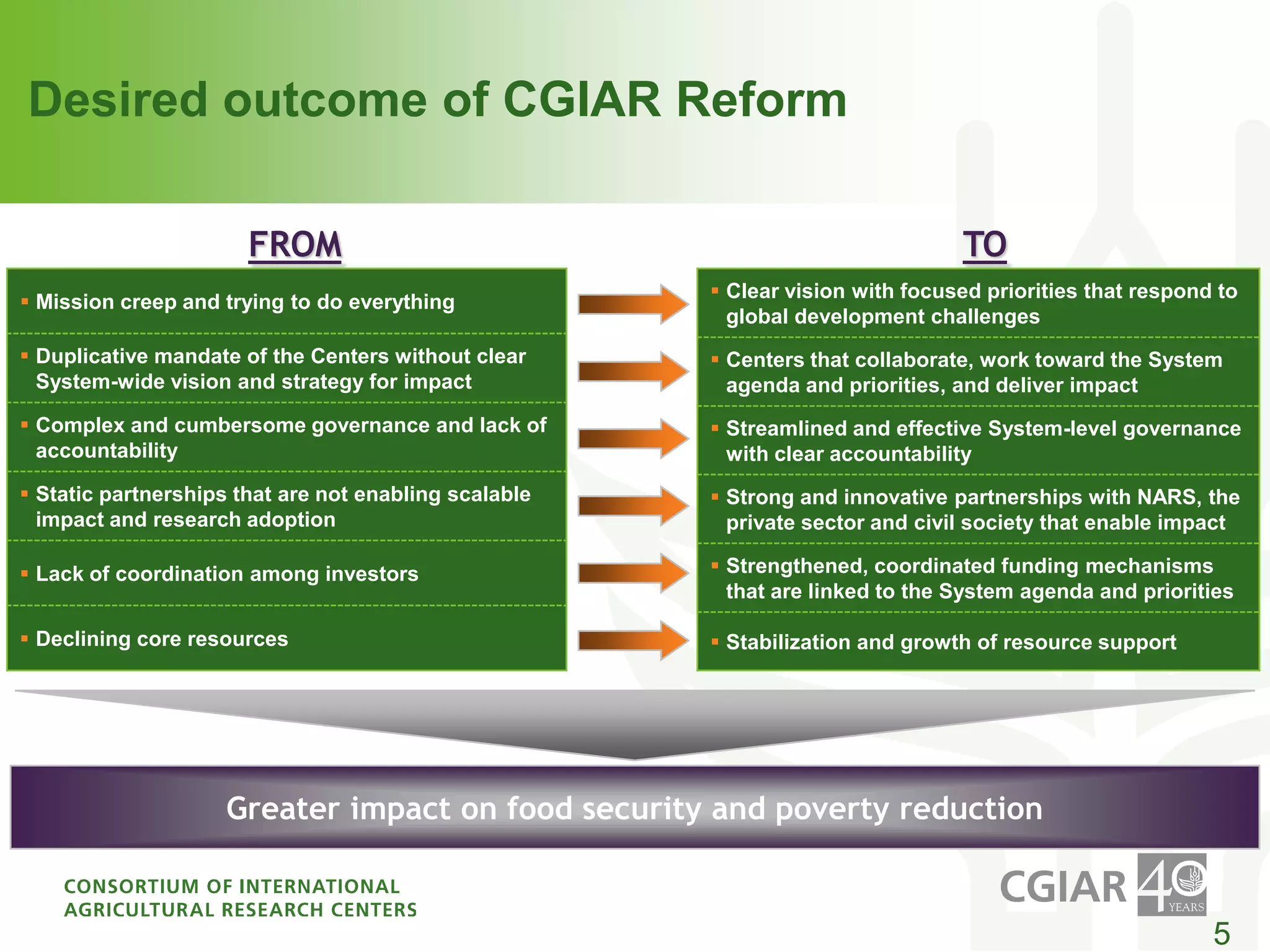
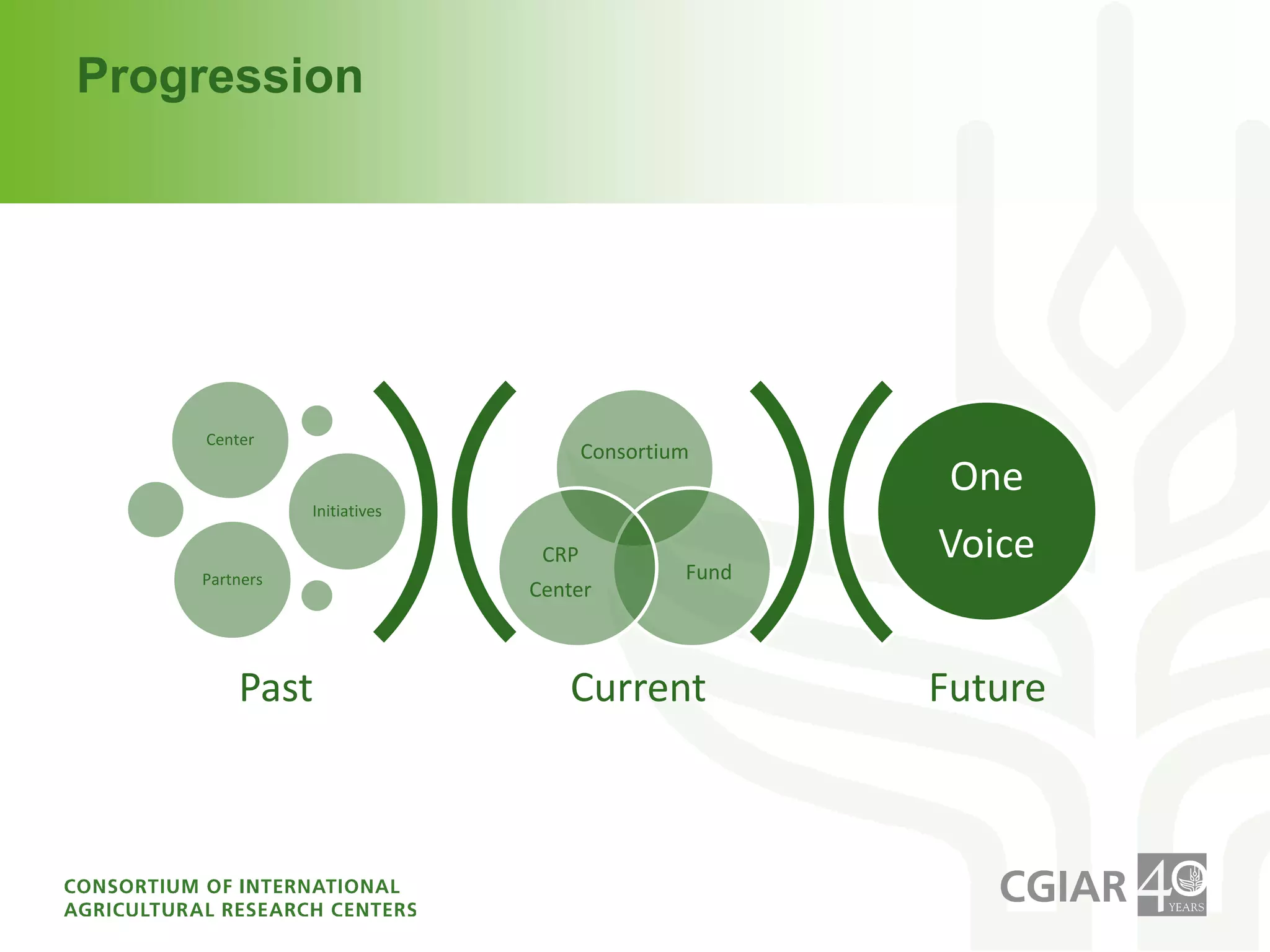
Desired outcome of CGIAR ReformFROMTOGreater impact on food security and poverty reduction5
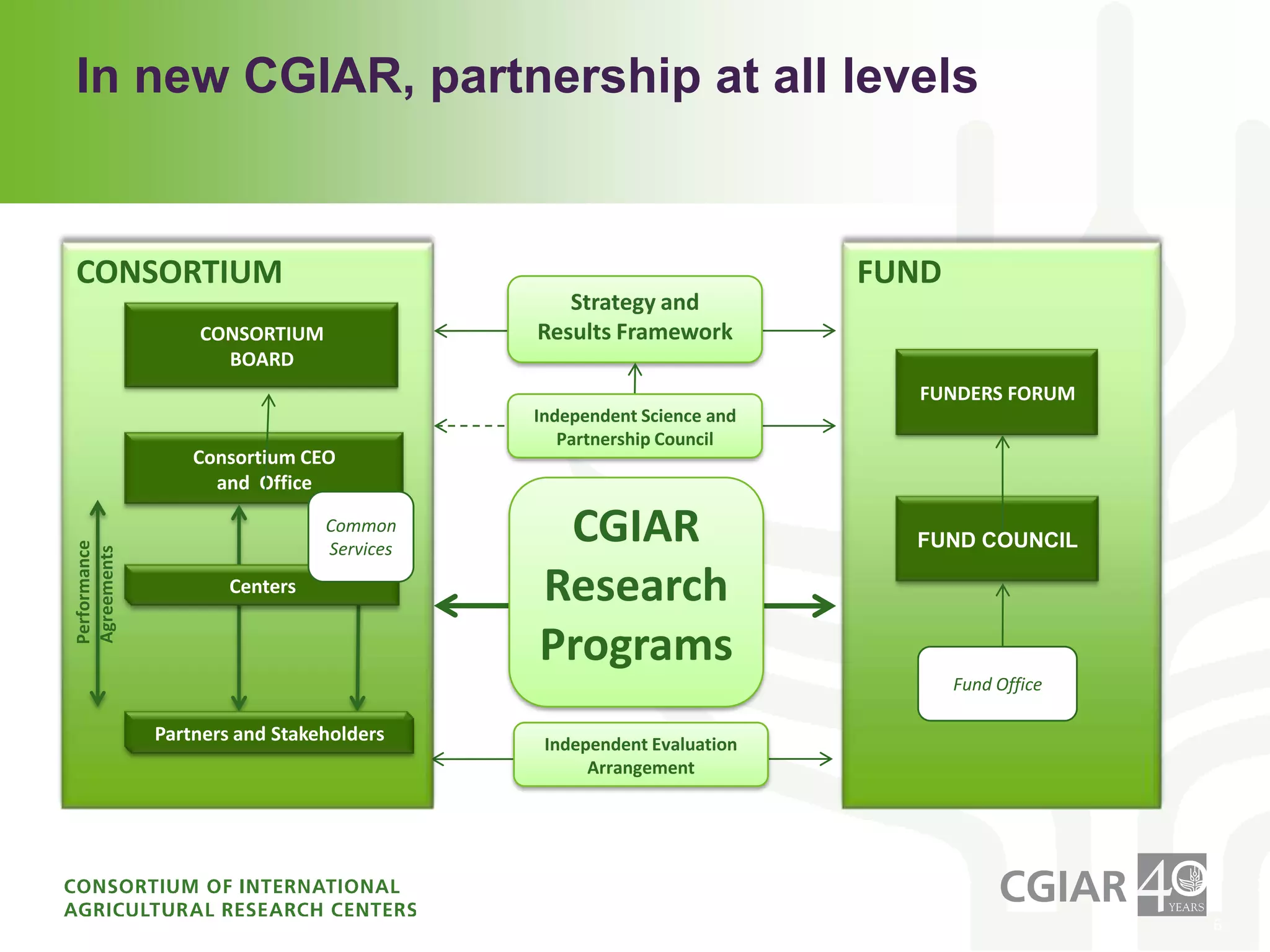
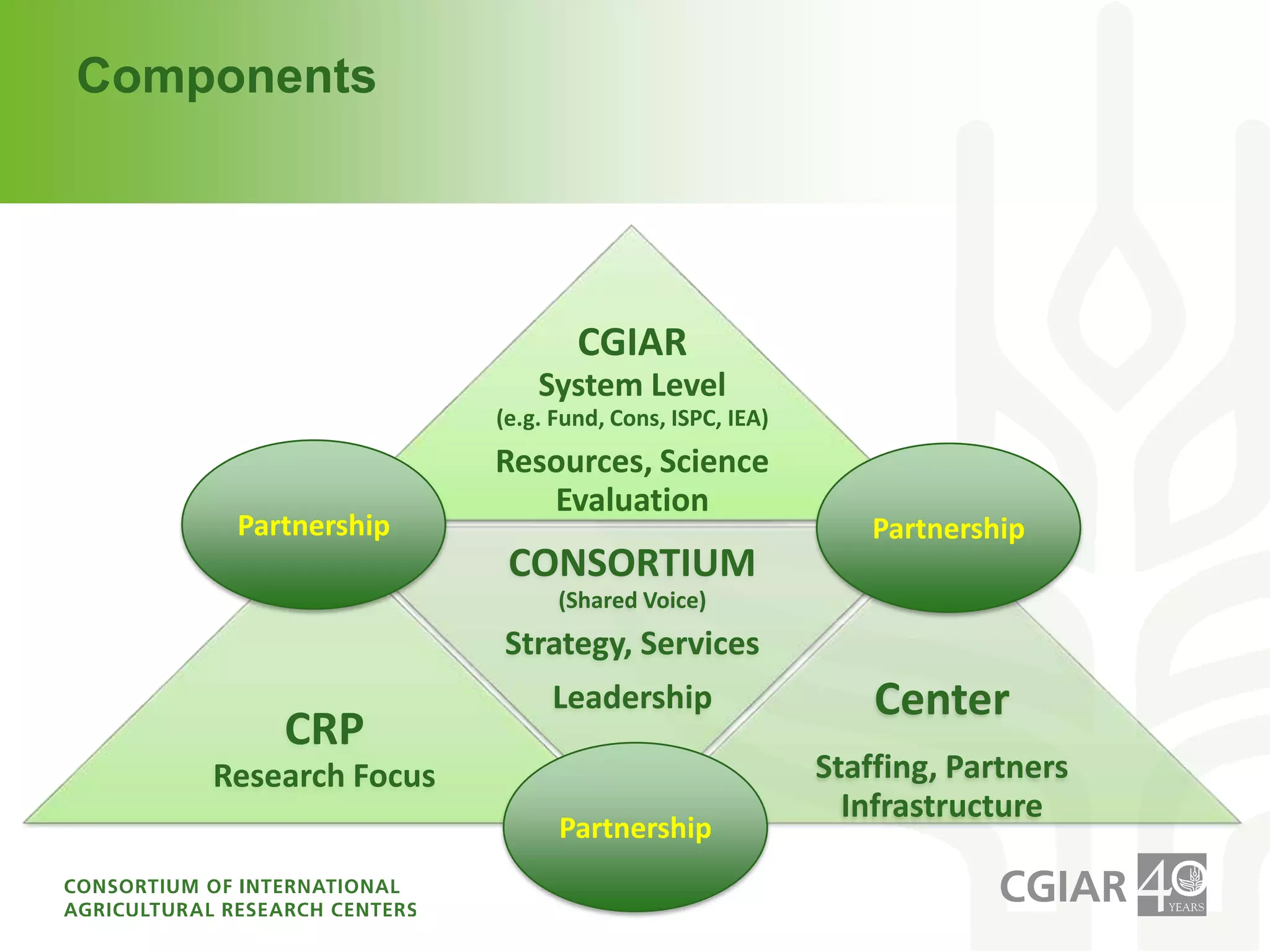
CONSORTIUMFUNDStrategy and                    Results Framework CONSORTIUMBOARDFUNDERS FORUMIndependent Science and Partnership CouncilConsortium CEO and  OfficeFUND COUNCILPerformance AgreementsFund Office6In new CGIAR, partnership at all levelsCGIAR Research ProgramsCommon ServicesCentersPartners and StakeholdersIndependent EvaluationArrangement
Who is the CGIAR Consortium?
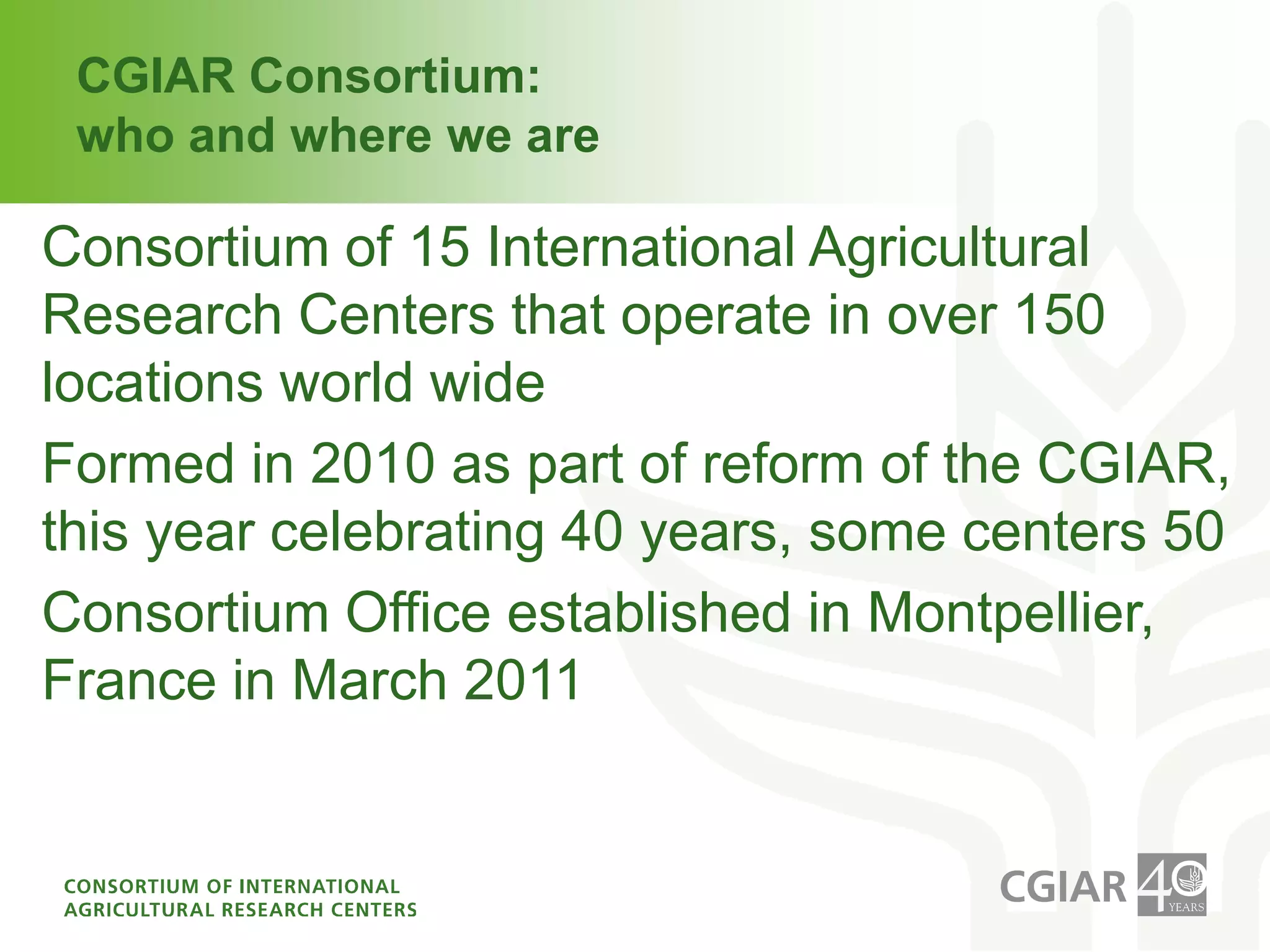
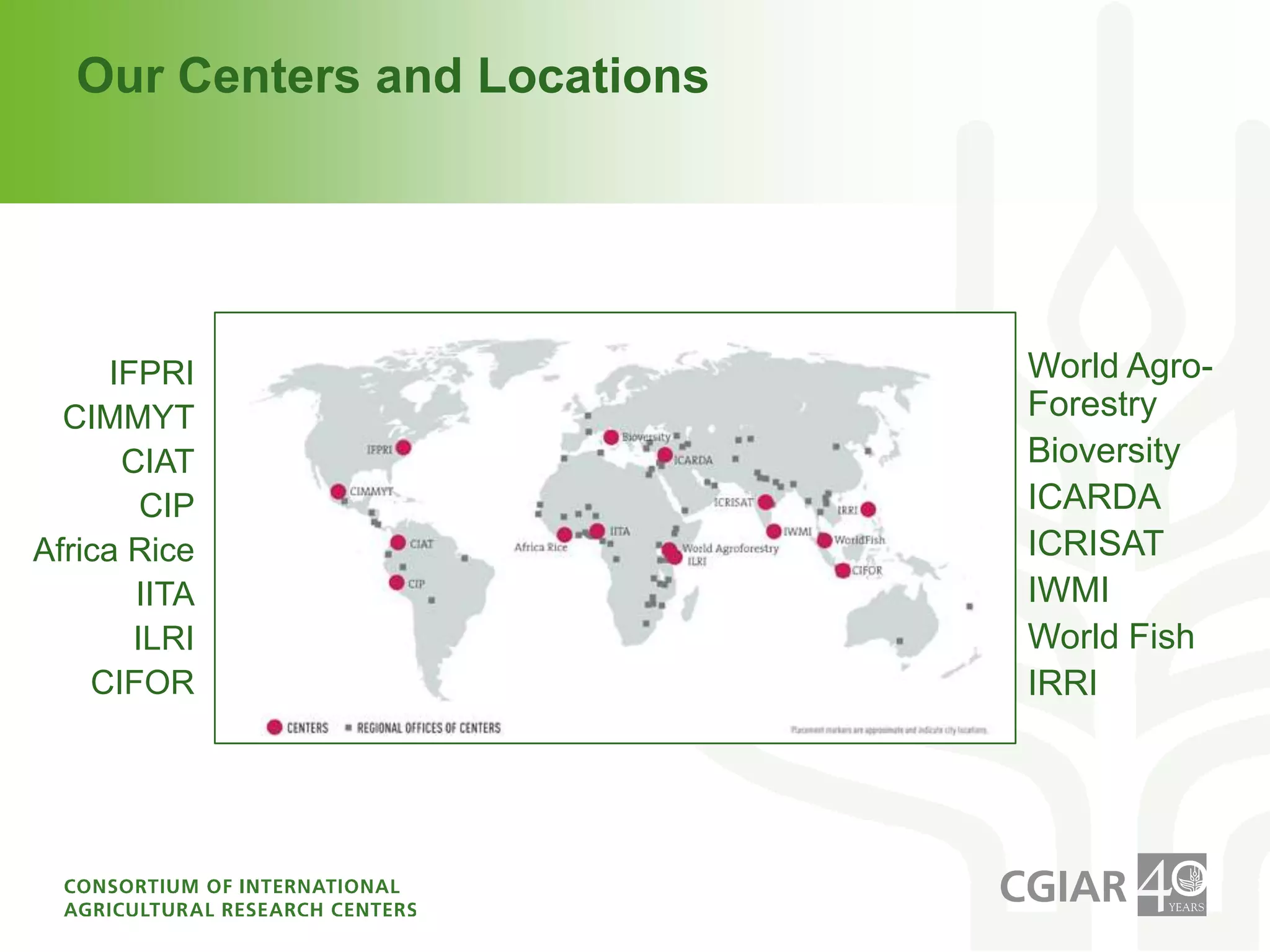
CGIAR Consortium: who and where we areConsortium of 15 International Agricultural Research Centers that operate in over 150 locations world wideFormed in 2010 as part of reform of the CGIAR, this year celebrating 40 years, some centers 50Consortium Office established in Montpellier, France in March 2011
Our Centers and LocationsWorld Agro-ForestryBioversityICARDAICRISATIWMIWorld FishIRRIIFPRICIMMYTCIATCIPAfrica RiceIITAILRICIFOR
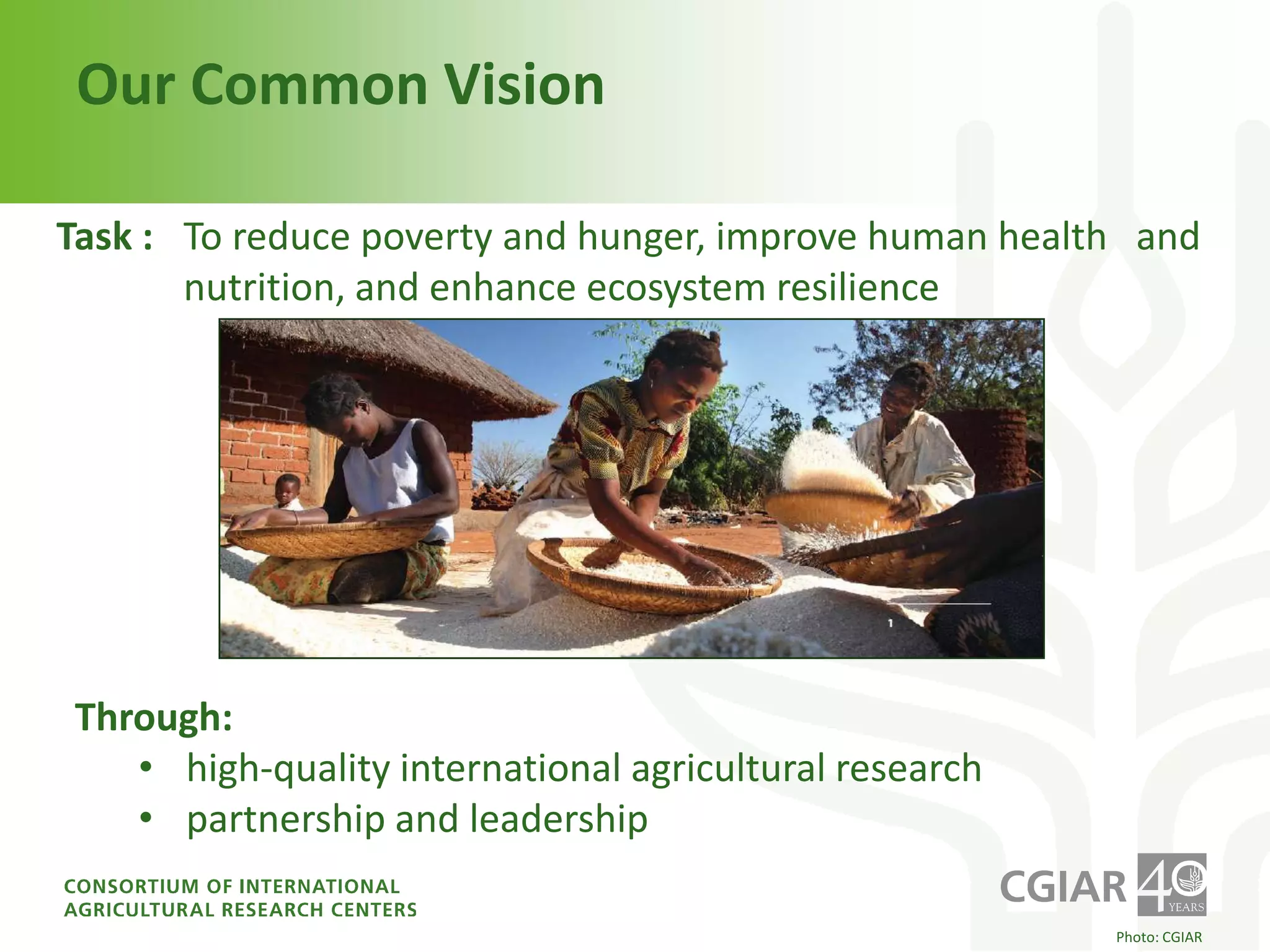
Our Common VisionTask : 	To reduce poverty and hunger, improve human health 	and 		nutrition, and enhance ecosystem resilience Through: high-quality international agricultural research
partnership and leadershipPhoto: CGIAR
What is the comparative advantage of the CGIAR to address these challenges?Primary organization with a global public mandate and funding for scientific research to find solutions eradicating poverty and hunger at global scaleA critical mass of leading scientists  with multidisciplinary knowledge of key agro-ecosystems, especially for the poor and under-served areasExtensive global research network, including research stations with strong links to farmers and national agricultural research and innovation systems40 year track record in addressing R4D issues Guardian of collections of genetic resources for agriculture held in trust for the worlds current and future generations
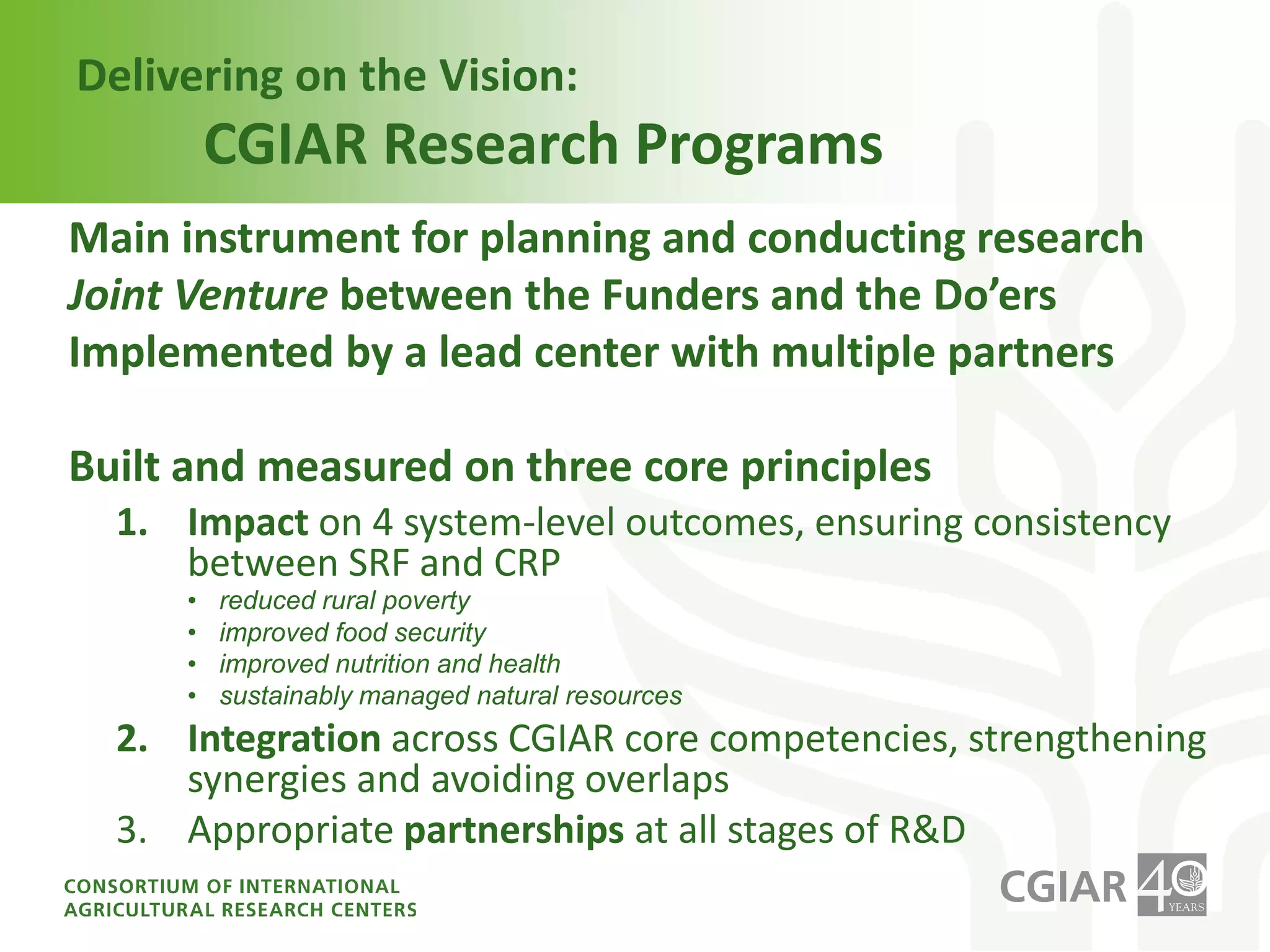
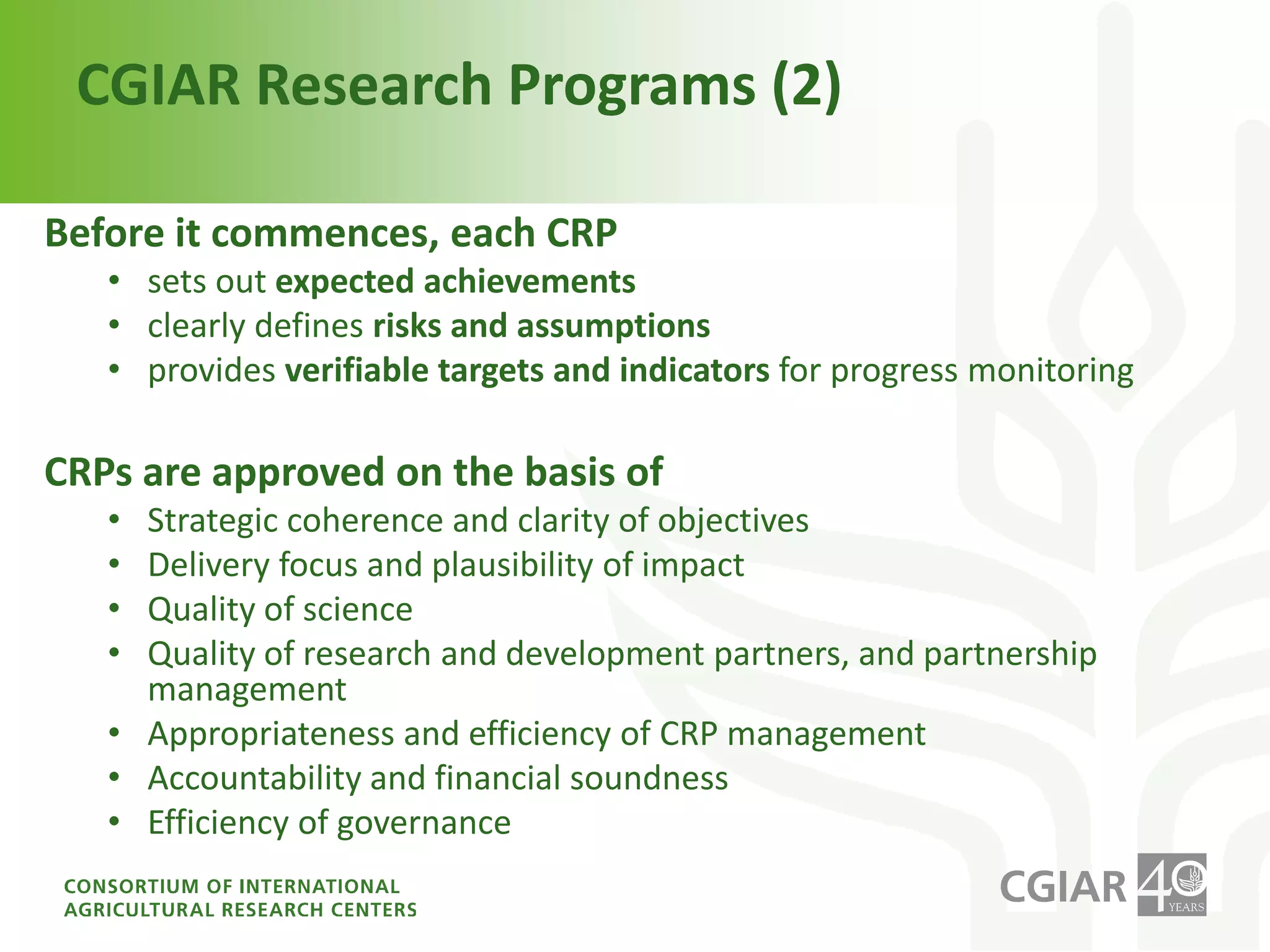
Delivering on the Vision:CGIAR Research ProgramsMain instrument for planning and conducting researchJoint Venture between the Funders and the Do’ersImplemented by a lead center with multiple partnersBuilt and measured on three core principlesImpact on 4 system-level outcomes, ensuring consistency between SRF and CRPreduced rural povertyimproved food securityimproved nutrition and healthsustainably managed natural resourcesIntegration across CGIAR core competencies, strengthening synergies and avoiding overlapsAppropriate partnerships at all stages of R&D
CGIAR Research Programs (2)Before it commences, each CRP sets out expected achievements
clearly defines risks and assumptions
provides verifiable targets and indicators for progress monitoringCRPs are approved on the basis ofStrategic coherence and clarity of objectives
Delivery focus and plausibility of impact
Quality of science

Institutional Frameworks, Experience with CGIAR reform (PPT format)

  • 1.
    Institutional FrameworksExperience withCGIAR reformLloyd Le Page, CEO CGIAR ConsortiumOECD Conference on Agricultural Knowledge Systems
  • 2.
    Background of theCGIARFormed in 1971 due to serious concerns about global hungerIndia, Pakistan and other Asian countries teetered on the brink of famine. Formed on the basis of convincing evidence that agricultural science was a powerful instrument for combating hunger. Dramatic increases in agricultural productivity possible through:widespread adoption of new, high-yielding rice and wheat varieties, Combines with increased use of fertilizers, irrigation and other inputs, in what came to be celebrated as the Green Revolution. Humanitarian concern, mixed with science-based conviction, brought together the agricultural researchers and development donors who created the CGIAR. Shared objective was to extend the early gains made possible by modern agricultural science by developing a workable formula for mobilizing resources to support research on a “long-term continuing basis”
  • 3.
    Since early beginnings,the CGIAR System had evolved to become increasingly complicated with multiple donors, center, crop and national priorities3
  • 4.
  • 5.
    Desired outcome ofCGIAR ReformFROMTOGreater impact on food security and poverty reduction5
  • 6.
    CONSORTIUMFUNDStrategy and Results Framework CONSORTIUMBOARDFUNDERS FORUMIndependent Science and Partnership CouncilConsortium CEO and OfficeFUND COUNCILPerformance AgreementsFund Office6In new CGIAR, partnership at all levelsCGIAR Research ProgramsCommon ServicesCentersPartners and StakeholdersIndependent EvaluationArrangement
  • 7.
    Who is theCGIAR Consortium?
  • 8.
    CGIAR Consortium: whoand where we areConsortium of 15 International Agricultural Research Centers that operate in over 150 locations world wideFormed in 2010 as part of reform of the CGIAR, this year celebrating 40 years, some centers 50Consortium Office established in Montpellier, France in March 2011
  • 9.
    Our Centers andLocationsWorld Agro-ForestryBioversityICARDAICRISATIWMIWorld FishIRRIIFPRICIMMYTCIATCIPAfrica RiceIITAILRICIFOR
  • 10.
    Our Common VisionTask: To reduce poverty and hunger, improve human health and nutrition, and enhance ecosystem resilience Through: high-quality international agricultural research
  • 11.
  • 12.
    What is thecomparative advantage of the CGIAR to address these challenges?Primary organization with a global public mandate and funding for scientific research to find solutions eradicating poverty and hunger at global scaleA critical mass of leading scientists with multidisciplinary knowledge of key agro-ecosystems, especially for the poor and under-served areasExtensive global research network, including research stations with strong links to farmers and national agricultural research and innovation systems40 year track record in addressing R4D issues Guardian of collections of genetic resources for agriculture held in trust for the worlds current and future generations
  • 13.
    Delivering on theVision:CGIAR Research ProgramsMain instrument for planning and conducting researchJoint Venture between the Funders and the Do’ersImplemented by a lead center with multiple partnersBuilt and measured on three core principlesImpact on 4 system-level outcomes, ensuring consistency between SRF and CRPreduced rural povertyimproved food securityimproved nutrition and healthsustainably managed natural resourcesIntegration across CGIAR core competencies, strengthening synergies and avoiding overlapsAppropriate partnerships at all stages of R&D
  • 14.
    CGIAR Research Programs(2)Before it commences, each CRP sets out expected achievements
  • 15.
    clearly defines risksand assumptions
  • 16.
    provides verifiable targetsand indicators for progress monitoringCRPs are approved on the basis ofStrategic coherence and clarity of objectives
  • 17.
    Delivery focus andplausibility of impact
  • 18.
  • 19.
    Quality of researchand development partners, and partnership management
  • 20.
  • 21.
  • 22.
  • 23.
  • 24.
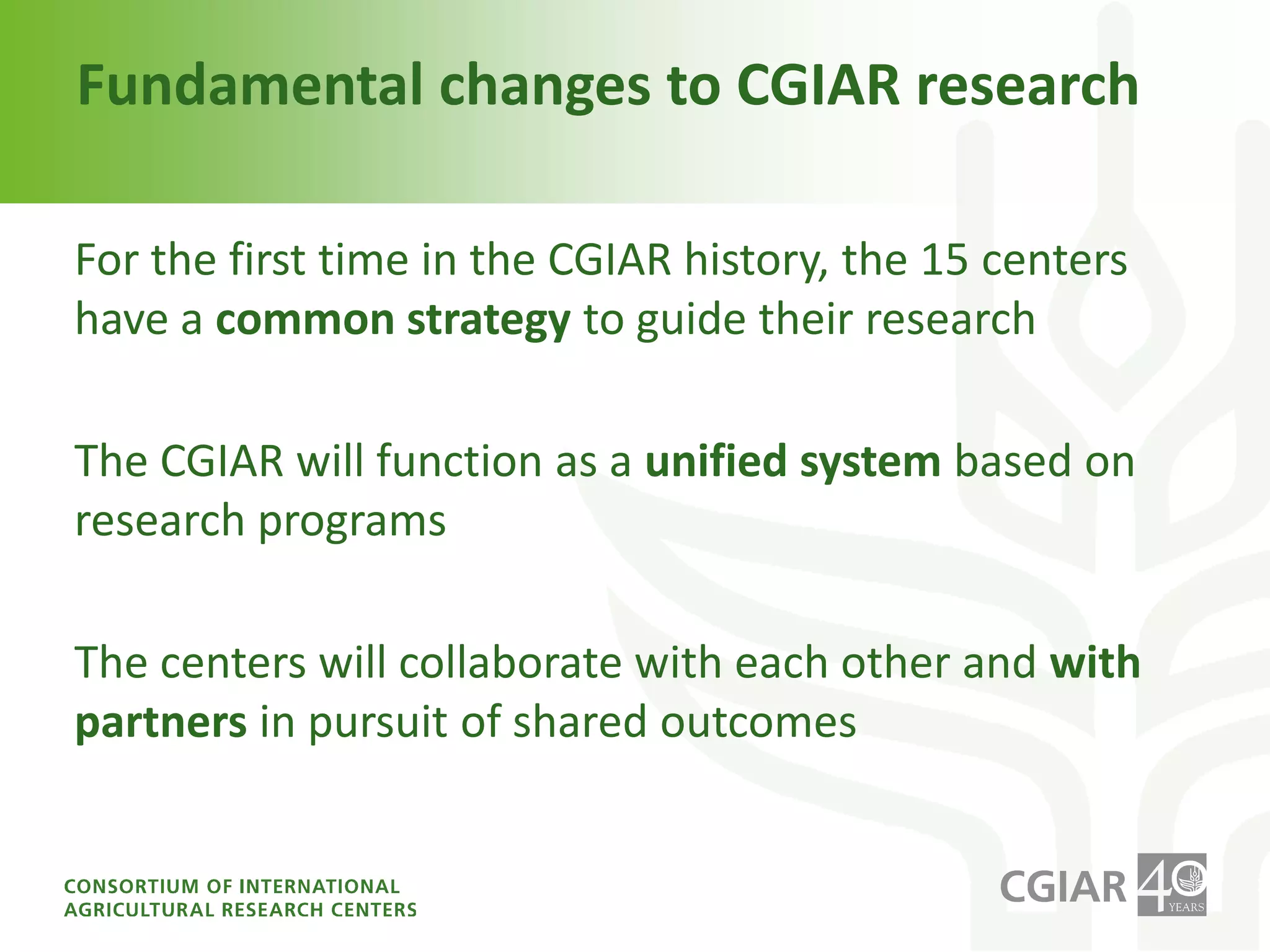
    Fundamental changes toCGIAR researchFor the first time in the CGIAR history, the 15 centers have a common strategy to guide their researchThe CGIAR will function as a unified system based on research programsThe centers will collaborate with each other and with partners in pursuit of shared outcomes
  • 25.
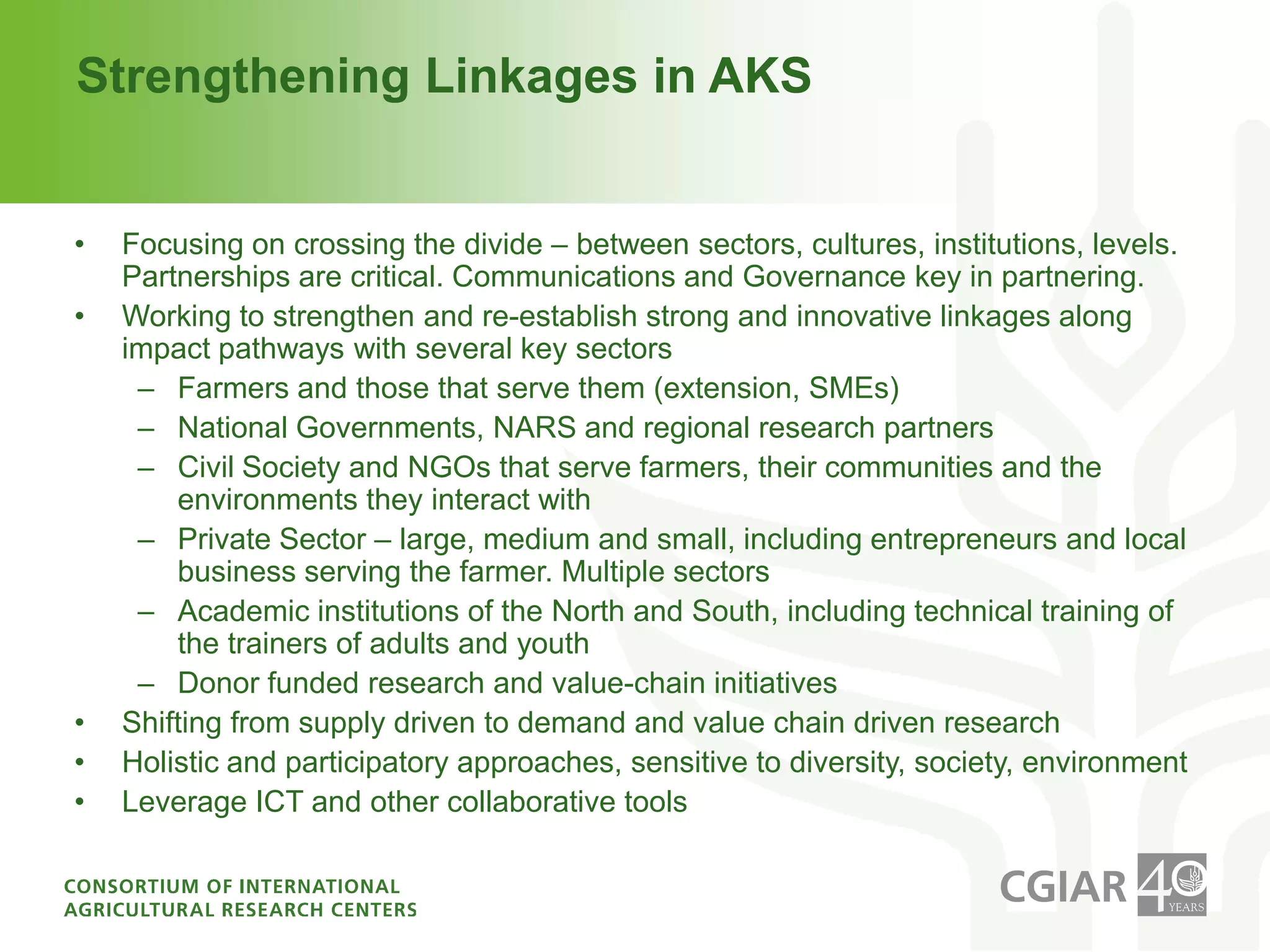
    Strengthening Linkages inAKSFocusing on crossing the divide – between sectors, cultures, institutions, levels. Partnerships are critical. Communications and Governance key in partnering.Working to strengthen and re-establish strong and innovative linkages along impact pathways with several key sectorsFarmers and those that serve them (extension, SMEs)National Governments, NARS and regional research partnersCivil Society and NGOs that serve farmers, their communities and the environments they interact withPrivate Sector – large, medium and small, including entrepreneurs and local business serving the farmer. Multiple sectorsAcademic institutions of the North and South, including technical training of the trainers of adults and youthDonor funded research and value-chain initiativesShifting from supply driven to demand and value chain driven researchHolistic and participatory approaches, sensitive to diversity, society, environmentLeverage ICT and other collaborative tools
  • 26.