Health Sponsorship Council Seminar
          5 August 2010
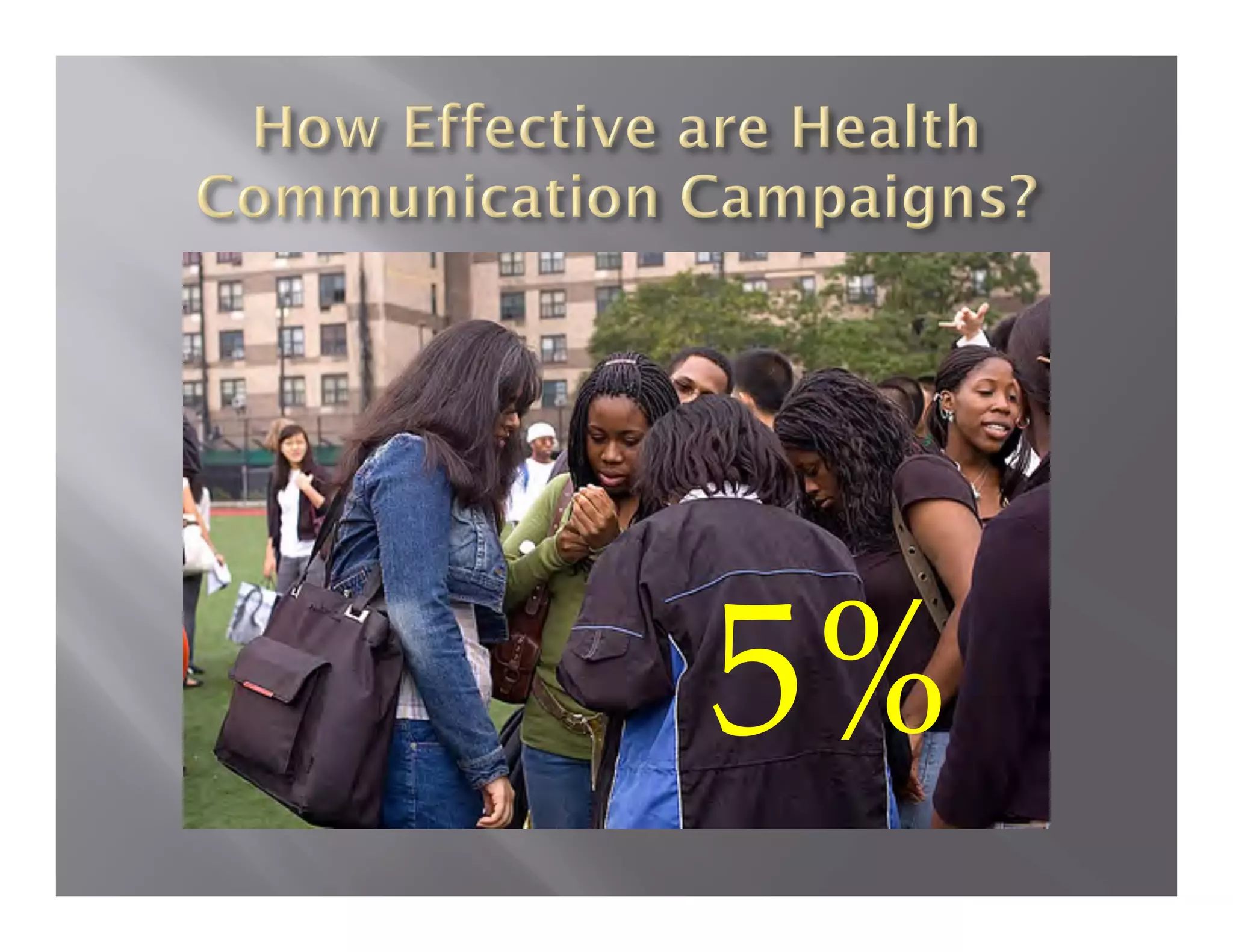
5%
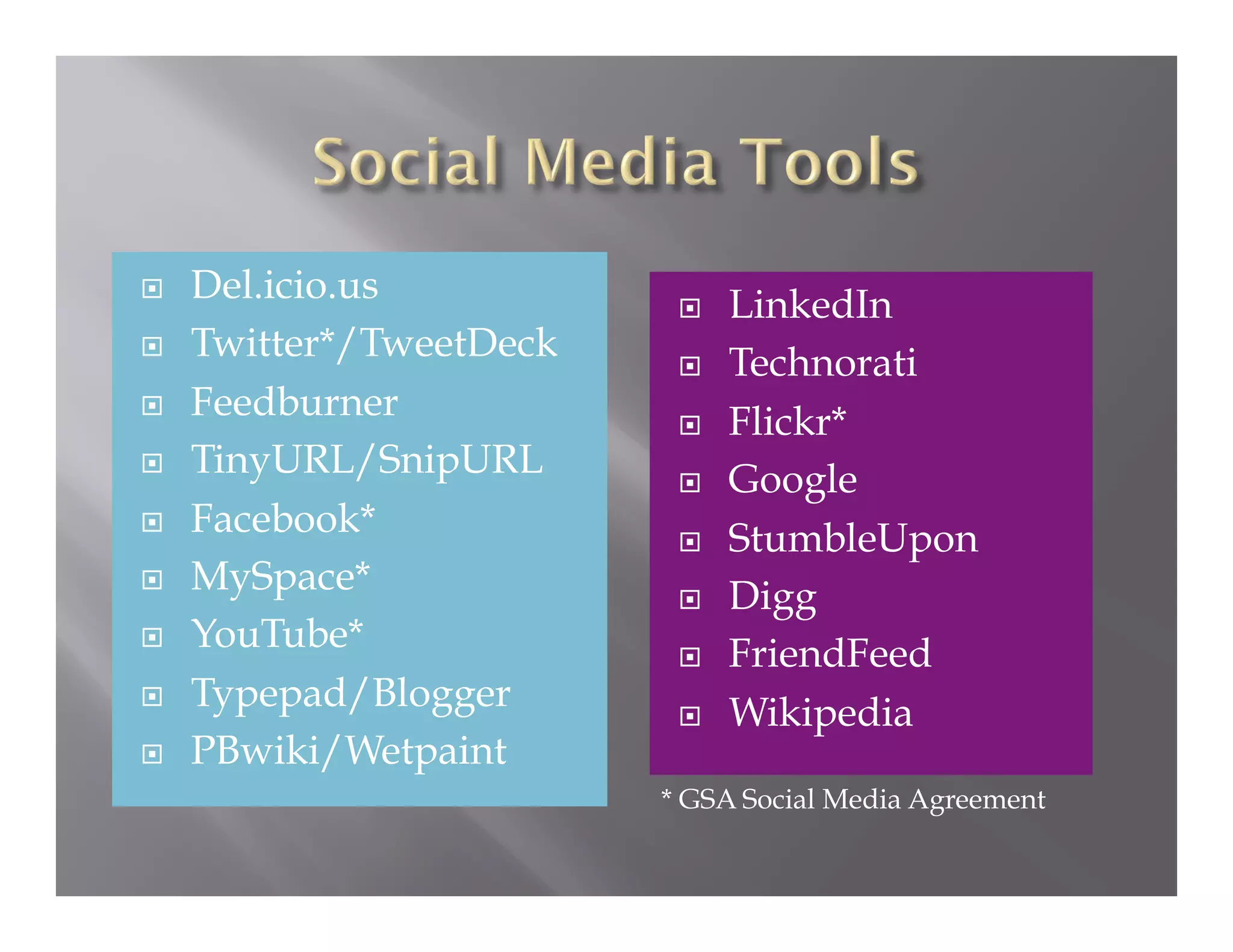
    Del.icio.us               LinkedIn
    Twitter*/TweetDeck        Technorati
    Feedburner                Flickr*
    TinyURL/SnipURL           Google
    Facebook*                 StumbleUpon
    MySpace*                  Digg
    YouTube*                  FriendFeed
    Typepad/Blogger           Wikipedia
    PBwiki/Wetpaint
                          * GSA Social Media Agreement
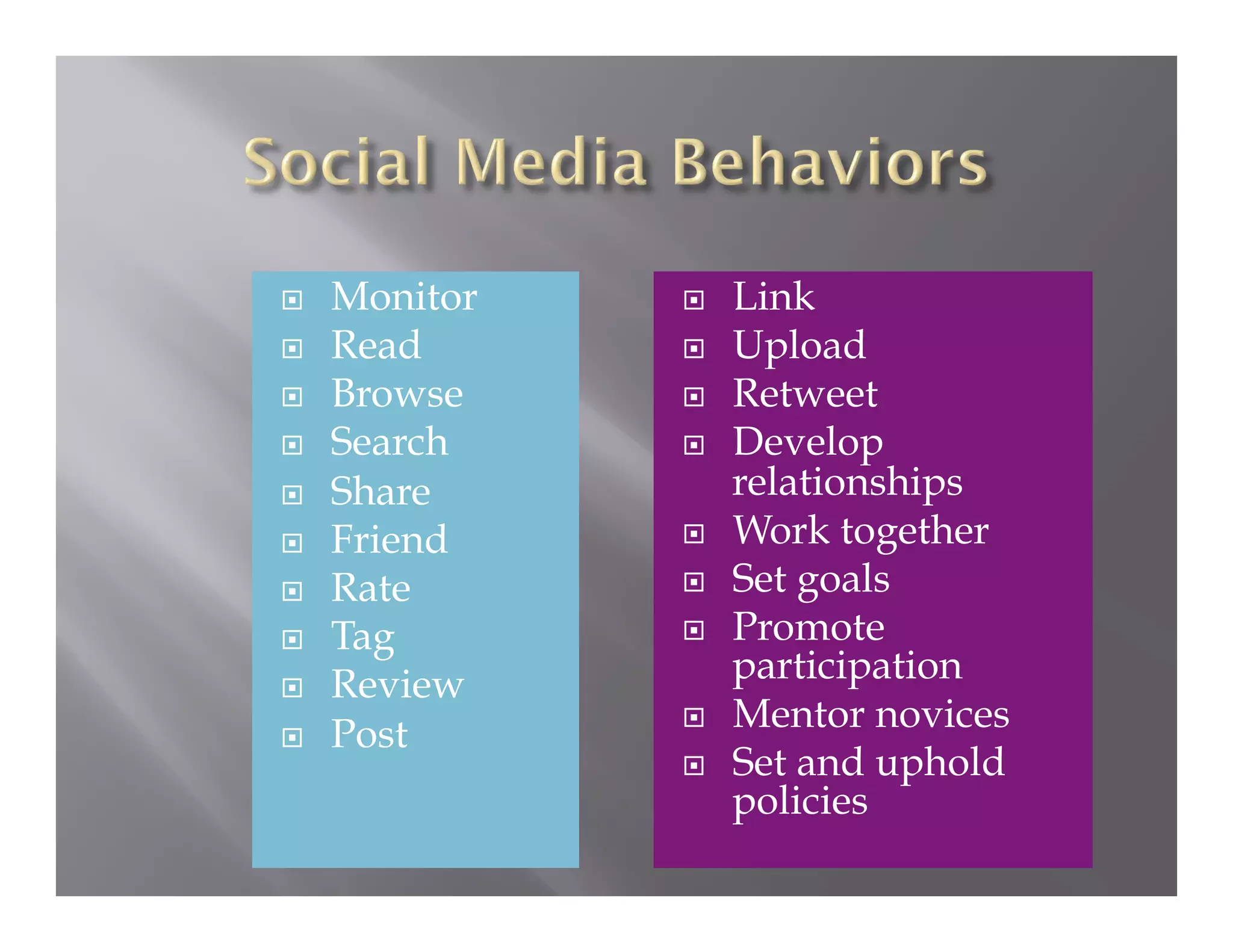
    Monitor       Link
    Read          Upload
    Browse        Retweet
    Search        Develop
    Share          relationships
    Friend        Work together
    Rate          Set goals
    Tag           Promote
    Review         participation
                   Mentor novices
    Post
                   Set and uphold
                    policies
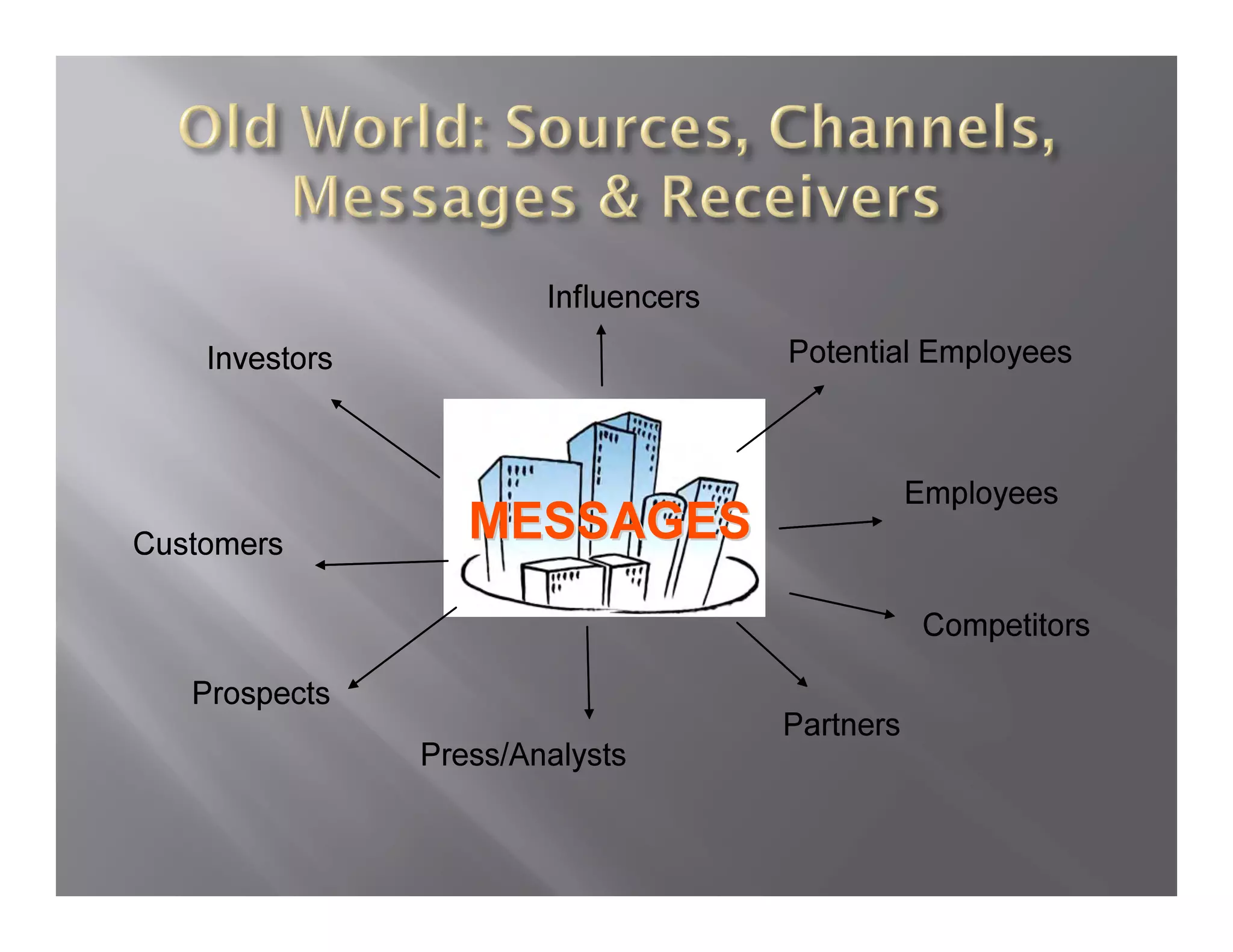
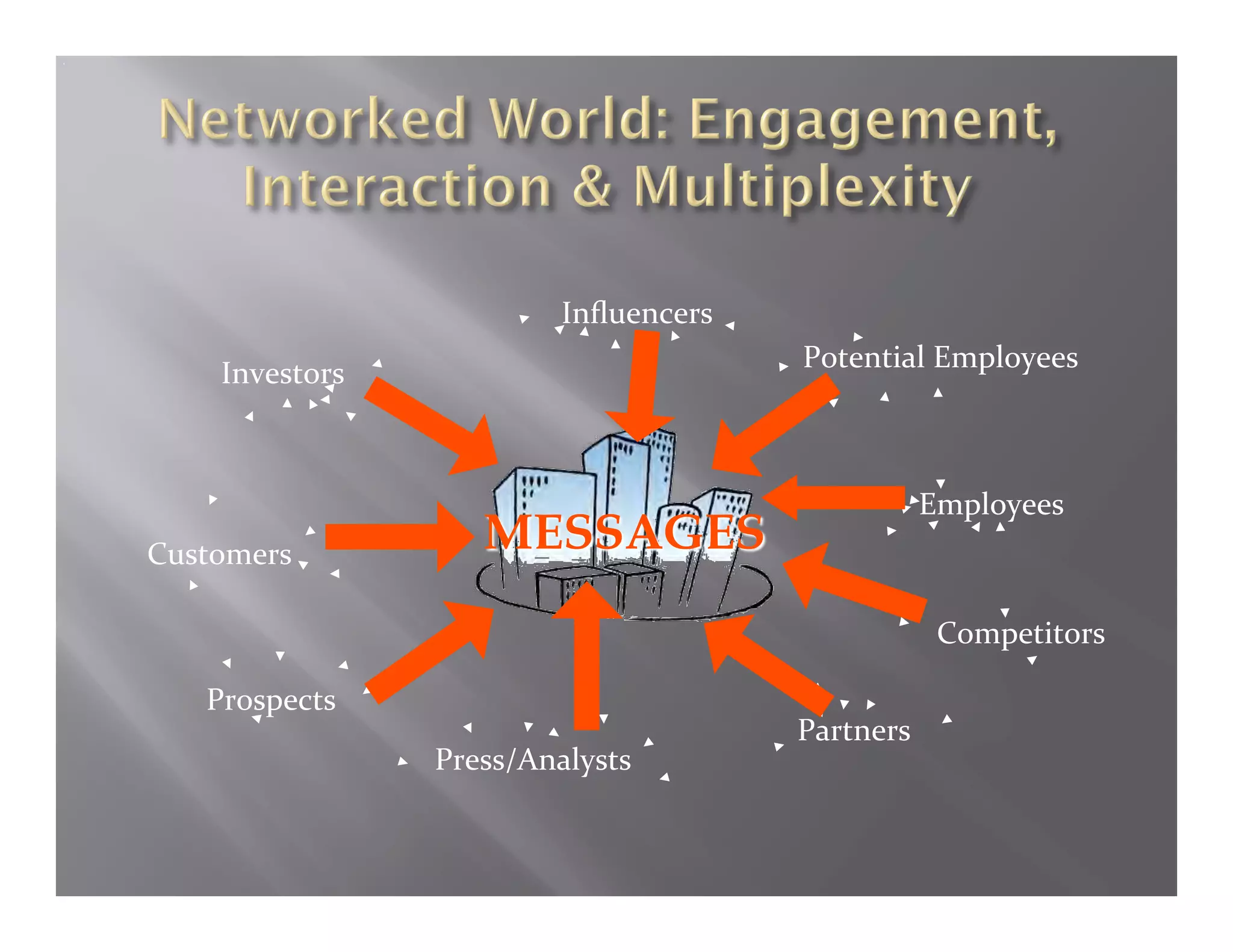
Influencers

                                        Potential
Employees

    Investors


                                                    Employees

Customers


                                                     Competitors


   Prospects

                                        Partners

                 Press/Analysts

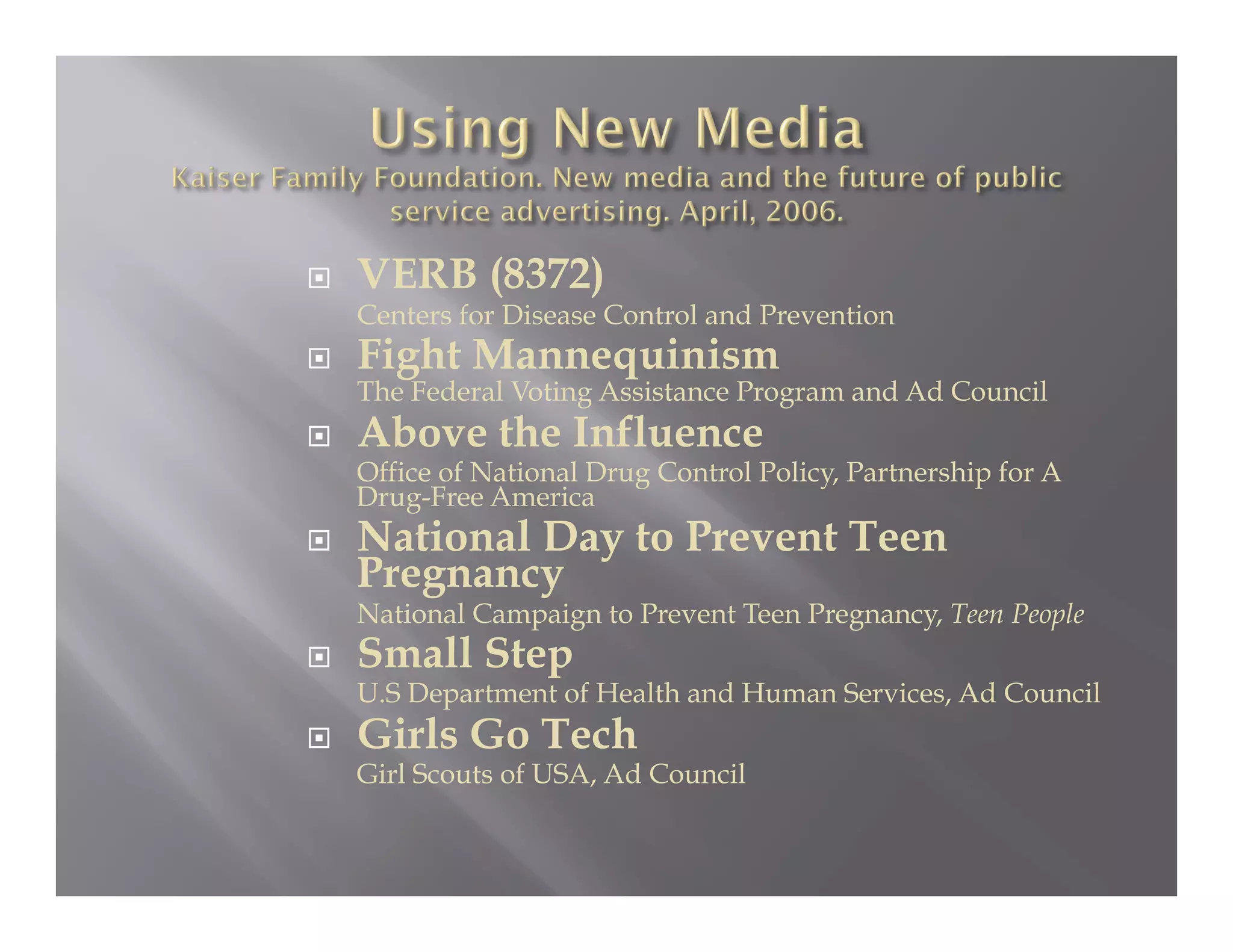
    VERB (8372)
     Centers for Disease Control and Prevention
    Fight Mannequinism
     The Federal Voting Assistance Program and Ad Council
    Above the Influence
     Office of National Drug Control Policy, Partnership for A
     Drug-Free America
    National Day to Prevent Teen
     Pregnancy
     National Campaign to Prevent Teen Pregnancy, Teen People
    Small Step
     U.S Department of Health and Human Services, Ad Council
    Girls Go Tech
     Girl Scouts of USA, Ad Council
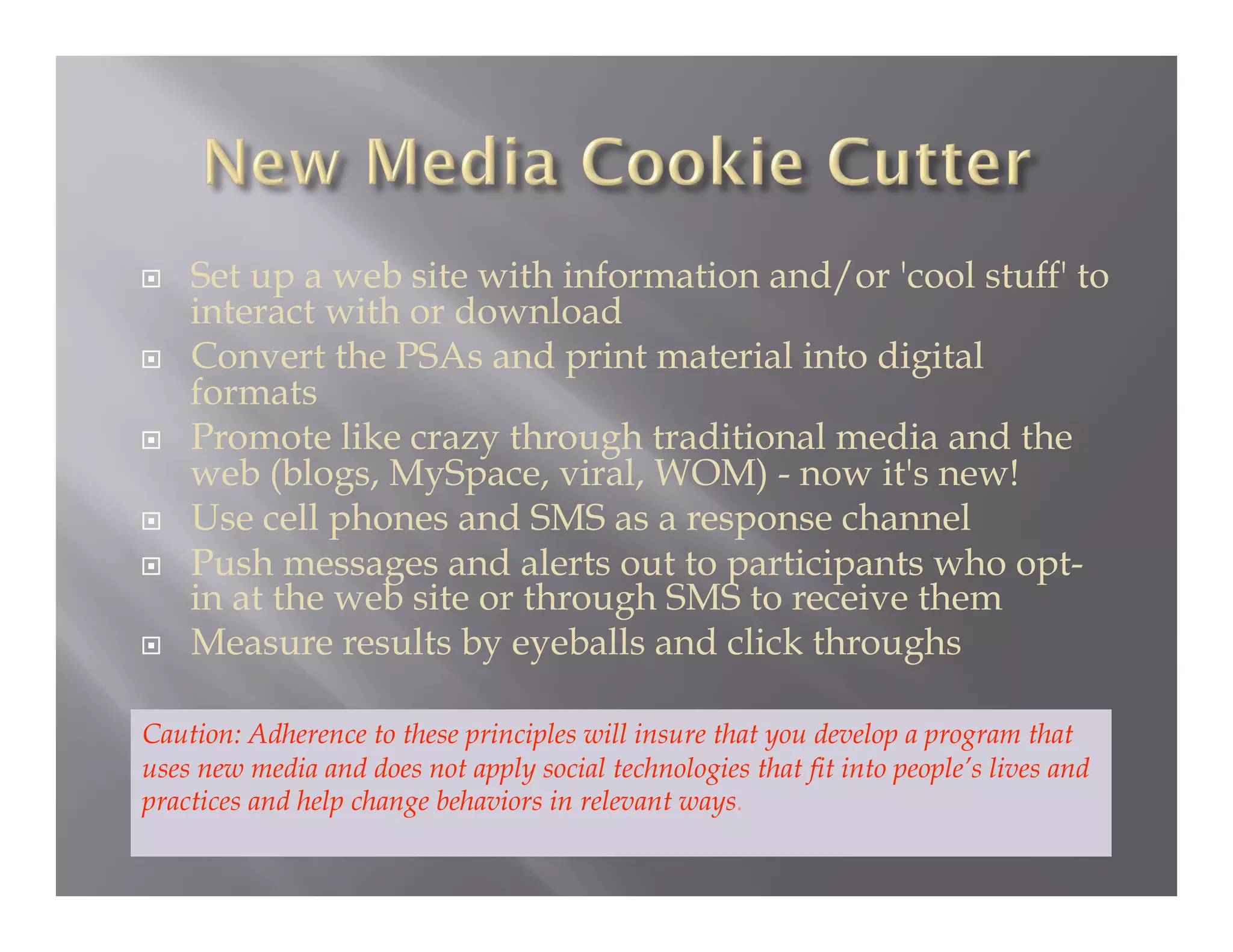
    Set up a web site with information and/or 'cool stuff' to
     interact with or download
    Convert the PSAs and print material into digital
     formats
    Promote like crazy through traditional media and the
     web (blogs, MySpace, viral, WOM) - now it's new!
    Use cell phones and SMS as a response channel
    Push messages and alerts out to participants who opt-
     in at the web site or through SMS to receive them
    Measure results by eyeballs and click throughs

Caution: Adherence to these principles will insure that you develop a program that
uses new media and does not apply social technologies that fit into people’s lives and
practices and help change behaviors in relevant ways.
“The
most
frequently
cited
benefit
of
the
internet
was

in

helping
people
tap
into
[their]
social
networks”
–

Susannah
Fox.

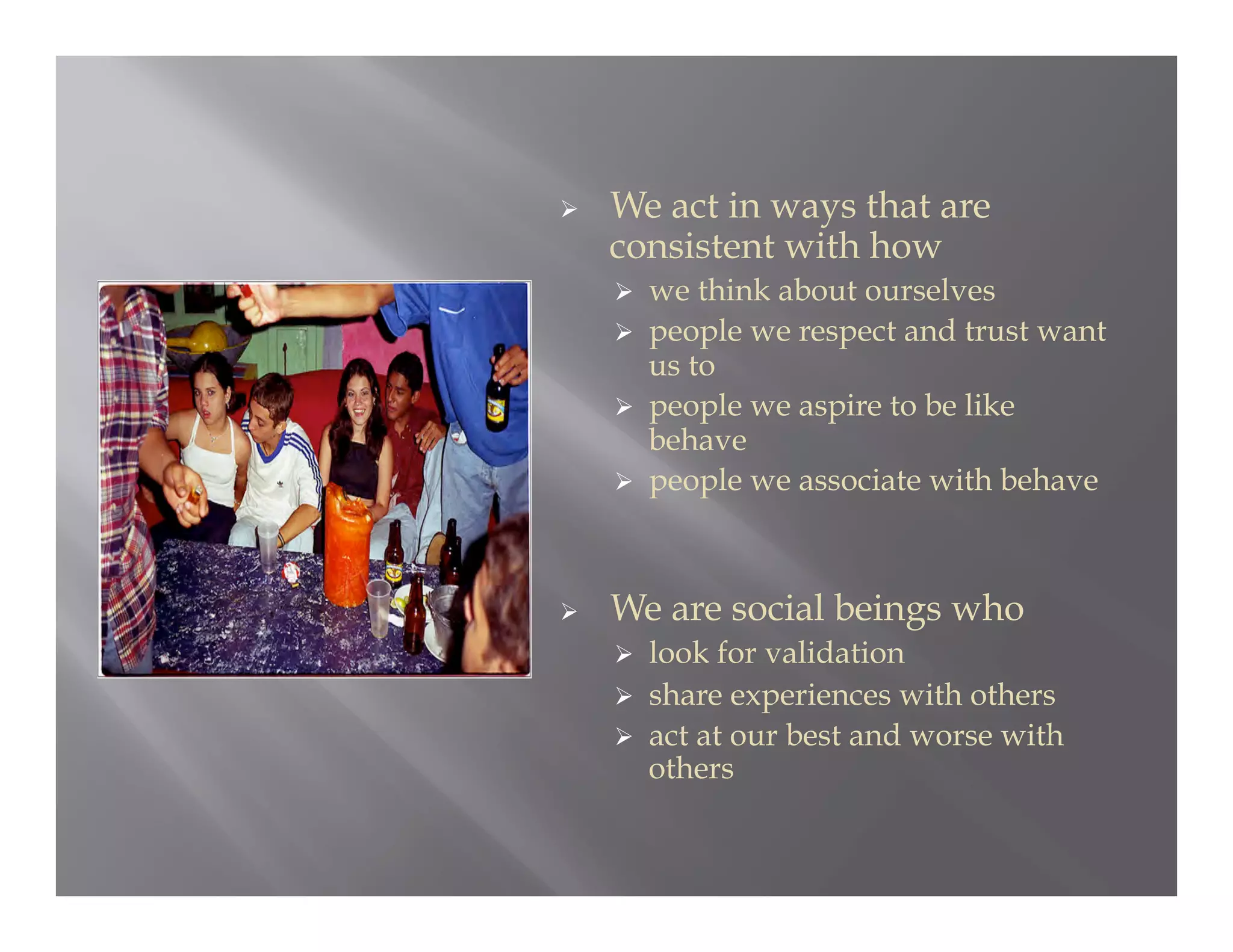
    We act in ways that are
     consistent with how
       we think about ourselves
       people we respect and trust want
        us to
       people we aspire to be like
        behave
       people we associate with behave


    We are social beings who
       look for validation
       share experiences with others
       act at our best and worse with
        others
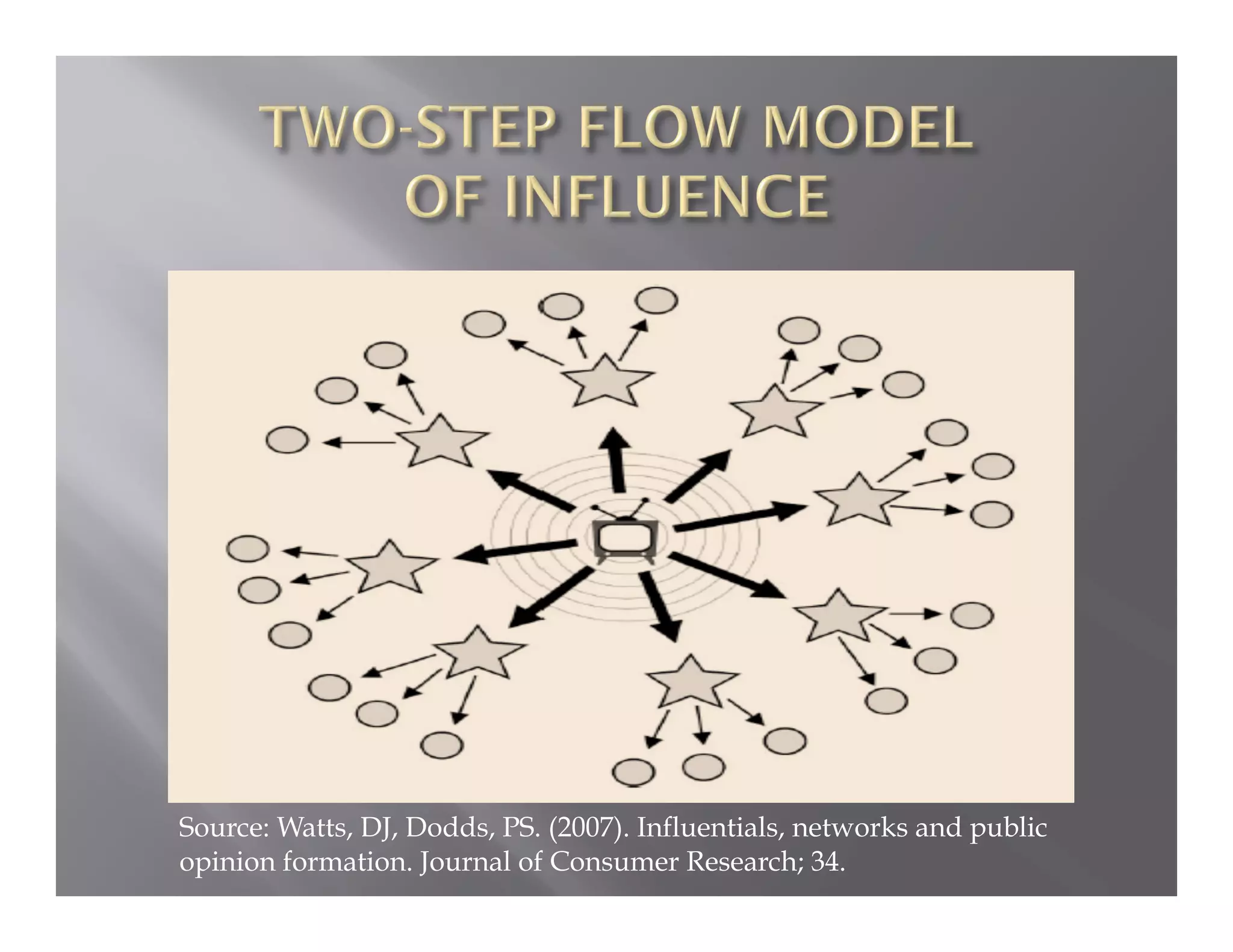
Source: Watts, DJ, Dodds, PS. (2007). Influentials, networks and public
opinion formation. Journal of Consumer Research; 34.
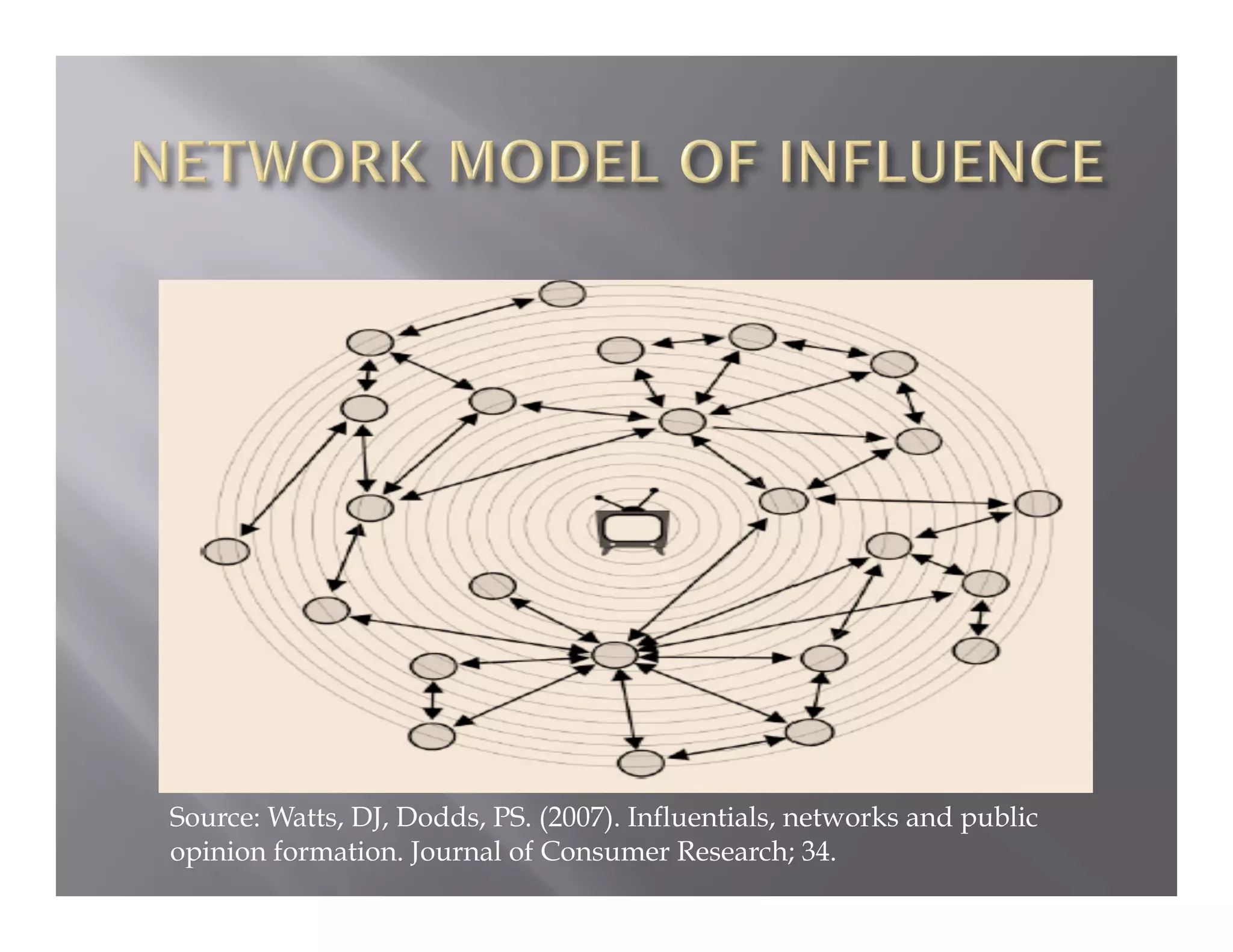
Source: Watts, DJ, Dodds, PS. (2007). Influentials, networks and public
opinion formation. Journal of Consumer Research; 34.
    Becomes a collaborative platform
    Harnesses collective intelligence
    Enables everyone to be a content creator
    Provides greater access to knowledge
     and information resources
    Encourages media multiplexity
    Expands and manages social networks
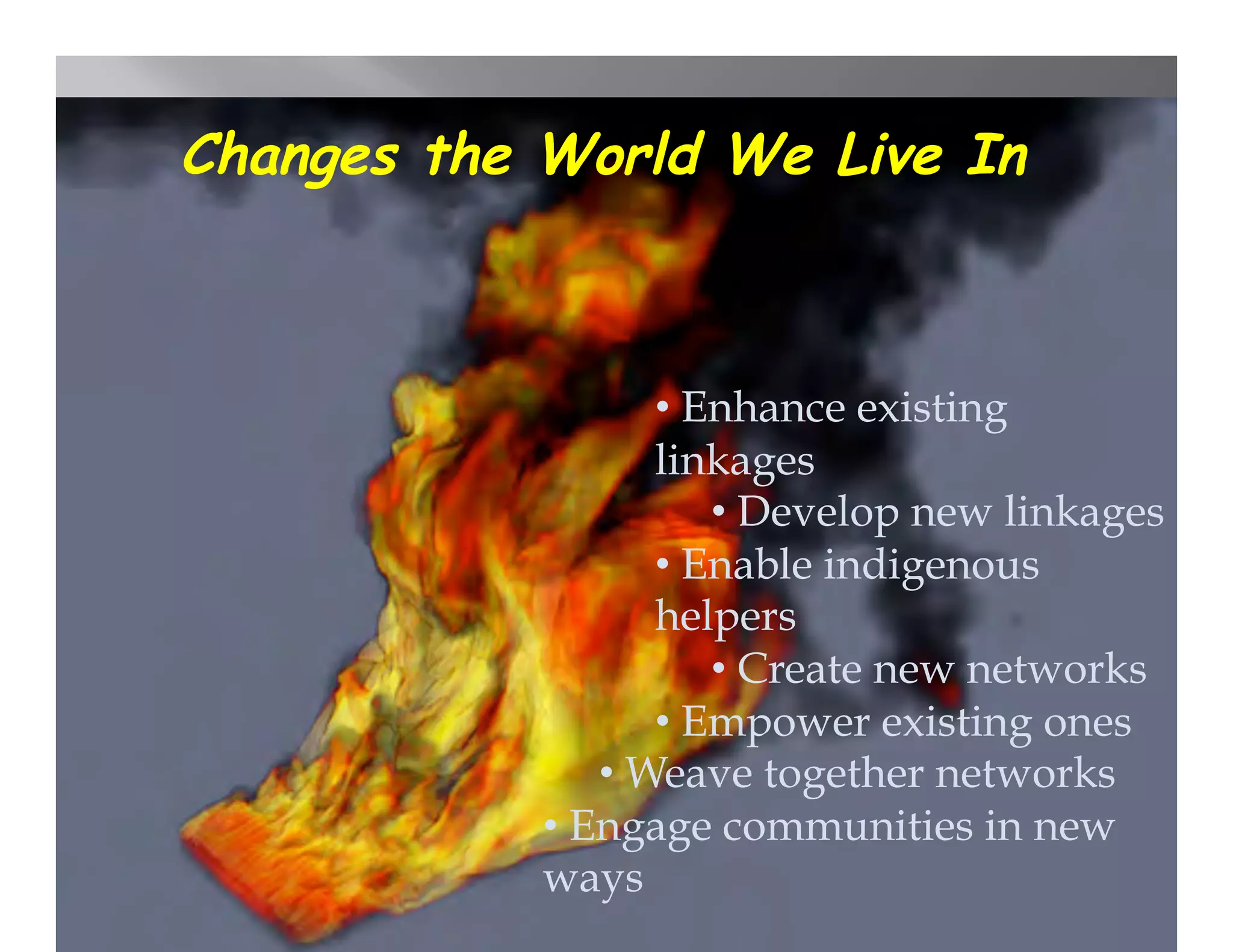
Changes the World We Live In


                    •  Enhance existing
                    linkages
                        •  Develop new linkages
                    •  Enable indigenous
                    helpers
                        •  Create new networks
                    •  Empower existing ones
                •  Weave together networks
            •  Engage communities in new
            ways
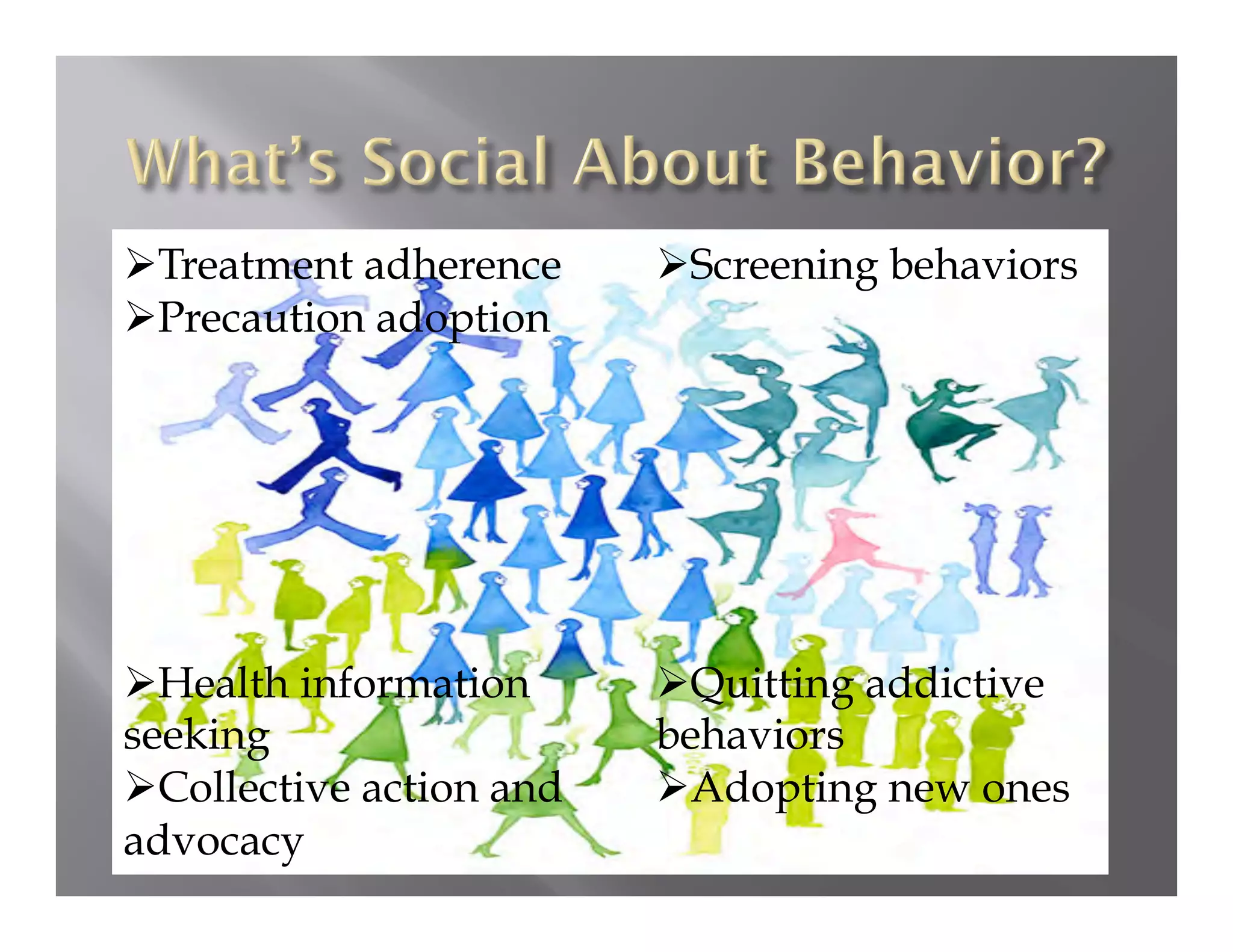
 Treatment adherence      Screening behaviors
 Precaution adoption


 Health information       Quitting addictive
seeking                   behaviors
 Collective action and    Adopting new ones
advocacy
    ‘Bridging’ and ‘bonding’ (building,
     strengthening and using social connections)
    Audience Benefits: access social network
     resources and solves a problem
    Focus on ‘boundary spanners’
    Enhance salience and attractiveness of the ‘out
     group’ [positive deviants] – put the
     practitioners of ‘new’ behaviors in a light that
     attracts imitation or modeling.
    Build sustainable local capacities/assets
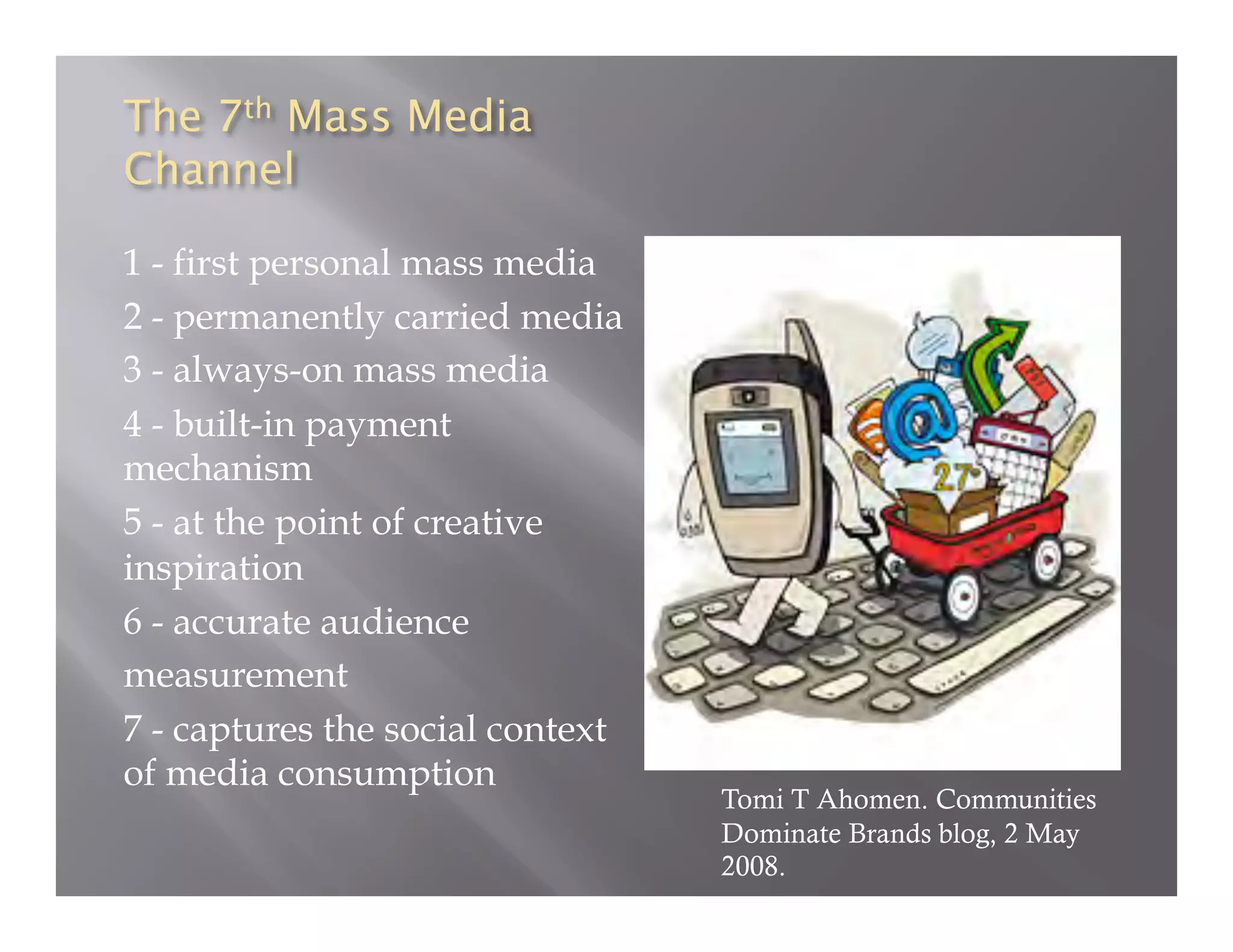
1 - first personal mass media
2 - permanently carried media
3 - always-on mass media
4 - built-in payment
mechanism
5 - at the point of creative
inspiration
6 - accurate audience
measurement
7 - captures the social context
of media consumption
                                  Tomi T Ahomen. Communities
                                  Dominate Brands blog, 2 May
                                  2008.
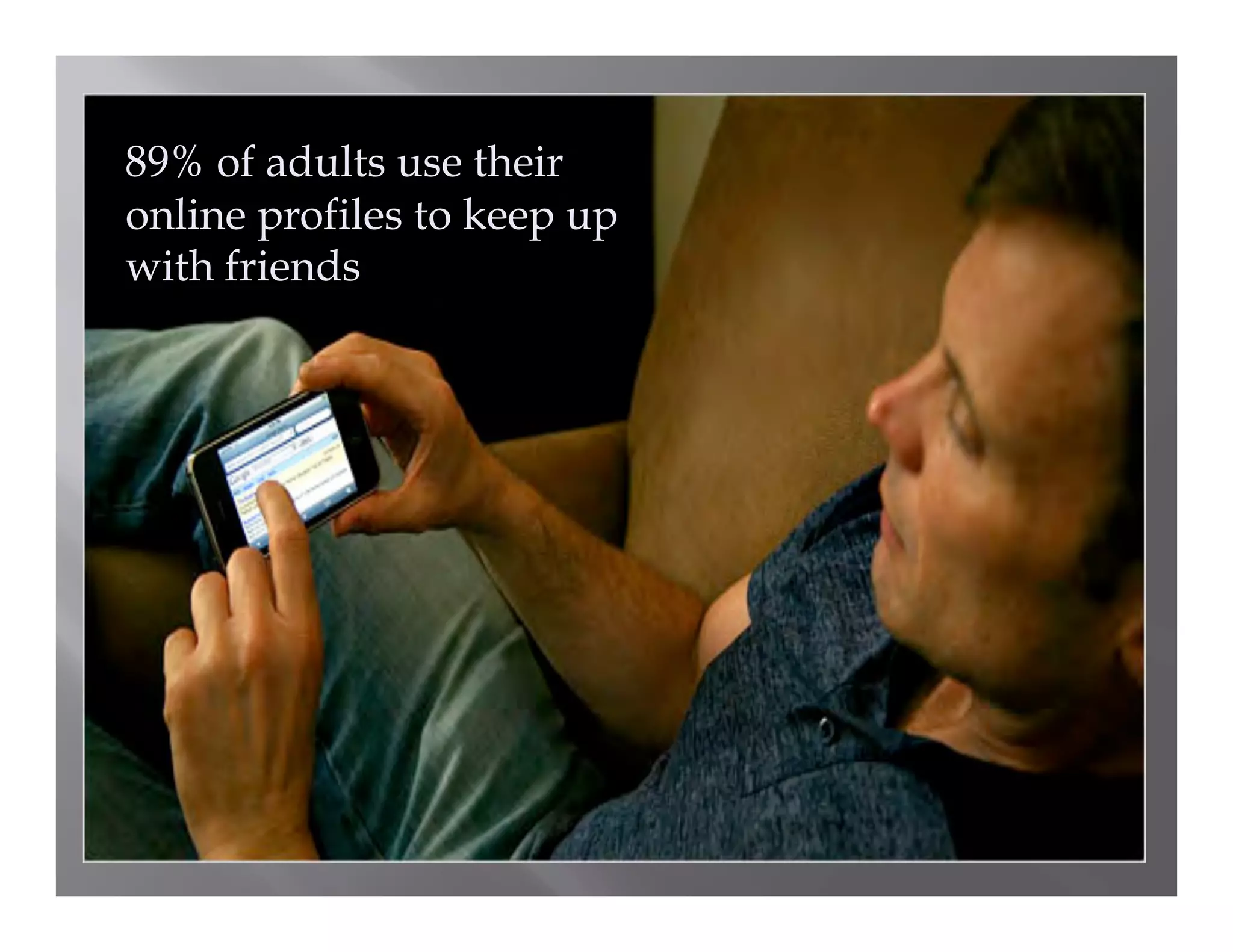
89% of adults use their
online profiles to keep up
with friends
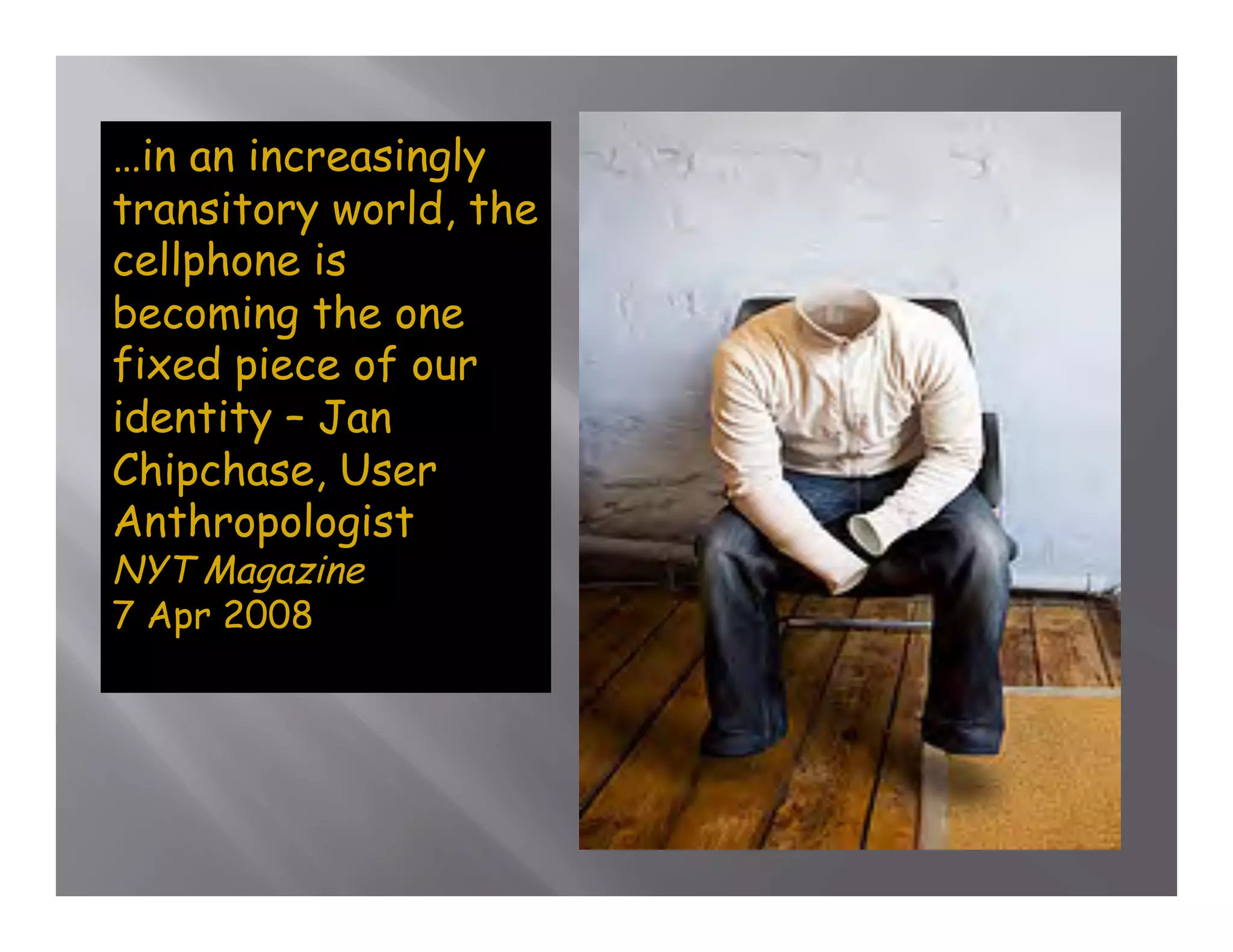
…in an increasingly
transitory world, the
cellphone is
becoming the one
fixed piece of our
identity – Jan
Chipchase, User
Anthropologist
NYT Magazine
7 Apr 2008
3,800 products recalled as of 3/30/09
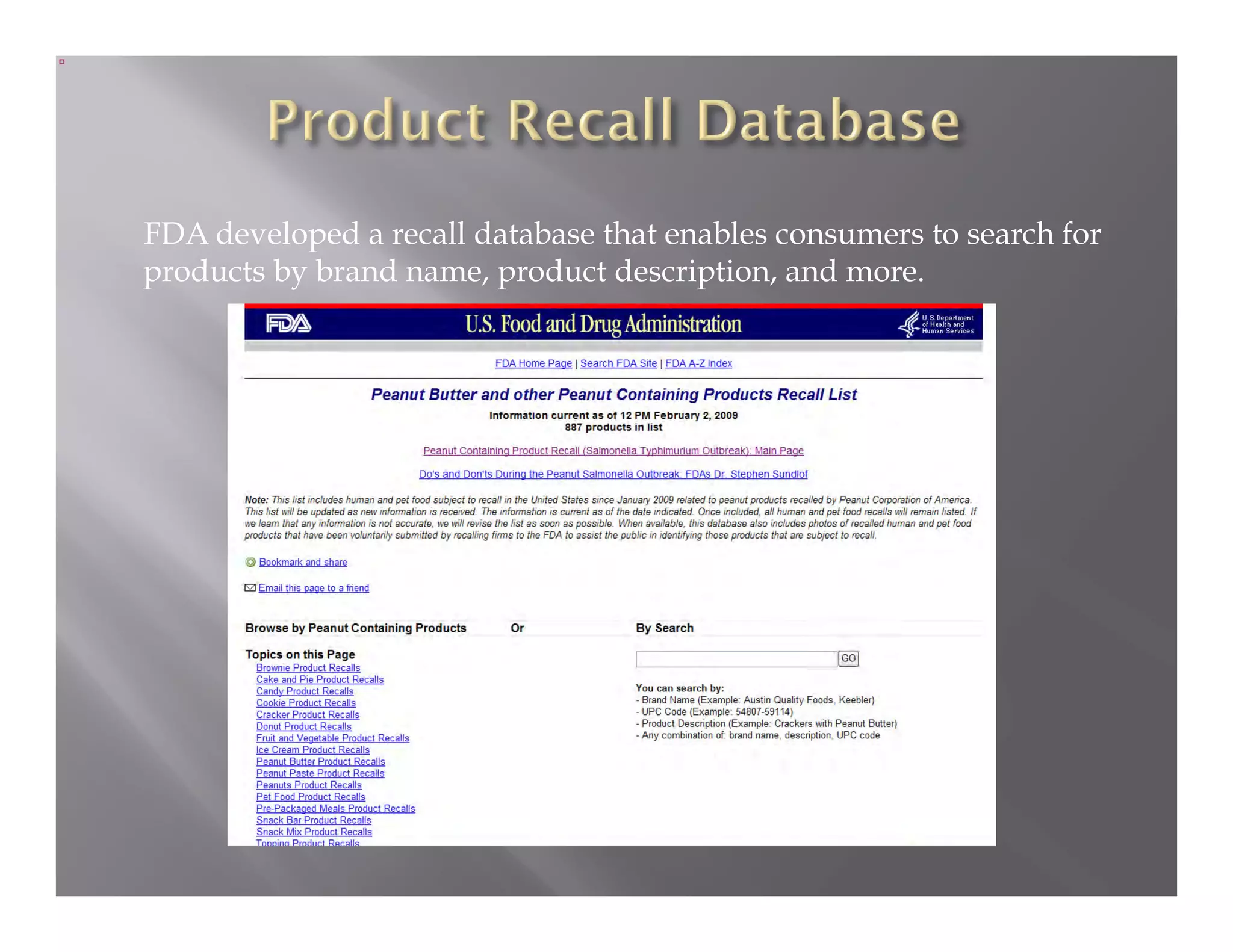
FDA developed a recall database that enables consumers to search for
products by brand name, product description, and more.
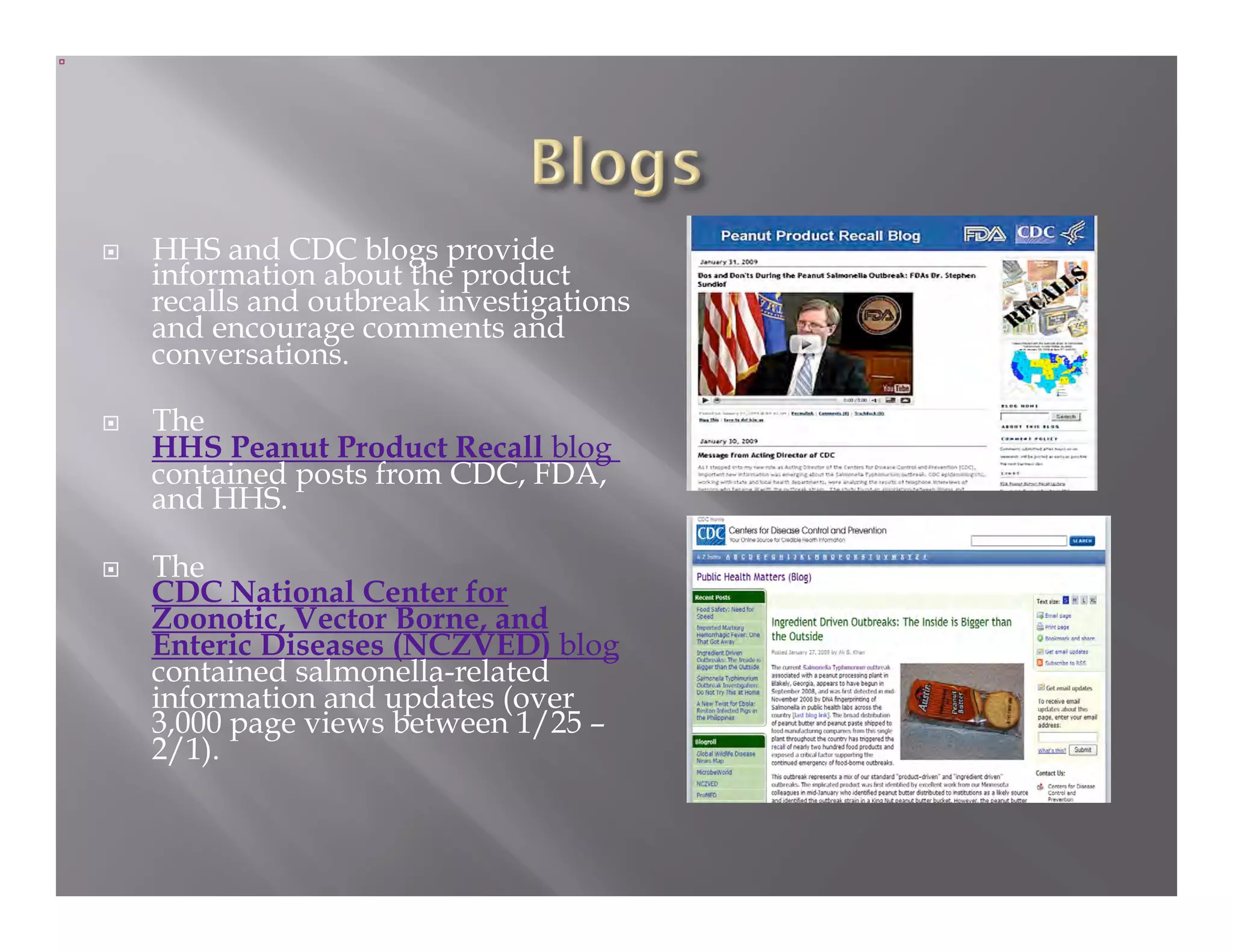
    HHS and CDC blogs provide
     information about the product
     recalls and outbreak investigations
     and encourage comments and
     conversations.

    The
     HHS Peanut Product Recall blog
     contained posts from CDC, FDA,
     and HHS.

    The
     CDC National Center for
     Zoonotic, Vector Borne, and
     Enteric Diseases (NCZVED) blog
     contained salmonella-related
     information and updates (over
     3,000 page views between 1/25 –
     2/1).
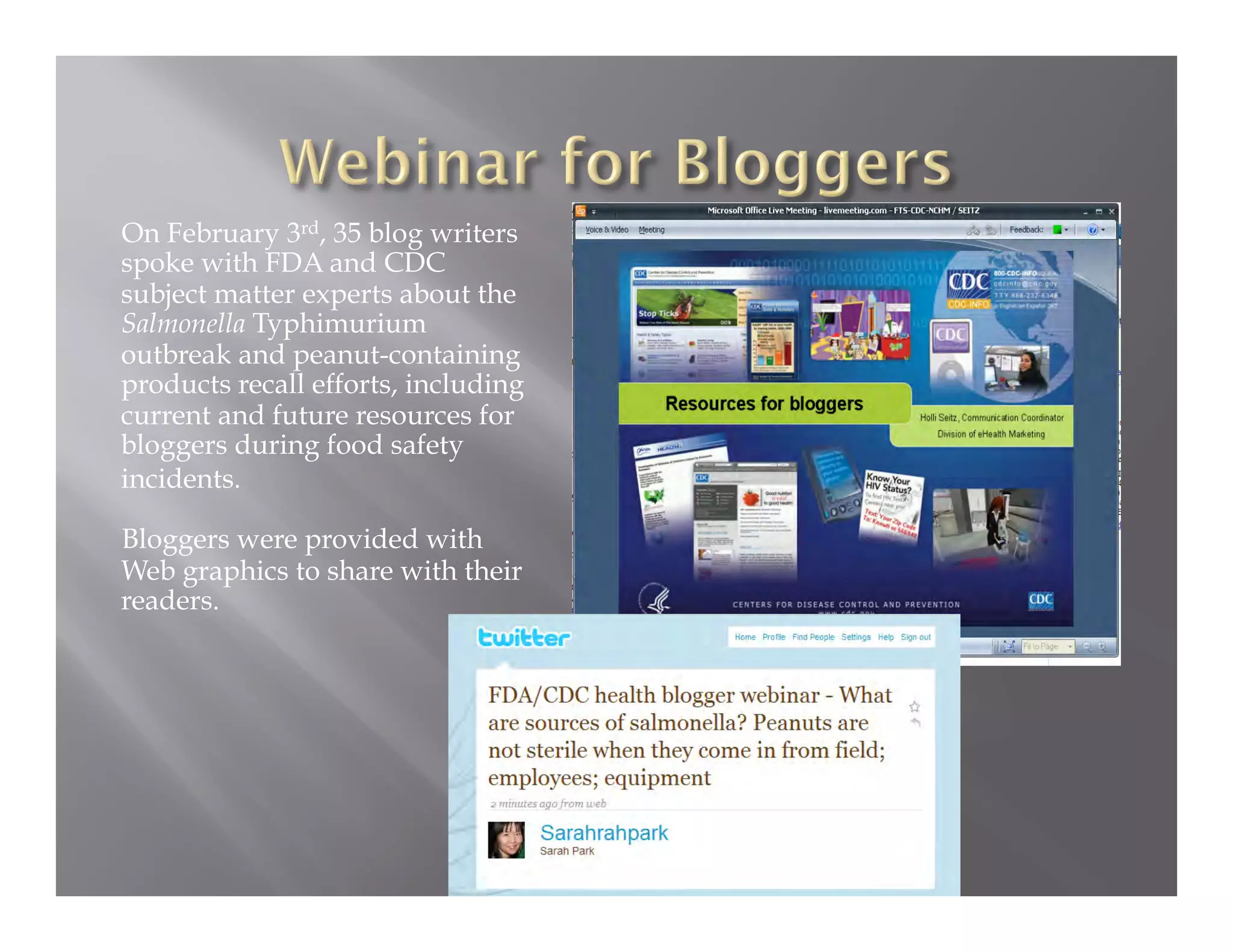
On February 3rd, 35 blog writers
spoke with FDA and CDC
subject matter experts about the
Salmonella Typhimurium
outbreak and peanut-containing
products recall efforts, including
current and future resources for
bloggers during food safety
incidents.

Bloggers were provided with
Web graphics to share with their
readers.
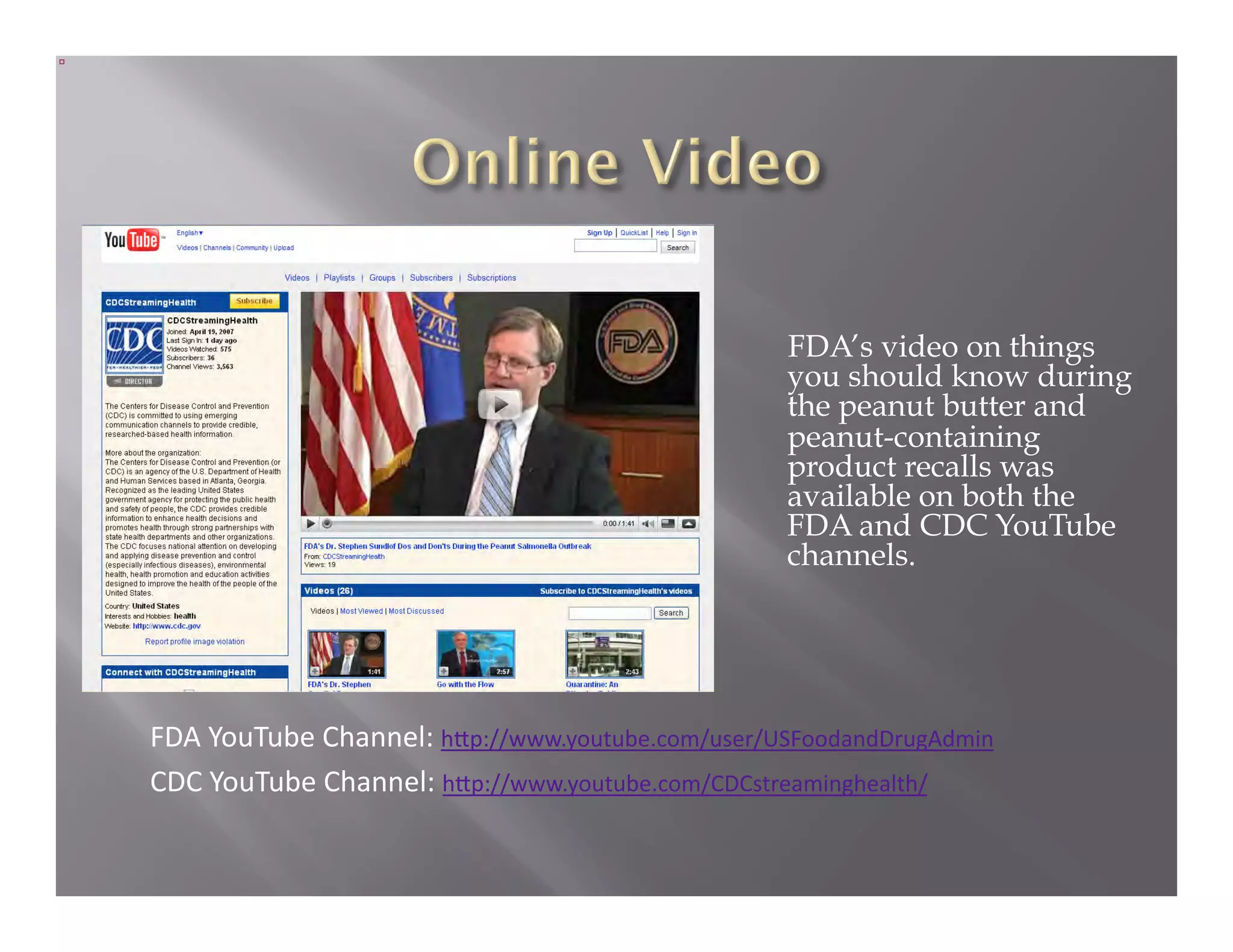
FDA’s video on things
                                                  you should know during
                                                  the peanut butter and
                                                  peanut-containing
                                                  product recalls was
                                                  available on both the
                                                  FDA and CDC YouTube
                                                  channels.


FDA
YouTube
Channel:
h1p://www.youtube.com/user/USFoodandDrugAdmin


CDC
YouTube
Channel:
h1p://www.youtube.com/CDCstreaminghealth/


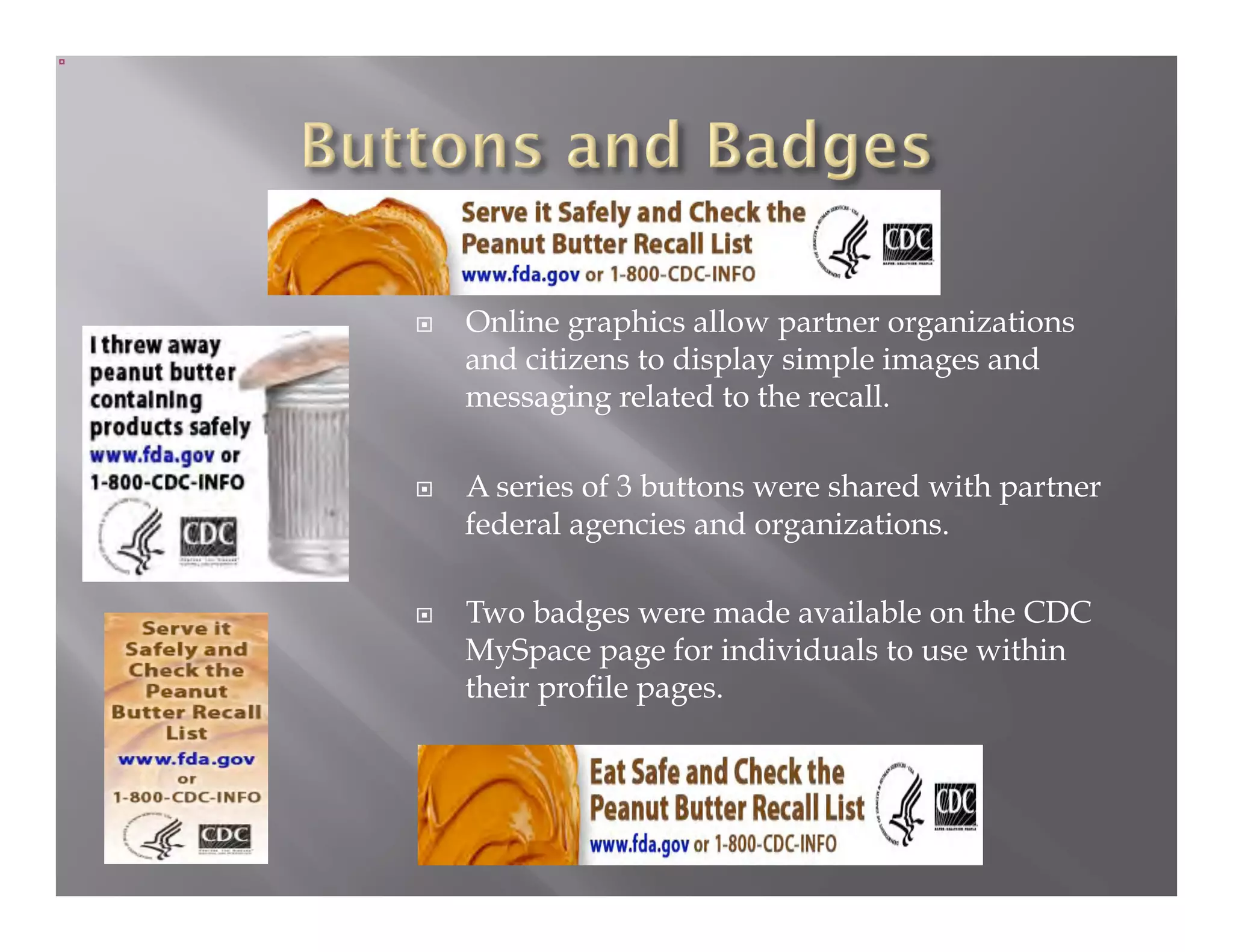
    Online graphics allow partner organizations
     and citizens to display simple images and
     messaging related to the recall.

    A series of 3 buttons were shared with partner
     federal agencies and organizations.

    Two badges were made available on the CDC
     MySpace page for individuals to use within
     their profile pages.


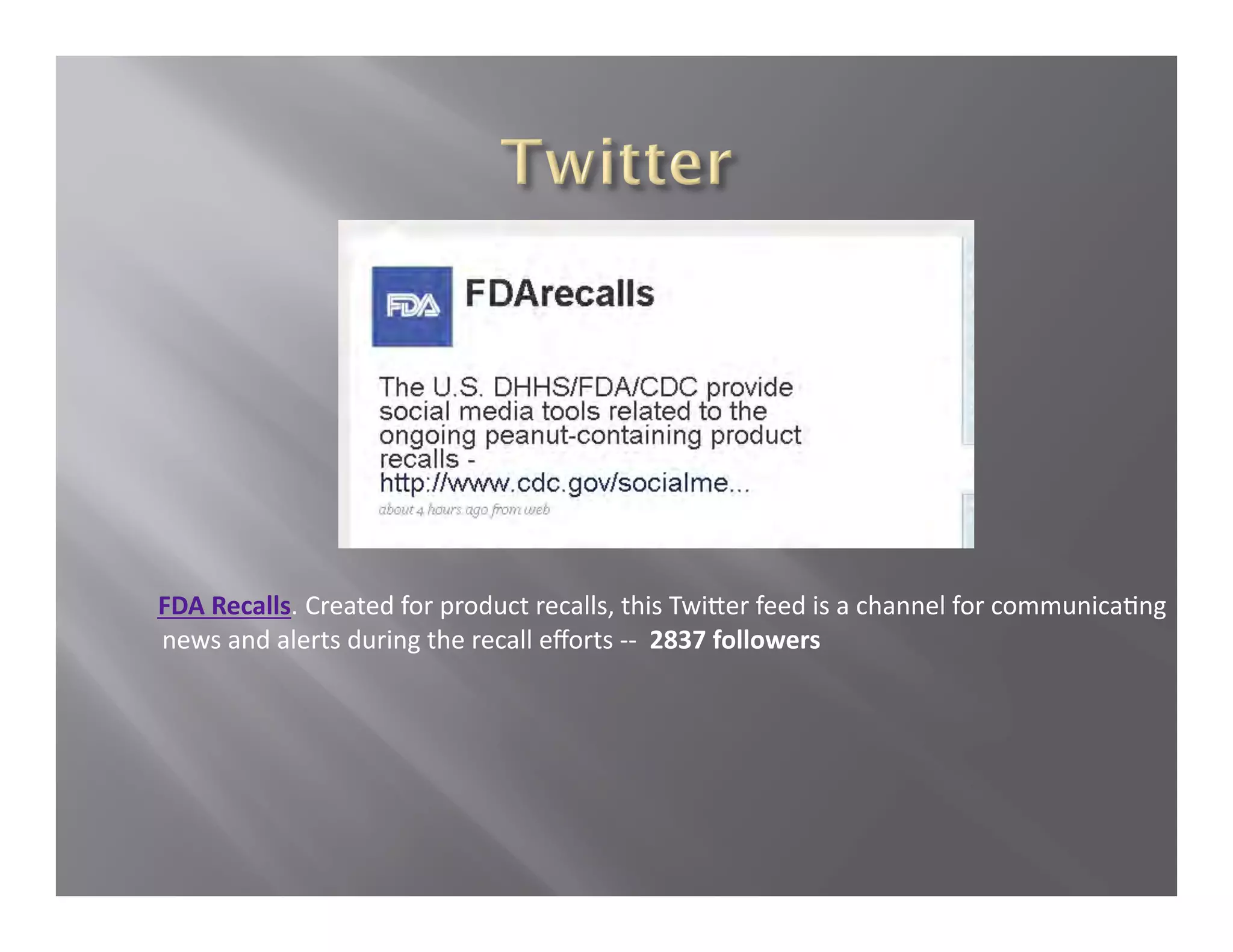
FDA
Recalls.
Created
for
product
recalls,
this
Twi1er
feed
is
a
channel
for
communicaCng

      news
and
alerts
during
the
recall
efforts
‐‐

2837
followers

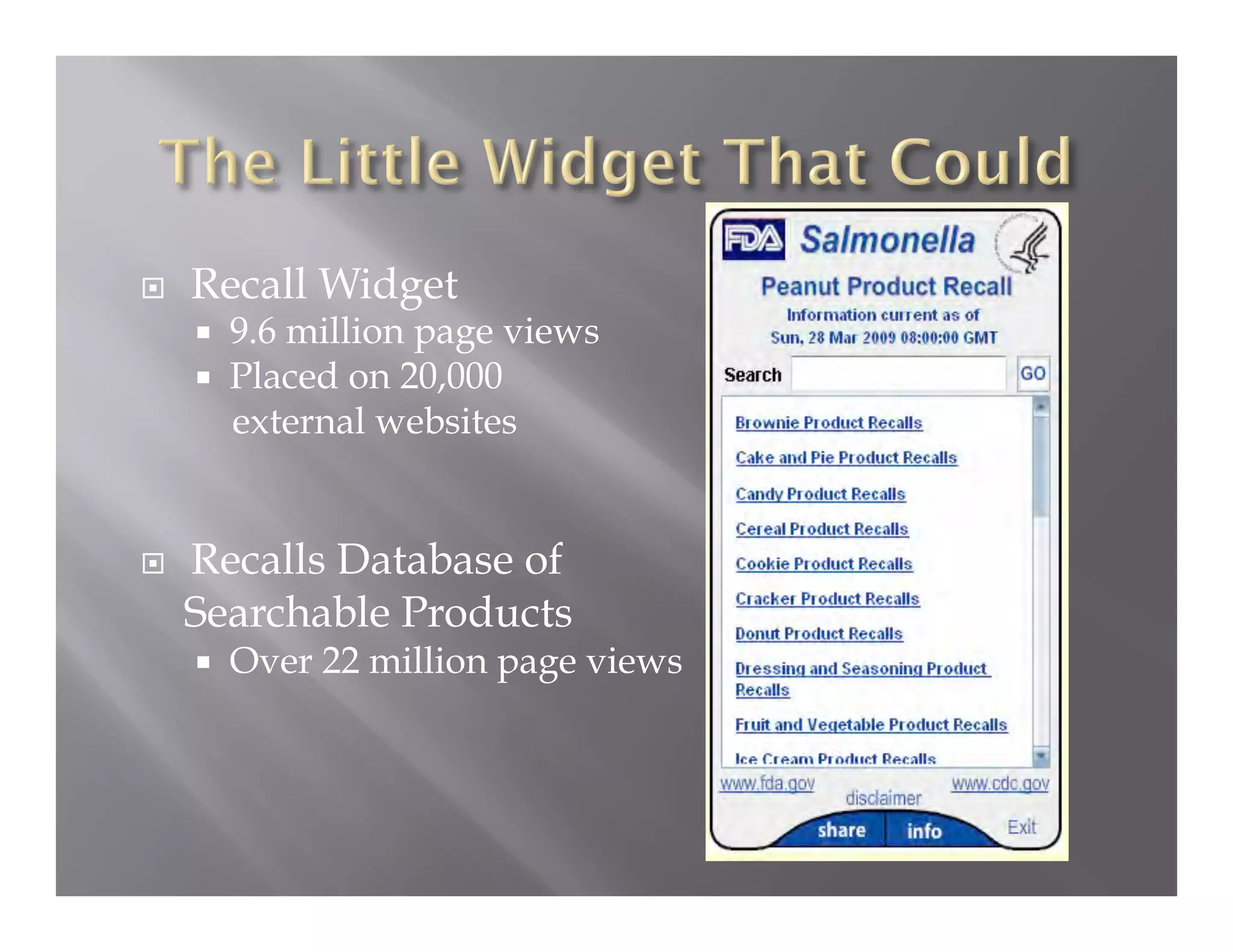
    Recall Widget
         9.6 million page views
         Placed on 20,000
          external websites


    Recalls Database of
     Searchable Products
         Over 22 million page views
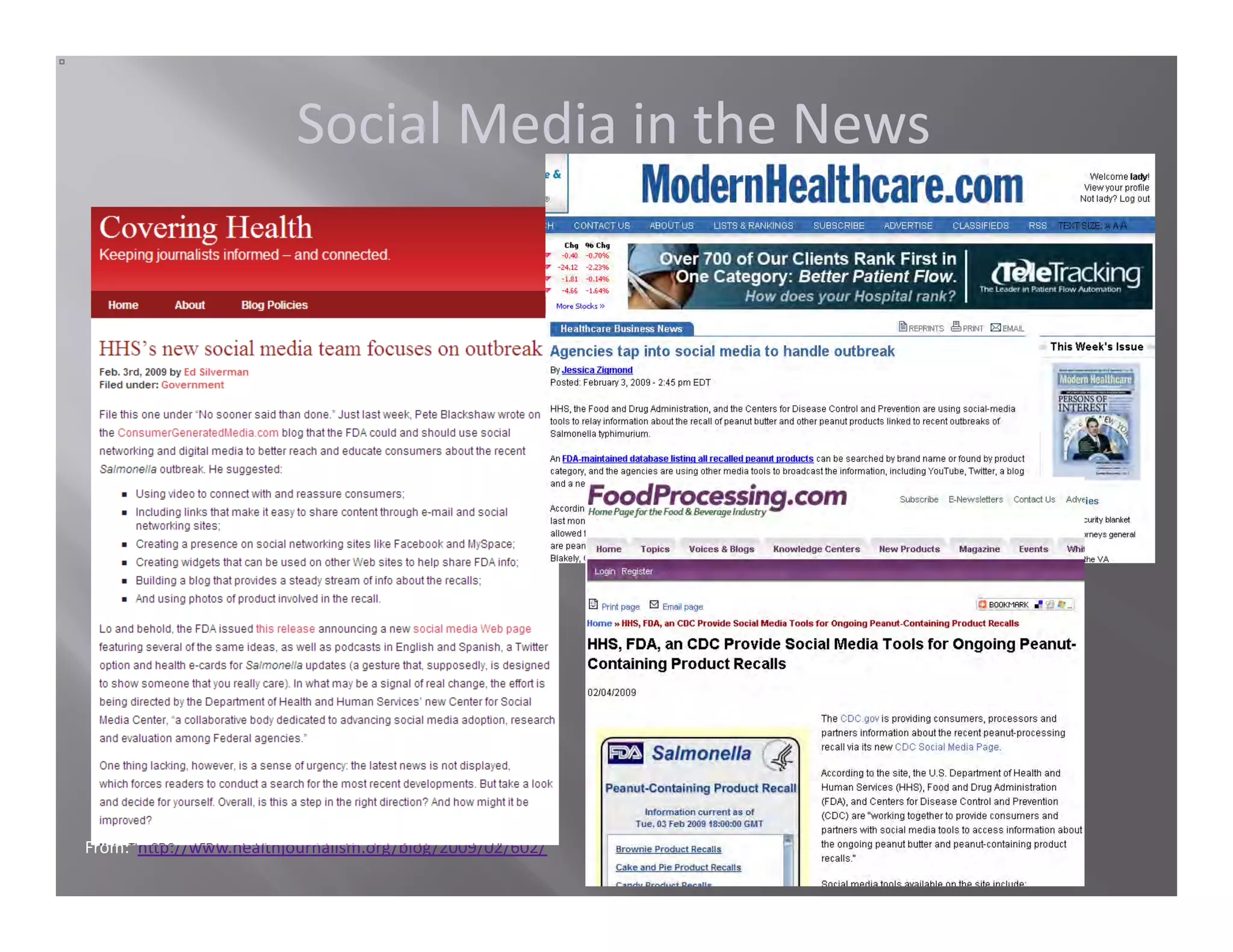
Social
Media
in
the
News


From:

h1p://www.healthjournalism.org/blog/2009/02/602/


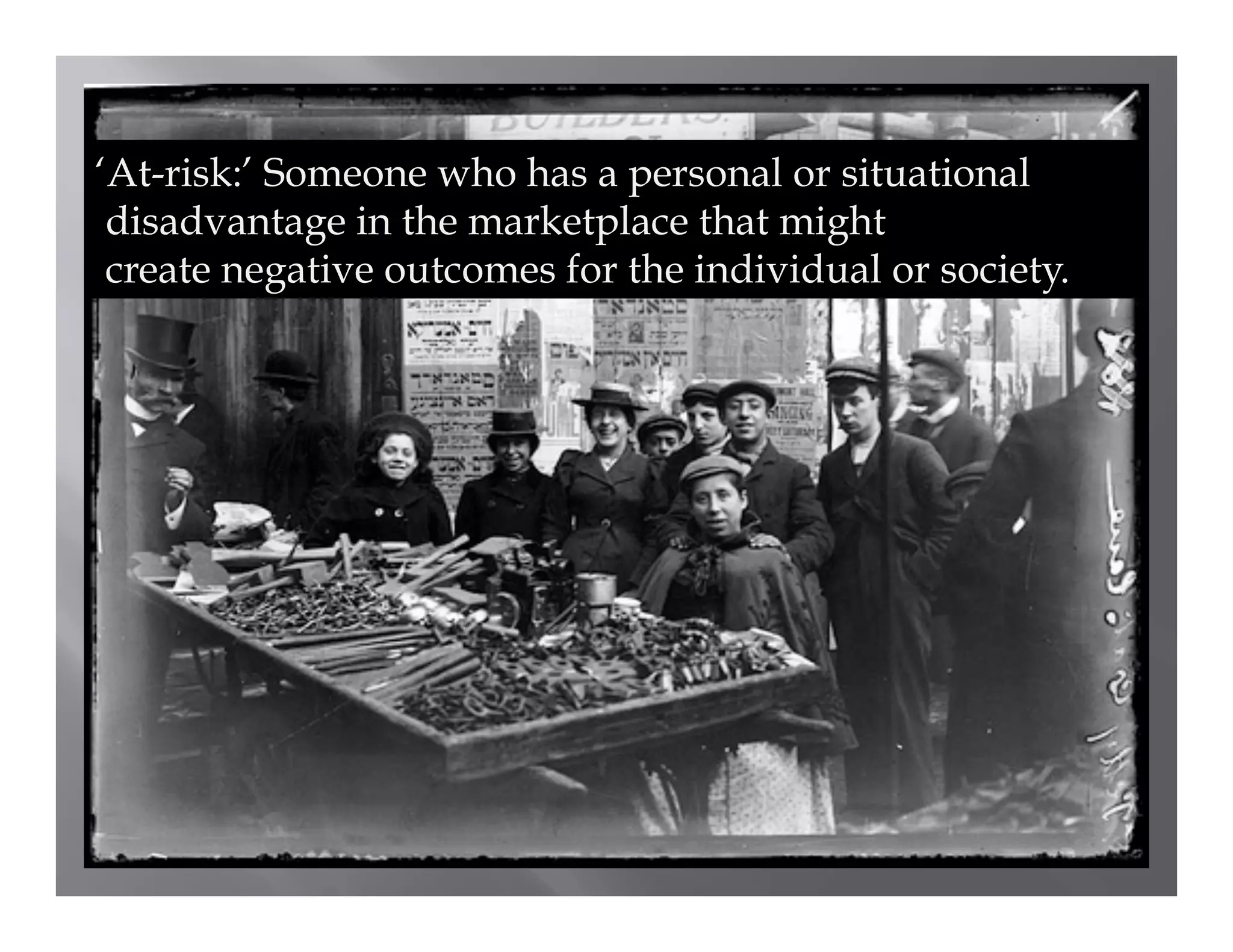
‘At-risk:’ Someone who has a personal or situational
 disadvantage in the marketplace that might
 create negative outcomes for the individual or society.
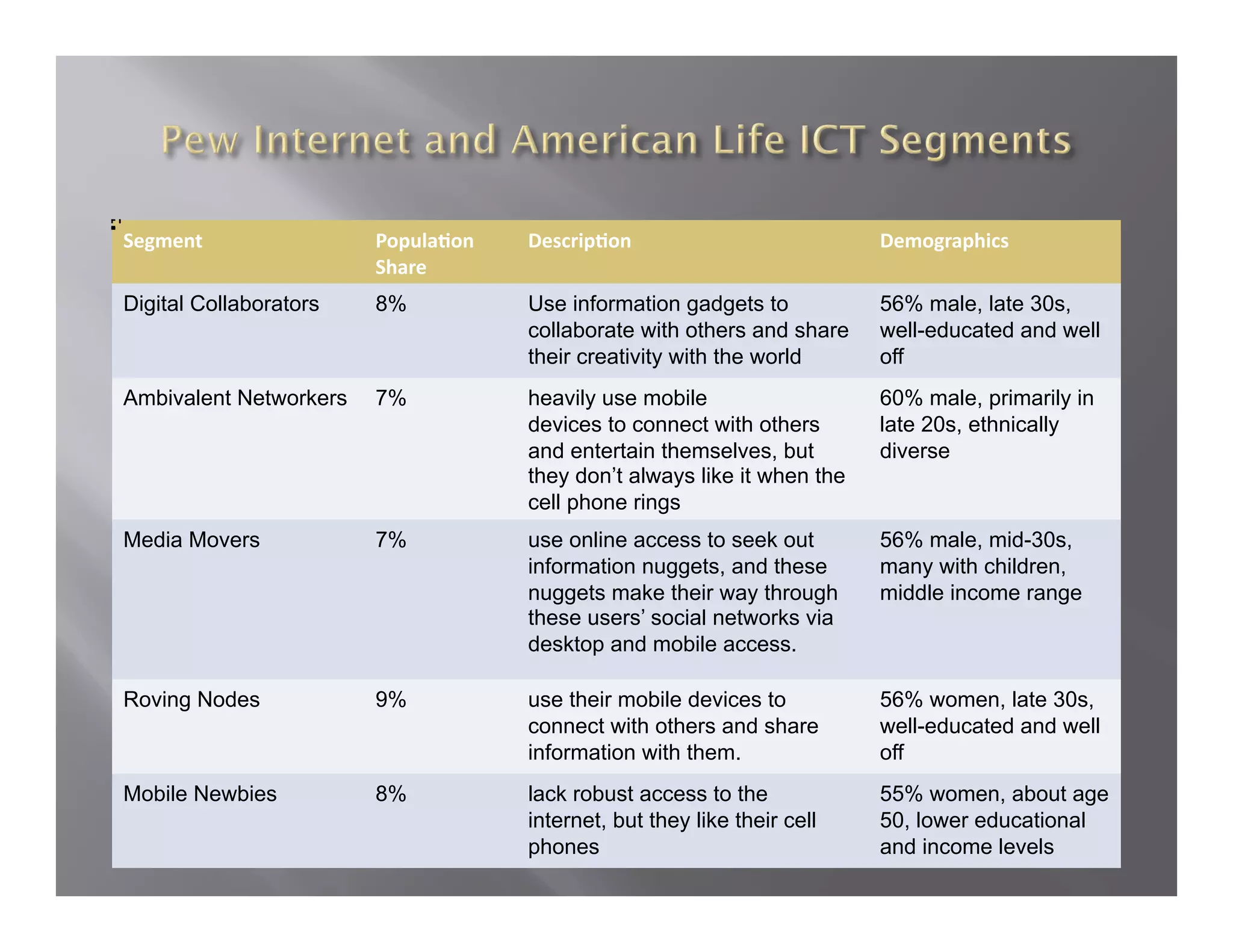
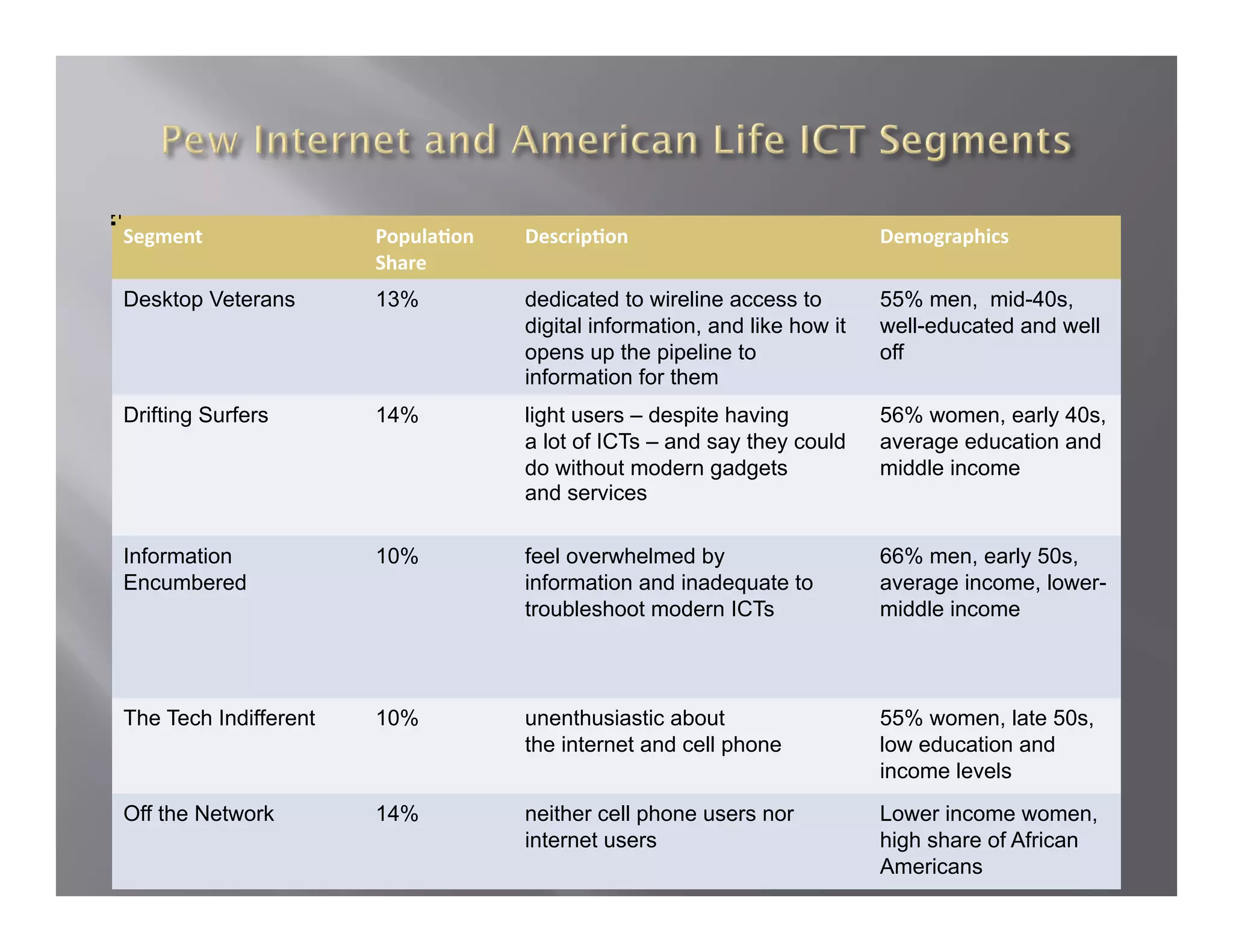
Segment
                Popula;on
   Descrip;on
                          Demographics

                        Share

Digital Collaborators   8%           Use information gadgets to           56% male, late 30s,
                                     collaborate with others and share    well-educated and well
                                     their creativity with the world      off
Ambivalent Networkers   7%           heavily use mobile                   60% male, primarily in
                                     devices to connect with others       late 20s, ethnically
                                     and entertain themselves, but        diverse
                                     they don’t always like it when the
                                     cell phone rings
Media Movers            7%           use online access to seek out        56% male, mid-30s,
                                     information nuggets, and these       many with children,
                                     nuggets make their way through       middle income range
                                     these users’ social networks via
                                     desktop and mobile access.

Roving Nodes            9%           use their mobile devices to          56% women, late 30s,
                                     connect with others and share        well-educated and well
                                     information with them.               off
Mobile Newbies          8%           lack robust access to the            55% women, about age
                                     internet, but they like their cell   50, lower educational
                                     phones                               and income levels
Segment
               Popula;on
   Descrip;on
                            Demographics

                       Share

Desktop Veterans       13%          dedicated to wireline access to        55% men, mid-40s,
                                    digital information, and like how it   well-educated and well
                                    opens up the pipeline to               off
                                    information for them
Drifting Surfers       14%          light users – despite having           56% women, early 40s,
                                    a lot of ICTs – and say they could     average education and
                                    do without modern gadgets              middle income
                                    and services

Information            10%          feel overwhelmed by                    66% men, early 50s,
Encumbered                          information and inadequate to          average income, lower-
                                    troubleshoot modern ICTs               middle income


The Tech Indifferent   10%          unenthusiastic about                   55% women, late 50s,
                                    the internet and cell phone            low education and
                                                                           income levels
Off the Network        14%          neither cell phone users nor           Lower income women,
                                    internet users                         high share of African
                                                                           Americans
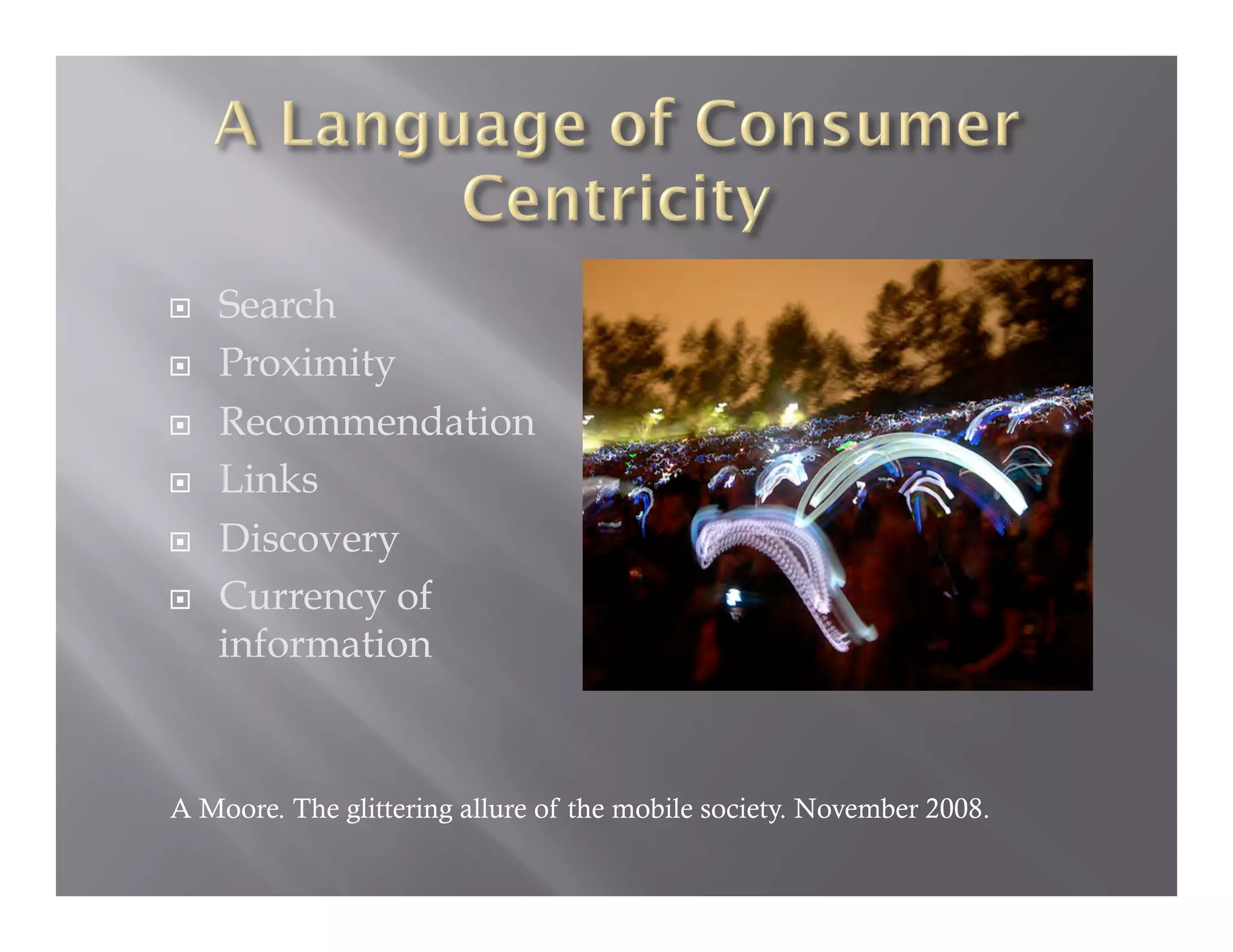
    Search
    Proximity
    Recommendation
    Links
    Discovery
    Currency of
     information


A Moore. The glittering allure of the mobile society. November 2008.
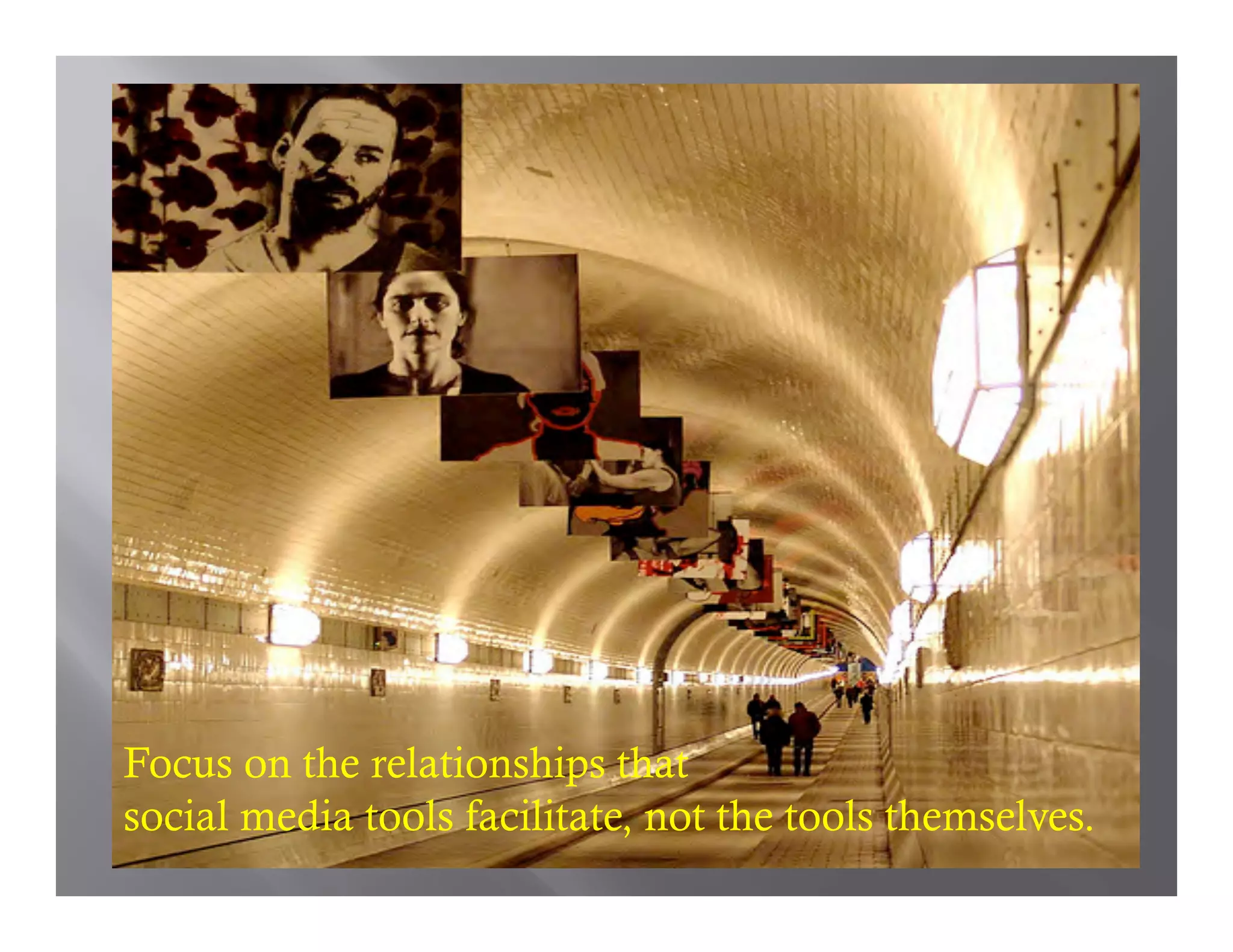
Focus on the relationships that
social media tools facilitate, not the tools themselves.

."
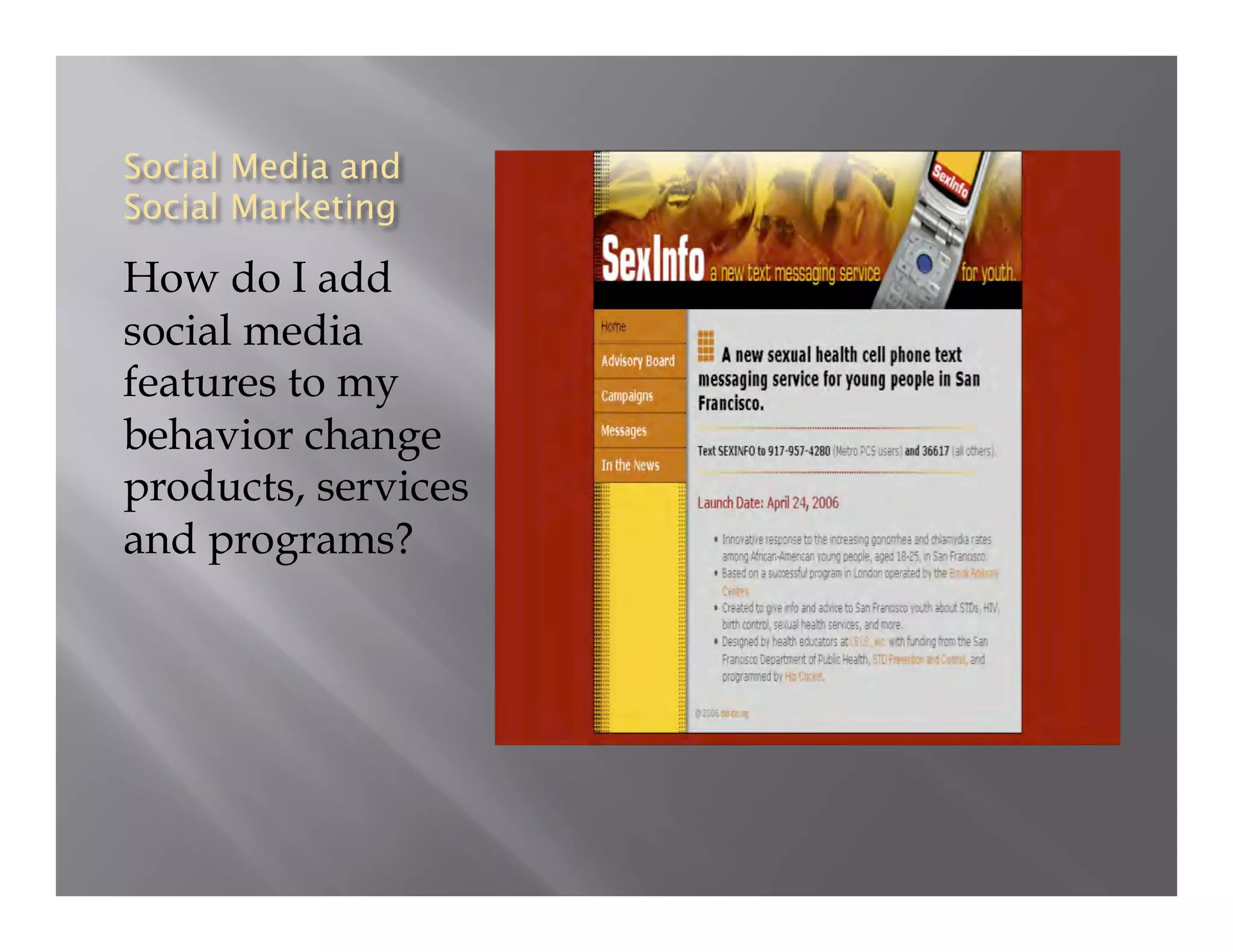
How do I add
social media
features to my
behavior change
products, services
and programs?
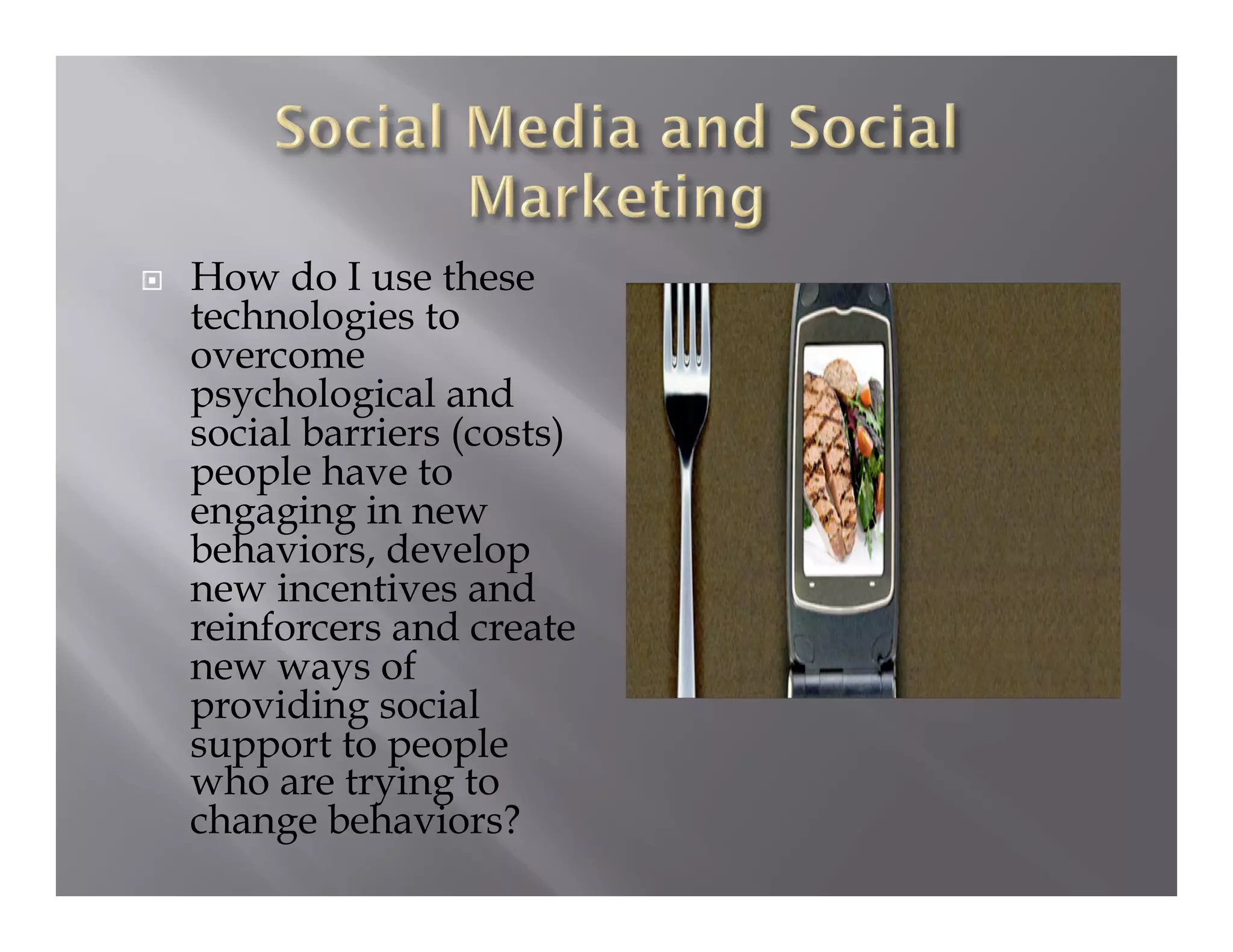
    How do I use these
     technologies to
     overcome
     psychological and
     social barriers (costs)
     people have to
     engaging in new
     behaviors, develop
     new incentives and
     reinforcers and create
     new ways of
     providing social
     support to people
     who are trying to
     change behaviors?
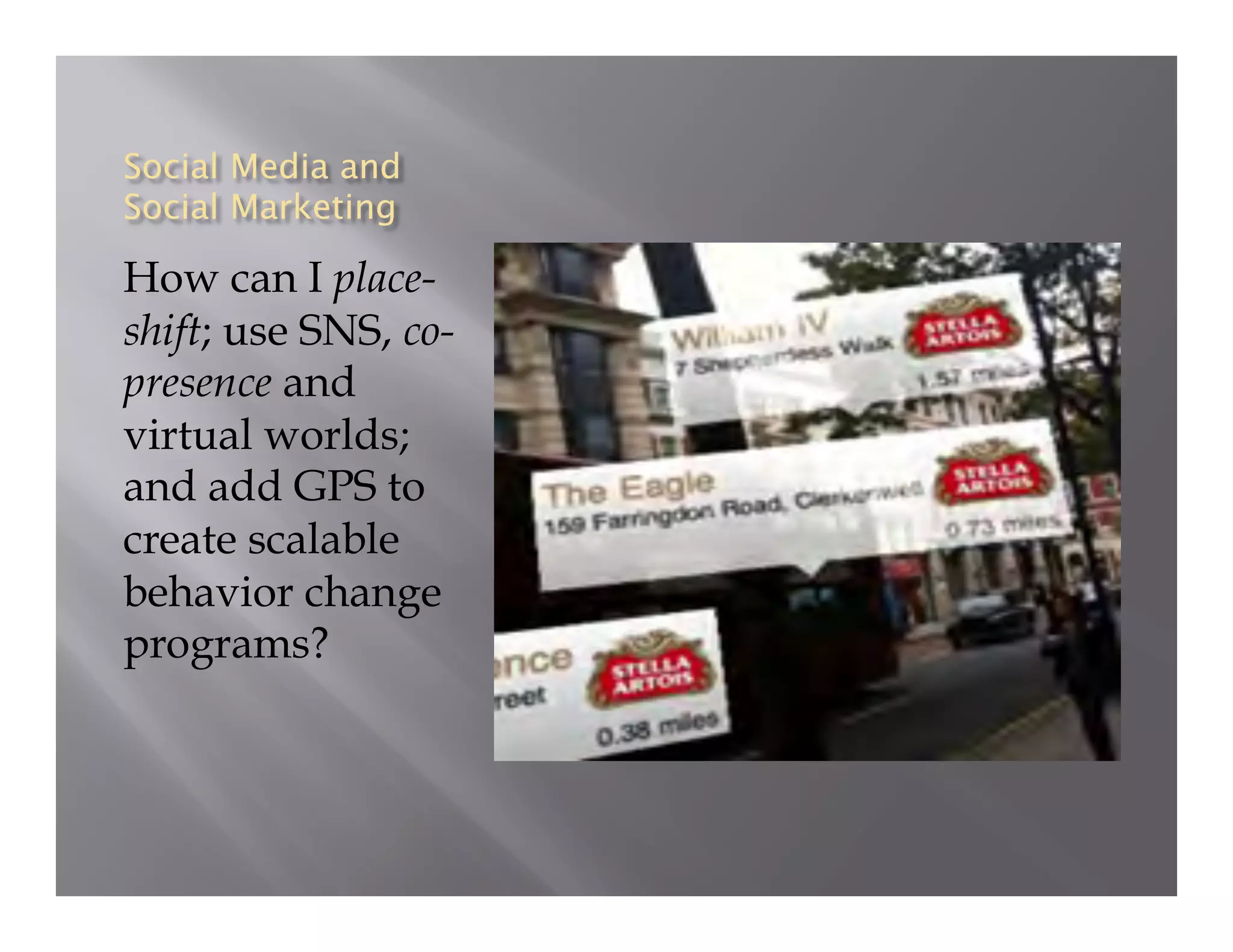
How can I place-
shift; use SNS, co-
presence and
virtual worlds;
and add GPS to
create scalable
behavior change
programs?
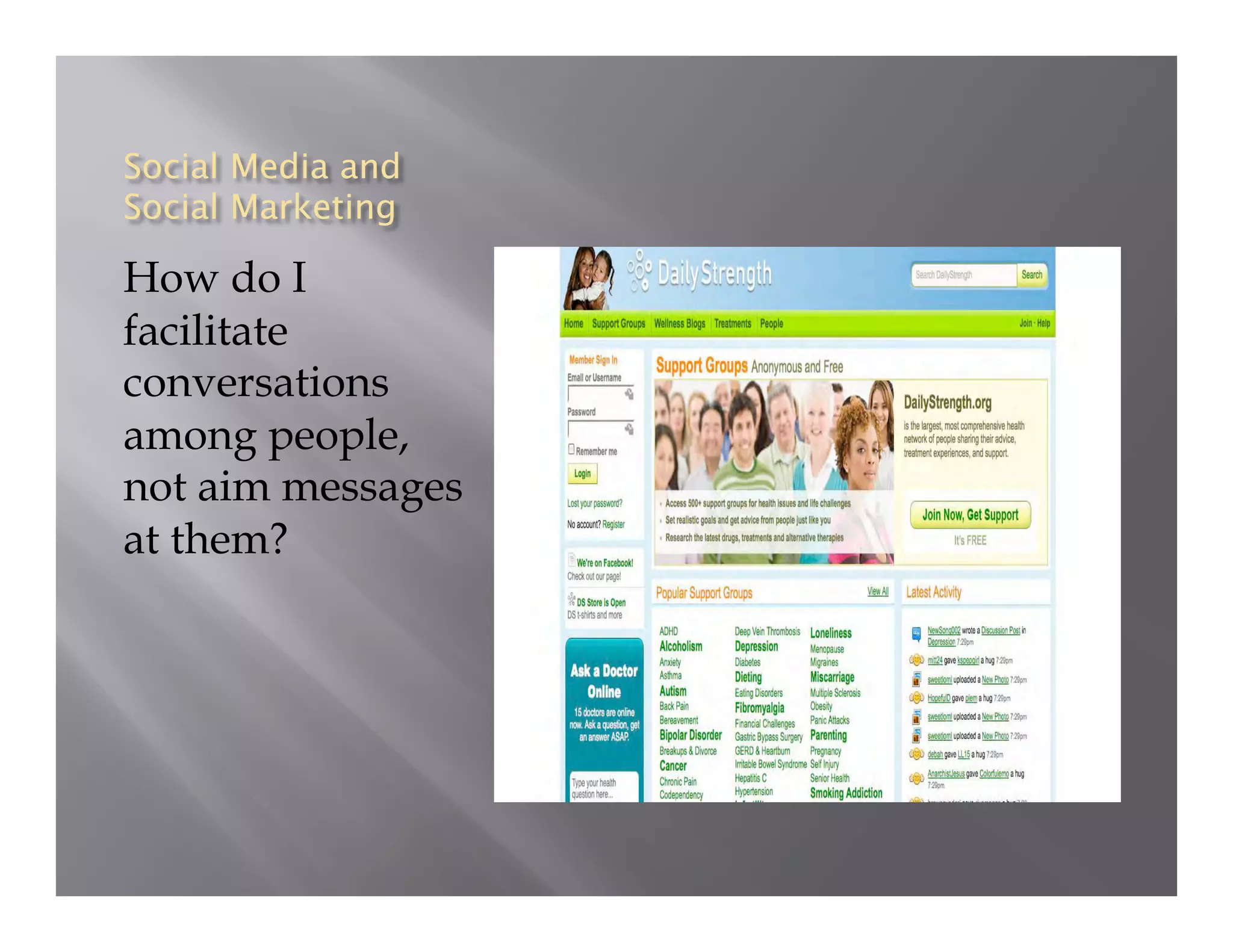
How do I
facilitate
conversations
among people,
not aim messages
at them?
Are we available when, where and how
people want us to be?
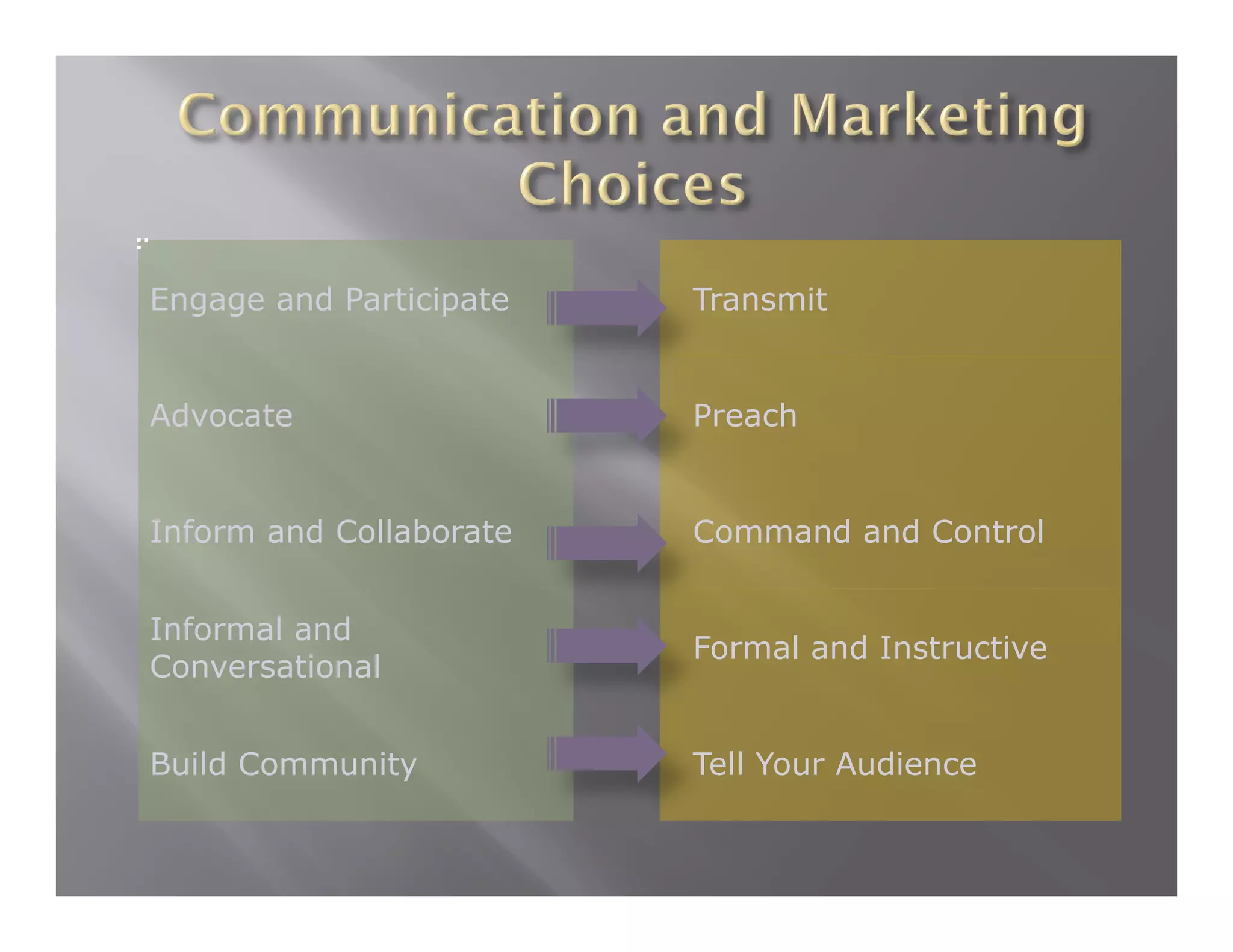
Engage and Participate   Transmit


Advocate                 Preach


Inform and Collaborate   Command and Control


Informal and
                         Formal and Instructive
Conversational


Build Community          Tell Your Audience
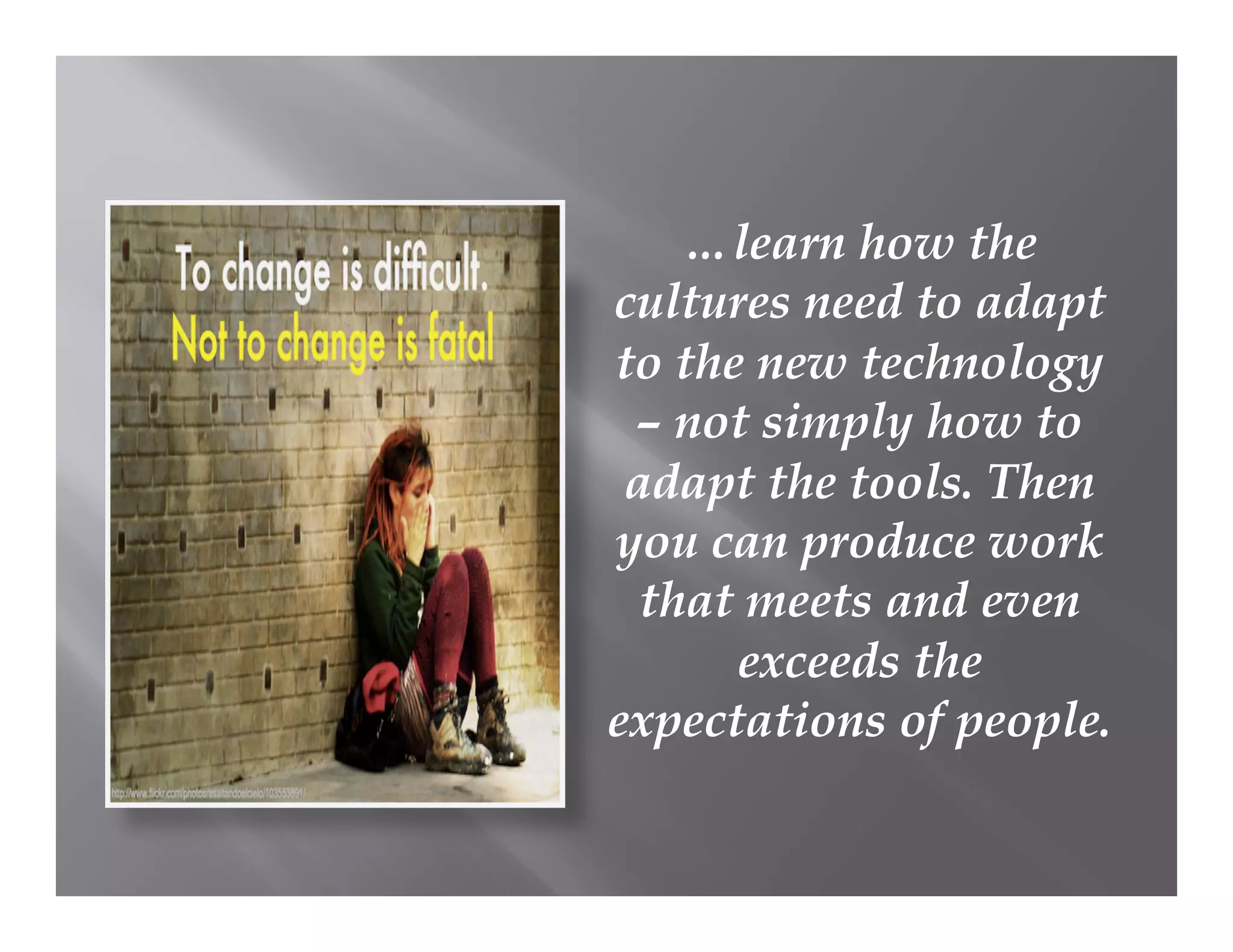
…learn how the
cultures need to adapt
to the new technology
 – not simply how to
 adapt the tools. Then
you can produce work
  that meets and even
      exceeds the
expectations of people.
R. Craig Lefebvre, PhD
George Washington University School of Public Health and
           Health Services, Washington, DC

        socialShift, Sarasota, FL & Washington, DC
         social|design, marketing and media


       On Social Marketing and Social Change
          http://socialmarketing.blogs.com


        http://twitter.com/chiefmaven

Insm 2010-lefebvre

  • 1.
    Health Sponsorship CouncilSeminar 5 August 2010
  • 2.
  • 5.
      Del.icio.us   LinkedIn   Twitter*/TweetDeck   Technorati   Feedburner   Flickr*   TinyURL/SnipURL   Google   Facebook*   StumbleUpon   MySpace*   Digg   YouTube*   FriendFeed   Typepad/Blogger   Wikipedia   PBwiki/Wetpaint * GSA Social Media Agreement
  • 6.
      Monitor   Link   Read   Upload   Browse   Retweet   Search   Develop   Share relationships   Friend   Work together   Rate   Set goals   Tag   Promote   Review participation   Mentor novices   Post   Set and uphold policies
  • 12.
    Influencers
 Potential
Employees
 Investors
 Employees
 Customers
 Competitors
 Prospects
 Partners
 Press/Analysts

  • 15.
      VERB (8372) Centers for Disease Control and Prevention   Fight Mannequinism The Federal Voting Assistance Program and Ad Council   Above the Influence Office of National Drug Control Policy, Partnership for A Drug-Free America   National Day to Prevent Teen Pregnancy National Campaign to Prevent Teen Pregnancy, Teen People   Small Step U.S Department of Health and Human Services, Ad Council   Girls Go Tech Girl Scouts of USA, Ad Council
  • 16.
      Set up a web site with information and/or 'cool stuff' to interact with or download   Convert the PSAs and print material into digital formats   Promote like crazy through traditional media and the web (blogs, MySpace, viral, WOM) - now it's new!   Use cell phones and SMS as a response channel   Push messages and alerts out to participants who opt- in at the web site or through SMS to receive them   Measure results by eyeballs and click throughs Caution: Adherence to these principles will insure that you develop a program that uses new media and does not apply social technologies that fit into people’s lives and practices and help change behaviors in relevant ways.
  • 19.
  • 22.
      We act in ways that are consistent with how   we think about ourselves   people we respect and trust want us to   people we aspire to be like behave   people we associate with behave   We are social beings who   look for validation   share experiences with others   act at our best and worse with others
  • 24.
    Source: Watts, DJ,Dodds, PS. (2007). Influentials, networks and public opinion formation. Journal of Consumer Research; 34.
  • 25.
    Source: Watts, DJ,Dodds, PS. (2007). Influentials, networks and public opinion formation. Journal of Consumer Research; 34.
  • 27.
      Becomes a collaborative platform   Harnesses collective intelligence   Enables everyone to be a content creator   Provides greater access to knowledge and information resources   Encourages media multiplexity   Expands and manages social networks
  • 28.
    Changes the WorldWe Live In •  Enhance existing linkages •  Develop new linkages •  Enable indigenous helpers •  Create new networks •  Empower existing ones •  Weave together networks •  Engage communities in new ways
  • 29.
     Treatment adherence  Screening behaviors  Precaution adoption  Health information  Quitting addictive seeking behaviors  Collective action and  Adopting new ones advocacy
  • 30.
      ‘Bridging’ and ‘bonding’ (building, strengthening and using social connections)   Audience Benefits: access social network resources and solves a problem   Focus on ‘boundary spanners’   Enhance salience and attractiveness of the ‘out group’ [positive deviants] – put the practitioners of ‘new’ behaviors in a light that attracts imitation or modeling.   Build sustainable local capacities/assets
  • 33.
    1 - firstpersonal mass media 2 - permanently carried media 3 - always-on mass media 4 - built-in payment mechanism 5 - at the point of creative inspiration 6 - accurate audience measurement 7 - captures the social context of media consumption Tomi T Ahomen. Communities Dominate Brands blog, 2 May 2008.
  • 34.
    89% of adultsuse their online profiles to keep up with friends
  • 35.
    …in an increasingly transitoryworld, the cellphone is becoming the one fixed piece of our identity – Jan Chipchase, User Anthropologist NYT Magazine 7 Apr 2008
  • 36.
  • 37.
    FDA developed arecall database that enables consumers to search for products by brand name, product description, and more.
  • 38.
      HHS and CDC blogs provide information about the product recalls and outbreak investigations and encourage comments and conversations.   The HHS Peanut Product Recall blog contained posts from CDC, FDA, and HHS.   The CDC National Center for Zoonotic, Vector Borne, and Enteric Diseases (NCZVED) blog contained salmonella-related information and updates (over 3,000 page views between 1/25 – 2/1).
  • 39.
    On February 3rd,35 blog writers spoke with FDA and CDC subject matter experts about the Salmonella Typhimurium outbreak and peanut-containing products recall efforts, including current and future resources for bloggers during food safety incidents. Bloggers were provided with Web graphics to share with their readers.
  • 40.
    FDA’s video onthings you should know during the peanut butter and peanut-containing product recalls was available on both the FDA and CDC YouTube channels. FDA
YouTube
Channel:
h1p://www.youtube.com/user/USFoodandDrugAdmin

 CDC
YouTube
Channel:
h1p://www.youtube.com/CDCstreaminghealth/


  • 41.
      Online graphics allow partner organizations and citizens to display simple images and messaging related to the recall.   A series of 3 buttons were shared with partner federal agencies and organizations.   Two badges were made available on the CDC MySpace page for individuals to use within their profile pages.
  • 42.
  • 44.
      Recall Widget   9.6 million page views   Placed on 20,000 external websites   Recalls Database of Searchable Products   Over 22 million page views
  • 45.
  • 47.
    ‘At-risk:’ Someone whohas a personal or situational disadvantage in the marketplace that might create negative outcomes for the individual or society.
  • 48.
    Segment
 Popula;on
 Descrip;on
 Demographics
 Share
 Digital Collaborators 8% Use information gadgets to 56% male, late 30s, collaborate with others and share well-educated and well their creativity with the world off Ambivalent Networkers 7% heavily use mobile 60% male, primarily in devices to connect with others late 20s, ethnically and entertain themselves, but diverse they don’t always like it when the cell phone rings Media Movers 7% use online access to seek out 56% male, mid-30s, information nuggets, and these many with children, nuggets make their way through middle income range these users’ social networks via desktop and mobile access. Roving Nodes 9% use their mobile devices to 56% women, late 30s, connect with others and share well-educated and well information with them. off Mobile Newbies 8% lack robust access to the 55% women, about age internet, but they like their cell 50, lower educational phones and income levels
  • 49.
    Segment
 Popula;on
 Descrip;on
 Demographics
 Share
 Desktop Veterans 13% dedicated to wireline access to 55% men, mid-40s, digital information, and like how it well-educated and well opens up the pipeline to off information for them Drifting Surfers 14% light users – despite having 56% women, early 40s, a lot of ICTs – and say they could average education and do without modern gadgets middle income and services Information 10% feel overwhelmed by 66% men, early 50s, Encumbered information and inadequate to average income, lower- troubleshoot modern ICTs middle income The Tech Indifferent 10% unenthusiastic about 55% women, late 50s, the internet and cell phone low education and income levels Off the Network 14% neither cell phone users nor Lower income women, internet users high share of African Americans
  • 50.
      Search   Proximity   Recommendation   Links   Discovery   Currency of information A Moore. The glittering allure of the mobile society. November 2008.
  • 51.
    Focus on therelationships that social media tools facilitate, not the tools themselves. ."
  • 52.
    How do Iadd social media features to my behavior change products, services and programs?
  • 53.
      How do I use these technologies to overcome psychological and social barriers (costs) people have to engaging in new behaviors, develop new incentives and reinforcers and create new ways of providing social support to people who are trying to change behaviors?
  • 54.
    How can Iplace- shift; use SNS, co- presence and virtual worlds; and add GPS to create scalable behavior change programs?
  • 55.
    How do I facilitate conversations amongpeople, not aim messages at them?
  • 56.
    Are we availablewhen, where and how people want us to be?
  • 57.
    Engage and Participate Transmit Advocate Preach Inform and Collaborate Command and Control Informal and Formal and Instructive Conversational Build Community Tell Your Audience
  • 58.
    …learn how the culturesneed to adapt to the new technology – not simply how to adapt the tools. Then you can produce work that meets and even exceeds the expectations of people.
  • 60.
    R. Craig Lefebvre,PhD George Washington University School of Public Health and Health Services, Washington, DC socialShift, Sarasota, FL & Washington, DC social|design, marketing and media On Social Marketing and Social Change http://socialmarketing.blogs.com http://twitter.com/chiefmaven