Funded by the Health 
Programme of the 
European Union 
Insights into future skills and 
competences 
Matt Edwards 
Head of Horizon scanning & International / EU JA HWF WP6 Leader, CfWI 
John Fellows 
Horizon scanning Consultant / EU JA HWF WP6 Content Lead, CfWI 
Joint Action Health Workforce Planning and Forecasting: 
Conference on improving planning methodologies & data across Europe 4 December 2014
Horizon scanning work at CfWI 
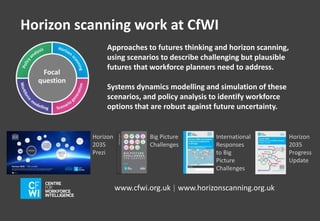
Approaches to futures thinking and horizon scanning, 
using scenarios to describe challenging but plausible 
futures that workforce planners need to address. 
Systems dynamics modelling and simulation of these 
scenarios, and policy analysis to identify workforce 
options that are robust against future uncertainty. 
Big Picture 
Challenges 
International 
Responses 
to Big 
Picture 
Challenges 
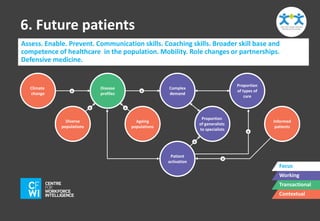
www.cfwi.org.uk | www.horizonscanning.org.uk 
Horizon 
2035 
Progress 
Update 
Horizon 
2035 
Prezi
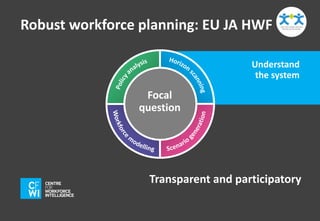
Robust workforce planning 
Understand 
the system 
Explore 
the future 
Make robust 
decisions 
Simulate the 
possibilities 
Focal 
question 
Transparent and participatory
Number of pharmacists (full-time equivalent) 
2012 
2014 
2016 
2018 
2020 
2022 
2024 
2026 
2028 
2030 
2032 
2034 
2036 
2038 
2040 
100,000 
80,000 
60,000 
40,000 
20,000 
0 
2012 
2014 
2016 
2018 
2020 
2022 
2024 
2026 
2028 
2030 
2032 
2034 
2036 
2038 
2040 
100,000 
80,000 
60,000 
40,000 
20,000 
0 
2012 
2014 
2016 
2018 
2020 
2022 
2024 
2026 
2028 
2030 
2032 
2034 
2036 
2038 
2040 
100,000 
80,000 
60,000 
40,000 
20,000 
0 
2012 
2014 
2016 
2018 
2020 
2022 
2024 
2026 
2028 
2030 
2032 
2034 
2036 
2038 
2040 
100,000 
80,000 
60,000 
40,000 
20,000 
0 
Year 
Scenario 1 
Scenario 3 
Scenario 2 
Scenario 4 
CfWI outputs: Pharmacy example 
How uncertain is the future?
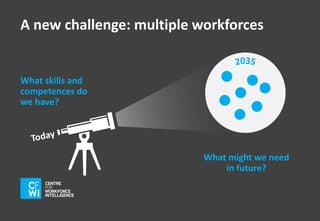
A new challenge: multiple workforces 
What skills and 
competences do 
we have? 
What might we need 
in future?
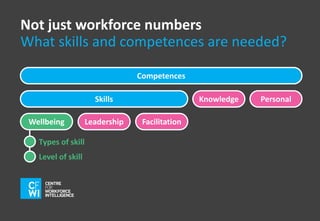
Not just workforce numbers 
What skills and competences are needed? 
Competences 
Skills 
Wellbeing Leadership Facilitation 
Knowledge Personal 
Types of skill 
Level of skill
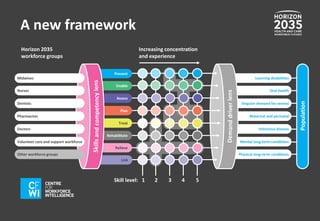
Population 
Learning disabilities 
Oral health 
Singular demand for service 
Maternal and perinatal 
Infectious disease 
Mental long-term conditions 
Physical long-term conditions 
A new framework 
Prevent 
Enable 
Assess 
Plan 
Treat 
Rehabilitate 
Relieve 
Link 
Skill level: 1 2 3 4 5 
Horizon 2035 
workforce groups 
Midwives 
Nurses 
Dentists 
Pharmacists 
Doctors 
Volunteer care and support workforce 
Other workforce groups 
Increasing concentration 
and experience
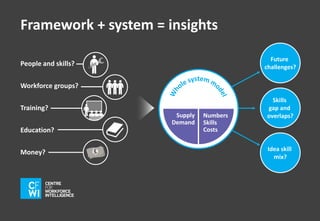
Framework + system = insights 
Numbers 
Skills 
Costs 
Supply 
Demand 
People and skills? 
Workforce groups? 
Training? 
Education? 
Money? 
Future 
challenges? 
Skills 
gap and 
overlaps? 
Idea skill 
mix?
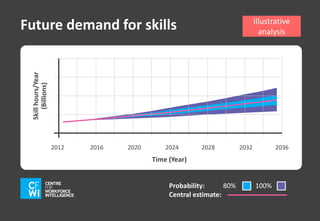
Future demand for skills 
Skill hours/Year 
(Billions) 
Illustrative 
analysis 
2012 2016 2020 2024 2028 2032 2036 
Time (Year) 
Probability: 80% 100% 
Central estimate:
European perspective
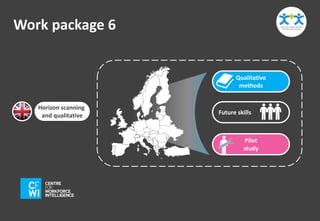
Work package 6 
Horizon scanning 
and qualitative 
Qualitative 
methods 
Future skills 
Pilot 
study
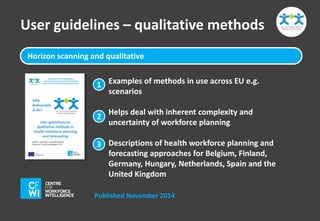
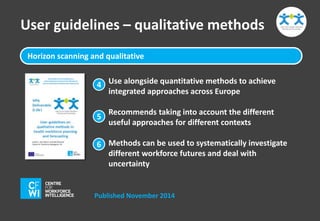
User guidelines – qualitative methods 
Horizon scanning and qualitative 
Examples of methods in use across EU e.g. 
scenarios 
Helps deal with inherent complexity and 
uncertainty of workforce planning 
Descriptions of health workforce planning and 
forecasting approaches for Belgium, Finland, 
Germany, Hungary, Netherlands, Spain and the 
United Kingdom 
1 
2 
3 
Published November 2014
User guidelines – qualitative methods 
Horizon scanning and qualitative 
Use alongside quantitative methods to achieve 
integrated approaches across Europe 
Recommends taking into account the different 
useful approaches for different contexts 
Methods can be used to systematically investigate 
different workforce futures and deal with 
uncertainty 
4 
5 
6 
Published November 2014
Robust workforce planning: EU JA HWF 
Understand 
the system 
Focal 
question 
Transparent and participatory
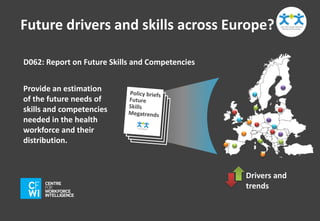
Future drivers and skills across Europe? 
D062: Report on Future Skills and Competencies 
Provide an estimation 
of the future needs of 
skills and competencies 
needed in the health 
workforce and their 
distribution. 
Drivers and 
trends
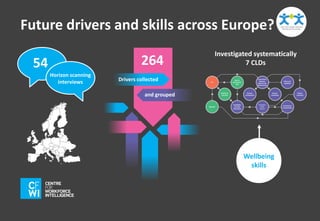
Future drivers and skills across Europe? 
54 
Horizon scanning 
interviews 
264 
Drivers collected 
and grouped 
Investigated systematically 
7 CLDs 
Wellbeing 
skills
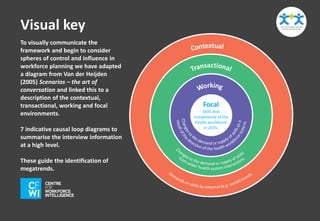
Visual key 
To visually communicate the 
framework and begin to consider 
spheres of control and influence in 
workforce planning we have adapted 
a diagram from Van der Heijden 
(2005) Scenarios – the art of 
conversation and linked this to a 
description of the contextual, 
transactional, working and focal 
environments. 
7 indicative causal loop diagrams to 
summarise the interview information 
at a high level. 
These guide the identification of 
megatrends. 
Focal 
Skills and 
competence of the 
health workforce 
in 2035.
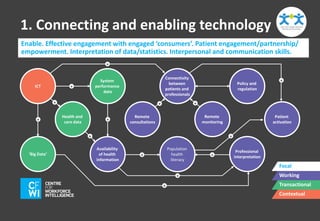
1. Connecting and enabling technology 
Enable. Effective engagement with engaged ‘consumers’. Patient engagement/partnership/ 
empowerment. Interpretation of data/statistics. Interpersonal and communication skills. 
System 
performance 
data 
Availability 
of health 
information 
Patient 
activation 
Policy and 
regulation 
Professional 
interpretation 
Remote 
consultations 
Connectivity 
between 
patients and 
professionals 
Health and 
care data 
Remote 
monitoring 
ICT 
Population 
health 
literacy 
+ 
‘Big Data’ 
+ 
+ 
+ 
+ 
+ 
+ + 
+ 
+ 
+ 
+ 
+ 
+ 
Focal 
Working 
Transactional 
Contextual
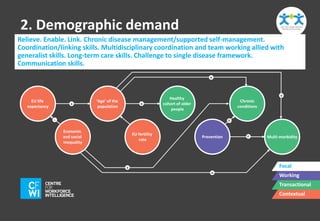
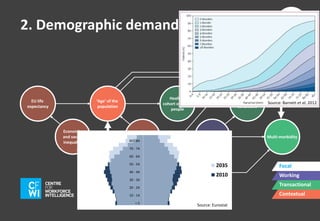
2. Demographic demand 
Relieve. Enable. Link. Chronic disease management/supported self-management. 
Coordination/linking skills. Multidisciplinary coordination and team working allied with 
generalist skills. Long-term care skills. Challenge to single disease framework. 
Communication skills. 
Multi-morbidity 
Focal 
Working 
Transactional 
Contextual 
Chronic 
conditions 
EU fertility 
rate 
Healthy 
cohort of older 
people 
Prevention 
EU life 
expectancy 
+ 
= 
+ 
+ 
‘Age’ of the 
population 
+ 
= 
+ 
- 
Economic 
and social 
inequality 
+
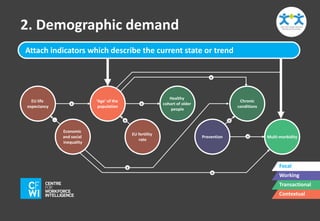
2. Demographic demand 
Multi-morbidity 
Focal 
Working 
Transactional 
Contextual 
Chronic 
conditions 
Attach indicators which describe the current state or trend 
+ 
EU fertility 
rate 
Healthy 
cohort of older 
people 
Prevention 
EU life 
expectancy 
+ 
+ = 
‘Age’ of the 
population 
+ 
= 
+ 
- 
Economic 
and social 
inequality 
+
2. Demographic demand 
Multi-morbidity 
Focal 
Working 
Transactional 
Contextual 
Chronic 
conditions 
EU fertility 
rate 
Healthy 
cohort of older 
people 
Prevention 
EU life 
expectancy 
+ 
‘Age’ of the 
population 
+ 
+ 
Economic 
and social 
inequality 
+ 
80 - 84 
70 - 74 
60 - 64 
50 - 54 
40 - 44 
30 - 34 
20 - 24 
10 - 14 
< 5 
2035 
2010 
Source: Eurostat 
Source: Barnett et al, 2012
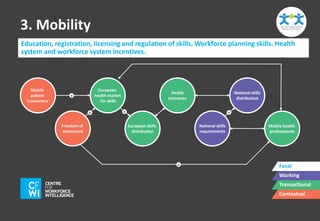
3. Mobility 
Education, registration, licensing and regulation of skills. Workforce planning skills. Health 
system and workforce system incentives. 
Mobile health 
professionals 
Focal 
Working 
Transactional 
Contextual 
National skills 
distribution 
European skills 
distribution 
Health 
outcomes 
National skills 
requirements 
Mobile 
patient 
‘consumers’ 
+ 
+ + 
European 
health market 
for skills 
+ 
Freedom of 
movement 
+
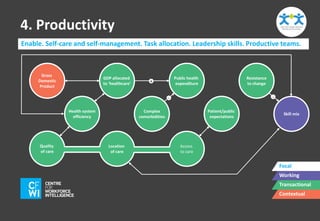
4. Productivity 
Enable. Self-care and self-management. Task allocation. Leadership skills. Productive teams. 
Focal 
Working 
Transactional 
Contextual 
GDP allocated 
to ‘healthcare’ 
Location 
of care 
Skill mix 
Resistance 
to change 
Complex 
comorbidities 
Public health 
expenditure 
Health system 
efficiency 
Patient/public 
expectations 
Gross 
Domestic 
Product 
Access 
to care 
Quality 
of care 
+ 
- -
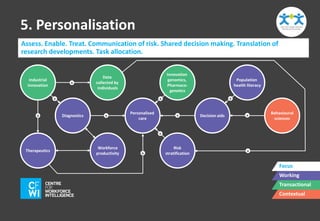
5. Personalisation 
Assess. Enable. Treat. Communication of risk. Shared decision making. Translation of 
research developments. Task allocation. 
Focus 
Working 
Transactional 
Contextual 
Workforce 
productivity 
Behavioural 
sciences 
Population 
health literacy 
Personalised 
care 
Innovation 
genomics, 
Pharmaco-genetics 
Diagnostics Decision aids 
Industrial 
innovation 
Risk 
stratification 
+ 
+ 
Therapeutics 
+ 
+ 
+ 
+ 
+ 
+ 
+ 
+ 
Data 
collected by 
individuals 
+
6. Future patients 
Assess. Enable. Prevent. Communication skills. Coaching skills. Broader skill base and 
competence of healthcare in the population. Mobility. Role changes or partnerships. 
Defensive medicine. 
Focus 
Working 
Transactional 
Contextual 
Proportion 
of types of 
care 
Ageing 
populations 
Complex 
demand 
Diverse 
populations 
Proportion 
of generalists 
to specialists 
Climate 
change 
+ 
+ 
+ 
Disease 
profiles 
+ 
+ 
Patient 
activation 
Informed 
patients 
+ 
+
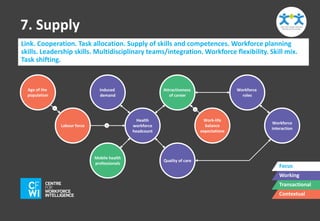
7. Supply 
Link. Cooperation. Task allocation. Supply of skills and competences. Workforce planning 
skills. Leadership skills. Multidisciplinary teams/integration. Workforce flexibility. Skill mix. 
Task shifting. 
Focus 
Working 
Transactional 
Contextual 
Induced 
demand 
Mobile health 
professionals 
Workforce 
roles 
Health 
workforce 
headcount 
Attractiveness 
of career 
Labour force 
Work-life 
balance 
expectations 
Age of the 
population 
- - 
- 
Workforce 
interaction 
Quality of care
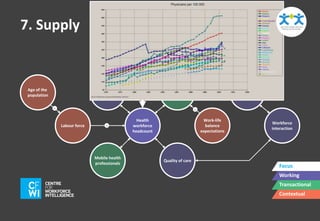
7. Supply 
Focus 
Working 
Transactional 
Contextual 
Induced 
demand 
Mobile health 
professionals 
Workforce 
roles 
Health 
workforce 
headcount 
Attractiveness 
of career 
Labour force 
Work-life 
balance 
expectations 
Age of the 
population 
- - 
- 
Workforce 
interaction 
Quality of care
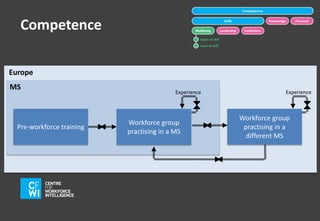
Competence 
Europe 
MS 
Pre-workforce training 
Experience Experience 
Workforce group 
practising in a MS 
Workforce group 
practising in a 
different MS
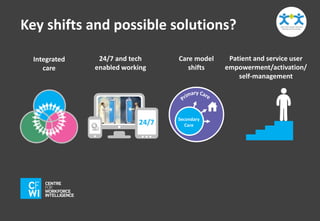
Key shifts and possible solutions? 
Integrated 
care 
24/7 and tech 
enabled working 
24/7 
Care model 
shifts 
Secondary 
Care 
Patient and service user 
empowerment/activation/ 
self-management
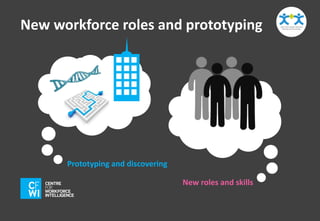
New workforce roles and prototyping 
Prototyping and discovering 
New roles and skills
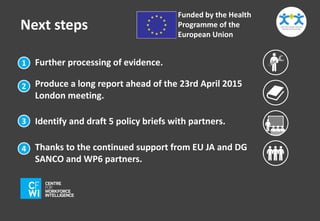
Next steps 
Further processing of evidence. 
Funded by the Health 
Programme of the 
European Union 
1 
2 
3 
4 
Produce a long report ahead of the 23rd April 2015 
London meeting. 
Identify and draft 5 policy briefs with partners. 
Thanks to the continued support from EU JA and DG 
SANCO and WP6 partners.
Contact details 
Matt Edwards 
Head of Horizon Scanning & International 
CfWI, England 
@ 
+44(0)7834 800 393 
matt.edwards@cfwi.org.uk 
Funded by the Health 
Programme of the 
European Union 
John Fellows 
Horizon Scanning Consultant 
CfWI, England 
+44(0)7795 452 972 
john.fellows@cfwi.org.uk 
euhwforce@cfwi.org.uk 
www.cfwi.org.uk | www.horizonscanning.org.uk

Insights into future skills and competences

  • 1.
    Funded by theHealth Programme of the European Union Insights into future skills and competences Matt Edwards Head of Horizon scanning & International / EU JA HWF WP6 Leader, CfWI John Fellows Horizon scanning Consultant / EU JA HWF WP6 Content Lead, CfWI Joint Action Health Workforce Planning and Forecasting: Conference on improving planning methodologies & data across Europe 4 December 2014
  • 2.
    Horizon scanning workat CfWI Approaches to futures thinking and horizon scanning, using scenarios to describe challenging but plausible futures that workforce planners need to address. Systems dynamics modelling and simulation of these scenarios, and policy analysis to identify workforce options that are robust against future uncertainty. Big Picture Challenges International Responses to Big Picture Challenges www.cfwi.org.uk | www.horizonscanning.org.uk Horizon 2035 Progress Update Horizon 2035 Prezi
  • 3.
    Robust workforce planning Understand the system Explore the future Make robust decisions Simulate the possibilities Focal question Transparent and participatory
  • 4.
    Number of pharmacists(full-time equivalent) 2012 2014 2016 2018 2020 2022 2024 2026 2028 2030 2032 2034 2036 2038 2040 100,000 80,000 60,000 40,000 20,000 0 2012 2014 2016 2018 2020 2022 2024 2026 2028 2030 2032 2034 2036 2038 2040 100,000 80,000 60,000 40,000 20,000 0 2012 2014 2016 2018 2020 2022 2024 2026 2028 2030 2032 2034 2036 2038 2040 100,000 80,000 60,000 40,000 20,000 0 2012 2014 2016 2018 2020 2022 2024 2026 2028 2030 2032 2034 2036 2038 2040 100,000 80,000 60,000 40,000 20,000 0 Year Scenario 1 Scenario 3 Scenario 2 Scenario 4 CfWI outputs: Pharmacy example How uncertain is the future?
  • 5.
    A new challenge:multiple workforces What skills and competences do we have? What might we need in future?
  • 6.
    Not just workforcenumbers What skills and competences are needed? Competences Skills Wellbeing Leadership Facilitation Knowledge Personal Types of skill Level of skill
  • 7.
    Population Learning disabilities Oral health Singular demand for service Maternal and perinatal Infectious disease Mental long-term conditions Physical long-term conditions A new framework Prevent Enable Assess Plan Treat Rehabilitate Relieve Link Skill level: 1 2 3 4 5 Horizon 2035 workforce groups Midwives Nurses Dentists Pharmacists Doctors Volunteer care and support workforce Other workforce groups Increasing concentration and experience
  • 8.
    Framework + system= insights Numbers Skills Costs Supply Demand People and skills? Workforce groups? Training? Education? Money? Future challenges? Skills gap and overlaps? Idea skill mix?
  • 9.
    Future demand forskills Skill hours/Year (Billions) Illustrative analysis 2012 2016 2020 2024 2028 2032 2036 Time (Year) Probability: 80% 100% Central estimate:
  • 10.
  • 11.
    Work package 6 Horizon scanning and qualitative Qualitative methods Future skills Pilot study
  • 12.
    User guidelines –qualitative methods Horizon scanning and qualitative Examples of methods in use across EU e.g. scenarios Helps deal with inherent complexity and uncertainty of workforce planning Descriptions of health workforce planning and forecasting approaches for Belgium, Finland, Germany, Hungary, Netherlands, Spain and the United Kingdom 1 2 3 Published November 2014
  • 13.
    User guidelines –qualitative methods Horizon scanning and qualitative Use alongside quantitative methods to achieve integrated approaches across Europe Recommends taking into account the different useful approaches for different contexts Methods can be used to systematically investigate different workforce futures and deal with uncertainty 4 5 6 Published November 2014
  • 14.
    Robust workforce planning:EU JA HWF Understand the system Focal question Transparent and participatory
  • 15.
    Future drivers andskills across Europe? D062: Report on Future Skills and Competencies Provide an estimation of the future needs of skills and competencies needed in the health workforce and their distribution. Drivers and trends
  • 16.
    Future drivers andskills across Europe? 54 Horizon scanning interviews 264 Drivers collected and grouped Investigated systematically 7 CLDs Wellbeing skills
  • 17.
    Visual key Tovisually communicate the framework and begin to consider spheres of control and influence in workforce planning we have adapted a diagram from Van der Heijden (2005) Scenarios – the art of conversation and linked this to a description of the contextual, transactional, working and focal environments. 7 indicative causal loop diagrams to summarise the interview information at a high level. These guide the identification of megatrends. Focal Skills and competence of the health workforce in 2035.
  • 18.
    1. Connecting andenabling technology Enable. Effective engagement with engaged ‘consumers’. Patient engagement/partnership/ empowerment. Interpretation of data/statistics. Interpersonal and communication skills. System performance data Availability of health information Patient activation Policy and regulation Professional interpretation Remote consultations Connectivity between patients and professionals Health and care data Remote monitoring ICT Population health literacy + ‘Big Data’ + + + + + + + + + + + + + Focal Working Transactional Contextual
  • 19.
    2. Demographic demand Relieve. Enable. Link. Chronic disease management/supported self-management. Coordination/linking skills. Multidisciplinary coordination and team working allied with generalist skills. Long-term care skills. Challenge to single disease framework. Communication skills. Multi-morbidity Focal Working Transactional Contextual Chronic conditions EU fertility rate Healthy cohort of older people Prevention EU life expectancy + = + + ‘Age’ of the population + = + - Economic and social inequality +
  • 20.
    2. Demographic demand Multi-morbidity Focal Working Transactional Contextual Chronic conditions Attach indicators which describe the current state or trend + EU fertility rate Healthy cohort of older people Prevention EU life expectancy + + = ‘Age’ of the population + = + - Economic and social inequality +
  • 21.
    2. Demographic demand Multi-morbidity Focal Working Transactional Contextual Chronic conditions EU fertility rate Healthy cohort of older people Prevention EU life expectancy + ‘Age’ of the population + + Economic and social inequality + 80 - 84 70 - 74 60 - 64 50 - 54 40 - 44 30 - 34 20 - 24 10 - 14 < 5 2035 2010 Source: Eurostat Source: Barnett et al, 2012
  • 22.
    3. Mobility Education,registration, licensing and regulation of skills. Workforce planning skills. Health system and workforce system incentives. Mobile health professionals Focal Working Transactional Contextual National skills distribution European skills distribution Health outcomes National skills requirements Mobile patient ‘consumers’ + + + European health market for skills + Freedom of movement +
  • 23.
    4. Productivity Enable.Self-care and self-management. Task allocation. Leadership skills. Productive teams. Focal Working Transactional Contextual GDP allocated to ‘healthcare’ Location of care Skill mix Resistance to change Complex comorbidities Public health expenditure Health system efficiency Patient/public expectations Gross Domestic Product Access to care Quality of care + - -
  • 24.
    5. Personalisation Assess.Enable. Treat. Communication of risk. Shared decision making. Translation of research developments. Task allocation. Focus Working Transactional Contextual Workforce productivity Behavioural sciences Population health literacy Personalised care Innovation genomics, Pharmaco-genetics Diagnostics Decision aids Industrial innovation Risk stratification + + Therapeutics + + + + + + + + Data collected by individuals +
  • 25.
    6. Future patients Assess. Enable. Prevent. Communication skills. Coaching skills. Broader skill base and competence of healthcare in the population. Mobility. Role changes or partnerships. Defensive medicine. Focus Working Transactional Contextual Proportion of types of care Ageing populations Complex demand Diverse populations Proportion of generalists to specialists Climate change + + + Disease profiles + + Patient activation Informed patients + +
  • 26.
    7. Supply Link.Cooperation. Task allocation. Supply of skills and competences. Workforce planning skills. Leadership skills. Multidisciplinary teams/integration. Workforce flexibility. Skill mix. Task shifting. Focus Working Transactional Contextual Induced demand Mobile health professionals Workforce roles Health workforce headcount Attractiveness of career Labour force Work-life balance expectations Age of the population - - - Workforce interaction Quality of care
  • 27.
    7. Supply Focus Working Transactional Contextual Induced demand Mobile health professionals Workforce roles Health workforce headcount Attractiveness of career Labour force Work-life balance expectations Age of the population - - - Workforce interaction Quality of care
  • 28.
    Competence Europe MS Pre-workforce training Experience Experience Workforce group practising in a MS Workforce group practising in a different MS
  • 29.
    Key shifts andpossible solutions? Integrated care 24/7 and tech enabled working 24/7 Care model shifts Secondary Care Patient and service user empowerment/activation/ self-management
  • 30.
    New workforce rolesand prototyping Prototyping and discovering New roles and skills
  • 31.
    Next steps Furtherprocessing of evidence. Funded by the Health Programme of the European Union 1 2 3 4 Produce a long report ahead of the 23rd April 2015 London meeting. Identify and draft 5 policy briefs with partners. Thanks to the continued support from EU JA and DG SANCO and WP6 partners.
  • 32.
    Contact details MattEdwards Head of Horizon Scanning & International CfWI, England @ +44(0)7834 800 393 matt.edwards@cfwi.org.uk Funded by the Health Programme of the European Union John Fellows Horizon Scanning Consultant CfWI, England +44(0)7795 452 972 john.fellows@cfwi.org.uk euhwforce@cfwi.org.uk www.cfwi.org.uk | www.horizonscanning.org.uk

Editor's Notes

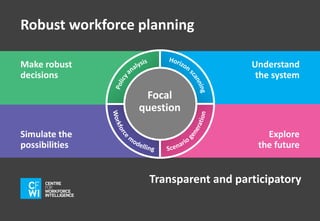
  • #4 We want an approach that will allow us to create policies that are robust, that take account of the uncertainty of the future, and will lead to good outcomes. This is the framework we have developed. [explain] It is transparent and participatory. We wanted a method that open and easy to understand – unlike our previous Excel model which was a black box and impossible to understand. We also wanted to involve stakeholders in all stages. This is really important in situations that are highly political – and there is nothing more politically charged that the healthcare system. So, for example, they sense-check the model design and outputs. [If time: Chief dental officer story]
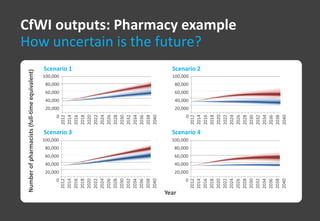
  • #5 Red is supply, blue is demand. The fans show the spread of uncertainty from our Monte Carlo simulation. The outer light band is 95% probability. The good news is that we are not short of pharmacists The bad news is that we are training far more pharmacists than we need. Some pharmacists training today won’t get jobs in the future. We are spending money on training that might be better spent elsewhere. In every future there is over-supply – the desirable futures and the less desirable.