InsightOn:
                                                        by   OneVoice


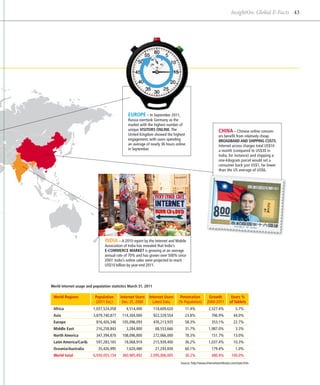
                           BUY


         1001011110110110101010101010101111010111101011101
         0101010101010101010101010101010101111010101010000
         0100010101010001001010101100101011010101001010101
         0101010100001010101010101011101010110010111101101
         1010101010101010111101011110101110101010101010101
         0101010101010101010111101010101000001000101010100
         0100101010110010101101010100101010101010101000010
         1010101010101110101011001011011011010101010101010
         1111010111000101011101010101010101010101010101010
         1010101111010101010010100100010101010001001010101
         1001010110101010010101010101010100001010101010101
         0111010101101010101010101111010101010000010001010
         1010001001010101100101011010101001010101010101010
         0001010101010101011101010110010111101101101010101
         0101010111101011110101110101010101010101010101010
         1010101010111101010101000001000101010100010010101
         0110010101101010100101010101010101000010101010101
         0101110101011001011110110110101010101011001011110
         1101101010101010101011110101111010111010101010101
         0101010101010101010101011110101010100000100010101
         0100010010101011001010110101010010101010101010100
         0010101010101010111010101100101111011011010101010
         1010101111010111101011101010101010101010101010101
         0101010101111010101010000010001010101000100101010
         1100101011010101001010101010101010000101010101010
         1011101010110010110110110101010101010101111010111
         0001010111010101010101010101010101010101010101111
         0101010100101001000101010100010010101011001010110
         1010100101010101010101000010101010101010111010101
         1010101010101011110101010100000100010101010001001
         0101011001010110101010010101010101010100001010101
         0101010111010101100101111011011010101010101010111


E-Commerce & Collaboration
03


If everyone is moving forward together,
     then success takes care of itself.


              HENRY FORD
04
InsightOn: Editorial – Bill Meahl 05


Dear Reader,

With the growth of e-commerce, the way people consume is changing rapid-
ly, with strong impact on the way many companies do business and on their
supply chains and logistics.

There’s no doubt that e-commerce empowers consumers through ease of use
and broadening product choice. Plus, for logistics providers, it opens up a
whole new area of potential, because, of course, products ordered online need
to be delivered to doorsteps. Those doorsteps might be in the next town; but
they might also be on the other side of the world. For every opportunity, there’s
a challenge. How can good delivery performance be achieved cost-effectively
in an era of higher fuel prices and higher volumes, for example?

Collaboration may be one part of the solution. Collaboration is frequently
discussed in business, yet not always fully understood in its entire scope and
potential.

Most commonly, companies think of collaboration as what happens at a con-
solidation center, when manufacturers and retailers work to share warehouses,
transport infrastructure and information. Some people call this ‘horizontal
collaboration’, and it is indeed an option that many companies are pursuing as
higher e-commerce volumes change the equation on the market.

Then there’s ‘vertical collaboration’ in which suppliers in a single industry, such
as the semiconductor industry, consolidate goods and share transport, since
they are often retracing each other’s steps and sharing the same customers
from a logistics point of view.

True collaboration is hard to achieve, of course, as you’ll read in the second
half of this report. Luckily, it’s also a topic that inspires a great deal of ‘thought
leadership’, some of which is highlighted in the following pages.

I invite you to enjoy our take on e-commerce and collaboration and to find out
more about what experts from around the world have to say about both.

Best regards,


Bill Meahl
Chief Commercial Officer at DHL
06
InsightOn: Contents 07


                                                 Contents
Editorial – Bill Meahl 	                                                  Page 05

Contents 	                                                                Page 07

Editorial – Ken Allen 	                                                   Page 09

Facts & Figures 	 Page 10

The Game Changer 	 Page 13

Life – Plugged In 	                                                       Page 14

Consumption 3.0 	                                                         Page 20

The Expert View – Johan Paludan 	                                         Page 25

Reaching Customers – Globally and Locally 	                               Page 26

Perfection: What Customers Expect with Online Shopping 	                  Page 34

The Ripple Effect of Online Purchases 	                                   Page 38

Global E-Facts 	                                                          Page 42

E-Commerce: The Growing Pains 	                                           Page 44

The Expert View – Christoph Wenk-Fischer 	                                Page 50

E-Commerce and Collaboration 	                                            Page 53

An Evolution of Collaboration 	                                           Page 55

Collaboration – The Human Factor 	                                        Page 58

Collaboration: A Foundation for Supply Chain Innovation 	                 Page 65

The Expert View – John Gattorna 	                                         Page 70

Orchestration: The New Form of Collaboration 	                            Page 74

The Foundation of Future Business 	                                       Page 76

DHL Case Studies 	                                                        Page 78

Background and Bibliography 	                                             Page 90
08
InsightOn: Editorial – Ken Allen 09


E-commerce revenues worldwide are expected to reach 1 trillion US dollars
this year. By 2015, the world will have 3.7 billion internet users. Already, the
number of internet users in Asia is double that of Europe, even though pen-
etration rates in Asia are still low.

The numbers are staggering. And, as e-commerce flourishes, they are only set
to rise. For retailers with an online offer, then, the international opportunities
are both hugely exciting and there for the taking. The phenomenon of online
shopping (and it is a phenomenon, touching everyone wherever they are in
the world) allows enterprise the chance to break into new markets – particu-
larly lucrative developing ones. It also allows them to build a prosperous and
truly global customer base.

There is, of course, a ‘however’ – and it’s this. Successful product shipment is
going to become more critical than ever for retailers who want a slice of the
e-commerce pie. You might have developed a truly groundbreaking product,
but if you can’t transfer it easily from your website into the hands of your
customers, your business will never succeed.

Studies have shown that effective logistics – particularly in the retail e-com-
merce sector – are a competitive differentiator for merchants. If you can offer
the items that people want or need and ship them more efficiently than your
competitors, you offer something of real value. Your business is duly marked
as a cut above the rest.

For those who recognize this, online is a real growth opportunity, a point
made in the first half of this InsightOn: report which explores the trends,
prospects and challenges of e-commerce. The second half of the report looks
at collaboration as a means to tackle some of the more taxing problems and
complexities of e-retail.

Collaboration is a word we know well at DHL. We believe in close collabor­ tion
                                                                             a
with businesses in order to drive sustainability initiatives, reduce costs and
implement the best, most efficient integrated solutions for their individual needs.

Of course, we are well known for providing critical services that enable the
vast flow of goods around the world, and for our ability to move high volumes
from one corner of the world to another on time and within budget. But we
also do far more to support our customers who run businesses online. For
example, we provide software products that make it easy for merchants to ship
and track their packages and manage their returns – a facet of e-commerce
highlighted in this report.

Whatever viewpoint you are reading from, e-commerce isn’t a subject any of us can
choose to ignore. Online retail, with all its multi-faceted challenges, is here to stay.

With that, I’ll leave you to explore our latest InsightOn:. Enjoy your read.

Best regards,


Ken Allen
CEO, DHL Express
10


               S AL E
                         68%
         of American retailers polled expected 2011 online
       ­holiday sales to increase by at least 15% from 2010


     26%
     projected annual growth of e-commerce
     in countries such as Spain, Brazil, China, Russia
     and Mexico through 2015


     More than 1000			                                        16 – number of top 50 online retailers
     101 to 1000	              7                                 that featured more than 1,000
                                                                   videos on their site in Q1 2011.
     11 to 100		                       9
     Under 10				                                                    18
InsightOn: Facts & Figures 11


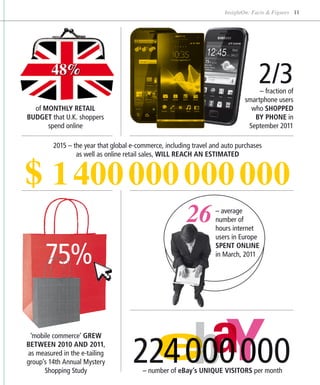
        48%
                                                                                   2/3
                                                                                  – fraction of
                                                                             smartphone users
  of monthly retail                                                            who shopped
budget that U.K. shoppers                                                       by phone in
      spend online                                                            September 2011


$ 1 400 000 000 000
         2015 – the year that global e-commerce, including travel and auto purchases
                 as well as online retail sales, will reach an estimated


                                                         26        – average
                                                                   number of
                                                                   hours internet
                                                                   users in Europe


      75%
                                                                   spent online
                                                                   in March, 2011


                                     224 000 000
 ‘mobile commerce’ grew
between 2010 and 2011,
as measured in the e-tailing
group’s 14th Annual Mystery
      Shopping Study                     – number of ebay’s unique visitors per month
12
InsightOn: The Game Changer 13


The Game Changer
E-commerce once described how companies operating in the B2B sector conducted business by
sharing information electronically. Nowadays, it has a completely different meaning: e-commerce
is ‘online shopping’ and all that comes with it, such as social shopping, multimedia entertainment,
immediacy and, of course, ease.


E-commerce is a truly ground-breaking inter­            travel to the end user. There are human factors
national phenomenon — a consumer in Madrid,             to consider, too: Collaboration between internal
say, can order goods from a seller in Missouri.         team members and their managers, for example,
Yet, from a logistics perspective, this involves a      and cross-collaboration between their opposite
long supply chain that crosses borders, curren-         numbers in external (and sometimes competing)
cies and customs regimes and requires a cost-           organizations. For this to be successful, a com-
effective and consistent solution. The consumer’s       mon focus and open communication is needed;
repeat business depends on it.                          plus an understanding of the end goal by staff at
                                                        many different levels within a business.
Returns is another conundrum. How does a
faulty or unwanted product go back through the          So how do companies collaborate successfully?
supply chain in a way that serves and satisfies the     What challenges and barriers must they over-
customer, but doesn’t squeeze the margins of the        come to do it effectively, what is its true cost and
e-retailer or the logistics provider? It’s a question   how can it be encouraged? In the second half
that the logistics industry is still grappling with.    of this report, leading international academ-
                                                        ics and logistics experts (including author and
There’s no doubt, however, that e-commerce is           consultant John Gattorna, and Richard Wilding,
a game changer for the retail industry. It’s also       a professor of supply chain strategy at Cranfield
growing exponentially. Online companies who             School of Management) offer the latest thinking
want growth – and what ones don’t? – know               and strategies on collaboration.
they need to set up their businesses and sup-
ply chains to take advantage of a new shopping          Could it be a turning point for e-commerce?
reality. The ones who don’t won’t be around to
tell the tale about how they tried to turn back
the e-commerce tide. So, in the first part of this
edition of InsightOn:, we look at the continually
evolving e-commerce landscape and investigate
its trends, opportunities and challenges from the
viewpoints of the consumer, enterprise and the
logistics operator.

If retailers are going to thrive in the age of e-com-
merce, then collaboration could offer a way to
implement greater competencies in logistics
planning and execution. At its simplest level,
collaboration is about the sharing of equipment,
vehicles and carriers; but it’s also about sharing
critical data on the movement of goods as they
14


Life – Plugged In
The digital world – with its always-on, 24-hour cycle of information, communication and media –
­ ermeates lifestyles, shaping the way people interact, consume and make sense of the world we live in.
p


                         The changes are well documented. Anthropologists
                                                            ­                Futurists predict that our electronic connect-
                         have shown how text messaging – expected to top     edness will continue to impact daily lives in
                         9.4 trillion messages by 2016 (Informa Telecoms
                                                                ­            profound ways, including the way we consume.
                         and Media, May 2012) – has transformed language;    It may seem far-fetched now, but some futur-
                         how instant messaging has shortened attention       ists can see the day when you might not have to
                         spans, and how consumers are collaborating and      shop for yourself because your fridge will do it
                         sharing in new-found communities that are no        for you. It will be intelligent and, knowing when
                         longer restricted by physical boundaries.           it is getting empty, able to initiate an order from
                                                                             an online shop – thus taking you, the consumer,
                         These communities often pursue a greater good,      out of the equation.
                         such as reducing their carbon footprint or help-
                         ing others with practical information on things     Your bathroom mirror, meanwhile, could have
                         as diverse as home health remedies, fashion         a dual role as a message centre, reminding you
                         trends and where to spot a shopping bargain.        about your schedule as you get ready for the
                                                                             day, and/or summarizing your home’s energy
                         From a consumer perspective, computer technol-      consumption and production. By tapping your
                         ogy has had the greatest impact of all by revolu-   mirror you post these results on a social net-
                         tionizing the way people shop. Now everything       working site, where you are challenging friends
                         from groceries and home furnishings to cars and     to earn the most points to exchange for games
                         holidays can be bought over the internet. More      and prizes to be collected online.
                         than this, however, consumers can collaborate
                         and share information, write reviews and impart     If all this sounds outlandish, scroll back to the
                         tips in new-found online communities. Shoppers      world today and notice that what was considered
                         are no longer restricted by physical boundaries.    science fiction two decades ago is not only part
                         Technology has empowered them.                      of the new reality – it is driving expectations
InsightOn: Life – Plugged In 15


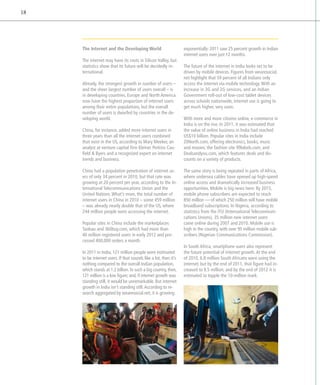
for consumers. For instance, between meetings        It’s no wonder then that retail e-commerce is
                                                                                                             DELPHI THESIS 46
at work, the busy consumer can now place an          booming. For several years now, it has been
online order for a dinner to be delivered to their   steadily taking market share away from tradi-           IN FUTURE …
home at a time of their choosing. All they need      tional bricks-and-mortar retailers. In the US, for      … the internet connects
to make this happen is two minutes’ access to        example, e-commerce reached 8 percent of over-          100% of the world’s
a PC, laptop, mobile or tablet – and a reliable      all retail sales in 2011, compared with roughly 4       population, based on a
delivery service, of course                          percent in 2004.                                        new infrastructure (e.g.
                                                                                                             glass fiber, satellite, mobile
                                                     With reliable delivery and plenty of choice,            devices).
                                                     consumers have discovered that click-and-ship
“With reliable delivery                              is in many ways more gratifying than traditional
                                                                                                             PROBABILITY
                                                                                                                    Definitely not:   Definitely:

                                                     shopping. People find that it fits into their lives                     13 %    12 %


and plenty of choice,                                much more easily than a trip to the store, where        Unlikely:
                                                                                                             25 %
                                                     selection may be limited and comparing prices is
c
­ onsumers have discovered                           done the old-fashioned way: Manually.

that click-and-ship is in                            And that’s not to mention the benefits for life-                                             Probably:
                                                     logistics: No more vying for a parking spot at a                                             31 %


many ways more gratify-                              shopping area, waiting in line to try on clothes,
                                                                                                                         Possibly:
                                                                                                                         19 %

                                                     waiting in line again to pay and then fighting
ing than traditional                                 traffic or crowds on the subway on the way            Delivering Tomorrow: Customer Needs in
                                                                                                           2020 and Beyond. A Global Delphi Study (see
                                                     home.
­shopping.”
                                                                                                           p. 113 for details)


                                                     Governments, too, are keenly aware of the
                                                     advantages that come with e-commerce, and
                                                     they’re keen to boost computer and internet
Multiple means of communication – or hyper-          usage to keep their economies and workforces
connectivity – is the new normal. According to       competitive.
Robert Greenhill, the chief business officer of
the World Economic Forum, hyperconnectivity          As part of its Digital Agenda for Europe, the
is redefining relationships between individuals,     European Commission has set a target of en­
between consumers and enterprises and between        abling 75 percent of the population to be regular
citizens and state. He has said, “We are begin-      internet users by 2015, with the proportion of
ning to see fundamental transformations in all       the population that has never used the inter-
areas of the economy and society.”                   net decreasing to 15 percent. Within the same
                                                     period, 50 percent of the population should be
Most experts believe that e-commerce is not          buying online and 20 percent of the population
the driving force, but rather e-connectedness.       should buy cross-border online.
Once connected, people then transfer their
experience of instant information gratification      For businesses and consumers alike, this trend
and empowerment to the realm of e-commerce.          opens up whole new worlds of opportunity.
In other words, e-connectedness means con-
sumers want their products fast, easy and on
their own terms.
16


     E-commerce trends


     SoLoMo                                                    Many people use social networks to research pur-
                                                               chases and learn about products. For example,
     We are perpetually in motion. Thanks to online            Mumsnet in the UK, a place where mothers compare
     technology, we can now all have a home and office         notes and collaborate, has built up such a following
     on the move. With our mobile phones and tablets,          that is considered crucial for influencing product
     we can field business queries, monitor our Facebook       choices – and even elections. In India, India Con-
     pages, send a Tweet, add to a blog and book a table       sumer Forum is an online platform giving consumers
     for dinner while we’re, say, sitting on a train or re-    the chance to share information about goods and
     laxing at a café table.                                   services, post grievances and give helpful consumer-
                                                               related tips and advice. Then there is US site Pinter-
     Internet trend watchers have come up with a new           est, which invites visitors to share their favorite
     acronym that could describe this behavior as well         things on ‘pinboards’ and follow collections created
     as one of the main trends on the world wide web:          by others, and has over 12 million users a month.
     SoLoMo, short for social-local-mobile.                    Plus, many retail sites have developed a sellers and
                                                               buyers community forum – discussion pages where
     The term conjures up a world dominated by social          potential consumers can read comments and re-
     networks (So), in which local (Lo) commerce and           views by posters who have already bought a partic-
     communities thrive while people interact and              ular product. US retail giant Amazon, for example,
     transact from their mobile (Mo) devices.                  launched its customer discussion board in 2007.

     “The Social, Local, Mobile (SoLoMo) revolution is         Christoph Schwarzl, a Kurt Salmon partner and the
     here,” says Daniel Laury, the CEO of LSF Network, a       author of the book New Online Retailing, said,
     US-headquartered global digital marketing company         “Many shoppers now consult their peers online be-
     offering digital advertising and performance marketing.   fore they make major purchases. For them, other
     “With rapid rates of smartphone and tablet adoption,      consumers are considered more reliable and trust-
     consumers are on the move, looking for information        worthy than advertisers.”
     quickly and expecting relevant results on the go.”
                                                               Going Local
     Already in 2007, social networking surpassed email
     in terms of time spent online. By 2011, users in          Next comes business, with a definitive local twist,
     I
     ­srael, Argentina, Turkey and Chile all spent more        driven by social media users on mobile devices.
     than 10 hours a month on social networking sites.         While business may be global in many ways, com-
     They were most likely sharing and commenting on           panies like Groupon and LivingSocial help generate
     photos of friends and family, swapping recipes or         demand for products and services locally. And
     comparing their opinions on films, books and cur-         check-in services like shopkick drive foot traffic
     rent events.                                              into retail outlets.
InsightOn: Life – Plugged In 17


                                                                                                                    DELPHI THESIS 48

                                                                                                                    IN FUTURE …
                                                                                                                    … all across the world,
                                                                                                                    communication costs
                                                                                                                    decrease extremely –
                                                                                                                    information and telecom-
                                                                                                                    munications are available
                                                                                                                    to everyone at any time
                                                                                                                    and almost for free.
                                                                                                                    PROBABILITY
                                                                                                                         Definitely not:   Definitely:
                                                                                                                                   2%     12 %
                                                                                                                   Unlikely:
                                                                                                                   19 %


                                                                                                                   Possibly:
Indeed, a survey by comScore in 2011 showed that           smart-phone or tablet. The device will be the cen-      27 %                            Probably:
                                                                                                                                                   40 %
local listings are among the most relevant and trust-      tral nervous system of their lives and the place
ed search results for consumers. Some 61 percent of        where they conduct their affairs, relying on the       Delivering Tomorrow: Customer Needs in
                                                                                                                  2020 and Beyond. A Global Delphi Study (see
online searchers consider local search results to be       opinions of people in their social networks and ser-   p. 115 for details)
more relevant, and 58 percent consider local search        vices provided locally.
results to be most trustworthy than others, it said.
                                                           In South Africa, for instance, internet use grew
Relevancy typically means that users recognize the         25 percent in 2011, mostly due to access via mo-
name or address of a business that has the products or     bile phones. And India may be raising a “mobile-
services they want in a specific location. For business-   only” generation, according to one study. It found
es, it translates to a more targeted readership for ads.   that 49 percent of people who are using the mobile
                                                           internet either never or infrequently use it from a
“For a local company looking for local customers or        desktop.
a national company steering customers to local
storefronts, local search provides targeted messages       Essentially, the SoLoMo trend is another example
to the consumer searching for a product or service in      of how electronic connectedness and new consumer
a particular area,” Laury said. The “Mo” trend in          technologies have eliminated information asym-
SoLoMo is also moving forward at full speed.               metries from the consumer‘s shopping experience –
                                                           and put power into the consumer’s hands.
Almost shockingly, more people on this planet
could access a mobile phone network than electric-
ity, if cost were no factor. According to the GSM As-
sociation and the United Nations, commercial wire-
less networks can reach 85 percent of the world’s
population while the electrical grid can reach only
80 percent of the world population.

With wireless access widely available and mobile
handsets far cheaper than desktop PCs, it’s clear
that users of the mobile internet will far outnumber
their fixed-line brethren. At the time of writing,
PCs are still the preferred way of connecting to the
internet; but a new study by NPD DisplaySearch
predicts that tablets will overtake PCs by 2016.
Indeed, experts say that most of the mass market
consumer world will never have a PC, but only a
18


     The Internet and the Developing World                        exponentially: 2011 saw 25 percent growth in Indian
                                                                  internet users over just 12 months.
     The internet may have its roots in Silicon Valley, but
     statistics show that its future will be decidedly in-        The future of the internet in India looks set to be
     ternational.                                                 driven by mobile devices. Figures from wearesocial.
                                                                  net highlight that 59 percent of all Indians only
     Already, the strongest growth in number of users –           a
                                                                  ­ ccess the internet via mobile technology. With an
     and the sheer largest number of users overall – is           increase in 3G and 2G services, and an Indian
     in developing countries. Europe and North America            G
                                                                  ­ overnment roll-out of low-cost tablet devices
     now have the highest proportion of internet users            across schools nationwide, internet use is going to
     among their entire populations, but the overall              get much higher, very soon.
     number of users is dwarfed by countries in the de-
     veloping world.                                              With more and more citizens online, e-commerce in
                                                                  India is on the rise. In 2011, it was estimated that
     China, for instance, added more internet users in            the value of online business in India had reached
     three years than all the internet users combined             US$10 billion. Popular sites in India include
     that exist in the US, according to Mary Meeker, an           20North.com, offering electronics, books, music
     analyst at venture capital firm Kleiner Perkins Cau-         and movies; the fashion site 99labels.com; and
     field & Byers and a recognized expert on internet            Dealsandyou.com, which features deals and dis-
     trends and business.                                         counts on a variety of products.

     China had a population penetration of internet us-           The same story is being repeated in parts of Africa,
     ers of only 34 percent in 2010, but that rate was            where undersea cables have opened up high-speed
     growing at 20 percent per year, according to the In-         online access and dramatically increased business
     ternational Telecommunications Union and the                 opportunities. Mobile is big news here: By 2015,
     United Nations. What’s more, the total number of             mobile phone subscribers are expected to reach
     internet users in China in 2010 – some 459 million           850 million — of which 250 million will have mobile
     – was already nearly double that of the US, where            broadband subscriptions. In Nigeria, according to
     244 million people were accessing the internet.              statistics from the ITU (International Telecommuni-
                                                                  cations Unions), 35 million new internet users
     Popular sites in China include the marketplaces              came online during 2007 and 2010. Mobile use is
     Tao­ ao and 360buy.com, which had more than
        b                                                         high in the country, with over 95 million mobile sub-
     40 million registered users in early 2012 and pro-           scribers (Nigerian Communications Commission).
     cessed 400,000 orders a month.
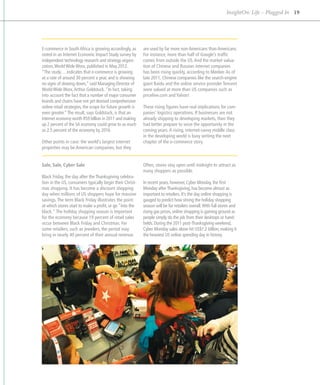
                                                                  In South Africa, smartphone users also represent
     In 2011 in India, 121 million people were estimated          the future potential of internet growth. At the end
     to be internet users. If that sounds like a lot, then it’s   of 2010, 6.8 million South Africans were using the
     nothing compared to the overall Indian population,           internet; but by the end of 2011, that figure had in-
     which stands at 1.2 billion. In such a big country, then,    creased to 8.5 million; and by the end of 2012 it is
     121 million is a low figure; and, if internet growth was     estimated to topple the 10-million mark.
     standing still, it would be unremarkable. But internet
     growth in India isn’t standing still. According to re-
     search aggregated by wearesocial.net, it is growing
InsightOn: Life – Plugged In 19


E-commerce in South Africa is growing accordingly, as      are used by far more non-Americans than Americans.
noted in an Internet Economic Impact Study survey by       For instance, more than half of Google’s traffic
independent technology research and strategy organi­       comes from outside the US. And the market valua-
zation, World Wide Worx, published in May 2012.            tion of Chinese and Russian internet companies
“The study… indicates that e-commerce is growing           has been rising quickly, according to Meeker. As of
at a rate of around 30 percent a year, and is showing      late 2011, Chinese companies like the search-engine
no signs of slowing down,” said Managing Director of       giant Baidu and the online service provider Tencent
World Wide Worx, Arthur Goldstuck. “In fact, taking        were valued at more than US companies such as
into account the fact that a number of major consumer      priceline.com and Yahoo!
brands and chains have not yet devised comprehensive
online retail strategies, the scope for future growth is   These rising figures have real implications for com-
even greater.” The result, says Goldstuck, is that an      panies’ logistics operations. If businesses are not
internet economy worth R59 billion in 2011 and making      already shipping to developing markets, then they
up 2 percent of the SA economy could grow to as much       had better prepare to seize the opportunity in the
as 2.5 percent of the economy by 2016.                     coming years. A rising, internet-savvy middle class
                                                           in the developing world is busy writing the next
Other points in case: the world’s largest internet         chapter of the e-commerce story.
properties may be American companies, but they


Sale, Sale, Cyber Sale                                     Often, stores stay open until midnight to attract as
                                                           many shoppers as possible.
Black Friday, the day after the Thanksgiving celebra-
tion in the US, consumers typically begin their Christ-    In recent years, however, Cyber Monday, the first
mas shopping. It has become a discount shopping            Monday after Thanksgiving, has become almost as
day when millions of US shoppers hope for massive          important to retailers. It’s the day online shopping is
savings. The term Black ­ riday illustrates the point
                          F                                gauged to predict how strong the holiday shopping
at which stores start to make a profit, or go "into the    season will be for retailers overall. With full stores and
black." The holiday shopping season is important           rising gas prices, online shopping is gaining ground as
for the economy because 19 percent of retail sales         people simply do the job from their desktops or hand-
occur between Black Friday and Christmas. For              helds. During the 2011 post-Thanksgiving weekend,
some retailers, such as jewelers, the period may           Cyber Monday sales alone hit US$1.2 billion, making it
bring in nearly 40 percent of their annual revenue.        the heaviest US online spending day in history.
20


Consumption 3.0
Once, the mantra for successful retailing was “location, location, location.” Now, e-commerce is re-
defining the concept of place, allowing companies to create a virtual identity that can be marketed
just like a physical one and enabling people to travel between both worlds.


                                              Take the phenomenon of pop-up retail. In           draw large groups of people; typically, they work
  DELPHI THESIS 56
                                              New York, Paris and Berlin, shops can appear       through social networks and rely on social
  IN FUTURE …                                 quickly – and be gone a few days later.            m
                                                                                                 ­ edia to spread the word about deals at shops.
  … Web-connected inter-
  faces make private homes                    The idea is to create a buzz online that trans-
  intelligent environments,                   fers back to the physical world, enticing people
  where temperature, aroma,                   to partake in short-term, limited offerings at     “Digital natives don’t
  personalized broadcasts,                    frequently changing locations in city centers –
  and information are                         i.e. pop-up locales.                               want to waste their time.
  automatically adjusted to
  the preferences of the                      Over the past few years, Toys ‘R Us has            They will only go shopping
  inhabitants, at all times.                  opened hundreds of holiday pop-up retail
  PROBABILITY                                 shops using otherwise vacant retail space,         for one reason: To have fun.”
       Definitely not:                         Vogue magazine has rolled out temporary
  Unlikely: 8 %
                 2%           Definitely:      stores for teens that don’t sell any items but
                                  13 %
                                              offer makeovers and model castings, and
                                              US retailer Target offered New Yorkers two         The Psychology of Shopping
                                              weeks to buy regular store items onboard           Over the course of time, shopping has always
                                              a 220-foot long glass-topped boat that it          been about more than just meeting the daily
                                              m
                                              ­ otored into Chelsea harbor.                      needs of life. The acquisition of certain goods re-
 Possibly:                                                                                       mains a central way for people to distinguish
 36 %
                               Probably:
                                              Johan Paludan, a futurist who has worked at        themselves socially and economically from oth-
                               41 %           the Copenhagen Institute for Future Studies        ers. And marketplaces have historically offered
                                              since 1976, says the pop-up retail trend is part   an important space for social interaction, the ex-
Delivering Tomorrow: Customer Needs in
2020 and Beyond. A Global Delphi Study (see   of a wider ongoing transformation of retail        change of information and spectacle.
p. 123 for details)
                                              space to event space.
                                                                                                 According to Paludan, the future of “live” shop-
                                              “Bricks-and-mortar shops are quickly finding       ping may hinge on its ability to continue to meet
                                              out that they must offer something special to      these key needs as it adapts to changes in the
                                              compete with the benefits of buying online. It     way we peruse and pursue goods.
                                              won’t be long before people head to shopping
                                              areas not to buy things – but to seek entertain-   For hundreds of years, people visited ancient ba-
                                              ment,” Paludan said.                               zaars, seaport commercial districts and general
                                                                                                 stores to select the things they needed. Then
                                              “Digital natives don’t want to waste their time.   came downtown department stores and sub­
                                              They will only go shopping for one reason: To      urban shopping malls.
                                              have fun.”
                                                                                                 But all this was before e-commerce was a force
                                              Those retailers who are successful in pop-up       to be reckoned with, with its 470 billion US dol-
                                              selling often use the techniques employed by the   lars in sales that are expected to exceed 1 trillion
                                              flash mob performance art movement to quickly      US dollars worldwide by 2012.
InsightOn: Consumption 3.0 21


Despite its tremendous size, the experience of        CBRE Group, Inc, it was reported that e-commerce
e
­ -commerce is not even fully evolved yet, says       had seen its share of core retail sales captured rise
Paludan. Right now, popular shopping sites in-        from 3 to 6 percent during the past six years; while
clude large marketplaces that aggregate the goods     the majority of bricks-and-mortar retailers’ shares
of thousands of sellers, such as Amazon.com and       declined during the same period. Jeffrey B Edelman,
Alibaba.com, or giant retailers with a large web      Director of the assurance, tax and consulting firm
footprint such as Walmart.com.                        McGladrey & Pullen, LLP, believes that “2012 will
                                                      be another year of lethargic growth, store closings
In the future, we may shop in 3D virtual malls that   and increased focus on everyday low prices by
are architectural masterpieces and, at some point,    s
                                                      ­ everal major retailers, all of which will have a
we may even be able to have sensory and tactile       s
                                                      ­ ignificant impact on the entire retail landscape.”
experiences while shopping online. “Merchants         He adds that multichannel is key to survival for
may be able to pipe the smell of bread into your      many; and that online retailing also threatens
own home, or you may be able to print out sample      e
                                                      ­ xisting store economics, measurement systems
fabrics to explore their feel,” said Paludan.         and incentives.

With the fast uptake of e-commerce, and such fan-     According to a UK-government backed report by
ciful developments on the horizon, some experts       Mary Portas, a retail marketing expert, TV person-
are already predicting the death of the shopping      ality and fashion designer known as The Queen of
mall. They say that e-commerce could leave shop-      Shops, town center vacancy rates have doubled
ping malls in a bind, just as those very malls and    over the past two years, and 50 percent of consumer
hypermarkets have played a part in high vacancy       spending takes place off the high streets. Portas
rates in downtown shopping districts. In the US, in   a
                                                      ­ dvocates turning the country’s town centers into
a May 2012 report from real estate services firm      cultural and social meccas. She says, “I fundamentally


       BUY
22


     believe that once we invest in and create social        expect to find there. It’s a bridge between event
     capital in the heart of our communities, the eco-       shopping and old shopping – as consumers go back
     nomic capital will follow.                              and forth between the worlds,” said Paludan. This is
                                                             omni-channel retail – the ideal aim for many e-re-
     Others don’t see e-commerce as such a threat.           tailers and the ultimate evolution of ‘multi-channel’
     Paludan, for instance, believes it and real-world       and cross-channel retail. The idea of omni-channel
     shopping can co-exist and be mutually beneficial.       retail is that consumers will be able to access the
     He says the most successful real-life shopping          retailer from whatever platform is available to them
     venues will actually be a blend of both – offering      in whatever part of the retail process they are, and
     interaction between the virtual and real worlds and     enjoy a co-ordinated and cohesive experience.
     striking the right mix of entertainment and shopping.

     Already, people and merchants connect the two
     worlds. Users do so when they redeem electronic         “The idea of omni-channel
     coupons for real-world goods in stores or follow
     the recommendation given on their handset to            retail is that consumers are
     walk into a particular store and interact with
     products. There’s also the trend of sharing your        able to access the retailer
     location with friends by checking into physical
     spaces – like a Starbucks – using a smartphone          from whatever platform
     and services such as foursquare or Facebook’s
     location-sharing feature. Often companies will          is available to them in
     reward users with discounts for checking in.
                                                             whatever part of the retail
     Companies, too, are transcending cyberspace.
     The auction site eBay did so by setting up a            process they are.”
     pop-up shop in central London for wares avail-
     able only online. And the carmaker Renault has

     plugged the virtual into the physical world by
     erecting an information kiosk at a car show in          To this end, one company has even reproduced
     Holland and enabling visitors to “like” particular      the image of a grocery store on a poster – just
     models on their Facebook pages.                         like a Potemkin village – and is giving people the
                                                             chance to buy items in what appears to be a typi-
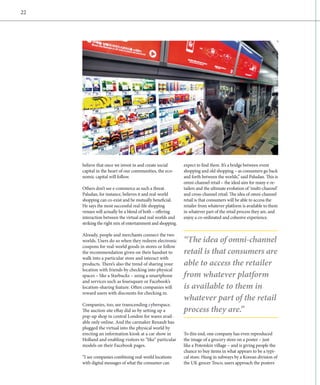
     “I see companies combining real-world locations         cal store. Hung in subways by a Korean division of
     with digital messages of what the consumer can          the UK grocer Tesco, users approach the posters
InsightOn: Consumption 3.0 23


and place orders for home delivery with their           working to make target marketing enhance the
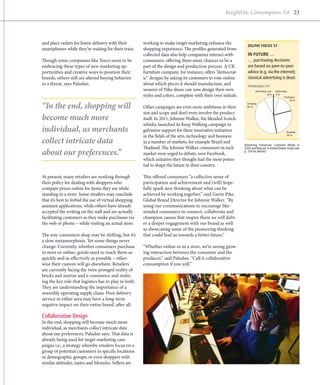
                                                                                                                 DELPHI THESIS 57
smartphones while they’re waiting for their train.      shopping experience. The profiles generated from
                                                        collected data also help companies interact with         IN FUTURE …
Though some companies like Tesco seem to be             consumers, offering them more chances to be a            … purchasing decisions
embracing these types of new marketing op-              part of the design and production process. A UK          are based on peer-to-peer
portunities and creative ways to position their         furniture company, for instance, offers “democrat-       advice (e.g. via the internet);
brands, others still see altered buying behavior        ic” designs by asking its customers to vote online       classical advertising is dead.
as a threat, says Paludan.                              about which pieces it should manufacture, and            PROBABILITY
                                                        wearers of Nike shoes can now design their own                  Definitely not:   Definitely:
                                                        styles and colors, complete with their own initials.                      8%     5%
                                                                                                                                                Probably:
                                                                                                                                                    16 %

“In the end, shopping will                              Other campaigns are even more ambitious in their
                                                                                                                 Unlikely:
                                                                                                                 45 %

                                                        size and scope and don’t even involve the product
become much more                                        itself. In 2011, Johnnie Walker, the blended Scotch
                                                        whisky, launched its Keep Walking campaign to
individual, as merchants                                galvanize support for three innovative initiatives                                        Possibly:
                                                        in the fields of the arts, technology and business                                        26 %

collect intricate data                                  in a number of markets, for example Brazil and
                                                                                                               Delivering Tomorrow: Customer Needs in
                                                        Thailand. The Johnnie Walker consumers in each
about our preferences.”
                                                                                                               2020 and Beyond. A Global Delphi Study (see
                                                                                                               p. 124 for details)
                                                        market were urged to debate, over Facebook,
                                                        which initiative they thought had the most poten-
                                                        tial to shape the future in their country.

At present, many retailers are working through          This offered consumers “a collective sense of
their policy for dealing with shoppers who              participation and achievement and (will) hope-
compare prices online for items they see while          fully spark new thinking about what can be
standing in a store. Some retailers may conclude        achieved by working together,” said Gavin Pike,
that it’s best to forbid the use of virtual shopping    Global Brand Director for Johnnie Walker. “By
assistant applications, while others have already       using our communications to encourage like-
accepted the writing on the wall and are actually       minded consumers to connect, collaborate and
facilitating customers as they make purchases via       champion causes that inspire them we will deliv-
the web or phone – while visiting an actual store.      er a deeper engagement with our brand as well
                                                        as showcasing some of the pioneering thinking
The way consumers shop may be shifting, but it’s        that could lead us towards a better future.”
a slow metamorphosis. Yet some things never
change: Currently, whether consumers purchase           “Whether online or in a store, we’re seeing grow-
in store or online, goods need to reach them as         ing interaction between the consumer and the
quickly and as effectively as possible – other-         producer,” said Paludan. “Call it collaborative
wise their custom will go elsewhere. Retailers          consumption if you will.”
are ­ urrently facing the twin-pronged reality of
    c
bricks and mortar and e-commerce and realiz­
ing the key role that logistics has to play in both.
They are understanding the importance of a
smoothly operating supply chain. Poor delivery
service in either area may have a long-term
negative impact on their entire brand, after all.

Collaborative Design
In the end, shopping will become much more
individual, as merchants collect intricate data
about our preferences, Paludan says. That data is
already being used for target marketing cam-
paigns i.e., a strategy whereby retailers focus on a
group of potential customers in specific locations
or demographic groups; or even shoppers with
similar attitudes, tastes and lifestyles. Sellers are
24


     Try This on For Size –                                 actually available to shoppers around the physical
     Shape-Fitting Technologies                             and digital worlds.

     Walk into some stores these days and the sales         In the UK, shoppers at Selfridges and New Look
     clerk may call your attention to the screen on the     can have their bodies mapped by BodyMetrics, and
     back wall instead of the coat on the rack.             online shoppers can do the same with home-based
                                                            camera technology. After the profile is made, it be-
     There you can position yourself to play a game of      comes a tool for trying on garments across multiple
     shopping in a Wii-like way. The program will react     stores on the web. Shoppers will try on clothes via
     when you raise your arms and move your body to         a personal avatar that is an interpretation of their
     signal which items you like and dislike.               shape.

     You may motion to remove an item you’re viewing        If body measuring technology became the basis for
     that has been fitted to your personal avatar, or you   online shopping, it could do even more by helping
     may swipe wide and twist to have it returned to        retailers improve their manufacturing, warehous-
     center-screen for your inspection.                     ing and stocking processes because of the ability
                                                            to predict demand more precisely for particularly-
     What you’re doing is interacting with a computer-      sized items.
     ized personal shopping assistant. Such technolo-
     gies are no longer the realm of futuristic films but   Now that’s a good fit for retailers.
InsightOn: The Expert View – Johan Paludan 25


The Expert View –
Johan Paludan

Many people shop online in marketplaces (like             Which products will disappear from the traditional
eBay), but the experience doesn’t feel like that of       retail trade as consumers shift to online buying?
v
­ isiting a mall. Why not?
                                                          Johan Paludan: The current situation gives the
Johan Paludan: Online shopping is fundamen-               answer: Those products where it is not impor-
tally different from traditional shops. A traditional     tant to feel, taste and smell were among the first
shop has a general display, where the shopper has         to be popular online, such as books and music.
to find what she wants. Online shopping will in-          Ultimately, all products could disappear from
creasingly be based on the supplier knowing more          the traditional retail trade once the digitalization
and more about the individual shopper. Online             of taste and smell has been accomplished. Right
shopping is therefore much more based on the in-          now, that process is still in the lab. Traditional
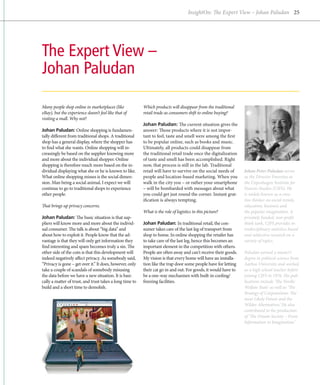
dividual displaying what she or he is known to like.      retail will have to survive on the social needs of     Johan Peter Paludan serves
What online shopping misses is the social dimen-          people and location-based marketing. When you          as the Director Emeritus at
sion. Man being a social animal, I expect we will         walk in the city you – or rather your smartphone       the Copenhagen Institute for
continue to go to traditional shops to experience         – will be bombarded with messages about what           Futures Studies (CIFS). He
other people.                                             you could get just round the corner. Instant grat-     is widely known as a crea-
                                                          ification is always tempting.                          tive thinker on social trends,
That brings up privacy concerns.                                                                                 education, business and
                                                          What is the role of logistics in this picture?         the popular imagination. A
Johan Paludan: The basic situation is that sup-                                                                  privately funded, non-profit
pliers will know more and more about the individ-         Johan Paludan: In traditional retail, the con-         think tank, CIFS provides in-
ual consumer. The talk is about “big data” and            sumer takes care of the last leg of transport from     terdisciplinary statistics-based
about how to exploit it. People know that the ad-         shop to home. In online shopping the retailer has      and subjective research on a
vantage is that they will only get information they       to take care of the last leg, hence this becomes an    variety of topics.
find interesting and spam becomes truly a sin. The        important element in the competition with ­ thers.
                                                                                                        o
other side of the coin is that this development will      People are often away and can't receive their goods.   Paludan earned a master’s
indeed negatively affect privacy. As somebody said,       My vision is that every home will have an installa-    degree in political science from
“Privacy is gone – get over it.” It does, however, only   tion like the trap door some people have for letting   Aarhus University and worked
take a couple of scandals of somebody misusing            their cat go in and out. For goods, it would have to   as a high school teacher before
the data before we have a new situation. It is basi-      be a one-way mechanism with built-in cooling/          joining CIFS in 1976. His pub-
cally a matter of trust, and trust takes a long time to   freezing facilities.                                   lications include ‘The Nordic
build and a short time to demolish.                                                                              Welfare State’ as well as ‘The
                                                                                                                 Strategy of Corporations: The
                                                                                                                 most Likely Future and the
                                                                                                                 Wilder Alternatives.’ He also
                                                                                                                 contributed to the production
                                                                                                                 of ‘The Dream Society – From
                                                                                                                 Information to Imagination.’
26


Reaching Customers –
Globally and Locally
When surfing and shopping the Web, national frontiers are hard to spot. One click leads to another,
and the product is suddenly in your shopping basket. For the consumer, it is of little concern that the
website is based outside their country of residence.


                        For the merchant behind the website, the shop-          Yet a retailer’s ability to serve customers abroad
                        per’s physical location is far from irrelevant.         may make or break a business, especially during
                        L
                        ­ ogistically speaking, where the customer is can       tough economic times. In the UK, for example,
                        have a major impact on how quickly – or even if         merchants are clearly responding to growing
                        – they can be served. Shipping goods overseas           competition from domestic websites and cutbacks
                        means dealing with issues surrounding different         in household spending due to the financial crisis:
                        currencies and customs regimes and longer               A recent survey showed that 64 percent of online
                        transport times. Overheads – such a factoring in        retailers there plan to expand internationally in
                        the costs of returns from abroad – may put a            2012. Good logistics will therefore play a central
                        squeeze on profit margins. Suddenly, from the           role in future competition among e-retailers.
                        e
                        ­ -retailer’s perspective, delivering the goods from
                        A to B is fraught with difficulty, especially if A is    “The real growth opportunity is international,”
                        on one side of the world and B is on the other.         says Andrew McClelland, the Chief Operations
InsightOn: Reaching Customers – Globally and Locally 27


& Policy Officer of the Interactive Media in Re-       Chinese market, and to better understand how
                                                                                                                    DELPHI THESIS 52
tail Group (IMRG), a UK e-retail trade group.          consumers across China interact with Macy’s and
“Overseas e-commerce markets offer a com-              the products we sell,” said Terry J. Lundgren, chair-        IN FUTURE …
pletely fresh customer base and one that is in-        man, president and chief executive officer of Ma-            … more than 3 billion
creasing exponentially.” By the end of this year,      cy’s, Inc. “We know that Macy’s is very well known           people in the world run their
there will be 2.5 billion internet users worldwide.    and regarded in China through international tour-            businesses completely and
By 2015, this number will rise to 3.7 billion.         ism, globally broadcast events such as the Macy’s            more effectively than ever
                                                       Thanksgiving Day Parade, and movies such as Mir-             via the internet, making
For merchants, going global is easier said than        acle on 34th Street. But we still have a great deal to       use of the World Wide
done. And it’s just one of the many challenges to      learn about the shopping patterns and merchandise            Web’s marketing power;
tackle as the e-commerce market matures and            preferences of consumers in China’s very diverse             50% of B2C transactions
customer demands rise for the best service and         and rapidly emerging consumer marketplace.                   are carried out online.
the best prices.                                                                                                    PROBABILITY
                                                       “We continue to believe there is significant long-               Definitely not:   Definitely:

                                                       term opportunity internationally for both Macy’s                           1%     10 %


                                                       and Bloomingdale’s. But we need to be certain               Unlikely:


“A retailer’s ability to serve
                                                                                                                   25 %                               Probably:

                                                       that our future decisions in this regard are based                                                 27 %


                                                       on fact and experience.”
customers abroad may
                                                       Macy’s are not alone in being cautious in entering
make or break a business,                              new territories. Only a small proportion of the              Possibly:

                                                       sites the IMRG has surveyed offer currency con-              37 %


especially during tough                                verters or customer support in a local language.           Delivering Tomorrow: Customer Needs in
                                                                                                                  2020 and Beyond. A Global Delphi Study (see

economic times.”                                       One hurdle they face is missing infrastructure
                                                                                                                  p. 119 for details)


                                                       for cross-border transactions. Search engines,
                                                       which know no geographical borders, may drive
                                                       traffic to a retailer’s site, but sales are lost without
Beginning in the early 1990s as a curious new          the requisite checkout, customs and delivery ser-
form of distance selling, e-commerce has be-           vices for international clientele, as well as a host
come an overwhelming force to reckon with –            of other adaptations.
for both small and medium enterprises (SMEs)
and the world’s largest retailers. While early en-     These include site-specific ways to handle lan-
trants like Amazon.com and eBay continue to            guage and cultural barriers as well as the chal-
drive expectations with their giant marketplaces,      lenges of cross-border fulfillment and returns. For
experts say much unclaimed territory is still          example, not all merchandise can be shipped
available to those online sellers that get multi-      across international lines without incurring taxes
channel retailing right and learn to cross borders     or duties, and returns from a different country are
effectively.                                           more complex and costly than domestic ones.

Opportunities – A Click Away                           European Cross-Border E-Commerce
According to recent industry surveys, even the big-    Cross-border e-retailing within the European
gest names in retail e-commerce are taking a slow,     Union would seem easy enough since internet
measured approach to expanding abroad, given the       use and online buying from domestic websites is
risks of failure, which would be costly and damag-     on the rise across member countries, led by
ing to hard-won brand confidence. For example, in      adoption in Norway, the UK and Sweden. The
May 2012, US retailer Macy’s announced its inten-      percentage of individuals who made purchases
tion to dip a toe into the Chinese market by selling   over the internet has, on average, more than
an assortment of its private brand merchandise di-     doubled from 20 percent to 43 percent between
rectly to consumers in China through a Macy’s sec-     2004 and 2011, Eurostat says. In addition, the
tion on omei.com, a newly established China-based      European Union’s 27 member countries have a
online retailer of in-season luxury and fashion        common legal basis for trading and 17 countries
brands operated by VIPStore Co., Ltd.                  share the common currency.

“Our relationship with VIPStore will allow us to       Yet significant barriers to cross-border e-com-
gain additional experience in the fast-growing         merce still exist in Europe. In 2010, some
28


                                              74 ­ ercent of EU online retailers did not sell to
                                                 p                                                 Many companies simply underestimate the cul-
                                              other EU countries.                                  tural divide present when expanding to interna-
                                                                                                   tional markets. Experts believe they do so be-
                                              A report released in 2011 by the European Par-       cause of the lingering myth that technology
                                              liament found a lack of consumer confidence in       eradicates borders in our lives.
                                              cross-border online commerce. Apparently, cus-
                                              tomers hesitate before making purchases outside
                                              their home countries because of differing rules
                                              on sales taxes (VAT), returns and the inability to   “There are still a significant
                                              compare prices in different languages. This fear
                                              of the e-commerce unknown seems to be easily         number of consumers who
                                              overcome, however. A 2011 report, published
  DELPHI THESIS 54
                                              by the European Consumer Centres Network,            are not yet aware of the
                                              found that 61 percent of the consumers who
  IN FUTURE …                                 have already shopped across borders are equally      offers and competitive ­ rices
                                                                                                                           p
  … people are “always on”                    confident in cross-border and domestic online
  the internet, surrounded                    shopping, compared to only 33 percent of the         that are available from
  by easy-to-use appliances                   general population.
  and virtual “smart agents”                                                                       cross-border retailers.”
  automatically assisting the                 Europe needs more multilingual price compari-
  users in their daily activities,            son sites, says Pablo Arias Echeverría, the rap-
  filtering information and                   porteur for a European Parliament Working
  serving as personal coaches.                Group on e-commerce. “There are still a signifi-     Yet, by neglecting to adapt to local conditions,
                                              cant number of consumers who are not yet             some retailers could be cutting themselves off
  PROBABILITY
                                              aware of the offers and competitive prices that      from growth: During recent years, e-commerce
        Definitely not:
                  2%
                         Definitely:
                         16 %                 are available from cross-border retailers. Despite   sales have been the main growth engine of the
      Unlikely:
      9%                                      the 300 price comparison websites that exist,        retail sector. According to the European Com-
                                              only a handful provide cross-border price re-        mission, e-commerce is the dominant distance
                                              views,” he has said.                                 sales channel and accounts for around 4 percent
                                                                                                   of the total retail sector.
                                              Consumer uncertainty and language barriers
  Possibly:
  29 %                            Probably:
                                              have made themselves visible in the numbers as       Getting Cross-Border E-Selling Right
                                  44 %        well: From 2008 to 2010, cross-border e-shop-        Amazon.com has successfully expanded to inter-
                                              ping in Europe only grew from 6 percent to 9         national markets. Yet the world’s largest online
Delivering Tomorrow: Customer Needs in
2020 and Beyond. A Global Delphi Study (see   percent while domestic online purchases rose         retailer, with 48.08 billion US dollars in net sales
p. 121 for details)
                                              twofold.                                             in 2011, acknowledged in its latest annual report
InsightOn: Reaching Customers – Globally and Locally 29


that international operations present risks such       viding call centers. That’s because some consum-
                                                                                                                 DELPHI THESIS 53
as a relative lack of operating experience in a        ers only feel comfortable making a purchase
particular country, legal and regulatory uncer-        ­ fter finding out that the company is ‘real’ by
                                                       a                                                         IN FUTURE …
tainty and established local brand-name compa-         a
                                                       ­ ctually speaking to someone.                            … rapidly expanding
nies as competitors.                                                                                             mobile infrastructures and
                                                       US retailer Walmart operates a website in China           free access to information
Still, a “significant” portion of the company’s to-    that is highly tailored to the local market. Where-       let emerging economies
tal revenues come from outside the US, and it is       as its global site is designed for consumers who          catch up with Western
clearly a leader off of its home turf. Some ana-       want to purchase online, its Chinese site is made         societies.
lysts believe the Seattle-based company may be         to have an “official” look and feel appropriate for a     PROBABILITY
entering a new international expansion phase af-       retailer with the size and clout of Walmart.                  Definitely not:   Definitely:
ter slowing the pace following its 2004 debut on                                                                               4%     5%

the Chinese market. Amazon has retail websites         According to an analysis of the site by a group of        Unlikely:                    Probably:
                                                                                                                                                  31 %
                                                                                                                 24 %
in the US as well as in Canada, the UK, Germa-         professors from universities in the US, Hong
ny, France, Italy, Japan and China. It launched in     Kong and Taiwan, Walmart’s site rightly focuses
Spain in 2011, and reports say the giant is now        on what’s important in the Chinese market –
eyeing new markets.                                    i
                                                       ­ ntroducing the company, cooperation with the
                                                       government, social responsibility, the latest
Even as market leaders like Amazon.com or Ali­         news, supplier services and food security.                 Possibly:
baba.com forge ahead outside their home markets,                                                                  36 %

significant opportunity still exists. But what works   Scott Price, the Asia CEO of Walmart, said the
                                                                                                               Delivering Tomorrow: Customer Needs in
in Michigan won’t necessarily work in Mumbai.          company is “very keen” on the online market in          2020 and Beyond. A Global Delphi Study (see
                                                                                                               p. 120 for details)
So how must businesses and supply chains adapt         China. Walmart operates about 370 bricks-and-
when going abroad? Researching customers and           mortar stores across China and has a minority
markets is critical, naturally, because each market-   position in Yihaodian, a company that has
place is different. Apart from getting a handle on     carved a niche in same-day or next-day deliver-
culture, language and etiquette, retailers will need   ies in five cities. Walmart is applying to take a
to understand what product – and packaging –           majority position in the company. “We’re com-
will work best in the locations they are targeting.    mitted to the Chinese market,” Price said.

Experts agree that “local” is the lingua franca.       The Localization Industry
They say companies should start exactly there by       For retailers large and small, the cross-border
making shopping carts, websites and customer           o
                                                       ­ pportunity is too attractive to ignore, and an
service available in the local language and pro-       i
                                                       ­ndustry of boutique companies has cropped up
30


     to help others properly design localized, multi­       Macy’s is addressing all these questions and
     lingual websites. According to some estimates, the     more as it expands abroad with its Macys.com
     decade-old industry is already worth more than         website. The company’s flagship store in Man-
     10 billion US dollars.                                 hattan is a popular destination among foreign
                                                            shoppers, and Macy’s has tried to cultivate that
     These consultants are prepared with software           customer segment for years.
     and solutions that will help companies run
     fl
     ­ exible websites that can scale up and down           In 2011, the company began offering shipping
     a
     ­ lmost by the minute – as demand dictates.            outside the US. According to a news report, its
                                                            website is being reconfigured to detect a shop-
                                                            per’s location worldwide and display a welcome
                                                            screen in the appropriate language. Shopping
     “The future will be to figure                          will then continue in English, but at checkout,
                                                            the consumer is notified of the price and ship-
     out how to encourage the                               ping costs in the local currency.

     online customer to come to                             Overall, Macy’s online sales are booming. CEO
                                                            Terry Lundgren said in a TV interview that he
     the stores, and encourage                              expects them to exceed 2 billion US dollars in
                                                            2012. “We’re one of the most advanced com­
     the customer in the store to                           panies when it comes to the online business. And
                                                            we’ve been investing there. A lot of the capital
     shop online.”                                          investments I’ve made for the company over the
                                                            last three years have gone into technology. It’s
                                                            r
                                                            ­ eally paying off.”

     They also help retailers consider critical questions   Shopping Channels A La Carte –
     when reaching out to new markets: Is your prod-        In Store, By Phone, Online
     uct selection adapted to local tastes and are prices   Macy’s international push online is part of its
     competitive? Does your advertising comply with         overall strategy to meet the demands of sophisti-
     applicable law and does the approach resonate          cated shoppers who want access to Macy’s prod-
     with locals? And are your fulfillment process and      ucts and services in a multi-faceted way.
     logistics effective and cost-efficient?
                                                            “Today, the most important customer and the
                                                            most important trend is what we call the ‘omni-
                                                            channel consumer,’” Lundgren told a reporter.
                                                            “This is the consumer who is shopping on his or
                                                            her phone, shopping at their desktop and going
                                                            into our stores. The future will be for us to figure
                                                            out how to encourage the online customer to
                                                            come to our stores, and encourage the customer
                                                            in our store to shop online.”

                                                            As a result, the retailer is now testing or imple-
                                                            menting capabilities such as digital receipts, free
                                                            Wi-Fi in stores and tablet computers for sales
                                                            clerks that will help improve customer service by
                                                            giving easier access to online information. And
                                                            Macy’s already has the technology at its cash reg-
                                                            isters to allow sales clerks to search for an item
                                                            online that may not be available in the store and
                                                            complete an online purchase for the customer
                                                            who is standing in the store.

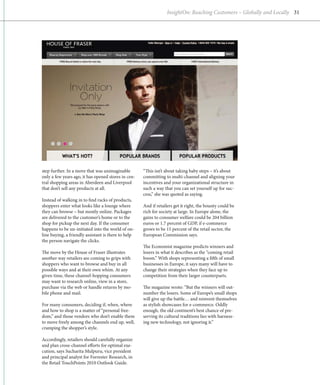
                                                            The UK department store House of Fraser and
                                                            others have taken the multi-channel idea one
InsightOn: Reaching Customers – Globally and Locally 31


step further. In a move that was unimaginable        “This isn’t about taking baby steps – it’s about
only a few years ago, it has opened stores in cen-   committing to multi-channel and aligning your
tral shopping areas in Aberdeen and Liverpool        incentives and your organizational structure in
that don’t sell any products at all.                 such a way that you can set yourself up for suc-
                                                     cess,” she was quoted as saying.
Instead of walking in to find racks of products,
shoppers enter what looks like a lounge where        And if retailers get it right, the bounty could be
they can browse – but mostly online. Packages        rich for society at large. In Europe alone, the
are delivered to the customer’s home or to the       gains to consumer welfare could be 204 billion
shop for pickup the next day. If the consumer        euros or 1.7 percent of GDP, if e-commerce
happens to be un-initiated into the world of on-     grows to be 15 percent of the retail sector, the
line buying, a friendly assistant is there to help   European Commission says.
the person navigate the clicks.
                                                     The Economist magazine predicts winners and
The move by the House of Fraser illustrates          losers in what it describes as the “coming retail
a
­ nother way retailers are coming to grips with      boom.” With shops representing a fifth of small
shoppers who want to browse and buy in all           businesses in Europe, it says many will have to
­ ossible ways and at their own whim. At any
p                                                    change their strategies when they face up to
given time, these channel-hopping consumers          competition from their larger counterparts.
may want to research online, view in a store,
purchase via the web or handle returns by mo-        The magazine wrote: “But the winners will out-
bile phone and mail.                                 number the losers. Some of Europe’s small shops
                                                     will give up the battle… and reinvent themselves
For many consumers, deciding if, when, where         as stylish showcases for e-commerce. Oddly
and how to shop is a matter of “personal free-       enough, the old continent’s best chance of pre-
dom,” and those vendors who don’t enable them        serving its cultural traditions lies with harness-
to move freely among the channels end up, well,      ing new technology, not ignoring it.”
cramping the shopper’s style.

Accordingly, retailers should carefully organize
and plan cross-channel efforts for optimal exe-
cution, says Sucharita Mulpuru, vice president
and principal analyst for Forrester Research, in
the Retail TouchPoints 2010 Outlook Guide.
32


     China’s Big Sellers: Alibaba, TMall, Taobao                   B2B trade, retail and payment platforms, a shopping
                                                                   search engine and distributed cloud computing ser-
     Tmall, which is part of the Alibaba Group, was launched       vices. Privately held, the group reaches internet users
     in April 2008 and is the most visited online retail web-      in more than 240 countries and regions and employs
     site in China, offering an extensive brand selection          more than 25,000 people in some 70 cities in China,
     of consumer electronics, home furnishings, designer           India, Japan, Korea, the UK and the US.
     footwear and beauty products, to name a few.
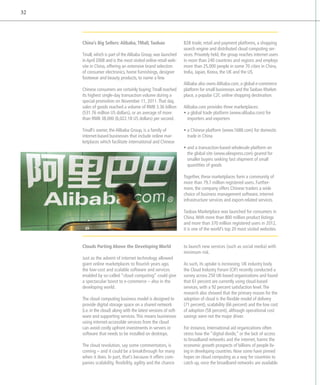
                                                                   Alibaba also owns Alibaba.com, a global e-commerce
     Chinese consumers are certainly buying: Tmall reached         platform for small businesses and the Taobao Market-
     its highest single-day transaction volume during a            place, a popular C2C online shopping destination.
     special promotion on November 11, 2011. That day,
     sales of goods reached a volume of RMB 3.36 billion           Alibaba.com provides three marketplaces:
     (531.76 million US dollars), or an average of more            •  global trade platform (www.alibaba.com) for
                                                                     a
     than RMB 38,000 (6,022.18 US dollars) per second.               importers and exporters

     Tmall’s owner, the Alibaba Group, is a family of              •  Chinese platform (www.1688.com) for domestic
                                                                     a
     internet-based businesses that include online mar-              trade in China
     ketplaces which facilitate international and Chinese
                                                                   •  nd a transaction-based wholesale platform on
                                                                     a
                                                                     the global site (www.aliexpress.com) geared for
                                                                     smaller buyers seeking fast shipment of small
                                                                     quantities of goods

                                                                   Together, these marketplaces form a community of
                                                                   more than 79.7 million registered users. Further-
                                                                   more, the company offers Chinese traders a wide
                                                                   choice of business management software, internet
                                                                   infrastructure services and export-related services.

                                                                   Taobao Marketplace was launched for consumers in
                                                                   China. With more than 800 million product listings
                                                                   and more than 370 million registered users in 2012,
                                                                   it is one of the world’s top 20 most visited websites.


     Clouds Parting Above the Developing World                     to launch new services (such as social media) with
                                                                   minimum risk.
     Just as the advent of internet technology allowed
     giant online marketplaces to flourish years ago,              As such, its uptake is increasing. UK industry body
     the low-cost and scalable software and services               the Cloud Industry Forum (CIF) recently conducted a
     enabled by so-called “cloud computing” could give             survey across 250 UK-based organizations and found
     a spectacular boost to e-commerce – also in the               that 61 percent are currently using cloud-based
     developing world.                                             services, with a 92 percent satisfaction level. The
                                                                   research also showed that the primary reason for the
     The cloud computing business model is designed to             adoption of cloud is the flexible model of delivery
     provide digital storage space on a shared network             (71 percent), scalability (66 percent) and the low cost
     (i.e. in the cloud) along with the latest versions of soft-   of adoption (58 percent), although operational cost
     ware and supporting services. This means businesses           savings were not the major driver.
     using internet-accessible services from the cloud
     can avoid costly upfront investments in servers or            For instance, international aid organizations often
     software that needs to be installed on desktops.              stress how the “digital divide,” or the lack of access
                                                                   to broadband networks and the internet, harms the
     The cloud revolution, say some commentators, is               economic growth prospects of billions of people liv-
     coming – and it could be a breakthrough for many              ing in developing countries. Now some have pinned
     when it does. In part, that’s because it offers com-          hopes on cloud computing as a way for countries to
     panies scalability, flexibility, agility and the chance       catch up, once the broadband networks are available.
InsightOn: Reaching Customers – Globally and Locally 33


Mobile telecommunications networks have already            Microsoft, Google and Amazon.com are among
done a lot to bring communications and digital services    the large providers of cloud services worldwide
to people in remote areas, and the positive economic       that may indeed help chip away at the structural
impact is well-documented. In Africa, some 65 percent      disadvantages that exist in health, education and
of the population uses a mobile phone. This cellular       commerce in the developing world.
infrastructure has allowed some developing countries
to “leapfrog” over the age of fixed-line networks and      Kshetri wrote: “In theory, it is possible for the de-
go straight to the mobil e-commerce party.                 veloping economies to catch up with the West, as
                                                           the cloud allows them to have access to the same
In Kenya, for instance, users not only talk and text       IT infrastructure, data centers and applications.”
with their phones, they also conduct their banking
on them. The M-PESA system, which uses cloud-
based infrastructure, is well known for having
brought payment capabilities to remote villages,
thereby helping millions of small businesses thrive.

Still, much more must be done to improve lives in
developing countries, and experts say the cloud
could play an important part. Nir Kshetri, a profes-
sor of business at the University of North Carolina
in Greensboro, pointed out that cloud services
are easier to install, maintain and update than
traditional computers with desktop software and
therefore provide a benefit of particular importance
for rural users with little IT training.


All Eyes on Amazon                                         and it’s clear to see why the company is a key trend-
                                                           setter in the market.
The name Amazon.com is nearly synonymous with
the concept of e-retailing, and most experts credit        Forrester analyst Sucharita Mulpuru credits
the company with opening the floodgates of online          A
                                                           ­ mazon.com’s marketplace model as a key driver of
commerce. When it was launched in 1995 by                  profit, since Amazon earns a commission off the sale
Jeff ­ ezos, the company’s CEO, few would have
     B                                                     of the wares without necessarily having to keep
i
­magined that the company would grow to its                them in inventory or fulfill orders. According to
c
­ urrent size and scale in less than two decades.          F
                                                           ­ orrester, marketplace sales represented 35 percent
                                                           of revenues and 30 percent of unit sales on Amazon’s
Now the world’s largest online retailer, with 48.08        website in the fourth quarter of 2010. Other online
billion US dollars in net sales in 2011, Amazon.com is a   players are taking a cue from the likes of Amazon
strong force in setting expectations among consumers,      and eBay and moving to the marketplace model,
with its huge selection, prices and customer service.      including Flipkart.com in India, which offers a cash-
                                                           on-delivery model that makes sales possible for those
The story goes that Bezos boxed up the first book          people in India who do not have bank accounts.
sold on Amazon.com in his garage in Seattle. His
idea in the early years was to focus on cheap-to-ship      “Retailers that compete with Amazon have come to
books and other media that was already catalogued          dis­ over that offering marketplaces on their own sites is
                                                               c
and therefore easy to be uploaded on a website.            critical to driving margins and remaining competitive on
                                                           the prices and the shipping fees of the items they do stock
Today, Amazon offers a product catalogue of mil-           in inventory,” Mulpuru wrote in a research note in 2011.
lions of items. Many are warehoused, fulfilled and
delivered from Amazon’s logistics centers in north         “Companies such as Buy.com and Walmart have in-
America, Europe and Asia, and many more come               troduced marketplaces, and we anticipate others in
from the millions of merchants that also offer             verticals such as apparel, toys, and sporting goods
goods via the company’s marketplaces. Add to that          will follow suit.” Mulpuru said, “This strategy will
Amazon’s so-called “Prime” services, which feature         help them to retain some of the market share they
unlimited delivery for a low, fixed price each year,       may otherwise lose to Amazon.”
34


Perfection: What Customers Expect
with Online Shopping
By Andrew Starkey

The demands placed on the supply chain by e-commerce will be driven by retailers’ requirements.
But retailers’ requirements themselves are driven by consumers. Logistics providers and retailers
must examine how consumers are changing their behavior to understand how supply chains should
be adapted for e-commerce.


                                   Recently on a Sunday afternoon, I went online       The Digital World: Three Reasons Why
                                   to purchase a towel rail for my bathroom. I         Consumers Demand More
                                   found a model I liked at a decent price on the      Consumer behavior is being changed by the
                                   website of a UK retailer whose name I won’t         spread of ubiquitous digital communications and
                                   reveal. After doing some quick research, I was      the alternatives it brings for multi-channel contact.
                                   ready to purchase.                                  We know that some 70 percent of consumers who
                                                                                       make purchases online in the UK are influenced
                                   However, when I got to the checkout stage,          by other channels, including above-the-line media,
                                   I could not get the web site to accept my order     below-the-line media, digital media and so forth.
                                   for delivery to my home. I called the company’s     Secondly, consumers are used to an immediate ex-
                                   customer service line, and a representative,        perience, and they’re looking for that in shopping
Andrew Starkey is the found-       sounding a bit surprised, told me that I could      as well. The result is that they are losing patience.
er and lead consultant for         only buy the item in the store. My retort: “Well,
Spiral4, a postal and e-logis-     why is it listed on your website?”                  Third, consumers are more mobile. We find that
tics consulting company. He is                                                         consumers are very often in different locations for
retained by IMRG as its Head       My easy and convenient home shopping experi-        different deliveries. They don’t spend all day in an
of e-Logistics, leading its re-    ence turned into frustration, and this retailer     office. They don’t spend regular hours at home.
search and member support          is no longer in such high standing in my eyes.      They conduct their lives from different places.
program. Starkey has a             Now I won’t be purchasing it from them at           Consumers are simply less predictable.
unique background in the           all; and I may not purchase anything else ever
world of parcels, packets and      again.                                              Although they’re more unpredictable, we do know
postal logistics, with more                                                            that these individuals shop and increasingly on-
than 30 years of experience        I don’t think my reaction is particularly draco-    line. Sometimes they shop in a physical environ-
gained in the commercial sec-      nian. Like other consumers, I know that I can       ment, but they may do their research in an online
tor and the regulatory envir­      have a reliable and consistent online purchasing    environment. When this consumer walks into a
onment. He held senior posts       experience elsewhere. Why should I give this        store, he may use QR codes or scan a barcode with
at Royal Mail, and he has          merchant more of my time?                           a mobile device to identify if a particular item can
served as an Executive                                                                 be had cheaper online.
Director of Postcomm and the       This brings me to a point I’d like to make about
Commercial Director of             how deliveries measure up in the world of           These options give consumers more choices, but
Jersey Post International.         e
                                   ­ -commerce: Too often, logistics and the supply    they also create complexity, particularly for the re-
Starkey is a member of the         chain lag behind what the consumer actually         tailer, since the consumer wants to have a consist-
Chartered Institute of Logistics   expects. We at the IMRG, the Interactive Media      ent experience – no matter what the channel.
and Transport and the              in Retail Group, the UK’s trade association for
Institute of Direct Marketing      e-retail, have four years of data to show that      High Expectations for Delivery
and is a recognized expert on      consumer satisfaction with physical logistics is    Then comes delivery. We say delivery begins
the UK postal and e-retail         lower than that with other steps in the home-       during the browsing phase. If you go onto an
home-delivery markets.             shopping process.                                   Amazon website and you’re browsing for a
InsightOn: Perfection: What Customers Expect with Online Shopping 35


p
­ roduct, it will describe the product and the service   Yet some e-retailers still apply delivery charges
you get with the product. If you’re shopping             at checkout after the purchase decision has been
for a camera, it will tell you how many pixels           made.
the camera has, plus that camera’s absolute
availability and the time window when it will be         Other retailers provide a consistent shopping
dispatched and when you can expect delivery.             and delivery experience each time. But what
This happens at the point of browsing. What              happens if it fails? Let’s say you’re on your third
market leaders are doing is replicating the act of       purchase with a retailer and that delivery failed.
walking into a physical store and seeing the item        If that happened, you had a 30 percent failure
for yourself, knowing you can walk out with it.          rate. Nobody in this world would deal with a
                                                         company that has a 30 percent failure rate.
Many less-advanced e-retailers don’t give you
this information until you’ve made your decision         But at least 8 percent of UK deliveries fail to
to purchase and you’re in the checkout process.          meet the shoppers expectation at the first
Only then do they tell you when and how you can          attempt. We’ve got clear data that show that de-
receive your camera, and if they don’t provide the       livery performance is a clear retail differentiator.
right options you may well abandon the purchase          In excess of 70 percent of UK consumers will
– a time-consuming and costly exercise for both          positively testify that a good delivery experience
parties.                                                 encourages them to shop with that retailer again
                                                         (and again, and again…).
We’re getting to a point now where consumers
expect to see this supply chain information              In-Transit
at the start of their online shopping journey.           During the in-transit stage, consumers want to
They want to know the availability, dispatch             have instant information at their fingertips as
date, delivery time windows and delivery time            well. However, some retailers disappear after the
options. They want to see this at the time of            checkout is complete. Some 70 to 80 percent of
browsing, and a vast majority of retailers don’t         retailers do send a confirmation email or SMS
give you that information then. So, consumers            to notify the customer that an item has been
immediately experience a disconnect between              dispatched. However, only 12 percent will send
what they expect in the wider digital world and          a message while the goods are in transit con-
the reality of many e-retailers provide, which is        firming the delivery date is still on target. That’s
often driven by supply chain restraints (or the          88 percent of retailers who forget to maintain
lack of understanding of the importance and              the positive experience.
impact of the supply chain).
                                                         Returns
Checkout                                                 The final way that e-retailers can improve
As the shopper enters the checkout, he/she ex-           customer service and the delivery experience
pects to know exactly what that product will cost.       is in the area of returns. I call the current status
36


     quo on returns a ‘black hole.’ We have data that     the goods are back in their system and that I’ll
     shows that female shoppers are more likely           be given my refund. During this time, I’m in the
     to return goods than their male counterparts.        returns ‘black hole.’
     Some 42 percent of female fashion purchases
     are returned as compared to 13 percent of            When the retailer gets the goods back, the credit
     f
     ­ ashion purchases made by men in the UK.            may be delayed for another three to four days
     Clearly, ladies are more discerning, so they         while the return is being processed. All this
     buy several colors and several styles and they       time, the consumer is feeling uncertain. She
     choose the one that suits them best. The rest        may phone the customer service center, asking
     they return.                                         questions and causing the retailer to incur cost.
                                                          I always say that an anxious consumer is a bad
     The problem is that in most cases, the customer      consumer.
     has already paid for the item that is being re-
     turned but has no control and lacks information      This is a customer who the retailer spent mar-
     about the package during the returns process,        keting money to acquire; and the customer is
     even though she may be bearing the cost of the       unlikely to shop with the retailer again if it’s a
     return herself. In fact, that’s a key point.         bad experience. This is a very vulnerable time.
                                                          Yet in the UK, most return services remain
     Since the consumer may have to pay for the           untracked. The data show that about 85 percent
     return, she sends it back the cheapest way – i.e.    of online shoppers are generally satisfied with
     through a postal carrier that doesn’t provide a      their outbound deliveries but only 60 percent
     tracking number. At this point she is carrying all   are satisfied with services for returns. Again,
     the risk during the three or four days it may take   it’s a disconnect because shoppers will see both
     to return the item. During this time, she has        d
                                                          ­ elivery and returns as components of the over-
     1) no goods 2) no money 3) and may have paid         all shopping process – an excellent ‘outbound’
     a premium to return the items. Many e-retailers      experience will be negated by a ‘black hole’
     are generally not good at letting me know that       returns experience.
InsightOn: Perfection: What Customers Expect with Online Shopping 37


Inside the Consumer’s Mind
I have presented four stages of the online shop-
ping experience as they relate to deliveries and
consumer expectations. It’s clear to see that a
first-class online experience is characterized
by communication with the customer that is
conducted via the channel pre-selected by the
shopper. The buyer is constantly kept abreast
about the status of their deliveries, beginning at
the browsing stage.

It’s also clear that consumers demand high
levels of service and experience from e-retailers
yet frequently experience a gap between their
expectations and the available service enhance-
ments in logistics. This gap represents an oppor-
tunity for retailers, software providers, technol-
ogy providers and logistics providers to respond
via the supply chain.

I would argue that the response must be guided
by a full understanding of how the consumer
is feeling and why consumers’ expectations are
as so high. Otherwise, we will never be able
to properly adapt the supply chain and design
low- or no-cost services that address consumer
expectations.


IDIS Gold Standard

Some UK retailers are seeking certification for the
use of delivery best practices as a way to differenti-
                                                                                 delivery Notification
ate themselves from the competition.

IMRG has developed the IDIS Gold Standard, a
delivery baseline against which retailers can meas-                                                  89%                       26%
ure themselves and become certified. Certification
indicates to consumers that the retailer is geared                              77%                         11%
up for delivery best practice, such as allowing the                              89% of retailers allowed   Larger retailers were
                                                                                 the customer to track      more likely to send
customer to specify when the delivery is made.                                   their order online, up     texts: 26% did so, up
                                                                                 from 77% last year         from 11% last year
Once the standard is met, the retailer is invited
to display the IDIS Gold Best Practice logo on its
website to show its customers that it provides an
excellent delivery service.                                                                         12%                       19%
                                                                                 4%
                                                                                 12% of retailers sent      19% of sites made the
                                                                                 a text message alert       customer log-in/register
                                                                                 regarding delivery, up     before showing the
                                                                                 from 4% last year          delivery charge
38


The Ripple Effect of Online Purchases
Despite its image as “virtual,” the e-commerce industry depends on effective on-the-ground
services, such as fulfillment and last-mile deliveries. The boom in e-commerce is bringing new
and different challenges to supply chains.


                                              Consumers may save time and energy by no               p
                                                                                                     ­ articularly in countries like China, where ­ogistics
                                                                                                                                                  l
                                              longer heading to the shopping mall. Instead,          capabilities must in some cases be built from scratch.
                                              they click away and the items are delivered to
                                              their doorsteps.                                       Step-by-Step:
                                                                                                     How E-Commerce Impacts Supply Chains
                                              But let’s say a consumer receives at least five        Before an order is placed online, many custom-
                                              packages a week of foodstuffs, clothing and            ers expect to see real-time information about
                                              housewares, because they live in a remote area.        the product’s availability, how long it will take
                                              The ability to purchase online may have simpli-        for delivery and the cost of delivery. This type
                                              fied their life, but it still means change and         of information is very useful to the customer
                                              learning a new process: Not only must the card-        but not so easy for internet shops to provide,
                                              board carrier cartons be taken to the recycling        since they are dependent on a long list of supply
                                              bin, the consumer may need to think ahead              chain partners to make that data available in a
                                              about where they will be when the packages ar-         compatible format and a timely manner. Across
                                              rive (i.e. how the delivery will be received) and,     the board, much effort is being given to make
                                              in case the product isn’t right or is faulty, how it   this information available widely.
                                              will be returned.
                                                                                                     Next, shoppers place their order. Besides a pay-
                                              Consumers bought 34 billion euros of goods             ment receipt, they expect an electronic confir-
                                              online for home delivery in Germany alone in           mation about when the order will be shipped.
                                              2011, according to Christoph Wenk-Fischer, the         Andrew Starkey, the head of e-logistics at the
                                              head of the German e-commerce and Distance             UK’s trade association for e-retail, IMRG,
                                              Selling Trade Association (BVH).                       the Interactive Media in Retail Group, says,
  DELPHI THESIS 49
                                                                                                     “Most merchants and logistics companies send
  IN FUTURE …                                 How this boom changes daily lives is only one          confirmation emails with the IT systems they
  … data and program                          part of the picture. Flip to the other side, and       have ramped up in the past years. Often, the IT
  storage are provided not                    you’ll see millions of additional small packages       systems of the merchant are connected to that of
  locally but on huge                         flowing through the delivery networks of postal        the logistics provider or a managing intermedi-
  internet servers, allowing                  and express carriers impacts businesses and            ary, or access is provided via the internet.”
  for ever smaller and lighter                supply chains in numerous ways.
  devices.                                                                                           After the order travels through the various
                                              “A typical customer order triggers several B2B         information systems (i.e. that of the online
  PROBABILITY
                                              and B2C logistical operations,” says N. Viswa-         shop, the producer, the distributor, etc.), and the
         Definitely not:
                   1%
                          Definitely:
                          15 %                nadham, a professor at the Indian Institute of         product is located in the warehouse, someone
     Unlikely:                                Science and an expert in logistics.                    (or, in highly automated warehouses, some-
     12 %
                                                                                                     thing, i.e. a robot), must then move it off the
                                              Market leaders like Apple have refined their busi-     shelf and place it into a staging area for packing.
                                              ness to the point where a customer’s order online
                                              can initiate the manufacturing of the product.         Indeed, such fulfillment services have seen
  Possibly:
  30 %                                        Others have focused on using advanced IT to au-        their share of growth in the past few years, and
                                Probably:     tomate numerous processes, such as the creation        experts see them growing at 5 to 10 percent
                                42%
                                              of production or picking orders.                       going forward, as producers target the direct-
                                                                                                     to-consumer market. It’s no coincidence that
Delivering Tomorrow: Customer Needs in
2020 and Beyond. A Global Delphi Study (see   Still, the higher volumes mean far more people         big online retail names have opened up fulfill-
p. 116 for details)
                                              than in the past are needed to handle freight,         ment centers in emerging markets recently, such
InsightOn: The Ripple Effect of Online Purchases 39


as China and India, in order to help with their           The fact is that a merchant’s customer-focused
logistics operations in these countries.                  reputation hangs on fulfillment. Fulfillment is
                                                          super-critical to the success of any e-commerce
In some cases, small online sellers will fulfill or-      enterprise. Unfortunately, fulfillment also gets
ders from their basements; others ask third-party         potentially more complex and costly as e-retailers
logistics providers to do the job. Companies with         tap into different markets – including emerging
larger online volumes often have their own fulfill-       markets with all their promise but also with their
ment facilities, or they have adapted their existing      variable infrastructure – while offering increasing
logistics operations for the larger volumes and           numbers of products to their customers.
particular demands of e-commerce.
                                                          It is essential, then, for the home delivery part
Some even operate their own warehouses for their          of the process to be working efficiently, with the
merchant customers. After outbound packages               e-retailer utilizing the right logistics networks and
reach the warehouse dock door, these companies            solutions that, literally, deliver. Apart from being
send them with a variety of commercial logistics          ultra-reliable, these solutions need to be cost-ef-
providers (often express carriers) that deliver to        fective both for the merchant and for the logistics
the consumer’s home.                                      provider (who will be aware of repeat deliveries
                                                          eating into their profit margins) but also for the
For many logistics providers, doorstep deliveries can     customer. Otherwise their business will be lost.
be the most costly step in the process and represent
one of the biggest areas of change taking place in the    The way forward has to be through ­ ollaboration.
                                                                                               c
business, given the higher volumes of home deliveries     With e-retailers and logistics providers ­ orking
                                                                                                   w
and rising demand by consumers to determine for           together to provide each other with better
themselves when and where the package should be           i
                                                          ­ nformation, the challenges of the constantly
dropped off. The challenge for the e-retailer – and,      evolving e-commerce market can be ­ etter
                                                                                                 b
by extension, the logistics provider – is how home        u
                                                          ­ nderstood and the supply chain solutions become
                                                                                                     ­
deliveries can be made both efficiently and profitably.   that more ingenious.
40


     Delivery Re-Runs                                         Working – In Reverse
     If the customer is not at home when the package          What’s obvious is that the package must make
     arrives, the logistics provider either tries again       its way back to the original sender. What’s not so
     at another time, takes the package to the near-          obvious is the sophistication and skill required by
     est post office or, if the proper infrastructure is      carriers to make this an efficient process, even if
     in place and the customer requests it, drops the         the package is returned through a different chan-
     package off at a 24-hour un-manned service               nel than it was bought.
     point, such as DHL’s Packstation.
                                                              Merchants rely on the returns management ser-
     A decade ago, un-manned pick-up and drop off             vices offered by third-party logistics companies
     stations were few and far between. Clearly driven        and others, and the ability of a business partner
     by e-commerce, their spread is a smart way to            to handle returns reflects back directly on the
     deal with the fact that people aren’t always home        merchant. It impacts their image and is associated
     to receive a package. Some experts expect grocers        with customer service.
     to begin to place such stations in their stores as a
     way to drive sales on their own websites. Con-
     sumers can go to the corner store, buy fresh milk
     and collect their packages from the store’s locker.      “Often called ‘reverse
     If a second delivery attempt must be made, the           ­ ogistics,’ the process of
                                                              l
     delivery company’s margins – already low – are put
     under further pressure. And then there’s the matter      returning an item raises
     of parking delivery vans in dense city centers as well
     as increased truck traffic in already congested areas.   the cost of the transaction,
     Some companies have come up with innovative              but it’s a fundamental
     solutions to make doorstep delivery more cost-
     and time-efficient and to decrease the related           and unavoidable part of
     emissions. One way is to send customers a text
     message or email informing them of the time              the business.”
     window for delivery and giving those customers
     the option to accept the time window or select
     another. Such a service is possible with existing IT,
     but only a few companies are using it effectively at     In many cases, the way a company handles re-
     the moment, according to the IMRG’s Starkey.             turns can make or break the business. Customer
                                                              satisfaction is strongly linked to the returns pro-
     Typically, a carrier will make two attempts to           cess, and inventory management depends on an
     deliver a package and offer some form of online          efficient and effective returns process. From a cus-
     tracking of that package for both the merchant           tomer perspective, an e-retailer’s returns process
     and the consumer, services made possible with            cannot be underestimated. Get it right and you
     advanced IT systems. But what happens when               can increase customer satisfaction. Get it wrong
     the delivery just can’t be made? Or the product          and you reduce the chance of their repeat busi-
     isn’t right and has to be returned?                      ness. Returns figure highly on online shoppers’
                                                              wish-lists. According to a survey by comScore,
                                                              63 percent of online shoppers look at a retailer’s
                                                              return policy before making a purchase.

                                                              Often called “reverse logistics,” the process of return-
                                                              ing an item raises the cost of the transaction, but it’s
                                                              a fundamental and unavoidable part of the business.
                                                              The right of consumers to return items bought from
                                                              a distance trader is enshrined in European law, for
                                                              instance. E-retailers will have to deal with customer
                                                              product returns because this is a critical part of
                                                              their customer service program. Customers may be
                                                              advised to mail goods back – or some merchants will
InsightOn: The Ripple Effect of Online Purchases 41


organize pick-up from the customer. Poor instruc-        100 GBP per year for shipping, postage and pack-
                                                                                                                DELPHI THESIS 51
tions on how to return the goods – included with the     aging. In Germany, 80 percent of clothes ordered
original items – may ultimately impact on a retailer’s   online are returned, according to the BVH.             IN FUTURE …
receiving staff. Returns policies among major                                                                   … most business transac-
e-retailers are broadly similar, in order to remain      Across Europe, consumers have 14 days to               tions are totally automated
competitive and encourage the customer.                  refuse an item purchased online. Often, they           due to the connection of
                                                         choose to return their purchases, which were           business databases. Clients
According to a 2008 study by Forrester, 81 percent       delivered by express carriers, in the cheapest         and service providers
of consumers surveyed felt they would be more            (and therefore the slowest) way, using services        cooperate closely on the
loyal if an online company offers a good returns         such as those offered by postal carriers.              basis of aligned integrated
policy. Some e-retailers are now going one step                                                                 IT systems.
further and offering free returns policies: A good       “For merchants, that’s a very long 14 days since       PROBABILITY
marketing strategy. Yet by making it easy to             they are trying to recover some of the lost time           Definitely not:   Definitely:
return goods, more goods will be returned: Thus          and expense associated with the item,” said the                      4%     9%

the company creates a thorny problem for itself.         BVH’s Wenk-Fischer, adding, “Sophisticated            Unlikely:
                                                                                                               15 %
It may also be shaping new consumer behavior,            companies handle returns as part of their inven-
because why just order the one product you do            tory management.”
want when you can order a further four alongside
it that you may want? If it turns out you don’t want     With every additional trip to the post office to
the extra ones, they are easily returned after all.      return an item bought online, supply chains are
                                                         once again asked to adapt. Due to the higher            Possibly:                    Probably:
                                                                                                                 31 %                         41 %
                                                         volumes, many postal organizations find them-
                                                         selves stretched to the limit, experts say.
“With every additional
                                                                                                              Delivering Tomorrow: Customer Needs in
                                                                                                              2020 and Beyond. A Global Delphi Study (see
                                                                                                              p. 118 for details)
                                                         Who Pays for Returns?
trip to the post office to                               When considering the higher volumes and the
                                                         costs associated with reverse logistics, one must
r
­ eturn an item bought                                   remember that product returns are not new to
                                                         the world of distance trading. They were a fact
o
­ nline, supply chains are                               of life for companies and customers of catalogue
                                                         and television shopping for decades before
once again asked to adapt.”                              online shopping existed.

                                                         What’s different now is the transparency of
                                                         delivery prices. The rise of IT automation in the
A reverse logistics operation will therefore need        global supply chains has allowed companies to
to be as efficient and cost-effective as possible        calculate more easily the cost of each step of the
and executed in a way that satisfies both the cus-       shipping process at the item level (as opposed
tomer and, importantly, the company itself. This         to the pallet or container level) and share that
is because returns can have a significant impact         information electronically.
on business profits. In a paper entitled Reverse
Logistics with E-Commerce Strategy, produced             “With transparent pricing, it’s now far easier to
by IFIM Business School in Bangalore, reverse            debate over who will pay the fee. Of course, cus-
logistics is succinctly described as a process           tomers don’t want to pay anything extra for ship-
“done by a firm to minimize loss in the process          ping and handling,” said the BVH’s Wenk-Fischer.
of capturing value without affecting the quality
available for enhanced customer satisfaction.”           What may not be calculated into the costs is
                                                         the business complexity unleashed by reverse
In sectors such as high-end apparel, consumer            logistics and multi-channel shopping.
returns reach levels as high as 20 percent.              “Before, retailers had to worry about getting
A
­ pparently, it’s women shoppers who initiate most       their products to the store. Now, they must
of the returns, says the IMRG’s Starkey. “Women          place the same stock into multiple channels,
in the UK are more selective shoppers and far            manage availability for peak periods, such as
more likely to return a product bought online            Cyber Monday, and handle increased returns.
than men,” he said. Some estimates put the cost of       All this requires precision logistics and plan-
o
­ nline returns for UK consumers and retailers at        ning,” said Viswanadham.
42


Global E-Facts


     United States – The success
     of US-based retailer Apple’s IPad
     is driving widespread retail site
     overhauls, with 73.9% of chain
     r
     ­ etailers, 62.3% of web-only
     m
     ­ erchants and 69.2% of manufac-
     turers selling online reporting that
     they will have tablets in mind as
     they redesign their sites.


                                                                               Africa – Credit card pen-
                                                                               etration remains low in Africa, with
                                                                               only 50 million bank accounts
                                                                               spread across a population of one
                       Brazil – Although online sales in Brazil will reach     billion. Mobile payment systems like
                       US$22 billion in 2016, up 178% from 2010 figures,       ‘M-PESA’ have instead helped drive
                       import taxes remain steep. A Laptop, for                an increase in online transactions,
                       i
                       ­nstance, sells for US$1,400 in Brazil, compared with   fueled by the continent’s growing
                       US$800 in Mexico and US$500 in the United States.       middle class.
InsightOn: Global E-Facts 43


                                              Europe – In September 2011,
                                              Russia overtook Germany as the
                                              market with the highest number of
                                              unique visitors online. The                                  China – Chinese online consum-

                                              United Kingdom showed the highest                            ers benefit from relatively cheap
                                              engagement, with users spending                              broadband and shipping costs.
                                              an average of nearly 36 hours online                         Internet access charges total US$10
                                              in September.                                                a month (compared to US$30 in
                                                                                                           I
                                                                                                           ­ndia, for instance) and shipping a
                                                                                                           one-kilogram parcel would set a
                                                                                                           c
                                                                                                           ­ onsumer back just US$1, far lower
                                                                                                           than the US average of US$6.


                                India – A 2010 report by the Internet and ­Mobile
                                Association of India has revealed that ­ndia’s
                                                                       I
                                e
                                ­ -commerce market is growing at an average
                                annual rate of 70% and has grown over 500% since
                                2007. India’s online sales were projected to reach
                                US$10 billion by year-end 2011.


World internet usage and population statistics March 31, 2011

 World Regions            Population     Internet Users    Internet Users      Penetration         Growth           Users %
                          (2011 Est.)     Dec. 31, 2000      Latest Data      (% Population)      2000-2011        of Tablets
 Africa                  1,037,524,058       4,514,400          118,609,620       11.4%            2,527.4%             5.7%
 Asia                    3,879,740,877     114,304,000          922,329,554       23.8%               706.9%          44.0%
 Europe                    816,426,346     105,096,093          476,213,935       58.3%               353.1%          22.7%
 Middle East               216,258,843       3,284,800           68,553,666       31.7%            1,987.0%             3.3%
 North America             347,394,870     108,096,800          272,066,000       78.3%               151.7%          13.0%
 Latin America/Carib.      597,283,165      18,068,919          215,939,400       36.2%            1,037.4%           10.3%
 Oceania/Australia          35,426,995       7,620,480           21,293,830       60.1%               179.4%            1.0%
 World total             6,930,055,154     360,985,492     2,095,006,005          30.2%               480.4%         100.0%
                                                                               Source: http://www.internetworldstats.com/stats.htm
44


E-Commerce:
The Growing Pains

     Bricks-and-Mortar Stores: Fighting for Survival          eye-sore but also due to the blight that inevitably
                                                              sets in when urban spaces are abandoned.
     Walk down a high street in Britain these days and
     you’re likely to find more than a few large clothing     UK Prime Minister David Cameron is so worried
     retailers and sporting goods stores. Over the next       about it that he commissioned a report on how to
     five years, you’ve got a four in ten chance of stroll-   revitalize downtown shopping zones. The report has
     ing by storefronts that have been nailed shut and        come up with 28 recommendations on how to fight
     left to graffiti artists.                                the decline.

     According to a report by the consulting company          Cameron asked retail expert and TV personality
     Deloitte, retailers in the UK will be selling large      Mary Portas to lead the research. A sought-after
     portions of their property holdings as they struggle     speaker known for her creative approach and sense
     to keep up with the changes in the market, driven in     of fashion, Portas frequently lectures around the
     part by a shift to online buying.                        world on retailing and brand positioning.

     Already, another study says, some 48,000 retail sites    Published late last year, the report says high streets,
     across the country are vacant, something that’s got      or downtown shopping zones, must once again
     communities worried, not only because they’re an         become community centers where people seek
                                                              cultural and social enrichment.

                                                              “Our high streets can be lively, dynamic, exciting
                                                              and social places that give a sense of belonging and
                                                              trust to a community,” she wrote in the “The Portas
                                                              Review: An Independent Review into the Future of
                                                              Our High Streets.”
InsightOn: E-Commerce: The Growing Pains 45


While people embrace e-commerce, they may also wonder what it means for their livelihoods,
their neighborhoods and their privacy. In this chapter of InsightOn:, we explore the side effects of
e-commerce and how the boom is forcing change in companies – and for communities.
We also look at what happens when customers are unsure about the final costs for receiving
their online purchases.


Key recommendations from the report include            teraction, including sound advice about medica-
putting visionary operational teams in place to run    tions, is a big part of his success. Hinson seeks
high streets like businesses, removing unnecessary     to individualize prescription medications for the
regulations so that anyone can trade on the high       patients he sees.
street unless there is a valid reason why not and
exploring further disincentives to prevent landlords   For the UK’s Portas, Hinson’s business may be just
from leaving units vacant.                             what she imagines as an antidote to closed shops.

Though focused on the UK, these recommen­
dations would surely help in other countries that
are experi­ ncing urban decline, which is often
           e
s
­ ymbolized by boarded up bricks-and-mortar stores.
Economist trace decline in the US, for example, to
the rise of the automobile and the availability of
abundant cheap energy that enabled suburban
living.

Over decades, those trends left countless town
squares in America looking like the ghost towns
depicted in iconic Westerns.

Prince Hinson, an independent pharmacist in
the US, operates a store with a single location in
Gainesville, Florida. In his 32 years as a pharma-
cist, he has seen the business move from one that
was a neighborhood staple based on a trusting
relationship between patient and pharmacist to a
mass-market industry dominated by chain stores
with drive-thru prescription pickups.

Yet Hinson has found a model that is surviving,
even as consumers are driven online for better
prices or are even forced to fill prescriptions that
way by their insurers. Hinson’s Westlab Pharmacy
has focused on the pharmacist as a chemist – i.e.
his store continues to mix compounds by hand
                                                       Mary Portas
for individuals and companies. And human in-
46


     Shopping Online and The Big Unknowns                     According to Muldoon, online shopping has
                                                              provided the visibility for the buyer, but much work
     Now that consumers have access to a global mar-          remains for sellers to maximize the potential.
     ketplace for goods, they are getting their feet wet
     in making purchases outside their home countries.        “There are a couple of sellers who do it really well.
                                                              A buyer goes onto their website and prices are in
     Research shows, however, that what these consum-         the local currency and they guarantee a delivery
     ers actually want is the feeling that they’re buying     time of a few days. The buyer doesn’t know, or
     from a shop around the corner. They want the             need to know, that goods are actually shipped from
     buying experience to be simple, and the items they       China or Singapore or Brazil or Germany. They’re
     purchase should be delivered quickly and without         transported across the world, cleared through cus-
     the hassles, costs and delays typically associated       toms with all necessary paperwork, and then deliv-
     with customs.                                            ered to their door. All the buyer sees is a local price
                                                              and a few days later the goods,” said Muldoon.
     With its international express network, ability to
     have goods landed in the shortest times, and ties        What these companies offer, in one way or an-
     to customs-clearance boutiques like Borderlinx,          other, is what’s known in the logistics industry as a
     Deutsche Post DHL is already making one part of          Guaranteed Landed Price (GLP). The idea is that the
     that scenario possible. And steady progress is being     consumer is offered a single price for an inter­ ational
                                                                                                              n
     made on the other side: The company is working           purchase that is an advance calculation in the buyer’s
     together with partners, including IOR Global, to         local currency incorporating the following: The price
     streamline many of the complexities that are as-         of the item, its shipment, customs fees, and charges
     sociated with the international shipment of goods        for duties, taxes and quarantine, if necessary.
     for consumers.
                                                              With the GLP concept, which is slowly making its
     “We handle matters such as obtaining licences and        way into the market, consumers will be able to
     permits, or the payment of duties and taxes, so the      make “like-for-like” comparisons of prices that
     buyer does not have to be involved,” said Ken Muldoon,
                                                   ­          remain valid for a given period of time.
     the CEO of IOR Global, which helps inter­ ational
                                               n
     traders meet the requirements of being an Exporter       It may all sound simple enough, but from a process
     of Record (EOR) and Importer of Record (IOR).            point of view, making the GLP a reality is daunting,
                                                              not to mention data-intensive.
     IOR Global operates in all major trading nations
     across Asia Pacific, the Americas and Europe/Middle      “Given the complexity and the difference in customs
     East/Africa, consolidating shipments in its own name     regimes around the world, getting to a Guaranteed
     to keep freight costs down and reduce emissions.         Landed Price is not so easy,” says Muldoon. “Service
                                                              providers must review a seller’s product catalogue for
                                                              goods that may cause problems for international
                                                              clearance, determine if licenses are necessary – and if
                                                              so which ones – understand the packaging and dimen-
                                                              sions of the products, determine the likely freight charg-
                                                              es for single or bulk shipments, and the list goes on.”

                                                              A few service providers are specialized in doing
                                                              just this, allowing retailers to sell to any number
                                                              of countries without the expense of establishing a
                                                              company there.

                                                              Providing a Guaranteed Landed Price and customs
                                                              clearance are services that Muldoon expects more
                                                              and more sellers to take advantage of.

                                                              Muldoon said, “It is really about giving access to
                                                              the vast world market, with the simplicity of a local
                                                              purchase.”
InsightOn: E-Commerce: The Growing Pains 47


Counterfeiting and E-Commerce:                              or the authorities. China Daily reported that,
The Genuine Article                                         over a six-month period in 2010–2011, Chinese
                                                            a
                                                            ­ uthorities shut down 829 websites involved in
It’s a fact of life: There will always be unscrupulous      counterfeit operations. In all, 426 suspects were
people who try to take advantage of a good situa-           detained in cases involving nearly 800 million yuan
tion by doing bad things. The world of e-commerce           (US$124.3 million).
is no exception, with the sale of online counterfeit
items reaching epidemic proportions.                        In November 2011, the US federal authorities shut
                                                            down 150 websites for selling counterfeit products;
There has long been a trade in counterfeit goods,           and in April 2012, the US District Court for the
of course, but the growth of the internet has rap-          Southern District of Florida issued a preliminary in-
idly increased and eased its spread. A 2011 report          junction shutting down over 175 websites engaged
by MarkMonitor – a provider of online brand pro-            in the sale of counterfeit golf products. In the UK,
tection technology – revealed that websites selling         fashion retailer Karen Millen says it has identified
counterfeit goods, including prescription drugs and         over 65 websites selling counterfeit Karen Millen
luxury items, generated more than 92 million visits         goods, and is taking action against them.
per year.
                                                            The counterfeit e-commerce trade starts with a mouse
This is criminal activity with serious implications.        click. It can stop just as easily if online shoppers only
The International Chamber of Commerce (ICC) has             bought from established, authorized retailers; and,
found that by 2015, the total impact of the trade           on eBay, ones that have been recommended to them.
in counterfeit and pirated goods – including those
traded on the internet and the added costs to
society through lost taxes and jobs – will exceed
US$1 trillion. Even more disturbing is that profits
made from illegal online operations often fund
other kinds of organized crime.

The anonymity the internet provides has undoubt-
edly aided the counterfeit trade. Yet buying from an
unauthorized website that purports to be dealing
in top brands – be they Vuitton accessories or Oak-
ley sunglasses – is just as risky as buying them at a
knock-down price from a nervous-looking man who
is selling them from a suitcase in the high street. In
both instances, you shouldn’t be surprised when
your purchase turns out to be a substandard fake.

It’s not just a financial cost that’s at stake from
counterfeit e-commerce, however. When you
discover that the ‘Rolex’ watch you bought online
isn’t the real deal – if it arrives at all, that is – you
risk feeling cheated. If the medicines you buy
online are fake, you risk your health and safety,
because these can range from inactive, ineffective
preparations to harmful toxic substances. Estimates
suggest that up to 90 percent of illegal drugs are
now sold online; and, worryingly, Robert Mallett,
a senior vice-president at Pfizer, has warned that
one out of five individuals may use a counterfeit
pharmaceutical within five years.

The sheer scale of the e-commerce counterfeit
problem can’t be underestimated – and it certainly
isn’t being ignored, either by genuine retailers
48


     A Matter of Trust: Is E-Commerce Safe?                Cybercrime is a big problem and a worrying one.
                                                           US-based IT security company Kaspersky Lab has
     Major security breaches of brand-name websites        revealed in a survey with B2B International that
     constantly make top headlines in the news.            41 percent of companies polled worldwide are not
     Meanwhile, phishing attacks – emails directing        prepared to counter cyberthreats. Kaspersky Lab
     consumers to scam websites to ‘update’ their          also published the results of a survey by Harris
     financial or personal data – are on the increase.     Interactive in which 60 percent of internet users
     Spam email is a constant bugbear, clogging up per-    from Russia, the US and Europe cited the loss
     sonal and company inboxes worldwide, asking for       of financial information as their greatest online
     attachments to be opened and links to be followed     concern. It may be, but the e-commerce explosion
                                                           ­
     (these should always be deleted, naturally). What’s   shows that these concerns aren’t dissuading
     more, there are frequent horror stories about mal-    shoppers from making online purchases. It could,
     ware and the increasing abilities of cybercriminals   however, be stopping e-commerce from realizing
     to, for example, monitor online movements; and,       its full potential.
     of course, viruses can infect computer systems and
     wreak havoc across entire companies.                  This point was underlined recently by Arrie Rauten­
                                                           bach, Head of Retail Markets at South African
                                                           retail bank Absa. In August, Absa announced a
                                                           partnership with fashion retailer Mr Price that
                                                           will extend the bank’s online payment services to
                                                           the retailer’s customer base and provide a secure
                                                           payment facility when shopping for Mr Price ap-
                                                           parel online. “Online banking is one of the most

                                                           successful stories to emerge from the advent of
                                                           e-commerce,” said Rautenbach. “It provides un-
                                                           precedented flexibility for consumers. However, for
                                                           e-commerce to realize its full potential, consumers
                                                           must have confidence in the security of online
                                                           transactions.”
InsightOn: E-Commerce: The Growing Pains 49


Unlike a face-to-face transaction in a store,          “E-commerce is about collaboration, and col-
e-commerce requires trust on the part of the           laboration is about trust. It is our job to protect
consumer. The consumer has to know that the            customer data from loss, prevent its access by
website they are buying from is genuine and that       unauthorized parties, keep it away from those with
the financial details they are asked to plug into it   malicious intentions, make sure that customer data
will be secure. The bigger players are so well-        integrity is maintained and remove any means of
known that their authenticity is never in ques-        interception.”
tion (although fraudulent sites may impersonate
legitimate companies, using similar domain             Still, stresses Ventura, consumers should stay
names); but even the largest e-commerce retailer       proactive, watching for red flags that may signal a
can experience issues around the security of cus-      dubious website. These may include spelling and
tomer records. Some smaller, less well-known or        usage on websites or in emails; design irregulari-
new websites are patently an unknown quantity          ties on websites; the inability to reach someone
for the online shopper. Yet more and more con-         behind a website, either via email, online chat or
sumers are entrusting their personal and financial     phone; and static websites on which many links are
data to online merchants.                              broken, except those leading you to a place where
                                                       you can enter your personal and financial details.
So how do shoppers know their information is           For Ventura, consumer vigilance and responsible
secure? Many trusted websites rely on third-party      merchants both play a crucial role in keeping per-
suppliers of secure payment methods at the cash        sonal data safe in cyberspace.
register. They may also have their security regime
audited by an independent party and carry that         “Security techniques have improved dramatically
group’s seal of approval.                              over the past decade. But threats evolve, and so
                                                       must the ways to fight them. At DHL, keeping on
Tony Ventura, the Chief Information Security           top of the security game is one of our highest
Officer Senior Director at DHL Express, says that      priorities.”
an ­mportant part of DHL’s role as an enabler of
   i
e-commerce is protecting customer data shared
along the supply chain.
50


The Expert View –
Christoph Wenk-Fischer
                                   The European initiative comes as other coun-        Mr. Wenk-Fischer, what keeps your members up
                                   tries are re-working their laws about the com-      at night regarding data privacy?
                                   mercial use of personal electronic data. The
                                   White House released a “Consumer Privacy            Christoph Wenk-Fischer: The main issue
                                   Bill of Rights” in February which calls for basic   we’re facing in the next years is European data
                                   data self-determination, such as transparency       privacy laws. In Germany, we don’t have a
                                   regarding data policies and accountability for      problem at the moment because the benchmark
                                   the companies that collect and use personal         for data protection is a very high one. We are
                                   data.                                               leading internationally on data protection law,
                                                                                       but the proposed European Union directive for
                                   India and China, too, are working on data pro-      data protection and privacy regulations goes
Christoph Wenk-Fischer             tection rules. Their moves are critical given the   much further than German rules.
has served as the head of the      fact that more Indians and Chinese will soon
German e-commerce and              be online than there are citizens in Europe and     One thing that would adversely impact every
Distance Selling Trade             the US. According to the Economist, India’s bill    e
                                                                                       ­ -commerce merchant is that you could only
Association (Bundesverbands        would set up a data-protection authority, call      use data with the consent of your customer
des Deutschen Versand­ an­
                         h         for consent before personal data can be pro-        u
                                                                                       ­ nder the current draft of the directive. So, it
dels e.V. bvh) since 2010, lead-   cessed and create a formal right to privacy. In     would be very difficult to acquire new custom-
ing the association’s work to      China, a 2003 draft law that seems to have lost     ers. That’s the first point. I think the European
promote the long-term inter-       steam would require, among other things, prior      Commission came up with this idea in re-
ests of the mail order trade.      informed consent for organizations that want        sponse to the data practices of American com-
The association maintains close    to transfer personal data.                          panies that are well known for their leniency
contacts with the German                                                               compared to European ones.
Bundestag and with various         DHL spoke with Christoph Wenk-Fischer, the
associations in Germany. It        head of Germany’s e-commerce and Distance           In what concrete ways would the directive
cooperates with the European       Selling Trade Association (BVH), which repre-       impact e-commerce merchants in Europe?
Mail Order and Distance            sents 330 companies. Members are combined
Selling Trade Association          catalogue and internet sellers, merchants that      Christoph Wenk-Fischer: Under the draft
(EMOTA), which works close-        operate only online, tele-shopping companies,       law, you are asked to give your written consent
ly with the European Union.        online pharmacies and eBay power sellers. The       to use your data if you want to buy something
Before joining the bvh, where      German e-commerce and distance selling in-          online. This will make it impossible to make

he also served as deputy head,     dustry represents 34 billion euros in spending      sales. In a social network, it’s easy to collect
Wenk-Fischer was the editor        per year.                                           data because everybody wants to join. But for
in chief of the legal magazine                                                         daily business like e-commerce, it will be diffi-
NJW, the Neue Juristische                                                              cult to get consent.
Wochenschrift. Wenk-Fischer
also led the legal and real es-                                                        Right now, e-commerce is booming, but we’re
tate activities at Otto Group in                                                       worried that if the proposal were implemented
Hamburg, where he worked                                                               in the way it is written now, it would cause a
from 1997 to 2007.                                                                     downturn in sales. We would be happy if the
InsightOn: The Expert View – Christoph Wenk-Fischer 51


The European Commission proposed a new set of rules in January 2012 to strengthen the data
protection rights of people online and to streamline the way data is handled across Member
Countries. The Commission says the new rules, which may go into effect in 2016, could save busi-
nesses 2.3 billion euros a year.


German benchmark becomes the European                But I think some politicians consider e-commerce
one, but anything more would harm sales.             too new and too unknown. They associate
                                                     e
                                                     ­ -commerce with the risk of credit card data
So how does it work now? How are German              being stolen or the like. It’s always the same
internet retailers doing business?                   story. The real point is that we have to explain
                                                     how easy it is and how safe it is as well. Indeed
Christoph Wenk-Fischer: Under German data            there are no big problems in IT security for our
protection law, there’s an exemption for purposes    customers because of secure payment methods,
of acquiring new customers. The exemption is that    reliable shops and trust marks. In Germany, we
you can use a customer’s address if it’s published   have three or four established trust marks. If
in the public domain. But in the future under the    you buy in a shop with such a trust mark, it’s
European directive, this would be impossible.        reliable. Period.
You would need the written consent of every new
customer. Another point would be that you couldn’t   In closing, what are you doing about the draft
send a catalogue to someone if he’s not yet your     European privacy legislation?
customer. Now companies can buy addresses from
list brokerages. That’s an important business.       Christoph Wenk-Fischer: The BVH is talk-
                                                     ing to politicians and to the European
Under the new directive, profiling would also        Commission. And EMOTA (the European
be prohibited. For Germany, it means that one        Multi-Channel and Online Trade Association)
quite important payment method would be im-          is also involved in direct dialogue with
possible. Nearly two thirds of all customers buy     European authorities. EMOTA is the
and pay after receiving their goods because          European-level e-commerce organization we
they prefer to avoid using a credit card or an       are members of.
electronic method to pay. No merchant would
send goods to somebody he doesn’t know any-          The draft law will be discussed in all European
thing about. So, we need profiling, which is         forums, such as the European Parliament and
scoring. But profiling would be prohibited.          the European Council. We do have some ways
                                                     to influence the discussion. We’re talking to
What other data-related issues do your               politicians in the parliament as well as to the
members face?                                        German government.

Christoph Wenk-Fischer: Another point is             It is our hope that further discussion over the
IT security. Our merchants don’t worry about         next two years will lead to some sensible changes
it, but politicians worry about IT security. I       in the proposal. I think we’re making progress.
think e-commerce is daily business nowadays.
Especially in Germany, everybody does it and
everybody buys everything online. We have re-

liable merchants, we have great shops. We have
secure payment methods. IT security is not the
point at all for our merchants.
52
InsightOn: E-Commerce and Collaboration 53


E-Commerce and
Collaboration
E-commerce has made a huge impact in a rela-            ‘Collaboration’ doesn’t simply mean sharing
tively short timescale. In the last decade it has       warehouse space – although that may be part
redefined the term ‘shopping’ for consumers and         of the solution in some instances, with com-
changed the face of retail for merchants. Now           peting retailers and competing manufacturers
every retailer recognizes that they must have           looking to consolidation centers for savings on
an online offer if they are to attract customers        everything from rent and utilities to transport
and keep pace with the competition. In order to         costs. For example, rival consumer electron-
survive and thrive, they need e-commerce.               ics companies are sharing facilities via DHL in
                                                        Scandinavia, and Carrefour is sharing space with
And, remarkably, this is only just the beginning        other retailers in France.
of the e-commerce story because its potential
– in terms of emerging markets, cloud comput-           Logistics providers will also have to work togeth-
ing and mobile technologies, etc – hasn’t even          er with their customers to improve forecasting
begun to be explored. The future is bright and          and replenishment by integrating information
the financial possibilities considerable. In JP         systems and sharing business-specific informa-
Morgan’s annual Nothing But Net: 2011 Internet          tion. Based on trust and linked information
Investment Guide on digital commerce, Gold-             systems, companies will pool their data to create
man Sachs predicts that global e-commerce sales         a whole new picture of financial and physical
will reach US$963 billion by 2013, growing at an        flows that wouldn’t otherwise be possible. They’ll
annual rate of 19.4 percent.                            aim to balance supply and demand to reduce the
                                                        cost of shifting goods around the world – and to
However, as we have seen, there are numerous            maximize sales for the manufacturer and seller.
challenges that e-commerce presents for manu-
facturers, e-retailers and logistics providers. For     The ability to do all this has been boosted by
most of civilization, retail meant bartering with       ever-cheaper computing power and storage
people in your own physical space and time.             space as well as the expansion of the cloud and
Enabled by e-networks, in 2012, it often means          cloud-based software services. Dell, Toyota and
short-term agreements executed for and with             Walmart have each found new ways to collab­
people in distant places who you may never              orate that were enabled by connectivity. Toyota,
meet. A successful e-commerce transaction,              for example, links up with its suppliers elec-
therefore, is all about good order fulfillment.         tronically, sharing key information that allows
That means reliable and timely delivery.                Toyota to better coordinate its manufacturing
                                                        schedule.
Yet in order to function properly, protect profit
margins and inventories and raise customer ser-         Even here, however, as we now explore in the
vice levels, the e-retailer is going to have to drive   second half of this report, there are challenges
down costs by enhancing supply chain efficien-          to confront. Simply having the technology to
cies. That means embracing a way of working             facilitate collaboration won’t be enough on its
closely with partners including logistics provid-       own. The willingness among all players to make
ers, intermediaries and even other e-retailers.         it happen has to be strong, too. E-commerce
In other words, the supply chain of the future          is still in its infancy but, to be successful in its
will have to become even more visible and even          future, companies will require a community of
more collaborative.                                     spirit – and a new way of thinking.
54
InsightOn: An Evolution of Collaboration 55


An Evolution of Collaboration
Collaboration is one of the earliest survival techniques known to humankind. Whether hunters and
gatherers or market traders, people collaborated to meet their daily needs.


Today, collaboration remains a survival tech-          Waller, the chairman of a cross-industry group
nique – and a competitive advantage – for indi-        that promotes collaboration in the supply
viduals and companies alike.                           chain, the European Logistics Users, Providers
                                                       and Enablers Group (ELUPEG) Ltd.
It may take place in cyberspace, and collabora-
tion may be among partners scattered around            “The threat is that if we don’t stop under-utiliz-
the world, but it is essential for staying alive in    ing transport assets, Brussels will force us to do
today’s competitive business environment.              it by introducing taxes that give an incentive to
                                                       consolidate transport. This could happen in the
For most enterprises, certain forms of collab­         next three to five years. To avoid such disrup-
oration are already an integral part of each           tive legislation, the players in supply chain
b
­ usiness area. But effective collaboration in the     must work together to develop solutions,” said
area of logistics is becoming even more im­            Waller. Waller is also the Vice President for
portant, says N. Viswanadham, a professor and          Supply Chain Innovation at the international
the ­ xecutive director of the Centre for Global
    e                                                  consultancy, Solving Efeso.
Logistics and Manufacturing Strategies
(GLAMS) at the Indian School of Business.              Shared Data –
                                                       The Basis for Modern-Day Collaboration
Driven by higher fuel prices, lower volumes            One way companies are already tackling the
due to the recession and an acknowledged               problem themselves is through increased
need to reduce consumption of fossil fuels,            ‘
                                                       ­co-opetition.’ The term, a blend of the words
                                                                                                              DELPHI THESIS 07
some companies are looking to improve the              ‘cooperation’ and ‘competition,’ describes
utilization of their transport, for instance by        c
                                                       ­ ompetitors working together to a common              IN FUTURE …
consolidating multiple shipments.                      end without infringing anti-trust law.                 … competitors collaborate
                                                                                                              with each other in order
For good reason, says Viswanadham: “In my              The basis of their work together in transport          to develop innovative
view, all successful companies in future will be       management, fulfillment and scheduling is              solutions for sustainability
logistics companies. Companies must not only           trust and shared data, for instance about inven-       and to better shoulder
be able to design and market a product, they           tory levels and freight flows.                         rising energy costs.
also must be able to source its components,
                                                                                                              PROBABILITY
build it, move it, store it, and deliver it to the     In Scandinavia, for instance, two consumer
                                                                                                                 Definitely not: 2 %
market – on time and at a competitive price.”          electronics firms are working together to cut              Unlikely: 4 %
                                                                                                                                          Definitely:
                                                                                                                                          23 %
                                                       their costs at a shared DHL Supply Chain facil-
Yet barriers to logistics collaboration remain. Some   ity. The companies have similar delivery pat-         Possibly:
                                                                                                             24 %
companies are worried about sharing the neces-         terns for products sent to electronics retailers.
sary business information to make collaboration        At the facility, distribution is organized inde-
possible. Others want to avoid becoming reliant on     pendently via DHL Freight and other logistics
partners to hold up their end of the agreement, or     providers, and customers have the opportunity
they are concerned that partnerships would suffer      to consolidate deliveries to save on handling                                      Probably:
                                                                                                                                          47 %
when it is time to share the gains.                    and transportation. This requires a collabora-
                                                       tive approach in which all parties involved          Delivering Tomorrow: Customer Needs in
If this attitude persists, however, the industry       agree on the business rules and the commercial       2020 and Beyond. A Global Delphi Study (see
                                                                                                            p. 74 for details)
risks the government stepping in, says Alan            framework.
56


  DELPHI THESIS 34
                                              Retail-Driven Collaboration                                Carrefour places its order with manufacturers,
                                              In other cases, and representing a new trend,              taking ownership of the goods only when they
  IN FUTURE …                                 suppliers are working together more closely                leave the DHL consolidation center. By syn-
  … logistics providers can                   with retailers at consolidation centers.                   chronizing orders, Carrefour ensures that ca-
  only survive if they form                                                                              pacity on the trucks that deliver to its facilities
  global alliances and                        “Traditionally, the retailer has been quite domi-          is used as much as possible.
  collaborate closely, e.g. to                nant in the relationship, but we’re now seeing
  develop new rail networks                   manufacturers becoming more influential and                “Since Carrefour can place small orders but still
  connecting Russia, Asia,                    taking a more active role in the supply chain in           fill trucks, and it doesn’t take ownership of the
  and Europe.                                 order to get their products to the retail store            stock until the stock arrives, the com­ any saves
                                                                                                                                                p
                                              floor in the most efficient way. They say, ‘If I           money. Manufacturers save by not doing the
  PROBABILITY
                                              share a warehouse, or share a vehicle, or share            cross-docking themselves,” said Quesne.
        Definitely not:
                  3%                          infor­ ation, then that’s fine. The real battle is on
                                                   m
                              Definitely:
     Unlikely:
     11 %                         19 %        the store floor,’” said Richard Quesne, Customer           Overall, the consolidation center can reduce
                                              Management Director, DHL Supply Chain.                     transport costs by up to 40 percent per pallet,
                                                                                                         cut stock holding costs by 20 percent and re-
                                              At DHL’s Collaborative Consolidation Center                duce carbon emissions by 25 percent, according
                                              that serves Carrefour in Lomme, France,                    to DHL’s calculations.
 Possibly:                                    Carrefour is working together with suppliers to
 21 %

                              Probably:
                                              ensure product availability and cut costs by               Despite the benefits that collaboration can
                              46 %            d
                                              ­ ecreasing its stocks and truck movements.                bring, much remains to be done to improve col-
                                                                                                         laboration in the logistics sector.
Delivering Tomorrow: Customer Needs in
2020 and Beyond. A Global Delphi Study (see   Here’s how it works: Some 100 producers of items
p. 101 for details)                           such as shampoo, baby food and laundry detergent           Some experts see great potential in cloud
                                              deliver from their factories to the center in Lomme,       c
                                                                                                         ­ omputing. Where Electronic Data Inter­ hange
                                                                                                                                                    c
                                              remaining owners of the stock. DHL, which has              (EDI) was the main gateway for sharing data
                                              signed contracts with the manufacturers and oper-          from the 1970s to the 1990s, now ­ pplications
                                                                                                                                             a
                                              ates as a neutral third party, handles all the logistics   on the internet and cloud-based software pro-
                                              – from the reception of the goods through to order         vided as a service (SaaS) are leveling the playing
                                              preparation and co-packing on pallets and in cages.        field, making it much easier and cost-effective
InsightOn: An Evolution of Collaboration 57


for business partners of all sizes to exchange     pany’s own networks. This information could
data and manage their supply chains better.        help with route planning in congested areas and
                                                   would make it possible to initiate partnerships to
                                                   consolidate goods along shared routes.

“Despite the benefits that                         The database would be a sort of “control tower”
                                                   of global, cross-company supply chain informa-
collaboration can bring,                           tion. Companies would benefit each time an-
                                                   other joins, adding their data to the pool; and
much remains to be done                            each time a user corrected or updated data,
                                                   e
                                                   ­ veryone would benefit. In addition, users could
to improve collaboration                           analyze traffic flow scenarios on a global basis
                                                   for far more accurate planning and predicting
in the logistics sector.”                          than similar analyses based on only internal data.

                                                   Various organizations are at work building up
                                                   such a capability and establishing a business as
One grand vision revolves around a global          a neutral orchestrator of multiple supply chains.
r
­ epository of real-time freight-flow and other    They provide, among other things, the cloud-
logistics data that would be generated and         based solutions and algorithms to enable a so-
maintained by hundreds or even thousands of        phisticated use of the data. But the practice is
companies involved in transport. It’s a concept    not yet widespread.
not so different from the way the online en­
cyclopedia Wikipedia works, but it’s all about     Waller’s ELUPEG is working on a similar con-
data, technically sophisticated and maintained     cept called Vision 2020. “If it did catch on, a
by professional users.                             massive cloud of data about global freight flows
                                                   could spur all kinds of new cooperation and
By inputting their own data and combining that     collaboration – and it could be an ideal basis for
with data from other companies, users could gain   helping companies cut costs and reduce emis-
a real-time overview of flows outside their com-   sions,” said Waller.
58


Collaboration –
The Human Factor
by Stuart Whiting


                    Overview – Where Are We At?                         soft-side of collaboration: The organization and
                    Collaboration has been pursued by business as       the people.
                    the holy grail for solving performance problems
                    in businesses for more than a decade. The focus     This year, on January 24th 2012, Jacob Morgan,
                    has been primarily on improving systems, pro-       a Social Business Advisor wrote in his blog that
                    cesses, operations, IT, controls, financials and    “Collaboration is a Business Requirement”.
                    other business activities. Improvement in this      There’s hope here that collaboration is now be-
                    part of the organization have been addressed        ing addressed in a more ‘people’ oriented man-
                    through incremental, innovative and revolu-         ner. However when reading through the post
                    tionary means yet the results in performance        the focus is still on ‘collaborative tools’. So the
                    improvement are variable and at times do not        challenge remains that the focus on collabora-
                    seem to justify the effort. There seems to be yet   tion – the people side – remains difficult to un-
                    another area to address in the elusive ideal of     pack and facilitate. Its much easier to look at
                    successful collaboration, one that has been         tools and technology, than the murky waters of
                    mostly ignored to date. In the supply chain area    people, culture and collaboration.
                    the focus of businesses has been on systems and
                    processes, however more work needs to be done
                    to address ‘human factors’.
                                                                        “So the challenge re-
                    In 2006, Verizon Business and Microsoft Corp.
                    sponsored an international study of over 2000       mains that the focus on
                    organizations that revealed that “collaboration
                    is a key driver of business performance around      collabora­ ion – the people
                                                                                  t
                    the world.” The research, conducted by Frost 
                    Sullivan, developed an index for ‘collaborative-    side – remains difficult to
                    ness’ based on:
                                                                        un­ ack and facilitate.”
                                                                           p
                    •  n organization’s orientation and infrastruc-
                      A
                      ture to collaborate, including collaborative
                      technologies such as audio conferencing, web
                      conferencing and instant messaging                So, What Is ‘Collaboration’?
                                                                        The term collaboration is derived from the
                    •  e nature and extent of collaboration that
                      Th                                                Latin collaborare, ‘to work with’, appearing in
                      a
                      ­ llows people to work together as well as an     print as early as 1871. Despite the clarity and
                       organization’s culture and processes that        simplicity of this definition, collaboration is a
                      ­encourage teamwork                               complex concept. For collaboration to be suc-
                                                                        cessful it requires involvement from an organ­
                    Drilling down into this study reveals that the      ization at a multitude of levels. This includes
                    focus is on technologies that allow communica-      the individual who collaborates, their manager
                    tion, rather than identifying the more elusive      who facilitates and assesses the collaboration,
InsightOn: Collaboration – The Human Factor 59


as well as the organizational context. Each of       critical to the collaborative experience. This is
these factors can enhance or limit collabora-        because it involves generating, converting, and
tion. Then to complicate matters even further,       diffusing ideas. In addition, it involves the abil-
if collaboration is across organizations, the        ity to make decisions – not necessarily about
complexity increases as these factors are in play    the collaboration per se but about when to col-
at each level of the other organization as well.     laborate and when not to collaborate. Thus col-
This added level of complexity increases the         laboration is not really able to be project man-
challenge; however, anecdotally it has been re-      aged in a truly linear or sequential manner. The
ported that the relationships within an organi-      aim is more to keep the collaboration moving
zation are often more difficult to negotiate than    forward and aiming at definite goals over time.
external ones.
                                                     The creative side of collaboration includes as-        Stuart M. Whiting is the
If collaboration is to be successful there needs     pects such as:                                         Global Head of Multinational
to be an appropriate ‘fit’ or an alignment of a                                                             Customers, Government 
range of factors. These include disparate things     •  elieving all involved can contribute creative-
                                                       B                                                    Defense at DHL Express.
such as: The culture; mutual understanding of          ly to the project;                                   Based in Bonn, Germany,
the project and the contributors; knowledge                                                                 Whiting also oversees DHL
(more than just information); organizational         •  upport, value and recognize creativity;
                                                       S                                                    Express’ logistics business in a
values; willingness of the leadership for collab-                                                           variety of regions. He has a
oration to happen; as well as the goal(s) and as-    •Set the situation up so that there’s a challenge     keen interest in customer
sumptions of the individuals involved. This is a      – but not too much of a stretch;                      alignment and buying behav­
big call for something that seems to be so simple.                                                          iors and works to apply in-
                                                     •  rovide a situation for those involved to focus
                                                       P                                                    dustry-leading strategies on
                                                       on their work rather than on constant dead-          behalf of customers.
                                                       lines;                                               Previously based in Taipei,
“Good ­collaboration                                                                                        Taiwan, Whiting was General
                                                     •  f people are excited about their work they
                                                       I                                                    Manager of DHL Express.
 is worse than no                                      tend to be more creative;                            Before that, he worked in
                                                                                                            commercial supply chains
­collabo­ration at all.”                             •  Creativity takes a hit when people in a work
                                                       “                                                    and other functions in Japan
                                                       group compete instead of collaborate. The            and throughout Asia.
                                                       most creative teams are those that have the          Whiting joined DHL Express
                                                       confidence to share and debate ideas” (Breen         in 1999 as a Commercial
In addition, there are a range of barriers to col-     2007), which means that trust and openness           Manager from TNT Express.
laboration such as team and/or organizational          need to be valued in the culture(s) for success-     A Fellow of the Chartered
conflict; poor focus on results; hostile territory     ful collaboration; and                               Institute of Logistics and
(i.e., relating to the context rather than the in-                                                          Transport, Whiting holds a
dividuals); under-estimating the costs of col-       •  table work environments need to be in place
                                                       S                                                    Master of Science degree in
laborating (including time); and lack of identi-       as constant downsizing or increasing work-           Logistics and Supply Chain
fication – and/or acknowledgement – of other           loads tend to reduce creativity.                     Management from Cranfield
barriers to collaboration that may be unique to                                                             University.
the situation or the organization. Each one of       But What About the Status Quo?
these barriers, if present in an organization,       Morten Hansen in his 2009 book Collaboration:
will be challenges that need to be overcome for      How Leaders Avoid the Traps, Create Unity
successful collaboration to happen. These nega-      and Reap Big Results wrote that “Good collabo­
tives aspects, that are believed to be linked to     ration is worse than no collaboration at all”.
poor or no collaboration, need to be either elimi-   This counterintuitive idea is the result of research
nated – or at least be reduced to a level at which   on successful and unsuccessful collaborative
they are less important than the positive aspects    projects across a range of industries and busi-
of collaboration – for success to be possible.       nesses. Poor collaboration often involves high
                                                     levels of friction and a poor focus on results.
Another area of collaboration that is often          The drain on resources (products, money and
overlooked is the activity of collaboration – at     time) through poor collaboration results in a
least in the initial stages. Creativity and inno-    problems for an organization. The other side of
vation are non-linear processes that are diffi-      the coin, a poor focus on results, is often elusive
cult to control, are not easily regulated, and are   to some organizations as well as the focus of
60


     the project drifts from the end goal to the means     project per se. The issue is deeper than that.
     of achieving the goal – collaboration. Hansen         Answering the following questions may reveal
     reports that the goal of collaboration is not         a situation that is ‘hostile territory’ for collab­
     c
     ­ ollaboration, but it is actually a means to an      oration. How does the organization reward
     end: Improved business performance. The               people? Does the organization encourage
     problem is that in many projects this objective       p
                                                           ­ roductivity through internal competition? Do
     is lost in the activity of collaborating and the      business units or team compete? Is cooperation
     end goal of an improvement or resolution of a         rewarded and encouraged? Do employees in
     problem becomes lost.                                 the organization interact and share information
                                                           easily? Or is the system more one of internal
     The approach Hansen proposes for successful           competition? If the response to these questions
     collaboration is disciplined collaboration. This      reveals that the emphasis and culture in the
     can be achieved by carefully selecting what col-      o
                                                           ­ rganization is internal competition rather
     laboration projects to pursue and then ensuring       than cooperation, it will be more difficult to
     that the focus is on the desired outcome(s)           e
                                                           ­ stablish a project that requires collaboration.
     throughout the project. Once the project is select-   Even before the project starts it is working
     ed the next step is not to commence the project.      against the cultural status quo and is more
     There needs to be some background work com-           than likely going to fail.
     pleted to identify and understand the current
     barriers to collaboration in the individuals, their
     manager(s), the team(s), and the organization(s)
     involved. This aspect is a huge challenge due to      “A different problem,
     the number involved and may take some time to
     determine. Part of this may be identifiable           found in an organization
     through reviewing collaborations that were un-
     successful in the past. Removing or at least reduc-   with a more ­ ooperative
                                                                        c
     ing these barriers to collaboration through man-
     agement solutions and careful observation of the      environment is over-­
     project is an ongoing quality of the collaboration
     itself. This may mean empowering individuals          collaboration.”
     and team members to resolve issues, rather than
     leaving everything to managers.

     This disciplined collaboration is defined as          Another aspect of hostile territory that is less
     “the leadership practice of properly assessing        obviously a barrier to collaboration is where
     when to collaborate (when not to) and instilling      power lies in an organization. If power and de-
     in people both the willingness and ability to         cision-making is tightly held with the manage-
     collaborate when required” (Hansen 2009).             ment team and senior executives then there is
     This then requires delegation of power and the        little space in the organization for others to make
     ability of individuals to participate in the pro-     decisions. Do employees have freedom to develop
     cess of collaboration, as well as to pursue the       something new without asking permission? Or
     project itself.                                       is everything centralized? Do employees out-
                                                           side the top management team have a way of
     Challenges to Overcome for Successful                 making their opinion heard? Is there freedom to
     Collaboration                                         initiate in the organization? Or is this frowned
     There are a number of challenges in the cultural      upon and viewed as subversive? There are two
     and people area that need to be overcome – or         issues with centralized power in an organization
     at least reduced – for a project relying on collab­   or at least when there is a lack – or a low level –
     oration to be successful. These can grouped           of empowerment of employees. The first is that
     into five areas of focus, although not all of these   the culture then tends to work against a project
     problems will be found in the one organization:       that is perceived to be undermining the power
     There is some overlap and interaction.                base of the organization. The second issue is
                                                           that the employees are less experienced in initi-
     The first area of concern is trying to establish      ating ideas and applying them and thinking
     collaboration in hostile territory. This does         outside the box. In this scenario it may be more
     not mean that there is negativity towards the         difficult for the team to get used to the freedom
InsightOn: Collaboration – The Human Factor 61


of being creative, which is required in collab­       factors are in place, a lack of trust alone may
                                                                                                                   DELPHI THESIS 59
oration as discussed earlier.                         block success. Despite the fact that the individu-
                                                      als involved in the project may be enthusiastic              IN FUTURE …
A different problem, found in an organization         and committed to collaborating, a lack of sup-               … virtual companies
with a more cooperative environment, is over-         port from the relevant touch points in the organ-            assemble highly educated
collaboration. In this type of organization it is     ization may thwart successful collaboration.                 professionals on a freelance
easier for the employees to focus on the activity     Therefore, support for collaboration from the or-            basis in flexible teams and
of collaboration rather than the output of the        ganization itself, including management, and the             on demand. Thus, traditional
project. This situation is almost the opposite of     business units associated with the project is very           company structures, based
hostile territory. Instead, in this type of culture   important. A lack of support will erode most col-            on rigid work spaces and
the project may lack focus on the end game and        laborative projects – even if they do commence.              fixed working hours, are
the bottom line. After all, the purpose of col-       A soft skill also required within both the collabo-          obsolete.

laborating is a result, not just the collaboration.   rating team and organization leadership is the
                                                                                                                   PROBABILITY
                                                      ability to resolve conflict. This has a similar out-
                                                                                                                      Definitely not:   Definitely:
                                                      come to support with collaborative projects, that                         5%     3%
                                                      is, if the ability to resolve conflict is present it can    Unlikely:                     Probably:

“In collaborative projects,                           greatly facilitate collaboration, but if it is lacking,
                                                                                                                  28 %                              22 %


                                                      it may not obviously slow down the project and
which require some level                              something else may be blamed for a lack of
                                                      s
                                                      ­ uccess. Time too, is required for developing a
of creativity and have no                             successful collaboration and building trust.
                                                      Estimating how much time is required to invest
guarantee of success, there                           in a project, as well as how much time is ‘enough’                                     Possibly:
                                                                                                                                             42 %
                                                      for a project is difficult. Lastly, knowing the
is an element of needing                              r
                                                      ­ equired outcome and what the desired benefits            Delivering Tomorrow: Customer Needs in
                                                      are is very important to keeping collaboration             2020 and Beyond. A Global Delphi Study (see

time for the project to
                                                                                                                 p. 126 for details)
                                                      on track.

come to fruition.”                                    The final challenge is identifying the barriers
                                                      correctly, which takes an imitate knowledge of
                                                      the organization, intuitive knowledge of people
                                                      and their interaction, and the ability to recog-
A corollary issue to over-collaborating is over-      nize both the soft and technical requirements
shooting the potential value of the outcome.          of a collaborative project. A lack of understand-
Some projects are not successful, yet organiza-       ing of this may result in a collaborative project
tions will continue to support them a long time       costing too much – or being disbanded when it
after they should be closed down. In collabora-       could have a large payback.
tive projects, which require some level of crea-
tivity and have no guarantee of success, there is     So What Does Collaboration Really Cost?
an element of needing time for the project to         In investigating collaboration, Hansen (2009)
come to fruition. At times it may be difficult to     determined what he believes to be the real cost
decide whether to cut losses or to wait. Sometimes,   of collaboration. The collaboration premium
linked to each of the challenges listed above,        (i.e., the full cost of collaborating) is calculated
underestimating the costs of collaboration will       not just by identifying the direct costs of a col-
lead to an inability to determine when a proposed     laborative project, but it also includes account-
collaborative project should not be pursued.          ing for the opportunity cost in order to identify
Additionally, if these costs are underestimated       the true value of the collaboration, positive or
it is difficult to identify when a collaborative      negative. This is:
project should be disbanded as it costs more
than the potential benefits estimated from            Collaboration Premium =
completion.                                           Return on Project - Opportunity Cost -
                                                      Collaboration Cost
These costs of collaborating include both finan-
cial and non-financial factors. Understanding the     This formula attempts to capture some of the
absolute necessity of trust is critical to the suc-   softer culture side of collaboration. The limited
cess of a collaborative project. Even if all other    business success to date of collaborative projects
62


     has demonstrated that the commonly used ap-             tion and knowledge and leave the collaborative
     proach of focusing on tools in the supply chain         project unsupported. Although this may be an
     is acceptable, yet limited. It is the equivalent to     individual’s trait it may also be a reflection of a
     a
     ­ ssessing a company’s value using only financial       more internally competitive culture. The two
     metrics and ignoring the relational, social and         other individual and team barriers are due
     human assets. Under­ tanding of this limitation
                            s                                more to inability than unwillingness. These are
     was recognized in the field of accounting and           the inability to seek and find expertise required
     r
     ­ esulted in the assessment of a firm’s value using     for the project and the inability to work togeth-
     the triple bottom line.                                 er and transfer knowledge. These may also be
                                                             due in part to a more competitive culture, but it
     Intangibles in business are recognized as differ-       could also be an experience and maturity issue.
     entiators between levels of success. A report on        A good manager could spot some of these fac-
     high-performing workplaces from the Australian          tors and help overcome these hurdles for a suc-
     School of Business in October 2011 noted that           cessful collaboration.
     the intangibles that make a difference in per-
     formance are innovation, leadership, fairness,
     employee experiences and customer experiences.
     In collaboration the cultural factors, soft skills      “Part of the task of a
     and intangibles are strong contributors to col-
     laboration success – or failure.                        ­ anager who wants to
                                                             m
     So What Are the Human Factors for                       facilitate the improve-
     Collaboration?
     The human factors in collaboration do not only          ment of the organization
     lie with the individual. In reality they include a
     wide circle of contributors: individuals such as        ­context for ­collaboration
     the designated collaborators; their managers;
     groups of individuals such as the collaborative          is working to create a
     teams; and the context of the organization(s).
     Next there is the interaction between all these,         ­positive environment.”
     along with the IT set-up, the formal and infor-
     mal systems in the organization, and processes
     that contribute to and modify the human fac-
     tors of collaboration.                                  There are a number of requisites of a manager
                                                             for encouraging successful collaboration. This
     In Working with Emotional Intelligence (2009)           is critical for the establishment and continuity
     Daniel Goleman stresses the importance of soft          of collaboration, as it sets a positive context for
     skills for success in business. A number of indi-       the project. These include factors expanded
     vidual behaviors have been identified for success-      previously in this discussion. Empowerment of
     ful collaboration. These are often described as         the team in terms of allowing freedom to make
     ‘high-level’ or soft skills. Most critical are (self)   decisions and the ability to function to com-
     motivation for the project, ability to do the re-       plete the tasks required. Support for the project
     quired work, ability to collaborate and a willing-      and removing organization conflicts – and
     ness to participate. Combining these individual         helping with conflict management – is some-
     skills with the manager’s contribution of em­           thing that a manager can facilitate. The devel-
     powerment of the individuals in the collaborative       opment of a common goal for the team and the
     project, support (discussed earlier), the ability to    organization is critical as this can lead to align-
     negotiate conflict, provision of appropriate re-        ment and reinforce the positive aspects of the
     wards, and being able to shape the project around       venture. Tying this all into rewards that relate
     a specified common goal is a powerful mix.              to the success of the project and identifying the
                                                             outcomes so that they are measureable is all
     There are some individual and team barriers to          part of working with the collaboration.
     collaboration that can work against the project.
     These include an unwillingness to seek input            In summary the activities on the part of the
     and learn from others, and an unwillingness to          manager are to provide equal opportunities
     help. These can limit the transfer of informa-          for the collaboration to occur, help spot the
InsightOn: Collaboration – The Human Factor 63


barriers to collaboration (before and during          Ghoshal and Bartlett (1994) identify four sets of
the project) and most importantly for the             attributes that interact to define an organization’s
more experienced manager, to help tailor              context. The first two, stretch and discipline,
c
­ ollaborative solutions. Hansen (2009) reports       c
                                                      ­ ontribute to performance management,
that these can be achieved by using the follow-       through stimulating people to deliver high-
ing three levers:                                     quality results with accountability for their
                                                      a
                                                      ­ ctions. The next two, support and trust,
•  nification through creating compelling,
  U                                                   p
                                                      ­ rovide the social support through security and
  common goals, articulating the value of the         space they need to perform. The combination of
  project and consistently talking collaboration.     performance management and social support
  In this the manager frames the project in the       are believed to be mutually reinforcing, and
  context of the culture of the organization;         need to be in balance for the best organizational
                                                      context. This research matches Hasen’s (2009,
• Select people who cultivate collaboration, which
                                                     page 49) more recent observations:
  is basically the right people in the right place,   “Collaboration rarely occurs naturally because
                                                                                       ­
  and support them with training and empower-         leaders, often unintentionally, erect barriers
  ment to say yes or no to collaboration; and         that block people from collaborative… And the
                                                      culprit is modern management”.
•  romote the use of decentralized networks
  P
  which may in some cases break through the
  hold of centralized power and decision-­
  making to enable more contribution from             “Collaboration rarely
  those collaborating.
                                                      ­ ccurs naturally because
                                                      o
Organizational Context for Encouraging
Collaboration                                         leaders, often unintentio-
Part of the task of a manager who wants to
f
­ acilitate the improvement of the organization       nally, erect barriers that
context for collaboration is working to create a
positive environment. This extends the indi­          block people from collab­
vidual actions of a manager encouraging
collab­ ration to changes in the organization.
        o                                             orative… And the culprit
This includes building and strengthening
knowledge management and connections (not             is modern management.”
just information management). The aim is to
move from the attitude of ‘not invented here’,
which is found in an insular culture, and bring
it around to reducing status gaps, increasing         The sub-optimal contexts include over-emphasis
self-reliance and decreasing fear of decision-        on performance management while neglecting
making.                                               the social systems resulting in burnout and frus-
                                                      tration of employees. The other situation is when
Measuring and monitoring collaboration pro-           performance is mediocre and the support system
jects using relevant key performance indicators       is over-developed.
(KPIs) that may have to be developed in relation
to the specific outcomes required from the            One other factor that impacts collaboration is the
c
­ ollaboration. Helping to provide the correct        tools used to facilitate the activities. The function
environment and the required time for the             is the same but the activity will vary. Gen Y are
p
­ roject is something that an organization needs      described by Graham (2011) as “embracing the
to do to ensure that the culture matches the          convergence of creativity, connectivity and col-
e
­ nvironment that is necessary for successful         laboration…” and replacing Richard Florida’s
collaboration.                                        creative class.
64
InsightOn: Collaboration: A Foundation for Supply Chain Innovation 65


Collaboration: A Foundation
for Supply Chain Innovation
by Professor Richard Wilding
Cranfield School of Management


Introduction                                             Asda Walmart, Julian Walker Palin, is quoted in
At a recent presentation by a leading retailer to a      recent supply chain press as saying, “Our custom-
global beverage supplier a simple yet challenging        ers have told us they want retailers like us to
request was made. “We need you to cut your logistics     p
                                                         ­ rovide affordable, sustainable products as the
costs by 5.25 percent. Without this we cannot do         norm, not make it a complex choice with a pre-
business with you!” The response, as you can imag-       mium attached. By helping our suppliers to be-
ine, was not particularly positive; cries of “we don’t   come more sustainable and efficient at the same
have that level of margin” and “we will be giving        time through the Sustain  Save Exchange we
you stuff for free!” were heard at the meeting. After    are helping to ensure everyone can afford to
four years of downward price pressures there are no      make sustainable choices.”
longer the reserves to take such a cut. But after an
initial emotional response, it was recognized that       Asda Walmart will require the alignment of val-       Richard Wilding, a chaired
new ways of working would have to be used to meet        ues across the supply chain. Their customers, it      professor of supply chain stra-
this challenge and this could only be done by work-      seems, have bought into sustainability, but do        tegy at Cranfield School of
ing with the customer and perhaps even competitors.      other supply chain members embrace this value         Management, is a specialist
It was recognized that by innovation and collab­         also? In order for sustainability and efficiency to   in supply chain risk strategies.
oration perhaps this cut could be achieved.              be created across the supply chain network, part-     In 2005 he was named the
                                                         nerships and collaborative relationships will be      first ever full professor for the
                                                         key. It now seems that many ‘burning platforms’       discipline, in recognition of
                                                         are forcing organizations to innovate, and for        his contribution to the sub-
“Collaboration is about                                  i
                                                         ­ nnovation to be effective, collaboration is often   ject. Wilding has applied
                                                         required. Competition is no longer between            c
                                                                                                               ­ haos and complexity science
working together to bring                                i
                                                         ­ ndividual companies but the supply chains they      to logistics and supply chain
                                                         are part of.                                          management. The result was
resources into a required                                                                                      new management guidelines
                                                         In this article we explore the concept of collabo­    for supply chain re-engin­
relationship to achieve                                  ration and why we are going to be increasingly        eering to mitigate risk.
                                                         dependent on such approaches in the future.           In addition to his academic
e
­ ffective operations in                                                                                       work, Wilding is a consultant
                                                         How Do We Define Collaboration?                       to European and internatio-
harmony with the strate-                                 When looking at collaborative and partnership         nal companies in various
                                                         relationships we often find the terms are used in-    ­ ndustries on logistics and
                                                                                                               i
gies and objectives of the                               terchangeably. Collaboration is about working to-     supply chain projects.
                                                         gether to bring resources into a required relation-   Wilding was the winner of the
parties involved thus re-                                ship to achieve effective operations in harmony       ‘Individual Contribution
                                                         with the strategies and objectives of the parties     Award’ at the ‘European
sulting in mutual benefits.”                             involved, thus resulting in mutual benefits.          Supply Chain Excellence
                                                                                                               Awards 2010’. He continues
                                                         The Global Supply Chain Forum defined a part-         his work on creating collab­
There are many drivers resulting in the need for         nership as a tailored business relationship based     orative business environ-
companies to innovate their supply chains. The           on mutual trust, openness, shared risk and            ments, reducing supply chain
sustainability agenda, for example, is forcing in­       shared rewards that results in performance            vulnerability and risk and
novation. Head of corporate sustainability at            greater than would be achieved by two firms           maximizing customer value.
66


     working together in the absence of partnership.      ships with supply chain partners have proved
     Both these definitions emphasis the multiplica-      to be significantly more resilient to such dis-
     tion effect of collaboration: By bringing together   ruptions.
     two parties a win-win relationship is created. We
     move from one plus one making two, to one plus       Horizontal and Vertical Collaboration –
     one making eleven! The language of multiplica-       the Concept of Co-opetition
     tion.                                                A major challenge and opportunity being recog-
                                                          nized is collaboration between competitors. The
     The definition for supply chain management           concept of horizontal collaboration, which has
     used by Cranfield School of Management is “the       been defined as “the pooling of logistics activi-
     management of upstream and downstream rela-          ties and consolidation of supply chains between
     tionships with suppliers, distributors and cus-      two manufacturers for mutual benefit”, requires
     tomers to achieve greater customer value-added       new forms of collaborative relationships. The
     at less total cost.”                                 manufacturers could be competing or non-com-
                                                          peting, but often organizations are being forced
                                                          to review how they can work with competitors.
                                                          Collaboration between competitors, the concept
     “So, as companies strive                             of ‘Co-opetition’ (from COOPEration compeTI-
                                                          TION) where competitors come together in or-
     to manage their supply                               der to compete.

     chains, collaboration                                Examples of this approach have been common-
                                                          place in many industries. For example, brewers
     ­becomes increas­ingly                               Heineken and Guinness build breweries together
                                                          in developing markets to produce both competi-
      ­important.”                                        tors’ products. Carmakers Ford and Volkswagen
                                                          Group co-developed and manufactured the origi­
                                                          nal Ford Galaxy, Seat Alhambra and Volkswagen
                                                          Sharan people carriers. The advantage to those
     The key emphasis is the management of re­            involved in ‘co-opetition’ is that a category or
     lationships within the supply chain. The recog-      market can be developed at lower risk to each
     nition that competition is no longer between         o
                                                          ­ rganization. Now co-opetition can be utilized
     individual businesses but between the supply         by logistics providers to lower CO2 and reduce
     chains they are part of forces organizations to      costs for a group of companies in a sector. The
     col­ aborate and partner with the best to gain
         l                                                challenge for an organization is having the skills
     competitive advantage. Analysis of how               and abilities to manage such relationships effec-
     supply chain failures, such as late delivery,        tively.
     trade restrictions and quality issues, impact on
                                     ­
     shareholder value show an average reduction of       Creating Effective Collaborative
     nearly 25 percent in the share prices of an          Relationships
     ­ ffected company. However, such supply chain
     a                                                    To create a win-win relationships there are two
     failures are often not the complete responsi­        key dimensions that need to develop. The first is
     bility of the companies whose share price has        C3 behavior, a combination of Co-operation,
     been hit, but are contributed to by failures in      C
                                                          ­ o-ordination and Collaboration and the second
     suppliers and possibly customers that then           is trust.
     cause a significant failure in one organization.
     This ­ reates our first ‘burning platform’: The
           c                                              C3 behavior is seen as being essential to main-
     pressure of shareholder value and supply chain       tain a successful business partnership especially
     resilience. So, as companies strive to manage        when it is linked with commitment to the
     their supply chains, collaboration becomes           achievement of shared, realistic goals. There is
     ­ ncreasingly important. Recent events, such as
     i                                                    generally an evolution that needs to take place.
     the Japanese earthquake and tsunami, the             Co-operation is initially required, often in the
     floods in Thailand and volcanic eruptions,           form of short-duration low-risk interaction. This
     have demonstrated how fragile modern supply          then builds to co-ordinating activity requiring
     chains can be, but those organizations that          longer commitment and greater working to­
     have built and sustained high-quality relation-      gether and finally collaboration is achieved,
InsightOn: Collaboration: A Foundation for Supply Chain Innovation 67


where both parties may jointly plan and define        The New Skills for Collaboration –
operations and strategy. This is very similar to      Moving from IQ to EQ
any personal relationship. Initially you may go       It has become apparent that managers need new
on a short, low-risk ‘date’, for example a trip to    skill sets to develop C3 behavior and trust and
the cinema. This then may progress to both par-       thus develop collaborative relationships. All
ties spending more time together, co-ordinating       o
                                                      ­ rganizations need to have an emphasis on so
their activities and finally a marriage may occur,    called ‘soft skills’. Technical ability and intelli-
where both parties collaborate!                       gence (IQ) alone do not guarantee success, and
                                                      may be only one qualifying factor rather than
Trust is a keystone of business-to-business rela-     the winning factor in the race to be collaborative.
tionships. Trust enables co-operative behavior,       The emotional intelligence (EQ) of the organiza-
promotes improved relationships, reduces              tion is critical in enabling a collaborative culture.
harmful conflict and allows effective response
in a crisis.                                          When building a collaborative relationship,
                                                      s
                                                      ­ ocial skills, empathy and motivation are of high
                                                      value. Daniel Goleman in his book Working with
                                                      Emotional Intelligence discusses this factor in
“Technical ability and in-                            d
                                                      ­ etail and Cranfield School of Managements
                                                      r
                                                      ­ esearch highlights the requirements for these
telligence (IQ) alone do                              high-level skills.

not guarantee success, and                            A survey by the Society of Human Resource
                                                      Management further emphasizes the need for
may be only one qualify-                              emotional intelligence in gaining competitive
                                                      advantage. The survey analyzed a series of top
ing factor rather than the                            companies, selected for profitability, cycle times,
                                                      volumes and other key performance measures.
winning factor in the race                            They found that the outstanding companies had
                                                      the following competencies in managing their
to be collaborative. The                              ‘human assets’: organizational belief and com-
                                                      mitment to basic strategy; open communication
emotional intelligence                                and trust building with all internal and external
                                                      stakeholders; an interest in building relationships
(EQ) of the organization                              inside and outside the organization where they
                                                      offered competitive advantage; collaboration,
is critical in enabling a                             support and the sharing of resources; an environ-
                                                      ment where innovation, risk taking and learning
collaborative culture.”                               together is promoted and a passion for compe­
                                                      tition and continual improvement.

                                                      Effective Collaboration Within Your
Trust requires risk (a perceived probability of       Organization
loss), uncertainty (over the intentions of the        Internal collaboration, within an individual or-
o
­ ther party), interdependence (where the inter-      ganization, is also becoming critically important.
ests of one party cannot be achieved without          Analysis of both internal and external relation-
r
­ eliance on the other) and choice (options are       ships by Cranfield School of Management, using a
available) as essential conditions. There is little   technique for assessing the strength of collaborative
doubt that repeated cycles of exchange, risk-­        relationships, has shown that it is not ­ ncommon
                                                                                              u
taking and successful fulfilment of expectations      for internal relationships within an organization
strengthen the willingness of parties to rely upon    to be far worse than the external relationships
each other and, as a result, expand the relation-     they have with customers or suppliers. The inter-
ship, in effect producing a virtuous circle that      nal relationships may be treated with contempt,
can be developed and promoted. The alternative,       with functions trying to gain advantage over each
lack of trust, may precipitate a downward spiral      other, like a failing marriage where both parties
of conflict leading to diminished operations or       are continually bickering but in the presence of
failure.                                              strangers they appear like the perfect couple!
68


     Those organizations which collaborated well in-           B2B customers may require suppliers to demon-
     ternally had greater performance in terms of              strate that they have effective processes and
     meeting customer needs and accommodating                  measures in place to manage relationships. In
     special customer requests, and new product intro-         the UK for example, a new collaborative stand-
     duction was significantly better. This resulted in        ard, BS11000 has been launched by the British
     an increased customer perception of the organiza-         Standards Institute. This requires organizations
     tions which led to increased sales and margin.            to go through an eight-stage process that
                                                               includes assessment and measurement.
     The Building Blocks of Collaboration
     For collaborative relationships to be successful a        Reduce, Re-route, Re-Time, Re-mode
     number of key foundations need to be in place.            The ‘burning platform’ of the London 2012
     Both organizations need a common focus (com-              Olympics has also forced organizations to innovate
     mitment to a basic strategy). This may, in the re-        and collaborate. The impact of the Olympics on
     tail supply chain, be focusing on the customer            supply chains in London was significant. The
     and, because data sharing then becomes critical,          Olympics was Britain’s largest peacetime logistical
     IT systems need to be in place to enable this. An         exercise, equivalent to running 26 simultaneous
     agreed joint process is required; this is often a         sporting world championships at the same time.
     problem as it is not uncommon for organizations           All businesses with operations in and around
     to have little understanding of their own internal        London needed to plan to ensure business contin-
     processes so agreeing on a joint one can be diffi-        ued as usual. When considering the movement
     cult. Integration of internal applications is im-         of goods, deliveries and collections the motto:
     portant to ensure good communication and data             “Reduce, Re-route, Re-Time and Re-Mode” was
     flow. Flexibility and responsiveness are also criti-      developed.
     cal for both organizations to exhibit, creating
     agility within the relationship.

     The Building Blocks of Measurement                        “Flexibility and
     One of the biggest requirements is agreed joint per-
     formance measures; both parties should be meas-           responsive­ ess are also crit-
                                                                          n
     uring the success of the relationship in a common
     way using the same measures. Hard measures will           ical for both organizations
     need to be used but also soft measures for measur-
     ing the success of the relationship in terms of levels    to exhibit, creating agility
     of trust and personal relationships.
                                                               within the relationship.”
     One particular question we do need to ask is if col-
     laboration is so important to the success of a business
     in our modern global economy, why do so few or-
     ganizations measure the ‘soft’ relationship issues        Reduce – Where possible consolidate and join
     and continue to focus on hard performance meas-           multiple orders into a single delivery to reduce
     ures which only reveal the symptoms of failure and        journeys. Collaborate and coordinate with
     not the causes? Organizations need to ask questions       neighboring business to share deliveries. By
     like: How many business relationships do we have?         doing this it is anticipated that a reduction in
     Why are they important? Which ones are doing well         individual organizations costs and the amount
     and why? Which ones are NOT doing well and why?           of CO2 produced may result in cost savings.
     How do we identify hard targets for continuous
     r
     ­ elationship improvement? Techniques like the            Re-Route – By identifying the traffic hot spots
     ‘Supply Chain Collaboration Index’ available from         using the feely available planning tool provided
     SCCI Ltd enable organizations to gain answers to          by Transport for London, companies can identify
     such questions and work together on relationship          if it is appropriate to re-route deliveries, perhaps
     improvement. This approach has been used by               using different depots to supply from or perhaps
     Masterfoods, EDF Energy, AMEC, and the UK                 different suppliers. This will save time and CO2.
     Ministry of Defence amongst others to measure
     and improve the effectiveness of key collaborative        Re-Time – Arrange out of hours deliveries when
     relationships. The measurement and management             roads are quieter, plan to receive deliveries out-
     of collaboration is receiving increased notice.           side the busiest times.
InsightOn: Collaboration: A Foundation for Supply Chain Innovation 69


 Re-Mode – Revising the mode of transport is               to come. Foundational to this is developing new
 encouraged. Organizations are being asked to              ways of working together
 look at using different transport and delivery
 modes – cycling or walking couriers might be              Conclusion
 used for small deliveries. Use ‘driver’s mates’ to        When striving to create win-win relationships it
 minimize drop off parking by enabling them to             could be argued that the first question all organi-
 jump out and deliver. Use secure drop boxes for           zations need to ask before creating a collaborative
 smaller items. This potentially can save further          relationship is: “How will the company or inter-
 time, costs and CO2.                                      nal function you want to collaborate with benefit
                                                           from collaborating with YOU?” At the end of the
 These actions may provide a surprising legacy             day if there is nothing in it for the other party
 from the games, because it is forcing all in lo-          there is no motivation for collaboration and
 gistics and transport to innovate. The ‘burning           therefore the ‘multiplication effect’ will not oc-
 platform’ generated by this event may have last-          cur. ‘Burning platforms’ are often useful to bring
 ing impact by reducing costs and increasing               the benefits into sharp focus for both parties.
 sustainability of transport operations for years


 Success and Failure Factors

            Frequent,
        interactive, open
   communications across                                                                                        Adversarial,
  all levels of the customer/                    Joint planning and                                          bureaucratic com-
 supplier interface especially                  business systems sup-                                      mercial practices and
                                                ported by free flow of               Open, no-
 on performance reviews and                                                        blame culture         attitudes, which increase
 continuous improvement of                           information.                                           costs, cause delays
                                                                              aimed at customer and
    products/services and                                                    relationship satisfaction        and reduce trust.
      business processes.                                                       which depend upon
                                                                                 personal, trusting
                                                                                   relationships.
                                                                                                                                Insufficient
                                                     rs
                                               cto                                                                         investment, which
                                            Fa                                                                            generates long-term
                                     ss


                                          A recent analysis of                                                             costs and prevents
                                                                            re Factor
                                   Succe


                                                                                                                               performance
                                         over 60 collaborative
                                                                      a ilu              s                                   incentivisation.
                                       relationships by Professor
                                                                     F


 Innovative commer-
 cial practices, tough                  Richard Wilding found a       Those relationships
                                                                                     ­
but achievable incen-                   number of foundations        that were typified by
tives, and meaningful                          for success.        failure exhibited the fol-
       gainshare.
                                                                  lowing types of behaviors                                 Lack of investment
                                                                          and practices.                                   in good staff, which
                                                                                                                         causes unnaturally high
                                                                                                                          turnover and prevents
                                                                                                                         personal relationship de-
                       End-to-end,                                                                                       velopment and efficient
                  clearly visible perfor-                                                                                  business processes.
                    mance objectives                                                              Lack of culture-
                  agreed by all supply              Lack of stable cus-                         matching results in
                 chain players including          tomer funding arran-                       ‘them and us’ attitudes,
                   the end-customers.            gements, which prevent                     which result in a downward
                                                   supplier investment                        spiral of poor behavior,
                                                        planning.                              reduced benefits and
                                                                                                 low performance.
70


The Expert View – John Gattorna

                                 Companies that operate this way have reached         different value propositions via varying supply
                                 the much sought-after ‘collaborative zone,’ a        chain configurations, based on what the cus-
                                 state that inevitably takes time and patience to     tomer needs. In addition, executives must
                                 attain.                                              match the values of internal personnel with that
                                                                                      of the collaborative customers they serve.
                                 While a select few parties genuinely collaborate
                                 in some supply chains, in many others this is        These may seem like small points, Gattorna
                                 not the case, and it’s not necessarily desirable,    says, but we are now operating in a world where
                                 says John Gattorna, a supply chain expert and        nuances make the difference between success
                                 the author of Dynamic Supply Chains:                 and failure operationally and financially, and
                                 Delivering Value Through People.                     companies ignore this reality at their own peril.
Dr. John Gattorna is consi-
dered a thought leader on the    That’s because collaboration is one of those         InsightOn: spoke to John Gattorna about the
global supply chain with his     concepts that can be over-used and over-             obstacles and challenges of reaching the
unique, multi-disciplinary       worked in the supply chain vernacular, and col-      ‘collaborative zone.’
approach to the design and       laborating only makes sense if companies do it
management of enterprise         with those customers and partners who exhibit        Dr. Gattorna, what are the risks of too much or
supply chains. Gattorna, who     true collaborative behavior. Otherwise, they         ill-conceived collaboration?
heads his own advisory busi-     risk wasting their time and money.
ness for companies around                                                             Dr. John Gattorna: Collaboration is a condi-
the world, serves as an ad-      In the early years of ‘lean’ manufacturing, as it    tion that is definitely not for everyone. I prefer
junct professor at the           was first introduced and practised by Japanese       to think in terms of ‘requisite’ collaboration,
Graduate School of               manufacturers, companies took for granted            where you collaborate as much as or as little as a
Management at Macquarie          that suppliers would collaborate in the system-      particular customer wants or deserves. In this
University in his hometown       atic joint effort to cut costs, rather than just     way, companies avoid a lot of costly over-servic-
of Sydney, Australia.            move them up and down the supply chain.              ing. In some industries, such as logistics service
Gattorna established and led     However, as globalization took hold and supply       providers, research I have undertaken clearly
Accenture’s supply chain         chains became longer and more complex, the           showed an inverse correlation between the per-
practice in the Asia Pacific     idea got lost in translation.                        formance of LSPs and the number and com-
region for several years from                                                         plexity of contracts they were locked into.
1995. Before that, he ran a      According to Gattorna, it is unlikely that more
consultancy business speciali-   than 25 percent of customers at best will exhib-     These days, some previously collaborative com-
zing in marketing, logistics     it truly collaborative buying values. Typically,     panies are even moving away from collabora-
and channel strategies. A fre-   they are those working with partners in ‘con-        tion because of the way they are measured on
quent keynote speaker at con-    tinuous replenishment’ mode. These customers         KPIs. It’s only a very enlightened CEO who
ferences around the world,       genuinely seek close relationships with their        says, “I’m going to segment my market. I’m go-
Gattorna’s latest book is        key suppliers, tend to single-source, remain         ing to find out which of my partners and suppli-
called ‘Dynamic Supply           brand loyal, share information freely, exercise      ers genuinely appreciate collaboration, and I
Chains: Delivering Value         price tolerance and, above all, they are forgiv-     will set up a collaborative supply chain with
Through People,’ published by    ing in case of a supply failure.                     them. But for all the others, I’m going to have to
FT Prentice Hall, Harlow,                                                             come up with another solution.”
2010.                            Gattorna argues, therefore, that companies
                                 must identify the supply chain needs of their        But some companies do get it right with collabo-
                                 customers and partners to see who has truly          ration.
                                 collaborative values. These parties must then be
                                 treated as a separate segment to the rest in their   Dr. John Gattorna: If someone gives you a
                                 customer base so that the company can deliver        golf lesson, and you’re an absolute beginner, you
InsightOn: The Expert View – John Gattorna 71


Based on the cultural value of trust – an idea treasured above all others – collaboration in the
supply chain means partners share information freely, seek long-term stability in the relationship
and painstakingly forge ahead on strategic matters.


may walk out, pick up your golf club and hit the      oping strategies around these key segments
most fabulous shot down the middle of the fair-       they were able to create a unified and positive
way. But you don’t know how you did it. For the       market positioning for the new business. They
rest of your life, you try to replicate that shot.    were also able to drive internal cooperation and
That’s what companies are doing at the mo-            to break down change barriers by focusing
ment. They sometimes get collaboration right          management effort on this external objective.
and don’t understand that they’re in a sweet
spot. Next week, they’ll do something different,      The research found that the new company’s
disrupting their own people and customers.            ‘collaborative’ segment was larger than either
                                                      company had predicted, and thus new strate-
I’m arguing that you can’t make the success of        gies were designed to ensure they retained and
collaboration repeatable until you’ve deter-          built share of wallet with this group. The other
mined the behavioral biases of your customers         three segments, who did not exhibit a collabo-
and partners. If you can reduce customers and         rative bias, however also represented a large
suppliers to segments based on their buying be-       part of their business. Their specific priorities,
havior, you can get cost out of your business,        ranging from very stable supply to very fast re-
permanently. And you achieve greater custom-          sponse times and to innovative offerings, were
er satisfaction, so you end up with a double-         also reflected in the new portfolio of strategies.
whammy effect: Higher revenues at lower cost-         After close to 12 months there is clear feedback
to-serve.                                             from both shareholders and customers that the
                                                      merger has been successful.
What are the behavioral segments?
                                                      Unilever’s former CEO Anthony Burgmans got
Dr. John Gattorna: We’ve identified 16 buy-           it right when he said, in effect, that you should
ing behaviors, but when it comes to supply            only collaborate with those customers and sup-
chains, most people fit into four categories.         pliers who genuinely want to collaborate. For
These suppliers, partners or customers exhibit        the rest, you do whatever you have to do, but
1) collaborative behavior 2) transactional be-        don’t waste your time trying to convert them to
havior 3) agile/dynamic behavior or 4) innova-        collaborative behaviors. This goes to the heart
tive solutions behavior.                              of my observation that too many suppliers are
                                                      over-servicing some customers and under-ser-
Once you have identified the truly collaborative      vicing others, and don’t have a clue which is
customers in your marketplace and where they          which!
fit into these segments, you can focus on non-
binding Memoranda of Understandings that              If you start guessing, then you get into a mess.
provide guidance for engaging each other, but         Collaboration works in the right places: It’s like
in the end are based on trust.                        a big jigsaw puzzle.

The value of behavioral segmentation was              What holds companies back from hitting that
highlighted recently when Australia’s 2nd and         ‘sweet spot’ of collaboration on a continuous basis?
3rd largest beef exporters (Teys and Cargill)
merged. Aware that many mergers and acquisi-          Dr. John Gattorna: Generally, people don’t
tions do not deliver for shareholders or customers,   have the full picture of the jigsaw on the cover
they used segmentation and Dynamic Alignment          of the box. One big problem for companies is
to pro-actively manage the process and the re-        that they organize themselves by functions and
sult. By identifying the four major segments in       divisions – the opposite to the way that their
their combined customer portfolio and devel-          customers buy. The company manages itself
72


     vertically, but its customers buy horizontally,     studied or worked in procurement, you’ll talk
     picking and choosing from the products and          about ‘tenders.’ If you’ve got a marketing
     services offered.                                   d
                                                         ­ egree, you’ll talk about product portfolios
                                                         and life­ ycle concepts. Production and General
                                                                  c
     Yet, if we can’t get people to work together in-    m
                                                         ­ anagement have their equivalent languages,
     ternally to get the finished product to the cus-    too.
     tomer in the way they want to buy it, that
     means lost revenues. What I’m talking about is      Yet at the corporate level, we’ve got to speak the
     aligning cultures internally. But when it comes     same language and share common KPIs, other-
     time to do this, many executives are either out     wise, we fail to understand the demands that
     of their depth or simply in denial.                 the customer is putting on us.

     Why? Because either they don’t understand or        Any other suggestions for fostering collaboration?
     don’t want to delve into the abyss where the so-
     called ‘forces of darkness’ lurk in their own or-   Dr. John Gattorna: One technique that I
     ganizations. With all the preoccupation with        have developed over the years is called
     competitors, executives have been distracted        ‘Strategic Partnering.’ This process involves de-
     from looking more deeply at the internal cul-       veloping enduring corporate relationships
     tural in their own enterprises that can be im-      based on understanding and shared knowledge.
     proved to bring bigger returns for the time, ef-    The process takes its name from developing
     fort and money invested.                            and maintaining a strategic ‘fit’ between the
                                                         goals, capabilities and market opportunities of
     We will not be able to go to the next level of      both buyer and seller organizations involved in
     supply chain performance until this mountain        a particular situation. The two parties commit
     is climbed and conquered.                           to a unique but not necessarily exclusive rela-
                                                         tionship – that is the key, and it works!
     In the book I’m writing now, Dynamic Supply
     Chains 3rd edition (due 2014), I examine fur-       And what about collaboration at a higher level
     ther why true collaboration is difficult to         – i.e. via consortia or industry bodies?
     achieve – i.e. the language barrier.
                                                         Dr. John Gattorna: The concept, per se, has
     Language barrier?                                   merit: By working via consortia, joint ventures
                                                         and with industry-level solutions, companies
     Dr. John Gattorna: I’m not talking about            have instant access to more skills. But the
     working in an international setting, I’m refer-     c
                                                         ­ ultures of these consortia have to be aligned
     ring to the vernacular inside a company. I’m        from the outset. If not, problems arise on a
     trying to crack the code of that vernacular to      macro scale, and internal synergies are hard to
     understand the subliminal meanings and de-          achieve.
     termine the common metrics that allow for
     comparison within the company.                      Where is collaboration at the industry level
                                                         working well and why?
     It leads back to my point about vertical integra-
     tion. We’ve got functions, such as the market-      Dr. John Gattorna: As many before me have
     ing function, the production function and           noted, competition is no longer between indi-
     s
     ­ upply chain functions. All those different        vidual companies but instead between their
     functions come from different roots and             supply chains. I would take this idea one step
     have different languages are jargon. If you’ve      further and predict that within 10 to 20 years,
InsightOn: The Expert View – John Gattorna 73


we’ll see networks competing against networks.        Unilever has examined its demand fluctuation
We’ve gone from individual companies vs. in-          to see that despite swings, some customers still
dividual companies, to supply chain vs. supply        take about 60 percent of a particular product
chain, and next up will be network vs. network.       on a regular basis. So, we started filling the trucks
I expect more industries to organize like the         with that product, supplying them with 60 percent.
airlines do, where you’ve got competitors col-        And then, when Unilever runs promotions, they
laborating in groups like Star Alliance vs. rivals    have available trucks for the additional volumes
in a different alliances like OneWorld. These         and top-ups. It’s all about capacity management.
companies share spare parts, capacity and fa-         And the more volatile the demand, the worse it is
cilities. That’s where we’re moving. Collaboration    for your supply chain. Supply chains hate disrup-
will be fleshed out even more and become              tion and volatility; they love predictability.
three-dimensional.
                                                      You’ve got to understand how much of your
That’s a sort of co-opetition. Where do you see       supply chain is your baseload and build from
co-opetition headed?                                  there. Maybe only 20 companies around the
                                                      world are currently able to do this.
Dr. John Gattorna: I think we’ll see a lot
more co-opetition, but the problem is that a lot      In closing, I’d like to ask where you see the most
of people don’t understand the difference be-         creativity when it comes to supply chains?
tween co-opetition and collusion. Co-opetition
is working with competitors within a well-de-         Dr. John Gattorna: True innovation in the
fined area, such as sharing certain logistics func-   supply will come out of Indo-Asia rather than
tions to create better economies of scale. A lot of   Europe or the US, because it’s so growth-ori-
the anti-trust people get very nervous when they      ented. There are opportunities every which way
see manufacturers in the same industry or re-         you look. Some countries like India require so
tailers working together. I draw the line at price.   much catch-up. They’re not going to just follow
Price collusion shouldn’t be allowed. But the fact    what the West did; they’re going to leapfrog the
that you’re working together behind the shop for      West with innovation and new business mod-
the benefit of your company and a competitor          els. They will try things that others were too
shouldn’t be regarded as collusion.                   frightened to try. There’s a whole motivation in
                                                      Asia that is totally different than the conserva-
As companies come under more pressure, they           tive approaches of the West. The incremental
will reach for the creativity pill – ideas that       thinking of the Western world will be replaced
they wouldn’t have entertained in the past. It’s      by far more creative mindsets. And I wouldn’t
happening in the oil industry a lot, where com-       be surprised if some of the ideas are based on
panies enter into ‘swaps arrangements’ instead        collaboration.
of having to transport petrol across geogra-
phies at significant cost.

How are companies putting your other ideas
about supply chain alignment into action?

Dr. John Gattorna: We’re working with
companies like Unilever and Dell to help them
consider what to do on a day-by-day basis to
achieve finer alignment of their supply chains
with customers.
74


Orchestration:
The New Form of Collaboration
N. Viswanadham, the INAE Distinguished Professor at the Indian Institute of Science,
spoke to InsightOn: about supply chain orchestration.


                                    You’ve talked about supply chain orchestration.          mitigation strategies are the responsibility of
                                    What is it?                                              the orchestrator.

                                    N. Viswanadham: Let’s start with what is a               Why is supply chain orchestration so important?
                                    supply chain? It’s several organizations coming
                                    together to deliver the product to the customer.         N. Viswanadham: If you take any business,
                                    There are suppliers, manufacturers, distributors         there are three main things. Number 1 is called
                                    and retailers, to name a few. And what is collab-        governance, in other words, you have multiple
                                    oration? It’s the way each player works together         alternate suppliers and you have relationships
                                    to make production possible.                             with them that need to be managed. Suppose I
                                                                                             tell a logistics provider that they have to deliver
N. Viswanadham is currently         Take the processes behind producing and deliv-           so many items to my factory at 9:00 a.m. every
the INAE Distinguished Pro-         ering a plastic doll. You’ve got the cloth dyer in       day. I have to choose my partners and tell them
fessor at the Indian Institute of   Bangladesh who is preparing fabric for the               what I want. And the logistic player has to tune
Science. Formerly, he was a         doll’s clothes, seamstresses in Taiwan sewing            their resources, for instance. That’s governance.
professor and executive director    her outfit, and the doll’s hair may come from
for the Center of Excellence,       Japan. What would happen without collabora-              The second thing is coordination. I have to tell
Global Logistics and Manu-          tion? Someone has to be there and say, “Hey,             each player what to do when. I have to find the
facturing Strategies at the         have you done this? Is it of quality?” and then          driver and the truck and so on. Coordination is
­ ndian School Of Business in
I                                   take us to the next level and across the next bor-       the detail work involved in collaboration.
Hyderabad. He also served as        der. This is production and logistics at various
deputy executive director of        places. It’s something more than collaboration.          Then you have to execute. And when you do
The Logistics Institute-Asia        It’s orchestration.                                      this across borders, like what’s necessary to pro-
Pacific. Professor Viswanadham                                                               duce the doll, then the process gets complicated.
has contributed significantly       I would argue that orchestration is the new              In a single country you have a single currency
to the area of automation, in       form of collaboration. When a single company             and a single culture. That makes things easy.
particular to manufacturing         takes responsibility for the whole thing, it’s sup-      But now you’ve got to execute across borders.
and supply and service-chain        ply chain orchestration.                                 And you may need to execute in areas that lack
automation. He is the author                                                                 infrastructure, such as in rural India. There,
of three textbooks, six edited      Then what is the difference between a provider of        where 400 million people lack access to basic
volumes, and more than a            third-party logistics and a supply chain orchestrator?   infrastructure, the delivery person may drive a
hundred journal articles and                                                                 motorbike and only have a mobile phone to run
conference papers about auto-       N. Viswanadham: The 3PL delivers goods                   his business. If a company like Flipkart, the
mation. His current research        end to end as per contract. It is only responsible       Indian operator of a large online marketplace,
interests include Global Supply     for on-time delivery and takes care of all the           wants to deliver to a customer in rural India, it
and Service Chain Networks.         tasks from loading the goods at the supplier             may need to hire the motorbike driver. To do
Viswanadham has developed           end, until they are delivered to the customer.           that, an orchestrator is crucial.
an ecosystem framework for          The orchestrator does much more. It is respon-
the analysis and design of          sible for telling the suppliers how much to pro-         Currently, the above tasks are performed in an
supply and service supply-          duce and when and for whom and of what qual-             ad hoc manner and money and time are spent
chain networks.                     ity. Also, if risks develop on the way, the              on expediting.
InsightOn: Orchestration: The New Form of Collaboration 75


What makes supply chain orchestration possible?     among multiple partners of the supply chain
                                                    and use that coordination as a source of value
N. Viswanadham: Over time, the difference           and competitive advantage. As competition
between an ordinary supply chain and an e-          shifts from head-to-head competition between
supply chain have disappeared. In other words,      firms to competition between supply chains,
every supply chain is an electronic supply chain.   competitive success will depend increasingly on
The transition has happened because of the de-      the ability to coordinate and integrate the pro-
velopment of the internet and the ease of ex-       duction activities at geographically dispersed
changing information. The result is what is of-     and organizationally distinct locations. The new
ten called supply chain visibility.                 supply chain structures that are emerging will
                                                    play a fundamentally important role in the fu-
With that visibility, it’s possible to coordinate   ture of businesses.
76


The Foundation of
Future Business
by Professor Richard Wilding
Cranfield School of Management


                     Rapid developments in e-commerce have re-           The complexity of managing e-commerce means
                     sulted in the need for significant changes with-    that few organizations have the internal capability
                     in logistics and supply chain environments.         to manage each element of the value delivery sys-
                     Logistics and supply chain was, for many or-        tem. It can be seen in this report that organiza-
                     ganizations, seen as something of an after          tions require capability in, for example, electronic
                     thought; an ‘operational’ issue to be sorted out    social networking, delivery, returns, cross border
                     after the marketing and sales strategy had been     payments, managing cross border tax, privacy
                     defined. Now, e-commerce has driven organi-         law, the technology of shape and, location tech-
                     zations to recognize the importance of devel-       nologies, to enable them to compete. These cap-
                     oping their logistics and supply chain strate-      abilities are available but can only be leveraged by
                     gies in parallel with their sales and marketing     effective collaboration with a wide variety of sup-
                     strategies. This paradigm requires new forms        pliers. Organizations will continue to ‘outsource’
                     of collaborative working.                           elements, but perhaps the term ‘out-source’ is now
                                                                         incorrect, because, effectively, businesses need to
                     For effective e-commerce, effective collabora-      bring a capability into their organization. By ‘in-
                     tion within the individual company is re-           sourcing’ this capability, a true win-win relation-
                     quired, and between all functions, too – but        ship can be developed where a new and innovative
                     particularly the sales and marketing functions.     value delivery system subsequently creates reve-
                     This, in simplistic terms, is the part of the or-   nue and advantage for both parties.
                     ganization responsible for the ‘demand crea-
                     tion’ element of the business strategy; while the   Fundamentally, e-commerce is resulting in
                     logistics, supply chain and operations func-        businesses having to implement new processes,
                     tions are responsible for the ‘demand fulfil-       infrastructure, information systems and organ-
                     ment’ element.                                      izations. This results in major change manage-
                                                                         ment initiatives that need to be effectively im-
                     These functions need to continually collabo-        plemented. For success in e-commerce, it needs
                     rate to ensure value is delivered to the custom-    to be recognized that “competition is no longer
                     er at an appropriate cost. Sales and marketing      between individual companies but the supply
                     needs to understand what drives value in the        chains they are part of”. Partnering with the
                     final market place for the customer segments        best to create highly efficient supply chains that
                     the company is serving. This ‘value’ has to be      can deliver value at an appropriate cost will be-
                     communicated effectively so that the logistics,     come a foundation of future business. The tradi-
                     supply chain and operations functions can de-       tional structures of business are falling apart to
                     sign techniques to deliver successfully to the      accommodate unprecedented change.
                     organization. Conversely, logistics, supply
                     chain and operations can innovate new ap-           As Marilyn Monroe so aptly stated: “Sometimes
                     proaches that sales and marketing can utilize       good things fall apart so better things can fall
                     to create more value for the customer.              together.”
InsightOn: The Foundation of Future Business 77
78


DHL Case Studies

        1. Borderlinx – Bringing the World of                  Not so for many merchants, however, who are un-
           Shopping Right to Your Doorstep                      familiar with the global logistics landscape and
                                                                hesitant to learn the ropes of international ship-
        In today’s e-commerce realm, exciting collabora-        ping. They are also worried that sending products
        tions are happening between various interested          abroad may reduce their margins, especially if re-
        parties to make online transactions and doorstep        turns are involved or receivables are difficult or
        deliveries easier – and therefore more attractive –     costly to collect, due to the foreign currency and
        to consumers.                                           unfamiliar system.

        Borderlinx, as we shall see, is one such innovative     The myriad rules and regulations for shipping are
        collaboration, in this case between a logistics pro-    also off-putting, such as those concerning hazard-
        vider, a credit provider and a customs-clearance        ous goods and others that come across as merely
        and e-commerce service provider. By working to-         quirky, usually because they’re designed to pro-
        gether, they have taken cross-border e-commerce         tect domestic markets. In Japan, for example, ven-
        to another dimension, with benefits and opportu-        dors need a special license to import eyeglasses
        nities for all concerned. E-commerce shoppers cer-      and contact lenses, and radar detectors are re-
        tainly need to be inspired by innovative new            stricted in the UAE. Such expert logistics knowl-
        joined-up thinking, because cross-border transac-       edge is a priceless asset.
        tions can be exasperating at times. For example, if
        you are shopping on a UK or US website – but live       For shoppers, the hitch usually comes with web-
        outside those countries – it can be frustrating to      sites that won’t accept credit cards with a foreign
        get to the checkout and discover that your address      address or the high cost of international shipping
        isn’t accepted for shipment, or that customs clear-     fees. These consumers may be attracted by better
        ance costs more than the item you want to buy.          prices or a better selection on certain international
        It’s also incongruent with the way many people          websites, but they’re hesitant to buy a product
        live today, jet-setting from one continent to an-       when they don’t know how much it will actually
        other and crossing borders with ease.                   cost in the end.

        It’s almost as if cross-border shopping hasn’t kept     Good, reliable, easy-flowing logistics, then, is the
        up with the times: The actual shopping experience       crucial make-or-break element in effective e-com-
        feels international because products appear to be       merce. That’s why DHL, MasterCard and
        just one click away. But the reality is that national   Borderlinx, the Brussels-based customs-clearance
        borders can still create an exasperating barrier.       and e-commerce service provider, are working to-
        And despite growing networks of global economic         gether to take the surprise out of shopping online
        activity, cross-border online shopping can still be     from vendors in faraway countries.
        full of surprises, such as unplanned trips to the
        customs office or unexpected tax bills.                 The partners are ramping up two services that bring
                                                                international shopping to consumers' doorsteps,
        For the international logistics provider, cross-bor-    simplifying the whole shopping process for consum-
        der challenges are many. Apart from the need to         ers and vendors. In essence, shoppers outsource the
        understand different languages and currencies,          effort involved in managing an international ship-
        there are individual countries’ differing customs       ment to the partners, who provide an end-to-end,
        regimes, import tariffs and other regulations,          e-commerce transaction management service.
        lengthening transport distances and on-time ser-
        vice. These, however, are dealt with on a day-to-       For e-retailers, this is of enormous benefit as they
        day basis.                                              try to expand their global reach, but find logistics
InsightOn: DHL Case Studies   79


problems thwarting them at every turn. The ability       and stored for free for up to 30 days. Once fees
to offer reliable cross-border delivery will give them   have been paid, DHL forwards the package to the
access to new markets, increase their customer           address of choice in the 61 countries and territo-
base exponentially and offer them long-term              ries served in the DHL-Borderlinx partnership.
growth accordingly.
                                                         For vendors, the transaction remains essentially a
The borderlinx.com offering gives shoppers outside       domestic one, since goods are shipped inland. Yet
the US and the UK the chance to register on the site     the market potential is far greater since merchants
and receive their own US and UK addresses. These         have the chance to reach shoppers in 61 countries
are input during the checkout process as the shop-       who may want to take advantage of better prices
pers’ domestic “ship-to” address. Customers pay          and selection on US and UK websites. At the same
with their credit cards with prices displayed in US      time, the Borderlinx offering gives the merchant
dollars and the local currency of the final delivery     an advantage over the competition, since only a
address. Borderlinx’s online calculator can be used      small number of US and UK-based websites ship
to add up the cost of getting the item from the          internationally at this point.
merchant to the final international shipping ad-
dress, including the cost of the product, the ship-      Borderlinx is one of few companies worldwide
ping and customs fees and a Borderlinx service           that is enabling cross-border shopping and has
charge that covers the cost of freight forwarding.       the potential to transform the online retail land-
                                                         scape, said Matthew Mitchell of DHL Express,
Once a person has finished shopping, goods are           who works closely with Borderlinx. Others have
consolidated at a warehouse operated by DHL on           specialized in what is called “hosted checkouts.”
behalf of Borderlinx – thereby reducing overall          The process allows shoppers on certain US sites to
shipping fees. This happens at three facilities – one    make purchases from outside that country, but
in the UK and two in the US. Items are collected         shoppers are typically led off a merchant’s site
80


     during the checkout process, even if the mer-            The second way Borderlinx has opened up the world
     chant’s branding is still visible. With the Borderlinx   of shopping is by launching the first-ever website
     solution, users simply input their own US or UK          that allows shoppers to buy products internation-
     address without ever leaving the merchant’s site         ally from a single source. Called oneworldavenue.
     on which they are purchasing. For many shoppers,         com, it makes it possible to pay shipping, duties
     this is an important matter of trust: They may feel      and taxes up front, taking the risk out of interna-
     comfortable buying off a merchant’s own website          tional purchases.
     but become uncertain about buying via an un-
     known payment system.                                    According to Mitchell, oneworldavenue.com rep-
                                                              resents a big opportunity for Borderlinx because
     When the shopper is ready, packages are consoli-         the business model simplifies logistics and reduces
     dated and shipped. Before purchase, customers can        the cost of shipping compared to the borderlinx.
     estimate their shipping fees and duties online with      com model. The specifications for goods are
     the Borderlinx total-cost calculator. Once packages      known in advance for purchases made on one-
     arrive at a shopper’s Borderlinx-sponsored address,      worldavenue.com, whereas borderlinx.com orders
     Borderlinx provides the customer with final ship-        may come in all sizes and shapes. Borderlinx.com
     ping costs based on the actual weight and dimen-         never knows the dimensions, the weight and the
     sions of the packages. It also makes it easy for         value of the items that are headed to the ware-
     shoppers to pay their international duties.              house, and the company must invest time and
InsightOn: DHL Case Studies   81


money to look up the information to prepare            Borderlinx proves that good collaboration be­
items for forwarding. With oneworldavenue.com          tween logistics providers and e-retailers is key to
orders, the company is sent an alert about the         success for all. By working together, DHL,
critical shipping information and does not have to     MasterCard and Borderlinx plan to successive­y l
manually look up product information.                  open up new international markets and sell the
                                                       joint service to their respective customers.
For merchants who sell via oneworldavenue.com,         Essentially, the three partners aim to make cross-
Borderlinx provides a unique opportunity to out-       border shopping as easy as possible.
source the entire international shopping experi-
ence for customers as well as the risks that come      In the process, borders will be broken down for
with it. For shoppers, it’s the best of both worlds,   online merchants, the partners will benefit from
consolidating the Borderlinx experience and the        higher value and a higher number of transactions
shopping mall experience into one, said Mitchell.      and, what’s more, shoppers will have options they
                                                       didn’t have before. They will be able to get the
“It’s the first end-to-end international e-com-        best deals on the products they really want – no
merce offering,” said Mitchell. “We envision both      matter where on the plan­ t those products are to
                                                                                 e
Borderlinx partnerships enabling the promise of        be found.
international e-commerce to truly unfold for mer-
chants and shoppers.”
82


     2. Enforcing Intellectual Property Rights –            •  eutsche Post DHL supports efforts to take ac-
                                                               D
        the DHL View                                           tion against the violation of IPR and is engaged
                                                               in full cooperation with authorities within appli-
     Risk management is the science of balancing out           cable legal frameworks.
     potential rewards with potential costs.
                                                             •  here it is suspected that IPR – infringing goods
                                                               W
     In the supply chain, it’s also a tool for finding the     are being carried by the network, Deutsche Post
     proper equilibrium between legitimate trade and           DHL will cooperate fully with regulatory authorities.
     controls meant to curb the buying and selling of
     counterfeit goods.                                      One way to strike the right balance between legiti-
                                                             mate trade and necessary controls, says Adrian
     Online shopping gives the makers of counterfeit         Whelan, the senior vice president and head of
     goods new reach into new markets – boosting             Global Customs and Security for DHL Express, is to
     what is already a multi-billion dollar industry for     target controls where they are to be most effec-
     knock-off products, such as luxury handbags,            tive, for instance by using sophisticated risk man-
     medication or men’s wristwatches. The trade             agement techniques that rely on algorithms and
     harms both the original producer and the consum-        models that combine information from intelligence
     er. In some cases, counterfeit products can even        sources to focus in on high-risk areas.
     be deadly – if they fail at the wrong moment or
     contain toxic substances.                               “Customs officials should apply enforcement sys-
                                                             tems based on international best practices that use
     As a leading global logistics company, DHL has          risk analysis and risk management to identify goods
     formulated a policy about the problem of intellec-      which pose potential IPR risks,” said Whelan.
     tual property right (IPR) infringement. Among oth-
     er points, the policy states that:                      And, of course, it’s critical to combat counterfeit-
                                                             ing from the supply side – i.e. in the country of ori-
     •  eutsche Post DHL will not knowingly carry
       D                                                     gin of the counterfeited goods – as well as from
       goods that infringe IPR.                              the demand side, Whelan added.
InsightOn: DHL Case Studies 83


3.  00,000 Registered Users for
   5                                                     introduces the products on the portal and eases
   MeinPaket.de                                          the way for customers to go online and make pur-
                                                         chases via MeinPaket.de.
A good selection. Secure transactions. And reliable
delivery. For many consumers, these criteria are top     Customers have a range of benefits as well. They
of the list when choosing an online marketplace.         can buy from 2,500 vendors through a single, se-
                                                         cure DHL login, saving them the effort of register-
DHL offers just this with its MeinPaket.de online        ing with the vendors individually. They also have
shopping portal, launched in 2010 as part of DHL’s       full control over their shipment and have access to
strategy to support e-commerce vendors with all          the services they’re accustomed to from DHL via
possible services. Today, MeinPaket.de presents          the MeinPaket.de platform. For instance, they can
four million products offered by 2,500 vendors to        track their shipments with a mouse click or man-
more than 500,000 registered customers.                  age their returns via a single, integrated account.

Merchants, including DHL’s business customers, are       In addition, the customer can use DHL Checkout,
using the marketplace as an additional sales chan-       an innovative payment system that is activated at
nel for everything from cosmetics and copy paper to      the time of registration on MeinPaket.de. The cus-
high-end mountain bikes that retail for 3,500 euros.     tomer’s address and payment data are saved dur-
Goods are categorized into areas: Technology and         ing registration. When a customer makes purchas-
entertainment, living and enjoying, leisure and hob-     es, he or she selects a delivery address and a
by, house and garden, and special offers. Some ven-      preferred payment method. The order can be com-
dors offer daily sales promotions with spectacular       pleted within two clicks. Online merchants can in-
discounts that can help them lower their invento-        tegrate the DHL Checkout system into their own
ries: For instance, Kontra sold 1,000 brand-name         web shops independent of their participation on
telephones and Heuer moved 500 game consoles             MeinPaket.de
within a single hour.
                                                         MeinPaket.de, available for the German market
Unlike other marketplaces, MeinPaket.de is adver-        only, is provided to merchants at a fair price,
tised through traditional channels as well, repre-       roughly 4 to 8 percent of the sales price of an arti-
senting yet another benefit for vendors. DHL sends       cle, as well as a 20 euro fee for registering an on-
out a printed customer magazine by mail to reach         line shop on the portal. DHL does not see the mar-
those market segments that may not be typical on-        ketplace as a competitor to that of Amazon or
line buyers, such as the over-50 group. The mag-         eBay, two important customers with whom DHL
azine includes articles on a wide variety of subjects,   will continue to work closely.
84


     4. Helping Geeks Get Their Favorite Toys                 a technology that allows ThinkGeek to meet peak
        During the Holiday Rush                                volumes in the fourth quarter and remain efficient
                                                               during the rest of the year, when volumes are lower.
     ThinkGeek, an American online retailer that caters
     to people who are passionate about technology,            The company now occupies 130,000 square feet,
     had been experiencing tremendous growth, in-              which is 30 percent less than the previous site,
     cluding fourth-quarter sales that were several            and it uses a three-level pick tower. The tower re-
     times higher than usual non-peak volumes.                 duces congestion by storing product up instead of
                                                               out and ensures efficiency during peak holiday
     Being computer geeks as they are, ThinkGeek’s             times. A conveyor system can be adapted when
     c
     ­ ustomers have high expectations that their orders       needed to keep packages moving.
     for computer accessories, humorous T-shirts and
     caffeinated drinks will arrive on time without a hitch.   Exel provides the picking, packing and shipping
                                                               services at the distribution center and manages
     The company had one distribution center that was          personnel. Any order that comes in by 2:00 p.m.
     operated by a small third-party logistics company         Eastern Standard Time during non-peak season is
     (3PL), but it needed a more flexible solution to po-      shipped out the same day. During peak season,
     sition the company for growth. ThinkGeek part-            items are sent within 24 hours.
     nered with Exel, a sister company to DHL Supply
     Chain operating in North America, to help it fulfill      Since the partnership began, Exel has successfully
     the huge amount of orders it expected to receive          fulfilled a significant percentage of volume during
     during the fourth-quarter peak and to establish           the six-week peak period. The flexible supply
     the right solution for future growth. To pick, pack       chain solution has also reduced returns by 5 per-
     and ship these orders effectively, the two partners       cent, raised inventory accuracy to 99 percent from
     began working months in advance to redesign the           92 percent, and established a year-on-year pro-
     warehousing and delivery systems supporting               ductivity improvement of 18 percent.
     ThinkGeek.
                                                               The facility and team are now well positioned to
     Exel set up operations at a shared-use distribution       meet peak-season demands with a high degree of
     center in Ohio that features vertical mechanization,      flexibility and efficiency throughout the year.
InsightOn: DHL Case Studies 85


5. Packstation: Convenient 24/7 Parcel                euro cheaper than processing the shipment
   ­Services by DHL                                    through a DHL shop.

Seeking to provide a better access for customers       The idea of launching Packstation evolved out of a
to their parcels, Deutsche Post DHL developed the      changing customer behavior. Having more single
Packstation system. Since its inception in 2002,       households in Germany and people travelling
it has offered a wide selection of services, from      b
                                                       ­ igger distances to work each day, it was difficult
d
­ elivering shipments to picking up parcels around     for the couriers to deliver parcels during working
the clock and franking.                                hours. Another point is the development of online
                                                       shopping. Since shopping habits have changed
For parcel services, customers have the choice to      due to the significant increase of e-commerce
have their shipments delivered to the Packstation,     p
                                                       ­ roviders, shoppers are able to purchase items
so the parcel is no longer brought to the custom-      round-the-clock on the internet. Having a flexible
er’s home address but can be picked up individu-       and time-independent delivery of the parcels fits
ally. The process is easy: Customers register on       better with the customers expectations: They want
the internet and receive a Packstation access card.    to receive their parcels as fast as possible and
Whenever ordering a parcel they can decide to          c
                                                       ­ ircumvent the inconvenience of being at work
have it shipped to their home or to a Packstation      when the parcel arrives. Having access to a
for collection. If a parcel is meant to be shipped     Packstation, customers can easily pick up their
to the home address but the recipient is not there,    parcel after work or make a shipment outside re-
the DHL courier knows, via the ­ canning device,
                                  s                    strictive working hours. Stamps are available at
whether the customer is a Packstation member and       the Packstation and the parcel can be left in one
if so can deliver the shipment to the nearest one.     of the boxes where it will be picked up by DP DHL.

Once a parcel has been deposited at the Packstation    Currently 2 million customers all over Germany
the customer gets a text message and/or email.         can access around 2,500 Packstations. Starting
The parcel then can be picked up easily using the      in 2002 with 56 boxes, there are now over
customer’s card all over Germany. Dedicated            200,000 boxes available in more than 1,600 cities
s
­ ervice is provided by a modern touch screen, a       and counties. The service has been rolled out in a
card reader device for the customer’s card and a       number of countries to date, such as Austria,
card reader for the credit card to frank the parcel.   Lithuania, Russia, Denmark, Luxemburg, Turkey
The advantage: Franking at Packstation is one          and Dubai.
86


     6. Return Solutions                                     elements of DHL’s strategy to make online buying
                                                              as simple and easy as possible – for end custom-
     It can happen to the best of shoppers: The dress         ers and for thousands of online vendors as well.
     you ordered online arrives – cut one size too big.       For instance, when a customer initiates a return
     Or the mobile phone you purchased via the inter-         with the online returns solution, the merchant is
     net needs repair.                                        provided with critical data about the returns pro-
                                                              cess. The vendor can forward that information to
     In both cases, it’s time for a return. In the world of   its own customers, thereby offering superior cus-
     bricks-and-mortar shopping, that would mean a            tomer service and building loyalty. DHL also pro-
     trip back to the store, standing in line at the regis-   vides its business customers with information that
     ter and conducting the transaction.                      gives them complete transparency and control of
                                                              expected returns.
     For online buyers, returns can be as quick as a few
     clicks, and, of course, they’re done from the com-       Reverse Logistics
     fort of your own home. Members of the shopping           For many businesses, returns handling and recalls
     club Brands4Friends.com, for instance, simply se-        can be a critical factor for success. Some even seek
     lect the item that needs to be returned, and a few       to differentiate themselves from the competition
     clicks later, they can print out a bar-coded and         with superior after-sales service. The US-based
     pre-addressed label for the outside of their pack-       shoe vendor Zappos, for instance, says its loyal
     age. Members slap that on the parcel and hand            customer base and high reorder rates are partly
     over the package to a DHL driver, at a service           due to its liberal returns policy.
     center or via a 24/7 Packstation.
                                                              But what happens when returns are more than an
     The idea is to make the returns process as easy as       occasional package? The answer is not so easy. By
     possible for the 3.5 million members of the              some estimates, only 1 to 5 percent of goods are
     German fashion club that was acquired by eBay in         returned, but their handling can use up a dispro-
     2011. It is Germany’s largest online shopping club       portionate amount of a manager’s time and a
     focused on brand-name specials for members who           company’s resources.
     are on average 32 years old.
                                                              Usually called reverse logistics, the process of get-
     The online returns solution, which is integrated di-     ting products back from the end customer to the
     rectly into the website of Brands4Friends so that        correct spot for the required action – which may be
     users never have to leave that site, is one of many      located at the manufacturer, the retailer or a service
InsightOn: DHL Case Studies 87


center – is indeed complex. It’s a part of doing busi-     central repair facility. DHL Supply Chain India
ness in almost all industries, but reverse logistics are a worked with Acer to consolidate the warehouses
particular challenge in the technology sector.             to three regional hubs in Mumbai, New Delhi and
                                                           Kolkata and to perform screening and repair oper-
Just think about what needs to happen to that mo- ations at each of those hubs.
bile phone you want replaced or the hard drive that
began to overheat and needs repair.                        DHL is managing the whole reverse logistics pro-
                                                           cess – from warehousing, to repair, to transport
The package must be handled by the logistics pro-          services – for 10,000 parts repairs per month. It is
vider as well as warehousing and customer service also providing a dashboard and metrics so that
staff, and people in marketing and product develop- Acer has full visibility, traceability and control.
ment may also be alerted about the return, as they Since the solution is working so well, DHL and
seek to improve product information or design. Each Acer are considering taking it global.
time the package is handled, the complexity of the
transaction and the costs increase.                        Recalls
                                                           Now imagine that Acer or another company had
As a result, companies seek experienced partners to to suddenly recall a product due to a consumer
help them manage returns and reverse logistics, and safety issue. This happened in 2009 to a maker of
they often want those who can offer additional ca- children’s strollers. The strollers were recalled af-
pacity during peak return times, such as right after ter 12 children lost parts of their fingers when us-
Christmas.                                                 ing the strollers. Such situations require well-test-
                                                           ed plans and fast action to fulfill the legal and
Creative partners will help their customers analyze regulatory requirements of recalls and to minimize
their returns processes and integrate steps to reduce bad publicity for the brand.
costs, such as screening or testing products upfront
or providing repair services directly at a warehouse DHL, which has managed large, global recalls, in-
to avoid further transport.                                cluding the recall of 40 million lithium batteries
                                                           for a major mobile phone manufacturer, is further
Service Parts and Repairs – Acer                           developing and standardizing its offering, the DHL
Acer, a maker of computers, smartphones and pe-            Recall Solution. It is also expanding services
ripherals, asked DHL to make suggestions on how it through the DHL Recall Alliance, a consultancy
could improve service parts and repair operations in that helps customers make contingency plans for
India at the company’s 21 parts warehouses and a           a potential recall.
88


     7. Easy Return – A Standardized Return                    Returning a cross-border parcel by conventional
        Solution                                                means can be inconvenient and costly. One com-
                                                                mon method is having the consumers pay for the
     In order to better meet the needs of cross-border          export parcels back to the distance seller first,
     e
     ­ -retailers and their customers in the area of returns,   who then have to refund the cost of postage
     DHL Global Mail has created a service called DHL           (which is troublesome for both parties). Another
     EASY RETURN. This is a convenient and simplified           method is to use couriers who pick up the parcels
     return solution for European distance sellers out-         at a pre-arranged time at the consumer’s door-
     side Germany. For German e-retailers however, a            step (but this may be inconvenient for the busy
     similar service is available under the name of             consumer). Finally, a third method is to have the
     DHL Retoure International, offered by DHL Paket.           consumers take their parcels to the courier’s
                                                                d
                                                                ­ epot themselves (which is time-consuming and
     Europe is now a major marketplace for mail order           involves travel, usually due to low depot density).
     customers and online shoppers who are more like-           The harder it is for the consumers to return their
     ly to buy a product if they have the option to re-         goods to the e-retailer, the less likely it is that
     turn it easily, with no incurred costs.                    they will return to buy from them again.

     Yet buying from a website abroad may be off-put-           With DHL EASY RETURN, DHL Global Mail pro-
     ting for some would-be consumers, simply be-               vides e-retailers with return labels, customized to


     cause cross-border returns can be so complex.              almost every postal outlet throughout the EU
     Each European country has its own returns rules            (presently available for returns from around 20
     and border regulations, which can cause insecuri-          countries including Germany). The e-retailers can
     ty for both e-retailers and consumers. Only the            simply download a return label as necessary and
     biggest e-retailers have the money and resources           send it via email to their customers for printing; or
     to set up domestic returns solutions in each indi-         to reduce the workload they can provide a web
     vidual country they wish to do business in.                link via their webpage so that consumers can print
                                                                the return label out by themselves on the DHL
     With DHL EASY RETURN, however, big and small               homepage; or they can integrate a web service for
     e
     ­ -retailers can offer customers outside their home        label generation in their webpage or system and
     countries a standardized return solution with the          provide the label this way. The return labels are
     backing of a well-known international logistics brand.     usually pre-paid for most European countries with
     This takes all the complexity out of cross-border          only few countries having differing regulations.
     r
     ­ eturns to make the process as straightforward as
     sending a domestic parcel, thereby increasing con-         The consumers then simply fix the return labels to
     sumer confidence and encouraging repeat purchases.         their parcels and take them to one of currently
InsightOn: DHL Case Studies 89


more than 80,000 drop-off points across Europe.         and flexibility for the consumers and it provides
The postal services take all parcels to DHL’s           them with a smooth returns experience. For the
European hub, where the parcels are consolidated        e
                                                        ­ -retailers, it is both easy to set up and an effective
and returned the most cost-efficient way to the         way to manage their return volumes with minimal
originating distance seller.                            effort. The DHL Global Mail web portal provides
                                                        visibility so that e-retailers using DHL EASY RETURN
DHL EASY RETURN caters for the needs of consum-         can trace their returns at any time, improving in-
ers and e-retailers alike. It offers both ease of use   ventory management and reducing costs.
90


Background

                                                               InsightOn:
                                                               InsightOn: is a series of special reports com­    The print version of this report can be ordered,
                                                               prising external and proprietary insights into    and the PDF version downloaded
                                                               selected global topics from the world of          at www.dhl.com
                                                               logistics and commerce. Each report takes
                                                               an in-depth look and examines potential
                                                               change and solutions on the horizon for each
                                                               special topic.

                                                               InsightOn: also serves as a practical resource
                                                               for businesses, governments and educational
                                                               institutions.


     The Magazine for DHL Customers           ISSUE 3 | 2011   OneVoice
                                                               OneVoice is the global DHL customer mag-          www.dhl-onevoice.com
                                                               azine. It is published six times a year and
                                                               intends to keep readers informed of the latest
                                                               developments, trends and innovations across
                                                               DHL and in business around the world. Each
 INDUSTRY FOCUS:

 ENGINEERING
  MANUFACTURING
                                                               issue is comprised of features on logistics and
 COUNTRY FOCUS:

 AFRICA                                                        business topics, news, in-depth coverage of
                                                               key global markets and industry sectors, plus
 THE EXECUTIVE VIEW:

 DIAGEO


                                                               opinions from leading executives.


                                                               Delphi Study
                                                               Published by Deutsche Post DHL in 2009, Deliv-    www.dp-dhl.com/en/logistics_around_us/
                                                               ering Tomorrow: Customer Needs in 2020 and        delphi_study.html
                                                               Beyond. A Global Delphi Study

                                                               The Delphi Study identified ten top trends
                                                               for the future – green technologies and the
                                                               ­significant role of the logistics industry
                                                                among them. Also examined within the
                       DELIVERING
                       TOMORROW                                 Delphi Study is the probability of 81 separate
               Customer Needs in 2020 and Beyond                h
                                                                ­ ypotheses being realized, as determined by
                     A Global Delphi Study
                                                                numerous international experts.
InsightOn: Background  Bibliography 91


Bibliography
Picture Credits:

Page 5: Thorsten Scherz
Page 6: Getty Images
Page 9: David Klaumer
Page 11: Getty Images
Page 14: Thinkstock
Page 16: Corbis
Page 17 top: Getty Images
Page 17 bottom: Getty Images
Page 19 left: Corbis
Page 19 right: Getty Images
Page 20: Getty Images
Page 23: Corbis
Page 24: Getty Images
Page 26: Getty Images
Page 28: Getty Images
Page 29: Getty Images
Page 32: Corbis
Page 33: Getty Images
Page 35: Corbis
Page 36: Corbis
Page 37: Corbis
Page 39: Wehmeyer
Page 44 left: Corbis
Page 44 right: Corbis
Page 45: Rick Pushinsky / eyevine / Picture Press
Page 46: Thinkstock
Page 47 top: Getty Images
Page 47 bottom: Getty Images
Page 48 top: Getty Images
Page 48 bottom: Getty Images
Page 49 top left: Corbis
Page 49 top right: Corbis
Page 49 bottom: Getty Images
Page 54: Thinkstock
Page 75: Thinkstock
Page 82: Corbis
Page 86: Corbis

Photographs used in illustrations: Corbis, Getty Images, Thinkstock
92


Imprint
Editor-in-Chief/Project Director    Managing Editor
                    Michelle Bach   Hannah Rausche

                         Writers    Publisher
                     Rhea Wessel    Deutsche Post DHL
                   Tony Greenway    Christof Ehrhart | Silje Skogstad

                  Picture Editor    Printer
             Marialuisa Plassmann   Druckhaus Fromm GmbH  Co KG

                      Illustrator   Editorial Contact
                 Janina Kossmann    Michelle.Bach@dhl.com               Paper:
                                                                        Recymago (115 g/m2 inside pages, 200 g/m2 cover).
             Print Coordination     Project Team                        This paper is made from 100 % recovered paper.
                     Williams Lea   Diane Rinas
                 Manfred Rehberg    Johannes Oppolzer                   We are committed to protecting the environment and
                                    Valerie Smith                       the world’s resources.
Insighton ecommerce and_collaboration

Insighton ecommerce and_collaboration

  • 1.
    InsightOn: by OneVoice BUY 1001011110110110101010101010101111010111101011101 0101010101010101010101010101010101111010101010000 0100010101010001001010101100101011010101001010101 0101010100001010101010101011101010110010111101101 1010101010101010111101011110101110101010101010101 0101010101010101010111101010101000001000101010100 0100101010110010101101010100101010101010101000010 1010101010101110101011001011011011010101010101010 1111010111000101011101010101010101010101010101010 1010101111010101010010100100010101010001001010101 1001010110101010010101010101010100001010101010101 0111010101101010101010101111010101010000010001010 1010001001010101100101011010101001010101010101010 0001010101010101011101010110010111101101101010101 0101010111101011110101110101010101010101010101010 1010101010111101010101000001000101010100010010101 0110010101101010100101010101010101000010101010101 0101110101011001011110110110101010101011001011110 1101101010101010101011110101111010111010101010101 0101010101010101010101011110101010100000100010101 0100010010101011001010110101010010101010101010100 0010101010101010111010101100101111011011010101010 1010101111010111101011101010101010101010101010101 0101010101111010101010000010001010101000100101010 1100101011010101001010101010101010000101010101010 1011101010110010110110110101010101010101111010111 0001010111010101010101010101010101010101010101111 0101010100101001000101010100010010101011001010110 1010100101010101010101000010101010101010111010101 1010101010101011110101010100000100010101010001001 0101011001010110101010010101010101010100001010101 0101010111010101100101111011011010101010101010111 E-Commerce & Collaboration
  • 3.
    03 If everyone ismoving forward together, then success takes care of itself. HENRY FORD
  • 4.
  • 5.
    InsightOn: Editorial –Bill Meahl 05 Dear Reader, With the growth of e-commerce, the way people consume is changing rapid- ly, with strong impact on the way many companies do business and on their supply chains and logistics. There’s no doubt that e-commerce empowers consumers through ease of use and broadening product choice. Plus, for logistics providers, it opens up a whole new area of potential, because, of course, products ordered online need to be delivered to doorsteps. Those doorsteps might be in the next town; but they might also be on the other side of the world. For every opportunity, there’s a challenge. How can good delivery performance be achieved cost-effectively in an era of higher fuel prices and higher volumes, for example? Collaboration may be one part of the solution. Collaboration is frequently discussed in business, yet not always fully understood in its entire scope and potential. Most commonly, companies think of collaboration as what happens at a con- solidation center, when manufacturers and retailers work to share warehouses, transport infrastructure and information. Some people call this ‘horizontal collaboration’, and it is indeed an option that many companies are pursuing as higher e-commerce volumes change the equation on the market. Then there’s ‘vertical collaboration’ in which suppliers in a single industry, such as the semiconductor industry, consolidate goods and share transport, since they are often retracing each other’s steps and sharing the same customers from a logistics point of view. True collaboration is hard to achieve, of course, as you’ll read in the second half of this report. Luckily, it’s also a topic that inspires a great deal of ‘thought leadership’, some of which is highlighted in the following pages. I invite you to enjoy our take on e-commerce and collaboration and to find out more about what experts from around the world have to say about both. Best regards, Bill Meahl Chief Commercial Officer at DHL
  • 6.
  • 7.
    InsightOn: Contents 07 Contents Editorial – Bill Meahl   Page 05 Contents Page 07 Editorial – Ken Allen Page 09 Facts & Figures Page 10 The Game Changer Page 13 Life – Plugged In Page 14 Consumption 3.0 Page 20 The Expert View – Johan Paludan Page 25 Reaching Customers – Globally and Locally Page 26 Perfection: What Customers Expect with Online Shopping Page 34 The Ripple Effect of Online Purchases Page 38 Global E-Facts Page 42 E-Commerce: The Growing Pains Page 44 The Expert View – Christoph Wenk-Fischer Page 50 E-Commerce and Collaboration Page 53 An Evolution of Collaboration Page 55 Collaboration – The Human Factor Page 58 Collaboration: A Foundation for Supply Chain Innovation Page 65 The Expert View – John Gattorna Page 70 Orchestration: The New Form of Collaboration Page 74 The Foundation of Future Business Page 76 DHL Case Studies Page 78 Background and Bibliography Page 90
  • 8.
  • 9.
    InsightOn: Editorial –Ken Allen 09 E-commerce revenues worldwide are expected to reach 1 trillion US dollars this year. By 2015, the world will have 3.7 billion internet users. Already, the number of internet users in Asia is double that of Europe, even though pen- etration rates in Asia are still low. The numbers are staggering. And, as e-commerce flourishes, they are only set to rise. For retailers with an online offer, then, the international opportunities are both hugely exciting and there for the taking. The phenomenon of online shopping (and it is a phenomenon, touching everyone wherever they are in the world) allows enterprise the chance to break into new markets – particu- larly lucrative developing ones. It also allows them to build a prosperous and truly global customer base. There is, of course, a ‘however’ – and it’s this. Successful product shipment is going to become more critical than ever for retailers who want a slice of the e-commerce pie. You might have developed a truly groundbreaking product, but if you can’t transfer it easily from your website into the hands of your customers, your business will never succeed. Studies have shown that effective logistics – particularly in the retail e-com- merce sector – are a competitive differentiator for merchants. If you can offer the items that people want or need and ship them more efficiently than your competitors, you offer something of real value. Your business is duly marked as a cut above the rest. For those who recognize this, online is a real growth opportunity, a point made in the first half of this InsightOn: report which explores the trends, prospects and challenges of e-commerce. The second half of the report looks at collaboration as a means to tackle some of the more taxing problems and complexities of e-retail. Collaboration is a word we know well at DHL. We believe in close collabor­ tion a with businesses in order to drive sustainability initiatives, reduce costs and implement the best, most efficient integrated solutions for their individual needs. Of course, we are well known for providing critical services that enable the vast flow of goods around the world, and for our ability to move high volumes from one corner of the world to another on time and within budget. But we also do far more to support our customers who run businesses online. For example, we provide software products that make it easy for merchants to ship and track their packages and manage their returns – a facet of e-commerce highlighted in this report. Whatever viewpoint you are reading from, e-commerce isn’t a subject any of us can choose to ignore. Online retail, with all its multi-faceted challenges, is here to stay. With that, I’ll leave you to explore our latest InsightOn:. Enjoy your read. Best regards, Ken Allen CEO, DHL Express
  • 10.
    10 S AL E 68% of American retailers polled expected 2011 online ­holiday sales to increase by at least 15% from 2010 26% projected annual growth of e-commerce in countries such as Spain, Brazil, China, Russia and Mexico through 2015 More than 1000 16 – number of top 50 online retailers 101 to 1000 7 that featured more than 1,000 videos on their site in Q1 2011. 11 to 100 9 Under 10 18
  • 11.
    InsightOn: Facts &Figures 11 48% 2/3 – fraction of smartphone users of monthly retail who shopped budget that U.K. shoppers by phone in spend online September 2011 $ 1 400 000 000 000 2015 – the year that global e-commerce, including travel and auto purchases as well as online retail sales, will reach an estimated 26 – average number of hours internet users in Europe 75% spent online in March, 2011 224 000 000 ‘mobile commerce’ grew between 2010 and 2011, as measured in the e-tailing group’s 14th Annual Mystery Shopping Study – number of ebay’s unique visitors per month
  • 12.
  • 13.
    InsightOn: The GameChanger 13 The Game Changer E-commerce once described how companies operating in the B2B sector conducted business by sharing information electronically. Nowadays, it has a completely different meaning: e-commerce is ‘online shopping’ and all that comes with it, such as social shopping, multimedia entertainment, immediacy and, of course, ease. E-commerce is a truly ground-breaking inter­ travel to the end user. There are human factors national phenomenon — a consumer in Madrid, to consider, too: Collaboration between internal say, can order goods from a seller in Missouri. team members and their managers, for example, Yet, from a logistics perspective, this involves a and cross-collaboration between their opposite long supply chain that crosses borders, curren- numbers in external (and sometimes competing) cies and customs regimes and requires a cost- organizations. For this to be successful, a com- effective and consistent solution. The consumer’s mon focus and open communication is needed; repeat business depends on it. plus an understanding of the end goal by staff at many different levels within a business. Returns is another conundrum. How does a faulty or unwanted product go back through the So how do companies collaborate successfully? supply chain in a way that serves and satisfies the What challenges and barriers must they over- customer, but doesn’t squeeze the margins of the come to do it effectively, what is its true cost and e-retailer or the logistics provider? It’s a question how can it be encouraged? In the second half that the logistics industry is still grappling with. of this report, leading international academ- ics and logistics experts (including author and There’s no doubt, however, that e-commerce is consultant John Gattorna, and Richard Wilding, a game changer for the retail industry. It’s also a professor of supply chain strategy at Cranfield growing exponentially. Online companies who School of Management) offer the latest thinking want growth – and what ones don’t? – know and strategies on collaboration. they need to set up their businesses and sup- ply chains to take advantage of a new shopping Could it be a turning point for e-commerce? reality. The ones who don’t won’t be around to tell the tale about how they tried to turn back the e-commerce tide. So, in the first part of this edition of InsightOn:, we look at the continually evolving e-commerce landscape and investigate its trends, opportunities and challenges from the viewpoints of the consumer, enterprise and the logistics operator. If retailers are going to thrive in the age of e-com- merce, then collaboration could offer a way to implement greater competencies in logistics planning and execution. At its simplest level, collaboration is about the sharing of equipment, vehicles and carriers; but it’s also about sharing critical data on the movement of goods as they
  • 14.
    14 Life – PluggedIn The digital world – with its always-on, 24-hour cycle of information, communication and media – ­ ermeates lifestyles, shaping the way people interact, consume and make sense of the world we live in. p The changes are well documented. Anthropologists ­ Futurists predict that our electronic connect- have shown how text messaging – expected to top edness will continue to impact daily lives in 9.4 trillion messages by 2016 (Informa Telecoms ­ profound ways, including the way we consume. and Media, May 2012) – has transformed language; It may seem far-fetched now, but some futur- how instant messaging has shortened attention ists can see the day when you might not have to spans, and how consumers are collaborating and shop for yourself because your fridge will do it sharing in new-found communities that are no for you. It will be intelligent and, knowing when longer restricted by physical boundaries. it is getting empty, able to initiate an order from an online shop – thus taking you, the consumer, These communities often pursue a greater good, out of the equation. such as reducing their carbon footprint or help- ing others with practical information on things Your bathroom mirror, meanwhile, could have as diverse as home health remedies, fashion a dual role as a message centre, reminding you trends and where to spot a shopping bargain. about your schedule as you get ready for the day, and/or summarizing your home’s energy From a consumer perspective, computer technol- consumption and production. By tapping your ogy has had the greatest impact of all by revolu- mirror you post these results on a social net- tionizing the way people shop. Now everything working site, where you are challenging friends from groceries and home furnishings to cars and to earn the most points to exchange for games holidays can be bought over the internet. More and prizes to be collected online. than this, however, consumers can collaborate and share information, write reviews and impart If all this sounds outlandish, scroll back to the tips in new-found online communities. Shoppers world today and notice that what was considered are no longer restricted by physical boundaries. science fiction two decades ago is not only part Technology has empowered them. of the new reality – it is driving expectations
  • 15.
    InsightOn: Life –Plugged In 15 for consumers. For instance, between meetings It’s no wonder then that retail e-commerce is DELPHI THESIS 46 at work, the busy consumer can now place an booming. For several years now, it has been online order for a dinner to be delivered to their steadily taking market share away from tradi- IN FUTURE … home at a time of their choosing. All they need tional bricks-and-mortar retailers. In the US, for … the internet connects to make this happen is two minutes’ access to example, e-commerce reached 8 percent of over- 100% of the world’s a PC, laptop, mobile or tablet – and a reliable all retail sales in 2011, compared with roughly 4 population, based on a delivery service, of course percent in 2004. new infrastructure (e.g. glass fiber, satellite, mobile With reliable delivery and plenty of choice, devices). consumers have discovered that click-and-ship “With reliable delivery is in many ways more gratifying than traditional PROBABILITY Definitely not: Definitely: shopping. People find that it fits into their lives 13 % 12 % and plenty of choice, much more easily than a trip to the store, where Unlikely: 25 % selection may be limited and comparing prices is c ­ onsumers have discovered done the old-fashioned way: Manually. that click-and-ship is in And that’s not to mention the benefits for life- Probably: logistics: No more vying for a parking spot at a 31 % many ways more gratify- shopping area, waiting in line to try on clothes, Possibly: 19 % waiting in line again to pay and then fighting ing than traditional traffic or crowds on the subway on the way Delivering Tomorrow: Customer Needs in 2020 and Beyond. A Global Delphi Study (see home. ­shopping.” p. 113 for details) Governments, too, are keenly aware of the advantages that come with e-commerce, and they’re keen to boost computer and internet Multiple means of communication – or hyper- usage to keep their economies and workforces connectivity – is the new normal. According to competitive. Robert Greenhill, the chief business officer of the World Economic Forum, hyperconnectivity As part of its Digital Agenda for Europe, the is redefining relationships between individuals, European Commission has set a target of en­ between consumers and enterprises and between abling 75 percent of the population to be regular citizens and state. He has said, “We are begin- internet users by 2015, with the proportion of ning to see fundamental transformations in all the population that has never used the inter- areas of the economy and society.” net decreasing to 15 percent. Within the same period, 50 percent of the population should be Most experts believe that e-commerce is not buying online and 20 percent of the population the driving force, but rather e-connectedness. should buy cross-border online. Once connected, people then transfer their experience of instant information gratification For businesses and consumers alike, this trend and empowerment to the realm of e-commerce. opens up whole new worlds of opportunity. In other words, e-connectedness means con- sumers want their products fast, easy and on their own terms.
  • 16.
    16 E-commerce trends SoLoMo Many people use social networks to research pur- chases and learn about products. For example, We are perpetually in motion. Thanks to online Mumsnet in the UK, a place where mothers compare technology, we can now all have a home and office notes and collaborate, has built up such a following on the move. With our mobile phones and tablets, that is considered crucial for influencing product we can field business queries, monitor our Facebook choices – and even elections. In India, India Con- pages, send a Tweet, add to a blog and book a table sumer Forum is an online platform giving consumers for dinner while we’re, say, sitting on a train or re- the chance to share information about goods and laxing at a café table. services, post grievances and give helpful consumer- related tips and advice. Then there is US site Pinter- Internet trend watchers have come up with a new est, which invites visitors to share their favorite acronym that could describe this behavior as well things on ‘pinboards’ and follow collections created as one of the main trends on the world wide web: by others, and has over 12 million users a month. SoLoMo, short for social-local-mobile. Plus, many retail sites have developed a sellers and buyers community forum – discussion pages where The term conjures up a world dominated by social potential consumers can read comments and re- networks (So), in which local (Lo) commerce and views by posters who have already bought a partic- communities thrive while people interact and ular product. US retail giant Amazon, for example, transact from their mobile (Mo) devices. launched its customer discussion board in 2007. “The Social, Local, Mobile (SoLoMo) revolution is Christoph Schwarzl, a Kurt Salmon partner and the here,” says Daniel Laury, the CEO of LSF Network, a author of the book New Online Retailing, said, US-headquartered global digital marketing company “Many shoppers now consult their peers online be- offering digital advertising and performance marketing. fore they make major purchases. For them, other “With rapid rates of smartphone and tablet adoption, consumers are considered more reliable and trust- consumers are on the move, looking for information worthy than advertisers.” quickly and expecting relevant results on the go.” Going Local Already in 2007, social networking surpassed email in terms of time spent online. By 2011, users in Next comes business, with a definitive local twist, I ­srael, Argentina, Turkey and Chile all spent more driven by social media users on mobile devices. than 10 hours a month on social networking sites. While business may be global in many ways, com- They were most likely sharing and commenting on panies like Groupon and LivingSocial help generate photos of friends and family, swapping recipes or demand for products and services locally. And comparing their opinions on films, books and cur- check-in services like shopkick drive foot traffic rent events. into retail outlets.
  • 17.
    InsightOn: Life –Plugged In 17 DELPHI THESIS 48 IN FUTURE … … all across the world, communication costs decrease extremely – information and telecom- munications are available to everyone at any time and almost for free. PROBABILITY Definitely not: Definitely: 2% 12 % Unlikely: 19 % Possibly: Indeed, a survey by comScore in 2011 showed that smart-phone or tablet. The device will be the cen- 27 % Probably: 40 % local listings are among the most relevant and trust- tral nervous system of their lives and the place ed search results for consumers. Some 61 percent of where they conduct their affairs, relying on the Delivering Tomorrow: Customer Needs in 2020 and Beyond. A Global Delphi Study (see online searchers consider local search results to be opinions of people in their social networks and ser- p. 115 for details) more relevant, and 58 percent consider local search vices provided locally. results to be most trustworthy than others, it said. In South Africa, for instance, internet use grew Relevancy typically means that users recognize the 25 percent in 2011, mostly due to access via mo- name or address of a business that has the products or bile phones. And India may be raising a “mobile- services they want in a specific location. For business- only” generation, according to one study. It found es, it translates to a more targeted readership for ads. that 49 percent of people who are using the mobile internet either never or infrequently use it from a “For a local company looking for local customers or desktop. a national company steering customers to local storefronts, local search provides targeted messages Essentially, the SoLoMo trend is another example to the consumer searching for a product or service in of how electronic connectedness and new consumer a particular area,” Laury said. The “Mo” trend in technologies have eliminated information asym- SoLoMo is also moving forward at full speed. metries from the consumer‘s shopping experience – and put power into the consumer’s hands. Almost shockingly, more people on this planet could access a mobile phone network than electric- ity, if cost were no factor. According to the GSM As- sociation and the United Nations, commercial wire- less networks can reach 85 percent of the world’s population while the electrical grid can reach only 80 percent of the world population. With wireless access widely available and mobile handsets far cheaper than desktop PCs, it’s clear that users of the mobile internet will far outnumber their fixed-line brethren. At the time of writing, PCs are still the preferred way of connecting to the internet; but a new study by NPD DisplaySearch predicts that tablets will overtake PCs by 2016. Indeed, experts say that most of the mass market consumer world will never have a PC, but only a
  • 18.
    18 The Internet and the Developing World exponentially: 2011 saw 25 percent growth in Indian internet users over just 12 months. The internet may have its roots in Silicon Valley, but statistics show that its future will be decidedly in- The future of the internet in India looks set to be ternational. driven by mobile devices. Figures from wearesocial. net highlight that 59 percent of all Indians only Already, the strongest growth in number of users – a ­ ccess the internet via mobile technology. With an and the sheer largest number of users overall – is increase in 3G and 2G services, and an Indian in developing countries. Europe and North America G ­ overnment roll-out of low-cost tablet devices now have the highest proportion of internet users across schools nationwide, internet use is going to among their entire populations, but the overall get much higher, very soon. number of users is dwarfed by countries in the de- veloping world. With more and more citizens online, e-commerce in India is on the rise. In 2011, it was estimated that China, for instance, added more internet users in the value of online business in India had reached three years than all the internet users combined US$10 billion. Popular sites in India include that exist in the US, according to Mary Meeker, an 20North.com, offering electronics, books, music analyst at venture capital firm Kleiner Perkins Cau- and movies; the fashion site 99labels.com; and field & Byers and a recognized expert on internet Dealsandyou.com, which features deals and dis- trends and business. counts on a variety of products. China had a population penetration of internet us- The same story is being repeated in parts of Africa, ers of only 34 percent in 2010, but that rate was where undersea cables have opened up high-speed growing at 20 percent per year, according to the In- online access and dramatically increased business ternational Telecommunications Union and the opportunities. Mobile is big news here: By 2015, United Nations. What’s more, the total number of mobile phone subscribers are expected to reach internet users in China in 2010 – some 459 million 850 million — of which 250 million will have mobile – was already nearly double that of the US, where broadband subscriptions. In Nigeria, according to 244 million people were accessing the internet. statistics from the ITU (International Telecommuni- cations Unions), 35 million new internet users Popular sites in China include the marketplaces came online during 2007 and 2010. Mobile use is Tao­ ao and 360buy.com, which had more than b high in the country, with over 95 million mobile sub- 40 million registered users in early 2012 and pro- scribers (Nigerian Communications Commission). cessed 400,000 orders a month. In South Africa, smartphone users also represent In 2011 in India, 121 million people were estimated the future potential of internet growth. At the end to be internet users. If that sounds like a lot, then it’s of 2010, 6.8 million South Africans were using the nothing compared to the overall Indian population, internet; but by the end of 2011, that figure had in- which stands at 1.2 billion. In such a big country, then, creased to 8.5 million; and by the end of 2012 it is 121 million is a low figure; and, if internet growth was estimated to topple the 10-million mark. standing still, it would be unremarkable. But internet growth in India isn’t standing still. According to re- search aggregated by wearesocial.net, it is growing
  • 19.
    InsightOn: Life –Plugged In 19 E-commerce in South Africa is growing accordingly, as are used by far more non-Americans than Americans. noted in an Internet Economic Impact Study survey by For instance, more than half of Google’s traffic independent technology research and strategy organi­ comes from outside the US. And the market valua- zation, World Wide Worx, published in May 2012. tion of Chinese and Russian internet companies “The study… indicates that e-commerce is growing has been rising quickly, according to Meeker. As of at a rate of around 30 percent a year, and is showing late 2011, Chinese companies like the search-engine no signs of slowing down,” said Managing Director of giant Baidu and the online service provider Tencent World Wide Worx, Arthur Goldstuck. “In fact, taking were valued at more than US companies such as into account the fact that a number of major consumer priceline.com and Yahoo! brands and chains have not yet devised comprehensive online retail strategies, the scope for future growth is These rising figures have real implications for com- even greater.” The result, says Goldstuck, is that an panies’ logistics operations. If businesses are not internet economy worth R59 billion in 2011 and making already shipping to developing markets, then they up 2 percent of the SA economy could grow to as much had better prepare to seize the opportunity in the as 2.5 percent of the economy by 2016. coming years. A rising, internet-savvy middle class in the developing world is busy writing the next Other points in case: the world’s largest internet chapter of the e-commerce story. properties may be American companies, but they Sale, Sale, Cyber Sale Often, stores stay open until midnight to attract as many shoppers as possible. Black Friday, the day after the Thanksgiving celebra- tion in the US, consumers typically begin their Christ- In recent years, however, Cyber Monday, the first mas shopping. It has become a discount shopping Monday after Thanksgiving, has become almost as day when millions of US shoppers hope for massive important to retailers. It’s the day online shopping is savings. The term Black ­ riday illustrates the point F gauged to predict how strong the holiday shopping at which stores start to make a profit, or go "into the season will be for retailers overall. With full stores and black." The holiday shopping season is important rising gas prices, online shopping is gaining ground as for the economy because 19 percent of retail sales people simply do the job from their desktops or hand- occur between Black Friday and Christmas. For helds. During the 2011 post-Thanksgiving weekend, some retailers, such as jewelers, the period may Cyber Monday sales alone hit US$1.2 billion, making it bring in nearly 40 percent of their annual revenue. the heaviest US online spending day in history.
  • 20.
    20 Consumption 3.0 Once, themantra for successful retailing was “location, location, location.” Now, e-commerce is re- defining the concept of place, allowing companies to create a virtual identity that can be marketed just like a physical one and enabling people to travel between both worlds. Take the phenomenon of pop-up retail. In draw large groups of people; typically, they work DELPHI THESIS 56 New York, Paris and Berlin, shops can appear through social networks and rely on social IN FUTURE … quickly – and be gone a few days later. m ­ edia to spread the word about deals at shops. … Web-connected inter- faces make private homes The idea is to create a buzz online that trans- intelligent environments, fers back to the physical world, enticing people where temperature, aroma, to partake in short-term, limited offerings at “Digital natives don’t personalized broadcasts, frequently changing locations in city centers – and information are i.e. pop-up locales. want to waste their time. automatically adjusted to the preferences of the Over the past few years, Toys ‘R Us has They will only go shopping inhabitants, at all times. opened hundreds of holiday pop-up retail PROBABILITY shops using otherwise vacant retail space, for one reason: To have fun.” Definitely not: Vogue magazine has rolled out temporary Unlikely: 8 % 2% Definitely: stores for teens that don’t sell any items but 13 % offer makeovers and model castings, and US retailer Target offered New Yorkers two The Psychology of Shopping weeks to buy regular store items onboard Over the course of time, shopping has always a 220-foot long glass-topped boat that it been about more than just meeting the daily m ­ otored into Chelsea harbor. needs of life. The acquisition of certain goods re- Possibly: mains a central way for people to distinguish 36 % Probably: Johan Paludan, a futurist who has worked at themselves socially and economically from oth- 41 % the Copenhagen Institute for Future Studies ers. And marketplaces have historically offered since 1976, says the pop-up retail trend is part an important space for social interaction, the ex- Delivering Tomorrow: Customer Needs in 2020 and Beyond. A Global Delphi Study (see of a wider ongoing transformation of retail change of information and spectacle. p. 123 for details) space to event space. According to Paludan, the future of “live” shop- “Bricks-and-mortar shops are quickly finding ping may hinge on its ability to continue to meet out that they must offer something special to these key needs as it adapts to changes in the compete with the benefits of buying online. It way we peruse and pursue goods. won’t be long before people head to shopping areas not to buy things – but to seek entertain- For hundreds of years, people visited ancient ba- ment,” Paludan said. zaars, seaport commercial districts and general stores to select the things they needed. Then “Digital natives don’t want to waste their time. came downtown department stores and sub­ They will only go shopping for one reason: To urban shopping malls. have fun.” But all this was before e-commerce was a force Those retailers who are successful in pop-up to be reckoned with, with its 470 billion US dol- selling often use the techniques employed by the lars in sales that are expected to exceed 1 trillion flash mob performance art movement to quickly US dollars worldwide by 2012.
  • 21.
    InsightOn: Consumption 3.021 Despite its tremendous size, the experience of CBRE Group, Inc, it was reported that e-commerce e ­ -commerce is not even fully evolved yet, says had seen its share of core retail sales captured rise Paludan. Right now, popular shopping sites in- from 3 to 6 percent during the past six years; while clude large marketplaces that aggregate the goods the majority of bricks-and-mortar retailers’ shares of thousands of sellers, such as Amazon.com and declined during the same period. Jeffrey B Edelman, Alibaba.com, or giant retailers with a large web Director of the assurance, tax and consulting firm footprint such as Walmart.com. McGladrey & Pullen, LLP, believes that “2012 will be another year of lethargic growth, store closings In the future, we may shop in 3D virtual malls that and increased focus on everyday low prices by are architectural masterpieces and, at some point, s ­ everal major retailers, all of which will have a we may even be able to have sensory and tactile s ­ ignificant impact on the entire retail landscape.” experiences while shopping online. “Merchants He adds that multichannel is key to survival for may be able to pipe the smell of bread into your many; and that online retailing also threatens own home, or you may be able to print out sample e ­ xisting store economics, measurement systems fabrics to explore their feel,” said Paludan. and incentives. With the fast uptake of e-commerce, and such fan- According to a UK-government backed report by ciful developments on the horizon, some experts Mary Portas, a retail marketing expert, TV person- are already predicting the death of the shopping ality and fashion designer known as The Queen of mall. They say that e-commerce could leave shop- Shops, town center vacancy rates have doubled ping malls in a bind, just as those very malls and over the past two years, and 50 percent of consumer hypermarkets have played a part in high vacancy spending takes place off the high streets. Portas rates in downtown shopping districts. In the US, in a ­ dvocates turning the country’s town centers into a May 2012 report from real estate services firm cultural and social meccas. She says, “I fundamentally BUY
  • 22.
    22 believe that once we invest in and create social expect to find there. It’s a bridge between event capital in the heart of our communities, the eco- shopping and old shopping – as consumers go back nomic capital will follow. and forth between the worlds,” said Paludan. This is omni-channel retail – the ideal aim for many e-re- Others don’t see e-commerce as such a threat. tailers and the ultimate evolution of ‘multi-channel’ Paludan, for instance, believes it and real-world and cross-channel retail. The idea of omni-channel shopping can co-exist and be mutually beneficial. retail is that consumers will be able to access the He says the most successful real-life shopping retailer from whatever platform is available to them venues will actually be a blend of both – offering in whatever part of the retail process they are, and interaction between the virtual and real worlds and enjoy a co-ordinated and cohesive experience. striking the right mix of entertainment and shopping. Already, people and merchants connect the two worlds. Users do so when they redeem electronic “The idea of omni-channel coupons for real-world goods in stores or follow the recommendation given on their handset to retail is that consumers are walk into a particular store and interact with products. There’s also the trend of sharing your able to access the retailer location with friends by checking into physical spaces – like a Starbucks – using a smartphone from whatever platform and services such as foursquare or Facebook’s location-sharing feature. Often companies will is available to them in reward users with discounts for checking in. whatever part of the retail Companies, too, are transcending cyberspace. The auction site eBay did so by setting up a process they are.” pop-up shop in central London for wares avail- able only online. And the carmaker Renault has plugged the virtual into the physical world by erecting an information kiosk at a car show in To this end, one company has even reproduced Holland and enabling visitors to “like” particular the image of a grocery store on a poster – just models on their Facebook pages. like a Potemkin village – and is giving people the chance to buy items in what appears to be a typi- “I see companies combining real-world locations cal store. Hung in subways by a Korean division of with digital messages of what the consumer can the UK grocer Tesco, users approach the posters
  • 23.
    InsightOn: Consumption 3.023 and place orders for home delivery with their working to make target marketing enhance the DELPHI THESIS 57 smartphones while they’re waiting for their train. shopping experience. The profiles generated from collected data also help companies interact with IN FUTURE … Though some companies like Tesco seem to be consumers, offering them more chances to be a … purchasing decisions embracing these types of new marketing op- part of the design and production process. A UK are based on peer-to-peer portunities and creative ways to position their furniture company, for instance, offers “democrat- advice (e.g. via the internet); brands, others still see altered buying behavior ic” designs by asking its customers to vote online classical advertising is dead. as a threat, says Paludan. about which pieces it should manufacture, and PROBABILITY wearers of Nike shoes can now design their own Definitely not: Definitely: styles and colors, complete with their own initials. 8% 5% Probably: 16 % “In the end, shopping will Other campaigns are even more ambitious in their Unlikely: 45 % size and scope and don’t even involve the product become much more itself. In 2011, Johnnie Walker, the blended Scotch whisky, launched its Keep Walking campaign to individual, as merchants galvanize support for three innovative initiatives Possibly: in the fields of the arts, technology and business 26 % collect intricate data in a number of markets, for example Brazil and Delivering Tomorrow: Customer Needs in Thailand. The Johnnie Walker consumers in each about our preferences.” 2020 and Beyond. A Global Delphi Study (see p. 124 for details) market were urged to debate, over Facebook, which initiative they thought had the most poten- tial to shape the future in their country. At present, many retailers are working through This offered consumers “a collective sense of their policy for dealing with shoppers who participation and achievement and (will) hope- compare prices online for items they see while fully spark new thinking about what can be standing in a store. Some retailers may conclude achieved by working together,” said Gavin Pike, that it’s best to forbid the use of virtual shopping Global Brand Director for Johnnie Walker. “By assistant applications, while others have already using our communications to encourage like- accepted the writing on the wall and are actually minded consumers to connect, collaborate and facilitating customers as they make purchases via champion causes that inspire them we will deliv- the web or phone – while visiting an actual store. er a deeper engagement with our brand as well as showcasing some of the pioneering thinking The way consumers shop may be shifting, but it’s that could lead us towards a better future.” a slow metamorphosis. Yet some things never change: Currently, whether consumers purchase “Whether online or in a store, we’re seeing grow- in store or online, goods need to reach them as ing interaction between the consumer and the quickly and as effectively as possible – other- producer,” said Paludan. “Call it collaborative wise their custom will go elsewhere. Retailers consumption if you will.” are ­ urrently facing the twin-pronged reality of c bricks and mortar and e-commerce and realiz­ ing the key role that logistics has to play in both. They are understanding the importance of a smoothly operating supply chain. Poor delivery service in either area may have a long-term negative impact on their entire brand, after all. Collaborative Design In the end, shopping will become much more individual, as merchants collect intricate data about our preferences, Paludan says. That data is already being used for target marketing cam- paigns i.e., a strategy whereby retailers focus on a group of potential customers in specific locations or demographic groups; or even shoppers with similar attitudes, tastes and lifestyles. Sellers are
  • 24.
    24 Try This on For Size – actually available to shoppers around the physical Shape-Fitting Technologies and digital worlds. Walk into some stores these days and the sales In the UK, shoppers at Selfridges and New Look clerk may call your attention to the screen on the can have their bodies mapped by BodyMetrics, and back wall instead of the coat on the rack. online shoppers can do the same with home-based camera technology. After the profile is made, it be- There you can position yourself to play a game of comes a tool for trying on garments across multiple shopping in a Wii-like way. The program will react stores on the web. Shoppers will try on clothes via when you raise your arms and move your body to a personal avatar that is an interpretation of their signal which items you like and dislike. shape. You may motion to remove an item you’re viewing If body measuring technology became the basis for that has been fitted to your personal avatar, or you online shopping, it could do even more by helping may swipe wide and twist to have it returned to retailers improve their manufacturing, warehous- center-screen for your inspection. ing and stocking processes because of the ability to predict demand more precisely for particularly- What you’re doing is interacting with a computer- sized items. ized personal shopping assistant. Such technolo- gies are no longer the realm of futuristic films but Now that’s a good fit for retailers.
  • 25.
    InsightOn: The ExpertView – Johan Paludan 25 The Expert View – Johan Paludan Many people shop online in marketplaces (like Which products will disappear from the traditional eBay), but the experience doesn’t feel like that of retail trade as consumers shift to online buying? v ­ isiting a mall. Why not? Johan Paludan: The current situation gives the Johan Paludan: Online shopping is fundamen- answer: Those products where it is not impor- tally different from traditional shops. A traditional tant to feel, taste and smell were among the first shop has a general display, where the shopper has to be popular online, such as books and music. to find what she wants. Online shopping will in- Ultimately, all products could disappear from creasingly be based on the supplier knowing more the traditional retail trade once the digitalization and more about the individual shopper. Online of taste and smell has been accomplished. Right shopping is therefore much more based on the in- now, that process is still in the lab. Traditional dividual displaying what she or he is known to like. retail will have to survive on the social needs of Johan Peter Paludan serves What online shopping misses is the social dimen- people and location-based marketing. When you as the Director Emeritus at sion. Man being a social animal, I expect we will walk in the city you – or rather your smartphone the Copenhagen Institute for continue to go to traditional shops to experience – will be bombarded with messages about what Futures Studies (CIFS). He other people. you could get just round the corner. Instant grat- is widely known as a crea- ification is always tempting. tive thinker on social trends, That brings up privacy concerns. education, business and What is the role of logistics in this picture? the popular imagination. A Johan Paludan: The basic situation is that sup- privately funded, non-profit pliers will know more and more about the individ- Johan Paludan: In traditional retail, the con- think tank, CIFS provides in- ual consumer. The talk is about “big data” and sumer takes care of the last leg of transport from terdisciplinary statistics-based about how to exploit it. People know that the ad- shop to home. In online shopping the retailer has and subjective research on a vantage is that they will only get information they to take care of the last leg, hence this becomes an variety of topics. find interesting and spam becomes truly a sin. The important element in the competition with ­ thers. o other side of the coin is that this development will People are often away and can't receive their goods. Paludan earned a master’s indeed negatively affect privacy. As somebody said, My vision is that every home will have an installa- degree in political science from “Privacy is gone – get over it.” It does, however, only tion like the trap door some people have for letting Aarhus University and worked take a couple of scandals of somebody misusing their cat go in and out. For goods, it would have to as a high school teacher before the data before we have a new situation. It is basi- be a one-way mechanism with built-in cooling/ joining CIFS in 1976. His pub- cally a matter of trust, and trust takes a long time to freezing facilities. lications include ‘The Nordic build and a short time to demolish. Welfare State’ as well as ‘The Strategy of Corporations: The most Likely Future and the Wilder Alternatives.’ He also contributed to the production of ‘The Dream Society – From Information to Imagination.’
  • 26.
    26 Reaching Customers – Globallyand Locally When surfing and shopping the Web, national frontiers are hard to spot. One click leads to another, and the product is suddenly in your shopping basket. For the consumer, it is of little concern that the website is based outside their country of residence. For the merchant behind the website, the shop- Yet a retailer’s ability to serve customers abroad per’s physical location is far from irrelevant. may make or break a business, especially during L ­ ogistically speaking, where the customer is can tough economic times. In the UK, for example, have a major impact on how quickly – or even if merchants are clearly responding to growing – they can be served. Shipping goods overseas competition from domestic websites and cutbacks means dealing with issues surrounding different in household spending due to the financial crisis: currencies and customs regimes and longer A recent survey showed that 64 percent of online transport times. Overheads – such a factoring in retailers there plan to expand internationally in the costs of returns from abroad – may put a 2012. Good logistics will therefore play a central squeeze on profit margins. Suddenly, from the role in future competition among e-retailers. e ­ -retailer’s perspective, delivering the goods from A to B is fraught with difficulty, especially if A is “The real growth opportunity is international,” on one side of the world and B is on the other. says Andrew McClelland, the Chief Operations
  • 27.
    InsightOn: Reaching Customers– Globally and Locally 27 & Policy Officer of the Interactive Media in Re- Chinese market, and to better understand how DELPHI THESIS 52 tail Group (IMRG), a UK e-retail trade group. consumers across China interact with Macy’s and “Overseas e-commerce markets offer a com- the products we sell,” said Terry J. Lundgren, chair- IN FUTURE … pletely fresh customer base and one that is in- man, president and chief executive officer of Ma- … more than 3 billion creasing exponentially.” By the end of this year, cy’s, Inc. “We know that Macy’s is very well known people in the world run their there will be 2.5 billion internet users worldwide. and regarded in China through international tour- businesses completely and By 2015, this number will rise to 3.7 billion. ism, globally broadcast events such as the Macy’s more effectively than ever Thanksgiving Day Parade, and movies such as Mir- via the internet, making For merchants, going global is easier said than acle on 34th Street. But we still have a great deal to use of the World Wide done. And it’s just one of the many challenges to learn about the shopping patterns and merchandise Web’s marketing power; tackle as the e-commerce market matures and preferences of consumers in China’s very diverse 50% of B2C transactions customer demands rise for the best service and and rapidly emerging consumer marketplace. are carried out online. the best prices. PROBABILITY “We continue to believe there is significant long- Definitely not: Definitely: term opportunity internationally for both Macy’s 1% 10 % and Bloomingdale’s. But we need to be certain Unlikely: “A retailer’s ability to serve 25 % Probably: that our future decisions in this regard are based 27 % on fact and experience.” customers abroad may Macy’s are not alone in being cautious in entering make or break a business, new territories. Only a small proportion of the Possibly: sites the IMRG has surveyed offer currency con- 37 % especially during tough verters or customer support in a local language. Delivering Tomorrow: Customer Needs in 2020 and Beyond. A Global Delphi Study (see economic times.” One hurdle they face is missing infrastructure p. 119 for details) for cross-border transactions. Search engines, which know no geographical borders, may drive traffic to a retailer’s site, but sales are lost without Beginning in the early 1990s as a curious new the requisite checkout, customs and delivery ser- form of distance selling, e-commerce has be- vices for international clientele, as well as a host come an overwhelming force to reckon with – of other adaptations. for both small and medium enterprises (SMEs) and the world’s largest retailers. While early en- These include site-specific ways to handle lan- trants like Amazon.com and eBay continue to guage and cultural barriers as well as the chal- drive expectations with their giant marketplaces, lenges of cross-border fulfillment and returns. For experts say much unclaimed territory is still example, not all merchandise can be shipped available to those online sellers that get multi- across international lines without incurring taxes channel retailing right and learn to cross borders or duties, and returns from a different country are effectively. more complex and costly than domestic ones. Opportunities – A Click Away European Cross-Border E-Commerce According to recent industry surveys, even the big- Cross-border e-retailing within the European gest names in retail e-commerce are taking a slow, Union would seem easy enough since internet measured approach to expanding abroad, given the use and online buying from domestic websites is risks of failure, which would be costly and damag- on the rise across member countries, led by ing to hard-won brand confidence. For example, in adoption in Norway, the UK and Sweden. The May 2012, US retailer Macy’s announced its inten- percentage of individuals who made purchases tion to dip a toe into the Chinese market by selling over the internet has, on average, more than an assortment of its private brand merchandise di- doubled from 20 percent to 43 percent between rectly to consumers in China through a Macy’s sec- 2004 and 2011, Eurostat says. In addition, the tion on omei.com, a newly established China-based European Union’s 27 member countries have a online retailer of in-season luxury and fashion common legal basis for trading and 17 countries brands operated by VIPStore Co., Ltd. share the common currency. “Our relationship with VIPStore will allow us to Yet significant barriers to cross-border e-com- gain additional experience in the fast-growing merce still exist in Europe. In 2010, some
  • 28.
    28 74 ­ ercent of EU online retailers did not sell to p Many companies simply underestimate the cul- other EU countries. tural divide present when expanding to interna- tional markets. Experts believe they do so be- A report released in 2011 by the European Par- cause of the lingering myth that technology liament found a lack of consumer confidence in eradicates borders in our lives. cross-border online commerce. Apparently, cus- tomers hesitate before making purchases outside their home countries because of differing rules on sales taxes (VAT), returns and the inability to “There are still a significant compare prices in different languages. This fear of the e-commerce unknown seems to be easily number of consumers who overcome, however. A 2011 report, published DELPHI THESIS 54 by the European Consumer Centres Network, are not yet aware of the found that 61 percent of the consumers who IN FUTURE … have already shopped across borders are equally offers and competitive ­ rices p … people are “always on” confident in cross-border and domestic online the internet, surrounded shopping, compared to only 33 percent of the that are available from by easy-to-use appliances general population. and virtual “smart agents” cross-border retailers.” automatically assisting the Europe needs more multilingual price compari- users in their daily activities, son sites, says Pablo Arias Echeverría, the rap- filtering information and porteur for a European Parliament Working serving as personal coaches. Group on e-commerce. “There are still a signifi- Yet, by neglecting to adapt to local conditions, cant number of consumers who are not yet some retailers could be cutting themselves off PROBABILITY aware of the offers and competitive prices that from growth: During recent years, e-commerce Definitely not: 2% Definitely: 16 % are available from cross-border retailers. Despite sales have been the main growth engine of the Unlikely: 9% the 300 price comparison websites that exist, retail sector. According to the European Com- only a handful provide cross-border price re- mission, e-commerce is the dominant distance views,” he has said. sales channel and accounts for around 4 percent of the total retail sector. Consumer uncertainty and language barriers Possibly: 29 % Probably: have made themselves visible in the numbers as Getting Cross-Border E-Selling Right 44 % well: From 2008 to 2010, cross-border e-shop- Amazon.com has successfully expanded to inter- ping in Europe only grew from 6 percent to 9 national markets. Yet the world’s largest online Delivering Tomorrow: Customer Needs in 2020 and Beyond. A Global Delphi Study (see percent while domestic online purchases rose retailer, with 48.08 billion US dollars in net sales p. 121 for details) twofold. in 2011, acknowledged in its latest annual report
  • 29.
    InsightOn: Reaching Customers– Globally and Locally 29 that international operations present risks such viding call centers. That’s because some consum- DELPHI THESIS 53 as a relative lack of operating experience in a ers only feel comfortable making a purchase particular country, legal and regulatory uncer- ­ fter finding out that the company is ‘real’ by a IN FUTURE … tainty and established local brand-name compa- a ­ ctually speaking to someone. … rapidly expanding nies as competitors. mobile infrastructures and US retailer Walmart operates a website in China free access to information Still, a “significant” portion of the company’s to- that is highly tailored to the local market. Where- let emerging economies tal revenues come from outside the US, and it is as its global site is designed for consumers who catch up with Western clearly a leader off of its home turf. Some ana- want to purchase online, its Chinese site is made societies. lysts believe the Seattle-based company may be to have an “official” look and feel appropriate for a PROBABILITY entering a new international expansion phase af- retailer with the size and clout of Walmart. Definitely not: Definitely: ter slowing the pace following its 2004 debut on 4% 5% the Chinese market. Amazon has retail websites According to an analysis of the site by a group of Unlikely: Probably: 31 % 24 % in the US as well as in Canada, the UK, Germa- professors from universities in the US, Hong ny, France, Italy, Japan and China. It launched in Kong and Taiwan, Walmart’s site rightly focuses Spain in 2011, and reports say the giant is now on what’s important in the Chinese market – eyeing new markets. i ­ ntroducing the company, cooperation with the government, social responsibility, the latest Even as market leaders like Amazon.com or Ali­ news, supplier services and food security. Possibly: baba.com forge ahead outside their home markets, 36 % significant opportunity still exists. But what works Scott Price, the Asia CEO of Walmart, said the Delivering Tomorrow: Customer Needs in in Michigan won’t necessarily work in Mumbai. company is “very keen” on the online market in 2020 and Beyond. A Global Delphi Study (see p. 120 for details) So how must businesses and supply chains adapt China. Walmart operates about 370 bricks-and- when going abroad? Researching customers and mortar stores across China and has a minority markets is critical, naturally, because each market- position in Yihaodian, a company that has place is different. Apart from getting a handle on carved a niche in same-day or next-day deliver- culture, language and etiquette, retailers will need ies in five cities. Walmart is applying to take a to understand what product – and packaging – majority position in the company. “We’re com- will work best in the locations they are targeting. mitted to the Chinese market,” Price said. Experts agree that “local” is the lingua franca. The Localization Industry They say companies should start exactly there by For retailers large and small, the cross-border making shopping carts, websites and customer o ­ pportunity is too attractive to ignore, and an service available in the local language and pro- i ­ndustry of boutique companies has cropped up
  • 30.
    30 to help others properly design localized, multi­ Macy’s is addressing all these questions and lingual websites. According to some estimates, the more as it expands abroad with its Macys.com decade-old industry is already worth more than website. The company’s flagship store in Man- 10 billion US dollars. hattan is a popular destination among foreign shoppers, and Macy’s has tried to cultivate that These consultants are prepared with software customer segment for years. and solutions that will help companies run fl ­ exible websites that can scale up and down In 2011, the company began offering shipping a ­ lmost by the minute – as demand dictates. outside the US. According to a news report, its website is being reconfigured to detect a shop- per’s location worldwide and display a welcome screen in the appropriate language. Shopping “The future will be to figure will then continue in English, but at checkout, the consumer is notified of the price and ship- out how to encourage the ping costs in the local currency. online customer to come to Overall, Macy’s online sales are booming. CEO Terry Lundgren said in a TV interview that he the stores, and encourage expects them to exceed 2 billion US dollars in 2012. “We’re one of the most advanced com­ the customer in the store to panies when it comes to the online business. And we’ve been investing there. A lot of the capital shop online.” investments I’ve made for the company over the last three years have gone into technology. It’s r ­ eally paying off.” They also help retailers consider critical questions Shopping Channels A La Carte – when reaching out to new markets: Is your prod- In Store, By Phone, Online uct selection adapted to local tastes and are prices Macy’s international push online is part of its competitive? Does your advertising comply with overall strategy to meet the demands of sophisti- applicable law and does the approach resonate cated shoppers who want access to Macy’s prod- with locals? And are your fulfillment process and ucts and services in a multi-faceted way. logistics effective and cost-efficient? “Today, the most important customer and the most important trend is what we call the ‘omni- channel consumer,’” Lundgren told a reporter. “This is the consumer who is shopping on his or her phone, shopping at their desktop and going into our stores. The future will be for us to figure out how to encourage the online customer to come to our stores, and encourage the customer in our store to shop online.” As a result, the retailer is now testing or imple- menting capabilities such as digital receipts, free Wi-Fi in stores and tablet computers for sales clerks that will help improve customer service by giving easier access to online information. And Macy’s already has the technology at its cash reg- isters to allow sales clerks to search for an item online that may not be available in the store and complete an online purchase for the customer who is standing in the store. The UK department store House of Fraser and others have taken the multi-channel idea one
  • 31.
    InsightOn: Reaching Customers– Globally and Locally 31 step further. In a move that was unimaginable “This isn’t about taking baby steps – it’s about only a few years ago, it has opened stores in cen- committing to multi-channel and aligning your tral shopping areas in Aberdeen and Liverpool incentives and your organizational structure in that don’t sell any products at all. such a way that you can set yourself up for suc- cess,” she was quoted as saying. Instead of walking in to find racks of products, shoppers enter what looks like a lounge where And if retailers get it right, the bounty could be they can browse – but mostly online. Packages rich for society at large. In Europe alone, the are delivered to the customer’s home or to the gains to consumer welfare could be 204 billion shop for pickup the next day. If the consumer euros or 1.7 percent of GDP, if e-commerce happens to be un-initiated into the world of on- grows to be 15 percent of the retail sector, the line buying, a friendly assistant is there to help European Commission says. the person navigate the clicks. The Economist magazine predicts winners and The move by the House of Fraser illustrates losers in what it describes as the “coming retail a ­ nother way retailers are coming to grips with boom.” With shops representing a fifth of small shoppers who want to browse and buy in all businesses in Europe, it says many will have to ­ ossible ways and at their own whim. At any p change their strategies when they face up to given time, these channel-hopping consumers competition from their larger counterparts. may want to research online, view in a store, purchase via the web or handle returns by mo- The magazine wrote: “But the winners will out- bile phone and mail. number the losers. Some of Europe’s small shops will give up the battle… and reinvent themselves For many consumers, deciding if, when, where as stylish showcases for e-commerce. Oddly and how to shop is a matter of “personal free- enough, the old continent’s best chance of pre- dom,” and those vendors who don’t enable them serving its cultural traditions lies with harness- to move freely among the channels end up, well, ing new technology, not ignoring it.” cramping the shopper’s style. Accordingly, retailers should carefully organize and plan cross-channel efforts for optimal exe- cution, says Sucharita Mulpuru, vice president and principal analyst for Forrester Research, in the Retail TouchPoints 2010 Outlook Guide.
  • 32.
    32 China’s Big Sellers: Alibaba, TMall, Taobao B2B trade, retail and payment platforms, a shopping search engine and distributed cloud computing ser- Tmall, which is part of the Alibaba Group, was launched vices. Privately held, the group reaches internet users in April 2008 and is the most visited online retail web- in more than 240 countries and regions and employs site in China, offering an extensive brand selection more than 25,000 people in some 70 cities in China, of consumer electronics, home furnishings, designer India, Japan, Korea, the UK and the US. footwear and beauty products, to name a few. Alibaba also owns Alibaba.com, a global e-commerce Chinese consumers are certainly buying: Tmall reached platform for small businesses and the Taobao Market- its highest single-day transaction volume during a place, a popular C2C online shopping destination. special promotion on November 11, 2011. That day, sales of goods reached a volume of RMB 3.36 billion Alibaba.com provides three marketplaces: (531.76 million US dollars), or an average of more • global trade platform (www.alibaba.com) for a than RMB 38,000 (6,022.18 US dollars) per second. importers and exporters Tmall’s owner, the Alibaba Group, is a family of • Chinese platform (www.1688.com) for domestic a internet-based businesses that include online mar- trade in China ketplaces which facilitate international and Chinese • nd a transaction-based wholesale platform on a the global site (www.aliexpress.com) geared for smaller buyers seeking fast shipment of small quantities of goods Together, these marketplaces form a community of more than 79.7 million registered users. Further- more, the company offers Chinese traders a wide choice of business management software, internet infrastructure services and export-related services. Taobao Marketplace was launched for consumers in China. With more than 800 million product listings and more than 370 million registered users in 2012, it is one of the world’s top 20 most visited websites. Clouds Parting Above the Developing World to launch new services (such as social media) with minimum risk. Just as the advent of internet technology allowed giant online marketplaces to flourish years ago, As such, its uptake is increasing. UK industry body the low-cost and scalable software and services the Cloud Industry Forum (CIF) recently conducted a enabled by so-called “cloud computing” could give survey across 250 UK-based organizations and found a spectacular boost to e-commerce – also in the that 61 percent are currently using cloud-based developing world. services, with a 92 percent satisfaction level. The research also showed that the primary reason for the The cloud computing business model is designed to adoption of cloud is the flexible model of delivery provide digital storage space on a shared network (71 percent), scalability (66 percent) and the low cost (i.e. in the cloud) along with the latest versions of soft- of adoption (58 percent), although operational cost ware and supporting services. This means businesses savings were not the major driver. using internet-accessible services from the cloud can avoid costly upfront investments in servers or For instance, international aid organizations often software that needs to be installed on desktops. stress how the “digital divide,” or the lack of access to broadband networks and the internet, harms the The cloud revolution, say some commentators, is economic growth prospects of billions of people liv- coming – and it could be a breakthrough for many ing in developing countries. Now some have pinned when it does. In part, that’s because it offers com- hopes on cloud computing as a way for countries to panies scalability, flexibility, agility and the chance catch up, once the broadband networks are available.
  • 33.
    InsightOn: Reaching Customers– Globally and Locally 33 Mobile telecommunications networks have already Microsoft, Google and Amazon.com are among done a lot to bring communications and digital services the large providers of cloud services worldwide to people in remote areas, and the positive economic that may indeed help chip away at the structural impact is well-documented. In Africa, some 65 percent disadvantages that exist in health, education and of the population uses a mobile phone. This cellular commerce in the developing world. infrastructure has allowed some developing countries to “leapfrog” over the age of fixed-line networks and Kshetri wrote: “In theory, it is possible for the de- go straight to the mobil e-commerce party. veloping economies to catch up with the West, as the cloud allows them to have access to the same In Kenya, for instance, users not only talk and text IT infrastructure, data centers and applications.” with their phones, they also conduct their banking on them. The M-PESA system, which uses cloud- based infrastructure, is well known for having brought payment capabilities to remote villages, thereby helping millions of small businesses thrive. Still, much more must be done to improve lives in developing countries, and experts say the cloud could play an important part. Nir Kshetri, a profes- sor of business at the University of North Carolina in Greensboro, pointed out that cloud services are easier to install, maintain and update than traditional computers with desktop software and therefore provide a benefit of particular importance for rural users with little IT training. All Eyes on Amazon and it’s clear to see why the company is a key trend- setter in the market. The name Amazon.com is nearly synonymous with the concept of e-retailing, and most experts credit Forrester analyst Sucharita Mulpuru credits the company with opening the floodgates of online A ­ mazon.com’s marketplace model as a key driver of commerce. When it was launched in 1995 by profit, since Amazon earns a commission off the sale Jeff ­ ezos, the company’s CEO, few would have B of the wares without necessarily having to keep i ­magined that the company would grow to its them in inventory or fulfill orders. According to c ­ urrent size and scale in less than two decades. F ­ orrester, marketplace sales represented 35 percent of revenues and 30 percent of unit sales on Amazon’s Now the world’s largest online retailer, with 48.08 website in the fourth quarter of 2010. Other online billion US dollars in net sales in 2011, Amazon.com is a players are taking a cue from the likes of Amazon strong force in setting expectations among consumers, and eBay and moving to the marketplace model, with its huge selection, prices and customer service. including Flipkart.com in India, which offers a cash- on-delivery model that makes sales possible for those The story goes that Bezos boxed up the first book people in India who do not have bank accounts. sold on Amazon.com in his garage in Seattle. His idea in the early years was to focus on cheap-to-ship “Retailers that compete with Amazon have come to books and other media that was already catalogued dis­ over that offering marketplaces on their own sites is c and therefore easy to be uploaded on a website. critical to driving margins and remaining competitive on the prices and the shipping fees of the items they do stock Today, Amazon offers a product catalogue of mil- in inventory,” Mulpuru wrote in a research note in 2011. lions of items. Many are warehoused, fulfilled and delivered from Amazon’s logistics centers in north “Companies such as Buy.com and Walmart have in- America, Europe and Asia, and many more come troduced marketplaces, and we anticipate others in from the millions of merchants that also offer verticals such as apparel, toys, and sporting goods goods via the company’s marketplaces. Add to that will follow suit.” Mulpuru said, “This strategy will Amazon’s so-called “Prime” services, which feature help them to retain some of the market share they unlimited delivery for a low, fixed price each year, may otherwise lose to Amazon.”
  • 34.
    34 Perfection: What CustomersExpect with Online Shopping By Andrew Starkey The demands placed on the supply chain by e-commerce will be driven by retailers’ requirements. But retailers’ requirements themselves are driven by consumers. Logistics providers and retailers must examine how consumers are changing their behavior to understand how supply chains should be adapted for e-commerce. Recently on a Sunday afternoon, I went online The Digital World: Three Reasons Why to purchase a towel rail for my bathroom. I Consumers Demand More found a model I liked at a decent price on the Consumer behavior is being changed by the website of a UK retailer whose name I won’t spread of ubiquitous digital communications and reveal. After doing some quick research, I was the alternatives it brings for multi-channel contact. ready to purchase. We know that some 70 percent of consumers who make purchases online in the UK are influenced However, when I got to the checkout stage, by other channels, including above-the-line media, I could not get the web site to accept my order below-the-line media, digital media and so forth. for delivery to my home. I called the company’s Secondly, consumers are used to an immediate ex- customer service line, and a representative, perience, and they’re looking for that in shopping Andrew Starkey is the found- sounding a bit surprised, told me that I could as well. The result is that they are losing patience. er and lead consultant for only buy the item in the store. My retort: “Well, Spiral4, a postal and e-logis- why is it listed on your website?” Third, consumers are more mobile. We find that tics consulting company. He is consumers are very often in different locations for retained by IMRG as its Head My easy and convenient home shopping experi- different deliveries. They don’t spend all day in an of e-Logistics, leading its re- ence turned into frustration, and this retailer office. They don’t spend regular hours at home. search and member support is no longer in such high standing in my eyes. They conduct their lives from different places. program. Starkey has a Now I won’t be purchasing it from them at Consumers are simply less predictable. unique background in the all; and I may not purchase anything else ever world of parcels, packets and again. Although they’re more unpredictable, we do know postal logistics, with more that these individuals shop and increasingly on- than 30 years of experience I don’t think my reaction is particularly draco- line. Sometimes they shop in a physical environ- gained in the commercial sec- nian. Like other consumers, I know that I can ment, but they may do their research in an online tor and the regulatory envir­ have a reliable and consistent online purchasing environment. When this consumer walks into a onment. He held senior posts experience elsewhere. Why should I give this store, he may use QR codes or scan a barcode with at Royal Mail, and he has merchant more of my time? a mobile device to identify if a particular item can served as an Executive be had cheaper online. Director of Postcomm and the This brings me to a point I’d like to make about Commercial Director of how deliveries measure up in the world of These options give consumers more choices, but Jersey Post International. e ­ -commerce: Too often, logistics and the supply they also create complexity, particularly for the re- Starkey is a member of the chain lag behind what the consumer actually tailer, since the consumer wants to have a consist- Chartered Institute of Logistics expects. We at the IMRG, the Interactive Media ent experience – no matter what the channel. and Transport and the in Retail Group, the UK’s trade association for Institute of Direct Marketing e-retail, have four years of data to show that High Expectations for Delivery and is a recognized expert on consumer satisfaction with physical logistics is Then comes delivery. We say delivery begins the UK postal and e-retail lower than that with other steps in the home- during the browsing phase. If you go onto an home-delivery markets. shopping process. Amazon website and you’re browsing for a
  • 35.
    InsightOn: Perfection: WhatCustomers Expect with Online Shopping 35 p ­ roduct, it will describe the product and the service Yet some e-retailers still apply delivery charges you get with the product. If you’re shopping at checkout after the purchase decision has been for a camera, it will tell you how many pixels made. the camera has, plus that camera’s absolute availability and the time window when it will be Other retailers provide a consistent shopping dispatched and when you can expect delivery. and delivery experience each time. But what This happens at the point of browsing. What happens if it fails? Let’s say you’re on your third market leaders are doing is replicating the act of purchase with a retailer and that delivery failed. walking into a physical store and seeing the item If that happened, you had a 30 percent failure for yourself, knowing you can walk out with it. rate. Nobody in this world would deal with a company that has a 30 percent failure rate. Many less-advanced e-retailers don’t give you this information until you’ve made your decision But at least 8 percent of UK deliveries fail to to purchase and you’re in the checkout process. meet the shoppers expectation at the first Only then do they tell you when and how you can attempt. We’ve got clear data that show that de- receive your camera, and if they don’t provide the livery performance is a clear retail differentiator. right options you may well abandon the purchase In excess of 70 percent of UK consumers will – a time-consuming and costly exercise for both positively testify that a good delivery experience parties. encourages them to shop with that retailer again (and again, and again…). We’re getting to a point now where consumers expect to see this supply chain information In-Transit at the start of their online shopping journey. During the in-transit stage, consumers want to They want to know the availability, dispatch have instant information at their fingertips as date, delivery time windows and delivery time well. However, some retailers disappear after the options. They want to see this at the time of checkout is complete. Some 70 to 80 percent of browsing, and a vast majority of retailers don’t retailers do send a confirmation email or SMS give you that information then. So, consumers to notify the customer that an item has been immediately experience a disconnect between dispatched. However, only 12 percent will send what they expect in the wider digital world and a message while the goods are in transit con- the reality of many e-retailers provide, which is firming the delivery date is still on target. That’s often driven by supply chain restraints (or the 88 percent of retailers who forget to maintain lack of understanding of the importance and the positive experience. impact of the supply chain). Returns Checkout The final way that e-retailers can improve As the shopper enters the checkout, he/she ex- customer service and the delivery experience pects to know exactly what that product will cost. is in the area of returns. I call the current status
  • 36.
    36 quo on returns a ‘black hole.’ We have data that the goods are back in their system and that I’ll shows that female shoppers are more likely be given my refund. During this time, I’m in the to return goods than their male counterparts. returns ‘black hole.’ Some 42 percent of female fashion purchases are returned as compared to 13 percent of When the retailer gets the goods back, the credit f ­ ashion purchases made by men in the UK. may be delayed for another three to four days Clearly, ladies are more discerning, so they while the return is being processed. All this buy several colors and several styles and they time, the consumer is feeling uncertain. She choose the one that suits them best. The rest may phone the customer service center, asking they return. questions and causing the retailer to incur cost. I always say that an anxious consumer is a bad The problem is that in most cases, the customer consumer. has already paid for the item that is being re- turned but has no control and lacks information This is a customer who the retailer spent mar- about the package during the returns process, keting money to acquire; and the customer is even though she may be bearing the cost of the unlikely to shop with the retailer again if it’s a return herself. In fact, that’s a key point. bad experience. This is a very vulnerable time. Yet in the UK, most return services remain Since the consumer may have to pay for the untracked. The data show that about 85 percent return, she sends it back the cheapest way – i.e. of online shoppers are generally satisfied with through a postal carrier that doesn’t provide a their outbound deliveries but only 60 percent tracking number. At this point she is carrying all are satisfied with services for returns. Again, the risk during the three or four days it may take it’s a disconnect because shoppers will see both to return the item. During this time, she has d ­ elivery and returns as components of the over- 1) no goods 2) no money 3) and may have paid all shopping process – an excellent ‘outbound’ a premium to return the items. Many e-retailers experience will be negated by a ‘black hole’ are generally not good at letting me know that returns experience.
  • 37.
    InsightOn: Perfection: WhatCustomers Expect with Online Shopping 37 Inside the Consumer’s Mind I have presented four stages of the online shop- ping experience as they relate to deliveries and consumer expectations. It’s clear to see that a first-class online experience is characterized by communication with the customer that is conducted via the channel pre-selected by the shopper. The buyer is constantly kept abreast about the status of their deliveries, beginning at the browsing stage. It’s also clear that consumers demand high levels of service and experience from e-retailers yet frequently experience a gap between their expectations and the available service enhance- ments in logistics. This gap represents an oppor- tunity for retailers, software providers, technol- ogy providers and logistics providers to respond via the supply chain. I would argue that the response must be guided by a full understanding of how the consumer is feeling and why consumers’ expectations are as so high. Otherwise, we will never be able to properly adapt the supply chain and design low- or no-cost services that address consumer expectations. IDIS Gold Standard Some UK retailers are seeking certification for the use of delivery best practices as a way to differenti- delivery Notification ate themselves from the competition. IMRG has developed the IDIS Gold Standard, a delivery baseline against which retailers can meas- 89% 26% ure themselves and become certified. Certification indicates to consumers that the retailer is geared 77% 11% up for delivery best practice, such as allowing the 89% of retailers allowed Larger retailers were the customer to track more likely to send customer to specify when the delivery is made. their order online, up texts: 26% did so, up from 77% last year from 11% last year Once the standard is met, the retailer is invited to display the IDIS Gold Best Practice logo on its website to show its customers that it provides an excellent delivery service. 12% 19% 4% 12% of retailers sent 19% of sites made the a text message alert customer log-in/register regarding delivery, up before showing the from 4% last year delivery charge
  • 38.
    38 The Ripple Effectof Online Purchases Despite its image as “virtual,” the e-commerce industry depends on effective on-the-ground services, such as fulfillment and last-mile deliveries. The boom in e-commerce is bringing new and different challenges to supply chains. Consumers may save time and energy by no p ­ articularly in countries like China, where ­ogistics l longer heading to the shopping mall. Instead, capabilities must in some cases be built from scratch. they click away and the items are delivered to their doorsteps. Step-by-Step: How E-Commerce Impacts Supply Chains But let’s say a consumer receives at least five Before an order is placed online, many custom- packages a week of foodstuffs, clothing and ers expect to see real-time information about housewares, because they live in a remote area. the product’s availability, how long it will take The ability to purchase online may have simpli- for delivery and the cost of delivery. This type fied their life, but it still means change and of information is very useful to the customer learning a new process: Not only must the card- but not so easy for internet shops to provide, board carrier cartons be taken to the recycling since they are dependent on a long list of supply bin, the consumer may need to think ahead chain partners to make that data available in a about where they will be when the packages ar- compatible format and a timely manner. Across rive (i.e. how the delivery will be received) and, the board, much effort is being given to make in case the product isn’t right or is faulty, how it this information available widely. will be returned. Next, shoppers place their order. Besides a pay- Consumers bought 34 billion euros of goods ment receipt, they expect an electronic confir- online for home delivery in Germany alone in mation about when the order will be shipped. 2011, according to Christoph Wenk-Fischer, the Andrew Starkey, the head of e-logistics at the head of the German e-commerce and Distance UK’s trade association for e-retail, IMRG, Selling Trade Association (BVH). the Interactive Media in Retail Group, says, DELPHI THESIS 49 “Most merchants and logistics companies send IN FUTURE … How this boom changes daily lives is only one confirmation emails with the IT systems they … data and program part of the picture. Flip to the other side, and have ramped up in the past years. Often, the IT storage are provided not you’ll see millions of additional small packages systems of the merchant are connected to that of locally but on huge flowing through the delivery networks of postal the logistics provider or a managing intermedi- internet servers, allowing and express carriers impacts businesses and ary, or access is provided via the internet.” for ever smaller and lighter supply chains in numerous ways. devices. After the order travels through the various “A typical customer order triggers several B2B information systems (i.e. that of the online PROBABILITY and B2C logistical operations,” says N. Viswa- shop, the producer, the distributor, etc.), and the Definitely not: 1% Definitely: 15 % nadham, a professor at the Indian Institute of product is located in the warehouse, someone Unlikely: Science and an expert in logistics. (or, in highly automated warehouses, some- 12 % thing, i.e. a robot), must then move it off the Market leaders like Apple have refined their busi- shelf and place it into a staging area for packing. ness to the point where a customer’s order online can initiate the manufacturing of the product. Indeed, such fulfillment services have seen Possibly: 30 % Others have focused on using advanced IT to au- their share of growth in the past few years, and Probably: tomate numerous processes, such as the creation experts see them growing at 5 to 10 percent 42% of production or picking orders. going forward, as producers target the direct- to-consumer market. It’s no coincidence that Delivering Tomorrow: Customer Needs in 2020 and Beyond. A Global Delphi Study (see Still, the higher volumes mean far more people big online retail names have opened up fulfill- p. 116 for details) than in the past are needed to handle freight, ment centers in emerging markets recently, such
  • 39.
    InsightOn: The RippleEffect of Online Purchases 39 as China and India, in order to help with their The fact is that a merchant’s customer-focused logistics operations in these countries. reputation hangs on fulfillment. Fulfillment is super-critical to the success of any e-commerce In some cases, small online sellers will fulfill or- enterprise. Unfortunately, fulfillment also gets ders from their basements; others ask third-party potentially more complex and costly as e-retailers logistics providers to do the job. Companies with tap into different markets – including emerging larger online volumes often have their own fulfill- markets with all their promise but also with their ment facilities, or they have adapted their existing variable infrastructure – while offering increasing logistics operations for the larger volumes and numbers of products to their customers. particular demands of e-commerce. It is essential, then, for the home delivery part Some even operate their own warehouses for their of the process to be working efficiently, with the merchant customers. After outbound packages e-retailer utilizing the right logistics networks and reach the warehouse dock door, these companies solutions that, literally, deliver. Apart from being send them with a variety of commercial logistics ultra-reliable, these solutions need to be cost-ef- providers (often express carriers) that deliver to fective both for the merchant and for the logistics the consumer’s home. provider (who will be aware of repeat deliveries eating into their profit margins) but also for the For many logistics providers, doorstep deliveries can customer. Otherwise their business will be lost. be the most costly step in the process and represent one of the biggest areas of change taking place in the The way forward has to be through ­ ollaboration. c business, given the higher volumes of home deliveries With e-retailers and logistics providers ­ orking w and rising demand by consumers to determine for together to provide each other with better themselves when and where the package should be i ­ nformation, the challenges of the constantly dropped off. The challenge for the e-retailer – and, evolving e-commerce market can be ­ etter b by extension, the logistics provider – is how home u ­ nderstood and the supply chain solutions become ­ deliveries can be made both efficiently and profitably. that more ingenious.
  • 40.
    40 Delivery Re-Runs Working – In Reverse If the customer is not at home when the package What’s obvious is that the package must make arrives, the logistics provider either tries again its way back to the original sender. What’s not so at another time, takes the package to the near- obvious is the sophistication and skill required by est post office or, if the proper infrastructure is carriers to make this an efficient process, even if in place and the customer requests it, drops the the package is returned through a different chan- package off at a 24-hour un-manned service nel than it was bought. point, such as DHL’s Packstation. Merchants rely on the returns management ser- A decade ago, un-manned pick-up and drop off vices offered by third-party logistics companies stations were few and far between. Clearly driven and others, and the ability of a business partner by e-commerce, their spread is a smart way to to handle returns reflects back directly on the deal with the fact that people aren’t always home merchant. It impacts their image and is associated to receive a package. Some experts expect grocers with customer service. to begin to place such stations in their stores as a way to drive sales on their own websites. Con- sumers can go to the corner store, buy fresh milk and collect their packages from the store’s locker. “Often called ‘reverse If a second delivery attempt must be made, the ­ ogistics,’ the process of l delivery company’s margins – already low – are put under further pressure. And then there’s the matter returning an item raises of parking delivery vans in dense city centers as well as increased truck traffic in already congested areas. the cost of the transaction, Some companies have come up with innovative but it’s a fundamental solutions to make doorstep delivery more cost- and time-efficient and to decrease the related and unavoidable part of emissions. One way is to send customers a text message or email informing them of the time the business.” window for delivery and giving those customers the option to accept the time window or select another. Such a service is possible with existing IT, but only a few companies are using it effectively at In many cases, the way a company handles re- the moment, according to the IMRG’s Starkey. turns can make or break the business. Customer satisfaction is strongly linked to the returns pro- Typically, a carrier will make two attempts to cess, and inventory management depends on an deliver a package and offer some form of online efficient and effective returns process. From a cus- tracking of that package for both the merchant tomer perspective, an e-retailer’s returns process and the consumer, services made possible with cannot be underestimated. Get it right and you advanced IT systems. But what happens when can increase customer satisfaction. Get it wrong the delivery just can’t be made? Or the product and you reduce the chance of their repeat busi- isn’t right and has to be returned? ness. Returns figure highly on online shoppers’ wish-lists. According to a survey by comScore, 63 percent of online shoppers look at a retailer’s return policy before making a purchase. Often called “reverse logistics,” the process of return- ing an item raises the cost of the transaction, but it’s a fundamental and unavoidable part of the business. The right of consumers to return items bought from a distance trader is enshrined in European law, for instance. E-retailers will have to deal with customer product returns because this is a critical part of their customer service program. Customers may be advised to mail goods back – or some merchants will
  • 41.
    InsightOn: The RippleEffect of Online Purchases 41 organize pick-up from the customer. Poor instruc- 100 GBP per year for shipping, postage and pack- DELPHI THESIS 51 tions on how to return the goods – included with the aging. In Germany, 80 percent of clothes ordered original items – may ultimately impact on a retailer’s online are returned, according to the BVH. IN FUTURE … receiving staff. Returns policies among major … most business transac- e-retailers are broadly similar, in order to remain Across Europe, consumers have 14 days to tions are totally automated competitive and encourage the customer. refuse an item purchased online. Often, they due to the connection of choose to return their purchases, which were business databases. Clients According to a 2008 study by Forrester, 81 percent delivered by express carriers, in the cheapest and service providers of consumers surveyed felt they would be more (and therefore the slowest) way, using services cooperate closely on the loyal if an online company offers a good returns such as those offered by postal carriers. basis of aligned integrated policy. Some e-retailers are now going one step IT systems. further and offering free returns policies: A good “For merchants, that’s a very long 14 days since PROBABILITY marketing strategy. Yet by making it easy to they are trying to recover some of the lost time Definitely not: Definitely: return goods, more goods will be returned: Thus and expense associated with the item,” said the 4% 9% the company creates a thorny problem for itself. BVH’s Wenk-Fischer, adding, “Sophisticated Unlikely: 15 % It may also be shaping new consumer behavior, companies handle returns as part of their inven- because why just order the one product you do tory management.” want when you can order a further four alongside it that you may want? If it turns out you don’t want With every additional trip to the post office to the extra ones, they are easily returned after all. return an item bought online, supply chains are once again asked to adapt. Due to the higher Possibly: Probably: 31 % 41 % volumes, many postal organizations find them- selves stretched to the limit, experts say. “With every additional Delivering Tomorrow: Customer Needs in 2020 and Beyond. A Global Delphi Study (see p. 118 for details) Who Pays for Returns? trip to the post office to When considering the higher volumes and the costs associated with reverse logistics, one must r ­ eturn an item bought remember that product returns are not new to the world of distance trading. They were a fact o ­ nline, supply chains are of life for companies and customers of catalogue and television shopping for decades before once again asked to adapt.” online shopping existed. What’s different now is the transparency of delivery prices. The rise of IT automation in the A reverse logistics operation will therefore need global supply chains has allowed companies to to be as efficient and cost-effective as possible calculate more easily the cost of each step of the and executed in a way that satisfies both the cus- shipping process at the item level (as opposed tomer and, importantly, the company itself. This to the pallet or container level) and share that is because returns can have a significant impact information electronically. on business profits. In a paper entitled Reverse Logistics with E-Commerce Strategy, produced “With transparent pricing, it’s now far easier to by IFIM Business School in Bangalore, reverse debate over who will pay the fee. Of course, cus- logistics is succinctly described as a process tomers don’t want to pay anything extra for ship- “done by a firm to minimize loss in the process ping and handling,” said the BVH’s Wenk-Fischer. of capturing value without affecting the quality available for enhanced customer satisfaction.” What may not be calculated into the costs is the business complexity unleashed by reverse In sectors such as high-end apparel, consumer logistics and multi-channel shopping. returns reach levels as high as 20 percent. “Before, retailers had to worry about getting A ­ pparently, it’s women shoppers who initiate most their products to the store. Now, they must of the returns, says the IMRG’s Starkey. “Women place the same stock into multiple channels, in the UK are more selective shoppers and far manage availability for peak periods, such as more likely to return a product bought online Cyber Monday, and handle increased returns. than men,” he said. Some estimates put the cost of All this requires precision logistics and plan- o ­ nline returns for UK consumers and retailers at ning,” said Viswanadham.
  • 42.
    42 Global E-Facts United States – The success of US-based retailer Apple’s IPad is driving widespread retail site overhauls, with 73.9% of chain r ­ etailers, 62.3% of web-only m ­ erchants and 69.2% of manufac- turers selling online reporting that they will have tablets in mind as they redesign their sites. Africa – Credit card pen- etration remains low in Africa, with only 50 million bank accounts spread across a population of one Brazil – Although online sales in Brazil will reach billion. Mobile payment systems like US$22 billion in 2016, up 178% from 2010 figures, ‘M-PESA’ have instead helped drive import taxes remain steep. A Laptop, for an increase in online transactions, i ­nstance, sells for US$1,400 in Brazil, compared with fueled by the continent’s growing US$800 in Mexico and US$500 in the United States. middle class.
  • 43.
    InsightOn: Global E-Facts43 Europe – In September 2011, Russia overtook Germany as the market with the highest number of unique visitors online. The China – Chinese online consum- United Kingdom showed the highest ers benefit from relatively cheap engagement, with users spending broadband and shipping costs. an average of nearly 36 hours online Internet access charges total US$10 in September. a month (compared to US$30 in I ­ndia, for instance) and shipping a one-kilogram parcel would set a c ­ onsumer back just US$1, far lower than the US average of US$6. India – A 2010 report by the Internet and ­Mobile Association of India has revealed that ­ndia’s I e ­ -commerce market is growing at an average annual rate of 70% and has grown over 500% since 2007. India’s online sales were projected to reach US$10 billion by year-end 2011. World internet usage and population statistics March 31, 2011 World Regions Population Internet Users Internet Users Penetration Growth Users % (2011 Est.) Dec. 31, 2000 Latest Data (% Population) 2000-2011 of Tablets Africa 1,037,524,058 4,514,400 118,609,620 11.4% 2,527.4% 5.7% Asia 3,879,740,877 114,304,000 922,329,554 23.8% 706.9% 44.0% Europe 816,426,346 105,096,093 476,213,935 58.3% 353.1% 22.7% Middle East 216,258,843 3,284,800 68,553,666 31.7% 1,987.0% 3.3% North America 347,394,870 108,096,800 272,066,000 78.3% 151.7% 13.0% Latin America/Carib. 597,283,165 18,068,919 215,939,400 36.2% 1,037.4% 10.3% Oceania/Australia 35,426,995 7,620,480 21,293,830 60.1% 179.4% 1.0% World total 6,930,055,154 360,985,492 2,095,006,005 30.2% 480.4% 100.0% Source: http://www.internetworldstats.com/stats.htm
  • 44.
    44 E-Commerce: The Growing Pains Bricks-and-Mortar Stores: Fighting for Survival eye-sore but also due to the blight that inevitably sets in when urban spaces are abandoned. Walk down a high street in Britain these days and you’re likely to find more than a few large clothing UK Prime Minister David Cameron is so worried retailers and sporting goods stores. Over the next about it that he commissioned a report on how to five years, you’ve got a four in ten chance of stroll- revitalize downtown shopping zones. The report has ing by storefronts that have been nailed shut and come up with 28 recommendations on how to fight left to graffiti artists. the decline. According to a report by the consulting company Cameron asked retail expert and TV personality Deloitte, retailers in the UK will be selling large Mary Portas to lead the research. A sought-after portions of their property holdings as they struggle speaker known for her creative approach and sense to keep up with the changes in the market, driven in of fashion, Portas frequently lectures around the part by a shift to online buying. world on retailing and brand positioning. Already, another study says, some 48,000 retail sites Published late last year, the report says high streets, across the country are vacant, something that’s got or downtown shopping zones, must once again communities worried, not only because they’re an become community centers where people seek cultural and social enrichment. “Our high streets can be lively, dynamic, exciting and social places that give a sense of belonging and trust to a community,” she wrote in the “The Portas Review: An Independent Review into the Future of Our High Streets.”
  • 45.
    InsightOn: E-Commerce: TheGrowing Pains 45 While people embrace e-commerce, they may also wonder what it means for their livelihoods, their neighborhoods and their privacy. In this chapter of InsightOn:, we explore the side effects of e-commerce and how the boom is forcing change in companies – and for communities. We also look at what happens when customers are unsure about the final costs for receiving their online purchases. Key recommendations from the report include teraction, including sound advice about medica- putting visionary operational teams in place to run tions, is a big part of his success. Hinson seeks high streets like businesses, removing unnecessary to individualize prescription medications for the regulations so that anyone can trade on the high patients he sees. street unless there is a valid reason why not and exploring further disincentives to prevent landlords For the UK’s Portas, Hinson’s business may be just from leaving units vacant. what she imagines as an antidote to closed shops. Though focused on the UK, these recommen­ dations would surely help in other countries that are experi­ ncing urban decline, which is often e s ­ ymbolized by boarded up bricks-and-mortar stores. Economist trace decline in the US, for example, to the rise of the automobile and the availability of abundant cheap energy that enabled suburban living. Over decades, those trends left countless town squares in America looking like the ghost towns depicted in iconic Westerns. Prince Hinson, an independent pharmacist in the US, operates a store with a single location in Gainesville, Florida. In his 32 years as a pharma- cist, he has seen the business move from one that was a neighborhood staple based on a trusting relationship between patient and pharmacist to a mass-market industry dominated by chain stores with drive-thru prescription pickups. Yet Hinson has found a model that is surviving, even as consumers are driven online for better prices or are even forced to fill prescriptions that way by their insurers. Hinson’s Westlab Pharmacy has focused on the pharmacist as a chemist – i.e. his store continues to mix compounds by hand Mary Portas for individuals and companies. And human in-
  • 46.
    46 Shopping Online and The Big Unknowns According to Muldoon, online shopping has provided the visibility for the buyer, but much work Now that consumers have access to a global mar- remains for sellers to maximize the potential. ketplace for goods, they are getting their feet wet in making purchases outside their home countries. “There are a couple of sellers who do it really well. A buyer goes onto their website and prices are in Research shows, however, that what these consum- the local currency and they guarantee a delivery ers actually want is the feeling that they’re buying time of a few days. The buyer doesn’t know, or from a shop around the corner. They want the need to know, that goods are actually shipped from buying experience to be simple, and the items they China or Singapore or Brazil or Germany. They’re purchase should be delivered quickly and without transported across the world, cleared through cus- the hassles, costs and delays typically associated toms with all necessary paperwork, and then deliv- with customs. ered to their door. All the buyer sees is a local price and a few days later the goods,” said Muldoon. With its international express network, ability to have goods landed in the shortest times, and ties What these companies offer, in one way or an- to customs-clearance boutiques like Borderlinx, other, is what’s known in the logistics industry as a Deutsche Post DHL is already making one part of Guaranteed Landed Price (GLP). The idea is that the that scenario possible. And steady progress is being consumer is offered a single price for an inter­ ational n made on the other side: The company is working purchase that is an advance calculation in the buyer’s together with partners, including IOR Global, to local currency incorporating the following: The price streamline many of the complexities that are as- of the item, its shipment, customs fees, and charges sociated with the international shipment of goods for duties, taxes and quarantine, if necessary. for consumers. With the GLP concept, which is slowly making its “We handle matters such as obtaining licences and way into the market, consumers will be able to permits, or the payment of duties and taxes, so the make “like-for-like” comparisons of prices that buyer does not have to be involved,” said Ken Muldoon, ­ remain valid for a given period of time. the CEO of IOR Global, which helps inter­ ational n traders meet the requirements of being an Exporter It may all sound simple enough, but from a process of Record (EOR) and Importer of Record (IOR). point of view, making the GLP a reality is daunting, not to mention data-intensive. IOR Global operates in all major trading nations across Asia Pacific, the Americas and Europe/Middle “Given the complexity and the difference in customs East/Africa, consolidating shipments in its own name regimes around the world, getting to a Guaranteed to keep freight costs down and reduce emissions. Landed Price is not so easy,” says Muldoon. “Service providers must review a seller’s product catalogue for goods that may cause problems for international clearance, determine if licenses are necessary – and if so which ones – understand the packaging and dimen- sions of the products, determine the likely freight charg- es for single or bulk shipments, and the list goes on.” A few service providers are specialized in doing just this, allowing retailers to sell to any number of countries without the expense of establishing a company there. Providing a Guaranteed Landed Price and customs clearance are services that Muldoon expects more and more sellers to take advantage of. Muldoon said, “It is really about giving access to the vast world market, with the simplicity of a local purchase.”
  • 47.
    InsightOn: E-Commerce: TheGrowing Pains 47 Counterfeiting and E-Commerce: or the authorities. China Daily reported that, The Genuine Article over a six-month period in 2010–2011, Chinese a ­ uthorities shut down 829 websites involved in It’s a fact of life: There will always be unscrupulous counterfeit operations. In all, 426 suspects were people who try to take advantage of a good situa- detained in cases involving nearly 800 million yuan tion by doing bad things. The world of e-commerce (US$124.3 million). is no exception, with the sale of online counterfeit items reaching epidemic proportions. In November 2011, the US federal authorities shut down 150 websites for selling counterfeit products; There has long been a trade in counterfeit goods, and in April 2012, the US District Court for the of course, but the growth of the internet has rap- Southern District of Florida issued a preliminary in- idly increased and eased its spread. A 2011 report junction shutting down over 175 websites engaged by MarkMonitor – a provider of online brand pro- in the sale of counterfeit golf products. In the UK, tection technology – revealed that websites selling fashion retailer Karen Millen says it has identified counterfeit goods, including prescription drugs and over 65 websites selling counterfeit Karen Millen luxury items, generated more than 92 million visits goods, and is taking action against them. per year. The counterfeit e-commerce trade starts with a mouse This is criminal activity with serious implications. click. It can stop just as easily if online shoppers only The International Chamber of Commerce (ICC) has bought from established, authorized retailers; and, found that by 2015, the total impact of the trade on eBay, ones that have been recommended to them. in counterfeit and pirated goods – including those traded on the internet and the added costs to society through lost taxes and jobs – will exceed US$1 trillion. Even more disturbing is that profits made from illegal online operations often fund other kinds of organized crime. The anonymity the internet provides has undoubt- edly aided the counterfeit trade. Yet buying from an unauthorized website that purports to be dealing in top brands – be they Vuitton accessories or Oak- ley sunglasses – is just as risky as buying them at a knock-down price from a nervous-looking man who is selling them from a suitcase in the high street. In both instances, you shouldn’t be surprised when your purchase turns out to be a substandard fake. It’s not just a financial cost that’s at stake from counterfeit e-commerce, however. When you discover that the ‘Rolex’ watch you bought online isn’t the real deal – if it arrives at all, that is – you risk feeling cheated. If the medicines you buy online are fake, you risk your health and safety, because these can range from inactive, ineffective preparations to harmful toxic substances. Estimates suggest that up to 90 percent of illegal drugs are now sold online; and, worryingly, Robert Mallett, a senior vice-president at Pfizer, has warned that one out of five individuals may use a counterfeit pharmaceutical within five years. The sheer scale of the e-commerce counterfeit problem can’t be underestimated – and it certainly isn’t being ignored, either by genuine retailers
  • 48.
    48 A Matter of Trust: Is E-Commerce Safe? Cybercrime is a big problem and a worrying one. US-based IT security company Kaspersky Lab has Major security breaches of brand-name websites revealed in a survey with B2B International that constantly make top headlines in the news. 41 percent of companies polled worldwide are not Meanwhile, phishing attacks – emails directing prepared to counter cyberthreats. Kaspersky Lab consumers to scam websites to ‘update’ their also published the results of a survey by Harris financial or personal data – are on the increase. Interactive in which 60 percent of internet users Spam email is a constant bugbear, clogging up per- from Russia, the US and Europe cited the loss sonal and company inboxes worldwide, asking for of financial information as their greatest online attachments to be opened and links to be followed concern. It may be, but the e-commerce explosion ­ (these should always be deleted, naturally). What’s shows that these concerns aren’t dissuading more, there are frequent horror stories about mal- shoppers from making online purchases. It could, ware and the increasing abilities of cybercriminals however, be stopping e-commerce from realizing to, for example, monitor online movements; and, its full potential. of course, viruses can infect computer systems and wreak havoc across entire companies. This point was underlined recently by Arrie Rauten­ bach, Head of Retail Markets at South African retail bank Absa. In August, Absa announced a partnership with fashion retailer Mr Price that will extend the bank’s online payment services to the retailer’s customer base and provide a secure payment facility when shopping for Mr Price ap- parel online. “Online banking is one of the most successful stories to emerge from the advent of e-commerce,” said Rautenbach. “It provides un- precedented flexibility for consumers. However, for e-commerce to realize its full potential, consumers must have confidence in the security of online transactions.”
  • 49.
    InsightOn: E-Commerce: TheGrowing Pains 49 Unlike a face-to-face transaction in a store, “E-commerce is about collaboration, and col- e-commerce requires trust on the part of the laboration is about trust. It is our job to protect consumer. The consumer has to know that the customer data from loss, prevent its access by website they are buying from is genuine and that unauthorized parties, keep it away from those with the financial details they are asked to plug into it malicious intentions, make sure that customer data will be secure. The bigger players are so well- integrity is maintained and remove any means of known that their authenticity is never in ques- interception.” tion (although fraudulent sites may impersonate legitimate companies, using similar domain Still, stresses Ventura, consumers should stay names); but even the largest e-commerce retailer proactive, watching for red flags that may signal a can experience issues around the security of cus- dubious website. These may include spelling and tomer records. Some smaller, less well-known or usage on websites or in emails; design irregulari- new websites are patently an unknown quantity ties on websites; the inability to reach someone for the online shopper. Yet more and more con- behind a website, either via email, online chat or sumers are entrusting their personal and financial phone; and static websites on which many links are data to online merchants. broken, except those leading you to a place where you can enter your personal and financial details. So how do shoppers know their information is For Ventura, consumer vigilance and responsible secure? Many trusted websites rely on third-party merchants both play a crucial role in keeping per- suppliers of secure payment methods at the cash sonal data safe in cyberspace. register. They may also have their security regime audited by an independent party and carry that “Security techniques have improved dramatically group’s seal of approval. over the past decade. But threats evolve, and so must the ways to fight them. At DHL, keeping on Tony Ventura, the Chief Information Security top of the security game is one of our highest Officer Senior Director at DHL Express, says that priorities.” an ­mportant part of DHL’s role as an enabler of i e-commerce is protecting customer data shared along the supply chain.
  • 50.
    50 The Expert View– Christoph Wenk-Fischer The European initiative comes as other coun- Mr. Wenk-Fischer, what keeps your members up tries are re-working their laws about the com- at night regarding data privacy? mercial use of personal electronic data. The White House released a “Consumer Privacy Christoph Wenk-Fischer: The main issue Bill of Rights” in February which calls for basic we’re facing in the next years is European data data self-determination, such as transparency privacy laws. In Germany, we don’t have a regarding data policies and accountability for problem at the moment because the benchmark the companies that collect and use personal for data protection is a very high one. We are data. leading internationally on data protection law, but the proposed European Union directive for India and China, too, are working on data pro- data protection and privacy regulations goes Christoph Wenk-Fischer tection rules. Their moves are critical given the much further than German rules. has served as the head of the fact that more Indians and Chinese will soon German e-commerce and be online than there are citizens in Europe and One thing that would adversely impact every Distance Selling Trade the US. According to the Economist, India’s bill e ­ -commerce merchant is that you could only Association (Bundesverbands would set up a data-protection authority, call use data with the consent of your customer des Deutschen Versand­ an­ h for consent before personal data can be pro- u ­ nder the current draft of the directive. So, it dels e.V. bvh) since 2010, lead- cessed and create a formal right to privacy. In would be very difficult to acquire new custom- ing the association’s work to China, a 2003 draft law that seems to have lost ers. That’s the first point. I think the European promote the long-term inter- steam would require, among other things, prior Commission came up with this idea in re- ests of the mail order trade. informed consent for organizations that want sponse to the data practices of American com- The association maintains close to transfer personal data. panies that are well known for their leniency contacts with the German compared to European ones. Bundestag and with various DHL spoke with Christoph Wenk-Fischer, the associations in Germany. It head of Germany’s e-commerce and Distance In what concrete ways would the directive cooperates with the European Selling Trade Association (BVH), which repre- impact e-commerce merchants in Europe? Mail Order and Distance sents 330 companies. Members are combined Selling Trade Association catalogue and internet sellers, merchants that Christoph Wenk-Fischer: Under the draft (EMOTA), which works close- operate only online, tele-shopping companies, law, you are asked to give your written consent ly with the European Union. online pharmacies and eBay power sellers. The to use your data if you want to buy something Before joining the bvh, where German e-commerce and distance selling in- online. This will make it impossible to make he also served as deputy head, dustry represents 34 billion euros in spending sales. In a social network, it’s easy to collect Wenk-Fischer was the editor per year. data because everybody wants to join. But for in chief of the legal magazine daily business like e-commerce, it will be diffi- NJW, the Neue Juristische cult to get consent. Wochenschrift. Wenk-Fischer also led the legal and real es- Right now, e-commerce is booming, but we’re tate activities at Otto Group in worried that if the proposal were implemented Hamburg, where he worked in the way it is written now, it would cause a from 1997 to 2007. downturn in sales. We would be happy if the
  • 51.
    InsightOn: The ExpertView – Christoph Wenk-Fischer 51 The European Commission proposed a new set of rules in January 2012 to strengthen the data protection rights of people online and to streamline the way data is handled across Member Countries. The Commission says the new rules, which may go into effect in 2016, could save busi- nesses 2.3 billion euros a year. German benchmark becomes the European But I think some politicians consider e-commerce one, but anything more would harm sales. too new and too unknown. They associate e ­ -commerce with the risk of credit card data So how does it work now? How are German being stolen or the like. It’s always the same internet retailers doing business? story. The real point is that we have to explain how easy it is and how safe it is as well. Indeed Christoph Wenk-Fischer: Under German data there are no big problems in IT security for our protection law, there’s an exemption for purposes customers because of secure payment methods, of acquiring new customers. The exemption is that reliable shops and trust marks. In Germany, we you can use a customer’s address if it’s published have three or four established trust marks. If in the public domain. But in the future under the you buy in a shop with such a trust mark, it’s European directive, this would be impossible. reliable. Period. You would need the written consent of every new customer. Another point would be that you couldn’t In closing, what are you doing about the draft send a catalogue to someone if he’s not yet your European privacy legislation? customer. Now companies can buy addresses from list brokerages. That’s an important business. Christoph Wenk-Fischer: The BVH is talk- ing to politicians and to the European Under the new directive, profiling would also Commission. And EMOTA (the European be prohibited. For Germany, it means that one Multi-Channel and Online Trade Association) quite important payment method would be im- is also involved in direct dialogue with possible. Nearly two thirds of all customers buy European authorities. EMOTA is the and pay after receiving their goods because European-level e-commerce organization we they prefer to avoid using a credit card or an are members of. electronic method to pay. No merchant would send goods to somebody he doesn’t know any- The draft law will be discussed in all European thing about. So, we need profiling, which is forums, such as the European Parliament and scoring. But profiling would be prohibited. the European Council. We do have some ways to influence the discussion. We’re talking to What other data-related issues do your politicians in the parliament as well as to the members face? German government. Christoph Wenk-Fischer: Another point is It is our hope that further discussion over the IT security. Our merchants don’t worry about next two years will lead to some sensible changes it, but politicians worry about IT security. I in the proposal. I think we’re making progress. think e-commerce is daily business nowadays. Especially in Germany, everybody does it and everybody buys everything online. We have re- liable merchants, we have great shops. We have secure payment methods. IT security is not the point at all for our merchants.
  • 52.
  • 53.
    InsightOn: E-Commerce andCollaboration 53 E-Commerce and Collaboration E-commerce has made a huge impact in a rela- ‘Collaboration’ doesn’t simply mean sharing tively short timescale. In the last decade it has warehouse space – although that may be part redefined the term ‘shopping’ for consumers and of the solution in some instances, with com- changed the face of retail for merchants. Now peting retailers and competing manufacturers every retailer recognizes that they must have looking to consolidation centers for savings on an online offer if they are to attract customers everything from rent and utilities to transport and keep pace with the competition. In order to costs. For example, rival consumer electron- survive and thrive, they need e-commerce. ics companies are sharing facilities via DHL in Scandinavia, and Carrefour is sharing space with And, remarkably, this is only just the beginning other retailers in France. of the e-commerce story because its potential – in terms of emerging markets, cloud comput- Logistics providers will also have to work togeth- ing and mobile technologies, etc – hasn’t even er with their customers to improve forecasting begun to be explored. The future is bright and and replenishment by integrating information the financial possibilities considerable. In JP systems and sharing business-specific informa- Morgan’s annual Nothing But Net: 2011 Internet tion. Based on trust and linked information Investment Guide on digital commerce, Gold- systems, companies will pool their data to create man Sachs predicts that global e-commerce sales a whole new picture of financial and physical will reach US$963 billion by 2013, growing at an flows that wouldn’t otherwise be possible. They’ll annual rate of 19.4 percent. aim to balance supply and demand to reduce the cost of shifting goods around the world – and to However, as we have seen, there are numerous maximize sales for the manufacturer and seller. challenges that e-commerce presents for manu- facturers, e-retailers and logistics providers. For The ability to do all this has been boosted by most of civilization, retail meant bartering with ever-cheaper computing power and storage people in your own physical space and time. space as well as the expansion of the cloud and Enabled by e-networks, in 2012, it often means cloud-based software services. Dell, Toyota and short-term agreements executed for and with Walmart have each found new ways to collab­ people in distant places who you may never orate that were enabled by connectivity. Toyota, meet. A successful e-commerce transaction, for example, links up with its suppliers elec- therefore, is all about good order fulfillment. tronically, sharing key information that allows That means reliable and timely delivery. Toyota to better coordinate its manufacturing schedule. Yet in order to function properly, protect profit margins and inventories and raise customer ser- Even here, however, as we now explore in the vice levels, the e-retailer is going to have to drive second half of this report, there are challenges down costs by enhancing supply chain efficien- to confront. Simply having the technology to cies. That means embracing a way of working facilitate collaboration won’t be enough on its closely with partners including logistics provid- own. The willingness among all players to make ers, intermediaries and even other e-retailers. it happen has to be strong, too. E-commerce In other words, the supply chain of the future is still in its infancy but, to be successful in its will have to become even more visible and even future, companies will require a community of more collaborative. spirit – and a new way of thinking.
  • 54.
  • 55.
    InsightOn: An Evolutionof Collaboration 55 An Evolution of Collaboration Collaboration is one of the earliest survival techniques known to humankind. Whether hunters and gatherers or market traders, people collaborated to meet their daily needs. Today, collaboration remains a survival tech- Waller, the chairman of a cross-industry group nique – and a competitive advantage – for indi- that promotes collaboration in the supply viduals and companies alike. chain, the European Logistics Users, Providers and Enablers Group (ELUPEG) Ltd. It may take place in cyberspace, and collabora- tion may be among partners scattered around “The threat is that if we don’t stop under-utiliz- the world, but it is essential for staying alive in ing transport assets, Brussels will force us to do today’s competitive business environment. it by introducing taxes that give an incentive to consolidate transport. This could happen in the For most enterprises, certain forms of collab­ next three to five years. To avoid such disrup- oration are already an integral part of each tive legislation, the players in supply chain b ­ usiness area. But effective collaboration in the must work together to develop solutions,” said area of logistics is becoming even more im­ Waller. Waller is also the Vice President for portant, says N. Viswanadham, a professor and Supply Chain Innovation at the international the ­ xecutive director of the Centre for Global e consultancy, Solving Efeso. Logistics and Manufacturing Strategies (GLAMS) at the Indian School of Business. Shared Data – The Basis for Modern-Day Collaboration Driven by higher fuel prices, lower volumes One way companies are already tackling the due to the recession and an acknowledged problem themselves is through increased need to reduce consumption of fossil fuels, ‘ ­co-opetition.’ The term, a blend of the words DELPHI THESIS 07 some companies are looking to improve the ‘cooperation’ and ‘competition,’ describes utilization of their transport, for instance by c ­ ompetitors working together to a common IN FUTURE … consolidating multiple shipments. end without infringing anti-trust law. … competitors collaborate with each other in order For good reason, says Viswanadham: “In my The basis of their work together in transport to develop innovative view, all successful companies in future will be management, fulfillment and scheduling is solutions for sustainability logistics companies. Companies must not only trust and shared data, for instance about inven- and to better shoulder be able to design and market a product, they tory levels and freight flows. rising energy costs. also must be able to source its components, PROBABILITY build it, move it, store it, and deliver it to the In Scandinavia, for instance, two consumer Definitely not: 2 % market – on time and at a competitive price.” electronics firms are working together to cut Unlikely: 4 % Definitely: 23 % their costs at a shared DHL Supply Chain facil- Yet barriers to logistics collaboration remain. Some ity. The companies have similar delivery pat- Possibly: 24 % companies are worried about sharing the neces- terns for products sent to electronics retailers. sary business information to make collaboration At the facility, distribution is organized inde- possible. Others want to avoid becoming reliant on pendently via DHL Freight and other logistics partners to hold up their end of the agreement, or providers, and customers have the opportunity they are concerned that partnerships would suffer to consolidate deliveries to save on handling Probably: 47 % when it is time to share the gains. and transportation. This requires a collabora- tive approach in which all parties involved Delivering Tomorrow: Customer Needs in If this attitude persists, however, the industry agree on the business rules and the commercial 2020 and Beyond. A Global Delphi Study (see p. 74 for details) risks the government stepping in, says Alan framework.
  • 56.
    56 DELPHITHESIS 34 Retail-Driven Collaboration Carrefour places its order with manufacturers, In other cases, and representing a new trend, taking ownership of the goods only when they IN FUTURE … suppliers are working together more closely leave the DHL consolidation center. By syn- … logistics providers can with retailers at consolidation centers. chronizing orders, Carrefour ensures that ca- only survive if they form pacity on the trucks that deliver to its facilities global alliances and “Traditionally, the retailer has been quite domi- is used as much as possible. collaborate closely, e.g. to nant in the relationship, but we’re now seeing develop new rail networks manufacturers becoming more influential and “Since Carrefour can place small orders but still connecting Russia, Asia, taking a more active role in the supply chain in fill trucks, and it doesn’t take ownership of the and Europe. order to get their products to the retail store stock until the stock arrives, the com­ any saves p floor in the most efficient way. They say, ‘If I money. Manufacturers save by not doing the PROBABILITY share a warehouse, or share a vehicle, or share cross-docking themselves,” said Quesne. Definitely not: 3% infor­ ation, then that’s fine. The real battle is on m Definitely: Unlikely: 11 % 19 % the store floor,’” said Richard Quesne, Customer Overall, the consolidation center can reduce Management Director, DHL Supply Chain. transport costs by up to 40 percent per pallet, cut stock holding costs by 20 percent and re- At DHL’s Collaborative Consolidation Center duce carbon emissions by 25 percent, according that serves Carrefour in Lomme, France, to DHL’s calculations. Possibly: Carrefour is working together with suppliers to 21 % Probably: ensure product availability and cut costs by Despite the benefits that collaboration can 46 % d ­ ecreasing its stocks and truck movements. bring, much remains to be done to improve col- laboration in the logistics sector. Delivering Tomorrow: Customer Needs in 2020 and Beyond. A Global Delphi Study (see Here’s how it works: Some 100 producers of items p. 101 for details) such as shampoo, baby food and laundry detergent Some experts see great potential in cloud deliver from their factories to the center in Lomme, c ­ omputing. Where Electronic Data Inter­ hange c remaining owners of the stock. DHL, which has (EDI) was the main gateway for sharing data signed contracts with the manufacturers and oper- from the 1970s to the 1990s, now ­ pplications a ates as a neutral third party, handles all the logistics on the internet and cloud-based software pro- – from the reception of the goods through to order vided as a service (SaaS) are leveling the playing preparation and co-packing on pallets and in cages. field, making it much easier and cost-effective
  • 57.
    InsightOn: An Evolutionof Collaboration 57 for business partners of all sizes to exchange pany’s own networks. This information could data and manage their supply chains better. help with route planning in congested areas and would make it possible to initiate partnerships to consolidate goods along shared routes. “Despite the benefits that The database would be a sort of “control tower” of global, cross-company supply chain informa- collaboration can bring, tion. Companies would benefit each time an- other joins, adding their data to the pool; and much remains to be done each time a user corrected or updated data, e ­ veryone would benefit. In addition, users could to improve collaboration analyze traffic flow scenarios on a global basis for far more accurate planning and predicting in the logistics sector.” than similar analyses based on only internal data. Various organizations are at work building up such a capability and establishing a business as One grand vision revolves around a global a neutral orchestrator of multiple supply chains. r ­ epository of real-time freight-flow and other They provide, among other things, the cloud- logistics data that would be generated and based solutions and algorithms to enable a so- maintained by hundreds or even thousands of phisticated use of the data. But the practice is companies involved in transport. It’s a concept not yet widespread. not so different from the way the online en­ cyclopedia Wikipedia works, but it’s all about Waller’s ELUPEG is working on a similar con- data, technically sophisticated and maintained cept called Vision 2020. “If it did catch on, a by professional users. massive cloud of data about global freight flows could spur all kinds of new cooperation and By inputting their own data and combining that collaboration – and it could be an ideal basis for with data from other companies, users could gain helping companies cut costs and reduce emis- a real-time overview of flows outside their com- sions,” said Waller.
  • 58.
    58 Collaboration – The HumanFactor by Stuart Whiting Overview – Where Are We At? soft-side of collaboration: The organization and Collaboration has been pursued by business as the people. the holy grail for solving performance problems in businesses for more than a decade. The focus This year, on January 24th 2012, Jacob Morgan, has been primarily on improving systems, pro- a Social Business Advisor wrote in his blog that cesses, operations, IT, controls, financials and “Collaboration is a Business Requirement”. other business activities. Improvement in this There’s hope here that collaboration is now be- part of the organization have been addressed ing addressed in a more ‘people’ oriented man- through incremental, innovative and revolu- ner. However when reading through the post tionary means yet the results in performance the focus is still on ‘collaborative tools’. So the improvement are variable and at times do not challenge remains that the focus on collabora- seem to justify the effort. There seems to be yet tion – the people side – remains difficult to un- another area to address in the elusive ideal of pack and facilitate. Its much easier to look at successful collaboration, one that has been tools and technology, than the murky waters of mostly ignored to date. In the supply chain area people, culture and collaboration. the focus of businesses has been on systems and processes, however more work needs to be done to address ‘human factors’. “So the challenge re- In 2006, Verizon Business and Microsoft Corp. sponsored an international study of over 2000 mains that the focus on organizations that revealed that “collaboration is a key driver of business performance around collabora­ ion – the people t the world.” The research, conducted by Frost Sullivan, developed an index for ‘collaborative- side – remains difficult to ness’ based on: un­ ack and facilitate.” p • n organization’s orientation and infrastruc- A ture to collaborate, including collaborative technologies such as audio conferencing, web conferencing and instant messaging So, What Is ‘Collaboration’? The term collaboration is derived from the • e nature and extent of collaboration that Th Latin collaborare, ‘to work with’, appearing in a ­ llows people to work together as well as an print as early as 1871. Despite the clarity and organization’s culture and processes that simplicity of this definition, collaboration is a ­encourage teamwork complex concept. For collaboration to be suc- cessful it requires involvement from an organ­ Drilling down into this study reveals that the ization at a multitude of levels. This includes focus is on technologies that allow communica- the individual who collaborates, their manager tion, rather than identifying the more elusive who facilitates and assesses the collaboration,
  • 59.
    InsightOn: Collaboration –The Human Factor 59 as well as the organizational context. Each of critical to the collaborative experience. This is these factors can enhance or limit collabora- because it involves generating, converting, and tion. Then to complicate matters even further, diffusing ideas. In addition, it involves the abil- if collaboration is across organizations, the ity to make decisions – not necessarily about complexity increases as these factors are in play the collaboration per se but about when to col- at each level of the other organization as well. laborate and when not to collaborate. Thus col- This added level of complexity increases the laboration is not really able to be project man- challenge; however, anecdotally it has been re- aged in a truly linear or sequential manner. The ported that the relationships within an organi- aim is more to keep the collaboration moving zation are often more difficult to negotiate than forward and aiming at definite goals over time. external ones. The creative side of collaboration includes as- Stuart M. Whiting is the If collaboration is to be successful there needs pects such as: Global Head of Multinational to be an appropriate ‘fit’ or an alignment of a Customers, Government range of factors. These include disparate things • elieving all involved can contribute creative- B Defense at DHL Express. such as: The culture; mutual understanding of ly to the project; Based in Bonn, Germany, the project and the contributors; knowledge Whiting also oversees DHL (more than just information); organizational • upport, value and recognize creativity; S Express’ logistics business in a values; willingness of the leadership for collab- variety of regions. He has a oration to happen; as well as the goal(s) and as- •Set the situation up so that there’s a challenge keen interest in customer sumptions of the individuals involved. This is a – but not too much of a stretch; alignment and buying behav­ big call for something that seems to be so simple. iors and works to apply in- • rovide a situation for those involved to focus P dustry-leading strategies on on their work rather than on constant dead- behalf of customers. lines; Previously based in Taipei, “Good ­collaboration Taiwan, Whiting was General • f people are excited about their work they I Manager of DHL Express. is worse than no tend to be more creative; Before that, he worked in commercial supply chains ­collabo­ration at all.” • Creativity takes a hit when people in a work “ and other functions in Japan group compete instead of collaborate. The and throughout Asia. most creative teams are those that have the Whiting joined DHL Express confidence to share and debate ideas” (Breen in 1999 as a Commercial In addition, there are a range of barriers to col- 2007), which means that trust and openness Manager from TNT Express. laboration such as team and/or organizational need to be valued in the culture(s) for success- A Fellow of the Chartered conflict; poor focus on results; hostile territory ful collaboration; and Institute of Logistics and (i.e., relating to the context rather than the in- Transport, Whiting holds a dividuals); under-estimating the costs of col- • table work environments need to be in place S Master of Science degree in laborating (including time); and lack of identi- as constant downsizing or increasing work- Logistics and Supply Chain fication – and/or acknowledgement – of other loads tend to reduce creativity. Management from Cranfield barriers to collaboration that may be unique to University. the situation or the organization. Each one of But What About the Status Quo? these barriers, if present in an organization, Morten Hansen in his 2009 book Collaboration: will be challenges that need to be overcome for How Leaders Avoid the Traps, Create Unity successful collaboration to happen. These nega- and Reap Big Results wrote that “Good collabo­ tives aspects, that are believed to be linked to ration is worse than no collaboration at all”. poor or no collaboration, need to be either elimi- This counterintuitive idea is the result of research nated – or at least be reduced to a level at which on successful and unsuccessful collaborative they are less important than the positive aspects projects across a range of industries and busi- of collaboration – for success to be possible. nesses. Poor collaboration often involves high levels of friction and a poor focus on results. Another area of collaboration that is often The drain on resources (products, money and overlooked is the activity of collaboration – at time) through poor collaboration results in a least in the initial stages. Creativity and inno- problems for an organization. The other side of vation are non-linear processes that are diffi- the coin, a poor focus on results, is often elusive cult to control, are not easily regulated, and are to some organizations as well as the focus of
  • 60.
    60 the project drifts from the end goal to the means project per se. The issue is deeper than that. of achieving the goal – collaboration. Hansen Answering the following questions may reveal reports that the goal of collaboration is not a situation that is ‘hostile territory’ for collab­ c ­ ollaboration, but it is actually a means to an oration. How does the organization reward end: Improved business performance. The people? Does the organization encourage problem is that in many projects this objective p ­ roductivity through internal competition? Do is lost in the activity of collaborating and the business units or team compete? Is cooperation end goal of an improvement or resolution of a rewarded and encouraged? Do employees in problem becomes lost. the organization interact and share information easily? Or is the system more one of internal The approach Hansen proposes for successful competition? If the response to these questions collaboration is disciplined collaboration. This reveals that the emphasis and culture in the can be achieved by carefully selecting what col- o ­ rganization is internal competition rather laboration projects to pursue and then ensuring than cooperation, it will be more difficult to that the focus is on the desired outcome(s) e ­ stablish a project that requires collaboration. throughout the project. Once the project is select- Even before the project starts it is working ed the next step is not to commence the project. against the cultural status quo and is more There needs to be some background work com- than likely going to fail. pleted to identify and understand the current barriers to collaboration in the individuals, their manager(s), the team(s), and the organization(s) involved. This aspect is a huge challenge due to “A different problem, the number involved and may take some time to determine. Part of this may be identifiable found in an organization through reviewing collaborations that were un- successful in the past. Removing or at least reduc- with a more ­ ooperative c ing these barriers to collaboration through man- agement solutions and careful observation of the environment is over-­ project is an ongoing quality of the collaboration itself. This may mean empowering individuals collaboration.” and team members to resolve issues, rather than leaving everything to managers. This disciplined collaboration is defined as Another aspect of hostile territory that is less “the leadership practice of properly assessing obviously a barrier to collaboration is where when to collaborate (when not to) and instilling power lies in an organization. If power and de- in people both the willingness and ability to cision-making is tightly held with the manage- collaborate when required” (Hansen 2009). ment team and senior executives then there is This then requires delegation of power and the little space in the organization for others to make ability of individuals to participate in the pro- decisions. Do employees have freedom to develop cess of collaboration, as well as to pursue the something new without asking permission? Or project itself. is everything centralized? Do employees out- side the top management team have a way of Challenges to Overcome for Successful making their opinion heard? Is there freedom to Collaboration initiate in the organization? Or is this frowned There are a number of challenges in the cultural upon and viewed as subversive? There are two and people area that need to be overcome – or issues with centralized power in an organization at least reduced – for a project relying on collab­ or at least when there is a lack – or a low level – oration to be successful. These can grouped of empowerment of employees. The first is that into five areas of focus, although not all of these the culture then tends to work against a project problems will be found in the one organization: that is perceived to be undermining the power There is some overlap and interaction. base of the organization. The second issue is that the employees are less experienced in initi- The first area of concern is trying to establish ating ideas and applying them and thinking collaboration in hostile territory. This does outside the box. In this scenario it may be more not mean that there is negativity towards the difficult for the team to get used to the freedom
  • 61.
    InsightOn: Collaboration –The Human Factor 61 of being creative, which is required in collab­ factors are in place, a lack of trust alone may DELPHI THESIS 59 oration as discussed earlier. block success. Despite the fact that the individu- als involved in the project may be enthusiastic IN FUTURE … A different problem, found in an organization and committed to collaborating, a lack of sup- … virtual companies with a more cooperative environment, is over- port from the relevant touch points in the organ- assemble highly educated collaboration. In this type of organization it is ization may thwart successful collaboration. professionals on a freelance easier for the employees to focus on the activity Therefore, support for collaboration from the or- basis in flexible teams and of collaboration rather than the output of the ganization itself, including management, and the on demand. Thus, traditional project. This situation is almost the opposite of business units associated with the project is very company structures, based hostile territory. Instead, in this type of culture important. A lack of support will erode most col- on rigid work spaces and the project may lack focus on the end game and laborative projects – even if they do commence. fixed working hours, are the bottom line. After all, the purpose of col- A soft skill also required within both the collabo- obsolete. laborating is a result, not just the collaboration. rating team and organization leadership is the PROBABILITY ability to resolve conflict. This has a similar out- Definitely not: Definitely: come to support with collaborative projects, that 5% 3% is, if the ability to resolve conflict is present it can Unlikely: Probably: “In collaborative projects, greatly facilitate collaboration, but if it is lacking, 28 % 22 % it may not obviously slow down the project and which require some level something else may be blamed for a lack of s ­ uccess. Time too, is required for developing a of creativity and have no successful collaboration and building trust. Estimating how much time is required to invest guarantee of success, there in a project, as well as how much time is ‘enough’ Possibly: 42 % for a project is difficult. Lastly, knowing the is an element of needing r ­ equired outcome and what the desired benefits Delivering Tomorrow: Customer Needs in are is very important to keeping collaboration 2020 and Beyond. A Global Delphi Study (see time for the project to p. 126 for details) on track. come to fruition.” The final challenge is identifying the barriers correctly, which takes an imitate knowledge of the organization, intuitive knowledge of people and their interaction, and the ability to recog- A corollary issue to over-collaborating is over- nize both the soft and technical requirements shooting the potential value of the outcome. of a collaborative project. A lack of understand- Some projects are not successful, yet organiza- ing of this may result in a collaborative project tions will continue to support them a long time costing too much – or being disbanded when it after they should be closed down. In collabora- could have a large payback. tive projects, which require some level of crea- tivity and have no guarantee of success, there is So What Does Collaboration Really Cost? an element of needing time for the project to In investigating collaboration, Hansen (2009) come to fruition. At times it may be difficult to determined what he believes to be the real cost decide whether to cut losses or to wait. Sometimes, of collaboration. The collaboration premium linked to each of the challenges listed above, (i.e., the full cost of collaborating) is calculated underestimating the costs of collaboration will not just by identifying the direct costs of a col- lead to an inability to determine when a proposed laborative project, but it also includes account- collaborative project should not be pursued. ing for the opportunity cost in order to identify Additionally, if these costs are underestimated the true value of the collaboration, positive or it is difficult to identify when a collaborative negative. This is: project should be disbanded as it costs more than the potential benefits estimated from Collaboration Premium = completion. Return on Project - Opportunity Cost - Collaboration Cost These costs of collaborating include both finan- cial and non-financial factors. Understanding the This formula attempts to capture some of the absolute necessity of trust is critical to the suc- softer culture side of collaboration. The limited cess of a collaborative project. Even if all other business success to date of collaborative projects
  • 62.
    62 has demonstrated that the commonly used ap- tion and knowledge and leave the collaborative proach of focusing on tools in the supply chain project unsupported. Although this may be an is acceptable, yet limited. It is the equivalent to individual’s trait it may also be a reflection of a a ­ ssessing a company’s value using only financial more internally competitive culture. The two metrics and ignoring the relational, social and other individual and team barriers are due human assets. Under­ tanding of this limitation s more to inability than unwillingness. These are was recognized in the field of accounting and the inability to seek and find expertise required r ­ esulted in the assessment of a firm’s value using for the project and the inability to work togeth- the triple bottom line. er and transfer knowledge. These may also be due in part to a more competitive culture, but it Intangibles in business are recognized as differ- could also be an experience and maturity issue. entiators between levels of success. A report on A good manager could spot some of these fac- high-performing workplaces from the Australian tors and help overcome these hurdles for a suc- School of Business in October 2011 noted that cessful collaboration. the intangibles that make a difference in per- formance are innovation, leadership, fairness, employee experiences and customer experiences. In collaboration the cultural factors, soft skills “Part of the task of a and intangibles are strong contributors to col- laboration success – or failure. ­ anager who wants to m So What Are the Human Factors for facilitate the improve- Collaboration? The human factors in collaboration do not only ment of the organization lie with the individual. In reality they include a wide circle of contributors: individuals such as ­context for ­collaboration the designated collaborators; their managers; groups of individuals such as the collaborative is working to create a teams; and the context of the organization(s). Next there is the interaction between all these, ­positive environment.” along with the IT set-up, the formal and infor- mal systems in the organization, and processes that contribute to and modify the human fac- tors of collaboration. There are a number of requisites of a manager for encouraging successful collaboration. This In Working with Emotional Intelligence (2009) is critical for the establishment and continuity Daniel Goleman stresses the importance of soft of collaboration, as it sets a positive context for skills for success in business. A number of indi- the project. These include factors expanded vidual behaviors have been identified for success- previously in this discussion. Empowerment of ful collaboration. These are often described as the team in terms of allowing freedom to make ‘high-level’ or soft skills. Most critical are (self) decisions and the ability to function to com- motivation for the project, ability to do the re- plete the tasks required. Support for the project quired work, ability to collaborate and a willing- and removing organization conflicts – and ness to participate. Combining these individual helping with conflict management – is some- skills with the manager’s contribution of em­ thing that a manager can facilitate. The devel- powerment of the individuals in the collaborative opment of a common goal for the team and the project, support (discussed earlier), the ability to organization is critical as this can lead to align- negotiate conflict, provision of appropriate re- ment and reinforce the positive aspects of the wards, and being able to shape the project around venture. Tying this all into rewards that relate a specified common goal is a powerful mix. to the success of the project and identifying the outcomes so that they are measureable is all There are some individual and team barriers to part of working with the collaboration. collaboration that can work against the project. These include an unwillingness to seek input In summary the activities on the part of the and learn from others, and an unwillingness to manager are to provide equal opportunities help. These can limit the transfer of informa- for the collaboration to occur, help spot the
  • 63.
    InsightOn: Collaboration –The Human Factor 63 barriers to collaboration (before and during Ghoshal and Bartlett (1994) identify four sets of the project) and most importantly for the attributes that interact to define an organization’s more experienced manager, to help tailor context. The first two, stretch and discipline, c ­ ollaborative solutions. Hansen (2009) reports c ­ ontribute to performance management, that these can be achieved by using the follow- through stimulating people to deliver high- ing three levers: quality results with accountability for their a ­ ctions. The next two, support and trust, • nification through creating compelling, U p ­ rovide the social support through security and common goals, articulating the value of the space they need to perform. The combination of project and consistently talking collaboration. performance management and social support In this the manager frames the project in the are believed to be mutually reinforcing, and context of the culture of the organization; need to be in balance for the best organizational context. This research matches Hasen’s (2009, • Select people who cultivate collaboration, which page 49) more recent observations: is basically the right people in the right place, “Collaboration rarely occurs naturally because ­ and support them with training and empower- leaders, often unintentionally, erect barriers ment to say yes or no to collaboration; and that block people from collaborative… And the culprit is modern management”. • romote the use of decentralized networks P which may in some cases break through the hold of centralized power and decision-­ making to enable more contribution from “Collaboration rarely those collaborating. ­ ccurs naturally because o Organizational Context for Encouraging Collaboration leaders, often unintentio- Part of the task of a manager who wants to f ­ acilitate the improvement of the organization nally, erect barriers that context for collaboration is working to create a positive environment. This extends the indi­ block people from collab­ vidual actions of a manager encouraging collab­ ration to changes in the organization. o orative… And the culprit This includes building and strengthening knowledge management and connections (not is modern management.” just information management). The aim is to move from the attitude of ‘not invented here’, which is found in an insular culture, and bring it around to reducing status gaps, increasing The sub-optimal contexts include over-emphasis self-reliance and decreasing fear of decision- on performance management while neglecting making. the social systems resulting in burnout and frus- tration of employees. The other situation is when Measuring and monitoring collaboration pro- performance is mediocre and the support system jects using relevant key performance indicators is over-developed. (KPIs) that may have to be developed in relation to the specific outcomes required from the One other factor that impacts collaboration is the c ­ ollaboration. Helping to provide the correct tools used to facilitate the activities. The function environment and the required time for the is the same but the activity will vary. Gen Y are p ­ roject is something that an organization needs described by Graham (2011) as “embracing the to do to ensure that the culture matches the convergence of creativity, connectivity and col- e ­ nvironment that is necessary for successful laboration…” and replacing Richard Florida’s collaboration. creative class.
  • 64.
  • 65.
    InsightOn: Collaboration: AFoundation for Supply Chain Innovation 65 Collaboration: A Foundation for Supply Chain Innovation by Professor Richard Wilding Cranfield School of Management Introduction Asda Walmart, Julian Walker Palin, is quoted in At a recent presentation by a leading retailer to a recent supply chain press as saying, “Our custom- global beverage supplier a simple yet challenging ers have told us they want retailers like us to request was made. “We need you to cut your logistics p ­ rovide affordable, sustainable products as the costs by 5.25 percent. Without this we cannot do norm, not make it a complex choice with a pre- business with you!” The response, as you can imag- mium attached. By helping our suppliers to be- ine, was not particularly positive; cries of “we don’t come more sustainable and efficient at the same have that level of margin” and “we will be giving time through the Sustain Save Exchange we you stuff for free!” were heard at the meeting. After are helping to ensure everyone can afford to four years of downward price pressures there are no make sustainable choices.” longer the reserves to take such a cut. But after an initial emotional response, it was recognized that Asda Walmart will require the alignment of val- Richard Wilding, a chaired new ways of working would have to be used to meet ues across the supply chain. Their customers, it professor of supply chain stra- this challenge and this could only be done by work- seems, have bought into sustainability, but do tegy at Cranfield School of ing with the customer and perhaps even competitors. other supply chain members embrace this value Management, is a specialist It was recognized that by innovation and collab­ also? In order for sustainability and efficiency to in supply chain risk strategies. oration perhaps this cut could be achieved. be created across the supply chain network, part- In 2005 he was named the nerships and collaborative relationships will be first ever full professor for the key. It now seems that many ‘burning platforms’ discipline, in recognition of are forcing organizations to innovate, and for his contribution to the sub- “Collaboration is about i ­ nnovation to be effective, collaboration is often ject. Wilding has applied required. Competition is no longer between c ­ haos and complexity science working together to bring i ­ ndividual companies but the supply chains they to logistics and supply chain are part of. management. The result was resources into a required new management guidelines In this article we explore the concept of collabo­ for supply chain re-engin­ relationship to achieve ration and why we are going to be increasingly eering to mitigate risk. dependent on such approaches in the future. In addition to his academic e ­ ffective operations in work, Wilding is a consultant How Do We Define Collaboration? to European and internatio- harmony with the strate- When looking at collaborative and partnership nal companies in various relationships we often find the terms are used in- ­ ndustries on logistics and i gies and objectives of the terchangeably. Collaboration is about working to- supply chain projects. gether to bring resources into a required relation- Wilding was the winner of the parties involved thus re- ship to achieve effective operations in harmony ‘Individual Contribution with the strategies and objectives of the parties Award’ at the ‘European sulting in mutual benefits.” involved, thus resulting in mutual benefits. Supply Chain Excellence Awards 2010’. He continues The Global Supply Chain Forum defined a part- his work on creating collab­ There are many drivers resulting in the need for nership as a tailored business relationship based orative business environ- companies to innovate their supply chains. The on mutual trust, openness, shared risk and ments, reducing supply chain sustainability agenda, for example, is forcing in­ shared rewards that results in performance vulnerability and risk and novation. Head of corporate sustainability at greater than would be achieved by two firms maximizing customer value.
  • 66.
    66 working together in the absence of partnership. ships with supply chain partners have proved Both these definitions emphasis the multiplica- to be significantly more resilient to such dis- tion effect of collaboration: By bringing together ruptions. two parties a win-win relationship is created. We move from one plus one making two, to one plus Horizontal and Vertical Collaboration – one making eleven! The language of multiplica- the Concept of Co-opetition tion. A major challenge and opportunity being recog- nized is collaboration between competitors. The The definition for supply chain management concept of horizontal collaboration, which has used by Cranfield School of Management is “the been defined as “the pooling of logistics activi- management of upstream and downstream rela- ties and consolidation of supply chains between tionships with suppliers, distributors and cus- two manufacturers for mutual benefit”, requires tomers to achieve greater customer value-added new forms of collaborative relationships. The at less total cost.” manufacturers could be competing or non-com- peting, but often organizations are being forced to review how they can work with competitors. Collaboration between competitors, the concept “So, as companies strive of ‘Co-opetition’ (from COOPEration compeTI- TION) where competitors come together in or- to manage their supply der to compete. chains, collaboration Examples of this approach have been common- place in many industries. For example, brewers ­becomes increas­ingly Heineken and Guinness build breweries together in developing markets to produce both competi- ­important.” tors’ products. Carmakers Ford and Volkswagen Group co-developed and manufactured the origi­ nal Ford Galaxy, Seat Alhambra and Volkswagen Sharan people carriers. The advantage to those The key emphasis is the management of re­ involved in ‘co-opetition’ is that a category or lationships within the supply chain. The recog- market can be developed at lower risk to each nition that competition is no longer between o ­ rganization. Now co-opetition can be utilized individual businesses but between the supply by logistics providers to lower CO2 and reduce chains they are part of forces organizations to costs for a group of companies in a sector. The col­ aborate and partner with the best to gain l challenge for an organization is having the skills competitive advantage. Analysis of how and abilities to manage such relationships effec- supply chain failures, such as late delivery, tively. trade restrictions and quality issues, impact on ­ shareholder value show an average reduction of Creating Effective Collaborative nearly 25 percent in the share prices of an Relationships ­ ffected company. However, such supply chain a To create a win-win relationships there are two failures are often not the complete responsi­ key dimensions that need to develop. The first is bility of the companies whose share price has C3 behavior, a combination of Co-operation, been hit, but are contributed to by failures in C ­ o-ordination and Collaboration and the second suppliers and possibly customers that then is trust. cause a significant failure in one organization. This ­ reates our first ‘burning platform’: The c C3 behavior is seen as being essential to main- pressure of shareholder value and supply chain tain a successful business partnership especially resilience. So, as companies strive to manage when it is linked with commitment to the their supply chains, collaboration becomes achievement of shared, realistic goals. There is ­ ncreasingly important. Recent events, such as i generally an evolution that needs to take place. the Japanese earthquake and tsunami, the Co-operation is initially required, often in the floods in Thailand and volcanic eruptions, form of short-duration low-risk interaction. This have demonstrated how fragile modern supply then builds to co-ordinating activity requiring chains can be, but those organizations that longer commitment and greater working to­ have built and sustained high-quality relation- gether and finally collaboration is achieved,
  • 67.
    InsightOn: Collaboration: AFoundation for Supply Chain Innovation 67 where both parties may jointly plan and define The New Skills for Collaboration – operations and strategy. This is very similar to Moving from IQ to EQ any personal relationship. Initially you may go It has become apparent that managers need new on a short, low-risk ‘date’, for example a trip to skill sets to develop C3 behavior and trust and the cinema. This then may progress to both par- thus develop collaborative relationships. All ties spending more time together, co-ordinating o ­ rganizations need to have an emphasis on so their activities and finally a marriage may occur, called ‘soft skills’. Technical ability and intelli- where both parties collaborate! gence (IQ) alone do not guarantee success, and may be only one qualifying factor rather than Trust is a keystone of business-to-business rela- the winning factor in the race to be collaborative. tionships. Trust enables co-operative behavior, The emotional intelligence (EQ) of the organiza- promotes improved relationships, reduces tion is critical in enabling a collaborative culture. harmful conflict and allows effective response in a crisis. When building a collaborative relationship, s ­ ocial skills, empathy and motivation are of high value. Daniel Goleman in his book Working with Emotional Intelligence discusses this factor in “Technical ability and in- d ­ etail and Cranfield School of Managements r ­ esearch highlights the requirements for these telligence (IQ) alone do high-level skills. not guarantee success, and A survey by the Society of Human Resource Management further emphasizes the need for may be only one qualify- emotional intelligence in gaining competitive advantage. The survey analyzed a series of top ing factor rather than the companies, selected for profitability, cycle times, volumes and other key performance measures. winning factor in the race They found that the outstanding companies had the following competencies in managing their to be collaborative. The ‘human assets’: organizational belief and com- mitment to basic strategy; open communication emotional intelligence and trust building with all internal and external stakeholders; an interest in building relationships (EQ) of the organization inside and outside the organization where they offered competitive advantage; collaboration, is critical in enabling a support and the sharing of resources; an environ- ment where innovation, risk taking and learning collaborative culture.” together is promoted and a passion for compe­ tition and continual improvement. Effective Collaboration Within Your Trust requires risk (a perceived probability of Organization loss), uncertainty (over the intentions of the Internal collaboration, within an individual or- o ­ ther party), interdependence (where the inter- ganization, is also becoming critically important. ests of one party cannot be achieved without Analysis of both internal and external relation- r ­ eliance on the other) and choice (options are ships by Cranfield School of Management, using a available) as essential conditions. There is little technique for assessing the strength of collaborative doubt that repeated cycles of exchange, risk-­ relationships, has shown that it is not ­ ncommon u taking and successful fulfilment of expectations for internal relationships within an organization strengthen the willingness of parties to rely upon to be far worse than the external relationships each other and, as a result, expand the relation- they have with customers or suppliers. The inter- ship, in effect producing a virtuous circle that nal relationships may be treated with contempt, can be developed and promoted. The alternative, with functions trying to gain advantage over each lack of trust, may precipitate a downward spiral other, like a failing marriage where both parties of conflict leading to diminished operations or are continually bickering but in the presence of failure. strangers they appear like the perfect couple!
  • 68.
    68 Those organizations which collaborated well in- B2B customers may require suppliers to demon- ternally had greater performance in terms of strate that they have effective processes and meeting customer needs and accommodating measures in place to manage relationships. In special customer requests, and new product intro- the UK for example, a new collaborative stand- duction was significantly better. This resulted in ard, BS11000 has been launched by the British an increased customer perception of the organiza- Standards Institute. This requires organizations tions which led to increased sales and margin. to go through an eight-stage process that includes assessment and measurement. The Building Blocks of Collaboration For collaborative relationships to be successful a Reduce, Re-route, Re-Time, Re-mode number of key foundations need to be in place. The ‘burning platform’ of the London 2012 Both organizations need a common focus (com- Olympics has also forced organizations to innovate mitment to a basic strategy). This may, in the re- and collaborate. The impact of the Olympics on tail supply chain, be focusing on the customer supply chains in London was significant. The and, because data sharing then becomes critical, Olympics was Britain’s largest peacetime logistical IT systems need to be in place to enable this. An exercise, equivalent to running 26 simultaneous agreed joint process is required; this is often a sporting world championships at the same time. problem as it is not uncommon for organizations All businesses with operations in and around to have little understanding of their own internal London needed to plan to ensure business contin- processes so agreeing on a joint one can be diffi- ued as usual. When considering the movement cult. Integration of internal applications is im- of goods, deliveries and collections the motto: portant to ensure good communication and data “Reduce, Re-route, Re-Time and Re-Mode” was flow. Flexibility and responsiveness are also criti- developed. cal for both organizations to exhibit, creating agility within the relationship. The Building Blocks of Measurement “Flexibility and One of the biggest requirements is agreed joint per- formance measures; both parties should be meas- responsive­ ess are also crit- n uring the success of the relationship in a common way using the same measures. Hard measures will ical for both organizations need to be used but also soft measures for measur- ing the success of the relationship in terms of levels to exhibit, creating agility of trust and personal relationships. within the relationship.” One particular question we do need to ask is if col- laboration is so important to the success of a business in our modern global economy, why do so few or- ganizations measure the ‘soft’ relationship issues Reduce – Where possible consolidate and join and continue to focus on hard performance meas- multiple orders into a single delivery to reduce ures which only reveal the symptoms of failure and journeys. Collaborate and coordinate with not the causes? Organizations need to ask questions neighboring business to share deliveries. By like: How many business relationships do we have? doing this it is anticipated that a reduction in Why are they important? Which ones are doing well individual organizations costs and the amount and why? Which ones are NOT doing well and why? of CO2 produced may result in cost savings. How do we identify hard targets for continuous r ­ elationship improvement? Techniques like the Re-Route – By identifying the traffic hot spots ‘Supply Chain Collaboration Index’ available from using the feely available planning tool provided SCCI Ltd enable organizations to gain answers to by Transport for London, companies can identify such questions and work together on relationship if it is appropriate to re-route deliveries, perhaps improvement. This approach has been used by using different depots to supply from or perhaps Masterfoods, EDF Energy, AMEC, and the UK different suppliers. This will save time and CO2. Ministry of Defence amongst others to measure and improve the effectiveness of key collaborative Re-Time – Arrange out of hours deliveries when relationships. The measurement and management roads are quieter, plan to receive deliveries out- of collaboration is receiving increased notice. side the busiest times.
  • 69.
    InsightOn: Collaboration: AFoundation for Supply Chain Innovation 69 Re-Mode – Revising the mode of transport is to come. Foundational to this is developing new encouraged. Organizations are being asked to ways of working together look at using different transport and delivery modes – cycling or walking couriers might be Conclusion used for small deliveries. Use ‘driver’s mates’ to When striving to create win-win relationships it minimize drop off parking by enabling them to could be argued that the first question all organi- jump out and deliver. Use secure drop boxes for zations need to ask before creating a collaborative smaller items. This potentially can save further relationship is: “How will the company or inter- time, costs and CO2. nal function you want to collaborate with benefit from collaborating with YOU?” At the end of the These actions may provide a surprising legacy day if there is nothing in it for the other party from the games, because it is forcing all in lo- there is no motivation for collaboration and gistics and transport to innovate. The ‘burning therefore the ‘multiplication effect’ will not oc- platform’ generated by this event may have last- cur. ‘Burning platforms’ are often useful to bring ing impact by reducing costs and increasing the benefits into sharp focus for both parties. sustainability of transport operations for years Success and Failure Factors Frequent, interactive, open communications across Adversarial, all levels of the customer/ Joint planning and bureaucratic com- supplier interface especially business systems sup- mercial practices and ported by free flow of Open, no- on performance reviews and blame culture attitudes, which increase continuous improvement of information. costs, cause delays aimed at customer and products/services and relationship satisfaction and reduce trust. business processes. which depend upon personal, trusting relationships. Insufficient rs cto investment, which Fa generates long-term ss A recent analysis of costs and prevents re Factor Succe performance over 60 collaborative a ilu s incentivisation. relationships by Professor F Innovative commer- cial practices, tough Richard Wilding found a Those relationships ­ but achievable incen- number of foundations that were typified by tives, and meaningful for success. failure exhibited the fol- gainshare. lowing types of behaviors Lack of investment and practices. in good staff, which causes unnaturally high turnover and prevents personal relationship de- End-to-end, velopment and efficient clearly visible perfor- business processes. mance objectives Lack of culture- agreed by all supply Lack of stable cus- matching results in chain players including tomer funding arran- ‘them and us’ attitudes, the end-customers. gements, which prevent which result in a downward supplier investment spiral of poor behavior, planning. reduced benefits and low performance.
  • 70.
    70 The Expert View– John Gattorna Companies that operate this way have reached different value propositions via varying supply the much sought-after ‘collaborative zone,’ a chain configurations, based on what the cus- state that inevitably takes time and patience to tomer needs. In addition, executives must attain. match the values of internal personnel with that of the collaborative customers they serve. While a select few parties genuinely collaborate in some supply chains, in many others this is These may seem like small points, Gattorna not the case, and it’s not necessarily desirable, says, but we are now operating in a world where says John Gattorna, a supply chain expert and nuances make the difference between success the author of Dynamic Supply Chains: and failure operationally and financially, and Delivering Value Through People. companies ignore this reality at their own peril. Dr. John Gattorna is consi- dered a thought leader on the That’s because collaboration is one of those InsightOn: spoke to John Gattorna about the global supply chain with his concepts that can be over-used and over- obstacles and challenges of reaching the unique, multi-disciplinary worked in the supply chain vernacular, and col- ‘collaborative zone.’ approach to the design and laborating only makes sense if companies do it management of enterprise with those customers and partners who exhibit Dr. Gattorna, what are the risks of too much or supply chains. Gattorna, who true collaborative behavior. Otherwise, they ill-conceived collaboration? heads his own advisory busi- risk wasting their time and money. ness for companies around Dr. John Gattorna: Collaboration is a condi- the world, serves as an ad- In the early years of ‘lean’ manufacturing, as it tion that is definitely not for everyone. I prefer junct professor at the was first introduced and practised by Japanese to think in terms of ‘requisite’ collaboration, Graduate School of manufacturers, companies took for granted where you collaborate as much as or as little as a Management at Macquarie that suppliers would collaborate in the system- particular customer wants or deserves. In this University in his hometown atic joint effort to cut costs, rather than just way, companies avoid a lot of costly over-servic- of Sydney, Australia. move them up and down the supply chain. ing. In some industries, such as logistics service Gattorna established and led However, as globalization took hold and supply providers, research I have undertaken clearly Accenture’s supply chain chains became longer and more complex, the showed an inverse correlation between the per- practice in the Asia Pacific idea got lost in translation. formance of LSPs and the number and com- region for several years from plexity of contracts they were locked into. 1995. Before that, he ran a According to Gattorna, it is unlikely that more consultancy business speciali- than 25 percent of customers at best will exhib- These days, some previously collaborative com- zing in marketing, logistics it truly collaborative buying values. Typically, panies are even moving away from collabora- and channel strategies. A fre- they are those working with partners in ‘con- tion because of the way they are measured on quent keynote speaker at con- tinuous replenishment’ mode. These customers KPIs. It’s only a very enlightened CEO who ferences around the world, genuinely seek close relationships with their says, “I’m going to segment my market. I’m go- Gattorna’s latest book is key suppliers, tend to single-source, remain ing to find out which of my partners and suppli- called ‘Dynamic Supply brand loyal, share information freely, exercise ers genuinely appreciate collaboration, and I Chains: Delivering Value price tolerance and, above all, they are forgiv- will set up a collaborative supply chain with Through People,’ published by ing in case of a supply failure. them. But for all the others, I’m going to have to FT Prentice Hall, Harlow, come up with another solution.” 2010. Gattorna argues, therefore, that companies must identify the supply chain needs of their But some companies do get it right with collabo- customers and partners to see who has truly ration. collaborative values. These parties must then be treated as a separate segment to the rest in their Dr. John Gattorna: If someone gives you a customer base so that the company can deliver golf lesson, and you’re an absolute beginner, you
  • 71.
    InsightOn: The ExpertView – John Gattorna 71 Based on the cultural value of trust – an idea treasured above all others – collaboration in the supply chain means partners share information freely, seek long-term stability in the relationship and painstakingly forge ahead on strategic matters. may walk out, pick up your golf club and hit the oping strategies around these key segments most fabulous shot down the middle of the fair- they were able to create a unified and positive way. But you don’t know how you did it. For the market positioning for the new business. They rest of your life, you try to replicate that shot. were also able to drive internal cooperation and That’s what companies are doing at the mo- to break down change barriers by focusing ment. They sometimes get collaboration right management effort on this external objective. and don’t understand that they’re in a sweet spot. Next week, they’ll do something different, The research found that the new company’s disrupting their own people and customers. ‘collaborative’ segment was larger than either company had predicted, and thus new strate- I’m arguing that you can’t make the success of gies were designed to ensure they retained and collaboration repeatable until you’ve deter- built share of wallet with this group. The other mined the behavioral biases of your customers three segments, who did not exhibit a collabo- and partners. If you can reduce customers and rative bias, however also represented a large suppliers to segments based on their buying be- part of their business. Their specific priorities, havior, you can get cost out of your business, ranging from very stable supply to very fast re- permanently. And you achieve greater custom- sponse times and to innovative offerings, were er satisfaction, so you end up with a double- also reflected in the new portfolio of strategies. whammy effect: Higher revenues at lower cost- After close to 12 months there is clear feedback to-serve. from both shareholders and customers that the merger has been successful. What are the behavioral segments? Unilever’s former CEO Anthony Burgmans got Dr. John Gattorna: We’ve identified 16 buy- it right when he said, in effect, that you should ing behaviors, but when it comes to supply only collaborate with those customers and sup- chains, most people fit into four categories. pliers who genuinely want to collaborate. For These suppliers, partners or customers exhibit the rest, you do whatever you have to do, but 1) collaborative behavior 2) transactional be- don’t waste your time trying to convert them to havior 3) agile/dynamic behavior or 4) innova- collaborative behaviors. This goes to the heart tive solutions behavior. of my observation that too many suppliers are over-servicing some customers and under-ser- Once you have identified the truly collaborative vicing others, and don’t have a clue which is customers in your marketplace and where they which! fit into these segments, you can focus on non- binding Memoranda of Understandings that If you start guessing, then you get into a mess. provide guidance for engaging each other, but Collaboration works in the right places: It’s like in the end are based on trust. a big jigsaw puzzle. The value of behavioral segmentation was What holds companies back from hitting that highlighted recently when Australia’s 2nd and ‘sweet spot’ of collaboration on a continuous basis? 3rd largest beef exporters (Teys and Cargill) merged. Aware that many mergers and acquisi- Dr. John Gattorna: Generally, people don’t tions do not deliver for shareholders or customers, have the full picture of the jigsaw on the cover they used segmentation and Dynamic Alignment of the box. One big problem for companies is to pro-actively manage the process and the re- that they organize themselves by functions and sult. By identifying the four major segments in divisions – the opposite to the way that their their combined customer portfolio and devel- customers buy. The company manages itself
  • 72.
    72 vertically, but its customers buy horizontally, studied or worked in procurement, you’ll talk picking and choosing from the products and about ‘tenders.’ If you’ve got a marketing services offered. d ­ egree, you’ll talk about product portfolios and life­ ycle concepts. Production and General c Yet, if we can’t get people to work together in- m ­ anagement have their equivalent languages, ternally to get the finished product to the cus- too. tomer in the way they want to buy it, that means lost revenues. What I’m talking about is Yet at the corporate level, we’ve got to speak the aligning cultures internally. But when it comes same language and share common KPIs, other- time to do this, many executives are either out wise, we fail to understand the demands that of their depth or simply in denial. the customer is putting on us. Why? Because either they don’t understand or Any other suggestions for fostering collaboration? don’t want to delve into the abyss where the so- called ‘forces of darkness’ lurk in their own or- Dr. John Gattorna: One technique that I ganizations. With all the preoccupation with have developed over the years is called competitors, executives have been distracted ‘Strategic Partnering.’ This process involves de- from looking more deeply at the internal cul- veloping enduring corporate relationships tural in their own enterprises that can be im- based on understanding and shared knowledge. proved to bring bigger returns for the time, ef- The process takes its name from developing fort and money invested. and maintaining a strategic ‘fit’ between the goals, capabilities and market opportunities of We will not be able to go to the next level of both buyer and seller organizations involved in supply chain performance until this mountain a particular situation. The two parties commit is climbed and conquered. to a unique but not necessarily exclusive rela- tionship – that is the key, and it works! In the book I’m writing now, Dynamic Supply Chains 3rd edition (due 2014), I examine fur- And what about collaboration at a higher level ther why true collaboration is difficult to – i.e. via consortia or industry bodies? achieve – i.e. the language barrier. Dr. John Gattorna: The concept, per se, has Language barrier? merit: By working via consortia, joint ventures and with industry-level solutions, companies Dr. John Gattorna: I’m not talking about have instant access to more skills. But the working in an international setting, I’m refer- c ­ ultures of these consortia have to be aligned ring to the vernacular inside a company. I’m from the outset. If not, problems arise on a trying to crack the code of that vernacular to macro scale, and internal synergies are hard to understand the subliminal meanings and de- achieve. termine the common metrics that allow for comparison within the company. Where is collaboration at the industry level working well and why? It leads back to my point about vertical integra- tion. We’ve got functions, such as the market- Dr. John Gattorna: As many before me have ing function, the production function and noted, competition is no longer between indi- s ­ upply chain functions. All those different vidual companies but instead between their functions come from different roots and supply chains. I would take this idea one step have different languages are jargon. If you’ve further and predict that within 10 to 20 years,
  • 73.
    InsightOn: The ExpertView – John Gattorna 73 we’ll see networks competing against networks. Unilever has examined its demand fluctuation We’ve gone from individual companies vs. in- to see that despite swings, some customers still dividual companies, to supply chain vs. supply take about 60 percent of a particular product chain, and next up will be network vs. network. on a regular basis. So, we started filling the trucks I expect more industries to organize like the with that product, supplying them with 60 percent. airlines do, where you’ve got competitors col- And then, when Unilever runs promotions, they laborating in groups like Star Alliance vs. rivals have available trucks for the additional volumes in a different alliances like OneWorld. These and top-ups. It’s all about capacity management. companies share spare parts, capacity and fa- And the more volatile the demand, the worse it is cilities. That’s where we’re moving. Collaboration for your supply chain. Supply chains hate disrup- will be fleshed out even more and become tion and volatility; they love predictability. three-dimensional. You’ve got to understand how much of your That’s a sort of co-opetition. Where do you see supply chain is your baseload and build from co-opetition headed? there. Maybe only 20 companies around the world are currently able to do this. Dr. John Gattorna: I think we’ll see a lot more co-opetition, but the problem is that a lot In closing, I’d like to ask where you see the most of people don’t understand the difference be- creativity when it comes to supply chains? tween co-opetition and collusion. Co-opetition is working with competitors within a well-de- Dr. John Gattorna: True innovation in the fined area, such as sharing certain logistics func- supply will come out of Indo-Asia rather than tions to create better economies of scale. A lot of Europe or the US, because it’s so growth-ori- the anti-trust people get very nervous when they ented. There are opportunities every which way see manufacturers in the same industry or re- you look. Some countries like India require so tailers working together. I draw the line at price. much catch-up. They’re not going to just follow Price collusion shouldn’t be allowed. But the fact what the West did; they’re going to leapfrog the that you’re working together behind the shop for West with innovation and new business mod- the benefit of your company and a competitor els. They will try things that others were too shouldn’t be regarded as collusion. frightened to try. There’s a whole motivation in Asia that is totally different than the conserva- As companies come under more pressure, they tive approaches of the West. The incremental will reach for the creativity pill – ideas that thinking of the Western world will be replaced they wouldn’t have entertained in the past. It’s by far more creative mindsets. And I wouldn’t happening in the oil industry a lot, where com- be surprised if some of the ideas are based on panies enter into ‘swaps arrangements’ instead collaboration. of having to transport petrol across geogra- phies at significant cost. How are companies putting your other ideas about supply chain alignment into action? Dr. John Gattorna: We’re working with companies like Unilever and Dell to help them consider what to do on a day-by-day basis to achieve finer alignment of their supply chains with customers.
  • 74.
    74 Orchestration: The New Formof Collaboration N. Viswanadham, the INAE Distinguished Professor at the Indian Institute of Science, spoke to InsightOn: about supply chain orchestration. You’ve talked about supply chain orchestration. mitigation strategies are the responsibility of What is it? the orchestrator. N. Viswanadham: Let’s start with what is a Why is supply chain orchestration so important? supply chain? It’s several organizations coming together to deliver the product to the customer. N. Viswanadham: If you take any business, There are suppliers, manufacturers, distributors there are three main things. Number 1 is called and retailers, to name a few. And what is collab- governance, in other words, you have multiple oration? It’s the way each player works together alternate suppliers and you have relationships to make production possible. with them that need to be managed. Suppose I tell a logistics provider that they have to deliver N. Viswanadham is currently Take the processes behind producing and deliv- so many items to my factory at 9:00 a.m. every the INAE Distinguished Pro- ering a plastic doll. You’ve got the cloth dyer in day. I have to choose my partners and tell them fessor at the Indian Institute of Bangladesh who is preparing fabric for the what I want. And the logistic player has to tune Science. Formerly, he was a doll’s clothes, seamstresses in Taiwan sewing their resources, for instance. That’s governance. professor and executive director her outfit, and the doll’s hair may come from for the Center of Excellence, Japan. What would happen without collabora- The second thing is coordination. I have to tell Global Logistics and Manu- tion? Someone has to be there and say, “Hey, each player what to do when. I have to find the facturing Strategies at the have you done this? Is it of quality?” and then driver and the truck and so on. Coordination is ­ ndian School Of Business in I take us to the next level and across the next bor- the detail work involved in collaboration. Hyderabad. He also served as der. This is production and logistics at various deputy executive director of places. It’s something more than collaboration. Then you have to execute. And when you do The Logistics Institute-Asia It’s orchestration. this across borders, like what’s necessary to pro- Pacific. Professor Viswanadham duce the doll, then the process gets complicated. has contributed significantly I would argue that orchestration is the new In a single country you have a single currency to the area of automation, in form of collaboration. When a single company and a single culture. That makes things easy. particular to manufacturing takes responsibility for the whole thing, it’s sup- But now you’ve got to execute across borders. and supply and service-chain ply chain orchestration. And you may need to execute in areas that lack automation. He is the author infrastructure, such as in rural India. There, of three textbooks, six edited Then what is the difference between a provider of where 400 million people lack access to basic volumes, and more than a third-party logistics and a supply chain orchestrator? infrastructure, the delivery person may drive a hundred journal articles and motorbike and only have a mobile phone to run conference papers about auto- N. Viswanadham: The 3PL delivers goods his business. If a company like Flipkart, the mation. His current research end to end as per contract. It is only responsible Indian operator of a large online marketplace, interests include Global Supply for on-time delivery and takes care of all the wants to deliver to a customer in rural India, it and Service Chain Networks. tasks from loading the goods at the supplier may need to hire the motorbike driver. To do Viswanadham has developed end, until they are delivered to the customer. that, an orchestrator is crucial. an ecosystem framework for The orchestrator does much more. It is respon- the analysis and design of sible for telling the suppliers how much to pro- Currently, the above tasks are performed in an supply and service supply- duce and when and for whom and of what qual- ad hoc manner and money and time are spent chain networks. ity. Also, if risks develop on the way, the on expediting.
  • 75.
    InsightOn: Orchestration: TheNew Form of Collaboration 75 What makes supply chain orchestration possible? among multiple partners of the supply chain and use that coordination as a source of value N. Viswanadham: Over time, the difference and competitive advantage. As competition between an ordinary supply chain and an e- shifts from head-to-head competition between supply chain have disappeared. In other words, firms to competition between supply chains, every supply chain is an electronic supply chain. competitive success will depend increasingly on The transition has happened because of the de- the ability to coordinate and integrate the pro- velopment of the internet and the ease of ex- duction activities at geographically dispersed changing information. The result is what is of- and organizationally distinct locations. The new ten called supply chain visibility. supply chain structures that are emerging will play a fundamentally important role in the fu- With that visibility, it’s possible to coordinate ture of businesses.
  • 76.
    76 The Foundation of FutureBusiness by Professor Richard Wilding Cranfield School of Management Rapid developments in e-commerce have re- The complexity of managing e-commerce means sulted in the need for significant changes with- that few organizations have the internal capability in logistics and supply chain environments. to manage each element of the value delivery sys- Logistics and supply chain was, for many or- tem. It can be seen in this report that organiza- ganizations, seen as something of an after tions require capability in, for example, electronic thought; an ‘operational’ issue to be sorted out social networking, delivery, returns, cross border after the marketing and sales strategy had been payments, managing cross border tax, privacy defined. Now, e-commerce has driven organi- law, the technology of shape and, location tech- zations to recognize the importance of devel- nologies, to enable them to compete. These cap- oping their logistics and supply chain strate- abilities are available but can only be leveraged by gies in parallel with their sales and marketing effective collaboration with a wide variety of sup- strategies. This paradigm requires new forms pliers. Organizations will continue to ‘outsource’ of collaborative working. elements, but perhaps the term ‘out-source’ is now incorrect, because, effectively, businesses need to For effective e-commerce, effective collabora- bring a capability into their organization. By ‘in- tion within the individual company is re- sourcing’ this capability, a true win-win relation- quired, and between all functions, too – but ship can be developed where a new and innovative particularly the sales and marketing functions. value delivery system subsequently creates reve- This, in simplistic terms, is the part of the or- nue and advantage for both parties. ganization responsible for the ‘demand crea- tion’ element of the business strategy; while the Fundamentally, e-commerce is resulting in logistics, supply chain and operations func- businesses having to implement new processes, tions are responsible for the ‘demand fulfil- infrastructure, information systems and organ- ment’ element. izations. This results in major change manage- ment initiatives that need to be effectively im- These functions need to continually collabo- plemented. For success in e-commerce, it needs rate to ensure value is delivered to the custom- to be recognized that “competition is no longer er at an appropriate cost. Sales and marketing between individual companies but the supply needs to understand what drives value in the chains they are part of”. Partnering with the final market place for the customer segments best to create highly efficient supply chains that the company is serving. This ‘value’ has to be can deliver value at an appropriate cost will be- communicated effectively so that the logistics, come a foundation of future business. The tradi- supply chain and operations functions can de- tional structures of business are falling apart to sign techniques to deliver successfully to the accommodate unprecedented change. organization. Conversely, logistics, supply chain and operations can innovate new ap- As Marilyn Monroe so aptly stated: “Sometimes proaches that sales and marketing can utilize good things fall apart so better things can fall to create more value for the customer. together.”
  • 77.
    InsightOn: The Foundationof Future Business 77
  • 78.
    78 DHL Case Studies 1. Borderlinx – Bringing the World of Not so for many merchants, however, who are un- Shopping Right to Your Doorstep familiar with the global logistics landscape and hesitant to learn the ropes of international ship- In today’s e-commerce realm, exciting collabora- ping. They are also worried that sending products tions are happening between various interested abroad may reduce their margins, especially if re- parties to make online transactions and doorstep turns are involved or receivables are difficult or deliveries easier – and therefore more attractive – costly to collect, due to the foreign currency and to consumers. unfamiliar system. Borderlinx, as we shall see, is one such innovative The myriad rules and regulations for shipping are collaboration, in this case between a logistics pro- also off-putting, such as those concerning hazard- vider, a credit provider and a customs-clearance ous goods and others that come across as merely and e-commerce service provider. By working to- quirky, usually because they’re designed to pro- gether, they have taken cross-border e-commerce tect domestic markets. In Japan, for example, ven- to another dimension, with benefits and opportu- dors need a special license to import eyeglasses nities for all concerned. E-commerce shoppers cer- and contact lenses, and radar detectors are re- tainly need to be inspired by innovative new stricted in the UAE. Such expert logistics knowl- joined-up thinking, because cross-border transac- edge is a priceless asset. tions can be exasperating at times. For example, if you are shopping on a UK or US website – but live For shoppers, the hitch usually comes with web- outside those countries – it can be frustrating to sites that won’t accept credit cards with a foreign get to the checkout and discover that your address address or the high cost of international shipping isn’t accepted for shipment, or that customs clear- fees. These consumers may be attracted by better ance costs more than the item you want to buy. prices or a better selection on certain international It’s also incongruent with the way many people websites, but they’re hesitant to buy a product live today, jet-setting from one continent to an- when they don’t know how much it will actually other and crossing borders with ease. cost in the end. It’s almost as if cross-border shopping hasn’t kept Good, reliable, easy-flowing logistics, then, is the up with the times: The actual shopping experience crucial make-or-break element in effective e-com- feels international because products appear to be merce. That’s why DHL, MasterCard and just one click away. But the reality is that national Borderlinx, the Brussels-based customs-clearance borders can still create an exasperating barrier. and e-commerce service provider, are working to- And despite growing networks of global economic gether to take the surprise out of shopping online activity, cross-border online shopping can still be from vendors in faraway countries. full of surprises, such as unplanned trips to the customs office or unexpected tax bills. The partners are ramping up two services that bring international shopping to consumers' doorsteps, For the international logistics provider, cross-bor- simplifying the whole shopping process for consum- der challenges are many. Apart from the need to ers and vendors. In essence, shoppers outsource the understand different languages and currencies, effort involved in managing an international ship- there are individual countries’ differing customs ment to the partners, who provide an end-to-end, regimes, import tariffs and other regulations, e-commerce transaction management service. lengthening transport distances and on-time ser- vice. These, however, are dealt with on a day-to- For e-retailers, this is of enormous benefit as they day basis. try to expand their global reach, but find logistics
  • 79.
    InsightOn: DHL CaseStudies 79 problems thwarting them at every turn. The ability and stored for free for up to 30 days. Once fees to offer reliable cross-border delivery will give them have been paid, DHL forwards the package to the access to new markets, increase their customer address of choice in the 61 countries and territo- base exponentially and offer them long-term ries served in the DHL-Borderlinx partnership. growth accordingly. For vendors, the transaction remains essentially a The borderlinx.com offering gives shoppers outside domestic one, since goods are shipped inland. Yet the US and the UK the chance to register on the site the market potential is far greater since merchants and receive their own US and UK addresses. These have the chance to reach shoppers in 61 countries are input during the checkout process as the shop- who may want to take advantage of better prices pers’ domestic “ship-to” address. Customers pay and selection on US and UK websites. At the same with their credit cards with prices displayed in US time, the Borderlinx offering gives the merchant dollars and the local currency of the final delivery an advantage over the competition, since only a address. Borderlinx’s online calculator can be used small number of US and UK-based websites ship to add up the cost of getting the item from the internationally at this point. merchant to the final international shipping ad- dress, including the cost of the product, the ship- Borderlinx is one of few companies worldwide ping and customs fees and a Borderlinx service that is enabling cross-border shopping and has charge that covers the cost of freight forwarding. the potential to transform the online retail land- scape, said Matthew Mitchell of DHL Express, Once a person has finished shopping, goods are who works closely with Borderlinx. Others have consolidated at a warehouse operated by DHL on specialized in what is called “hosted checkouts.” behalf of Borderlinx – thereby reducing overall The process allows shoppers on certain US sites to shipping fees. This happens at three facilities – one make purchases from outside that country, but in the UK and two in the US. Items are collected shoppers are typically led off a merchant’s site
  • 80.
    80 during the checkout process, even if the mer- The second way Borderlinx has opened up the world chant’s branding is still visible. With the Borderlinx of shopping is by launching the first-ever website solution, users simply input their own US or UK that allows shoppers to buy products internation- address without ever leaving the merchant’s site ally from a single source. Called oneworldavenue. on which they are purchasing. For many shoppers, com, it makes it possible to pay shipping, duties this is an important matter of trust: They may feel and taxes up front, taking the risk out of interna- comfortable buying off a merchant’s own website tional purchases. but become uncertain about buying via an un- known payment system. According to Mitchell, oneworldavenue.com rep- resents a big opportunity for Borderlinx because When the shopper is ready, packages are consoli- the business model simplifies logistics and reduces dated and shipped. Before purchase, customers can the cost of shipping compared to the borderlinx. estimate their shipping fees and duties online with com model. The specifications for goods are the Borderlinx total-cost calculator. Once packages known in advance for purchases made on one- arrive at a shopper’s Borderlinx-sponsored address, worldavenue.com, whereas borderlinx.com orders Borderlinx provides the customer with final ship- may come in all sizes and shapes. Borderlinx.com ping costs based on the actual weight and dimen- never knows the dimensions, the weight and the sions of the packages. It also makes it easy for value of the items that are headed to the ware- shoppers to pay their international duties. house, and the company must invest time and
  • 81.
    InsightOn: DHL CaseStudies 81 money to look up the information to prepare Borderlinx proves that good collaboration be­ items for forwarding. With oneworldavenue.com tween logistics providers and e-retailers is key to orders, the company is sent an alert about the success for all. By working together, DHL, critical shipping information and does not have to MasterCard and Borderlinx plan to successive­y l manually look up product information. open up new international markets and sell the joint service to their respective customers. For merchants who sell via oneworldavenue.com, Essentially, the three partners aim to make cross- Borderlinx provides a unique opportunity to out- border shopping as easy as possible. source the entire international shopping experi- ence for customers as well as the risks that come In the process, borders will be broken down for with it. For shoppers, it’s the best of both worlds, online merchants, the partners will benefit from consolidating the Borderlinx experience and the higher value and a higher number of transactions shopping mall experience into one, said Mitchell. and, what’s more, shoppers will have options they didn’t have before. They will be able to get the “It’s the first end-to-end international e-com- best deals on the products they really want – no merce offering,” said Mitchell. “We envision both matter where on the plan­ t those products are to e Borderlinx partnerships enabling the promise of be found. international e-commerce to truly unfold for mer- chants and shoppers.”
  • 82.
    82 2. Enforcing Intellectual Property Rights – • eutsche Post DHL supports efforts to take ac- D the DHL View tion against the violation of IPR and is engaged in full cooperation with authorities within appli- Risk management is the science of balancing out cable legal frameworks. potential rewards with potential costs. • here it is suspected that IPR – infringing goods W In the supply chain, it’s also a tool for finding the are being carried by the network, Deutsche Post proper equilibrium between legitimate trade and DHL will cooperate fully with regulatory authorities. controls meant to curb the buying and selling of counterfeit goods. One way to strike the right balance between legiti- mate trade and necessary controls, says Adrian Online shopping gives the makers of counterfeit Whelan, the senior vice president and head of goods new reach into new markets – boosting Global Customs and Security for DHL Express, is to what is already a multi-billion dollar industry for target controls where they are to be most effec- knock-off products, such as luxury handbags, tive, for instance by using sophisticated risk man- medication or men’s wristwatches. The trade agement techniques that rely on algorithms and harms both the original producer and the consum- models that combine information from intelligence er. In some cases, counterfeit products can even sources to focus in on high-risk areas. be deadly – if they fail at the wrong moment or contain toxic substances. “Customs officials should apply enforcement sys- tems based on international best practices that use As a leading global logistics company, DHL has risk analysis and risk management to identify goods formulated a policy about the problem of intellec- which pose potential IPR risks,” said Whelan. tual property right (IPR) infringement. Among oth- er points, the policy states that: And, of course, it’s critical to combat counterfeit- ing from the supply side – i.e. in the country of ori- • eutsche Post DHL will not knowingly carry D gin of the counterfeited goods – as well as from goods that infringe IPR. the demand side, Whelan added.
  • 83.
    InsightOn: DHL CaseStudies 83 3. 00,000 Registered Users for 5 introduces the products on the portal and eases MeinPaket.de the way for customers to go online and make pur- chases via MeinPaket.de. A good selection. Secure transactions. And reliable delivery. For many consumers, these criteria are top Customers have a range of benefits as well. They of the list when choosing an online marketplace. can buy from 2,500 vendors through a single, se- cure DHL login, saving them the effort of register- DHL offers just this with its MeinPaket.de online ing with the vendors individually. They also have shopping portal, launched in 2010 as part of DHL’s full control over their shipment and have access to strategy to support e-commerce vendors with all the services they’re accustomed to from DHL via possible services. Today, MeinPaket.de presents the MeinPaket.de platform. For instance, they can four million products offered by 2,500 vendors to track their shipments with a mouse click or man- more than 500,000 registered customers. age their returns via a single, integrated account. Merchants, including DHL’s business customers, are In addition, the customer can use DHL Checkout, using the marketplace as an additional sales chan- an innovative payment system that is activated at nel for everything from cosmetics and copy paper to the time of registration on MeinPaket.de. The cus- high-end mountain bikes that retail for 3,500 euros. tomer’s address and payment data are saved dur- Goods are categorized into areas: Technology and ing registration. When a customer makes purchas- entertainment, living and enjoying, leisure and hob- es, he or she selects a delivery address and a by, house and garden, and special offers. Some ven- preferred payment method. The order can be com- dors offer daily sales promotions with spectacular pleted within two clicks. Online merchants can in- discounts that can help them lower their invento- tegrate the DHL Checkout system into their own ries: For instance, Kontra sold 1,000 brand-name web shops independent of their participation on telephones and Heuer moved 500 game consoles MeinPaket.de within a single hour. MeinPaket.de, available for the German market Unlike other marketplaces, MeinPaket.de is adver- only, is provided to merchants at a fair price, tised through traditional channels as well, repre- roughly 4 to 8 percent of the sales price of an arti- senting yet another benefit for vendors. DHL sends cle, as well as a 20 euro fee for registering an on- out a printed customer magazine by mail to reach line shop on the portal. DHL does not see the mar- those market segments that may not be typical on- ketplace as a competitor to that of Amazon or line buyers, such as the over-50 group. The mag- eBay, two important customers with whom DHL azine includes articles on a wide variety of subjects, will continue to work closely.
  • 84.
    84 4. Helping Geeks Get Their Favorite Toys a technology that allows ThinkGeek to meet peak During the Holiday Rush volumes in the fourth quarter and remain efficient during the rest of the year, when volumes are lower. ThinkGeek, an American online retailer that caters to people who are passionate about technology, The company now occupies 130,000 square feet, had been experiencing tremendous growth, in- which is 30 percent less than the previous site, cluding fourth-quarter sales that were several and it uses a three-level pick tower. The tower re- times higher than usual non-peak volumes. duces congestion by storing product up instead of out and ensures efficiency during peak holiday Being computer geeks as they are, ThinkGeek’s times. A conveyor system can be adapted when c ­ ustomers have high expectations that their orders needed to keep packages moving. for computer accessories, humorous T-shirts and caffeinated drinks will arrive on time without a hitch. Exel provides the picking, packing and shipping services at the distribution center and manages The company had one distribution center that was personnel. Any order that comes in by 2:00 p.m. operated by a small third-party logistics company Eastern Standard Time during non-peak season is (3PL), but it needed a more flexible solution to po- shipped out the same day. During peak season, sition the company for growth. ThinkGeek part- items are sent within 24 hours. nered with Exel, a sister company to DHL Supply Chain operating in North America, to help it fulfill Since the partnership began, Exel has successfully the huge amount of orders it expected to receive fulfilled a significant percentage of volume during during the fourth-quarter peak and to establish the six-week peak period. The flexible supply the right solution for future growth. To pick, pack chain solution has also reduced returns by 5 per- and ship these orders effectively, the two partners cent, raised inventory accuracy to 99 percent from began working months in advance to redesign the 92 percent, and established a year-on-year pro- warehousing and delivery systems supporting ductivity improvement of 18 percent. ThinkGeek. The facility and team are now well positioned to Exel set up operations at a shared-use distribution meet peak-season demands with a high degree of center in Ohio that features vertical mechanization, flexibility and efficiency throughout the year.
  • 85.
    InsightOn: DHL CaseStudies 85 5. Packstation: Convenient 24/7 Parcel euro cheaper than processing the shipment ­Services by DHL through a DHL shop. Seeking to provide a better access for customers The idea of launching Packstation evolved out of a to their parcels, Deutsche Post DHL developed the changing customer behavior. Having more single Packstation system. Since its inception in 2002, households in Germany and people travelling it has offered a wide selection of services, from b ­ igger distances to work each day, it was difficult d ­ elivering shipments to picking up parcels around for the couriers to deliver parcels during working the clock and franking. hours. Another point is the development of online shopping. Since shopping habits have changed For parcel services, customers have the choice to due to the significant increase of e-commerce have their shipments delivered to the Packstation, p ­ roviders, shoppers are able to purchase items so the parcel is no longer brought to the custom- round-the-clock on the internet. Having a flexible er’s home address but can be picked up individu- and time-independent delivery of the parcels fits ally. The process is easy: Customers register on better with the customers expectations: They want the internet and receive a Packstation access card. to receive their parcels as fast as possible and Whenever ordering a parcel they can decide to c ­ ircumvent the inconvenience of being at work have it shipped to their home or to a Packstation when the parcel arrives. Having access to a for collection. If a parcel is meant to be shipped Packstation, customers can easily pick up their to the home address but the recipient is not there, parcel after work or make a shipment outside re- the DHL courier knows, via the ­ canning device, s strictive working hours. Stamps are available at whether the customer is a Packstation member and the Packstation and the parcel can be left in one if so can deliver the shipment to the nearest one. of the boxes where it will be picked up by DP DHL. Once a parcel has been deposited at the Packstation Currently 2 million customers all over Germany the customer gets a text message and/or email. can access around 2,500 Packstations. Starting The parcel then can be picked up easily using the in 2002 with 56 boxes, there are now over customer’s card all over Germany. Dedicated 200,000 boxes available in more than 1,600 cities s ­ ervice is provided by a modern touch screen, a and counties. The service has been rolled out in a card reader device for the customer’s card and a number of countries to date, such as Austria, card reader for the credit card to frank the parcel. Lithuania, Russia, Denmark, Luxemburg, Turkey The advantage: Franking at Packstation is one and Dubai.
  • 86.
    86 6. Return Solutions elements of DHL’s strategy to make online buying as simple and easy as possible – for end custom- It can happen to the best of shoppers: The dress ers and for thousands of online vendors as well. you ordered online arrives – cut one size too big. For instance, when a customer initiates a return Or the mobile phone you purchased via the inter- with the online returns solution, the merchant is net needs repair. provided with critical data about the returns pro- cess. The vendor can forward that information to In both cases, it’s time for a return. In the world of its own customers, thereby offering superior cus- bricks-and-mortar shopping, that would mean a tomer service and building loyalty. DHL also pro- trip back to the store, standing in line at the regis- vides its business customers with information that ter and conducting the transaction. gives them complete transparency and control of expected returns. For online buyers, returns can be as quick as a few clicks, and, of course, they’re done from the com- Reverse Logistics fort of your own home. Members of the shopping For many businesses, returns handling and recalls club Brands4Friends.com, for instance, simply se- can be a critical factor for success. Some even seek lect the item that needs to be returned, and a few to differentiate themselves from the competition clicks later, they can print out a bar-coded and with superior after-sales service. The US-based pre-addressed label for the outside of their pack- shoe vendor Zappos, for instance, says its loyal age. Members slap that on the parcel and hand customer base and high reorder rates are partly over the package to a DHL driver, at a service due to its liberal returns policy. center or via a 24/7 Packstation. But what happens when returns are more than an The idea is to make the returns process as easy as occasional package? The answer is not so easy. By possible for the 3.5 million members of the some estimates, only 1 to 5 percent of goods are German fashion club that was acquired by eBay in returned, but their handling can use up a dispro- 2011. It is Germany’s largest online shopping club portionate amount of a manager’s time and a focused on brand-name specials for members who company’s resources. are on average 32 years old. Usually called reverse logistics, the process of get- The online returns solution, which is integrated di- ting products back from the end customer to the rectly into the website of Brands4Friends so that correct spot for the required action – which may be users never have to leave that site, is one of many located at the manufacturer, the retailer or a service
  • 87.
    InsightOn: DHL CaseStudies 87 center – is indeed complex. It’s a part of doing busi- central repair facility. DHL Supply Chain India ness in almost all industries, but reverse logistics are a worked with Acer to consolidate the warehouses particular challenge in the technology sector. to three regional hubs in Mumbai, New Delhi and Kolkata and to perform screening and repair oper- Just think about what needs to happen to that mo- ations at each of those hubs. bile phone you want replaced or the hard drive that began to overheat and needs repair. DHL is managing the whole reverse logistics pro- cess – from warehousing, to repair, to transport The package must be handled by the logistics pro- services – for 10,000 parts repairs per month. It is vider as well as warehousing and customer service also providing a dashboard and metrics so that staff, and people in marketing and product develop- Acer has full visibility, traceability and control. ment may also be alerted about the return, as they Since the solution is working so well, DHL and seek to improve product information or design. Each Acer are considering taking it global. time the package is handled, the complexity of the transaction and the costs increase. Recalls Now imagine that Acer or another company had As a result, companies seek experienced partners to to suddenly recall a product due to a consumer help them manage returns and reverse logistics, and safety issue. This happened in 2009 to a maker of they often want those who can offer additional ca- children’s strollers. The strollers were recalled af- pacity during peak return times, such as right after ter 12 children lost parts of their fingers when us- Christmas. ing the strollers. Such situations require well-test- ed plans and fast action to fulfill the legal and Creative partners will help their customers analyze regulatory requirements of recalls and to minimize their returns processes and integrate steps to reduce bad publicity for the brand. costs, such as screening or testing products upfront or providing repair services directly at a warehouse DHL, which has managed large, global recalls, in- to avoid further transport. cluding the recall of 40 million lithium batteries for a major mobile phone manufacturer, is further Service Parts and Repairs – Acer developing and standardizing its offering, the DHL Acer, a maker of computers, smartphones and pe- Recall Solution. It is also expanding services ripherals, asked DHL to make suggestions on how it through the DHL Recall Alliance, a consultancy could improve service parts and repair operations in that helps customers make contingency plans for India at the company’s 21 parts warehouses and a a potential recall.
  • 88.
    88 7. Easy Return – A Standardized Return Returning a cross-border parcel by conventional Solution means can be inconvenient and costly. One com- mon method is having the consumers pay for the In order to better meet the needs of cross-border export parcels back to the distance seller first, e ­ -retailers and their customers in the area of returns, who then have to refund the cost of postage DHL Global Mail has created a service called DHL (which is troublesome for both parties). Another EASY RETURN. This is a convenient and simplified method is to use couriers who pick up the parcels return solution for European distance sellers out- at a pre-arranged time at the consumer’s door- side Germany. For German e-retailers however, a step (but this may be inconvenient for the busy similar service is available under the name of consumer). Finally, a third method is to have the DHL Retoure International, offered by DHL Paket. consumers take their parcels to the courier’s d ­ epot themselves (which is time-consuming and Europe is now a major marketplace for mail order involves travel, usually due to low depot density). customers and online shoppers who are more like- The harder it is for the consumers to return their ly to buy a product if they have the option to re- goods to the e-retailer, the less likely it is that turn it easily, with no incurred costs. they will return to buy from them again. Yet buying from a website abroad may be off-put- With DHL EASY RETURN, DHL Global Mail pro- ting for some would-be consumers, simply be- vides e-retailers with return labels, customized to cause cross-border returns can be so complex. almost every postal outlet throughout the EU Each European country has its own returns rules (presently available for returns from around 20 and border regulations, which can cause insecuri- countries including Germany). The e-retailers can ty for both e-retailers and consumers. Only the simply download a return label as necessary and biggest e-retailers have the money and resources send it via email to their customers for printing; or to set up domestic returns solutions in each indi- to reduce the workload they can provide a web vidual country they wish to do business in. link via their webpage so that consumers can print the return label out by themselves on the DHL With DHL EASY RETURN, however, big and small homepage; or they can integrate a web service for e ­ -retailers can offer customers outside their home label generation in their webpage or system and countries a standardized return solution with the provide the label this way. The return labels are backing of a well-known international logistics brand. usually pre-paid for most European countries with This takes all the complexity out of cross-border only few countries having differing regulations. r ­ eturns to make the process as straightforward as sending a domestic parcel, thereby increasing con- The consumers then simply fix the return labels to sumer confidence and encouraging repeat purchases. their parcels and take them to one of currently
  • 89.
    InsightOn: DHL CaseStudies 89 more than 80,000 drop-off points across Europe. and flexibility for the consumers and it provides The postal services take all parcels to DHL’s them with a smooth returns experience. For the European hub, where the parcels are consolidated e ­ -retailers, it is both easy to set up and an effective and returned the most cost-efficient way to the way to manage their return volumes with minimal originating distance seller. effort. The DHL Global Mail web portal provides visibility so that e-retailers using DHL EASY RETURN DHL EASY RETURN caters for the needs of consum- can trace their returns at any time, improving in- ers and e-retailers alike. It offers both ease of use ventory management and reducing costs.
  • 90.
    90 Background InsightOn: InsightOn: is a series of special reports com­ The print version of this report can be ordered, prising external and proprietary insights into and the PDF version downloaded selected global topics from the world of at www.dhl.com logistics and commerce. Each report takes an in-depth look and examines potential change and solutions on the horizon for each special topic. InsightOn: also serves as a practical resource for businesses, governments and educational institutions. The Magazine for DHL Customers ISSUE 3 | 2011 OneVoice OneVoice is the global DHL customer mag- www.dhl-onevoice.com azine. It is published six times a year and intends to keep readers informed of the latest developments, trends and innovations across DHL and in business around the world. Each INDUSTRY FOCUS: ENGINEERING MANUFACTURING issue is comprised of features on logistics and COUNTRY FOCUS: AFRICA business topics, news, in-depth coverage of key global markets and industry sectors, plus THE EXECUTIVE VIEW: DIAGEO opinions from leading executives. Delphi Study Published by Deutsche Post DHL in 2009, Deliv- www.dp-dhl.com/en/logistics_around_us/ ering Tomorrow: Customer Needs in 2020 and delphi_study.html Beyond. A Global Delphi Study The Delphi Study identified ten top trends for the future – green technologies and the ­significant role of the logistics industry among them. Also examined within the DELIVERING TOMORROW Delphi Study is the probability of 81 separate Customer Needs in 2020 and Beyond h ­ ypotheses being realized, as determined by A Global Delphi Study numerous international experts.
  • 91.
    InsightOn: Background Bibliography 91 Bibliography Picture Credits: Page 5: Thorsten Scherz Page 6: Getty Images Page 9: David Klaumer Page 11: Getty Images Page 14: Thinkstock Page 16: Corbis Page 17 top: Getty Images Page 17 bottom: Getty Images Page 19 left: Corbis Page 19 right: Getty Images Page 20: Getty Images Page 23: Corbis Page 24: Getty Images Page 26: Getty Images Page 28: Getty Images Page 29: Getty Images Page 32: Corbis Page 33: Getty Images Page 35: Corbis Page 36: Corbis Page 37: Corbis Page 39: Wehmeyer Page 44 left: Corbis Page 44 right: Corbis Page 45: Rick Pushinsky / eyevine / Picture Press Page 46: Thinkstock Page 47 top: Getty Images Page 47 bottom: Getty Images Page 48 top: Getty Images Page 48 bottom: Getty Images Page 49 top left: Corbis Page 49 top right: Corbis Page 49 bottom: Getty Images Page 54: Thinkstock Page 75: Thinkstock Page 82: Corbis Page 86: Corbis Photographs used in illustrations: Corbis, Getty Images, Thinkstock
  • 92.
    92 Imprint Editor-in-Chief/Project Director Managing Editor Michelle Bach Hannah Rausche Writers Publisher Rhea Wessel Deutsche Post DHL Tony Greenway Christof Ehrhart | Silje Skogstad Picture Editor Printer Marialuisa Plassmann Druckhaus Fromm GmbH Co KG Illustrator Editorial Contact Janina Kossmann Michelle.Bach@dhl.com Paper: Recymago (115 g/m2 inside pages, 200 g/m2 cover). Print Coordination Project Team This paper is made from 100 % recovered paper. Williams Lea Diane Rinas Manfred Rehberg Johannes Oppolzer We are committed to protecting the environment and Valerie Smith the world’s resources.