SoLoMo and beyond

   eCommerce Trends
      Mar 2012


                      1
Agenda

•   The most important trend…
•   Consumer behaviour patterns
•   Trends in the eCommerce industry
•   Product design
•   Globalisation
•   Workplace changes
•   Tech trends
•   Implications for management

                                       2
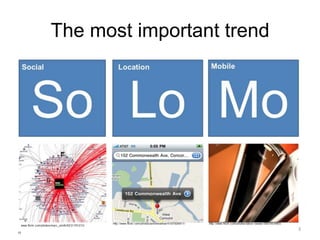
The most important trend


                           3
4
Context-aware computing


                          5
Suggestions of things to do           Touristy places


        Restaurants           Blog your location as you move
                                                           6
Consumer behaviour


                     7
Sales growing, but penetration peaking


                                     8
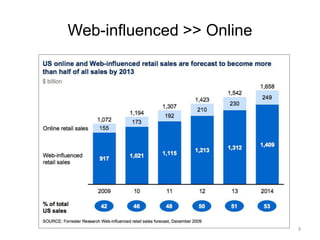
Web-influenced >> Online


                           9
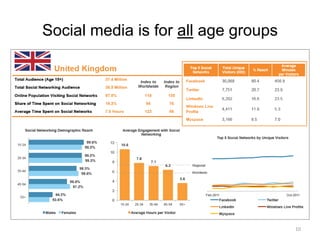
Social media is for all age groups


                                     10
Eroding brand loyalty: deal-chaser nation


                                            11
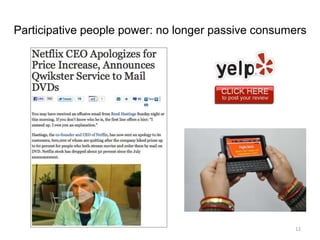
Participative people power: no longer passive consumers


                                                    12
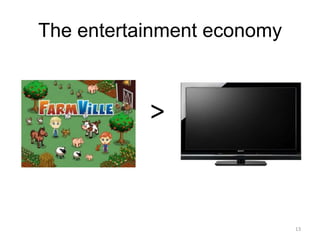
The entertainment economy


           >


                            13
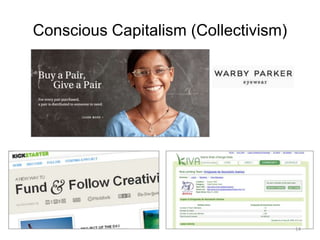
Conscious Capitalism (Collectivism)


                                      14
Industry trends


                  15
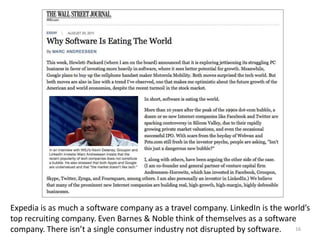
Expedia is as much a software company as a travel company. LinkedIn is the world’s
top recruiting company. Even Barnes & Noble think of themselves as a software
company. There isn’t a single consumer industry not disrupted by software.   16
The rich get richer
• In Dec 2011, big online retailers grew 19% but
  smaller ones grew only 7%

• Bigboxification: Amazon in 2011 = Walmart in
  1971

• Paretto’s law: the 25 biggest online retailers
  account for 75% of all revenue
                                                   17
But also death by a thousand piranhas


The largest travel site, Expedia.com is under siege from smaller, nimbler specialists
                                                                                18
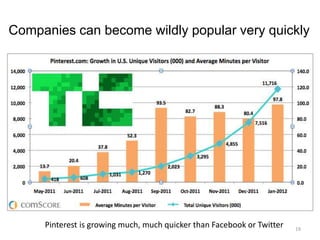
Companies can become wildly popular very quickly


     Pinterest is growing much, much quicker than Facebook or Twitter   19
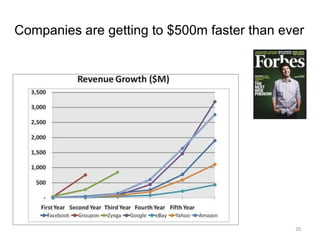
Companies are getting to $500m faster than ever


                                             20
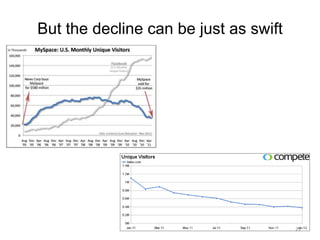
But the decline can be just as swift


                                       21
eCommerce doesn’t create many
jobs, leading to interesting social
         consequences


                                      22
A “mobile first” world


                         23
The internet of things


                         24
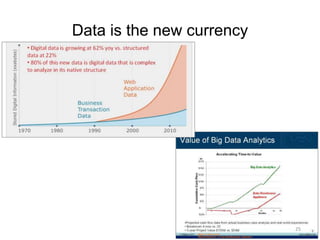
Data is the new currency


                           25
The crowds are often wiser than the experts

                                              26
Freemium finally gets its poster child


Dropbox made $210m in 2011 with 70 employees, though
       96% of its 50m users don’t pay anything.
                                                 27
Seductive experiences on iPad


                                28
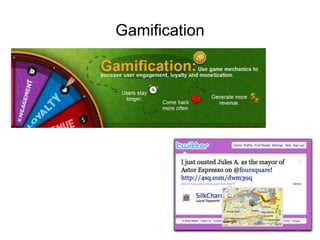
Gamification


               29
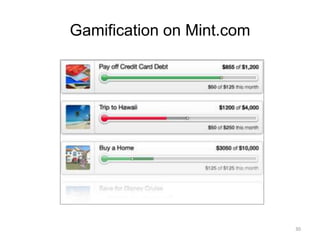
Gamification on Mint.com


                           30
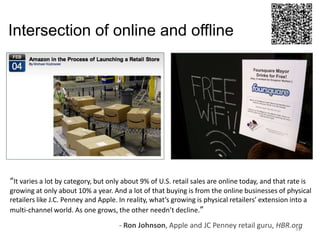
Intersection of online and offline


“It varies a lot by category, but only about 9% of U.S. retail sales are online today, and that rate is
growing at only about 10% a year. And a lot of that buying is from the online businesses of physical
retailers like J.C. Penney and Apple. In reality, what’s growing is physical retailers’ extension into a
multi-channel world. As one grows, the other needn’t decline.”

                                      - Ron Johnson, Apple and JC Penney retail guru, HBR.org
                                                                                           31
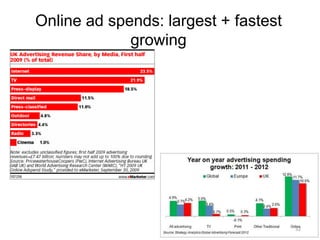
Online ad spends: largest + fastest
             growing


                                      32
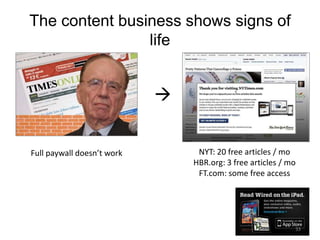
The content business shows signs of
                life


                            


Full paywall doesn’t work        NYT: 20 free articles / mo
                                HBR.org: 3 free articles / mo
                                 FT.com: some free access


                                                            33
Product design


                 34
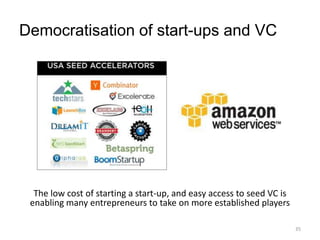
Democratisation of start-ups and VC


  The low cost of starting a start-up, and easy access to seed VC is
 enabling many entrepreneurs to take on more established players

                                                                       35
Well-designed, simple, low-friction products


          Don’t do everything under the sun!   36
Customer Experience: front and centre


                                    37
38
Light-weight business models


 What good is building it fast and reliably, if you are
            building the wrong thing?

                                                          39
Staggered roll-outs of Facebook Timeline
                                                         Worldwide roll-out: Dec 15, ’11
 Announcement: Sep ’11
   (feedback and redesign)


                             NZ roll-out: Dec 5, ’11
                               (feedback and redesign)


                                                                                     40
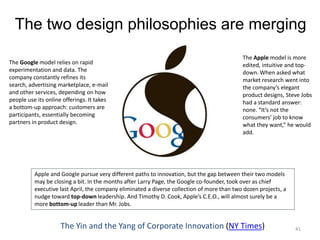
The two design philosophies are merging
                                                                                            The Apple model is more
The Google model relies on rapid                                                            edited, intuitive and top-
experimentation and data. The                                                               down. When asked what
company constantly refines its                                                              market research went into
search, advertising marketplace, e-mail                                                     the company’s elegant
and other services, depending on how                                                        product designs, Steve Jobs
people use its online offerings. It takes                                                   had a standard answer:
a bottom-up approach: customers are                                                         none. “It’s not the
participants, essentially becoming                                                          consumers’ job to know
partners in product design.                                                                 what they want,” he would
                                                                                            add.


          Apple and Google pursue very different paths to innovation, but the gap between their two models
          may be closing a bit. In the months after Larry Page, the Google co-founder, took over as chief
          executive last April, the company eliminated a diverse collection of more than two dozen projects, a
          nudge toward top-down leadership. And Timothy D. Cook, Apple’s C.E.O., will almost surely be a
          more bottom-up leader than Mr. Jobs.


                     The Yin and the Yang of Corporate Innovation (NY Times)                                     41
Globalisation


                42
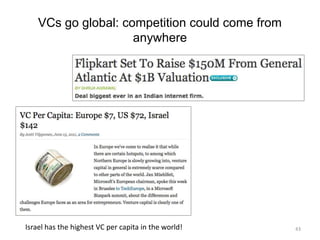
VCs go global: competition could come from
                     anywhere


Israel has the highest VC per capita in the world!   43
Globalisation (per Forrester)

• International shipping will be commonplace
• More brands will sell direct in international
  markets
• Companies will leverage their domestic
  infrastructure before going fully global
• BRIC will still be the acronym, but CBIR
  (China, Brasil, India, Russia) will be the order
                                                     44
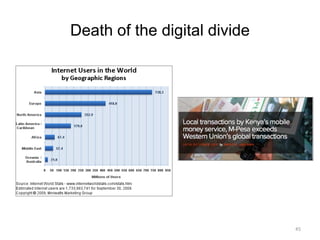
Death of the digital divide


                              45
eCommerce is global


                      46
Frugal innovation: simple interfaces in
         emerging economies


                                          47
Workplace changes


                    48
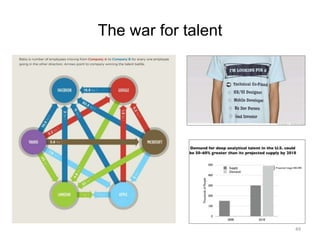
The war for talent


                     49
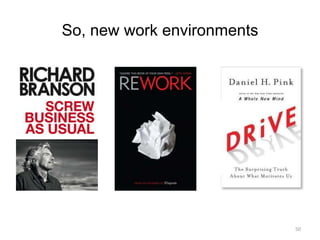
So, new work environments


                            50
Mainstreaming of the hacker ethic


       Zuckerburg in the IPO filing

      Move fast and break things
        Code wins arguments
      Done is better than perfect
                                      51
Technology


             52
Emergent business models:
“plan-do” to “envision-experiment”


                                     53
Technical Practices


                      54
The platform wars


The huge tech companies want to own the full ecosystem: Amazon makes
    hardware, Apple wants to sell books, and Google buys Motorola   55
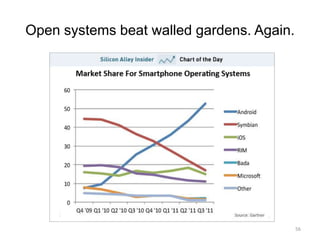
Open systems beat walled gardens. Again.


                                           56
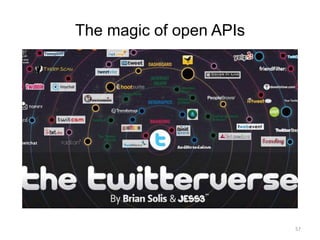
The magic of open APIs


                         57
Big Data Ecosystem


                     58
The retail technology landscape


                                  59
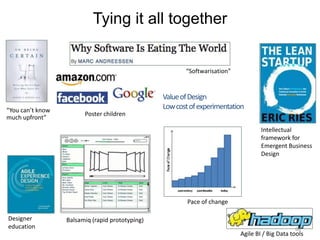
Tying it all together


                                                        “Softwarisation”


                                                 Value of Design
“You can’t know
                                                 Low cost of experimentation
                        Poster children
much upfront”
                                                                                   Intellectual
                                                                                   framework for
                                                                                   Emergent Business
                                                                                   Design


                                                         Pace of change

Designer          Balsamiq (rapid prototyping)
education                                                                                       60
                                                                           Agile BI / Big Data tools
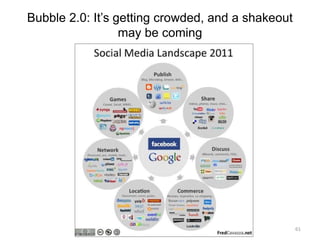
Bubble 2.0: It’s getting crowded, and a shakeout
                  may be coming


                                                   61
Implications for leaders

• Adaptive leadership
• “Plan-do” to “Envision-experiment”
• Hire smart people. Set the vision and leave
  them alone
• Get comfortable with ambiguity
• Lean what tech can do
• Rewire companies to

                                                62
Appendix: SoLoMo by the numbers


                                  63
Thank you


            67

eCommerce trends (Mar '12)

  • 1.
    SoLoMo and beyond eCommerce Trends Mar 2012 1
  • 2.
    Agenda • The most important trend… • Consumer behaviour patterns • Trends in the eCommerce industry • Product design • Globalisation • Workplace changes • Tech trends • Implications for management 2
  • 3.
  • 4.
  • 5.
  • 6.
    Suggestions of thingsto do Touristy places Restaurants Blog your location as you move 6
  • 7.
  • 8.
    Sales growing, butpenetration peaking 8
  • 9.
  • 10.
    Social media isfor all age groups 10
  • 11.
    Eroding brand loyalty:deal-chaser nation 11
  • 12.
    Participative people power:no longer passive consumers 12
  • 13.
  • 14.
  • 15.
  • 16.
    Expedia is asmuch a software company as a travel company. LinkedIn is the world’s top recruiting company. Even Barnes & Noble think of themselves as a software company. There isn’t a single consumer industry not disrupted by software. 16
  • 17.
    The rich getricher • In Dec 2011, big online retailers grew 19% but smaller ones grew only 7% • Bigboxification: Amazon in 2011 = Walmart in 1971 • Paretto’s law: the 25 biggest online retailers account for 75% of all revenue 17
  • 18.
    But also deathby a thousand piranhas The largest travel site, Expedia.com is under siege from smaller, nimbler specialists 18
  • 19.
    Companies can becomewildly popular very quickly Pinterest is growing much, much quicker than Facebook or Twitter 19
  • 20.
    Companies are gettingto $500m faster than ever 20
  • 21.
    But the declinecan be just as swift 21
  • 22.
    eCommerce doesn’t createmany jobs, leading to interesting social consequences 22
  • 23.
  • 24.
    The internet ofthings 24
  • 25.
    Data is thenew currency 25
  • 26.
    The crowds areoften wiser than the experts 26
  • 27.
    Freemium finally getsits poster child Dropbox made $210m in 2011 with 70 employees, though 96% of its 50m users don’t pay anything. 27
  • 28.
  • 29.
  • 30.
  • 31.
    Intersection of onlineand offline “It varies a lot by category, but only about 9% of U.S. retail sales are online today, and that rate is growing at only about 10% a year. And a lot of that buying is from the online businesses of physical retailers like J.C. Penney and Apple. In reality, what’s growing is physical retailers’ extension into a multi-channel world. As one grows, the other needn’t decline.” - Ron Johnson, Apple and JC Penney retail guru, HBR.org 31
  • 32.
    Online ad spends:largest + fastest growing 32
  • 33.
    The content businessshows signs of life  Full paywall doesn’t work NYT: 20 free articles / mo HBR.org: 3 free articles / mo FT.com: some free access 33
  • 34.
  • 35.
    Democratisation of start-upsand VC The low cost of starting a start-up, and easy access to seed VC is enabling many entrepreneurs to take on more established players 35
  • 36.
    Well-designed, simple, low-frictionproducts Don’t do everything under the sun! 36
  • 37.
  • 38.
  • 39.
    Light-weight business models What good is building it fast and reliably, if you are building the wrong thing? 39
  • 40.
    Staggered roll-outs ofFacebook Timeline Worldwide roll-out: Dec 15, ’11 Announcement: Sep ’11 (feedback and redesign) NZ roll-out: Dec 5, ’11 (feedback and redesign) 40
  • 41.
    The two designphilosophies are merging The Apple model is more The Google model relies on rapid edited, intuitive and top- experimentation and data. The down. When asked what company constantly refines its market research went into search, advertising marketplace, e-mail the company’s elegant and other services, depending on how product designs, Steve Jobs people use its online offerings. It takes had a standard answer: a bottom-up approach: customers are none. “It’s not the participants, essentially becoming consumers’ job to know partners in product design. what they want,” he would add. Apple and Google pursue very different paths to innovation, but the gap between their two models may be closing a bit. In the months after Larry Page, the Google co-founder, took over as chief executive last April, the company eliminated a diverse collection of more than two dozen projects, a nudge toward top-down leadership. And Timothy D. Cook, Apple’s C.E.O., will almost surely be a more bottom-up leader than Mr. Jobs. The Yin and the Yang of Corporate Innovation (NY Times) 41
  • 42.
  • 43.
    VCs go global:competition could come from anywhere Israel has the highest VC per capita in the world! 43
  • 44.
    Globalisation (per Forrester) •International shipping will be commonplace • More brands will sell direct in international markets • Companies will leverage their domestic infrastructure before going fully global • BRIC will still be the acronym, but CBIR (China, Brasil, India, Russia) will be the order 44
  • 45.
    Death of thedigital divide 45
  • 46.
  • 47.
    Frugal innovation: simpleinterfaces in emerging economies 47
  • 48.
  • 49.
    The war fortalent 49
  • 50.
    So, new workenvironments 50
  • 51.
    Mainstreaming of thehacker ethic Zuckerburg in the IPO filing Move fast and break things Code wins arguments Done is better than perfect 51
  • 52.
  • 53.
    Emergent business models: “plan-do”to “envision-experiment” 53
  • 54.
  • 55.
    The platform wars Thehuge tech companies want to own the full ecosystem: Amazon makes hardware, Apple wants to sell books, and Google buys Motorola 55
  • 56.
    Open systems beatwalled gardens. Again. 56
  • 57.
    The magic ofopen APIs 57
  • 58.
  • 59.
  • 60.
    Tying it alltogether “Softwarisation” Value of Design “You can’t know Low cost of experimentation Poster children much upfront” Intellectual framework for Emergent Business Design Pace of change Designer Balsamiq (rapid prototyping) education 60 Agile BI / Big Data tools
  • 61.
    Bubble 2.0: It’sgetting crowded, and a shakeout may be coming 61
  • 62.
    Implications for leaders •Adaptive leadership • “Plan-do” to “Envision-experiment” • Hire smart people. Set the vision and leave them alone • Get comfortable with ambiguity • Lean what tech can do • Rewire companies to 62
  • 63.
    Appendix: SoLoMo bythe numbers 63
  • 67.