

Integrated Rural and Agricultural Development
Association (IRADA), Satara
Online Training on
“Advanced Irrigation and Precision Agriculture”
Primary Data Requirement for Irrigation and it's
Impact
by
Er. A. N. Gaupale
M. Tech. (Irrigation and Drainage Engineering)
Integrated Rural and Agricultural Development Association (IRADA), Satara
•
Advanced Irrigation and Precision Agriculture 2
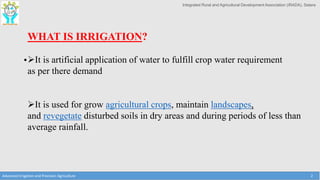
WHAT IS IRRIGATION?
It is artificial application of water to fulfill crop water requirement
as per there demand
It is used for grow agricultural crops, maintain landscapes,
and revegetate disturbed soils in dry areas and during periods of less than
average rainfall.
Integrated Rural and Agricultural Development Association (IRADA), Satara
Advanced Irrigation and Precision Agriculture 3
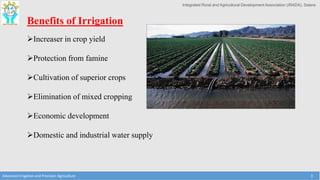
Benefits of Irrigation
Increaser in crop yield
Protection from famine
Cultivation of superior crops
Elimination of mixed cropping
Economic development
Domestic and industrial water supply
Integrated Rural and Agricultural Development Association (IRADA), Satara
Advanced Irrigation and Precision Agriculture 4
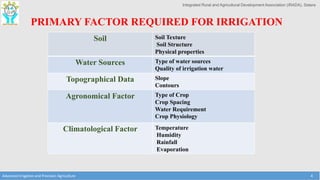
PRIMARY FACTOR REQUIRED FOR IRRIGATION
Soil Soil Texture
Soil Structure
Physical properties
Water Sources Type of water sources
Quality of irrigation water
Topographical Data Slope
Contours
Agronomical Factor Type of Crop
Crop Spacing
Water Requirement
Crop Physiology
Climatological Factor Temperature
Humidity
Rainfall
Evaporation
Integrated Rural and Agricultural Development Association (IRADA), Satara
Advanced Irrigation and Precision Agriculture 5
SOIL
It is upper most weathered disintegrate layer of the earth
composed of several minerals and organic matters.
To an Agriculturist, it means loose material laying on earth’s
surface formed by disintegration of rocks, which can support
plant life.
To civil Engg., it means all the inorganic material on the
earth’s surface produced by weathering of rocks being either
residual or transported.
Integrated Rural and Agricultural Development Association (IRADA), Satara
Advanced Irrigation and Precision Agriculture 6
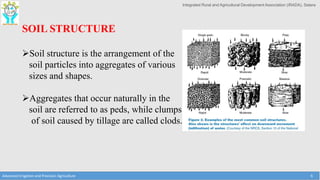
SOIL STRUCTURE
Soil structure is the arrangement of the
soil particles into aggregates of various
sizes and shapes.
Aggregates that occur naturally in the
soil are referred to as peds, while clumps
of soil caused by tillage are called clods.
Integrated Rural and Agricultural Development Association (IRADA), Satara
Advanced Irrigation and Precision Agriculture 7
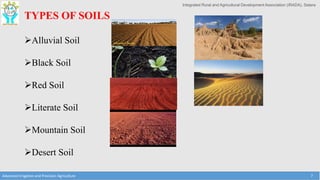
TYPES OF SOILS
Alluvial Soil
Black Soil
Red Soil
Literate Soil
Mountain Soil
Desert Soil
Integrated Rural and Agricultural Development Association (IRADA), Satara
Advanced Irrigation and Precision Agriculture 8
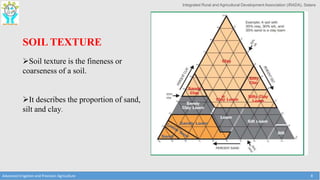
SOIL TEXTURE
Soil texture is the fineness or
coarseness of a soil.
It describes the proportion of sand,
silt and clay.
Integrated Rural and Agricultural Development Association (IRADA), Satara
Advanced Irrigation and Precision Agriculture 9
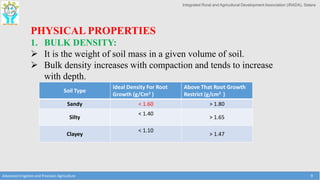
PHYSICAL PROPERTIES
1. BULK DENSITY:
 It is the weight of soil mass in a given volume of soil.
 Bulk density increases with compaction and tends to increase
with depth.
Soil Type
Ideal Density For Root
Growth (g/Cm3 )
Above That Root Growth
Restrict (g/cm3 )
Sandy < 1.60 > 1.80
Silty
< 1.40
> 1.65
Clayey
< 1.10
> 1.47
Integrated Rural and Agricultural Development Association (IRADA), Satara
Advanced Irrigation and Precision Agriculture 10
2. HYDRAULIC CONDUCTIVITY(K)
It is a property of soils and rocks that describes the ease with which a
fluid (usually water) can move through pore spaces or fractures.
It depends on the intrinsic permeability, degree
of saturation, density and viscosity of the fluid.
Integrated Rural and Agricultural Development Association (IRADA), Satara
Advanced Irrigation and Precision Agriculture 11
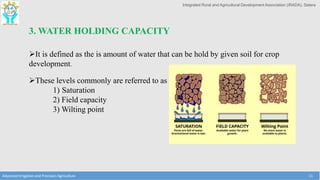
3. WATER HOLDING CAPACITY
It is defined as the is amount of water that can be hold by given soil for crop
development.
These levels commonly are referred to as
1) Saturation
2) Field capacity
3) Wilting point
Integrated Rural and Agricultural Development Association (IRADA), Satara
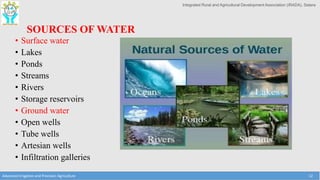
• Surface water
• Lakes
• Ponds
• Streams
• Rivers
• Storage reservoirs
• Ground water
• Open wells
• Tube wells
• Artesian wells
• Infiltration galleries
Advanced Irrigation and Precision Agriculture 12
SOURCES OF WATER
Integrated Rural and Agricultural Development Association (IRADA), Satara
Advanced Irrigation and Precision Agriculture 13
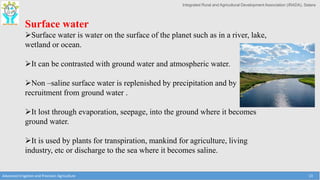
Surface water
Surface water is water on the surface of the planet such as in a river, lake,
wetland or ocean.
It can be contrasted with ground water and atmospheric water.
Non –saline surface water is replenished by precipitation and by
recruitment from ground water .
It lost through evaporation, seepage, into the ground where it becomes
ground water.
It is used by plants for transpiration, mankind for agriculture, living
industry, etc or discharge to the sea where it becomes saline.
Integrated Rural and Agricultural Development Association (IRADA), Satara
Advanced Irrigation and Precision Agriculture 14
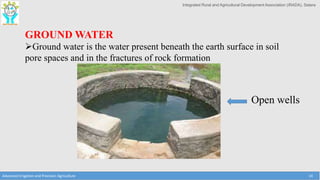
GROUND WATER
Ground water is the water present beneath the earth surface in soil
pore spaces and in the fractures of rock formation
Open wells
Integrated Rural and Agricultural Development Association (IRADA), Satara
Advanced Irrigation and Precision Agriculture 15
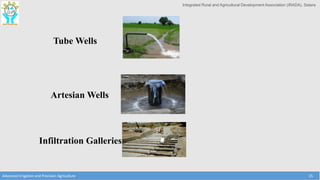
Tube Wells
Artesian Wells
Infiltration Galleries
Integrated Rural and Agricultural Development Association (IRADA), Satara
Advanced Irrigation and Precision Agriculture 16
TOPOGRAPHY
Topographic relief will affect the type of irrigation system, water
conveyance system (ditches or pipes), drainage requirements and water
erosion control practices.
■ Ground Slope
Slope is the incline or gradient of a surface and commonly is expressed in
percents.
Slope is important to soil formation & management because of its
influence on runoff, soil drainage, erosion, use of machinery and choice of
crops.
Integrated Rural and Agricultural Development Association (IRADA), Satara
Advanced Irrigation and Precision Agriculture 17
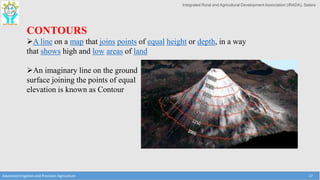
CONTOURS
A line on a map that joins points of equal height or depth, in a way
that shows high and low areas of land
An imaginary line on the ground
surface joining the points of equal
elevation is known as Contour
Integrated Rural and Agricultural Development Association (IRADA), Satara
Advanced Irrigation and Precision Agriculture 18
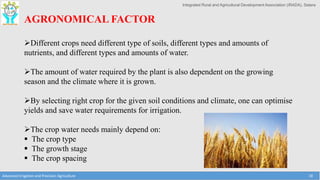
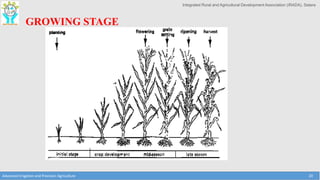
AGRONOMICAL FACTOR
Different crops need different type of soils, different types and amounts of
nutrients, and different types and amounts of water.
The amount of water required by the plant is also dependent on the growing
season and the climate where it is grown.
By selecting right crop for the given soil conditions and climate, one can optimise
yields and save water requirements for irrigation.
The crop water needs mainly depend on:
 The crop type
 The growth stage
 The crop spacing
Integrated Rural and Agricultural Development Association (IRADA), Satara
Advanced Irrigation and Precision Agriculture 19
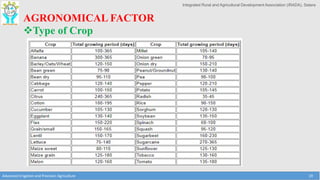
AGRONOMICAL FACTOR
Type of Crop
Integrated Rural and Agricultural Development Association (IRADA), Satara
Advanced Irrigation and Precision Agriculture 20
GROWING STAGE
Integrated Rural and Agricultural Development Association (IRADA), Satara
Advanced Irrigation and Precision Agriculture 21
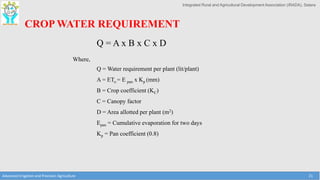
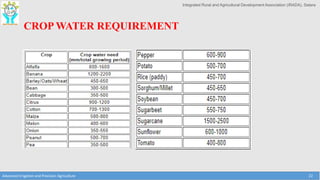
CROP WATER REQUIREMENT
Q = A x B x C x D
Where,
Q = Water requirement per plant (lit/plant)
A = ETo = E pan x Kp (mm)
B = Crop coefficient (KC)
C = Canopy factor
D = Area allotted per plant (m2)
Epan = Cumulative evaporation for two days
Kp = Pan coefficient (0.8)
Integrated Rural and Agricultural Development Association (IRADA), Satara
CROP WATER REQUIREMENT
Advanced Irrigation and Precision Agriculture 22
Integrated Rural and Agricultural Development Association (IRADA), Satara
Advanced Irrigation and Precision Agriculture 23
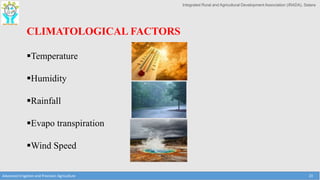
CLIMATOLOGICAL FACTORS
Temperature
Humidity
Rainfall
Evapo transpiration
Wind Speed
Integrated Rural and Agricultural Development Association (IRADA), Satara
Advanced Irrigation and Precision Agriculture 24
SOILAND WATER TESTING
1) Why soil testing?
 19 nutrients are required for crop growth out of these,
16 nutrients are important and 3 nutrients are needed for
specific crops
1) Natural Nutrients: Carbon, Hydrogen, Oxygen
2) Main nutrients: Nitrogen, Phosphorus and Potassium,
3) Secondary Nutrients: Calcium, Magnesium Sulphur
4) Micronutrients: Iron, Chlorine Zinc, Copper, Boron,
Molybdenum and Nickel
Integrated Rural and Agricultural Development Association (IRADA), Satara
Advanced Irrigation and Precision Agriculture 25
FROM WHERE SOIL SAMPLE
COLLECT ?
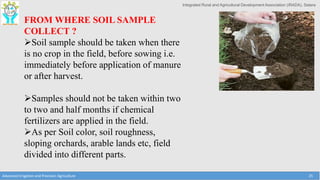
Soil sample should be taken when there
is no crop in the field, before sowing i.e.
immediately before application of manure
or after harvest.
Samples should not be taken within two
to two and half months if chemical
fertilizers are applied in the field.
As per Soil color, soil roughness,
sloping orchards, arable lands etc, field
divided into different parts.
Integrated Rural and Agricultural Development Association (IRADA), Satara
Advanced Irrigation and Precision Agriculture 26
FROM WHERE SOIL SAMPLE COLLECT ?
Living space, manure landfill, swampy area, near
house, farm dam etc. Space should be omitted.
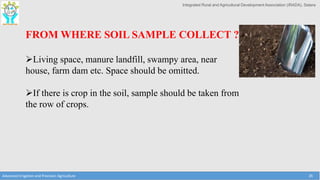
If there is crop in the soil, sample should be taken from
the row of crops.
Integrated Rural and Agricultural Development Association (IRADA), Satara
Advanced Irrigation and Precision Agriculture 27
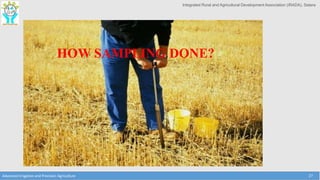
HOW SAMPLING DONE?
Integrated Rural and Agricultural Development Association (IRADA), Satara
Advanced Irrigation and Precision Agriculture 28
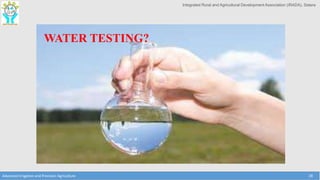
WATER TESTING?
Integrated Rural and Agricultural Development Association (IRADA), Satara
Advanced Irrigation and Precision Agriculture 29
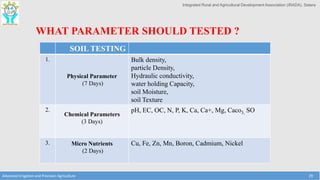
WHAT PARAMETER SHOULD TESTED ?
SOIL TESTING
1.
Physical Parameter
(7 Days)
Bulk density,
particle Density,
Hydraulic conductivity,
water holding Capacity,
soil Moisture,
soil Texture
2.
Chemical Parameters
(3 Days)
pH, EC, OC, N, P, K, Ca, Ca+, Mg, Caco3, SO
3. Micro Nutrients
(2 Days)
Cu, Fe, Zn, Mn, Boron, Cadmium, Nickel
Integrated Rural and Agricultural Development Association (IRADA), Satara
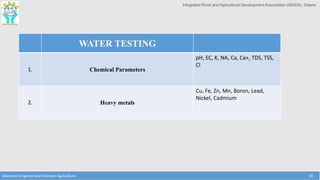
WATER TESTING
1. Chemical Parameters
pH, EC, K, NA, Ca, Ca+, TDS, TSS,
Cl
2. Heavy metals
Cu, Fe, Zn, Mn, Boron, Lead,
Nickel, Cadmium
Advanced Irrigation and Precision Agriculture 30
Integrated Rural and Agricultural Development Association (IRADA), Satara
Advanced Irrigation and Precision Agriculture 31
SOIL HEALTH CARD
Integrated Rural and Agricultural Development Association (IRADA), Satara
Advanced Irrigation and Precision Agriculture 32

Primary data requirement for irrigation methods

  • 1.
    Integrated Rural andAgricultural Development Association (IRADA), Satara Online Training on “Advanced Irrigation and Precision Agriculture” Primary Data Requirement for Irrigation and it's Impact by Er. A. N. Gaupale M. Tech. (Irrigation and Drainage Engineering)
  • 2.
    Integrated Rural andAgricultural Development Association (IRADA), Satara • Advanced Irrigation and Precision Agriculture 2 WHAT IS IRRIGATION? It is artificial application of water to fulfill crop water requirement as per there demand It is used for grow agricultural crops, maintain landscapes, and revegetate disturbed soils in dry areas and during periods of less than average rainfall.
  • 3.
    Integrated Rural andAgricultural Development Association (IRADA), Satara Advanced Irrigation and Precision Agriculture 3 Benefits of Irrigation Increaser in crop yield Protection from famine Cultivation of superior crops Elimination of mixed cropping Economic development Domestic and industrial water supply
  • 4.
    Integrated Rural andAgricultural Development Association (IRADA), Satara Advanced Irrigation and Precision Agriculture 4 PRIMARY FACTOR REQUIRED FOR IRRIGATION Soil Soil Texture Soil Structure Physical properties Water Sources Type of water sources Quality of irrigation water Topographical Data Slope Contours Agronomical Factor Type of Crop Crop Spacing Water Requirement Crop Physiology Climatological Factor Temperature Humidity Rainfall Evaporation
  • 5.
    Integrated Rural andAgricultural Development Association (IRADA), Satara Advanced Irrigation and Precision Agriculture 5 SOIL It is upper most weathered disintegrate layer of the earth composed of several minerals and organic matters. To an Agriculturist, it means loose material laying on earth’s surface formed by disintegration of rocks, which can support plant life. To civil Engg., it means all the inorganic material on the earth’s surface produced by weathering of rocks being either residual or transported.
  • 6.
    Integrated Rural andAgricultural Development Association (IRADA), Satara Advanced Irrigation and Precision Agriculture 6 SOIL STRUCTURE Soil structure is the arrangement of the soil particles into aggregates of various sizes and shapes. Aggregates that occur naturally in the soil are referred to as peds, while clumps of soil caused by tillage are called clods.
  • 7.
    Integrated Rural andAgricultural Development Association (IRADA), Satara Advanced Irrigation and Precision Agriculture 7 TYPES OF SOILS Alluvial Soil Black Soil Red Soil Literate Soil Mountain Soil Desert Soil
  • 8.
    Integrated Rural andAgricultural Development Association (IRADA), Satara Advanced Irrigation and Precision Agriculture 8 SOIL TEXTURE Soil texture is the fineness or coarseness of a soil. It describes the proportion of sand, silt and clay.
  • 9.
    Integrated Rural andAgricultural Development Association (IRADA), Satara Advanced Irrigation and Precision Agriculture 9 PHYSICAL PROPERTIES 1. BULK DENSITY:  It is the weight of soil mass in a given volume of soil.  Bulk density increases with compaction and tends to increase with depth. Soil Type Ideal Density For Root Growth (g/Cm3 ) Above That Root Growth Restrict (g/cm3 ) Sandy < 1.60 > 1.80 Silty < 1.40 > 1.65 Clayey < 1.10 > 1.47
  • 10.
    Integrated Rural andAgricultural Development Association (IRADA), Satara Advanced Irrigation and Precision Agriculture 10 2. HYDRAULIC CONDUCTIVITY(K) It is a property of soils and rocks that describes the ease with which a fluid (usually water) can move through pore spaces or fractures. It depends on the intrinsic permeability, degree of saturation, density and viscosity of the fluid.
  • 11.
    Integrated Rural andAgricultural Development Association (IRADA), Satara Advanced Irrigation and Precision Agriculture 11 3. WATER HOLDING CAPACITY It is defined as the is amount of water that can be hold by given soil for crop development. These levels commonly are referred to as 1) Saturation 2) Field capacity 3) Wilting point
  • 12.
    Integrated Rural andAgricultural Development Association (IRADA), Satara • Surface water • Lakes • Ponds • Streams • Rivers • Storage reservoirs • Ground water • Open wells • Tube wells • Artesian wells • Infiltration galleries Advanced Irrigation and Precision Agriculture 12 SOURCES OF WATER
  • 13.
    Integrated Rural andAgricultural Development Association (IRADA), Satara Advanced Irrigation and Precision Agriculture 13 Surface water Surface water is water on the surface of the planet such as in a river, lake, wetland or ocean. It can be contrasted with ground water and atmospheric water. Non –saline surface water is replenished by precipitation and by recruitment from ground water . It lost through evaporation, seepage, into the ground where it becomes ground water. It is used by plants for transpiration, mankind for agriculture, living industry, etc or discharge to the sea where it becomes saline.
  • 14.
    Integrated Rural andAgricultural Development Association (IRADA), Satara Advanced Irrigation and Precision Agriculture 14 GROUND WATER Ground water is the water present beneath the earth surface in soil pore spaces and in the fractures of rock formation Open wells
  • 15.
    Integrated Rural andAgricultural Development Association (IRADA), Satara Advanced Irrigation and Precision Agriculture 15 Tube Wells Artesian Wells Infiltration Galleries
  • 16.
    Integrated Rural andAgricultural Development Association (IRADA), Satara Advanced Irrigation and Precision Agriculture 16 TOPOGRAPHY Topographic relief will affect the type of irrigation system, water conveyance system (ditches or pipes), drainage requirements and water erosion control practices. ■ Ground Slope Slope is the incline or gradient of a surface and commonly is expressed in percents. Slope is important to soil formation & management because of its influence on runoff, soil drainage, erosion, use of machinery and choice of crops.
  • 17.
    Integrated Rural andAgricultural Development Association (IRADA), Satara Advanced Irrigation and Precision Agriculture 17 CONTOURS A line on a map that joins points of equal height or depth, in a way that shows high and low areas of land An imaginary line on the ground surface joining the points of equal elevation is known as Contour
  • 18.
    Integrated Rural andAgricultural Development Association (IRADA), Satara Advanced Irrigation and Precision Agriculture 18 AGRONOMICAL FACTOR Different crops need different type of soils, different types and amounts of nutrients, and different types and amounts of water. The amount of water required by the plant is also dependent on the growing season and the climate where it is grown. By selecting right crop for the given soil conditions and climate, one can optimise yields and save water requirements for irrigation. The crop water needs mainly depend on:  The crop type  The growth stage  The crop spacing
  • 19.
    Integrated Rural andAgricultural Development Association (IRADA), Satara Advanced Irrigation and Precision Agriculture 19 AGRONOMICAL FACTOR Type of Crop
  • 20.
    Integrated Rural andAgricultural Development Association (IRADA), Satara Advanced Irrigation and Precision Agriculture 20 GROWING STAGE
  • 21.
    Integrated Rural andAgricultural Development Association (IRADA), Satara Advanced Irrigation and Precision Agriculture 21 CROP WATER REQUIREMENT Q = A x B x C x D Where, Q = Water requirement per plant (lit/plant) A = ETo = E pan x Kp (mm) B = Crop coefficient (KC) C = Canopy factor D = Area allotted per plant (m2) Epan = Cumulative evaporation for two days Kp = Pan coefficient (0.8)
  • 22.
    Integrated Rural andAgricultural Development Association (IRADA), Satara CROP WATER REQUIREMENT Advanced Irrigation and Precision Agriculture 22
  • 23.
    Integrated Rural andAgricultural Development Association (IRADA), Satara Advanced Irrigation and Precision Agriculture 23 CLIMATOLOGICAL FACTORS Temperature Humidity Rainfall Evapo transpiration Wind Speed
  • 24.
    Integrated Rural andAgricultural Development Association (IRADA), Satara Advanced Irrigation and Precision Agriculture 24 SOILAND WATER TESTING 1) Why soil testing?  19 nutrients are required for crop growth out of these, 16 nutrients are important and 3 nutrients are needed for specific crops 1) Natural Nutrients: Carbon, Hydrogen, Oxygen 2) Main nutrients: Nitrogen, Phosphorus and Potassium, 3) Secondary Nutrients: Calcium, Magnesium Sulphur 4) Micronutrients: Iron, Chlorine Zinc, Copper, Boron, Molybdenum and Nickel
  • 25.
    Integrated Rural andAgricultural Development Association (IRADA), Satara Advanced Irrigation and Precision Agriculture 25 FROM WHERE SOIL SAMPLE COLLECT ? Soil sample should be taken when there is no crop in the field, before sowing i.e. immediately before application of manure or after harvest. Samples should not be taken within two to two and half months if chemical fertilizers are applied in the field. As per Soil color, soil roughness, sloping orchards, arable lands etc, field divided into different parts.
  • 26.
    Integrated Rural andAgricultural Development Association (IRADA), Satara Advanced Irrigation and Precision Agriculture 26 FROM WHERE SOIL SAMPLE COLLECT ? Living space, manure landfill, swampy area, near house, farm dam etc. Space should be omitted. If there is crop in the soil, sample should be taken from the row of crops.
  • 27.
    Integrated Rural andAgricultural Development Association (IRADA), Satara Advanced Irrigation and Precision Agriculture 27 HOW SAMPLING DONE?
  • 28.
    Integrated Rural andAgricultural Development Association (IRADA), Satara Advanced Irrigation and Precision Agriculture 28 WATER TESTING?
  • 29.
    Integrated Rural andAgricultural Development Association (IRADA), Satara Advanced Irrigation and Precision Agriculture 29 WHAT PARAMETER SHOULD TESTED ? SOIL TESTING 1. Physical Parameter (7 Days) Bulk density, particle Density, Hydraulic conductivity, water holding Capacity, soil Moisture, soil Texture 2. Chemical Parameters (3 Days) pH, EC, OC, N, P, K, Ca, Ca+, Mg, Caco3, SO 3. Micro Nutrients (2 Days) Cu, Fe, Zn, Mn, Boron, Cadmium, Nickel
  • 30.
    Integrated Rural andAgricultural Development Association (IRADA), Satara WATER TESTING 1. Chemical Parameters pH, EC, K, NA, Ca, Ca+, TDS, TSS, Cl 2. Heavy metals Cu, Fe, Zn, Mn, Boron, Lead, Nickel, Cadmium Advanced Irrigation and Precision Agriculture 30
  • 31.
    Integrated Rural andAgricultural Development Association (IRADA), Satara Advanced Irrigation and Precision Agriculture 31 SOIL HEALTH CARD
  • 32.
    Integrated Rural andAgricultural Development Association (IRADA), Satara Advanced Irrigation and Precision Agriculture 32