COURSE SEMINAR
ON
PRESENTS STATUS OF INSECTICIDE RESISTANCE IN INSECTS
Seminar in- charge;
Dr. Umesh Chandra, Asst. professor&
Head of Dept. of Entomology
Dr. Sameer Kumar Singh, Assistant
professor
Dr. Pankaj Singh Assistant professor
Presented by ;
Abhishek Kumar Yadav
ID NO.- A-12251/21
M.Sc. Entomology
Department of Entomology
Acharya Narendra Deva University of Agriculture & Technology
Kumarganj, Ayodhya – 224229(U.P.)
‘A heritable change in the sensitivity of a pest population that is reflected in the repeated
failure of a product to achieve the expected level of control when used according to the
label recommendation for that pest species.
Inheritance is one of the key characteristics of resistance and it generally involves
alterations, mutations or other such aberrations in the genetic makeup of insects
normally involving one or more genes
Insecticide
(WHO, 1957).
The development of an ability in a strain of an organism to tolerate
doses of a toxicant which would prove lethal to the majority of
individuals in a normal (susceptible) population of the species
IRAC
Melander(1914) first documented resistance to insecticides in San José scale
insects (Quadrispidiotus pernicious), which were found alive, under a "crust of
dried spray" of sulphur-lime.
Between 1914 and 1946, another 11 cases of resistance to inorganic pesticides
were reported. In 1947, within a decade of the discovery of insecticidal properties
of DDT, resistance in houseflies was reported.
In India, singhara beetle (Galerucella birmanica) was reported to be the first
agricultural pest to be resistant to BHC and DDT
Later on, flour beetle (Tribolium castaneum) became the first stored grain pest to
be resistant to DDT and Malathion
Historical overview
SOURCE; Melander, A. L. (1914)
1. Oligogenes
2. Polygenes
3. Cytoplasmic
genes
Genetics of Insect Resistance
Insect resistance is governed by -
Manjit S. Kang 2017
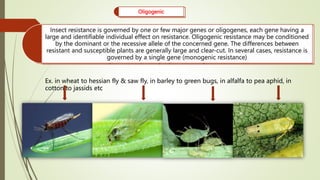
Ex. in wheat to hessian fly & saw fly, in barley to green bugs, in alfalfa to pea aphid, in
cotton to jassids etc
Oligogenic
Insect resistance is governed by one or few major genes or oligogenes, each gene having a
large and identifiable individual effect on resistance. Oligogenic resistance may be conditioned
by the dominant or the recessive allele of the concerned gene. The differences between
resistant and susceptible plants are generally large and clear-cut. In several cases, resistance is
governed by a single gene (monogenic resistance)
Oligogenic
Insect resistance is governed by one or few major genes or oligogenes, each gene having a
large and identifiable individual effect on resistance. Oligogenic resistance may be conditioned
by the dominant or the recessive allele of the concerned gene. The differences between
resistant and susceptible plants are generally large and clear-cut. In several cases, resistance is
governed by a single gene (monogenic resistance)
Oligogenic
Insect resistance is governed by one or few major genes or oligogenes, each gene having a
large and identifiable individual effect on resistance. Oligogenic resistance may be conditioned
by the dominant or the recessive allele of the concerned gene. The differences between
resistant and susceptible plants are generally large and clear-cut. In several cases, resistance is
governed by a single gene (monogenic resistance)
Polygenic Resistance
1) Involve more than one feature of the host plant
2) Are much more durable than the cases of oligogenic resistance.
3) Difference between resistance & susceptible plants are not clear cut
4) Transfer of resistance is much more difficult
It is governed by several genes, each gene producing a small and usually
cumulative effect. Such cases of resistance.
Ex- in rice to stem borer, in cereals
to leaf beetle, etc
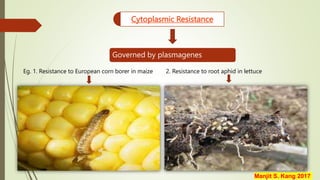
Cytoplasmic Resistance
Eg. 1. Resistance to European corn borer in maize 2. Resistance to root aphid in lettuce
Governed by plasmagenes
Manjit S. Kang 2017
Overexploitation of plant protection agrochemicals has led to significant changes in the
susceptibility status of insects.
This problem is much more evident in agricultural ecosystems where the insect pest populations
are put under the pressure of pesticides much more frequently than in other ecosystems.
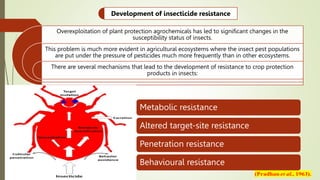
There are several mechanisms that lead to the development of resistance to crop protection
products in insects:
Metabolic resistance
Altered target-site resistance
Penetration resistance
Behavioural resistance
Development of insecticide resistance
Resistant insects may naturally detoxify or destroy the toxin faster than
susceptible insects, or quickly rid their bodies of the toxic molecules.
The main drivers of metabolic resistance are esterase, glutathione S-
transferase (GST), and mixed function oxidase (MFO) enzymes.
Metabolic resistance
The site where the toxin
usually binds in the insect
system may be genetically
modified to reduce the
product’s effects.
Insecticide is not able to bind
properly to the receptors and
is unable to produce the
desired effects in the target
insects.
Example, modified
acetylcholinesterase (mAChE)
in T.urticae is major factor for
resistance to carbamate and
organophosphate insecticides.
Altered target-site resistance
Resistant insects may absorb the toxin slower than susceptible insects.
For example, the decreased penetration of DDT, dieldrin, and permethrin in resistant Musca domestica
populations were due to a gene termed pen (penetration) located on chromosome III.
Penetration resistance
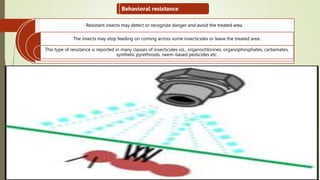
Resistant insects may detect or recognize danger and avoid the treated area.
The insects may stop feeding on coming across some insecticides or leave the treated area.
This type of resistance is reported in many classes of insecticides viz., organochlorines, organophosphates, carbamates,
synthetic pyrethroids, neem-based pesticides etc.
Behavioral resistance
Resistant insects may detect or recognize danger and avoid the treated area.
The insects may stop feeding on coming across some insecticides or leave the treated area.
This type of resistance is reported in many classes of insecticides viz., organochlorines, organophosphates, carbamates,
synthetic pyrethroids, neem-based pesticides etc.
Behavioral resistance
Agricultural pests are under the constant pressure of crop protection chemicals, which is why the resistance
build-up in them is much more prominent.
Two-spotted spider mites (Tetranychus urticae) were considered the most resistant arthropod
Now the diamond-back moth (Plutella xylostella) is the most resistant agricultural pest to insecticides with
980 reported cases of resistance against as much as 101 active ingredients
Among the homopterans, Bemesia tabaci, Myzus persicae, Nilaparvata lugens, Aphis gossypyii, and
Phenacoccus solenopsis are the most resistant pests of agricultural importance.
Resistance of agricultural pests to major groups of insecticides in use The pesticide resistance problem has
now been reported from almost all groups of insecticides.
The most commonly used groups of insecticides viz., organophosphates, carbamates, synthetic pyrethroids,
and neonicotinoids have exhibited resistance development in a large number of insect species
Resistance problem in agricultural
Pradhan, S., Jotwani, M. G. and Sarup, P. (1963).
S.No Order: Family No. of cases No. of Active ingredients
1 American bollworm, Helicoverpa
armigera
Lepidoptera: Noctuidae 879 52
2 Mediterranean climbing cutworm,
Spodoptera litura
Lepidoptera: Noctuidae 690 42
3 Sweet potato whitefly, Bemisia tabaci Homoptera: Aleyrodidae 673 65
4 Diamond-back moth, Plutella xylostella Lepidoptera: Plutellidae 980 101
5 Beet army worm, Spodoptera exigua Lepidoptera: Noctuidae 641 43
6 Two spotted spider mite, Tetranychus
urtica
Acari: Tetranychidae 551 96
7 Pollen beetle, Meligethes aeneus Coleoptera: Nitidulidae 518 27
8 Green peach aphid, Myzus persicae Homoptera: Aphididae 477 81
Top 15 insecticide-resistant agricultural pests
Brown planthopper, Nilaparvata lugens Homoptera:
Delphacidae
445 33
Colorado potato beetle, Leptinotarsa
decemlineata
Coleoptera:
Chrysomelidae
300 56
Melon and cotton aphid, Aphis gossypii Homoptera: Aphididae 283 50
White-backed planthopper, Sogatella
furcifera
Homoptera: Delphacidae 216 15
European red mite, Panonychus ulmi Acari: Tetranychidae 203 48
Cotton mealybug, Phenacoccus solenopsis Homoptera:
Pseudococcidae
199 26
Western flower thrips, Frankliniella
occidentalis
Thysanoptera: Thripidae 175 30
Source: Mota-Sanchez and
Wise (2021
Resistance status of agricultural pests to major groups of insecticides
S. No. Insecticide Group IRAC MoA
Classfication
No. of species
reported to be
resistant
Some important pests
1 Carbamates 1A 81 H. armigera, S. litura, M. persicae,
F. occidentalis, N. lugens
2 Organophosphates 1B 196 M. persicae, H. armigera, S. litura,
L. decemlineata, P. xylostella, T.
urticae
3 Pyrethroids, Pyrethrins 3A 175 B. tabaci, Cydiapomonella,
Eariasvitella, F. occidentalis, H.
armigera, P. xylostella, S. litura, S.
exigua
4 Neonicotinoids 4A 30 A. gossypyii, B. tabaci, M. persicae,
N. lugens, Diaphorinacitri
Source: Mota-Sanchez and Wise (2021
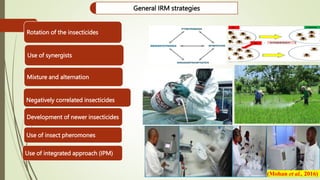
General IRM strategies
Rotation of the insecticides
Use of synergists
Mixture and alternation
Negatively correlated insecticides
Development of newer insecticides
Use of insect pheromones
Use of integrated approach (IPM)
(Mohan et al., 2016)
CASE STUDY OF IRM IN DIFFERENT PESTS
Coleoptera
Lepidoptera
Sucking pests
Vectors
Other pests
SOURCE; IRAC
Coleoptera
POLLEN BEETLE COLORADO POTATO BEETLE
FALL ARMYWORM DIAMOND BACK MOTH
LEPIDOPTERA
SUCKING PESTS
Aphis gossypii
Bemisia tabaci
VECTORS
Anopheles spp Anopheles spp
OTHER PESTS
Musca domestica Cockroach Species
PRESENTS STATUS OF INSECTICIDE RESISTANCE IN INSECTS

PRESENTS STATUS OF INSECTICIDE RESISTANCE IN INSECTS

  • 1.
    COURSE SEMINAR ON PRESENTS STATUSOF INSECTICIDE RESISTANCE IN INSECTS Seminar in- charge; Dr. Umesh Chandra, Asst. professor& Head of Dept. of Entomology Dr. Sameer Kumar Singh, Assistant professor Dr. Pankaj Singh Assistant professor Presented by ; Abhishek Kumar Yadav ID NO.- A-12251/21 M.Sc. Entomology Department of Entomology Acharya Narendra Deva University of Agriculture & Technology Kumarganj, Ayodhya – 224229(U.P.)
  • 2.
    ‘A heritable changein the sensitivity of a pest population that is reflected in the repeated failure of a product to achieve the expected level of control when used according to the label recommendation for that pest species. Inheritance is one of the key characteristics of resistance and it generally involves alterations, mutations or other such aberrations in the genetic makeup of insects normally involving one or more genes Insecticide (WHO, 1957). The development of an ability in a strain of an organism to tolerate doses of a toxicant which would prove lethal to the majority of individuals in a normal (susceptible) population of the species IRAC
  • 3.
    Melander(1914) first documentedresistance to insecticides in San José scale insects (Quadrispidiotus pernicious), which were found alive, under a "crust of dried spray" of sulphur-lime. Between 1914 and 1946, another 11 cases of resistance to inorganic pesticides were reported. In 1947, within a decade of the discovery of insecticidal properties of DDT, resistance in houseflies was reported. In India, singhara beetle (Galerucella birmanica) was reported to be the first agricultural pest to be resistant to BHC and DDT Later on, flour beetle (Tribolium castaneum) became the first stored grain pest to be resistant to DDT and Malathion Historical overview SOURCE; Melander, A. L. (1914)
  • 4.
    1. Oligogenes 2. Polygenes 3.Cytoplasmic genes Genetics of Insect Resistance Insect resistance is governed by - Manjit S. Kang 2017
  • 5.
    Ex. in wheatto hessian fly & saw fly, in barley to green bugs, in alfalfa to pea aphid, in cotton to jassids etc Oligogenic Insect resistance is governed by one or few major genes or oligogenes, each gene having a large and identifiable individual effect on resistance. Oligogenic resistance may be conditioned by the dominant or the recessive allele of the concerned gene. The differences between resistant and susceptible plants are generally large and clear-cut. In several cases, resistance is governed by a single gene (monogenic resistance) Oligogenic Insect resistance is governed by one or few major genes or oligogenes, each gene having a large and identifiable individual effect on resistance. Oligogenic resistance may be conditioned by the dominant or the recessive allele of the concerned gene. The differences between resistant and susceptible plants are generally large and clear-cut. In several cases, resistance is governed by a single gene (monogenic resistance) Oligogenic Insect resistance is governed by one or few major genes or oligogenes, each gene having a large and identifiable individual effect on resistance. Oligogenic resistance may be conditioned by the dominant or the recessive allele of the concerned gene. The differences between resistant and susceptible plants are generally large and clear-cut. In several cases, resistance is governed by a single gene (monogenic resistance)
  • 6.
    Polygenic Resistance 1) Involvemore than one feature of the host plant 2) Are much more durable than the cases of oligogenic resistance. 3) Difference between resistance & susceptible plants are not clear cut 4) Transfer of resistance is much more difficult It is governed by several genes, each gene producing a small and usually cumulative effect. Such cases of resistance. Ex- in rice to stem borer, in cereals to leaf beetle, etc
  • 7.
    Cytoplasmic Resistance Eg. 1.Resistance to European corn borer in maize 2. Resistance to root aphid in lettuce Governed by plasmagenes Manjit S. Kang 2017
  • 8.
    Overexploitation of plantprotection agrochemicals has led to significant changes in the susceptibility status of insects. This problem is much more evident in agricultural ecosystems where the insect pest populations are put under the pressure of pesticides much more frequently than in other ecosystems. There are several mechanisms that lead to the development of resistance to crop protection products in insects: Metabolic resistance Altered target-site resistance Penetration resistance Behavioural resistance Development of insecticide resistance
  • 9.
    Resistant insects maynaturally detoxify or destroy the toxin faster than susceptible insects, or quickly rid their bodies of the toxic molecules. The main drivers of metabolic resistance are esterase, glutathione S- transferase (GST), and mixed function oxidase (MFO) enzymes. Metabolic resistance
  • 10.
    The site wherethe toxin usually binds in the insect system may be genetically modified to reduce the product’s effects. Insecticide is not able to bind properly to the receptors and is unable to produce the desired effects in the target insects. Example, modified acetylcholinesterase (mAChE) in T.urticae is major factor for resistance to carbamate and organophosphate insecticides. Altered target-site resistance
  • 11.
    Resistant insects mayabsorb the toxin slower than susceptible insects. For example, the decreased penetration of DDT, dieldrin, and permethrin in resistant Musca domestica populations were due to a gene termed pen (penetration) located on chromosome III. Penetration resistance
  • 12.
    Resistant insects maydetect or recognize danger and avoid the treated area. The insects may stop feeding on coming across some insecticides or leave the treated area. This type of resistance is reported in many classes of insecticides viz., organochlorines, organophosphates, carbamates, synthetic pyrethroids, neem-based pesticides etc. Behavioral resistance Resistant insects may detect or recognize danger and avoid the treated area. The insects may stop feeding on coming across some insecticides or leave the treated area. This type of resistance is reported in many classes of insecticides viz., organochlorines, organophosphates, carbamates, synthetic pyrethroids, neem-based pesticides etc. Behavioral resistance
  • 13.
    Agricultural pests areunder the constant pressure of crop protection chemicals, which is why the resistance build-up in them is much more prominent. Two-spotted spider mites (Tetranychus urticae) were considered the most resistant arthropod Now the diamond-back moth (Plutella xylostella) is the most resistant agricultural pest to insecticides with 980 reported cases of resistance against as much as 101 active ingredients Among the homopterans, Bemesia tabaci, Myzus persicae, Nilaparvata lugens, Aphis gossypyii, and Phenacoccus solenopsis are the most resistant pests of agricultural importance. Resistance of agricultural pests to major groups of insecticides in use The pesticide resistance problem has now been reported from almost all groups of insecticides. The most commonly used groups of insecticides viz., organophosphates, carbamates, synthetic pyrethroids, and neonicotinoids have exhibited resistance development in a large number of insect species Resistance problem in agricultural Pradhan, S., Jotwani, M. G. and Sarup, P. (1963).
  • 14.
    S.No Order: FamilyNo. of cases No. of Active ingredients 1 American bollworm, Helicoverpa armigera Lepidoptera: Noctuidae 879 52 2 Mediterranean climbing cutworm, Spodoptera litura Lepidoptera: Noctuidae 690 42 3 Sweet potato whitefly, Bemisia tabaci Homoptera: Aleyrodidae 673 65 4 Diamond-back moth, Plutella xylostella Lepidoptera: Plutellidae 980 101 5 Beet army worm, Spodoptera exigua Lepidoptera: Noctuidae 641 43 6 Two spotted spider mite, Tetranychus urtica Acari: Tetranychidae 551 96 7 Pollen beetle, Meligethes aeneus Coleoptera: Nitidulidae 518 27 8 Green peach aphid, Myzus persicae Homoptera: Aphididae 477 81 Top 15 insecticide-resistant agricultural pests
  • 15.
    Brown planthopper, Nilaparvatalugens Homoptera: Delphacidae 445 33 Colorado potato beetle, Leptinotarsa decemlineata Coleoptera: Chrysomelidae 300 56 Melon and cotton aphid, Aphis gossypii Homoptera: Aphididae 283 50 White-backed planthopper, Sogatella furcifera Homoptera: Delphacidae 216 15 European red mite, Panonychus ulmi Acari: Tetranychidae 203 48 Cotton mealybug, Phenacoccus solenopsis Homoptera: Pseudococcidae 199 26 Western flower thrips, Frankliniella occidentalis Thysanoptera: Thripidae 175 30 Source: Mota-Sanchez and Wise (2021
  • 16.
    Resistance status ofagricultural pests to major groups of insecticides S. No. Insecticide Group IRAC MoA Classfication No. of species reported to be resistant Some important pests 1 Carbamates 1A 81 H. armigera, S. litura, M. persicae, F. occidentalis, N. lugens 2 Organophosphates 1B 196 M. persicae, H. armigera, S. litura, L. decemlineata, P. xylostella, T. urticae 3 Pyrethroids, Pyrethrins 3A 175 B. tabaci, Cydiapomonella, Eariasvitella, F. occidentalis, H. armigera, P. xylostella, S. litura, S. exigua 4 Neonicotinoids 4A 30 A. gossypyii, B. tabaci, M. persicae, N. lugens, Diaphorinacitri Source: Mota-Sanchez and Wise (2021
  • 17.
    General IRM strategies Rotationof the insecticides Use of synergists Mixture and alternation Negatively correlated insecticides Development of newer insecticides Use of insect pheromones Use of integrated approach (IPM) (Mohan et al., 2016)
  • 18.
    CASE STUDY OFIRM IN DIFFERENT PESTS Coleoptera Lepidoptera Sucking pests Vectors Other pests SOURCE; IRAC
  • 19.
  • 22.
    FALL ARMYWORM DIAMONDBACK MOTH LEPIDOPTERA
  • 25.
  • 28.
  • 31.
    OTHER PESTS Musca domesticaCockroach Species