
Insect Resistance In Sugarcane
Presented To: Dr Asam Riaz
Presented by: Aqib Hussain & Muhammad Irfan Shan
Sr.# : 2 &16
Introduction
• Sugarcane (Saccharum spp.) is one of the important commercial crops cultivated
throughout the world about in 110 countries with a tropical/sub-tropical conditions.
• It is the primary source for manufacturing crystal sugar, which is a predominant
commodity in the global food industry.
• Sugarcane crop remains in field for 12-14 months and is attacked by a large number of
insect pests including tissue borers, grasshoppers and termites and some sucking type
belonging to fulgorids coccids.
• Losses due to these pests are estimated to be around 10% .And these loses can be reduced
by resistance in sugarcane against these insects.
What is Resistance?
• Plant qualities results in a relative less plant damage by insects as
compare to plant without qualities.
Types of Resistance
• Ecological resistance
• Genetic resistance
• Physiological resistance
Mechanisms of host-plant resistance
• Pest and disease resistance is shown in the inherited ability of an organism to
negate the effects, totally or partially, of a pathogen, insect, or other harmful
factor.
• Resistance is shown when symptoms are minimal to none which indicates that the
pest cannot spread, or spreads with difficulty on the host (Ahman, 2006).
• The resistant characteristic of plants is usually a result of morphological and
biochemical attributes of the plant which has an effect on the insect’s behavior and
biology and leads to better survival and production of the plant.
• Induced resistance requires the plant to recognize that there is an invader, which in
turn results in the plant producing proteins or metabolites that are harmful to the
invader (War et al., 2012).
Mechanisms of host-plant resistance
• With induced resistance the plant detects the pest via at least one molecule
produced by the pest.
• Classified and described resistance in terms of direct and indirect defenses.
• Direct defenses are those which instantly impact on herbivores attacking the plant,
such as physical barriers which include thorns, trichomes, waxes, spines, and
• chemical means using secondary plant metabolites or special defense proteins.
• Direct defenses can be both constitutive and inducible.
• Indirect defenses are mediated through other species such as natural enemies of
the insect pest.
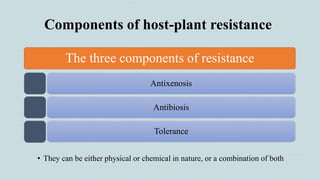
Components of host-plant resistance
• They can be either physical or chemical in nature, or a combination of both
The three components of resistance
Antixenosis
Antibiosis
Tolerance
Antixenosis
• It is a resistant mechanism in plants that can be morphological, physical, or
structural in nature and interferes with the behavioral aspect of insects such as
mating, laying of eggs and the insects feeding.
• It therefore results in the insect avoiding the host plant.
• It could be due to the color, texture of the leaf surface, certain allele-chemicals, or
an interaction between all of these factors in the plant which deters the insect pest
and prevents ovipositing from occurring on the plant.
• Antixenosis has been used in some cases to develop resistant varieties of crops.
Antibiosis
• It adversely affects the biology of an insect which tries to use the plant as a host and can be
physical or chemical in nature.
• Damage to the insect can be severe and often affects the larvae and eggs.
• Insects that survive the effects of antibiosis may be permanently damaged having stunted
growth, slower development processes, and a reduction in fecundity.
• Antibiosis can be attributed to allelochemicals, growth inhibitors, and morphological
factors preventing the attack of the insect.
• Allelochemicals such as glycoalkaloids in potato, γ-tomatine in tomato, gossypol in cotton,
rutin and chlorogenic acid in tomato are harmful to insects that attack such plants.
Antibiosis
• This has been shown for sugarcane that the application of silicon fertilizer resulted in
increased resistance to penetration by E. saccharina (Kvedaras and Keeping, 2007).
• Another important physical attribute of plants involved in pest resistance is leaf
toughness. This characteristic has an effect on insect penetration, preventing their
piercing and sucking mouthparts from damaging plant tissues.
• Leaf toughness is generally regarded as a physical factor. However the chemical
composition of the cell wall contributes to leaf toughness. Other physical attributes of
plants contributing towards insect resistance are shape and color.
Tolerance
• This mechanism allows for normal growth and an increase in plant biomass,
irrespective of the level of insect infestations.
• Painter (1951) defined tolerance as, “a basis of resistance in which the plant
shows an ability to grow and reproduce itself or repair injury to a marked degree
in spite of supporting a population approximately equal to that damaging a
susceptible host”.
• According to Reese et al. (1993), tolerance is the preferred mechanism of
resistance because it does not negatively impact on the natural enemy
populations, whereas antixenosis and antibiosis increase selection pressure on
insect populations, which can lead to the development of more virulent biotypes
and can also, have an adverse effect on control methods.
Role of defense mechanisms in plants against
Insect Pests
There are two types of Defenses
Physical Defenses
Chemical Defenses
Physical Defenses
• The surface of a plant is where organisms first come into contact with the plant in order to
establish themselves with the plant, therefore any alteration / barrier on the surface contribute
towards pest resistance.
• Trichomes or hairs on the surface of plants have been used to give rise to insect resistant varieties
(Peter et al., 1995).
• Trichomes can either be non-glandular, tiny hairs which physically deter insects, or they may be
specialized glandular trichomes, morphological and chemical in nature.
• Recent research also shows that trichomes may be involved in the early detection of pests whereby
the trichomes are disturbed by the presence of moths or larvae and this leads to the plant gaining
awareness of the pest which allows it to respond to the insect attack more quickly.
• The nature of response could be to increase the trichome density on new leaves.
• Epicuticular wax on the surface of leaves may also play a role in protecting plants against insects.
• In addition to preventing the plant from desiccation, they also result in a more slippery surface
which prevents non-specialized insects from inhabiting the plant
Morphological Characters
• Nine morphological characters, namely
(i) leaf width
(ii) length of internodes
(iii) length of vulnerable portion
(iv) width of vulnerable portion
(v) length of stalk,
(vi) colour of leaves
(vii) nature of leaf sheath
(viii) colour of stalk
(ix) nature of leaves
were examined in relation to the percentage of internodes damaged by the
internode borer
Morphological Characters
• Sugarcane white fly
The wiry clones (leaf width less than 2.5 to 3.3 mm) as also broad
leaved clones (leaf width of 12--14 mm) were almost free of the
whitefly attack, whereas the clones of narrow and medium leaf width
(5 to 10 mm) were generally attacked.
• cry1Ac gene integration and endogenous borer stress-related genes
synergistically improve insect resistance in sugarcane
Chemical Defenses
• Chemical factors involved in plant resistance can be used in one of two ways.
• Firstly, chemicals can decrease the nutritional value of the plant as a food source.
• Secondly, they can prevent insects by producing toxins.
• Plant primary metabolism gives rise to carbohydrates, amino acids, and lipids that are
vital nutrients for insects.
• The availability of these nutrients has an effect on the life span, size, productiveness, and
mortality of insects (Howe and Schaller, 2008).
• Secondary metabolites play a vital role in defense mechanisms of plants (i.e.,
antixenosis, antibiosis and tolerance) (Wink, 1988).
• Phenolic compounds are secondary metabolites that are major compounds in plants
(Mazid et al., 2011).
Insect Resistance In Sugarcane

Insect Resistance In Sugarcane

  • 1.
    Insect Resistance InSugarcane Presented To: Dr Asam Riaz Presented by: Aqib Hussain & Muhammad Irfan Shan Sr.# : 2 &16
  • 2.
    Introduction • Sugarcane (Saccharumspp.) is one of the important commercial crops cultivated throughout the world about in 110 countries with a tropical/sub-tropical conditions. • It is the primary source for manufacturing crystal sugar, which is a predominant commodity in the global food industry. • Sugarcane crop remains in field for 12-14 months and is attacked by a large number of insect pests including tissue borers, grasshoppers and termites and some sucking type belonging to fulgorids coccids. • Losses due to these pests are estimated to be around 10% .And these loses can be reduced by resistance in sugarcane against these insects.
  • 3.
    What is Resistance? •Plant qualities results in a relative less plant damage by insects as compare to plant without qualities.
  • 4.
    Types of Resistance •Ecological resistance • Genetic resistance • Physiological resistance
  • 5.
    Mechanisms of host-plantresistance • Pest and disease resistance is shown in the inherited ability of an organism to negate the effects, totally or partially, of a pathogen, insect, or other harmful factor. • Resistance is shown when symptoms are minimal to none which indicates that the pest cannot spread, or spreads with difficulty on the host (Ahman, 2006). • The resistant characteristic of plants is usually a result of morphological and biochemical attributes of the plant which has an effect on the insect’s behavior and biology and leads to better survival and production of the plant. • Induced resistance requires the plant to recognize that there is an invader, which in turn results in the plant producing proteins or metabolites that are harmful to the invader (War et al., 2012).
  • 6.
    Mechanisms of host-plantresistance • With induced resistance the plant detects the pest via at least one molecule produced by the pest. • Classified and described resistance in terms of direct and indirect defenses. • Direct defenses are those which instantly impact on herbivores attacking the plant, such as physical barriers which include thorns, trichomes, waxes, spines, and • chemical means using secondary plant metabolites or special defense proteins. • Direct defenses can be both constitutive and inducible. • Indirect defenses are mediated through other species such as natural enemies of the insect pest.
  • 7.
    Components of host-plantresistance • They can be either physical or chemical in nature, or a combination of both The three components of resistance Antixenosis Antibiosis Tolerance
  • 8.
    Antixenosis • It isa resistant mechanism in plants that can be morphological, physical, or structural in nature and interferes with the behavioral aspect of insects such as mating, laying of eggs and the insects feeding. • It therefore results in the insect avoiding the host plant. • It could be due to the color, texture of the leaf surface, certain allele-chemicals, or an interaction between all of these factors in the plant which deters the insect pest and prevents ovipositing from occurring on the plant. • Antixenosis has been used in some cases to develop resistant varieties of crops.
  • 9.
    Antibiosis • It adverselyaffects the biology of an insect which tries to use the plant as a host and can be physical or chemical in nature. • Damage to the insect can be severe and often affects the larvae and eggs. • Insects that survive the effects of antibiosis may be permanently damaged having stunted growth, slower development processes, and a reduction in fecundity. • Antibiosis can be attributed to allelochemicals, growth inhibitors, and morphological factors preventing the attack of the insect. • Allelochemicals such as glycoalkaloids in potato, γ-tomatine in tomato, gossypol in cotton, rutin and chlorogenic acid in tomato are harmful to insects that attack such plants.
  • 10.
    Antibiosis • This hasbeen shown for sugarcane that the application of silicon fertilizer resulted in increased resistance to penetration by E. saccharina (Kvedaras and Keeping, 2007). • Another important physical attribute of plants involved in pest resistance is leaf toughness. This characteristic has an effect on insect penetration, preventing their piercing and sucking mouthparts from damaging plant tissues. • Leaf toughness is generally regarded as a physical factor. However the chemical composition of the cell wall contributes to leaf toughness. Other physical attributes of plants contributing towards insect resistance are shape and color.
  • 11.
    Tolerance • This mechanismallows for normal growth and an increase in plant biomass, irrespective of the level of insect infestations. • Painter (1951) defined tolerance as, “a basis of resistance in which the plant shows an ability to grow and reproduce itself or repair injury to a marked degree in spite of supporting a population approximately equal to that damaging a susceptible host”. • According to Reese et al. (1993), tolerance is the preferred mechanism of resistance because it does not negatively impact on the natural enemy populations, whereas antixenosis and antibiosis increase selection pressure on insect populations, which can lead to the development of more virulent biotypes and can also, have an adverse effect on control methods.
  • 12.
    Role of defensemechanisms in plants against Insect Pests There are two types of Defenses Physical Defenses Chemical Defenses
  • 13.
    Physical Defenses • Thesurface of a plant is where organisms first come into contact with the plant in order to establish themselves with the plant, therefore any alteration / barrier on the surface contribute towards pest resistance. • Trichomes or hairs on the surface of plants have been used to give rise to insect resistant varieties (Peter et al., 1995). • Trichomes can either be non-glandular, tiny hairs which physically deter insects, or they may be specialized glandular trichomes, morphological and chemical in nature. • Recent research also shows that trichomes may be involved in the early detection of pests whereby the trichomes are disturbed by the presence of moths or larvae and this leads to the plant gaining awareness of the pest which allows it to respond to the insect attack more quickly. • The nature of response could be to increase the trichome density on new leaves. • Epicuticular wax on the surface of leaves may also play a role in protecting plants against insects. • In addition to preventing the plant from desiccation, they also result in a more slippery surface which prevents non-specialized insects from inhabiting the plant
  • 14.
    Morphological Characters • Ninemorphological characters, namely (i) leaf width (ii) length of internodes (iii) length of vulnerable portion (iv) width of vulnerable portion (v) length of stalk, (vi) colour of leaves (vii) nature of leaf sheath (viii) colour of stalk (ix) nature of leaves were examined in relation to the percentage of internodes damaged by the internode borer
  • 15.
    Morphological Characters • Sugarcanewhite fly The wiry clones (leaf width less than 2.5 to 3.3 mm) as also broad leaved clones (leaf width of 12--14 mm) were almost free of the whitefly attack, whereas the clones of narrow and medium leaf width (5 to 10 mm) were generally attacked. • cry1Ac gene integration and endogenous borer stress-related genes synergistically improve insect resistance in sugarcane
  • 16.
    Chemical Defenses • Chemicalfactors involved in plant resistance can be used in one of two ways. • Firstly, chemicals can decrease the nutritional value of the plant as a food source. • Secondly, they can prevent insects by producing toxins. • Plant primary metabolism gives rise to carbohydrates, amino acids, and lipids that are vital nutrients for insects. • The availability of these nutrients has an effect on the life span, size, productiveness, and mortality of insects (Howe and Schaller, 2008). • Secondary metabolites play a vital role in defense mechanisms of plants (i.e., antixenosis, antibiosis and tolerance) (Wink, 1988). • Phenolic compounds are secondary metabolites that are major compounds in plants (Mazid et al., 2011).