LOOKING AT INTERLANGUAGE
PROCESSING
Prepared by Mr. Pheuy Tay
Taught by: Ngo Sitha
Second Language Acquisition Course (CLA)
Cambodian University for Specialties
Contents
i. Introduction
ii. Connectionist/Emergentist models
iii. Processing approaches
iv. Knowledge Types
v. Interface of knowledge types
vi. Psycholinguistic Constructs
vii. Conclusion
I. Introduction
In the field of linguistics, the field of psychology has significantly influenced the
study of SLA. In this chapter, we outline approaches to second language
acquisition with a basis in psycholinguistic processing rather than in the
structure of linguistic products. Emphasis on Psycholinguistic processing: Actual
processing mechanisms.
II. Connectionist/Emergentist models
Connectionism: A cover term that includes a number of network architecture.
- PDP: Parallel Distributed Processing : At the heart of PDP is a neural network that
is generally biologically inspired in nature.
- Within connectionism, pathways are strengthened or weakened through activation
or use.
- Learning takes place as the network (i.e., the learner) is able to make
associations, and associations come through exposure to repeated patterns. The
more often an association is made, the stronger that association becomes.
III. Processing approaches
Processing mechanisms
• Capacities of the human brain
• How they operate when dealing L2
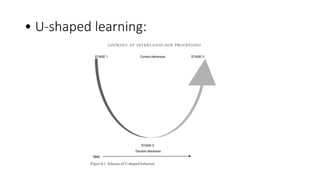
• Information processing: automaticity, restructuring,
and U-shaped learning.
• Input Processing
+ Information processing: automaticity,
restructuring, and U-shaped learning
• Assumption of Automaticity and Restructuring:
- Human beings have a limited capacity for processing.
• Automaticity: To control over one’s linguistic knowledge. One must
bring together a number of skills from perceptual, cognitive and social
domains.
• Restructuring:
- The changes made to internalized representations as a result of new
learning.
- Additional information which must be organized and structured.
• U-shaped learning:
IV. Knowledge Types
Acquisition – Learning - Acquisition:
1. Subconscious process
2. “feel” and “sound” for correctness and grammatical sentences.
- Learning:
1. Conscious knowledge.
2. Being able to talk about the rules.
1. Declarative/procedural
- Declarative: Declarative memory underlies learning and storage of
facts. (e.g. Newfoundland dogs are generally black)
- Procedural: To motor and cognitive skills that involve sequencing
information.
2. Implicit/explicit
- Implicit:
1. Acquisition of knowledge about input.
2. naturally, simply and unconscious of complex, structure processing.
- Explicit: Conscious operation.
V. Interface of knowledge types
- No interface
- Weak interface
We only think about what we said when we stumble.
-Strong interface
Practice is necessary to ensure that particular behaviors are quick, and with
diminished attention paid to the particular task.
VI. Psycholinguistic Constructs
Attention
- The concentration of the mental powers upon an object.
- Major component: Detection
- From the perspective of its differential role on different parts of the grammar
(lexicon, morphosyntax, syntax.
VI. Psycholinguistic Constructs (Cont.)
Working memory
• The structures and processes that humans use to store and manipulate
information.
• E.g. When you want to remember a phone number and you do not have pen
and paper to write it down, you will repeat the number over and over until you
can get to a phone to dial the number or can find pen and paper to write it
down.
VI. Psycholinguistic Constructs (Cont.)
Monitoring
• Acquisition and learning in second language production.
• Three conditions:
1.Time
2. Focus on form
3. Know the rule
- Self-correction is the result of monitoring.
VII. Conclusion
Psycholinguistic approaches to the study of SLA:
• L2 learners organize their SL knowledge
• How learner use L2 knowledge
• How subsequent learning affects the restructured organization of L2
knowledge
• Suggestion: move to social and contextual variables
LOOKING AT INTERLANGUAGE.pptx

LOOKING AT INTERLANGUAGE.pptx

  • 1.
    LOOKING AT INTERLANGUAGE PROCESSING Preparedby Mr. Pheuy Tay Taught by: Ngo Sitha Second Language Acquisition Course (CLA) Cambodian University for Specialties
  • 2.
    Contents i. Introduction ii. Connectionist/Emergentistmodels iii. Processing approaches iv. Knowledge Types v. Interface of knowledge types vi. Psycholinguistic Constructs vii. Conclusion
  • 3.
    I. Introduction In thefield of linguistics, the field of psychology has significantly influenced the study of SLA. In this chapter, we outline approaches to second language acquisition with a basis in psycholinguistic processing rather than in the structure of linguistic products. Emphasis on Psycholinguistic processing: Actual processing mechanisms.
  • 4.
    II. Connectionist/Emergentist models Connectionism:A cover term that includes a number of network architecture. - PDP: Parallel Distributed Processing : At the heart of PDP is a neural network that is generally biologically inspired in nature. - Within connectionism, pathways are strengthened or weakened through activation or use. - Learning takes place as the network (i.e., the learner) is able to make associations, and associations come through exposure to repeated patterns. The more often an association is made, the stronger that association becomes.
  • 5.
    III. Processing approaches Processingmechanisms • Capacities of the human brain • How they operate when dealing L2 • Information processing: automaticity, restructuring, and U-shaped learning. • Input Processing
  • 6.
    + Information processing:automaticity, restructuring, and U-shaped learning • Assumption of Automaticity and Restructuring: - Human beings have a limited capacity for processing. • Automaticity: To control over one’s linguistic knowledge. One must bring together a number of skills from perceptual, cognitive and social domains. • Restructuring: - The changes made to internalized representations as a result of new learning. - Additional information which must be organized and structured.
  • 7.
  • 8.
    IV. Knowledge Types Acquisition– Learning - Acquisition: 1. Subconscious process 2. “feel” and “sound” for correctness and grammatical sentences. - Learning: 1. Conscious knowledge. 2. Being able to talk about the rules.
  • 9.
    1. Declarative/procedural - Declarative:Declarative memory underlies learning and storage of facts. (e.g. Newfoundland dogs are generally black) - Procedural: To motor and cognitive skills that involve sequencing information.
  • 10.
    2. Implicit/explicit - Implicit: 1.Acquisition of knowledge about input. 2. naturally, simply and unconscious of complex, structure processing. - Explicit: Conscious operation.
  • 11.
    V. Interface ofknowledge types - No interface - Weak interface We only think about what we said when we stumble. -Strong interface Practice is necessary to ensure that particular behaviors are quick, and with diminished attention paid to the particular task.
  • 12.
    VI. Psycholinguistic Constructs Attention -The concentration of the mental powers upon an object. - Major component: Detection - From the perspective of its differential role on different parts of the grammar (lexicon, morphosyntax, syntax.
  • 13.
    VI. Psycholinguistic Constructs(Cont.) Working memory • The structures and processes that humans use to store and manipulate information. • E.g. When you want to remember a phone number and you do not have pen and paper to write it down, you will repeat the number over and over until you can get to a phone to dial the number or can find pen and paper to write it down.
  • 14.
    VI. Psycholinguistic Constructs(Cont.) Monitoring • Acquisition and learning in second language production. • Three conditions: 1.Time 2. Focus on form 3. Know the rule - Self-correction is the result of monitoring.
  • 15.
    VII. Conclusion Psycholinguistic approachesto the study of SLA: • L2 learners organize their SL knowledge • How learner use L2 knowledge • How subsequent learning affects the restructured organization of L2 knowledge • Suggestion: move to social and contextual variables