The Innovator’s Journey:
Pathways to Data Dexterity
State Street 2014 Data and Analytics Survey
Asset Owners Insights
March 2015
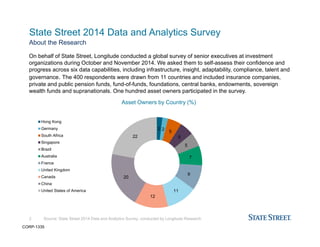
2 2 5
5
5
7
9
11
12
20
22
Hong Kong
Germany
South Africa
Singapore
Brazil
Australia
France
United Kingdom
Canada
China
United States of America
Source: State Street 2014 Data and Analytics Survey, conducted by Longitude Research
State Street 2014 Data and Analytics Survey
2
About the Research
Asset Owners by Country (%)
On behalf of State Street, Longitude conducted a global survey of senior executives at investment
organizations during October and November 2014. We asked them to self-assess their confidence and
progress across six data capabilities, including infrastructure, insight, adaptability, compliance, talent and
governance. The 400 respondents were drawn from 11 countries and included insurance companies,
private and public pension funds, fund-of-funds, foundations, central banks, endowments, sovereign
wealth funds and supranationals. One hundred asset owners participated in the survey.
CORP-1335
Source: State Street 2014 Data and Analytics Survey, conducted by Longitude Research
Our Analysis Identifies Three Groups of Asset Owners at
Different Stages in the Data Journey
3
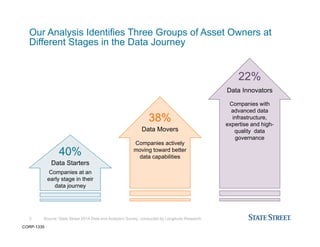
Data Starters
Companies at an
early stage in their
data journey
Data Movers
Companies actively
moving toward better
data capabilities
Data Innovators
Companies with
advanced data
infrastructure,
expertise and high-
quality data
governance
40%
38%
22%
CORP-1335
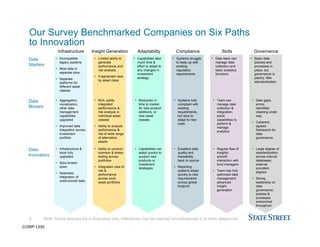
Data
Starters
Data
Movers
Data
Innovators
Infrastructure
• Incompatible
legacy systems
• Most data in
separate silos
• Separate
platforms for
different asset
classes
• Aggregation,
visualization,
other data
management
capabilities
upgraded
• Improved data
integration across
investment
portfolio
• Infrastructure &
tools fully
upgraded
• Silos broken
down
• Seamless
integration of
unstructured data
Insight Generation
• Limited ability to
generate
performance and
risk analysis
• Fragmented view
by asset class
• Ability to conduct
scenario & stress
testing across
portfolios
• Integrated view of
risk &
performance
across multi-
asset portfolios
Adaptability
• Capabilities take
much time &
effort to adapt to
any changes in
investment
strategy
• Capabilities can
adapt quickly to
support new
products or
investment
strategies
Compliance
• Systems struggle
to keep up with
existing
regulatory
requirements
Skills
• Data team can
manage data
collection and
basic analytics
functions
Governance
• Basic data
policies and
processes in
place, but
governance is
patchy; little
standardization
• Data gaps,
errors
identified;
cleaning under
way
• Coherent,
agreed
framework for
data
governance
• Reduction in
time to market
for new product
additions, or
new asset
classes
• Systems fully
compliant with
existing
requirements,
but slow to
adapt to new
rules
• Team can
manage data
collection &
integration;
some
capabilities to
perform &
manage
analytics
• Rich, partly
integrated
performance &
risk analysis in
individual asset
classes
• Ability to analyze
performance &
risk of wide range
of alternative
assets
• Excellent data
quality and
traceability
back to source
• Reporting
systems adapt
quickly to new
requirements
across global
footprint
• Regular flow of
insights;
smooth
interaction with
fund managers
• Team has fully
optimized data
management;
advanced
Insight
generation
• Large degree of
standardization
across internal
databases;
external
providers
aligned
• Strong
leadership on
data
governance;
policies &
processes
entrenched
throughout
Note: Above sequencing is illustrative only; milestones may be reached simultaneously or in other sequences.
Our Survey Benchmarked Companies on Six Paths
to Innovation
4
CORP-1335
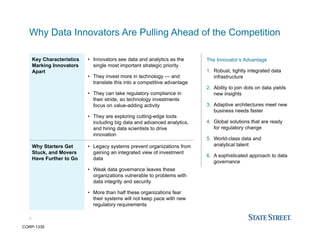
Why Data Innovators Are Pulling Ahead of the Competition
5
The Innovator’s Advantage
1. Robust, tightly integrated data
infrastructure
2. Ability to join dots on data yields
new insights
3. Adaptive architectures meet new
business needs faster
4. Global solutions that are ready
for regulatory change
5. World-class data and
analytical talent
6. A sophisticated approach to data
governance
Key Characteristics
Marking Innovators
Apart
• Innovators see data and analytics as the
single most important strategic priority
• They invest more in technology — and
translate this into a competitive advantage
• They can take regulatory compliance in
their stride, so technology investments
focus on value-adding activity
• They are exploring cutting-edge tools
including big data and advanced analytics,
and hiring data scientists to drive
innovation
Why Starters Get
Stuck, and Movers
Have Further to Go
• Legacy systems prevent organizations from
gaining an integrated view of investment
data
• Weak data governance leaves these
organizations vulnerable to problems with
data integrity and security
• More than half these organizations fear
their systems will not keep pace with new
regulatory requirements
CORP-1335
32
55
45
18
23
59
27
24
16
24
13
11
29
16
5
3
10
5
5
5
0
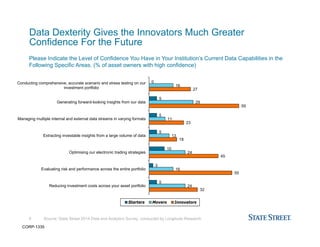
Reducing investment costs across your asset portfolio
Evaluating risk and performance across the entire portfolio
Optimising our electronic trading strategies
Extracting investable insights from a large volume of data
Managing multiple internal and external data streams in varying formats
Generating forward-looking insights from our data
Conducting comprehensive, accurate scenario and stress testing on our
investment portfolio
Starters Movers Innovators
Source: State Street 2014 Data and Analytics Survey, conducted by Longitude Research
Data Dexterity Gives the Innovators Much Greater
Confidence For the Future
6
Please Indicate the Level of Confidence You Have in Your Institution’s Current Data Capabilities in the
Following Specific Areas. (% of asset owners with high confidence)
CORP-1335
Investing in Data
7 Source: State Street 2014 Data and Analytics Survey, conducted by Longitude Research
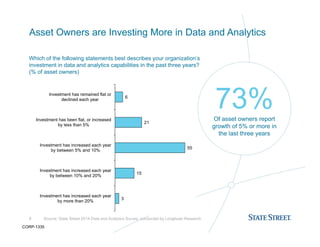
Asset Owners are Investing More in Data and Analytics
8 Source: State Street 2014 Data and Analytics Survey, conducted by Longitude Research
Which of the following statements best describes your organization’s
investment in data and analytics capabilities in the past three years?
(% of asset owners)
73%Of asset owners report
growth of 5% or more in
the last three years
3
15
55
21
6
Investment has increased each year
by more than 20%
Investment has increased each year
by between 10% and 20%
Investment has increased each year
by between 5% and 10%
Investment has been flat, or increased
by less than 5%
Investment has remained flat or
declined each year
CORP-1335
14
23
50
9
5
0
16
68
13
3
0
10
45
35
10
Investment has increased each year by more than
20%
Investment has increased each year by between
10% and 20%
Investment has increased each year by between
5% and 10%
Investment has been flat, or increased by less
than 5%
Investment has remained flat or declined each
year
Starters Movers Innovators
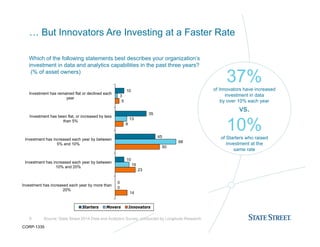
… But Innovators Are Investing at a Faster Rate
9 Source: State Street 2014 Data and Analytics Survey, conducted by Longitude Research
Which of the following statements best describes your organization’s
investment in data and analytics capabilities in the past three years?
(% of asset owners)
37%of Innovators have increased
investment in data
by over 10% each year
vs.
10%of Starters who raised
investment at the
same rate
CORP-1335
Source: State Street 2014 Data and Analytics Survey, conducted by Longitude Research
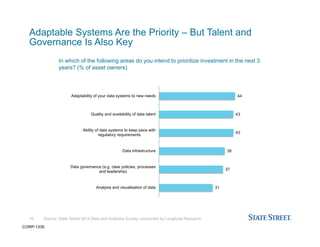
Adaptable Systems Are the Priority – But Talent and
Governance Is Also Key
10
In which of the following areas do you intend to prioritize investment in the next 3
years? (% of asset owners)
31
37
38
43
43
44
Analysis and visualisation of data
Data governance (e.g. clear policies, processes
and leadership)
Data infrastructure
Ability of data systems to keep pace with
regulatory requirements
Quality and availability of data talent
Adaptability of your data systems to new needs
CORP-1335
Source: State Street 2014 Data and Analytics Survey, conducted by Longitude Research
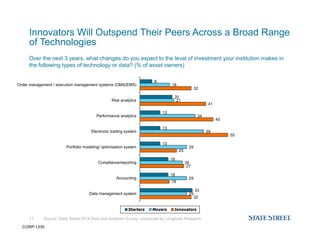
Innovators Will Outspend Their Peers Across a Broad Range
of Technologies
11
Over the next 3 years, what changes do you expect to the level of investment your institution makes in
the following types of technology or data? (% of asset owners)
32
18
27
23
55
45
41
32
29
29
26
29
39
34
21
18
33
18
18
13
13
13
20
8
Data management system
Accounting
Compliance/reporting
Portfolio modeling/ optimisation system
Electronic trading system
Performance analytics
Risk analytics
Order management / execution management systems (OMS/EMS)
Starters Movers Innovators
CORP-1335
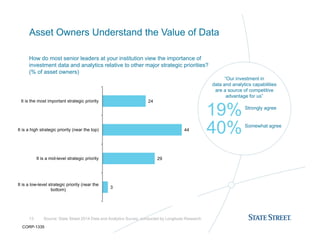
Data Strategy and Challenges
12 Source: State Street 2014 Data and Analytics Survey, conducted by Longitude Research
3
29
44
24
It is a low-level strategic priority (near the
bottom)
It is a mid-level strategic priority
It is a high strategic priority (near the top)
It is the most important strategic priority
Asset Owners Understand the Value of Data
13 Source: State Street 2014 Data and Analytics Survey, conducted by Longitude Research
How do most senior leaders at your institution view the importance of
investment data and analytics relative to other major strategic priorities?
(% of asset owners)
“Our investment in
data and analytics capabilities
are a source of competitive
advantage for us”
19%
40%
Strongly agree
Somewhat agree
CORP-1335
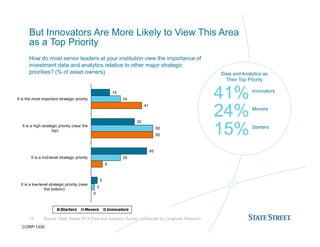
Data and Analytics as
Their Top Priority
But Innovators Are More Likely to View This Area
as a Top Priority
14 Source: State Street 2014 Data and Analytics Survey, conducted by Longitude Research
How do most senior leaders at your institution view the importance of
investment data and analytics relative to other major strategic
priorities? (% of asset owners)
41%
24%
Innovators
Movers
15% Starters
0
9
50
41
3
24
50
24
5
45
35
15
It is a low-level strategic priority (near
the bottom)
It is a mid-level strategic priority
It is a high strategic priority (near the
top)
It is the most important strategic priority
Starters Movers Innovators
CORP-1335
Source: State Street 2014 Data and Analytics Survey, conducted by Longitude Research
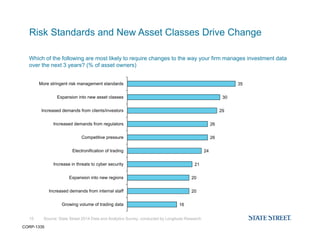
Risk Standards and New Asset Classes Drive Change
15
Which of the following are most likely to require changes to the way your firm manages investment data
over the next 3 years? (% of asset owners)
16
20
20
21
24
26
26
29
30
35
Growing volume of trading data
Increased demands from internal staff
Expansion into new regions
Increase in threats to cyber security
Electronification of trading
Competitive pressure
Increased demands from regulators
Increased demands from clients/investors
Expansion into new asset classes
More stringent risk management standards
CORP-1335
Source: State Street 2014 Data and Analytics Survey, conducted by Longitude Research
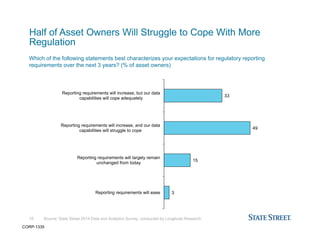
Half of Asset Owners Will Struggle to Cope With More
Regulation
16
55%
Which of the following statements best characterizes your expectations for regulatory reporting
requirements over the next 3 years? (% of asset owners)
3
15
49
33
Reporting requirements will ease
Reporting requirements will largely remain
unchanged from today
Reporting requirements will increase, and our data
capabilities will struggle to cope
Reporting requirements will increase, but our data
capabilities will cope adequately
CORP-1335
Source: State Street 2014 Data and Analytics Survey, conducted by Longitude Research
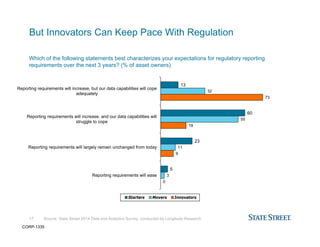
But Innovators Can Keep Pace With Regulation
17
Which of the following statements best characterizes your expectations for regulatory reporting
requirements over the next 3 years? (% of asset owners)
0
9
18
73
3
11
55
32
5
23
60
13
Reporting requirements will ease
Reporting requirements will largely remain unchanged from today
Reporting requirements will increase, and our data capabilities will
struggle to cope
Reporting requirements will increase, but our data capabilities will cope
adequately
Starters Movers Innovators
CORP-1335
Source: State Street 2014 Data and Analytics Survey, conducted by Longitude Research
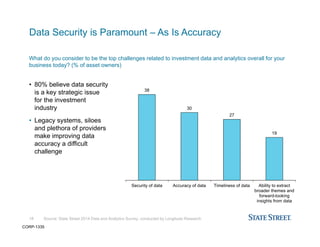
Data Security is Paramount – As Is Accuracy
18
• 80% believe data security
is a key strategic issue
for the investment
industry
• Legacy systems, siloes
and plethora of providers
make improving data
accuracy a difficult
challenge
What do you consider to be the top challenges related to investment data and analytics overall for your
business today? (% of asset owners)
19
27
30
38
Ability to extract
broader themes and
forward-looking
insights from data
Timeliness of dataAccuracy of dataSecurity of data
CORP-1335
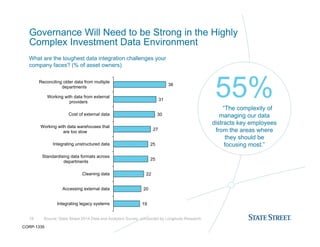
Governance Will Need to be Strong in the Highly
Complex Investment Data Environment
19 Source: State Street 2014 Data and Analytics Survey, conducted by Longitude Research
What are the toughest data integration challenges your
company faces? (% of asset owners)
55%“” “The complexity of
managing our data
distracts key employees
from the areas where
they should be
focusing most.”
19
20
22
25
25
27
30
31
38
Integrating legacy systems
Accessing external data
Cleaning data
Standardising data formats across
departments
Integrating unstructured data
Working with data warehouses that
are too slow
Cost of external data
Working with data from external
providers
Reconciling older data from multiple
departments
CORP-1335
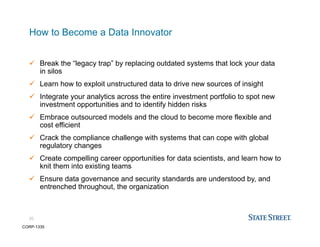
How to Become a Data Innovator
 Break the “legacy trap” by replacing outdated systems that lock your data
in silos
 Learn how to exploit unstructured data to drive new sources of insight
 Integrate your analytics across the entire investment portfolio to spot new
investment opportunities and to identify hidden risks
 Embrace outsourced models and the cloud to become more flexible and
cost efficient
 Crack the compliance challenge with systems that can cope with global
regulatory changes
 Create compelling career opportunities for data scientists, and learn how to
knit them into existing teams
 Ensure data governance and security standards are understood by, and
entrenched throughout, the organization
20
CORP-1335
21
CORP-1335
This document is for marketing and/or informational purposes only, it does not take into account any investor’s particular investment
objectives, strategies or tax and legal status, nor does it purport to be comprehensive or intended to replace the exercise of a client’s
own careful independent review regarding any corresponding investment decision or review of our products and services prior to making
any decision regarding their utilization. This does not constitute investment, legal, or tax advice and is not a solicitation for products or
services or intended to constitute any binding contractual arrangement or commitment by State Street and/or any subsidiary referenced
herein to provide securities services. State Street hereby disclaims all liability, whether arising in contract, tort or otherwise, for any
losses, liabilities, damages, expenses or costs arising, either direct or consequential, from or in connection with the use of this document
and/or the information herein. This document contains certain statements that may be deemed forward-looking statements, which are
based on certain assumptions and analyses made in light of experience and perception of historical trends, current conditions, expected
future developments and other factors believed appropriate in the circumstances.
All information has been obtained from sources believed to be reliable, but its accuracy is not guaranteed. There is no representation or
warranty as to the current accuracy, reliability or completeness of, nor liability for, decisions based on such information and it should not
be relied on as such. The whole or any part of this work may not be reproduced, copied or transmitted or any of its contents disclosed to
third parties without State Street express written consent. Investing involves risk including the risk of loss of principal.
Expiration: March 31, 2016
©2015 State Street Corporation – All Rights Reserved

The Innovator’s Journey: Asset Owners Insights

  • 1.
    The Innovator’s Journey: Pathwaysto Data Dexterity State Street 2014 Data and Analytics Survey Asset Owners Insights March 2015
  • 2.
    2 2 5 5 5 7 9 11 12 20 22 HongKong Germany South Africa Singapore Brazil Australia France United Kingdom Canada China United States of America Source: State Street 2014 Data and Analytics Survey, conducted by Longitude Research State Street 2014 Data and Analytics Survey 2 About the Research Asset Owners by Country (%) On behalf of State Street, Longitude conducted a global survey of senior executives at investment organizations during October and November 2014. We asked them to self-assess their confidence and progress across six data capabilities, including infrastructure, insight, adaptability, compliance, talent and governance. The 400 respondents were drawn from 11 countries and included insurance companies, private and public pension funds, fund-of-funds, foundations, central banks, endowments, sovereign wealth funds and supranationals. One hundred asset owners participated in the survey. CORP-1335
  • 3.
    Source: State Street2014 Data and Analytics Survey, conducted by Longitude Research Our Analysis Identifies Three Groups of Asset Owners at Different Stages in the Data Journey 3 Data Starters Companies at an early stage in their data journey Data Movers Companies actively moving toward better data capabilities Data Innovators Companies with advanced data infrastructure, expertise and high- quality data governance 40% 38% 22% CORP-1335
  • 4.
    Data Starters Data Movers Data Innovators Infrastructure • Incompatible legacy systems •Most data in separate silos • Separate platforms for different asset classes • Aggregation, visualization, other data management capabilities upgraded • Improved data integration across investment portfolio • Infrastructure & tools fully upgraded • Silos broken down • Seamless integration of unstructured data Insight Generation • Limited ability to generate performance and risk analysis • Fragmented view by asset class • Ability to conduct scenario & stress testing across portfolios • Integrated view of risk & performance across multi- asset portfolios Adaptability • Capabilities take much time & effort to adapt to any changes in investment strategy • Capabilities can adapt quickly to support new products or investment strategies Compliance • Systems struggle to keep up with existing regulatory requirements Skills • Data team can manage data collection and basic analytics functions Governance • Basic data policies and processes in place, but governance is patchy; little standardization • Data gaps, errors identified; cleaning under way • Coherent, agreed framework for data governance • Reduction in time to market for new product additions, or new asset classes • Systems fully compliant with existing requirements, but slow to adapt to new rules • Team can manage data collection & integration; some capabilities to perform & manage analytics • Rich, partly integrated performance & risk analysis in individual asset classes • Ability to analyze performance & risk of wide range of alternative assets • Excellent data quality and traceability back to source • Reporting systems adapt quickly to new requirements across global footprint • Regular flow of insights; smooth interaction with fund managers • Team has fully optimized data management; advanced Insight generation • Large degree of standardization across internal databases; external providers aligned • Strong leadership on data governance; policies & processes entrenched throughout Note: Above sequencing is illustrative only; milestones may be reached simultaneously or in other sequences. Our Survey Benchmarked Companies on Six Paths to Innovation 4 CORP-1335
  • 5.
    Why Data InnovatorsAre Pulling Ahead of the Competition 5 The Innovator’s Advantage 1. Robust, tightly integrated data infrastructure 2. Ability to join dots on data yields new insights 3. Adaptive architectures meet new business needs faster 4. Global solutions that are ready for regulatory change 5. World-class data and analytical talent 6. A sophisticated approach to data governance Key Characteristics Marking Innovators Apart • Innovators see data and analytics as the single most important strategic priority • They invest more in technology — and translate this into a competitive advantage • They can take regulatory compliance in their stride, so technology investments focus on value-adding activity • They are exploring cutting-edge tools including big data and advanced analytics, and hiring data scientists to drive innovation Why Starters Get Stuck, and Movers Have Further to Go • Legacy systems prevent organizations from gaining an integrated view of investment data • Weak data governance leaves these organizations vulnerable to problems with data integrity and security • More than half these organizations fear their systems will not keep pace with new regulatory requirements CORP-1335
  • 6.
    32 55 45 18 23 59 27 24 16 24 13 11 29 16 5 3 10 5 5 5 0 Reducing investment costsacross your asset portfolio Evaluating risk and performance across the entire portfolio Optimising our electronic trading strategies Extracting investable insights from a large volume of data Managing multiple internal and external data streams in varying formats Generating forward-looking insights from our data Conducting comprehensive, accurate scenario and stress testing on our investment portfolio Starters Movers Innovators Source: State Street 2014 Data and Analytics Survey, conducted by Longitude Research Data Dexterity Gives the Innovators Much Greater Confidence For the Future 6 Please Indicate the Level of Confidence You Have in Your Institution’s Current Data Capabilities in the Following Specific Areas. (% of asset owners with high confidence) CORP-1335
  • 7.
    Investing in Data 7Source: State Street 2014 Data and Analytics Survey, conducted by Longitude Research
  • 8.
    Asset Owners areInvesting More in Data and Analytics 8 Source: State Street 2014 Data and Analytics Survey, conducted by Longitude Research Which of the following statements best describes your organization’s investment in data and analytics capabilities in the past three years? (% of asset owners) 73%Of asset owners report growth of 5% or more in the last three years 3 15 55 21 6 Investment has increased each year by more than 20% Investment has increased each year by between 10% and 20% Investment has increased each year by between 5% and 10% Investment has been flat, or increased by less than 5% Investment has remained flat or declined each year CORP-1335
  • 9.
    14 23 50 9 5 0 16 68 13 3 0 10 45 35 10 Investment has increasedeach year by more than 20% Investment has increased each year by between 10% and 20% Investment has increased each year by between 5% and 10% Investment has been flat, or increased by less than 5% Investment has remained flat or declined each year Starters Movers Innovators … But Innovators Are Investing at a Faster Rate 9 Source: State Street 2014 Data and Analytics Survey, conducted by Longitude Research Which of the following statements best describes your organization’s investment in data and analytics capabilities in the past three years? (% of asset owners) 37%of Innovators have increased investment in data by over 10% each year vs. 10%of Starters who raised investment at the same rate CORP-1335
  • 10.
    Source: State Street2014 Data and Analytics Survey, conducted by Longitude Research Adaptable Systems Are the Priority – But Talent and Governance Is Also Key 10 In which of the following areas do you intend to prioritize investment in the next 3 years? (% of asset owners) 31 37 38 43 43 44 Analysis and visualisation of data Data governance (e.g. clear policies, processes and leadership) Data infrastructure Ability of data systems to keep pace with regulatory requirements Quality and availability of data talent Adaptability of your data systems to new needs CORP-1335
  • 11.
    Source: State Street2014 Data and Analytics Survey, conducted by Longitude Research Innovators Will Outspend Their Peers Across a Broad Range of Technologies 11 Over the next 3 years, what changes do you expect to the level of investment your institution makes in the following types of technology or data? (% of asset owners) 32 18 27 23 55 45 41 32 29 29 26 29 39 34 21 18 33 18 18 13 13 13 20 8 Data management system Accounting Compliance/reporting Portfolio modeling/ optimisation system Electronic trading system Performance analytics Risk analytics Order management / execution management systems (OMS/EMS) Starters Movers Innovators CORP-1335
  • 12.
    Data Strategy andChallenges 12 Source: State Street 2014 Data and Analytics Survey, conducted by Longitude Research
  • 13.
    3 29 44 24 It is alow-level strategic priority (near the bottom) It is a mid-level strategic priority It is a high strategic priority (near the top) It is the most important strategic priority Asset Owners Understand the Value of Data 13 Source: State Street 2014 Data and Analytics Survey, conducted by Longitude Research How do most senior leaders at your institution view the importance of investment data and analytics relative to other major strategic priorities? (% of asset owners) “Our investment in data and analytics capabilities are a source of competitive advantage for us” 19% 40% Strongly agree Somewhat agree CORP-1335
  • 14.
    Data and Analyticsas Their Top Priority But Innovators Are More Likely to View This Area as a Top Priority 14 Source: State Street 2014 Data and Analytics Survey, conducted by Longitude Research How do most senior leaders at your institution view the importance of investment data and analytics relative to other major strategic priorities? (% of asset owners) 41% 24% Innovators Movers 15% Starters 0 9 50 41 3 24 50 24 5 45 35 15 It is a low-level strategic priority (near the bottom) It is a mid-level strategic priority It is a high strategic priority (near the top) It is the most important strategic priority Starters Movers Innovators CORP-1335
  • 15.
    Source: State Street2014 Data and Analytics Survey, conducted by Longitude Research Risk Standards and New Asset Classes Drive Change 15 Which of the following are most likely to require changes to the way your firm manages investment data over the next 3 years? (% of asset owners) 16 20 20 21 24 26 26 29 30 35 Growing volume of trading data Increased demands from internal staff Expansion into new regions Increase in threats to cyber security Electronification of trading Competitive pressure Increased demands from regulators Increased demands from clients/investors Expansion into new asset classes More stringent risk management standards CORP-1335
  • 16.
    Source: State Street2014 Data and Analytics Survey, conducted by Longitude Research Half of Asset Owners Will Struggle to Cope With More Regulation 16 55% Which of the following statements best characterizes your expectations for regulatory reporting requirements over the next 3 years? (% of asset owners) 3 15 49 33 Reporting requirements will ease Reporting requirements will largely remain unchanged from today Reporting requirements will increase, and our data capabilities will struggle to cope Reporting requirements will increase, but our data capabilities will cope adequately CORP-1335
  • 17.
    Source: State Street2014 Data and Analytics Survey, conducted by Longitude Research But Innovators Can Keep Pace With Regulation 17 Which of the following statements best characterizes your expectations for regulatory reporting requirements over the next 3 years? (% of asset owners) 0 9 18 73 3 11 55 32 5 23 60 13 Reporting requirements will ease Reporting requirements will largely remain unchanged from today Reporting requirements will increase, and our data capabilities will struggle to cope Reporting requirements will increase, but our data capabilities will cope adequately Starters Movers Innovators CORP-1335
  • 18.
    Source: State Street2014 Data and Analytics Survey, conducted by Longitude Research Data Security is Paramount – As Is Accuracy 18 • 80% believe data security is a key strategic issue for the investment industry • Legacy systems, siloes and plethora of providers make improving data accuracy a difficult challenge What do you consider to be the top challenges related to investment data and analytics overall for your business today? (% of asset owners) 19 27 30 38 Ability to extract broader themes and forward-looking insights from data Timeliness of dataAccuracy of dataSecurity of data CORP-1335
  • 19.
    Governance Will Needto be Strong in the Highly Complex Investment Data Environment 19 Source: State Street 2014 Data and Analytics Survey, conducted by Longitude Research What are the toughest data integration challenges your company faces? (% of asset owners) 55%“” “The complexity of managing our data distracts key employees from the areas where they should be focusing most.” 19 20 22 25 25 27 30 31 38 Integrating legacy systems Accessing external data Cleaning data Standardising data formats across departments Integrating unstructured data Working with data warehouses that are too slow Cost of external data Working with data from external providers Reconciling older data from multiple departments CORP-1335
  • 20.
    How to Becomea Data Innovator  Break the “legacy trap” by replacing outdated systems that lock your data in silos  Learn how to exploit unstructured data to drive new sources of insight  Integrate your analytics across the entire investment portfolio to spot new investment opportunities and to identify hidden risks  Embrace outsourced models and the cloud to become more flexible and cost efficient  Crack the compliance challenge with systems that can cope with global regulatory changes  Create compelling career opportunities for data scientists, and learn how to knit them into existing teams  Ensure data governance and security standards are understood by, and entrenched throughout, the organization 20 CORP-1335
  • 21.
    21 CORP-1335 This document isfor marketing and/or informational purposes only, it does not take into account any investor’s particular investment objectives, strategies or tax and legal status, nor does it purport to be comprehensive or intended to replace the exercise of a client’s own careful independent review regarding any corresponding investment decision or review of our products and services prior to making any decision regarding their utilization. This does not constitute investment, legal, or tax advice and is not a solicitation for products or services or intended to constitute any binding contractual arrangement or commitment by State Street and/or any subsidiary referenced herein to provide securities services. State Street hereby disclaims all liability, whether arising in contract, tort or otherwise, for any losses, liabilities, damages, expenses or costs arising, either direct or consequential, from or in connection with the use of this document and/or the information herein. This document contains certain statements that may be deemed forward-looking statements, which are based on certain assumptions and analyses made in light of experience and perception of historical trends, current conditions, expected future developments and other factors believed appropriate in the circumstances. All information has been obtained from sources believed to be reliable, but its accuracy is not guaranteed. There is no representation or warranty as to the current accuracy, reliability or completeness of, nor liability for, decisions based on such information and it should not be relied on as such. The whole or any part of this work may not be reproduced, copied or transmitted or any of its contents disclosed to third parties without State Street express written consent. Investing involves risk including the risk of loss of principal. Expiration: March 31, 2016 ©2015 State Street Corporation – All Rights Reserved