Melchor Ga-ayon Dullao
Assessment is a systematic process of gathering,
interpreting, and acting upon data related to student
learning and experience for the purpose of developing a
deep understanding of what students know, understand,
and can do with their knowledge as a result of their
educational experience; the process culminates when
assessment results are used to improve subsequent
learning.
Huba and Freed, 2000
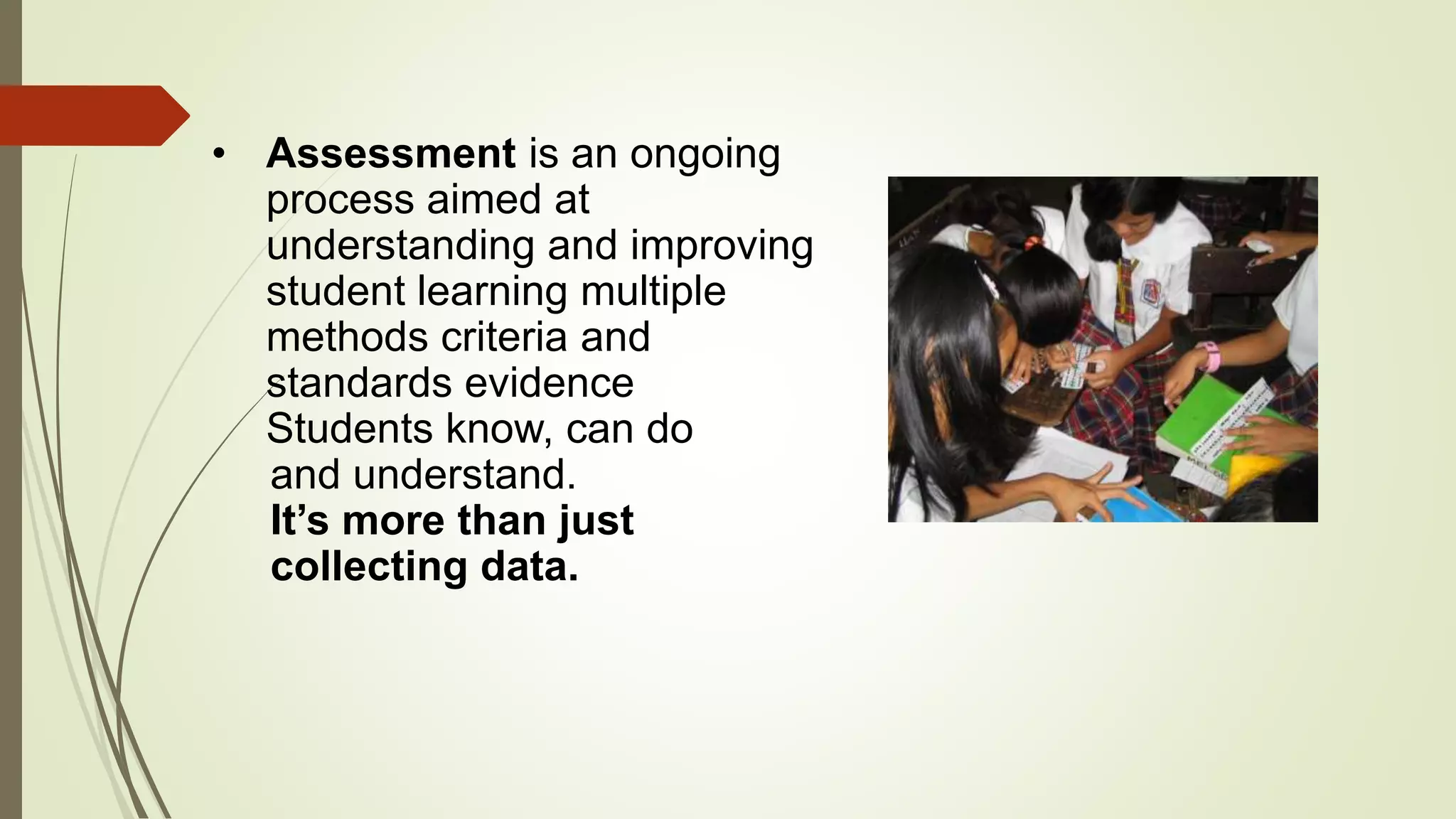
• Assessment is an ongoing
process aimed at
understanding and improving
student learning multiple
methods criteria and
standards evidence
Students know, can do
and understand.
It’s more than just
collecting data.
IMPORTANCE OF ASSESSMENT
 To find out what the students know (knowledge)
 To find out what the students can do, and how
well they can do it (skill; performance)
 To find out how students go about the task of
doing their work (process)To find out how
students feel about their work (motivation,
effort)
 Innovative Assessment could be any form of assessment which
involves the application of a new technique or method….however,
innovative assessment has come to mean more than that; it is a
term we use which encompasses a whole range of different
techniques and methods, not all of which are new inventions. What
Unites them is a common goal; to improve the quality of student
learning” (Mowl 2006)
 Innovative assessment is also about ‘the redistribution of
educational power' when assessment becomes not just something
which is 'done to' learners but also 'done with' and 'done by'
learners (Harris and Bell, 1990).
 Innovative assessment is not just some trendy, new technique
dreamt-up purely to save on the amount of time teachers spend on
marking, it is a genuine attempt to improve the quality of learning in
higher education. (Mowl, 2005)
Innovative Assessment aims to produce students who are...
deep rather than surface learners
highly motivated and committed
enterprising
equipped with a range of transferable skills
capable of self-criticism and evaluation
fairly and reliably assessed
active and reactive participants in the learning process, capable
of 'creative dissent' rather than simply passive, uncritical
recipients of other people's knowledge.
(Cowan,2006)
Benefits Of Innovative Assessment
 By incorporating a range of different methods innovative assessment
assesses a broader range of skills and as such it is considered to be fairer
and less discriminatory. Consequently, innovative assessment should have
the effect of widening access to Higher Education and perhaps widening
success.
 Innovative assessment is a more reliable assessment of student learning
because it is not dependent on any one method of assessment. Innovative
assessments allow for the fact that all individuals have strengths and
weaknesses, by assessing an individual’s performance across a range of
skills a more balanced and reliable assessment can be obtained.
 Innovative assessment on the whole adopts a more positive approach to
education; by spreading the assessment net more widely, it provides students
with a range of opportunities to demonstrate how much they understand
(Ramsden, 1992), rather than the somewhat negative approach of how little.
 Innovative assessment is usually formative and as such is more likely to
facilitate effective, well motivated student learning. Providing timely and
constructive feedback allows misunderstandings to be detected and cleared
up, and students are able to make improvements where necessary. This
process helps maintain student motivation, enabling them to learn more
steadily and fluently. If students genuinely don’t
 know what they are doing wrong, as they are never informed, then this can
lead to frustration and a loss of interest in the subject.
 A range of different techniques and methods should stimulate both staff and
student interest. 6. Students learn and are assessed upon a much greater
variety of skills and in a number of different situations. This should produce
more rounded and more employable graduates. Assessments may include
students demonstrating that they ‘know how to’ rather than just ‘know about’
(Race, 1994).
Innovative assessment methods are usually more realistic and
relevant, involving role plays, simulation and work placements;
students develop a better understanding of how their specific skills
and knowledge can be applied both inside and outside the
academic environment.
Innovative assessment is generally regarded as a possible
strategy for facilitating a ‘deep’ rather than a ‘surface’ approach to
learning (Marton and Säljö, 1990; Boyd and Cowan, 1985;
Ramsden, 1992). Brown and Dove (1993) consulted staff from
four different universities who were already using self and peer
assessments, the staff reported: “students using higher levels of
reflection, developing a questioning and self analytic approach to
their professional practice and engaging in deep rather than
surface learning” (Brown and Dove, 1993)
 “Writings or drawings that have been scribbled, scratched or sprayed illicitly on a wall or other surface in a
public place.”
 The graffiti wall is fun activity for students and gives you a visual representation of what your students have
learned during a unit of study.
 Using the graffiti wall activity partway through a unit provides you with information for further planning of
instruction. If there appear to be gaps in your students’ learning, you can target those areas and further
assess to see if there is indeed a deficit that you need to focus on in future lessons. Students may have
made connections that you were not expecting or hadn’t even thought of when planning the unit. The
information you collect from the graffiti wall is valuable formative assessment data. Leave the graffiti wall up
during the remainder of the unit and students can continue to add comments and drawings.
Step One: Preparation
1. Cover a part of a wall with white paper or manila paper.
2. Prepare pencils,markers,pens, crayons and other things used in drawing.
Step Two: Contracting
5. Before the activity begins contract with the students in terms of what an
appropriate response is and how to express one's discomfort with something in
an appropriate way.
6. Make sure that the students work silently.
7. Students can write their own response to the prompt as well as respond to the
questions and ideas that other students have written.
8. They should draw lines connecting their comments to those of other students.
Step Three: Invite Students to the Board
9. Encourage students to write comments, questions or draw what they have learned
about a topic on the graffiti board.
10. Students can jot down facts, write personal opinions, connect their learning to
other areas of study, etc.
GRAFFITI WALL ACTIVITY
Layunin ng gawaing ito na matukoy ang kaalaman ng mga mag-aaral tungkol sa heograpiya ng
daigdig. Makatutulong ito sa isasagawang talakayan sa bahagi ng Paunlarin.
1. Gumamit ng manila paper o cartolina bilang graffiti wall.
2. Maaaring pangkatan o pambuong klase ang gawaing ito.
3. Ipasagot sa mga mag-aaral ang tanong na nasa graffiti wall. Masasagot ito sa pamamagitan ng
pangungusap o guhit.
4. Paalalahanan ang mga mag-aaral na malayang maihahayag ang kanilang mga kasagutan sapagkat mga
dating kaalaman o iskema ang hinihingi sa gawain. .
5. Bigyan ng pagkakataon ang mga mag-aaral na basahin ang kanilang mga inilagay sa graffiti wall.
6. Mahalagang magkaroon ng paglalagom sa mga impormasyong ibinigay ng mga mag-aaral upang maging
lunsaran sa susunod na bahagi ng aralin, ang PAUNLARIN.
7. Itabi muna ang graffiti wall at muling ipakita kapag tapos na ang bahagi ng
PAGNILAYAN. Layon nito na masagot ang mga tanong at maiwasto ang mga konseptong naitala sa graffiti
wall.
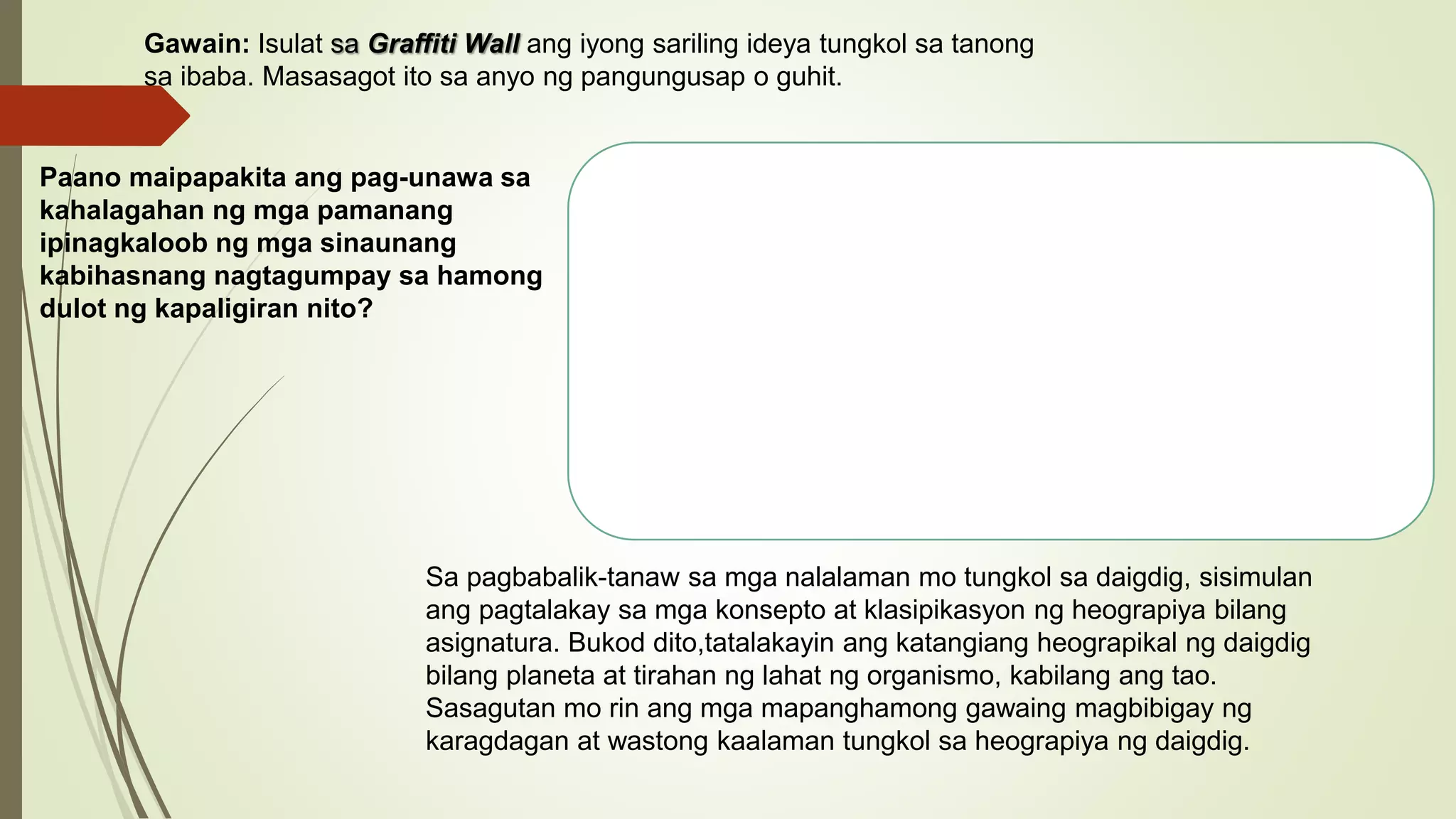
Gawain: Isulat sa Graffiti Wall ang iyong sariling ideya tungkol sa tanong
sa ibaba. Masasagot ito sa anyo ng pangungusap o guhit.
Sa pagbabalik-tanaw sa mga nalalaman mo tungkol sa daigdig, sisimulan
ang pagtalakay sa mga konsepto at klasipikasyon ng heograpiya bilang
asignatura. Bukod dito,tatalakayin ang katangiang heograpikal ng daigdig
bilang planeta at tirahan ng lahat ng organismo, kabilang ang tao.
Sasagutan mo rin ang mga mapanghamong gawaing magbibigay ng
karagdagan at wastong kaalaman tungkol sa heograpiya ng daigdig.
Paano maipapakita ang pag-unawa sa
kahalagahan ng mga pamanang
ipinagkaloob ng mga sinaunang
kabihasnang nagtagumpay sa hamong
dulot ng kapaligiran nito?
2.Geography Checklist
Reflection journals are notebooks that students use when
writing about their own thoughts. This encourages the
development of metacognitive skills by helping students
sort what they know from what they don't know.
is a means of recording ideas, personal thoughts and
experiences, as well as reflections and insights a student
have in the learning process of a course.
REFLECTION JOURNAL
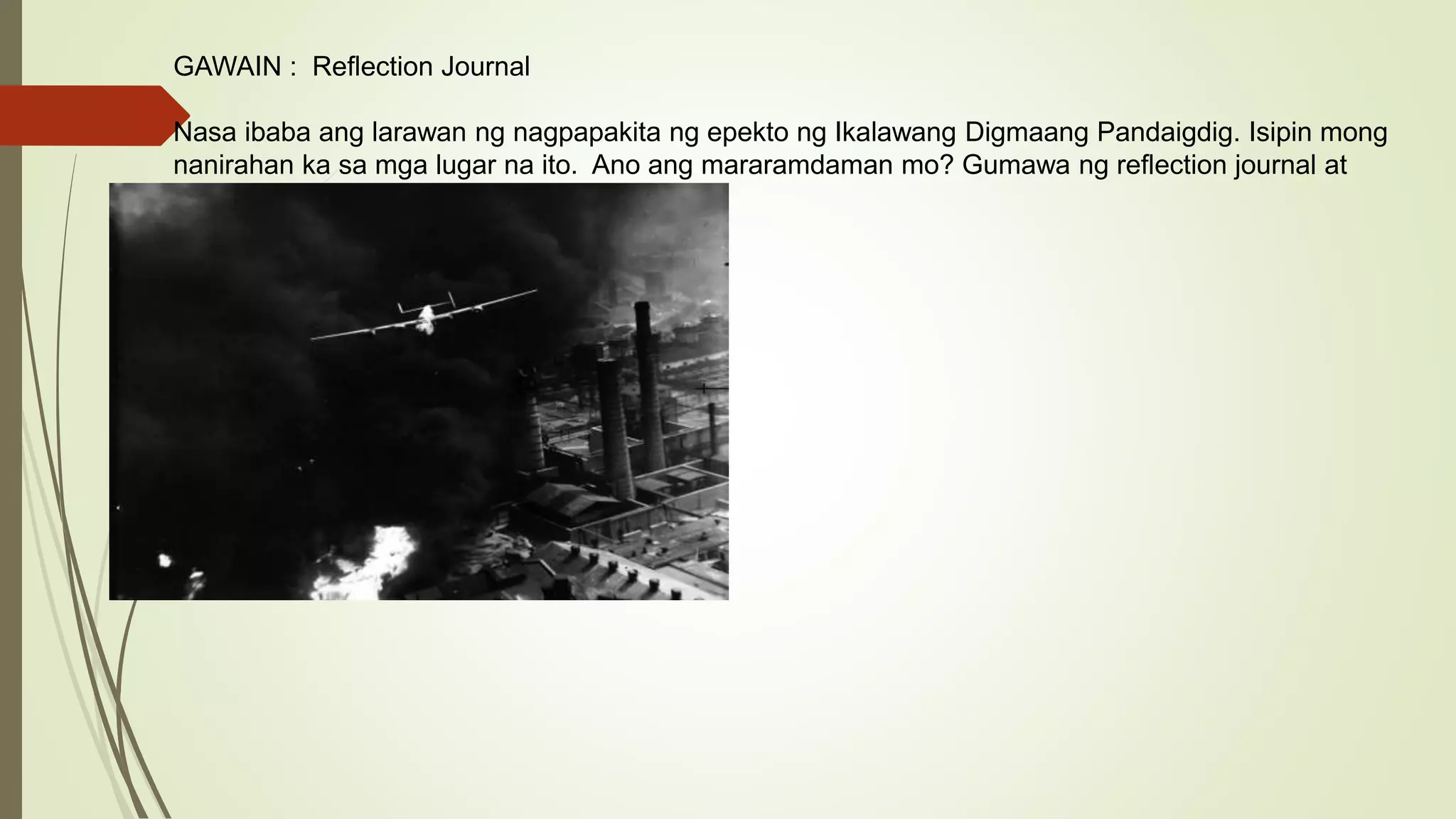
GAWAIN : Reflection Journal
Nasa ibaba ang larawan ng nagpapakita ng epekto ng Ikalawang Digmaang Pandaigdig. Isipin mong
nanirahan ka sa mga lugar na ito. Ano ang mararamdaman mo? Gumawa ng reflection journal at
isulat doon ang iyong damdamin.
Story Map

Innovative and interactive kinds of assessment

  • 1.
  • 2.
    Assessment is asystematic process of gathering, interpreting, and acting upon data related to student learning and experience for the purpose of developing a deep understanding of what students know, understand, and can do with their knowledge as a result of their educational experience; the process culminates when assessment results are used to improve subsequent learning. Huba and Freed, 2000
  • 3.
    • Assessment isan ongoing process aimed at understanding and improving student learning multiple methods criteria and standards evidence Students know, can do and understand. It’s more than just collecting data.
  • 4.
    IMPORTANCE OF ASSESSMENT To find out what the students know (knowledge)  To find out what the students can do, and how well they can do it (skill; performance)  To find out how students go about the task of doing their work (process)To find out how students feel about their work (motivation, effort)
  • 6.
     Innovative Assessmentcould be any form of assessment which involves the application of a new technique or method….however, innovative assessment has come to mean more than that; it is a term we use which encompasses a whole range of different techniques and methods, not all of which are new inventions. What Unites them is a common goal; to improve the quality of student learning” (Mowl 2006)  Innovative assessment is also about ‘the redistribution of educational power' when assessment becomes not just something which is 'done to' learners but also 'done with' and 'done by' learners (Harris and Bell, 1990).  Innovative assessment is not just some trendy, new technique dreamt-up purely to save on the amount of time teachers spend on marking, it is a genuine attempt to improve the quality of learning in higher education. (Mowl, 2005)
  • 7.
    Innovative Assessment aimsto produce students who are... deep rather than surface learners highly motivated and committed enterprising equipped with a range of transferable skills capable of self-criticism and evaluation fairly and reliably assessed active and reactive participants in the learning process, capable of 'creative dissent' rather than simply passive, uncritical recipients of other people's knowledge. (Cowan,2006)
  • 8.
    Benefits Of InnovativeAssessment  By incorporating a range of different methods innovative assessment assesses a broader range of skills and as such it is considered to be fairer and less discriminatory. Consequently, innovative assessment should have the effect of widening access to Higher Education and perhaps widening success.  Innovative assessment is a more reliable assessment of student learning because it is not dependent on any one method of assessment. Innovative assessments allow for the fact that all individuals have strengths and weaknesses, by assessing an individual’s performance across a range of skills a more balanced and reliable assessment can be obtained.  Innovative assessment on the whole adopts a more positive approach to education; by spreading the assessment net more widely, it provides students with a range of opportunities to demonstrate how much they understand (Ramsden, 1992), rather than the somewhat negative approach of how little.
  • 9.
     Innovative assessmentis usually formative and as such is more likely to facilitate effective, well motivated student learning. Providing timely and constructive feedback allows misunderstandings to be detected and cleared up, and students are able to make improvements where necessary. This process helps maintain student motivation, enabling them to learn more steadily and fluently. If students genuinely don’t  know what they are doing wrong, as they are never informed, then this can lead to frustration and a loss of interest in the subject.  A range of different techniques and methods should stimulate both staff and student interest. 6. Students learn and are assessed upon a much greater variety of skills and in a number of different situations. This should produce more rounded and more employable graduates. Assessments may include students demonstrating that they ‘know how to’ rather than just ‘know about’ (Race, 1994).
  • 10.
    Innovative assessment methodsare usually more realistic and relevant, involving role plays, simulation and work placements; students develop a better understanding of how their specific skills and knowledge can be applied both inside and outside the academic environment. Innovative assessment is generally regarded as a possible strategy for facilitating a ‘deep’ rather than a ‘surface’ approach to learning (Marton and Säljö, 1990; Boyd and Cowan, 1985; Ramsden, 1992). Brown and Dove (1993) consulted staff from four different universities who were already using self and peer assessments, the staff reported: “students using higher levels of reflection, developing a questioning and self analytic approach to their professional practice and engaging in deep rather than surface learning” (Brown and Dove, 1993)
  • 12.
     “Writings ordrawings that have been scribbled, scratched or sprayed illicitly on a wall or other surface in a public place.”  The graffiti wall is fun activity for students and gives you a visual representation of what your students have learned during a unit of study.  Using the graffiti wall activity partway through a unit provides you with information for further planning of instruction. If there appear to be gaps in your students’ learning, you can target those areas and further assess to see if there is indeed a deficit that you need to focus on in future lessons. Students may have made connections that you were not expecting or hadn’t even thought of when planning the unit. The information you collect from the graffiti wall is valuable formative assessment data. Leave the graffiti wall up during the remainder of the unit and students can continue to add comments and drawings.
  • 13.
    Step One: Preparation 1.Cover a part of a wall with white paper or manila paper. 2. Prepare pencils,markers,pens, crayons and other things used in drawing.
  • 14.
    Step Two: Contracting 5.Before the activity begins contract with the students in terms of what an appropriate response is and how to express one's discomfort with something in an appropriate way. 6. Make sure that the students work silently. 7. Students can write their own response to the prompt as well as respond to the questions and ideas that other students have written. 8. They should draw lines connecting their comments to those of other students. Step Three: Invite Students to the Board 9. Encourage students to write comments, questions or draw what they have learned about a topic on the graffiti board. 10. Students can jot down facts, write personal opinions, connect their learning to other areas of study, etc.
  • 15.
    GRAFFITI WALL ACTIVITY Layuninng gawaing ito na matukoy ang kaalaman ng mga mag-aaral tungkol sa heograpiya ng daigdig. Makatutulong ito sa isasagawang talakayan sa bahagi ng Paunlarin. 1. Gumamit ng manila paper o cartolina bilang graffiti wall. 2. Maaaring pangkatan o pambuong klase ang gawaing ito. 3. Ipasagot sa mga mag-aaral ang tanong na nasa graffiti wall. Masasagot ito sa pamamagitan ng pangungusap o guhit. 4. Paalalahanan ang mga mag-aaral na malayang maihahayag ang kanilang mga kasagutan sapagkat mga dating kaalaman o iskema ang hinihingi sa gawain. . 5. Bigyan ng pagkakataon ang mga mag-aaral na basahin ang kanilang mga inilagay sa graffiti wall. 6. Mahalagang magkaroon ng paglalagom sa mga impormasyong ibinigay ng mga mag-aaral upang maging lunsaran sa susunod na bahagi ng aralin, ang PAUNLARIN. 7. Itabi muna ang graffiti wall at muling ipakita kapag tapos na ang bahagi ng PAGNILAYAN. Layon nito na masagot ang mga tanong at maiwasto ang mga konseptong naitala sa graffiti wall.
  • 16.
    Gawain: Isulat saGraffiti Wall ang iyong sariling ideya tungkol sa tanong sa ibaba. Masasagot ito sa anyo ng pangungusap o guhit. Sa pagbabalik-tanaw sa mga nalalaman mo tungkol sa daigdig, sisimulan ang pagtalakay sa mga konsepto at klasipikasyon ng heograpiya bilang asignatura. Bukod dito,tatalakayin ang katangiang heograpikal ng daigdig bilang planeta at tirahan ng lahat ng organismo, kabilang ang tao. Sasagutan mo rin ang mga mapanghamong gawaing magbibigay ng karagdagan at wastong kaalaman tungkol sa heograpiya ng daigdig. Paano maipapakita ang pag-unawa sa kahalagahan ng mga pamanang ipinagkaloob ng mga sinaunang kabihasnang nagtagumpay sa hamong dulot ng kapaligiran nito?
  • 17.
  • 18.
    Reflection journals arenotebooks that students use when writing about their own thoughts. This encourages the development of metacognitive skills by helping students sort what they know from what they don't know. is a means of recording ideas, personal thoughts and experiences, as well as reflections and insights a student have in the learning process of a course. REFLECTION JOURNAL
  • 19.
    GAWAIN : ReflectionJournal Nasa ibaba ang larawan ng nagpapakita ng epekto ng Ikalawang Digmaang Pandaigdig. Isipin mong nanirahan ka sa mga lugar na ito. Ano ang mararamdaman mo? Gumawa ng reflection journal at isulat doon ang iyong damdamin.
  • 21.