Managing Your Innovation Portfolio - Harvard Business ...                                                                                           Page 1 of 3


                                                                   Harvard Business Publishing | For Educators | For Corporate Buyers | Visit Harvard Business School


                                                                                                                                                   FOLLOW HBR:
                                                                                                                                                             DIGITAL & MOBILE


                                                      Register today and save 20%* off your first order! Details           Subscribe   Sign in / Register    My Account


       May 2012
                 ARTICLE PREVIEW To read the full article: Sign in or Register for FREE.                   Buy Reprint »
                 Registered HBR.org users may view 3 magazine articles per month


       Managing Your Innovation Portfolio
       by Bansi Nagji and Geoff Tuff

              EMAIL               SHARE                  PRINT                     FEATURED PRODUCTS

                                                                                                  Judgment Calls:
                                                                                                  Twelve Stories of Big
                                                                                                  Decisions and the
                                                                                                  Teams That Got Them
                                                                                                  Right
                                                                                                  by Thomas Davenport,
                                                                                                  Brook Manville,
                                                                                                  Laurence Prusak
                                                                                   $30.00
                                                                                   Buy it now »

                                                                                                  Reverse Innovation:
                                                                                                  Create Far From                TOP MAGAZINE ARTICLES
                                                                                                  Home, Win
                                                                                                  Everywhere                      24 HOURS      7 DAYS       30 DAYS
                                                                                                  by Vijay Govindarajan,
                                                                                                  Chris Trimble
                                                                                                                            1. The Rise of the Supertemp
                                                                                                  $30.00
                                                                                   Buy it now »                             2. The Real Leadership Lessons of Steve Jobs
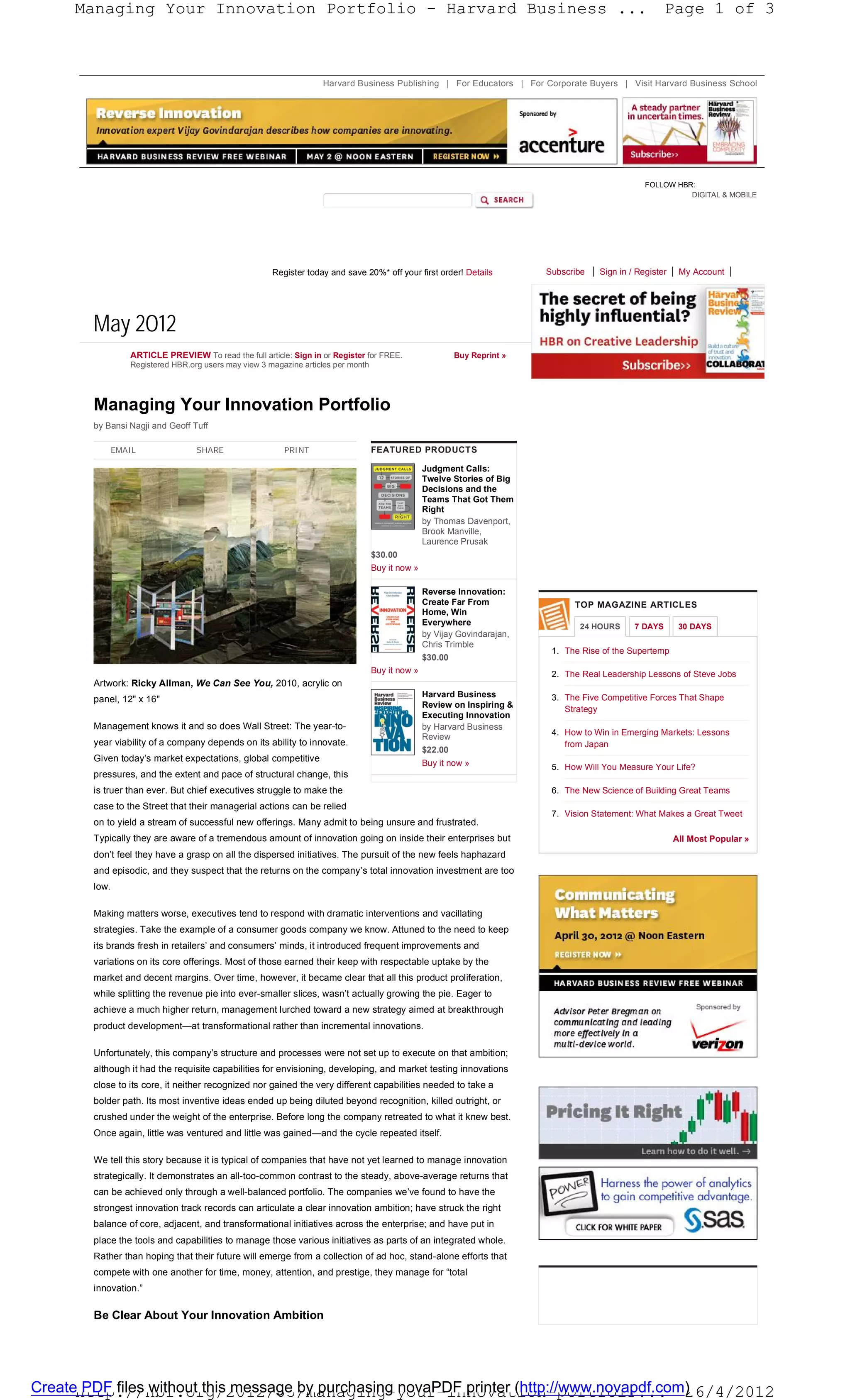
       Artwork: Ricky Allman, We Can See You, 2010, acrylic on
                                                                                                  Harvard Business          3. The Five Competitive Forces That Shape
       panel, 12" x 16"
                                                                                                  Review on Inspiring &        Strategy
                                                                                                  Executing Innovation
       Management knows it and so does Wall Street: The year-to-                                  by Harvard Business
                                                                                                  Review                    4. How to Win in Emerging Markets: Lessons
       year viability of a company depends on its ability to innovate.                                                         from Japan
                                                                                                  $22.00
       Given today’s market expectations, global competitive
                                                                                                  Buy it now »              5. How Will You Measure Your Life?
       pressures, and the extent and pace of structural change, this
       is truer than ever. But chief executives struggle to make the                                                        6. The New Science of Building Great Teams
       case to the Street that their managerial actions can be relied
                                                                                                                            7. Vision Statement: What Makes a Great Tweet
       on to yield a stream of successful new offerings. Many admit to being unsure and frustrated.
       Typically they are aware of a tremendous amount of innovation going on inside their enterprises but                                                  All Most Popular »
       don’t feel they have a grasp on all the dispersed initiatives. The pursuit of the new feels haphazard
       and episodic, and they suspect that the returns on the company’s total innovation investment are too
       low.

       Making matters worse, executives tend to respond with dramatic interventions and vacillating
       strategies. Take the example of a consumer goods company we know. Attuned to the need to keep
       its brands fresh in retailers’ and consumers’ minds, it introduced frequent improvements and
       variations on its core offerings. Most of those earned their keep with respectable uptake by the
       market and decent margins. Over time, however, it became clear that all this product proliferation,
       while splitting the revenue pie into ever-smaller slices, wasn’t actually growing the pie. Eager to
       achieve a much higher return, management lurched toward a new strategy aimed at breakthrough
       product development—at transformational rather than incremental innovations.

       Unfortunately, this company’s structure and processes were not set up to execute on that ambition;
       although it had the requisite capabilities for envisioning, developing, and market testing innovations
       close to its core, it neither recognized nor gained the very different capabilities needed to take a
       bolder path. Its most inventive ideas ended up being diluted beyond recognition, killed outright, or
       crushed under the weight of the enterprise. Before long the company retreated to what it knew best.
       Once again, little was ventured and little was gained—and the cycle repeated itself.

       We tell this story because it is typical of companies that have not yet learned to manage innovation
       strategically. It demonstrates an all-too-common contrast to the steady, above-average returns that
       can be achieved only through a well-balanced portfolio. The companies we’ve found to have the
       strongest innovation track records can articulate a clear innovation ambition; have struck the right
       balance of core, adjacent, and transformational initiatives across the enterprise; and have put in
       place the tools and capabilities to manage those various initiatives as parts of an integrated whole.
       Rather than hoping that their future will emerge from a collection of ad hoc, stand-alone efforts that
       compete with one another for time, money, attention, and prestige, they manage for “total
       innovation.”

       Be Clear About Your Innovation Ambition


Createhttp://hbr.org/2012/05/managing-your-innovation-portfoli... 26/4/2012
       PDF files without this message by purchasing novaPDF printer (http://www.novapdf.com)
Managing Your Innovation Portfolio - Harvard Business ...                                                                                       Page 2 of 3


       What does it mean to manage an innovation portfolio? First, let’s consider how broad a term                   HBR.ORG ON FACEBOOK

       “innovation” is. Defined as a novel creation that produces value, an innovation can be as slight as a
                                                                                                                             Eight Apps to Make You More Productive -
       new nail polish color or as vast as the World Wide Web. Most companies invest in initiatives along a                  Harvard Business Review
       broad spectrum of risk and reward. As in financial investing, their goal should be to construct the                   245 orang menyarankan ini.

       portfolio that produces the highest overall return that’s in keeping with their appetite for risk.                    Nice Girls Don't Ask
                                                                                                                             173 orang menyarankan ini.
       One tool we’ve developed is the Innovation Ambition Matrix (see the exhibit below). Students of
                                                                                                                             Managing Yourself: The Paradox of
       management will recognize it as a refinement of a classic diagram devised by the mathematician H.                     Excellence
       Igor Ansoff to help companies allocate funds among growth initiatives. Ansoff’s matrix clarified the                  990 orang menyarankan ini.

       notion that tactics should differ according to whether a firm was launching a new product, entering a                 Your Use of Pronouns Reveals Your
                                                                                                                             Personality
       new market, or both. Our version replaces Ansoff’s binary choices of product and market (old versus
                                                                                                                             565 orang menyarankan ini.
       new) with a range of values. This acknowledges that the novelty of a company’s offerings (on the x
                                                                                                                             Difficult Conversations: Nine Common
       axis) and the novelty of its customer markets (on the y axis) are a matter of degree. We have                         Mistakes - Harvard Business Review
       overlaid three levels of distance from the company’s current, bottom-left reality.                                    181 orang menyarankan ini.

                                                                                                                        Plugin sosial Facebook
         The Innovation Ambition Matrix


       In the band of activity at the lower left of the matrix are core innovation initiatives—efforts to make
                                                                                                                                STAY CONNECTED TO HBR
       incremental changes to existing products and incremental inroads into new markets. Whether in the
       form of new packaging (such as Nabisco’s 100-calorie packets of Oreos for on-the-go snackers),
       slight reformulations (as when Dow AgroSciences launched one of its herbicides as a liquid
       suspension rather than a dry powder), or added service convenience (for example, replacing pallets               Facebook         Twitter     RSS      iPhone
       with shrink-wrapping to reduce shipping charges), such innovations draw on assets the company
       already has in place.

       At the opposite corner of the matrix are transformational initiatives, designed to create new offers—if         Newsletters      LinkedIn    YouTube   Google

       not whole new businesses—to serve new markets and customer needs. These are the innovations
       that, when successful, make headlines: Think of iTunes, the Tata Nano, and the Starbucks in-store
       experience. These sorts of innovations, also called breakthrough, disruptive, or game changing,
       generally require that the company call on unfamiliar assets—for example, building capabilities to
       gain a deeper understanding of customers, to communicate about products that have no direct
       antecedents, and to develop markets that aren’t yet mature.


                 To continue reading, register now or purchase a single copy PDF.
                 Registered users may view 3 HBR magazine articles for free each month. Become a paid subscriber
                 for full uninterrupted access. Already an online or premium subscriber? Sign in.


       Bansi Nagji and Geoff Tuff are partners at Monitor Group and leaders of the firm’s global innovation
       practice.


       COMMENTS

          Like         2 people liked this.


              Showing 0 comments


       Sort by Newest first                                  Subscribe by email    Subscribe by RSS


       Real-time updating is paused. (Resume)


       ADD NEW COMMENT


                                                                                                        Post as …


       Posting Guidelines


       We hope the conversations that take place on HBR.org will be energetic, constructive, free-wheeling, and
       provocative. To make sure we all stay on-topic, all posts will be reviewed by our editors and may be edited
       for clarity, length, and relevance.


       We ask that you adhere to the following guidelines.

       1. No selling of products or services. Let's keep this an ad-free zone.
       2. No ad hominem attacks. These are conversations in which we debate ideas. Criticize ideas, not the
          people behind them.
       3. No multimedia. If you want us to know about outside sources, please link to them, Don't paste them in.

       All postings become the property of Harvard Business School Publishing

       The editors


Createhttp://hbr.org/2012/05/managing-your-innovation-portfoli... 26/4/2012
       PDF files without this message by purchasing novaPDF printer (http://www.novapdf.com)
Managing Your Innovation Portfolio - Harvard Business ...                                                                                                                   Page 3 of 3


       Topics                                         Today on HBR                                      RSS Feed                                         Contact Us
           Change Management                          Blogs                                             Email Newsletters                                Advertise with Us
           Competition                                Books                                             HBR on Twitter                                   Newsroom
           Innovation                                 Authors                                           HBR on Facebook                                  Guidelines for Authors: Magazine
           Leadership                                 Guidelines for Authors                            HBR on YouTube                                   Guidelines for Authors: Books
           Strategy                                                                                     Most Popular on HBR.org                          Guidelines for Authors: Web
                                                                                                        Podcasts: Audio and Video                        Information for Booksellers/Retailers
       Skills                                         Current Issue                                     Harvard Business Mobile
           Emotional Intelligence                     Subscribe                                         Webinars
           Managing Yourself                          International Editions                                                                             Harvard Business School
           Measuring Business Performance             Guidelines for Authors                                                                             HBS Executive Education
           Project Management                                                                           HBR Article Reprints
           Strategy Execution                                                                           Case Studies

                                                      Subscriber Help                                   Books                                            About Us
       Industries                                                                                       Book Chapters
                                                      Products and Website Help                                                                          Careers
           Finance & Insurance                                                                          CDs and Audio
                                                      Return Policy                                                                                      Higher Education
           Health Care Services                                                                         Special Collections                              Corporate Learning
           Manufacturing                                                                                Balanced Scorecard Report
           Media & Telecommunications                                                                   HBR Guide Series
           Professional Services                                                                        HBR On Series
                                                                                                        Courses


                             About Us    Privacy Policy   Copyright Information    Trademark Policy
                             Harvard Business Publishing: Higher Education | Corporate Learning | Harvard Business Review
                             Copyright © 2012 Harvard Business School Publishing. All rights reserved. Harvard Business Publishing is an affiliate of Harvard Business School.


Createhttp://hbr.org/2012/05/managing-your-innovation-portfoli... 26/4/2012
       PDF files without this message by purchasing novaPDF printer (http://www.novapdf.com)

Innovation hbr

  • 1.
    Managing Your InnovationPortfolio - Harvard Business ... Page 1 of 3 Harvard Business Publishing | For Educators | For Corporate Buyers | Visit Harvard Business School FOLLOW HBR: DIGITAL & MOBILE Register today and save 20%* off your first order! Details Subscribe Sign in / Register My Account May 2012 ARTICLE PREVIEW To read the full article: Sign in or Register for FREE. Buy Reprint » Registered HBR.org users may view 3 magazine articles per month Managing Your Innovation Portfolio by Bansi Nagji and Geoff Tuff EMAIL SHARE PRINT FEATURED PRODUCTS Judgment Calls: Twelve Stories of Big Decisions and the Teams That Got Them Right by Thomas Davenport, Brook Manville, Laurence Prusak $30.00 Buy it now » Reverse Innovation: Create Far From TOP MAGAZINE ARTICLES Home, Win Everywhere 24 HOURS 7 DAYS 30 DAYS by Vijay Govindarajan, Chris Trimble 1. The Rise of the Supertemp $30.00 Buy it now » 2. The Real Leadership Lessons of Steve Jobs Artwork: Ricky Allman, We Can See You, 2010, acrylic on Harvard Business 3. The Five Competitive Forces That Shape panel, 12" x 16" Review on Inspiring & Strategy Executing Innovation Management knows it and so does Wall Street: The year-to- by Harvard Business Review 4. How to Win in Emerging Markets: Lessons year viability of a company depends on its ability to innovate. from Japan $22.00 Given today’s market expectations, global competitive Buy it now » 5. How Will You Measure Your Life? pressures, and the extent and pace of structural change, this is truer than ever. But chief executives struggle to make the 6. The New Science of Building Great Teams case to the Street that their managerial actions can be relied 7. Vision Statement: What Makes a Great Tweet on to yield a stream of successful new offerings. Many admit to being unsure and frustrated. Typically they are aware of a tremendous amount of innovation going on inside their enterprises but All Most Popular » don’t feel they have a grasp on all the dispersed initiatives. The pursuit of the new feels haphazard and episodic, and they suspect that the returns on the company’s total innovation investment are too low. Making matters worse, executives tend to respond with dramatic interventions and vacillating strategies. Take the example of a consumer goods company we know. Attuned to the need to keep its brands fresh in retailers’ and consumers’ minds, it introduced frequent improvements and variations on its core offerings. Most of those earned their keep with respectable uptake by the market and decent margins. Over time, however, it became clear that all this product proliferation, while splitting the revenue pie into ever-smaller slices, wasn’t actually growing the pie. Eager to achieve a much higher return, management lurched toward a new strategy aimed at breakthrough product development—at transformational rather than incremental innovations. Unfortunately, this company’s structure and processes were not set up to execute on that ambition; although it had the requisite capabilities for envisioning, developing, and market testing innovations close to its core, it neither recognized nor gained the very different capabilities needed to take a bolder path. Its most inventive ideas ended up being diluted beyond recognition, killed outright, or crushed under the weight of the enterprise. Before long the company retreated to what it knew best. Once again, little was ventured and little was gained—and the cycle repeated itself. We tell this story because it is typical of companies that have not yet learned to manage innovation strategically. It demonstrates an all-too-common contrast to the steady, above-average returns that can be achieved only through a well-balanced portfolio. The companies we’ve found to have the strongest innovation track records can articulate a clear innovation ambition; have struck the right balance of core, adjacent, and transformational initiatives across the enterprise; and have put in place the tools and capabilities to manage those various initiatives as parts of an integrated whole. Rather than hoping that their future will emerge from a collection of ad hoc, stand-alone efforts that compete with one another for time, money, attention, and prestige, they manage for “total innovation.” Be Clear About Your Innovation Ambition Createhttp://hbr.org/2012/05/managing-your-innovation-portfoli... 26/4/2012 PDF files without this message by purchasing novaPDF printer (http://www.novapdf.com)
  • 2.
    Managing Your InnovationPortfolio - Harvard Business ... Page 2 of 3 What does it mean to manage an innovation portfolio? First, let’s consider how broad a term HBR.ORG ON FACEBOOK “innovation” is. Defined as a novel creation that produces value, an innovation can be as slight as a Eight Apps to Make You More Productive - new nail polish color or as vast as the World Wide Web. Most companies invest in initiatives along a Harvard Business Review broad spectrum of risk and reward. As in financial investing, their goal should be to construct the 245 orang menyarankan ini. portfolio that produces the highest overall return that’s in keeping with their appetite for risk. Nice Girls Don't Ask 173 orang menyarankan ini. One tool we’ve developed is the Innovation Ambition Matrix (see the exhibit below). Students of Managing Yourself: The Paradox of management will recognize it as a refinement of a classic diagram devised by the mathematician H. Excellence Igor Ansoff to help companies allocate funds among growth initiatives. Ansoff’s matrix clarified the 990 orang menyarankan ini. notion that tactics should differ according to whether a firm was launching a new product, entering a Your Use of Pronouns Reveals Your Personality new market, or both. Our version replaces Ansoff’s binary choices of product and market (old versus 565 orang menyarankan ini. new) with a range of values. This acknowledges that the novelty of a company’s offerings (on the x Difficult Conversations: Nine Common axis) and the novelty of its customer markets (on the y axis) are a matter of degree. We have Mistakes - Harvard Business Review overlaid three levels of distance from the company’s current, bottom-left reality. 181 orang menyarankan ini. Plugin sosial Facebook The Innovation Ambition Matrix In the band of activity at the lower left of the matrix are core innovation initiatives—efforts to make STAY CONNECTED TO HBR incremental changes to existing products and incremental inroads into new markets. Whether in the form of new packaging (such as Nabisco’s 100-calorie packets of Oreos for on-the-go snackers), slight reformulations (as when Dow AgroSciences launched one of its herbicides as a liquid suspension rather than a dry powder), or added service convenience (for example, replacing pallets Facebook Twitter RSS iPhone with shrink-wrapping to reduce shipping charges), such innovations draw on assets the company already has in place. At the opposite corner of the matrix are transformational initiatives, designed to create new offers—if Newsletters LinkedIn YouTube Google not whole new businesses—to serve new markets and customer needs. These are the innovations that, when successful, make headlines: Think of iTunes, the Tata Nano, and the Starbucks in-store experience. These sorts of innovations, also called breakthrough, disruptive, or game changing, generally require that the company call on unfamiliar assets—for example, building capabilities to gain a deeper understanding of customers, to communicate about products that have no direct antecedents, and to develop markets that aren’t yet mature. To continue reading, register now or purchase a single copy PDF. Registered users may view 3 HBR magazine articles for free each month. Become a paid subscriber for full uninterrupted access. Already an online or premium subscriber? Sign in. Bansi Nagji and Geoff Tuff are partners at Monitor Group and leaders of the firm’s global innovation practice. COMMENTS Like 2 people liked this. Showing 0 comments Sort by Newest first Subscribe by email Subscribe by RSS Real-time updating is paused. (Resume) ADD NEW COMMENT Post as … Posting Guidelines We hope the conversations that take place on HBR.org will be energetic, constructive, free-wheeling, and provocative. To make sure we all stay on-topic, all posts will be reviewed by our editors and may be edited for clarity, length, and relevance. We ask that you adhere to the following guidelines. 1. No selling of products or services. Let's keep this an ad-free zone. 2. No ad hominem attacks. These are conversations in which we debate ideas. Criticize ideas, not the people behind them. 3. No multimedia. If you want us to know about outside sources, please link to them, Don't paste them in. All postings become the property of Harvard Business School Publishing The editors Createhttp://hbr.org/2012/05/managing-your-innovation-portfoli... 26/4/2012 PDF files without this message by purchasing novaPDF printer (http://www.novapdf.com)
  • 3.
    Managing Your InnovationPortfolio - Harvard Business ... Page 3 of 3 Topics Today on HBR RSS Feed Contact Us Change Management Blogs Email Newsletters Advertise with Us Competition Books HBR on Twitter Newsroom Innovation Authors HBR on Facebook Guidelines for Authors: Magazine Leadership Guidelines for Authors HBR on YouTube Guidelines for Authors: Books Strategy Most Popular on HBR.org Guidelines for Authors: Web Podcasts: Audio and Video Information for Booksellers/Retailers Skills Current Issue Harvard Business Mobile Emotional Intelligence Subscribe Webinars Managing Yourself International Editions Harvard Business School Measuring Business Performance Guidelines for Authors HBS Executive Education Project Management HBR Article Reprints Strategy Execution Case Studies Subscriber Help Books About Us Industries Book Chapters Products and Website Help Careers Finance & Insurance CDs and Audio Return Policy Higher Education Health Care Services Special Collections Corporate Learning Manufacturing Balanced Scorecard Report Media & Telecommunications HBR Guide Series Professional Services HBR On Series Courses About Us Privacy Policy Copyright Information Trademark Policy Harvard Business Publishing: Higher Education | Corporate Learning | Harvard Business Review Copyright © 2012 Harvard Business School Publishing. All rights reserved. Harvard Business Publishing is an affiliate of Harvard Business School. Createhttp://hbr.org/2012/05/managing-your-innovation-portfoli... 26/4/2012 PDF files without this message by purchasing novaPDF printer (http://www.novapdf.com)