Embracing New Technology
Joe, Anthony, Maggie, Gwendolyn, Andie, Nicole,
Conor, Nick
Organizational Culture
• Definition: the shared values, principles,
traditions, and ways of doing things that
influence the way organizational members act
• 3 aspects
– Perception
– Descriptive
– Shared Values
OC : The Role it Plays
• Affects an organization's productivity,
performance, attendance, product quality,
environmental concern etc.
• Provides guidelines for employees on
customer care and service
• Extends to marketing practices, new product
development, and production methods
Changes in Organizational Culture
• Product development is
crucial for any
organization to
succeed.
• Technology changes
and so does demand
• Consumers want what’s
new
Embracing New Technology :
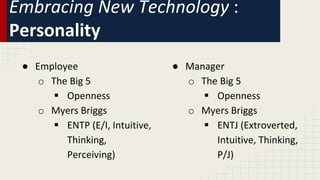
Personality
● Employee
o The Big 5
 Openness
o Myers Briggs
 ENTP (E/I, Intuitive,
Thinking,
Perceiving)
● Manager
o The Big 5
 Openness
o Myers Briggs
 ENTJ (Extroverted,
Intuitive, Thinking,
P/J)
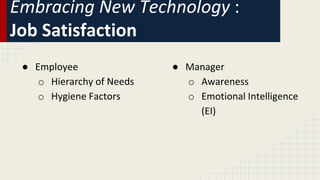
Embracing New Technology :
Job Satisfaction
● Manager
o Awareness
o Emotional Intelligence
(EI)
● Employee
o Hierarchy of Needs
o Hygiene Factors
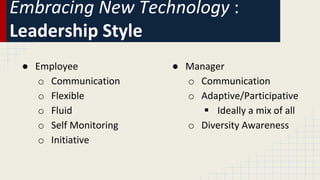
Embracing New Technology :
Leadership Style
● Employee
o Communication
o Flexible
o Fluid
o Self Monitoring
o Initiative
● Manager
o Communication
o Adaptive/Participative
 Ideally a mix of all
o Diversity Awareness
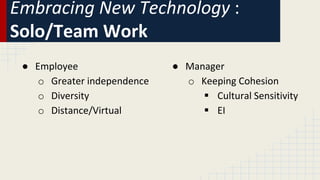
● Employee
o Greater independence
o Diversity
o Distance/Virtual
Embracing New Technology :
Solo/Team Work
● Manager
o Keeping Cohesion
 Cultural Sensitivity
 EI
Embracing New Technology :
Challenges & Benefits
● Challenges
o Training
o Keeping a Cohesive
Team
 Global
 Virtual
● Benefits
o Mobile/Remote
contact
o Efficiency
o Productivity
o Performance
o Keeping Up
Embracing Technology
• The world around us is changing everyday
– In order to stay relevant and competitive
organizations must plan for, and embrace
technological changes within their market
– How Kodak embraced changes in technology and
the challenges they faced
How Does Technology
Change
● Exponential Growth- Abstract
● Exponential Growth- Research
● Embracing New Technology
● Embracing New Technology & Exponential Growth
An Overview
Exponential Growth in
Technology
● Printing Press, Telephone, Radio, Television
● Internet, Cell Phones
● Google Glass
o https://www.youtube.com/watch?v=IaU6DWb0yzs
1:50-2:15
● The Future...
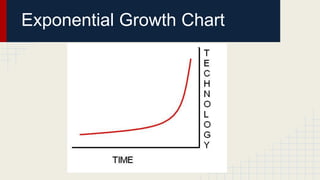
Exponential Growth Chart
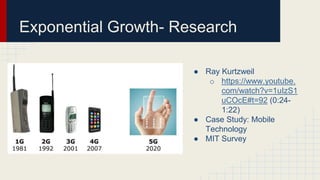
Exponential Growth- Research
● Ray Kurtzweil
o https://www.youtube.
com/watch?v=1uIzS1
uCOcE#t=92 (0:24-
1:22)
● Case Study: Mobile
Technology
● MIT Survey
Embracing New Technology
● Starbucks
● Wisconsin Union
● MOOCS- Kevin
Fong
Embracing New Technology
and Exponential Growth
● Major problems in embracing new technology
o Slow
o Lack of urgency
o Training
o Employee-CEO divide
Training with New
Technology
-Training and development frequently determine if an organization fails
or succeeds
-Interactive tutorials, computer simulations, animations, videos,
podcasts, social media, games, and mobile tools.
-Social Media
-Instant messaging, desktop video conferencing, telepresence and
increasing collaboration tools build a framework for learning
-Employer-sponsored e-training programs and subscription-bases
services
-Organizations must understand how to use technology in combination
with face-to-face interaction to deliver relevant information
Advantages of Embracing
New Technology
-Edge over businesses with outdated technology
-Noticeable effects on workflow and interactions with
customers
-Early adoption is a good selling point
-Gives an opportunity to become a thought leader and
network with other early adopters
Difficulties in Embracing
New Technology
-No guarantee the trend won’t fade out
-Faced with the difficulty in finding employers
who are capable of using the new technology
-On going expenses
-Risk of cyber crime
-Disconnectedness from final products and
each other
-Distractions
Costs with New Technology
-Initial purchasing costs
-Ongoing maintenance
-Updates and training expenses
-If a system failure occur, loss of revenue
can result due to loss of services
rendered or product production halted
Embracing New Technology
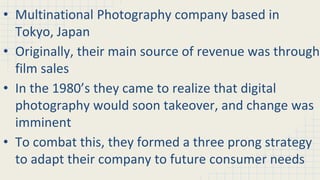
• Multinational Photography company based in
Tokyo, Japan
• Originally, their main source of revenue was through
film sales
• In the 1980’s they came to realize that digital
photography would soon takeover, and change was
imminent
• To combat this, they formed a three prong strategy
to adapt their company to future consumer needs
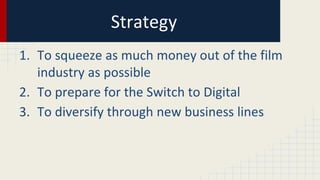
Strategy
1. To squeeze as much money out of the film
industry as possible
2. To prepare for the Switch to Digital
3. To diversify through new business lines
1st-Film
• Fujifilm had sponsorship of the 1984
Olympics, in Los Angeles. They used this to
invade on Kodaks market. Until this time,
Fujifilm did not have a large international
market. Their substantially cheaper film prices
allowed them to steal much of Kodaks film
market, while it was still relevant.
2nd-Preparation
• To prepare for the switch, Fujifilm’s CEO
Shigetaka Komori totally changed their
business model. He got rid of unneeded
distributors, development labs, managers and
researchers in an effort to cut costs.
3rd-Diversification
• Fujifilm used its resources and expertise in
chemicals and drugs to enter different markets
1. Cosmetics
2. Development of LCD panel film for computers,
Televisions, and other electronic devices
3. Drugs
• Today, less than 1% of Revenues are from
photographic film
Embracing New Technology with the 7S
Model
The 7S model can be used in a wide variety of situations where an alignment
perspective is useful, for example, to help you:
● Improve the performance of a company.
● Examine the likely effects of future changes within a company.
● Align departments and processes during a merger or acquisition.
● Determine how best to implement a proposed strategy
Strategy
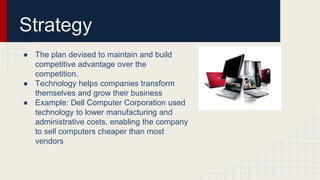
● The plan devised to maintain and build
competitive advantage over the
competition.
● Technology helps companies transform
themselves and grow their business
● Example: Dell Computer Corporation used
technology to lower manufacturing and
administrative costs, enabling the company
to sell computers cheaper than most
vendors
Structure
● How the organization is structured and who reports to whom
● Uses:
o Enhances productivity
o Initiates new and more effective structural designs for the organization
● These uses become potential sources of economic value and competitive
advantage
● Example: “The virtual organization”
o Connects a network of organizations via the internet
Systems
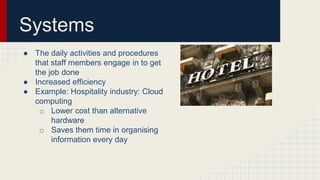
● The daily activities and procedures
that staff members engage in to get
the job done
● Increased efficiency
● Example: Hospitality industry: Cloud
computing
o Lower cost than alternative
hardware
o Saves them time in organising
information every day
Shared Values
● The core values of the company that are evidenced in the corporate
culture and the general work ethic
● Can result in increased revenue and quantifiable social impact
● Example:Verizon
o “Shared Success Program”
 Shared across the firm
 Company identifies and accelerates deployment of technology
solutions
 Results in increased revenue and quantifiable social impact
Style
● The type of leadership adopted
● Modern and trendy
● Example: Apple
o Stores are interactive
o Genius Bar
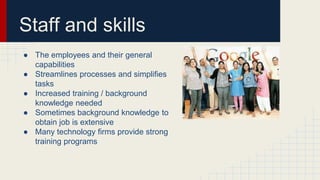
Staff and skills
● The employees and their general
capabilities
● Streamlines processes and simplifies
tasks
● Increased training / background
knowledge needed
● Sometimes background knowledge to
obtain job is extensive
● Many technology firms provide strong
training programs
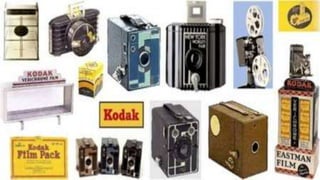
A Brief history of Kodak
● Founded in Rochester, New York by George Eastman
● 1880
● Dry-Plate photography
● 1884 partnership → Corporation with 14 shareholders
($200,000)
● First Kodak camera in 1888
● Inventor of Film
● Edison and Motion Picture
Rise to the Top
● 1929 First film designed for sound
● Continued to rise to the top
o high speed film
o projectors, color film, Brownie cameras, home sound
movies
● Jun 1 1972 $124.89 Stock price
● By 2010 Ave. $4.00
● By 1976, controlled 90% of film sales
● 85% camera sales in U.S.
● 1980 100th anniversary
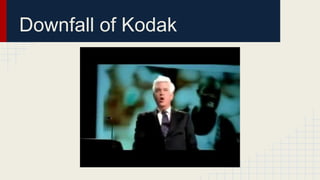
Downfall of Kodak
● Digital photography was the primary downfall of Kodak.
● This new technology literally destroyed the film based
model that Kodak was centered around.
● Kodak failed to see digital photography as disruptive.
● They were a company stuck in time
Downfall of Kodak
Downfall of Kodak
This video shows how stubborn Kodak’s
reaction was to the rise of digital photography.
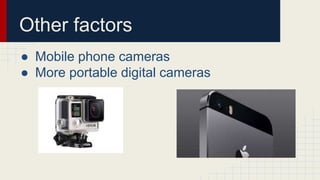
Other factors
● Mobile phone cameras
● More portable digital cameras
More Factors
● They have an obsolete product
● Inflexibility
● Competition with Fujifilm
● Digital cameras only require manufacturing
● Not service based- Much of Kodaks income
Strategy
At the time of Bankruptcy Kodak had roughly
$7 Billion in liabilities. Chairman and CEO
Antonino Perez, “The board of directors and the
entire senior management team unanimously
believe that this is a necessary step and the
right thing to do for the future of Kodak”. They
were extended a $950 million credit line over
the next 18 months.

Embracing Technology

  • 1.
    Embracing New Technology Joe,Anthony, Maggie, Gwendolyn, Andie, Nicole, Conor, Nick
  • 2.
    Organizational Culture • Definition:the shared values, principles, traditions, and ways of doing things that influence the way organizational members act • 3 aspects – Perception – Descriptive – Shared Values
  • 3.
    OC : TheRole it Plays • Affects an organization's productivity, performance, attendance, product quality, environmental concern etc. • Provides guidelines for employees on customer care and service • Extends to marketing practices, new product development, and production methods
  • 4.
    Changes in OrganizationalCulture • Product development is crucial for any organization to succeed. • Technology changes and so does demand • Consumers want what’s new
  • 5.
    Embracing New Technology: Personality ● Employee o The Big 5  Openness o Myers Briggs  ENTP (E/I, Intuitive, Thinking, Perceiving) ● Manager o The Big 5  Openness o Myers Briggs  ENTJ (Extroverted, Intuitive, Thinking, P/J)
  • 6.
    Embracing New Technology: Job Satisfaction ● Manager o Awareness o Emotional Intelligence (EI) ● Employee o Hierarchy of Needs o Hygiene Factors
  • 7.
    Embracing New Technology: Leadership Style ● Employee o Communication o Flexible o Fluid o Self Monitoring o Initiative ● Manager o Communication o Adaptive/Participative  Ideally a mix of all o Diversity Awareness
  • 8.
    ● Employee o Greaterindependence o Diversity o Distance/Virtual Embracing New Technology : Solo/Team Work ● Manager o Keeping Cohesion  Cultural Sensitivity  EI
  • 9.
    Embracing New Technology: Challenges & Benefits ● Challenges o Training o Keeping a Cohesive Team  Global  Virtual ● Benefits o Mobile/Remote contact o Efficiency o Productivity o Performance o Keeping Up
  • 10.
    Embracing Technology • Theworld around us is changing everyday – In order to stay relevant and competitive organizations must plan for, and embrace technological changes within their market – How Kodak embraced changes in technology and the challenges they faced
  • 11.
    How Does Technology Change ●Exponential Growth- Abstract ● Exponential Growth- Research ● Embracing New Technology ● Embracing New Technology & Exponential Growth An Overview
  • 12.
    Exponential Growth in Technology ●Printing Press, Telephone, Radio, Television ● Internet, Cell Phones ● Google Glass o https://www.youtube.com/watch?v=IaU6DWb0yzs 1:50-2:15 ● The Future...
  • 13.
  • 14.
    Exponential Growth- Research ●Ray Kurtzweil o https://www.youtube. com/watch?v=1uIzS1 uCOcE#t=92 (0:24- 1:22) ● Case Study: Mobile Technology ● MIT Survey
  • 15.
    Embracing New Technology ●Starbucks ● Wisconsin Union ● MOOCS- Kevin Fong
  • 16.
    Embracing New Technology andExponential Growth ● Major problems in embracing new technology o Slow o Lack of urgency o Training o Employee-CEO divide
  • 17.
    Training with New Technology -Trainingand development frequently determine if an organization fails or succeeds -Interactive tutorials, computer simulations, animations, videos, podcasts, social media, games, and mobile tools. -Social Media -Instant messaging, desktop video conferencing, telepresence and increasing collaboration tools build a framework for learning -Employer-sponsored e-training programs and subscription-bases services -Organizations must understand how to use technology in combination with face-to-face interaction to deliver relevant information
  • 18.
    Advantages of Embracing NewTechnology -Edge over businesses with outdated technology -Noticeable effects on workflow and interactions with customers -Early adoption is a good selling point -Gives an opportunity to become a thought leader and network with other early adopters
  • 19.
    Difficulties in Embracing NewTechnology -No guarantee the trend won’t fade out -Faced with the difficulty in finding employers who are capable of using the new technology -On going expenses -Risk of cyber crime -Disconnectedness from final products and each other -Distractions
  • 20.
    Costs with NewTechnology -Initial purchasing costs -Ongoing maintenance -Updates and training expenses -If a system failure occur, loss of revenue can result due to loss of services rendered or product production halted
  • 22.
  • 24.
    • Multinational Photographycompany based in Tokyo, Japan • Originally, their main source of revenue was through film sales • In the 1980’s they came to realize that digital photography would soon takeover, and change was imminent • To combat this, they formed a three prong strategy to adapt their company to future consumer needs
  • 25.
    Strategy 1. To squeezeas much money out of the film industry as possible 2. To prepare for the Switch to Digital 3. To diversify through new business lines
  • 26.
    1st-Film • Fujifilm hadsponsorship of the 1984 Olympics, in Los Angeles. They used this to invade on Kodaks market. Until this time, Fujifilm did not have a large international market. Their substantially cheaper film prices allowed them to steal much of Kodaks film market, while it was still relevant.
  • 27.
    2nd-Preparation • To preparefor the switch, Fujifilm’s CEO Shigetaka Komori totally changed their business model. He got rid of unneeded distributors, development labs, managers and researchers in an effort to cut costs.

  • 28.

    3rd-Diversification • Fujifilm usedits resources and expertise in chemicals and drugs to enter different markets 1. Cosmetics 2. Development of LCD panel film for computers, Televisions, and other electronic devices 3. Drugs • Today, less than 1% of Revenues are from photographic film
  • 29.
    Embracing New Technologywith the 7S Model The 7S model can be used in a wide variety of situations where an alignment perspective is useful, for example, to help you: ● Improve the performance of a company. ● Examine the likely effects of future changes within a company. ● Align departments and processes during a merger or acquisition. ● Determine how best to implement a proposed strategy
  • 30.
    Strategy ● The plandevised to maintain and build competitive advantage over the competition. ● Technology helps companies transform themselves and grow their business ● Example: Dell Computer Corporation used technology to lower manufacturing and administrative costs, enabling the company to sell computers cheaper than most vendors
  • 31.
    Structure ● How theorganization is structured and who reports to whom ● Uses: o Enhances productivity o Initiates new and more effective structural designs for the organization ● These uses become potential sources of economic value and competitive advantage ● Example: “The virtual organization” o Connects a network of organizations via the internet
  • 32.
    Systems ● The dailyactivities and procedures that staff members engage in to get the job done ● Increased efficiency ● Example: Hospitality industry: Cloud computing o Lower cost than alternative hardware o Saves them time in organising information every day
  • 33.
    Shared Values ● Thecore values of the company that are evidenced in the corporate culture and the general work ethic ● Can result in increased revenue and quantifiable social impact ● Example:Verizon o “Shared Success Program”  Shared across the firm  Company identifies and accelerates deployment of technology solutions  Results in increased revenue and quantifiable social impact
  • 34.
    Style ● The typeof leadership adopted ● Modern and trendy ● Example: Apple o Stores are interactive o Genius Bar
  • 35.
    Staff and skills ●The employees and their general capabilities ● Streamlines processes and simplifies tasks ● Increased training / background knowledge needed ● Sometimes background knowledge to obtain job is extensive ● Many technology firms provide strong training programs
  • 36.
    A Brief historyof Kodak ● Founded in Rochester, New York by George Eastman ● 1880 ● Dry-Plate photography ● 1884 partnership → Corporation with 14 shareholders ($200,000) ● First Kodak camera in 1888 ● Inventor of Film ● Edison and Motion Picture
  • 40.
    Rise to theTop ● 1929 First film designed for sound ● Continued to rise to the top o high speed film o projectors, color film, Brownie cameras, home sound movies ● Jun 1 1972 $124.89 Stock price ● By 2010 Ave. $4.00 ● By 1976, controlled 90% of film sales ● 85% camera sales in U.S. ● 1980 100th anniversary
  • 41.
    Downfall of Kodak ●Digital photography was the primary downfall of Kodak. ● This new technology literally destroyed the film based model that Kodak was centered around. ● Kodak failed to see digital photography as disruptive. ● They were a company stuck in time
  • 42.
  • 43.
    Downfall of Kodak Thisvideo shows how stubborn Kodak’s reaction was to the rise of digital photography.
  • 44.
    Other factors ● Mobilephone cameras ● More portable digital cameras
  • 45.
    More Factors ● Theyhave an obsolete product ● Inflexibility ● Competition with Fujifilm ● Digital cameras only require manufacturing ● Not service based- Much of Kodaks income
  • 46.
    Strategy At the timeof Bankruptcy Kodak had roughly $7 Billion in liabilities. Chairman and CEO Antonino Perez, “The board of directors and the entire senior management team unanimously believe that this is a necessary step and the right thing to do for the future of Kodak”. They were extended a $950 million credit line over the next 18 months.