Innovation & Productivity
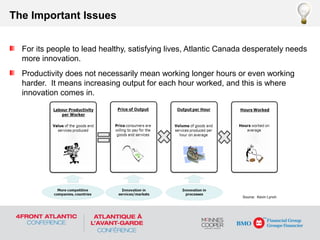
For its people to lead healthy, satisfying lives, Atlantic Canada desperately needs
more innovation.
Productivity does not necessarily mean working longer hours or even working
harder. It means increasing output for each hour worked, and this is where
innovation comes in.
The Important Issues
Source: Kevin Lynch
In this year’s World Economic
Forum’s global competitiveness
ranking, Canada slipped from 12th
to 14th in its overall ranking, scoring
behind China.
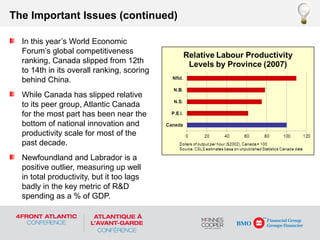
While Canada has slipped relative
to its peer group, Atlantic Canada
for the most part has been near the
bottom of national innovation and
productivity scale for most of the
past decade.
Newfoundland and Labrador is a
positive outlier, measuring up well
in total productivity, but it too lags
badly in the key metric of R&D
spending as a % of GDP.
The Important Issues (continued)
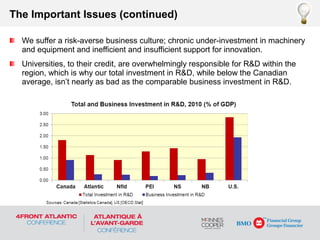
We suffer a risk-averse business culture; chronic under-investment in machinery
and equipment and inefficient and insufficient support for innovation.
Universities, to their credit, are overwhelmingly responsible for R&D within the
region, which is why our total investment in R&D, while below the Canadian
average, isn’t nearly as bad as the comparable business investment in R&D.
The Important Issues (continued)
Our universities have not been very successful in commercializing technologies.
That is primarily the role of business, and the business community perceives
academia as being difficult to engage with in meaningful relationships, and likely
vice versa.
There is a general lack of public awareness about what is being done on college
and university campuses and how business can play a role in commercializing
the schools’ discoveries.
There is also limited knowledge in the private sector of awareness of government
programs to support R&D collaboration.
The Important Issues (continued)
Not all is Doom and Gloom:
Recently each Atlantic province has highlighted innovation and productivity as
pillars for future growth.
There are pioneering programs to bridge the gap, such as Springboard Atlantic,
which acts as a link between business and the universities’ research capacity, and
AcelR8, a New Brunswick program aimed at knitting together innovative clusters.
there are massive capital programs underway in Atlantic Canada – such as the
Muskrat Falls hydro project, and the ship building contracts.
The Important Issues (continued)
What’s Needed
We need to reorient our competitiveness
approach to one based on productivity and
innovation—continually turning new ideas into
new, commercially viable, goods and services.
We must invest in advanced skills and
processes that stay in the region.
Our businesses must do more to invest in and
drive innovation.
We need to reorient our competitiveness
approach to one based on productivity and
innovation—continually turning new ideas into
new, commercially viable, goods and services.
We must invest in advanced skills and
processes that stay in the region.
Our businesses must do more to invest in and
drive innovation.
Private companies must play a lead role in innovation. They have to understand
it, invest in it and manage for it. There should be increase the collaboration and
alignment between university and industry R&D, making university research
capacity more accessible to private companies.
– Private companies should approach the universities’ industry liaison offices with
challenges they face.
– Universities must leverage the private sector investments with government programs
and build research capacity relevant to the challenges of business.
Our “Big Ideas”
We would like a refined and expanded role of Springboard Atlantic as a key
contact point and relationship-builder between industry and academia.
– Develop a prospect list of the top 300 companies in Atlantic Canada that could grow
their businesses through increased innovation and productivity.
– Visit all 300 companies over the next 12 months to educate, engage and find real
relevance for collaboration.
– Work with industry associations to identify common research agendas and work with the
members and universities to develop meaningful R&D.
We’d like regional chambers of commerce to commit to help educate the private
sector on the importance of R&D.
– Establish a private sector–university council on innovation, comprised of private sector
leaders and university vice-presidents of research, with the intention of aligning
business needs with university research.
Our “Big Ideas” (continued)
Atlantic Canadian innovators need an accelerator to support and mentor our
emerging start-ups and companies looking to innovate (similar to Communitech in
Waterloo). The recently launched Volta, is a great start and deserves our
support.
It should be easier for students, including international students, to be hired by
companies by leveraging existing partnership programs.
– Private sector companies should invest in internships under the federal Mitacs and
NSERC programs.
– Chambers of commerce to play a lead role in educating members on the value of these
programs.
Our “Big Ideas” (continued)
We need to improve the regional capacity for innovation.
– Create an ‘ideation space’ where businesses can come together to generate ideas.
– Create a mentor bank to help make matches between companies looking for advice,
connections, or introductions with experienced business leaders eager to give back.
We should our provincial governments to have strategic procurement programs in
place to enable innovative technologies.
Our “Big Ideas” (continued)
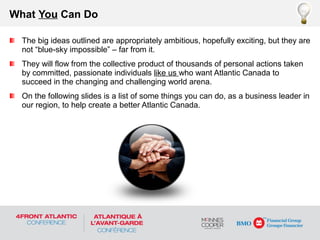
The big ideas outlined are appropriately ambitious, hopefully exciting, but they are
not “blue-sky impossible” – far from it.
They will flow from the collective product of thousands of personal actions taken
by committed, passionate individuals like us who want Atlantic Canada to
succeed in the changing and challenging world arena.
On the following slides is a list of some things you can do, as a business leader in
our region, to help create a better Atlantic Canada.
What You Can Do
Commit to increasing your firm’s investment in R&D.
Approach a university’s industry liaison office to see how you can work with the
institution’s researchers or tap into its projects with the challenges you face.
Get involved in regional chambers of commerce and help to educate the private
sector on the importance of R&D.
Investigate and use the Springboard program—Invite Springboard Atlantic into
your company to learn about university research, and how you may link into this
work.
Set aside “blue sky” innovation time at your companies.
Learn about Mitac and NSERC and offer a Mitac or NSERC internship program.
What You Can Do
Support and or participate in the launching of:
– an ideation space
– a mentor bank
If you are a young university or college graduate, consider turning your research
into a new business, or working with an established company in the region.
What You Can Do
Thank you for your help
with this important
initiative

Innovation and productivity

  • 1.
  • 2.
    For its peopleto lead healthy, satisfying lives, Atlantic Canada desperately needs more innovation. Productivity does not necessarily mean working longer hours or even working harder. It means increasing output for each hour worked, and this is where innovation comes in. The Important Issues Source: Kevin Lynch
  • 3.
    In this year’sWorld Economic Forum’s global competitiveness ranking, Canada slipped from 12th to 14th in its overall ranking, scoring behind China. While Canada has slipped relative to its peer group, Atlantic Canada for the most part has been near the bottom of national innovation and productivity scale for most of the past decade. Newfoundland and Labrador is a positive outlier, measuring up well in total productivity, but it too lags badly in the key metric of R&D spending as a % of GDP. The Important Issues (continued)
  • 4.
    We suffer arisk-averse business culture; chronic under-investment in machinery and equipment and inefficient and insufficient support for innovation. Universities, to their credit, are overwhelmingly responsible for R&D within the region, which is why our total investment in R&D, while below the Canadian average, isn’t nearly as bad as the comparable business investment in R&D. The Important Issues (continued)
  • 5.
    Our universities havenot been very successful in commercializing technologies. That is primarily the role of business, and the business community perceives academia as being difficult to engage with in meaningful relationships, and likely vice versa. There is a general lack of public awareness about what is being done on college and university campuses and how business can play a role in commercializing the schools’ discoveries. There is also limited knowledge in the private sector of awareness of government programs to support R&D collaboration. The Important Issues (continued)
  • 6.
    Not all isDoom and Gloom: Recently each Atlantic province has highlighted innovation and productivity as pillars for future growth. There are pioneering programs to bridge the gap, such as Springboard Atlantic, which acts as a link between business and the universities’ research capacity, and AcelR8, a New Brunswick program aimed at knitting together innovative clusters. there are massive capital programs underway in Atlantic Canada – such as the Muskrat Falls hydro project, and the ship building contracts. The Important Issues (continued)
  • 7.
    What’s Needed We needto reorient our competitiveness approach to one based on productivity and innovation—continually turning new ideas into new, commercially viable, goods and services. We must invest in advanced skills and processes that stay in the region. Our businesses must do more to invest in and drive innovation. We need to reorient our competitiveness approach to one based on productivity and innovation—continually turning new ideas into new, commercially viable, goods and services. We must invest in advanced skills and processes that stay in the region. Our businesses must do more to invest in and drive innovation.
  • 8.
    Private companies mustplay a lead role in innovation. They have to understand it, invest in it and manage for it. There should be increase the collaboration and alignment between university and industry R&D, making university research capacity more accessible to private companies. – Private companies should approach the universities’ industry liaison offices with challenges they face. – Universities must leverage the private sector investments with government programs and build research capacity relevant to the challenges of business. Our “Big Ideas”
  • 9.
    We would likea refined and expanded role of Springboard Atlantic as a key contact point and relationship-builder between industry and academia. – Develop a prospect list of the top 300 companies in Atlantic Canada that could grow their businesses through increased innovation and productivity. – Visit all 300 companies over the next 12 months to educate, engage and find real relevance for collaboration. – Work with industry associations to identify common research agendas and work with the members and universities to develop meaningful R&D. We’d like regional chambers of commerce to commit to help educate the private sector on the importance of R&D. – Establish a private sector–university council on innovation, comprised of private sector leaders and university vice-presidents of research, with the intention of aligning business needs with university research. Our “Big Ideas” (continued)
  • 10.
    Atlantic Canadian innovatorsneed an accelerator to support and mentor our emerging start-ups and companies looking to innovate (similar to Communitech in Waterloo). The recently launched Volta, is a great start and deserves our support. It should be easier for students, including international students, to be hired by companies by leveraging existing partnership programs. – Private sector companies should invest in internships under the federal Mitacs and NSERC programs. – Chambers of commerce to play a lead role in educating members on the value of these programs. Our “Big Ideas” (continued)
  • 11.
    We need toimprove the regional capacity for innovation. – Create an ‘ideation space’ where businesses can come together to generate ideas. – Create a mentor bank to help make matches between companies looking for advice, connections, or introductions with experienced business leaders eager to give back. We should our provincial governments to have strategic procurement programs in place to enable innovative technologies. Our “Big Ideas” (continued)
  • 12.
    The big ideasoutlined are appropriately ambitious, hopefully exciting, but they are not “blue-sky impossible” – far from it. They will flow from the collective product of thousands of personal actions taken by committed, passionate individuals like us who want Atlantic Canada to succeed in the changing and challenging world arena. On the following slides is a list of some things you can do, as a business leader in our region, to help create a better Atlantic Canada. What You Can Do
  • 13.
    Commit to increasingyour firm’s investment in R&D. Approach a university’s industry liaison office to see how you can work with the institution’s researchers or tap into its projects with the challenges you face. Get involved in regional chambers of commerce and help to educate the private sector on the importance of R&D. Investigate and use the Springboard program—Invite Springboard Atlantic into your company to learn about university research, and how you may link into this work. Set aside “blue sky” innovation time at your companies. Learn about Mitac and NSERC and offer a Mitac or NSERC internship program. What You Can Do
  • 14.
    Support and orparticipate in the launching of: – an ideation space – a mentor bank If you are a young university or college graduate, consider turning your research into a new business, or working with an established company in the region. What You Can Do
  • 15.
    Thank you foryour help with this important initiative

Editor's Notes