What Matters46
Innovation
The global recession is commanding most of the attention of
business executives and government leaders. But they should not
lose sight of innovation: managers know that the future of their
businesses depend on it, and government leaders understand that
the long-term growth prospects of cities and nations are tied
to it. Even—perhaps especially—in times of economic turbulence,
innovation remains the most important differentiator separat-
ing economic winners from also-rans.
McKinsey has partnered with the World Economic Forum to create
an “Innovation Heat Map,” by identifying factors that are com-
mon to successful innovation hubs. As part of this effort, we have
examined the evolution of hundreds of such clusters around
the world and analyzed over 700 variables, including those driving
innovation (business environment, government and regulation,
human capital, infrastructure, and local demand) along with prox-
ies for innovation output (for example, economic value added,
journal publications, patent applications) to identify trends among
the success stories. In the process, we have found patterns that
suggest the critical ingredients required to grow, nurture, and
sustain innovation hubs. At the same time, we have compiled thou-
sands of data points that may be used to identify bottlenecks
and benchmark the performance of cities, regions, and countries
by measuring how they are evolving.
Creating a cluster: Of fundamentals and focus
Our analysis identified a set of fundamentals that are needed to
establish a minimum infrastructure base. Criteria such as
the quality of the physical infrastructure (for example, electrical,
transportation, and telecommunications) and governance
indicators (for instance, rule of law and government stability) are
essential for a location to “earn the right to play.” Meeting
this minimal threshold is an important prerequisite. Further
improvements to this base, interestingly, are associated with
only incremental growth in innovation capacity.
Once a base is established, innovation hubs must then develop
a specific sector focus. Our analysis of the world’s must successful
Where will the world’s primary
centers of innovation be?
André Andonian, Christoph Loos, and Luiz Pires
André Andonian is a director in McKinsey’s Munich office and leader of the Europe, Middle East, and
Africa high-tech practice; Christoph Loos is an associate principal in the Frankfurt office; and Luiz Pires is
a consultant in the Munich office and the EMEA high-tech practice manager.
Building an innovation nation
>
47
clusters shows that they have first established themselves as world-
class players in an emerging specialty before expanding. This
focus allows locations to concentrate limited resources, such as
labor and capital, on developing competence and credibility.
When successful, the result of these first two steps is the emergence
of what we call an “innovation hot spring”: a small and fast-
growing hub that relies on a small number of companies to establish
itself as a relevant world player in a narrow sector. Our analysis
indicates that these early innovation hubs have historically followed
one of three primary paths.
> Heroic bets: large, government-led, targeted investment efforts
that focus on a specific promising sector and provide substan-
tial initial support in the form of subsidies, tax holidays, and direct
investments, to name a few. While this has been an attractive
option for many locations, it has historically been a challenging
path: governments are often ill equipped to identify the right
sectors, to define nondistorting incentive structures, and to ensure
an effective path out of the initial support phase.
> Irresistible deals: regions that are able to attract established
companies (often foreign players) who want to capitalize on
a significant local advantage, such as low cost of qualified labor or
access to large local markets. When done effectively, the loca-
tion can build on this base to add greater value over time, moving,
for example, from manufacturing to basic engineering to design
and innovation. To be successful, regions need to create mechanisms
that encourage the effective transfer of knowledge to the local
ecosystem, as well as tools and processes to raise the skills of the
local labor pool.
0
Low High
High
Momentum:
Average growth of
US patents in cluster,
1997–2006
Diversity: Number of separate companies
and patent sectors in cluster in 2006
Mapping innovation clusters
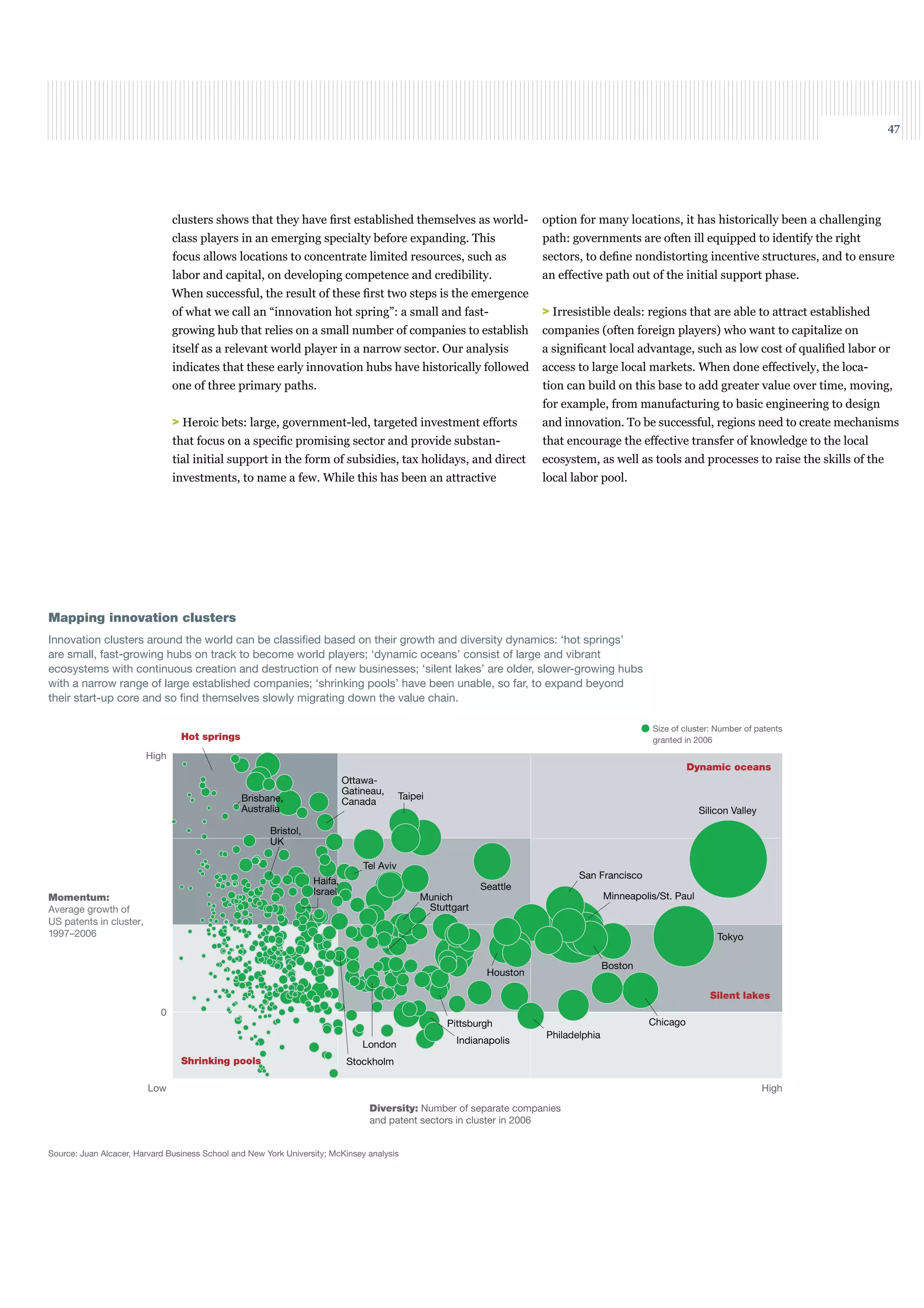
Innovation clusters around the world can be classified based on their growth and diversity dynamics: ‘hot springs’
are small, fast-growing hubs on track to become world players; ‘dynamic oceans’ consist of large and vibrant
ecosystems with continuous creation and destruction of new businesses; ‘silent lakes’ are older, slower-growing hubs
with a narrow range of large established companies; ‘shrinking pools’ have been unable, so far, to expand beyond
their start-up core and so find themselves slowly migrating down the value chain.
Source: Juan Alcacer, Harvard Business School and New York University; McKinsey analysis
Silicon Valley
Chicago
Philadelphia
Pittsburgh
IndianapolisLondon
Stockholm
Houston
Minneapolis/St. Paul
San Francisco
Seattle
Munich
Taipei
Ottawa-
Gatineau,
Canada
Stuttgart
Tokyo
Dynamic oceans
Silent lakes
Hot springs
Brisbane,
Australia
Shrinking pools
Haifa,
Israel
Bristol,
UK
Tel Aviv
Boston
Size of cluster: Number of patents
granted in 2006
What Matters48
Innovation
> Knowledge oases: locations with a critical mass of highly
specialized talent (for instance, a large research university or
government R&D lab). These hubs capitalize on break-
through technical advances for commercial success. This path is
less frequently successful, however. It requires that locations
attract the capital and entrepreneurial skills needed to bridge the
chasm between idea creation and commercialization.
While innovation clusters may grow quickly in the short term, only
a small proportion of these promising hot springs stand the
test of time. Most hit a ceiling of limited resources that severely
constrains their growth.
Nurturing the cluster: Securing the talent base
Our work has shown that critical drivers of innovation vary from
sector to sector. The local regulatory environment, for example,
is a critical determinant for some sectors; for others, the availabil-
able to draw from a very large demographic pool, need to train
a larger proportion of their population to reach world-class levels.
They also must increase the attractiveness of their hubs to better
compete for top global talent. While simply meeting basic
infrastructure needs is sufficient to sustain initial growth, a region
must establish itself as an attractive destination for global talent
in order to establish itself as an innovation hub.
Sustaining the cluster: Sowing the seeds of reinvention
While focus is critical for emerging innovation hubs, as they
mature, they need to broaden their portfolios of businesses and
sectors. This diversification is vital to the long-term survival
of an innovation hub—it allows the hub to survive the unavoidable
downturns that affect specific sectors and provides the impetus
for continuous reinvention. New innovators typically emerge in
adjacent industries, or as hubs attract nonlocal players that want to
capitalize on the local infrastructure and available talent. Our
When it comes to talent, Japan and Western Europe
must overcome a severe demographic challenge–their
fast-aging populations and growing number of
retirees need to be replaced
or their labor efficiency further enhanced.
“
”
ity of venture capital or the presence of a demanding local
customer base are key. However, the single common factor that
drives—or, indeed, constrains—innovation across all sectors
is the availability of a well-qualified and specialized talent pool.
While a hub’s initial success can often be fueled by relying
primarily on local talent, the importance of attracting, develop-
ing, and retaining a vibrant base of world-class talent increases as
clusters mature and grow in complexity.
While the need for talent is the same all over the world, differ-
ent locations are currently facing very different challenges. Japan
and Western Europe must overcome a severe demographic
challenge—their fast-aging populations and growing number of
retirees need to be replaced or their labor efficiency further
enhanced. North America is struggling with the challenge of replac-
ing a large number of highly specialized immigrants who are now
choosing to stay or return home. Emerging Asian economies, while
data indicates that, depending on the strategy, mature innovation
clusters will evolve toward one of the following categories:
> Dynamic oceans: large and vibrant innovation ecosystems
with continuous creation and destruction of new busi-
nesses. Leading innovators and primary sectors change organically
as the hub frequently reinvents itself through significant
breakthrough innovations.
> Silent lakes: slow-growing innovation ecosystems backed
by a narrow range of very large established companies that operate
in a handful of sectors. These clusters are frequently the
source of a steady stream of “evolutionary” innovations and
step-wise improvements.
> Shrinking pools: innovation hubs that are unable to broaden
their areas of activity or increase their lists of innovators
49
Irving Wladawsky-Berger on knowledge creation. Think
Venice and Florence in the transition from the Middle Ages to
the Renaissance, or think London and New York in the transition
from the agricultural age to the industrial one. Throughout his-
tory, certain cities and the regions around them have been the major
centers of innovation in a variety of different fields, as a result of
their unique accumulation of talent and wealth.
What we had then, and now, is largely the workings of network
effects—that is, the more talented people you have in close
proximity, the more their ideas and their work influence each other
and stimulate them to innovate. While talent is necessary to
becoming an innovation hub, you need wealth in order to support
the talented people and bring their work to market. You also
need an open culture that values a diversity of ideas and experi-
ences. Eventually, these innovation network effects become
formidable barriers to entry for competing regions.
Given the prominence of information technologies in the transition
from the industrial to the knowledge age, over the last 30 years
we have seen the rise of Silicon Valley and a few other technology-
based innovation hubs, like Boston, built around the great
engineering universities in their midst—think Stanford University,
the University of California at Berkeley, and the Massachusetts
Institute of Technology (MIT).
But something interesting is now happening. While information
technology is very much the engine driving the knowledge age, the
bulk of future innovation and ensuing economic growth is less
likely to be driven by the technologies and products coming from
labs than from their applications outside the laboratory. Activi-
ties that involve people, either as providers or consumers of services,
will be particularly significant.
What’s next in the knowledge economy?
Another take
This means that the biggest opportunities for innovation, productivity,
job creation, and economic growth can now be found as we
apply the huge advances in IT, the Internet, and related technologies
to address problems in the marketplace and society at large, in
industry after industry, from health care to finance distribution, enter-
tainment, and media. I believe that such IT-based marketplace and
societal transformations are going to be the essence of the
knowledge economy.
In principle, cities like London and New York—with strong talent
bases and economic positions in key industries that IT is now
transforming—should do quite well, if they welcome technology and
engineering into the mix. And it may be Silicon Valley, the Boston
area, and other key technology-based innovation hubs that have to
play catch-up. While their open cultures and ability to generate
a culture of opportunity will continue to attract talented people and
investors from all over the world, they may need to become more
urban-like—more complex and diverse in their cultural and industrial
base—in order to capture the kinds of innovation that will be
driving the most growth and societal benefit in the years ahead.
In other words, it may not be enough to build social networks of
techies and entrepreneurs. The economic and cultural palette may
need to be broader.
This essay comes from the personal blog of Irving Wladawsky-Berger, (irvingwb.
typepad.com), chairman emeritus of the IBM Academy of Technology.
and so find themselves slowly migrating down the value chain,
as their narrow sector becomes less innovation driven and
increasingly commoditized.
The data-driven methodology of the Innovation Heat Map sheds
new light on the innovation process and allows for an objective
diagnosis of both innovation output and local bottlenecks.
Going forward, we look to built upon this approach to evaluate
conventional wisdom about the drivers of innovative
environments and thus bring new perspectives to this vitally
important topic.

Innovation Heatmap - What Matters

  • 1.
    What Matters46 Innovation The globalrecession is commanding most of the attention of business executives and government leaders. But they should not lose sight of innovation: managers know that the future of their businesses depend on it, and government leaders understand that the long-term growth prospects of cities and nations are tied to it. Even—perhaps especially—in times of economic turbulence, innovation remains the most important differentiator separat- ing economic winners from also-rans. McKinsey has partnered with the World Economic Forum to create an “Innovation Heat Map,” by identifying factors that are com- mon to successful innovation hubs. As part of this effort, we have examined the evolution of hundreds of such clusters around the world and analyzed over 700 variables, including those driving innovation (business environment, government and regulation, human capital, infrastructure, and local demand) along with prox- ies for innovation output (for example, economic value added, journal publications, patent applications) to identify trends among the success stories. In the process, we have found patterns that suggest the critical ingredients required to grow, nurture, and sustain innovation hubs. At the same time, we have compiled thou- sands of data points that may be used to identify bottlenecks and benchmark the performance of cities, regions, and countries by measuring how they are evolving. Creating a cluster: Of fundamentals and focus Our analysis identified a set of fundamentals that are needed to establish a minimum infrastructure base. Criteria such as the quality of the physical infrastructure (for example, electrical, transportation, and telecommunications) and governance indicators (for instance, rule of law and government stability) are essential for a location to “earn the right to play.” Meeting this minimal threshold is an important prerequisite. Further improvements to this base, interestingly, are associated with only incremental growth in innovation capacity. Once a base is established, innovation hubs must then develop a specific sector focus. Our analysis of the world’s must successful Where will the world’s primary centers of innovation be? André Andonian, Christoph Loos, and Luiz Pires André Andonian is a director in McKinsey’s Munich office and leader of the Europe, Middle East, and Africa high-tech practice; Christoph Loos is an associate principal in the Frankfurt office; and Luiz Pires is a consultant in the Munich office and the EMEA high-tech practice manager. Building an innovation nation >
  • 2.
    47 clusters shows thatthey have first established themselves as world- class players in an emerging specialty before expanding. This focus allows locations to concentrate limited resources, such as labor and capital, on developing competence and credibility. When successful, the result of these first two steps is the emergence of what we call an “innovation hot spring”: a small and fast- growing hub that relies on a small number of companies to establish itself as a relevant world player in a narrow sector. Our analysis indicates that these early innovation hubs have historically followed one of three primary paths. > Heroic bets: large, government-led, targeted investment efforts that focus on a specific promising sector and provide substan- tial initial support in the form of subsidies, tax holidays, and direct investments, to name a few. While this has been an attractive option for many locations, it has historically been a challenging path: governments are often ill equipped to identify the right sectors, to define nondistorting incentive structures, and to ensure an effective path out of the initial support phase. > Irresistible deals: regions that are able to attract established companies (often foreign players) who want to capitalize on a significant local advantage, such as low cost of qualified labor or access to large local markets. When done effectively, the loca- tion can build on this base to add greater value over time, moving, for example, from manufacturing to basic engineering to design and innovation. To be successful, regions need to create mechanisms that encourage the effective transfer of knowledge to the local ecosystem, as well as tools and processes to raise the skills of the local labor pool. 0 Low High High Momentum: Average growth of US patents in cluster, 1997–2006 Diversity: Number of separate companies and patent sectors in cluster in 2006 Mapping innovation clusters Innovation clusters around the world can be classified based on their growth and diversity dynamics: ‘hot springs’ are small, fast-growing hubs on track to become world players; ‘dynamic oceans’ consist of large and vibrant ecosystems with continuous creation and destruction of new businesses; ‘silent lakes’ are older, slower-growing hubs with a narrow range of large established companies; ‘shrinking pools’ have been unable, so far, to expand beyond their start-up core and so find themselves slowly migrating down the value chain. Source: Juan Alcacer, Harvard Business School and New York University; McKinsey analysis Silicon Valley Chicago Philadelphia Pittsburgh IndianapolisLondon Stockholm Houston Minneapolis/St. Paul San Francisco Seattle Munich Taipei Ottawa- Gatineau, Canada Stuttgart Tokyo Dynamic oceans Silent lakes Hot springs Brisbane, Australia Shrinking pools Haifa, Israel Bristol, UK Tel Aviv Boston Size of cluster: Number of patents granted in 2006
  • 3.
    What Matters48 Innovation > Knowledgeoases: locations with a critical mass of highly specialized talent (for instance, a large research university or government R&D lab). These hubs capitalize on break- through technical advances for commercial success. This path is less frequently successful, however. It requires that locations attract the capital and entrepreneurial skills needed to bridge the chasm between idea creation and commercialization. While innovation clusters may grow quickly in the short term, only a small proportion of these promising hot springs stand the test of time. Most hit a ceiling of limited resources that severely constrains their growth. Nurturing the cluster: Securing the talent base Our work has shown that critical drivers of innovation vary from sector to sector. The local regulatory environment, for example, is a critical determinant for some sectors; for others, the availabil- able to draw from a very large demographic pool, need to train a larger proportion of their population to reach world-class levels. They also must increase the attractiveness of their hubs to better compete for top global talent. While simply meeting basic infrastructure needs is sufficient to sustain initial growth, a region must establish itself as an attractive destination for global talent in order to establish itself as an innovation hub. Sustaining the cluster: Sowing the seeds of reinvention While focus is critical for emerging innovation hubs, as they mature, they need to broaden their portfolios of businesses and sectors. This diversification is vital to the long-term survival of an innovation hub—it allows the hub to survive the unavoidable downturns that affect specific sectors and provides the impetus for continuous reinvention. New innovators typically emerge in adjacent industries, or as hubs attract nonlocal players that want to capitalize on the local infrastructure and available talent. Our When it comes to talent, Japan and Western Europe must overcome a severe demographic challenge–their fast-aging populations and growing number of retirees need to be replaced or their labor efficiency further enhanced. “ ” ity of venture capital or the presence of a demanding local customer base are key. However, the single common factor that drives—or, indeed, constrains—innovation across all sectors is the availability of a well-qualified and specialized talent pool. While a hub’s initial success can often be fueled by relying primarily on local talent, the importance of attracting, develop- ing, and retaining a vibrant base of world-class talent increases as clusters mature and grow in complexity. While the need for talent is the same all over the world, differ- ent locations are currently facing very different challenges. Japan and Western Europe must overcome a severe demographic challenge—their fast-aging populations and growing number of retirees need to be replaced or their labor efficiency further enhanced. North America is struggling with the challenge of replac- ing a large number of highly specialized immigrants who are now choosing to stay or return home. Emerging Asian economies, while data indicates that, depending on the strategy, mature innovation clusters will evolve toward one of the following categories: > Dynamic oceans: large and vibrant innovation ecosystems with continuous creation and destruction of new busi- nesses. Leading innovators and primary sectors change organically as the hub frequently reinvents itself through significant breakthrough innovations. > Silent lakes: slow-growing innovation ecosystems backed by a narrow range of very large established companies that operate in a handful of sectors. These clusters are frequently the source of a steady stream of “evolutionary” innovations and step-wise improvements. > Shrinking pools: innovation hubs that are unable to broaden their areas of activity or increase their lists of innovators
  • 4.
    49 Irving Wladawsky-Berger onknowledge creation. Think Venice and Florence in the transition from the Middle Ages to the Renaissance, or think London and New York in the transition from the agricultural age to the industrial one. Throughout his- tory, certain cities and the regions around them have been the major centers of innovation in a variety of different fields, as a result of their unique accumulation of talent and wealth. What we had then, and now, is largely the workings of network effects—that is, the more talented people you have in close proximity, the more their ideas and their work influence each other and stimulate them to innovate. While talent is necessary to becoming an innovation hub, you need wealth in order to support the talented people and bring their work to market. You also need an open culture that values a diversity of ideas and experi- ences. Eventually, these innovation network effects become formidable barriers to entry for competing regions. Given the prominence of information technologies in the transition from the industrial to the knowledge age, over the last 30 years we have seen the rise of Silicon Valley and a few other technology- based innovation hubs, like Boston, built around the great engineering universities in their midst—think Stanford University, the University of California at Berkeley, and the Massachusetts Institute of Technology (MIT). But something interesting is now happening. While information technology is very much the engine driving the knowledge age, the bulk of future innovation and ensuing economic growth is less likely to be driven by the technologies and products coming from labs than from their applications outside the laboratory. Activi- ties that involve people, either as providers or consumers of services, will be particularly significant. What’s next in the knowledge economy? Another take This means that the biggest opportunities for innovation, productivity, job creation, and economic growth can now be found as we apply the huge advances in IT, the Internet, and related technologies to address problems in the marketplace and society at large, in industry after industry, from health care to finance distribution, enter- tainment, and media. I believe that such IT-based marketplace and societal transformations are going to be the essence of the knowledge economy. In principle, cities like London and New York—with strong talent bases and economic positions in key industries that IT is now transforming—should do quite well, if they welcome technology and engineering into the mix. And it may be Silicon Valley, the Boston area, and other key technology-based innovation hubs that have to play catch-up. While their open cultures and ability to generate a culture of opportunity will continue to attract talented people and investors from all over the world, they may need to become more urban-like—more complex and diverse in their cultural and industrial base—in order to capture the kinds of innovation that will be driving the most growth and societal benefit in the years ahead. In other words, it may not be enough to build social networks of techies and entrepreneurs. The economic and cultural palette may need to be broader. This essay comes from the personal blog of Irving Wladawsky-Berger, (irvingwb. typepad.com), chairman emeritus of the IBM Academy of Technology. and so find themselves slowly migrating down the value chain, as their narrow sector becomes less innovation driven and increasingly commoditized. The data-driven methodology of the Innovation Heat Map sheds new light on the innovation process and allows for an objective diagnosis of both innovation output and local bottlenecks. Going forward, we look to built upon this approach to evaluate conventional wisdom about the drivers of innovative environments and thus bring new perspectives to this vitally important topic.